The Grand Narrative

Women’s Bodies in Korea’s Consumer Society, Part 2: We’re not in Kansas Anymore

Posted in East Asia, Korean Advertisements, Korean Economy, Korean History, Korean Media by James Turnbull on March 26, 2008

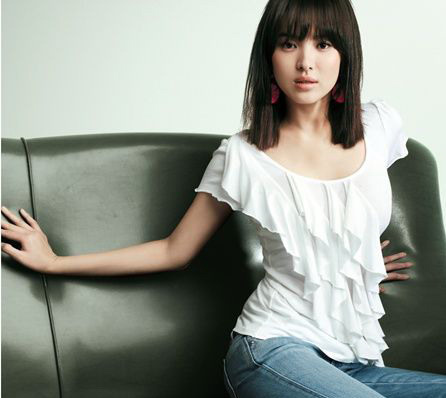
song-hye-gyos-cherry.jpg

(Photo by +~*aRyaNa*~+)

The Paradox

For new readers, Part 1 was an outline and discussion of the first part of the 2003 journal article Neo-Confucian Body Techniques: Women’s Bodies in Korea’s Consumer Society by Taeyon Kim. To quickly recap it, she argues that women weren’t really thought of as individuals in Joseon Dynasty Korea, as the state ideology of Neo-Confucianism considered them incapable of the spiritual transcendence that men were. Instead, the best they could aim for in life was continuing a husband’s “ki”, or spirit, through the production and upbringing of sons and the efficient management of his household. Hence Kim describes them as “subjectless bodies,” as not only were they not really individuals but their physical bodies were not really their own either, merely being vessels for and tenders of the more precious ki instead.

In terms of the ideals for women’s appearance, this meant that the physical attributes required for both were prized more than beauty. On top of that, adornment and/or alteration of the body was not condoned for either sex, as the physical body was one’s inheritance of ancestors’ sacred ki. And herein lies the paradox, as on the one hand Neo-Confucianism still pervades all aspects of Korean life today (I’ll take readers knowing and agreeing with this as a given), but on the other hand, modern Korea appears to be in the midst of a decidedly non-traditional celebration of youth and the female form. What gives?

Neo-Confucian Consumption Motives

jeon-ji-hyuncome-and-drink-tea-with-me.jpg

(Photo by !°jeon ji-hyun)

The short answer is that appearances can be deceptive. It is certainly true that modern media images of Korean women are not Neo-Confucian in the 19th Century sense described above, and it’s difficult to argue just by looking at them that advertisements, for instance, are any different to their counterparts in Western countries. Of course, systematic cross-country analyses of numbers and types do reveal significant and telling differences, and if readers are interested in those then I highly recommend reading the 2006 journal article entitled “Content Analysis of Diet Advertisments: A Cross-National Comparison of Korean and U.S. Women’s Magazines” by Minjeong Kim and Sharron Lennon, downloadable here. But surveys like those do not chronicle average Korean and Western women’s reactions to them, and herein lies the essential differences between them.

In Western countries especially, most (although not all) advertisements for a product have to actively suppress and disguise the notion that people may feel compelled, influenced or forced into purchasing that product, whether by the ad, by peer pressure, or some other unwritten social rule. Instead, people are encouraged to conceive their purchase in terms of personal choice, individuality, empowerment, and – especially if the target consumer is young – maybe liberation, and the breaking of rules too (I discuss these notions in more detail in this very academic post). Of course, these advertising norms probably operate for a good proportion of advertisements in Korea too. But in the case of advertisements for products related to one’s appearance, be they cosmetics, clothes, or plastic surgery, then it turns out that most Korean women make purchases for precisely the opposite reasons. Indeed, not only is there no stigma in doing so, but they positively embrace the opportunity to conform to and harmonize with social norms through their consumption choices.

judge-of-korean-form.jpg

Lest that assertion sound like a typical exaggeration of a mere Caucasian male, surveys that Kim cites indicate that most Korean women explicitly justify their choices in those Neo-Confucian terms, and definitely not the individual empowerment, entitlement, and personal assertion of one’s individual choice that Western women tend to do in similar surveys. That is not to say that Western women (or men) can’t and don’t also passively follow fashions, and it’s not necessarily a negative or dehumanizing thing either (again, see this post for more on that). But very few Westerners would admit to it.

green-conformity.jpg

(Photo by Matzepeng)

I see no reason to doubt the results of those surveys (which I can provide the details of if readers wish), and while my own female Korean friends for instance, are certainly as liberal and free-willed as any Westerner in their clothing and cosmetic choices – that’s why we’re friends – they can’t counter the mass of empirical evidence Kim provides and the anecdotal evidence from the media and on the streets of Korea. If Neo-Confucianism is pervasive in modern Korean life then, and Korean women consume cosmetics, clothes, and undergo plastic surgery operations largely for the sake of Neo-Confucianist motives, then it’s time to call a spade a spade and argue that Korean society’s new emphasis on women’s appearances is (somehow) Neo-Confucianist too. Indeed, it would be strange if only this particular aspect of Korean life was so different.

Hence, the second part of Kim’s article is about how this modern phenomenon is a warping of and adaptation of Neo-Confucian ideals of women’s roles to new capitalist and consumerist circumstances. But while I originally wanted to outline and discuss that in this post, first I wanted to place those circumstances in their historical context, and because that took up too much space then I had to move Kim to Part 3 (to come soon). I focus so much on that context myself mainly because it’s interesting (of course), but also because while a discussion of it would have been too far removed from Kim’s focus (and area of expertise) of women’s bodies for her to consider covering, I think it considerably adds to and strengthens her argument.

The Developmental Context of East Asian Consumption

enjoy-capitalism.jpg

(Photo by Fritz Hayek)

I’ve already demonstrated that although Korean women and, say, American women, can both be labelled as “consumers,” they can and do both make radically different consumption choices, or make the same choices but for radically different reasons. Sure, this is obvious, but I’m as guilty as anyone in generalising and using labels here, so it’s good to remind ourselves of it. But if we shift our attention to the differences between most Westerners and most Koreans (and East Asians) as a whole, the first fact of note is the fact that most Korean university students’ parents easily recall the days when possession of some must-have items like a fridge, radio, color TV and car were essential signifier that one’s family had made it into the then swelling ranks of the middle-class. On that basis, its fair to say that they still imbue their consumer goods with much more status and importance than most Westerners do. Hell, many of the university students themselves too. This explains Koreans’ love affair with big cars and SUVs for instance, and in one of the most oil-lacking, mountainous and densely-populated countries in the world.

proud-korean-family-with-car.jpg

(Photo by benhuh)

On top of that, Korean governments since 1961 have explicitly and fervently extorted Koreans to consume these items, provided that they were made in Korea. It’s easy to simply attribute this to and write off as mere nationalism, only different in degree to, say, the “Buying Kiwi-Made” campaign in New Zealand, or Democratic presidential candidates in the US criticising NAFTA in election year. But this is quite wrong. If you’ll bear with me for a moment, to properly understand women’s fashions in Korea you need to understand a little of it’s well, political history first. No, really.

When Park Chung-hee/박정희 took power through a coup in 1961, while his military regime of course relied on the use of force, it would be naive to assume that it didn’t have a great deal of popular support. And so, originally at least, his military regime’s sole claim to legitimacy was its perceived ability and capacity to produce the economic development seen as necessary for national security after the chaotic years of the Syngman Rhee/이승만 presidency. While linking the economy and security this way may sound absurd in 2008, it’s important to be aware that North Korea was actually ahead of South Korea economically until the late-1960s, and in addition to this Park was (justifiably) deeply concerned about the US possibly withdrawing its security guarantees to South Korea in the wake of its foreseeable withdrawal from Vietnam. Hence the development of POSCO and the Korean steel industry for instance, which, far from being the carefully planned and coordinated developmental success story it is often touted as today (it is the third largest steel producer in the world), was pursued despite the advice of Korean economists at the time, let alone American ones. Instead, as Mark Clifford explains in chapter five of this must-have book, Park didn’t care about the economics of it; he simply wanted the ability to produce tanks and ships should the US no longer provide them.
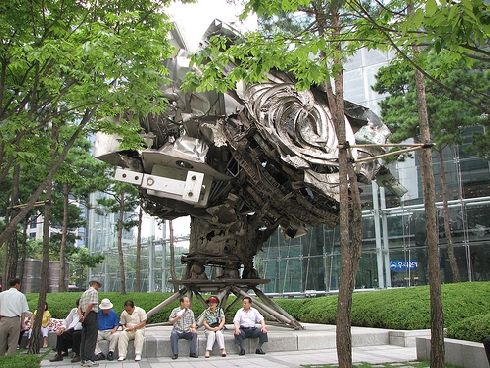
posco-center-statue.jpg

(Posco Center, Seoul. Photo by Ian Muttoo)

This is why Korea is often known as a “Developmental State,” as too are Japan, Taiwan and Singapore, which faced similarly dire circumstances in the Cold War and reacted in similar ways. Neo-liberal economists in particular are loath to admit that state-led development can be successful, and so they continue to critique the economic policies of these Developmental States decades later, but this excessive focus on economic minutiae has overshadowed the fact that they were and are primarily socio-political, not economic, phenomenons.

Hence consumerism has links to national security in Developmental States, and all the choice government slogans like “Consumption is Virtuous” that I saw in old photographs of Korea from the ’70s in economic journals in the archives room of my university library. And while the corollary of Park’s developmentalism was authoritarianism, and average Koreans were expected to be content with and prolific buyers of Korean goods, imports being shut out by high tariffs in order to develop Korea’s own industries (which is why such a stigma remains on imports today), what I want you to take away from all the above is that:

  • Koreans are used to being told what to buy.
  • These choices have often been couched in terms of contributing to a higher purpose.
  • Those that didn’t subscribe to these higher purposes were given few alternatives, and the state was encouraged in stigmatizing them.

It is no great conceptual leap for Neo-Confucian women to go from being subservient to the higher purpose of ki, and their bodies to be imperfect versions of men’s, to furthering the higher purpose of improving the economy and maintaining national security by consuming Korean goods, and finding common identity in a turbulent century by following the new fashion industry’s edicts to improve their imperfect bodies by following their rules for fashion, cosmetics, and body shapes. Those will be the subject of Part 3.

Share

Women’s Bodies in Korea’s Consumer Society, Part 1: Their Neo-Confucian Heritage

Posted in East Asia, Korean History by James Turnbull on March 19, 2008

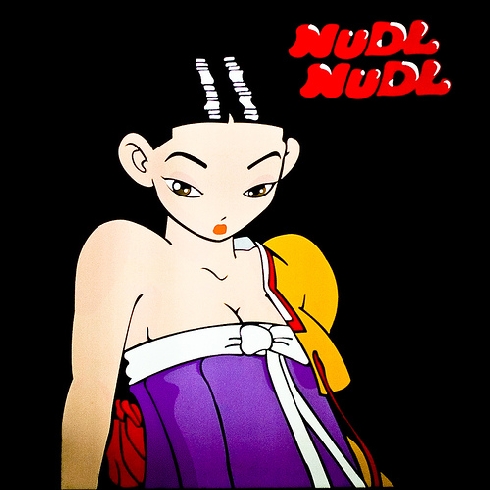
Dasepo Naughty Girls 2006

( Screen capture from the movie Dasepo Naughty Girls/다세포소녀. Source: martin francisco )

“Koreans are conformist because of their Confucian heritage…yada yada yada”

Even though I’ve chosen to live in Korea a long time, like most expats I still often find it to be a frustrating and exasperating place. Actually I don’t think that that’s necessarily a criticism, and this love-hate relationship may even be part of it’s charm; certainly my adopted hometown of Auckland, New Zealand, never aroused such strong emotions in me.

On the other hand, it leads to so many one-liners about the place, endlessly repeated in the same expat bars by fresh rotations of teachers, and I’ve been on a bit of a roll critiquing many in the Korean blogosphere recently, both positive and negative (see here and here). Still, that’s not to say that they’re always wrong, or that I don’t sometimes use them myself. Indeed, today I’m going to examine one that I and probably most readers have made at some point in our stay here, but which I personally wouldn’t have been able to justify before I did my research for this post.

What I have in mind is your gut reaction to watching this commercial, about three years old:

According to Marmot’s Hole commentator mins0306, to whom I’m very grateful for finding the video, the message the commercial wanted to convey was “What she selects will become a trend. And since she selected a Prugio apartment, Prugio apartments will also become a trend.” Instead, it has inadvertently become of a symbol of Korean people’s conformism, particularly of women’s attitudes to fashion.

But before writing this post, had I been pressed for why so many Korean women seem to so blindly follow the latest trends, be they mini-skirts in winter or getting double-eyelid surgery, I would have mumbled something about Confucianism and the education system discouraging individuality. That is still technically correct, but – let’s face it – most of us blame so much here on Confucianism, but actually know little more about it than what we read in Lonely Planet Korea in the week before we came. But how, exactly, is it to blame? Why?

On the surface, it may not even have anything to do with Confucianism at all. Consider this statement from the 2003 journal article “Neo-Confucian Body Techniques: Women’s Bodies in Korea’s Consumer Society” by Taeyon Kim (details and abstract here):

“For 500 years, Korea adopted Neo-Confucianism as its official ideology and strove to create a Neo-Confucian state by following its precepts as closely as possible. Neo-Confucians believed the body was sacred. Since it was bequeathed by one’s parents, in accordance with filial piety, the body had to be respected and remain unaltered…The Korean aversion to manipulation of the body seems to have been a long-standing cultural principle – only whole-heartedly abandoned in the last few years of proliferating plastic surgeries and various other manipulations of the body. Why has what appears to have been such a strong cultural value been so suddenly and completely abandoned?” (p. 98)

jeon-ji-hyeon-tea-drink-one.jpg

( Source: !°jeon ji-hyun )

Like I said, I didn’t know that Joseon Dynasty Korea adopted ”Neo-Confucianism” rather than merely “Confucianism” its state ideology either; from now on, I’ll make sure to blame all Korean ills on that instead. But now that she mentions it, yes, I do recall that Confucianism…oops, Neo-Confucianism I mean…did not condone alteration and adornment of the body, which is why it was so dishonourable for men to have their ponytails cut off.

How then, can Korea still be described as “more Confucian than China” when Korean women adorn fashion and accessories to the point of what Michael Hurt describes as “fetishization,” female friends of mine wear excessive make-up to work upon fear of being fired if they don’t, others think nothing of wearing it to the gym, and Korea leads the world in the number of plastic surgeries made per capita? The notion now sounds absurd.

But Kim goes on to argue that the prescribed Neo-Confucian role of women’s bodies is essentially the same today as it was in the Joseon Dynasty, albeit adapted to and/or warped by democratization and capitalism. I don’t entirely agree with everything she says, but more in degree than in substance, and she certainly does make a decent stab at solving that paradox above.

Because her two-part argument is very long, and I actually have a lot of my own thoughts and ideas to add to her arguments about postwar Korea, I’ve taken the wise (but unusual for me!) decision to split my original 3500 word post on her journal article into two. In the remainder of this first one then, I’ll outline what Kim says about how Neo-Confucianism viewed women’s bodies and their roles, and in the next one I’ll discuss how these adapted and changed to, but ultimately survived, the 20th Century.

Neo-Confucian Women’s Bodies as Mere Vessels

korean-woman-as-a-mere-vessel.jpg

( Source: natebeaty )

Before reading the following, bear in mind that only Joseon Dynasty elites – possibly as little as 1% of the population – would have subscribed to the Neo-Confucianism edicts described (Kim does acknowledge this). But the vast majority of Korean women worked on their farms, and were integrral economic parts of the household; I’ve won arguments with older male students of mine on this point, who thought that “Korean tradition” justified them in literally forbidding their daughters-in-law from working after marriage. I concede though, that they remained an ideal.

“To understand the Neo-Confucian body, it is essential to understand the concept of ki. A material force which links the body and mind into one system, ki flows through all things, giving them form and vitality….There is no distinction between the self and the universe. Neo-Confucian men were encouraged to let go of ego and become selfless, that is to have no consciousness of an individual and separate self apart from others….Ki was passed from parent to child throughout the generations, acting as a material link between ancestors and descendants….The family composed a unified body through ki, and the identity of the family and self and family was continuous and undifferentiated.” (p.99, italics in original)

For learners of Korean, this “ki” appears to be “기,” which has a hanja character on p.38 of my Korean vocabularly bible that, in addition to “spirit,” also means “air,” “atmosphere,” and “energy.” And for everyone, I admit, at the moment it sounds very similar to a mere family name or bloodline, but those are quite vague concepts at best, whereas ki does sound like a well-thought out, albeit sexist and flawed, philosophical concept. Elaborating on it further:

“The force of ki constituted one’s sense of the body and self more than the corporeal body. It followed that the family body, within which flows the same ki,was considered the essential self more than one’s own physical body. The emphasis on non-distinction between self and others produced a sense of self that was non-individuated and fluid, with no boundaries to determine a distinction between one’s family and one’s self.” (p.99)

Hence the Hoju System/호주제, a family registry system, rather than one of individual birth certificates like in Western countries, that was not abolished until as late as this year. Under it, upon marriage, women would be transferred from one family’s certificate to her husband’s family, almost like property. In practice, female divorcees suffered greatly from it because:

  • Given that it was often required for job applications, it meant that applicants’ marital status was readily apparent to employers. I’ve read, but am not sure how applicable it is now given the high divorce rate, that female divorcees were often discriminated against by employers as a result, ironically at a time when most would have needed employment more than ever.
  • Custody of children was overwhelmingly awarded to fathers; after all, the women were no longer part of the ki/family.
  • For those women married to fathers that abandoned their families, divorcing them would mean years of adminstrative problems with children in schools and so forth, as it meant that they were no longer their legal guardians. In Japan, with a similar system, these issues came up with ex-prime minister Koizumi after he divorced in 1982.

Promising to abolish this system was one reason I supported the election of Roh Mu-hyon back in 2002, and while he did prove to be quite a lame duck president, and least this promise was fulfilled. To continue:

“Neo-Confucian techniques of self-cultivation of the mind and body only applied to men. Women in the Neo-Confucian view were incapable of achieving sagehood and therefore had neither the need nor the ability to strive for transcendence of the self and body. While men produced their selves through the mind (study of the classics) and body (maintenance of the family body through ancestor worship), women were occupied with maintaining and reproducing the family body through the corporeal bodies of the family.” (p. 100)

erotic-hanbok.jpg

( Source: theturninggate)

Koreans are by no means alone in having philosophic or religious beliefs justifying an inferior status of women, but this particular one could lead to some very strange-sounding results. For instance, Kim explains that one study of a villagers in 1990 found that they thought women were inferior to men because they did not carry the ki that men did, meaning that “women were believed to be passive receptacles of the life which men implanted in them; they played no active part in creating life.

It also meant that beauty and wealth were secondary to possession of the physical traits required to bear sons, and gave rise to an elaborate system of prenatal education known as taegyo/태교 which, rather than the notion of women and child’s health that the word brings to mind today, back then was more the idea of women as bodies rather than subjects or individuals, because “their conduct and thoughts were for the sake of the other abiding in their bodies, and they were valued mostly for the children and labour that their bodies could produce.” Hence, women “were regarded as subjectless bodies.” (pp. 100-101). The consequences of this were, in sum, that:

“While [men] aimed to transcend the body, women could never do so – their bodies were too valuable. A man’s mind and ki were considered more valuable than his corporeal limbs while a woman was most valued for her body and its reproductive labour. As a result, efforts were made to maintain sole control over women’s bodies, subjecting them to a protection and concealment that practically rendered their bodies invisible.” (p.101)

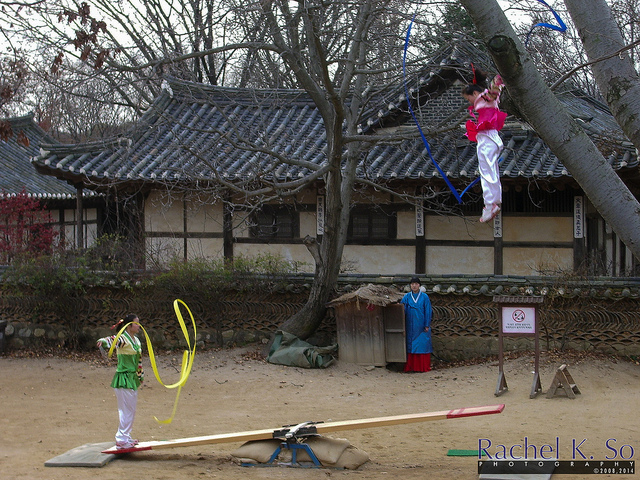
korean-see-saw.jpg

( Source: simisvetik)

Indeed, while the hanbok is much more comfortable to wear and walk around in than a kimono (or so I’ve heard), it’s not exactly a celebration of the female form. Also, this protection and concealment literally meant that elite women’s homes became prisons, as they weren’t allowed to leave: those “traditional see-saws,” for instance, were actually so popular because they allowed elite women rare glimpses of life outside of the walls of their courtyards, and I remember reading somewhere of a woman escaping from her village to Busan during the Korean War, despite all the death and destruction around her actually having an exciting time, as it was the first time she’d left her house in decades!

And in the original (long) post I began my discussion of postwar Korea on that note, so I’ll end this post here. Part 2 will be up early next week.

Share

Sex, Marriage and the Modern Japanese (and Korean) Woman

japan-fashioneti-couple.jpgAs promised, here is the second of the links I planned to discuss, from my favourite Japanese blog, PingMag. In its own words, that post is about that fact that:

While Japan has an enormous sex-related industry, married couples don’t seem to do it that often (According to a Durex Survey, Japan ranks last internationally in terms of sexual activity.) And this would be the case in many modern societies as well. So for the last two years, author Sumie Kawakami gathered interviews of various Japanese women to depict this one aspect of society: Her latest book, Goodbye Madame Butterfly: Sex, Marriage and the Modern Japanese Woman by the superb Chin Music Press portrays eleven sex lives in painstaking detail. Today PingMag talks to Sumie about the heart of relationships. (Photo by 6uÿ)

Personally, I can’t think of too many ”modern societies” with sexless married couples and huge sex industries outside of Northeast Asia myself. On top of that, this is yet another case where all the “Japan”s could be replaced with “Korea”s in the original link and be equally valid, which is why I devote so much attention to the subject here, via some highlights from the interview:

unusual-japanese-couple.jpg

Let’s get to the point: Why do you think Japanese married couples aren’t having much sex?

I’d like to refer you to statistics: Pharmaceutical company Bayer AG conducted an online survey in 2006, which found that 38.8 percent of couples questioned didn’t have sex in the past year. Sexlessness had little to do with age – 47 percent of those in their 30s, 46 percent of those in their 40s and 50 percent of those in their 50s said they were sexless.

Please explain.

In my interviews of women, I’ve talked to many who said that sex with their husbands was too much work. For one thing, their husbands came home very late from work but had to get up early the next morning, so sex was the last thing on their minds. I didn’t mention this in the book, but in the process of reporting for this book, I’ve also talked to men who claimed they were sexless: One guy was in his early 20s. He told me that he often comes home from work early in the morning and by the time he gets ready to go to bed, his wife wakes up to go to work. Sex is out of the question here. They’re not having affairs either. He said, “I could go home earlier if I wanted to, but going out for drinks after work is part of my job. I feel bad for my wife, but for now, work is my priority – not being at home.” Weekends are so busy with shopping and other events that sex never enters the picture. Making time just for sex in a very busy schedule feels awkward. It’s not that he lacks drive – it’s just easier taking care of business on his own when his wife’s not around.

While that example is an extreme case, this couple has been married for only a few years. If the relationship continues in that way, what awaits them in ten or twenty years? Long working hours and the fact that men are tied to evening social obligations long after they’ve left the company are impediments to a healthy sex life. They’re all tired, men included. These days, women continue to work after they’ve had babies. On weekdays, sex is the furthest thing from their minds as they focus on work and raising their children. I think these are common issues for most families.

( “Tokyo Subway” by sqis)

I don’t know enough about Japanese people or that survey to comment on either, but I do know that similar statistics would be notoriously unreliable for Koreans: to put it mildly, most lack the matter-of-factness that I hear that Japanese people have on the subject of sex, nor have the relative openness about it that most Westerners possess (at least amongst friends), to the extent that many 30 year-old Koreans may not even know if their best friend is a virgin or not (lest that sound like an exaggeration, it’s my Korean wife and both female and male friends that have told me this). Moreover, as long-time readers of the blog will know, it isn’t because Koreans are inexperienced sexually either: rather, it’s because to many Koreans…nay, to Korean society as a whole…sex is, well, the elephant in the room. That Korea has one of the biggest sex industries in the world, that love hotels are ubiquitous, and that some Koreans may have sexual urges before marriage…as far as I can tell, most Koreans would prefer to remain in blissful, feigned ignorance of them, and media attention on them must be confined to obscure cable channels in the early hours of the morning.

With that qualification out of the way, I personally think that figures for Koreans would be broadly similar, and I say this based on the numbers of Koreans I know that do not have sex for a long time, if ever, after their first child is born. Of course, I’m very familiar with the difficulties all couples have in returning to a normal sex-life after having a baby, and, seeing as the topic came up, I may as well pull the 8th edition of Our Sexuality (2001) by Karla Baur and Robert Crooks out of my bookcase to remind myself as I type this, for on…let’s see…pp. 361-2 it lists those difficulties and gives advice about how to overcome them (What? You don’t have 3kg, thick academic tomes on human sexuality within ready reach in your own bookcase? You’ve never given one as a birthday present to your spouse or partner??).

And in a nutshell, despite all the physiological, psychological, and practical difficulties the book mentions, the underlying message is that the vast majority of couples want to continue having sex after having children, and almost all do sooner or later, usually within 2-3 months. But in Korea, they just seem to give up. Indeed, since becoming a full-time housewife over a year ago, my wife has come to know at least 6 other housewives in our apartment complex, and all (eventually) reported that they may have had sex with their husbands once, twice, or even not at all in the year since their first baby was born, sometimes in two years. No, not because of difficulties, but because just not trying at all, and they all think that that’s perfectly normal and natural for young parents.

It would be strange to for couples with happy and healthy sex-lives before pregnancy to somehow lose all libido for years afterwards (beyond when the woman is breastfeeding that is, when a loss of libido is natural), so it doesn’t seem unreasonable to assume that 40% or so of Korean married couples also rarely, if ever, have sex. What gives?

( Source: unknown )

So, an obstacle seems to be a busy work life?

Also, lack of communication between the spouses is part of the problem. The main focal point in the lives of men becomes the workplace and work itself, while for women, it’s the home and children. They end up sharing so little. In North America, for instance, men are active in the children’s schools or within the local community. That experience likely leads to stronger ties within the family and between the spouses. In Japan, however, many fathers can barely attend the child’s sports day event once a year. The husband works downtown and his center of activity is rooted in that area. The wife’s radius of activity is confined to a small area, perhaps a few kilometers, around the school. No wonder husbands and wives begin to drift apart.

If anything, this would apply even more to Koreans than to Japanese people. Sure, like Korea, I think Japan schools may also usually be single sex (can any Japan-based readers confirm?), and this makes children and teenagers much more likely to seek physical affection from the same sex, and the lack of experience with each other before university means that young Koreans have developed very elaborate blind dating systems to meet the opposite sex without having to go up and actually talk to each other first. But what Japan lacks is Korea’s 22-26 month compulsory military service for men afterward, not only compounding these tendencies learned from school, including how to survive on little sleep, but in the process turning them into the sexist ajosshis (아저씨) that we all love to hate. Think I’m exaggerating? To put it mildly, no countries with compulsory military service are exactly well known for the high status of women in society, and academic journals on Korea are full of articles about the corporatist training, militaristic notions of Korean citizenship, and and sense of post-service privilege that Korean men learn during their service. I’m interested, naturally, so I can point readers in the direction of and discuss some of those articles in another post if anyone asks. In the meantime, you could also simply just ask Korean mothers and girlfriends of young Korean men, and you’ll invariably find that they’ll be very concerned about how they’ll turn out when return home after their service.

rekindled-youth.jpg

After this background, the salaryman lifestyle of long hours, followed by heavy drinking sessions with colleagues and visits to prostitutes sounds somewhat natural. And as I’ve repeatedly mentioned on the blog already, the majority of Korean women still spend many years off work after childbirth, if they return to work at all, and until 1997 Korea had far more salarymen then Japan ever did, and the accompanying company-first work ethos remains very much the Korean ideal. These would exaggerate these seperate spheres of Korean married life all the more (Photo by E.C.A. Studio).

Apart from the relationship issues mentioned by Kawakami, another consequence in Korea is ubiquitous urology clinics for men, which effectively serve more as STD and impotence clinics. I assume Japan has similarly high numbers of them, although admittedly the decentralized structure of the Korean medical industry also plays a role in Korea, and I don’t how much that applies to Japan too. Again, I’d be grateful if any readers could let me know.

On that note, there are many more, related questions to follow in the  interview, but I can’t really add to Kawakami’s already succinct answers, so I’ll end my post here. Again, and especially if you’ve read this far, then I recommend reading the full interview.

Share