Update, November 2013: My views on skin-whitening have changed considerably since this post was written five years ago, so I’ve removed my original commentary to this commercial, and consequently the comments also. But I’ll keep my translation up, just in case any readers still find this post useful (original article: page 52, July 2008 edition of the now-defunct Korea Ad Times / 코리아애드타임스):
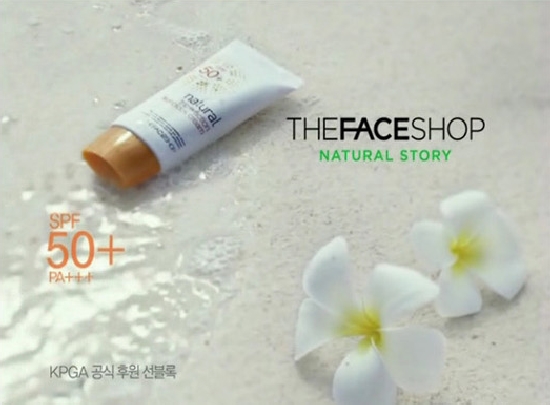
더페이스샵 ‘내추럴 선블럭’ 편 / The Face Shop’s ‘Natural Sunblock’ Commercial
“해빛을 맘껏 즐겨봐” / “Enjoy the Sunshine to Your Heart’s Content”
더페이스샵의 광고가 전파를 타고 있다. 이번 광고는 햇빛을 차단해주는 기존 자외선 차단제의 수동적인 발상에서 벗어나 오히려 햇빛을 즐길 수 있게 만들어준다는 능동적인 역할로 선블록의 개념을 변화시키고 있다.
Currently on air, this commercial marks a move away from the traditional notion that one has to protect one’s skin from the sun passively by wearing sunblock and avoiding the sun, and encourages consumers to enjoy the sunshine.
자외선은 피부 노화를 앞당기는 주범으로 많은 여성들은 최대한 자외선으로부터 멀어지려 갖은 노력을 하고 있다. 특히 자외선 양이 급격히 증가하는 여름철에는 손으로 얼굴을 가리고 빠른 걸음으로 햇빛을 피해가는 여성들을 도시의 길거리에서 흔히 볼 수 있다. 심지어 휴양지에서도 긴팔옷과 모자 등으로 최대한 자외선에 노출을 막고 햇빛 아래로 나오지 않으려고 한다. 왜냐면 자외선은 피부를 위해 경계해야 할 대상 ‘제1호’ 이기 때문이다.
Because ultraviolet rays are the number one cause of aging skin, women in particular try very hard to stay out of the sun. As the amount of potential UV exposure rises dramatically in the summer, these days in cities you can see many women both shielding their faces with books or handbags and walking very quickly across the street to avoid having their skin damaged by it. Even at beach resorts women will often wear long sleeves and hats to avoid exposure, or even stay entirely indoors.
그렇기 때문에 지금껏 자외선 이번 자외선차단제 광고는 흔히 자외선을 가장 효과적으로 ‘방어(Block Sun)’ 해준다는 개념으로 접근해왔다. 하지만 이번 더페이스샵의 내추럴 선블록 광고는 이러한 자외선 차단체의 개념을 새롭게 정의해 주목받고 있다. 이유는 소비자들이 선블록을 바르는 이유는 햇빛을 피하고 싶어서가 아니라 햇빛 속에서도 오랫동안 즐기고 싶어서라는 인사이트(Insight)에 초점을 맞췄기 때문이다.
Because of this, up until now the makers of sunblocks have tended to emphasize how effective their products are at stopping UV rays in commercials. By introducing the new notion that consumers can use sunblock to enjoy the sun rather than avoid it instead, this commercial has gathered a lot of attention.
해빛을 즐기는 미남과 미녀
An Attractive Couple Enjoying the Sun
이번 광고는 태국 파타야 근방의 아름다운 무인도를 배경으로 제작됐다. 자연의 수수함이 살아있는 해변에서 눈부시게 쏟아지는 햇빛을 즐기는 두 남녀의 모습이 비쳐진다. 남자모델은 4년간 더페에스샵의 전속모델로 활동하고 있는권상우이고 여자모델은 이번 광고부터 더페이스샵의 얼굴로 새롭게 합류하게 된 배우 이보영이다. 권상우는 데뷔 이래 광고에서 최초로 상반신을 노출하는 파격읗 보여줬다. 그는 햇빛을 즐기는 모습을 담기에 꼭 필요한 노출이라 생각해 기꺼이 응해줬다는 후문이다. 권상우는 익히 알려진 ‘몸짱’ 스타답게 건강하고 멋진 몸매를 과시해 시청자들의 눈길을 단번에 사로잡고 있다. 광고가 전파를 타기 전부터 관광객이 찍은 것으로 보이는 촬영 한장 사진들이 인터넷상을 뜨겁게 달구기도 했다.
This commercial was shot on a beautiful deserted island in Pattaya, Thailand, a natural and pure setting in which to show an attractive couple enjoying the glistening sea. Kwon Sang Woo, the male model, has been modeling for The Face Shop for four years, but although this is the first time that he’s ever appeared half-naked in a commercial, it’s rumored that that he was happy to do it because he felt it was necessary to show how he was enjoying the sun while using the product. Of course, he is well known for his good body, and not only has this helped to attract viewers’ attentions, even before the commercial was aired it received a lot of publicity through Korean tourists taking pictures of it being produced and then uploading them onto the internet.
이보영은 그동안 여러 영화와 광고를 통해 깨끗하고 청순한 모습을 보여왔는데 이런 순수한 이미지가 더페이스샵과 잘 맞아떨어져 새롭게 광고모델로 발탁됐다. 이번 광고에서는 물에 젖은 머리칼을 휘날리며 기존의 순수한 모습 속에 섹시함이 묻어나는 모습으로 그녀의 색다른 모습을 만나볼 수 있다.
As for the actor Lee Bo Young, this is the first time that she has modeled for The Face Shop. As she already has a pure and innocent image from her previous movies and commercials, it was felt that she would be a perfect new face for the company. But with her wet hair fluttering in the breeze in this commercial, viewers get to see a sexy new side to her too.
Update, December 2013: My translation of an article from pages 108-9 of the July 2008 edition of IMAD (아이엠애드) magazine, which has since been discontinued. I’ve removed my original commentary (and readers’ comments), but am keeping the translation up in case someone finds it useful one day:
소비자의 추억을 자극하라 Stimulating Consumer’s Memories
롯데리아 아바카도 통새우버거 TV CF 제작 현장 The Making of the Lotteria Avocado Whole Shrimp Burger Television Commercial
어린 시절 누구나 가지고 있는 추억이 있다. 신나는 동요 소리에 달려나가면 골목 어귀에 서 있던 늠름한 만들. 100원 동전 하나로 리어카에 스프링으로 매달려 있는 말을 타고 멋지게 달렸던 기억.
Everybody has many memories from their childhood, and one many Koreans cherish is suddenly hearing a nursery rhyme playing in the alleyway outside, which meant they could run out excitedly and pay 100won to ride on a magnificent mechanical horse driven around the neighborhood.
웰빙 트렌드를 반영하면서 먹거리에서도 많은 변화가 일어나고 있다. 햄버거도 가공식품의 느낌이 아닌 원재료의 느낌을 그대로 살린 제품이 출시된다. 이번 TV CF도 그런 제품의 특징을 살리고 빠른 시간 내애 소비자의 인식 속에 롯데리아 아보카도 통새우버거를 자리잡도록 하는 것이 목표였다.
Reflecting the “Well-Being” trend, the food consumers eat is undergoing many changes. Hamburger makers too are trying to remove their product’s image of being unhealthy processed food, and to emphasize the taste of their original, healthy ingredients to consumers instead. Thus, the aim of this particular television commercial is both to grab viewers’ attentions within a short time and to convince them that this new burger is also a well-being food.
‘나는 새우’ 라는 동요를 듣고 카피라터가 찾아왔다. 몇 번을 반복해 듣던 중 머리에 스치는 건 어린 시절 동요를 들으며 타고 놀았던 리어카의 장난감 말이었다. “새우를 타보는 건 어떨까?” 이 한마디로 이지아가 새우를 타게 됐다. 제작에 들어가니 한두 군데 손이 가는 것이 아니었다. 우선 가장 큰일은 새우를 만드는 것이었다. 기본 디자인은 회전목마의 모습에서 따오기로 했다. 여신의 모습으로 커다란 통새우를 타고 치마를 휘날리는 이지아의 모습에 팝송이나 클래식이 어울리지 않을까라고 생각하지만, 기획의도부터 언밸런스를 유도하여 처음 보는 소비자도 금방 기억할 수 있는 CF를 만드는 것이 목표였다.
The “Flying Shrimp” song was copyrighted for this commercial. While listening to it many times, the producer realized that it reminded him of the nursery rhymes played by the owners of mechanical horses that visited his neighborhood when he was a child, and so somebody suggested that in the commercial the model Lee Ji-ah should ride a shrimp similar to those. However, there were many to things to do to bring that concept from the drawing board to actual production, and ultimately the basic design of the shrimp used was more similar to a horse from a merry-go-round. In the commercial Lee Ji-ah represents a female goddess, her skirt fluttering in the breeze as she rides a shrimp of equally god-like proportions. The producer originally felt that classical music or a pop song would have been most appropriate for that image, but to capture consumers’ attention quickly he felt that an “unbalancing” nursery rhyme would be more effective.
촬영장소로 선택한 곳은 제주 함덕 해수욕장. 얕은 수심과 에메랄드 빛 바다로 유명한 이것은 CF촬용장소로 많이 찾는 곳이기도 하다. 전날 육지에서 배로 옮긴 통새우를 바닷가에 설치하고 촬영이 시작되었다. 밀물과 썰물의 차 때문에 바다에서의 촬영은 초를 다툴 만큼 어려웠다. 2D에서 나무를 합성해도 되지만 느낌을 최대한 살리기 위해 바다 중간에 모래로 섬을 만들고 나무도 심었다.
Hamdok Beach in Jeju was chosen as the shooting area, well-known amongst producers of commercial because of its shallow water and emerald-like glittering sea. Time was saved by taking the model of the shrimp was taken by boat from the shore and setting it up the day before shooting, but still, because of the difference between high tide and low tide the production crew was literally fighting against the clock on the day itself. This was not helped by having to make a small island out of sand in the background and planting two trees on it, because it was thought that real trees would give of a more lifelike and vivid atmosphere than the 2D ones called for in the original plan.
통새우의 이미지는 물론, 소비자가 CF를 봤을 때 먹고 싶게 만드는 것도 중요하다. 보통 시즐 촐용은 모델 촬영이 끝난 후 남는 시간에 졸린 눈을 비벼가며 야간에 찍는 것이 보통이다. 하지만 이번 CF에서 중요한 건 통새우와 아보카도를 알리는 것이기 때문에 우리는 시즐 촬영에 이틀의 시가늘 쏟아부었다. 최상의 컨디션과 신선한 재료로 최고로 먹음직스러워 보이는 화면을 찍기에는 이 시간도 짧게만 느껴졌다.
While the image of the shrimp was important, of course the main purpose of the commercial is simply to make people want to eat. Usually, in commercials of this nature the “sizzle” shot is quickly done at night after the main shooting with a model during the day, often when the commercial crew is very tired, but in this case it was felt that convincing consumers of the healthiness of the new avocado and shrimp burger was so important that 2 entire days were spent on it. Because all ingredients had to be shot fresh and in the best condition, those two days also felt too short!
You can’t blame overseas reporters for just calling them metrosexuals: kkotminam (꽃미남), literally “flower beauty man,” sounds a little strange even in Korean, let alone English.
Done too often though, it’s easy to lose sight of the differences. Combined with scholarship that (over)emphasizes the trend’s roots in popular yaoi manga from Japan, one can easily be forgiven for thinking that Korean men are doing no more than imitating what they see overseas.
This needs rectifying. Not least, because when men suddenly adopt some new fashion en masse, it’s invariably with the specific purpose of getting laid. But what was so special about the 2002 World Cup that made Korean women demand hitherto “effeminate” clothing, personal-grooming, and behaviors from them, if they wanted any hope of doing so?
To answer, you need to consider what happened in the 5 years preceding it, which was a tumultuous period for Korean society. Especially for Korean women, something which tends to get ignored in most accounts of events.
In brief, once democratization began in the late-1980s, women were finally rewarded with the drafting, implementation, and — yes — even enforcement of a wealth of sexual equality legislation, after years of having such concerns ignored or deferred by the military authorities and democracy movement respectively. Also, the female workforce participation rate slowly but surely increased, despite the predominance of the salaryman system and the attendant male-breadwinner ideology. In more ways than one, women could feel justified that their patience was being rewarded.
Then the Asian Financial Crisis of 1997-8 struck. Not only was “expensive” sexual equality legislation indefinitely postponed, but the government-business “solution” was to disproportionately lay off women, the logic being that young single ones, largely living with their parents, would be provided for by their fathers, whereas married women (and their children) would be provided for by their husbands. More advanced in their careers, and thus more expensive, the latter would be particularly targeted, to the extent that many would do their utmost to keep their marriages a secret from their employers, a theme subsequently explored in many dramas.
Lest anyone feel that this overview is a wild generalization, note that, tellingly, president Lee Myung-bak would repeat the same solution in the next financial crisis in 2008, although by that stage there was more of a pure financial logic: by having the most irregular workers in the OECD, which women would form the vast majority of. Back in 1998 though, and coming so soon after supposedly liberating and empowering democratization, which actually only really, qualitatively, began upon the administration of the first civilian president Kim Young-sam (김영삼) from 1993, then I’m going to take a wild guess that women were, in short, pissed off.
And with that prickly conclusion in mind is precisely how one should view the following music video by the Korean girl-group SES, made in 2002:
About which Matt at Gusts of Popular Feeling gives the following insightful commentary, starting with:
Taken at face value, the SES video seems to be about getting revenge on some boorish (white) men and humiliating them, but I think there are other ways to look at this video than just as a representation of Korean anti-Americanism. A very simple question would be: How many working women in Korea interact with foreign bosses, foreign colleagues, or foreign customers? I would imagine that the vast majority of working women never have to deal with foreigners in the workplace. So, for working Korean women…who would the sexist or rude bosses, colleagues, or customers really be?
And a little later:
…could this be seen as a “liberating” narrative of women standing up to boorish, disrespectful men in positions of power over them and humiliating them or otherwise getting revenge on them and asserting their power. In this case, the use of foreign actors to portray these men acts as the spoonful of sugar which makes the medicine go down because images of Korean men being humiliated would never be approved.
Whatever the answer, what’s clear is that, especially in 2002, on TV, Korean men could never have been treated like this, unless it was done with a lot of humor (and probably not even then). It needs to be asked, of course, why it would be acceptable to portray foreign men the way they are in this video, but not Korean men.
Lest you feel that Matt exaggerates the restrictions on how Korean men could be — and still can be — portrayed in popular culture, see here for a wealth of further examples. Yet, despite those, there were other ways women could express their anger. And a lot more besides.
While I should always resist the temptation to generalize my own experiences to the rest of Korea, it is still remarkable just in its own right that, in one of my first ever classes here in 2000, some of my female students mentioned that they were regularly chastised by middle-aged women on the street for — wait for it — wearing short sleeves. For just 2 years later, it would be a point of patriotic pride for them to wear a crop-top made out of the previously sacred national flag during the 2002 World Cup, and very much encouraged by their elders. As Hyun-Mee Kim (see the footnotes) puts it:
Stripping the Korean national flag of its heavy solemnity and nationalism, [women] brought change with their white, red, blue, and black sports bras, scarves, tank tops, and skirts. And the young Korean women who had been the target of criticism by the media every summer for their “excessive spending” and “oversexed outfits” were praised as original and attractive fashion leaders at the soccer scenes (Hyun-mee Kim: 228-229)
To clarify, I am not (yet) making a connection between this and previous events: merely pointing out the speed of the change. But, how to explain that pace? What on earth did soccer — of all things — have to do with the way women chose to dress?
Perceptive readers may already be thinking that all the skin was publicly encouraged to show support of the Korean soccer players, not the first time women’s bodies and sexuality have quite literally been used in service of the South Korean state (see Sex Among Allies by Katharine Moon, or my own series on gender and militarism). And, indeed, the media did soon describe it as such.
But Hyun-mee Kim notes that Korean women were already on the streets wearing sexier and/or more comfortable clothing that summer, well before public perceptions caught up with and condoned the new standards of dress that they had created. Moreover, and crucially, they were also simultaneously publicly discussing, idolizing and objectifying the Korean players and their bodies in ways that would have been previously thought of as shocking. And, as one does not salivate over a guy’s pecs simply by government decree (please correct me if I’m wrong), then it’s difficult to deny that both were definitely initiated by and for women.
Also, that much more was going on than simply women showing more skin, questioning public standards of decency, or talking more about men that they found attractive. Indeed, the process had already begun in popular culture in the mid-1990s.
Writing in 2002, So-hee Lee mentions that in 1995, “the most popular topics among university students were sexuality, sexual identity, and other sexual subjects” but that in 2002 “there is still no broad popular social discourse on female sexuality outside of marriage”. Partially that was because the term barely existed in Korea then as explained, but primarily it was because – for all the stereotypes of married Korean women or ajumma (아주마) having gender but not sex – precisely they that were at the forefront of a veritable sexual revolution in Korea beginning in the mid-1990s. As she explains, many Korean women novelists confessed that it was in marriage that they had begun to recognize their repression as women for the very first time”, and this was because:
Looking at their mother’s lives, Korean women in their early thirties believed that their marriages would be different. Because the Korean standard of living and patterns of Korean life changed very quickly, they believed that Korean ways of thinking had been transformed with the same speed. This is where their tragedy begins. As [a character in a mid-1990s novel discussed] says, “mothers teach daughters to live differently from themselves but teach sons to live like their fathers”….During sixteen years of schooling, they had learned that equality is an important democratic value, but nowhere had they been taught that women experience the institution of marriage as a condition of inequality. Many married women of this generation have [thus] experienced a process of self-awakening…(Lee: 144)
Lee’s chapter is about a succession of novels, movies and TV dramas that suddenly appeared between 1993-1996 which, with their blunt depictions of Korean women’s sexual desires, sexual repression, sexual frustrations within marriage, direct challenges to sexual double standards and so forth, were direct challenges to those stereotypes and provoked intense discussions throughout Korea. Unfortunately, a detailed discussion of them will have to wait for another post (update: and here that is!), but it can be said here that Lee concludes from her study of them that:
Looking back at Korean culture with a certain detachment [in 2002], I can imagine that the years 1995 and 1996 will be remembered as a critical period for the emergence of social discourse on sexuality, especially female sexuality. The year 1995 was particularly remarkable in that housewives began, on their own initiative, to speak in public about wives’ subjective sexuality (Lee: 160).
And that, in a comparison with the US in the 1970s:
My reading of the concept of female sexuality in Korean popular culture might suggest that Korean society is now at a stage of development comparable to America in the 1970s, when every kind of women’s issue appeared in realistic novel form….If this parallel holds, then what kind of story is unfolding in twenty-first-century Korea? Is it not difficult to image that a viable revolution against sexual repression might take place? (158)
With even greater benefit of hindsight, I’m not all that sure that the mid-1990s are remembered quite like that in 2008, and Lee did acknowledge that her discussion possibly:
…gives the impression that Korean women now are marching to demand their sexual subjectivity, in reality, most Korean women are marching only as the passive consumers of the sorts of cultural products described previously, not as their active cultural producers (159).
But quite presciently, she continues:
When women are able to intervene in the process of cultural production as subjective consumers with a feminist point of view, the Korean concept of female sexuality can be transformed more rapidly than before (159, my emphasis).
And of course, just like the 2008 Olympics that are coming in up in 3 weeks time, the World Cup is no longer merely or even primarily a competition for victory between nations, but is a prominent global cultural product. Part of that cultural product is the bodies of the the players themselves, and Korean women in 2002 definitely fundamentally changed the ways in which they “consumed” those.
The Rise of Kkotminam: A backlash against salarymen?
The first change they made was in confirming the dominance of feminized ideals of male beauty that had first begun evolving in the mid-1990s. Consider this description of the previous ideals:
The streets of Seoul are now filled with girlish women. Some look fragile, as if calling for protection. Women of this generation say that want to be protected rather than to protect. Young girls who used to favor gentle “mama’s boys” now turn their backs on them. They are anxious to fall in love with “tough guys” who look strong and even violent, like Choi Min-su and Lee Cheong-jae, who played tough gangsters in the explosively popular 1995 television drama Sand Clock (모레시계). Besides having a “tough guy” as a boyfriend, the women of this emerging generation want a pet. A pretty and coquettish girl, with a tiny, cute dog, beside a tough guy is part of this emergent new image. (Cho Haejoang: 182)
Although the book that was from was published in 2002, by the reference to the television drama and by the focus of other chapters I get the impression she is really writing about the mid to late-1990s. Later in the chapter, she mentions how the country as a whole reverted to a justifying male breadwinner mentality under the banner of “Let’s protect the our fathers who have lost their vitality” or “Let’s restore the authority of the family head” as a result of the IMF Crisis as I’ve discussed, and presumably the natural result would have been that those “tough guy” preferences of Korean women would have been reinforced, or at least the protective elements of them. But in fact, quite the opposite occurred. For instance, by 2000 there was:
…a new type of male emerging albeit in a small number of music videos. It is a de-gendered image of men which is a contrast to the macho image. Male groups such as Y2K, H.O.T., ITYM, and Shinhwa, whose fans are mostly teenage girls, portray this image. They wear make-up and a lot of jewelry and ornaments – which are all considered feminine – and take of their shirts to show off their bodies. This indicates that the male body is also sexually objectified as the female body….The style of the video is similar to that used to show female [bodies] with extreme close-ups to fill the screen with a face, and medium range or full body shots for dances. Although there is a risk of overstating the phenomenon, this image could be interpreted as a signal indicating the possibility of breaking the binary boundaries of men and women that have been formed in a patriarchal culture (Hoon-soon Kim: 207)
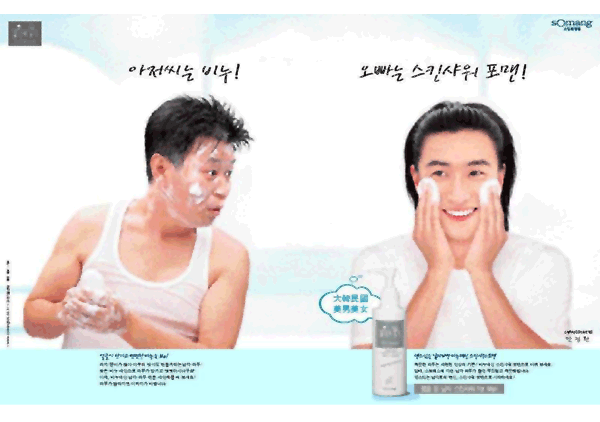
And this is corroborated by the fact, as early as the mid-1990s, there were already distinctly feminine advertisements for cosmetics aimed at men. These following ones are all from the Somang Cosmetics website (update: they’ve since been taken down), but I can’t imagine that those of other cosmetics companies would have been significantly different.
1998, with Kim Sung-woo (김승우):
1999, when soccer player Ahn Jung-hwan (안정한) must have signed a modeling contract with them:
And then of course the notorious television advertisement for “Color Lotion” from 2002, featuring Kim Jae-won (김재원) on the left:
Regardless of what women made of that particular homoerotic advertisement, the establishment of distinctly feminine ideals of male attractiveness were at least partially sealed by Ahn Jung-Hwan’s success in the World Cup, when Somang Cosmetics must have thought that all its Christmases had come at once:
Although the Earth must surely have shifted as Korean women collectively put their hands to their chests and sighed as Ahn Jung-hwan kissed his wedding ring every time he scored a goal, I’m not for an instant placing the blame(!) for what came to be known as the “Flower Men” (꽃미남) phenomenon solely on his shoulders. Where does it come from then?
Of course there is some international basis for it. While Taiwan, for instance, both survived the IMF Crisis relatively unscathed and didn’t host the World Cup, much the same phenomenon still happened there:
Josephine Ho (2001: 63-86), a feminist from Taiwan, points out that most of the recent idols of teenage girls are no longer buff and tough men but rather “feminine men” who evoke a sense of sympathy, saying that there is a “clear contrast between teenage girls of enormous strength and their idols of somewhat weak image.” This illustrates that women in their teens are breaking away from the typical framework of heterosexual romance in which women long for me who will devote themselves to, and take care of them, and have started to express their sexuality in an active manner. The preference for men with the capability and personality of the breadwinner as the “most attractive” is being undermined. (Hyun-Mee Kim: 235)
I don’t know enough about modern Taiwanese society to judge the accuracy of that, but I have no reason to doubt that it’s true. But I have many problems with international comparisons.
Firstly, because they mean that the Western notion of “metrosexuality” invariably comes to dominate discussions, years of repetitive comparisons between An Jung-hwan and David Beckham in the Korean English-language media (and, by extension, by foreign observers too) ultimately seeming to absolve Korean women of any ability to determine their own tastes in men. And just like it does to be told personally that my liking any Korean women at all is mere “yellow fever”, it must surely rankle Korean women to be told that them liking say any Korean idol is no different to, say, a British teenage girl liking a member of Westlife.
On top of that, for all their new assertiveness, there were still definite limits on how far women’s new freedoms could go, and they did not extend to publicly praising and/or objectifying non-Korean men. Obviously that’s a crucial point, but as this post approaches (ahem) 4500 words I realize that a discussion of that would be better placed in Part Three; meanwhile, accounting for changes by a simple importation of foreign ideals of male attractiveness portrays Korean women as, well, mindless, uncritical, and passive consumers and again as Part Three will more fully reveal, this was anything but the case.
As the title suggests, I pose a more proactive explanation, and herein (finally) lies the revelation that has so preoccupied me for the past two weeks. First, consider this statement:
When gender discrimination in public areas such as the labor market and politics is still powerfully all pervasive, Korean women often feel helpless in thinking that change won’t come easily. Their sense of devastation leads to displays of resistance and subversiveness in “private areas such as sexuality. Sexuality and intimacy lend themselves to being viewed as the only arena where the women can affect a measure of change through their will or emotions. In this respect, Korean women’s rapid sexual subjectification demonstrates, on the one hand, the power to transform and, on the other, a collective sense of powerlessness (Hyun-Mee Kim: 240).
The first things that came to mind when I read that were the scene in either La Femme Nikita or Point of No Return (I can’t remember which) when, after receiving her training to become an assassin, the main character is placed in a sort of finishing school where her female tutor reveals the existence of “this power” that women have over men. After that was a line from some sex and/or relationship advice book that I read once, which said that women should not consider sex as something to be given to or withheld from partners as a form of reward and punishment.
Yes, considering the virtual gender apartheid that exists in Korea, then an alleged asexuality of ajummas as a form of resistance to patriarchy was one of the first things that came to mind too. But then the next thing was that, maybe, just maybe, flower men became their new ideal of male attractiveness as a act of at least subconscious resistance to the men that had denied them of the opportunity for children and careers that they’d (finally) come to expect? That still maintained that women didn’t even have sexual feelings, but at the same time taking advantage of one of the biggest prostitution industries in Asia? That had the gall, after doing all that, to expect Korean women to continue to hold breadwinners like them on a pedestal? Like I said, they were pissed off, andKorean men that came up with the aforementioned slogans were surely naive to think that things could have gone on simply as before.
Of course, I acknowledge that it will be much more complicated than that in reality. Like I said, I haven’t looked at the 1990s in any great detail here, but in addition to the sexually radical new books, movies and dramas that came out in 1993-96 that Cho Haejeong discusses, there’s a whole host of developments like the “Missy” phenomenon beginning in 1994 and the “Samonim” (사모님) one before that: in other words, things weren’t quite as simplistic as how I’ve depicted them. I haven’t paid enough attention to generational differences either, even though Hyun-mee Kim quite correctly claims that they are as strong markers of identity in Korea as race is in the US, so much so that most chapters in the books used here us them as their base units of analysis, and increasingly books on Korean politics are too.
As I type this, I realize that no description is complete without those, and so they’ll require an unplanned additional post before I talk about the 2002 World Cup proper in now Part Four (or Five)…which is not to imply that this post hasn’t considerably evolved and mutated itself since I first began writing on this, now somewhat amorphous subject.
Another thing I realize is that until recently I’ve been so enamored of my associations of Korea with futurism (see here and especially here for instance) that I’ve mistakenly disdained studying the 1990s previously, feeling that as I looked further and further back in time in Korea then the people become more conservative and unlikeable, the clothes and hairstyles more bizarre, the women less attractive, and the country as a whole much less modern…and so on. That’s not unreasonable given Korea’s breakneck speed of development, but considering that I arrived in Korea as long ago as 2000, and that I first went to university in 1994, then in hindsight my disinterest has been very strange. After all, to understand me, you’d have to understand New Zealand in my formative years as an adult, and indeed just on the bus home yesterday I listened to a Korea Society Podcast on president Lee Myung-bak’s first 100 days in office, in which one panelist argued that the experience of the IMF crisis defines Koreans of my generation. All obvious certainly, but I’ve got some catching up to do.
Regardless of all that though, I think my notion of flower men becoming popular because of a backlash is a definitely a valid one, and I think original too; certainly no-one that I’ve read recently makes a link like that. At the very least, it needs further exploring.
Only having just begun examining the 1990s myself then, I can’t confirm or disprove Gord Sellar’s suggestion that cross-fertilization from some elements of Japanese popular culture may also have played a role in the rising appeal of flower men, and while my gut instinct tells me that it was mostly home grown and that that would only have had a marginal role at best, I still highly recommend his post just for its discussion of the ways in which the phenomenon has evolved and be sustained since 2002 alone. Given that I end my discussion on them in 2002 (for now), then our two posts nicely compliment each other on that score.
Ho, Josephine, “From ‘Spice Girls’ to ‘compensated dating’: sexualization of Taiwanese teenage girls,” Yonsei Women’s Journal, 7, (2001), pp. 63-86.
Hoon-Soon Kim, “Korean Music Videos, Postmodernism, and Gender Politics” in Feminist Cultural Politics in Korea, ed. by Jung-Hwa Oh, 2005, p. 207 pp. 195-227.
Hyun-Mee Kim, “Feminization of the 2002 World Cup and Women’s Fandom” in Feminist Cultural Politics in Korea, ed. by Jung-Hwa Oh, 2005, pp. 228-243.
So-hee Lee, “Female Sexuality in Popular Culture” in Under Construction: The Gendering of Modernity, Class, and Consumption in the Republic of Korea, edited by Laurel Kendall, pp. 141-164.
Update, December 2013: A translation of this article, with my original commentary (and consequently readers’ comments) removed. Here are some quick translations for the captions below too:
“Be picky”
“Embrace your desires”
“Be lazy”
“Think differently”
“Look at them [men] humorously”
“Don’t wait”
“Don’t even look up [at him]”
“Shout”
“Dios Women Cheer Project” (the name of the ad campaign).
최근 TV를 통해 방영중인 LG 냉장고 ‘디오스 여자만세 프로젝트’ 광고가 네티즌들로부터 거센 비판을 받고 있다. 무엇보다 표현이 상식수준을 넘어 보기 민망할 정도로 지나치고 심지어 남녀 역차별을 조장하고 있다는 점을 들어 포털사이트 다음 아고라에서는 ‘디오스 여자만세 프로젝트’ 광고 중지를 요구하는 청원 서명까지 벌이고 있다.
Netizens have strongly criticized the “Dios Woman Cheer Project” advertisement that has recently been playing on Korean TV. On the Daum Agora discussion forum, they have complained that the things said in it defy common-sense standards of decency, even going so far as to promote discrimination against men, and so have set up an online petition calling for it to be taken off the air.
광고에는 ‘여자들이여 까다롭게 굴어라, 더 욕심 부려라, 게을러져라, 딴 생각해라, 우습게 보라, 기다리지 마라, 거들떠보지 마라, 큰소리 쳐라’ 등의 문구가 여성이 남성을 인형처럼 조정하는 자극적인 장면과 함께 등장한다.
In the advertisement, the voiceover and the text say: “Hey, women! Be picky! Embrace your desires! Be lazy! Think differently! Look at them (men) humorously! Don’t wait! Don’t even look up (at him)! Shout!”, and so forth. In one scene women are even encouraged to treat men like puppets.
서명을 주도하고 있는 네티즌 ‘꽃순이’는 “‘여성만세 프로젝트’라는 거창한 이름으로 좋지 않은 말들만 열거하고, 그 대상을 남자로 유도하고 있다”며 “방송에서 안볼 수 있게 해 달라”고 요청하고 나섰다. 또 다른 네티즌은 “만약 남녀 반대로 광고가 만들어졌다면, 사회적으로 큰 파장이 왔을 것”이라며 “남녀 역차별을 조장하고 있다”고 주장했다.
According to the netizen “Flower-Suni” that initiated the petition, “The grand-sounding ‘Woman Cheer Project’ advertisement merely lists and induces negative behavior towards men”, that “people don’t really want to see on their screens”, and demanded that it be taken off the air. Another netizen added that “if an advertisement portraying the same sentiments towards women had been made, then all sectors of society would have been quickly up in arms and insisted that “it promotes inequality”.
광고 내용이 눈에 거슬리기는 여성들도 마찬가지다. 여성이라고 밝힌 네티즌들 대부분 “저런 광고는 여성들에게도 달갑지 않다”, “괜히 여자 안티를 만드는 광고”, “광고가 무척 거슬렸다. 된장녀를 만드는 것인가”라고 비난했으며 “남녀평등이란 서로 만드는 것이다, 한쪽만 강조하는 평등은 또 다른 불평등을 가져온다” 고 지적했다.
By no means is it only men that feel that the contents of the ad were inappropriate. Of those female netizens who have made their gender public on discussion boards, most criticized it, saying things like “it is unacceptable to women just as much as men”; that “the advertisement will make people anti-women”; and that “the advertisement is very offensive, and encourages women to be Bean-paste Girls”. Finally one netizen pointed out that “men and women have to become equal together, and if you overemphasize only one aspect of that then it will actually only lead to further inequality.”
Update, December 2013: A very old post, which I’ve long since removed the original commentary to (and consequently the comments also). But hopefully someone may still find the translation useful!
해외동포 연예인 붐을 일으킨 재키림의 10년 전 사진 / Jackie Lim, The Creator of an Overseas Korean Entertainer Boom
삼성은 하이버네이션 기능 때문에 안정성에 문제가 많은 그린컴퓨터를 얼른 단종시키고 매직스테이션이라는 새로운 브랜드를 선보였는데, 매직스테이션은 꽤 오래 출시되면서 장수 브랜드로 자리 잡았다.
Because the “hibernation” function was causing many problems with stability, Samsung quickly stopped producing “Green computers” in 1995 and launched a new brand called “Magic Station” instead, which became a very successful brand over the next ten years.
매직스테이션III의 광고모델은 당시 새롭게 떠오르던 해외동포 연예인인 재키림이다. 몇 개 국어를 자유자재로 구사할 수 있었던 재키림은 재원이라고 칭찬받으며 화려하게 연예계에 데뷔했다. 재키림은 SBS ‘생방송 TV 가요 20’, KMTV ‘동방특급 비디오자키’ 등을 뛰면서 가수와 비디오자키로 활동했다. 재키림은 비디오자키의 열풍을 일으켰을 뿐만 아니라 오늘날의 해외동포 연예인 붐을 일으킨 불씨가 되었지만, 정작 본인은 한국 연예계에 적응하지 못하고 방황으로 얼룩진 비운의 운명을 걷게 된다.
Jackie Lim was a new and upcoming star when she appeared in the “Magic Station 3” advertisement in 1995. As she was fluent in many languages she received a lot of attention and praise when she made her original debut, both starring as a singer and working as “video jockey” on the SBS program “20 Songs On Air” and KMTV’s “High-Class Eastern Video Jockey”. Ultimately she proved so popular she provided the spark for a boom in interest in overseas Korean entertainers. But she soon found it difficult to adapt to the Korean entertainment industry, and became a bit lost for which direction to take herself and her career.
재키림은 마약을 비롯한 좋지 않은 사건에 휘말리는데, 그녀가 이런 사건에 빠진 이유는 ‘한국에서 실력으로 활동하려 했지만 자신을 성적대상으로만 보면서 높은 사람 자리에 불려나가야 하고, 동료연예인들로부터 왕따당하면서 외로워서 약을 하게 되었다.’고 밝혔다. 재원이라고 떠들었던 뒷편에는 여성 연예인에 대한 여전한 성차별과 고위권의 압력, 동료 연예인의 텃세가 있었던 것이다.
Later, she became disgusted and further disheartened by trying to succeed as a singer in Korea through her own abilities but while facing the virtual prostitution of female entertainers that goes on behind the scenes. Not only was she regularly pressured to entertain and provide sexual services for politicians and business leaders, who saw her merely as yet another trophy girlfriend to be used, but on top of that she was also ostracized by other entertainers too, angered by whom they saw as an uppity overseas Korean whom they intended to put in her place. In the end she became very lonely and depressed and got involved with drugs.
이미지: 1995년 삼성 매직스테이션3 광고에서 밝게 웃는 재키림. 하지만 이 웃음 뒤에는 잘못된 연예게 관행으로 인한 외로움과 고통이 숨어있다.
Photo caption: Jackie Lim smiling brightly in Samsung’s advertisement for the Magic Station 3. But hidden behind the smile there was a great deal of loneliness and pain caused by the Korean entertainment industry’s bad practices (source).





 (Source:




 (Source:
 (Source:
 The Grand Narrative