How Many Unmarried Koreans Live Away From Their Parents?

korean-girl-eating-noodles-on-rooftop-manhwa-만화(Source: Bengal)

Let me take that break this weekend by posing a couple of questions to readers for a change: if you have a Korean partner, do you live with him or her? And if so, do his or her parents know about the arrangement? Or is it a secret, which is what I expect most of you to say?

I say that because it’s been nine years now since my then girlfriend moved in with me back in Jinju (진주), and I remember how for the next four years until our marriage she was determined to keep it a secret from her parents, who still think she lived in a “one-room” (원룸) with her younger sister all that time. Fortunately they and most of her relatives were strawberry farmers who lived an hour’s bus-ride out of town, so it was only on the very rare occasion when we were out together that her spotting one in the distance had me hurriedly climbing over walls and up trees to get out of sight. But it did mean that the issue of Koreans’ conservative attitudes to living together before marriage, then, was the first cultural difference I really grappled with both literally and figuratively(!), and in fact it was what ultimately inspired to me to start this blog too, my bristling years ago at most Koreans’ blanket assertions that conveniently ill-defined – yet somehow also timeless and unchanging – “Korean culture” was responsible for it, and my wanting to dig deeper.

In reality, although it certainly helps, it doesn’t take half an hour up a tree dwelling on the subject to demonstrate that the combination of extremely high security deposits demanded of tenants and absurdly low wages provided by part-time jobs would make living away from home financially impossible for most young people. Change either economic disincentive, as I’ve argued at length here and especially here, then despite cultural prohibitions, in my experience many young Koreans can, will, and do leave the stifling confines of their homes the instant they’re given the opportunity.

spaghetti-messy-telephone-wires-and-telegraph-pole-outside-korean-apartments(Source, above and below: Raysoda)

Those young Koreans that can’t live away from home though, must reconcile themselves to the fact, and so by their mid to late-20s – when they do have the means to leave – I find that as a psychological coping mechanism they can ironically often end up being among the stoutest of defenders of living with their parents instead. Hearing it from men specifically though, I don’t need to invoke that notion, for there is plenty of truth to the stereotype that they have all the comforts of having their housework done for them and with none of the restrictions applied to their sisters: hell, in their case I’d probably stay at home too. But a defense of the arrangement from the latter? Of the curfews often applied on them, and parents’ expectations that after working hard studying and/or pursuing their careers during the day, that they still should have to do a load of housework once they arrive home at 11pm? That will simply ever cease to amaze me, and if I know that a Korean woman has the means to leave home but still tolerates such living arrangements, then in all seriousness we could never be friends: I’ve just had too many experiences of feeling like I’m talking to a 27 year-old teenager, and/or of wanting to grab her and shake some sense into her, demanding that she stop moaning to me about her mother and take some control of her life.

(Update: I should probably add that I find it just as difficult to be friends with men living at home too though, my respect also not extending to anyone who expects to go through their entire life with their mothers and then their wives doing all their housework for them!)

To be fair though, the “That’s Korean culture” mantra is a useful device with which to silence know-it-all foreigners, often happy to provide Koreans with their profound insights into Korean society after less than two weeks in the country *cough*, and as an immigrant to both countries I’m aware of parallels in Australia and New Zealand too (I’m sure it’s universal really). And while most Koreans outside of sociology departments naturally haven’t spent all that much time thinking – up a tree or otherwise – about why adult Koreans tend to live with their parents, it has to be said that when the subject came up in conversation (as it had a tendency to do so with me), that actually they did usually agree with my arguments that economics had quite a bit to do with it.

People thinking I’m right because I’ve paid more attention to the subject than them isn’t quite as satisfying as having the evidence to prove I’m right however(!), so although I put that specific topic on the backburner long ago, my ears still always prick up at any mention of related statistical data, although as I discovered recently, there’s much less of that than you might think. Hence I got quite excited when I came across this in today’s Korea Herald:

seoul-spiritual-lightOne-person homes rise to 20%

By Kim So-hyun (sophie@heraldm.com)

One-person households accounted for a fifth of all households in Seoul, according to a report released yesterday by a city-funded research institute.

Some 675,000, or 20.4 percent of the total households in the capital, were people living alone, according to the Seoul Development Institute.

The SDI categorized those who live alone into four groups of professional singles, jobless youth, people who got divorced or had separated families, and senior citizens aged 65 or more.

“The percentage of one-person households is expected to reach 25 percent by 2030,” said Byun Mi-ree, an SDI research fellow who wrote the report.

She noted that the city needs to come up with matching policies such as supplying a wide variety of small homes, creating more jobs for unemployed youth, helping unstable singles rebuild families and assisting senior citizens in poverty.

The number of white-collar, professional singles has constantly increased since the mid-1990s along with the changing views of marriage, social accomplishment and individualism, according to the report.

Others increased as well with the tight job market, the aging society and the rising number of children leaving home with their mothers to study abroad.

Forty-five percent of the one-person households earned less than a million won per month. Seventy-six percent made less than 2 million won per month.

More than half of the people who live alone had blue-collar jobs such as sales service (26 percent) or manual labor (10 percent).

Fifty-one percent said they mostly used the mass transportation systems and lived along the subway line No. 2.

Yes, I expected a breakdown of the numbers of those “four groups of professional singles, jobless youth, people who got divorced or had separated families, and senior citizens aged 65 or more” too, and have to wonder what the point of one-person households as a unit of analysis is, given how disparate the make-up and needs of each of those groups mentioned above are. At first I was very curious that there was no mention of middle-aged “lonely goose fathers” (외기러기) too, who live and work in different cities during the week and then return home to their families on the weekend, but then I realized that, as I explain here, the concentration of wealth and educational opportunities in Seoul would mean that when those fathers that were already living there were, say, transferred to a branch office, it was logical for the family to remain behind. I couldn’t imagine a family not following a father’s new job in or transfer to Seoul though, so although many many Seoulites will indeed be lonely geese fathers, while they’re actually there they wouldn’t count as one-person households (but see here for some information on their numbers that I did find).

So, I checked out the Korean report from the Seoul Development Institute itself , and although it’s quite comprehensive, unfortunately that doesn’t have any figures either! I’ll keep an eye out for them any new reports from the SDI though, which I’m glad that the Korea Herald made me aware of, but in the meantime…then I guess I should provide an apology for not providing an actual answer to the question I pose in the post title. But if you did want to know then I’d genuinely be surprised if you weren’t also interested in the above report too, so *ahem* please forgive the slight subterfuge on my part? And regardless, please do pass on your own experiences of cohabiting in Korea, for my own opinions on the issue, first forged up a tree over nine years now, may well be in some serious need of updating!

Bang Bang With Han Ji-hye?

han-ji-hye-bang-bang-ebb185ebb185-candies-sexist-advertisement-eab491eab3a0-mark-mcgrath

Maybe it’s a sign that I need to take a break from the blog this weekend, for the instant I saw the picture of actress and model Han Ji-hye (한지혜) on the left (source), this advertisement on the right with American singer Mark McGraph came to mind, a pretty reliable find if one types in “sexist advertisement” in an image search (as one does).

The picture comes from a news report about Han Ji-hye’s new year-long modeling contract with the Korean clothes company Bang Bang (뱅뱅), a name which also never fails to bring certain images to mind, but ones which I’d wager the company is completely unaware of given the absence of any tounge-in-cheek references to the double-entendre in any of their advertisements or commercials so far (most recently with Ha Ji-won {하지원} and Kwon Sang-woo {권상우}, the former of whom I guess Han Ji-hye is replacing). Meanwhile, the advertisement with Mark McGrath you can read about on this Univeristy of Minnesota “Feminist Film and Media Studies” course blog here, and while many of the students’ interpretations of sexism in various advertisements are entirely in their own heads (this one is so far off the mark, it’s almost a satire), I concur with their basic (if somewhat unoriginal) take on this one. Pretty asinine of Candies to post the same ad in men’s and women’s magazines though!

Share

Korean Gender Reader

smart-스마트-advertisement-광고-s-line-s-S라인

Sorry for the slight delay this week, but I thought that I’d delay publishing until most of my readers were back home from their New Year trips!

1. Korean Films to Get Racier

As reported by Robert Koehler here, the Supreme Court recently “ruled in favor of the import and distribution of U.S. film Shortbus, annulling the “restricted screening” rating imposed on the movie by the Korea Media Rating Board….Restricted screening virtually means a film cannot be screened in regular movie theaters. Thanks to the court’s ruling, Shortbus can be screened in cinemas.”

Given that “the controversial movie graphically portrays non-simulated sex scenes,” then I concur with the Chosun Ilbo’s opinion that “Korean films are likely to feature more vivid depictions of sex from after the ruling.” But while images or depictions of genitalia or pubic hair were previously illegal in Korea (outside of traditionally defined art that is), the internet has long rendered access to uncensored pornography a moot point. So how is this ruling at all significant, especially in a feminist sense?

Well, this may sound like a bit of a leap at this point, but despite their stereotype of consensus and passivity, Korean adults have actually long complained that the current restrictions leave them feeling as if they’re being treated as children. In the same vein, as you read about the events of the past week and a half below, please bear in mind that much of what I describe could have been considerably ameliorated or even prevented by Koreans acknowledging that sexuality, particularly female sexuality, is not suddenly turned on like a light upon one’s wedding night (nor just as suddenly turned off after a women’s first pregnancy either). This ruling then, if it’s too much to say is an indirect recognition of that, is at least a step in the right direction, potentially with a great impact on people’s mindsets.

심민아-hugging-a-rather-lucky-teddy-bear

2. First Korean Man Convicted of Spousal Rape Commits Suicide

This was big news at the beginning of last week of course, but as I’ve already provided commentary on the conviction and then on the suicide itself though, all I really have to add to the links in those posts are this one providing brief translations of Korean opinions on events, and Baltimoron’s analysis here, who notes that, unfortunately, the Korean Bar Association is still opposed to recognizing marital rape as a crime.

Having said that, I must admit that no matter how many times I’ve stressed just how miserable and frustrating life can be for women here, I was still quite shocked to learn that marital rape wasn’t even a crime here…I simply had no idea. In my defense though, neither did Michael Hurt either, who’s been blogging about similar issues for much longer than I have too. But rather than rendering any previous observations of his on the subject moot however, in fact this new information strengthens them really: consider these two passages of his on the UN’s measurements of Korea’s Gender Empowerment Measure (GEM) in 2001, written in 2006 and 2004 respectively.

The countries were all ranked in a 2001 UN study according to standard of living (Human Development Index or HDI) and that GEM stat. Funny thing was, Korea was one of the countries that had a higher standard of living, but whose GEM was waaaaay off from that ranking. You see, most developed countries in that study had numbers that kind of made intuitive sense, with GEM rankings that kind of matched – not in a direct correlation, but generally – the overall economic and political development of the country

Not Korea.

Here are Korea’s peers in the 60′s to the end in the 2001 study. On the left is the HDI number, to the right of the country the GEM.

  • 75 Ukraine 61
  • 88 Georgia 62
  • 30 Korea 63
  • 130 Cambodia 64
  • 48 United Arab Emirates 65
  • 96 Turkey 66
  • 99 Sri Lanka 67
  • 120 Egypt 68
  • 139 Bangladesh 69
  • 148 Yemen 70.

And as he put it two years earlier, here’s what a HDI of 30 but a GEM of only 63 implies:

…the US is ranked 10th, Japan is ranked 44th, Thailand 55th, Russia 57th, and Pakistan 58th. The only other countries that actually managed to score behind Korea were all places in which women’s inequality is overtly and sometimes even brutally enforced; in ascending order of GEM rank: Cambodia, where domestic violence is not even legally a criminal offense, starts the slide down at 64th. The United Arab Emirates, where a man can still legally take up to four wives, is next, and Turkey, where “honor killings” of women who have had the audacity to be a victim of rape are still often murdered by male relatives, takes 66th place. Sri Lanka follows, with Egypt, Bangladesh, and Yemen bringing up the rear, last out of of the countries measured.

korean-prostitutes3. Protest Against Advertisements for Brothels in Major Korean Newspapers

I’ve been a big fan of utilitarianism ever since I was an undergraduate, and so regardless of the abstract ethical rights or wrongs of most issues, I do tend to weigh on the side of whichever provides ”the greatest good for the greatest number.” So while their are many reasons I am pro-abortion, by far the main one is the simple fact is that if it is made illegal then a great many women will die at the hands of backyard abortionists. Similarly, Korea provides a compelling argument for the legalization of prostitution, for the women themselves are definitely the primary victims of the inconsistent and arbitrary ways in which prostitution laws are applied here. And what better symbol of those than advertisements for illegal brothels…from the website of a newspaper which often castigates prostitution on the front pages of its print edition no less? As KoreaBeat explains, who translated some examples:

Back in November a group of Korean feminist organizations came together to protest what they called “the practice of the top media outlets in Korean society of allowing illegal activities on their internet homepages,” specifically prostitution. Here’s a great example of what they were talking about: a couple of articles written about the new “full salon” system by prostitution aficionados and published in the adults-only online section of the Chosun Ilbo, which I will never tire of noting is the nation’s most conservative major newspaper. If you click through to the link you will find photos of men engaging in straight-up debauchery with Korean women.

Unfortunately, I can’t find a good online introduction to the whole convoluted history of Korean prostitution (something I should get on to writing then), but if you’d like a primer on the debacle of the current laws then I recommend scanning the numerous posts on the subject at The Marmot’s Hole, starting in 2005-6, and for good summaries of the colonial and postwar period I recommend this post at Occidentalism and especially this one written last week by Gord Sellar, who’s done the hard job of finding specific links and whose writing style is very accessible too.

(Update: Among other things, this 2005 Korea Journal article entitled “Intersectionality Revealed: Sexual Politics in Post-IMF Korea” by Cho Joo-hyun does provide a good primer on {relatively} recent prostitution laws)

baek-ji-young-백지영-cyworld-digital-awards

4. Baek Ji-young Receives Award

A victim of a sex video secretly made of them by her former manager and boyfriend, I have a lot of respect for Baek Ji-young (백지영), who came out fighting against the double-standards applied to her when he rather vindictively released it publicly in 2000 (see here and here for the details, and here for her manager finally getting caught and jailed last year). But she has made a respectable comeback since then, and although her career will never reach the heights it could have without the scandal, for her sake and for the, hell,  sheer symbolism of it I’m very happy with any success that she does have. Hence I am inordinately pleased to report here that she won the “Song of the Month” award for her single Like Being Hit By A Bullet at the Cyworld Digital Awards on January 21st (photo source).

Unfortunately, regardless of all the above, I don’t think it would have been a good idea of any Korean celebrity to reveal two days later that:

At one point I was meeting 8 guys at once. Not necessarily dating, but comparing.

Oh well.

(Update: As Gomushin Girl rightfully points out (and I should have), it’s important to place the above comment in the appropriate context. For the reasons I explain here, as Koreans tend to be too scared to ask each other directly for a date then they engage in a whole host of blind dating arrangements instead, making them much more open to and likely to engage in them than most Westerners are (yes, regardless of the wide variation in that amorphous mass known as “Westerners” too). So while 8 guys at a time is probably on the high side, my distinct impression is that many Korean blind “dates” are often little more than coffees with the opposite sex: no big deal really, and quickly forgotten about. So really, the above in no way implies she was *cough* octuple-timing anyone, sexually or otherwise!)

5. Forced Prostitution of 16 Year-Old By Peers

Unfortunately just one of a string of similar cases in recent years involving teens as perpetrators and/or victims; for the details, see here. Naturally, a good first step towards preventing such incidents would be to provide sex education – to which I can thank personally, for instance, for learning that “no means no” and that what female porn stars profess to like on the screen isn’t *cough* usually what women tend to like in real life – but given that many Koreans seem reluctant to accept that even unmarried 20-somethings have sexuality – the case of #1 in this post being a rare and welcome exception like I said – then it will still be quite some time before they accept that Korean teenagers have sex too, despite the overwhelming evidence of it.

(Update: And again, this journal article provides a great deal of information on the first of that “string of cases”,  a gang rape case in the small rural town of Miryang (밀양) in 2004. By coincidence, I used to work there the year before)

6. Korean Star’s Cellphone Hacked By Own Agency

It turns out that actress and model Jun Ji-hyun’s (전지현) phone was “cloned” by her agency, allowing them to eavesdrop on all calls and text messages, and what’s more that this was the norm for the Korean entertainment industry rather than an exception! For the details of the case and for the slave-like contracts see here and here, and below I provide (some of) the Korea Herald’s editorial “Virtual Slaves” of the 23rd (otherwise you’d have to pay for access):

korean-woman-with-spider-on-shoulder

The alleged cloning of actress Jeon Ji-hyeon’s cell phone brought to light the serious breach of privacy suffered by many Korean celebrities.

The fact that her agency, Sidus HQ, may have had Jeon’s phone cloned to monitor her phone calls and text messages gives an insight into the darker side of the entertainment industry.

Markedly unequal contracts signed by entertainers and their agents are nothing new. They are labeled “slave contracts” because they relegate almost all authority to the agents at the expense of the entertainers’ rights.

Entertainers who hope to make it big find it hard to refuse such contracts because it is difficult to launch a career in the entertainment industry without powerful agencies behind them

Jeon signed up with Sidus HQ more than 10 years ago when she was in high school. There were rumors that she may not renew her contract, which expires next month, because she was unhappy with the agency for intruding on her personal life.

It is speculated that Sidus HQ may have eavesdropped on Jeon’s cell phone to check if she was in contact with other agencies.

The Seoul police said it was investigating whether Sidus HQ had cloned other stars’ phones. “We suspect this may have been the agents’ usual way of controlling celebrities.”

Celebrities complain that their agents control their lives excessively. One popular singer recently said that her agent constantly calls her to check her whereabouts. Of the 350 celebrities questioned by the Fair Trade Commission last year about “slave contracts,” some 200 said that they were forced to report on their whereabouts even when they were not working. More than 100 said they had virtually no private life.

To help you put that into some sort of perspective, recall that Korean celebrity culture is the polar opposite of that of most Western countries, with stars, particularly female stars, generally being held to much higher moral standards than the public as whole, and so any complaints about their slave-like contracts are not at all compensated by all the normal perks of fame. Moreover, I’d wouldn’t be surprised if the widespread sexual exploitation of female stars has little changed since Jackie Lim’s experiences back in the mid-1990s also.

7. Celebrities No Longer Allowed to Advertise School Uniforms

ec868ceb8580ec8b9ceb8c80-girls-generation-elite-advertisement-eab491eab3a0

Even if you work at a public school here, you might be surprised to learn that Korean students don’t actually buy their uniforms directly from their school like I did in the UK, Australia and New Zealand (it’s a long story), but that in fact for any specific school there’s a range of companies competing to sell their brand of its uniforms to students, complete with their own individual stores and with sometimes marked differences in quality and price. It’s not an obvious point aspect of life here though – I only discovered it by chance after five years here – and other than the fact that having students spending extra to have better uniforms than their peers somewhat detracts from the whole point of them, I didn’t really know what to make of it. Even getting teenage girls to pay attention to their “S-line” like in the advertisement at the top of this post isn’t all that significant…or at least, not when 8 year-olds are encouraged to do the same thing.

So it was with interest that I read that under the orders(?) of the Ministry of Education, Science, and Technology (MEST), star endorsements of school uniforms – a natural niche for the members of teenage girl bands – were to be terminated come February when existing contracts expired, with the aim of lowering costs for consumers. Is it related to the economic climate, or would it have come regardless, someone at MEST coming to the same conclusions that I did? If anyone is interested then I’ll try to find more information in Korean, but in the meantime for the English blog with the most information on that, see CoolSmurf here, and if you’re into that sort of thing, there’s literally hundreds of comments on the move available on that blog and others here, here, and here too.

(Update: In the comments to the post at Coolsmurf, author Alvin Lim links to a good Korea Times article here that explains how the school uniform industry works, and the problems parents were beginning to have with the prices)

(Update 2: Paul of his “개 밥에 도토리 / An acorn in the dog’s food” blog provides a good potted history and round-up of links on the issue of Korean parents and the prices of school uniforms here)

8. Protests Against Disabled Teen Being Returned to her Sexual Abusers

Finally, as noted by KoreaBeat back on the 14th, a mentally-disabled teen was returned back to her abusers (who received light punishments), because there was literally no one else to care for her. I wonder what happens in similar cases in other countries? Here is the follow-up article on protests against the decision.

Share

Why are Korean and Japanese Families so Similar? Part 2: Couples Living With Their Parents After Marriage

korean-wedding-couple-kissing

To refresh your memories, last month I came across this study that showed that Japanese women living with their husbands and parents-in-law were more than three times more likely than their husbands to have a heart attack: interesting in its own right, it led me to wonder how likely a similar study of Korean women would have been to have come up with a similar result, and why I so readily assumed that it probably would. This brief series is the result, a personal combination of learning new things, a healthy airing of some of my intellectual baggage, and, finally, some much-needed hard statistics about Korean families with which to analyze them from now on; without them, then I’ve been as guilty of relying on gut-feelings and generalizing about Korea just as much as the next expat.

As I discussed in Part One, most of those gut feelings about Korean women being under similar stresses were because I knew of the practice of eldest sons living with their parents after marriage and the great potential for the subordination and/or exploitation of the new daughter-in-law within, ethically and legally buttressed by Neo-Confucianism in much the same way that Christianity also heavily informs Western, historically unequal notions of marriage and family life. But are the same living arrangements also common in Japan? And if so, what role does Neo-Confucianism play in their numbers, and in the ways they internally operated so to speak?

japanese-woman-with-pink-hair-and-pink-bunny-earsPossibly I got the order in which I should have looked at those various questions mixed up, but I confess that prior to writing that post I knew very little about Japanese religion, and given Japan society’s relative progressiveness, and some important, decidedly non-Confucian features of it (most notably sexuality), would previously have assumed the virtual irrelevance of Neo-Confucianism in Japanese society today. Part One was about me investigating that, and I was surprised to learn that Neo-Confucianism permeates daily life in Japan just as much as it does here. Having done that, then this post is (mostly) about the actual numbers of couples and parents living together in Korea and Japan, and given how much I conflate doing so with Neo-Confucianism – or at least, permanently and willingly doing so – then probably I shouldn’t have been surprised at the high rates of that living arrangement I found in Japan also. Ergo, there are many daughters-in-law living with their husbands’ families in both countries, and they are likely to face very similar, stressful social expectations of filial duty and subservience in both countries. But much higher rates in Japan?Why?

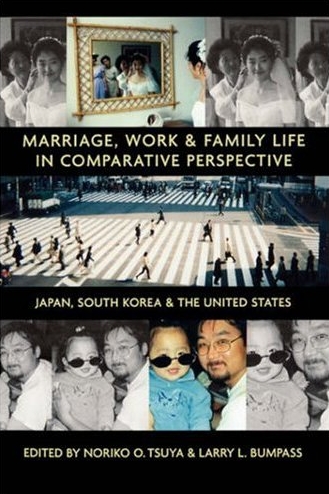
marriage-work-and-family-life-in-comparative-perspective-bumpassWell, before getting to the “why stage” though, you’d be surprised at how difficult it was to find even the most basic of demographic data on Korea in particular, even with the plethora of sources that a Korea Studies geek like myself has. And the only(!) book I have which does provide some of the answers – Marriage, Work and Family Life in Comparative Perspective: Japan, South Korea and the US (click on the image for a link), I was originally very disappointed with when I first bought it over a year ago, for while it was published in 2004 most of its data actually comes from 1994 or even earlier, a flaw not exactly highlighted by the accompanying notes at online bookstores either. But forced out of desperation to reread it, I realized that I’d dismissed it too quickly: like a visiting UN demographer who lectured at my university once pointed out to me, demographics is all about waves, and as I’ll explain, 15 years later Korea is definitely still feeling the effects of the processes highlighted in this actually rather good book.

And, once I realized that, then I confess that I got a bit lost in it at that point, for the similarities and differences between the three countries are simply fascinating, and go well beyond mere numbers of extended families. In particular, after hearing it first on some old Korea Society podcast, I’ve often said that one’s generation in Korea is as important a marker of identity as, say, race is in the US, but I doubt that whoever I heard that phrase from meant it as anything more than an allusion to Korea’s extremely rapid rate of development (I know that I certainly haven’t!). But then I read this on page 61:

Korea tends to differ from the other two countries on a number of structural characteristics that are likely to [strongly] affect intergenerational relations.

But first, the basics. Seeing as they take up an entire chapter, then I won’t get into all the technical details and potential flaws of the methodologies of the surveys in the three countries sorry: suffice to say that, unless stated otherwise, all the statistics in the remainder of the post refer to married couples at the time of questioning, with both spouses between 30 and 59, and almost all for Korea, Japan and the US are from 1994, 1994, and 1988 respectively. Starting off then, the number of couples that were:

  • Living with the wife’s parents: Korea 4%, Japan 9%, and the US less than 1%
  • Living with the husband’s parents: Korea 24%, Japan 37%, and the US less than 1%

Yoshi Sugimoto, in his excellent book An Introduction to Japanese Society (2003), also notes that in 2000 “about a half of persons at or above the age of sixty-five live with their relatives, mainly with the family of one of their children” and that “this pattern is inconsistent with the prediction of modernization theory, that industrialization entails the overwhelming dominance of the nuclear family system” (p. 175). Far from being because immutable and deeply-held Neo-Confucian beliefs however, in reality:

…most two-generation families make [the] arrangement for pragmatic rather than altruistic reasons. Given the high cost of purchasing housing properties, young people are prepared to live with or close to their parents and provide them with home-based nursing care, in the expectation of acquiring their house after their death in exchange. Even if the two generations do not live together or close, aged parents often expect to receive living allowances from their children, with the tacit understanding that they will repay the “debt” by allowing the contributing children to inherit their property after death. This is why aged parents without inheritable assets find it more difficult  to live with their children or receive an allowance from them. (p. 176)

But why do more Japanese parents and married children live together than Korean ones? Rather than giving you the answer straight up, let me highlight the other differences, so that hopefully you might be able to work them out for yourself:

  • Korean parents are the least likely to be alive.
  • One half of Korean married couples surveyed grew up in rural areas and now live in urban areas, against a third for Japan and a figure “somewhat lower” in the US.
  • Naturally more US parents live further away from their children in either Japan or Korea (50% of both the wife’s and husband’s parents live more than 25 miles/40 km away), but there’s still a big difference between Japan and Korea: 28% of the wife’s parents and 24% of the husband’s parents live in a different district or municipality, against 45% and 38% respectively for Korea.
  • Only 46% of Korean husbands were eldest sons, against 56% in Japan.

korean-japanese-daughter-in-law

And finally here are some more interesting facts, albeit more indicative and/or the cause of Korean women’s extremely low economic and political empowerment (possibly – make of them what you will) rather than why Japan has more extended families than Korean does:

  • Korea has the lowest number of couples in which both spouses are working: 22% against 57% in Japan, and 66% in the US. Undoubtedly these figures will have changed in the 15 years since then, but Korea is still exceptional in this regard, with the lowest number of working women in the OECD.
  • Korea has the lowest number of couples where the wife is older than the husband (4%), and the most where the husband is substantially older. In contrast, the figures for Japan and the US are 10% and 18% respectively.
  • Korean women don’t change their names when they get married, Japanese women do. The maintenance of “bloodlines” via male descendants continuing the family register known as hojuje (호주제) being more important in Korea then (at least until it was abolished last year),  until roughly a decade ago Korea had one of the most skewed sex-ratios in the world, and Koreans were notorious for refusing to adopt unwanted children, generally sending them overseas instead. The similar koseki (戸籍法) system in Japan does still continue, but there continuing the family name is important, leading families without a son to often adopt one for instance.

I confess, there appeared to be rather more noteworthy statistical differences and interesting tidbits when I began writing this post: I expected to have much more to say, and yet I find I’ve gotten through those in *cough* only 1470 words as I type this, half of which was an introduction/recap, albeit probably necessary. On the plus side though, I do see much of my role as a blogger as being to do condense (very) much larger pieces of work into their key points, thereby making them much more accessible to a wider audience, and so even if you can’t see the reasons for the differences in the numbers of extended families between Japan and Korea yet, if you just read the part of the authors’ summary below, then go back and look at the four points above the last (rather stylish) photo above, and then finally say something like “Ahh! Of course!” once you do…then I’ll know I’ve been doing the right thing!

…from a number of socioeconomic and demographic perspectives, Japan and the US are more like one another, and Korea is more distinctive. Korea’s mortality and fertility declines are more recent than either Japan’s or those the US. In Korea, the generation of middle-aged adults examined here has experienced all the dislocations and opportunities that go with a recent and rapid shift from an agricultural to a manufacturing and service economy, from a rural to an urban settlement pattern, and from a low level to a higher level of educational attainment. In the US and Japan, these transitions occurred somewhat earlier, and it is expected that the timing and nature of these transitions would affect patterns of intergenerational relations. (p.74, my emphases)

jun-ji-hyun-thumbs-up-wink-navel

If you’re also interested in why so many unmarried Korean and Japanese children live with their parents, see here and here.

(Image Sources: Raysoda, Helozang, Amazon, Raysoda, and Electra1119)