I don’t quite know how I happened to come across this very old Korean underwear advertisement above, but I do know that I couldn’t resist using it sooner or later. See if you can guess who it is before you reach the end of this post, and I’m open as to suggestions as to what exactly the point of her gesture was (it’s not what you think!).
In the meantime, my apologies, but from now on my Korean Gender Reader posts will be a lot more minimalist I’m afraid. Partially because the weekends spent on them has been detracting from — nay, has been in lieu of — time spent on all the longer, more in-depth posts that I’ve had planned, and partially because this last week especially seems to have been a particularly fruitful one for news. And here it is in strict chronological order too, primarily for the sake of breaking it into more manageable chunks for you to digest from on. Please let me know what you think of the new format.
Monday 23 February (And Earlier)
I write “and earlier” because some things I missed last week are still too good not to cover here. For instance:
 1. You’ve Had the Theory, Now the Practice: Finding Reliable and Affordable Childcare in Korea
While I’ve written a great deal on the problems of child care in Korea in the abstract (see here, here and here), two Fridays ago Melissa of Expatriate Games wrote a far more useful post about the ensuing practical difficulties of finding childcare for her 2 year-old daughter in Seoul. Make sure to read her follow-up post on the same issue from Saturday too.
2. Discrimination Against Men Within the Airline Industry
For some reason Google Reader only yesterday gave me the last seven of Aaron McKenzie’s posts at Idiot’s Collective, so earlier I missed his take on a lengthy feature in the JoongAng Daily about the discrimination against male flight attendants in the Korean airline industry, by coincidence the issue which prompted me to start these weekly posts in the first place. For my take on the issue from when it first arose in late December last year, see ROK Drop here.
The image on the right is a close-up from a Korean Air advertisement by the way, which doesn’t actually allow male stewards at all.
(Update: To be more precise, it does hire men, but only from within the company, and hasn’t directly hired any new male cabin staff since 1997)
And now for news from Monday itself:
3. Jun Ji-hyun Forgives and Forgets?
Despite the fact that Jeon ji-hyun’s (전지현) management company Sidus HQ spied on her using a “clone” phone for many years, giving them the ability to eavesdrop on all her phone calls (see story#6 here), not only have all those involved not been booked at her request, but she may well be renewing her contract with the company too! For the details, see Dramabeans here.
4. Less Marriages and Babies During This Recession
I’ve read repeatedly that condom sales go up during recessions, so not unsurprisingly Korean couples are both putting off getting married and having far fewer babies too, with “government officials and scholars predicting that this year’s birthrate will barely exceed 1.0 child per woman, and will drop below that next year,” which I might add is the lowest of any developed country in modern history.
5. System ‘Failing Victims of Child Sex Crimes’
Self explanatory, although the statistics provided by this English Chosun report are always useful. But for more information on actual cases and the attitudes and legal absurdities that lay behind those, such as a man being acquitted of groping his stepdaughter’s breasts because “it was a sign of affection,” see many examples mentioned by Brian in Jeollanam-do here.
Tuesday 24 February
6. Women’s Organizations Compile List of Bad Court Decisions
Far from living up to their stereotypes of passivity — which, to be fair, I might be guilty of perpetuating a little occasionally — women’s groups are doing something about the cases mentioned above.
7. French TV Personality tearfully ends marriage
Ida Daussy, a French woman popular and well-known in Korea (albeit primarily for her fluent Korean skills), is getting divorced from her Korean husband after 16 years of marriage. Interesting ensuing discussion at the Marmot’s Hole here about Western-Korean marriages.
8. Sex Tourism from Japan Increasing?
To be expected with the huge decrease in the exchange rate. Not that too many parallels should be made with the 1950s and 1960s, but the first thing that came to mind when I read the report was how many Korean women then were extorted to become prostitutes to Japanese tourists and US servicemen on US bases; primarily for the sake of obtaining much-needed foreign exchange of course, but those women were also provided to the latter for the sake of helping to cement US-ROK relations.
Wednesday 25 February
9. Eco-friendly weddings

“Lotte Department Store in downtown Seoul held a green wedding on February 23 to promote eco-friendly weddings. The bride’s wedding dress is made of natural fabric from the mulberry tree.” (Yonhap News, via ROK Drop)
10. DNA Evidence Fingers Suspect Three Years After Crime
More good news from Korea Beat. While the Korean Police have a (largely deserved) reputation for incompetence, and rape-kits aren’t even available at most Korean hospitals, in this case three year-old DNA evidence was used to convict a rapist of two mentally-disabled women.
Thursday 26 February
11. Support Network for Unwed Mothers Established
Although Korea is notorious for sending large numbers of children overseas for adoption, the statistics driving that are still shocking. Such is the stigma of having a child out of wedlock here, that even the structure of the miserly welfare parents to mothers encourages it. As explained by Richard Boas, a American physician who has recently established the ”Korean Unwed Mothers Support Network” explains:
…many single mothers struggle with poverty. The welfare ministry gives 50,000 won ($33) in monthly subsidies for childcare to single parent families. Those living below the poverty line can receive basic government subsidies, stay with foster families for up to two years and stay at 40 facilities nationwide for up to five years, far from enough to help mothers keep their children. ”The government gives 100,000 won a month for a domestic adoptive family. However, giving out just 50,000 won for unwed mothers surely gives the impression that the government encourages adoption,” he said.
For the rest of the report, see the Korea Times here. To place it into context, there were 140,000 single mothers in Korea as of 2005, a number which “is believed to have since risen,” and 1,250 children were adopted overseas last year.
12. Prostitution Answers Sexual Needs of Senior Citizens?
The first time I visited in Jongmyo Park in Seoul in 2000, naturally I remarked on the hundreds of mostly male retirees there to my friend visiting from Japan, who rightly pointed out that they “didn’t particularly have much to do nor anywhere in particular to do it,” so why not play Korean chess all day there? In hindsight though, many would much rather be doing something else, and it’s almost surprising that it took so long for prostitutes to encroach on this captive and — let’s call a spade a spade — somewhat desperate market, and the Korea Times reports here on the ensuing problems of unsafe sex, the sale of fake Viagra and “men’s stamina” products, and the general increasing seediness of the area. You can also read discussions at ROK Drop and The Marmot’s Hole here and here.
Personally, while I’m still a strong advocate of the legalization of prostitution, I’d still rather that it took place somewhere other than the former courtyards of Korean kings and queens(!), and that it is used as su h could easily be read as both a symbol and indictment of modern Korea society, much like “National Treasure #1” Namdaemun was unguarded and regularly urinated and vomited on by homeless people until one of them decided to burn it down in a fit of rage last year. Part of the problems, of course, are general attitudes of distaste and avoidance by the police and general public towards the sexuality of the aged, which the KT correctly notes (and brings to mind this comment about a movie on that theme that ended up being censored).
For those further interested, Matt of Gusts of Popular Feeling discusses a little about the history of the area here, and also notes that there is an essay entitled “Stigma, Lifestyle, and Self in Later Life: The Meaning and Paradox of Older Men’s Hang-Out Culture at Jongmyo Park” by Chung Gene-Woong in the latest issue of Korean Journal, which will be free to download here in six months. He mentions that that abstract doesn’t mention this particular aspect of that culture though, and by chance actually I happen to have a physical copy (as this essay is very relevant to my thesis), and so I can confirm that it’s not mentioned in the article itself either!
13. What Image of Korean Women is Presented by the New 50,000 Bill?
 Arriving roughly a decade(!) after it was needed, one report on the woman on it — Shin Saim-dang, a renowned female writer, calligraphist and mother of a noted Joseon Dynasty scholar — caught my eye, as it said that she is widely referred to as the symbol of a ”wise mother and good wife,” or “현모양처” in Korean.
Forgive me if similar sentiments were raised last year when plans for the new bill were first announced, but that phrase — still well known and aspired to by many Korean women today (just ask them) — instantly reminded me *cough* of the suffrage movement in New Zealand in the Nineteenth Century, women being the first in the world to get the vote naturally being a good thing, but which in fact was also a regression for women’s rights because that vote in 1893 was based on the premise that women would add a civilizing and moral element to politics that it lacked. Or am I making too much of it?
Jumping ahead a little though, the most recent controversy surround ing the new bill has actually focused on the shape of her face (sigh), much taller and thinner and — dare I say it? — Western-looking than the original round shape of the portrait it was based on. Perhaps my eyes are tired and that is too much of a leap really, so without any further ado read about both controversies at ROK Drop here and decide for yourself.
14. New Mother Son Tae-young Shows-Off Her S-line
No, I don’t have a thing for her, and I’m not at all saying that she isn’t entitled to look good, nor that any mother can’t or shouldn’t either. On the other hand, not only was she the thinnest pregnant woman that I’ve ever seen (see #11 here), but showing off her great body one month after the birth does set hopelessly unrealistic standards for those mothers without wealth, personal trainers, beauticians and domestic helpers to follow, a complaint I remember regularly reading in Western newspapers in response to “Celebrity Moms” a few years ago too.
Friday 27th February
15. Home Buyers With Over 3 Kids May Be Subsidized
A story naturally linked to above reports on the plummeting birthrate, which, however dire, I still fail to see how, say, telling Strategy and Finance Minister Yoon Jeong-hyun and Land and Transport Minister Chung Jong-hwan to “check Seoul and surrounding areas from a helicopter to find places for new homes” is going to help exactly! True, also giving preference “to couples with three children or more when providing homes and leased apartments and lower house prices” is better than nothing of course, but – seriously – when on the Earth is the Korean government and business establishment going to realize that you can’t educate women to the level of men and then expect them to have kids when they have to give up their careers if they do so? Two hundred thousand won a month in subsidies is supposed to compensate for that?
16. Phones With Security Feature for Women, Children Becoming More Popular
Again, partially in response to serial murder suspect Kang Ho-soon (see #5 here). See the Korea Times article here, and Brian’s take on them here.
17. Sex, Videotape & Lies
In a scam he pulled off on four different women, a 26 year-old is arrested for having sex with his then girlfriends at love hotels and then allegedly claiming that the owners told him that they secretly recorded them, demanding money not to release the clips on the internet. Naturally, he had no money to pay “them”, and so his girlfriends gave him their own money to pass on, the latest ending up resorting to loan sharks to get it.
Saturday and Sunday 28 February and 1 March
19. The Coming Baby Bust
Noticing a theme here? At least the English-language dailies at least are beginning to draw attention to the issue. See here for an editorial in the Korea Times.
20. Study: Most Child Molesters Know Their Victims
Like Korea Beat says here, this is probably well-known to most readers of this post, but it may not be in Korea.
21. Human Trafficking in South Korea
Two excellent articles from the Hankyoreh: first, a story here about a Uzbekistani woman tricked into prostitution in Korea, but whom the police have charged for falsifying electronic records, and next an editorial placing that into some context.
22. Japanese Transgender Entertainer Named as new KNTO Spokesperson
Finally, I’m glad to end on a fun, positive story. But, alas, it’s not that big a deal really, as although Korea’s own transgender celebrity Harisu (하리수) also happens to enjoy a great deal of popularity herself, I seriously doubt that either will have had all that much impact on wider public acceptance of transgender people in both countries, in much the same way that Hines Ward’s sporting success has at least raised the issue of the poor treatment of biracial children in Korea (see here and here) but now the next rather more difficult step of actually doing something about it is needed.

Oh, and the picture at the beginning of this post? Although I’d never have recognized her myself, my wife took one look and told me it’s Song Hye-gyo (송혜교) back from when she first started modeling. But from when exactly I can’t say sorry: the source of the photo is a blog entry from 2005, but obviously it is much older than that, although I did find the photo again alongside two others of Kim Min-sun (김민선) and Jenny Lee (이제니) here, both with the same gesture and advertising the same god-awful granny panties, unfortunately there was no further information on the date, company, nor the meaning of the gesture. Still, I’m dying to know now: what do you think the hand gesture means? Like I said, it’s probably not what it looks like, for can you image that ever being used to sell lingerie? Let alone in Korea, in the late-1990s? But what, then?


 Update, June 2014:
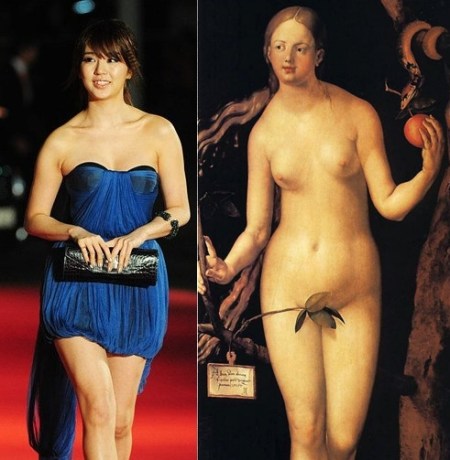
 As they are great opportunities to show off previously their previously hidden confidence and beauty, actresses look more and more glamorous on the red carpet at award ceremonies, and fans are eager to get a peek at their idols. A few days ago at the 45th Paeksang Arts Awards many actresses took the opportunity to throw off their old, established images and show off new sides to themselves, particularly Go Eun-ah (right, source) and Yoon Eun-hye. Both were previously well known and popular for their cute and sweet images, but despite her youth Go Eun-ah has become quite buxom, and has been described as the second Kim Hye-su. Also on this occasion, Yoon Eun-hye showed her new womanly side by revealing her round shoulders for the first time.
 An actress also getting attention recently is Yoon Eun-hye, who has been in the dramas “The First Shop of Coffee Prince” and “Princess Hours” but who looked rather androgynous and/or tomboyish in both, showed off her shoulders and legs in a blue mini tube top. Especially, Yoon Eun-hye’s round shoulders were very similar to Eve’s in a 16th Century oil painting “Adam and Eve” by Albrecht Dürer, a well-known symbol with which to evaluate female beauty. Apart from Eve, other symbols used as such have been Venus in “The Birth of Venus” by Sandro Botticelli (1482, above), and she has a remarkable resemblance to the former. Lee Baek-gwon says “On the whole, while the muscle development around Yoon Eun-hye’s shoulders is a little narrow, its roundness give her a very feminine and woman-like appearance” and also that “in the West in the 16th Century, this type of well-developed curve was considered the beauty standard”. And so while a little chubby, her hips and so on are very close to that standard. These two women didn’t previously show this sexy side to themselves in the dramas they appeared in, but people now have high expectations for their next appearance on the red carpet! (end)
 I already mentioned some articles on this in story #22

 The Grand Narrative