Apologies for the Korea Gender Reader’s one-month hiatus. Naturally even I can’t cover everything I missed(!), so today’s post will be a mish-mash of news from March and from last week.
1. Baek Ji-young Chosen as Soju Model
The innocent victim of a sex-scandal in 2000, singer Baek Ji-young (백지영) has had to fight hard against Korea’s double-standards to rehabilitate her career, and it’s both a reflection of that and how much Korea has changed since that she was recently chosen in an online-poll as the next model for “Ip-Saeju” (잎새주) soju, produced by Bohae (보해양조).
Of course, by now it’s quite rare to find Korean soju and beer advertisements that feature virginal-looking women, although they were the norm two years ago when both were almost exclusively marketed towards men. I wonder if Baek Ji-young would have been considered too risqué had a similar poll have been conducted then?
2. Statistics on the Effects of the Recession on Women
On many occasions I’ve pointed out that, like during the Asian Financial Crisis of 1997-98, women workers are again the biggest victims of the current recession. But finally, here are some actual figures:
According to the National Statistical Office (NSO), Sunday, the number of people employed in their 30s fell by 167,000 to 5.81 million in February from a year earlier, the lowest since the office began compiling data in June 1999.
In particular, the number of female workers in that age bracket dropped sharply by 157,000, while male workers declined by 9,000, indicating women are more severely affected than men by the unfolding corporate downsizing and the collapse of self-run businesses.
And why…
”A significant portion of 30-something female workers are employed on a non-permanent and temporary basis, without job security and other fringe benefits. Companies target them first when things go bad because it is easier to lay them off than regular workers,” the official said.
3. Another Knocked-up Korean Star Gets Married
An inelegant way to put it perhaps, but how else to convey just how routine this is becoming? Of course, in practice just like everyone else Koreans have long been more tolerant of premarital sex and pregnancy provided that the couple ultimately “did the right thing,” but it’s certainly been only recently that Korean celebrities, usually held to much higher moral standards than the public, could start being so blatant about it.
Or can they? In this particular case, minor celebrity Jung Sia (정시아) still felt compelled to deny pregnancy rumors until an wedding date was set, but despite that I’m quite confident that sooner or later not only will some female celebrity be unrepentant after being “exposed,” but will also be supported by most Koreans (albeit by indifference more than active censure).
4. The Continuing Korean Low Birth-Rate Saga
While it’s been one of my areas of interest for a long time (see here and here), even I tire of repeated articles that mention that Korea’s birth rate is one of the lowest in the world and…little much else really, so I’ll try to keep this section to a minimum:
— 4 in 10 Korean women report that they are delaying pregnancy due to the recession, but certainly not helping are management and colleagues’ changed perceptions of new mothers’ abilities and career ambitions once they return to work.
— Last year, the average marrying age was 31.4 for men and 28.3 for women, but the number of marriages is beginning to dwindle.
 — Health, Welfare and Family Affairs Minister Jeon Jae-hee and comedian Kim Ji-sun (right, source) are currently holding radio campaigns to “boost the country’s birthrate,” which totaled about 630,000 infants in 2000 but declined to 430,000 in 2005 (although there was a temporary increase in 2008 because Koreans rushed to get married before — and then have children during — the auspicious Year of the Pig).
Although that’s better than nothing, one gets the sense that it’s like rearranging deckchairs on the Titanic considering the wider problems with inadequate and expensive childcare facilities and workplace discrimination that are the real reasons Korean women are discouraged from having children: it’s not just a matter of feeling more maternal. But to be fair, John Jae-hee does acknowledge that the benefits of incremental improvements to policy are likely to be moot given the current recession (Note: rather confusingly, not least for the Ministries themselves, there is a seperate Gender Equality Minister by the name of Byun Do-yoon).
— Lawmaker Park Sun-young of the minor Liberty Forward Party (LFP) recommended that in order to increase birth rates Korea should adopt the French policy anonymous birth, under which pregnant women can visit a hospital, register anonymously, give birth and leave.
While commendable in itself, I doubt there’d be much effect on the birth rate in a country with a strong stigma against raising children out of wedlock (see #3 above). More interesting in that report are statistics on the extremely high number of abortions in Korea, and the fact that only 1% of fathers take advantage of the *cough* generous 3-day paternity leave to which they are entitled, introduced last year. To be fair to Korean fathers though, as an undergraduate I read that even with the extremely generous provisions offered in Scandinavian countries that few fathers took up the offers there either, and I’ve read on at least one blog here (although I’ve lost the address unfortunately) that many Korean employers are completely ignoring or effectively prohibiting male employees from taking paternity leave.
In today’s economic climate, the maxim “Choose your battles” comes to mind, and 3 days hardly seems worth it.
— A strange report on a bill to reduce the term limit for abortions from 28 weeks to 24. Strange because first it notes that Korea has one of the highest abortion rates in the world, and then it states that:
Healthy women who undergo elective abortions can be imprisoned for up to one year or fined two million won. Doctors performing the abortion can be imprisoned for up to two years.
And yet doesn’t comment on the obvious contradiction .
If you’re interested in the debate about term limits, then you’ll probably be interested in last year’s decision in the UK to keep the abortion limit to 24 weeks (see here and here). In sum, that limit was set in 1990, and there was a move to reduce the limit to 20 weeks because of advances in medical technology since, but in fact despite those the rates of 24 week-old and younger premature babies surviving is virtually unchanged. Hence although it was made a conscience vote (not along party lines), it was overwhelmingly rejected.
— Finally, by 2020 probably up to 50% of teenagers in many rural areas will be biracial (see here also). But see here for a brief report on the verbal, physical, and sexual abuse faced by many of their immigrant mothers.
5. PETA Demonstration in Seoul
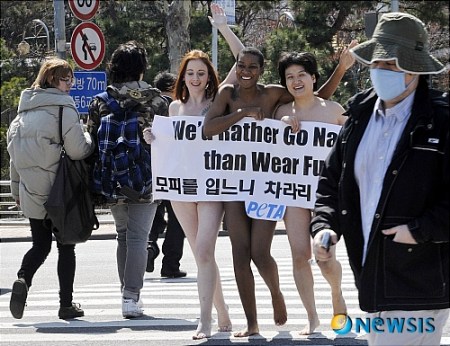 For the story behind the jarring image on the right (source), see here.
I’m definitely anti-fur, always bought free-range eggs and chicken before moving to Korea (which lacks them), and was even vegetarian for the odd couple of months or so as a student, but despite all that I’m vehemently anti-PETA, and for so many reasons that I could write several posts just on that subject alone. Keeping on topic though, while I often disagree with much of what I read on the blog Feministing, its critique of PETA’s use of (attractive) naked women to advertise its cause is spot on:
…the thing I hate most about this particular PETA propaganda is that it takes what should be a message of empowerment, Love-Your-Body-style, and turns it into yet another affirmation of the female ideal. As [co-author] Renee puts it, “It seems that they respect the rights of animals far more than they respect women. Consider that they don’t use images of male nudes, nor do they use images of women with varying body sizes.”
As you’ll recall, PETA has defended this advertising strategy with the weak response that “sex sells.” It’s an excuse I expect from Axe and Maxim, but not from a movement that is supposedly about justice.
Granted, the Korean woman on the right isn’t your average model, but then she would have been included to add a token sense of local legitimacy: the modus operandi and the arguments against it remain the same.
As a guy I find the notion that naked women are the only way to get me interested in a cause very patronizing, and besides which I seriously doubt that men’s greater awareness of PETA via admiring notorious advertisements like this (second from the top) really translates into effective support.
If I happened to be Korean too then I also would annoyed at the audacity of foreigners thinking that: flying in from the US; walking around naked for 5 minutes; then flying out to do exactly the same thing in another country the next day would somehow be enough to influence my opinions, although I’m not for a moment saying that foreigners shouldn’t protest in Korea and/or that they can’t be effective, especially in situations where Koreans lack local expertise, aren’t interested (but should be), and/or are understandably too concerned about their own reputations to protest themselves.
6. Adidas Korea Finally Uses an Actual Athlete For Advertisements
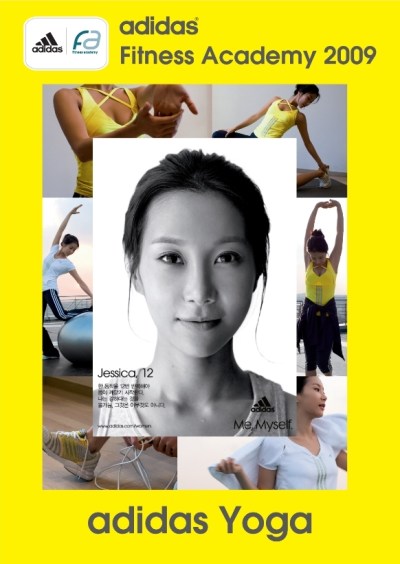 Too distracted by them to notice myself, commentator Sonagi was right to point out that the skinny, decidedly nonathletic models used to launch Adidas Korea’s “Me Myself Campaign” in February, supposedly all about rejecting the fashion industry’s impossible standards and promoting healthy and fit body images for women, achieved anything but in reality.
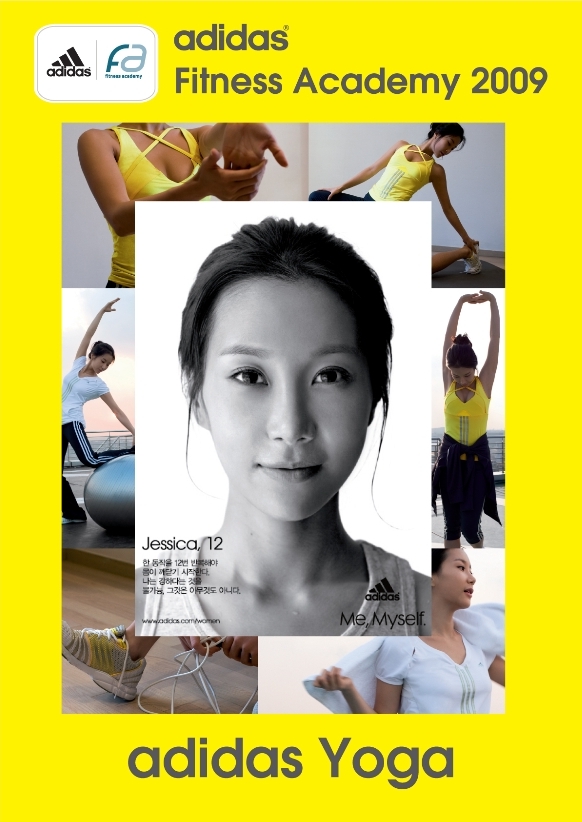
Suitably chagrined, I suggested that some kick-ass female boxers could be used instead, but Adidas ultimately plumped for a yoga instructor who goes by the name of Jessica (left, source). Meanwhile, rival Nike Korea is now has a side-contract with actress Park Shin-Hye (박신혜), but currently world-famous ice skater Kim Yu-na (김윤아) is their frontwoman, replacing BoA who was the year before.
I don’t mean to imply by the above that non-athletes are bad choices in themselves, and indeed BoA in particular is clearly very physically active, but as Korean women overwhelmingly prefer passive methods of losing weight (see here and here), then absolutely any link between losing weight and active exercise is to be strongly encouraged.
To illustrate the transformative effects attributed to merely drinking something, for instance, the music group Girls’ Generation (소녀시대) is currently promoting a skin-cleansing drink despite its members’ typical teenage acne, actress Song Hye-gyo (성혜교) is doing the same for one that makes you look White lightens your skin, and Kim Tae-hee (김태희) is still selling drinks that make your face more of a “V” shape.
Bear in mind that such obsessions exist despite Korean women still being the least obese in the OECD. On the plus-side though, limits are emerging as to how skinny a woman’s legs can be before even Korean netizens think twice about praising them.
7. More Bizarre Standards For Female Celebrities
 Like this post explains, most Korean female celebrities start with a cute and innocent image and try a sexier and more mature one later, but actress and singer Sandara Park (박산다라), who had a modest career in the Philippines before becoming popular in Korea, is making news for her photoshoot for the “lads’ mag” on the right while she was there (source).
But while it’s true that Korean fans are often upset with real-life behavior out of character with actresses’ roles in dramas and TV (no, really), considering the number of Korean women that have appeared in Korean equivalents – a standard method for advancing one’s career – then I’m at a loss as to what all the fuss by netizens is about. Especially as it’s quite clear that it was a one-off and that it was done because her image in the Philippines then was simply too cute and innocent!
8. Family Who Raped Mentally-handicapped Relative Given Jail Time
Undoubtedly due to public pressure, the four men who repeatedly raped their mentally-handicapped relative over seven years, but whom were given suspended sentences because there was no-one else to look after her (see #8 here, then here), have been re-sentenced to prison time.
9. Sex Offenders Free to Teach In Korean Schools
One does have to wonder where the motives for stereotyping foreign male teachers as pedophiles comes from when you discover things like this:
Currently, criminal records of those sentenced to less than three years in prison are removed after five years. As such, schools can’t always ascertain the criminal record of would-be teachers.
Which meant that a Korean teacher with seven counts of “sexual assault and other crimes” against teens was able to get a job teaching them: for the details read Matt at Gusts of Popular Feeling here, KoreaBeat here, and Brian in Jeollanamdo here. Matt also rounds off with an excellently researched and comprehensive “State of Korean Youth” post here, and don’t forget to also read this one describing how a teacher was only given a six-month sentence for sex with an 11 year-old, and how the maximum sentence is still only three years.



 While it is possible to absorb Vitamin D through food, the surest way is through exposure to a few rays of sunlight every day, and Korean women would be well advised to ask themselves if ultra-pallid skin is really worth the price of full health. Just as Korean parents might wonder if higher TOEIC scores are really worth the price of their children’s long-term health (end).


 (The Prewar Expansion of the Japanese Empire.


 In today’s


 Estimated reading time: 2 minutes. Actors:

 Perhaps given the dire state of today’s economy, such imperatives will force such a change in Korea? (End)



 Finally, enter the 2002 World Cup, which no, I’m definitely not kidding about: while people may not have noticed this particular aspect at the time, anyone that was actually here would readily agree that it was an amazing time to be young and in Korea, and was just as revolutionary in terms of expressions of women’s sexuality as I described. In all seriousness, consider what life was like for unmarried women literally just a week prior to the start of the games: they would often be criticized walking down the street for merely wearing short sleeves – remember that 19 out of 20 women would wear t-shirts over their bikinis at the beaches then – and it was quite taboo to discuss sexual feelings and preferred men’s bodies, even to close friends. Meanwhile, soccer was very much seen as a men’s game – who were originally rather taken aback by women’s sudden interest – and members of the national team(!) made less per year than I made then as an English teacher (source, right: unknown).


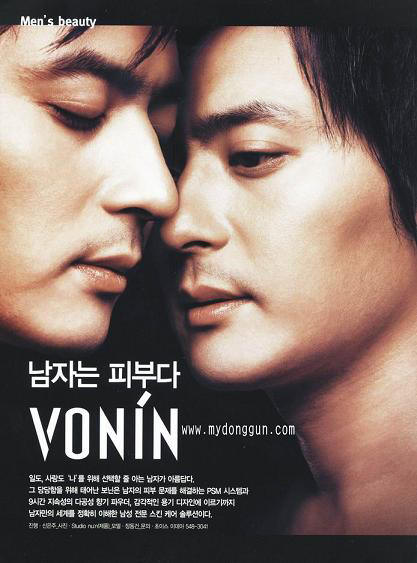 Among other things, Korea completely lacked — nay, explicitly banned — the mainstreaming and then commodification of gay culture in the 1990s that led to the rise of metrosexuality. Even today there are implicit restrictions against positive portrayals of foreign male-Korean female relationships in the Korea media that have prevented metrosexual symbols like David Beckham from ever acquiring the popularity here that they did in, say, Japan during the 2002 World Cup. Moreover, when focusing on men, it can be easy to lose sight of the fact that it is actually women’s changing tastes in them that drive changes in their fashions and grooming habits, and accordingly it ultimately proves to be married Korean women in the late-1990s that are responsible for flower men’s origins (source, right: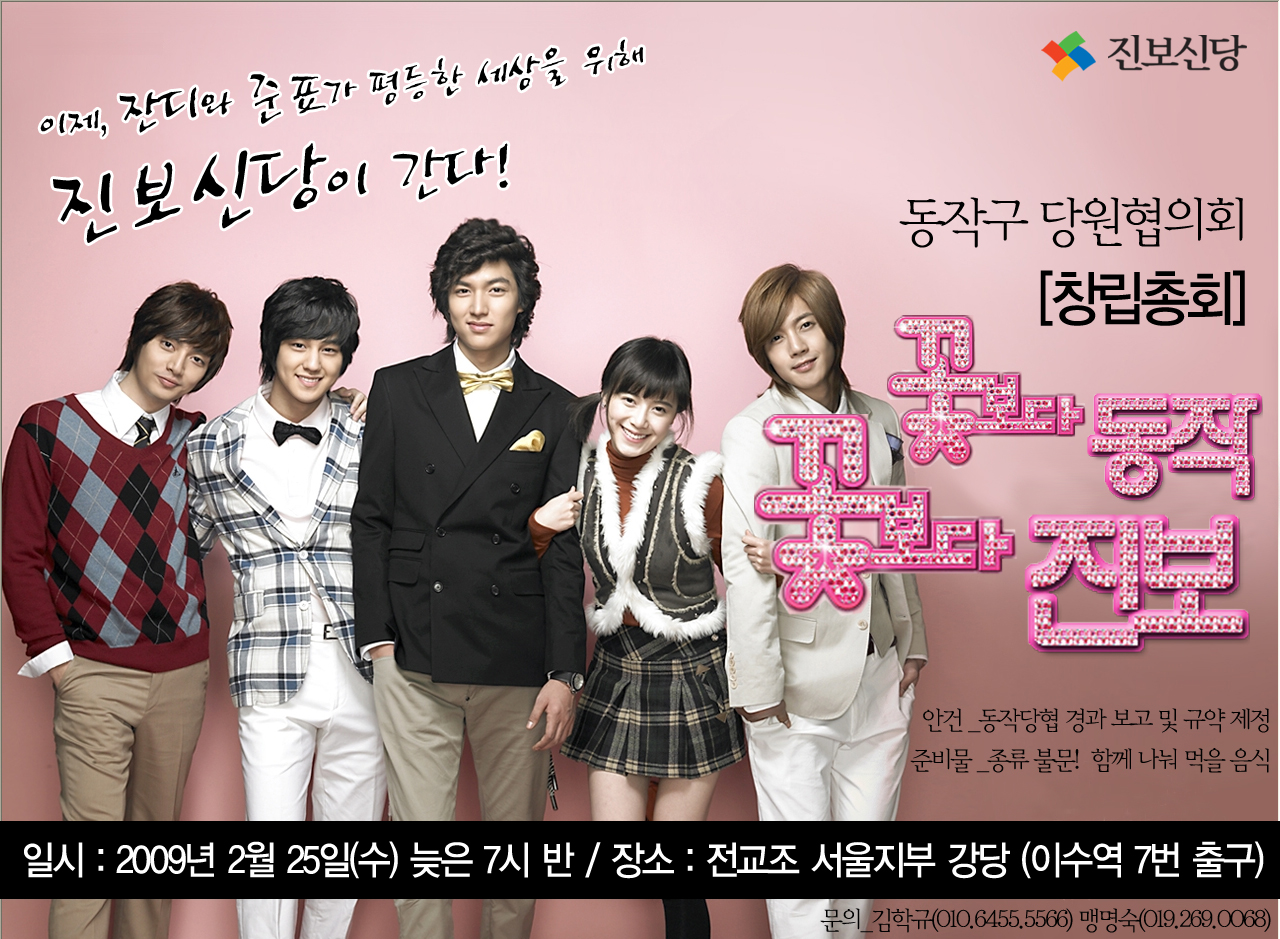
 The Grand Narrative


