(Update, 2013: See here and here for much more up to date posts on this topic, and for similar cases in English-speaking countries in the 1910s-1930s and 1940s.)
That the female body has occupied a central place in the Western cultural imagination hardly comes as news, says comparative literature writer Susan Suleiman. And while I lack knowledge of Korean counterparts to the historical examples in the visual arts, literature, and religion that she mentions, I don’t doubt that they exist.
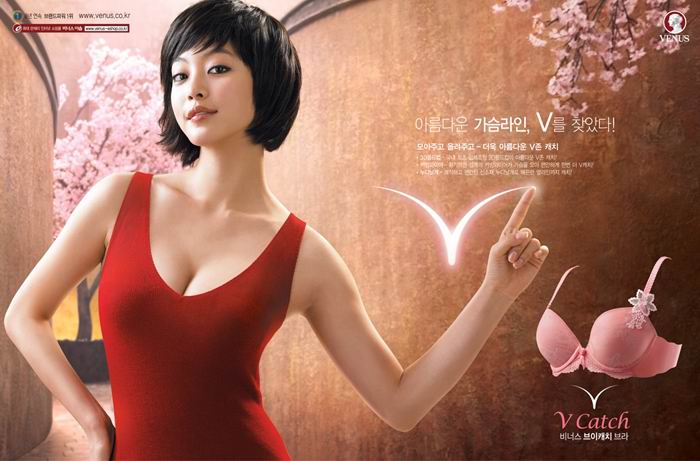
But what to make of the recent Korean trend towards categorizing the female body and/or body parts into a plethora of different romanized “lines”? Where do they fit in?
It’s been easy enough to prove that they have become a pervasive feature of Korean popular culture; so much so, that many have acquired a life of their own, bearing little resemblance to the (idealized) women’s bodies they were first used to describe. But those earlier observations of mine were devoid of context, something which began troubling me once I paused to consider the source of the above article on the most recent manifestations of the trend, about Korean cosmetic surgeons classifying woman’s buttocks into four types. To be precise, it raised two questions, which I would appreciate readers’ help with.
The first is that is this trend of categorization qualitatively and/or quantitatively different to that which occurs in the Western media? As to the former, probably not: I need hardly point out the similar obsession with women’s bodies there, or that it also provides often impossible ideals to live up to. And however much English speakers may find Koreans’ romanization habit in this particular case both curious and amusing (and thereby memorable), arguably it merely reflects Koreans’ general obsession with English, grafted on to an interest in women’s body forms that is not dissimilar to that of the West. Indeed, even some native English sources are beginning to describe women’s bodies in terms of letters (see below), and while that failed to catch on, are they really different to describing women’s bodies in terms of bananas and hourglasses and so forth?
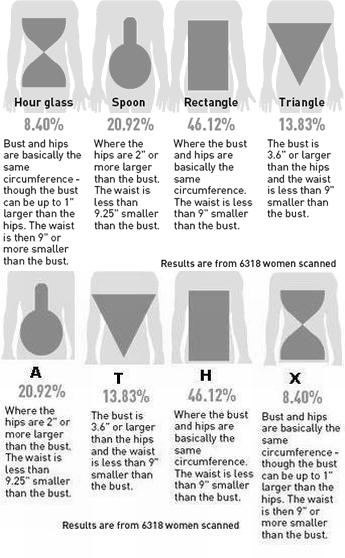 (Image sources: top; bottom. The results are from this 2005 study)
Forgive me for stating the obvious perhaps, and I mention all that not to exonerate the Korean media for the ways in which it warps and distorts women’s body images. Rather, that if I still feel that it does so more than its Western counterparts nevertheless (and I do), then that something more than my gut feeling is necessary to convince skeptics. And perhaps the difference simply lies in the much greater extent to which S-lines and V-lines and so forth are mentioned? After all, not for nothing do I describe them as a “pervasive feature of Korean popular culture.”
Unfortunately however, providing empirical proof of that is rather difficult, at least for a humble blogger. But I can provide indirect evidence in the meantime, which I would very grateful if any readers could add to.
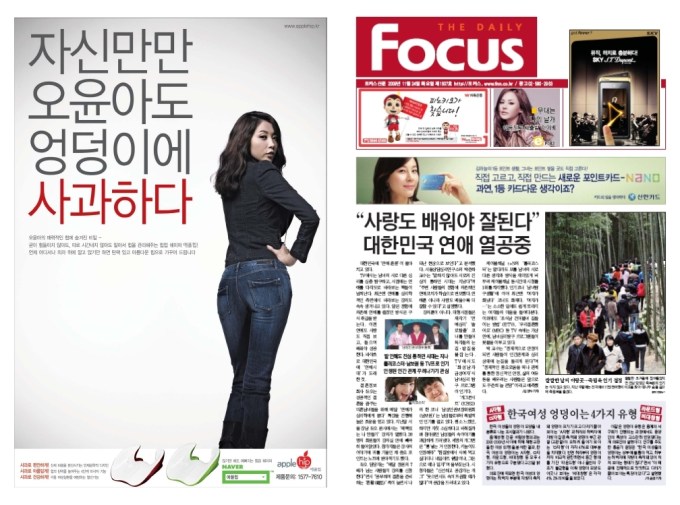
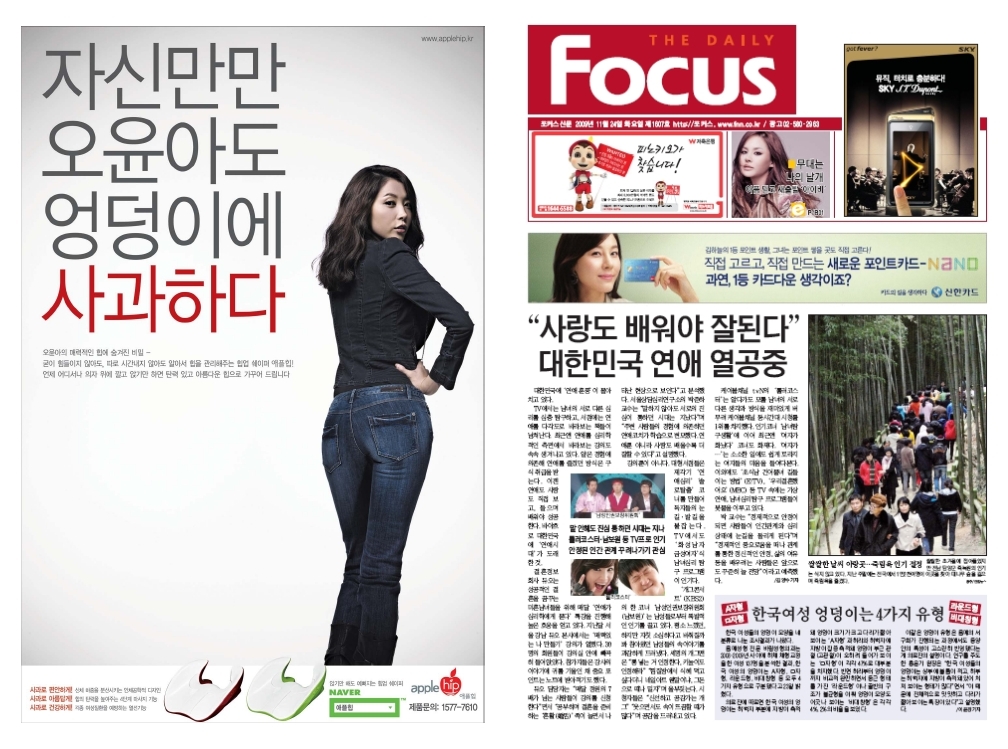
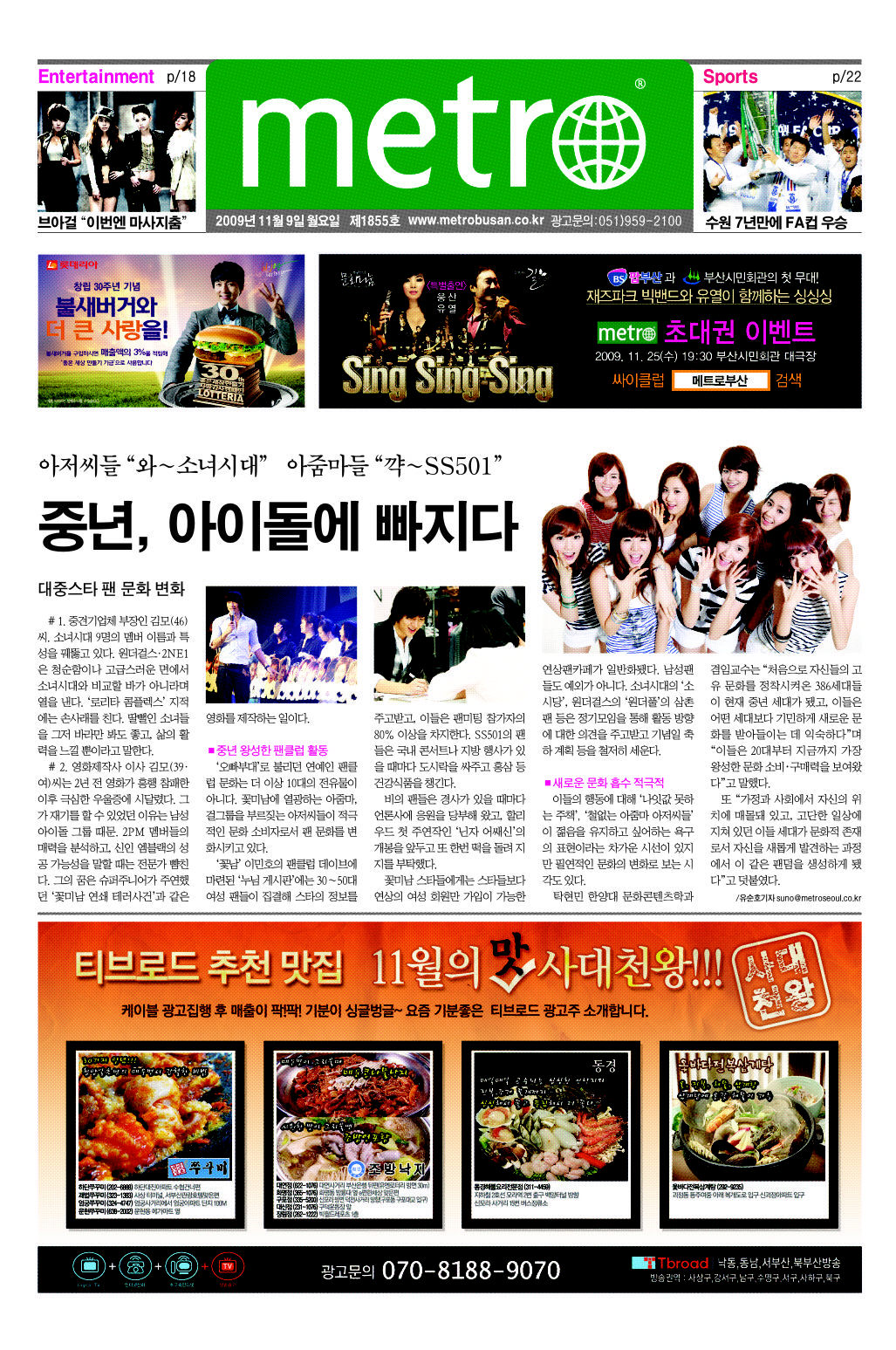
The first is the source of the article on women’s buttocks I’ve translated at the end of this post. While it may not be obvious from the opening image, it’s actually on the front page of Focus, a free daily newspaper: the image on its left, not coincidentally an advertisement for a chair which supposedly shapes one’s buttocks, part of an accompanying cover.
To your average Westerner, I’d wager that this choice would immediately single out the newspaper as a tabloid—”Women have four kinds of ass! Read all about it!”—but I’ve been asking my 20-something students’ opinions of Focus and other newspapers over the past week, and only a minority considered it such. And why would they, considering that the article was also covered by numerous other news sources (see here, here, and here), including the authoritative Hanguk Kyeongjae, a business newspaper, and which even had a helpful graphic?
Ergo, the bar for tabloid journalism is rather lower in Korea, and this extends to mainstream Korean portal sites, about which I wrote the following in my last post:
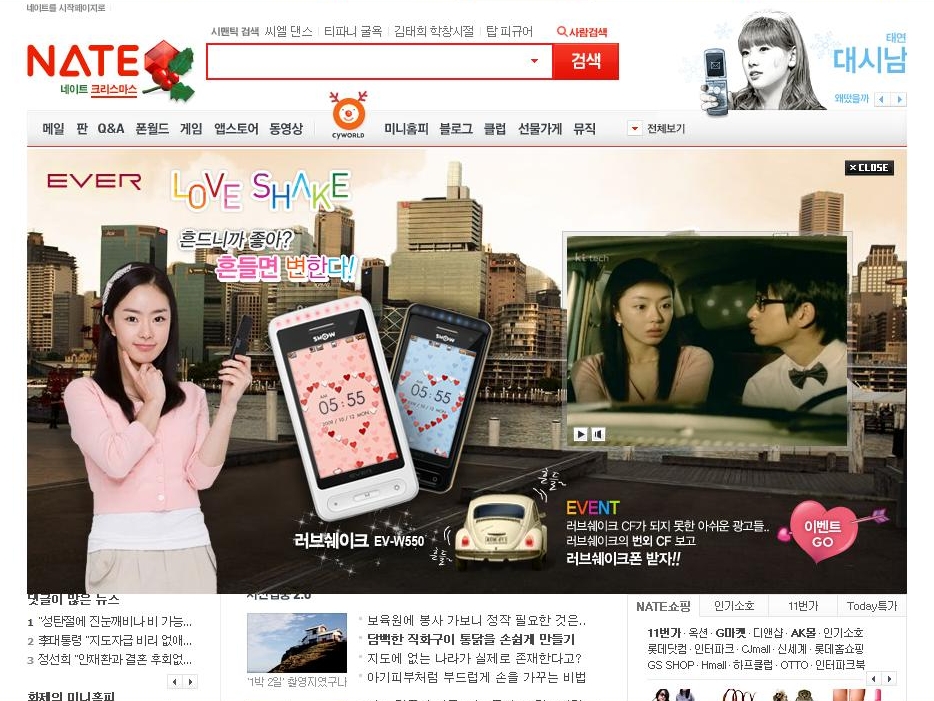
Unlike their English counterparts, you have roughly a 50% chance of opening Naver, Daum, Nate, Yahoo!Korea and kr.msn.com to be greeted with headlines and thumbnail pictures about sex scandals, accidental exposures (no-chool;노출) of female celebrities, and/or crazed nude Westerners.
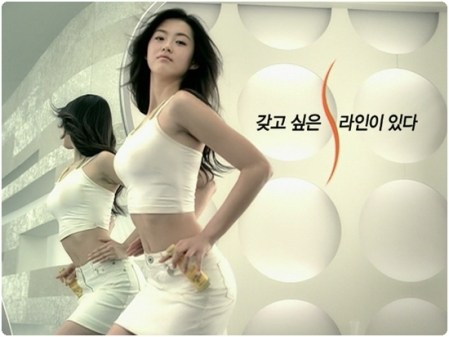 To which I should have added—of course—numerous thumbnail pictures of female celebrities’ S-lines, and also a warning to never look at any of the otherwise innocuous images in the “image gallery” at the bottom of Yahoo!Korea in particular, for if you do you’ll frequently be greeted with advertisements for videos of celebrities’ nipple-slips and so on alongside those birds, flowers, and interesting landscapes.
What’s more, if portal sites are fair game, is it any wonder that children are also encouraged to be concerned about their S-lines and so on? And don’t get me started on ubiquitous narrator models.
Finally, consider what Javabeans wrote on the subject, a blogger on Korean dramas who is a much more authoritative source on Korean television than I will ever be:
…while this [romanization] practice is seemingly frivolous on the surface, it actually belies much more pernicious trends in society at large, when you have celebrities vocally espousing their alphabet-lines and therefore actually objectifying themselves as a conglomeration of “perfect” body parts rather than as whole, genuine people. (my emphasis)
With that combination, something has finally clicked for me: why it is so difficult to find Korean language sources on sexism in the media, and on advertisements in particular? I’ve been looking on and off for years now, and while I accept (and would be more than happy to learn) that perhaps I’ve simply been using the wrong search terms and/or looking in the wrong places, that it is so difficult in the first place is surely telling. A solution though, is perhaps provided by Daniel Jonah Goldhagen in Hitler’s Willing Executioners: Ordinary Germans and the Holocaust – no, really – who had this to say about anti-Semitism in Nazi Germany:
A general problem in uncovering lost cultural axioms and cognitive orientations of societies since gone or transformed is that they are often not articulated as clearly, frequently, or loudly as their importance for the life of a given society and its individual members might suggest. In the words of one student of German attitudes during the Nazi period, “to be an anti-Semite in Hitler’s Germany was so commonplace as to go practically unnoticed.” Notions fundamental to the dominant worldview and operation of a society, precisely because they are taken for granted, often are not expressed in a manner commensurate with their prominence and significance or, when uttered, seen as worthy by others to be noted and recorded. (Vintage Books Edition, Feb. 1997; p.32)
Not lost or transformed, but equally obtuse to someone from another culture perhaps, and which I’m still only just starting to make a dent in.
 But a good grounding for that would be the origins of Koreans’ obsession with romanizing women’s bodies, the second question the article raised for me. Or to be honest, an element of the subject I realized I’d paid little attention to when, serendipitously, Korean reader Chorahan provided this extremely informative comment on the subject on another post. With permission, I am happy to now place readers in her more than capable hands:
…I think the specifics of the alphabetization of Korean women are best approached in the context of the classification of women into certain rigid subtypes (read: simplified stereotypes) of women. The S-line and V-line are part of the ‘formula’ for the ‘pretty girl’ here, as are humongous pupils in big double-lidded eyes, cosmetically unaided pallor, bone-tight ligaments, etc. I would suggest that people here perpetuate this mind-boggling state of sheeple-ness precisely because this ‘formula’ serves as helpful, socially constructed and ordained criteria – with which to deduce the type of woman being dealt with, and to adjust manners to suit.
Manners are adjusted according to the woman’s ‘type’ because it is widely taken as a given that certain things can/cannot be said/thought about women depending on how they look (value-judgment wise). The socially ‘accepted’ or ‘conceivable’ scenario that follows any such encounter is rigidly stratified into according variations. My take on this phenomenon is that this is directly derived from a warped and popularized Confucian principle popularized in the Chosun dynasty called 정명론 (正名論), or literally ‘right name idea’, in which the ‘father should be fatherlike and the son sonlike etc.’ A beauty should be treated as a beauty, or a ‘talking flower’; an ugly girl can be laughed at/with (hence the ‘ugly’—or, as I like to put it, ‘uglified’—comedian typification.)
I’m a Korean girl and I’ve lived in Seoul nearly all my life, going through the average Korean educational system to enter the undergraduate level here. Inferring from the numerous social contexts in which I’ve encountered such blunt references to conventionally ugly/pretty features, I would venture the possibility that in originally familial, communal societies where everyone had to stick together whether they liked it or not, the ‘insult’ was not only an insult per se, but also employed as a form of veiled endearment. This is widely considered the ideal sort of 부담없는 (easygoing) interaction between two close individuals—dialogue employing insult as endearment, or ‘constructively realistic advice to help you in the real world’—and is often the most commonly resorted-to excuse for horrific verbal abuse. (Coloring vacuous praise according to these featural types is also just such a form of ordained interaction, considered honest and respectful and completely normal.)
 I do not, however, think that this should simply be chalked up to individual stupidity on the part of people that blindly follow this line of thought/action—quite the contrary. I think it’s very telling that the homogenizing retardation of the populace in this regard is and has always been spearheaded by *the commercial/entertainment media sector,* which is—big surprise— notoriously homogenized/stereotyped! It has even resorted to homogenizing certain snapshots of stereotyped ‘diversity’ or ‘unconventionality’ in the form of teen idols that are held up on pedestals as somehow being harbingers of Korea’s ‘openness’ and ‘creativity of the youth’.
As a twenty-something Korean woman towards whom those commercials are directly marketed, I find all this very sad and disgusting and lame, and I am very troubled by the thought that people actually think Korean society is improving/ has improved in its bridging of (sexual or gender-based, if that’s your cup of tea, though I don’t think that’s all) dichotomies (if dichotomies are indeed criteria on which to issue any normative judgment.)
I think it is not people being stupid, but the other way around (stupid being people, or stupidity donning the guise of specific individual avatars): the root of the problem (of not seeing people for the people they are, and adjusting social perception/performance according to formulas hammered in by peer pressure since birth) is a sort of warped ‘commodification of human beings’ + ‘Confucian backwash’ that is only being exacerbated as people constantly look to external/ international solutions to symptoms that stem from an overlooked, simplified, but inherently endogenous disease that must be addressed within its own context.
I definitely think something fundamental has to give. This isn’t just an odd cultural quirk to cluck tongues over – this S-line, this V-line trope, this alphabetization of women just as much as the stereotyping of men – it’s seriously symptomatic of some skewed rift in the goodness and saneness and kindness of people here vs. the expressed, contorted manifestations of such potential strengths.
Not exactly concise, but this is my very understandably strong opinion regarding the topic of this post. But I’m no sociologist, so I wouldn’t know.
p.s. In first paragraph—sorry, this could be misunderstood, i don’t propose any normative suggestion—I’m suggesting as an explanation that people ‘are perpetuating’ etc. (end)
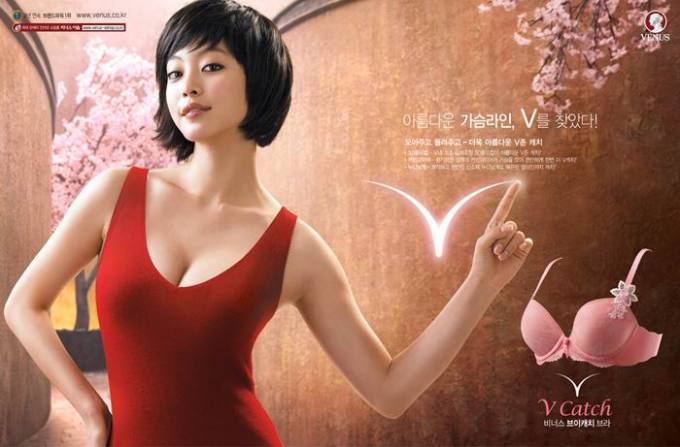 Despite all that context however, one still shudders at the thought that the following was the first thing millions of Koreans read one November morning:
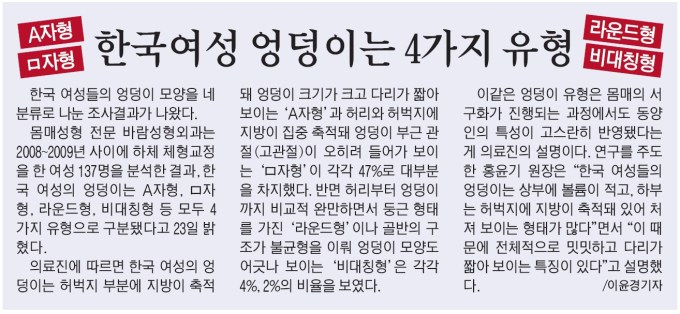 Korean Women Have 4 Types of Buttocks
The results of a survey about the different types of Korean women’s buttocks have just been released.
Baram (wind) Cosmetic Surgery Clinic, which focuses on operations on the body rather than the face, performed operations on the lower bodies of 137 female patients in 2008-2009. An analysis of their different types of buttocks was performed, and the results released on the 23rd of November. All in all, Korean women have 4 types: “A”, “ㅁ,” “Round,” and “Asymmetrical/Imbalanced.”
According to the team of doctors there, women with type A have a lot of accumulated fat in their thighs, making buttocks look big and their legs short, and those with type ㅁ, a lot of accumulated fat in their thighs and around their waists, making their hips look relatively narrow. Both comprise 47% of Korean women each. On the other hand, those with relatively smooth and curved hips and buttocks have a Round type, and those with an asymmetrical or imbalanced pelvis have an asymmetrical or imbalanced type, compromising 4% and 2% of Korean women respectively.
As the doctors explain, even though Korean women’s bodies are Westernizing, Korean women still have these 4 East-Asian types of buttocks. According to the doctor in charge of this study, Hong Yun-gi, “because Korean women’s buttocks don’t have much volume at the top, but have a lot of accumulated fat at the bottom, they look a little droopy” and so overall “their buttocks look boring overall, and their legs short.” (end)
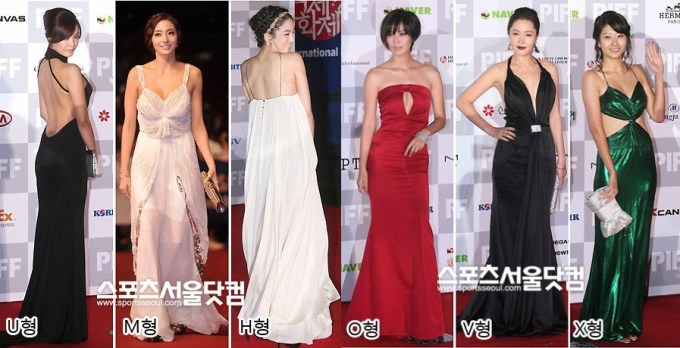
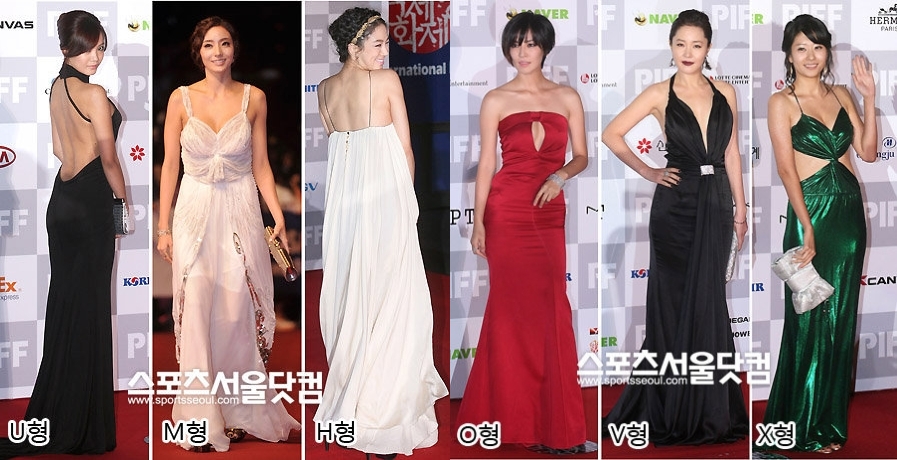
No, the extrapolation from 137 cosmetic surgery patients to all Korean women was not a mistranslation I’m afraid. And I beg to differ on Korean women’s buttocks looking boring also, but that discussion is probably best avoided. Instead consider, first, Jezebel’s take on “the ridiculousness of dressing for your shape,” many guides to which came up as I researched this post, especially this one from The Daily Mail, a UK tabloid. Next, another case of Korean romanization gone mad that I originally planned to look at alongside the above, albeit of women’s dresses rather than their bodies per se:
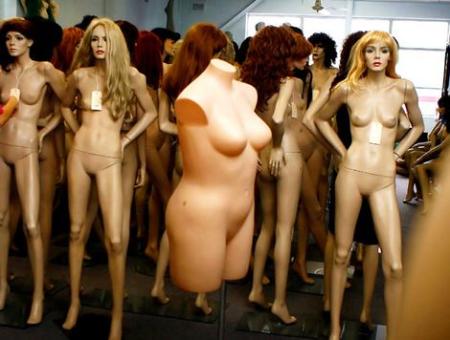
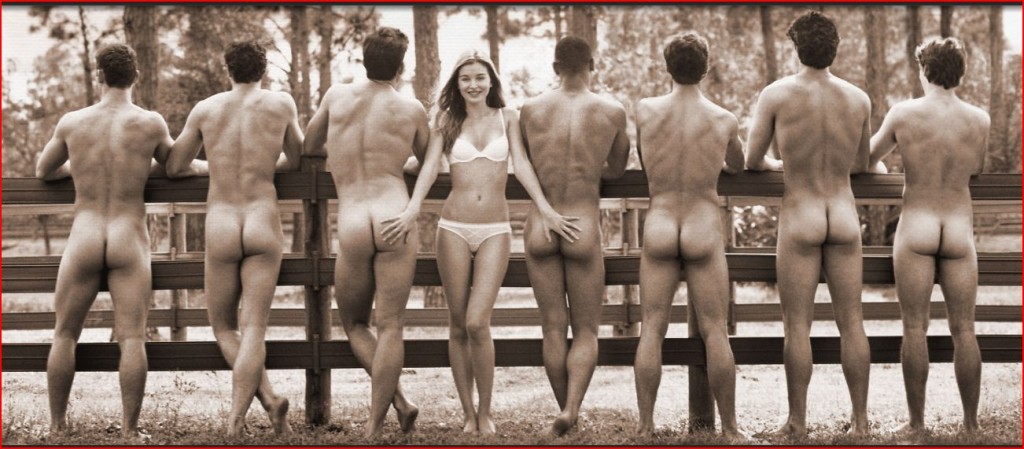
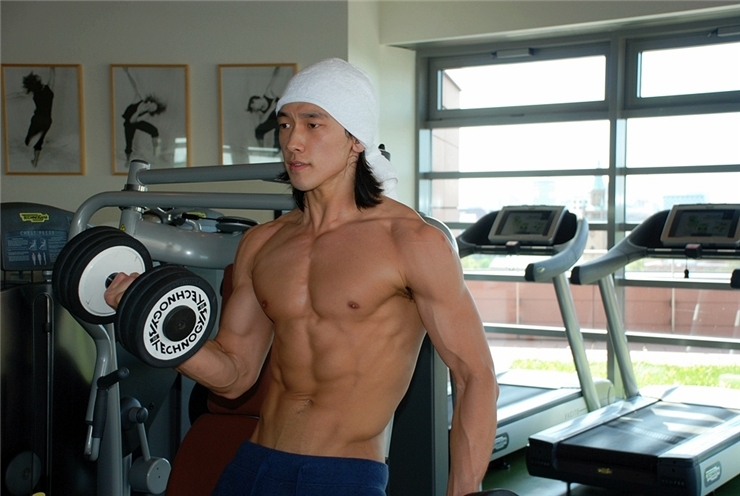
 And finally, literally the very first thing that came to mind when I saw the Korean article on women’s buttocks: the following picture from a post on male objectification from Sociological Images, because I wondered if men’s buttocks would ever similarly be categorized. But given that a page exists on Wikipedia for “female body shape” for instance, but not on male’s, then I suspect not in the near future.
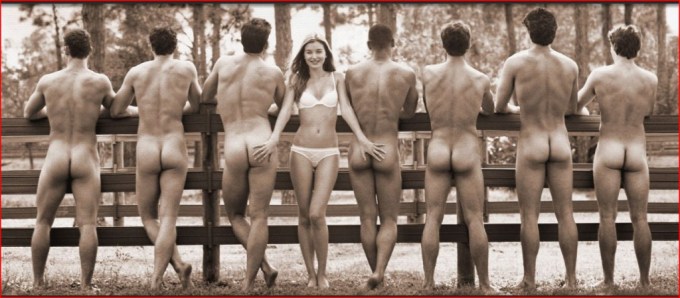 On a side note, and not that I want to repeat the experience anytime soon, but searching for images of Korean men’s buttocks instead proved impossible, at least on Korean portal sites. But perhaps again…*cough*…I’m not looking in the right places?












 Source:


 The Grand Narrative