Alas, I’m still taking a break from blogging for another week or so(!), so let me just quickly pass on a Korea Timesarticle on “X-lines” and women’s body images that I’m quoted in today. New readers who want to learn more about them, please see:
Here for a quick summary of all the various “lines” used to describe women’s bodies at the moment
Here for a much longer analysis and a discussion of how and why they’ve developed from being mere fads to become enduring parts of Korean media culture
Here for the ways in which even prepubescent girls are socialized to develop a concern for achieving such lines in the future
Here for the deep roots this Alphabetization craze has in various Korean philosophical and linguistic traditions, rendering it qualitatively different to similar sounding name-assigning in English.
And finally here, here, and here for more on the fact that Korean women are the slimmest in the OECD, but still consume the most diet drugs.
Meanwhile, I’m very grateful to author Cathy Rose A. Garcia for asking for my input, and for then including so much of what I wrote in our email exchange. It seems almost churlish of me to critique it so severely after that, but I’m afraid I must, for it seems rather naive, almost disingenuous to write an article about how popular X-lines are when the only evidence for that comes from a company that has a vested interest in making people think so:
Three out of four female college students consider X-line, a term referring to a slim waist with ample breasts and hips, to be the ideal body shape, according to a survey by Amore Pacific’s V=B Program. The survey covered 1,000 female college students from Ewha Woman’s University and Dongduk Women’s University from May 13 and 17.
Granted, Cathy does mention later:
Amore Pacific’s V=B Program, which sponsored the survey of college students, offers a line of herbal Oriental beauty supplements. It recently introduced the “S-line slim DX,” which claims to reduce body fat and abdominal fat.
But the conflict of interest should have been made more explicit, and indeed is rather ironic in light of one of my quotes:
“Companies do have a vested interest in creating new, artificial body ideals that purchasing their products can supposedly help you achieve. And given the media’s overwhelmingly uncritical reporting and active dissemination of these ideals, then it is difficult not to conclude that the media is at least passively colluding with its advertisers in this regard,” Turnbull said.
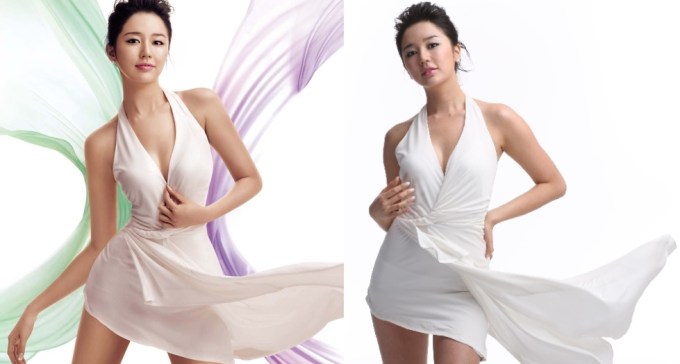
Moreover, as I explain here, the X-line is by no means a “new” obsession of Korean women, but is at least 2 years old, originally created by – you guessed it – Amore Pacific, who created the monstrosity on a computer when Yoon Eun-hye’s (윤은혜) actual body failed to deliver:
In fairness, Amore Pacific did use more human-like realistic images of her body in some of its advertisements for the V=B Program that year, but those in no way compensate for encouraging women to obtain a literally impossible body shape in the first place. And call me picky, but any news article on X-lines is severely remiss in not mentioning that.
What do you think? Are my critiques of the article fair?
With apologies to readers, but after 3 years of almost constant blogging I’m feeling very burned-out, and have decided to take a short break from it. But please don’t get the wrong impression: I’m not at all thinking of quitting The Grand Narrative, and will be up and writing again by June at the very latest on Monday June 7.
Until then, please feel free to contribute to and/or discuss anything in last week’s Open Thread, either with myself or other readers (I’ll still be around), and a big thanks to all of you for reading and your comments over these 3 years. Forgive me for not saying that more often.
This coming Tuesday, I will have been in Korea for exactly 1o years! Any suggestions on how to celebrate it?
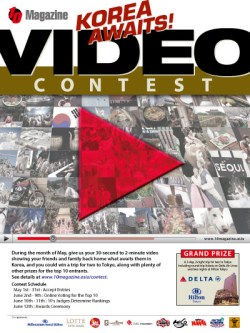
Update: If you haven’t heard about it already, 10 Magazine is holding a video contest until the end of May. In its own words:
As a foreigner in Korea have you ever found yourself criticizing Korea’s publicity efforts? Let’s face it, most of the promotional materials have been made by Koreans, and hence appeal more to Koreans. Well here’s your chance to show the world what awaits them in Korea from a foreigner’s perspective!
During the month of May, make your own 30-second to 2-minute video about Korea, and if you’re the lucky winner, you’ll win a trip for two to Tokyo, including round-trip air fare on Delta Airlines and two nights in an executive room at the Hilton Tokyo!
See here for further details on how to enter and the prizes for 2nd to 10th place.
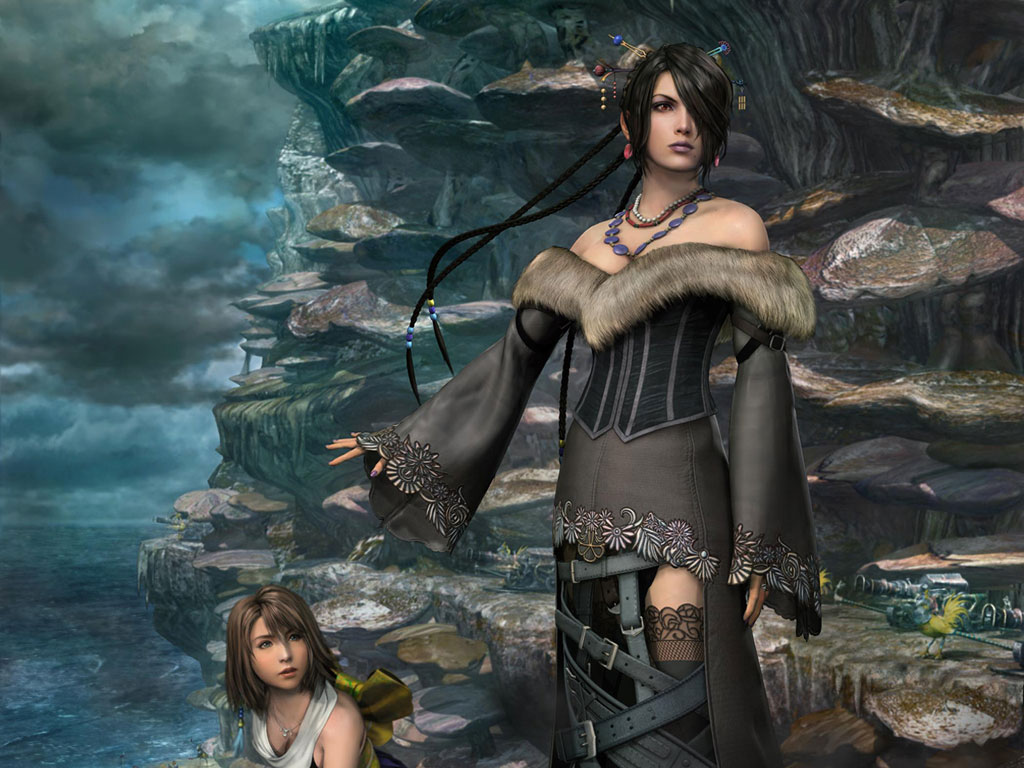
Last week, I mentioned that until I found DJ Areia’s trance remixes, then in almost 10 years here I’d never been particularly moved by any popular Korean music. But with a few noticeable exceptions, starting with Isn’t it Beautiful? (얼마나 좋을까?) by Lee Soo-young (이수영), a Korean adaptation of the Japanese song sung by Japanese folk singer Ritsuki Nakano (professionally known as “RIKKI“), and which was the theme song for Final Fantasy X, a role-playing game for the PlayStation 2 released in 2001. Difficult to avoid hearing in Korea at the time, there is no better way to describe it than as a simply beautiful piece of music, and one which deserves to be much better known among a, well, younger generation of listeners.
With apologies for the poor quality of the video, please take a listen for yourself:
I actually first translated the lyrics in July 2007 just after starting this blog, but like most of what I wrote back then that original post has since been mercifully deleted. As I began translating some of these songs for this research project of mine however, to be posted over the next several weeks (and hopefully to become a regular thing), I realized it would be a shame to waste it, both for the sake of the music and especially for understanding the original Korean. Which as you’ll soon see, is much more difficult than it may at first appear, and I realize now that I made many mistakes in the original!
Let’s start with the first verse. I won’t mention many specific words, because you can simply look those up in a dictionary yourself, but I will highlight some of the things I had difficulty with, as you may well be confused by them too. But this is by no means the final, definitive word on the lyrics in English, and I very much welcome and will appreciate any corrections:
바람이 들려준 이야기엔, 내 마음 설레였고
구름에 실려온 내일로, 그 목소리 향해
거울에 흔들리는 달에 비친, 내 마음 함께 떨리고
별들은 흐르는 눈물속에, 고이 다 흘러버렸어
The confusion starts almost immediately, for “엔” in line 1 is not simply a shortened form of “에” plus “는”, with the latter indicating that the “이야기” is the subject here. Rather, my wife says that the “는” is just added for emphasis, although she can’t say why.
Next, although in hindsight the “내일” in line 2 is obviously “tomorrow”, that wasn’t so clear when I first started translating and didn’t know what the song was about; hence I wondered if it could be “내” plus “일”, or “my” plus “work/task”, but then there would need to be a space between the “내” and the “일”!
Also, the “오다” in “실려온” is not always simply “실리다” plus “coming” like I thought 3 years ago; rather, although it’s difficult to summarize the grammar point here, “오다” or “가다 ” added to a verb are not always simply “coming” and “going” in space respectively, but can also be in time too. Korean Grammar for International Learners, p. 340, describes them as meaning “continuous performance of an action over time as one comes towards the ‘present and continuous’ performance of an action over time into the future (away from the present) respectively”.
Finally, although I personally find it quite easy now, I should also mention the “버리다” attached to “흐르다” in the last line: if you look in your dictionary, it means “throw away” or “ruin”, but when added to a verb it can mean 1) the action of the verb has been completed with little or no room to spare, 2) the verb produced a state contrary to what was hoped for or expected, or 3) that the speaker feels relief that something has ended. So:
My heart was throbbing to a story told to me by the wind, and
which was carried by a cloud towards the voice of tomorrow.
My heart trembled to the moon shining in a mirror,
and it all softly melted with the stars’ flowing tears
Unfortunately, that is very different to what I wrote 3 years ago, and it may also be very different to what you yourself came up with too: there’s so much metaphor here, that my wife and I despaired with pinning words down to anything specific in English, particularly with line 2. And on that note, if you’d like a more poetic and/or readable alternative for all the lyrics (sniff), then consider these ones and in the details to this video for instance, but note that both are based on the Japanese rather than the Korean version. Moving on:
얼마나 좋을까, 둘이서 손을 잡고 갈 수 있다면
가보고 싶어, 당신이 있는 곳 당신의 품 속
거기 안겨, 몸을 맡기고, 어둠에 감싸여
꿈을 꾸네
This verse, or the chorus rather, was much easier. If we just focus on the problematic words first, of course the “둘” in line 1 means “two”, but the “이서” added to it basically renders it “[us] two, together”, or “you and I”. Then in line 2, “곳” or “spot, place” should not be confused with “것”, or “thing”, and just after that the “품” means chest, or bosom. Not that that last can’t also simply be looked up in a dictionary of course, but then I’ve never personally heard of that meaning of “품” outside of this song.
The grammar is also very easy, although I’ll quickly mention it for learners: first, the “ㄹ/을까” in line 1 is added when asking for someone opinion, or just reaffirming yours (making it analogous to the “eh” of Australian, NZ, and Canadian English”). Then, the “다” added to the “면”, or “if”, is only for definite hypothetical situations, as opposed to “If you grab the beer, I’ll grab the chips” for instance. Finally there’s the “네” in line 4, which denotes mild surprise, but then you’ve probably already had many Koreans replyingg “와…한국말 잘 하시네요” when you’ve spoken to them in Korean!
Imagine how wonderful it would be, if we could grab each other’s hands and leave
I’d try to go, into the place that you are in your heart
Hugged by you, I’d entrust my body (soul?) to you and
The next verse was also quite easy. Admittedly I’m confused by which tenses apply to what, but otherwise probably the only things of note are the “지” in line 1, which usually means “right?” as in a tag question, but like in English can just be part of a simple statement (like “좋을까” earlier); and the “지다” in “흩다” in line 2, which basically means “make into the state of the preceding verb or adjective”. In this case “흩다” means “spread” or “scatter”, so “be scattered”:
바람은 멈추고 목소리는, 아득하게 속삭이겠지
구름이 흩어져 내일은, 아득한 환상일 뿐
달빛이 스미는 거울 속, 내 마음은 흐르고 별들이 떨리다, 멈춰
흐를 때 눈물은 감출 수 없어
Which gives in English:
The wind has stopped, and my voice with become just a whisper
The clouds will scatter and tomorrow will become only a vague, distant fantasy
Moonlight will soak the mirror in which my heart flows and the stars tremble and stop
I can’t hide my tears when they flow
Finally the chorus again, with only a little changed:
얼마나 좋을까, 둘이서 손을 잡고 갈 수 있다면
가보고 싶어, 당신이 있는 곳 당신의 품 속
그대 얼굴, 살며시 스치고,
내일로 사라지는, 꿈을 꿨어
In line 3, don’t confuse “그대”, which means “you” or the other party involved, with “그때”, or “then”. Giving in English:
Imagine how wonderful it would be, if we could grab each other’s hands and leave
I’d try to go, into the place that you are in your heart
I gently touch and brush past your face, and
I dreamt a dream that is disappearing towards tomorrow
And there you go! I hope you enjoyed the song and/or I helped you to understand it a little, and there’s certainly many more gems out there in Korean music if you’re prepared to look. Probably I’ll provide much less of an explanation for more recent songs though, as I’d rather focus on the content of the songs rather than on the Korean per se, but we’ll see!
Well, the good news is that I’ve been asked to write an article on dating in Korea for a local magazine. But I need your help!
To be specific, I’m going to discuss blogs about dating in Korea, of which a great many seemed to have been formed in the past year or so, either devoted entirely to that topic or mentioning it frequently. And of these, the vast majority seem to be by women, which leads me to the following questions that I can’t answer by myself:
1. Do you also think that there has been a big increase in their numbers? How about those written by women in general? Of course I’ve noticed a definite increase personally, but then I’ve gone from reading perhaps 5 blogs a day in 2007 (when I starting blogging) to subscribing to perhaps 80 today just for keeping up with news related to my niches and new material, so it may just be because I’m noticing them for the first time.
2. If your answer to either question is “yes” however, then what do you think are the reasons for the increase(s)?
– Greater numbers of women coming to work in Korea?
– Greater numbers of women staying for longer periods in Korea? After all, as recently as 2008 I would have said that perhaps 6-7 out of 10 foreigners coming to Korea were male, rising to 8 or even 9 out of 10 among those who had been in Korea over, say, 5 years, but now I’m not so sure. But would you agree with those figures for back then? And what do you think they are now?
– Changes in attitudes among Korean men toward dating and marrying Western women?
– Changes in attitudes among Western women dating and marrying Korean men?
– Some other reason(s)?
3. Do you think double standards exist when talking about dating? In particular, do you think that in the wake of “EnglishSpectrumGate”, male bloggers now feel much more inhibited about discussing their practical experiences of dating Koreans then female bloggers do? (very new arrivals to the Korea blogosphere, see here, here, and here for a quick synopsis of that)
On a final note, naturally I do already follow most blogs about dating in Korea, and many more intelligent ones that discuss it in passing; but I’m sure that there’s many that I’m unaware of, so please feel free to plug yours here! (and female bloggers too, for I simply don’t have the time to go through all 69 of them mentioned on this post by Chris in South Korea I’m afraid) Also, being married with 2 kids, and not having dated in nearly 10 years, then practically speaking at least there’s a great deal about the subject that I simply no longer know and/or is outdated, so thank you to everyone in advance for filling me in.
p.s. Please, no inane comments about the choice of pictures; as you might expect in a society where the fact that local women are sometimes interested in foreign men is considered newsworthy, then there weren’t exactly very many to choose from!
Not strictly gender-related sorry, but while Vogue Korea’srecent photoshoot of Lee Hyori (이효리) is not without a touch of class, that particular image above is probably the strangest of her’s I’ve ever seen!
1. “What is Aegyo and How Can We Kill It?”
Regularlyexpressing a disdain for displays of aegyo (애교) by Korean women, or “affected sweetness”, strangely it has never occurred to me to scratch below the surface of the phenomenon, let alone see how it could actually be an empowering tool to navigate a patriarchal society. I highly recommend reading The Joshing Gnome’s short, very readable, 5-part series then, which is rooted in Thorstein Veblen’sThe Theory of the Leisure Class: see here for Part 1, and don’t miss Kelly in Korea’s insights also.
2. “60% of Actresses Accosted for Sex by Bigwigs”
A rather confusing headline, as although the Chosun Ilbo article begins:
Six out of 10 actresses in Korea have been propositioned for sex by influential figures, according to a poll of 111 actresses by the Korean Women’s Development Institute commissioned by the National Human Rights Commission.
In the survey published Tuesday, 60.2 percent of respondents said they had been accosted for sex by senior figures in the broadcast industry or other prominent people. The poll was conducted between September and December last year and involved detailed interviews. Top actresses accounted for around 10 percent of respondents.
…It actually later says that only 21.5% received direct requests, but of course that figure is also unacceptable.
Probably commissioned in the wake of huge public reaction to the suicide of actress Jang Ja-yeon (장자연) in March last year, unfortunately they probably come as no great surprise, but at least attention is being drawn to the scale of the problem. See The Guardian, The Hankyoreh, SeoulBeats, and myself at #13 here for more if that is in the first you’ve heard of that, and which provide some context to the recent news from Korea Beat that a short-track skating coach has been accused of molesting a student, a university professor has been found guilty of sexually harassing one of his students, and a police officer was fired for placing a digital camera under the desk of his female co-worker.
An excellent summary by Yuna at The Marmot’s Hole. Also, see Ask a Korean! for an interview with Kim Su-hyeon (김수현), writer of the drama Life is Beautiful (인생은 아름다워), actually the first in Korea to depict a gay relationship.
Not to imply that Daniel Henney (다니엘헤니) above is gay of course, but I do have a penchant for close-ups of attractive faces, and I also I just thought that my gay readers and heterosexual women might like it! Does anyone else think he looks a little like Roger Moore did in his James Bond days here? (via: PopSeoul)
4. “If you think that Korean women are fragile eastern flowers, you might want to think again”
Streetwise in Seoul writes brief biographies of Lim Su-jeong (임수정) and Choi Hyun-mi (최현미), a Muay Thai fighter and boxer respectively. See here for a video of the latter in action and for some more information on other Korean female boxers also, and you may also like Living on the Flipside, a blog by an expat boxer (with a Korean husband who is also a boxer!).
5. Go So-young knocked-up
A reminder that Koreans’ public attitudes to sexuality are much more subtle than they may at first appear (let alone considering the wide gap with their private ones), the news that Go So-young (고소영) was already 3 months pregnant upon her recent marriage to Jang Dong-gun (장동건) raised nary an eyebrow in Korea, despite strong taboos against premarital sex and cohabitation (albeit only that against the latter strong enough to dissuade it!). As commenter Oranckay explained, and well worth repeating, the reason is because:
…one needs to take into account that not all pre-marital sex is the same. There is a difference between just having sex and having sex with someone you are going to, or intend to, marry, and traditional/Joseon and even 20th Korea saw this as a big difference. Having sex on the premise of, and as consummation of, commitment, was the normal, socially acceptable way to have pre-marital sex. So valued was a woman’s virginity that a decent man could only sleep with her if he was ready to “take responsibility for her,” as the saying would go, and so on, because that’s what sleeping with her was supposed to imply. Fiction and non-fiction narratives (many known to me personally) are full of this kind of thinking. I know couples that decided not to have sex because they weren’t sure they were getting married, that didn’t have sex because he was going to the military and he wanted to be sure he’d come back alive before permanently “making her his,” as that would be too traumatic for her, and of couples that lived together (and obviously were having sex) before being married and it was acceptable because they were going to marry, had family approval, but couldn’t marry because maybe the girl’s elder sister wasn’t married off yet or they were both still in college but both sets of parents wanted to get them married after graduation, or one of those odd reasons. Maybe no money; whatever…
As watchers of Korean dramas may recall, back in January KBS decided to censor the scene below from the popular drama Chuno (추노), despite the fact that Lee Da-hae (이다해) was clearly fully-clothed. I didn’t comment it on at the time, but had I done so then I too would likely have joined the bandwagon of criticism and described it as absurd, completely unnecessary, and downright bizarre in light of the amount of skin that is displayed 24/7 on KBS, let alone on any city street.
And don’t get me wrong: I still consider it absurd. But via a comment on the French-language Korean cinema blog Dooliblog, I have since learned that it was in fact done to placate disgruntled fans of the show, critical of Lee Da-hae’s flawless skin as being too unrealistic for her role. Granted, how blurring her breasts specifically was supposed to overcome that remains a bit of a mystery, but the new information does at least provide a healthy reminder not to take instances of censorship in Korea at face value, and certainly not to automatically assume that the Korean media’s “default” option is for greater conservatism.
When it does occur however, it can also easily be circumvented or even exploited, as skillfully done by rapper E.via (이비아), who (in my personal opinion) seems to compensate for a lack of musical talent by seeking controversy with everything she produces (see #1 here, #11 here, and #20 here). I may simply be biased because I’ve never liked rap however(!), and against that interpretation Twitterer David Frazer points out (update: actually regular commenter Gag Halfrunt) she has a penchant for “juxtaposing [an] innocent idol look with explicit lyrics”, and may in fact be “deliberately attacking the pretense that ‘it’s not sexy, it’s cute’ when under-18s do suggestive dance moves”. Can anyone more familiar with her enlighten us?
Regardless, it is curious why her latest music video Shake! (쉐이크!) is likely to be banned from public television…
…while advertisements like this remain completely acceptable:
Vodpod videos no longer available.
Meanwhile, the Korea Timesreports that Twitter is providing a means for pornography websites to avoid restrictions placed on them by the Korea Communications Standards Commission, the country’s censorship authority for broadcasting and Internet content.
7. Body Image
I confess, sometimes keeping up with Korean gender issues almost feels like being simply scouring the internet looking for more things to criticize, but then there is so rarely any positive news when it comes to Koreans’ attitudes to women’s body images especially. Accordingly, I’ll simply pass on these links below rather than providing (admittedly increasingly repetitive) commentary also, although do check out this video on cosmetic surgery in Korea posted last week if you missed it:
Shift the focus of attention slightly however, and there have been positive recent developments. In an article in the Los Angeles Times entitled “South Korea’s homemakers don’t want to be pegged” for example, John Glionna explains how “some stay-at-home mothers, known as ajumma, are fed up with being stereotyped as deadbeats who just love to gossip and shop. Kim Yong-sook is helping them forge a new identity”:
( Source: unknown )
Kim Yong-sook is fed up and she’s not going to take it anymore.
She’s weary of women between the ages of 30 and 60 being ridiculed as selfish and unstylish — bossy, gossiping magpies with bad perms who pinch pennies and hog seats on the subway.
They’re known as ajumma, a word long applied to married women with children but which in recent years has taken on a pejorative connotation that irks Kim.
Among many South Koreans, it’s now often used to conjure an image of homemakers who disdain full-time jobs to while away afternoons on park benches, in coffee shops and at social clubs, bragging about their children and, if they’ve got the money, go on shopping sprees.
At 58, Kim has empathy for her fellow ajumma, who she insists have too long been misunderstood and ridiculed. Ajumma are not deadbeats, cracks in Korea’s economic engine.
“Actually, we’re running the nation,” says the mother of one, a son. “We’ve got one foot in the house and one foot in society.”
A decade ago, Kim formed a support group called “Ajumma are the Pillars of the Nation.” Since then, she has attracted thousands to her declaration of independence. She’s written a book and consults with business and government.
Her message: Ajumma unite! Don’t take the snickers, behind-the-back finger-pointing and jibes lying down!
Update – At risk of contradicting myself and trivializing what Kim Yong-sook is doing, these ajumma cartoons are classic nevertheless: after all, the stereotypes aren’t entirely baseless…
8. Despite her protestations to the contrary, I’m no Picasso continues to provide sage advice about dating and sexuality in Korea, here demolishing another expat’s seriously flawed logic and stereotypes about both. Jumping ahead to next week’s Gender Reader, many of these are likely to re-emerge in the news that “Single Korean Females Eye Foreign Husbands“, so be sure to read her posts first!
9. “Writers and Women Writers”
Over at Korean Modern Literature in Translation, Charles Montgomery passes on an article by literary critic Bruce Fulton, who begins with “an amusing tendency in Korean Literature that all readers eventually catch”:
Readers of an earlier generation who happened upon the anthology Modern Short Stories From Korea, translated into English by In-Sob Zong (Chong In-sop),1 might be forgiven if they gained the impression that two varieties of human beings write fiction in modern Korea: writers and women writers.
10. Less than 1 in 10 executives is female
In a poll conducted by major recruiting service Incruit, it was found that “the larger the company, the less likely it was to employ women as leaders”: of the companies surveyed, those with fewer than 300 employees had 36,666 executives, of whom 3,279, or 8.9 percent, were female, while in bigger companies only 126 out of 2,474 execs, or 5.1 percent, were female.
With apologies to Seoulplay, but I’m tempted to only use screenshots from 2NE1’s (투애니원) Try to Follow Me (날 따라 해봐요) music video for the Open Threads from now on! For like Anna at her Appears music blog explains:
Every moment in this promotional video is a photograph. Every shot, every pan, every object has been calculated to the point of mental instability. What is K-pop like in the 10′s? Everything I predicted and more. And like all the things I truly admire in this world, I’m torn between laughing at them and laughing with them.
Read the rest of her post, and you’ll soon see why. And on that note, a quick but serious question to anyone familiar with 2NE1 to get the ball rolling this week: how accurate a portrayal of the group would you say is presented by the following recent video on them?
In a nutshell, I ask because I’m about to start working on a project to find out how actual fans respond to various girl groups’ song lyrics, music videos, and on and off-stage behavior and so on, rather than simply speculating like I’ve done previously. And to do that, I’m planning to join their fan clubs (albeit probably posing as my Korean wife), but naturally I would like to start with groups whose music I really like and/or which has a slightly radical message before I invest the all the time in translating long comments threads about them.
Liking almost all of After School’s (애프터스쿨) songs so far then, or at least DJ Areia’s remixes, I’ll definitely still start with them, but in light of that video I’m now considering looking at 2NE1 after that. So before I do, my question is: do they live up to all the hype?
Thanks in advance, and of course readers please feel free to raise any other Korea-related issues!

 (Source)
Three out of four female college students consider X-line, a term referring to a slim waist with ample breasts and hips, to be the ideal body shape, according to a survey by Amore Pacific’s V=B Program. The survey covered 1,000 female college students from Ewha Woman’s University and Dongduk Women’s University from May 13 and 17.
 (Sources: left, right)



 As a foreigner in Korea have you ever found yourself criticizing Korea’s publicity efforts? Let’s face it, most of the promotional materials have been made by Koreans, and hence appeal more to Koreans. Well here’s your chance to show the world what awaits them in Korea from a foreigner’s perspective!






 The Grand Narrative
