
 ( Source: L-C-R. Reproduced with permission )

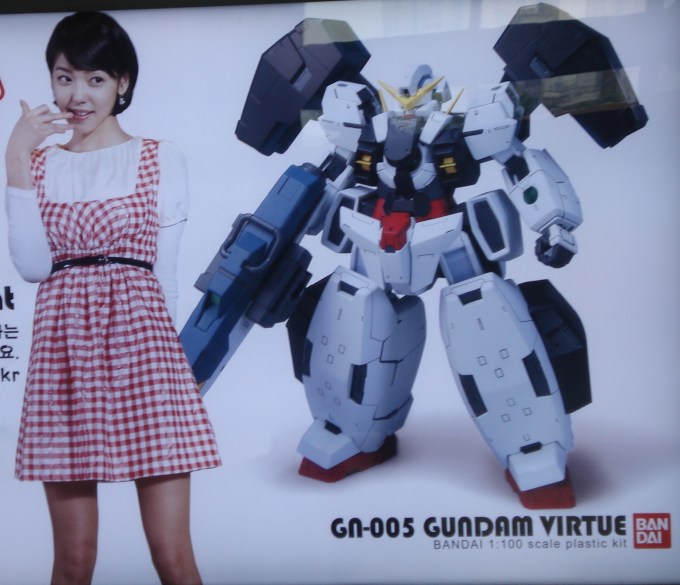
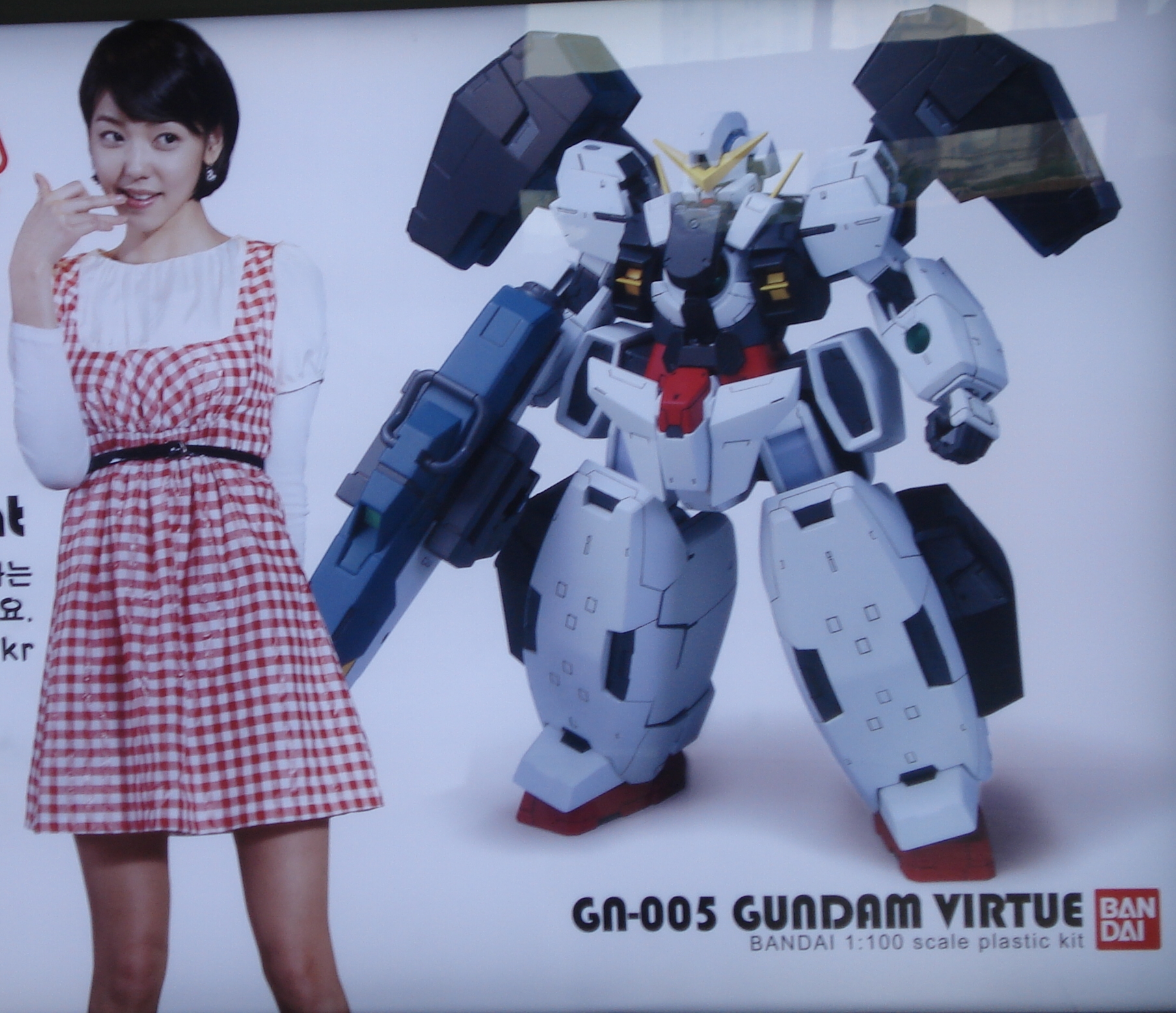
Like photographer L-C-R says, this 2008 Gundam advertisement is a prime example of a woman being portrayed as a child and/or sex object, of which she saw entirely too much of while she was in Korea.
You may be very surprised then, when you learn whom it was actually aimed at.
But first, please consider what is it exactly that so demeans drama actress Min Seo-hyeon (민서현) in it? I identify 4 or 5 things myself, which I outline in descending order of importance below:
- her childlike expression, combined with putting her fingers in her mouth
- the canting of her head
- her surprisingly awkward stance
- her passivity as she awaits the masculine-looking robot to make the next move
And after discussing those, albeit briefly because I’ve already done so in great depth in this similar post about soju advertisements, I’ll finally look at the ad in the context of the campaign as a whole. But feel free to disagree with any of those and/or suggest others, and in that vein I highly recommend asking your Korean partners, colleagues or friends their own opinions also. As if the experience of asking my wife and her friends earlier is anything to go by, then they are very likely to disagree with the first. Or indeed, that she’s being portrayed childishly at all, and – jumping ahead – not even in the following commercials either:
I’d argue that the main reason for that is the Korean cultural practice of aegyo (애교), difficult to define in English but probably somewhere between “affected sweetness” and “affected childishness“, and at least partially rooted in the prolonged transition to adulthood of experienced 20-something Koreans that are the biggest practitioners of it. For not only does the Korean education system essentially defer the joys of adolescence (but not the negatives!) until graduating from high school, but economic circumstances force them to live at home until marriage and/or deliberately put off their university graduation, and men also have their 24-28 months of compulsory military service to boot.
But I realize that since I was a student myself in the mid-1990s, more and more 20-somethings in Western countries are also postponing leaving home, and indeed to note all the above is not to argue that all Korean 20-somethings in such circumstances are childish; actually, I have intelligent, mature, and thoroughly Westernized Korean friends that have resigned themselves to them, or alternatively feel so trapped that they are literally fleeing the country to escape. Yet one thing they certainly do not do however, is aegyo, and I put it to you that in fact that is neither required for women to successfully navigate a patriarchal society, nor particularly savvy and ultimately empowering of them to do so.
 ( Source )

 ( Source: L-C-R )
Yes, “women”. As while Korean men do also do aegyo, and so as you’d expect content analysis demonstrates that men are much more likely to be portrayed childishly in advertisements in Korean magazines than US ones, and Korean men more than Western ones in the former, it is still overwhelmingly Korean women that are done so, and to a much greater extent than women of any ethnicity are in US magazines.
 ( Source )
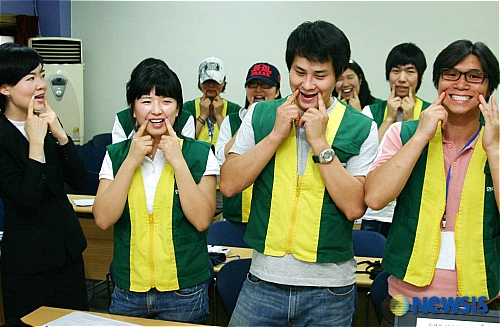
As for anyone still not seeing the childishness in Seo-hyeon’s expression however, or why it is problematic in any sense, consider what the images above tell us about just how “natural” such expressions really are on adults, and why women are more commonly portrayed with them nevertheless. And which are often accentuated of course, by putting their fingers in their mouths, and which could possibly be considered “self-touching” as defined by sociologist Erving Goffman in Gender Advertisements (1979) below:
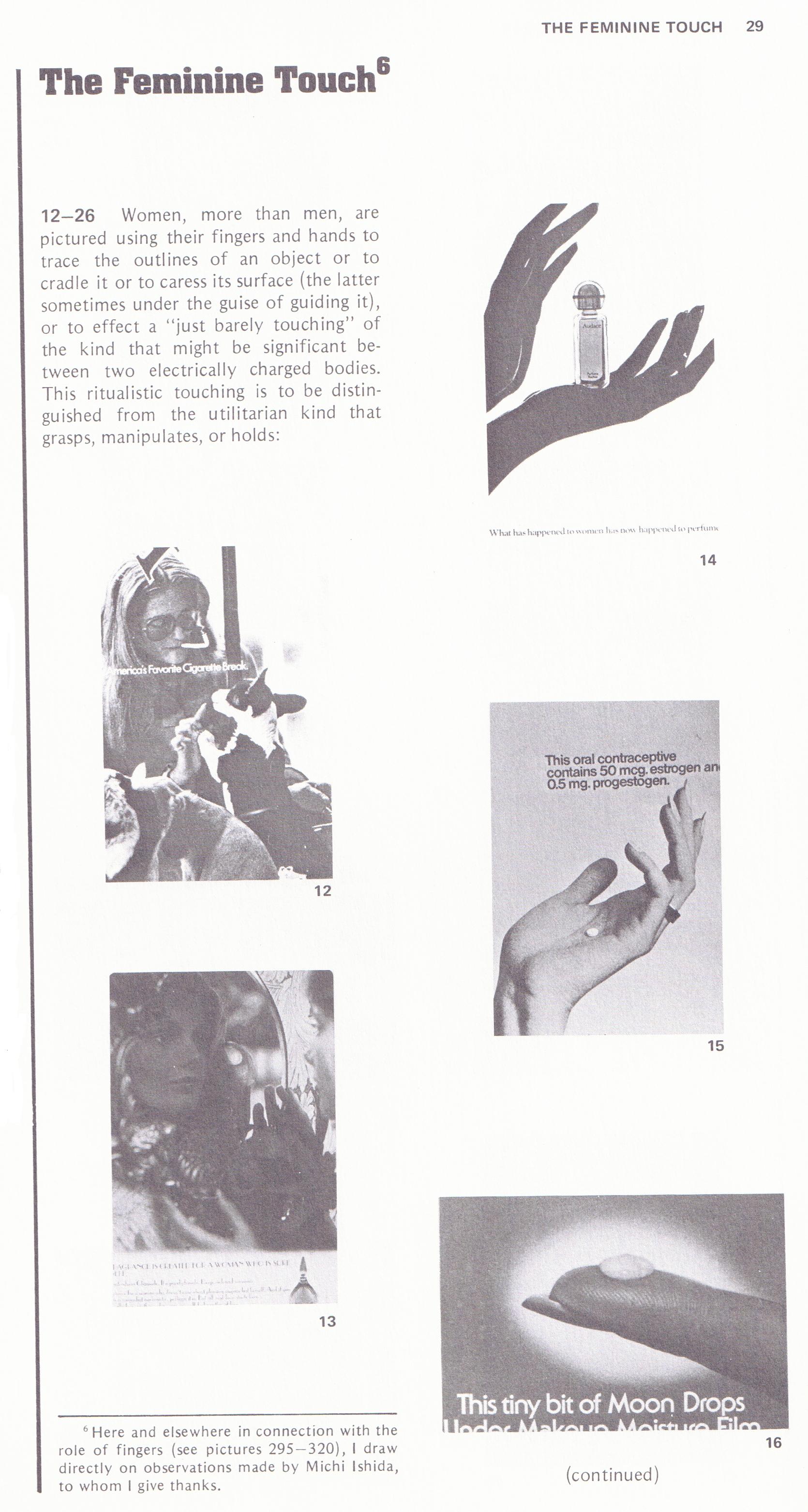
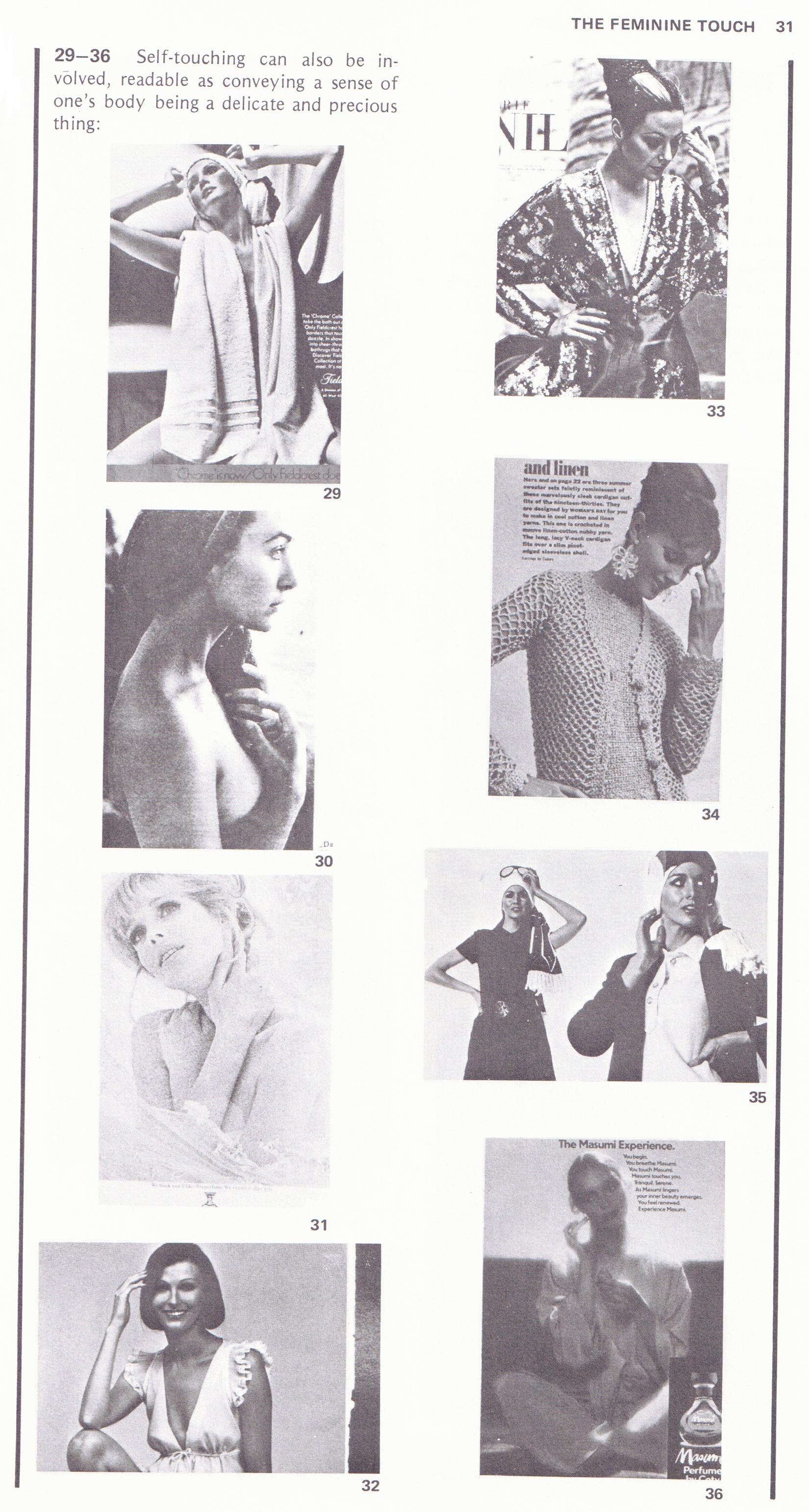
As discussed in that earlier post on soju advertisements, both are often combined with the canting of the head, which is problematic for the reasons outlined there. I also discuss awkward stances there too, and to anyone believing that I’m about to read too much into Seo-hyeon’s, I suggest stopping here and trying it for yourself, making sure to bend and spread your legs outward at the knees like she does in particular. For not only will you realize just how unnatural it really is, and that people only ever stand like that in advertisements (and overwhelmingly women at that), but you’ll also probably end up falling forward a little on your first attempt like I did, and will suddenly gain a very palpable sense of why exactly the advertisement does indeed present her as a sex object:
 ( Source: L-C-R )
In Goffman’s framework in Gender Advertisements, that “bashful knee bend” is something that women frequently, men very infrequently, are posed in a display of. And whatever else, it can be read as
…a foregoing of full effort to be prepared and on he ready in the current social situation, for the position adds a moment to any effort to fight or flee. Once again one finds a posture that seems to presuppose the goodwill of anyone in the surround who could offer harm. (p.45)
Hence passivity, as blind to whatever occurs behind her, nevertheless Seo-hyeon seems to be eagerly awaiting whatever the robot plans to do with her. And which judging by the fact that it also is standing slightly thrust forward, and has a big long gun resting behind Seo-hyeon’s buttocks, couldn’t really be any clearer. Hell, even the protrusion on its crotch is already bright red for good measure too.
 ( Source )

An advertising campaign clearly aimed at young men and adolescent boys then, whom I’ll safely assume are the vast majority of Gundam fans? If so, then the effort actually appears to have backfired, as the few commentators on it I’ve been able to find here, here, here, here, and here generally express both surprise and disdain at seeing Min Seo-hyun at all, the last of whom wrote the following about the advertisement above:
이 광고는 광고로서의 설득력이 전혀 없다. 그것이 염가 제작되었기 때문이 아니다. 반대로 제작비는 많이 들었을 것이다. 이름있는 사람들의 얼굴을 비추기 때문이다.(그림의 건프라 광고에 출연하는 사람이 유명한지는 잘 모르겠다.) 그러나 문제 역시 그러한 사고방식에 있다. 즉, 유명한 사람의 얼굴을 비추면 광고가 될 것이라는 사고방식에.
This advertisement has no persuasive power at all. But not because it was cheaply and poorly produced; actually, because of the famous faces in it, it looks like a lot of money was spent on it (well, actually I don’t know if they are famous or not). Rather, the problem is with using that advertising logic in the first place.
이것은 어느 정도 맞는 말이다. 유명한 사람이 어떤 상품을 소비하고 있으면 그것만으로도 상품의 질을 소비자들에게 안심시켜 줄 수 있다. 그러나 그것도 광고의 효용성 안에서 이루어져야 한다.
However you look at it, this is correct. While of course simply having famous faces in an advertisement is sufficient for most consumers, they should still be used in the ad as effectively as possible however.
이 광고의 전략은, 유명하거나 예쁜 사람과 건프라의 이미지를 교차시켜 건프라가 갖는 오타쿠 이미지의 쇄신일 것이다. 좋은 생각이다. 그러나 이러한 두 이미지가 교차점을 찾지 못하고 있다. 저 사람은 건프라를 만지작거리고 있지만 전혀 즐거워 보이지 않는다. 아마 저 사람은 자신이 들고 있는 건프라의 이름도 모를 것이다.
The advertisement’s strategy is to reform the image of a Gunpla Otaku [an obsessive fan of something – James] by combining with a famous or attractive person. This is a good idea. However, ultimately they don’t really mix. This person doesn’t look like she’s enjoying holding the model [really?] and probably doesn’t even know the name of it.
 ( Source )

방 또한 지나치게 깨끗하지 않은가? 건프라에 열중하면 당연히 방은 데칼 찌꺼기나 플라스틱 조각으로 너저분해져 있어야 하고, 책장에는 잡다한 건프라가 어지럽게 진열되어 있어야 한다. 채색하는 손은 알록달록 에나멜이 묻어 있어야 하고, 옷은 더러워져도 상관없는 펑퍼짐한 츄리닝이어야 하며, 얼굴은 지극히 진중한 표정을 짓고 있을 것이다. 오히려 이러한 당연한 이미지를 예쁘고, 성공적이고, 멋있는 사람들과 교차시켰으면 이 광고는 성공을 거두었을 것이다. 장동건이 한없이 고결한 태도로 NDS를 플레이했다면 NDS는 그만큼 팔리지 않았을 것이다. 오히려 소파에 퍼져 앉아 우리들이 하듯이 게임을 했기 때문에, 우리가 하는 것을 장동건도 한다는 안심을 소비자에게 줄 수 있었다.
Also, isn’t the room excessively clean? When you are absorbed in assembling a Gunpla model, of course the room should be messy with the remains of decals and leftover plastic, and various other models displayed on the bookcase. And while your hands would be stained with enamel paint and your casual clothes dirty and speckled, your face shows that you don’t care about that as you focus all your attention on assembling the model. Rather, prettier and more successful people were needed. And recall that very famous actor Jang Dong-gun didn’t similarly loftily play Nintendo DS Lite while he was advertising it in 2007; instead, he just played it normally on the sofa like the rest of us, and so it sold well.
게다가, 타겟을 통일했으면 더 설득력이 있었을 것이다. 지금 이 광고가 노리는 소비층은 누구인가? 아이? 청소년? 남자? 여자?
Hence I think the ad would have been more persuasive if it had been aimed at a wider variety of people. But to whom was it actually aimed at anyway? Children? Teenagers? Men? Women?
 ( Source: L-C-R. Reproduced with permission )

Sounds like a rather picky otaku to me, but he does at least finish with some good questions, which I’ll now attempt to answer by passing on what I’ve been able to find of the remainder of the campaign.
First up, the one above that was alongside the one with Min Seo-hyun. Featuring popular singer (now actor) Kim Kibum (김기범) of the boy band Super Junior (슈퍼주니어), at first glance it’s very similar. And yet:
- the robot isn’t even facing towards him, let alone thrusting a phallic object towards his buttocks
- Kibum’s stance is much more natural
- rather than passively waiting for robot to initiate something, here he seems to be silently asking the observer what fun things he can do with the robot himself
- accordingly, his expression is more mischievous than childish
 ( Source: L-C-R )
Crucially however, this dichotomy is not repeated in the rest of the campaign. See the following commercial which features both actors for instance (as an aside, it starts with the lines “Shall we do it? Okay”, a common innuendo in Korean advertising):
And in particular, the long version of the bedroom one, which reveals that the reason she become interested in Gundam in the first place was because boyfriend Kim Kibum bequeathed his collection to her while doing his military service, to which she now enthusiastically adds to with her own robot:
And the theme of both sexes enjoying assembling and enjoying Gundam models is corroborated by the following posters and website images:
 ( Source )
 ( Sources: left, right )

Taken as a whole, I’d argue that the only consistent theme of the campaign is that of Min Seo-hyeon becoming more and more involved in the hobby for various reasons, including by: being (sexually) tempted by the models themselves; encouraged to take it up by Kim Kibum giving her his own models; assembling models together at his suggestion; and finally becoming equally passionate and knowledgeable about it as he is. Nay, it’s not so much a theme as the exact narrative Gundam hoped would play out repeatedly in real life, and besides which the cute portrait poster of Kibum above to download from the Gundam website is sufficient evidence in itself that the campaign was aimed at teenage girls and women.
Why then, did the bedroom commercial and the opening advertisement simply suck so badly? Why on Earth did the advertising agency responsible think that having a 22 year-old woman acting like a 12 year-old would make either age group more interested in the product, let alone by suggesting that – not to put too fine a point on it – she also wanted to get fucked by it?
Of course, there could be any number of reasons. For instance, there is the cultural practice of aegyo as mentioned, which I may have underestimated, and perhaps I’m wrong in thinking that the majority of Korean women would be at least unimpressed, if not offended, by depictions of women as children. It could also be yet another demonstration of an advertising agency so used to selling products to men that it comes to regard their perceived desires and tastes as the norm, and so unwittingly applies them to women too:
 ( Tempted to drink soju with 16.8% alcohol now girls? )

But recall that photographer L-C-R mentioned that she saw advertisements like these everywhere in Korea, as probably you do too, which raises a third possibility: either the Korean advertising industry as a whole is dominated by men (which may in fact be true), or else it has so internalized those male norms that even women in the industry (let alone consumers) regard them as normal and appropriate for selling products to either sex.
A phenomenon by no means confined to Korea or the just the advertising industry, this is the essence of the “male gaze“, and which hopefully having provided some evidence for and/or at least piqued your interest in, I’ll wisely finish by pointing you in the direction of excellent introductions to the topic rather than going on further here. One is the examination of the ways women are portrayed in graphic novels provided by fantasy magazine, and another is the related Bechdel Test for movies:
And here’s a brief application of that to specifically Fantasy movies at Feminist SF also. But I most highly recommend the illuminating, even strangely moving 1972 documentary Ways of Seeing by then art historian John Berger, which I’ve just discovered via Sociological Images here and here. Obviously the second episode on the female nude is most pertinent here, but episode 1 is more likely to captivate you to the extent that you forget to leave your seat for the next half hour:
Here’s episode 2:
And I would include episodes 3 and 4, the latter of which is on advertising, but I haven’t watched them myself yet!^^
(For all posts in the Korean Sociological Images series, see here)




































 The Grand Narrative
