But perhaps as you’d expect, they’re generally not using protection. A quick report from The Daily Focus on Wednesday:
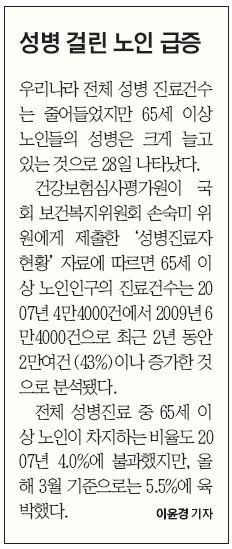
Number of STD Cases Among Old People Rising
While the national total number of STD cases has dropped overall, the numbers of people aged 65 and over contracting STDs has risen sharply, it emerged on the 28th.
The Health Insurance Review and Assessment Service presented its “Current Situation Regarded STD Treatment Recipients” report to Assemblywoman Son Sook-mee of the National Assembly Health Welfare Committee, according to the data of which the number of cases of people aged 65 and older receiving treatment for STDs was 44,000 in 2007 and 64,000 in 2009, a rise of 43% in just 2 years.
In 2007, people 65 years and older accounted for 4.0% of all cases of people treated for STDs, but this has risen to 5.5% as of March this year.
Little information to go on unfortunately, but Seoul residents may be interested in placing that into the context of the prostitution culture around Jongmyo Park in Jongno, which caters to the thousands of male retirees that spend their days there. From story #13 in a “Korean Gender Reader” post from March last year:
Prostitution Answers Sexual Needs of Senior Citizens?
The first time I visited in Jongmyo Park in Seoul in 2000, naturally I remarked on the hundreds of mostly male retirees there to my friend visiting from Japan, who rightly pointed out that they “didn’t particularly have much to do nor anywhere in particular to do it,” so why not play Korean chess all day there? In hindsight though, many would much rather be doing something else, and it’s almost surprising that it took so long for prostitutes to encroach on this captive and – let’s call a spade a spade – somewhat desperate market.
Here, the Korea Times reports on the ensuing problems of unsafe sex, the sale of fake Viagra and “men’s stamina” products, and the general increasing seediness of the area. You can also read discussions about it at ROK Drop and The Marmot’s Hole.
One surprising omission in the Korea Times article though, was the fact that the area between Jongmyo and Tapgol Park is also “packed full with gay bars and hotels catering to gay clients”, as noted by regular commenter Gomushin Girl. Still it does end with the pertinent point that:
…the social atmosphere of viewing senior citizen’s sexual desire as a nasty matter has worsened the situation. “Sexual desire is a desire not only shared among young people but also old people. But our society is sill stuck in the obsolete Confucian-based perception that labels desire as an undesirable state, playing a major hurdle in setting a sound sexual culture for the aged,” said Prof. Lim Choon-sik at Hannam University’s social welfare department.
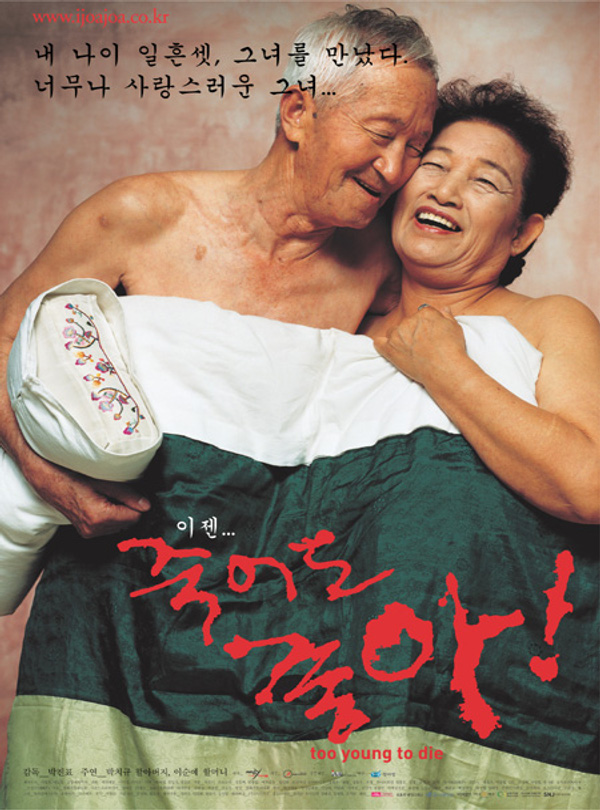
And accordingly, probably the most notable if not the only “recent” Korean film to depict the sexuality of the aged – Too Young to Die (죽어도 좋아; 2002) – was heavily censored. As noted at KoreanFilm.org:
The filmic career of this independent digital feature about an elderly couple in love has followed an unusual arc. It began at the pinnacle of respectability, being selected to screen in the Critics’ Week section at the 2002 Cannes International Film Festival. After receiving a number of very positive reviews, it went on to be selected for the Toronto International Film Festival’s showcase of Korean cinema, and then received a special grant from the government-supported Korean Film Commission to help finance the film’s transfer to 35mm film for a release in Korea. Then, alas, the film was submitted to the nation’s Media Ratings Board, where it was judged unfit for public viewing and banned from release in ordinary theaters.
Too Young To Die is based on the true story of Park Chi-gyu and Lee Soon-ye, a man and woman in their early seventies who met, fell in love, and then rediscovered sex. The couple, who play themselves in the movie, seem little different from a couple in their twenties. They tease each other, fret about their hair, take snapshots of themselves, argue over trifles, and leap into bed with unabashed frequency. Indeed, watching them forces you to rethink all your stereotypes of what it is to be old.
In particular, as Gomushin Girl mentioned in the context of the excessive censorship of women’s sexuality in general:
…the key scene of fellatio was darkened and shortened significantly before it could be released. I would suggest that it was not just the fact that the couple was elderly that made the sex scenes so controversial, but the gusto and relish that the woman took in the acts.
Which raises the question of if there have been any other depictions of aged sexuality in Korean popular culture in the past 8 years (positive or otherwise), as perhaps that experience put directors off? If you know of any, then please let know, but regardless I’d wager that we’re likely to see more soon; after all, with Korea rapidly becoming the most aged society in the world, then audiences (and rating boards) can only become more sympathetic to the subject over time.
In the meantime, can anyone think of any areas in other Korean cities where retirees and prostitutes regularly meet?
A girl-group aimed at my demographic, set in the style of the video games I used to play as a teenager? Seriously, what more could one ask for in a music video?^^
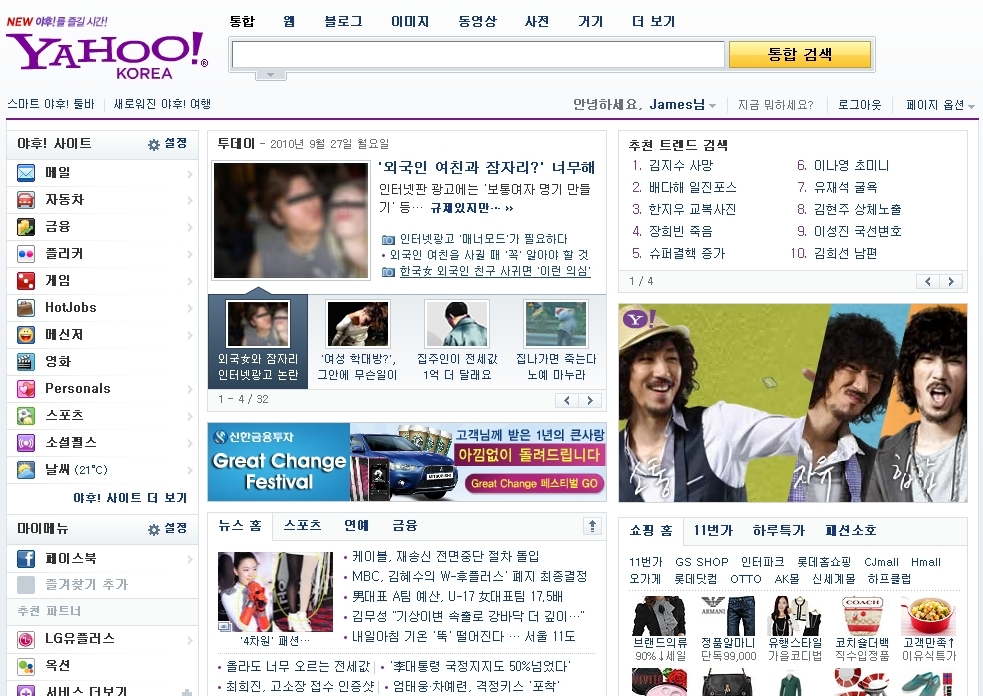
A provocative article title from Yahoo! Korea yesterday, yes?
Alas, actually it’s only about one lawmaker’s concern over the growing number of “lewd” internet advertisements these days, among which presumably that’s a common slogan. But that does underlie some of the street harassment and groping that many foreign women experience here, so it’s interesting in its own right.
As is the irony and hypocrisy of Yahoo! Korea posting such an article in the first place too. For Korean portal sites are virtually like The Sun newspaper in their content, tone, and adherence to journalistic ethics, like I said of them last year:
Unlike their English-language counterparts, you have roughly a 50% chance of opening Naver, Daum,Nate, Yahoo!Korea, and kr.msn.com to be greeted with headlines and thumbnail pictures about sex scandals, accidental exposures (no-chool;노출) of female celebrities, and/or crazed nude Westerners.
And indeed, scroll to the bottom of Yahoo! Korea as I type this, and just today’s “image galleries” below include lingerie photoshoots and “beautiful Russian news anchors”, let alone the links on the rest of the site.
Not that I mind those in themselves of course. But if they’re the standard for Korean portal sites, then you can just imagine what it’s like for the rest of the Korean internet.
Take those of “serious” newspaper websites for instance, the main focus of the orginal article, and which are already notorious for posting pictures of womenin bikinis or even middle-school girls in short skirts:
‘외국인 여친과 잠자리?’ “인터넷 음란광고 강제 퇴출해야”
‘Want to Sleep With a Foreign Woman?’ “Lewd Internet Advertisements Should be Forced to be Withdrawn”
[아시아경제 김성곤 기자]인터넷 광고시장이 급성장하고 있지만 법적 장치의 미비로 선정적인 내용의 음란광고로 홍수를 이루는 등 부작용이 심각한 것으로 나타났다.
While the internet advertising market is experiencing rapid growth, its legal oversight is imperfect, and there has been a flood of lewd advertisements with suggestive contents, with serious side effects.
김성동 한나라당 의원은 27일 방송통신심의위원회로부터 제출받은 자료를 분석한 결과, 인터넷 광고시장은 2004년 4800억원 규모에서, 2005년에는 6600억원, 2009년에는 1조2978억원 등으로 매년 크게 늘고 있지만 성적 호기심을 자극하는 광고가 난무하고 있다고 지적했다.
On the 27th, after analyzing data submitted by the Korean Communication Standards Commission, Kim Seong-dong, an assemblyman from the [ruling] Grand National Party, concluded that the Korean internet advertising market was worth [at today’s exchange rate] US$419 million in 2004, US$576 million in 2005, and US$1.132 billion in 2009, rapidly expanding every year. However, he pointed out that this is also true of advertisements stimulating sexual curiosity.
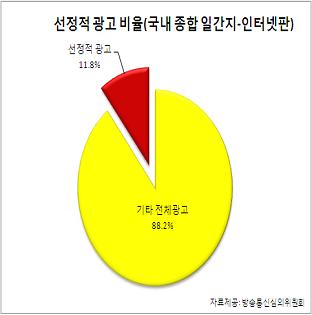
이 자료에 따르면 국내 종합 일간지의 인터넷판 광고에는 ▲ 외국인 여친과의 술자리에서 헉 ▲ 그녀가 원하는 건 크기·힘! ▲ 보통여자 명기 만들기 등 선정적 광고가 전체 광고의 11.8% 수준에 이르렀다. 특히 스포츠 연예지는 선정적 광고의 비율이 20.6%에 달해 전체광고 5개 중 1개는 음란 광고였다.
According to the data, if you look at all the internet advertisements of national newspapers, sexual advertisements with lines like “At a bar with a foreign girlfriend…Wow!”, “She wants size and power!”, “Make a normal woman a famous kisaeng (Korean geisha)”, and so on make up 11.8% of the total. In particular, the rate is 20.6% in sports newspapers, or 1 in 5.
문제는 이러한 인터넷 광고는 다른 광고에 비해 소비자 피해가 즉각적으로 발생하고, 피해 범위도 광범위하다는 것. 특히 피해가 발생해도 광고주의 이동과 은닉 등으로 피해구제가 어려운 것이 특징이다. 아울러 판별능력이 부족한 어린이, 청소년에 대한 무분별한 광고의 노출은 부작용이 심대하기 때문에 규제의 필요성이 절실한 형편이다.
The problem is that compared with other advertisements, consumers instantly suffer a wide range of damages from them. In particular, the producers of the ads can move and conceal themselves easily, making relief and help for the damages difficult (James – I think what these “damages” are exactly should have been made more specific). Accordingly, because the side effects of children and teenagers seeing sexual advertisements is serious, as their ability to understand them properly is lacking, then there is an urgent need for their regulation.
김 의원은 “이러한 현실이 인터넷 광고에 대한 내용 규제가 제도적 미비로 인해 제대로 작동하지 않은 것에서 기인하고 있다”며 “정부, 인터넷 사업자, 민간단체 등 모든 주체가 참여하는 공동자율규제 도입을 고려해야 할 때”라고 주장했다.
Assemblyman Kim claims that “This problem is caused by a lack of and/or poorly-functioning regulation of internet advertising at present,” and that “this issue of regulation needs to be considered by all participating and/or concerned parties, including the government, internet businesses, NGOs, and so on.”
한편, 현재 인터넷광고는 2007년 발족한 한국인터넷광고심의기구가 자율규제를 하고 있지만, 법적 구속력도 없고 비회원사의 참여를 강제할 수도 없는 구조적 모순 아래 놓여있는 형편이다.
There has actually been an organization to regulate Korean internet advertising since 2007, the Korean Internet Advertising Deliberation Organization, but its authority is insufficient as its decisions have no legal binding, nor can it force non-members to participate. This undermines its role as an advertising relief(?) organization. (end)
Meanwhile, observant readers will have noticed two other links in the original screenshot: the first, a Korean blogger’s opinion piece saying that if you’re a Korean woman and want a foreign [male] friend, then you’ll have to get over everyone’s suspicions that you’re with them just for the sake of English and/or sex.
Which may well be true, but unfortunately my wife says it reads like it was written by a 16 year-old.
The second however, another blogger’s advice about getting a foreign girlfriend, actually looks rather interesting, but unfortunately is several thousand words long. I’d still consider translating it though, probably as a 9-part series, but only if readers are interested. If so, please let me know!
Are commercials for this product really the same the world over? Put that to the test by quickly trying to guess what is being advertised above, before all is revealed at o:10.
For non-Korean speakers, the powder shown is a combination of ganghwa-yagssoog (강화약쑥), or “medicinally strengthening” mugwort, and hongsam-paoodeo (홍삼파우더), or red ginseng powder. And surely there is no greater testament to believing in its health benefits than by being prepared to use it in the most intimate of places?
Lest my bashful euphemism for VAGINAS detract from that point however, do recall that during the 2008 protests against US beef imports for instance, many Koreans genuinely believed baseless rumors that Mad Cow Disease could be caught via the gelatin used in sanitary napkins. So it makes perfect sense for aptly-named manufacturer Body Fit (바디피트) to capitalize on the belief that what’s inside sanitary napkins can have direct effects on the wearer’s health.
Still, you could also argue that it actually smacks of desperation by ginseng producers. For – with apologies for the inadvertent pun – one of the first things the commercial reminded me of was the fact that:
…once a market is saturated, I learned at university in New Zealand, there is a inherent tendency for a company’s rate of profit to fall. But this can be offset by re-marketing and/or making new varieties of the original product, and accordingly my lecturer posited the plethora of varieties of Coca-Cola available in the U.S. as a reflection of the greater capitalistic development of its economy (read: saturation of its domestic market) compared to New Zealand’s, which then only had two. Indeed, advertising culture in New Zealand in the late-1990s, he suggested, was only akin to that of the US in the 1950s in its scale and intensity, no matter how brash and “American” New Zealanders regarded it.
( Source: unknown )
And the second was either a Metro or Focus newspaper cartoon I remember from 2005, a satire of the “well being” (웰빙) craze that showed that simply adding a sprinkle of green tea powder to a product seemed to give it health benefits in consumers’ minds, and for which they were prepared to pay a premium for. In particular, the last panel had me laughing out loud on a crowded subway car, for its ads for extremely expensive “Well Being Apartments” built with green tea concrete really hit the spot.
And which just goes to show that not all Korean consumers are gullible as the mad cow disease connection above suggests. And – seeing as we’re talking about vaginas after all – then the latest Western craze for “labiaplasties” for instance, sounds far far worse (see a NSFW video here too).
But hey, if a misguided belief in the health benefits of a product exists, then you can guarantee that companies will exploit it and/or encourage it. And so it seems very strange then, that actually neither sexual potency or health benefits are the stated logic of the commercial, which is rather that the combination of mugwort and red ginseng would eliminate odor. And which my wife assures me is a genuine concern for women, and not an invented concern as I first thought.
But still, would they really be the most appropriate substances for doing so? How about green tea powder, which – you guessed it – is also found in feminine hygiene products in Korea?
Let’s just say I have my doubts. Meanwhile, can anyone also think of any red ginseng (or green tea) products specifically aimed at men? Or, aphrodisiac-wise, is red ginseng actually only supposed to work on men anyway?
Update:Here’s a collection of amusing and/or bizarre “care down there” ads from around the world. Enjoy!
(For all posts in the Korean Sociological Images series, see here)
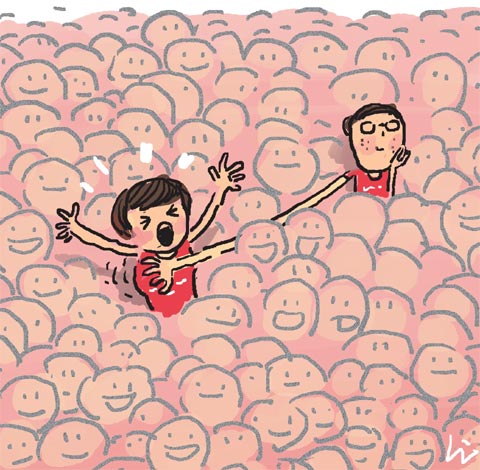
I never did think that women should consider street harassment as flattering of course. But still, this cartoon is eerily effective in getting that message across. It’s no wonder that’s it’s received nearly 300 comments over at Sociological Images.
Most of those dealing with the US though, now I’m curious as to how bad street harassment is in Korea in comparison. And in hindsight I realize that I’ve largely overlooked that in favor of covering workplace discrimination previously, most recently the landmark sexual harassment lawsuit against Samsung.
But groping? I’d never really thought about it, except in passing. After all, what guy does?
Hence my surprise and naivety at discovering that it’s not a problem confined to subways, and in fact was a pervasive problem among crowds during the World Cup, as the following report I’ve translated makes clear. And, even in broad daylight today too, as Krista of Salt City Girl wrote in her email to me that I’ve posted after that.
서울의 한 고교 2학년 최모(17)양은 지난 17일 강남구 삼성동 코엑스 앞 영동대로에 월드컵 길거리 응원을 나갔다가 봉변을 당했다. 아르헨티나 에 0 대 2로 뒤지던 전반 막판 이청용의 만회골이 터지자 시민들은 일제히 소리를 지르며 서로를 부둥켜 안았다. 최양도 친구와 손을 붙잡고 팔짝팔짝 뛰었다. 소리를 지르며 정신없이 뛰고 있던 중 갑자기 뒤에서 한 남자가 어깨동무를 하며 다른 손으로 가슴과 엉덩이를 더듬었다. 놀란 최양이 뒤를 돌아보자 20대로 보이는 남자 1명이 순식간에 군중 속으로 사라졌다. 최양은 “남자 얼굴을 제대로 보지 못했고 사람들 속으로 숨어 버려 경찰에 신고도 못했다”면서 “월드컵이라 부모님이 특별히 밤 외출을 허락했는데, 완전히 기분을 망쳤다. 앞으론 절대 길거리 응원은 안 나갈 것”이라고 했다.
Choi Mo-XXX, a 16 year-old (western age) second year high school student in Seoul, had a bad experience on the 17th after she arrived at Yeongdong Road in front of COEX in Samseong-dong, Gangnam-gu to cheer [the Korean team] during the World Cup.
Korea was losing 2-nil, but then at the end of the first half Lee Cheong-yong suddenly exploded back into the game with a goal, and everyone in the crowd cheered in unison and hugged each other, with Choi Mo-XXX too holding tight onto her friend’s hand and jumping up and down. But while she was doing this and not thinking about anything else, a man who was behind her placed one hand on her shoulders and with the other groped her breasts and buttocks.
She turned around, and saw a man who appeared to be in his 20s, who disappeared into the crowd in an instant. She said “I didn’t really see his face, and he disappeared into the crowd so quickly, that there’s really no point in telling the police,” and added that “because this was the World Cup, my parents gave me special permission to come out and cheer with everyone, but now my feelings have been completely ruined. From now on, I’m never going to attend any cheering events like this again.” (Source, right)
월드컵 기간 길거리 응원을 나가는 여성들에게 ‘성추행 경보’가 켜졌다. 남아공 월드컵은 시차 때문에 저녁 8시나 11시, 새벽 3시 30분 등 어두울 때 경기가 열려 성추행 범죄가 일어나기 쉬운 상황이다. 특히 위기대처 능력이 부족한 여자 중·고생들은 성추행을 당하고도 무서워서 가만히 있거나 수치심 때문에 주위에 도움을 청하지도 못하고 있다.
A big “Groping Alert” to women has been issued to women going to the streets to cheer during the World Cup period. Because of the time difference with South Africa, games are played at 8pm, 11pm, 3:30 in the morning, and so on, providing easy opportunities for gropers to strike. Especially women least able to deal with such a situation, such as middle or high school students, may be so scared as to quietly accept the groping and/or through a feeling of shame or disgrace be unable to ask for help.
인터넷 게시판에는 길거리 응원전에 나갔다가 성추행을 당했다는 제보가 끊이지 않고 있다. 네이버 한 카페에서 ID ‘바람’은 “사촌동생이 거리응원 나갔다가 성추행당했다고 그러더라. (이겨서) 너무 좋고 정신없어서 당시엔 잘 몰랐는데 가슴을 대놓고 만졌다고 했다”고 썼다. ID ‘단탈리안’도 “친구가 길거리 응원 나갔는데 계속 가슴에 어떤 남자의 손이 부딪혔다고 했다”는 글을 올렸다.
On internet cafes, there is an unceasing stream of information from women who have been groped during World Cup cheering events. On one Naver cafe, a commenter with the ID “Baram” wrote “My younger cousin said she was groped at a cheering event. Without her realizing at first, while she was concentrating on cheering her breasts were roughly grabbed, with no attempt by the groper to conceal what he was doing”. Another with the ID “Dantallian” posted the message that “When my friend went to a cheering event, a man kept feeling her breasts when she was crushed up against him.”
한 인터넷 커뮤니티에는 “거리응원 가서 생각지도 못하게 여자 가슴 만져서 레알(진짜) 기분좋음 ㅋㅋ” 등 성추행을 한 사실을 밝히는 글도 올라 있다.
[But] On another internet community site, there have been messages like “At a cheering event I touched accidentally touched a women’s breasts. But it (really) felt good LOL”, clearly stating that the writers have groped women.
인터넷에는 16강 진출이 확정된 24일 아침 서울의 한 거리에서 남성 5~6명이 핫팬츠를 입은 여성을 자동차 보닛 위에 올려놓고 성추행을 하는 사진이 떠돌고 있다. 지난 21일 경기도 파주에서는 한국과 아르헨티나전 경기 응원 현장에서 여중생 김모(16)양을 성추행한 40대가 경찰에 입건되기도 했다.
And on the 24th, when it was confirmed that the Korea team had made it through to the first round, a picture of 5 or 6 men lifting a woman in hot pants onto the bonnet of car and groping her was posted around on the internet. Also, on the 21st, when Korea was playing against Argentina, a 40 year-old man was booked in the town of Paju for groping 15 year-old Kim Mo-XXX at a cheering event.
26일 열리는 우루과이 전 길거리 응원에서도 여성들의 각별한 주의가 필요하다. 경찰은 우루과이전에 서울광장 15만명, 영동대로에 12만명, 한강공원 반포지구에 12만명 등 전국에서 182만여명이 응원에 참가할 것이라고 예상했다. 서울경찰청 고평기 여성청소년계장은 “월드컵 길거리 응원을 나갈 때는 혼자 가지 말고 어른들이나 여러 일행과 함께 가는 게 좋다”며 “성추행을 당하면 큰 소리로 ‘싫다’고 소리치고 주변 응원객들에게 알려 붙잡도록 하는 것도 방법”이라고 조언했다.
Women need to take special care on the 26th, when Korea plays Uruguay. The police expect 150,000 people to participate in the cheering event at Seoul Plaza, 120,000 at Yeongdong Road, 120,000 at the Han River Banpo Baseball Stadium, and roughly 1.82 million people nationwide. Seoul City Police Women & Adolescent Crime Division Chief Go Pyeong-gi said that “it is better if you don’t go to the cheering events with older people or in groups rather than going alone,” and recommended that “if you get groped, the best method to deal with it is to scream “I hate this!” to the surrounding crowd to make sure they know what is going on and can help catch the groper.”
And now Krista’s experience, whom I’ll let speak for herself. And thanks again to her for giving me permission to print this part of her email (Source, right):
It seems to me that sex, sexuality, gender and race are somehow at more extremes in Korea.
I have never been as groped or inappropriately grabbed at in my life until coming to South Korea. Just a few days ago, I was assaulted by a man in the rainy streets of Chungju in the middle of the day in front of other men. He had no problem at all with putting his hand in my shirt and grabbing my breast. I have resorted to wearing high-necked tops at all times because of the experience. When I shared this experience with a Korean man, he seemed to suggest this was surprising and unlikely to happen because I am “foreign” but then went on to suggest I may be to blame for wearing a low-cut top. I cannot believe either of these instances happened. I did not make that man grab my breast and my low-cut shirt more than covered my breasts. And I certainly expected a more sympathetic ear. But the fact that anyone anywhere thinks it’s okay to grope anyone else is absurd. (I wish I could also explain how demeaning the blatant staring, pointing and discussing of any waygukin woman in the area is.) This hypersexualization of Caucasian women allows an attitude which makes it easier to discriminate against Caucasian women and the people who are willing to help them, work with them, talk to them or have anything to do with them. Obviously the objectification of women everywhere has lead to and continues to allow for misogyny, albeit often in a more subtle form in the US.
It would be a lie to say I haven’t been groped or otherwise harassed in America, but again, it does not compare to South Korea. The behavior is more extreme, bizarre and accepted. Quite frankly I do not even begin to understand how Korean women tolerate it and I believe it goes a long way towards explaining why it is so rare to find a Caucasian woman who has been in Korea for more than five years. It is something that gives me pause when considering whether or not Korea is a place worth living.
I hope that gives you some insight into how at least one Caucasian woman sees hypersexualization in Korea.
Not to downplay Krista’s experiences in any way, but I had no idea that things were so bad here that many foreign women were persuaded to leave. Do readers agree that it is a big problem here, or has Krista merely been extremely unlucky?
Update: Read about a slightly bizarre 2-hour long case of groping on a train here and here.
Over at a recent post on Noona Blog: Seoul, an excellent blog written by a Swedish woman in a relationship with a Korean man, currently there’s several interesting comments about the sources of racism often directed against Korean female – Caucasian male (KF-CM) couples in Korea.
Many of which were written by Jake of Asian Male Revolutions, who has the admirable and very necessary goal of challenging the racist and emasculating images of Asian men in the US media through that website.
But in the process of – in my view – very much contriving to paint racism against KF-CM couples in Korea in those terms, as well as global racial power relations, I found he made many extremely sexist assumptions about Korean women, which I’d like to challenge. As technical issues prevent me from doing so at Noona Blog directly however,* then – assuming that you’ve already read his comments – I’ll post my original response here instead:
Dear Jake,
it’s difficult not to sound offensive when critiquing someone’s opinions so harshly. But still, however legitimate your concerns about representations of Asian men in the US media are, it’s incredibly naive of you to assume that that these would exist in the same form and degree in the Korean media, or indeed at all.
Argue that they still have a role in expressions of racism against KF-CM couples in Korea nevertheless though, and you end up simply sounding like an apologist.
Much more seriously however, in so doing you also rely heavily on some extremely patronizing and sexist assumptions about Korean women, let alone racist ones against Caucasian men. Let me explain.
I’ll start with your acknowledgment that “there’s no denying that simple male jealousy plays a role in the bellyaching white men…encounter as one part of an interracial couple in Korea.” Naturally I fully agree, and while I consider it a little harsh to dismiss treating that “as simple jealousy from a bunch of Korean/Asian losers” as a “pretty foolish assumption” – after all, you get jerks like that the world over – I also agree that it is wise “to consider the historical and political implications and undertones of various types and permutations of interracial dating” to understand that bellyaching more fully (source, bellyaching pun above).
But what is that historical and political context you identify?
The Western media has a much longer reach than Korean media; in fact all Asian media is to an extent influenced strongly by Euro-centric beauty standards. This has been well-documented by all the plastic surgery, and by the glorification of media figures (singers, actresses) who are selected first and foremost for their vaguely euro-Asian looks (as opposed to supposedly ‘ugly’ Korean features) and then groomed by a team of trainers and managers to become media superstars like Girls Generation, Son Dam-Bi, and all the ‘flavors du jour’ pop-tarts you see on Korean TV shows.
And again I largely agree, having written many posts saying pretty much the same thing myself. But crucially not the “The Western media has a much longer reach than Korean media” part; and as we’ll see in a moment, I feel you have an extremely inflated view of the Western media’s power in Korea.
So given the fact that an embedded system of euro/white-worship permeates South Korean pop-culture, white males have more elbow room to work with in the global dating scene. Many come to the shores of Korea and Asia and have relatively little trouble finding willing women who having seen and internalized images of white beauty standards, would like nothing more than to experience the thrill of dating the mythic “white boy”. And white men who come to Korea are only too happy to take advantage of this fact.
Okaaay…I’ll deal with your warped view of the interracial dating scene in Korea in a moment too (source above: Gusts of Popular Feeling). But first, let’s focus on your views of Korean women which it relies on, which you expand upon in your next comment:
Asian female/white male relationships cannot happen unless both parties are willing to participate in it.
This can only mean one thing – that Korean women, having internalized media messages glorifying white men, are also actively seeking them out to satisfy their own ‘white fetish’. Therefore, we cannot simply categorize white men as “predators” for Asian flesh: instead, a significant number of Asian women are willing collaborators.
Interesting choices of terms you’re using, especially that last. Continuing:
Or at the very least, they are passively open to it – that is, they might not go out of their way to seek white men, but if one does hit on them they are psychologically “primed” to be much more open to their sexual and romantic advances, as opposed to a black or even Korean man.
This is just more evidence of the pervasive white worship in Korean society, and it illustrates just how thoroughly and totally many Korean women internalize this message.
You’ve seen them in the bars and clubs and lounges of Seoul. To them, white boys on their arm are the ultimate accessory to their personal crusade to be the “coolest” chick on the block.
They’re commodifying race – and according to their rather twisted logic, being seen with a white guy the equivalent of having the latest handbag or shoes.
They ought to stop and think about the implications of their choices. To them it’s a confirmation of their own belief that “being with a white man = COOL + URBANE + COSMOPOLITAN + TRENDY”… but it’s actually an expression of a colonial mindset – they are psychologically and mentally colonized, dominated, and enslaved.
They’re not setting the tone on what is cool – they’re doing the exact opposite: setting the tone on what is sick, twisted, and unwholesome.
Disclaimer: I am in no way claiming that ALL Korean women with white men are like this. But there is also no denying that a significant number of these women do exist. So please take my comments for what they are, and don’t take them out of context. Thanks.
Hey, no-one is denying that there are some Korean women who seek a White boyfriend for much the same reasons they would a Gucci handbag (or various types of Korean men either for that matter). But a “significant” number of Korean women with White men are like this you say? What percentage of them do you mean by that term roughly? 10? 25? And do you actually have any evidence whatsoever that they represent anything but the tiniest fraction of all KF-CM relationships?
Also, I’m rather confused: what percentage don’t want a White boyfriend as an accessory, but like you say just want to experience the thrill of dating one instead (which apparently is bad, even though we’re all attracted to the exotic)? What percentage are simply psychologically “primed” to spread their legs more readily for a White man “as opposed to a Black or even Korean” one? And finally, presuming you even allow for the possibility, what percentage of Korean women would you say aren’t passive, unthinking dupes of media messages of White male supremacy and are thus able to have genuine loving relationships with White men?
More to the point, have you asked so much as a single Korean woman of what she thinks of your characterization of them above?
I have asked one myself actually, my wife, and I’d wager that her reaction to you on the right is pretty representative. But I’ve asked many many more about interracial dating (including many who only speak Korean), and I think you’d be rather surprised at the far greater numbers of Korean women who have little interest, even a positive distaste at the possibility of dating White men.
Moreover, while global racial patterns of hegemony and privilege certainly ensure that more White guys end up in South Korea than, say, Indian guys, and that stereotypes of both exist that encourage and discourage Korean women to form relationships with them respectively, it doesn’t automatically follow that Korean women assessing them as potential partners don’t do so by pretty much the same criteria that they do for any men, including Koreans.
Most South Asian men in Korea, for instance, are laborers, which obviously puts them at a big disadvantage to middle-class White teachers. Also, as one Korean female friend put it to me, while White guys tending to be taller has a great deal to do with their attraction to some Korean women (albeit a disparity that is rapidly disappearing), that still isn’t enough to overcome the anticipated language and/or cultural difficulties for most others. And another acknowledged that while White men in Korean tended to have more money (and freedom) than Korean guys in their early-20s, with the ESL industry in Korea being the joke that is, then, financially-speaking, in fact Koreans make much better partners by their late-20s and early-30s.
In short, while the specific mixture of the fish in the sea may well be determined by forces beyond their control, women are very much the arbiters of which ones they reel in so to speak.
To be fair, you do somewhat acknowledge this in your next comment, and which I admit I misinterpreted in the first draft of this post. But still, it is interesting how you force that into a narrative of Korean female submissiveness and White men’s sexual colonialism nevertheless. You say of the relationship between one commenter’s German father and Korean mother’s relationship, for instance:
…until Korean male/German female relationships become just as commonplace as what’s already out there (that is, WM/AF relationships), you can’t exactly hold that up as a ’shining example’ of “colorblindness”. It’s not — it’s more of an expression of racialized power structures and a neo-colonial history.
No, actually it can be colorblind, and both relationships and the people behind them are more then mere expressions of vast, impersonal forces. But if you’d like a more specific critique of your twisting facts to suit your narrative however:
It’s the German man’s knowledge when he goes abroad that his country is wealthier and more powerful, compounded with the Korean woman’s knowledge that her’s is less wealthy (particularly back in those days), that makes the Western-male/Asian female (WM-AF) relationship so numerous.
And since women generally look to marry “up” while men look to marry “down” (socially and economically), you can see why the inequality between the white and Asian races makes the WM-AF relationship so easy to forge.
Put simply, I call bullshit on women marrying up and men marrying down: in virtually every society, both historically and today, the vast majority of men and women marry someone within the same socioeconomic group as themselves. Earning much more money than women however, then men are certainly freer to marry down, but that doesn’t at all mean that they aim to do so, or that they don’t aim to marry up any less than women.
If you take some time to analyze our message instead of reacting emotionally, you’ll see just how out of line your thinking is, and how little time and effort you put into trying to understand something that is admittedly *highly, highly* complex. It’s a difficult concept for anyone to wrap his or her head around, so I guess I can’t blame you for taking the lazy way out with convenient and disjointed logic.
But then I said I’d talk about the Western media’s influence in Korea, and so I’ll do so now by contrasting the different impacts you feel it has on Korean men and women (my emphasis):
But the rub for Korean men (in general) is that men in places like Madison Avenue in New York City and Hollywood who control the images that go up on billboards and on TV and movie-screens are white – and they invariably make those images in their own image: White, Male, and BLOWN WAY OUT OF PROPORTION. In short: welcome to the world of Hollywood and the White Male Action Hero.
Keep in mind that while this is happening, Asian males are either completely excluded or used as a foil to make the white male look better in comparison. So Asian males in America or Korean males living in Korea internalize this subliminal message in the media and think that they can’t possibly step up to a blonde girl (or whatever white chick). They live their entire lives being psychologically castrated, in sharp contrast to a white male from where ever, who is emboldened or even arrogantly empowered by the jumbo-sized images made in his likeness, in the embrace of gorgeous white, black, latin, and of course Asian women in movie theatres all over the world.
Hey, again I completely agree about the representations of Korean and Asian men in the US media. But I’m curious as to how you think this affects Korean males in Korea exactly, and what’s more upon whom you – very tellingly – imply that there is an equal effect as on Asian males in America. Pray, have you actually watched or read any Korean television, movies, magazines, or websites recently? It’s not like they’re lacking for strong, macho images of Korean men getting the Korean girl; or indeed, frequently getting the White girl these days, creating hypersexual stereotypes of them in the process.
Am I also “emotionally reacting” in pointing that out?
And simultaneously (being human and all) many white women are conditioned to shoot for white men as the “gold standard”, since all the glorified images of ‘male sex appeal’ feature only white males. Some even view Asian males with contempt or pity, and this of course spills over when white chicks go abroad – though to be fair, I’ve noticed this racist bias more in North American white females than European ones. So it is any wonder we see a “global sexual marketplace” that is DOMINATED by white males (figuratively) ‘raping’ and exploiting these loopholes to their sexual advantage?
Given the above dynamics of a GLOBAL system of media brainwashing that favors white males, is it any wonder that some people in Korea or elsewhere might secretly (or openly, in some cases) resent a white male for doing what he does? It’s not unreasonable, or completely out of the realm of possibility.
Ah. So while Korean women are mere passive dupes of the Western media, in contrast Korean men are savvy, knowledgeable consumers of it, and for whom calling a Korean woman walking down the street with Caucasian male a whore, say, is hence a justified response to their symbolic castrations and emasculation therein? As is the way the Korean media treats Western men?
To put it mildly, that sounds rather apologist to me. But then considering what you write about White guys in Korea, then what would I know, right?
But here’s the funny thing: to him, he’s just ‘innocently’ going about his personal life – but of course he also doesn’t see (well, probably chooses not to see, that is, ignore) that the entire System is built for HIS personal advantage. It’s custom-built for his white male needs – and that is very racist, no doubt.
And on that note, I’ll put this response to rest. Regular readers may well wonder why I devoted so much time to it: after all, its flaws speak for themselves. But then I’m only human, and I reacted partially because it reminded me of how a commentator on this blog also conflated the 2 issues in an earlier post for instance, and whom I simply gave up reasoning with. Much more though, because it was annoying to spend 60 minutes on a comment only to have it disappear (see below), and finally especially because I was angered by comments on a similar post on Noona Blog not only gushing with enthusiasm for Jake’s comments but also implying that he had “a fact-based academic writing style”, when if anything it’s marked by their complete absence.
Combine that with being a White man married to a Korean woman blogging about gender issues in Korea too, who as a result has had trolls insulting the both of us incessantly for 3 years, or even being sent 3000 word emails patiently explaining that the vast majority of White men in Korea (but always excluding myself of course) have yellow fever, and that I’m just being emotional in not acknowledging that…then hopefully you can see why I get very tired and angry at hearing that sort of thing sometimes!^^
Update: See I’m No Picasso and Roboseyo for two excellent posts written in response to this one.
You’ve seen them in the bars and clubs and lounges of Seoul. To them, white boys on their arm are the ultimate accessory to their personal crusade to be the “coolest” chick on the block.
They’re commodifying race – and according to their rather twisted logic, being seen with a white guy the equivalent of having the latest handbag or shoes.
They ought to stop and think about the implications of their choices. To them it’s a confirmation of their own belief that “being with a white man = COOL + URBANE + COSMOPOLITAN + TRENDY”… but it’s actually an expression of a colonial mindset – they are psychologically and mentally colonized, dominated, and enslaved.
They’re not setting the tone on what is cool – they’re doing the exact opposite: setting the tone on what is sick, twisted, and unwholesome.
Disclaimer: I am in no way claiming that ALL Korean women with white men are like this. But there is also no denying that a significant number of these women do exist. So please take my comments for what they are, and don’t take them out of context. Thanks.
*Actually, my original intention was just to leave a comment at Noona Blog, but as soon as I hit “submit reply” then it disappeared into the ether. As the same thing happened on a different post last week however (my first there), then wisely I’d saved it first. Of course, it’s annoying that I can’t seem to comment at all there then, but normally I’d just chalk that up to the idiosyncrasies of the individual website. Yet then the same thing happened on Seoul Beats yesterday too (thanks for the link guys!), which I have successfully commented on before. Do any technically-minded readers have any possible explanations? A plugin issue perhaps, or something to do with the most recent version of WordPress? (Switching from Firefox to I.E. didn’t help) Thanks in advance!
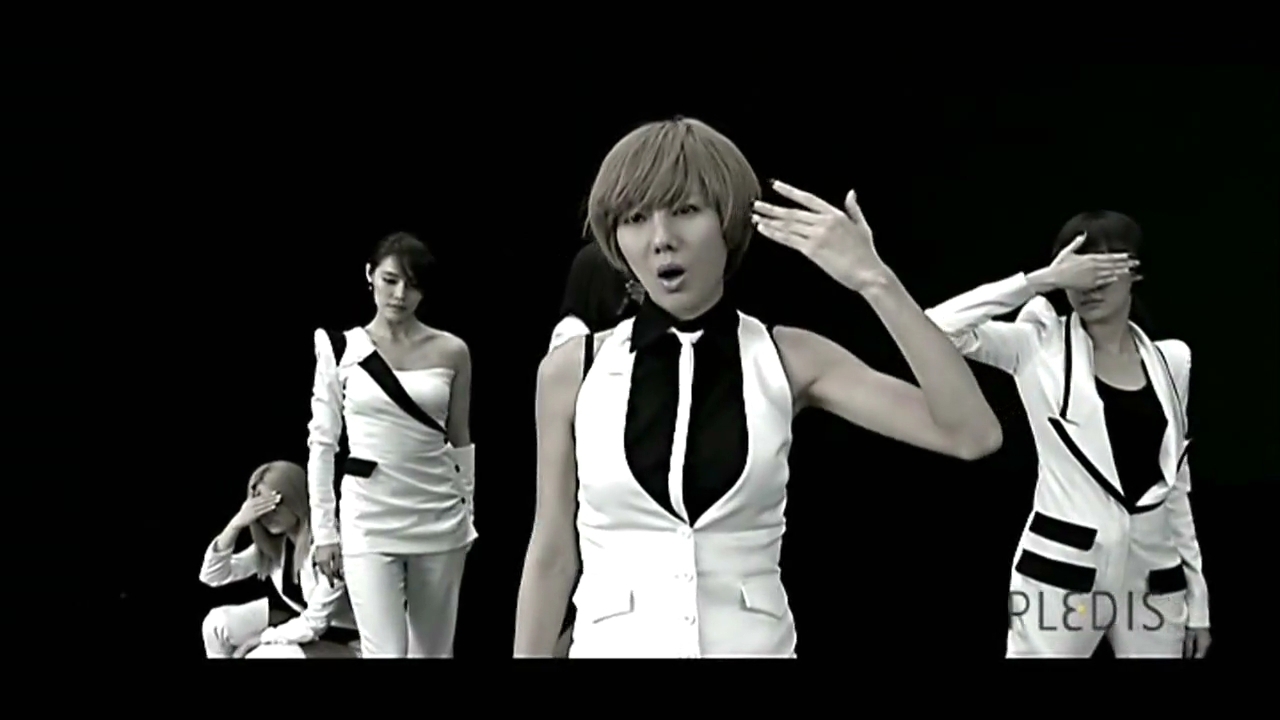
With apologies for not writing about the positives of Korean popular culture more often, let me present Because of You (너 때문에) by After School (애프터스쿨). It’s one of my 10 favorite Korean songs, and easily their best.
Or at least, DJ Areia’s version of it above is, but I include the original below if you prefer.
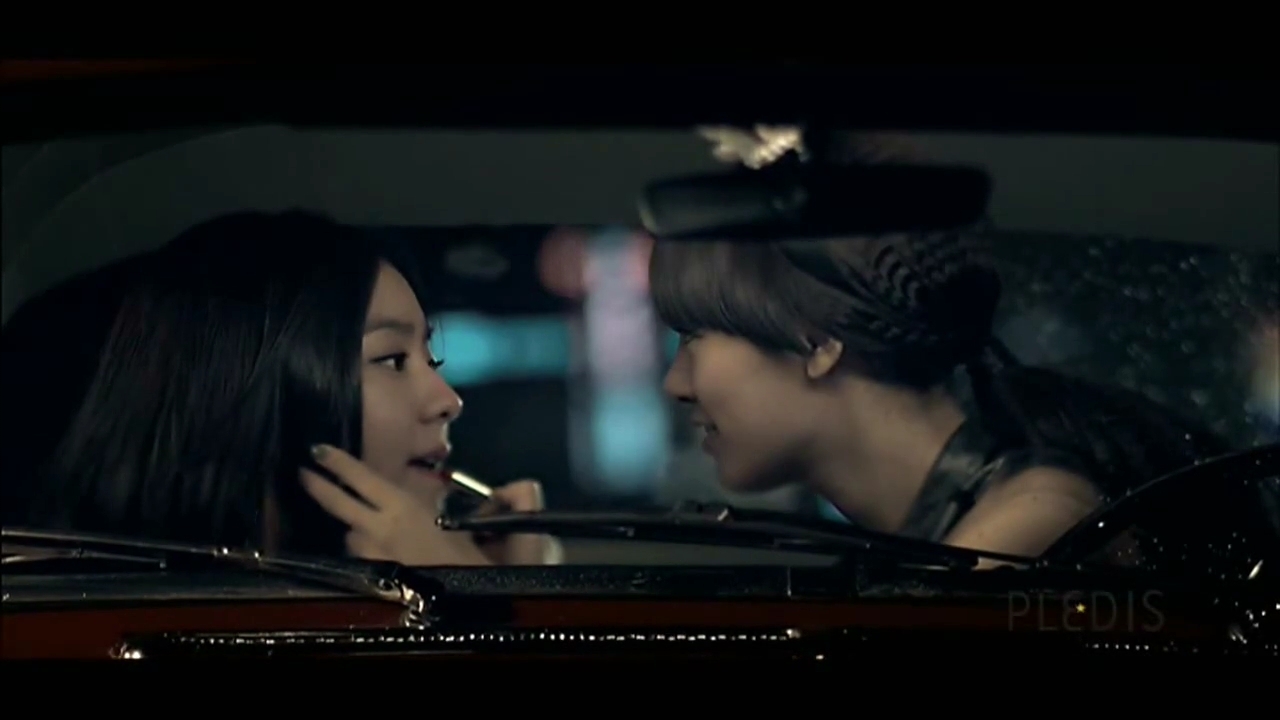
The music video however, is a little confusing. Not because it depicts a relationship between 2 women though: admittedly that was a surprise, but in hindsight the lyrics are completely gender neutral. Rather, it’s because there is a man – model Song Jae-lim (송재림) – featured prominently throughout, and it’s not entirely clear who or what he’s supposed to represent exactly. Indeed, with his collage of photos of different members of the group, closed-circuit TV monitoring of them, and finally holes in walls through which to directly spy on them, then “voyeur” or “stalker” is what comes to mind personally, but I’d be surprised if that’s what the creative director intended.
If anyone can explain what he’s doing there then, then please let me know! In the meantime, I hope the translation adds to your enjoyment of the song, and for Korean learners I’ve included detailed explanations in those cases where I came across words or grammar that were new to me personally, or where my (Korean) wife and I had some difficulties. But I’m still quite happy to explain anything else though, and of course may have made some mistakes, so please give me a buzz in either case.
Here goes:
아직도 나 그대를 잊지못해
I never forget boy
I never forget boy
헤어진지 벌써 몇년이 지났는지 몰라
그대 생각만 하면 자꾸 눈물만 흘러
오늘따라 왜 그렇게 네가 보고플까
창밖의 빗소리가 내 맘을 흔들어놔
I still can’t forget you
I never forget boy
I never forget boy
Since we split up, already so many years have passed I’ve lost track
I only have to think of you, and I frequently [end up] crying
Why especially today do I want to see you so much?
The sounds of the rain outside the window pane has gotten my heart beating
Line 5 was the first problem, which my wife and I actually argued about a little (albeit when we were both very tired), because although “만” usually means “only”, according to her it can also mean “whenever” too. And however annoying it is for learners like myself, I do concede that even the simplest of Korean words can have multiple meanings sometime, so although I haven’t encountered that use of the term myself yet, for a while I wisely deferred to her translation of it as “Whenever I think about you”.
But still, it bugged me, as surely “그대 (애대해서) 생각할때 마다”, say, would be a much less ambiguous way of saying that? Hence the result you see above, after resolving which we wisely decided to start translating the next verse in the morning. Unfortunately however, that still left Line 7, which uses the construction of [verb] + [아/어/여 ending] + [놓다].
I wasn’t familiar with that, but I did know [verb]+ [아/어/여 ending] + [있다], which means that “the state resulting from the action of the verb continues to exist” for a short time, and also [verb]+ [아/어/여 ending] + [두다], which basically means to something in that state for a much much longer time (compared to 있다), so it wasn’t difficult to understand this new 놓다 one, which “indicates that the action of the main verb is complete, and is restricted to action verbs”. See page 353 of Korean Grammar for International Learnersfor more information, an essential reference book which I’d be surprised if anyone still reading by this stage didn’t already have!
사랑하지 말걸 그랬어 정 주지 말걸 그랬어
붙잡지 말걸 그랬어 왜 이렇게 나 혼자 아파
사랑하지 말걸 그랬어 정주지 말걸 그랬어
붙잡지 말걸 그랬어 왜 이렇게 나 혼자 아파
난 항상 너만의 장미가 되려던 내 맘을 아니
이제 조각난 사랑의 마침표가 됐다는걸
눈물이 밀려와 메마른 입술이 젖어
이제 어떡해 그댈 잊을 수 없어
I shouldn’t have loved you, I shouldn’t have given you affection
I shouldn’t have asked you to stay, why am only I hurt so much?
I shouldn’t have loved you, I shouldn’t have given you affection
I shouldn’t have asked you to stay, why am only I hurt so much?
I was always going to be your rose, Do you know my heart?
I know our shattered love’s final end has come
My gushing tears wet my dry lips
Why can’t I forget you now?
In lines 1-3, the construction [verb] + [지말걸] basically means “shouldn’t have [verb], and the “그랬어” just adds emphasis. In Line 1, it seemed simplest just to translate “정” as “affection”, but note that it often means a great deal more than that in group contexts (see here and here). Meanwhile, in Line 7 I changed “밀려오다” from “advancing” to “gushing”, because although the former is technically more correct, in English “advancing tears” really means tears that haven’t arrived yet, whereas in this case the Korean means tears that have arrived, and keep coming like waves on the sea keep advancing towards the shore.
Line 6 though – 이제 조각난 사랑의 마침표가 됐다는걸 – was probably the hardest of the entire song to translate. My logic with “I know our shattered love’s final end has come” was, first, that the sentence is quite literally “Now-shattered-love’s-full stop/period-has come/formed/arrived I know”, with me writing “full stop/period” to avoid anyone confusing “period” with a period of time, when actually “마침표” just means the punctuation at the end of a sentence. But then I decided that “final end” is what it is meant by that surely, and changed it accordingly.
Still, I admit that the sentence as a whole remains pretty strange, as in my experience “shattered love” has already has had “a final end” by virtue of shattering in the first place. Perhaps not so in Korean though?
Next, the chorus:
너 때문에 많이도 울었어 (매일밤 난)
너 때문에 많이도 웃었어 (그대 때문에)
너 때문에 사랑을 믿었어 (woo boy)
너 때문에 너 때문에 모두 다 잃었어
정말 답답답해 갑갑갑해 막막막해 너없는 세상이
내 말을 씹어놓고 자존심 짖밟아놓고
내 맘을 찢어놓고 왜 나를 떠나가
Because of you I cried a lot (every night I)
Because of you I laughed a lot (because of you)
Because of you I believed in love (woo boy)
Because of you, because of you, I lost everything
I am so frustrated, stifled, and lost in a world without you
You ignored what I said and walked all over me
You tore my heart to shreds, why did you leave me?
Most of that was quite simple in contrast. Of course there are many alternatives in English for “닫답하다”, “갑갑하다”, and “막막하다” in Line 5, and the difference between the first 2 in particular is quite subtle. Indeed, although this was the first time I’d ever heard “갑갑하다” myself, my wife tells me that it is so similar to “닫답하다” that it is often used in conjunction with it for emphasis.
Also, in line 6 and 7 there is the [verb] + [아/어/여 ending] + [놓다] used earlier. In Line 6, I decided that “you ignored what I said” was a better translation of “내 말을 씹어” than the literal “you chewed my words”, which sounds quite ambiguous in English. In the case of “자존심 짖밟아” though, I decided that “walked all over me” sounded the most natural, but the more literal “you trampled over my self-respect” was probably fine really.
Note though, that the last line should really have a “you” or “당신이” inserted, making it “내 맘을 찢어놓고 왜 당신이 나를 떠나가” or “You tore my heart to shreds, why did you leave me?”. And as I’ll explain, the question of who left whom exactly becomes important a little later.
그날도 비가 왔었지
한참을 그댄 말없이 나를 바라보기만 했어 어어어
흔들리는 눈빛과
애써 짓는 어색한 미소가 이별을 얘기해줘 줘줘줘
It rained that day too
For a long time, you just stared at me wordlessly
Through the light of your eyes and your labored, awkward smile, I realized you were going to split up with me
That’s quite straightforward, so I’ll just continue:
사랑하지 말걸 그랬어 정주지 말걸 그랬어
붙잡지 말걸 그랬어 왜 이렇게 나 혼자 아파
사랑하지 말걸 그랬어 정주지 말걸 그랬어
붙잡지 말걸 그랬어 왜 이렇게 나 혼자 아파
나보고 떠나가라고 할땐 언제고
떠난다니까 어쩌고 미친사람 취급만 해 정말 힘들어 (Boy slooow down)
아무런 말도 못한 채 울어
Cause I want to stay next to you
My love is true Wanna go back to when I was with you
I shouldn’t have loved you, I shouldn’t have given you affection
I shouldn’t have asked you to stay, why am only I hurt so much?
I shouldn’t have loved you, I shouldn’t have given you affection
I shouldn’t have asked you to stay, why am only I hurt so much?
You are the one who told me to leave
After saying that, why did you only treat me like I was crazy? It was so painful and difficult for me
I cried so hard I couldn’t speak
Cause I want to stay next to you
My love is true Wanna go back to when I was with you
The question of who left whom is important because of Line 5, “나보고 떠나가라고 할땐 언제고”. The “보고” in that is just another way of saying “한테”, leaving us with literally “To me-ordered [me] to leave-when you [ordered me]-some day”; not as confusing as it looks though, as it’s just “When you told me to leave someday”. Or so I thought, but in that case the placing of the “언제고” would be different: “”나보고 언제고 떠나가라고 할땐”. And it couldn’t be “Someday, when you told me to leave” either, as the subject marker attached to “when” – “할 땐” – makes that impossible.
I despaired then, and it didn’t help that I thought it was the other person that left the singer(s) either. My wife came to the rescue though, by saying that although the dictionary says “”언제고” is “someday”, it’s also used for emphasizing that someone said something to you, and not the other way round. She also told me that that meant I could omit the “when” too, and hence you the final result “You are the one who told me to leave”.
That still leaves the question of who left whom though, especially as the next line was “After saying that, why did you only treat me like I was crazy?”. My best guess then, is that the ex-girlfriend told the singer(s) to leave, and when she didn’t, the ex-girlfriend left instead, especially given the last line of the song which you’ll see in a moment.
Next is the chorus again though, so I’ll skip ahead to the next verse. And if you haven’t been listening to the remix version, then I highly recommend you at least listen to this section from 2:42 (3:03 in the original), as it’s not for nothing that I said back in May that “the background melodies at that point raise my spirits from virtually any depths, and make me feel like I can conquer the world, even after probably 200+ times of listening to the song”!
I miss you I need you 꿈 속에선 아직도 I’m with you
I miss you (miss you) I need you (need you)
시간을 되돌려 Wanna kiss you again ma boy
맘이 너무 아픈데 견디기 괴로운데
너는 어디서 뭘하니 (나 울었어 참 많이)
너 없인 난 못살아 내게로 돌아와줘 날 떠나가지마
I miss you, I need you, You’re still in my dreams, I’m with you
I miss you (miss you) I need you (need you)
I wish I could go back to then, Wanna kiss you again ma boy
My heart aches, enduring it is so painful
What are you doing now, where are you (I cried so much)
I can’t live without you, Please come back to me, Please don’t leave me
And finally there is the chorus again. Again then, I hope you can all enjoy the song much better now, and if you’re a fan of After School then you may also like to check out my translations of the lyrics to Ah! (아!) and Bang! (뱅!) too. And the Song Lyrics & Translations category in general of course; alas, there’s only 1 song by another artist in there as I type this, but I promise to add many more soon!
<!–[if gte mso 9]> Normal 0 MicrosoftInternetExplorer4 <![endif]–> <!–[endif]–>
What? Belgian surrealist art on a blog about Korean sociology? Yes indeed; but never fear, for I’ll be criticizing something Korea-related soon enough!^^
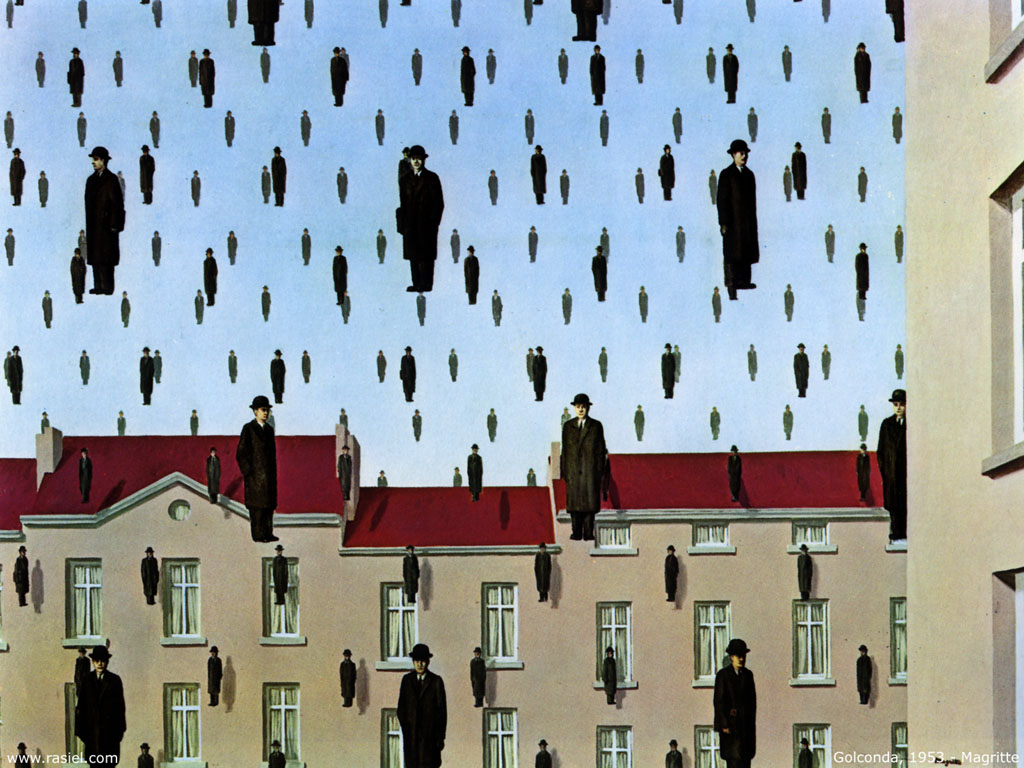
The painting in question isGolconda (1953) by René Magritte, and I’m sure many of you have seen it before. But what did you think it was about?
Personally, I’d always assumed it was a critique of conformism. But Charly Herscovici, who was bequeathed copyright on Magritte’s works, commented that (via Wikipedia):
Magritte was fascinated by the seductiveness of images. Ordinarily, you see a picture of something and you believe in it, you are seduced by it; you take its honesty for granted. But Magritte knew that representations of things can lie. These images of men aren’t men, just pictures of them, so they don’t have to follow any rules. This painting is fun, but it also makes us aware of the falsity of representation.
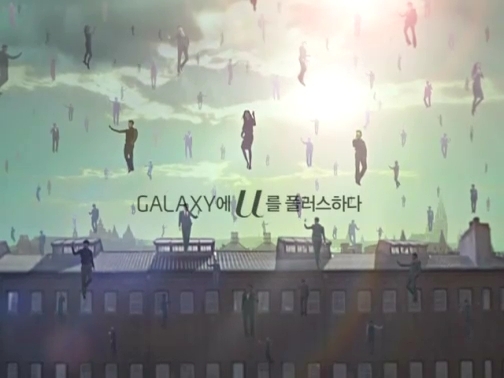
So although our interpretations aren’t mutually exclusive, the painting may not be quite as drab and negative as I thought. Still, does that make the concept suitable for a phone commercial?
Not really:
Vodpod videos no longer available.
No, I can’t really think of any relationship between the artistic concept and the voiceover droning on through the “U” section of the dictionary either. And ironically, the result probably emphasizes conformism and/or uniformity more than Golconda does too; particularly by starting with the word “unique”, only then to visually demonstrate how owning a Galaxy S phone will make you anything but.
Explicitly stating the opposite however, Rain’s (비) recent commercial for the SK-W Phone provides an interesting contrast:
And at least the copywriting does match the video this time (translation from the uploader):
– Do you want to be in the spotlight as just one of all dressed in the same form?
– You can be a real star only when there is an aura about you.
– (Rain’s voice): Your desire to want someone’s attention is one good enough reason to want ‘W’.
– ‘W’ which is really quite something with its own shining aura (repeated two times)
Or in other words, if you’re just the same as everyone else, then owning a special SK-W phone will compensate for your lacking any special qualities, thereby helping you get the girl.
Or will you? It takes no great leap of the imagination to see that if I can get a shining aura of sexual magnetism to rub off on me by purchasing the phone, then so can you too. Indeed, you can argue that the explicitness of the above message actually only serves to highlight that mundane, self-defeating reality of consumerism.
Alas, I know nothing about the merits of the phone itself. But some advertorials have directly linked its success to Rain’s dancing in the commercial, and I can disagree with that at least, finding the first part of his dance more reminiscent of an imitation of Robocop than anything else (source, right). Instead, I would attribute it more to the fact that it simply features one of Korea’s biggest celebrities, an unfortunate mainstay of Korean advertising. As Londoner Bruce Haines puts it, currently head of Korea’s largest ad agency Cheil Worldwide (제일기획):
Q) What’s one big difference between advertising in Korea and the UK?
A) Celebrity endorsement – a huge proportion of Korean ads depend on famous people. Of course, it’s not uncommon in the West for stars to endorse a product, but generally the ad has a core idea and makes use of the celebrity endorsement to enhance the original concept. Not so in Korea. In its crudest form, Korean advertising degenerates to beautiful people holding a bottle. This is one of the things holding back the reputation of Korean advertising worldwide. (10 Magazine)
And on top of that, perhaps I’m really quite misguided in assuming that the messages of conformity wouldn’t find a receptive audience among Korean consumers too. After all, however much of a gross generalization it sounds at first, in fact emphasizing both have been strong political and economic prerogatives of the South Korean state for much of its short history, and with profoundly gendered consequences.
What do you think? Either way, if this collection of my thoughts on the 2 commercials must(?) have a conclusion, then it would be that I’d like to see more alternatives to the dominate narrative of simply throwing expensive celebrities and/or their bodies at consumers. And I don’t mean simply throwing art at them instead!^^
In the case of smart phones specifically, perhaps we could have ones that emphasized how they can be genuinely helpful and empowering for ordinary people?
At first, I thought this one qualified:
Vodpod videos no longer available.
But in hindsight, a demonstration of how phones can help you be like everyone else isn’t quite what I had in mind. If you know of any then, please pass on any better ones, for phones or anything else!
Something about Kong Hyo-jin (공효진) got me all hot and bothered last week. And no, I don’t mean her lingerie photoshoot for Calvin Klein.
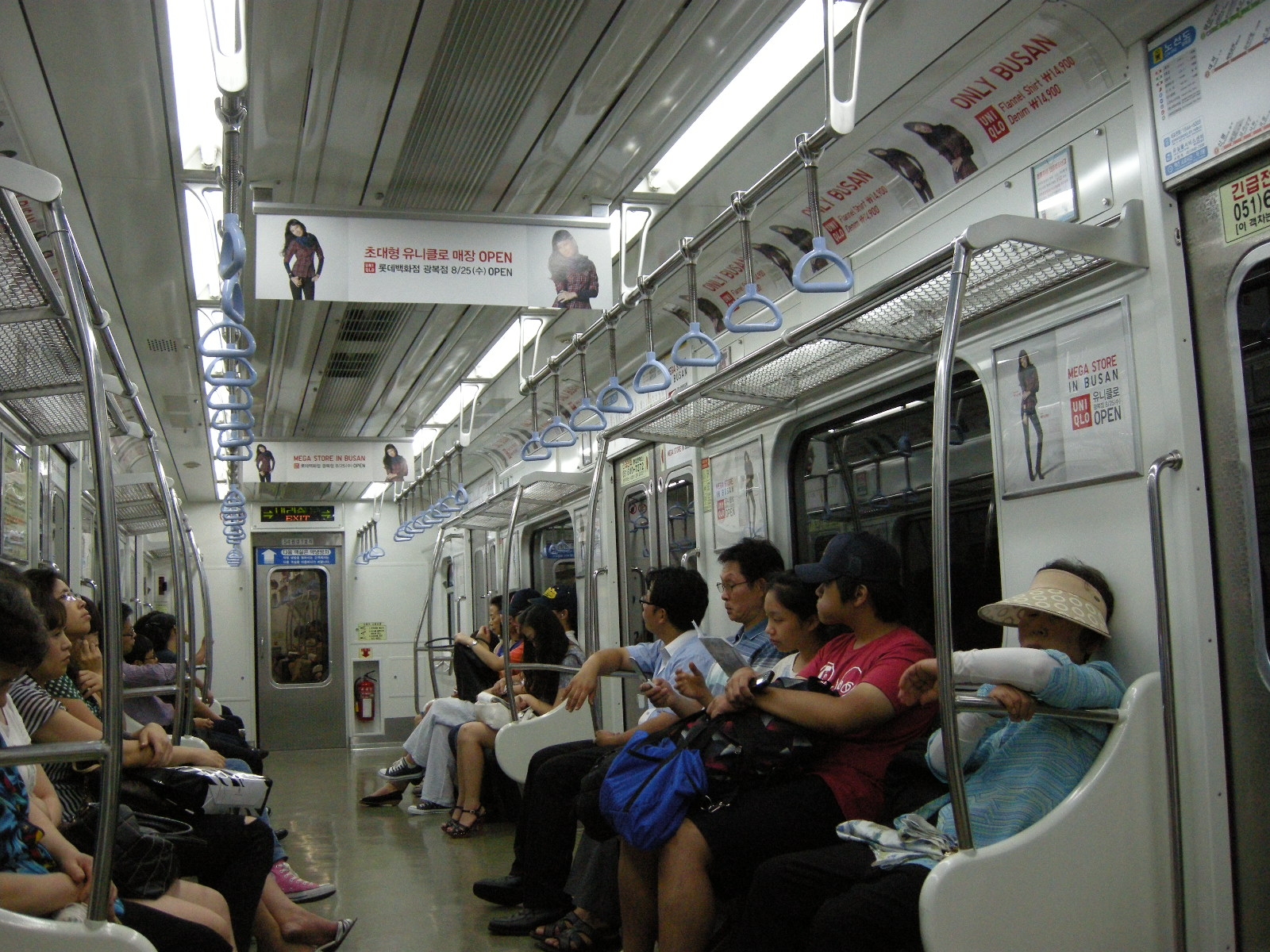
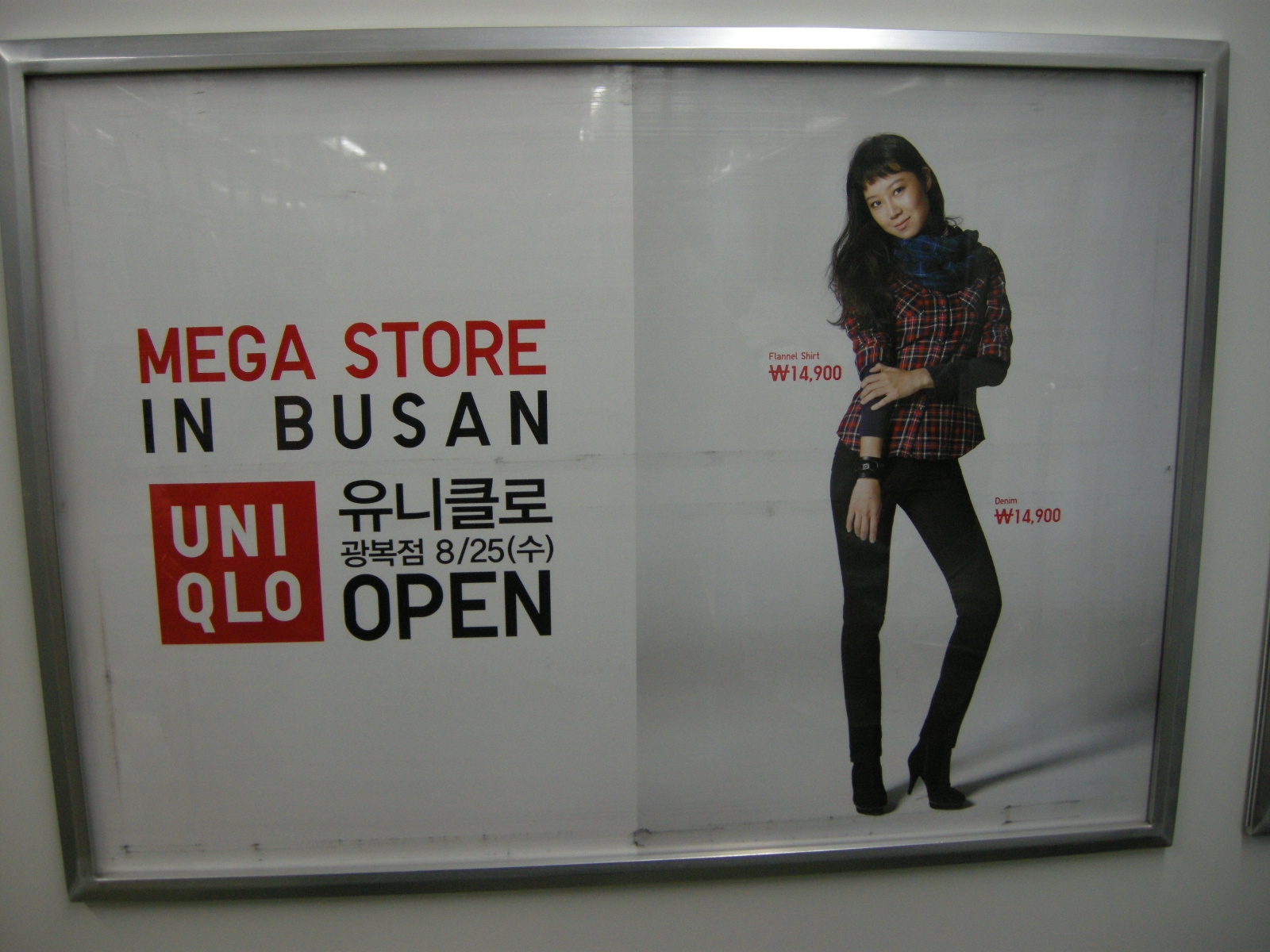
Rather, it was her ads for Uniqlo (유니클로), all over Busan at the moment. Surely, I thought, the creative team could have anticipated how their ads would look on the side of buses, and designed something that didn’t look like she was literally squashed into them?
But then I caught a subway train on Line 2, every carriage of which was decked out like this:
And suddenly I realized that her squashed appearance wasn’t an accident:
Still, what’s the big deal?
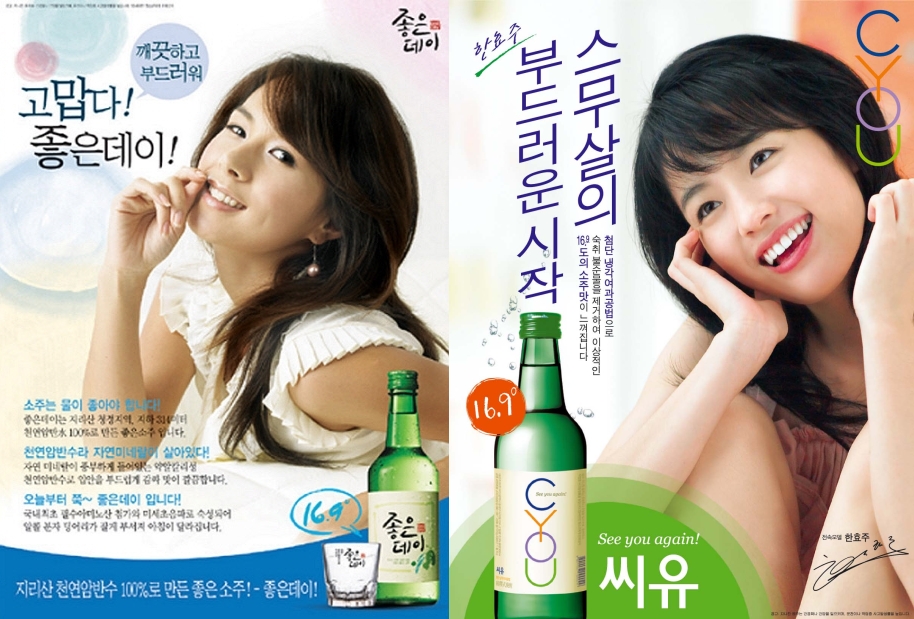
Well, just try it for yourself. Assuming that you have, and that your neck no longer hurts, then now you too may be wondering why her head was placed so awkwardly. Moreover, why is it overwhelmingly women that have this “head cant” in advertisements too, albeit not usually tilted quite so much?
(Sources: unknown)
Sociologist Erving Goffman believed it made women look subordinate, and hence that the disparity was evidence of sexism. But as I already discussed that back in February, my original aim here was just to pass on further evidence of the sociological pattern.
Yet the more I looked at the ad, the more I liked it despite myself. And I wanted to know why.
One possible reason, I thought, was Kong Hyo-jin’s luxuriant, flowing hair, another recurring theme of advertisements. Combined with her hands on her hips, it reminded of this ad with Kim Ah-joong (김아중) especially:
(Source: unknown)
And in particular, the wind effect:
…makes it look as though whatever she is looking at (presumably a male viewer) is powerful enough to nearly blow her away while she marvels at him and waits for his approach. She doesn’t look like she intends to act, but rather like she hopes to be acted upon–sexual but still submissive.
As discussed in detail here. But of course that wouldn’t apply to all cases of women with windswept hair in advertisements, and so I did a little investigating. And just guess what I found was #1 in “The 13 Most Common Female Courtship Signals and Gestures” in my Korean edition of The Definitive Book of Body Language (p. 290)?
Basically, that says that when women see a man they are interested in, the first thing they tend to do is start touching their hair, as raising their arms allows them to more easily give off pheromones via their armpits. I’m surprised that it doesn’t also mention that it would also serve to thrust their chests out a little too, and that as women tend to have longer hair than men then touching it also shows off that secondary sexual characteristic; but it does note that even women with short hair do it, so that latter may not be all that important really.
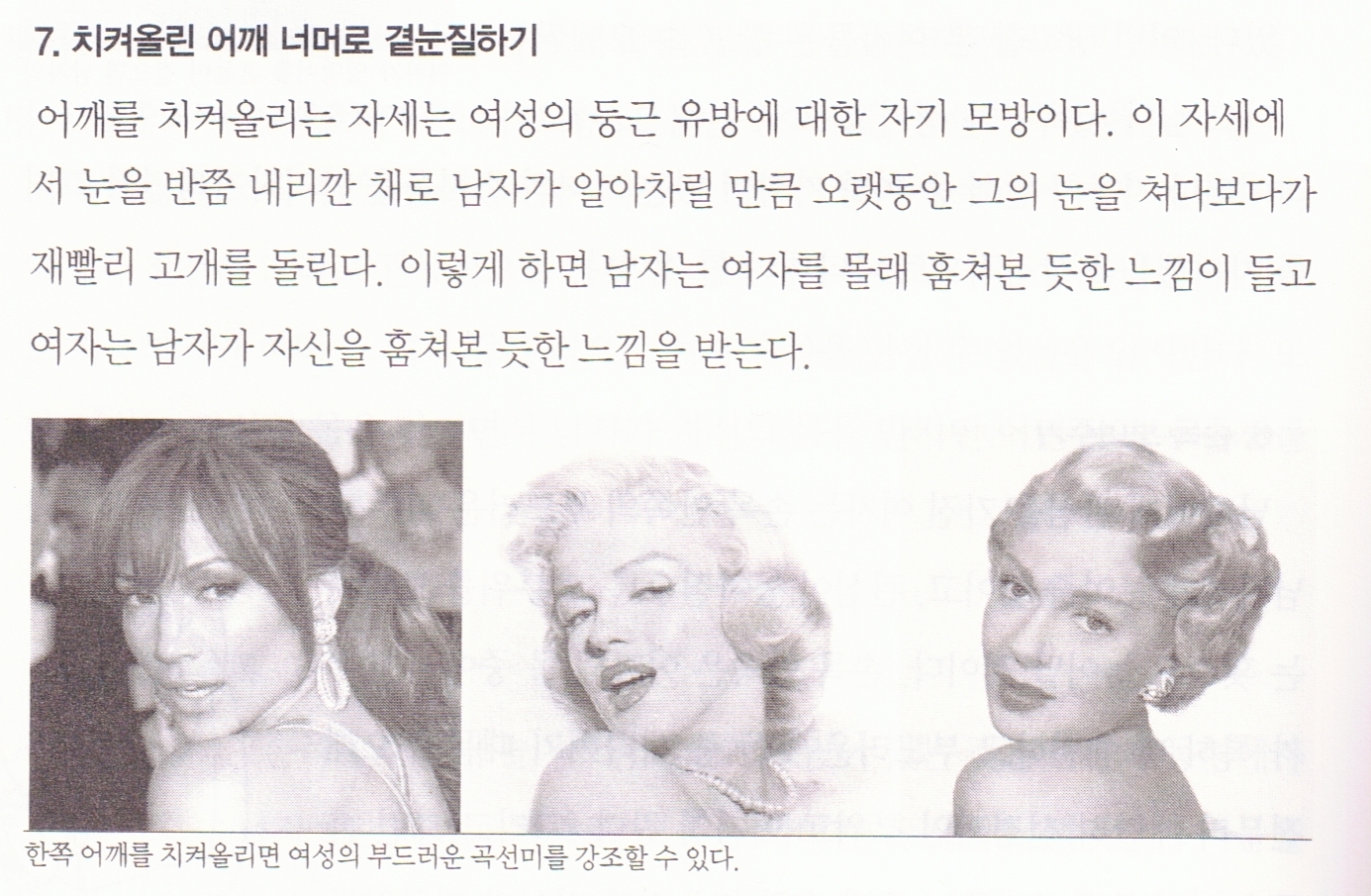
The head cant though? It’s more complicated, and for a little while I confused it with number 7 on that list (pp. 293-4):
But which is not actually referring to the head cant, but rather how women will raise their shoulders and look at the object of their affection while he’s preoccupied, suddenly looking away when he looks at them (which in turn makes him secretly look at them afterward, according to the book). Apparently, the round shape of their shoulders is suggestive of breasts also, which is not as ludicrous as it sounds considering breasts themselves likely evolved (to such a disproportionately large size for primates) through looking similar to buttocks.
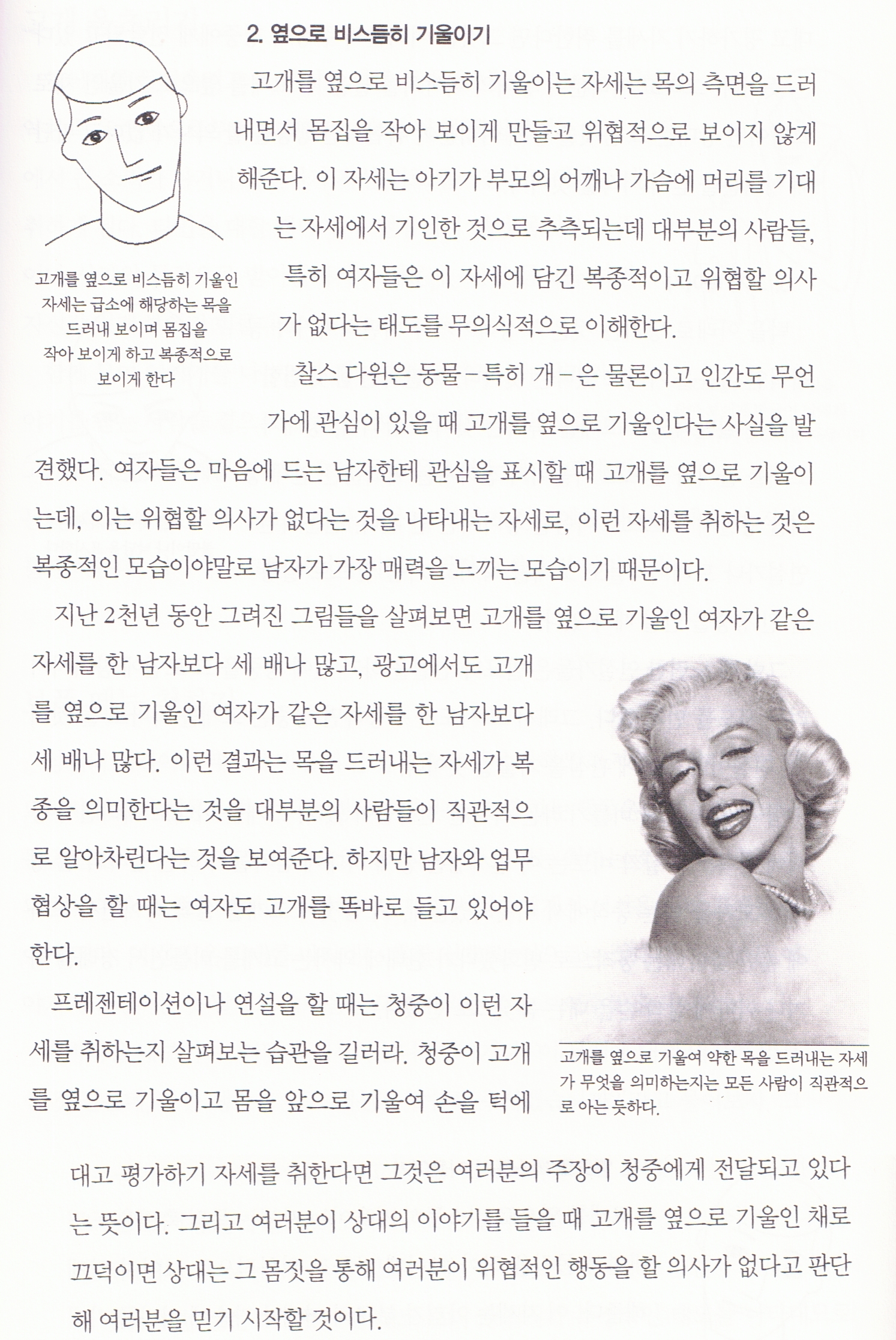
Still, I did know that a tilted head showed interest in something or someone though (sexual or otherwise), and sure enough I soon found this (pp. 231-2):
Apologies for lacking the time to properly translate all of the above scans; if anyone would like me to, I’m quite happy to later in the week. In the meantime, it basically says that in addition being an expression of interest, tilting the head also serves to expose the neck, the obvious submissiveness of which is exaggerated by also having the effect of making the person shorter and/or smaller, which is quite the opposite of standing up straight to emphasize our height when we want to compete or fight with others in some sense.
Finally, it notes that it is often seen on women in advertisements, although it doesn’t say why. Upon reading that though, I finally realized what many of you probably knew all along: Kong Hyo-jin is in that pose because it’s sexually appealing to men, as easily confirmed by this, this, and this article on dating advice, and that’s why I was drawn to it I guess.
Hell, even knowing all that, I still like it!
But that doesn’t mean it isn’t problematic. Or rather, that seeing that pose so often on women in advertisements isn’t. After all, there are many many other ways to appeal to heterosexual men, some quite the opposite of looking submissive, so it’s strange that that particular one would be so common (and, related, that you find women taller than accompanying men in ads muchless than in real life). Moreover, why is the ad designed for a male gaze too, when presumably the intended consumers of the women’s clothes advertised are women?
But I started this post because Kong Hyo-jin’s pose looked so strange, and just because it did ultimately prove to have a logic is not to say that women in advertisements aren’t still frequently placed in some bizarre, awkward poses nevertheless. Consider the other Uniqlo advertisement in the series on the bus for instance:
Now, despite deconstructing advertisements for over 3 years, just like everyone else in a developed country I too am exposed to 500-1000 advertising messages a day. So some common advertising themes I just simply get used to, a sure sign of which is that I originally thought that this was the more normal and natural-looking of the 2 advertisements, and hence had no intention of writing about it.
But in fact, it’s anything but “natural”. Again, I invite you to adopt Kong Hyo-jin’s pose for yourself just to see how strange it really is.
The crucial thing is her arms: one folded over the other, it reminds me most of a gesture that you’ll frequently see on new students and colleagues and so on on their first days at schools and workplaces. Just like on the woman below on page 103 of The Definitive Book of Body Language:
As I first mentioned here, the logic behind it is that when someone is nervous, then their instinctive reaction is to protect their exposed fronts using whatever comes to hand, be they bags, books, folders…or of course their own arms. Meeting people with folded arms doesn’t exactly create a warm and open first impression though, and so with the other partially open, hanging arm, they try to express that at the same time.
Yes, it is indeed an awkward compromise, but even having read the 1989 edition of Body Language above at the age of 13, and being perfectly aware of what I was doing (and why) thereafter, nevertheless I still couldn’t stop putting my arms like that on my first days at all 6 of my high schools (in 3 years in 3 countries). For those lacking self-confidence, as I did back then, it is an amazingly powerful instinct.
In Kong Hyo-jin’s case however, while I guess the expression of nervousness does accentuate an image of submissiveness, it’s just too much of a compromise to expose one part of the body – the neck – while protecting others with the arms. It also contradicts her “bashful knee bend” too, which I discuss here.
But why? I confess I simply don’t know, being a little mentally subdued after having to reconsider my original opinions about the first ad so much. Now seems as good a time as any then, to throw the floor open to readers, who may see something that I’ve missed and/or have alternative explanations!^^

 ( Source )
 Number of STD Cases Among Old People Rising
 ( Source )



















 (
(




 (
(

 The Grand Narrative
