Bad Girl, Good Girl (배드걸 굿걸) by Miss A (미쓰에이): Lyrics, Translation, and Explanation
( Source )
Having just written that I find new girl groups virtually indistinguishable from each other these days, then I’m very glad reader “abcfsk” persuaded me to take a closer look at Bad Girl, Good Girl (배드걸 굿걸) by Miss A (미쓰에이), as I grew to like it very quickly. And not just because of the eye-candy in the music video below either, which I actually deliberately avoided watching so as to better compare my own translation of the lyrics to the one there later.
But hell: taken from a zip-file available here, in hindsight the screenshots below didn’t really do justice to the eroticism of some of the dance moves. And which to be frank, made finally seeing the video itself almost feel like a reward for all my hard work.
No great surprise to learn that Park Jin-young (박진영) is their manager then, as he is notorious for that sort of thing. Granted, that is the way the whole Korean music industry is going these days, primarily as a means for new groups to stand out, but those groups under the JYP Entertainment label do seem to push the boundaries more than most.
Focusing on the lyrics for now though, here’s my own original translation of them, with explanations of those parts I found difficult:
Update - In case anyone’s confused, the original video with lyrics included has been deleted.
You don’t know me, you don’t know me
So shut up boy, so shut up boy
So shut up boy, so shut up, shut up
앞에선 한 마디도 못 하더니
뒤에선 내 얘길 안 좋게 해 어이가 없어
Hello, hello, hello
나같은 여잔 처음 으로 으로 으로
본 것 같은데 왜 나를 판단하니
내가 혹시 두려운거니
You don’t know me, you don’t know me
So shut up boy, so shut up boy
So shut up boy, so shut up, shut up
In front of me you can’t say a word
And I can’t believe the bad things you say about me behind my back
Hello, hello, hello
I think this is the first time you’ve ever met a woman like me…why do you judge me?
Am I a thing to be feared?
( Source, all screenshots: Red and Rosy )
Starting with Line 1 of the Korean after “shut up” etc., the “더니” in “하더니” has many usages according to page 277 of my reference guide, Korean Grammar for International Learners (KGIL), but I think the most appropriate is number 1, that which “allows the speaker to affirm that some fact which (s)he directly experienced or witnessed in the past about a third-person subject is the reason or source for the state of affairs in the follow clause…the subject is usually second or third person”.
That allows the fact that the unnamed man (her boyfriend?) is reticent in front of her to be linked to line 2, that he badmouths her behind her back. But which was actually much more difficult to translate than it looked, as “뒤에선 내 얘길 안 좋게 해 어이가 없어” is literally “[me] behind as for – my story – not well do – word – not have”, which sort of looks like what I ultimately wrote, but was ripe for misinterpretation. Once my long-suffering wife told me that “어이가 없어” actually means “I can’t believe” though, then I was able to muddle along.
In line 6, the “거니” in “두려운거니” isn’t in KGIL, but I think it’s shorthand for “두려운것이에요”, or “scary thing is”. Hence I used the noun form “am I a thing to be feared?” in my translation, but of course something like “are you scared of me?” would be fine too.
Now for the chorus:
겉으론 bad girl 속으론 good girl
나를 잘 알지도 못 하면서
내 겉모습만 보면서
한심한 여자로 보는 너의 시선이 난 너무나 웃겨
춤 출 땐 bad girl 사랑은 good girl
춤추는 내 모습을 볼 때는 넋을 놓고 보고서는
끝나니 손가락질 하는 그 위선이 난 너무나 웃겨
On the outside I’m a bad girl, on the inside I’m a good girl
While you don’t know me well
While only looking at my outward appearance
Thinking of me as a pathetic woman is so laughable
When I dance I’m a bad girl, but when it comes to love I’m a good girl
When you see me dance you lose your mind
Only then to scorn me when the dance is ended
I laugh at your hypocrisy
In line 1, I was surprised that “으로” was used instead of “에”, as I’d always thought the former was used mostly for directions and processes rather than physical locations, but my wife assures me that the latter can’t be used at all in this case (oh well). She also told me that in line 4, “pathetic” would be a much better translation of “한심하다” than the “pitiful; pitiable; wretched” and so on that my dictionary gave; that in the case of line 6 at least, “모습” really means just “me” rather than “outward appearance” or “figure”; and finally that “넋을 놓고 보다” means “to lose one’s mind”, which I would never have got figured out otherwise. I did realize that “보고서” at the end looked a bit weird though – “a written report” – and ultimately the “고서” in it turns out to be one more grammar pattern. Which according to p. 251 of KGIL, has the effect of:
…tightening the relationship between the preceding and following clause, and implying that the contents of the second clause are a natural and closely linked follow-on to those of the first. In other words, whereas “고” alone is appropriate when a long interval intervenes between the two clauses, “고서” is appropriate when the connection is more immediate”.
Finally in line 7, of course “끝나니” is short for “끝나니까”, or “because it finished”. Add “scorn” and “hypocrisy” in there as well, then whatever the particulars of the last 2 lines, I got the impression that the man is captivated by her dancing, but then scorns and thinks little of her as soon as she stops and the spell is broken. Hence laughing at his hypocrisy, although now I’m little confused about the narrative of the song as I type this, as by this stage at least I thought the whole point was that she shouldn’t be judged by her outward appearance and actions…whereas now it appears that they’re actually also her strong points.
이런 옷 이런 머리모양으로 이런 춤을 추는 여자는
뻔해 ha 네가 더 뻔해, 오~
Hello, hello, hello
자신 없으면 저 뒤로 뒤로 뒤로
물러서면 되지 왜 자꾸 떠드니
속이 훤히 보이는 건 아니
A woman with those clothes, that hairstyle, and doing that dance
is shameless? Ha! You’re even more shameless, oh~
Hello, hello, hello
If you have no confidence, you can step back back back there
Why do you frequently make so much noise complaining about me?
I can see right through you
In line 4, I was a little confused for a moment by “저”, which is short for “저기” or “there” rather than being the respectful form of “me”. And then by “자신 없으면 저 뒤로 뒤로 뒤로 물러서면 되지” in lines 4-5, which literally means “confidence – if not have – there – towards the back towards the back towards the back – if step back” and looks like an unnecessary and confusing repetition to me.
Finally, line 6 was a big stumbling block: first, I originally thought “아니” meant “no”, but it’s actually “know”, as in “알다”. Then, “훤하다” means “gray, dimly-lit”; “extensive, broad and wide, spacious”; “good-looking”; and finally “be familiar with” and I was plumping for the first meaning until my wife said the last would be better.
Speaking of whom, to anybody envious at my Korean ability evident in translations in numerous earlier posts, and surprised at (and tired of) how much I’ve needed my wife’s help this time(!), then, well, I’d be lying if I said she didn’t have a huge role in correcting my numerous mistakes and explaining things after I do the original translations (I probably wouldn’t be able to properly provide any at all without her). I just haven’t mentioned that before because I usually don’t talk about the translation process itself, and how much time and effort it takes us.
Which gives me a newfound respect for those studying Korean entirely by themselves! But getting back to the lyrics though, after the above there’s the chorus again, and then the final verse:
날 감당 할 수 있는 남잘 찾아요
진짜 남자를 찾아요
말로만 남자다운 척 할 남자 말고
날 불안 해 하지 않을 남잔 없나요
자신감이 넘쳐서 내가 나일 수 있게
자유롭게 두고 멀리서 바라보는
I’m looking for a man who can bear me
I’m looking for a real man
Not a man who only talks like a real man
Is there no man that I don’t make uneasy?
Who can’t give me the freedom to watch me become a woman overflowing with confidence?
Finally, an easy verse! Any fellow Korean learners, please feel free to ask me about any of it, but otherwise that’s the whole song already, but for the chorus and finally the English opening sequence again.
Reluctantly tearing my eyes away from the singers (especially Fei {페이}) to the translated lyrics in the video then, I’m happy to say that they appear to be very similar, although there do appear to be some differences between the subjects in the some cases (in other words, I’ve got some “he”s where TheKpopSubber has “she”s and so on).
I’d like to look at those in more detail, but unfortunately I’m about to go out on a big shopping trip with my wife and kids, so for now I’ll just have to leave the post for you to enjoy as it is I’m afraid (those of you also unnerved by mistaken recent reports that North Korea was shelling again, may be happy for the distraction!). But of course, do please feel free to discuss those differences and/or anything about the song, group, and/or MV yourselves, although still knowing so little about the group then I’m going to reserve my own analysis until I’ve at least translated their second hit Breathe (브리드) next week:
Enjoy!^^
Update: Wait…one of them’s only just turned 16? Another middle-school student in a girl band?
Update 2: Given Miss A’s Chinese angle mentioned in the comments (2 of singers are Chinese, and they’ve been promoting themselves extensively there), then I’d like to point interested readers to Rowan Pease’s chapter “Korean Pop Music in China: Nationalism, Authenticity, and Gender” in Cultural Studies and Cultural Industries in Northeast Asia: What a Difference a Region Makes, edited by Chris Berry, Nicola Liscutin, and Jonathan D. Mackintosh, (2009, pp. 151-167), in which (among many other interesting things) she explains that:
( Source: The Japan Foundation )
In 2003, the Korean National Tourism Office [a major investor in the Korean wave] conducted a Hanliu tourism survey in China, Taiwan, and Hong Kong exploring attitudes to Korean culture, publishing the results online…
….It compared the impact of Korean culture with that of four “competitor” countries (the U.S., Japan, Taiwan, and Hong Kong), and in the process revealed much about Korea’s own political and nationalist concerns, particularly in relation to Japan and America. Six of the eleven options for respondents to the category “reasons I like Korean culture” reflect this preoccupation: “less sexual than Japanese culture,” “less sexual than American culture,” “less violent than Japanese popular culture,” “less violent than American popular culture,” “decreased interest in American culture,” and “decreased interest in Japanese culture.” One other echoes Straubhaar’s notion of cultural proximity: “similar in culture.” Certainly, Korea’s own music media censorship laws (which even in 1997 prohibited the displaying of body piercings, navels, tattoos, “outfits which might harm the sound emotional development of youth,” and banned violent or political lyrics), meant that Chinese TV stations could buy in Korean music videos and music TV shows knowing that they were unlikely to upset local censors. However, these questions also reflected a perception that Korea acts as a defender against excessive Westernization and as a guardian of Confucian values within East Asia. (pp. 155-156)
I wonder if those perceptions still hold true for China today, and in particular just how safe and “less sexual” than American and Japanese culture music videos like this one are viewed by Chinese TV stations?
Girl Groups, VNT, and THAT Maxim Korea Cover
( Source )
Ever heard of VNT (브이엔티) before?
No, me neither, and frankly I find most new girl groups virtually indistinguishable from each other these days. But it turns out that VNT may actually be quite different, its 3 members explicitly wanting to “focus more on their music rather than their visuals.” Like rapper of the group Lil’J (릴제이) said in a recent interview:
“One thing that I’m confident about is, like our CEO stated, our music. We’ll become a team that wins because of our talents, not our looks. Tina and I dropped out of high school for this, and we will be sure to show everyone our passion for music.”
And later:
“We may be a girl group, but we dream of changing the Korean music industry with our music. Our first and foremost goal is to have our fans listen to high quality music. We want to become the top in every aspect, and later become seniors that lure others to dream of becoming like us. Of course, we also dream of an award at the year-end awards this year.”
Of course, that may well just be hype. And I’m not sure how a photoshoot in December’s Maxim Korea fits in with that sentiment exactly, with subsequent “news” reports on it overwhelmingly focusing on their hitherto hidden S-lines. But they do still need some publicity of course, so I’ll give them the benefit of the doubt for now.
As for their music, judge for yourself with their first single Sound (소리):
Personally it’s a little slow for my tastes, and despite their similar look to 2NE1 (투애니원), there’s definitely nothing about grrrl power in the lyrics. Indeed, quite the opposite really, as they’re all about passively waiting for a man…and which is precisely what Yumi (유미) appears to be doing on the magazine cover come to think of it.
Or is she?
If so, then I hope *cough* he comes soon, as she looks pretty uncomfortable really. But is that really just a sex position she’s in?
Granted, Maxim Korea isn’t exactly averse to placing women in ostensibly sexually attractive poses, but which just a few seconds’ thought demonstrates would be quite impractical and awkward in reality (especially for the woman). Take 18 year-old model Om Sang-mi (엄상미) in the same edition for instance, spreadeagled in a shopping trolley.
But with the top half of Yumi’s body sticking out unnaturally like that, and with those red pants, that hairstyle, and puffed-up frilly shirt to boot? In line with the Christmas theme, then I think the main point is actually to make her look like a turkey.
Prove me wrong!^^
(For a similar example of women’s bodies being compared to meat in the Korean media, see here)
Sex and the University: Part 1
( Source )
Well, sex and Yonsei University to be precise, with 4 articles on that theme being published in the latest Yonsei Chunchu (연세춘추) campus newspaper, providing valuable insights into modern Korean students’ sexual experience and attitudes.
Unfortunately for the authors though, Yonsei happens to be a notoriously Christian university. And so according to my anonymous informer, they were actually punished for them in some way.
Details are sketchy at the moment, but the main problem appears to have been a sex survey sent to all students, with the first article below discussing the results. Perhaps the board of trustees was shocked and embarrassed that 1 in 3 Yonsei students are quite happy having one-night stands or something?
연세인, 당신의 성의식은 어떤가요? 대학생 성의식은 개방으로 황새걸음, 사회적 인식은 아직도 뱁새걸음
Yonsei students, how is your awareness of sexual issues? While university students’ awareness is progressing by leaps and bounds, Korean society is still only making baby steps
가장 기본적이고 보편적인 욕구인 동시에 가장 은밀하기도 한 것, 바로 ‘성(性)’이다. 아직 성적인 이야기를 스스럼 없이 털어 놓을 수 없는 한국 사회에서 연세인들은 성에 대해 어떠한 생각을 갖고 있는지 「연세춘추」에서 알아봤다. 설문조사는 이메일을 통해 지난 9월 13일에서 10월 4일까지 약 3주간 진행됐으며 1천287명의 학생들이 이에 답했다.
Sex is the most basic, universal desire, but at the same time it’s also the most private one. And in a society in which people still feel unable to speak frankly and openly about sexual matters, how to find out Yonsei students’ thoughts on them? So, the Yonsei Chunchu conducted an email survey for 3 weeks between the 13th of September and the 4th of October, and received 1,287 replies from students.
( Source )
연세인 2명 중 1명, “나는 성경험이 있다”
1 in 2 Yonsei students have sexual experience
성경험의 유무를 묻는 질문에 거의 절반에 해당하는 49.5%의 학생들이 “있다”고 답했다. 또한 “있다”고 답한 응답자 중 72.5%가 08학번 이상이라고 답해 고학번이 높은 비중을 차지한 것을 볼 수 있었다. 이에 대해 ‘행복한 성문화센터’ 배정원 소장은 “사회적 분위기 자체가 달라져 성관계를 맺는다는 것이 쉽게 받아들여지고 있다”며 “예전에는 공개적으로 등장하지 않았던 혼전 성관계가 대중매체에서 자연스럽게 나오면서 사람들이 이에 대해 대수롭지 않게 생각하게 됐다”고 말했다.
또한 우리대학교 성희롱·성폭력 상담실 이정화 교수는 “실제로 성경험이 있는 학생들의 숫자도 늘어났지만 그 사실을 드러내놓고 이야기 할 수 있게 여건이 변한 탓도 있다”고 말했다. 이러한 사실은 “성경험이 있음에도 주변사람들에게 거짓말을 한 적이 있다면 그 이유는 무엇인가”라는 문항에서도 찾을 수 있다. “주변의 인식 때문에”라는 답변을 33.0%의 학생들이 선택한 반면 “사생활에 대해 말하기 싫어서”를 택한 학생은 40.8%로 가장 많았다. 이 교수는 이 결과에 대해 “성관계를 가졌다고 해서 안 좋은 낙인이 찍히거나 이상하게 보는 분위기가 아니기 때문에 주변의 인식의 문제보다 ‘이건 내 사생활’이라는 의식이 더 크게 작용한 것”이라고 분석했다.
On the question of it they had sexual experience, almost half of students (49.5%) replied that they had, of whom 72.5% entered Yonsei University in 2008 or earlier. About this, Bae Jeong-won, head of the Happy Sex Culture Center said “the social atmosphere is changing, and nowadays people are becoming much more accepting of [premarital] sexual relationships”, and that “in the past, you never saw premarital sexual relationships depicted in the mass media. But as they’ve naturally started appearing, people have come to think that they’re nothing to really get concerned about.”
( Source: Extreme Movie )
Also, Professor Lee Jeong-hwa of the university sexual harassment and sexual violence consultation center said “because society is changing, the number of people who openly admit to having sexual experience is increasing”. And about that, one of the questions in the survey was “have you ever lied about your sexual experience, and if so, what was the reason?” [James - I think "have you ever pretended you didn't have sexual experience when you did?" is more accurate], and 33% of those that replied that they had did so because of what others would think of them, whereas 40.8% replied that they did because they didn’t want to talk about their private life. About those results, Professor Lee said “respondents were more concerned about keeping their private life private than being stigmatized and/or branded by those around them”.
사회는 ‘보수’지만 나는 ‘개방’
Society is conservative, but I am liberal
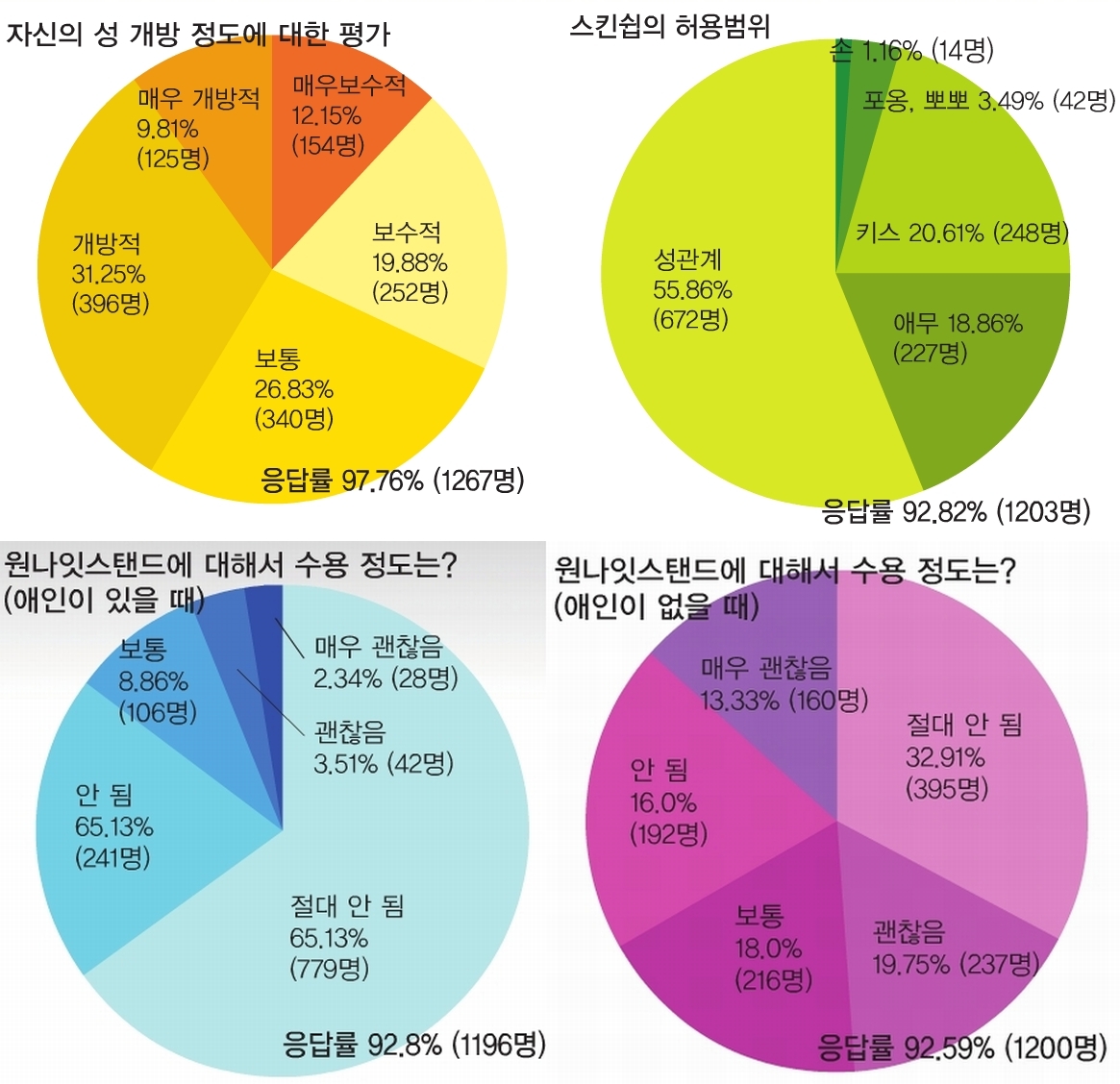
이런 분위기에도 불구하고 학생들은 한국 사회를 보수적이라고 평가했다. 전체 응답자의 67.0%가 한국 사회의 성개방 정도에 대해 보수적이라고 답해 아직 사회 전체적으로는 개방적이지 않다고 생각하고 있었다. 이에 비해 자신의 성개방 정도에 대한 평가는 개방적이라는 답변이 41.1%로 보통이라고 답한 26.8%와 보수적이라고 답한 32.0%보다 많은 비중을 차지했다.
Despite this [changing] atmosphere, students think Korean society is still conservative, and on the question of sex in particular, 67% of the total replies that is was conservative and not yet liberal. Of themselves in contrast, 41.1% considered themselves to have liberal attitudes towards sex, 26.8% were middle of the road, and 32.0% considered themselves conservative.
( Source )
스킨십은 성관계까지, 원나잇은 애인이 없을 때?
As for skinship [James - Er...basically, physical affection towards a boyfriend or girlfriend], does that go all the way to sex? Are one-night stands only for when you don’t have a boyfriend or girlfriend?
자신은 개방적이라는 연세인의 생각은 다른 문항에서도 나타났다. 스킨십의 허용 범위를 묻는 질문에서 “성관계”라고 답한 응답자가 55.9%로 가장 많았고 “키스까지 가능하다”는 응답이 20.6%로 그 뒤를 이었다. 지난 2004년 7월 「연세춘추」 연애에 관한 설문조사에서 스킨십의 허용범위를 묻는 질문에 “키스까지 가능하다”는 응답이 54.3%로 가장 많았던 것과도 달라진 결과다. 또한 연애를 함에 있어서 성관계의 중요도를 묻는 질문에는 “꼭 필요한 것”이라는 응답이 37.0%를 차지한 데 비해 “절대 안된다”고 답한 연세인은 13.2%에 불과했다.
연세인들은 이성친구가 과거 성경험이 있는 것에 대해서도 높은 관용도를 보였다. 이성친구의 성경험에 대한 관용도를 묻는 설문 문항에서 “괜찮다”는 응답이 49.4%로 “안된다”고 답한 26.8%보다 월등히 많았다.
모텔에 가는 것에 대한 수용 수준은 “괜찮다”는 응답이 45.9%를 차지해 “안된다”고 답한 32.1%보다 많았다. 또한 원나잇스탠드에 대해서도 애인이 있는 경우에는 “절대 안된다”는 응답이 65.1%, “괜찮다”는 응답이 5.8%에 불과했지만, 애인이 없는 경우에는 “절대 안된다”가 32.9%, “괜찮다”가 33.1%로 큰 차이를 보였다.
The fact that Yonsei students are now quite liberal about sex also emerged from a different question. To the question of how much physical affection they permitted, most (55.9%) said “all the way to sex”, while 20.6% only limited it to kissing. In a similar survey given by the Yonsei Chunchu in July 2004 though, as many 54.3% said they would limit it to kissing, and on the additional question of how important sex is for a relationship, 37.0% replied that it was essential, whereas 13.2% said they would absolutely not have sex [James - presumably before marriage that is]. (source, right)
On the question of how they would react if they discovered their boyfriend or girlfriend had sexual experience prior to meeting them, Yonsei students also showed a high level of acceptance: 49.4% saying it was okay, with 26.8% saying it wasn’t.
As for if they were happy to go to a love motel to have sex, 45.9% said that was fine, with 32.1% disagreeing. And if they had a partner already, 65.1% would never have a one-night stand with someone else, whereas 5.8% replied that it was okay. If they were single though, 32.9% would still never have a one night stand, but 33.1% were fine with it.
학생들 따라가지 못하는 성교육
Sex education is not keeping pace with students’ needs
이렇듯 젊은 대학생들은 점점 개방적으로 변화하고 있지만 성교육은 이를 쫓아가지 못하고 있다. “지금까지 받아온 공식적인 성교육이 충분했다고 생각한다”는 문항에 과반수를 훌쩍 넘는 85.6%의 연세인이 “아니다”라고 답했다. 또한 가장 실용적이고 도움이 되는 성지식의 출처를 묻는 질문에 “공식적인 성교육”이라고 답한 응답자는 13.4%로 대중매체와 관련 책 항목에 밀려 세 번째를 차지했다. 이에 도지연(생명공학·09)씨는 “문화가 개방적으로 빠르게 변하는데 비해 성교육은 제자리걸음인 것 같다”며 “성교육 자체가 보수적이라 실생활에서 활용이 불가능하다는 것이 문제”라고 결과에 동의했다.
이 같은 결과에 배 소장은 “상담을 받아 보면 학생들의 성지식이 턱없이 부족하다는 것을 느낀다”며 “학생들은 성에 관한 정보를 점점 더 많이 접하고 있는데 그에 비해 성교육은 충분하지 않아 잘못된 지식을 갖게 될 위험성이 매우 큰 것이 문제”라고 비판했다. 나아가 이 교수는 “사실 성관계를 맺는 과정에 대해서는 인터넷 같은 데에 충분히 개방돼 있고 접하기가 쉽지만 중요한 것은 의사소통인데 이것이 공식적인 성교육에서 매우 부족하다”고 말했다.
( Source )
In light of all this, as university students become more liberal about sex, then sex education is not really following suit. In response to the question of “has the sex education you have received up until now been satisfactory”, 85.6% replied that it hadn’t, and only 13.4% replied that it was the most practical and helpful source of information for them, well behind the mass media and sex-related books. Second-year biotechnology student Do Ji-hyeon agreed, and said that “even though culture is changing and rapidly liberalizing, sex education remains the same,” and that “as it is taught conservatively, it doesn’t really meet students’ practical needs”.
Similarly, Happy Sex Culture Center head Bae said “from consultations we’ve had with students, we get the feeling that their knowledge about sexual matters is woefully inadequate”, and that “because sex education is also inadequate, and because students are getting information for themselves instead, then there is a danger that they will be misinformed.” Professor Lee Jeong-hwa of the university consultation center agrees, and says that “it’s easy enough to find information on the internet about the process of sex [James - does she mean the basic biology of it?]. But the important thing is communication, and in this sense public sex-education is severely lacking”. (end)
( Source )
To play Devil’s advocate for Yonsei punishing the authors for giving the survey to students, of course we don’t know how severe that punishment was as of yet; Yonsei’s religiosity is by no means uncommon for Korean universities (my own has similar requirements for Chapel attendance in order to graduate, regardless of one’s religion); the punishment probably pales in comparison to effectively expelling a student for being gay like this one is; it has the oldest LGBT group of any Korean university; and, as Part 3 will reveal (see here for a sneak peek), it even has mandatory sex education classes. Indeed, in the light of the last in particular, then the fact that there was any punishment at all is very surprising and confusing, and I’d be very grateful if any Seoul-based readers can send me any further information about that (and please feel free do so anonymously if you prefer).
Meanwhile, what did you think of the survey? Do you think the results are actually of any use, given that only 1,287 students out of nearly 30,000 replied? Has anyone heard of similar surveys and/or mandatory sex education classes at other Korean universities?
Regardless, thanks again to the person who sent me all the articles, and – writing this next week now – here is Part 2!


40 comments