Mirror Mirror (거울아 거울아) by 4Minute (포미닛): Lyrics, Translation, and Explanation

(Source, all screenshots)

For many Korean girl groups, debuting a new song on a music program seems to follow a set script these days:

  • First, it will include some provocative lyrics, choreography, and/or outfits that deliberately push the envelope
  • Then, despite presumably knowing that well in advance, the producers of the program will still allow the song to be performed, only then to disassociate themselves from it and claim shock and surprise at the ensuing reaction
  • Next, those songs will be will be banned from future broadcasts unless changes to the offending parts are made
  • Equally absurdly, the performers themselves or their entertainment companies will claim shock and surprise that people find them sexually suggestive at all
  • Finally, despite those protestations, the groups will have modified versions of the song available to be used suspiciously quickly

It’s really quite a farcical process, and very patronizing to viewers.

Nevertheless, while nobody emerges unblemished from all that, it’s the entertainment companies that I’m most critical of. For rather than actually admitting to the sexuality in their groups’ performances, thereby placing the onus on the music program producers and public to explain just what is it that is so problematic about that exactly, instead they even force their own performers to be complicit in a long-held narrative of female virginity and innocence in K-pop.

Granted, they may lack the clout to challenge terrestrial broadcasters on that point, nor is there much evidence that they possess the feminist motivations to do so. However, even just for financial reasons one would expect more of a challenge to systematic double standards in the Korean music industry, as the various restrictions on girl group performances can often be quite costly.
(Source)

As for how that all recently played out with Mirror Mirror (거울아 거울아) by 4Minute (포미닛), see the links in the list above, while Mixtapes and Liner Notes has more on Rania’s (라니아) performance of Dr. Feel Good (닥터 필 굿) specifically. Two of the three controversial songs that debuted on Music Bank on April the 8th (the other was Do You Know/아나요 by the Brave Girls/브레이브 걸스), unfortunately Mirror Mirror is the only one of them I like enough to listen to – yes, sans eye-candy – on my MP3 player!

Yes, however crass, it does indeed sound like Hyuna is saying “4 minute slut” at the beginning. As for the translation, the vocabulary and grammar were relatively easy for a change, and the song mercifully short and repetitive too. But some unclear breaks between sentences and strange word orders definitely complicated things:

Let’s go

4minutes left 4minutes left Ah! Ah!

4minutes left 4minutes left Ah! Ah!

대체 왜 그땐 날 거들떠 보지 않고

매일 날 그대만 바라보게 만들고

오늘은 좀더 예쁘게 나 나 나 날 (오늘도)

보여줘 너무 멋진 너 너 너 너 너에게

거울아 거울아 이 세상에 누가 제일 예쁘니?

거울아 거울아 이 세상에 내가 제일 예쁘니?

오늘만은 내가 제일 예쁘다고 말해줘 봐

Let’s go

4minutes left 4minutes left Ah! Ah!

4minutes left 4minutes left Ah! Ah!

Why on Earth didn’t you notice me back then?

Everyday, you made me gaze only at you

Today, show me me me me a little more prettily  (today too)

To very cool you you you you

Hey Mirror, hey Mirror, who is the prettiest in the world?

Hey Mirror, hey Mirror, am I the prettiest in the world?

Just for today, please try saying I’m the prettiest

Here, “대체” is short for “도대체” (on Earth), and a new one for me was “거들떠보다” (not even notice/look). Otherwise:

  • the “바라보게 만들다” in line 4 is a long causative, which there’s a lot of in this song (see p. 368 of Korean Grammar for International Learners [KGIL] for more information)
  • See Seamus Walsh’s comment here for more on the “니” ending in lines 7 and 8
  • And of course the last line is some simple indirect speech. Although it’s awkward in English, I include a “try” in it (and similar sentences in later verses) because technically, “보다” added to a verb stem does indeed mean “try to do [the verb]“

All basic stuff by this, my twelfth song translation for the blog. But lines 3 and 4 were a bit of a stumbling block until my wife pointed out that actually a break falls between “오늘은 좀더 예쁘게 나 나 나 날 (오늘도) 보여줘” and “너무 멋진 너 너 너 너 너에게”.
너를 생각하면 더 거울에 비친 내 모습은 마치

너무 예쁜데 너는 자꾸 왜 다른 생각만 하는지

왜 날 보지 않는건데

내 거울아 (거울아 거울아 거울아 거울아)

거울아 (거울아 거울아 거울아 거울아)

내 거울아 (거울아 거울아 거울아 거울아)

거울아 (거울아 거울아 거울아 거울아)

It’s as if my reflection becomes prettier the more I think of you

Why do you frequently think differently?

Why do you not look at me?

My mirror (Hey Mirror Hey Mirror Hey Mirror Hey Mirror)

Hey Mirror (Hey Mirror Hey Mirror Hey Mirror Hey Mirror)

My mirror (Hey Mirror Hey Mirror Hey Mirror Hey Mirror)

Hey Mirror (Hey Mirror Hey Mirror Hey Mirror Hey Mirror)

Again, Lines 1 & 2 become much easier if you know there’s a break between “너를 생각하면 더 거울에 비친 내 모습은 마치 너무 예쁜데” and “너는 자꾸 왜 다른 생각만 하는지”, but this time the location of the “더” complicates things even further. Ideally, it should be placed before the “예쁜데” in line 2.

Update: With thanks to J.Goard for pointing out it, actually that pattern is perfectly acceptable in Korean, and quite common.
대체 왜 언제나 본 체 만 체만 하고

매일 밤 너는 날 가슴 뛰게 만들어

언제나 너무 멋진 너 너 너 너 너

내게로 다가오게 더 더 더 더 더 Ma boy

거울아 거울아 이 세상에 누가 제일 예쁘니?

거울아 거울아 이 세상에 내가 제일 예쁘니?

처음부터 마음에 들었다고 내게 말해줘 봐

Why on Earth do you always pretend not to see me, and

make my heart pound every night?

Always so cool you you you you you

Come more more more more and more closer to me Ma boy

Hey Mirror, hey Mirror, who is the prettiest in the world?

Hey Mirror, hey Mirror, am I the prettiest in the world?

Please try to say that from the beginning, I was the one for you

And here, again there’s a long causative in line 2 – “가슴 뛰게 만들어” – but the “날” before that (me [object]) is I think ungrammatical, and it should really say “내” (my) instead. Before that, the phrase “본 체 만 체” (pretend not to see; show indifference to; slight) was a new one on me, and it didn’t help that I forgot that “[verb] + (으)ㄴ/는 체하다” was the same as “[verb] + (으)ㄴ/는 척하다” (to pretend to [verb])”! (see p. 58 of KGIL)

Next, it’s just the chorus again.

너를 생각하면 더 거울에 비친 내 모습은 마치

너무 예쁜데 너는 자꾸 왜 다른 생각만 하는지

왜 날 보지 않는건데 예~

내 거울아 (거울아 거울아 거울아 거울아)

거울아 (거울아 거울아 거울아 거울아)

내 거울아 (거울아 거울아 거울아 거울아)

거울아 (거울아 거울아 거울아 거울아)

It’s as if my reflection becomes prettier the more I think of you

Why do you frequently think differently?

Why do you not look at me?

My mirror (Hey Mirror Hey Mirror Hey Mirror Hey Mirror)

Hey Mirror (Hey Mirror Hey Mirror Hey Mirror Hey Mirror)

My mirror (Hey Mirror Hey Mirror Hey Mirror Hey Mirror)

Hey Mirror (Hey Mirror Hey Mirror Hey Mirror Hey Mirror)

Oh mirror shine Let me fix my make up

Break it down Break it down

Baby I like that Baby baby just I like that

Baby I like that Baby baby just I like that

더 더 더 내게 빠져들어

Shine on my face 모두 놀라지 Oh

거울아 거울아 이 세상에서 누가 제일 예쁘니? It’s me

Oh mirror shine Let me fix my make up

Break it down Break it down

Baby I like that Baby baby just I like that

Baby I like that Baby baby just I like that

Become fallen into me more more more

Shine on my face everybody surprised Oh

Hey Mirror, hey Mirror, who is the prettiest in the world? It’s me

In line 5, I was confused by how “빠져들어” is different to “빠지다” (to fall into/for), and the best explanation my wife could provide was that it means “become fallen for”. Which is just fine with me, but it does sound a little awkward.  Can anybody do any better?

Update: With thanks again to J.Goard, see here for a much fuller description of how they’re different exactly.

And suddenly it’s already the last verse:

좀더 너에게 다가가서 난 1,2 step 1,2 step 1,2 step

Let’s live it up Let’s make it up

나를 보면 니 마음 흔들릴수 있게

내 거울아 (거울아 거울아 거울아 거울아)

거울아 (거울아 거울아 거울아 거울아)

내 거울아 (거울아 거울아 거울아 거울아)

거울아 (거울아 거울아 거울아 거울아)

거울아 거울아 거울아 거울아

I’ll come a little closer to you, I 1,2 step 1,2 step 1,2 step

Let’s live it up Let’s make it up

If you see me I can make your heart shake

My mirror (Hey Mirror Hey Mirror Hey Mirror Hey Mirror)

Hey Mirror (Hey Mirror Hey Mirror Hey Mirror Hey Mirror)

My mirror (Hey Mirror Hey Mirror Hey Mirror Hey Mirror)

Hey Mirror (Hey Mirror Hey Mirror Hey Mirror Hey Mirror)

And on that note, here is an alternate translation by Chris @4-minute.com, which you can use to follow-along with the video:

As you can see, fortunately our versions seem pretty much the same, although his(?) sounds rather better because he hasn’t been quite so literal with his choice of words!

Meanwhile, apologies to any readers that may have been expecting a promised(?) translation of Can’t Nobody by 2NE1 (투애니원) instead today, but unfortunately my finally getting tired of that after listening to it for probably the 100th time(!) coincided with me getting heavily into this one, and besides which I wanted to do something more recent for a change. Having said that, next I’ll actually be doing the 2005 song Girls on Top by BoA (보아), because a reader sent me the following intriguing email:

…I have been following your girl group lyric translations but there’s one song I am really curious about, mostly because I’d like to know if it’s as overtly feminist as I suspect it is. The song would be Boa’s “Girls on Top”…

…It’s not only the gold lamé and skull ring that’s tough but the part at the end where she fake kicks her male dancers into submission in a Take Back the Night inspired bit of of pop choreography. I know you’re focusing mostly on girl groups, but I think this one’s interesting in the context of K-pop because it seems to fall outside the two ever present concepts of “sexy” and “cute.” I have tried to find the lyrics in English but most of them are poorly done. What I’ve gleaned so far is that she may be talking about the myriad conflicting expectations a modern girl must fulfill and might even be bemoaning the constant pressure to embody male views of sexiness (!). Or it could be a girl power-lite anthem conceived by greedy business men; but either way I’d like to hear your views.

Until then, I hope you a good weekend, and as always I’d appreciate any feedback on the translation and/or your thoughts on the song!^^

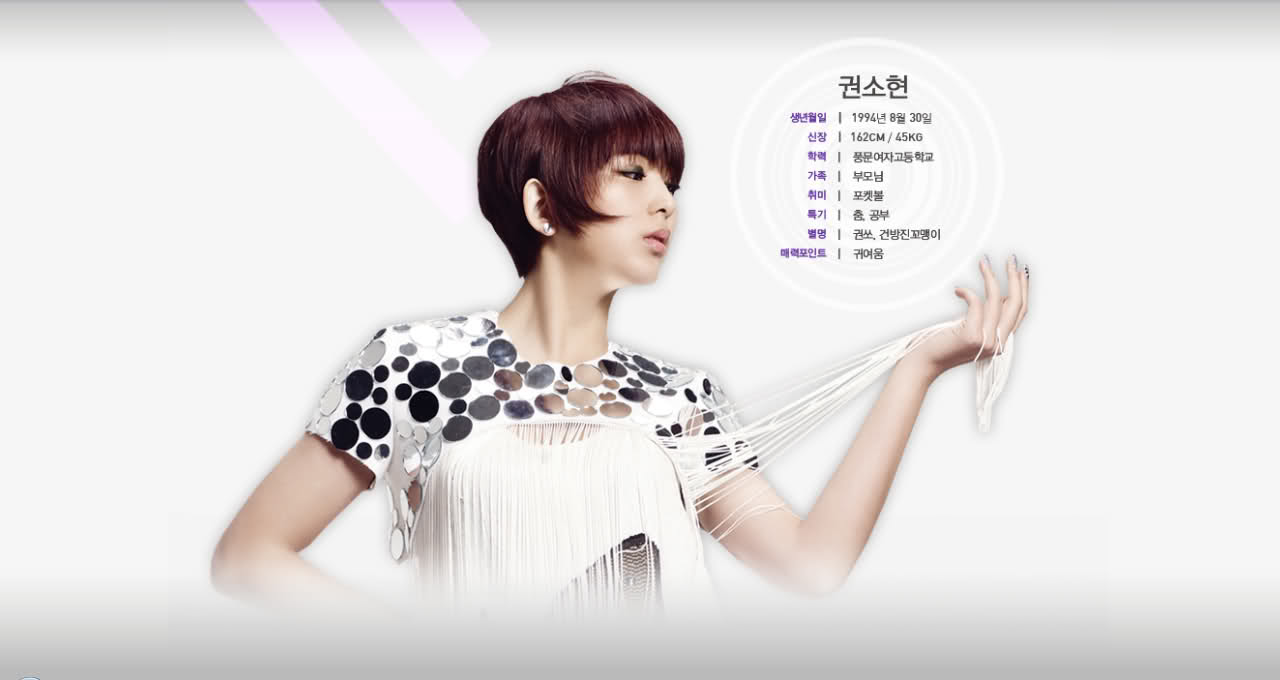
Update: I’ve just found these profiles of the group members on korean lovers photoblog, and thought they might be useful for future reference:

(For more Korean song translations, please see here)

Korean Sociological Image #58: Sexulizising Caucasian Women (again)

(Source: Ads of the World)

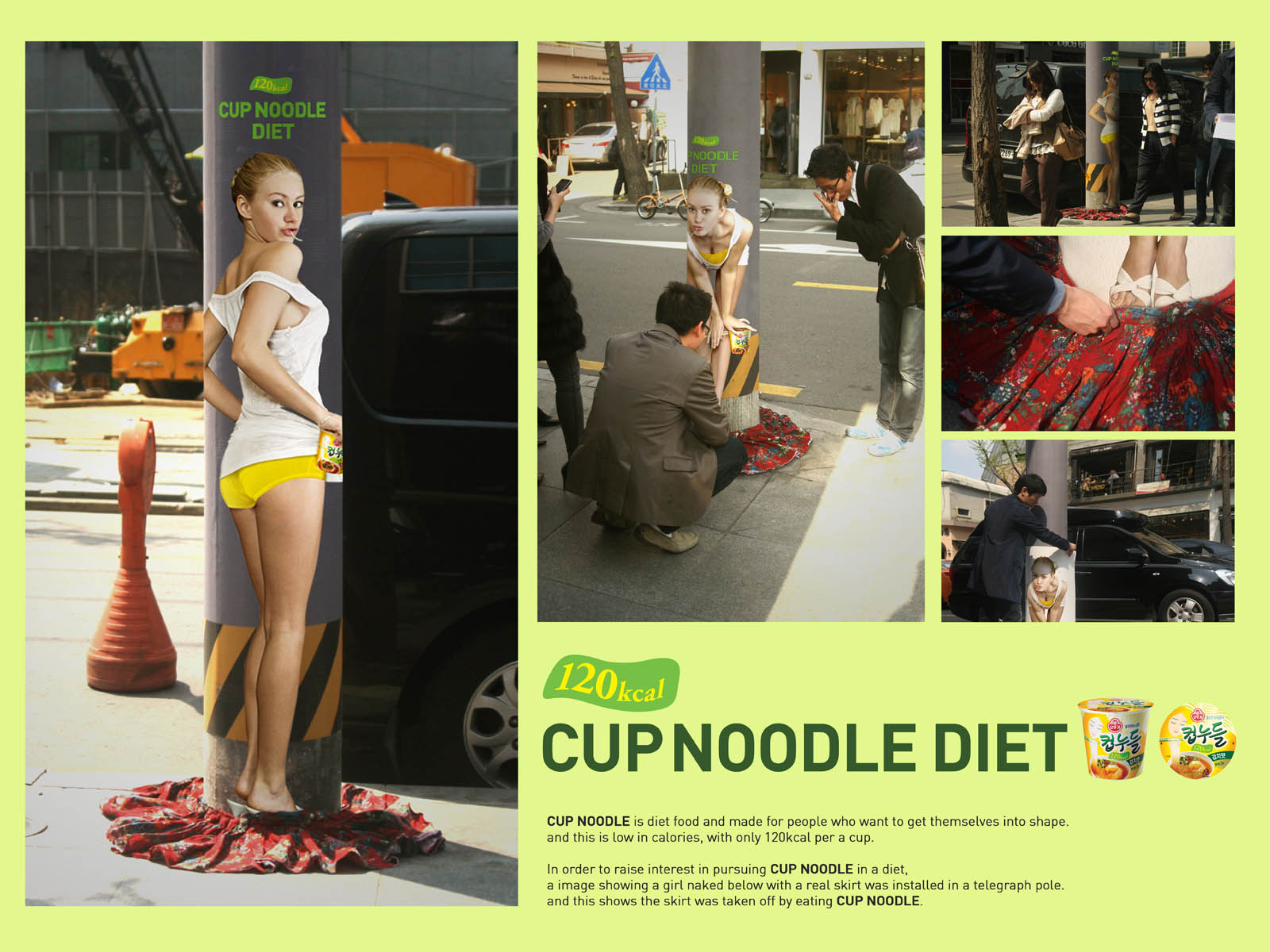
Sigh. I beg to differ on Cup Noodles being a “diet food” made for “people who want to get themselves into shape”, but it’s no great surprise that that’s how they’re being marketed in Korea.

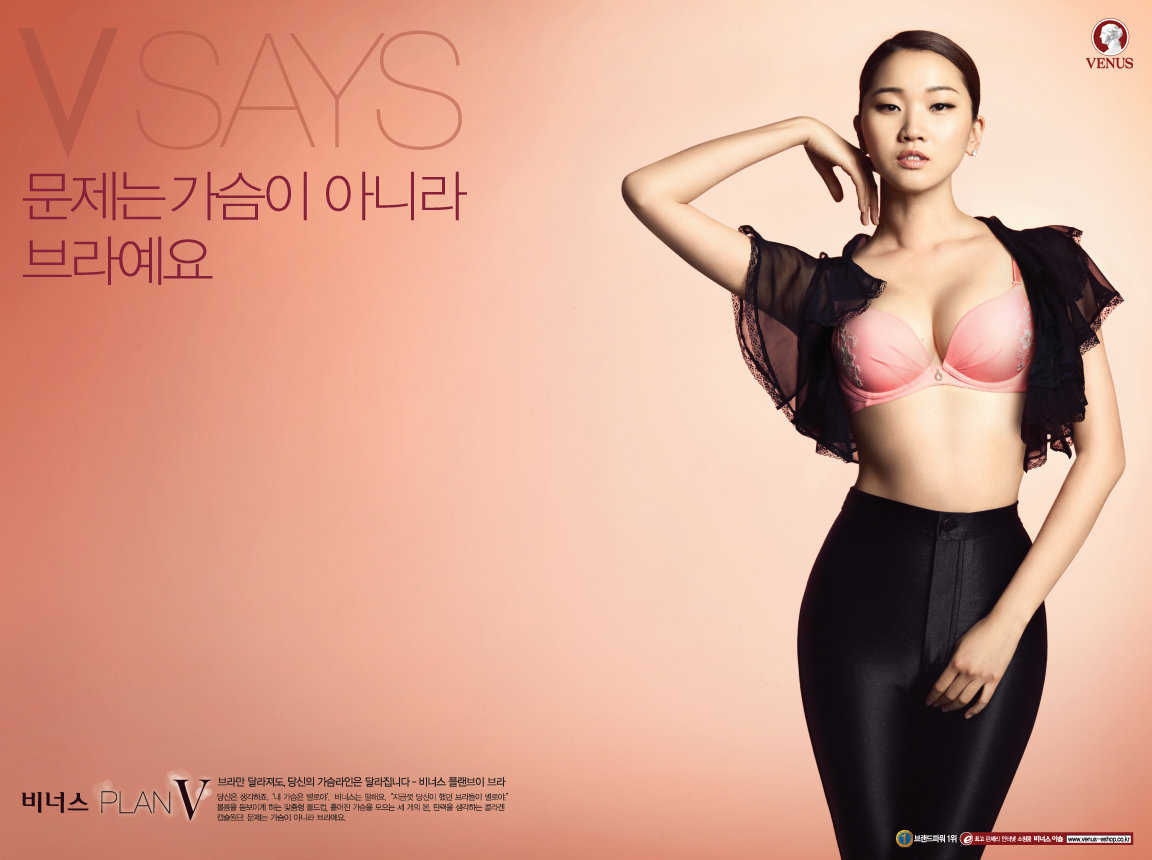
Nor that it’s a Caucasian female model who loses her skirt either, rather than Korean model Jang Yun-ju (장윤주) who’s the one actually endorsing it:

(Source)

Both familiar themes of Korean advertising, for more on body image in Korea see especially Korean Sociological Image #57 and this follow-up, or #18, 27, and 52 for more the sexualization of Western (especially Caucasian) women in the Korean media, and here for some of the negative effects of that.

Meanwhile, of course I do realize that Korea is by no means the only country where noodles are sometimes marketed as a diet food. But the campaign is very different to what you would see in New Zealand for instance, where my sister – who found the ad here – tells me that, these days, instant noodles are increasingly being marketed to children instead. And as for the falling skirt advertisement, that “would immediately be set upon and torched by militant lesbians”!

Also, as it happens I’ve actually liked Jang Yun-ju ever since I read this, and so consider it both ironic and a pity that such an atypical Korean model agreed to be part of something that displays some of the worst habits of the Korean advertising industry. Moreover, she’s also one of the rare Korean models not ashamed of doing lingerie advertisements (although their numbers have been increasing recently), which again raises the question of what a Caucasian woman is doing, well, bending over on that lamppost instead of her.

(Source)

What do you think? Has anybody actually seen the ad themselves?

Update: I’m glad I’m not the only one that noticed that it’s male passersby that seemed to most appreciate the ad, whereas women can be seen walking by in embarrassment!

Update 2: I did miss the phallic object though…

(For all posts in the Korean Sociological Image series, see here)

Share

Korean Gender Reader

(Source)

1) How to find a good Korean man

Excellent dating advice from I’m No Picasso, although like she says, of course most of her advice would apply to any group of men!

Update: Is it harder for women to date in South Korea? From Noona with love answers a (frustratingly vague!) reader’s question.

2) 14% of Korean men subject to sexual abuse as children

To put it mildly, I’ll have to see a lot more detail about the methodology and definitions used before I accept that figure. But I do look forward to finding out more about this survey.

3) Condoms in hotels

In Chinese hotels to be precise. As Shanghai Shiok! explains:

Should hotels provide condoms in guest rooms, whether complimentary or for sale? It’s a question still debated in the hotel industry. In China, condoms in hotels are quite common (after Beijing ordered it), but some foreigners have averse reactions to the foil-wrapped rubbers in their rooms, like my dad who angrily declared the hotel condoms “an embarrassment!” before hiding them away from our eyes.

For me, whether condoms should be there or not just really… depends.

Depends on what? Find out here!

(Source)

4) Native speaker English teacher sexually assaulted in Anyang

See the details at Gusts of Popular Feeling here. Like a commenter there says, I’m amazed at the attitude of the proprietor of the yogwan (motel) where the assault occurred, who apparently didn’t so much as bat an eyelid when 3 male university students carried an unconscious woman to their room.

Update: Asian Correspondent has more details here.

5) Why so few fathers take paternity leave

An excellent, comprehensive report from The JoongAng Daily, in contrast to The Chosun Ilbo one that waxes lyrical about changing attitudes and the fact that a grand total of 819 men took it last year, an increase of 63% from last year.

Note that seeing as this particular paternity leave seems to have been available since at least 2001 however, then it can’t refer to the 3 day one made available in 2008, so at the very least some clarification about the original Korean terms is required. Unfortunately, I don’t have time to do any further investigating myself at the moment, but if anyone’s further interested then I recommend this, this, this, and this to get you started! (and if you clicked on any of those, then I think you’ll find this book fascinating too)

(Source)

6) Korean documentary on ajummas and ajoshis

No, really. As New Yorker in Seoul described it:

I watched this program with JS, my German-Korean friend, and she and I both had similar reactions. First, here’s how WE perceived what the program was doing:

1-First, it showed the bad perceptions of ajuma and ajoshi.
2-Then it explained how these figures are actually good members of society, thereby reaffirming these roles in society.

There was much to appreciate in the documentary–the interviews, the claymation snippets (from the Arari Show), the surveys. But the way the program was constructed entirely, at least for many Western viewers, seemed pretty cheesy. Or at least, heavy-handed in its delivering of the message of why society actually NEEDS the ajuma and ajoshi figures.

Granted, it was designed for a Korean audience. But I wonder: do any Korean viewers broach programs constructed in this way with at least a modicum of cynicism? Does such a program bear a whiff of sentimentality for Korean viewers?

7) A South Korean farm, a brother & sister, a forbidden love

Found via The Three Wise Monkeys, I confess I’m not quite sure what to make of this:

The video shoot took place on a small farm in Jeollabuk-do province, South Korea in February 2011. The storyline was conceived in response to the song lyrics which tell of an unrequited love or a longing that can’t be satisfied or consummated. We came up with the concept of a brother and sister who are twins who have grown up lived and worked together on their parents’ small farm. They are confused and disturbed by the fact that their closeness has developed into a kind of sexual longing that they know they must hide away deep inside.

8) Korean men do least housework in OECD

To play Devil’s advocate however, it’s somewhat natural considering that women do the least paid work in the OECD, as noted by The Korean Herald article.

See Sociological Images also for some more perspective, and handy graphs of how various countries compare.

9) Protecting Korean women from foreign devils, circa late-1940s

I believe that most resentment towards and/or stereotyping of foreign men in Korea stems naturally from having millions stuck in unemployment or low-paid and/irregular work, and it certainly doesn’t help that – as far as I know – boys born at the peak of Korea’s phase of aborting female fetuses in the early-1990s are now becoming adults (while long since resolved, soon there’s going to be something like 116 eighteen-year old men for every 100 women).

But as this post at Gusts of Popular Feelings reveals however, neither factor explains the harassment some Korean women received as early as the late-1940s, even just for working with American men.

(Source)

10) Amber returns to f(x)

Like Dora says at SeoulBeats, it’s good that she’s back:

…the moment I set eyes on Amber, I knew I was a goner. Pardon me, but it was during an era whereby K-pop was being flooded with Barbie dolls everywhere, all right? All the Korean girl group members were armed with the typical Bambi eyes, long swishing hair and legs half the width and twice the length of my own. I was desperate for a change; my self-esteem couldn’t take any more beatings. So once Amber popped into the scene, all the other girls who felt the same way as I did went crazy. With her androgynous hotness (oh gosh, the floppy fringe that can totally rival Justin Bieber’s!), Amber has confused poor females everywhere, and became the new obsession of fangirls.

(Source)

Share

Restrictions Imposed on 18+ Controversial “Wide Leg Spread Dance”

(Source)

Followers of K-pop blogs will already be well aware of this latest storm in a teacup of course, but it’s always interesting to see what ordinary Koreans themselves read about such things. Accordingly, here’s my (very literal) translation of an article from yesterday’s Metro newspaper, which millions would have read on their morning commute:

Restrictions Imposed on 18+ Controversial “Wide Leg Spread Dance”

Three groups with underage members all do suggestive dances as if they’d planned them together

Demands for a review of regulations on suggestive outfits and poses on music programs

While the three girl groups that are showing off their so called “wide leg spread dance” are being regulated by broadcasters, controversy has arisen about suggestive choreography.

Appearing on Music Bank on KBS2 on the 8th, 4Minute (making a comeback that night), RaNia, and the Brave Girls have become very controversial for the suggestiveness of their performances (update: here’s Seoulbeats’ post on the show).

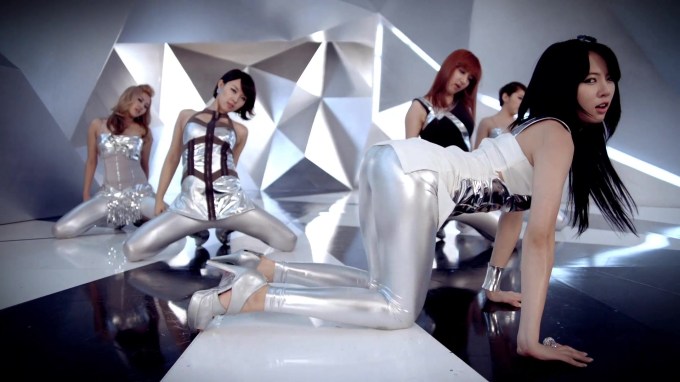
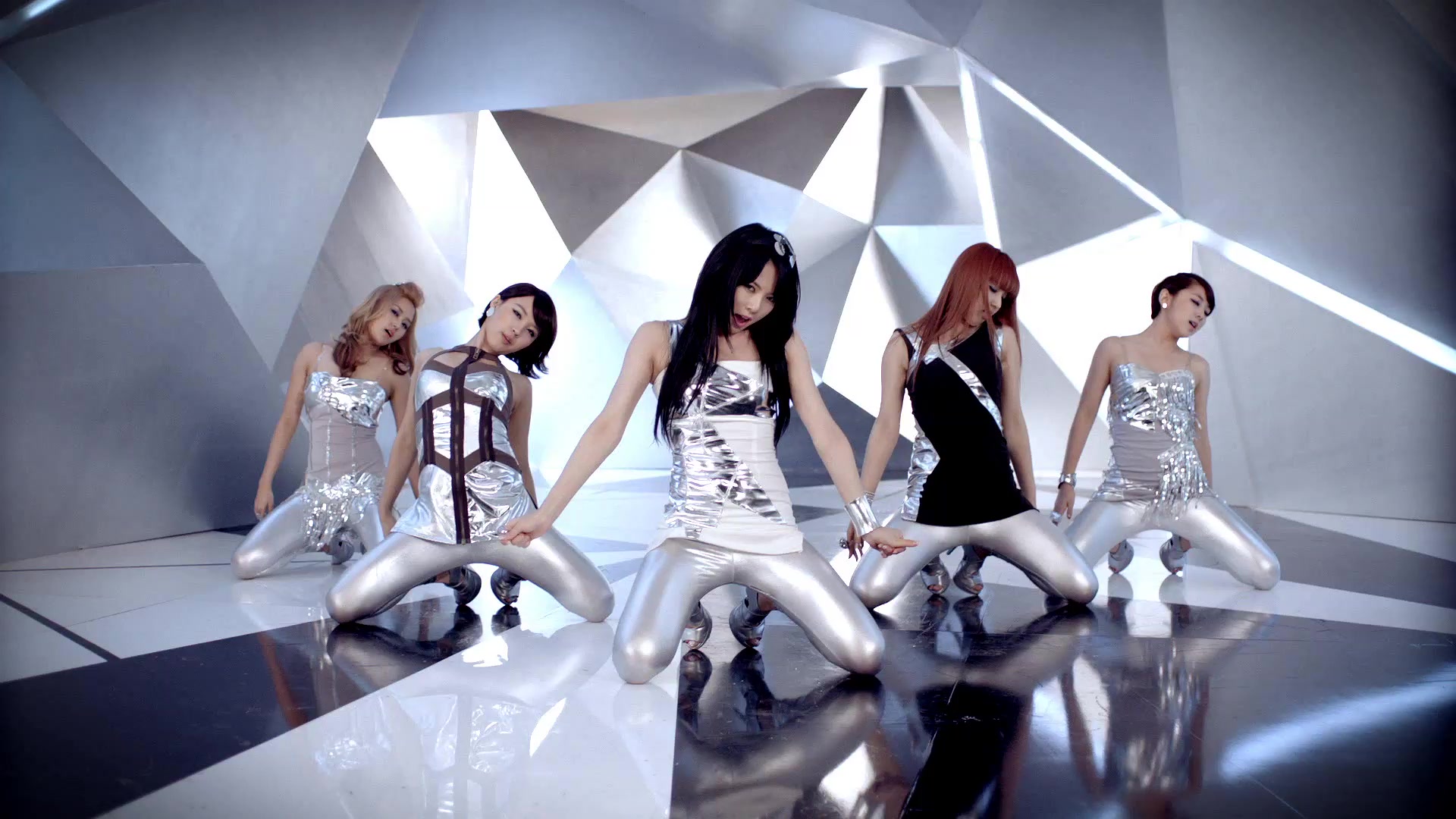
While performing their new song Mirror Mirror, 4Minute members get on the floor on their knees, spread their legs, and repeatedly open and close them:

With support from overseas producer Teddy Riley, new 7-member group RaNia debuted with Dr. Feel Good. Sporting a striking lingerie and garter belt look, one mesmerizing dance move involved only moving their legs and pelvises repeatedly. And Brave Brother-produced 5-member group Brave Girls gave off a similar sexual attractiveness with their debut song Do You Know:

Giving the same performances on 2 other broadcasters’ music programs last weekend, the controversy increased. In the end, Music Bank, SBS’s The Music Trend, and MBC’s Show! Music Core all demanded changes to the dances and outfits and imposed restrictions on them. The reason is that programs that a lot of teenagers watch can not have outfits which expose too much of the body, and/or dances that bring to mind sexual acts.

In particular, it is not just the nature of the outfits and the choreography that is the problem, but that many of the performers are underage. In 4Minute, Hyuna (18) and So-hyun (16); in RaNia, Di (19), Joy (20), T-ae (16), and Xia (16); and in Brave Girls, Yu-jin (?) and Hye-ran (?) are all underage.

(James: Most of the ages given in the article are wrong, whether using the Korean or the “international” system: instead, I’ve provided their international ages, with sources given in their links, although I’ve been unable to find any sources for the ages of the Brave Girls members. I remain confused about why some are described as “underage” though, because clearly many aren’t at all, even with the {incorrect} ages given in the original article)

The result of analysis reveals that this is the result of following the dance moves of sexy pop stars. Before there were national girl groups, it was Lady Gaga that garnered a lot of controversy for the wide spread leg dance and sexually suggestive choreography of her Born This Way music video:

About this, an [anonymous] person in the broadcasting industry said, “While people say that Lady Gaga’s dances and dance moves are unique and individual, they say that Korean singers aren’t like that” and that “it’s a pity that in this era of spreading K-pop to the world, we have such anachronistic rules” (end).

(Source)

Like me, you’re probably aghast at the Metro’s low writing standards and sloppy fact-checking. But that’s quite normal for Korean tabloid newspapers (and, alas, many of their mainstream counterparts too), so much more of interest personally was the author’s point that “before there were national girl groups, it was Lady Gaga that garnered a lot of controversy”, indirectly confirming my own (and many others’) observation that although of course there have always been Korean girl groups previously, it’s only been in the last 4 years or so that there’s been such a glut of them. And also that, following the model set by The Wondergirls (원더걸스), they’re generally much much racier than their predecessors were.

Other than that, I’m a little tired of references to Lady Gaga whenever a girl group comes up with a suggestive dance move, but that’s hardly unique to the Korean media. And it’s curious that the anonymous person in the broadcasting industry felt that Korean girl groups must follow her example to “spread K-pop to the world”, because although this does play to Occidentalist stereotypes of hypersexual Western audiences somewhat, it also marks the culmination of a 180-degree turn against what used to make K-pop appealing to East-Asian audiences, and which presumably influenced music producers. As Rowan Pease explains in her chapter “Korean Pop Music in China: Nationalism, Authenticity, and Gender” in Cultural Studies and Cultural Industries in Northeast Asia: What a Difference a Region Makes (2010):

( Source: The Japan Foundation )

In 2003, the Korean National Tourism Office [a major investor in the Korean wave] conducted a Hanliu tourism survey in China, Taiwan, and Hong Kong exploring attitudes to Korean culture, publishing the results online…

….It compared the impact of Korean culture with that of four “competitor” countries (the U.S., Japan, Taiwan, and Hong Kong), and in the process revealed much about Korea’s own political and nationalist concerns, particularly in relation to Japan and America. Six of the eleven options for respondents to the category “reasons I like Korean culture” reflect this preoccupation: “less sexual than Japanese culture,” “less sexual than American culture,” “less violent than Japanese popular culture,” “less violent than American popular culture,” “decreased interest in American culture,” and “decreased interest in Japanese culture.” One other echoes Straubhaar’s notion of cultural proximity: “similar in culture.” Certainly, Korea’s own music media censorship laws (which even in 1997 prohibited the displaying of body piercings, navels, tattoos, “outfits which might harm the sound emotional development of youth,” and banned violent or political lyrics), meant that Chinese TV stations could buy in Korean music videos and music TV shows knowing that they were unlikely to upset local censors. However, these questions also reflected a perception that Korea acts as a defender against excessive Westernization and as a guardian of Confucian values within East Asia. (pp. 155-156)

Which long-term readers may remember from my translation of the lyrics to Bad Girl, Good Girl (배드걸 굿걸) by Miss A (미쓰에이), probably the most erotic Korean girl group music video I’d ever seen until these latest ones came out:

Alternatively, the above view of Chinese, Taiwanese, and Hong Kong tastes may well be outdated, and “the world” in the newspaper article shouldn’t automatically be taken to mean Western audiences: after all, 2 members of Miss A are Chinese, and the group was originally designed to be overwhelmingly aimed at the Chinese market.  What do you think?

Meanwhile, see here, here, here, and here for the latest developments in this “Wide Leg Spread Dance” controversy (yes, I love saying that too!). And today’s edition of the Metro newspaper also happens to have an interview of RaNia in which they discuss the dance, but I’m afraid I don’t have time to translate it at the moment sorry. Any takers?^^

(Source)

Update: Here’s an hilarious response to the banning from some netizens!

Update 2: See Mixtapes and Liner Notes for some more in-depth analysis of RaNia’s performance, its subsequent censorship, and the issues it’s raised.

Share