
 (Source)
1) Korean Attitudes to Arranged Marriages
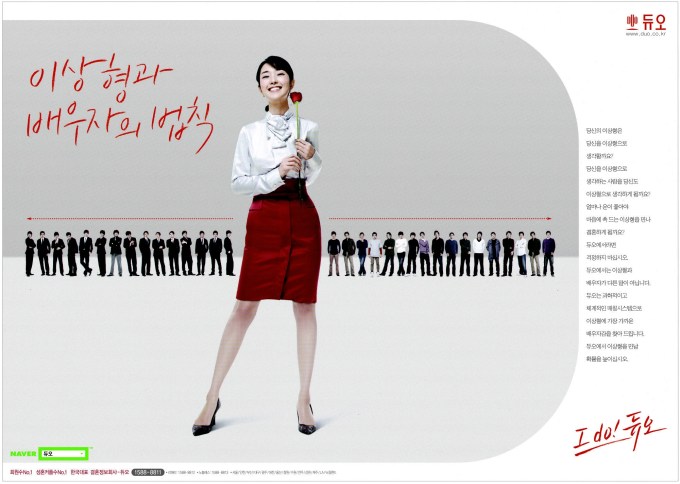
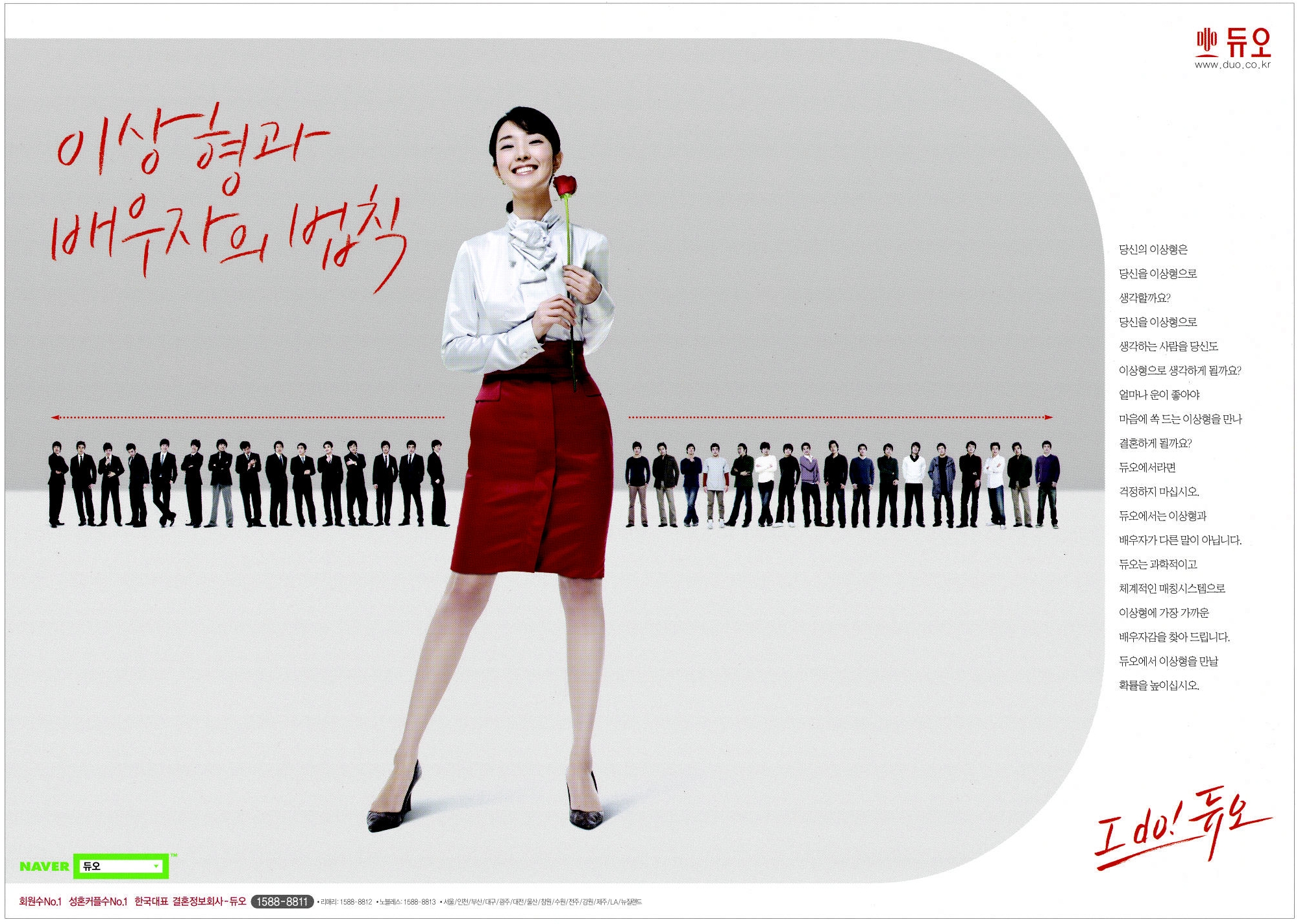
Probably everybody reading knows a Korean person who married someone just one or two months after meeting them. Of the three women I know that did, all enrolled the services of a professional matchmaking marriage agency like Duo (듀오) above to find them, two just the week after they split up with their heartbroken long-term boyfriends.
Needless to say, that sits uncomfortably with modern Western notions of romance and marriage. Yet despite most readers’ distaste, not all such pairings are doomed to loveless failure, and indeed all three of those women I know seem perfectly happy with their new spouses. But what compels such hasty arrangements?
See Dana in Soko for an answer, and for anyone further interested I highly recommend Getting Married in Korea: Of Gender, Morality, and Modernity (1996) by Laurel Kendall too, although it is a little dated.
Also, a confession and a question: the third woman I mentioned was actually a very close Korean friend of mine, but I was so surprised and disappointed with her for getting an arranged marriage that I didn’t try to keep in touch when she moved to a new city afterwards (although we both became much too busy with our respective families anyway). Do you think I was too judgmental? Have any other readers also had their intelligent, confident, ambitious female friends suddenly surprise them with an arranged marriage like that? Did you stay friends afterwards, despite that “traditional” Korean elephant in the room? Please let me know!
2) Korean Gay Community Warns of Assaults on Twitter
According to reports on Twitter there seems to be a group of men in Jongro assaulting gay men at night. See Asian Correspondent for more information.
3) Koreans’ Teeth and Cosmetic Infantilization
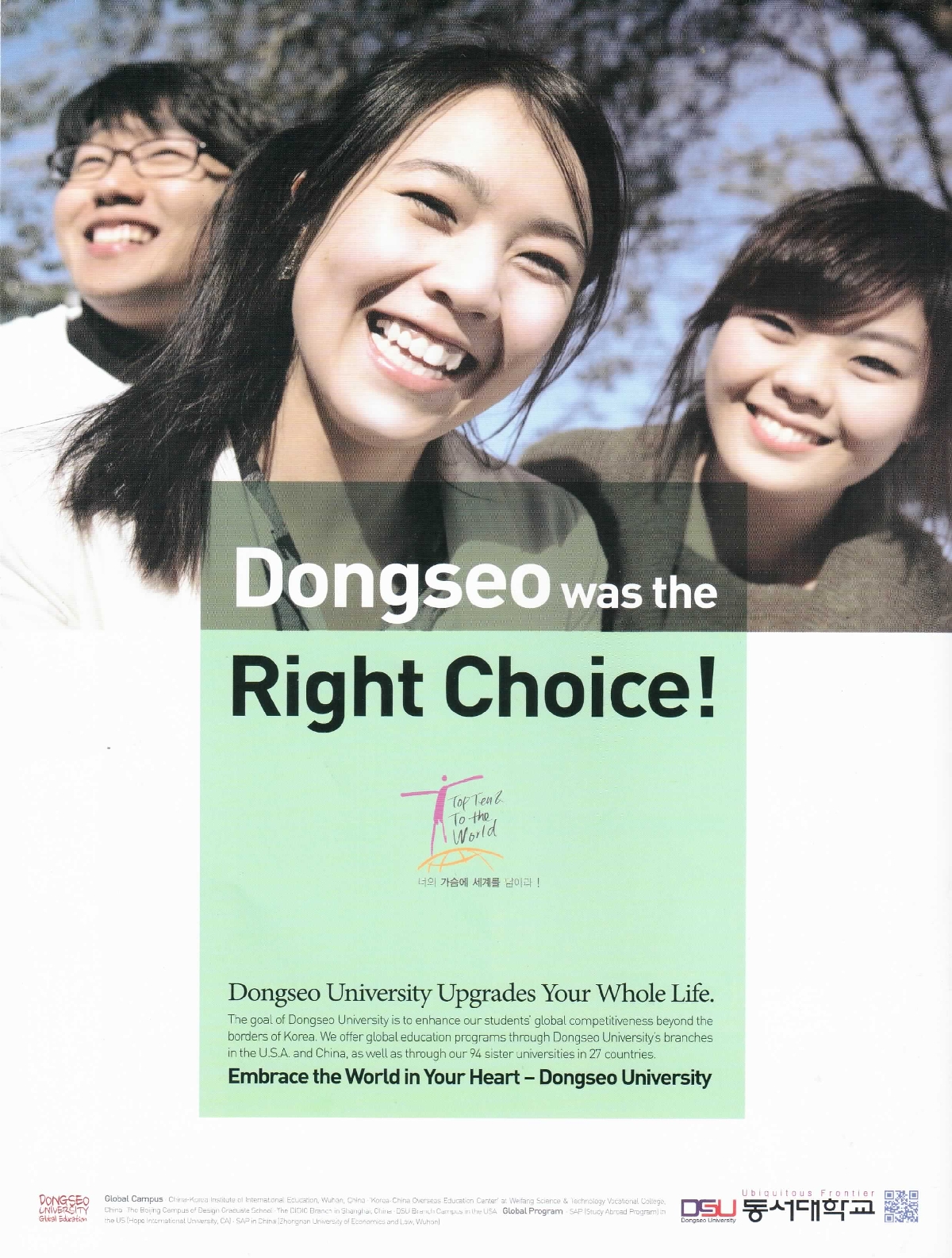
Five times a week, I’m greeted with the above advertisement for my workplace as I leave the subway. It may sound a little harsh of me, but every time I see it, I can’t help but ponder why the advertisers didn’t choose a model with nicer teeth (rest assured they look much worse when they’re the size of your palm!).
Possibly, it was felt that a using a “real” person would be more appealing to potential students than an obvious professional model. But on the other hand, good teeth aren’t really a requirement even for Korean celebrities either, as this post by Johnelle at Seoulbeats makes clear. In it, she speculates that good affordable orthodontic treatments weren’t really an option for the current generation of 20 and 30-something celebrities, and/or that they didn’t correct them once the option to do so did become available because crooked teeth are a good sign of being a fabled “natural beauty”, in particular of not having undergone jaw surgery to obtain a V-line.
 Without disputing those at all though, the news that some Japanese women are deliberately making their teeth look crooked (known as yaeba) suggests a third, strongly gendered possibility. As explained by Sociological Images (source, right):
Michelle Phan, who blogged about the trend, explained:
It’s not like here, where perfect, straight, picket-fence teeth are considered beautiful. In Japan, in fact, crooked teeth are actually endearing, and it shows that a girl is not perfect. And, in a way, men find that more approachable than someone who is too overly perfect.
Communication Studies professor Dr. Emilie Zaslow had something different to say. She argued that the trend represented a fixation with youth, the sexualization of girls, and pressure on women to infantilize themselves:
…the naturally occurring yaeba is because of delayed baby teeth, or a mouth that’s too small.
In other words, having a crowded mouth makes you look younger, like a girl instead of a woman.
In short, I’d argue that this possibility means that Korean men with crooked teeth are more likely to correct them than Korean women, and indeed that matches my own observations. But although it’s too early for confirmation bias to have an effect here(!), of course that result may simply reflect my being much more interested in women’s mouths than in men’s. So, what are readers’ own observtions? And if there is indeed a gender imbalance, can you think of alternative reasons for why that would be the case?
Related, Leanne of Hello Korea! laments the popularity of “Asian poses”, and how it perpetuates Orientalist stereotypes of childish East Asian poses (including among East Asians themselves). As she writes:
Now, to be fair, your common everyday Korean woman is not posing for a camera all the time, but it’s still disturbing that they do this stuff when a camera gets put in front of their face.
That really struck a chord with me, because, the same day I read that, I happened to be presenting the following video (albeit by an Asian-American I think) to an all-male class of computer-gaming students. Perennially bored and sleepy (the students that is), I thought a cute young woman imitating various feelings would spark some interest in studying English for a change. Indeed, it worked so well, I decided I’d do something similar for my other, mostly female classes…but, tellingly, soon gave up trying to find a cute young guy doing the same sort of video!
4) Korean Attitudes to Women Working While Pregnant
Msleetobe, of On Becoming a Good Korean (Feminist) Wife, discusses her realization that her Korean students and coworkers seem to find pregnant women essentially useless, or at least poor workers. While she is careful to not to generalize from that small group though, she also raises the important point that with so many pregnant women expected – or forced – to resign from their companies (see #2 here), then unfortunately very few Koreans actually get to meet anyone who could challenge that stereotype.
5) Police Arrest Individuals Behind Solbi’s Fake Sex Tape
I confess, I know little about Solbi (솔비) beyond her name, and certainly not that a fake sex-tape of her had been circulating for over two years, and which led to her breaking up with her boyfriend. Does anyone also know how the tape affected her career? (For comparison, see what happened to Ivy [아이비] because of her own alleged sex tape in 2008)
 (Source)

Finally, it’s not related to Korea sorry, but do let me pass on this excellent In Our Time podcast on Eugène Delacroix’s 1830 painting Liberty Leading the People above, with a lot of discussion of how it has been appropriated as a Feminist symbol ever since. Which is kind of ironic, because as guest Tamar Garb of University College London especially points out, French women had almost all no rights at all at the time, and accordingly the woman depicted was definitely only intended to be an allegorical – and not Feminist – figure.


 The Grand Narrative