Korean Gender Reader

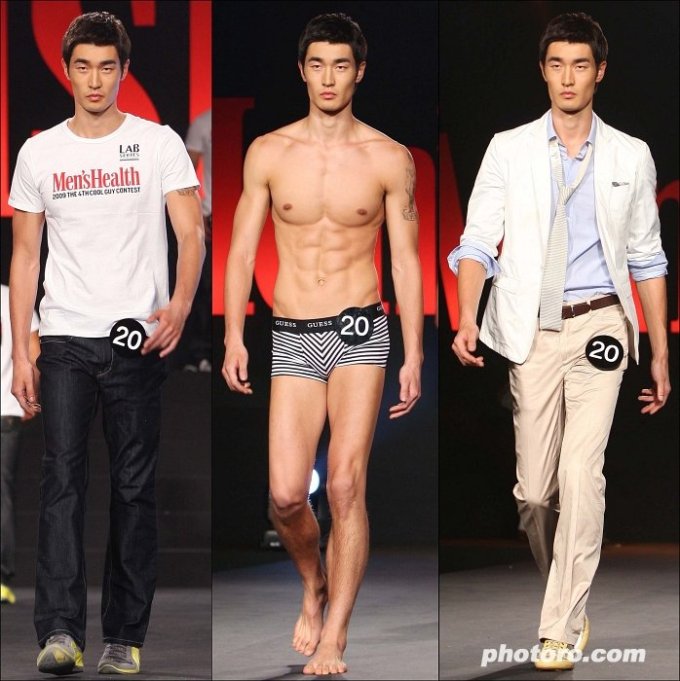
Korea 2009 Men's Health Cool Guy Contest

I didn’t catch his name sorry, but if you’d like to know more about the winner of the “4th Men’s Health Cool Guy Contest” above, then click on the picture or the Men’s Health Korea site itself for many more like it. In the meantime, with so many stories to report on this week I’ve decided to put them into loose categories to make it easier to find what you’re interested in:

Sexuality

1) Of course, the two biggest stories of the last week were: first, the foreign women on the Korean show “Global Beauties Chat” (미녀들의 수다), who chose to complain about both the foreign (Caucasian) men who supposedly come to Korea because they can’t get a job or girl back home and the Korean women that naively fall for them; and second, intern reporter Choi Hee-seon’s series of articles in The Chosun Ilbo saying much the same thing, as well as accusing said men of sexual crimes against students and Korean women. Needless to say, both provoked an instantaneous and vehement response in the Korean blogosphere (for starters see here, here, here on the former, and here and here on the latter), and with 165 comments at that first link alone I’m not going to enter into the fray at this late stage.

In passing though, let me mention that in response Chris in South Korea offers 8 reasons, and then 8 more reasons, why Korean women might prefer Western guys over Korean men. But while I haven’t read either post nor the comments in any great detail, and I’d be surprised if I didn’t think that there was something to all of them, let me offer a word of caution: when actual Korean women themselves aren’t providing most if not all of the input into such lists, they can very quickly and easily devolve into simple narcissism.

Not that Chris is guilty of this by any means, and in fact I write because I speak from experience, having waxed lyrical on similar points with a Korean female friend years ago only rightly to be told to STFU, and that most Korean women that liked Western guys did so simply because they tended to be taller. Just something to keep in mind.

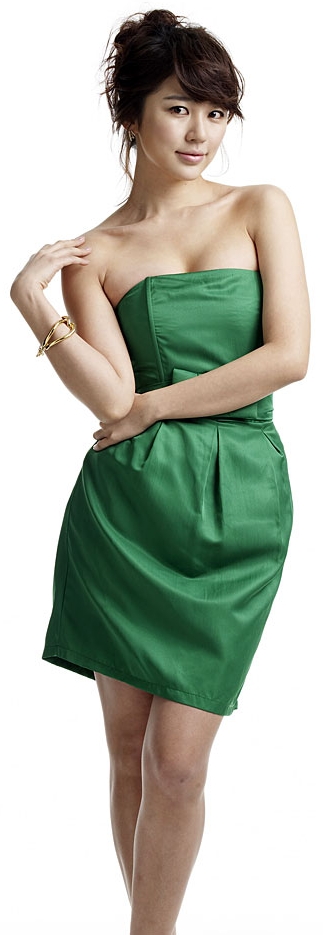
Park Shi-yeon2) Imported vibrators to penetrate local market. No, I hadn’t been aware that they had been illegal either, and actually I’m not entirely certain that they were: the Supreme Court’s ruling may have been more against the arbitrariness of denying customs clearance for their import than anything else. Regardless, by no means does Korea have a monopoly on absurd and indefensible restrictions on the sale of sex toys.

(Above: Park Si-yeon {박시연} models for High Cut. For more information about the photoshoot, see here)

3) Consensual sex with 13 year-olds is legal. Yes, apparently so, given a recent acquittal of a Busan man for doing so with a runaway in his (unofficial) care and, as Matt at Gusts of Popular Feeling notes in the most comprehensive look at the case, mirrors a similar decision 8 years earlier. For further discussion, see this article in the Korea Times by Michael Stevens, and this post at The Marmot’s Hole.

4) Infidelik at FeetManSeoul reports on the perils of not wearing a bra on the streets of Korea . If you’re interested in that, then you may also want to check out this post at Sociological Images about how, in contrast, visible nipples have became more accepted in Western countries since the 1990s.

5) Rules on abortion toughened. Somewhat surreal, given that there are already very few circumstances under which Korean women can legally have an abortion, and yet Korean has one of the largest abortion industries in the world. To put it mildly, the article is somewhat lacking by not providing that context (see here for that).

Worried Moment for Korean Couple

6) The Marmot’s Hole reports that the police would like to close down a Swinger’s Club in Seoul, but unfortunately there is currently no law allowing them to do so. Again, somewhat surreal, given that adultery is actually illegal in Korea, albeit usually with entirely arbitrary prosecutions.

Meanwhile, Brian in Jeollanam-do reports that Education Ministry officials formed the largest group of civil servants caught paying for sex.

7) Not that these are recent news items by any means, but while we’re on the topic you may be interested in the fact that Korea used to be a much more sexually freer place; indeed, as Frog in a Well points out, “just because a society has a reputation for sexual restraint doesn’t mean that it is and always was asexual.” Also, here and here are two excellent Andrei Lankov articles from The Korea Times about how military governments allowed much racier films in the late-1970s and early-1980s (in an opium for the masses sense) and the development of the prostitution industry in Korea before the Japanese colonial period respectively.

Censorship and Media

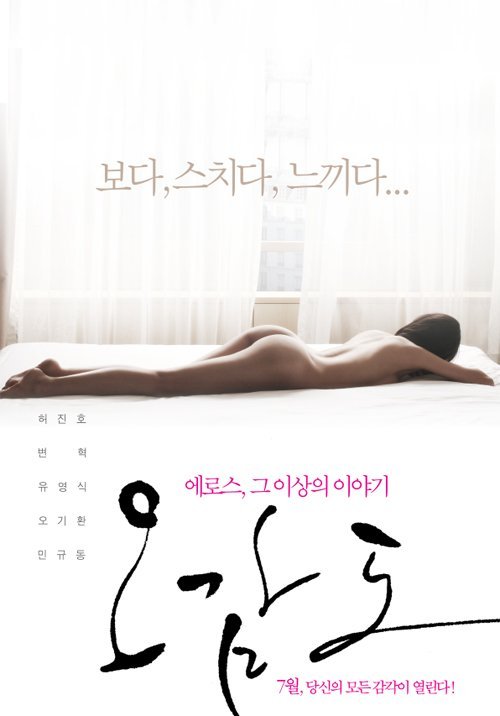
Ogamdo Posters

8) Dramabeans reports that the star-studded Ogamado (오감도) continues with its provocative promotional material (see #7 here also). For a review of the movie, (which is really 5 movies in 1) see here, and given some of their subject matter then as a commenter over at Dramabeans (#17) noted, it is strange that the posters are as per usual fetishizing the female form and not the men, which leads her(?) to worry that all the sex is only from the perspective of the men.

9) The Korea Communications Standards Council announced on Monday they will commence deliberations on the fate of Naked News Korea,” which started its racy services late last month both online and mobile. As Brian notes, there far more explicit and sexually suggestive programs are readily available 24/7 on Korean cable television, so this scrutiny is rather strange. Is it because its whole raison d’être and discussions of sexuality are just too blatant for censors’ tastes? To wit:

According to the communications watchdog, the contents of the site have been closely monitored since it began and an episode in which its presenters discussed female orgasms was deemed vulgar and inappropriately suggestive.

In all seriousness, I’d be interested in seeing that. I have the strong suspicion that the notion of women sitting around talking in a no-BS Sex and the City style was a bit too much for Korean censors, and hence any discussion of female orgasms by them would have been deemed vulgar and suggestive regardless.

10) Another commercial featuring kissing…well, actually there’s so many these days that I’m losing track (see here for another recent one). Here is the latest one (via PopSeoul!), featuring AJ and Min Hyo-rin (민효린) and with the tagline “Cool (refreshing) for 20 year-olds” (“스무살을 상큼하게”, at 0:17):

11) As predicted (see #1 here), rapper E.via’s (이비아) latest song, featuring a lot of innuendo and heavy breathing, was indeed deemed inappropriate for Korean TV. For further details, see Extra! Korea here.

12) More on Choi Jin-sil (최진실), who was notoriously sued by a company she had a modeling contract with for ruining their reputation by making her husband’s beating of her public (see here and here, the latter of which has puts the case into the context of domestic violence in Korea). For two opinion pieces in The Korea Times, see here and here.

13) As a result of the case of actress Jang Ja-yeon (장자연), who killed herself in March due to being forced to provide sexual services to various high-ups in the entertainment industry in order to advance her career, Korea is to enhance the right of entertainers (see here also). Meanwhile, the police have determined that she was indeed forced to have sex, and a survey shows that 19% of female entertainers are, although Extra! Korea rightfully disputes the figures.

14) Apparently, Abusive Words Over The Phone Are Punishable. Meanwhile, and more understandably, a cartoonist was summoned by the police after drawing a cartoon insulting the president. As a commenter here notes, regardless of the freedom of speech issues involved, the police in any country are obliged to investigate cases as blatant as this one.

Politics and Economics
korean-man-and-woman-sitting-apart-on-subway

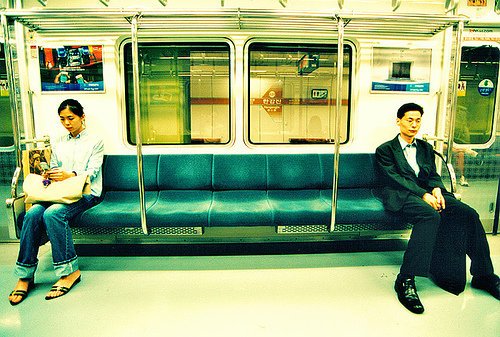
15) Korea has the biggest wage gap between men and women in the OECD. See the Korea Times and the JoongAng Daily for more, and see Brian in Jeollanam-do for more information about conditions in Jeollanam-do specifically, which has the biggest gap (image source: J. David Allen).
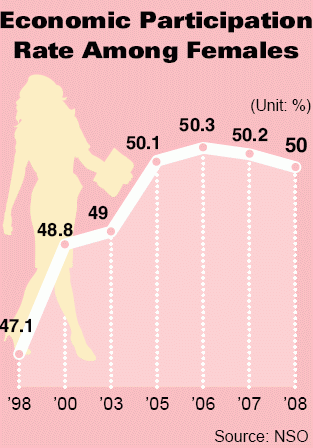
Economic Participation Rate Among Korean FemalesIn addition, Lee Hyo-sik of the Korea Times reported that male temporary workers are more likely to lose their jobs than women because of the industries they tend to be in, but on the other hand reported a few days later that women are still more likely to lose their jobs overall because they form a disproportionate number of temporary workers. The graph on the right comes from the latter report, and while useful, would have been more so had it been placed into context, which is that Korea has one of the lowest rates of female participation in the labor force in the OECD. For much more on that, see here (source, right).

Not unrelated, the Chosun Ilbo reported that “Korean Women’s Status is Still Low Among OECD Nations”.

16) Korea is to become most aged society in OECD by 2050. Also:The Hankyoreh has an editorial on how its record-breaking low birth rate – “unparalleled to anywhere else in the world” – requires employment policy revisions; there is a list of related recent articles at the Hub of Sparkle! here; and Japanian writes on the implications of the aging and shrinking Japanese population, with obvious parallels in Korea (via Global Voices).

17) 90% of Teachers Back a Quota for Male Teachers

18) Brand Confucian reports that KT recently promoted 3 women to top-tier executive positions.

19) However miserly it sounds, something that may have a lasting impact on the rate of young Koreans living independently before marriage is the raising of the minimum wage to 4,110 won per hour. See Judy Han at Otherwise for the details.

On the other hand, Korean graduates are now forced to flip burgers, and not unrelated is the fact that Koreans as a whole are increasingly willing to overcome their Confucian disdain for manual labour. They are also increasingly unhappy in general, as are Korean teenagers and children.

20) ROK Drop discusses whether the Korean Army should also conscript women, or do away with conscription altogether. Given conscription’s role in a pervasive militarization of Korean society, as I discuss in this series of posts beginning here, then I’m much more in favor of the latter.

Events, Movies, and Fashion

Miss Korea 2009

21) FeetManSeoul’s cover model Lee Seul-gi (이슬기) becomes Miss Korea 2009. I’m a little confused though, because the Korea Times reported that a different woman won.

22) Chris in South Korea (naturally) visited and took many pictures of the Wild Women’s Performing Arts Festival that I mentioned last month (see #17 here).

23) Unflattering pictures of members of girl group 2NE1 (투 애니원) without make-up were publicly released, and YG Entertainment is to take strong action against whomever responsible.

24) Rebecca Voight at The New York Times loses her head and claims that Korean menswear is innovative. Meanwhile,  Five by Fifty says that pink is both Japanese women’s most and second least-preferred color on Japanese men.

25) (Male) actor Yoo Ji-tae (유지태) is to receive Seoul Women’s Prize.

26) Apparently, Kim Yu-na (김연아) is a champion skater primarily because of her small face. For the details, see here, and see here and here for where such a crazed logic stems from.


27) Keeping Korea Beautiful: read here for an interview with Klaus Fassbender, president and executive director of L’Oreal Korea.

When will the netizens ever be happy.....

28) Hopefully not because of netizen’s complaints (see #1 here) and not via starving herself, Kim Yu-bin (김유빈) of the Wondergirls (원더걸스) has lost a lot of weight.

29) Breathless (똥파리 or “shit fly” in typically earthy Korean), a Korean movie about domestic violence that I wrote a little about here, has won its 13th award, this time at the New York Asian Film Festival.


30) Finally, in news outside of Korea, Matt at On My Way to Korea has a post on the way women are presented in North Korean propaganda posters; EqualWrites explains why being catcalled in Vietnam is not flattering; Shanghaiist writes about “homowives”, or heterosexual women married to gay Chinese men (hat tip to Left Flank); and finally, the Economist has an article about Gay rights in China and last month’s Shanghai Pride Week.


Share

Korean Gender Reader

E.Via BananaYes, Korean “gender” reader from now on, as despite the name my “feminist reader” posts were really always more on gender and sexuality issues rather than on feminist ones per se, although of course they’re still intimately related and will still get mentioned. I’ve updated the names of all the old posts accordingly.

1) In an advertising tactic that looks set to become a new standard given how popular the recent banning of similar songs and videos made them afterward (see #1 here and #2 here, and apparently the same logic applies to “leftist” books), rookie rapper E.via (이비아) probably deliberately sought controversy with the opening of her song “Oppa, Can I do it?” (오빠! 나 해도 돼?), which – surprise, surprise – begins with heavy breathing and the lines “Oppa…you know…I really want to do it…Can’t I do it once? Oppa…Can I do it?” See allkpop here for more, and here for the song itself (photo source: Diet Life).

2) Abortions in South Korea: Legality, Morality and Public Opinion from Ask The Expat.

3) The ballad singer “U” created a stir with a lesbian kissing scene in an MV teaser for her new song, “Suddenly” (울컥).

4) School violence appears to be on the rise, although Korea Beat notes it may just be institutions are better at ferreting out cases that would previously have gone undiscovered. See Brian in Jeollanam-do also for a legal case where a student hitting a teacher in retaliation for corporeal punishment was ruled as not being legitimate self-defense.

5) Matt at Gusts of Popular Feeling discusses the a Korean groups’ attempts to link foreign teachers with AIDS, and despite all the evidence against this, their efforts are having impacts on Korean legislators.

In related news, an English guide (possibly satirical) on how to pick up Korean women is generating complaints in Korea, as is another website devoted to that purpose, but regular revealing and/or “upskirt” pictures of underage girls in the Korean media strangely get much less attention, as do naked news presenters (see here also).

6) A good look at the nightmare that is trying to find quality, affordable childcare in Tokyo, with obvious parallels to Korea. See here also for how Korean kindergarten teachers are underpaid and overworked. In fairness though, my own 3 year-old daughter goes to a very nice and affordable kindergarten (and our family makes much less money than your average Korean middle-class ones!), so they are out there.

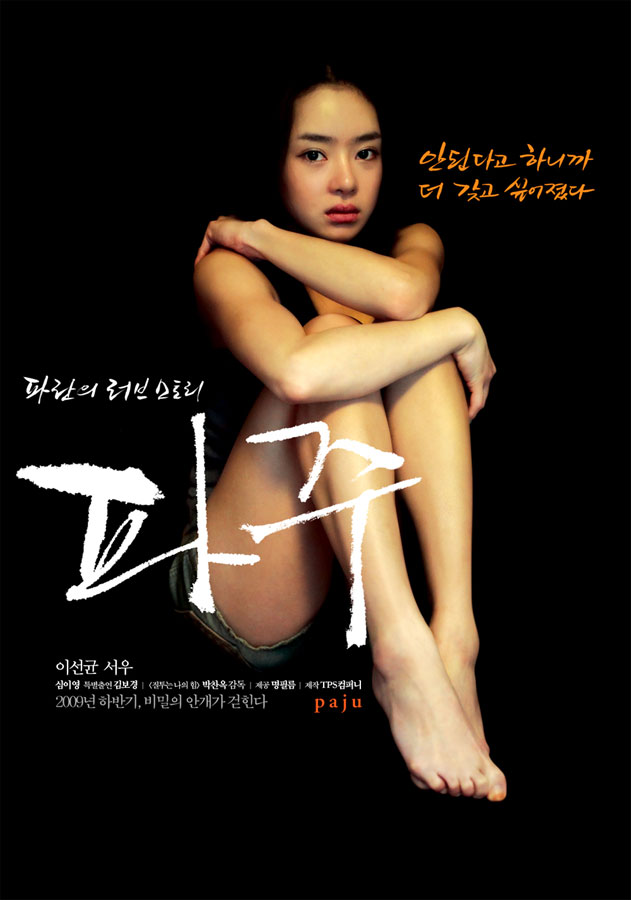
Paju Movie Poster Seo Woo

7) Although the movie itself isn’t set to come out until Autumn, with its Lolita-themed storyline and especially the poster with actress Seo-woo (서우) above (source), then Paju (파주) is already getting a lot of attention: the orange text, for instance, says “If (you) say (I) can’t, then (I) want to do (it) all the more.” See DramaBeans here for a synopsis (actually, it sounds quite interesting).

Update: Come to think of it, Seo-woo’s passive look in the poster and the assertive, risqué text give completely opposite impressions of her character in the movie. I wonder why? From what I’ve read at DramaBeans though, the latter is the more accurate.

8) Chris in South Korea visited Haesindang Park (해신당 공원) in Gangwon-do, which is apparently full of penises.

9) An Acorn in the Dog’s Food provides a harrowing tale of a mother suffering from depression who killed her son and tried to make it look like suicide, and only by chance was unable to kill her daughter also.

10) Chinese Chic provides a good quick summary of queer cinema and the state of LGBT rights in various Northast-Asian countries.

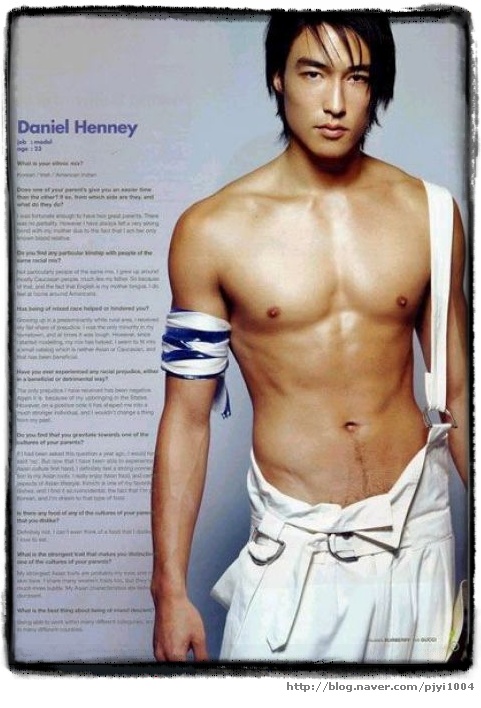
Daniel Henney Abs11) PopSeoul! and allkpop discuss the case of newbie actor Lee Si-young, who was dropped from an upcoming drama for falling in love and making public her relationship with fellow actor Junjin. This will have a big negative impact on her fledgling career (she is already said to have lost some advertising deals as a result), but, lest this be taken as indicative of Korean management companies slave-like contracts with their stars  (see #6 here) and Korean companies’ strange stipulations about the reputations of stars modeling for them (ie, if you get beaten up by your husband then be sure to hide it from the public), the decision was made solely by screenwriter Im Sung-han (임성한), apparently notorious for that sort of thing.

12) Korea Beat discusses discriminatory Korean textbooks. Meanwhile, Miss Korea feels the pain of interracial Korean families, and the government plans to tighten the rules on foreign spouses of Koreans getting citizenship (see here also).

13) As allkpop discusses here, recent advertisements featuring Lee Hyori are creating jams in Korean subway stations (apparently not here though!).

14) Good on actress Kim Bu-seon (김부선) for standing up for the legalization of marijuana in Korea and drawing attention to the Korean public’s often bizarre attitudes towards it (considering that 46% of Korean men and 9% of women are considered binge drinkers, then you may be surprised at Koreans’ rather dogmatic attitudes to other drugs). See Michael Hurt at Scribblings of the Metropolitician for a wider discussion of those.

15) Finally, as Omana They Didn’t! tests your knowledge of Korea’s best abs here (helpful example above), it behooves me to present my candidate for the best female version below. And in related news, some form of contest for former Men’s Health Korea magazine cover models will take place at the ‘4th Men’s Health Cool Guy Contest’ on July 2, 2009 at the Grand Hilton Convention Center. See here and here for the details.

lee-hyori-navel

Share

Korean Gender Reader

3xFTM PosterWe’re Here, We’re Queer…And We’re In Korea

Sorry, but once I remembered the catchphrase of the gay groups at my university in the mid-1990s, then I couldn’t resist that particular addition to it!

In my defense though, there’s been a relative flood of LGBT-related news in the Korean blogosphere since the 10th Korea Queer Culture Festival finished two weeks ago. To wit:

1) Expect an outing of a Korean celebrity by an angry ex-girlfriend sometime soon.

2) 3xFTM, Korea’s first ever movie about a female to male transgender experience, is currently playing in cinemas. See here for a review.

3) Ask the Expat wrote an informative post about gay culture in Korea.

4) The Wonder Girls are so popular in Thailand that a “Wonder Gays” group has been created.

5) Don’t miss Chris in South Korea’s photos of the parade and festival themselves.

6) And finally, Dramabeans reports that “Director Kim Jo Gwang-soo added an entry to the small-but-growing category of Korean queer cinema with his short film Boy Meets Boy, starring rising pretty-boy actor Kim Hye-sung. He is following that with his second film, Friends? [친구사이?], which isn’t quite feature-length but clocks in as a mid-length film at 50 minutes.”

Friends is currently in post-production, and with teenage boys kissing in it and reportedly a bed-scene too, it’ll be very interesting to see how widely it is screened and if any objections to it are raised. Unfortunately, I missed any news of Boy Meets Boy when it was released last year, so if anyone has any information about its reception then please let me know.

Update: “fuchsiathegreat” has just written a list that he(?) claims covers most if not all queer films that have ever been produced in Korea. I think that that’s an exaggeration(!), but it’s certainly a good guide to what has been produced in the last decade. Check it out at Omana They Didn’t! here.

Update 2: Although most of the films themselves are difficult to find unfortunately, check out the links provided by Pierre here for a history of queer cinema in Korea up until the late-1990s.

(By the way, if you were under the {perfectly understandable} impression that Koreans thought that there were no homosexuals in Korea, then you might find this post interesting)

Fledgling Queer Cinema in Korea

Other news, in no particular order:

7) Actress Moon Geun-young participated at the 2009 Pink Ribbon Love Marathon fan meeting, with the aim of raising the awareness and need for prevention of breast cancer.

8) The Chosun Ilbo reported that Swedish husbands do 6 time more housework than their Korean counterparts.

9) The original is a little difficult to read, but Watashi to Tokyo discusses an article about why highly-educated Japanese women aspire to be housewives.

10) The Dong-a Ilbo reported on the recent launching of government task force for making a “better place for procreation” to promote childbirth. Forgive my arrogance, but I suspect that I could have translated that better.

11) Netizens voted on the best kissing scene in a Korean drama.

12) The Hub of Sparkle! provides valuable information on women’s safety in Korea and on what support is available for rape victims.

Girls' Generation ironically encourages me to not worry about getting someone pregnant13) Allkpop reports that teenage girl group Girls’ Generation is involved in a new show where they learn look after a baby for a day (see here and here). I’m sure that it’s entirely with ratings in mind, but on the plus side they are also getting involved in a campaign to help adopted children. Cue highly relevant pictures accompanying the Korean news reports.

14) Brand Confucian reports that “according to Yonhap news, Consumers Korea, a consumer advocacy group, released a report showing that several international and local Korean baby skin care product manufacturers are marketing products containing potentially harmful chemical preservatives and fragrances as ‘natural’ or even ‘organic’.”

To place that into context, 88% of products marketed as organic food in Korea are anything but, and even though 27 out of 30 Vitamin C drinks in Korea contain dangerously high levels of carcinogenic benzene, not only are the KFDA’s powers so limited that none of the companies producing them can face penalties, but it’s not allowed to publicly reveal their names. So, when I wrote about this topic in passing a year ago, guess what country’s websites I had to visit in order to learn which 3 drinks are safe?  It certainly put Korean democracy into a new perspective…

In related news, I’ve just read that the government said that “7 out of 79 brands of bottled water were found to contain bromate, a suspected carcinogen, exceeding international guidelines for drinking water quality.” See here for the details, and again, which 7 are not named. And in another ominous sign, last year the KFDA’s lack of legal authority and resources inspired it to get the public to do its own job of checking health and safety standards at Korean restaurants.

15) The Korea Times reports that a professor was given a jail term for sexually harassing female students, and Korea Beat reports that: the acquittal of a professor accused of sexually assaulting a female student was affirmed; the Dong-a Ilbo was accused of sexism by portraying women memorial services for the late ex-president Roh Muh-hyun as acting only out of emotion; and, as a follow-up to the Seoul City government’s plans to increase the number of public toilets for women (see #9 here), provides some more details of what exactly will be provided and how they will be funded (and parks are to become more “women-friendly” also).

16) PopSeoul! reports that the two rumor-spreaders that contributed to Choi Jin-sil’s suicide last year are to receive…suspended sentences of 2 years and 120 hours community service. But while that may sound lenient, particularly in light of her tragic life and the ignominy of being sued after death for not hiding her husband’s beatings  from the media, there are still rights to free speech involved.

17) The Wild Women’s Performing Arts Festival is set to be held in Hongdae in Seoul on June 27, and will raise funds for the Korean Women’s Association United, which tackles such issues as gender equality. See here and here for the details.

Lady Gaga Seoul

18) Despite thousands of articles about and even more photos of Lady Gaga’s recent visit to Seoul (source), only Sarah Kim at Ningin made the obvious points that “…Asian sensibilities seem to have a double standard. It’s not ok for Asian artist to dress risqué or to come off as sexy, but when Westerners do it, it’s completely ok. And why is it when Westerns idols go to Asia it’s a big deal but not the other way around.”

There are exceptions to the first point of course (Kim So-yeon’s revealing dress at the Pusan International Film Festival in 2007 instantly springs to mind), but Sarah is quite right, and I’ve made the same point frequently myself (see #1 here). Recall that Chae-yeon’s far less revealing music video was banned from Korean television recently for instance (see #1 here), which she discusses briefly in an interview here.

Whispering Corridors 519) Not strictly Korean, but considering that Korea has the lowest number of working women (read: mothers) in the OECD then this post at Contexts “about the ‘motherhood penalty’:  the pattern demonstrating that working mothers make less than women without children.” should be interesting. The study examined, authored by Shelley J. Correll of Stanford University, Stephen J. Benard, and In Paik also suggests that, “the mommy gap is actually bigger than the gender gap for women under 35.”

20) Korea Beat asks why Korean ghosts always appear to be female.

21) Mr World 2009 is to be held in Seoul this September.

22) In the Korea Times, Choi Yearn-hong writes about the bizarre mentality of the Korean Constitutional Court, which seems stuck in the 19th Century when it rules women’s rights. Among other things, in some cases it has adjudged that women’s inheritance rights are only half those of men.

23) Apparently, hairy legs for men are no longer in fashion in Korea, although despite living here 9 years I’ll be damned it I can recall when they ever were? Despite Korean men not exactly being well-known for their body hair though, the Korea Times reports that sales of body-hair removal products and devices to them are increasing every summer. They are also putting on cosmetics for the sake of getting an edge in the job market too.

24) And to make sure to end on a fun note, the Korea Herald reports that Korean actor Lee Byung-hun below (source) is the most desired boyfriend by Japanese women, and finally Allkpop gives a list of the hottest Korean male stars under 25 and also informs us that apparently Kim Hyun-joong is the most kissable Korean male celebrity.

lee-byung-heon-elle

Yes, that was the minimalist version. Why do you ask?

Share

Korean Gender Reader

Cute Gu Hae-seon and Jo In-seong

1. Chinese Women Becoming More Expensive…

Back in April, I wrote this post on recent research that had finally provided hard data on the extent of the skewed sex-ratio in China, which showed that in 2005 there were 32 million more Chinese boys under the age of 20 than girls. And like virtually every commentator who has ever imagined a world with a scarcity of women – Robert A. Heinlein comes to mind – I had assumed that it would mean that women would be able to command a suitably high marriage price, to contract for favorable marriage conditions, and/or that it would usher in a veritable watershed in men’s behavior towards women. In reaction to this report on the somewhat predictable phenomenon of scams targeting particularly rural bachelors’ families saving more money for brides though, Kenneth Anderson at the (rather hard to categorize) Volokh Conspiracy blog has drawn on his Mormon upbringing to provide a unique perspective on what is occurring to the status of Chinese women. An excerpt:

Exposure to the wider world…has left me persuaded that abstract libertarianism must sometimes give way to the realities of cultures and actual conditions. My view today is that – drawing on conversations with Nicholas Eberstadt in which he noted that he, too, had read Heinlein – it was far more historically common, and almost certainly the more common direction of things today, that in a world with scarcity of women – especially in a world of scarcity of females and yet a cultural preference for male births – the result would be increased treatment of women as property. More valuable property, yes, but increasingly as property precisely as the perception of its value increased.

Chinese One Child Policy Poster 1986 Zhou Yuwei

The authors of Bare Branches have noted that a surplus of males unable to find mates is the social equivalent of plural marriage in which a single male has exclusive reproductive access to multiple wives. The effect is to create, as in China, India, and other places with similar cultural patterns combined with modern technology, the imbalance in the sexes. Again, my moderate libertarianism gives way to social realities – no doubt informed by my Mormon upbringing, which left me on the one hand the least offended person in the world by the idea of polygamy, but on the other hand a very detailed understanding of what it means in practice, for women but also for surplus men and boys. Indeed, there is a very good and persuasive paper by Thom Brooks arguing – contra Martha Nussbaum and others – that a society of multiple wives and a single husband is inherently and necessarily an inegalitarian one.

Among many other things, see the (much longer) original post for a link to that paper by Brooks (emphases in original).

2. AIDS Cases in Korea

Korean AIDS HIV Poster

Adding to those I mentioned in February (see #10 here), for some recent statistics and links to further analysis see Brian in Jeollanam-do here, who also briefly discusses the contradictions between advertising free AIDS tests to foreigners when a positive result can mean instant deportation.

Like I’ve already discussed here, but worth mentioning again because it’s so important, it was through listening to a Korean radio report back in 2005 that I realized that the vast majority of Koreans no longer think that they’re are no homosexual people in Korea, nor – considering that 99% of Korean cases were infected through sexual intercourse – that AIDS is a “gay disease.” I don’t mean to sound patronizing, but if that comes as a surprise, then don’t worry – it was to me too – and if you think about it you’ll probably realize that you never actually heard a Korean person say them; rather, you heard them from other, non-Korean speaking expats and/ or English-language books or magazines about Korea, the latter of which tend to get outdated very quickly in such a rapidly changing society as Korea.

And then you’ll realize that the same goes for a lot of things about Korea…it’s quite a sobering experience, or at least it was for me. Apologies if I’m projecting a little here though!

(In my brief survey of Korean AIDS/HIV awareness posters while finding the above image by the way, all of those I saw were tasteful and/or a little abstract like the above. Personally though, like experience with those for smoking suggests, I think the more graphic and explicit the better, either by showing terminally-ill patients, or by making strong negative associations with the act of having sex without a condom itself {see here, here, here, here, and here}. From *cough* experience, anything else is just too abstract to remember and/or care about in the heat of the moment)

OUT205283383. Korea’s Most Beautiful Men and Women

With a nod to the sorts of things most people actually read on my blog, here is a rare list provided by photographers at Movieweek rather than by netizens.

4. Number of “Harmful” Korean Web Sites Decreases for the First Time

The title of this Korea Times report is self-explanatory, but if you didn’t know it, much more interesting is Korea’s dubious high-ranking in this league:

There are about 3.45 million sites worldwide that contain sex, violence, gambling and other offensive material, 230,000 more than at the end of last year, with 1,500 to 2,000 new sites generated every day, KT said.

English sites accounted for about 1.99 million of the disturbing online destinations, or 57.6 percent, followed by the 490,000 Chinese sites, which accounted for 14.3 percent.

Korean sites, which accounted for 11 percent, came in third, relieved of its second-place position of last year, followed by the 360,000 German sites and the 80,000 Japanese sites.

More than 98 percent of those identified contained sexually explicit content, KT officials said, while gambling sites accounted for 1.62 percent and violent and “grotesque” sites combined for 0.05 percent.

“Although the decrease in the total number of sites is encouraging, this doesn’t exactly mean that the users of these sites have declined by the same rate as well,” said a KT spokesman.

I’m not surprised by the ranking of English and Chinese sites (although I’m sure it means English-language sites), but (98 percent of) 11 per cent of all pornography sites in the world are Korean? You don’t need to have spent a long time in Korea to realize that it’s by no means the conservative society it’s portrayed as in the foreign media, but still…

5. First Korean Astronaut Speaks on Women in Korean Society

Like Korea Beat says, unfortunately it was a very brief interview, but this does give a flavor of what she said. If you’ve never heard of Yi So-yeon (이소연) before though, first read Scribblings of the Metropolitician here and here on the incredible amount of criticism and negativity with which she and her achievement were received because of her replacing the original, male candidate.

6. How to Get Koreans More Interested in Foreign Culture

the reader nudity

It’s a little old, but if you’ve been following these Korean Gender Reader posts for a little while then you’ll know that I’m very interested in censorship issues in Korea, and the mechanisms by which the Korean media is slowly but surely being liberalized. One way, according to Korea Pop Wars, is a prime example of desperation being the mother of invention, as – outside of film festivals – there is unfortunately almost no market for non-mainstream foreign films in Korea, regardless of how popular they have been overseas or how many awards they have received. Consequently, local film promotion companies are focusing on any instances of nudity in them…and with immediate and enthusiastic responses!

7. Korean Women’s Skin Whitening

Lest you feel I’ve already mentioned this subject often enough, this Malaysian(!) reporter was also amazed at the extreme lengths Korean women will go to to have light skin.

8. The Korean Female Cutsie Act

Typical Korean Cutsie Act

Like Tony Hellman says:

I’ve noticed for some time that some Korean women have a tendency to talk in a high voice and have a kind of coquettish, childlike way about them. Often enough for me to to recognize a pattern. So I talked to a couple people and got some perspectives. I have a good friend who is a Korean-American woman, who explained it thusly…

See here for that explanation, and Gord Sellar’s posts here and here remain very good for putting it into a wider context.

9. Update on Domestic Violence in Taiwan

One of the longest recent news reports I’ve ever seen on the subject is available at The China Post here.  See #2 here for more links on Taiwan and Japan and Korea also.

10. Effects of the New Lay Judge (Jury) System on Sex-Crime Victims in Japan

With relevance to Korea, that is also experimenting with using juries in trials. See In Absentia here for more (via Global Voices).

11. Global Links…

Faith Hill Photoshopped Cover

As this has already been probably the least Korea-specific “Korean” Feminist Reader post that I’ve ever written, then I may as well pass on some recent stories that are only indirectly related to Korea, but which I’d be surprised if readers that have gotten this far wouldn’t still find interesting:

– Re: the above image(s), this New York Times article discusses the increasing backlash against the excessive levels of photoshopping done on especially women’s bodies in the media. And see here for an hilarious annotated guide to the changes above.

– With parallels to attempts to create a market from scratch for deodorant and men’s cosmetics in Korea, this post from Sociological Images discusses Philips attempt to create a trend for the other 50 per cent of the market to trim their pubic hair.

– And finally, with obvious relevance to Japanese and Korean social norms of virtually sexless marriages after having children (this is not an exaggeration), this report from the New York Times (again) demonstrates that married couples that have sex frequently are more likely to report being happy in their marriages and less likely to divorce. Who’d have thought it?

Related is this not entirely whimsical article from Esquire on determining whether you love your spouse or not.

( Image Sources: first, second, third-unknown, fourth, fifth, sixth, final )

Share

Korean Gender Reader

Yoon Eun-hye Vivien's Summer Collection1. Korean Stars Exposing Themselves?

Or not as the case may be, for while Yoon Eun-hye’s (윤은혜) latest advertisements for lingerie company Vivian certainly made quite a splash in the Korean blogosphere last week, again the products she is supposedly advertising are conspicuous for their absence. And just like, say, restrictions that existed on showing couples in the same bed on television reveal a great deal about the (repressed) sexuality of Americans in the 1950s, that very few major Korean stars are prepared to wear lingerie in lingerie advertisements is noteworthy in a sociological sense.

True, perhaps my voyeuristic male gaze compels me to return to this subject more often than most, but lingerie advertisements are ubiquitous in Korea, and it’s a rare commute when I don’t have the slightly surreal experience of seeing advertisements featuring scantily clad Caucasians in one subway car, then seeing others with Koreans like this one of Eun-hye (source) in another when I transfer (sometimes, you can even see both in the same car). Seriously, it’s no exaggeration to say that Koreans’ convoluted and often contradictory notions of sexuality and race literally stare me in the face everyday, and in a form that means that I’m particularly likely to sit up and take notice.

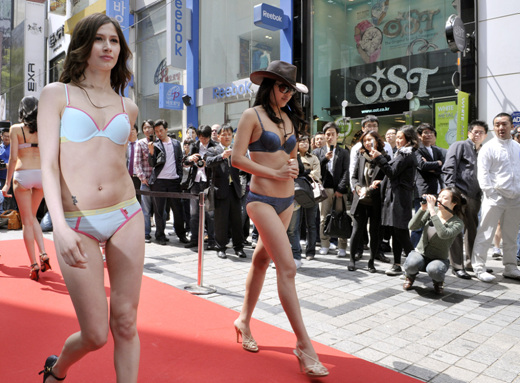
As I’ve discussed previously, lingerie modeling’s associations with porn stars remains the most compelling explanation, especially as the same Korean stars that don’t deign to appear in lingerie advertisements have appeared in quite skimpy bikinis in films and on television. Indeed, how else but shame explains even unknown models at lingerie fashion shows feeling compelled to hide their faces (see #3 here)?

Yet via commenting on the contradictions between sexually explicit Western films recently allowed to be screened here, but a rather tame music video by a Korean singer being banned by broadcasters, Eric Strickland has recently reminded me of the false dichotomy many Koreans have between themselves and supposedly more provocatively-dressed and acting Caucasians, and hence that – herein lies his insight – in many ways standards and expectations for the latter have yet be transferred to the former. Moreover, it doesn’t logically follow from Korean models not appearing in lingerie advertisements that their replacements would overwhelmingly be Caucasians either.

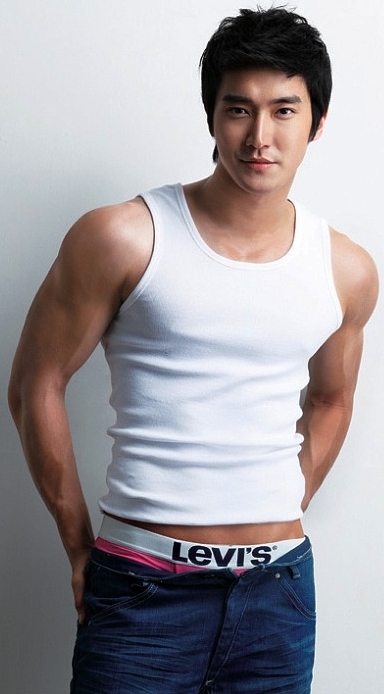
Choi Shi-wonYes, the various institutions and individuals involved with censorship in Korea are hardly a monolithic bloc, and this points to the need for restraint *cough* when interpreting decisions like the above, or, indeed, individual advertisements or even collections of them like Eun-hye’s also.

Something to always bear in mind next time you hear that Korea is rapidly becoming a more (or less) liberal and democratic place over time – depending on the commentator’s perspective – not least from myself! And for me personally, it means that the jury’s still out on the clothed-Korean/unclothed-Caucasian phenomenon.

Meanwhile, other notable cases of stars strutting their stuff last week were Choi Shi-won (최시원) of Super Junior (슈퍼주니어) on the left (source), apparently “the first idol star” to appear on the cover of Men’s Health (Korea) magazine, and also Rain (비), who has recently signed a 2-year, 1.5 billion Korean Won modeling contract with cosmetic brand Nature Republic to be its exclusive model (see here and here).

2. Taiwan Sees Rise in Domestic Violence

For an excellent introduction to the subject, see here. And if you’re interested in that, then please also see here for a video introduction to domestic violence in Japan; here for the first post in my five-part series on domestic violence in Korea (which I hope to resume later this week); and finally here for information about a recent Korean movie exploring the subject.

3. Number of Newborns Falls for 13th Consecutive Month

I’ve written so much about this subject also, I’ll defer from commenting this time! Amongst all the otherwise depressing news in this Korea Times report though, was the fact that the:

…number of divorces totaled 10,600 in March, down 5.9 percent from a year ago, due mainly to a mandatory system under which couples are required to take a one- to three-month cooling off period. The scheme was introduced as part of government efforts to reduce divorces.

Call me old-fashioned, but I see that as a good thing. However:

The fragile economy also appears to have made disgruntled couples more reluctant to go their separate ways because of the costs associated with divorce.

Although I do think that the cooling-off period will still have a palpable effect in the long run. And, lest you think that it is too long, consider that in New Zealand it is 2 years!

4. Big Mama…Not So Big Anymore?

Big Mama Korean Group

Shame on me for not hearing about this group earlier! Apparently Big Mama (빅마마) are a very talented music group, but they haven’t gotten the attention they deserve in Korea because – as the name implies – they’re normal-sized neither thin nor young like the vast majority of popular female singers. Ironically Lee Young-hyun (이영현) though, third from the right above (source), was recently in the news for losing weight.

5. Historic LGBT Festivals to be Held Next Week

In the words of Korea Beat:

From June 5th through 7th in Busan will be held the “Stonewell Celebration” to protect the rights of sexual minorities.

Ahead of the 40th anniversary of the Stonewall riot, Korean gay rights organization Chingusai and others announced on the 26th that they will hold a Stonewall Celebration in Busan, Gwangju, and Daegu to call for protection of the rights of sexual minorities.

See the original post for more details. Unfortunately, browsing through the links in that post there appears to be little to no information available in English, and if you’re confident enough with your Korean ability to attend regardless…then you won’t need my Korean wife me to translate anything for you before you do!  But for any non-Korean speakers still interested in the subject of LGBT rights in Korea, then I recommend the Autumn 2005 Korea Journal article “Intersectionality Revealed: Sexual Politics in Post-IMF Korea” by Cho Ju-hyun as the most recent and comprehensive guide, available here. Among other things, it mentions that unfortunately lesbian activists have been restricted from membership from mainstream umbrella Korean Women’s organizations, thereby having to form their own from scratch.

In passing, here is information about two short Korean films that screened at the recent San Francisco International LGBT Film Festival.

Update: here and here are two more recent blog posts that are also good introductions to LGBT life in Korea.

Update 2: Lost among all the attention being given to the former president Roh Moo-hyun’s (노무현) suicide last week (belying a huge social problem in Korea), well-known transgender star Harisu (하리수) has set up a transgender performance cum support group.

Update 3: It’s two years old, and a translation of an article two years older still, but otherwise Korea Beat has an excellent (and surprisingly long) post about teen homosexuality in Korea here.

Jo Shin-ae Pre Wedding Pictures6. On Being A Princess in Korea

I was tempted to include this image (source) of Jo Shin-ae (조신애) in my “Korean Sociological Images” series, but then it really illustrates a cultural feature of Korea rather than a sociological phenomenon really, and that is the almost universal practice for engaged couples to hire photographers to take pictures of them in various outfits and locations before their wedding, then to prominently display those pictures at the event itself. And while I chose not to get them for my own wedding as I’ll explain, that is not the same as saying that they can’t be quite nice and/or classy, and I don’t think it’s patronizing or in any way a criticism to say that women probably enjoy having them taken more than men because of the fantasy/dress-up element to it either.

Personally though, after wandering through parks full of couples romantically looking into each other’s eyes at sunset…accompanied by a team of two photographers and four assistants, and perhaps 10m away from two other couples and their own photographers on either side of them (and so on, completely surrounding lakes and riversides!), or alternatively seeing couples taking pictures like these at Gwanganlli Beach in Busan (scroll down)…with my big, smelly, sweaty, and unshaven self quite possibly jogging less than 6m away from them at the time, then I found the whole concept too expensive superficial and cheesy to consider taking them for my own wedding.

Having said that, having spent most of my adult life in Korea then it’s Korean weddings that I’m most familiar with, and in fact I never actually attended any in New Zealand before I left when I was 24. Am I correct in assuming though, that most Western countries still lack this pre-wedding custom?

As for Shin-ae, she got married on Thursday (see here also), as did actors Seol Gyeong-gu (설경구) and Song Yoon-ah (송윤아) (see here for pictures).

Update: If anyone’s into that sort of thing – and judging by number of clicks on the links above, then a surprising number of you are – then here is some extra information about Shin-ae’s wedding dress!

7. Old, Heavily Censored Korean Movies…Censored Even More by EBS!

korean censorshipThis certainly puts what I wrote in #1 into some perspective, and deserves to be much better known. From Seen in Jeonju:

For many years I have enjoyed the late night Korean classic series that airs over the Educational Broadcasting Service on Sunday night. Through that I have gotten to see many old movies from the 50s, 60s, and 70s and for that I am forever grateful.  However, I now have a question for whomever is in charge of the show–please don’t think me disrespectful but I have to ask.  What the hell have you been doing?  For the last four weeks, whenever I watch the movies selected, I wind up turning it off in disgust. Why?  Because some idiot has decided to censor the films that are being shown!  Movies from the 60s and 70s were subject to enormous amounts of government interference and censorship.  Now some moralist over at EBS has decided to restrict these films even more! There was so much government control in the earlier decades that I didn’t  think there was anything left to censor.  Apparently I was wrong…

Read the rest here. While the re-censoring is restricted to blurring out knives and cigarettes (yes really, and all in movies playing late at night), there is perhaps no greater indictment of the Lee Myung-bak Administration’s moves to restrict media freedom than feeling the need to examine movies already censored by military dictatorships, let alone finding their efforts inadequate! The arbitrary nature and ineffectiveness of it are also annoying, and ultimately very worrying.

In related news, albeit slightly old, this post on a German English-language site about Asian movies discusses the differences between the international trailer and the tamer Korean trailer for the movie Thirst (박쥐).

censored Korean trailer for Thirst

8. “Working Wives and Incompetent Husbands” in North Korea

Part 4 of a series on “the ideal model of North Korean Housewife.” The site is a little difficult to navigate, so if you want to read more then Part 1, 2, and 3 are available here, here and here also.

9. International Marriage: Links

For a thorough introduction, see posts by Matt at Gusts of Popular Feeling here and here (for starters, and this is also interesting). Meanwhile:

10. Gender Equality Minister Byun Do-yoon

In a short and very readable interview for The Jakarta Post on Wednesday, with many interesting tidbits about the history of the ministry (여성부) and Korean feminism as a whole.

About PopMatters

PopMatters is an international magazine of cultural criticism. Our scope is broadly cast on all things pop culture, and our content is updated daily, Monday through Friday.  We provide intelligent reviews, engaging interviews, and in-depth essays on most cultural products and expressions in areas such as music, television, films, books, video games, sports, theatre, the visual arts, travel, and the Internet. Since 1999, PopMatters has been providing smart readers with sharp, entertaining writing on a wide range of topics in pop culture, offering a refuge from the usual hype and gossip.

PopMatters cultivates smart writers from the world-at-large. Our staff ranges from the multiple-degreed and/or well traveled, to young writers of high caliber, to ‘seasoned’ folks who punch the 9-5 clock, regardless of what type of degree, if any, they may hold. PopMatters recognizes that creative, compassionate intellectuals reside in all levels of society, in all types of societies, and we value their ability to provide intelligent, entertaining cultural criticism in the form of thoughtful, magazine-style essays. Many of our writers are called upon for their opinion by notable members of the media such as the BBC, NPR, MSNBC, Radio Australia, and VH1. Publications such as USA Today.com, Alternet.org, and Imdb.com regularly pick up links to PopMatters articles and post quotes from PopMatters writers.  Our articles are also indexed by all English language Google News sites and by NewsNow in the UK.

Naturally, this value for our staff and our content extends to great respect for our readers, who also hail from many parts of the world, are inquisitive and savvy, and bring many experiences and expectations to this magazine. Our intent is to reach the broadest possible audience with intelligent and thought-provoking writing that is often not readily available within the mainstream mass media.  We currently have over 1 million unique readers per month, and counting.

Among those readers, Entertainment Weekly has listed PopMatters as one of its favorite popular culture websites. Music critic Jim DeRogatis has said that “writing as thought-provoking, engaging, insightful, witty, and just plain ol’ fun as much of the fare on PopMatters is a rare and wonderful thing, and it should be treasured.”

PopMatters has had essays published in Da Capo’s Best Music Writing series for several years.  In 2006’s edition, we are represented by two essays.  PopMatters was also nominated for a Plug Award for best music website in 2006.

PopMatters has been profiled and/or namedropped in all of these reputable sources: BBC, New York Times, The Times (London), The Guardian, Slate, Salon, Entertainment Weekly, Financial Times, NME, CBC, Variety, The Globe & Mail (Canada), Scotland on Sunday, Daily Telegraph, Chicago Sun-Times, USA Today, Newsday, Boston Globe, Baltimore Sun, and Curve among others.

PopMatters has a partnership with McClatchy-Tribune, whereby some of our content is syndicated into newspapers via both the MCT newswires and their premium package, “What’s Next”, targeting 18-34-year-olds. PopMatters produces four nationally syndicated newspaper columns weekly, distributed to over 1,000 U.S. metro dailies via MCT Direct, and over 1,000 college newspapers via MCT Campus: “PopMatters Picks”, details the best in pop culture each week (MCT Direct and MCT Campus); “20 Questions”, a playful Q&A, reveals the gist of national and internationally-renowned artists and intellectuals (MCT Direct); “Sound Affects”, zeroes in on the week’s top topics in music (MCT Direct and MCT Campus); and “The Riff Report”, a twice weekly music news column penned by PopMatters editor and publisher Sarah Zupko (MCT Direct and MCT Campus).

At this writing PopMatters hosts eight blogs from high-caliber writers: “Short Ends and Leader”, a multi-faceted daily film blog edited by Bill Gibron; “Marginal Utility”, essays on consumer culture by critic Rob Homing; “Sound Affects”, our music blog; “Moving Pixels”, our blog devoted to all things video games; “Re:Print”, our books blog; “Notes from the Road”, on the scene cultural reporting and photo essays; “Peripatetic Postcards”, a travel blog by Japanese pop culture critic Todd ‘tjm’ Holden; and “Crazed by the Music”, discussions on and examinations into matters related to the music business, by music critic, Jason Gross.

Share

Korean Gender Reader

Chae-Yeon in her underwear cropped1. Chae-yeon’s Music Video Banned by Korean Broadcasters

Personally, I think that the K-pop blogs (see here and here) have been too harsh in their criticisms of Chae-yeon’s (채연) new music video Shake (흔들려) as being more skanky than sexy, and while it’s certainly true that at the ripe old age of 31 she’s much older than most Korean pop stars, any c0mments to the effect that the video is a sign of desperation on her part are rendered false by her being no stranger to sexy outfits and provocative dances and music videos since…well, pretty much since she first rose to fame in late 2003.

Now, I’m not so naive as to think that her management company, now humbled into editing the video to make it suitable for television, didn’t deliberately seek this ban for promotional purposes, nor do I so dogmatically associate sexual liberation and it’s expression in the media with democratization that I see Chae-yeon as a feminist pioneer merely for showing us some cleavage either. But if you actually see the video, then like I imagine what most Koreans are doing you will probably ask yourself what all the fuss is about. And coming on top of the Ministry for Health, Welfare and Family Affairs recent banning of music group TVXQ’s I’ve Got You Under My Skin from TV and radio on the one hand (see #2 here), but also the Supreme Court’s recent ruling in favor of the import and distribution of the very sexually explicit U.S. film Shortbus on the other (see #1 here), then it doesn’t seem unreasonable to suppose that this latest banning just adds to Koreans’ increasing frustrations with a completely arbitrary, often contradictory, and almost always completely ineffective system for determining what is and isn’t “suitable” for them to watch.

2. The Changing Role of Women in Korea’s Past

Andrei Lankov writes an amusing column here about stereotypes of widows and the prohibitions against their remarriage in Korean history, and how these proved unsustainable in the 1950s in the face of their huge numbers and inability to make a living. After all, considering that they were well-known to have voracious sexual desires, all the better for them to remarry and have a man to provide for them rather than satisfy themselves with married men (but remain destitute).

Meanwhile, here Don Southerton discusses how paintings of the late-18th and early-19th Century reflected changes in women’s roles in the late Joseon dynasty (대조선국).

3. Female Climber Conquers Top 11 Himalayan Peaks

South Korean Oh Eun-sun, 43, became Korea’s first and the world’s third female mountaineer to conquer the 11 highest Himalayan peaks, her agency said Friday.

On top of that…*cough*…she aims to be the first women in the world to climb the 14 highest, and will on her way to Pakistan to do just that as soon as July!

4. “Making Pregnancy Unglamorous”

jung hye-young uncomfortable pregnancy D-line(Source: Cloudnain)

Skinny Bitch Bun in the OvenAs a father of two, then I don’t know how anyone could ever describe pregnancy as “glamorous,” although if one doesn’t have any direct experience of it then I suppose that Byun Jung-soo (변정수) and Son Tae-young (손태영) did manage to pull that image off, or at least within the confines of a photo studio and then with later retouching by Photoshop that is (see here and #11 here respectively).

Unfortunately, the same can’t really be said of Jung Hye-young (정혜영) in photos of her pregnant figure in Elle magazine here, here, and here, and which with her squashed belly in some and high heels in all of them, beg the question of what Elle’s purpose in taking them was exactly. To highlight how uncomfortable pregnancy actually is in reality? :D

Update, right: A book that all these recent celebrity pregnancies reminded of (see here for the details).

5. Koreans’ Bodies Are Changing

Obviously Koreans are getting much taller as a result of their better diets, and these days it’s not at all unusual to see children literally a foot (30.48cm) or more taller than their parents because those have improved so rapidly. Personally, whenever I see such a stark contrast I’m always reminded of sociologist So-Hee Lee’s point that ” Generation is an important attribute of identity in Korea, like race in the United States” (p. 146 of this book), and something always good to bear in mind when thinking about Korean society, although it was intended as more of a comment on how that was changing so quickly rather than on Koreans’ actual bodies themselves!

But the shape of their faces changing also? Apparently so, according to this article, but it seems counter-intuitive, and without further access to the original data and descriptions of the methodology of the Korean Agency for Technology and Standards behind the research, then the first thing that comes to mind is the possibility – but I stress, only possibility – that researchers may be projecting today’s desired face shapes and/or changes onto the data.

Just something to bear in mind: it would be good to have more information. In the meantime, for more discussion of that and other related issues, see here and here, and let me highlight Sonagi’s point that “Nutrition can explain changes in bone and facial structure” especially.

6. The Five Prettiest Male Entertainers

A description to be taken literally!  See the results of a netizen poll here.

7. Traditional Feminism

“Traditional” in the sense that some people are actually doing something about women’s inequality here rather than *cough* merely writing about on the internet. First, see here for more information about a group of Korean women that “envision a global network of local feminist activists that they are calling the Glocal Activist Network (글로컬액티비즘), and are traveling the world to recruit organizations and individuals to join up,” then here for a little about members of the Korean Women’s Trade Union who are campaigning for a 1000 won increase in the minimum wage (I believe it’s at about 3500 won at the moment, or US$2.80), and finally here on the rising inequality in Korea behind the latter, which has disproportionately affected women (see #2 here).

8. Love, Marriage, Babies…and Taxes

As I discuss here, with Korean women still being “encouraged to resign” once their bosses discover that they’re pregnant, then I’ve often made the point that minimal tax incentives and/or one-off cash payments for recent parents are unlikely to encourage many women to have more children, and indeed – lo and behold – Korea has had the lowest birthrate in the world for the second-year running.

Moreover, it turns out that while “conventional wisdom holds that married couples with children pay less income tax than singles, with multiple-member households enjoying greater tax deductions,” in fact “the nation’s tax system still favors single-member households over married couples,” according to this report.

On top of that, Korea already has the third most dangerous roads for children in the OECD (and is the sixth most dangerous to drive in overall), and Korean children and teenagers are the unhappiest in the OECD also.  Which begs the question of why I chose to raise two here myself…

9. Seoul Going Woman Friendly

I’ve already mentioned the increases in the numbers of women’s toilets, and a more comprehensive list of the changes being made is available here. Many are logical and positive steps, but most attention has (naturally) been given to the “women-only parking spaces, ” conceived under the explicit assumption that “women are worse drivers” (see here and here). That is sexist and just plain wrong, like I noted in #3 here, but the following extra information in that first link above draw my attention to yet another, overlooked sexist element:

…Seongdong and Dongdaemun in Seoul offer women-only parking spaces designed to help female drivers. The parking spaces are a bit larger than ordinary, giving consideration to children and baby carriages, and are also arranged in bright and open places.

On the one hand, it’s good that they’re in bright and open places, and women may well enjoy the greater room for children and baby carriages also. But then, as this image from Thailand reminded me, it also reinforces the notion that childcare is only women’s work.

10. Kim Yu-na: Most Overexposed Performer in Korean Commercials

I’ve nothing against ice-skater Kim Yu-na, and in fact quite like the new sultry and sweaty side of her presented in the image on the left (source, and see here also), quite a contrast to the childish image of her that is usually presented in the media (and of Korean female celebrities in general). But the idea of drinking milk while exercising is so incongruous that I soon wake up from any fantasies Maeil presumably wanted me to have, although it has to be said that that probably wouldn’t put most Koreans off, whom will in my experience drink it at some distinctly odd times and occasions (such as with spicy kimchee-stew (김치찌개), and after a hard day’s hiking!).

More to the point, Yu-na appeared in more commercials than any other Korean celebrity in the May 2008-May 2009 period, and yet is merely the latest – and certainly won’t be the last – in a string of Korean personalities to suddenly become famous overseas and thereby immediately overexposed in the Korean media. For more on that, and on Koreans’ collective passionate embrace of a sport once a Korean person – any Korean person – becomes internationally successful in it, and their just as abrupt abandonment of all interest in it after their fame dies down, see here, here, here and here.

(By the way, “Kim Yu-na” is a very bad Anglicization of  “김연아”: the official one of “Kim Yeon-ah”, with the “eo” sounding like the “o” in hot, would be much better)

Korean Gender Reader

White Kim Hye-su Missha1. Number of Women Suffering Osteoporotic Fracture Increasing

So short that I may as well give the entire article:

Around 200 out of 100,000 Korean women are suffering from osteoporotic fracture, more than a four-fold increase over the past decade. The estimated annual socio-economic losses from such fractures are around W1.05 trillion (US$1=W1,275).

According to a 2007 survey by the U.S. National Institute of Health, the number of female osteoporotic fracture patients was seven times more than that of breast cancer patients, 2.5 times more than stroke patients, and 1.4 times more than heart attack patients.

Moon Sung-hwan, an orthopedist at Severance Hospital, said, “According to the World Health Organization, one in four women suffers a fracture in her lifetime. The rate increases to over 33 percent among those in their 60s or 70s, and 50 percent among those aged 80 or over.” Hip-joint fractures are particularly dangerous, since approximately 30 percent of patients die within two years.

I accept that a host of factors may be responsible for the dramatic increase, but as I make clear here, here, and here, Korean women go to great lengths to avoid the sun for the sake of light skins (to the extent that they now have among the lowest Vitamin D levels in the world). Moreover, as Korean women’s disposable incomes have gone up over the last few decades then so too has the range of whitening creams, lotions, and pills and so forth available to them, one of the most recent of which is that in this recent advertisement with Kim Hye-su (김혜수) for Korean cosmetics company Missha (미샤) above (source). It is not illogical to suppose that with greater spending on such items comes even greater care and attention to avoiding the sun, hence a drop in Vitamin D levels, and in turn a greater risk of osteoporotic fracture.

Naturally, that would be more young women than the middle-aged and older women most at risk, so there is an unresolved issue of timing with the recent increase. Alternative explanations?

2. South Korea Ranks Low In Terms Of Its Mothers’ Quality Of Life

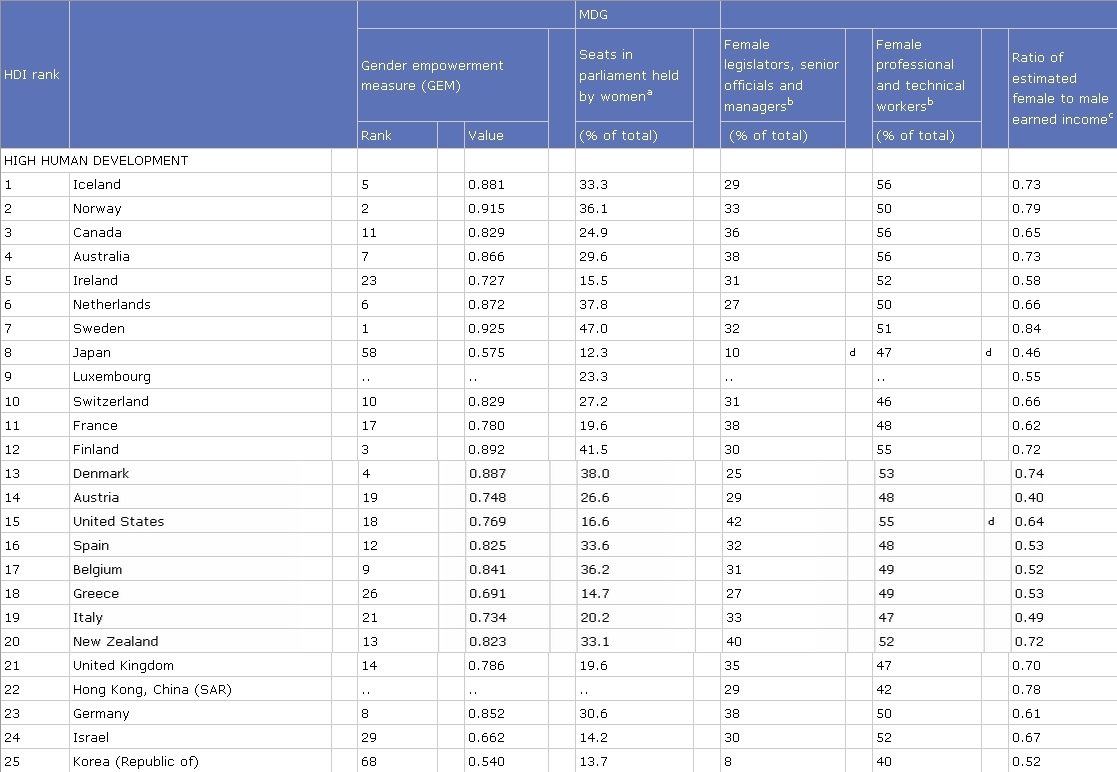
For the details, see here. Again, just like with the UNDP’s 2008  “Human Development Index” and “Gender Empowerment Index” that I discussed here, whereas most countries’ economic indicators are also pretty good guides to the quality of life there, when it comes to Korea anything to do with women’s quality of life trails those economic indicators quite significantly. In this case for instance, its GDP was 15th largest in the world in 2008, but somehow it was only the 50th best place to be a mother (out of 158 countries surveyed).

I haven’t looked at the breakdown of the figures, but I would be very surprised if Korean maternal and infant death rates weren’t indeed the 15th lowest in the world or even lower, but that Korea lost a great deal of marks on its inability and/or unwillingness to reintegrate mothers into the workplace. For stark illustrations of just how bad Korea is in that regard, see here.

3. Jeong Ryeo-won’s Anorexia Problems?

Skinny Jeong Ryeo-won in April 2009(Source: zziixx)

In this interview, Jeong Ryeo-won (정려원) claims that she only lost the weight for a recent movie role, and never went below 40kg, but personally I think that the jury is still out on both. Regardless, in a sense it’s surprising that she’s been getting the attention that she has for it, considering that Biotherm presumably thinks that that caricature of an actual women above would not repel Korean women but be instead what they aspire to look like themselves. And if you think that that’s bad, wait till you see how she looked last July, when clothing retailer Giordano thought that pictures of her that scared my two year-old daughter would somehow have women rushing to their stores…

4. “If I Can Grope You, You Pass”

There’s been a great deal more discussion of the case of the student teachers sexually harassed by four teachers at their assigned public school earlier in the month (see #4 here), but probably the best is that at Brian in Jeollanam-do here, who also talks about the pervasiveness of this sort of thing at mandatory drinking parties at Korean workplaces. Here and here are two follow-ups also.

Meanwhile, the medical confinement of sexual predators has begun. According to Korea Beat, it’s a rare positive step, with rehabilitation as the goal.

Cruel Temptations Korean Drama5. Swearing Increases on Korean Television

A strange inclusion perhaps, but while there are naturally awkward aspects to all societies that its members are aware of but refuse to acknowledge and/or discuss (particularly sexual ones), in this part of world cultural norms of deference to authority, saving face, and not wanting to stand out in the crowd and so on probably mean that pressing social issues tend to get avoided for longer than in most.

So far, so cliched. Sure. But in a general sense, it’s a step in the right direction when popular culture reflects how people actually think, speak, and behave rather than cultural producers’ notions of how they should do so, and can create a feedback loop leading to more of the same

More concretely though, a spate of Korean women swearing on television, which appears to be occurring in the currently playing popular drama Cruel Temptations on the right in particular (source), may well challenge the sexist dubbing of foreign films and dramas, reported on by Robert Koehler in 2006:

A women’s group has issued a report on the “sexist” dubbing of foreign films and dramas, reports women’s newspaper Ilda The group took a look at some 27 English-language dramas shown on terrestrial broadcasting in September and October.  It found that most of them employed sexist sexist practices when dubbed into Korean.  Namely, male characters spoke in banmal, or “low language,” while female characters used jondaenmal, or “high/respectful” language, even though the original English dialogue made no such distinctions.

I don’t watch enough Korean television to know how prevalent this practice still is (can any readers fill me in?), but if it does still occur then it can only look more ridiculous in light of these new developments.

And I say “ridiculous” because a) it is, and b) I’m not so sure that any Korean couples even speak like that anymore, but then if any of my own limited circle of Korean friends used such a sexist division of language with their spouses and partners then we probably wouldn’t be friends in the first place! Can anyone without kids who gets to leave the house more than do I confirm that that is indeed out of date now (or not)?

6. Love and Marriage

Worried Moment for Korean Couple(Source: Unknown)

First up, the Korea Times reports that there’s a recent trend for employers to set up events for their single employees to meet:

Here’s what they do ― First, companies offer their single staff to register for a large dating event offsite at a hotel or theme mark. Matchmaking companies then kick in with games and events to help the crowd get to know each other better. At the end of the session, participants pick ― through a secret ballot ― who they want to be with.

Duo says about 50 people are accepted for one session and 30 percent of them go home as a couple. Some companies host the event as much as four times a year.

Considering Koreans are physically at work for some of the longest hours in the world, albeit not actually working for much of them (see here), then these events certainly make sense, although I doubt that they’re so efficient and no-nonsense that 30 percent of participants “go home as a couple”(!). Which makes me wonder whether: the long hours and culture of the salaryman system is primarily responsible for the idea (or rather, the vestiges of it), and if so if it is mirrored in Japan especially; or the fact that most Koreans were raised in single-sex middle and high-schools until recently, and thus much prefer arranged, usually group meetings rather than being so bold as to ask the opposite sex for a date directly; or, most likely, a combination of the two?

Regardless, Korean companies clearly seem unlikely to go down the Western path of banning the practice anytime soon, but on a more grass-roots level Koreans I have spoken to about this personally have invariably been surprised to hear about what occurs – or rather, what doesn’t occur – in Western workplaces, and have taken a surprising amount of time to get their heads around notions such as “Don’t screw the crew.” But naturally my friends and students don’t speak for all Koreans, so I’d be interested in hearing what others have (had) to say.

Before I forget, Michael Hurt has written an excellent guide for (primarily) men on the positives and pitfalls of dating Korean women because of having such different backgrounds, including the effects of that single-sex schooling as mentioned. But don’t get the wrong impression: this is not a “How to screw Korean women”  kind of Korean guide, but rather something I could very much relate to after being in a relationship with a Korean woman for the last 9 years, and that I wish had been available much earlier!

Also, Koreans are continuing to get married at later and later ages, compounded by the recent financial crisis:

The latest statistics compound the frustrations felt by baby boomer parents. Last year, the average marrying age was 31.4 for men and 28.3 for women. More and more Koreans are choosing to marry later in life. In 1981, Korean men got married at an average age of 26.4 and women when they were 23.2. This means in 27 years, the average marrying age has been pushed back five years. Three out of 10 Koreans between the ages of 25 and 34, which are considered prime marrying years, are single.

In addition, the crisis is also having an effect on the kind of ceremonies couples that actually do get married actually have, practicalities and strained finances forcing a rethink in the previous norm of the groom’s family paying for the couple’s apartment, and the bride’s for the contents.

A more equitable, more Feminist arrangement because it’s the cheapest? God moves in mysterious ways!

And finally, here is a story about a matchmaker that is setting up North Korean defectors with eligible South Korean men.

7. Quick Links

A follow-up on the Joo Ji-hoon drug scandal, which I discussed last week.

KoreaBeat briefly discusses a TV program about a 23 year-old that leads a double life as a university student and a prostitute, and also about the military opening up to girlfriends, sisters and mothers by encouraging conscripts to blog about their experiences. Considering the huge socialization effect of military conscription on Korean men, then this may ultimately prove much more significant than it probably first appears.

– And last but not least, more information on the cost of studying in Korea at Extra! Korea here, and part and parcel of the primarily financial and not cultural reasons that Koreans adults live with their parents until marriage.

Korean Gender Reader

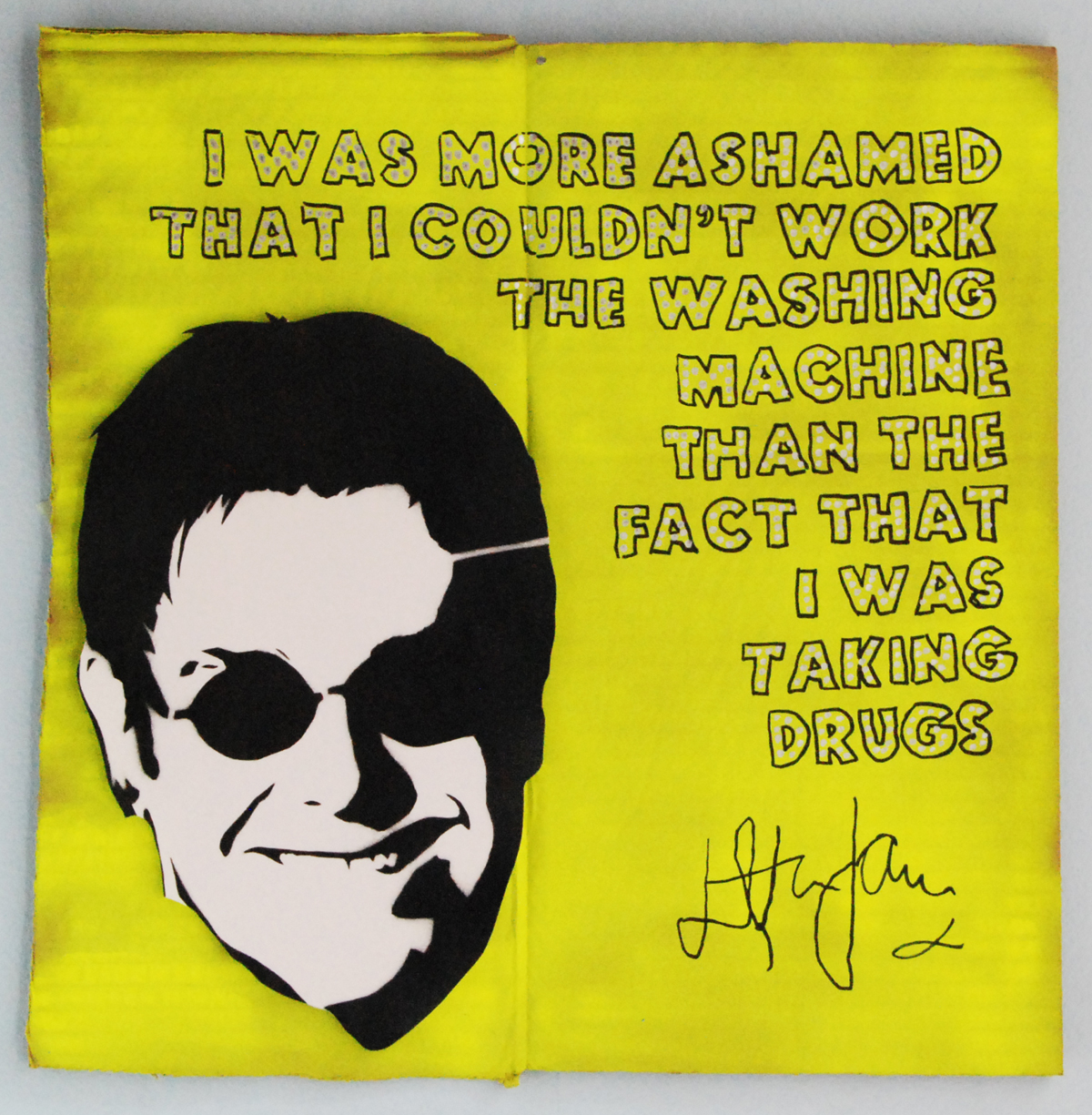
elton-john-drugs-quoteSource: id-iom.

Sorry for the delay: although I’d like to provide a much more professional-sounding excuse, the reality is that my toddler’s constant temper tantrums over the last two days have completely ruined my blogging plans for this week!

1. Joo Ji-hoon Drug Scandal

My personal choice for the most interesting story last week. In brief:

In the latest drug bust of entertainers, police booked popular film star Ju Ji-hun, 27, on suspicion of drug use and arrest warrants were sought for actress Yun Seol-hee, 28, and model Ye Hak-young, 26, for alleged smuggling ecstasy tablets and ketamine into the country from Japan. Two other residents were booked on similar suspicions.

“Besides the suspects on the list we have secured, there are likely more, given the amount of drugs smuggled. Further investigations are unavoidable,” an officer of the Seoul Metropolitan Policy Agency said (Korea Times).

Why I found it so interesting, and why it’s notable in a feminist sense, is because of how the huge disparities between Western and Korean celebrity culture may play out here. Very broadly speaking, Westerners usually tolerate – nay, encourage –  debauchery on the part of their idols, but Koreans are the polar opposite, usually demanding of celebrities standards of behavior and conduct much stricter than they do of themselves. Throw sexual double-standards and many especially young actresses frequently playing “sweet and innocent” roles into the mix too, then many female celebrities in particular have faced heavy public opprobrium once they have been revealed to be, say, merely human.

Yoon eun hye the temptressHence my first thought that the female celebrities involved in this scandal might get the most flak for it, but as Joo Ji-hoon (주지훈) is so much better known than them then so far most attention has been on him instead. Naturally, this story is all over the K-pop blogs, but DramaBeans provides the best coverage: see here, here and then here for all the details in chronological order, to which I’d add the surprising news that so far he hasn’t given the tearful apology that is de rigueur for these situations, and instead is – shock! horror! – unrepentant.

(Right: Does the blame ultimately lie with Yoon Eun-hye? Source)

2. I’ve Got You Under My Skin

Previous restrictions on nudity, sex, and swearing in the media are rapidly being lifted in Korea (see #1 here), but that doesn’t mean that all the individuals and institutions involved are liberalizing things at the same speed, nor, indeed, that they’re even on the same page. As I explain in the bottom of this post:

…aside from the government’s push for a  “real name” internet system of course, one other notable censorship issue is the Youth Protection Committee’s (of the Ministry for Health, Welfare and Family Affairs; see #4 here) recent banning of music group TVXQ’s latest songs from being played on TV and the radio because of “lewd content” (see here also). But one might ask what exactly the point was considering the album has already been out for six months though!

And blogger Gord Sellar has written an excellent post on the supreme irony of this:

…The idea that a censor who cannot speak English well enough to understand the nuances of what’s being said is interesting.

But then again, there’s also the nuances of what’s being heard. After all, I can say, “Ha, that censor doesn’t know enough English to know that it means, “I’ve got you on my mind,” or, “You’ve affected me emotionally in such a way that I cannot shake this effect you have on me.” But the censor’s grasp of English is…

Well, there’s the question. The Ministry for Health, Welfare and Family Affairs certainly doesn’t seem to know what the phrase means in English — though it’s well-documented, is present in popular culture, and absolutely innocuous in an English speaking context. (Even the stuff about “… deep down in the heart of me, so deep inside, that you’re really a part of me…” is tame enough to have been on mainstream TV back when sexual content was not broadcast in the States.)

See here for the rest.

3. More Female Toilets to be Built in Seoul

By coincidence, I heard on the Guardian Daily podcast last year about recent changes to laws in the UK requiring all new buildings to have female toilets double the size of those provided for men, and as a guy I had no idea of just how impractical and inconvenient and still steeped in a Victorian architectural mentality many are there, ultimately with big impacts on women with children in particular (and in turn, families), although as a father now I have much the same problems myself, and can certainly empathize. See here, here, here for more information on that UK case, but most of the problems mentioned would be universal,  and so provide some good context for the following news about the Seoul City Government, which will:

…increase the number of women’s toilets to close to that of their male counterparts. Currently, there are 42,348 male toilets compared to only 34,649 toilets for females. It will build 3,100 more this year and 3,800 next year (Korea Times).

A curious disparity. Regardless, and even if you’re a guy and/or not interested in such matters, at the very least more and bigger female toilets will mean less waiting for your partner, as someone on the podcast I heard mentioned.

Another, somewhat misguided initiative also mentioned in that report is to provide many slightly larger female-only car-parking spaces, the logic presumably being that women are worse drivers and so need more space to maneuver. Admittedly I don’t drive myself, but I’m pretty confident that any car-insurance salesperson can confirm that that is complete bullshit (women actually have less accidents than men), and so this idea reflects the prejudices of the city councilors more than anything else.

Update: See KoreaBeat here for more details.

4. Gwangju Female High School Students Stripped as Punishment

For the details, see Brian in Jeollanam-do here. One minor thing that he forgot to mention in that post is that it occurred at an all-girl high school, but which is not to say that that condones the punishment in any way

Also occurring at a high school, it was reported by the Korea Times that four male teachers are to receive punishment for sexually harassing female interns. Unfortunately, given a history of teachers getting off lightly for far worse offenses, such as one being given only a six-month sentence for sex with an 11 year-old (see #9 here), then…let’s just say I have my doubts as to how effective their ultimate “punishment” will be.

5. Han Chae-young Models Men’s Clothes

han-chae-young-rogatis-한채영-로가디스As allkpop reports, Rogatis (로가디스), a Korean menswear company, has chosen actress Han Chae-young (한채영), as their next model for their latest line of mens clothing (right, source). Not that significant perhaps, but it immediately brought to mind Danish clothing company JBS’s notorious underwear advertisements from last year, which featured virtually naked (naturally) women in men’s underwear, and which ultimately got…er…pulled (see here and here for more on those, but which are probably NSFW).

Now, I’m not going to feign outrage at those, nor at the notion of using women to model men’s clothes in itself, although personally I found the ones with nurses and so forth actually sniffing the underwear (and savoring the smell) to be very unrealistic more of a turn-off than anything else. But I’m curious as to readers’ opinions on the Rogatis advertisements specifically, as although they’re certainly still quite risqué (see more examples here), most of the complaints against those by JSB focused less on the women’s nudity as their explicit subservience in them, which clearly doesn’t apply here.

So, does it work? It it still objectionable in any way? Why, why not?

6. Korea’s Lost Generation

First becoming involved in Korean sociology via the huge differences in living arrangements for 20-somethings between Korea and Western countries, then I’ve long been interested in the various financial barriers that prevented Korean twenty-somethings from leaving home, and without which it’s no exaggeration to say a veritable revolution in Korean sexuality would occur. Indeed, the situation of today, rife with double-standards and open secrets and all, is not at all dissimilar to that of Western countries before huge expansions in university enrollments in the 1960s and 1970s, but until a similar Korean generation of cohabitants that no longer feels a need to hide things emerges from that, then it will continue to be women especially that suffer the most from sexual matters not being out in the open, either physically or by placing feminine virginity and “modesty” on a pedestal.

In my most recent posts on the subject then (here, here, and here), excessive student loan interest rates and rising univeristy fees have emerged as the biggest of those financial burdens, and in many ways what is occurring in Korea today parallels what occurred when I was a student myself in New Zealand in the mid-1990s. I didn’t, however, have this to contend with also:

As a candidate, President Lee Myung-bak promised to slash school fees by 50 percent and create 600,000 jobs annually. He did neither….

….It’s true President Lee had made these pledges before he knew the world would fall to what he has dubbed the “unprecedented” economic crisis. But there are not many governments trying to get out of this crisis by cutting initial salaries of college graduates, and telling them to remain content with internships, as the Lee administration does now.

President Lee called for the new entrants into labor markets, who probably constitute the best-educated generation of all, to “lower their sights and start humbly.” This could pass as advice among individuals but hardly a sermon coming from a responsible official ― much less the head of state ― to the fresh workforce that will shoulder the nation’s future.

By all means much recent criticism about the Korea Times is deserved (see here and here), but the editorial that that is from may prove remarkably prescient: at the very least, telling a whole swath of young people to STFU and be content with working in Family Mart for what should be the most productive and exciting part of their lives will accentuate their disengagement with the political process.

7. Birth, Death and Divorce in Korea

A swathe of statistics on each have been published recently:  for links and analysis on the former two especially, see Matt at Gusts of Popular Feeling here, and for the latter see Brian in Jelloanamdo here.

Meanwhile, if you’re futher interested in Korean demographics, particularly similarities and differences in family structures between Korea, the US, and Japan,  then you’ll probably like this series of mine on the subject also.

8. Korea’s Lack of Rape Kits: A Comparison to the U.S.

As someone who gets plagiarized himself on a regular basis, then normally I’d be very reluctant to cut and paste a post by KoreaBeat in its entirety, but in this case I think I can make a rare exception:

Nicholas Kristof wrote in [the] New York Times about the problem of severely backlogged rape kits in the United States, putting me in mind of how they are often never even collected in Korea.

And the latter, a translation of a lengthy article on the subject, should be required reading for everyone reading this blog!

If you reside in South Korea, you can donate via wire transfer: Turnbull James Edward (Kookmin Bank/국민은행, 563401-01-214324)

Korean Gender Reader

supposedly-fat-kim-yu-bin-김유빈(Source: 원더풀홀릭)

1. God Moves in Mysterious Ways

My opinions on the marketing of teenage girl groups like the Wondergirls (원더걸스) have become much more nuanced since I wrote controversial posts like this and this a year ago, although regardless of my criticisms I never had anything against any of the groups or the singers themselves. And good on Kim Yu-bin (김유빈) above for standing up to the netizens who can’t tell the difference between turning “fat” and turning into a woman.

2. Korea Drops from 64th to 68th in its Gender Empowerment Measure

Probably the most stunning indictment of Korea’s gender relations, it’s worth quoting this Hankyoreh report in full for those of you who haven’t heard of the GEM before:

South Korea fell further out of the mid-low range last year compared to other world nations in women’s rights, a report shows.

According to [2008 data] released Monday, calculated by the United Nations Development Programme for over 100 world nations, South Korea earned a score of 0.54, falling four spaces to 68th from its 2007 ranking of 64th.

The GEM is an indicator of women’s degree of participation in political and economic activity and the policy-making process, using for its evaluation factors such as the number of female legislators, the percentage of women in senior official and managerial positions, the percentage of women in professional and technical positions, and the income differential between men and women. A value closer to 1 indicates a higher level of empowerment.

In the first set of GEM calculations released in 1995, South Korea ranked 90th out of 116 countries, but its ranking gradually rose after that, reaching 68th in 2004, 59th in 2005 and 53rd in 2006. But its ranking fell once again in 2007, as it fell considerably compared to the overall average for nations assessed in areas such as percentage of female legislators and female professionals.

Like Michael Hurt pointed out back in 2006, these figures need to be placed in the context of Korea’s ranking in the Human Development Index (HDI), which combines things like life expectancy and education levels. Roughly speaking, the more developed and better a country is to live in the higher its HDI ranking will be, and usually its GEM will be pretty similar too. But then look at these (click for a much larger version):

south-korea-2008-gender-empowerment-measure-gem-ranking-by-human-development-index-hdi(Source: UNData)

In brief, of the best 25 countries in the world to live in, only 4 are not also among the best 25 countries in terms of women’s rights and levels of economic and political power: Greece on 26, Israel on 29, Japan on 58, and finally Korea on 68. Put another way, women will certainly have a good quality of life in Korea, but they have less chance of becoming a politician or even a middle-manager or computer programmer than in:

  • 59 Kyrgyzstan,
  • 60 the Dominican Republic,
  • 61 the Philippines,
  • 62 Vietnam,
  • 63 Moldova,
  • 64 Botswana,
  • 65 the Russian Federation,
  • 66 Uruguay,

and

  • 67 Nicaragua, the HDI of which was 120th(!) out of 179 countries surveyed.

In fairness though, Korea has actually improved in absolute if not relative terms:

In South Korea last year, women accounted for 13.7 percent of legislators, 8.0 percent of administrative and managerial positions and 40 percent of professional and technical positions, while the ratio of female to male income was 0.52.

The overall percentage improved from 2007, but South Korea was pushed down in the rankings through an overall improvement in gender empowerment among other nations examined. The overall average values for the nations studied were 19 percent for the percentage of female legislators, 29 percent for women in administrative and managerial positions, and 48 percent for women in professional and technical positions.

True, the gap between Japan’s HDI and GEM is also so high, and I can’t blame Korea’s low GEM ranking almost entirely on military conscription in this series but also regularly claim deep economic and social similarities between the two countries in other posts. While I do eventually plan to start covering gender issues in at least Japan and Taiwan though, until then I’d strongly caution against looking for easy explanations such as shared Neo-Confucianism, as Singapore’s HDI is 28 but it’s GEM 15(!), and China’s 94 and 72 respectively for instance (unfortunately there are no separate figures for Hong Kong, or for non-member state Taiwan). Moreover, China’s comparatively good GEM score is not due to the number of women in state-owned enterprises, as they almost always held lower, non-advancing positions within them and were the first to go when they were privatized, wound down, or restructured (but it may account for Vietnam’s relatively good one though).

caucasian-and-korean-lingerie-models3. Korean Lingerie Models too Embarrassed to Show Their Faces?

As long-term readers of this blog will know, the main reason that there are so few Korean women in lingerie advertisements is because many Korean porn stars have done so in the past, giving the industry a dirty reputation, although stereotypes of Caucasians’ more liberal sexuality and their role as signifiers of “developed country status” certainly also play a part.

FeetmanSeoul argues that this accounts for Korean models’ virtual disguises(!) at Levi’s “Best Body” fashion show in Myeongdong last week (source, right), although it may well have been the choice of organizers rather than the models themselves.

4. Korea’s Double-Standards Still Devastating for Female Celebrities

As I explain here, it’s still open to debate whether singer Baek Ji-young (백지영) has successfully salvaged her reputation after a sex video scandal in 2000, but another case that deserves to be far better known is that of Ivy (아이비), for whom simply the threat of the release of a similar video was enough to derail her career in 2007. On top of that, despite the trivial fact that the video didn’t actually exist, and that her ex-boyfriend was ultimately sent to jail for making the threat, she was sued by various companies she modeled for and endorsed because of the “damage to their reputations.”

Unfortunately, she is still considered beyond the pale. As PopSeoul! explains, songs originally written for her are now being used by other singers instead.

5. Sexual Violence

  • It’s good that the drunken executives that harassed a 19 year-old student were arrested, but not that she accepted monetary compensation from them rather than pressing charges. As for why this is a feature of the Korean justice system, see here.
  • One of the five teenagers that drugged and raped a 16 year-old in Suncheon is a student at one of Brian in Jeollanamdo’s schools. Make sure to ask him for follow-up details.
  • The Supreme Court upheld a 10 year sentence on Jesus Morning Star cult leader Jung Myung-suk for the sexual abuse of five Korean followers between 2003 and 2006.
  • On Wednesday serial killer Kang Ho-soon was sentenced to death for the murder of a total of 10 women, including his wife and mother-in-law. See here and #5 here for more details.

6. That Movie Poster

Yes, for the movie Ogamdo (오감도, source), apparently causing quite some controversy with it’s depiction of a women’s naked buttocks (a first?), but really quite predictable given things like this (see #1) and this. ogamdo-오감도For more on the movie itself see here (including details on the owner of said buttocks), and there’s a nice…er…meaty discussion at KoreaBeat too.

7. Anti-Miss Korea Festival

Held at Seoul University on Saturday, and now in its tenth year, bizarrely there appears to be a great deal of information on it available in English, particularly in Australian newspapers (maybe this has something to do with that?) but virtually none in Korean, at least for this year’s event! As Australian newspapers are unlikely to report on how it went though, then I’ll keep looking for “안티미스코리아대회” on Naver, but in the meantime you might find this journal article about the 2000-2001 Drama Viva Women (여자만세) that it inspired interesting.

8. The Differences Between How Koreans and Westerners Perceive and Discuss Appearance

What is said to you and about you by Koreans often shouldn’t be taken at face value, but on the other hand is invariably very blunt, and this habit can take a great deal of getting used to. For a big discussion on how to navigate this cultural minefield, see The Hub of Sparkle here.

9. Monsters-in-Law

A Korean take on domineering mothers-in-law. For the religious/ethical and demographic reasons for why it’s no generalization to say that they’re much worse than their Western counterparts, see here and here respectively.

10. Welcome, Brides, But…

A good recent summary of the problems faced by migrant brides, although I concur with J. Scott Burgeson’s criticism of the author as being unable to ‘transcend the “pure-blood” ideology she claims to critique.”

Korean Gender Reader

baek-ji-young-soju-advertisements(Source: Bohae)

Apologies for the Korea Gender Reader’s one-month hiatus. Naturally even I can’t cover everything I missed(!), so today’s post will be a mish-mash of news from March and from last week.

1. Baek Ji-young Chosen as Soju Model

The innocent victim of a sex-scandal in 2000, singer Baek Ji-young (백지영) has had to fight hard against Korea’s double-standards to rehabilitate her career, and it’s both a reflection of that and how much Korea has changed since that she was recently chosen in an online-poll as the next model for “Ip-Saeju” (잎새주) soju, produced by Bohae (보해양조).

Of course, by now it’s quite rare to find Korean soju and beer advertisements that feature virginal-looking women, although they were the norm two years ago when both were almost exclusively marketed towards men. I wonder if Baek Ji-young would have been considered too risqué had a similar poll have been conducted then?

2. Statistics on the Effects of the Recession on Women

On many occasions I’ve pointed out that, like during the Asian Financial Crisis of 1997-98, women workers are again the biggest victims of the current recession. But finally, here are some actual figures:

According to the National Statistical Office (NSO), Sunday, the number of people employed in their 30s fell by 167,000 to 5.81 million in February from a year earlier, the lowest since the office began compiling data in June 1999.

In particular, the number of female workers in that age bracket dropped sharply by 157,000, while male workers declined by 9,000, indicating women are more severely affected than men by the unfolding corporate downsizing and the collapse of self-run businesses.

And why…

”A significant portion of 30-something female workers are employed on a non-permanent and temporary basis, without job security and other fringe benefits. Companies target them first when things go bad because it is easier to lay them off than regular workers,” the official said.

3. Another Knocked-up Korean Star Gets Married

An inelegant way to put it perhaps, but how else to convey just how routine this is becoming? Of course, in practice just like everyone else Koreans have long been more tolerant of premarital sex and pregnancy provided that the couple ultimately “did the right thing,” but it’s certainly been only recently that Korean celebrities, usually held to much higher moral standards than the public, could start being so blatant about it.

Or can they? In this particular case, minor celebrity Jung Sia (정시아) still felt compelled to deny pregnancy rumors until an wedding date was set, but despite that I’m quite confident that sooner or later not only will some female celebrity be unrepentant after being “exposed,” but will also be supported by most Koreans (albeit by indifference more than active censure).

4. The Continuing Korean Low Birth-Rate Saga

While it’s been one of my areas of interest for a long time (see here and here), even I tire of repeated articles that mention that Korea’s birth rate is one of the lowest in the world and…little much else really, so I’ll try to keep this section to a minimum:

— 4 in 10 Korean women report that they are delaying pregnancy due to the recession, but certainly not helping are management and colleagues’ changed perceptions of new mothers’ abilities and career ambitions once they return to work.

— Last year, the average marrying age was 31.4 for men and 28.3 for women, but the number of marriages is beginning to dwindle.

korean-health-minister-jeon-jae-hee-and-comedian-kim-ji-sun— Health, Welfare and Family Affairs Minister Jeon Jae-hee and comedian Kim Ji-sun (right, source) are currently holding radio campaigns to “boost the country’s birthrate,”  which totaled about 630,000 infants in 2000 but declined to 430,000 in 2005 (although there was a temporary increase in 2008 because Koreans rushed to get married before — and then have children during — the auspicious Year of the Pig).
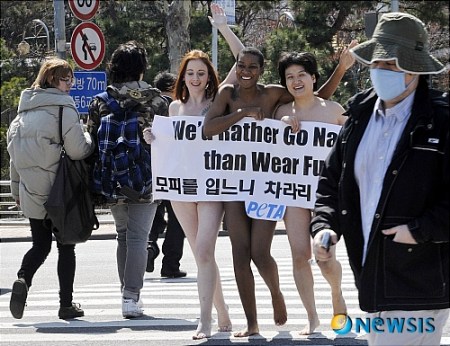
Although that’s better than nothing, one gets the sense that it’s like rearranging deckchairs on the Titanic considering the wider problems with inadequate and expensive childcare facilities and workplace discrimination that are the real reasons Korean women are discouraged from having children: it’s not just a matter of feeling more maternal. But to be fair, John Jae-hee does acknowledge that the benefits of incremental improvements to policy are likely to be moot given the current recession (Note: rather confusingly, not least for the Ministries themselves, there is a seperate Gender Equality Minister by the name of Byun Do-yoon).

— Lawmaker Park Sun-young of the minor Liberty Forward Party (LFP) recommended that in order to increase birth rates Korea should adopt the French policy anonymous birth, under which pregnant women can visit a hospital, register anonymously, give birth and leave.

While commendable in itself, I doubt there’d be much effect on the birth rate  in a country with a strong stigma against raising children out of wedlock (see #3 above). More interesting in that report are statistics on the extremely high number of abortions in Korea, and the fact that only 1% of fathers take advantage of the *cough* generous 3-day paternity leave to which they are entitled, introduced last year. To be fair to Korean fathers though, as an undergraduate I read that even with the extremely generous provisions offered in  Scandinavian countries that few fathers took up the offers there either, and I’ve read on at least one blog here (although I’ve lost the address unfortunately) that many Korean employers are completely ignoring or effectively prohibiting male employees from taking paternity leave.

In today’s economic climate,  the maxim “Choose your battles” comes to mind, and 3 days hardly seems worth it.

— A strange report on a bill to reduce the term limit for abortions from 28 weeks to 24. Strange because first it notes that Korea has one of the highest abortion rates in the world, and then it states that:

Healthy women who undergo elective abortions can be imprisoned for up to one year or fined two million won. Doctors performing the abortion can be imprisoned for up to two years.

And yet doesn’t comment on the obvious contradiction .

If you’re interested in the debate about term limits, then you’ll probably be interested in last year’s decision in the UK to keep the abortion limit to 24 weeks (see here and here). In sum, that limit was set in 1990, and there was a move to reduce the limit to 20 weeks because of advances in medical technology since, but in fact despite those the rates of 24 week-old and younger premature babies surviving is virtually unchanged. Hence although it was made a conscience vote (not along party lines), it was overwhelmingly rejected.

— Finally, by 2020 probably up to 50% of teenagers in many rural areas will be biracial (see here also). But see here for a brief report on the verbal, physical, and sexual abuse faced by many of their immigrant mothers.

5. PETA Demonstration in Seoul

peta-protest-in-seoul-ed8e98ed8380-ec9ab8ec849cFor the story behind the jarring image on the right (source), see here.
I’m definitely anti-fur, always bought free-range eggs and chicken before moving to Korea (which lacks them), and was even vegetarian for the odd couple of months or so as a student, but despite all that I’m vehemently anti-PETA, and for so many reasons that I could write several posts just on that subject alone. Keeping on topic though, while I often disagree with much of what I read on the blog Feministing, its critique of PETA’s use of (attractive) naked women to advertise its cause is spot on:

…the thing I hate most about this particular PETA propaganda is that it takes what should be a message of empowerment, Love-Your-Body-style, and turns it into yet another affirmation of the female ideal. As [co-author] Renee puts it, “It seems that they respect the rights of animals far more than they respect women. Consider that they don’t use images of male nudes, nor do they use images of women with varying body sizes.”

As you’ll recall, PETA has defended this advertising strategy with the weak response that “sex sells.” It’s an excuse I expect from Axe and Maxim, but not from a movement that is supposedly about justice.

Granted, the Korean woman on the right isn’t your average model, but then she would have been included to add a token sense of local legitimacy: the modus operandi and the arguments against it remain the same.

As a guy I find the notion that naked women are the only way to get me interested in a cause very patronizing, and besides which I seriously doubt that men’s greater awareness of PETA via admiring notorious advertisements like this (second from the top) really translates into effective support.

If I happened to be Korean too then I also would annoyed at the audacity of foreigners thinking that: flying in from the US; walking around naked for 5 minutes; then flying out to do exactly the same thing in another country the next day would somehow be enough to influence my opinions, although I’m not for a moment saying that foreigners shouldn’t protest in Korea and/or that they can’t be effective, especially in situations where Koreans lack local expertise, aren’t interested (but should be), and/or are understandably too concerned about their own reputations to protest themselves.

6. Adidas Korea Finally Uses an Actual Athlete For Advertisements

adidas-korea-me-myself-campaign-spokesperson-modelToo distracted by them to notice myself, commentator Sonagi was right to point out that the skinny, decidedly nonathletic models used to launch Adidas Korea’s “Me Myself Campaign” in February, supposedly all about rejecting the fashion industry’s impossible standards and promoting healthy and fit body images for women, achieved anything but in reality.

Suitably chagrined, I suggested that some kick-ass female boxers could be used instead, but Adidas ultimately plumped for a yoga instructor who goes by the name of Jessica (left, source). Meanwhile, rival Nike Korea is now has a side-contract with actress Park Shin-Hye (박신혜), but currently world-famous ice skater Kim Yu-na (김윤아) is their frontwoman, replacing BoA who was the year before.

I don’t mean to imply by the above that non-athletes are bad choices in themselves, and indeed BoA in particular is clearly very physically active, but as Korean women overwhelmingly prefer passive methods of losing weight (see here and here), then absolutely any link between losing weight and active exercise is to be strongly encouraged.

To illustrate the transformative effects attributed to merely drinking something, for instance, the music group Girls’ Generation (소녀시대) is currently promoting a skin-cleansing drink despite its members’ typical teenage acne, actress Song Hye-gyo (성혜교) is doing the same for one that makes you look White lightens your skin, and Kim Tae-hee (김태희) is still selling drinks that make your face more of a “V” shape.

Bear in mind that such obsessions exist despite Korean women still being the least obese in the OECD. On the plus-side though, limits are emerging as to how skinny a woman’s legs can be before even Korean netizens think twice about praising them.

7. More Bizarre Standards For Female Celebrities

sandra-park-박산다라-magazine-coverLike this post explains, most Korean female celebrities start with a cute and innocent image and try a sexier and more mature one later, but actress and singer Sandara Park (박산다라), who had a modest career in the Philippines before becoming popular in Korea, is making news for her photoshoot for the “lads’ mag” on the right while she was there (source).

But while it’s true that Korean fans are often upset with real-life behavior out of character with actresses’ roles in dramas and TV (no, really), considering the number of Korean women that have appeared in Korean equivalents – a standard method for advancing one’s career – then I’m at a loss as to what all the fuss by netizens is about. Especially as it’s quite clear that it was a one-off and that it was done because her image in the Philippines then was simply too cute and innocent!

8. Family Who Raped Mentally-handicapped Relative Given Jail Time

Undoubtedly due to public pressure, the four men who repeatedly raped their mentally-handicapped relative over seven years, but whom were given suspended sentences because there was no-one else to look after her (see #8 here, then here), have been re-sentenced to prison time.

9. Sex Offenders Free to Teach In Korean Schools

One does have to wonder where the motives for stereotyping foreign male teachers as pedophiles comes from when you discover things like this:

Currently, criminal records of those sentenced to less than three years in prison are removed after five years. As such, schools can’t always ascertain the criminal record of would-be teachers.

Which meant that a Korean teacher with seven counts of “sexual assault and other crimes” against teens was able to get a job teaching them: for the details read Matt at Gusts of Popular Feeling here, KoreaBeat here, and Brian in Jeollanamdo here. Matt also rounds off with an excellently researched and comprehensive “State of Korean Youth”  post here, and don’t forget to also read this one describing how a teacher was only given a six-month sentence for sex with an 11 year-old, and how the maximum sentence is still only three years.

Korean Gender Reader

anorexic-jeong-ryeo-won-정려원-giordano-advertisement-지오다노-광고(Source: zziixx)

Old news in the K-pop blogosphere admittedly, but these advertisements of Jeong Ryeo-won’s do give me concerns about her health, although fortunately she’s gained a little weight since they were shot back in July.

Update: As this post at Allkpop makes clear, actually she lost the weight for a movie role. But, given that extreme weight loss, the question remains of if she was an appropriate choice of model.

On to this week’s stories:

1. The Politicization of Skin-Whitening Products

With thanks to reader Anne for passing it on, I’d agree that this is “an insightful recent look at beauty standards in N. America and Korea from the perspective of a Korean American woman,” and for anyone interested in my own take on the subjects raised there by Min Jin Lee, author of “Free Food for Millionaires”, please see here, here and here also.

2. How to Read Your Date’s Personality in 10 Minutes

A Korean blogger’s humorous guide for women here.

3. Couple Steal to Pay for Abortion

Do they cost that much money? Still, one can sympathize with the impoverished couple to a certain extent, and I wonder what punishment they’ll receive? Not that I’m advocating at all that they should get a mere slap on the wrist for holding four bar-owners up at knife point, but they do still present a bit of a dilemma, as obviously they can’t pay a fine, and jail time would mean that their five year-old daughter is sent into (woefully inadequate and under-resourced) state care.

By coincidence though, Wednesday’s English Chosun had a report saying that from September, destitute offenders would be allowed to do community service in lieu of paying fines. Currently, 32,000 people are in jail because they can’t afford to, although 94% of all fines are for less than 3 million won.

4. Government Buildings to Have ‘Refresh Zones’

Fiddling while Rome burns. As Brian rightly points out, a far more effective way to look after employees’ health would be to get rid of the mindset that hard workers don’t go home before the boss does, which means that while Koreans technically have among the longest working hours in the world, much of them are already spent napping and/or playing Minesweeper on their computers.

See here for my own take on the natural effects that has on Korean family life and the low birthrate.

5. Uzbekistani Woman Forced into Sex Slavery in Seoul

uzbekistani-women-forced-into-prostitutionI already mentioned some articles on this in story #22 last week, but if you’re further interested then here’s a translation of another Korean article on the same subject by Korea Beat, and it is always good to get as many different perspectives as possible (source, right: the Hankyoreh).

6. ‘Upskirting’ Gains Attention

Not that one article marks a trend, but this translation of this article from the Guardian on upskirting worldwide did briefly feature prominently on Yahoo Korea’s “front page” this week. And as this and this report make clear, it’s actually still quite a legal grey area in Korea.

7. Vice-Principal Who Ignored Sex Scandal Gets Chance at Promotion

As reported by Korea Beat, “controversy is brewing as a vice-principal in Yeosu, who may or may not have looked the other way as his principal was molesting little kids, is getting one final chance for a promotion.”

8. Resource on Sexual and/or Physical Abuse of Korean Children

Found via his recent post on The Hub of Sparkle here, blogger Roboseyo has been gathering links at news reports on these subjects since November last year, and I dare say I’ll be referring to it a lot from now on!

9. International Marriage in Korea Doubled in Last Six Years

That’s according to a broad statistical report just released by the Korean government, the outline of which are translated by Korea Beat here. Personally though, I find the myriad of other statistics more interesting, such as the fact that traffic fatalities have halved since 1990 for instance, and the ratio of boys to girls among newborns is well within natural ranges, although Korean’s supposed preference for sons is still invariably what tends to be reported by the foreign media.

Meanwhile, the English Chosun at least is convinced that Korea must embrace immigration and ethnic diversity simply for the sake of its long-term economic survival. Definitely laudable thoughts, but while progress is definitely slow, one suspects that most Koreans will find (albeit very very belatedly) that making it easier for Korean mothers to work will be a far more palatable option for them.

10. Gay Politics in Taiwan and Japan

An interesting comparison here, and given Japanese people’s reputation for their….well, let’s say “rather liberal” notions of sexuality, then I was quite surprised to learn that the Taiwanese are actually much more open and progressive when it comes to homosexuality (found via Global Voices).

11. Happy Ending to Adoption Story

While fellow blogger Javabeans is rightfully skeptical of the real benefits celebrity involvement provides to charity promotion and public campaigns of any stripe, she(?) was happy to report that it did have a big impact on this child’s life.

12. Controversy Over Design of New 50,000 won Bill Settled

Details here. For a much more interesting and in-depth look at the issues raised by that controversy though, see the discussion between Gomushin Girl and Bebel in the comments section to last week’s post, starting here.

13. “Boys Over Flowers” Actor Jang Ja-yeon Commits Suicide

jang-ja-yeon-commits-suicideFor the original Korea Times report see here, and the instant I heard of her death I thought of this excellent post by Micheal Hurt on suicide in Korea to place her death into some context, a sentiment echoed by Matt at The Hub of Sparkle here, and who also provides a list of the large number of Korean celebrities to have killed themselves in recent years.

For K-pop blogs’ takes on events and more information about her all-too-brief career also, see here, here and here (source, right).

14. Brothel Owners Pay Average of Nearly 3 Million won a Year in Bribes to Police

And naturally enough, to specifically those police officers in charge of cracking down on them too (prostitution is illegal in Korea, but widespread: for a primer and many links, see #3 here). See here for details of those and for the average sums of bribes paid to the police to overlook other crimes too, and while we’re on the subject of prostitution here is a report of a Korean man pimping foreign prostitutes from the fifth floor of a tourist hotel in Seoul too. Unfortunately though the report is unclear on whether the prostitutes, who are about to be deported, came to Korea with the intention of working in the sex industry or whether they were tricked and/or forced into it upon arrival (like #5 above).

15. Lawmakers Want Tougher Laws on Child Sex Crime

While little good if a lack of state care means that abusers are often the only ones able to provide for their victims, and which in practice means that often they’re not even prosecuted at all (see #3 above), at least these measures are a step in right direction.

16. Women First to be Laid-Off During Recession

Sigh. Again, it doesn’t exactly give me a warm and fuzzy feeling inside to be proved right (see #1 here, and #2 here), but the most recent statistics on phenomenon can be read at the English Chousn here.

Meanwhile, amongst Korean men that are laid-off, as many as 20 percent are opting not to tell their families. One suspects though, that surely they’ll still find out eventually?

17. Unmarried Women Refused Smear Test

Yes, really, and despite the fact that it is all sexually-active women that are most at risk and hence most in need of a regular test. For the lively discussion on that, see the thread at Dave’s ESL Cafe here, and personally I see this as further vindication of my view that the contraceptive pill should remain an over-the-counter option in Korea, rather than requiring a prescription from an almost invariably patronizing and moralistic Korean medical establishment, almost Victorian in its inability to acknowledge that Korean women are having sex before marriage.

18. Women’s Rights in Taiwan

On International Women’s Day, Letters from Taiwan notes the gap between government rhetoric and actual practice on women’s rights (found via Global Voices)

Korean Gender Reader

song-hye-gyo-panties-송혜교-판티스-곰세마리(Source: jinhwii)

I don’t quite know how I happened to come across this very old Korean underwear advertisement above, but I do know that I couldn’t resist using it sooner or later. See if you can guess who it is before you reach the end of this post, and I’m open as to suggestions as to what exactly the point of her gesture was (it’s not what you think!).

In the meantime, my apologies, but from now on my Korean Gender Reader posts will be a lot more minimalist I’m afraid. Partially because the weekends spent on them has been detracting from — nay, has been in lieu of —  time spent on all the longer, more in-depth posts that I’ve had planned, and partially because this last week especially seems to have been a particularly fruitful one for news. And here it is in strict chronological order too, primarily for the sake of breaking it into more manageable chunks for you to digest from on. Please let me know what you think of the new format.

Monday 23 February (And Earlier)

I write “and earlier” because some things I missed last week are still too good not to cover here. For instance:

close-up-of-man-from-korean-air-advertisement1. You’ve Had the Theory, Now the Practice: Finding Reliable and Affordable Childcare in Korea
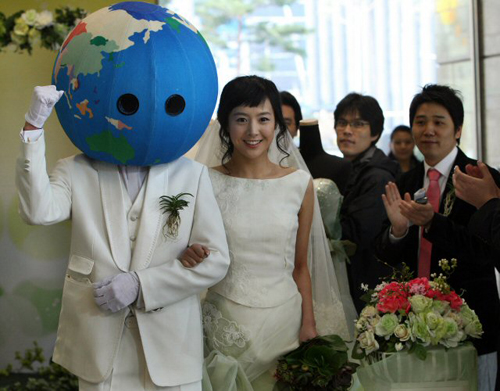
While I’ve written a great deal on the problems of child care in Korea in the abstract (see here, here and here), two Fridays ago Melissa of Expatriate Games wrote a far more useful post about the ensuing practical difficulties of finding childcare for her 2 year-old daughter in Seoul. Make sure to read her follow-up post on the same issue from Saturday too.

2. Discrimination Against Men Within the Airline Industry

For some reason Google Reader only yesterday gave me the last seven of Aaron McKenzie’s posts at Idiot’s Collective, so earlier I missed his take on a lengthy feature in the JoongAng Daily about the discrimination against male flight attendants in the Korean airline industry, by coincidence the issue which prompted me to start these weekly posts in the first place. For my take on the issue from when it first arose in late December last year, see ROK Drop here.

The image on the right is a close-up from a Korean Air advertisement by the way, which doesn’t actually allow male stewards at all.

(Update: To be more precise, it does hire men, but only from within the company, and hasn’t directly hired any new male cabin staff since 1997)

And now for news from Monday itself:

3. Jun Ji-hyun Forgives and Forgets?

Despite the fact that Jeon ji-hyun’s (전지현) management company Sidus HQ spied on her using a “clone” phone for many years, giving them the ability to eavesdrop on all her phone calls (see story#6 here), not only have all those involved not been booked at her request, but she may well be renewing her contract with the company too! For the details, see Dramabeans here.

4. Less Marriages and Babies During This Recession

I’ve read repeatedly that condom sales go up during recessions, so not unsurprisingly Korean couples are both putting off getting married and having far fewer babies too, with  “government officials and scholars predicting that this year’s birthrate will barely exceed 1.0 child per woman, and will drop below that next year,” which I might add is the lowest of any developed country in modern history.

5. System ‘Failing Victims of Child Sex Crimes’

Self explanatory, although the statistics  provided by this English Chosun report are always useful. But for more information on actual cases and the attitudes and legal absurdities that lay behind those, such as a man being acquitted of groping his stepdaughter’s breasts because “it was a sign of affection,” see many examples mentioned by Brian in Jeollanam-do here.

disabled-korean-sex-abuse-victim-returned-to-care-of-her-abusers

(Source: SeoulPodcast)

Tuesday 24 February

6. Women’s Organizations Compile List of Bad Court Decisions

Far from living up to their stereotypes of passivity — which, to be fair, I might be guilty of perpetuating a little occasionally — women’s groups are doing something about the cases mentioned above.

7. French TV Personality tearfully ends marriage

Ida Daussy, a French woman popular and well-known in Korea (albeit primarily for her fluent Korean skills), is getting divorced from her Korean husband after 16 years of marriage. Interesting ensuing discussion at the Marmot’s Hole here about Western-Korean marriages.

8. Sex Tourism from Japan Increasing?

To be expected with the huge decrease in the exchange rate. Not that too many parallels should be made with the 1950s and 1960s, but the first thing that came to mind when I read the report was how many Korean women then were extorted to become prostitutes to Japanese tourists and US servicemen on US bases; primarily for the sake of obtaining much-needed foreign exchange of course, but those women were also provided to the latter for the sake of  helping to cement US-ROK relations.

 Wednesday 25 February

9. Eco-friendly weddings

korean-eco-friendly-weddings

“Lotte Department Store in downtown Seoul held a green wedding on February 23 to promote eco-friendly weddings. The bride’s wedding dress is made of natural fabric from the mulberry tree.” (Yonhap News, via ROK Drop)

10. DNA Evidence Fingers Suspect Three Years After Crime

More good news from Korea Beat. While the Korean Police have a (largely deserved) reputation for incompetence, and rape-kits aren’t even available at most Korean hospitals, in this case three year-old DNA evidence was used to convict a rapist of two mentally-disabled women.

Thursday 26 February

11. Support Network for Unwed Mothers Established

Although Korea is notorious for sending large numbers of children overseas for adoption, the statistics driving that are still shocking. Such is the stigma of having a child out of wedlock here, that even the structure of the miserly welfare parents to mothers encourages it. As explained by Richard Boas, a American physician who has recently established the ”Korean Unwed Mothers Support Network” explains:

…many single mothers struggle with poverty. The welfare ministry gives 50,000 won ($33) in monthly subsidies for childcare to single parent families. Those living below the poverty line can receive basic government subsidies, stay with foster families for up to two years and stay at 40 facilities nationwide for up to five years, far from enough to help mothers keep their children. ”The government gives 100,000 won a month for a domestic adoptive family. However, giving out just 50,000 won for unwed mothers surely gives the impression that the government encourages adoption,” he said.

For the rest of the report, see the Korea Times here. To place it into context, there were 140,000 single mothers in Korea as of 2005, a number which “is believed to have since risen,” and 1,250 children were adopted overseas last year.

12. Prostitution Answers Sexual Needs of Senior Citizens?

The first time I visited in Jongmyo Park in Seoul in 2000, naturally I remarked on the hundreds of mostly male retirees there to my friend visiting from Japan, who rightly pointed out that they “didn’t particularly have much to do nor anywhere in particular to do it,” so why not play Korean chess all day there? In hindsight though, many would much rather be doing something else, and it’s almost surprising that it took so long for prostitutes to encroach on this captive and — let’s call a spade a spade — somewhat desperate market, and the Korea Times reports here on the ensuing problems of unsafe sex, the sale of fake Viagra and “men’s stamina” products, and the general increasing seediness of the area. You can also read discussions at ROK Drop and The Marmot’s Hole here and here.

Personally, while I’m still a strong advocate of the legalization of prostitution, I’d still rather that it took place somewhere other than the former courtyards of Korean kings and queens(!), and that it is used as su h could easily be read as both a symbol and indictment of modern Korea society, much like “National Treasure #1” Namdaemun was unguarded and regularly urinated and vomited on by homeless people until one of them decided to burn it down in a fit of rage last year. Part of the problems, of course, are general attitudes of distaste and avoidance by the police and general public towards the sexuality of the aged, which the KT correctly notes (and brings to mind this comment about a movie on that theme that ended up being censored).

For those further interested, Matt of Gusts of Popular Feeling discusses a little about the history of the area here, and also notes that there is an essay entitled “Stigma, Lifestyle, and Self in Later Life: The Meaning and Paradox of Older Men’s Hang-Out Culture at Jongmyo Park” by Chung Gene-Woong in the latest issue of Korean Journal, which will be free to download here in six months. He mentions that that abstract doesn’t mention this particular aspect of that culture though, and by chance actually I happen to have a physical copy (as this essay is very relevant to my thesis), and so I can confirm that it’s not mentioned in the article itself either!

13. What Image of Korean Women is Presented by the New 50,000 Bill?

new-50000-won-bill-difference-in-face-shapesArriving roughly a decade(!) after it was needed, one report on the woman on it — Shin Saim-dang, a renowned female writer, calligraphist and mother of a noted Joseon Dynasty scholar — caught my eye, as it said that she is widely referred to as the symbol of a ”wise mother and good wife,” or “현모양처” in Korean.

Forgive me if similar sentiments were raised last year when plans for the new bill were first announced, but that phrase — still well known and aspired to by many Korean women today (just ask them) — instantly reminded me *cough* of the suffrage movement in New Zealand in the Nineteenth Century, women being the first in the world to get the vote naturally being a good thing, but which in fact was also a regression for women’s rights because that vote in 1893 was based on the premise that women would add a civilizing and moral element to politics that it lacked. Or am I making too much of it?

Jumping ahead a little though, the most recent controversy surroundson-tae-young-new-mother-shows-off-her-s-lineing the new bill has actually focused on the shape of her face (sigh), much taller and thinner and — dare I say it? — Western-looking than the original round shape of the portrait it was based on. Perhaps my eyes are tired and that is too much of a leap really, so without any further ado read about both controversies at ROK Drop here and decide for yourself.

14. New Mother Son Tae-young Shows-Off Her S-line

No, I don’t have a thing for her, and I’m not at all saying that she isn’t entitled to look good, nor that any mother can’t or shouldn’t either. On the other hand, not only was she the thinnest pregnant woman that I’ve ever seen (see #11 here), but showing off her great body one month after the birth does set hopelessly unrealistic standards for those mothers without wealth, personal trainers, beauticians and domestic helpers to follow, a complaint I remember regularly reading in Western newspapers in response to “Celebrity Moms” a few years ago too.

Friday 27th February

15. Home Buyers With Over 3 Kids May Be Subsidized

A story naturally linked to above reports on the plummeting birthrate, which, however dire, I still fail to see how, say, telling Strategy and Finance Minister Yoon Jeong-hyun and Land and Transport Minister Chung Jong-hwan to “check Seoul and surrounding areas from a helicopter to find places for new homes” is going to help exactly! True, also giving preference “to couples with three children or more when providing homes and leased apartments and lower house prices” is better than nothing of course, but – seriously – when on the Earth is the Korean government and business establishment going to realize that you can’t educate women to the level of men and then expect them to have kids when they have to give up their careers if they do so? Two hundred thousand won a month in subsidies is supposed to compensate for that?

16. Phones With Security Feature for Women, Children Becoming More Popular

Again, partially in response to serial murder suspect Kang Ho-soon (see #5 here). See the Korea Times article here, and Brian’s take on them here.

17. Sex, Videotape & Lies

In a scam he pulled off on four different women, a 26 year-old is arrested for having sex with his then girlfriends at love hotels and then allegedly claiming that the owners told him that they secretly recorded them, demanding money not to release the clips on the internet. Naturally, he had no money to pay “them”, and so his girlfriends gave him their own money to pass on, the latest ending up resorting to loan sharks to get it.

Saturday and Sunday 28 February and 1 March

19. The Coming Baby Bust

Noticing a theme here? At least the English-language dailies at least are beginning to draw attention to the issue. See here for an editorial in the Korea Times.

20. Study: Most Child Molesters Know Their Victims

Like Korea Beat says here, this is probably well-known to most readers of this post, but it may not be in Korea.

21. Human Trafficking in South Korea

Two excellent articles from the Hankyoreh: first, a story here about a Uzbekistani woman tricked into prostitution in Korea, but whom the police have charged for falsifying electronic records, and next an editorial placing that into some context.

22. Japanese Transgender Entertainer Named as new KNTO Spokesperson

Finally, I’m glad to end on a fun, positive story. But, alas, it’s not that big a deal really, as although Korea’s own transgender celebrity Harisu (하리수) also happens to enjoy a great deal of popularity herself, I seriously doubt that either will have had all that much impact on wider public acceptance of transgender people in both countries, in much the same way that Hines Ward’s sporting success has at least raised the issue of the poor treatment of biracial children in Korea (see here and here) but now the next rather more difficult step of actually doing something about it is needed.

kim-min-sun-jenny-lee-song-hye-gyo-panties

Oh, and the picture at the beginning of this post? Although I’d never have recognized her myself, my wife took one look and told me it’s Song Hye-gyo (송혜교) back from when she first started modeling. But from when exactly I can’t say sorry: the source of the photo is a blog entry from 2005, but obviously it is much older than that, although I did find the photo again alongside two others of Kim Min-sun (김민선) and Jenny Lee (이제니) here, both with the same gesture and advertising the same god-awful granny panties, unfortunately there was no further information on the date, company, nor the meaning of the gesture. Still, I’m dying to know now: what do you think the hand gesture means? Like I said, it’s probably not what it looks like, for can you image that ever being used to sell lingerie? Let alone in Korea, in the late-1990s? But what, then?

Korean Gender Reader

blue-puzzled-pororo-and-pink-happy-loopy-waving(Sources: Unknown)

Sorry for the long delay since the last Korean Gender Reader: much as I like to write about the low Korean birth-rate and/or the lack of affordable and trustworthy childcare that effectively stops mothers from working in Korea, I’d rather not personally suffer the side effects of those for the sake of being a better writer. Nor can I see how my sleep-deprivation, lack of exercise, weight-gaining and coming down with regular colds would ever particularly help with that either!

Hence my wife and I have bitten the bullet and will be sending our (nearly) three year-old daughter Alice to a lovely kindergarten down the road come March, 9am-2pm Mon-Fri for 320,000 won a month. On the one hand it’ll naturally be strange and a little sad without her, but on the other it’ll be good to be able to grab some much-needed sleep at the same time that our six-month old baby Elizabeth does, and especially not to have Alice screaming about watching the Korean cartoon “Pororo the Little Penguin”  all day, and me constantly worrying that Loopy(!), the only female character in the first series, “likes cooking and the arts” at her home and always seems to be making gifts of food for the boys and/or watching them on the sidelines while they invent stuff and go on adventures. Fortunately the inclusion of active, sports-mad Petty (who thinks of their English names?) somewhat compensates in the next series (update: and it turns out I missed this new positive change too).

This post covers the period since the last one then, or *cough* just over three weeks, and with the stories roughly in chronological order (with the exception of some on domestic violence, which I’ll be covering in the next post or the next). Sorry in advance for 3000 words that that delay meant, and they’ll definitely be weekly from now on.

1. Females hardest hit by economic slump

Korean Female University Student(Source: UNC – CFC – USFK; CC BY 2.0)

As I predicted, female workers (and the self-employed) are being the hardest hit by the troubled economy:

According to the National Statistical Office (NSO), the ratio of economically active females recorded 48.8 percent in December, the lowest level since last February. The rate dropped by 1.6 percentage points from November, when it hovered above 50 percent.

Not that this is due to sexism per se, more because of:

…the high ratio of part-timers and contract workers among women, who are the first target when businesses decide to cut their workforce.

And here and here are two later reports on the number of temporary and daily workers falling. Interestingly, in America the huge layoffs in the male-dominated manufacturing and construction industries means that for the first time in history America may soon have more female than male workers, women tending to work in more stable sectors such as education and health-care instead (see here for a more in-depth look). This split is paralleled in Korea of course: women are disproportionately represented in the civil service for instance, as its exam-based system of entry renders it one of the few genuinely meritocratic employment sectors out there (by coincidence my sister-in-law just qualified, after four years of trying), but with women’s overall labor force participation still being the lowest in the world then men are likely to remain the primary breadwinners for many years to come.

Which is not to say that Korean men aren’t losing their jobs in droves, and many women taking over as the main or only earner: here is a short translation of one Korean man’s take on the resulting change of gender roles for his family, and here and here are two American pieces on the effects on men and women in general (update: and here is one on why the incidence of domestic violence tends to rise with unemployment).

2. Court to decide who will take custody of children

choi-jin-sil-최진실-suicide-자살Prompted by the custody battle between actor Choi Jin-sil’s (최진실) family and her ex-husband Cho Sung-min after her suicide in October last year (see here and here also), the Ministry of Justice has ruled that in the future family courts will decide who will take custody of children when a parent dies.

Under the current law, if a divorced mother or father with custodial rights dies, the surviving former spouse automatically gets the custody, regardless of how ”ill-prepared or inappropriate” a parent they are (source, left: unknown).

3. Economic slump drives more teenage girls into prostitution

Also depressingly predictable, although it’s good that Park Eun-jung, the head official within the Ministry for Health, Welfare and Family Affairs is keen to point out that “it’s not ”girls gone wild” who get involved in prostitution,” and that these days many teenagers have to sell sex simply  ”to make ends meet,” although on the other hand I very much doubt her assertion that “teenage prostitution stemmed mostly out of curiosity six months ago.”

For the full report see here, and for some context see here, here. and especially Matt’s posts on teenage prostitution and related subjects at Gusts of Popular Feeling here, here and here.

4. Speaking out against perverted teachers

Korea Beat translates a Hankyoreh columnist on the pervasive culture of sexual harassment and molestation of female teachers and students at Korean schools and the often complete impunity with which male teachers get away with such acts. For a much more in-depth look at the issue and how it pertains to (false) stereotypes of foreign teachers as perverts and molesters,  see Michael Hurt’s 2006 post at Scribblings of the Metropolitician here.

(Update: And Matt at Gusts of Popular Feeling has a related post here on a tabloid news documentary from 2005 that did a great deal in helping to shape and perpetuate “the image of English teachers as unqualified, pot-smoking child molesters”)

5. Korean women rush to buy self-defense weapons

The Korea Times reports that many women are rushing to buy self-defense weapons in the wake of the arrest of rapist and serial killer Kang Ho-soon, especially those compact enough to fit into a pocket or purse, and the sales of surveillance cameras, electronic door locks and other security gadgets has also correspondingly increased.

(Update: Korea Beat reports that the numbers of CCTV cameras is exploding in wealthier districts of Seoul especially, and all Seoul schools are also in the process of adding them and hiring security guards)

Much more interesting though, is a later report that women are also rushing home from work these days, fears for their own safety apparently outweighing the extremely wasteful but still deeply ingrained Korean work habit of being seen to be staying at work until the boss leaves, regardless of how much work there actually is – or usually isn’t – to do (see here for more, and here for what many workers are really doing during “work hours”). Hopefully, the reflection on women’s work/life priorities and especially personal safety will lead genuine shift in attitudes, the first target of which will I’d like to think would be the “bikkis” that physically drag young attractive women into nightclubs for the sake of attracting male spenders for instance, but against this optimistic interpretation of events that first Korea Times report mentions similar peaks of spending and interest in the wake of a the last serial killer arrested in 2006, presumably indicating that the change in habits was only temporary unfortunately.

6. Battered Cambodian woman stabs Korean husband

Read the report here. In related news, this report outlines the poor conditions under which many “import brides” live under, one indicator of which is a high rate of miscarriages due to malnutrition, doing heavy work on farms while pregnant,  and a lack of access to/and knowledge of public health services.

But in one positive symbolic move that I hope will become official policy,  a Japanese man has been banned from entering the Philippines for abusing his Filipino wife in Japan: “A foreigner who beats his wife is a menace to the society and who does not deserve our hospitality,” the Immigration commissioner said.

Korean Father and Son(Source: James Kim; CC BY-SA 2.0)

7. Fetus sex notification to be allowed

Although only after 28 weeks gestation, when ”no doctor would dare to perform an abortion”‘ a Korean Society of Obstetrics and Gynecology spokesman said.

But this is quite strange: presumably the cut-off date means that there are still strong concerns that younger fetuses would be aborted if they were discovered to be female for instance, but in fact the problems of the resulting gender imbalance were acknowledged and dealt with by Koreans over a decade ago, and Koreans have had a genuine positive shift in attitudes towards daughters since (unfortunately this is rarely reported in the foreign media, the Confucian penchant for sons being much more newsworthy apparently). Moreover, the current law banning notification at any age is completely ignored in practice (“Oh! The Baby looks strong/pretty”), so the practical and even symbolic effects of this law will be minimal.

Meanwhile, you (and many Koreans!) may be surprised to hear that abortion is actually technically illegal in Korea, despite Korea having one of the highest per capita rates of abortion in the world.

8. Lee Hyori swearing on TV

If you never watch Korean television then you will probably be unaware that Korean celebrity culture is very unlike its Western counterpart(s), starring in a variety of decidedly unglamorous and down-to-earth game and talkshows being an integral part of the process of acquiring and then maintaining popularity here for instance. While I can’t imagine the likes of Brad Pitt or Beyonce ever rolling around in mud or having trays dropped on their heads on national TV then, Korea’s number one sex symbol Lee Hyori is well-liked by many Koreans for not only appearing to enjoy herself while she does so, but for being so, well, normal too.

Hence personally I find it almost endearing that she said that (guest) “Chang Ui fucking loves women who can cook well” on national TV, although unfortunately many netizens don’t. For the details, see here, and no, she wasn’t advocating the joys of cooking for one’s husband!

True, at first glance this might not appear particularly meaningful in a feminist sense, but as I explain in that first link, the other (negative) difference with Western countries is that female celebrities especially are held to almost impossible moral standards by the Korean public, so any challenge to those attitudes is welcome, no matter how minor.

(Update: In hindsight, the explanation of what she said in that link above isn’t very accurate or even helpful, so after seeing the video here please read my own explanation here)

9. Naver, newspapers spat over lewd ads

In the last Korean Gender Reader I reported on the hypocrisy of Korean newspapers regularly criticizing prostitution in their print editions while having advertisements for and even guides to brothels on their online editions. Rather than removing them however, recent technical changes to Naver – as important to the Korean internet as, say, Google is to the American one – have resulted in some newspapers actually loading their web sites with more adult content and lewd advertisements in order to drive up traffic!

10. HIV cases top 6,000 for first time

From the The Korea Times:

The number of reported HIV cases in the nation topped 6,000 for the first time since 1985, when the country began to compile relevant data, the Korea Center for Disease Control and Prevention said.

The agency reported that the cumulative number of those with HIV had reached 6,120 at the end of December, 1,084 of whom had died.

A total of 797 new HIV cases were reported last year, up 7.1 percent from 744 the previous year.

It said the 99 percent of cases have resulted from sexual intercourse, with those in their 20s and 30s accounting for more than half of the total. Teenagers accounted for 2.5 percent, and those aged over 60 accounted for 7 percent. It said 743, or 94.2, percent were male

On the positive side though, despite the stereotypes it’s actually been a very long time since most Koreans thought that AIDS was a “gay disease” that they didn’t need to be concerned about because it “only affected foreigners.”

11. Son Tae-young has baby boy

Normally I’d pay very little attention to news of celebrity marriages and pregnancies, but after writing this post on Korean women’s concerns about their body image during pregnancy, some pregnant-son-tae-youngeven dieting to remain thin, then I couldn’t help but notice how thin actress and former Miss Korea runner-up Son Tae-young (손태영) looked during hers (see her at 7 months here, and at 8 months here); which is not to say at all that I think she’s dieting herself or that her being thin is her fault somehow(!), but I do cringe to think of any Korean women as whale-like as my wife was when she was pregnant thinking that Son Tae-young is the norm to aspire to rather the exception.

On the plus side, Son Tae-young is breastfeeding her son that was born on the 6th, and hopefully she may well prove to be the slim & beautiful celebrity mom to talk about the benefits of doing so that mother and fellow-blogger Melissa of Expatriate Games noted Korean women so desperately need (source, right: unknown).

12. What Koreans consider fat

You’ll just be amazed at which celebrities have been criticized by netizens for their fatness at some point. See here, here, and here (the last because of these pictures).

(Update: most of those links are from the pop culture blog allkpop, and freyja writes a follow-up post briefly summarizing some of the issues raised by them here)

13. Singles at disadvantage from social system

Not that, say, ending the extremely wasteful practice of staying at work until the boss the leaves (see #5) or actually enforcing existing legislation on maternity leave, the provision of childcare facilities and checking the standards of them (see here and here) wouldn’t be much more effective ways of increasing Korea’s birth rate (currently the lowest in the world) but it is true that the tax breaks for married couples and so forth are now so big as to make single people grumble at least.

Actually, the Korea Times article of that title above is more interesting for its statistics on the numbers of single person households and a brief discussion of some of the reasons that make it difficult to people to live alone in Korea, a recent pet project of mine, so I’ll return to it later this week.

14. Men eye nursing jobs

I think the Korea Herald’s above title was a little of an exaggeration considering that men still only account for 5% of those that passed last week’s national nursing exam, but it’s certainly true that their numbers Male Nurse Action Figurehave been increasing in recent years. In that exam there were 617 men out of the total of 11,717 successful applicants, and it was only in 2004 that the number exceeded 200 for the first time (source, right: Geoffrey Fairchild; CC BY 2.0).

One of the new male nurses interviewed says that he converted to medical nursing a few years ago as he foresaw problems in securing employment as a computer major, so I imagine there may well be a glut of new entrants in next year’s exam! And as for their impact, here are a few quick excerpts:

These qualified male nurses are highly demanded in hospitals and other medical fields.

“I am glad about the increase of male nurses,” said Han Sang-mal, a nursing supervisor in an orthopedic hospital in Cheongju. “Not only do we need their physical strength, but our male patients often prefer to be tended to by men.”

But the positives go beyond mere practicalities:

“People are dismissing the bias that the nursing job is submissive, a role to be filled mainly by women,” she said. “As the roles of nurses are expanding from hospital jobs to schools, public health centers, and private nursing homes, such wider spectrum of manpower is to be regarded as highly positive.”

The first official male nurse was Cho Sang-moon, who was licensed in 1962 and worked as a leading figure in the nursing field in the 1970s. Before Cho, only women could be qualified as nurses.

15. Divorce suit deals blow to Samsung’s father-to-son succession plan

The size and importance of Samsung to the Korean economy can not be understated, and hence there’s a lot riding on this particular divorce of Samsung’s heir apparent.

16. Four in ten telemarketers suffer sexual harassment

I very much doubt that Korea has a monopoly on this, and it’s probably true that most of the victims(?) of customers moaning or asking about their breast sizes can’t do any more than simply hanging up on them and flagging their number, but unfortunately:

…only 12 percent and 11 percent said they forwarded the calls to managers or took issue with the conversations, respectively. About 90 percent said their companies do not have a protocol for such circumstances, although 45 percent said the companies had preventive measures.

17. Court acknowledges rape of transsexual

It’s been quite an interesting period in Korea for laws regarding rape recently, last month seeing the first man convicted for spousal rape (still not a crime here) and then his suicide, and now this month a provincial court:

…for the first time found a man in his 20s guilty of ”raping” a transsexual, challenging the current law that defines rape to when a man has forcible sex with a woman born a female. The victim’s legal gender still remains man.

Not that presages a radical shift in legislation unfortunately, the judge stating that he based his decision on the facts that:

The victim has acted like woman since he was born. In 1974, when he turned 24, he underwent a gender reassignment program. He once also lived with a male partner for a decade. Given all of these, he can be seen as female.

And so:

Giving the unprecedented ruling, the judge set three criteria to define the precedent – whether the victim had sex change surgery; how long he/she has lived with appearance of the opposite sex; and if he/she has no problems having sexual relations.

I guess this means that homosexual rape (of either sex) isn’t a crime either? And what if a transgender person was raped only a week after his or her operation, or a month, or a year? Is those not long enough to count? To be frank, I don’t get more used or deadened to the sheer arbitrariness of the law the longer I stay in Korea, and it’s judgments like this and that below that prevent me from ever staying in Korea permanently, primarily out of concern for my kids.

18. Vietnamese mother denied custody of biological children

And in the same vein as my comment on the last piece, I’m almost scared at how the Seoul Family Court has virtually rewarded the Korean husband’s use of his unwitting Vietnamese wife as a baby factory for him and his former Korean wife. For all the details and issues involved with that, see Michael Breen’s excellent column here.

(Update: Not to be missed is Matt’s post placing the case in the wider context of Vietnamese brides and immigration to Korea here also, and there’s a substantial forum thread on the case over at Dave’s ESL Cafe here)

19.Women outnumber men amongst newly hired prosecuting attorneys

finding-your-career-path-with-sinfest

(Source: Sinfest, May 9 2004)

From Sonagi at the Marmot’s Hole:

An impressive 51% (58 out of 112) of newly hired prosecuting attorneys are women. These 58 new female prosecutors will join 316 women who comprise 18% of the 1716 prosecutors employed nationwide. The increasing number of women is expected to challenge the old boys’ network and change the way domestic violence cases are handled.

For some context to those numbers and the reality of being a female lawyer in Korea, see Korea Law Blog here.

Korean Gender Reader

(Source: Soompi)

Sorry for the slight delay this week, but I thought that I’d delay publishing until most of my readers were back home from their New Year trips!

1. Korean Films to Get Racier

As reported by Robert Koehler here, the Supreme Court recently “ruled in favor of the import and distribution of U.S. film Shortbus, annulling the “restricted screening” rating imposed on the movie by the Korea Media Rating Board….Restricted screening virtually means a film cannot be screened in regular movie theaters. Thanks to the court’s ruling, Shortbus can be screened in cinemas.”

Given that “the controversial movie graphically portrays non-simulated sex scenes,” then I concur with the Chosun Ilbo’s opinion that “Korean films are likely to feature more vivid depictions of sex from after the ruling.” But while images or depictions of genitalia or pubic hair were previously illegal in Korea (outside of traditionally defined art that is), the internet has long rendered access to uncensored pornography a moot point. So how is this ruling at all significant, especially in a feminist sense?

Well, this may sound like a bit of a leap at this point, but despite their stereotype of consensus and passivity, Korean adults have actually long complained that the current restrictions leave them feeling as if OMGthey’re being treated as children. In the same vein, as you read about the events of the past week and a half below, please bear in mind that much of what I describe could have been considerably ameliorated or even prevented by Koreans acknowledging that sexuality, particularly female sexuality, is not suddenly turned on like a light upon one’s wedding night (nor just as suddenly turned off after a women’s first pregnancy either). This ruling then, if it’s too much to say is an indirect recognition of that, is at least a step in the right direction, potentially with a great impact on people’s mindsets (source, right: Jeff Kramer; CC BY 2.0).

2. First Korean Man Convicted of Spousal Rape Commits Suicide

This was big news at the beginning of last week of course, but as I’ve already provided commentary on the conviction and then on the suicide itself though, all I really have to add to the links in those posts are this one providing brief translations of Korean opinions on events, and Baltimoron’s analysis here, who notes that, unfortunately, the Korean Bar Association is still opposed to recognizing marital rape as a crime.

Having said that, I must admit that I was still quite shocked to learn that marital rape wasn’t even a crime here. In my defense though, neither did Michael Hurt either, who’s been blogging about similar issues for much longer than I have. But rather than rendering any previous observations of his on the subject moot however, in fact this new information strengthens them really: consider these two passages of his on the UN’s measurements of Korea’s Gender Empowerment Measure (GEM) in 2001, written in 2006 and 2004 respectively.

The countries were all ranked in a 2001 UN study according to standard of living (Human Development Index or HDI) and that GEM stat. Funny thing was, Korea was one of the countries that had a higher standard of living, but whose GEM was waaaaay off from that ranking. You see, most developed countries in that study had numbers that kind of made intuitive sense, with GEM rankings that kind of matched – not in a direct correlation, but generally – the overall economic and political development of the country

Not Korea.

Here are Korea’s peers in the 60’s to the end in the 2001 study. On the left is the HDI number, to the right of the country the GEM.

  • 75 Ukraine 61
  • 88 Georgia 62
  • 30 Korea 63
  • 130 Cambodia 64
  • 48 United Arab Emirates 65
  • 96 Turkey 66
  • 99 Sri Lanka 67
  • 120 Egypt 68
  • 139 Bangladesh 69
  • 148 Yemen 70.

And as he put it two years earlier, here’s what a HDI of 30 but a GEM of only 63 implies:

…the US is ranked 10th, Japan is ranked 44th, Thailand 55th, Russia 57th, and Pakistan 58th. The only other countries that actually managed to score behind Korea were all places in which women’s inequality is overtly and sometimes even brutally enforced; in ascending order of GEM rank: Cambodia, where domestic violence is not even legally a criminal offense, starts the slide down at 64th. The United Arab Emirates, where a man can still legally take up to four wives, is next, and Turkey, where “honor killings” of women who have had the audacity to be a victim of rape are still often murdered by male relatives, takes 66th place. Sri Lanka follows, with Egypt, Bangladesh, and Yemen bringing up the rear, last out of of the countries measured.

3. Protest Against Advertisements for Brothels in Major Korean Newspapers

I’ve been a big fan of utilitarianism ever since I was an undergraduate, and so regardless of the abstract ethical rights or wrongs of most issues, I do tend to weigh on the side of whichever provides “the greatest good for the greatest number.” So while their are many reasons I am pro-abortion, by far the main one is the simple fact is that if it is made illegal then a great many women will die at the hands of backyard abortionists. Similarly, Korea provides a compelling argument for the legalization of prostitution, for the women themselves are definitely the primary victims of the inconsistent and arbitrary ways in which prostitution laws are applied here. And what better symbol of those than advertisements for illegal brothels…from the website of a newspaper which often castigates prostitution on the front pages of its print edition no less? As KoreaBeat explains, who translated some examples:

Back in November a group of Korean feminist organizations came together to protest what they called “the practice of the top media outlets in Korean society of allowing illegal activities on their internet homepages,” specifically prostitution. Here’s a great example of what they were talking about: a couple of articles written about the new “full salon” system by prostitution aficionados and published in the adults-only online section of the Chosun Ilbo, which I will never tire of noting is the nation’s most conservative major newspaper. If you click through to the link you will find photos of men engaging in straight-up debauchery with Korean women.

Unfortunately, I can’t find a good online introduction to the whole convoluted history of Korean prostitution (something I should get on to writing then), but if you’d like a primer on the debacle of the current laws then I recommend scanning the numerous posts on the subject at The Marmot’s Hole, starting in 2005-6, and for good summaries of the colonial and postwar period I recommend this post at Occidentalism and especially this one written last week by Gord Sellar, who’s done the hard job of finding specific links and whose writing style is very accessible too.

(Update: Among other things, this 2005 Korea Journal article entitled “Intersectionality Revealed: Sexual Politics in Post-IMF Korea” by Cho Joo-hyun does provide a good primer on {relatively} recent prostitution laws)

baek-ji-young-백지영-cyworld-digital-awards4. Baek Ji-young Receives Award

A victim of a sex video secretly made of them by her former manager and boyfriend, I have a lot of respect for Baek Ji-young (백지영), who came out fighting against the double-standards applied to her when he rather vindictively released it publicly in 2000 (see here and here for the details, and here for her manager finally getting caught and jailed last year). But she has made a respectable comeback since then, and although her career will never reach the heights it could have without the scandal, for her sake and for the, hell,  sheer symbolism of it I’m very happy with any success that she does have. Hence I am inordinately pleased to report here that she won the “Song of the Month” award for her single Like Being Hit By A Bullet at the Cyworld Digital Awards on January 21st (source, right: One Asian World).

Unfortunately, regardless of all the above, I don’t think it would have been a good idea of any Korean celebrity to reveal two days later that:

At one point I was meeting 8 guys at once. Not necessarily dating, but comparing.

Oh well.

(Update: As Gomushin Girl rightfully points out (and I should have), it’s important to place the above comment in the appropriate context. For the reasons I explain here, as Koreans tend to be too scared to ask each other directly for a date then they engage in a whole host of blind dating arrangements instead, making them much more open to and likely to engage in them than most Westerners are (yes, regardless of the wide variation in that amorphous mass known as “Westerners” too). So while 8 guys at a time is probably on the high side, my distinct impression is that many Korean blind “dates” are often little more than coffees with the opposite sex: no big deal really, and quickly forgotten about. So really, the above in no way implies she was *cough* octuple-timing anyone, sexually or otherwise!)

5. Forced Prostitution of 16 Year-Old By Peers

Unfortunately just one of a string of similar cases in recent years involving teens as perpetrators and/or victims; for the details, see here. Naturally, a good first step towards preventing such incidents would be to provide sex education – to which I can thank personally, for instance, for learning that “no means no” and that what female porn stars profess to like on the screen isn’t *cough* usually what women tend to like in real life – but given that many Koreans seem reluctant to accept that even unmarried 20-somethings have sexuality – the case of #1 in this post being a rare and welcome exception like I said – then it will still be quite some time before they accept that Korean teenagers have sex too, despite the overwhelming evidence of it.

(Update: And again, this journal article provides a great deal of information on the first of that “string of cases”,  a gang rape case in the small rural town of Miryang (밀양) in 2004. By coincidence, I used to work there the year before)

6. Korean Star’s Cellphone Hacked By Own Agency

It turns out that actress and model Jun Ji-hyun’s (전지현) phone was “cloned” by her agency, allowing them to eavesdrop on all calls and text messages, and what’s more that this was the norm for the Korean entertainment industry rather than an exception! For the details of the case and for the slave-like contracts see here and here, and below I provide (some of) the Korea Herald’s editorial “Virtual Slaves” of the 23rd (otherwise you’d have to pay for access):

The alleged cloning of actress Jeon Ji-hyeon’s cell phone brought to light the serious breach of privacy suffered by many Korean celebrities.

The fact that her agency, Sidus HQ, may have had Jeon’s phone cloned to monitor her phone calls and text messages gives an insight into the darker side of the entertainment industry.

Markedly unequal contracts signed by entertainers and their agents are nothing new. They are labeled “slave contracts” because they relegate almost all authority to the agents at the expense of the entertainers’ rights.

Entertainers who hope to make it big find it hard to refuse such contracts because it is difficult to launch a career in the entertainment industry without powerful agencies behind them

Jeon signed up with Sidus HQ more than 10 years ago when she was in high school. There were rumors that she may not renew her contract, which expires next month, because she was unhappy with the agency for intruding on her personal life.

It is speculated that Sidus HQ may have eavesdropped on Jeon’s cell phone to check if she was in contact with other agencies.

The Seoul police said it was investigating whether Sidus HQ had cloned other stars’ phones. “We suspect this may have been the agents’ usual way of controlling celebrities.”

Celebrities complain that their agents control their lives excessively. One popular singer recently said that her agent constantly calls her to check her whereabouts. Of the 350 celebrities questioned by the Fair Trade Commission last year about “slave contracts,” some 200 said that they were forced to report on their whereabouts even when they were not working. More than 100 said they had virtually no private life.

To help you put that into some sort of perspective, recall that Korean celebrity culture is the polar opposite of that of most Western countries, with stars, particularly female stars, generally being held to much higher moral standards than the public as whole, and so any complaints about their slave-like contracts are not at all compensated by all the normal perks of fame. Moreover, I’d wouldn’t be surprised if the widespread sexual exploitation of female stars has little changed since Jackie Lim’s experiences back in the mid-1990s also.

7. Celebrities No Longer Allowed to Advertise School Uniforms

ec868ceb8580ec8b9ceb8c80-girls-generation-elite-advertisement-eab491eab3a0(Source: Unknown)

Even if you work at a public school here, you might be surprised to learn that Korean students don’t actually buy their uniforms directly from their school like I did in the UK, Australia and New Zealand (it’s a long story), but that in fact for any specific school there’s a range of companies competing to sell their brand of its uniforms to students, complete with their own individual stores and with sometimes marked differences in quality and price. It’s not an obvious point aspect of life here though – I only discovered it by chance after five years here – and other than the fact that having students spending extra to have better uniforms than their peers somewhat detracts from the whole point of them, I didn’t really know what to make of it. Even getting teenage girls to pay attention to their “S-line” like in the advertisement at the top of this post isn’t all that significant…or at least, not when children are encouraged to do the same thing.

So it was with interest that I read that under the orders(?) of the Ministry of Education, Science, and Technology (MEST), star endorsements of school uniforms – a natural niche for the members of teenage girl bands – were to be terminated come February when existing contracts expired, with the aim of lowering costs for consumers. Is it related to the economic climate, or would it have come regardless, someone at MEST coming to the same conclusions that I did? If anyone is interested then I’ll try to find more information in Korean, but in the meantime for the English blog with the most information on that, see CoolSmurf here, and if you’re into that sort of thing, there’s literally hundreds of comments on the move available on that blog and others here, here, and here too.

(Update: In the comments to the post at Coolsmurf, author Alvin Lim links to a good Korea Times article here that explains how the school uniform industry works, and the problems parents were beginning to have with the prices)

(Update 2: Paul of his “개 밥에 도토리 / An acorn in the dog’s food” blog provides a good potted history and round-up of links on the issue of Korean parents and the prices of school uniforms here)

8. Protests Against Disabled Teen Being Returned to her Sexual Abusers

Finally, as noted by KoreaBeat back on the 14th, a mentally-disabled teen was returned back to her abusers (who received light punishments), because there was literally no one else to care for her. I wonder what happens in similar cases in other countries? Here is the follow-up article on protests against the decision.

Korean Gender Reader

Neon Gender Source Material F(Source: Carolyn Speranza; CC BY 2.0)

Three news reports to start this series with, in order from the most negative to the positive. All are originally from the Korea Times, here, here and here:

1. Textbooks Hit With Gender Bias Accusation

caveman-taking-a-woman-black-and-whiteBy Kang Shin-who
Staff Reporter

Textbooks for primary school students have been accused of containing illustrations that could create a gender bias.

Male characters appear about 30 percent more often than girls in textbook illustrations and are portrayed as main characters, according to a paper coauthored by Prof Kwon Chi-soon of Seoul National University of Education and Kim Kyung-hee, a teacher at Euncheon Elementary School in Seoul.

”Male characters play important roles in many cases while female characters often play passive roles,” the research team said in the paper. ”Children are vulnerable to the biased role models and textbook writers have to remove those sexual stereotypes.”

The paper said men are depicted as a president, politician, judge, doctor and university professor, while women appear as a teacher, nurse and bank tellers.

Male characters play the main roles about 60 percent more often than their counterparts in textbooks, it said. In social studies textbooks, male characters appeared twice as often as females.

But textbooks for domestic affairs and arts have more female characters than male figures in their illustrations, the paper added.

As a teenager in the early-1990s in New Zealand, I remember reading some school social studies textbooks making much the same points about New Zealand science textbooks of the late-1970s, after which they were (presumably) thoroughly updated. On the one hand this just goes to show how far behind Korean institutions are in their knowledge of and/or concern about gender issues (see more on that here) but on the other it may well presage belated moves to correct that, recent immigration, for instance, leading to an end to Korean school textbooks extolling the virtues of ethnic homogeneity and maintaining pure racial bloodlines (no, really) in 2006. So, although this highlights a problem, surely at least acknowledging that a problem exists is an important and necessary first step? Especially in Korea, where so much is routinely swept under the carpet for the sake of saving face?

Or so I thought before I began writing this post: now that I have, I’m somewhat less optimistic, as I’ve just discovered that the changes to the sexist depictions of gender roles were in fact already supposed to have been made in the 2007 editions! Sigh. Were they been made or not? Were they originally so bad that the recent editions criticized above are in fact the improved versions? If any readers are interested in finding out, please let me know and I’ll do some further investigating, but in the meantime if anyone wants to read more on the subject then here, here and here are some journal articles putting gender roles in Korean textbooks into comparative perspective for you, here and here are two articles explaining why textbook revisions in general are so problematic in Korea, and finally here is Michael Hurt’s convincing visual explanation of where some of Korean children’s stereotypes about race come from.

2. President Lee Calls for Job-Sharingkorean-woman-fuck-you

By Park Si-soo
Staff Reporter

South Korean President Lee Myung-bak called for wage cuts Thursday to create more jobs, one day after a government report showed the country’s employment market shrank for the first time in over five years, according to Yonhap News.

“The most urgent issue on our hands is to create jobs for the heads of households,” the President was quoted as saying at a meeting of the Emergency Economy Management Council. The presidential body was set up last week to paddle the country out of the economic crisis.

Lee suggested the government promote “job-sharing” among workers, according to the presidential office spokesman.

“I believe we should think of ways to promote job-sharing by cutting wages,” Lee was quoted as saying by spokesman Lee Dong-kwan. The President added that wage cuts would prompt employers to hire more workers.

The remarks come one day after the National Statistical Office said the country lost 12,000 jobs last month, marking the first contraction since October 2003.

Unless you’re familiar with my thesis topic, then the inclusion of this article here will probably make little sense, but — with the proviso that I’ll have to go to the original Korean source(s) to confirm that that was indeed what he said — if accurately translated, that otherwise innocuous-sounding statement of Lee Myung-bak’s that I’ve highlighted above may have huge long-term implications for Korean feminism.

In a nutshell, this is because it echoes similar statements during the “IMF Crisis” a decade ago, when women were the first to be laid off by Korean companies, under the explicit and oft-repeated assumption that they would be provided for either by their father if they were unmarried (Koreans generally live at home until they’re married), or by their husbands if they were. Being such a comparatively recent entrant into the labor market, and in an environment where women were still overwhelmingly expected to quit their jobs upon marriage or becoming pregnant, then the latter especially would be targeted, to the extent that many desperately kept their marital status a closely-guarded secret from employers, and doing so became a theme of many popular dramas a little later.

My thesis is specifically about how women’s anger at this fundamentally changed Korean women’s perceptions of their ideal Korean men, ultimately giving rise to Korea’s own distinct brand of metrosexuals, but in terms of Korean feminism as a whole the strong reaffirmation of the men as breadwinner and women as homemaker mentality arguably put the cause of women’s right back by at least a decade. Or to be more precise, put them in stasis: not that it’s the only indicator that should be considered when looking at the last decade, but I do think it’s telling that, according to my copy of Working Korea 2007 by Kim Yoo-Sun of the Korea Labor and Society Institute, the gender wage gap shows a slow but steady improvement in the two decades before the crisis, with women making 45% of what men made in 1980; 48% in 1985; 53% in 1990; 60% in 1995; and finally peaking at 64% in 1998…only to stay there for next 8 years. Unfortunately nothing says that like the graph itself, with the straight diagonal line up from 1980 to 1998 and then a virtually horizontal line from 1998 to 2006, but I haven’t been able to find a similar graphic on Korean government websites, nor do I recommend users installing the numerous ‘ActiveX’ programs I reluctantly acquiesced to just to be able to see any statistics at all. I did however, find this corroborating evidence on the English version of the Ministry of Gender Equality website:

As far as I know, so far employers are not again targeting women for layoffs in the recent financial crisis, and while it is certainly severely affecting the Korean middle-class as a whole, I don’t expect the crisis to be remotely as bad as that of 1998. Moreover, the Korean labour market fundamentally changed as a result of that crisis, in the decade since Korea going from having the largest number of job-for-life, male-breadwinner salaryman-style jobs in the OECD to having the most irregular jobs instead (see here), a huge change that has meant that – even though Korean women do still have the lowest labor participation rate in the OECD – families with dual incomes are now the norm rather than the exception, which, combined with there being virtually no political support for working mothers, has meant that the Korean birthrate has plummeted to being the world’s lowest. So it is certainly ominous that, despite this new reality, the Korean president still seems to see women’s economic – and thereby political – empowerment not as something fundamental to a modern, democratic and capitalist nation-state, but instead as almost superfluous to requirements, to be denied to them with every downturn of the economic cycle. In hindsight, given his statements around the period of his election victory, kind of predictable too: see my posts on those here, here, and then here in chronological order.

Despite the potential doom and gloom though – remember the jury’s still out on the current crisis’s effect on women, and on Lee Myung-bak’s specifc remarks –  ironically it will actually be a huge boon to my thesis. One problem with attributing any social change anywhere to a backlash is that, no matter how plausible it may be, how to find direct evidence? Given how tightly constrained Korean women were (and still are) in any open public criticism of men after the IMF Crisis, then even women’s magazines of the period are unlikely to have had any scathing editorials on the subject. But today, in 2009? If I’m right, then I’m very confident that as you read this at least some female netizens will have picked up on this, and be writing all over forums that, well, Lee Myung-bak can go fuck himself…all examples of which will will take pride of place in my bibliography!

(Update: see here for Korea’s gender wage gap worsening in 2007, and here on it also being the biggest in the OECD)

3. Court Convicts Man of Raping Wife

A husband who forced sex on his foreign wife has been convicted of rape, the first time that marital rape has been recognized by a local court.

To date, courts refused to acknowledge marital rape ㅡ a non-consensual sexual assault in which the perpetrator is the victim’s spouse ㅡ because it contradicted a law stating that a husband and wife were mutually responsible for faithfully responding to a request for sex from one another. In 1970, the Supreme Court did not uphold a guilty verdict in a similar rape case.

The Busan District Court sentenced a 42-year-old husband to 30 months in prison, suspended for three years, on charges of raping his 25-year-old Filipino spouse.

In the ruling, Judge Go Jong-joo said, ”the accused infringed upon his wife’s right to have sex or not. Even worse, he frequently used a blunt weapon to threaten her when she refused his request.”

According to statements in court, the husband threatened his wife with a gas gun and a knife.

The man first met his wife through a Seoul-based international matchmaking agency in August 2006 and they married that year. He was indicted in July 2008 after coercively having sex with his wife, who resisted citing her ongoing menstrual cycle. The man appealed the case.

The United Nations said in 2006 marital rape is a prosecutable offense in at least 104 countries worldwide.

To which Tom Coyner provides this excellent commentary, which I can’t really add to:

[This] article raises a lot of questions of what is afoot here.  First, a ruling of this sort is way overdue.  Last year there was a scandal when a Vietnamese wife of a blue collar Korean jumped to her death from her apartment building, but her family strongly believes she was pushed given recent phone calls, letters, etc.  The man walked away unpunished.

In any case, one naturally wonders if this punishment of spousal violence will apply to Koreans wives.  The good news, of sorts, is one no longer sees public wife beating as once did thirty years ago.  But one can only shudder when thinking of what happens in the home.

But getting back to Filipina-Korean marriages, according to a Filipina friend of mine who has lived in Korea many years, the general reputation among Filipinos here is that only one in ten such marriages are viewed as being successful.  Often the problems can be traced back to language problems.  But in any case, drunken wife beating is a common problem.  My friend knew a separate story of a Filipina wife being pushed out a third floor apartment window by her Korean husband.

Another problem is that Koreans are primarily concerned in finding a wife to produce children.  After the offspring are produced, the wives are essentially discarded.

Finally, another sad aspect of this travesty is that the wives are often better educated than their husbands as a result of their families having invested a great deal to ensure their daughters get good and even advanced educations.  Naive expectations include in having their daughters marry someone of a more advanced country, their daughters will fulfill their dreams.  Apparently such dreams, much more often than not, turn into nightmares upon arrival at Incheon.

If you haven’t heard of Tom Coyner, then I highly recommend checking out his website and signing up to his Korean Economic Reader emailing list here; the above comes from that, so obviously it is not just about economic issues.

Update: Unfortunately, as today’s editorial in the Korea Times makes clear, the notion of spousal rape still has quite a few legal hurdles to overcome before it is definitively considered a crime by the Korean legal establishment, let alone by the Korean public.

Update 2: As I reread the report today, I began to have concerns that the issue of spousal rape might get sidelined as an issue of Southeast-Asian immigrant wives rather than of Korean women as a whole, and Baltimoron of the Left Flank blog argues that unfortunately all signs point to this so far.

Update 3: It appears that the Korean husband committed suicide on Monday. For more information, see here.