
 In yesterday’s Korea Times. Long-term readers may recognize the topic from this brief report I gave on it back in January, but, as I’ll explain, I’m very glad I decided to take a second look at the science involved:
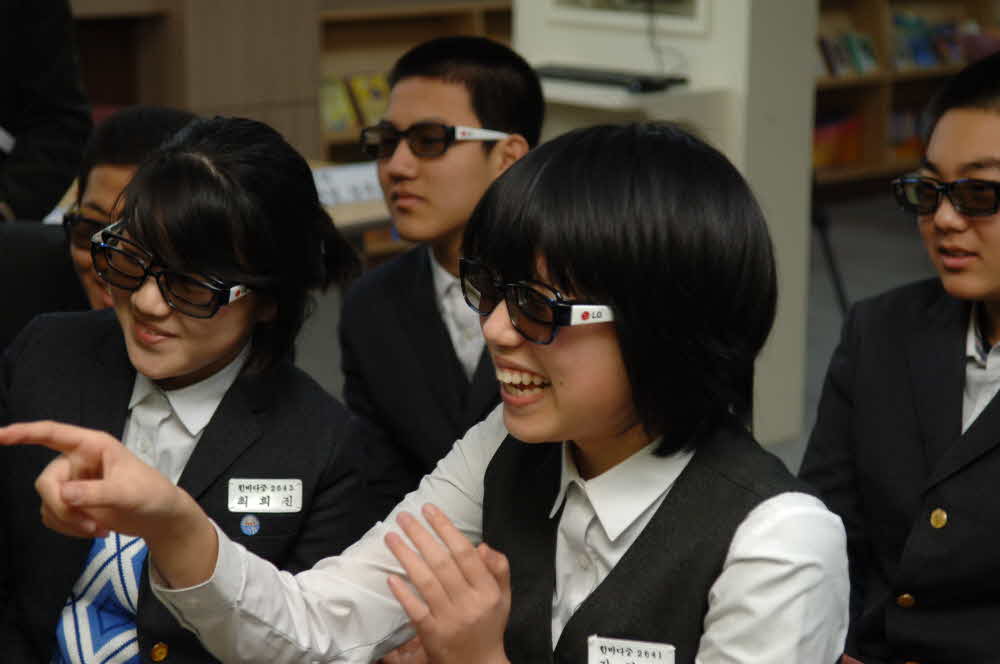
Why do so many East Asian children wear glasses? Because they don’t get enough exposure to sunlight, according to a study released by the Australian Research Council’s Centre of Excellence in Vision Science earlier this year. Which may well prove to be a damming indictment of education cultures that confine huge numbers of children to institutes when they’re not at school (source, left: unknown).
Rates of myopia (short-sightedness) have dramatically increased in East Asia over recent decades. To pick the best-known example, data on male conscripts in the Singaporean army shows that 40 years ago, roughly 25% of Singaporean children finishing high school had myopia, but now that figure is closer to 90%, despite students being healthier and taller overall. Similar rates are found in Hong Kong, Taiwan, and Guangzhou Province in China.
These general figures belie what is actually a very real threat to public health. Beyond simply consigning 9 in 10 students to eyewear, according to Dr. Ian Morgan of the Vision Centre, up to 20% of students in those regions are in the “high myopia” category, which translates into a roughly 50/50 chance of going completely blind by the time they are middle-aged. Governments across the region are expressing serious concern.
Previous popular explanations for the worsening vision included East Asian children spending more time at their desks and computers (“near work activity”, when the focus of vision is within a short range over an extended period) these days, or alternatively that there is a special East Asian genetic susceptibility. Both theories have been demolished by researchers at the Vision Centre, who compared myopia rates of 6 year-old children of Chinese origin in Singapore and Sydney.
In brief, only 3% of those in Sydney suffered from myopia, compared to 30% in Singapore. That there was any difference undermines a genetic explanation, but whereas most people might have expected it to be accounted for by the latter’s greater amount of near work activity, to researchers’ surprise in fact Sydney children did more, which suggested that the myopia must be triggered by some other environmental factor. Eliminating all other variables, the critical factor appeared to be that Sydney children were spending far more time outdoors. To be precise, 13-14 hours a week compared to 3 or 4.
While the exact mechanism between sunlight exposure and preventing myopia is still to be determined, the researchers believe that the neurotransmitter dopamine is responsible: known to inhibit eyeball growth, sunlight causes the retina to release more of it.
Evolved to literally keep an eye on the horizon, humans are naturally long-sighted (with short eyeballs), but our eyeballs lengthen as we grow and become more accustomed to near work activity. Myopia occurs when the eyeball has grown too long, meaning that the focus of light entering it falls short of the back of the eyeball, requiring corrective lenses to correct it.
That Singaporean children don’t get enough exposure to sunlight may sound counterintuitive, but in fact the hot and sticky climate makes children more inclined to spend time in air-conditioned environments indoors, and just like in many East Asian countries with more agreeable climates there is also a relative lack of parks and open spaces. Regardless, culture is undoubtedly the biggest factor. Australia is well known as a sporty outdoor country and after-school institutes are almost unheard of. In contrast, many East Asian children’s 6-day school and institute schedules deprive them of sleep to levels that would be considered borderline child abuse in Australia, sapping them of the time, energy or inclination to play outdoors in the sun.
There are additional medical problems associated with a lack of sunlight. Light skins are very popular among many East Asian women, evidenced by the plethora of “skin-whitening” pills, lotions and creams available in cosmetics stores, and in Korea it is already a common sight this spring to see women making sure to cover their faces with books and handbags as they cross a sunlit street, even if just for a few seconds.
While there is nothing at all wrong or unhealthy with this in itself – quite the opposite – the sun is avoided to excess by South Korean women. A 2004 endocrinology study by Severance Hospital in Seoul showed that the nation’s women are seriously deficient in Vitamin D, making them more likely to suffer osteoporosis later in life. In fact they posted the lowest Vitamin D levels of all 18 nations surveyed, with 88.2% of the women surveyed failing to reach a healthy threshold (source, right: the Korea Times).
 While it is possible to absorb Vitamin D through food, the surest way is through exposure to a few rays of sunlight every day, and Korean women would be well advised to ask themselves if ultra-pallid skin is really worth the price of full health. Just as Korean parents might wonder if higher TOEIC scores are really worth the price of their children’s long-term health (end).
I confess, I struggled with the science in this article. No, not because it was out of my field of expertise: as it so happens, not only do I have very bad eyesight myself (-7.5 for those of you who know what that means), and so am intimately familiar with diagrams of long and short eyeballs and so on from countless visits to opticians, but in fact my original major at university was astronomy too (no, really), and I learned so much about optics instead of actually looking at stars that I ended up dropping that major altogether!
More then, because the authors of the articles I linked to in my original post proved to be much less concerned with how sunlight prevents myopia as explaining that it had been discovered that it did, and so what proved to be the key information about the effect of dopamine on inhibiting the growth of the eyeball was missing from them. Fortunately though, I eventually found it in this press release by the Vision Center itself, and suddenly everything clicked. But without it, those articles and the dozen more I pored over while researching this post simply don’t make sense, and although it’s tempting to forgive those authors that lacked a science background especially, some advice from my (last) high school physics teacher seems apt here: if you can’t explain something to someone else, then odds are you don’t understand it yourself.
Words I’ve lived by for the past 16 years. Meanwhile, my frustrations with science reporting aside, see here for more information on the Severance Hospital study demonstrating Korean women’s severe Vitamin D deficiencies. And I’m too harsh really: this radio interview of Dr. Ian Morgan is still useful and interesting despite everything.
Update) Unfortunately, as parents’ angry complaints against this proposal for a 10pm curfew on hagwon teaching indicate, the norm of keeping children indoors studying until as late as 12:30am(!) five to six nights of the week isn’t going to change anytime soon.

 The Grand Narrative