Sex and Maths

(Source: Patrick Mannion, CC BY-SA 2.0)

Readers, I’m sure, are familiar with many of the biological and cultural explanations proffered for differences in mental abilities between the sexes. Here’s an an article in the Economist magazine with some strong evidence for, well…both sides to the debate, and with some surprising conclusions about Korea too:

Girls are becoming as good as boys at mathematics, and are still better at reading

TRADITION has it that boys are good at counting and girls are good at reading. So much so that Mattel once produced a talking Barbie doll whose stock of phrases included “Math class is tough!”

Although much is made of differences between the brains of adult males and females, the sources of these differences are a matter of controversy. Some people put forward cultural explanations and note, for example, that when girls are taught separately from boys they often do better in subjects such as maths than if classes are mixed. Others claim that the differences are rooted in biology, are there from birth, and exist because girls’ and boys’ brains have evolved to handle information in different ways.

Luigi Guiso of the European University Institute in Florence and his colleagues have just published the results of a study which suggests that culture explains most of the difference in maths, at least. In this week’s Science, they show that the gap in mathematics scores between boys and girls virtually disappears in countries with high levels of sexual equality, though the reading gap remains.

Student with Math Formula on Her BackDr Guiso took data from the 2003 OECD Programme for International Student Assessment. Some 276,000 15-year-olds from 40 countries sat the same maths and reading tests. The researchers compared the results, by country, with each other and with a number of different measures of social sexual equality. One measure was the World Economic Forum’s gender-gap index, which reflects economic and political opportunities, education and well-being for women. Another was based on an index of cultural attitudes towards women. A third was the rate of female economic activity in a country, and the fourth measure looked at women’s political participation.

As long-term readers will know, I usually have problems with virtually anything the Economist says about international comparisons of education standards, its consistent praise of the high scores of South Korean students, for instance, undermined by South Koreans themselves finding their education system appalling (a fact which a whole five minutes of checking on the internet would reveal). There’s little scope for misinterpretations of correlations between reading and writing scores and measures of sexual equality though, but still, as you can see, the researchers were at pains to keep the variables down to a minimum (source, right: Tattoo Lover; CC BY-SA 2.0).

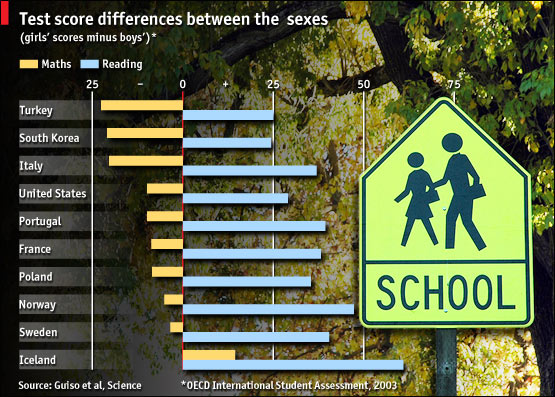
On average, girls’ maths scores were, as expected, lower than those of boys. However, the gap was largest in countries with the least equality between the sexes (by any score), such as Turkey. It vanished in countries such as Norway and Sweden, where the sexes are more or less on a par with one another. The researchers also did some additional statistical checks to ensure the correlation was material, and not generated by another, third variable that is correlated with sexual equality, such as GDP per person. They say their data therefore show that improvements in maths scores are related not to economic development, but directly to improvements in the social position of women.

And notice where Korea fits into that scale:
(Source: The Economist)

That was quite surprising, and confusing. For sure, in terms of its gender empowerment measure,   Korea is one of the most sexist countries in the world, and although it was less than a generation ago that girls’ university and even high-school educations were often sacrificed for the sake of their brothers’, I’ve heard from many different sources that the Korean education system today is relatively meritocratic. Indeed, Michael Seth in this must-read book on the subject, argues that it is one of its greatest strengths, albeit one unfortunately (and ironically) at odds with the great respect, status and deference given to high achievers also.

I’d imagined, then, that young Korean women confront sexism more once they enter the workforce, as despite their educations there remain strong societal expectations that they will be happy to work at non-advancing jobs in their twenties and then effectively retire upon marriage, not unlike the situation in Western countries in the 1950s and ’60s.

But then these tests were for 15 year-olds, so clearly there is some sex-based factor at work in the Korean education system that I wasn’t aware of. Why do Korean girls do so badly at math then? I’m open to suggestions.

The only clue I have is that Maths (and English) is considered a hard and difficult subject for students, which is why in its 19-year history the chain of institutes I work for didn’t hire any female teachers to teach it until literally last week, only men being considered authoritative enough to get students to study in class. Certainly, the institutes I work for are quite unique in that regard, and much more demanding of students than most, but still: I think it’s quite telling that the policy was in place. And if students of either sex disliked it so much, then I can’t imagine that girls with interest and/or ability in it would have been particularly encouraged to pursue it, given their relative absence in engineering and scientific fields in Korea. Perhaps Korean education isn’t quite as meritocratic as I thought?

(On a side note, it says a great deal about the sort of English taught at my institute that only men were considered capable of teaching that also, despite — I assume — a majority of English {and languge} teachers in Korea {and probably the world} being women)

The one mathematical gap that did not disappear was the differences between girls and boys in geometry. This seems to have no relation to sexual equality, and may allow men to cling on to their famed claim to be better at navigating than women are….

Again, surprising in a Korean context. I’ve been teaching 13 and 14 year-olds, on-and-off, for a good eight years now, and I’ve noticed that their math textbooks are always just full of geometry, far more than I ever had to do at their age. For sure, frantically copying each other’s answers in breaks between classes doesn’t equate to real learning, something they’re forced to do because they wouldn’t possibly have enough time to do all the homework required of them (let alone — heaven forbid — eat and sleep too). But still, if there’s one country where I’d thought girls would have been good at geometry, it would have been Korea. Something is clearly up (source, right: unknown).

The article gets more interesting (and controversial) after that:

….However, the gap in reading scores not only remained, but got bigger as the sexes became more equal. Average reading scores were higher for girls than for boys in all countries. But in more equal societies, not only were the girls as good at maths as the boys, their advantage in reading had increased.

This suggests an interesting paradox. At first sight, girls’ rise to mathematical equality suggests they should be invading maths-heavy professions such as engineering-and that if they are not, the implication might be that prejudice is keeping them out. However, as David Ricardo observed almost 200 years ago, economic optimisation is about comparative advantage. The rise in female reading scores alongside their maths scores suggests that female comparative advantage in this area has not changed. According to Paola Sapienza, a professor of finance at the Kellogg School of Management in Illinois who is one of the paper’s authors, that is just what has happened. Other studies of gifted girls, she says, show that even though the girls had the ability, fewer than expected ended up reading maths and sciences at university. Instead, they went on to be become successful in areas such as law.

In other words, girls may acquire an absolute advantage over boys as a result of equal treatment. This is something that society, more broadly, has not yet taken on board. Mattel may wish to take note that among Teen Talk Barbie’s 270 phrases concerning shopping, parties and clothes, at least one might usefully have been, “Dostoevsky rocks!”
(Source: Vaguely Artistic; CC BY-NC-ND 2.0)

I’m very much a proponent of the existence of some fundamental biological differences in aptitudes between the sexes myself, and do believe that even in a perfect world that there will always be, say more female nurses than male ones, and more male engineers then female ones and so forth. Not for a moment does that mean that I will ever stop or even not positively encourage my daughter to, say, be an engineer, or not take seriously a male nurse, but the above is yet another inconvenient truth against the argument that all difference is due to prejudice.

For more on that I recommend the book The New Sexual Revolution, by Robert Pool (1994), and especially “The Real Truth About The Female Body” in Time Magazine, March 8 1999. I especially recommend checking out the (naturally) numerous comments to the Economist article; as you have to be a subscriber to make a comment, then the dialogue is a lot more intelligent and civilized than you’ll find on most blogs and forums! I especially like this one of Tom West’s, a healthy cautionary message against what I’ve written above:

“Do all feminists rail against the idea that men and women might actually be inherently different?”

The trouble with acknowledging differences is that human beings tend to turn a generality into a specific rule. As soon as you say that it’s natural that men are over-represented in higher math, it becomes instantly harder for any woman to be even average at math. The meme is simplified into “women can’t do math”, and you soon end up with teacher’s wjho won’t work hard to teach girls math, boys and girls that reject those who are good at math as weird and different, and of course, dissuade many from putting in the effort to become good at math because they themselves believe they can’t do math.

As an aside, in my opinion, that was why Larry Summers deserved to lose his job for his remarks. Not that he was necessarily wrong. It was that by virtue of his widely circulated speech, he had legitimized “women can’t do math” in the minds of many, regardless of what he actually meant or believed. (And that people in authority have to be aware of not what their words say, but of what their words will do.)

(Note: Having my blog posts regularly copied and pasted by others myself, normally I’d be loathe to paste an entire article here. But it was of an annoying length that made simply giving excerpts difficult, yet pasting all of it too much. After much time and repeated links wasted on trying the former, I gave up and chose the latter!)


Women’s Bodies in Korea’s Consumer Society, Part 2: We’re not in Kansas Anymore


The ParadoxSong Hye-gyo sofa

For new readers, Part 1 was an outline and discussion of the first part of the 2003 journal article Neo-Confucian Body Techniques: Women’s Bodies in Korea’s Consumer Society by Taeyon Kim. To quickly recap it, she argues that women weren’t really thought of as individuals in Joseon Dynasty Korea, as the state ideology of Neo-Confucianism considered them incapable of the spiritual transcendence that men were. Instead, the best they could aim for in life was continuing a husband’s “ki”, or spirit, through the production and upbringing of sons and the efficient management of his household. Hence Kim describes them as “subjectless bodies,” as not only were they not really individuals but their physical bodies were not really their own either, merely being vessels for and tenders of the more precious ki instead (source, right: jingdianmeinv)

In terms of the ideals for women’s appearance, this meant that the physical attributes required for those were prized more than beauty. On top of that, adornment and/or alteration of the body was not condoned for either sex, as the physical body was one’s inheritance of ancestors’ sacred ki. And herein lies the paradox, as on the one hand Neo-Confucianism still pervades all aspects of Korean life today (I’ll take readers knowing and agreeing with this as a given), but on the other hand, modern Korea appears to be in the midst of a decidedly non-traditional celebration of youth and the female form. What gives?


Neo-Confucian Consumption Motives

The short answer is that appearances can be deceptive. It is certainly true that modern media images of Korean women are not Neo-Confucian in the 19th Century sense described above, and it’s difficult to argue just by looking at them that advertisements, for instance, are any different to their counterparts in Western countries. Of course, systematic cross-country analyses of numbers and types do reveal significant and telling differences, and if readers are interested in those then I highly recommend reading the 2006 journal article entitled “Content Analysis of Diet Advertisments: A Cross-National Comparison of Korean and U.S. Women’s Magazines” by Minjeong Kim and Sharron Lennon, downloadable here. But surveys like those do not chronicle average Korean and Western women’s reactions to them, and herein lies the essential differences between them.

Barbie Dolls ConformityAs a rule, in Western countries most (although not all) advertisements for a product have to actively suppress and disguise the notion that people may feel compelled, influenced or forced into purchasing that product, whether by the ad, by peer pressure, or some other unwritten social rule. Instead, people are encouraged to conceive their purchase in terms of personal choice, individuality, empowerment, and — especially if the target consumer is young — maybe liberation and rebellion too. And of course, these advertising norms undoubtedly operate for a good proportion of advertisements in Korea too. But in the case of advertisements for products related to one’s appearance, be they cosmetics, clothes, or plastic surgery, it turns out that a great number of Korean women make purchases for precisely the opposite reasons. Indeed, not only is there no stigma in doing so, but they positively embrace the opportunity to conform to and harmonize with social norms through their consumption choices (source, right: Kiran Foster).

Lest that assertion sound like a typical exaggeration of a Caucasian male, surveys that Kim cites indicate that most Korean women explicitly justify their choices in those Neo-Confucian terms, and definitely not the individual empowerment, entitlement, and personal assertion of one’s individual choice that Western women tend to do in similar surveys. That is not to say that Western women (or men) can’t and don’t also passively follow fashions, and it’s not necessarily a negative or dehumanizing thing either. But very few Westerners would admit to it.

I see no reason to doubt the results of those surveys (which I can provide the details of if readers wish), and while my own female Korean friends for instance, are certainly as liberal and free-willed as any Westerner in their clothing and cosmetic choices — and lifestyles; indeed, that’s why we’re friends — they can’t counter the mass of empirical evidence Kim provides, and even the anecdotal evidence from the media and on the streets of Korea. If Neo-Confucianism is pervasive in modern Korean life then, and Korean women consume cosmetics, clothes, and undergo plastic surgery operations largely for the sake of Neo-Confucianist motives, then it’s time to call a spade a spade and argue that Korean society’s new emphasis on women’s appearances is (somehow) Neo-Confucianist too. Indeed, it would be strange if only this particular aspect of Korean life was so different.

Enjoy Capitalism T-shirtHence the second part of Kim’s article is about how this modern phenomenon is a warping of and adaptation of Neo-Confucian ideals of women’s roles to new capitalist and consumerist circumstances. But while I originally wanted to outline and discuss that in this post, I’ve moved that to Part 3, because first I wanted to place those circumstances in their historical context, which I think considerably adds to and strengthens Kim’s argument (source, right: Jacob Bøtter).


The Developmental Context of East Asian Consumption

I’ve already demonstrated that although Korean women and, say, American women, can both be labelled as “consumers,” they can and do both make radically different consumption choices; or, make the same choices, but for radically different reasons. Sure, this is obvious, but I’m as guilty as anyone in generalizing and using labels here, so it’s good to remind ourselves of it. But if we shift our attention to the differences between most Westerners and most Koreans (and East Asians) as a whole, the first fact of note is the fact that most Korean university students’ parents easily recall the days when possession of some must-have items like a fridge, radio, color TV and car were essential signifier that one’s family had made it into the then swelling ranks of the middle-class. On that basis, it may be fair to say that they still imbue their consumer goods with much more status and importance than most Westerners do. (Hell, many of the university students themselves too.) This explains Koreans’ love affair with big cars and SUVs for instance, and in one of the most oil-lacking, mountainous and densely-populated countries in the world.

(Update, April 2013: Actually, the Korean preference for big cars is more due to the [inordinate] social status they provide.)


On top of that, Korean governments since 1961 have explicitly and fervently extorted Koreans to consume these items, provided that they were made in Korea. It’s easy to simply attribute this to and write off as mere nationalism, only different in degree to, say, the “Buying Kiwi-Made” campaign in New Zealand, or Democratic presidential candidates in the US criticising NAFTA in election year. But this is quite wrong. If you’ll bear with me for a moment, to properly understand women’s fashions in Korea you need to understand a little of it’s well, political history first. No, really.

When Park Chung-hee/박정희 took power through a coup in 1961, while his military regime of course relied on the use of force, it would be naive to assume that it didn’t have a great deal of popular support. And so, originally at least, his military regime’s sole claim to legitimacy was its perceived ability and capacity to produce the economic development seen as necessary for national security after the chaotic years of the Syngman Rhee/이승만 presidency. While linking the economy and security this way may sound absurd in 2008, it’s important to be aware that North Korea was actually ahead of South Korea economically until the late-1960s, and in addition to this Park was (justifiably) deeply concerned about the US possibly withdrawing its security guarantees to South Korea in the wake of its foreseeable withdrawal from Vietnam. Hence the development of POSCO and the Korean steel industry for instance, which, far from being the carefully planned and coordinated developmental success story it is often touted as today (it is the third largest steel producer in the world), was pursued despite the advice of Korean economists at the time, let alone American ones. Instead, as Mark Clifford explains in chapter five of this must-have book, Park didn’t care about the economics of it; he simply wanted the ability to produce tanks and ships should the US no longer provide them.

posco-center-statue.jpg

This is why Korea is often known as a “Developmental State,” as too are Japan, Taiwan and Singapore, which faced similarly dire circumstances in the Cold War and reacted in similar ways. Neo-liberal economists in particular are loath to admit that state-led development can be successful, and so they continue to critique the economic policies of these Developmental States decades later, but this excessive focus on economic minutiae has overshadowed the fact that they were and are primarily socio-political, not economic, phenomenons (right: Posco Center, Seoul, by Ian Muttoo).

Hence consumerism has links to national security in Developmental States, and all the choice government slogans like “Consumption is Virtuous” that I saw in old photographs of Korea from the ’70s in economic journals in the archives room of my university library. And while the corollary of Park’s developmentalism was authoritarianism, and average Koreans were expected to be content with and prolific buyers of Korean goods, imports being shut out by high tariffs in order to develop Korea’s own industries (which is why such a stigma remains on imports today), what I want you to take away from all the above is that:

  • Koreans are used to being told what to buy.
  • These choices have often been couched in terms of contributing to a higher purpose.
  • Those that didn’t subscribe to these higher purposes were given few alternatives, and the state was encouraged in stigmatizing them.

It is no great conceptual leap for Neo-Confucian women to go from being subservient to the higher purpose of ki, and their bodies to be imperfect versions of men’s, to furthering the higher purpose of improving the economy and maintaining national security by consuming Korean goods, and finding common identity in a turbulent century by following the new fashion industry’s edicts to improve their imperfect bodies by following their rules for fashion, cosmetics, and body shapes. Those will be the subject of Part 3.

(Update, April 2013: An important rejoinder to my fuzzy memories of reading in my university library is the book Measured Excess: Status, Gender, and Consumer Nationalism in South Korea by Laura Nelson (2000), which I describe here as:

…essential reading for anyone wanting to know more about the 1990s in Korea, and in particular the frequent government and media campaigns against over-consumption (in practice aimed almost exclusively at women, these were important precursors to the “beanpaste girl” stereotypes of the 2000s)

See my “Revealing the Korean Body Politic” series for more on those campaigns and stereotypes in the 2000s, especially Parts 3 and 4.

Paternity Leave in Korea from Next Year?

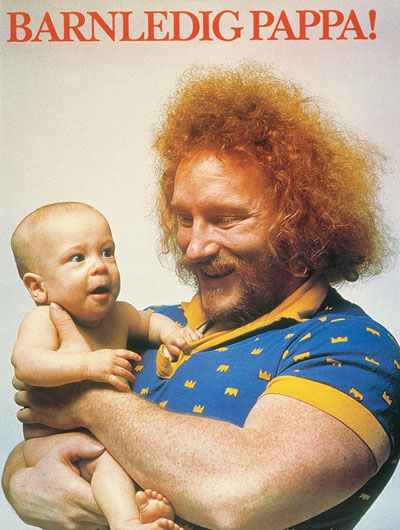
From page 3 of the September 12, 2007 Busan Focus:Paternity Leave, 1970s Swedish Poster

출산휴가가는男: 내년7월 배우자 3일 부여 ‘남녀고용평등법’등 의결

내년 7월부터 남성근로자도 배우자 출산휴가를 사용할 수 있으며, 육아휴직을 나눠 쓰거나 육아휴직대신 근로시간 단축방법도 사용할 수 있게 된다.

정부는 11일 오전 중앙청사에서 한덕수 총리 주재로 국무회의를 열어 일과 육아의 병행을 위해 이 같은 내용을 핵심으로 하는‘남녀고 용평등법’개정안 등 20여개 안건을 심의, 의결했다. 이 개정안은 그간 사업장별로 임의로 시행해 오던 남성근로자의 출산휴가를 3일간 부여하는 것으로 의무화했으며, 현행 전일제 육아휴직 대신 주 15~30시간 이내의 범위에서 근무하는 육아기 근로시간 단축을 신청할 수있도록 하고, 육아휴직이나 육아기근로시간 단축제를 1회에 한해 분할 사용할 수 있도록 하고 있다.

또 육아기 근로시간 단축을 이유로 해고나 불리한 처우를 하는 사업자의 경우 3년 이하의 징역이나  2천만원 이하의 벌금, 육아기 근로 시간 단축 종료 후 같은 업무에 복귀시키지 아니할 경우 500만원 이하의 벌금, 그리고 배우자 출산휴가를 주지 않을 경우 500만원 이하의 과태료를 부과하도록했다 (image source: On Being; CC BY-NC-SA 2.0).

또 국제화 시대를 맞아 ▲ 회사의 설립·운영 등에 사적 자치를 폭넓게인정하는 유한책임회사 등 새로운기업형태를 도입하고 ▲무액면주식 제도의 도입과 최저자본금제도의폐지 등 상법 개정안도 심의했다.

Men on Paternity Leave: To fulfill the requirements of the law on gender equality in the workplace, a 3 day paternity leave is to be available from next July

From next July, the spouses of women taking time off work to give birth can also take time off from work, either for the birth itself or by shortening their work hours by an equivalent amount.

On the Morning 11th of September, the prime minister Han Deok-Su, opened a session of Congress focusing on work and childcare. Congress members deliberated on a bills regarding the law on gender equality in the workplace and on 20 other matters, and passed a law that will require all workplaces to provide paternity leave to male employees. They will be given the option of either taking 3 days at the time of the birth of the child, or have their working hours reduced by 15-30 hours at alternate times when it is convenient to them. These 15-30 hours will not have to be taken all at once.

If employers use this reduction of work hours as a pretext to fire an employee or treat him unfairly, then the employer will be liable for a jail sentence of up to 3 years or a fine of 20 million won. Also, if an employee is not allowed to continue in the same position after returning from paternity leave, or if paternity leave isn’t granted at all, then the employer will be liable for a fine of up to 5 million won.

Since we are in a globalized age, Korean companies need to introduce more scope for employee’s personal autonomy in their establishment and operations. Also discussed at the congress was the introduction into commercial law of a no-par stock system and the discarding of a minimum capital stock system.

For the sake of comparison, see here for a table showing different countries’ parental leave provisions.