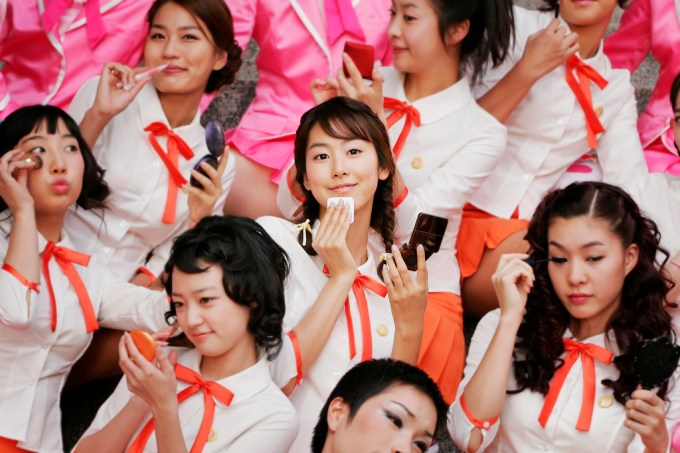
 (Screen capture from the movie Dasepo Naughty Girls/다세포소녀. Source: martin francisco)

“Koreans are conformist because of their Confucian heritage…yada yada yada”
Even though I’ve chosen to live in Korea a long time, like most expats I often find it to be a frustrating and exasperating place sometimes. That’s not necessarily a criticism, and indeed this love-hate relationship may even be part of its charm—certainly my adopted hometown of Auckland, New Zealand, never aroused such strong emotions in me. On the other hand, it does lead to so many one-liners about the place, endlessly repeated by fresh rotations of expats.
But are they always wrong? Don’t some have a grain of truth? To answer, let me examine one that I and probably most readers have made at some point in our stay here, but which I personally wouldn’t have been able to justify before I did my research for this post. And certainly won’t ever be making again.
What I have in mind is your gut reaction to watching the following commercial, about three years old:
 (Update, July 2012: Unfortunately, the video has been taken down, and I didn’t save a spare copy back in 2008. Hopefully, the screenshots will still give you the gist of it!)
According to Marmot’s Hole commentator mins0306, to whom I’m very grateful for finding the video, the message the commercial wanted to convey was “What she selects will become a trend. And since she selected a Prugio apartment, Prugio apartments will also become a trend.” Instead, it has inadvertently become of a symbol of Korean people’s conformism, particularly of women’s attitudes to fashion.
But before writing this post, had I been pressed for why so many Korean women seem to so blindly follow the latest trends, be they mini-skirts in winter or getting double-eyelid surgery, I would have mumbled something about Confucianism and the education system discouraging individuality. That is still technically correct, but—let’s face it—most of us blame so much here on Confucianism, but actually know little more about it than what we read in Lonely Planet Korea in the week before we came. But how,exactly, is it to blame? Why?
On the surface, it may not even have anything to do with Confucianism at all. Consider this statement from the 2003 journal article “Neo-Confucian Body Techniques: Women’s Bodies in Korea’s Consumer Society” by Taeyon Kim (details and abstract here):
“For 500 years, Korea adopted Neo-Confucianism as its official ideology and strove to create a Neo-Confucian state by following its precepts as closely as possible. Neo-Confucians believed the body was sacred. Since it was bequeathed by one’s parents, in accordance with filial piety, the body had to be respected and remain unaltered…The Korean aversion to manipulation of the body seems to have been a long-standing cultural principle – only whole-heartedly abandoned in the last few years of proliferating plastic surgeries and various other manipulations of the body. Why has what appears to have been such a strong cultural value been so suddenly and completely abandoned?” (p. 98)
Like I said, I didn’t know that Joseon Dynasty Korea adopted “Neo-Confucianism” rather than merely “Confucianism” its state ideology either; from now on, I’ll make sure to blame all Korean ills on that instead. But now that she mentions it, yes, I do recall that Confucianism…oops, Neo-Confucianism I mean…did not condone alteration and adornment of the body, which is why it was so dishonourable for men to have their ponytails cut off.
How then, can Korea still be described as “more Confucian than China” when: Korean women adorn fashion and accessories to the point of what Michael Hurt describes as “fetishization;” female friends of mine wear excessive make-up to work upon fear of being fired if they don’t; others think nothing of wearing it to the gym; and Korea leads the world in the number of plastic surgeries made per capita? The notion now sounds absurd.
But Kim goes on to argue that the prescribed Neo-Confucian role of women’s bodies is essentially the same today as it was in the Joseon Dynasty, albeit adapted to and/or warped by democratization and capitalism. I don’t entirely agree with everything she says, but more in degree than in substance, and she certainly does make a decent stab at solving that paradox above.

Because her two-part argument is very long, and I actually have a lot of my own thoughts and ideas to add to her arguments about postwar Korea, I’ve taken the wise (but unusual for me!) decision to split my original 3500 word post on her journal article into two. In the remainder of this first one then, I’ll outline what Kim says about how Neo-Confucianism viewed women’s bodies and their roles, and in the next one I’ll discuss how these adapted and changed to, but ultimately survived, the 20th Century (source, right: natebeaty).
Neo-Confucian Women’s Bodies as Mere Vessels
Before reading the following, bear in mind that only Joseon Dynasty elites—possibly as little as 1% of the population—would have subscribed to the Neo-Confucianism edicts described (Kim does acknowledge this). But the vast majority of Korean women worked on their farms, and were integral economic parts of the household; indeed, I’ve won arguments with older male students of mine on this point, who thought that “Korean tradition” justified them in literally forbidding their daughters-in-law from working after marriage. I concede though, that they would have remained an ideal.
“To understand the Neo-Confucian body, it is essential to understand the concept of ki. A material force which links the body and mind into one system, ki flows through all things, giving them form and vitality….There is no distinction between the self and the universe. Neo-Confucian men were encouraged to let go of ego and become selfless, that is to have no consciousness of an individual and separate self apart from others….Ki was passed from parent to child throughout the generations, acting as a material link between ancestors and descendants….The family composed a unified body through ki, and the identity of the family and self and family was continuous and undifferentiated.” (p.99, italics in original)
For learners of Korean, this “ki” appears to be “기,” which has a hanja character on p.38 of my Korean vocabularly ‘bible’ that, in addition to “spirit,” also means “air,” “atmosphere,” and “energy.” And for everyone, I admit, at the moment it sounds very similar to a mere family name or bloodline, but those are quite vague concepts at best, whereas ki does sound like a well-thought out—albeit sexist and fundamentally flawed—philosophical concept. Elaborating on it further:
“The force of ki constituted one’s sense of the body and self more than the corporeal body. It followed that the family body, within which flows the same ki,was considered the essential self more than one’s own physical body. The emphasis on non-distinction between self and others produced a sense of self that was non-individuated and fluid, with no boundaries to determine a distinction between one’s family and one’s self.” (p.99)
Hence the Hoju System/호주제, a family registry system, rather than one of individual birth certificates like in Western countries, that was not abolished until as late as this year. Under it, upon marriage, women would be transferred from one family’s certificate to her husband’s family, almost like property. In practice, female divorcees suffered greatly from it because:
-
Given that it was often required for job applications, it meant that applicants’ marital status was readily apparent to employers. I’ve read, but am not sure how applicable it is now given the high divorce rate, that female divorcees were often discriminated against by employers as a result, ironically at a time when most would have needed employment more than ever.
-
Custody of children was overwhelmingly awarded to fathers; after all, the women were no longer part of the ki/family.
-
For those women married to fathers that abandoned their families, divorcing them would mean years of adminstrative problems with children in schools and so forth, as it meant that they were no longer their legal guardians. In Japan, with a similar system, these issues came up with ex-prime minister Koizumi after he divorced in 1982.
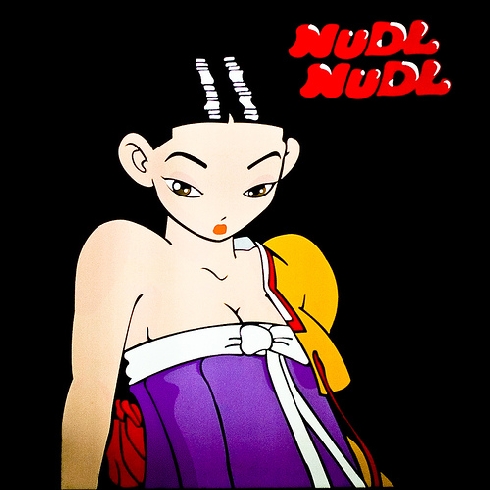
Promising to abolish this system was one reason I supported the election of Roh Mu-hyon back in 2002, and while he did prove to be quite a lame duck president, and least this promise was fulfilled. To continue (source, right: theturninggate):
“Neo-Confucian techniques of self-cultivation of the mind and body only applied to men. Women in the Neo-Confucian view were incapable of achieving sagehood and therefore had neither the need nor the ability to strive for transcendence of the self and body. While men produced their selves through the mind (study of the classics) and body (maintenance of the family body through ancestor worship), women were occupied with maintaining and reproducing the family body through the corporeal bodies of the family.” (p. 100)
Koreans are by no means alone in having philosophical or religious beliefs justifying an inferior status of women, but this particular one could lead to some very strange-sounding results. For instance, Kim explains that one study of a villagers in 1990 found that they thought women were inferior to men because they did not carry the ki that men did, meaning that “women were believed to be passive receptacles of the life which men implanted in them; they played no active part in creating life.”
It also meant that beauty and wealth were secondary to possession of the physical traits required to bear sons, and gave rise 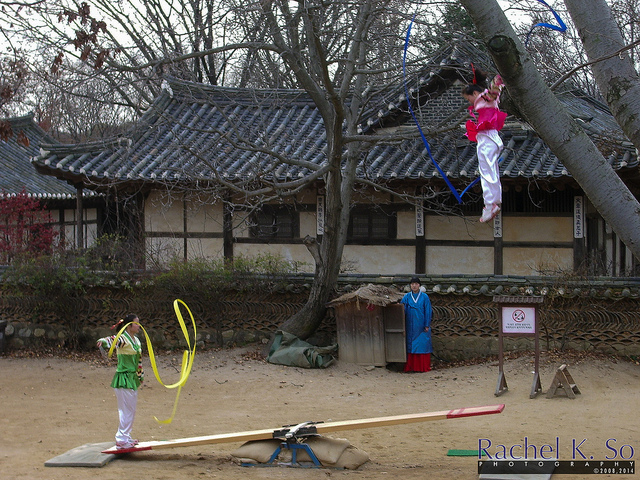 to an elaborate system of prenatal education known as taegyo/태교 which, rather than the notion of women and child’s health that the word brings to mind today, back then was more the idea of women as bodies rather than subjects or individuals, because “their conduct and thoughts were for the sake of the other abiding in their bodies, and they were valued mostly for the children and labour that their bodies could produce.” Hence, women “were regarded as subjectless bodies.” (pp. 100-101), the consequences, in sum, being that (source, right: InSapphoWeTrust):
“While [men] aimed to transcend the body, women could never do so – their bodies were too valuable. A man’s mind and ki were considered more valuable than his corporeal limbs while a woman was most valued for her body and its reproductive labour. As a result, efforts were made to maintain sole control over women’s bodies, subjecting them to a protection and concealment that practically rendered their bodies invisible.” (p.101)
Indeed, while the hanbok is much more comfortable to wear and walk around in than a kimono (or so I’ve heard), it’s not exactly a celebration of the female form. Also, this protection and concealment literally meant that elite women’s homes became prisons, as they weren’t allowed to leave: those “traditional see-saws,” for instance, were actually so popular because they allowed elite women rare glimpses of life outside of the walls of their courtyards, and I remember reading somewhere of a woman escaping from her village to Busan during the Korean War, despite all the death and destruction around her actually having an exciting time, as it was the first time she’d left her house in decades!
Next week: Part 2, which will continue the discussion into the postwar period.


 Movie poster for Samaritan Girl/Samaria (2004), a Korean movie about teenage prostitution; see