
 (Source: SpaceHo)

Written at the request of the Korea Times editor yesterday, with the final edited version available online here.
Naturally I think the original is much the more pleasant to read, and so that is what I include below, but I have to concede that the editor both adapted it well to a news format and made it take much less time to get to the point; in hindsight, my thesis topic wasn’t exactly the best of choices for an 800 word article. Any new readers looking for the promised wider discussion of the issues raised in it though, please see here, here, here, and here (for starters!).
Still, one genuine quibble with the Korea Time’s article is the misleading title, as it was actually the last downturn — the Asian Financial Crisis — that was responsible for the “Flower Men Wind” as they put it. But that’s no big deal, and its obvious to anyone who goes on to read it.
On a final note, I suddenly have a newfound appreciation for Michael Breen’s sarcastic article about commentators to Korea Times articles. To wit: “this author is out to lunch and offers nothing to KT readers. men need to work and they should be first in line for jobs.”
Sigh.
Downturn Spawns ‘Flower Men’ Wind
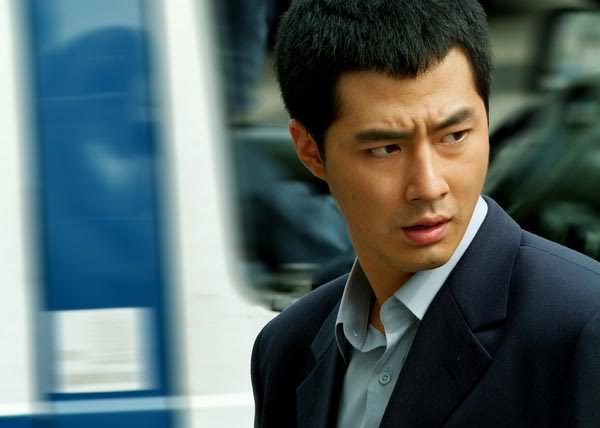 (Source: Dramabeans)
“Dynamic Korea” still graces many a Korean government website, and while that slogan has demonstrably failed to stimulate tourism in recent years, it remains a fitting one for such a rapidly changing society. Yet in the midst of such change, how to anchor oneself as a member of it?
In practice, the need for rootedness renders one’s generation in Korea as strong a marker of identity as, say, race is in the US, and one vivid demonstration of this is the sight of grown children alongside their parents: not only are the former often well over a foot taller because of better diets, but in particular the pastel colors of many sons’ clothes, their elaborate hairstyles, their attention to skincare, their “couple-clothes” and so on can be in sharp contrast to the staid appearance of their fathers, many of whom may well be quite perplexed and embarrassed at what they see as their sons’ effeminate looks.
Yet most would probably be surprised and offended to hear themselves being described as such, and, to be fair, such concepts do vary greatly between times and cultures. What their fathers regard as effeminate now were actually the norm in many earlier periods of Korean history for instance, as illustrated by the costumes in the 2005 movie “The King and the Clown,” and — however bizarre this may sound to Western readers — couple-clothes can in fact be worn by both sexes for the sake of rebellion, such visible affection being a stark rejection of their parents’ often arranged marriages, and all that those entailed.
As such, it is important to analyze the origins of current Korean fashions and lifestyle choices in Koreans’ own terms. Unfortunately, this has generally not been the case in English for Korean men’s current “kkotminam” ideals of appearance.
Possibly, this is because its literal translation — “flower men” — sounds awkward, and so the seemingly close equivalent of “metrosexual” is quickly used in its place. This conflation leads writers to attribute the rising popularity of flower men in Korea over the last decade to a mere importing of metrosexuality. This is a mistake.
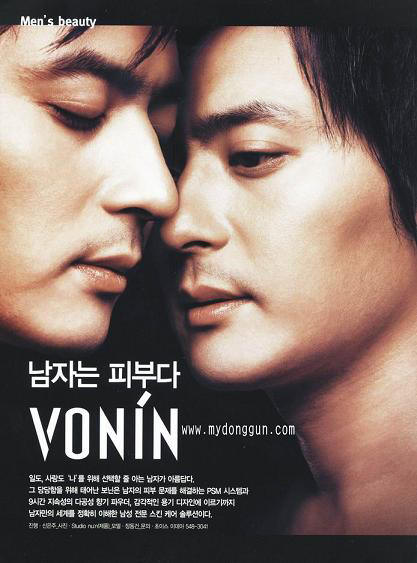 Among other things, Korea completely lacked — nay, explicitly banned — the mainstreaming and then commodification of gay culture in the 1990s that led to the rise of metrosexuality. Even today there are implicit restrictions against positive portrayals of foreign male-Korean female relationships in the Korea media that have prevented metrosexual symbols like David Beckham from ever acquiring the popularity here that they did in, say, Japan during the 2002 World Cup. Moreover, when focusing on men, it can be easy to lose sight of the fact that it is actually women’s changing tastes in them that drive changes in their fashions and grooming habits, and accordingly it ultimately proves to be married Korean women in the late-1990s that are responsible for flower men’s origins (source, right: ruppy2009).
Why married women? Because it was they who bore the brunt of layoffs during the “IMF crisis,” the logic being that they could be provided for by their husbands instead. But coming after decades of the subservience of feminist goals to wider ones of democratization, and only so recently being given the opportunity to achieve those – not least of which was the right not to be fired upon marriage – they were greatly angered at the sudden loss of a long-awaited opportunity. Moreover, to add insult to injury, they were then encouraged by both government and business to support “Korea’s hardworking men” in order to overcome the crisis.
This shows that Korea remains a deeply patriarchal society, and even today women are heavily circumscribed in the extent to which they can publicly criticize Korean men. Indirect criticism, therefore, took the form of an outright rejection of traditional ideals of men as strong, provider types. A sudden glut of movies appeared featuring romances between older women and younger men, and that this was when the first, identifiable, flower men began appearing in advertising too. And then there was the World Cup of 2002: Korean women themselves were surprised at how as a mass they appropriated such a previously masculine event as their own, in just a few short weeks forever changing standards of dress, discourses of sexuality, and cementing these new ideals of the Korean man.
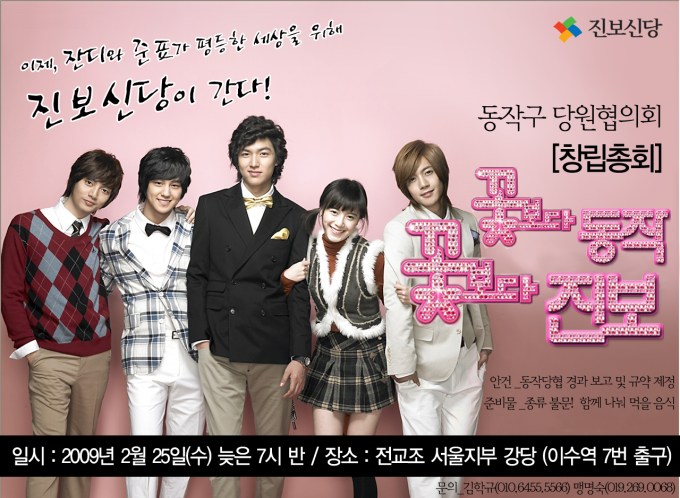 (Source: 동작신진보)
Certainly, there are many more elements to the story: the term “flower men” actually first appeared in 1999 in the context of imported Japanese manga for instance, and as the teenagers that read those grew up, manga-derived films and dramas have gone mainstream. But it is the supposedly asexual married women known as “ajumma” that deserve major credit as instigators of that process, showing that Korea was not a mere passive vessel for Western trends. It is surely telling that the first mention of the term “metrosexual” in Korean newspapers was not until 2003.
Update) “Mirror, Mirror…”, from TIME in October 2005, is a good example of an article that conflates kkotminam with metrosexuals, and in turn sees no essential differences between them and similar groups in East Asia such as, say, “aimei nanren” (love beauty men) in China. But although I (justifiably) criticize that journalistic tendency, there definitely is what my (likely) thesis supervisor has described as Japanese-inspired, “pan-Asian soft masculinity” out there: I just think that its national differences need more acknowledgement, and that at the very least it was very much through the lens of the IMF Crisis that that was imported it to Korea.
Other than that though, the article is not without its good points. For example:
But is the rise of the Asian Pretty Boy all that revolutionary? Not really, says Romit Dasgupta, who teaches Japanese studies at the University of Western Australia. “It’s not a result of David Beckham that suddenly Asian men are starting to look after themselves,” he says. “The tradition was already there.” During Japan’s peaceful Heian period between 794 and 1185, for example, both men and women powdered their faces white. Chinese University of Hong Kong professor Anthony Fung notes that in the West, maleness typically means “muscles, dark skin and strong bodies.” In Asia, by contrast, definitions of masculinity have traditionally been more flexible. During China’s Ming and Qing dynasties (1368-1911), men were depicted in paintings as ethereal, feminine creatures. That refined ideal is best found in the Chinese classic novel, The Dream of the Red Chamber, in which one of the main characters, Jia Baoyu, applies makeup and writes prose in his study instead of battling enemies. And he gets the girl! “Extreme androgyny is nothing particularly new,” says Fabienne Darling-Wolf, a professor of Japanese studies at Temple University in Pennsylvania. “The 50 or so post-war years during which Japanese men were not androgynous-due to Western influence and the desire to ‘catch up’ economically-is the glitch in history, not the other way around.”


 The Grand Narrative