Bad Girl, Good Girl (배드걸 굿걸) by Miss A (미쓰에이): Lyrics, Translation, and Explanation

(Source)

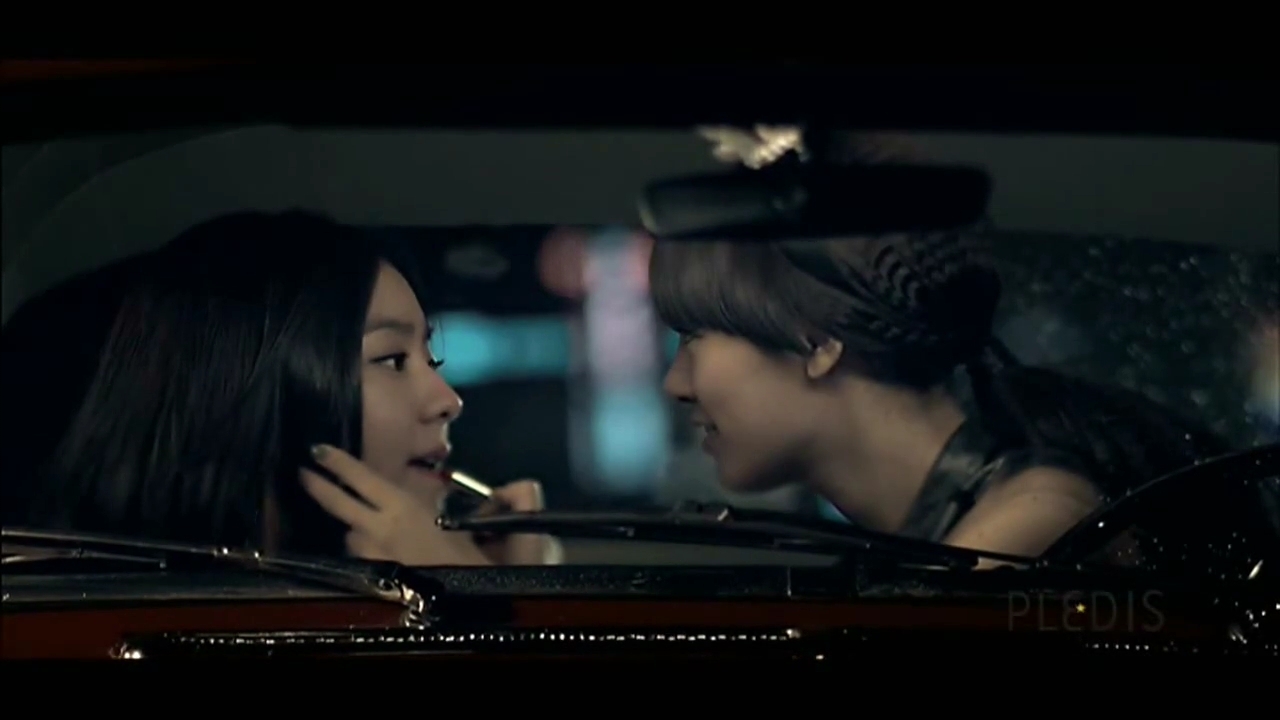
Having just written that I find new girl groups virtually indistinguishable from each other these days, then I’m very glad reader “abcfsk” persuaded me to take a closer look at Bad Girl, Good Girl (배드걸 굿걸) by Miss A (미쓰에이), as I grew to like it very quickly. And not just because of the eye-candy in the music video below either, which I actually deliberately avoided watching so as to better compare my own translation of the lyrics to the one there later.

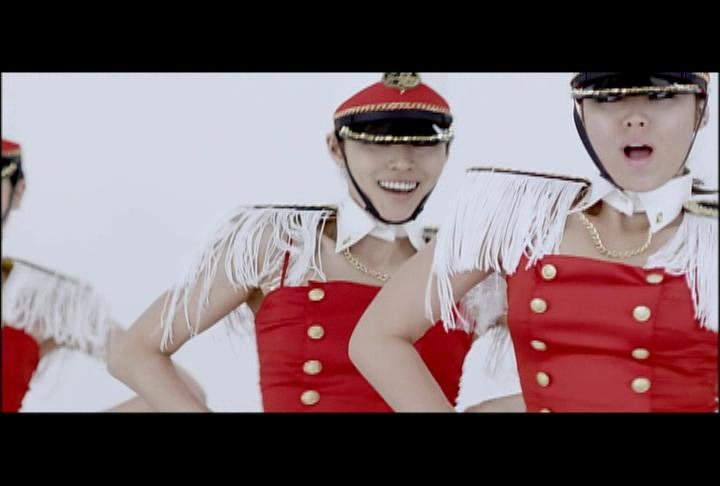
But hell: taken from a zip-file available here, in hindsight the screenshots below didn’t really do justice to the eroticism of some of the dance moves. And which to be frank, made finally seeing the video itself almost feel like a reward for all my hard work.

No great surprise to learn that Park Jin-young (박진영) is their manager then, as he is notorious for that sort of thing. Granted, that is the way the whole Korean music industry is going these days, primarily as a means for new groups to stand out, but those groups under the JYP Entertainment label do seem to push the boundaries more than most.

Focusing on the lyrics for now though, here’s my own original translation of them, with explanations of those parts I found difficult:

Update – In case anyone’s confused, the original video with lyrics included has been deleted.

You don’t know me, you don’t know me

You don’t know me, you don’t know me

So shut up boy, so shut up boy

So shut up boy, so shut up, shut up

앞에선 한 마디도 못 하더니

뒤에선 내 얘길 안 좋게 해 어이가 없어

Hello, hello, hello

나같은 여잔 처음 으로 으로 으로

본 것 같은데 왜 나를 판단하니

내가 혹시 두려운거니

You don’t know me, you don’t know me

You don’t know me, you don’t know me

So shut up boy, so shut up boy

So shut up boy, so shut up, shut up

In front of me you can’t say a word

And I can’t believe the bad things you say about me behind my back

Hello, hello, hello

I think this is the first time you’ve ever met a woman like me…why do you judge me?

Am I a thing to be feared?

(Source, all screenshots: Red and Rosy)

Starting with Line 1 of the Korean after “shut up” etc., the “더니” in “하더니” has many usages according to page 277 of my reference guide, Korean Grammar for International Learners (KGIL), but I think the most appropriate is number 1, that which “allows the speaker to affirm that some fact which (s)he directly experienced or witnessed in the past about a third-person subject is the reason or source for the state of affairs in the follow clause…the subject is usually second or third person”.

That allows the fact that the unnamed man (her boyfriend?) is reticent in front of her to be linked to line 2, that he badmouths her behind her back. But which was actually much more difficult to translate than it looked, as “뒤에선 내 얘길 안 좋게 해 어이가 없어” is literally “[me] behind as for – my story – not well do – word – not have”, which sort of looks like what I ultimately wrote, but was ripe for misinterpretation. Once my long-suffering wife told me that “어이가 없어” actually means “I can’t believe” though, then I was able to muddle along.

In line 6, the “거니” in “두려운거니” isn’t in KGIL, but I think it’s shorthand for “두려운것이에요”, or “scary thing is”. Hence I used the noun form “am I a thing to be feared?” in my translation, but of course something like “are you scared of me?” would be fine too.

Now for the chorus:

겉으론 bad girl 속으론 good girl

나를 잘 알지도 못 하면서

내 겉모습만 보면서

한심한 여자로 보는 너의 시선이 난 너무나 웃겨

춤 출 땐 bad girl 사랑은 good girl

춤추는 내 모습을 볼 때는 넋을 놓고 보고서는

끝나니 손가락질 하는 그 위선이 난 너무나 웃겨

On the outside I’m a bad girl, on the inside I’m a good girl

While you don’t know me well

While only looking at my outward appearance

Thinking of me as a pathetic woman is so laughable

When I dance I’m a bad girl, but when it comes to love I’m a good girl

When you see me dance you lose your mind

Only then to scorn me when the dance is ended

I laugh at your hypocrisy

In line 1, I was surprised that “으로” was used instead of “에”, as I’d always thought the former was used mostly for directions and processes rather than physical locations, but my wife assures me that the latter can’t be used at all in this case (oh well). She also told me that in line 4, “pathetic” would be a much better translation of “한심하다” than the “pitiful; pitiable; wretched” and so on that my dictionary gave; that in the case of line 6 at least, “모습” really means just “me” rather than “outward appearance” or “figure”; and finally that “넋을 놓고 보다” means “to lose one’s mind”, which I would never have got figured out otherwise. I did realize that “보고서” at the end looked a bit weird though – “a written report” – and ultimately the “고서” in it turns out to be one more grammar pattern. Which according to p. 251 of KGIL, has the effect of:

…tightening the relationship between the preceding and following clause, and implying that the contents of the second clause are a natural and closely linked follow-on to those of the first. In other words, whereas “고” alone is appropriate when a long interval intervenes between the two clauses, “고서” is appropriate when the connection is more immediate”.

Finally in line 7, of course “끝나니” is short for “끝나니까”, or “because it finished”. Add “scorn” and “hypocrisy” in there as well, then whatever the particulars of the last 2 lines, I got the impression that the man is captivated by her dancing, but then scorns and thinks little of her as soon as she stops and the spell is broken. Hence laughing at his hypocrisy, although now I’m little confused about the narrative of the song as I type this, as by this stage at least I thought the whole point was that she shouldn’t be judged by her outward appearance and actions…whereas now it appears that they’re actually also her strong points.

이런 옷 이런 머리모양으로 이런 춤을 추는 여자는

뻔해 ha 네가 더 뻔해, 오~

Hello, hello, hello

자신 없으면 저 뒤로 뒤로 뒤로

물러서면 되지 왜 자꾸 떠드니

속이 훤히 보이는 건 아니

A woman with those clothes, that hairstyle, and doing that dance

is shameless? Ha! You’re even more shameless, oh~

Hello, hello, hello

If you have no confidence, you can step back back back there

Why do you frequently make so much noise complaining about me?

I can see right through you

In line 4, I was a little confused for a moment by “저”, which is short for “저기” or “there” rather than being the respectful form of “me”. And then by “자신 없으면 저 뒤로 뒤로 뒤로 물러서면 되지” in lines 4-5, which literally means “confidence – if not have – there – towards the back towards the back towards the back – if step back” and looks like an unnecessary and confusing repetition to me.

Finally, line 6 was a big stumbling block: first, I originally thought “아니” meant “no”, but it’s actually “know”, as in “알다”. Then, “훤하다” means “gray, dimly-lit”; “extensive, broad and wide, spacious”; “good-looking”; and finally “be familiar with” and I was plumping for the first meaning until my wife said the last would be better.

Speaking of whom, to anybody envious at my Korean ability evident in translations in numerous earlier posts, and surprised at (and tired of) how much I’ve needed my wife’s help this time(!), then, well, I’d be lying if I said she didn’t have a huge role in correcting my numerous mistakes and explaining things after I do the original translations (I probably wouldn’t be able to properly provide any at all without her). I just haven’t mentioned that before because I usually don’t talk about the translation process itself, and how much time and effort it takes us.

Which gives me a newfound respect for those studying Korean entirely by themselves! But getting back to the lyrics though, after the above there’s the chorus again, and then the final verse:

날 감당 할 수 있는 남잘 찾아요

진짜 남자를 찾아요

말로만 남자다운 척 할 남자 말고

날 불안 해 하지 않을 남잔 없나요

자신감이 넘쳐서 내가 나일 수 있게

자유롭게 두고 멀리서 바라보는

I’m looking for a man who can bear me

I’m looking for a real man

Not a man who only talks like a real man

Is there no man that I don’t make uneasy?

Who can’t give me the freedom to watch me become a woman overflowing with confidence?

Finally, an easy verse! Any fellow Korean learners, please feel free to ask me about any of it, but otherwise that’s the whole song already, but for the chorus and finally the English opening sequence again.

Reluctantly tearing my eyes away from the singers (especially Fei {페이}) to the translated lyrics in the video then, I’m happy to say that they appear to be very similar, although there do appear to be some differences between the subjects in the some cases (in other words, I’ve got some “he”s where TheKpopSubber has “she”s and so on).

I’d like to look at those in more detail, but unfortunately I’m about to go out on a big shopping trip with my wife and kids, so for now I’ll just have to leave the post for you to enjoy as it is I’m afraid (those of you also unnerved by mistaken recent reports that North Korea was shelling again, may be happy for the distraction!). But of course, do please feel free to discuss those differences and/or anything about the song, group, and/or MV yourselves, although still knowing so little about the group then I’m going to reserve my own analysis until I’ve at least translated their second hit Breathe (브리드) next week:

Enjoy!^^

Update: Wait…one of them’s only just turned 16? Another middle-school student in a girl band?

Update 2: Given Miss A’s Chinese angle mentioned in the comments (2 of singers are Chinese, and they’ve been promoting themselves extensively there), then I’d like to point interested readers to Rowan Pease’s chapter “Korean Pop Music in China: Nationalism, Authenticity, and Gender” in Cultural Studies and Cultural Industries in Northeast Asia: What a Difference a Region Makes, edited by Chris Berry, Nicola Liscutin, and Jonathan D. Mackintosh, (2009, pp. 151-167), in which (among many other interesting things) she explains that:

(Source: The Japan Foundation)

In 2003, the Korean National Tourism Office [a major investor in the Korean wave] conducted a Hanliu tourism survey in China, Taiwan, and Hong Kong exploring attitudes to Korean culture, publishing the results online…

….It compared the impact of Korean culture with that of four “competitor” countries (the U.S., Japan, Taiwan, and Hong Kong), and in the process revealed much about Korea’s own political and nationalist concerns, particularly in relation to Japan and America. Six of the eleven options for respondents to the category “reasons I like Korean culture” reflect this preoccupation: “less sexual than Japanese culture,” “less sexual than American culture,” “less violent than Japanese popular culture,” “less violent than American popular culture,” “decreased interest in American culture,” and “decreased interest in Japanese culture.” One other echoes Straubhaar’s notion of cultural proximity: “similar in culture.” Certainly, Korea’s own music media censorship laws (which even in 1997 prohibited the displaying of body piercings, navels, tattoos, “outfits which might harm the sound emotional development of youth,” and banned violent or political lyrics), meant that Chinese TV stations could buy in Korean music videos and music TV shows knowing that they were unlikely to upset local censors. However, these questions also reflected a perception that Korea acts as a defender against excessive Westernization and as a guardian of Confucian values within East Asia. (pp. 155-156)

I wonder if those perceptions still hold true for China today, and in particular just how safe and “less sexual” than American and Japanese culture music videos like this one are viewed by Chinese TV stations?

Because Of You (너 때문에) by After School (애프터스쿨): Lyrics, Translation, & Explanation

With apologies for not writing about the positives of Korean popular culture more often, let me present Because of You (너 때문에) by After School (애프터스쿨). It’s one of my 10 favorite Korean songs, and easily their best.

Or at least, DJ Areia’s version of it above is, but I include the original below if you prefer.

The music video however, is a little confusing. Not because it depicts a relationship between 2 women though: admittedly that was a surprise, but in hindsight the lyrics are completely gender neutral. Rather, it’s because there is a man – model Song Jae-lim (송재림) – featured prominently throughout, and it’s not entirely clear who or what he’s supposed to represent exactly. Indeed, with his collage of photos of different members of the group, closed-circuit TV monitoring of them, and finally holes in walls through which to directly spy on them, then “voyeur” or “stalker” is what comes to mind personally, but I’d be surprised if that’s what the creative director intended.

If anyone can explain what he’s doing there then, then please let me know! In the meantime, I hope the translation adds to your enjoyment of the song, and for Korean learners I’ve included detailed explanations in those cases where I came across words or grammar that were new to me personally, or where my (Korean) wife and I had some difficulties. But I’m still quite happy to explain anything else though, and of course may have made some mistakes, so please give me a buzz in either case.

Here goes:

아직도 나 그대를 잊지못해

I never forget boy

I never forget boy

헤어진지 벌써 몇년이 지났는지 몰라

그대 생각만 하면 자꾸 눈물만 흘러

오늘따라 왜 그렇게 네가 보고플까

창밖의 빗소리가 내 맘을 흔들어놔

I still can’t forget you

I never forget boy

I never forget boy

Since we split up, already so many years have passed I’ve lost track

I only have to think of you, and I frequently [end up] crying

Why especially today do I want to see you so much?

The sounds of the rain outside the window pane has gotten my heart beating

Line 5 was the first problem, which my wife and I actually argued about a little (albeit when we were both very tired), because although “만” usually means “only”, according to her it can also mean “whenever” too. And however annoying it is for learners like myself, I do concede that even the simplest of Korean words can have multiple meanings sometime, so although I haven’t encountered that use of the term myself yet, for a while I wisely deferred to her translation of it as “Whenever I think about you”.

But still, it bugged me, as surely “그대 (애대해서) 생각할때 마다”, say, would be a much less ambiguous way of saying that? Hence the result you see above, after resolving which we wisely decided to start translating the next verse in the morning. Unfortunately however, that still left Line 7, which uses the construction of [verb] + [아/어/여 ending] + [놓다].

I wasn’t familiar with that, but I did know [verb]+ [아/어/여 ending] + [있다], which means that “the state resulting from the action of the verb continues to exist” for a short time, and also [verb]+ [아/어/여 ending] + [두다], which basically means to something in that state for a much much longer time (compared to 있다), so it wasn’t difficult to understand this new 놓다 one, which “indicates that the action of the main verb is complete, and is restricted to action verbs”. See page 353 of Korean Grammar for International Learners for more information, an essential reference book which I’d be surprised if anyone still reading by this stage didn’t already have!

사랑하지 말걸 그랬어 정 주지 말걸 그랬어

붙잡지 말걸 그랬어 왜 이렇게 나 혼자 아파

사랑하지 말걸 그랬어 정주지 말걸 그랬어

붙잡지 말걸 그랬어 왜 이렇게 나 혼자 아파

난 항상 너만의 장미가 되려던 내 맘을 아니

이제 조각난 사랑의 마침표가 됐다는걸

눈물이 밀려와 메마른 입술이 젖어

이제 어떡해 그댈 잊을 수 없어

I shouldn’t have loved you, I shouldn’t have given you affection

I shouldn’t have asked you to stay, why am only I hurt so much?

I shouldn’t have loved you, I shouldn’t have given you affection

I shouldn’t have asked you to stay, why am only I hurt so much?

I was always going to be your rose, Do you know my heart?

I know our shattered love’s final end has come

My gushing tears wet my dry lips

Why can’t I forget you now?

In lines 1-3, the construction [verb] + [지말걸] basically means “shouldn’t have [verb], and the “그랬어” just adds emphasis. In Line 1, it seemed simplest just to translate “정” as “affection”, but note that it often means a great deal more than that in group contexts (see here and here). Meanwhile, in Line 7 I changed “밀려오다” from “advancing” to “gushing”, because although the former is technically more correct, in English “advancing tears” really means tears that haven’t arrived yet, whereas in this case the Korean means tears that have arrived, and keep coming like waves on the sea keep advancing towards the shore.

Line 6 though – 이제 조각난 사랑의 마침표가 됐다는걸 – was probably the hardest of the entire song to translate. My logic with “I know our shattered love’s final end has come” was, first, that the sentence is quite literally “Now-shattered-love’s-full stop/period-has come/formed/arrived I know”, with me writing “full stop/period” to avoid anyone confusing “period” with a period of time, when actually “마침표” just means the punctuation at the end of a sentence. But then I decided that “final end” is what it is meant by that surely, and changed it accordingly.

Still, I admit that the sentence as a whole remains pretty strange, as in my experience “shattered love” has already has had “a final end” by virtue of shattering in the first place. Perhaps not so in Korean though?

Next, the chorus:

너 때문에 많이도 울었어 (매일밤 난)

너 때문에 많이도 웃었어 (그대 때문에)

너 때문에 사랑을 믿었어 (woo boy)

너 때문에 너 때문에 모두 다 잃었어

정말 답답답해 갑갑갑해 막막막해 너없는 세상이

내 말을 씹어놓고 자존심 짖밟아놓고

내 맘을 찢어놓고 왜 나를 떠나가

Because of you I cried a lot (every night I)

Because of you I laughed a lot (because of you)

Because of you I believed in love (woo boy)

Because of you, because of you, I lost everything

I am so frustrated, stifled, and lost in a world without you

You ignored what I said and walked all over me

You tore my heart to shreds, why did you leave me?

Most of that was quite simple in contrast. Of course there are many alternatives in English for “닫답하다”, “갑갑하다”, and “막막하다” in Line 5, and the difference between the first 2 in particular is quite subtle. Indeed, although this was the first time I’d ever heard “갑갑하다” myself, my wife tells me that it is so similar to “닫답하다” that it is often used in conjunction with it for emphasis.

Also, in line 6 and 7 there is the [verb] + [아/어/여 ending] + [놓다] used earlier. In Line 6, I decided that “you ignored what I said” was a better translation of “내 말을 씹어” than the literal “you chewed my words”, which sounds quite ambiguous in English. In the case of  “자존심 짖밟아” though, I decided that “walked all over me” sounded the most natural, but the more literal “you trampled over my self-respect” was probably fine really.

Note though, that the last line should really have a “you” or “당신이” inserted, making it  “내 맘을 찢어놓고 왜 당신이 나를 떠나가” or “You tore my heart to shreds, why did you leave me?”. And as I’ll explain, the question of who left whom exactly becomes important a little later.

그날도 비가 왔었지

한참을 그댄 말없이 나를 바라보기만 했어 어어어

흔들리는 눈빛과

애써 짓는 어색한 미소가 이별을 얘기해줘 줘줘줘

It rained that day too

For a long time, you just stared at me wordlessly

Through the light of your eyes and your labored, awkward smile, I realized you were going to split up with me

That’s quite straightforward, so I’ll just continue:

사랑하지 말걸 그랬어 정주지 말걸 그랬어

붙잡지 말걸 그랬어 왜 이렇게 나 혼자 아파

사랑하지 말걸 그랬어 정주지 말걸 그랬어

붙잡지 말걸 그랬어 왜 이렇게 나 혼자 아파

나보고 떠나가라고 할땐 언제고

떠난다니까 어쩌고 미친사람 취급만 해 정말 힘들어 (Boy slooow down)

아무런 말도 못한 채 울어

Cause I want to stay next to you

My love is true Wanna go back to when I was with you

I shouldn’t have loved you, I shouldn’t have given you affection

I shouldn’t have asked you to stay, why am only I hurt so much?

I shouldn’t have loved you, I shouldn’t have given you affection

I shouldn’t have asked you to stay, why am only I hurt so much?

You are the one who told me to leave

After saying that, why did you only treat me like I was crazy? It was so painful and difficult for me

I cried so hard I couldn’t speak

Cause I want to stay next to you

My love is true Wanna go back to when I was with you

The question of who left whom is important because of Line 5, “나보고 떠나가라고 할땐 언제고”. The “보고” in that is just another way of saying “한테”, leaving us with literally “To me-ordered [me] to leave-when you [ordered me]-some day”; not as confusing as it looks though, as it’s just “When you told me to leave someday”. Or so I thought, but in that case the placing of the “언제고” would be different: “”나보고 언제고 떠나가라고 할땐”. And it couldn’t be “Someday, when you told me to leave” either, as the subject marker attached to “when” – “할 땐” – makes that impossible.

I despaired then, and it didn’t help that I thought it was the other person that left the singer(s) either. My wife came to the rescue though, by saying that although the dictionary says “”언제고” is “someday”, it’s also used for emphasizing that someone said something to you, and not the other way round. She also told me that that meant I could omit the “when” too, and hence you the final result “You are the one who told me to leave”.

That still leaves the question of who left whom though, especially as the next line was “After saying that, why did you only treat me like I was crazy?”. My best guess then, is that the ex-girlfriend told the singer(s) to leave, and when she didn’t, the ex-girlfriend left instead, especially given the last line of the song which you’ll see in a moment.

Next is the chorus again though, so I’ll skip ahead to the next verse. And if you haven’t been listening to the remix version, then I highly recommend you at least listen to this section from 2:42 (3:03 in the original), as it’s not for nothing that I said back in May that “the background melodies at that point raise my spirits from virtually any depths, and make me feel like I can conquer the world, even after probably 200+ times of listening to the song”!

I miss you I need you 꿈 속에선 아직도 I’m with you

I miss you (miss you) I need you (need you)

시간을 되돌려 Wanna kiss you again ma boy

맘이 너무 아픈데 견디기 괴로운데

너는 어디서 뭘하니 (나 울었어 참 많이)

너 없인 난 못살아 내게로 돌아와줘 날 떠나가지마

I miss you, I need you, You’re still in my dreams, I’m with you

I miss you (miss you) I need you (need you)

I wish I could go back to then, Wanna kiss you again ma boy

My heart aches, enduring it is so painful

What are you doing now, where are you (I cried so much)

I can’t live without you, Please come back to me, Please don’t leave me

And finally there is the chorus again. Again then, I hope you can all enjoy the song much better now, and if you’re a fan of After School then you may also like to check out my translations of the lyrics to Ah! (아!) and Bang! (뱅!) too. And the Song Lyrics & Translations category in general of course; alas, there’s only 1 song by another artist in there as I type this, but I promise to add many more soon!

<!–[if gte mso 9]> Normal 0 MicrosoftInternetExplorer4 <![endif]–> <!–[endif]–>

아직도 그대를 잊지못해

I never forget boy

I never forget boy

헤어진지 벌써 몇년이 지났는지 몰라

그대 생각만 하면 자꾸 눈물만 흘러

오늘따라 그렇게 네가 보고플까

창밖의 빗소리가 맘을 흔들어놔

사랑하지 말걸 그랬어

정주지 말걸 그랬어

붙잡지 말걸 그랬어

이렇게 혼자 아파

사랑하지 말걸 그랬어

정주지 말걸 그랬어

붙잡지 말걸 그랬어

이렇게 혼자 아파

항상 너만의 장미가

되려던 맘을 아니

이제 조각난 사랑의 마침표가

됐다는걸

눈물이 밀려와

메마른 입술이 젖어

이제 어떡해

그댈 잊을 없어

너때문에 많이도 울었어 (매일밤 )

너때문에 많이도 웃었어(그대 때문에)

너때문에 사랑을 믿었어(woo boy)

너때문에 너때문에 모두 잃었어

정말 답답답해

갑갑갑해

막막막해

너없는 세상이

말을 씹어놓고

자존심 짖밟아놓고

맘을 찢어놓고

나를 떠나가

그날도 비가 왔었지

한참을 그댄 말없이 나를

바라보기만 했어

흔들리는 눈빛과

애써 짓는 어색한 미소가

이별을 얘기해줘

사랑하지 말걸 그랬어

정주지 말걸 그랬어

붙잡지 말걸 그랬어

이렇게 혼자 아파

사랑하지 말걸 그랬어

정주지 말걸 그랬어

붙잡지 말걸 그랬어

이렇게 혼자 아파

나보고 떠나가라고 할땐 언제고

떠난다니까 어쩌고

미친사람 취급만

정말 힘들어 (보이 슬로우 다운)

아무런 말도 못한 울어

cause i want to stay

next to you my love is true

wanna go back to when i was with you

너때문에 많이도 울었어 (매일 )

너때문에 많이도 웃었어 (그대 때문에)

너때문에 사랑을 믿었어 (woo boy)

너때문에 너때문에 모두다 잃었어

정말 답답답해

갑갑갑해

막막막해

없는 세상이

내말을 씹어놓고

자존심 짓밟아놓고

맘을 찢어 놓고

나를 떠나가

I miss you i need you

속에선 아직도

i’m with you

I miss you (miss you)

I need you (need you)

시간을 되돌려

wanna kiss you again ma boy

맘이 너무 아픈데

견디기 괴로운데

너는 어디서 뭘하니

(나울었어 참많이)

없인 못살아

내게로 돌아와줘

떠나가지마

너때문에 많이도 울었어

너때문에 많이도 웃었어

(많이도 웃었어)

너때문에 사랑을 믿었어

너때문에 너때문에 모두 잃었어

(너때문에 )

정말 답답해

갑갑해

막막해

없는 세상이

말을 씹어놓고

자존심 짓밟아놓고

맘을 찢어 놓고

나를 떠나가

Share

Share

Ah! (아!) by After School (애프터스쿨): Lyrics & Translation

After School’s (애프터스쿨) debut track from last year, of which I again include both DJ Areia’s remix above and the original below for you to enjoy while I explain the lyrics. But note that the remix is not actually trance this time, but rather the disco-like “vibrating analog synthesizer sounds and the helicopter-like basslines” of the late-1980s and early-1990s, so please do give it a try if you’re normally put off by dance music.

As for the music video itself, its theme is a little strange: schoolgirls in skimpy clothing coming on to their increasingly flustered young teacher, whom they are very happy to have ‘accidentally’ burst into their locker room later? It sounds…nay, looks like Japanese manga, and reminds me that student-teacher relationships (including dating and marriage) are a common trope of mainstream Korean popular culture (see here, here, and here for example), which only serves to both glamorize and normalize them.

Still, overly hormonal school students do sometimes have crushes on their teachers, and there’s nothing wrong in itself with portraying those in a music video. But while this one does obviously cater more to men’s sexual fantasies than to women’s (would having the group members vying for the affections of a handsome male student instead appeal more to women?), the lyrics demonstrate that there is much more to the song than meets the eye…

Again, for reasons outlined last time, I’ll provide very literal translations:

이렇게 둘이, 너와 단 둘이
언제나 둘이, 달콤한 이야길 하고파 둘이
둘이, 오늘밤 둘이, 사랑해 우리 둘이 둘이 baby

This way the two of us, with you only the two of us

All the time the two of us, I want us to tell a sweet story

The two of us, tonight the two of us, I love you we the two of us the two of us baby

“단” in the first line confused me for a while: it has a dozen meanings, including “bunch” or “bundle” which would (sort of) go with “the two of us”, but ultimately the meaning “only” is the most appropriate here. After that, the “~ㄹ 고파 하다” verb ending in the second line was the first time I’ve ever come across it personally, nor is it in any of my grammar books, but my wife says it simply means “~하고 싶다”, or “want to”.

잘빠진 다리와 외모 너는 내게 반하지
그대를 향한 윙크 한번 내게 빠지지
니 높은 콧대, 내 몸맨 어때
내 앞에선 니 모든게 무너지고 말껄

You have fallen in love with my slender legs and outward appearance

If I wink towards you one time you will fall (further)

The bridge of your nose is high (you have high standards)

How is my body?

Everything about you is going to crumble in front of me anyway

It feels a little hypocritical of me to critique other translations of songs here, as I very much rely on them to try and understand anything I might be having difficulty with myself, and especially because the translators may lack my increasingly annoyed Korean wife to constantly ask questions of in the next room. Nevertheless, those of whomever DJ Areia uses in his remixes (Yeeun2Grace perhaps?) really do seem a little sloppy sometimes (recall the big mistake in the 5th line of Bang!), and certainly disguise the subtlety of the original.

Take the first line for instance: “빠지다” has 13 meanings according to my dictionary, but “sexy” isn’t one of them; rather “잘빠진 다리” are “legs that have lost a lot of weight”, or “slender”. Sure, you could argue that this is just being picky, but it’s just as plausible to think that there is something culturally significant in the fact that “legs that have lost a lot of weight” was said rather than “섹시한다리” for instance, or more literally “sexy legs”. Also, “외모” is not “face”, but is actually the “outward appearance” of your entire body.

Next, putting line 4 as “I know you’ll crumble in my presence” completely ignores the “모든게” (or “모든것” + “이”) in it, or “everything”, and although “I know you’ll fall for me” is fine I guess, the verb ending “~고 말껄” (annoyingly not in any of my grammar books) means more “[the verb] is going to happen anyway”. Hence “everything about you is revealed in front of me” seems much better, as per the translation available on the AfterSchoolPlay fansite (registration required)

Finally, not a translation mistake, but in line 2 annoyingly the meaning of “빠지다” is different to that in line 1; and learners of English complain about the multiple meanings of words!

사랑한다 말만 말고 보여 주겠니
나도 니가 맘에 들어 춤을 추겠니
너와 난 왠지, 자꾸만 왠지
통할 것만 같아, 너를 사랑 할것 같아

Don’t just say you love me, aren’t you going to show me?

I like you too, aren’t you going to dance for me?

You and me for some reason, only again and again for some reason

I think we will only be connected, I think I will love you

My wife tells me that the verb ending “~겠니” in line 1 and 2, again not in any of my grammar books(!), means “aren’t you going to [verb] for me?”, So where on Earth “If I didn’t like you would I dance up on you like this?” below comes from I have no idea, no matter how appealing the thought!

(chorus)

짧은 시간 가까워진 우리 둘 사이
그대와 난 이제 하늘이 맺어준 사이
두말 할 필요 없어, 다가와 내게 어서
조명이 나를 번쩍 비추면
그댈 유혹하는 내 눈빛이 뜨거워지지
다른 남자들은 니가 너무 부러워지지
말은 안해도 난 알잖아 표현 안해도 다 알아
빨개진 니 얼굴이 다 말을 해주잖아

In just a short time we have become close

We are a match made in heaven

We don’t need to say it twice, come to me

If a light suddenly shines on me

It heats up the light of my eyes that is seductive to you

And other men become very jealous of you

You don’t have to say it or show it in your expression, I know everything

You red face shows it all

Not much to say here actually, other than both the translators at Yeeun2Grace and AfterSchoolPlay separated the above into two verses between lines 4 and 5. But I think that was mistaken, as line 4 ends in “비추면” or “if the light shines (on me)”, which is why the singer’s seductive eyes light up in the line 5. Lacking that connector, then I think that their own versions of line 4 and line 5 – “I’ve been illuminated by the light… You see my burning seductive eyes” and “When the lightning strikes me…My eyes which are putting him into temptation are becoming hotter”  respectively – don’t really make any sense.

(chorus)

나나나~

After school in the house, 모두 같이 make it bounce
들어봐 지금 내 말, 오늘밤 tonight
다가와 말못했던 얘기, 우리 둘만의 작고 작은 속삭임
그래 넌 지금 날 너무 원하지, 가벼운건 싫어 내 모습이
다른 장소 after party, 걱정마 이런 내 스타일에
오늘밤은 후회안해, 내 맘을 뺏어봐 baby boy

(chorus)

Na na na~

After School in the house, everybody together make it bounce

Hear my words now, this night tonight

Come to me, and all the things you (we?) couldn’t say, all the little whispers we said only to each other

Yes, you really want me now, I (you?) don’t want just light stuff

Different place after party, don’t worry this is my style

Don’t regret tonight, try to take my heart baby boy

Again, the Korean seems pretty straightforward here. On a final note then, given how targeted it is towards male audiences I was very surprised not to find any screenshots of the music video either via Korean or English search engines, leaving me with the onerous task of producing my own. Despite the visuals however, the lyrics in this debut song are clearly just as much about girl-power and being confident and assertive as they were in Bang! a year later, so the possibility remains open that After School may actually have a sizable female fan base (and I rather hope that they do).

In light of that then, you imagine what I thought of three members’ most recent song in which they pour on the aegyo (애교), basically looking and behaving like 12 year-old girls. Like I said in the comments to a post about it at SeoulBeats:

I’d have to give it a thumbs down. Not so much for the music in itself, but because I’ve always liked After School for the assertive, confident, girl-power theme of their songs, and so this “candy coated aegyo overload” as you well put it really seems to dilute their brand.

And most other commenters there agreed with me. But what do you think of it? Feel free to disagree with me of course, and diversity is the spice of life and all, even for music groups. But still…

(Source)

As always, thanks in advance for pointing out any mistakes I may have made or providing alternative translations!

Bang! (뱅!) by After School (애프터스쿨): Lyrics & Translation

Remember my plan last month “to find out how actual fans respond to various girl groups’ song lyrics, music videos, and on and off-stage behavior and so on, rather than simply speculating like I’ve done previously”? Alas, I haven’t been able to do any as much work on that as I would have liked to by now, but I have completed a necessary first step: translating After School’s (애프터스쿨) songs into English, so as to get a better grip on what is actually being discussed. Starting with Bang! (뱅!) here, I’ll be passing on the results over the next few weeks, before moving on to 2NE1’s songs.

Actually, there are already numerous translations of the song available, so you may wonder what the point of adding one more is. But then song lyrics in any language can be very ambiguous even to native speakers, and so some of those translations can ultimately differ quite widely. And as you’ll soon see, a mistranslation of just a single line can have a huge impact on the perceived character of a song too, so I’m glad I decided to engage with the original Korean instead.

A quick note on the music itself first. While my predilection for trance music is already well known to regular readers (not that this really qualifies as such), I do genuinely believe that, objectively speaking, DJ Areia’s remix above is far superior to the original below. For not only does it have a faster tempo (134 bpm vs. 120) that is much more appropriate for its youthful, energetic theme, but more importantly because it has a clear climax at 1:29-1:43 which flows well into the melodic, dreamlike sequence from 1:43-2:15. In contrast, the original seems to be almost, well, passing the time at the equivalent period of 1:39-1:54, in a sense waiting for the climax that never comes; instead, you merely get the melodic sequence at 1:54-2:27. This ends up leaving me feeling very unfulfilled, and many fans have also commented that it seems somewhat out of place (but not that I dislike that segment in itself).

Hence the original literally feels somewhat lacking to me, and the first time I heard it I was reminded of playing my father’s singles at 33½rpm rather than 45rpm for fun when I was a kid. Here it is if you prefer it though, and I’ll be briefly referring to the some of the translations in this particular video of it in the text:

T.R.Y. Do it now! Can you follow me? Yes!! Uh-ha~!!

T.R.Y. Pick it up! You’ll never catch me!! Oh~ No!!

눈부시게 빛나는 나를 따라 Oh! Oh! Oh!

가식적인 말들은 비웃어버려 Ha! Ha! Ha!

예쁘기만 한 너는 더 이상은 No! No! No!

짜릿한 음악 속에 던져버려 Bang! Bang! Bang!

Follow my dazzlingly shining self Oh! Oh! Oh!

Laugh out your pretentious, affected words

You only being pretty, no longer

Throw yourself/it into the thrilling music

As you can see, I’ve decided to stick to very literal translations this time: partially because I’m sure readers can already think of phrases that would be more appropriate for English audiences, and partially because with all the ambiguity and different translations as mentioned, then knowing the gist of the song is more important.

Indeed, this helped me to overcome the difficulties which I had as soon as line 3, very literally  “prettiness-only-(having)-you-more-more-(than) No! No! No!”. Not unreasonably I first translated that as “you have no more than your prettiness”, but I found that a little cynical and odd in light of the girl-power vibe of the song as a whole, so I checked out the translations that DJ Areia used, but which also came up with “the only thing you have is being pretty, you’re no more”.  Still dissatisfied, I eventually found the video above at NME.com then (which has many more translated K-pop videos), and it had “All you do is being pretty, no more No! No! No!”, which seems much more logical. And later, my wife also confirmed that “더 이상은” is almost always used in a negative sentence, and means “no longer” in a time sense.

Hence, detailed translations of songs often belie how open to interpretation they really are, and so never take them for granted (including mine!): it would be a pity if anybody got entirely the wrong impression of After School because of something like that. Meanwhile, is one supposed to throw that attitude or oneself into the thrilling music in line 4? The original Korean doesn’t say, but like much of the song, I suspect that it doesn’t really matter.

우리는!! Oh~ After!! School Up!! 너흰 모두 비켜라!! Check it out!! 다 가져봐!! A-ha! A-ha! A-ha!

Right now!! Oh~ After!! School Up!! 모두 미쳐라!! 외쳐라!! 또 이렇게!! A-ha! A-ha! A-ha!

Us!! Oh~ After!! School Up!! All of you get out of the way!! Check it out!! Take it all!! A-ha! A-ha! A-ha!

Right now!! Oh~ After!! School Up!! Everybody be crazy!! Shout!! Do it like this again!! A-ha! A-ha! A-ha!

Those seem quite straightforward, but a quick cultural point: while it is perfectly normal to say “비켜” to children, literally “Get out of the way”, my wife has advised me that adding a respectful “주세요” at the end like with most verbs doesn’t make it an acceptable request to strangers, just like “Could you please get out of the way” isn’t that bad(!) but still wouldn’t always be the most appropriate thing to say in English either. Instead, simply “실례합니다” is best.

T.R.Y. Do it now! Can you follow me? Yes!! Uh-ha~!!

T.R.Y. Pick it up! You’ll never catch me!! Oh~ No!!

가슴 뛰는 이 밤을 내 맘은 Oh! Oh! Oh!

불타는 네 눈길은 내 몸을 타고 Ha! Ha! Ha!

거칠어진 숨소리 멈추진 마 No! No! No!

심장이 이 리듬을 따라가게 쿵! 쿵! 쿵!

This chest-throbbing night is mine Oh! Oh! Oh!

Your burning gaze climbs/burns my body Ha! Ha! Ha!

Don’t stop your breath (that has turned wild and rough) No! No! No!

Let your heart follow the rhythm Bang! Bang! Bang!

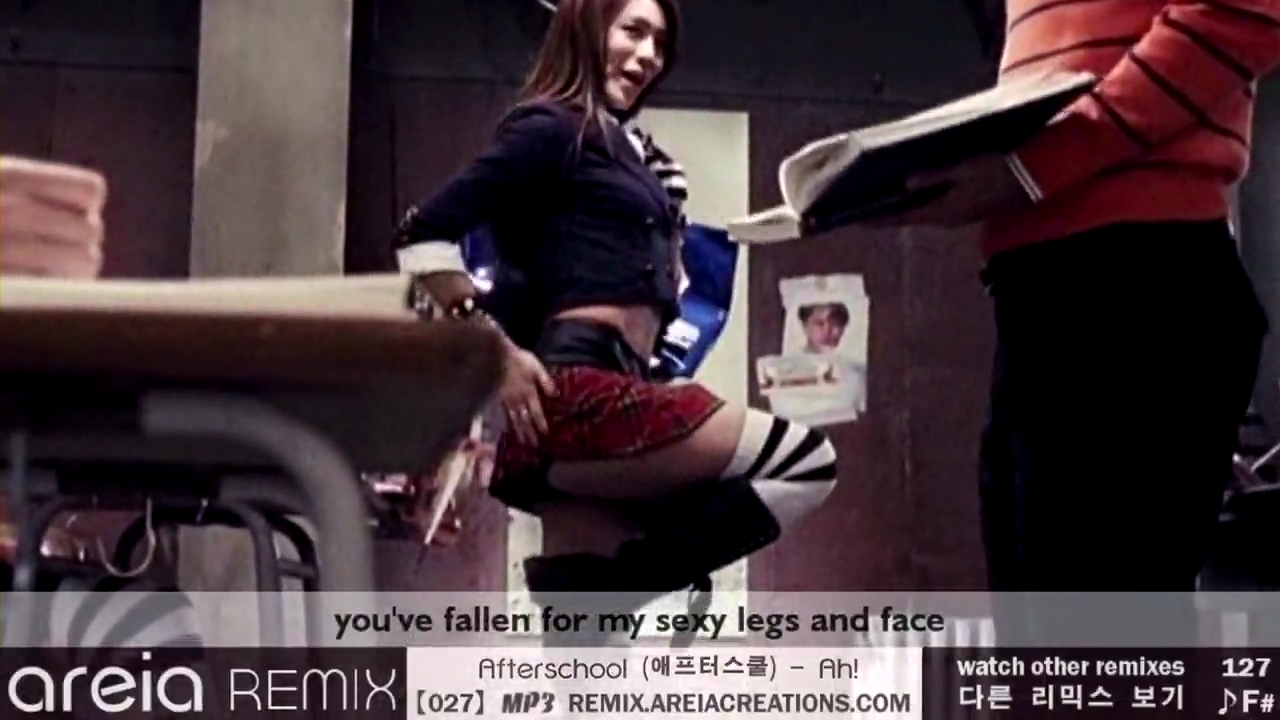
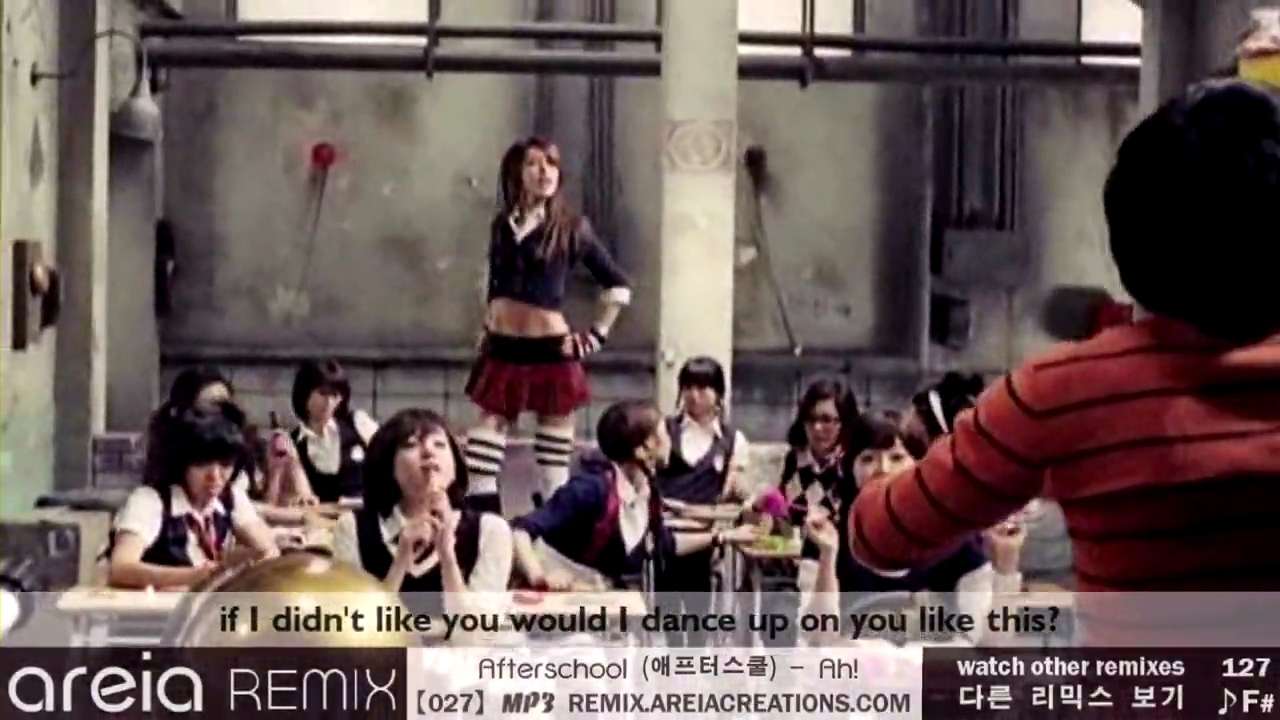
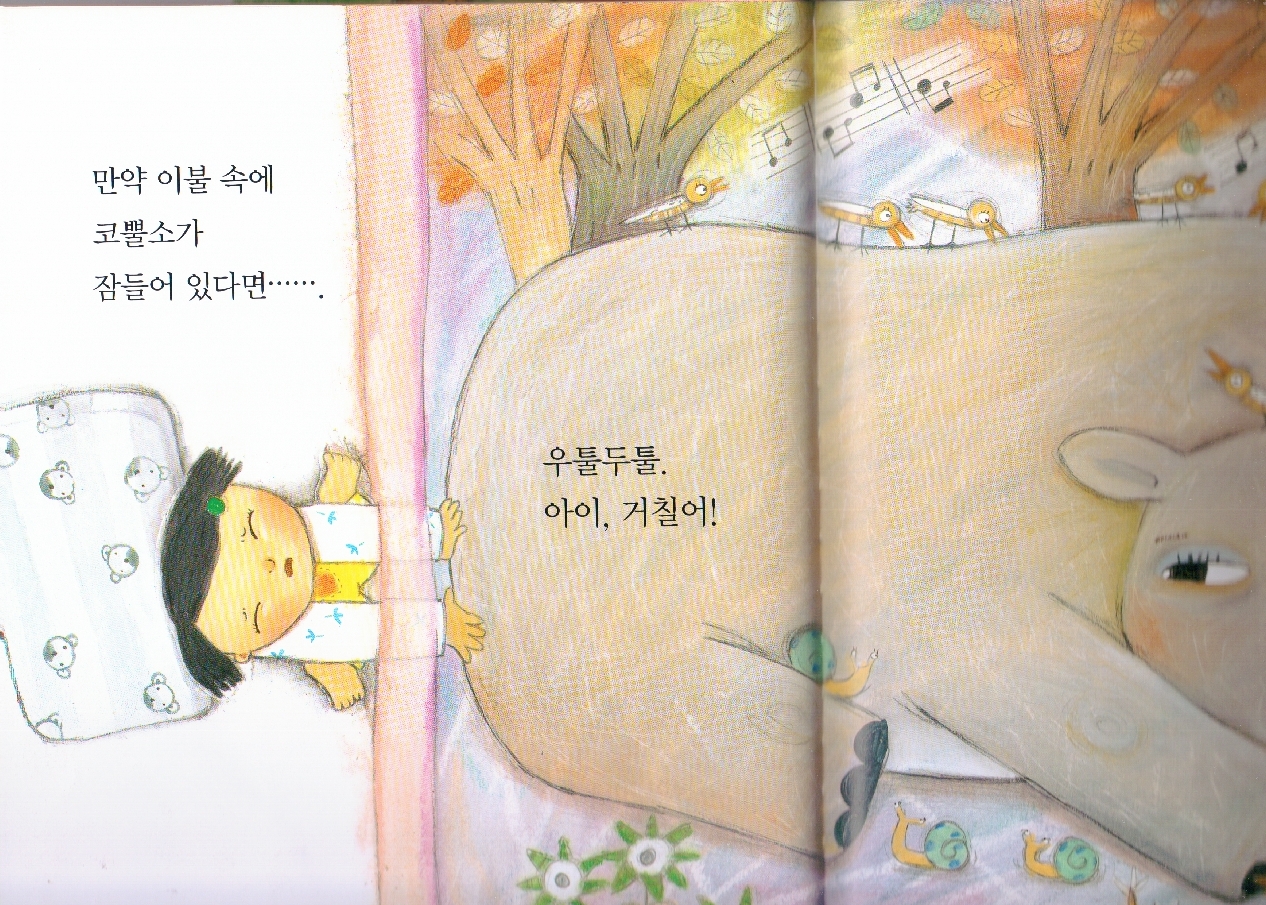
Again, I’m sure you get the gist above, but let me just highlight 2 points. First, line 3 is translated as the slightly perverse-sounding “the sound of your breath gets rougher, don’t stop” or “don’t stop the sound your heavy breathing” respectively in the videos above, but that’s not at all obvious from “거칠다”, which is “coarse/rough (skin); rude (behavior)/wild (nature)/harsh (tone)/violent (language); rough/slovenly/slipshod/loose; or rough/wild/raging/furious/turbulent” according my electronic dictionary, and indeed “heavy (breathing)” seems far removed from the “rough (skin)” meant in one of my daughters’ books in the first picture (in case you’re wondering, the girl is pondering what could be hiding under the blankets).

Similarly, like you can see in the bottom 2 pictures, “쿵” in line 4 is an onomatopoeia for the sound of something hitting something else, so probably “bump” in the bottom video is better than the “bang” of the first. Still, the English “bang bang bang” does seem quite apt considering band member Kim Jung-ah (김정아) dances to that part of the song by repeatedly thrusting her chest out at the viewer(!), and on a side note I’ve often wondered if advertisers for the Korean clothes company Bang Bang (뱅뱅) are aware of the double-entendre:

But carrying on:

우리는!! Oh~ After!! School Up!! 너흰 모두 비켜라!! Check it out!! 다 가져봐!! A-ha! A-ha! A-ha!

Right now!! Oh~ After!! School Up!! 모두 미쳐라!! 외쳐라!! 또 이렇게!! A-ha! A-ha! A-ha!

(rap) Bringin’ it to you daily It’s only from the best

After School Playgirlz know how to get fresh

So cool, So right, just so tasty

We bring it fast forward the fellows go crazy

좀더 과감하게 보여 주는 거야 너~ (To be raised for my life)

좀더 특별하게 춤을 추는 거야 너~ (To be raised for my life)

Show yourself dancing a little more boldly (To be raised for my life)

Dance a little more specially (To be raised for my life)

And “과감하다” means “resolute/determined/bold/daring”, so I’d say the first video’s “you should show it more dangerously” is a little off.

One! Two!! Three!!!

음악에 널 맡겨 주문을 걸어봐 Yeah~ (To be raised for my life)

(rap) Crisp clean original new quality is what we give to you.

(Check it out) a new generation and a whole new start (check it out) collaboration with a brand new heart

조금 더 다가와 이순간을 Catch Up!! Oh~

(rap) On your mark set ready to go, can you feel it in your body this A.S. flow…

Hey hey what you want ! Let’s go…!!

Entrust yourself (your body) to the music, and try casting a spell Yeah~ (To be raised for my life)

And:

Approach this moment a little more

That first line is one of those cases which would just be impossible without a native speaker: “주문을 걸다” means “cast a spell”, but naturally that compound verb isn’t mentioned in any of my dictionaries. Instead, I was struggling with “주문” as “order”, “spell”,  or “request/demand/desire” and “걸다” which has 10 meanings, but usually “hook”, “put into position”, or “install”, before giving up and consulting the videos.

And that’s about it, but here is the remainder for the sake of completeness:

우리는!! Oh~ After!! School Up!! 너흰 모두 비켜라!! Check it out!! 다 가져봐!! A-ha! A-ha! A-ha!

Right now!! Oh~ After!! School Up!! 모두 미쳐라!! 외쳐라!! 또 이렇게!! A-ha! A-ha! A-ha!

T.R.Y. Do it now! Can you follow me? Yes!! Uh-ha~!!

T.R.Y. Pick it up! You’ll never catch me!! Oh~ No!!

A-ha! A-ha! A-ha! T.R.Y. Do it now!!.

A-ha! A-ha! A-ha! Can you follow me? Yes!! Uh-ha~!!

A-ha! A-ha! A-ha!

A-ha! A-ha! A-ha!

And on that note, I hope you enjoyed the song, and/or learned a little about After School and/or some Korean in the process. As always, please feel free to correct any mistakes I may have made, and thanks in advance to those that do!

( Source, all screenshots )

Share

Isn’t It Beautiful? (얼마나 좋을까?) by Lee Soo-young (이수영): Lyrics & Translation

( Source )

Last week, I mentioned that until I found DJ Areia’s trance remixes, then in almost 10 years here I’d never been particularly moved by any popular Korean music. But with a few noticeable exceptions, starting with Isn’t it Beautiful? (얼마나 좋을까?) by Lee Soo-young (이수영), a Korean adaptation of the Japanese song sung by Japanese folk singer Ritsuki Nakano (professionally known as “RIKKI“), and which was the theme song for Final Fantasy X, a role-playing game for the PlayStation 2 released in 2001. Difficult to avoid hearing in Korea at the time, there is no better way to describe it than as a simply beautiful piece of music, and one which deserves to be much better known among a, well, younger generation of listeners.

With apologies for the poor quality of the video, please take a listen for yourself:

I actually first translated the lyrics in July 2007 just after starting this blog, but like most of what I wrote back then that original post has since been mercifully deleted. As I began translating some of these songs for this research project of mine however, to be posted over the next several weeks (and hopefully to become a regular thing), I realized it would be a shame to waste it, both for the sake of the music and especially for understanding the original Korean. Which as you’ll soon see, is much more difficult than it may at first appear, and I realize now that I made many mistakes in the original!

Let’s start with the first verse. I won’t mention many specific words, because you can simply look those up in a dictionary yourself, but I will highlight some of the things I had difficulty with, as you may well be confused by them too. But this is by no means the final, definitive word on the lyrics in English, and I very much welcome and will appreciate any corrections:

바람이 들려준 이야기엔, 내 마음 설레였고

구름에 실려온 내일로, 그 목소리 향해

거울에 흔들리는 달에 비친, 내 마음 함께 떨리고

별들은 흐르는 눈물속에, 고이 다 흘러버렸어

The confusion starts almost immediately, for “엔” in line 1 is not simply a shortened form of “에” plus “는”, with the latter indicating that the “이야기” is the subject here. Rather, my wife says that the “는” is just added for emphasis, although she can’t say why.

( Source )

Next, although in hindsight the “내일” in line 2 is obviously “tomorrow”, that wasn’t so clear when I first started translating and didn’t know what the song was about; hence I wondered if it could be “내” plus “일”, or “my” plus “work/task”, but then there would need to be a space between the “내” and the “일”!

Also, the “오다” in “실려온” is not always simply “실리다” plus “coming” like I thought 3 years ago; rather, although it’s difficult to summarize the grammar point here, “오다” or “가다 ” added to a verb are not always simply “coming” and “going” in space respectively, but can also be in time too. Korean Grammar for International Learners, p. 340, describes them as meaning “continuous performance of an action over time as one comes towards the ‘present and continuous’ performance of an action over time into the future (away from the present) respectively”.

Finally, although I personally find it quite easy now, I should also mention the “버리다” attached to “흐르다” in the last line: if you look in your dictionary, it means “throw away” or “ruin”, but when added to a verb it can mean 1) the action of the verb has been completed with little or no room to spare, 2) the verb produced a state contrary to what was hoped for or expected, or 3) that the speaker feels relief that something has ended.  So:

My heart was throbbing to a story told to me by the wind, and

which was carried by a cloud towards the voice of tomorrow.

My heart trembled to the moon shining in a mirror,

and it all softly melted with the stars’ flowing tears

( Source )

Unfortunately, that is very different to what I wrote 3 years ago, and it may also be very different to what you yourself came up with too: there’s so much metaphor here, that my wife and I despaired with pinning words down to anything specific in English, particularly with line 2. And on that note, if you’d like a more poetic and/or readable alternative for all the lyrics (sniff), then consider these ones and in the details to this video for instance, but note that both are based on the Japanese rather than the Korean version. Moving on:

얼마나 좋을까, 둘이서 손을 잡고 갈 수 있다면

가보고 싶어, 당신이 있는 곳 당신의 품 속

거기 안겨, 몸을 맡기고, 어둠에 감싸여

꿈을 꾸네

This verse, or the chorus rather, was much easier. If we just focus on the problematic words first, of course the “둘” in line 1 means “two”, but the “이서” added to it basically renders it “[us] two, together”, or “you and I”. Then in line 2, “곳” or “spot, place” should not be confused with “것”, or “thing”, and just after that the “품” means chest, or bosom. Not that that last can’t also simply be looked up in a dictionary of course, but then I’ve never personally heard of that meaning of “품” outside of this song.

The grammar is also very easy, although I’ll quickly mention it for learners: first, the “ㄹ/을까” in line 1 is added when asking for someone opinion, or just reaffirming yours (making it analogous to the “eh” of Australian, NZ, and Canadian English”). Then, the “다” added to the “면”, or “if”, is only for definite hypothetical situations, as opposed to “If you grab the beer, I’ll grab the chips” for instance. Finally there’s the “네” in line 4, which denotes mild surprise, but then you’ve probably already had many Koreans replyingg “와…한국말 잘 하시네요” when you’ve spoken to them in Korean!

Imagine how wonderful it would be, if we could grab each other’s hands and leave

I’d try to go, into the place that you are in your heart

Hugged by you, I’d entrust my body (soul?) to you and

Wrapped in the darkness…I’m dreaming!

( Sources: left, right )


The next verse was also quite easy. Admittedly I’m confused by which tenses apply to what, but otherwise probably the only things of note are the “지” in line 1, which usually means “right?” as in a tag question, but like in English can just be part of a simple statement (like “좋을까” earlier); and the “지다” in “흩다” in line 2, which basically means “make into the state of the preceding verb or adjective”. In this case “흩다” means “spread” or “scatter”, so “be scattered”:

바람은 멈추고 목소리는, 아득하게 속삭이겠지

구름이 흩어져 내일은, 아득한 환상일 뿐

달빛이 스미는 거울 속, 내 마음은 흐르고 별들이 떨리다, 멈춰

흐를 때 눈물은 감출 수 없어

Which gives in English:

The wind has stopped, and my voice with become just a whisper

The clouds will scatter and tomorrow will become only a vague, distant fantasy

Moonlight will soak the mirror in which my heart flows and the stars tremble and stop

I can’t hide my tears when they flow

Finally the chorus again, with only a little changed:

얼마나 좋을까, 둘이서 손을 잡고 갈 수 있다면

가보고 싶어, 당신이 있는 곳 당신의 품 속

그대 얼굴, 살며시 스치고,

내일로 사라지는, 꿈을 꿨어

In line 3, don’t confuse “그대”, which means “you” or the other party involved, with “그때”, or “then”. Giving in English:

Imagine how wonderful it would be, if we could grab each other’s hands and leave

I’d try to go, into the place that you are in your heart


I gently touch and brush past your face, and

I dreamt a dream that is disappearing towards tomorrow

( Source )

And there you go! I hope you enjoyed the song and/or I helped you to understand it a little, and there’s certainly many more gems out there in Korean music if you’re prepared to look. Probably I’ll provide much less of an explanation for more recent songs though, as I’d rather focus on the content of the songs rather than on the Korean per se, but we’ll see!

Share