That advertisements featuring Girl’s Generation (소녀시대) are invariably photoshopped isn’t news of course, and these ones are hardly the most egregious examples either. But in a rare positive step, the before and after pictures for their latest advertisements for the LG Black Label Series Chocolate phone are currently featured on the front page of the “Enter Holic” or “Entertainmentholic” (엔터홀릭) section of the Korean MSN homepage, and so will have been the first thing many people saw when they opened Windows Live Messenger this morning.
Not to imply that most Koreans aren’t aware of photoshopping in advertisements of course. But still, anything that fosters further discussion of that is to be encouraged.
Or at least, that was my first impression. Looking more closely though, in fact it was the before images that were used in the advertisements. Unfortunately there is no information about who created the photoshopped images, or why, but with the statement “Wow! Very subtle changes make a big difference” (아주 미묘한 차이가 큰 차이를 만드는구놔), he or she implies that the altered images are to be preferred.
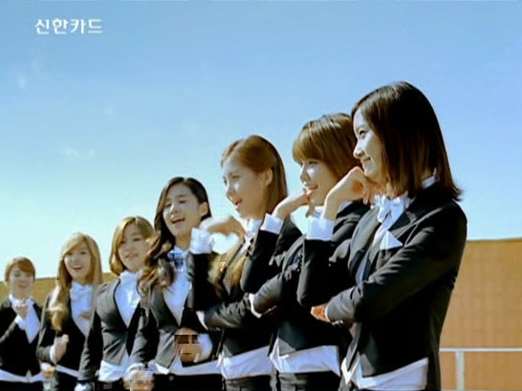
Forget the TED Talks. Instead, use this 16-second commercial for a great introduction to Korean gender roles.
By Girls’ Generation’s for Shinhan Card, it’s completely innocuous at first viewing. Take a second and third look though, and it’s extraordinary in how much it reveals:
First, because of the obvious: those legs. Then, because my students barely seemed to notice them when I asked what they thought of the commercial, let alone considered objectifying only the women to be problematic. Probably, because they’re already used to ubiquitous female “assistants” (doumi;도우미) and scantily-clad “narrator models” (나레이터 머델) being used to sell and promote all manner of products, services, and causes. And girl-groups, effectively, are performingvery muchthe sameroles.
But I’m not—I’m singling it out for what the differences between the men and the women reveal. Because my students would surely have noticed more if the men had also been wearing short-shorts, with the well-muscled legs to pull them off. Or, with more male-specific revealing costumes that showed off their abs.
With just women doing silly dances in revealing clothes though? That’s so normal in advertising that most people don’t think twice about it. See what I mean by looking at these images from A Web Essay on the Male Gaze, Fashion Advertising, and the Pose below. What are your gut reactions to them?
(“Most viewers find the images of the men odd or laughable. But the images of the women seem charming and attractive…Why should it seem funny to see a picture of adult men striking a pose when the same pose seems normal or charming to us in pictures of adult women?”)
Obviously, this speaks to gender role portrayals in the media worldwide, not just that of Korea. But, with the latter’s tendency towards cuteness and aegyo, it does seem quite extreme here. And, as if to rub that in, in this particular commercial the text and the song also emphasize that the women are very much just for decoration:
First, the text in blue box: “끝없이 ‘고객만족’을 생각하는 카드”.
“The card that unceasingly thinks about customer satisfaction”.
Then what the men are saying while that is visible: “생각, 생각, 생각, 생각”.
“Think, think, think, think.”
Next Girls’ Generation, dancing with their shoulders while sitting on a bench: “어떡하면, 원하는걸, 다 이뤄줄수 있으까?”.
Then the men again, while the girls are do their leggy dance, then stand in a line with the men and supposedly sing along with them (but we only hear the men’s voices): “손잡고 힘을 모아 다 함께 생각 생각”.
“Let’s cooperate [with the customer] and collect our energy together and think about all that”.
Finally in the voiceover, with the men sitting in contemplative poses and the girls standing behind them clapping : “카드의 길을 생각하다”.
“What is a card’s purpose? Let’s think about that”.
With this text in the blue box above them: “끝없는 제휴혜택으로 더 큰 고객만족을”.
“The card that can be used anywhere in order to increase customer satisfaction!”.
Easy to miss on a single viewing, it emerges that it is only the men that do the thinking in this commercial, and by default, for the bank also. Yes, really: even when they all say “How shall [the card] achieve everything [the customer] wishes?,” if you look closely at roughly 0:08 into the commercial when the girls actually finish saying that (see far above), they clearly turn to the men for an answer. Rest assured then, that if you invest your money in this bank, that it will be in the hands of smart people that will take your concerns very seriously. Those people just won’t be women, that’s all.
Exaggeration? Hardly. Consider the facts: according to a recent report in the Korea Times, there are no female CEOs in the entire financial industry here; there are only 2 women out of a total of 220 team managers in the Financial Supervisory Service (and no executives); there are no women with either position in the Bank of Korea. Moreover, one anonymous (male) government official in finance argued that this is somehow justified by “the country’s financial bureaucrats [having] been overwhelmed with too “serious tasks” to pay attention to gender equality” (as in ever since the early 1960’s, not just the recent crisis), and it’s telling that even Rep. Lee Sung-nam (이성남) of the Democratic Party, a woman and former worker at the FSS, feels that women’s weak point in finance is their “competitive edge.”
Granted, given that Korea has one of the lowest women’s workforce participation rates in the OECD, and that Korea has a surprisingly low “Gender Empowerment Measure” relative to its level of development, which is based on “factors such as the number of female legislators, the percentage of women in senior official and managerial positions, the percentage of women in professional and technical positions, and the income differential between men and women,” then it might seem unfair to single out the financial sector for criticism in this regard. But then if I’d wanted to highlight the lack of women there in particular, then I couldn’t have selected a better commercial to illustrate why that might be so.
Nor for explaining “function ranking” either, a common sexist motif in advertisements. A quick summary (source):
Activities can also be expressive and symbolic—who is shown doing what in the image? For example which gender is most likely to shown caring for children? Very commonly when persons in the image have functions, these functions are ranked, with the male carrying out the senior functions, the female the junior functions. Men act, and women help men act. Males are more likely to be shown in the executive or leadership role, with females in the supportive, assistant, or decorative accessory role.
That and other motifs were first outlined by the late sociologist Erving Goffman in his 1979 work Gender Advertisements, and which is still very much the framework by which sociologists study how gender roles are perpetuated in advertising. Let me leave you with one more observation from it (see the sidebar for many more examinations of Korean advertisements using his framework), then another example from Korean banking:
In our society where a man and a woman collaborate face to face in an undertaking, the man—it would seem—is likely to perform the executive role, providing only that one can be fashioned. This arrangement seems widely represented in advertisements, in part, no doubt, to facilitate interpretability at a glance (p.32).
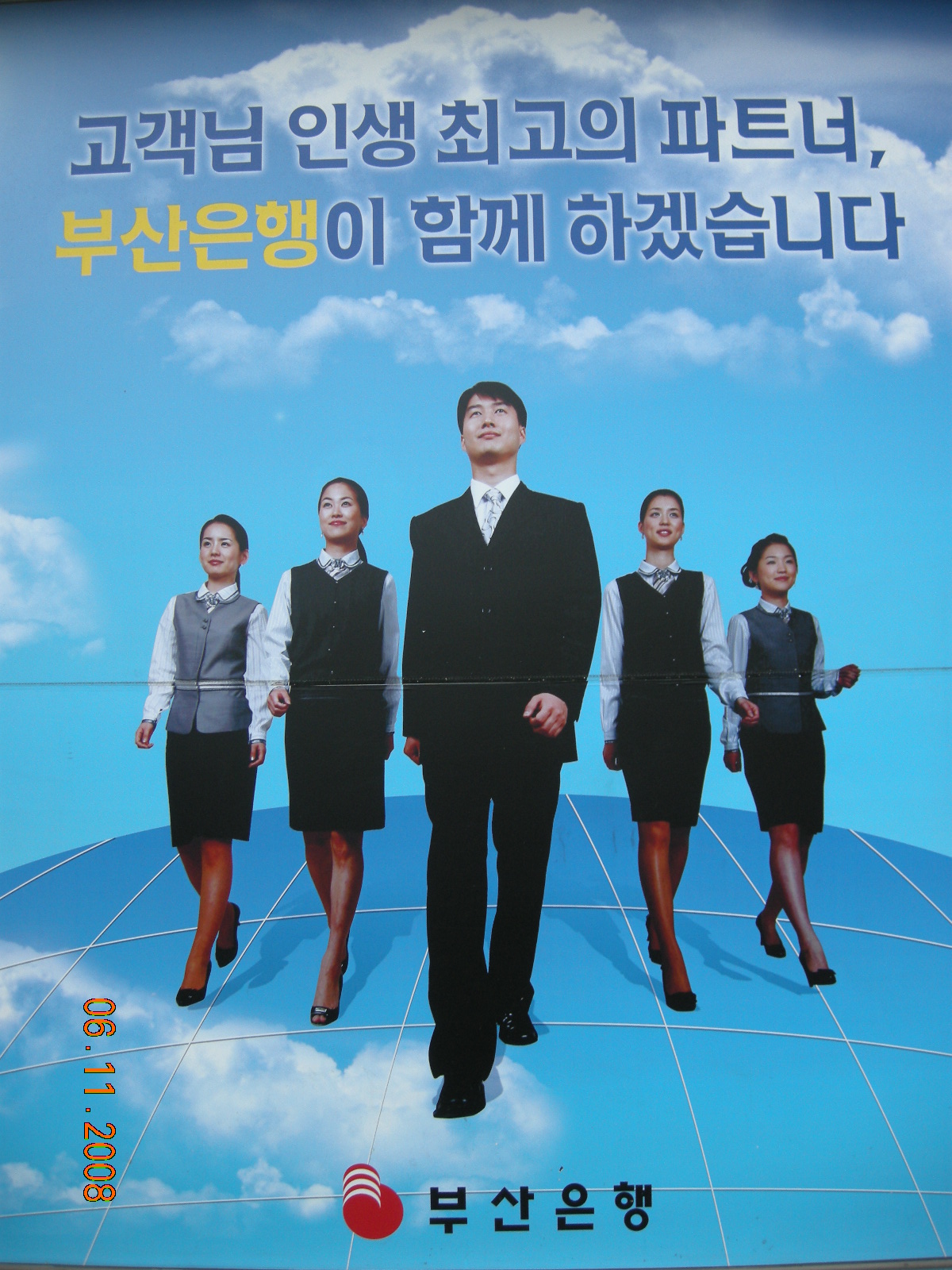
As indeed is the case with this advertisement for a bank I came across last November:
Technically, the man is a customer, the women clerks (the text reads: “The customer’s best life partner, with Busan bank”). It is very telling though, how difficult it is to imagine an ad with the sexes reversed—let alone find an example in real life.
Thoughts?
Update: For comparison, see here for a Shinhan Card commercial with just the men.
(For all posts in the “Korean Sociological Images” series, see here)
Activities can also be expressive and symbolic – who is shown doing what in the image? For example which gender is most likely to shown caring for children? Very commonly when persons in the image have functions, these functions are ranked, with the male carrying out the senior functions, the female the junior functions. Men act, and women help men act. Males are more likely to be shown in the executive or leadership role, with females in the supportive, assistant, or decorative accessory role.
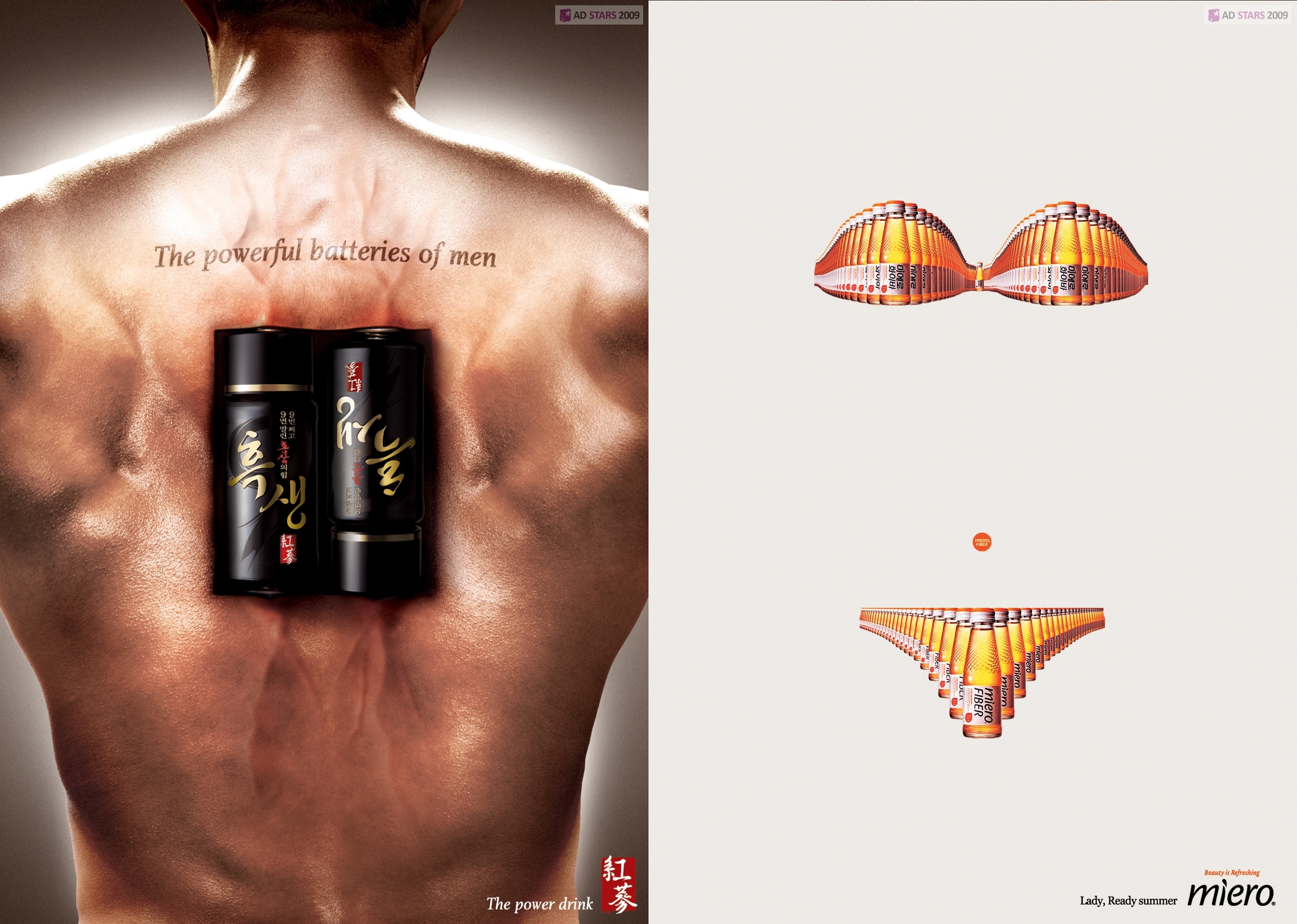
What is the first thing that goes through your mind when you hear of a“power drink” for men?
If you live in Korea, then I’d wager some form of aphrodisiac, testament to the large number of drinks claiming to improve “men’s power” or “men’s stamina” that are available here. In the particular case of the advertisement on the left though, that would be quite wrong, as Huksaeng (흑생) is the name of a health drink from Hyundai Pharm (현대약품) made with huksam (흑삼), or black-red ginseng (흑삼), and it has no prior history of being marketed to men specifically. Here you can see a women’s taekwondo team extolling its virtues for instance, albeit that of a different company.
But compare that with Hyundai Pharm’s other product Miero Fiber (미에로화이바) on the right, which in its 20-year history has only ever been marketed towards women. Currently placed alongside each other at the Busan Ad Stars 2009 website, the accidental juxtaposition of the two advertisements provides an interesting contrast. And given Koreans’ overwhelming preference for health drinks over multivitamin pills also, then the insights to be gained have more relevance to Koreans’ body images than may at first appear to overseas observers.
My own first reaction was that I was at a loss to think of an Korean advertisement for a health drink aimed at women that uses the analogy of recharging one’s batteries. This is a minor point though, and by no means do I have an encyclopedic knowledge of Korean advertisements, so I would be grateful if readers could pass on any examples that I may have missed. But with the proviso that Huksaeng is supposed to provide more of a mental and general health boost rather than improving one’s body per se, both that and any counter-examples from readers would not detract from the obvious and correct inference that Korean advertisements for “men’s drinks” generally feature men as sporty, active participants in the process of achieving that perfect body and/or losing weight. With those for women however, it’s genuinely difficult to find any that don’t promote the idea that drinking the product is the only step required.
Don’t just take my word for it though. Consider recent popular commercials with girl-group Girls’ Generation (소녀시대) for Miero Beauty N (미에로뷰티엔) here and here for instance, and more importantly the evidence provided by the journal article “Content Analysis of Diet Advertisements: A Cross-National Comparison of Korean and U.S. Women’s Magazines” (Clothing and Textiles Research Journal, October 2006), by Minjeong Kim and Sharron Lennon, which I discuss in great detail inpartsOne, Two, and Three of my series on Korean women’s body images from last year. More recently, I discuss it in passing in this post about an advertisement for a diet clinic and this one about the advertisement below for a slimming tea-drink also:
Unfortunately the article is no longer freely available at the link above, and I’ve long since lost my own copy of the original PDF file. I can scan my copy if anybody requests it though, but in the meantime hopefully the abstract will suffice:
Content analysis of diet advertisements was performed to examinehow diet advertisements portray the Western ideal of femininebeauty and promote dieting in Korean women’s magazines in comparisonwith U.S. women’s magazines. Results showed that the Westerncultural ideal of feminine beauty and dieting were prevalentin Korean women’s magazines. Diet advertisements in Korean magazinesappear to promote more passive dieting methods (e.g., diet pills,aroma therapy, diet crème, or diet drinks) than activedieting methods (e.g., exercise). Results further indicatedthat women may be misled to believe that dieting is simple,easy, quick, and effective without pain, if they consume theadvertised product. This study suggests that there is an urgentneed to establish government regulations or policies about dietproducts and their claims in Korea. Magazine publishers alsoneed to recognize their role in societal well-being and acceptsome responsibility for advertisements in their magazines.
In especially part Two of that series above I discuss that passivity in more detail and extend it to Korean exercise culture, further continued in this recent post about a device that electrically massages breasts in order to make them grow bigger. No, really:
Let me also pass on this post at Sociological Images about the similar gendering of energy drinks in the US, with more of a focus on those targeted towards men, and this one at Feministing about the fact that laxatives there are almost exclusively marketed towards women, with the implicit purposes of losing weight. To which I’d add that their Korean equivalents are both ubiquitous and completely lacking of the usual euphemisms, instead providing computer graphics of bowel movements that leave little to the imagination. Rather than continuing in that vein though(!), let me close with a question prompted by the latter post: what is the reason that products like these are marketed specifically towards women?
(For all posts in the “Korean Sociological Image” series, see here)
One of these pictures from Shoo’s (슈) recent photoshoot is not quite like the others: take a closer look, and if nothing sticks out then see these classics of the genre for hints, or #6 for the solution.
1) In that vein, for me last week really stood out for the number of excellent points raised about the subjects of women’s body images, censorship, and Korean sexuality by Korean bloggers. But first, I should of course mention that a South-African woman was raped in her home in Ulsan by a neighbor earlier in the month, and early indications were that the police were at best lukewarm in handling her case, which naturally provoked lively discussions in the Korean blogosphere about rape in Korea, women’s and foreigner’s safety, and the Korean police ‘s attitudes to both. Lest I appear indifferent by not discussing those subjects in more detail myself though, lengthy but often informative comments threads on these already exist at Korea Beat and The Marmot’s Hole if you’re interested. Moreover, it appears from this Facebook thread devoted to the issue that claims of police indifference were complete fabrications by The Chosun Ilbo, as were quotes from the victim, who hadn’t actually spoken to any news outlets.
2) First up then, in a post I’m embarrassed not to have written myself, VixenVarla of Seoulbeatsasks if Korean society is really ready for “women” idols, and thinks not: noting the netizen furor over the above Abracadabra (아브라카다브라) music video by the Brown Eyed Girls (브라운아이드걸스), which features a sex scene (and rather more than the mere lesbian kissing scene I reported last week sorry), she argues that while provocative, both that and Chae-yeon’s (채연) new music video Shake (흔들려) were at least alternative representations of Korean women to the coy, innocent, and sexually inexperienced ones normally presented. But while teenage groups’ blatantly sexual dance moves are usually instantly praised as being “hip”, “sexy”, and “cool,” Abracadabra will probably have to be heavily edited for television (despite protestations that it won’t be), as indeed much tamer Shake was recently (see #1 here). She concludes:
….when Korean “women” choose to project a more sexualized side of themselves they are looked down upon by censors and neitizens. Is Korea so afraid to show adult women in control of their own sexuality that they would prefer to cast scantily clad little girls in heavy makeup, to play “grown up” in their place?
See here for the full post. But please note that by reiterating it’s main points I (and I’m sure VixenVarla would concur) am not attacking expressions of teenage sexuality per se: rather, I’m just saying that they don’t deserve the kid gloves with which they are treated with by the Korean media (see here for my most recent post on this issue). Possibly Abracadabra was a bad choice with which to make that particular point though, as it’s easily the most sexually-explicit mainstream Korean music video I’ve seen in the whole 9 years I’ve lived here:
Of course, 9 times out of 10 such a video would be used to disguise the poor quality of the music itself, but this song is actually good, and – I confess – I heard it on the radio and thought it was (forgive the temporary lapse in sophistication) cool well before I saw the video above. Meanwhile, here is a live performance if you’re curious as to how all that translates to the stage (see PopSeoul! for the details):
3) In case you’re confused by the Korean media praising moves by, say, The Wondergirls (원더걸스) or Girls’ Generation (소녀시대) as “sexy” while criticizing, say, Chae-yeon’s dancing as too sexual though, Brian in Jeollanam-do has an excellent post on how Korean uses of the word have become almost entirely divorced from its English meaning.
4) In related news, while discussing a promotion in Seoul involving women dressed as Paris Hilton to celebrate the Korean airing of MTV reality show “Paris Hilton’s My New Best Friends Forever,” Brian also makes the point that:
…while Korean celebrities are held to pretty high moral standards, you have a woman like Paris Hilton regularly on TV and endorsing Fila Korea.
Like he thought, he’s not the first or the last person to mention that (see #18 here), and after reading this post on her by Michael Hurt at Scribblings of the Metropolitician I would also no longer, well, slag off Paris Hilton as readily as most people are inclined to either. But still, the point stands regardless of the celebrity involved, and is worth remembering.
5) Also making big news were some Southeast-Asian men being arrested for taking pictures of women at Haeundae Beach in Busan, whereas – as numerous bloggers have pointed out, Korean newspaper photographers regularly (and excessively) do so, and particularly of Caucasian women also. See Brian’s post (yes, again – a productive week for him it seems!) and Korean Media Watch for more.
6) No, that’s not an alien on the right, but Choi Ji-woo (최지우) promoting cosmetics brand Vidi Vici. Speaking of which, if you haven’t figured out what was wrong with the opening image of Shoo, see AllKpophere for the solution.
7) Also on the photography front, many Korean newspapers (and particularly the ones that denounce Western men as sexual predators and deviants: see #1 here) are increasingly posting “upskirt” pictures of celebrities and members of the public on their websites. Apologies for not providing links (even I have my limits), but I mention this because PopSeoul! has raised the point of PR managers and so on increasingly providing only high stools for stars to sit on at press conferences, which there can only be one reason for given that it is now de rigueur for female stars to wear something short and skimpy to them.
8) Spare a thought for North Korean women: among numerous other frustrations of daily life there, they also have to contend with being forced by government to wear skirts at some times of the year, and traditional clothing at others.
9) A while ago I mentioned a post at Sociological Images about the Tokyo City Government’s appointment of three young women as “cute ambassadors” for the city, the better to promote Japanese kawaii (cute) culture and project Japan’s “soft power” abroad. Now Ampontan – my personal choice for the best blog on Japanese society, politics, and culture – has a great meta post on what issues the policy raises, noting, for example:
I’d rather the Japanese had chosen other parts of their culture to present to the rest of the world—festivals, for example—but might there be a bigger picture that we’re missing?
Plug the word kawaii in English into Google and you’ll get 7,590,000 hits. Do the same with cosplay and you’ll get 24,200,000. Yes, I was astonished too. When the words kawaii and cosplay are so commonly known and accepted around the world, I think it’s safe to say we’re dealing with a phenomenon that transcends Japan.
10) I’m still generally against cosmetic surgery, but largely through reader’s comments I’m much more sympathetic of it and understanding of people’s reasons for having operations (especially in an appearance-obsessed society as Korea) than I was before I started the blog. In that vein, see AllKpophere for winner of the title of “prettiest celebrity after female surgery,” with the important point that contestants were only those that openly admitted their surgery.
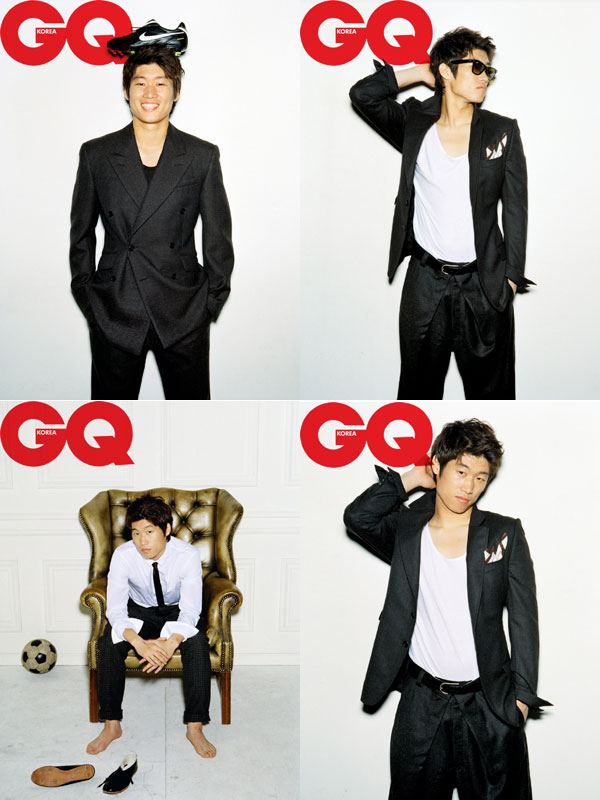
11) Given the amount of photoshopping that was necessary for him to do so, I possibly was a little harsh in my opinion on Park Ji-sung’s (박지성) appearance in this post on his modelling for Gillette Korea. But I have to say, he looks quite dapper in his latest photoshoot for Gentlemen’s Quarterly (via KP Culture):
12) While apparently sexual relations with 13 year-olds are okay (see #3 here), Extra Korea! notes that from next year, solitciting teenagers for sex will be punishable, even if no sexual act takes place. Hey, at least it’s consistent with laws for adults…
13) Widely reported in the Korean media, Koreans as a whole are becoming more overweight. Considering that Korean women were among the lest obese women in the OECD (let alone the world) as recently as 2005 though, then the new data needs to be taken with a grain of salt (no pun intended).
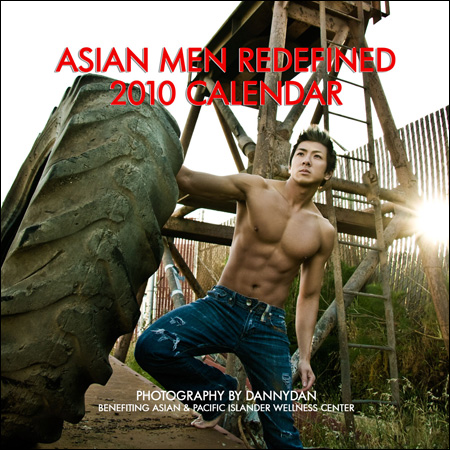
14) With apologies for this being the largest picture I could find, Andrew Lim recommends you buy the (self-explanatory) “Asian Men Redefined 2010 Calendar,” the proceeds of which will go to charity. For the details, see Ninginhere.
15) Singer Ivy (아이비) is trying to make a comeback after being forced to put her career on her hold by a sex-tape scandal…which didn’t actually exist. If the latter is news to you, then see DramaBeansfor the background.
I’m wondering if they’re insinuating the wage of female workers should decrease to save the national birthrate…
“Working mothers who prefer to offer quality education or living environment rather than having more children has also contributed to the declining number of second children.
The report said the increase in the women’s wages has negative impact the births of a second child but the increase in paychecks from husbands increases the chances of having more than one child. ”
That’s quite the justification for the disparity in salaries.
Meanwhile, see here for Tom Coyner’s article on the effects of the recession on young people, to which he adds in his email on it in his “Korean Economic Reader” mailing listthat:
To be candid, one of the ulterior motives to write this column was to plug my firm’s “Rising Star Coaching” program that helps organizations lacking the budgets to go out and hire specialists while needing to recycle bright, younger employees to assume new roles as their employers adjust to new challenges.
Should the reader know of anyone who lacks internal mentors for developing a specific skill set in a younger manager or employee, please let me know. We can provide senior Korean executives who have been trained in coaching skills to mentor junior employees on a short-term contractual basis.
17) Finally, in news that I should have placed much earlier in the post sorry, Brian notes that a pregnant 18-year old Cambodian woman was given a 4-year sentence for killing her abusive husband, and also that 2 sisters-in-law and a stepdaughter of a Vietnamese immigrant wife were fined for beating her after she allegedly failed to tend to her mother-in-law’s needs. That second link is just factual really, but in the first has many interesting points about Southeast immigration to Korean and the international marriage trade.
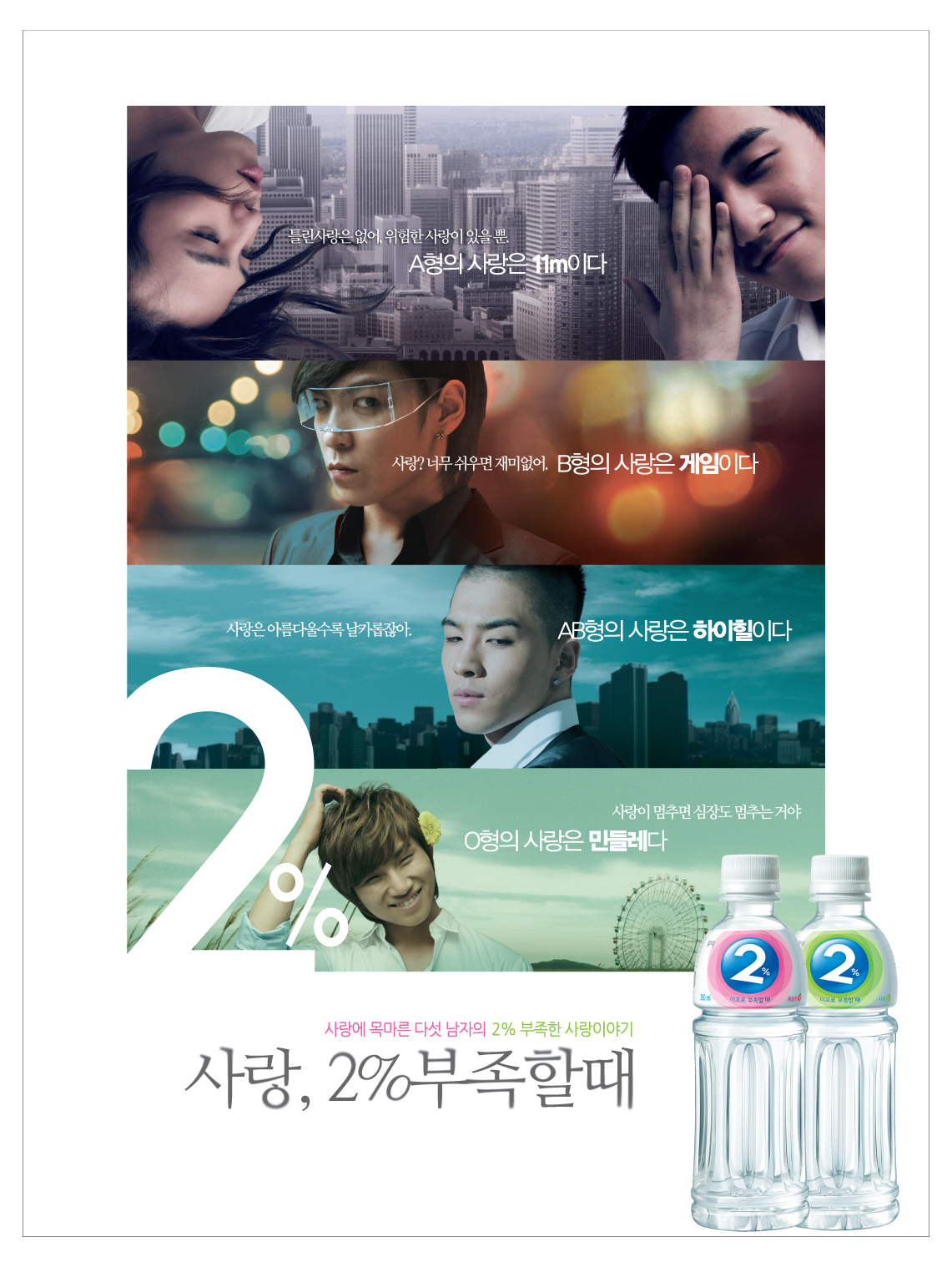
With those top two panels reminding me of the futuristic Blade Runner, it’s ironic that the ad is actually based on the decidedly archaic belief that one’s bloodtype determines one’s personality. What’s more, it’s a surprisingly deeply-held one too, with some Korean women even rejecting all B-type men as potential marriage partners because of it, as I discussed when I wrote about a similar marketing campaign for kiwifruit back in May. In short, it’s not quite the same as having a good laugh at your daily horoscope, and can’t be so easily dismissed.
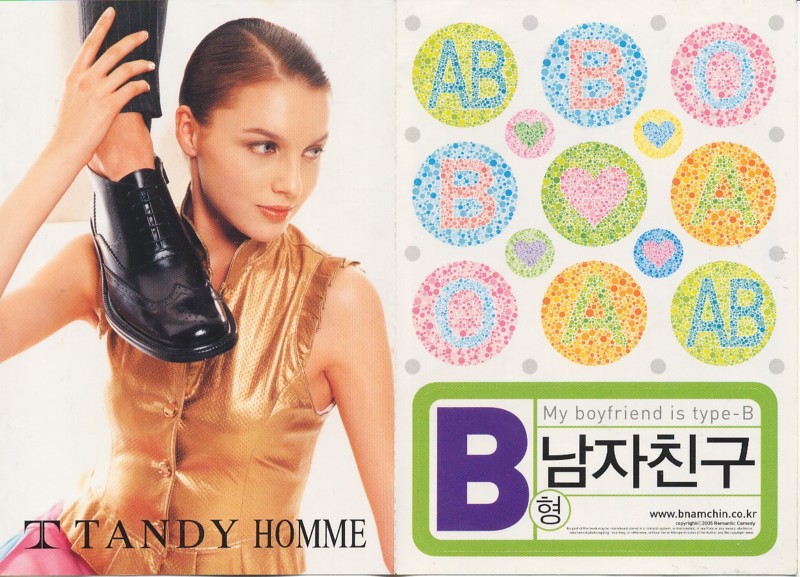
A strange {and slightly disturbing} advertisement for Tandy found on this site about the 2005 movie My Boyfriend is Type B {B형 남자친구}. See later in the post for one more, and here for a review of the movie.
Lest one is tempted to jump to conclusions about Koreans’ critical-thinking skills though, then consider this blog post on the subject that was featured on the front page of Yahoo! Korea about a month later, which I’ve translated below. It is from the 12th most popular Korean blog according to its own blog ranking system—by way of comparison, this one is currently ranked 87,378 out of 4,644,184—so it would have been read by a lot of people:
우리나라에서만 볼 수 있는 ‘혈액형’ 광고의 불편함…
It’s discomforting how Korea is the only country in the world with advertisements about bloodtypes…
A형, B형, AB형, O형이 한자리에 앉아서 식사를 하고 있었다. 갑자기 AB형이 밥을 먹다 말고 벌떡 일어나 뛰쳐나가자 O형이 AB형을 뒤쫓아간다.
남겨진 A형이 B형에게 조심스레 묻는다: “쟤 혹시 나한테 화난거야?”
온라인과 오프라인을 막론하고 이젠 귀에 딱지가 앉을 정도로 듣게되는 혈액형별 성격에 관한 유머다.
일본에서 들어와 국내에 뿌리내린 혈액형별 성격 분석은 독일의 우성학에서 출발해 일본에서도 1970년대에 확고히 자리잡았다고 하는데 이런 성격 분석이 국내에 유입되어 뿌리내리며 우리나라를 전세계에서 몇 안되는 혈액형 신봉 국가를 만들어 버렸다. 사람 둘 셋만 모이면 혈액형에 대한 이야기가 쏟아져 나오는 그런 나라…;;
그렇게 보면 다음 CF들은 어쩌면 우리나라에서만 만날 수 있는 광고의 유형은 아닐까?
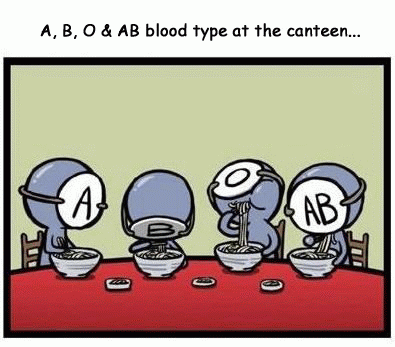
Four people, one with bloodtype A, one with B, one with AB, and one with O were sitting down having a meal together. Suddenly, “AB” stopped eating and got up and ran outside, and “O” decided to follow (him).
“A” and “B” remained, and A nervously asked B: “Is (he) angry with me?”
(James: No, I don’t get it either. But, for the remainder of the cartoon version on the right, see here, and here for many more like it.)
Needless to say, online and offline, there is so much humor about blood types that people are very tired of it.
Blood type and personality analysis originally derives from German eugenics, but it became firmly rooted in Japan in the 1970s, and from there in Korean culture, making Korea one of just a handful of countries that haven’t thrown such beliefs away. Indeed, get two or three Koreans together, and invariably they’ll end up chattering about blood types…
In this sense, you can only really see commercials like the following in Korea, right?
혈액형으로먹는다… 제스프리골드키위/Eat according to your blood type…Zespri Golden Kiwi
키위를 먹는 방식을 혈액형 성격 분석에 맞춰 유머러스하게 풀어놓은 제스프리의 CF다.
Here’s a humorous commercial by Zespri saying different blood types eat Kiwis in different styles (James: see my earlier post for the other 3 in the series):
Vodpod videos no longer available.
혈액형으로마신다… 2% 부족할때/Drink according to your blood type…2% “Near Water”
제스프리가 코믹이란 콘셉트를 내세웠다면 이쪽은 혈액형과 치환되는 단어와 사랑을 엮고 빅뱅을 얹어 광고를 내놨는데 실제 빅뱅 멤버의 혈액형에 맞춘 광고란다.
Whereas the Zespri commercials had a comic concept, the following ones with the band Big Bang (빅뱅) has each member falling in love and romancing women according to their bloodtypes (James: this video combines all 4 commercials in the series):
재학습되는혈액형성격분석…/These commercials help perpetuate public belief in the bloodtype and personality theory
평소 귀가 얇은 편이라 혈액형별 성격 분석에 종종 혹하는 편이지만 ABO식 혈액형의 고작 4가지 패턴으로 60억 세계인의 성격을 모두 분류할 수 있다고는 생각치 않는다. 또 이론적 뿌리도 부실하고 지나친 일반화와 선입견 듬뿍 담긴 규정으로 혈액형 별로 사람을 가늠해 버리는 것 자체가 혈액형에 기준한 성격 분석이 갖는 문제점이라고 생각하는 편이다.
Normally I’m a little gullible, so I’m often convinced of the validity of the bloodtype and personality theory, but still, I can’t believe that all 6 billion people in the world can be compartmentalized and categorized into just four types. And it is a problem that people are influenced by and follow the rules of their prescribed personality when the theory is based on insufficient evidence, is too generalistic, and rife with prejudices and preconceptions.
그런 이유로 이번에 소개한 혈액형에 관한 CF들은 왠지 불편했는데…감각적인 영상과 유머 코드로 적당히 버무려 광고를 바라보는 이들에게 쉽게 퍼지고 기억되는 이런 영상들이 결국 사람들 사이에 회자되는 혈액형별 성격 분석을 재학습시키고 있는게 아닐까란 생각에 이르렀기 때문이다.
For this reason, seeing these commercials made me feel a little uncomfortable…when sensible (if misguided) notions of bloodtype and personality are mixed with humorous ones in a sort-of cultural code and then utilized in commercials like these, they help to keep the theory on everyone’s minds and thereby perpetuate artificial divisions.
물론 사회에서 익숙한 코드를 반영해 상품을 홍보하는 건 일반적인 광고의 특성이니 어쩔 수 없는 부분이 있었겠지만 그래도 “이 혈액형은 이렇고 저 혈액형은 저래. 그러니 너는 이렇지?”라는 식으로 세상 모두를 4가지 성격군으로 분류할 수 있다고 생각하는 것 자체가 문제 아닐까?
훗~ 평범한 O형의 한마디였다. 응?
Of course commercials will always reflect a society’s cultural codes, but nevertheless isn’t it a problem when we say “this bloodtype behaves like this, that one like that, so that’s why you do what you do, yes?”, and that we want to compartmentalize the whole world into just four types?
I’m O by the way. Is that a typical thing for an O type to say? (Finish)
Not exactly the piercing critique I anticipated when I began translating, but that wasn’t my point really, which was more to provide a healthy reminder that just like back home there is a healthy diversity of opinions in Korea on just about every subject, but which it’s very easy to overlook if you only rely on English-language sources. Indeed, I’ve just found yet another, longer news report on the same two advertising campaigns, which I’m happy to also translate if anyone’s further interested (it’ll be good revision).
In the meantime, while finding some images for this post I couldn’t help but notice that, once again, apparently the powers that be felt that only young women in tight t-shirts and/or miniskirts could persuade persuade Koreans to perform their civic duty on “World Blood Donor Day” this year (left) and last (right). Come to think it though, that particular advertising convention doesn’t exactly detract from the aim of getting people’s blood flowing…
Sorry, I couldn’t resist it. And in fairness, this year’s ads did feature boy-band Super Junior (슈퍼주니어) also. For some big pictures of them promoting donating blood, albeit together with Girls’ Generation (소녀시대), see here.
Spare a thought for the hapless LG Cyon marketing department. Because after 12 years in the business, it must be really difficult to think of interesting names for new phones.
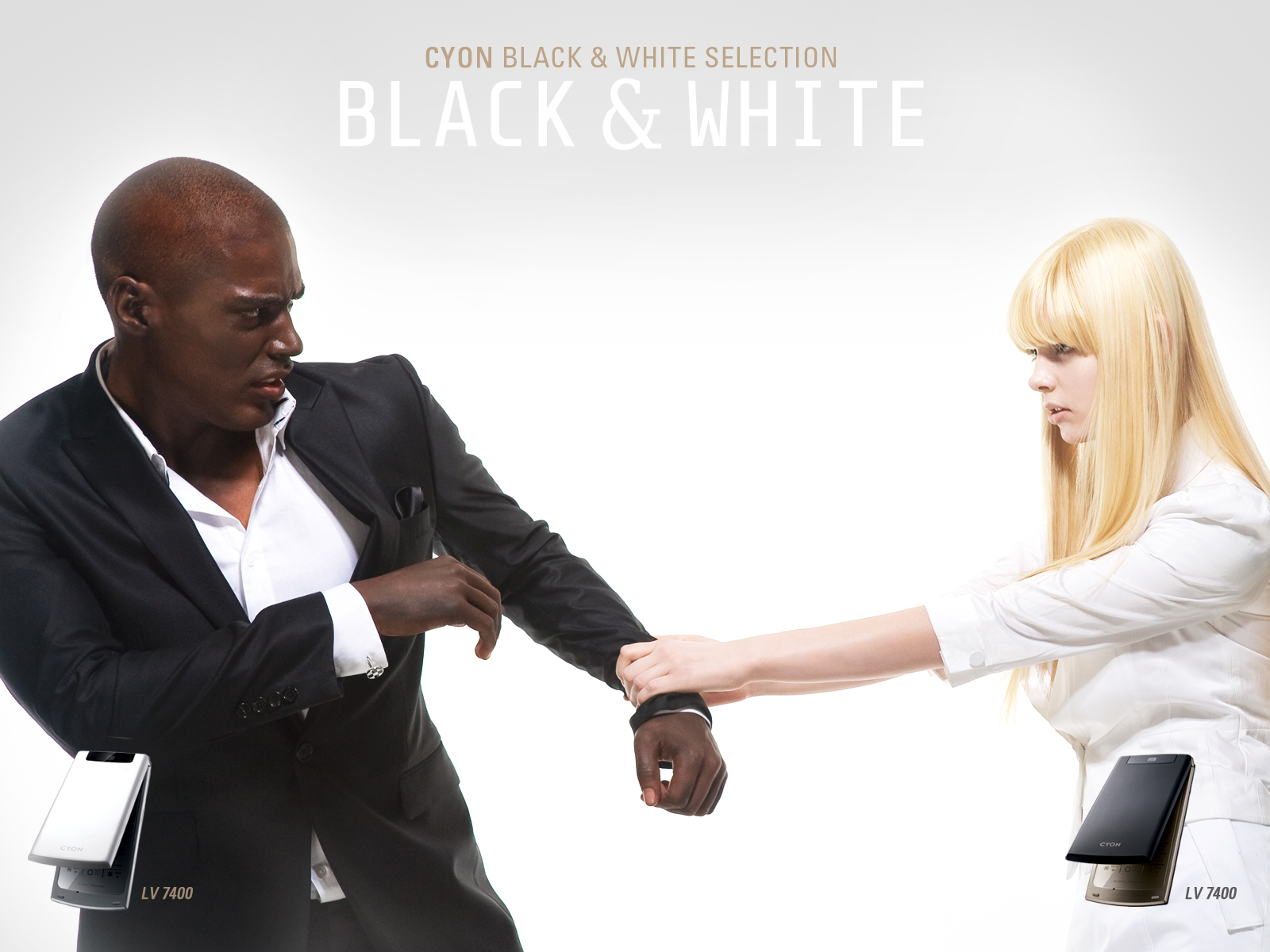
No, really: how else to explain the singularly uninspired choice of “Black and White” for the latest, well, black and white LV-7400 phones to come out? Sure, the likes of “Lollipop” and “Ice Cream” may hardly have been all that creative either, but at least they spawned quirky and memorable advertising campaigns, whereas this series of advertisements for the LV-7400 seems dull, uninspired, and above all too literal. In fairness though, they do provide an instant and dramatic representation of the product, and the commercial itself has a mild eroticism and sensuality to it that compels you to look more closely.
But of course, it’s not those that made me sit up and take notice:
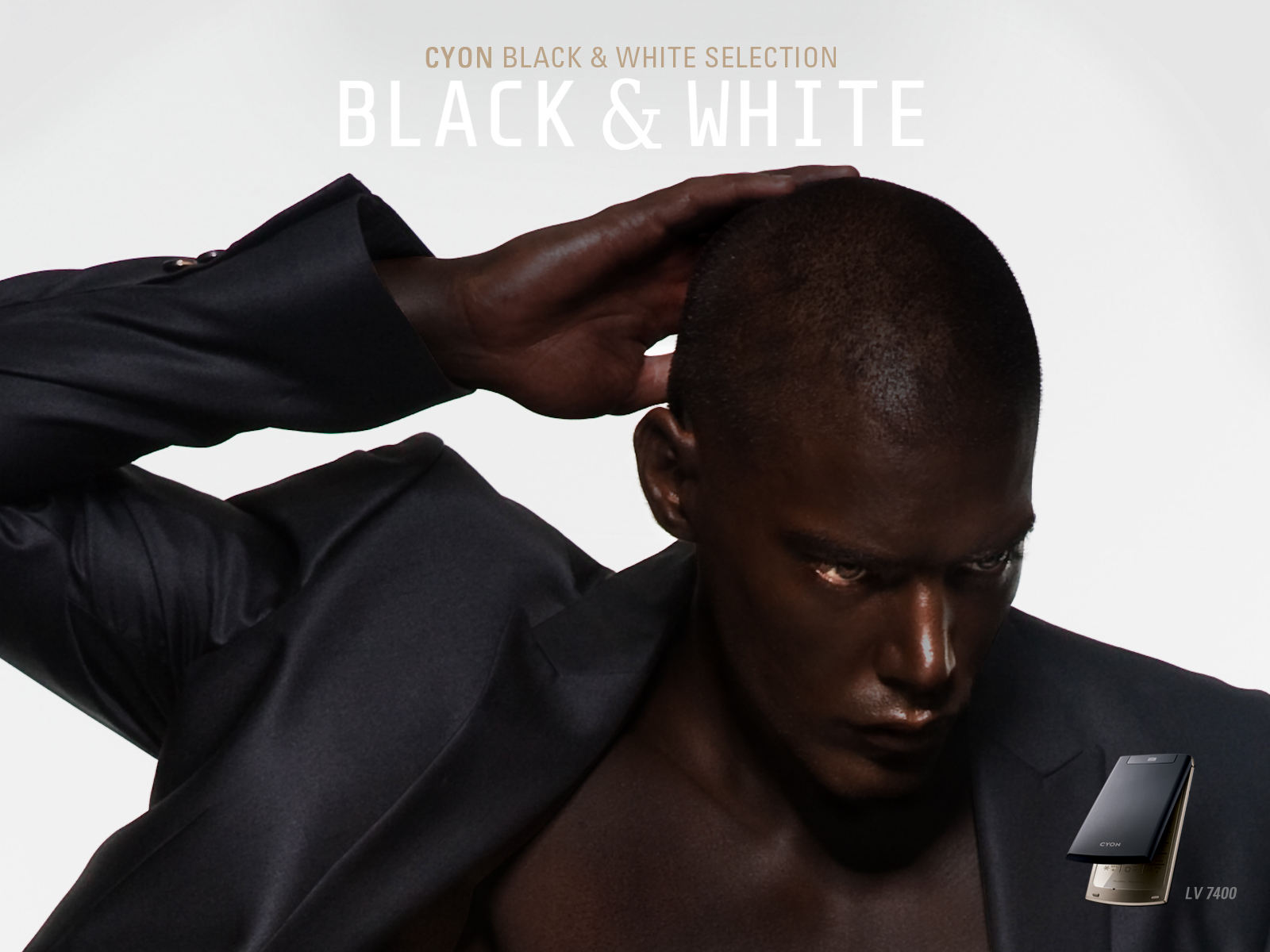
Yes, that is indeed not a Black man, but a Caucasian man somehow painted black.
It’s so bizarre, and so difficult to rationalize. Because was it really so difficult to find a genuine Black guy? No of course not, and given the extra time and effort involved in painting a Caucasian one then it must have been a deliberate choice. But if so, wouldn’t it have been far more logical and consistent to have also included a Black woman painted white? If not, then what is the “coloring” supposed to signify? And why, oh why, weren’t these blatantly obvious questions asked by LG Cyon?
Very flawed concept and execution aside though, could the advertisement be construed as racist in any sense?
To answer, my first thought was to turn to Michael Hurt post’s about other Korean examples of the “Blackface” phenomenon at the Scribblings of the Metropolitician, and I broadly agree that the examples he gives are indeed offensive. Moreover, a huge multinational company like LG (of which Cyon is just the name of its mobile phone arm) would almost certainly be aware of the reception they would receive in Western markets, and as such cannot claim ignorance of their racist connotations and history, a parallel of which is Coreana’s use of Nazi imagery in a cosmetics commercial (see Brian in Jeollanam-dohere and here for more on that). Nor do I accept the argument that images that Westerners would find problematic are automatically rendered acceptable simply by virtue or being made by and for Koreans, a culturally-relativist argument that at the very least is highly patronizing to the latter.
But despite all that, my gut reaction to first offenses is to give the various Korean institutions, companies, and/or individuals behind them the benefit of the doubt, and to use them as an opportunity for education. In particular, because Korean society almost completely lacks any sense of political correctness (which can be as refreshing as it is annoying), and as, for instance, the recent controversy over the use of icons of its former Japanese colonizers for Girls’ Generation’s new album cover (see here and here) demonstrate, or the choice of a comfort woman theme for a series of erotic photos, many Korean companies can display a shocking ignorance of what might offend just fellow Koreans, let alone foreigners. Moreover, considering that: until as late as 2006 Korean social-science textbooks stated that Korea was a homogeneous society and that this was a source of national strength (see #1 here); that a great deal of manifestations of supposedly Western culture in the music industry especially are mere imitations of domestic acts that have come before them, sans non-Koreans’ cultural baggage and angst; and finally that, in Japan at least there are:
…teenagers who used to dress up, and maybe still do, in a fashion known as Ganguro (ガングロ), which literally means “black-face.”
According to a Western video report on this phenomenon, this look does not come from people of African descent; instead, its origins are traceable to a Japanese comic’s donning of blackface in order to clown around in a loincloth in the guise of an aboriginal Australian.
With influences on Korea also (again, see Michael’s post), then it’s almost surprising that offensive advertisements and so on don’t crop up more often, and perhaps demonstrate that Korean society is improving in this regard, albeit more slowly than surely (see below).
Also, while intent is not the only consideration in judging such an advertisement, it is still probably the most important, and accordingly I’m at a loss as to how the Cyon advertisements could be construed as a deliberate attempt to demean Black people somehow, regardless of how much offense it may or may not generate: indeed, if that was the intention, then it could certainly have been done much more directly.
That said, I’m reluctant to let Cyon completely off the hook. For take its advertisement from last year for the “mix&match SH-240” series of phones on the right for instance (source). In isolation, then they’re not bad at all (sex sells after all), but again, consistent and logical would have been alternative advertisements with a Caucasian man and a Korean women getting it on also, let alone Koreans with partners of other ethnicities, and I see such a lack as both very deliberate and emblematic of the Korean media’s issues with such relationships even in 2009 (see here, here, here, and here). But that’s another blog post, albeit one which I have to write very soon as part of my preparation for this conference in August!
Update, October 17) See here for another controversial example of “contemporary blackface,” this time from the French version of Vogue magazine.
(For more posts in the “Korean Sociological Image” series, see here)


 ( Source: goagsu4 )


 (Source:

 (Source, above and below:





 (
( 
 Four people, one with bloodtype A, one with B, one with AB, and one with O were sitting down having a meal together. Suddenly, “AB” stopped eating and got up and ran outside, and “O” decided to follow (him).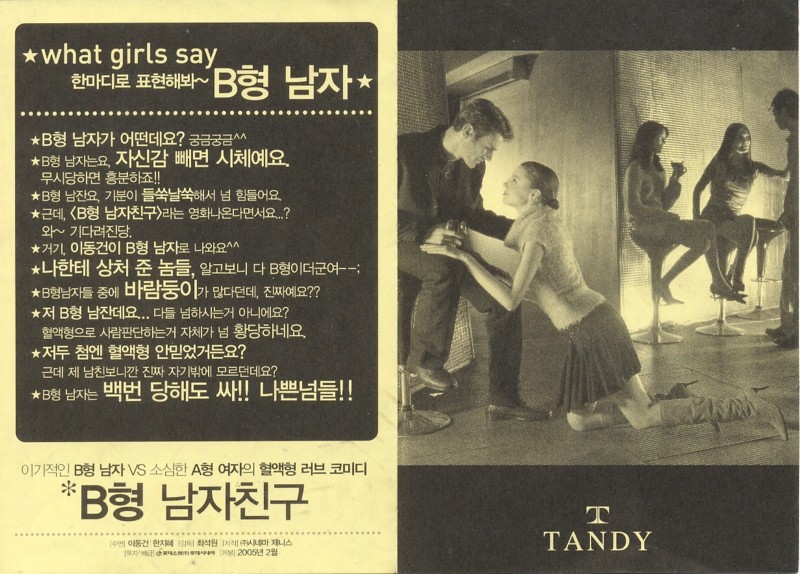


 argument that at the very least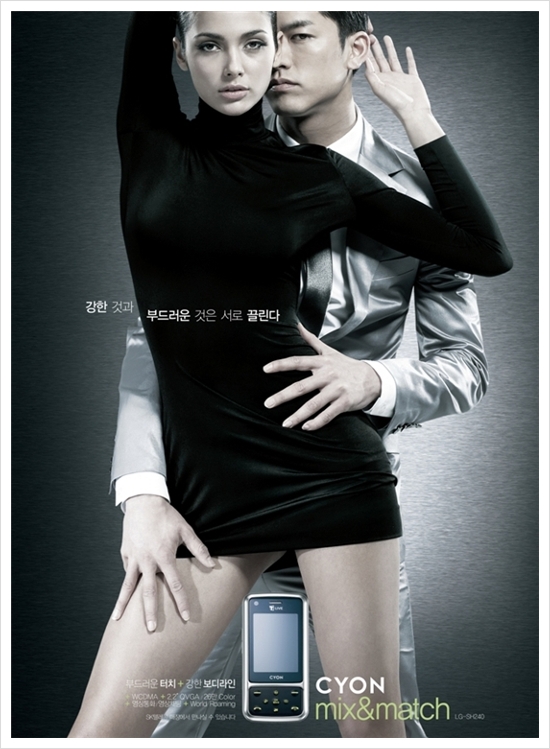
 The Grand Narrative
