
 ( Source )
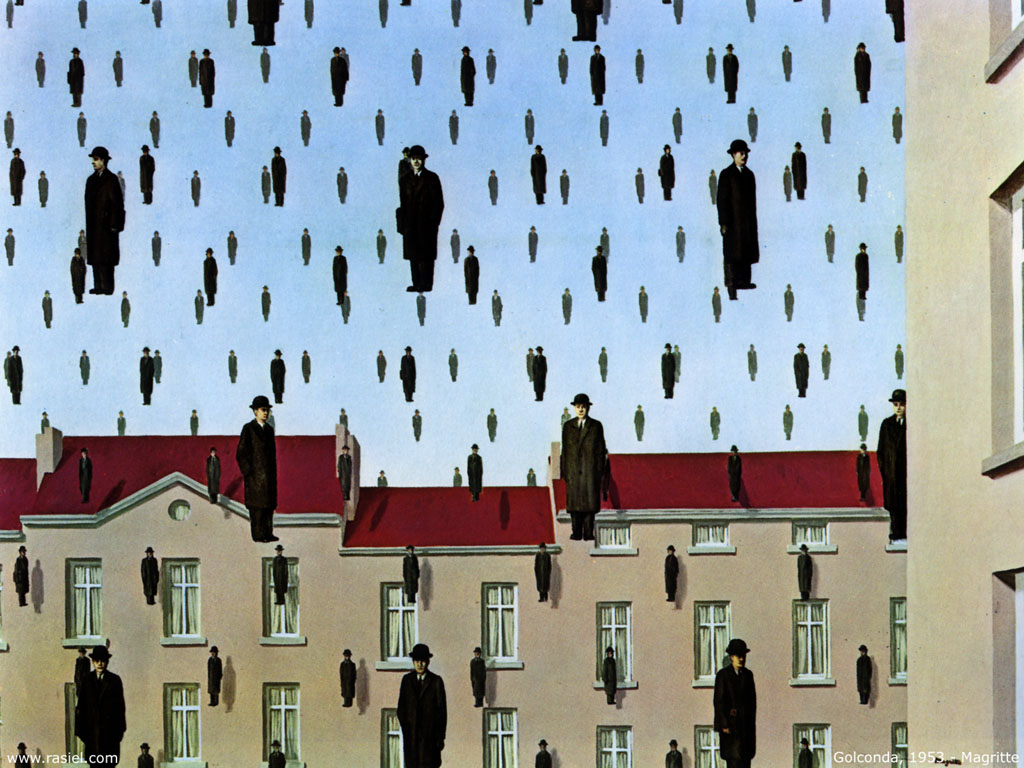
What? Belgian surrealist art on a blog about Korean sociology? Yes indeed; but never fear, for I’ll be criticizing something Korea-related soon enough!^^
The painting in question is Golconda (1953) by René Magritte, and I’m sure many of you have seen it before. But what did you think it was about?
Personally, I’d always assumed it was a critique of conformism. But Charly Herscovici, who was bequeathed copyright on Magritte’s works, commented that (via Wikipedia):
Magritte was fascinated by the seductiveness of images. Ordinarily, you see a picture of something and you believe in it, you are seduced by it; you take its honesty for granted. But Magritte knew that representations of things can lie. These images of men aren’t men, just pictures of them, so they don’t have to follow any rules. This painting is fun, but it also makes us aware of the falsity of representation.
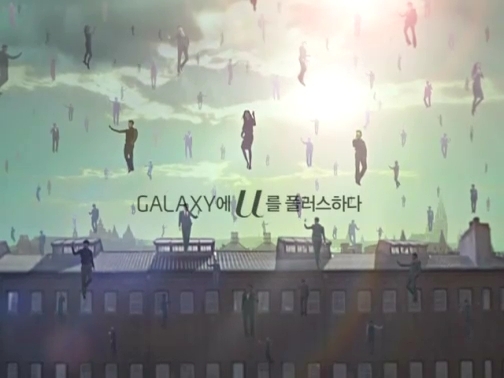
So although our interpretations aren’t mutually exclusive, the painting may not be quite as drab and negative as I thought. Still, does that make the concept suitable for a phone commercial?
Not really:
Vodpod videos no longer available.
No, I can’t really think of any relationship between the artistic concept and the voiceover droning on through the “U” section of the dictionary either. And ironically, the result probably emphasizes conformism and/or uniformity more than Golconda does too; particularly by starting with the word “unique”, only then to visually demonstrate how owning a Galaxy S phone will make you anything but.
Explicitly stating the opposite however, Rain’s (비) recent commercial for the SK-W Phone provides an interesting contrast:
And at least the copywriting does match the video this time (translation from the uploader):
– Do you want to be in the spotlight as just one of all dressed in the same form?
– You can be a real star only when there is an aura about you.
– (Rain’s voice): Your desire to want someone’s attention is one good enough reason to want ‘W’.
– ‘W’ which is really quite something with its own shining aura (repeated two times)
Or in other words, if you’re just the same as everyone else, then owning a special SK-W phone will compensate for your lacking any special qualities, thereby helping you get the girl.
Or will you? It takes no great leap of the imagination to see that if I can get a shining aura of sexual magnetism to rub off on me by purchasing the phone, then so can you too. Indeed, you can argue that the explicitness of the above message actually only serves to highlight that mundane, self-defeating reality of consumerism.
So why then, were over 100,000 sold in the month after its release?
 Alas, I know nothing about the merits of the phone itself. But some advertorials have directly linked its success to Rain’s dancing in the commercial, and I can disagree with that at least, finding the first part of his dance more reminiscent of an imitation of Robocop than anything else (source, right). Instead, I would attribute it more to the fact that it simply features one of Korea’s biggest celebrities, an unfortunate mainstay of Korean advertising. As Londoner Bruce Haines puts it, currently head of Korea’s largest ad agency Cheil Worldwide (제일기획):
Q) What’s one big difference between advertising in Korea and the UK?
A) Celebrity endorsement – a huge proportion of Korean ads depend on famous people. Of course, it’s not uncommon in the West for stars to endorse a product, but generally the ad has a core idea and makes use of the celebrity endorsement to enhance the original concept. Not so in Korea. In its crudest form, Korean advertising degenerates to beautiful people holding a bottle. This is one of the things holding back the reputation of Korean advertising worldwide. (10 Magazine)
And on top of that, perhaps I’m really quite misguided in assuming that the messages of conformity wouldn’t find a receptive audience among Korean consumers too. After all, however much of a gross generalization it sounds at first, in fact emphasizing both have been strong political and economic prerogatives of the South Korean state for much of its short history, and with profoundly gendered consequences.
What do you think? Either way, if this collection of my thoughts on the 2 commercials must(?) have a conclusion, then it would be that I’d like to see more alternatives to the dominate narrative of simply throwing expensive celebrities and/or their bodies at consumers. And I don’t mean simply throwing art at them instead!^^
In the case of smart phones specifically, perhaps we could have ones that emphasized how they can be genuinely helpful and empowering for ordinary people?
At first, I thought this one qualified:
Vodpod videos no longer available.
But in hindsight, a demonstration of how phones can help you be like everyone else isn’t quite what I had in mind. If you know of any then, please pass on any better ones, for phones or anything else!



 The Grand Narrative