Sex and Maths

(Source: Patrick Mannion, CC BY-SA 2.0)
Readers, I’m sure, are familiar with many of the biological and cultural explanations proffered for differences in mental abilities between the sexes. Here’s an an article in the Economist magazine with some strong evidence for, well…both sides to the debate, and with some surprising conclusions about Korea too:

Girls are becoming as good as boys at mathematics, and are still better at reading

TRADITION has it that boys are good at counting and girls are good at reading. So much so that Mattel once produced a talking Barbie doll whose stock of phrases included “Math class is tough!”

Although much is made of differences between the brains of adult males and females, the sources of these differences are a matter of controversy. Some people put forward cultural explanations and note, for example, that when girls are taught separately from boys they often do better in subjects such as maths than if classes are mixed. Others claim that the differences are rooted in biology, are there from birth, and exist because girls’ and boys’ brains have evolved to handle information in different ways.

Luigi Guiso of the European University Institute in Florence and his colleagues have just published the results of a study which suggests that culture explains most of the difference in maths, at least. In this week’s Science, they show that the gap in mathematics scores between boys and girls virtually disappears in countries with high levels of sexual equality, though the reading gap remains.

Student with Math Formula on Her BackDr Guiso took data from the 2003 OECD Programme for International Student Assessment. Some 276,000 15-year-olds from 40 countries sat the same maths and reading tests. The researchers compared the results, by country, with each other and with a number of different measures of social sexual equality. One measure was the World Economic Forum’s gender-gap index, which reflects economic and political opportunities, education and well-being for women. Another was based on an index of cultural attitudes towards women. A third was the rate of female economic activity in a country, and the fourth measure looked at women’s political participation.
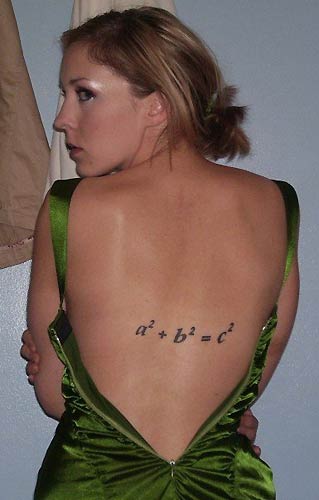
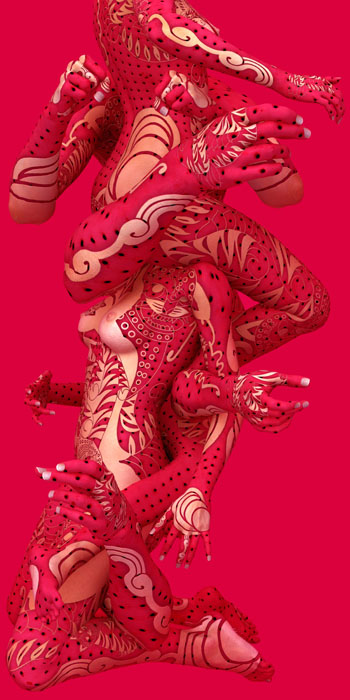
As long-term readers will know, I usually have problems with virtually anything the Economist says about international comparisons of education standards, its consistent praise of the high scores of South Korean students, for instance, undermined by South Koreans themselves finding their education system appalling (a fact which a whole five minutes of checking on the internet would reveal). There’s little scope for misinterpretations of correlations between reading and writing scores and measures of sexual equality though, but still, as you can see, the researchers were at pains to keep the variables down to a minimum (source, right: Tattoo Lover; CC BY-SA 2.0).

On average, girls’ maths scores were, as expected, lower than those of boys. However, the gap was largest in countries with the least equality between the sexes (by any score), such as Turkey. It vanished in countries such as Norway and Sweden, where the sexes are more or less on a par with one another. The researchers also did some additional statistical checks to ensure the correlation was material, and not generated by another, third variable that is correlated with sexual equality, such as GDP per person. They say their data therefore show that improvements in maths scores are related not to economic development, but directly to improvements in the social position of women.

And notice where Korea fits into that scale:
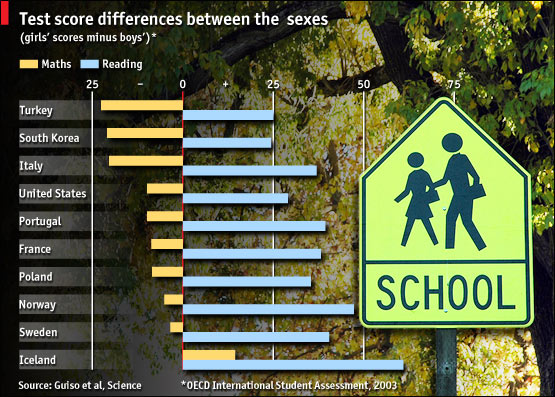
(Source: The Economist)

That was quite surprising, and confusing. For sure, in terms of its gender empowerment measure,   Korea is one of the most sexist countries in the world, and although it was less than a generation ago that girls’ university and even high-school educations were often sacrificed for the sake of their brothers’, I’ve heard from many different sources that the Korean education system today is relatively meritocratic. Indeed, Michael Seth in this must-read book on the subject, argues that it is one of its greatest strengths, albeit one unfortunately (and ironically) at odds with the great respect, status and deference given to high achievers also.

I’d imagined, then, that young Korean women confront sexism more once they enter the workforce, as despite their educations there remain strong societal expectations that they will be happy to work at non-advancing jobs in their twenties and then effectively retire upon marriage, not unlike the situation in Western countries in the 1950s and ’60s.

But then these tests were for 15 year-olds, so clearly there is some sex-based factor at work in the Korean education system that I wasn’t aware of. Why do Korean girls do so badly at math then? I’m open to suggestions.

The only clue I have is that Maths (and English) is considered a hard and difficult subject for students, which is why in its 19-year history the chain of institutes I work for didn’t hire any female teachers to teach it until literally last week, only men being considered authoritative enough to get students to study in class. Certainly, the institutes I work for are quite unique in that regard, and much more demanding of students than most, but still: I think it’s quite telling that the policy was in place. And if students of either sex disliked it so much, then I can’t imagine that girls with interest and/or ability in it would have been particularly encouraged to pursue it, given their relative absence in engineering and scientific fields in Korea. Perhaps Korean education isn’t quite as meritocratic as I thought?

(On a side note, it says a great deal about the sort of English taught at my institute that only men were considered capable of teaching that also, despite — I assume — a majority of English {and languge} teachers in Korea {and probably the world} being women)

The one mathematical gap that did not disappear was the differences between girls and boys in geometry. This seems to have no relation to sexual equality, and may allow men to cling on to their famed claim to be better at navigating than women are….

Again, surprising in a Korean context. I’ve been teaching 13 and 14 year-olds, on-and-off, for a good eight years now, and I’ve noticed that their math textbooks are always just full of geometry, far more than I ever had to do at their age. For sure, frantically copying each other’s answers in breaks between classes doesn’t equate to real learning, something they’re forced to do because they wouldn’t possibly have enough time to do all the homework required of them (let alone — heaven forbid — eat and sleep too). But still, if there’s one country where I’d thought girls would have been good at geometry, it would have been Korea. Something is clearly up (source, right: unknown).

The article gets more interesting (and controversial) after that:

….However, the gap in reading scores not only remained, but got bigger as the sexes became more equal. Average reading scores were higher for girls than for boys in all countries. But in more equal societies, not only were the girls as good at maths as the boys, their advantage in reading had increased.

This suggests an interesting paradox. At first sight, girls’ rise to mathematical equality suggests they should be invading maths-heavy professions such as engineering-and that if they are not, the implication might be that prejudice is keeping them out. However, as David Ricardo observed almost 200 years ago, economic optimisation is about comparative advantage. The rise in female reading scores alongside their maths scores suggests that female comparative advantage in this area has not changed. According to Paola Sapienza, a professor of finance at the Kellogg School of Management in Illinois who is one of the paper’s authors, that is just what has happened. Other studies of gifted girls, she says, show that even though the girls had the ability, fewer than expected ended up reading maths and sciences at university. Instead, they went on to be become successful in areas such as law.

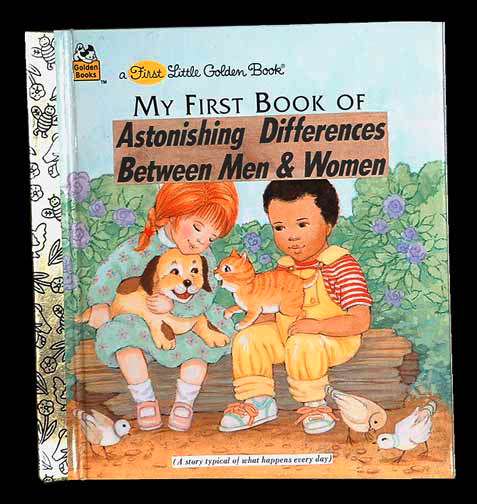
In other words, girls may acquire an absolute advantage over boys as a result of equal treatment. This is something that society, more broadly, has not yet taken on board. Mattel may wish to take note that among Teen Talk Barbie’s 270 phrases concerning shopping, parties and clothes, at least one might usefully have been, “Dostoevsky rocks!”
(Source: Vaguely Artistic; CC BY-NC-ND 2.0)

I’m very much a proponent of the existence of some fundamental biological differences in aptitudes between the sexes myself, and do believe that even in a perfect world that there will always be, say more female nurses than male ones, and more male engineers then female ones and so forth. Not for a moment does that mean that I will ever stop or even not positively encourage my daughter to, say, be an engineer, or not take seriously a male nurse, but the above is yet another inconvenient truth against the argument that all difference is due to prejudice.

For more on that I recommend the book The New Sexual Revolution, by Robert Pool (1994), and especially “The Real Truth About The Female Body” in Time Magazine, March 8 1999. I especially recommend checking out the (naturally) numerous comments to the Economist article; as you have to be a subscriber to make a comment, then the dialogue is a lot more intelligent and civilized than you’ll find on most blogs and forums! I especially like this one of Tom West’s, a healthy cautionary message against what I’ve written above:

“Do all feminists rail against the idea that men and women might actually be inherently different?”

The trouble with acknowledging differences is that human beings tend to turn a generality into a specific rule. As soon as you say that it’s natural that men are over-represented in higher math, it becomes instantly harder for any woman to be even average at math. The meme is simplified into “women can’t do math”, and you soon end up with teacher’s wjho won’t work hard to teach girls math, boys and girls that reject those who are good at math as weird and different, and of course, dissuade many from putting in the effort to become good at math because they themselves believe they can’t do math.

As an aside, in my opinion, that was why Larry Summers deserved to lose his job for his remarks. Not that he was necessarily wrong. It was that by virtue of his widely circulated speech, he had legitimized “women can’t do math” in the minds of many, regardless of what he actually meant or believed. (And that people in authority have to be aware of not what their words say, but of what their words will do.)

(Note: Having my blog posts regularly copied and pasted by others myself, normally I’d be loathe to paste an entire article here. But it was of an annoying length that made simply giving excerpts difficult, yet pasting all of it too much. After much time and repeated links wasted on trying the former, I gave up and chose the latter!)

Ich bin ein Westerner

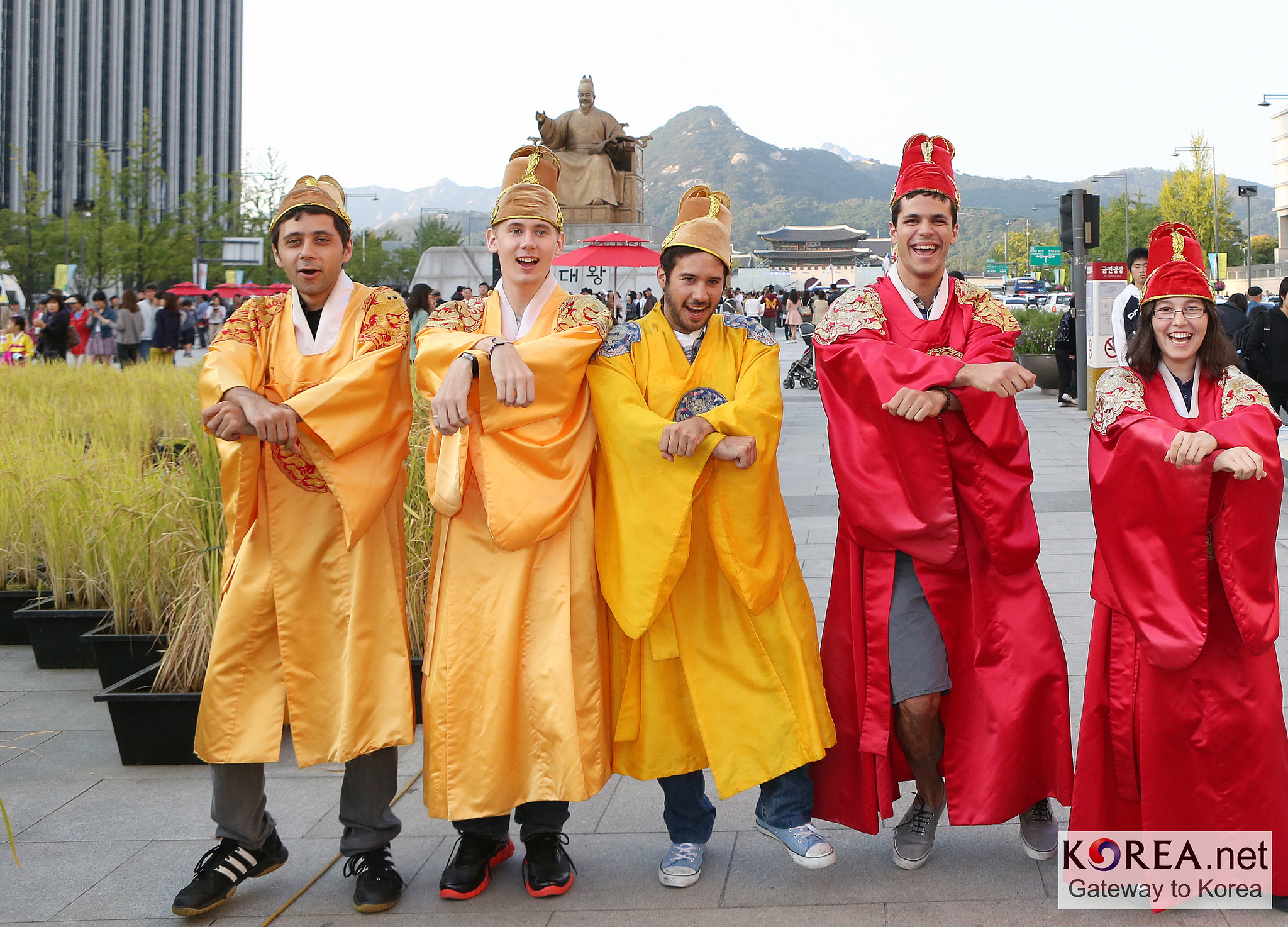
Foreigners Gangnam Style(Source: Republic of Korea; CC BY-SA 2.0)

Steve, who is unfortunately leaving Korea soon, has written a short but interesting post about the meanings and ramifications of the terms waekookin (외국인) in Korea and gajin (外国人) in Japan over at his blog Where is Cheongju Again?, and long-timers here especially could do much worse than take the five minutes to read it over their coffee this morning. Overall, he makes a pretty convincing case for Westerners in both countries referring to and thinking of themselves as such rather than simply as “foreigners” (the basic translation of both words), and I’ll be doing so myself from now on.

It may not sound like much, but like I said in this forum, Korea’s (and Japan’s) “bloodline”-based notions of nationalism and citizenship emphasize and exaggerate the differences between natives and non-natives to an extent rarely found elsewhere in the world, and the constant reminders of these quickly become wearisome to anyone who’s spent even just a few months living here, let alone eight years. Also, ironically, constantly hearing the term waekookin in our daily lives probably means that we come to adopt some of the same notions of division and distance ourselves too, and the effect snowballs.

A little cliched? Perhaps. But still, the term is such an immutable fact of expat life here that probably few of us have ever given some thought to it, and it surely can’t harm to do so. Not least, by a grizzled and cynical old timer like myself.

Update: If you found this post interesting, then you might want to check out this thread on Dave’s ESL Cafe too. To those of you not in Korea especially, it gives a good idea of how (over)used the word “foreigner” is here, and just how quickly it can become annoying.

Kim Joon’s Body Art (NSFW)

(Slightly updated, August 2013)

Hat tip to the (sadly now defunct) Startdrawing.org. But you can still go directly to Kim Joon’s own website for hundreds more examples of his work. Here’s a small selection:

(Party-red Hole, 2007. Photo directly from Kim Joon’s website)

With apologies, I rejected posting examples with male subjects back in 2008, primarily because I didn’t particularly like Kim Joon’s choice of only stocky men or those lacking any muscle definition (as opposed to his choice of universally tall and skinny or athletic* women, a body type I admit I find both aesthetically pleasing and sexually attractive). I’ve since come to appreciate them though, and fortunately there’s still many 2005 examples available here. Also, he did start using more muscular male subjects a few years later.

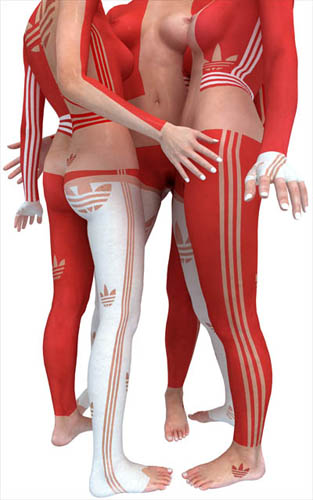
(We-adidas, 2005. Source: 普若 安 )

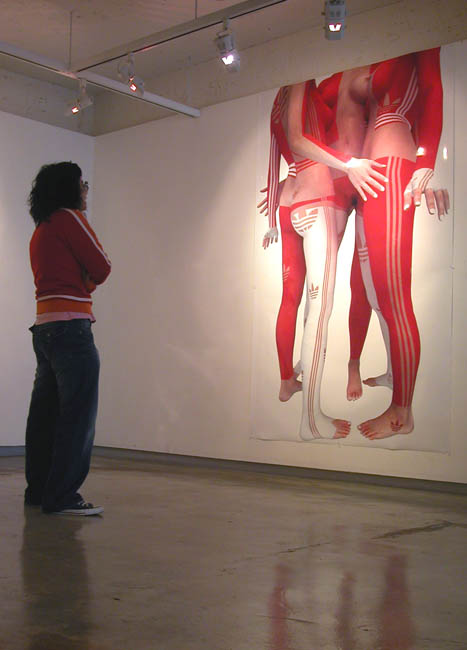
Unfortunately, despite the plethora of websites that feature his work, very few give any specific details about how he actually makes his images, and him being described a “tattooist” left me rather confused: are they primarily tattoos, computer graphics, or both? From what I can make out from the “text” section of his site, different images required different techniques, but most of them were substantially changed on a computer after the original photos were taken.

(Photo directly from Kim Joon’s website)

Looking at his profile, he does live in Korea and has exhibited here often, and so I’ll try to keep tabs on when his next exhibition is coming up, although if any readers hear before me I’d be very grateful if they could pass it on. Also, have any readers already seen his work in person? What did you think? Did seeing the photos at a large scale make you like the art any more or less?

*I’ve also since come to realize that “athletic” is a misleading and inappropriate term for this body type, as athletes of both sexes actually come in all shapes and sizes. Can any readers suggest a better alternative?

(Update, November 2008: Here’s a follow-up post on later exhibitions of his work)

Women’s Bodies in Korea’s Consumer Society, Part 3 (Final): Nation, Family, Self

busan-focus-06-03-2013-p-5(Source: Focus, Busan ed.)

Anti-Communist Fashion

As promised in Part 2, in just a moment I’ll jump straight into outlining and discussing the the second part of Taeyeon Kim’s 2003 journal article Neo-Confucian Body Techniques: Women’s Bodies in Korea’s Consumer Society.But before I do, I should mention that I’ve also started reading SeungSook Moon’s book Militarized Modernity and Gendered Citizenship in South Korea (2005), and it’s made me realize just how narrow a focus Kim’s article has.

That’s not really a criticism: in the 16 pages available to her, Kim does an excellent job of explaining how the 19th Century Joseon Dynasty’s Neo-Confucianist views of the female body were warped by, adapted to, and ultimately cam to survive and proper in the 20th Century. And that endurance does go a long way towards explaining the question I first posted in Part 1 — namely, why are Koreans so conformist in their fashion choices?

korean-anti-communist-posterBut what Moon’s book has also made me realize is that, however outlandish the connection sounds at first, today’s Korean fashion can’t be explained fully without mention of the postwar Korean state’s anti-communist ideology too.

Let me run with this for a moment. In a nutshell, Moon’s book gave me a more bottom-up perspective on life in postwar Korea than what I’m used to (decidedly top-down Troubled Tiger is one of my favorite books), and the more I read about it, the more I learned just how pervasive that ideology was in people’s everyday lives, and how almost any form of legitimate dissent or creative difference was often regarded by the state as nothing short of “leftist” subversion. I could give you examples, like Korean men with long hair being publicly shaved in the 1970s, or the police checking that women’s skirts were long enough (albeit more as an excuse to simply harass women), but you get the drift (source, right: theturninggate).

These attitudes didn’t suddenly disappear upon democratization in 1987. In hindsight, it’s incredibly naive for me (or anyone else) to account for conformity in modern Korean life without reference to it. Yes, even in something as innocuous-sounding as fashion.

(Update: I suddenly remembered this ad. But while it’s a good play on how the “rule” for miniskirts has completely reversed since the 1970s, the conformity remains the same. How else to explain wearing miniskirts in winter? An otherwise extremely wasteful use of the body’s resources to demonstrate one’s physical prowess to mates, just like a peacock’s tail?)

But that will be the subject of later posts. First, let’s finish Kim’s article, sans political ideologies (Update: after reading it, I recommend this recent post of the Metropolitician’s on Korean fashion, lest you feel that I give too pessimistic and conformist an image of Koreans; honorable mention should be made of this post of Roboseyo’s post too). The second part starts by placing the endurance of Neo-Confucian images of women’s bodies in modern times in the context of the endurance of Neo-Confucianism in Korean society as a whole:

Confucian Fundamentalism and Korean Identity

The first thing of note is that, despite how it may at first appear, the endurance of Neo-Confucianism in modern Korea is probably more because of Korea’s turbulent 20th Century rather than despite it, as 余 涵 彌fundamentalism of any stripe is usually a reaction against painful, forced transitions to modernity. As Kim says, in Korea’s case Japanese colonization and then civil war and division meant that its postwar search for national identity (source, right):

“…became essential to Korea’s postcolonial and post-war project for national reconstruction. Neo-Confucianism came to stand for essential ‘Koreanness’ and was quickly embraced as the authentic culture of Korea – so much so that challenges to Neo-Confucian principles were branded as threats to national integrity. Neo-Confucianism also maintained its gloss as part of the elite culture, and as more and more Koreans were becoming upwardly mobile, many strove to identify themselves with the former [elites], making what was originally an ideology and culture of the elite minority into the culture of all Koreans” (pp.102-103).

Some other consequences of that quest for self-identity include Korea’s bloodline-based nationalism (although the origins of that were closer to 1900 than 1953), and military regimes deliberately nurturing the idea that Korea has suffered invasions more than most, both now counter-productive (to put it mildly). Ironically though, for women it also ultimately meant a reaffirmation of the ideals of taegyo (태교), despite women’s entrance into the workforce for the first time and the nuclearization of the Korean family. There are two reasons for this, one speculative and one more concrete.

First, one increasingly under-appreciated aspect of postwar Korea was overcoming the psychological trauma of the physical dislocation and separation of Korean families due to the war, and until I started today’s post I didn’t realize that that may have affected Korean’s women’s postwar lives much more than men — remember that, under Neo-Confucianism, they weren’t really thought of as of as individuals in the Joseon Dynasty, and thus their families had been the primary source of their identity. But then, not only were they suddenly and violently brought out of the inner, private sanctum of those families and homes by the war, and then into the public sphere of schools and factories for the first time, those families also moved from the farm to the cities, and nuclearized in the process. Given those circumstances, it is natural to suppose that women might yearn for the good old days of certainty, especially former upper-class women to whom Neo-Confucian tenets had been most vigorously applied.

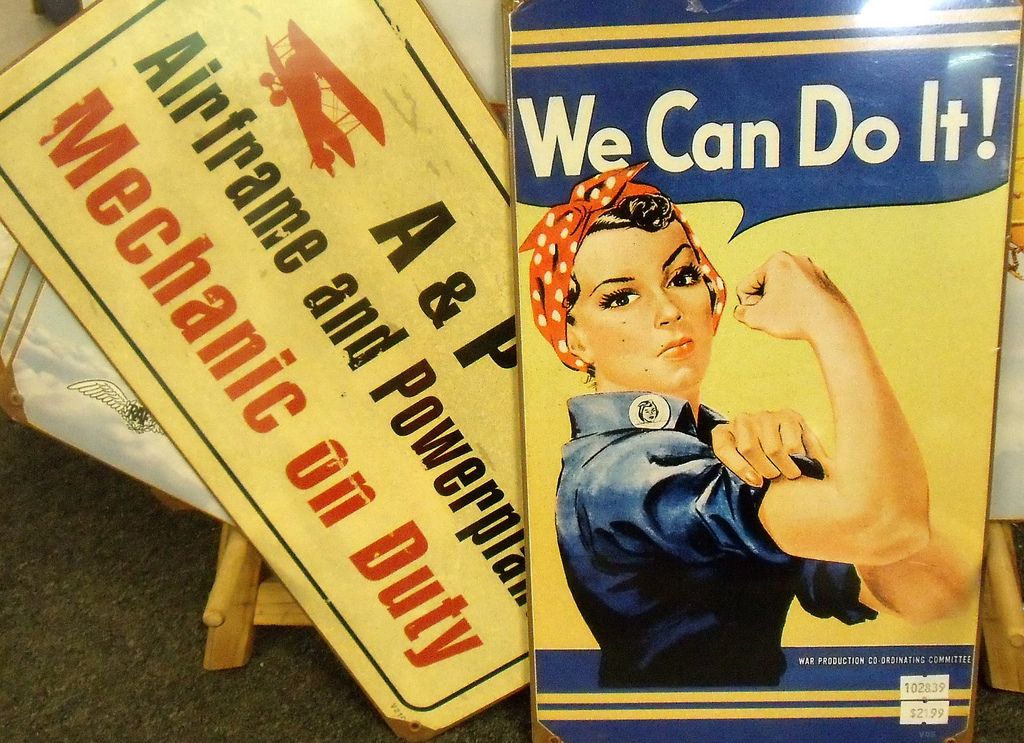
Rosie the Riveter We Can Do ItSecond, while for a time women’s physical labour in factories came to be regarded (rhetorically at least) as just as important and useful as their traditional domestic work in the home (as was, I might also add, their equally “needed”, expanded roles as sex workers too; I’ll save that for a later post), ultimately (source, right: Mike Beauregard; CC BY 2.0):

with the advent of a post-industrial, consumer capitalist society in the 1980s, women became more important as consumers than as factory workers, shifting the utility of their bodies from national labor production to national consumption, becoming, in effect, what Byran S. Turner (1996) calls the capitalist body. (p. 102)

Later, I feel that Kim exaggerates how “post-industrial” Korea is, but that doesn’t detract from the basic point that women, once exhorted and educated to work in the factories, were once again extorted to stay at home upon marriage, and to then focus on producing and raising children. Seeing as a good third or so of the blog is about how the Korean economy and minimalist welfare system is predicated on that fact, then I don’t feel the need to elaborate on and justify that here. Instead, of note is how they are also urged to consume as housewives and mothers, both for the sake of national development, and for the sake of obtaining the items necessary to secure and advance their family’s social status, as explained in Part 2. Ergo, it’s taegyo all over again, although I’ll admit that it sounds neither particularly Korean or even Neo-Confucian at the moment.

The Ensuing Social Malaise

But just like in Western countries after World War Two, you can’t expose most women to working life and equal education and then expect them to meekly return to the home once the economy and/or national emergency no longer requires their economic services; the contradiction leads to the appearance of various social malaises, such as the “housewives’ syndrome” that Betty Friedan so adroitly recognised in 1963. In Western countries, that recognition and the civil-rights movement led to Second-wave Feminism. But Korea has so far lacked the former, and is only just beginning to experience a form of latter, often more because of the signing and implementing of UN conventions on gender issues and so forth rather than domestic pressures. What unresolved social malaises then, have arisen in Korea?

Kim argues that uprooted Korean women naturally found solace in new, postwar media images of women, and following the new rules of fashion was certainly easier and more personally satisfying to most women then embracing new, entirely alien concepts of liberalism, individualism and feminism to which Korea’s new relationship with America exposed them to. Hence:

The Neo-Confucian values of harmonizing as one, proper behaviour and self-cultivation, [re-emerged] in the guise of conformity, propriety and self-improvement. (p. 107)

But as we’ve seen, while self-improvement for men involved training of the mind, resulting in transcendence of the individual self, women were considered incapable of this. Hence women’s primary means of self-improvement came to center on the physical body instead, and this ultimately explains the why of today’s social malaises in Korea today, notably that:

Hence taegyo is Korean and/or Neo-Confucian, because while plenty, if not most, Western women consider getting plastic surgery for the sake of bettering their chances in job interviews and marriage prospects so forth, very few do explicitly for the sake of their father’s and or husband’s families.

Finally, now for the how.

Correcting the Flawed Eastern Female

Oriental Girls(Source: Joel Ormsby)

I’ve already explained that Korean women tend to embrace conformity rather than individuality in their fashion choices, and articles about fashion in women’s magazines too are less “Western” than they may first appear. While opening paragraphs seem to promise articles “promoting liberation from the edicts of fashion, and self-expression over blind conformity,” for instance, what they actually do is set up strict guidelines for Korean women to follow, the authors often failing to recognise that their exhortations not to follow fashion magazines’ fashions, but their tastes and styles instead, actually amount to the same thing. Indeed:

What is right for [the authors] must be right for everyone else, for there is a blurry distinction between [the authors] and others, a legacy of the subjectlessness of the Korean woman. (p. 104, emphasis in original)

Sure, much the same can be said of Western women’s magazines, which Kim should have acknowledged. But remember the importance of the notion of “subjectless bodies” in Kim’s article (see Part 1), and that for Korean women the philosophical concept of the individual self, defined not by ki and the family but by the physical limitations of the corporeal body, is very new. Hence Korean authors and readers may not see the contradiction that their Western counterparts may. Moreover, articles often present:

…what [they] consider to be particular features of the Korean women – short legs, big face, yellow skin – as problem features that can be corrected by certain types of clothing and colours….[they] imply that the imperfect Korean body is disordered but can be put back in order through the tricks of fashion. The body is something to be rearranged so its apparent flaws are concealed or eliminated. These flaws themselves stand out as imperfections because they are features unique to Koreans and absent in white models (p. 104, emphasis in original)

I could go on to discuss the details of huge plastic surgery industry in Korea, but it’s been done to death elsewhere, and I think the above photo and this article sum it up better than any virtual ink spilt on the subject. Having said that, numerous sources have claimed that Korean women’s desires to look Caucasian are the result of an inferiority complex towards and cultural colonization by the West, but I think that both that desire and those influences have been grossly exaggerated. Consider this:

All three elements, the Neo-Confucian woman’s subjectlessness, the perception of Korean bodies as imperfect, and fashion’s function to re-order the disordered Korean bodies, make Korean women’s bodies particularly prone to alterations, rearrangements and re-creations of the body. (p. 104)

The biggest thing I’ve gained from these writing this series of posts (and I just so happen to think that it’s quite an original point too), is that in that statement above you can replace “Korea” with China, Japan, and/or Taiwan, and that argument would still be just as valid. Arguing that their shared plastic surgery mania is because all four countries share a history of cultural colonization and have inferiority complexes towards the West is tenuous at best, and if even if true, surely it would mean that Korean men too, say, would aim to look more Western? But no, they don’t, and not even with the huge size of the Korean male beauty industry today. But all four countries do share a history of Neo-Confucianism. On that basis, is it too much of a jump to argue that the Neo-Confucianist combination above is precisely why plastic surgery is so popular amongst women in this part of the world?

Women’s Bodies in Korea’s Consumer Society, Part 2: We’re not in Kansas Anymore


The ParadoxSong Hye-gyo sofa

For new readers, Part 1 was an outline and discussion of the first part of the 2003 journal article Neo-Confucian Body Techniques: Women’s Bodies in Korea’s Consumer Society by Taeyon Kim. To quickly recap it, she argues that women weren’t really thought of as individuals in Joseon Dynasty Korea, as the state ideology of Neo-Confucianism considered them incapable of the spiritual transcendence that men were. Instead, the best they could aim for in life was continuing a husband’s “ki”, or spirit, through the production and upbringing of sons and the efficient management of his household. Hence Kim describes them as “subjectless bodies,” as not only were they not really individuals but their physical bodies were not really their own either, merely being vessels for and tenders of the more precious ki instead (source, right: jingdianmeinv)

In terms of the ideals for women’s appearance, this meant that the physical attributes required for those were prized more than beauty. On top of that, adornment and/or alteration of the body was not condoned for either sex, as the physical body was one’s inheritance of ancestors’ sacred ki. And herein lies the paradox, as on the one hand Neo-Confucianism still pervades all aspects of Korean life today (I’ll take readers knowing and agreeing with this as a given), but on the other hand, modern Korea appears to be in the midst of a decidedly non-traditional celebration of youth and the female form. What gives?


Neo-Confucian Consumption Motives

The short answer is that appearances can be deceptive. It is certainly true that modern media images of Korean women are not Neo-Confucian in the 19th Century sense described above, and it’s difficult to argue just by looking at them that advertisements, for instance, are any different to their counterparts in Western countries. Of course, systematic cross-country analyses of numbers and types do reveal significant and telling differences, and if readers are interested in those then I highly recommend reading the 2006 journal article entitled “Content Analysis of Diet Advertisments: A Cross-National Comparison of Korean and U.S. Women’s Magazines” by Minjeong Kim and Sharron Lennon, downloadable here. But surveys like those do not chronicle average Korean and Western women’s reactions to them, and herein lies the essential differences between them.

Barbie Dolls ConformityAs a rule, in Western countries most (although not all) advertisements for a product have to actively suppress and disguise the notion that people may feel compelled, influenced or forced into purchasing that product, whether by the ad, by peer pressure, or some other unwritten social rule. Instead, people are encouraged to conceive their purchase in terms of personal choice, individuality, empowerment, and — especially if the target consumer is young — maybe liberation and rebellion too. And of course, these advertising norms undoubtedly operate for a good proportion of advertisements in Korea too. But in the case of advertisements for products related to one’s appearance, be they cosmetics, clothes, or plastic surgery, it turns out that a great number of Korean women make purchases for precisely the opposite reasons. Indeed, not only is there no stigma in doing so, but they positively embrace the opportunity to conform to and harmonize with social norms through their consumption choices (source, right: Kiran Foster).

Lest that assertion sound like a typical exaggeration of a Caucasian male, surveys that Kim cites indicate that most Korean women explicitly justify their choices in those Neo-Confucian terms, and definitely not the individual empowerment, entitlement, and personal assertion of one’s individual choice that Western women tend to do in similar surveys. That is not to say that Western women (or men) can’t and don’t also passively follow fashions, and it’s not necessarily a negative or dehumanizing thing either. But very few Westerners would admit to it.

I see no reason to doubt the results of those surveys (which I can provide the details of if readers wish), and while my own female Korean friends for instance, are certainly as liberal and free-willed as any Westerner in their clothing and cosmetic choices — and lifestyles; indeed, that’s why we’re friends — they can’t counter the mass of empirical evidence Kim provides, and even the anecdotal evidence from the media and on the streets of Korea. If Neo-Confucianism is pervasive in modern Korean life then, and Korean women consume cosmetics, clothes, and undergo plastic surgery operations largely for the sake of Neo-Confucianist motives, then it’s time to call a spade a spade and argue that Korean society’s new emphasis on women’s appearances is (somehow) Neo-Confucianist too. Indeed, it would be strange if only this particular aspect of Korean life was so different.

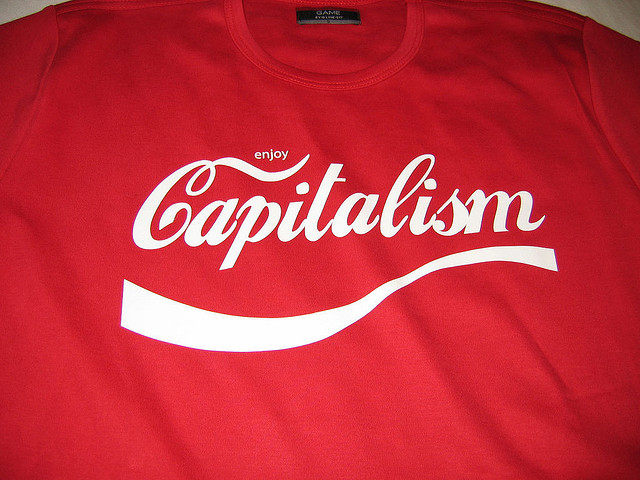
Enjoy Capitalism T-shirtHence the second part of Kim’s article is about how this modern phenomenon is a warping of and adaptation of Neo-Confucian ideals of women’s roles to new capitalist and consumerist circumstances. But while I originally wanted to outline and discuss that in this post, I’ve moved that to Part 3, because first I wanted to place those circumstances in their historical context, which I think considerably adds to and strengthens Kim’s argument (source, right: Jacob Bøtter).


The Developmental Context of East Asian Consumption

I’ve already demonstrated that although Korean women and, say, American women, can both be labelled as “consumers,” they can and do both make radically different consumption choices; or, make the same choices, but for radically different reasons. Sure, this is obvious, but I’m as guilty as anyone in generalizing and using labels here, so it’s good to remind ourselves of it. But if we shift our attention to the differences between most Westerners and most Koreans (and East Asians) as a whole, the first fact of note is the fact that most Korean university students’ parents easily recall the days when possession of some must-have items like a fridge, radio, color TV and car were essential signifier that one’s family had made it into the then swelling ranks of the middle-class. On that basis, it may be fair to say that they still imbue their consumer goods with much more status and importance than most Westerners do. (Hell, many of the university students themselves too.) This explains Koreans’ love affair with big cars and SUVs for instance, and in one of the most oil-lacking, mountainous and densely-populated countries in the world.

(Update, April 2013: Actually, the Korean preference for big cars is more due to the [inordinate] social status they provide.)


On top of that, Korean governments since 1961 have explicitly and fervently extorted Koreans to consume these items, provided that they were made in Korea. It’s easy to simply attribute this to and write off as mere nationalism, only different in degree to, say, the “Buying Kiwi-Made” campaign in New Zealand, or Democratic presidential candidates in the US criticising NAFTA in election year. But this is quite wrong. If you’ll bear with me for a moment, to properly understand women’s fashions in Korea you need to understand a little of it’s well, political history first. No, really.

When Park Chung-hee/박정희 took power through a coup in 1961, while his military regime of course relied on the use of force, it would be naive to assume that it didn’t have a great deal of popular support. And so, originally at least, his military regime’s sole claim to legitimacy was its perceived ability and capacity to produce the economic development seen as necessary for national security after the chaotic years of the Syngman Rhee/이승만 presidency. While linking the economy and security this way may sound absurd in 2008, it’s important to be aware that North Korea was actually ahead of South Korea economically until the late-1960s, and in addition to this Park was (justifiably) deeply concerned about the US possibly withdrawing its security guarantees to South Korea in the wake of its foreseeable withdrawal from Vietnam. Hence the development of POSCO and the Korean steel industry for instance, which, far from being the carefully planned and coordinated developmental success story it is often touted as today (it is the third largest steel producer in the world), was pursued despite the advice of Korean economists at the time, let alone American ones. Instead, as Mark Clifford explains in chapter five of this must-have book, Park didn’t care about the economics of it; he simply wanted the ability to produce tanks and ships should the US no longer provide them.

posco-center-statue.jpg

This is why Korea is often known as a “Developmental State,” as too are Japan, Taiwan and Singapore, which faced similarly dire circumstances in the Cold War and reacted in similar ways. Neo-liberal economists in particular are loath to admit that state-led development can be successful, and so they continue to critique the economic policies of these Developmental States decades later, but this excessive focus on economic minutiae has overshadowed the fact that they were and are primarily socio-political, not economic, phenomenons (right: Posco Center, Seoul, by Ian Muttoo).

Hence consumerism has links to national security in Developmental States, and all the choice government slogans like “Consumption is Virtuous” that I saw in old photographs of Korea from the ’70s in economic journals in the archives room of my university library. And while the corollary of Park’s developmentalism was authoritarianism, and average Koreans were expected to be content with and prolific buyers of Korean goods, imports being shut out by high tariffs in order to develop Korea’s own industries (which is why such a stigma remains on imports today), what I want you to take away from all the above is that:

  • Koreans are used to being told what to buy.
  • These choices have often been couched in terms of contributing to a higher purpose.
  • Those that didn’t subscribe to these higher purposes were given few alternatives, and the state was encouraged in stigmatizing them.

It is no great conceptual leap for Neo-Confucian women to go from being subservient to the higher purpose of ki, and their bodies to be imperfect versions of men’s, to furthering the higher purpose of improving the economy and maintaining national security by consuming Korean goods, and finding common identity in a turbulent century by following the new fashion industry’s edicts to improve their imperfect bodies by following their rules for fashion, cosmetics, and body shapes. Those will be the subject of Part 3.

(Update, April 2013: An important rejoinder to my fuzzy memories of reading in my university library is the book Measured Excess: Status, Gender, and Consumer Nationalism in South Korea by Laura Nelson (2000), which I describe here as:

…essential reading for anyone wanting to know more about the 1990s in Korea, and in particular the frequent government and media campaigns against over-consumption (in practice aimed almost exclusively at women, these were important precursors to the “beanpaste girl” stereotypes of the 2000s)

See my “Revealing the Korean Body Politic” series for more on those campaigns and stereotypes in the 2000s, especially Parts 3 and 4.

Women’s Bodies in Korea’s Consumer Society, Part 1: Their Neo-Confucian Heritage

Dasepo Naughty Girls 2006(Screen capture from the movie Dasepo Naughty Girls/다세포소녀. Source: martin francisco)

“Koreans are conformist because of their Confucian heritage…yada yada yada”

Even though I’ve chosen to live in Korea a long time, like most expats I often find it to be a frustrating and exasperating place sometimes. That’s not necessarily a criticism, and indeed this love-hate relationship may even be part of its charm—certainly my adopted hometown of Auckland, New Zealand, never aroused such strong emotions in me. On the other hand, it does lead to so many one-liners about the place, endlessly repeated by fresh rotations of expats.

But are they always wrong? Don’t some have a grain of truth? To answer, let me examine one that I and probably most readers have made at some point in our stay here, but which I personally wouldn’t have been able to justify before I did my research for this post. And certainly won’t ever be making again.

What I have in mind is your gut reaction to watching the following commercial, about three years old:

(Update, July 2012: Unfortunately, the video has been taken down, and I didn’t save a spare copy back in 2008. Hopefully, the screenshots will still give you the gist of it!)

According to Marmot’s Hole commentator mins0306, to whom I’m very grateful for finding the video, the message the commercial wanted to convey was “What she selects will become a trend. And since she selected a Prugio apartment, Prugio apartments will also become a trend.” Instead, it has inadvertently become of a symbol of Korean people’s conformism, particularly of women’s attitudes to fashion.

But before writing this post, had I been pressed for why so many Korean women seem to so blindly follow the latest trends, be they mini-skirts in winter or getting double-eyelid surgery, I would have mumbled something about Confucianism and the education system discouraging individuality. That is still technically correct, but—let’s face it—most of us blame so much here on Confucianism, but actually know little more about it than what we read in Lonely Planet Korea in the week before we came. But how,exactly, is it to blame? Why?

On the surface, it may not even have anything to do with Confucianism at all. Consider this statement from the 2003 journal article “Neo-Confucian Body Techniques: Women’s Bodies in Korea’s Consumer Society” by Taeyon Kim (details and abstract here):

“For 500 years, Korea adopted Neo-Confucianism as its official ideology and strove to create a Neo-Confucian state by following its precepts as closely as possible. Neo-Confucians believed the body was sacred. Since it was bequeathed by one’s parents, in accordance with filial piety, the body had to be respected and remain unaltered…The Korean aversion to manipulation of the body seems to have been a long-standing cultural principle – only whole-heartedly abandoned in the last few years of proliferating plastic surgeries and various other manipulations of the body. Why has what appears to have been such a strong cultural value been so suddenly and completely abandoned?” (p. 98)

Like I said, I didn’t know that Joseon Dynasty Korea adopted “Neo-Confucianism” rather than merely “Confucianism” its state ideology either; from now on, I’ll make sure to blame all Korean ills on that instead. But now that she mentions it, yes, I do recall that Confucianism…oops, Neo-Confucianism I mean…did not condone alteration and adornment of the body, which is why it was so dishonourable for men to have their ponytails cut off.

How then, can Korea still be described as “more Confucian than China” when: Korean women adorn fashion and accessories to the point of what Michael Hurt describes as “fetishization;” female friends of mine wear excessive make-up to work upon fear of being fired if they don’t; others think nothing of wearing it to the gym; and Korea leads the world in the number of plastic surgeries made per capita? The notion now sounds absurd.

But Kim goes on to argue that the prescribed Neo-Confucian role of women’s bodies is essentially the same today as it was in the Joseon Dynasty, albeit adapted to and/or warped by democratization and capitalism. I don’t entirely agree with everything she says, but more in degree than in substance, and she certainly does make a decent stab at solving that paradox above.

korean-woman-as-a-mere-vessel.jpg

Because her two-part argument is very long, and I actually have a lot of my own thoughts and ideas to add to her arguments about postwar Korea, I’ve taken the wise (but unusual for me!) decision to split my original 3500 word post on her journal article into two. In the remainder of this first one then, I’ll outline what Kim says about how Neo-Confucianism viewed women’s bodies and their roles, and in the next one I’ll discuss how these adapted and changed to, but ultimately survived, the 20th Century (source, right: natebeaty).

Neo-Confucian Women’s Bodies as Mere Vessels

Before reading the following, bear in mind that only Joseon Dynasty elites—possibly as little as 1% of the population—would have subscribed to the Neo-Confucianism edicts described (Kim does acknowledge this). But the vast majority of Korean women worked on their farms, and were integral economic parts of the household; indeed, I’ve won arguments with older male students of mine on this point, who thought that “Korean tradition” justified them in literally forbidding their daughters-in-law from working after marriage. I concede though, that they would have remained an ideal.

“To understand the Neo-Confucian body, it is essential to understand the concept of ki. A material force which links the body and mind into one system, ki flows through all things, giving them form and vitality….There is no distinction between the self and the universe. Neo-Confucian men were encouraged to let go of ego and become selfless, that is to have no consciousness of an individual and separate self apart from others….Ki was passed from parent to child throughout the generations, acting as a material link between ancestors and descendants….The family composed a unified body through ki, and the identity of the family and self and family was continuous and undifferentiated.” (p.99, italics in original)

For learners of Korean, this “ki” appears to be “기,” which has a hanja character on p.38 of my Korean vocabularly ‘bible’ that, in addition to “spirit,” also means “air,” “atmosphere,” and “energy.” And for everyone, I admit, at the moment it sounds very similar to a mere family name or bloodline, but those are quite vague concepts at best, whereas ki does sound like a well-thought out—albeit sexist and fundamentally flawed—philosophical concept. Elaborating on it further:

“The force of ki constituted one’s sense of the body and self more than the corporeal body. It followed that the family body, within which flows the same ki,was considered the essential self more than one’s own physical body. The emphasis on non-distinction between self and others produced a sense of self that was non-individuated and fluid, with no boundaries to determine a distinction between one’s family and one’s self.” (p.99)

Hence the Hoju System/호주제, a family registry system, rather than one of individual birth certificates like in Western countries, that was not abolished until as late as this year. Under it, upon marriage, women would be transferred from one family’s certificate to her husband’s family, almost like property. In practice, female divorcees suffered greatly from it because:

  • Given that it was often required for job applications, it meant that applicants’ marital status was readily apparent to employers. I’ve read, but am not sure how applicable it is now given the high divorce rate, that female divorcees were often discriminated against by employers as a result, ironically at a time when most would have needed employment more than ever.
  • Custody of children was overwhelmingly awarded to fathers; after all, the women were no longer part of the ki/family.
  • For those women married to fathers that abandoned their families, divorcing them would mean years of adminstrative problems with children in schools and so forth, as it meant that they were no longer their legal guardians. In Japan, with a similar system, these issues came up with ex-prime minister Koizumi after he divorced in 1982.
erotic-hanbok.jpg

Promising to abolish this system was one reason I supported the election of Roh Mu-hyon back in 2002, and while he did prove to be quite a lame duck president, and least this promise was fulfilled. To continue (source, right: theturninggate):

“Neo-Confucian techniques of self-cultivation of the mind and body only applied to men. Women in the Neo-Confucian view were incapable of achieving sagehood and therefore had neither the need nor the ability to strive for transcendence of the self and body. While men produced their selves through the mind (study of the classics) and body (maintenance of the family body through ancestor worship), women were occupied with maintaining and reproducing the family body through the corporeal bodies of the family.” (p. 100)

Koreans are by no means alone in having philosophical or religious beliefs justifying an inferior status of women, but this particular one could lead to some very strange-sounding results. For instance, Kim explains that one study of a villagers in 1990 found that they thought women were inferior to men because they did not carry the ki that men did, meaning that “women were believed to be passive receptacles of the life which men implanted in them; they played no active part in creating life.

It also meant that beauty and wealth were secondary to possession of the physical traits required to bear sons, and gave rise Korean Folk Villageto an elaborate system of prenatal education known as taegyo/태교 which, rather than the notion of women and child’s health that the word brings to mind today, back then was more the idea of women as bodies rather than subjects or individuals, because “their conduct and thoughts were for the sake of the other abiding in their bodies, and they were valued mostly for the children and labour that their bodies could produce.” Hence, women “were regarded as subjectless bodies.” (pp. 100-101), the consequences, in sum, being that (source, right: InSapphoWeTrust):

“While [men] aimed to transcend the body, women could never do so – their bodies were too valuable. A man’s mind and ki were considered more valuable than his corporeal limbs while a woman was most valued for her body and its reproductive labour. As a result, efforts were made to maintain sole control over women’s bodies, subjecting them to a protection and concealment that practically rendered their bodies invisible.” (p.101)

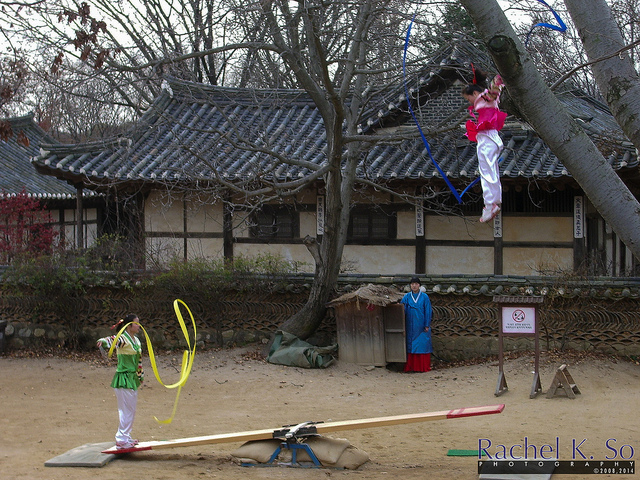
Indeed, while the hanbok is much more comfortable to wear and walk around in than a kimono (or so I’ve heard), it’s not exactly a celebration of the female form. Also, this protection and concealment literally meant that elite women’s homes became prisons, as they weren’t allowed to leave: those “traditional see-saws,” for instance, were actually so popular because they allowed elite women rare glimpses of life outside of the walls of their courtyards, and I remember reading somewhere of a woman escaping from her village to Busan during the Korean War, despite all the death and destruction around her actually having an exciting time, as it was the first time she’d left her house in decades!

Next week: Part 2, which will continue the discussion into the postwar period.