Thinking Sociologically About Modern Korean Female Body Ideals

TIL that many simple, everyday things like monkey bars in playgrounds, and standing desks, were originally born out of eugenic concerns with white people’s postures.

What surprises might an examination of Korean “figure correction” services also provide?

Estimated reading time: 10 minutes.

Full disclosure—I’m not actually answering that question I pose. Or at least, not for now. Sorry. Instead, this meta post is about reveling in the asking. Then, passing on to you the mind-blowing BBC podcast episode about the “posture police” that helped me remind me of the value of that, plus a myriad of sources to help come to some answers. I’ll also give a shoutout to my favorite fashion history YouTuber.

But first, how I got to them, starting with the visceral unease I felt when I first saw the ad below. It was just too much, even by Korean standards. It simply begged commentary.

Or did it? What was there to say exactly?

I’m not at all against the “체형교정,” or “figure correction” services this clinic provides. Actually, I could do with a consultation for my back myself.

But that figurehead-like ‘after’ shot, the model’s impossibly high heels conveniently hidden? That however uncomfortable and painful that pose looks to hold for more than a moment, it’s still presented as an ideal?

I can’t help but be reminded of the “figure flaws” or “figure faults” that overseas corset manufacturers invented a century ago, to help keep their industry afloat.

For readers unfamiliar (long-term readers, please bear with me a moment), those manufacturers’ pseudo-scientific justifications for their ensuing schema for women’ bodies, developed only to disguise that their flaws were wholly invented, somehow became the accepted wisdom for how women viewed themselves. Which I saw uncanny parallels to in the Korean craze for inventing various “lines/라인” for women’s bodies 10-20 years ago. Then, it was

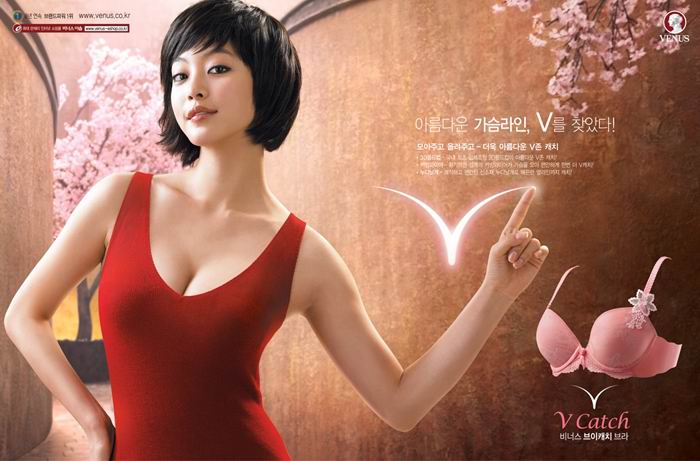
astonishing to see how brazenly companies would compete for their new, eponymous lines to sink into in the public consciousness. Venus lingerie claiming that women’s breasts were a “V-line” for instance, Yes lingerie that they were a “Y-line.”

Hanging over this trend was the inconvenient fact that most women neither needed nor wanted exciting new names for their body parts, which would invariably be found wanting compared to those photoshopped versions in the ads. Hence most lines, mercifully, were quickly forgotten. But some did indeed stick, a V-line neck becoming a standard offering by cosmetic surgeons today for instance, and just a few days ago my female students told me that their summer plans included working on their “bodylines.” In fact, in the 2020s, it seems just about everything to do with a woman’s body has become a generalized “line.”

But these subjects, I’ve already covered in depth. You could argue I’m merely projecting too, and overemphasizing mere semantic similarities.

Either way, I could have just tweeted the ad, and all those links.

For both you long-term and hopefully new, interested readers though, who I need to provide extra value to if I’m (very) belatedly going to transition this blog into a paying, subscriber-based newsletter, simply linking to stuff you’ve probably read before felt woefully insufficient.

But again, what to add though? An in-depth look at the growth of the figure-correction industry? Now ubiquitous, but which I’m not sure I’d even heard of 5 years ago? Interesting to learn more about, for sure, but probably lacking English sources. So, not really worth, as a busy divorced dad, the huge time investment I’d need to spend on all the translations.

“For liposuction and fat transplantation, Model-Line Clinic, Busan.”

Hence I sat on this post for a year, leaving it half-finished. And, frankly, dozens like it before and since, for the same reason that I didn’t feel I knew enough about the subject to add that value, so fresh research was needed first. All culminating in my recent hiatus.

Then finally, in just the last two weeks, they all suddenly starting making sense again.

Like all breakthroughs, this one is merely the culmination of a lot of hard work. Or rather, my reading of the hard work done by other people much smarter than me. Specifically, one trigger was my recently encountering the article “The Intimacy of Exercise: Sensuality and Sexuality in Black Women’s Fitness History” by Ava Purkiss at Nursing Clio, author of Fit Citizens: A History of Black Women’s Exercise from Post-Reconstruction to Postwar America (2023), which I couldn’t order fast enough. Instantly, it reminded of themes I’d previously read about in, to give just a small sample:

All of which I was too daunted by to even begin to parse here. But just thinking about them all together for the first time now, persuaded me to buy 운동하는 여자: 체육관에서 만난 페미니즘 / A Woman Who Exercises: Feminism Meets the Gymnasium by 양민영 / Lee Min-yeong. Which I’m finding surprisingly well-suited to my Korean level, and has already thrown me headfirst into an equally deep dive on the sexualization of Korean (female) basketball players’ uniforms, which I’ll link to here once I emerge.

Source: Aladin.

An 인증샷 and teaser for Korean speakers:

But to continue with the ‘small’ sample, “The Intimacy of Exercise” also reminded me of Militarized Modernity and Gendered Citizenship in South Korea by Seungsook Moon (2005) and 예쁜 여자 만들기 / Making Pretty Women by 이영아 / Lee Yeong-ah (2011) which I have discussed. The former, because it more provides essential socio-historical context and background than looks specifically at body image and beauty ideals per se, and the latter because it’s Korean, so normally I only, slowly, examine small sections at a time.

Then Moon’s book suddenly reminded me of Suk-Jung Han’s July 2005 Japan Focus article “Imitating the Colonizers: The Legacy of the Disciplining State from Manchukuo to South Korea,” one of two utterly essential for understanding Northeast Asia in the second half of the 20th Century, specifically South Korea’s national Jaegun citizens’ gymnastics (국민체조) from the 1960s. Which then reminded me of Taeyeon Kim’s 2003 Body and Society article “Neo-Confucian Body Techniques: Women’s Bodies in Korea’s Consumer Society,” because of @equalopportunityreader’s perceptive point below about Korean self-cultivation, and the endless drive—very much shared by myself—to improve one’s ‘specs.’ And, oh, what about that guy you ask? Don’t get me started on photo requirements for resumes, and the ensuing excessive, often alien-like photoshopping, absolutely enabling resigned acceptance of often literally impossible body image standards for women—and men.

Source: @equalopportunityreader.

More specifically, the breakthrough is my suddenly beginning to see the links between all of those. A grand narrative coalescing as it were, rather than feeling overwhelmed all the time. That maybe just through osmosis, I do know my shit. That I’m worth $2-$5 a month, if only I can put those thoughts into words on paper on a regular basis. And, crucially, stop with all the navel-gazing already!

On that note, may I first present the “The Politics of the Body,” the 16 June episode of the BBC 4 radio show and podcast Thinking Allowed, hosted by sociologist Laurie Taylor. The ultimate impetus for this post, his interview of Beth Linker, Associate Professor in the Social Sciences at the University of Pennsylvania, about her new book Slouch: Posture Panic in Modern America (2024), which I will happily throw money at once the paperback comes out, is a fascinating examination of aspects of everyday life we take for granted—which nicely dovetailed with my sense there was—is—something to be said about those figure correction ads.

Beth Linker’s full interview, from 1:45 to 16:50, I can’t possibly do justice to with my transcripts of brief sections. But hopefully they’ll suffice give a taste.

First, from 5:45-7:10:

Laurie Taylor:

“Then you actually get posture exams in the early 20th-Century, [they] became mainstays in the military, workplace, and schools…and there’s a thing called the ‘American Posture League,’ which was formed in 1914. Tell me about the League, and what beliefs it promoted.”

Beth Linker:

“Yes, the American Posture League was formed by Jessie Bankcroft, head of public schools in New York City…the first order of business was to standardize posture…they developed tools by which to measure posture…, so they used what’s called a schematograph—an overhead projector where you get posture tracings. Eventually they adopt camera technology. And they begin to use this technology in the military, in public schools, and universities to physically examine every person, and then, they develop grading systems for everybody’s posture. Standard grades then became A, B, C, D—D being the worst….and they also developed posture contests.”

Next, from 10:08-11:00:

Laurie Taylor:

“Slouching has been linked to an offensive discourse about so-called ‘primitive people,’ but you found out that the rise of eugenics in the early 20th-Century prompted scientists to worry that bad posture could lead to a backward slide in human progress. Tell me a little bit more about this development and about ‘race betterment’ projects.” (Source, right: Penn Arts & Sciences.)

Beth Linker:

“The white educated class, again, very much worried that, if they lacked physical fitness, that other non-white peoples would become stronger and overtake them and their better physical form. The end of that quote that you had you could hear good posture requires drill, which requires a certain kind of intellect and a will, which still puts white people as superior.”

And finally, from 16:02-16:45:

Beth Linker:

“…it was assumed that your outward appearance indicated inward ability and morality.”

Laurie Taylor:

“That’s not denying posture therapy can be a powerful tool when used to alleviate existing back pain. But…in a way, we’ve got to salvage that thought, haven’t we, from the rather long, troubled history of ‘posture panic.'”

Beth Linker:

“I am not opposed to, you know, standing desks…to anything that people do to improve their well-being. I am more trying to get us to think more critically about when we say to someone ‘Oh, you should stand up straight,” what do we mean by that, and what do we think that that’s going to improve?”

Sources: KoreanYouSay, CollectorsWeekly.

And finally for this post, let me take advantage of the opportunity to give a shoutout to my favorite fashion history YouTuber, SnappyDragon. Swayed by the image above that reigned supreme on the sidebar I had then, a year ago the model’s pose in the figure correction ad reminded me of the bustle, leading me to the following two videos of hers. For the second, I’ll wrap up this post by leaving you with several screenshots I took before I developed my colossal writer’s block—but again, I highly recommend watching both in full.

Enjoy!

From 16:10 in that second video:

Sound familiar?

Continuing, from earlier at 13:26:

And, last but not least, from 21:55:

Related Posts:

If you reside in South Korea, you can donate via wire transfer: Turnbull James Edward (Kookmin Bank/국민은행, 563401-01-214324)
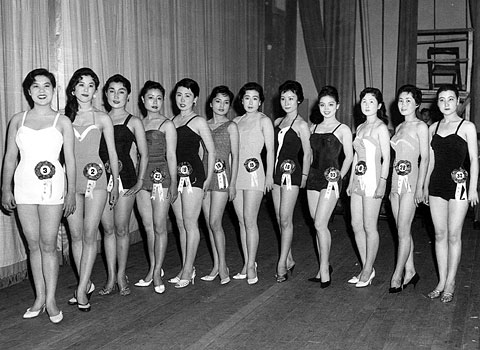

No V-lines Required: Miss Korea in the 1960s

(Source: Munhwa Ilbo)

Alas, this brief article from today’s Munhwa Ilbo isn’t exactly a scathing critique of Korea’s body-labeling craze, and I don’t mean to imply that there aren’t much more substantial ones out there. But still, it’s good to be quickly reminded that perhaps “V-lines” aren’t as necessary as pop-culture icons would like us to think (e.g., see ZE:A in Brazil below), and I hope the photo makes it to the front page of major Korean portal sites.

See here or here for better quality versions, or here and here for pictures of the 1957 and various 1970s contestants respectively.

60년대 미스코리아는 ‘V라인 아닌 건강미’ / In the 1960s, Miss Korea Had a Healthy Beauty, not a V-line.

‘미인’의 기준은 문화와 관습에 따라 다르지만 시대에 따라서도 변합니다.

The criteria for a beautiful woman depend on time, culture, and customs.

사진을 보면 1960년 미스코리아 선발대회에 나온 여성들은 건강미가 넘쳤습니다. 당시에는 서구적인 마스크를 선호했다고 하죠. 1980년대 이후 한동안 도시형 미인이 인기를 끌었고, 요즘은 ‘V라인’의 작은 얼굴과 뚜렷한 이목구비가 대세라고 합니다. 성형미인도 많아졌고요.

If you look at this photo of the 1960 Miss Korea contest, you see women overflowing with healthy beauty, [even though] it is said that people preferred Western masks [looks?] then. [But] from the 1980s, for a while urban beauties were preferred, and these days having a V-line and distinct facial characteristics are huge trends. There are many cosmetic surgery beauties.

1957년 시작된 미스코리아 선발대회는 초창기 큰 인기를 모았습니다. 공중파 TV를 통해 전국에 생중계됐고, 수상자들은 카퍼레이드까지 하며 미를 뽐내기도 했었죠. 그러다 여성단체 등의 ‘성상품화 조장’ 반발로 2002년 이후 공중파에서는 중계를 하지 않고 있습니다.

(Source: Yufit)

Starting in 1957, from the beginning the Miss Korea contest was very popular. From being shown live on TV, to winners taking part in car parades, their beauty was shown off. However, later women’s groups denounced it as promoting sexual objectification, and from 2002 it was only allowed to be shown live on cable.

예전에는 미스코리아 선발대회를 통해 연예계로 진출하는 경우도 많았지만 요즘은 오디션 프로그램 등 연예계로 나설 방법이 다양하게 생겨났습니다. 그래서인지 대회의 인기가 예전만 못합니다.

In the past, there were many cases of Miss Korea contest participants entering into the entertainment industry through the competition, but these days there are a variety of audition programs that provide the same opportunity. Because of that, the contest can’t reach the level of popularity that it enjoyed in the past. (End.)

Update: Here’s a video of the 1981 to 2008 winners. As one of the commenters on YouTube put it, it’s interesting to see how much their faces seem to change from the late-1990s onwards.

The Korean Ad Industry’s Celebrity Obsession

(Sources: left, right)

See Busan Haps for the full article. It was prompted by Yoo In-na (유인나) and then Kim Sa-rang (김사랑; left) endorsing Gillette razors last year, when suddenly a lot of celebrities seemed to be endorsing products not normally associated with their sex.

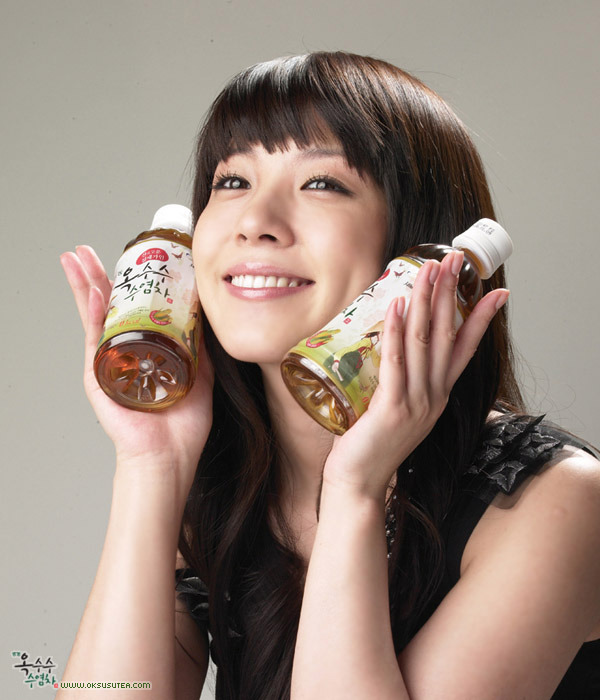
Granted, women have been used to sell things to men for as long as advertisements have existed. And as for using Hyun Bin (현빈; right) to advertise a tea-drink that supposedly gives you a “V-line”, that’s just common sense: not only will he appeal to women, but so too might some men be encouraged to think about their own, hitherto exclusively feminine V-lines, thereby creating a whole new market.

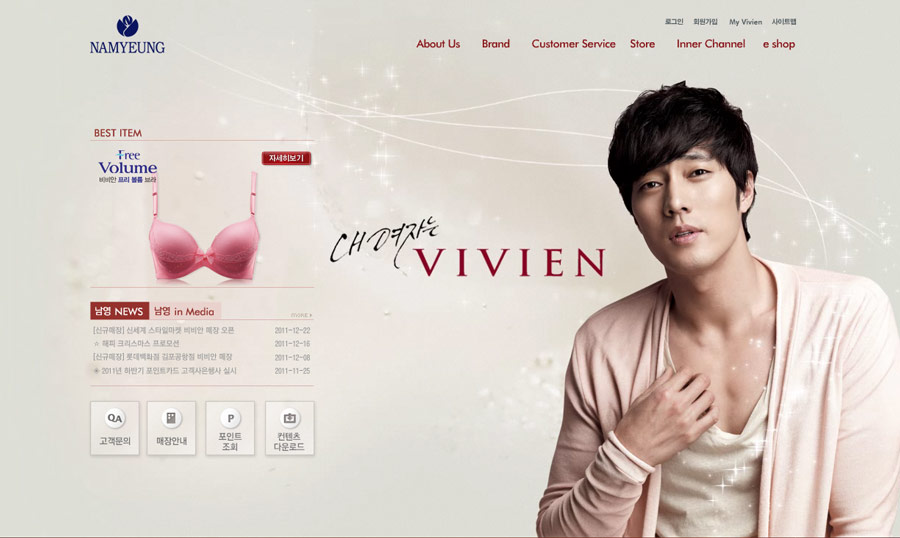
But still: I’d wager that there has indeed been a great deal of gender-bending in the Korean advertising industry in the last couple of years. For instance, I’ve definitely never heard of a guy advertising bras before, no matter how dishy I’m assured this one (So Ji-sub; 소지섭) happens to be:

(Source)

Was he chosen just because he’s a pretty face? Or was the reasoning much more subtle than that? I can’t say in this case. But I do know that celebrities have a much greater effect on our consumption choices than we all like to think. Please read the article for more on how and why…

For some hints, here is the interview with Fame Junkies author Jake Halpern that I refer to in it. If for some reason that the video below doesn’t immediately take you to it though (it’s at 34:30), then please click here instead:

Finally, if you’ve read this far, then I heartily recommend watching Starsuckers in its entirety. For me, it was especially what the narrator says at 45:45 that sold me on it, and which I encourage you all to refer to the next time someone accuses you of reading too much into anything you see in the media:

p.s. Sorry for sounding so mercenary, but please let me remind everyone that any donations for my writing, however small, are very much appreciated. Unfortunately though, I haven’t actually received any since January 21(!), and I don’t get paid for my Busan Haps articles!^^

The Alphabetization of Korean Women’s Body Types: Origins

(Update, 2013: See here and here for much more up to date posts on this topic, and for similar cases in English-speaking countries in the 1910s-1930s and 1940s.)

That the female body has occupied a central place in the Western cultural imagination hardly comes as news, says comparative literature writer Susan Suleiman. And while I lack knowledge of Korean counterparts to the historical examples in the visual arts, literature, and religion that she mentions, I don’t doubt that they exist.

But what to make of the recent Korean trend towards categorizing the female body and/or body parts into a plethora of different romanized “lines”? Where do they fit in?

It’s been easy enough to prove that they have become a pervasive feature of Korean popular culture; so much so, that many have acquired a life of their own, bearing little resemblance to the (idealized) women’s bodies they were first used to describe. But those earlier observations of mine were devoid of context, something which began troubling me once I paused to consider the source of the above article on the most recent manifestations of the trend, about Korean cosmetic surgeons classifying woman’s buttocks into four types. To be precise, it raised two questions, which I would appreciate readers’ help with.

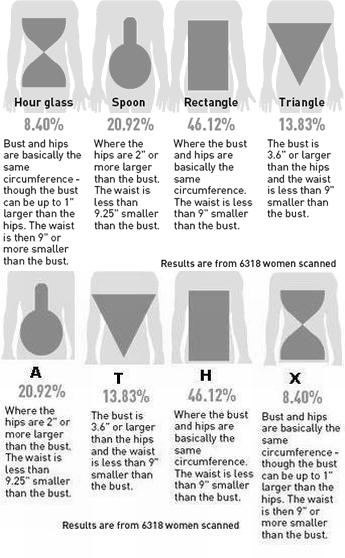
The first is that is this trend of categorization qualitatively and/or quantitatively different to that which occurs in the Western media? As to the former, probably not: I need hardly point out the similar obsession with women’s bodies there, or that it also provides often impossible ideals to live up to. And however much English speakers may find Koreans’ romanization habit in this particular case both curious and amusing (and thereby memorable), arguably it merely reflects Koreans’ general obsession with English, grafted on to an interest in women’s body forms that is not dissimilar to that of the West. Indeed, even some native English sources are beginning to describe women’s bodies in terms of letters (see below), and while that failed to catch on, are they really different to describing women’s bodies in terms of bananas and hourglasses and so forth?

(Image sources: top; bottom. The results are from this 2005 study)

Forgive me for stating the obvious perhaps, and I mention all that not to exonerate the Korean media for the ways in which it warps and distorts women’s body images. Rather, that if I still feel that it does so more than its Western counterparts nevertheless (and I do), then that something more than my gut feeling is necessary to convince skeptics. And perhaps the difference simply lies in the much greater extent to which S-lines and V-lines and so forth are mentioned? After all, not for nothing do I describe them as a “pervasive feature of Korean popular culture.”

Unfortunately however, providing empirical proof of that is rather difficult, at least for a humble blogger. But I can provide indirect evidence in the meantime, which I would very grateful if any readers could add to.

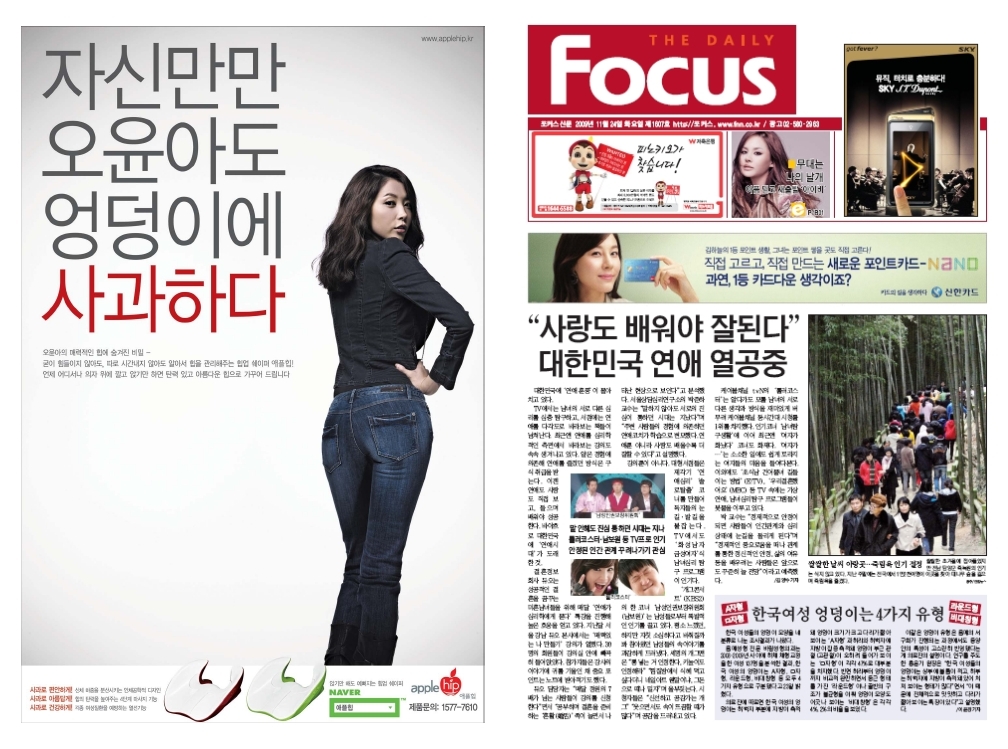
The first is the source of the article on women’s buttocks I’ve translated at the end of this post. While it may not be obvious from the opening image, it’s actually on the front page of Focus, a free daily newspaper: the image on its left, not coincidentally an advertisement for a chair which supposedly shapes one’s buttocks, part of an accompanying cover.

To your average Westerner, I’d wager that this choice would immediately single out the newspaper as a tabloid—”Women have four kinds of ass! Read all about it!”—but I’ve been asking my 20-something students’ opinions of Focus and other newspapers over the past week, and only a minority considered it such. And why would they, considering that the article was also covered by numerous other news sources (see here, here, and here), including the authoritative Hanguk Kyeongjae, a business newspaper, and which even had a helpful graphic?

Ergo, the bar for tabloid journalism is rather lower in Korea, and this extends to mainstream Korean portal sites, about which I wrote the following in my last post:

Unlike their English counterparts, you have roughly a 50% chance of opening Naver, Daum, Nate, Yahoo!Korea and kr.msn.com to be greeted with headlines and thumbnail pictures about sex scandals, accidental exposures (no-chool;노출) of female celebrities, and/or crazed nude Westerners.

To which I should have added—of course—numerous thumbnail pictures of female celebrities’ S-lines, and also a warning to never look at any of the otherwise innocuous images in the “image gallery” at the bottom of Yahoo!Korea in particular, for if you do you’ll frequently be greeted with advertisements for videos of celebrities’ nipple-slips and so on alongside those birds, flowers, and interesting landscapes.

What’s more, if portal sites are fair game, is it any wonder that children are also encouraged to be concerned about their S-lines and so on? And don’t get me started on ubiquitous narrator models.

Finally, consider what Javabeans wrote on the subject, a blogger on Korean dramas who is a much more authoritative source on Korean television than I will ever be:

…while this [romanization] practice is seemingly frivolous on the surface, it actually belies much more pernicious trends in society at large, when you have celebrities vocally espousing their alphabet-lines and therefore actually objectifying themselves as a conglomeration of “perfect” body parts rather than as whole, genuine people. (my emphasis)

With that combination, something has finally clicked for me: why it is so difficult to find Korean language sources on sexism in the media, and on advertisements in particular? I’ve been looking on and off for years now, and while I accept (and would be more than happy to learn) that perhaps I’ve simply been using the wrong search terms and/or looking in the wrong places, that it is so difficult in the first place is surely telling. A solution though, is perhaps provided by Daniel Jonah Goldhagen in Hitler’s Willing Executioners: Ordinary Germans and the Holocaust – no, really – who had this to say about anti-Semitism in Nazi Germany:

A general problem in uncovering lost cultural axioms and cognitive orientations of societies since gone or transformed is that they are often not articulated as clearly, frequently, or loudly as their importance for the life of a given society and its individual members might suggest. In the words of one student of German attitudes during the Nazi period, “to be an anti-Semite in Hitler’s Germany was so commonplace as to go practically unnoticed.” Notions fundamental to the dominant worldview and operation of a society, precisely because they are taken for granted, often are not expressed in a manner commensurate with their prominence and significance or, when uttered, seen as worthy by others to be noted and recorded. (Vintage Books Edition, Feb. 1997; p.32)

Not lost or transformed, but equally obtuse to someone from another culture perhaps, and which I’m still only just starting to make a dent in.

But a good grounding for that would be the origins of Koreans’ obsession with romanizing women’s bodies, the second question the article raised for me. Or to be honest, an element of the subject I realized I’d paid little attention to when, serendipitously, Korean reader Chorahan provided this extremely informative comment on the subject on another post. With permission, I am happy to now place readers in her more than capable hands:

…I think the specifics of the alphabetization of Korean women are best approached in the context of the classification of women into certain rigid subtypes (read: simplified stereotypes) of women. The S-line and V-line are part of the ‘formula’ for the ‘pretty girl’ here, as are humongous pupils in big double-lidded eyes, cosmetically unaided pallor, bone-tight ligaments, etc. I would suggest that people here perpetuate this mind-boggling state of sheeple-ness precisely because this ‘formula’ serves as helpful, socially constructed and ordained criteria – with which to deduce the type of woman being dealt with, and to adjust manners to suit.

Manners are adjusted according to the woman’s ‘type’ because it is widely taken as a given that certain things can/cannot be said/thought about women depending on how they look (value-judgment wise). The socially ‘accepted’ or ‘conceivable’ scenario that follows any such encounter is rigidly stratified into according variations. My take on this phenomenon is that this is directly derived from a warped and popularized Confucian principle popularized in the Chosun dynasty called 정명론 (正名論), or literally ‘right name idea’, in which the ‘father should be fatherlike and the son sonlike etc.’ A beauty should be treated as a beauty, or a ‘talking flower’; an ugly girl can be laughed at/with (hence the ‘ugly’—or, as I like to put it, ‘uglified’—comedian typification.)

I’m a Korean girl and I’ve lived in Seoul nearly all my life, going through the average Korean educational system to enter the undergraduate level here. Inferring from the numerous social contexts in which I’ve encountered such blunt references to conventionally ugly/pretty features, I would venture the possibility that in originally familial, communal societies where everyone had to stick together whether they liked it or not, the ‘insult’ was not only an insult per se, but also employed as a form of veiled endearment. This is widely considered the ideal sort of 부담없는 (easygoing) interaction between two close individuals—dialogue employing insult as endearment, or ‘constructively realistic advice to help you in the real world’—and is often the most commonly resorted-to excuse for horrific verbal abuse. (Coloring vacuous praise according to these featural types is also just such a form of ordained interaction, considered honest and respectful and completely normal.)

I do not, however, think that this should simply be chalked up to individual stupidity on the part of people that blindly follow this line of thought/action—quite the contrary. I think it’s very telling that the homogenizing retardation of the populace in this regard is and has always been spearheaded by *the commercial/entertainment media sector,* which is—big surprise— notoriously homogenized/stereotyped! It has even resorted to homogenizing certain snapshots of stereotyped ‘diversity’ or ‘unconventionality’ in the form of teen idols that are held up on pedestals as somehow being harbingers of Korea’s ‘openness’ and ‘creativity of the youth’.

As a twenty-something Korean woman towards whom those commercials are directly marketed, I find all this very sad and disgusting and lame, and I am very troubled by the thought that people actually think Korean society is improving/ has improved in its bridging of (sexual or gender-based, if that’s your cup of tea, though I don’t think that’s all) dichotomies (if dichotomies are indeed criteria on which to issue any normative judgment.)

I think it is not people being stupid, but the other way around (stupid being people, or stupidity donning the guise of specific individual avatars): the root of the problem (of not seeing people for the people they are, and adjusting social perception/performance according to formulas hammered in by peer pressure since birth) is a sort of warped ‘commodification of human beings’ + ‘Confucian backwash’ that is only being exacerbated as people constantly look to external/ international solutions to symptoms that stem from an overlooked, simplified, but inherently endogenous disease that must be addressed within its own context.

I definitely think something fundamental has to give. This isn’t just an odd cultural quirk to cluck tongues over – this S-line, this V-line trope, this alphabetization of women just as much as the stereotyping of men – it’s seriously symptomatic of some skewed rift in the goodness and saneness and kindness of people here vs. the expressed, contorted manifestations of such potential strengths.

Not exactly concise, but this is my very understandably strong opinion regarding the topic of this post. But I’m no sociologist, so I wouldn’t know.

p.s. In first paragraph—sorry, this could be misunderstood, i don’t propose any normative suggestion—I’m suggesting as an explanation that people ‘are perpetuating’ etc. (end)

Despite all that context however, one still shudders at the thought that the following was the first thing millions of Koreans read one November morning:

Korean Women Have 4 Types of Buttocks

The results of a survey about the different types of Korean women’s buttocks have just been released.

Baram (wind) Cosmetic Surgery Clinic, which focuses on operations on the body rather than the face, performed operations on the lower bodies of 137 female patients in 2008-2009. An analysis of their different types of buttocks was performed, and the results released on the 23rd of November. All in all, Korean women have 4 types: “A”, “ㅁ,” “Round,” and “Asymmetrical/Imbalanced.”

According to the team of doctors there, women with type A have a lot of accumulated fat in their thighs, making buttocks look big and their legs short, and those with type ㅁ, a lot of accumulated fat in their thighs and around their waists, making their hips look relatively narrow. Both comprise 47% of Korean women each. On the other hand, those with relatively smooth and curved hips and buttocks have a Round type, and those with an asymmetrical or imbalanced pelvis have an asymmetrical or imbalanced type, compromising 4% and 2% of Korean women respectively.

As the doctors explain, even though Korean women’s bodies are Westernizing, Korean women still have these 4 East-Asian types of buttocks.  According to the doctor in charge of this study, Hong Yun-gi, “because Korean women’s buttocks don’t have much volume at the top, but have a lot of accumulated fat at the bottom, they look a little droopy” and so overall “their buttocks look boring overall, and their legs short.” (end)

No, the extrapolation from 137 cosmetic surgery patients to all Korean women was not a mistranslation I’m afraid. And I beg to differ on Korean women’s buttocks looking boring also, but that discussion is probably best avoided. Instead consider, first, Jezebel’s take on “the ridiculousness of dressing for your shape,” many guides to which came up as I researched this post, especially this one from The Daily Mail, a UK tabloid. Next, another case of Korean romanization gone mad that I originally planned to look at alongside the above, albeit of women’s dresses rather than their bodies per se:

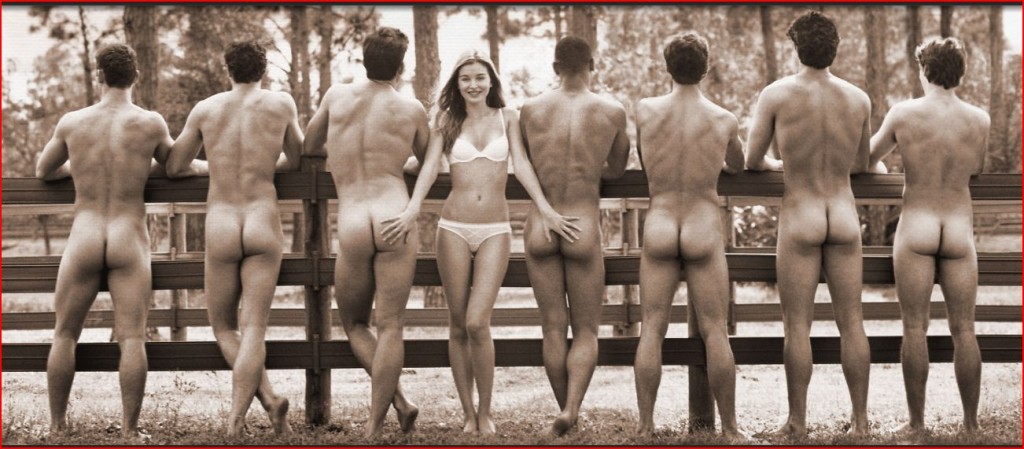
And finally, literally the very first thing that came to mind when I saw the Korean article on women’s buttocks: the following picture from a post on male objectification from Sociological Images, because I wondered if men’s buttocks would ever similarly be categorized. But given that a page exists on Wikipedia for “female body shape” for instance, but not on male’s, then I suspect not in the near future.

On a side note, and not that I want to repeat the experience anytime soon, but searching for images of Korean men’s buttocks instead proved impossible, at least on Korean portal sites. But perhaps again…*cough*…I’m not looking in the right places?

Korean Women Are Not Alphabets!

kim-tae-hee-v-line-face-drink-advertisement

Update, February 2013: Please see here, here, and many other posts in my “Revealing the Korean Body Politic” series for my considerably updated, hopefully much more nuanced thoughts on Korea’s alphabetization trend, especially in light of what I’ve learned about historical Western precedents!

The original version of my article for today’s Korea Times:

Well known for donning corsets on stage since her comeback in May last year, few can deny that there is much to find cute in singer Son Dam-bi (손담비) tightening a miniature one around a bottle of ‘Today’s Tea’ in her latest commercial.

But while modern corsets lack the uncomfortable body-shaping functions of their Victorian counterparts, they remain an enduring symbol of the pressures women can be under to conform to often impossible ideals of appearance. And despite its lightheartedness, this commercial provides an excellent illustration of a distinctly Korean spin on this (source, right: kjutaeng3)

Beverage producer Lotte Chilsung invented the term ‘bellyline’ for use in this commercial, and it is this that the corset and supposedly the drink help with slimming. In itself, doing so is not at all worthy of any criticism, nor is the term dissimilar to, say, the English equivalent of ‘waistline,’ which would actually have been a much more appropriate choice here. But with that perfectly good term existing already, then why invent a new one?

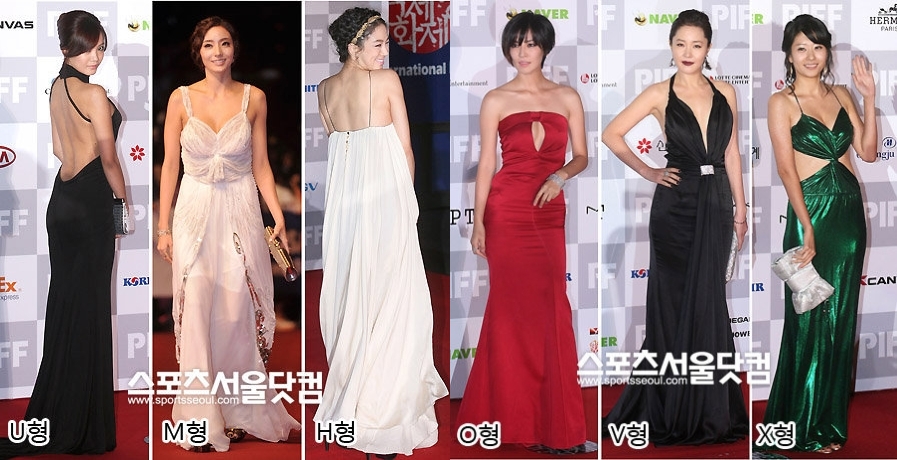
The reason is that the term is merely the latest in a spate of naming particularly female body parts after English letters in recent years, a very curious fashion that seems unique to Korea so far. Consider the following best known examples of this:

  • M-line (abdominals, for men)
  • S-line (breasts and buttocks, viewed from the side)
  • U-line (exposed lower back)
  • V-line (one for face, and another for the line in-between breasts)
  • W-line (breasts)
  • X-line (long legs and arms, with a narrow waist)
A Woman and her lines(Source: Dark Roasted Blend)

And so integral to Korean pop culture are S-lines and V-lines in particular, that within five minutes of turning on a television you are likely to see either female celebrities strutting them on talk-shows, or prominent ‘S’s and ‘V’s displayed in commercials. Indeed, such is the current mania surrounding them that you can even come across examples completely unrelated to the original body parts involved, including in commercials for cell-phones, school uniforms, and even gas boilers!

Although this practice seems frivolous on the surface, says blogger Javabeans “it actually belies much more pernicious trends in society at large,” and something is surely seriously amiss when, rather than the media, you have a majority of female celebrities “vocally espousing their alphabet-lines and therefore actually objectifying themselves as a conglomeration of “perfect” body parts rather than as whole, genuine people.” But, why their alacrity in doing so? (source, left: 여자가 좋다. 남자는 필요없다.)

A clue is that this quote was made in the context of a breast cancer fund-raising party in October last year, the producers of which saw absolutely no irony in naming ‘Love Your W.’ And if nothing is viewed as untoward in doing so for an event supposedly about empowering women by encouraging them to respect more and take better care of their bodies, then you can imagine that there are few inhibitions for promoting the use of ‘lines’ to teenagers and young girls either.

Accordingly, there are even educational videos that promote healthy food such as fermented bean paste (dwenjang/된장) to elementary-school children that mention that eating it will be good for their S-lines and V-lines also. And one probably direct effect of this is the fact that many Korean middle-school girls have ‘face rollers,’ the repeated application of which is supposed to flatten one’s face towards a desired, angular, ‘V’ shape.

To be sure, the Korean media is not unique in placing undue emphasis on women’s appearances rather than their intelligence — the American media obsession with Michelle Obama’s fashion choices being a notorious recent example — nor is it in providing often unobtainable and unnatural role models and body ideals for women and girls. But the contexts in which those are received are important, and whereas videos like the above would rapidly be banned in schools in many other developed countries, and/or educators that criticized children because of their appearance rapidly fired, unfortunately both are par for the course in Korea.

(Han Ye-seul demonstrates yet another “V-line.” Source: Naver Photo Gallery)

To an extent, this lack of awareness and/or concern is understandable when a child’s entire life prospects are almost entirely determined by a single exam: parents have other priorities. But on the other hand, when a majority of netizens did not take pride in astronaut Yi Soyeon for being the first Korean to go into space last year, but instead criticized her for her appearance during the flight, then teenage girls will hardly be encouraged to study harder.

And on a wider scale, as Korea again faces an economic crisis, in order to recover it is worth pondering what lies behind Korea long having one of the lowest rates of working women in the OECD. Surely a good start to using this underutilized human resource, one of the best-educated in the world, would be to encourage both sexes to stop judging women, and women expecting to be judged, entirely on their appearance?

How Korean Girls Learn to be Insecure About Their Bodies

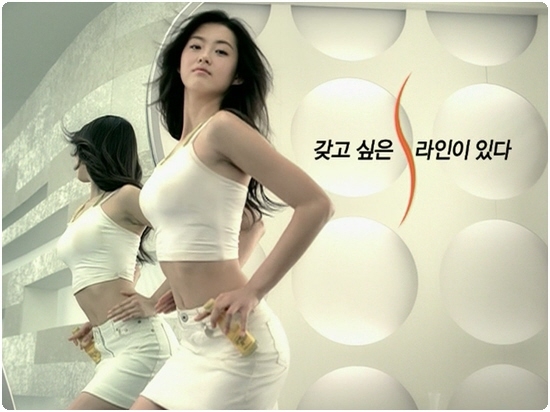
Seriously, it’s great that the makers of this video are trying to encourage children to eat healthy foods with fermented bean paste (된장) rather than candy. But do they really need to be told that it’s good for their “S-lines” and “V-lines” too? For those few of you that don’t know what either are, this next commercial in particular makes the former pretty clear:

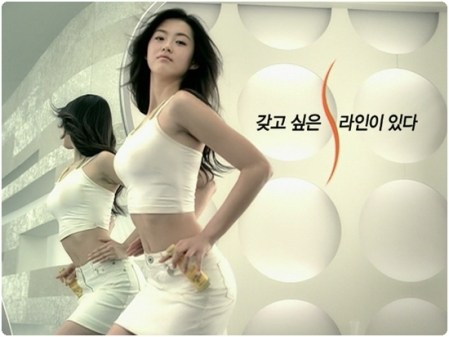
(Source: ¡Hoy mejor que ayer, mañana mejor que hoy!. The text reads “The S-line you want to have.”)

Note that Go Ara, the actress in the commercial, is actually much younger (16) than she may appear above. Meanwhile, here are some commercials for a tea-drink which supposedly gives you a V-line chin, which at least have actual grown women (BoA, 22; Kim Tae-Hee, 28) endorsing the product:

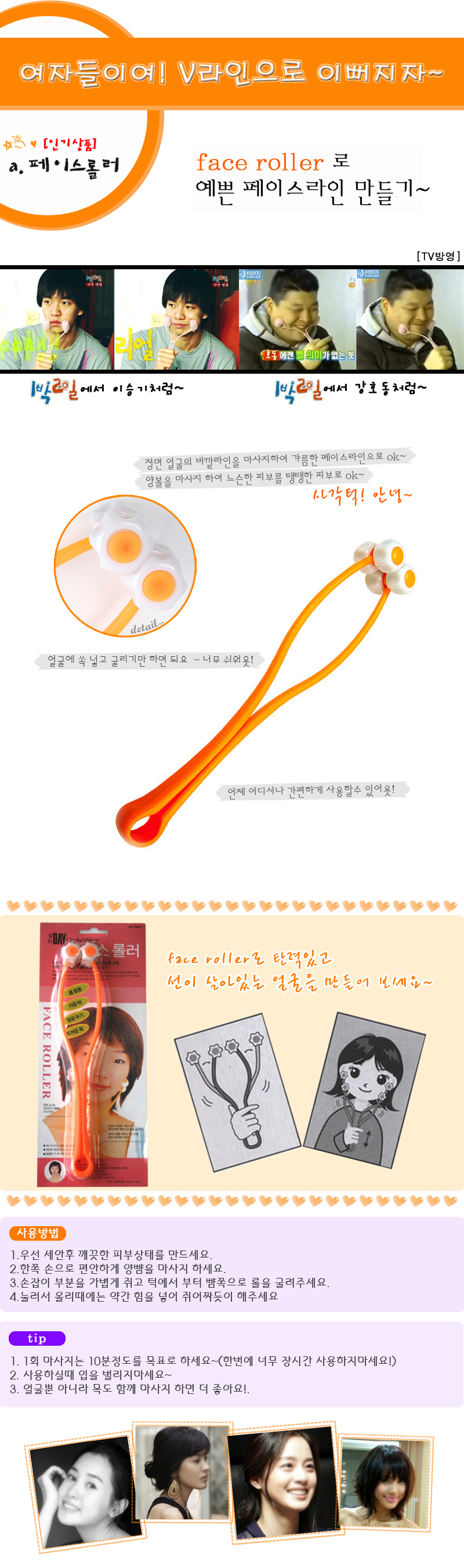
Not by coincidence, here are some “face rollers” which started to appear all over Korea not long after I first heard of V-lines. I’ve read that they’ve been used for many years in Japan and Taiwan too, so Korean women too may well have been using for a long time before they started worrying about their V-lines specifically. But then they weren’t popular enough for me to have noticed them at all until last year, and certainly sellers of them have been making explicit references to V-lines ever since the concept first appeared:

(Source: GMarket)

Alas, I’m not entirely certain why an ad explicitly for women opens with some not particularly flattering shots of men either (Lee Seung-gi and comedian Kang Ho-dong), but I guess I’m not the target market. That they do so humorously though, does help reinforce the notion that dieting (etc.) is only something for women to be serious about.

Or perhaps just girls, as I’ve never actually seen a woman using one. My 13 year-old students, however, use them every other break…(sigh).

Update: See here, here, here, and here for much more on the constant invention of new, often impossible body shapes and “lines” for Korean women to strive for, and for North American and European parallels.