
 (Source: TheDailyEnglishShow.com,via studio tdes)

A snapshot of some of the different forms of sexual discrimination experienced at Korean workplaces, from the January 15 edition of Metro Busan:
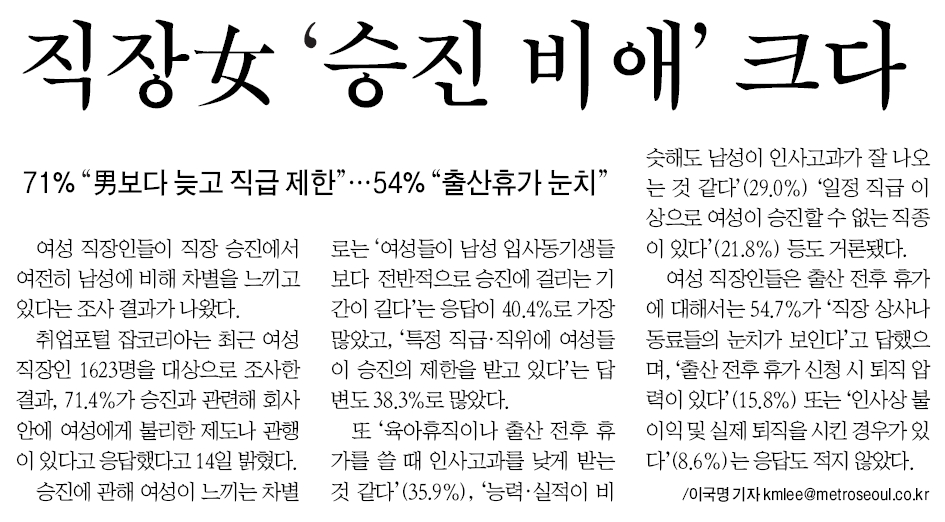 Women Workers’ “Promotion Grief” is Big
71% Say “Compared to Men, Promotions Come Late and with Limits”…54% Say “We Feel Inhibited From Asking for Maternity Leave”
A survey of women workers has revealed that when it comes to promotion, they still feel that they suffer from sexual discrimination.
The results of a survey of 1623 women workers by job portal site JobKorea, released on the 14th, showed that 71.4% believed that the promotion systems at their companies placed women at a disadvantage.
Asked for more information about this discrimination, 40.4% [of the 1623 women] said that “compared to men that enter the company at the same time, women have to wait longer to get promoted,” and 38.3% added that “women are excluded from some higher positions.”
In addition, 35.9% mentioned that “if we take maternity leave or time off before and after giving birth, we get lower scores on our evaluations by the personnel department,” 29% that “even if we have the same ability and practical know-how as men, we get lower scores,” and 21.8% that women simply are excluded from certain kinds of jobs.
Also, 54.7% replied that they found it very difficult to ask their superiors or coworkers for time off for childbirth, 15.8% said that they felt pressure to quit their jobs after having a baby, and finally 8.6% were aware of cases where recent mothers were indeed forced to quit. (end)
 With no information given about the methodology used, then all those results should be taken with a grain of salt unfortunately.
In particular, considering that it is still common practice to fire women upon marriage, then that last figure sounds rather low to me. Also, consider that before the current economic crisis, not only did Korea already have one of the lowest women’s workforce participation rates (and the highest wage gap) in the OECD, but that those few that did work formed a disproportionate number of irregular workers. This ensured that they would be laid-off en masse last year (see #15 here also), and they are unlikely to return to work soon given Korea’s jobless recovery.
(In stark contrast, the decline in the construction industry in the US, for instance, means that for the first time in history actually more women work than men there now.)
Meanwhile, the effects of all the above on Korea’s low birthrate have also been somewhat predictable, now the world’s lowest for the third year running. But never fear, for the Korean Broadcasting Advertising Corporation (KOBACO) is on the case:
(See here {Korean} for more on the making of the campaign)
In KOBACO’s defense, the first women featured does actually have a job. Is it churlish of me to point out that she still goes home early to cook while her husband burns the midnight oil…?
Update 1: Lest the commercial not succeed though, then the Ministry for Health, Welfare and Family Affairs (보건복지가족부), in charge of raising the country’s birthrate, is insisting that its employees go home at 7:30 pm on the third Wednesday of each month, all the better to have sex with their partners and have more babies.
No, unfortunately I’m not making that up.
Update 2: This satire of that is so good, it’s difficult not to believe that it’s the real thing!

 The Grand Narrative
Err, without being able to understand what is being said, it looks like it is trying to suggest that women can work and take care of the kid (or hopefully kids) only if she cooks for her husband and does all the housework. One wonders how successful it might be. Good to see that they are serious about this issue, and are willing to change their thinking!
LikeLike
I’m a bit too drunk to translate at the moment sorry, but I hear you. I doubt there’s any surprises in the voiceover.
LikeLike
i think taiwan has the lowest birthrate in the world now, not korea. like the post!
LikeLike
On two separate lists, Wikipedia lists the South Korean fertility rate around 1.2. This figure is just absurd. ROK’s ranking on both lists is 192/195 and 218/223. If ROK society doesn’t delegate jobs to women and a significant number of them aren’t even having children, then what are these women supposed to do?
The next generation is really going to be burdened with a large section of an aging Korean population. I imagine production and growth will slow down in the coming decades. At least jobs will be plentiful for them.
LikeLike
Thanks Chinesechic and Hopeful Korean Zygote (love the name!). But whether Korea or Taiwan has the lowest rate, or whether either rate is 1.2, 1.12, or 1.08 or whatever, are both moot points really, as virtually every source says something different. I can assure you that in the Korean case at least though, that other than a recent small blip because one year (I can’t remember which sorry) was supposedly auspicious for being born in under the Chinese zodiac system, the trend has been inexorably downwards.
I understand the sentiment “what are these women supposed to do?” and it’s an indictment of how little opportunities there are out there that Korea is the only country in the OECD where college-educated women are LESS likely to have a job than only high-school educated women (at work sorry; can provide a source later at home if anyone wants).
If you’re interested Hopeful Korean Zygote (lol again), I also talk about the medium and long-term effects on the Korean economy and society here and here.
LikeLike
Damn, how did you find that KOBACO ad? I was looking around for it for weeks. I got the message “Life not fulfiling? Have a kid. Become a mother? Your kid’s life is boring. Make a brother.”
LikeLike
If you’re ever looking for a Korean ad but can’t find it, then here is the first place you should look, basically a big repository of (95%) Korean ads, updated with 10 new ones every day. If I’m ever looking for a particular ad, often it turns out that that’s the only place on the entire internet which has it.
Usually it’s the other way round with me though: these days, my TV watching has been reduced to about 3 hours a week (sigh), 2 of which are spent on BBC World and the other 1 on the 2 Starcraft channels. So I find new ads
to criticizeby subscribing to that site instead.LikeLike
Women are angry about not being promoted. The men are angry that the women go to Europe for holiday and the men go to military training where they are subjected to sexual and physical abuse. Hmm, one seems worse than the other.
LikeLike