The Grand Narrative

Sexual Harrasment on Intercity Buses

Posted in Korean Feminism, Rape, Sexual Harassment by James Turnbull on April 13, 2011
(Source)

Of course, I’ve never been sexually harassed on an overnight bus myself. But then I’ve never seen it happen nor heard anyone ever complaining about it either, nor have any of my female friends (Korean or Western). Are things really as bad as this article makes out?

[Why] 불 꺼진 심야고속버스, 술 취한 손이 내 가슴을…An express night bus with the lights off, a drunken hand on my breast

性추행·만취 난동 끊이지 않는 ‘달리는 범죄 사각지대’로, 유일한 안전요원은 운전기사 / [Becoming] a ‘running blind spot of crime’ with constant sexual molestation, intoxicated disturbances, and the driver the sole security officer

지난 12일 자정 무렵 광주발(發) 서울행(行) 심야 우등 고속버스 안. 버스가 출발한 지 10분 만에 한 여성이 소리를 질렀다. 막 고속도로에 진입한 버스는 갓길에 멈춰 섰다. 비명을 지른 20대 여성은 운전기사에게 자리를 바꿔달라고 했다. 여성 승객은 얼굴만 붉힐 뿐 이유를 얘기하지 않았다. 버스에 빈자리가 없어 운전기사는 여성 승객의 요구를 들어줄 수 없었다.

Inside the premium express night bus from Gwangju to Seoul around midnight on the 12th. Just ten minutes after the bus departed, a woman screamed. The bus, which had just entered the expressway, came to a stop on the shoulder of the road. The twenty-something woman who had screamed asked the bus driver to change her seat. She would not say the reason why, and she was only blushing. There were no empty seats on the bus so the bus driver could not grant her request (source, right).

고속버스가 다시 출발한 지 10분 정도가 지나자 또다시 비명이 들렸다. 버스는 재차 갓길에 멈췄다. 이 여성은 운전기사에게 “옆자리에 앉은 남자가 가슴을 만졌다”고 말했다. 술에 취한 듯 보이는 남성은 잠든 척했다. 이후 남성의 성추행은 한 차례 더 이어졌고, 고속버스는 예정에 없이 고속도로 갓길과 휴게소에 3차례 정차한 후 목적지인 서울에 도착했다. 50대 남성은 도착 후 유유히 사라졌고, 20대 여성 승객은 얼굴을 가린 채 울면서 황급히 자리를 떴다.

The bus had been back on the road for about ten minutes when a scream was heard again. The bus stopped on the shoulder for the second time.  The [same] woman told the bus driver, “The man sitting next to me touched my breast.” The man, who looked drunk, pretended to be asleep. After this, the man’s sexual molestation happened once more, and after the bus had made three unplanned stops on the expressway shoulder and a rest stop, it reached its Seoul destination.  The fifty-something man calmly disappeared after arrival, and the young female passenger left her seat hurriedly, crying with her face covered.

(Source)

심야 고속버스에서 성추행·흡연·난동 등이 빈번히 일어나고 있다. 늦은 밤 편히 휴식을 취하며 빠른 시간에 목적지에 가려는 이들이 선호하는 심야 고속버스가 ‘달리는 범죄의 사각지대’가 된 셈이다. 문제는 술에 취해 조용한 버스 안에서 고성방가를 일삼고 성추행까지 저질러도 제지할 방법이 마땅치 않다는 것이다.

In the express night bus, sexual molestation, smoking, and other disturbances occur frequently. This bus, preferred by people who want to relax comfortably late at night while quickly getting to their destination, has become a‘running blind spot of crime.The problem is that though someone becomes intoxicated and sings loudly in the quiet bus, or even commits sexual molestation, there is no suitable method of restraining them.

심야 고속버스는 출발과 동시에 전등을 끈다. 승객들의 취침을 위해 소등하는 것이 운전기사들에게는 의무처럼 돼 있다. 버스 안이 어두워 성추행이나 도난을 당해도 주변에서는 범행을 목격하기가 힘들다. 동부익스프레스 관계자는 “회사 모든 버스에 블랙박스를 설치했지만, 버스 내부는 인권 침해 소지가 있어 촬영하지 않는다”고 했다. 설사 버스 내부를 촬영할 수 있다고 하더라도 버스의 출발과 동시에 소등을 해 범행 현장 촬영은 불가능하다.

The lights are turned off in an express night bus as soon as it departs. Putting out the lights so passengers can sleep has become like a duty for drivers.  Because the inside of the bus is dark, even if one is sexually molested or stolen from, those nearby have trouble seeing the criminal behavior.  A source from Dongbu Express said, “The company installed a black box in all the buses, but because it is a possible civil rights violation, we don’t film inside the bus.”  Even if he had said they could film inside the bus, the lights are turned off after departure so filming the crime would be impossible.

(Source)

심야 고속버스에서 범행이 일어날 경우 제지할 사람이 없다는 것도 문제로 지적된다. 운전기사가 유일한 안전요원이다. 버스 안에서 소란이 일어나거나 범죄가 발생하면 운전기사는 달리는 고속버스를 갓길이나 인근 휴게소에 세워야 한다. 한 버스 운전기사는 “취객이 버스 안에서 성추행을 일삼는 경우가 많다”며 “피해 여성이 항의하면 어쩔 수 없이 고속도로 순찰대에 연락해 조치를 한다”고 했다. 고속도로 치안을 담당하는 고속도로순찰대가 도착하기 전까지 정시에 목적지에 도착하기 위해 달려야 하는 고속버스는 갓길이나 인근 휴게소에서 멈춰야 한다. 고속도로순찰대 관계자는 “심야 고속버스에서 종종 신고가 들어와 톨게이트나 휴게소로 출동해 범인을 인근 지구대에 인계한다”며 “순찰대가 30㎞마다 하나 정도 있다”고 했다.

Another problem that has been noted is that there is no one to stop criminal behavior that arises on the express night bus. If a disturbance arises or a crime is committed inside the bus, the driver must stop the express bus on the side of the road or at a nearby rest stop.  One bus driver said, “There are many cases in which drunken passengers sexually molest others several times inside the bus,” adding, “if the female victims complain, we have no choice but to contact the highway patrol station and take action.”  Before highway patrol,which is responsible for public order on the highway, arrives, the express bus that should keep moving in order to reach its destination at a fixed time has to stop on the shoulder or at a nearby rest stop. A highway patrol source said, “We sometimes receive reports from express night buses so we go to a toll-gate or rest stop and then we hand the criminal over to a nearby small police station,” and noted, “There’s highway patrol station every 30 kilometers or so.”

고속버스 운전기사는 취객에 대한 승차 거부를 할 수 있다. 그러나 심야 고속버스에서 술에 취한 승객을 보는 것은 어렵지 않다. 복수의 고속버스 운전기사들은 “취객들에 대한 단속은 절실하지만 승객을 한명이라도 더 태워야 하는 회사의 입장이 우선시되면서 승차거부를 하는 경우는 거의 없다”고 했다.

Express night bus drivers can refuse service to passengers.  However, it is not difficult to find drunken passengers on these buses.  Several [Marilyn – not sure if “several” is right; two Korean friends said it seems the reporter made a writing mistake with the word he used] express bus drivers said, “[The need for] crackdowns on drunken passengers is desperate, but the company’s position that every passenger counts is a priority so there are almost no cases of refusing service.”

고속버스와 경쟁 관계인 KTX·새마을호 등 철도의 경우 국토해양부 소속 철도특별사법경찰대 대원들이 심야시간 등 취약시간에 직접 열차에 탑승한다. 이들에겐 수갑·포승·가스분사기 등의 용품과 함께 범인을 현장에서 체포할 수 있는 권한이 있다.

In the cases of the KTX, Saemaeul, and other railway companies that are the economic competitors of express buses, officers from the Railway Special Judicial Police, part of the Ministry of Land, Transport and Maritime Affairs, are on board late at night and at other vulnerable times.  They have the authority to arrest criminals on-the-spot with necessities like handcuffs, policeman’s rope, and tear gas guns. (end)

(Source)

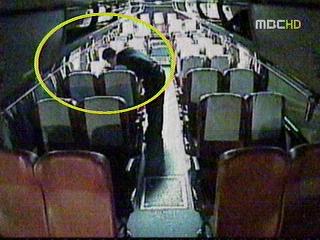
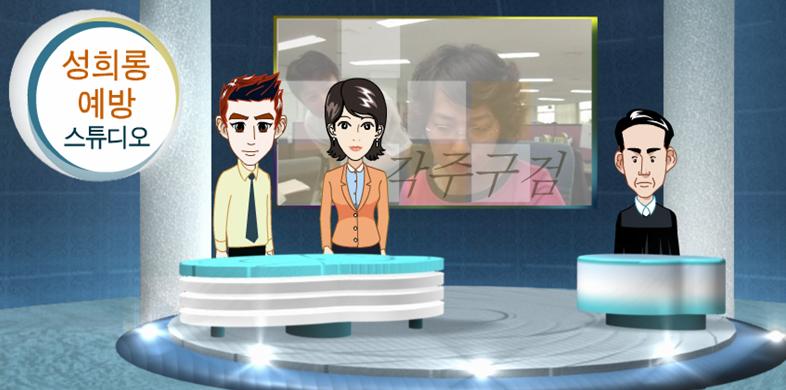
With thanks again to Marilyn for translating it, that was the most read article on Naver a few weeks ago. Personally, I thought that stopping 3 times without alerting the authorities was unbelievably negligent of the first bus driver, and while fortunately it sounds like that’s not company policy, there’s no indication that he or she was punished for doing so either. Also, in one of the few other news stories on this subject I could find, it was actually the bus driver himself(!) that was accused of harassment in a separate incident in December 2010 (click on the picture above for a link to a Korean news video with a transcript), the video footage of which suggests that although Dongbu Express may well not film inside buses because of potential civil rights violations, curiously other companies don’t seem to have any such qualms.

Meanwhile, if anyone would like more information on sexual harassment in Korea, please see here for more on groping and general street harassment specifically, or here and here for more on sexual harassment in Korean workplaces.

Share

Studying Korean Social Issues Can Be Fun…

Posted in Korean Media, Korean Newspapers, Manhwa, Sexual Harassment by James Turnbull on January 18, 2011
( Sources: left, right)

And using manhwa (만화), or Korean cartoons, is a good place to start. Sadly, my favorite “grown-up” comic-book poptoon (팝툰) sold its last edition back in March, but there’s lot’s more where that came from.

One possibility is Department Head Dal-ma (Dalmagwajang; 달마과장), available in the free Focus newspaper. Although it’s often very basic, requiring no Korean ability to get the gist of, you could do much worse than quickly translating it on your morning commute.

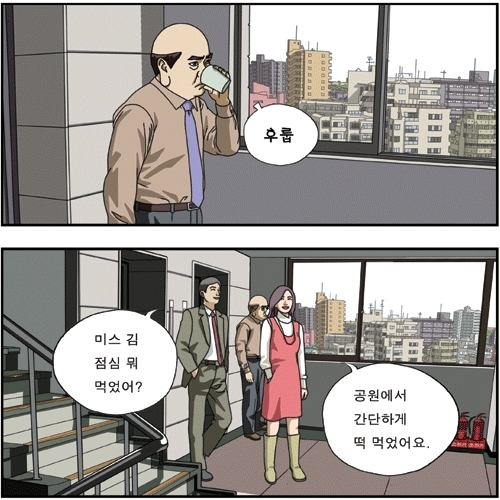
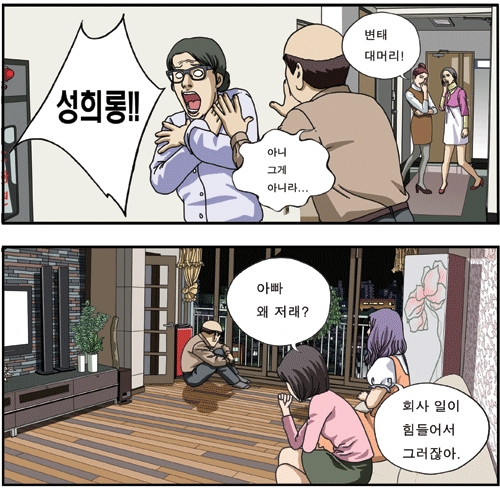
Take these two strips for instance, which kept cropping up in Naver searches while I was preparing a recent post on sexual harassment in Korea. First, number 21:

Dal-ma: Gulp.

Man: Miss Kim, what did you have for lunch?

Miss Kim: I simply had ricecake at the park.

Even from just these first panels, already one thing of interest is that the man uses banmal (반말), or informal speech to speak to Miss Kim, and she replies in nopimmal (높임말), formal speech. No big deal there you might say: he’s probably her superior in the company. And as this recent incident on a subway demonstrated, using the appropriate level of speech to others is considered extremely important in Korea, with even many of my university students using nopimmal to friends just a few months older.

But then the same happens in the second cartoon too, even though the man addresses the woman with the semi-formal shi (씨) at the end of her name. And while a brief survey of other Dalmagwajang cartoons does occasionally show men and women each using nopimmal to each other, I didn’t see any cases of a woman speaking to a man in banmal and he answering in nopimmal. Which is not to say that they don’t exist necessarily, but if there are any then I’d wager there’d be very few.

If so, then is that just a reflection of reality? After all, women do tend to have junior and/or non-advancing positions in Korean workplaces, as even in 2011 it considered perfectly normal for them to resign and/or be fired upon marriage or becoming pregnant (only 50% of Korean women work, the lowest rate in the OECD).

(Source: unknown)

On the other hand, recall that even subtitles for foreign films and programs have this gender-dichotomy grafted onto them:

A women’s group has issued a report on the “sexist” dubbing of foreign films and dramas, reports women’s newspaper Ilda The group took a look at some 27 English-language dramas shown on terrestrial broadcasting in September and October.  It found that most of them employed sexist sexist practices when dubbed into Korean.  Namely, male characters spoke in banmal, or “low language,” while female characters used jondaenmal, or “high/respectful” language, even though the original English dialogue made no such distinctions.

This tendency was most often seen in dialogue between husbands and wives or lovers.  Besides dramas, foreign films showed the same tendency, with 12 of 15 films monitored by the group employing this dubbing practice.

Clearly then, for TV at least there is a compulsion to conform to it. Whether that’s just the industry convention, fear of negative public reaction, and/or the personal choices of the translators themselves, then that remains to be seen, but I’d be surprised if that didn’t apply to some extent to other forms of media. Either way, you’re left with a pretty pervasive socialization agent, and one easy to overlook for English speakers, and/or even easier to get used to for native Korean speakers.

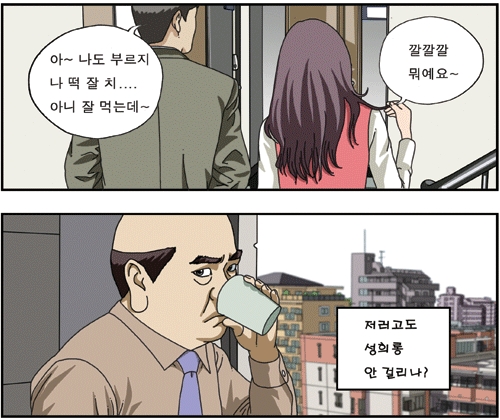
Man: Ah, why didn’t you invite me? I pound ricecakes really well…No, well, I eat them well…

Miss Kim: (Laughing) What do you mean?

Dal-ma: Even acting like that, he won’t get accused of sexual harassment?

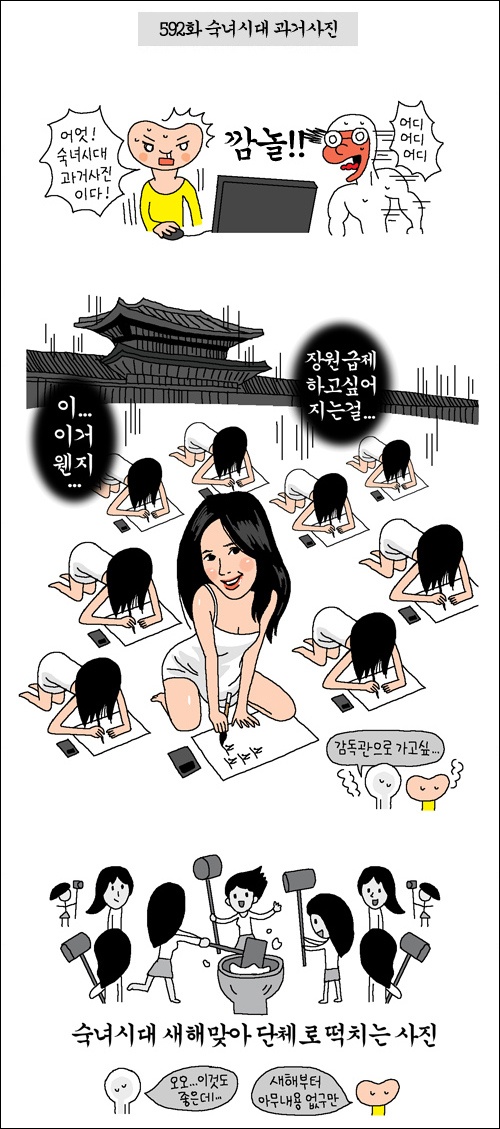
Next, despite its curious reputation for conservatism overseas, in fact the Korean media is simply full of sexual innuendo, and this cartoon read by millions every weekday is surely a classic case in point: “떡을 치다” is literally “pounding rice cake”, but is really slang for having sex. Which is why a year ago, a cartoonist was sued for sexual harassment by Girls’ Generation’s (소녀시대) management company SM Entertainment for this otherwise innocuous-looking cartoon:

(Source)

This might sound strange, but personally I find that slang quite endearing. For not only does it seem quintessentially Korean (here’s another example), but with most Koreans living in the countryside until as recently as 1979, then it reminds me of the country’s strong agricultural roots too (no pun intended).

Ahem. Continuing:

Dal-ma: Still, if something is judged sexual harassment or not all depends on your face (how attractive you look)

Woman left: He really said that?

Woman middle: (Laughing) Really?

Dal-ma: Wow! Look at her chest!

Dal-ma: Jeez, how can’t they feel ashamed to wear clothes that emphasize their breasts like that…

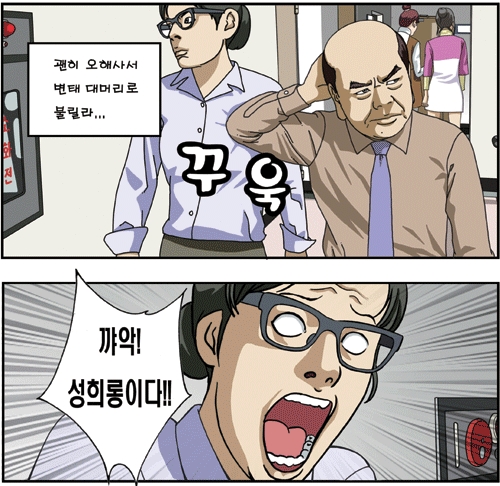
Eek, I forgot! Staring is also sexual harassment.

Dal-ma: (Worried) For no reason, because of a misunderstanding I’d be called a bald pervert.

Woman: Eek! It’s sexual harassment!

Having a shaved head myself, then I couldn’t help but chuckle at the unnecessary mention of his baldness here, as if that somehow makes his perversion all the worse. But with shaved heads being best known as a symbol of “prison, protest, or penance” in Korea, then unfortunately those negative connotations aren’t likely to go away any time soon.

Woman: Sexual harassment!

Dal-ma: No, it’s not that…

Women in background: Bald pervert!

Dal-ma’s daughter: What’s wrong with Dad?

Dal-ma’s wife: He’s like that because working at the office is tiring.

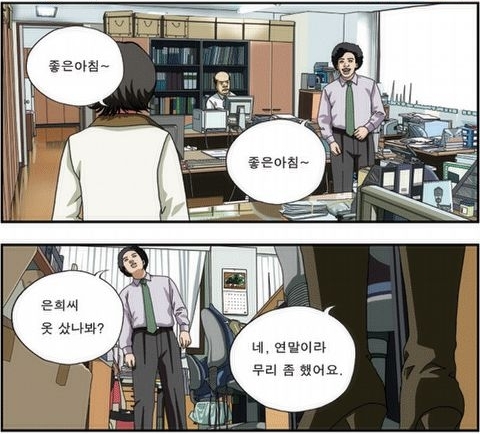
Next, number 57 (the latest is number 327 by the way). Sorry for the poor image quality:

Woman (Eun-hee): Good morning!

Man: Good morning! Eun-hee, you bought new clothes?

Eun-hee: Yes, because it’s the end of the year I spent a lot on myself

Man: Wow, your back is a killer!

Eun-hee: Really?

Man: Yes, you’ve a perfect Honey-bottom!

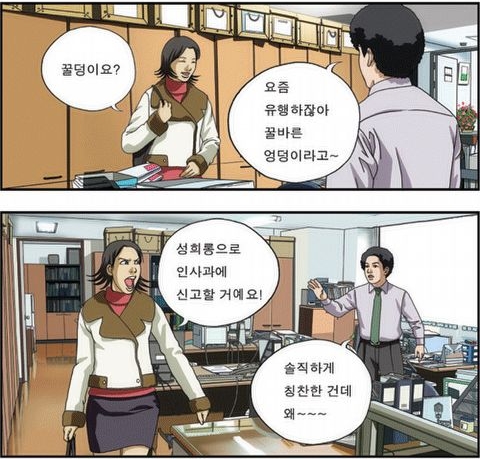
Despite what the man says in a moment, that’s the first time I’ve heard the term ggooldongi, a combination of ggol (꿀; honey) and ongdongee (엉덩이; bottom). But I have heard (and written about) ggoolbokji (꿀벅지) that it comes from though, which, as Matt at Gusts of Popular Feeling explained:

…apparently means, according to this article and allkpop, ‘sweet-as-honey thighs’ or “alluring as-if they-were-coated-with-honey thighs”, though a more creative, if incorrect, translation would be ‘alluring thighs that spread like honey.’ Ahem.

And in particular:

…a ‘high school girl living in Cheonan’ posted a petition on the Ministry of Gender Equality’s website claiming that the word ‘honey thighs’ actually means ‘thighs that you want to smear honey all over and lick off’, and represented the sexual commodification of a female body part, was sexual harassment, “induced a feeling of sexual shame” and said its use should be banned. She was also irritated that such a ‘sexually derogatory word’ was used by the media and asked that it stop. According to allkpop, “Even Korean portal site Daum has requested people to refrain from using this controversial term…”

Hence Eun-hee’s justified reaction:

Eun-hee: Honey bottom?

Man: These days it’s popular. It means honey applied to a bottom…

Eun-hee: I’m going to the Human Resources Department to complain about your sexual harassment!

Man: Honestly, it was just a compliment, why…

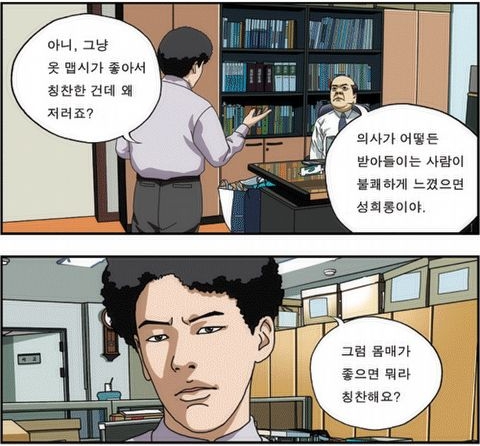
Man: Well, I was just complimenting her on how well her clothes fit. Why’s she acting like that?

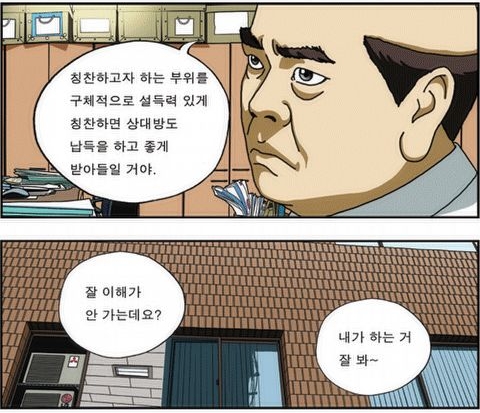
Dal-ma: It doesn’t matter what your intention is, it depends on how the other person receives it. If they feel uncomfortable, then it’s sexual harassment.

Man: In that case, if someone has a good body, how can we give them a compliment?

Dal-ma: If you intend to compliment a certain part of a person’s body, then do it precisely. Then, the other person will take it well.

Man: I don’t really understand.

Dal-ma: Watch me do it.

Dal-ma: Sung-mi, your pectoral muscles are amazing. And your Sternocostal joints and Sternocleidomastoid muscle are beautiful!

Sung-mi: Er…thank you.

Dal-ma: You see?

No, I didn’t find them funny either. What’s more, they give the impression that all it takes to deal with sexual harassment in Korean workplaces is a quick visit to the Human Resources Department, and consequently that male employees are very nervous about being accused of it. Unfortunately though, as this case at Samsung and these recent testimonies by victims demonstrate, the reality is anything but.

Why the discrepancy? That’s a good question, and it’s made me curious to see if its also found in other newspapers, and so on. Which is not bad for a couple of quick cartoons over my morning coffee, yes?

I did hope to end on a more positive note though!^^ So, to compensate, here’s a sneak preview of something genuinely fun that I’ll be writing about soon:

Enjoy!

Share

Sexual Harassment in the Workplace & the 2001 Equal Employment Opportunity Law: What Still Needs to be Done

(Source)

With thanks very much to Marilyn for the translation of the following article from Ildaro (일다), I’ll quickly let it speak for itself:

고용불안 속, 직장내 성희롱 위협 커져

In the midst of employment instability, the threat of workplace sexual harassment increases

고용평등상담실 10년, 여성노동의 현실과 미래를 말한다(2)

10th year of the Equal Employment Counseling Office, discussing female employees’ present and future

[편집자 주] 2001년 남녀고용평등법 4차 개정으로 고용평등상담실 지원제도가 도입된 지 10년이 되었습니다. 민간단체들의 고용평등상담실은 그동안 여성노동자들의 실질적 보호장치로 기능해왔으며, 여성노동자들이 처한 현실을 사회에 고발하는 창구역할을 해왔습니다. 일다는 여성노동자회와 함께 고용평등상담실에 접수된 상담사례를 통해 IMF 경제 위기 이후 후퇴 일로를 걷고 있는 여성노동의 현실과 과제를 살펴보고자 합니다. 필자 황현숙님은 현재 서울여성노동자회 회장을 맡고 있습니다.

우 리 사회의 성폭력 문제는 온 국민이 알게 된 끔찍한 아동 성폭행, 유명 정치인의 성희롱 등으로 자주 언론에 오르내리는 이슈가 되었다. 직장내 성희롱으로 고용평등상담실의 문을 두드리는 여성들의 호소 또한 가벼운 성적 농담이나 접촉을 넘어서 심지어는 강간에 이르는 경우조차 발생되고 있다. 직장내 성희롱은 그 자체가 미치는 정신적․신체적 악영향, 노동환경의 악화뿐만 아니라 일자리 자체까지 위협받게 된다는 데에 그 심각성이 있다.

[Editor’s note] It’s been 10 years since the Equal Employment Counseling Office support system was introduced through the 4th Amendment to the 2001 Equal Employment Opportunity Law.  During that time, the Equal Employment Counseling Offices of private organizations have been functioning as female workers’ practical safeguards and have acted as liaisons that report to society the realities that female workers encounter. Through the case consultations received in the Equal Employment Counseling Office, Ilda and the Women Workers Association intend to look at the realities and problems of women workers, who are losing ground after the 1997 Asian Financial Crisis.   Author Hwang Hyun-sook  is the current head of the Seoul Women Workers Association.

Through incidents of horrible child molestation, a famous politician’s sexual harassment, and others of which the entire nation is aware, our society’s problem with sexual violence has become an issue that often comes up in the press.  According to the complaints of women workers who’ve knocked on the Equal Employment Counseling Office’s door because of sexual harassment, there are also cases occurring that surpass light sexual jokes or touching to go as far as rape.  Workplace sexual harassment itself not only has bad mental and physical effects and worsens work environments, but is even of such a magnitude that jobs themselves [of victims] may be threatened.

(Source)

일자리 위협으로 이어지는 직장내 성희롱

“과장이 ‘피곤하지?’라며 손, 팔을 주물러 너무 불쾌하여 늘 가슴을 조이며 지냈어요. 어느 날 허벅지를 만지기도 하여 우울증에 시달리다가 문제제기를 하였더니 그 후 재계약을 하지 않겠다는 통보를 받았어요. 성희롱으로 실직하게 된 것 같아 너무 억울해요.”(2009년 상담사례, 계약직)

“사 장님이 자꾸 만나자고 하면서 ‘옆에 오면 가슴이 떨린다. 만나면 안고 싶고 무릎을 베고 누워 얘기도 하고 싶고 즐기고 싶다. 나를 받아 줄 수 없냐.”고 하더라고요. 남자에 대해 관심이 없다고 거절했더니, 부장을 통해 퇴사하라는 통보를 받았는데……“(2009년 상담사례, 2개월 근무)

성희롱 가해자가 사업주, 상사 인 상담은 매년 75~85% 가량이다. 가해자가 인사권을 직접 가지고 있는 경우가 많아 성희롱을 거부하거나 문제제기했을 경우에는 직. 간접적인 괴롭힘으로 스스로 그만두게 하거나 권고사직, 심지어 다른 사유를 들어 해고하는 사례들도 나타난다. 그래서 성희롱이 발생해도 공론화하기 어렵고 이를 은폐하도록 가해자가 권력을 행사하기도 한다.

Workplace sexual harassment extending to job threats

“My manager would ask, ‘Are you tired?’ and massage my hands and feet; it was so uncomfortable and I always went around feeling anxious.  One day he even touched my thigh and so while suffering from depression, I made a complaint; because of that I received notice that my contract wouldn’t be renewed.  I became unemployed because of sexual harassment – it’s so unfair.” (2009 counseling case, contract worker)

“The president of the company often asked me out and said ‘When you come near me my heart pounds.  If we go out I want to hold you, put my head in your lap and talk, and have fun.  Can’t you accept me?’  I refused, telling him I wasn’t interested in men, and through the general manager I received notice that I was to resign…” (2009 case consultation, working for 2 months)

Every year, about 75-85% of the consultations are ones in which the perpetrator of sexual harassment is the business’ owner or victim’s boss.  There are many cases in which the perpetrator is directly in charge of the company’s human resources.  Because of this, when the victim has rejected the perpetrator’s advances or made an official complaint, there have been cases in which the perpetrator may cause her to quit though direct or indirect harassment, urge her to resign, or even find grounds to fire her.  Therefore, even though sexual harassment occurs, making it public is difficult and the perpetrator often exerts his authority to conceal it.

(Source: unknown)

성희롱의 온상, 회식자리 남성중심 문화

“입 사한지 1주일 만에 본사 간부급 직원들과 회식자리가 있었어요. 간부들이 버릇인양 손잡기, 어깨동무하기, 허리 감싸기, 끌어안기, 볼 부비기……. 마치 간부들을 위해 여직원들이 대접하는 자리 같았는데 어렵게 입사하여 그만둘 수도 없고 어찌해야 할지……” (2007년 상담사례, 정규직)

“회 식 2차로 노래방에 끌려가다시피 갔어요. 술 마신 남직원들이 안으려고 해서 피했는데, 갑자기 뒤에서 끌어안더니 들었다놓았다하는데 과장, 계장 모두 묵인하고, 계장은 블루스를 추자고 하더라고요. 그래서 울면서 집에 왔는데 동기들도 다른 구청이나 동사무소 근무하면서 회식자리 성희롱 때문에 너무 힘들어 해요. 블루스를 춘 여직원한테는 잘해주고, 안 추면 욕하고 못살게 군다고 하더라고요.” (2007년 상담사례, 공무원)

회 식문화가 변하는 곳도 생겨나고 있지만, 회식자리에서의 성희롱은 지금도 일상적으로 일어나고 있다. 회식자리는 직장내 위계적 관계의 연속으로 상사의 기호에 맞추어야 하고 그의 요구에 따라야 하는 업무의 연속처럼 진행된다. 우리 사회의 남성 중심적인 문화, 위계질서가 이어지는 회식 문화는 여성들의 고용환경을 악화시키는데 일조하고 있다.

The hotbed of sexual harassment, office dinner male-centric culture

“I was at an office dinner with head office management-level employees only a week after joining the company.  The executives had habits of holding my hand, putting their arms around my shoulders and waist, hugging me, pressing their cheeks against mine…   It was like a place for the female employees to serve executives; it was hard to get a job here so I can’t quit and [don’t know] what to do…”  (2007 case consultation, regular employee)

“I went to the second [drinking-heavy] part of our office dinner like I was being dragged.  Male employees who were drinking were trying to hug me so I avoided them; suddenly I was embraced from behind and picked up and put down.  The manager and section chief overlooked everything, and the section chief asked me to slow-dance with him.  So I came home crying; also my peers who work at other district offices or dong offices have a really hard time because of sexual harassment at office dinners.  They say the female employees who slow-danced are treated well, and if you don’t dance they curse and treat you badly.” (2007 case consultation, government employee)

There are places where office dinner culture is changing, but sexual harassment at office dinners happens regularly even now. Office dinners progress similar to the  business itself, in which one must adjust to the preferences of a superior ahead of one in the workplace’s hierarchical relationships, and follow his demands.  Our society’s male-centric culture and hierarchy-connected office dinner culture lead to the worsening of women’s working conditions.

(Source)

친밀한 관계가 질곡인 영세소규모사업장 성희롱

“5 명도 안 되는 회사에서 근무한지 2개월인데 사장이 아침부터 술을 먹자고 하고, 남자친구랑 몇 번 하냐고 묻고 ‘나랑 애인 같은 거 하자’는 소리를 자꾸 해요. ‘이런 소리 들으려고 일하는 거 아니다’라고 말하면 무릎 꿇고 안한다고 하면서도 술만 마시면 또 그러니 일자리가 아니라 고문받는 자리 같아요.”(2008년 상담사례)

“연 말에 사장이 송년회를 가자고 해서 부담스러웠지만 가게 되었어요. 결국 2차까지 가게 되었는데 노래방에서 강제로 키스를 하고 옷 속으로 손을 넣어 몸을 만졌어요. 거부하면서 강하게 밀쳤더니 “난 사장이고, 넌 경리야”, “너 내일부터 나오지 마.”라는데, 다시 직장을 알아보면서 화도 나고 얼굴 보는 것도 두렵고 생각할수록 화가 나고 억울해요.“(2008년 상담사례, 사업주와 2명 근무)

영세소규모사업장의 성희롱은 가해자가 사업주인 경우가 많아 실질적인 법적 조치가 어려운 점, 성희롱 예방교육 특례조항 적용 사업장이라 예방교육이 실시되지 않는다는 문제점이 있다.

업 무적으로 둘만이 접촉하는 경우가 많아 사업주의 부당한 성적 요구나 사적인 친밀감을 성적 언행으로 표시하는 경우도 잦다. 성희롱을 거부하면 바로 그만두라는 통보를 받는 노동권 위협의 문제도 크지만, 매일 가까운 곳에서 얼굴을 마주쳐야 하니 버티고 싶어도 버티기 어렵다는 어려움이 있다.

Sexual harassment in a small business bound by close relationships

“I’ve been working for 2 months at an office that doesn’t even have 5 people in it; from the morning on the president suggests drinking together, asks me how many times I do it with my boyfriend, and keeps saying ‘Let’s date or something’. When I say, ‘I don’t work in order to listen to this kind of noise’, even though he gets on his knees and says he won’t do it [anymore], when he drinks, he gets like that again, so it’s like a torture chamber, not a workplace.” (2008 case consultation)

“At the end of the year, the president wanted to have an end-of-the-year party, so I went though it was annoying.  I ended up going to the second part and at a karaoke room he forcibly kissed me and put his hands under my clothes and touched me.  I refused him and pushed him hard so he said ‘I’m the president and you’re the bookkeeper’ and ‘From tomorrow, don’t come in [to work] anymore.’  I’m looking for another job and I feel angry and afraid of seeing his face, and the more I think about it, the angrier I get and the more unfair it feels.”  (2008 case consultation, office with company president and two people)

There are many cases in which the perpetrator of sexual harassment in a small business workplace is the business owner, so real legal measures are a challenge, and they are workplaces to which the Sexual Harassment Prevention Education Exception Clause applies, so there is the problem of prevention education not being implemented.

There are many cases in business in which two people only have contact with each other, so cases in which the business’ owner expresses his unjustified sexual demands or personal feelings of intimacy through sexual speech and behavior also frequently occur.  If victims rebuff the sexual harassment, the labor rights-threatening problem of immediately receiving notice to quit is serious, but there is also the drawback that because they have to see the other person’s face nearby every day, even though they want to endure it [keep working], enduring it is difficult.

(Source)

늘어나는 서비스직, 늘어나는 고객에 의한 성희롱

“고객센터에서 근무하고 있는데 외주업체 소속 강사가 메신저로 ‘만나자, 남자친구와 몇 번 했냐는 등의 말과 스킨십을 하는데 법적으로 어떻게 처리할 수 있을까요?” (2009년 상담사례, 텔레마케터)

“노 인돌보미 일을 하고 있는데, 고객이 70세인데 전직 교장이래요. 첫날부터 자꾸 몸을 밀착해오고 ‘젊은 사람이 곁에 있으니 내가 다시 남성이 되는 느낌이다’, 어제는 노골적으로 ‘아랫도리가 되살아난다’며 치근대 괴로워요. 어떻게 해야 할지…….“(2009년 상담사례, 45세)

고 용형태와 업무 방식이 다양해지면서 업무상 맺는 관계의 폭도 다양하고 복잡해졌다. 협력업체나 거래처 직원, 대인서비스직의 성희롱도 다양하게 나타난다. 그리고 간병이나 노인돌봄 같은 사회서비스 일자리가 늘어남에 따라 재가 돌봄서비스에 종사하는 여성들의 성희롱 피해상담도 늘어나고 있다.

Increasing service-industry workers, increasing sexual harassment by customers

“I work in a customer service center.  A supervisor [actually she uses the word for "lecturer" but I think that's a mistake] affiliated with our subcontractor says things on Messenger like ‘Let’s go out’, ‘How many times have you done it with a boyfriend?’ and so on, and does skinship [touching like they're in a relationship].  How can I deal with this using the law?” (2009 case consultation, telemarketer)

“I work in elder care.  My patient is 70 years old and says he used to be a school principal. From the first day he has often pressed up against me and said ‘Because there’s a young person at my side I feel like I’m becoming a man again’ and yesterday, saying bluntly, ‘My lower body is coming back to life”, he made pass at me; I’m really upset.  [I don’t know] what to do…” (2009 case consultation, 45-year-old)

As types of employment and ways of conducting business are diversifying, the range of relationships formed through business is also diversifying and becoming complicated. Sexual harassment of employees of subcontractors or clients, and personal service workers also presents itself in various ways.  Also, in line with the increase in social service positions like nursing or elder care, sexual harassment victim counseling for women working in in-home care is also increasing.

(Source)

성희롱은 사적인 일?

“남자 동료가 수시로 농담을 하면서 뽀뽀하자, 너도 밤일 할 줄 아냐는 등 수치심을 갖도록 하여 회사에 제기하였는데, 개인의 일이라고 개인적으로 대응하라고만 하는데……”(2009년 상담사례)

직 장내 성희롱은 안전한 환경에서 일할 노동권과 직접 관련이 있다. 그래서 남녀고용평등법에서도 직장내 성희롱을 금지하고 있을 뿐만 아니라, 사업주의 의무로 △직장 내 성희롱의 예방을 위한 교육 실시△성희롱 행위자에 대하여 징계나 이에 준하는 조치를 취할 것△피해자에게 해고나 다른 불이익 조치를 하지 말 것을 규정하고 있다. 그런데도 성희롱이 발생하여 이를 사측에 문제제기하면 위의 상담사례처럼 개인적인 일로 치부해 버리는 문제들이 여전히 일어나고 있다.

Sexual harassment is personal business?

“A male coworker often makes jokes and says, ‘Let’s kiss’, ‘Do you too know how to do night work [sex]?’ and other things to humiliate me so I made a complaint to the company.  They said it was personal business and just told me to deal with it privately…” (2009 case consultation)

Workplace sexual harassment is directly related to the employee’s right to work in a safe environment.  Therefore, the Equal Employment Opportunity Law not only prohibits workplace sexual harassment, it also stipulates, as the business owner’s duty, 1) implementation of education for the prevention of sexual harassment in the workplace, 2) disciplinary action, or taking steps in accordance with disciplinary action, against the perpetrators of sexual harassment, 3) not firing or taking other disadvantageous action against victims.  However, when sexual harassment occurs and is reported to the management, problems with it just being regarded as personal business, as in the case consultation above, are still coming up.

(Source)

고용평등상담실 통해 가해자의 공식사과와 징계 등 확보하기도

“부 원장님이 간호사들에게 안마를 해달라고 하거나 성적인 얘기도 잦아 힘들었어요. 며칠 전에는 맨발로 제 다리를 쓰다듬었는데 징그럽고 수치스러운 느낌 때문에 정신과 상담까지 받았어요. 그런데 고용평등상담실에서 도와주셔서 부원장은 공개사과와 감봉처분에, 병원 전체에 성희롱예방교육까지 실시하게 되었답니다!”

“과장님 성희롱 때문에 괴로웠는데 상담실에서 도와주셔서 공개사과도 받고 가해자는 다른 근무지로 전출되어 얼굴보지 않고 근무할 수 있게 되었어요!”

직 장내 성희롱 자체가 노동환경을 악화시키고, 이를 문제제기하면 해고나 불이익이 따르기도 한다. 그러나 다른 여직원들을 위해서라도 그냥 있을 수 없다며 이에 맞서 문제를 제기하는 여성들 또한 늘어나고 있다. 이렇듯 권리를 확보하게 되는 사례도 많았지만, 일자리 자체의 불안정이 갈수록 커지면서 적극적인 대응을 주저하는 경우도 많은 안타까움이 있다.

Securing perpetrators’ public apology, disciplinary action, etc., through the Equal Employment Counseling Office

“The vice director frequently asked the nurses to give him massages or talked about sex, so it was difficult.  A few days ago he stroked my leg with his left foot; because of the nasty and shameful feeling, I even got psychiatric counseling.   But the Equal Employment Counseling Office helped me so the vice director’s public apology and pay docking measure, and even sexual harassment prevention education for the whole hospital were implemented!”

“I suffered because of my manager’s sexual harassment, but the Equal Employment Counseling Office helped me so I received a public apology and the perpetrator was transferred to a different workplace so I don’t see his face and I’ve become able to work!”

Workplace sexual harassment itself has a negative effect on a work environment, and if one reports it, dismissal or disadvantages often follow.  However, the number of women saying that, for the sake of other women workers, they can’t just [let it] be and accordingly, making complaints, is rising.  In this way there have been many cases that secured rights, but regrettably, as the instability of jobs themselves increases, there are many cases in which [victims] hesitate to take assertive action.

(Source)

직장내 성희롱 문화? 이젠 바뀌어야

직장내 성희롱을 겪으면 그만두라고 할까봐 참고 견디거나, 문제제기하면 결국 피해자가 그만두게 되는 상황이 더 이상 반복되지 않도록 해야 한다. 지난 해 여성노동자회 고용평등상담실에 접수된 성희롱 발생 사업장의 78%가 성희롱예방교육을 실시하지 않은 것으로 파악되었다. 그러므로 사업장에서는 형식적이지 않은 예방교육 실시해야 하고 사내에서 발생하는 성희롱에 대하여 조사와 조치, 재발방지 대책 등을 마련하여 실시해야 한다.

그 리고 정부는 이런 사항들이 실질적으로 이루어지도록 적극적인 행정지도·감독을 해야 한다. 또한 남성 중심적이 아닌 성인지적 관점의 성희롱 인정, 영세사업장장의 성희롱 예방교육 지원 확대, 돌봄서비스노동의 성희롱 실태조사와 예방교육 및 대책 등을 마련해야 한다. 이를 통해 우리 사회와 직장 전반의 남성 중심적인 문화가 변화될 때 직장내 성희롱에 대한 인식과 대책의 변화 또한 이끌어낼 수 있을 것이다.

Workplace sexual harassment culture?  Needs to change now

We need to make it so that situations in which, if one experiences workplace sexual harassment, they hold back and endure it because they’re afraid of being told to quit, or in which if they report it, they end up quitting, are no longer repeated. Last year, 78% of the workplaces reported to the Women Worker’s Association’s Equal Employment Counseling Center for sexual harassment were places where sexual harassment prevention education had not been implemented.  Therefore, in the workplace, prevention education that is not cursory needs to be implemented, and for sexual harassment that occurs in-house, research, action, recurrence prevention measures, etc., need to be arranged and implemented.

The government needs to use assertive administrative guidance and supervision to make these remedies become reality.  Also, recognition of sexual harassment from a gender-sensitive perspective that is not male-centric, securing support for sexual harassment prevention education for the owners of small businesses, research, prevention education, and measures regarding the sexual harassment of care-industry workers, etc., have to be arranged. When, through these, both our society’s and all workplaces’ male-centric culture changes, they will also be able to lead to changes in the understanding of and countermeasures for workplace sexual harassment.

Share

Tagged with: