In yesterday’sKorea Times. Long-term readers may recognize the topic from this brief report I gave on it back in January, but, as I’ll explain, I’m very glad I decided to take a second look at the science involved:
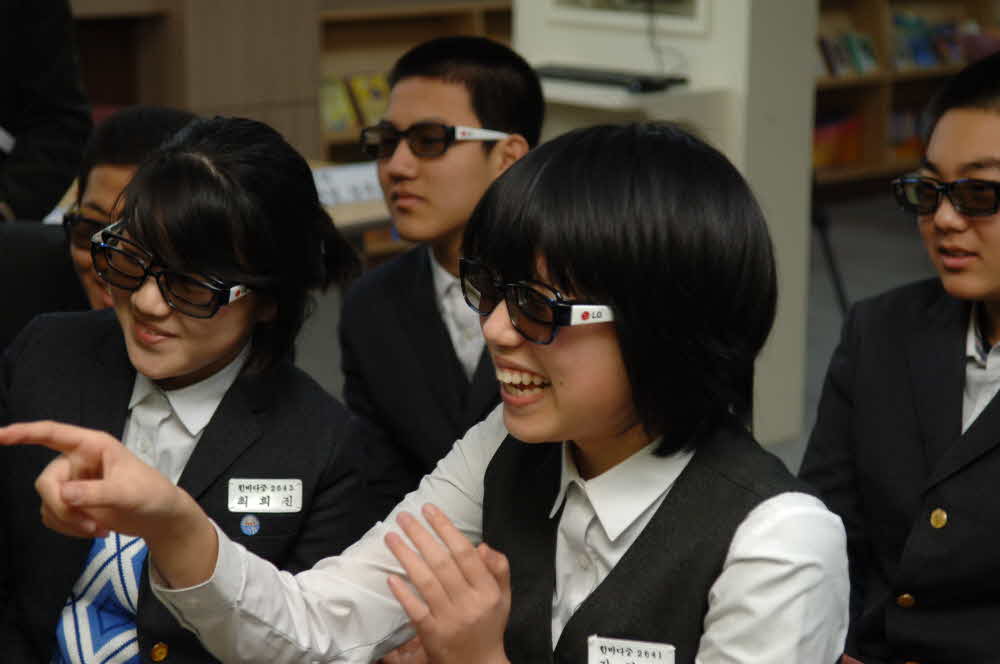
Why do so many East Asian children wear glasses? Because they don’t get enough exposure to sunlight, according to a study released by the Australian Research Council’s Centre of Excellence in Vision Science earlier this year. Which may well prove to be a damming indictment of education cultures that confine huge numbers of children to institutes when they’re not at school (source, left: unknown).
Rates of myopia (short-sightedness) have dramatically increased in East Asia over recent decades. To pick the best-known example, data on male conscripts in the Singaporean army shows that 40 years ago, roughly 25% of Singaporean children finishing high school had myopia, but now that figure is closer to 90%, despite students being healthier and taller overall. Similar rates are found in Hong Kong, Taiwan, and Guangzhou Province in China.
These general figures belie what is actually a very real threat to public health. Beyond simply consigning 9 in 10 students to eyewear, according to Dr. Ian Morgan of the Vision Centre, up to 20% of students in those regions are in the “high myopia” category, which translates into a roughly 50/50 chance of going completely blind by the time they are middle-aged. Governments across the region are expressing serious concern.
Previous popular explanations for the worsening vision included East Asian children spending more time at their desks and computers (“near work activity”, when the focus of vision is within a short range over an extended period) these days, or alternatively that there is a special East Asian genetic susceptibility. Both theories have been demolished by researchers at the Vision Centre, who compared myopia rates of 6 year-old children of Chinese origin in Singapore and Sydney.
In brief, only 3% of those in Sydney suffered from myopia, compared to 30% in Singapore. That there was any difference undermines a genetic explanation, but whereas most people might have expected it to be accounted for by the latter’s greater amount of near work activity, to researchers’ surprise in fact Sydney children did more, which suggested that the myopia must be triggered by some other environmental factor. Eliminating all other variables, the critical factor appeared to be that Sydney children were spending far more time outdoors. To be precise, 13-14 hours a week compared to 3 or 4.
While the exact mechanism between sunlight exposure and preventing myopia is still to be determined, the researchers believe that the neurotransmitter dopamine is responsible: known to inhibit eyeball growth, sunlight causes the retina to release more of it.
Evolved to literally keep an eye on the horizon, humans are naturally long-sighted (with short eyeballs), but our eyeballs lengthen as we grow and become more accustomed to near work activity. Myopia occurs when the eyeball has grown too long, meaning that the focus of light entering it falls short of the back of the eyeball, requiring corrective lenses to correct it.
That Singaporean children don’t get enough exposure to sunlight may sound counterintuitive, but in fact the hot and sticky climate makes children more inclined to spend time in air-conditioned environments indoors, and just like in many East Asian countries with more agreeable climates there is also a relative lack of parks and open spaces. Regardless, culture is undoubtedly the biggest factor. Australia is well known as a sporty outdoor country and after-school institutes are almost unheard of. In contrast, many East Asian children’s 6-day school and institute schedules deprive them of sleep to levels that would be considered borderline child abuse in Australia, sapping them of the time, energy or inclination to play outdoors in the sun.
There are additional medical problems associated with a lack of sunlight. Light skins are very popular among many East Asian women, evidenced by the plethora of “skin-whitening” pills, lotions and creams available in cosmetics stores, and in Korea it is already a common sight this spring to see women making sure to cover their faces with books and handbags as they cross a sunlit street, even if just for a few seconds.
While there is nothing at all wrong or unhealthy with this in itself – quite the opposite – the sun is avoided to excess by South Korean women. A 2004 endocrinology study by Severance Hospital in Seoul showed that the nation’s women are seriously deficient in Vitamin D, making them more likely to suffer osteoporosis later in life. In fact they posted the lowest Vitamin D levels of all 18 nations surveyed, with 88.2% of the women surveyed failing to reach a healthy threshold (source, right: the Korea Times).
While it is possible to absorb Vitamin D through food, the surest way is through exposure to a few rays of sunlight every day, and Korean women would be well advised to ask themselves if ultra-pallid skin is really worth the price of full health. Just as Korean parents might wonder if higher TOEIC scores are really worth the price of their children’s long-term health (end).
I confess, I struggled with the science in this article. No, not because it was out of my field of expertise: as it so happens, not only do I have very bad eyesight myself (-7.5 for those of you who know what that means), and so am intimately familiar with diagrams of long and short eyeballs and so on from countless visits to opticians, but in fact my original major at university was astronomy too (no, really), and I learned so much about optics instead of actually looking at stars that I ended up dropping that major altogether!
More then, because the authors of the articles I linked to in my original post proved to be much less concerned with how sunlight prevents myopia as explaining that it had been discovered that it did, and so what proved to be the key information about the effect of dopamine on inhibiting the growth of the eyeball was missing from them. Fortunately though, I eventually found it in this press release by the Vision Center itself, and suddenly everything clicked. But without it, those articles and the dozen more I pored over while researching this post simply don’t make sense, and although it’s tempting to forgive those authors that lacked a science background especially, some advice from my (last) high school physics teacher seems apt here: if you can’t explain something to someone else, then odds are you don’t understand it yourself.
Words I’ve lived by for the past 16 years. Meanwhile, my frustrations with science reporting aside, see here for more information on the Severance Hospital study demonstrating Korean women’s severe Vitamin D deficiencies. And I’m too harsh really: this radio interview of Dr. Ian Morgan is still useful and interesting despite everything.
Update) Unfortunately, as parents’ angry complaints against this proposal for a 10pm curfew on hagwon teaching indicate, the norm of keeping children indoors studying until as late as 12:30am(!) five to six nights of the week isn’t going to change anytime soon.
Update, April 2009: In hindsight, I didn’t cover this subject thoroughly enough here, leaving some questions unanswered. For a more comprehensive overview, see this article I wrote for the Korea Times.
Update 2, June 2013: And for a much more up-to-date overview, see this article I wrote for Busan Haps.
If I’d been asked this question yesterday, then I too would have answered that it was because they were always hunched over their books, or staring at computer screens. But the surprising result of this Australian study was that those are only correlated but not causative factors.
In fact, it’s because they don’t get enough exposure to sunlight.
I confess, before I read the details of the survey, I was very sympathetic to such a result: young Korean women, for instance, have among the lowest Vitamin D levels in the world because of avoiding the sun for the sake of light skins, and given how the required behavior and body images that lead to such extremes are inculcated very early in Korean children’s lives, then if a lack of sunlight does indeed lead to myopia (short-sightedness) I’d wager money on rates being higher among Korean teenage girls than boys. Not much higher, no, but I’d still expect a statistically significant difference between them.
But technically the study never looked at Korean children specifically. And while Korea certainly shares other developed East Asian countries’ skyrocketing rates of myopia among children — virtually all my middle-school students wear glasses or contact lenses, and I bet yours do too — I was confused when I heard that the study was primarily based on Singaporean children.
How on Earth do children that live on the equator not get enough sun?
Actually, partially it’s precisely because they live there. As head researcher Dr. Ian Morgan explains in an Australian radio interview, the heat meant that:
The children in Singapore were spending about three hours a week outside, so very, very limited periods of time outside, excluding the school hours. Basically they went to school, they went home, they did their homework and then they watched television and that was life.
But this issue of climate wouldn’t apply so much to children in other East Asian countries, where the same education culture of going to school during the day and then cram schools in the evenings prevails, although that does also mean that they’re not outdoors much of course. But how to tease apart the effects of that lifestyle from a lack of sunlight specifically? Things like diet, and, say, the not insignificant fact that Korean children get the least sleep in the world, would presumably have some effect too.
Here’s the key part of the radio interview that reveals how and why researchers did that. Without it, basic summaries of the study like this and this that are all over the news wires are good introductions, but raise more questions than answers really:
DR IAN MORGAN:….we have been able to compare the prevalence of myopia in Chinese kids in Singapore, as compared to kids of Chinese origin growing up in Sydney. And at the age of six, the kids in Singapore — the Chinese kids in Singapore are ten times more myopic than the kids of Chinese origin in Australia.
INTERVIWER: But did the Singaporean children spend more time in near-work activity than the Sydney children?
DR IAN MORGAN: If anything, they spent a little bit less and this is what led in part to us looking for what other factors could be important. And the striking difference that came across was that these kids — remember they’re matched for age and they’re matched for ethnicity, they’re all of Chinese origin. The kids of Chinese origin in Sydney were spending a lot more time outdoors than the kids of Chinese origin in Singapore.
For more details, including the debunking of alternative theories that there is some genetic susceptibility to myopia among East Asian populations, and why it is specifically light intensity that is important, then I highly recommend reading the radio interview in full.
I don’t have the time to translate anything myself unfortunately, but it’ll be interesting to see how the Korea media interprets the results of this study. While it would be just one of a very long list of serious social and health problems among young Koreans resulting from Korea’s after-school institute or hagwon (학원) culture, and so unlikely to lead to any huge changes overnight, all the various English-language articles on the study point out that governments across the region already do have serious concerns about the issue. So, this may well provide just enough of a shove for Korean schools to, say, provide more outdoor physical education and field trips for students. Granted that it’s rather cold at the moment though!
As long-term readers will (hopefully) recall, in my last major post in this series I put forward the hypothesis that an increasingly feminized ideal of Korean male beauty was not a mere import of foreign notions of metrosexuality, as is often claimed, but more the result of a subconscious or deliberate act of defiance by Korean women, angered at being the first to lose their jobs during the economic crisis of the late-1990s. Given that these small inroads into Korean business had been only recently made too, Korean feminism very much taking a back-seat to the wider goals of the democratization movement previously, then it’s not unreasonable to suppose that Korean women would have angrily rejected their previous ideals of men as strong, masculine providers in response, particularly as the male-dominated government and media chose to urge them to support their hardworking fathers and husbands rather than air their complaints.
Unfortunately, there is not quite the same level of academic interest in evolving Korean ideals of men’s beauty as there is in women’s…*cough*…and in the case of English-language studies of Korean men especially I suspect that I’m entering into almost completely uncharted territory.
But in addition to some that I linked to that earlier post, one more English resource that I did find recently was a paper titled “Dual Dominating Strategies of the Korean Hegemonic Masculinity: Advertisements for Men’s Cosmetics” by Park Seung-min, downloadable here. If the title gives you misgivings however, then so it should, for unfortunately it badly needs a major rewrite by a native speaker, preferably one with some background in social sciences too; at the very least, simple terms should have been chosen over rather abstract academic ones which even specialists disagree on the precise meanings of. Otherwise you end up with ditties like this:
According to R. Barthes, creating any meaning of the advertising goes through two stages in the process of action in its meaning. The first stage is a process representing things with symbols, having the denotative meanings. Since the expression of one symbol only has the content of one symbol, the symbol merely has ‘monosemic meaning’ in the action of meaning at the first stage…
But the paper’s images of advertisements from 1970-2006 alone make it worth viewing, and despite everything it is still possible to follow, something which can’t be said of a great deal I’ve read on postmodernism that that passage is reminiscent of. Meanwhile, to add my own contribution, here is my translation of an article from the July edition of Korea Ad Times (코리아애드타임즈) about a recent commercial for men’s sunblock:
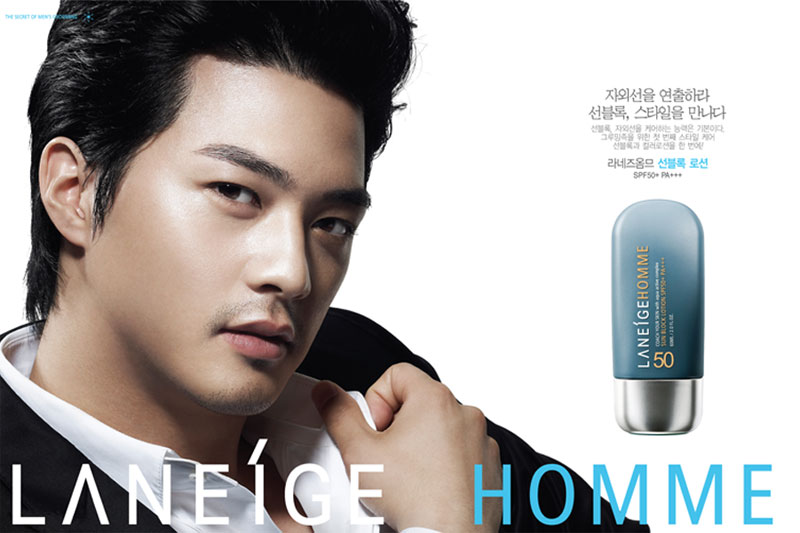
라네즈 옴므 ‘선블록 로션’ 편: 그루밍족을 위한 스타일리쉬 선블록
Laneíge Homme ‘Sunblock Lotion’: Stylish Sunblock for Men Concerned about Personal Grooming
‘자외선은 피부의 적’ 이라는 사실은 누구나 알고 있을 것이다. 자외선의 UVB파장은 진피층의 콜라겐과 엘라스틴 파괴시키고 색소 침착을 증가 시키기 때문.
Everybody knows that UV rays are the enemy of youthful-looking skin. This is because the UVB ray components of it destroy the collagen and the elastin in the dermis layer and increase the amount of pigment.
피부 노화의 주범이 자외선이라는 사실이 밝혀지면서 여름은 물론 사시사철 자외선 차단제의 중요성이 강조되고 있다. 하지만 남성들은 끈적이고 바르면 하얗게 뭉쳐 귀찮아서라는 이유는 선블록을 평소에는 바르지 않는다.
Ultraviolet rays are the main cause of aging of the skin, and people are beginning to realize the importance of using sunblock all year round. But men ordinarily don’t wear it, as they don’t like its sticky, greasy feeling or the fact that it tends to clump together in white lumps.
선블록은 단지 야외에서 운동할 때 여름 휴가 때 겨울의 스키장에서만 바르는 특수한 용도의 화장품이라고 여기고 있기 때문이다. 남성들의 이런 생각 때문에 남성 피부는 항상 자외선에 무비방 상태로 놓여있다.
Men tend to think of sunblock as something only to be used when exercising or traveling in the summer or skiing in winter, and so normally their skin has no protection at all against the sun.
하지만 이런 남성들 사이에도 변화의 바람이 불기 시작했다. 바로 ‘그루밍족’의 탄생이다. 이는 몸을 칭찬한다는 뜻의 ‘Groom’에서 나온 말로 패션과 미용에 아낌없이 투자하는 남성을 지칭한다. 이러한 그루밍족을 위해 탄생한 라네즈 옴므, 라네즈 옴므에서 제안하는 피부관리의 첫단계는 바로 ‘선블록’ 이다.
But men are changing their attitudes, and some are prepared to invest a lot of time and money in their appearance, becoming known as “Groomers” by advertisers. Laneíge Homme’s “Sunblock Lotion” is specifically designed for this new group, and advises men that sunblock is the essential first step in adequate skincare.
갈색으로 그을린 구릿빛 피부는 보기에는 멋지고 건강해 보이지만 실제로는 자외선에 의해 피부가 손상됐을 가능성이 높다. 이 CF는 이점에 착안, 스타일을 생각한다면 스킨과 로션 후, 손질를 마무리하는 단계에서 자외선을 차단하면서 피부톤까지 살려주는 라네즈 옴므 선블록 로션을 잊지 말아야 한다는 것을 강조한다.
Brown skin may look attractive and healthy, but it actually means that the possibility of it being damaged by the sun is very high. This commercial draws attention to this, and also emphasizes that you should not forget to apply the product after applying skin lotion and toner.
라네즈 옴므 선블록 로션TVCF는 ‘스타일리쉬’ 그 자체라고 할 수 있다. 심플하고 모던한 실내 세트장은 그 압도적인 규모뿐 아니라 브라운관들로 이루어진 천정이 눈길을 끈다. 모던한 세트장과 조화를 이루는 절제된 소품들은 고급스러움을 한층 더하고 있다.
Laneíge Homme’s new commercial is very stylish. The simple and modern room interior it was shot in is not just big, but viewers’ eyes are drawn to the ceiling, which has many TV monitors. The commercial has much finesse and many subtle points which combine to produce a high quality piece of work.
그루밍족을 위한 카리스마 강조, Emphasizing the Charisma of Groomers
무엇보다 ‘그루밍’ 의 워너비로 등장하는 배우 김지훈은 그만이 가진 세련된 실루엣과 카리스마로 남성뿐 아니라 여성들의 시선을 사조잡고 있다. 어두운 공간에 홀로 앉아 있는 멋진 남자와 천정에 설치된 작은 브라운관들에 남자의 다양한 표정들이 보여진다. 이 때 부라운관에서 자외선이 강렬하게 내리쬐며 남자를 비추고 강렬한 빛에도 당당한 모습을 잃지 않은 남자, 그의 손에는 라네즈 옴므 선블록 로션이 들려있다.
More than anything else, actor Kim Ji-hoon (김지훈) – Groomers’ ideal type – attracts the interest of both men and women with his charisma and stylishly-cut body shape. In the commercial, a man is sitting alone in a dark space and his various expressions are shown on the TV monitors. Then, on the TV monitors there’s a sudden strong flash of sunshine against him, but he still holds himself confident and strong against it, all the while holding a bottle of Laneíge Homme Sunblock Lotion.
내리쬐는 빛으로 점점 환해지는 실내, 자외선마저도 자유롭게 연출 할 수 있는 당당하고 스타일리쉬한 남자, 바로 모두가 꿈꾸는 진정한 ‘그루밍족’ 이 아닐까?
The sunshine gradually makes the room bright, but the stylish and confident man is unaffected by it and free to do as he wishes. He is the quintessential grooming man, the envy of consumers.
선블록 로션TVCF의 또 다른 매력은 바로BGM과 영상의 조화가 돋보인다는 점이다. 이번 광고를 위해 BGM이 특별히 제작했다. 젊은 남성 타겟의 취향을 고려하여 파워플하면서도 세련된 사운드가 돋보이는 Rock 스타일로 만들어진 것.
Another charm of this sunblock lotion commercial is that is in exceptional harmony with BGM’s background music. BGM produced the music especially for this commercial, and it has a powerful and sophisticated rock-style sound, in consideration of young men’s tastes.
이로써 TV CF의 하이라이트 부분과 BGM의 클라이막스가 완벽하게 맞아 떨어지면서 한층 임팩트 있는 광고가 됐다.
The climax of the music is in perfect synchronization with the climax of the commercial and combines to give a very powerful impact on viewers.
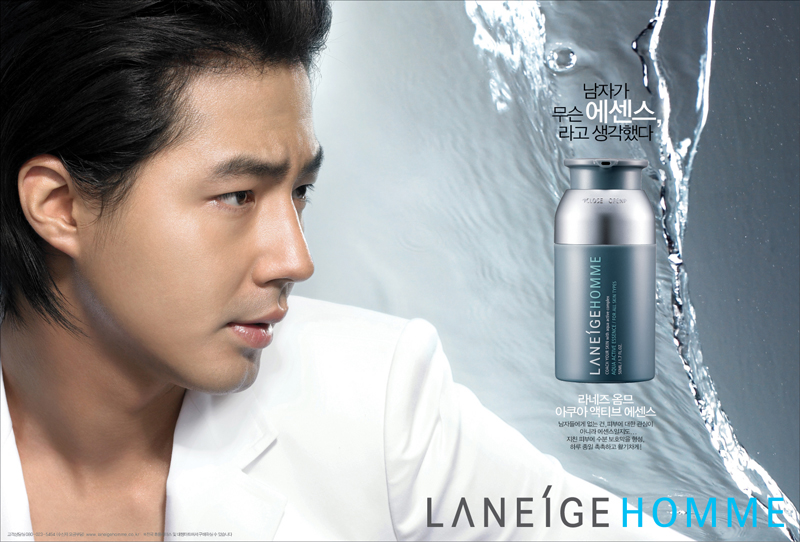
(A 2007 Laneíge Homme advertisement featuring Jo In-sung {조인성}, the first aimed at men. Source:Laniege)
Perhaps not a great contribution sorry, and I really expected rather better from a 15,000 won specialist magazine; given how much my wife was laughing out loud at the original Korean version, then I’m not sure how I could have made it more natural-sounding in English either. On the other hand, at least I do now know about “Groomers”, whom I expect to hear much more about in Korean advertising literature in the future.
Update, November 2013: My views on skin-whitening have changed considerably since this post was written five years ago, so I’ve removed my original commentary to this commercial, and consequently the comments also. But I’ll keep my translation up, just in case any readers still find this post useful (original article: page 52, July 2008 edition of the now-defunct Korea Ad Times / 코리아애드타임스):
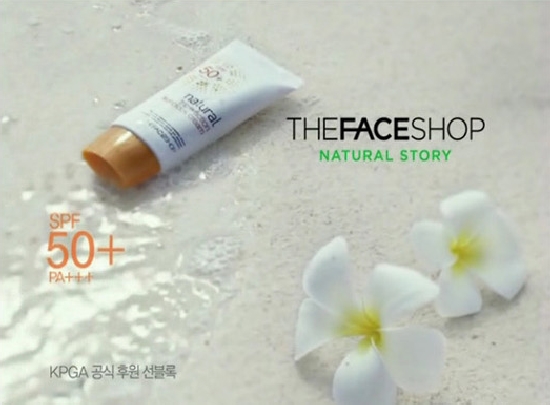
더페이스샵 ‘내추럴 선블럭’ 편 / The Face Shop’s ‘Natural Sunblock’ Commercial
“해빛을 맘껏 즐겨봐” / “Enjoy the Sunshine to Your Heart’s Content”
더페이스샵의 광고가 전파를 타고 있다. 이번 광고는 햇빛을 차단해주는 기존 자외선 차단제의 수동적인 발상에서 벗어나 오히려 햇빛을 즐길 수 있게 만들어준다는 능동적인 역할로 선블록의 개념을 변화시키고 있다.
Currently on air, this commercial marks a move away from the traditional notion that one has to protect one’s skin from the sun passively by wearing sunblock and avoiding the sun, and encourages consumers to enjoy the sunshine.
자외선은 피부 노화를 앞당기는 주범으로 많은 여성들은 최대한 자외선으로부터 멀어지려 갖은 노력을 하고 있다. 특히 자외선 양이 급격히 증가하는 여름철에는 손으로 얼굴을 가리고 빠른 걸음으로 햇빛을 피해가는 여성들을 도시의 길거리에서 흔히 볼 수 있다. 심지어 휴양지에서도 긴팔옷과 모자 등으로 최대한 자외선에 노출을 막고 햇빛 아래로 나오지 않으려고 한다. 왜냐면 자외선은 피부를 위해 경계해야 할 대상 ‘제1호’ 이기 때문이다.
Because ultraviolet rays are the number one cause of aging skin, women in particular try very hard to stay out of the sun. As the amount of potential UV exposure rises dramatically in the summer, these days in cities you can see many women both shielding their faces with books or handbags and walking very quickly across the street to avoid having their skin damaged by it. Even at beach resorts women will often wear long sleeves and hats to avoid exposure, or even stay entirely indoors.
그렇기 때문에 지금껏 자외선 이번 자외선차단제 광고는 흔히 자외선을 가장 효과적으로 ‘방어(Block Sun)’ 해준다는 개념으로 접근해왔다. 하지만 이번 더페이스샵의 내추럴 선블록 광고는 이러한 자외선 차단체의 개념을 새롭게 정의해 주목받고 있다. 이유는 소비자들이 선블록을 바르는 이유는 햇빛을 피하고 싶어서가 아니라 햇빛 속에서도 오랫동안 즐기고 싶어서라는 인사이트(Insight)에 초점을 맞췄기 때문이다.
Because of this, up until now the makers of sunblocks have tended to emphasize how effective their products are at stopping UV rays in commercials. By introducing the new notion that consumers can use sunblock to enjoy the sun rather than avoid it instead, this commercial has gathered a lot of attention.
해빛을 즐기는 미남과 미녀
An Attractive Couple Enjoying the Sun
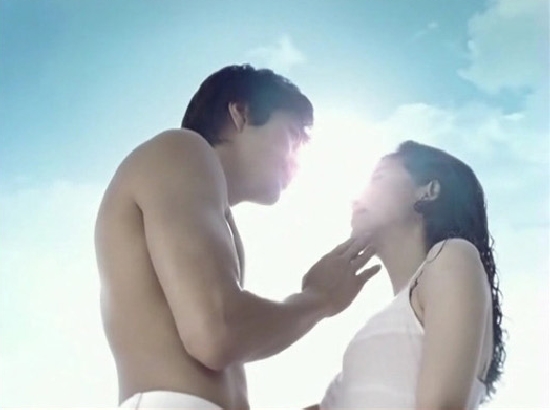
이번 광고는 태국 파타야 근방의 아름다운 무인도를 배경으로 제작됐다. 자연의 수수함이 살아있는 해변에서 눈부시게 쏟아지는 햇빛을 즐기는 두 남녀의 모습이 비쳐진다. 남자모델은 4년간 더페에스샵의 전속모델로 활동하고 있는권상우이고 여자모델은 이번 광고부터 더페이스샵의 얼굴로 새롭게 합류하게 된 배우 이보영이다. 권상우는 데뷔 이래 광고에서 최초로 상반신을 노출하는 파격읗 보여줬다. 그는 햇빛을 즐기는 모습을 담기에 꼭 필요한 노출이라 생각해 기꺼이 응해줬다는 후문이다. 권상우는 익히 알려진 ‘몸짱’ 스타답게 건강하고 멋진 몸매를 과시해 시청자들의 눈길을 단번에 사로잡고 있다. 광고가 전파를 타기 전부터 관광객이 찍은 것으로 보이는 촬영 한장 사진들이 인터넷상을 뜨겁게 달구기도 했다.
This commercial was shot on a beautiful deserted island in Pattaya, Thailand, a natural and pure setting in which to show an attractive couple enjoying the glistening sea. Kwon Sang Woo, the male model, has been modeling for The Face Shop for four years, but although this is the first time that he’s ever appeared half-naked in a commercial, it’s rumored that that he was happy to do it because he felt it was necessary to show how he was enjoying the sun while using the product. Of course, he is well known for his good body, and not only has this helped to attract viewers’ attentions, even before the commercial was aired it received a lot of publicity through Korean tourists taking pictures of it being produced and then uploading them onto the internet.
이보영은 그동안 여러 영화와 광고를 통해 깨끗하고 청순한 모습을 보여왔는데 이런 순수한 이미지가 더페이스샵과 잘 맞아떨어져 새롭게 광고모델로 발탁됐다. 이번 광고에서는 물에 젖은 머리칼을 휘날리며 기존의 순수한 모습 속에 섹시함이 묻어나는 모습으로 그녀의 색다른 모습을 만나볼 수 있다.
As for the actor Lee Bo Young, this is the first time that she has modeled for The Face Shop. As she already has a pure and innocent image from her previous movies and commercials, it was felt that she would be a perfect new face for the company. But with her wet hair fluttering in the breeze in this commercial, viewers get to see a sexy new side to her too.
You can’t blame overseas reporters for just calling them metrosexuals: kkotminam (꽃미남), literally “flower beauty man,” sounds a little strange even in Korean, let alone English.
Done too often though, it’s easy to lose sight of the differences. Combined with scholarship that (over)emphasizes the trend’s roots in popular yaoi manga from Japan, one can easily be forgiven for thinking that Korean men are doing no more than imitating what they see overseas.
This needs rectifying. Not least, because when men suddenly adopt some new fashion en masse, it’s invariably with the specific purpose of getting laid. But what was so special about the 2002 World Cup that made Korean women demand hitherto “effeminate” clothing, personal-grooming, and behaviors from them, if they wanted any hope of doing so?
To answer, you need to consider what happened in the 5 years preceding it, which was a tumultuous period for Korean society. Especially for Korean women, something which tends to get ignored in most accounts of events.
In brief, once democratization began in the late-1980s, women were finally rewarded with the drafting, implementation, and — yes — even enforcement of a wealth of sexual equality legislation, after years of having such concerns ignored or deferred by the military authorities and democracy movement respectively. Also, the female workforce participation rate slowly but surely increased, despite the predominance of the salaryman system and the attendant male-breadwinner ideology. In more ways than one, women could feel justified that their patience was being rewarded.
Then the Asian Financial Crisis of 1997-8 struck. Not only was “expensive” sexual equality legislation indefinitely postponed, but the government-business “solution” was to disproportionately lay off women, the logic being that young single ones, largely living with their parents, would be provided for by their fathers, whereas married women (and their children) would be provided for by their husbands. More advanced in their careers, and thus more expensive, the latter would be particularly targeted, to the extent that many would do their utmost to keep their marriages a secret from their employers, a theme subsequently explored in many dramas.
Lest anyone feel that this overview is a wild generalization, note that, tellingly, president Lee Myung-bak would repeat the same solution in the next financial crisis in 2008, although by that stage there was more of a pure financial logic: by having the most irregular workers in the OECD, which women would form the vast majority of. Back in 1998 though, and coming so soon after supposedly liberating and empowering democratization, which actually only really, qualitatively, began upon the administration of the first civilian president Kim Young-sam (김영삼) from 1993, then I’m going to take a wild guess that women were, in short, pissed off.
And with that prickly conclusion in mind is precisely how one should view the following music video by the Korean girl-group SES, made in 2002:
About which Matt at Gusts of Popular Feeling gives the following insightful commentary, starting with:
Taken at face value, the SES video seems to be about getting revenge on some boorish (white) men and humiliating them, but I think there are other ways to look at this video than just as a representation of Korean anti-Americanism. A very simple question would be: How many working women in Korea interact with foreign bosses, foreign colleagues, or foreign customers? I would imagine that the vast majority of working women never have to deal with foreigners in the workplace. So, for working Korean women…who would the sexist or rude bosses, colleagues, or customers really be?
And a little later:
…could this be seen as a “liberating” narrative of women standing up to boorish, disrespectful men in positions of power over them and humiliating them or otherwise getting revenge on them and asserting their power. In this case, the use of foreign actors to portray these men acts as the spoonful of sugar which makes the medicine go down because images of Korean men being humiliated would never be approved.
Whatever the answer, what’s clear is that, especially in 2002, on TV, Korean men could never have been treated like this, unless it was done with a lot of humor (and probably not even then). It needs to be asked, of course, why it would be acceptable to portray foreign men the way they are in this video, but not Korean men.
Lest you feel that Matt exaggerates the restrictions on how Korean men could be — and still can be — portrayed in popular culture, see here for a wealth of further examples. Yet, despite those, there were other ways women could express their anger. And a lot more besides.
While I should always resist the temptation to generalize my own experiences to the rest of Korea, it is still remarkable just in its own right that, in one of my first ever classes here in 2000, some of my female students mentioned that they were regularly chastised by middle-aged women on the street for — wait for it — wearing short sleeves. For just 2 years later, it would be a point of patriotic pride for them to wear a crop-top made out of the previously sacred national flag during the 2002 World Cup, and very much encouraged by their elders. As Hyun-Mee Kim (see the footnotes) puts it:
Stripping the Korean national flag of its heavy solemnity and nationalism, [women] brought change with their white, red, blue, and black sports bras, scarves, tank tops, and skirts. And the young Korean women who had been the target of criticism by the media every summer for their “excessive spending” and “oversexed outfits” were praised as original and attractive fashion leaders at the soccer scenes (Hyun-mee Kim: 228-229)
To clarify, I am not (yet) making a connection between this and previous events: merely pointing out the speed of the change. But, how to explain that pace? What on earth did soccer — of all things — have to do with the way women chose to dress?
Perceptive readers may already be thinking that all the skin was publicly encouraged to show support of the Korean soccer players, not the first time women’s bodies and sexuality have quite literally been used in service of the South Korean state (see Sex Among Allies by Katharine Moon, or my own series on gender and militarism). And, indeed, the media did soon describe it as such.
But Hyun-mee Kim notes that Korean women were already on the streets wearing sexier and/or more comfortable clothing that summer, well before public perceptions caught up with and condoned the new standards of dress that they had created. Moreover, and crucially, they were also simultaneously publicly discussing, idolizing and objectifying the Korean players and their bodies in ways that would have been previously thought of as shocking. And, as one does not salivate over a guy’s pecs simply by government decree (please correct me if I’m wrong), then it’s difficult to deny that both were definitely initiated by and for women.
Also, that much more was going on than simply women showing more skin, questioning public standards of decency, or talking more about men that they found attractive. Indeed, the process had already begun in popular culture in the mid-1990s.
Writing in 2002, So-hee Lee mentions that in 1995, “the most popular topics among university students were sexuality, sexual identity, and other sexual subjects” but that in 2002 “there is still no broad popular social discourse on female sexuality outside of marriage”. Partially that was because the term barely existed in Korea then as explained, but primarily it was because – for all the stereotypes of married Korean women or ajumma (아주마) having gender but not sex – precisely they that were at the forefront of a veritable sexual revolution in Korea beginning in the mid-1990s. As she explains, many Korean women novelists confessed that it was in marriage that they had begun to recognize their repression as women for the very first time”, and this was because:
Looking at their mother’s lives, Korean women in their early thirties believed that their marriages would be different. Because the Korean standard of living and patterns of Korean life changed very quickly, they believed that Korean ways of thinking had been transformed with the same speed. This is where their tragedy begins. As [a character in a mid-1990s novel discussed] says, “mothers teach daughters to live differently from themselves but teach sons to live like their fathers”….During sixteen years of schooling, they had learned that equality is an important democratic value, but nowhere had they been taught that women experience the institution of marriage as a condition of inequality. Many married women of this generation have [thus] experienced a process of self-awakening…(Lee: 144)
Lee’s chapter is about a succession of novels, movies and TV dramas that suddenly appeared between 1993-1996 which, with their blunt depictions of Korean women’s sexual desires, sexual repression, sexual frustrations within marriage, direct challenges to sexual double standards and so forth, were direct challenges to those stereotypes and provoked intense discussions throughout Korea. Unfortunately, a detailed discussion of them will have to wait for another post (update: and here that is!), but it can be said here that Lee concludes from her study of them that:
Looking back at Korean culture with a certain detachment [in 2002], I can imagine that the years 1995 and 1996 will be remembered as a critical period for the emergence of social discourse on sexuality, especially female sexuality. The year 1995 was particularly remarkable in that housewives began, on their own initiative, to speak in public about wives’ subjective sexuality (Lee: 160).
And that, in a comparison with the US in the 1970s:
My reading of the concept of female sexuality in Korean popular culture might suggest that Korean society is now at a stage of development comparable to America in the 1970s, when every kind of women’s issue appeared in realistic novel form….If this parallel holds, then what kind of story is unfolding in twenty-first-century Korea? Is it not difficult to image that a viable revolution against sexual repression might take place? (158)
With even greater benefit of hindsight, I’m not all that sure that the mid-1990s are remembered quite like that in 2008, and Lee did acknowledge that her discussion possibly:
…gives the impression that Korean women now are marching to demand their sexual subjectivity, in reality, most Korean women are marching only as the passive consumers of the sorts of cultural products described previously, not as their active cultural producers (159).
But quite presciently, she continues:
When women are able to intervene in the process of cultural production as subjective consumers with a feminist point of view, the Korean concept of female sexuality can be transformed more rapidly than before (159, my emphasis).
And of course, just like the 2008 Olympics that are coming in up in 3 weeks time, the World Cup is no longer merely or even primarily a competition for victory between nations, but is a prominent global cultural product. Part of that cultural product is the bodies of the the players themselves, and Korean women in 2002 definitely fundamentally changed the ways in which they “consumed” those.
The Rise of Kkotminam: A backlash against salarymen?
The first change they made was in confirming the dominance of feminized ideals of male beauty that had first begun evolving in the mid-1990s. Consider this description of the previous ideals:
The streets of Seoul are now filled with girlish women. Some look fragile, as if calling for protection. Women of this generation say that want to be protected rather than to protect. Young girls who used to favor gentle “mama’s boys” now turn their backs on them. They are anxious to fall in love with “tough guys” who look strong and even violent, like Choi Min-su and Lee Cheong-jae, who played tough gangsters in the explosively popular 1995 television drama Sand Clock (모레시계). Besides having a “tough guy” as a boyfriend, the women of this emerging generation want a pet. A pretty and coquettish girl, with a tiny, cute dog, beside a tough guy is part of this emergent new image. (Cho Haejoang: 182)
Although the book that was from was published in 2002, by the reference to the television drama and by the focus of other chapters I get the impression she is really writing about the mid to late-1990s. Later in the chapter, she mentions how the country as a whole reverted to a justifying male breadwinner mentality under the banner of “Let’s protect the our fathers who have lost their vitality” or “Let’s restore the authority of the family head” as a result of the IMF Crisis as I’ve discussed, and presumably the natural result would have been that those “tough guy” preferences of Korean women would have been reinforced, or at least the protective elements of them. But in fact, quite the opposite occurred. For instance, by 2000 there was:
…a new type of male emerging albeit in a small number of music videos. It is a de-gendered image of men which is a contrast to the macho image. Male groups such as Y2K, H.O.T., ITYM, and Shinhwa, whose fans are mostly teenage girls, portray this image. They wear make-up and a lot of jewelry and ornaments – which are all considered feminine – and take of their shirts to show off their bodies. This indicates that the male body is also sexually objectified as the female body….The style of the video is similar to that used to show female [bodies] with extreme close-ups to fill the screen with a face, and medium range or full body shots for dances. Although there is a risk of overstating the phenomenon, this image could be interpreted as a signal indicating the possibility of breaking the binary boundaries of men and women that have been formed in a patriarchal culture (Hoon-soon Kim: 207)
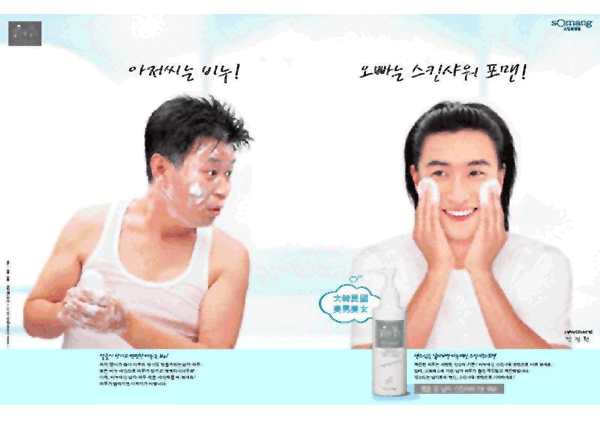
And this is corroborated by the fact, as early as the mid-1990s, there were already distinctly feminine advertisements for cosmetics aimed at men. These following ones are all from the Somang Cosmetics website (update: they’ve since been taken down), but I can’t imagine that those of other cosmetics companies would have been significantly different.
1998, with Kim Sung-woo (김승우):
1999, when soccer player Ahn Jung-hwan (안정한) must have signed a modeling contract with them:
And then of course the notorious television advertisement for “Color Lotion” from 2002, featuring Kim Jae-won (김재원) on the left:
Regardless of what women made of that particular homoerotic advertisement, the establishment of distinctly feminine ideals of male attractiveness were at least partially sealed by Ahn Jung-Hwan’s success in the World Cup, when Somang Cosmetics must have thought that all its Christmases had come at once:
Although the Earth must surely have shifted as Korean women collectively put their hands to their chests and sighed as Ahn Jung-hwan kissed his wedding ring every time he scored a goal, I’m not for an instant placing the blame(!) for what came to be known as the “Flower Men” (꽃미남) phenomenon solely on his shoulders. Where does it come from then?
Of course there is some international basis for it. While Taiwan, for instance, both survived the IMF Crisis relatively unscathed and didn’t host the World Cup, much the same phenomenon still happened there:
Josephine Ho (2001: 63-86), a feminist from Taiwan, points out that most of the recent idols of teenage girls are no longer buff and tough men but rather “feminine men” who evoke a sense of sympathy, saying that there is a “clear contrast between teenage girls of enormous strength and their idols of somewhat weak image.” This illustrates that women in their teens are breaking away from the typical framework of heterosexual romance in which women long for me who will devote themselves to, and take care of them, and have started to express their sexuality in an active manner. The preference for men with the capability and personality of the breadwinner as the “most attractive” is being undermined. (Hyun-Mee Kim: 235)
I don’t know enough about modern Taiwanese society to judge the accuracy of that, but I have no reason to doubt that it’s true. But I have many problems with international comparisons.
Firstly, because they mean that the Western notion of “metrosexuality” invariably comes to dominate discussions, years of repetitive comparisons between An Jung-hwan and David Beckham in the Korean English-language media (and, by extension, by foreign observers too) ultimately seeming to absolve Korean women of any ability to determine their own tastes in men. And just like it does to be told personally that my liking any Korean women at all is mere “yellow fever”, it must surely rankle Korean women to be told that them liking say any Korean idol is no different to, say, a British teenage girl liking a member of Westlife.
On top of that, for all their new assertiveness, there were still definite limits on how far women’s new freedoms could go, and they did not extend to publicly praising and/or objectifying non-Korean men. Obviously that’s a crucial point, but as this post approaches (ahem) 4500 words I realize that a discussion of that would be better placed in Part Three; meanwhile, accounting for changes by a simple importation of foreign ideals of male attractiveness portrays Korean women as, well, mindless, uncritical, and passive consumers and again as Part Three will more fully reveal, this was anything but the case.
As the title suggests, I pose a more proactive explanation, and herein (finally) lies the revelation that has so preoccupied me for the past two weeks. First, consider this statement:
When gender discrimination in public areas such as the labor market and politics is still powerfully all pervasive, Korean women often feel helpless in thinking that change won’t come easily. Their sense of devastation leads to displays of resistance and subversiveness in “private areas such as sexuality. Sexuality and intimacy lend themselves to being viewed as the only arena where the women can affect a measure of change through their will or emotions. In this respect, Korean women’s rapid sexual subjectification demonstrates, on the one hand, the power to transform and, on the other, a collective sense of powerlessness (Hyun-Mee Kim: 240).
The first things that came to mind when I read that were the scene in either La Femme Nikita or Point of No Return (I can’t remember which) when, after receiving her training to become an assassin, the main character is placed in a sort of finishing school where her female tutor reveals the existence of “this power” that women have over men. After that was a line from some sex and/or relationship advice book that I read once, which said that women should not consider sex as something to be given to or withheld from partners as a form of reward and punishment.
Yes, considering the virtual gender apartheid that exists in Korea, then an alleged asexuality of ajummas as a form of resistance to patriarchy was one of the first things that came to mind too. But then the next thing was that, maybe, just maybe, flower men became their new ideal of male attractiveness as a act of at least subconscious resistance to the men that had denied them of the opportunity for children and careers that they’d (finally) come to expect? That still maintained that women didn’t even have sexual feelings, but at the same time taking advantage of one of the biggest prostitution industries in Asia? That had the gall, after doing all that, to expect Korean women to continue to hold breadwinners like them on a pedestal? Like I said, they were pissed off, andKorean men that came up with the aforementioned slogans were surely naive to think that things could have gone on simply as before.
Of course, I acknowledge that it will be much more complicated than that in reality. Like I said, I haven’t looked at the 1990s in any great detail here, but in addition to the sexually radical new books, movies and dramas that came out in 1993-96 that Cho Haejeong discusses, there’s a whole host of developments like the “Missy” phenomenon beginning in 1994 and the “Samonim” (사모님) one before that: in other words, things weren’t quite as simplistic as how I’ve depicted them. I haven’t paid enough attention to generational differences either, even though Hyun-mee Kim quite correctly claims that they are as strong markers of identity in Korea as race is in the US, so much so that most chapters in the books used here us them as their base units of analysis, and increasingly books on Korean politics are too.
As I type this, I realize that no description is complete without those, and so they’ll require an unplanned additional post before I talk about the 2002 World Cup proper in now Part Four (or Five)…which is not to imply that this post hasn’t considerably evolved and mutated itself since I first began writing on this, now somewhat amorphous subject.
Another thing I realize is that until recently I’ve been so enamored of my associations of Korea with futurism (see here and especially here for instance) that I’ve mistakenly disdained studying the 1990s previously, feeling that as I looked further and further back in time in Korea then the people become more conservative and unlikeable, the clothes and hairstyles more bizarre, the women less attractive, and the country as a whole much less modern…and so on. That’s not unreasonable given Korea’s breakneck speed of development, but considering that I arrived in Korea as long ago as 2000, and that I first went to university in 1994, then in hindsight my disinterest has been very strange. After all, to understand me, you’d have to understand New Zealand in my formative years as an adult, and indeed just on the bus home yesterday I listened to a Korea Society Podcast on president Lee Myung-bak’s first 100 days in office, in which one panelist argued that the experience of the IMF crisis defines Koreans of my generation. All obvious certainly, but I’ve got some catching up to do.
Regardless of all that though, I think my notion of flower men becoming popular because of a backlash is a definitely a valid one, and I think original too; certainly no-one that I’ve read recently makes a link like that. At the very least, it needs further exploring.
Only having just begun examining the 1990s myself then, I can’t confirm or disprove Gord Sellar’s suggestion that cross-fertilization from some elements of Japanese popular culture may also have played a role in the rising appeal of flower men, and while my gut instinct tells me that it was mostly home grown and that that would only have had a marginal role at best, I still highly recommend his post just for its discussion of the ways in which the phenomenon has evolved and be sustained since 2002 alone. Given that I end my discussion on them in 2002 (for now), then our two posts nicely compliment each other on that score.
Ho, Josephine, “From ‘Spice Girls’ to ‘compensated dating’: sexualization of Taiwanese teenage girls,” Yonsei Women’s Journal, 7, (2001), pp. 63-86.
Hoon-Soon Kim, “Korean Music Videos, Postmodernism, and Gender Politics” in Feminist Cultural Politics in Korea, ed. by Jung-Hwa Oh, 2005, p. 207 pp. 195-227.
Hyun-Mee Kim, “Feminization of the 2002 World Cup and Women’s Fandom” in Feminist Cultural Politics in Korea, ed. by Jung-Hwa Oh, 2005, pp. 228-243.
So-hee Lee, “Female Sexuality in Popular Culture” in Under Construction: The Gendering of Modernity, Class, and Consumption in the Republic of Korea, edited by Laurel Kendall, pp. 141-164.

 In yesterday’s Korea Times. Long-term readers may recognize the topic from this brief report I gave on it back in January, but, as I’ll explain, I’m very glad I decided to take a second look at the science involved:
 While it is possible to absorb Vitamin D through food, the surest way is through exposure to a few rays of sunlight every day, and Korean women would be well advised to ask themselves if ultra-pallid skin is really worth the price of full health. Just as Korean parents might wonder if higher TOEIC scores are really worth the price of their children’s long-term health (end).






 The Grand Narrative