Why Do Young Koreans Live With Their Parents?

Young Korean Man (Source: Andrew Butts; CC BY 2.0)

(Update, 2 March 2016: Thanks for the link in today’s Guardian, but this Korea Times article of mine is a little out of date. I recommend this 2013 Busan Haps article instead.)

In Saturday’s Korea Times. As always, here’s the original version:

…Everyone knows the strong Korean custom of adult children living with their parents until marriage. Yet a report released earlier this year revealed that one-person households now account for a fifth of all households in Seoul.

This is lower than national figures for most other developed countries, the Seoul Development Institute report notes, and the number for Korea as a whole is likely to be lower still. But the rise puts Seoul on par with Australia, and the rate is predicted to grow to a quarter of all households by 2030.

How to interpret this? Does it signal that the Korean custom of staying in the family home until marriage is under threat?

That is unlikely. The figure includes single professionals, jobless youth, those separated from their spouses, divorcees, and senior citizens, with growth in every category. It does not imply a sudden glut of young Koreans leaving home.

While Korea has experienced many periods of great labor mobility in its recent history, particularly of young, single, working-class women moving to work in factories in cities in the 1960s and 1970s, there is definitely no tradition of young middle-class Korean university students leaving home to share private accommodation with fellow students, and there are still strong taboos against openly cohabiting with partners.

At the same time, young Westerners are adjusting their expectations for living arrangements, as the combination of rising university fees, stingier government allowances, and prospect of paying back student loans leads them to defer leaving home until graduating and/or getting their first job. This delay is often both parents’ and children’s least preferred option, but it is a trend likely to continue given the bleak job market for graduates worldwide.

This points to important economic reasons for the differences, and indeed there are big financial hurdles to overcome to live independently in Korea. For instance, at the moment Korean students cannot get student loans without their parents acting as guarantors (although the Ministry of Education, Science and Technology is working to change this). Nor do the vast majority of universities accept credit cards for payment of fees. In practice though, the combination of extremely high “key money” deposits required by landlords and the low wages afforded by part-time jobs favored by students are keeping even the most rebellious of youths at home until graduating and getting their first job. And then, he or she faces a dearth of rentals of appropriate size.

But familiarity breeds acceptance, and while cultural factors are still important, in practice they are often overstated, as for all the purported differences in how Koreans and Westerners view and value family life, many would behave in a similar fashion in similar circumstances.

For instance, with a child’s school being such an important consideration for entrance into a preferred university, and seniority-based promotion systems locking an employee into a specific company, then if a man is transferred to a different city it is very logical for his wife and children to remain in the family home rather than the children leaving the good school and/or him starting at a much lower wage and position in another company.

Also, as legions of unhappy mothers driving home every Sunday night can attest, Koreans generally don’t like to give their children to relatives to look after during the week, but with childcare facilities being so inadequate,  working parents usually have little choice.

Certainly there are some arrangements that Westerners would almost unanimously reject, such as sending one’s family overseas for years for the sake of the children’s education, but Koreans’ living arrangements do not mean that they are as cold, calculating, or dogmatic as they may at first appear. For instance, while they are not openly discussed, ubiquitous love hotels point to unmarried Koreans having romantic relationships much like Westerners, and as the spate of recent celebrity pregnancies can attest, engaged couples are usually given a great deal of freedom.

Moreover, Korean’s living arrangements may well become more liberal in the future.

A long-running debate within sociology rages over whether capitalism forces very different societies to “converge” and become more similar to each other over time or not, and as one of the only non-Western developed societies, Korea is an important element in that debate.

And as reported by the Economist in March, a decade ago Andrew Oswald of the University of Warwick observed that countries with high rates of home ownership have higher rates of unemployment: with few rental options, he argued, young people living with their parents find it harder to move out and get work, or are stuck in local jobs for which they are ill-suited, and earning less than they could.

korean-grown-children-living-with-parentsPerhaps given the dire state of today’s economy, such imperatives will force such a change in Korea? (End)

With apologies to long-term readers, for naturally my articles for the KT will tend to be about subjects that I’ve already covered and know well (source right: Korea Times).

As they’re for a newspaper rather than a blog though, then I’m being forced to make the subjects much more newsworthy, contemporary, and concise than in their original rambling manifestations here, which (presumably) can’t help but have positive effects on my writing style in the blog as a whole. At the very least then, my planned next blog post will be much shorter than it would have been had I posted it just a few months ago(!), but never fear, for I am still a geek, and so it will still be an in-depth one on an original subject (update: sorry, it’ll be next week, but I’m not sure what day now).

For anyone new to the blog and wanting to learn more about any of the issues raised in the article though, then please try the following links:

Enjoy!

Update) The SDI’s report also mentioned that 51% of those people living alone in Seoul lived in the districts along subway line No. 2, a very small area relative to the vast conurbation that is the second most populous city in the world! It’s definitely no coincidence then, that those districts are dense with cafes, restaurants and retail shops, in total offering 21% of all the part-time jobs in Seoul.

Most of those pay 4000 won an hour, that article reports; the minimum wage is 3500.

Update 2) Here’s a graphic representation of the “single belt” around subway line No. 2, from p.15 of the SDI report.
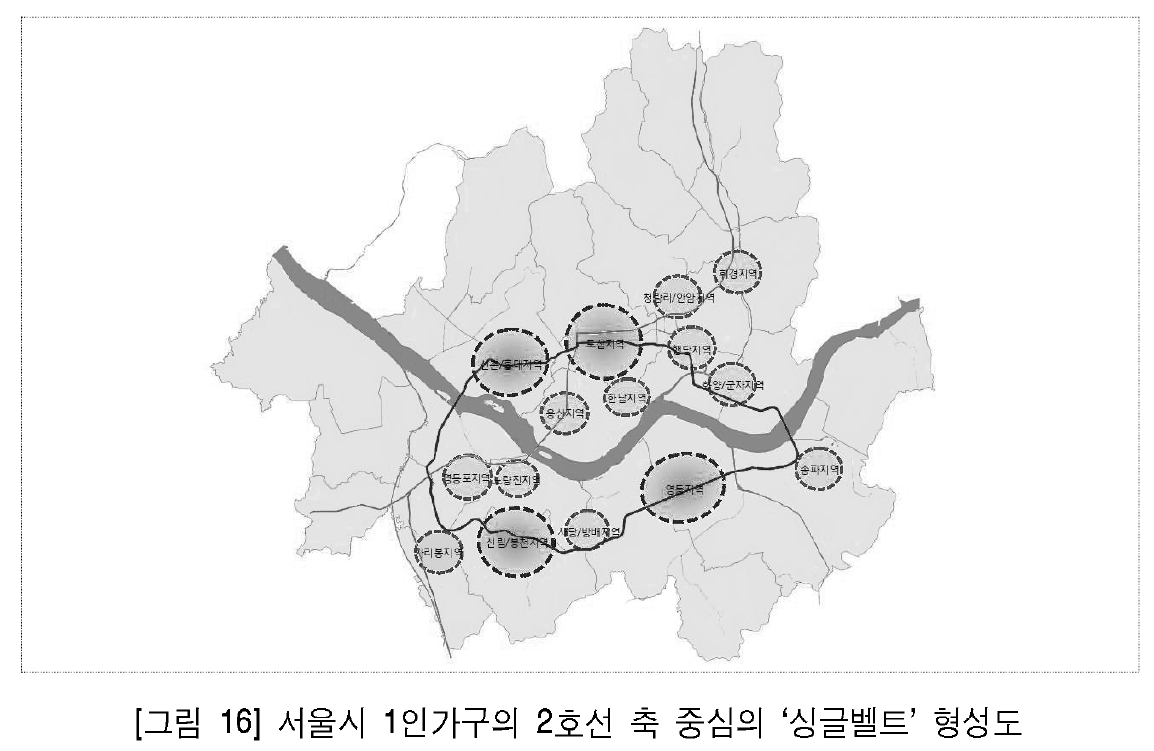
the-single-belt-of-one-person-households-around-subway-line-no-2-in-seoul

A Penetrating New Look at Japanese and Korean Love Hotels

korean-movie-couple-in-passionate-embrace(Source: Unknown)

If you’ve been following my recent discussions on why Koreans generally live at home until marriage, then you’ll have noticed that one gap in those were the ubiquitous love-hotels (러브호텔) that were the obvious corollary of that arrangement, and which would probably have been more interesting topics than demographic data on Korean household types and student loans too. In my defense though, I already covered premarital sex and cohabitation and their relation to Korean capitalism (yes, really) in lengthy posts back in 2007, and besides which love hotels are not only or probably even primarily used by young unmarried couples. The numbers of hotels that are in the middle of the countryside for instance, relatively devoid of that age group, and accessible only after quite some driving, testify to the fact that they are also host to just as many adulterous trysts in practice.

But that the latter occurs doesn’t mean that grown children, parents and even grandparents all under one roof can’t both be faithful to their partners and spouses and still chafe at the lack of space and privacy, and so need to get away for a few hours occasionally. Which is why although I might still balk at opening one next to an elementary school myself, I’m all for love hotels, and see no reason to pretend that both the need and the demand don’t both exist in droves. Hence I’m very interested in reading about the development of both in Ed Jacob’s new book Love Hotels: An Inside Look at Japan’s Sexual Playgrounds, which editor-in-chief James provides a quick review of over at the ironically-titled Japan Probe blog. History-cum-practical guide, I’d be surprised if the general course of events described in the book wasn’t closely paralleled in Korea too, albeit perhaps with a gap of ten to fifteen years as it reached the same level of economic development.
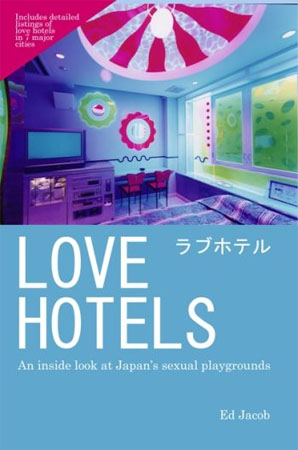
love-hotels-an-inside-look-at-japans-sexual-playgrounds-ed-jacobUnfortunately there the similarities probably end, for in a social environment where women are so concerned about their virginal reputation that they rely on men for contraception (lest a proactive attitude reveal their experience), and in which one of the largest prostitution industries in the world exists and is openly advertised despite periodic crackdowns and extensive legislation banning it (see here also) too, then in Korea love hotels and what occurs in them are like dogs loudly mating in the corner of the garden: an inescapable but otherwise seedy, unspoken part of life that is preferably hidden away from polite society.

In other words, the polar opposite of their hygienic and matter-of-fact Japanese counterparts. The hotels that is, not the dogs.

But having said that, it’s (naturally) been many years since I’ve visited a hotel myself, my daughters and meager family budget preventing much traveling these days.  So, in lieu of more fieldwork on my part, I’d be interested to hear if Korean love hotels are really still as bad as my experience of them in before I was married, when I used to stay in them with my then-girlfriend now-wife while traveling all over Korea. Sigh…

For Every Birth, a Korean Career Dies

pregnant warrior with one knee up(Source: Bonbon; CC BY 2.0)

Not technically Korean sorry, but it seemed an apt response to the following graph:

international-comparison-of-female-labour-force-participation-rates-in-oecd-2007

(Source: OECD)

Actually I’m surprised that that figure for Korea is so high, regularly hearing that Korea has the lowest rate in the OECD, and which given the high numbers of Koreans in tertiary education and the low wages in the types of jobs open to young women (and men), both of which will only be exacerbated by the current financial crisis, it may still well be if the age range is extended from 25-54 to 15-64. Regardless, it’s very low, and while I’ve written a great deal on the blog over the last two years as to the reasons why (see here and here for starters), a picture really does say a thousand words.

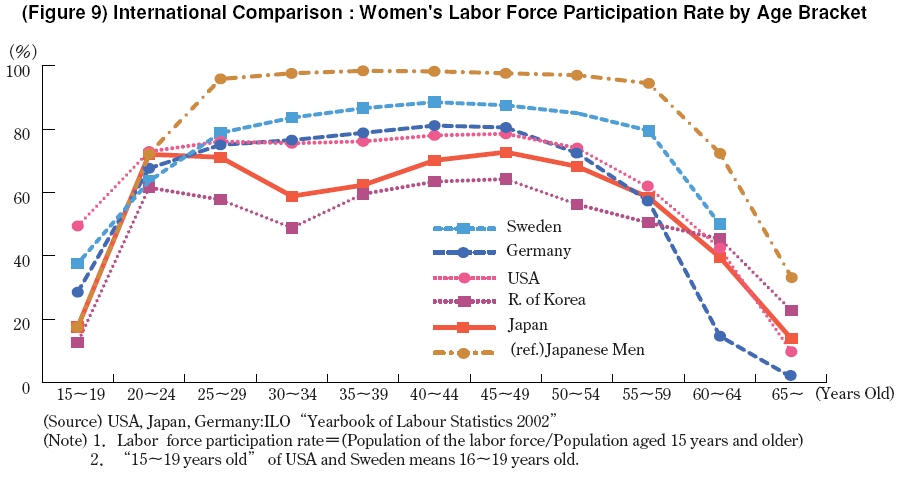
Or more graphs to be precise, the next one below clearly showing Korea’s sharp “M-shaped curve” of women’s labor force participation, the result of women entering the labor force after finishing their schooling, then leaving in droves as they find it impossible to juggle children and work, then returning gradually once the children reach school age, finally to leave again as they retire. This is in contrast to the “upside-down U-curve”  of – let’s face it – more enlightened countries (at least when it comes to the position of women), and the “n-curve” for men, which is usefully included as a comparison:

womens-labor-force-participation-rate-by-age-bracket-2002-south-korea-etc(Source: Gender Equality Bureau Cabinet Office)

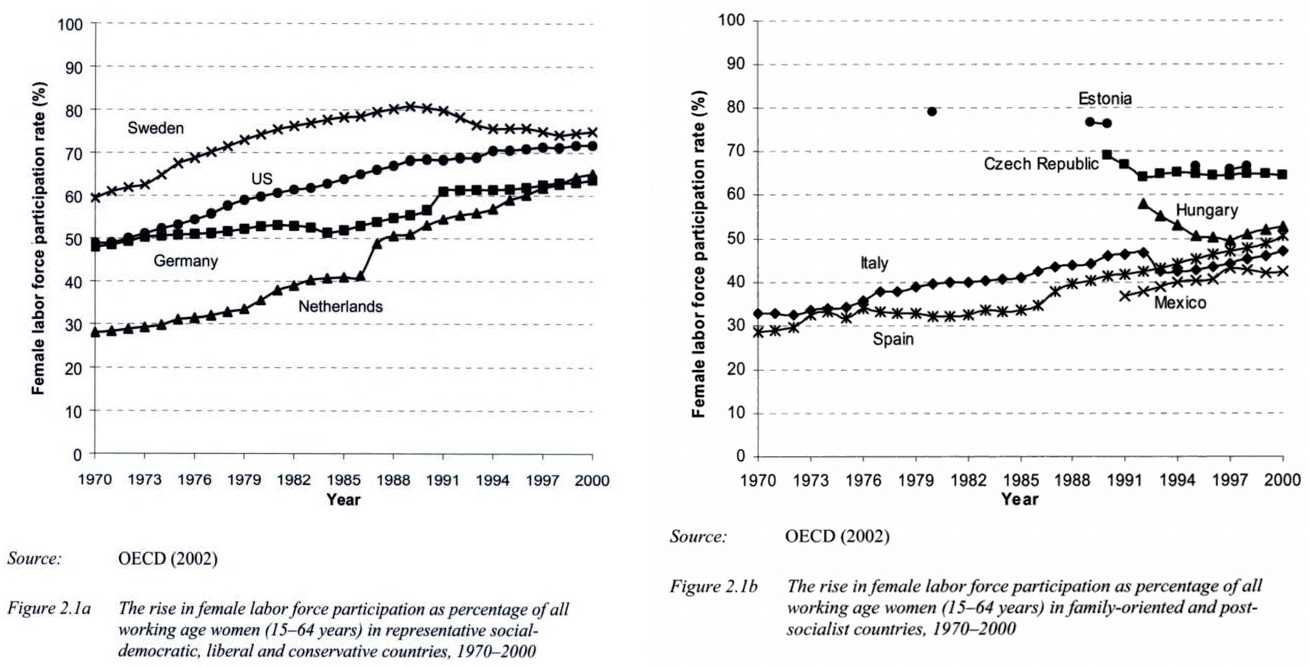
Unfortunately I couldn’t find an online graph showing how Korea’s women’s labor force participation rate has changed over time, but I do have the figures below from page 24 of Working Korea 2007 published by the Korea Labor & Society Institute, which you can compare to the rates of some other countries through these graphs that I could find, luckily for the same age range of 15-64:

  • 1980: 38.2%
  • 1980-84: 38.6%
  • 1985-89: 40.0%
  • 1990-94: 40.%
  • 1995-99: 41.5%
the-rise-in-female-labor-force-participation-as-a-percentage-of-all-working-women-graphs(Source: Pages 36 & 37, Globalization, Uncertainty and Women’s Careers: An International Comparison
edited by Hans-Peter Blossfeld, Heather Anne Hofmeister, 2006)

In this case, Korea’s figures most resemble Mexico’s I guess. For the sake of future reference, here are some more recent, albeit depressingly similar figures:

  • 2005: 41.7%
  • 2006: 41.9%

Being so…er…ripe for it, then ideally this or a similar ad will also appear in Korea sometime soon; either way, I’m sorry if in the past I’ve sounded a little like a stuck record, so regularly lamenting the low position of women in Korea and all, but hopefully all of the above has provided a stark demonstration as to why I have the focus on the blog that I do!

A Small Victory for Independent-Minded Korean Students? (Updated)

Young Korean Woman on Busan Subway(Source: Jinho Jung; CC BY-SA 2.0)

Update: One more reason unfettered access to student loans is so important is because only 60 out of 400 Korean universities allow students to pay their tuition with credit cards. For more on why these odd rules exist, and on Korean student loan rates and information in general, see here.

Why do Koreans generally stay at home until marriage? With some figures on the numbers of different household types in Korea now at hand, then I’ve recently been re-examining that question, but still see no reason to change my view that the combination of high rents and low wages is primarily responsible, or at least much more so that universal panacea for inquisitive foreigners otherwise known as “Korean culture.” But there are other factors of course. Consider this from Monday’s Korea Times:

Student Loan Plan Shelved

By Bae Ji-sook, Staff Reporter

A plan to allow students to get loans without their parents acting as guarantors has been scrapped, the Ministry of Education, Science and Technology said Sunday.

The National Assembly recently withdrew the measure since Korean civil law does not allow adolescents to make legal decisions on their own, the ministry said.

The initial plan aimed to help students who were unable to get loans because their parents were divorced or were from single parent families.

”If necessary, we will seek a revision of respective civil laws. Since its purpose is to help poor students pursue higher education, student loans should be available to more students, without barriers,” a ministry spokesman said.

Why do I suggest that this might be a victory? Well, because while the scrapping of the plan is certainly a tactical defeat so to speak, given the ministry’s apparent attitude as revealed by that last statement of theirs,  then it does look like that university students will ultimately be given the opportunity to secure loans without the approval of their parents.

That students necessarily should take up the offers of loans is of course debatable, and I speak from bitter experience when I say that eighteen and nineteen year-olds of any country are not exactly well-known for their prudence and financial sophistication when given sudden access to lots of money, to be paid back in some distant future. But the only way for young adults to leave the family nest against the wishes of their parents, the move by implication meaning that they’d be – heaven forbid – openly engaging in premarital sex, as opposed to the present-day subterfuge in love-hotels that maintains their (and thus their family’s) reputations? That is of course by having the funds to do so, and sometimes an adult’s simply got to do what an adult’s go to do, debt, reputation or otherwise.

Personally, my father and I are very glad that student loans were available to me as a 19 year-old myself back in New Zealand, as we were literally very close to blows by that point, and it was simply essential for our relationship that I move when I did. Fourteen years later, both that and many other aspects of my life are much much better as a result, so much so that even if I could go back in time I’d still make the move, even with knowledge of my struggling with a mountain of debt today before me. But with no loans available, and so having to have had stayed at home instead? I shudder to think.

On a final note, I have a question for readers, particularly those with Korean partners and/or friends and/or students who are young enough to be university students themselves and/or remember how the Korean student loan system operates. Do all students currently require parental approval, regardless of their age? Obviously that would have quite an impact on their ability to leave home! Or is there a cut-off point, after which even the Korean state acknowledges them to be an adult, and responsible enough for his or her own financial decisions? My wife didn’t get loans herself, which I’m thankful for, but with that and her university days being so long ago then unfortunately she can’t remember how they operate exactly, so I’d be grateful for any information.

How Many Unmarried Koreans Live Away From Their Parents?

Korean couple(Source: Hojusaram; CC BY-SA 2.0)

Let me take that break this weekend by posing a couple of questions to readers for a change: if you have a Korean partner, but aren’t married, do you live with him or her? And if so, do his or her parents know about the arrangement? Or is it a secret, which is what I expect most of you to say?

I say that because it’s been nine years now since my then girlfriend moved in with me back in Jinju, and I remember how for the next four years until our marriage she was determined to keep it a secret from her parents, who still think she lived in a “one-room” (원룸) with her younger sister all that time. Fortunately, they and most of her relatives were farmers who lived an hour’s bus-ride out of town, so it was only on the very rare occasion when we were out together that her spotting one in the distance had me hurriedly climbing over walls and up trees to get out of sight. Literally and figuratively then, Koreans’ conservative attitudes to cohabitation was the first cultural difference I really grappled with, and truthfully it was what ultimately inspired to me to start this blog too, my bristling years ago at most Koreans’ blanket assertions that conveniently ill-defined—yet somehow also timeless and unchanging—”Korean culture” was responsible for them, and my wanting to dig deeper.

In reality though, it doesn’t take half an hour up a tree dwelling on the subject to demonstrate that extremely high security deposits demanded of tenants, combined with absurdly low wages provided by part-time jobs, would make living away from home next to impossible for most young people. Change either economic disincentive though, then despite cultural prohibitions, in my experience many young Koreans can, will, and do leave the stifling confines of their homes the instant they’re given the opportunity.

Those young Koreans that can’t live away from home though, must reconcile themselves to the fact, and so by their mid to late-20s — when they do have the means to leave — I find that (as a psychological coping mechanism?) they can ironically often end up being among the stoutest of defenders of living with their parents instead. Hearing it from men specifically though, I don’t need to invoke that notion, for there is plenty of truth to the stereotype that they have all the comforts of having their housework done for them and with none of the restrictions applied to their sisters; hell, in their case I’d probably stay at home too. But a defense of the arrangement from the latter? Of the curfews often applied on them, and parents’ expectations that after working hard studying and/or pursuing their careers during the day, that they still should have to do a load of housework once they arrive home at 11pm? That will never cease to amaze me, and if I know that a Korean woman has the means to leave home but still tolerates such living arrangements, then in all seriousness we could never be friends: I’ve just had too many experiences of feeling like I’m talking to a 27 year-old teenager, and/or of wanting to grab her and shake some sense into her, demanding that she stop moaning to me about her mother and take some control of her life.

(Update: I should probably add that I find it just as difficult to be friends with men living at home too though, my respect also not extending to anyone who expects to go through their entire life with their mothers and then their wives doing all their housework for them!)

To be fair though, the “That’s Korean culture” mantra is a useful device with which to silence know-it-all foreigners, often happy to provide Koreans with their profound insights into Korean society after *cough* less than two weeks in the country, and as an immigrant to both countries I’m familiar with similar responses in Australia and New Zealand too (I’m sure it’s a universal tendency really). And while most Koreans outside of sociology departments naturally haven’t spent all that much time thinking — up a tree or otherwise — about why adult Koreans tend to live with their parents, it has to be said that when the subject came up in conversation (as it had a tendency to do so with me), that actually they did usually agree with my arguments that economics had quite a bit to do with it.

People thinking I’m right because I’ve paid more attention to the subject than them isn’t quite as satisfying as having the evidence to prove I’m right however(!), so although I put that specific topic on the backburner long ago, my ears still always prick up at any mention of related statistical data, although as I discovered recently, there’s much less of that than you might think. Hence I got quite excited when I came across this in today’s Korea Herald:

Seoul TiltshiftOne-person homes rise to 20%

By Kim So-hyun (sophie@heraldm.com)

One-person households accounted for a fifth of all households in Seoul, according to a report released yesterday by a city-funded research institute (source, right: Jude Lee; CC BY 2.0).

Some 675,000, or 20.4 percent of the total households in the capital, were people living alone, according to the Seoul Development Institute.

The SDI categorized those who live alone into four groups of professional singles, jobless youth, people who got divorced or had separated families, and senior citizens aged 65 or more.

“The percentage of one-person households is expected to reach 25 percent by 2030,” said Byun Mi-ree, an SDI research fellow who wrote the report.

She noted that the city needs to come up with matching policies such as supplying a wide variety of small homes, creating more jobs for unemployed youth, helping unstable singles rebuild families and assisting senior citizens in poverty.

The number of white-collar, professional singles has constantly increased since the mid-1990s along with the changing views of marriage, social accomplishment and individualism, according to the report.

Others increased as well with the tight job market, the aging society and the rising number of children leaving home with their mothers to study abroad.

Forty-five percent of the one-person households earned less than a million won per month. Seventy-six percent made less than 2 million won per month.

More than half of the people who live alone had blue-collar jobs such as sales service (26 percent) or manual labor (10 percent).

Fifty-one percent said they mostly used the mass transportation systems and lived along the subway line No. 2.

Yes, I expected a breakdown of the numbers of those “four groups of professional singles, jobless youth, people who got divorced or had separated families, and senior citizens aged 65 or more” too, and have to wonder what the point of one-person households as a unit of analysis is, given how disparate the make-up and needs of each of those groups mentioned above are. At first I was very curious that there was no mention of middle-aged “lonely goose fathers” (외기러기) too, who live and work in different cities during the week and then return home to their families on the weekend, but then I realized that the concentration of wealth and educational opportunities in Seoul would mean that when those fathers that were already living there were, say, transferred to a branch office, it was logical for the family to remain behind. I couldn’t imagine a family not following a father’s new job in or transfer to Seoul though, so although many Seoulites will indeed be lonely geese fathers, while they’re actually there they wouldn’t count as one-person households (but see here for some information on their numbers that I did find).

So, I checked out the Korean report from the Seoul Development Institute itself , and although it’s quite comprehensive, unfortunately that doesn’t have any figures either! I’ll keep an eye out for them any new reports from the SDI though, which I’m glad that the Korea Herald made me aware of, but in the meantime…then I guess I should provide an apology for not providing an actual answer to the question I pose in the post title. But if you did want to know then I’d genuinely be surprised if you weren’t also interested in the above report too, so *ahem* please forgive the slight subterfuge on my part? And regardless, please do pass on your own experiences of cohabiting in Korea, for my own opinions on the issue, first forged up a tree over nine years now, may well be in some serious need of updating!

Why are Korean and Japanese Families so Similar? Part 2: Couples Living With Their Parents After Marriage

Korean Wedding Party(Source: myllissa; CC BY-SA 2.0)

To refresh your memories, last month I came across this study that showed that Japanese women living with their husbands and parents-in-law were more than three times more likely than their husbands to have a heart attack: interesting in its own right, it led me to wonder how likely a similar study of Korean women would have been to have come up with a similar result, and why I so readily assumed that it probably would. This brief series is the result, a personal combination of learning new things, a healthy airing of some of my intellectual baggage, and, finally, some much-needed hard statistics about Korean families with which to analyze them from now on; without them, then I’ve been as guilty of relying on gut-feelings and generalizing about Korea just as much as the next expat.

As I discussed in Part One, most of those gut feelings about Korean women being under similar stresses were because I knew of the practice of eldest sons living with their parents after marriage and the great potential for the subordination and/or exploitation of the new daughter-in-law within, ethically and legally buttressed by Neo-Confucianism in much the same way that Christianity also heavily informs Western, historically unequal notions of marriage and family life. But are the same living arrangements also common in Japan? And if so, what role does Neo-Confucianism play in their numbers, and in the ways they internally operated so to speak?

Possibly I got the order in which I should have looked at those various questions mixed up, but I confess that prior to writing that post I knew very little about Japanese religion, and given Japan society’s relative progressiveness, and some important, decidedly non-Confucian features of it (most notably sexuality), would previously have assumed the virtual irrelevance of Neo-Confucianism in Japanese society today. Part One was about me investigating that, and I was surprised to learn that Neo-Confucianism permeates daily life in Japan just as much as it does here. Having done that, then this post is (mostly) about the actual numbers of couples and parents living together in Korea and Japan, and given how much I conflate doing so with Neo-Confucianism – or at least, permanently and willingly doing so – then probably I shouldn’t have been surprised at the high rates of that living arrangement I found in Japan also. Ergo, there are many daughters-in-law living with their husbands’ families in both countries, and they are likely to face very similar, stressful social expectations of filial duty and subservience in both countries. But much higher rates in Japan?Why?

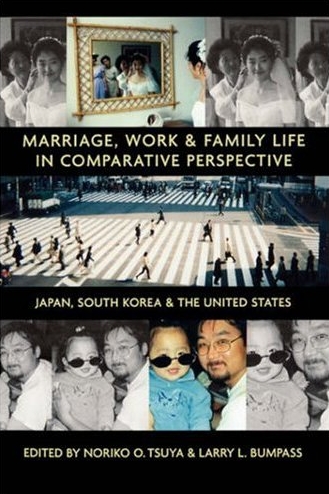
Well, before getting to the “why stage” though, you’d be surprised at how difficult it was to find even the most basic of demographic data on Korea in particular, even with the plethora of sources that a Korea Studies geek like myself has. And the only(!) book I have which does provide some of the answers: Marriage, Work and Family Life in Comparative Perspective: Japan, South Korea and the US (click on the image for a link to Amazon), I was originally very disappointed with when I first bought it over a year ago, for while it was published in 2004 most of its data actually comes from 1994 or even earlier, a flaw not exactly highlighted by the accompanying notes at online bookstores either. But forced out of desperation to reread it, I realized that I’d dismissed it too quickly: like a visiting UN demographer who lectured at my university once pointed out to me, demographics is all about waves, and as I’ll explain, 15 years later Korea is definitely still feeling the effects of the processes highlighted in this actually rather good book.

And, once I realized that, then I confess that I got a bit lost in it at that point, for the similarities and differences between the three countries are simply fascinating, and go well beyond mere numbers of extended families. In particular, after hearing it first on some old Korea Society podcast, I’ve often said that one’s generation in Korea is as important a marker of identity as, say, race is in the US, but I doubt that whoever I heard that phrase from meant it as anything more than an allusion to Korea’s extremely rapid rate of development (I know that I certainly haven’t!). But then I read this on page 61:

Korea tends to differ from the other two countries on a number of structural characteristics that are likely to [strongly] affect intergenerational relations.

But first, the basics. Seeing as they take up an entire chapter, then I won’t get into all the technical details and potential flaws of the methodologies of the surveys in the three countries sorry: suffice to say that, unless stated otherwise, all the statistics in the remainder of the post refer to married couples at the time of questioning, with both spouses between 30 and 59, and almost all for Korea, Japan and the US are from 1994, 1994, and 1988 respectively. Starting off then, the number of couples that were:

  • Living with the wife’s parents: Korea 4%, Japan 9%, and the US less than 1%
  • Living with the husband’s parents: Korea 24%, Japan 37%, and the US less than 1%

Yoshi Sugimoto, in his excellent book An Introduction to Japanese Society (2003), also notes that in 2000 “about a half of persons at or above the age of sixty-five live with their relatives, mainly with the family of one of their children” and that “this pattern is inconsistent with the prediction of modernization theory, that industrialization entails the overwhelming dominance of the nuclear family system” (p. 175). Far from being because immutable and deeply-held Neo-Confucian beliefs however, in reality:

…most two-generation families make [the] arrangement for pragmatic rather than altruistic reasons. Given the high cost of purchasing housing properties, young people are prepared to live with or close to their parents and provide them with home-based nursing care, in the expectation of acquiring their house after their death in exchange. Even if the two generations do not live together or close, aged parents often expect to receive living allowances from their children, with the tacit understanding that they will repay the “debt” by allowing the contributing children to inherit their property after death. This is why aged parents without inheritable assets find it more difficult  to live with their children or receive an allowance from them. (p. 176)

But why do more Japanese parents and married children live together than Korean ones? Rather than giving you the answer straight up, let me highlight the other differences, so that hopefully you might be able to work them out for yourself:

  • Korean parents are the least likely to be alive.
  • One half of Korean married couples surveyed grew up in rural areas and now live in urban areas, against a third for Japan and a figure “somewhat lower” in the US.
  • Naturally more US parents live further away from their children in either Japan or Korea (50% of both the wife’s and husband’s parents live more than 25 miles/40 km away), but there’s still a big difference between Japan and Korea: 28% of the wife’s parents and 24% of the husband’s parents live in a different district or municipality, against 45% and 38% respectively for Korea.
  • Only 46% of Korean husbands were eldest sons, against 56% in Japan.

And finally here are some more interesting facts, albeit more indicative and/or the cause of Korean women’s extremely low economic and political empowerment (possibly – make of them what you will) rather than why Japan has more extended families than Korean does:

  • Korea has the lowest number of couples in which both spouses are working: 22% against 57% in Japan, and 66% in the US. Undoubtedly these figures will have changed in the 15 years since then, but Korea is still exceptional in this regard, with the lowest number of working women in the OECD.
  • Korea has the lowest number of couples where the wife is older than the husband (4%), and the most where the husband is substantially older. In contrast, the figures for Japan and the US are 10% and 18% respectively.
  • Korean women don’t change their names when they get married, Japanese women do. The maintenance of “bloodlines” via male descendants continuing the family register known as hojuje (호주제) being more important in Korea then (at least until it was abolished last year),  until roughly a decade ago Korea had one of the most skewed sex-ratios in the world, and Koreans were notorious for refusing to adopt unwanted children, generally sending them overseas instead. The similar koseki (戸籍法) system in Japan does still continue, but there continuing the family name is important, leading families without a son to often adopt one for instance.

I confess, there appeared to be rather more noteworthy statistical differences and interesting tidbits when I began writing this post: I expected to have much more to say, and yet I find I’ve gotten through those in *cough* only 1470 words as I type this, half of which was an introduction/recap, albeit probably necessary. On the plus side though, I do see much of my role as a blogger as being to do condense (very) much larger pieces of work into their key points, thereby making them much more accessible to a wider audience, and so even if you can’t see the reasons for the differences in the numbers of extended families between Japan and Korea yet, if you just read the part of the authors’ summary below, then go back and look at the four points above the last (rather stylish) photo above, and then finally say something like “Ahh! Of course!” once you do…then I’ll know I’ve been doing the right thing!

…from a number of socioeconomic and demographic perspectives, Japan and the US are more like one another, and Korea is more distinctive. Korea’s mortality and fertility declines are more recent than either Japan’s or those the US. In Korea, the generation of middle-aged adults examined here has experienced all the dislocations and opportunities that go with a recent and rapid shift from an agricultural to a manufacturing and service economy, from a rural to an urban settlement pattern, and from a low level to a higher level of educational attainment. In the US and Japan, these transitions occurred somewhat earlier, and it is expected that the timing and nature of these transitions would affect patterns of intergenerational relations. (p.74, my emphases)

If you’re also interested in why so many unmarried Korean and Japanese children live with their parents, see here and here.

Korean Medical Association: Don’t Take the Pill!

All the contraceptive pills are gone...(Source: Surija / “Sray”; CC BY 2.0)

Why not? Well, because Korean women are stupid apparently, unable to do so much as read the instructions and numerous warnings about possible side-effects that come with the product, let alone do their own research and make their own choice about what contraception is best for them personally.

Or at least, that is the more benign reading of this warning from the KMA, and to be fair, given such factors as Koreans’ general reluctance to self-diagnose and be proactive about treating any medical condition that they might have themselves, and many Korean women’s complete reliance on men to use contraception, then at first glance there is nothing to distinguish the top-down, patronizing but also paternalistic tone of the KMA in the warning as any different from any other Korean institution’s relationship with the Korean public. In reality however, in its bias and scare-mongering it demonstrates an explicit and almost sinister vested interest in maintaining the huge abortion industry here.

No, really. That may sound like hyperbole, but then the Korean state already has a long history as an extremely invasive and coercive force in Koreans’ reproductive lives, its population policy in the 1960s and 1970s only slightly less draconian than that of China’s today, at many points having soldiers withdrawn from the DMZ at the height of the Cold War to deliver IUDs and perform abortions in the Korean countryside for instance (see this book for more on that). And such industry-related claims are also widely acknowledged of Japanese health authorities (albeit not so much in Japan itself), which banned the pill for three decades and which Japanese women are still scared of using, so why not of Korea ones too?

But regardless of that background, how else are we to interpret the evidence from just the KMA’s warning alone? Consider that:

  • It provides no information about possible side-effects that I didn’t already know about 10 years ago (and I’m a guy remember), which begs the question of why the Korea Times considered it “news” exactly.
  • It literally doesn’t provide a single positive medical benefit of using them, and naturally the Korea Times fails its most basic of journalistic duties by not providing them either.
  • It implies that somehow there is somehow something unique to contraceptive pills and not, say…amphetamines that makes women’s access to them in much more urgent need of being restricted.
  • And finally, that in a country where double-standards, moralistic pharmacists and medical staff, virtually non-existent sex education, and a lack of access already combine to severely limit women’s sexual confidence and choices of contraception in practice (see here)…surely it is telling that the most senior medical institution in the country is literally scaring women away from using the single safest and most effective contraceptive in human history?

Actually, I do agree that there are some benefits to women of, say, requiring a prescription from a doctor to get the pill, one poster in this forum (which I give a hat tip to for some of the above) pointing out that it means many women will usually get gynecological examinations at the same time, wheres they wouldn’t have bothered otherwise. But, one should always be very careful to acknowledge the different contexts in which they occur, and I dare say that most young British women buying contraceptives, for instance, are not asked by pharmacists if they’re married, or alternatively the same by doctors and nurses rather than a more neutral, non-judgmental inquiry as to if they are sexually active. To require a prescription in those circumstances would surely mean that many women simply wouldn’t go to get them all, which renders quick and easy access to the pill, albeit online if you don’t look 25 or older, one of the very few positives about Korean sexual culture (source, right: NEWSis).

Ending on another positive note, all trends in Korea point to continued increased use of the pill over time, and I’m not merely seeking brownie points among my readers when I say that I do have confidence in Korean women even just considering the pill not to be swayed by “warnings” like this. Given how, as I explained in my last post on the subject, half the battle is getting many Korean women to take an active role in using contraception at all, then merely thinking about all the pros and cons of the options available is an important first step. And of those that have done so, then I dare say that from that point on they will apply a more discerning eye to the ravings of groups like the KMA!

Update: In case anyone wants it, here is the original warning in Korean too.

Why are Korean and Japanese Families so Similar? Part 1: Neo-Confucianism

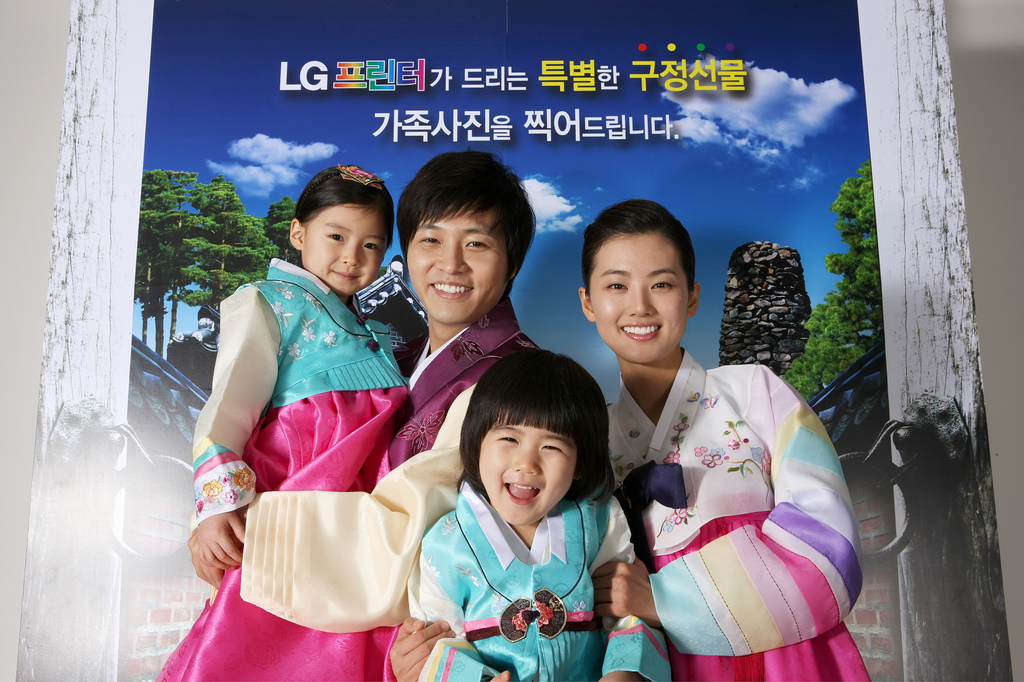
Korean Family LG Printer(Source: LG 전자; CC BY 2.0)

According to a recent study, Japanese women living with their parents-in-law are three times more likely to have a heart attack than those just living with their husbands. This, in a country famous for its very low rates of heart problems overall.

Which got me wondering about Korea. Korean family structures and gender roles are very similar to those of Japan, so it seems reasonable to suppose that the Japanese study has great relevance to Korea, and that a knowledge of Korean family life can reliably inform our interpretation of it.

Or does it? This is the question that has occupied me for past nine days, and, for readers by definition interested in Korean social issues, it is much less abstract and pedantic than perhaps it first sounds. Let me explain.

As a writer about Korean society, but often lacking in English-language material, frankly it is always a temptation to stress its similarities with Japan, just for the sake of having something to work with. But seriously, the huge Japanese role in the development of both the modern Korean state and economy has left profound and enduring legacies. Add that I’m a big proponent of the Marxian concept of base and superstructure—basically that much of a society’s oft-claimed timeless and enduring culture (one aspect of the superstructure) changes pretty damn quickly once economic structures or modes of production change (the base)—too, then it stands to reason that, with still broadly similar economic structures centered around horizontal and vertically-integrated conglomerates known as keiretsu and chaebol respectively, then much about daily life in both societies (workplace culture, working hours, drinking-culture, male-breadwinner based welfare systems, gender divisions between work and the home, and so on) would also be very similar. And it wouldn’t take much reading of just this blog alone to find that this indeed the case.

With that background and strong inclination however, there is always a danger of taking similarities as a given. And particularly in this case, where the authors of the study point out that:

One of the overwhelming things that stands out is that it doesn’t matter for Japanese men what the living arrangements are…they’re immune from stresses in the home (source, right: Urânia – José Galisi Filho).

And from which Samhita of the Feministing blog argues:

The article feigns surprise in finding out that men don’t have these same health problems, but fails to make the obvious conclusion that women get inordinate amounts of pressure from their in-laws to live up to certain expectations that increases stress in their lives. Many women are choosing not to get married or have as many children in Japan, but the culture of expectation around how women should act in the home seems resilient. I wonder if a similar correlation can be made with women that are living with their in-laws in the states?

Which is equally true of Korean brides, where those expectations include assuming the bulk of housework duties, and utter subservience to their mother-in-laws. Naturally, the ensuing potential for domestic tension and conflict make such living arrangements a staple of Korean dramas for decades, one such playing at the moment being You are My Destiny (너는 내 운명, but not to be confused with the 2005 movie with a similar name) starring the decidedly unhappy-looking bride Yuna below. Having said that, just like the traditional hanok houses that many of these dramas are inexplicably set in, one can’t help but assume that women’s disdain for eldest sons and the nuclearization of the Korean family mean that these living arrangements are increasingly rare in practice, which begs the question of why dramatizations of them remain so popular even today.

Writing a week ago, I thought it was because, in practice, living in separate homes has not diminished many parents’ intimate involvement in their childrens’ married lives, and hence the exaggerated situations of dramas still strike a chord amongst married couples and those of marriageable age. Indeed, the combination of Korea’s small size and improvement in Korea’s transport and communications infrastructure has made this even more possible and likely over time. Note that even as recently as the 1970s, a move to Seoul might entail not seeing parents and siblings in the countryside for many years, let alone friends who moved elsewhere in the country. (Source, above: HKGolden.)

But, to spare you the reflections on my preconceptions and academic baggage that took up much of an earlier version of this post, there comes a point where you need evidence. Much of those nine days were spent looking.

Fortunately, I was successful. But in the process, I discovered the question was much more difficult than I thought. Again, to spare readers from a frankly rather incoherent argument in a previous version of this post, in sum I learned that:

  • According to Yoshio Sugimoto’s brilliant An Introduction to Japanese Society (2003, pp. 175-176), Japanese dramas likewise dwell on intergenerational conflicts in households with extended families.
  • In fact, Japan has many of more such households than Korea (which will be discussed in Part 2).
  • But why? Crucially, Japanese society lacks the (Neo-)Confucianist ideology that underscores such family arrangement, and the ensuing conflicts.

Or so I thought. But, after a decade of constantly reading how Korea is the most Confucian country in the world, and “more Confucian than China,” I’d considerably underestimated Confucianism’s influence on the rest of East Asia.

Korean Woman Bench Sitting Gallery(Source: thomas park; CC BY 2.0)

This was revealed to me by Robert Smith in his chapter “The Japanese (Confucian) Family: The Tradition from the Bottom Up” in Tu Wei-Ming (ed.), Confucian Traditions in East Asian Modernity: Moral Education and Economic Culture in Japan and the Four Mini-Dragons (1996), and who aims to show:

…that it is impossible to advance a plausible argument that the Japanese family today is Confucian in the strict sense. It is equally impossible to argue that it has been completely purged of the effects of attempts by the authorities to structure it in terms of selected Confucian principles. (p. 157)

Some selected excerpts to make up the remainder of this post then. Please forgive me if there’s rather a lot of them, and apologies to any Japan-based readers who already started saying “Well…Duh!” to the computer screens some time ago, but hopefully they’ll still be helpful for any readers like myself that aren’t/weren’t as familiar with Japanese social history as they thought they were.

First, on why I had that impression that I did:

I have asked a hopelessly unrepresentative sample of Japanese colleagues, acquaintances, and friends whether contemporary Japanese think of themselves or their families as Confucian. The spontaneous answer is a resounding no, often supplemented by a dismissive reference to the conservative, reactionary, or feudal (a favorite term of opprobrium in Japan) character of its teachings. The implication is that one’s grandfather or great-grandfather may have been taught Confucian ethics and might even have internalized them, but in 1945 the Japanese consigned Confucianism to the dustbin of history. (p. 157)

There is one obvious difference between the role of Confucianism in China and Japan, where is has always been only one of many competing ideologies, philosophies and ethical systems, and never, as in China, “a way of life encompassing the ultimate standards for Chinese social and political order.” (158)

And the Japanese tend to underplay the Confucian influence in their own society because:

Japanese Confucianism started as a cultural ideology serving the needs of the Tokugawa Bakufu (or Shōgun, or Army Commander)….Although for a time Confucianism had been discredited along with everything else associated with the shogunate, it gained currency again with the consolidation of conservative power in the late 1920s and 1930s. (p. 158-9).

The latter of which was the decade when:

…Japanese society was being reduced at the hands of fanatics to its most stifling condition of oppressive irrationalism [and] in which the ideals of the Japanese educational world were closer to those of its Togukawa past than at any time since 1870….Is it any wonder that today’s Japanese, if they have thought about it at all, are likely to view Confucianism in a negative light? (p. 159, my emphasis)

Now, why the influence of Confucianism on the Japanese and particularly the Japanese family remains pervasive nevertheless:

Were the Japanese ever Confucianists in, say, the same sense as the Koreans? No one claims that they were. Nevertheless, there are many ways in which the Confucianist concern with hierarchical relationships and its emphasis on harmonious families as the basis for harmonious states seems to have influenced Japanese society. Be that as it may, it is just as likely that the Japanese selectively utilized Confucian teachings to reaffirm and strengthen characteristics of their society, which was deeply rooted in the pre-Confucian past.

Presumably one of the domains in which Confucianism did not simply reinforce and justify older social practices is the treatment of women, for it is widely argued that they enjoyed a far more favorable position in Japanese society before the introducton of Confucianism. It may well be, however, that the decline of women’s status in Japan actually began with the popularization of Buddhism. (pp. 160-1, my emphasis)

Finally:

The question is not whether Confucianism is a religion. It is rather: Does Confucianism, broadly defined (or, perhaps better, undefined) have anything at all to do with religion in Japan?

The “rules” by which religions are tacitly expected to operate in Japan are, more than anything else, Confucian. As so often in Japan, Confucianism plays the role of a moral and ethical substratum that, its preconditions being met, allows a harmless surface diversity. Indeed, one could argue, as many have, that these principles go back beyond Confucian influences on early Japan to the values inherent in ancient clan structures and an agricultural society with their demands for loyalty and cooperative effort; Confucianism did not so much crate as articulate the values by which Japanese society works.

Virtually all religions that have endured in Japan have adapted external forms agreeable to the patriarchal family model and have made their peace with the state. (p. 171, my emphasis)

At this point, a more thorough blogger than myself would probably move onto those passages where Smith discusses that latent Confucianism within Japanese families (and the education system) more specifically, but I think that readers can reasonably extrapolate those from the big picture that I have already provided rather than requiring me to add those too. Ergo, Japanese families are indeed (Neo) Confucianist, and I’m especially glad that demonstrating that gave me a legitimate opportunity to get stuck into my recently purchased copy of Tu-Wei Ming’s book. But while 2500 words is a rather short post (for me), given the long time this one took and that Confucianism, Demographics and Biological Anthropology are much more discreet subjects than what I normally blog about, I’ll wisely end this post here!

Update

Although they’re not really related to the topic at hand, the questions of: a) to what extent the US could be described as a “Christian country” and b) whether Confucianism is a religion or not came up in the comments, and are interesting in their own rights. And while I’m usually reluctant—yes, really—to type out literally entire pages from books here, Robert Smith does answer both much better than I could:

To what extent has the Japanese family ever been Confucian, and to what extent is it today? Would that the question could be so easily answered. Even the most casual survey of the vicissitudes of Confucianism in Japan suggests the need for caution. Indeed, I was tempted to indicate just how cautious one must be by titling this essay either “Confucianism Is in the Eye of the Beholder” or “Confucian Is as Confucian Does.” That is to say, how Confucianism is described, the praises sung of it, the importance assigned to it, and the terms by which it is denounced are all very strongly colored by the historical period in which the assessments are made, the position in the social hierarchy of the person expressing the opinion, and – not least in recent times – the age and gender of those who views they are.

I hasten to add that in these respects Confucianism seems to me rather like all other philosophical, ethical, and/or religious systems of whatever time or place. An example, drawn from personal experience with one such system, involves one of the myriad subcategories of the southern United States brand of Protestantism. Fifty years ago its construction of Christianity was a finely crafted one that had no place for Catholics, who were thought of as idolaters, or for Quakers, of whom few had ever heard. Depending on the particular church and the position of its minister on the issue, it was not always entirely clear that Methodists and Presbyterians were Christian either.

Be that as it may, did my relatives and neighbors think that they themselves led Christian lives? Of course they did, or tried to. Were it to be pointed out that someone had committed some “unchristian” act, the usual explanations were that all are conceived and born in sin, that it all happened before the miscreant had found God – or perhaps it was because Christ had found him. It is all now too far in the past for me to recall the full inventory of shifting grounds on which our neighbors and relatives took their unshakable Christian stands. Would they have agreed – and do they still – that the United States is a “Christian country”? Of course. They have never doubted it….Yet I wager that in the course of conducting interviews on the subject, you could collect scores of definitions – some of them flatly contradictory – of just what the term “a Christian country” might mean. There is bound to be some overlap, to be sure, but no consensus. Are we then to conclude that the United States is not a Christian country? I think not. But I submit that consensus on the religious and ethical dimensions of Christianity is not much more likely to be achieved than agreement as to precisely what Confucianism might be and whether the Japanese family is a Confucian institution.

It is possible, of course, that I am looking in the wrong place for an authoritative definition, and would be better advised to seek it among the philosophers, the theologians, the ethicists, or the intellectual historians. My reading of the relevant sources, however, strongly suggests that consensus at the tip is even more difficult to achieve than at the bottom. In any event, my anthropological training predisposes me to start at ground level. (pp. 155-157)

Thoughts?

Korea’s “Lonely Geese” Families: More of them than you may think

Back in July, I wrote a lengthy post* on the reasons behind and implications for Korean society of the high numbers of “weekend couples” (주말부부) and “lonely geese fathers” (외기러기) here, the latter generally referring to fathers who remain in Korea to work while their families live overseas for the sake of the children’s eduction. Back then, no statistics on the numbers of either seemed to be Shy Korean Boyavailable, so I speculated that the combination of both meant that a total of perhaps one in fifteen to one in ten Korean teenagers lived in a different city to their father most of the time (source, left: James Kim; CC BY-SA 2.0).

But it turns out that perhaps I underestimated that number: according to this recent survey of single women, effectively teenagers in this particular sense, for Koreans tend to live at home until marriage (although this is more for economic rather than the cultural reasons usually cited: see here and here), as many as one in eight Korean families have “at least one immediate family member living apart from the rest”. True, on the one hand that figure will include also university students living away from home, but then they are not common as I explain in those two posts linked to above, and on the other it wouldn’t contain the “international” lonely goose fathers I mention above either, so ultimately I’d wager that 90% or more of those one in eight immediate family members referred to would indeed be fathers working in different cities during the week.

There are some other interesting points made in that survey, but as it doesn’t mention the numbers and methodology (par for the course for most Korean newspapers unfortunately), then I’d take them with a grain of salt. But I think that the figures for geese families would be pretty consistent whatever the sample size.

*Since deleted sorry.

Ich bin ein Westerner

Foreigners Gangnam Style(Source: Republic of Korea; CC BY-SA 2.0)

Steve, who is unfortunately leaving Korea soon, has written a short but interesting post about the meanings and ramifications of the terms waekookin (외국인) in Korea and gajin (外国人) in Japan over at his blog Where is Cheongju Again?, and long-timers here especially could do much worse than take the five minutes to read it over their coffee this morning. Overall, he makes a pretty convincing case for Westerners in both countries referring to and thinking of themselves as such rather than simply as “foreigners” (the basic translation of both words), and I’ll be doing so myself from now on.

It may not sound like much, but like I said in this forum, Korea’s (and Japan’s) “bloodline”-based notions of nationalism and citizenship emphasize and exaggerate the differences between natives and non-natives to an extent rarely found elsewhere in the world, and the constant reminders of these quickly become wearisome to anyone who’s spent even just a few months living here, let alone eight years. Also, ironically, constantly hearing the term waekookin in our daily lives probably means that we come to adopt some of the same notions of division and distance ourselves too, and the effect snowballs.

A little cliched? Perhaps. But still, the term is such an immutable fact of expat life here that probably few of us have ever given some thought to it, and it surely can’t harm to do so. Not least, by a grizzled and cynical old timer like myself.

Update: If you found this post interesting, then you might want to check out this thread on Dave’s ESL Cafe too. To those of you not in Korea especially, it gives a good idea of how (over)used the word “foreigner” is here, and just how quickly it can become annoying.

Paternity Leave in Korea from Next Year?

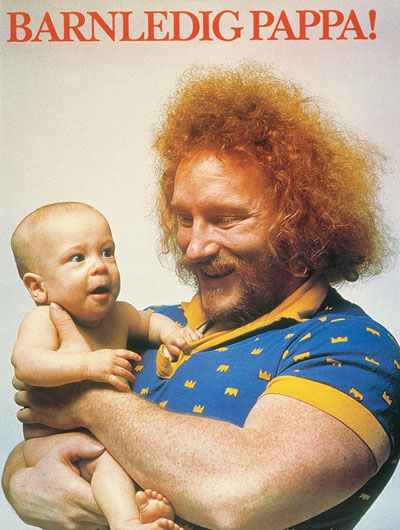
From page 3 of the September 12, 2007 Busan Focus:Paternity Leave, 1970s Swedish Poster

출산휴가가는男: 내년7월 배우자 3일 부여 ‘남녀고용평등법’등 의결

내년 7월부터 남성근로자도 배우자 출산휴가를 사용할 수 있으며, 육아휴직을 나눠 쓰거나 육아휴직대신 근로시간 단축방법도 사용할 수 있게 된다.

정부는 11일 오전 중앙청사에서 한덕수 총리 주재로 국무회의를 열어 일과 육아의 병행을 위해 이 같은 내용을 핵심으로 하는‘남녀고 용평등법’개정안 등 20여개 안건을 심의, 의결했다. 이 개정안은 그간 사업장별로 임의로 시행해 오던 남성근로자의 출산휴가를 3일간 부여하는 것으로 의무화했으며, 현행 전일제 육아휴직 대신 주 15~30시간 이내의 범위에서 근무하는 육아기 근로시간 단축을 신청할 수있도록 하고, 육아휴직이나 육아기근로시간 단축제를 1회에 한해 분할 사용할 수 있도록 하고 있다.

또 육아기 근로시간 단축을 이유로 해고나 불리한 처우를 하는 사업자의 경우 3년 이하의 징역이나  2천만원 이하의 벌금, 육아기 근로 시간 단축 종료 후 같은 업무에 복귀시키지 아니할 경우 500만원 이하의 벌금, 그리고 배우자 출산휴가를 주지 않을 경우 500만원 이하의 과태료를 부과하도록했다 (image source: On Being; CC BY-NC-SA 2.0).

또 국제화 시대를 맞아 ▲ 회사의 설립·운영 등에 사적 자치를 폭넓게인정하는 유한책임회사 등 새로운기업형태를 도입하고 ▲무액면주식 제도의 도입과 최저자본금제도의폐지 등 상법 개정안도 심의했다.

Men on Paternity Leave: To fulfill the requirements of the law on gender equality in the workplace, a 3 day paternity leave is to be available from next July

From next July, the spouses of women taking time off work to give birth can also take time off from work, either for the birth itself or by shortening their work hours by an equivalent amount.

On the Morning 11th of September, the prime minister Han Deok-Su, opened a session of Congress focusing on work and childcare. Congress members deliberated on a bills regarding the law on gender equality in the workplace and on 20 other matters, and passed a law that will require all workplaces to provide paternity leave to male employees. They will be given the option of either taking 3 days at the time of the birth of the child, or have their working hours reduced by 15-30 hours at alternate times when it is convenient to them. These 15-30 hours will not have to be taken all at once.

If employers use this reduction of work hours as a pretext to fire an employee or treat him unfairly, then the employer will be liable for a jail sentence of up to 3 years or a fine of 20 million won. Also, if an employee is not allowed to continue in the same position after returning from paternity leave, or if paternity leave isn’t granted at all, then the employer will be liable for a fine of up to 5 million won.

Since we are in a globalized age, Korean companies need to introduce more scope for employee’s personal autonomy in their establishment and operations. Also discussed at the congress was the introduction into commercial law of a no-par stock system and the discarding of a minimum capital stock system.

For the sake of comparison, see here for a table showing different countries’ parental leave provisions.