The 14-year old girl is Park Seo-jin, the controversial photoshoot from the Mnet reality show I Am A Model. It’s already covered in numerous “news” articles though, so let me just quickly highlight one element of it here: that for all the recent and historical mania about protecting underage girls against foreign pedophiles, the Korean police seem strangely reluctant to respect their own laws banning the nude photos of minors that would (presumably) encourage them. The most obvious examples being one of the promotion posters for—let alone various scenes in—Samaritan Girl/Samaria (2004), all shot when actress Kwak Ji-min was still in high school, and therefore legally a minor.
Like with those, no-one will ever be prosecuted for Park Seo-jin’s photos. Unlike those though, they do seem to be creating much more negative reaction. Most likely, simply because she is just sooo young.
What do you think?
Update: In case of any confusion, note that while she’s 16 according to the (strange) Korean age system, her birth date is actually 11 March 1994.
According to a recent study, Japanese women living with their parents-in-law are three times more likely to have a heart attack than those just living with their husbands. This, in a country famous for its very low rates of heart problems overall.
Which got me wondering about Korea. Korean family structures and gender roles are very similar to those of Japan, so it seems reasonable to suppose that the Japanese study has great relevance to Korea, and that a knowledge of Korean family life can reliably inform our interpretation of it.
Or does it? This is the question that has occupied me for past nine days, and, for readers by definition interested in Korean social issues, it is much less abstract and pedantic than perhaps it first sounds. Let me explain.
As a writer about Korean society, but often lacking in English-language material, frankly it is always a temptation to stress its similarities with Japan, just for the sake of having something to work with. But seriously, the huge Japanese role in the development of both the modern Korean state and economy has left profound and enduring legacies. Add that I’m a big proponent of the Marxian concept of base and superstructure—basically that much of a society’s oft-claimed timeless and enduring culture (one aspect of the superstructure) changes pretty damn quickly once economic structures or modes of production change (the base)—too, then it stands to reason that, with still broadly similar economic structures centered around horizontal and vertically-integrated conglomerates known as keiretsu and chaebol respectively, then much about daily life in both societies (workplace culture, working hours, drinking-culture, male-breadwinner based welfare systems, gender divisions between work and the home, and so on) would also be very similar. And it wouldn’t take much reading of just this blog alone to find that this indeed the case.
With that background and strong inclination however, there is always a danger of taking similarities as a given. And particularly in this case, where the authors of the study point out that:
One of the overwhelming things that stands out is that it doesn’t matter for Japanese men what the living arrangements are…they’re immune from stresses in the home (source, right: Urânia – José Galisi Filho).
And from which Samhita of the Feministing blog argues:
The article feigns surprise in finding out that men don’t have these same health problems, but fails to make the obvious conclusion that women get inordinate amounts of pressure from their in-laws to live up to certain expectations that increases stress in their lives. Many women are choosing not to get married or have as many children in Japan, but the culture of expectation around how women should act in the home seems resilient. I wonder if a similar correlation can be made with women that are living with their in-laws in the states?
Which is equally true of Korean brides, where those expectations include assuming the bulk of housework duties, and utter subservience to their mother-in-laws. Naturally, the ensuing potential for domestic tension and conflict make such living arrangements a staple of Korean dramas for decades, one such playing at the moment being You are My Destiny (너는 내 운명, but not to be confused with the 2005 movie with a similar name) starring the decidedly unhappy-looking bride Yuna below. Having said that, just like the traditional hanok houses that many of these dramas are inexplicably set in, one can’t help but assume that women’s disdain for eldest sons and the nuclearization of the Korean family mean that these living arrangements are increasingly rare in practice, which begs the question of why dramatizations of them remain so popular even today.
Writing a week ago, I thought it was because, in practice, living in separate homes has not diminished many parents’ intimate involvement in their childrens’ married lives, and hence the exaggerated situations of dramas still strike a chord amongst married couples and those of marriageable age. Indeed, the combination of Korea’s small size and improvement in Korea’s transport and communications infrastructure has made this even more possible and likely over time. Note that even as recently as the 1970s, a move to Seoul might entail not seeing parents and siblings in the countryside for many years, let alone friends who moved elsewhere in the country. (Source, above: HKGolden.)
But, to spare you the reflections on my preconceptions and academic baggage that took up much of an earlier version of this post, there comes a point where you need evidence. Much of those nine days were spent looking.
Fortunately, I was successful. But in the process, I discovered the question was much more difficult than I thought. Again, to spare readers from a frankly rather incoherent argument in a previous version of this post, in sum I learned that:
According to Yoshio Sugimoto’s brilliant An Introduction to Japanese Society (2003, pp. 175-176), Japanese dramas likewise dwell on intergenerational conflicts in households with extended families.
In fact, Japan has many of more such households than Korea (which will be discussed in Part 2).
But why? Crucially, Japanese society lacks the (Neo-)Confucianist ideology that underscores such family arrangement, and the ensuing conflicts.
Or so I thought. But, after a decade of constantly reading how Korea is the most Confucian country in the world, and “more Confucian than China,” I’d considerably underestimated Confucianism’s influence on the rest of East Asia.
…that it is impossible to advance a plausible argument that the Japanese family today is Confucian in the strict sense. It is equally impossible to argue that it has been completely purged of the effects of attempts by the authorities to structure it in terms of selected Confucian principles. (p. 157)
Some selected excerpts to make up the remainder of this post then. Please forgive me if there’s rather a lot of them, and apologies to any Japan-based readers who already started saying “Well…Duh!” to the computer screens some time ago, but hopefully they’ll still be helpful for any readers like myself that aren’t/weren’t as familiar with Japanese social history as they thought they were.
First, on why I had that impression that I did:
I have asked a hopelessly unrepresentative sample of Japanese colleagues, acquaintances, and friends whether contemporary Japanese think of themselves or their families as Confucian. The spontaneous answer is a resounding no, often supplemented by a dismissive reference to the conservative, reactionary, or feudal (a favorite term of opprobrium in Japan) character of its teachings. The implication is that one’s grandfather or great-grandfather may have been taught Confucian ethics and might even have internalized them, but in 1945 the Japanese consigned Confucianism to the dustbin of history. (p. 157)
…
There is one obvious difference between the role of Confucianism in China and Japan, where is has always been only one of many competing ideologies, philosophies and ethical systems, and never, as in China, “a way of life encompassing the ultimate standards for Chinese social and political order.” (158)
And the Japanese tend to underplay the Confucian influence in their own society because:
Japanese Confucianism started as a cultural ideology serving the needs of the TokugawaBakufu(or Shōgun, or Army Commander)….Although for a time Confucianism had been discredited along with everything else associated with the shogunate, it gained currency again with the consolidation of conservative power in the late 1920s and 1930s. (p. 158-9).
The latter of which was the decade when:
…Japanese society was being reduced at the hands of fanatics to its most stifling condition of oppressive irrationalism [and] in which the ideals of the Japanese educational world were closer to those of its Togukawa past than at any time since 1870….Is it any wonder that today’s Japanese, if they have thought about it at all, are likely to view Confucianism in a negative light? (p. 159, my emphasis)
Now, why the influence of Confucianism on the Japanese and particularly the Japanese family remains pervasive nevertheless:
Were the Japanese ever Confucianists in, say, the same sense as the Koreans? No one claims that they were. Nevertheless, there are many ways in which the Confucianist concern with hierarchical relationships and its emphasis on harmonious families as the basis for harmonious states seems to have influenced Japanese society. Be that as it may, it is just as likely that the Japanese selectively utilized Confucian teachings to reaffirm and strengthen characteristics of their society, which was deeply rooted in the pre-Confucian past.
Presumably one of the domains in which Confucianism did not simply reinforce and justify older social practices is the treatment of women, for it is widely argued that they enjoyed a far more favorable position in Japanese society before the introducton of Confucianism. It may well be, however, that the decline of women’s status in Japan actually began with the popularization of Buddhism. (pp. 160-1, my emphasis)
Finally:
The question is not whether Confucianism is a religion. It is rather: Does Confucianism, broadly defined (or, perhaps better, undefined) have anything at all to do with religion in Japan?
…
The “rules” by which religions are tacitly expected to operate in Japan are, more than anything else, Confucian. As so often in Japan, Confucianism plays the role of a moral and ethical substratum that, its preconditions being met, allows a harmless surface diversity. Indeed, one could argue, as many have, that these principles go back beyond Confucian influences on early Japan to the values inherent in ancient clan structures and an agricultural society with their demands for loyalty and cooperative effort; Confucianism did not so much crate as articulate the values by which Japanese society works.
…
Virtually all religions that have endured in Japan have adapted external forms agreeable to the patriarchal family model and have made their peace with the state. (p. 171, my emphasis)
At this point, a more thorough blogger than myself would probably move onto those passages where Smith discusses that latent Confucianism within Japanese families (and the education system) more specifically, but I think that readers can reasonably extrapolate those from the big picture that I have already provided rather than requiring me to add those too. Ergo, Japanese families are indeed (Neo) Confucianist, and I’m especially glad that demonstrating that gave me a legitimate opportunity to get stuck into my recently purchased copy of Tu-Wei Ming’s book. But while 2500 words is a rather short post (for me), given the long time this one took and that Confucianism, Demographics and Biological Anthropology are much more discreet subjects than what I normally blog about, I’ll wisely end this post here!
Update
Although they’re not really related to the topic at hand, the questions of: a) to what extent the US could be described as a “Christian country” and b) whether Confucianism is a religion or not came up in the comments, and are interesting in their own rights. And while I’m usually reluctant—yes, really—to type out literally entire pages from books here, Robert Smith does answer both much better than I could:
To what extent has the Japanese family ever been Confucian, and to what extent is it today? Would that the question could be so easily answered. Even the most casual survey of the vicissitudes of Confucianism in Japan suggests the need for caution. Indeed, I was tempted to indicate just how cautious one must be by titling this essay either “Confucianism Is in the Eye of the Beholder” or “Confucian Is as Confucian Does.” That is to say, how Confucianism is described, the praises sung of it, the importance assigned to it, and the terms by which it is denounced are all very strongly colored by the historical period in which the assessments are made, the position in the social hierarchy of the person expressing the opinion, and – not least in recent times – the age and gender of those who views they are.
I hasten to add that in these respects Confucianism seems to me rather like all other philosophical, ethical, and/or religious systems of whatever time or place. An example, drawn from personal experience with one such system, involves one of the myriad subcategories of the southern United States brand of Protestantism. Fifty years ago its construction of Christianity was a finely crafted one that had no place for Catholics, who were thought of as idolaters, or for Quakers, of whom few had ever heard. Depending on the particular church and the position of its minister on the issue, it was not always entirely clear that Methodists and Presbyterians were Christian either.
Be that as it may, did my relatives and neighbors think that they themselves led Christian lives? Of course they did, or tried to. Were it to be pointed out that someone had committed some “unchristian” act, the usual explanations were that all are conceived and born in sin, that it all happened before the miscreant had found God – or perhaps it was because Christ had found him. It is all now too far in the past for me to recall the full inventory of shifting grounds on which our neighbors and relatives took their unshakable Christian stands. Would they have agreed – and do they still – that the United States is a “Christian country”? Of course. They have never doubted it….Yet I wager that in the course of conducting interviews on the subject, you could collect scores of definitions – some of them flatly contradictory – of just what the term “a Christian country” might mean. There is bound to be some overlap, to be sure, but no consensus. Are we then to conclude that the United States is not a Christian country? I think not. But I submit that consensus on the religious and ethical dimensions of Christianity is not much more likely to be achieved than agreement as to precisely what Confucianism might be and whether the Japanese family is a Confucian institution.
It is possible, of course, that I am looking in the wrong place for an authoritative definition, and would be better advised to seek it among the philosophers, the theologians, the ethicists, or the intellectual historians. My reading of the relevant sources, however, strongly suggests that consensus at the tip is even more difficult to achieve than at the bottom. In any event, my anthropological training predisposes me to start at ground level. (pp. 155-157)
Just some quick good news that my presentation proposal “Backlash: The Role of the Asian Financial Crisis in the Feminization of Korean Ideals of Male Beauty”has been accepted for the sixth International Convention of Asia Scholars (ICAS) conference at Chungnam National University in Daejeon in August next year. I understand if you won’t be penciling anything in your 2009 diary quite yet though, so I’ll make sure to post a reminder closer to the date—it would be nice to meet any readers while I’m there, and to receive feedback.
In the meantime, here’s the abstract, based on this (5100 word!) post from earlier in the year:
In the mid-1990s, the dominant images of men in Korean popular culture were of strong, masculine figures that protected and provided for women, mirroring the male breadwinner ethos that underlay Korea’s then prevalent salaryman system and which, by dint of being much larger and more integral to the Korean economy than the Japanese one with which it is most often associated, had a correspondingly larger hold on the Korean psyche. Despite this, in accounting for the complete switch of dominant images of men to effeminate, youthful “kkotminam” in just a few short years after the Asian Financial Crisis of 1997-98, what limited literature exists on evolving Korean sexuality and gender roles in the last decade seems to exhibit a curious blind spot as to possible economic and employment-related factors, instead attributing it to, variously, a rising general “pan-Asian soft masculinity”, the import of Western notions of metrosexuality, and particularly of Japanese ones of “bishōnen”.
In this paper, I begin by acknowledging the validity of these factors but argue that the dominance of Japan in East Asian cultural studies has led scholars to overemphasize the latter, in turn ascribing too much agency to Korean women in their late-teens and early-twenties that were the primary recipients of such Japanese cultural products as “yaoi” fan-fiction. This is anachronistic, as public displays and discussions of female sexuality and ideals of male beauty were in reality very much proscribed in Korea for unmarried women before the 2002 World Cup, the locus of which was primarily married women instead. Indeed, as I will next discuss, in the mid-1990s there was an sudden and intense public discourse on both generated by increasingly radical depictions of married women’s sex lives in books and films, partially reflecting the coming of the age of the first generation of Korean women to receive democratic notions of gender and family life through their schooling but then encountering the reality of Korean patriarchy in their marriages, and partially also the concomitant liberation represented by increased numbers of Korean women entering the workforce: small, but growing, and symbolically significant in that they vindicated decades of the relegation of feminist concerns to the wider aims of the democratization movement as a whole, with the understanding that they would be addressed upon its success.
It is in these contexts that the Asian Financial Crisis struck Korea, and married women in particular would be the first to be laid-off as part of restructuring efforts, with the explicit justification that they would be supported by their husbands. Rather than retaining and reaffirming breadwinner ideals of male beauty as encouraged however, in the final part of this paper I demonstrate how images of men in Korean popular culture were suddenly dominated by kkotminam and such indirect criticisms of salarymen as were permitted under prevailing public opinion. This was a natural reaction to circumstances, and I conclude that explanations for the shift that do not consequently take the role of the crisis as a catalyst into account are inadequate.
In hindsight, my overall argument about the increasing popularity of feminine ideals of Korean male beauty—that it at least partially stemmed from a sense of backlash and anger by Korean married women at their mass lay-offs and so forth—could possibly have been made a little clearer in that last paragraph, but then I was only just shy of the 500 word limit, and I’m not sure that I could have fitted everything necessary in otherwise. But it did the job! :D
벗겨라, 팔리리라! Undress the Models and the Products Will Sell!”
에로틱 광고, 잡지에서 거리로 나왔다…예술과 외설 사이 아슬아슬한 줄타기” 광고 속 에로스. Borderline indecent advertisements formerly only found in magazines are now on the streets (16 December 2006).
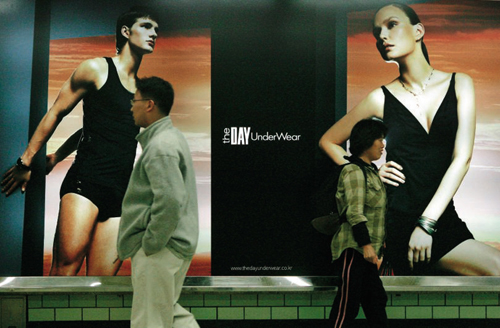
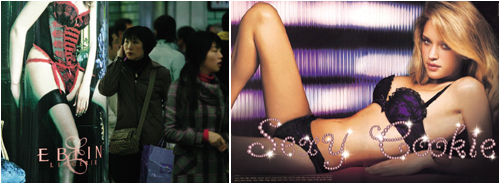
▶근육질의 남성과 섹시한 여성이 반라 차림으로 서로를 그윽하게 바라보는 속옷 광고 (서울 지하철 2호선 삼성역). A muscular, semi-nude man and sexy woman furtively looking at each other in this underwear advertisement (Samseong Station, Seoul Subway Line 2).
브래지어와 팬티 차림의 여성이 거리를 점령했다. 잘록한 허리에 배꼽을 드러내다 못해 엉덩이까지 절반쯤 나온 섹시한 여성의 눈빛이 버스 정류장에서 혹은 지하철 역사에서 남성들의 시선을 붙잡는다. 예술과 외설 사이를 아슬아슬하게 넘나드는 속옷 광고들이다.
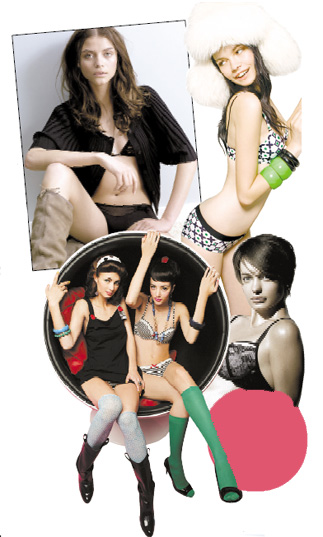
Advertisements with women in just their bras and panties are to be found on streets everywhere these days, but presenting narrow, slender waists and navels are no longer enough for advertisers, and so many at bus stops and subways stations now reveal women’s buttocks too, which naturally gain the attention of more men than women. Many are not so much artistic, as bordering on the indecent.
과거 잡지 속에서나 볼 수 있었을 만한 아찔한 속옷 광고들이 당당히 거리로 나왔다. 속옷 광고뿐만이 아니다. 녹차 광고나 심지어 커피숍 광고도 일단 벗고 본다. 에로틱한 분위기의 광고는 제품과 관계없이 일단 사람들의 호기심을 불러 일으키는 법. 이것을 광고 제작자들이 놓칠 리 없다. 그러나 너무 많이 벗은 탓일까? 반라의 남녀가 넘쳐나는 거리를 행인들은 무심히 지나간다.
Such revealing advertisements used to be only found in magazines, but now you can find them on the street. It’s not just lingerie advertisements which have such revealing images either: even tea drink companies and coffee shops use them also, trying to attract the curiosity of passers-by with sexual images that have no actual relation to the products being sold. Other advertisers can’t help but notice this trend and be sucked in by it, but don’t you think it’s too much? Indeed, there are so many images of semi-nude men and women on our streets these days that in fact people may be taking less and not more notice of them.
▶위 : (주)좋은사람들이 지난해 8월 20대 후반 여성을 타깃으로 런칭한 속옷 브랜드 ‘섹시쿠키(Sexy Cookie)’의 지면 광고. 아래 : 국내 속옷시장에 패션 바람을 몰고 온 이랜드 계열의 속옷 브랜드 ‘에블린’의 광고판 (서울 지하철 2호선 삼성역). Left: An advertisement for a new kind of lingerie from “Eblin”, set to be quite a trend in the national lingerie fashion market. Right: An advertisement from August 2005 launching Korean company “Good People”‘s new lingerie brand “Sexy Cookie”, targeted at women in their late twenties (both advertisements from Samseong Station, Seoul Subway Line 2).
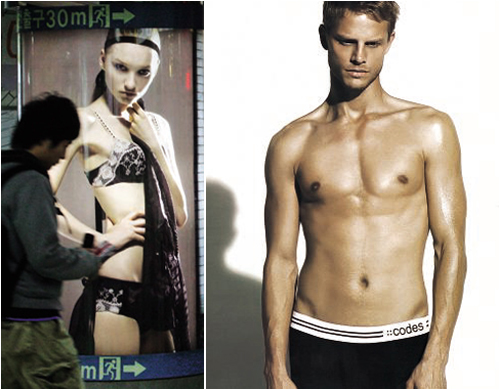
▶좌 : 반라차림의 여인을 전면에 내세운 속옷 광고판 앞을 한 남성이 무심히 지나가고 있다 (서울 지하철 4호선 명동역). 우 : 여성만 벗는 것이 아니다. 남성도 벗는다. 근육질의 남성 모델을 내세운 ‘코데스콤바인’의 지면 광고. Left: A man absentmindedly walks by a lingerie advertisement. Right: A muscular man in a Korean “Codes Combine” underwear advertisement (both advertisements from Myeong-dong Station, Seoul Subway Line 4).
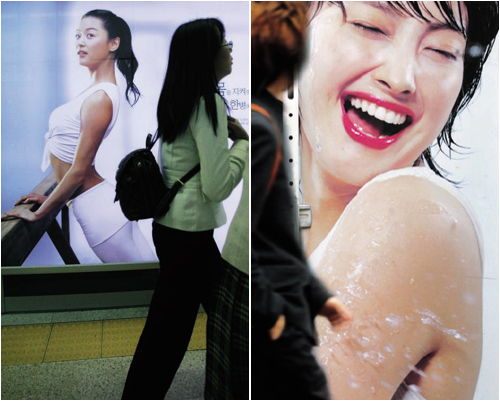
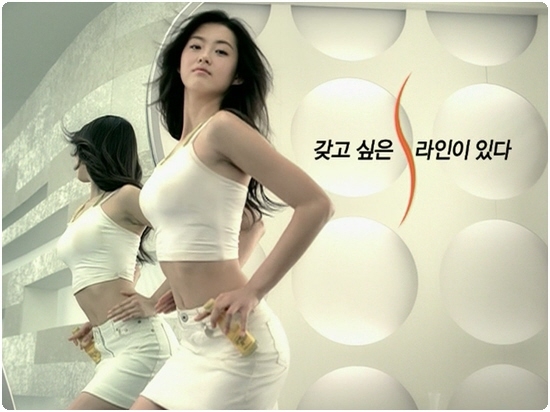
▶좌 : 반라의 여성모델을 내세우는 것은 속옷 광고만이 아니다. 전지현의 S라인을 전면에 내세운 ‘17차’의 광고판.(서울 지하철 2호선 강남역). 우 : 화장품 광고라고 해서 얼굴만 대문짝만 하게 찍는 것은 아니다. 살짝쿵 벗어 주는 센스를 보여준 ‘라네즈’의 거리 광고 (서울 홍대앞). Left: The semi-nude women in this advertisement is not advertising lingerie, but is actually the actress Jun Ji-hyun advertising a tea drink (Gangnam Station, Seoul Subway Line 2). Right: An advertisement for Laneige cosmetics in which the model’s face has been greatly enlarged, but with which we somehow get the impression of her being semi-nude (Hongdae University area, Seoul).
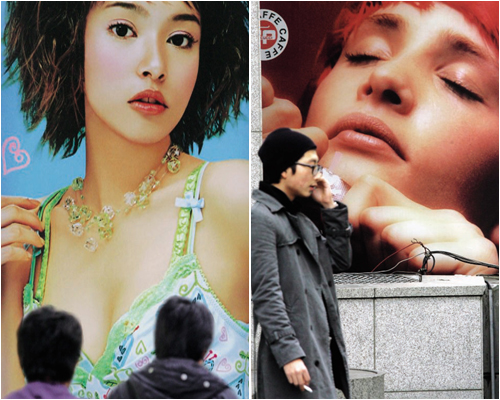
▶좌 : 홍대앞 속옷가게 앞에 걸린 광고판을 뚫어져라 바라보고 있는 두 남자. 우 : 벗는 것만이 에로스는 아니다. 살며시 눈을 감은 여인의 얼굴에서 살포시 읽히는 에로틱함으로 행인을 유혹하는 커피숍 광고 (서울 홍대앞). Left: Two men’s gazes penetrate a lingerie advertisement in the Hongdae University area. Right: This women’s softly closed eyes while reading a book give a slightly erotic and seductive impression to this coffee shop advertisement, persuading passers-by to come inside (Hongdae University area, Seoul).
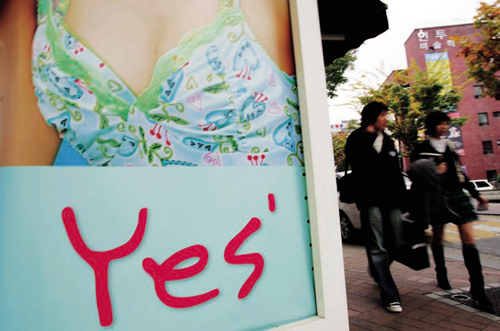
▶풍만한 여인의 가슴을 그대로 노출한 속옷 브랜드 ‘ Yes’의 거리 광고 (서울 홍대앞). A “Yes” lingerie advertisement exposing a woman’s voluptuous breasts (Hongdae University area, Seoul; End)
As a further example, contrast two recent bra commercials with Han Ye-seul (한예슬) for Venus (비너스) with I think a 2003 one with Go So-young (고소영). Whereas Han Ye-seul’s unabashedly presents herself — or rather, her breasts — as an object for the male gaze, Go So-young advertised the ‘Nudy Bra’ on the basis of bra-straps and lines not being visible, and therefore unlikely to attract any unwanted attention from men.
Finally, another article from the JoongAng Daily on the rapid change in fashions and attitudes:
Underwear emerges from the shadows
(September 04, 2007)
Underwear has been an integral part of the fashion industry for so long that saying “underwear is outerwear” now feels trite.
Ever since the 1990s, when Courtney Love sported a rag-doll look, wearing nothing but big red lips and a stark white slip, the boundary separating underwear from outerwear has become very thin. It now seems like the line will vanish altogether.
Looking through a rack of neon-colored swimsuits at the Galleria department store, Kim Ji-eun, 27, revealed her own summer fashion tip. “I’ve been wearing halter-style bikini tops in pretty colors under summer dresses. The little bow on the back [of the swimsuit, made when she ties the loose ends around the neck] makes a great accent and it does double duty as a bra.”
Kim, a fashion-hungry Seoul girl, went on to disclose more underwear secrets as she walked out of the department store. “Do you remember when Winona Ryder wore a bright red bra under a white tank top during an award show and the straps showed?” she said, with a smile. “To tell the truth, I’ve been copying that look all summer.”
Looking around the Apgujeong area recently, it seemed that Kim wasn’t the only one. Han Hye-seong, 25, was wearing a flowy peasant skirt with a loose top, under which her colorful bra straps were strategically placed to be noticed. “Five years ago, these [straps] would have been clear. But now, I hardly ever see clear straps being sold,” she said.
Until recently, Kim and Han did their underwear shopping at Internet sites which stock foreign underwear labels like Victoria’s Secret. “I couldn’t find underwear made by Korean labels which had any pretty patterns, bold colors or high-fashion elements,” said Kim.
It seems as though Korean companies are finally catching up. The triad of underwear brands – Try Brands, BYC and Taechang, have faltered, making room for new names.The triad’s standard white, black and beige selections with a small variety of designs couldn’t withstand the new wave of outer/inner wear. By 2005, Try Brands’ sales had fallen from 220 billion won ($24.2 million) in 2003 to 129 billion won. BYC’s sales also went down significantly, from 182.5 billion won in 2003 to 151 billion won in 2005. Taechang sold their underwear division to E-Land in 2005.
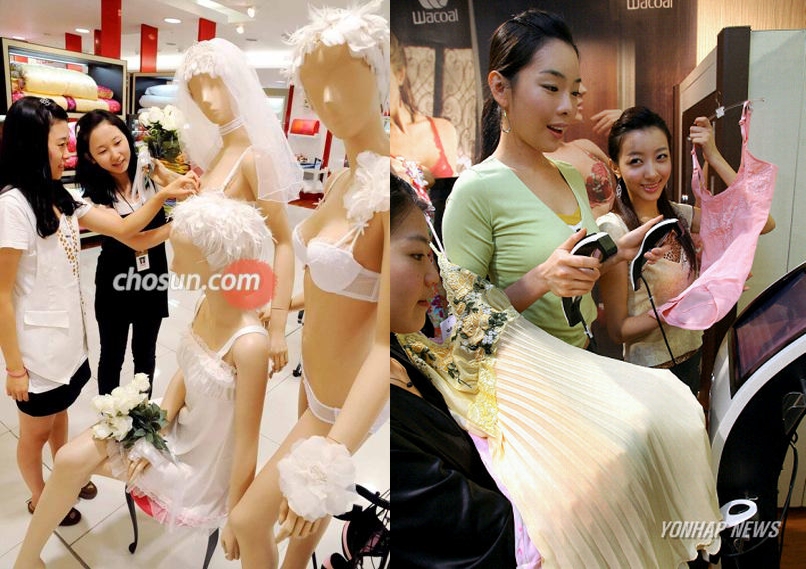
In their place, a new triad have emerged, including E-Land World (with brands like Roem, Who.A.U and Hunt), Yeshin Persons (including brands like Maru, Codes Combine and Noton) and Good People (with Bodyguard and James Dean). Yeshin Persons was in the forefront of this new group with Maru Underwear (a domestic sportswear brand) in 2004. “Maru Underwear features casual lingerie with a bit of a fashion edge and it targets women from 19 to 25,” said Lim Sae-un, a Maru media representative. Following the initial success of this brand, the company made another underwear line – Codes Combine – which also stems from one of their sportswear brands. This line, targeting people in their 20s and 30s, includes underwear with bohemian and vintage-inspired elements like fringes and neutral tones. The two underwear lines alone made the company 45 billion won in 2005.
E-Land World has been following a similar path. Besides Hunt Underwear and The Day Underwear, they launched Body Pop and Petite Lin, the former for teenagers and the latter for kids under 10. Both have been a great success. Good People launched underwear lines which target women in their late teens to 20s, including Sugar Free and Sexy Cookie.
One factor behind the success of these lines is their affordability. Along with the growing popularity of affordable cosmetics lines like Missha and The Face Shop, these underwear lines provide a sense of adventure at prices that do not involve the risk of a big investment. “Customers feel free to take risks and buy colorful items with patterns instead of your basic white or skin-colored underwear because these items are so affordable,” said an E-Land representative.
Along with domestic brands, underwear brands from other countries have also been selling well. Women’s Secret, an underwear brand from Spain, was introduced in late 2005, with its first shop in Apgujeong-dong. “Underwear is no longer hidden beneath clothes and consumers are now more daring and wear colorful, showy underwear. We decided to bring in this brand to meet these needs,” said Kim Hyun-hwa, the brand’s assistant marketing manager. “Customers are smarter as well. They don’t want cheap material or poor tailoring. Underwear nowadays has to be fashionable and practical with a reasonable price tag.”
Choi Young-jip, head of Princess TamTam Korea, an underwear brand based in France, agrees. “Customers not only look for good designs, but also for underwear that is a good fit for their body. So material and cut are very important.”
These factors have led to some adjustments in tailoring. “We have introduced a line of bras and panties just for the Asian market for this fall/winter season,” said Kim Hyeon-hwa at Women’s Secret. “The panties in this line support the hips, with more coverage, as opposed to thongs or Brazilian-style pieces which are popular in Europe.”
Actress Park Jeong-su launched Sooanae last year, an underwear line targeting middle-aged women which offers stylish yet form-flattering foundation garments. Next was actress Hwang Shin-hae with Elypry, which was first offered through Hyundai home shopping but branched out to CJ home shopping this year. Actress Hyeon Yeong and actress/singer Um Jeong-hwa both used their sexy image to full advantage by launching underwear lines this year. “Finally, there are now lots of choices [for underwear] in Korea.” said Kim Ji-eun as she flipped her hair and continued to search for the perfect bikini/bras to match her new shoes.
If you’ve followed a link here, please note that this post was deleted and completely rewritten in January 2012, but unfortunately I’m unable to do automatic redirects for single posts sorry. Instead, please click here for the new version.
Seriously, it’s great that the makers of this video are trying to encourage children to eat healthy foods with fermented bean paste (된장) rather than candy. But do they really need to be told that it’s good for their “S-lines” and “V-lines” too? For those few of you that don’t know what either are, this next commercial in particular makes the former pretty clear:
Note that Go Ara, the actress in the commercial, is actually much younger (16) than she may appear above. Meanwhile, here are some commercials for a tea-drink which supposedly gives you a V-line chin, which at least have actual grown women (BoA, 22; Kim Tae-Hee, 28) endorsing the product:
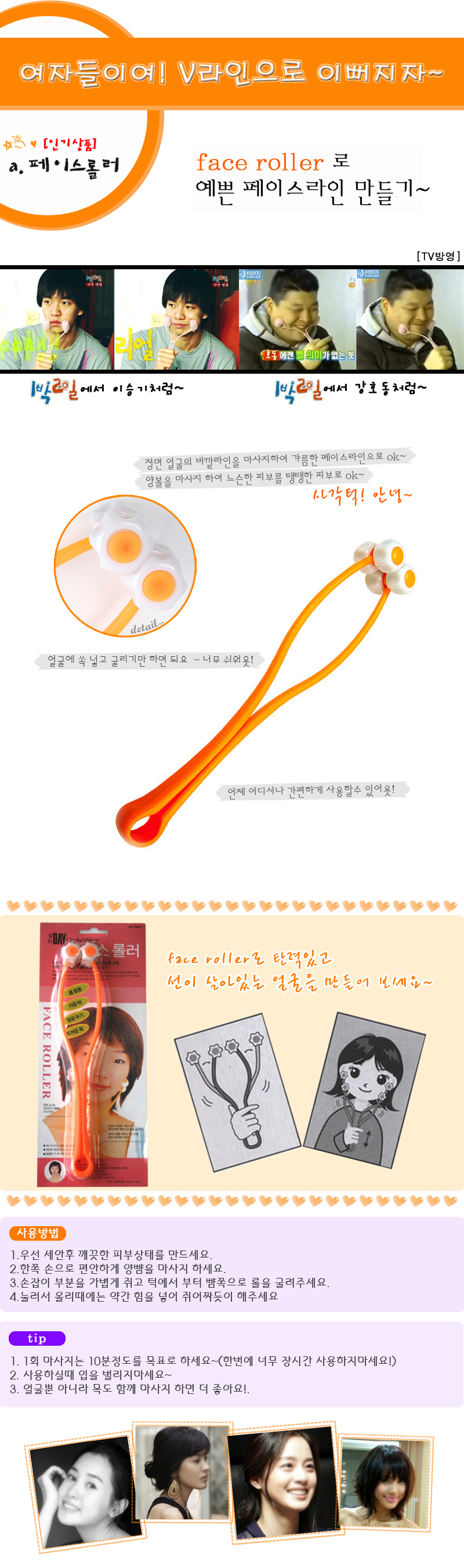
Not by coincidence, here are some “face rollers” which started to appear all over Korea not long after I first heard of V-lines. I’ve read that they’ve been used for many years in Japan and Taiwan too, so Korean women too may well have been using for a long time before they started worrying about their V-lines specifically. But then they weren’t popular enough for me to have noticed them at all until last year, and certainly sellers of them have been making explicit references to V-lines ever since the concept first appeared:
Alas, I’m not entirely certain why an ad explicitly for women opens with some not particularly flattering shots of men either (Lee Seung-gi and comedian Kang Ho-dong), but I guess I’m not the target market. That they do so humorously though, does help reinforce the notion that dieting (etc.) is only something for women to be serious about.
Or perhaps just girls, as I’ve never actually seen a woman using one. My 13 year-old students, however, use them every other break…(sigh).
Update: See here, here, here, and here for much more on the constant invention of new, often impossible body shapes and “lines” for Korean women to strive for, and for North American and European parallels.
You can’t blame overseas reporters for just calling them metrosexuals: kkotminam (꽃미남), literally “flower beauty man,” sounds a little strange even in Korean, let alone English.
Done too often though, it’s easy to lose sight of the differences. Combined with scholarship that (over)emphasizes the trend’s roots in popular yaoi manga from Japan, one can easily be forgiven for thinking that Korean men are doing no more than imitating what they see overseas.
This needs rectifying. Not least, because when men suddenly adopt some new fashion en masse, it’s invariably with the specific purpose of getting laid. But what was so special about the 2002 World Cup that made Korean women demand hitherto “effeminate” clothing, personal-grooming, and behaviors from them, if they wanted any hope of doing so?
To answer, you need to consider what happened in the 5 years preceding it, which was a tumultuous period for Korean society. Especially for Korean women, something which tends to get ignored in most accounts of events.
In brief, once democratization began in the late-1980s, women were finally rewarded with the drafting, implementation, and — yes — even enforcement of a wealth of sexual equality legislation, after years of having such concerns ignored or deferred by the military authorities and democracy movement respectively. Also, the female workforce participation rate slowly but surely increased, despite the predominance of the salaryman system and the attendant male-breadwinner ideology. In more ways than one, women could feel justified that their patience was being rewarded.
Then the Asian Financial Crisis of 1997-8 struck. Not only was “expensive” sexual equality legislation indefinitely postponed, but the government-business “solution” was to disproportionately lay off women, the logic being that young single ones, largely living with their parents, would be provided for by their fathers, whereas married women (and their children) would be provided for by their husbands. More advanced in their careers, and thus more expensive, the latter would be particularly targeted, to the extent that many would do their utmost to keep their marriages a secret from their employers, a theme subsequently explored in many dramas.
Lest anyone feel that this overview is a wild generalization, note that, tellingly, president Lee Myung-bak would repeat the same solution in the next financial crisis in 2008, although by that stage there was more of a pure financial logic: by having the most irregular workers in the OECD, which women would form the vast majority of. Back in 1998 though, and coming so soon after supposedly liberating and empowering democratization, which actually only really, qualitatively, began upon the administration of the first civilian president Kim Young-sam (김영삼) from 1993, then I’m going to take a wild guess that women were, in short, pissed off.
And with that prickly conclusion in mind is precisely how one should view the following music video by the Korean girl-group SES, made in 2002:
About which Matt at Gusts of Popular Feeling gives the following insightful commentary, starting with:
Taken at face value, the SES video seems to be about getting revenge on some boorish (white) men and humiliating them, but I think there are other ways to look at this video than just as a representation of Korean anti-Americanism. A very simple question would be: How many working women in Korea interact with foreign bosses, foreign colleagues, or foreign customers? I would imagine that the vast majority of working women never have to deal with foreigners in the workplace. So, for working Korean women…who would the sexist or rude bosses, colleagues, or customers really be?
And a little later:
…could this be seen as a “liberating” narrative of women standing up to boorish, disrespectful men in positions of power over them and humiliating them or otherwise getting revenge on them and asserting their power. In this case, the use of foreign actors to portray these men acts as the spoonful of sugar which makes the medicine go down because images of Korean men being humiliated would never be approved.
Whatever the answer, what’s clear is that, especially in 2002, on TV, Korean men could never have been treated like this, unless it was done with a lot of humor (and probably not even then). It needs to be asked, of course, why it would be acceptable to portray foreign men the way they are in this video, but not Korean men.
Lest you feel that Matt exaggerates the restrictions on how Korean men could be — and still can be — portrayed in popular culture, see here for a wealth of further examples. Yet, despite those, there were other ways women could express their anger. And a lot more besides.
While I should always resist the temptation to generalize my own experiences to the rest of Korea, it is still remarkable just in its own right that, in one of my first ever classes here in 2000, some of my female students mentioned that they were regularly chastised by middle-aged women on the street for — wait for it — wearing short sleeves. For just 2 years later, it would be a point of patriotic pride for them to wear a crop-top made out of the previously sacred national flag during the 2002 World Cup, and very much encouraged by their elders. As Hyun-Mee Kim (see the footnotes) puts it:
Stripping the Korean national flag of its heavy solemnity and nationalism, [women] brought change with their white, red, blue, and black sports bras, scarves, tank tops, and skirts. And the young Korean women who had been the target of criticism by the media every summer for their “excessive spending” and “oversexed outfits” were praised as original and attractive fashion leaders at the soccer scenes (Hyun-mee Kim: 228-229)
To clarify, I am not (yet) making a connection between this and previous events: merely pointing out the speed of the change. But, how to explain that pace? What on earth did soccer — of all things — have to do with the way women chose to dress?
Perceptive readers may already be thinking that all the skin was publicly encouraged to show support of the Korean soccer players, not the first time women’s bodies and sexuality have quite literally been used in service of the South Korean state (see Sex Among Allies by Katharine Moon, or my own series on gender and militarism). And, indeed, the media did soon describe it as such.
But Hyun-mee Kim notes that Korean women were already on the streets wearing sexier and/or more comfortable clothing that summer, well before public perceptions caught up with and condoned the new standards of dress that they had created. Moreover, and crucially, they were also simultaneously publicly discussing, idolizing and objectifying the Korean players and their bodies in ways that would have been previously thought of as shocking. And, as one does not salivate over a guy’s pecs simply by government decree (please correct me if I’m wrong), then it’s difficult to deny that both were definitely initiated by and for women.
Also, that much more was going on than simply women showing more skin, questioning public standards of decency, or talking more about men that they found attractive. Indeed, the process had already begun in popular culture in the mid-1990s.
Writing in 2002, So-hee Lee mentions that in 1995, “the most popular topics among university students were sexuality, sexual identity, and other sexual subjects” but that in 2002 “there is still no broad popular social discourse on female sexuality outside of marriage”. Partially that was because the term barely existed in Korea then as explained, but primarily it was because – for all the stereotypes of married Korean women or ajumma (아주마) having gender but not sex – precisely they that were at the forefront of a veritable sexual revolution in Korea beginning in the mid-1990s. As she explains, many Korean women novelists confessed that it was in marriage that they had begun to recognize their repression as women for the very first time”, and this was because:
Looking at their mother’s lives, Korean women in their early thirties believed that their marriages would be different. Because the Korean standard of living and patterns of Korean life changed very quickly, they believed that Korean ways of thinking had been transformed with the same speed. This is where their tragedy begins. As [a character in a mid-1990s novel discussed] says, “mothers teach daughters to live differently from themselves but teach sons to live like their fathers”….During sixteen years of schooling, they had learned that equality is an important democratic value, but nowhere had they been taught that women experience the institution of marriage as a condition of inequality. Many married women of this generation have [thus] experienced a process of self-awakening…(Lee: 144)
Lee’s chapter is about a succession of novels, movies and TV dramas that suddenly appeared between 1993-1996 which, with their blunt depictions of Korean women’s sexual desires, sexual repression, sexual frustrations within marriage, direct challenges to sexual double standards and so forth, were direct challenges to those stereotypes and provoked intense discussions throughout Korea. Unfortunately, a detailed discussion of them will have to wait for another post (update: and here that is!), but it can be said here that Lee concludes from her study of them that:
Looking back at Korean culture with a certain detachment [in 2002], I can imagine that the years 1995 and 1996 will be remembered as a critical period for the emergence of social discourse on sexuality, especially female sexuality. The year 1995 was particularly remarkable in that housewives began, on their own initiative, to speak in public about wives’ subjective sexuality (Lee: 160).
And that, in a comparison with the US in the 1970s:
My reading of the concept of female sexuality in Korean popular culture might suggest that Korean society is now at a stage of development comparable to America in the 1970s, when every kind of women’s issue appeared in realistic novel form….If this parallel holds, then what kind of story is unfolding in twenty-first-century Korea? Is it not difficult to image that a viable revolution against sexual repression might take place? (158)
With even greater benefit of hindsight, I’m not all that sure that the mid-1990s are remembered quite like that in 2008, and Lee did acknowledge that her discussion possibly:
…gives the impression that Korean women now are marching to demand their sexual subjectivity, in reality, most Korean women are marching only as the passive consumers of the sorts of cultural products described previously, not as their active cultural producers (159).
But quite presciently, she continues:
When women are able to intervene in the process of cultural production as subjective consumers with a feminist point of view, the Korean concept of female sexuality can be transformed more rapidly than before (159, my emphasis).
And of course, just like the 2008 Olympics that are coming in up in 3 weeks time, the World Cup is no longer merely or even primarily a competition for victory between nations, but is a prominent global cultural product. Part of that cultural product is the bodies of the the players themselves, and Korean women in 2002 definitely fundamentally changed the ways in which they “consumed” those.
The Rise of Kkotminam: A backlash against salarymen?
The first change they made was in confirming the dominance of feminized ideals of male beauty that had first begun evolving in the mid-1990s. Consider this description of the previous ideals:
The streets of Seoul are now filled with girlish women. Some look fragile, as if calling for protection. Women of this generation say that want to be protected rather than to protect. Young girls who used to favor gentle “mama’s boys” now turn their backs on them. They are anxious to fall in love with “tough guys” who look strong and even violent, like Choi Min-su and Lee Cheong-jae, who played tough gangsters in the explosively popular 1995 television drama Sand Clock (모레시계). Besides having a “tough guy” as a boyfriend, the women of this emerging generation want a pet. A pretty and coquettish girl, with a tiny, cute dog, beside a tough guy is part of this emergent new image. (Cho Haejoang: 182)
Although the book that was from was published in 2002, by the reference to the television drama and by the focus of other chapters I get the impression she is really writing about the mid to late-1990s. Later in the chapter, she mentions how the country as a whole reverted to a justifying male breadwinner mentality under the banner of “Let’s protect the our fathers who have lost their vitality” or “Let’s restore the authority of the family head” as a result of the IMF Crisis as I’ve discussed, and presumably the natural result would have been that those “tough guy” preferences of Korean women would have been reinforced, or at least the protective elements of them. But in fact, quite the opposite occurred. For instance, by 2000 there was:
…a new type of male emerging albeit in a small number of music videos. It is a de-gendered image of men which is a contrast to the macho image. Male groups such as Y2K, H.O.T., ITYM, and Shinhwa, whose fans are mostly teenage girls, portray this image. They wear make-up and a lot of jewelry and ornaments – which are all considered feminine – and take of their shirts to show off their bodies. This indicates that the male body is also sexually objectified as the female body….The style of the video is similar to that used to show female [bodies] with extreme close-ups to fill the screen with a face, and medium range or full body shots for dances. Although there is a risk of overstating the phenomenon, this image could be interpreted as a signal indicating the possibility of breaking the binary boundaries of men and women that have been formed in a patriarchal culture (Hoon-soon Kim: 207)
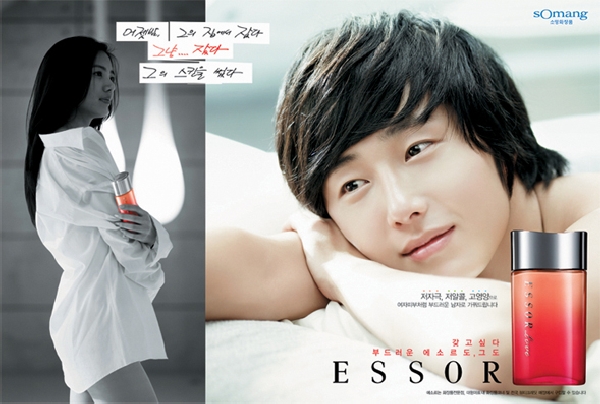
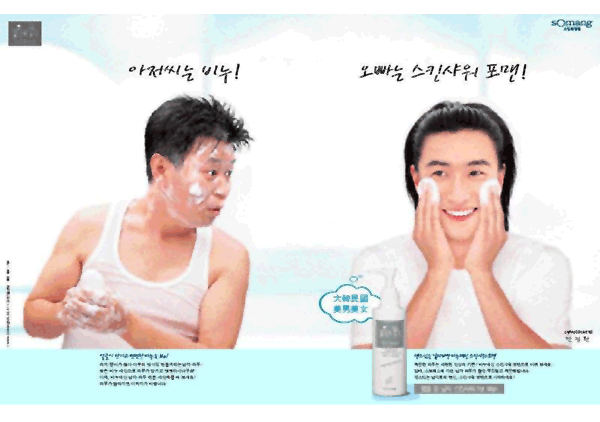
And this is corroborated by the fact, as early as the mid-1990s, there were already distinctly feminine advertisements for cosmetics aimed at men. These following ones are all from the Somang Cosmetics website (update: they’ve since been taken down), but I can’t imagine that those of other cosmetics companies would have been significantly different.
1998, with Kim Sung-woo (김승우):
1999, when soccer player Ahn Jung-hwan (안정한) must have signed a modeling contract with them:
And then of course the notorious television advertisement for “Color Lotion” from 2002, featuring Kim Jae-won (김재원) on the left:
Regardless of what women made of that particular homoerotic advertisement, the establishment of distinctly feminine ideals of male attractiveness were at least partially sealed by Ahn Jung-Hwan’s success in the World Cup, when Somang Cosmetics must have thought that all its Christmases had come at once:
Although the Earth must surely have shifted as Korean women collectively put their hands to their chests and sighed as Ahn Jung-hwan kissed his wedding ring every time he scored a goal, I’m not for an instant placing the blame(!) for what came to be known as the “Flower Men” (꽃미남) phenomenon solely on his shoulders. Where does it come from then?
Of course there is some international basis for it. While Taiwan, for instance, both survived the IMF Crisis relatively unscathed and didn’t host the World Cup, much the same phenomenon still happened there:
Josephine Ho (2001: 63-86), a feminist from Taiwan, points out that most of the recent idols of teenage girls are no longer buff and tough men but rather “feminine men” who evoke a sense of sympathy, saying that there is a “clear contrast between teenage girls of enormous strength and their idols of somewhat weak image.” This illustrates that women in their teens are breaking away from the typical framework of heterosexual romance in which women long for me who will devote themselves to, and take care of them, and have started to express their sexuality in an active manner. The preference for men with the capability and personality of the breadwinner as the “most attractive” is being undermined. (Hyun-Mee Kim: 235)
I don’t know enough about modern Taiwanese society to judge the accuracy of that, but I have no reason to doubt that it’s true. But I have many problems with international comparisons.
Firstly, because they mean that the Western notion of “metrosexuality” invariably comes to dominate discussions, years of repetitive comparisons between An Jung-hwan and David Beckham in the Korean English-language media (and, by extension, by foreign observers too) ultimately seeming to absolve Korean women of any ability to determine their own tastes in men. And just like it does to be told personally that my liking any Korean women at all is mere “yellow fever”, it must surely rankle Korean women to be told that them liking say any Korean idol is no different to, say, a British teenage girl liking a member of Westlife.
On top of that, for all their new assertiveness, there were still definite limits on how far women’s new freedoms could go, and they did not extend to publicly praising and/or objectifying non-Korean men. Obviously that’s a crucial point, but as this post approaches (ahem) 4500 words I realize that a discussion of that would be better placed in Part Three; meanwhile, accounting for changes by a simple importation of foreign ideals of male attractiveness portrays Korean women as, well, mindless, uncritical, and passive consumers and again as Part Three will more fully reveal, this was anything but the case.
As the title suggests, I pose a more proactive explanation, and herein (finally) lies the revelation that has so preoccupied me for the past two weeks. First, consider this statement:
When gender discrimination in public areas such as the labor market and politics is still powerfully all pervasive, Korean women often feel helpless in thinking that change won’t come easily. Their sense of devastation leads to displays of resistance and subversiveness in “private areas such as sexuality. Sexuality and intimacy lend themselves to being viewed as the only arena where the women can affect a measure of change through their will or emotions. In this respect, Korean women’s rapid sexual subjectification demonstrates, on the one hand, the power to transform and, on the other, a collective sense of powerlessness (Hyun-Mee Kim: 240).
The first things that came to mind when I read that were the scene in either La Femme Nikita or Point of No Return (I can’t remember which) when, after receiving her training to become an assassin, the main character is placed in a sort of finishing school where her female tutor reveals the existence of “this power” that women have over men. After that was a line from some sex and/or relationship advice book that I read once, which said that women should not consider sex as something to be given to or withheld from partners as a form of reward and punishment.
Yes, considering the virtual gender apartheid that exists in Korea, then an alleged asexuality of ajummas as a form of resistance to patriarchy was one of the first things that came to mind too. But then the next thing was that, maybe, just maybe, flower men became their new ideal of male attractiveness as a act of at least subconscious resistance to the men that had denied them of the opportunity for children and careers that they’d (finally) come to expect? That still maintained that women didn’t even have sexual feelings, but at the same time taking advantage of one of the biggest prostitution industries in Asia? That had the gall, after doing all that, to expect Korean women to continue to hold breadwinners like them on a pedestal? Like I said, they were pissed off, andKorean men that came up with the aforementioned slogans were surely naive to think that things could have gone on simply as before.
Of course, I acknowledge that it will be much more complicated than that in reality. Like I said, I haven’t looked at the 1990s in any great detail here, but in addition to the sexually radical new books, movies and dramas that came out in 1993-96 that Cho Haejeong discusses, there’s a whole host of developments like the “Missy” phenomenon beginning in 1994 and the “Samonim” (사모님) one before that: in other words, things weren’t quite as simplistic as how I’ve depicted them. I haven’t paid enough attention to generational differences either, even though Hyun-mee Kim quite correctly claims that they are as strong markers of identity in Korea as race is in the US, so much so that most chapters in the books used here us them as their base units of analysis, and increasingly books on Korean politics are too.
As I type this, I realize that no description is complete without those, and so they’ll require an unplanned additional post before I talk about the 2002 World Cup proper in now Part Four (or Five)…which is not to imply that this post hasn’t considerably evolved and mutated itself since I first began writing on this, now somewhat amorphous subject.
Another thing I realize is that until recently I’ve been so enamored of my associations of Korea with futurism (see here and especially here for instance) that I’ve mistakenly disdained studying the 1990s previously, feeling that as I looked further and further back in time in Korea then the people become more conservative and unlikeable, the clothes and hairstyles more bizarre, the women less attractive, and the country as a whole much less modern…and so on. That’s not unreasonable given Korea’s breakneck speed of development, but considering that I arrived in Korea as long ago as 2000, and that I first went to university in 1994, then in hindsight my disinterest has been very strange. After all, to understand me, you’d have to understand New Zealand in my formative years as an adult, and indeed just on the bus home yesterday I listened to a Korea Society Podcast on president Lee Myung-bak’s first 100 days in office, in which one panelist argued that the experience of the IMF crisis defines Koreans of my generation. All obvious certainly, but I’ve got some catching up to do.
Regardless of all that though, I think my notion of flower men becoming popular because of a backlash is a definitely a valid one, and I think original too; certainly no-one that I’ve read recently makes a link like that. At the very least, it needs further exploring.
Only having just begun examining the 1990s myself then, I can’t confirm or disprove Gord Sellar’s suggestion that cross-fertilization from some elements of Japanese popular culture may also have played a role in the rising appeal of flower men, and while my gut instinct tells me that it was mostly home grown and that that would only have had a marginal role at best, I still highly recommend his post just for its discussion of the ways in which the phenomenon has evolved and be sustained since 2002 alone. Given that I end my discussion on them in 2002 (for now), then our two posts nicely compliment each other on that score.
Ho, Josephine, “From ‘Spice Girls’ to ‘compensated dating’: sexualization of Taiwanese teenage girls,” Yonsei Women’s Journal, 7, (2001), pp. 63-86.
Hoon-Soon Kim, “Korean Music Videos, Postmodernism, and Gender Politics” in Feminist Cultural Politics in Korea, ed. by Jung-Hwa Oh, 2005, p. 207 pp. 195-227.
Hyun-Mee Kim, “Feminization of the 2002 World Cup and Women’s Fandom” in Feminist Cultural Politics in Korea, ed. by Jung-Hwa Oh, 2005, pp. 228-243.
So-hee Lee, “Female Sexuality in Popular Culture” in Under Construction: The Gendering of Modernity, Class, and Consumption in the Republic of Korea, edited by Laurel Kendall, pp. 141-164.
Update, December 2013: A translation of this article, with my original commentary (and consequently readers’ comments) removed. Here are some quick translations for the captions below too:
“Be picky”
“Embrace your desires”
“Be lazy”
“Think differently”
“Look at them [men] humorously”
“Don’t wait”
“Don’t even look up [at him]”
“Shout”
“Dios Women Cheer Project” (the name of the ad campaign).
최근 TV를 통해 방영중인 LG 냉장고 ‘디오스 여자만세 프로젝트’ 광고가 네티즌들로부터 거센 비판을 받고 있다. 무엇보다 표현이 상식수준을 넘어 보기 민망할 정도로 지나치고 심지어 남녀 역차별을 조장하고 있다는 점을 들어 포털사이트 다음 아고라에서는 ‘디오스 여자만세 프로젝트’ 광고 중지를 요구하는 청원 서명까지 벌이고 있다.
Netizens have strongly criticized the “Dios Woman Cheer Project” advertisement that has recently been playing on Korean TV. On the Daum Agora discussion forum, they have complained that the things said in it defy common-sense standards of decency, even going so far as to promote discrimination against men, and so have set up an online petition calling for it to be taken off the air.
광고에는 ‘여자들이여 까다롭게 굴어라, 더 욕심 부려라, 게을러져라, 딴 생각해라, 우습게 보라, 기다리지 마라, 거들떠보지 마라, 큰소리 쳐라’ 등의 문구가 여성이 남성을 인형처럼 조정하는 자극적인 장면과 함께 등장한다.
In the advertisement, the voiceover and the text say: “Hey, women! Be picky! Embrace your desires! Be lazy! Think differently! Look at them (men) humorously! Don’t wait! Don’t even look up (at him)! Shout!”, and so forth. In one scene women are even encouraged to treat men like puppets.
서명을 주도하고 있는 네티즌 ‘꽃순이’는 “‘여성만세 프로젝트’라는 거창한 이름으로 좋지 않은 말들만 열거하고, 그 대상을 남자로 유도하고 있다”며 “방송에서 안볼 수 있게 해 달라”고 요청하고 나섰다. 또 다른 네티즌은 “만약 남녀 반대로 광고가 만들어졌다면, 사회적으로 큰 파장이 왔을 것”이라며 “남녀 역차별을 조장하고 있다”고 주장했다.
According to the netizen “Flower-Suni” that initiated the petition, “The grand-sounding ‘Woman Cheer Project’ advertisement merely lists and induces negative behavior towards men”, that “people don’t really want to see on their screens”, and demanded that it be taken off the air. Another netizen added that “if an advertisement portraying the same sentiments towards women had been made, then all sectors of society would have been quickly up in arms and insisted that “it promotes inequality”.
광고 내용이 눈에 거슬리기는 여성들도 마찬가지다. 여성이라고 밝힌 네티즌들 대부분 “저런 광고는 여성들에게도 달갑지 않다”, “괜히 여자 안티를 만드는 광고”, “광고가 무척 거슬렸다. 된장녀를 만드는 것인가”라고 비난했으며 “남녀평등이란 서로 만드는 것이다, 한쪽만 강조하는 평등은 또 다른 불평등을 가져온다” 고 지적했다.
By no means is it only men that feel that the contents of the ad were inappropriate. Of those female netizens who have made their gender public on discussion boards, most criticized it, saying things like “it is unacceptable to women just as much as men”; that “the advertisement will make people anti-women”; and that “the advertisement is very offensive, and encourages women to be Bean-paste Girls”. Finally one netizen pointed out that “men and women have to become equal together, and if you overemphasize only one aspect of that then it will actually only lead to further inequality.”
For new readers, Part 1 was an outline and discussion of the first part of the 2003 journal article “Neo-Confucian Body Techniques: Women’s Bodies in Korea’s Consumer Society“ by Taeyon Kim. To quickly recap it, she argues that women weren’t really thought of as individuals in Joseon Dynasty Korea, as the state ideology of Neo-Confucianism considered them incapable of the spiritual transcendence that men were. Instead, the best they could aim for in life was continuing a husband’s “ki”, or spirit, through the production and upbringing of sons and the efficient management of his household. Hence Kim describes them as “subjectless bodies,” as not only were they not really individuals but their physical bodies were not really their own either, merely being vessels for and tenders of the more precious ki instead (source, right: jingdianmeinv)
In terms of the ideals for women’s appearance, this meant that the physical attributes required for those were prized more than beauty. On top of that, adornment and/or alteration of the body was not condoned for either sex, as the physical body was one’s inheritance of ancestors’ sacred ki. And herein lies the paradox, as on the one hand Neo-Confucianism still pervades all aspects of Korean life today (I’ll take readers knowing and agreeing with this as a given), but on the other hand, modern Korea appears to be in the midst of a decidedly non-traditional celebration of youth and the female form. What gives?
Neo-Confucian Consumption Motives
The short answer is that appearances can be deceptive. It is certainly true that modern media images of Korean women are not Neo-Confucian in the 19th Century sense described above, and it’s difficult to argue just by looking at them that advertisements, for instance, are any different to their counterparts in Western countries. Of course, systematic cross-country analyses of numbers and types do reveal significant and telling differences, and if readers are interested in those then I highly recommend reading the 2006 journal article entitled “Content Analysis of Diet Advertisments: A Cross-National Comparison of Korean and U.S. Women’s Magazines” by Minjeong Kim and Sharron Lennon, downloadable here. But surveys like those do not chronicle average Korean and Western women’s reactions to them, and herein lies the essential differences between them.
As a rule, in Western countries most (although not all) advertisements for a product have to actively suppress and disguise the notion that people may feel compelled, influenced or forced into purchasing that product, whether by the ad, by peer pressure, or some other unwritten social rule. Instead, people are encouraged to conceive their purchase in terms of personal choice, individuality, empowerment, and — especially if the target consumer is young — maybe liberation and rebellion too. And of course, these advertising norms undoubtedly operate for a good proportion of advertisements in Korea too. But in the case of advertisements for products related to one’s appearance, be they cosmetics, clothes, or plastic surgery, it turns out that a great number of Korean women make purchases for precisely the opposite reasons. Indeed, not only is there no stigma in doing so, but they positively embrace the opportunity to conform to and harmonize with social norms through their consumption choices (source, right: Kiran Foster).
Lest that assertion sound like a typical exaggeration of a Caucasian male, surveys that Kim cites indicate that most Korean women explicitly justify their choices in those Neo-Confucian terms, and definitely not the individual empowerment, entitlement, and personal assertion of one’s individual choice that Western women tend to do in similar surveys. That is not to say that Western women (or men) can’t and don’t also passively follow fashions, and it’s not necessarily a negative or dehumanizing thing either. But very few Westerners would admit to it.
I see no reason to doubt the results of those surveys (which I can provide the details of if readers wish), and while my own female Korean friends for instance, are certainly as liberal and free-willed as any Westerner in their clothing and cosmetic choices — and lifestyles; indeed, that’s why we’re friends — they can’t counter the mass of empirical evidence Kim provides, and even the anecdotal evidence from the media and on the streets of Korea. If Neo-Confucianism is pervasive in modern Korean life then, and Korean women consume cosmetics, clothes, and undergo plastic surgery operations largely for the sake of Neo-Confucianist motives, then it’s time to call a spade a spade and argue that Korean society’s new emphasis on women’s appearances is (somehow) Neo-Confucianist too. Indeed, it would be strange if only this particular aspect of Korean life was so different.
Hence the second part of Kim’s article is about how this modern phenomenon is a warping of and adaptation of Neo-Confucian ideals of women’s roles to new capitalist and consumerist circumstances. But while I originally wanted to outline and discuss that in this post, I’ve moved that to Part 3, because first I wanted to place those circumstances in their historical context, which I think considerably adds to and strengthens Kim’s argument (source, right: Jacob Bøtter).
The Developmental Context of East Asian Consumption
I’ve already demonstrated that although Korean women and, say, American women, can both be labelled as “consumers,” they can and do both make radically different consumption choices; or, make the same choices, but for radically different reasons. Sure, this is obvious, but I’m as guilty as anyone in generalizing and using labels here, so it’s good to remind ourselves of it. But if we shift our attention to the differences between most Westerners and most Koreans (and East Asians) as a whole, the first fact of note is the fact that most Korean university students’ parents easily recall the days when possession of some must-have items like a fridge, radio, color TV and car were essential signifier that one’s family had made it into the then swelling ranks of the middle-class. On that basis, it may be fair to say that they still imbue their consumer goods with much more status and importance than most Westerners do. (Hell, many of the university students themselves too.) This explains Koreans’ love affair with big cars and SUVs for instance, and in one of the most oil-lacking, mountainous and densely-populated countries in the world.
(Update, April 2013: Actually, the Korean preference for big cars is more due to the [inordinate] socialstatus they provide.)
On top of that, Korean governments since 1961 have explicitly and fervently extorted Koreans to consume these items, provided that they were made in Korea. It’s easy to simply attribute this to and write off as mere nationalism, only different in degree to, say, the “Buying Kiwi-Made” campaign in New Zealand, or Democratic presidential candidates in the US criticising NAFTA in election year. But this is quite wrong. If you’ll bear with me for a moment, to properly understand women’s fashions in Korea you need to understand a little of it’s well, political history first. No, really.
When Park Chung-hee/박정희 took power through a coup in 1961, while his military regime of course relied on the use of force, it would be naive to assume that it didn’t have a great deal of popular support. And so, originally at least, his military regime’s sole claim to legitimacy was its perceived ability and capacity to produce the economic development seen as necessary for national security after the chaotic years of the Syngman Rhee/이승만 presidency. While linking the economy and security this way may sound absurd in 2008, it’s important to be aware that North Korea was actually ahead of South Korea economically until the late-1960s, and in addition to this Park was (justifiably) deeply concerned about the US possibly withdrawing its security guarantees to South Korea in the wake of its foreseeable withdrawal from Vietnam. Hence the development of POSCO and the Korean steel industry for instance, which, far from being the carefully planned and coordinated developmental success story it is often touted as today (it is the third largest steel producer in the world), was pursued despite the advice of Korean economists at the time, let alone American ones. Instead, as Mark Clifford explains in chapter five of this must-have book, Park didn’t care about the economics of it; he simply wanted the ability to produce tanks and ships should the US no longer provide them.
This is why Korea is often known as a “Developmental State,” as too are Japan, Taiwan and Singapore, which faced similarly dire circumstances in the Cold War and reacted in similar ways. Neo-liberal economists in particular are loath to admit that state-led development can be successful, and so they continue to critique the economic policies of these Developmental States decades later, but this excessive focus on economic minutiae has overshadowed the fact that they were and are primarily socio-political, not economic, phenomenons (right: Posco Center, Seoul, by Ian Muttoo).
Hence consumerism has links to national security in Developmental States, and all the choice government slogans like “Consumption is Virtuous” that I saw in old photographs of Korea from the ’70s in economic journals in the archives room of my university library. And while the corollary of Park’s developmentalism was authoritarianism, and average Koreans were expected to be content with and prolific buyers of Korean goods, imports being shut out by high tariffs in order to develop Korea’s own industries (which is why such a stigma remains on imports today), what I want you to take away from all the above is that:
Koreans are used to being told what to buy.
These choices have often been couched in terms of contributing to a higher purpose.
Those that didn’t subscribe to these higher purposes were given few alternatives, and the state was encouraged in stigmatizing them.
It is no great conceptual leap for Neo-Confucian women to go from being subservient to the higher purpose of ki, and their bodies to be imperfect versions of men’s, to furthering the higher purpose of improving the economy and maintaining national security by consuming Korean goods, and finding common identity in a turbulent century by following the new fashion industry’s edicts to improve their imperfect bodies by following their rules for fashion, cosmetics, and body shapes. Those will be the subject of Part 3.
…essential reading for anyone wanting to know more about the 1990s in Korea, and in particular the frequent government and media campaigns against over-consumption (in practice aimed almost exclusively at women, these were important precursors to the “beanpaste girl” stereotypes of the 2000s)
See my “Revealing the Korean Body Politic” series for more on those campaigns and stereotypes in the 2000s, especially Parts 3 and 4.

 The 14-year old girl is Park Seo-jin, the controversial photoshoot from the Mnet reality show I Am A Model. It’s already covered in numerous “news” articles though, so let me just quickly highlight one element of it here: that for all the recent and historical mania about protecting underage girls against foreign pedophiles, the Korean police seem strangely reluctant to respect their own laws banning the nude photos of minors that would (presumably) encourage them. The most obvious examples being one of the promotion posters for—let alone various scenes in—Samaritan Girl/Samaria (2004), all shot when actress Kwak Ji-min was still in high school, and therefore legally a minor.
 With that background and strong inclination however, there is always a danger of taking similarities as a given. And particularly in this case, where the authors of the study point out that:


 (
(




 (Source:

 The Grand Narrative