Korean Photoshop Disaster #6: I like it hot, strong, and black! (Updated)

( Source )

Do men pay more attention to men’s chests than women?

As a gym addict 10-15 years ago, I read somewhere in a newspaper that they do. And with my self-confidence back then wholly tied to how much I buffed up, it certainly matched my own experience.

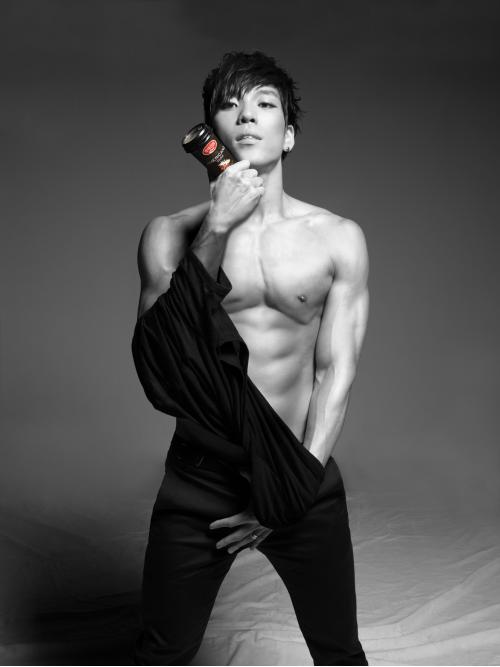
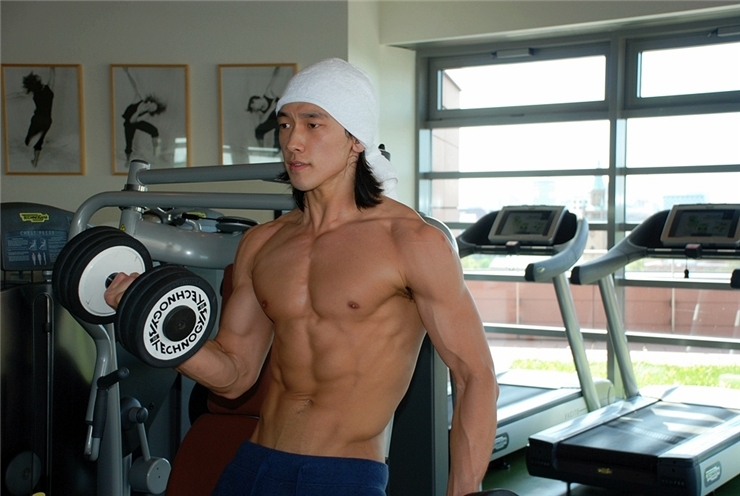
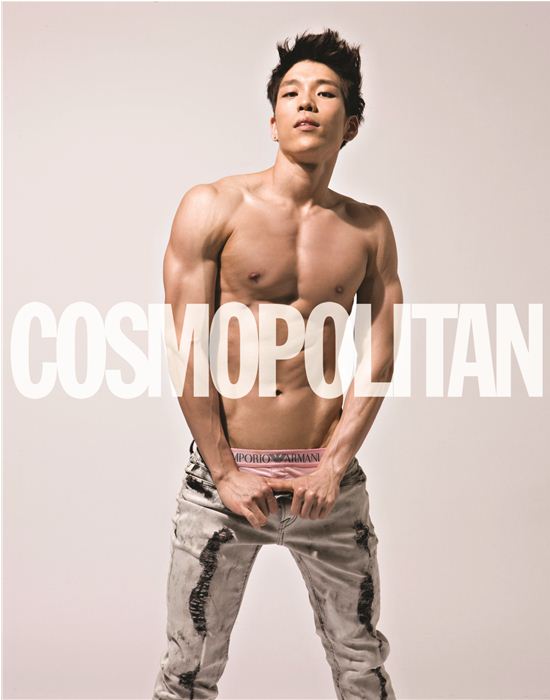
Unfortunately for the sake of objectivity though, it’s been difficult not to remember that every time I’ve seen a topless man ever since. One look at Changmim of 2AM half-naked and holding his crotch in a coffee ad then, and all I could think about was the large, firm package that used to be the weekend edition of the New Zealand Herald.

Naturally enough, most commenters at allkpop and Omona! They Didn’t focused on the one that Changmin was allegedly holding in his left hand instead, and I’m going to take a wild guess that most of those were heterosexual women. Perhaps that explains why so few noticed the appalling photoshop job on his chest?^^

Yet despite men’s greater interest in those in a competitive sense, in reality not only is bilateral symmetry a good indicator of genetic health for both sexes, and hence a heavily favored trait in mates, but even women’s own breasts become more symmetrical during the most fertile period of their menstrual cycle too. So it’s a strange oversight.
And of course for the photoshopper too, who presumably originally aimed to create some sort of languid, fluid-like effect, and I expect the mistake will be corrected before the full ad campaign for Maeil’s “Cafe Latte Americano Dutch” is launched on the 13th (source, above). But regardless, and on a more serious note now, it still has to be the first of the recent spate of Korean advertisements to objectify men that I’ve positively disliked, rather than be merely nonplussed or amused by.

For it is just as lame as it is provocative.

Putting aside how problematic the slogan “Find Your Black” is to English speakers, as described at allkpop the campaign’s basic concept is that various members of 2AM represent “Chic Black”, “Luxury Black”, “Tough Black”, and Changmin as “Sexy Black,” and the first major problem with the ad is also the most obvious: what does a topless idol grabbing his genitalia has to with coffee exactly?

Or indeed, with being “sexy”, and it that sense it also reduces to and perpetuates the notion that sexiness is only a matter of skin exposure, whether for men or for women. A problem which is hardly unique to the Korea media of course, but it is exaggerated here, and so unfortunately I’m wasn’t all that surprised that that was the best that the creative team could come up with.

And yet, would the same ad have actually been possible with a woman? Specifically, one with her hand placed on her crotch, a pretty blatant gesture of intent in anyone’s language?

( Source: unknown )

But why so specific? Well, if there’s one consistent theme to emerge out of writing about Korean advertisements for 3 years, that would be being witness to a long line of firsts: the first erect nipples; the first portrayal of Korean female – foreign male relationships; the first kiss; the first spoof of objectification within ads(!); the first soju ad to portray a woman as, well, really rather slutty, as opposed to decades of portraying them as virgins; and so on. And no matter how difficult it may be to believe for recent visitors to the country, in fact some of those emerged just within the last 3 weeks, let alone the last 3 years.

So, it’s natural to write as if I have almost a perverted fixation on things like crotches sometimes! And indeed, if there’s one thing to take away from Changmin’s ad, it’s the realization that however permissible grabbing one’s crotch is in passing in brief dances on talk shows and in music videos and so on in Korea, I don’t think I’ve ever seen it in a print advertisement. On women or on men, and hence netizens’ intense interest in Changmin’s ad.

But of course I may be wrong, and so as always, please pass on any earlier ads that you are aware of. But for various reasons, I really do think that an equivalent ad with a woman would have aroused far more controversy.

How about you? Let me finish by providing two related examples to help get you thinking.

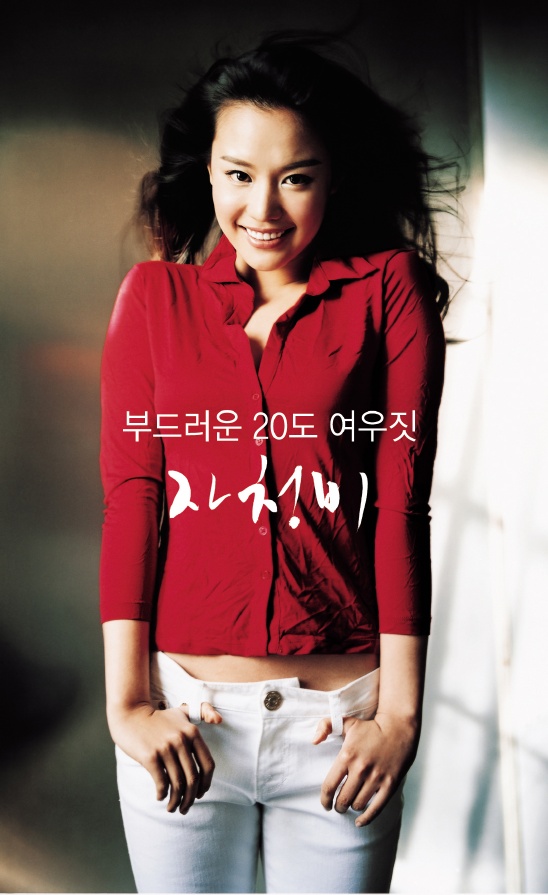
First, the the above one with Kim Ah-joong (김아중) from 2006, which at first glance is sexually-assertive enough. But as commenter “huncamunca” pointed out to me 2 years ago (in a post I ironically deleted yesterday!), it is definitely not an example of the sexually aggressive “cowboy stance” that I first interpreted it as:

…I agree that the “cowboy” thumbs in the belt loops make the picture sexual, but other elements of the stance make it sexual AND DEMURE, not aggressive. Usually, in the cowboy stance, the shoulders are relaxed and legs are slightly apart, with weight more on one foot than the other (see for example the picture of the woman on page 240 of the Pease book) [on body language]. However, Kim Ah-jung’s shoulders are raised, as if she is shrugging slightly in a demure way. Her elbows are straight and held close to her body to take up as little space as possible, which is not typical of the relaxed cowboy stance. Her legs are also tightly closed to take up as little space as possible, and they don’t look like they are about to take her toward what she wants. Her head is tilted down so she can look up demurely at the viewer. The combination of raised shoulders and lowered head is similar to the “Head Duck” in the Pease book (p. 235), which shows submissiveness. Also the wind effect makes it look as though whatever she is looking at (presumably a male viewer) is powerful enough to nearly blow her away while she marvels at him and waits for his approach. She doesn’t look like she intends to act, but rather like she hopes to be acted upon–sexual but still submissive.

Not that Changmin looks all that sexually aggressive either of course: indeed, he appears to be protecting himself more than anything else, but either way the ambiguity again points to a lack of thought behind the campaign.

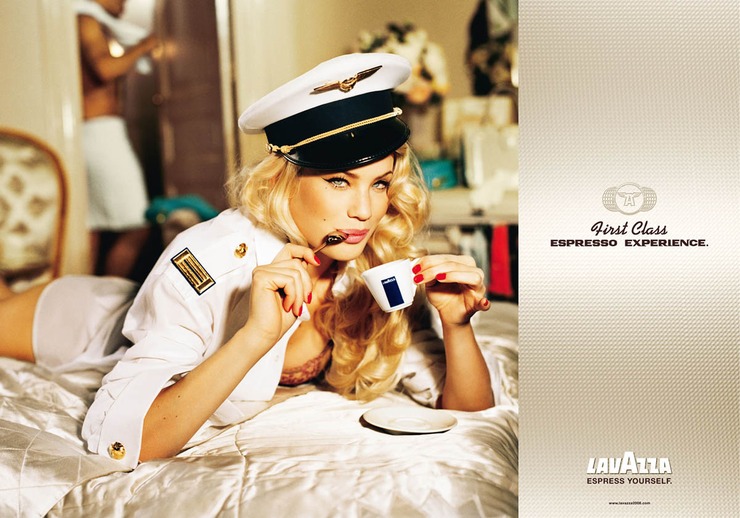
Finally, a female equivalent of gratuitous objectification and/or nudity in a coffee ad provided by Italian coffee company Lavazza, also in 2006:

( Source )

Notorious for ads involving sex and/or the excessive objectification of women since at least 2005, this one was ultimately judged as discriminating against women by the Swedish Trade Ethical Council against Sexism in Advertising (ERK), and presumably forced to be withdrawn:

Sweden’s Ethical Council has a lower tolerance for the use of scantily clad women to advertise products than comparable regulatory bodies in other countries…

…ERK judged “that the woman is used as an eye catcher without any connection to the advertised products, and that it is insulting towards women”.In its defence Lavazza wrote that the 2006 calendar from which the images were taken used humour and irony to recreate a 1950s feel. The company claimed that the images depicted glamour, style and a lust for life and were in no way discriminatory.

[ERK Secretary] Jan Fager disagrees. In his opinion it is not acceptable for an advertisement for coffee to be sexy in the same way as, for example, an underwear ad. He noted that while H&M has come in for much criticism from the general public the company’s Christmas campaigns have never been found in breach of ethical standards…

…In its written judgment the ERK maintained that Lavazza had not lived up to the principle “that advertising should be formed with due regard for social responsibility”

Good for ERK, and yes, I rather like that acronym too!^^ But one wonders what they would make of Changmin?

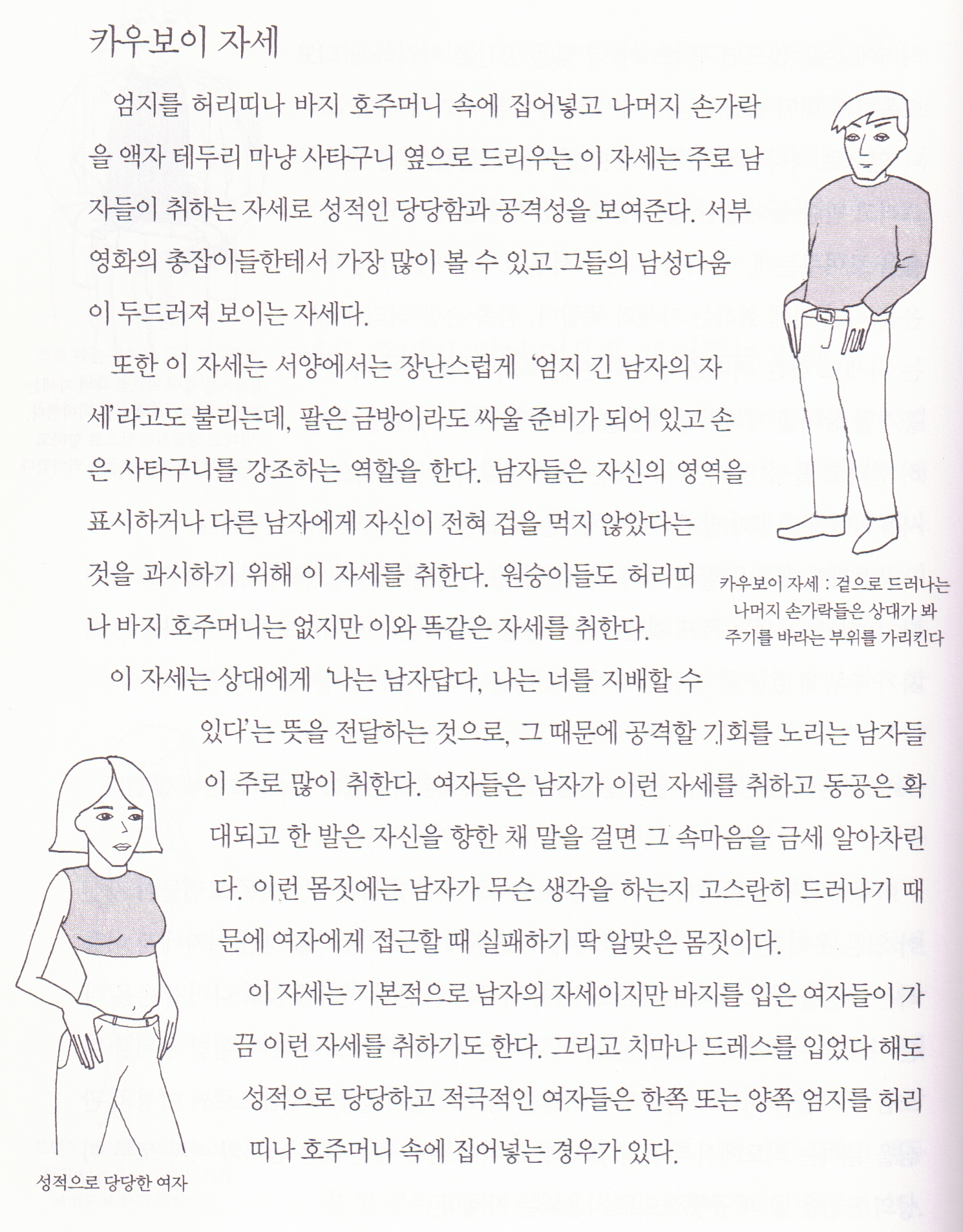
Update – Unfortunately my English copy is in New Zealand, but see below for more on the cowboy stance, and how intimately sexual and physical aggression can be linked. From pages 236 and 237 of the Korean edition of The Definitive Book of Body Language by Alan and Barbara Pease (2006), it’s easily one of the most helpful book purchases you’ll ever make, although I did much prefer the realistic line drawings in the 1989(?) edition to the cartoon-like ones and photos of famous people in the new one:
And for comparison’s sake, here’s a less disastrously photoshopped image of Changmin:
( Source )

(For more posts in the Korean Photoshop Disasters series, see here)

Share

Korean Sociological Image #48: The Male Gaze

( Source: L-C-R. Reproduced with permission )

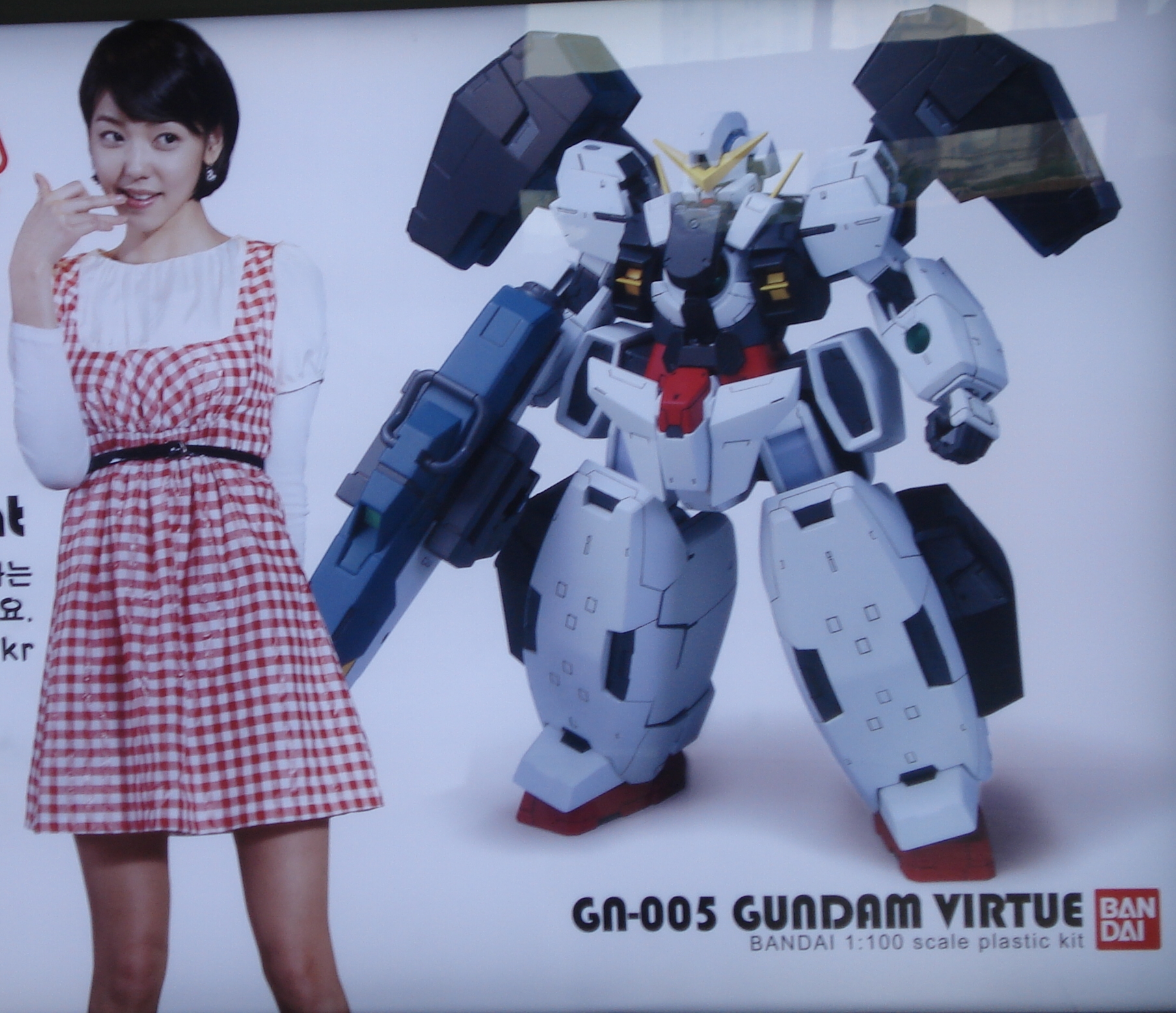
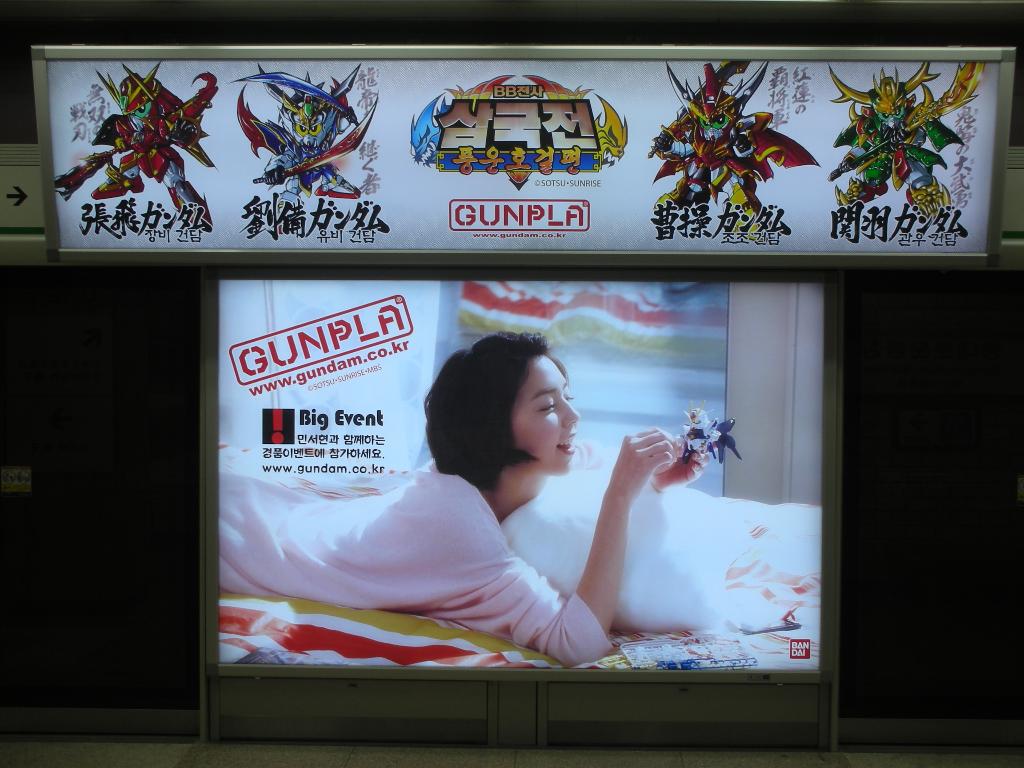
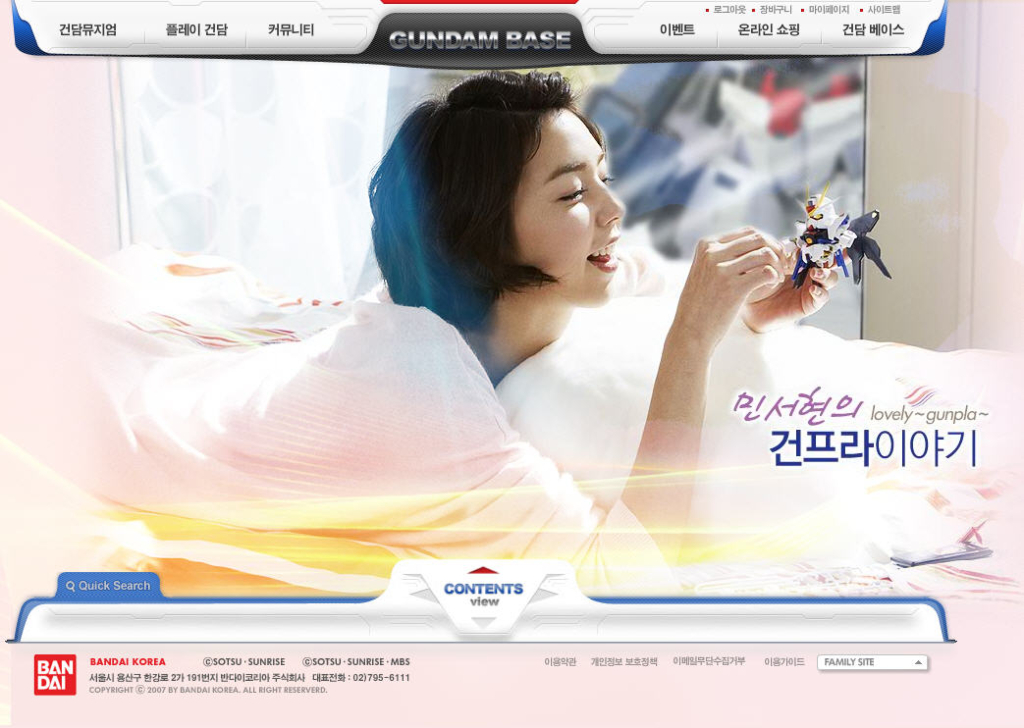
Like photographer L-C-R says, this 2008 Gundam advertisement is a prime example of a woman being portrayed as a child and/or sex object, of which she saw entirely too much of while she was in Korea.

You may be very surprised then, when you learn whom it was actually aimed at.

But first, please consider what is it exactly that so demeans drama actress Min Seo-hyeon (민서현) in it? I identify 4 or 5 things myself, which I outline in descending order of importance below:

  1. her childlike expression, combined with putting her fingers in her mouth
  2. the canting of her head
  3. her surprisingly awkward stance
  4. her passivity as she awaits the masculine-looking robot to make the next move

And after discussing those, albeit briefly because I’ve already done so in great depth in this similar post about soju advertisements, I’ll finally look at the ad in the context of the campaign as a whole. But feel free to disagree with any of those and/or suggest others, and in that vein I highly recommend asking your Korean partners, colleagues or friends their own opinions also. As if the experience of asking my wife and her friends earlier is anything to go by, then they are very likely to disagree with the first. Or indeed, that she’s being portrayed childishly at all, and – jumping ahead – not even in the following commercials either:

I’d argue that the main reason for that is the Korean cultural practice of aegyo (애교), difficult to define in English but probably somewhere between “affected sweetness” and “affected childishness“, and at least partially rooted in the prolonged transition to adulthood of experienced 20-something Koreans that are the biggest practitioners of it. For not only does the Korean education system essentially defer the joys of adolescence (but not the negatives!) until graduating from high school, but economic circumstances force them to live at home until marriage and/or deliberately put off their university graduation, and men also have their 24-28 months of compulsory military service to boot.

But I realize that since I was a student myself in the mid-1990s, more and more 20-somethings in Western countries are also postponing leaving home, and indeed to note all the above is not to argue that all Korean 20-somethings in such circumstances are childish; actually, I have intelligent, mature, and thoroughly Westernized Korean friends that have resigned themselves to them, or alternatively feel so trapped that they are literally fleeing the country to escape. Yet one thing they certainly do not do however, is aegyo, and I put it to you that in fact that is neither required for women to successfully navigate a patriarchal society, nor particularly savvy and ultimately empowering of them to do so.

( Source )
( Source: L-C-R )

Yes, “women”. As while Korean men do also do aegyo, and so as you’d expect content analysis demonstrates that men are much more likely to be portrayed childishly in advertisements in Korean magazines than US ones, and Korean men more than Western ones in the former, it is still overwhelmingly Korean women that are done so, and to a much greater extent than women of any ethnicity are in US magazines.

( Source )

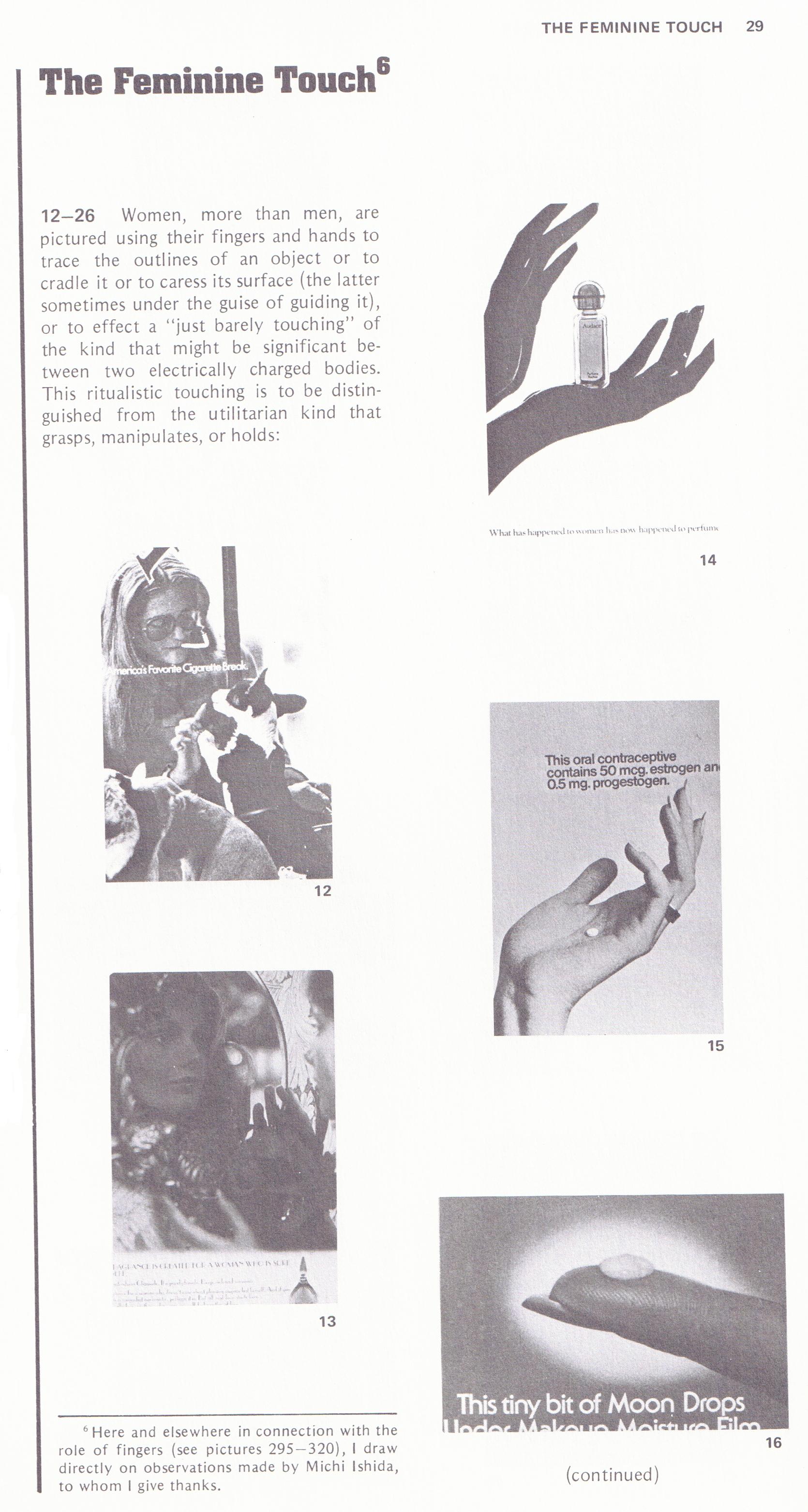
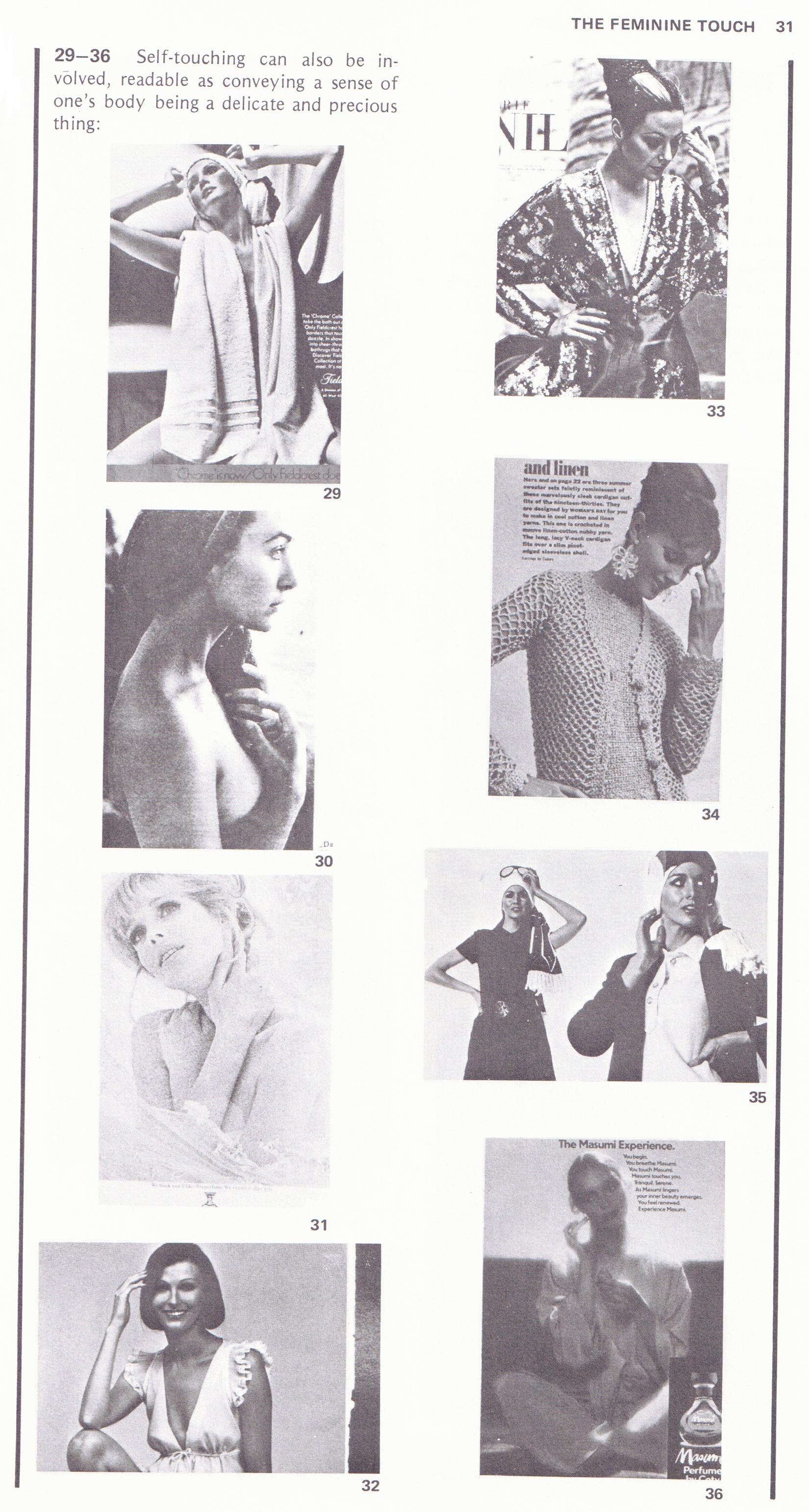
As for anyone still not seeing the childishness in Seo-hyeon’s expression however, or why it is problematic in any sense, consider what the images above tell us about just how “natural” such expressions really are on adults, and why women are more commonly portrayed with them nevertheless. And which are often accentuated of course, by putting their fingers in their mouths, and which could possibly be considered “self-touching” as defined by sociologist Erving Goffman in Gender Advertisements (1979) below:

As discussed in that earlier post on soju advertisements, both are often combined with the canting of the head, which is problematic for the reasons outlined there. I also discuss awkward stances there too, and to anyone believing that I’m about to read too much into Seo-hyeon’s, I suggest stopping here and trying it for yourself,  making sure to bend and spread your legs outward at the knees like she does in particular. For not only will you realize just how unnatural it really is, and that people only ever stand like that in advertisements (and overwhelmingly women at that), but you’ll also probably end up falling forward a little on your first attempt like I did, and will suddenly gain a very palpable sense of why exactly the advertisement does indeed present her as a sex object:

( Source: L-C-R )

In Goffman’s framework in Gender Advertisements, that “bashful knee bend” is something that women frequently, men very infrequently, are posed in a display of. And whatever else, it can be read as

…a foregoing of full effort to be prepared and on he ready in the current social situation, for the position adds a moment to any effort to fight or flee. Once again one finds a posture that seems to presuppose the goodwill of anyone in the surround who could offer harm. (p.45)

Hence passivity, as blind to whatever occurs behind her, nevertheless Seo-hyeon seems to be eagerly awaiting whatever the robot plans to do with her. And which judging by the fact that it also is standing slightly thrust forward, and has a big long gun resting behind Seo-hyeon’s buttocks, couldn’t really be any clearer. Hell, even the protrusion on its crotch is already bright red for good measure too.

( Source )

An advertising campaign clearly aimed at young men and adolescent boys then, whom I’ll safely assume are the vast majority of Gundam fans? If so, then the effort actually appears to have backfired, as the few commentators on it I’ve been able to find here, here, here, here, and here generally express both surprise and disdain at seeing Min Seo-hyun at all, the last of whom wrote the following about the advertisement above:

이 광고는 광고로서의 설득력이 전혀 없다. 그것이 염가 제작되었기 때문이 아니다. 반대로 제작비는 많이 들었을 것이다. 이름있는 사람들의 얼굴을 비추기 때문이다.(그림의 건프라 광고에 출연하는 사람이 유명한지는 잘 모르겠다.) 그러나 문제 역시 그러한 사고방식에 있다. 즉, 유명한 사람의 얼굴을 비추면 광고가 될 것이라는 사고방식에.

This advertisement has no persuasive power at all. But not because it was cheaply and poorly produced; actually, because of the famous faces in it, it looks like a lot of money was spent on it (well, actually I don’t know if they are famous or not). Rather, the problem is with using that advertising logic in the first place.

이것은 어느 정도 맞는 말이다. 유명한 사람이 어떤 상품을 소비하고 있으면 그것만으로도 상품의 질을 소비자들에게 안심시켜 줄 수 있다. 그러나 그것도 광고의 효용성 안에서 이루어져야 한다.

However you look at it, this is correct. While of course simply having famous faces in an advertisement is sufficient for most consumers, they should still be used in the ad as effectively as possible however.

이 광고의 전략은, 유명하거나 예쁜 사람과 건프라의 이미지를 교차시켜 건프라가 갖는 오타쿠 이미지의 쇄신일 것이다. 좋은 생각이다. 그러나 이러한 두 이미지가 교차점을 찾지 못하고 있다. 저 사람은 건프라를 만지작거리고 있지만 전혀 즐거워 보이지 않는다. 아마 저 사람은 자신이 들고 있는 건프라의 이름도 모를 것이다.

The advertisement’s strategy is to reform the image of a Gunpla Otaku [an obsessive fan of something – James] by combining with a famous or attractive person. This is a good idea. However, ultimately they don’t really mix. This person doesn’t look like she’s enjoying holding the model [really?] and probably doesn’t even know the name of it.

( Source )

방 또한 지나치게 깨끗하지 않은가? 건프라에 열중하면 당연히 방은 데칼 찌꺼기나 플라스틱 조각으로 너저분해져 있어야 하고, 책장에는 잡다한 건프라가 어지럽게 진열되어 있어야 한다. 채색하는 손은 알록달록 에나멜이 묻어 있어야 하고, 옷은 더러워져도 상관없는 펑퍼짐한 츄리닝이어야 하며, 얼굴은 지극히 진중한 표정을 짓고 있을 것이다. 오히려 이러한 당연한 이미지를 예쁘고, 성공적이고, 멋있는 사람들과 교차시켰으면 이 광고는 성공을 거두었을 것이다. 장동건이 한없이 고결한 태도로 NDS를 플레이했다면 NDS는 그만큼 팔리지 않았을 것이다. 오히려 소파에 퍼져 앉아 우리들이 하듯이 게임을 했기 때문에, 우리가 하는 것을 장동건도 한다는 안심을 소비자에게 줄 수 있었다.

Also, isn’t the room excessively clean? When you are absorbed in assembling a Gunpla model, of course the room should be messy with the remains of decals and leftover plastic, and various other models displayed on the bookcase. And while your hands would be stained with enamel paint and your casual clothes dirty and speckled, your face shows that you don’t care about that as you focus all your attention on assembling the model. Rather, prettier and more successful people were needed. And recall that very famous actor Jang Dong-gun didn’t similarly loftily play Nintendo DS Lite while he was advertising it in 2007; instead, he just played it normally on the sofa like the rest of us, and so it sold well.

게다가, 타겟을 통일했으면 더 설득력이 있었을 것이다. 지금 이 광고가 노리는 소비층은 누구인가? 아이? 청소년? 남자? 여자?

Hence I think the ad would have been more persuasive if it had been aimed at a wider variety of people. But to whom was it actually aimed at anyway? Children? Teenagers? Men? Women?

( Source: L-C-R. Reproduced with permission )

Sounds like a rather picky otaku to me, but he does at least finish with some good questions, which I’ll now attempt to answer by passing on what I’ve been able to find of the remainder of the campaign.

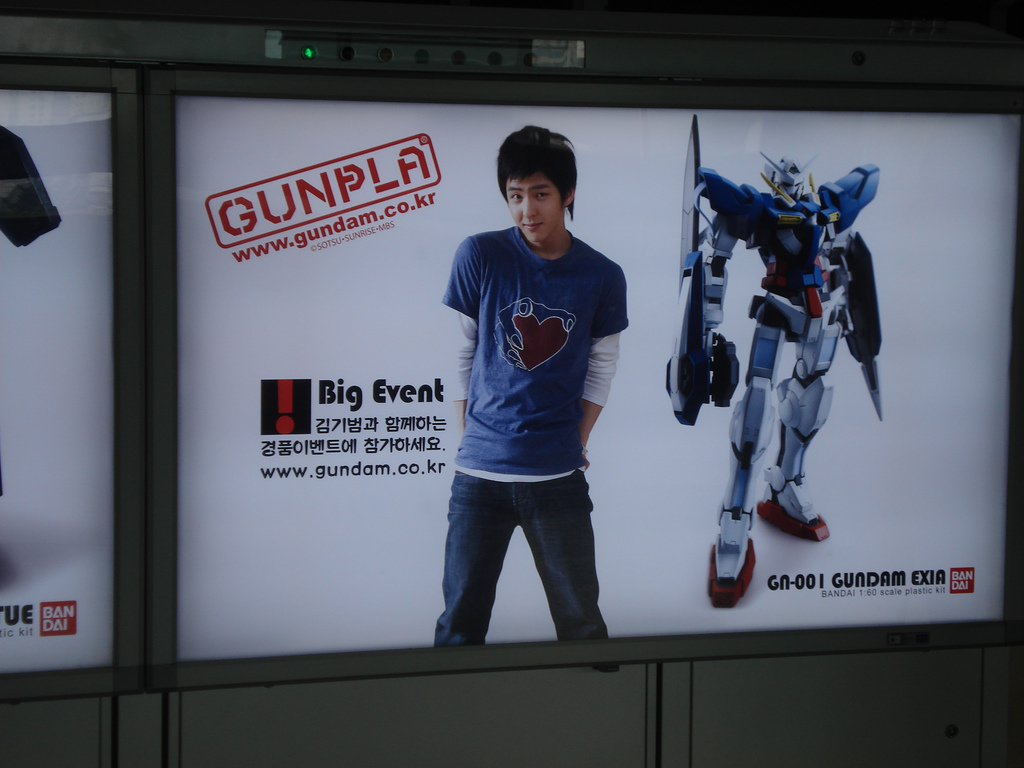
First up, the one above that was alongside the one with Min Seo-hyun. Featuring popular singer (now actor) Kim Kibum (김기범) of the boy band Super Junior (슈퍼주니어), at first glance it’s very similar. And yet:

  • the robot isn’t even facing towards him, let alone thrusting a phallic object towards his buttocks
  • Kibum’s stance is much more natural
  • rather than passively waiting for robot to initiate something, here he seems to be silently asking the observer what fun things he can do with the robot himself
  • accordingly, his expression is more mischievous than childish
( Source: L-C-R )

Crucially however, this dichotomy is not repeated in the rest of the campaign. See the following commercial which features both actors for instance (as an aside, it starts with the lines “Shall we do it? Okay”, a common innuendo in Korean advertising):

And in particular, the long version of the bedroom one, which reveals that the reason she become interested in Gundam in the first place was because boyfriend Kim Kibum bequeathed his collection to her while doing his military service, to which she now enthusiastically adds to with her own robot:

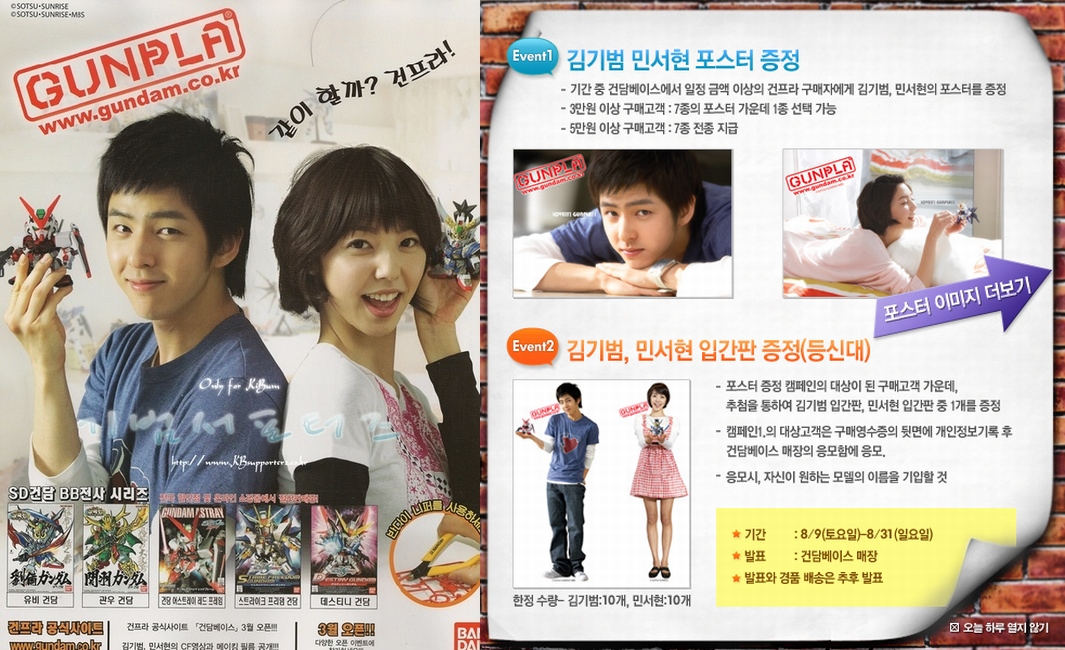
And the theme of both sexes enjoying assembling and enjoying Gundam models is corroborated by the following posters and website images:

( Source )
( Sources: left, right )

Taken as a whole, I’d argue that the only consistent theme of the campaign is that of Min Seo-hyeon becoming more and more involved in the hobby for various reasons, including by: being (sexually) tempted by the models themselves; encouraged to take it up by Kim Kibum giving her his own models; assembling models together at his suggestion; and finally becoming equally passionate and knowledgeable about it as he is. Nay, it’s not so much a theme as the exact narrative Gundam hoped would play out repeatedly in real life, and besides which the cute portrait poster of Kibum above to download from the Gundam website is sufficient evidence in itself that the campaign was aimed at teenage girls and women.

Why then, did the bedroom commercial and the opening advertisement simply suck so badly? Why on Earth did the advertising agency responsible think that having a 22 year-old woman acting like a 12 year-old would make either age group more interested in the product, let alone by suggesting that – not to put too fine a point on it – she also wanted to get fucked by it?

Of course, there could be any number of reasons. For instance, there is the cultural practice of aegyo as mentioned, which I may have underestimated, and perhaps I’m wrong in thinking that the majority of Korean women would be at least unimpressed, if not offended, by depictions of women as children. It could also be yet another demonstration of an advertising agency so used to selling products to men that it comes to regard their perceived desires and tastes as the norm, and so unwittingly applies them to women too:

( Tempted to drink soju with 16.8% alcohol now girls? )

But recall that photographer L-C-R mentioned that she saw advertisements like these everywhere in Korea, as probably you do too, which raises a third possibility: either the Korean advertising industry as a whole is dominated by men (which may in fact be true), or else it has so internalized those male norms that even women in the industry (let alone consumers) regard them as normal and appropriate for selling products to either sex.

A phenomenon by no means confined to Korea or the just the advertising industry, this is the essence of the “male gaze“, and which hopefully having provided some evidence for and/or at least piqued your interest in, I’ll wisely finish by pointing you in the direction of excellent introductions to the topic rather than going on further here. One is the examination of the ways women are portrayed in graphic novels provided by fantasy magazine, and another is the related Bechdel Test for movies:

And here’s a brief application of that to specifically Fantasy movies at Feminist SF also. But I most highly recommend the illuminating, even strangely moving 1972 documentary Ways of Seeing by then art historian John Berger, which I’ve just discovered via Sociological Images here and here. Obviously the second episode on the female nude is most pertinent here, but episode 1 is more likely to captivate you to the extent that you forget to leave your seat for the next half hour:

Here’s episode 2:

And I would include episodes 3 and 4, the latter of which is on advertising, but I haven’t watched them myself yet!^^

(For all posts in the Korean Sociological Images series, see here)

Share

Music Monday: On Black music, KARA, & Why K-pop bands are so large…

Three things of interest I came across all in the space of this morning…

First up, a recent edition of the BBC4 podcast Thinking Allowed, which – paraphrasing slightly – discusses the contention of cultural critic Paul Gilroy that:

From Curtis Mayfield to 50 Cent, from Nina Simone to JayZ, black music has declined in its quality and lost its moral stance. Outlined in his essay “Troubadours, Warriors, and Diplomats” in his book Darker Than Blue: On the Moral Economies of Black Atlantic Culture (2010) , he joins host Laurie Taylor and music journalist Caspar Melville to discuss the counter-cultural stance that black popular music once had, and explore whether it really has been destroyed.

On the surface only tangentially-related to Korea, in that modern K-pop has strong hip-hop roots (in contrast to J-pop, which are more in rock), this 28 minute, very accessible synopsis it is still surely required listening for all those interested in music and cultural studies. And indeed, the second half of the discussion in which they talk more about the impact of technological developments on music, and especially the reality that precious few young people are prepared to pay for it anymore, is perhaps more pertinent to the Korean music industry than most.

Next, an Icelandic reader passed on a link (thanks!) to the journal article “Crazy About You: Reflections on the Meanings of Contemporary Teen Pop Music” in the Electronic Journal of Sociology (2002), by Phillip Vannini and Scott M. Myers, in which the highlighted part below immediately leaped out at me. With apologies for the long quote for the sake of context (actually, only 2/3rds of the paragraph!):

…Centralized corporate production insures continued consumption through pervasive distribution, vast output volume, and structured product obsolescence (Gitlin, 1981) while strategies of careful manufacturing of the image and sound of pop icons ascertain that audiences are treated as ‘targets’ and ‘market-segments’. Take for example the case of Britney Spears. Her image and sound had been first controlled by Disney as a pre-teen Britney worked as a host of the Mickey Mouse Club. Subsequently her schoolgirl image was spiced up to appeal to the 12-16 age group and her videos were made to occupy a steady spot in the rotation of Zoog ABC and the Disney Network. Now, with her continued biological growth her image has been recreated as sensual and provocative and formatted to meet the demands of MTV. As this takes place new ‘Britney’s’ mushroom on the market to appeal to different targets: Jessica Simpson to Christian teenagers, Mandy Moore to preteens, Jennifer Lopez to Latinas and older fans. Producers’ control extends from songwriting to image-packaging and personality development (Frith, 1978). Any boy-band act is put together to appeal to various personalities and life outlooks of fans as each band includes a member portrayed as cute and sweet, one funny, one good-looking and mysterious, one creative and goofy, one talented and motivated, one dark and tough, and such. Bands are created with the consumers’ demand in mind4, for example LFO target through MTV an older adolescent urban audience with their hip-hopish sound and sexual innuendos, while S Club 7 and Aaron Carter target preteens through Fox Family and ABC Family. This is an example of the diversification of products that allow producers the broadest appeal possible and the highest profit margin.

In passing, footnote 4 from that is also interesting:

4. The structure of consumer demand is an important concept to keep in mind. As Frith (1978) suggested producers’ ability to shape needs is limited. Why or when a style becomes popular or unpopular remains a conundrum for the music industry. It is much easier for any producer to stay with one genre or act after it has become popular and produce endless imitations than experiment with new formats or shape consumer demand. Record industries still find very few acts highly profitable, while the majority of albums produced and distributed hardly bring any profit at all (Burnett, 1996).

But the highlighted part caught my eye because of what I’d read in the post Thoughts on K-Pop Vol. 1: So Addictive at the blog Multi, which is definitely required reading for those interested in Korean music specifically:

Another important thing to note is that the Korean music industry is populated mainly by groups of at least five members. With a main audience of between 10 and 19, this is a brilliant idea because all the kids will have at least one person they like in every band, are enthralled by their personalities as seen on numerous TV shows, and will not hesitate to buy their albums and merchandise. This works for other industries as well, as phone, food and clothing companies almost solely hire celebrities to star in their commercials. They also record songs and shoot music videos (and short films) for these products and then endorse them on their numerous TV appearances. Basically, the celebrities become the only people you see on screen and in print. They become ridiculously popular really quickly, and then are sent around Asia to maximize their worth because all the other countries have succumbed to the “hallyu wave”.

Naively, I hadn’t been aware that the same logic also existed outside of East Asia. But having said that, it is still much more marked in K-pop. For not only it is exaggerated by the overwhelmingly celebrity-focused nature of advertising here, but that in turn is further exaggerated by the need to sell singers rather than their music per se,  for reasons mentioned earlier. And there’s less space for independent artists that don’t subscribe to that logic to emerge too.

Finally, all the photos of KARA (카라) in this post are from their performance at (unfortunately spelt) Wonkwang University (원광대학교)* last month, in which it started to rain halfway through their song but – seemingly without so much as batting an eye – they kept performing nonetheless (see video below).  Found via Omona They Didn’t!, admittedly I probably wouldn’t have given the photos a second glance if they had been of a boy-band instead, but once I had then I really responded to them, well-aware of how refreshing and especially liberating it can feel to continue exercising – or indeed, dancing – in a downpour.

More to the point though, not only are the photos themselves stunning, which this blog theme doesn’t really do justice to (click on the images themselves for more detail, or see Diabolique here and here for more), but in particular KARA happened to be performing Lupin (루팡), in which as Multi – who else? – puts it:

…From what I gleaned from Youtube translations of the songs, they sing about being confident (in love?) and not being afraid…as opposed to simply trying to get a guy’s attention in “Mister” (미스터); check here and here for respective lyrics, and it shows in their performances. They shine in “Lupin”, but bore with “Mister”. It might just be that “Lupin” is fresher, and they’re bored of performing Mister (side effect of weekly live performances, a.k.a overkill, of songs in k-pop) but I doubt it’s just that…

She tends to prefer performances to the music itself, and presumably to the music videos too, but for what it’s worth here they are to compare:

And finally a fan cam of the performance, although unfortunately it’s of very poor quality. The rain starts falling about at about 1:20:

Thoughts?

p.s. I’d been under the impression for many years that the term “Black Music” wasn’t particularly PC, and consequently have sometimes discouraged my Korean students from using it, but the Thinking Allowed podcast made me realize I may have been mistaken. Was I, or is there perhaps a difference between American and British English?

* (Say “Won-Kwang”, not “Wonk Wang”!)

Share

Gender Advertisements: What, boys can drink girly drinks now?

Regularly criticizing food and drink companies for marketing their products so differently to either sex, or even exclusively just to one, then I’m surprised to find I have mixed feelings about the news that one company has actually chosen to stop doing so for a change: Hyundai Pharm (현대약픔), whose Miero Fiber (미에로화이바) “diet drink” for women was ironically the first of its kind in Korea, but for which a new campaign has been launched featuring Lee Joon (이준), a member of boy band MBLAQ (엠블랙), and Kwak Min-jung (곽민정), a figure skater:

제 2의 비라 불리며 초콜릿 복근으로 팬들의 마음을 사로잡고 있는 엠블랙 이준과 밴쿠버 동계올림픽에서 괄목할만한 성장으로 모두를 놀라게 한, 제2의 피겨여왕을 꿈꾸는 피겨스케이팅 선수 곽민정, 이 두 사람이 만난다면 어떤 모습일까?

엠블랙 이준과 곽민정 선수가 기능성 식이섬유 음료의 대표 주자인 현대약품 미에로화이바의 새모델로 발탁됐다.

Called the second Rain (비), and gaining a lot of fans through his chocolate abs, Lee Joon of MBLAQ is with Kwak Min-jung, a figure skater who startled everyone with her remarkable growth as a skater at the Winter Olympics in Vancouver, and who dreams of becoming the second figure skating queen [after Kim Yuna (김연아)]. What are they doing meeting together?

Lee Joon of MBLAQ and Kwak Min-jung the skilled athlete have been chosen as the representatives of the diet fiber drink Miero Fiber by producers Hyundai Pharm.

미에로화이바는 1989년에 출시되어 20년 넘게 많은 사람들의 사랑을 받아온 국내 최초의 식이섬유 기능성 음료로, 그 동안 이소라, 김혜수, 박민영, 고아라, 신민아 등 미에로화이바를 거쳐 간 여자 연예인들은 최고의 인기를 구사한다는 소문을 낳을 만큼, S라인 여자 연예인들의 매력이 돋보이는 CF를 선보여왔다.

이에 이준과 곽민정 선수의 모델 발탁이 더욱 신선할 것이라는 것이 현대약품 측의 설명. 서로 다른 분야에서 떠오르는 신예로 맹활약 중인 이 두 사람은 이번 CF를 통해 2010년, 모두가 부러워하는 워너비 몸짱으로 등극할 예정이라고.

Miero Fiber has received a lot of love since being launched as the first diet drink in Korea in 1989, and indeed [previously unknown] female entertainers that have showed off their S-lines and attractiveness in commercials for it have included the likes of Lee So-ra, Kim Hye-su, Park Min-young, Go-ara, and Shin Min-a, to the extent that there is a rumor that appearing in one is very helpful for a female entertainer’s career!

James – That is probably just the typical hyperbole of Korean news stories, but then I did personally first learn of Shin Min-a in 2000 and Go-ara in 2006 through their Meiro Fiber commercials:

Lee Joon and Kwak Min-jung were chosen by Hyundai Pharm because the company wanted a strong, fresh image, and because both are rising stars in their respective fields. It is hoped that through this commercial, in 2010 many people will become jealous of them and also try to get good bodies.

현대약품 관계자는 “이준과 곽민정 의 건강미와 무한한 가능성에 주목했다”며 “이준의 강하고 섹시한 이미지와 곽민정 선수의 건강하고 귀여운 매력을 통해 미에로화이바가 상징하는 건강한 아름다움의 컨셉이 효과적으로 전달될 것”이라며 새로운 모델에 대한 기대감을 선보였다.

한편, 지난 달 세계선수권대회를 마치고 귀국한 곽민정 은 국내에서 한 달간 머물며 휴식을 취한 뒤 다시 캐나다 토론토로 돌아가 오서코치와 함께 훈련에 전념할 계획이며, 이준은 최근 짧은 헤어스타일로 변신해 스승인 비와 붕어빵 외모로 화제를 일으키며 본격적인 컴백에 대한 팬들의 기대감이 한껏 고조되고 있다.

According to a Hyundai Pharm spokesperson, “It has often been remarked that Lee Joon and Kwak Min-jung both have a kind of healthy beauty and unlimited potential,” and that “with Lee Joon’s strong and sexy image and Kwak Min-jung’s healthy and cute one, they will be effective as symbols of Miero Fiber’s healthy and beautiful concept,” which is why they were chosen as new models and why Hyundai Pharm has high expectations of them.

In the meantime, after the 2010 World Figure Skating Championships concluded last month, Kwak Min-jung returned to Korea for a month of rest, but has since returned to Toronto in Canada to concentrate on training with coach Brian Orser, while Lee-Joon has recently changed his hairstyle to look almost like a twin of his mentor Rain, raising a lot of interest and expectations among fans as to what the theme of MBLAQ’s comeback will be. (source)

Granted, not an explicit admission that Hyundai Pharm now hopes to sell to men what it previously wanted consumers to believe was only for women. But that message is pretty clear in the commercial itself:

언니만큼 잘하고싶어요. 라인도 신경써야죠.

Like my older sister [Kim Yuna], I want to do well. I also have to pay attention to my S-line, yes?

마시는것도 관리해야죠. 형! 딱 기다려!

I too have to think about what I drink. Older brother [Rain]! Just you wait for me!

내일이 기다려집니다. 미에로 화이버.

We can’t wait for tomorrow. Miero Fiber.

And on that note, it’s a pity that, yet again, athletes that have gained great bodies through exercise are endorsing a product that encourages people to think that merely slugging a diet drink is all that is required. But I do think that selling it to both sexes is still a positive step: after all, as I discuss here, unfortunately it is by no means an exaggeration to say that there is a widespread belief among Korean women that “obtaining the perfect body is possible provided one merely buys and passively uses, applies or digests various products,” and one which strangely coexists alongside a belief by men that they must do active exercise instead. Introduce the notion that men and women can obtain their desired bodies through the same means however, and you begin to challenge that false dichotomy.

On the other hand, it is a diet drink being sold, and so there is also the possibility that ads like these will simply encourage men to forgo exercise in favor of dieting (and so on) also. Which do you think is the more likely scenario?

Either way, Korean energy drinks are off to a good start!

Share

“Gender Advertisements” in the Korean Context: A Request

( Source )

If you’d told me a week ago that I’d be spending much of my birthday looking for images of Korean men touching themselves, I’d probably have politely told you never to comment on my blog again.

Prompted by this analysis of Korean magazine advertisements that found that Korean men were significantly more likely to be shown doing so than Western men in them however, that’s precisely what I’ve been doing. But for all their supposed ubiquity, it’s proving surprisingly difficult to find examples, throwing off my schedule for the next posts in this series.

To be specific, I’m after advertisements like these, but featuring Korean men rather than women, and would really appreciate any help. Seriously, what search terms would you suggest, in English or Korean?^^

Of course I do have some examples, and will continue looking: my planned post will simply take longer than expected. In the meantime then, let me briefly offer some amusing and/or interesting advertisements that have cropped up recently instead, starting with that for Coca Cola Korea (한국 코카콜라) above featuring Thai-American Nichkhun (닉쿤) of the Korean band 2PM. I think its humor speaks for itself, but in the unlikely event that you feel I’m reading too much into it, please see those featuring other…er…members of the band here, of which Junho (준호) in particular seems to be enjoying holding his miniCoke bottle entirely too much!

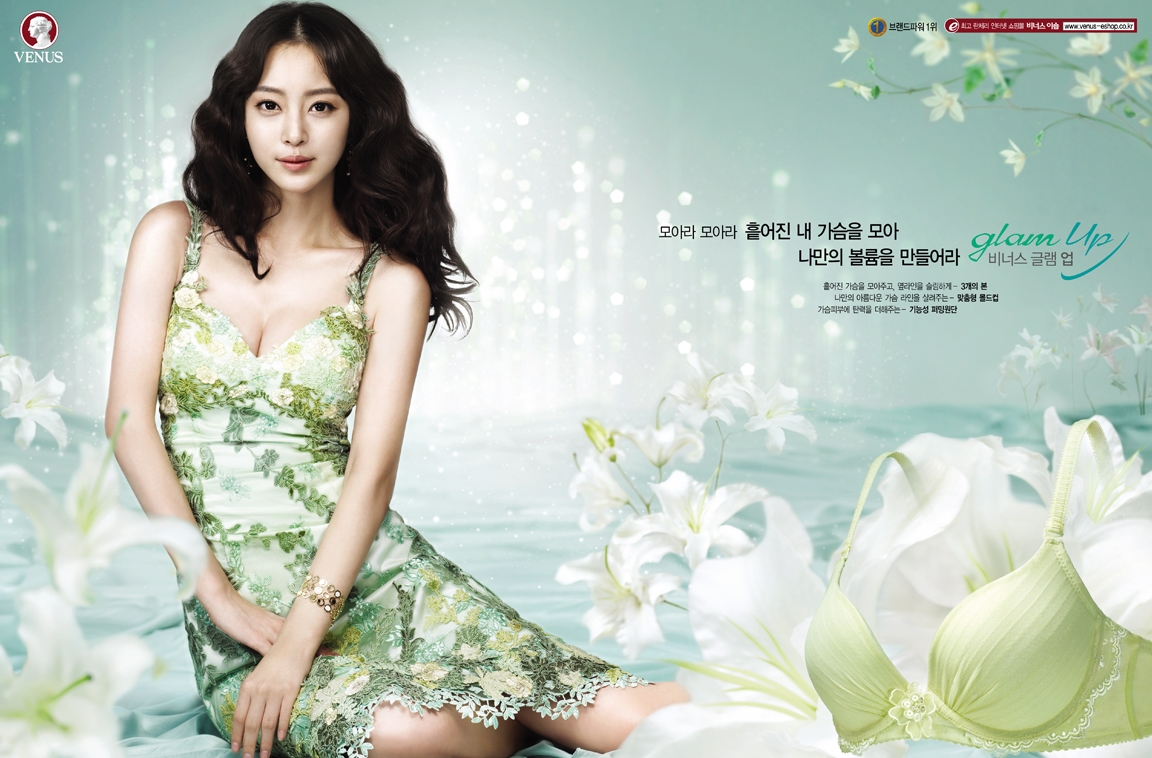
Next is this one for Venus lingerie (비너스) featuring Han Ye-seul (한예슬), featured on the front page of Korea’s main portal site Naver (네이버) as I type this. Why it’s interesting is because of the English name “Glam Up” for the bra featured, which, making little sense otherwise, supports the argument that the English word “glamor” has somehow come to mean “voluptuous” or “curvaceous” in Korean:

( Source )

In turn, it demonstrates the ridiculousness of the new Korean phrase cheongsoon-gullaemor (청순글래머; or “innocent glamor”), but which is nevertheless very much in vogue in the Korean media at the moment. But that is no great surprise in view of the enduring popularity of older ones for women’s bodies like “S-line” (S라인) perhaps, and so, lest I begin to sound too serious here, let me move on to this advertisement for Nike Korea (나이키) featuring ice skater Kim Yu-na (김연아):

( Source: korean lovers photoblog )

One of the most endearing athletes I’ve ever seen (well before she won her gold medal), it’s difficult not to simply adore Yuna, but I confess I still had to to laugh at what Matt at Gusts of Popular Feeling wrote about this ad last month:

By the way, does anyone find Kim’s expression in this ad to be, uh, ecstatic?

Perhaps there’s a reason the left hand side was cut off where it was. Just do it, indeed.

Okay, perhaps that was reading too much into it, and I’m sure you can understand my reluctance in not posting it earlier, the image of her at #10 here alone receiving thousands of hits in the last week of February, presumably most of them from fans…

Either way, I hope you at least one of those advertisements made you smile and/or think. And again, if anyone can help find examples of the sorts of advertisements I’m looking for, I would very much appreciate it; even if it’s only because you feel guilty for forgetting my birthday!^^

Share

Open Thread #7: Candy to my Ears

(Source: Nbbang)

Sorry, but it had to happen eventually: I’ve fallen in love with K-pop.

Well, with 3 more remixes from Greek trance DJ Areia to be precise. With apologies for dispensing with my normal analysis of the songs on this occasion, but I can’t remember the last time that I liked new music so much that I’ve lost sleep listening to it over the next few days.

Seriously, this music makes me feel like a smitten teenager, and hopefully it will some of you too.

The first track is My Ear’s Candy by Baek Ji-young, from her mini-album EGO that came out in August last year (the MV also features Ok Taec-yeon of 2PM). Curious about her music after recently writing about her soju ad, this is the gateway video got me hooked:

But not so much because of the cinematography and costumes, although I confess I have always loved that look with the white wig. More because Baek Ji-young looks like she’s genuinely enjoying herself, which makes a refreshing change from the forced smiles of Girls’ Generation in Oh! for instance, or alternatively the seeming disdain for the viewer that U.S./Barbadian singer Rihanna displays in Shut Up and Drive that SM Entertainment has been accused of plagiarizing.

Granted, Rihanna’s persona is appropriate for the title of the song, and I’m not so naive as to not be aware that Baek Ji-young’s may be just as carefully choreographed for this one also. But still, she does look like someone great to go clubbing with ;)

As for the remix, arguably it is very similar to the original (as is the next song too), so you may well be wondering what the point is. But there are differences, and which, as all trance aficionados are well aware, unfortunately you’re likely to be completely missing if you’re listening via your tinny computer speakers. Please try headphones instead, and you may be pleasantly surprised!

Next is Like the First Time,  by T-ara (say “tiara”). Put off by their simply atrocious Bo Peep Bo Peep (보핍보핍) last year though, and which even Areia’s remix could not save, then I’d never have suspected that this one would become my new favorite:

As happens to many viewers of K-pop these days, you might be very surprised to learn that one member of the group, Park Ji-yeon, is still only 16 (as is one girl in the next video too, but she looks her age). But that’s a long discussion I already had earlier this month; instead, consider this assessment of the of the the dancing and clothing in the video by Areia himself, as it partially inspired the topic of one of next week’s posts, and I’m very curious to hear your own opinions of it before I start writing:

The girls are supercute throughout the video and I find them very sexy at the scenes with the black dresses. The way they slowly move to the melody just kills my heartbeat every single time. To the untrained western eyes the video might just seem a bit cute or even silly. “It’s just some girls with short black dresses trying to look good, so what?” my overexposed-to-western-sexiness friends back home would say. But there is a huge difference here and this difference is very representative of the gap between the eastern and western stereotypes. It’s not okay to express too directly in Korea and that leaves you with only one acceptable weapon to tease your target: charm. And this is exactly what these girls are doing with their moves in this video – I’m not referring to the cute scenes. Whoever did the choreography and the dresses knew very well what they were doing. And the girls of course have done an excellent job at being charming. When I watch some sexy western video clip (let’s say Buttons from Pussycat Dolls) it hits my eyes. But this charm here hits me straight in my heart – I feel like wanting to hug the girls not…. Perhaps that’s the reason I’m into Asian pop in the first place.

Finally, here is Please Don’t Go by CL and Minzy (the 16 year-old) of 2NE1 (투애니원; say “to anyone” or, confusedly, “21”). No music video being made, then this one of a performance of theirs is unremarkable, but this remix at least is virtually unrecognizable from the original song, and in my opinion a vast improvement:

Update: For reasons explained here, unfortunately Areia had to delete that video, but the MP3 is still available for download.

Click on the titles of all the remixes for links to where you can download MP3s of them, and detailed explanations of what when into making them. I hope you’ve enjoyed them, but if not then thank you for bearing with me, and please remember that this is still *cough* an open thread, where you can raise anything on your mind.

Speaking of which, as of yesterday I am now officially in the job market again, and so would very much appreciate any readers help in getting jobs teaching adults in either Busan or Seoul, or of course anything not involving teaching at all. Unfortunately with having a family to support then I’ll need at least 3 million won a month before moving to Seoul especially, but hopefully that won’t prove too difficult?

Wish me luck!

Korean Sociological Image #32: Censorship and Indirect Advertising

(Source: unknown)

Ever find yourself wondering at the logic behind some of the blurring and mosaicing on Korean television?

No, I’m not talking about that recent scene from Chuno involving a fully-clothed Lee Da-hae (이다해) I’m afraid. Rather, the proclivity with which Korean broadcasters will disguise the logos of products visible in television programs. Indeed, it’s so taken for granted here that frankly I’ve had trouble finding examples (without simply watching television and waiting for something to pop up that is).

The reason is to prevent indirect advertising, known as ganjeob gwango (간집 광고) in Korean and PPL (Product Placement, or Embedded Marketing) in the industry. But it is usually ineffective, the blurring in the following segment from the talk-show Giboon Joeunnal (기분좋은날) for instance, or A Day That Feels Good, providing little impediment to this Korean blogger in identifying the brand-name and model of the baby monitor and recommending it to her readers (update: see here for a video that provides a collage of much better examples):

Instead of cases like those though, the majority of articles on the subject discuss deliberate, unedited PPL instead, such as this case with the Bon Bibimbap food chain in the drama City Hall (시티홀), this case with actor Jang Hyuk (장혁) and various Canon cameras in an unidentified drama and film below, and especially a recent episode of the comedy show Paemilli-ga Ddottda (패밀리가 떴다), or Family Outing, in which some Nepa (네파) outdoor clothes were used (see here, here, and here).

Family Outing Nepa(Source)

At the end of that last link, the laws regarding PPL are mentioned, the gist of which is that it should not: influence the content or story of the program; be the focus of viewers’ attentions; be mentioned by anyone in the program; and finally, that the program should not persuade you to buy the product in any way. While all sound reasonable however, they are also very open to interpretation, and Korean broadcasters frequently receive warnings or fines from the Korean Broadcasting Communications Committee for falling afoul of them.

Adding even further confusion to the mix, since 2006 PPL of specifically Korean products has been increasingly encouraged as a means to capitalize on the success of the Korean Wave abroad, one recent example being Kia Motor’s deal to provide cars and other paraphernalia for the hugely popular drama IRIS.

Given that context, then broadcasters’ decisions to ban singer J.ae’s (제이) new album from the airwaves simply because of the lyrics of some songs seems particularly hypocritical:

J.ae’s New Album Rejected by TV Stations

Returning to the music business after three long years must not be as easy as she thought. J.ae’s new special album, “Sentimental,” was ruled unfit for broadcasting by KBS and SBS. MBC is currently reviewing the song to announce the result next week. Broadcasting review panels at the leading national networks said that the lyrics of the title song “No.5” contained direct references to commercial brand names, like Chanel and McDonalds. Network stations are concerned that naming certain brands could cause debates over indirect advertising.

“No. 5” was written by Lee Ji-rin of the indie band Humming Urban Stereo, who was inspired to write a song after seeing an ad about Chanel No.5 perfume on a bus. The song may have succeeded in grabbing the interest of listeners with its unique lyrics, but could not escape from the criticism of indirect advertisement. Jae’s agency said that it’s most unfortunate that her year’s work failed to meet the industry standards, but it will apply for another review after changing some parts of the lyrics. J.ae’s latest album will be out on the market on February 10th. (Source: KBS Global, via Omona They Didn’t)

One wonders what they made of Aqua’s Barbie Girl back in 1997?

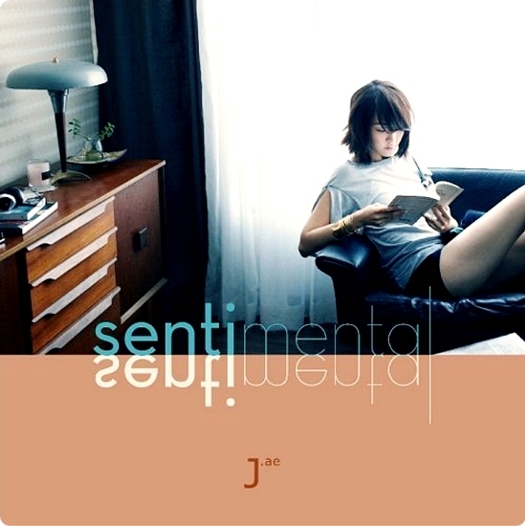
J.ae Sentimental .For those of you further interested in J.ae herself, you can read two interviews of her (conducted before the banning) here, and listen to one of the problematic songs No. 5 here (source right: unknown).

Meanwhile, unfortunately this is by no means the first time that artists’ songs have been banned in Korea simply because their lyrics could be construed as PPL, a case involving Epik High (에픽하이) back in April showing that even indirect mention of the artists’ own website can be considered problematic. Moreover, against the argument that both cases are merely inane but innocuous, they do add to the essential arbitrariness of censorship in Korea, English song lyrics acceptable on 1950s American television banned because they could sound vaguely sexual to non native speakers for instance (see #2 here), and accordingly it doesn’t take a great leap of imagination to imagine a time when censors will ultimately use PPL as a convenient excuse to ban a disagreeable but otherwise completely legal cultural product.

Or perhaps they already have? If you know of any previous cases of banning based on PPL, then please pass them on, whether the PPL was used as a ruse or otherwise!

(For more posts in the Korean Sociological Images series, see here)

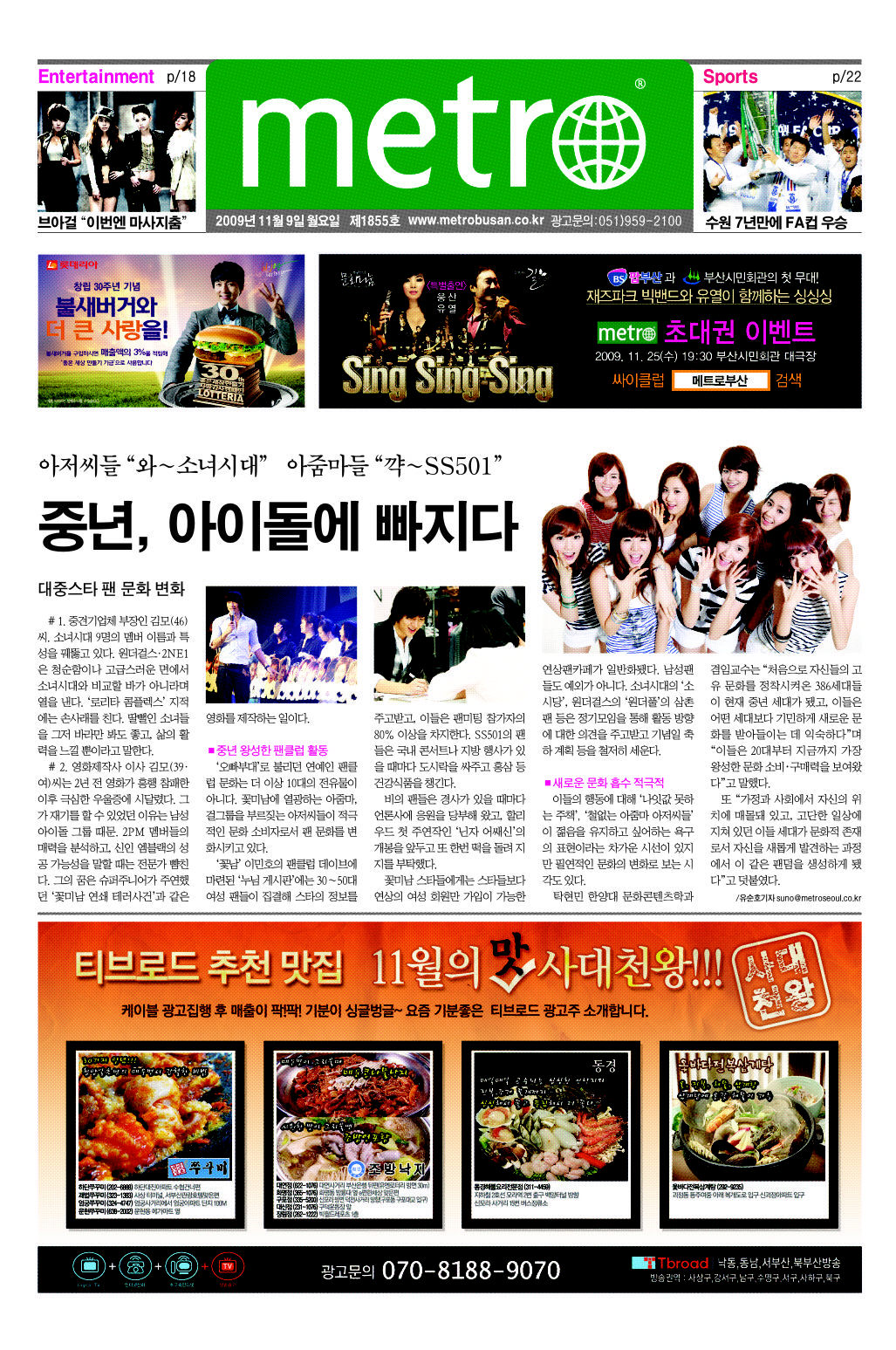
Lusting After Teenagers…or the Maturing of Women’s Fan Culture?

Update, September 2013: My original commentary on this article became outdated, so I’ve since removed it. Instead, please see here, here, here, and here for more on the controversial “uncle” or “ajosshi” fandom of teen girl-group members, and here for more on why middle-aged women came to dominate soccer fandom back in 2002 — an important precursor to their fandom of pop stars and actors described here.

Middle-aged People are Head Over Heels about Young Idols

Fan Culture is Changing

#1. Mr. Kim (46), a department manager of a medium-sized business, knows the names and personalities of all 9 members of Girls’ Generation. He thinks that the Wondergirls and 2NE1 do not even come close in terms of purity and class. He dismisses accusations of having a Lolita complex, and says that watching the girls of Girls’ Generation, who are about the same age as his daughter, give him a feeling of life and vitality.

#2. Film company CEO Mrs. Kim (39), suffered severe depression after her movie did extremely badly 2 years ago. But she was able to recover because of her interest in male idol groups, and when she analyzes the charms of members of 2PM, or discusses the potential for the new group MBLAQ, she is indistinguishable from an expert in the music industry. Her dream is to make a movie like Attack on the Pin-up Boys (2007) that Super Junior starred in.

Middle-aged People Are Actively Participating in Fan Clubs

As the name implies, “older brother” fan club members used to be mainly teenagers, but this is no longer the case. But as active consumers of culture, middle-aged women passionate about flower men‘ and middle-aged men heavily into girl groups are actively changing fan culture.

For instance, on flower man Lee Min-ho’s fan club “Dave,” there is an “older sister” section for 30-50 year old women to exchange information about their star, and when there are fan meetings with him they make up over 80% of the audience. And whenever SS501 [James: if you don’t want to show your age, say “double-ess” rather than “ess-ess”!)] have a concert in Korea or attend some event in their region, their middle-aged female fans prepare packed lunches with healthy foods such as red ginseng for them.

(Source)

And whenever there is an event featuring Rain, his middle-aged female fans call the media and request favorable coverage. Before the release of his first Hollywood movie Ninja Assassin (2009), they even delivered rice-cakes to them, a symbol of good luck for a new venture.

Indeed, it has become quite normal for there to be fan clubs that only allow those older than the flower men themselves to join. And this is true for male-only fan clubs for female idols too. In the Girls’ Generation’s “Girls’ Generation’s Party” and the Wondergirls’ “Wonderful” fan clubs for instance, middle-aged men have regular virtual meetings where they exchange opinions about how the groups can progress and thoroughly how they can celebrate group anniversaries and birthdays and so on.

A New Fan Culture is Actively Forming

Many people have dim views of middle-aged men and women who don’t act their age, dismissing them as merely chasing after their lost youth. But an alternate view is that this demographic shift in membership is an inevitable change.

Professor Tak Hyeon-min, on sabbatical in the Cultural Contents Department of Hanyang University, said “People of the 386 Generation, who have finally established their own unique culture, are used to actively absorbing new things,” and that “from their 20s until now, they have demonstrated that they are the biggest consumers and purchasers of cultural products.”

Also, “members of this generation are stuck with heavy family, home, and/or social responsibilities, so as a means of escapism and renewing themselves, they have created a middle-aged fandom in a sense, fundamentally changing Korean fan-club culture in the process.” (end)

What do Koreans REALLY Think of Bloodtypes?

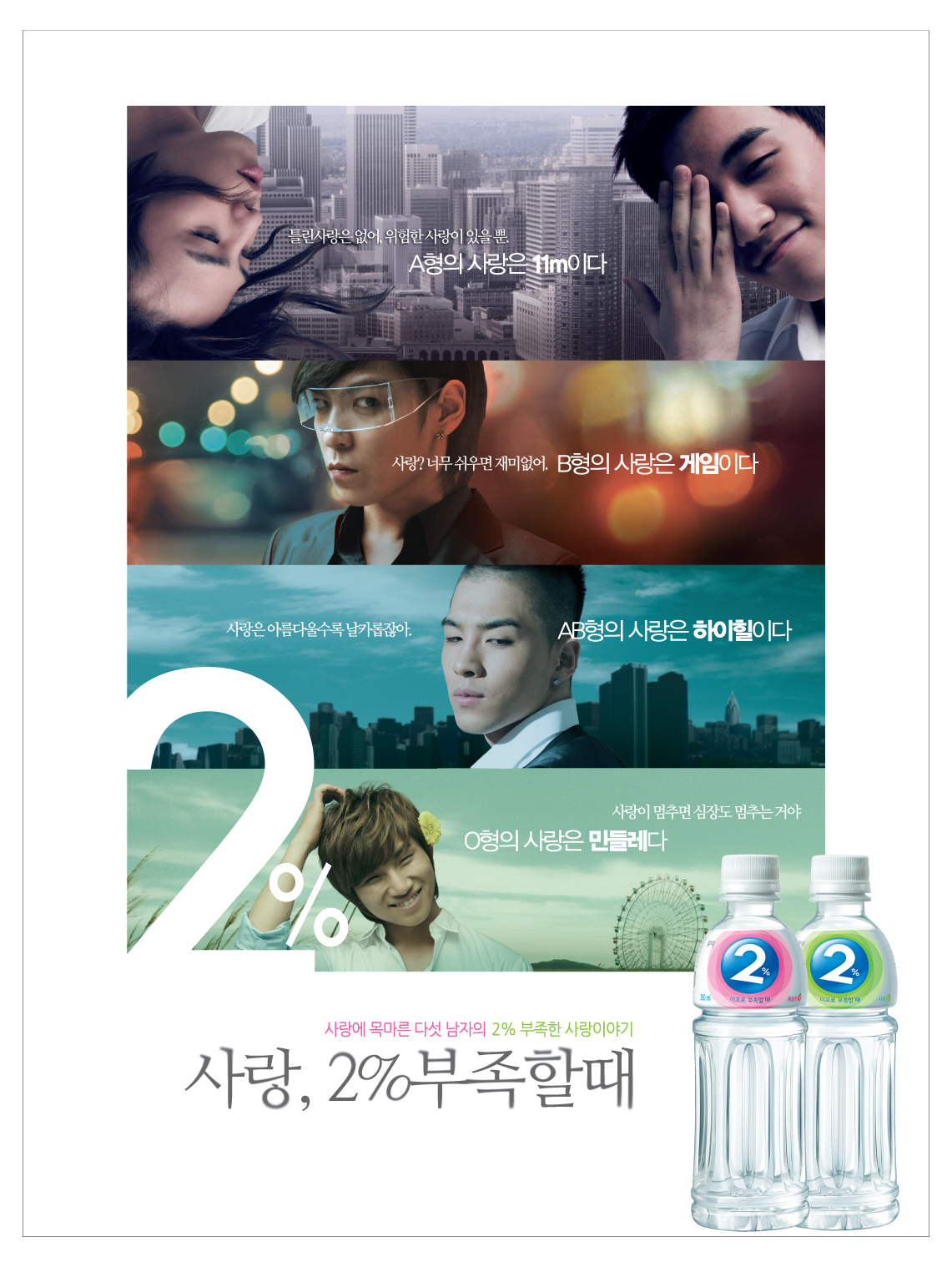
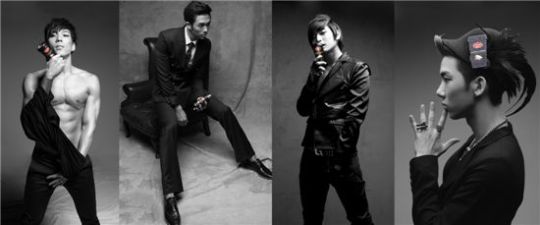
big bang 2%보족할때 광고 blood type advertisement

With those top two panels reminding me of the futuristic Blade Runner, it’s ironic that the ad is actually based on the decidedly archaic belief that one’s bloodtype determines one’s personality. What’s more, it’s a surprisingly deeply-held one too, with some Korean women even rejecting all B-type men as potential marriage partners because of it, as I discussed when I wrote about a similar marketing campaign for kiwifruit back in May. In short, it’s not quite the same as having a good laugh at your daily horoscope, and can’t be so easily dismissed.

My Boyfriend is Type-b Tandy Advertisement

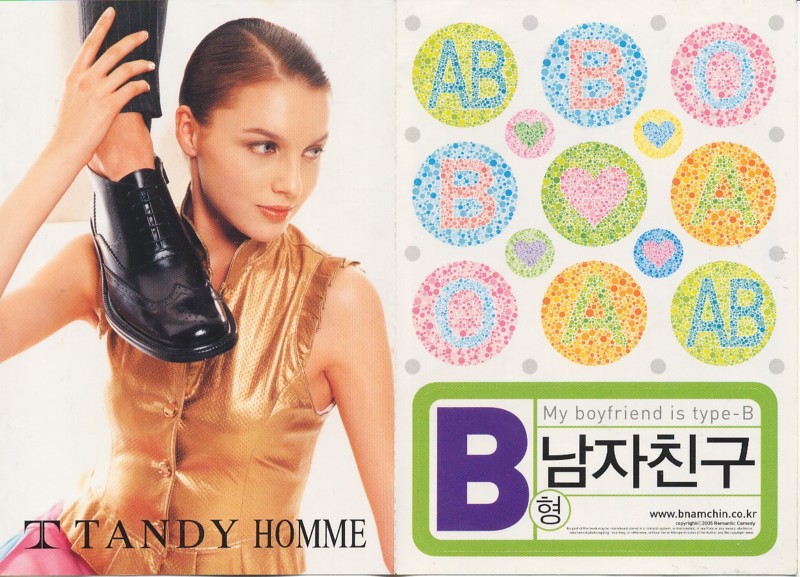
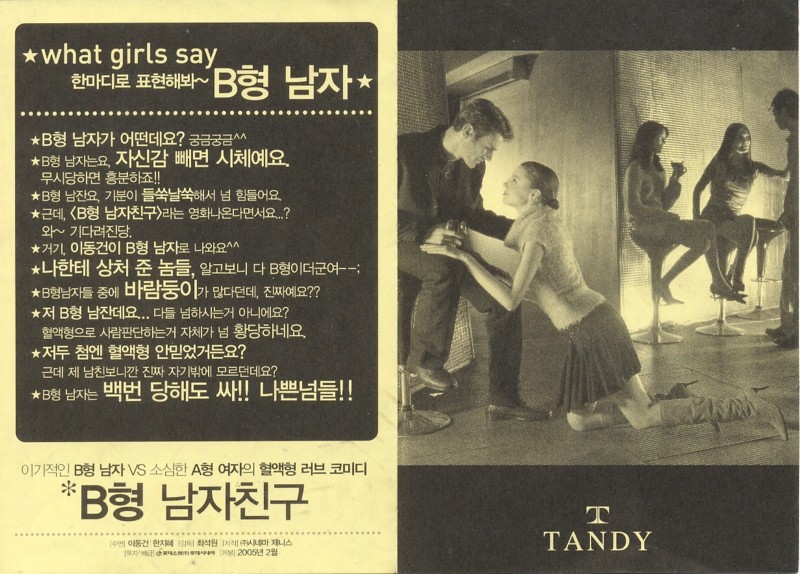
A strange {and slightly disturbing} advertisement for Tandy found on this site about the 2005 movie My Boyfriend is Type B {B형 남자친구}. See later in the post for one more, and here for a review of the movie.

Lest one is tempted to jump to conclusions about Koreans’ critical-thinking skills though, then consider this blog post on the subject that was featured on the front page of Yahoo! Korea about a month later, which I’ve translated below. It is from the 12th most popular Korean blog according to its own blog ranking system—by way of comparison, this one is currently ranked 87,378 out of 4,644,184—so it would have been read by a lot of people:

우리나라에서만 볼 수 있는 ‘혈액형’ 광고의 불편함…

It’s discomforting  how Korea is the only country in the world with advertisements about bloodtypes…

A형, B형, AB형, O형이 한자리에 앉아서 식사를 하고 있었다. 갑자기 AB형이 밥을 먹다 말고 벌떡 일어나 뛰쳐나가자 O형이 AB형을 뒤쫓아간다.

남겨진 A형이 B형에게 조심스레 묻는다: “쟤 혹시 나한테 화난거야?”

온라인과 오프라인을 막론하고 이젠 귀에 딱지가 앉을 정도로 듣게되는 혈액형별 성격에 관한 유머다.

일본에서 들어와 국내에 뿌리내린 혈액형별 성격 분석은 독일의 우성학에서 출발해 일본에서도 1970년대에 확고히 자리잡았다고 하는데 이런 성격 분석이 국내에 유입되어 뿌리내리며 우리나라를 전세계에서 몇 안되는 혈액형 신봉 국가를 만들어 버렸다. 사람 둘 셋만 모이면 혈액형에 대한 이야기가 쏟아져 나오는 그런 나라…;;

그렇게 보면 다음 CF들은 어쩌면 우리나라에서만 만날 수 있는 광고의 유형은 아닐까?

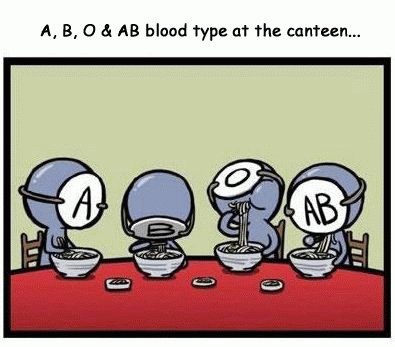
A, B, O & AB Bloodtypes Eating TogetherFour people, one with bloodtype A, one with B, one with AB, and one with O were sitting down having a meal together. Suddenly, “AB” stopped eating and got up and ran outside, and “O” decided to follow (him).
“A” and “B” remained, and A nervously asked B: “Is (he) angry with me?”

(James: No, I don’t get it either. But, for the remainder of the cartoon version on the right, see here, and here for many more like it.)

Needless to say, online and offline, there is so much humor about blood types that people are very tired of it.

Blood type and personality analysis originally derives from German eugenics, but it became firmly rooted in Japan in the 1970s, and from there in Korean culture, making Korea one of just a handful of countries that haven’t thrown such beliefs away. Indeed, get two or three Koreans together, and invariably they’ll end up chattering about blood types…

In this sense, you can only really see commercials like the following in Korea, right?

혈액형으로 먹는다제스프리 골드키위/Eat according to your blood type…Zespri Golden Kiwi

키위를 먹는 방식을 혈액형 성격 분석에 맞춰 유머러스하게 풀어놓은 제스프리의 CF다.

Here’s a humorous commercial by Zespri saying different blood types eat Kiwis in different styles (James: see my earlier post for the other 3 in the series):

Vodpod videos no longer available.

혈액형으로 마신다… 2% 부족할 때/Drink according to your blood type…2% “Near Water

제스프리가 코믹이란 콘셉트를 내세웠다면 이쪽은 혈액형과 치환되는 단어와 사랑을 엮고 빅뱅을 얹어 광고를 내놨는데 실제 빅뱅 멤버의 혈액형에 맞춘 광고란다.

Whereas the Zespri commercials had a comic concept, the following ones with the band Big Bang (빅뱅) has each member falling in love and romancing women according to their bloodtypes (James: this video combines all 4 commercials in the series):

재학습되는 혈액형 성격 분석…/These commercials help perpetuate public belief in the bloodtype and personality theory

평소 귀가 얇은 편이라 혈액형별 성격 분석에 종종 혹하는 편이지만 ABO식 혈액형의 고작 4가지 패턴으로 60억 세계인의 성격을 모두 분류할 수 있다고는 생각치 않는다. 또 이론적 뿌리도 부실하고 지나친 일반화와 선입견 듬뿍 담긴 규정으로 혈액형 별로 사람을 가늠해 버리는 것 자체가 혈액형에 기준한 성격 분석이 갖는 문제점이라고 생각하는 편이다.

Normally I’m a little gullible, so I’m often convinced of the validity of the bloodtype and personality theory, but still, I can’t believe that all 6 billion people in the world can be compartmentalized and categorized into just four types. And it is a problem that people are influenced by and follow the rules of their prescribed personality when the theory is based on insufficient evidence,  is too generalistic, and rife with prejudices and preconceptions.

My Boyfriend is Type-b Korean Tandy Advertisement

그런 이유로 이번에 소개한 혈액형에 관한 CF들은 왠지 불편했는데…감각적인 영상과 유머 코드로 적당히 버무려 광고를 바라보는 이들에게 쉽게 퍼지고 기억되는 이런 영상들이 결국 사람들 사이에 회자되는 혈액형별 성격 분석을 재학습시키고 있는게 아닐까란 생각에 이르렀기 때문이다.

For this reason, seeing these commercials made me feel a little uncomfortable…when sensible (if misguided) notions of bloodtype and personality are mixed with humorous ones in a sort-of cultural code and then utilized in commercials like these, they help to keep the theory on everyone’s minds and thereby perpetuate artificial divisions.

물론 사회에서 익숙한 코드를 반영해 상품을 홍보하는 건 일반적인 광고의 특성이니 어쩔 수 없는 부분이 있었겠지만 그래도 “이 혈액형은 이렇고 저 혈액형은 저래. 그러니 너는 이렇지?”라는 식으로 세상 모두를 4가지 성격군으로 분류할 수 있다고 생각하는 것 자체가 문제 아닐까?

훗~ 평범한 O형의 한마디였다. 응?

Of course commercials will always reflect a society’s cultural codes, but nevertheless isn’t it a problem when we say “this bloodtype behaves like this, that one like that, so that’s why you do what you do, yes?”, and that we want to compartmentalize the whole world into just four types?

I’m O by the way. Is that a typical thing for an O type to say? (Finish)

Get's the blood flowing...

Not exactly the piercing critique I anticipated when I began translating, but that wasn’t my point really, which was more to provide a healthy reminder that just like back home there is a healthy diversity of opinions in Korea on just about every subject, but which it’s very easy to overlook if you only rely on English-language sources. Indeed, I’ve just found yet another, longer news report on the same two advertising campaigns, which I’m happy to also translate if anyone’s further interested (it’ll be good revision).

In the meantime, while finding some images for this post I couldn’t help but notice that, once again, apparently the powers that be felt that only young women in tight t-shirts and/or miniskirts could persuade persuade Koreans to perform their civic duty on “World Blood Donor Day” this year (left) and last (right). Come to think it though, that particular advertising convention doesn’t exactly detract from the aim of getting people’s blood flowing…

Sorry, I couldn’t resist it. And in fairness, this year’s ads did feature boy-band Super Junior (슈퍼주니어) also. For some big pictures of them promoting donating blood, albeit together with Girls’ Generation (소녀시대), see here.

Share