
While young Korean women’s greater use of condoms in recent years is—You go girls!—definitely something to be celebrated, their continued disdain for long-term contraceptive methods, particularly the pill, sends mixed messages about female empowerment.
 Estimated reading time: 7 minutes. Image source: FM Korea
But no, seriously. There has been a seismic shift in Koreans’ attitudes to premarital sex over the last decade or so.
So earth-moving in fact, that I just did a huge double take during my own lecture. I had to pause for a moment when I presented the slides below, so many other things I was covering that day—nay, the entire semester—seeming to suddenly coalesce into a coherent whole, vindicating all the work I’d put into it.
In particular, my earlier lecture on the almost equally dramatic rise in single households in Korea, more than doubling in 20 years to reach 42% of all households in 2024, with particularly rapid rises in the years since Covid. Also that, coming just a few slides later in this one, 20-something Korean women have far, far more experience of and willingness to use contraception than their 30- and 40-something counterparts do.
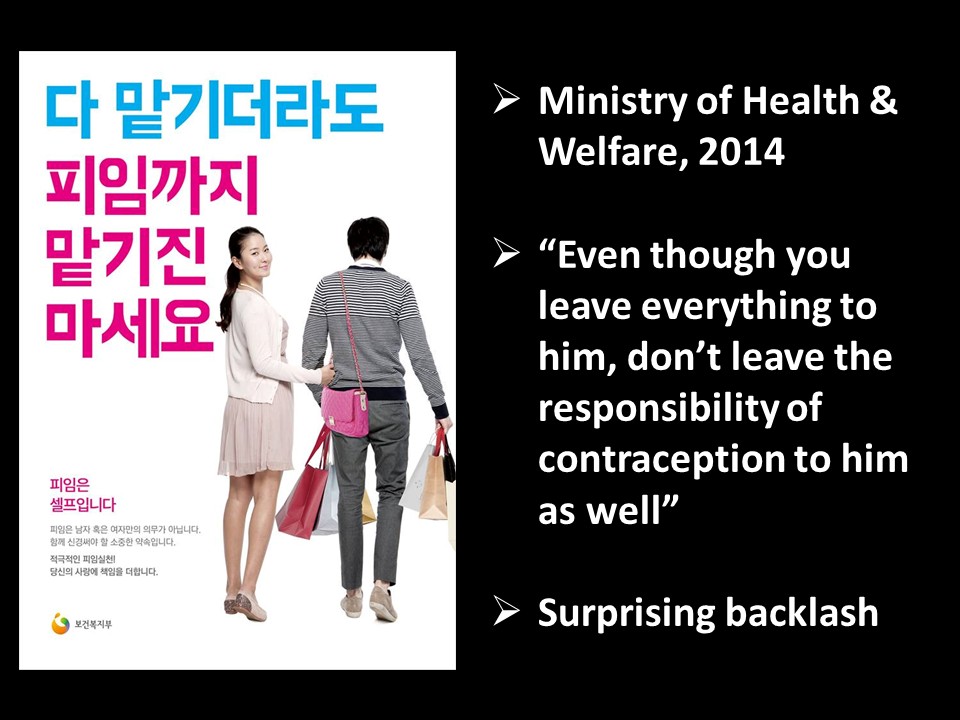
Whereas as recently as 2014, unmarried women were so concerned about maintaining their virginal reputations, akin to UK women before the sexual revolution of—yes—the 1960s, that the Ministry of Health and Welfare would launch a campaign to encourage them to stop relying entirely on their male partners to provide, know how to use, and, you know, actually use contraception.
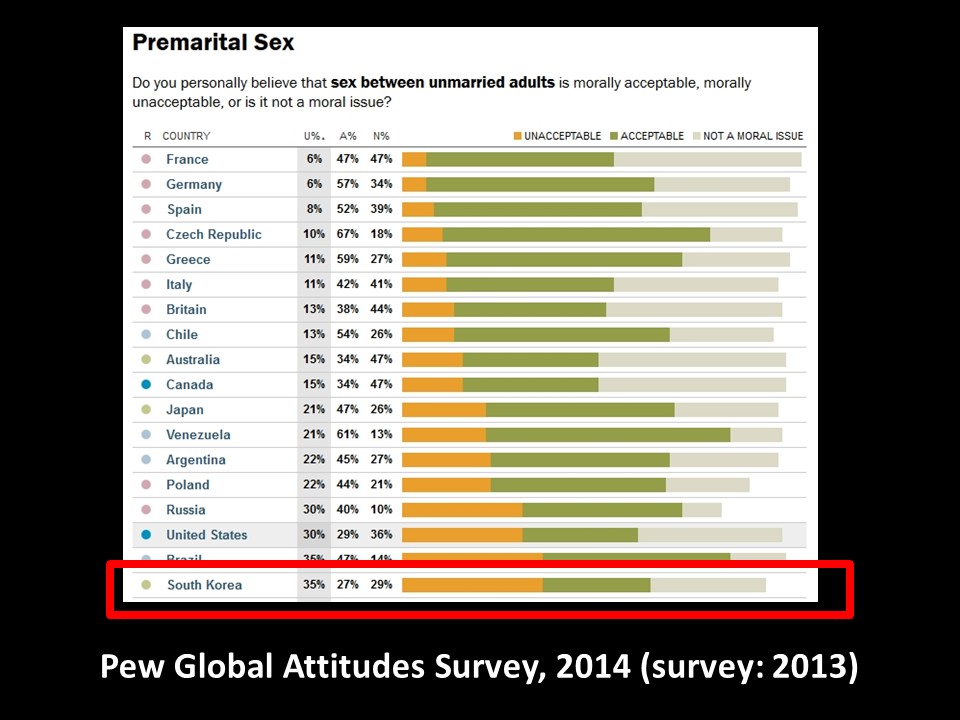
Alas, it wasn’t as enlightened as it necessarily sounds, mostly being prompted by a desire to reduce the (then illegal) abortion rate. But still—that was then, and this is now. As, during class, the following statistics suddenly made abundantly clear:
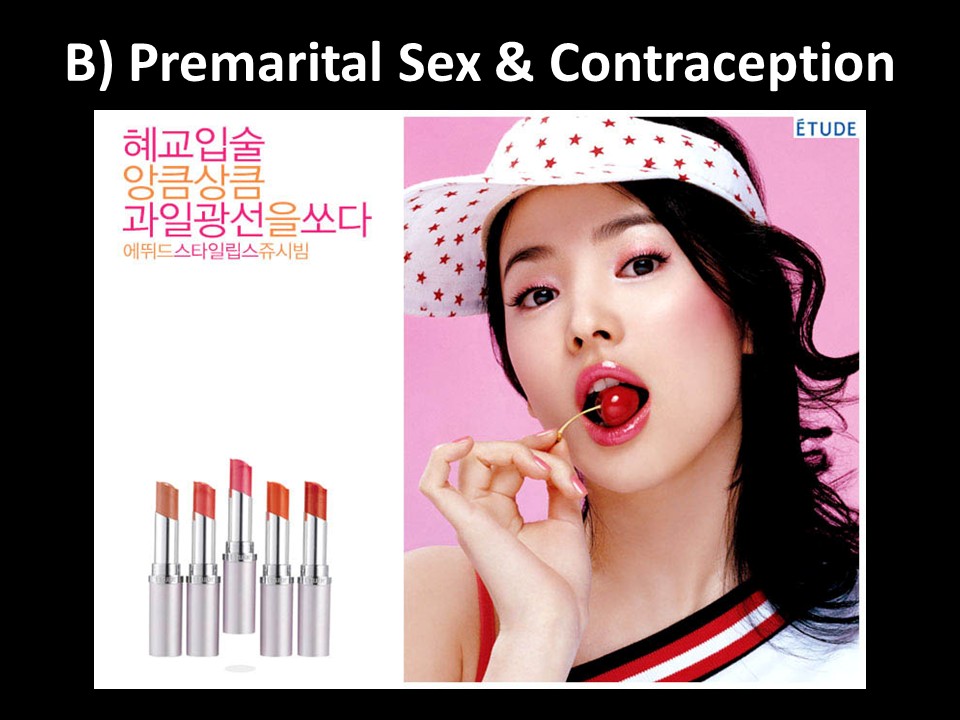
Yes, technically my favorite Song Hye-kyo advertisement wasn’t all that necessary. But sometimes an educator’s just got to do what an educator’s just got to do.
As for the statistics, which exist for far more countries than just those I show in my slide (actually placing Korea more in the middle than at the bottom for acceptance of premarital sex), they’re sourced from the Pew Research Center, which has a handy interactive table.
Next:
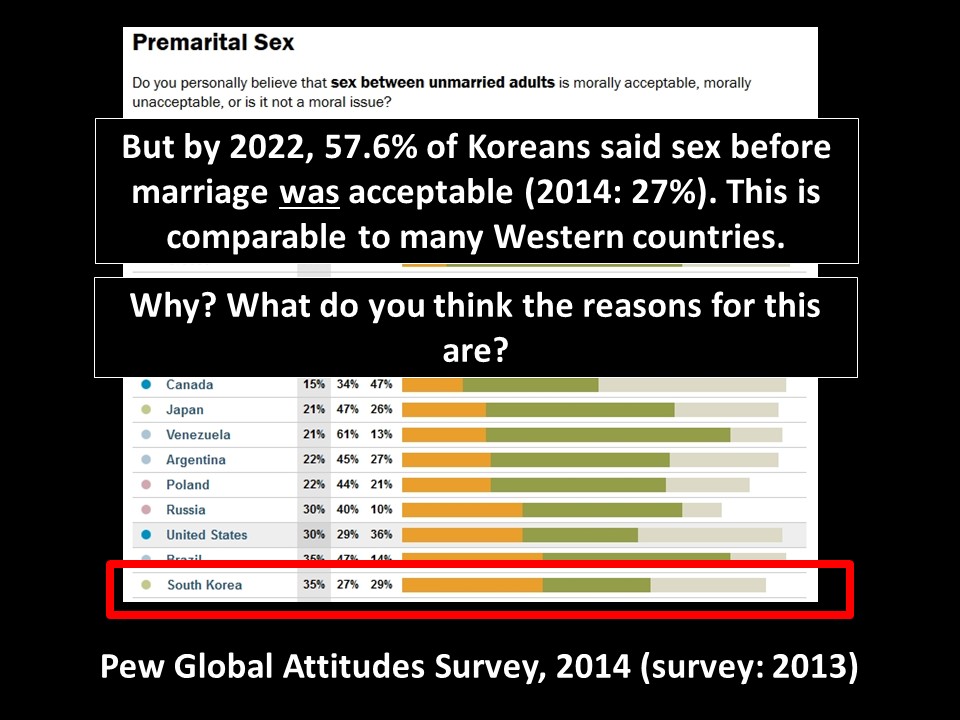
That 57.6% figure comes from statista, a German data-gathering and visualization portal. I have to admit to having some slight reservations over using it, as I don’t have access to the methodology. (Alas, the whopping $2 a month in donations I receive here—thanks M!—doesn’t quite cover the $199 a month required.) Reporter Lee Jee-eun at The Korea Herald though, which I’m guessing also doesn’t have such largesse for its staff, compensated by interviewing several people who largely confirmed the shift in attitudes, including matchmakers and medical professionals.
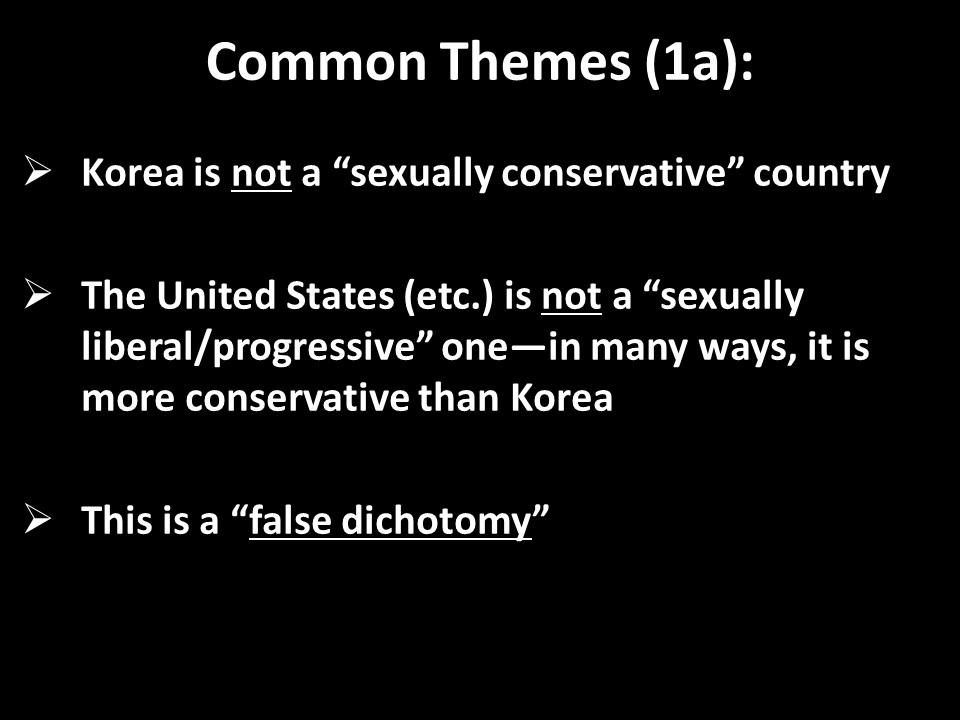
Meanwhile, if you yourself have some slight reservations over my use of the term “Western,” please rest assured that great minds think alike! For while it’s definitely a necessary generalization, I’m always at pains to stress that I only use terms like it cautiously and reluctantly, starting this particular lecture with:
Continuing, here’s that 2014 Ministry of Health and Welfare campaign:
Literally as I write this though, I realize my claim that “20-something Korean women have far, far more experience of and willingness to use contraception than their 30- and 40-something counterparts,” is on much shakier ground than I conveyed in class. Certainly, women’s greater experience and, crucially, desire for more information about contraception remains, as the comprehensive source—”Perceptions and Knowledge of Women Regarding Contraception and Current Trends in Contraceptive Use in Korea” by Kyong Wook Yi, Seul Ki Kim, Dong-Yun Lee, Sa Ra Lee, Hyosun Shin, and DooSeok Choi in Yonsei Medical Journal, 2022 Nov; 63 (11): 999-1006—makes clear. In combination with the plethora of other changes to Korean sex culture in recent years that I mentioned in class too then, far too many to list here sorry, surely when I receive their assignments next week, my students will be scoffing at the archaic notions of men’s exclusive responsibilities and women’s reputations?
The reaction to having a woman in a condom ad is exactly why we need women in condom ads. (See here for my translation.)
Hint—if students’ responses in previous semesters are anything to go by, then yes, absolutely. (Yaaay~)
And yet, the authors of that study didn’t really cover those issues at all. What’s more, what they did find doesn’t necessarily suggest significant change either. As while 20-something women were indeed found to be more knowledgeable and experienced than their 30- and 40-something counterparts, and may well be very blasé about insisting on using condoms or the withdrawal method these days, rates of “long-acting reversible contraception” among them, like the pill, are surprisingly low.
Despite those long-term methods, with the proviso that it’s a middle-aged cishet guy saying this, surely being ones they would have much more control over than their male partners?
The Korea Biomedical Review thought that was a little odd too. So, writer Kim Yun-mi followed-up a year later with an interview of the study’s lead author, Professor Yi Kyong-wook of the Obstetrics and Gynecology Department at Korea University Ansan Hospital, asking him the potential reasons for this. Most prominent among them included perceived cost, as well as women’s fears of “polluting” their bodies. Which I think are misguided, but again, I’m me. And also again, by no means necessarily suggest young Korean women aren’t indeed more sexually-empowered compared to a decade ago.
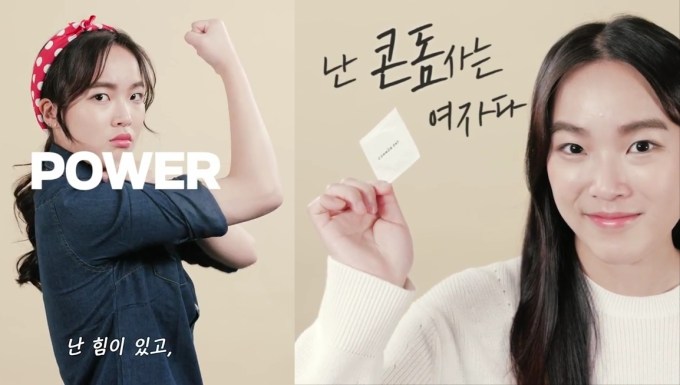 Screenshot via YouTube

Either way, it was a nice, immensely vindicating teaching moment in class on Wednesday, which I hope to have many more of. So I will purposefully end on that optimistic note.
Also, for the sake of conveying what it’s actually like writing posts like this, and being prepared to put them out there.
You see, with such limited time to write, it’s always frustrating discovering an issue is much more nuanced than my schedule provided for. But hey, that’s what writing is all about, right? And it can be just as rewarding too.
In the past though, I’d be very reluctant to finish on such an uncertain note. This bizarre illusion that many of you seem to have, that I actually know what I’m talking about, would be utterly broken if I did. Also, in this particular case, I’ve just admitted to teaching my students something I’m no completely certain to be true.
So, usually I’d hold off on publishing at all until I got a handle on things. Say, by analyzing just these four sources alone that cropped up while writing, let alone the dozens of others on my hard drive, or my books. But that might take weeks—and usually did.
Rather than just disappearing again this time then, I hope maybe you learned something from this work in progress, you enjoyed seeing where it led me, you’re as excited as I am about where I’m going with it, and—who knows? Maybe in the comments section, you’ll even join me on that journey of discovery?
Either way, please do enjoy the ride, and I’ll let you when we arrive at the next milestone soon!
Related Posts:
- “I am a Woman Who Buys Condoms”
- Quick Hit: “Don’t Leave the Responsibility for Contraception to Men”
- Korean Women’s Sexual Histories: Still a slippery subject
- Why Korean Girls Don’t Say No: Contraception Commercials, Condom Use, and Double Standards in South Korea
- One for the Korean Sexuality Geeks!
- Korean Sexuality: Still Awaiting a Revolution?

If you reside in South Korea, you can donate via wire transfer: Turnbull James Edward (Kookmin Bank/국민은행, 563401-01-214324)

