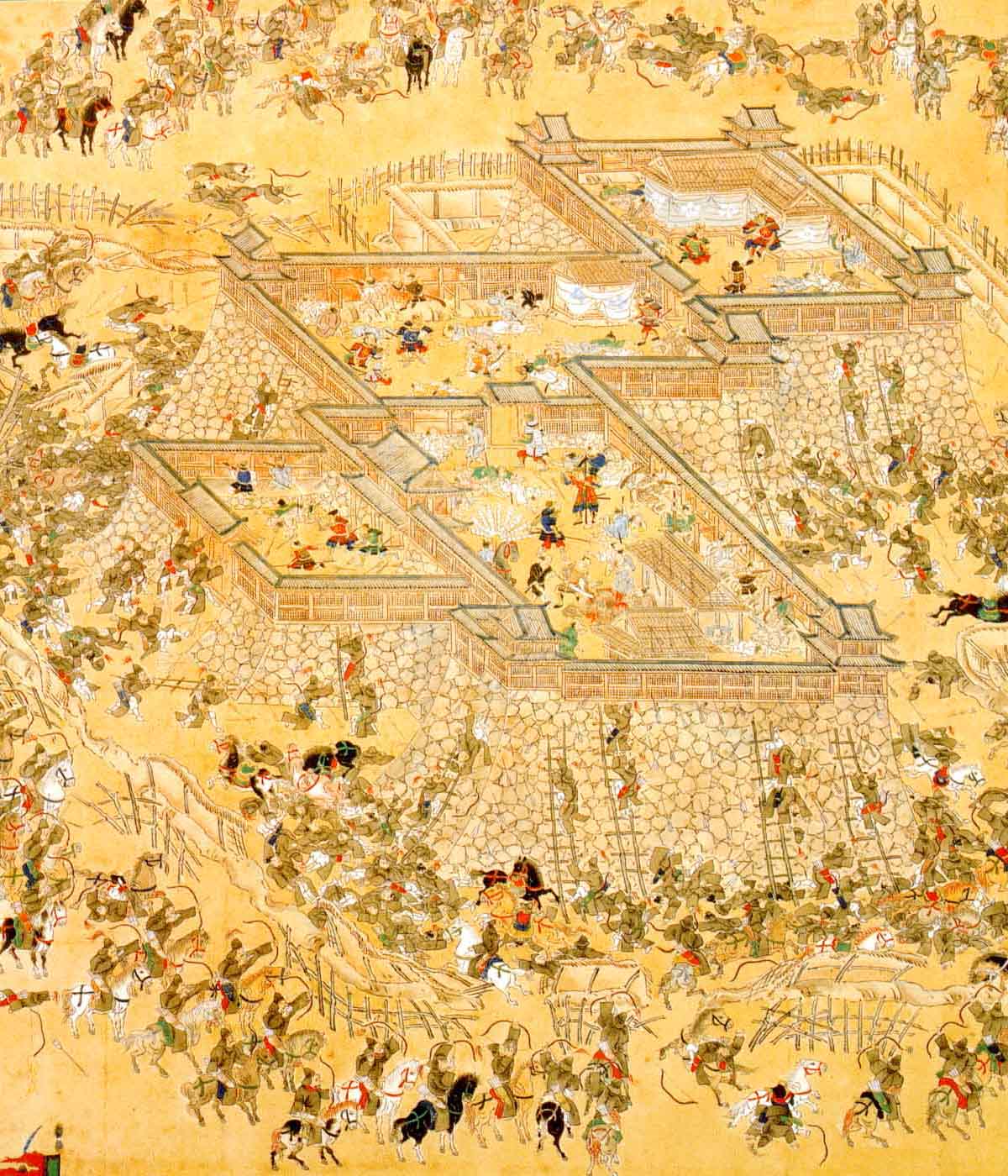
Women Getting on Top: Korean Sexuality and Popular Culture in the 1990s

The Adventures of Mrs. Park 박봉곤 가출 사건

For those of you that are interested in the title topic, then let me mention that I’ve finally finished the rather lengthy post on it that I started back in May, which you can read here. Apologies for taking 2 months rather than the promised 2 days to do so, and by why of compensation you can expect a flurry of related posts from me over the next 3 weeks, which by complete coincidence I’ve just realized is all the time I have left to prepare a presentation on the subject for a conference in Daejeon

Seriously though, while it is a much more academic post than usual, even if you just give it a quick scan then you may be simply amazed at how much Korean television and movies have changed in the last 10-15 years, and how important dramas in particular have been at subverting traditional ideologies of female sexuality. This provides a precedent for the impact of things like Friends and Sex and the City on Korean gender relations and consumerism a little later, and hence also myself a newfound respect for them: see here for some recommendations for more recent ones in the same radical vein as the ones mentioned in the post.

Korean Sociological Image #4: Where do Korean Politicians Come From?

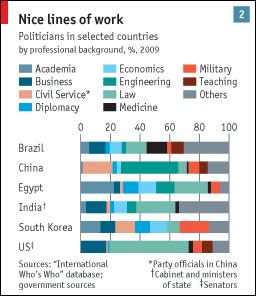
Original Lines of Work, Politicians in Selected=Apologies for the small size, but if you can see the pink and orange blobs for Korean politicians that were originally civil servants or in the military respectively, then you get the idea.

The graph is from this article in the Economist magazine, which asks the question of why professional paths to the top vary so much, but unfortunately only mentions South Korea when it says…

Countries often have marked peculiarities. Egypt likes academics; South Korea, civil servants; Brazil, doctors (see chart 2). Some emerging-market countries are bedeviled by large numbers of criminals, even if this doesn’t usually show up in their ‘Who’s Who’ records.

…yet is no less fascinating for all that. If I reluctantly confine my brief discussion to South Korea here though, then that predominance of civil servants among Korean politicians should be no surprise to anyone familiar with its Twentieth Century history (see here and here), and I’d expect to find much the same in other postwar “developmental states” also, particularly Japan that is their model and the former colonial power of most.

But of course their importance goes back much further than that (see here), as indeed it does in China, which has historically provided Korea with many governmental and political models to emulate. Hence the Economist is quite correct in painting Chinese Communist Party officials with (literally) the same brush also, for despite their modern ideological labels they are in many senses merely performing what are really quite timeless roles.

Other than that, I confess to being surprised at the number of politicians with military backgrounds, even though I’ve written a great deal about the pervasiveness of military culture in Korean daily life. One shouldn’t make too many generalizations from so little information though, and so I’d hesitate to make any links between the low numbers of politicians that were formerly lawyers and Korean legal culture also, although I’m certainly tempted!

(For more posts in the “Korean Sociological Image” series, see here)

Where do Ajosshis Come From? Part 3: Manchukuo and The Militarization of Daily Life in South Korea

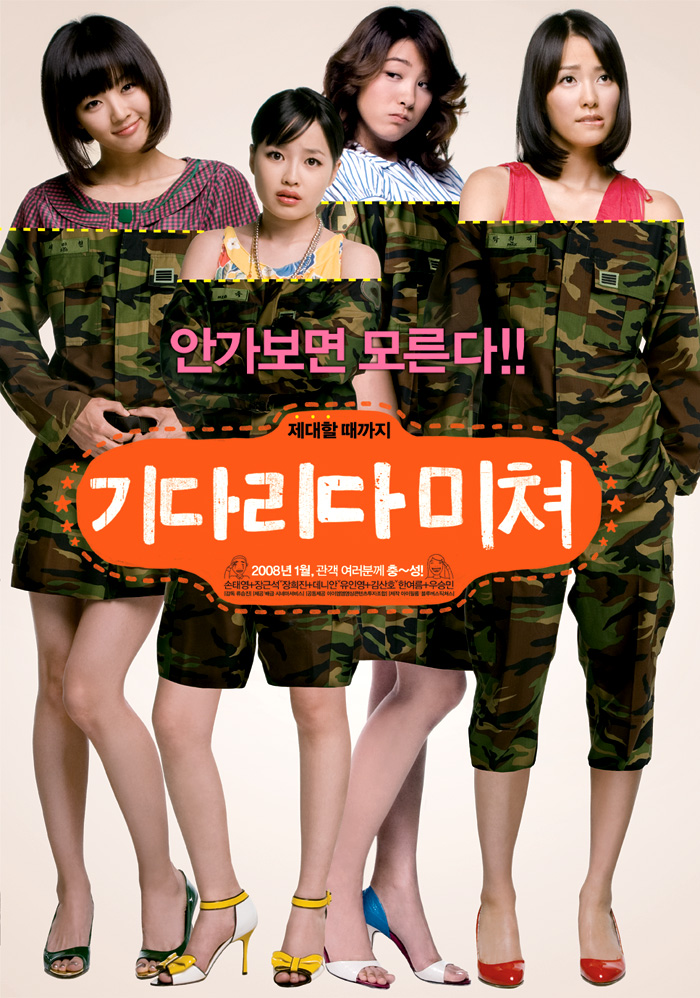
(Movie poster for “The Longest 24 Hours,” (기다리다미쳐, 2007), a lighthearted look at military service from the perspective of conscripts’ girlfriends; also known as “Crazy4wait.” Source: 여자도 모른는 여자이야기)

It’s been quite a while, so to remind readers, in Part One of this series I argued that a virtual gender apartheid existed in modern Korea, with women excluded from economic and political life here to an extent much more reminiscent of Middle Eastern countries than what one would expect in a modern liberal democracy. If that sounds like mere hyperbole to new readers, then sure, it probably would to me too(!), but by all means examine the evidence given there, to which I would now add that Korea has the lowest number of working women of all developed countries also, and that spousal rape isn’t even a crime here (see #2 here).

(Update, February 2014: Part One has since been deleted sorry)

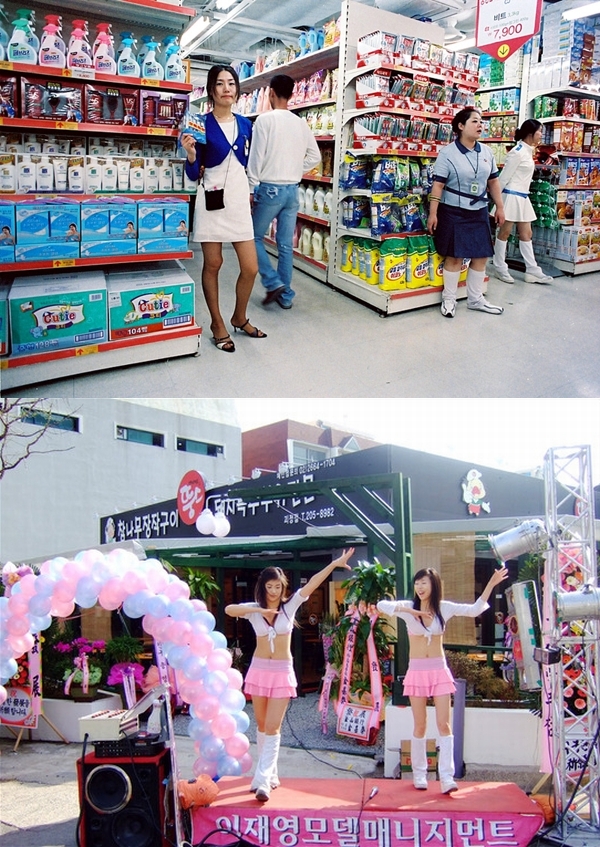
How to explain this? Well, naturally many specific elements of Korean women’s disadvantaged position in Korean society are no great mysteries: decades of salaryman male-breadwinner forms of employment for instance, explain a great deal about the lack of women in senior positions in companies (a parallel is how the Cultural Revolution four decades ago resulted in an “intellectual skills gap” that still affects the Chinese economy), and deeply hierarchical and sexist Neo-Confucianism has had a profound influence on Koreans’ worldviews, even extending to how men’s and women’s bodies are perceived and valued differently, and from which it is no great leap of the imagination to see echoes of in – amongst other things –  the widespread use of doumi (도우미) or female “assistants” and scantily-clad “narrator models” (나레이터 머델) here to sell mundane household items or open even the humblest of new stores and restaurants respectively.

korean-doumi-shop-assistants-and-narrator-models-도우미0-나레이터-모델(With apologies to Michael Hurt for the use of the top image, but like he says, despite their ubiquity most doumi are embarrassed by their jobs and very reluctant to have their photos taken; after half an hour of looking (in Korean!), this is the only similar one I could find. Bottom image taken from shytiny)

But both those and many other factors commonly cited are by no means confined to Korea, and while going into greater detail would undoubtedly tease out plausible reasons why Korean women are worse off than, say, their counterparts in Japan or even China (hardly well-known for gender equality in themselves), here I am more concerned with the systematic nature of women’s exclusion in Korea. Ergo, however cliched it sounds, this series is all about seeing the forest rather than the trees.

With that in mind, based on my readings of especially Kwon (2001) and Moon (2005) and on my own nine years’ experience of the militarism that is still inherent to many Korean institutions (especially schools) in particular, then I laid the blame for that exclusion squarely on the continuation of and widespread public acceptance of the universal male conscription system, and all that that entails: nothing else seems adequate to explain so widespread and pervasive a phenomenon.

Again, that may well sound somewhat exaggerated at first: after all, South Korea is by no means the only country in the world to have conscription, and while I’d venture that a cross-country comparison would undoubtedly demonstrate at least a tendency towards lower levels of women’s empowerment in those countries that had it, that the “feminist paradises” of Sweden and Norway also have it, for instance, shows that any link would by no means be clear-cut. But then for most of the brief history of South Korea the military has had a uniquely pervasive role in society, one not revealed by any casual comparisons with other military regimes, and this really needs to be fully appreciated and understood before some of my more outlandish sounding claims about the effects of conscription on gender roles here can be assessed objectively. Hence, while it will take us far in time and space from what would normally come under the rubric of “Korean gender issues” – and which explains the 9 month hiatus, for unfortunately my beginning to write the series coincided with my wanting to examine more “traditional” aspects of that subject – I realized that the Korean military itself needed to be studied first, and so Part Two was about its origins in the Japanese colonial state, again much greater in size, scope and ambitions than a simple conflation with its European and US counterparts would suggest.

This post continues where that left off, focusing on the short-lived Japanese colonial state of Manchukuo (Manchuria region, 1932-1945), which eventual nreturnees to Korea among the  720,000 Korean immigrants there (from 1932-1940) and a sizable proportion of the South Korean bureaucracy, armed forces, and police of the 1950s and 1960s had some first-hand experience of living in and working for. In particular, Manchukuo was where president Park Chung-hee (1963-1979) above (source) spent most of his formative years as an officer in the army (even going so far as to sign an oath of loyalty to it in his own blood), and, as we shall see, is what he would effectively recreate in South Korea in the 1960s and 70s.

Korea’s Wild Wild West?

(Source: 이것저것 연습장)

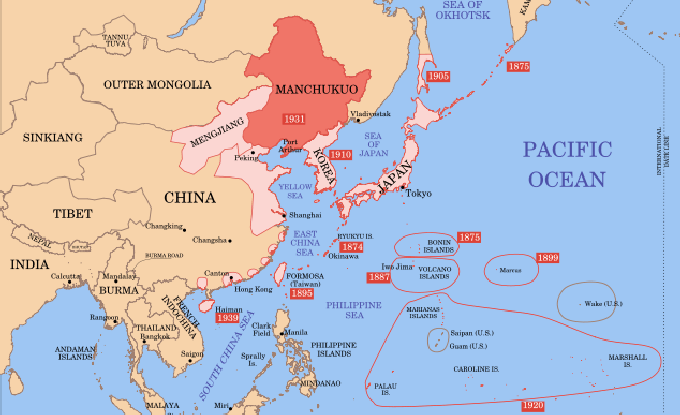
Okay, first the big picture:  what were Japanese motives in occupying what was to become Manchukuo? Well, primarily because it greatly expanded the Japanese imperial empire, still much smaller, weaker, and younger than its European and American counterparts as explained in Part Two. But more practically speaking, it also provided:

  • A bridgehead for the invasion of China, well connected by rail and road links to Korea even before the 1930s
  • A buffer-zone between the USSR and both the more developed and crucial colony of Korea, and indeed there would be several clashes between the two on the Machukuo border in the late 1930s
  • An important source of particularly mineral resources in its own right, without which the later invasion of Southeast Asia wouldn’t have been possible
  • And finally, an escape valve to ease Japanese (and Korean) domestic agrarian population pressures and poverty, exacerbated by the depression.
(The Prewar Expansion of the Japanese Empire. Source: Wikipedia)

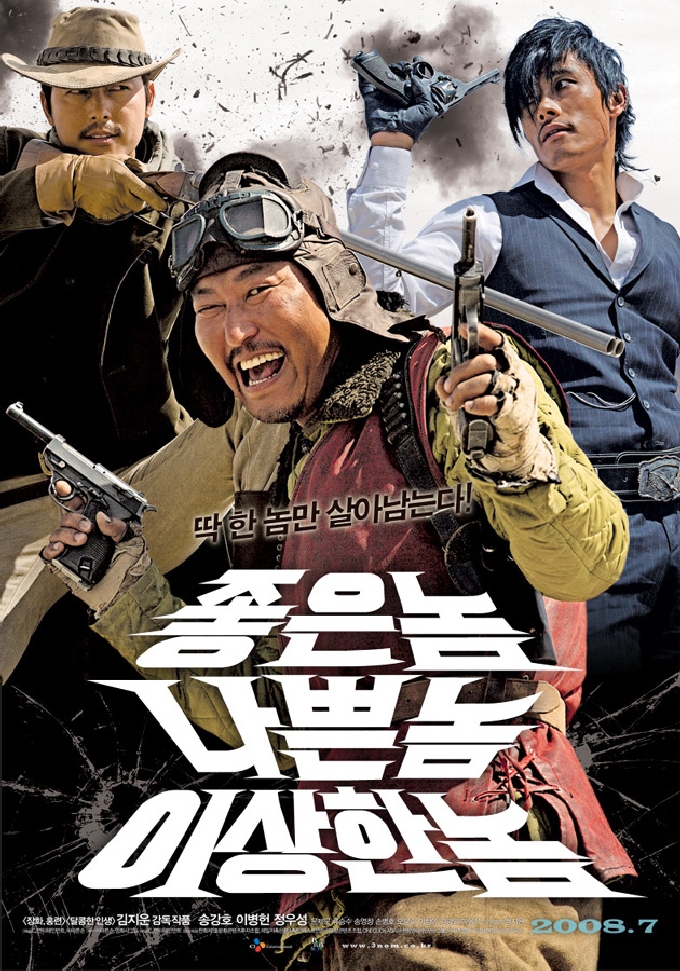
The 2008 movie The Good, The Bad, The Weird (좋은 놈, 나쁜 놈, 이상한 놈) in the poster above happens to be set there, and by all accounts it is fun to watch, but unfortunately its depiction of life there in the 1930s as Korea’s version of the Wild West is probably exaggerated at best. While it’s true that the Chinese Warlord Era as a whole is not exactly well known for the stability or internal coherence of its various regimes, and that things would have been quite chaotic around the period when warlord Zhang Xueliang withdrew his forces from the region and ceded it to the elite Kwangtung Japanese Imperial Army after the Mukden Incident of September 18 1931, that strategic retreat was largely dictated by forces beyond his control, such as Chiang Kai-Shek being unable to provide assistance. In fact, his regime was far more coherent than most of that era, being able to effectively wipe out opium-trafficking and internal corruption in the previous decade for instance. Moreover, much of the state bureaucracy was bequeathed to the new Japanese colonial state, and as soon as April of 1932, it was one of the most controlled, regimented regimes in Northeast Asian history.

Don’t worry if that was all above your head: suffice to say that Manchukuo state organs were in many senses grafted onto the preexisting ones of Zhang Xueliang’s regime, but with the crucial difference that recent events meant that there were no longer any substantial non-state actors like a business or landed class to impede them in instilling notions of loyalty and nationalism in their new pool of workers and soldiers.

And whom were by no means unwilling victims of the process either. For example, writing about the Korean “Truth Commission on Forced Mobilization under the Japanese Imperialism (sic)” in 2006, Michael Breen said:

The Truth Commission on Forced Mobilization under the Japanese Imperialism (sic) announced on Monday that 83 of the 148 Koreans convicted of war crimes were victims of Japan and should not be blamed….

[But they] were not tried as soldiers or POW camp guards who had done their jobs. They were tried for over-zealousness, for decisions and actions over and above the call of duty. They were the thugs, the brutes, the monsters, the most horrible of the ”horrible people”….By what authority does the Truth Commission have to remove their individual responsibility with its class act defense of nationality? Such skewed morality led to the crimes against the lowest class– ”prisoners” — in the first place. People who committed crimes against humanity are not innocent by virtue of being Korean any more than Japanese who brutalized Koreans are innocent by virtue of being Japanese.

….[the Truth Commission] should recognize that the idea that Koreans were all unhappy citizens of imperialism bar a few collaborators is a myth. Koreans were Japanese citizens, and it did not occur to many to support the allies against their own country. Ask anyone who lived in that period, and they will tell you that the political correctness of the post-colonial generation is distorted.

They will also tell you that from 1937-42, Koreans in the Japanese army were volunteers — who included King Kojong’s son, an army general — and that large-scale forced conscription only started in 1944. The Commission should know that those rounding up comfort women were Koreans and those torturing people in police stations were mostly Koreans. Koreans, in other words, were more ”horrible” to Koreans in many cases than the Japanese were. The solution to this dilemma is to accept the notion of individual responsibility.

And according to Suk-Jung Han in his July 2005 Japan Focus article “Imitating the Colonizers: The Legacy of the Disciplining State from Manchukuo to South Korea,”  similar senses of citizenship were instilled in new Manchukuo citizens by means of:

  • State-Sponsored Confucianism
  • Mourning Rituals and Ancestor Worship
  • State-foundation Gymnastics
  • Anti-Communist Rallies

A combination which will probably sound very familiar to those of you even with just the most basic of knowledge of South Korea’s history. Indeed, as Han’s article is only 14 pages long and very readable in its own right, rather than provide a detailed discussion of what you many of you will go on to read there regardless, it’s probably wiser if I just provide some excerpts here, starting with:

The legacy of Manchukuo can be seen in numerous “naturalized” events in South and North Korea. So-called “national ceremonies,” such as paying a one minute silent tribute to the war dead in front of monuments, marching, lectures on the “current emergency situation”, movie-showing, poster making, student speech contests, rallies, big athletic meetings, and so on- largely related to anti-communism, and all too familiar to South Koreans for several decades from the 1950s- were originally national events of Manchukuo in the 1930s.

For state-sponsored Confucianism, some crucial clues as for how South Korea has come to be known as “More Confucian than China”:

South Koreans grew accustomed to the Confucian ideology of loyalty and filiality (choong-hyo) stressed by Syngman Rhee’s regime (1948-1960) as well as Park Chung Hee’s (1961-1979). The post-liberation ideology was different from the Confucianism of the Chosun dynasty, which had been not only the official ideology but also the basis of ethics and cosmic philosophy. The former was less intense than the latter. But Confucianism was still influential in the post-liberation era. Important Confucian concepts, like loyalty to the nation, were instilled in students. It was Manchukuo that energetically patronized Confucianism. Manchukuo differed from mainland China where Confucianism was severely attacked by the May 4th intellectuals and their heirs. Also, Manchukuo differed from Japan in the 1930s when Shinto was deployed as the state religion.

About the importance of mourning rituals and ancestor worship, which might sound outlandish to many outside of Korea, but intimately familiar to anyone who’s ever experienced either of the two biggest occasions of the year Seollal or Chuseok in an actual Korean home, and learned first-hand just how morbid they can be, at least symbolically:

Although monuments for the war dead began to supplement Confucian shrines as the site of important ceremonies, the mourning ceremony, either for ancestors or soldiers, was long essential to Confucian practice inside and outside the home. In April, 1935, officials and army officers attended a great mourning ceremony (zhaohunji, shokonsai), held at the newly built monument in the capital. The assembly, opening ceremony, invocation of the spirits, enshrining of the dead, offering of food, and tributary speech solemnly proceeded. This was simply one example of numerous mourning ceremonies of subsequent years, particularly after the outbreak of the Sino-Japanese war.

The mourning ceremony for dead officials, policemen and soldiers was an important an event, next only to one worshipping Confucius. Although prewar Japanese society also had ceremonies for the war dead at Yasukuni shrine, they were not equal to those in Manchukuo. In Japan, all the war dead (except those who died in hospitals, rather than at the front) were enshrined at Yasukuni. Ceremonies for all were held there at fixed dates. In Manchukuo, by contrast, ceremonies were held at numerous places and at various times. Each ministry of the central government, central police board, army district, province, and county office organized a committee for constructing monuments. Monuments and plazas for the war dead were built across the nation.

seollal-shrine(Offerings of food and drink at a temporary mini-shrine devoted to the spirits of dead ancestors, to whom male members of the family must bow to in ceremonies on Seollal and Chuseok. Source: DiscoverKorea)

For state-foundation gymnastics:

Most middle-aged and older South Koreans remember Jaegun gymnastics from the 1960s. “Jaegun chejo shiijak (let’s start Jaegun gymnastics), one, two, three, four!” The song was broadcast in the early morning across the country in the 1960s following Park’s military coup. [9] Most family members woke up to this song-like command and practiced Jaegun gymnastics, still practically asleep. Jaegun, meaning reconstruction (of the state or nation), was the catch phrase of Park’s regime. Several other songs about Jaegun were written and propagated for citizens and students to memorize. The model for Jaegun gymnastics was the Jianguo (state foundation or construction of the nation) gymnastics of Manchukuo. Jianguo and Jaegun had the common Chinese character of foundation or construction (“jian” in Chinese, “gun” in Korean). Jianguo was the essential word in Manchukuo, from “Jianguo spirit”, “Jianguo celebration day” to “Jianguo University” and “Jianguo exercise.” Hence, construction and reconstruction were the key words for Manchukuo and South Korea.

And still as big a part of the collective Korean psyche that there are still many references to it in popular culture, even that explicitly catering to young people that would barely remember it, if at all. One recent example of which was in a commercial for an eyeliner, as I discuss here:

Also of note:

In Manchukuo, exercise and sanitation were important fields in which the regime invested. There were special weeks of exercise and street cleaning. During this time, the human body came under the jurisdiction of the state. One month after its foundation, the regime prepared an athletic meeting….Imitating the German fascists, the rulers of Manchukuo were interested in the physical training of citizens….Through sports, Manchukuo sought international approval, for which the regime was so thirsty.

This importance of this will become apparent in later posts when I discuss Korea’s population control policies of the 1960s and 1970s, only marginally less rigorously pursued and personally invasive than their Chinese counterparts, and a good illustration of which is the withdrawal troops from the DMZ at the height of tensions with North Korea in order to implant IUDs and perform (voluntary, but rather highly encouraged) sterilizations on citizens in remote rural areas and islands. No, really.

crimson-dawn-by-spargett(“Crimson Dawn” by Spargett. Source: A Muchness of Me)

And finally, for anti-Communist rallies:

South Koreans became sick and tired of anti-communist rallies (bangongdaehue) or “Great gathering for destroying communists” (myulgongdaehue) under Syngman Rhee’s and Park Chung Hee’s regimes. Old folks and housewives were led by officials of city districts and neighborhood districts, and students led by teachers gathered in great stadiums and shouted anti-communist phrases. Again, the model was Manchukuo. In prewar Japan, of course, there was mass mobilization (through such organizations as the Military reservist association and National youth association). After the Manchurian Incident, in particular, jingoism spread among news media, magazines, movies, and literature. According to Louise Young, however, neither government repression nor market pressures can entirely explain the enthusiasm in the 1930s. It was voluntary. Journalists of Asahi or Mainichi supported the army, because they had conviction (Young 1998: 79). Also, the main enemy in Japanese society was not necessarily communist Russia (although it may have been for the Japanese army). Hence, there were no anti-communist rallies in Japan. By contrast, there were myriad anti-communist rallies in Manchukuo. Also, Manchukuo had many more occasions for rallies. Manchukuo was a pioneering place of maximum mobilization, summoning people day and night. The fascist gatherings of Germany and Italy flowed to both North Korea and South Korea through Manchukuo.

Hell, for all its anti-Japanese rhetoric, even at least one of South Korea’s national holidays (until 2005) ultimately comes from Manchukuo too:

In 1936, “tree-planting day” was added. There were other celebrations such as, those for Japan’s withdrawal from the League of Nations, the entry of Japanese soldiers to Manchuria, the visit of Japanese royal family members, and the abolition of Japanese privilege, even one for the founding of the post office.

For a little more on the national-security mania of South Korean military regimes, see here, but that will be the main topic of *cough* a much bigger Part Four.

But let me stop this post here, for Han’s section on “Inheritors in the 1970s,” in which South Korea sounds like a carbon copy of all the above, really needs to be read in its entirety, and my amount of copying and pasting has already become a little excessive. Apologies for that, and I don’t like looking lazy either, but I confess that the question of how to summarize an article that most readers would go on to read regardless proved such a stumbling block for me that it’s taken me nine months to return to it. And that was despite the fact that the next post in the series will be about something I read in 1997 which – in no uncertain terms – was such a revelation to me that without having done so I literally wouldn’t be in Korea or even East Asia today too, let alone have started this blog (but hence its title). Better then, to be a little lazy in this one post then to procrastinate any longer!

democracy-park-monument-busan(Source: Brian Yap (葉); CC BY-NC 2.0)

Jackie Lim and The Pimping of Korean Entertainers, 1995

(Source: ITH)

Update, December 2013: A very old post, which I’ve long since removed the original commentary to (and consequently the comments also). But hopefully someone may still find the translation useful!

해외동포 연예인 붐을 일으킨 재키림의 10년 전 사진 / Jackie Lim, The Creator of an Overseas Korean Entertainer Boom

삼성은 하이버네이션 기능 때문에 안정성에 문제가 많은 그린컴퓨터를 얼른 단종시키고 매직스테이션이라는 새로운 브랜드를 선보였는데, 매직스테이션은 꽤 오래 출시되면서 장수 브랜드로 자리 잡았다.

Because the “hibernation” function was causing many problems with stability, Samsung quickly stopped producing “Green computers” in 1995 and launched a new brand called “Magic Station” instead, which became a very successful brand over the next ten years.

매직스테이션III의 광고모델은 당시 새롭게 떠오르던 해외동포 연예인인 재키림이다. 몇 개 국어를 자유자재로 구사할 수 있었던 재키림은 재원이라고 칭찬받으며 화려하게 연예계에 데뷔했다. 재키림은 SBS ‘생방송 TV 가요 20’, KMTV ‘동방특급 비디오자키’ 등을 뛰면서 가수와 비디오자키로 활동했다. 재키림은 비디오자키의 열풍을 일으켰을 뿐만 아니라 오늘날의 해외동포 연예인 붐을 일으킨 불씨가 되었지만, 정작 본인은 한국 연예계에 적응하지 못하고 방황으로 얼룩진 비운의 운명을 걷게 된다.

Jackie Lim was a new and upcoming star when she appeared in the “Magic Station 3” advertisement in 1995. As she was fluent in many languages she received a lot of attention and praise when she made her original debut, both starring as a singer and working as “video jockey” on the SBS program “20 Songs On Air” and KMTV’s “High-Class Eastern Video Jockey”. Ultimately she proved so popular she provided the spark for a boom in interest in overseas Korean entertainers. But she soon found it difficult to adapt to the Korean entertainment industry, and became a bit lost for which direction to take herself and her career.

재키림은 마약을 비롯한 좋지 않은 사건에 휘말리는데, 그녀가 이런 사건에 빠진 이유는 ‘한국에서 실력으로 활동하려 했지만 자신을 성적대상으로만 보면서 높은 사람 자리에 불려나가야 하고, 동료연예인들로부터 왕따당하면서 외로워서 약을 하게 되었다.’고 밝혔다. 재원이라고 떠들었던 뒷편에는 여성 연예인에 대한 여전한 성차별과 고위권의 압력, 동료 연예인의 텃세가 있었던 것이다.

Later, she became disgusted and further disheartened by trying to succeed as a singer in Korea through her own abilities but while facing the virtual prostitution of female entertainers that goes on behind the scenes. Not only was she regularly pressured to entertain and provide sexual services for politicians and business leaders, who saw her merely as yet another trophy girlfriend to be used, but on top of that she was also ostracized by other entertainers too, angered by whom they saw as an uppity overseas Korean whom they intended to put in her place. In the end she became very lonely and depressed and got involved with drugs.

이미지: 1995년 삼성 매직스테이션3 광고에서 밝게 웃는 재키림. 하지만 이 웃음 뒤에는 잘못된 연예게 관행으로 인한 외로움과 고통이 숨어있다.

Photo caption: Jackie Lim smiling brightly in Samsung’s advertisement for the Magic Station 3. But hidden behind the smile there was a great deal of loneliness and pain caused by the Korean entertainment industry’s bad practices (source).

Where do Ajosshis Come From? Part 2: The Colonial Origins of the South Korean Military

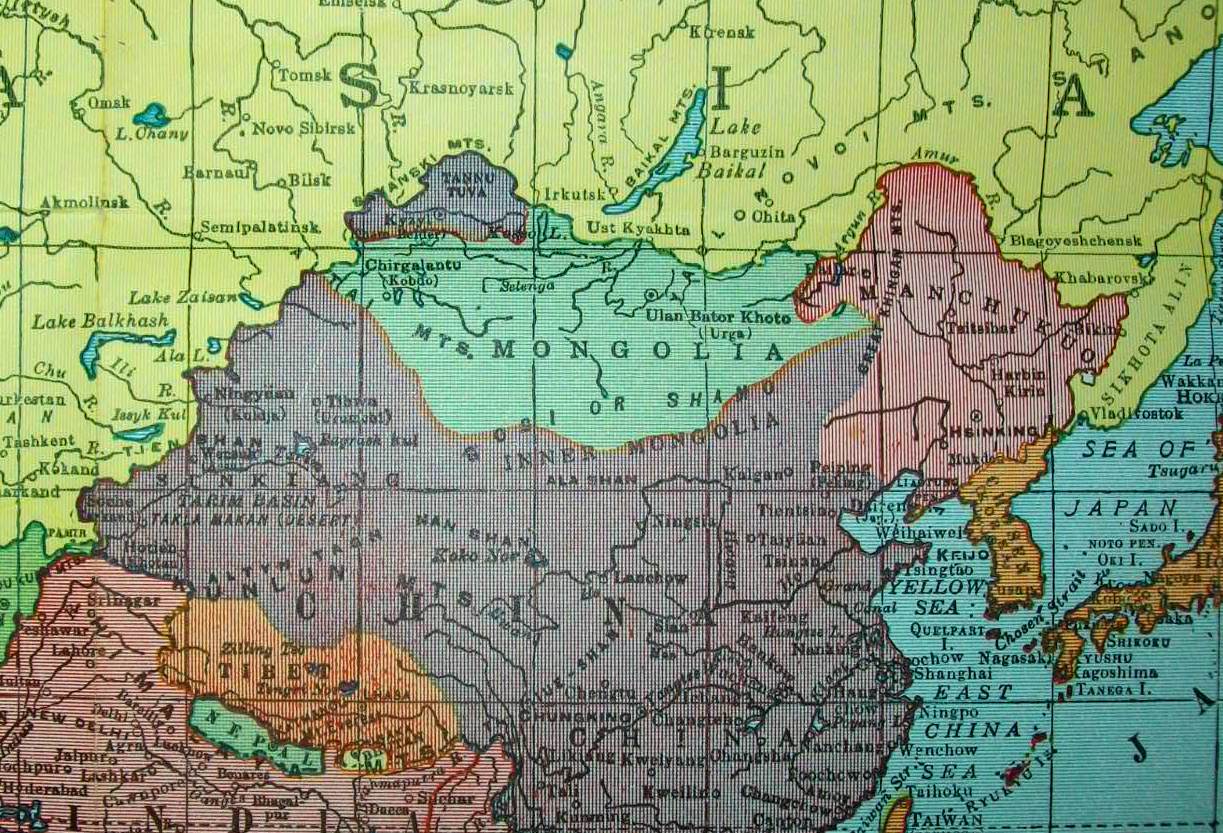
East Asia Map 1930s(Source: DavidCC BY 2.0)

Update, February 2014: In case of any confusion, Part 1 on Korean workplace culture has since been deleted sorry!

Switching from the office politics of Korean workplaces to the Japanese colonization of East Asia may seem like quite a jump at first, especially to those whose primary interest is gender issues, but then to fully understand the present-day impact of conscription on Korean society it is obviously necessary to study the military as a whole first. Doing so invariably leads to colonial Korea, for the Korean military regimes of 1961 to 1987 had uniquely pervasive roles in and control of Korean society, and any accounting for those cannot avoid the fact that the bulk of their military officers and bureaucrats in the 1960s had served in the Japanese colonial state in some capacity. Once in power they had no hesitation in recreating a state model that had, in their experience, demonstrably delivered high growth under an authoritarian, top-down control of society, and both features tied in well with and were ultimately considered essential to the new state ideology of anti-communism. Indeed president Park Chung-hee had spent most of his impressionable twenties as an officer in the army of colonial Manchukuo, a vast social laboratory of state control that 1960s Korea increasingly began to resemble.

I’ve frequently mentioned the profound similarities between Japan and Korea in this blog, but in many senses the colonial origins of these are still like the elephant in the room here, their presence still keenly felt in economics, state-society relations and domestic politics, but something that Korean social-science scholars have only just begun acknowledging – let alone the Korean public – lest Korea’s post-colonial achievements be viewed as nothing more than the product of a much disliked and particularly brutal colonial rule. Hence while nobody in any country likes having foreigners explain their history to them, in this particular case Korea specialists outside of the country, with more job security, really do seem to have a much more balanced and objective view of the period than Koreans themselves.

With that note on being objective in mind, it is important to begin by putting all stereotypes and preconceptions of other military regimes out of one’s mind, especially for North Americans (the bulk of my readers) who may be very familiar with Latin American cases and tempted to equate those of South Korea with them. In those cases (with the important exception of the huge social and economic transformations begun under Pinochet in Chile), militaries generally merely took over state organs, either for the sake of preventing leftists coming to power, preventing the socialization of the economy, and/ or for the sake of their own enrichment, but overall they left state and elite structures largely intact. In contrast, a more accurate picture of the level of control and transformation wrought by South Korean military regimes would be of China under the Chinese Communist Party, and this is by no means a coincidence as I’ll explain later.

Ultimately, by outlining this historical context in this post and the next, I hope to demonstrate both why it’s so important to treat the Korean military as a special entity and why it’s reasonable to describe Korea as a “militarized” (if not technically military) regime even now, and having done so then hopefully readers will be more convinced of the truth of the seemingly outlandish assertions about the effects of conscription on Korean men that I’ll make in Parts Five and Six.

For the sake of space then I’m going to assume that readers know a little about the history of Japanese colonialism and how Japan had been trying to catch up economically and militarily with the West since at least 1868. If not then no problem, the Wikipedia articles linked to above are perfectly adequate, if basic introductions; this provides some additional information and links too. Instead, I’m going to start off here with some facts about the former that I’ll hazard that most readers probably don’t know, but which proved very influential on the ultimate development of its colonies and of Korea in particular. Ironically, considering the government’s largely empty rhetoric on the subject today, back then Korea was a very real hub for the movement of soldiers, immigrants and materials between Japan, its other colonies and then front-lines in China, and as such it was also a natural supplier of mineral resources, hydroelectricity and forced labour.

But first, a note on sources before I begin properly. I actually studied all this as an undergraduate, but as most of my notes are back in New Zealand then for now I relied on the book The Developmental State, edited by Meredith Woo-Cumings (1999) for the first half or so of this post, and used the chapters “Introduction: Chalmers Johnson and the Politics of Nationalism and Development” by Meredith Woo-Cumings and “Where do High-Growth Political Economies Come From? The Japanese Lineage of Korea’s Developmental State” by Atul Kohli in particular, and for the second last section I used the chapter “Colonizing Manchuria: The Making of an Imperial Myth” by Louise Young in Mirror of Modernity: Invented Traditions of Modern Japan, edited by Stephen Vlastos (1998) and especially the journal article “Imitating the Colonizers: The Legacy of the Disciplining State from Manchukuo to South Korea” by Suk-Jung Han in the July 2005 volume of Japan Focus (available online here).

Finally, for any readers also interested in Latin American studies and in particular what made the Pinochet regime so unique in the region, I strongly recommend reading the journal article “Reconceptualizing Latin American Authoritarianism in the 1970s: From Bureaucratic-Authoritarianism to Neoconservatism” by Hector E. Schamis in Comparative Politics, January 1991, pp. 201-220. I usually wouldn’t bother mentioning something so off-topic, but then it’s one of those articles that made three years of Latin American Studies suddenly all make sense in fifteen minutes of reading, and so it should be much more widely known (Part Three will be based on a similarly revelatory journal article for East Asian Studies). Speaking of which, the best comparative study remains Chapters Five and Six of Capitalist Development and Democracy by Dietrich Rueschemeyer, Elelyne Huber Stephens and John D. Stevens (1992), one of the first books I made sure to buy as soon as I received my first ever paycheck.

Japanese Colonization in Comparative Perspective
(Source: Wikipedia)

Again, please put aside all preconceptions. First, those of Japanese strength back then based on its position as an economic superpower today. While European powers were at the height of their technological, military and economic superiority to the rest of the world by the latter half of the Nineteenth Century, it’s important to remember that Japan, in contrast, barely avoided being colonized itself. The developmental passion that this provoked in the Japanese was very important, and combined with its victory in the Russo-Japanese War of 1904-5 and the benefit of hindsight then its ultimate rise appears somewhat inevitable. But in reality that victory was a very close-run thing, against the most backward of European powers, and in contrast to their then global empires this only granted Japan a very limited corner of the world to just begin to colonize. Even four decades later Japan was by no means fully developed, and the consensus of historians is that even if Japan had, say, won the Battle of Midway or even occupied Hawaii, an ultimate US victory in the Pacific (and Europe) was still somewhat inevitable, albeit one heavily army-based involving hopping from the Aleutian Islands, the Kamchatka Peninsula, and finally the Kuril Islands, involving a transfer of resources that may have stalled the development of atomic weapons and their attendant technologies.
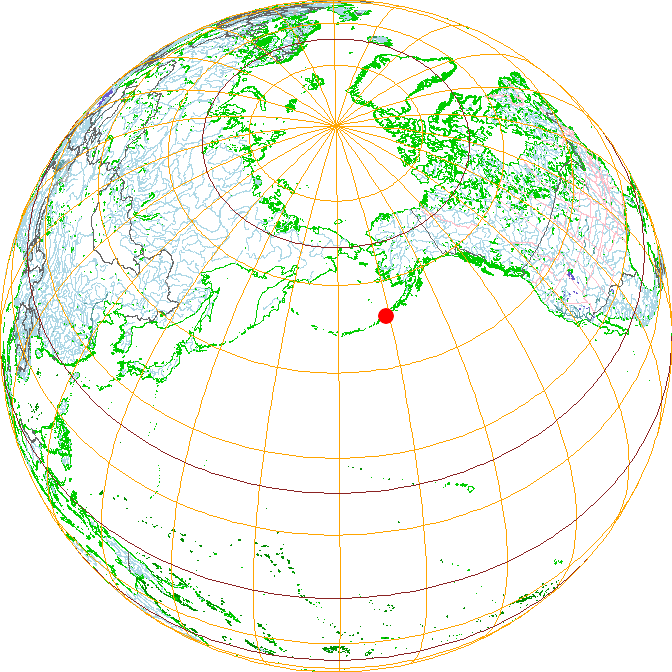
(The Aleutian Islands. Source: Wikipedia)

Yes, I am a big fan of alternate history fiction and counterfactual history. Meanwhile, Japan’s quite weak position at the turn of the Nineteenth Century forced a uniquely intensified form of colonialism, which again any preconceptions based on European colonialism would give quite a false impression of. Japanese colonialism was different in several crucial ways:

1. It began much later, and was initiated, led and controlled by the Japanese state for the sake of Japanese development rather than by private companies and business interests in pursuit of profit.

While it’s true that all European powers were in a mad scramble for colonial possessions in the second half of the Nineteenth Century, this belies the fact that for centuries they generally only gained territories with the greatest reluctance, usually after becoming entangled in disputes between natives and trading companies and having to stay for the latter’s protection and continued free pursuit of trade. In contrast, in Kohli’s words, Japan stands out amongst colonizing nations “as nearly the only one with a successful record of deliberate, state-led political and economic transformation” (the other would be Germany, as it was also a late developer), and given their circumstances as described then the Japanese were forced to make “ruthless use of [this] state power to pry open and transform Korea in a relatively short period.”

2. It only occurred in those areas geographically closest to Japan, and, not unimportant, culturally and racially closest to Japan too.

This proximity both facilitated and encouraged many more Japanese to play a direct role in colonial rule than was ever the case in European colonies. To give some comparisons, there were 87,552 government officials in Korea in 1937, 52,270 of whom were Japanese, whereas the French state in Vietnam (relatively large itself compared to British colonies in Africa) only had 3000 French officials. In other words, for geographically-similar sized colonies the Japanese had fifteen officials for every French one. Also, there was a police force of 60,000 in 1941, just under half of whom were Japanese. Kohli gives no figures for Vietnam, largely as having a large colonial police force isn’t all that unique, but again this belies the unusually close personal supervision of it by the Japanese: in 1915-20, about one in ten police officers were sternly disciplined for transgression of police rules. In contrast, you virtually need the direct intervention of the president for that in Korea today.

This proximity also led to a great deal of movement of ordinary civilians from Japan. Grand state narratives of colonial settlement before the 1930s were more propaganda then reality, genuine examples only being confined to places like Okinawa and Hokkaido (much less historically “Japanese” than people think) in the 1870s and 1880s, and after that emigration was primarily to other places like Hawaii, California and Latin America (by coincidence, Brazil recently celebrated 100 years of Japanese immigration) until the racist natives increasingly restricted their numbers. After that the state certainly encouraged farmers to colonize the new overseas territories, but few actually did until the agrarian pressures and poverty engendered by the depression, combined with the newly acquired territory of Manchukuo, persuaded no less than 321,882 to settle there in a decade or so. Even more extraordinarily, roughly 720,000 Koreans settled there between 1932 and 1940 too.

My budget for books is large but not unlimited, so I don’t have any figures for the numbers of settlers from European nations to their colonies sorry, but I’d be surprised if those figures didn’t compare well to those for, say, Canada, Australia or New Zealand, which took much longer and lacked such large and/or vulnerable indigenous populations. Moreover, there is a clear agricultural and psychological ease in colonizing areas similar climatically to the mother country (obvious, but strangely rarely pointed out), and given their geographical proximity and racial and cultural affinities with the natives then the Japanese could realistically consider their rule to be permanent, leading eventually to a full integration of colonies into an expanded Japan. This, indeed, was the idea of the official ideology of the “Greater East Asia Co-Prosperity Sphere“, even if the racism of the officials charged with implementing it did seriously undermine this vision in practice.
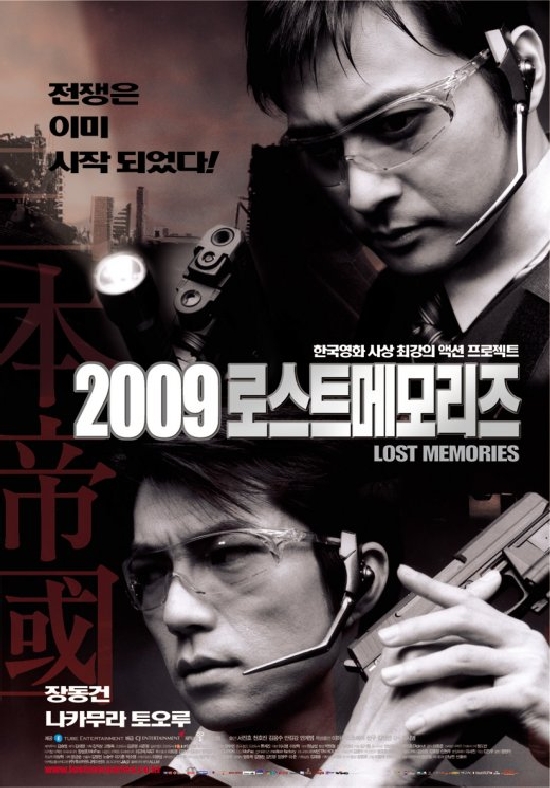
(Source: Moeyyo. Good review available here.)

3. Given the above, then Japanese colonization ultimately involved the complete transformation and development of colonies’ economies and the establishment of modern bureaucratic states where none had existed before, and while all this was purely for the sake of Japan, this involved much more investment and establishment of infrastructure and industry than the extractive industries of European colonies ever did.

In Kohl’s words, its impact was “more intense, more brutal, and deeply architectonic: it also left Korea with three and a half decades of economic growth [at an average of 3%] and a relatively advanced level of industrialization (nearly 35% of Korea’s national production in 1940 originated in mining and manufacturing).” No, the word “architectonic” isn’t in my dictionary either, but you get the idea. One of the first and most important things I learned in my Southeast Asian history classes at university was that coloring, say, England, Malaysia and Burma red in an atlas didn’t imply that the latter in anyway resembled the former, but in very real senses Korea at least was indeed a mini-Japan by the 1940s.

It is natural and correct to point out that a great deal of this development was destroyed in the Korean War, but although the developmental mindset passed on was ultimately a much more influential colonial endowment as I’ll explain in Part Three, the remaining industry and infrastructure was by no means insignificant. In brief, this included:

– As the hub of the colonial empire, Korea’s roads and railways were among the finest that a developing country could inherit from its colonial past.

– Although technically “human capital”, the Japanese made significant investments in primary education, and the benefits of these would have largely been felt by North and South Korea rather than the colonial state itself.

– The exhaustive land survey of 1910-1918, which “mapped all plots of land, classified it according to type, graded its productivity and established ownership” both provided a reliable source of taxation and the information upon which Korea’s agricultural revolution was based, Korea going from a land of regular famines to the granary of the empire in two decades. Certainly this never meant that Koreans actually ate more themselves, and however important clearly delineated land ownership is to developing economies today it was obviously of little use in Korea after the Korea War. But still, the postcolonial state knew its subjects and resources intimately, whereas most governments of former colonies today still haven’t mapped their territories adequately.

– The geographical distribution of industries established did have impacts later. Most chemical, metal, and electricity-generating industries were in the North, and the remainder of those, combined with communist regimes’ strengths in producing industries but not consumer goods, in large measure accounts for the economic superiority of the North over the South until the late-1960s. But these were largely highly capital-intensive industries “that were not well integrated into the local economy…much more likely to evolve into white elephants, requiring continuous protection, rather than into nimble, labor-intensive exporters of consumer products”. In contrast, the South actually had 60% of total industrial production in 1938, and what’s more this was concentrated in such fields as food production, textiles, machines and tools, and tobacco-related industries, not coincidentally much better suited to export than anything produced in the North.

– And export they did. In 1938 Korea was exporting twice as much as other similar-sized economies, and what’s more almost half of its exports were in manufactured goods. And as anybody who studied history in school should know, the whole idea of most colonies was to extract raw materials from them, send them back to the mother country, make things from them, then sell them back to the colonies, a captive market. No wonder then, that South Korean military and bureaucratic elites in 1961, largely the same people that had previously occupied the lower rungs of the colonial state, relished the chance to restart a high-growth economic system for the sake of Korean rather than Japanese development and capital accumulation.

I’ll cover the colonial period in a little more detail in Part Three, but only on a macro-level so to speak, so anyone further interested in the Japanese colonial period and grassroots Korean history in general, I recommend the Korean section of Frog in a Well for many interesting posts, and Matt at Gusts of Popular Feeling has written a great deal on that period too (although without a category section his posts can take some time to find sorry). Meanwhile, as so many of those elites mentioned and especially Park Chung-hee had served in Manchukuo in some capacity, then an examination of that colony really does become almost as important as colonial Korea itself to understand Korean military regimes.

Part Three

Women’s Bodies in Korea’s Consumer Society, Part 3 (Final): Nation, Family, Self

busan-focus-06-03-2013-p-5(Source: Focus, Busan ed.)

Anti-Communist Fashion

As promised in Part 2, in just a moment I’ll jump straight into outlining and discussing the the second part of Taeyeon Kim’s 2003 journal article Neo-Confucian Body Techniques: Women’s Bodies in Korea’s Consumer Society.But before I do, I should mention that I’ve also started reading SeungSook Moon’s book Militarized Modernity and Gendered Citizenship in South Korea (2005), and it’s made me realize just how narrow a focus Kim’s article has.

That’s not really a criticism: in the 16 pages available to her, Kim does an excellent job of explaining how the 19th Century Joseon Dynasty’s Neo-Confucianist views of the female body were warped by, adapted to, and ultimately cam to survive and proper in the 20th Century. And that endurance does go a long way towards explaining the question I first posted in Part 1 — namely, why are Koreans so conformist in their fashion choices?

korean-anti-communist-posterBut what Moon’s book has also made me realize is that, however outlandish the connection sounds at first, today’s Korean fashion can’t be explained fully without mention of the postwar Korean state’s anti-communist ideology too.

Let me run with this for a moment. In a nutshell, Moon’s book gave me a more bottom-up perspective on life in postwar Korea than what I’m used to (decidedly top-down Troubled Tiger is one of my favorite books), and the more I read about it, the more I learned just how pervasive that ideology was in people’s everyday lives, and how almost any form of legitimate dissent or creative difference was often regarded by the state as nothing short of “leftist” subversion. I could give you examples, like Korean men with long hair being publicly shaved in the 1970s, or the police checking that women’s skirts were long enough (albeit more as an excuse to simply harass women), but you get the drift (source, right: theturninggate).

These attitudes didn’t suddenly disappear upon democratization in 1987. In hindsight, it’s incredibly naive for me (or anyone else) to account for conformity in modern Korean life without reference to it. Yes, even in something as innocuous-sounding as fashion.

(Update: I suddenly remembered this ad. But while it’s a good play on how the “rule” for miniskirts has completely reversed since the 1970s, the conformity remains the same. How else to explain wearing miniskirts in winter? An otherwise extremely wasteful use of the body’s resources to demonstrate one’s physical prowess to mates, just like a peacock’s tail?)

But that will be the subject of later posts. First, let’s finish Kim’s article, sans political ideologies (Update: after reading it, I recommend this recent post of the Metropolitician’s on Korean fashion, lest you feel that I give too pessimistic and conformist an image of Koreans; honorable mention should be made of this post of Roboseyo’s post too). The second part starts by placing the endurance of Neo-Confucian images of women’s bodies in modern times in the context of the endurance of Neo-Confucianism in Korean society as a whole:

Confucian Fundamentalism and Korean Identity

The first thing of note is that, despite how it may at first appear, the endurance of Neo-Confucianism in modern Korea is probably more because of Korea’s turbulent 20th Century rather than despite it, as 余 涵 彌fundamentalism of any stripe is usually a reaction against painful, forced transitions to modernity. As Kim says, in Korea’s case Japanese colonization and then civil war and division meant that its postwar search for national identity (source, right):

“…became essential to Korea’s postcolonial and post-war project for national reconstruction. Neo-Confucianism came to stand for essential ‘Koreanness’ and was quickly embraced as the authentic culture of Korea – so much so that challenges to Neo-Confucian principles were branded as threats to national integrity. Neo-Confucianism also maintained its gloss as part of the elite culture, and as more and more Koreans were becoming upwardly mobile, many strove to identify themselves with the former [elites], making what was originally an ideology and culture of the elite minority into the culture of all Koreans” (pp.102-103).

Some other consequences of that quest for self-identity include Korea’s bloodline-based nationalism (although the origins of that were closer to 1900 than 1953), and military regimes deliberately nurturing the idea that Korea has suffered invasions more than most, both now counter-productive (to put it mildly). Ironically though, for women it also ultimately meant a reaffirmation of the ideals of taegyo (태교), despite women’s entrance into the workforce for the first time and the nuclearization of the Korean family. There are two reasons for this, one speculative and one more concrete.

First, one increasingly under-appreciated aspect of postwar Korea was overcoming the psychological trauma of the physical dislocation and separation of Korean families due to the war, and until I started today’s post I didn’t realize that that may have affected Korean’s women’s postwar lives much more than men — remember that, under Neo-Confucianism, they weren’t really thought of as of as individuals in the Joseon Dynasty, and thus their families had been the primary source of their identity. But then, not only were they suddenly and violently brought out of the inner, private sanctum of those families and homes by the war, and then into the public sphere of schools and factories for the first time, those families also moved from the farm to the cities, and nuclearized in the process. Given those circumstances, it is natural to suppose that women might yearn for the good old days of certainty, especially former upper-class women to whom Neo-Confucian tenets had been most vigorously applied.

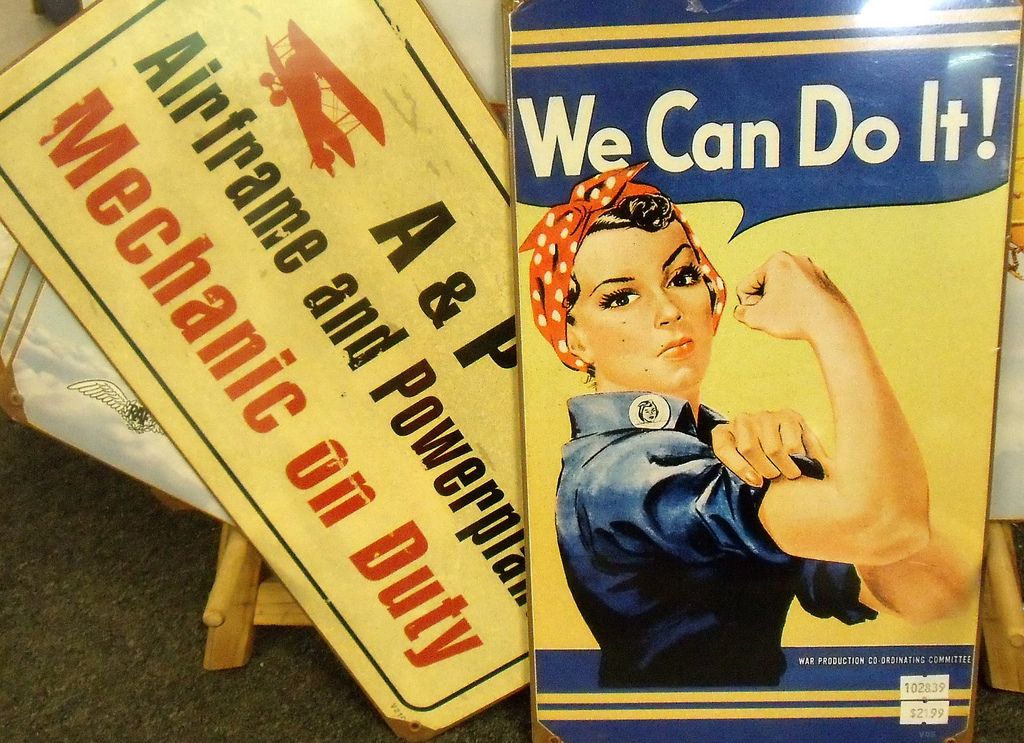
Rosie the Riveter We Can Do ItSecond, while for a time women’s physical labour in factories came to be regarded (rhetorically at least) as just as important and useful as their traditional domestic work in the home (as was, I might also add, their equally “needed”, expanded roles as sex workers too; I’ll save that for a later post), ultimately (source, right: Mike Beauregard; CC BY 2.0):

with the advent of a post-industrial, consumer capitalist society in the 1980s, women became more important as consumers than as factory workers, shifting the utility of their bodies from national labor production to national consumption, becoming, in effect, what Byran S. Turner (1996) calls the capitalist body. (p. 102)

Later, I feel that Kim exaggerates how “post-industrial” Korea is, but that doesn’t detract from the basic point that women, once exhorted and educated to work in the factories, were once again extorted to stay at home upon marriage, and to then focus on producing and raising children. Seeing as a good third or so of the blog is about how the Korean economy and minimalist welfare system is predicated on that fact, then I don’t feel the need to elaborate on and justify that here. Instead, of note is how they are also urged to consume as housewives and mothers, both for the sake of national development, and for the sake of obtaining the items necessary to secure and advance their family’s social status, as explained in Part 2. Ergo, it’s taegyo all over again, although I’ll admit that it sounds neither particularly Korean or even Neo-Confucian at the moment.

The Ensuing Social Malaise

But just like in Western countries after World War Two, you can’t expose most women to working life and equal education and then expect them to meekly return to the home once the economy and/or national emergency no longer requires their economic services; the contradiction leads to the appearance of various social malaises, such as the “housewives’ syndrome” that Betty Friedan so adroitly recognised in 1963. In Western countries, that recognition and the civil-rights movement led to Second-wave Feminism. But Korea has so far lacked the former, and is only just beginning to experience a form of latter, often more because of the signing and implementing of UN conventions on gender issues and so forth rather than domestic pressures. What unresolved social malaises then, have arisen in Korea?

Kim argues that uprooted Korean women naturally found solace in new, postwar media images of women, and following the new rules of fashion was certainly easier and more personally satisfying to most women then embracing new, entirely alien concepts of liberalism, individualism and feminism to which Korea’s new relationship with America exposed them to. Hence:

The Neo-Confucian values of harmonizing as one, proper behaviour and self-cultivation, [re-emerged] in the guise of conformity, propriety and self-improvement. (p. 107)

But as we’ve seen, while self-improvement for men involved training of the mind, resulting in transcendence of the individual self, women were considered incapable of this. Hence women’s primary means of self-improvement came to center on the physical body instead, and this ultimately explains the why of today’s social malaises in Korea today, notably that:

Hence taegyo is Korean and/or Neo-Confucian, because while plenty, if not most, Western women consider getting plastic surgery for the sake of bettering their chances in job interviews and marriage prospects so forth, very few do explicitly for the sake of their father’s and or husband’s families.

Finally, now for the how.

Correcting the Flawed Eastern Female

Oriental Girls(Source: Joel Ormsby)

I’ve already explained that Korean women tend to embrace conformity rather than individuality in their fashion choices, and articles about fashion in women’s magazines too are less “Western” than they may first appear. While opening paragraphs seem to promise articles “promoting liberation from the edicts of fashion, and self-expression over blind conformity,” for instance, what they actually do is set up strict guidelines for Korean women to follow, the authors often failing to recognise that their exhortations not to follow fashion magazines’ fashions, but their tastes and styles instead, actually amount to the same thing. Indeed:

What is right for [the authors] must be right for everyone else, for there is a blurry distinction between [the authors] and others, a legacy of the subjectlessness of the Korean woman. (p. 104, emphasis in original)

Sure, much the same can be said of Western women’s magazines, which Kim should have acknowledged. But remember the importance of the notion of “subjectless bodies” in Kim’s article (see Part 1), and that for Korean women the philosophical concept of the individual self, defined not by ki and the family but by the physical limitations of the corporeal body, is very new. Hence Korean authors and readers may not see the contradiction that their Western counterparts may. Moreover, articles often present:

…what [they] consider to be particular features of the Korean women – short legs, big face, yellow skin – as problem features that can be corrected by certain types of clothing and colours….[they] imply that the imperfect Korean body is disordered but can be put back in order through the tricks of fashion. The body is something to be rearranged so its apparent flaws are concealed or eliminated. These flaws themselves stand out as imperfections because they are features unique to Koreans and absent in white models (p. 104, emphasis in original)

I could go on to discuss the details of huge plastic surgery industry in Korea, but it’s been done to death elsewhere, and I think the above photo and this article sum it up better than any virtual ink spilt on the subject. Having said that, numerous sources have claimed that Korean women’s desires to look Caucasian are the result of an inferiority complex towards and cultural colonization by the West, but I think that both that desire and those influences have been grossly exaggerated. Consider this:

All three elements, the Neo-Confucian woman’s subjectlessness, the perception of Korean bodies as imperfect, and fashion’s function to re-order the disordered Korean bodies, make Korean women’s bodies particularly prone to alterations, rearrangements and re-creations of the body. (p. 104)

The biggest thing I’ve gained from these writing this series of posts (and I just so happen to think that it’s quite an original point too), is that in that statement above you can replace “Korea” with China, Japan, and/or Taiwan, and that argument would still be just as valid. Arguing that their shared plastic surgery mania is because all four countries share a history of cultural colonization and have inferiority complexes towards the West is tenuous at best, and if even if true, surely it would mean that Korean men too, say, would aim to look more Western? But no, they don’t, and not even with the huge size of the Korean male beauty industry today. But all four countries do share a history of Neo-Confucianism. On that basis, is it too much of a jump to argue that the Neo-Confucianist combination above is precisely why plastic surgery is so popular amongst women in this part of the world?

Women’s Bodies in Korea’s Consumer Society, Part 2: We’re not in Kansas Anymore


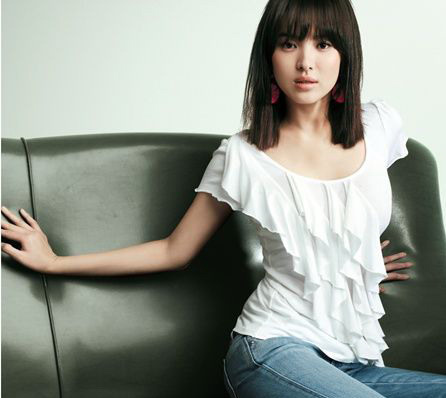
The ParadoxSong Hye-gyo sofa

For new readers, Part 1 was an outline and discussion of the first part of the 2003 journal article Neo-Confucian Body Techniques: Women’s Bodies in Korea’s Consumer Society by Taeyon Kim. To quickly recap it, she argues that women weren’t really thought of as individuals in Joseon Dynasty Korea, as the state ideology of Neo-Confucianism considered them incapable of the spiritual transcendence that men were. Instead, the best they could aim for in life was continuing a husband’s “ki”, or spirit, through the production and upbringing of sons and the efficient management of his household. Hence Kim describes them as “subjectless bodies,” as not only were they not really individuals but their physical bodies were not really their own either, merely being vessels for and tenders of the more precious ki instead (source, right: jingdianmeinv)

In terms of the ideals for women’s appearance, this meant that the physical attributes required for those were prized more than beauty. On top of that, adornment and/or alteration of the body was not condoned for either sex, as the physical body was one’s inheritance of ancestors’ sacred ki. And herein lies the paradox, as on the one hand Neo-Confucianism still pervades all aspects of Korean life today (I’ll take readers knowing and agreeing with this as a given), but on the other hand, modern Korea appears to be in the midst of a decidedly non-traditional celebration of youth and the female form. What gives?


Neo-Confucian Consumption Motives

The short answer is that appearances can be deceptive. It is certainly true that modern media images of Korean women are not Neo-Confucian in the 19th Century sense described above, and it’s difficult to argue just by looking at them that advertisements, for instance, are any different to their counterparts in Western countries. Of course, systematic cross-country analyses of numbers and types do reveal significant and telling differences, and if readers are interested in those then I highly recommend reading the 2006 journal article entitled “Content Analysis of Diet Advertisments: A Cross-National Comparison of Korean and U.S. Women’s Magazines” by Minjeong Kim and Sharron Lennon, downloadable here. But surveys like those do not chronicle average Korean and Western women’s reactions to them, and herein lies the essential differences between them.

Barbie Dolls ConformityAs a rule, in Western countries most (although not all) advertisements for a product have to actively suppress and disguise the notion that people may feel compelled, influenced or forced into purchasing that product, whether by the ad, by peer pressure, or some other unwritten social rule. Instead, people are encouraged to conceive their purchase in terms of personal choice, individuality, empowerment, and — especially if the target consumer is young — maybe liberation and rebellion too. And of course, these advertising norms undoubtedly operate for a good proportion of advertisements in Korea too. But in the case of advertisements for products related to one’s appearance, be they cosmetics, clothes, or plastic surgery, it turns out that a great number of Korean women make purchases for precisely the opposite reasons. Indeed, not only is there no stigma in doing so, but they positively embrace the opportunity to conform to and harmonize with social norms through their consumption choices (source, right: Kiran Foster).

Lest that assertion sound like a typical exaggeration of a Caucasian male, surveys that Kim cites indicate that most Korean women explicitly justify their choices in those Neo-Confucian terms, and definitely not the individual empowerment, entitlement, and personal assertion of one’s individual choice that Western women tend to do in similar surveys. That is not to say that Western women (or men) can’t and don’t also passively follow fashions, and it’s not necessarily a negative or dehumanizing thing either. But very few Westerners would admit to it.

I see no reason to doubt the results of those surveys (which I can provide the details of if readers wish), and while my own female Korean friends for instance, are certainly as liberal and free-willed as any Westerner in their clothing and cosmetic choices — and lifestyles; indeed, that’s why we’re friends — they can’t counter the mass of empirical evidence Kim provides, and even the anecdotal evidence from the media and on the streets of Korea. If Neo-Confucianism is pervasive in modern Korean life then, and Korean women consume cosmetics, clothes, and undergo plastic surgery operations largely for the sake of Neo-Confucianist motives, then it’s time to call a spade a spade and argue that Korean society’s new emphasis on women’s appearances is (somehow) Neo-Confucianist too. Indeed, it would be strange if only this particular aspect of Korean life was so different.

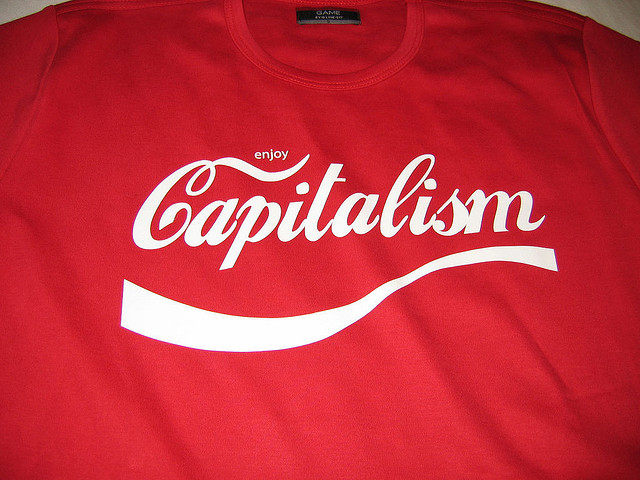
Enjoy Capitalism T-shirtHence the second part of Kim’s article is about how this modern phenomenon is a warping of and adaptation of Neo-Confucian ideals of women’s roles to new capitalist and consumerist circumstances. But while I originally wanted to outline and discuss that in this post, I’ve moved that to Part 3, because first I wanted to place those circumstances in their historical context, which I think considerably adds to and strengthens Kim’s argument (source, right: Jacob Bøtter).


The Developmental Context of East Asian Consumption

I’ve already demonstrated that although Korean women and, say, American women, can both be labelled as “consumers,” they can and do both make radically different consumption choices; or, make the same choices, but for radically different reasons. Sure, this is obvious, but I’m as guilty as anyone in generalizing and using labels here, so it’s good to remind ourselves of it. But if we shift our attention to the differences between most Westerners and most Koreans (and East Asians) as a whole, the first fact of note is the fact that most Korean university students’ parents easily recall the days when possession of some must-have items like a fridge, radio, color TV and car were essential signifier that one’s family had made it into the then swelling ranks of the middle-class. On that basis, it may be fair to say that they still imbue their consumer goods with much more status and importance than most Westerners do. (Hell, many of the university students themselves too.) This explains Koreans’ love affair with big cars and SUVs for instance, and in one of the most oil-lacking, mountainous and densely-populated countries in the world.

(Update, April 2013: Actually, the Korean preference for big cars is more due to the [inordinate] social status they provide.)


On top of that, Korean governments since 1961 have explicitly and fervently extorted Koreans to consume these items, provided that they were made in Korea. It’s easy to simply attribute this to and write off as mere nationalism, only different in degree to, say, the “Buying Kiwi-Made” campaign in New Zealand, or Democratic presidential candidates in the US criticising NAFTA in election year. But this is quite wrong. If you’ll bear with me for a moment, to properly understand women’s fashions in Korea you need to understand a little of it’s well, political history first. No, really.

When Park Chung-hee/박정희 took power through a coup in 1961, while his military regime of course relied on the use of force, it would be naive to assume that it didn’t have a great deal of popular support. And so, originally at least, his military regime’s sole claim to legitimacy was its perceived ability and capacity to produce the economic development seen as necessary for national security after the chaotic years of the Syngman Rhee/이승만 presidency. While linking the economy and security this way may sound absurd in 2008, it’s important to be aware that North Korea was actually ahead of South Korea economically until the late-1960s, and in addition to this Park was (justifiably) deeply concerned about the US possibly withdrawing its security guarantees to South Korea in the wake of its foreseeable withdrawal from Vietnam. Hence the development of POSCO and the Korean steel industry for instance, which, far from being the carefully planned and coordinated developmental success story it is often touted as today (it is the third largest steel producer in the world), was pursued despite the advice of Korean economists at the time, let alone American ones. Instead, as Mark Clifford explains in chapter five of this must-have book, Park didn’t care about the economics of it; he simply wanted the ability to produce tanks and ships should the US no longer provide them.

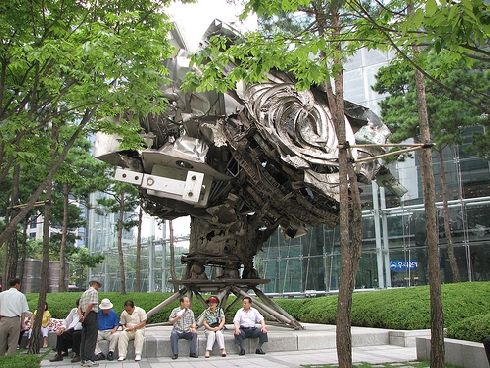
posco-center-statue.jpg

This is why Korea is often known as a “Developmental State,” as too are Japan, Taiwan and Singapore, which faced similarly dire circumstances in the Cold War and reacted in similar ways. Neo-liberal economists in particular are loath to admit that state-led development can be successful, and so they continue to critique the economic policies of these Developmental States decades later, but this excessive focus on economic minutiae has overshadowed the fact that they were and are primarily socio-political, not economic, phenomenons (right: Posco Center, Seoul, by Ian Muttoo).

Hence consumerism has links to national security in Developmental States, and all the choice government slogans like “Consumption is Virtuous” that I saw in old photographs of Korea from the ’70s in economic journals in the archives room of my university library. And while the corollary of Park’s developmentalism was authoritarianism, and average Koreans were expected to be content with and prolific buyers of Korean goods, imports being shut out by high tariffs in order to develop Korea’s own industries (which is why such a stigma remains on imports today), what I want you to take away from all the above is that:

  • Koreans are used to being told what to buy.
  • These choices have often been couched in terms of contributing to a higher purpose.
  • Those that didn’t subscribe to these higher purposes were given few alternatives, and the state was encouraged in stigmatizing them.

It is no great conceptual leap for Neo-Confucian women to go from being subservient to the higher purpose of ki, and their bodies to be imperfect versions of men’s, to furthering the higher purpose of improving the economy and maintaining national security by consuming Korean goods, and finding common identity in a turbulent century by following the new fashion industry’s edicts to improve their imperfect bodies by following their rules for fashion, cosmetics, and body shapes. Those will be the subject of Part 3.

(Update, April 2013: An important rejoinder to my fuzzy memories of reading in my university library is the book Measured Excess: Status, Gender, and Consumer Nationalism in South Korea by Laura Nelson (2000), which I describe here as:

…essential reading for anyone wanting to know more about the 1990s in Korea, and in particular the frequent government and media campaigns against over-consumption (in practice aimed almost exclusively at women, these were important precursors to the “beanpaste girl” stereotypes of the 2000s)

See my “Revealing the Korean Body Politic” series for more on those campaigns and stereotypes in the 2000s, especially Parts 3 and 4.

Women’s Bodies in Korea’s Consumer Society, Part 1: Their Neo-Confucian Heritage

Dasepo Naughty Girls 2006(Screen capture from the movie Dasepo Naughty Girls/다세포소녀. Source: martin francisco)

“Koreans are conformist because of their Confucian heritage…yada yada yada”

Even though I’ve chosen to live in Korea a long time, like most expats I often find it to be a frustrating and exasperating place sometimes. That’s not necessarily a criticism, and indeed this love-hate relationship may even be part of its charm—certainly my adopted hometown of Auckland, New Zealand, never aroused such strong emotions in me. On the other hand, it does lead to so many one-liners about the place, endlessly repeated by fresh rotations of expats.

But are they always wrong? Don’t some have a grain of truth? To answer, let me examine one that I and probably most readers have made at some point in our stay here, but which I personally wouldn’t have been able to justify before I did my research for this post. And certainly won’t ever be making again.

What I have in mind is your gut reaction to watching the following commercial, about three years old:

(Update, July 2012: Unfortunately, the video has been taken down, and I didn’t save a spare copy back in 2008. Hopefully, the screenshots will still give you the gist of it!)

According to Marmot’s Hole commentator mins0306, to whom I’m very grateful for finding the video, the message the commercial wanted to convey was “What she selects will become a trend. And since she selected a Prugio apartment, Prugio apartments will also become a trend.” Instead, it has inadvertently become of a symbol of Korean people’s conformism, particularly of women’s attitudes to fashion.

But before writing this post, had I been pressed for why so many Korean women seem to so blindly follow the latest trends, be they mini-skirts in winter or getting double-eyelid surgery, I would have mumbled something about Confucianism and the education system discouraging individuality. That is still technically correct, but—let’s face it—most of us blame so much here on Confucianism, but actually know little more about it than what we read in Lonely Planet Korea in the week before we came. But how,exactly, is it to blame? Why?

On the surface, it may not even have anything to do with Confucianism at all. Consider this statement from the 2003 journal article “Neo-Confucian Body Techniques: Women’s Bodies in Korea’s Consumer Society” by Taeyon Kim (details and abstract here):

“For 500 years, Korea adopted Neo-Confucianism as its official ideology and strove to create a Neo-Confucian state by following its precepts as closely as possible. Neo-Confucians believed the body was sacred. Since it was bequeathed by one’s parents, in accordance with filial piety, the body had to be respected and remain unaltered…The Korean aversion to manipulation of the body seems to have been a long-standing cultural principle – only whole-heartedly abandoned in the last few years of proliferating plastic surgeries and various other manipulations of the body. Why has what appears to have been such a strong cultural value been so suddenly and completely abandoned?” (p. 98)

Like I said, I didn’t know that Joseon Dynasty Korea adopted “Neo-Confucianism” rather than merely “Confucianism” its state ideology either; from now on, I’ll make sure to blame all Korean ills on that instead. But now that she mentions it, yes, I do recall that Confucianism…oops, Neo-Confucianism I mean…did not condone alteration and adornment of the body, which is why it was so dishonourable for men to have their ponytails cut off.

How then, can Korea still be described as “more Confucian than China” when: Korean women adorn fashion and accessories to the point of what Michael Hurt describes as “fetishization;” female friends of mine wear excessive make-up to work upon fear of being fired if they don’t; others think nothing of wearing it to the gym; and Korea leads the world in the number of plastic surgeries made per capita? The notion now sounds absurd.

But Kim goes on to argue that the prescribed Neo-Confucian role of women’s bodies is essentially the same today as it was in the Joseon Dynasty, albeit adapted to and/or warped by democratization and capitalism. I don’t entirely agree with everything she says, but more in degree than in substance, and she certainly does make a decent stab at solving that paradox above.

korean-woman-as-a-mere-vessel.jpg

Because her two-part argument is very long, and I actually have a lot of my own thoughts and ideas to add to her arguments about postwar Korea, I’ve taken the wise (but unusual for me!) decision to split my original 3500 word post on her journal article into two. In the remainder of this first one then, I’ll outline what Kim says about how Neo-Confucianism viewed women’s bodies and their roles, and in the next one I’ll discuss how these adapted and changed to, but ultimately survived, the 20th Century (source, right: natebeaty).

Neo-Confucian Women’s Bodies as Mere Vessels

Before reading the following, bear in mind that only Joseon Dynasty elites—possibly as little as 1% of the population—would have subscribed to the Neo-Confucianism edicts described (Kim does acknowledge this). But the vast majority of Korean women worked on their farms, and were integral economic parts of the household; indeed, I’ve won arguments with older male students of mine on this point, who thought that “Korean tradition” justified them in literally forbidding their daughters-in-law from working after marriage. I concede though, that they would have remained an ideal.

“To understand the Neo-Confucian body, it is essential to understand the concept of ki. A material force which links the body and mind into one system, ki flows through all things, giving them form and vitality….There is no distinction between the self and the universe. Neo-Confucian men were encouraged to let go of ego and become selfless, that is to have no consciousness of an individual and separate self apart from others….Ki was passed from parent to child throughout the generations, acting as a material link between ancestors and descendants….The family composed a unified body through ki, and the identity of the family and self and family was continuous and undifferentiated.” (p.99, italics in original)

For learners of Korean, this “ki” appears to be “기,” which has a hanja character on p.38 of my Korean vocabularly ‘bible’ that, in addition to “spirit,” also means “air,” “atmosphere,” and “energy.” And for everyone, I admit, at the moment it sounds very similar to a mere family name or bloodline, but those are quite vague concepts at best, whereas ki does sound like a well-thought out—albeit sexist and fundamentally flawed—philosophical concept. Elaborating on it further:

“The force of ki constituted one’s sense of the body and self more than the corporeal body. It followed that the family body, within which flows the same ki,was considered the essential self more than one’s own physical body. The emphasis on non-distinction between self and others produced a sense of self that was non-individuated and fluid, with no boundaries to determine a distinction between one’s family and one’s self.” (p.99)

Hence the Hoju System/호주제, a family registry system, rather than one of individual birth certificates like in Western countries, that was not abolished until as late as this year. Under it, upon marriage, women would be transferred from one family’s certificate to her husband’s family, almost like property. In practice, female divorcees suffered greatly from it because:

  • Given that it was often required for job applications, it meant that applicants’ marital status was readily apparent to employers. I’ve read, but am not sure how applicable it is now given the high divorce rate, that female divorcees were often discriminated against by employers as a result, ironically at a time when most would have needed employment more than ever.
  • Custody of children was overwhelmingly awarded to fathers; after all, the women were no longer part of the ki/family.
  • For those women married to fathers that abandoned their families, divorcing them would mean years of adminstrative problems with children in schools and so forth, as it meant that they were no longer their legal guardians. In Japan, with a similar system, these issues came up with ex-prime minister Koizumi after he divorced in 1982.
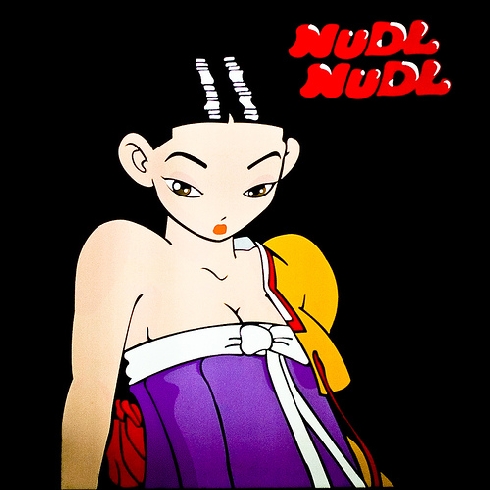
erotic-hanbok.jpg

Promising to abolish this system was one reason I supported the election of Roh Mu-hyon back in 2002, and while he did prove to be quite a lame duck president, and least this promise was fulfilled. To continue (source, right: theturninggate):

“Neo-Confucian techniques of self-cultivation of the mind and body only applied to men. Women in the Neo-Confucian view were incapable of achieving sagehood and therefore had neither the need nor the ability to strive for transcendence of the self and body. While men produced their selves through the mind (study of the classics) and body (maintenance of the family body through ancestor worship), women were occupied with maintaining and reproducing the family body through the corporeal bodies of the family.” (p. 100)

Koreans are by no means alone in having philosophical or religious beliefs justifying an inferior status of women, but this particular one could lead to some very strange-sounding results. For instance, Kim explains that one study of a villagers in 1990 found that they thought women were inferior to men because they did not carry the ki that men did, meaning that “women were believed to be passive receptacles of the life which men implanted in them; they played no active part in creating life.

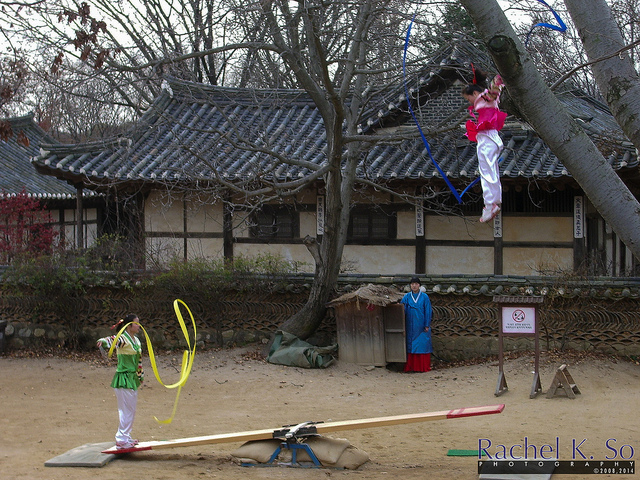
It also meant that beauty and wealth were secondary to possession of the physical traits required to bear sons, and gave rise Korean Folk Villageto an elaborate system of prenatal education known as taegyo/태교 which, rather than the notion of women and child’s health that the word brings to mind today, back then was more the idea of women as bodies rather than subjects or individuals, because “their conduct and thoughts were for the sake of the other abiding in their bodies, and they were valued mostly for the children and labour that their bodies could produce.” Hence, women “were regarded as subjectless bodies.” (pp. 100-101), the consequences, in sum, being that (source, right: InSapphoWeTrust):

“While [men] aimed to transcend the body, women could never do so – their bodies were too valuable. A man’s mind and ki were considered more valuable than his corporeal limbs while a woman was most valued for her body and its reproductive labour. As a result, efforts were made to maintain sole control over women’s bodies, subjecting them to a protection and concealment that practically rendered their bodies invisible.” (p.101)

Indeed, while the hanbok is much more comfortable to wear and walk around in than a kimono (or so I’ve heard), it’s not exactly a celebration of the female form. Also, this protection and concealment literally meant that elite women’s homes became prisons, as they weren’t allowed to leave: those “traditional see-saws,” for instance, were actually so popular because they allowed elite women rare glimpses of life outside of the walls of their courtyards, and I remember reading somewhere of a woman escaping from her village to Busan during the Korean War, despite all the death and destruction around her actually having an exciting time, as it was the first time she’d left her house in decades!

Next week: Part 2, which will continue the discussion into the postwar period.

Korea’s Convenient Invasion Myths

Source: Wikimedia

Update, August 2010: An excellent article by Andrei Lankov, which deserves to be much more widely read. Unfortunately though, Tom Coyner’s site is the only site I’ve been able to find it on. So, here’s one more copy, to ensure that it remains available:

War of Details

Andrei Lankov, Korea Times, August 31 2006.

Every foreign resident of Korea is exposed to a number of habitual Korean statements, which reflect Korean ideas about themselves and their nation. Many of these beliefs are true, some are not so well founded, while others are strange — like, say, the well-known tendency of Koreans to boast that their country “has four distinct seasons” as if this is something unusual and unknown to most other countries of the globe.

One such oft-repeated statement is that Korea has always suffered invasions and wars. Koreans often say, “Our history has been tragic, for centuries we have been invaded by powerful enemies and suffered in their hands greatly.” Every visitor to Korea is bound to hear such a remark sooner or later, and most people tend to take it at face value. This statement might correctly describe Korean history of the last one hundred years, but it is hardly applicable to earlier eras.

Well, let’s have a look at the Choson Dynasty period, from 1392 to 1910. The last four decades of these five centuries were turbulent indeed, but what about earlier times? Even a cursory look demonstrates that it was hardly a “time of troubles.” Throughout 1392-1865, Korea fought three wars against foreign invaders, not including some minor border skirmishes with nomads in the north, and Japanese pirates on the coasts. In one case, the war with Japan from 1592-1598, known as “Hideyoshi’s invasion” in the West, and as the “Imjin War” in Korea, was disastrous and the entire country was devastated. As you know, the medieval armies, all those “knights in shining armor,” were not too nice when they encountered the civilian population. The two other conflicts, of 1627 and of 1636, were of much smaller scale — essentially, two blitzkriegs brilliantly executed by Manchu generals whose cavalry units broke through Korean defenses, approached Seoul, and forced the Korean government to agree to an unfavorable peace.

Source: totustuusegosum2000

Let’s compare this with the fate of more or less every European country. Throughout the same period of 1392-1865, almost every country in Europe fought a much greater number of conflicts, and suffered much greater casualties. Let’s have a look at German history. The period under consideration is marked by at least four major military conflicts, each lasting for one or several decades, and resulting in mass death and destruction: the Reformation Wars, the Thirty Years War (1618-1648), the Prussian campaigns of the mid-18th century and the Napoleonic wars. And these are only large-scale wars, each being as significant and bloody as Korea’s war with Japan in 1592-1598 (in all probability, all these conflicts were more destructive than the “Hideyoshi invasion”). Apart from these, there were a number of smaller conflicts, many of which were not small at all– like the War of the Spanish Succession (1701-1714), or the chain of conflicts that accompanied German unification in the 1850s and 1860s. And, of course, there were countless quarrels between the mini-states which formed the Germany of the era, each such quarrel being a military conflict on its own right, far exceeding Korea’s occasional skirmishes with Japanese raiders.

Is Germany an exception? By no means. This is the fairly typical history of any European country, and against such a background Korean history appears rather quiet. Rather than being a country with a uniquely turbulent history, Korea actually was a country, which enjoyed stability undreamed of in most other parts of the world!

The same is true in regard to domestic policy. Of course, old Korea had its own share of court conspiracies, poisoned dignitaries, and scheming royal concubines. But throughout the same period of 470 years, only two Korean kings were actually overthrown (and in one case the life of the ex-sovereign was spared — an almost unthinkable leniency by the standard of medieval Europe or the Middle East!). There were two unsuccessful gentry revolts, each lasting for but a few weeks, one peasant uprising on moderate scale, some local disturbances, a bit of banditry — and that’s all! Once again, in comparison with France (at least a dozen major revolts, revolutions, and civil wars), Germany, or even relatively peaceful England demonstrates that Korea was indeed a very secure and stable place.

Suffice to say that the Korean army for most of the period had about ten thousand soldiers on active duty — a very small army for a country with population of some ten million. The armed forces were increased when the government faced a perceived security threat, but for most of this long period the Korean army was essentially a police force, sufficient to fight bandits, patrol borders, restore order in some villages, and ensure the personal security of the king. So much for the talk of the permanent invasions Korea allegedly faced: a country, which lives under threat, does not have such a small army.

But why did such a view develop? There might be few reasons, but I suspect that Korean intellectuals of the 1950s or 1960s were shocked by the turbulent nature of the last hundred years of Korea history (to be more precise, the period between 1865 and 1960). This came as a sharp contrast to the tranquility and predictability of earlier times. This shock made Koreans believe that their history has always been that difficult and hard. And, of course, Korean nationalists used these feelings for their own gains. But this is another story…

If you reside in South Korea, you can donate via wire transfer: Turnbull James Edward (Kookmin Bank/국민은행, 563401-01-214324)