Korean Gender Reader: Abortion Republic No More?

Alice Park es Gogo by Tetsumo ; CC BY 2.0.

Yes, after a long hiatus, I’m starting up this series again, and this time hopefully for good!

For new readers unfamiliar with it, basically this means that for your convenience and interest, each Monday I’ll be providing summaries of the biggest Korean gender-related stories of the week before, with a few related and/or interesting ones from overseas also, especially Northeast Asia. But I may sometimes miss some though, so I’ll still always be grateful if you could pass any on that you come across, either just by writing a comment on any post, or via email, Twitter, or Facebook.

With dire long-term implications however, the first story required rather more than a simple summary:

1) Abortion Republic No More?

Starting late last year, but suddenly getting a lot of attention in the international media, the Lee Myung-bak administration has decided to start enforcing Korea’s abortion laws, basically for the first time since they were enacted in 1953. But while the news that the Korean government is actually enforcing its own laws might usually be cause for celebration, unfortunately its abortion laws are amongst the most restrictive in the world, only allowing it in the case of heredity diseases, incest, rape, and/or danger to the mother’s health.

( Source: Chicago Tribune )

For an excellent overview of the topic, with many links to various English-language stories, see Robert Neff’s post at The Marmot’s Hole; assuming that you’ve read that, here I’d like to highlight some of the few points not covered in it, starting with some statistics on whom exactly is getting abortions and why. From the Hankyoreh:

According to the data released by the Ministry of Health, Welfare and Family Affairs (MHWFA) yesterday, the reasons why married women, who make up 58 percent of the women who have undergone abortion procedures, chose to have abortions are because they do not want children (70 percent) and financial difficulties (17.5 percent). In the case of unmarried women, 93.7 percent said they underwent an abortion procedure because they were not married. They are saying that having children is difficult because of child-rearing and economic burdens in the case of married women, and because of social prejudice and financial difficulties in the case of unmarried women.

A second point is while that data came from the MHWFA on March 3, it actually lost its jurisdiction over family affairs on the 19th, which have returned to the Ministry of Gender Equality (now Ministry of Gender Equality and Family Affairs, or MOGEF). Coming with a big increase in staff and 4 times larger budget (albeit from a base of 0.03%(!) of the government total), and partially dealing with problems of overlapping responsibilities with other ministries, again ostensibly this is good news. But also strange; after all, according to The Korea Times:

As a candidate, President Lee Myung-bak promised to expand the Ministry of Gender Equality, but his transition committee ― led by a woman ― first attempted to abolish the ministry and, faced with fierce opposition from feminists, backed down to sharply downsizing it. Equally problematic was Lee’s choice for its top post, a food and nutrition expert who had no experience at all in the female rights movement, under the excuse of “globalizing Korean food.”

See here and here for more details. Why this is important is because almost every report I’ve read on this subject has directly or implicitly linked the “abortion crackdown” to Lee Myung-bak’s special taskforce of November 2009, charged with finding a means to improve Korea’s birthrate, one of the lowest in the world. And given the above history, and how disastrous his administration has been for Korean women as a whole, then in my opinion quite correctly too, although to be fair, this link has been denied by the government. From The Chicago Tribune:

“Our plan against illegal abortions is entirely separate from our low birthrate countermeasures,” said Rhee Won-hee, chief of the health ministry’s Family Support Division. “The comprehensive plan is to fight rampant disrespect for the sanctity of life.”

Nevertheless, as it was the MHWFA that was responsible for implementing the crackdown, even setting up a hotline to report on law-breaking doctors or pregnant women, and – as far as I am aware – it is these responsibilities that MOGEF has just taken on, then it remains to be seen what genuinely useful initiatives MOGEF will be implementing to help raise the birthrate other than clamping down on abortions. After all, recall that this is the same ministry that paid men not to have sex with prostitutes, and that will be continuing the MHWFA policy of letting them go home early every third Wednesday so that they might, well, fuck their wives, neither of which, to identify a recurring theme, really deal with the fundamentals of why Korean women are having so few children.

Unfortunately, this also proves to be the case for its “purple-job system” of encouraging flexitime for women and men: again ostensibly commendable, and sorely needed with a workplace culture that uselessly confines people to the office until late in the evening, but all essentially useless when a record number of Korean women have lost their jobs in the last year (see below), and they’re still fired for getting pregnant. Perhaps the money might be better spent in conjunction with the Ministry of Labor in ensuring that companies are prosecuted for doing so?

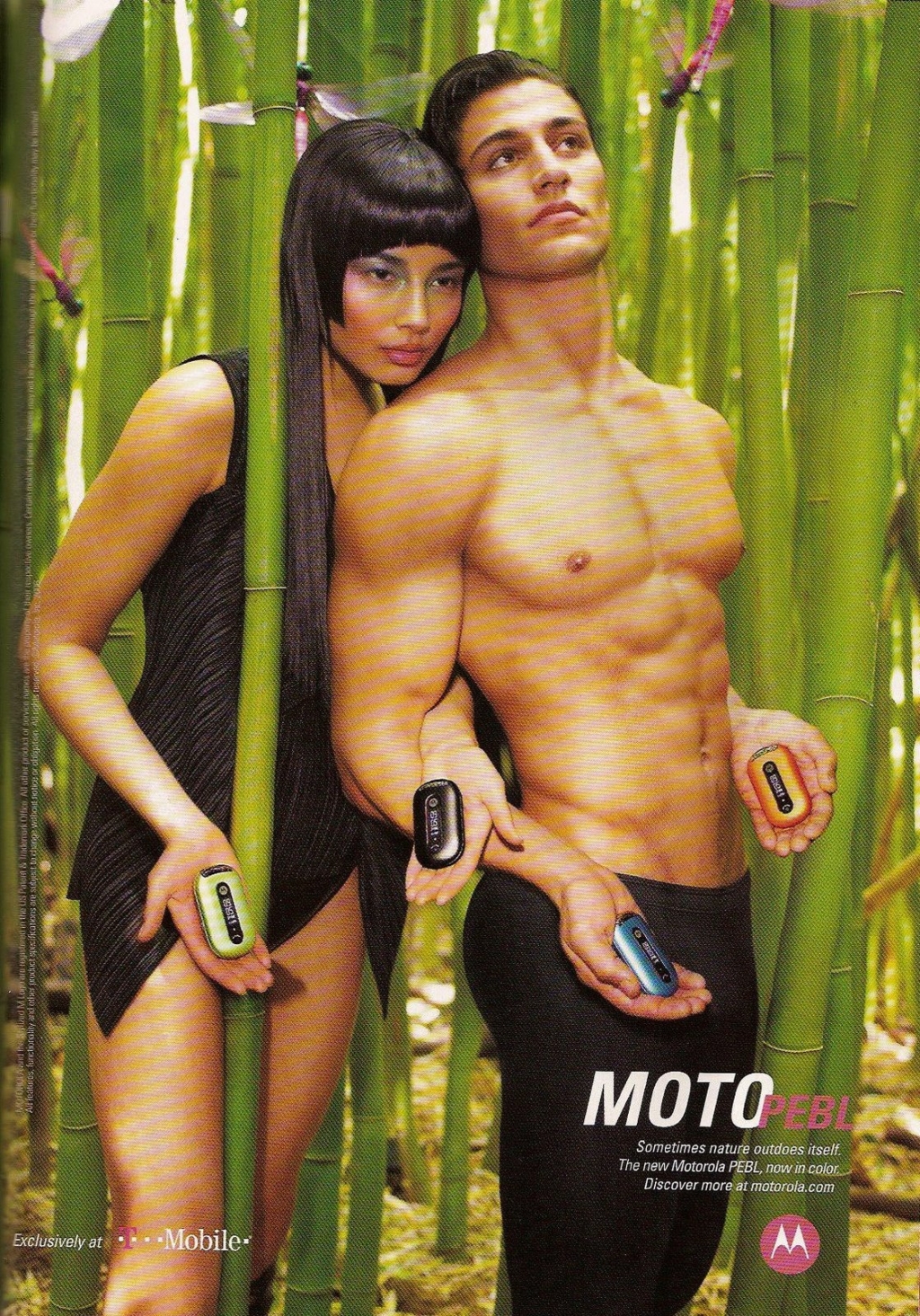
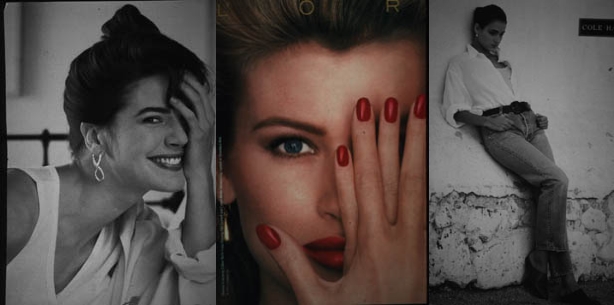
( Source: I Believe in Advertising; adapted from Grazia advertisement )

Third, there are the motivations of the various interest groups themselves, in particular those of the Korean Gynecological Physicians’ Association (GYNOB; 진오비), a new group of 600-700 obstetricians that has sought forgiveness from the public for performing abortions in the past, probably not coincidentally receiving a great deal of media attention at about the same time that Lee Myung-bak’s taskforce was formed. While the New York Times at least emphasizes the religious affiliations of the group, and points out that it doesn’t have the support of the 4000 member Korean Association of Obstetricians and Gynecologists (대한산부인과학회), I suspect that simple corporatist interests will soon increase its support among them, as according to The Korea Herald:

Obstetrical and gynecological clinics in Korea have long struggled from old issues such as low medical fees, ceaseless legal conflicts and a shortage of specialists.

Under the system, most private clinics have given up risk-bearing delivery services. But practicing cheaper gynecological treatment does not make a profit. As a result, a growing number of specialists do abortions or turn to other more favorable departments such as dermatology and plastic surgery.

And indeed the report then makes an explicit, corporatist link:

Young doctors started sensing that they could be the nation’s last generation of gynecologists, resulting in the establishment of GYNOB…

Presumably the idea being that gynecologists and obstetricians did not enter the field simply to perform abortions. Lest the argument that they’re simply looking out for their jobs sound cynical on my part however, consider how last year the Korean Medical Association (대한의사협회) started blatantly scaremongering about the contraceptive pill, despite the fact that already surprisingly low numbers of Korean women use the pill (in no small part due to previous scaremongering), and that it is widely acknowledged (outside of Japan at least) that Japanese gynecologists and obstetricians, for instance, deliberately blocked the introduction of the pill there for over 30 years in order to maintain their own extensive abortion industry. Granted, the KMA is not GYNOB, but it would be interesting to see who exactly in the KMA was responsible for that (needless to say, perhaps some are members of GYNOB?), and to hear alternative explanations for the KMA’s sudden concern.

Meanwhile, the corporatist interests of the Korean state are clear. As Sara Mendkedick at Change.org puts it:

Abortion shouldn’t be the only, desperate choice of women whose voices are silenced by their society, and it shouldn’t be used as a form of population control by the government. It should be one option for women who have the power, education, and awareness to make informed decisions. Unfortunately, it seems South Korea still sees abortion as one more issue for men to deal with, one more choice they make when and how they feel like it.

And for the best source on the history of Korea’s population control policies, almost as draconian as China’s “One Child Policy”, see Militarized Modernity and Gendered Citizenship in South Korea (2005) by Seungsook Moon (see here for a review; source right: Japan Focus), a good illustration of the zealousness of which is the fact that the Marine Corps was mobilized to perform IUD insertions and vasectomies on isolated islanders in the late-1970s (p.84). Moreover:

In the second half of the 1970s, female sterilization was introduced and aggressively applied to fertile women in the form of free one-shot surgical sterilization. Necessary postsurgical care was often ignored. The practice of female sterilization reached its peak in 1979 and then decreased. Perceiving this decrease as a crisis, the state accelerated its sterilization campaign in the 1980s, into what can only be described as sterilization mania. Between 1982 and 1983, 2 million women were sterilized, making up 58% of the total cases of sterilization during the past 25 years. Statistics in 1988 indicated that 48% of all fertile married women were sterilized. Sterilized women also made up 63% of all female contraceptive users. In addition, 83% of these women had been sterilized for free by the state’s agencies, operating primarily in the form of mobile services. The semiforced mass sterilization led to abrupt reductions in the fertility rate and the rate of population growth in the 1980s. According to official statistics, the average number of children an adult woman would bear during her lifetime dropped from 6.3 in the early-1960s to 1.6 in 1988. (pp. 84-85)

Needless to say, I find it appalling that the government of a now supposedly developed, democratic society is applying the mindset of a military dictatorship to population control, and personally this is the straw that broke that broke the camel’s back as far my opinion of the Lee Myung-bak Administration, albeit something I should have expected from someone that saw fit to offer Seoul to God. Seriously, are poor Korean women going to be forced to go overseas or use backstreet abortionists from now on? In 2010?

I’d welcome suggestions as to what us, presumably mostly non-Koreans, can do about this. At the very least, I’ll be following developments closely here, and it’s not all doom and gloom: women’s groups are protesting, albeit at the moment in surprisingly low numbers. Meanwhile, for those of you further interested in the pervasive militarization of daily life in Korea that this policy is a manifestation of, then please consider my Gender and Militarization series, and I also recommend this post by Korea Beat on avoiding compulsory military service, which he and I both think is an anachronism.

( Source: ROK SPOONFUL )

And now, in no particular order, the remainder of last week’s stories…but starting with some good news for a change:

2) Pregnant teenager allowed to graduate from high school

As the Joongang Ilbo reported:

The National Human Rights Commission said yesterday that any school that forces a student to drop out because she is pregnant is being discriminatory and infringing on her right to an education.

The announcement follows the case of Kim Su-hyeon, 19, a teenager who was forced to drop out during her senior year of high school last year because of a pregnancy.

Though many Western countries allow pregnant high school students to complete their educations, Kim’s case is the first of its kind in Korea to be decided by the commission.

Kim agreed to reveal her real name to the JoongAng Ilbo, commenting that she hoped her case would help other teenage mothers who have been forced to end their studies.

See Gusts of Popular Feeling for an overview and the wider context, and ROK Drop also has a brief comments thread in which comparisons to the US are made.

3) Korea to abolish adultery law

Self-explanatory (but good!), much more interesting is some additional information on the abortion issue that I’ve just noticed in the report from The Chosun Ilbo:

The committee is also reportedly discussing permitting abortions, which remain illegal in Korea. “We have not reached any conclusions since it is a very controversial issue,” a committee member said. “But discussions are under way allowing abortions if they are conducted before a certain period of pregnancy and clamping down on those that take place after that phase as seen in advanced countries.”

Hear hear!

4) New shows bring gay love to prime time

Long taboo on Korean television, this month not one but two dramas deal with homosexual relationships: Personal Taste (개인의 취향; also known as Personal Preference) and Life is Beautiful (인생은아름다워). See the JoongAng Daily for an overview, and Dramabeans at the above links for the details.

(Yes, I realize that that’s actually a man and woman on the right: as it turns out, Lee Min-ho (이민호) just pretends to be gay in order to room with Son Ye-jin (손예진) in Personal Preference)

5) G-Dragon Not Guilty

See SeoulBeats for the details, and here for the background.

6) Cambodian Government Temporarily Bans Marriage Between Cambodians and Koreans

Big news of course, but somewhat inevitable considering the treatment many Cambodian women receive in Korea, and hopefully this will prompt both countries to take a closer look at their mutual international marriage industry.

For an overview see The Marmot’s Hole and The Hub of Sparkle, and between them they link to an article at the Deutsche Press-Agentur and another at The Korea Herald that appears to have been written (but not published) just before the ban, which ironically claimed that most migrant women were happy with their marriages! To those I can now add this report from the JoongAng Daily, and an editorial from the (rather embarrassed?) Korea Herald.

7) Plastic surgery clinic accused of violating patients’ privacy

A woman in her 20s who lives in Gwangju has asked police to prosecute a plastic surgery clinic and its owner for placing on the Internet, without her consent, before-and-after photographs of her plastic surgery.

Read the rest at Korea Beat.

8) Sex offenders banned from entering country

And those already in the country will be immediately deported. Not that I’m necessarily against the ends, although using retroactive legislation as the means does seem problematic, as in the case of MOGEF working to make sex-offenders’ details available on the internet also.

Update: Robert Koehler and Brian in Jeollanam-do have more information on the former case here and here.

9) Korean 28 year-old jockey commits suicide

But perhaps a silver lining is provided by the light her death has shone on the harsh practices of the Korean racing industry, the second by a (rare) female jockey at Busan racecourse? See The Korea Times for details, and some additional analysis is provided by Roboseyo and Aaron Bruckhart (source right: Korea Times).

10) Crime

MOGEF’s plans in #8 are undoubtedly in response to the case of alleged rapist and murderer Kim Gil-tae (김길태), over whom there is a great deal of public anger directed towards the government because he was a convicted sex-offender but whose privacy is protected by current legislation. Further details that have emerged in that case since my last post on it are that he claims to have been too drunk to remember his crimes, and that some netizens opened a “cafe” in support of  him before that confession, albeit more in a “groupie” sense than in a genuine belief that he was innocent.

Meanwhile, singer and radio host Kim Beum-soo (김범수) is under fire for shock-jock comments about his stalking of women while he was a student, rather tasteless and alarming even without the above case, and the Hankyoreh accuses the ruling Grand National Party of exploiting the Kim Gil-tae to create a  “climate of fear” to “enact hardline measures”.

And in other crime news:

…two soccer players of Kyunggi University in Suwon, Gyeonggi Province, were arrested for rape, police said. The school is seriously considering disbanding its soccer team to take responsibility for the crime, a school spokesman said.

11) Economy

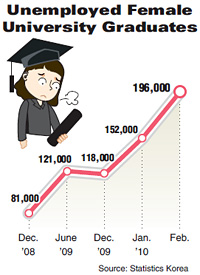
Not only has youth unemployment reached a 10-year high of 10% and is still rising, but the number of jobless female graduates has hit a record high, and the JoongAng Ilbo has a report on the structural and discriminatory practices responsible. Not that it gladdens me to be proved right, but this was somewhat predictable considering the fact that women were overwhelmingly targeted for recession in the financial crisis, as I reported in my very first Korean Gender Reader post in January 2009 (source right: Korea Times).

12) Breaking the myth of Korean homogeneity

While not a gender issue at first glace, actually it’s difficult to think of a gender issue, or rather sexuality issue, in which Korea’s “bloodlines”-based nationalism and its preservation doesn’t play a role, and for more on which I highly recommend Ethnic Nationalism in Korea: Genealogy, Politics, And Legacy (2006) by Gi-Wook Shin. Here, Halfie Trots the Globe translates and discusses the article Indian Ayodhia’s twin-fish motif as evidence of its marriage-based relationship with Gaya by Kim Byeongmo, a professor of Anthropology and Archaeology at Hanyang University, and which demonstrates India and Korea’s historical relationship and evidence of some intermarriage 2000 years ago.

13) Northeast Asia

– Taiwan launches million dollar baby-making slogan search

Alas, while Taiwan has much the same problems as Korea with its low birthrate, it isn’t that desperate, and the prize is for 1 million Taiwanese dollars, or US$30,000. My apologies, but I don’t know if English slogans are acceptable…

– Domestic violence cases souring in Japan

But this may actually be positive, reflecting greater awareness and reporting:

The number of domestic violence cases police recognized in 2009 soared 11.7% from the previous year to 28,158, the highest since an annual survey began in 2002, the National Police Agency said Thursday. An NPA official ascribed the rise to increased reports to police and consultations with them by citizens amid growing awareness of domestic violence in Japan.

See here for links a brief video offering some background, from April 2009. And actually, despite appearances, much the same revolution is occurring in Korea, primarily because of women’s greater willingness to report and prosecute abusers and a sea-change in the police’s attitudes towards it (see here for a long post providing some background also).

– Ex-Prada employee sues Japanese division for discrimination

To be precise, she was fired for refusing to fire staff because they were “ugly”. From New York Magazine:

An ex-retail manager for Prada’s Japanese division, Rina Bovrisse, has followed through on her pledge to file a discrimination lawsuit against the company. Bovrisse claims she was asked to fire store managers and retail staff members whom Prada Japan’s CEO found visually unappealing. After filing a complaint about this with the Tokyo District Court in December, she was fired from the company

– Tokyo municipal government plans to outlaw child-porn manga

According to The Economist:

The Tokyo municipal government plans to vote on March 30th to amend an ordinance against child pornography to include “non-existent minors”. Much Japanese porn comes in forms that escape rules covering photos and videos: manga; anime (cartoons); and video-games. Existing bans are meant to protect the child victims. “Virtual” porn—where there is no harm to a real person—is illegal in some countries to protect public morals and ensure a safe environment for children. Last month an American court sentenced a man to six months in prison for possession of Japanese manga child pornography.

With qualifications for the age of viewers and the context in which it is received, then personally I’m completely against the banning of simple drawings, no matter how morally objectionable the content. But regardless, see here for more on a (belated) crackdown on the photos and DVDs in 2008, and which of course I was completely in support of.

If you reside in South Korea, you can donate via wire transfer: Turnbull James Edward (Kookmin Bank/국민은행, 563401-01-214324)

From Asian to Caucasian: Update

(Businesswoman, by the_toe_stubber)

A recent comment on my post From Asian to Caucasian: Response From a Reader from last year, and which I’m sure you’ll all agree is worth highlighting here rather than having it wasted unread in obscurity on an old post!

With permission, in a moment I’ll place you in the capable hands of Anna then, to whom I’m extremely grateful for the time and effort she put into this. But first, because I haven’t really made it clear previously, I should mention that I’m always open to guest posts (which this 2500+ word ‘comment’ has surely become), as for reasons of time, resources, and/or personal interest, I am simply never able to write as many posts on as many subjects as I like. If you’re ever interested, and please don’t be put off by thinking that there is a minimum word-limit(!), then please just drop me a line.

Now, without any further ado:

…Hey James,

Your work is fascinating and is quite hilarious at times. I am currently writing a thesis on cosmetic surgery in South Korea and your blog really caught my interest. I wanted to just add to the comments here and to also add to your discussion. Beware, this might get a little long.

First of all, I know people can get quite defensive when people say Korean women are undergoing cosmetic surgery to become “white.” (evidence of the comments above). I mean honestly, nobody would like to hear that. Also, Korean women, as was mentioned in your blog and in other people’s comments, don’t go around piping that they did their eyes to look white. One of the driving factors in contemporary society as to why Korean women go under the knife is because 1) cosmetic surgery is a marker for upper class wealth 2) social mobility and 3) economic stability. Women get their faces done or whatever part they deem necessary to look prettier because beauty gets jobs and husbands in an extremely competitive market, and I mean both the market for jobs and husbands.

Furthermore, If you take the time to read Korean forums on cosmetic surgery, a majority of women undergo cosmetic surgery to gain self confidence. It is quite interesting and tragic as well that many of the Korean women who post on these forums talk about how cosmetic surgery will bring a new stage in their lives. Beauty is everything. And they talk about searching for self-esteem like they never had it in the first place and the only way to be “reborn”, “transformed” or to gain their lost self-esteem is through cosmetic surgery. Some of these Korean women are aware of the pressures on them from society to get cosmetic surgery as well and they complain about those reasons too. Korean society is not only very conscious about appearances but how those appearances conform with what the cultural norms are. Therefore, if one girl gets a job because of a pretty nose or eye job, then there will be tons of women who will go get that nose job in the hopes that their chances for getting the next job will be increased. Its a dog eat dog world.

Now set that all aside. I believe that everything has a historical context and cosmetic surgery in South Korea is no exception. Cosmetic surgery in South Korea didn’t just appear in the 1990s to attain a “universal beauty standard.” Nor is the pervasive popularity of specific procedures just because of modernization and the consumer culture it brings. First of all, I take issue with the claim of a “universal beauty standard”. Modernization and globalization has complicated a lot of things so what may seem true now may not ring true when societies were isolated from each other. Korea, for example, was known as the hermit kingdom due to their refusal to open up to foreign influences until they were basically pried open. BEAUTY STANDARDS THEN did not fall in line with “universal” beauty standards now, to say the least. An oval and round face as well as small features were considered beautiful. If you look at old portraits of Korean women, do you see women with overly sized dopey eyes and shaved V-line chins? Or whatever the damn letter is? It is quite the opposite.

Beauty standards may all seem the same way now but that is because we have been socialized to think a certain way due to overwhelming western influences. I know this is an argument that some people get tired of hearing but that is just the truth. Modern history was dominated by our Western/European counterparts and as globalization is rapidly changing the way information is disseminated, such beauty ideals are able to really influence the individual sitting in the living room in any part of the world privy to a TV or any other popular media outlet and those channels in their native language that send such messages. Korean media is no exception. As we all know the Korean media is largely responsible for the beauty standards that Korean women consume.

Now, lets talk about history some more. Since each country has a different history, such history should be used to help explain why certain practices become widespread. Yes, cosmetic surgery is a universal phenomenon in that people do it all over the world. But depending on the place, certain plastic surgery procedures are preferred over others. The question here that we need to ask, in which James has been eloquently trying to answer, is why do women go for such particular procedures?? To attain a universal beauty standard?? Well that answer would make everything too easy now wouldn’t it? And I already said that in Korea, beauty was quite different until they were confronted with different bodies such as the west.

Korean people are first and foremost going to do cosmetic surgery on their eyes, nose, and chin. The most popular being the Double eyelid surgery. Now James emphasizes why the double-eyelid??? Why is this procedure the most popular?? Just because the SUPPOSEDLY universal standard dictates this? Or because Asian women just want to be white?? We really need to probe a lot deeper. WHY, to Korean women, is the big dopey double eye lid considered beautiful when arguably before the infiltration of the west, it wasn’t?

Now, I know there is a percentage of Korean people who already have the double eyelid, so whats the big deal? Well the big deal is that those who didn’t have the double eyelid were considered just as good looking until this ideal changed. The fact that the single lid was problematized after a certain point in Korean history is telling of the fact that perceptions in Korean society began to change. Beauty standards is not in fact universal. Something was influencing Koreans to change their mind. Now what was it??

I look at Korean history in the past century as a whole bunch of successive traumatic events which modernization has just served to confuse and exacerbate Korean society. You have Japanese colonization, then independence which was short-lived with the U.S. occupation, then the split of the peninsula, the fratricidal Korean War, and the ensuing U.S. dominance that followed afterwards. Then without much time in between Koreans were caught in a nationalistic frenzy to economically develop, then democratization happened, and then market forces opened up and voila! in a matter of 30 years Korea is not only a democracy, it is one of the biggest economies in the world, and is still experiencing the onslaught of modernization. What does this equal?? A very confused and unstable society. I honestly think the Korean people have not been able to properly digest their traumatic past. Now what does this have to do with cosmetic surgery? Read on if you haven’t been bored out of your mind yet.

Now starting from Japanese colonization, Koreans were taught to believe they were inferior. Since the Japanese didn’t look too different from Koreans, they couldn’t really harp on the whole racially different argument to establish their superiority. However, it was a traumatic experience nonetheless, in which the Korean people were subjected to mental and psychological degradation where they were made to believe, they were not “good enough.”

Now with the entrance of the Americans during and after the Korean War, this is where I believe Koreans began to see their bodies, their PHYSICAL FEATURES as defected and flawed. Other scholars such as Tae Yon Kim and David Palumbo-liu discuss this affect on the Korean people as they were confronted with an overwhelming presence of American bodies. The Americans, upon coming to Korea to “help” the “poor people”, were confronted with a curious looking bunch. One of those Americans, by the name of Dr. Millard, set out to fix such faces in order to “read” the Koreans better. Dr. Millard was a military surgeon who was sent to Korea on a good will mission to reconstruct war-damaged bodies. Dr. Millard, in addition, to reconstructing such “war damaged bodies” became obsessed with making the Korean or “oriental” legible for the American people. He thought the single lid made Koreans look lazy, sneaky, untrustworthy and basically dumb. He became the first white person to create a double-eyelid surgery for the Asian face. This is monumental. Although double-eyelid surgery was present in Japan before the introduction of cosmetic surgery in Korea, what David Palumbo-liu states and other authors also cite him, is that cosmetic surgery actually reached its popular high point in Korea during this time frame. Dr. Millard began to “treat” Korean patients and he has photos of his first Korean patients in his original work, Oriental Peregrinations. It’s fascinating and extremely disturbing at the same time. Basically the Korean people were mentally brainwashed to view their eyes, their facial shape as inherently flawed. Their natural features were a defect meant to be fixed. The introduction of Dr. Millard’s double eyelid surgery during the Korean War really shows how cosmetic surgery is tied up with trauma, war, and foreign domination. The words he used to describe Korean eyes in his articles, are used in Korean websites, in present day Korean websites to describe natural single lidded Korean eyes. Why is it that the words used to describe Korean eyes by a an American military surgeon during the Korean War, used to describe Korean eyes in modern day society?? Korean websites are carrying on the tradition of passing on this idea that Korean eyes are naturally defected, if you have the single-lid that is. And the only difference is that now, double eyelid surgery is cloaked under the label for women to look more beautiful.

There are more linguistic connections in descriptions of the Asian eye that harks back to Korea’s traumatic history but I won’t go into it.

So Korean women undergo cosmetic surgery to look more beautiful and yes we can just stop it at there. They just want to look beautiful. But why I ask again, those CERTAIN aspects? Why did those certain aspects become what was “Beautiful?” when it wasn’t before? Although Korean women may not know that they are changing their eyes based on white standards of beauty, (in fact many wholeheartedly believe the double eyelid surgery is tailored to make Asian eyes more beautiful) single-lidded eyes were problematized because of confrontations with the West and now it has become so commonplace in Korea that these origins have been forgotten and it is now a natural thing to think. That single lidded small eyes are ugly and big dopey eyes are pretty and that is just the way it is because they are told that and they consume that every day of their lives.

I think, saying Korean people are fixing their eyes to become more Caucasian is not the right way to put it. In my opinion, Korean people are fixing their eyes because they are naturally made to believe that it is flawed, a legacy that was left by Korea’s historical trauma. I see cosmetic surgery in Korean society as a way Korean people are trying to reconcile their “flawed bodies” and “fix” themselves. I look at cosmetic surgery a bit differently and it might seem a bit far fetched but when you keep digging, sometimes you can’t help but think this way.

This is where trauma comes into the picture. My argument, basically sees unresolved trauma as a major factor in the pervasive practice of cosmetic surgery, especially the double eyelid. I won’t go in depth there because that would require me to talk about trauma and how trauma can last for generations. But anyways I hope that my comments show cosmetic surgery in Korea is wrapped up in a lot of complex issues.

IT IS NOT just about attaining a beauty standard or to look white. There are historical consequences that explain as well as add to the modern picture of why Korean women flock to clinics to get their eyes done.

This message probably won’t be read but this was a really great exercise for me to keep my mind active and up to date with all the stuff I have to read for my research. I know it was quite selfish of me to post such a long entry so my apologies.

But hopefully somebody learns something and gains or at least thinks again when discussing this subject.

Addendum (in a follow-up comment):

Also, I read my post again and I didn’t specify what kind of Korean websites, I meant Korean cosmetic surgery websites.

Also another piece of interesting information is that cosmetic surgery originally had a bad reputation due to its associations with prostitution during and after the Korean War. Basically cosmetic surgery was seen as disreputable because Korean war brides were the ones who mostly underwent cosmetic surgery in order to better assimilate into their new American husband’s life. These Korean War Brides were seen as prostitutes and some of them really were. So another little interesting piece to the whole picture –> forwarding now 50 years later cosmetic surgery is such a pervasive practice that it is now quite the cultural norm.

I have provided some readings that briefly talk about this, because cosmetic surgery in Korea is such a little explored subject in Academia, and the majority of the articles just skim the surface, the literature below I believe has done some justice on the topic as well as how U.S. domination has affected Korean society.

• Dissertation called the “The Moving Eye: From Cold War Racial Subject to Middle Class Cosmopolitan, Korean cosmetic Eyelid Surgery, 1955-2001″ by Taeyon Kim

James: I haven’t been able to find a copy of that online unfortunately, but in case the name sounds familiar, I discuss her 2003 journal article “Neo-Confucian Body Techniques: Women’s Bodies in Korea’s Consumer Society” at great length in my series entitled journal article “Women’s Bodies in Korea’s Consumer Society”, starting here.

• Nadia Kim, Imperial Citizens: Koreans and Race from Seoul to LA (2008)

• David Palumbo-liu, Asian/American: Historical Crossings of a Racial Frontier (1999)

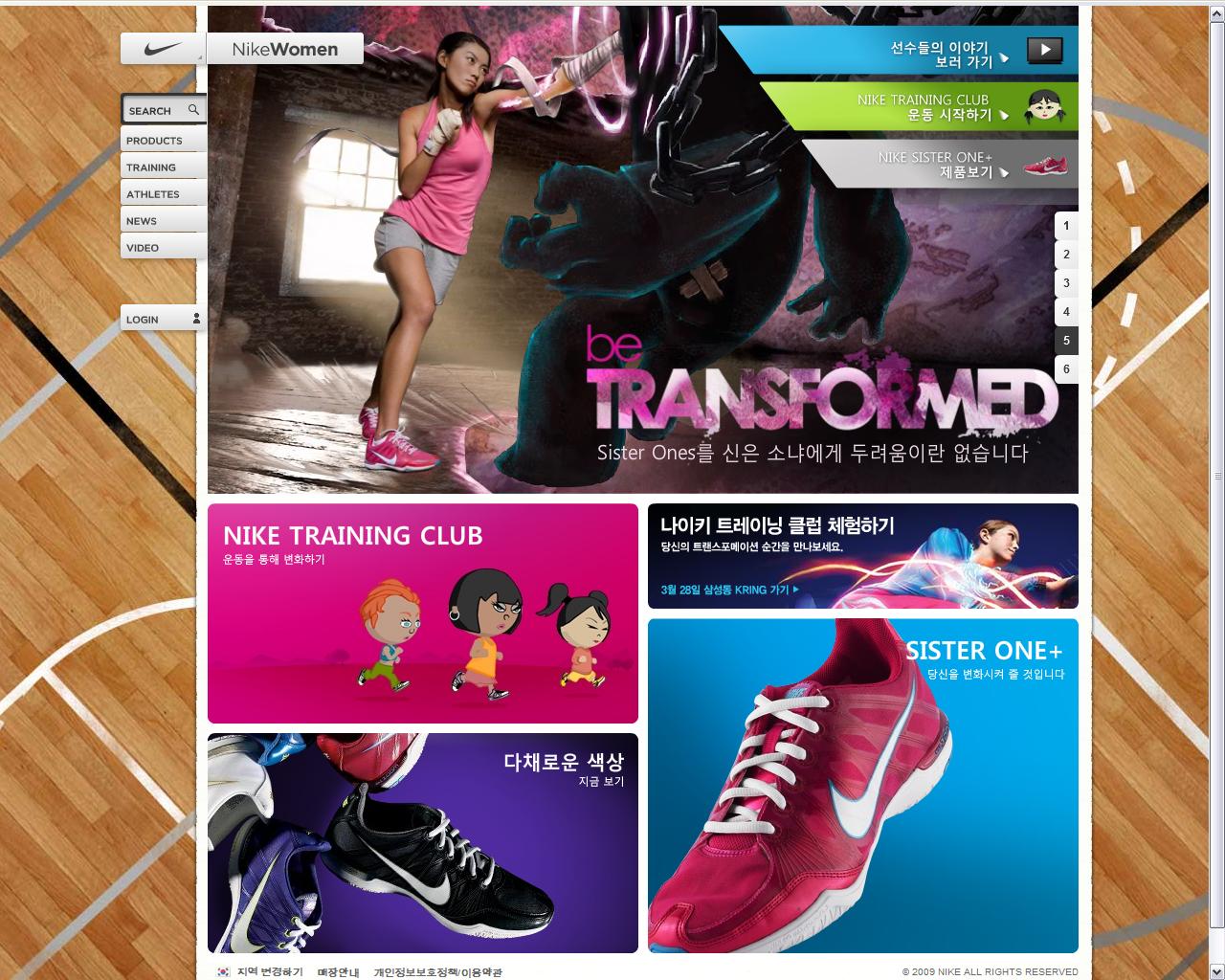
(ELP_NIKE_KOREA, by gkristo)

Thoughts?

And here’s an update from Anna…

Hey James!

I was just doing some more reading and I realized that I had written incorrect information about the Japanese not being able to use racist ideologies during Korea’s colonization. In fact they did, in terms of Japan being the superior blood race–>a focus on ethnonationality. Japan differentiated itself from Korea by focusing mainly on the centrality of blood. Although Japan outwardly promoted a Pan-Asian ideology where the Japanese would protect their Asian neighbors from Western imperialism, the brutality of the Japanese towards the Koreans obviously showed that this was all bullshit. The oppression of Japan towards Korea also helped Korean individuals foment Korea as a “nation” around blood as well. Nadia Kim says this is connected to why Koreans are so obsessed with blood types…pretty funny. So “race” for Koreans originally focused on ethnonationality and purity of blood and blood ties. Then the West came in and complicated the picture with their own racial ideologies of black and white which also the Koreans were pretty primed to accept due to their already hierarchical associations to the lighter skin/darker skin complex.

Also, I won’t go into detail too much because I have probably lost you already, but it seems like the concept of lighter skin and the color white as pure and good was a pretty salient concept in Korea before the West. Koreans and the Japanese have seemed to have an obsession with white for a while.

Kim writes, “The country has valorized white as representatives of its people’s purity and desire for peace since the Three Kingdoms Period of 57 B.C. to A.D. 668. One manifestation was Koreans’ primarily white clothing, earning them the moniker the “white-clad nation.” Because the Koreans continued to wear solely white clothing through the middle twentieth century, Western visitors would be captivated by the “enormous white waves sweeping the streets” (27).

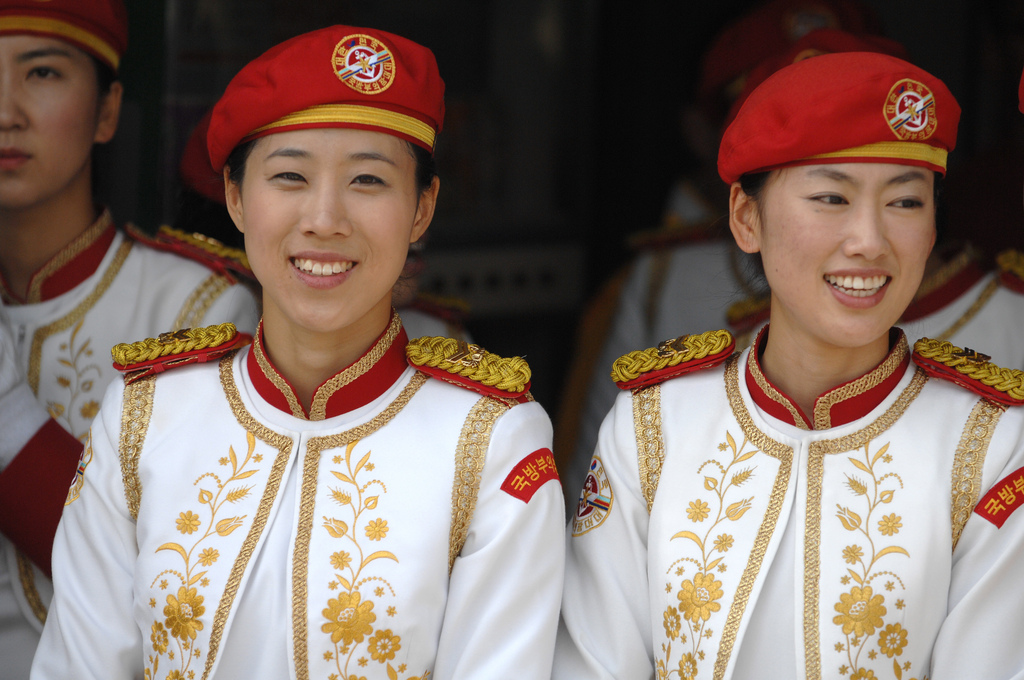
(Korean War Museum and Memorial – Seoul 090501, by anja_johnson)

She then goes on and talks about how lighter skin/dark skin also corresponded to where you stood in the rigid neo-confucian hierarchies of Korean society. But basically, this shows how Koreans were pretty well “primed” to accept the White/Black dichotomy that was brought by its relations with the US/West.

So to wrap up and reiterate again, the Japanese did use racial ideologies but focused mainly on blood purity, the superior “blood race”, although I’m sure they also used other things to establish their superiority.

I really really recommend reading her book its pretty awesome.

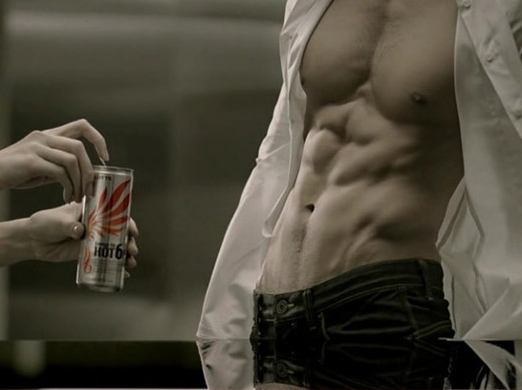
Korean Sociological Image #35: Ready for some Hot 6iX?

(Source)

For all the misreadings of the title that undoubtedly brought many of you to this post(!), “Hot 6iX” (핫식스) is just a simple energy drink really, albeit a deliberate attempt by Lotte Chilsung (롯데칠성음료) to produce a Korean equivalent of Red Bull for the domestic market. And ultimately to belatedly tap into the global market too, currently worth 1.4 billion dollars and growing 20% every year despite the recession.

An avid drinker of “V” back when I lived in New Zealand, I think it’s about time. Much more interesting than the drink itself though, are what the 4 advertisements produced so far tell us about how quickly the Korean media is changing, and especially how men and women are presented therein. With apologies for giving the game away somewhat with the opening image, here they are:

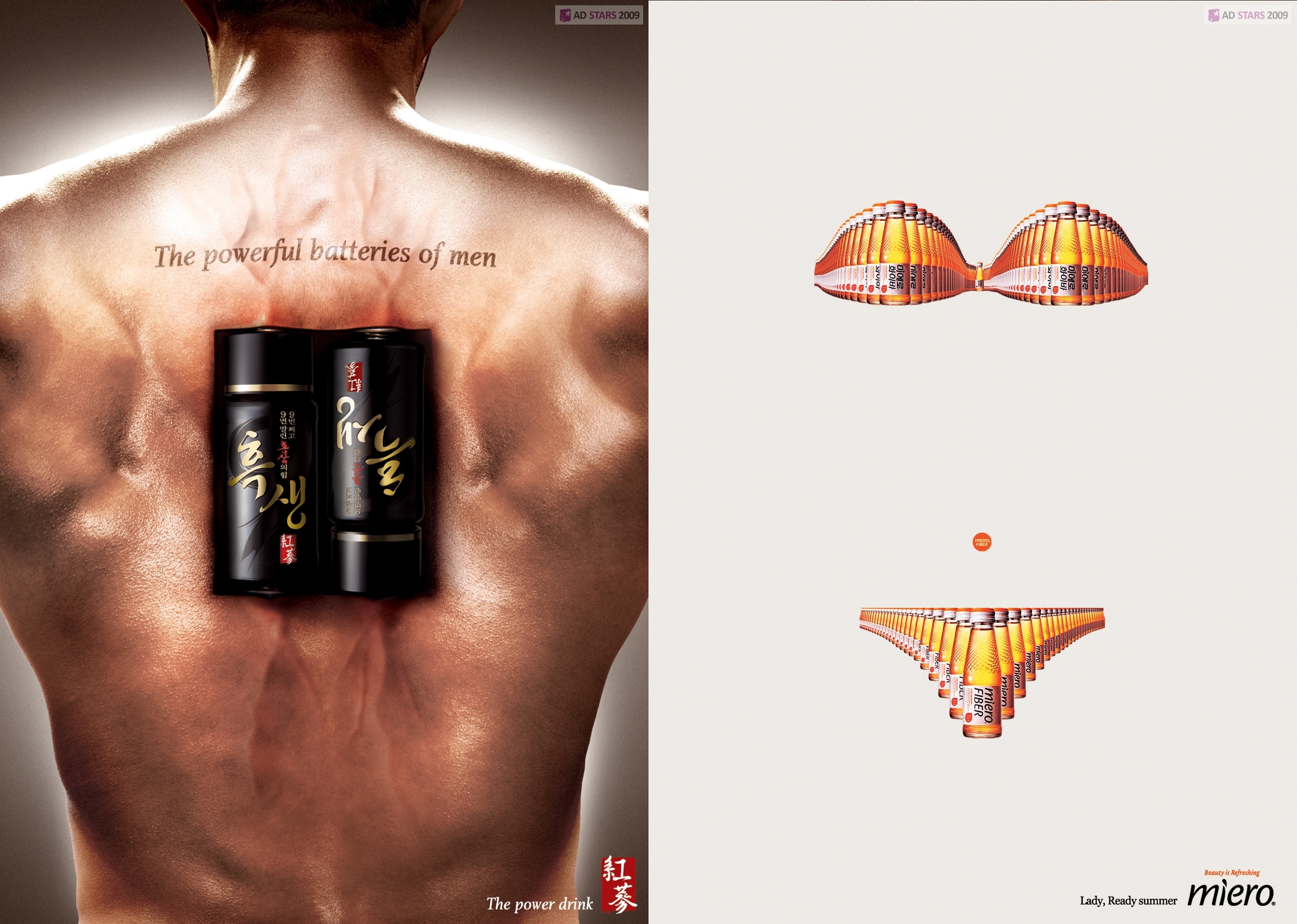
Although my wife and I laughed at the joke in the first one too, I confess that I was already well into writing this post after only seeing the two featuring women. For they confirmed a strong and enduring division in the marketing of health, energy, and/or sports drinks whereby those aimed at men tend to promote the idea that the drink will give them extra energy for work, exercise, or even sex, but those at women that it will simply help them to lose weight. A phenomenon by no means confined only to Korea, you can imagine my surprise then, when I learned of the 6iX ad aimed at female drinkers also.

(Sources: left, right)

And although it sounds rather awkward, my delight too. For with the proviso that the objectification of men can be just as problematic as that of women, and its occurrence in the media in numbers comparable to that of women a bizarre and somewhat unlikely “solution” for the latter, I’d like to throw open for discussion the notion that any objections any of you may have – or imagine that others may have – to those first 2 advertisements are somewhat mollified by having an advertisement featuring a man also.  Or alternatively is that just me, and/or are the advertisements with women not all that objectionable in the first place?

Meanwhile, expect to see many more advertisements like them in coming months: the 4 above all have random numbers assigned to them, much like what were ultimately 30 or so in this “Confessions of 20-somethings” (스무살의 고백) advertising series of Maxwell House (맥스웰하우스) that started last year (see #2 here). And on a final note, it’s difficult to believe that advertisements objectifying men like this only really started in earnest last year, yes?

Update, July 2012: Alas, my prediction was completely wrong. There were no new commercials for over 2 years, and the new ones released this month don’t objectify either sex at all (although they do still target both men and women). See here for all the 2012 and 2010 ones.

(For more posts in the Korean Sociological Images series, see here)

Open Thread #8: Superfuturism & Anitiquity

( “Fade to Red” by StudioQube. Source: deviantART)

Thoughts for the weekend, from boingboing:

Marilyn from National Geographic sez, “I think you’ll love these Shanghai photos by Fritz Hoffmann in March National Geo. It’s hard to believe such a superfuturistic megacity also looks like a village from 100 years ago.”

What she said. There are lots of places in the world where seamless high-tech and ancient cobblestones exist side by side, but I’ve never been anywhere in which you can go from one to the other so quickly as Shanghai. One moment you’re on the set of Blade Runner, then you turn a corner and you’re in a historical drama, with no sign of glass-and-steel in sight.

And of course most Korean cities are some of those places, and perhaps Seoul in particular. Something surprisingly absent from the discussion at boingboing though, is that in many senses such places can be considered ecotones, a geographical term for the zone where 2 ecosystems meet, and all the much richer and more diverse than either because of the ensuing interaction.

Seriously, nearly 10 years after I arrived in Korea, I still love wandering around such districts occasionally: the constant juxtapositions to be experienced there remind of how I felt when I first came. Unfortunately however, Korea’s misguided attempts at “modernization” means that they may not be around much longer, so make sure to enjoy them while you still can.

To end on a more positive note then, here is my latest favorite K-pop song, or again my new favorite Areia remix at least: Because of you (너 때문에), by After School (애프터스쿨; download the MP3 here). Clearly portraying a lesbian relationship despite the ostensibly heterosexual lyrics, I’ll definitely be analyzing it in depth at some point, but until then I’d be more interested in hearing your own thoughts. Enjoy!^^

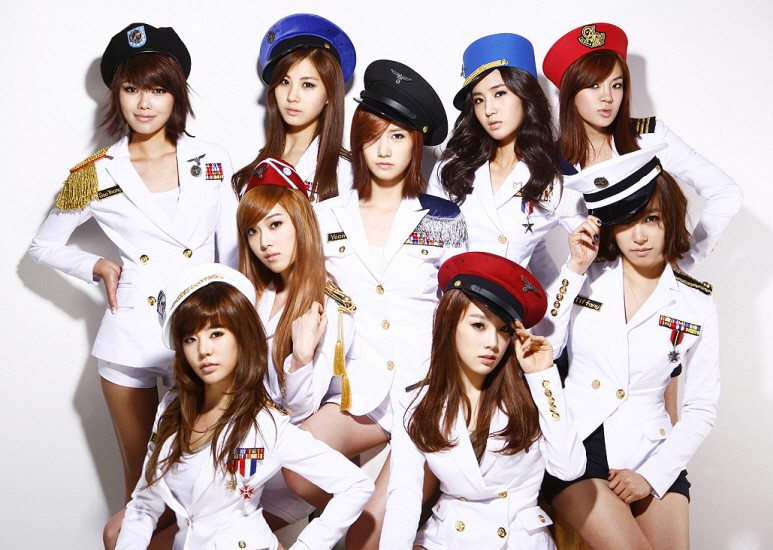
Update: And before I forget, here’s a remix of Tell Me Your Wish (소원을 말해봐) by Girls’ Generation (소녀시대) also. But by a different DJ this time, and in my opinion a much deeper, warmer version of the original that makes it actually worth listening to, rather than the song merely being a means to provide some eye candy and indirect advertising via the music video. Skeptics, try the first 15 seconds at least, and if you don’t like those then you simply have no soul(!); everyone else, download the MP3 here.

Share

Korean Sociological Image #34: Child Sex Offender Kim Kil-tae Caught

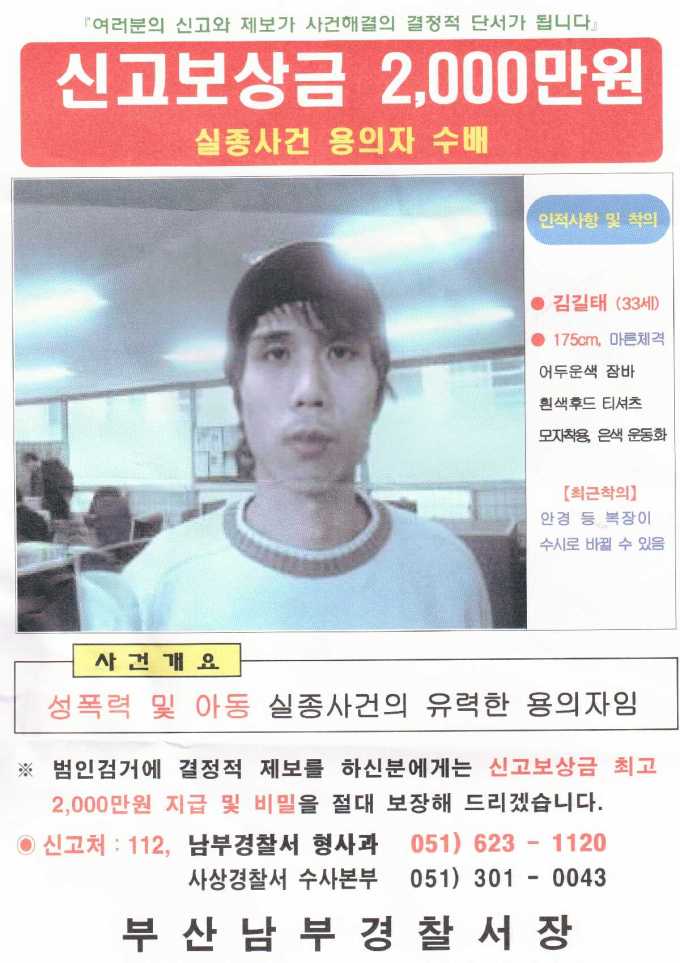
Whether in response to intense criticism of the government’s policies towards sex offenders or of their own accord, I was still very impressed with the police for sending this wanted notice for Kim Kil-tae (김길태) to all Busan households yesterday, the main suspect in the rape and murder of 13 year-old Lee Yu-ri (이유리) last month. The first time I’d ever received a wanted notice in the mail in 10 years in Korea, let alone for a crime that occurred last Saturday at the other side of a city of 3.6 million, I thought it was significant enough to warrant a post in its own right, but I’m happy to report that literally as I began typing that the news came through that he has been caught.

I’ll update this post as more information becomes available. The reward, by the way, was for 20,000,000 won, or roughly 17,700 US dollars.

Update 1 – I’ll let this news speak for itself:

Rival parties agreed Wednesday to convene a one-day parliamentary session this month to act on a series of bills calling for tougher punishment for sex crimes, an unusual bipartisan move reflecting nationwide outrage over the recent rape and murder of a teenage girl.

Read the rest here. On a more reflective note, see Extra! Korea for a brief discussion on the possible role of absentee parents in this and similar crimes.

Update 2 – The Korea Times has a report about his apprehension here.

Update 3 – The Hankyoreh’s take on it is here. Earlier, it used the original crime itself to criticize unrelated policies of the Lee Myung-bak administration in a cartoon, and while I’m generally sympathetic to the newspaper (it’s the only Korean newspaper which doesn’t caricature and/or deliberately misrepresent foreign English teachers for instance), it does seem to have a habit of that sort of thing.

Update 4 – Via ROK Drop, here are the latest developments in the case:

The police investigation of a recent rape and murder case of a teenage girl in Busan is facing difficulties due to lack of evidence.

The 33-year-old, Kim Gil-tae, caught Wednesday, has denied the charges and remained silent during interrogation, said officials.

He only admitted stealing money and keys in a nearby hair shop while he was hiding from police.

Investigators requested an arrest warrant on Thursday, based on genetic evidence such as Kim’s DNA found in the body of the 13-year-old victim, Lee Yu-ri.

The police, however, have so far failed to collect definitive evidence linking him to the murder.

Read the rest at the Korea Herald here. Personally, I’m a bit confused and surprised though, as how on Earth can the fact that his DNA was found inside the body not be the “definitive evidence” required?

Update 5: Initially denying it, the news has just come in that Kim Kil-tae has now confessed to the crime.

(For all posts in the Korean Sociological Images series, see here)

Share

“Gender Advertisements” in the Korean Context: A Request

( Source )

If you’d told me a week ago that I’d be spending much of my birthday looking for images of Korean men touching themselves, I’d probably have politely told you never to comment on my blog again.

Prompted by this analysis of Korean magazine advertisements that found that Korean men were significantly more likely to be shown doing so than Western men in them however, that’s precisely what I’ve been doing. But for all their supposed ubiquity, it’s proving surprisingly difficult to find examples, throwing off my schedule for the next posts in this series.

To be specific, I’m after advertisements like these, but featuring Korean men rather than women, and would really appreciate any help. Seriously, what search terms would you suggest, in English or Korean?^^

Of course I do have some examples, and will continue looking: my planned post will simply take longer than expected. In the meantime then, let me briefly offer some amusing and/or interesting advertisements that have cropped up recently instead, starting with that for Coca Cola Korea (한국 코카콜라) above featuring Thai-American Nichkhun (닉쿤) of the Korean band 2PM. I think its humor speaks for itself, but in the unlikely event that you feel I’m reading too much into it, please see those featuring other…er…members of the band here, of which Junho (준호) in particular seems to be enjoying holding his miniCoke bottle entirely too much!

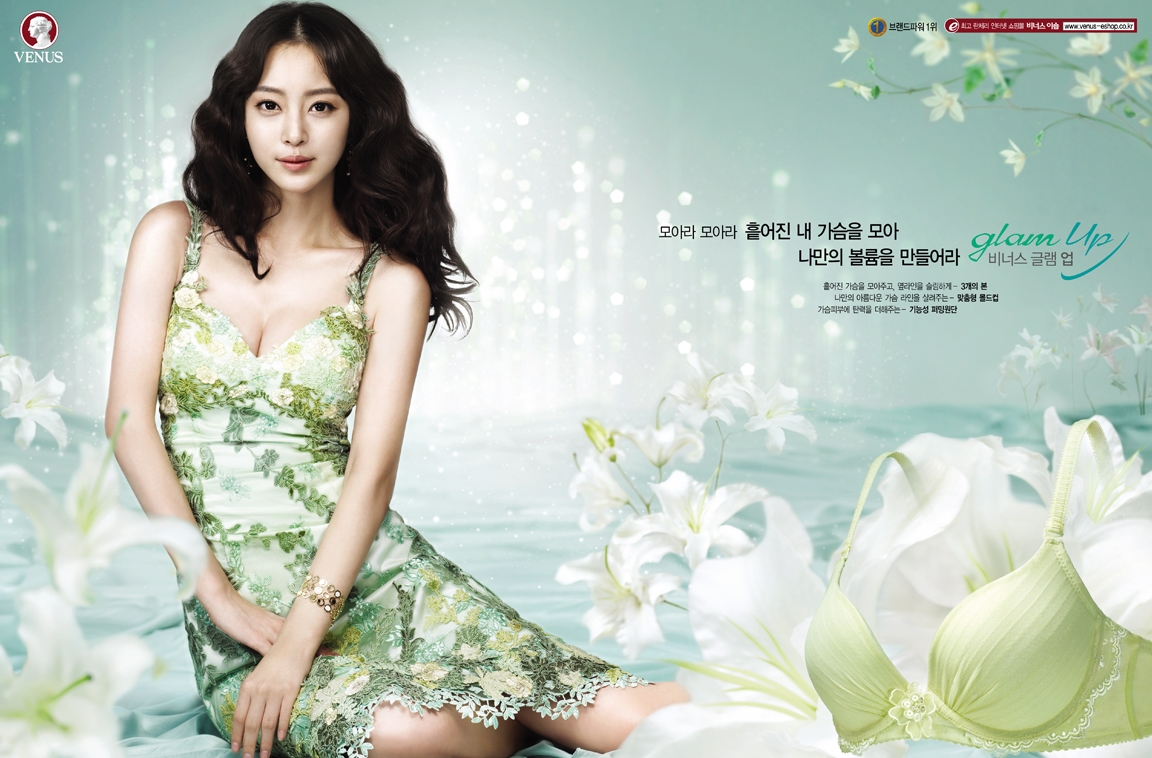
Next is this one for Venus lingerie (비너스) featuring Han Ye-seul (한예슬), featured on the front page of Korea’s main portal site Naver (네이버) as I type this. Why it’s interesting is because of the English name “Glam Up” for the bra featured, which, making little sense otherwise, supports the argument that the English word “glamor” has somehow come to mean “voluptuous” or “curvaceous” in Korean:

( Source )

In turn, it demonstrates the ridiculousness of the new Korean phrase cheongsoon-gullaemor (청순글래머; or “innocent glamor”), but which is nevertheless very much in vogue in the Korean media at the moment. But that is no great surprise in view of the enduring popularity of older ones for women’s bodies like “S-line” (S라인) perhaps, and so, lest I begin to sound too serious here, let me move on to this advertisement for Nike Korea (나이키) featuring ice skater Kim Yu-na (김연아):

( Source: korean lovers photoblog )

One of the most endearing athletes I’ve ever seen (well before she won her gold medal), it’s difficult not to simply adore Yuna, but I confess I still had to to laugh at what Matt at Gusts of Popular Feeling wrote about this ad last month:

By the way, does anyone find Kim’s expression in this ad to be, uh, ecstatic?

Perhaps there’s a reason the left hand side was cut off where it was. Just do it, indeed.

Okay, perhaps that was reading too much into it, and I’m sure you can understand my reluctance in not posting it earlier, the image of her at #10 here alone receiving thousands of hits in the last week of February, presumably most of them from fans…

Either way, I hope you at least one of those advertisements made you smile and/or think. And again, if anyone can help find examples of the sorts of advertisements I’m looking for, I would very much appreciate it; even if it’s only because you feel guilty for forgetting my birthday!^^

Share

“Gender Advertisements” in the Korean Context: Part 1

(Source: SeoulBeats)

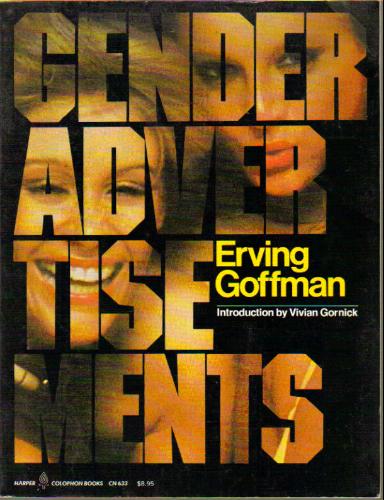
Be warned: Gender Advertisements, by the late sociologist Erving Goffman, is one of those books that changes your life forever.

Well, not life-changing like reading The Communist Manifesto inspired an Argentine ex-lecturer of mine to start shooting police officers. But you will pay much more attention to advertising messages, of which you already receive between 500 and 1000 every day. (Yes, it’s really that many.)

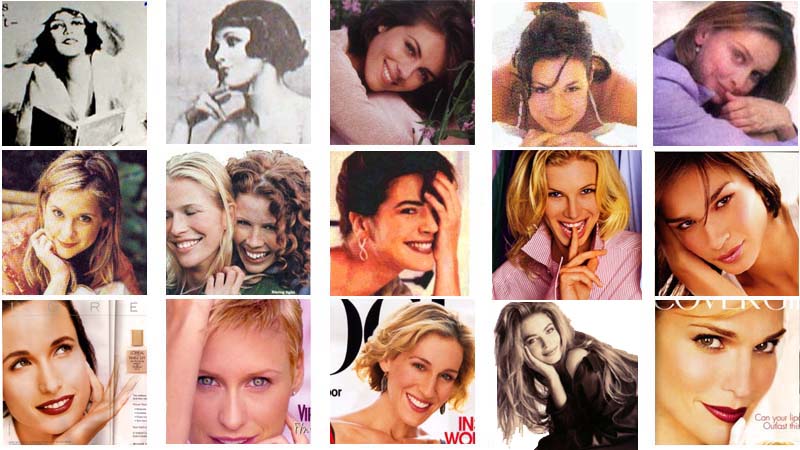
Of course, advertisements have changed considerably since the book was published in 1979, and are much less sexist overall. But indeed that’s precisely because of the attention given to them. Moreover, some elements have actually gotten worse, advertising to children for instance now an embarrassment compared to the relatively gender-neutral tone of the early-1980s (compare these to this, this, and this), and also there is now so much partial nudity in advertisements that several researchers argue that a new category has had to be added to Goffman’s framework to analyze it.

However, partial nudity isn’t objectifying or sexist per se: rather, it is the manner and context in which it is applied. And if that is the case, then you can imagine how problematic applying Goffman’s framework as a whole to Korean advertisements is, in which such different cultural codes operate.

Or do they? In at least one case, yes: social status usually trumps all other considerations in Korea, and so having one person (usually a man) elevated above another (usually a woman) in an advertisement, perhaps by him sitting and her reclining on the floor in front of him, by no means implies superiority, rendering that subcategory of Goffman’s “Ritualization of Subordination” category problematic (see here and here for examples). Still others, such as cute and/or childlike depictions of women, or having them staring off into the distance rather than directly back at the viewer (a subcategory of “Licensed Withdrawal”), are not necessarily sexist in light of East Asian notions of metrosexuality and politeness respectively, as helpfully pointed out by reader Melissa. And in point of fact the only analysis (Nam et al, 2007) that has looked at men as well as women in Korean magazine advertisements did find that Korean men were depicted much more childishly and “withdrawn” than Western men in them.

Still, while this point is easy to miss in posts that necessarily give only a few illustrative examples, surveys of depictions of men and women in advertisements using Goffman’s framework are made to determine if there are statistically significant differences between them as a whole. And, if those are found, then there are a number of different cultural and anthropological explanations that can be suggested in addition to feminist ones: Occidentalism, for instance, may have played a role in the above result, or the fact that it is quite acceptable for Korean 20-somethings of both sexes to behave in a manner that many Westerners might consider childish (see here for possible reasons for this). Alternatively, Nam et al (2007) found that Western women were much more likely than Korean women to be depicted in a lower physical position than men, such as by him standing and her reclining in a chair on on the floor, but while this could be interpreted positively (for Korean women), much more likely is the fact that status trumps all other considerations in Korea, and so to be physically lower than someone else by no means implies that one is the inferior. Accordingly, there were no statistical differences between Korean men and women in this regard.

Other differences however, like the fact that regardless of the social norms I’ve discussed, Korean women are still depicted childishly or withdrawn more often than Korean men for instance, are extremely difficult to account for other than in terms of their inferior social and economic status in Korea. Or in other words, while an individual advertisement depicting a woman like a child isn’t necessarily sexist in itself, that there’s more of them than there are of men is certainly evidence of sexism. Moreover, I fail to see how noticing discrepancies like this is somehow Eurocentric of me, or “looking at Korean society through Western eyes.” Which is not at all to say that Melissa argued that, but others have.

Update: Specifically, aegyo is often claimed as a form of empowerment that Westerners fail to appreciate. In which case, guilty as charged: when (usually) women act like children to manipulate (usually older, higher-ranked, and/or richer) men, how is that anything but wholly accommodating to a patriarchal system?

(Source: Unknown)

In response, in what was originally intended to be a single post here I wanted to discuss the problems Kang (1997), Hovland et al (2005), and Nam et al (2007) had with Goffman’s framework, the alterations they made to it, and the latter two’s discussion of how appropriate various categories of it were to the Korean context.

In particular, the last found that Western men and women were more likely to be depicted as partially nude than their Korean counterparts, but with allowances again for Occidentalism, and the fact that Korean female models will rarely appear in lingerie advertisements (of which the authors were unaware, and so didn’t account for), they argue that this is again evidence of sexism because in fact “many scantily garbed women [emit] a sense of independence and confidence.” While I’d be a bit more circumspect than that myself, fortunately having long since on moved on from the days when I automatically equated bikinis with feminist liberation, they do have a point, particularly in a society where the majority of women were too scared to wear them 5-10 years ago.

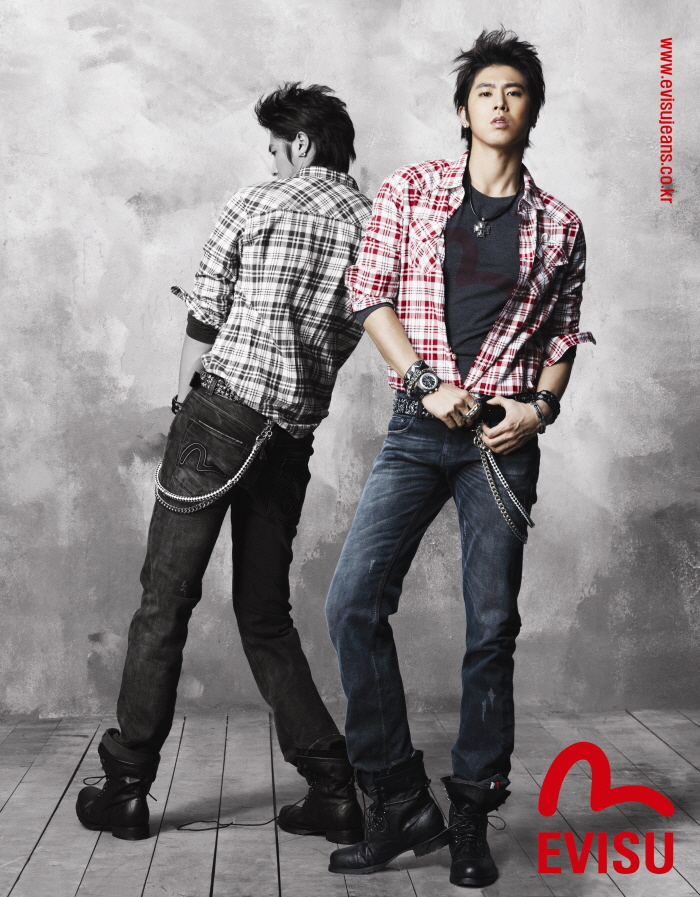
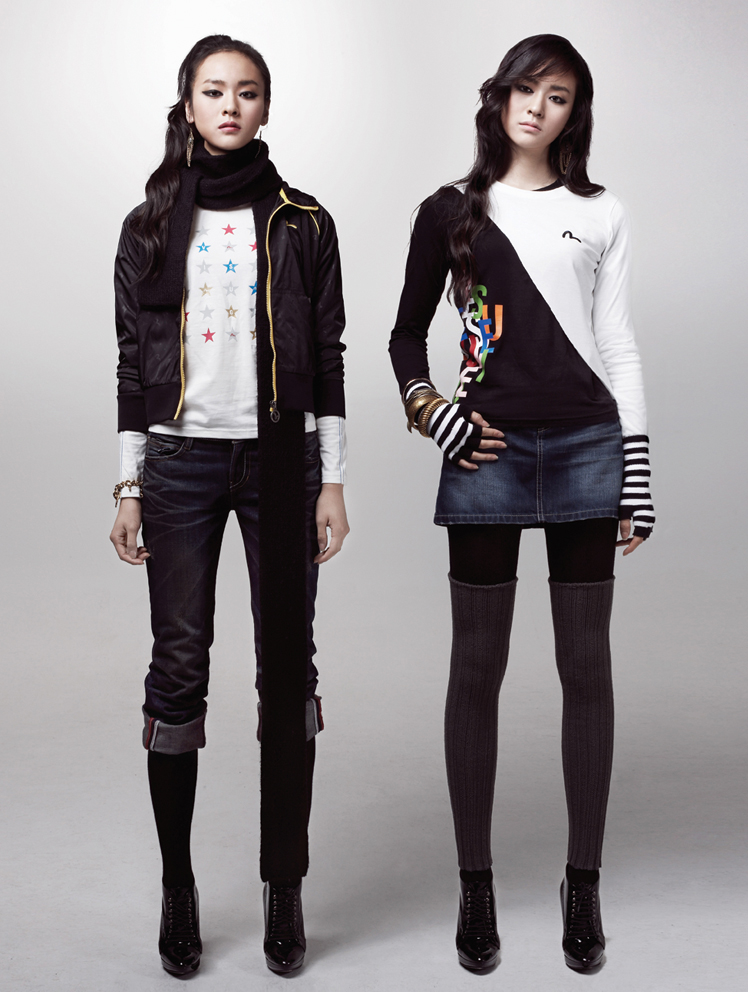
Also, I wanted to discuss the “female-stereotypical” depictions of Korean men in advertisements like Melissa identified, posing a challenge as they do to especially Western men’s notions of masculinity. Unfortunately however, for reasons of space and ease of reading those will have to wait for Part 2 and perhaps even a Part 3. Instead, having provided a grounding in this post, let me devote the rest of it to a practical example of another discrepancy in the ways men and women are portrayed in advertisements, one that I stumbled onto by accident in the process of investigating the Evisu (에비수) advertisement at the beginning of the post.

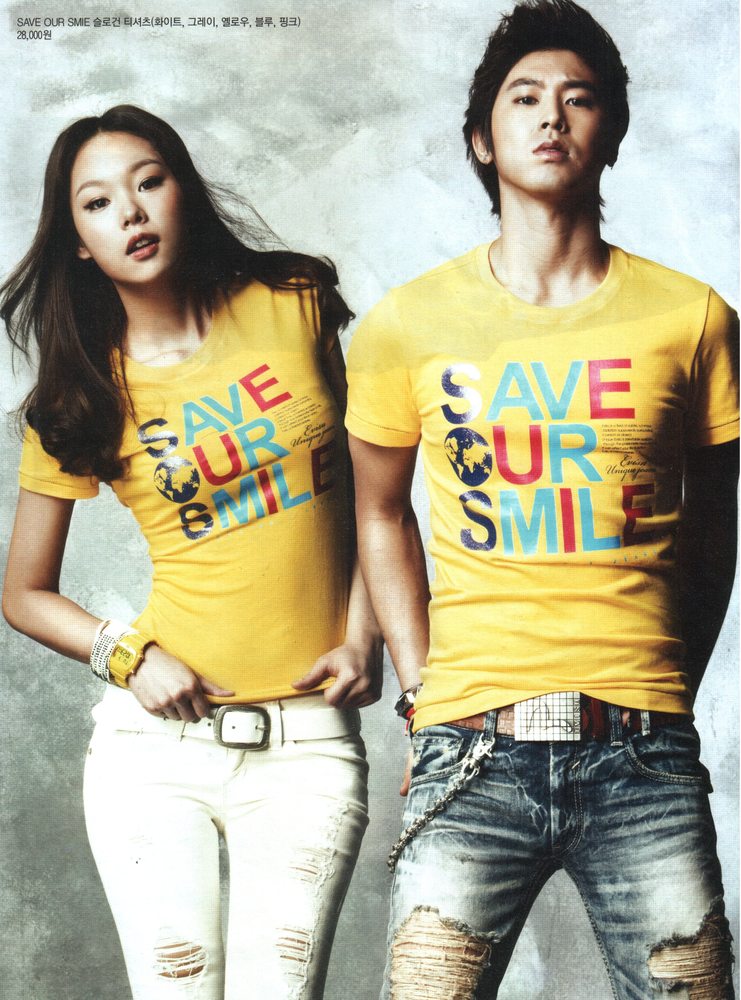
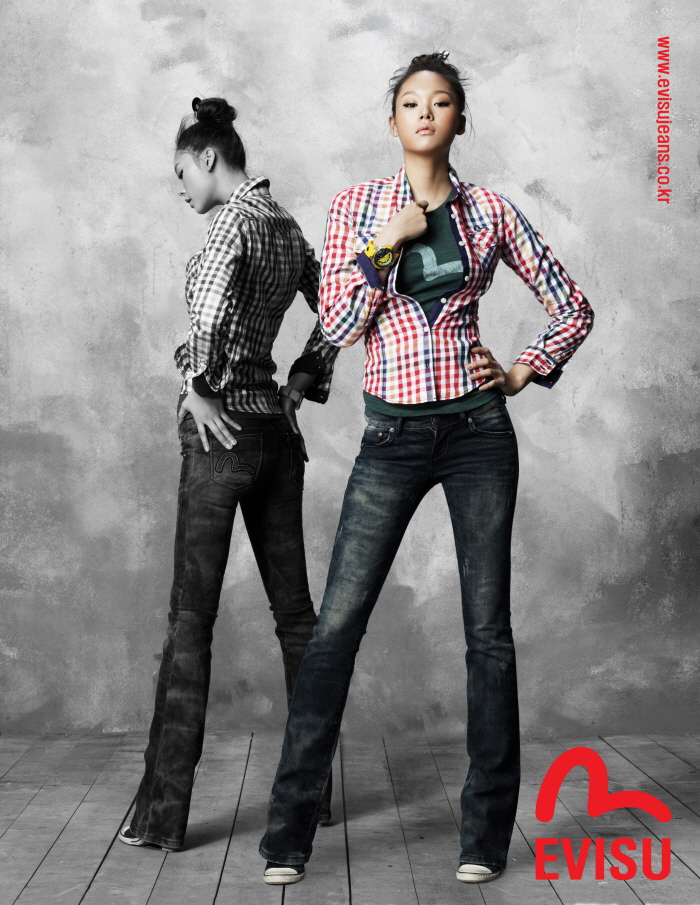
Featuring Jung Yun-ho (정윤호; also know as “U-know”) of the boy band TVXQ (I don’t know who the woman is sorry), the first thing it reminded me of was this:

(Source: Shine So Cold)

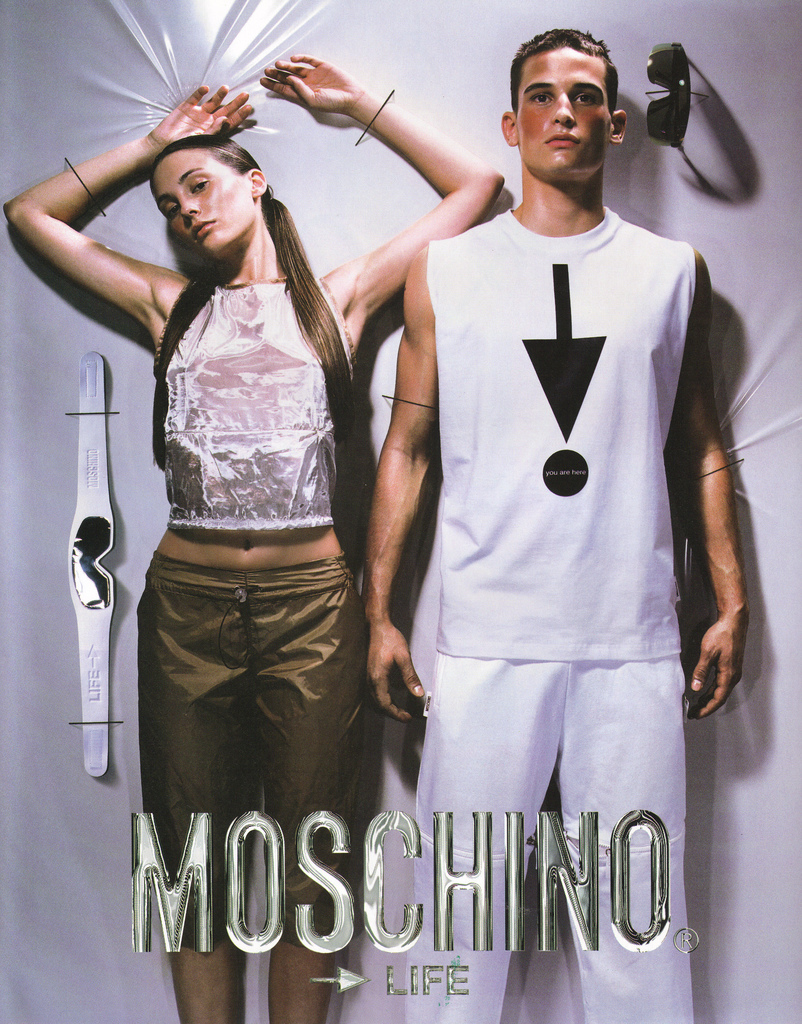
Of which I wrote this back in November 2008 (update: since edited out sorry):

Personally, it took me a few moments to figure out what this advertisement is supposed to represent exactly: were the couple prisoners? No…why would their sunglasses be tied up too? How apart parts from a model kit then? No…then they’d be disassembled, and besides which the man appears to be raised from the white background a little, a rather awkward position for a model component. And then I realized that he’s actually standing, which would mean that the woman is too, although I can surely be forgiven for thinking that she’s lying down.

So probably they’re supposed to be like a Barbie and Ken doll set in a box, like you find in a toy store. But then why is the women tied down so helplessly, whereas the man, ostensibly also tied down, looks – as the photographer points out – firmly grounded and in control? I haven’t been looking (sorry!), but I dare say that Barbie and Ken dolls don’t leave the Mattel factory like that in real life. So why would the advertisers choose to depict them like that?

Granted, it’s a much more extreme example than the own with Yun-ho. But while I don’t mean to equate the two, that is indeed what it reminded me of, and the final question I pose is just as relevant.

But in terms of Goffman’s framework itself, probably this is more similar:

(Source: Tech Fatale)

And with that, let me add “participation shields,” a subcategory of Licensed Withdrawal, to add to all those others I’ve already elaborated on here, here, here, and here as well as those in this post. This is what Goffman (1979) had to say about it:

It is possible to look in on a social situation from a distance or from a one-way panel—a “participation shield”—and be little seen oneself, in which case one can, in effect, partake of the the events but not be exposed to scrutiny or address. A splitting up this results between some of the gains and some of the costs of face-to-face interaction. I might note that when one’s participation is thus shielded, simultaneous maintenance of dissociated side involvements would seem to be facilitated, since these could hardly intrude between oneself and one’s availability to the others in the situation – one not being available at all.

A ritualization of participation shielding occurs when one presents oneself as if on the edge of the situation or otherwise shielded from it physically, when in fact one is quite accessible to those in it. Still further ritualization is found in commercial posings. (p.70)

Then he gives examples of using walls as shields, then window frames, then various objects, then animals, and finally people:

…with the consequent opportunity to overlay distance with a differentiating expression, in the extreme, collusive betrayal of one’s shield. (p. 72)

Here are some examples he provides, from my scan of page 73:

And I think the Evisu advertisement is a good example of that last point, as Jung Yun-ho’s aggressive, confrontational stance is betrayed by that of the inquisitive, unconcerned expression of the woman partially hiding behind him. But lest I contradict myself and read too much into one image (and I’ll grant that those above are deliberately much more extreme cases), again let’s consider the discrepancies among the advertisements currently on the Evisu website. In particular, when the woman and Jung Yun-ho are by themselves, both have strong, confident stances, good examples of the “Independence/Self-Assurance” category first suggested by Kang (1997) and expanded on Nam (2007) which I’ll be discussing in Part 2:

(Source, all remaining images: Evisu)

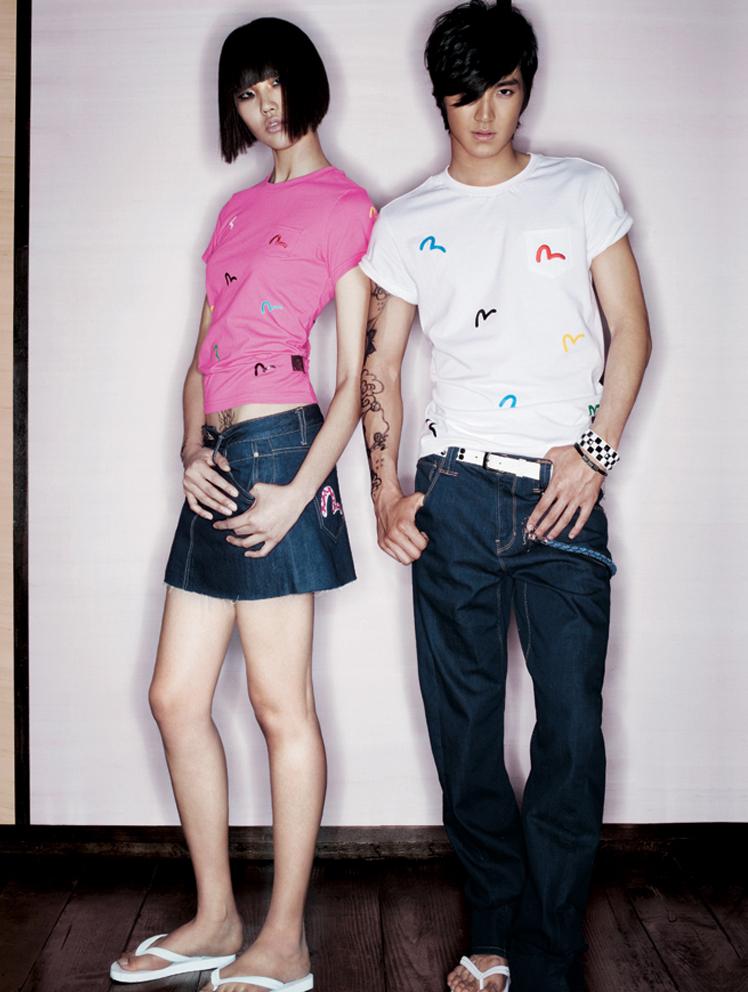
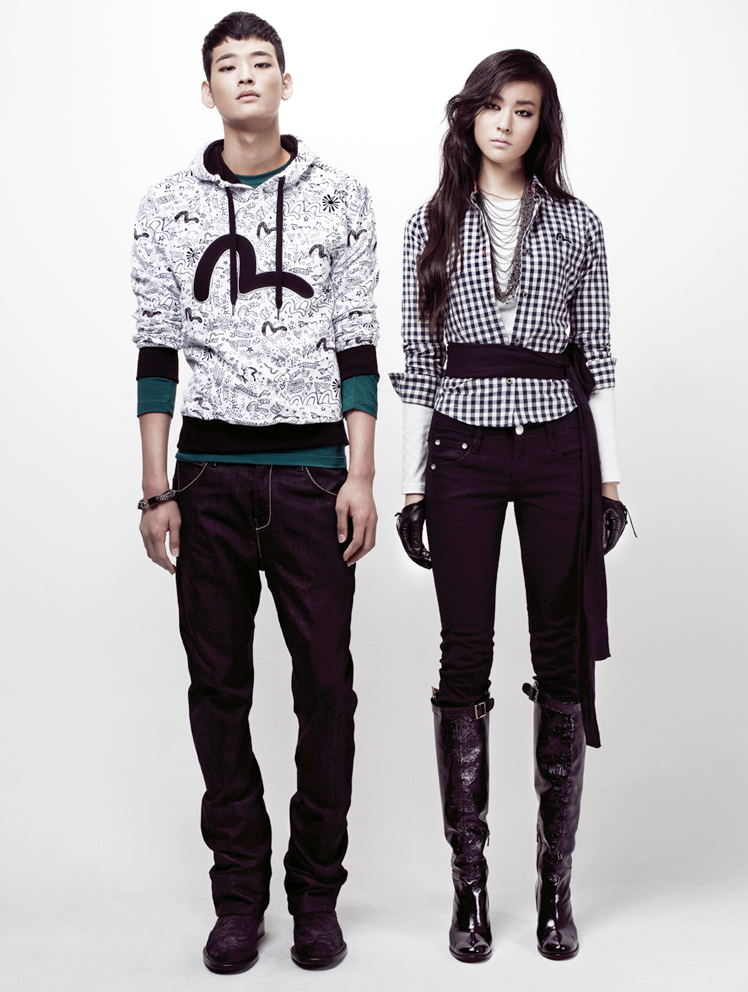
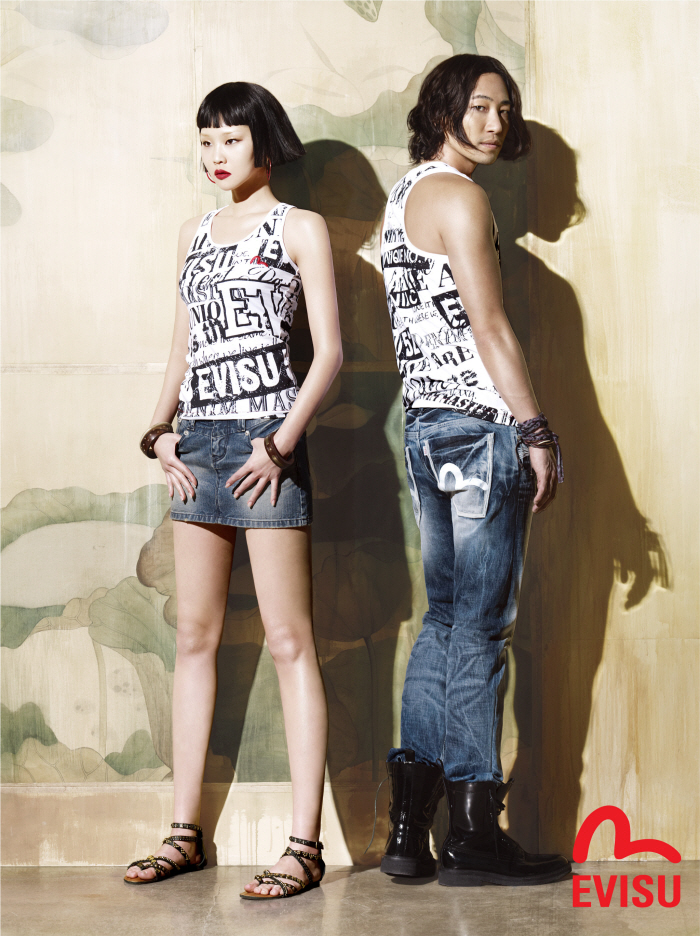
So why then, in most of the few Evisu advertisements that have a man and a woman together, are the women relegated so to speak? But don’t just take my word for it. Instead, see all of them for yourself, starting from the most glaring example to the least:

Note also that only the woman has the “head cant” in each, which I discuss here.

But here is one example that is the complete opposite to all the above:

And I include this one also as it’s the only other one with two people, although strictly speaking it shouldn’t be counted:

Personally I think that the woman on the right above is not quite as “out of it” as she in her advertisements with a man, but I’ll grant that that’s open to debate, as is how much she is using the man as a participation shield in that second advertisement in which she is wearing black gloves. But that’s precisely the point: again, those are all the advertisements with more than one person in them on the Evisu website as a I type this (please note that the first one with Jung Yun-ho isn’t on the website though), and so please make your own minds up about whether there is a discrepancy in the way the men and women are depicted in them. Naturally, I think it’s obvious that there is, but if you agree and yet have a non-feminist, culturally-based argument for its existence however, then I’m all ears.

Meanwhile, a note on the sources for this post: if they look very familiar to regular readers, then that’s because there have been so few surveys of Korean advertisements made using Goffman’s framework. Moreover, even Nam et al’s (2007) is based on magazines from 2002 and 2003, hopelessly out of date for a society as fast-changing as Korea, and so I’ve long wanted to conduct my own survey(s) to compensate. That would involve far too much work for just one person unfortunately, and so if any readers are interested in co-authoring a conference paper and/or journal article on the topic, please let me know!^^

Goffman, E. (1979), Gender Advertisements.

Hovland, R. et.al. (2005) ‘Gender Role Portrayals in American and Korean Advertisements’, Sex Roles: A Journal of Research December 2005, pp. 887-899 (although I have a physical copy, unfortunately this is no longer downloadable; I’d appreciate it if anyone with library access could email a PDF).

Kang, M. (1997) ‘The Portrayal of Women’s Images in Magazine Advertisements: Goffman’s Gender Analysis Revisited’, Sex Roles: A Journal of Research December 1997 (ditto on downloading)

Nam, K. et. al. (2007)  ‘Gender Role Stereotypes Depicted by Western and Korean Advertising Models in Korean Adolescent Girls’ Magazines‘, Paper presented at the annual meeting of the International Communication Association, TBA, San Francisco, CA Online (2007), pp. 1-31.

Update: If you’ve enjoyed this post, then you may also be interested in this one at Sociological Images that describes how even the “physiology and anatomy” theme of a university website also genders the stances of the physiological representation of both sexes, the man standing straight, looking ahead, and having even weight distribution, but the female form being “almost classically passive, hands held behind her back, weight distribution uneven” in contrast.

The Grand Narrative in The Washington Post

Photo by Dương Nhân from Pexels

While the background will be very familiar to regular readers, I confess I was still intrigued when Washington Post reporter Blaine Harden emailed me about this last month:

With pressures high, South Korean women put off marriage and childbirth

SEOUL — In a full-page newspaper advertisement headlined “I Am a Bad Woman,” Hwang Myoung-eun (황명은) explained the trauma of being a working mom in South Korea.

“I may be a good employee, but to my family I am a failure,” wrote Hwang, a marketing executive and mother of a 6-year-old son. “In their eyes, I am a bad daughter-in-law, bad wife and bad mother.”

The highly unusual ad gave voice to the resentment and repressed anger that are common to working women across South Korea…

With thanks to Blaine Harden for asking for my input, see here for the full report, and further details are included in this similar report from the JoongAng Daily last week also.

New readers further interested in any of the issues mentioned in either, please see: #2 here for more on Korea’s extremely low score in the UNDP’s “Gender Empowerment Measure” on which I based my email statement “….despite Korean women having good health and excellent education, they still have a much greater chance of becoming a politician or even a middle manager or computer programmer in countries like Kyrgyzstan, the Dominican Republic, Botswana or Nicaragua” that Blaine Harden quoted, and here for a recent survey on the discrimination expectant mothers face in Korean workplaces, which mentions that nearly 25% of them either got fired or were forced to quit once their pregnancies were revealed. For all others, please see the list of links I provided when I was involved in a report on a very similar topic for TIME Magazine last year, and another in a more recent post on childcare and socialization.

Unfortunately, judging by the handful of news articles available on the internet, then this story seemed to get little attention in the Korean-language media, although as I type this the Washington Post article itself has prompted a couple more. But see here for the original text of the advertisements, and here, here and here for some of the original reports from October and November last year, and I’d be very grateful to hear from anybody who saw her television interviews!

If you reside in South Korea, you can donate via wire transfer: Turnbull James Edward (Kookmin Bank/국민은행, 563401-01-214324)

Open Thread #7: Candy to my Ears

(Source: Nbbang)

Sorry, but it had to happen eventually: I’ve fallen in love with K-pop.

Well, with 3 more remixes from Greek trance DJ Areia to be precise. With apologies for dispensing with my normal analysis of the songs on this occasion, but I can’t remember the last time that I liked new music so much that I’ve lost sleep listening to it over the next few days.

Seriously, this music makes me feel like a smitten teenager, and hopefully it will some of you too.

The first track is My Ear’s Candy by Baek Ji-young, from her mini-album EGO that came out in August last year (the MV also features Ok Taec-yeon of 2PM). Curious about her music after recently writing about her soju ad, this is the gateway video got me hooked:

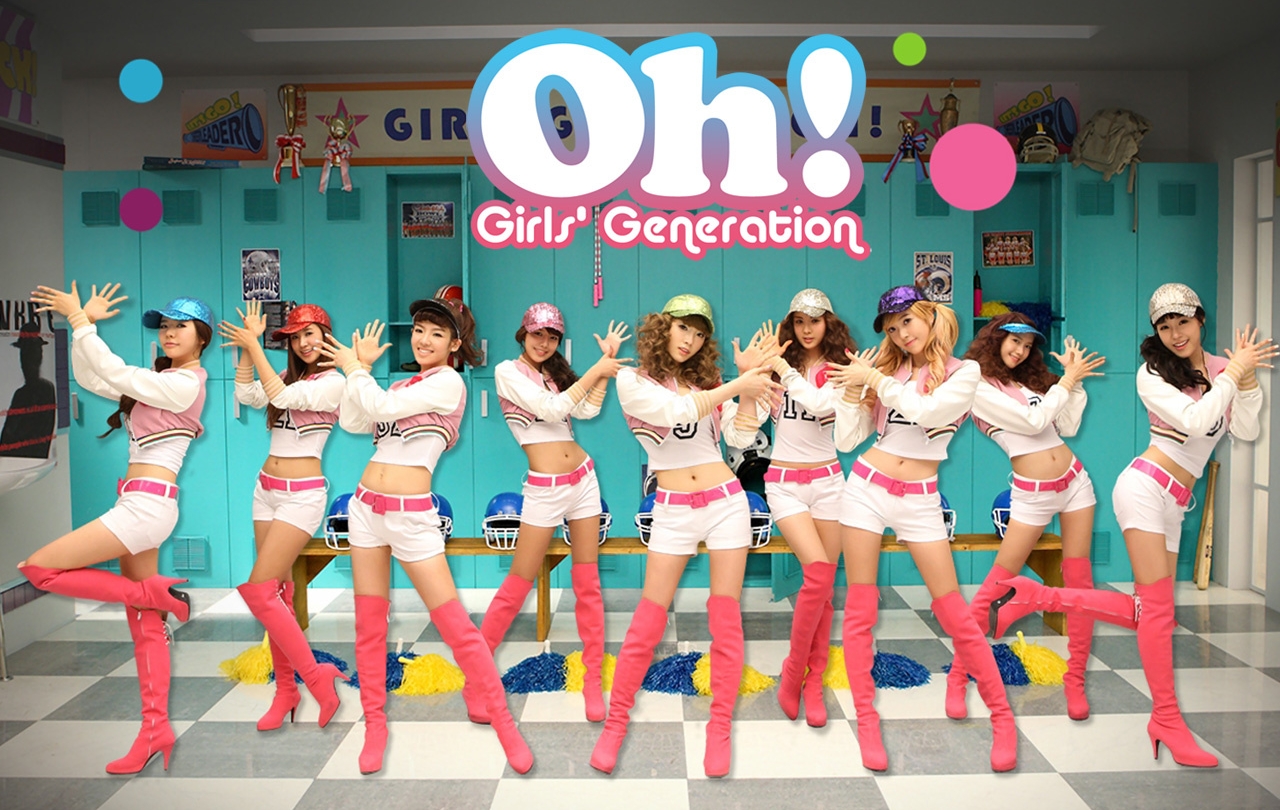
But not so much because of the cinematography and costumes, although I confess I have always loved that look with the white wig. More because Baek Ji-young looks like she’s genuinely enjoying herself, which makes a refreshing change from the forced smiles of Girls’ Generation in Oh! for instance, or alternatively the seeming disdain for the viewer that U.S./Barbadian singer Rihanna displays in Shut Up and Drive that SM Entertainment has been accused of plagiarizing.

Granted, Rihanna’s persona is appropriate for the title of the song, and I’m not so naive as to not be aware that Baek Ji-young’s may be just as carefully choreographed for this one also. But still, she does look like someone great to go clubbing with ;)

As for the remix, arguably it is very similar to the original (as is the next song too), so you may well be wondering what the point is. But there are differences, and which, as all trance aficionados are well aware, unfortunately you’re likely to be completely missing if you’re listening via your tinny computer speakers. Please try headphones instead, and you may be pleasantly surprised!

Next is Like the First Time,  by T-ara (say “tiara”). Put off by their simply atrocious Bo Peep Bo Peep (보핍보핍) last year though, and which even Areia’s remix could not save, then I’d never have suspected that this one would become my new favorite:

As happens to many viewers of K-pop these days, you might be very surprised to learn that one member of the group, Park Ji-yeon, is still only 16 (as is one girl in the next video too, but she looks her age). But that’s a long discussion I already had earlier this month; instead, consider this assessment of the of the the dancing and clothing in the video by Areia himself, as it partially inspired the topic of one of next week’s posts, and I’m very curious to hear your own opinions of it before I start writing:

The girls are supercute throughout the video and I find them very sexy at the scenes with the black dresses. The way they slowly move to the melody just kills my heartbeat every single time. To the untrained western eyes the video might just seem a bit cute or even silly. “It’s just some girls with short black dresses trying to look good, so what?” my overexposed-to-western-sexiness friends back home would say. But there is a huge difference here and this difference is very representative of the gap between the eastern and western stereotypes. It’s not okay to express too directly in Korea and that leaves you with only one acceptable weapon to tease your target: charm. And this is exactly what these girls are doing with their moves in this video – I’m not referring to the cute scenes. Whoever did the choreography and the dresses knew very well what they were doing. And the girls of course have done an excellent job at being charming. When I watch some sexy western video clip (let’s say Buttons from Pussycat Dolls) it hits my eyes. But this charm here hits me straight in my heart – I feel like wanting to hug the girls not…. Perhaps that’s the reason I’m into Asian pop in the first place.

Finally, here is Please Don’t Go by CL and Minzy (the 16 year-old) of 2NE1 (투애니원; say “to anyone” or, confusedly, “21”). No music video being made, then this one of a performance of theirs is unremarkable, but this remix at least is virtually unrecognizable from the original song, and in my opinion a vast improvement:

Update: For reasons explained here, unfortunately Areia had to delete that video, but the MP3 is still available for download.

Click on the titles of all the remixes for links to where you can download MP3s of them, and detailed explanations of what when into making them. I hope you’ve enjoyed them, but if not then thank you for bearing with me, and please remember that this is still *cough* an open thread, where you can raise anything on your mind.

Speaking of which, as of yesterday I am now officially in the job market again, and so would very much appreciate any readers help in getting jobs teaching adults in either Busan or Seoul, or of course anything not involving teaching at all. Unfortunately with having a family to support then I’ll need at least 3 million won a month before moving to Seoul especially, but hopefully that won’t prove too difficult?

Wish me luck!

Korean Sociological Image #33: Take the Wondergirls, Lolita Sexy Style!

Source: Wgby

Well, that is literally what it says:

원더걸스를 가져라! 그녀들의 스타일! 그녀를의 매렬에 끌린다면…소녀의 감성과 성숙함이 공존하는 앙비귀때(Ambiguite) 섹시함을 입어라

Take the Wondergirls [with you]! Their style! If you are attracted to their charm…wear Ambiguity’s sexiness, which has both girls’ sense and maturity.

But lest I give the wrong impression, it’s just the name of one line of JYP Entertainment’s new Wondergirls-themed cosmetics brand. And given the essential randomness of the names of the others too, and the fact that English terms routinely get incororated into Korean almost completely devoid of their original meaning, then I doubt that much thought went into it. Certainly it’s difficult to argue for nefarious intent in this case at least.

Still, it’s inappropriate.

Debuting in early-2007 when 3 of the 5 members were only 14 years old, the Wondergirls have been routinely described as Lolitas by the Korean media ever since; as were Girls’ Generation, and presumably as all the teen members of the new girl groups following them will be too. Using that term while simultaneously denying the sexual connotations to it however, is an oxymoron, and part and parcel of the Korean public’s wider refusal to acknowledge the sexual ways in which they’re marketed.

Hence the name is problematic. But granted: this is a tired theme, so for a change, it was very encouraging to see music columnist Kim Bong-hyeon (김병현) challenging that myopia earlier this month. And now I’ve also learned of a famous essayist and surgeon named Park Kyung-chul (박경철) too, who asked probing questions to Girls’ Generation members themselves in an interview nearly 2 years ago. Thanks very much to “A Korean Student” for passing on a partial translation, which I’ve posted with their commentary below:

Source: AsianPopcorn

…[In an interview] ironically subtitled: THEY ALWAYS ASK IF WE REHEARSED OUR ANSWERS. WHY CAN’T YOU BELIEVE OUR WORDS?, Park deliberately asks “difficult” questions and gets guarded and somewhat obtuse/hostile answers in return. Park is an ajusshi but definitely not a fan of entertainment industry, and there was also a chaperon/manager present. Here’s a translated excerpt:

QUESTION: Let me ask you some questions that might be uncomfortable. Do you think the word ‘Girls’ Generation’ is really innocent as it sounds? Don’t you think there’s a disguised sexy code [sic] behind the mask of innocence?

ANSWER: Anyhow we are not the ones who created that code. We know there are people who see it that way. It hurts to read ogling comments about us on the internet sometimes. But presenting the innocent girls’ image as it is—that is what has made us [successful.] We’ve shown you an image of girls who are growing up, and we will continue to do so in the future. Of course when we get older, it will be different. But that time hasn’t come yet. If they choose to see us like that, that is not really our problem. Why do you/they want to do it anyway? We are still kids. Don’t you think the real problem lies not in the way we show ourselves as we are, but in the fact that you/they compulsively see what us kids don’t actually possess?

Source: Unknown

And here Park thinks to himself:

But the girls’ rather uniform make-up style, obvious traces (to my trained surgeon’s eyes, that is) of cosmetic surgeries, their miniskirts, and the way they sit and dress—-all this “processed” feel leads me to think of the unknowingly worn facade of ‘ladies,’ not ‘girls.’

Whew. Talking about double entendres. Frankly, the girls react like hard-bitten soldiers who live in barracks. (Like most teenage idol groups, they’ve actually lived together in a dorm-apartment for many years.) Park even likens them to slippery politicians. So I guess you can throw away the notion of naivete, at least in GG’s case. I’d say they are fully aware, perhaps more so than the others, of the contexts surrounding them. Not sure about the interviewer though. The guy’s kind of ambivalent, though not as unreflective as the music columnist.

Imagine that, next we’ll be hearing that they eat and fart too!

You are not too far off the mark, but probably not in the way you mean. LoL (end)

James: Thanks again for the translation, and very much a healthy reminder to myself of how much I may have missed before I started regularly using Korean-language sources on this blog!^^

(For all posts in the Korean Sociological Images series, see here)

If you reside in South Korea, you can donate via wire transfer: Turnbull James Edward (Kookmin Bank/국민은행, 563401-01-214324)

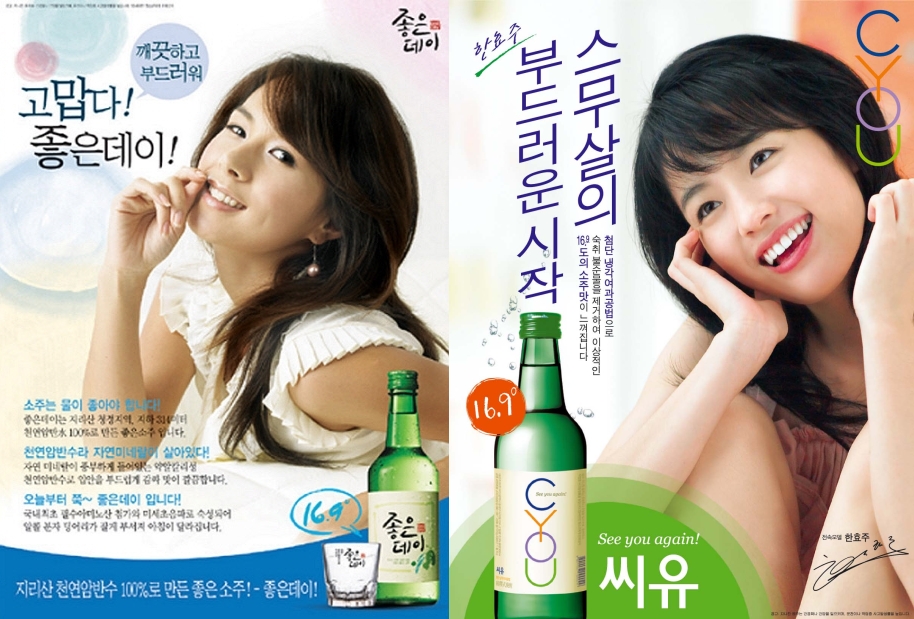
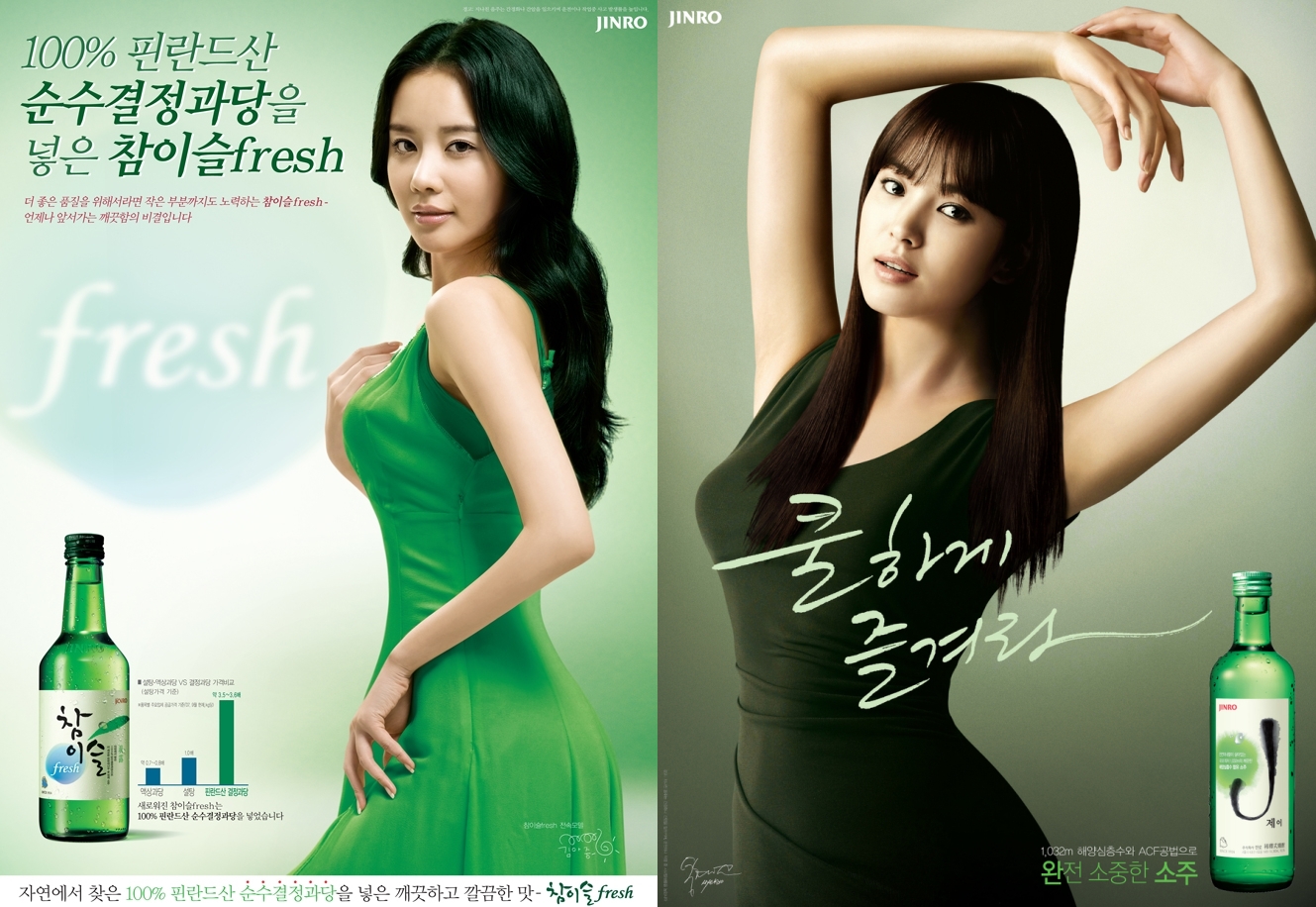
Beauties and the Beast? Understanding and Subverting the Male Gaze through Soju Advertisements

It’s not often that I laugh at soju advertisements.

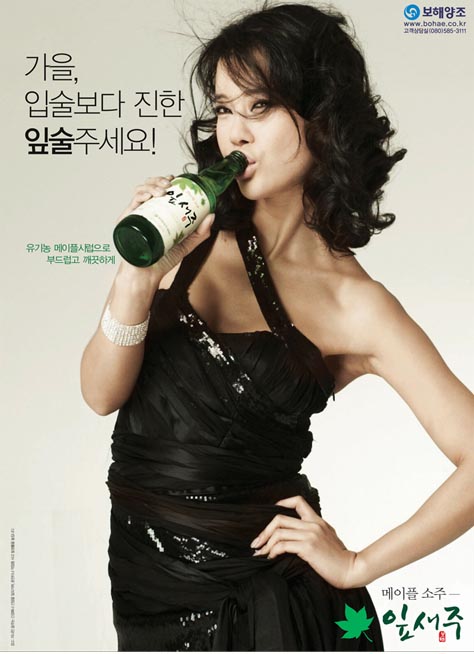
Flying in the face of decades-old traditions that they should feature demure and virginal-looking women though, this one with singer Baek Ji-young (백지영) for Yipsejoo (잎새주) literally had me in tears.

Indeed, if it’s not a deliberate satire, then it at least prompted me to reexamine those traditions, making me realize just how ridiculous many are. And being exclusively designed for a “male gaze” too, they also prove to be a very good guide to it, giving pointers to the ways in which a wide range of advertisements seem to be based on the assumption that their audience are entirely heterosexual men, especially by focusing on and sexualizing women’s bodies.

Even when the products are aimed at women.

But first, the humor of this one, which is on several levels. First there is the caption, which reads “In autumn, rather than your lips (kiss), please give me some strong-tasting Yipsejoo!,” (가을, 입술보다 진한 잎술주세요!), and is a pun based on the fact that yibsool (입술), or lips, sounds very similar to yipsool (잎술), shorthand for Yipsejoo.

And as an added inside-joke for fans, a popular song on Baek Ji-young’s 7th album Sensibility, released five months before she was hired by Yipsejoo’s parent company Bohae (보해양조), even had the name Give Me Your Lips (입술을 주고) too.

But context is everything.

Previously on a fast track to stardom, Baek Ji-young was the innocent victim of a sex-scandal in 2000, and had to fight hard against Korea’s double-standards in order to revive her career. But while this severely limited her advertising options, perhaps one silver lining was the ability to disregard the high moral standards Koreans usually apply to their celebrities (especially women), and indeed it is very difficult to imagine anyone else appearing in advertisements like those she has so far for Yipsejoo.

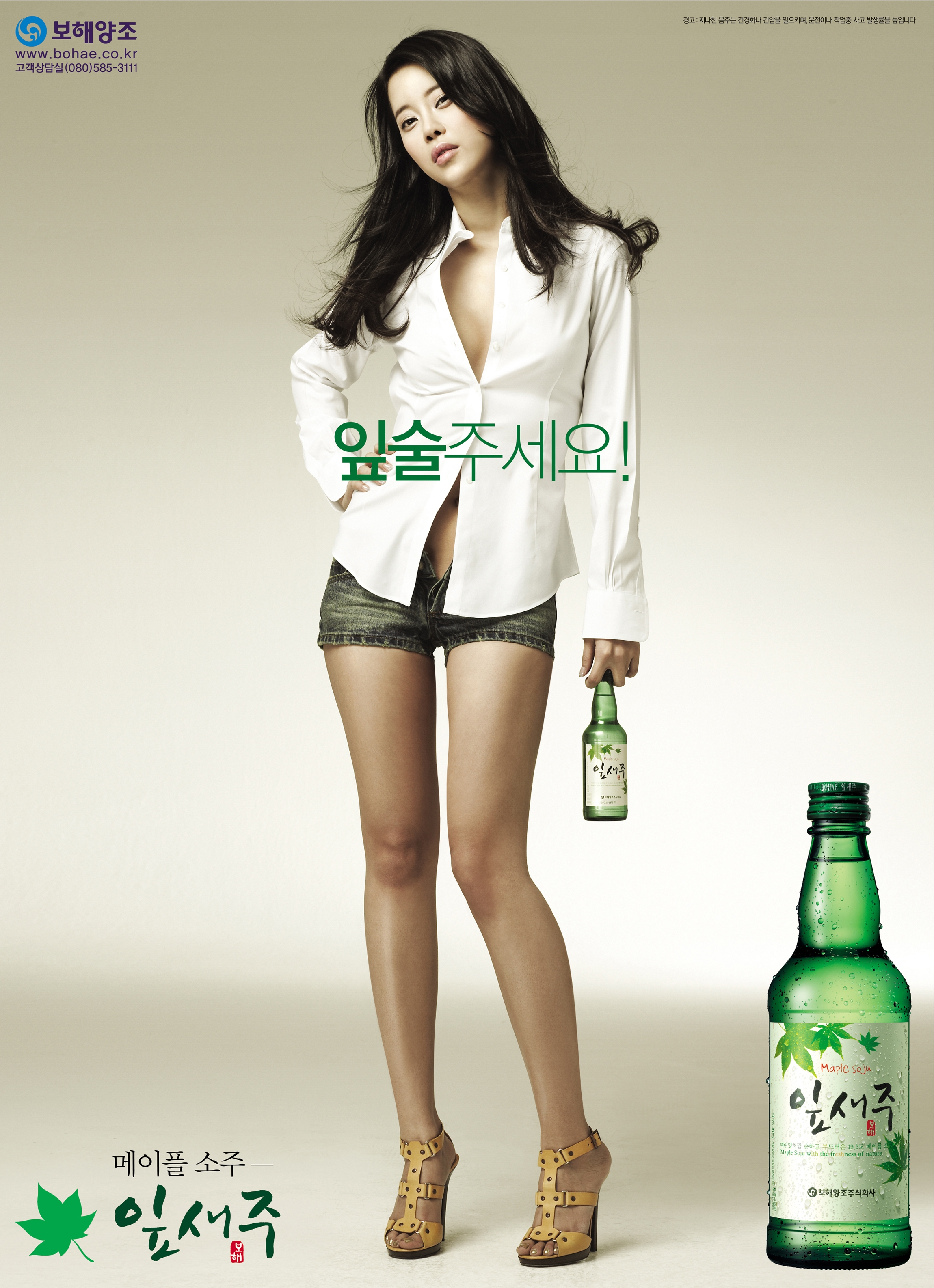
For instance, recall that when she was chosen in an online poll to model for Yipsejoo in March last year, I remarked that her first advertisement for the company below was:

…not to put too fine a point on it, literally the sluttiest soju ad I’ve ever seen….

With apologies for sounding crass (then), but I still can’t think of a better way to describe it:

I also discussed the fact that while she did mention how happy she was to have been chosen to appear in soju advertisements like top stars Lee Hyori and Song Hye-gyo, one still sensed that they wouldn’t have consented to appearing bra-less and with an open zipper in them, which smacked of desperation. Judging by the soju advertisements that emerged that summer however, I was quite wrong, but then I’d already concluded of Beak Ji-young that:

however unfair or unwarranted, she’ll always be stuck with her promiscuous image, so she may as well play into it.

Still, I didn’t realize that she would take my advice quite so literally!

To be precise, I laughed so hard when I saw the opening image because I thought she looked like a prostitute who’d been plying her trade for rather too long now, and which were quite a contrast to, say, these earlier ones for Yipsejoo featuring Jeong Ryeo-won (정려원), for whom her evening of drinking soju with her male partner will be her first time in more ways than one:

But this post is not about that shift, which I’ve more than adequately covered elsewhere, although I do want to stress 2 things about it here before moving on: that however impressed I was by the changes when I first noticed them back in 2007, it was still extremely naive of me to have ever equated it with (female) sexual liberation(!); and that while an empirical study would undoubtedly demonstrate an increase in soju advertisements with – in the sociological framework that I’ll be using below – “body display” – in recent years, there is by no means an linear progression of racier advertisements over time.

Even just Yipseejo itself for instance, makes both forms of advertisements with the same models, and/or seems to alternate which ones it primarily makes with them, such as traditional, virginal ones with Jeong Ryeo-won and Han Ji-min (한지민) in 2006 and 2008 respectively, but then racier ones with Kim Ok-bin in 2007 and Baek Ji-young in 2009.

Regardless, both types are still designed for the male gaze. In the interests of full disclosure however, I have never studied that formally, and so here I shall be quoting liberally from the excellent A Web Essay on the Male Gaze, Fashion Advertising, and the Pose, part of the Semiotics and Advertising Web Site of the University of Vermont, and I also highly recommend this post by Michael Hurt at the Scribblings of the Metropolitician after that for an analysis of Korean women’s body images using that perspective.

But it does dovetail nicely with the work done by the late sociologist Erving Goffman in his 1979 work Gender Advertisements, still very much the framework by which sociologists study how gender roles are perpetuated in advertising (and indeed referred to repeatedly in A Web Essay). In earlier posts, I’ve already analyzed Korean advertisements using one motif of that: “Relative Size”, or how and why it is extremely rare to see women taller than men in advertisements despite being women being taller than men in 1 out of 6 randomly matched pairs. It’s high time to start using others, beginning with “Ritualization of Subordination”:

Under this broad category, Goffman actually described a great number of symbolic ways in which the women’s behavior in advertisements displays the subordination of females to males, many of which involve women acting like children. Why this is more problematic than it may sound is because:

Given the subordinated and indulged position of children in regard to adults, it would appear that to present oneself in puckish styling is to encourage the corresponding treatment. How much of this guise is found in real life is an open question; but found it is in advertisements. (Goffman, p. 48)

And indeed Korean society strongly encourages grown women to act like children, so it is probably not surprising to hear that in Korean adolescent girl’s magazines for instance, Korean female models are portrayed in such ways much more often than Western ones. From Gender Role Stereotypes Depicted by Western and Korean Advertising Models in Korean Adolescent Girls’ Magazines by Nam, Kyoungtae., Lee, Guiohk. and Hwang, Jang-Sun (2007):

Korean women were more likely to be portrayed in smiling, pouting and childlike or cute expressions than Western women. This result is similar to the findings of [this 1999 study] in which many Japanese girls in magazine advertising were portrayed as happy, playful and childlike. Understanding that gender displays in advertising reflect cultural orientation in a society, these findings indicate that in Korea and Japan, cuteness is an important virtue for women. (p. 18)

And yet to complain about those advertisements with Yoo In-young (유인영) and Shin Min-a (신민아) above, especially when they’re aimed at men, might still seem a little excessive. But then consider the following images from A Web Essay, which poses the questions “What do they suggest to you about these men? Do they seem silly?”

“What about these images?”

And as you probably expected:

Most viewers find the images of the men odd or laughable. But the images of the women seem charming and attractive…Why should it seem funny to see a picture of adult men striking a pose when the same pose seems normal or charming to us in pictures of adult women?

Not childlike per se, but as the next part points out, such expressions are often done with a head cant, for instance by Chae Yeon (채연) and Han Hyo-Joo (한효주) below:

The effect of the head cant is to lower the level of the head:

“…relative to that of others, including, indirectly, the viewer of the picture. The resulting configuration can be read as an acceptance of subordination, and expression of ingratiation, submissiveness, and appeasement.” (Goffman, p. 46)

And A Web Essay adds that it is often combined with putting a finger in the mouth or otherwise touching the face in a childlike way, and so common in advertising as to be barely noticed:

The difference between those and the soju advertisements however, is that they’re all from women’s magazines and presumably aimed at women, and so what is actually going on in those is:

…not that the viewer is looking at a woman who is actually subordinate or childish. Rather, the models are posed so as to show that they know that they are being looked at — belying the otherwise childlike pose — and they are controlling or mastering this act of being looked at. The childish, submissive postures are represented as strategic, as a sign of control of the gaze.

This mastery and control over the gaze might explain why the highly accomplished and wealthy women you see above would strike submissive, deferential poses for the camera that no accomplished man would strike. For in so doing:

…[they are] not at all signaling to others that [they are] actually subordinate; on the contrary, [they are] showing that [they], too, can be successful in this arena, the arena where the goal is to attract and control the power of the gaze by striking a subordinate pose. And were this an occasional event, if we regularly saw images of women that were of a different sort, the effect might be innocuous.

The problem is, however, that most women make less money and have less power than most men, and the message that goes out to women without power is that to get some, you need to gain control of a male view of women — which means to get power through male power, rather than on your own.

This is where the theory of the male gaze becomes important…

A Web Essay also briefly mentions women’s typical advertising poses in much the same vein. But I think that that’s a little misguided, as a distinction needs to be made between those that are sexually appealing to heterosexual men and others, the basic physiology of sexual reproduction ensuring that men will almost always look ridiculous in the former. Hilariously demonstrated by these pictures from English Russia for instance:

See Sociological Images for a wider discussion of those. Of course, by no means are women (or men) always placed in sexually appealing poses in advertisements, but for some reason women in particular frequently are placed in completely bizarre, often comical ones instead. Goffman notes of them that:

The note of unseriousness struck by a childlike guise is struck by another styling of the self, this one perhaps entirely restricted to advertisements, namely, the use of the entire body as a playful gesticulative device, a sort of body clowning. (Goffman p. 50)

With the possible exception of that with Kim Ok-bin, admittedly these following examples from soju advertisements can not really be described as “childlike.” But however natural they may appear though (again because of our frequent exposure to them), in fact some are extremely awkward to perform: just try them and see!

Starting with Kim Ah-joong (김아중) and Song Hye-gyo (송혜교):

Then Chae Yeon and Kim Ok-bin:

And finally Shin Min-a and Lee Hyori (이효리):

Those with Chae Yeon, Kim Ok-bin, and particularly Shin Min-a also display the “bashful knee bend,” which women frequently but men only infrequently are posed in a display of. Whatever else, it:

…can be read as a forgoing of full effort to be prepared and on the ready in the current social situation, for the position adds a moment to any effort to fight or flee. Once again one finds a posture that seems to presuppose the goodwill of anyone in the surround who could offer harm. (Goffman, p. 45)

But I’ll wisely move on to the second and last motif for this post, that of “Licensed Withdrawal.” In the words of Images of Women in Advertising:


[One] way in which women are disempowered is by displaying them as withdrawn from active participation in the social scene and therefore dependent on others.  This involvement with some inner emotional processing, whether anxiety, ecstasy or introspection, can be symbolized by turning the face away, looking dreamy and introverted, or by covering the face, particularly the mouth, with the hands….

….Rather than being portrayed as active, powerful and in charge, females are commonly shown in this licensed withdrawal mode, removed into internal involvements, overcome with emotions, or symbolically silenced with hand over the mouth….

….In another variation, females are frequently shown withdrawn inwards into some dreamy introverted state;  they pose, become things for others to gaze at and desire.  Males will stereotypically be shown active, engaged, and in charge of the situation.  They are not so much objects for others’ to gaze at, as actors with occupations and professions….

But I’d never given it much thought until I saw this composite of four soju advertisements with Jang Yun-jeong (장윤정), which I also laughed out loud at. What on Earth is she looking at?

More examples with Kim Tae-hee (김태희), and Ku Hye-sun (구혜선):

And to which can be added Han Hyo-joo’s from earlier. Arguably Ku Hye-sun is merely lost in her enjoyment of her drink though, and in that sense the advertisement could even be used to appeal to women(?). But then with the possible exception of the second one of Baek Ji-young’s, no advertisement featured here is particularly objectionable in itself; rather, this post has been about noting recurring features of soju advertisements that – if I may be so presumptuous – now that you’re more aware of, are likely to see across the entire Korean (and Western) media.

It is the pervasiveness of these features that is objectionable, and so rarely countered by alternative images of women.

But on that note, I should point out that I notice and pay attention to soju advertisements with skin just as much as the next guy; actually probably more so (call it an occupational hazard). Still, based on the opinions of the men and women in my classes at least, this one with Song Hye-gyo has the greatest universal appeal, although that is probably simply because of her attractiveness:

And after writing this post, in fact this one with Kim Yoon-ah (김윤아; not the skater) of the rock band Jaurim (자우림) is my favorite: it’s the only one I’ve seen in which the woman depicted is actually doing something of her own accord and enjoying herself, rather than waiting to be seduced by a man. Baek Ji-young’s does come close of course, but then it’s even more unflattering, and all she is doing is drinking!

Finally, while it’s technically out of place, I would be remiss in not providing the one which, well, literally had my female students squealing in delight when they saw it. Featuring Kang Dong-won (강동원) for Bom Bom (봄봄; “Spring Spring”), that will be music to the ears of manufacturer Daesun (대선주조), creators of one of the first ever soju brands aimed at women:

See here for more information on the consequences of that for soju advertisements so far; given all the above, it is perhaps no surprise that most soju advertisers still can’t restrain themselves from using womens’ bodies!

(Soju advertisement sources: Shootar.net, or directly from manufacturers’ websites)

Ajosshis & Girls’ Generation: The Panic Interface of Korean Sexuality

Girls' Generation's Ajosshi Fans…Gender matters in the ways that it shapes social interaction. Identities, of course, are products of and sustained through interactions with others. Social interaction thus is an important setting in which gender emerges and is enacted. As Ridgeway (p. 219) observes: “It is striking that people are nearly incapable of interacting with one another when they cannot guess the other’s sex.” That the identification of someone as male or female facilitates social interaction testifies to this category’s power in social life. (Amy Wharton, The Sociology of Gender {2005}, p.10)

And throw in my age, ethnicity, and language difficulties into the mix too, then you’d think that discussing gender issues and sexuality with Korean women would be quite a trying experience sometimes (source, above).

Ironically though, I usually find them to be better informed and more willing to talk about them than men.

One reason might be because women the world over tend to be better language learners, and as my Korean speaking ability is much worse than my reading ability, then my conversations with Koreans on abstract subjects are confined to those with relatively good English.

But that doesn’t explain the relative disinterest of Korean men at the same level,¹ and so more much likely is that whatever their degree of interest originally, sooner or later all women are invariably forced to deal with at least the consequences of Korea’s systematic sexual discrimination, perhaps the first time being when they’re deliberately shunted into non-advancing career tracks as they enter the workforce, under the assumption that they’ll no longer work (or be fired) upon marriage or childbirth.

In contrast, such things usually impact men at a much later stage in their life cycles, if at all. Perhaps when trying to decide with his wife if they can afford to have a second child for instance, and/or if it’s worth her returning to work when she will likely only bring home 41% of the wages he does, the highest gender wage gap in the OECD. Indeed, if my wife — a 31 year-old mother of two — wasn’t lucky enough to be able to work from home as a recruiter, then we’re not entirely sure what she could do, and even that is hardly an advancing career.

That is not to say that Koreans are only ever interested in issues that directly concern them of course, or that there aren’t parallels in other countries. But there are still yet more factors working against Korean men being interested in gender issues. Most notably the profoundly patriarchal ideology of Neo-Confucianism that is all-pervasive here,² buttressed by the the socialization experience undergone during their mandatory military service.

(Source: unknown)

Admittedly these are generalizations, and to an extent they become self-fulfilling: as I’ve gotten older, I find it more and more difficult to find the effort to befriend Korean men, so different do I expect our work-family priorities and opinions on gender issues to be. This inhibits me from raising such issues in free-talking sessions with advanced students also, although in that case it’s more because I respect that their purpose in attending my classes is not for me to lecture to or argue with them.

But surely there must be some feminist Korean men out there? If you are one, or know of one, then by all means let me know! But unfortunately the differences are real, and a good illustration of the difficulties in finding common ground on gender and sexuality issues are our opinions on — you guessed it — teenage girl groups like Girls’ Generation (소녀시대) and the Wondergirls (원더걸스).

Why the focus on them specifically? It’s a reasonable question, as they’re not the first young girls groups in Korea. What distinguishes them though, is that they are the first groups explicitly created to appeal to men 20 years their senior, and as such they are very much at the forefront of the increasing sexualization of young girls in the Korean media in recent years, setting the tone for the wave of 15, 16 and 17 year-olds following them.

Where I and most 30 and 40-something Korean men — ajosshis — differ on them is that I don’t buy into the collective narrative that we all like these girl groups because we have a brotherly, paternal, or avuncular affection for their members. Instead, while I can’t imagine having any kind of sexual or romantic relationship with them in reality, I’d be lying if I said I didn’t want to bang them whenever I see them on stage…and so would those ajosshis. Try to get one to admit that though, even one you know well and in a bar just with other men like themselves, and you’ll soon realize that not for nothing do I use the term “panic” in the title of this post.

(Source)

I also use “interface,” because acknowledging things like why 15 year-old f(x) band member Sulli’s (최설리) shorts are so high above, for instance, or why she is pulling her dress up in the other pictures in that photoshoot, are very literally where commercialized teenage sexuality and conservative Korean social mores meet. And I seriously doubt that pressing issues of teenage prostitution and abysmal sex education can even begin to be rectified while the collective Korean establishment — read: ajosshis — can’t admit to something so blatantly obvious.

But this is on old, tired theme for regular readers, and not what this post is about. Rather, I’m belatedly concerned with the question of why it is the case.

One possible reason is Occidentalism, for as blogger Michael Hurt argues, this platonic rationalization:

…parallels the notion in idea that in Korea, people are all good, clean Confucians who don’t do dirty things (but just save it for the love motels and leave that “skeleton bone” there – hehe, yes, I meant for a double entendre to be read there!), while Americans apparently hump everybody, according to everybody not American.

And recall that Occidentalism doesn’t actually need a physical Occidental in the room in order to be operating: indeed, it’s better that there isn’t, for greater distance gives greater leeway to imagine an “other” with which to advance a domestic agenda. And that proves to be the crucial point here, for as the following translation of a Korean music columnist’s thoughts reveals, all of this is by no means merely a face-saving device employed to obscure unsavory aspects of Korean society from inquisitive foreigners.

I warn you: the translation is rather long, a little melodramatic in places (less so in the original Korean, my wife assures me), and doesn’t actually offer an answer as to why. But still, I’m glad to have made a start by removing the “wild card” of the foreign observer from the equation:

(Zhang Wei, 2006?)

“‘섹 시한소녀시대 좋아하는 죄 인가요?” (or 대한민국평균아저씨소길동 고백)

Is it a Sin to Like Girls’ Generation Because They’re Sexy? (or The Confession of an Average Korean Man)

Kim Bong-hyeon, 4th February 2010

이제 고등학교에 입학하는 조카가 있다. 조카는 ‘소녀시대’의 팬이다. 당연히 이번 달 단독 콘서트 예매도 이미 끝냈다. 조카는 특히 서현을 좋아한다. 한정판 소녀시대 카드 중에서 다른 멤버들 것은 줘도 서현의 것은 끝내 안 준다. 소신이 뚜렷한 녀석이다. 크게 될 놈이다.

내가 글쟁이인 것을 아는 조카는 며칠 전 이번 새 앨범 음악이 어떠냐고 물어왔다. 해줄 말 중에는 좋은 것도, 나쁜 것도 있었다. 어차피 나쁜 말하면 귀담아 듣지 않을 테니 대충 좋은 말만 하고 넘어갔다. 실은 내가 오히려 묻고 싶은 게 하나 있었다. 하지만 묻지 않았다. 이것이었다.

“네가 진짜로 소녀시대를 좋아하는 이유가 뭐야?”

At the moment, I have a nephew entering high school. He’s a fan of Girls’ Generation. Of course, he has already reserved a ticket for their concert this month. His favorite member is Seo-hyeon, and while he will happily exchange picture cards of other members with his classmates and friends, he won’t trade any of her. Clearly he is a man of his own ideas, and is destined for great things!

Knowing that I was a writer, my nephew asked what I thought of their new album. It has good and bad points, but guessing that he wouldn’t have listened to the latter, I just talked about the good things. But actually there was something I wanted to ask him (although I didn’t), which was:

What is the real reason that you like Girls’ Generation?

(Source)

이걸 묻고 싶었던 이유는 간단하다. 나 자신에게 물어봤는데, 나에게서 나온 대답이 정답인 것 같아서 다른 남자(!)에게도 확인해보고 싶었기 때문이다. 한마디로, 나는 소녀시대가 ‘섹시’해서 좋다. 물론 기본적으로 귀여운 매력이 크긴 한데 섹시한 매력도 나에게는 그 정도 크기는 된다.

이게 무슨 뚱딴지같은 소리냐고? 노파심에 말하자면 나는 변태도 아니고 과대망상증 환자도 아니다. 그리고 이제는 자신 있게 말할 수 있다. 소녀시대는 분명히 섹시하다. 정확히 말하자면, ‘섹시하지 않은 척 하면서 섹시’하다.

내가 소녀시대에게서 섹시함을 느낀 건 ‘Gee’ 이후였던 것 같다. 그전까지 소녀시대는 나에게 그저 귀여운 여동생에 불과했다. 그러나 소녀시대가 Gee로 컴백해 딱 달라붙는 배꼽티와 스키니진을 입고나오자 ‘소녀’는 ‘그녀’가 되었다. ‘소원을 말해봐’는 ‘Gee’의 심화판이었다. 핫팬츠와 하이힐, 제복을 입고 그녀들이 내게 ‘소원을 말해보라고’ 외쳤다. 신곡 ‘Oh!’는 한술 더 떠 치어리더 콘셉트다. 더 무슨 말이 필요하나.

The reason I wanted to ask this was simple. I knew why I liked them – and all men like them – but I wanted to confirm that he would give the same answer: that it’s because they’re sexy. Of course, they do also have a cute charm about them, but they’re at least as sexy.

What foolish talk is this you ask? But no, asking this does not mean I am a pervert, nor that I’m a mental patient having excessive sexual fantasies about Girls’ Generation. Rather let me say this: of course, Girls’ Generation are sexy. Or to be more accurate, they are sexy while pretending not to be.

It was with their song Gee that Girls’ Generation really started appearing sexy to me; before that, they were merely like little sisters. But then they started wearing tight, clinging croptops and jeans, and the girls had changed to women. This was even more so with their song Tell Me Your Wish, combining hotpants, high-heels, and uniforms while crying “tell me your wish…”. And with their new song Oh!, they continue that theme with a cheerleader concept. What more is there to say? (Source, below).

여기서 중요한 건 섹시 그 자체가 아니다. 소녀시대보다 섹시한 가수들은 얼마든지 있다. 포인트는 소녀들이 ‘더없이 순수한 눈망울’을 하고선 남성의 성적 판타지를 자극하려는 의도가 분명한 옷과 액세서리, 그리고 노랫말과 춤동작을 선보인다는 점이다. 나는 고민에 빠진다. 그 순수한 눈망울들이 나를 죄책감의 구렁텅이로 몰아넣는다. 내가 저 천사 같은 아이들을 두고 대체 무슨 상상을 한 걸까. 나는 변태인가. 난 누군가 또 여긴 어딘가.

분명히 맞는 것 같은데 증명할 방법이 없다. 섹시함을 주 무기로 삼으면서 겉으로는 그렇지 않은 척한다. 그런데 더 가관(?)인 건 그렇지 않은 척하니까 대놓고 그러는 것보다 더 섹시하다는 거다. 낮에는 현모양처, 밤에는 요부를 바라는 어쩔 수 없는 남성의 본능이다. 가히 최악의 상황이다.

이런 상황에서 ‘기획사 너희들! 일단 남성의 성적 판타지를 정확히 자극한 것에는 10점 만점에 10점을 주겠어. 대단히 유효한 전략이었지. 하지만 어린 여자애들 데리고 더 이상 교묘하게 섹스를 팔지 마! 이제 더 이상 당하지 않아!’, 이렇게 외친다면 (비록 속은 다를지라도) ‘아니, 어떻게 이렇게 귀여운 여동생을 보고 그런 천박한 생각을…’, 하며 경멸어린 시선으로 변태 취급당할 가능성이 다분하다.

The important point here is not how sexy they are: there are many female singers sexier than Girls’ Generation (James: I think he means more “sexual” than sexy). Rather, that despite their innocent expressions, Girls’ Generation’s clothes, accessories and lyrics are all designed to provoke men into having sexual fantasies about them. But this leaves me feeling a little perturbed and guilty: how can I think like that when I see those angelic faces? Am I a pervert? Who am I…where am I?

This is all true, but it is impossible to prove. While deliberately being sexy, Girls’ Generation pretend that they aren’t. Which proves to be even sexier than it they just admitted it, for every man’s instinct is to have a woman who is a wise mother and good, virtuous wife by day, but a shameless hussy at night.

This is a very bad situation.

About this, I say “To the people that work at the company! First, I give you 10 out of 10 points for knowing what stimulates men’s sexual fantasies so well. But please stop using these young girls to sell sex so skillfully! I won’t put up with it anymore!”. And I do so even though many people may scorn me and label me as a pervert, asking how I can think such things of such cute, innocent girls.

과연 나만 이런 생각을 하는 걸까? 나만 섹시함을 섹시함이라 말하지 못하는 ‘소길동’의 덫에 걸린 걸까? 아니라고 본다. 모르긴 몰라도 적지 않은 대한민국 성인 남성이 나와 비슷한 고민을 하지 않으려나?

여기서 두 가지 고민이 발생한다. 그리고 그 전에 하나 전제되어야할 것이 있다. 바로 ‘소녀시대의 기획사는 어린 소녀들을 통해 남성의 성적 판타지를 자극해 교묘히 섹스를 판매한다’는 합의다. 물론 이 같은 판단에 소녀시대의 팬이나 어린 학생들, 그리고 여성들은 동의하지 않을 수도 있다.

이유는 여러 가지다. 우선 소녀시대의 팬들에게 이 같은 지적은 소녀들에 대한 모욕일 수 있고, 어린 학생들이나 여성들의 경우에는 진심으로 이러한 부분을 체감하지 못했을 수 있다. 그러나 이것은 엄연히 현존하는 사실이다. 양해를 구한다. 그렇게 사실로 인정하고 넘어가도록 하자.

Well, am I the only person that thinks like that?Am I the only guy to have fallen into the trap of not recognizing sexiness when I see it? I don’t think so. In fact I think that all Korean adults suffer the same.

Based on the premise that Girls’ Generation’s company is skillfully encouraging men to have sexual fantasies about the group and basically selling sex then all this raises two problematic issues to worry about. But I don’t expect many fans, young students and women to agree with me, for many reasons: first, because to Girls’ Generations’ fans, this sort of opinion is considered insulting to the group; and in the case of young students and women, they can’t really understand these physical feelings of men. But while I seek their forgiveness, the facts remain. Let’s continue on that premise (source, left).

첫 번째 고민은, ‘욕망하는 것은 과연 나쁜가’이다. 더 정확히 말하면 ‘의도된 자극에 예상된 욕망으로 반응하는 것은 나쁜가’가 되겠다. 말이야 바른 말이지 은근슬쩍 성적 판타지를 자극해 오는데 모른 척하며 억지로 속으로 눌러야 하나? 오히려 그게 솔직하지 못하고 자신을 속이는 것 아닌가? 남에게 피해를 주지 않는 솔직함은 미덕이라고 배우지 않았나. 굳이 말을 하자면 자극받는 쪽보다 자극하는 쪽이 나쁘지 않느냐는 말이다. 하아, 나는 왜 불필요한 죄책감에 사로잡혀 있었을까. 문제는 개인이 아니라 구조이고 시스템인 것을.

두 번째 고민은, ‘어린 소녀들을 통해 섹스를 파는 행위는 과연 나쁜가’이다(‘미성년자’라는 법적 개념으로도 판단할 수 있겠지만 여기서 논하려는 건 그러한 차원은 아니다). 어떻게 보면 누이 좋고 매부 좋은 거래가 아닌가. 기획사는 돈을 벌고, 소녀들은 스타가 되고, 대중은 욕망을 충족한다. 소녀들이 특별히 공공질서를 저해하는 음란 행위를 하는 것도 아니고, 대중이 소녀들에게 위해를 가하거나 범죄를 저지르는 것도 아니다. 상부상조하는 좋은 거래다.

The first thing to worry about is the question of if desire is a bad thing. Or to be more precise, is getting sexually stimulated bad when that is the deliberate and expected reaction? Does the fact that it is done indirectly and stealthily mean that we have to pretend that we don’t feel aroused? Isn’t that being dishonest and deceiving yourself? We all know that as long as it doesn’t cause harm to others, honesty is a virtue. And surely it is worse to so insidiously arouse men than to feel aroused. Why on Earth was I feeling guilty about this? This is not a problem with myself, but more a systematic thing.

The second worry is that the act of using young girls to sell sex is bad (I don’t want to discuss the legality of using minors for this though). But if you look at it in a different way, it is can actually be a good thing. The company makes money, the girls become stars, and men’s sexual desire is satisfied. Nor are the girls committing indecent acts, or the public harming ordinary girls in any way or commit crimes against them. So in a sense, everybody helps each other.

그러나 이렇게 간단하게 정리하고 넘어갈 문제가 아니라는 게 바로 문제다. 기본적으로 나는 욕망하는 주체다. 그리고 욕망하는 나 자체는 건강하다. 그러나 내 욕망을 충족시켜주는 것들이 모두 옳은 건 아니다. 다시 말해 나는 내 욕망의 정곡을 찔러주는 소녀시대의 무대를 보면서 기획사의 의도대로 욕망을 느낀다.

하지만 그 반대편엔 욕망의 크기만큼이나 커다란 이성 역시 자리 잡고 있다. 나는 소녀시대가 내 성적 판타지를 충족시켜준다는 점을 인정하면서도 동시에 그들 기획사의 전략이 야기할 부정적인 단면들을 고민한다. 즉 나는 끊임없이 욕망하면서 동시에 그 욕망을 충족시켜주는 것의 올바름에 대해 끊임없이 의심한다.

그렇게 의심해본 결과, ‘섹시하지 않은 척 하면서 섹시한’ 소녀시대는 몇 가지 문제점을 내포하고 있다. 먼저, 이것은 기획사의 입장에서는 분명 대단히 효과적인 돈벌이 전략이지만 사회적으로는 성의 이중성을 더욱 공고히 할 뿐이다. 성적 판타지를 자극하도록 설계된 소녀들에게서 당연하게(?) 예정된 욕망을 느끼더라도 남성들은 그것을 제대로 표출할 수 없다. 욕망 표출의 해방감 대신 그들에게 부여되는 것은 일종의 죄책감이다. 욕망은 점점 안으로 파고 들어가고 겉과 속은 달라진다. 그렇게 섹시한 것을 섹시하다고 말하지 못하는 소길동이 되어간다.

Unfortunately, the problem isn’t as simple and easily resolved as that. Basically, because I have sexual desire. And that is healthy and good, not a sin. But not everything that arouses me is correct and proper (James: should be acted on?), and one of those is watching Girls’ Generation dancing on a stage.

On the other hand, while I do have sexual desire, I have just as much logic and rationality to me. So although I admit to at the fact that Girls’ Generation arouses me, at the same time I worry that I am just being manipulated by their company. Or in other words, while I am unceasingly aroused by them at the same time I think seriously about if both that and what the company is doing is correct and appropriate.

As a result, I realize there are many problems to Girls’ Generation being sexy while pretending not to. First, while it is undoubtedly a very effective strategy for the company to make money, to society it reaffirms that there is a public and private face to put on sex. For while the group is designed to stimulate men’s sexual fantasies, they can not admit to this. Rather than expressions of sexual liberation, they must instead have guilt about how differently they feel inside and what they must actually say. This is why you have men like me saying that sexiness is something else entirely.
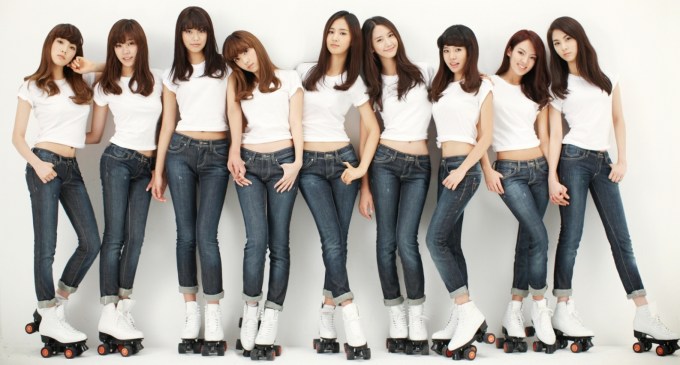
(Source: unknown)

또 하나. 다름 아닌 소녀들 걱정이다. 윤아 걱정, 유리 걱정, 무엇보다 우리 조카를 위해 서현 걱정이다. 어쩌면 이게 제일 중요한 문제일지도 모른다. 나는 소녀시대의 무대를 볼 때마다 매번 이런 생각이 든다. 쟤네들은 자기가 어떻게 소비되는지 과연 알고 있을까? 남성들의 시선과 속마음에 대해서는 얼마나 알까? 만약 알고 있다면 그게 쟤네들이 원하는 걸까? 혹시 기획사의 의도와 속내가 충돌해 괴롭지는 않을까?

이게 무슨 오지랖이냐고 웃을지도 모르겠다. 하지만 ‘소녀들도 이제 엄연한 법적 성인이니까 자기 일은 자기가 알아서 하겠지’라고 안일하게 생각하기에는 아직도 소녀들은 많이 어릴뿐더러 소녀들 개개인의 힘에 비해 시스템의 권력이 너무 크고 거대하다. 또한 ‘자본주의 사회에서 소녀시대 역시 하나의 상품이며 상품이 된 것 역시 소녀들의 선택’이라고 치부하기에는 머릿속에서 ‘인간의 존엄성’이라는 단어가 자꾸만 아른거린다.

서현. 가장 순수할 것 같고 실제로도 가장 어린 서현. 지금, 상처받지 않고 있을까? 그리고 앞으로도 상처받지 않을 수 있을까?

글을 마무리하면서 문득 지금의 내 메신저 대화명을 떠올렸다. ‘소시 앨범 득템! 화보 쩐다.’ 화보가 쩌는 건 사실이지만 아무래도 당장 다른 대화명으로 바꾸어야겠다. 갑자기 이 저열한 욕망의 바다에 물 한 방울 보태기도 싫어졌으니까.

(Source)

One more thing: I worry about the girls of Girls’ Generation themselves. I worry about Yuna, about Yuri, and most of all about my nephew’s favorite Seo-hyeon. This may be the most important issue of all, and whenever I see them on stage I think it: do they know how they are being consumed? Do they know how they are viewed and felt by men? If they do know, is that what they really want? By any chance, do they suffer from their own wishes and their company’s clashing?

People will ask why I worry about them. After all, they are legal adults. Despite that however, the system they operate in is far more powerful. And against the argument that they are in the music industry – just the product of a capitalist society – and that it’s their choice, I still frequently pause to think if it’s not an affront to human dignity.

Seo-hyeon: she looks the most innocent, and in reality she is the youngest too. To her I say are you getting hurt at all now? Or is there any way you can avoid it in the future?

As I was writing this article, I added some words next to my name in my messenger program: “I’ve bought Girls’ Generation new album! Their pictures are fantastic!”. While that is true though, I have to change it. I suddenly really don’t want to add one drop to this ocean of base, vulgar sexual desire. (end)

(Source)

As always, apologies for any errors with the translation (there’s bound to be with something of this length), and I’d really appreciate it if you could let me know if you spot any. And what do you make of Kim Byeong-hyeon’s “confession”?

Or, hell, my own? Not that I think that mine is any great surprise to long term readers of course(!), and I don’t mean to imply that I’m embarrassed at only having Korean female friends now. Indeed, most of my Western male friends here also had equal numbers of male and female Korean friends in their first few years here, only to lose the former for much the same reasons I mentioned earlier; or at least, those that like myself came in their early to mid-20s,and have stayed for 5-10 years since. And they’re by no means gender studies geeks either, although I confess that we do still talk mostly about women when we meet! ;)

What is your own experience? How are things similar or different for Western women here also?

Notes:

1) Rereading this in November 2013, nearly 4 years later, I cringe at the numerous generalizations I make based on only my own personal experience; I would be much more careful to avoid those and/or acknowledge my biases were I to write on the same subject today. On the other hand, unfortunately it’s also true that my personal experience remains largely the same.

2) I also try to avoid the “C word” these days. Although this is hardly the most egregious example, Confucianism is very overused as a catch-all, explain anything and everything device in English-language writing about Korea.

Korean Sociological Image #32: Censorship and Indirect Advertising

(Source: unknown)

Ever find yourself wondering at the logic behind some of the blurring and mosaicing on Korean television?

No, I’m not talking about that recent scene from Chuno involving a fully-clothed Lee Da-hae (이다해) I’m afraid. Rather, the proclivity with which Korean broadcasters will disguise the logos of products visible in television programs. Indeed, it’s so taken for granted here that frankly I’ve had trouble finding examples (without simply watching television and waiting for something to pop up that is).

The reason is to prevent indirect advertising, known as ganjeob gwango (간집 광고) in Korean and PPL (Product Placement, or Embedded Marketing) in the industry. But it is usually ineffective, the blurring in the following segment from the talk-show Giboon Joeunnal (기분좋은날) for instance, or A Day That Feels Good, providing little impediment to this Korean blogger in identifying the brand-name and model of the baby monitor and recommending it to her readers (update: see here for a video that provides a collage of much better examples):

Instead of cases like those though, the majority of articles on the subject discuss deliberate, unedited PPL instead, such as this case with the Bon Bibimbap food chain in the drama City Hall (시티홀), this case with actor Jang Hyuk (장혁) and various Canon cameras in an unidentified drama and film below, and especially a recent episode of the comedy show Paemilli-ga Ddottda (패밀리가 떴다), or Family Outing, in which some Nepa (네파) outdoor clothes were used (see here, here, and here).

Family Outing Nepa(Source)

At the end of that last link, the laws regarding PPL are mentioned, the gist of which is that it should not: influence the content or story of the program; be the focus of viewers’ attentions; be mentioned by anyone in the program; and finally, that the program should not persuade you to buy the product in any way. While all sound reasonable however, they are also very open to interpretation, and Korean broadcasters frequently receive warnings or fines from the Korean Broadcasting Communications Committee for falling afoul of them.

Adding even further confusion to the mix, since 2006 PPL of specifically Korean products has been increasingly encouraged as a means to capitalize on the success of the Korean Wave abroad, one recent example being Kia Motor’s deal to provide cars and other paraphernalia for the hugely popular drama IRIS.

Given that context, then broadcasters’ decisions to ban singer J.ae’s (제이) new album from the airwaves simply because of the lyrics of some songs seems particularly hypocritical:

J.ae’s New Album Rejected by TV Stations

Returning to the music business after three long years must not be as easy as she thought. J.ae’s new special album, “Sentimental,” was ruled unfit for broadcasting by KBS and SBS. MBC is currently reviewing the song to announce the result next week. Broadcasting review panels at the leading national networks said that the lyrics of the title song “No.5” contained direct references to commercial brand names, like Chanel and McDonalds. Network stations are concerned that naming certain brands could cause debates over indirect advertising.

“No. 5” was written by Lee Ji-rin of the indie band Humming Urban Stereo, who was inspired to write a song after seeing an ad about Chanel No.5 perfume on a bus. The song may have succeeded in grabbing the interest of listeners with its unique lyrics, but could not escape from the criticism of indirect advertisement. Jae’s agency said that it’s most unfortunate that her year’s work failed to meet the industry standards, but it will apply for another review after changing some parts of the lyrics. J.ae’s latest album will be out on the market on February 10th. (Source: KBS Global, via Omona They Didn’t)

One wonders what they made of Aqua’s Barbie Girl back in 1997?

J.ae Sentimental .For those of you further interested in J.ae herself, you can read two interviews of her (conducted before the banning) here, and listen to one of the problematic songs No. 5 here (source right: unknown).

Meanwhile, unfortunately this is by no means the first time that artists’ songs have been banned in Korea simply because their lyrics could be construed as PPL, a case involving Epik High (에픽하이) back in April showing that even indirect mention of the artists’ own website can be considered problematic. Moreover, against the argument that both cases are merely inane but innocuous, they do add to the essential arbitrariness of censorship in Korea, English song lyrics acceptable on 1950s American television banned because they could sound vaguely sexual to non native speakers for instance (see #2 here), and accordingly it doesn’t take a great leap of imagination to imagine a time when censors will ultimately use PPL as a convenient excuse to ban a disagreeable but otherwise completely legal cultural product.

Or perhaps they already have? If you know of any previous cases of banning based on PPL, then please pass them on, whether the PPL was used as a ruse or otherwise!

(For more posts in the Korean Sociological Images series, see here)

Korean Sociological Image #31: Gender Roles & Korean Holidays

With apologies to teachers of Korean children everywhere, tired of their Korea Gender Lunar New Yearproclivity for repeating the nonsensical foreign words found in Korean advertisements, there is actually much to be admired in KT’s recent olleh (올레) campaign. For under the rubric da gu-rae-rul dwee-jeeb-ora (다 그래를 뒤집어라), or “turn the things that bug you on their heads,” it has a definite self-depreciating streak, poking fun at various groups of Koreans and their habits in a way that feels curiously similar to British humor (source, right: Paranzui).

Coming from a society notorious for always presenting itself in the best possible light, this is very refreshing.

Examples on TV so far have included: elderly women being encouraged not to all have the same boring, monotonous hairstyle; men to nap on travel rugs in parks with their children playing next to them rather than always lazing around at home on weekends; Koreans not to always say the same reflexive English phrases to foreigners that they learned at school; and employees to choose their own meals rather than meekly ordering whatever the boss is having.

And there are many more like it. But all pale in comparison to the directness of the latest in the series, which targets the disproportionate burden placed women during “holidays” like Seollal (설날), coming up this weekend:

Incidentally, it shows another interesting aspect of Korean society: their lack of embarrassment (some would say alacrity) in showing bodily functions. Already having rather too much of that sort of thing at home with 2 young daughters to look after though, then I’ll wisely refrain from further commentary on that here.

Instead, I’ll look forward to possibly seeing another that covers a second reason many women hate Seollal: if they’re in their late-20s or older, being pestered by their relatives to find a partner and get married, and indeed I have a 29 year-old friend and a 32 year-old sister-in-law that will be staying well away from home because of precisely that. A phenomenon hardly confined to Korea of course, as is women doing more domestic work than men, but then I’d wager that many foreign women at similar ages reading this can attest to the sheer amazement Koreans experience when they learn that they’re not married!

On that note, apologies if all this sounds familiar to many readers. But while the Korean media will be full of similar commentary this week, this is the first time I’ve seen something like it in a Korean advertisement, and as part of a particularly popular series at that. And as they say, a picture tells a thousand words…

Or perhaps there have been earlier ones that I missed, or alternatively others by different companies playing at the moment? Please let me know!

(For more posts in the Korean Sociological Image series, see here)

Open Thread #6

( Source: Fabror Sid )
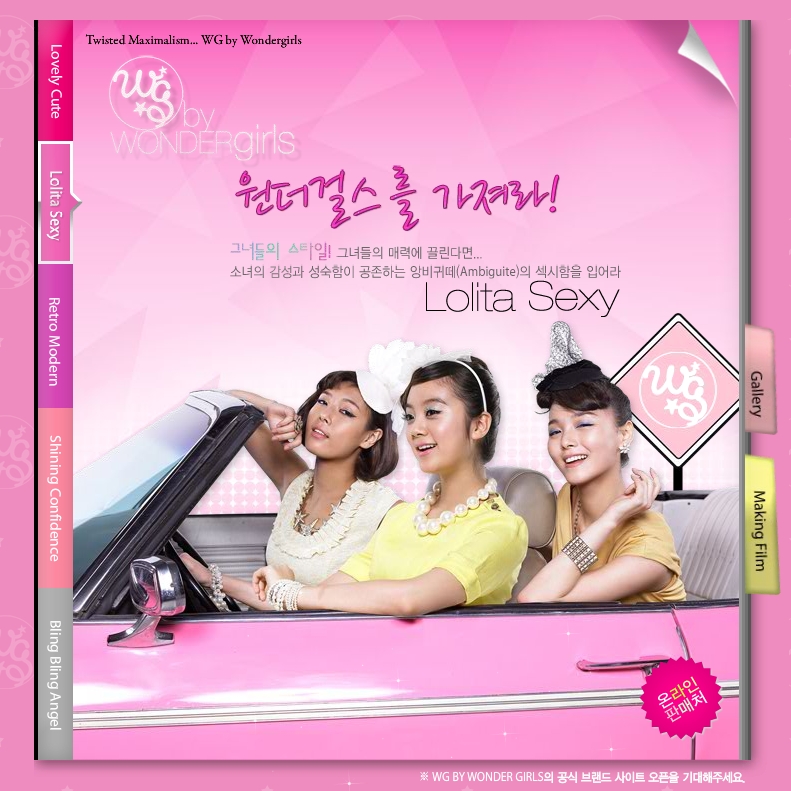
Fashionably late, but I made it! What’s on your mind this weekend folks?

Share

The Kafkaesque Korean Beauty Trends of 2009

(Source: Unknown)

Confused about all the new buzzwords used to describe Koreans’ bodies these days? Here’s my translation of an article that gives a quick guide.

The author implies that most of them arose organically from the public’s interest in certain actors in Korean dramas. Whereas in reality, it’s companies and the media that are overwhelmingly responsible, as they’re in a constant quest to create new consumer trends (read: new reasons for people to feel dissatisfied with themselves). Yet while most of these have no basis in reality, are essentially useless, and/or are so contrived as to be quickly forgotten or ignored, some do stick.

Of those that do though, if they have some English in them then it often makes them more interesting from a sociological standpoint. For whether by accident, mistranslation or design, they both reflect the way the term is already usually misused in Korean and further influence they way in which related English-language popular culture gets filtered into its Korean counterpart.

A good example from this article would be chongsoon-glaemor (청순글래머), or “innocent glamor,” which at first glance doesn’t seem all that strange: in her television commercials for instance, the ice-skater Kim Yuna (김연아) below manages to project an innocent image while having a seemingly glamorous lifestyle (I wonder if she’ll find the former stifling as she grows older however, like actress Moon Geun-young?). But it emerges that “sexy” would be a much better translation of the English word “glamor(ous),” and although I’m sure readers are well aware of the number of ways  in which women are presented as pure and innocent but somehow also lustful in Western popular culture, and effectively are in Korean, there are still problems with assuming that that is what the term means, as the word “sexy” isn’t construed quite the same way here. Instead, we seem to be left with an obscure term for Korean women that look more virginal than normal(?), but yet still do the mechanical “sexy dances” virtually required of them on Korean talk shows.

Anybody with more familiarity with the term and/or the actress Shin Se-kyung that supposedly spawned it, please feel free to correct me on my interpretation: after all, this is the first time I’ve looked at its origins, and just based on one article at that (Update — with thanks to Seamus Walsh for pointing it out, I did indeed make a mistake: “glamor” actually means “busty” in Korean). But with the proviso that the next means I may be cherry-picking the facts to suit my own views, it does still seem very consistent with the Korean media’s overall trend towards discouraging or outright banning of assertive displays of women’s sexuality, i.e. genuinely sexy behavior.

꿀벅지·미중년·꽃남…2009년 연예계 뷰티 트렌드는? 2009-12-31 by 두정아

올해 연예계 트렌드를 이끈 핫 키워드는 무엇일까. 꽃남과 미중년, 꿀벅지, 베이비페이스, 청순글래머 등 어느 해보다 개성있고 다양한 트렌드가 공존했던 한 해였다.

드라마 ‘꽃보다 남자’로 ‘꽃남’이라는 단어가 사람들 입에 오르내렸고, ‘내조의 여왕’의 윤상현은 ‘미중년’이라는 찬사를 받으며 남성들의 뷰티 열풍을 이끌었으며 그룹 에프터스쿨 멤버 유이의 매끈한 허벅지를 일컫는 ‘꿀벅지’와 배우 신세경의 ‘청순글래머’ 등은 여심을 자극하며 바디 열풍을 일으켰다. 여전한 ‘V라인’ 강세 속에 동안(童顔) 열풍 또한 이어져 ‘베이비페이스’라는 단어가 자주 회자됐다.

What were the hot keywords that led trends in the world of entertainment in 2009?

With kkotnam (flower man) and mijoongnam (beautiful middle-aged man), ggoolbokji (honey thighs), babyface and chongsoon-glaemor (innocent glamor) emerging, there were many very distinct trends compared to most years.

From the drama Boys Over Flowers the term “flower man” was on everyone’s lips; from Queen of Housewives the actor Yoon Sang-hyu received a lot of praise for his looks, spawning the word “beautiful middle-aged man” and a strong following among men wanting to emulate him; and women were similarly interested in the After School member UEE’s smooth and velvety thighs known as “honey thighs” and actress Shin Se-kyung’s “innocent glamor.” Finally, in addition to the eternal “V-line,” a strong interest in youthful faces has been shown by the new word “babyface” that is often talked about.

(Source: Unknown)

‘꽃남’·’미중년’, 남성 뷰티(美) 열풍

KBS 드라마 ‘꽃보다 남자’ 신드롬에 힘입어, MBC 드라마 ‘내조의 여왕’ 태봉이 (윤상현 분)가 일으킨 ‘미중년’ 열풍까지 남성들의 뷰티 열풍이 어느 해보다 뜨거웠다. 이를 계기로 남자도 외모 관리를 해야 한다는 인식이 공유되기도 했다.

거친 남성다움보다는 부드럽고 세련된 귀족적인 이미지를 선호하는 분위기로 바뀌며 성형외과나 피부과를 적극적으로 찾는 남성들도 크게 증가했다.

경제 성장을 이루던 90년대에 사회생활을 시작한 현재 30대 후반부터 40대 초반의 중년들은 전통적인 부모 세대와 달리 중년이 돼서도 문화와 여가를 즐기고 자신을 가꾸는 노력에 적극적이기 때문이라는 해석이다.

Combined, the flower man syndrome caused by the KBS Drama Boys Over Flowers and the beautiful middle-aged man craze caused by the character Tae Bong-ee in Queen of Housewives have led to men taking a great interest in their bodies. This is how the notion that men, like women, also have to take care of their bodies and appearance has become accepted wisdom.

In turn, as the preferred image of Korean masculinity has become softer and more polished, refined and noble, cosmetic surgery and skincare clinics are reporting a great upsurge in interest from men.

One additional reason for this is that even though men that grew up and entered the workforce in the 1990s are now in their late-30s and early-40s, they are very different to their parents’ generation, and choose to enjoy culture and their free time more, which includes taking a greater interest in themselves.

‘꿀벅지’ ‘소시지룩’ ‘청순글래머’ 바디 열풍 선도

올 한해 주목할 트렌드는 바디 열풍이다. 소녀시대의 지(GEE) 열풍과 함께 유행한 일명 ‘소·시·지(Gee)룩’. 몸매가 고스란히 드러나는 초절정 스키니진에 타이트한 티셔츠를 입은 여성들이 패션을 주도하면서 여성들의 S라인 욕구는 상승했다.

뒤이어 그룹 애프터스쿨 유이의 건강미 넘치는 탄탄한 허벅지가 주목을 받으면서 꿀이 발린 듯한 매력적인 허벅지라는 뜻의 ‘꿀벅지’라는 신조어까지 탄생했다.

또한 요즘 주가를 올리고 있는 단어는 ‘청순글래머’. MBC 시트콤 ‘지붕 뚫고 하이킥’ 출연하고 있는 신세경은 청순한 매력과 섹시한 관능미를 동시에 지니고 있어 ‘청순 글래머’의 대명사로 불린다. ‘포스트 김혜수’로 주목받으며 휴대전화, 화장품 광고 모델 자리를 꿰차는 등 그 인기를 입증하고 있다.

이에 대해 그랜드성형외과 유상욱 원장은 “과거 여자 톱스타들의 상징이 ‘화장품 모델’이었다면 2009년은 이효리, 신민아, 송혜교, 손담비 등 청바지 모델로 그 중심이 바뀌었다”며 “이 같은 변화는 요즘 대중들의 관심이 바디로 옮겨지고 있다는 증거”라고 설명했다.

2009 was a real year of body trends. First, there was the very popular so called “sausage look” of Girls’ Generation. Hiding nothing, the ensuing fashion of wearing extremely skinny jeans and tight t-shirts among women has sparked an intense interest by women in their S-lines.

(Update — “Sausage look” may be a mistake, as the “소시”, or “soshi”, in “소시지(Gee)룩” is also the Korean shorthand for Girls’ Generation, and the “지”, or “gee”, the name of one of their most iconic songs. So the term may mean “sausage look”, or it may mean, literally, “how Girls’ Generation looked in the Gee music video”, in which they happened to wear skinny jeans. Either way, it’s a good pun!)

Next, as a lot of interest in After School member UEE’s firm, smooth and very healthy-looking thighs emerged, the new word “honey thighs” was coined to describe thighs like them.

Another word that’s stock is rising is “Innocent Glamor.” This comes from the actress Shin Se-kyung that appeared in the MBC sitcom High Kick Through The Roof, described as the icon for women who combine a pure and innocent image with sex appeal. Considered a second Kim Hye-su also, because of her popularity she regularly appears in cellphone and cosmetics commercials.

According to “Grand Cosmetic Surgery Clinic” owner Yu Sang-ok, “in the past the symbol of top female stars was the cosmetic model, but in 2009 women like Lee Hyori, Shin Min-ah, Song Hye-gyo and Son Dam-bi have been mostly modeling jeans instead,” and “this is proof that the focus of people’s attention has moved to star’s bodies now.”

(Source: Naver)

‘V라인’ 강세, ‘베이비페이스’가 위협

올해도 ‘V라인’ 강세는 여전했다. 뭐니뭐니해도 ‘동안’, ‘V라인’, ‘작은 얼굴’은 사람들이 가장 선호하는 이미지이기 때문이다. 갸름하고 부드러운 V라인은 첫인상부터 편안하고 친근한 장점도 있다.

MBC 드라마 ‘선덕여왕’ 미실 역의 고현정은 소름끼치는 연기와 더불어 나이를 가늠할 수 없는 ‘베이비페이스’로 주목을 받았다. 투명한 피부는 물론, 볼륨감이 그대로 살아있는 생기있는 얼굴은 아기 피부 같다는 찬사를 받았다.

‘베이비페이스’는 ‘어려보이면서 입체적인 얼굴’을 말한다. 그 특징은 얼굴 옆이 아닌 앞쪽으로 볼륨감이 살아있는 얼굴로 콧등의 높이와 균형을 이루는 부드러운 곡선 모양의 탐스러운 이마 그리고 갸름하고 조금은 짧은 듯한 턱 선이 생명이다. 이러한 ‘베이비 페이스’의 열풍은 2010년에도 지속될 것으로 전망된다.

Last year, the emphasis on the V-line remained unchanged. After all, the preferred image is to have a dongan “youthful face [for one’s age],” V-line, or jakkun-olgool “small face.” And if you have a long, slender face with a V-line, people’s first impression of you will be softer and friendlier.

Hence the interest in the “Babyface” of actress Ko Hyeon-jeong, who played the character Lady Mishil in the MBC drama Queen Seon Duk, and whose acting was so good that she gave viewers goose pimples. With clear skin and glowing, firm cheeks, she has received a lot of praise for having a face as good as a baby’s.

But a babyface has been described as a “solid, 3D face.” In particular, it’s not just the volume of the cheeks on the side but also the balance with the bridge of the nose, the softness of the curves and the desirability of the forehead that make it look youthful. They look set to remain popular in 2010. (end)

(Source: Naver)

Like I said in an earlier post, I was embarrassed at not realizing how sexist the term honey thighs was when I first heard the term, but I doubt I would have if they’d been described like that instead. And continuing with the theme of  sexual discrimination, I was surprised not to see “chocolate abs” for men also; unlike the commercial that spawned it, perhaps the term itself is more 2010 vintage?

Regardless, please let me know if you can think of any others, and especially if you have alternative explanations for where any of the above ones came from!

Oh? Oh…!

( Source )

Call me old-fashioned, but although music videos can have a huge effect on my enjoyment of songs, I still try to judge them on their own merits.

By that criteria, all of Girls’ Generation’s hits have fallen flat for me, no matter how photogenic the girls are. But then I found a remix of their latest hit Oh! by the Greek trance DJ “Areia”, and I immediately fell in love with it.

Like he says on his blog, he put a lot of work into it. And it shows.

True, it’s actually the only one of his K-pop remixes that I like, that of Abracadabra (아브라카다브라) by the Brown Eyed Girls being particularly disappointing. But I’ve only listened to a handful so far, and his abilities are definitely improving over time. To any other Korea-based trance fans out there, frequently lamenting at how something so popular in Japan could be so completely absent from the cultural radar here, I’m sure you’ll be just as happy as I was to have found him!

For the lyrics (and a translation) to the song, see Yeeun2Grace here, and if you’re interested and haven’t seen it already, then this video (via Extra! Korea) makes a pretty compelling case that the song has been plagiarized from U.S./Barbadian singer Rihanna’s Shut Up and Drive. If you’re disappointed in my not providing my usual critical analysis on this occasion though, then I apologize(!), and by all means read precisely that at Appears.

But if you’d still like to watch the original video, albeit now with the trance remix, then I do understand:

Click on the video itself to be taken to Ariea’s YouTube page, which has a playlist of his other K-pop remixes.

Update: There’s been a lot of speculation in the comments as to why the video’s concept is of cheerleaders hoping to get the attention of American footballers, simply bizarre considering that the sport has virtually no following here. So I posed the question to my two classes earlier today, and the combination of their explanations proves to be quite compelling.

First, my morning class mentioned the success of the movie Bring it On in 2000, particularly the song Hey Mickey from the soundtrack, and this struck a chord with me because men who would have been in their late-teens and early-twenties back then were precisely the demographic that SM Entertainment created Girls’ Generation for (indeed, Girls’ Generation has performed the song many times). While that may just be coincidence though, they also said that high school footballers dating cheerleaders have been a staple of American movies and dramas they’ve watched ever since, and they were at a loss for an equivalent in Korean pop culture.

My afternoon class disagreed that Bring It On was popular however, and this is borne out by the box office figures for that year. Instead, they pointed out that all Korean cheerleaders are adults, and so although the youngest members of the group are in fact turning 20 this year, to have presented them as Korean cheerleaders pining after Korean baseball or basketball players would have clashed with their image of being precocious teenagers. Recall that the song itself is about unrequited love for an older male too, which the exaggerated youth of the women singing it would help to emphasize.

In short, cheerleaders for high school American footballers were the only possibility because there are no teenage cheerleaders in Korea.

But my two classes’ explanations are not mutually exclusive of course, nor with some of the alternative explanations posted in the comments section here either. While I would like to corroborate them though, unfortunately analysis like that is severely lacking on the Korean internet, so that might have to wait until I investigate next month’s music magazines.

Meanwhile, I’m quite convinced personally, but what do you think? Please let me know, and perhaps I can get a dialogue going with my students!

Update 2: Despite 1 billion won (US$860,000) being spent on Girls’ Generations stage costumes last year, apparently there was little money available for making some props for this music video, so some store-bought ones with the Iowa Hawkeyes logo were used instead. You can just imagine the reaction of Hawkeyes fans

Share

The Dire Need for Sex Education in South Korea

(Source)

As you probably suspected, only a very small percentage of Korean teenagers are having sex. The average age that they started though, was as young as 14, and that doesn’t just affect them academically.

Or at least, that’s the take-away message of the news article below, which I was pleasantly surprised to see on the front page of Yahoo! Korea last week. Unfortunately it is rather sloppily written, raises more questions than answers, seems to ignore teenage prostitution and – in a typical irony – required age verification to search for it again the next day, but I’m cautiously optimistic that the information will lead to more calls for improved sex education at Korean schools. After all, it can hardly get any worse.

이른 성관계가 아이들에게 미치는 영향 – The Effects of Having Sex at an Early Age

“어린나이에 갖는 성관계는 아이들에게 어떤 영향을 끼칠까?”

얼마 전 청소년들이 성관계를 시작하는 평균 연령이 14.2세며 피임율은 38%에 불과하다는 조사결과가 발표되면서 우리나라 청소년들의 성 노출 연령이 점차 낮아지고 있음이 드러나면서 청소년의 성 문제가 다시 한 번 대두되고 있다.

대한산부인과학회지에 실린 ‘한국 청소년들을 대상으로 한 성행태 조사’에 따르면 2006년 9월 13~18세 중·고등학생 7만1404명 (남 3만7420명, 여 3만4200명) 을 조사한 결과 청소년의 성관계 시작 연령은 중학교 2학년인 14.2세(남 14.0세, 여 14.5세)였다고 밝혔다.

이들의 성관계 경험률은 5.1% (남 6.7%, 여 3.4%) 였으며 성경험자의 피임률은 38%에 불과했다. 또한 성관계 경험 여학생의 14%는 임신 경험이 있었으며 이 중 85%가 임신중절수술 경험을 했다.

청소년의 생식기는 생물학적으로 완전히 성숙된 단계가 아니기 때문에 바이러스가 침투하면 대항할 힘이 부족해 이른 성경험은 자칫 자궁과 생식기의 건강을 위협할 수 있고 여자의 경우 자궁경부암의 발병확률이 급증 할 수 있음을 전문가들은 충고했다.

“What are the effects of having sex at an early age?”

The results of a survey on adolescent sexuality released some time ago shows that the average age that adolescents are exposed to sex is gradually lowering over time. Of adolescents that have already had sex, the average age that they lost their virginity was 14.2, and only 38% of them used contraception. This is making teenage sexuality become a pressing social issue again.

According to the “Survey of Korean Adolescents’ Sexual Activity” published in The Korean Gynecological Journal, of the 71,404 13~18 year-old middle and high school students surveyed in September 2006 (37, 420 boys and 34,200 girls), the average age that they lost their virginity was 14.2, which is the second year of middle school (boys at 14.0, and girls at 14.5).

Of those students surveyed, 5.1% had sexual experience (boys: 6.7%, girls 3.4%), but only 38% of them had used contraception. Also, 14.1% of those girls had gotten pregnant, 85% of whom had an abortion.

Having sex before the genitals are fully developed means that the body’s ability to fight off viruses and repair damage to them is insufficient, and in particular girls have a much greater chance of developing cervical cancer.

이른 나이에 성관계 갖은 아이들, 대학 못간다 – Adolescents That Have Sex Don’t Want to go to University

완벽하게 몸이 성장하지 못한 상태에서 갖는 성관계는 신체적인 악영향을 끼치기도 하지만 더 심각한 것은 심리적인 부작용이다.

영국 글래스고대학이 지난 6년 동안 5000명의 학생들을 대상으로 성관계와 학업성취도의 상관관계를 조사한 결과 남녀 청소년 모두 이른 성경험이 자신을 어른처럼 느끼게 만들어 학업 등에 소홀해지는 경향을 보였다는 연구결과를 사춘기저널(Journal of Adolescence)에 발표했다.

연구는 14~18세 사이의 청소년들에게 성관계를 가진 그룹과 그렇지 않은 그룹을 나누어 계속 학교를 다닐 의향과 장래희망의 변화여부 등에 대해 묻는 방식으로 진행됐다.

연구결과 16세 이전에 이미 섹스를 경험한 청소년 중 39%가 대학 진학 등 학업을 더 연장하고 싶은 생각이 없다고 대답했으며 성경험이 없는 학생들은 24%만이 학업연장에 대한 뜻이 없는 것으로 나타났다.

앨리슨 파크스는 “청소년기에 성경험을 가지게 되면 더욱 이성과 함께 있는 시간을 원하는 것으로 나타났다”며 “일찍 성을 경험한 남녀 모두 마치 자신이 선구자인 것처럼 행동하는 경향을 보였다”고 말했다.

(Source)

While having sex before one’s body is fully developed is bad physically, the mental side effects are far greater.

A study of the sexual experiences and academic accomplishments of 5000 adolescent boys and girls conducted for the last 6 years by the University of Glasgow, published in the Journal of Adolescence, shows a negative relationship between the two. In short, adolescents with sexual experience tended to feel that they were already adults, and so paid less attention to their studies.

The study’s method involved dividing 14~18 year-olds into two groups: those with sexual experiences and those without, and asking each about their plans for the future. Of the 16 year-olds that had already had sex, 39% said that they had had enough of schooling and did not plan to go on to university, but only 24% of virgins felt the same way. According to Alison Parkson, this was partially because “those adolescents that first had sex at an early age wanted to spend more and more time with members of the opposite sex,” and that they “felt that they were pioneers.”

성관계 그 후, 밀려오는 불안감 – Anxiety and Depression After Having Sex

충동 에 이끌려 성관계를 맺은 후 정신적으로 미성숙한 아이들에게는 그제 서야 불안감이 물밀 듯이 밀려온다.

우리나라에서 청소년 시절에 성관계는 물론 이성교제 역시 불건전하고 몰래해야한다는 인식이 사회전반에 깔려 있다.

즉 아이들에게 이성과의 관계는 일종의 ‘죄’라는 이미지가 강하기 때문에 이성교제나 성관계가 이뤄지는 것은 단연 어른들의 눈을 피한 탈선의 상황에서가 주를 이루게 된다.

게다가 신체적으로는 임신이 충분히 가능한 나이고 또 그것을 본인들도 인지하고 있기 때문에 심한 불안감을 겪게 되는 것이다.

상담21성건강연구소 유외숙 박사는 “아이들은 무방비하게 인터넷에 노출되다보니 실제적인 것이 어떤 느낌을 줄까 하는 호기심과 욕구에 사로잡히게 된다”며 “그러나 섹스를 하고 돌아서자 마자 ‘임신했을까, 만족을 못시켰을까, 부모님에게 알려질까’ 등의 불안감이 찾아오기 때문에 자기평가가 상당히 낮아지게 된다”고 설명했다.

유 박사는 이어 “게다가 이런 고민들을 해결 할 곳이 필요한데 실제 청소년들이 문제를 들고 찾아갈 만한 곳이 없어 혼자 앓게 되는 경우가 많다”며 “이런 불안감이 심해지면 대인기피증이 생기거나 정말 성관계가 필요한 시기가 됐을 때 제대로 된 성생활을 못하게 되는 경우도 있다”고 덧붙였다.

(Source)

Adolescents that act on their urges to have sex before they are mentally ready for it tend to have feelings of anxiety, uneasiness and depression afterward.

In Korean society, there is almost a universal taboo against adolescents dating, meaning that they have to do it secretly. Indeed, having sexual relationships or even dating the opposite sex is virtually considered a crime by adolescents here, and hence that that which does occur is in places far from the eyes of adults.

In addition, as the girls are aware that there is a chance that they might get pregnant, then they in particular suffer a great deal of anxiety and depression.

According to Dr. Yu Wae-sook at Consult 21 Sexual Health Research Institute, “adolescents are defenseless against what they see on the internet, and naturally get caught up in and want to physically experience those things for themselves,” but also that once they do, “they worry about such things as if they are pregnant, if they were good enough and if their parents will somehow find out. This causes them a great deal of anxiety, and lowers their self-worth and confidence.”

Moreover, “adolescents don’t really have anywhere or anyone to go to for answers, and so have to continue worrying about them alone” and “that these worries can become so serious that they become reclusive. This can have grave consequences for their future sex lives once they reach an age when they would normally be physically and emotionally mature enough to start one.” (end)

(Source: Unknown)

As always, please feel free to correct any mistakes above, which is by no means a literal translation.

For more information about the issues raised, see here for a related survey conducted in 2003 and my analysis, and Matt at Gusts of Popular Feeling here for his on similar surveys conducted in late 2008; you may also find this recent post of mine on the Korean age of consent interesting. Meanwhile, I will try to find out more information about the survey itself in the next few days, particularly the methodology used!

Open Thread #5: So What?

Photo(edited) by Marco Xu on Unsplash

To get you started, a provocative comment I just received on an old post, which would be wasted in obscurity there. With apologies to the author if this sounds impolite, but I ultimately find much of his argument superficial, although it’s always good to have one’s views tested:

…Hi, just stumbled on to your blog last night in between reviewing flashcards for my Chinese class, and I have to say I’m thrilled to find someone as interested (at least in this and recent posts) in the topic of standards of beauty, particularly in Korea. I do however have to argue a point. And this isn’t necessarily aimed at you personally or the views you hold, but you seem to be a willing enough participant in the discussions that occur because of your blog posts that I though I’d give it a shot.

Looking back over said “beauty” posts, I continually find myself asking, “so what”? So what if Koreans openly put an exceptionally high standard on external appearance? So what if women in Korea try to become most easily divisible by which letter they most look like? So what if even kids are targeted by the media in what amounts to little more than marketers seeking the widest possible audience?

Is all this something that doesn’t happen in western countries? You yourself have said that it is not.

Granted, I come from something of a biased perspective in a number of ways. First of all, I don’t think of women in ad campaigns, subconsciously or otherwise, as sex objects because I’m gay. Secondly, from my “objective” perspective on feminine beauty, I tend to lean more towards the thinner, petite side of women that are shown so ubiquitously in magazines from Vogue downwards. Thirdly, as someone who has been very tall (6′5″, so ~195cm)and called thin all his life almost in place of standard introductions, I can see where all of the body-consciousness in our society comes from; it’s only natural to judge someone first and foremost on appearance.

Source: unknown

Anyway, back to the gist, I have to say, is it a bad thing that Korean ad firms target womens’ physical appearance so blatantly? After all, at least it seems as though a Korean woman knows what’s expected of her in terms of appearance. In the West, on the contrary, we constantly say that size doesn’t matter, which we know perfectly well to be false. Heterosexual males may not be as turned on by a 100lb, 170cm woman as they are by one maybe 20lbs heavier, but the upper limit to what most males find attractive, by my subjective observations, is significantly lower than what the average woman in the U.S. (my country of residence) now weighs. Because we’ve told women (and men) that size doesn’t matter, things have, to be polite, gotten out of hand. According to the U.S. gov’t, which calculates these things based on body-mass index (admittedly a very poor way of doing so, basically just weight divided by height), more than two-thirds of women in America are overweight.

Although of course there are exceptions, in most East Asian countries overweight and obese people, particularly women, are fairly rare. I think in part it’s because the culture in that part of the world (yay generalizations!) says outright that size does matter, whereas we say it doesn’t, but really it still does.

In short, long-winded post aside, I’d rather be in a country where people say to my face that I’m fat instead of whispering it to each other as I walk by. At least that way, the social pressure to be thin is so much greater and clearer that it can’t be overlooked or downplayed to save face for those applying that pressure. And in terms of health, I think more would rather be underweight than overweight. After all, eating disorders affect, what, about 10% of women in the U.S., while obesity-related diseases kill millions each year. Just from the perspective of someone living in the U.S., I think maybe being a bit more upfront about the natural inclination towards “thinner” (when compared to the national average) women may not be such a bad thing after all.

Then again, having never been to Korea, you’re more able to say whether this is quite so helpful there as it would be here. Of course, culture aside, that brings us to the question of whether certain ethnic groups are naturally thinner or not, which is another issue entirely of questionable validity and fairness…(end).

Source: Cocofun

Actually I don’t disagree with all of that, and by coincidence its “so what?” tone struck a chord with me because of some similar advice about writing I’ve been putting into practice in recent months. Unfortunately, I feel too guilty about my daughters being glued to the television for hours to provide a proper critique this weekend sorry, and will have to rely on my choice of accompanying images to speak for themselves. Besides which, I’m much more interested in what you think!

If you reside in South Korea, you can donate via wire transfer: Turnbull James Edward (Kookmin Bank/국민은행, 563401-01-214324)

Sex and the Red-Blooded Woman

Remember these?

I first came across them back in 2008, the first time I really tried to understand Korean women’s penchant for skin-whitening. While it turns out that I originally misinterpreted what the images above were, from a 2005 study of the relationship between female attractiveness and hormones, one of its conclusions remains the same: the redder a women’s cheeks, the sexier.

In brief, the images are 2 composites made from 2 separate groups of 10 women each from the study (out of 59), all taken on the days they were ovulating, i.e. when they were most likely to get pregnant. On the left is that of the 10 women with the highest estrogen levels on that day in their menstrual cycles, and on the right of the 10 women with the lowest.

It sounds mean to the latter, but I’m sure there’d be little argument as to which women are the more attractive.

While I’ve touched in passing on the role of hormones in human sexual attractiveness many times before however, most notably the fact that women with (arguably) universally-attractive hourglass figures have much more estrogen than those with other body shapes, making them up to 3 times more likely to get pregnant, I don’t mean to imply that one’s preferences in the opposite sex are nothing but a reflection of their hormone levels.

Source: Pixabay @Pexels.

For example, all things being equal, then men with high testosterone are better mates for women, as that is a good indicator of physical health. But while a great many women might find men with “masculine” jaws like Harrison Ford irresistible however, that is not the same as saying that they would automatically choose to have children with them over more “feminine” men, as those same high hormone levels tend (and I stress, only tend) to make them poorer fathers relative to their more average rivals.

But ideally, women would get pregnant by the hunks, and trick other men who were better fathers into raising them, thinking they were their own. And one way in which men try to prevent this is by spending much more time with their female partners when they are ovulating, thereby ensuring that they don’t get a chance to have flings with those dashing Harrison Ford types just when they’re most tempted to. (Women in heterosexual relationships, take note of the extra attention right about the same time you feel like a night out with the girls!)

On the women’s side, one way to ensure that he doesn’t have flings when you’re having your period, thereby potentially having children with other women who will take some of his time and resources away from your own, is to trick him into thinking that you’re actually ovulating instead. And how best to do that?

Well, remember those red cheeks in the opening image?

I confess, I haven’t actually had many conversations with women about why they wear blusher, and invariably they’ve just said they do so out of habit, and/or that it makes them look prettier. And indeed it might, in the sense that if one associates red and pink with femininity (for whatever cultural and/or biological reasons), then wearing it would certainly make one appear more feminine. But in a new study by Ian Stephen and colleagues at the University of St. Andrews in Scotland, one more very good reason to wear it has been revealed. In short, as Jina Pincott at Love, Sex, Attraction…and Science explains, they:

…recruited volunteers of various races and asked them to digitally adjust the color tone on more than 50 faces [of both sexes] to make them look as healthy and attractive as possible. Volunteers consistently added more red coloring to the cheeks — whether the face was Caucasian, Asian, or Black. The redder the face, the more suggestive it is of oxygen-rich blood reaching the skin. The more oxygen-rich blood, the more suggestive it is of the person’s general health and youth. An old person, a sick person, a person with hypertension or bad circulation…will not get rosy-cheeked.

And crucially, the researchers also found that volunteers preferred women over men with rosy cheeks. Why?

One reason may be the sex hormones, which show up more obviously in flushed female faces. But it may also be due to the fact that men already have ruddier faces than women do — they have higher levels of hemoglobin and arterial oxygen content in their blood. As a result, the male blush is not as obvious a cue of good health and high sex hormones.

Corroborated by this study that I discussed back in May, which showed that people tend to judge the same androgynous face on left as female because it is much lighter than that on the right:

In my view then, and regardless of my opinions on its origins, skin-whitening is an enduring but fundamentally anti-instinctive cultural practice. Or is it?

Despite all the above, please bear in mind that interpretations and explanations of otherwise objective studies of human attractiveness can in practice be very culturally determined…not least my own. For example, as an impressionable 19 year-old I became a huge fan of evolutionary psychology after reading this article in Time magazine in 1995, and in turn the sociobiological explanations of human attractiveness that are its bread and butter. But just 4 years later, I was suitably chagrined by a second article in the same magazine that exposed the fact that, for one, evolutionary psychologists’ depictions of the work division in hunter-gatherer societies was remarkably like that of 1950s suburban nuclear families. More recently, Bad Science provides a scathing critique in much the same vein, including of some of the specific points I’ve mentioned in this post, and while I share many commenters’ concerns that author Ben Goldacre doesn’t seem to appreciate the differences between media reports on evolutionary psychology and the discipline itself, he does make some valid points.

So please feel free to question anything here yourself also! And I have a request: while writing this post, I realized that I’ve never actually asked any Korean men themselves if they prefer women with light skin, let alone why. With apologies for my lack of field research then, can anyone that has please let me know? I have a sneaking suspicion that it might pressure to do so might primarily come from other women rather than men, just like I recently read somewhere is the case with losing weight, so I’d be very interested in finding out.

If you reside in South Korea, you can donate via wire transfer: Turnbull James Edward (Kookmin Bank/국민은행, 563401-01-214324)