How Many Unmarried Koreans Live Away From Their Parents?

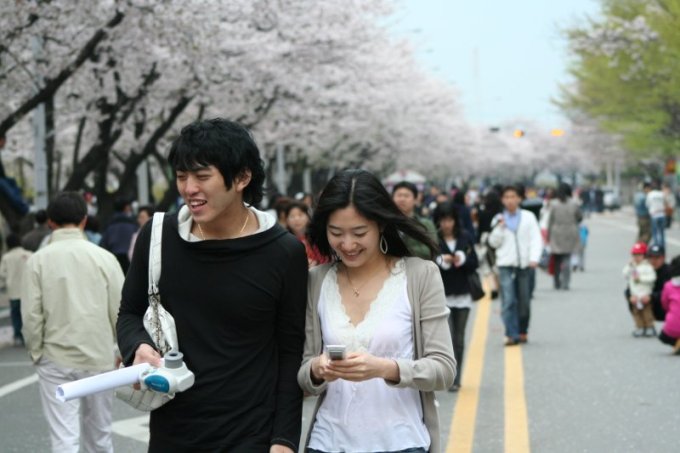
Korean couple(Source: Hojusaram; CC BY-SA 2.0)

Let me take that break this weekend by posing a couple of questions to readers for a change: if you have a Korean partner, but aren’t married, do you live with him or her? And if so, do his or her parents know about the arrangement? Or is it a secret, which is what I expect most of you to say?

I say that because it’s been nine years now since my then girlfriend moved in with me back in Jinju, and I remember how for the next four years until our marriage she was determined to keep it a secret from her parents, who still think she lived in a “one-room” (원룸) with her younger sister all that time. Fortunately, they and most of her relatives were farmers who lived an hour’s bus-ride out of town, so it was only on the very rare occasion when we were out together that her spotting one in the distance had me hurriedly climbing over walls and up trees to get out of sight. Literally and figuratively then, Koreans’ conservative attitudes to cohabitation was the first cultural difference I really grappled with, and truthfully it was what ultimately inspired to me to start this blog too, my bristling years ago at most Koreans’ blanket assertions that conveniently ill-defined—yet somehow also timeless and unchanging—”Korean culture” was responsible for them, and my wanting to dig deeper.

In reality though, it doesn’t take half an hour up a tree dwelling on the subject to demonstrate that extremely high security deposits demanded of tenants, combined with absurdly low wages provided by part-time jobs, would make living away from home next to impossible for most young people. Change either economic disincentive though, then despite cultural prohibitions, in my experience many young Koreans can, will, and do leave the stifling confines of their homes the instant they’re given the opportunity.

Those young Koreans that can’t live away from home though, must reconcile themselves to the fact, and so by their mid to late-20s — when they do have the means to leave — I find that (as a psychological coping mechanism?) they can ironically often end up being among the stoutest of defenders of living with their parents instead. Hearing it from men specifically though, I don’t need to invoke that notion, for there is plenty of truth to the stereotype that they have all the comforts of having their housework done for them and with none of the restrictions applied to their sisters; hell, in their case I’d probably stay at home too. But a defense of the arrangement from the latter? Of the curfews often applied on them, and parents’ expectations that after working hard studying and/or pursuing their careers during the day, that they still should have to do a load of housework once they arrive home at 11pm? That will never cease to amaze me, and if I know that a Korean woman has the means to leave home but still tolerates such living arrangements, then in all seriousness we could never be friends: I’ve just had too many experiences of feeling like I’m talking to a 27 year-old teenager, and/or of wanting to grab her and shake some sense into her, demanding that she stop moaning to me about her mother and take some control of her life.

(Update: I should probably add that I find it just as difficult to be friends with men living at home too though, my respect also not extending to anyone who expects to go through their entire life with their mothers and then their wives doing all their housework for them!)

To be fair though, the “That’s Korean culture” mantra is a useful device with which to silence know-it-all foreigners, often happy to provide Koreans with their profound insights into Korean society after *cough* less than two weeks in the country, and as an immigrant to both countries I’m familiar with similar responses in Australia and New Zealand too (I’m sure it’s a universal tendency really). And while most Koreans outside of sociology departments naturally haven’t spent all that much time thinking — up a tree or otherwise — about why adult Koreans tend to live with their parents, it has to be said that when the subject came up in conversation (as it had a tendency to do so with me), that actually they did usually agree with my arguments that economics had quite a bit to do with it.

People thinking I’m right because I’ve paid more attention to the subject than them isn’t quite as satisfying as having the evidence to prove I’m right however(!), so although I put that specific topic on the backburner long ago, my ears still always prick up at any mention of related statistical data, although as I discovered recently, there’s much less of that than you might think. Hence I got quite excited when I came across this in today’s Korea Herald:

Seoul TiltshiftOne-person homes rise to 20%

By Kim So-hyun (sophie@heraldm.com)

One-person households accounted for a fifth of all households in Seoul, according to a report released yesterday by a city-funded research institute (source, right: Jude Lee; CC BY 2.0).

Some 675,000, or 20.4 percent of the total households in the capital, were people living alone, according to the Seoul Development Institute.

The SDI categorized those who live alone into four groups of professional singles, jobless youth, people who got divorced or had separated families, and senior citizens aged 65 or more.

“The percentage of one-person households is expected to reach 25 percent by 2030,” said Byun Mi-ree, an SDI research fellow who wrote the report.

She noted that the city needs to come up with matching policies such as supplying a wide variety of small homes, creating more jobs for unemployed youth, helping unstable singles rebuild families and assisting senior citizens in poverty.

The number of white-collar, professional singles has constantly increased since the mid-1990s along with the changing views of marriage, social accomplishment and individualism, according to the report.

Others increased as well with the tight job market, the aging society and the rising number of children leaving home with their mothers to study abroad.

Forty-five percent of the one-person households earned less than a million won per month. Seventy-six percent made less than 2 million won per month.

More than half of the people who live alone had blue-collar jobs such as sales service (26 percent) or manual labor (10 percent).

Fifty-one percent said they mostly used the mass transportation systems and lived along the subway line No. 2.

Yes, I expected a breakdown of the numbers of those “four groups of professional singles, jobless youth, people who got divorced or had separated families, and senior citizens aged 65 or more” too, and have to wonder what the point of one-person households as a unit of analysis is, given how disparate the make-up and needs of each of those groups mentioned above are. At first I was very curious that there was no mention of middle-aged “lonely goose fathers” (외기러기) too, who live and work in different cities during the week and then return home to their families on the weekend, but then I realized that the concentration of wealth and educational opportunities in Seoul would mean that when those fathers that were already living there were, say, transferred to a branch office, it was logical for the family to remain behind. I couldn’t imagine a family not following a father’s new job in or transfer to Seoul though, so although many Seoulites will indeed be lonely geese fathers, while they’re actually there they wouldn’t count as one-person households (but see here for some information on their numbers that I did find).

So, I checked out the Korean report from the Seoul Development Institute itself , and although it’s quite comprehensive, unfortunately that doesn’t have any figures either! I’ll keep an eye out for them any new reports from the SDI though, which I’m glad that the Korea Herald made me aware of, but in the meantime…then I guess I should provide an apology for not providing an actual answer to the question I pose in the post title. But if you did want to know then I’d genuinely be surprised if you weren’t also interested in the above report too, so *ahem* please forgive the slight subterfuge on my part? And regardless, please do pass on your own experiences of cohabiting in Korea, for my own opinions on the issue, first forged up a tree over nine years now, may well be in some serious need of updating!

Korean Gender Reader

(Source: Soompi)

Sorry for the slight delay this week, but I thought that I’d delay publishing until most of my readers were back home from their New Year trips!

1. Korean Films to Get Racier

As reported by Robert Koehler here, the Supreme Court recently “ruled in favor of the import and distribution of U.S. film Shortbus, annulling the “restricted screening” rating imposed on the movie by the Korea Media Rating Board….Restricted screening virtually means a film cannot be screened in regular movie theaters. Thanks to the court’s ruling, Shortbus can be screened in cinemas.”

Given that “the controversial movie graphically portrays non-simulated sex scenes,” then I concur with the Chosun Ilbo’s opinion that “Korean films are likely to feature more vivid depictions of sex from after the ruling.” But while images or depictions of genitalia or pubic hair were previously illegal in Korea (outside of traditionally defined art that is), the internet has long rendered access to uncensored pornography a moot point. So how is this ruling at all significant, especially in a feminist sense?

Well, this may sound like a bit of a leap at this point, but despite their stereotype of consensus and passivity, Korean adults have actually long complained that the current restrictions leave them feeling as if OMGthey’re being treated as children. In the same vein, as you read about the events of the past week and a half below, please bear in mind that much of what I describe could have been considerably ameliorated or even prevented by Koreans acknowledging that sexuality, particularly female sexuality, is not suddenly turned on like a light upon one’s wedding night (nor just as suddenly turned off after a women’s first pregnancy either). This ruling then, if it’s too much to say is an indirect recognition of that, is at least a step in the right direction, potentially with a great impact on people’s mindsets (source, right: Jeff Kramer; CC BY 2.0).

2. First Korean Man Convicted of Spousal Rape Commits Suicide

This was big news at the beginning of last week of course, but as I’ve already provided commentary on the conviction and then on the suicide itself though, all I really have to add to the links in those posts are this one providing brief translations of Korean opinions on events, and Baltimoron’s analysis here, who notes that, unfortunately, the Korean Bar Association is still opposed to recognizing marital rape as a crime.

Having said that, I must admit that I was still quite shocked to learn that marital rape wasn’t even a crime here. In my defense though, neither did Michael Hurt either, who’s been blogging about similar issues for much longer than I have. But rather than rendering any previous observations of his on the subject moot however, in fact this new information strengthens them really: consider these two passages of his on the UN’s measurements of Korea’s Gender Empowerment Measure (GEM) in 2001, written in 2006 and 2004 respectively.

The countries were all ranked in a 2001 UN study according to standard of living (Human Development Index or HDI) and that GEM stat. Funny thing was, Korea was one of the countries that had a higher standard of living, but whose GEM was waaaaay off from that ranking. You see, most developed countries in that study had numbers that kind of made intuitive sense, with GEM rankings that kind of matched – not in a direct correlation, but generally – the overall economic and political development of the country

Not Korea.

Here are Korea’s peers in the 60’s to the end in the 2001 study. On the left is the HDI number, to the right of the country the GEM.

  • 75 Ukraine 61
  • 88 Georgia 62
  • 30 Korea 63
  • 130 Cambodia 64
  • 48 United Arab Emirates 65
  • 96 Turkey 66
  • 99 Sri Lanka 67
  • 120 Egypt 68
  • 139 Bangladesh 69
  • 148 Yemen 70.

And as he put it two years earlier, here’s what a HDI of 30 but a GEM of only 63 implies:

…the US is ranked 10th, Japan is ranked 44th, Thailand 55th, Russia 57th, and Pakistan 58th. The only other countries that actually managed to score behind Korea were all places in which women’s inequality is overtly and sometimes even brutally enforced; in ascending order of GEM rank: Cambodia, where domestic violence is not even legally a criminal offense, starts the slide down at 64th. The United Arab Emirates, where a man can still legally take up to four wives, is next, and Turkey, where “honor killings” of women who have had the audacity to be a victim of rape are still often murdered by male relatives, takes 66th place. Sri Lanka follows, with Egypt, Bangladesh, and Yemen bringing up the rear, last out of of the countries measured.

3. Protest Against Advertisements for Brothels in Major Korean Newspapers

I’ve been a big fan of utilitarianism ever since I was an undergraduate, and so regardless of the abstract ethical rights or wrongs of most issues, I do tend to weigh on the side of whichever provides “the greatest good for the greatest number.” So while their are many reasons I am pro-abortion, by far the main one is the simple fact is that if it is made illegal then a great many women will die at the hands of backyard abortionists. Similarly, Korea provides a compelling argument for the legalization of prostitution, for the women themselves are definitely the primary victims of the inconsistent and arbitrary ways in which prostitution laws are applied here. And what better symbol of those than advertisements for illegal brothels…from the website of a newspaper which often castigates prostitution on the front pages of its print edition no less? As KoreaBeat explains, who translated some examples:

Back in November a group of Korean feminist organizations came together to protest what they called “the practice of the top media outlets in Korean society of allowing illegal activities on their internet homepages,” specifically prostitution. Here’s a great example of what they were talking about: a couple of articles written about the new “full salon” system by prostitution aficionados and published in the adults-only online section of the Chosun Ilbo, which I will never tire of noting is the nation’s most conservative major newspaper. If you click through to the link you will find photos of men engaging in straight-up debauchery with Korean women.

Unfortunately, I can’t find a good online introduction to the whole convoluted history of Korean prostitution (something I should get on to writing then), but if you’d like a primer on the debacle of the current laws then I recommend scanning the numerous posts on the subject at The Marmot’s Hole, starting in 2005-6, and for good summaries of the colonial and postwar period I recommend this post at Occidentalism and especially this one written last week by Gord Sellar, who’s done the hard job of finding specific links and whose writing style is very accessible too.

(Update: Among other things, this 2005 Korea Journal article entitled “Intersectionality Revealed: Sexual Politics in Post-IMF Korea” by Cho Joo-hyun does provide a good primer on {relatively} recent prostitution laws)

baek-ji-young-백지영-cyworld-digital-awards4. Baek Ji-young Receives Award

A victim of a sex video secretly made of them by her former manager and boyfriend, I have a lot of respect for Baek Ji-young (백지영), who came out fighting against the double-standards applied to her when he rather vindictively released it publicly in 2000 (see here and here for the details, and here for her manager finally getting caught and jailed last year). But she has made a respectable comeback since then, and although her career will never reach the heights it could have without the scandal, for her sake and for the, hell,  sheer symbolism of it I’m very happy with any success that she does have. Hence I am inordinately pleased to report here that she won the “Song of the Month” award for her single Like Being Hit By A Bullet at the Cyworld Digital Awards on January 21st (source, right: One Asian World).

Unfortunately, regardless of all the above, I don’t think it would have been a good idea of any Korean celebrity to reveal two days later that:

At one point I was meeting 8 guys at once. Not necessarily dating, but comparing.

Oh well.

(Update: As Gomushin Girl rightfully points out (and I should have), it’s important to place the above comment in the appropriate context. For the reasons I explain here, as Koreans tend to be too scared to ask each other directly for a date then they engage in a whole host of blind dating arrangements instead, making them much more open to and likely to engage in them than most Westerners are (yes, regardless of the wide variation in that amorphous mass known as “Westerners” too). So while 8 guys at a time is probably on the high side, my distinct impression is that many Korean blind “dates” are often little more than coffees with the opposite sex: no big deal really, and quickly forgotten about. So really, the above in no way implies she was *cough* octuple-timing anyone, sexually or otherwise!)

5. Forced Prostitution of 16 Year-Old By Peers

Unfortunately just one of a string of similar cases in recent years involving teens as perpetrators and/or victims; for the details, see here. Naturally, a good first step towards preventing such incidents would be to provide sex education – to which I can thank personally, for instance, for learning that “no means no” and that what female porn stars profess to like on the screen isn’t *cough* usually what women tend to like in real life – but given that many Koreans seem reluctant to accept that even unmarried 20-somethings have sexuality – the case of #1 in this post being a rare and welcome exception like I said – then it will still be quite some time before they accept that Korean teenagers have sex too, despite the overwhelming evidence of it.

(Update: And again, this journal article provides a great deal of information on the first of that “string of cases”,  a gang rape case in the small rural town of Miryang (밀양) in 2004. By coincidence, I used to work there the year before)

6. Korean Star’s Cellphone Hacked By Own Agency

It turns out that actress and model Jun Ji-hyun’s (전지현) phone was “cloned” by her agency, allowing them to eavesdrop on all calls and text messages, and what’s more that this was the norm for the Korean entertainment industry rather than an exception! For the details of the case and for the slave-like contracts see here and here, and below I provide (some of) the Korea Herald’s editorial “Virtual Slaves” of the 23rd (otherwise you’d have to pay for access):

The alleged cloning of actress Jeon Ji-hyeon’s cell phone brought to light the serious breach of privacy suffered by many Korean celebrities.

The fact that her agency, Sidus HQ, may have had Jeon’s phone cloned to monitor her phone calls and text messages gives an insight into the darker side of the entertainment industry.

Markedly unequal contracts signed by entertainers and their agents are nothing new. They are labeled “slave contracts” because they relegate almost all authority to the agents at the expense of the entertainers’ rights.

Entertainers who hope to make it big find it hard to refuse such contracts because it is difficult to launch a career in the entertainment industry without powerful agencies behind them

Jeon signed up with Sidus HQ more than 10 years ago when she was in high school. There were rumors that she may not renew her contract, which expires next month, because she was unhappy with the agency for intruding on her personal life.

It is speculated that Sidus HQ may have eavesdropped on Jeon’s cell phone to check if she was in contact with other agencies.

The Seoul police said it was investigating whether Sidus HQ had cloned other stars’ phones. “We suspect this may have been the agents’ usual way of controlling celebrities.”

Celebrities complain that their agents control their lives excessively. One popular singer recently said that her agent constantly calls her to check her whereabouts. Of the 350 celebrities questioned by the Fair Trade Commission last year about “slave contracts,” some 200 said that they were forced to report on their whereabouts even when they were not working. More than 100 said they had virtually no private life.

To help you put that into some sort of perspective, recall that Korean celebrity culture is the polar opposite of that of most Western countries, with stars, particularly female stars, generally being held to much higher moral standards than the public as whole, and so any complaints about their slave-like contracts are not at all compensated by all the normal perks of fame. Moreover, I’d wouldn’t be surprised if the widespread sexual exploitation of female stars has little changed since Jackie Lim’s experiences back in the mid-1990s also.

7. Celebrities No Longer Allowed to Advertise School Uniforms

ec868ceb8580ec8b9ceb8c80-girls-generation-elite-advertisement-eab491eab3a0(Source: Unknown)

Even if you work at a public school here, you might be surprised to learn that Korean students don’t actually buy their uniforms directly from their school like I did in the UK, Australia and New Zealand (it’s a long story), but that in fact for any specific school there’s a range of companies competing to sell their brand of its uniforms to students, complete with their own individual stores and with sometimes marked differences in quality and price. It’s not an obvious point aspect of life here though – I only discovered it by chance after five years here – and other than the fact that having students spending extra to have better uniforms than their peers somewhat detracts from the whole point of them, I didn’t really know what to make of it. Even getting teenage girls to pay attention to their “S-line” like in the advertisement at the top of this post isn’t all that significant…or at least, not when children are encouraged to do the same thing.

So it was with interest that I read that under the orders(?) of the Ministry of Education, Science, and Technology (MEST), star endorsements of school uniforms – a natural niche for the members of teenage girl bands – were to be terminated come February when existing contracts expired, with the aim of lowering costs for consumers. Is it related to the economic climate, or would it have come regardless, someone at MEST coming to the same conclusions that I did? If anyone is interested then I’ll try to find more information in Korean, but in the meantime for the English blog with the most information on that, see CoolSmurf here, and if you’re into that sort of thing, there’s literally hundreds of comments on the move available on that blog and others here, here, and here too.

(Update: In the comments to the post at Coolsmurf, author Alvin Lim links to a good Korea Times article here that explains how the school uniform industry works, and the problems parents were beginning to have with the prices)

(Update 2: Paul of his “개 밥에 도토리 / An acorn in the dog’s food” blog provides a good potted history and round-up of links on the issue of Korean parents and the prices of school uniforms here)

8. Protests Against Disabled Teen Being Returned to her Sexual Abusers

Finally, as noted by KoreaBeat back on the 14th, a mentally-disabled teen was returned back to her abusers (who received light punishments), because there was literally no one else to care for her. I wonder what happens in similar cases in other countries? Here is the follow-up article on protests against the decision.

Why are Korean and Japanese Families so Similar? Part 2: Couples Living With Their Parents After Marriage

Korean Wedding Party(Source: myllissa; CC BY-SA 2.0)

To refresh your memories, last month I came across this study that showed that Japanese women living with their husbands and parents-in-law were more than three times more likely than their husbands to have a heart attack: interesting in its own right, it led me to wonder how likely a similar study of Korean women would have been to have come up with a similar result, and why I so readily assumed that it probably would. This brief series is the result, a personal combination of learning new things, a healthy airing of some of my intellectual baggage, and, finally, some much-needed hard statistics about Korean families with which to analyze them from now on; without them, then I’ve been as guilty of relying on gut-feelings and generalizing about Korea just as much as the next expat.

As I discussed in Part One, most of those gut feelings about Korean women being under similar stresses were because I knew of the practice of eldest sons living with their parents after marriage and the great potential for the subordination and/or exploitation of the new daughter-in-law within, ethically and legally buttressed by Neo-Confucianism in much the same way that Christianity also heavily informs Western, historically unequal notions of marriage and family life. But are the same living arrangements also common in Japan? And if so, what role does Neo-Confucianism play in their numbers, and in the ways they internally operated so to speak?

Possibly I got the order in which I should have looked at those various questions mixed up, but I confess that prior to writing that post I knew very little about Japanese religion, and given Japan society’s relative progressiveness, and some important, decidedly non-Confucian features of it (most notably sexuality), would previously have assumed the virtual irrelevance of Neo-Confucianism in Japanese society today. Part One was about me investigating that, and I was surprised to learn that Neo-Confucianism permeates daily life in Japan just as much as it does here. Having done that, then this post is (mostly) about the actual numbers of couples and parents living together in Korea and Japan, and given how much I conflate doing so with Neo-Confucianism – or at least, permanently and willingly doing so – then probably I shouldn’t have been surprised at the high rates of that living arrangement I found in Japan also. Ergo, there are many daughters-in-law living with their husbands’ families in both countries, and they are likely to face very similar, stressful social expectations of filial duty and subservience in both countries. But much higher rates in Japan?Why?

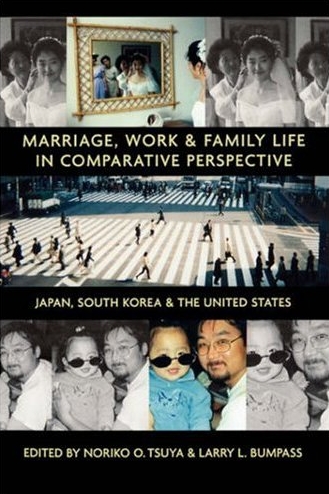
Well, before getting to the “why stage” though, you’d be surprised at how difficult it was to find even the most basic of demographic data on Korea in particular, even with the plethora of sources that a Korea Studies geek like myself has. And the only(!) book I have which does provide some of the answers: Marriage, Work and Family Life in Comparative Perspective: Japan, South Korea and the US (click on the image for a link to Amazon), I was originally very disappointed with when I first bought it over a year ago, for while it was published in 2004 most of its data actually comes from 1994 or even earlier, a flaw not exactly highlighted by the accompanying notes at online bookstores either. But forced out of desperation to reread it, I realized that I’d dismissed it too quickly: like a visiting UN demographer who lectured at my university once pointed out to me, demographics is all about waves, and as I’ll explain, 15 years later Korea is definitely still feeling the effects of the processes highlighted in this actually rather good book.

And, once I realized that, then I confess that I got a bit lost in it at that point, for the similarities and differences between the three countries are simply fascinating, and go well beyond mere numbers of extended families. In particular, after hearing it first on some old Korea Society podcast, I’ve often said that one’s generation in Korea is as important a marker of identity as, say, race is in the US, but I doubt that whoever I heard that phrase from meant it as anything more than an allusion to Korea’s extremely rapid rate of development (I know that I certainly haven’t!). But then I read this on page 61:

Korea tends to differ from the other two countries on a number of structural characteristics that are likely to [strongly] affect intergenerational relations.

But first, the basics. Seeing as they take up an entire chapter, then I won’t get into all the technical details and potential flaws of the methodologies of the surveys in the three countries sorry: suffice to say that, unless stated otherwise, all the statistics in the remainder of the post refer to married couples at the time of questioning, with both spouses between 30 and 59, and almost all for Korea, Japan and the US are from 1994, 1994, and 1988 respectively. Starting off then, the number of couples that were:

  • Living with the wife’s parents: Korea 4%, Japan 9%, and the US less than 1%
  • Living with the husband’s parents: Korea 24%, Japan 37%, and the US less than 1%

Yoshi Sugimoto, in his excellent book An Introduction to Japanese Society (2003), also notes that in 2000 “about a half of persons at or above the age of sixty-five live with their relatives, mainly with the family of one of their children” and that “this pattern is inconsistent with the prediction of modernization theory, that industrialization entails the overwhelming dominance of the nuclear family system” (p. 175). Far from being because immutable and deeply-held Neo-Confucian beliefs however, in reality:

…most two-generation families make [the] arrangement for pragmatic rather than altruistic reasons. Given the high cost of purchasing housing properties, young people are prepared to live with or close to their parents and provide them with home-based nursing care, in the expectation of acquiring their house after their death in exchange. Even if the two generations do not live together or close, aged parents often expect to receive living allowances from their children, with the tacit understanding that they will repay the “debt” by allowing the contributing children to inherit their property after death. This is why aged parents without inheritable assets find it more difficult  to live with their children or receive an allowance from them. (p. 176)

But why do more Japanese parents and married children live together than Korean ones? Rather than giving you the answer straight up, let me highlight the other differences, so that hopefully you might be able to work them out for yourself:

  • Korean parents are the least likely to be alive.
  • One half of Korean married couples surveyed grew up in rural areas and now live in urban areas, against a third for Japan and a figure “somewhat lower” in the US.
  • Naturally more US parents live further away from their children in either Japan or Korea (50% of both the wife’s and husband’s parents live more than 25 miles/40 km away), but there’s still a big difference between Japan and Korea: 28% of the wife’s parents and 24% of the husband’s parents live in a different district or municipality, against 45% and 38% respectively for Korea.
  • Only 46% of Korean husbands were eldest sons, against 56% in Japan.

And finally here are some more interesting facts, albeit more indicative and/or the cause of Korean women’s extremely low economic and political empowerment (possibly – make of them what you will) rather than why Japan has more extended families than Korean does:

  • Korea has the lowest number of couples in which both spouses are working: 22% against 57% in Japan, and 66% in the US. Undoubtedly these figures will have changed in the 15 years since then, but Korea is still exceptional in this regard, with the lowest number of working women in the OECD.
  • Korea has the lowest number of couples where the wife is older than the husband (4%), and the most where the husband is substantially older. In contrast, the figures for Japan and the US are 10% and 18% respectively.
  • Korean women don’t change their names when they get married, Japanese women do. The maintenance of “bloodlines” via male descendants continuing the family register known as hojuje (호주제) being more important in Korea then (at least until it was abolished last year),  until roughly a decade ago Korea had one of the most skewed sex-ratios in the world, and Koreans were notorious for refusing to adopt unwanted children, generally sending them overseas instead. The similar koseki (戸籍法) system in Japan does still continue, but there continuing the family name is important, leading families without a son to often adopt one for instance.

I confess, there appeared to be rather more noteworthy statistical differences and interesting tidbits when I began writing this post: I expected to have much more to say, and yet I find I’ve gotten through those in *cough* only 1470 words as I type this, half of which was an introduction/recap, albeit probably necessary. On the plus side though, I do see much of my role as a blogger as being to do condense (very) much larger pieces of work into their key points, thereby making them much more accessible to a wider audience, and so even if you can’t see the reasons for the differences in the numbers of extended families between Japan and Korea yet, if you just read the part of the authors’ summary below, then go back and look at the four points above the last (rather stylish) photo above, and then finally say something like “Ahh! Of course!” once you do…then I’ll know I’ve been doing the right thing!

…from a number of socioeconomic and demographic perspectives, Japan and the US are more like one another, and Korea is more distinctive. Korea’s mortality and fertility declines are more recent than either Japan’s or those the US. In Korea, the generation of middle-aged adults examined here has experienced all the dislocations and opportunities that go with a recent and rapid shift from an agricultural to a manufacturing and service economy, from a rural to an urban settlement pattern, and from a low level to a higher level of educational attainment. In the US and Japan, these transitions occurred somewhat earlier, and it is expected that the timing and nature of these transitions would affect patterns of intergenerational relations. (p.74, my emphases)

If you’re also interested in why so many unmarried Korean and Japanese children live with their parents, see here and here.

First Korean Man Convicted of Spousal Rape Found Dead

korea suicide(Source: danle; CC BY 2.0)

Not the outcome I expected when I first wrote about this on Sunday. From Yonhap news:

BUSAN, Jan. 20 (Yonhap) — A South Korean man, the first to be convicted of spousal rape in the country, was found dead Tuesday in an apparent suicide, police officials said.

The 43-year-old man, identified by his surname Lim, was found by his mother hanged at his home in southern Busan around 2:40 p.m., according to the police.

This is just breaking news, so I’ll add more tomorrow once more than just the bare details become available. In the meantime, here is a brief Korean news video with a transcript for those of you that speak Korean.

Update: Rather than simply repeating what he mentions, for more information let me direct you to Robert Koehler’s post on the subject here.

Update 2: See also #2 here.

Korean Comics for Adults

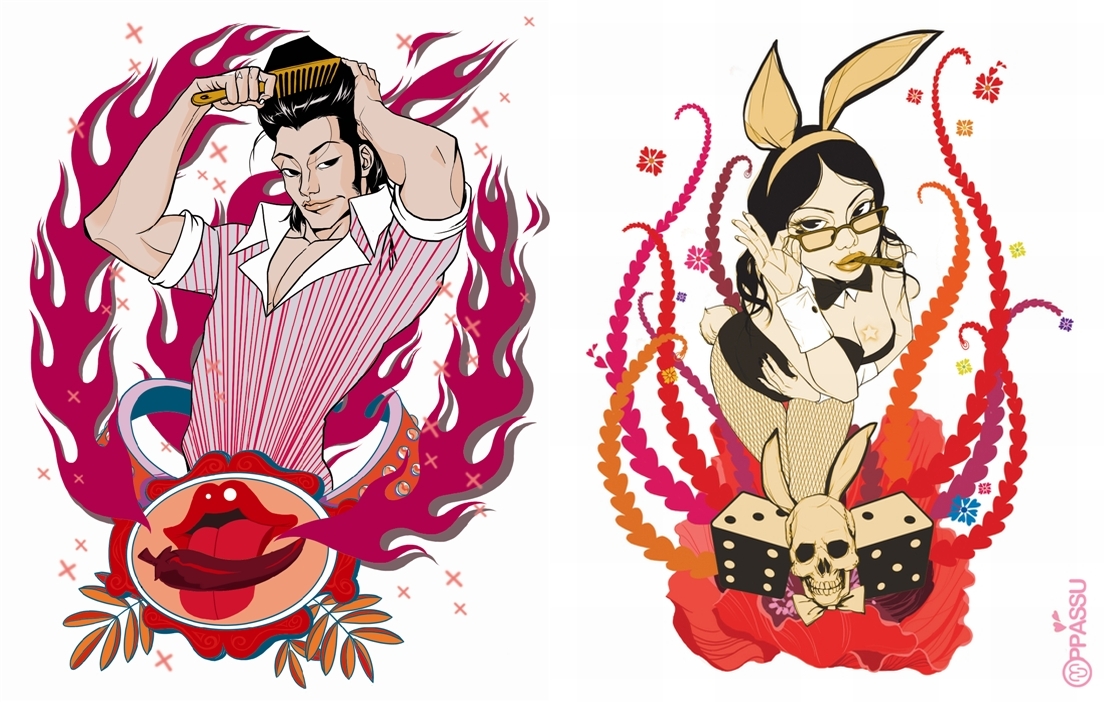
pop-ing-city-column-illustration-poptoon-ed8c9ded88b0-breasts-eab080ec8ab4(Source: ppassu; left, right)

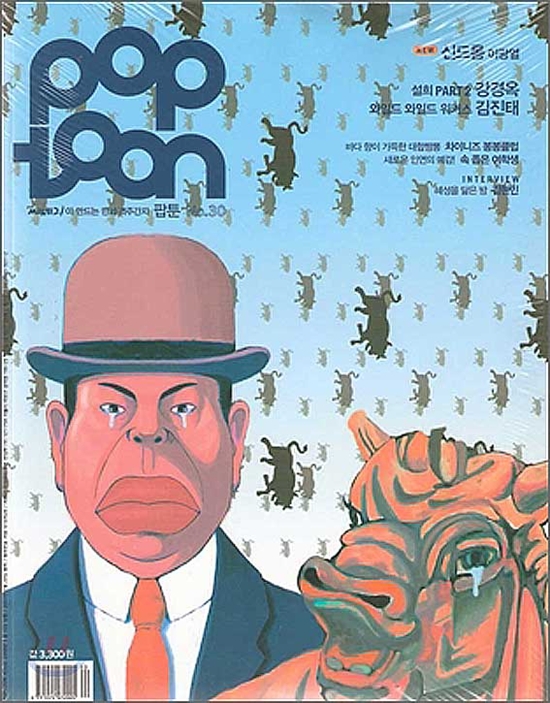
While it’s been a long time since I’ve translated “articles” about photoshoots of Korean women in bikinis for the purposes of learning Korean, I’m still always on the lookout for more stimulating study material than the temple tours, making kimchi, and the joys of wearing a hanbok that are the normal fare for Korean textbooks. I’ve also long lamented that comic books known as manhwa are largely considered a child’s pursuit in Korea, whereas tens of millions of Japanese adults from all walks of life read manga daily (it would be interesting to learn why), and so I am happy to report that I have finally found poptoon (팝툰), a bi-weekly, book-like collection of over a dozen comics (plus columns and articles) for only 3300 won, in its own words “full of things that children don’t know are fun for adults” (“아이들은 모르는 어르의 재미 팝툰”), and which I’ve been happily getting stuck into on my daily commute for the past month or so now.

Don’t be misled by the attention-grabbing image above though, not actually from one of the comics but merely the artwork that accompanies a regular column called “pop-ing city,” albeit a spunky one that in the first edition I bought happened to be about one-night stands. In fact, although most of their female characters do tend to be on the voluptuous side (not that there’s anything “wrong” with that), most of the comics in it—ranging from Korean-style slapstick comedy, critiques of Lee Myung-bak, and gangster stories to science-fiction, and with very different artistic styles—barely so much as mention any sexual subject at all, let alone have any risqué pictures in them, and in fact I’ve only ever come across one panel that I’d rather the halmoni sitting next to me on the bus hadn’t had seen, and even that one simply of a nude woman (albeit spreadeagled) being painted by an artist. But once you know which regular cartoons with the rare *cough* naughty bits are, then it’s a simple matter to avoid brazenly sharing them with your fellow commuters (source, right: dableman).

The downside of that variety is that there’ll undoubtedly be some comics among them that you simply don’t like, and I’d have to admit that at the moment at least there’s about half that I’d happily have removed for the sake of having something less tiring to hold. But still, there’s plenty in each edition to keep me occupied for two weeks, and my own personal favorite cartoonist in it is 하혜연, whose comics seem to have a focus on early 20-somethings pondering their pretentiousness and angst, something which I still happen to be rather good at. Regardless of what particular comic does it for you though, naturally the language used in all is very contemporary, with slang that you won’t find in any textbooks but which you’ll be very likely to encounter in your daily life.

To see what it actually looks like, and get a little more information about its contents (albeit all in Korean), go to its homepage here. I’d be surprised if your local bookstore didn’t stock them, but the ones in mine do seem to disappear pretty quickly!

Korean Gender Reader

Neon Gender Source Material F(Source: Carolyn Speranza; CC BY 2.0)

Three news reports to start this series with, in order from the most negative to the positive. All are originally from the Korea Times, here, here and here:

1. Textbooks Hit With Gender Bias Accusation

caveman-taking-a-woman-black-and-whiteBy Kang Shin-who
Staff Reporter

Textbooks for primary school students have been accused of containing illustrations that could create a gender bias.

Male characters appear about 30 percent more often than girls in textbook illustrations and are portrayed as main characters, according to a paper coauthored by Prof Kwon Chi-soon of Seoul National University of Education and Kim Kyung-hee, a teacher at Euncheon Elementary School in Seoul.

”Male characters play important roles in many cases while female characters often play passive roles,” the research team said in the paper. ”Children are vulnerable to the biased role models and textbook writers have to remove those sexual stereotypes.”

The paper said men are depicted as a president, politician, judge, doctor and university professor, while women appear as a teacher, nurse and bank tellers.

Male characters play the main roles about 60 percent more often than their counterparts in textbooks, it said. In social studies textbooks, male characters appeared twice as often as females.

But textbooks for domestic affairs and arts have more female characters than male figures in their illustrations, the paper added.

As a teenager in the early-1990s in New Zealand, I remember reading some school social studies textbooks making much the same points about New Zealand science textbooks of the late-1970s, after which they were (presumably) thoroughly updated. On the one hand this just goes to show how far behind Korean institutions are in their knowledge of and/or concern about gender issues (see more on that here) but on the other it may well presage belated moves to correct that, recent immigration, for instance, leading to an end to Korean school textbooks extolling the virtues of ethnic homogeneity and maintaining pure racial bloodlines (no, really) in 2006. So, although this highlights a problem, surely at least acknowledging that a problem exists is an important and necessary first step? Especially in Korea, where so much is routinely swept under the carpet for the sake of saving face?

Or so I thought before I began writing this post: now that I have, I’m somewhat less optimistic, as I’ve just discovered that the changes to the sexist depictions of gender roles were in fact already supposed to have been made in the 2007 editions! Sigh. Were they been made or not? Were they originally so bad that the recent editions criticized above are in fact the improved versions? If any readers are interested in finding out, please let me know and I’ll do some further investigating, but in the meantime if anyone wants to read more on the subject then here, here and here are some journal articles putting gender roles in Korean textbooks into comparative perspective for you, here and here are two articles explaining why textbook revisions in general are so problematic in Korea, and finally here is Michael Hurt’s convincing visual explanation of where some of Korean children’s stereotypes about race come from.

2. President Lee Calls for Job-Sharingkorean-woman-fuck-you

By Park Si-soo
Staff Reporter

South Korean President Lee Myung-bak called for wage cuts Thursday to create more jobs, one day after a government report showed the country’s employment market shrank for the first time in over five years, according to Yonhap News.

“The most urgent issue on our hands is to create jobs for the heads of households,” the President was quoted as saying at a meeting of the Emergency Economy Management Council. The presidential body was set up last week to paddle the country out of the economic crisis.

Lee suggested the government promote “job-sharing” among workers, according to the presidential office spokesman.

“I believe we should think of ways to promote job-sharing by cutting wages,” Lee was quoted as saying by spokesman Lee Dong-kwan. The President added that wage cuts would prompt employers to hire more workers.

The remarks come one day after the National Statistical Office said the country lost 12,000 jobs last month, marking the first contraction since October 2003.

Unless you’re familiar with my thesis topic, then the inclusion of this article here will probably make little sense, but — with the proviso that I’ll have to go to the original Korean source(s) to confirm that that was indeed what he said — if accurately translated, that otherwise innocuous-sounding statement of Lee Myung-bak’s that I’ve highlighted above may have huge long-term implications for Korean feminism.

In a nutshell, this is because it echoes similar statements during the “IMF Crisis” a decade ago, when women were the first to be laid off by Korean companies, under the explicit and oft-repeated assumption that they would be provided for either by their father if they were unmarried (Koreans generally live at home until they’re married), or by their husbands if they were. Being such a comparatively recent entrant into the labor market, and in an environment where women were still overwhelmingly expected to quit their jobs upon marriage or becoming pregnant, then the latter especially would be targeted, to the extent that many desperately kept their marital status a closely-guarded secret from employers, and doing so became a theme of many popular dramas a little later.

My thesis is specifically about how women’s anger at this fundamentally changed Korean women’s perceptions of their ideal Korean men, ultimately giving rise to Korea’s own distinct brand of metrosexuals, but in terms of Korean feminism as a whole the strong reaffirmation of the men as breadwinner and women as homemaker mentality arguably put the cause of women’s right back by at least a decade. Or to be more precise, put them in stasis: not that it’s the only indicator that should be considered when looking at the last decade, but I do think it’s telling that, according to my copy of Working Korea 2007 by Kim Yoo-Sun of the Korea Labor and Society Institute, the gender wage gap shows a slow but steady improvement in the two decades before the crisis, with women making 45% of what men made in 1980; 48% in 1985; 53% in 1990; 60% in 1995; and finally peaking at 64% in 1998…only to stay there for next 8 years. Unfortunately nothing says that like the graph itself, with the straight diagonal line up from 1980 to 1998 and then a virtually horizontal line from 1998 to 2006, but I haven’t been able to find a similar graphic on Korean government websites, nor do I recommend users installing the numerous ‘ActiveX’ programs I reluctantly acquiesced to just to be able to see any statistics at all. I did however, find this corroborating evidence on the English version of the Ministry of Gender Equality website:

As far as I know, so far employers are not again targeting women for layoffs in the recent financial crisis, and while it is certainly severely affecting the Korean middle-class as a whole, I don’t expect the crisis to be remotely as bad as that of 1998. Moreover, the Korean labour market fundamentally changed as a result of that crisis, in the decade since Korea going from having the largest number of job-for-life, male-breadwinner salaryman-style jobs in the OECD to having the most irregular jobs instead (see here), a huge change that has meant that – even though Korean women do still have the lowest labor participation rate in the OECD – families with dual incomes are now the norm rather than the exception, which, combined with there being virtually no political support for working mothers, has meant that the Korean birthrate has plummeted to being the world’s lowest. So it is certainly ominous that, despite this new reality, the Korean president still seems to see women’s economic – and thereby political – empowerment not as something fundamental to a modern, democratic and capitalist nation-state, but instead as almost superfluous to requirements, to be denied to them with every downturn of the economic cycle. In hindsight, given his statements around the period of his election victory, kind of predictable too: see my posts on those here, here, and then here in chronological order.

Despite the potential doom and gloom though – remember the jury’s still out on the current crisis’s effect on women, and on Lee Myung-bak’s specifc remarks –  ironically it will actually be a huge boon to my thesis. One problem with attributing any social change anywhere to a backlash is that, no matter how plausible it may be, how to find direct evidence? Given how tightly constrained Korean women were (and still are) in any open public criticism of men after the IMF Crisis, then even women’s magazines of the period are unlikely to have had any scathing editorials on the subject. But today, in 2009? If I’m right, then I’m very confident that as you read this at least some female netizens will have picked up on this, and be writing all over forums that, well, Lee Myung-bak can go fuck himself…all examples of which will will take pride of place in my bibliography!

(Update: see here for Korea’s gender wage gap worsening in 2007, and here on it also being the biggest in the OECD)

3. Court Convicts Man of Raping Wife

A husband who forced sex on his foreign wife has been convicted of rape, the first time that marital rape has been recognized by a local court.

To date, courts refused to acknowledge marital rape ㅡ a non-consensual sexual assault in which the perpetrator is the victim’s spouse ㅡ because it contradicted a law stating that a husband and wife were mutually responsible for faithfully responding to a request for sex from one another. In 1970, the Supreme Court did not uphold a guilty verdict in a similar rape case.

The Busan District Court sentenced a 42-year-old husband to 30 months in prison, suspended for three years, on charges of raping his 25-year-old Filipino spouse.

In the ruling, Judge Go Jong-joo said, ”the accused infringed upon his wife’s right to have sex or not. Even worse, he frequently used a blunt weapon to threaten her when she refused his request.”

According to statements in court, the husband threatened his wife with a gas gun and a knife.

The man first met his wife through a Seoul-based international matchmaking agency in August 2006 and they married that year. He was indicted in July 2008 after coercively having sex with his wife, who resisted citing her ongoing menstrual cycle. The man appealed the case.

The United Nations said in 2006 marital rape is a prosecutable offense in at least 104 countries worldwide.

To which Tom Coyner provides this excellent commentary, which I can’t really add to:

[This] article raises a lot of questions of what is afoot here.  First, a ruling of this sort is way overdue.  Last year there was a scandal when a Vietnamese wife of a blue collar Korean jumped to her death from her apartment building, but her family strongly believes she was pushed given recent phone calls, letters, etc.  The man walked away unpunished.

In any case, one naturally wonders if this punishment of spousal violence will apply to Koreans wives.  The good news, of sorts, is one no longer sees public wife beating as once did thirty years ago.  But one can only shudder when thinking of what happens in the home.

But getting back to Filipina-Korean marriages, according to a Filipina friend of mine who has lived in Korea many years, the general reputation among Filipinos here is that only one in ten such marriages are viewed as being successful.  Often the problems can be traced back to language problems.  But in any case, drunken wife beating is a common problem.  My friend knew a separate story of a Filipina wife being pushed out a third floor apartment window by her Korean husband.

Another problem is that Koreans are primarily concerned in finding a wife to produce children.  After the offspring are produced, the wives are essentially discarded.

Finally, another sad aspect of this travesty is that the wives are often better educated than their husbands as a result of their families having invested a great deal to ensure their daughters get good and even advanced educations.  Naive expectations include in having their daughters marry someone of a more advanced country, their daughters will fulfill their dreams.  Apparently such dreams, much more often than not, turn into nightmares upon arrival at Incheon.

If you haven’t heard of Tom Coyner, then I highly recommend checking out his website and signing up to his Korean Economic Reader emailing list here; the above comes from that, so obviously it is not just about economic issues.

Update: Unfortunately, as today’s editorial in the Korea Times makes clear, the notion of spousal rape still has quite a few legal hurdles to overcome before it is definitively considered a crime by the Korean legal establishment, let alone by the Korean public.

Update 2: As I reread the report today, I began to have concerns that the issue of spousal rape might get sidelined as an issue of Southeast-Asian immigrant wives rather than of Korean women as a whole, and Baltimoron of the Left Flank blog argues that unfortunately all signs point to this so far.

Update 3: It appears that the Korean husband committed suicide on Monday. For more information, see here.

Why do so Many Korean Children Wear Glasses?

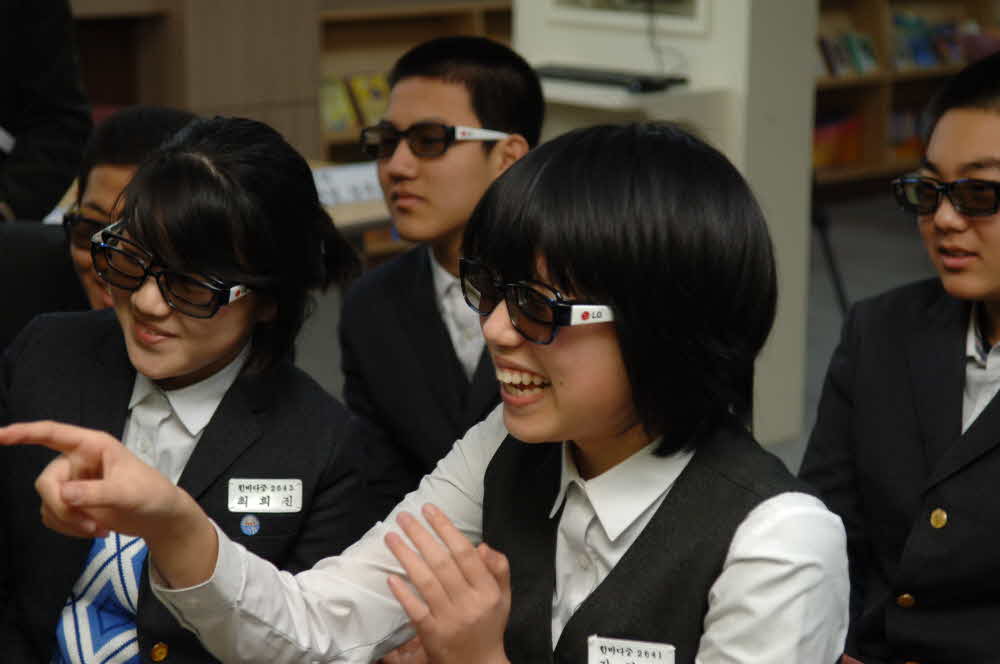
Korean Children Glasses TV(Source: LG전자; CC BY 2.0)

Update, April 2009: In hindsight, I didn’t cover this subject thoroughly enough here, leaving some questions unanswered. For a more comprehensive overview, see this article I wrote for the Korea Times.

Update 2, June 2013: And for a much more up-to-date overview, see this article I wrote for Busan Haps.

If I’d been asked this question yesterday, then I too would have answered that it was because they were always hunched over their books, or staring at computer screens. But the surprising result of this Australian study was that those are only correlated but not causative factors.

In fact, it’s because they don’t get enough exposure to sunlight.

I confess, before I read the details of the survey, I was very sympathetic to such a result: young Korean women, for instance, have among the lowest Vitamin D levels in the world because of avoiding the sun for the sake of light skins, and given how the required behavior and body images that lead to such extremes are inculcated very early in Korean children’s lives, then if a lack of sunlight does indeed lead to myopia (short-sightedness) I’d wager money on rates being higher among Korean teenage girls than boys. Not much higher, no, but I’d still expect a statistically significant difference between them.

But technically the study never looked at Korean children specifically. And while Korea certainly shares other developed East Asian countries’ skyrocketing rates of myopia among children — virtually all my middle-school students wear glasses or contact lenses, and I bet yours do too — I was confused when I heard that the study was primarily based on Singaporean children.

How on Earth do children that live on the equator not get enough sun?

Actually, partially it’s precisely because they live there. As head researcher Dr. Ian Morgan explains in an Australian radio interview, the heat meant that:

The children in Singapore were spending about three hours a week outside, so very, very limited periods of time outside, excluding the school hours. Basically they went to school, they went home, they did their homework and then they watched television and that was life.

But this issue of climate wouldn’t apply so much to children in other East Asian countries, where the same education culture of going to school during the day and then cram schools in the evenings prevails, although that does also mean that they’re not outdoors much of course. But how to tease apart the effects of that lifestyle from a lack of sunlight specifically? Things like diet, and, say, the not insignificant fact that Korean children get the least sleep in the world, would presumably have some effect too.

Here’s the key part of the radio interview that reveals how and why researchers did that. Without it, basic summaries of the study like this and this that are all over the news wires are good introductions, but raise more questions than answers really:

DR IAN MORGAN:….we have been able to compare the prevalence of myopia in Chinese kids in Singapore, as compared to kids of Chinese origin growing up in Sydney. And at the age of six, the kids in Singapore — the Chinese kids in Singapore are ten times more myopic than the kids of Chinese origin in Australia.

INTERVIWER: But did the Singaporean children spend more time in near-work activity than the Sydney children?

DR IAN MORGAN: If anything, they spent a little bit less and this is what led in part to us looking for what other factors could be important. And the striking difference that came across was that these kids — remember they’re matched for age and they’re matched for ethnicity, they’re all of Chinese origin. The kids of Chinese origin in Sydney were spending a lot more time outdoors than the kids of Chinese origin in Singapore.

For more details, including the debunking of alternative theories that there is some genetic susceptibility to myopia among East Asian populations, and why it is specifically light intensity that is important, then I highly recommend reading the radio interview in full.

I don’t have the time to translate anything myself unfortunately, but it’ll be interesting to see how the Korea media interprets the results of this study. While it would be just one of a very long list of serious social and health problems among young Koreans resulting from Korea’s after-school institute or hagwon (학원) culture, and so unlikely to lead to any huge changes overnight, all the various English-language articles on the study point out that governments across the region already do have serious concerns about the issue. So, this may well provide just enough of a shove for Korean schools to, say, provide more outdoor physical education and field trips for students. Granted that it’s rather cold at the moment though!

Korean Medical Association: Don’t Take the Pill!

All the contraceptive pills are gone...(Source: Surija / “Sray”; CC BY 2.0)

Why not? Well, because Korean women are stupid apparently, unable to do so much as read the instructions and numerous warnings about possible side-effects that come with the product, let alone do their own research and make their own choice about what contraception is best for them personally.

Or at least, that is the more benign reading of this warning from the KMA, and to be fair, given such factors as Koreans’ general reluctance to self-diagnose and be proactive about treating any medical condition that they might have themselves, and many Korean women’s complete reliance on men to use contraception, then at first glance there is nothing to distinguish the top-down, patronizing but also paternalistic tone of the KMA in the warning as any different from any other Korean institution’s relationship with the Korean public. In reality however, in its bias and scare-mongering it demonstrates an explicit and almost sinister vested interest in maintaining the huge abortion industry here.

No, really. That may sound like hyperbole, but then the Korean state already has a long history as an extremely invasive and coercive force in Koreans’ reproductive lives, its population policy in the 1960s and 1970s only slightly less draconian than that of China’s today, at many points having soldiers withdrawn from the DMZ at the height of the Cold War to deliver IUDs and perform abortions in the Korean countryside for instance (see this book for more on that). And such industry-related claims are also widely acknowledged of Japanese health authorities (albeit not so much in Japan itself), which banned the pill for three decades and which Japanese women are still scared of using, so why not of Korea ones too?

But regardless of that background, how else are we to interpret the evidence from just the KMA’s warning alone? Consider that:

  • It provides no information about possible side-effects that I didn’t already know about 10 years ago (and I’m a guy remember), which begs the question of why the Korea Times considered it “news” exactly.
  • It literally doesn’t provide a single positive medical benefit of using them, and naturally the Korea Times fails its most basic of journalistic duties by not providing them either.
  • It implies that somehow there is somehow something unique to contraceptive pills and not, say…amphetamines that makes women’s access to them in much more urgent need of being restricted.
  • And finally, that in a country where double-standards, moralistic pharmacists and medical staff, virtually non-existent sex education, and a lack of access already combine to severely limit women’s sexual confidence and choices of contraception in practice (see here)…surely it is telling that the most senior medical institution in the country is literally scaring women away from using the single safest and most effective contraceptive in human history?

Actually, I do agree that there are some benefits to women of, say, requiring a prescription from a doctor to get the pill, one poster in this forum (which I give a hat tip to for some of the above) pointing out that it means many women will usually get gynecological examinations at the same time, wheres they wouldn’t have bothered otherwise. But, one should always be very careful to acknowledge the different contexts in which they occur, and I dare say that most young British women buying contraceptives, for instance, are not asked by pharmacists if they’re married, or alternatively the same by doctors and nurses rather than a more neutral, non-judgmental inquiry as to if they are sexually active. To require a prescription in those circumstances would surely mean that many women simply wouldn’t go to get them all, which renders quick and easy access to the pill, albeit online if you don’t look 25 or older, one of the very few positives about Korean sexual culture (source, right: NEWSis).

Ending on another positive note, all trends in Korea point to continued increased use of the pill over time, and I’m not merely seeking brownie points among my readers when I say that I do have confidence in Korean women even just considering the pill not to be swayed by “warnings” like this. Given how, as I explained in my last post on the subject, half the battle is getting many Korean women to take an active role in using contraception at all, then merely thinking about all the pros and cons of the options available is an important first step. And of those that have done so, then I dare say that from that point on they will apply a more discerning eye to the ravings of groups like the KMA!

Update: In case anyone wants it, here is the original warning in Korean too.

Semi-Nude Photos of 14-Year Old Draw Controversy

The 14-year old girl is Park Seo-jin, the controversial photoshoot from the Mnet reality show I Am A Model. It’s already covered in numerous “news” articles though, so let me just quickly highlight one element of it here: that for all the recent and historical mania about protecting underage girls against foreign pedophiles, the Korean police seem strangely reluctant to respect their own laws banning the nude photos of minors that would (presumably) encourage them. The most obvious examples being one of the promotion posters for—let alone various scenes in—Samaritan Girl/Samaria (2004), all shot when actress Kwak Ji-min was still in high school, and therefore legally a minor.

Like with those, no-one will ever be prosecuted for Park Seo-jin’s photos. Unlike those though, they do seem to be creating much more negative reaction. Most likely, simply because she is just sooo young.

What do you think?

Update: In case of any confusion, note that while she’s 16 according to the (strange) Korean age system, her birth date is actually 11 March 1994.

The Scent of a Man: What deodorant commercials tell us about Korean metrosexuality

(Source: I am Goding)

As the message boards of numerous expat forums will attest, Koreans simply don’t wear deodorant, except for a few young urban sophisticates in the summer. What’s more, it’s likely almost all of those young urban sophisticates are women, as there have been no deodorant commercials aimed at Korean men yet (although Nivea did start using men alongside women for in-store promotions from 2007).

But why on Earth not? While I disagree with most prevailing explanations for the origins of Korea’s own, distinct brand of metrosexuality, that doesn’t mean that in the last decade or so there hasn’t been an explosive growth in sales of men’s skincare, cosmetic and grooming products to accompany that. It seems strange that Korean men prepared to spend the money and time on, say, wearing “masculine” sunblock for ten months of the year, wouldn’t also be concerned about how they smelled.

In Japan, even the middle-aged ajosshis are:

Explanations of why both sexes don’t wear deodorant usually focus on their (allegedly) sweating less than the average Westerner and the different kinds of foods that they eat. But personally, I give much more credence to the notion that — to the extent that most Koreans had even heard of the stuff until very recently — it was considered a luxury that few could afford, Korean consumerism in general still being trapped in the mentality of four decades ago. Back then, basic items were scarce, food barely adequate and lacking in quality or variety, and domestic monopolies and the restrictions on the imports of consumer meant that the customer was expected to be grateful for whatever he or she was given, as evidenced today by, for example: the gifting of soap, spam, cooking oil and/or shampoo (examples) on the two biggest holidays of Chuseok (추석) and Seollal (설날); a cuisine culture that — frankly — seems to consist of little more than throwing everything available together and then smothering the combination with salt, sugar or spicy pepper paste; and the often appalling customer service that still prevails in 2008 respectively.

Only slightly tongue-in-cheek, one could also argue that with virtually no-one wearing it and everyone used to the bad smell of each other to the extent that they don’t notice it, then the very minimal benefits of an individual wearing it mirror, say, the economics of my recently purchasing a videocall-capable phone: initially very expensive to myself, completely useless if others don’t have one also, but with increasing benefits to me as others do buy and use them (i.e. I can both talk to more and more people and services will probably become cheaper). Similarly, in the case of expensive Korean deodorant, as the number of users increased then Korean noses would become more and more sensitive to distinguishing between those who did and didn’t use it, and then later to lower prices and people having positive associations with and assumptions about the former group (source, left: cjswoxodwk).

Seemingly regardless of that background however, while it is true that early deodorant commercials featured – in a quintessentially Korean fashion – having a motherly figure explaining the benefits to respectfully attentive and nodding young Korean women (but which unfortunately predate the YouTube era), and that the first commercial below from just two years ago seemed to emphasize friendship more than anything else, commercials aimed at women are increasing in quantity and sophistication every summer, most like these two here and here (I can’t seem to embed them unfortunately) emphasizing deodorant’s supposed benefits in attracting the opposite sex just like their Western counterparts. Moreover, while for various reasons I personally hate any dubbed commercials, you don’t have to speak Korean to understand that the woman in the the second video opens with “What part of my body do you like the best? My legs? My ass? Or my hands?”, which, to put it mildly, you don’t otherwise hear all too often on Korean daytime television. Any wonder that it’s still the most popular deodorant commercial in Korea a year later?

But still, why aren’t deodorants marketed to men here? Actually there is a very detailed report on the Korean deodorant market available on the internet which may have the answer, and I’m quite happy to receive donations towards the US$753(!) required to purchase it and to pass on its conclusions when I do. But in the meantime, via this article on perfume science from the Economist magazine I’ve found, if perhaps not a perfect solution to the conundrum, then at least pointers towards further investigation. Here’s the gist of it, with my emphases throughout:

(Source: OHLALAMag)

THE very word “perfume” has feminine overtones to many male ears. Men can be sold “deodorant” and possibly “aftershave”, but the idea of all those dinky little bottles with their fussy paraphernalia is too much for the sensitive male ego. Yet no industry can afford to neglect half its potential market, and perfume-makers are ever keen to crack the shell of male reticence. Now they may know how to do so.

Craig Roberts of the University of Liverpool and his colleagues-working with a team from Unilever’s research laboratory at nearby Port Sunlight-have been investigating the problem. They already knew that appropriate scents can improve the mood of those who wear them. What they discovered, though, as they will describe in a forthcoming edition of the International Journal of Cosmetic Science, is that when a man changes his natural body odor it can alter his self-confidence to such an extent that it also changes how attractive women find him.

Half of Dr Roberts’s volunteers were given an aerosol spray containing a commercial formulation of fragrance and antimicrobial agents. The other half were given a spray identical in appearance but lacking active ingredients. The study was arranged so that the researchers did not know who had received the scent and who the dummy. Each participant obviously knew what he was spraying on himself, since he could smell it. But since no one was told the true purpose of the experiment, those who got the dummy did not realize they were being matched against people with a properly smelly aerosol.

Over the course of several days, Dr Roberts’s team conducted a battery of psychological tests on both groups of volunteers. They found that those who had been given the commercial fragrance showed an increase in self-confidence. Not that surprising, perhaps. What was surprising was that their self-confidence improved to such an extent that women who could watch them but not smell them noticed. The women in question were shown short, silent videos of the volunteers. They deemed the men wearing the deodorant more attractive. They were, however, unable to distinguish between the groups when shown only still photographs of the men, suggesting it was the men’s movement and bearing, rather than their physical appearance, that was making the difference.

For Unilever and other manufacturers of men’s scent, this is an important discovery. The firm’s marketing of its main product in this area, a deodorant called Lynx, plays up the so-called “Lynx Effect” – which is supposed to make men irresistibly attractive to women. Dr Roberts’s experiment, however, suggests that the advertised “Born chicka wah wah” of the product may have nothing to do with a woman’s appreciation of the smell, and everything to do with its psychological effect on the man wearing it.

The rest of the article focuses on the scientific theories of smell and attractiveness, not uninteresting in themselves, and I highly recommend you read the full article, especially the comments. Finally, a quick excerpt from the conclusion:

There are many useful inferences that might be drawn from this research. One would be that a woman’s choice of perfume will resist the vagaries of fashion. This may explain why most innovation in the industry involves changes in packaging and marketing, producing all that fussy paraphernalia, rather than changing what is in the bottle.

In hindsight of course, all quite obvious: I’m sure that we can all appreciate how, say, going through the process of our “date preparation routine” — showering listening to your favorite music, wearing more expensive clothes than usual, and finally putting on your expensive perfume/cologne/deodorant strictly reserved for special occasions, and so on – was a very important factor in getting into the mood for it, even though in hindsight showering immediately beforehand would have washed off natural pheromones crucial for the date’s success.

Hence my dismal record.

Also, while the reasons were unknown until know, manufacturers have undoubtedly long been aware of the effects of the phenomenon, but if not then the basic mechanics of capitalism alone — the inevitable saturation of markets and the rates of profit to fall — would constantly compel them to rebrand and repackage their products, the latest manifestations of which seem to be a decidely “Arctic” theme of absolutely any cosmetic marketed towards Western men.

But what does this tell us about the absence of such commercials in Korea?

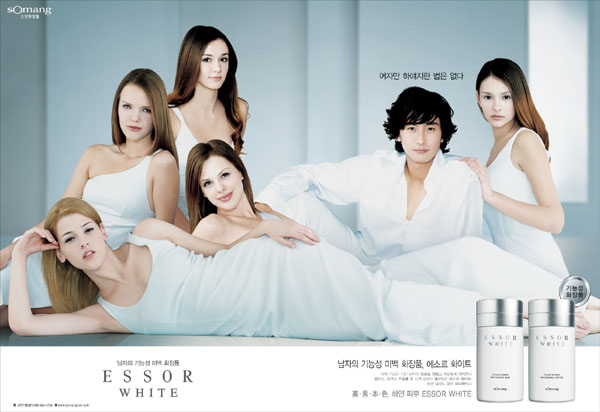
(Source: Somang Cosmetics)

For a time, I was planning to look at the origins of Korean metrosexuality for my MA thesis (summary here), put wisely rejected that topic after necessarily watching hundreds of Korean cosmetics commercials aimed at men. Only now though, can I see that a surprising common theme of them is the almost complete absence of women in them. Or to be more precise, with exceptions such as the notorious, multi-layered one with Ahn Jung-hwan (안정환) from 2003 above (video, alas, unavailable), of the relatively few times women are featured in them most of the time they are not at all there to demonstrate the product’s alleged effects on women. Rather, generally they are effectively mere props in narratives very much focused on the men themselves.

Some examples, with and without women, starting with…yes, that one with Ahn and Kim Jae-won (김재원) that unfortunately utterly defined Korean masculinity to a generation of expats in 2002, (update: while I’m at it, I’ve added a parody by some Seoul students also) then with Ahn again and Hyun-bin (현빈) in 2006, unfortunately cutting prematurely his distinctive gesture and facial expression at the end:

Now two more commercials, both with Hyun-bin and from 2006, and the second with Kim Hye-su (김혜수). While they appear at first glance to feature women lusting after Hyun, in fact both commercials are actually for women’s cosmetics:

And finally, a exception from late 2007 with Jung Il-woo (정일우) that proves the rule: that wearing cosmetics=more hot sex with lots of women was not a theme of Korean commercials until — to the extent that there are international standards — very late in the development of metrosexuality compared to other countries:

Why is this significant? Well, because when I wondered in a previous post about why so few commercials for women’s cosmetics featured men — naively thinking attracting them was the sole reason women ever used them — I was very surprised and much impressed by Gomushin Girl’s answer (my emphasis):

…I think the main reason for male absence is the convention of putting the product itself in the ad. While some advertisements focus primarily on the made-up faces, most want to show the packaging and look of the product itself, be it lipstick, mascara, or what have you. This means that a lot of advertisements focus on the process of application, or the period just after the makeup has been put on. This process of being made up is strongly associated with the private sphere, and thus excludes men. Men are present when the results (fully made up and dressed) are there, and so can be part and parcel of clothing and other advertisements, but a make up advertisement needs to feature a woman in a private space, preparing herself for going into the public sphere. If the man were there, it would be subverting the purposes of her putting the makeup on in the first place.

And from which I now take away the conclusion that, very generally speaking, Korean cosmetic commercials for men are much closer to those of Korean (and Western) women’s cosmetics than they are of those of the “wear this and women will want to rape you” style that overwhelmingly dominate the equivalent ones Western men.

Why? We can speculate on any number of reasons. But whatever is ultimately responsible, I would argue that the difference shows that:

  1. Korean cosmetic companies were never in the driving seat behind the rise of metrosexuality in Korea over the last decade or so (which is not to say that they ever were in Western metrosexuality either)
  2. And that the development of Korean metrosexuality at least was always driven by and for women, and thus the manifestations of it in consumer culture have been heavily influenced by preexisting narratives in previously exclusively women-focused industries. Or in other words, it’s like cosmetic companies didn’t realize that they were actually supposed to be advertising to men now.

Both of which buttress(ed) my hypothesis in my thesis proposal

Lest that sound a little abstract though, let me conclude by stressing that, just like you’d expect, Korean men always have and always will strive for appearances and modes of behavior that are most likely to get them laid. My thesis proposal was really just about some of the possible reasons why thee, well, requirements of Korean women for them to have a greater chance to do so changed in Korea in the late-1990s.

As for why those didn’t include wearing deodorant? Well, given that women didn’t themselves, then there was hardly the demand by them that men did. And I strongly suspect that it will be at least 10 years before a tipping point of deodorant-wearing Korean women is reached and it is seen as standard, after which men will increasingly be expected to wear it too,.

In the meantime, I’ll continue to have my parents send batches of cheap roll-ons from home every few months. But if you’re a single male in Korea? Then it sounds like it can’t harm to pamper yourself!