Contributors to this book provide an Asian women’s history from the perspective of gender analysis, assessing Japanese imperial policy and propaganda in its colonies and occupied territories and particularly its impact on women. Tackling topics including media, travel, migration, literature, and the perceptions of the empire by the colonized, the authors present an eclectic history, unified by the perspective of gender studies and the spatial and political lens of the Japanese Empire. They look at the lives of women in, Taiwan, Korea, Manchuria, Mainland China, Micronesia, and Okinawa, among others. These women were wives, mothers, writers, migrants, intellectuals and activists, and thus had a very broad range of views and experiences of Imperial Japan. Where women have tended in the past to be studied as objects of the imperial system, the contributors to this book study them as the subject of history, while also providing an outside-in perspective on the Japanese Empire by other Asians.
Via City Koh, an interesting recent addition to my TBR list—I had no idea there were such intimate connections between events in Korea and US immigration and racial policies a century ago. Enjoy!
The Allure of Empire traces how American ideas about race in the Pacific were made and remade on the imperial stage before World War II. Following the Russo-Japanese War, the United States cultivated an amicable relationship with Japan based on the belief that it was a “progressive” empire akin to its own. Even as the two nations competed for influence in Asia and clashed over immigration issues in the American West, the mutual respect for empire sustained their transpacific cooperation until Pearl Harbor, when both sides disavowed their history of collaboration and cast each other as incompatible enemies.
In recovering this lost history, Chris Suh reveals the surprising extent to which debates about Korea shaped the politics of interracial cooperation. American recognition of Japan as a suitable partner depended in part on a positive assessment of its colonial rule of Korea. It was not until news of Japan’s violent suppression of Koreans soured this perception that the exclusion of Japanese immigrants became possible in the United States. Central to these shifts in opinion was the cooperation of various Asian elites aspiring to inclusion in a “progressive” American empire. By examining how Korean, Japanese, and other nonwhite groups appealed to the United States, this book demonstrates that the imperial order sustained itself through a particular form of interracial collaboration that did not disturb the existing racial hierarchy.
Update: How could I have missed this interview of the author at New Books Network back in June??
If you reside in South Korea, you can donate via wire transfer: Turnbull James Edward (Kookmin Bank/국민은행, 563401-01-214324)
It’s tough impressing guests at my cocktail parties these days.
By definition, all of them are already bibliophiles—why else would I invite them? But that also means some guests don’t so much as bat an eyelid at my paltry 1500+ tomes, no matter how strategically I arrange their titles.
Hitherto my main trump card, and source of cultural capital, suddenly being exposed as neither smart nor well-read has become a real source of concern. And, when I do sense a guest’s moment of realization is finally arriving, my cats, trained to pose for Instagram, can only distract them for so long.
(From 28:10) “Into the Twentieth Century, I write about the culture of…Japanese modernism, as expressed in these two icons, the mobo and the moga, and the era of what’s called ‘Erotic Grotesque Nonsense.’ One of the arguments I make in the book, is that if you went to Japan in the 1910s, ‘20s, and ‘30s, you would recognize a lot of the forms of entertainment, because they were…at least originally, they came from other parts of the world, particularly North America and Europe. But they also looked different. Scholars call this ‘vernacular modernism.’ Where [something is] part of a global movement, but is articulated in very specific ways in specific places and for specific reasons. And so, even though these people look like flappers and dandies…and they evoke some of the same moral panic, they also were challenging very specifically Japanese norms and were fulfilling particular Japanese needs.”
I hear your thoughts, all half-dozen or so of you still reading: what grown adult only hears of vernacular modernism for the first time in their late-40s? How can I even call myself a man? Have I no shame at all??
“How could he string me along like that? I really thought he would have more books…(Sigh) Men can be such pigs…”. Photo (cropped) by Killian Pham on Unsplash.
But I’ll be way ahead of any guests voicing the same, already reaching for their raincoats and umbrellas. For I’ll use a cunning trick on them I’ve learned from a local book club I recently joined.
In those meetings, which are twice a week. we read our own books silently for an hour, then have a quick bathroom break, then go around in turns quickly summarizing our books, before finally posing a related question to the other members to answer. The ensuing discussions generally last until we’re kicked out of the various coffee shops. And—you guessed it—the most interesting and lively conversations tend to spring from questions that actually have no relationship to people’s books at all. So too, given how obvious my need for constant validation is, you can also guess that a not inconsiderable amount of my free time between meetings is spent preparing the most popular questions. Then, on procuring related books I can bring along to feign they just spontaneously came to me from my casual, cursory hour’s reading.
So, I will distract and impress my more discerning cocktail party guests not with big words, but by posing the first titular question: How were Korean new women and modern girls different…to their equivalents in other countries? Other than so many of their new fashions, beauty products, consumer goods, new education and employment opportunities, new beliefs about family life, sexuality, and women’s rights, being so closely associated with, forced by, enabled through, and/or utterly tainted by the Japanese colonial regime that is?
“Interesting questions James,” my guests will reply, stumped. “We misjudged you. Let’s bring your cats back for some more cute photos, then brainstorm some ideas. Oh, you already have a whiteboard and markers set up in the next room you say?”
Yes, I’m vastly overgeneralizing. But I know you too are intrigued by the prospect of learning the extent of the similarities and differences between Korean women and their Taiwanese and Manchurian counterparts in the 1920s and ’30s, let alone between those living in other colonial regimes. Indeed, the party will only just be getting started.
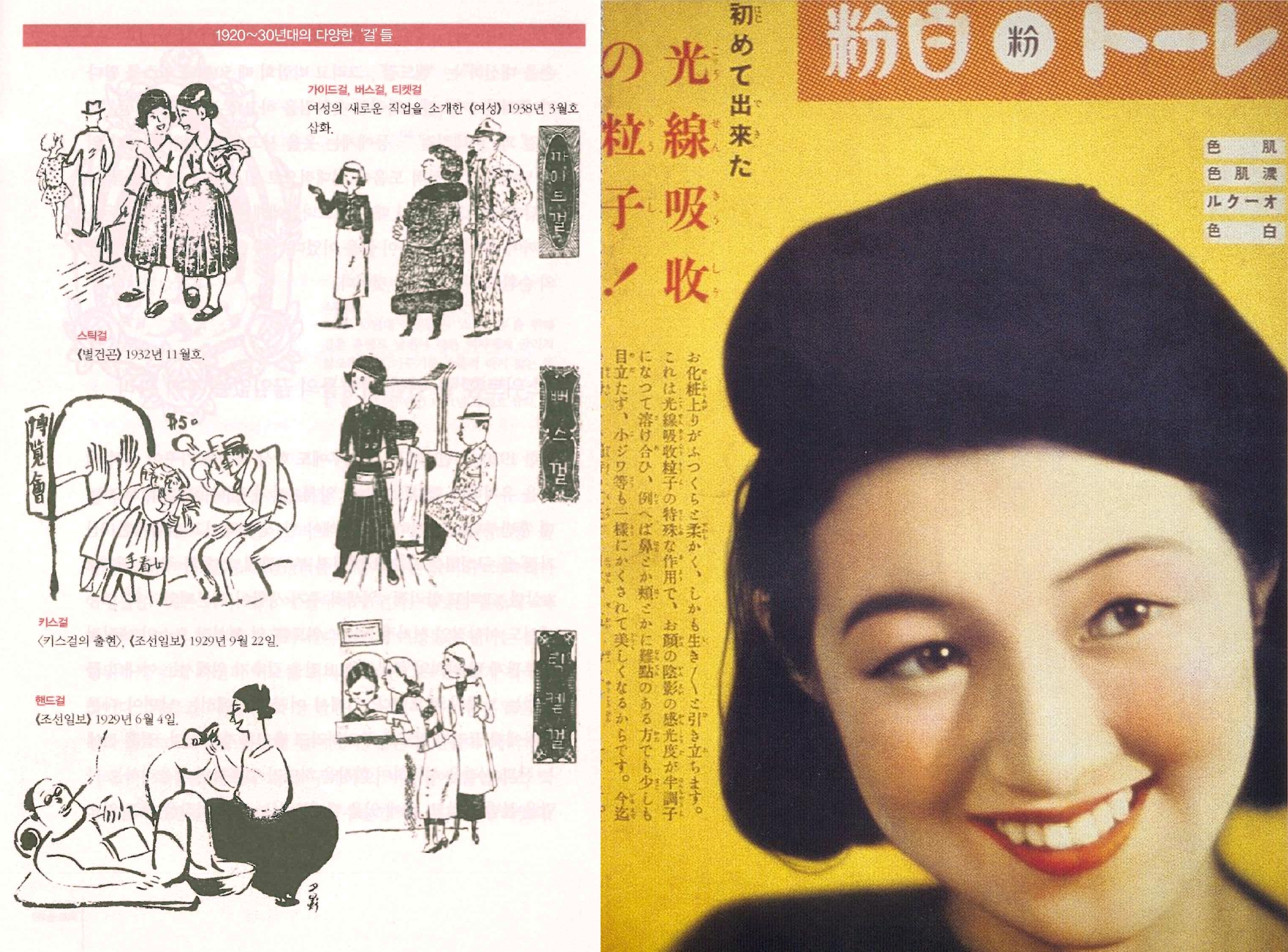
Left: “The various types of ‘girls’ in the 1920s to 1930s”; scan, 예쁜 여자 만들기, p. 245. Right: Actor Hideko Takamine, Japanese White Powder Foundation advertisement, 1930s; via The Flapper Girl.
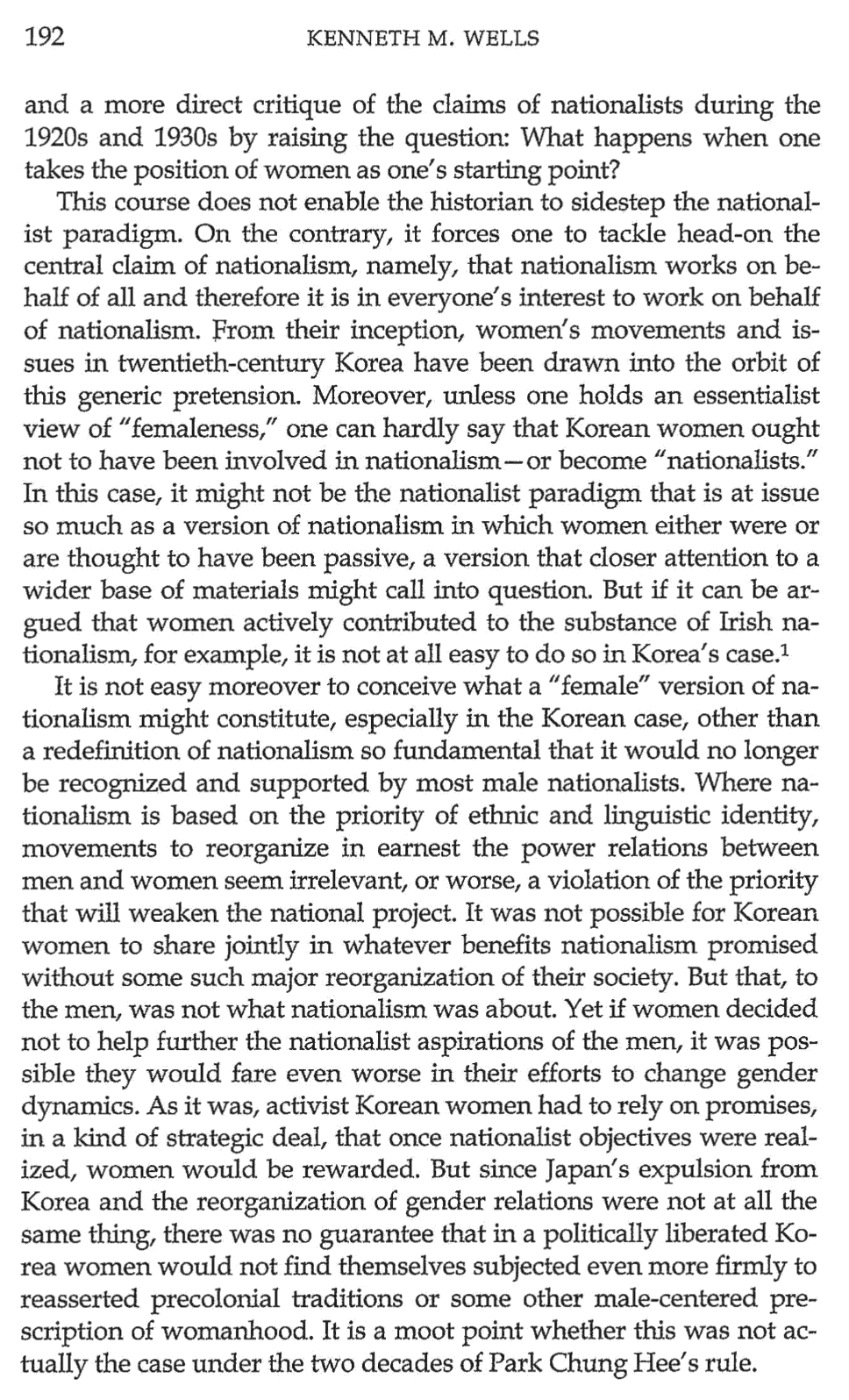
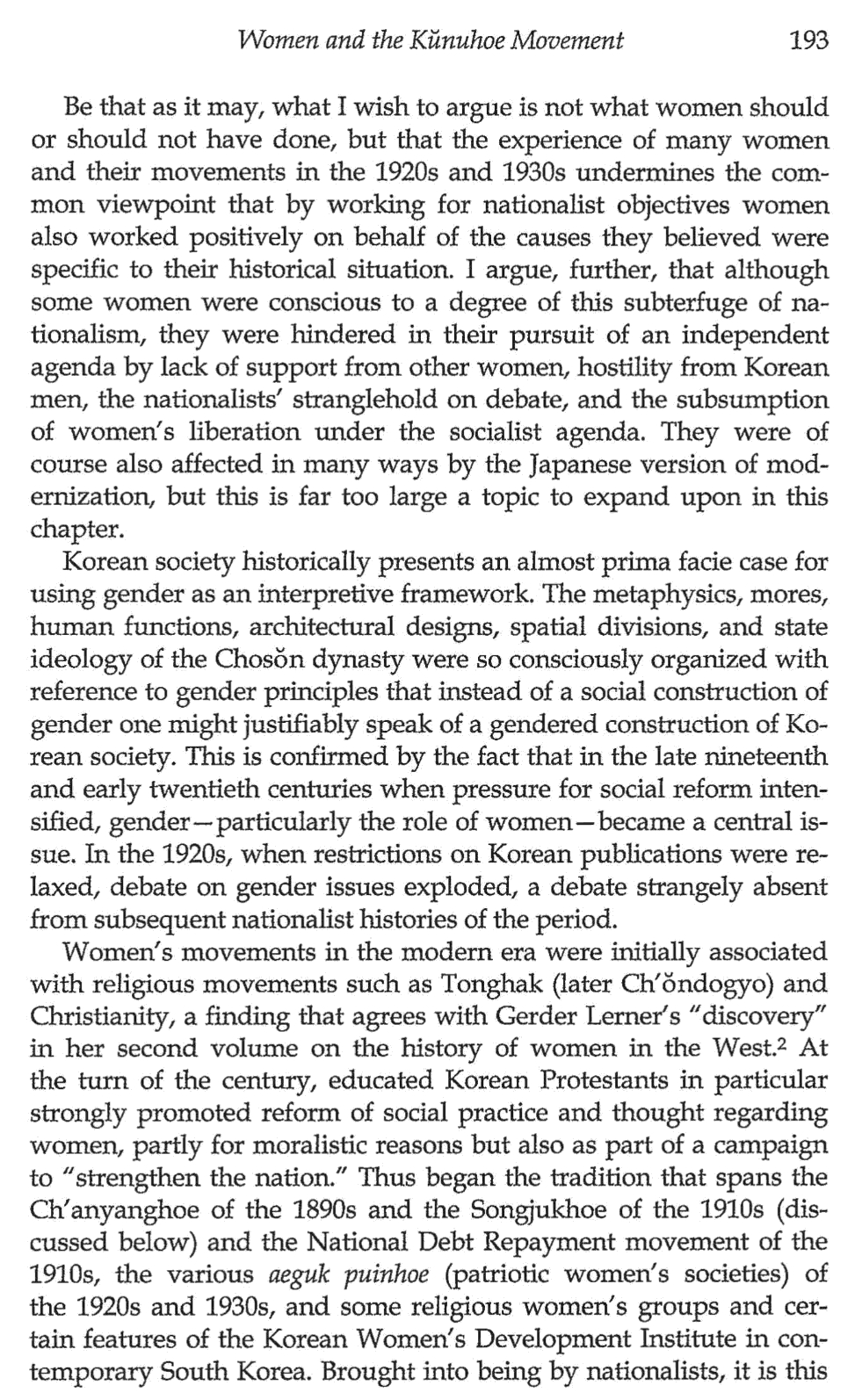
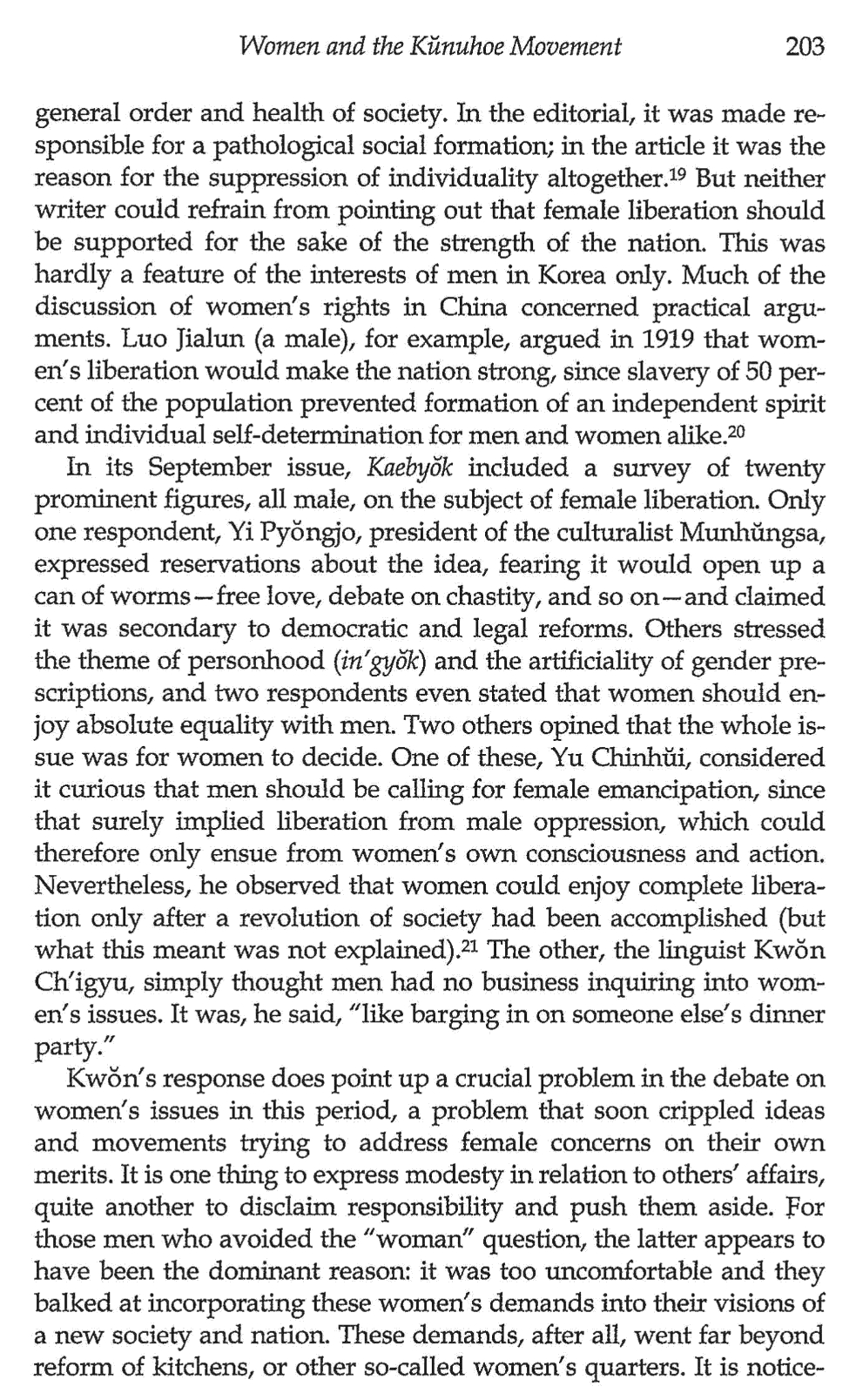
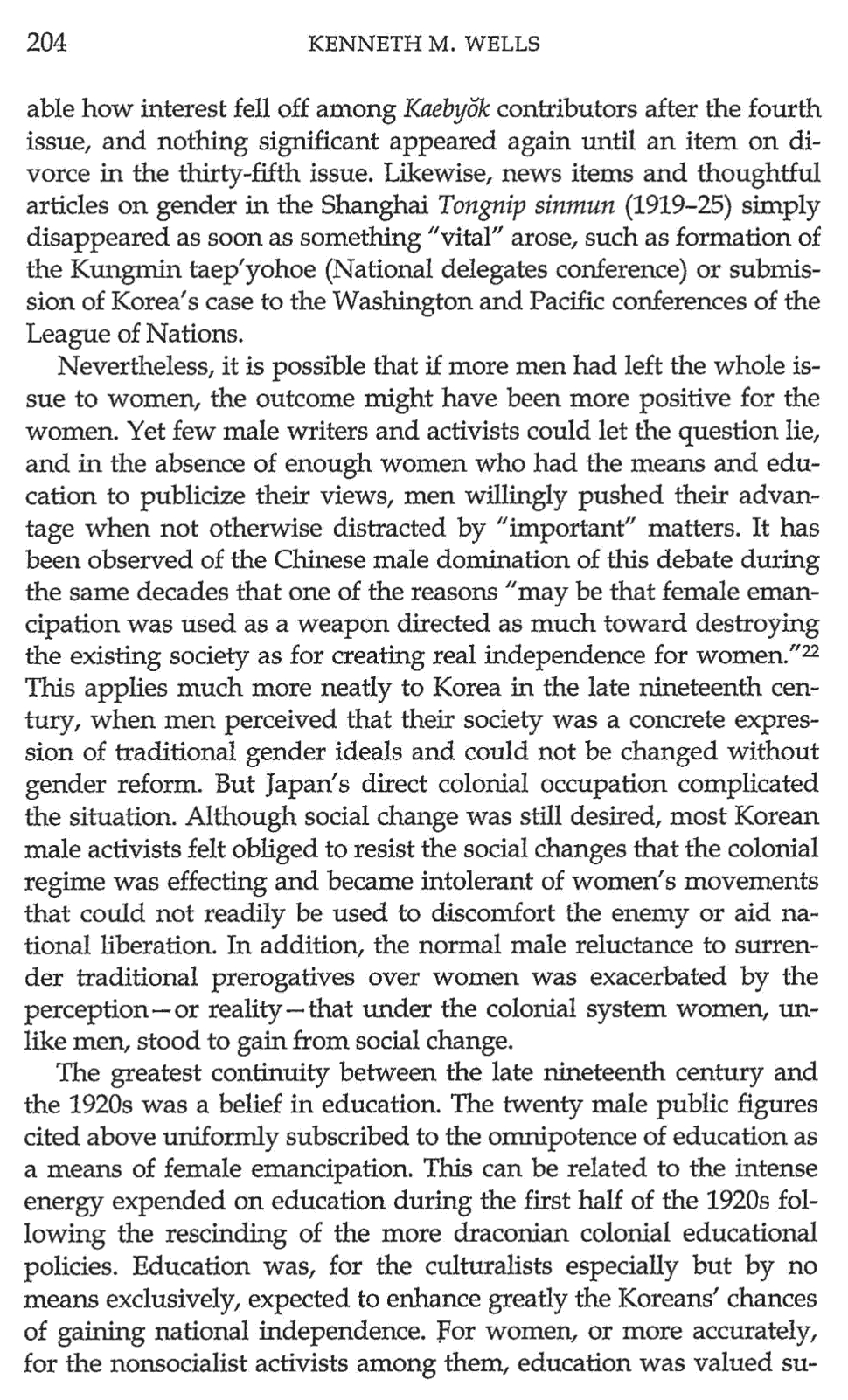
Unfortunately, my desire to learn from my guests’ answers will be so genuine, that I’ll quickly forget all my pretensions to aloofness and sophistication. So, when we move on to the next question, I’ll be quite unable to restrain my joy at recently (re)discovering an exceptional background source, and wanting to repay by sharing. Namely, albeit again vastly overgeneralizing, one that elaborates on how Korean women’s rights were put on the backburner in the first half of the Twentieth Century for the sake of focusing on liberation from the Japanese, then in the second half for the sake of democratization—which has basically informed just about everything I’ve ever written about Korean feminism here for the last 16 years. That is, Colonial Modernity in Korea, edited by Gi-Wook Shin and Michael Robinson (1999), and more specifically Chapter 7. “The Price of Legitimacy: Women and the Kunuhoe Movement, 1927–1931” by Kenneth M. Wells. Fortunately, much of the chapter is available via Google Books, including the following four pages (192-193, and 203-204) that will surely persuade you to buy your own copy:
But only embarrassed by myself to myself, because clearly I’m already way past being worried about my reputation among you, my dear readers. And glad to have had the opportunity to recommend a book too you, or more generally to have shared something useful and/or interesting. Because no matter how long I sometimes take to get there, that, after all, is always the point.
“Pretty weird guy, but…yeah, that does sound like a good book. I must order it post haste.” Photo by Brooke Cagle on Unsplash.
On which note, so what if, technically speaking, I haven’t actually had a single guest in my home since moving in six months ago? Or that my toasting my cats with Pepsi lime zero and cheap whiskey every other evening for, say, not vomiting over my meager possessions that day, doesn’t exactly qualify as my hosting “lavish cocktail parties” either? These are mere minutiae in the pursuit of great art. Or, indeed, of great books!
Estimated reading time: 5 minutes. Image by Jr Korpa on Unsplash.
For sixteen years, I’ve maintained a strict policy of never covering anything related to the “comfort women” issue. I already have my fair share of trolls, thank you very much, so don’t need to add Japanese and Korean ultra-nationalists to the mix.
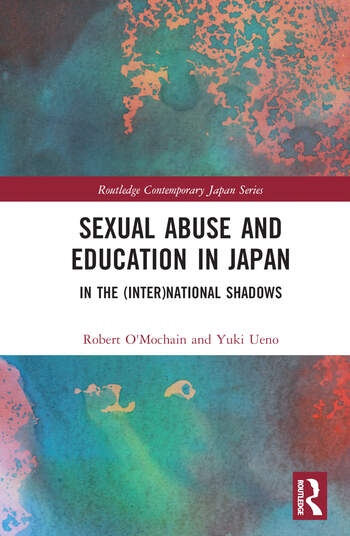
With this convenient out-of-sight, out-of-mind attitude though, I recently realized I’ve been missing a crucial connection to present discourses about sexual violence today, especially in Japan.
“The fixation with depicting comfort women as fake victims has repercussions for survivors of sexual assault today. Even if victims of abuse are not aware of comfort women issues, they are aware of the danger of being labeled a higaisha-buru (“fake victim”), and in the book we show how the association of ideas between ex-comfort women, and fake victims, and contemporary women who report sexual assault, is still a factor in the silencing of women, who have a right to report sexual assault, but…they remain in the shadows.
And, I think a good illustration of how this is relevant still today, is something that happened in 2020. There were prominent members of the main political party, the LDP, and there was an event there on a program that was looking at (unintelligible Japanese term?) through comfort women issues, and when the issue was under discussion a member of the House of Representatives, Sugita Mio, she made the comment “Women can lie as much they want.” Now she did issue an apology later for saying [that], but she wasn’t censured by her party for the comment. They actually refused to receive a petition against her then, when it came to the LDP headquarters…she is still around—she continues to exert influence as a lawmaker in the Diet. And the comment [about the refusal?] was “Why do you report it?”, so it’s part of public discourse. So I think it indicated there’s a determination there amongst ultra-conservative groups to depict ex-comfort women as fake victims, to cast doubt on their oral evidence, and that will affect all sexual assault survivors. I think that’s an important question that we’re exploring in the book.”
(Robert O’Mochain speaking,16:24-18:33)
Unfortunately for those of you who likewise now want to get their hands on said book, I think I speak for most of us when I say US$160–$204 is slightly out of our price range ㅠㅠ. So too, even US$44–$50 for a copy of Voices from the Contemporary Japanese Feminist Movement edited by Emma Dalton and Caroline Norma (Palgrave Macmillan, 2022) that I’ve long had my eye on, when you realize it’s only 141 pages long!
I therefore recommend the podcast interview again then, for more on links to the relative failure of Japan’s #MeToo movement (also Lile Otaki Donohue’s article in Trinity Women& Gender Minorities Review for an excellent 8-page summary and comparison with other countries), and the Daiwa Foundation’s video below for short interviews of the contributors to Voices:
Finally, it’s my birthday next week on—yes, really—International Women’s Day(!), so I think one source on Japan’s #MeToo movement even Ican indulge myself on is the self-explanatory Black Box: The Memoir That Sparked Japan’s #MeToo Movement by Ito Shiori :)
Has anyone read any of those books? Or have any other recommendations? Can any Japanese speakers please help with the term I couldn’t make out in the podcast at 17:25? Thanks!
Pervasive sexual inequality can feel like death from a thousand cuts. No one source of pain or minor irritation isn’t possible to dismiss or play down in favor of other, more visceral struggles against the patriarchy. But as it turns out, women’s relative absence from the legal profession has cascading effects across all society.
Estimated reading time: 6 minutes. Photo by cottonbro at Pexels.
When young Korean men return to university after doing their military service, they’re generally two to three years older than their female classmates. In a society where age really, really matters, this gap can grant those men a great deal of privilege. For example, by being able to avoid various mundane tasks periodically required of students by the university, as these get foisted onto the young(er) women instead. Like during this coming December after the university entrance exams, when some of my female students will be expected to “volunteer” to waste a precious day before their tests by bowing in the freezing cold to visiting high-schoolers as they arrive on the bus, while my male students study from the warmth comfort of the library.
Damn right, do I see a direct link to why so many talented and highly educated women are wasted answering the phones and making the coffee at Korean workplaces.
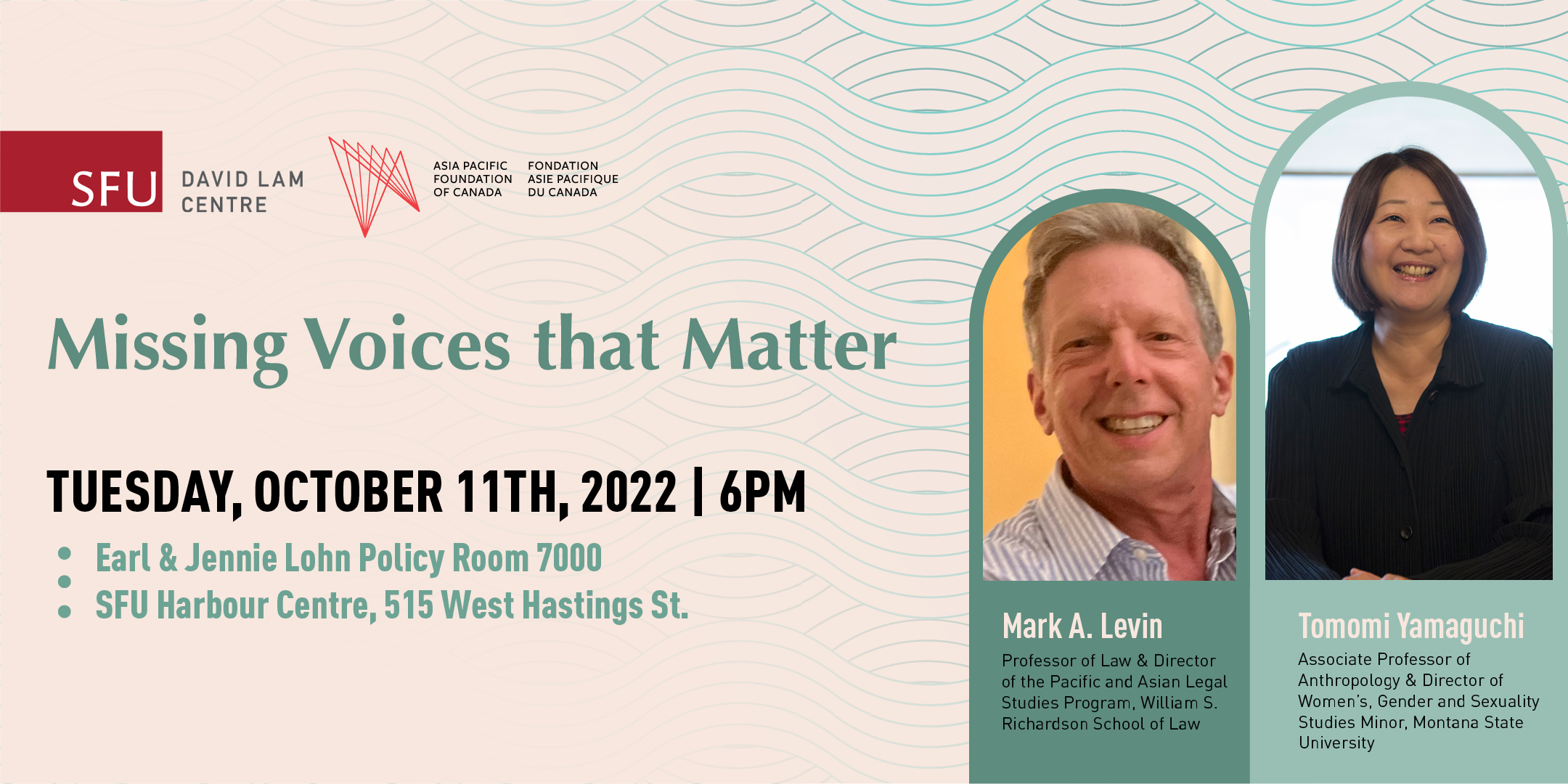
All of which may feel like an odd introduction to announce an upcoming hybrid talk (register) by Mark A. Levin and Tomomi Yamaguchi at the David Lam Centre of Simon Fraser University, which is not actually about Korea at all. But, based on its description below, it still feels intimately useful and relevant nonetheless. Specifically, I’m wagering it will reveal many more instances of how something seemingly innocuous like a slight age gap can have surprisingly wide implications for sexual equality, offering many similar possibilities to explore—and combat—in the Korean context:
“While the U.S. and Japan’s earliest generation of female legal scholars showed roughly similar numbers, their paths soon diverged dramatically. The number of women in the two legal academies in the 1950s to about 1960 were not all that different. Both nations counted phenomenally low numbers similarly. The U.S. took an early lead, but not by all that much. One report counted five women in tenure track positions in the U.S. in 1950 and another counted fourteen women before 1960. Japan could count five women by 1956 and eight women by 1958. Neither fifteen women in the U.S. nor eight women in Japan represent even token counts among individuals who made up the two countries’ legal academy professoriate in those times.”
“The difference then is in what followed. In the U.S., we crossed a count of 100 women around 1970 and then accelerated to 516 women by 1979, while Japan’s count essentially flatlined. From 1958 in Japan, there were no new women entrants for about ten years and then the next uptick in Japan was just five women entering the field in the late 1960s through 1974. After a second near hiatus of about eight years, Japan then saw some modest growth to have a total of twenty-two women who had entered law teaching by 1988. Our next found data point is 402 women in 2004.”
“The profound scarcity of voices of women academics as leaders, teachers, and scholars in Japanʻs legal academy for several decades remains significantly detrimental for Japanʻs gender circumstances today. The story demonstrates how crucial womenʻs and other feminist voices are in addressing gender gaps and dismantling patriarchy in a society. In particular, having women and feminist allies in the legal academy is essential for feminism to advance in a society. Conversely, deficits regarding women and feminist allies in the legal academy will invariably impact the overall society’s gender circumstances for the worse. And so, just as feminist legal theorists would suggest, it seems essential to assess those circumstances in Japan with the idea that gender gap deficits in Japan’s legal academy must be at least a contributing factor to the nation’s profound and distressing gender gap situation more generally that continue to the present day.”
“This talk aims to explore not only how, but why the two paths diverged so significantly. With time allowing, some effort will be made to draw upon Canada’s circumstances to add another historical sequence into the telling here.”
♥
Truthfully though, it was not those possibilities that first convinced me to sign up. Rather, it was the disjuncture the blurb noted between Japan’s postwar democratic, egalitarian ideals and the actual practice in Japanese women’s personal and professional lives. For it all sounded very familiar (as it probably did to many of you too), having already read much the same in a chapter from a classic Korean studies book: “The Concept of Female Sexuality in Korean Popular Culture” by So-hee Lee (pp. 141-164) in Under Construction: The Gendering of Modernity, Class and Consumption in the Republic of Korea (ed. by Laruel Kendell, 2002). To refresh your memories from page 144, with my emphases:
“[Korean women in their early-30s {now early-60s}]…were the first female generation to go to school en masse, side by side with their brothers. As Wonmo Dong (1988) argues, they learned democracy and its fundamental principles of liberty and equality as an academic subject, not as something to practice in everyday life. From the beginning of their university days, around 1980, they were pushed into the whirl of extremely violent demonstrations to demand national political democratization. Although political protests had long been a part of Korean student life, there was something about the culture of protest that emerged in the 1980s that was different from what had gone before; student activism became an all-pervasive and all-defining experience. In those days, various slogans and ideologies relating to the struggle for democracy were strongly imprinted on the consciousness of this generation as a metadiscourse. However, the students of the 1980s never examined these democratic values in the context of their own everyday lives.”
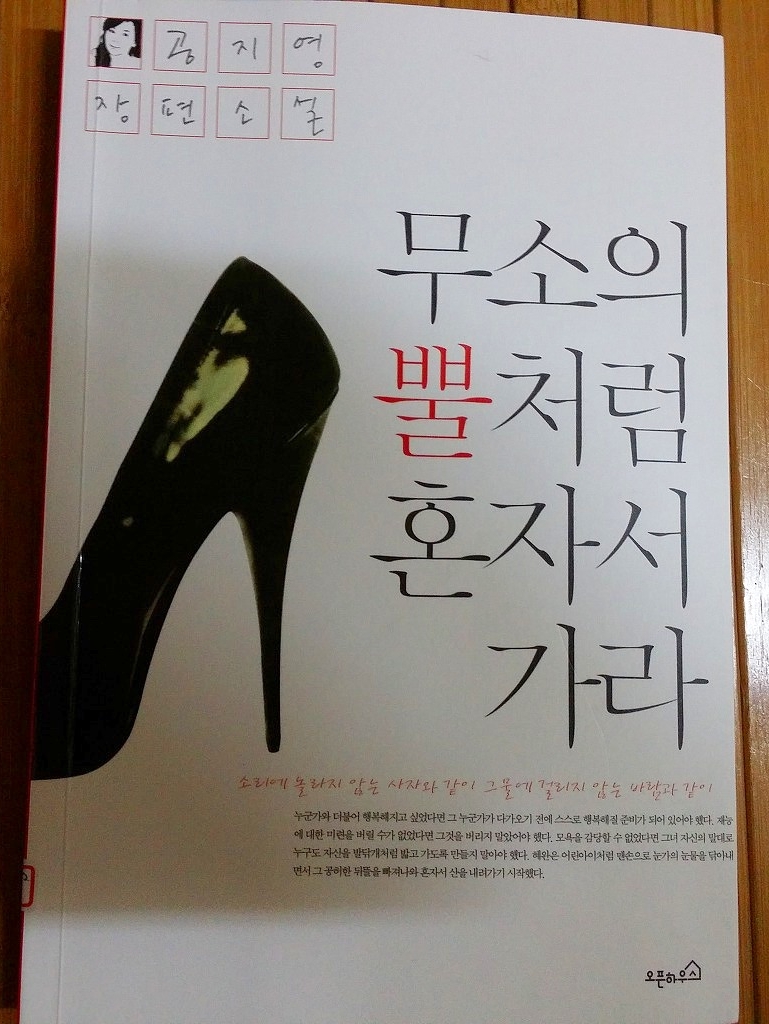
“Go Alone Like the Rhinoceros’s Horn (Source, left: Whitedevil) illustrates the bifurcation between theory and practice. Looking at their mothers’ lives,Korean women in their early thirties believed that their marriages would be different. Because the Korean standard of living and patterns of material life changed very quickly, they believed that Korean ways of thinking had been transformed with the same speed. This is where their tragedy begins. As Hye-Wan in the novel says, mothers “teach daughters to live differently from themselves but teach sons to live like their fathers” (Kong 1993, 83–84). As a result, the daughters’ generation experiences an enormous conflict between the real and the ideal. During sixteen years of schooling, they have learned that equality is an important democratic value, but nowhere have they been taught that women experience the institution of marriage as a condition of inequality. Many married women of this generation have experienced a process of self-awakening similar to that of Yông- Sôn, who early in the novel tries to kill herself. She says,“Where have I been during the last eight years of my marriage?” and concludes,“Though I don’t want to accept it, I’ve been a sincere and faithful maid who must carry out his every request” (109). Korean wives in their thirties cannot envisage a real-life alternative to the self-sacrifices of their mothers’ generation.”
Update—Indeed it was. There seem to be technical difficulties embedding it here however, so if the video below doesn’t work please watch it on YouTube:
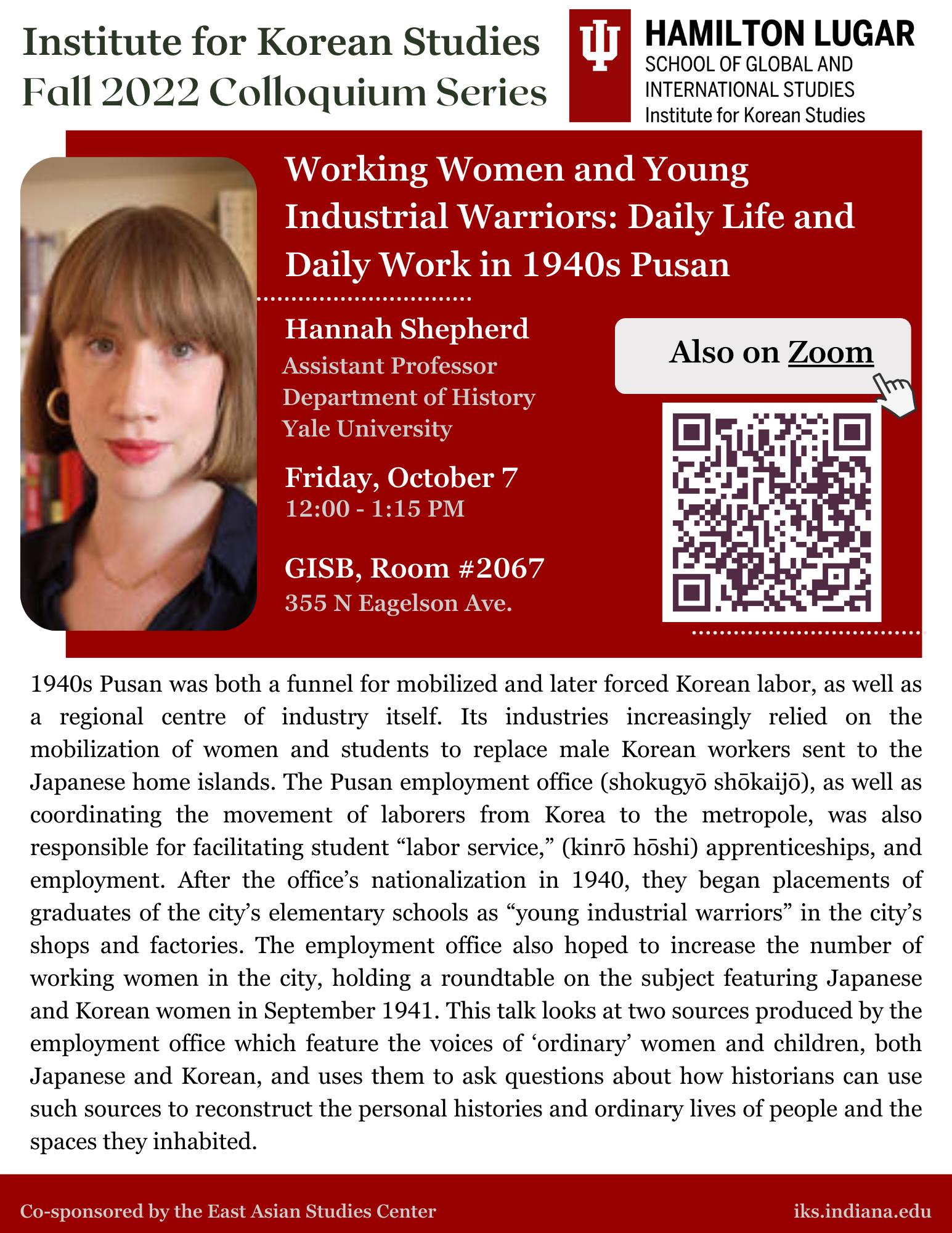
From now on, I’ll be posting information here about every upcoming Zoom talk I’ll be attending personally. And this particular one, how could I not shout from the rooftops about it, despite its horrible hour? Not only is it a rare one for focusing on Busan, my home for two decades, but it also covers wartime Korea. Which in hindsight, is a period I’ve severely neglected, sandwiched as it were between the Modern Girls and New Women of the 1920s and 1930s and the birth of Modern Korea.
Meanwhile, for information about any further upcoming Korea and East Asia-related public Zoom talks, I have to recommend Pusan National University professor CedarBough Saeji, who makes a real effort to inform everyone about as many as she can through her Twitter account. To make sure you don’t miss out, please follow her there @TheKpopProf.
Estimated reading time: 3 minutes. Original image source: The Chosun Ilbo, August 2015. For a discussion, see here.
It’s not often that one brief book chapter helps your whole degree make sense overnight. Even less often that someone will rescue a nearly 30 year-old, long since out of print tome from obscurity and offer that chapter as a free download.
Let me thank Shuyi Chua of the Education University of Hong Kong then, for providing a scan of Manuel Castells’ “Four Asian tigers With a Dragon Head: A comparative analysis of the state, economy, and society in the Asian Pacific Rim,” from R. Appelbaum & J. Henderson (eds.), States and development in the Asian Pacific Rim (1992). Not only did it give me one of my first genuine Eureka moments at university, but it’s still so relevant and helpful today that it took pride of place in my recent presentation above, and hence my finding Chua’s link.
(It’s probably still technically illegal to offer it publicly though, which is why I’ve never done so myself. So take advantage while you can!)
Let me also thank Professor Michael Free and his students at Kangwon National University, for the opportunity to wax lyrical about some of my favorite topics to them. If anyone reading would also like me to present to their students sometime in person or via Zoom, if for no other reason than to remind them that it’s not just you that gets excited about your subjects, please give me a buzz.
Finally, a big apology to everyone for not writing for so long. With so little physical social interaction over the summer, and with even what face-to-face contact I do get now almost entirely confined to my family and students, then frankly the weeks and months somewhat blurred into one another, making it difficult to pay much attention to the deadlines I set myself on the (always too many) posts I have in the pipeline. Inspired by my work on the presentation now though, I will try very hard to have one of my longer and more thought-provoking ones ready for you next week.
Until then!
If you reside in South Korea, you can donate via wire transfer: Turnbull James Edward (Kookmin Bank/국민은행, 563401-01-214324)
In the spirit of today’s title, let me direct you straight towards the moment I learned why Uemura Shōen was so amazing:
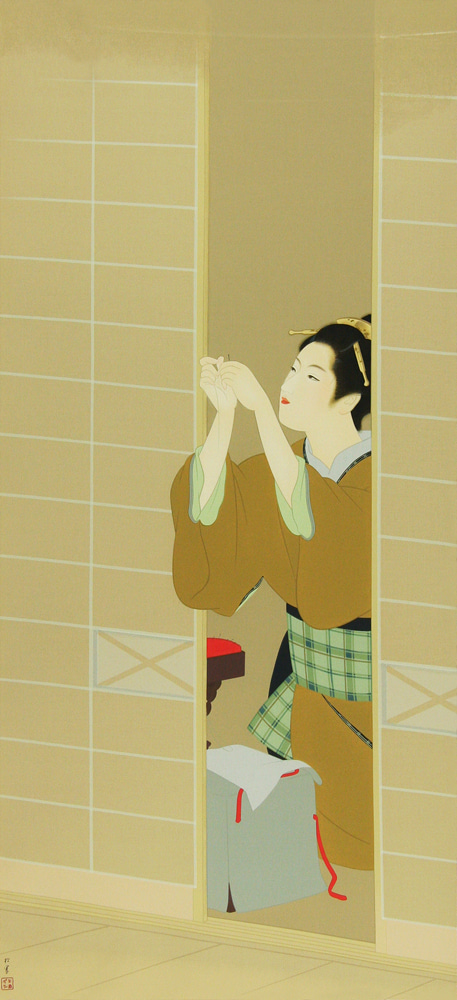
Shōen successfully turned her passion to creating a life worth living through her paintings. The themes and main subjects in all her paintings are women. Moreover, the women depicted in her paintings of this period are decisively different from those that appear in paintings done by men in the tradition of the Kyoto school of Bijinga, whose tradition dates back several hundred years. The major characteristic of women in the paintings before Shōen was that they were treated as the object of men’s sexual interest. Shōen painted working women for the first time in the history of Japanese painting. One of the masterpieces along that line is Yugure (Dusk). Here a middle-aged woman opens the paper-covered sliding door of her room to get enough light to thread a needle. Her plain kimono, the needlework, and the weak sunlight of the dusk impressively create an atmosphere of daily life. Japanese painting portrayed the reality of working women for the first time through Shōen’s works. They are as significant as the works of Millet, who painted working women instead of bourgeois women. In the late 1930s Uemura painted another middle-aged woman shown repapering a door to prepare for the coming winter in Banshu (Late Autumn). In another painting in a series titled Yuki no naka (In the Snow), she described women walking in the severe cold with heavy snow on their umbrellas. The clean, sharp, uncompromising lines of her drawing supported by her accurate drawing ability and the use of just a few colors clearly show the painter’s integrity of mind. It took Shōen a long time to reach this heightened state. Shōen received a great many awards for her noble and innovative art.
Page 71, “Three Women Artists of the Meiji Period (1868-1912): Reconsidering Their Significance from a Feminist Perspective” by Midori Wakakuwa (trans. by Naoko Aoki) in Japanese Women: New Feminist Perspectives on the Past, Present and Future ed. by Kumiko Fujimura-Fanselow and Atsuko Kameda (1995); my emphases.
Which really did immediately remind me of modern rock singer Kim Yoon-ah‘s 2006 unique poster for Cheoeum-Cheoreom soju above. Like I wrote in 2010, and sadly still remains the case today, it’s “the only one I’ve seen in which the woman depicted is actually doing something of her own accord and enjoying herself, rather than waiting to be seduced by a man.” Which is not to say that sultry and seductive is bad in itself, but just a small sampling of soju posters over the years reveals how monotonous that theme can be, and how truly exceptional this soju poster is. Made more even more so, by the text in white at the bottom that I missed nine years ago (apologies for the poor quality):
It reads: “김윤아씨의 모델료는 가정폭력 피해자들에게 기부됩니다. 여성으로서 락음악의 새로운 가능성을 연 가수, 김윤아”/ “Kim Yun-Ah’s model fee is donated to domestic violence victims. Singer Kim Yoon-ah, who paved the way for new possibilities of rock music as a woman.”
Turning back to Uemura Shōen’s own depictions of women actually doing something, here are the paintings (and one from the In the Snow series) mentioned above by Wakakuwa:
One of the most distinctive characteristics of Japanese painting when contrasted with its European counterpart is the use of empty space. And of course, this distinction was carried into the twentieth century….In Shōen Uemura’s Feathered Snow, the great blankness of the paper successful conveys the sensation of inclement weather, where the horizon reduces to edge of your umbrella as you try to shelter from the cold.
Inspiration aside though, I do wonder if the distinction between Shōen and her predecessors was as sharp as Wakakuwa suggests? In hindsight, her passage sounds a little hyperbolic. And my frustration with locating the full images among all those close-ups was a foreshadowing of what I’d read about Shōen online later, which tended to place her work very much on a continuum with other Bijinga (literally, “paintings of beautiful women”). That said, Jeff Hammond in The Japan Times notes her subjects weren’t the courtesans from the pleasure districts usually found in the genre. Also, in a must-read account in Japanonica of a 2017 exhibition of her work, historian and curator Roisin Inglesby finds subtle but important differences to works by her male contemporaries, despite her indeed very much sharing their emphasis on beauty:
…[Shōen’s] “outsider” status as a woman enabled her to acquire a deeper understanding of her female models and employ different approaches from male artists—a quality which, the curators argue, elevates her paintings by portraying women not just as objects created through the lens of the male gaze, but as thinking, feeling subjects who invite us to admire their inner beauty as well as their outward attractiveness.
In her efforts to show female beauty in what she believed to be its purest form, Shōen’s paintings are characterized by both a lightness of touch and a depth of feeling. [The tour guide] invited us to take time to look closely at the works and consider the emotional complexity beneath the peaceful expressions of Shōen’s subjects.
I wince at the crude characterization of the male gaze—admiration of outward attraction is not mutually exclusive with that of inner beauty—but that’s a subject for another post. Continuing later:
One of the most interesting aspects of [the] tour was [the] explanation of how Shōen gives agency to her subjects through a variety of techniques. In many paintings, she used a splash of red pigment on the women’s earlobes and fingertips to animate their otherwise placid demeanor. This small, yet visually enlivening, detail signals activity: these women hear; they touch. Often beautiful women are painted as objects of desire and admiration, yet through the composition of her work it seemed to me that Shōen invites her viewers to question their interior thoughts as well as appreciate their external beauty. The sparse background of Feathered Snow (1944) not only gives the impression of a punishing winter wind which beats its subjects back to one side of the painting, but encouraged my eyes to follow the movement of the composition and rest on their faces. What are they thinking as they trudge through the snow?
I recommend reading the article in full, and to watch this slideshow for many more examples of her work. Please feel free to add to (or correct) anything above also—including on Bijinga’s influence on Korean art, which I’m now about to look for more information about in my modest library, rather than preparing crucial PowerPoints for tomorrow’s classes. Damn you, Uemura! ;)

 Estimated reading time: 2 minutes. Photo by cottonbro studio @Pexels.
 Contributors to this book provide an Asian women’s history from the perspective of gender analysis, assessing Japanese imperial policy and propaganda in its colonies and occupied territories and particularly its impact on women. Tackling topics including media, travel, migration, literature, and the perceptions of the empire by the colonized, the authors present an eclectic history, unified by the perspective of gender studies and the spatial and political lens of the Japanese Empire. They look at the lives of women in, Taiwan, Korea, Manchuria, Mainland China, Micronesia, and Okinawa, among others. These women were wives, mothers, writers, migrants, intellectuals and activists, and thus had a very broad range of views and experiences of Imperial Japan. Where women have tended in the past to be studied as objects of the imperial system, the contributors to this book study them as the subject of history, while also providing an outside-in perspective on the Japanese Empire by other Asians.













 The Grand Narrative


