Fighting Sexual Harassment at Samsung: Part 1

( Source )

Extremely important for its ramifications for Korean workplaces, frankly I’m amazed that I’ve been unable to google any English-language sources on the following sexual-harassment case at Samsung. Perhaps the Korean English-language media still feels intimated by the company, let alone the Korean-language one?

Either way, it deserves to be much more widely known, and if I’d realized that when commenter “previouslyafter” first passed it on, I certainly wouldn’t have had a month’s break from blogging immediately thereafter! My apologies for the delay then, and to make the long article from Sisain more readable, I’ve decided to split it into 3 parts, especially as there are some important questions raised by the first. Which for the sake of accuracy and context, I would really appreciate readers’ help with answering before continuing translating Part 2:

삼성에 맞선 ‘만년 이 대리’의 기적 같은 승리

A Miracle-like Victory in a Long-time Deputy Section Chief Lee’s Stand Against Samsung

by Jang Il-ho (장일호), 28/04/10

뒷목과 머리카락으로 부서장의 손이 오고갔다. 브래지어 끈을 만지작거리는 날도 있었다. 해외 출장을 갔던 2005년의 어느 날, 부서장 박아무개씨는 엉덩이를 치면서 “상사를 잘 모시라”는 말을 하기도 했다. 삼성전기 전자영업팀에 근무하던 이은의 대리(36)는 지금도 그날의 수치를 잊지 못한다.

2005년 6월, 이은의씨는 더 이상 견딜 수 없어 부서장 박아무개씨한테 당한 성희롱 피해를 회사 인사팀에 알렸다. 그러나 돌아온 것은 부서장이 아닌 자신의 대기발령이었고, 부서전환, 그리고 왕따였다.

Park, the department head, would quickly touch the hair on her back of her neck with his hand. One day, he fondled the strap of her bra. And once while on a business trip in 2005, he stroked her buttocks while telling her “You should obey your superiors”. Deputy Section Chief Lee Eun-eui (36), who worked for Samsung’s electronic appliances’ sales team, still can’t lose the sense of shame and disgrace she felt on that day.

In June 2005, she decided she could stand no more from Park, and so informed the personnel department. Rather than Park being punished however, instead Lee was put on extended leave. Eventually she was brought back to work and transferred to a different department, but was generally ostracized in the company (source, right).

지 루한 법적공방이 이어졌다. 골리앗 삼성을 상대로 싸운 다는 게 어떤 것인지 그녀는 온몸으로 깨달았다. 실어증과 우울증을 앓았다. 자살까지 생각했다. 그러나 지난 4월15일 수원지방법원 성남지원 민사합의1부(재판장 황현찬)는 이씨의 손을 들어줬다. 회사 내에서 발생한 성희롱 사건과 관련해 가해자는 물론 회사도 책임이 있다는 판결이었다. 재판부는 판결문에서 “삼성전기는 원고가 직장 내 성희롱 피해를 당하였음에도 불구하고 그에 대한 적절한 조치를 취하지 않았고, 오히려 불이익한 조치까지 취하였으며 이로 인하여 원고가 정신적 고통을 입게 되었음은 경험칙상 명백하다. 가해자 박씨는 250만원, 삼성전기 3750만원, 모두 4천만원을 이씨에게 배상하라”고 밝혔다. 이씨는 판결문을 읽고 또 읽으면서 “엉엉 울었다”라고 말했다.

A tedious legal battle ensued, and Lee realized just how much of her it would take to fight a goliath like Samsung, eventually suffering from aphasia, depression, and even considering suicide. However, in a civil trial in the Songnam branch of the Suwon district court, Judge Hwang Hyeon-chan awarded damages to Lee on the 15th of April, and it was ruled that in addition to the perpetrator, clearly Samsung also had a responsibility for sexual harassment within the company. According to the judge’s ruling, “Despite the incidents, Samsung Electronics did not take measures to deal with the problem of sexual harassment within the company, but rather decided to disadvantage Lee instead, which clearly caused her great mental anguish”. Accordingly, perpetrator Park was ordered to pay her 2.5 million won in damages, while Samsung Electronics was ordered to pay 37.5 million won, for a total of 40 million won.  The judge also noted that Lee wept loudly as the ruling was being read.

지난 4월22일 서울 강남에서 이은의씨를 만났다. 이씨는 지금도 삼성에서 일하고 있다. 지난 1998년 삼성전기 경영지원팀 입사해 2003년부터 전자영업팀 해외 업무를 담당해 왔다. 성희롱 피해 사실을 알린 이후 7개월간 대기발령을 받았고, 기획팀을 거쳐 2007년부터는 인사팀 총무보안그룹 사회봉사단에서 결연후원을 모집하는 일을 하고 있다.

이씨는 “남미와 유렵 등에 부품을 판매하는 해외 영업을 해왔는데 성희롱 덕분에 졸지에 좋은 일 하는 부서로 옮겨졌다…벌써 8년째 대리다. 내 이름은 이은의가 아니라 ‘이 대리’다”라며 웃었다. 사건 이후 그의 인사고과는 늘 ‘C-‘, 그의 동료들은 벌써 과장 직함을 달았다.

( Source )

I met Ms. Lee Eun-eui on the 22nd of April in Gangnam in Seoul. She is still working for Samsung. She originally joined the company in 1998, first working for the management and support team. In 2003, she joined the electrical appliances’ sales team, where she focused on overseas affairs. And informing the personnel department of the sexual harassment, she was placed on 7 months leave, first joining the planning team and then from 2007 working the social welfare service group within the personnel department itself, helping to collect funds to be donated to charities.

Lee says “I used to deal with selling parts to overseas companies in South America and Europe and so on, but because of the sexual harassment I was very suddenly transferred to the social welfare service group…I’ve already been a deputy section chief for 8 years. My name isn’t ‘Lee Eun-eui,’ but ‘Deputy Section Chief Lee'” she laughed. And after she told the personnel department about the sexual harassment, they gave her an evaluation of ‘C-‘, whereas most of her colleagues have already been promoted to section chiefs.

And Jang Il-ho’s interview will continue in Part 2. But first, there is the question of the exact English meaning of 대기발령 mentioned in paragraph 2, and then 대기발령을받다 mentioned in paragraph 5, as after a great deal of debate with my (Korean) wife…we realized that we really had no idea. According to my cheap electronic dictionary however, 대기하다 means to “wait for a chance; be on alert; be on standby”, whereas according to Naver 대기발령 means to “be placed on the waiting list”, and 대기발령을받다 to “wait to be assigned or placed in”. Hence we plumped for to “be put on extended leave” in the end, but I would appreciate it if any readers could confirm that, and regardless it raises the additional questions of if it was unpaid, how common it is at Korean workplaces, and/or if it is only ever done to punish employees?

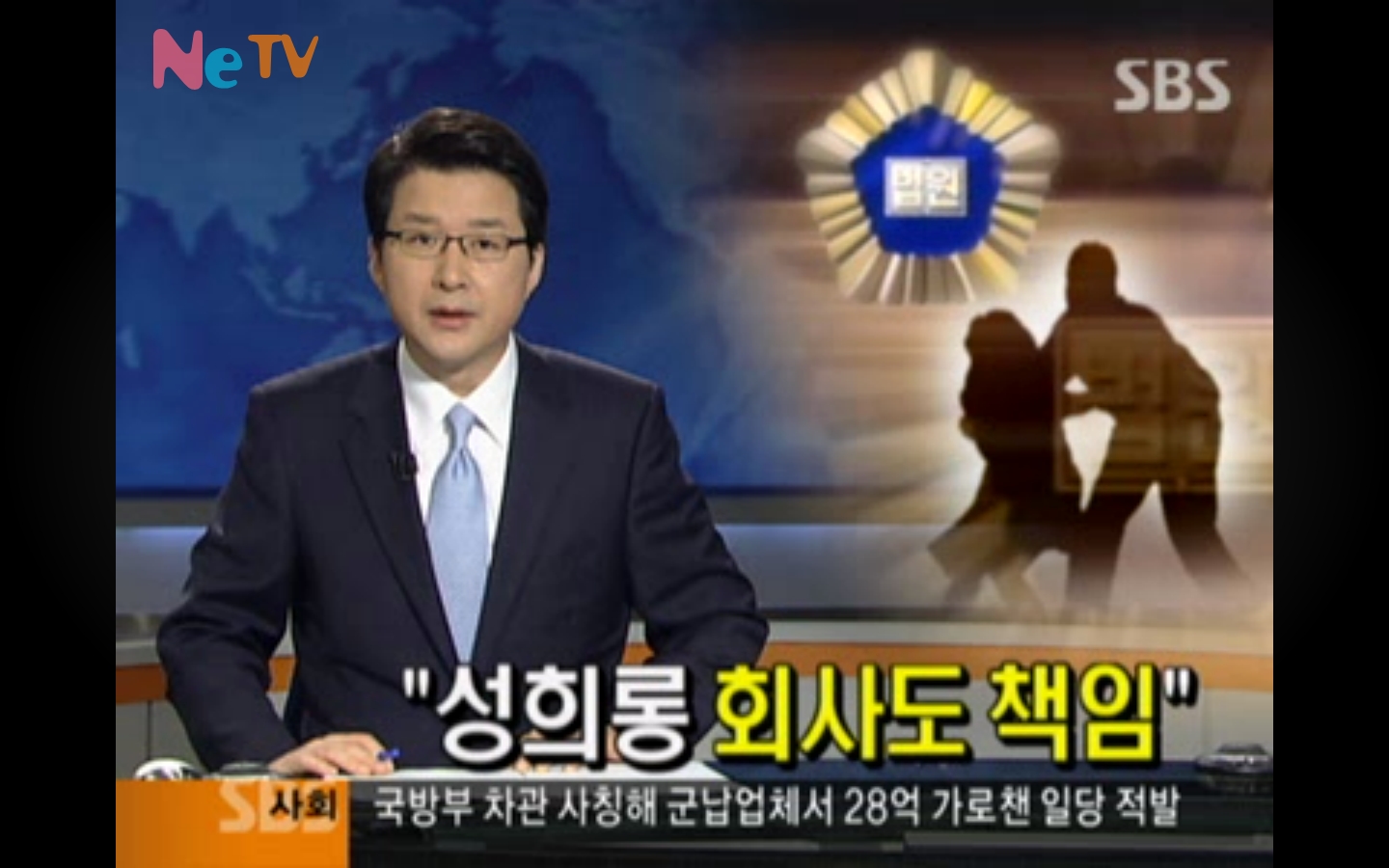
My original second question was much more important, but I’ve since been able to answer it through a report on the judge’s ruling on SBS News on the 21st of April, which unfortunately I’ve been unable to embed nor to download. If you fast-forward to 1:40 however, you’ll see that it leads with the headline above that “Companies also have responsibility for sexual harassment” and indeed the newscaster says that this is actually the very first time that such a judgment has been made; a notion I find simply bizarre on the one hand, and yet all too explicable in light of Korea having the “most unfriendly work conditions for women in OECD” on the other.

But am I misguided though, in believing that in cases of sexual harassment in the workplace in Western countries, it is generally employers rather than individual perpetrators that are considered liable?

Regardless, I’m sure you’ll agree that an important precedent has been set, and now I’m really looking forward to learning more about it in Part 2, which you can expect to be be up on Thursday Friday!

Share

Sex as Power in the South Korean Military: A Follow-up

( Source )

As I discussed back in March, the first ever survey on the issue of sexual violence in the Korean military discovered endemic levels of abuse, with roughly 15% of 250,000 conscripts each year experiencing it as either victims or perpetrators. A hugely important socialization experience for Korean men, this had grave implications for Korean society.

On a slight positive note however, I was happy to also read that much of the researchers’ data was obtained by interviews with soldiers in their barracks with the official cooperation of the Ministry of Defense. A sign of changing attitudes towards acknowledging and dealing with the problem?

Alas, I’ve just discovered that that was far too optimistic, as the military still remains one of the least transparent institutions in Korea:

When the Cheonan sank [in March], the initial reaction was shock and sadness, which quickly gave way to rage: with a government accused of dragging its feet, but also with a military that seemed unprepared for a North Korean attack.

But anger with the military runs deeper than over a single event. Mistrust of the institution is widespread because it has failed to open itself up, using the excuse of national security, while the rest of the country has embraced democracy.

South Korea’s military dictatorship may be a thing of the past, but the North’s constant saber rattling in the form of nuclear tests, missile launches, spy incidents and the occasional skirmish continue to give Korea’s men at arms an immediate relevance – and an excuse to conceal things from the public. That right to secrecy is enshrined in the National Security Law, which places restrictions even on regular citizens’ freedom of speech for the sake of preventing enemy subversion, but is even more of a cloak for the armed forces. It’s the legal manifestation of the bubble in which the military operates, isolating it from the massive changes the rest of Korean society has undergone. To date, for example, no civilian has ever been named defense minister.

Every year, a report is quietly released titled, “Military deaths caused by accidents.” In 2008, there were 134 names on that list, including 75 suicides. The suicides are usually explained by a “failure to adjust to military life.”

That explanation is unacceptable for Joo Jong-woo, whose son, Pvt. Joo Jung-wook, committed suicide in 2001 at age 22…

Read the rest at The JoongAng Ilbo, including about “its emphasis on tight ideological control of its conscripts” resulting in its banning of left-wing books like the works of Noam Chomsky, and the expulsion of military legal officers for “arguing that the military’s regulations are unconstitutional”. Meanwhile, the Korean military still refuses to recognize conscientious objectors and so imprisons them (see here also for a podcast on the development of the concept of conscientious objection in the West), the National Human Rights Commission is ineffective, and the maintenance of the conscription system as a whole is one reason why the Korean Military remains  “a 1970-vintage force structure, designed around a 1970-vintage threat, equipped with 1970-vintage weapons.”

( Source: anja_johnson )

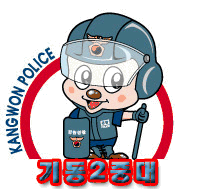
As for the images of mascots, please note that I post them not to be facetious though(!), but rather to show how facile such attempts to soften the image of institutions like the police and military are in light of reports like this. But nothing against the mascots themselves of course, and see here, here, and here for more information about Podori (포도리) in the riot gear!^^

Update, October 2010: Unfortunately, this recent incident demonstrates that little progress has been made since this post was written.

Share

Sex as Power in the South Korean Military

Source: anja_johnson

“All men are rapists,” I read on the back cover of Susan Brownmiller’s Against Our Will: Men, Women, and Rape in the student bookstore. Determined to impress women with my intellectual and feminist prowess by debunking that quote, I bought the book and doggedly read all 480 pages trying to find it. Twice.

Yes, I was rather naive about the whole dating game. Even worse, you can imagine how I felt years later, when I learned that she never actually said that. Rather, it was a big misinterpretation of her statement that rape “is nothing more or less than a conscious process of intimidation, by which all men keep all women in a state of fear” (p. 5), albeit an understandable one. Indeed, it’s probably what she’s become best known for, an enduring catch-phrase of pop-feminism that publishers would knowingly exploit to sell the book to me 2 decades later.

Which is a shame, because along with Menachem Amir, she was instrumental in overturning long-held conventions that rape was simply a spontaneous act of lust, instead demonstrating that it is more “a deliberate, hostile, violent act of degradation and possession on the part of a would-be conqueror, designed to intimidate and inspire fear…” (p. 439). Or in short, it’s due to her that surely all reading this are aware that sexual violence is all about power, and not surprised to hear this reaffirmed by the survey “Sexual Violence Among Men in the Military in South Korea” by Insook Kwon et. al., Journal of Interpersonal Violence, Vol. 22, No. 8, 1024-1042 (2007), the subject of today’s post.

The first comprehensive survey of its kind, in English or Korean, it was prompted by the suicide of a Korean soldier in July 2003, which received tremendous attention in the media because sexual violence by his superiors seemed to have played a role; after all, with 250,000 men forcibly conscripted each year, any implication that it wasn’t an isolated incident meant that there were far more victims. And in point of fact, with the proviso that the authors’ (undefined) notion of “sexual violence” appears to be much broader than a layperson’s as I’ll explain, they did indeed find that 15.8% of respondents experienced it during their time in the military, either as perpetrators or victims.

But before discussing the implications of that however, and especially what it says about the role of the military in the socialization of Korean men, let first provide an overview of the survey so you can make your minds (with a nod to copyright, I won’t upload the survey itself here sorry, but please feel free to email me if you’d like your own copy). And so, without any further ado:

The survey was conducted from November 2003 to February 2004, with researchers meeting 2 groups: 362 postconscripts, then students, at 6 different colleges; and 409 current conscripts, 115 at bus and train stations while they were on leave, and 294 in visits to their barracks with the official cooperation of the Ministry of Defense. From each group, there were 266, 111, and 294 valid samples respectively, giving a total of 671 valid samples out of 771 soldiers surveyed (the bulk excluded being postconscripts, and because more than 3 years had passed since their military service). They also conducted in-depth interviews of 8 perpetrators in army prison, and 3 victims.

Highlights of the results include (all emphases mine):

Of 671 valid respondents who participated in this survey of victimization, perpetration, and observation, a total of 103 people (15.4%) answered that they were directly victimized, 48 people (7.2%) answered that they had direct experience as perpetrators, and 166 people (24.7%) answered that they witnessed sexual violence in the military.

Excluding eyewitnesses, a total of 106 soldiers (15.8%) directly experienced physical sexual violence, either as perpetrators or victims in the military. A very high number of soldiers also indicated they experienced sexual violence as perpetrators and as victims: 59 soldiers (55.7%) were victims only, 39 soldiers (36.8%) were victims and perpetrators, and only 8 soldiers (7.5%) were exclusively perpetrators. Among perpetrators, 83% had experienced sexual violence in the military when they had been lower ranked soldiers. This feature of high number of perpetrators having previously experienced victimization themselves could be seen as the most unique feature of sexual violence among men in the military. (p. 1028)

(Source: anja_johnson)

And:

Victims named higher ranking soldiers (71.1%), junior officers (7%), and officers (3.1%) as their perpetrators, totaling 81.2% of victims who responded that someone of a higher rank forcibly imposed sexual contact….

Also, the eight perpetrators and three victims who agreed to be interviewed, as well as six cases recorded by the Korean Sexual Violence Relief Center and reports by military judiciary officers, confirmed that victims of sexual abuse were in lower ranks than their perpetrators. All victims had been victimized by higher ranking soldiers, and eyewitnesses reported likewise. In sum, sexual violence among men in the military in South Korea was committed primarily by a higher ranking solider against a lower ranking soldier. (p. 1029)

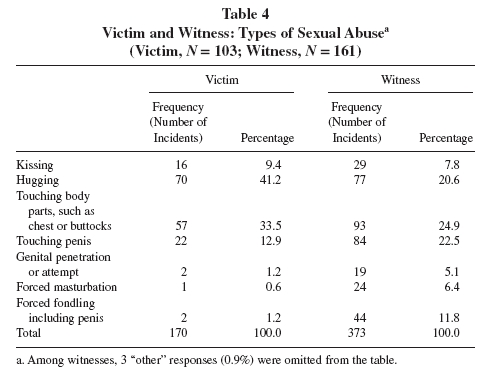
The types of abuse, as reported by victims and witnesses (p. 1031; multiple answers permitted):
As reported by the perpetrators (p. 1033):
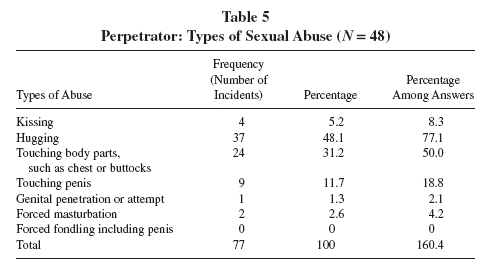
Also note that 22.1% of victims (but only 7% of perpetrators) reported that physical violence accompanied the sexual violence, and that 71.8% of victims and 90.7% of perpetrators responded that the acts of sexual violence when others were watching (I’ll return to the latter point shortly).  And in particular, eyewitnesses reported that 22.5% of the sexual violence they saw involved touching genitals, and 5.1% involving anal penetration (or the attempt), nearly 2 and 5 times higher than victims reported respectively.

Reflecting on the discrepancies, Kwon et al. found that:

…people tended to feel more comfortable talking about what might be considered part of a general sexual culture—such as kissing, hugging, and telling sexually explicit jokes—but answers were less forthcoming when concerning sexual violence of a more serious degree. (p. 1032)

Which for a long time I simply didn’t understand: how on Earth was that the “general sexual culture” of the military? Well, first consider that:

When asked, “In the military, have you ever been forced to talk about sexual experiences, even when you did not want to?” almost one third (32.7%) of the 667 respondents answered affirmatively. To the question, “Have you ever experienced negative consequences either because you did not have any sexual experiences or because you refused to discuss your sexual experiences?” a total of 218 soldiers (32.7%) answered that they had been forced to talk about sexual experience. (p. 1028)

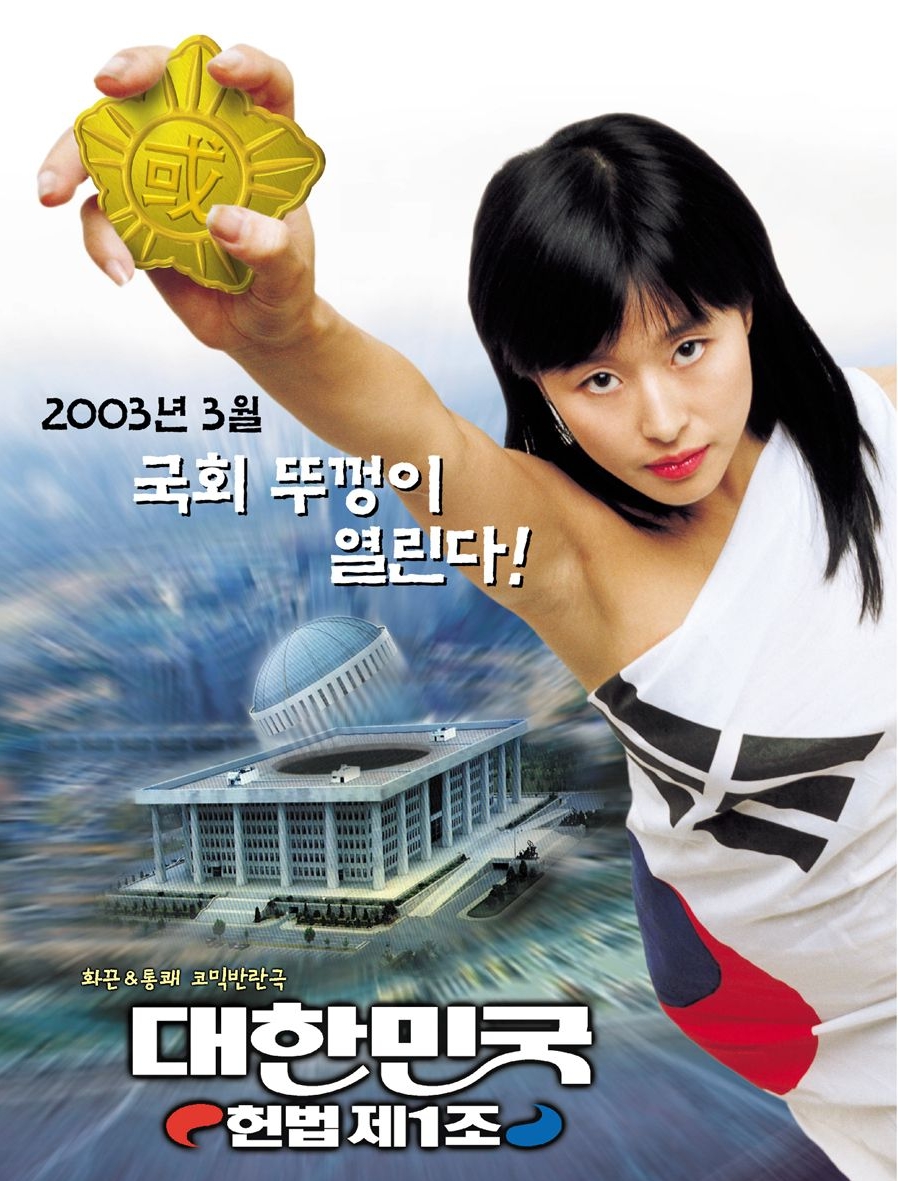
And that this mandatory disclosure of sexual experience has long been regarded as “an essential part of sexual culture in the military” is corroborated by numerous references in Korean movies to the practice of virgins visiting a prostitute before starting one’s military service, of which I highly recommend the satirical comedy The First Amendment of Korea below.

(Source)

Next, there is the fact that victims of sexual violence tended to interpret it as:

…intimacy or playfulness, because identification as a victim of sexual violence would imply one’s fragility and vulnerability. This tendency to minimize and trivialize injury was clear in cases where abuse continued for a long time, and in situations where a clear power dynamic between the perpetrator and the victim made resistance much more difficult for the victim. (p. 1033)

Moreover, perpetrators:

…did not force sexual contact on their peers with whom they had even closer relationships [than inferiors]. The intimacy in question was strictly an intimacy from the position of the higher ranking soldier.

Kwon et al. further discuss the natural difficulties victims had in refusing advances by a superior, and crucially, why the third most common form of sexual violence was touching a victim’s genitals. But why, particularly when only 5.4% of victims thought that their perpetrators were genuinely homosexual? Well, as one victim noted:

…unlike in the general society where one could not treat another person with complete disregard for age, educational level, or class, in the military, higher ranking soldiers could treat lower ranking soldiers as one pleased—including touching their genitals. (p. 1035)

And after a discussion of the right to control and abuse the body being a very useful method for militaries to reaffirm its hierarchical order, and of the role of the penis as a symbol of power and authority throughout history, they note that, hence:

…teasing or forceful contact with one’s penis becomes a way to prove the victim’s lack of power.

(Source: Journey to Perplexity)

Needless to say, the effects of this are amplified if done in public settings, and indeed 90.7% of perpetrators responded that people were watching when their sexual violence occurred, with the vast majority of witnesses either actively engaging in it in some way (23.7%), passively consenting by simply watching (57.9%), or pretending not to see (10.5%) rather than attempting to stop it: hence a “general sexual culture.”

But continuing with why:

…violence feminizes victims of sexual violence in two ways. The victim is reduced to a sexual object, like many women typically face in society, and as the powerless victim of violence, he is further feminized. Men who are victimized by sexual violence, then, become someone whose masculinity is lacking or damaged. Hierarchical order reasserts itself amid all this, and men collectively try to be on the offensive to affirm their aggressive masculinity. (pp. 1035-36)

And finally, the testimony of a perpetrator himself on why he did it, who said that he used sexual violence in lieu of physical violence sometimes, forcing sexual contact by “not hitting every time, and not joking around but harassing them”:

[Like harassing them…] Yes, I can’t hit them every time . . . and it’s not just joking around, but harassing them. . . . For instance, making them clean things repeatedly. Stuff like that. . . . If they were from wealthy families . . . or had a lot of education themselves . . . the superiors are ahead only because they came to the military before them . . . honestly . . . when you don’t have much to show for, and if they kiss ass to superiors who intimidate them . . . and if they think you’re not all that . . . well, you can’t beat them and so I kept thinking about ways to give them hell in the military, legal ways . . . and that’s how I ended up. (pp. 1036-37)

({2-365} Tick Tock by Dee’lite)

But what to make of all this?

At this point, it seems appropriate to point out my own complete lack of experience with the Korean military, as well as not even having any close relationships with any Korean men from whom I could learn about their military service, and so I would be very grateful to hear from those that have either. But then my own inexperience is essentially irrelevant here, as I’m largely passing on the results of renowned experts in the field (scroll down to note #32 here for more information on Kwon for instance); moreover, my own interest in on what is implied for Korean culture and sexuality as a whole, and so let me pass on the following description of military life provided by Ask a Korean, in his own excellent series on military service in Korea:

For some of today’s Korean young men, who have gone soft since the days of their fathers, military experience can be unbearable. Physical exercise is grueling, the superiors can be arbitrary and insulting, and your squad mates could shun you if you are responsible for putting the whole squad in trouble. Given that these guys, just like any other soldiers in Korea, can access guns and grenades, it should be no surprise that recently there has been a string of incidents in which a draftee shoots up his squad or toss a grenade in the squad room, killing many….

….[But there are definitely good life lessons to be learned from the experience, although it may be debatable whether learning those lessons is a good use of 2 to 3 years of young men in their prime. To put it bluntly, the military experience builds Korean men’s tolerance for all the life’s bullshit. As the Korean described so far, there is no shortage of bullshit – some of them perhaps the worst to be encountered in life – in the military. Exhausting physical training, insults and condescension from the superiors, and wasting time on arbitrary and trivial errands are all part of the experience. For young Korean men in the military, there is no choice but to simply grin and bear them. Once they finish bearing it, they know that most difficulties in life would be easier than what they already went through. The combination of such tolerance and insight, some may call it maturity – because, as anyone who has had a regular job can tell you, life as an adult has a lot of crap that we must simply grin and bear.

(Band of Brothers by The U.S. Army Photostream)

And in the next post in that series (my emphasis):

…one can argue that the military culture neatly coincides with traditional Korean culture – in both cultures, seniority automatically commands respect and loyalty. It is not surprising, then, that Korean workplaces are often run just like a squad in the military. You do what your boss tells you to do, and you are supposed to grin and bear it. Your time will come because Korea, like Japan, had automatic advancement by seniority at least until 1990s. Once you are the boss, you can order people around, much like the way you can order people around once you put in the time and became a sergeant.

I happened to work in such a place when I wrote the first post in my own series on gender and militarization in South Korea, and in which I noted that Korean corporate life often requires such a level of personal sacrifice for one’s superiors that, tellingly, even the Samsung Economic Research Institute acknowledges that “many workers…take it for granted that they have to tolerate anything in return for getting paid.” I should note however, that many readers thought my workplace was the exception rather than the rule, but be that as it may, the purpose of many of those things to be tolerated there boiled down to no more than the demonstration (and abuse) of superiors’ authority…and so too does sexual violence clearly emerge as one means – albeit, and I stress, only one, uncommon means – of doing so in the Korean military.

But I will further cover the effects on Korean gender relations and sexuality in great detail as I belatedly continue that series next month. In the meantime, let me leave you with the following passage from Shadows of Forgotten Ancestors: A Search For Who We Are (1993) by Carl Sagan and Ann Druyan to ponder, a book which had a great effect on my worldview and which frequently came to mind as I was writing this post (via Viraj’s Weblog):

(Source)

We go to great lengths to deny our animal heritage, and not just in scientific and philosophical discourse. You can glimpse the denial in the shaving of men’s faces; in clothing and other adornments; in the great lengths gone to in the preparation of meat to disguise the fact that an animal is being killed, flayed, and eaten. The common primate practice of pseudosexual mounting of males by males to express dominance is not widespread in humans, and some have taken comfort from this fact. But the most potent form of verbal abuse in English and many other languages is “Fuck you,” with the pronoun “I” implicit at the beginning. The speaker is vividly asserting his claim to higher status, and his contempt for those he considers subordinate. Characteristically, humans have converted a postural image into a linguistic one with barely a change in nuance. The phrase is uttered millions of times each day, all over the planet, with hardly anyone stopping to think what it means. Often, it escapes our lips unbidden. It is satisfying to say. It serves its purpose. It is a badge of the primate order, revealing something of our nature despite all our denials and pretensions.

Update 1, February 2013: See The Chosun Ilbo and ROK Drop for some more recent statistics on sexual assault in the Korean military.

Update 2, February 2013: See Sociological Images for more on sexualized insults.

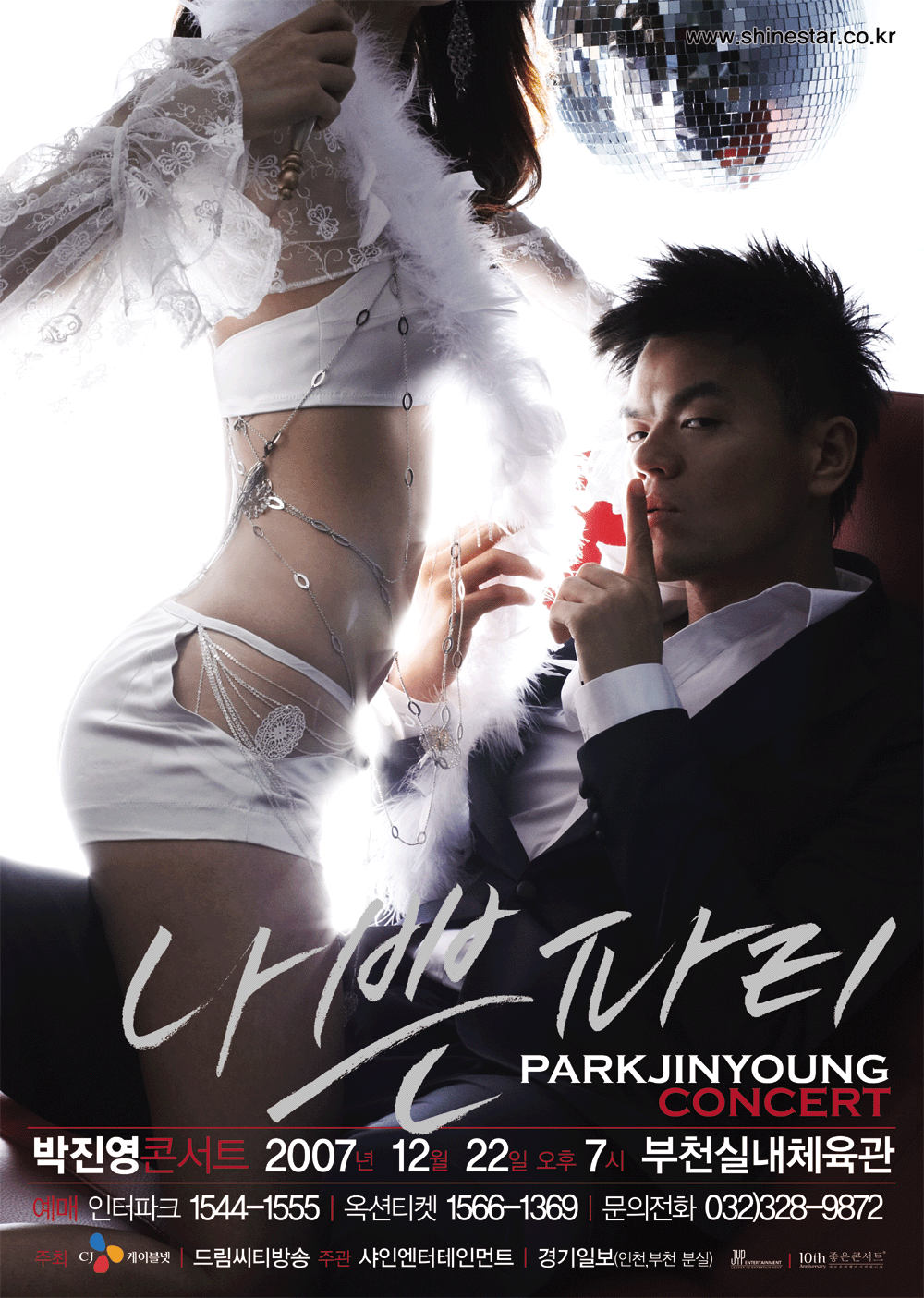
Korean Sociological Image #29: JYP’s Objectification of Women

(Source)

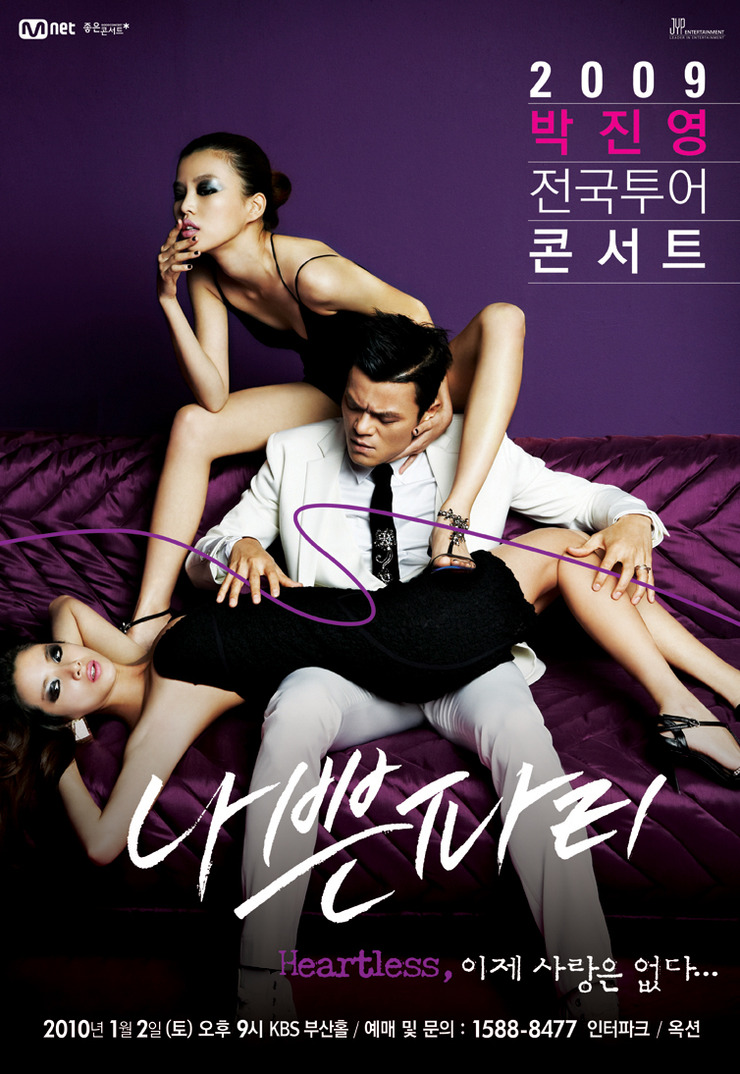
What’s wrong with this advertisement?

When I first saw it, I couldn’t really put my finger on it, other than noting the similarity to some iconic but controversial music videos by Robert Palmer. Which was kind of ironic, considering what Park Jin-young (박진영) is putting his fingers on.

With thanks to an anonymous reader for passing it on, both these problematic elements and more are present in his new music video No Love, No More (노러브노모어), the main subject of this post. But first, a quick explanation of what was so controversial about those Robert Palmer videos exactly, for many of my younger readers may not even have heard of him.

As Alyx Vesey explains in Feminist Music Geek, the crucial one was “Addicted to Love” from 1986, and as a feminist she had trouble with it:

…for one big, obvious, highlighter-yellow reason. It’s so blatantly sexist. The models who comprise Palmer’s backing band are normatively beautiful, musically inept, interchangeable, ornamental, passive, and blankly spectacular. They’re kinda like a Busby Berkeley chorus line, only on sedatives and with visible nipples.

And while it’s a little off-topic for a post ostensibly about JYP, I think it’s worth quoting her a little more:

And yet. I can’t let this one go so easily. It’s an indelible image that is simple and yet iconic in design (it’s so effective that ”Simply Irresistible” and “I Didn’t Mean to Turn You On” only mildly revise the concept). Thus, it’s also easily replicable. When you put “Addicted to Love” alongside another lexicon 1980s video like, say, Michael Jackson’s “Thriller,” it’s much easier to match (many people, including Jackson, tried and failed to reach or exceed that video’s epic proportions).

It’s also an easy concept to subvert, which is my primary interest. I’d like to highlight a few instances where women take on “Addicted to Love” and, in the process of recasting and reconfiguration, potentially disrupt the original music video’s sexist aims.

Which I highly encourage you to check out. Meanwhile, let me also present the Simply Irresistible music video here, for I think that with the women dancing in the background, it is the most similar of the three to No Love No More:

Finally, No Love No More itself. Regardless of the criticisms in this post, it probably has the best picture quality of any music video I’ve ever watched on Youtube, so make sure to click on “HD”:

Clearly not a carbon copy of Robert Palmer’s videos then, and JYP, or whomever was responsible for them, might reasonably claim not to have been at all influenced by those. But whatever the origins, the women in the barn (and in the poster) are indeed extremely similar, and almost all are objectified.

And yet there are still more problematic elements in it, pointed out to me by the reader who passed the video on. Unfortunately, I didn’t have time to ask permission to quote her email before writing (apologies for my over-enthusiasm), so she’ll have to remain anonymous:

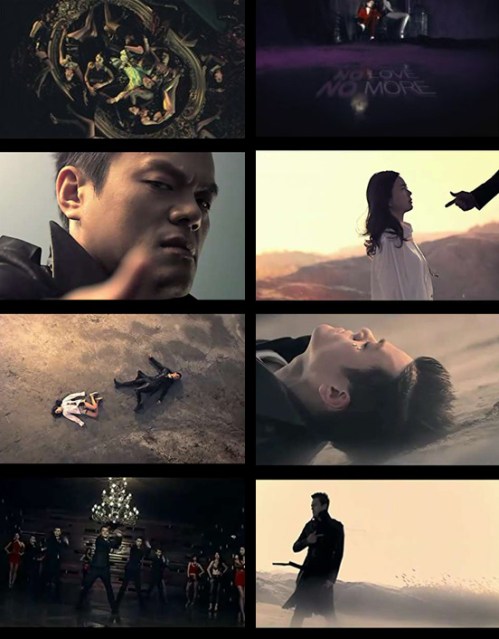
…the video infuriates me. Maybe it’s because I come from a country where explicit violence against women is not only extremely taboo but also illegal to portray in music videos. Still, given that domestic violence is such a formidable problem in this country, I find it mind-blowingly irresponsible that the most powerful man in Korean music at the moment puts out a video like this (source, right: unknown).

Shooting his girlfriend execution-style (apparently it’s okay to show her blood spraying out as her body crumples to the ground but it’s not okay to show an actual gun doing the shooting)… he then turns the “gun” on himself, and we’re expected to sympathize with him as a tear runs down his cheek as he takes his last breath. He executed his girlfriend, but the poor guy must have felt immense pain to have been driven to do such a thing. Break to the rest of the video, which simply consists of JYP dancing while dozens of women stand around or grope him as sexual props. JYP’s entire image seems to rely on the objectification of women, as demonstrated by [that poster], for one example…

…in which he is fingering a woman’s breasts, “playing her” as if she was a musical instrument. Now I’m definitely no fan of K-pop, and normally have nothing to do with it, but this video of his has been playing over and over on TV, and I can’t help but fear the message it sends young Koreans. JYP is, after all, immensely popular and influential in the K-music world, as he owns one of the most successful music labels in Korea and appears on countless TV shows and commercials. I find it surprising that no one seems to take offense to this video, which romanticizes violent “crimes of passion” (end).

(Source)

I agree, and as that reader is almost entirely responsible for this post, I encourage her to give me permission to print her name so that she can receive the credit for it!

But I would of course appreciate it if any other readers had more to add, on either the music video, the poster, and/or JYP’s marketing in general. And I confess, I know little about JYP’s music. So, to any fans of his in particular, would you say that that characterization of him is fair?

(For more posts in the Korean Sociological Image series, see here)

Unrequited Love…or Stalking? The Pitfalls of Dating in Korea

How to deal with a stalkerIn Korea, it is accepted practice for men to relentlessly pursue the objects of their heart’s desire, sometimes for many years, and despite if said objects clearly, repeatedly, and vehemently express their disinterest.

Far from being viewed as stalking however, it is generally viewed as both a sweet and noble sign of one’s love and dedication. There’s even a proverb specifically for this: “열번찍어 안넘이 가는 나무 없다,” which roughly translates as “There is no tree that can withstand being chopped 10 times.” (Image source, right.)

It’s not that I can’t see those sweet and noble elements, nor how many Korean women would surely exploit the practice, in a playing hard to get fashion (some more Korean that comes to mind is “희망고문하다,” literally to “hope-torture [someone],” or to repeatedly string someone along and then break their heart). But I think that the consensus of most Westerners is that if the woman says she’s not interested…then she’s not interested, and hence that the man’s behavior after being told is stalking, regardless of how sweet or noble his intentions. Unfortunately, in a society that already accepts women being physically dragged into nightclubs, then foreign or Korean, women can probably expect little sympathy when dealing a stalker.

This probably won’t be the first or last time you’ll read about this subject: navigating different expectations when it comes to dating are an integral part of the expat experience, and with my limited dating experience then I can’t add much that hasn’t already had gallons of virtual ink spilt on it. Two useful things I can do though: first, mentioning that of all the guides to navigating those dating minefields out there, that this one by Michael Hurt at Scribblings of the Metropolitician is by far the best, and with many things that informs even my marriage of 6 years; and second, and which was frankly the real inspiration for this post, that over at Sociological Images there is a post that discusses the fact that:

Various journalists and scholars have pointed out over the years that movies and TV shows often portray as romantic behavior that is fairly indistinguishable from stalking.

And then a video created by Jonathan McIntosh of Rebellious Pixels, who:

…edited together scenes from Buffy the Vampire Slayer with scenes of Edward Cullen from the movie Twilight to show how behavior that is depicted as protective and romantic in the film (and book) could also be seen as disturbing

For more, see the original post here. Not that I think that the humorous stalking in, say, There’s Something About Mary had much of an effect on my own opinions of it, nor that seeing it in pop-culture somehow renders real-life examples in any country okay, but still: the next time we feel a sense of righteousness and indignation about hearing Korean examples, it is certainly worth pondering the mixed messages that Western pop-culture provides.

Jackie Lim and The Pimping of Korean Entertainers, 1995

(Source: ITH)

Update, December 2013: A very old post, which I’ve long since removed the original commentary to (and consequently the comments also). But hopefully someone may still find the translation useful!

해외동포 연예인 붐을 일으킨 재키림의 10년 전 사진 / Jackie Lim, The Creator of an Overseas Korean Entertainer Boom

삼성은 하이버네이션 기능 때문에 안정성에 문제가 많은 그린컴퓨터를 얼른 단종시키고 매직스테이션이라는 새로운 브랜드를 선보였는데, 매직스테이션은 꽤 오래 출시되면서 장수 브랜드로 자리 잡았다.

Because the “hibernation” function was causing many problems with stability, Samsung quickly stopped producing “Green computers” in 1995 and launched a new brand called “Magic Station” instead, which became a very successful brand over the next ten years.

매직스테이션III의 광고모델은 당시 새롭게 떠오르던 해외동포 연예인인 재키림이다. 몇 개 국어를 자유자재로 구사할 수 있었던 재키림은 재원이라고 칭찬받으며 화려하게 연예계에 데뷔했다. 재키림은 SBS ‘생방송 TV 가요 20’, KMTV ‘동방특급 비디오자키’ 등을 뛰면서 가수와 비디오자키로 활동했다. 재키림은 비디오자키의 열풍을 일으켰을 뿐만 아니라 오늘날의 해외동포 연예인 붐을 일으킨 불씨가 되었지만, 정작 본인은 한국 연예계에 적응하지 못하고 방황으로 얼룩진 비운의 운명을 걷게 된다.

Jackie Lim was a new and upcoming star when she appeared in the “Magic Station 3” advertisement in 1995. As she was fluent in many languages she received a lot of attention and praise when she made her original debut, both starring as a singer and working as “video jockey” on the SBS program “20 Songs On Air” and KMTV’s “High-Class Eastern Video Jockey”. Ultimately she proved so popular she provided the spark for a boom in interest in overseas Korean entertainers. But she soon found it difficult to adapt to the Korean entertainment industry, and became a bit lost for which direction to take herself and her career.

재키림은 마약을 비롯한 좋지 않은 사건에 휘말리는데, 그녀가 이런 사건에 빠진 이유는 ‘한국에서 실력으로 활동하려 했지만 자신을 성적대상으로만 보면서 높은 사람 자리에 불려나가야 하고, 동료연예인들로부터 왕따당하면서 외로워서 약을 하게 되었다.’고 밝혔다. 재원이라고 떠들었던 뒷편에는 여성 연예인에 대한 여전한 성차별과 고위권의 압력, 동료 연예인의 텃세가 있었던 것이다.

Later, she became disgusted and further disheartened by trying to succeed as a singer in Korea through her own abilities but while facing the virtual prostitution of female entertainers that goes on behind the scenes. Not only was she regularly pressured to entertain and provide sexual services for politicians and business leaders, who saw her merely as yet another trophy girlfriend to be used, but on top of that she was also ostracized by other entertainers too, angered by whom they saw as an uppity overseas Korean whom they intended to put in her place. In the end she became very lonely and depressed and got involved with drugs.

이미지: 1995년 삼성 매직스테이션3 광고에서 밝게 웃는 재키림. 하지만 이 웃음 뒤에는 잘못된 연예게 관행으로 인한 외로움과 고통이 숨어있다.

Photo caption: Jackie Lim smiling brightly in Samsung’s advertisement for the Magic Station 3. But hidden behind the smile there was a great deal of loneliness and pain caused by the Korean entertainment industry’s bad practices (source).