With my considerable gratitude to its author for passing it on, I’ll let the following email speak for itself:
…As a foreign woman married to a Korean man, myself and my husband face a unique set of cultural obstacles in our marriage. It can be trying at times, but we are usually able to work out our differences through a serious commitment to communication. However, there is one aspect of being married to a Korean man that I continually struggle with. From what I have observed throughout my time in Korea (and please correct me if I’m wrong), it seems that frequenting prostitutes is an accepted part of life for Korean married men. In fact, it is often required of businessmen if they want to be successful and accepted among their coworkers. For example, I have a friend who was offered a highly coveted position with a certain large corporation. While working there, he was required to regularly go out drinking and visiting prostitutes with his team. Given the strong hierarchical nature of Korean society, he felt unable to say no to his superiors, yet his religious beliefs compelled him to reject this lifestyle. As a result, he had no other choice but to quit and try to find another line of work.
I am told by Korean friends that going out drinking and womanizing with coworkers is an integral part of business in Korea (and, I imagine, another way that female employees are excluded and held back in business). Although this was shocking to me at first, it wasn’t hard to believe once I became more familiar with the language and more observant of my surroundings. It’s impossible to go anywhere in this country without being faced with a constant barrage of prostitution venues. Of course, they often masquerade as something else- massage parlors, karaoke rooms, barber shops, tea shops, PC rooms, bars, rest houses, etc., but they all offer at least the possibility of sex. It’s not exactly comforting to walk around in the middle of the day and see middle-aged men in business suits going into cheap motels on their lunch breaks or after work before returning home to their families. Although I know my husband is a good man and he has assured me that he’ll never engage in that type of behavior, I find it hard to trust him completely when every man in his life, including his father, his friends, and his mentors, sets this kind of example.
When I ask my female friends how Korean women put up with this from their husbands, they tell me that it’s what the men must do if they are to be successful. One said that even though the husbands stay out all night with prostitutes, drink with them, touch their bodies, etc., it is their choice whether or not they go all the way. I simply can’t wrap my head around this rationalization. Where I come from, if a spouse cheats, it is expected that the couple will either get divorced or go into some serious marriage counseling. It is not simply tolerated, or at least not by those who have any self-respect. As I love my husband deeply, my greatest fear is that he will give in to his peers and join them some time, resulting in the end of our marriage. I can’t conceive of how Korean men can not only hurt and disrespect their wives like this, but also spend all their time fraternizing with coworkers and women rather than spending it with their children. This aspect of Korean culture is toxic to families, and is one of the reasons I don’t believe I could raise a family in Korea. I am truly interested to hear how other married women – both Korean and foreigners – deal with this problem. Have they experienced the same fears that I have, or have their experiences been different? Do they tolerate their husbands going out with coworkers and meeting women, and if so, why? Finally, for those like me who are greatly disturbed by this aspect of the culture, how do they overcome these anxieties and learn to trust their husbands? (end)
As I too would soon quit any job that required regularly drinking with colleagues, let alone visiting prostitutes, then I don’t have anything to add to the email I’m afraid. But I can point you towards my discussion of the effects on married couples’ sex lives, based around my review of Goodbye Madame Butterfly: Sex, Marriage and the Modern Japanese Woman by Sumie Kawakami (2007); as I explain there, the experiences and attitudes described there are very relevant to Korean couples, largely because both countries share the same salaryman working culture, with husbands (and indeed wives) working late most evenings.
Also, by coincidence Michael Hurt at the Scribblings of the Metropolitician has just written a post on Korean society’s denial of the pervasiveness, ubiquity, and above all systematic nature of prostitution that is highly relevant to the discussion here. A snippet:
…I posit that the resistance to what every outsider observes as KOREAN SOCIAL REALITY in terms of the commodification and subjugation of women in this society, especially as embodied in the rampant institutionalized prostitution that is as observable in terms of the sheer numbers and types of such places of business (room salons, business clubs, barber shops, massage parlors, handjob rooms, juicy bars, miin-chon, 단란주점, 도우미 노래방, which goes without even mentioning the vast numbers of red-light districts in every part of Seoul and every city in Korea) NARY REQUIRES statistics, either.
What I see as the frequent resistance of people to believe something that is OBVIOUS in observed reality if one simply COUNTS the number of houses of prostitution on a single city block in any part of this city — Kangnam Station to Shinchon to City Hall to Apkujeong to Chungdam to nearly any neighborhood after midnight, when the plastic balloons, mini-trucks, and neon signs come on that aren’t on during the day — is partially a denial of obvious reality, coupled with the urge to throw out the many statistics that bolster easy observation because they make one very uncomfortable.
But I’m a human being. I understand emotions. But what makes it so easy for me to recognize that the US brutally kidnapped, displaced, and murdered MILLIONS of human beings for the sake of material gain, which has resulted in creating some negative aspects to my culture, i.e. discrimination and institutionalized racism? But when I mention institutionalized prostitution as a legacy of compressed and authoritarian development in the Korean context, people instantly start equivocating and dismissing my argument, while holding it to such an abnormally high bar of scrutiny, one would be hard-pressed to assert ANYTHING particular about Korean society….(end)
Writing about sexual symbolism in advertisements for so long, it takes a lot to shock or surprise me these days.
Still, I confess I burst out laughing at this one.
Lest you feel that my sense of humor is a little crass however, then perhaps you need the context. Last week, I was skimming an article in the Korea Times about the rivalry between the French wine Beaujolais Nouveau (보졸레누보) above and the Korean rice wine Makgeolli (막걸리), and suddenly noticed this:
Recognized as a simply old-fashioned drink for a long time, Makgeolli is popular with trend-savvy young female customers in the current boom. The biggest group is women in their 20s and 30s, and some of them ended up placing orders for [the new] Makgeolli Nouveau (막걸리누보) when they came to reserve its Beaujolais counterpart, according to Hyundai Department Store.
Now I’ve written a lot on gender-based Korean advertising in recent months, including that of tea-drinks, health-drinks, and attempts to make soju more appealing to women, so I was interested in finding out if that preference was partially the result of (or led to) similar marketing: after all, gender-based advertising is often more indicative of advertisers’ stereotypes and prejudices rather than any empirical evidence that it actually works. And in the case of that for “girly” Korean drinks in particular?
Well, recently at least that has meant nothing more sophisticated than either the use of a lot of pastel colors and/or the breaking of the convention that bottles must be pointing straight-up and in the bottom right-corner of advertisements. Instead, they pop up in a most satisfying manner almost anywhere, and usually at somewhat less than a 90-degree angle (see here and the bottom of here).
Obviously I can see the humor, and even like this one (aimed at men), but I’m beginning to find its repetitiveness kind of patronizing too.
Refreshingly, I actually saw little evidence of either feature in the marketing for Makgeolli Nouveau (see here and here for examples) though. But you can imagine what frame of mind I was in then, when I finally turned my attention to advertisements for Beaujolais Nouveau instead, and was greeted with the magnificent specimen above!
In fairness to Korean advertisers, Beaujolais Nouveau certainly seems to be considered a girly drink worldwide also. In Japan it is poured into spas and promoted as giving smooth skin for instance, and the (presumably) international labeling of previous years’ wines similarly featured pastel colors and flowers and so on.
This possibly explains why the “Peninsula Beaujolais Nouveau Party” at Lotte Hotel in Seoul last Friday boasted a lingerie fashion show too.
But more to the point, the text “신의물방울”, in the top-left corner of the advertisement, translates as “The Water Drops of God” or Kami no Shizuku, a Japanese comic book about wine. Extremely popular, and not just in North-east Asia, there is a wealth of commentary on it, so for interested readers I suggest this post at the manga blog Precocious Curmudgeon for the best summary, with many links to longer news articles. Focusing on the original advertisement here though, in one of those links it is argued that the comic’s greatest impact has in fact been on South Korea, with over 1 million copies sold, and the authors were “stunned to be greeted like stars” on their first visit there in 2007, even finding themselves introduced to candidates during the presidential election.
For those of you more interested the wines themselves though, I recommend this article from Slate more information on Beaujolais Nouveau itself, albeit not a very flattering one (indeed, a rival Japanese food and drink comic book to Kami no Shizuku describes the drink as “little more than a French prank that the Japanese have fallen for hook, line and sinker”), and the recession has recently forced it to be sold there 10% cheaper than in previous years and in plastic bottles.
( Source: unknown )
Meanwhile, for more information on Makgeolli Nouveau I recommend two articles in turn recommended by connoisseur Tom Coyner: the first from early November on the reasons for Makgeolli’s renaissance, and which mentions that women make up only 10% of drinkers of regular Makgeolli but 30% of the fruit-flavored ones; and the second from Wednesday on the difficulties of expanding the market from its current 3.6% of all alcohol sales. In addition, you may also find this article from February about the Japanese role in its resurgence interesting, and finally all of the above should be placed into the context of the Korean government wanting to promote more domestic rice consumption, as evidenced by itsattemptsto promote “Garaetteok (가래떡) Day,” named after stick-shaped rice cakes, over the more commonly recognized “Pepero Day” earlier this month.
But has anyone actually tried either? Despite writing all that, I actually only started drinking wine and beer myself about 3 months ago(!) at the tender age of 33 (I preferred various cocktails), but if it tastes okay then I certainly wouldn’t mind trying something sweet and cheap like Beaujolais Nouveau. Any variety of Makgeolli however, would be just too weird: I have tried it, and concluded that something that looks like milk should not taste like wine!^^
Update 1: Water Drops of God is being made into a Korean Japanese drama series featuring Bae Yong-jun (배용준), and is scheduled to start next month.
Update 2: As Gomushin Girl has pointed out in the comments, labeling Makgeolli as rice “wine” is probably incorrect. Adding to that, this post at The Marmot’s Hole makes is clear that serving it in a wine glass is particularly inappropriate.
Update 3: Unfortunately, Bae Yong-jun’s drama series has been canceled.
Lest the last email from a reader featured here gives you the wrong first impression, Jacob Lee of California clearly put a lot of thought and attention into this one on the subject of Korean women’s body ideals, and has never ceased to be polite as he patiently waited almost 2 months(!) and many excuses from me before responding to it properly. Given the wait, he may be surprised to learn that I actually agree with most of the points he makes, although we draw very different conclusions from them.
For the sake of both making the email easier to read and distinguishing my interspersed comments from it, I’ve decided to preface the latter with pictures of myself, and, lacking a picture of Jake, one of popular Korean heart-throb Lee Seung-gi (이승기) to represent him. But no means do I mean to give the impression that I’m treating Jake’s email facetiously with that choice though, nor by the format that this was actually a two-way conversation. And I warn you: Jake’s email was over 2500 words long, and my response here brings that up to over 4300, so this post is definitely not for the faint-hearted!
Jake: Hello, Mr. Turnbull. I was browsing through your site the last few days when I came across your post, “From Asian to Caucasian,” at the end of which you wrote:
So although I’m always open to changing my mind, and think I have a pretty good record on this blog for admitting when I’ve been mistaken and/or changing my mind upon hearing new evidence, until someone actually addresses that point at all then I’ll continue to believe that “Caucasianness” is a very strong, albeit usually subconscious and/or indirect, influence on modern Korean women’s cosmetic surgery choices.
Well, hopefully, I can add a new, well… wrinkle to the topic of modern Korean women’s cosmetic surgery choices.
James: For readers’ sakes, let me reiterate that point here, which was that arguments that modern Korean ideals of appearance are merely extensions of historical associations of light skin and so forth, must confront the:
…big, fat, white elephant in the room that is America and the West. You have to consider how having white skin here in Korea is not simply a matter of lightness anymore, of being a sign that one doesn’t have to work outside in a field. The relative pallor of one’s skin is now inevitably linked to notions of civility and class that are also reflected against the very real presence of white people, who are not surprisingly, positively associated with notions of civility and class.
As Michael Hurt wrote in 2005. And so readers know what to expect, my main critique of Jake’s email is that while he does indeed add a great deal of new information to the subject, the points he make are essentially ahistorical, and he certainly doesn’t address that issue above.
Jake: First of all, let me just say that I do appreciate the work you are doing. I may not always agree with your conclusions, or the way you couch your arguments, but I do believe that for the most part, you are doing work that needs to be done, and saying things that need to be said as it pertains to Korean culture.
If you haven’t guessed already, I’m ethnically Korean. I’m a 23 year old guy living in Southern California. In the past few months especially, I’ve been interested in the question of Asians wanting to be Caucasians. Rather, I’m interested in the perspective of Caucasians regarding this topic. I suppose it wasn’t a really big surprise to learn that there are many Caucasians out there who firmly believe, as you do, that Asian women (in your case Korean women) are strongly influenced by “Caucasianness.” And no matter how vehemently these Asian women deny wanting to look white, the response invariably seems to be, “Yes you do. You just don’t know it b/c it’s subconscious, or you don’t want to admit it.” From youtube videos, Tyra Banks, the racist website stormfront.org, the list seems interminable.
To you and other non Asians, it seems that because many Asian women want larger eyes and a straighter nose, this is very strong evidence for their wanting to be white since these are deemed to be white standards of beauty…
James: Let me stop you there for a moment, as I think you’re careless with your choice of words here, unnecessarily and probably unintentionally generalizing myself and other Caucasians. Yes, I have indeed said that Korean women are strongly influenced by Caucasianness, but that’s not quite the same as saying that they subconsciously want to look White, and as far as I’m aware I’ve certainly never intentionally asserted such, either online or in person. I do agree that discussions on the subject by myself and others can certainly seem to have that dynamic you describe though, but in my own experience that’s frequently the result of either a misunderstanding or even a deliberate misrepresentation of non-Asians’ views.
Having said that, I do believe that the plethora of cosmetic surgery advertisements marketed towards Northeast-Asians but featuring Caucasians would suggest that – surely – some Koreans do indeed deliberately or subconsciously “want to look White.” But I’m not going to labor that point: it’s unnecessary. Rather, however cliched it is to do so, consider, say, that women wanting to look sexually aroused (and thereby more arousing) and men’s fondness for phallic symbols undoubtedly had big roles to play in origins of the modern habits of lipstick and tie-wearing respectively, but that doesn’t mean men and women deliberately or even subconsciously do so for those reasons now: instead, they are merely following cultural practices and/or norms surrounding them that have considerably evolved since. And in that vein, I’ll readily admit that the vast majority of Korean women that get lighten their skin and/or get cosmetic surgery operations that, to my eyes, make them look more Caucasian, actually do so to look more like Korean celebrities and/or merely follow Korean cultural norms. But while those certainly built on preexisting Korean ones, especially associations of light skins with an indoor, non-agricultural elite, they have also been heavily influenced by notions of class, civility and wealth literally embodied by Caucasians, as Michael Hurt pointed out.
That may all seem to be mere semantics, but because of the heated and often quite vitriolic debate this subject invariably seems to generate in the blogosphere, I want to remove that emotive element from any discussion immediately: I am not claiming here that Korean women simply want to look White, nor have I ever done so. With that out of the way then:
Jake: …But in the last few months, I’ve found that there has been some significant research done, mostly by evolutionary psychologists, which seem to strongly support the idea that there is, generally speaking, no white standard of beauty, Asian standard of beauty, black standard of beauty, or Hispanic standard of beauty – there is only a universal standard of beauty that is innate, recognizable by most, and aspired to by many.
I highly recommend the book, Survival of the Prettiest: The Science of Beauty by Nancy Etcoff, a psychologist and faculty member of the Harvard Medical School and of Harvard University’s Mind/Brain/Behavior Initiative.
Here’s an excerpt:
Despite racism, misperceptions, and misunderstandings, people have always been attracted to people of other races. Today the world is a global community where international beauty competitions have enormous followings (although many complain that these contests favor Western ideals of beauty). There must be some general understanding of beauty, however vaguely defined, since even three-month-old infants prefer to gaze at faces that adults find attractive, including faces of people from races they had not previously been exposed to. In recent years scientists have taken a deep interest in the universality of beauty.
It turns out that people in the same culture agree strongly about who is beautiful and who is not. In 1960 a London newspaper published pictures of twelve young women’s faces and asked its readers to rate their prettiness. There were over four thousand responses from all over Britain, from all social classes and from ages eight to eighty. This diverse group sent in remarkably consistent ratings. A similar study done five years later in the United States had ten thousand respondents who also showed a great deal of agreement in their ratings. The same result has emerged under more controlled conditions in psychologists’ laboratories. People firmly believe that beauty is in the eye of the beholder, and then they jot down very similar judgments (image right: source).
Our age and sex have little influence on our beauty judgments. As we have seen, three-month-old babies gaze longer at faces that adults find attractive. Seven-year-olds, twelve-year-olds, seventeen-year-olds, and adults do not differ significantly in their ratings of the attractiveness of the faces of children and adults. Women agree with men about which women are beautiful. Although men think they cannot judge another man’s beauty, they agree among themselves and with women about which men are the handsomest.
Although the high level of agreement within cultures may simply reflect the success of Western media in disseminating particular ideals of beauty, cross-cultural research suggests that shared ideals of beauty are not dependent on media images. Perhaps the most far-reaching study on the influence of race and culture on judgments of beauty was conducted by anthropologists Douglas Jones and Kim Hill, who visited two relatively isolated tribes, the Hiwi Indians of Venezuela and the Ache Indians of Paraguay, as well as people in three Western cultures. The Ache and the Hiwi lived as hunters and gatherers until the 1960s and have met only a few Western missionaries and anthropologists. Neither tribe watches television, and they do not have contact with each other: the two cultures have been developing independently for thousands of years. Jones and Hill found that all five cultures had easily tapped local beauty standards. A Hiwi tribesman was as likely to agree with another tribesman about beauty as one American college student was with another. Whatever process leads to a consensus within a culture does not depend on dissemination of media images.
James: Not that this detracts from either the points made in the book or in your email, and in fact I agree with all of those made in this *cough* rather lengthy excerpt, but let me point out here how I’m increasingly skeptical of the validity of any reports on the body and face preferences and so forth of isolated jungle tribes. Primarily, this is because of the way in which they are almost invariably used in the media, literally thrown into the discussion to support almost any hypothesis. Just this June for instance, Newsweek used some other South American tribes to argue the exact opposite, arguing that men’s ideals of women’s hip-to-waist ratios were heavily dependent on women’s economic position in their culture.
Cross-cultural studies have been done with people in Australia, Austria, England, China, India, Japan, Korea, Scotland, and the United States. All show that there is significant agreement among people of different races and different cultures about which faces they consider beautiful, although agreement is stronger for faces of the same race as the perceiver.
In the Jones and Hill study, people in Brazil, the United States, and Russia, as well as the Hiwi and Ache Indians, were presented a multiracial, multicultural set of faces (Indian, African-American, Asian-American, Caucasians, mixed-race Brazilian, and others). There was significant agreement among the five cultures in their beauty ratings and some differences. For example the Hiwi and the Ache agreed more with each other than they did with people in Western cultures. This is not because they share a culture – they don’t – but because they have similar facial features, and they are sensitive to the degree of similarity between their facial features and the features of the people in the photographs. For example, although the Ache had never met an Asian person, they were curious about the Asian-American faces, attracted to them, and aware of a similarity between these faces and their own. The Ache gave less favorable ratings overall to African-American faces, and they called the Caucasian anthropologists “pyta puku”, meaning longnose, behind their backs. One Caucasian anthropologist was given the nickname “anteater”.
Since the Hiwi and the Ache had never encountered Asians and Africans, had met only a few Caucasians, and were not accustomed to using the scientists rating scales, any level of agreement with the Western cultures is intriguing. Jones found a number of points of agreement. People in all five cultures were attracted to similar geometric proportions in the face. They liked female faces with small lower faces (delicate jaws and relatively small chins) and eyes that were large in relation to the length of the face. Jones called these “exaggerated markers of youthfulness”, and they are similar to the features mentioned in other cross-cultural studies of beauty. For example psychologist Michael Cunningham found that beautiful Asian, Hispanic, Afro-Caribbean, and Caucasian women had large, widely spaced eyes, high cheekbones, small chins and full lips.
People tend to agree about which faces are beautiful, and to find similar features attractive across ethnically diverse faces. The role of individual taste is far more insignificant than folk wisdom would have us believe.
Jake: And you can find the NYTimes book review here which offers some more insight (James: free registration required). Her book was even the basis for a discovery channel special which discussed the idea of a universal standard. Popseoul! (which I believe you are familiar with) even talks about it here.
No surprise that Kim Tae-hee (김태희) fits the standard perfectly, eh? Well, it wasn’t for me at least.
There might be the question, Do Caucasians fit the universal standard more than any other race? It doesn’t appear so. I can’t find the study anymore, but I’ll include it anyways just on the chance that you’ve come across similar studies or made comparable observations yourself, however informal. This study (one that was unrelated to this idea of universal beauty) suggested that 3 out of 4 people, regardless of race, were deemed to be either plain or ugly by participants who, themselves, were from various racial backgrounds. And only a very small percentage (less than one percent in each racial group if I recall correctly) was given the highest rating of beautiful.
My interpretation of this data is that since there are roughly 25% of people in each racial group who are considered somewhat attractive or beautiful, all racial groups have about the same proportion of people who fit the universal standard. It’s just that when we miss these standards, we miss them in different ways, e.g., small eyes for Asian women and big noses for Caucasian females.
Since I don’t have the source for this study, I wouldn’t blame you for ignoring it. But even if people want to believe that Caucasians fit the universal standard more than any other race, that still doesn’t change the fact (or at least what I believe to be a fact) that Asian women are trying to reach a universal ideal and not a white ideal.
James: I don’t mind that you don’t have the source for the study – I trust your interpretation of it – and I definitely agree that there are many features of human’s bodies and faces that are universally preferred: worldwide, people find symmetrical faces more trustworthy for instance.
But with that last sentence especially, I really think that you begin to carry the notion of universalism too far, as it leaves little room for what can be very influential culturally-based ideals, however malleable. And who exactly said that Caucasians fit the “universal standard” more than any other race? I know I certainly haven’t, and I challenge you to provide sources. The only sense in which I’d regard them as a universal standard is because of people’s associations of class, civility and wealth with Caucasians as explained, but that’s very different from saying that people have preferences for Caucasian features and so on for innate, biological reasons.
Update: One important thing I should add is that if Caucasian women have noses bigger than the universal standard, one would expect that Caucasian women would be getting operations to have them reduced with the same alacrity that Korean women, say, get double-eyelid surgery. I have no figures at hand and am frankly not inclined to search them out, but I’d wager that that isn’t at all the case. This ties in with the next quote by Michael Hurt I give a little later also.
Jake: So to paraphrase Nancy Etcoff, which is more likely? That a select group of men on Madison Ave. and in Hollywood determined what the ideal beauty should be and was able to influence countless billions of men and women over the next fifty years, even infants as young as one week old, even people living in the remotest parts of the world, such as the jungles of South America, people whom the only Caucasians they’ve seen were the few researchers who contacted them, researchers who were called “anteaters” behind their backs, but because of the stong influence of “Caucasianness, these people from all around the world, consistently chose what you consider to be the white standard of beauty, as their ideal standard of beauty, and they didn’t have the awareness, nor the capabilities, nor the will to resist such an influence, even knowing, perhaps only on a subconscious level, that they will never be able to measure up.
(“Qi BaiShi vs. Marilyn Monroe”, by Zhang Wei, Oil on canvas 2006. Source)
Or, could there be a universal standard of beauty, a certain facial structure that the significant majority of the people from all races and cultures find attractive, something that we are all born with, something we’ve always had even before the “westernization” of the world, just like we’ve always had an innate universal preference for the taste of fat and sugar, and a universal preference for certain sounds, rhythms and smells, and a universal enjoyment for the feeling of a soft fabric on bare skin, and a universal understanding of a smile and expressions of sadness and anger. And perhaps these advertising people on Madison Ave. and in Hollywood were as influenced by these standards as the rest of us?
Now I know that this is a gross simplification of a very complicated issue, and the “westernization” of the world is much more complicated and has many more facets including cultural, political, and economic imperialism, but at its core, the question that Nancy Etcoff poses needs at the very least to be considered….
James: Sorry, but “a gross simplification” is putting it mildly. And what’s to consider? Nancy Etcoff would find no disagreement from me that there are universally appealing facial features and shapes and so on. I’d even concede that double-eyelids, for instance, may not be quite as “Caucasian” as I first thought, and that Korean women may get the operation simply to make their eyes look bigger (and thus more attractive, by universal standards or otherwise) and/or just out of cultural habit…Caucasian ideals be dammed. But there’s so much more to the Caucasianness of the cosmetic surgery choices of Korean women then mere eyelids. As Michael Hurt points out (yes, him again, but then his post would be a adequate critique of your email in itself):
Deference to white skin here is so alive and well [here], how can one deny that it plays any role in the decision to get one’s eyes cut larger, nose Romanized, old-school high cheekbones shaved down to size, breasts enlarged, asses and lips pumped full of silicone, and nerves in the calves snipped? One can say that plastic surgery in the States or the West is also in major effect these days, but the crucial difference is that Westerners aren’t getting their epicanthic fold removed, breasts reduced, cheekbones raised, nose bridges removed, or calves fattened up. Let’s get real here – cultural sadaejuui (사대주의; flunkyism, toadyism, deference) goes in one direction. That’s what makes the case so sad when it comes to one culture trying to attain a beauty standard set by another one.
Moreover, as he eloquently puts it, you’re simply ignoring the big, fat, White elephant in the room that is America and the West:
You have to consider how having white skin here in Korea is not simply a matter of lightness anymore, of being a sign that one doesn’t have to work outside in a field. The relative pallor of one’s skin is now inevitably linked to notions of civility and class that are also reflected against the very real presence of white people, who are not surprisingly, positively associated with notions of civility and class.
In particular, I fail to see how a preference for light skin, taken to such extremes here that Korean women have among the lowest Vitamin D levels in the world, is anything but culturally determined.
Jake: To be sure she and her book are not without their critics, the most prominent being feminists (such as Naomi Wolf) and certain academics who have tried to downplay the importance of beauty for various reasons in the last few decades (James: see Popmatters for a recent feature article on this subject). But no one to my knowledge has been able to dismiss or discredit the significant amount of research she has included in her book. And judging by your other posts and your references to and criticisms of scholarly or journalistic pieces of work, I’m sure this won’t dissuade you from trying, lol. This book came out ten years ago, and since that time much research has been done which have only strengthened her conclusions. A couple of examples: first, from Psychology Today, and the BBC’s The Human Face documentary:
It is very Caucasian centric, but the conclusions Dr. Stephen Marquardt reaches parallels those of Dr. Escott in many ways.
Let me also say that I don’t want to give the impression that I believe “Caucasianness” had no influence on Korean women. Clearly, there has been. I think hair and eye colors are good examples of that. These aren’t universalities, so the fact that Korean women started dying their hair en masse during the eighties and started wearing colored contacts in the 1990’s tell me they were strongly influenced by white standards in this regard.
However, as Nancy Etcoff and others have pointed out, these culture specific standards (e.g. foot binding, lip plates, piercings, etc.) have a way of changing, sometimes very rapidly, to take on an altogether different meaning, such as what happened with the perception of a woman’s weight here in the U.S (source right: Scoubi).
In a similar way, I think the reasons why Korean women started dying their hair also changed along the way. Now, I think they do it for the same reasons Caucasian women do it – simply because they believe it makes them look better and they just want to try a different look. I also believe that they change the color of their hair to look more like Korean female celebrities. I don’t have anything to base my conclusions on because as far as I know, there hasn’t been any studies done on this issue. I’m only going by the word of the Korean women themselves and my understanding of how greatly Korean women admire the beauty of many Korean actresses.
And regarding colored contacts, that fad seems to be largely over.
James: Well, you can’t have it both ways. You’ve certainly made your point that some aspects of women’s facial and/or body ideals are really innate and universal, but like you and Nancy Etcoff say, others can be culturally determined. The onus is now on you to provide a list of which is which, otherwise it’s difficult to continue the discussion.
I strongly suspect though, that most of the cosmetic surgery operations that Korean women undergo (that to my eye make them look more Caucasian) will be extremely difficult to explain in terms of adherence to a universal standard, and which is in itself probably very much open to interpretation. If you do admit that some choices are culturally determined though, then again you really need to address the question posed at the beginning of this post.
Jake: In one of your posts, you wrote:
But I think the point that average Korean women are whitening their skins and undergoing cosmetic surgery because they want to look like rich and famous Korean women is, to be blunt, irrelevant: it merely changes the focus of our attention, but doesn’t answer the question of why rich and famous Korean women (rather than average Korean women) are doing so.
Well, to me, the answer is quite clear.
Anyways, I support what you are trying to do as it relates to women’s and children’s issues in Korea. Even though I’ve lived most of my life in the U.S., I still feel a deep connection to the country of my birth, and I have a great amount of respect for what it has been able to accomplish in such a short amount of time, especially since I sense an earnest attempt to continually improve itself. But that doesn’t blind me to its faults, and unfortunately, there are still too many.
Hope to hear from you soon concerning this topic. Take care.
Jake.
James: Apologies if I ultimately seem a bit dismissive of all your efforts, but I do really appreciate all the time and effort you put into your email, which I learned a great deal from on. And I really hope to keep the discussion going with yourself and other readers, either in the comments or by email. Naturally my preference is for the former, to make it a real discussion and all, but if you or anyone else would like to send further emails to be published here on this subject (or anything else) then by all means please do so. Preferably ones at least *cough* 50% shorter than 2500 words though!
Update:This post at Ask a Korean! about the differences in beauty standards between Koreans and American gyopos (ethnic Koreans living overseas) is a healthy reminder to be more specific about exactly which groups of ethnic Koreans we are discussing in the future. For the record then, I’ve only ever been referring to Korean women in Korea.
With those top two panels reminding me of the futuristic Blade Runner, it’s ironic that the ad is actually based on the decidedly archaic belief that one’s bloodtype determines one’s personality. What’s more, it’s a surprisingly deeply-held one too, with some Korean women even rejecting all B-type men as potential marriage partners because of it, as I discussed when I wrote about a similar marketing campaign for kiwifruit back in May. In short, it’s not quite the same as having a good laugh at your daily horoscope, and can’t be so easily dismissed.
A strange {and slightly disturbing} advertisement for Tandy found on this site about the 2005 movie My Boyfriend is Type B {B형 남자친구}. See later in the post for one more, and here for a review of the movie.
Lest one is tempted to jump to conclusions about Koreans’ critical-thinking skills though, then consider this blog post on the subject that was featured on the front page of Yahoo! Korea about a month later, which I’ve translated below. It is from the 12th most popular Korean blog according to its own blog ranking system—by way of comparison, this one is currently ranked 87,378 out of 4,644,184—so it would have been read by a lot of people:
우리나라에서만 볼 수 있는 ‘혈액형’ 광고의 불편함…
It’s discomforting how Korea is the only country in the world with advertisements about bloodtypes…
A형, B형, AB형, O형이 한자리에 앉아서 식사를 하고 있었다. 갑자기 AB형이 밥을 먹다 말고 벌떡 일어나 뛰쳐나가자 O형이 AB형을 뒤쫓아간다.
남겨진 A형이 B형에게 조심스레 묻는다: “쟤 혹시 나한테 화난거야?”
온라인과 오프라인을 막론하고 이젠 귀에 딱지가 앉을 정도로 듣게되는 혈액형별 성격에 관한 유머다.
일본에서 들어와 국내에 뿌리내린 혈액형별 성격 분석은 독일의 우성학에서 출발해 일본에서도 1970년대에 확고히 자리잡았다고 하는데 이런 성격 분석이 국내에 유입되어 뿌리내리며 우리나라를 전세계에서 몇 안되는 혈액형 신봉 국가를 만들어 버렸다. 사람 둘 셋만 모이면 혈액형에 대한 이야기가 쏟아져 나오는 그런 나라…;;
그렇게 보면 다음 CF들은 어쩌면 우리나라에서만 만날 수 있는 광고의 유형은 아닐까?
Four people, one with bloodtype A, one with B, one with AB, and one with O were sitting down having a meal together. Suddenly, “AB” stopped eating and got up and ran outside, and “O” decided to follow (him).
“A” and “B” remained, and A nervously asked B: “Is (he) angry with me?”
(James: No, I don’t get it either. But, for the remainder of the cartoon version on the right, see here, and here for many more like it.)
Needless to say, online and offline, there is so much humor about blood types that people are very tired of it.
Blood type and personality analysis originally derives from German eugenics, but it became firmly rooted in Japan in the 1970s, and from there in Korean culture, making Korea one of just a handful of countries that haven’t thrown such beliefs away. Indeed, get two or three Koreans together, and invariably they’ll end up chattering about blood types…
In this sense, you can only really see commercials like the following in Korea, right?
혈액형으로먹는다… 제스프리골드키위/Eat according to your blood type…Zespri Golden Kiwi
키위를 먹는 방식을 혈액형 성격 분석에 맞춰 유머러스하게 풀어놓은 제스프리의 CF다.
Here’s a humorous commercial by Zespri saying different blood types eat Kiwis in different styles (James: see my earlier post for the other 3 in the series):
Vodpod videos no longer available.
혈액형으로마신다… 2% 부족할때/Drink according to your blood type…2% “Near Water”
제스프리가 코믹이란 콘셉트를 내세웠다면 이쪽은 혈액형과 치환되는 단어와 사랑을 엮고 빅뱅을 얹어 광고를 내놨는데 실제 빅뱅 멤버의 혈액형에 맞춘 광고란다.
Whereas the Zespri commercials had a comic concept, the following ones with the band Big Bang (빅뱅) has each member falling in love and romancing women according to their bloodtypes (James: this video combines all 4 commercials in the series):
재학습되는혈액형성격분석…/These commercials help perpetuate public belief in the bloodtype and personality theory
평소 귀가 얇은 편이라 혈액형별 성격 분석에 종종 혹하는 편이지만 ABO식 혈액형의 고작 4가지 패턴으로 60억 세계인의 성격을 모두 분류할 수 있다고는 생각치 않는다. 또 이론적 뿌리도 부실하고 지나친 일반화와 선입견 듬뿍 담긴 규정으로 혈액형 별로 사람을 가늠해 버리는 것 자체가 혈액형에 기준한 성격 분석이 갖는 문제점이라고 생각하는 편이다.
Normally I’m a little gullible, so I’m often convinced of the validity of the bloodtype and personality theory, but still, I can’t believe that all 6 billion people in the world can be compartmentalized and categorized into just four types. And it is a problem that people are influenced by and follow the rules of their prescribed personality when the theory is based on insufficient evidence, is too generalistic, and rife with prejudices and preconceptions.
그런 이유로 이번에 소개한 혈액형에 관한 CF들은 왠지 불편했는데…감각적인 영상과 유머 코드로 적당히 버무려 광고를 바라보는 이들에게 쉽게 퍼지고 기억되는 이런 영상들이 결국 사람들 사이에 회자되는 혈액형별 성격 분석을 재학습시키고 있는게 아닐까란 생각에 이르렀기 때문이다.
For this reason, seeing these commercials made me feel a little uncomfortable…when sensible (if misguided) notions of bloodtype and personality are mixed with humorous ones in a sort-of cultural code and then utilized in commercials like these, they help to keep the theory on everyone’s minds and thereby perpetuate artificial divisions.
물론 사회에서 익숙한 코드를 반영해 상품을 홍보하는 건 일반적인 광고의 특성이니 어쩔 수 없는 부분이 있었겠지만 그래도 “이 혈액형은 이렇고 저 혈액형은 저래. 그러니 너는 이렇지?”라는 식으로 세상 모두를 4가지 성격군으로 분류할 수 있다고 생각하는 것 자체가 문제 아닐까?
훗~ 평범한 O형의 한마디였다. 응?
Of course commercials will always reflect a society’s cultural codes, but nevertheless isn’t it a problem when we say “this bloodtype behaves like this, that one like that, so that’s why you do what you do, yes?”, and that we want to compartmentalize the whole world into just four types?
I’m O by the way. Is that a typical thing for an O type to say? (Finish)
Not exactly the piercing critique I anticipated when I began translating, but that wasn’t my point really, which was more to provide a healthy reminder that just like back home there is a healthy diversity of opinions in Korea on just about every subject, but which it’s very easy to overlook if you only rely on English-language sources. Indeed, I’ve just found yet another, longer news report on the same two advertising campaigns, which I’m happy to also translate if anyone’s further interested (it’ll be good revision).
In the meantime, while finding some images for this post I couldn’t help but notice that, once again, apparently the powers that be felt that only young women in tight t-shirts and/or miniskirts could persuade persuade Koreans to perform their civic duty on “World Blood Donor Day” this year (left) and last (right). Come to think it though, that particular advertising convention doesn’t exactly detract from the aim of getting people’s blood flowing…
Sorry, I couldn’t resist it. And in fairness, this year’s ads did feature boy-band Super Junior (슈퍼주니어) also. For some big pictures of them promoting donating blood, albeit together with Girls’ Generation (소녀시대), see here.
Apologies for the small size, but if you can see the pink and orange blobs for Korean politicians that were originally civil servants or in the military respectively, then you get the idea.
The graph is from this article in the Economist magazine, which asks the question of why professional paths to the top vary so much, but unfortunately only mentions South Korea when it says…
Countries often have marked peculiarities. Egypt likes academics; South Korea, civil servants; Brazil, doctors (see chart 2). Some emerging-market countries are bedeviled by large numbers of criminals, even if this doesn’t usually show up in their ‘Who’s Who’ records.
…yet is no less fascinating for all that. If I reluctantly confine my brief discussion to South Korea here though, then that predominance of civil servants among Korean politicians should be no surprise to anyone familiar with its Twentieth Century history (see here and here), and I’d expect to find much the same in other postwar “developmental states” also, particularly Japan that is their model and the former colonial power of most.
But of course their importance goes back much further than that (see here), as indeed it does in China, which has historically provided Korea with many governmental and political models to emulate. Hence the Economist is quite correct in painting Chinese Communist Party officials with (literally) the same brush also, for despite their modern ideological labels they are in many senses merely performing what are really quite timeless roles.
Other than that, I confess to being surprised at the number of politicians with military backgrounds, even though I’ve written a great deal about the pervasiveness of military culture in Korean daily life. One shouldn’t make too many generalizations from so little information though, and so I’d hesitate to make any links between the low numbers of politicians that were formerly lawyers and Korean legal culture also, although I’m certainly tempted!
(For more posts in the “Korean Sociological Image” series, see here)
In Monday’s Korea Times, and it’s close enough to the original that I’ll forgo presenting my own version here this time. New readers, please see here for a video, screenshots, and much wider discussion of the O’yu commercial mentioned and the issues it raises, and see here for more on the Sahmyook University study on condom use and premarital sex by Koreans referred to also. Old readers, apologies for the repetition this time, but fulfilling Brian’s request just proved too tempting in the end!
For more detailed information, see Ken’s three part series on the 2006 survey on domestic violence by the Cabinet Office of Japan (Gender Equality Bureau) at What Japan Thinkshere.
Alternatively, for those of you more interested in domestic violence in Korea, then see here for the first installment in my series on that. Further afield, see here for information on the dramatic decrease in spouse-to-spouse murders in the US over the last 30 years (extreme, but still related), which deserves to be much more widely known.
In yesterday’sKorea Times. Long-term readers may recognize the topic from this brief report I gave on it back in January, but, as I’ll explain, I’m very glad I decided to take a second look at the science involved:
Why do so many East Asian children wear glasses? Because they don’t get enough exposure to sunlight, according to a study released by the Australian Research Council’s Centre of Excellence in Vision Science earlier this year. Which may well prove to be a damming indictment of education cultures that confine huge numbers of children to institutes when they’re not at school (source, left: unknown).
Rates of myopia (short-sightedness) have dramatically increased in East Asia over recent decades. To pick the best-known example, data on male conscripts in the Singaporean army shows that 40 years ago, roughly 25% of Singaporean children finishing high school had myopia, but now that figure is closer to 90%, despite students being healthier and taller overall. Similar rates are found in Hong Kong, Taiwan, and Guangzhou Province in China.
These general figures belie what is actually a very real threat to public health. Beyond simply consigning 9 in 10 students to eyewear, according to Dr. Ian Morgan of the Vision Centre, up to 20% of students in those regions are in the “high myopia” category, which translates into a roughly 50/50 chance of going completely blind by the time they are middle-aged. Governments across the region are expressing serious concern.
Previous popular explanations for the worsening vision included East Asian children spending more time at their desks and computers (“near work activity”, when the focus of vision is within a short range over an extended period) these days, or alternatively that there is a special East Asian genetic susceptibility. Both theories have been demolished by researchers at the Vision Centre, who compared myopia rates of 6 year-old children of Chinese origin in Singapore and Sydney.
In brief, only 3% of those in Sydney suffered from myopia, compared to 30% in Singapore. That there was any difference undermines a genetic explanation, but whereas most people might have expected it to be accounted for by the latter’s greater amount of near work activity, to researchers’ surprise in fact Sydney children did more, which suggested that the myopia must be triggered by some other environmental factor. Eliminating all other variables, the critical factor appeared to be that Sydney children were spending far more time outdoors. To be precise, 13-14 hours a week compared to 3 or 4.
While the exact mechanism between sunlight exposure and preventing myopia is still to be determined, the researchers believe that the neurotransmitter dopamine is responsible: known to inhibit eyeball growth, sunlight causes the retina to release more of it.
Evolved to literally keep an eye on the horizon, humans are naturally long-sighted (with short eyeballs), but our eyeballs lengthen as we grow and become more accustomed to near work activity. Myopia occurs when the eyeball has grown too long, meaning that the focus of light entering it falls short of the back of the eyeball, requiring corrective lenses to correct it.
That Singaporean children don’t get enough exposure to sunlight may sound counterintuitive, but in fact the hot and sticky climate makes children more inclined to spend time in air-conditioned environments indoors, and just like in many East Asian countries with more agreeable climates there is also a relative lack of parks and open spaces. Regardless, culture is undoubtedly the biggest factor. Australia is well known as a sporty outdoor country and after-school institutes are almost unheard of. In contrast, many East Asian children’s 6-day school and institute schedules deprive them of sleep to levels that would be considered borderline child abuse in Australia, sapping them of the time, energy or inclination to play outdoors in the sun.
There are additional medical problems associated with a lack of sunlight. Light skins are very popular among many East Asian women, evidenced by the plethora of “skin-whitening” pills, lotions and creams available in cosmetics stores, and in Korea it is already a common sight this spring to see women making sure to cover their faces with books and handbags as they cross a sunlit street, even if just for a few seconds.
While there is nothing at all wrong or unhealthy with this in itself – quite the opposite – the sun is avoided to excess by South Korean women. A 2004 endocrinology study by Severance Hospital in Seoul showed that the nation’s women are seriously deficient in Vitamin D, making them more likely to suffer osteoporosis later in life. In fact they posted the lowest Vitamin D levels of all 18 nations surveyed, with 88.2% of the women surveyed failing to reach a healthy threshold (source, right: the Korea Times).
While it is possible to absorb Vitamin D through food, the surest way is through exposure to a few rays of sunlight every day, and Korean women would be well advised to ask themselves if ultra-pallid skin is really worth the price of full health. Just as Korean parents might wonder if higher TOEIC scores are really worth the price of their children’s long-term health (end).
I confess, I struggled with the science in this article. No, not because it was out of my field of expertise: as it so happens, not only do I have very bad eyesight myself (-7.5 for those of you who know what that means), and so am intimately familiar with diagrams of long and short eyeballs and so on from countless visits to opticians, but in fact my original major at university was astronomy too (no, really), and I learned so much about optics instead of actually looking at stars that I ended up dropping that major altogether!
More then, because the authors of the articles I linked to in my original post proved to be much less concerned with how sunlight prevents myopia as explaining that it had been discovered that it did, and so what proved to be the key information about the effect of dopamine on inhibiting the growth of the eyeball was missing from them. Fortunately though, I eventually found it in this press release by the Vision Center itself, and suddenly everything clicked. But without it, those articles and the dozen more I pored over while researching this post simply don’t make sense, and although it’s tempting to forgive those authors that lacked a science background especially, some advice from my (last) high school physics teacher seems apt here: if you can’t explain something to someone else, then odds are you don’t understand it yourself.
Words I’ve lived by for the past 16 years. Meanwhile, my frustrations with science reporting aside, see here for more information on the Severance Hospital study demonstrating Korean women’s severe Vitamin D deficiencies. And I’m too harsh really: this radio interview of Dr. Ian Morgan is still useful and interesting despite everything.
Update) Unfortunately, as parents’ angry complaints against this proposal for a 10pm curfew on hagwon teaching indicate, the norm of keeping children indoors studying until as late as 12:30am(!) five to six nights of the week isn’t going to change anytime soon.
(Movie poster for “The Longest 24 Hours,” (기다리다미쳐, 2007), a lighthearted look at military service from the perspective of conscripts’ girlfriends; also known as “Crazy4wait.” Source:여자도 모른는 여자이야기)
It’s been quite a while, so to remind readers, in Part One of this series I argued that a virtual gender apartheid existed in modern Korea, with women excluded from economic and political life here to an extent much more reminiscent of Middle Eastern countries than what one would expect in a modern liberal democracy. If that sounds like mere hyperbole to new readers, then sure, it probably would to me too(!), but by all means examine the evidence given there, to which I would now add that Korea has the lowest number of working women of all developed countries also, and that spousal rape isn’t even a crime here (see #2 here).
(Update, February 2014: Part One has since been deleted sorry)
How to explain this? Well, naturally many specific elements of Korean women’s disadvantaged position in Korean society are no great mysteries: decades of salaryman male-breadwinner forms of employment for instance, explain a great deal about the lack of women in senior positions in companies (a parallel is how the Cultural Revolution four decades ago resulted in an “intellectual skills gap” that still affects the Chinese economy), and deeply hierarchical and sexist Neo-Confucianism has had a profound influence on Koreans’ worldviews, even extending to how men’s and women’s bodies are perceived and valued differently, and from which it is no great leap of the imagination to see echoes of in – amongst other things – the widespread use of doumi (도우미) or female “assistants” and scantily-clad “narrator models” (나레이터 머델) here to sell mundane household items or open even the humblest of new stores and restaurants respectively.
(With apologies to Michael Hurt for the use of the top image, but like he says, despite their ubiquity most doumi are embarrassed by their jobs and very reluctant to have their photos taken; after half an hour of looking (in Korean!), this is the only similar one I could find. Bottom image taken from shytiny)
But both those and many other factors commonly cited are by no means confined to Korea, and while going into greater detail would undoubtedly tease out plausible reasons why Korean women are worse off than, say, their counterparts in Japan or even China (hardly well-known for gender equality in themselves), here I am more concerned with the systematic nature of women’s exclusion in Korea. Ergo, however cliched it sounds, this series is all about seeing the forest rather than the trees.
With that in mind, based on my readings of especially Kwon (2001) and Moon (2005) and on my own nine years’ experience of the militarism that is still inherent to many Korean institutions (especially schools) in particular, then I laid the blame for that exclusion squarely on the continuation of and widespread public acceptance of the universal male conscription system, and all that that entails: nothing else seems adequate to explain so widespread and pervasive a phenomenon.
Again, that may well sound somewhat exaggerated at first: after all, South Korea is by no means the only country in the world to have conscription, and while I’d venture that a cross-country comparison would undoubtedly demonstrate at least a tendency towards lower levels of women’s empowerment in those countries that had it, that the “feminist paradises” of Sweden and Norway also have it, for instance, shows that any link would by no means be clear-cut. But then for most of the brief history of South Korea the military has had a uniquely pervasive role in society, one not revealed by any casual comparisons with other military regimes, and this really needs to be fully appreciated and understood before some of my more outlandish sounding claims about the effects of conscription on gender roles here can be assessed objectively. Hence, while it will take us far in time and space from what would normally come under the rubric of “Korean gender issues” – and which explains the 9 month hiatus, for unfortunately my beginning to write the series coincided with my wanting to examine more “traditional” aspects of that subject – I realized that the Korean military itself needed to be studied first, and so Part Two was about its origins in the Japanese colonial state, again much greater in size, scope and ambitions than a simple conflation with its European and US counterparts would suggest.
This post continues where that left off, focusing on the short-lived Japanese colonial state of Manchukuo (Manchuria region, 1932-1945), which eventual nreturnees to Korea among the 720,000 Korean immigrants there (from 1932-1940) and a sizable proportion of the South Korean bureaucracy, armed forces, and police of the 1950s and 1960s had some first-hand experience of living in and working for. In particular, Manchukuo was where president Park Chung-hee (1963-1979) above (source) spent most of his formative years as an officer in the army (even going so far as to sign an oath of loyalty to it in his own blood), and, as we shall see, is what he would effectively recreate in South Korea in the 1960s and 70s.
Okay, first the big picture: what were Japanese motives in occupying what was to become Manchukuo? Well, primarily because it greatly expanded the Japanese imperial empire, still much smaller, weaker, and younger than its European and American counterparts as explained in Part Two. But more practically speaking, it also provided:
A bridgehead for the invasion of China, well connected by rail and road links to Korea even before the 1930s
A buffer-zone between the USSR and both the more developed and crucial colony of Korea, and indeed there would be several clashes between the two on the Machukuo border in the late 1930s
An important source of particularly mineral resources in its own right, without which the later invasion of Southeast Asia wouldn’t have been possible
And finally, an escape valve to ease Japanese (and Korean) domestic agrarian population pressures and poverty, exacerbated by the depression.
(The Prewar Expansion of the Japanese Empire. Source: Wikipedia)
The 2008 movie The Good, The Bad, The Weird (좋은 놈, 나쁜 놈, 이상한 놈) in the poster above happens to be set there, and by all accounts it is fun to watch, but unfortunately its depiction of life there in the 1930s as Korea’s version of the Wild West is probably exaggerated at best. While it’s true that the Chinese Warlord Eraas a whole is not exactly well known for the stability or internal coherence of its various regimes, and that things would have been quite chaotic around the period when warlord Zhang Xueliang withdrew his forces from the region and ceded it to the elite Kwangtung Japanese Imperial Army after the Mukden Incident of September 18 1931, that strategic retreat was largely dictated by forces beyond his control, such as Chiang Kai-Shek being unable to provide assistance. In fact, his regime was far more coherent than most of that era, being able to effectively wipe out opium-trafficking and internal corruption in the previous decade for instance. Moreover, much of the state bureaucracy was bequeathed to the new Japanese colonial state, and as soon as April of 1932, it was one of the most controlled, regimented regimes in Northeast Asian history.
Don’t worry if that was all above your head: suffice to say that Manchukuo state organs were in many senses grafted onto the preexisting ones of Zhang Xueliang’s regime, but with the crucial difference that recent events meant that there were no longer any substantial non-state actors like a business or landed class to impede them in instilling notions of loyalty and nationalism in their new pool of workers and soldiers.
And whom were by no means unwilling victims of the process either. For example, writing about the Korean “Truth Commission on Forced Mobilization under the Japanese Imperialism (sic)” in 2006, Michael Breen said:
The Truth Commission on Forced Mobilization under the Japanese Imperialism (sic) announced on Monday that 83 of the 148 Koreans convicted of war crimes were victims of Japan and should not be blamed….
[But they] were not tried as soldiers or POW camp guards who had done their jobs. They were tried for over-zealousness, for decisions and actions over and above the call of duty. They were the thugs, the brutes, the monsters, the most horrible of the ”horrible people”….By what authority does the Truth Commission have to remove their individual responsibility with its class act defense of nationality? Such skewed morality led to the crimes against the lowest class– ”prisoners” — in the first place. People who committed crimes against humanity are not innocent by virtue of being Korean any more than Japanese who brutalized Koreans are innocent by virtue of being Japanese.
….[the Truth Commission] should recognize that the idea that Koreans were all unhappy citizens of imperialism bar a few collaborators is a myth. Koreans were Japanese citizens, and it did not occur to many to support the allies against their own country. Ask anyone who lived in that period, and they will tell you that the political correctness of the post-colonial generation is distorted.
They will also tell you that from 1937-42, Koreans in the Japanese army were volunteers — who included King Kojong’s son, an army general — and that large-scale forced conscription only started in 1944. The Commission should know that those rounding up comfort women were Koreans and those torturing people in police stations were mostly Koreans. Koreans, in other words, were more ”horrible” to Koreans in many cases than the Japanese were. The solution to this dilemma is to accept the notion of individual responsibility.
And according to Suk-Jung Han in his July 2005 Japan Focus article “Imitating the Colonizers: The Legacy of the Disciplining State from Manchukuo to South Korea,” similar senses of citizenship were instilled in new Manchukuo citizens by means of:
State-Sponsored Confucianism
Mourning Rituals and Ancestor Worship
State-foundation Gymnastics
Anti-Communist Rallies
A combination which will probably sound very familiar to those of you even with just the most basic of knowledge of South Korea’s history. Indeed, as Han’s article is only 14 pages long and very readable in its own right, rather than provide a detailed discussion of what you many of you will go on to read there regardless, it’s probably wiser if I just provide some excerpts here, starting with:
The legacy of Manchukuo can be seen in numerous “naturalized” events in South and North Korea. So-called “national ceremonies,” such as paying a one minute silent tribute to the war dead in front of monuments, marching, lectures on the “current emergency situation”, movie-showing, poster making, student speech contests, rallies, big athletic meetings, and so on- largely related to anti-communism, and all too familiar to South Koreans for several decades from the 1950s- were originally national events of Manchukuo in the 1930s.
For state-sponsored Confucianism, some crucial clues as for how South Korea has come to be known as “More Confucian than China”:
South Koreans grew accustomed to the Confucian ideology of loyalty and filiality (choong-hyo) stressed by Syngman Rhee’s regime (1948-1960) as well as Park Chung Hee’s (1961-1979). The post-liberation ideology was different from the Confucianism of the Chosun dynasty, which had been not only the official ideology but also the basis of ethics and cosmic philosophy. The former was less intense than the latter. But Confucianism was still influential in the post-liberation era. Important Confucian concepts, like loyalty to the nation, were instilled in students. It was Manchukuo that energetically patronized Confucianism. Manchukuo differed from mainland China where Confucianism was severely attacked by the May 4th intellectuals and their heirs. Also, Manchukuo differed from Japan in the 1930s when Shinto was deployed as the state religion.
About the importance of mourning rituals and ancestor worship, which might sound outlandish to many outside of Korea, but intimately familiar to anyone who’s ever experienced either of the two biggest occasions of the year Seollal or Chuseok in an actual Korean home, and learned first-hand just how morbid they can be, at least symbolically:
Although monuments for the war dead began to supplement Confucian shrines as the site of important ceremonies, the mourning ceremony, either for ancestors or soldiers, was long essential to Confucian practice inside and outside the home. In April, 1935, officials and army officers attended a great mourning ceremony (zhaohunji, shokonsai), held at the newly built monument in the capital. The assembly, opening ceremony, invocation of the spirits, enshrining of the dead, offering of food, and tributary speech solemnly proceeded. This was simply one example of numerous mourning ceremonies of subsequent years, particularly after the outbreak of the Sino-Japanese war.
The mourning ceremony for dead officials, policemen and soldiers was an important an event, next only to one worshipping Confucius. Although prewar Japanese society also had ceremonies for the war dead at Yasukuni shrine, they were not equal to those in Manchukuo. In Japan, all the war dead (except those who died in hospitals, rather than at the front) were enshrined at Yasukuni. Ceremonies for all were held there at fixed dates. In Manchukuo, by contrast, ceremonies were held at numerous places and at various times. Each ministry of the central government, central police board, army district, province, and county office organized a committee for constructing monuments. Monuments and plazas for the war dead were built across the nation.
(Offerings of food and drink at a temporary mini-shrine devoted to the spirits of dead ancestors, to whom male members of the family must bow to in ceremonies on Seollal and Chuseok. Source: DiscoverKorea)
For state-foundation gymnastics:
Most middle-aged and older South Koreans remember Jaegun gymnastics from the 1960s. “Jaegun chejo shiijak (let’s start Jaegun gymnastics), one, two, three, four!” The song was broadcast in the early morning across the country in the 1960s following Park’s military coup. [9] Most family members woke up to this song-like command and practiced Jaegun gymnastics, still practically asleep. Jaegun, meaning reconstruction (of the state or nation), was the catch phrase of Park’s regime. Several other songs about Jaegun were written and propagated for citizens and students to memorize. The model for Jaegun gymnastics was the Jianguo (state foundation or construction of the nation) gymnastics of Manchukuo. Jianguo and Jaegun had the common Chinese character of foundation or construction (“jian” in Chinese, “gun” in Korean). Jianguo was the essential word in Manchukuo, from “Jianguo spirit”, “Jianguo celebration day” to “Jianguo University” and “Jianguo exercise.” Hence, construction and reconstruction were the key words for Manchukuo and South Korea.
And still as big a part of the collective Korean psyche that there are still many references to it in popular culture, even that explicitly catering to young people that would barely remember it, if at all. One recent example of which was in a commercial for an eyeliner, as I discuss here:
Also of note:
In Manchukuo, exercise and sanitation were important fields in which the regime invested. There were special weeks of exercise and street cleaning. During this time, the human body came under the jurisdiction of the state. One month after its foundation, the regime prepared an athletic meeting….Imitating the German fascists, the rulers of Manchukuo were interested in the physical training of citizens….Through sports, Manchukuo sought international approval, for which the regime was so thirsty.
This importance of this will become apparent in later posts when I discuss Korea’s population control policies of the 1960s and 1970s, only marginally less rigorously pursued and personally invasive than their Chinese counterparts, and a good illustration of which is the withdrawal troops from the DMZ at the height of tensions with North Korea in order to implant IUDs and perform (voluntary, but rather highly encouraged) sterilizations on citizens in remote rural areas and islands. No, really.
South Koreans became sick and tired of anti-communist rallies (bangongdaehue) or “Great gathering for destroying communists” (myulgongdaehue) under Syngman Rhee’s and Park Chung Hee’s regimes. Old folks and housewives were led by officials of city districts and neighborhood districts, and students led by teachers gathered in great stadiums and shouted anti-communist phrases. Again, the model was Manchukuo. In prewar Japan, of course, there was mass mobilization (through such organizations as the Military reservist association and National youth association). After the Manchurian Incident, in particular, jingoism spread among news media, magazines, movies, and literature. According to Louise Young, however, neither government repression nor market pressures can entirely explain the enthusiasm in the 1930s. It was voluntary. Journalists of Asahi or Mainichi supported the army, because they had conviction (Young 1998: 79). Also, the main enemy in Japanese society was not necessarily communist Russia (although it may have been for the Japanese army). Hence, there were no anti-communist rallies in Japan. By contrast, there were myriad anti-communist rallies in Manchukuo. Also, Manchukuo had many more occasions for rallies. Manchukuo was a pioneering place of maximum mobilization, summoning people day and night. The fascist gatherings of Germany and Italy flowed to both North Korea and South Korea through Manchukuo.
Hell, for all its anti-Japanese rhetoric, even at least one of South Korea’s national holidays (until 2005) ultimately comes from Manchukuo too:
In 1936, “tree-planting day” was added. There were other celebrations such as, those for Japan’s withdrawal from the League of Nations, the entry of Japanese soldiers to Manchuria, the visit of Japanese royal family members, and the abolition of Japanese privilege, even one for the founding of the post office.
For a little more on the national-security mania of South Korean military regimes, see here, but that will be the main topic of *cough* a much bigger Part Four.
But let me stop this post here, for Han’s section on “Inheritors in the 1970s,” in which South Korea sounds like a carbon copy of all the above, really needs to be read in its entirety, and my amount of copying and pasting has already become a little excessive. Apologies for that, and I don’t like looking lazy either, but I confess that the question of how to summarize an article that most readers would go on to read regardless proved such a stumbling block for me that it’s taken me nine months to return to it. And that was despite the fact that the next post in the series will be about something I read in 1997 which – in no uncertain terms – was such a revelation to me that without having done so I literally wouldn’t be in Korea or even East Asia today too, let alone have started this blog (but hence its title). Better then, to be a little lazy in this one post then to procrastinate any longer!
Well, angry Chinese men to be precise, for in 2005 there were 32 million more Chinese boys under the age of 20 than girls, some of the oldest of which will already have been having problems finding sexual partners. And the the gap is set to get worse over the next twenty years as the demographic “wave” of China’s skewed sex ratio arrives.
That figure comes from this study released last week, according to the New York Times actually the first ever to provide hard data on the scale of the problems coming as a result of China’s “One Child Policy“, so it’s well worth a quick read (it’s only seven pages long).
Certainly the notion of hordes of sexually frustrated young men haunting Shanghai bars may sound facetious at first (aren’t they there already?), but the reality is that throughout history they’ve invariably proved very bad for social stability and security: much better to send them off fighting wars, so they don’t cause trouble back at home. Which, needless to say, is ultimately very ominous-sounding considering the ugly nationalist streak China has been displaying in recent years, particularly by its young people. For more on that, see this excellent article by Michael Ledeen (with thanks to Tom Coyner’s “Korean Economic Reader” mailing list), who argues partially on that basis that it is quite misleading and outdated to think of China as a communist regime, and that it is actually more a fascist one now. He’s very convincing.
Meanwhile, see here for my take on Korea’s own sex-ratio problems, which – despite what you may read elsewhere – were actually acknowledged and largely taken care of back in the mid-1990s. Unfortunately however, that minor detail tends to get overlooked by the overseas media somehow (source, right: Garfield Minus Garfield).
Finally, not that it really has anything to do with this post, but I confess that it inspired the title: if you haven’t heard of the Angry Asian Man blog then be sure to check it out, as it offers an unorthodox (and much needed) perspective on American culture and politics.
If you’ve been following my recent discussions on why Koreans generally live at home until marriage, then you’ll have noticed that one gap in those were the ubiquitous love-hotels (러브호텔) that were the obvious corollary of that arrangement, and which would probably have been more interesting topics than demographic data on Korean household types and student loans too. In my defense though, I already covered premarital sex and cohabitation and their relation to Korean capitalism (yes, really) in lengthy posts back in 2007, and besides which love hotels are not only or probably even primarily used by young unmarried couples. The numbers of hotels that are in the middle of the countryside for instance, relatively devoid of that age group, and accessible only after quite some driving, testify to the fact that they are also host to just as many adulterous trysts in practice.
But that the latter occurs doesn’t mean that grown children, parents and even grandparents all under one roof can’t both be faithful to their partners and spouses and still chafe at the lack of space and privacy, and so need to get away for a few hours occasionally. Which is why although I might still balk at opening one next to an elementary school myself, I’m all for love hotels, and see no reason to pretend that both the need and the demand don’t both exist in droves. Hence I’m very interested in reading about the development of both in Ed Jacob’s new book Love Hotels: An Inside Look at Japan’s Sexual Playgrounds, which editor-in-chief James provides a quick review of over at the ironically-titled Japan Probe blog. History-cum-practical guide, I’d be surprised if the general course of events described in the book wasn’t closely paralleled in Korea too, albeit perhaps with a gap of ten to fifteen years as it reached the same level of economic development.
Unfortunately there the similarities probably end, for in a social environment where women are so concerned about their virginal reputation that they rely on men for contraception (lest a proactive attitude reveal their experience), and in which one of the largest prostitution industries in the world exists and is openly advertised despite periodic crackdowns and extensive legislation banning it (see here also) too, then in Korea love hotels and what occurs in them are like dogs loudly mating in the corner of the garden: an inescapable but otherwise seedy, unspoken part of life that is preferably hidden away from polite society.
In other words, the polar opposite of their hygienic and matter-of-fact Japanese counterparts. The hotels that is, not the dogs.
But having said that, it’s (naturally) been many years since I’ve visited a hotel myself, my daughters and meager family budget preventing much traveling these days. So, in lieu of more fieldwork on my part, I’d be interested to hear if Korean love hotels are really still as bad as my experience of them in before I was married, when I used to stay in them with my then-girlfriend now-wife while traveling all over Korea. Sigh…
Ready for a quick quiz? Name three of your high school teachers. Now. No, don’t think, just say the first names which come into your head.
Finished? Okay, assuming you had one, I’m going to wager at least one of them was a particularly attractive member of the opposite sex. And what’s more, that your memories of him or her are much more vivid than those of the others too. Or am I just projecting?
Being in my thirties myself, then most of my teachers are nothing but a complete blur, and only for a select few can I still remember both faces and names. But my memories of one particular female teacher? Sigh. I’ll wisely restrain myself here, but I could wax lyrical about both her and what I learned in her classes, and the contrast between the quality and quantity of those memories and those of the male teachers I remembered — also excellent teachers, and of majors I later took up at university too — is simply too great to pass off as being due to other, asexual factors. But jokes about blood being diverted from the brain aside, what impact did that have on my learning?
According to this study in Thursday’s Korea Times, in fact it may well have hindered it. As author Thomas Dee demonstrates, based on test scores and self-reported perceptions by teachers and 25,000 eighth-grade students, simply having a teacher of the opposite sex harms a student’s academic progress, attractive or otherwise. In brief:
…having a female teacher instead of a male teacher raised the achievement of girls and lowered that of boys in science, social studies and English. Looked at the other way, when a man led the class, boys did better and girls did worse.
The study found switching up teachers actually could narrow achievement gaps between boys and girls, but one gender would gain at the expense of the other. Dee also contends that gender influences attitudes. For example, with a female teacher, boys were more likely to be seen as disruptive. Girls were less likely to be considered inattentive or disorderly.
In a class taught by a man, girls were more likely to say the subject was not useful for their future. They were less likely to look forward to the class or to ask questions. Dee said he isolated a teacher’s gender as an influence by accounting for several other factors that could affect student performance…
For the record, as there was no variable for a teacher’s attractiveness in the study then the jury remains out on the role of particularly attractive teachers, and Dee is also careful to point out that he is not advocating single-sex schooling, largely just passing on the correlations he noticed without really speculating as to the reasons. To buttress his point that “in a class taught by a man, girls were more likely to say that the subject was not useful for their future” though, I recommend reading this recent study from The Economist, which found the decidedly non-PC result that both men and women were prepared to take considerable cuts in pay at a first job provided that their boss was a man (although of course it wasn’t presented like that to test subjects!). But for some of the (naturally) many criticisms of Dee’s study then please read the article itself, and unfortunately those will have to do too, a suspicious absence of the article at the Korea Times website leading to me finding out that the article is in fact three years old, and so that link (to USA Today) above is the only one I could find that isn’t now dead. My misguided faith in the KT’s reliability as a timely and current news source aside, the subject does still have a certain timeless quality about it, and got me thinking about how the same dynamics operate for adult learners, my just so happening to be writing about marrying a former student of mine at about the same time as I first read that too. Surely they would be even stronger, given that students are more sexually experienced, and can and *cough* do sometimes consummate their relationships with their teachers?
Discussing the same subject here in 2007, Gord Sellar writes:
My first year in Korea, my roommate, a guy who spoke Korean pretty well, advised me that I needed to find a female teacher. Not a sleeping dictionary, mind you — his point was that the teacher didn’t need to be a girlfriend. All that was necessary was that I find an attractive female teacher, because having an attractive instructor of the opposite sex brings out approval-seeking behavior, and in the context of language study, if increased mastery of the language triggers praise from the teacher (as it should), then an autocatalytic cycle will be launched: you’ll study hard because your teacher will praise you, and that will make you study even harder.
And having an attractive female Korean teacher myself for over a year, then I can personally vouch for the effects of this, even though I was engaged at the beginning of that period and married towards the end, and didn’t for a moment seriously entertain that there was any chance of us getting together even if we’d both been single. My mind did tend to wander, however, when her back was turned, and which I was inordinately pleased that year to discover sometimes happened with me and my own female (adult) students, one of them naively both passing on her and her classmates’ Cyworld addresses one day and assuming that my Korean was much worse than it was (source, right: akstn88님의블로그).
Fond memories of reading descriptions of my (then) firm, apparently delicious-looking buttocks aside though, you don’t need your wife to be an ex-recruiter to be aware of the blatant racial, sexual and ageist-discrimination that occurs within the ESL industry here, and young college graduates are definitely not only chosen for their relative naivety and willingness to accept bad conditions. Nor — with the proviso that I acknowledge that I’m indirectly justifying discrimination here, but will continue for the sake of argument — can university deans and institute owners be entirely blamed for what the majority of students (or their parents) seem to want, and I’ve personally been on the wrong end of that many times, most notoriously at a place at which students and management blatantly favored the short, shuffling Asterix-like figure among us four foreign teachers, simply on the basis that he drank with his students almost every night. That he: looked closer to fifty than his actual age of thirty-five; often came to class in the same clothes he’d slept in; was regularly to be found passed out on a dirty couch in the hallway next to the staffroom, where he’d be mistaken by students as a homeless guy who’d wandered in for the warmth; and that his lesson prep consisted of grabbing whatever random piece of paper with ten questions about some subject was closest to hand, hastily scribbled years ago in five minutes…all this could not dim his alcohol-fueled stardom. To put it mildly, it was just a tad demotivating to us other teachers to have our teaching ability, qualifications, experience, and hard work constantly thrown in our faces, and so no foreign teachers (but for Asterix) ever ended up renewing their contracts there.
But let’s return to my great buttocks, or more specifically the motivations of the Korean women that I’d wager make up at least 70% of adult language students, or at least of those with the ability and/or inclination to join native speaker’s classes. Speaking about Japanese women specifically, but with observations that could just as readily be applied here, Keiron Bailey notes in Marketing the eikaiwa wonderland: ideology, akogare, and gender alterity in English conversation school advertising in Japan (Environment and Planning D: Society and Space 2006, volume 24, pages 105-130) that:
…there has been a rapid growth in the private English conversation school (eikaiwa) industry in Japan since the 1970s. Inside these eikaiwa, the participants are predominantly women and, in terms of skill and enthusiasm, these women are better students than their male counterparts. Younger women are pursuing English-language learning for three major reasons. The first reason is to enhance their career prospects, either by working for one of the increasing number of foreign-owned companies in Japan, or by moving to an English-speaking country. This trend has been augmented by economic geographies of internationalization that involve a reconfiguration of the Japanese labor market and that have created a demand for more workers with English-language-skills and, simultaneously, by the continuing recalcitrance of domestic social, cultural, and economic institutions to change in ways that reflect the desires of these younger women. The second purpose is to engage in travel, either for vacation purposes or for ryugaku. The third motivation is to actualize what Kelsky calls ”eroticized discourses of new selfhood” by realizing romantic and/or sexual desires with Western males. (pp.105-6, my emphasis)
Before going on, as you can probably see where this is headed, I should point that I am not for a moment suggesting that any more than a very, very small minority of Korean women learning English are there merely for the sake of hooking up with their foreign male teachers. I have to admit though, that I am certainly guilty of suggesting things like that in my first few years in Korea, although in my defense (and I’m sure many male readers can relate) it was very easy and natural to do so given my, well, immediate and much greater dating successes among women here than back in New Zealand. But there is definitely something to the stereotype, my wife and Korean female friends — most of whom were former students of mine — confirming that many Korean women (and indeed some of them too) do indeed ask about the attractiveness and dating availability of the male teachers, and to point out that those aren’t usually their primary concerns about a male teacher doesn’t mean they’re completely irrelevant.
How might this be exploited by the ESL industry? Well in Japan, to return to Bailey’s journal article:
In this paper I examine the visual promotions of a range of eikaiwa. Through a semiological analysis I argue that these schools seek to create a social space, or a destination, that is designed to appeal to this younger generation of Japanese women with professional, relationship, marriage, or studying abroad aspirations. I argue that the eikaiwa market the activity of English conversation as an eroticized, consumptive practice. Through a complex and heterodoxical engagement with a set of gendered ideological formations, the eikaiwa seek to invoke desire, or yearning (akogare), on the part of these female consumers. They do so by embedding this activity into a logonomic system in which the visual pairing of Japanese women with white males invokes a set of social and professional properties that are radically differentiated from a hegemonic array of gender-stratifying ideologies. This metonymy relies on the properties of the white male signifier being defined in relation to a historical gendered Occidentalist imaginary as an ”agent of women’s professional, romantic and sexual liberation”. However, simultaneously, the symbolic power of the coupling of white male signifiers with Japanese women relies on compliance with a pervasive and highly heteronormative ideology of complementary incompetence.
This logonomic system is supported by an array of nonvisual aspects including the gendered meaning ascribed to English-language use in modern Japan, in which its user is positioned as cosmopolitan, mobile, and desirable. At the same time, the female agency depicted by the eikaiwa articulates with a growing consciousness of female consumer agency, manifested in domestic Japanese product and services advertising and in other social and cultural formations. This trend valorizes and celebrates female erotic subjectivity and positions the white male as an object of consumption for sophisticated, cosmopolitan female consumers. The eikaiwa promotions seek to recruit female clients by actualizing and deepening their akogare through the medium of English-language instruction and use and an associated symbology. (p. 106, my emphases)
Don’t be put off by the postmodernist jargon: I don’t like it either, but while a little heavy in places, the article is still readable (albeit for article in academic journals that is!), and overall a fascinating look at this particular aspect of the Japanese ESL industry. Unfortunately whatever link I downloaded if for free from months ago has since disappeared though, so please just email me if you’d like a copy.
But why do I quote that article, apart from it being interesting in its own right? Well, I do admit this post has considerably evolved in the telling, and so after making the jump from a study about the effects of a teacher’s gender on children (my only originally intended topic) to what effects both that and their attractiveness might have on adults, then looking at that article was a logical next step. But now having presented the gist of it, what to make of it?
Upon reflection then, for me it has served to highlight the stark differences between the two countries, for despite the same sexual dynamics also operating in the ESL industry here as I’ve demonstrated, with all the mania about maintaining pure “bloodlines,” and hence still grudging public tolerance rather than acceptance (let alone condoning) of foreign male – Korean female sexual relationships and marriages, then you simply won’t find any Korean advertisements like the above, anywhere. Ever. Like I explain and give examples of in a post on a related topic here, there’d likely to be a public outcry. My own personal lesson from writing this post then? A cynical reaffirmation of this pervasive xenophobic streak, and a telling visual sign of it. Or not, as the case happens to be!
But this is probably not news to readers familiar with Korea; perhaps more so to Japan-based readers, who thought they could make the same claims about interracial relationships there? Regardless, apologies if you were expecting more of an examination of the practical role the sex of a teacher plays in the internal dynamics of the ESL classroom here. But never fear, for that earlier post of Gord’s I linked to provides an excellent examination of that, and so one which I wisely decided not to try and improve on!
To refresh your memories, last month I came across this study that showed that Japanese women living with their husbands and parents-in-law were more than three times more likely than their husbands to have a heart attack: interesting in its own right, it led me to wonder how likely a similar study of Korean women would have been to have come up with a similar result, and why I so readily assumed that it probably would. This brief series is the result, a personal combination of learning new things, a healthy airing of some of my intellectual baggage, and, finally, some much-needed hard statistics about Korean families with which to analyze them from now on; without them, then I’ve been as guilty of relying on gut-feelings and generalizing about Korea just as much as the next expat.
As I discussed in Part One, most of those gut feelings about Korean women being under similar stresses were because I knew of the practice of eldest sons living with their parents after marriage and the great potential for the subordination and/or exploitation of the new daughter-in-law within, ethically and legally buttressed by Neo-Confucianism in much the same way that Christianity also heavily informs Western, historically unequal notions of marriage and family life. But are the same living arrangements also common in Japan? And if so, what role does Neo-Confucianism play in their numbers, and in the ways they internally operated so to speak?
Possibly I got the order in which I should have looked at those various questions mixed up, but I confess that prior to writing that post I knew very little about Japanese religion, and given Japan society’s relative progressiveness, and some important, decidedly non-Confucian features of it (most notably sexuality), would previously have assumed the virtual irrelevance of Neo-Confucianism in Japanese society today. Part One was about me investigating that, and I was surprised to learn that Neo-Confucianism permeates daily life in Japan just as much as it does here. Having done that, then this post is (mostly) about the actual numbers of couples and parents living together in Korea and Japan, and given how much I conflate doing so with Neo-Confucianism – or at least, permanently and willingly doing so – then probably I shouldn’t have been surprised at the high rates of that living arrangement I found in Japan also. Ergo, there are many daughters-in-law living with their husbands’ families in both countries, and they are likely to face very similar, stressful social expectations of filial duty and subservience in both countries. But muchhigher rates in Japan?Why?
Well, before getting to the “why stage” though, you’d be surprised at how difficult it was to find even the most basic of demographic data on Korea in particular, even with the plethora of sources that a Korea Studies geek like myself has. And the only(!) book I have which does provide some of the answers: Marriage, Work and Family Life in Comparative Perspective: Japan, South Korea and the US (click on the image for a link to Amazon), I was originally very disappointed with when I first bought it over a year ago, for while it was published in 2004 most of its data actually comes from 1994 or even earlier, a flaw not exactly highlighted by the accompanying notes at online bookstores either. But forced out of desperation to reread it, I realized that I’d dismissed it too quickly: like a visiting UN demographer who lectured at my university once pointed out to me, demographics is all about waves, and as I’ll explain, 15 years later Korea is definitely still feeling the effects of the processes highlighted in this actually rather good book.
And, once I realized that, then I confess that I got a bit lost in it at that point, for the similarities and differences between the three countries are simply fascinating, and go well beyond mere numbers of extended families. In particular, after hearing it first on some old Korea Society podcast, I’ve often said that one’s generation in Korea is as important a marker of identity as, say, race is in the US, but I doubt that whoever I heard that phrase from meant it as anything more than an allusion to Korea’s extremely rapid rate of development (I know that I certainly haven’t!). But then I read this on page 61:
Korea tends to differ from the other two countries on a number of structural characteristics that are likely to [strongly] affect intergenerational relations.
But first, the basics. Seeing as they take up an entire chapter, then I won’t get into all the technical details and potential flaws of the methodologies of the surveys in the three countries sorry: suffice to say that, unless stated otherwise, all the statistics in the remainder of the post refer to married couples at the time of questioning, with both spouses between 30 and 59, and almost all for Korea, Japan and the US are from 1994, 1994, and 1988 respectively. Starting off then, the number of couples that were:
Living with the wife’s parents: Korea 4%, Japan 9%, and the US less than 1%
Living with the husband’s parents: Korea 24%, Japan 37%, and the US less than 1%
Yoshi Sugimoto, in his excellent book An Introduction to Japanese Society (2003), also notes that in 2000 “about a half of persons at or above the age of sixty-five live with their relatives, mainly with the family of one of their children” and that “this pattern is inconsistent with the prediction of modernization theory, that industrialization entails the overwhelming dominance of the nuclear family system” (p. 175). Far from being because immutable and deeply-held Neo-Confucian beliefs however, in reality:
…most two-generation families make [the] arrangement for pragmatic rather than altruistic reasons. Given the high cost of purchasing housing properties, young people are prepared to live with or close to their parents and provide them with home-based nursing care, in the expectation of acquiring their house after their death in exchange. Even if the two generations do not live together or close, aged parents often expect to receive living allowances from their children, with the tacit understanding that they will repay the “debt” by allowing the contributing children to inherit their property after death. This is why aged parents without inheritable assets find it more difficult to live with their children or receive an allowance from them. (p. 176)
But why do more Japanese parents and married children live together than Korean ones? Rather than giving you the answer straight up, let me highlight the other differences, so that hopefully you might be able to work them out for yourself:
Korean parents are the least likely to be alive.
One half of Korean married couples surveyed grew up in rural areas and now live in urban areas, against a third for Japan and a figure “somewhat lower” in the US.
Naturally more US parents live further away from their children in either Japan or Korea (50% of both the wife’s and husband’s parents live more than 25 miles/40 km away), but there’s still a big difference between Japan and Korea: 28% of the wife’s parents and 24% of the husband’s parents live in a different district or municipality, against 45% and 38% respectively for Korea.
Only 46% of Korean husbands were eldest sons, against 56% in Japan.
And finally here are some more interesting facts, albeit more indicative and/or the cause of Korean women’s extremely low economic and political empowerment (possibly – make of them what you will) rather than why Japan has more extended families than Korean does:
Korea has the lowest number of couples in which both spouses are working: 22% against 57% in Japan, and 66% in the US. Undoubtedly these figures will have changed in the 15 years since then, but Korea is still exceptional in this regard, with the lowest number of working women in the OECD.
Korea has the lowest number of couples where the wife is older than the husband (4%), and the most where the husband is substantially older. In contrast, the figures for Japan and the US are 10% and 18% respectively.
Korean women don’t change their names when they get married, Japanese women do. The maintenance of “bloodlines” via male descendants continuing the family register known as hojuje (호주제) being more important in Korea then (at least until it was abolished last year), until roughly a decade ago Korea had one of the most skewed sex-ratios in the world, and Koreans were notorious for refusing to adopt unwanted children, generally sending them overseas instead. The similar koseki (戸籍法) system in Japan does still continue, but there continuing the family name is important, leading families without a son to often adopt one for instance.
I confess, there appeared to be rather more noteworthy statistical differences and interesting tidbits when I began writing this post: I expected to have much more to say, and yet I find I’ve gotten through those in *cough* only 1470 words as I type this, half of which was an introduction/recap, albeit probably necessary. On the plus side though, I do see much of my role as a blogger as being to do condense (very) much larger pieces of work into their key points, thereby making them much more accessible to a wider audience, and so even if you can’t see the reasons for the differences in the numbers of extended families between Japan and Korea yet, if you just read the part of the authors’ summary below, then go back and look at the four points above the last (rather stylish) photo above, and then finally say something like “Ahh! Of course!” once you do…then I’ll know I’ve been doing the right thing!
…from a number of socioeconomic and demographic perspectives, Japan and the US are more like one another, and Korea is more distinctive. Korea’s mortality and fertility declines are more recent than either Japan’s or those the US. In Korea, the generation of middle-aged adults examined here has experienced all the dislocations and opportunities that go with a recent and rapid shift from an agricultural to a manufacturing and service economy, from a rural to an urban settlement pattern, and from a low level to a higher level of educational attainment. In the US and Japan, these transitions occurred somewhat earlier, and it is expected that the timing and nature of these transitions would affect patterns of intergenerational relations. (p.74, my emphases)
If you’re also interested in why so many unmarried Korean and Japanese children live with their parents, see here and here.
Update, April 2009: In hindsight, I didn’t cover this subject thoroughly enough here, leaving some questions unanswered. For a more comprehensive overview, see this article I wrote for the Korea Times.
Update 2, June 2013: And for a much more up-to-date overview, see this article I wrote for Busan Haps.
If I’d been asked this question yesterday, then I too would have answered that it was because they were always hunched over their books, or staring at computer screens. But the surprising result of this Australian study was that those are only correlated but not causative factors.
In fact, it’s because they don’t get enough exposure to sunlight.
I confess, before I read the details of the survey, I was very sympathetic to such a result: young Korean women, for instance, have among the lowest Vitamin D levels in the world because of avoiding the sun for the sake of light skins, and given how the required behavior and body images that lead to such extremes are inculcated very early in Korean children’s lives, then if a lack of sunlight does indeed lead to myopia (short-sightedness) I’d wager money on rates being higher among Korean teenage girls than boys. Not much higher, no, but I’d still expect a statistically significant difference between them.
But technically the study never looked at Korean children specifically. And while Korea certainly shares other developed East Asian countries’ skyrocketing rates of myopia among children — virtually all my middle-school students wear glasses or contact lenses, and I bet yours do too — I was confused when I heard that the study was primarily based on Singaporean children.
How on Earth do children that live on the equator not get enough sun?
Actually, partially it’s precisely because they live there. As head researcher Dr. Ian Morgan explains in an Australian radio interview, the heat meant that:
The children in Singapore were spending about three hours a week outside, so very, very limited periods of time outside, excluding the school hours. Basically they went to school, they went home, they did their homework and then they watched television and that was life.
But this issue of climate wouldn’t apply so much to children in other East Asian countries, where the same education culture of going to school during the day and then cram schools in the evenings prevails, although that does also mean that they’re not outdoors much of course. But how to tease apart the effects of that lifestyle from a lack of sunlight specifically? Things like diet, and, say, the not insignificant fact that Korean children get the least sleep in the world, would presumably have some effect too.
Here’s the key part of the radio interview that reveals how and why researchers did that. Without it, basic summaries of the study like this and this that are all over the news wires are good introductions, but raise more questions than answers really:
DR IAN MORGAN:….we have been able to compare the prevalence of myopia in Chinese kids in Singapore, as compared to kids of Chinese origin growing up in Sydney. And at the age of six, the kids in Singapore — the Chinese kids in Singapore are ten times more myopic than the kids of Chinese origin in Australia.
INTERVIWER: But did the Singaporean children spend more time in near-work activity than the Sydney children?
DR IAN MORGAN: If anything, they spent a little bit less and this is what led in part to us looking for what other factors could be important. And the striking difference that came across was that these kids — remember they’re matched for age and they’re matched for ethnicity, they’re all of Chinese origin. The kids of Chinese origin in Sydney were spending a lot more time outdoors than the kids of Chinese origin in Singapore.
For more details, including the debunking of alternative theories that there is some genetic susceptibility to myopia among East Asian populations, and why it is specifically light intensity that is important, then I highly recommend reading the radio interview in full.
I don’t have the time to translate anything myself unfortunately, but it’ll be interesting to see how the Korea media interprets the results of this study. While it would be just one of a very long list of serious social and health problems among young Koreans resulting from Korea’s after-school institute or hagwon (학원) culture, and so unlikely to lead to any huge changes overnight, all the various English-language articles on the study point out that governments across the region already do have serious concerns about the issue. So, this may well provide just enough of a shove for Korean schools to, say, provide more outdoor physical education and field trips for students. Granted that it’s rather cold at the moment though!
Why not? Well, because Korean women are stupid apparently, unable to do so much as read the instructions and numerous warnings about possible side-effects that come with the product, let alone do their own research and make their own choice about what contraception is best for them personally.
Or at least, that is the more benign reading of this warning from the KMA, and to be fair, given such factors as Koreans’ general reluctance to self-diagnose and be proactive about treating any medical condition that they might have themselves, and many Korean women’s complete reliance on men to use contraception, then at first glance there is nothing to distinguish the top-down, patronizing but also paternalistic tone of the KMA in the warning as any different from any other Korean institution’s relationship with the Korean public. In reality however, in its bias and scare-mongering it demonstrates an explicit and almost sinister vested interest in maintaining the huge abortion industry here.
No, really. That may sound like hyperbole, but then the Korean state already has a long history as an extremely invasive and coercive force in Koreans’ reproductive lives, its population policy in the 1960s and 1970s only slightly less draconian than that of China’s today, at many points having soldiers withdrawn from the DMZ at the height of the Cold War to deliver IUDs and perform abortions in the Korean countryside for instance (see this book for more on that). And such industry-related claims are also widely acknowledged of Japanese health authorities (albeit not so much in Japan itself), which banned the pill for three decades and which Japanese women are still scared of using, so why not of Korea ones too?
But regardless of that background, how else are we to interpret the evidence from just the KMA’s warning alone? Consider that:
It provides no information about possible side-effects that I didn’t already know about 10 years ago (and I’m a guy remember), which begs the question of why the Korea Times considered it “news” exactly.
It literally doesn’t provide a single positive medical benefit of using them, and naturally the Korea Times fails its most basic of journalistic duties by not providing them either.
It implies that somehow there is somehow something unique to contraceptive pills and not, say…amphetamines that makes women’s access to them in much more urgent need of being restricted.
And finally, that in a country where double-standards, moralistic pharmacists and medical staff, virtually non-existent sex education, and a lack of access already combine to severely limit women’s sexual confidence and choices of contraception in practice (see here)…surely it is telling that the most senior medical institution in the country is literally scaring women away from using the single safest and most effective contraceptive in human history?
Actually, I do agree that there are some benefits to women of, say, requiring a prescription from a doctor to get the pill, one poster in this forum (which I give a hat tip to for some of the above) pointing out that it means many women will usually get gynecological examinations at the same time, wheres they wouldn’t have bothered otherwise. But, one should always be very careful to acknowledge the different contexts in which they occur, and I dare say that most young British women buying contraceptives, for instance, are not asked by pharmacists if they’re married, or alternatively the same by doctors and nurses rather than a more neutral, non-judgmental inquiry as to if they are sexually active. To require a prescription in those circumstances would surely mean that many women simply wouldn’t go to get them all, which renders quick and easy access to the pill, albeit online if you don’t look 25 or older, one of the very few positives about Korean sexual culture (source, right: NEWSis).
Ending on another positive note, all trends in Korea point to continued increased use of the pill over time, and I’m not merely seeking brownie points among my readers when I say that I do have confidence in Korean women even just considering the pill not to be swayed by “warnings” like this. Given how, as I explained in my last post on the subject, half the battle is getting many Korean women to take an active role in using contraception at all, then merely thinking about all the pros and cons of the options available is an important first step. And of those that have done so, then I dare say that from that point on they will apply a more discerning eye to the ravings of groups like the KMA!
Update: In case anyone wants it, here is the original warning in Korean too.
As the message boards of numerous expat forums will attest, Koreans simply don’t wear deodorant, except for a few young urban sophisticates in the summer. What’s more, it’s likely almost all of those young urban sophisticates are women, as there have been no deodorant commercials aimed at Korean men yet (although Nivea did start using men alongside women for in-store promotions from 2007).
But why on Earth not? While I disagree with most prevailing explanations for the origins of Korea’s own, distinct brand of metrosexuality, that doesn’t mean that in the last decade or so there hasn’t been an explosive growth in sales of men’s skincare, cosmetic and grooming products to accompany that. It seems strange that Korean men prepared to spend the money and time on, say, wearing “masculine” sunblock for ten months of the year, wouldn’t also be concerned about how they smelled.
Explanations of why both sexes don’t wear deodorant usually focus on their (allegedly) sweating less than the average Westerner and the different kinds of foods that they eat. But personally, I give much more credence to the notion that — to the extent that most Koreans had even heard of the stuff until very recently — it was considered a luxury that few could afford, Korean consumerism in general still being trapped in the mentality of four decades ago. Back then, basic items were scarce, food barely adequate and lacking in quality or variety, and domestic monopolies and the restrictions on the imports of consumer meant that the customer was expected to be grateful for whatever he or she was given, as evidenced today by, for example: the gifting of soap, spam, cooking oil and/or shampoo (examples) on the two biggest holidays of Chuseok (추석) and Seollal (설날); a cuisine culture that — frankly — seems to consist of little more than throwing everything available together and then smothering the combination with salt, sugar or spicy pepper paste; and the often appalling customer service that still prevails in 2008 respectively.
Only slightly tongue-in-cheek, one could also argue that with virtually no-one wearing it and everyone used to the bad smell of each other to the extent that they don’t notice it, then the very minimal benefits of an individual wearing it mirror, say, the economics of my recently purchasing a videocall-capable phone: initially very expensive to myself, completely useless if others don’t have one also, but with increasing benefits to me as others do buy and use them (i.e. I can both talk to more and more people and services will probably become cheaper). Similarly, in the case of expensive Korean deodorant, as the number of users increased then Korean noses would become more and more sensitive to distinguishing between those who did and didn’t use it, and then later to lower prices and people having positive associations with and assumptions about the former group (source, left: cjswoxodwk).
Seemingly regardless of that background however, while it is true that early deodorant commercials featured – in a quintessentially Korean fashion – having a motherly figure explaining the benefits to respectfully attentive and nodding young Korean women (but which unfortunately predate the YouTube era), and that the first commercial below from just two years ago seemed to emphasize friendship more than anything else, commercials aimed at women are increasing in quantity and sophistication every summer, most like these two here and here (I can’t seem to embed them unfortunately) emphasizing deodorant’s supposed benefits in attracting the opposite sex just like their Western counterparts. Moreover, while for various reasons I personally hate any dubbed commercials, you don’t have to speak Korean to understand that the woman in the the second video opens with “What part of my body do you like the best? My legs? My ass? Or my hands?”, which, to put it mildly, you don’t otherwise hear all too often on Korean daytime television. Any wonder that it’s still the most popular deodorant commercial in Korea a year later?
But still, why aren’t deodorants marketed to men here? Actually there isa very detailed report on the Korean deodorant market available on the internet which may have the answer, and I’m quite happy to receive donations towards the US$753(!) required to purchase it and to pass on its conclusions when I do. But in the meantime, via this article on perfume science from the Economist magazine I’ve found, if perhaps not a perfect solution to the conundrum, then at least pointers towards further investigation. Here’s the gist of it, with my emphases throughout:
THE very word “perfume” has feminine overtones to many male ears. Men can be sold “deodorant” and possibly “aftershave”, but the idea of all those dinky little bottles with their fussy paraphernalia is too much for the sensitive male ego. Yet no industry can afford to neglect half its potential market, and perfume-makers are ever keen to crack the shell of male reticence. Now they may know how to do so.
Craig Roberts of the University of Liverpool and his colleagues-working with a team from Unilever’s research laboratory at nearby Port Sunlight-have been investigating the problem. They already knew that appropriate scents can improve the mood of those who wear them. What they discovered, though, as they will describe in a forthcoming edition of the International Journal of Cosmetic Science, is that when a man changes his natural body odor it can alter his self-confidence to such an extent that it also changes how attractive women find him.
Half of Dr Roberts’s volunteers were given an aerosol spray containing a commercial formulation of fragrance and antimicrobial agents. The other half were given a spray identical in appearance but lacking active ingredients. The study was arranged so that the researchers did not know who had received the scent and who the dummy. Each participant obviously knew what he was spraying on himself, since he could smell it. But since no one was told the true purpose of the experiment, those who got the dummy did not realize they were being matched against people with a properly smelly aerosol.
Over the course of several days, Dr Roberts’s team conducted a battery of psychological tests on both groups of volunteers. They found that those who had been given the commercial fragrance showed an increase in self-confidence. Not that surprising, perhaps. What was surprising was that their self-confidence improved to such an extent that women who could watch them but not smell them noticed. The women in question were shown short, silent videos of the volunteers. They deemed the men wearing the deodorant more attractive. They were, however, unable to distinguish between the groups when shown only still photographs of the men, suggesting it was the men’s movement and bearing, rather than their physical appearance, that was making the difference.
For Unilever and other manufacturers of men’s scent, this is an important discovery. The firm’s marketing of its main product in this area, a deodorant called Lynx, plays up the so-called “Lynx Effect” – which is supposed to make men irresistibly attractive to women. Dr Roberts’s experiment, however, suggests that the advertised “Born chicka wah wah” of the product may have nothing to do with a woman’s appreciation of the smell, and everything to do with its psychological effect on the man wearing it.
The rest of the article focuses on the scientific theories of smell and attractiveness, not uninteresting in themselves, and I highly recommend you read the full article, especially the comments. Finally, a quick excerpt from the conclusion:
There are many useful inferences that might be drawn from this research. One would be that a woman’s choice of perfume will resist the vagaries of fashion. This may explain why most innovation in the industry involves changes in packaging and marketing, producing all that fussy paraphernalia, rather than changing what is in the bottle.
In hindsight of course, all quite obvious: I’m sure that we can all appreciate how, say, going through the process of our “date preparation routine” — showering listening to your favorite music, wearing more expensive clothes than usual, and finally putting on your expensive perfume/cologne/deodorant strictly reserved for special occasions, and so on – was a very important factor in getting into the mood for it, even though in hindsight showering immediately beforehand would have washed off natural pheromones crucial for the date’s success.
Hence my dismal record.
Also, while the reasons were unknown until know, manufacturers have undoubtedly long been aware of the effects of the phenomenon, but if not then the basic mechanics of capitalism alone — the inevitable saturation of markets and the rates of profit to fall — would constantly compel them to rebrand and repackage their products, the latest manifestations of which seem to be a decidely “Arctic” theme of absolutely any cosmetic marketed towards Western men.
But what does this tell us about the absence of such commercials in Korea?
For a time, I was planning to look at the origins of Korean metrosexuality for my MA thesis (summary here), put wisely rejected that topic after necessarily watching hundreds of Korean cosmetics commercials aimed at men. Only now though, can I see that a surprising common theme of them is the almost complete absence of women in them. Or to be more precise, with exceptions such as the notorious, multi-layered one with Ahn Jung-hwan (안정환) from 2003 above (video, alas, unavailable), of the relatively few times women are featured in them most of the time they are not at all there to demonstrate the product’s alleged effects on women. Rather, generally they are effectively mere props in narratives very much focused on the men themselves.
Some examples, with and without women, starting with…yes, that one with Ahn and Kim Jae-won (김재원) that unfortunately utterly defined Korean masculinity to a generation of expats in 2002, (update: while I’m at it, I’ve added a parody by some Seoul students also) then with Ahn again and Hyun-bin (현빈) in 2006, unfortunately cutting prematurely his distinctive gesture and facial expression at the end:
Now two more commercials, both with Hyun-bin and from 2006, and the second with Kim Hye-su (김혜수). While they appear at first glance to feature women lusting after Hyun, in fact both commercials are actually for women’s cosmetics:
And finally, a exception from late 2007 with Jung Il-woo (정일우) that proves the rule: that wearing cosmetics=more hot sex with lots of women was not a theme of Korean commercials until — to the extent that there are international standards — very late in the development of metrosexuality compared to other countries:
Why is this significant? Well, because when I wondered in a previous post about why so few commercials for women’s cosmetics featured men — naively thinking attracting them was the sole reason women ever used them — I was very surprised and much impressed by Gomushin Girl’s answer (my emphasis):
…I think the main reason for male absence is the convention of putting the product itself in the ad. While some advertisements focus primarily on the made-up faces, most want to show the packaging and look of the product itself, be it lipstick, mascara, or what have you. This means that a lot of advertisements focus on the process of application, or the period just after the makeup has been put on. This process of being made up is strongly associated with the private sphere, and thus excludes men. Men are present when the results (fully made up and dressed) are there, and so can be part and parcel of clothing and other advertisements, but a make up advertisement needs to feature a woman in a private space, preparing herself for going into the public sphere. If the man were there, it would be subverting the purposes of her putting the makeup on in the first place.
And from which I now take away the conclusion that, very generally speaking, Korean cosmetic commercials for men are much closer to those of Korean (and Western) women’s cosmetics than they are of those of the “wear this and women will want to rape you” style that overwhelmingly dominate the equivalent ones Western men.
Why? We can speculate on any number of reasons. But whatever is ultimately responsible, I would argue that the difference shows that:
Korean cosmetic companies were never in the driving seat behind the rise of metrosexuality in Korea over the last decade or so (which is not to say that they ever were in Western metrosexuality either)
And that the development of Korean metrosexuality at least was always driven by and for women, and thus the manifestations of it in consumer culture have been heavily influenced by preexisting narratives in previously exclusively women-focused industries. Or in other words, it’s like cosmetic companies didn’t realize that they were actually supposed to be advertising to men now.
Both of which buttress(ed) my hypothesis in my thesisproposal…
Lest that sound a little abstract though, let me conclude by stressing that, just like you’d expect, Korean men always have and always will strive for appearances and modes of behavior that are most likely to get them laid. My thesis proposal was really just about some of the possible reasons why thee, well, requirements of Korean women for them to have a greater chance to do so changed in Korea in the late-1990s.
As for why those didn’t include wearing deodorant? Well, given that women didn’t themselves, then there was hardly the demand by them that men did. And I strongly suspect that it will be at least 10 years before a tipping point of deodorant-wearing Korean women is reached and it is seen as standard, after which men will increasingly be expected to wear it too,.
In the meantime, I’ll continue to have my parents send batches of cheap roll-ons from home every few months. But if you’re a single male in Korea? Then it sounds like it can’t harm to pamper yourself!
According to a recent study, Japanese women living with their parents-in-law are three times more likely to have a heart attack than those just living with their husbands. This, in a country famous for its very low rates of heart problems overall.
Which got me wondering about Korea. Korean family structures and gender roles are very similar to those of Japan, so it seems reasonable to suppose that the Japanese study has great relevance to Korea, and that a knowledge of Korean family life can reliably inform our interpretation of it.
Or does it? This is the question that has occupied me for past nine days, and, for readers by definition interested in Korean social issues, it is much less abstract and pedantic than perhaps it first sounds. Let me explain.
As a writer about Korean society, but often lacking in English-language material, frankly it is always a temptation to stress its similarities with Japan, just for the sake of having something to work with. But seriously, the huge Japanese role in the development of both the modern Korean state and economy has left profound and enduring legacies. Add that I’m a big proponent of the Marxian concept of base and superstructure—basically that much of a society’s oft-claimed timeless and enduring culture (one aspect of the superstructure) changes pretty damn quickly once economic structures or modes of production change (the base)—too, then it stands to reason that, with still broadly similar economic structures centered around horizontal and vertically-integrated conglomerates known as keiretsu and chaebol respectively, then much about daily life in both societies (workplace culture, working hours, drinking-culture, male-breadwinner based welfare systems, gender divisions between work and the home, and so on) would also be very similar. And it wouldn’t take much reading of just this blog alone to find that this indeed the case.
With that background and strong inclination however, there is always a danger of taking similarities as a given. And particularly in this case, where the authors of the study point out that:
One of the overwhelming things that stands out is that it doesn’t matter for Japanese men what the living arrangements are…they’re immune from stresses in the home (source, right: Urânia – José Galisi Filho).
And from which Samhita of the Feministing blog argues:
The article feigns surprise in finding out that men don’t have these same health problems, but fails to make the obvious conclusion that women get inordinate amounts of pressure from their in-laws to live up to certain expectations that increases stress in their lives. Many women are choosing not to get married or have as many children in Japan, but the culture of expectation around how women should act in the home seems resilient. I wonder if a similar correlation can be made with women that are living with their in-laws in the states?
Which is equally true of Korean brides, where those expectations include assuming the bulk of housework duties, and utter subservience to their mother-in-laws. Naturally, the ensuing potential for domestic tension and conflict make such living arrangements a staple of Korean dramas for decades, one such playing at the moment being You are My Destiny (너는 내 운명, but not to be confused with the 2005 movie with a similar name) starring the decidedly unhappy-looking bride Yuna below. Having said that, just like the traditional hanok houses that many of these dramas are inexplicably set in, one can’t help but assume that women’s disdain for eldest sons and the nuclearization of the Korean family mean that these living arrangements are increasingly rare in practice, which begs the question of why dramatizations of them remain so popular even today.
Writing a week ago, I thought it was because, in practice, living in separate homes has not diminished many parents’ intimate involvement in their childrens’ married lives, and hence the exaggerated situations of dramas still strike a chord amongst married couples and those of marriageable age. Indeed, the combination of Korea’s small size and improvement in Korea’s transport and communications infrastructure has made this even more possible and likely over time. Note that even as recently as the 1970s, a move to Seoul might entail not seeing parents and siblings in the countryside for many years, let alone friends who moved elsewhere in the country. (Source, above: HKGolden.)
But, to spare you the reflections on my preconceptions and academic baggage that took up much of an earlier version of this post, there comes a point where you need evidence. Much of those nine days were spent looking.
Fortunately, I was successful. But in the process, I discovered the question was much more difficult than I thought. Again, to spare readers from a frankly rather incoherent argument in a previous version of this post, in sum I learned that:
According to Yoshio Sugimoto’s brilliant An Introduction to Japanese Society (2003, pp. 175-176), Japanese dramas likewise dwell on intergenerational conflicts in households with extended families.
In fact, Japan has many of more such households than Korea (which will be discussed in Part 2).
But why? Crucially, Japanese society lacks the (Neo-)Confucianist ideology that underscores such family arrangement, and the ensuing conflicts.
Or so I thought. But, after a decade of constantly reading how Korea is the most Confucian country in the world, and “more Confucian than China,” I’d considerably underestimated Confucianism’s influence on the rest of East Asia.
…that it is impossible to advance a plausible argument that the Japanese family today is Confucian in the strict sense. It is equally impossible to argue that it has been completely purged of the effects of attempts by the authorities to structure it in terms of selected Confucian principles. (p. 157)
Some selected excerpts to make up the remainder of this post then. Please forgive me if there’s rather a lot of them, and apologies to any Japan-based readers who already started saying “Well…Duh!” to the computer screens some time ago, but hopefully they’ll still be helpful for any readers like myself that aren’t/weren’t as familiar with Japanese social history as they thought they were.
First, on why I had that impression that I did:
I have asked a hopelessly unrepresentative sample of Japanese colleagues, acquaintances, and friends whether contemporary Japanese think of themselves or their families as Confucian. The spontaneous answer is a resounding no, often supplemented by a dismissive reference to the conservative, reactionary, or feudal (a favorite term of opprobrium in Japan) character of its teachings. The implication is that one’s grandfather or great-grandfather may have been taught Confucian ethics and might even have internalized them, but in 1945 the Japanese consigned Confucianism to the dustbin of history. (p. 157)
…
There is one obvious difference between the role of Confucianism in China and Japan, where is has always been only one of many competing ideologies, philosophies and ethical systems, and never, as in China, “a way of life encompassing the ultimate standards for Chinese social and political order.” (158)
And the Japanese tend to underplay the Confucian influence in their own society because:
Japanese Confucianism started as a cultural ideology serving the needs of the TokugawaBakufu(or Shōgun, or Army Commander)….Although for a time Confucianism had been discredited along with everything else associated with the shogunate, it gained currency again with the consolidation of conservative power in the late 1920s and 1930s. (p. 158-9).
The latter of which was the decade when:
…Japanese society was being reduced at the hands of fanatics to its most stifling condition of oppressive irrationalism [and] in which the ideals of the Japanese educational world were closer to those of its Togukawa past than at any time since 1870….Is it any wonder that today’s Japanese, if they have thought about it at all, are likely to view Confucianism in a negative light? (p. 159, my emphasis)
Now, why the influence of Confucianism on the Japanese and particularly the Japanese family remains pervasive nevertheless:
Were the Japanese ever Confucianists in, say, the same sense as the Koreans? No one claims that they were. Nevertheless, there are many ways in which the Confucianist concern with hierarchical relationships and its emphasis on harmonious families as the basis for harmonious states seems to have influenced Japanese society. Be that as it may, it is just as likely that the Japanese selectively utilized Confucian teachings to reaffirm and strengthen characteristics of their society, which was deeply rooted in the pre-Confucian past.
Presumably one of the domains in which Confucianism did not simply reinforce and justify older social practices is the treatment of women, for it is widely argued that they enjoyed a far more favorable position in Japanese society before the introducton of Confucianism. It may well be, however, that the decline of women’s status in Japan actually began with the popularization of Buddhism. (pp. 160-1, my emphasis)
Finally:
The question is not whether Confucianism is a religion. It is rather: Does Confucianism, broadly defined (or, perhaps better, undefined) have anything at all to do with religion in Japan?
…
The “rules” by which religions are tacitly expected to operate in Japan are, more than anything else, Confucian. As so often in Japan, Confucianism plays the role of a moral and ethical substratum that, its preconditions being met, allows a harmless surface diversity. Indeed, one could argue, as many have, that these principles go back beyond Confucian influences on early Japan to the values inherent in ancient clan structures and an agricultural society with their demands for loyalty and cooperative effort; Confucianism did not so much crate as articulate the values by which Japanese society works.
…
Virtually all religions that have endured in Japan have adapted external forms agreeable to the patriarchal family model and have made their peace with the state. (p. 171, my emphasis)
At this point, a more thorough blogger than myself would probably move onto those passages where Smith discusses that latent Confucianism within Japanese families (and the education system) more specifically, but I think that readers can reasonably extrapolate those from the big picture that I have already provided rather than requiring me to add those too. Ergo, Japanese families are indeed (Neo) Confucianist, and I’m especially glad that demonstrating that gave me a legitimate opportunity to get stuck into my recently purchased copy of Tu-Wei Ming’s book. But while 2500 words is a rather short post (for me), given the long time this one took and that Confucianism, Demographics and Biological Anthropology are much more discreet subjects than what I normally blog about, I’ll wisely end this post here!
Update
Although they’re not really related to the topic at hand, the questions of: a) to what extent the US could be described as a “Christian country” and b) whether Confucianism is a religion or not came up in the comments, and are interesting in their own rights. And while I’m usually reluctant—yes, really—to type out literally entire pages from books here, Robert Smith does answer both much better than I could:
To what extent has the Japanese family ever been Confucian, and to what extent is it today? Would that the question could be so easily answered. Even the most casual survey of the vicissitudes of Confucianism in Japan suggests the need for caution. Indeed, I was tempted to indicate just how cautious one must be by titling this essay either “Confucianism Is in the Eye of the Beholder” or “Confucian Is as Confucian Does.” That is to say, how Confucianism is described, the praises sung of it, the importance assigned to it, and the terms by which it is denounced are all very strongly colored by the historical period in which the assessments are made, the position in the social hierarchy of the person expressing the opinion, and – not least in recent times – the age and gender of those who views they are.
I hasten to add that in these respects Confucianism seems to me rather like all other philosophical, ethical, and/or religious systems of whatever time or place. An example, drawn from personal experience with one such system, involves one of the myriad subcategories of the southern United States brand of Protestantism. Fifty years ago its construction of Christianity was a finely crafted one that had no place for Catholics, who were thought of as idolaters, or for Quakers, of whom few had ever heard. Depending on the particular church and the position of its minister on the issue, it was not always entirely clear that Methodists and Presbyterians were Christian either.
Be that as it may, did my relatives and neighbors think that they themselves led Christian lives? Of course they did, or tried to. Were it to be pointed out that someone had committed some “unchristian” act, the usual explanations were that all are conceived and born in sin, that it all happened before the miscreant had found God – or perhaps it was because Christ had found him. It is all now too far in the past for me to recall the full inventory of shifting grounds on which our neighbors and relatives took their unshakable Christian stands. Would they have agreed – and do they still – that the United States is a “Christian country”? Of course. They have never doubted it….Yet I wager that in the course of conducting interviews on the subject, you could collect scores of definitions – some of them flatly contradictory – of just what the term “a Christian country” might mean. There is bound to be some overlap, to be sure, but no consensus. Are we then to conclude that the United States is not a Christian country? I think not. But I submit that consensus on the religious and ethical dimensions of Christianity is not much more likely to be achieved than agreement as to precisely what Confucianism might be and whether the Japanese family is a Confucian institution.
It is possible, of course, that I am looking in the wrong place for an authoritative definition, and would be better advised to seek it among the philosophers, the theologians, the ethicists, or the intellectual historians. My reading of the relevant sources, however, strongly suggests that consensus at the tip is even more difficult to achieve than at the bottom. In any event, my anthropological training predisposes me to start at ground level. (pp. 155-157)
Just some quick good news that my presentation proposal “Backlash: The Role of the Asian Financial Crisis in the Feminization of Korean Ideals of Male Beauty”has been accepted for the sixth International Convention of Asia Scholars (ICAS) conference at Chungnam National University in Daejeon in August next year. I understand if you won’t be penciling anything in your 2009 diary quite yet though, so I’ll make sure to post a reminder closer to the date—it would be nice to meet any readers while I’m there, and to receive feedback.
In the meantime, here’s the abstract, based on this (5100 word!) post from earlier in the year:
In the mid-1990s, the dominant images of men in Korean popular culture were of strong, masculine figures that protected and provided for women, mirroring the male breadwinner ethos that underlay Korea’s then prevalent salaryman system and which, by dint of being much larger and more integral to the Korean economy than the Japanese one with which it is most often associated, had a correspondingly larger hold on the Korean psyche. Despite this, in accounting for the complete switch of dominant images of men to effeminate, youthful “kkotminam” in just a few short years after the Asian Financial Crisis of 1997-98, what limited literature exists on evolving Korean sexuality and gender roles in the last decade seems to exhibit a curious blind spot as to possible economic and employment-related factors, instead attributing it to, variously, a rising general “pan-Asian soft masculinity”, the import of Western notions of metrosexuality, and particularly of Japanese ones of “bishōnen”.
In this paper, I begin by acknowledging the validity of these factors but argue that the dominance of Japan in East Asian cultural studies has led scholars to overemphasize the latter, in turn ascribing too much agency to Korean women in their late-teens and early-twenties that were the primary recipients of such Japanese cultural products as “yaoi” fan-fiction. This is anachronistic, as public displays and discussions of female sexuality and ideals of male beauty were in reality very much proscribed in Korea for unmarried women before the 2002 World Cup, the locus of which was primarily married women instead. Indeed, as I will next discuss, in the mid-1990s there was an sudden and intense public discourse on both generated by increasingly radical depictions of married women’s sex lives in books and films, partially reflecting the coming of the age of the first generation of Korean women to receive democratic notions of gender and family life through their schooling but then encountering the reality of Korean patriarchy in their marriages, and partially also the concomitant liberation represented by increased numbers of Korean women entering the workforce: small, but growing, and symbolically significant in that they vindicated decades of the relegation of feminist concerns to the wider aims of the democratization movement as a whole, with the understanding that they would be addressed upon its success.
It is in these contexts that the Asian Financial Crisis struck Korea, and married women in particular would be the first to be laid-off as part of restructuring efforts, with the explicit justification that they would be supported by their husbands. Rather than retaining and reaffirming breadwinner ideals of male beauty as encouraged however, in the final part of this paper I demonstrate how images of men in Korean popular culture were suddenly dominated by kkotminam and such indirect criticisms of salarymen as were permitted under prevailing public opinion. This was a natural reaction to circumstances, and I conclude that explanations for the shift that do not consequently take the role of the crisis as a catalyst into account are inadequate.
In hindsight, my overall argument about the increasing popularity of feminine ideals of Korean male beauty—that it at least partially stemmed from a sense of backlash and anger by Korean married women at their mass lay-offs and so forth—could possibly have been made a little clearer in that last paragraph, but then I was only just shy of the 500 word limit, and I’m not sure that I could have fitted everything necessary in otherwise. But it did the job! :D
Update, February 2014:In case of any confusion, Part 1 on Korean workplace culture has since been deleted sorry!
Switching from the office politics of Korean workplaces to the Japanese colonization of East Asia may seem like quite a jump at first, especially to those whose primary interest is gender issues, but then to fully understand the present-day impact of conscription on Korean society it is obviously necessary to study the military as a whole first. Doing so invariably leads to colonial Korea, for the Korean military regimes of 1961 to 1987 had uniquely pervasive roles in and control of Korean society, and any accounting for those cannot avoid the fact that the bulk of their military officers and bureaucrats in the 1960s had served in the Japanese colonial state in some capacity. Once in power they had no hesitation in recreating a state model that had, in their experience, demonstrably delivered high growth under an authoritarian, top-down control of society, and both features tied in well with and were ultimately considered essential to the new state ideology of anti-communism. Indeed president Park Chung-hee had spent most of his impressionable twenties as an officer in the army of colonial Manchukuo, a vast social laboratory of state control that 1960s Korea increasingly began to resemble.
I’ve frequently mentioned the profound similarities between Japan and Korea in this blog, but in many senses the colonial origins of these are still like the elephant in the room here, their presence still keenly felt in economics, state-society relations and domestic politics, but something that Korean social-science scholars have only just begun acknowledging – let alone the Korean public – lest Korea’s post-colonial achievements be viewed as nothing more than the product of a much disliked and particularly brutal colonial rule. Hence while nobody in any country likes having foreigners explain their history to them, in this particular case Korea specialists outside of the country, with more job security, really do seem to have a much more balanced and objective view of the period than Koreans themselves.
With that note on being objective in mind, it is important to begin by putting all stereotypes and preconceptions of other military regimes out of one’s mind, especially for North Americans (the bulk of my readers) who may be very familiar with Latin American cases and tempted to equate those of South Korea with them. In those cases (with the important exception of the huge social and economic transformations begun under Pinochet in Chile), militaries generally merely took over state organs, either for the sake of preventing leftists coming to power, preventing the socialization of the economy, and/ or for the sake of their own enrichment, but overall they left state and elite structures largely intact. In contrast, a more accurate picture of the level of control and transformation wrought by South Korean military regimes would be of China under the Chinese Communist Party, and this is by no means a coincidence as I’ll explain later.
Ultimately, by outlining this historical context in this post and the next, I hope to demonstrate both why it’s so important to treat the Korean military as a special entity and why it’s reasonable to describe Korea as a “militarized” (if not technically military) regime even now, and having done so then hopefully readers will be more convinced of the truth of the seemingly outlandish assertions about the effects of conscription on Korean men that I’ll make in Parts Five and Six.
For the sake of space then I’m going to assume that readers know a little about the history of Japanese colonialism and how Japan had been trying to catch up economically and militarily with the West since at least 1868. If not then no problem, the Wikipedia articles linked to above are perfectly adequate, if basic introductions; this provides some additional information and links too. Instead, I’m going to start off here with some facts about the former that I’ll hazard that most readers probably don’t know, but which proved very influential on the ultimate development of its colonies and of Korea in particular. Ironically, considering the government’s largely empty rhetoric on the subject today, back then Korea was a very real hub for the movement of soldiers, immigrants and materials between Japan, its other colonies and then front-lines in China, and as such it was also a natural supplier of mineral resources, hydroelectricity and forced labour.
But first, a note on sources before I begin properly. I actually studied all this as an undergraduate, but as most of my notes are back in New Zealand then for now I relied on the book The Developmental State, edited by Meredith Woo-Cumings (1999) for the first half or so of this post, and used the chapters “Introduction: Chalmers Johnson and the Politics of Nationalism and Development” by Meredith Woo-Cumings and “Where do High-Growth Political Economies Come From? The Japanese Lineage of Korea’s Developmental State” by Atul Kohli in particular, and for the second last section I used the chapter “Colonizing Manchuria: The Making of an Imperial Myth” by Louise Young in Mirror of Modernity: Invented Traditions of Modern Japan, edited by Stephen Vlastos (1998) and especially the journal article “Imitating the Colonizers: The Legacy of the Disciplining State from Manchukuo to South Korea” by Suk-Jung Han in the July 2005 volume of Japan Focus (available online here).
Finally, for any readers also interested in Latin American studies and in particular what made the Pinochet regime so unique in the region, I strongly recommend reading the journal article “Reconceptualizing Latin American Authoritarianism in the 1970s: From Bureaucratic-Authoritarianism to Neoconservatism” by Hector E. Schamis in Comparative Politics, January 1991, pp. 201-220. I usually wouldn’t bother mentioning something so off-topic, but then it’s one of those articles that made three years of Latin American Studies suddenly all make sense in fifteen minutes of reading, and so it should be much more widely known (Part Three will be based on a similarly revelatory journal article for East Asian Studies). Speaking of which, the best comparative study remains Chapters Five and Six of Capitalist Development and Democracy by Dietrich Rueschemeyer, Elelyne Huber Stephens and John D. Stevens (1992), one of the first books I made sure to buy as soon as I received my first ever paycheck.
Again, please put aside all preconceptions. First, those of Japanese strength back then based on its position as an economic superpower today. While European powers were at the height of their technological, military and economic superiority to the rest of the world by the latter half of the Nineteenth Century, it’s important to remember that Japan, in contrast, barely avoided being colonized itself. The developmental passion that this provoked in the Japanese was very important, and combined with its victory in the Russo-Japanese War of 1904-5 and the benefit of hindsight then its ultimate rise appears somewhat inevitable. But in reality that victory was a very close-run thing, against the most backward of European powers, and in contrast to their then global empires this only granted Japan a very limited corner of the world to just begin to colonize. Even four decades later Japan was by no means fully developed, and the consensus of historians is that even if Japan had, say, won the Battle of Midway or even occupied Hawaii, an ultimate US victory in the Pacific (and Europe) was still somewhat inevitable, albeit one heavily army-based involving hopping from the Aleutian Islands, the Kamchatka Peninsula, and finally the Kuril Islands, involving a transfer of resources that may have stalled the development of atomic weapons and their attendant technologies.
Yes, I am a big fan of alternate history fiction and counterfactual history. Meanwhile, Japan’s quite weak position at the turn of the Nineteenth Century forced a uniquely intensified form of colonialism, which again any preconceptions based on European colonialism would give quite a false impression of. Japanese colonialism was different in several crucial ways:
1. It began much later, and was initiated, led and controlled by the Japanese state for the sake of Japanese development rather than by private companies and business interests in pursuit of profit.
While it’s true that all European powers were in a mad scramble for colonial possessions in the second half of the Nineteenth Century, this belies the fact that for centuries they generally only gained territories with the greatest reluctance, usually after becoming entangled in disputes between natives and trading companies and having to stay for the latter’s protection and continued free pursuit of trade. In contrast, in Kohli’s words, Japan stands out amongst colonizing nations “as nearly the only one with a successful record of deliberate, state-led political and economic transformation” (the other would be Germany, as it was also a late developer), and given their circumstances as described then the Japanese were forced to make “ruthless use of [this] state power to pry open and transform Korea in a relatively short period.”
2. It only occurred in those areas geographically closest to Japan, and, not unimportant, culturally and racially closest to Japan too.
This proximity both facilitated and encouraged many more Japanese to play a direct role in colonial rule than was ever the case in European colonies. To give some comparisons, there were 87,552 government officials in Korea in 1937, 52,270 of whom were Japanese, whereas the French state in Vietnam (relatively large itself compared to British colonies in Africa) only had 3000 French officials. In other words, for geographically-similar sized colonies the Japanese had fifteen officials for every French one. Also, there was a police force of 60,000 in 1941, just under half of whom were Japanese. Kohli gives no figures for Vietnam, largely as having a large colonial police force isn’t all that unique, but again this belies the unusually close personal supervision of it by the Japanese: in 1915-20, about one in ten police officers were sternly disciplined for transgression of police rules. In contrast, you virtually need the direct intervention of the president for that in Korea today.
This proximity also led to a great deal of movement of ordinary civilians from Japan. Grand state narratives of colonial settlement before the 1930s were more propaganda then reality, genuine examples only being confined to places like Okinawa and Hokkaido (much less historically “Japanese” than people think) in the 1870s and 1880s, and after that emigration was primarily to other places like Hawaii, California and Latin America (by coincidence, Brazil recently celebrated 100 years of Japanese immigration) until the racist natives increasingly restricted their numbers. After that the state certainly encouraged farmers to colonize the new overseas territories, but few actually did until the agrarian pressures and poverty engendered by the depression, combined with the newly acquired territory of Manchukuo, persuaded no less than 321,882 to settle there in a decade or so. Even more extraordinarily, roughly 720,000 Koreans settled there between 1932 and 1940 too.
My budget for books is large but not unlimited, so I don’t have any figures for the numbers of settlers from European nations to their colonies sorry, but I’d be surprised if those figures didn’t compare well to those for, say, Canada, Australia or New Zealand, which took much longer and lacked such large and/or vulnerable indigenous populations. Moreover, there is a clear agricultural and psychological ease in colonizing areas similar climatically to the mother country (obvious, but strangely rarely pointed out), and given their geographical proximity and racial and cultural affinities with the natives then the Japanese could realistically consider their rule to be permanent, leading eventually to a full integration of colonies into an expanded Japan. This, indeed, was the idea of the official ideology of the “Greater East Asia Co-Prosperity Sphere“, even if the racism of the officials charged with implementing it did seriously undermine this vision in practice.
3. Given the above, then Japanese colonization ultimately involved the complete transformation and development of colonies’ economies and the establishment of modern bureaucratic states where none had existed before, and while all this was purely for the sake of Japan, this involved much more investment and establishment of infrastructure and industry than the extractive industries of European colonies ever did.
In Kohl’s words, its impact was “more intense, more brutal, and deeply architectonic: it also left Korea with three and a half decades of economic growth [at an average of 3%] and a relatively advanced level of industrialization (nearly 35% of Korea’s national production in 1940 originated in mining and manufacturing).” No, the word “architectonic” isn’t in my dictionary either, but you get the idea. One of the first and most important things I learned in my Southeast Asian history classes at university was that coloring, say, England, Malaysia and Burma red in an atlas didn’t imply that the latter in anyway resembled the former, but in very real senses Korea at least was indeed a mini-Japan by the 1940s.
It is natural and correct to point out that a great deal of this development was destroyed in the Korean War, but although the developmental mindset passed on was ultimately a much more influential colonial endowment as I’ll explain in Part Three, the remaining industry and infrastructure was by no means insignificant. In brief, this included:
– As the hub of the colonial empire, Korea’s roads and railways were among the finest that a developing country could inherit from its colonial past.
– Although technically “human capital”, the Japanese made significant investments in primary education, and the benefits of these would have largely been felt by North and South Korea rather than the colonial state itself.
– The exhaustive land survey of 1910-1918, which “mapped all plots of land, classified it according to type, graded its productivity and established ownership” both provided a reliable source of taxation and the information upon which Korea’s agricultural revolution was based, Korea going from a land of regular famines to the granary of the empire in two decades. Certainly this never meant that Koreans actually ate more themselves, and however important clearly delineated land ownership is to developing economies today it was obviously of little use in Korea after the Korea War. But still, the postcolonial state knew its subjects and resources intimately, whereas most governments of former colonies today still haven’t mapped their territories adequately.
– The geographical distribution of industries established did have impacts later. Most chemical, metal, and electricity-generating industries were in the North, and the remainder of those, combined with communist regimes’ strengths in producing industries but not consumer goods, in large measure accounts for the economic superiority of the North over the South until the late-1960s. But these were largely highly capital-intensive industries “that were not well integrated into the local economy…much more likely to evolve into white elephants, requiring continuous protection, rather than into nimble, labor-intensive exporters of consumer products”. In contrast, the South actually had 60% of total industrial production in 1938, and what’s more this was concentrated in such fields as food production, textiles, machines and tools, and tobacco-related industries, not coincidentally much better suited to export than anything produced in the North.
– And export they did. In 1938 Korea was exporting twice as much as other similar-sized economies, and what’s more almost half of its exports were in manufactured goods. And as anybody who studied history in school should know, the whole idea of most colonies was to extract raw materials from them, send them back to the mother country, make things from them, then sell them back to the colonies, a captive market. No wonder then, that South Korean military and bureaucratic elites in 1961, largely the same people that had previously occupied the lower rungs of the colonial state, relished the chance to restart a high-growth economic system for the sake of Korean rather than Japanese development and capital accumulation.
I’ll cover the colonial period in a little more detail in Part Three, but only on a macro-level so to speak, so anyone further interested in the Japanese colonial period and grassroots Korean history in general, I recommend the Korean section of Frog in a Well for many interesting posts, and Matt at Gusts of Popular Feeling has written a great deal on that period too (although without a category section his posts can take some time to find sorry). Meanwhile, as so many of those elites mentioned and especially Park Chung-hee had served in Manchukuo in some capacity, then an examination of that colony really does become almost as important as colonial Korea itself to understand Korean military regimes.
Steve, who is unfortunately leaving Korea soon, has written a short but interesting post about the meanings and ramifications of the terms waekookin (외국인) in Korea and gajin (外国人) in Japan over at his blog Where is Cheongju Again?, and long-timers here especially could do much worse than take the five minutes to read it over their coffee this morning. Overall, he makes a pretty convincing case for Westerners in both countries referring to and thinking of themselves as such rather than simply as “foreigners” (the basic translation of both words), and I’ll be doing so myself from now on.
It may not sound like much, but like I said in this forum, Korea’s (and Japan’s) “bloodline”-based notions of nationalism and citizenship emphasize and exaggerate the differences between natives and non-natives to an extent rarely found elsewhere in the world, and the constant reminders of these quickly become wearisome to anyone who’s spent even just a few months living here, let alone eight years. Also, ironically, constantly hearing the term waekookin in our daily lives probably means that we come to adopt some of the same notions of division and distance ourselves too, and the effect snowballs.
A little cliched? Perhaps. But still, the term is such an immutable fact of expat life here that probably few of us have ever given some thought to it, and it surely can’t harm to do so. Not least, by a grizzled and cynical old timer like myself.
Update: If you found this post interesting, then you might want to check out this thread on Dave’s ESL Cafe too. To those of you not in Korea especially, it gives a good idea of how (over)used the word “foreigner” is here, and just how quickly it can become annoying.

 (Source: Matt Scott; CC BY 2.0)
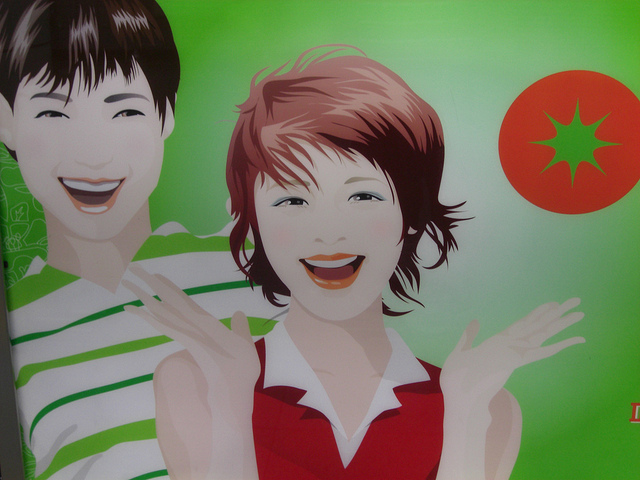 the way. I simply can’t wrap my head around this rationalization. Where I come from, if a spouse cheats, it is expected that the couple will either get divorced or go into some serious marriage counseling. It is not simply tolerated, or at least not by those who have any self-respect. As I love my husband deeply, my greatest fear is that he will give in to his peers and join them some time, resulting in the end of our marriage. I can’t conceive of how Korean men can not only hurt and disrespect their wives like this, but also spend all their time fraternizing with coworkers and women rather than spending it with their children. This aspect of Korean culture is toxic to families, and is one of the reasons I don’t believe I could raise a family in Korea. I am truly interested to hear how other married women – both Korean and foreigners – deal with this problem. Have they experienced the same fears that I have, or have their experiences been different? Do they tolerate their husbands going out with coworkers and meeting women, and if so, why? Finally, for those like me who are greatly disturbed by this aspect of the culture, how do they overcome these anxieties and learn to trust their husbands? (end)
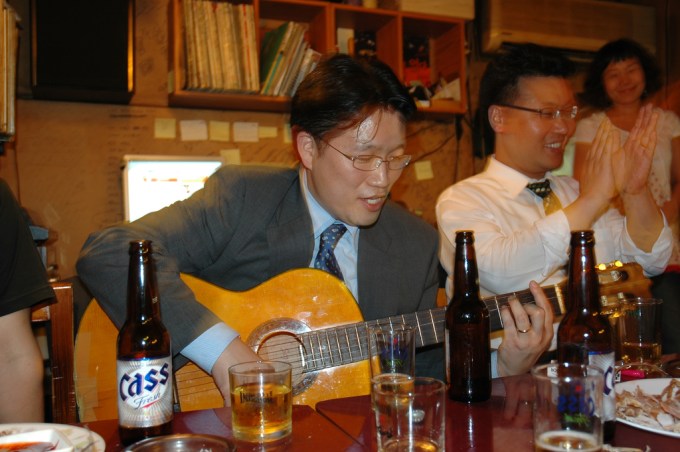 (Source: Simon Helle Nielsen; source above: Shawn Perez. Both CC BY 2.0)
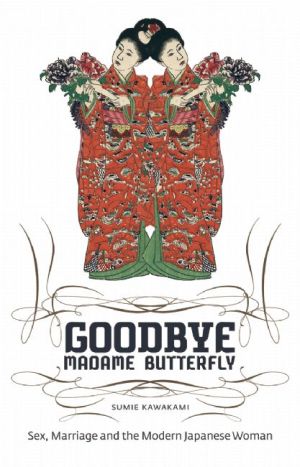 Also, by coincidence Michael Hurt at the Scribblings of the Metropolitician has just written a post on Korean society’s denial of the pervasiveness, ubiquity, and above all systematic nature of prostitution that is highly relevant to the discussion here. A snippet:

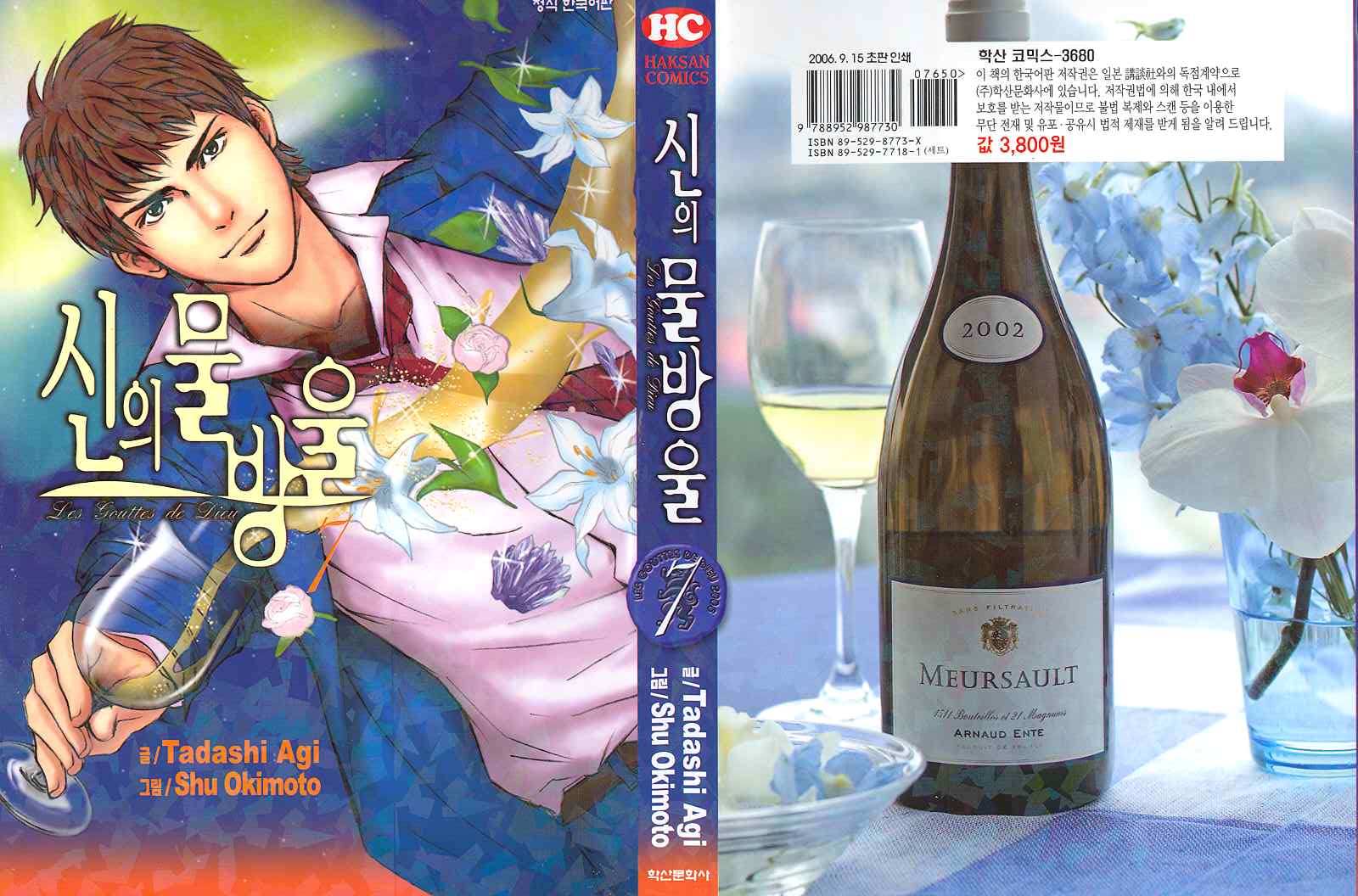


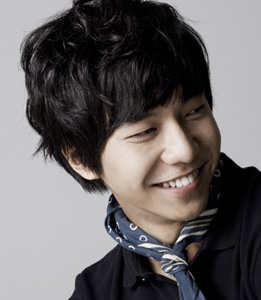



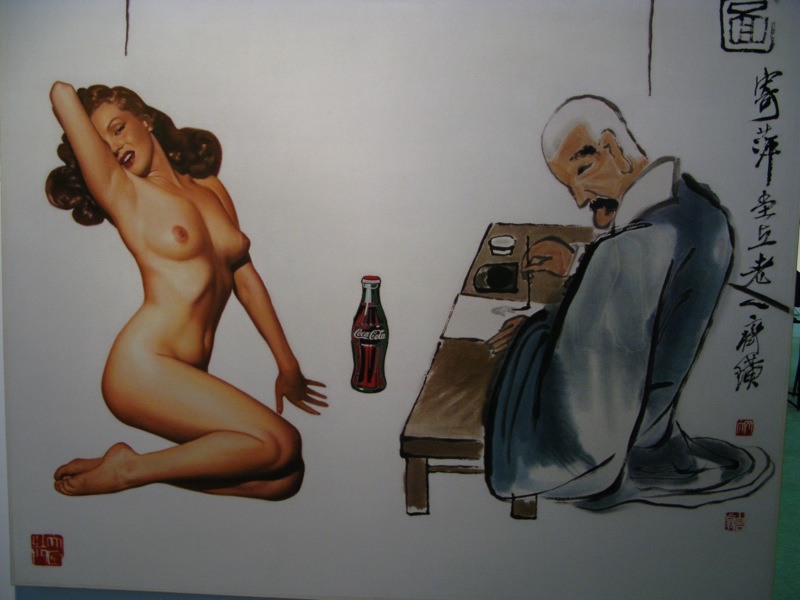

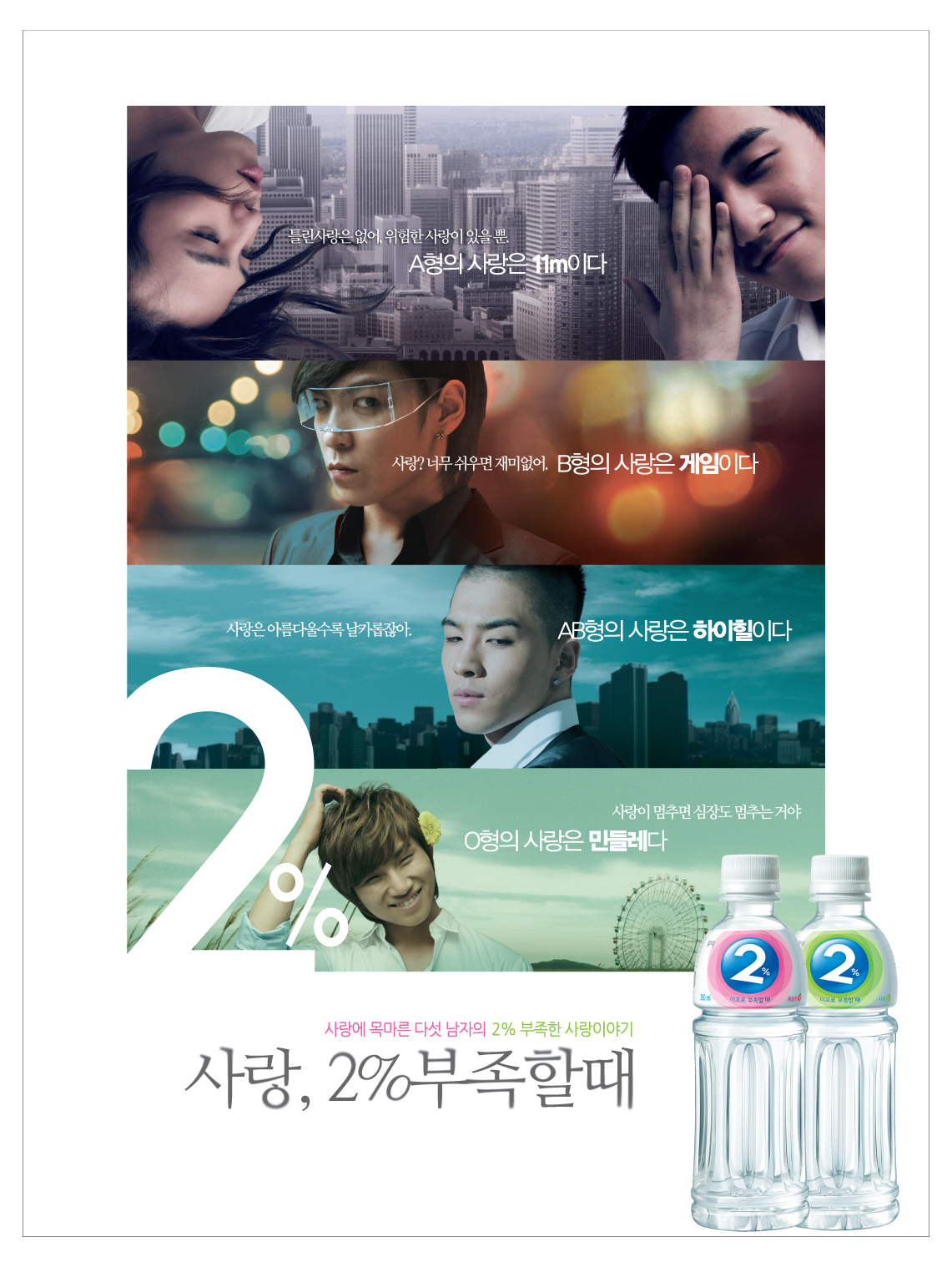
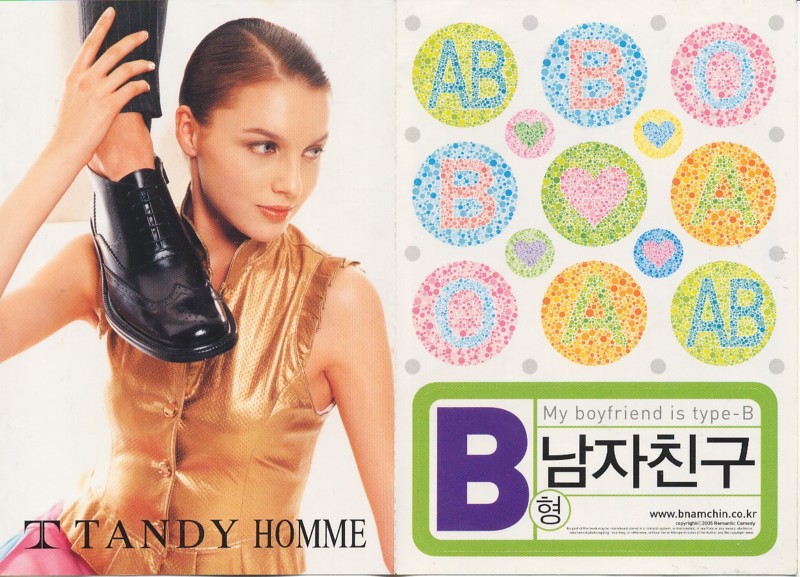
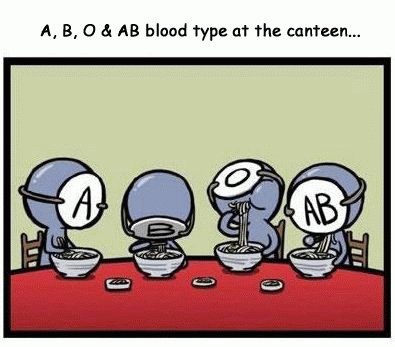 Four people, one with bloodtype A, one with B, one with AB, and one with O were sitting down having a meal together. Suddenly, “AB” stopped eating and got up and ran outside, and “O” decided to follow (him).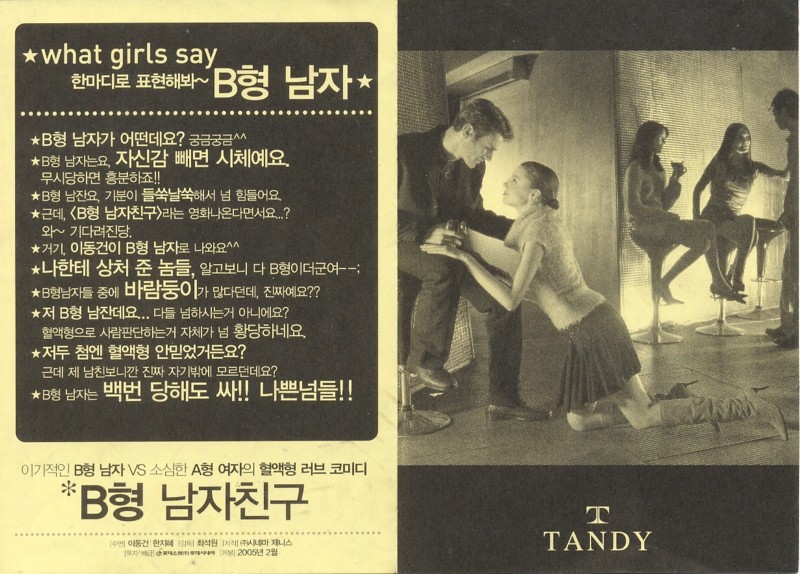

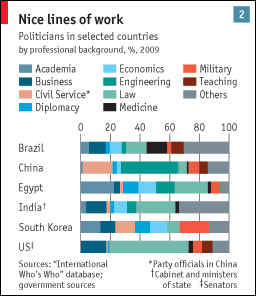 Apologies for the small size, but if you can see the pink and orange blobs for Korean politicians that were originally civil servants or in the military respectively, then you get the idea.

 While it is possible to absorb Vitamin D through food, the surest way is through exposure to a few rays of sunlight every day, and Korean women would be well advised to ask themselves if ultra-pallid skin is really worth the price of full health. Just as Korean parents might wonder if higher TOEIC scores are really worth the price of their children’s long-term health (end).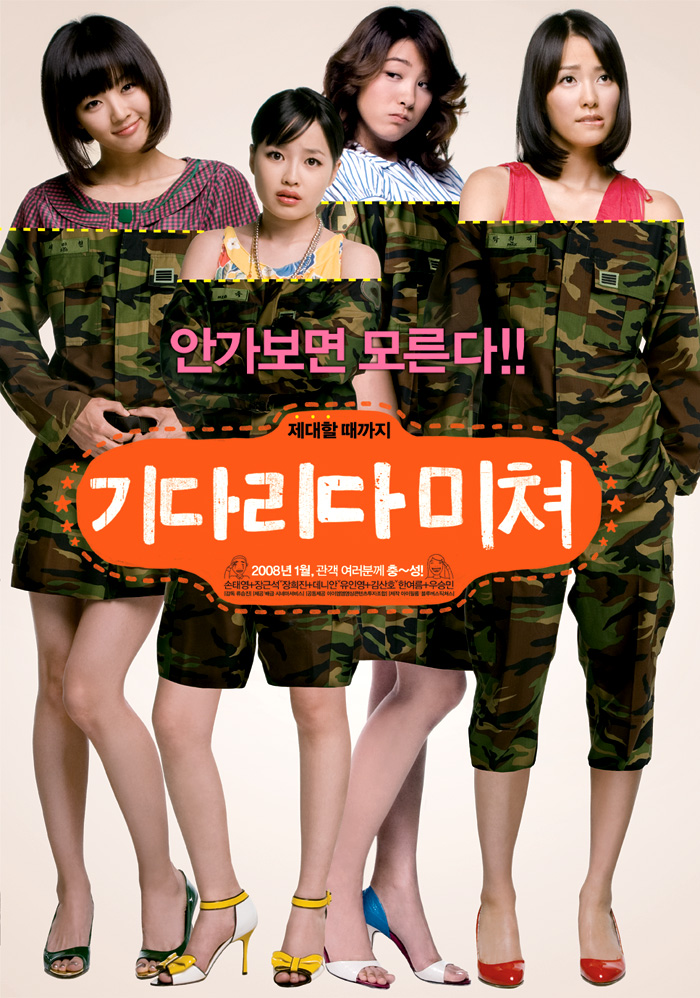
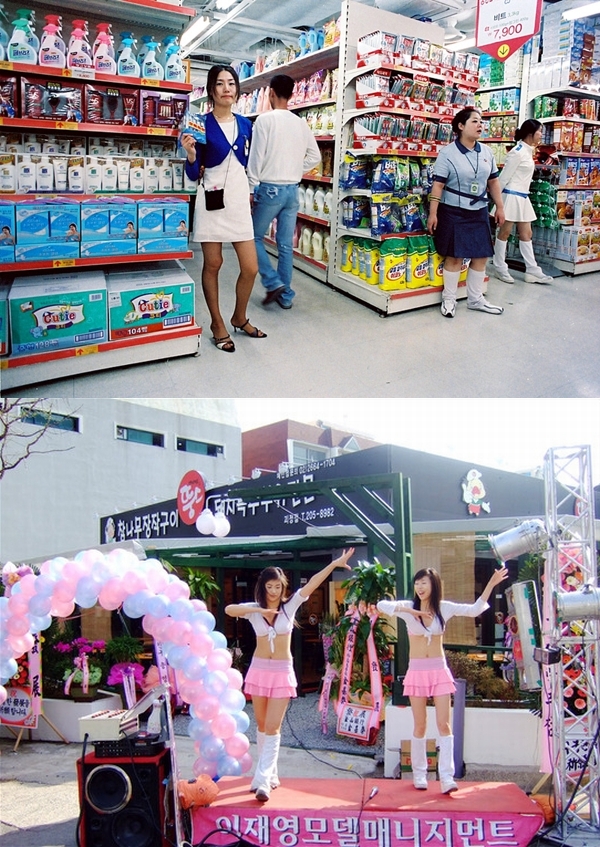

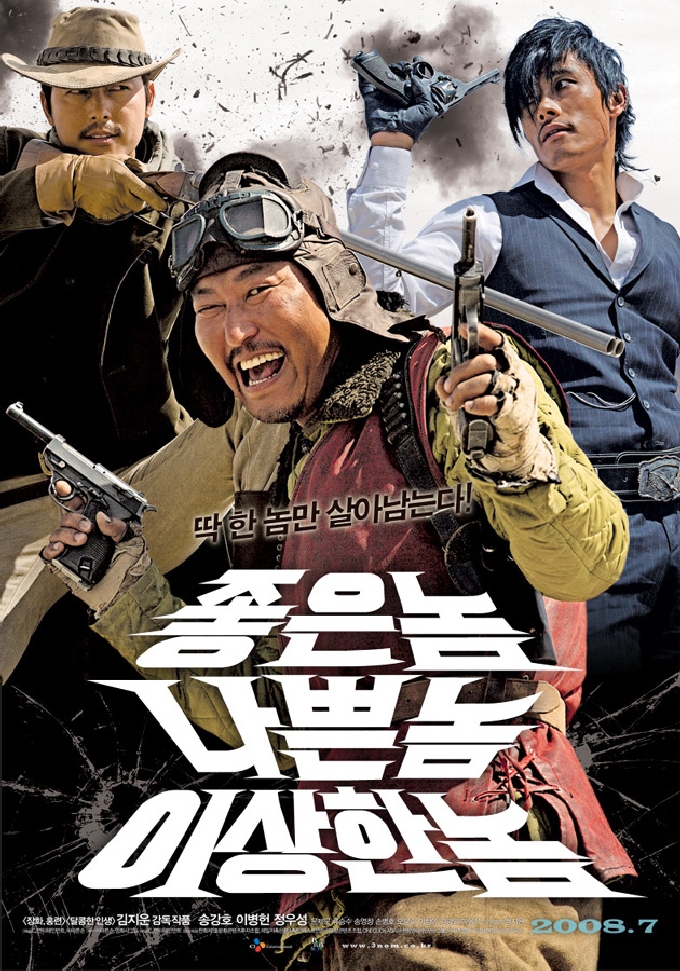
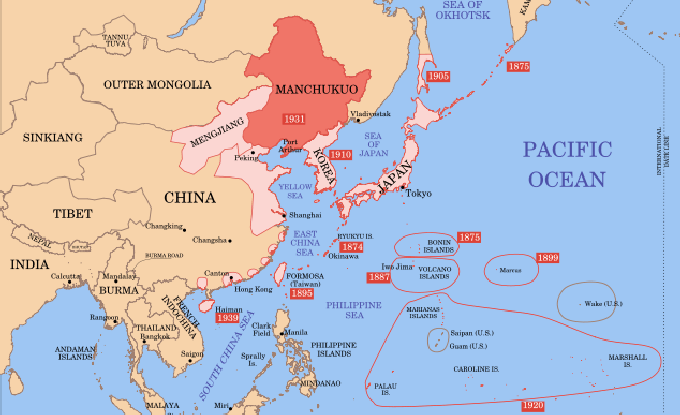 (The Prewar Expansion of the Japanese Empire.





 , which editor-in-chief James provides a quick review of over at the ironically-titled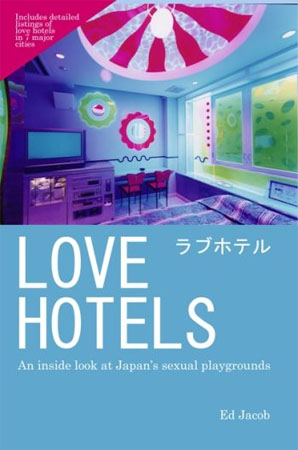


 And having an attractive female Korean teacher myself for over a year, then I can personally vouch for the effects of this, even though I was engaged at the beginning of that period and married towards the end, and didn’t for a moment seriously entertain that there was any chance of us getting together even if we’d both been single. My mind did tend to wander, however, when her back was turned, and which I was inordinately pleased that year to discover sometimes happened with me and my own female (adult) students, one of them naively both passing on her and her classmates’ Cyworld addresses one day and assuming that my Korean was much worse than it was (source, right:


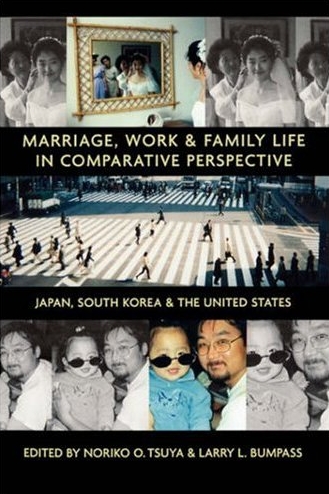
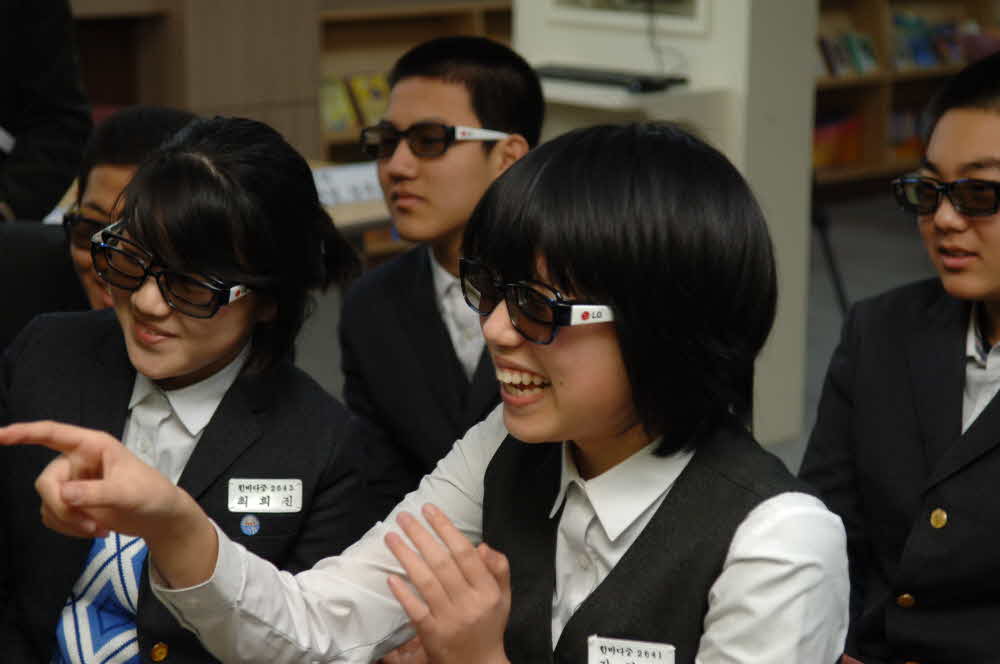





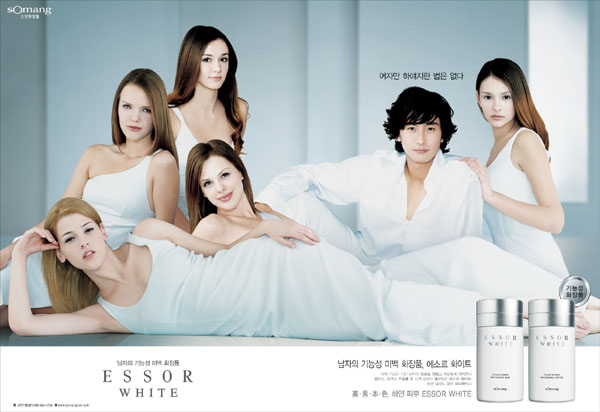 (Source:
 With that background and strong inclination however, there is always a danger of taking similarities as a given. And particularly in this case, where the authors of the study point out that:


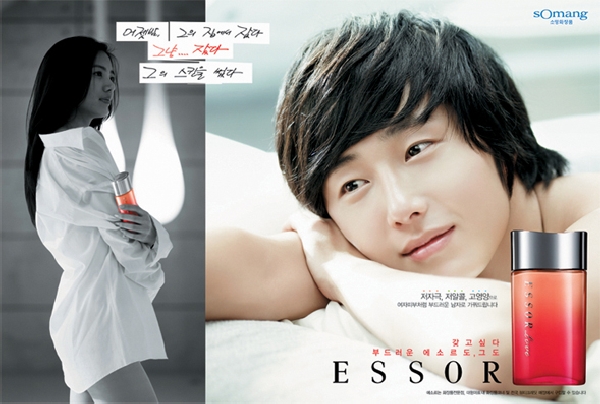 (
(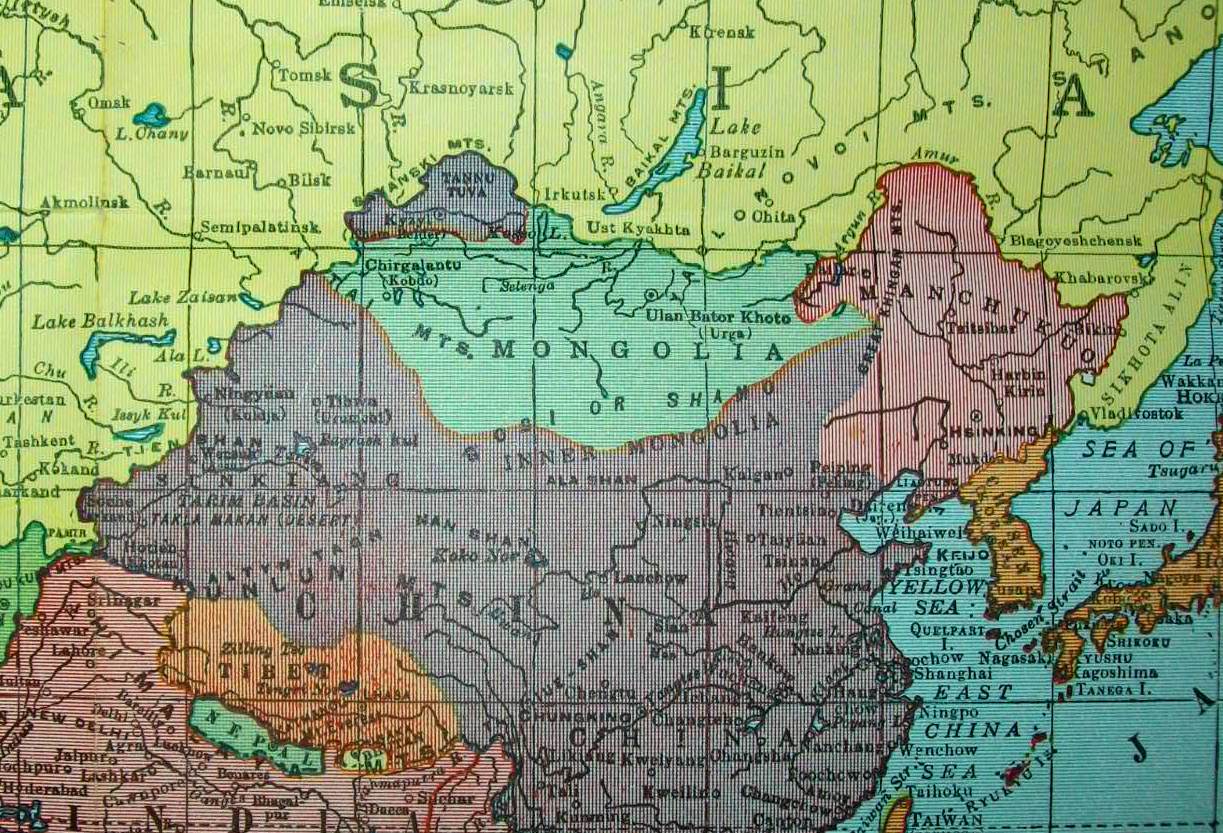
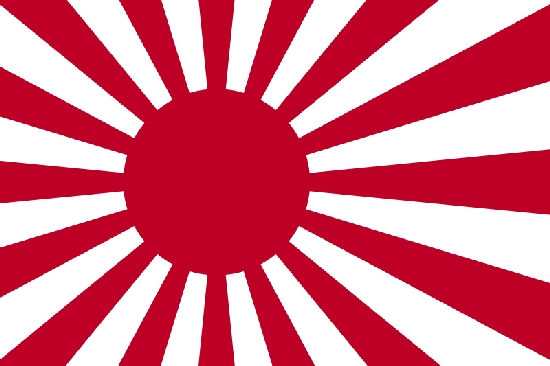 (Source:
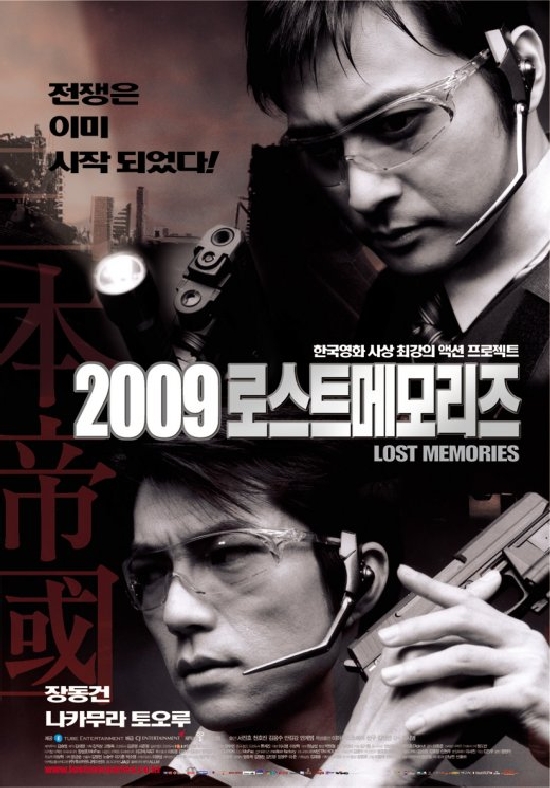 (
(