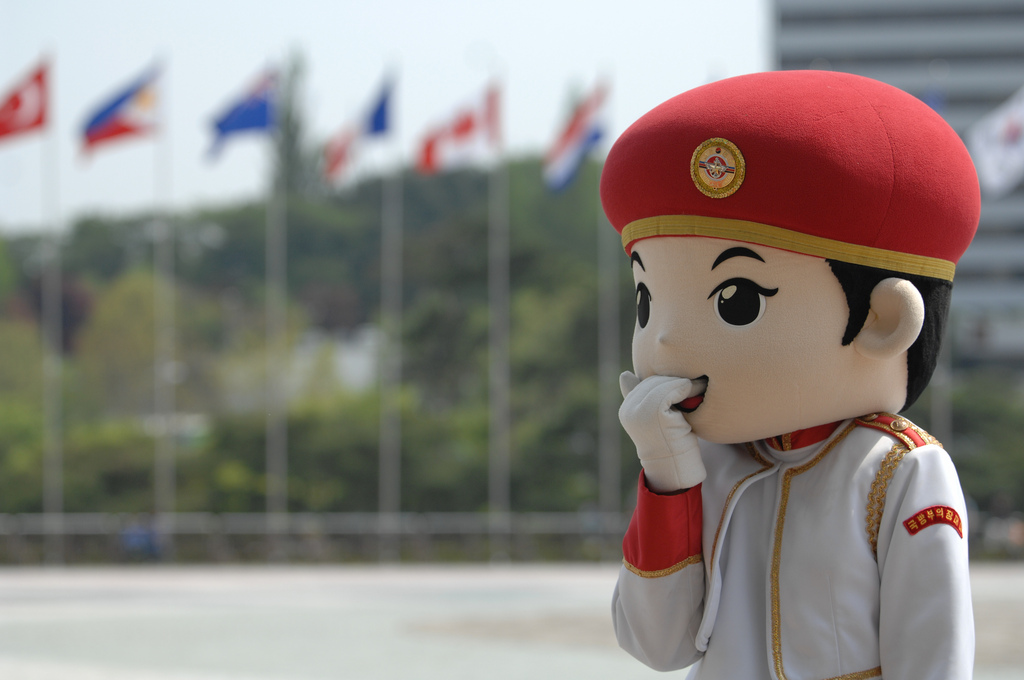
Korean Sociological Image #41: Mothers of Warriors

(Source)

A quick question: who would you choose to sell hormone-treatment and anti-depression medication to middle-aged women?

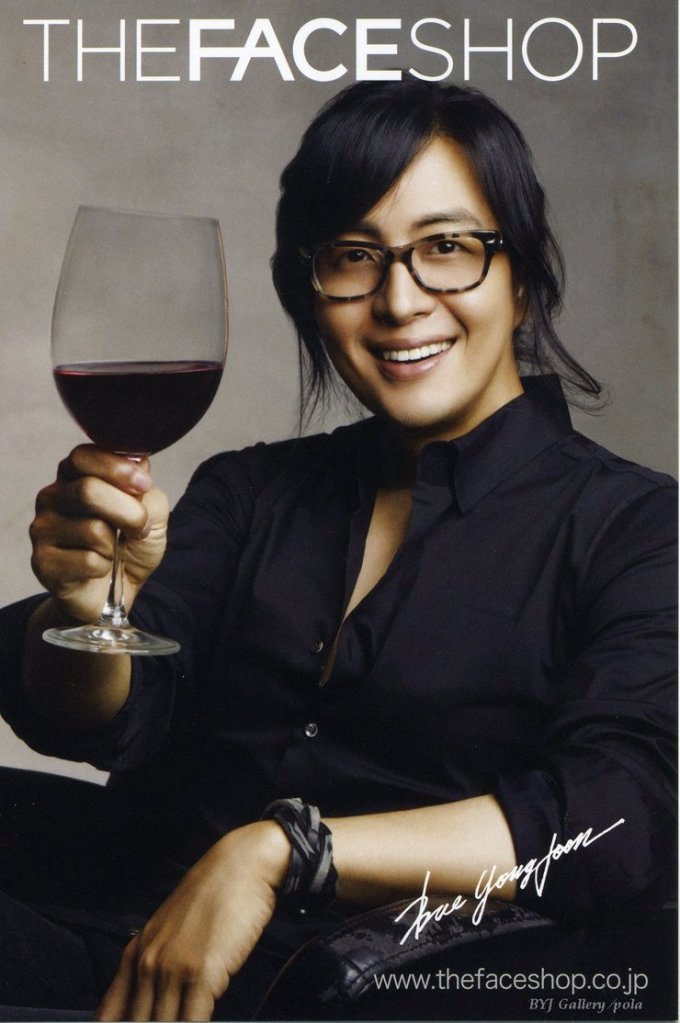
Barring Bae Young-joon (배용준) above, notoriously popular among them, then I’d wager that middle-aged women themselves were your most likely answer. And your least likely? Probably men in their early-20s, which begs the question of why they’re the only ones actually speaking in the following commercial from Dongkook Pharmaceutical (see below for a translation):

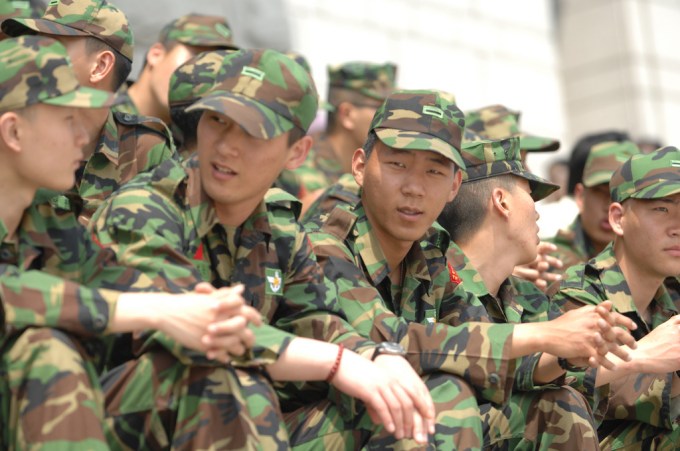
Of course, the reason the young men are featured at all is because Korea has universal male conscription, which makes parting scenes like those featured above a normal part of the Korean life-cycle. So while the leaving ceremony itself may be unfamiliar to most Western observers, a company encouraging consumers to associate its product with it is really no different from a bank using imagery of, say, children’s university graduation ceremonies to sell retirement savings plans.

Still, that’s not to say that it’s just any old commercial. For in relying on an emotional event for Korean mothers and sons to sell its products, but quite literally denying only the mothers a voice in that, Dongkook Pharmaceutical has ironically provided an apt illustration of Korean women’s expected role in any public debates about military conscription. Which is in short, to be seen and not heard, their opinions taken for granted by others.

For instance, in 1997 the Korean media revealed that the sons of Lee Hoi-chang (이회창), the then presidential candidate of the then ruling Shinhangukdang (New Korean Party; 신한국당), had been exempted from their military service due to medical grounds; popularly believed to have used his wealth and influence to secure this, the backlash against Lee for failing to fulfill his paternal and nationalist responsibilities was so intense that his political career was soon over. And yet according to Insook Kown in A Feminist Exploration of Military Conscription: The Gendering of the Connections Between Nationalism, Militarism and Citizenship in South Korea (2001), even in the midst of all that:

…women were voiceless. Those who accused Lee, answered the accusations, reported the matter, and contributed articles were all men. In public, the conscription scandal seemed a matter for men only. Sometimes, mothers were used by men as a reference symbolizing a certain group of women only concerned about the welfare of their sons. Many male editorial writers represented the angry emotions of mothers to show South Korean popular opinion. One editorial writer in the JoongAng Daily (22/08/97) described the anger of many mothers of sons. According to him, these mothers wrote a slogan on the calender for Election Day: “Let’s never forget the exemptions of Lee’s sons”.  (p. 43)
(Source: anja_johnson)

And later another editorial writer in the same paper (27/08/97) illustrated the emotional background of the issue by using a motherly perspective:

People did not deal with the exemption by making accusations of immorality or illegal intervention in the exemption, but with emotional anger like, why did your sons not have to go into the army, while my son is suffering in a life-or-death crisis. What made women angrier than anyone else, was caused by this kind emotion. (p. 43)

Kwon argues that the Korean state has always very much had a stake in accepting feminized forms of self-sacrifice in its name, whether as factory workers, prostitutes to the US military or Japanese tourists (a crucial source of foreign exchange in the 1960s and 1970s), or mothers of conscripts. Focusing on the latter here, consequently they have so far lacked:

…room to represent their own sacrifices in public. Mother’s concern and pain over their son’s conscription has remained hidden under the taken-for-granted necessity of military conscription for national security. Their voices have been deprived of a space for expression; and because their emotional attachment to their sons has been translated into a private matter, they have not mobilized as a group. (p. 37; tenses have been changed)

Not that this lack of representation means that mothers are necessarily opposed to conscription. For example, Cynthia Enloe, who has written extensively on the subject of “patriotic motherhood” narratives constructed by militarized states, argues that in fact they can have attractions for women whose mothering role has been evaluated as personal and private. Indeed, it can be a chance for them to completely revalue their maternal duty:

Some women feel deeply validated when some politician goes on the call for mothering to be defined as a vital contribution to the nation’s war effort, because warfare has been imagined by many to be the quintessentially public and national activity. (Maneuvers: The International Politics of Militarizing Women’s Lives, 2000, p. 11, quoted in Kwon p. 46)

Moreover, what are these “sacrifices” referred to exactly? Kwon’s analysis is a little weak on this point, as although she provides a comprehensive and convincing demonstration of how in fact all women suffer from the conscription system (a subject taken up in this series), there is little evidence that mothers specifically suffer beyond that aforementioned “concern and pain over their son’s conscription”. As the commercial demonstrates however, that may be rather more than a Western observer might expect.

At which point it is prudent to provide the translation of it(!). Below, the text featured on the screen is written as normal text below, while everything spoken by the conscripts or in the voiceover I’ve put in quotation marks. I’ve also provided the commercial again to make it easier to follow along:

엄마…..그동안 받기만 해왔습니다

Mother…..(I’ve) only ever received things (from you)

엄마…이제 처음으로 엄마품을 떠나네요

Mother….this is the first time I’ve left my mother’s (your?) bosom”

엄마…고맙습니다

Mother…thank you

듬직한 대한민국 군인이 돼서 엄마가 믿고 의지할 수 있는 아들이 되겠습니다

I will become a reliable, trustworthy Korean soldier whom you can trust and depend on

이제는 우리가 엄마를 도와드릴 차례입니다

Now it’s our (my?) turn to help our mothers

어머니 잘 다녀오겠습니다. 사랑합니다. 사랑해

Mother, I will do well before I return. I love you (formal). I love you (informal)

엄마, 사랑합니다. 충성!

Mother, I love you (formal). Loyalty! (Fealty?) (Devotion?) [James: whatever the exact meaning, it is said when saluting]

대한민국 갱년기 어머니들의 10명 중 8명은 다양한 갱년기 증상으로 힘들어하고 있습니다

Out of every 10 mothers of the Korean public who experience menopause, 8 suffer from various symptoms

(Above, left and right): 여성 갱년기 극복 갬폐인 & 동국제약

Female Menopause Conquest Campaign & Dongkook Pharmaceutical

엄마에게, 사랑의 마음을 전하세요. 훼라민큐가 함께 합니다

Tell your mother the love you feel in your heart. With HeraminQ.

이제, 엄마의 갱년기를 도와주세요. 훼라민Q.

Now, please help with mothers’ menopause. HeraminQ.

(In very fine print): 의사, 약사와 상의하십시오. 부작용이 있을 수 있습니다

Please consult with a doctor or pharmacist. Side effects are possible.

Update: Seamus Walsh has provided a slightly more accurate translation (with explanations) in the comments.
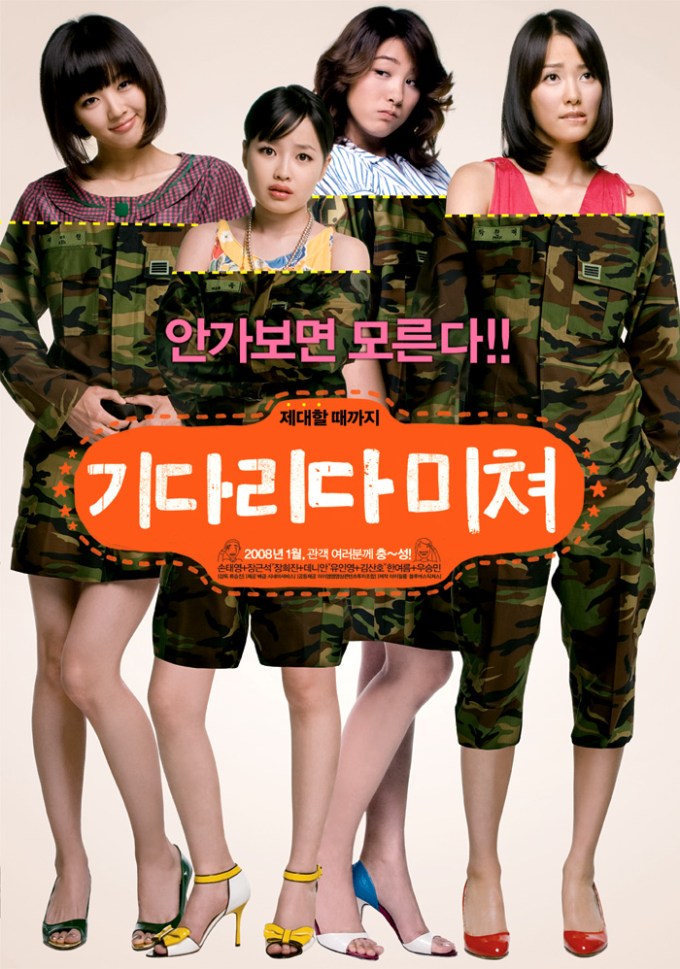
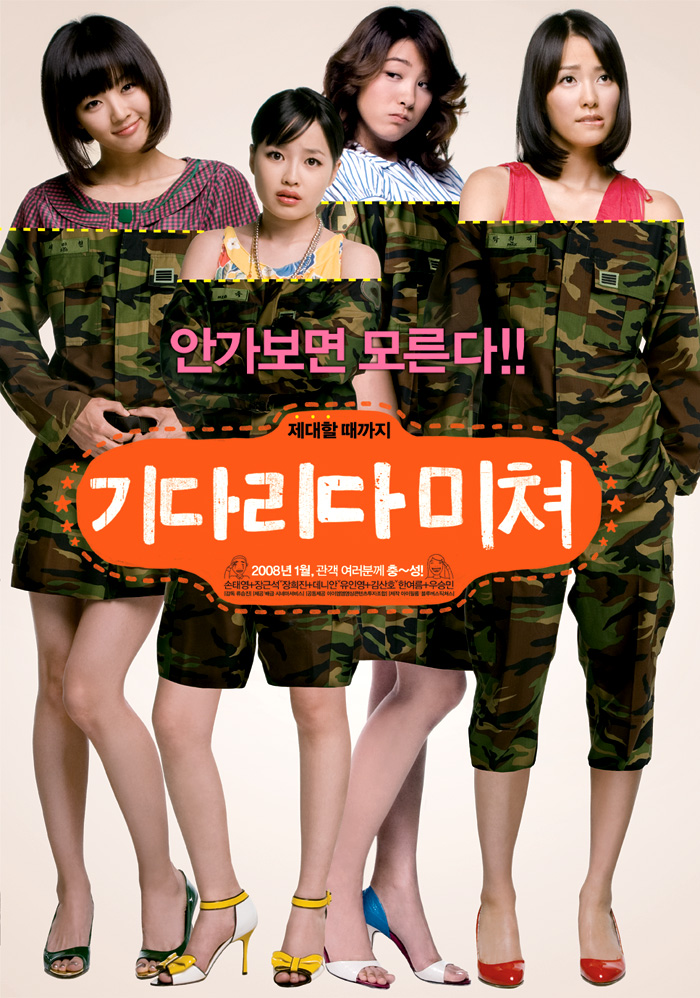
(For another post: the impact on sisters and girlfriends of conscription? Movie poster for The Longest 24 Hours, (기다리다미쳐, 2007), a lighthearted look at military service from the perspective of conscripts’ girlfriends; also known as Crazy4wait. Source)
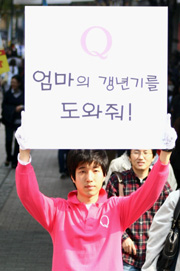
While this may sound a little hypocritical at first, let me begin my discussion on the subject of the mothers’ feelings by highlighting those of the men; actually, that is the original reason I wanted to write this post, for let me stress that you were seeing men in their early-20s crying at the thought of leaving their mothers. What did that make you think of them?

Well, at risk of sounding insensitive, personally I found them to be pathetic. Not that I was all that mature at the same age of course, and in many senses my reaction may simply be because of cultural differences. Like Brian in Jeollanam-do once put it:

…everything in Korea tries to be cute, in the same way everything in the States is “Xtreme” and too cool for school. Korea uses a cartoon to advertise where the US would have a gravelly stoner voiceover, and Korean videos often feature cuteness exaggerated to a sickening degree where American videos would lots of brooding and feigned indifference.

And not unrelated is how different average Koreans’ and average Westerners’ life-cycles are at that age, although 30-somethings like myself should be wary of projecting their own experiences onto today’s 20-somethings. Nor do I want to make light of the hardships conscripts have to endure either.

(Source: anja_johnson)

But then I’m not:  in that commercial at least, thinking about those hardships is not why they’re crying. Moreover, to describe the crying as a simple cultural difference underplays the extent to which this practice is unique even within Korean culture itself, as beyond obvious cases such as funerals, my (Korean) wife for one could think of no other situations in which it is so socially acceptable for a man of that age to cry publicly. That they can and do then, is partially because a) the vast majority of Koreans don’t actually think of any male as a “man” until he has fulfilled his military service, and b) this uniquely strong bond between mothers and conscript-sons. Indeed, there is:

…a widely held popular belief that a father should encourage his son to go into the army, and to fulfill his national defense duty to achieve real citizenship. In this gendered construction, mothers represent emotional attachment such as compassion and pity toward their conscripted sons. In other words…the emotional part of the work of conscription….

…At the most emotional step of the conscription process, the father disappears. For instance, in two recent guidebooks published for pre-conscripts, the authors, both male, make almost no mention of fathers. The only ‘object’ for whom male soldiers are expected to feel concern about in the family is the mother. (p. 44)
And as you might expect, this is well-represented in popular culture, and in addition to commercials like the above I have frequently seen conscripts brought on to the stage after a girl-group has performed on an army base to wax lyrical about their performance and their attractiveness…only then to break down in tears and leave a very emotional message to their mothers watching back home (indeed, often they’re literally choking on their words so much that Om-ma “mother” is the only word you’re able to discern).

Unfortunately for readers however, this is yet another case of something interesting to outside observers that is unremarkable to Koreans themselves, and so I’ve spent over an hour unsuccessfully looking for examples to post here (videos of girl-group performances typically finish just before the soldiers are brought on stage). If any readers find any I would appreciate it if you could pass them on, but in the meantime let me finish by passing on what Kwon says about the program Ujeongdui Mudae (우정의 무대), or Stage for Friendship, the only program about conscripted soldiers in the 1990s, and which had:

…one famous section, ‘Yearning for Mother’. An unidentified  mother talked about her son from back stage. Following her talk, a lot of soldiers ran on the stage shouting “Mother” and insisted she was their mother. Finally, the mother appeared on stage and hugged her son. Finally, the mother appeared on stage and hugged her son. Accompanied with deeply moving music, both mother and son cried, as did other soldiers and everybody watching the TV show. (p. 44).

For your interest though, I did find this 2008 commercial with Moon Geun-young (문근영) for GS Caltex (칼텍스), which features a mother visiting her son during his military service (and impressed with how much of a man he has become):

And for the record, Dongkook Pharmaceutical did produce more “normal” commercials for HeraminQ with middle-age women, here, here, and here, as well as another one in the “life-cycle” series featuring mothers’ high-school children taking their life-determining university-entrance exams:

Thoughts?

(For all posts in the Korean Sociological Images series, see here; for more on the effect of conscription on Korean society, see here and here)

The Gender Politics of Smoking in South Korea: Part 2

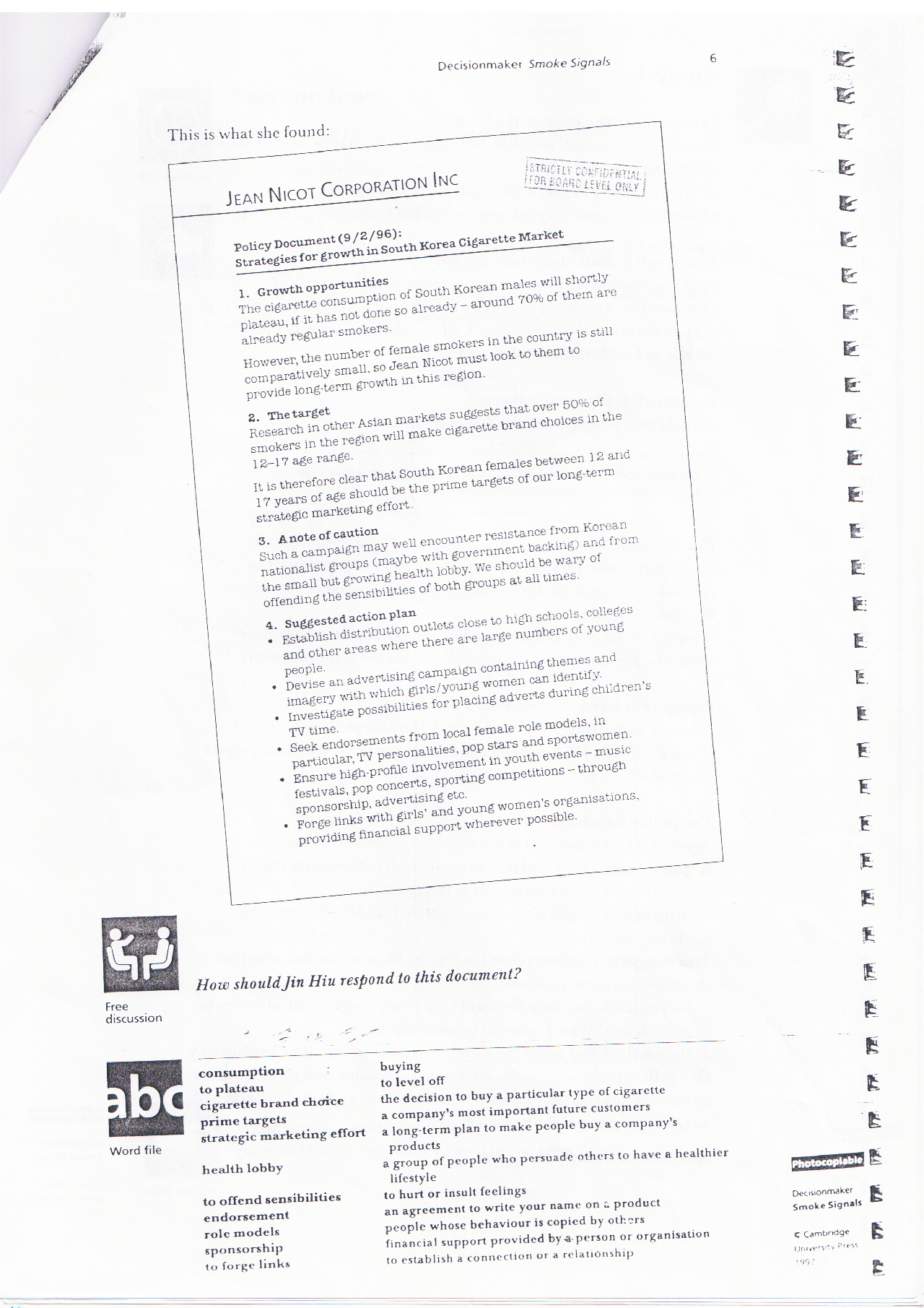
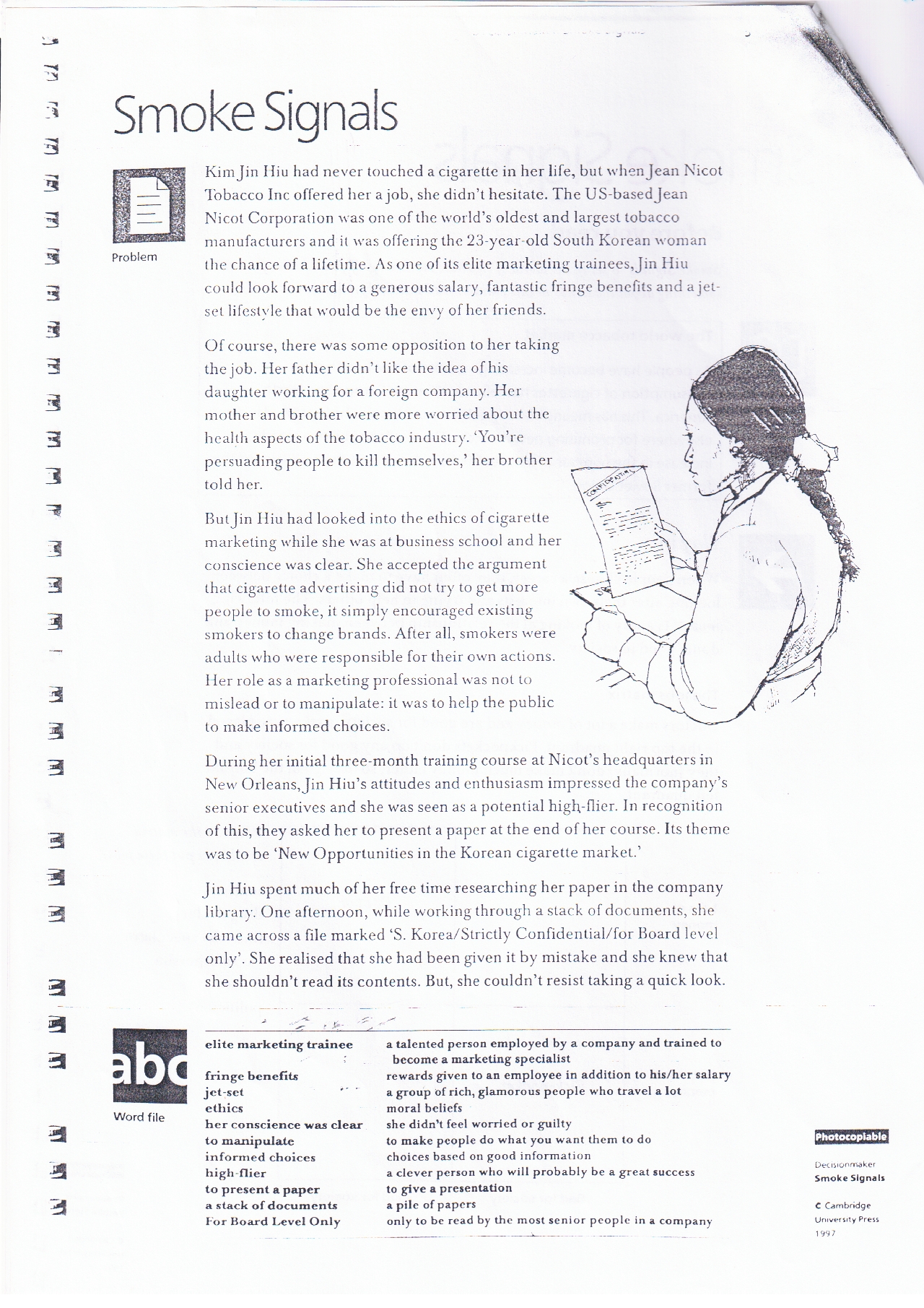
A teaser for the next posts in the series (click to enlarge):

With apologies for the poor quality of the scans, those are from an activity in the ESL activity book Decisionmaker: 14 Business Situations for Analysis and Discussion (1997) by David Evans, which I happened to be doing with my advanced students when a reader sent me the journal articles that inspired this series. It seemed a pity not to mention the interesting coincidence!

Yet another coincidence is that before I moved from Jinju (진주) to Busan in late-2003, I also happened to have a 23-year old female Korean friend who was similarly attracted by the possibility of working for British American Tobacco, which was then setting up a manufacturing plant in Sacheon (사천) just a few kilometers away (it’s still there). We didn’t quite have a conversation like Kim Jin-hiu did with her family, although I did try to discourage her from applying; as I would today too, although I’d have a much better appreciation of her motivations. In the end though, she ignored me and managed to get an interview, but surprisingly wasn’t offered a job.

Meanwhile, as David Evans explains, the marketing plan in the “secret memo” does sound outrageous, but in fact:

…some cigarette companies have undoubtedly targeted children in their marketing strategies. A leaked memo from a Canadian tobacco company listed teenagers as a target group,  and cigarette adverts are regularly shown on children’s TV in Japan (James: is this still true?). In 1991, a study showed that American children as young as six could identify Joe Camel (a cartoon character advertising Camel cigarettes) as easily as Mickey Mouse!

And in Part 4, which I’ll link to below once it’s up next week, I’ll outline how internal industry documents reveal that cigarette companies in Korea (including British American Tobacco) have indeed been using many of the same strategies mentioned above, albeit technically not explicitly to girls (or boys for that matter). Watch this space.

(Links to other posts in the series as they appear: Part 1, Part 3, Newsflash, Part 4, Korea’s Hidden Smokers; Living as a female smoker in Korea)

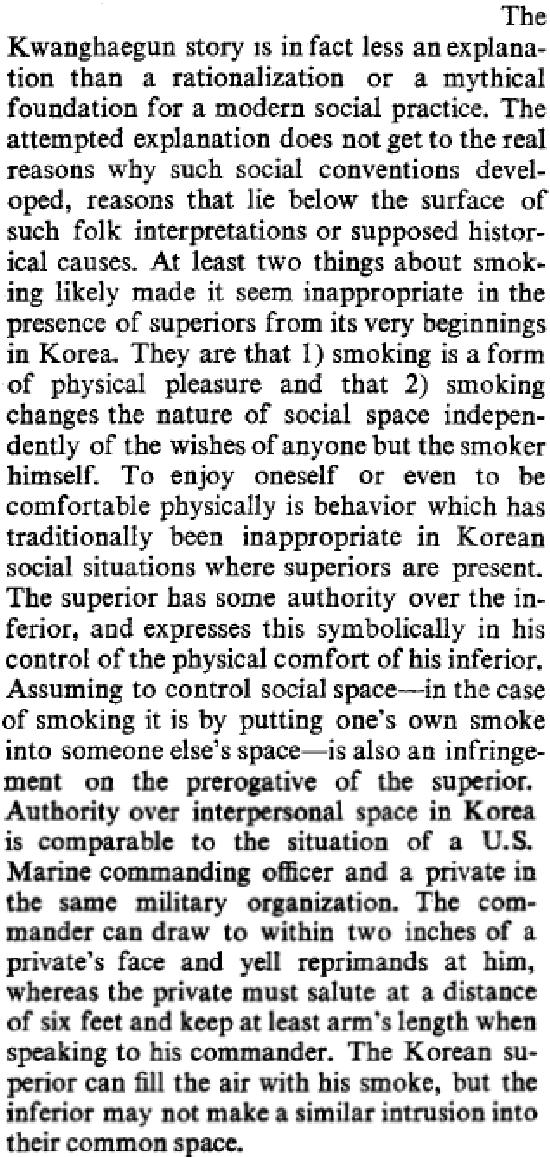
The Gender Politics of Smoking in South Korea: Part 1

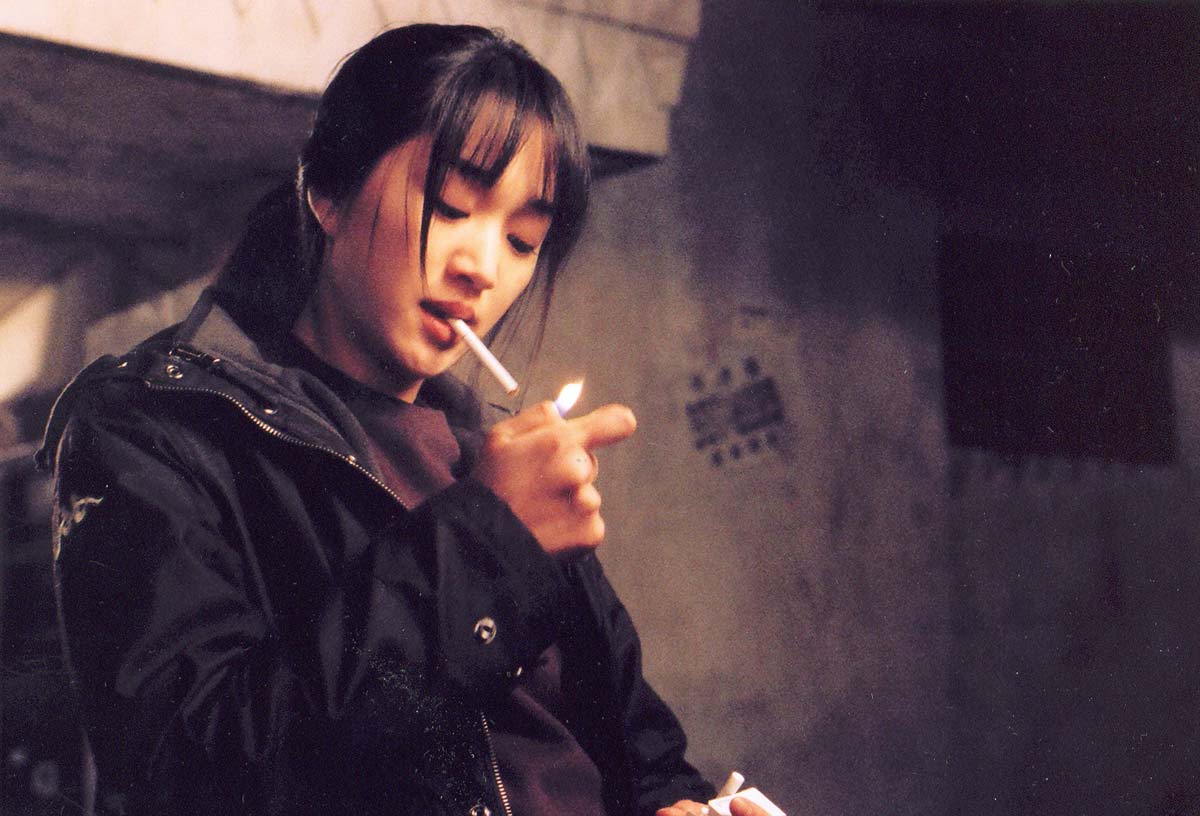
( Park Soo-ae {박수에} in A Family {가족; 2004}; source )

As numerous expats can attest to, coming to live in Korea can be quite a jarring experience sometimes. But probably not as much as you’d expect, for Korea too is a modern, developed country, with institutions and services that match – nay, are often better – than equivalents in your home country. Comparatively speaking, the transition is really rather smooth.

Scratch below the surface however, and decidedly archaic twists to many aspects of daily life do soon emerge, many of which are profoundly gendered too. For example, after a few months here I began teaching a group of highly intelligent women already fluent in English, who attended my class merely as a hobby. All housewives, later I learned that they likely did so because while Korea has been providing an equal education to both sexes for decades now, and indeed as many as 82% of high-school graduates go on to university, just a few years after graduating women are routinely fired and/or are pressured to resign upon getting married or becoming pregnant. Which makes one wonder what the point of women’s higher education was exactly, and accordingly a study conducted just a few years earlier (Women’s education, work, and marriage in Korea: women’s lives under institutional conflicts by Mijeong Lee, 1998, pp. 161-163) found that, à la Jane Austen, it was largely to secure higher-earning husbands.

It is true though, that modernization the world over has invariably entailed such “housewifization” and nuclearization of the family, so in that sense at least Korea is arguably simply repeating the experience of societies that developed earlier.  One way in which Korea does stand out then, is the case of smoking, and you’re probably well aware that it once had the highest male smoking rate in the world, whereas that for women has historically been extremely low. But unless you are already living in the country, then you may not have realized that this is not necessarily by choice, but rather because women can still get slapped for simply smoking in the street, even in 2010. And as testament to the strength of this taboo, it has influenced the smoking habits of at least one female blogger here too for instance, even though most Koreans excuse expats from the vast majority of Korean social norms (source, right).

This brief four-part series is about that gender politics of smoking in Korea, starting in this post with how such an artificial gender binary emerged in the first place; a later one will provide detailed statistics on the number of smokers in Korea, followed by a discussion on the ways in which tobacco companies have (largely successfully) targeted Korean girls and women over the last two decades. As you’ll soon see, it is really a little naive to speak of a “Korean smoking rate” or even “Korean male” or “Korean female” smoking rate when the results differ so widely by age, gender, class, and/or marital status, and the widely perceived notion that Korean women don’t and/or shouldn’t smoke is obscuring the fact that in reality more and more are over time (very roughly 1 in 5), and that success in reducing the number of male smokers comes in the midst of a looming health crisis among female ones.

But first, perhaps “taboo” is not strong enough a word. Consider why the Seoul Metropolitan Council recently proposed banning smoking in public spaces for instance:

“I suggested the bill to protect pregnant women and children from second-hand smoke on streets and at other public spaces” Park Hee-sung, a city councilor, said. “It also secures the right to smoke by designating smoking areas.”

No mere slip of the tongue, this is really a bizarre rationale for banning public smoking: don’t men and non-pregnant women also suffer from passive smoking? But place it in the context of decades-old legislation that posits both children and all women alike as in need of protection however, as mentioned in Kelley Lee et. al. in “The strategic targeting of females by transnational tobacco companies in South Korea following trade liberalisation”, Globalization and Health 2009; 5: 2 (download here), then it does begin to make some sense:

The National Health Promotion Law Enforcement Ordinance, adopted in 1989, bans all tobacco advertising, marketing and sponsorship aimed at women and children including both print and broadcast media.

Although as I’ll explain in Part 4, cigarette companies have largely managed to circumvent this restriction. In the meantime, how did the gender ideology behind the law come about?

( Source: iMorpheus )

Well, consider the thoughts of C. Paul Dredge in “Smoking in Korea” published in the Korea Journal back in April 1980, (downloadable here), which are worth quoting at some length. From page 28:

With a clear logic rooted in Neo-confucianism, this explanation intuitively makes sense, and I feel confident that I speak for almost everyone when I say that if that excerpt was all of Dredge’s article that was still available, then we’d be more than satisfied with it.

You can imagine how I felt then, when I read on and learned that that was actually bullshit. From pages 28-29:

A good lesson to remember when trying to understand any society better, and indeed I’ve previously made a similar point in the context of how authority and/or hierarchical relationships are portrayed differently in Korean and Western advertisements, so I should have given it a little more thought myself.

With a newfound respect for Dredge then (does anyone know more about him?), I highly recommend reading his article for yourself to learn more (it’s only 11 pages long), in which he goes on to discuss how the above affected Korean women’s smoking habits (at least in 1980). Also analyzing how they differed in the context of the aforementioned divisions of age, class, and marital status however, then I’ll leave that discussion for Part 3 next week.

For now, I’d be more interested in hearing about your own experiences and opinions of smoking in Korea. Alas, although I’ve never lectured anyone about smoking, I confess that I’m an anti-smoking Nazi myself, and possibly for that reason I only have 2 very occasional smokers among my friends to ask. So I would really appreciate it!^^

Update 1: For those interested in smoking culture in North Korea also, see here.

Update 2: An interesting response to this post by a Korean blogger (in English) is available here.

(Other posts in the series: Part 2, Part 3, Newsflash, Part 4, Korea’s Hidden Smokers, Quick Hit: Living as a female smoker in Korea)

Korean “Double In-Laws”… and Other Dramas!

(Wedding Day by summer park; CC BY 2.0)

An interesting question from Curtis, a reader with a slightly unusual family in which 2 brothers from one family married 2 sisters from another. As you will see, he was concerned about how this would be received by Koreans:

Dear James,

Lately I’ve been seriously confused and irritated by a seeming issue with relation to Korean marriages.  I can’t figure out why it is even a problem to begin with. I’ve never heard the term until recently, but apparently Koreans (I’m not sure if this is general or only among certain classes) seem to be against marriages that create “double in-laws,” meaning that, for example, member A of the Kim family marries member A of the Lee family. Then Member B of the Kim family marries the sister/brother of member A of the Lee family. The first marriage made them in-laws, but this second marriage creates what I’ve heard Koreans term “double in-laws” which seems to have some stigma.  As far as I am concerned as a westerner, the second marriage has little to no bearing on anything since it isn’t incest or intermarriage, therefore I see no problem. In fact, my father married my mother, and soon after that, my father’s brother married my mother’s sister. I guess that creates double in-laws in my family, but since it’s neither incest nor intermarriage, I haven’t once heard any issues being brought up about it. Could you explain if this “double in-laws” thing is really an issue, and if so, why? All I can think of is that the families are not being spread out far enough for maximum social networking and both sides of the family may end up being in one household, but since Korean family dynamics are changing, this doesn’t have to be the case.

I’ve also heard the English term “co-in-laws” to describe this, but again, I find no reports of issues with this arrangement other than in a few Korean instances.

And an update in a second email:

[I’ve done some more thinking]…, and I thought about the collective culture that Korea is.  I thought that perhaps when a family marries another family, the WHOLE family in that household become in-laws as such, whereas in western societies, the distinctions between in-laws is limited more so to the ones who married into the family.  I, personally, would consider the sister of my brother-in-law just that, the sister of my brother-in-law, not an in-law herself since she did not marry into the family.

(The Bride by Tetsumo; CC BY 2.0)

What do you think? Personally, while this is the first I’ve heard of any potential stigma, I suspected that there might be something to it when my wife instantly came up with the Korean term for people in such arrangements: gyeobsadon (겹사돈), or “a person doubly related by marriage.” Moreover, however illogical any stigma would be, there is certainly precedent too: until as late as 2005, Article 809 of the Korean Civil Code prohibited marriage between those of the same ancestral, regional clan (or local subgroup of Lees, Parks, or Kims and so on), of which the largest had over 4 million members. Or in short, somewhere between 8-15% of the Korean population were literally forbidden to marry each other, with even the children of any de-facto unions discriminated against also because their out-of-wedlock status prohibited them from receiving national health insurance, let alone complicating inheritance and property rights.

But as it turned out in this case at least, my wife knew the term not because of any stigma that she’s aware of…rather, because she remembered such arrangements from dramas!

Probably there is nothing to worry about then, but if anyone could confirm that then I’m sure Curtis will appreciate it, and I’d be interested in hearing any other unusual stories about marriage and Korean families also. If you’d rather read more yourself though, then consider this series on the uncertain role of Neo-Confucianism in the similarities between Japanese and Korean family forms, and especially how daughters-in-law are treated therein.

Update: Speaking of the importance of family names in Korea, today there was an interesting article in the New York Times about the trials and tribulations a Korean man (and subsequently his family) had due to his Japanese ancestry.

The Grand Narrative in The Washington Post

Photo by Dương Nhân from Pexels

While the background will be very familiar to regular readers, I confess I was still intrigued when Washington Post reporter Blaine Harden emailed me about this last month:

With pressures high, South Korean women put off marriage and childbirth

SEOUL — In a full-page newspaper advertisement headlined “I Am a Bad Woman,” Hwang Myoung-eun (황명은) explained the trauma of being a working mom in South Korea.

“I may be a good employee, but to my family I am a failure,” wrote Hwang, a marketing executive and mother of a 6-year-old son. “In their eyes, I am a bad daughter-in-law, bad wife and bad mother.”

The highly unusual ad gave voice to the resentment and repressed anger that are common to working women across South Korea…

With thanks to Blaine Harden for asking for my input, see here for the full report, and further details are included in this similar report from the JoongAng Daily last week also.

New readers further interested in any of the issues mentioned in either, please see: #2 here for more on Korea’s extremely low score in the UNDP’s “Gender Empowerment Measure” on which I based my email statement “….despite Korean women having good health and excellent education, they still have a much greater chance of becoming a politician or even a middle manager or computer programmer in countries like Kyrgyzstan, the Dominican Republic, Botswana or Nicaragua” that Blaine Harden quoted, and here for a recent survey on the discrimination expectant mothers face in Korean workplaces, which mentions that nearly 25% of them either got fired or were forced to quit once their pregnancies were revealed. For all others, please see the list of links I provided when I was involved in a report on a very similar topic for TIME Magazine last year, and another in a more recent post on childcare and socialization.

Unfortunately, judging by the handful of news articles available on the internet, then this story seemed to get little attention in the Korean-language media, although as I type this the Washington Post article itself has prompted a couple more. But see here for the original text of the advertisements, and here, here and here for some of the original reports from October and November last year, and I’d be very grateful to hear from anybody who saw her television interviews!

If you reside in South Korea, you can donate via wire transfer: Turnbull James Edward (Kookmin Bank/국민은행, 563401-01-214324)

Korean Women Angry at Being Promoted Less Than Men

Gender Gap Angry Woman(Source: TheDailyEnglishShow.com,via studio tdes)

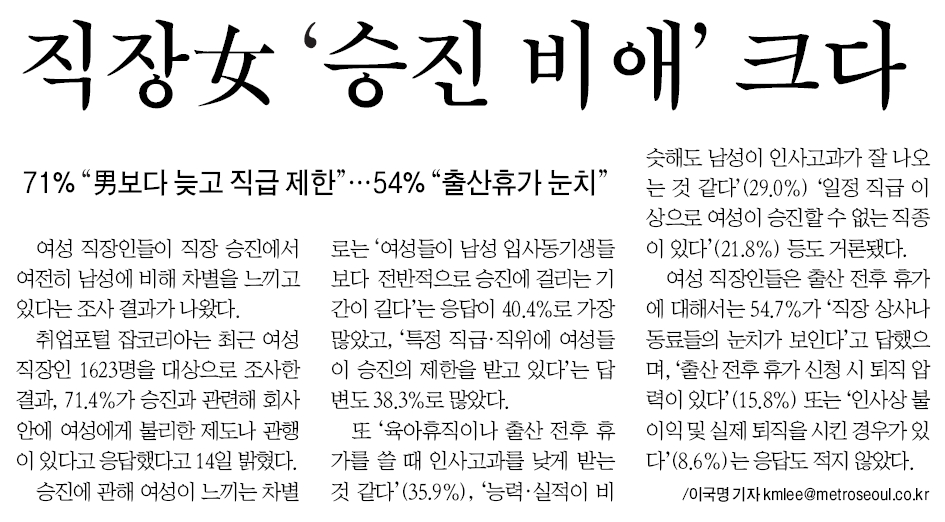
A snapshot of some of the different forms of sexual discrimination experienced at Korean workplaces, from the January 15 edition of Metro Busan:

Women Workers’ “Promotion Grief” is Big

71% Say “Compared to Men, Promotions Come Late and with Limits”…54% Say “We Feel Inhibited From Asking for Maternity Leave”

A survey of women workers has revealed that when it comes to promotion, they still feel that they suffer from sexual discrimination.

The results of a survey of 1623 women workers by job portal site JobKorea, released on the 14th, showed that 71.4% believed that the promotion systems at their companies placed women at a disadvantage.

Asked for more information about this discrimination, 40.4% [of the 1623 women] said that “compared to men that enter the company at the same time, women have to wait longer to get promoted,” and 38.3% added that “women are excluded from some higher positions.”

In addition, 35.9% mentioned that “if we take maternity leave or time off before and after giving birth, we get lower scores on our evaluations by the personnel department,” 29% that “even if we have the same ability and practical know-how as men, we get lower scores,” and 21.8% that women simply are excluded from certain kinds of jobs.

Also, 54.7% replied that they found it very difficult to ask their superiors or coworkers for time off for childbirth, 15.8% said that they felt pressure to quit their jobs after having a baby, and finally 8.6% were aware of cases where recent mothers were indeed forced to quit. (end)

With no information given about the methodology used, then all those results should be taken with a grain of salt unfortunately.

In particular, considering that it is still common practice to fire women upon marriage, then that last figure sounds rather low to me. Also, consider that before the current economic crisis, not only did Korea already have one of the lowest women’s workforce participation rates (and the highest wage gap) in the OECD, but that those few that did work formed a disproportionate number of irregular workers. This ensured that they would be laid-off en masse last year (see #15 here also), and they are unlikely to return to work soon given Korea’s jobless recovery.

(In stark contrast, the decline in the construction industry in the US, for instance, means that for the first time in history actually more women work than men there now.)

Meanwhile, the effects of all the above on Korea’s low birthrate have also been somewhat predictable, now the world’s lowest for the third year running. But never fear, for the Korean Broadcasting Advertising Corporation (KOBACO) is on the case:

(See here {Korean} for more on the making of the campaign)

In KOBACO’s defense, the first women featured does actually have a job. Is it churlish of me to point out that she still goes home early to cook while her husband burns the midnight oil…?

Update 1: Lest the commercial not succeed though, then the Ministry for Health, Welfare and Family Affairs (보건복지가족부), in charge of raising the country’s birthrate, is insisting that its employees go home at 7:30 pm on the third Wednesday of each month, all the better to have sex with their partners and have more babies.

No, unfortunately I’m not making that up.

Update 2: This satire of that is so good, it’s difficult not to believe that it’s the real thing!

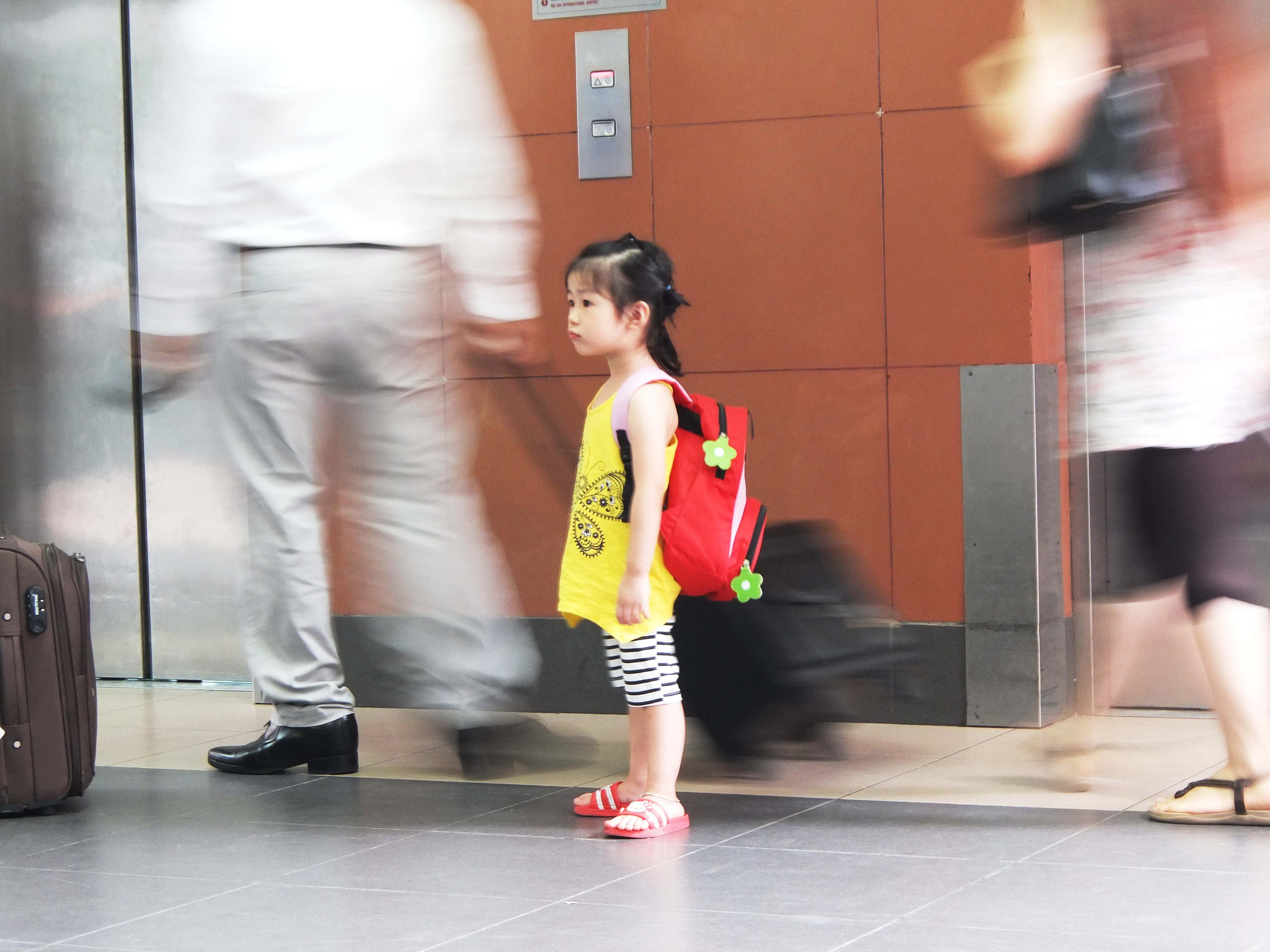
Korean Sociological Image #24: Childcare is Women’s Job

Oma(Source: 제동환 via Photo and Share CC)

For traveling parents, this is a godsend:

Asiana’s mother-friendly services have been gaining enthusiastic reviews from those who have been through the ordeals of traveling with infants.

Through the recent launch of “Happy Mom Services,” the airline has been providing exclusive check-in counters for mothers at the airport, breastfeeding covers and baby slings free of charge for travelers with babies.

It gets even better:

In response to the enthusiastic reception, Asiana will extend the “Happy Mom Services” to 66 airports internationally. Also, they will lengthen the age limit from 24 months to 36 months old…

….Passengers with infants will also receive a “Priority Tag” on their checked baggage. Arriving passengers with infants will now be able to quickly retrieve their baggage without the hassle of caring for their infant while waiting at baggage claim…

…For larger infants traveling on children tickets, Asiana is providing free installation of baby safety seats upon reservation. Asiana hopes the service will negate the need for passengers to bring along their own baby seats.

And considering the discriminatory hiring practices of its main rival Korean Air, which refuses to hire men for its cabin crew (see #2 here), then it seems somewhat picky, almost churlish to find any fault with Asiana’s initiative.

But still, “Happy Mom Services”?

(Source: Travel Story)

Yes, easy to overlook, unfortunately we are already barraged with signals that encourage and/or reinforce the notion that childcare is primarily women’s responsibility. For instance, wherever you are in the world, note the warning signs the next time you step on an escalator: only very rarely will you see child stick figures being protected by a male or gender-neutral one rather than a female one. Or, closer to home, consider Seoul Mayor Oh Se Hoon’s recent “Happy Women, Happy Seoul” plan involving the provision of such things as more women’s toilets and the now notorious pink parking spaces: as I point out here, providing larger spaces for those with children and pushchairs to unload is all well and good…but not if fathers are not allowed to use them. And I could go on with many similar examples.

Granted, probably none are confined only to Korea. But in the country with:

…then one suspects that greater attention should be paid to the grass-roots origins of those issues, which unfortunately Asiana’s choice of name only adds to.

Having said that, they’ll still easily be my first choice for traveling with my two young daughters from now on. And if it would be effective, I’d consider writing letters to both English and Korean-language newspapers to draw Asiana’s attention to the problem, hopefully persuading them to change the name to “Happy Parents’ Service.” What do you think?

(For more posts in the Korean Sociological Images Series, see here)

The Grand Narrative in TIME Magazine

Going Down David Smeaton(Going Down by David Smeaton; used with permission)

For the article in full, on Seoul Mayor Oh Se-hoon’s “Happy Women, Happy Seoul” plan involving more women’s toilets and the notorious pink parking spaces, see here. Meanwhile, for readers coming from there, see #2 here for the specific quote of Lee Myung-bak’s for which the blog was mentioned, and #2 here for more information on Korea’s disproportionately low Gender Empowerment Measure.

I would also add—with no offense to reporter Veronica Zaragovia, who necessarily had to omit most of what was said in our interview—that the argument that “the plan may end up reasserting South Korean women’s secondary status more than boosting it” is also one that I made in our phone conversation. I based it on the knowledge that the pink parking spaces were made wider in order to better accommodate loading and unloading pushchairs and so on (see #3 here), which had reminded me of this post from Sociological Images about the images in our daily lives that serve to subtly reaffirm the notion that childcare is primarily women’s responsibility. In that vein, while the extra space may well be appreciated by mothers, consider that if I were to park in one of those spaces myself, with just as pressing a need for the space to deal with my two young daughters in the back as my wife would have, then as a man I would be likely either be fined or shooed away.

I grant you, it sounds innocuous. But place that into the context of Korean women having the lowest workforce participation rate in the OECD, the result of a combination of a lack of childcare facilities and an enduring male-breadwinner mentality that forces a stark choice between motherhood or a career, then the underlying sexist logic becomes apparent. Moreover, with Korea in turn having the lowest birthrate in the world, the economic effects of which will be felt soon, then one might reasonably ask if the money could have been better spent.

p.s. Apologies in advance for some light blogging this week; I have a conference presentation to give this weekend.

Update, January 19 2010: See The JoongAng Daily here for all the ways in which programs like this have been considerably expanded since this post was written, now including pink spaces for women at bus stops, on buses, in parking lots and special pink taxis under the rubric of improving women’s safety (via: The Marmot’s Hole).

Choi Jin-sil Sued For Being Beaten by Her Husband: Update

Choi Jin-sil holding back tearsWhen hearing last week about something as appalling as an actress being sued for daring to show her bruises and black eyes to the media, it’s only human nature to assume the worst of Korean society.

But while Korea certainly does have a great deal of work to do in combating domestic violence—and criminalizing spousal rape would be an essential first step (see #2 here)—it’s also true that police and legal attitudes towards it have considerably hardened in recent years, both cause and effect of a law change in 2007 that requires police to forward all cases of domestic violence to a prosecutor (the previous 1998 law just left it up to their own discretion). In addition, Korean women are now more likely than ever to divorce on the basis of verbal or physical abuse, rather than suffering silently as in past decades.

Indeed, what stands out more than anything else about the court decision is how much it goes against the grain of trends within Korean society, and certainly does not reflect the will of all Koreans. Some quick excerpts from today’s Korea Times for instance:

Women’s groups are angry over the top court’s ruling that ordered the late actress Choi Jin-sil (최진실) to compensate a builder for failing to maintain “dignity” as a model representing its products.

They censured the Supreme Court for not realizing the suffering of domestic violence victims, which included Choi.

Korean Womenlink, the Korea Women’s Hot Line, and the Korea Women’s Association United issued a joint statement Wednesday lambasting the ruling.

On June 4, the court reversed a high court ruling that decided in favor of Choi in a compensation suit filed by Shinhan Engineering and Construction in 2004 against the actress, who was the model for its apartments.

The advertiser claims she did not keep her contractual obligation to “maintain dignity,” because she disclosed to the public her bruised and swollen face which was caused by the violence of her then husband, former baseball player Cho Sung-min. They divorced soon afterward.

For the rest, see here. Also, see here for my original post on this issue and information about similar cases in the past, and here for a quick primer on the numerical rates of domestic violence in Korea (albeit in 2004), with many graphs and tables.

(By the way, although it was already common knowledge, it’s good that the Korean media is now naming the company. But I wonder if it was originally kept anonymous by a court order, or just by convention?)

Firm Sues Dead Actress For Being Beaten by Her Husband – And Wins

Choi Jin-sil holding back tearsA simply outrageous story, that couldn’t really wait for my “Korean Gender Reader” on Monday.

But, given the similar case of the singer Ivy (아이비), whose reputation was ruined by her ex-boyfriend threatening to release a sex-video of her to the media in late 2007, and who was later sued by advertisers for this despite the video never actually existing, then this latest case with Choi Jin-sil (최진실) is exceptional only in degree really.

However, in suing an actress that committed suicide, the unnamed construction company (Update: It’s Shinhan/신한건설) below may well have pushed the limits of public acceptability, and this will hopefully incur a backlash that will far outweigh the relatively small gains now to be provided by her estate.

To play Devil’s Advocate for the moment though, the appeal was probably submitted to the Supreme Court well before Choi Jin-sil’s death in October last year (Update: Indeed, it was submitted 5 years ago). But even so, of course it is deplorable that the company submitted the original suit in the first place, and I’m sure that it would have still been possible to withdraw it afterwards.

Models who failed to maintain appropriate dignity as representatives of the products they represent should compensate for the damages caused to their advertiser, the top court ruled.

The Supreme Court reversed the original ruling and ruled in favor of a construction company that filed a suit against the deceased actress Choi Jin-sil, who committed suicide last October.

The company, upon hiring the top actress as their representing model in March 2004, concluded a contract stating Choi’s duties to pay back 500 million won ($399,361), should she depreciate the company’s social reputation.

However, in August, Choi appeared on television and newspapers with her face full of bruises, allegedly caused by the violence of her then husband and retired baseball player Cho Sung-min.

Choi and Cho, who had been living apart since 2002, divorced soon after the incident.

The advertiser company thus filed a suit against the actress, requesting for 3 billion won as compensation. The amount included the 500 million won in damages as stated in the contract, additional compensation of 400 million won and 210 million won in advertising costs spent by the company.

“The purpose of the brand model contract is to use the model’s social reputation and images to draw the customers’ interest,” said the Supreme Court in the ruling. “The model’s failure to maintain an adequate image constitutes a breach of the hiring contract.”

The concept of the apartment Choi was supposed to advertise was dignity and happiness, and Choi, as its model, was under the obligation to act accordingly, said the court.

A lower court said in an earlier ruling that Choi could not be held responsible for depreciating the image of the apartment or the company as she had not been proven guilty of causing her former husband’s violence.

Choi’s mother presented herself at court, as legal representative of her two children who succeeded their mother’s duties and became defendants of the case.

The estimated value of Choi’s estate is about 5 billion won, including real estate and bank savings, according to her family.

(Source: Korea Herald)

See here for more information about domestic violence in Korea, and #2 here for more on a custody battle which Choi Jin-sil’s family also had to face in October 2008, but which her ex-husband was persuaded to give up (see here and here), and which in turn ushered in positive changes in the Korean legal system. Here’s hoping this latest case will similarly have a silver lining, and force Korean companies to rethink the ethics and long-term financial value of insisting on compensation for events beyond celebrities’ control.

Quick Statistics on Child Sexual Abuse in Korea

Korean Children Stream(Source: Bridget CollaCC BY-SA 2.0)

The Ministry for Health, Welfare, and Family Affairs can certainly be misguided in the “protection” it provides to youngsters sometimes (see #2 here). But given Korean television’s propensity for highlighting dull, vacuous company-endorsed public “campaigns” in commercial breaks, then it deserves kudos for its simple but effective message in this one:

For those of you that are interested, here is the full text seen in the book (repeated by the voice over):

허루평균 2.7 명 아동성폭력 피해

On average, everyday 2.7 children suffer from sexual abuse.

성폭력 피해 아동 편균 연령 9.4세

The average age of victims is 9.4

2007년 아동 성폭력 1,081건 발생

In 2007, there were 1,081 cases of sexual abuse against children

아동 성폭력 ,  당신의 관심만이 사전에 막을 수 있습니다

Only your concern can prevent this

모든아이가 내아이입니다

All children are my children(?)

보건복지가족부

Ministry for Health, Welfare, and Family Affairs

And for further reading I highly recommend this semi-introduction to the topic by Gord Sellar, prompted by his witnessing a mother pouring water over her son’s head to punish him for not liking his food. Alternatively, for more statistics and analysis, then I recommend most of the posts in the “youth” section of Gusts of Popular Feeling here, and Brian in Jeollanam-do has also written a lot about specific cases.

And last but not least, there is also the English section of the Ministry’s website itself, which is actually not all that bad.

Why Do Young Koreans Live With Their Parents?

Young Korean Man (Source: Andrew Butts; CC BY 2.0)

(Update, 2 March 2016: Thanks for the link in today’s Guardian, but this Korea Times article of mine is a little out of date. I recommend this 2013 Busan Haps article instead.)

In Saturday’s Korea Times. As always, here’s the original version:

…Everyone knows the strong Korean custom of adult children living with their parents until marriage. Yet a report released earlier this year revealed that one-person households now account for a fifth of all households in Seoul.

This is lower than national figures for most other developed countries, the Seoul Development Institute report notes, and the number for Korea as a whole is likely to be lower still. But the rise puts Seoul on par with Australia, and the rate is predicted to grow to a quarter of all households by 2030.

How to interpret this? Does it signal that the Korean custom of staying in the family home until marriage is under threat?

That is unlikely. The figure includes single professionals, jobless youth, those separated from their spouses, divorcees, and senior citizens, with growth in every category. It does not imply a sudden glut of young Koreans leaving home.

While Korea has experienced many periods of great labor mobility in its recent history, particularly of young, single, working-class women moving to work in factories in cities in the 1960s and 1970s, there is definitely no tradition of young middle-class Korean university students leaving home to share private accommodation with fellow students, and there are still strong taboos against openly cohabiting with partners.

At the same time, young Westerners are adjusting their expectations for living arrangements, as the combination of rising university fees, stingier government allowances, and prospect of paying back student loans leads them to defer leaving home until graduating and/or getting their first job. This delay is often both parents’ and children’s least preferred option, but it is a trend likely to continue given the bleak job market for graduates worldwide.

This points to important economic reasons for the differences, and indeed there are big financial hurdles to overcome to live independently in Korea. For instance, at the moment Korean students cannot get student loans without their parents acting as guarantors (although the Ministry of Education, Science and Technology is working to change this). Nor do the vast majority of universities accept credit cards for payment of fees. In practice though, the combination of extremely high “key money” deposits required by landlords and the low wages afforded by part-time jobs favored by students are keeping even the most rebellious of youths at home until graduating and getting their first job. And then, he or she faces a dearth of rentals of appropriate size.

But familiarity breeds acceptance, and while cultural factors are still important, in practice they are often overstated, as for all the purported differences in how Koreans and Westerners view and value family life, many would behave in a similar fashion in similar circumstances.

For instance, with a child’s school being such an important consideration for entrance into a preferred university, and seniority-based promotion systems locking an employee into a specific company, then if a man is transferred to a different city it is very logical for his wife and children to remain in the family home rather than the children leaving the good school and/or him starting at a much lower wage and position in another company.

Also, as legions of unhappy mothers driving home every Sunday night can attest, Koreans generally don’t like to give their children to relatives to look after during the week, but with childcare facilities being so inadequate,  working parents usually have little choice.

Certainly there are some arrangements that Westerners would almost unanimously reject, such as sending one’s family overseas for years for the sake of the children’s education, but Koreans’ living arrangements do not mean that they are as cold, calculating, or dogmatic as they may at first appear. For instance, while they are not openly discussed, ubiquitous love hotels point to unmarried Koreans having romantic relationships much like Westerners, and as the spate of recent celebrity pregnancies can attest, engaged couples are usually given a great deal of freedom.

Moreover, Korean’s living arrangements may well become more liberal in the future.

A long-running debate within sociology rages over whether capitalism forces very different societies to “converge” and become more similar to each other over time or not, and as one of the only non-Western developed societies, Korea is an important element in that debate.

And as reported by the Economist in March, a decade ago Andrew Oswald of the University of Warwick observed that countries with high rates of home ownership have higher rates of unemployment: with few rental options, he argued, young people living with their parents find it harder to move out and get work, or are stuck in local jobs for which they are ill-suited, and earning less than they could.

korean-grown-children-living-with-parentsPerhaps given the dire state of today’s economy, such imperatives will force such a change in Korea? (End)
With apologies to long-term readers, for naturally my articles for the KT will tend to be about subjects that I’ve already covered and know well (source right: Korea Times).

As they’re for a newspaper rather than a blog though, then I’m being forced to make the subjects much more newsworthy, contemporary, and concise than in their original rambling manifestations here, which (presumably) can’t help but have positive effects on my writing style in the blog as a whole. At the very least then, my planned next blog post will be much shorter than it would have been had I posted it just a few months ago(!), but never fear, for I am still a geek, and so it will still be an in-depth one on an original subject (update: sorry, it’ll be next week, but I’m not sure what day now).

For anyone new to the blog and wanting to learn more about any of the issues raised in the article though, then please try the following links:

Enjoy!

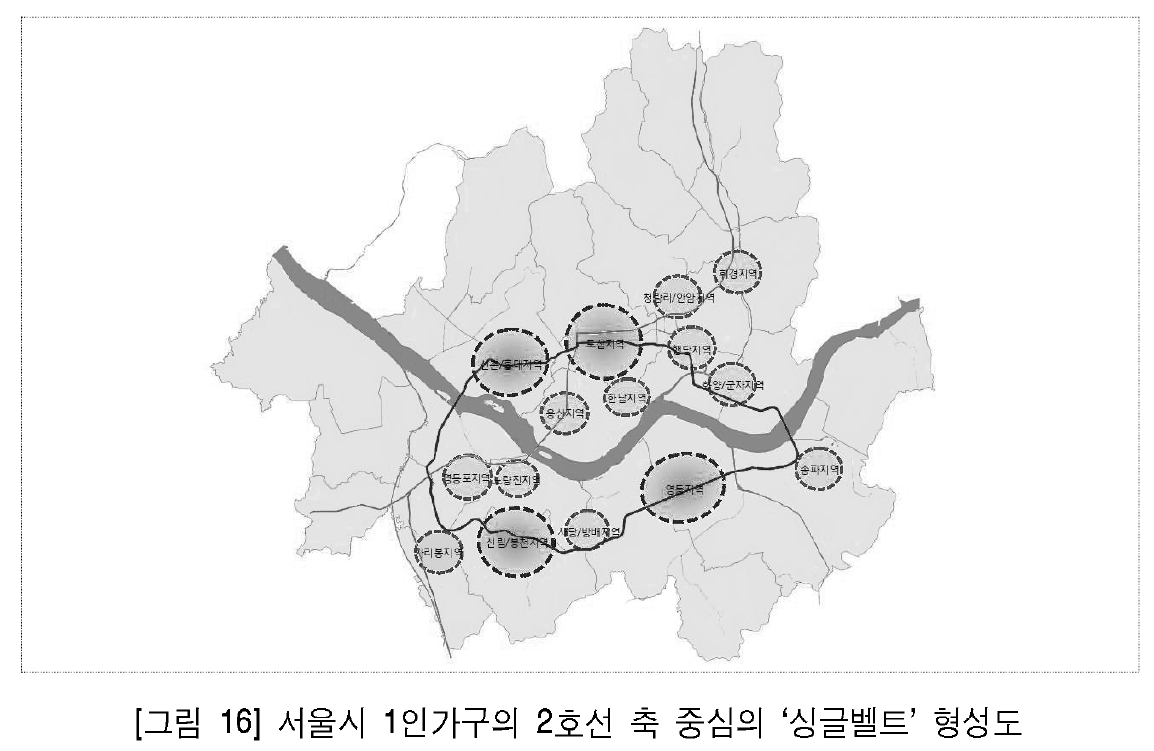
Update) The SDI’s report also mentioned that 51% of those people living alone in Seoul lived in the districts along subway line No. 2, a very small area relative to the vast conurbation that is the second most populous city in the world! It’s definitely no coincidence then, that those districts are dense with cafes, restaurants and retail shops, in total offering 21% of all the part-time jobs in Seoul.

Most of those pay 4000 won an hour, that article reports; the minimum wage is 3500.

Update 2) Here’s a graphic representation of the “single belt” around subway line No. 2, from p.15 of the SDI report.

the-single-belt-of-one-person-households-around-subway-line-no-2-in-seoul

How Many Unmarried Koreans Live Away From Their Parents?

Korean couple(Source: Hojusaram; CC BY-SA 2.0)

Let me take that break this weekend by posing a couple of questions to readers for a change: if you have a Korean partner, but aren’t married, do you live with him or her? And if so, do his or her parents know about the arrangement? Or is it a secret, which is what I expect most of you to say?

I say that because it’s been nine years now since my then girlfriend moved in with me back in Jinju, and I remember how for the next four years until our marriage she was determined to keep it a secret from her parents, who still think she lived in a “one-room” (원룸) with her younger sister all that time. Fortunately, they and most of her relatives were farmers who lived an hour’s bus-ride out of town, so it was only on the very rare occasion when we were out together that her spotting one in the distance had me hurriedly climbing over walls and up trees to get out of sight. Literally and figuratively then, Koreans’ conservative attitudes to cohabitation was the first cultural difference I really grappled with, and truthfully it was what ultimately inspired to me to start this blog too, my bristling years ago at most Koreans’ blanket assertions that conveniently ill-defined—yet somehow also timeless and unchanging—”Korean culture” was responsible for them, and my wanting to dig deeper.

In reality though, it doesn’t take half an hour up a tree dwelling on the subject to demonstrate that extremely high security deposits demanded of tenants, combined with absurdly low wages provided by part-time jobs, would make living away from home next to impossible for most young people. Change either economic disincentive though, then despite cultural prohibitions, in my experience many young Koreans can, will, and do leave the stifling confines of their homes the instant they’re given the opportunity.

Those young Koreans that can’t live away from home though, must reconcile themselves to the fact, and so by their mid to late-20s — when they do have the means to leave — I find that (as a psychological coping mechanism?) they can ironically often end up being among the stoutest of defenders of living with their parents instead. Hearing it from men specifically though, I don’t need to invoke that notion, for there is plenty of truth to the stereotype that they have all the comforts of having their housework done for them and with none of the restrictions applied to their sisters; hell, in their case I’d probably stay at home too. But a defense of the arrangement from the latter? Of the curfews often applied on them, and parents’ expectations that after working hard studying and/or pursuing their careers during the day, that they still should have to do a load of housework once they arrive home at 11pm? That will never cease to amaze me, and if I know that a Korean woman has the means to leave home but still tolerates such living arrangements, then in all seriousness we could never be friends: I’ve just had too many experiences of feeling like I’m talking to a 27 year-old teenager, and/or of wanting to grab her and shake some sense into her, demanding that she stop moaning to me about her mother and take some control of her life.

(Update: I should probably add that I find it just as difficult to be friends with men living at home too though, my respect also not extending to anyone who expects to go through their entire life with their mothers and then their wives doing all their housework for them!)

To be fair though, the “That’s Korean culture” mantra is a useful device with which to silence know-it-all foreigners, often happy to provide Koreans with their profound insights into Korean society after *cough* less than two weeks in the country, and as an immigrant to both countries I’m familiar with similar responses in Australia and New Zealand too (I’m sure it’s a universal tendency really). And while most Koreans outside of sociology departments naturally haven’t spent all that much time thinking — up a tree or otherwise — about why adult Koreans tend to live with their parents, it has to be said that when the subject came up in conversation (as it had a tendency to do so with me), that actually they did usually agree with my arguments that economics had quite a bit to do with it.

People thinking I’m right because I’ve paid more attention to the subject than them isn’t quite as satisfying as having the evidence to prove I’m right however(!), so although I put that specific topic on the backburner long ago, my ears still always prick up at any mention of related statistical data, although as I discovered recently, there’s much less of that than you might think. Hence I got quite excited when I came across this in today’s Korea Herald:

Seoul TiltshiftOne-person homes rise to 20%

By Kim So-hyun (sophie@heraldm.com)

One-person households accounted for a fifth of all households in Seoul, according to a report released yesterday by a city-funded research institute (source, right: Jude Lee; CC BY 2.0).

Some 675,000, or 20.4 percent of the total households in the capital, were people living alone, according to the Seoul Development Institute.

The SDI categorized those who live alone into four groups of professional singles, jobless youth, people who got divorced or had separated families, and senior citizens aged 65 or more.

“The percentage of one-person households is expected to reach 25 percent by 2030,” said Byun Mi-ree, an SDI research fellow who wrote the report.

She noted that the city needs to come up with matching policies such as supplying a wide variety of small homes, creating more jobs for unemployed youth, helping unstable singles rebuild families and assisting senior citizens in poverty.

The number of white-collar, professional singles has constantly increased since the mid-1990s along with the changing views of marriage, social accomplishment and individualism, according to the report.

Others increased as well with the tight job market, the aging society and the rising number of children leaving home with their mothers to study abroad.

Forty-five percent of the one-person households earned less than a million won per month. Seventy-six percent made less than 2 million won per month.

More than half of the people who live alone had blue-collar jobs such as sales service (26 percent) or manual labor (10 percent).

Fifty-one percent said they mostly used the mass transportation systems and lived along the subway line No. 2.

Yes, I expected a breakdown of the numbers of those “four groups of professional singles, jobless youth, people who got divorced or had separated families, and senior citizens aged 65 or more” too, and have to wonder what the point of one-person households as a unit of analysis is, given how disparate the make-up and needs of each of those groups mentioned above are. At first I was very curious that there was no mention of middle-aged “lonely goose fathers” (외기러기) too, who live and work in different cities during the week and then return home to their families on the weekend, but then I realized that the concentration of wealth and educational opportunities in Seoul would mean that when those fathers that were already living there were, say, transferred to a branch office, it was logical for the family to remain behind. I couldn’t imagine a family not following a father’s new job in or transfer to Seoul though, so although many Seoulites will indeed be lonely geese fathers, while they’re actually there they wouldn’t count as one-person households (but see here for some information on their numbers that I did find).

So, I checked out the Korean report from the Seoul Development Institute itself , and although it’s quite comprehensive, unfortunately that doesn’t have any figures either! I’ll keep an eye out for them any new reports from the SDI though, which I’m glad that the Korea Herald made me aware of, but in the meantime…then I guess I should provide an apology for not providing an actual answer to the question I pose in the post title. But if you did want to know then I’d genuinely be surprised if you weren’t also interested in the above report too, so *ahem* please forgive the slight subterfuge on my part? And regardless, please do pass on your own experiences of cohabiting in Korea, for my own opinions on the issue, first forged up a tree over nine years now, may well be in some serious need of updating!

Why are Korean and Japanese Families so Similar? Part 2: Couples Living With Their Parents After Marriage

Korean Wedding Party(Source: myllissa; CC BY-SA 2.0)

To refresh your memories, last month I came across this study that showed that Japanese women living with their husbands and parents-in-law were more than three times more likely than their husbands to have a heart attack: interesting in its own right, it led me to wonder how likely a similar study of Korean women would have been to have come up with a similar result, and why I so readily assumed that it probably would. This brief series is the result, a personal combination of learning new things, a healthy airing of some of my intellectual baggage, and, finally, some much-needed hard statistics about Korean families with which to analyze them from now on; without them, then I’ve been as guilty of relying on gut-feelings and generalizing about Korea just as much as the next expat.

As I discussed in Part One, most of those gut feelings about Korean women being under similar stresses were because I knew of the practice of eldest sons living with their parents after marriage and the great potential for the subordination and/or exploitation of the new daughter-in-law within, ethically and legally buttressed by Neo-Confucianism in much the same way that Christianity also heavily informs Western, historically unequal notions of marriage and family life. But are the same living arrangements also common in Japan? And if so, what role does Neo-Confucianism play in their numbers, and in the ways they internally operated so to speak?

Possibly I got the order in which I should have looked at those various questions mixed up, but I confess that prior to writing that post I knew very little about Japanese religion, and given Japan society’s relative progressiveness, and some important, decidedly non-Confucian features of it (most notably sexuality), would previously have assumed the virtual irrelevance of Neo-Confucianism in Japanese society today. Part One was about me investigating that, and I was surprised to learn that Neo-Confucianism permeates daily life in Japan just as much as it does here. Having done that, then this post is (mostly) about the actual numbers of couples and parents living together in Korea and Japan, and given how much I conflate doing so with Neo-Confucianism – or at least, permanently and willingly doing so – then probably I shouldn’t have been surprised at the high rates of that living arrangement I found in Japan also. Ergo, there are many daughters-in-law living with their husbands’ families in both countries, and they are likely to face very similar, stressful social expectations of filial duty and subservience in both countries. But much higher rates in Japan?Why?

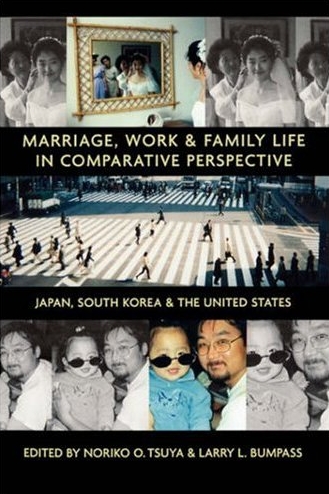
Well, before getting to the “why stage” though, you’d be surprised at how difficult it was to find even the most basic of demographic data on Korea in particular, even with the plethora of sources that a Korea Studies geek like myself has. And the only(!) book I have which does provide some of the answers: Marriage, Work and Family Life in Comparative Perspective: Japan, South Korea and the US (click on the image for a link to Amazon), I was originally very disappointed with when I first bought it over a year ago, for while it was published in 2004 most of its data actually comes from 1994 or even earlier, a flaw not exactly highlighted by the accompanying notes at online bookstores either. But forced out of desperation to reread it, I realized that I’d dismissed it too quickly: like a visiting UN demographer who lectured at my university once pointed out to me, demographics is all about waves, and as I’ll explain, 15 years later Korea is definitely still feeling the effects of the processes highlighted in this actually rather good book.

And, once I realized that, then I confess that I got a bit lost in it at that point, for the similarities and differences between the three countries are simply fascinating, and go well beyond mere numbers of extended families. In particular, after hearing it first on some old Korea Society podcast, I’ve often said that one’s generation in Korea is as important a marker of identity as, say, race is in the US, but I doubt that whoever I heard that phrase from meant it as anything more than an allusion to Korea’s extremely rapid rate of development (I know that I certainly haven’t!). But then I read this on page 61:

Korea tends to differ from the other two countries on a number of structural characteristics that are likely to [strongly] affect intergenerational relations.

But first, the basics. Seeing as they take up an entire chapter, then I won’t get into all the technical details and potential flaws of the methodologies of the surveys in the three countries sorry: suffice to say that, unless stated otherwise, all the statistics in the remainder of the post refer to married couples at the time of questioning, with both spouses between 30 and 59, and almost all for Korea, Japan and the US are from 1994, 1994, and 1988 respectively. Starting off then, the number of couples that were:

  • Living with the wife’s parents: Korea 4%, Japan 9%, and the US less than 1%
  • Living with the husband’s parents: Korea 24%, Japan 37%, and the US less than 1%

Yoshi Sugimoto, in his excellent book An Introduction to Japanese Society (2003), also notes that in 2000 “about a half of persons at or above the age of sixty-five live with their relatives, mainly with the family of one of their children” and that “this pattern is inconsistent with the prediction of modernization theory, that industrialization entails the overwhelming dominance of the nuclear family system” (p. 175). Far from being because immutable and deeply-held Neo-Confucian beliefs however, in reality:

…most two-generation families make [the] arrangement for pragmatic rather than altruistic reasons. Given the high cost of purchasing housing properties, young people are prepared to live with or close to their parents and provide them with home-based nursing care, in the expectation of acquiring their house after their death in exchange. Even if the two generations do not live together or close, aged parents often expect to receive living allowances from their children, with the tacit understanding that they will repay the “debt” by allowing the contributing children to inherit their property after death. This is why aged parents without inheritable assets find it more difficult  to live with their children or receive an allowance from them. (p. 176)

But why do more Japanese parents and married children live together than Korean ones? Rather than giving you the answer straight up, let me highlight the other differences, so that hopefully you might be able to work them out for yourself:

  • Korean parents are the least likely to be alive.
  • One half of Korean married couples surveyed grew up in rural areas and now live in urban areas, against a third for Japan and a figure “somewhat lower” in the US.
  • Naturally more US parents live further away from their children in either Japan or Korea (50% of both the wife’s and husband’s parents live more than 25 miles/40 km away), but there’s still a big difference between Japan and Korea: 28% of the wife’s parents and 24% of the husband’s parents live in a different district or municipality, against 45% and 38% respectively for Korea.
  • Only 46% of Korean husbands were eldest sons, against 56% in Japan.

And finally here are some more interesting facts, albeit more indicative and/or the cause of Korean women’s extremely low economic and political empowerment (possibly – make of them what you will) rather than why Japan has more extended families than Korean does:

  • Korea has the lowest number of couples in which both spouses are working: 22% against 57% in Japan, and 66% in the US. Undoubtedly these figures will have changed in the 15 years since then, but Korea is still exceptional in this regard, with the lowest number of working women in the OECD.
  • Korea has the lowest number of couples where the wife is older than the husband (4%), and the most where the husband is substantially older. In contrast, the figures for Japan and the US are 10% and 18% respectively.
  • Korean women don’t change their names when they get married, Japanese women do. The maintenance of “bloodlines” via male descendants continuing the family register known as hojuje (호주제) being more important in Korea then (at least until it was abolished last year),  until roughly a decade ago Korea had one of the most skewed sex-ratios in the world, and Koreans were notorious for refusing to adopt unwanted children, generally sending them overseas instead. The similar koseki (戸籍法) system in Japan does still continue, but there continuing the family name is important, leading families without a son to often adopt one for instance.

I confess, there appeared to be rather more noteworthy statistical differences and interesting tidbits when I began writing this post: I expected to have much more to say, and yet I find I’ve gotten through those in *cough* only 1470 words as I type this, half of which was an introduction/recap, albeit probably necessary. On the plus side though, I do see much of my role as a blogger as being to do condense (very) much larger pieces of work into their key points, thereby making them much more accessible to a wider audience, and so even if you can’t see the reasons for the differences in the numbers of extended families between Japan and Korea yet, if you just read the part of the authors’ summary below, then go back and look at the four points above the last (rather stylish) photo above, and then finally say something like “Ahh! Of course!” once you do…then I’ll know I’ve been doing the right thing!

…from a number of socioeconomic and demographic perspectives, Japan and the US are more like one another, and Korea is more distinctive. Korea’s mortality and fertility declines are more recent than either Japan’s or those the US. In Korea, the generation of middle-aged adults examined here has experienced all the dislocations and opportunities that go with a recent and rapid shift from an agricultural to a manufacturing and service economy, from a rural to an urban settlement pattern, and from a low level to a higher level of educational attainment. In the US and Japan, these transitions occurred somewhat earlier, and it is expected that the timing and nature of these transitions would affect patterns of intergenerational relations. (p.74, my emphases)

If you’re also interested in why so many unmarried Korean and Japanese children live with their parents, see here and here.

Why do so Many Korean Children Wear Glasses?

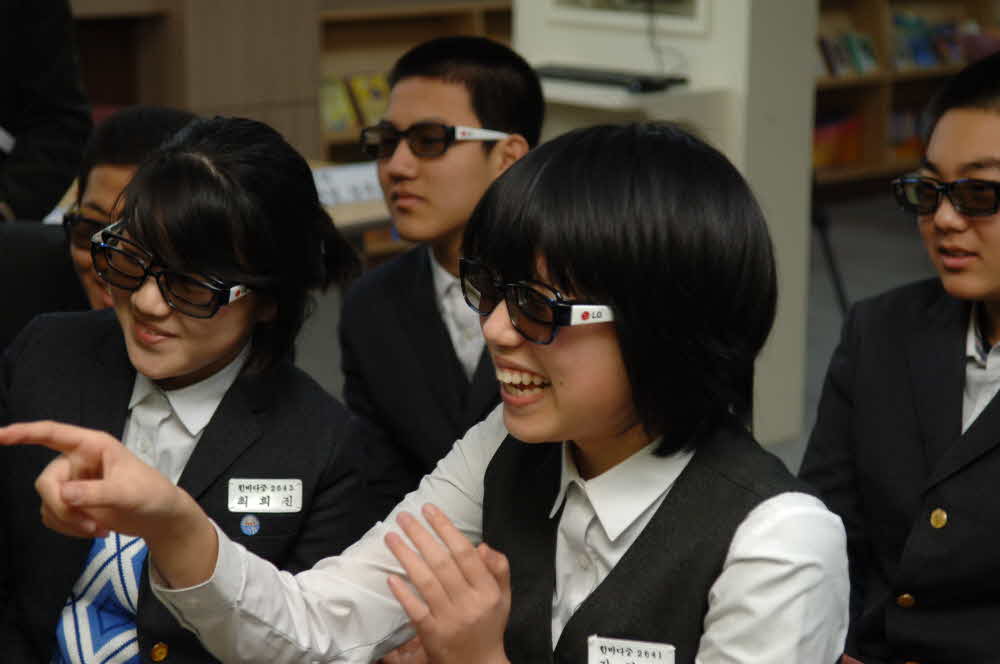
Korean Children Glasses TV(Source: LG전자; CC BY 2.0)

Update, April 2009: In hindsight, I didn’t cover this subject thoroughly enough here, leaving some questions unanswered. For a more comprehensive overview, see this article I wrote for the Korea Times.

Update 2, June 2013: And for a much more up-to-date overview, see this article I wrote for Busan Haps.

If I’d been asked this question yesterday, then I too would have answered that it was because they were always hunched over their books, or staring at computer screens. But the surprising result of this Australian study was that those are only correlated but not causative factors.

In fact, it’s because they don’t get enough exposure to sunlight.

I confess, before I read the details of the survey, I was very sympathetic to such a result: young Korean women, for instance, have among the lowest Vitamin D levels in the world because of avoiding the sun for the sake of light skins, and given how the required behavior and body images that lead to such extremes are inculcated very early in Korean children’s lives, then if a lack of sunlight does indeed lead to myopia (short-sightedness) I’d wager money on rates being higher among Korean teenage girls than boys. Not much higher, no, but I’d still expect a statistically significant difference between them.

But technically the study never looked at Korean children specifically. And while Korea certainly shares other developed East Asian countries’ skyrocketing rates of myopia among children — virtually all my middle-school students wear glasses or contact lenses, and I bet yours do too — I was confused when I heard that the study was primarily based on Singaporean children.

How on Earth do children that live on the equator not get enough sun?

Actually, partially it’s precisely because they live there. As head researcher Dr. Ian Morgan explains in an Australian radio interview, the heat meant that:

The children in Singapore were spending about three hours a week outside, so very, very limited periods of time outside, excluding the school hours. Basically they went to school, they went home, they did their homework and then they watched television and that was life.

But this issue of climate wouldn’t apply so much to children in other East Asian countries, where the same education culture of going to school during the day and then cram schools in the evenings prevails, although that does also mean that they’re not outdoors much of course. But how to tease apart the effects of that lifestyle from a lack of sunlight specifically? Things like diet, and, say, the not insignificant fact that Korean children get the least sleep in the world, would presumably have some effect too.

Here’s the key part of the radio interview that reveals how and why researchers did that. Without it, basic summaries of the study like this and this that are all over the news wires are good introductions, but raise more questions than answers really:

DR IAN MORGAN:….we have been able to compare the prevalence of myopia in Chinese kids in Singapore, as compared to kids of Chinese origin growing up in Sydney. And at the age of six, the kids in Singapore — the Chinese kids in Singapore are ten times more myopic than the kids of Chinese origin in Australia.

INTERVIWER: But did the Singaporean children spend more time in near-work activity than the Sydney children?

DR IAN MORGAN: If anything, they spent a little bit less and this is what led in part to us looking for what other factors could be important. And the striking difference that came across was that these kids — remember they’re matched for age and they’re matched for ethnicity, they’re all of Chinese origin. The kids of Chinese origin in Sydney were spending a lot more time outdoors than the kids of Chinese origin in Singapore.

For more details, including the debunking of alternative theories that there is some genetic susceptibility to myopia among East Asian populations, and why it is specifically light intensity that is important, then I highly recommend reading the radio interview in full.

I don’t have the time to translate anything myself unfortunately, but it’ll be interesting to see how the Korea media interprets the results of this study. While it would be just one of a very long list of serious social and health problems among young Koreans resulting from Korea’s after-school institute or hagwon (학원) culture, and so unlikely to lead to any huge changes overnight, all the various English-language articles on the study point out that governments across the region already do have serious concerns about the issue. So, this may well provide just enough of a shove for Korean schools to, say, provide more outdoor physical education and field trips for students. Granted that it’s rather cold at the moment though!

Why are Korean and Japanese Families so Similar? Part 1: Neo-Confucianism

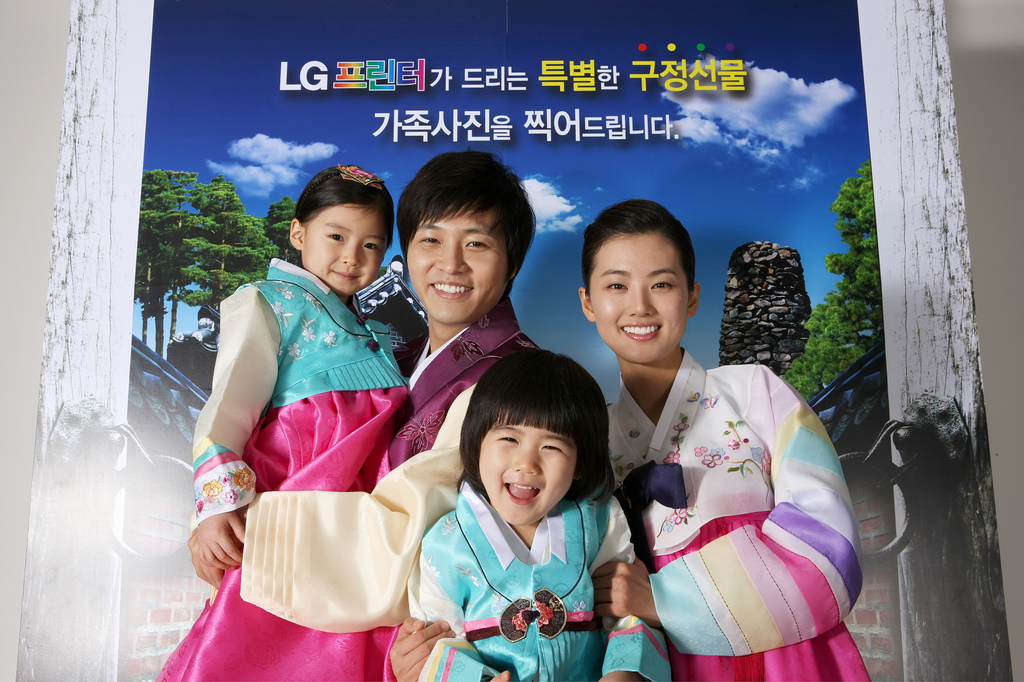
Korean Family LG Printer(Source: LG 전자; CC BY 2.0)

According to a recent study, Japanese women living with their parents-in-law are three times more likely to have a heart attack than those just living with their husbands. This, in a country famous for its very low rates of heart problems overall.

Which got me wondering about Korea. Korean family structures and gender roles are very similar to those of Japan, so it seems reasonable to suppose that the Japanese study has great relevance to Korea, and that a knowledge of Korean family life can reliably inform our interpretation of it.

Or does it? This is the question that has occupied me for past nine days, and, for readers by definition interested in Korean social issues, it is much less abstract and pedantic than perhaps it first sounds. Let me explain.

As a writer about Korean society, but often lacking in English-language material, frankly it is always a temptation to stress its similarities with Japan, just for the sake of having something to work with. But seriously, the huge Japanese role in the development of both the modern Korean state and economy has left profound and enduring legacies. Add that I’m a big proponent of the Marxian concept of base and superstructure—basically that much of a society’s oft-claimed timeless and enduring culture (one aspect of the superstructure) changes pretty damn quickly once economic structures or modes of production change (the base)—too, then it stands to reason that, with still broadly similar economic structures centered around horizontal and vertically-integrated conglomerates known as keiretsu and chaebol respectively, then much about daily life in both societies (workplace culture, working hours, drinking-culture, male-breadwinner based welfare systems, gender divisions between work and the home, and so on) would also be very similar. And it wouldn’t take much reading of just this blog alone to find that this indeed the case.

With that background and strong inclination however, there is always a danger of taking similarities as a given. And particularly in this case, where the authors of the study point out that:

One of the overwhelming things that stands out is that it doesn’t matter for Japanese men what the living arrangements are…they’re immune from stresses in the home (source, right: Urânia – José Galisi Filho).

And from which Samhita of the Feministing blog argues:

The article feigns surprise in finding out that men don’t have these same health problems, but fails to make the obvious conclusion that women get inordinate amounts of pressure from their in-laws to live up to certain expectations that increases stress in their lives. Many women are choosing not to get married or have as many children in Japan, but the culture of expectation around how women should act in the home seems resilient. I wonder if a similar correlation can be made with women that are living with their in-laws in the states?

Which is equally true of Korean brides, where those expectations include assuming the bulk of housework duties, and utter subservience to their mother-in-laws. Naturally, the ensuing potential for domestic tension and conflict make such living arrangements a staple of Korean dramas for decades, one such playing at the moment being You are My Destiny (너는 내 운명, but not to be confused with the 2005 movie with a similar name) starring the decidedly unhappy-looking bride Yuna below. Having said that, just like the traditional hanok houses that many of these dramas are inexplicably set in, one can’t help but assume that women’s disdain for eldest sons and the nuclearization of the Korean family mean that these living arrangements are increasingly rare in practice, which begs the question of why dramatizations of them remain so popular even today.

Writing a week ago, I thought it was because, in practice, living in separate homes has not diminished many parents’ intimate involvement in their childrens’ married lives, and hence the exaggerated situations of dramas still strike a chord amongst married couples and those of marriageable age. Indeed, the combination of Korea’s small size and improvement in Korea’s transport and communications infrastructure has made this even more possible and likely over time. Note that even as recently as the 1970s, a move to Seoul might entail not seeing parents and siblings in the countryside for many years, let alone friends who moved elsewhere in the country. (Source, above: HKGolden.)

But, to spare you the reflections on my preconceptions and academic baggage that took up much of an earlier version of this post, there comes a point where you need evidence. Much of those nine days were spent looking.

Fortunately, I was successful. But in the process, I discovered the question was much more difficult than I thought. Again, to spare readers from a frankly rather incoherent argument in a previous version of this post, in sum I learned that:

  • According to Yoshio Sugimoto’s brilliant An Introduction to Japanese Society (2003, pp. 175-176), Japanese dramas likewise dwell on intergenerational conflicts in households with extended families.
  • In fact, Japan has many of more such households than Korea (which will be discussed in Part 2).
  • But why? Crucially, Japanese society lacks the (Neo-)Confucianist ideology that underscores such family arrangement, and the ensuing conflicts.

Or so I thought. But, after a decade of constantly reading how Korea is the most Confucian country in the world, and “more Confucian than China,” I’d considerably underestimated Confucianism’s influence on the rest of East Asia.

Korean Woman Bench Sitting Gallery(Source: thomas park; CC BY 2.0)

This was revealed to me by Robert Smith in his chapter “The Japanese (Confucian) Family: The Tradition from the Bottom Up” in Tu Wei-Ming (ed.), Confucian Traditions in East Asian Modernity: Moral Education and Economic Culture in Japan and the Four Mini-Dragons (1996), and who aims to show:

…that it is impossible to advance a plausible argument that the Japanese family today is Confucian in the strict sense. It is equally impossible to argue that it has been completely purged of the effects of attempts by the authorities to structure it in terms of selected Confucian principles. (p. 157)

Some selected excerpts to make up the remainder of this post then. Please forgive me if there’s rather a lot of them, and apologies to any Japan-based readers who already started saying “Well…Duh!” to the computer screens some time ago, but hopefully they’ll still be helpful for any readers like myself that aren’t/weren’t as familiar with Japanese social history as they thought they were.

First, on why I had that impression that I did:

I have asked a hopelessly unrepresentative sample of Japanese colleagues, acquaintances, and friends whether contemporary Japanese think of themselves or their families as Confucian. The spontaneous answer is a resounding no, often supplemented by a dismissive reference to the conservative, reactionary, or feudal (a favorite term of opprobrium in Japan) character of its teachings. The implication is that one’s grandfather or great-grandfather may have been taught Confucian ethics and might even have internalized them, but in 1945 the Japanese consigned Confucianism to the dustbin of history. (p. 157)

There is one obvious difference between the role of Confucianism in China and Japan, where is has always been only one of many competing ideologies, philosophies and ethical systems, and never, as in China, “a way of life encompassing the ultimate standards for Chinese social and political order.” (158)

And the Japanese tend to underplay the Confucian influence in their own society because:

Japanese Confucianism started as a cultural ideology serving the needs of the Tokugawa Bakufu (or Shōgun, or Army Commander)….Although for a time Confucianism had been discredited along with everything else associated with the shogunate, it gained currency again with the consolidation of conservative power in the late 1920s and 1930s. (p. 158-9).

The latter of which was the decade when:

…Japanese society was being reduced at the hands of fanatics to its most stifling condition of oppressive irrationalism [and] in which the ideals of the Japanese educational world were closer to those of its Togukawa past than at any time since 1870….Is it any wonder that today’s Japanese, if they have thought about it at all, are likely to view Confucianism in a negative light? (p. 159, my emphasis)

Now, why the influence of Confucianism on the Japanese and particularly the Japanese family remains pervasive nevertheless:

Were the Japanese ever Confucianists in, say, the same sense as the Koreans? No one claims that they were. Nevertheless, there are many ways in which the Confucianist concern with hierarchical relationships and its emphasis on harmonious families as the basis for harmonious states seems to have influenced Japanese society. Be that as it may, it is just as likely that the Japanese selectively utilized Confucian teachings to reaffirm and strengthen characteristics of their society, which was deeply rooted in the pre-Confucian past.

Presumably one of the domains in which Confucianism did not simply reinforce and justify older social practices is the treatment of women, for it is widely argued that they enjoyed a far more favorable position in Japanese society before the introducton of Confucianism. It may well be, however, that the decline of women’s status in Japan actually began with the popularization of Buddhism. (pp. 160-1, my emphasis)

Finally:

The question is not whether Confucianism is a religion. It is rather: Does Confucianism, broadly defined (or, perhaps better, undefined) have anything at all to do with religion in Japan?

The “rules” by which religions are tacitly expected to operate in Japan are, more than anything else, Confucian. As so often in Japan, Confucianism plays the role of a moral and ethical substratum that, its preconditions being met, allows a harmless surface diversity. Indeed, one could argue, as many have, that these principles go back beyond Confucian influences on early Japan to the values inherent in ancient clan structures and an agricultural society with their demands for loyalty and cooperative effort; Confucianism did not so much crate as articulate the values by which Japanese society works.

Virtually all religions that have endured in Japan have adapted external forms agreeable to the patriarchal family model and have made their peace with the state. (p. 171, my emphasis)

At this point, a more thorough blogger than myself would probably move onto those passages where Smith discusses that latent Confucianism within Japanese families (and the education system) more specifically, but I think that readers can reasonably extrapolate those from the big picture that I have already provided rather than requiring me to add those too. Ergo, Japanese families are indeed (Neo) Confucianist, and I’m especially glad that demonstrating that gave me a legitimate opportunity to get stuck into my recently purchased copy of Tu-Wei Ming’s book. But while 2500 words is a rather short post (for me), given the long time this one took and that Confucianism, Demographics and Biological Anthropology are much more discreet subjects than what I normally blog about, I’ll wisely end this post here!

Update

Although they’re not really related to the topic at hand, the questions of: a) to what extent the US could be described as a “Christian country” and b) whether Confucianism is a religion or not came up in the comments, and are interesting in their own rights. And while I’m usually reluctant—yes, really—to type out literally entire pages from books here, Robert Smith does answer both much better than I could:

To what extent has the Japanese family ever been Confucian, and to what extent is it today? Would that the question could be so easily answered. Even the most casual survey of the vicissitudes of Confucianism in Japan suggests the need for caution. Indeed, I was tempted to indicate just how cautious one must be by titling this essay either “Confucianism Is in the Eye of the Beholder” or “Confucian Is as Confucian Does.” That is to say, how Confucianism is described, the praises sung of it, the importance assigned to it, and the terms by which it is denounced are all very strongly colored by the historical period in which the assessments are made, the position in the social hierarchy of the person expressing the opinion, and – not least in recent times – the age and gender of those who views they are.

I hasten to add that in these respects Confucianism seems to me rather like all other philosophical, ethical, and/or religious systems of whatever time or place. An example, drawn from personal experience with one such system, involves one of the myriad subcategories of the southern United States brand of Protestantism. Fifty years ago its construction of Christianity was a finely crafted one that had no place for Catholics, who were thought of as idolaters, or for Quakers, of whom few had ever heard. Depending on the particular church and the position of its minister on the issue, it was not always entirely clear that Methodists and Presbyterians were Christian either.

Be that as it may, did my relatives and neighbors think that they themselves led Christian lives? Of course they did, or tried to. Were it to be pointed out that someone had committed some “unchristian” act, the usual explanations were that all are conceived and born in sin, that it all happened before the miscreant had found God – or perhaps it was because Christ had found him. It is all now too far in the past for me to recall the full inventory of shifting grounds on which our neighbors and relatives took their unshakable Christian stands. Would they have agreed – and do they still – that the United States is a “Christian country”? Of course. They have never doubted it….Yet I wager that in the course of conducting interviews on the subject, you could collect scores of definitions – some of them flatly contradictory – of just what the term “a Christian country” might mean. There is bound to be some overlap, to be sure, but no consensus. Are we then to conclude that the United States is not a Christian country? I think not. But I submit that consensus on the religious and ethical dimensions of Christianity is not much more likely to be achieved than agreement as to precisely what Confucianism might be and whether the Japanese family is a Confucian institution.

It is possible, of course, that I am looking in the wrong place for an authoritative definition, and would be better advised to seek it among the philosophers, the theologians, the ethicists, or the intellectual historians. My reading of the relevant sources, however, strongly suggests that consensus at the tip is even more difficult to achieve than at the bottom. In any event, my anthropological training predisposes me to start at ground level. (pp. 155-157)

Thoughts?

Korea’s “Lonely Geese” Families: More of them than you may think

Back in July, I wrote a lengthy post* on the reasons behind and implications for Korean society of the high numbers of “weekend couples” (주말부부) and “lonely geese fathers” (외기러기) here, the latter generally referring to fathers who remain in Korea to work while their families live overseas for the sake of the children’s eduction. Back then, no statistics on the numbers of either seemed to be Shy Korean Boyavailable, so I speculated that the combination of both meant that a total of perhaps one in fifteen to one in ten Korean teenagers lived in a different city to their father most of the time (source, left: James Kim; CC BY-SA 2.0).

But it turns out that perhaps I underestimated that number: according to this recent survey of single women, effectively teenagers in this particular sense, for Koreans tend to live at home until marriage (although this is more for economic rather than the cultural reasons usually cited: see here and here), as many as one in eight Korean families have “at least one immediate family member living apart from the rest”. True, on the one hand that figure will include also university students living away from home, but then they are not common as I explain in those two posts linked to above, and on the other it wouldn’t contain the “international” lonely goose fathers I mention above either, so ultimately I’d wager that 90% or more of those one in eight immediate family members referred to would indeed be fathers working in different cities during the week.

There are some other interesting points made in that survey, but as it doesn’t mention the numbers and methodology (par for the course for most Korean newspapers unfortunately), then I’d take them with a grain of salt. But I think that the figures for geese families would be pretty consistent whatever the sample size.

*Since deleted sorry.

Ich bin ein Westerner

Foreigners Gangnam Style(Source: Republic of Korea; CC BY-SA 2.0)

Steve, who is unfortunately leaving Korea soon, has written a short but interesting post about the meanings and ramifications of the terms waekookin (외국인) in Korea and gajin (外国人) in Japan over at his blog Where is Cheongju Again?, and long-timers here especially could do much worse than take the five minutes to read it over their coffee this morning. Overall, he makes a pretty convincing case for Westerners in both countries referring to and thinking of themselves as such rather than simply as “foreigners” (the basic translation of both words), and I’ll be doing so myself from now on.

It may not sound like much, but like I said in this forum, Korea’s (and Japan’s) “bloodline”-based notions of nationalism and citizenship emphasize and exaggerate the differences between natives and non-natives to an extent rarely found elsewhere in the world, and the constant reminders of these quickly become wearisome to anyone who’s spent even just a few months living here, let alone eight years. Also, ironically, constantly hearing the term waekookin in our daily lives probably means that we come to adopt some of the same notions of division and distance ourselves too, and the effect snowballs.

A little cliched? Perhaps. But still, the term is such an immutable fact of expat life here that probably few of us have ever given some thought to it, and it surely can’t harm to do so. Not least, by a grizzled and cynical old timer like myself.

Update: If you found this post interesting, then you might want to check out this thread on Dave’s ESL Cafe too. To those of you not in Korea especially, it gives a good idea of how (over)used the word “foreigner” is here, and just how quickly it can become annoying.

Paternity Leave in Korea from Next Year?

From page 3 of the September 12, 2007 Busan Focus:Paternity Leave, 1970s Swedish Poster

출산휴가가는男: 내년7월 배우자 3일 부여 ‘남녀고용평등법’등 의결

내년 7월부터 남성근로자도 배우자 출산휴가를 사용할 수 있으며, 육아휴직을 나눠 쓰거나 육아휴직대신 근로시간 단축방법도 사용할 수 있게 된다.

정부는 11일 오전 중앙청사에서 한덕수 총리 주재로 국무회의를 열어 일과 육아의 병행을 위해 이 같은 내용을 핵심으로 하는‘남녀고 용평등법’개정안 등 20여개 안건을 심의, 의결했다. 이 개정안은 그간 사업장별로 임의로 시행해 오던 남성근로자의 출산휴가를 3일간 부여하는 것으로 의무화했으며, 현행 전일제 육아휴직 대신 주 15~30시간 이내의 범위에서 근무하는 육아기 근로시간 단축을 신청할 수있도록 하고, 육아휴직이나 육아기근로시간 단축제를 1회에 한해 분할 사용할 수 있도록 하고 있다.

또 육아기 근로시간 단축을 이유로 해고나 불리한 처우를 하는 사업자의 경우 3년 이하의 징역이나  2천만원 이하의 벌금, 육아기 근로 시간 단축 종료 후 같은 업무에 복귀시키지 아니할 경우 500만원 이하의 벌금, 그리고 배우자 출산휴가를 주지 않을 경우 500만원 이하의 과태료를 부과하도록했다 (image source: On Being; CC BY-NC-SA 2.0).

또 국제화 시대를 맞아 ▲ 회사의 설립·운영 등에 사적 자치를 폭넓게인정하는 유한책임회사 등 새로운기업형태를 도입하고 ▲무액면주식 제도의 도입과 최저자본금제도의폐지 등 상법 개정안도 심의했다.

Men on Paternity Leave: To fulfill the requirements of the law on gender equality in the workplace, a 3 day paternity leave is to be available from next July

From next July, the spouses of women taking time off work to give birth can also take time off from work, either for the birth itself or by shortening their work hours by an equivalent amount.

On the Morning 11th of September, the prime minister Han Deok-Su, opened a session of Congress focusing on work and childcare. Congress members deliberated on a bills regarding the law on gender equality in the workplace and on 20 other matters, and passed a law that will require all workplaces to provide paternity leave to male employees. They will be given the option of either taking 3 days at the time of the birth of the child, or have their working hours reduced by 15-30 hours at alternate times when it is convenient to them. These 15-30 hours will not have to be taken all at once.

If employers use this reduction of work hours as a pretext to fire an employee or treat him unfairly, then the employer will be liable for a jail sentence of up to 3 years or a fine of 20 million won. Also, if an employee is not allowed to continue in the same position after returning from paternity leave, or if paternity leave isn’t granted at all, then the employer will be liable for a fine of up to 5 million won.

Since we are in a globalized age, Korean companies need to introduce more scope for employee’s personal autonomy in their establishment and operations. Also discussed at the congress was the introduction into commercial law of a no-par stock system and the discarding of a minimum capital stock system.

For the sake of comparison, see here for a table showing different countries’ parental leave provisions.