Breathe (비리드) by Miss A (미쓰에이): Lyrics, Translation, & Explanation

( Source )

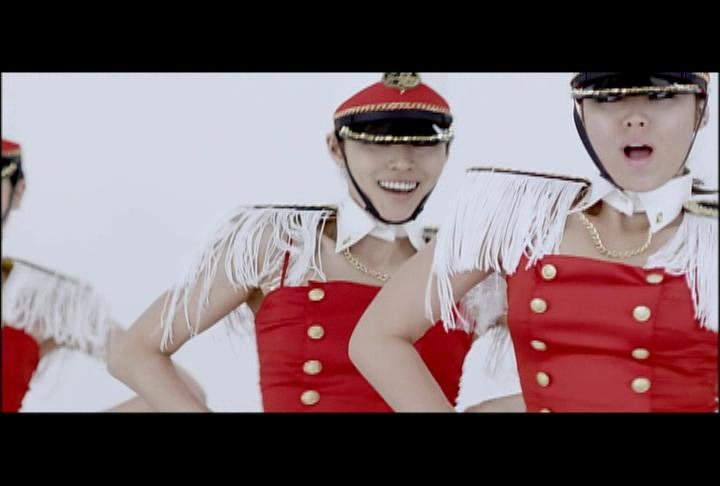
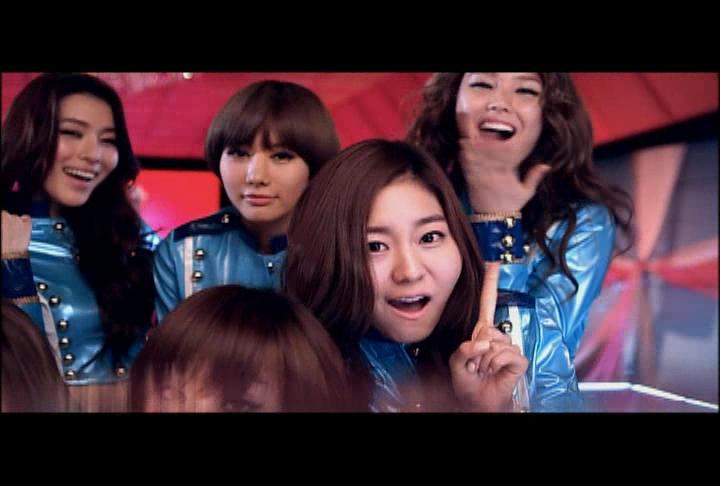
Like Bad Girl, Good Girl (배드걸 굿걸) translated last week, Miss A’s (미쓰에이) Breathe (브리드) is also a song which very quickly grows on you. But seeming to lack a real climax though, then ultimately it proves somewhat less satisfying…a double entendre you’d do well keep in mind if you’re likely to be shocked by all the panting and heavy-breathing in it, let alone Meng Jia’s (멍지아, 孟佳) helpful demonstration of what might cause her to do that at 2:47.

Hell, Korean may well lack the “th” sound, but even the Hangulization of the title actually sounds more like “breed” too.

You’d probably never suspect then, that its central narrative is actually one of complete passivity towards the desired guy, with the music video full of aegyo and childish impressions to boot. Indeed, in that sense it’s much more in the vein of, say, Girls’ Generation’s Oh, T-ara’s Like the First Time, and KARA’s Mister then anything you’d ever expect from the same group that just did Bad Girl, Good Girl.

Not that that’s necessarily bad of course, and may we all meet someone that makes us that weak at the knees. But it was certainly a slight disappointment after just becoming a fan of theirs for being so different.

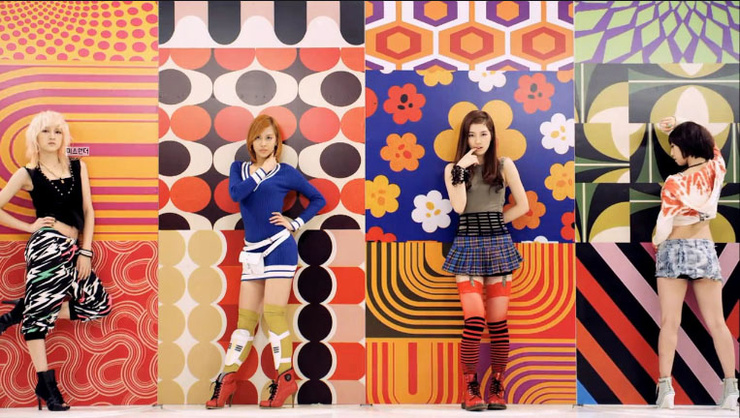
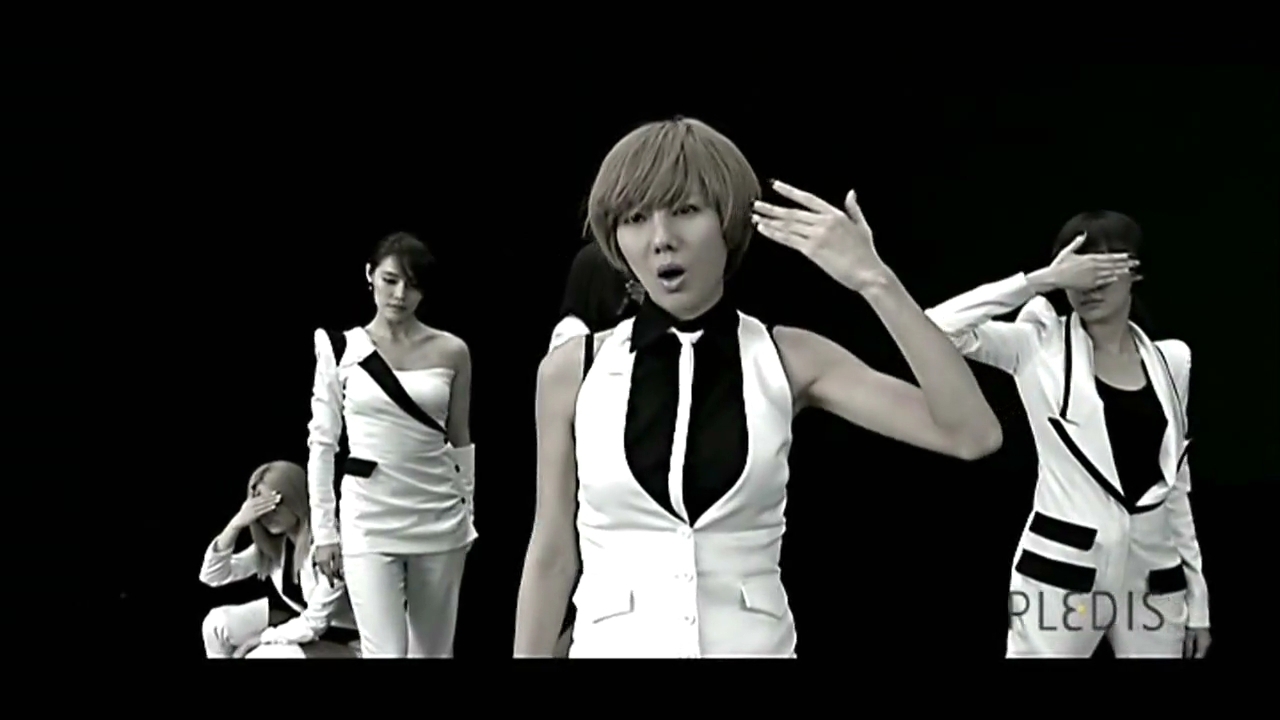
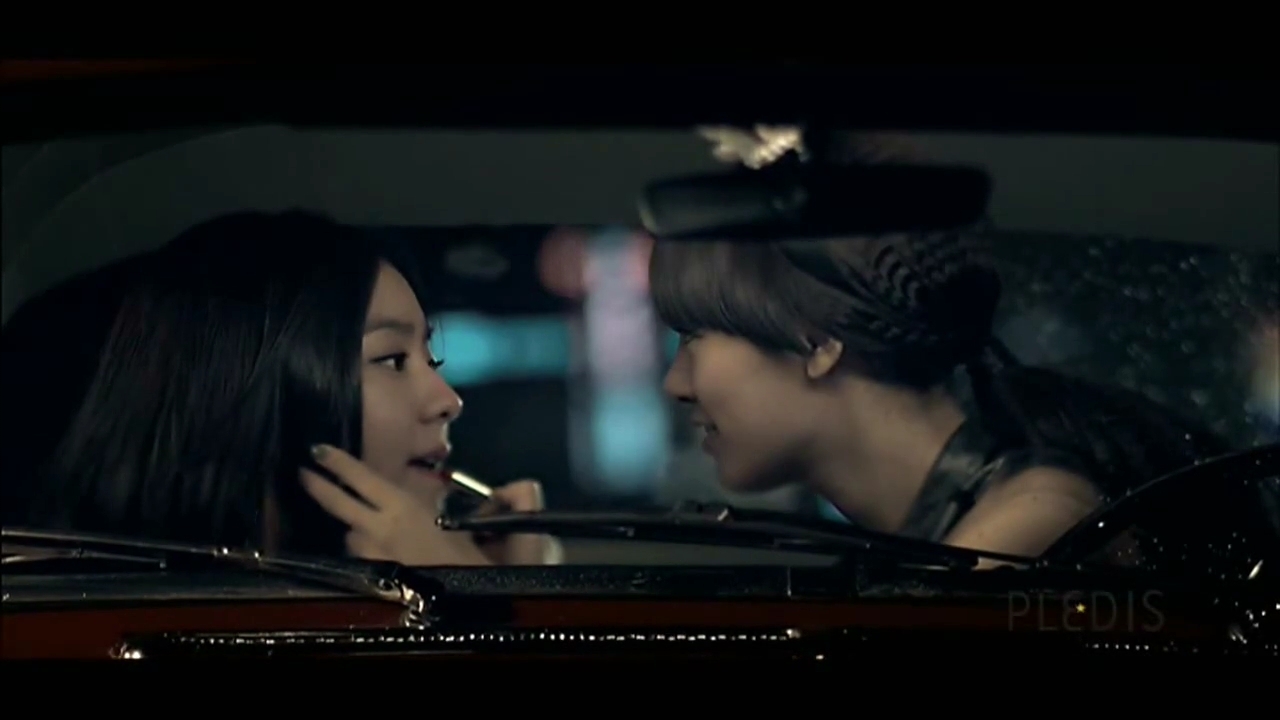
Still, I do like it, and especially the music video. And not just because of the eye-candy either. Rather, because with the backgrounds and the women’s sometimes deliberately stilted dance movements, in fact it reminds me a little of the 1989 Fine Young Cannibals’ number 1 hit She Drives Me Crazy, which was nominated for best video at the MTV Music Video Awards that year:

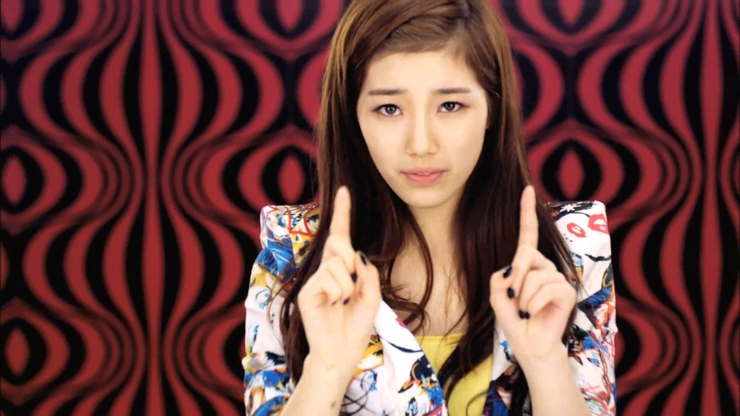
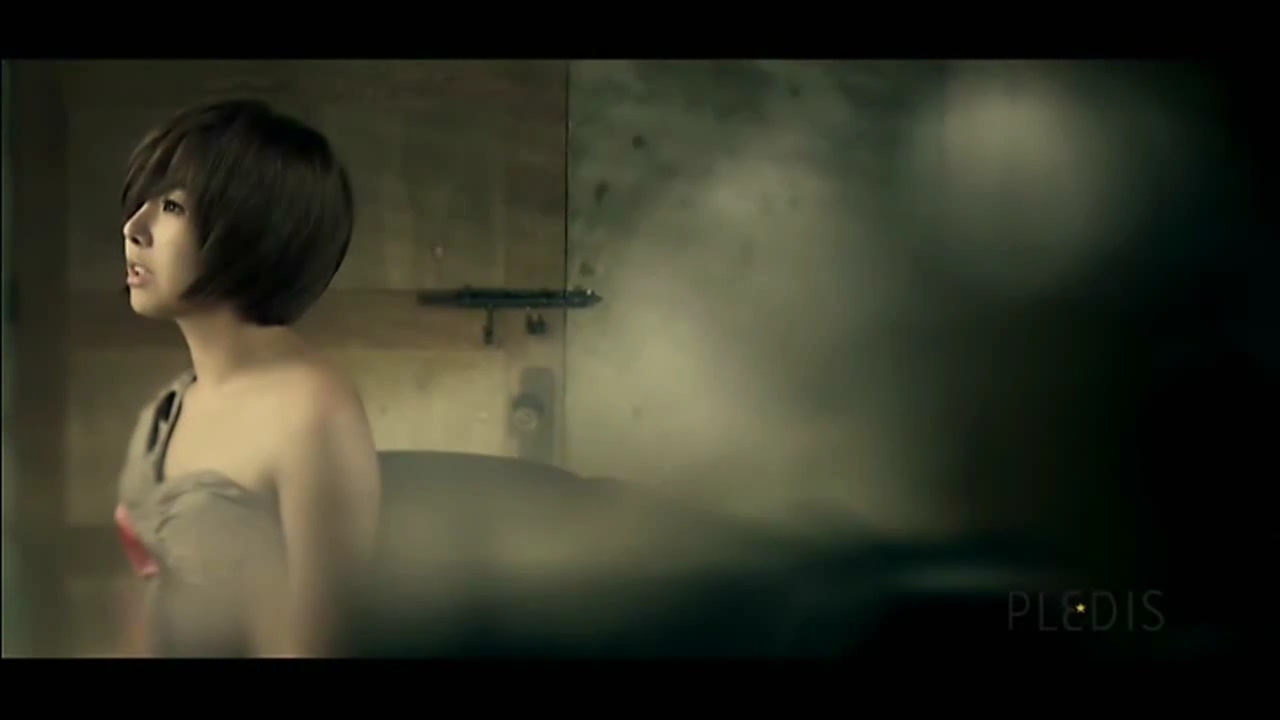
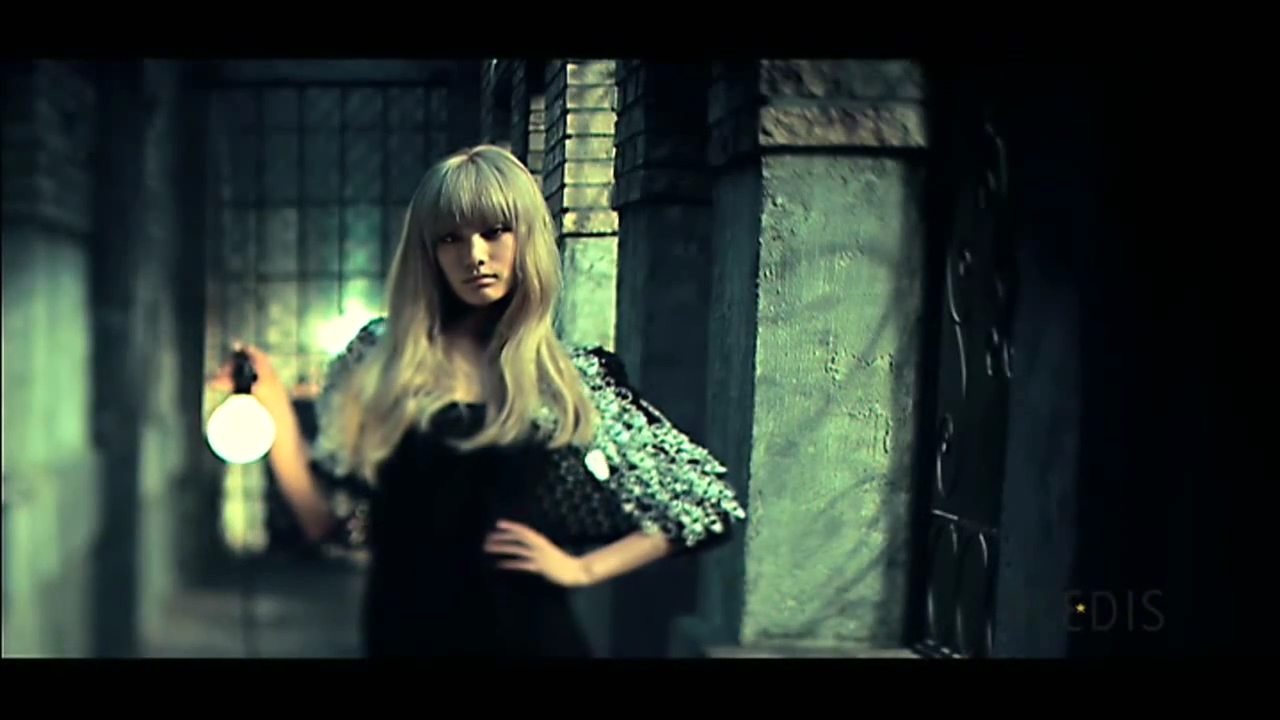
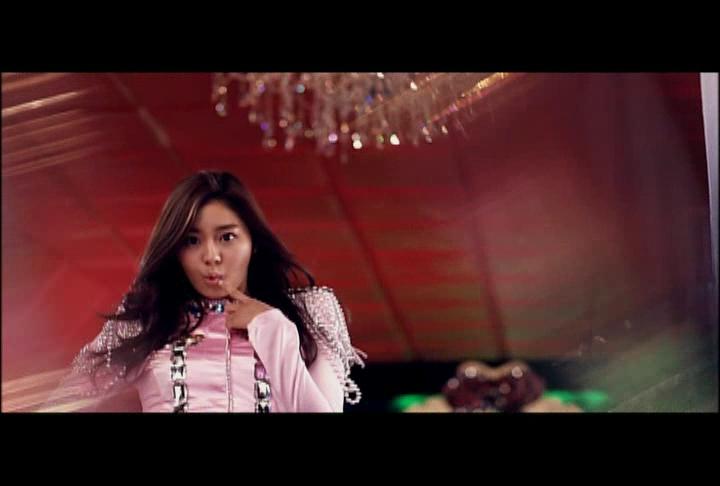
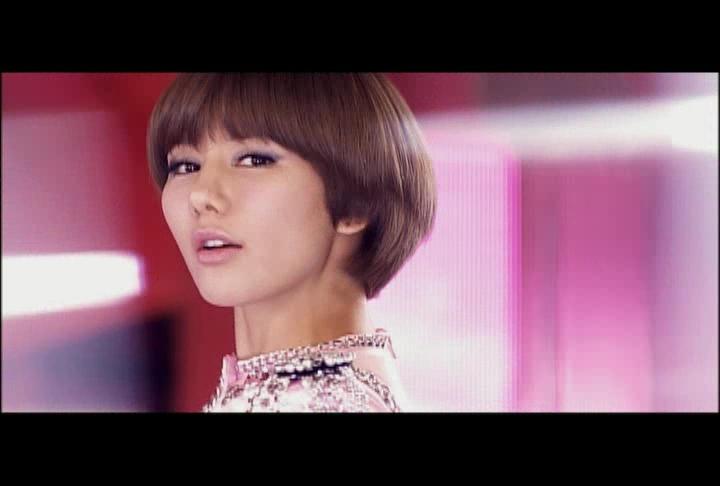
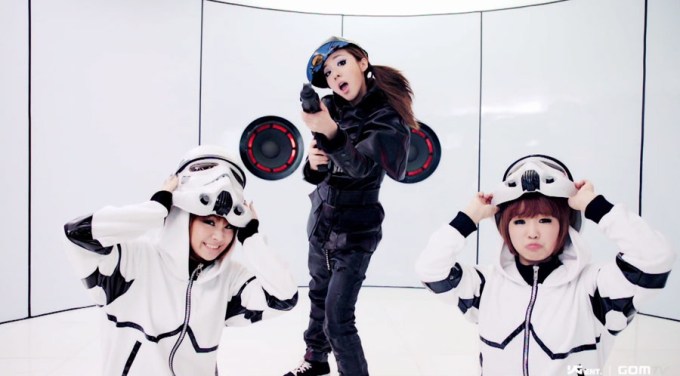
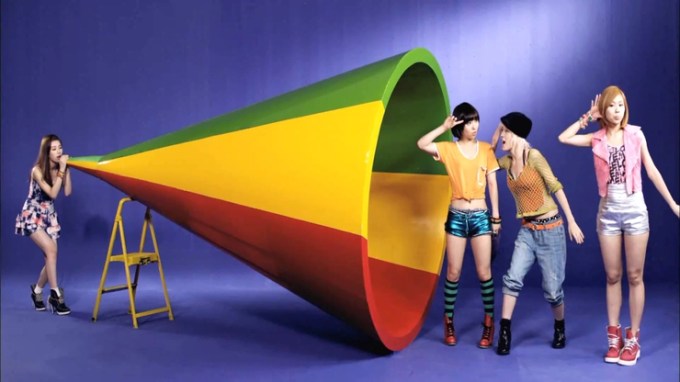
Minor quibbles are the small size of the room with the stripes that you can see in the screenshot below, which makes the fantasy element to the video a little harder to sustain, and Wang Fei Fei’s (왕페이페이, 王霏霏) simply bizarre hairstyle in the segments in which she’s wearing a red top (you’ll soon see what I mean). But I can easily forgive those considering how easy the excessive repetition made translating the lyrics!

너 땜에 자꾸만 내 가슴이 (hot hot hot hot)

너 땜에 자꾸만 내 몸이 (hot hot hot hot)

니가 날 볼 때마다, 니 생각 할 때마다

너 땜에 자꾸만 내 가슴이

no oh no oh no oh oh, I can’t breathe

no oh no oh no oh oh, I can’t breathe

no oh no oh no oh oh, I can’t breathe

no oh no oh no oh no oh no oh

Because of you my chest [is] often (hot hot hot hot)

Because of you my body [is] often (hot hot hot hot)

Whenever you look at me

Whenever I think of you

Because of you my chest [is] often…

( Source: unknown )

In Line 1, “땜” is short for “때문에”, or “because”, and there’s a lot of contractions like that in this song.

Next “만” after “자꾸” in several lines could have been a little confusing, as it usually means “only,” which would give the stange “frequently only” in the text. But in songs especially, it’s also used just for emphasis, and it’s usually very easy to tell by context which meaning is intended. You’ll see it again later.

Finally, yes, “가슴” does indeed mean “breasts”, but outside of Naver image searches then it’s probably more commonly used as the gender-neutral “chest”.

( Source )

Boy you look so fine

어쩜 너무 멋져 안보는 척 해보지만 자꾸만 눈을 맞춰

난 이런 적이 없는데 너에게 빠졌어

니 생각 만하고 있어 날 구해줘 어서

Boy you look so fine

Wow, you’re so cool, but while you pretend not to look we frequently make eye contact

I’ve never been like this before, I’ve sooo fallen for you

All I can think about is you, please hurry and save me

( Source )

In line 2, “어쩜” is short for “어쩌면”, which I was surprised wasn’t simply the verb “어쩌다” plus “면” (if) but was an entirely different word of its own, my dictionary giving:

  1. (감탄사로; admiration, wonder, exclamation) what, how
  2. (아마) possibly, maybe, perhaps

And I’m inordinately proud to say that while my Korean wife thought number 2 was correct, I argued that only number 1 made any sense, giving  “Wow, you’re so cool.” And if so,then it must be him that pretends not to look at her.

In line 4, “구하다” means:

  1. seek, look for, want, hunt
  2. ask for, call for, solicit for
  3. get, have, obtain, find (out), buy, purchase

But this time I did defer to my wife, who said that “save me” was much more accurate than my original “have me,” no matter how tempted I was to go with that instead because of all the heavy breathing.

( Source )

Boy you look so fine

(짝사랑은 난 하기 싫은데) 말을 해볼까

(너도 날 좋아할 것 같은데) 용기를 내서

고백해볼까 (yeah)

싫다면 어쩌나 (yeah)

이렇게 기다리다 미치겠어

Boy you look so fine

(I hate one-sided love) Shall I make the first move

(I think you like me too) Shall I be brave

and confess my love? (yeah)

But what if you don’t feel the same way?

I’m going crazy waiting like this
( Source )

Easy enough, but I’ve taken a few liberties to make it sound better in English. In line 2 for instance, “말을 해볼까” is literally “shall I try to talk,” and in line 5 “싫다면 어쩌나” would literally be “hate [me] – hypothetically speaking – if [you] – what would [I] do”.

Fellow Korean learners, give me a buzz if you’d like me to explain any of the grammar above, but otherwise, that in line 6 was most interesting for me. In particular, I wondered why “이렇게 기다리는것이 미치겠어” couldn’t be used instead, much easier for me because of how I learned Korean, and literally “this way – the act of waiting – crazy – will be.” But my wife says that that would mean more “it is crazy to wait like this”, not the song’s intended “waiting like this is driving me crazy”. Granted it may sound like a trivial difference, but there you have it.

For the sake of keeping track later, let’s call all that the chorus. For now though, next there’s the Korean half of the opening segment again, then after that:

( Source )

오늘은 난 꼭(꼭) 고백을 하고야 말 거라고

I’m gonna let you know

Baby I will let you know

생각하다가도 너만 나타나면

몸이 다시 굳어버리고 할말은 잊어버리고 oh

No matter how much I think that I will definitely confess my love to you today…

I’m gonna let you know

Baby I will let you know

…if you show up

Again I will tense up and forget what I was going to say
( Source )

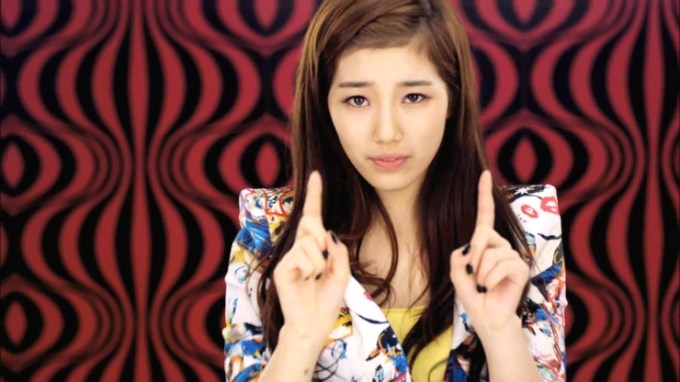
This part was much harder to translate than I thought it would be!

First, for the grammar form “~고야 말다” in line 1, my trusty Korean Grammar for International Learners came to the rescue, saying that, first on page 181, the “~(이)야” grammar pattern it is part of means “only if it be, if it is just (no more than); when it comes to; taking ··· for granted; even, indeed.” Then it gets to “~고야 말다” specifically on the next page, saying:

The auxiliary particle can be used in conjunction with the pattern in ~고 in two different ways. The combination ~고야 means “only after ··· ing” or “only under the circumstance that / under the unique circumstance that.” ··· Added to the patter ~고 말다 meaning “finish up doing it, get it done, finally do it,” the ~이(야) in the resulting pattern in ~고야 말다 lends added emphasis to the finality inherent in the pattern.

Next, it’s important to realize that line 4 follows straight on from line 1, with the English in lines 2 and 3 being an aside really (otherwise the future tense form of indirect speech – “ㄹ 거라고” – at the end of line 1 makes no sense). Then the “다가” added to “생각하다” line 4 means “think, and then.” Immediately after that, the “도” should really be “더라도”, or “no matter how much,” then the “만” after that is just for emphasis again.

Finally all that makes “오늘은 난 꼭(꼭) 고백을 하고야 말 거라고 생각하다가도 너만 나타나면” become literally “today – I – definitely (definitely) – confess [finally] – think [will] [after] [no matter how much I] – you – show up [if],” with the grammar points in square brackets. I hope that all makes sense!

After the “if” section, then the “굳다” in line 5 means “become hard, stiffen” or “hard, solid” according to my dictionary, which I’ll confess certainly got my mind wandering, but “tense up” would be a better translation. Finally, the “버리다” after both that and the “forget” at the end would be in the sense of to one’s disappointment or regret (another grammar form), not literally throwing something away.

Then there’s the chorus again…then the entire opening segment again…then:
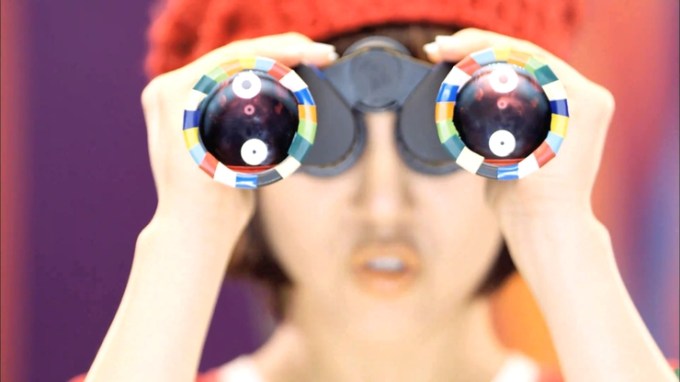
( Source )

눈이 마주칠 때 마다 심장이 잠시 멈춰 (hot hot)

니가 돌아설 때 마다 슬픔이 나를 덮쳐 (흑흑)

내 마음속에 갇혀 있는 이 사랑을 주고 싶어 미쳐 받아줘 catcher

Here (here) my (my)

love boy I just can’t breathe

Every time our eyes meet my heart stops for a moment (hot hot)

Whenever you turn your back on me I am struck with sadness (sob sob)

I’m going crazy wanting to give you my love that has been left trapped for so long, please receive it catcher

Here (here) my (my)

love boy I just can’t breathe
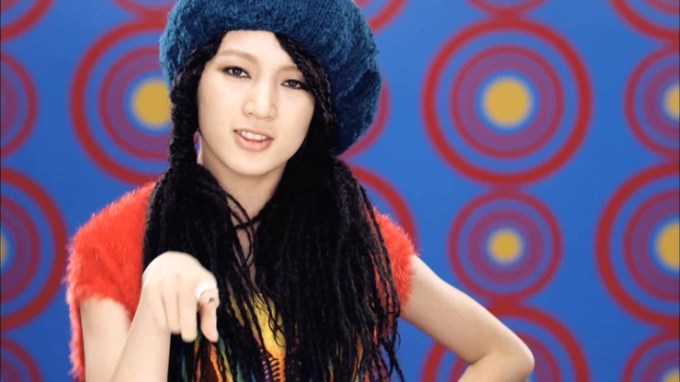
( Source )

In line 1, I couldn’t really see any difference between “눈을 맞춰” from earlier and “눈이 마주치다” here, so note it could just be “whenever we make eye contact” again. Next, in line 2 “덮치다” is “to hold something down” or to “attack, assault, raid, strike,” so “I am struck with sadness” felt appropriate.

What probably wouldn’t have been appropriate though, would be “pant pant” just after that, even that that’s much closer to what Meng Jia was actually doing. But as that sounds awkward even for lyrics for English songs, then I erred on the side of the dictionary definition of “흑흑,” or “sob sob” instead.

In line 3, the grammar form “[verb] + 아/어/여 있다” usually just means the thing that has been acted on (by the verb) remains in that state, and only “[verb] + 아/어/여 두다” means that it’s been left in that state for a long time, but I’d argue that in English at least the latter is more natural for this situation, and so stuck with “my love that has been left trapped for so long.”

Finally, I confess to having no idea what that (to me) nonsensical “이” is doing in the middle of it though, but unfortunately it’s not a typo. Sigh.

After that, the opening segment, and then, well already that’s it!

As always, I’d be very interested in hearing what you thought of the song and/or aspects of the translation, and if you’d like to sing and read along at the same time then I suggest this video above. To be frank though, I haven’t looked at it myself for comparison’s sake yet, nor this admittedly much easier to read translation at Yeeun2Grace either, although I will.

It’s just that after an unplanned 2-3 hours of dancing to K-pop songs with my 2 and 4 year-old daughters tonight, simultaneously worrying about the effects of watching music videos like this on them…then, well, I’d just rather have it up rather than delay another day!

Share

Bad Girl, Good Girl (배드걸 굿걸) by Miss A (미쓰에이): Lyrics, Translation, and Explanation

(Source)

Having just written that I find new girl groups virtually indistinguishable from each other these days, then I’m very glad reader “abcfsk” persuaded me to take a closer look at Bad Girl, Good Girl (배드걸 굿걸) by Miss A (미쓰에이), as I grew to like it very quickly. And not just because of the eye-candy in the music video below either, which I actually deliberately avoided watching so as to better compare my own translation of the lyrics to the one there later.

But hell: taken from a zip-file available here, in hindsight the screenshots below didn’t really do justice to the eroticism of some of the dance moves. And which to be frank, made finally seeing the video itself almost feel like a reward for all my hard work.

No great surprise to learn that Park Jin-young (박진영) is their manager then, as he is notorious for that sort of thing. Granted, that is the way the whole Korean music industry is going these days, primarily as a means for new groups to stand out, but those groups under the JYP Entertainment label do seem to push the boundaries more than most.

Focusing on the lyrics for now though, here’s my own original translation of them, with explanations of those parts I found difficult:

Update – In case anyone’s confused, the original video with lyrics included has been deleted.

You don’t know me, you don’t know me

You don’t know me, you don’t know me

So shut up boy, so shut up boy

So shut up boy, so shut up, shut up

앞에선 한 마디도 못 하더니

뒤에선 내 얘길 안 좋게 해 어이가 없어

Hello, hello, hello

나같은 여잔 처음 으로 으로 으로

본 것 같은데 왜 나를 판단하니

내가 혹시 두려운거니

You don’t know me, you don’t know me

You don’t know me, you don’t know me

So shut up boy, so shut up boy

So shut up boy, so shut up, shut up

In front of me you can’t say a word

And I can’t believe the bad things you say about me behind my back

Hello, hello, hello

I think this is the first time you’ve ever met a woman like me…why do you judge me?

Am I a thing to be feared?

(Source, all screenshots: Red and Rosy)

Starting with Line 1 of the Korean after “shut up” etc., the “더니” in “하더니” has many usages according to page 277 of my reference guide, Korean Grammar for International Learners (KGIL), but I think the most appropriate is number 1, that which “allows the speaker to affirm that some fact which (s)he directly experienced or witnessed in the past about a third-person subject is the reason or source for the state of affairs in the follow clause…the subject is usually second or third person”.

That allows the fact that the unnamed man (her boyfriend?) is reticent in front of her to be linked to line 2, that he badmouths her behind her back. But which was actually much more difficult to translate than it looked, as “뒤에선 내 얘길 안 좋게 해 어이가 없어” is literally “[me] behind as for – my story – not well do – word – not have”, which sort of looks like what I ultimately wrote, but was ripe for misinterpretation. Once my long-suffering wife told me that “어이가 없어” actually means “I can’t believe” though, then I was able to muddle along.

In line 6, the “거니” in “두려운거니” isn’t in KGIL, but I think it’s shorthand for “두려운것이에요”, or “scary thing is”. Hence I used the noun form “am I a thing to be feared?” in my translation, but of course something like “are you scared of me?” would be fine too.

Now for the chorus:

겉으론 bad girl 속으론 good girl

나를 잘 알지도 못 하면서

내 겉모습만 보면서

한심한 여자로 보는 너의 시선이 난 너무나 웃겨

춤 출 땐 bad girl 사랑은 good girl

춤추는 내 모습을 볼 때는 넋을 놓고 보고서는

끝나니 손가락질 하는 그 위선이 난 너무나 웃겨

On the outside I’m a bad girl, on the inside I’m a good girl

While you don’t know me well

While only looking at my outward appearance

Thinking of me as a pathetic woman is so laughable

When I dance I’m a bad girl, but when it comes to love I’m a good girl

When you see me dance you lose your mind

Only then to scorn me when the dance is ended

I laugh at your hypocrisy

In line 1, I was surprised that “으로” was used instead of “에”, as I’d always thought the former was used mostly for directions and processes rather than physical locations, but my wife assures me that the latter can’t be used at all in this case (oh well). She also told me that in line 4, “pathetic” would be a much better translation of “한심하다” than the “pitiful; pitiable; wretched” and so on that my dictionary gave; that in the case of line 6 at least, “모습” really means just “me” rather than “outward appearance” or “figure”; and finally that “넋을 놓고 보다” means “to lose one’s mind”, which I would never have got figured out otherwise. I did realize that “보고서” at the end looked a bit weird though – “a written report” – and ultimately the “고서” in it turns out to be one more grammar pattern. Which according to p. 251 of KGIL, has the effect of:

…tightening the relationship between the preceding and following clause, and implying that the contents of the second clause are a natural and closely linked follow-on to those of the first. In other words, whereas “고” alone is appropriate when a long interval intervenes between the two clauses, “고서” is appropriate when the connection is more immediate”.

Finally in line 7, of course “끝나니” is short for “끝나니까”, or “because it finished”. Add “scorn” and “hypocrisy” in there as well, then whatever the particulars of the last 2 lines, I got the impression that the man is captivated by her dancing, but then scorns and thinks little of her as soon as she stops and the spell is broken. Hence laughing at his hypocrisy, although now I’m little confused about the narrative of the song as I type this, as by this stage at least I thought the whole point was that she shouldn’t be judged by her outward appearance and actions…whereas now it appears that they’re actually also her strong points.

이런 옷 이런 머리모양으로 이런 춤을 추는 여자는

뻔해 ha 네가 더 뻔해, 오~

Hello, hello, hello

자신 없으면 저 뒤로 뒤로 뒤로

물러서면 되지 왜 자꾸 떠드니

속이 훤히 보이는 건 아니

A woman with those clothes, that hairstyle, and doing that dance

is shameless? Ha! You’re even more shameless, oh~

Hello, hello, hello

If you have no confidence, you can step back back back there

Why do you frequently make so much noise complaining about me?

I can see right through you

In line 4, I was a little confused for a moment by “저”, which is short for “저기” or “there” rather than being the respectful form of “me”. And then by “자신 없으면 저 뒤로 뒤로 뒤로 물러서면 되지” in lines 4-5, which literally means “confidence – if not have – there – towards the back towards the back towards the back – if step back” and looks like an unnecessary and confusing repetition to me.

Finally, line 6 was a big stumbling block: first, I originally thought “아니” meant “no”, but it’s actually “know”, as in “알다”. Then, “훤하다” means “gray, dimly-lit”; “extensive, broad and wide, spacious”; “good-looking”; and finally “be familiar with” and I was plumping for the first meaning until my wife said the last would be better.

Speaking of whom, to anybody envious at my Korean ability evident in translations in numerous earlier posts, and surprised at (and tired of) how much I’ve needed my wife’s help this time(!), then, well, I’d be lying if I said she didn’t have a huge role in correcting my numerous mistakes and explaining things after I do the original translations (I probably wouldn’t be able to properly provide any at all without her). I just haven’t mentioned that before because I usually don’t talk about the translation process itself, and how much time and effort it takes us.

Which gives me a newfound respect for those studying Korean entirely by themselves! But getting back to the lyrics though, after the above there’s the chorus again, and then the final verse:

날 감당 할 수 있는 남잘 찾아요

진짜 남자를 찾아요

말로만 남자다운 척 할 남자 말고

날 불안 해 하지 않을 남잔 없나요

자신감이 넘쳐서 내가 나일 수 있게

자유롭게 두고 멀리서 바라보는

I’m looking for a man who can bear me

I’m looking for a real man

Not a man who only talks like a real man

Is there no man that I don’t make uneasy?

Who can’t give me the freedom to watch me become a woman overflowing with confidence?

Finally, an easy verse! Any fellow Korean learners, please feel free to ask me about any of it, but otherwise that’s the whole song already, but for the chorus and finally the English opening sequence again.

Reluctantly tearing my eyes away from the singers (especially Fei {페이}) to the translated lyrics in the video then, I’m happy to say that they appear to be very similar, although there do appear to be some differences between the subjects in the some cases (in other words, I’ve got some “he”s where TheKpopSubber has “she”s and so on).

I’d like to look at those in more detail, but unfortunately I’m about to go out on a big shopping trip with my wife and kids, so for now I’ll just have to leave the post for you to enjoy as it is I’m afraid (those of you also unnerved by mistaken recent reports that North Korea was shelling again, may be happy for the distraction!). But of course, do please feel free to discuss those differences and/or anything about the song, group, and/or MV yourselves, although still knowing so little about the group then I’m going to reserve my own analysis until I’ve at least translated their second hit Breathe (브리드) next week:

Enjoy!^^

Update: Wait…one of them’s only just turned 16? Another middle-school student in a girl band?

Update 2: Given Miss A’s Chinese angle mentioned in the comments (2 of singers are Chinese, and they’ve been promoting themselves extensively there), then I’d like to point interested readers to Rowan Pease’s chapter “Korean Pop Music in China: Nationalism, Authenticity, and Gender” in Cultural Studies and Cultural Industries in Northeast Asia: What a Difference a Region Makes, edited by Chris Berry, Nicola Liscutin, and Jonathan D. Mackintosh, (2009, pp. 151-167), in which (among many other interesting things) she explains that:

(Source: The Japan Foundation)

In 2003, the Korean National Tourism Office [a major investor in the Korean wave] conducted a Hanliu tourism survey in China, Taiwan, and Hong Kong exploring attitudes to Korean culture, publishing the results online…

….It compared the impact of Korean culture with that of four “competitor” countries (the U.S., Japan, Taiwan, and Hong Kong), and in the process revealed much about Korea’s own political and nationalist concerns, particularly in relation to Japan and America. Six of the eleven options for respondents to the category “reasons I like Korean culture” reflect this preoccupation: “less sexual than Japanese culture,” “less sexual than American culture,” “less violent than Japanese popular culture,” “less violent than American popular culture,” “decreased interest in American culture,” and “decreased interest in Japanese culture.” One other echoes Straubhaar’s notion of cultural proximity: “similar in culture.” Certainly, Korea’s own music media censorship laws (which even in 1997 prohibited the displaying of body piercings, navels, tattoos, “outfits which might harm the sound emotional development of youth,” and banned violent or political lyrics), meant that Chinese TV stations could buy in Korean music videos and music TV shows knowing that they were unlikely to upset local censors. However, these questions also reflected a perception that Korea acts as a defender against excessive Westernization and as a guardian of Confucian values within East Asia. (pp. 155-156)

I wonder if those perceptions still hold true for China today, and in particular just how safe and “less sexual” than American and Japanese culture music videos like this one are viewed by Chinese TV stations?

Girl Groups, VNT, and THAT Maxim Korea Cover

( Source )

Ever heard of VNT (브이엔티) before?

No, me neither, and frankly I find most new girl groups virtually indistinguishable from each other these days. But it turns out that VNT may actually be quite different, its 3 members explicitly wanting to “focus more on their music rather than their visuals.” Like rapper of the group Lil’J (릴제이) said in a recent interview:

“One thing that I’m confident about is, like our CEO stated, our music. We’ll become a team that wins because of our talents, not our looks. Tina and I dropped out of high school for this, and we will be sure to show everyone our passion for music.”

And later:

“We may be a girl group, but we dream of changing the Korean music industry with our music. Our first and foremost goal is to have our fans listen to high quality music. We want to become the top in every aspect, and later become seniors that lure others to dream of becoming like us. Of course, we also dream of an award at the year-end awards this year.”

Of course, that may well just be hype. And I’m not sure how a photoshoot in December’s Maxim Korea fits in with that sentiment exactly, with subsequent “news” reports on it overwhelmingly focusing on their hitherto hidden S-lines. But they do still need some publicity of course, so I’ll give them the benefit of the doubt for now.

As for their music, judge for yourself with their first single Sound (소리):

Personally it’s a little slow for my tastes, and despite their similar look to 2NE1 (투애니원), there’s definitely nothing about grrrl power in the lyrics. Indeed, quite the opposite really, as they’re all about passively waiting for a man…and which is precisely what Yumi (유미) appears to be doing on the magazine cover come to think of it.

Or is she?

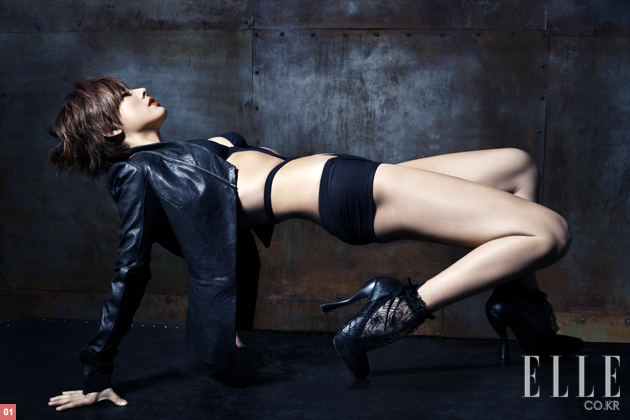
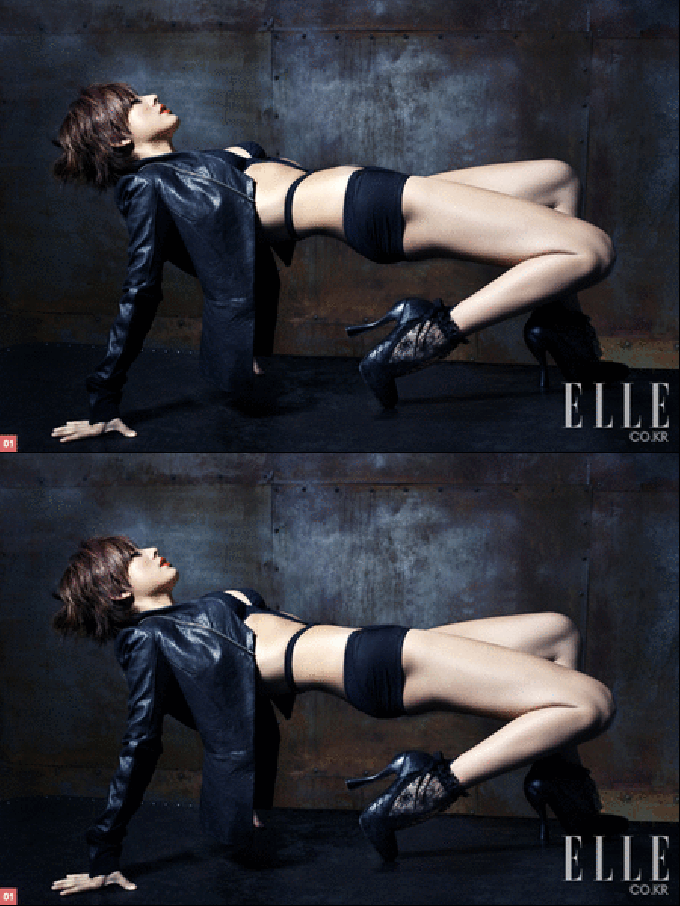
If so, then I hope *cough* he comes soon, as she looks pretty uncomfortable really. But is that really just a sex position she’s in?

Granted, Maxim Korea isn’t exactly averse to placing women in ostensibly sexually attractive poses, but which just a few seconds’ thought demonstrates would be quite impractical and awkward in reality (especially for the woman). Take 18 year-old model Om Sang-mi (엄상미) in the same edition for instance, spreadeagled in a shopping trolley.

But with the top half of Yumi’s body sticking out unnaturally like that, and with those red pants, that hairstyle, and puffed-up frilly shirt to boot? In line with the Christmas theme, then I think the main point is actually to make her look like a turkey.

Prove me wrong!^^

(For a similar example of women’s bodies being compared to meat in the Korean media, see here)

Share

Korean Retro!

(Source)

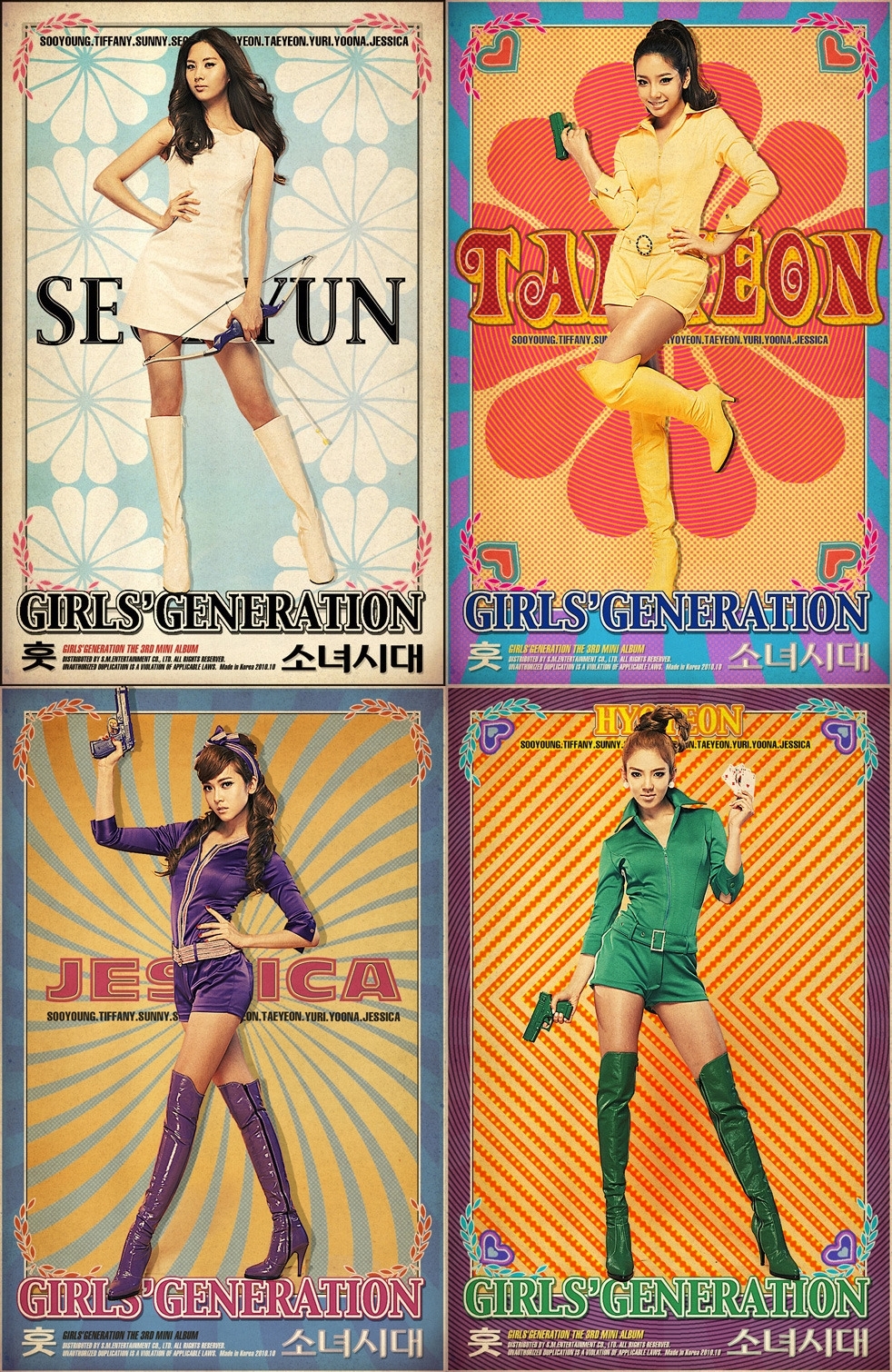
Despite everything I’ve said about Girls’ Generation (소녀시대) over the years, I’m really liking this retro look for their new mini-album Hoot (훗), to be released later this week. Heck, along with Eccentric Yoruba, I’m even liking the title track too, whereas I needed to hear DJ Areia’s trance remix before I could even begin to listen to Oh! (오!).

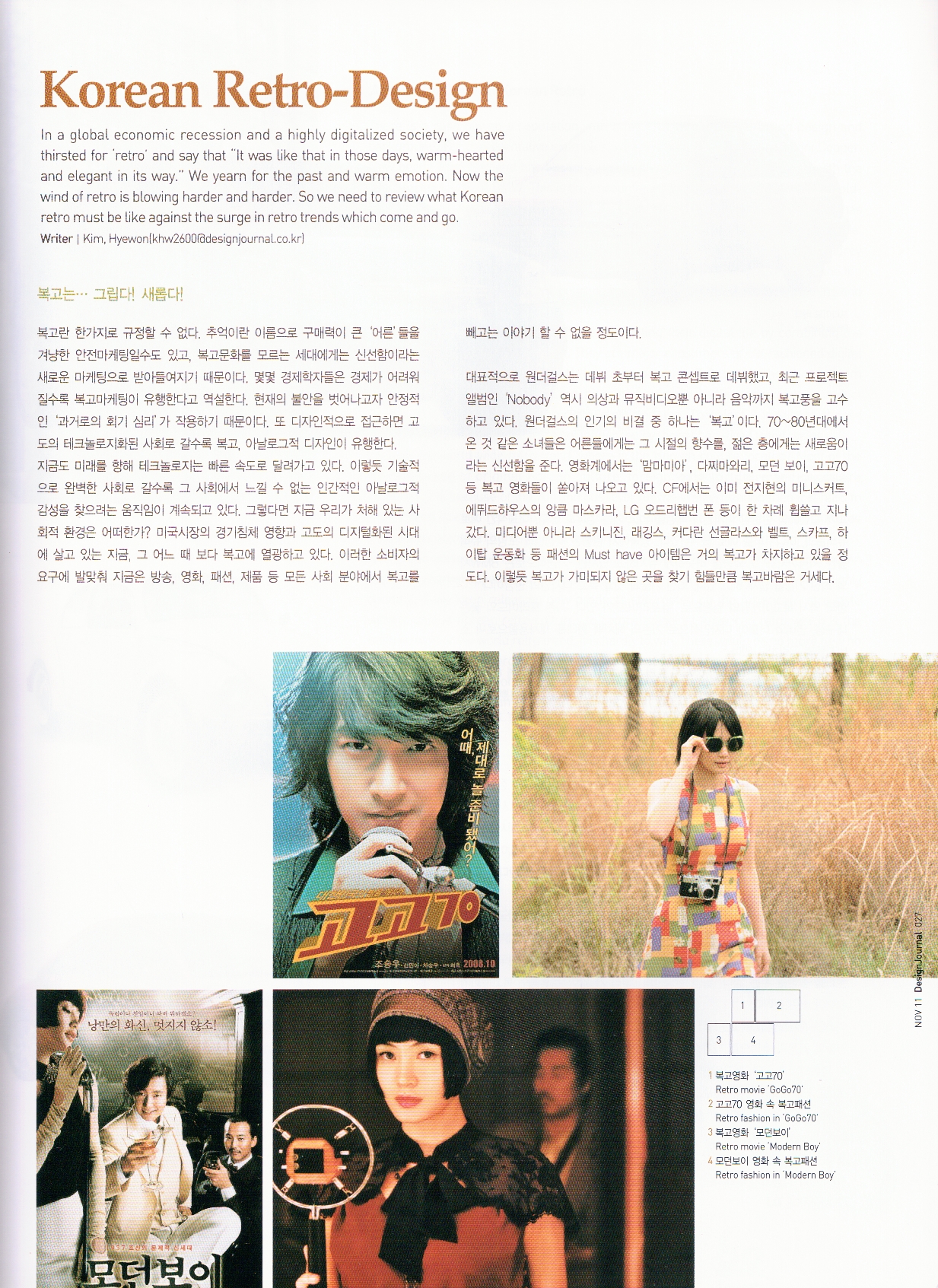
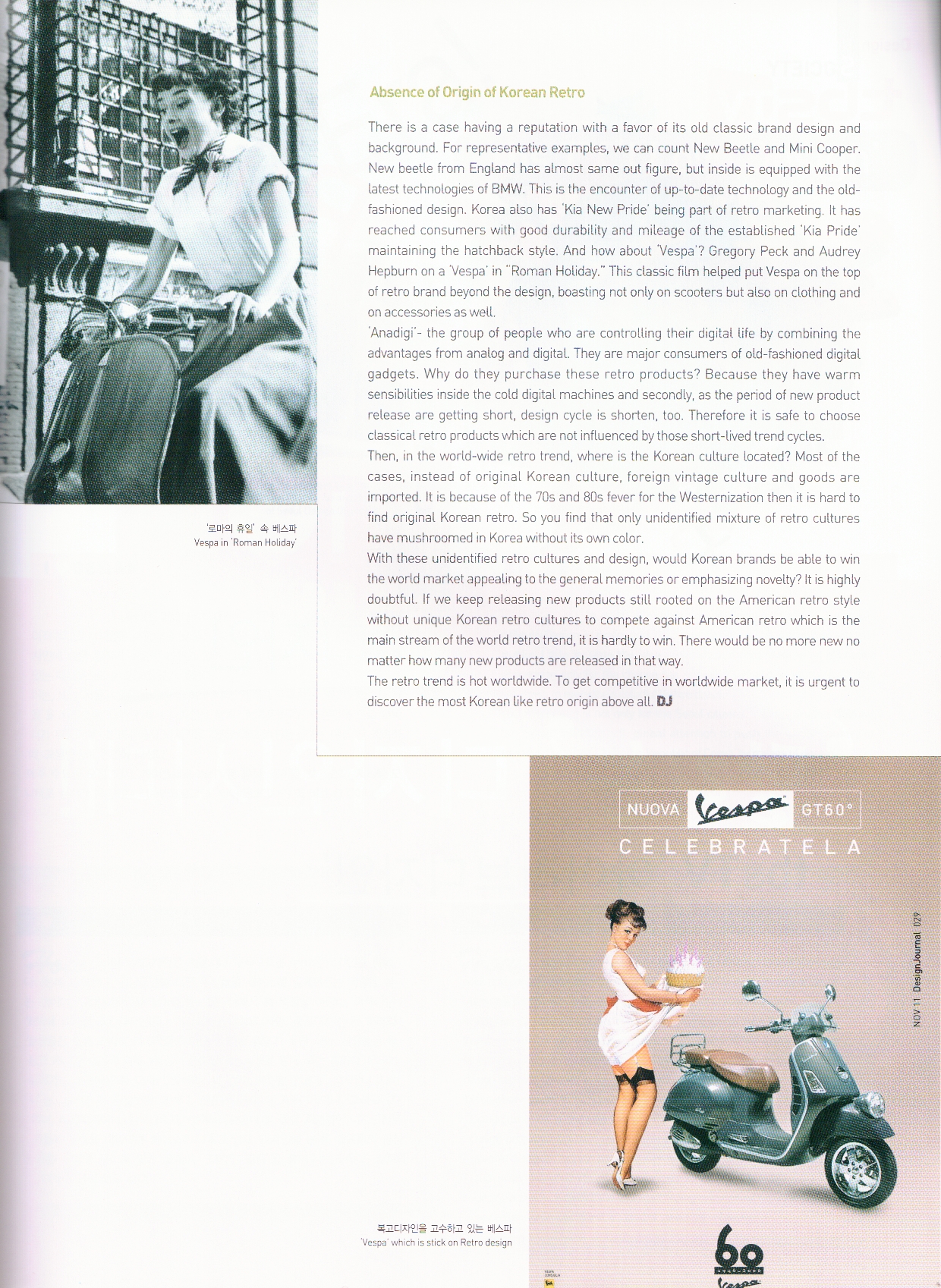
But I’ve actually liked Korean retro itself for a long time now, and the posters reminded me of a brief article on that from the November 2008 edition of Design Journal (디자인저널), which I thought readers may also be interested in. And in the magazine itself of course, which — although its English could be much improved as you’ll soon see — is very rare in that it has both English and Korean versions of each article, helping to open up an entire creative side of Korean life that would normally be relatively inaccessible to expats.

Alas, unfortunately I’ve just learned that there were no more issues published after July 2009. But I do hope you still enjoy the article though, and if so then you may also like the So Much Pileup blog that I subscribe to, which has examples of retro graphic design from around the world. Personally, I was hooked on it as soon as I read the following about the logotype on the right:

The way that A and the S form together as one. It’s like they’re having an incredibly intimate moment that I happened to stumble upon. Where as the r-a ligature seems a little forced. That lowercase a will undoubtedly wake up feeling used and perhaps will regret the whole experience.

And in that same spirit of turning what was once considered dull and ordinary into something fun and sexy, let me leave you with all the great examples of Korean retro mentioned below:

Any other aficionados out there?^^

Update: More retro-themed pictures of Girls’ Generation are available here:

Update 2, July 2012: Here’s a post on the “fashion police” of the 1970s who would check women’s skirt lengths, which emerged in the discussion in the comments.

Korean Sociological Image #51: Male Objectification and Double Standards

What would be your reaction if this flashed on your TV screen?

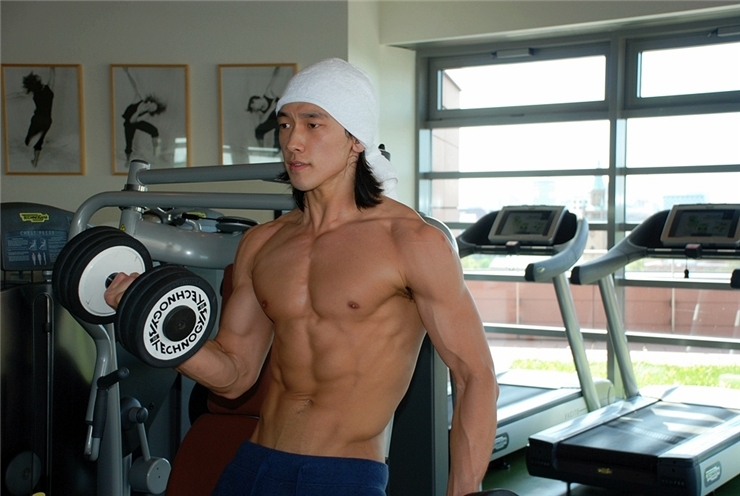
Mine was that hard abs aren’t the best analogy for airbags. But my mistake: they’re not supposed to be. Rather, Hyundai needed something to signify the number of airbags as the voiceover went through various specs of the car.

Which, to be fair, is much clearer in the full commercial.

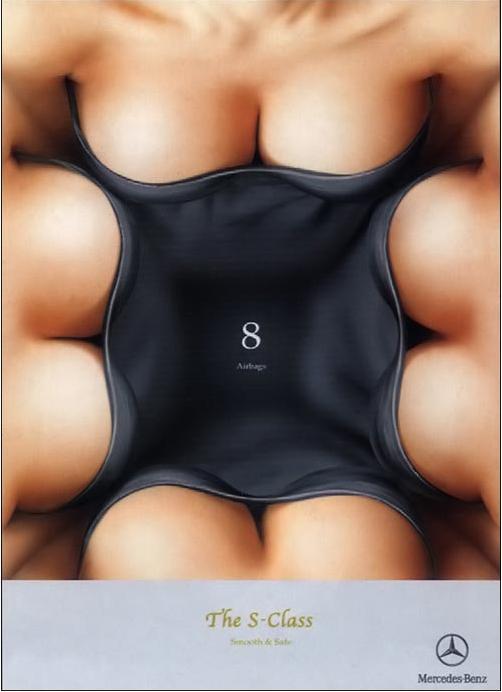
How about if a proper airbag analogy had been used instead, like Mercedes Benz did back in 2006?

(Source)

If you found that objectification distasteful however, then consider the following from Renault/Samsung in 2008 below also:

Which uses the same analogy, but is clearly quite a contrast to BMW’s puerile effort. Nevertheless, some commenters on an earlier post (update: since deleted sorry!) did still have some issues with it, whereas nobody on this blog at least has had any with all of the men’s 6-packs that suddenly started appearing in Korean commercials from last year.

But I’m sure you’re already well-aware of that double-standard, so the purpose of this post is not just to draw your attention to it. Nor to simply pass on that juxtaposition of advertisements, however interesting. In combination with a recent development in the Korean media though, what that juxtaposition did serve to do was make me realize both the rapid mainstreaming and dogmatic nature of that double-standard here, and which is a combination that I think is pretty unique to Korea too.

Let me explain.

Actually, the first I already have: consider how popular the new buzzword “chocolate abs” (초콜릿복근) is in the Korean media now as a result of all the recent ads featuring them for instance (see here, here, here, #8 here, and this new one below for examples and/or discussion), whereas it didn’t even make a list of buzzwords at the end of last year.

Against that sudden popularity however, you could argue that they’ve actually already been around for a long time in music videos. As Hoon-Soon Kim explains of some from 2000 in “Korean Music Videos, Postmodernism, and Gender Politics” in Jung-Hwa Oh (ed.), Feminist Cultural Politics in Korea (2005) for instance, albeit with more of a focus on the emergence of the “Flower Men” or kkotminam (꽃미남) phenomenon than male objectification per se:

…we see that there is a new type of male image emerging albeit in a small number of music videos. It is a de-gendered image of men which is a contrast to the macho image. Male groups such as Y2K, H.O.T., ITYM, and Sinwha, whose fans are mostly teenage girls, portray this image. They wear make-up and a lot of jewelry and ornaments – which are all considered feminine – and take off their shirts to show off their bodies. This indicates that the male body is also sexually objectified as the female body….The style of the video is similar to that used to show female images with extreme close-ups to fill the screen with a face, and medium-range or full body shots for dances. Although there is a risk of overstating the phenomenon, this image could be interpreted as a signal indicating the possibility of breaking the binary boundaries of men and women that have been formed in a patriarchal culture. (p. 207)

And yet just like in ads, the amount of male objectification in music videos—or to be specific, ab exposure—does also seem to have picked up markedly in the past year or so. Like Multi explained back in March:

…in the past month the internet has been flooded with pictures of Korean celebrities and their abs (as well as some other shots that are not entirely SFW – you’re over 18 you can check them out here, and here). Our favorite controversial band 2PM just did an extensive photoshoot and were topless for most of it (parts 1, 2, 3, 4). Lee Joon of the new boy group MBLAQ flashes his abs a whole lot, because the king of ab-flashing, and Korean superstar extraordinaire, Rain, who happens to be his boss, tells him to because the fans like it, (yup, we sure do ;) and everyone wants to get pictures of them (exhibit A, B, C, among countless others). Then there’s these guys, this guy and this guy, and like 50 others. And then countless polls as to whose abs are better.

To be precise, Rain told Lee Joon that taking off his shirt has far more effect on his audiences than his dancing. And as “the king of ab-flashing”, then of course he could have been talking about himself instead (actually, I thought he was originally), so I can hardly fault him for showing off his own abs so frequently in his own music videos and performances. But rarely in harmony with his song’s lyrics and/or even his choreography however, and so for me personally he more epitomizes just how cynical and commercially-driven the trend has become, with obvious parallels to more familiar ones for female performers. Check out from 2:55 here for instance:

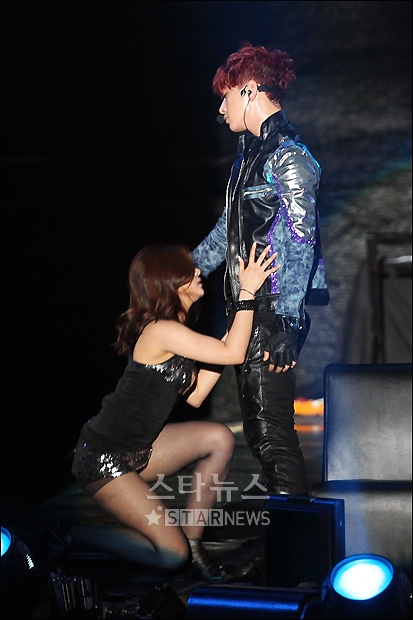
And my critique of the trend as “commercially-driven” is no mere cliche, because whereas it’s mostly young girl-groups that have sprung up in the past year or so (see here for a handy chart), likewise Korean male singers have to adapt to the Korean music industry’s overwhelming reliance on musicians’ product endorsements, appearances on variety shows, and casting in dramas to make profits (as opposed to actually selling music). This encourages their agencies to make them stand out and differentiate themselves from each other by coming up ever more sexual lyrics and/or performances and music videos: namely, more abs from the guys, let alone feigned fellatio, feigned sex on beds, or even virtual rapes of audience members on stage during performances.

Allkpop argues that it’s consumers that are driving this trend however, and that this explains the imbalance between new girl and boy groups:

It looks like girl groups don’t seem to have as high of a failure rate as boy groups or solo singers. These new girl groups have already been gaining so much attention. The reason why you can rely on girl groups to bring in the income is because there’s always teenage boys and ahjusshi (old men) fans to trust. They can also go perform at various events which always require a pay day. Supposedly, Secret gets paid around $8000 per event performance while a group like 4minute gets paid around $12,000 per event.

And yet while that is not incorrect per se, Multi goes on to explain in her post that it is largely female fan club members in their 30s and 40s that are driving this trend, not unlike how I’ve demonstrated that the same demographic (and often exactly the same women) were the driving force behind the full emergence of the kkotminam phenomenon back around the time of the 2002 World Cup. Hence I’d argue that the imbalance is more the result of top-down imperatives then, with many similarities to the American media ideal of female sexuality getting progressively younger over the last 3 decades…and for the same profit-driven motives.

But I digress: for more on that, see a forthcoming Part 2 of my “Reading the Lolita Effect in South Korea” series, which I’ll link to here once it’s up (update: and here it is!). In the meantime, hopefully by this stage you can see why celebrities so dominate advertising here, and which is already an industry not exactly averse to perpetuating celebrities’ agencies’ inherent needs to use sex to sell. Moreover, whereas it’s true that the content of ads worldwide does tend to lag behind social trends, as even just the title of Kwangok Kim and Dennis Lowry’s journal article “Television Commercials as a Lagging Social Indicator: Gender Role Stereotypes in Korean Television Advertising” in Sex Roles, Vol. 53, Nos. 11/12 December 2005 suggests, once they do start appearing in ads then that wider exposure (no pun intended) can have a profound effect in mainstreaming them:

According to cultivation theory, the media play an important role in creating distorted views. This theory suggests that exposure to media content creates a worldview, or a consistent image of social behavior, norms, values, and structures, based on the stable view of society provided by the media. In other words, cultivation theory posits that consistent images and portrayals construct a specific portrait of reality, and as viewers see more and more images, they gradually come to cultivate or adopt attitudes and expectations about the world that coincide with the images they see. Although this model has typically been employed to explain the impact of of television violence, it also has been applied successfully to the cultivation of attitudes towards gender roles. (p. 902, references removed)

(“Bob’s Television Dream” by Robert Couse-Baker)

And in particular:

Although television viewers often claim that commercials do not affect them in negative ways, repeated images in television advertising may already have created a “mainstreaming effect,” as suggested by cultivation theory. Television has the power to cultivate people to have the same views of the world, for example, stereotypical views of gender roles in our society. In other words, the mainstreaming effect reduces cultural and political differences among television viewers. Studies have shown that heavy television viewing may influence children’s perceptions of behaviors and psychological characteristics associated with gender…and [one other] found that heavy viewers of television commercials among the elderly were more likely than light viewers to perceive characters (e.g., the elderly) in commercials as realistic (i.e., mainstreaming effect). It may not be advertisers’ full responsibility to reflect statistically accurate images of society. However, the burden of responsibility is on the advertisers when they fail to reflect the rapid changes in such stereotypes in our society. (p. 908, references removed)

But still, how exactly does simple exposure to those ads necessarily result in us adopting the attitudes and worldviews contained therein, as if by osmosis or something?

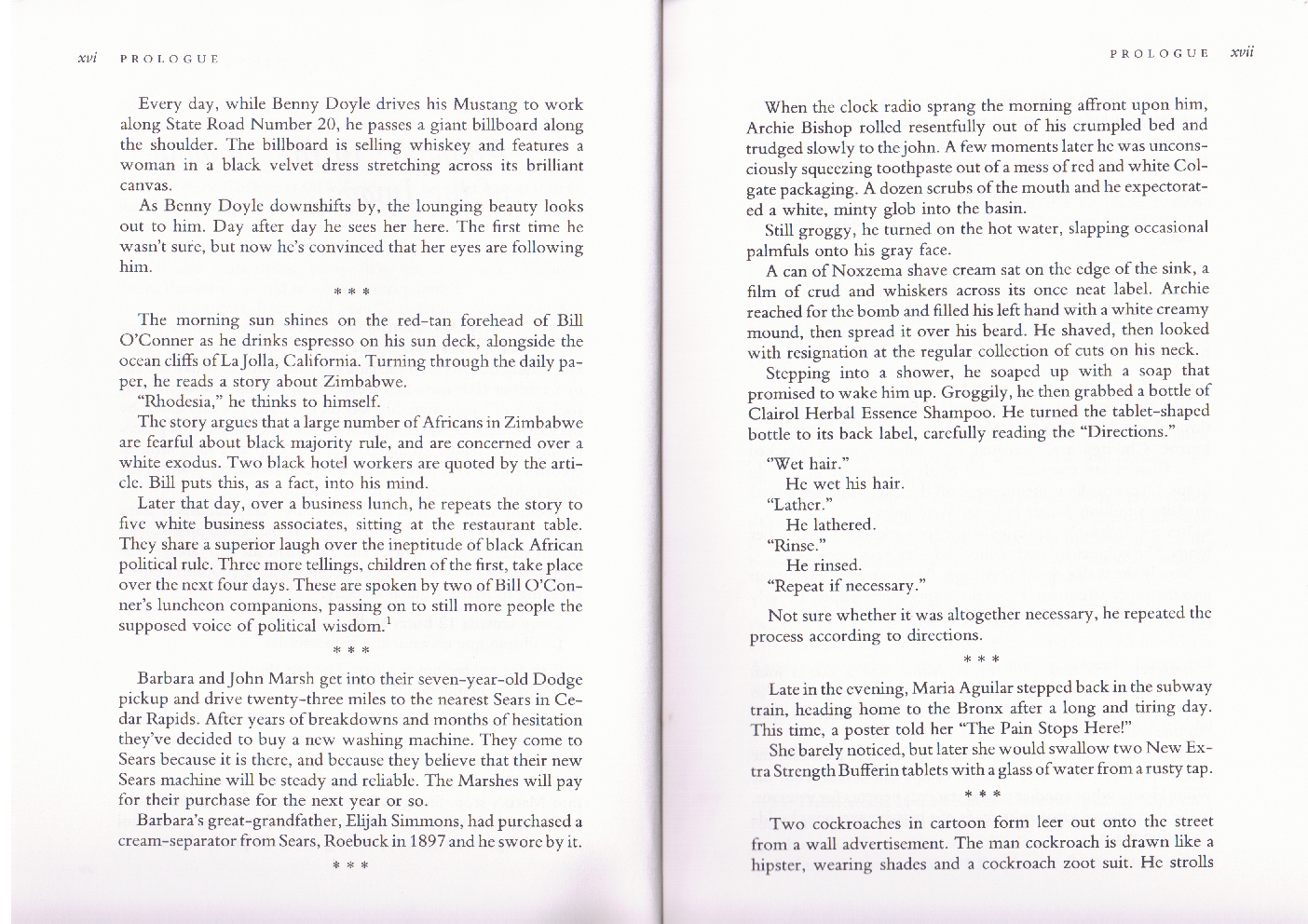
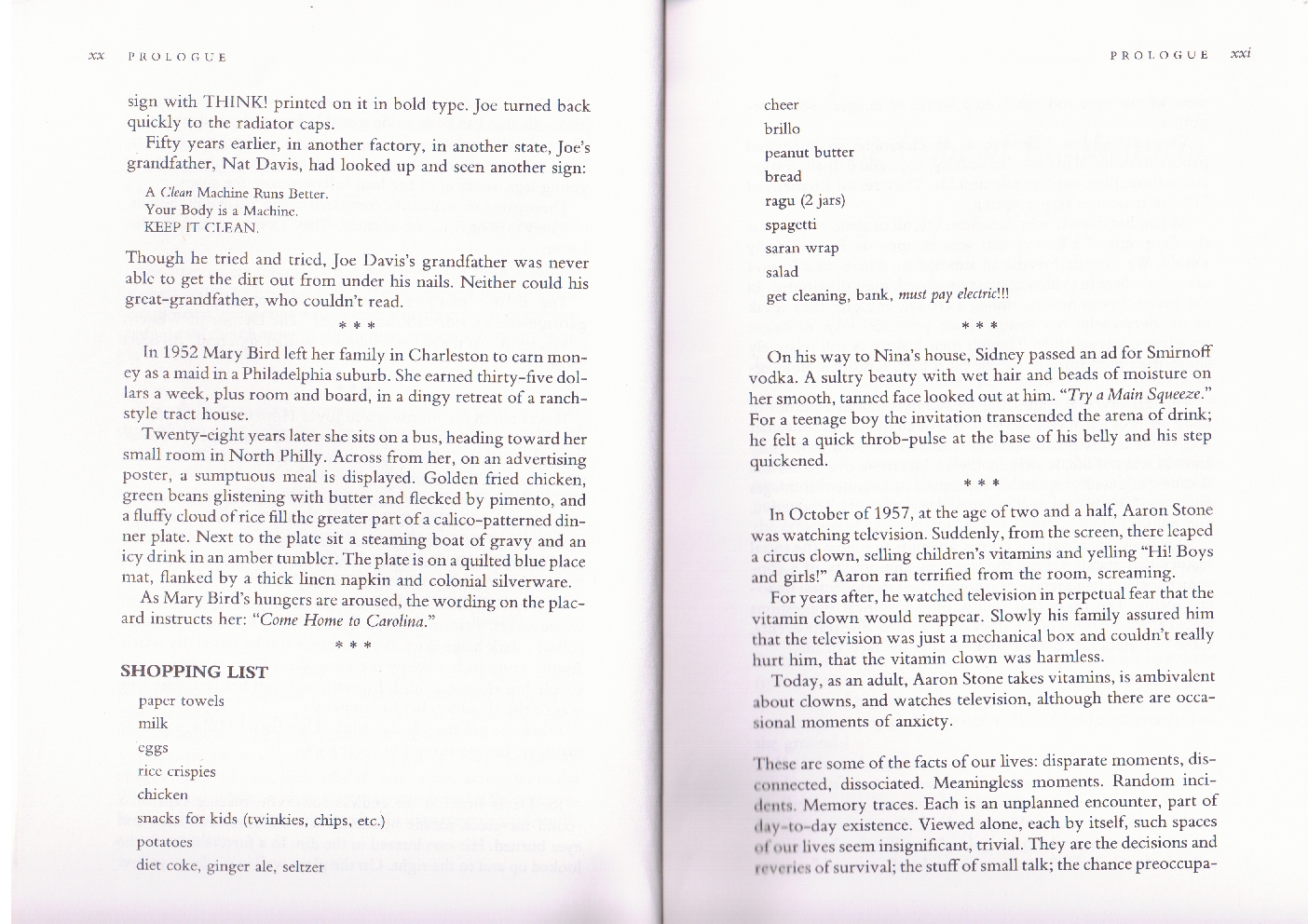
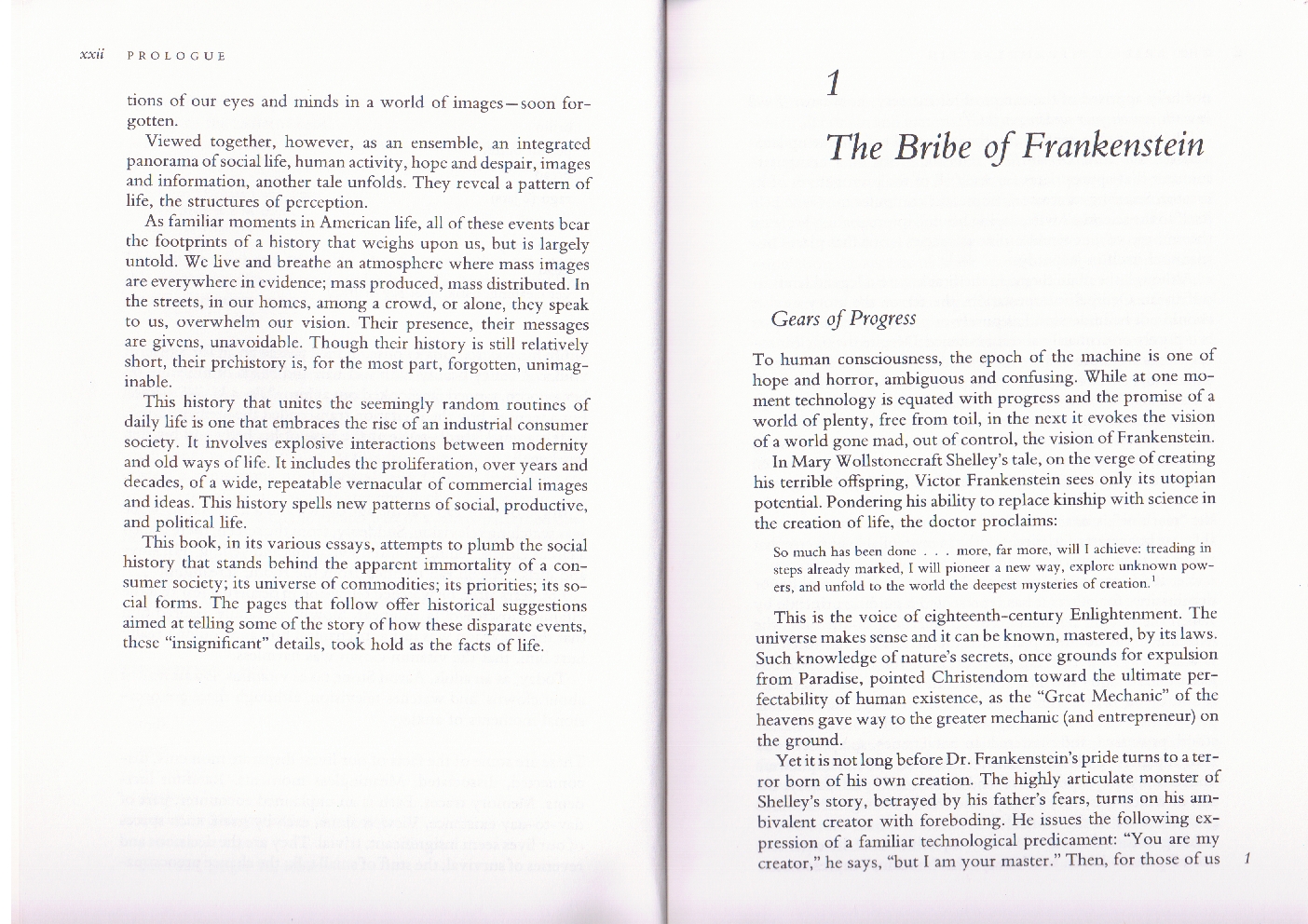
Well first, consider their sheer number: “In the United States alone, the average person may be exposed to 500 and 1000 commercial messages a day”, according to p.34 of Essentials of Contemporary Advertising by William Arens and David Schaefer (2007). And like Stuart and Elizabeth Ewen explain in their prologue to Channels of Desire: Mass Images and the Shaping of American Consciousness (1992), it’s amazing how subtly, profoundly, and almost entirely unconsciously this daily barrage affects us. Quite a charming narrative, which no-one can fail to be more interested in advertising after reading, I’ve scanned it for you below:

But regardless of whatever is ultimately responsible for the timing and/or mainstreaming of men exposing their abs in the Korean media, I’m sure we can all agree that they are now here to stay (and there was much rejoicing). And in a sense, this was indirectly confirmed by SBS recently when it decided to ban female performers from exposing their navels and/or abs on its popular Inkigayo (인기가요) show, whereas male performers remain free to rip off their own shirts: the “recent development in the Korean media” that I referred to in the introduction.

Why is that ban more significant than the plethora of others however? And why is it not exceptional, but in fact genuinely reflects deeply ambivalent and dogmatic societal attitudes to—for want of a better term—women’s top halves? Alas, it was my original intention to jump straight into that second part here, but with this post already at 2000 words (and well overdue), then I’ll wisely defer those 1500 extra ones to a separate post later in the week.

(Source)

Until then, a request, lest anyone feel I’ve been too critical of Rain here: does anybody know the name of a recent music video that features 2 young male singers vying for the affections of a woman, taking off their tops repeatedly (perhaps 10 times) and walking around half-naked for most of the video as they sing…before finally noticing that the woman has taken advantage of their distracted state by stealing their jeep?

Please do pass it on if you do, as I feel it actually much better epitomizes just “how cynical and commercially-driven the [ab-exposure] trend has become” than Rain does, and which even heterosexual women and gay men that see it will probably agree is a little excessive, let alone extremely lame. Moreover, while I don’t claim to have suddenly seen the light as a result, and can now completely empathize with women’s feelings about their own pervasive objectification in the media…I do think the eye-rolling, sense-of-exasperation, and literal gagging I experienced is at least a start towards doing so!^^

Update: With thanks to Katarina, the video is I was Able to Eat Well by 2AM’s Changmin & 8eight’s Lee Hyun:

Clearly, I exaggerated it in my memory. But understandably, as with them so so eager to shed their clothes together in the garage parking lot from roughly 0:59 for instance (for the sake of showing off their abs), that segment at least seriously resembles a gay porn video.

Probably actually objectifying the woman even more than the men though, then I take it all back: Rain’s performances do best epitomize the ab craze!

(For more posts in the Korean Sociological Images series, see here)

Korea Doesn’t Get Much Cuter Than This…

A girl-group aimed at my demographic, set in the style of the video games I used to play as a teenager? Seriously, what more could one ask for in a music video?^^

Thanks to Ashley at SeoulBeats for the laugh!

Because Of You (너 때문에) by After School (애프터스쿨): Lyrics, Translation, & Explanation

With apologies for not writing about the positives of Korean popular culture more often, let me present Because of You (너 때문에) by After School (애프터스쿨). It’s one of my 10 favorite Korean songs, and easily their best.

Or at least, DJ Areia’s version of it above is, but I include the original below if you prefer.

The music video however, is a little confusing. Not because it depicts a relationship between 2 women though: admittedly that was a surprise, but in hindsight the lyrics are completely gender neutral. Rather, it’s because there is a man – model Song Jae-lim (송재림) – featured prominently throughout, and it’s not entirely clear who or what he’s supposed to represent exactly. Indeed, with his collage of photos of different members of the group, closed-circuit TV monitoring of them, and finally holes in walls through which to directly spy on them, then “voyeur” or “stalker” is what comes to mind personally, but I’d be surprised if that’s what the creative director intended.

If anyone can explain what he’s doing there then, then please let me know! In the meantime, I hope the translation adds to your enjoyment of the song, and for Korean learners I’ve included detailed explanations in those cases where I came across words or grammar that were new to me personally, or where my (Korean) wife and I had some difficulties. But I’m still quite happy to explain anything else though, and of course may have made some mistakes, so please give me a buzz in either case.

Here goes:

아직도 나 그대를 잊지못해

I never forget boy

I never forget boy

헤어진지 벌써 몇년이 지났는지 몰라

그대 생각만 하면 자꾸 눈물만 흘러

오늘따라 왜 그렇게 네가 보고플까

창밖의 빗소리가 내 맘을 흔들어놔

I still can’t forget you

I never forget boy

I never forget boy

Since we split up, already so many years have passed I’ve lost track

I only have to think of you, and I frequently [end up] crying

Why especially today do I want to see you so much?

The sounds of the rain outside the window pane has gotten my heart beating

Line 5 was the first problem, which my wife and I actually argued about a little (albeit when we were both very tired), because although “만” usually means “only”, according to her it can also mean “whenever” too. And however annoying it is for learners like myself, I do concede that even the simplest of Korean words can have multiple meanings sometime, so although I haven’t encountered that use of the term myself yet, for a while I wisely deferred to her translation of it as “Whenever I think about you”.

But still, it bugged me, as surely “그대 (애대해서) 생각할때 마다”, say, would be a much less ambiguous way of saying that? Hence the result you see above, after resolving which we wisely decided to start translating the next verse in the morning. Unfortunately however, that still left Line 7, which uses the construction of [verb] + [아/어/여 ending] + [놓다].

I wasn’t familiar with that, but I did know [verb]+ [아/어/여 ending] + [있다], which means that “the state resulting from the action of the verb continues to exist” for a short time, and also [verb]+ [아/어/여 ending] + [두다], which basically means to something in that state for a much much longer time (compared to 있다), so it wasn’t difficult to understand this new 놓다 one, which “indicates that the action of the main verb is complete, and is restricted to action verbs”. See page 353 of Korean Grammar for International Learners for more information, an essential reference book which I’d be surprised if anyone still reading by this stage didn’t already have!

사랑하지 말걸 그랬어 정 주지 말걸 그랬어

붙잡지 말걸 그랬어 왜 이렇게 나 혼자 아파

사랑하지 말걸 그랬어 정주지 말걸 그랬어

붙잡지 말걸 그랬어 왜 이렇게 나 혼자 아파

난 항상 너만의 장미가 되려던 내 맘을 아니

이제 조각난 사랑의 마침표가 됐다는걸

눈물이 밀려와 메마른 입술이 젖어

이제 어떡해 그댈 잊을 수 없어

I shouldn’t have loved you, I shouldn’t have given you affection

I shouldn’t have asked you to stay, why am only I hurt so much?

I shouldn’t have loved you, I shouldn’t have given you affection

I shouldn’t have asked you to stay, why am only I hurt so much?

I was always going to be your rose, Do you know my heart?

I know our shattered love’s final end has come

My gushing tears wet my dry lips

Why can’t I forget you now?

In lines 1-3, the construction [verb] + [지말걸] basically means “shouldn’t have [verb], and the “그랬어” just adds emphasis. In Line 1, it seemed simplest just to translate “정” as “affection”, but note that it often means a great deal more than that in group contexts (see here and here). Meanwhile, in Line 7 I changed “밀려오다” from “advancing” to “gushing”, because although the former is technically more correct, in English “advancing tears” really means tears that haven’t arrived yet, whereas in this case the Korean means tears that have arrived, and keep coming like waves on the sea keep advancing towards the shore.

Line 6 though – 이제 조각난 사랑의 마침표가 됐다는걸 – was probably the hardest of the entire song to translate. My logic with “I know our shattered love’s final end has come” was, first, that the sentence is quite literally “Now-shattered-love’s-full stop/period-has come/formed/arrived I know”, with me writing “full stop/period” to avoid anyone confusing “period” with a period of time, when actually “마침표” just means the punctuation at the end of a sentence. But then I decided that “final end” is what it is meant by that surely, and changed it accordingly.

Still, I admit that the sentence as a whole remains pretty strange, as in my experience “shattered love” has already has had “a final end” by virtue of shattering in the first place. Perhaps not so in Korean though?

Next, the chorus:

너 때문에 많이도 울었어 (매일밤 난)

너 때문에 많이도 웃었어 (그대 때문에)

너 때문에 사랑을 믿었어 (woo boy)

너 때문에 너 때문에 모두 다 잃었어

정말 답답답해 갑갑갑해 막막막해 너없는 세상이

내 말을 씹어놓고 자존심 짖밟아놓고

내 맘을 찢어놓고 왜 나를 떠나가

Because of you I cried a lot (every night I)

Because of you I laughed a lot (because of you)

Because of you I believed in love (woo boy)

Because of you, because of you, I lost everything

I am so frustrated, stifled, and lost in a world without you

You ignored what I said and walked all over me

You tore my heart to shreds, why did you leave me?

Most of that was quite simple in contrast. Of course there are many alternatives in English for “닫답하다”, “갑갑하다”, and “막막하다” in Line 5, and the difference between the first 2 in particular is quite subtle. Indeed, although this was the first time I’d ever heard “갑갑하다” myself, my wife tells me that it is so similar to “닫답하다” that it is often used in conjunction with it for emphasis.

Also, in line 6 and 7 there is the [verb] + [아/어/여 ending] + [놓다] used earlier. In Line 6, I decided that “you ignored what I said” was a better translation of “내 말을 씹어” than the literal “you chewed my words”, which sounds quite ambiguous in English. In the case of  “자존심 짖밟아” though, I decided that “walked all over me” sounded the most natural, but the more literal “you trampled over my self-respect” was probably fine really.

Note though, that the last line should really have a “you” or “당신이” inserted, making it  “내 맘을 찢어놓고 왜 당신이 나를 떠나가” or “You tore my heart to shreds, why did you leave me?”. And as I’ll explain, the question of who left whom exactly becomes important a little later.

그날도 비가 왔었지

한참을 그댄 말없이 나를 바라보기만 했어 어어어

흔들리는 눈빛과

애써 짓는 어색한 미소가 이별을 얘기해줘 줘줘줘

It rained that day too

For a long time, you just stared at me wordlessly

Through the light of your eyes and your labored, awkward smile, I realized you were going to split up with me

That’s quite straightforward, so I’ll just continue:

사랑하지 말걸 그랬어 정주지 말걸 그랬어

붙잡지 말걸 그랬어 왜 이렇게 나 혼자 아파

사랑하지 말걸 그랬어 정주지 말걸 그랬어

붙잡지 말걸 그랬어 왜 이렇게 나 혼자 아파

나보고 떠나가라고 할땐 언제고

떠난다니까 어쩌고 미친사람 취급만 해 정말 힘들어 (Boy slooow down)

아무런 말도 못한 채 울어

Cause I want to stay next to you

My love is true Wanna go back to when I was with you

I shouldn’t have loved you, I shouldn’t have given you affection

I shouldn’t have asked you to stay, why am only I hurt so much?

I shouldn’t have loved you, I shouldn’t have given you affection

I shouldn’t have asked you to stay, why am only I hurt so much?

You are the one who told me to leave

After saying that, why did you only treat me like I was crazy? It was so painful and difficult for me

I cried so hard I couldn’t speak

Cause I want to stay next to you

My love is true Wanna go back to when I was with you

The question of who left whom is important because of Line 5, “나보고 떠나가라고 할땐 언제고”. The “보고” in that is just another way of saying “한테”, leaving us with literally “To me-ordered [me] to leave-when you [ordered me]-some day”; not as confusing as it looks though, as it’s just “When you told me to leave someday”. Or so I thought, but in that case the placing of the “언제고” would be different: “”나보고 언제고 떠나가라고 할땐”. And it couldn’t be “Someday, when you told me to leave” either, as the subject marker attached to “when” – “할 땐” – makes that impossible.

I despaired then, and it didn’t help that I thought it was the other person that left the singer(s) either. My wife came to the rescue though, by saying that although the dictionary says “”언제고” is “someday”, it’s also used for emphasizing that someone said something to you, and not the other way round. She also told me that that meant I could omit the “when” too, and hence you the final result “You are the one who told me to leave”.

That still leaves the question of who left whom though, especially as the next line was “After saying that, why did you only treat me like I was crazy?”. My best guess then, is that the ex-girlfriend told the singer(s) to leave, and when she didn’t, the ex-girlfriend left instead, especially given the last line of the song which you’ll see in a moment.

Next is the chorus again though, so I’ll skip ahead to the next verse. And if you haven’t been listening to the remix version, then I highly recommend you at least listen to this section from 2:42 (3:03 in the original), as it’s not for nothing that I said back in May that “the background melodies at that point raise my spirits from virtually any depths, and make me feel like I can conquer the world, even after probably 200+ times of listening to the song”!

I miss you I need you 꿈 속에선 아직도 I’m with you

I miss you (miss you) I need you (need you)

시간을 되돌려 Wanna kiss you again ma boy

맘이 너무 아픈데 견디기 괴로운데

너는 어디서 뭘하니 (나 울었어 참 많이)

너 없인 난 못살아 내게로 돌아와줘 날 떠나가지마

I miss you, I need you, You’re still in my dreams, I’m with you

I miss you (miss you) I need you (need you)

I wish I could go back to then, Wanna kiss you again ma boy

My heart aches, enduring it is so painful

What are you doing now, where are you (I cried so much)

I can’t live without you, Please come back to me, Please don’t leave me

And finally there is the chorus again. Again then, I hope you can all enjoy the song much better now, and if you’re a fan of After School then you may also like to check out my translations of the lyrics to Ah! (아!) and Bang! (뱅!) too. And the Song Lyrics & Translations category in general of course; alas, there’s only 1 song by another artist in there as I type this, but I promise to add many more soon!

<!–[if gte mso 9]> Normal 0 MicrosoftInternetExplorer4 <![endif]–> <!–[endif]–>

아직도 그대를 잊지못해

I never forget boy

I never forget boy

헤어진지 벌써 몇년이 지났는지 몰라

그대 생각만 하면 자꾸 눈물만 흘러

오늘따라 그렇게 네가 보고플까

창밖의 빗소리가 맘을 흔들어놔

사랑하지 말걸 그랬어

정주지 말걸 그랬어

붙잡지 말걸 그랬어

이렇게 혼자 아파

사랑하지 말걸 그랬어

정주지 말걸 그랬어

붙잡지 말걸 그랬어

이렇게 혼자 아파

항상 너만의 장미가

되려던 맘을 아니

이제 조각난 사랑의 마침표가

됐다는걸

눈물이 밀려와

메마른 입술이 젖어

이제 어떡해

그댈 잊을 없어

너때문에 많이도 울었어 (매일밤 )

너때문에 많이도 웃었어(그대 때문에)

너때문에 사랑을 믿었어(woo boy)

너때문에 너때문에 모두 잃었어

정말 답답답해

갑갑갑해

막막막해

너없는 세상이

말을 씹어놓고

자존심 짖밟아놓고

맘을 찢어놓고

나를 떠나가

그날도 비가 왔었지

한참을 그댄 말없이 나를

바라보기만 했어

흔들리는 눈빛과

애써 짓는 어색한 미소가

이별을 얘기해줘

사랑하지 말걸 그랬어

정주지 말걸 그랬어

붙잡지 말걸 그랬어

이렇게 혼자 아파

사랑하지 말걸 그랬어

정주지 말걸 그랬어

붙잡지 말걸 그랬어

이렇게 혼자 아파

나보고 떠나가라고 할땐 언제고

떠난다니까 어쩌고

미친사람 취급만

정말 힘들어 (보이 슬로우 다운)

아무런 말도 못한 울어

cause i want to stay

next to you my love is true

wanna go back to when i was with you

너때문에 많이도 울었어 (매일 )

너때문에 많이도 웃었어 (그대 때문에)

너때문에 사랑을 믿었어 (woo boy)

너때문에 너때문에 모두다 잃었어

정말 답답답해

갑갑갑해

막막막해

없는 세상이

내말을 씹어놓고

자존심 짓밟아놓고

맘을 찢어 놓고

나를 떠나가

I miss you i need you

속에선 아직도

i’m with you

I miss you (miss you)

I need you (need you)

시간을 되돌려

wanna kiss you again ma boy

맘이 너무 아픈데

견디기 괴로운데

너는 어디서 뭘하니

(나울었어 참많이)

없인 못살아

내게로 돌아와줘

떠나가지마

너때문에 많이도 울었어

너때문에 많이도 웃었어

(많이도 웃었어)

너때문에 사랑을 믿었어

너때문에 너때문에 모두 잃었어

(너때문에 )

정말 답답해

갑갑해

막막해

없는 세상이

말을 씹어놓고

자존심 짓밟아놓고

맘을 찢어 놓고

나를 떠나가

Share

Share

Korean Sociological Image #49: Lee Hyori has an Asian Bottom?

Well, bottom half of her body to be precise. But then she is Korean after all, so what on Earth does that make her top half?

“Western,” according to her. And while she’s quite happy with that at least, in contrast she’s dissatisfied with her “Asian” legs, claiming that she has to always wear high heels to compensate for them (source, right).

However, despite my original shock at hearing her describe herself in such terms, ironically I find myself defending her statements.

No, really.

But first, the context. From the Hankyung:

가수 이효리가 “상체는 서구적인 반면 하체는 동양적이다”라고 말해 눈길을 끌고 있다.

Singer Lee Hyori is drawing lots of attention for saying “While I have a Western top half, on the other hand the bottom half of my body is Asian.”

지난 20일 방송된 MBC ‘섹션TV 연예통신’에 출연한 이효리는 서구적인 상체를 가지고 있는데 반면 “동양적인 하체를 가지고 있다”며 “하이힐은 생명과도 같다”고 말해 주위를 웃음바다로 만들었다.

Appearing on the MBC show “Section TV Entertainment Report” on the 20th of August, she then said that “High heels are as important as life itself!”, which turned the audience into a sea of laughter.

이날 이효리는 “샵에서 효리씨가 입어주면 옷이 잘 팔린다며 옷을 공짜로 준다”며 “옷을 잘 입는 방법은 얼마나 자신의 체형을 잘 커버하느냐인 것 같다”고 설명했다.

She also explained that “When I go into a shop, the owners give me clothes for free because they will sell well if I wear them”, and that “How well you wear clothes depends on how much of your body shape you cover up.”

이효리에게 ‘숨기고 싶은 신체적 단점’에 대해 질문하자 “상체는 서구적인 반면 하체는 동양적이다”라고 말했다.

When asked what were bad points about her body she wanted to hide, she replied that “I have a Western top half, but an Asian bottom half”.

이어 동양적인 하체를 커버하기 위한 해결책으로 “절대로 하이힐을 벗지 않는 것”이라고 강조하며 “10cm 이하 하이힐은 쳐다보지도 않고 잠을 잘 때도 하이힐은 신고 잔다”고 말해 주위를 폭소케 했다.

Accordingly, she emphasized that the solution for covering(?) her Asian bottom half was “never taking high heels off”, and that “not only will I not look at high heels with a heel less than 10cm high, but I even sleep in high heels”, producing hysterics in the audience.

Lee Hyori High Heels(Source. Source below: unknown)

Apologies for the terrible quality of that “news report”, but as I type this unfortunately I’m only able to find minor variations of it on the Korean internet. But lots of them, albeit only because Korea’s top female sex-symbol is admitting to having (self-perceived) flaws, and definitely not because of her views on different races’ body shapes.

And why should they be news? Are they really as strange as they first sound?

In short, no, for three main reasons.

Firstly, as some commenters at K-pop blogs allkpop and Omona! They Didn’t have pointed out, she probably merely meant that she had larger than average breasts and short legs instead, and was not necessarily denigrating women cursed with the latter, nor Asians in general. And that’s probably true.

Still, why not just say that instead?

But would you? In English, we describe people by their races all the time; much less so, the specific features that make us characterize them as such. Moreover, I’ve certainly met many people with a blend of racial features too, let alone the two I’ve fathered myself!

So although it sounds extreme and even amusing in English, I’d be very surprised if Lee Hyori wasn’t indeed just referring to certain body features when she said she had a seogujeogin (서구적인) top half and dongyangjeogin (동양적인) bottom half. Indeed, and finally, it behooves non-native speakers like myself not to take the Korean language too literally.

I learned this lesson myself back in February, through trying to understand the 2009 buzzword cheongsoon-glaemor (청순글래머). Meaning “innocent” or “pure”, then cheongsoon at least was easy enough, but glaemor (글래머)? Naturally I assumed it meant the same as the English, but as several readers pointed out, it’s a false cognate, actually meaning “large breasts” instead. So cheongsoon-glaemor means “innocent and busty” in English.

Yes, that does indeed sound inane in any language, but the point is that it’s rather different to “innocent and pure-looking but while still having a rich and glamorous celebrity lifestyle”, which is what I originally thought. And just in light of a mistake like that alone, then surely Lee Hyori should be given the benefit of the doubt in this case, rather than instantly being accused of racism and/or – ironically – feelings of racial inferiority.

Still, after almost spitting out my coffee while reading about the story this morning, I admit I’m a little reluctant to let her entirely off the hook.

And indeed, just like the term glaemor originally came from a mistranslation by the Japanese, stemming from the well-endowed busts of glamorous Hollywood starlets in the 1950s, the notion that all Korean women should envy the large breasts and long legs of their Western counterparts seems simply absurd considering what their bodies are like 60 years later. So it is high time more Koreans challenged this stereotype, and pondered what sustains it nevertheless.

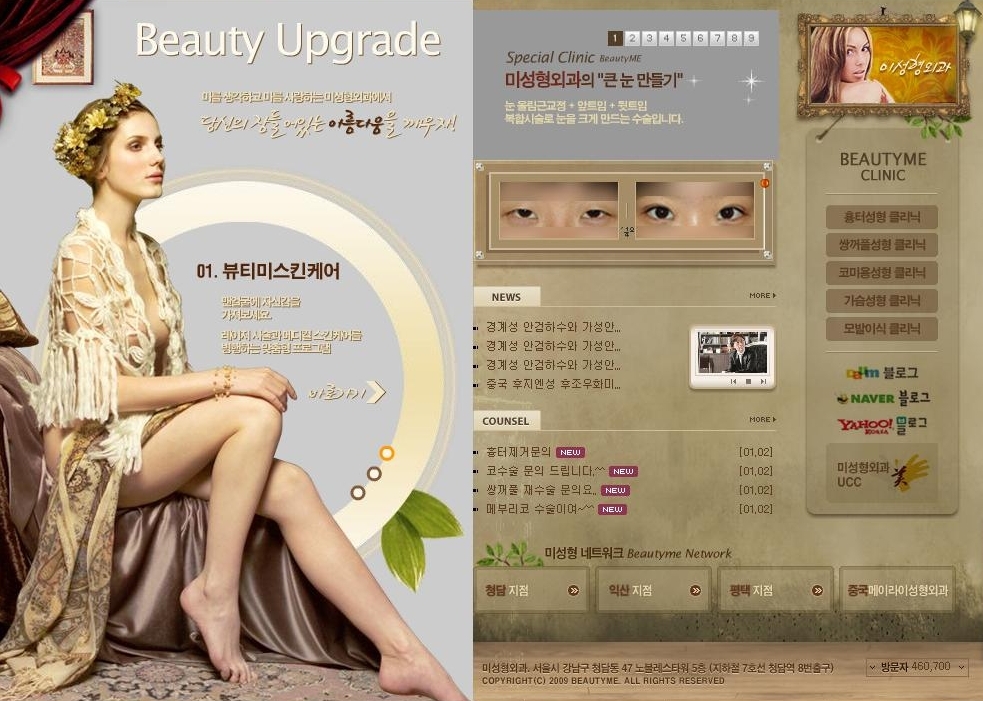
Perhaps a good place to start would be ubiquitous cosmetic-surgery advertisements, which seem to have an inordinate number of Caucasians in them? What do you think?

(Source)

(For all posts in the Korean Sociological Images series, see here)

Ah! (아!) by After School (애프터스쿨): Lyrics & Translation

After School’s (애프터스쿨) debut track from last year, of which I again include both DJ Areia’s remix above and the original below for you to enjoy while I explain the lyrics. But note that the remix is not actually trance this time, but rather the disco-like “vibrating analog synthesizer sounds and the helicopter-like basslines” of the late-1980s and early-1990s, so please do give it a try if you’re normally put off by dance music.

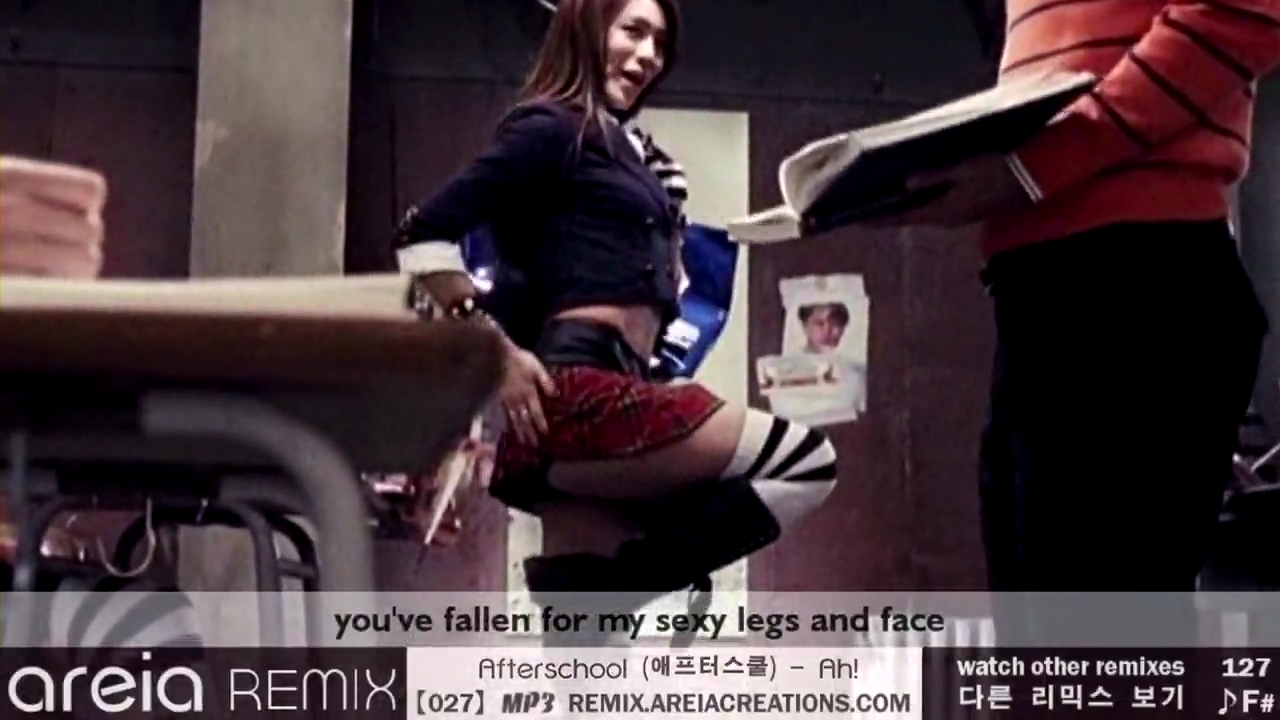
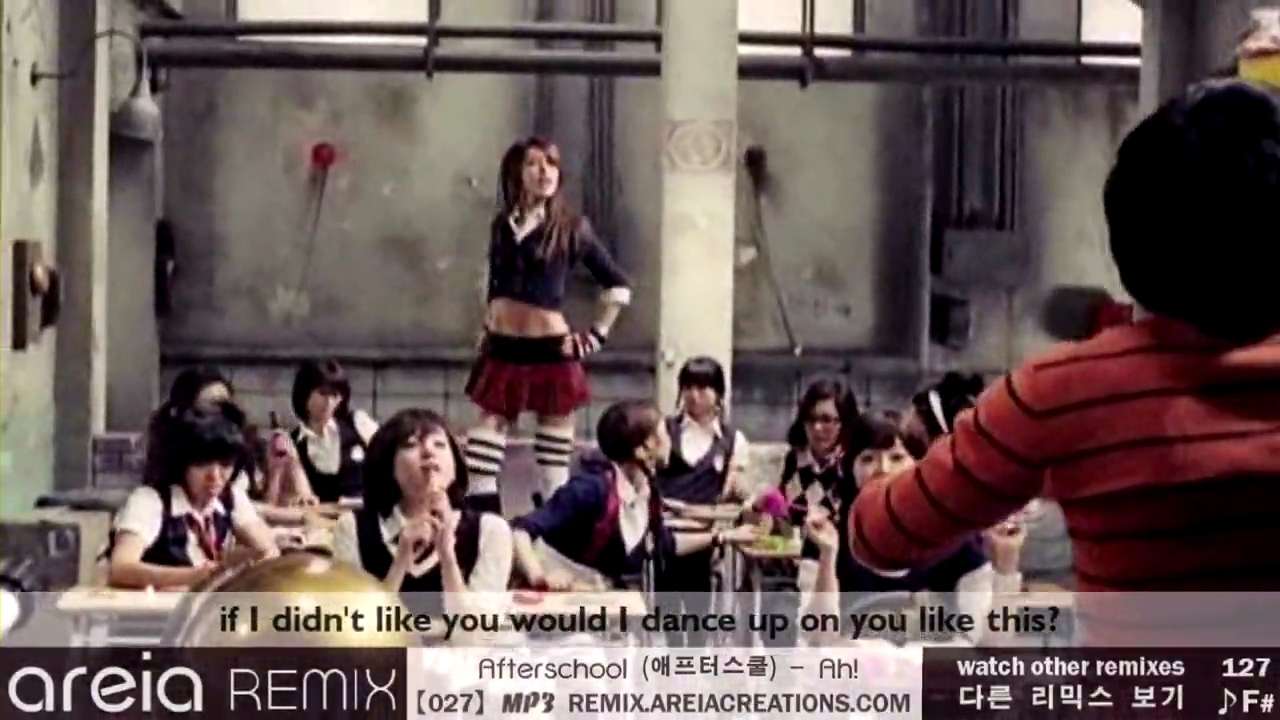
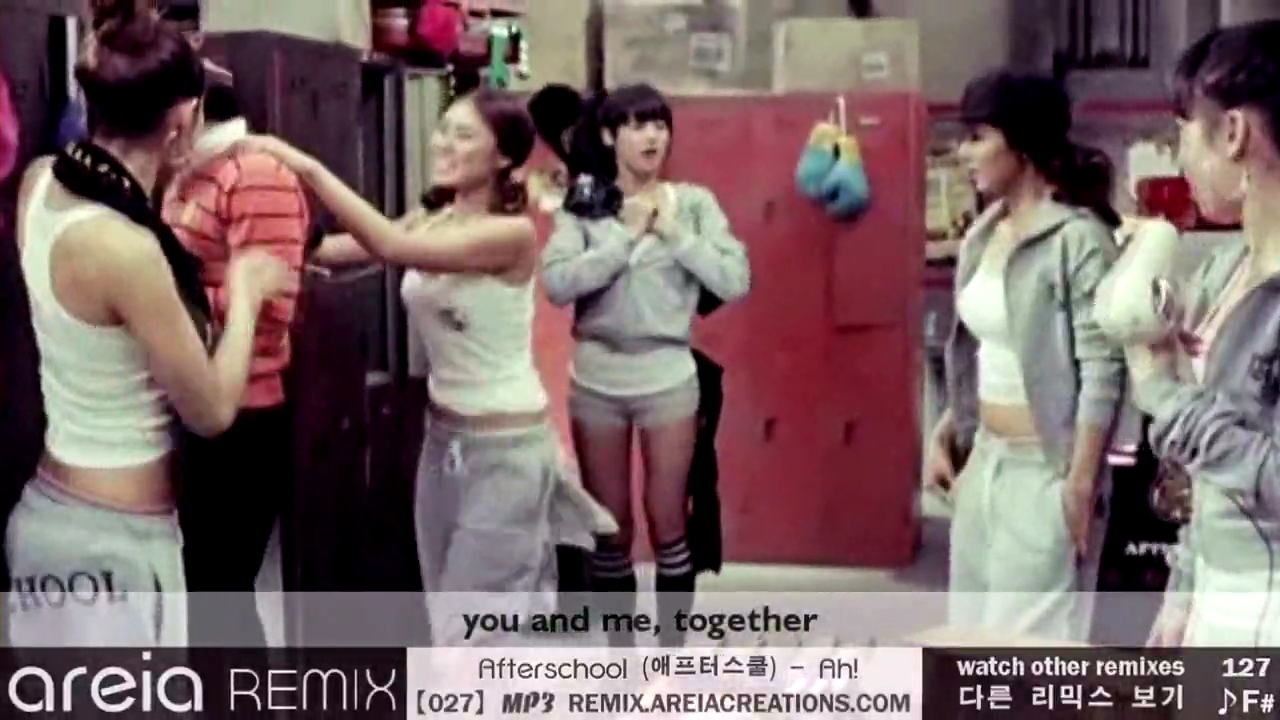
As for the music video itself, its theme is a little strange: schoolgirls in skimpy clothing coming on to their increasingly flustered young teacher, whom they are very happy to have ‘accidentally’ burst into their locker room later? It sounds…nay, looks like Japanese manga, and reminds me that student-teacher relationships (including dating and marriage) are a common trope of mainstream Korean popular culture (see here, here, and here for example), which only serves to both glamorize and normalize them.

Still, overly hormonal school students do sometimes have crushes on their teachers, and there’s nothing wrong in itself with portraying those in a music video. But while this one does obviously cater more to men’s sexual fantasies than to women’s (would having the group members vying for the affections of a handsome male student instead appeal more to women?), the lyrics demonstrate that there is much more to the song than meets the eye…

Again, for reasons outlined last time, I’ll provide very literal translations:

이렇게 둘이, 너와 단 둘이
언제나 둘이, 달콤한 이야길 하고파 둘이
둘이, 오늘밤 둘이, 사랑해 우리 둘이 둘이 baby

This way the two of us, with you only the two of us

All the time the two of us, I want us to tell a sweet story

The two of us, tonight the two of us, I love you we the two of us the two of us baby

“단” in the first line confused me for a while: it has a dozen meanings, including “bunch” or “bundle” which would (sort of) go with “the two of us”, but ultimately the meaning “only” is the most appropriate here. After that, the “~ㄹ 고파 하다” verb ending in the second line was the first time I’ve ever come across it personally, nor is it in any of my grammar books, but my wife says it simply means “~하고 싶다”, or “want to”.

잘빠진 다리와 외모 너는 내게 반하지
그대를 향한 윙크 한번 내게 빠지지
니 높은 콧대, 내 몸맨 어때
내 앞에선 니 모든게 무너지고 말껄

You have fallen in love with my slender legs and outward appearance

If I wink towards you one time you will fall (further)

The bridge of your nose is high (you have high standards)

How is my body?

Everything about you is going to crumble in front of me anyway

It feels a little hypocritical of me to critique other translations of songs here, as I very much rely on them to try and understand anything I might be having difficulty with myself, and especially because the translators may lack my increasingly annoyed Korean wife to constantly ask questions of in the next room. Nevertheless, those of whomever DJ Areia uses in his remixes (Yeeun2Grace perhaps?) really do seem a little sloppy sometimes (recall the big mistake in the 5th line of Bang!), and certainly disguise the subtlety of the original.

Take the first line for instance: “빠지다” has 13 meanings according to my dictionary, but “sexy” isn’t one of them; rather “잘빠진 다리” are “legs that have lost a lot of weight”, or “slender”. Sure, you could argue that this is just being picky, but it’s just as plausible to think that there is something culturally significant in the fact that “legs that have lost a lot of weight” was said rather than “섹시한다리” for instance, or more literally “sexy legs”. Also, “외모” is not “face”, but is actually the “outward appearance” of your entire body.

Next, putting line 4 as “I know you’ll crumble in my presence” completely ignores the “모든게” (or “모든것” + “이”) in it, or “everything”, and although “I know you’ll fall for me” is fine I guess, the verb ending “~고 말껄” (annoyingly not in any of my grammar books) means more “[the verb] is going to happen anyway”. Hence “everything about you is revealed in front of me” seems much better, as per the translation available on the AfterSchoolPlay fansite (registration required)

Finally, not a translation mistake, but in line 2 annoyingly the meaning of “빠지다” is different to that in line 1; and learners of English complain about the multiple meanings of words!

사랑한다 말만 말고 보여 주겠니
나도 니가 맘에 들어 춤을 추겠니
너와 난 왠지, 자꾸만 왠지
통할 것만 같아, 너를 사랑 할것 같아

Don’t just say you love me, aren’t you going to show me?

I like you too, aren’t you going to dance for me?

You and me for some reason, only again and again for some reason

I think we will only be connected, I think I will love you

My wife tells me that the verb ending “~겠니” in line 1 and 2, again not in any of my grammar books(!), means “aren’t you going to [verb] for me?”, So where on Earth “If I didn’t like you would I dance up on you like this?” below comes from I have no idea, no matter how appealing the thought!

(chorus)

짧은 시간 가까워진 우리 둘 사이
그대와 난 이제 하늘이 맺어준 사이
두말 할 필요 없어, 다가와 내게 어서
조명이 나를 번쩍 비추면
그댈 유혹하는 내 눈빛이 뜨거워지지
다른 남자들은 니가 너무 부러워지지
말은 안해도 난 알잖아 표현 안해도 다 알아
빨개진 니 얼굴이 다 말을 해주잖아

In just a short time we have become close

We are a match made in heaven

We don’t need to say it twice, come to me

If a light suddenly shines on me

It heats up the light of my eyes that is seductive to you

And other men become very jealous of you

You don’t have to say it or show it in your expression, I know everything

You red face shows it all

Not much to say here actually, other than both the translators at Yeeun2Grace and AfterSchoolPlay separated the above into two verses between lines 4 and 5. But I think that was mistaken, as line 4 ends in “비추면” or “if the light shines (on me)”, which is why the singer’s seductive eyes light up in the line 5. Lacking that connector, then I think that their own versions of line 4 and line 5 – “I’ve been illuminated by the light… You see my burning seductive eyes” and “When the lightning strikes me…My eyes which are putting him into temptation are becoming hotter”  respectively – don’t really make any sense.

(chorus)

나나나~

After school in the house, 모두 같이 make it bounce
들어봐 지금 내 말, 오늘밤 tonight
다가와 말못했던 얘기, 우리 둘만의 작고 작은 속삭임
그래 넌 지금 날 너무 원하지, 가벼운건 싫어 내 모습이
다른 장소 after party, 걱정마 이런 내 스타일에
오늘밤은 후회안해, 내 맘을 뺏어봐 baby boy

(chorus)

Na na na~

After School in the house, everybody together make it bounce

Hear my words now, this night tonight

Come to me, and all the things you (we?) couldn’t say, all the little whispers we said only to each other

Yes, you really want me now, I (you?) don’t want just light stuff

Different place after party, don’t worry this is my style

Don’t regret tonight, try to take my heart baby boy

Again, the Korean seems pretty straightforward here. On a final note then, given how targeted it is towards male audiences I was very surprised not to find any screenshots of the music video either via Korean or English search engines, leaving me with the onerous task of producing my own. Despite the visuals however, the lyrics in this debut song are clearly just as much about girl-power and being confident and assertive as they were in Bang! a year later, so the possibility remains open that After School may actually have a sizable female fan base (and I rather hope that they do).

In light of that then, you imagine what I thought of three members’ most recent song in which they pour on the aegyo (애교), basically looking and behaving like 12 year-old girls. Like I said in the comments to a post about it at SeoulBeats:

I’d have to give it a thumbs down. Not so much for the music in itself, but because I’ve always liked After School for the assertive, confident, girl-power theme of their songs, and so this “candy coated aegyo overload” as you well put it really seems to dilute their brand.

And most other commenters there agreed with me. But what do you think of it? Feel free to disagree with me of course, and diversity is the spice of life and all, even for music groups. But still…

(Source)

As always, thanks in advance for pointing out any mistakes I may have made or providing alternative translations!

Korean Photoshop Disaster #5: Girls’ Generation’s legs too fat for China?

( Source )

Given the clear artistic license applied to the other main image in this series, would you say that here too, the graphic designer deliberately intended for members of Girls’ Generation (소녀시대) to look like virtual caricatures of themselves?

Update: See Korean Lovers Photoblog for the full series.

(For more posts in the Korean Photoshop Disasters series, see here)

Share

Music Monday: On Black music, KARA, & Why K-pop bands are so large…

Three things of interest I came across all in the space of this morning…

First up, a recent edition of the BBC4 podcast Thinking Allowed, which – paraphrasing slightly – discusses the contention of cultural critic Paul Gilroy that:

From Curtis Mayfield to 50 Cent, from Nina Simone to JayZ, black music has declined in its quality and lost its moral stance. Outlined in his essay “Troubadours, Warriors, and Diplomats” in his book Darker Than Blue: On the Moral Economies of Black Atlantic Culture (2010) , he joins host Laurie Taylor and music journalist Caspar Melville to discuss the counter-cultural stance that black popular music once had, and explore whether it really has been destroyed.

On the surface only tangentially-related to Korea, in that modern K-pop has strong hip-hop roots (in contrast to J-pop, which are more in rock), this 28 minute, very accessible synopsis it is still surely required listening for all those interested in music and cultural studies. And indeed, the second half of the discussion in which they talk more about the impact of technological developments on music, and especially the reality that precious few young people are prepared to pay for it anymore, is perhaps more pertinent to the Korean music industry than most.

Next, an Icelandic reader passed on a link (thanks!) to the journal article “Crazy About You: Reflections on the Meanings of Contemporary Teen Pop Music” in the Electronic Journal of Sociology (2002), by Phillip Vannini and Scott M. Myers, in which the highlighted part below immediately leaped out at me. With apologies for the long quote for the sake of context (actually, only 2/3rds of the paragraph!):

…Centralized corporate production insures continued consumption through pervasive distribution, vast output volume, and structured product obsolescence (Gitlin, 1981) while strategies of careful manufacturing of the image and sound of pop icons ascertain that audiences are treated as ‘targets’ and ‘market-segments’. Take for example the case of Britney Spears. Her image and sound had been first controlled by Disney as a pre-teen Britney worked as a host of the Mickey Mouse Club. Subsequently her schoolgirl image was spiced up to appeal to the 12-16 age group and her videos were made to occupy a steady spot in the rotation of Zoog ABC and the Disney Network. Now, with her continued biological growth her image has been recreated as sensual and provocative and formatted to meet the demands of MTV. As this takes place new ‘Britney’s’ mushroom on the market to appeal to different targets: Jessica Simpson to Christian teenagers, Mandy Moore to preteens, Jennifer Lopez to Latinas and older fans. Producers’ control extends from songwriting to image-packaging and personality development (Frith, 1978). Any boy-band act is put together to appeal to various personalities and life outlooks of fans as each band includes a member portrayed as cute and sweet, one funny, one good-looking and mysterious, one creative and goofy, one talented and motivated, one dark and tough, and such. Bands are created with the consumers’ demand in mind4, for example LFO target through MTV an older adolescent urban audience with their hip-hopish sound and sexual innuendos, while S Club 7 and Aaron Carter target preteens through Fox Family and ABC Family. This is an example of the diversification of products that allow producers the broadest appeal possible and the highest profit margin.

In passing, footnote 4 from that is also interesting:

4. The structure of consumer demand is an important concept to keep in mind. As Frith (1978) suggested producers’ ability to shape needs is limited. Why or when a style becomes popular or unpopular remains a conundrum for the music industry. It is much easier for any producer to stay with one genre or act after it has become popular and produce endless imitations than experiment with new formats or shape consumer demand. Record industries still find very few acts highly profitable, while the majority of albums produced and distributed hardly bring any profit at all (Burnett, 1996).

But the highlighted part caught my eye because of what I’d read in the post Thoughts on K-Pop Vol. 1: So Addictive at the blog Multi, which is definitely required reading for those interested in Korean music specifically:

Another important thing to note is that the Korean music industry is populated mainly by groups of at least five members. With a main audience of between 10 and 19, this is a brilliant idea because all the kids will have at least one person they like in every band, are enthralled by their personalities as seen on numerous TV shows, and will not hesitate to buy their albums and merchandise. This works for other industries as well, as phone, food and clothing companies almost solely hire celebrities to star in their commercials. They also record songs and shoot music videos (and short films) for these products and then endorse them on their numerous TV appearances. Basically, the celebrities become the only people you see on screen and in print. They become ridiculously popular really quickly, and then are sent around Asia to maximize their worth because all the other countries have succumbed to the “hallyu wave”.

Naively, I hadn’t been aware that the same logic also existed outside of East Asia. But having said that, it is still much more marked in K-pop. For not only it is exaggerated by the overwhelmingly celebrity-focused nature of advertising here, but that in turn is further exaggerated by the need to sell singers rather than their music per se,  for reasons mentioned earlier. And there’s less space for independent artists that don’t subscribe to that logic to emerge too.

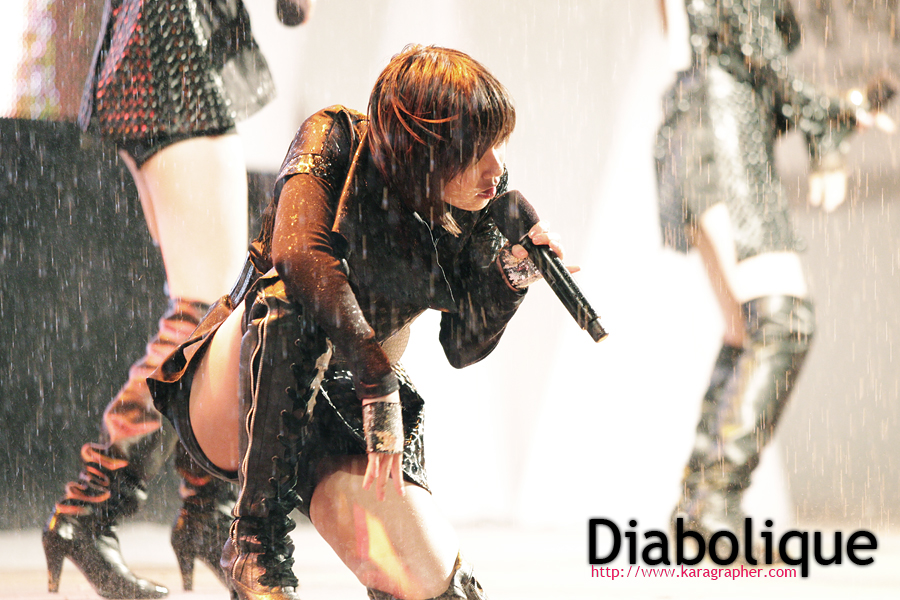
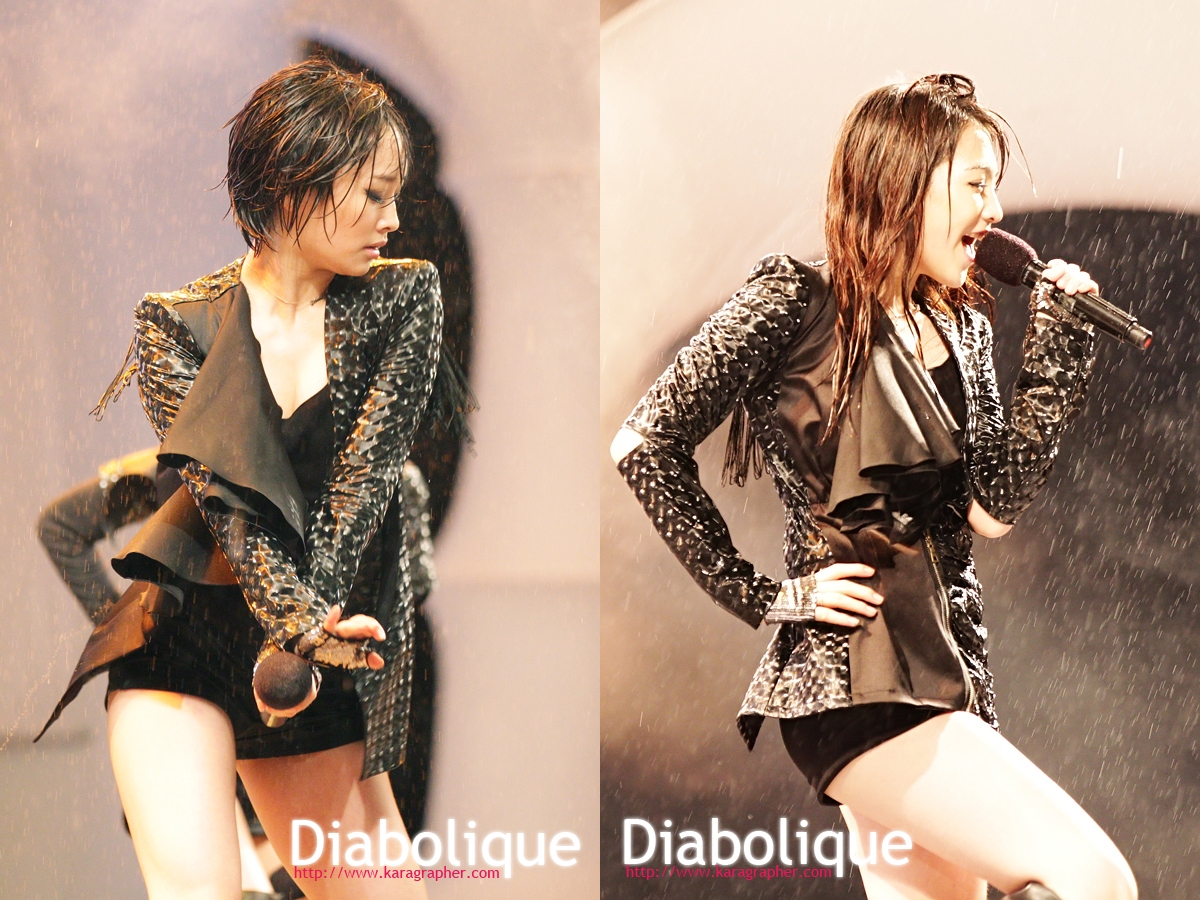
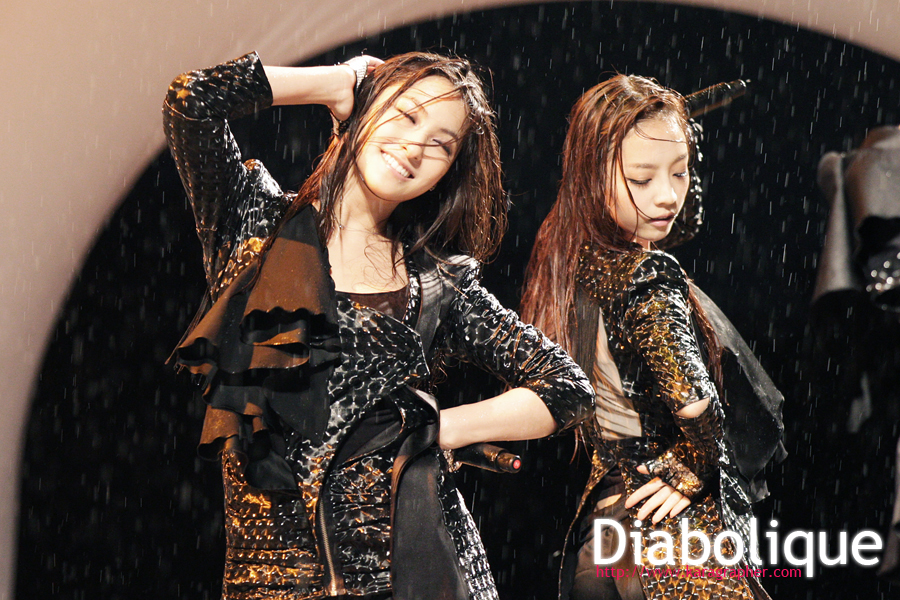
Finally, all the photos of KARA (카라) in this post are from their performance at (unfortunately spelt) Wonkwang University (원광대학교)* last month, in which it started to rain halfway through their song but – seemingly without so much as batting an eye – they kept performing nonetheless (see video below).  Found via Omona They Didn’t!, admittedly I probably wouldn’t have given the photos a second glance if they had been of a boy-band instead, but once I had then I really responded to them, well-aware of how refreshing and especially liberating it can feel to continue exercising – or indeed, dancing – in a downpour.

More to the point though, not only are the photos themselves stunning, which this blog theme doesn’t really do justice to (click on the images themselves for more detail, or see Diabolique here and here for more), but in particular KARA happened to be performing Lupin (루팡), in which as Multi – who else? – puts it:

…From what I gleaned from Youtube translations of the songs, they sing about being confident (in love?) and not being afraid…as opposed to simply trying to get a guy’s attention in “Mister” (미스터); check here and here for respective lyrics, and it shows in their performances. They shine in “Lupin”, but bore with “Mister”. It might just be that “Lupin” is fresher, and they’re bored of performing Mister (side effect of weekly live performances, a.k.a overkill, of songs in k-pop) but I doubt it’s just that…

She tends to prefer performances to the music itself, and presumably to the music videos too, but for what it’s worth here they are to compare:

And finally a fan cam of the performance, although unfortunately it’s of very poor quality. The rain starts falling about at about 1:20:

Thoughts?

p.s. I’d been under the impression for many years that the term “Black Music” wasn’t particularly PC, and consequently have sometimes discouraged my Korean students from using it, but the Thinking Allowed podcast made me realize I may have been mistaken. Was I, or is there perhaps a difference between American and British English?

* (Say “Won-Kwang”, not “Wonk Wang”!)

Share

Bang! (뱅!) by After School (애프터스쿨): Lyrics & Translation

Remember my plan last month “to find out how actual fans respond to various girl groups’ song lyrics, music videos, and on and off-stage behavior and so on, rather than simply speculating like I’ve done previously”? Alas, I haven’t been able to do any as much work on that as I would have liked to by now, but I have completed a necessary first step: translating After School’s (애프터스쿨) songs into English, so as to get a better grip on what is actually being discussed. Starting with Bang! (뱅!) here, I’ll be passing on the results over the next few weeks, before moving on to 2NE1’s songs.

Actually, there are already numerous translations of the song available, so you may wonder what the point of adding one more is. But then song lyrics in any language can be very ambiguous even to native speakers, and so some of those translations can ultimately differ quite widely. And as you’ll soon see, a mistranslation of just a single line can have a huge impact on the perceived character of a song too, so I’m glad I decided to engage with the original Korean instead.

A quick note on the music itself first. While my predilection for trance music is already well known to regular readers (not that this really qualifies as such), I do genuinely believe that, objectively speaking, DJ Areia’s remix above is far superior to the original below. For not only does it have a faster tempo (134 bpm vs. 120) that is much more appropriate for its youthful, energetic theme, but more importantly because it has a clear climax at 1:29-1:43 which flows well into the melodic, dreamlike sequence from 1:43-2:15. In contrast, the original seems to be almost, well, passing the time at the equivalent period of 1:39-1:54, in a sense waiting for the climax that never comes; instead, you merely get the melodic sequence at 1:54-2:27. This ends up leaving me feeling very unfulfilled, and many fans have also commented that it seems somewhat out of place (but not that I dislike that segment in itself).

Hence the original literally feels somewhat lacking to me, and the first time I heard it I was reminded of playing my father’s singles at 33½rpm rather than 45rpm for fun when I was a kid. Here it is if you prefer it though, and I’ll be briefly referring to the some of the translations in this particular video of it in the text:

T.R.Y. Do it now! Can you follow me? Yes!! Uh-ha~!!

T.R.Y. Pick it up! You’ll never catch me!! Oh~ No!!

눈부시게 빛나는 나를 따라 Oh! Oh! Oh!

가식적인 말들은 비웃어버려 Ha! Ha! Ha!

예쁘기만 한 너는 더 이상은 No! No! No!

짜릿한 음악 속에 던져버려 Bang! Bang! Bang!

Follow my dazzlingly shining self Oh! Oh! Oh!

Laugh out your pretentious, affected words

You only being pretty, no longer

Throw yourself/it into the thrilling music

As you can see, I’ve decided to stick to very literal translations this time: partially because I’m sure readers can already think of phrases that would be more appropriate for English audiences, and partially because with all the ambiguity and different translations as mentioned, then knowing the gist of the song is more important.

Indeed, this helped me to overcome the difficulties which I had as soon as line 3, very literally  “prettiness-only-(having)-you-more-more-(than) No! No! No!”. Not unreasonably I first translated that as “you have no more than your prettiness”, but I found that a little cynical and odd in light of the girl-power vibe of the song as a whole, so I checked out the translations that DJ Areia used, but which also came up with “the only thing you have is being pretty, you’re no more”.  Still dissatisfied, I eventually found the video above at NME.com then (which has many more translated K-pop videos), and it had “All you do is being pretty, no more No! No! No!”, which seems much more logical. And later, my wife also confirmed that “더 이상은” is almost always used in a negative sentence, and means “no longer” in a time sense.

Hence, detailed translations of songs often belie how open to interpretation they really are, and so never take them for granted (including mine!): it would be a pity if anybody got entirely the wrong impression of After School because of something like that. Meanwhile, is one supposed to throw that attitude or oneself into the thrilling music in line 4? The original Korean doesn’t say, but like much of the song, I suspect that it doesn’t really matter.

우리는!! Oh~ After!! School Up!! 너흰 모두 비켜라!! Check it out!! 다 가져봐!! A-ha! A-ha! A-ha!

Right now!! Oh~ After!! School Up!! 모두 미쳐라!! 외쳐라!! 또 이렇게!! A-ha! A-ha! A-ha!

Us!! Oh~ After!! School Up!! All of you get out of the way!! Check it out!! Take it all!! A-ha! A-ha! A-ha!

Right now!! Oh~ After!! School Up!! Everybody be crazy!! Shout!! Do it like this again!! A-ha! A-ha! A-ha!

Those seem quite straightforward, but a quick cultural point: while it is perfectly normal to say “비켜” to children, literally “Get out of the way”, my wife has advised me that adding a respectful “주세요” at the end like with most verbs doesn’t make it an acceptable request to strangers, just like “Could you please get out of the way” isn’t that bad(!) but still wouldn’t always be the most appropriate thing to say in English either. Instead, simply “실례합니다” is best.

T.R.Y. Do it now! Can you follow me? Yes!! Uh-ha~!!

T.R.Y. Pick it up! You’ll never catch me!! Oh~ No!!

가슴 뛰는 이 밤을 내 맘은 Oh! Oh! Oh!

불타는 네 눈길은 내 몸을 타고 Ha! Ha! Ha!

거칠어진 숨소리 멈추진 마 No! No! No!

심장이 이 리듬을 따라가게 쿵! 쿵! 쿵!

This chest-throbbing night is mine Oh! Oh! Oh!

Your burning gaze climbs/burns my body Ha! Ha! Ha!

Don’t stop your breath (that has turned wild and rough) No! No! No!

Let your heart follow the rhythm Bang! Bang! Bang!

Again, I’m sure you get the gist above, but let me just highlight 2 points. First, line 3 is translated as the slightly perverse-sounding “the sound of your breath gets rougher, don’t stop” or “don’t stop the sound your heavy breathing” respectively in the videos above, but that’s not at all obvious from “거칠다”, which is “coarse/rough (skin); rude (behavior)/wild (nature)/harsh (tone)/violent (language); rough/slovenly/slipshod/loose; or rough/wild/raging/furious/turbulent” according my electronic dictionary, and indeed “heavy (breathing)” seems far removed from the “rough (skin)” meant in one of my daughters’ books in the first picture (in case you’re wondering, the girl is pondering what could be hiding under the blankets).

Similarly, like you can see in the bottom 2 pictures, “쿵” in line 4 is an onomatopoeia for the sound of something hitting something else, so probably “bump” in the bottom video is better than the “bang” of the first. Still, the English “bang bang bang” does seem quite apt considering band member Kim Jung-ah (김정아) dances to that part of the song by repeatedly thrusting her chest out at the viewer(!), and on a side note I’ve often wondered if advertisers for the Korean clothes company Bang Bang (뱅뱅) are aware of the double-entendre:

But carrying on:

우리는!! Oh~ After!! School Up!! 너흰 모두 비켜라!! Check it out!! 다 가져봐!! A-ha! A-ha! A-ha!

Right now!! Oh~ After!! School Up!! 모두 미쳐라!! 외쳐라!! 또 이렇게!! A-ha! A-ha! A-ha!

(rap) Bringin’ it to you daily It’s only from the best

After School Playgirlz know how to get fresh

So cool, So right, just so tasty

We bring it fast forward the fellows go crazy

좀더 과감하게 보여 주는 거야 너~ (To be raised for my life)

좀더 특별하게 춤을 추는 거야 너~ (To be raised for my life)

Show yourself dancing a little more boldly (To be raised for my life)

Dance a little more specially (To be raised for my life)

And “과감하다” means “resolute/determined/bold/daring”, so I’d say the first video’s “you should show it more dangerously” is a little off.

One! Two!! Three!!!

음악에 널 맡겨 주문을 걸어봐 Yeah~ (To be raised for my life)

(rap) Crisp clean original new quality is what we give to you.

(Check it out) a new generation and a whole new start (check it out) collaboration with a brand new heart

조금 더 다가와 이순간을 Catch Up!! Oh~

(rap) On your mark set ready to go, can you feel it in your body this A.S. flow…

Hey hey what you want ! Let’s go…!!

Entrust yourself (your body) to the music, and try casting a spell Yeah~ (To be raised for my life)

And:

Approach this moment a little more

That first line is one of those cases which would just be impossible without a native speaker: “주문을 걸다” means “cast a spell”, but naturally that compound verb isn’t mentioned in any of my dictionaries. Instead, I was struggling with “주문” as “order”, “spell”,  or “request/demand/desire” and “걸다” which has 10 meanings, but usually “hook”, “put into position”, or “install”, before giving up and consulting the videos.

And that’s about it, but here is the remainder for the sake of completeness:

우리는!! Oh~ After!! School Up!! 너흰 모두 비켜라!! Check it out!! 다 가져봐!! A-ha! A-ha! A-ha!

Right now!! Oh~ After!! School Up!! 모두 미쳐라!! 외쳐라!! 또 이렇게!! A-ha! A-ha! A-ha!

T.R.Y. Do it now! Can you follow me? Yes!! Uh-ha~!!

T.R.Y. Pick it up! You’ll never catch me!! Oh~ No!!

A-ha! A-ha! A-ha! T.R.Y. Do it now!!.

A-ha! A-ha! A-ha! Can you follow me? Yes!! Uh-ha~!!

A-ha! A-ha! A-ha!

A-ha! A-ha! A-ha!

And on that note, I hope you enjoyed the song, and/or learned a little about After School and/or some Korean in the process. As always, please feel free to correct any mistakes I may have made, and thanks in advance to those that do!

( Source, all screenshots )

Share

Isn’t It Beautiful? (얼마나 좋을까?) by Lee Soo-young (이수영): Lyrics & Translation

( Source )

Last week, I mentioned that until I found DJ Areia’s trance remixes, then in almost 10 years here I’d never been particularly moved by any popular Korean music. But with a few noticeable exceptions, starting with Isn’t it Beautiful? (얼마나 좋을까?) by Lee Soo-young (이수영), a Korean adaptation of the Japanese song sung by Japanese folk singer Ritsuki Nakano (professionally known as “RIKKI“), and which was the theme song for Final Fantasy X, a role-playing game for the PlayStation 2 released in 2001. Difficult to avoid hearing in Korea at the time, there is no better way to describe it than as a simply beautiful piece of music, and one which deserves to be much better known among a, well, younger generation of listeners.

With apologies for the poor quality of the video, please take a listen for yourself:

I actually first translated the lyrics in July 2007 just after starting this blog, but like most of what I wrote back then that original post has since been mercifully deleted. As I began translating some of these songs for this research project of mine however, to be posted over the next several weeks (and hopefully to become a regular thing), I realized it would be a shame to waste it, both for the sake of the music and especially for understanding the original Korean. Which as you’ll soon see, is much more difficult than it may at first appear, and I realize now that I made many mistakes in the original!

Let’s start with the first verse. I won’t mention many specific words, because you can simply look those up in a dictionary yourself, but I will highlight some of the things I had difficulty with, as you may well be confused by them too. But this is by no means the final, definitive word on the lyrics in English, and I very much welcome and will appreciate any corrections:

바람이 들려준 이야기엔, 내 마음 설레였고

구름에 실려온 내일로, 그 목소리 향해

거울에 흔들리는 달에 비친, 내 마음 함께 떨리고

별들은 흐르는 눈물속에, 고이 다 흘러버렸어

The confusion starts almost immediately, for “엔” in line 1 is not simply a shortened form of “에” plus “는”, with the latter indicating that the “이야기” is the subject here. Rather, my wife says that the “는” is just added for emphasis, although she can’t say why.

( Source )

Next, although in hindsight the “내일” in line 2 is obviously “tomorrow”, that wasn’t so clear when I first started translating and didn’t know what the song was about; hence I wondered if it could be “내” plus “일”, or “my” plus “work/task”, but then there would need to be a space between the “내” and the “일”!

Also, the “오다” in “실려온” is not always simply “실리다” plus “coming” like I thought 3 years ago; rather, although it’s difficult to summarize the grammar point here, “오다” or “가다 ” added to a verb are not always simply “coming” and “going” in space respectively, but can also be in time too. Korean Grammar for International Learners, p. 340, describes them as meaning “continuous performance of an action over time as one comes towards the ‘present and continuous’ performance of an action over time into the future (away from the present) respectively”.

Finally, although I personally find it quite easy now, I should also mention the “버리다” attached to “흐르다” in the last line: if you look in your dictionary, it means “throw away” or “ruin”, but when added to a verb it can mean 1) the action of the verb has been completed with little or no room to spare, 2) the verb produced a state contrary to what was hoped for or expected, or 3) that the speaker feels relief that something has ended.  So:

My heart was throbbing to a story told to me by the wind, and

which was carried by a cloud towards the voice of tomorrow.

My heart trembled to the moon shining in a mirror,

and it all softly melted with the stars’ flowing tears

( Source )

Unfortunately, that is very different to what I wrote 3 years ago, and it may also be very different to what you yourself came up with too: there’s so much metaphor here, that my wife and I despaired with pinning words down to anything specific in English, particularly with line 2. And on that note, if you’d like a more poetic and/or readable alternative for all the lyrics (sniff), then consider these ones and in the details to this video for instance, but note that both are based on the Japanese rather than the Korean version. Moving on:

얼마나 좋을까, 둘이서 손을 잡고 갈 수 있다면

가보고 싶어, 당신이 있는 곳 당신의 품 속

거기 안겨, 몸을 맡기고, 어둠에 감싸여

꿈을 꾸네

This verse, or the chorus rather, was much easier. If we just focus on the problematic words first, of course the “둘” in line 1 means “two”, but the “이서” added to it basically renders it “[us] two, together”, or “you and I”. Then in line 2, “곳” or “spot, place” should not be confused with “것”, or “thing”, and just after that the “품” means chest, or bosom. Not that that last can’t also simply be looked up in a dictionary of course, but then I’ve never personally heard of that meaning of “품” outside of this song.

The grammar is also very easy, although I’ll quickly mention it for learners: first, the “ㄹ/을까” in line 1 is added when asking for someone opinion, or just reaffirming yours (making it analogous to the “eh” of Australian, NZ, and Canadian English”). Then, the “다” added to the “면”, or “if”, is only for definite hypothetical situations, as opposed to “If you grab the beer, I’ll grab the chips” for instance. Finally there’s the “네” in line 4, which denotes mild surprise, but then you’ve probably already had many Koreans replyingg “와…한국말 잘 하시네요” when you’ve spoken to them in Korean!

Imagine how wonderful it would be, if we could grab each other’s hands and leave

I’d try to go, into the place that you are in your heart

Hugged by you, I’d entrust my body (soul?) to you and

Wrapped in the darkness…I’m dreaming!

( Sources: left, right )


The next verse was also quite easy. Admittedly I’m confused by which tenses apply to what, but otherwise probably the only things of note are the “지” in line 1, which usually means “right?” as in a tag question, but like in English can just be part of a simple statement (like “좋을까” earlier); and the “지다” in “흩다” in line 2, which basically means “make into the state of the preceding verb or adjective”. In this case “흩다” means “spread” or “scatter”, so “be scattered”:

바람은 멈추고 목소리는, 아득하게 속삭이겠지

구름이 흩어져 내일은, 아득한 환상일 뿐

달빛이 스미는 거울 속, 내 마음은 흐르고 별들이 떨리다, 멈춰

흐를 때 눈물은 감출 수 없어

Which gives in English:

The wind has stopped, and my voice with become just a whisper

The clouds will scatter and tomorrow will become only a vague, distant fantasy

Moonlight will soak the mirror in which my heart flows and the stars tremble and stop

I can’t hide my tears when they flow

Finally the chorus again, with only a little changed:

얼마나 좋을까, 둘이서 손을 잡고 갈 수 있다면

가보고 싶어, 당신이 있는 곳 당신의 품 속

그대 얼굴, 살며시 스치고,

내일로 사라지는, 꿈을 꿨어

In line 3, don’t confuse “그대”, which means “you” or the other party involved, with “그때”, or “then”. Giving in English:

Imagine how wonderful it would be, if we could grab each other’s hands and leave

I’d try to go, into the place that you are in your heart


I gently touch and brush past your face, and

I dreamt a dream that is disappearing towards tomorrow

( Source )

And there you go! I hope you enjoyed the song and/or I helped you to understand it a little, and there’s certainly many more gems out there in Korean music if you’re prepared to look. Probably I’ll provide much less of an explanation for more recent songs though, as I’d rather focus on the content of the songs rather than on the Korean per se, but we’ll see!

Share

Open Thread #13

(Source)

With apologies to Seoulplay, but I’m tempted to only use screenshots from 2NE1’s (투애니원) Try to Follow Me (날 따라 해봐요) music video for the Open Threads from now on! For like Anna at her Appears music blog explains:

Every moment in this promotional video is a photograph. Every shot, every pan, every object has been calculated to the point of mental instability. What is K-pop like in the 10′s? Everything I predicted and more. And like all the things I truly admire in this world, I’m torn between laughing at them and laughing with them.

Read the rest of her post, and you’ll soon see why. And on that note, a quick but serious question to anyone familiar with 2NE1 to get the ball rolling this week: how accurate a portrayal of the group would you say is presented by the following recent video on them?

In a nutshell, I ask because I’m about to start working on a project to find out how actual fans respond to various girl groups’ song lyrics, music videos, and on and off-stage behavior and so on, rather than simply speculating like I’ve done previously. And to do that, I’m planning to join their fan clubs (albeit probably posing as my Korean wife), but naturally I would like to start with groups whose music I really like and/or which has a slightly radical message before I invest the all the time in translating long comments threads about them.

Liking almost all of After School’s (애프터스쿨) songs so far then, or at least DJ Areia’s remixes, I’ll definitely still start with them, but in light of that video I’m now considering looking at 2NE1 after that. So before I do, my question is: do they live up to all the hype?

Thanks in advance, and of course readers please feel free to raise any other Korea-related issues!

Share

Korean Photoshop Disaster #4: NOBODY’S Perfect!

Probably both a driving force and reflection of the increasing amount of male objectification in the Korean media since last year, then you may have noticed that female authors and commenters on K-pop blogs have become increasingly vocal in their admiration of male celebrities’ bodies these days. And with the provisos that such objectification can be problematic, and more of one sex by no means nullifying the negative effects of that of another, then all power to them, but it does increasingly tempt me to indulge myself a little too!

Hence I was considering presenting some pictures for Lee Hyori’s (이효리) recent photoshoot for Elle Korea here earlier today, but paused when I thought about how to describe her in them: after all, heaven forbid that a male blogger shift from simply using banalities like “she is sexy” when expressing admiration for a woman’s body, to discussing her body parts in the same manner that female bloggers now can and do of a man’s. Or is that just me?

Either way, the sky didn’t fall in the last time I posted a picture of a woman simply because I liked it, and so ultimately I probably would have done so this time too. Well before getting to that stage however, I happened to quickly click between the picture from Elle Korea itself above and that from MSN Korea below, and something much more interesting literally jumped out at me:

In case you’ve missed it, this GIF I’ve created shows how that switch looked:

Yes, not only did MSN Korea feel the need to enlarge her breasts, apparently they also thought that she was too fat too. Anybody else find the change simply more patronizing than sexy however?

Either way, it certainly makes yesterday’s video on Korean women’s perceived need for cosmetic surgery and weight reduction all the more poignant!

(For all posts in the Korean Photoshop Disasters series, see here)

Share

Korean Sociological Image #37: Like a Virgin?

As they say, first impressions are everything. And so, with apologies to those of you unwise enough to read this blog at work, let me share mine of girl group T-ara (티아라) from their music video of Like the First Time (처음처럼) before proceeding: namely, that they were confident, sexy women, not at all embarrassed to perform risqué dance moves like the above in front of large audiences.

However, it was difficult to square that impression with their shyness in the following brief interview for Entertainment Tonight (연예가 중계) last month, conducted while making (rather bizarre) commercials for a mobile phone, and I would interested in hearing your thoughts on possible reasons for the differences, and how representative the interview is as whole of the way 20-something women especially are portrayed in Korean entertainment programs.

The most important point first: from roughly 1:00 t0 1:30, the interview focuses on group leader Ham Eun-jeong (함은정) feeling embarrassed about repeatedly hugging actor Yoon Si-yoon (윤시윤) for their commercial, despite having just met in the studio. In particular, at 1:10 below she says “어떡해”, or “How” as in “How can I do this?” while making an exaggerated expression of embarrassment, about which the reporter comments “굉장히 부끄러워하죠?”, or “She’s very shy, yes?”. Note also the addition of “근심” and “걱정” on the screen too for added context and atmosphere, (a habit of entertainment programs picked up from Japan), although rather confusedly they both mean anxiety, or worry.

Then at 1:25, she’s asked how she feels from hugging Si-yoon for so long, to which she replies “솔직히말해도…떨려요!”, or “To be honest…I’m shaking/trembling!”.

Natural feelings? Of course. But then recall her music video, in which she – not to put too fine a point on it – repeatedly bends over and thrusts out her bottom, jiggles her breasts, and runs her hands over her breasts and crotch while singing about how her body was on fire. Indeed, even the interviewer herself later (3:08) highlights the complete contrast:

Moreover, while I’ve never personally strutted my stuff on stage like Eun-jeong, I am actually quite comfortable – nay, somewhat notorious for – acting in front of large groups of adult students (I’m tempted to mention faking an orgasm in class once in my first year of teaching, but I’d better not), and doubt that I’d be embarrassed repeatedly hugging an attractive woman in front of others. Yes, I would be if I ended up having a large visible erection as a result, but that’s besides the point: if Eun-jeong was embarrassed, it wasn’t because she was visibly turned on.

And I stress “if”: my wife, for instance, also watched the interview, and at first told me her embarrassment was perfectly natural, but then readily conceded it was rather strange in light of her performances in music videos and on stage. Which leads me to my first question: do you think Eun-jeong was genuinely embarrassed?

One commentator at Omona! They Didn’t did at least:

…Eunjung lost her composure while filming a hugging scene with Yoon Si Yoon….It’s funny how Eunjung was so flustered and shy around a guy because she exudes such a powerful and charismatic presence on stage. I guess we are all prone to weakness in front of the opposite sex.

And I do remain open to the possibility. However, I’d argue that either subconsciously or deliberately, she’s much more likely to be playing to expectations and norms of the Korean media that she present herself as cute and innocent, regardless of her true personality; well illustrated, I think, by this 2007 commercial with Kim Tae-hee (김태희):

As PopSeoul! explains:

She acts all sugar and spice in wide-eyed innocence as she sips her drink carefully, but as soon as her date turns away, she lets loose her inner diva to strike a pose for the camera. Her date discovers the saved pictures on his Olympus and accuses her of being “nae-soong”.

Nae-soong (내숭) being the:

…inconsistency between a girl’s true personality (i.e. extroverted), and external (i.e. introverted, shy and innocent) personality. In other words, trying to hide your true intentions self by acting sweet and innocent.

And indeed the interview is full of demonstrations of how sweet and innocent they are. For instance, at 1:47 Park Ji-yeon (박지연) is embarrassed to learn that she is Si-yoon’s favorite of all the T-ara members (although you may be surprised to learn that she’s only 16, and hence her embarrassment arguably the most likely to be genuine):

And at 3:17, Eun-jeong feigns (I don’t think anyone would dispute this!) being upset at the other group members selecting her as looking the most different (read: uglier) before putting on make-up:

One music video and and one interview are by no means sufficient to get an idea of their true personalities however (to the extent that one sees any celebrities’ true personalities in front of a camera at all that is), and so I also briefly looked at some episodes of T-ara Dot Com (티아라닷컴), a quasi-reality show about them setting up an internet clothes shopping mall of that name. Here’s a brief segment of one episode, with English subtitles:

And in which their behavior is no different to that in the interview. Hence, while I do still feel that Eun-jeong’s embarrassment at hugging Si-yoon at least was completely feigned, I concede that T-ara’s cutesy behavior overall probably wasn’t an act, and not unrepresentative of Koreans their age either (for reasons explained here).

If that behavior is still a definite expectation or norm of Korean entertainment programs however, depends on such factors as how other women are portrayed in them; if there’s a large difference between men and women; and to what extent such programs offer opportunities for entertainers to present alternate, more serious sides of themselves if they wish to do so.

Unfortunately, I can’t personally say: even when I first arrived in Korea at the tender age of 24, I soon chose never to watch these sorts of programs because I had better things to do than seeing grown men and women acting like children on them. Now, at 34, I’m more concerned about the influence they will have on my own daughters, and to be frank would consider myself a failure as a father if they grew up to behave like members of T-ara do when they reach the same age.

However, in contrast to when I was 24, in fact there’s also some things I like about the Korean media which are on display in the interview, and which I’ll devote the remainder of the post to.

First, in a meta-sense, the practice of providing subtitles and/or commentary on them is simply great for studying Korean, especially considering the huge gap in real-life learning material for Korean learners, let alone intermediate level material. And if dramas aren’t your thing, then studying a 10 minute segment of an episode of T-ara Dot Com everyday is probably quite a tolerable alternative:

More to the point of this post however, there is the very human side of stars presented, a stark contrast to the pedestals Western medias tend to place their own celebrities on. For instance, not only does the interviewer ask at 3:39, which member of T-ara farts the most:

But at 3:49, we even get to watch the evidence:

And, lest he feel left out, Si-yoon is asked if he also farts, to which he replies at 3:57 that yes, he enjoys it:

Compared to that, watching him pick his nose and examine the contents at 2:30 was nothing. And hey, a guy’s got to do what a guy’s got to do, but in any other country I’d be surprised his agent didn’t want that cut out:

But not that showing that celebrities fart and pick their noses like the rest of us mere mortals are the only positives of course. I also love how the interview highlights Ji-yeon stuffing her face with strawberries at 2:57 for instance, and particularly from a basket that looks like it was bought from the back of a food truck, to be found in literally every Korean neighborhood at almost any time of day (for instance, selling salt at 5:30 in the morning). You see, something that looks like it could have been bought in my wife’s home village in 1970 is somewhat incongruous on the set of a commercial for probably one of the most technologically sophisticated products on the planet, and reminds me that constantly seeing such juxtapositions is one reason I love living here:

Finally, there’s the standard happy, bubbly ending of such shows, usually accompanied by cries of Hwaiting! (화이팅); if you’re not smiling yourself at least a little when you see one on TV, that’s probably because you’re being carried out of the room on a stretcher with blanket over your head:

To recap, I would love to hear: your own opinions on how genuine Eun-jeong’s embarrassment was; how representative of young women’s behavior on entertainment shows T-ara’s was; and whether they were simply being themselves or if they were fulfilling expectations and norms of how 20-something women should act on them (I realize that the last is a bit of a false dichotomy though, and should be considered more as a feedback loop). Are there any Korean entertainment shows where women don’t have to be cute? And how about 20-something men, or older women?

Alternatively, do you have any more pet peeves about Korean shows not covered here, or reasons that you really like them?

(For all posts in the Korean Sociological Images series, see here)

Share

Everybody Bubi!

( Source: KBites )

While “Bubi Bubi” (부비부비) doesn’t quite mean what it sounds like in English, these will still probably be the most surreal advertisements you’ll see in your entire life:

Featuring girl-group T-ara (티아라), whom I talked about recently here, and actor Yoon Shi-yoon (윤시윤), 2 of the advertisements at least seem to show that bubibubihada (부비부비하다) means to touch, or rub 2 things against each other. Curiously however, that’s proving quite difficult to confirm, as even though it appears to be rather old, with references here and here in The Marmot’s Hole going back to early-2008, and a query at Naver on the meaning from late-2006, there’s still no mention of the term in print or online dictionaries.

From a reading of the former though, and K-pop blogs today, “grind” appears to be a much better translation, and indeed there’s even a 2008(?) Banana Girl (바나나걸) song called Bubi Bubi on that theme:

But then “Grind Grind” is a rather crude and unlikely name for a phone, and especially for one that KTF itself claims is aimed at teenagers. Hence the most likely explanation is that KTF is exploiting a double-entendre, and which Korean advertisers as a whole have a surprising proclivity for, especially sexual ones. But it would be appreciated if anyone more familiar with the term could confirm that; alas, married in 2004, and with two children after that, then it’s been a while since I’ve done any grinding in Korean nightclubs myself, and am unlikely to begin again soon!

Share

Open Thread #8: Superfuturism & Anitiquity

( “Fade to Red” by StudioQube. Source: deviantART)

Thoughts for the weekend, from boingboing:

Marilyn from National Geographic sez, “I think you’ll love these Shanghai photos by Fritz Hoffmann in March National Geo. It’s hard to believe such a superfuturistic megacity also looks like a village from 100 years ago.”

What she said. There are lots of places in the world where seamless high-tech and ancient cobblestones exist side by side, but I’ve never been anywhere in which you can go from one to the other so quickly as Shanghai. One moment you’re on the set of Blade Runner, then you turn a corner and you’re in a historical drama, with no sign of glass-and-steel in sight.

And of course most Korean cities are some of those places, and perhaps Seoul in particular. Something surprisingly absent from the discussion at boingboing though, is that in many senses such places can be considered ecotones, a geographical term for the zone where 2 ecosystems meet, and all the much richer and more diverse than either because of the ensuing interaction.

Seriously, nearly 10 years after I arrived in Korea, I still love wandering around such districts occasionally: the constant juxtapositions to be experienced there remind of how I felt when I first came. Unfortunately however, Korea’s misguided attempts at “modernization” means that they may not be around much longer, so make sure to enjoy them while you still can.

To end on a more positive note then, here is my latest favorite K-pop song, or again my new favorite Areia remix at least: Because of you (너 때문에), by After School (애프터스쿨; download the MP3 here). Clearly portraying a lesbian relationship despite the ostensibly heterosexual lyrics, I’ll definitely be analyzing it in depth at some point, but until then I’d be more interested in hearing your own thoughts. Enjoy!^^

Update: And before I forget, here’s a remix of Tell Me Your Wish (소원을 말해봐) by Girls’ Generation (소녀시대) also. But by a different DJ this time, and in my opinion a much deeper, warmer version of the original that makes it actually worth listening to, rather than the song merely being a means to provide some eye candy and indirect advertising via the music video. Skeptics, try the first 15 seconds at least, and if you don’t like those then you simply have no soul(!); everyone else, download the MP3 here.

Share

Open Thread #7: Candy to my Ears

(Source: Nbbang)

Sorry, but it had to happen eventually: I’ve fallen in love with K-pop.

Well, with 3 more remixes from Greek trance DJ Areia to be precise. With apologies for dispensing with my normal analysis of the songs on this occasion, but I can’t remember the last time that I liked new music so much that I’ve lost sleep listening to it over the next few days.

Seriously, this music makes me feel like a smitten teenager, and hopefully it will some of you too.

The first track is My Ear’s Candy by Baek Ji-young, from her mini-album EGO that came out in August last year (the MV also features Ok Taec-yeon of 2PM). Curious about her music after recently writing about her soju ad, this is the gateway video got me hooked:

But not so much because of the cinematography and costumes, although I confess I have always loved that look with the white wig. More because Baek Ji-young looks like she’s genuinely enjoying herself, which makes a refreshing change from the forced smiles of Girls’ Generation in Oh! for instance, or alternatively the seeming disdain for the viewer that U.S./Barbadian singer Rihanna displays in Shut Up and Drive that SM Entertainment has been accused of plagiarizing.

Granted, Rihanna’s persona is appropriate for the title of the song, and I’m not so naive as to not be aware that Baek Ji-young’s may be just as carefully choreographed for this one also. But still, she does look like someone great to go clubbing with ;)

As for the remix, arguably it is very similar to the original (as is the next song too), so you may well be wondering what the point is. But there are differences, and which, as all trance aficionados are well aware, unfortunately you’re likely to be completely missing if you’re listening via your tinny computer speakers. Please try headphones instead, and you may be pleasantly surprised!

Next is Like the First Time,  by T-ara (say “tiara”). Put off by their simply atrocious Bo Peep Bo Peep (보핍보핍) last year though, and which even Areia’s remix could not save, then I’d never have suspected that this one would become my new favorite:

As happens to many viewers of K-pop these days, you might be very surprised to learn that one member of the group, Park Ji-yeon, is still only 16 (as is one girl in the next video too, but she looks her age). But that’s a long discussion I already had earlier this month; instead, consider this assessment of the of the the dancing and clothing in the video by Areia himself, as it partially inspired the topic of one of next week’s posts, and I’m very curious to hear your own opinions of it before I start writing:

The girls are supercute throughout the video and I find them very sexy at the scenes with the black dresses. The way they slowly move to the melody just kills my heartbeat every single time. To the untrained western eyes the video might just seem a bit cute or even silly. “It’s just some girls with short black dresses trying to look good, so what?” my overexposed-to-western-sexiness friends back home would say. But there is a huge difference here and this difference is very representative of the gap between the eastern and western stereotypes. It’s not okay to express too directly in Korea and that leaves you with only one acceptable weapon to tease your target: charm. And this is exactly what these girls are doing with their moves in this video – I’m not referring to the cute scenes. Whoever did the choreography and the dresses knew very well what they were doing. And the girls of course have done an excellent job at being charming. When I watch some sexy western video clip (let’s say Buttons from Pussycat Dolls) it hits my eyes. But this charm here hits me straight in my heart – I feel like wanting to hug the girls not…. Perhaps that’s the reason I’m into Asian pop in the first place.

Finally, here is Please Don’t Go by CL and Minzy (the 16 year-old) of 2NE1 (투애니원; say “to anyone” or, confusedly, “21”). No music video being made, then this one of a performance of theirs is unremarkable, but this remix at least is virtually unrecognizable from the original song, and in my opinion a vast improvement:

Update: For reasons explained here, unfortunately Areia had to delete that video, but the MP3 is still available for download.

Click on the titles of all the remixes for links to where you can download MP3s of them, and detailed explanations of what when into making them. I hope you’ve enjoyed them, but if not then thank you for bearing with me, and please remember that this is still *cough* an open thread, where you can raise anything on your mind.

Speaking of which, as of yesterday I am now officially in the job market again, and so would very much appreciate any readers help in getting jobs teaching adults in either Busan or Seoul, or of course anything not involving teaching at all. Unfortunately with having a family to support then I’ll need at least 3 million won a month before moving to Seoul especially, but hopefully that won’t prove too difficult?

Wish me luck!

Korean Sociological Image #33: Take the Wondergirls, Lolita Sexy Style!

Source: Wgby

Well, that is literally what it says:

원더걸스를 가져라! 그녀들의 스타일! 그녀를의 매렬에 끌린다면…소녀의 감성과 성숙함이 공존하는 앙비귀때(Ambiguite) 섹시함을 입어라

Take the Wondergirls [with you]! Their style! If you are attracted to their charm…wear Ambiguity’s sexiness, which has both girls’ sense and maturity.

But lest I give the wrong impression, it’s just the name of one line of JYP Entertainment’s new Wondergirls-themed cosmetics brand. And given the essential randomness of the names of the others too, and the fact that English terms routinely get incororated into Korean almost completely devoid of their original meaning, then I doubt that much thought went into it. Certainly it’s difficult to argue for nefarious intent in this case at least.

Still, it’s inappropriate.

Debuting in early-2007 when 3 of the 5 members were only 14 years old, the Wondergirls have been routinely described as Lolitas by the Korean media ever since; as were Girls’ Generation, and presumably as all the teen members of the new girl groups following them will be too. Using that term while simultaneously denying the sexual connotations to it however, is an oxymoron, and part and parcel of the Korean public’s wider refusal to acknowledge the sexual ways in which they’re marketed.

Hence the name is problematic. But granted: this is a tired theme, so for a change, it was very encouraging to see music columnist Kim Bong-hyeon (김병현) challenging that myopia earlier this month. And now I’ve also learned of a famous essayist and surgeon named Park Kyung-chul (박경철) too, who asked probing questions to Girls’ Generation members themselves in an interview nearly 2 years ago. Thanks very much to “A Korean Student” for passing on a partial translation, which I’ve posted with their commentary below:

Source: AsianPopcorn

…[In an interview] ironically subtitled: THEY ALWAYS ASK IF WE REHEARSED OUR ANSWERS. WHY CAN’T YOU BELIEVE OUR WORDS?, Park deliberately asks “difficult” questions and gets guarded and somewhat obtuse/hostile answers in return. Park is an ajusshi but definitely not a fan of entertainment industry, and there was also a chaperon/manager present. Here’s a translated excerpt:

QUESTION: Let me ask you some questions that might be uncomfortable. Do you think the word ‘Girls’ Generation’ is really innocent as it sounds? Don’t you think there’s a disguised sexy code [sic] behind the mask of innocence?

ANSWER: Anyhow we are not the ones who created that code. We know there are people who see it that way. It hurts to read ogling comments about us on the internet sometimes. But presenting the innocent girls’ image as it is—that is what has made us [successful.] We’ve shown you an image of girls who are growing up, and we will continue to do so in the future. Of course when we get older, it will be different. But that time hasn’t come yet. If they choose to see us like that, that is not really our problem. Why do you/they want to do it anyway? We are still kids. Don’t you think the real problem lies not in the way we show ourselves as we are, but in the fact that you/they compulsively see what us kids don’t actually possess?

Source: Unknown

And here Park thinks to himself:

But the girls’ rather uniform make-up style, obvious traces (to my trained surgeon’s eyes, that is) of cosmetic surgeries, their miniskirts, and the way they sit and dress—-all this “processed” feel leads me to think of the unknowingly worn facade of ‘ladies,’ not ‘girls.’

Whew. Talking about double entendres. Frankly, the girls react like hard-bitten soldiers who live in barracks. (Like most teenage idol groups, they’ve actually lived together in a dorm-apartment for many years.) Park even likens them to slippery politicians. So I guess you can throw away the notion of naivete, at least in GG’s case. I’d say they are fully aware, perhaps more so than the others, of the contexts surrounding them. Not sure about the interviewer though. The guy’s kind of ambivalent, though not as unreflective as the music columnist.

Imagine that, next we’ll be hearing that they eat and fart too!

You are not too far off the mark, but probably not in the way you mean. LoL (end)

James: Thanks again for the translation, and very much a healthy reminder to myself of how much I may have missed before I started regularly using Korean-language sources on this blog!^^

(For all posts in the Korean Sociological Images series, see here)

If you reside in South Korea, you can donate via wire transfer: Turnbull James Edward (Kookmin Bank/국민은행, 563401-01-214324)