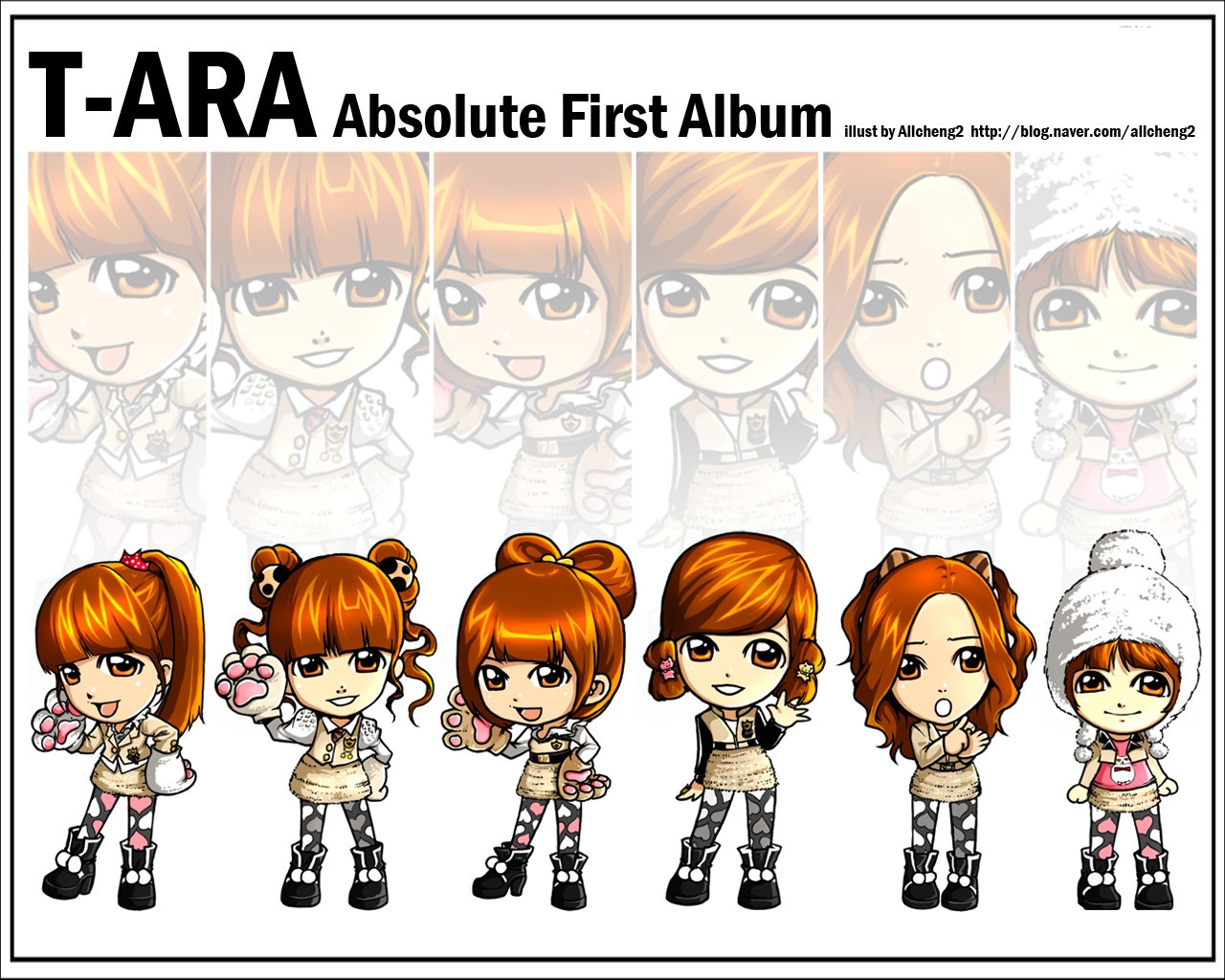
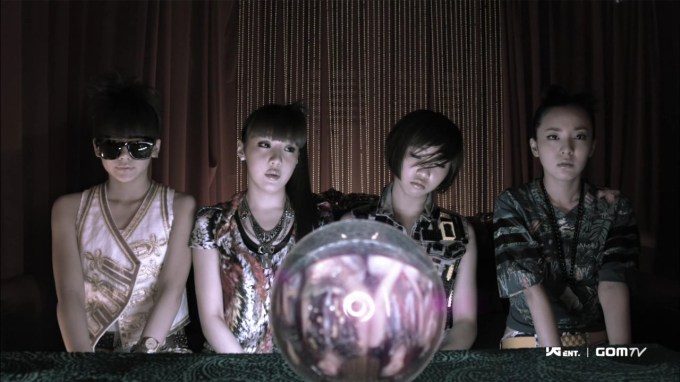
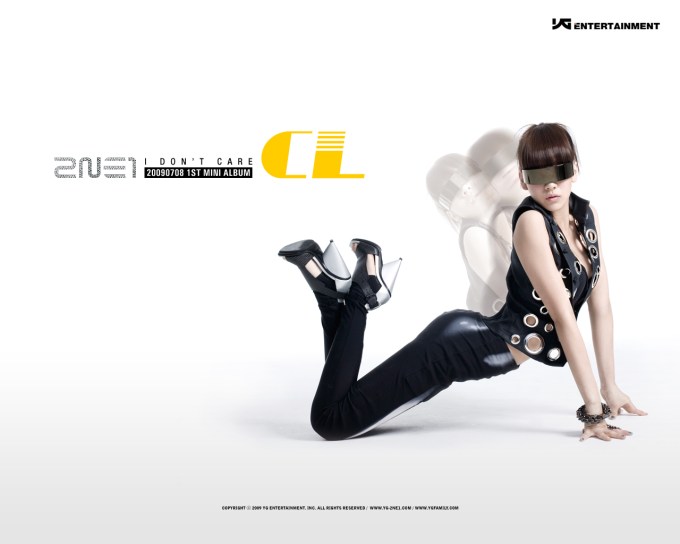
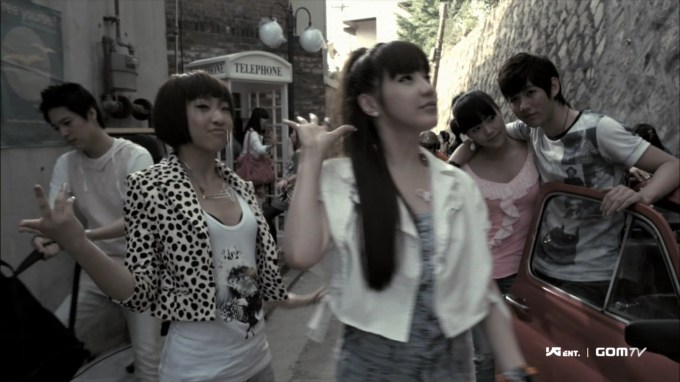
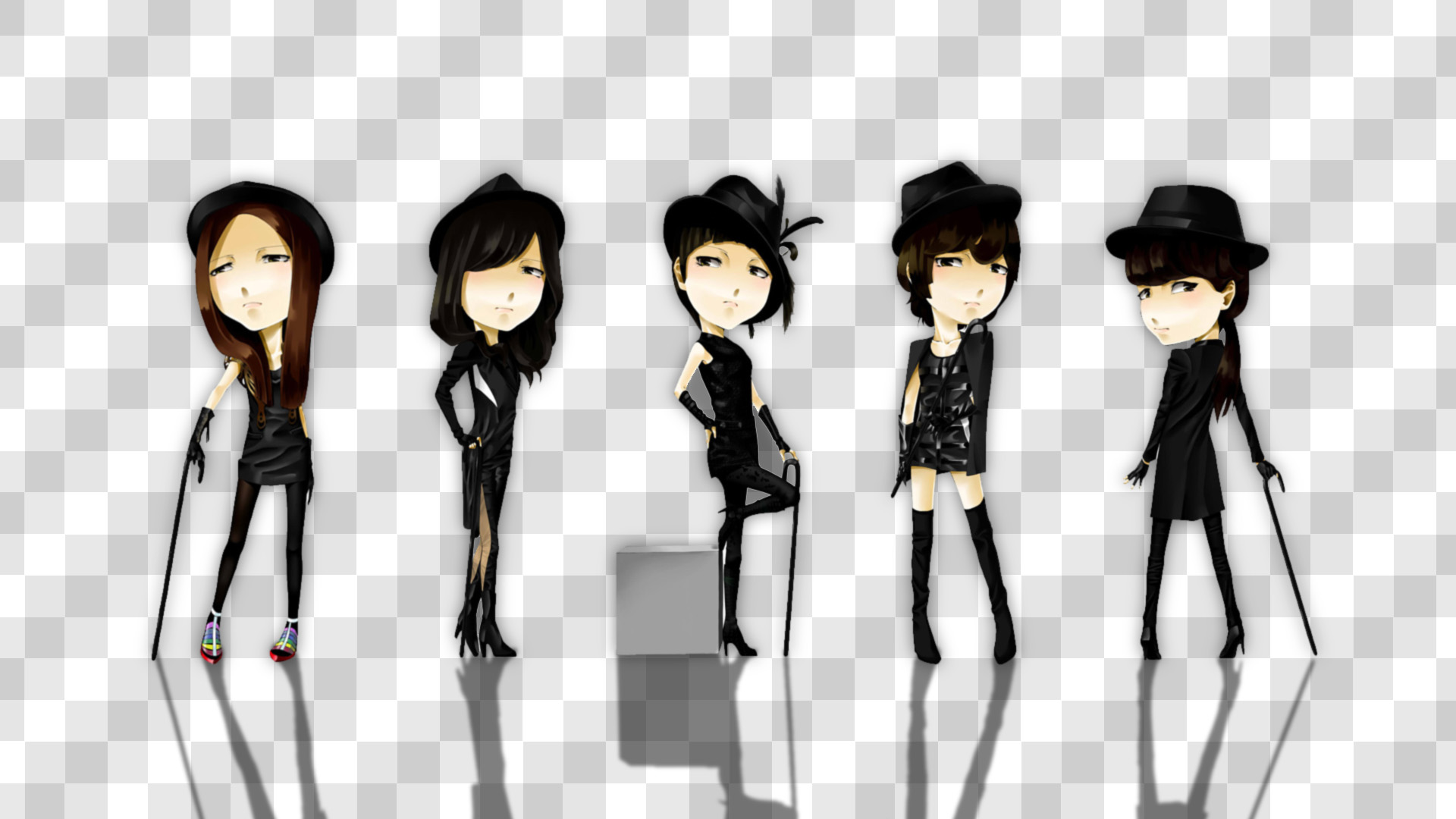
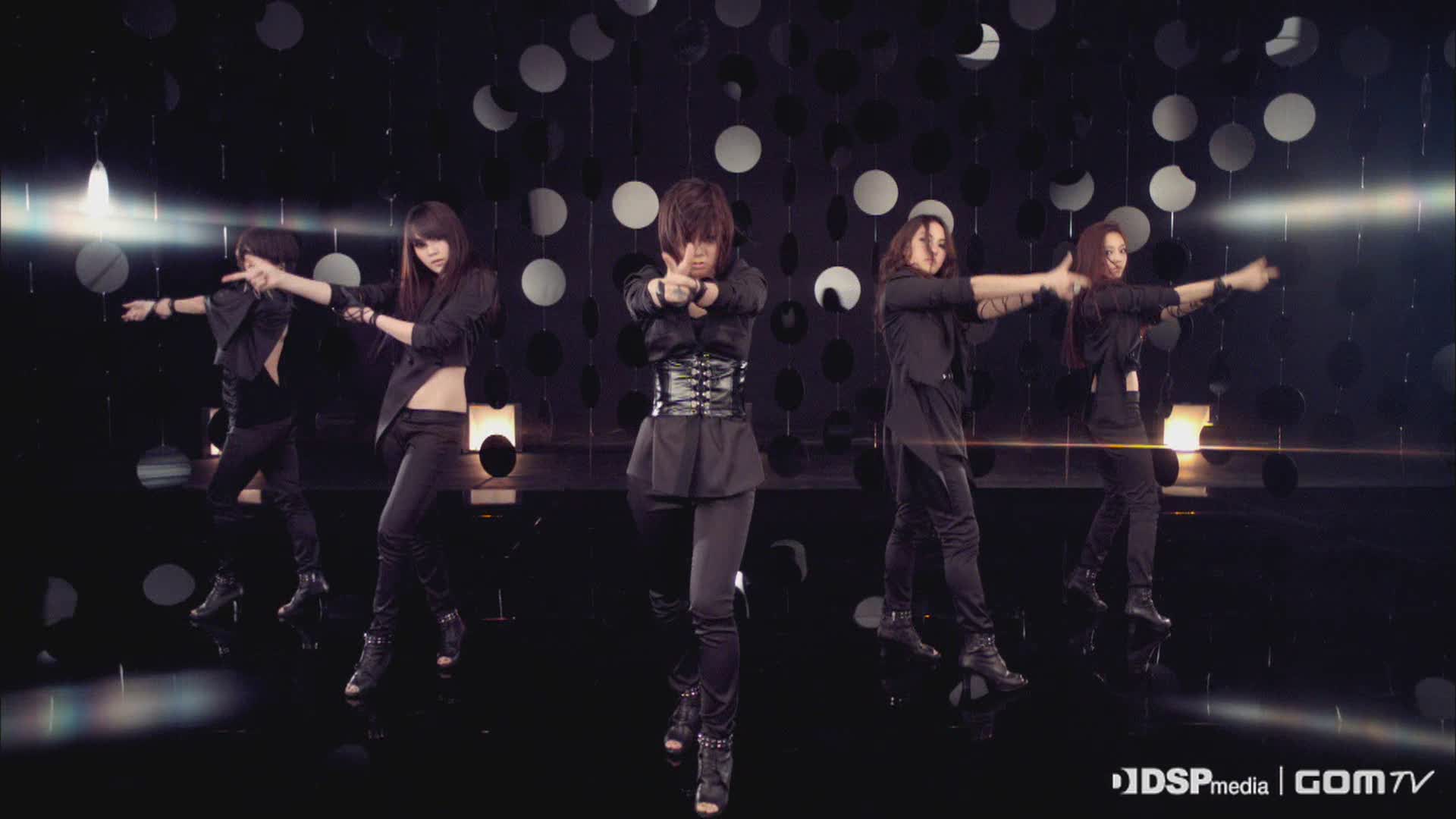
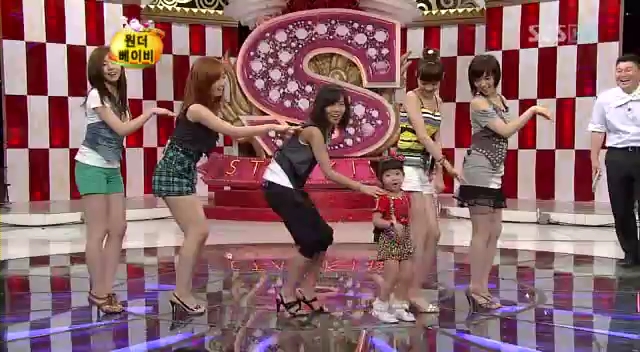
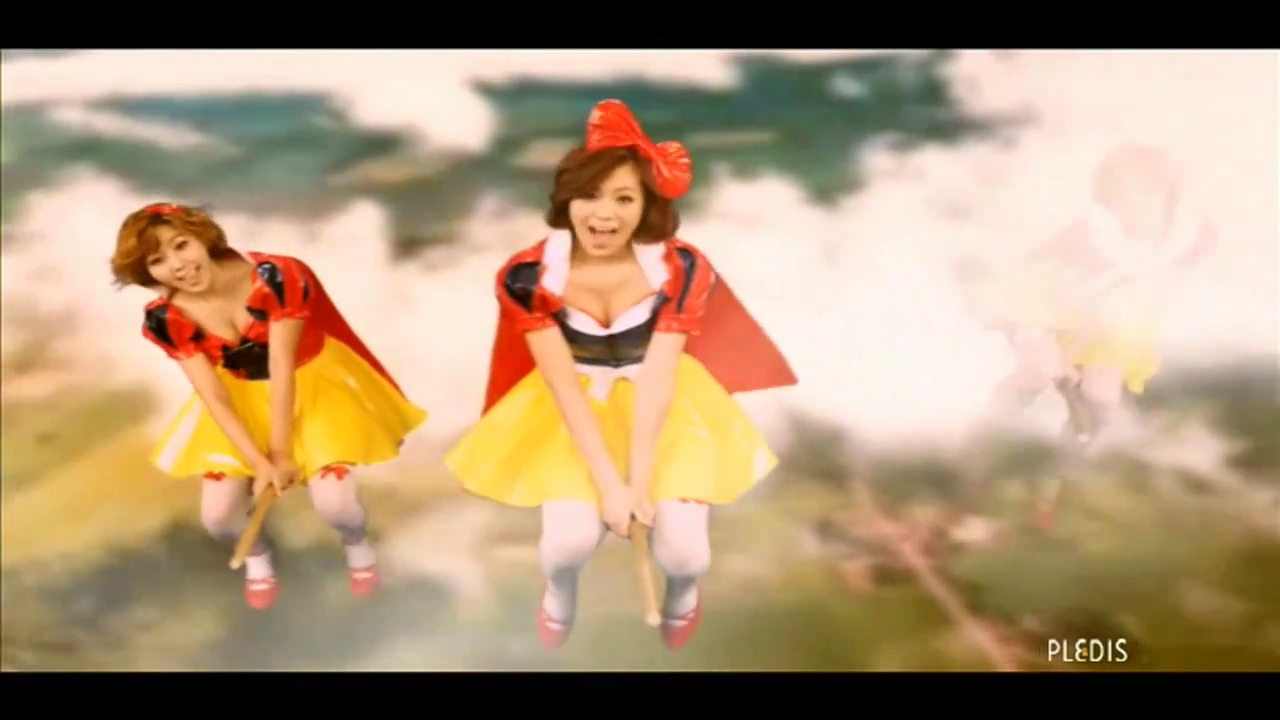
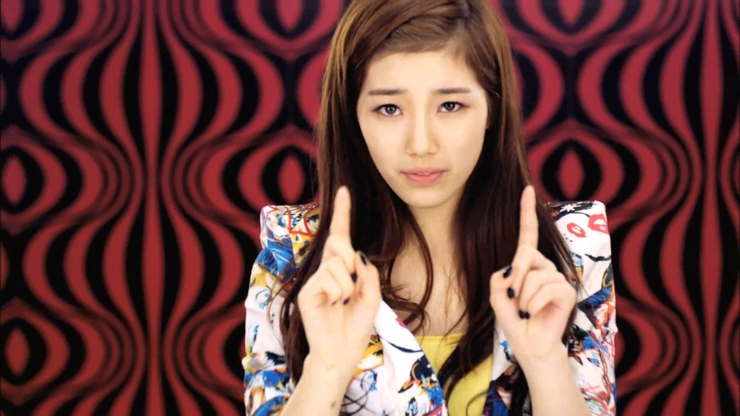
Like the First Time (처음처럼) by T-ara (티아라): Lyrics, Translation, & Explanation

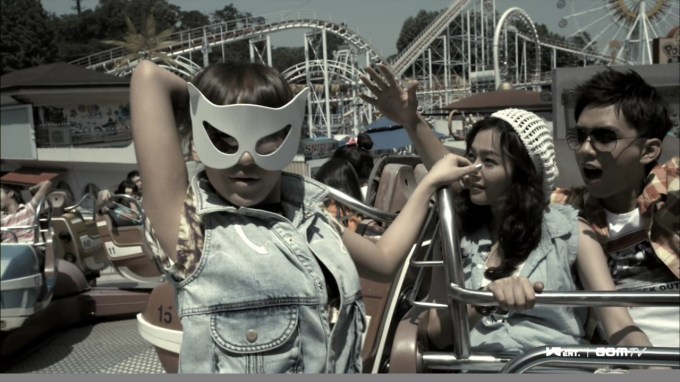
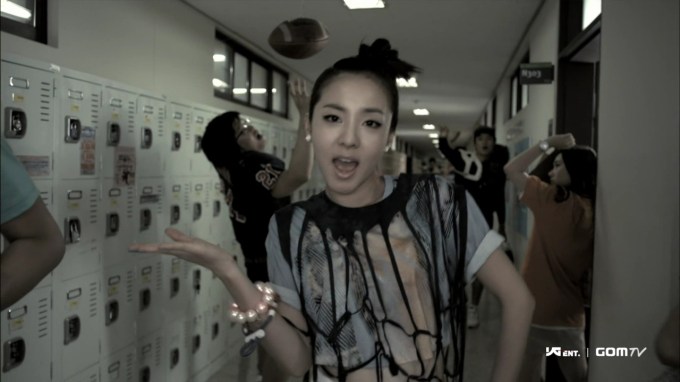
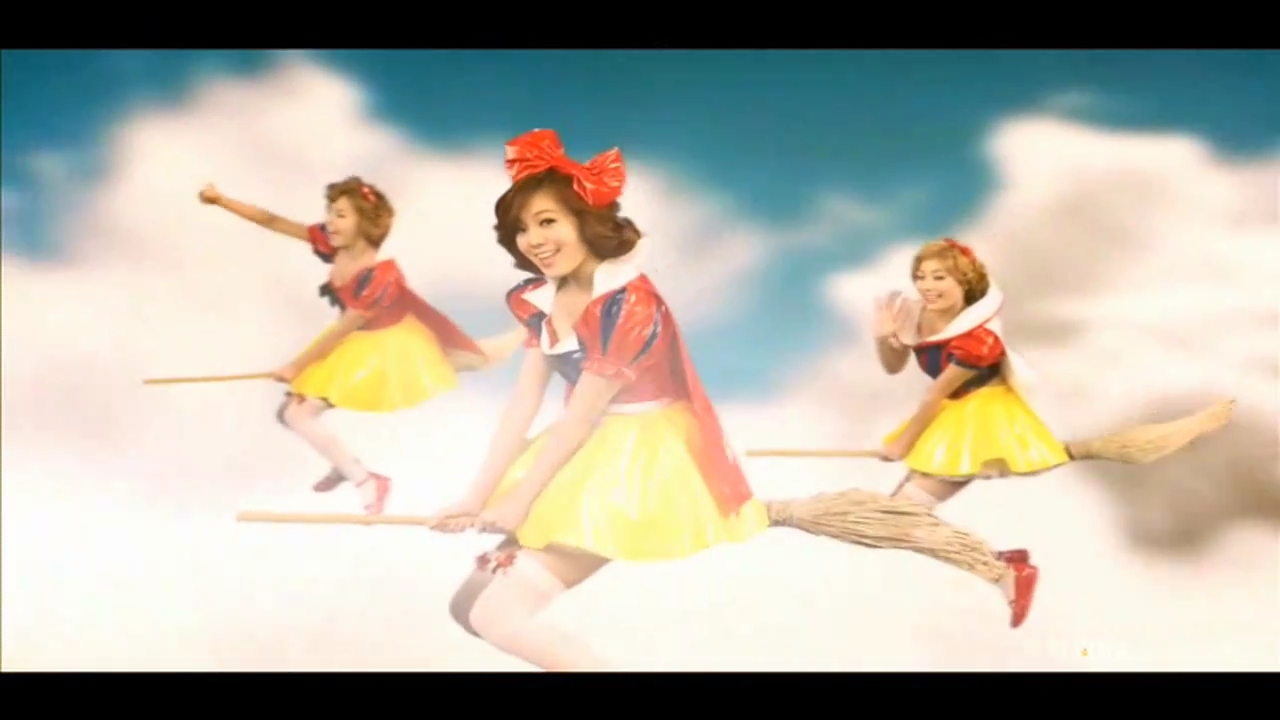
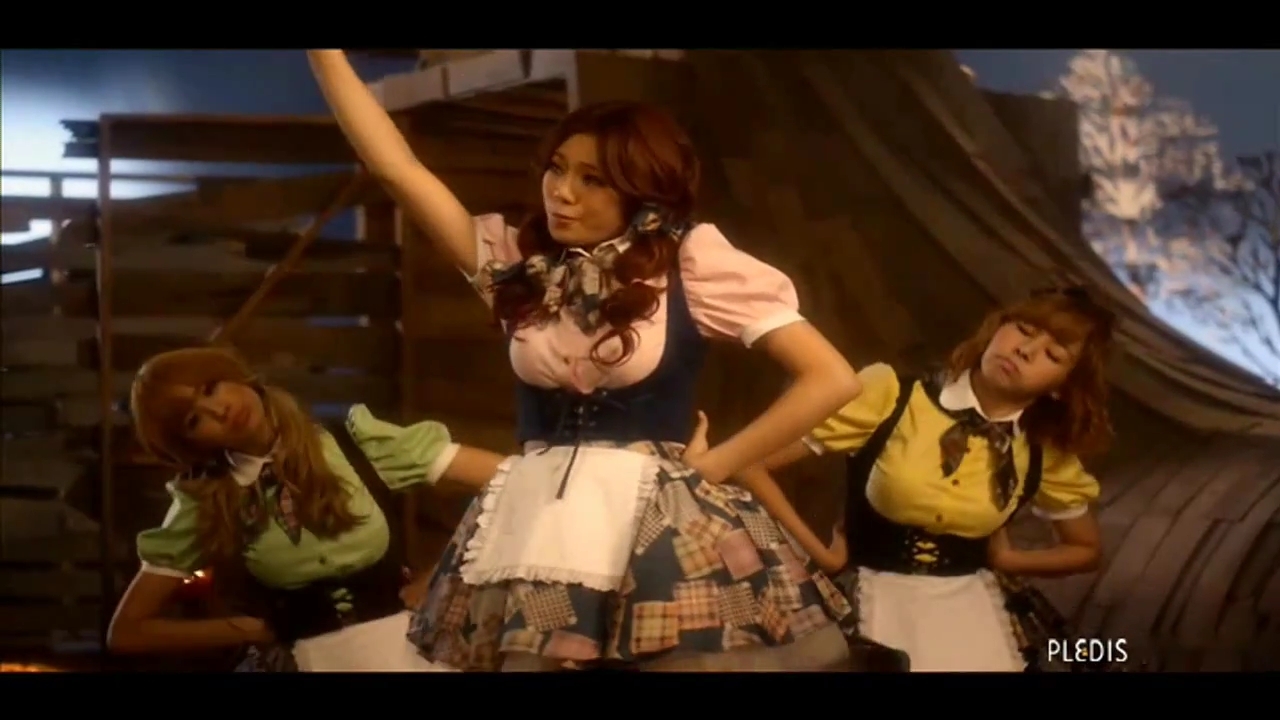
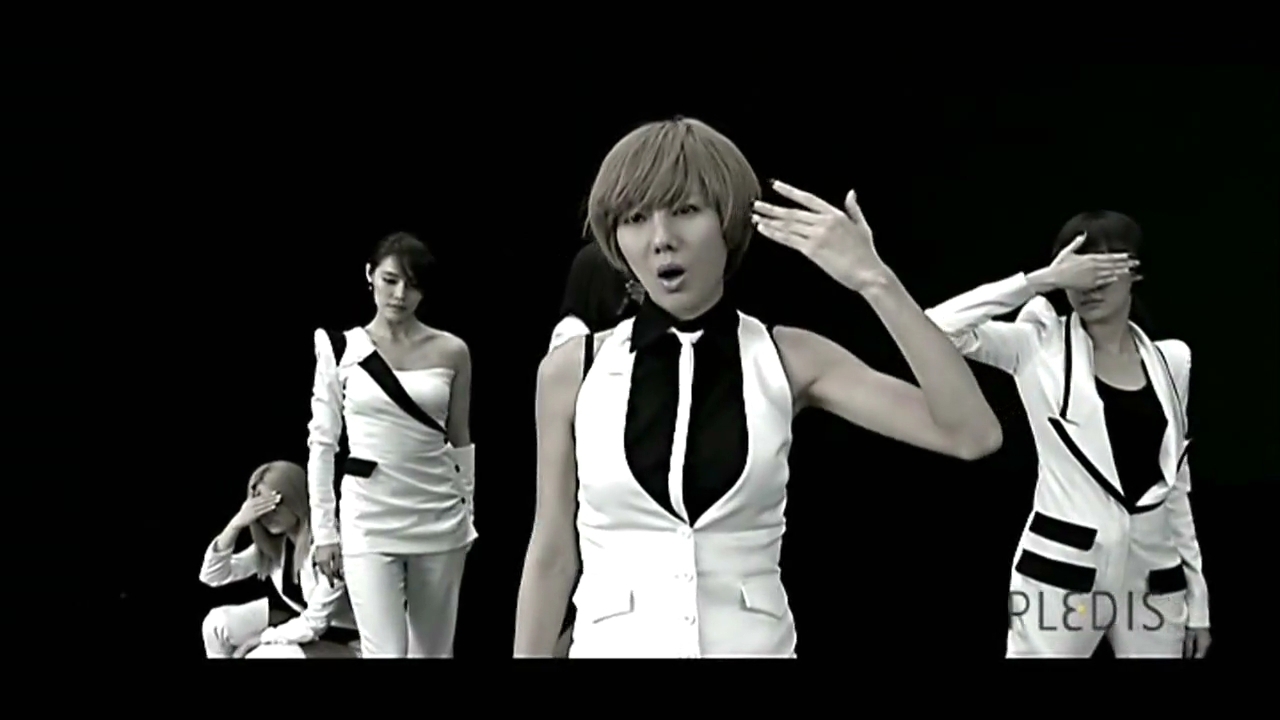
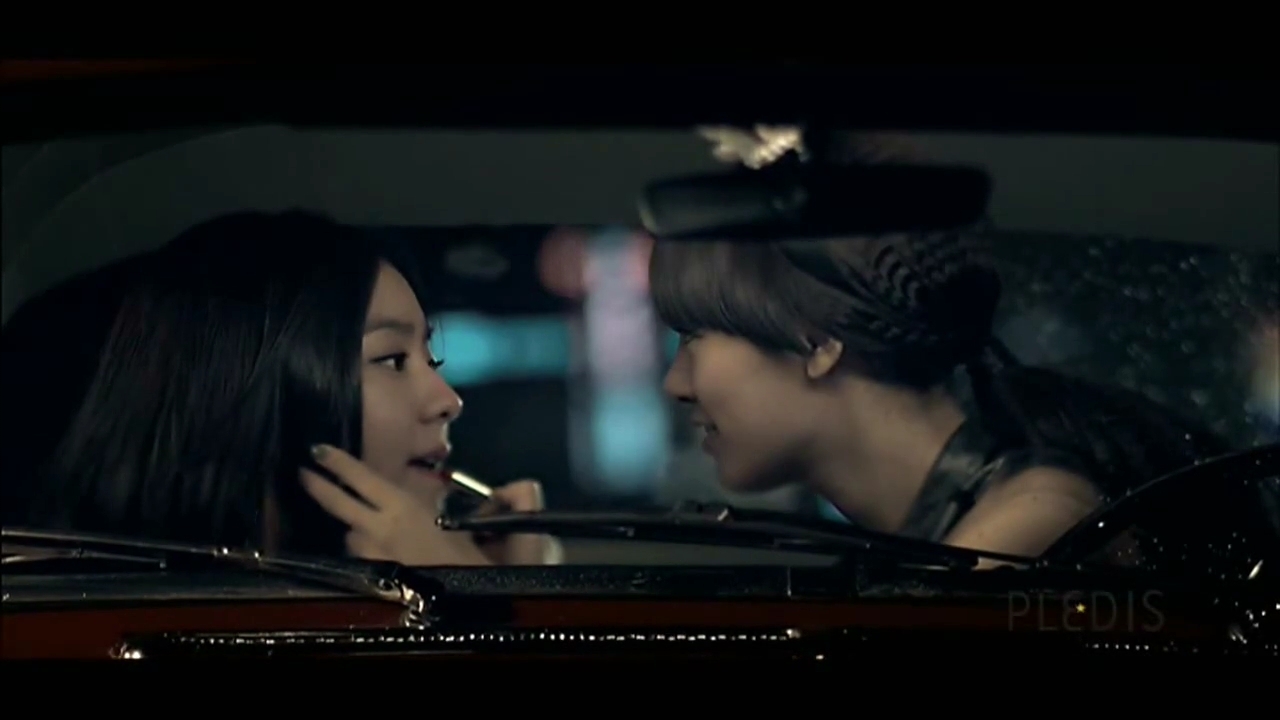
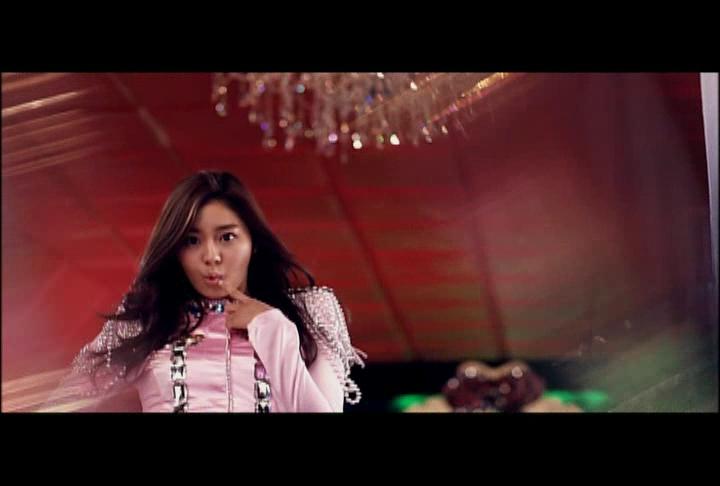
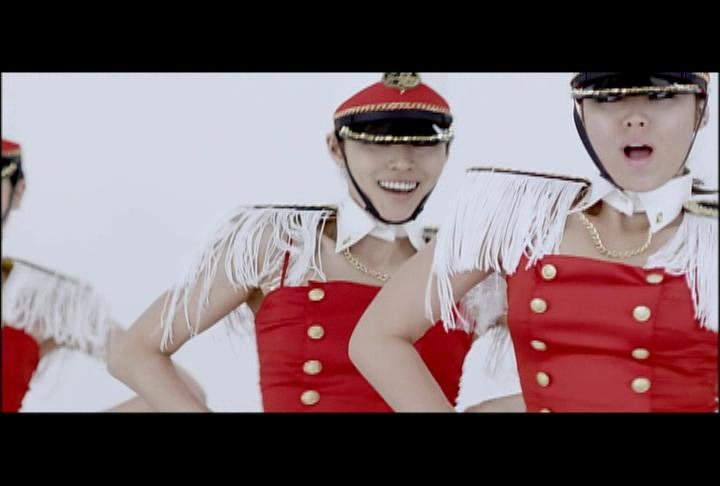
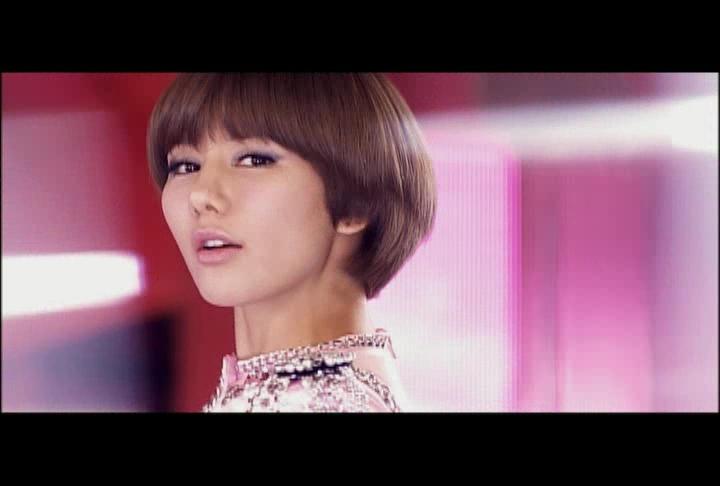
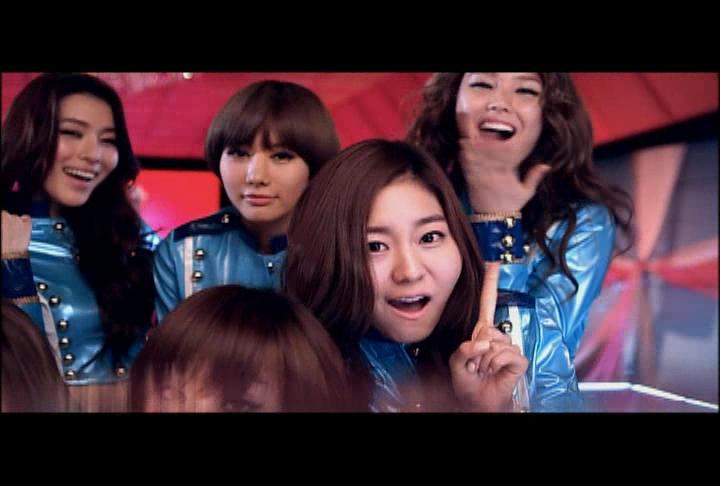
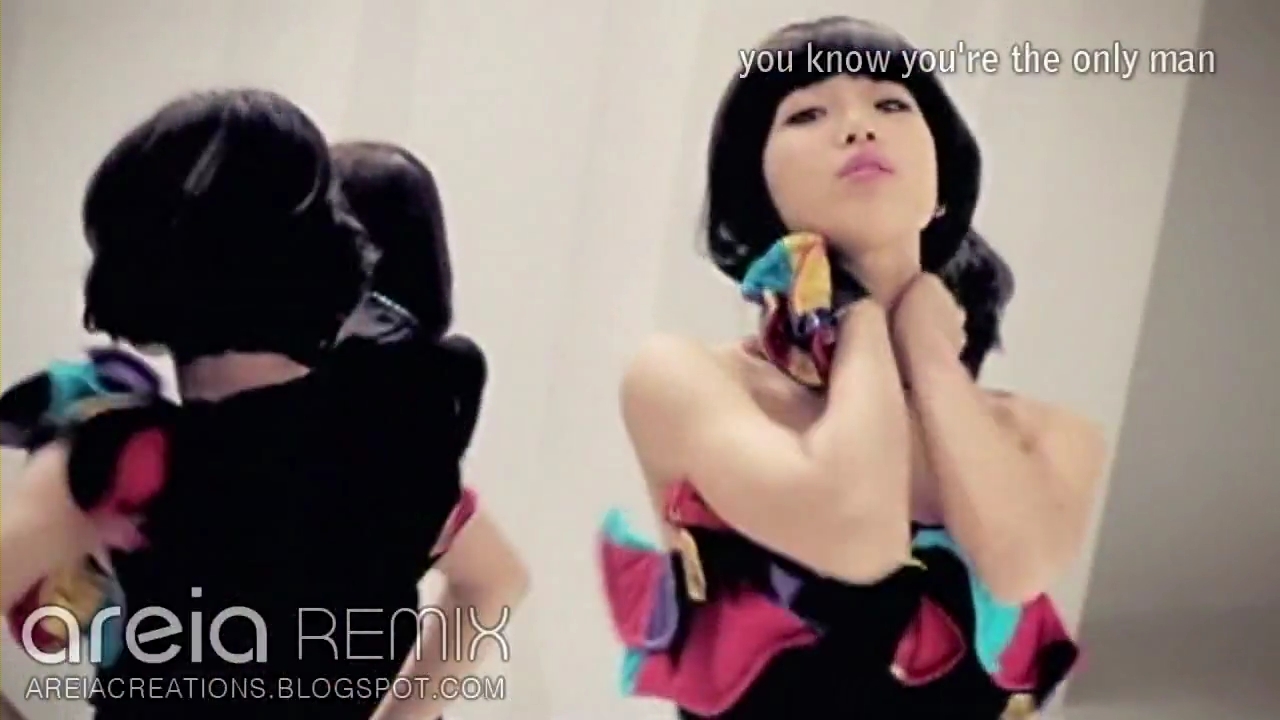
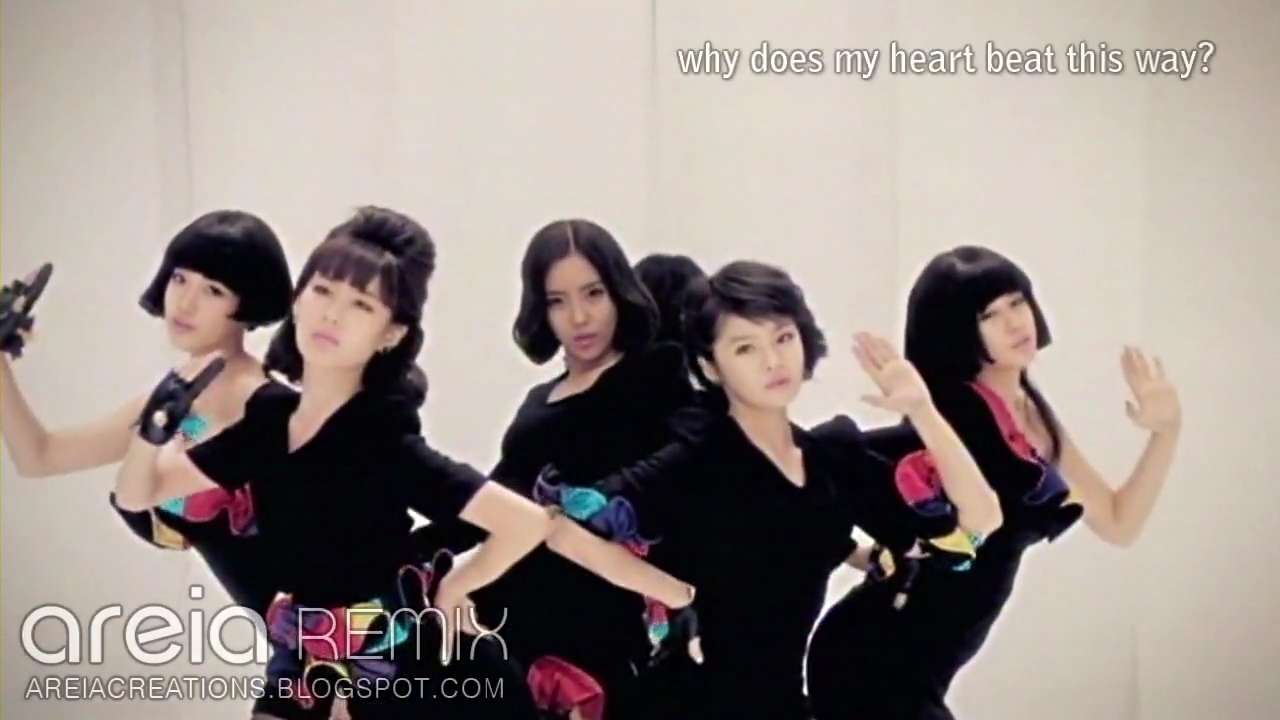
With lyrics designed to stoke any guy’s ego, and a music video full of eye-candy to boot, Like the First Time (처음처럼) by T-ara (티아라) is a very embarrassing song for a pro-feminist blogger to admit to liking.

Let alone have as his ringtone.

One of the handful of songs that got me addicted to K-pop though, then I’m guess I’m stuck with this peccadillo of mine. But in fairness, I wouldn’t have had it on my old, audio-only iPod for the past year if that’s all it could be be reduced to.

And in hindsight, is it really all that different to, say, You Look So Fine (1999) by Garbage, who to the best of my recollection have never been described as projecting an image of weakness and passivity?

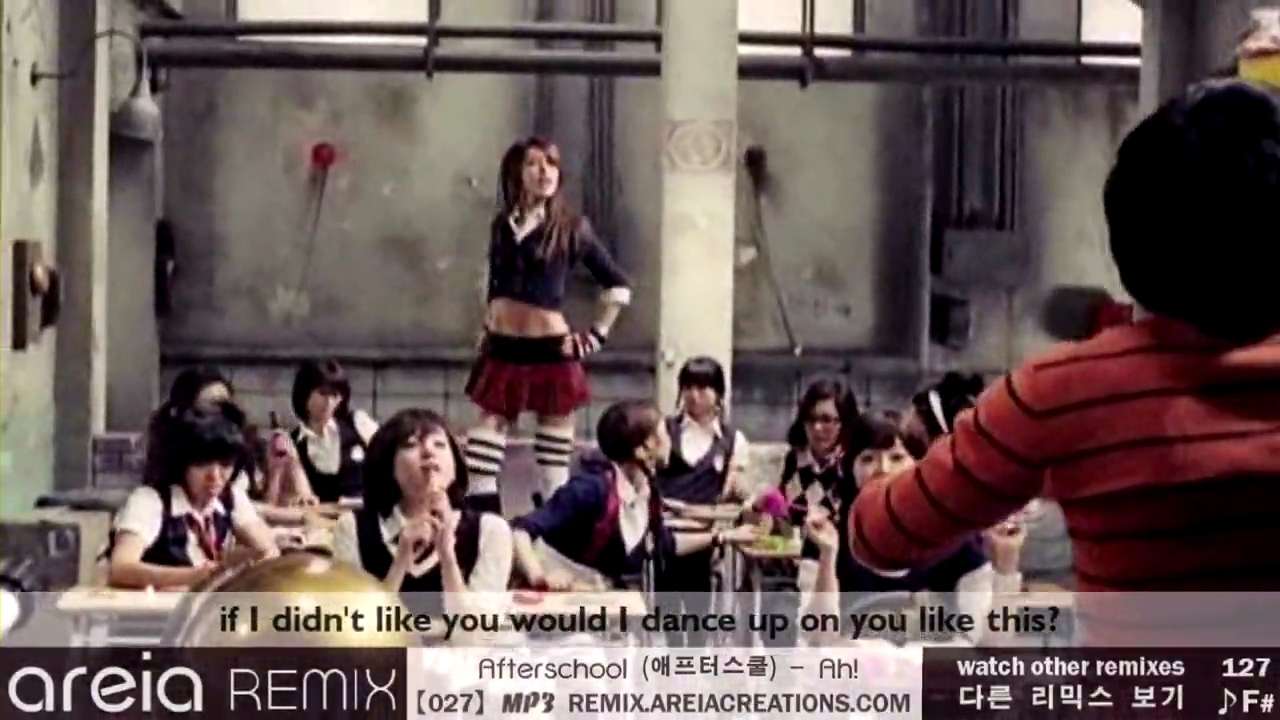
Either way, here’s the remix by DJ Areia that originally got me hooked (downloadable here):

And here’s the original, which for a change I like almost as much:

And here goes with the translation:

왜 자꾸 두근두근대죠 이 내 가슴이

왜 자꾸만 터 터질것 같죠 왜 자꾸만

왜 자꾸 숨이 가빠오죠 미칠것같이

왜 자꾸만 수 숨이 막히죠 왜 자꾸만

첫 사랑도 아닌데 순진한 건 아닌데

그댄 자꾸만 또 자꾸만 또 느끼게 해줘요

Why does my heart throb so often? Why does my chest

often feel like it’s going to burst? Why do I often keep

running out of breath? It’s like I will go crazy

Why do I often feel like I’m suffocating? Why so often?

This is not the first time I’ve fallen in love, I’m not innocent

You often again and again make me feel this way

Nothing too difficult here. First, as we’ve seen in just about every other song translation, again “만” doesn’t mean “only” but is just added for emphasis. Next, “죠”, short for “지요” is an ending meaning “right” that turns the sentence into a tag question, but I haven’t put it like that in the text because just like in English, tag questions often aren’t real questions, and clearly aren’t here (again, they just seem to be for emphasis). Finally, there’s the construction “~ㄹ 것 같다” which is used twice, and literally means ” [future tense]-thing-same [as]”, or effectively “it seems like/looks like/appears that … will do/be”; hence “Why does my chest often feel like it’s going to burst?” and “It’s like I will go crazy”, although admittedly the latter doesn’t sound that great in English.

One thing of great interest to me personally though, because it sort of came up in another translation, is the “오다” added to “가쁘다” in 3, with a tag question at the end added on top of that giving “가빠오죠”. Now “가쁘다” means “gasping [panting] for breath; difficulty in breathing”, but what does the “오다” (“come”) added to that do to it? Well, this is what I originally learned, from page 16 of the grammar and vocabulary guidebook that comes with 5A of the Sogang Korean series:
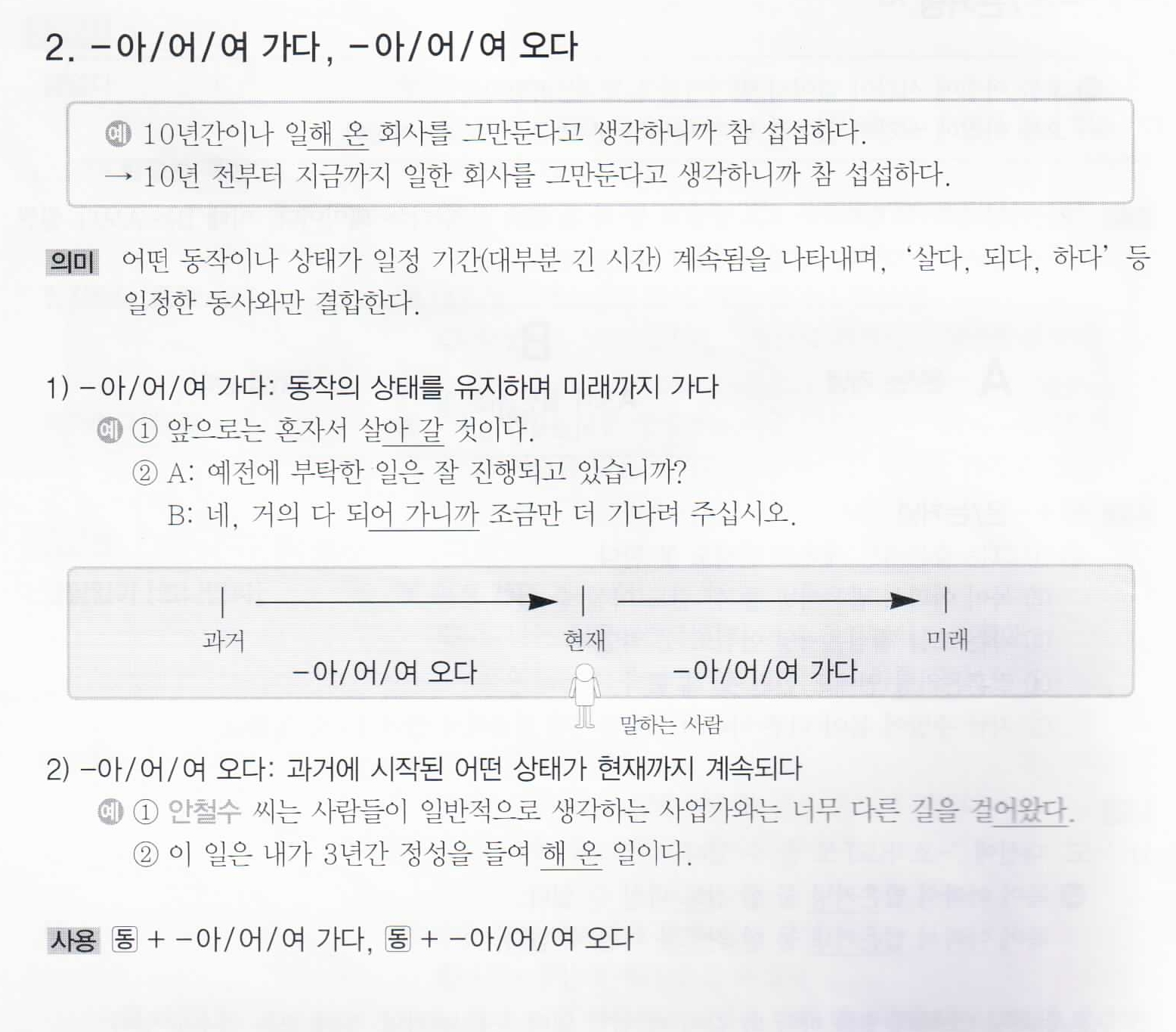
If you’d rather have an English explanation though, then this is what my trusty Korean Grammar for International Learners (KGIL) says on page 340:

When [“오다” & “가다” are] expressed as auxiliary verbs, they signify that an action is carried out continuously and repeatedly over a period of time. In keeping with the original meaning of these verbs, the patterns [above] mean “continuous performance of an action over time in the past as one comes toward the ‘present and continuous’ performance of an action over time into the future (away from the present)” respectively.

Quite a mouthful unfortunately, which I think it could be better edited (I’m sure an “and” is missing in it), and I think the above diagram is a must to make any sense of it! But hopefully, now you can see why I chose “Why do I often keep running out of breath?” for “왜 자꾸 숨이 가빠오죠” at least, rather than “Why do I often run of breath?”. Granted, they effectively mean the same thing, and “Why do I keep running out of breath” would sound better in English (like in the translation in the video). But with the “자꾸” is  still in the Korean unfortunately, then I’ll allow it to awkwardly remain in the English too (and same logic goes for line 6).
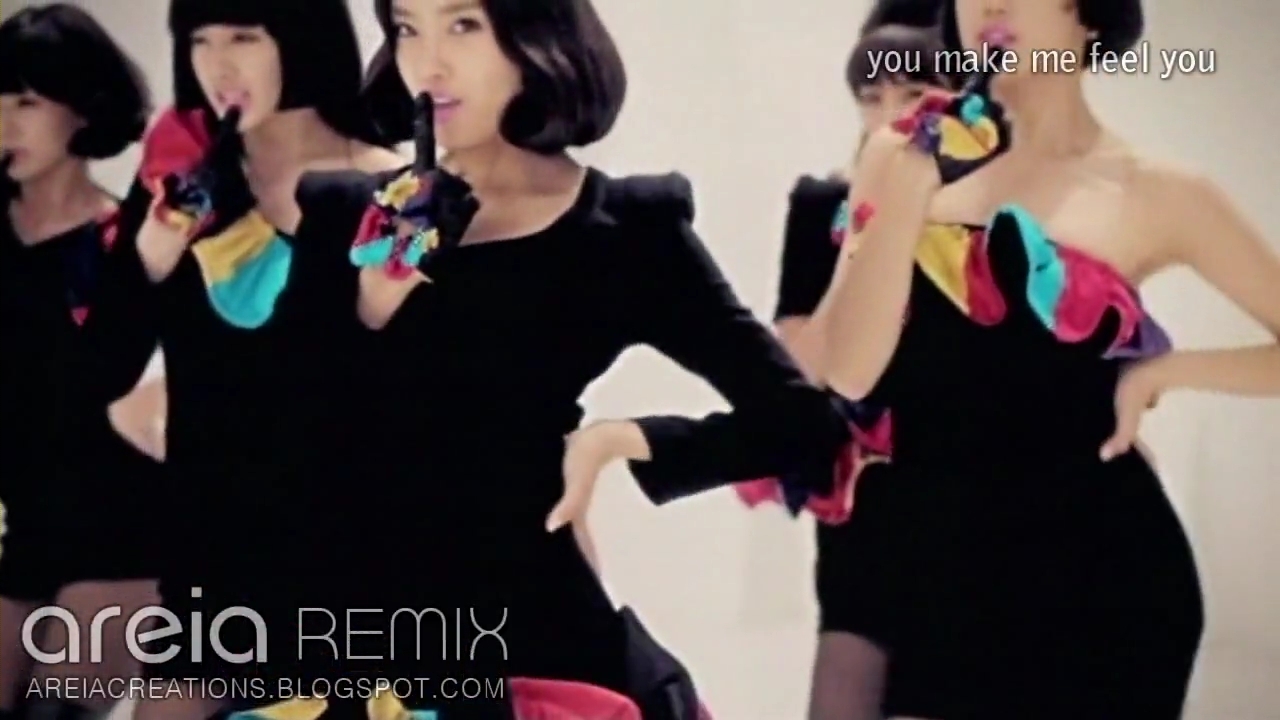
그댄 나를 기쁘게 해요 그댄 나를 느끼게 해요

처 처음처럼 처 처음처럼 처 처음처럼

그댄 나를 미치게 해요 자꾸자꾸 원하게 해요

처 처음처럼 처 처음처럼 처 처음처럼

처 처음처럼처럼처럼 처럼처럼처럼처럼

처 처음처럼처럼처럼 처럼처럼처럼처럼

처 처음처럼처럼 처처처처럼처럼

처럼처럼처럼처럼 처처처처처음처럼

You make me feel happy You make me feel you

Like the first time Like the first time Like the first time

You make me feel crazy I want you again and again

Like the first time, like the first time…(etc)
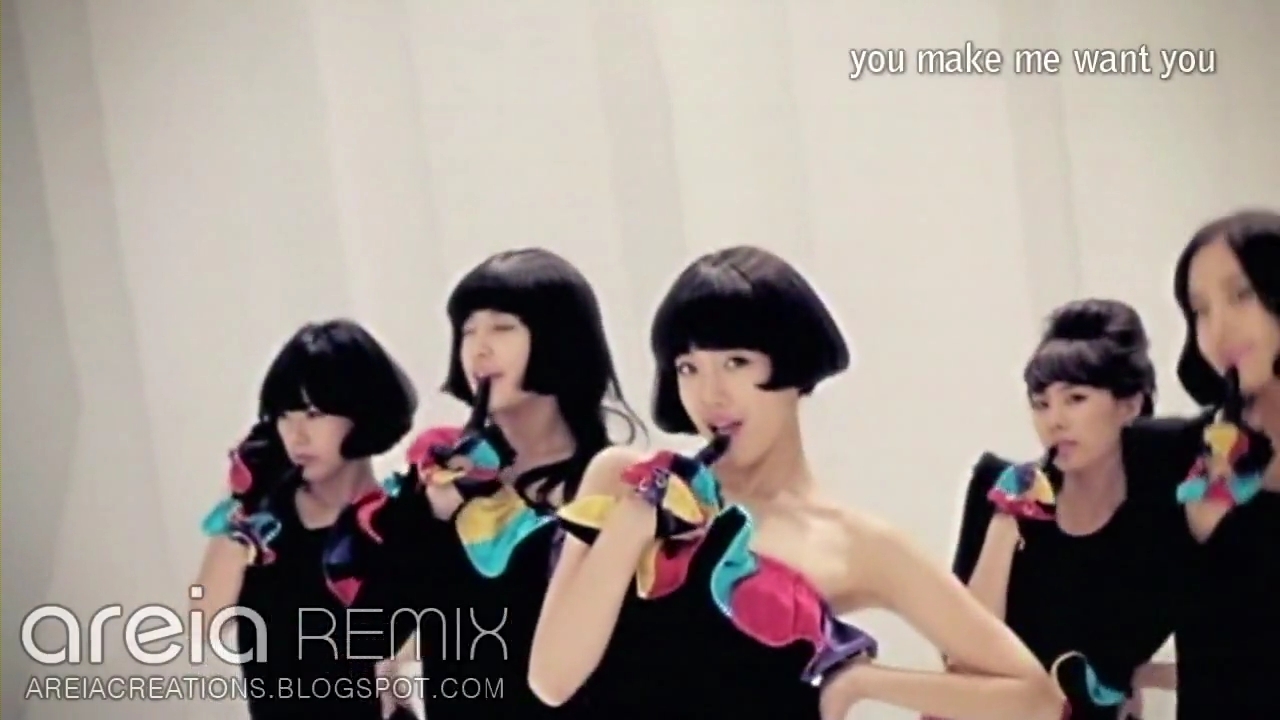
Easy as, but it’s just impossible for me to do a literal translation and keep a straight face sorry: for instance the first line would be “As for you – me – joyfully – do” then “As for you – me – feelingly – do”…gotta love the way Korean uses adverbs. More seriously though, I don’t think “기쁘다” should ever be translated as “joyfully” in English (the first entry in Korean dictionaries, but used by precisely zero native speakers), and it’s a red flag for me for any translator that does.

After that, I think “again and again” is more appropriate than the literal Korean “often often”.

왜 자꾸 열이 나는 거죠 온몸이 자꾸

왜 자꾸만 다 달아오르죠 왜 자꾸만

왜 자꾸 아찔아찔 하죠 정신이 없어

왜 자꾸만 주 죽을것 같죠 왜 자꾸만

사랑 사랑 지금껏 말로만 했던건지

그댈 만나고 난 느껴요 난 진짜 사랑이 뭔지

Why do I often get this fever, Why does my whole body

often burn, Why do I often

get so dizzy and lightheaded, It’s crazy

Why is it often like I’m going to die, Why did I often

love through only words before now

After meeting you I feel it, I [know] what real love is

Again easy, but it’s difficult to know where one clause and/or sentence begins and the other ends, although of course the resulting numerous translations would all pretty much amount to the same thing.

Just 3 things of note. First, that although “정신이 없어” on line 3 is literally “without a mind”, “mindless”, or “absent-minded”, and that it’s especially tempting to translate it in that vein given the context of the “왜 자꾸 아찔아찔 하죠” before it (“Why do I often get so dizzy and lightheaded”), in reality it’s most often said to express one’s annoyance at some crazy and/or untenable situation. Like me trying to write this post with two toddlers literally climbing all over me and the desk demanding to listen to KARA for instance, or both of them bawling their eyes out when I tell them 5 times every other night is quite enough.

Next, the “주” in “왜 자꾸만 주 죽을것 같죠” on line 3 (“Why is it often like I’m going to die”) is just to emphasize to the “death” part (“죽다”).

Finally, in line 6 the “건지” in “했던건지” had me stumped for a little while. The “던”, of course, refers to “recollection of a state in the past, or of a repeated, habitual, or uncompleted action in the past”, and the “~았/었/였” form before that “gives clearer expression to the notion of ‘completeness’ and also expresses experience” (KGIL, pp. 318-19), but “건지”? Then I realized it was short for “것인지”, or literally “thing-is-yes?”, another way of saying “I guess”.
그댄 나를 기쁘게 해요 그댄 나를 느끼게 해요

처 처음처럼 처 처음처럼 처 처음처럼

그댄 나를 미치게 해요 자꾸자꾸 원하게 해요

처 처음처럼 처 처음처럼 처 처음처럼

처 처음처럼처럼처럼 처럼처럼처럼처럼

처 처음처럼처럼처럼 처럼처럼처럼처럼

처 처음처럼처럼 처처처처럼처럼

You make me feel happy You make me feel you

Like the first time Like the first time Like the first time

You make me feel crazy I want you again and again

Like the first time, like the first time…(etc)
No explanation: that’s the chorus again!

(Source)

리무진에 champagne bling bling jewelry chain

나를 원해 목이 메인 그런 남자 oh no

항상 발길에 채이는 그런 남잔 just pain

Don’t wanna play this game 꺼져버려 이젠

Now I wanna pump up my gain this is about a man

You know you’re the only man 넌 나를 너무 잘 알기에

나를 기쁘게 기쁘게 기쁘게 해줘

나를 느끼게 느끼게 느끼게 해줘

Limousine champagne bling bling jewelry chain

I don’t want a man who wants me so badly he chokes oh no

I don’t want a man who always gets pushed around by a woman just pain

Don’t wanna play this game Get lost now

Now I wanna pump up my gain this is about a man

Now I wanna pump up my gain this is about a man Since you know me so well

You make me happy happy happy

You make me happy happy happy

(Source)

Finishing the translation of this song late last night, and composing an introduction to (hopefully) pique your interest as I fell asleep, then that was the first thing I wrote this morning. In hindsight though, it’s a little frivolous for how provocative this verse is.

In particular, lines 2 & 3. But as they were also the hardest parts of the song to translate, then I’ll keep the introduction as it is for now just in case I’ve misinterpreted them.

The difficulty was because at first, little things meant that they were quite different to what you’d expect given the rest of the song. For instance, there’s a phrase “사랑에 목을 메다”  which means you’re very in love with someone, so much so that you’re sort of hanging around their neck all the time. But then in line 2 it’s not actually  “목이” but “목을”, and “목을 메다” means “choke”.

With that in mind, then “나를 원해 목이 메인 그런 남자” literally gives “me-want-choke-kind of-man”, which was very very easy to interpret as “a man that wants to choke me”. But to put it mildly, that raised alarm bells. Instead, there’s really 2 clauses here “나를 원해” and “목이 메인 그런 남자”, giving “me-want”  and “choke-kind of-man”, and cobbling those together I came up with “I don’t want a man who wants me so badly he chokes”.

That seemed out of place, but it made sense in the context of line 3, “항상 발길에 채이는 그런 남잔” literally being “always-a kick-get kicked-kind-of-man”, but which I interpreted as “always-gets kicked [pushed around]-kind of-man”, and presumably by his female partner. The English “just pain” cobbled on the end of that though, is probably just virtually random English, and too much shouldn’t be read into it.

Taken all together then, then there’s a huge double standard: the female protagonist is free to feel powerless in wake of her desire for her man, but a man that feels the same way about her, and is prepared to spend a lot of money on and get pushed around by her to win her heart? That’s unacceptable.

Which is fine I suppose. But why I say the verse is provocative though, is that given the context of the woman’s weakness and passivity in the song as a whole, then I’m left with the uneasy feeling that she at least wouldn’t mind if things were reversed. That she wants to be dominated by him.

What do you think? Is there something to that, or should I reconsider after having my second coffee?

Either way, that’s it, but for the chorus again:

(Source)

그댄 나를 기쁘게 해요 그댄 나를 느끼게 해요

처 처음처럼 처 처음처럼 처 처음처럼

그댄 나를 미치게 해요 자꾸자꾸 원하게 해요

처 처음처럼 처 처음처럼 처 처음처럼

처 처음처럼처럼처럼 처럼처럼처럼처럼

처 처음처럼처럼처럼 처럼처럼처럼처럼

처 처음처럼처럼 처처처처럼처럼

처럼처럼처럼처럼

You make me feel happy You make me feel you

Like the first time Like the first time Like the first time

You make me feel crazy I want you again and again

Like the first time, like the first time…(etc)

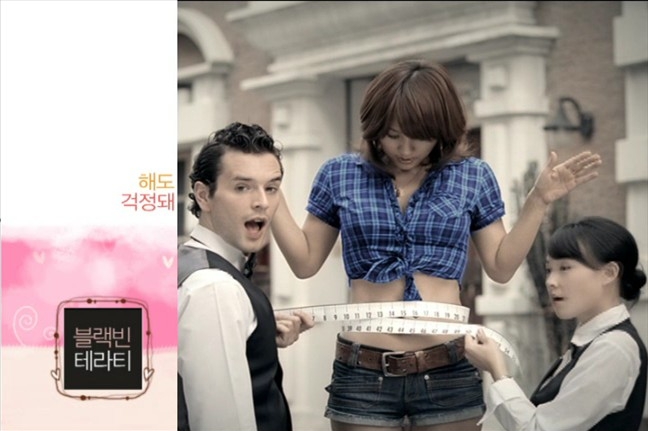
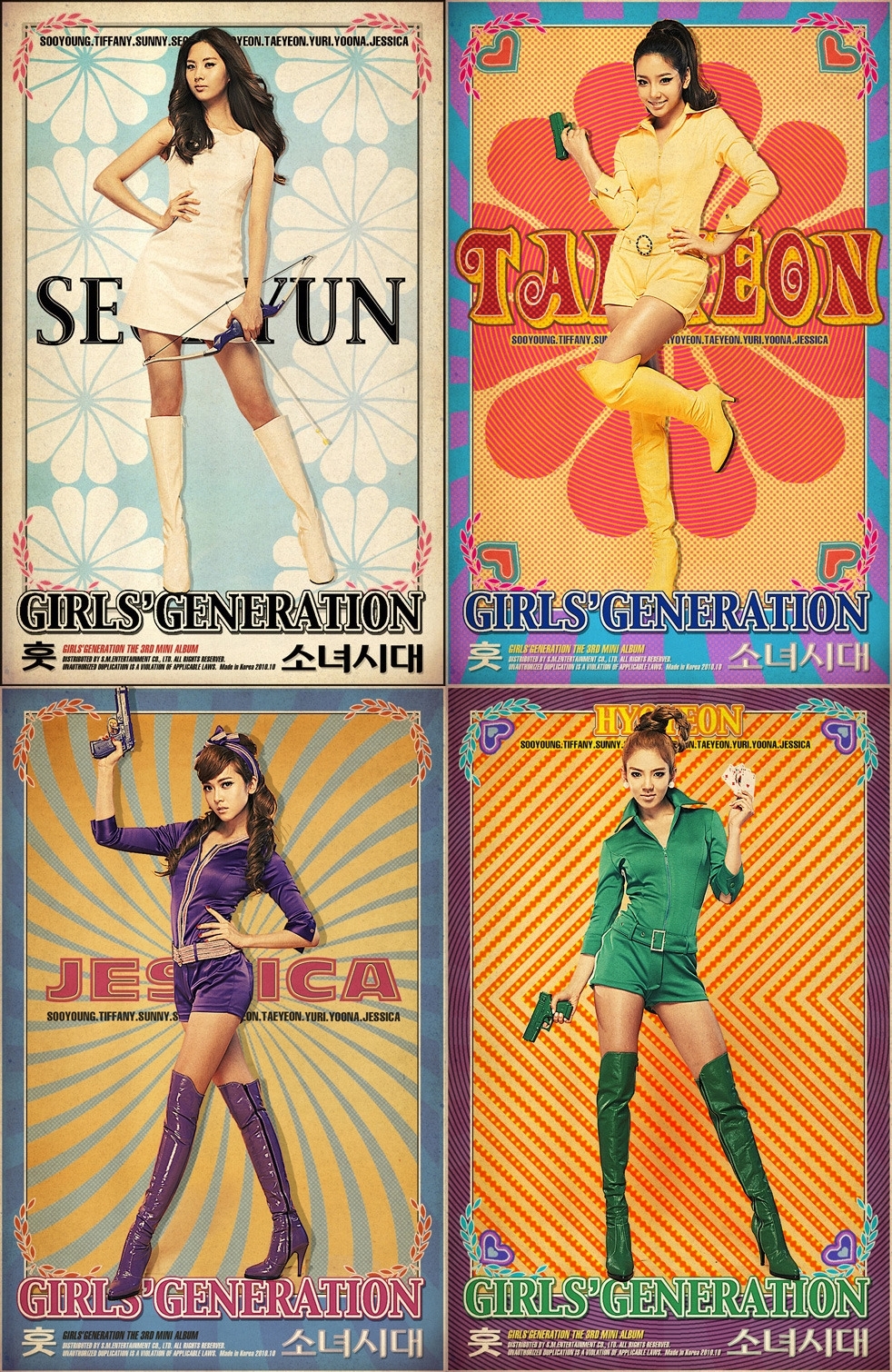
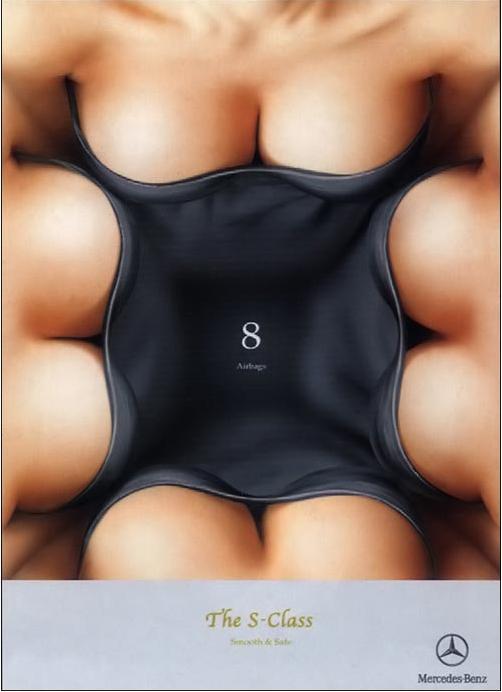
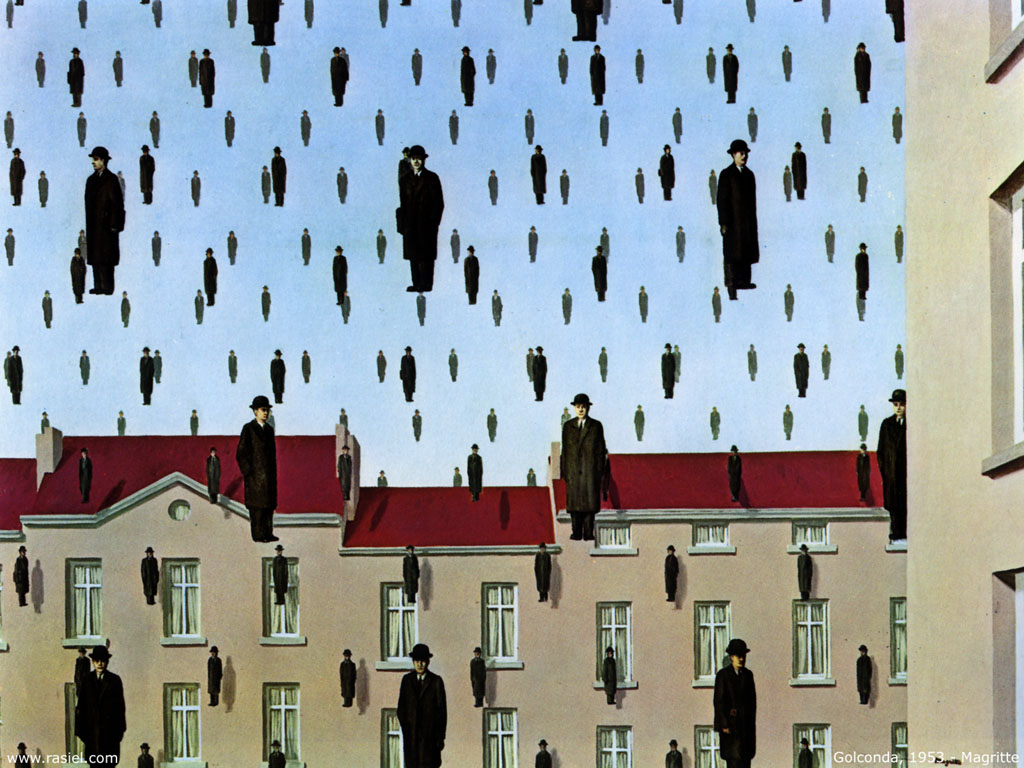
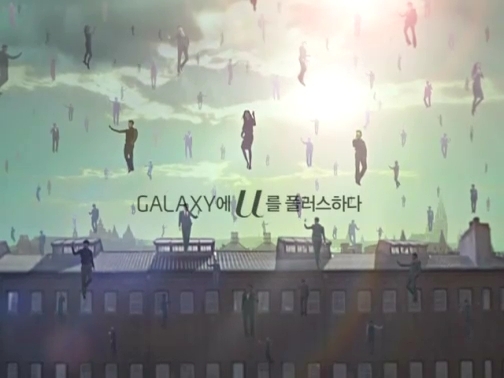
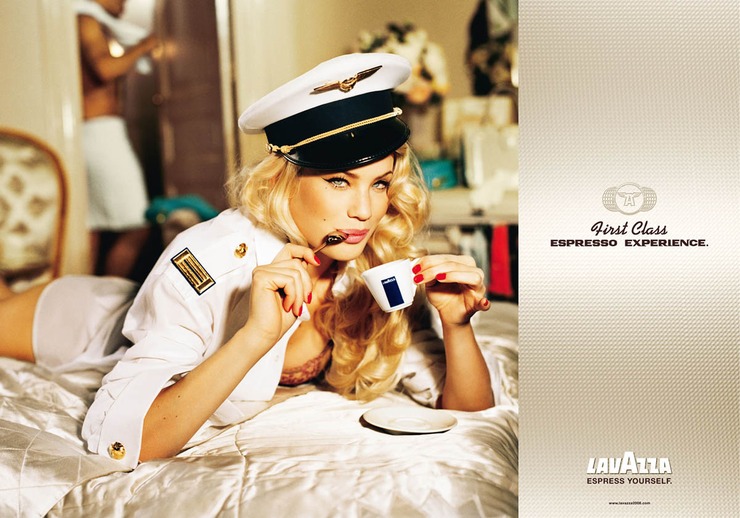
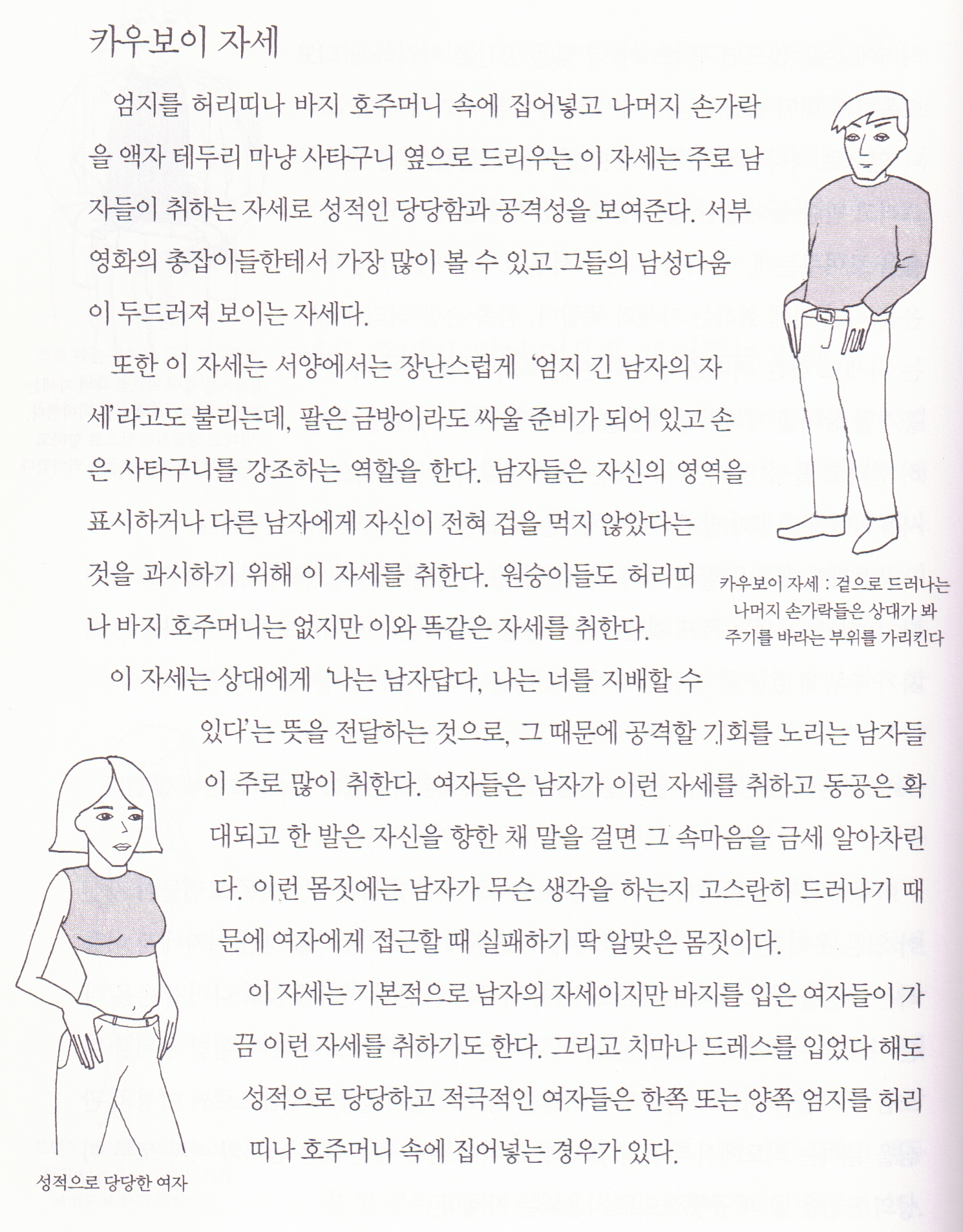
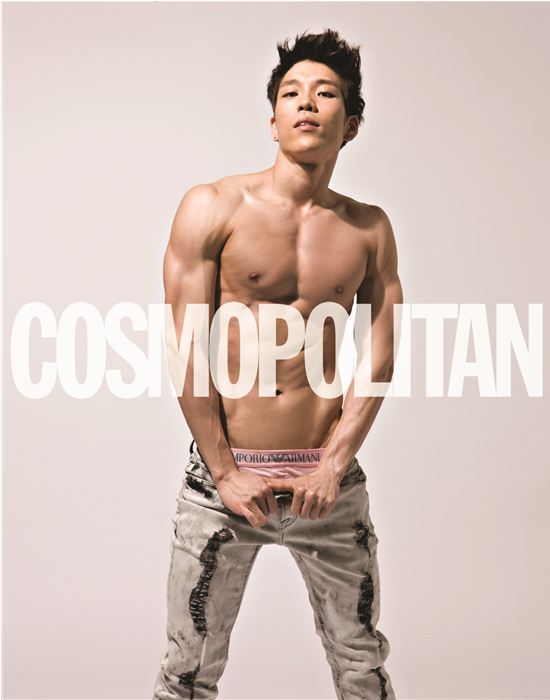
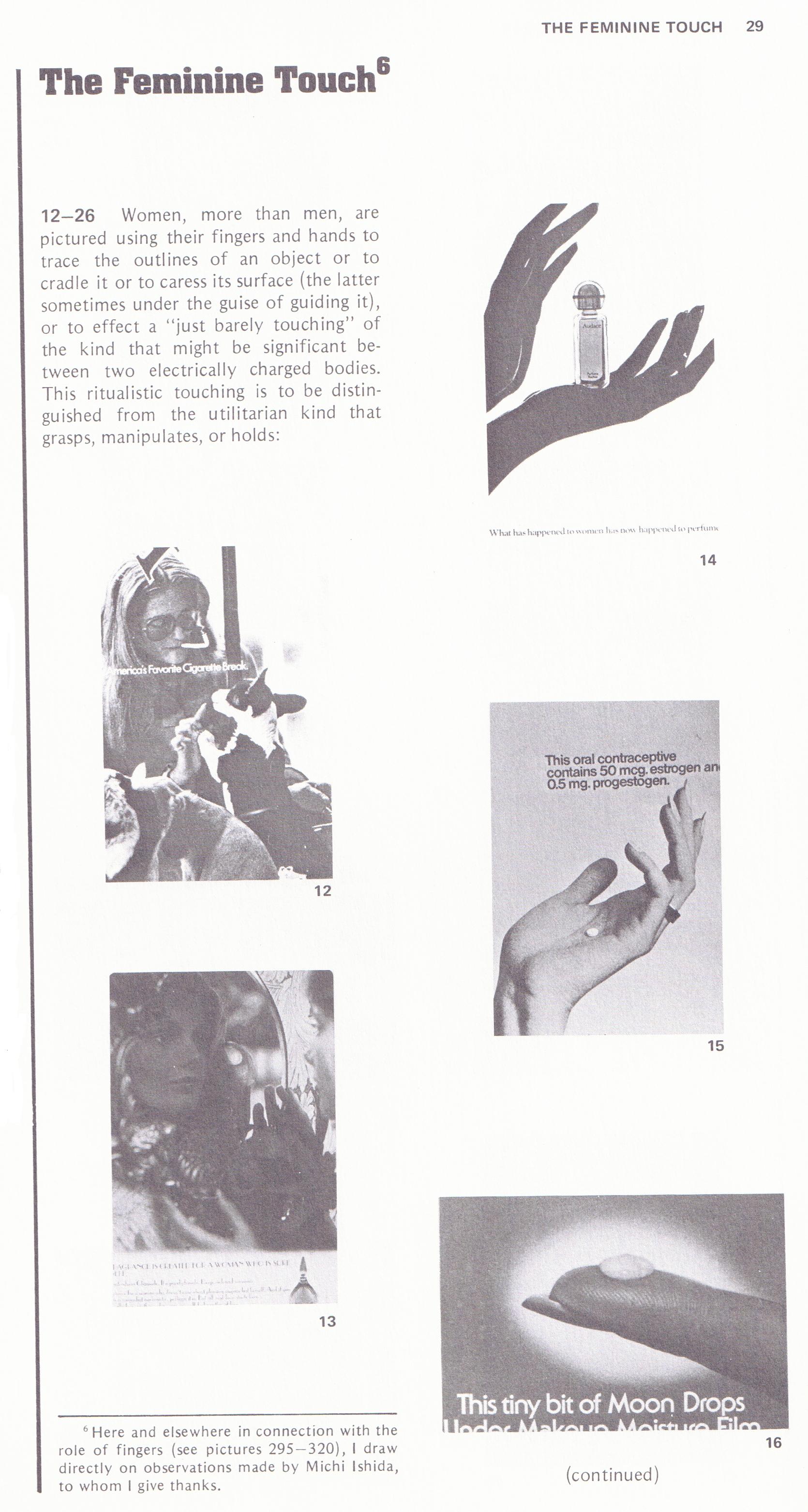
For more on T-ara and (indirectly) this song and the surreal ads above, see here and here. Meanwhile, for those of you that like your K-pop gossip, netizens are very concerned about Hyo-min’s (효민) recent excessive weightloss, the main character in the music video.

Next song to be translated: Oh! (오!) by Girls’ Generation (소녀시대), with a very similar narrative to this one.

Share

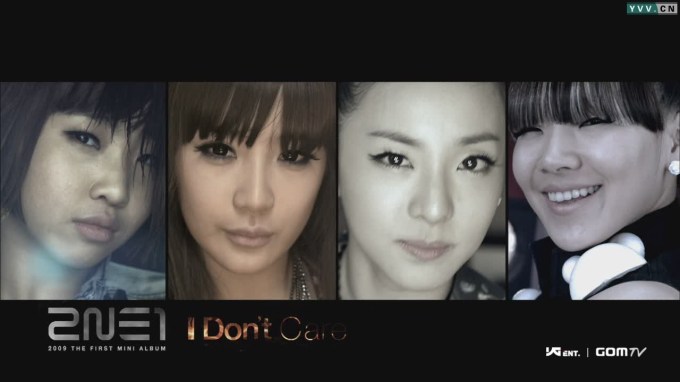
I Don’t Care by 2NE1 (투애니원): Lyrics, Translation, & Explanation

( Source )

Seems like everyone was really disappointed with Korean girl groups in 2010, and for good reason.

It’s kind of embarrassing then, that it was also the year that I first got into them. But still, I too was struck by how many of their members couldn’t even sing, and soon resolved to stick to the original tracks and official music videos rather than watch any live performances again.

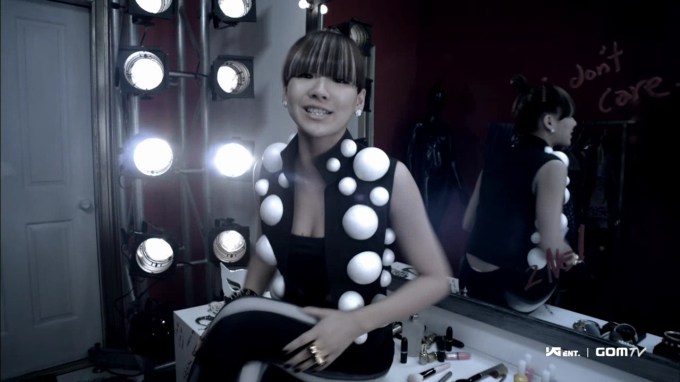
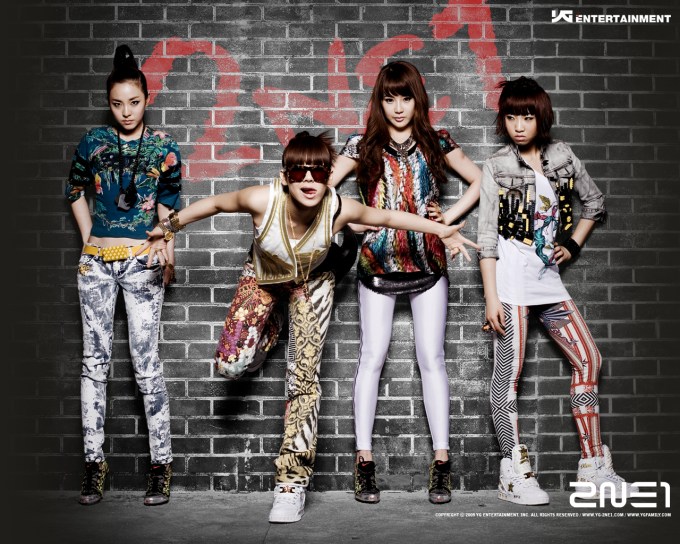
It was with some trepidation then, that after I discovered I Don’t Care by 2NE1 (투애니원), I immediately thought to describe their voices as, well, simply beautiful, especially Park Sandara’s (박산다라). Fortunately however, they don’t seem too different on stage either, and I think I’d enjoy listening to them singing even without any accompanying music.

Here is the original music video that got me hooked:

A live performance for the sake of comparison:

Next, a video which already has English lyrics. Some are very strange and/or completely wrong though, but otherwise they’re mostly correct, and good for getting the gist:

Yeah, I don’t think a Playboy bunny costume is apt either, even for an anime version of – I think – Park Bom (박봄).

But next, a reggae mix that I hate myself, but you might like it, and I think it actually became more popular than the original in Korea:

Finally, a not bad dance remix, although I’m not really sure who the “Baek Kyoung” referred to is sorry:

Meanwhile, I’m just as surprised as you are to find myself describing the “bad girls” of K-pop as having beautiful voices. But now that I think about it, why can’t they go together?

If I did have to find a flaw with the song though, it would be that the lyrics are a little inconsistent with what stage of the relationship the couple is in exactly: as you’ll soon see, in one line the girlfriend can appear to have just split up with the boyfriend, then in the next they seem to be together but she’s thinking about it, and then in yet another they sound like they split up a long time ago!

It would be very very tempting just to have assumed that they’re in one of those stages and translated accordingly (like in the video with English lyrics above), but I don’t think the lyrics justify that, and so ended up stumbling along accordingly. But with just a bit more thought by the writers, all that unnecessary confusion could easily have been avoided.

Update – In hindsight, the final verse does indeed resolve their relationship: they’re together, but about to split up. But please forgive me though, for declining to rewrite all 2400 words of translations and explanations accordingly!^^

Hey playboy, it’s about time and your time’s up

I had to do this one for my girls you know

Sometimes you gotta act like you don’t care

That’s the only way you boys learn

Oh oh oh oh oh oh 2ne1 이야이야

Oh oh oh oh oh oh 2ne1 이야이야

니 옷깃에 묻은 립스틱들 나는 절대로 용서못해

매일 하루에 수십번 꺼져있는 핸드폰

변하지 않을것만 같아 oh oh

I absolutely can’t forgive your collar being stained with lipsticks

Every day your phone dies many times

I don’t think you’ll ever change oh oh

( Source )

Line 1 of the Korean is a pretty basic, literal translation, although personally I was pretty surprised to learn that “묻다” means “stain” as well as “dig”. I’m more familiar with”얼룩지다”, easier to remember because “zebra” is “어룩말”, or literally “stain horse”.

Line 2 was more difficult though. First, because “매일” means “every day”, but then “하루” means “a day,” or “one day”, so already there’s some either unnecessary and/or nonsensical repetition (not to be confused with that about the relationship though). Not being able to figure out what the combination meant, then I decided to plump for the former, although I was tempted to put “all day long” in there instead, or “하루정일”, as given the next part then that would make sense in English at least.

That next part was “수십번”, rather confusedly “several” and/or “many times” according to my dictionary, but clearly the latter is more appropriate in the context of the song. Then, “꺼져있다”  was a little confusing for a moment, as it has many meanings. And for a while, I thought that the 2 most suitable here – “fade/die out/extinguish” and “be turned off” give slightly different nuances to the song: does the boyfriend’s phone “keep on dying”, like the lyrics in one of the videos above gives, or is it turned off, presumably deliberately in order to avoid the girlfriend? But either way, note that it’s actually “꺼지다” + “있다”, meaning that the phone is left in the state of dying and/or being turned off for a long time…and I guess that the 2 meanings actually amount to pretty much the same thing in the end.

Finally, the “만” in line 3 doesn’t mean “only”, but is just used for emphasis, as we’ve seen in many previous song translations.

(Source)

그저 친구라는 수많은 여자친구

날 똑같이 생각하지마 I won’t let it ride

이제 니 맘대로 해 난 미련은 버릴래

한땐 정말 사랑했는데 oh oh

All those girls you call just your friends

Don’t think of me as the same, I won’t let it ride

Now just do what you like, I want to be rid of my lingering affection for you

I really loved you once

(Source)

Pretty easy, although my wife said that “그저” in line 1 meant “just”, which wasn’t one of the meanings in my dictionary, and that “한땐” in line 4 was “한때” + “는”, or “once”.

But as for the jump in the middle of the song, between sounding like they’re still together and she’s working at improving the relationship, to sounding like she, well, just doesn’t care, presumably them having split up? I’m just as stuck as you!

Update: In hindsight, it’s strange that she wants to be more than just one of his female friends? I thought that she already was, and the problem was that all of those female friends of his were actually women he’s cheated on her with?

( Source )

가끔씩 술에 취해 전활 걸어 지금은 새벽 다섯시 반

넌 또 다른 여자애 이름을 불러 no no

I don’t care 그만할래 니가 어디에서 뭘 하던

이제 정말 상관 안할게 비켜줄래

이제와 울고불고 매달리지마

Frequently when you’re drunk you call me at 5:30 in the morning

And again you call me by another woman’s name no no

I don’t care, I want to end this, Wherever you are, Whatever you do

Now I won’t have anything to do with it, Get out of my way

Don’t suddenly hold on to me and start weeping

( Source )

A long section, but pretty easy. Just a couple of points: first, don’t be confused by the “걸다” in “전활를 걸다” (shortened to “전활 걸어” here), as I often used to be; although by itself it does mean “hang”, “”전활를 걸다” does not mean “hang up the phone” but rather “to make a phone call”, the complete opposite.

Next, my wife says “이제와” is short for “이제와서”, which means “suddenly”. Frankly I don’t get that, so I’ll have to take her word for it, but if anybody else has an explanation then that would be appreciated!

Meanwhile, the next part is very easy, so I’ll skip an explanation:

(Source)

Cause I don’t care e e e e e

I don’t care e e e e e

Cause I don’t care e e e e e

I don’t care e e e e e

Boy I don’t care

다른 여자들의 다리를 훔쳐보는

니가 너무너무 한심해

매일 빼놓는 커플링 나 몰래 한 소개팅

더 이상 못 참을 것 같아 oh oh

You steal a glance at other women’s legs

You’re so pitiful

Every day you take off your couple ring and secretly go on a blind date

I guess I can’t take it any more oh oh

( Source )

넌 절대 아니라는 수많은 나의 친구

난 너 땜에 친구들까지 다 잃었지만

차라리 홀가분해 너에게 난 과분해

내 사랑이라 믿었는데 oh oh

My many friends that said you weren’t right for me

I lost all of them because of you, but

That’s actually a relief

You don’t deserve me

I believed you were my true love oh oh

( Source )

And as if to make up for the easy part, that was quite difficult. True, the basic translations are easy enough, but an important part was unspoken, then yet again some sentences seem to contradict the others, then finally one way of saying something in English is said completely the opposite way in Korean!

Dealing with each in turn, line 1 is literally “you-absolutely-not-many-my friends”, but the “not” part is a relative clause incorporating the “many-my friends”. But what is the boyfriend “not”? Presumably, right for her, and presumably they said that to her too.

Next, I don’t how on Earth losing all her friends was “차라리 흘가분해”, literally “rather [a] relief” but that’s what it says: maybe because they weren’t really her friends or something.

Finally, just after that you have literally “you-to-me-unworthy”. Which sounds fine in English when put like that, but then the “me” is the subject here, as indicated by the addition of the “ㄴ”, short for “는”, and Korean is made much easier by thinking of “는” and “은” as meaning “as for” in English. So with those qualifications, now you have “you-to-as for me-unworthy”, which would be best re-ordered in English to “as for me-to-you-unworthy”. But rest assured, it is definitely still he that is unworthy of her in the Korean nonetheless…

There are only 2 new lines in the next section, and they’re pretty easy, so again I’ll skip an explanation. Yeah, I ‘m beginning to notice a pattern too:

(Source)

오늘도 바쁘다고 말하는 너 혹시나 전화해봤지만

역시 뒤에선 여자 웃음소리가 들려 oh no

I don’t care 그만할래 니가 어디에서 뭘 하던

이제 정말 상관 안할게 비켜줄래

이제와 울고불고 매달리지마

Cause I don’t care e e e e e

I don’t care e e e e e

You said you were busy today too, but by chance I got a hold of you and

In the background I heard a woman’s laugh oh no

I don’t care, I want to end this, Wherever you are, Whatever you do

Now I won’t have anything to do with it, Get out of my way

Don’t suddenly hold on to me and start weeping

Cause I don’t care e e e e e

I don’t care e e e e e

(Source)

난 너 땜에 울며 지새던 밤을 기억해 boy

더 후회할 걸 생각하면 맘이 시원해 boy

날 놓치긴 아깝고 갖기엔 시시하잖니

있을때 잘하지 너 왜 이제와 매달리니

I remember the night I cried until dawn because of you boy

I think I will regret it more if we stay together, now I feel relieved boy

When I’m gone I’m valuable, but when we were together I was nothing

You should have done better back then, why are you are hanging on to me now?

(Source)

As per the pattern, you’d expect this verse to be difficult. And indeed, although line 1 was fine, frankly I can’t make head or tail of line 2 especially, and invite alternative translations.

Literally, it is “more-regret [will]-think [if]-my heart & mind-relief”. But regret what? Not splitting up? And if you think? Arrgh!

As you can see, I came up with something for line 2 that certainly sounds okay, but it’s largely guesswork really. Line 3 and 4 at least though, were simple enough, with my wife telling me that the “있을때 잘하지” in the latter (when you have [them], you have to do well) is often used to express regret about relationships.

(Source)

속아준 거짓말만 해도 수백번

오늘 이후로 난 남자 울리는 bad girl

이젠 눈물 한방울 없이 널 비웃어

사랑이란 게임 속 loser

무릎꿇고 잘못을 뉘우쳐

아님 눈 앞에서 당장 꺼져

Now clap your hands to this

I also know about the hundreds of lies you’ve tricked me with

As of today, I’m a bad girl that makes men cry

Now, without so much as a tear I laugh at you

Love is a loser in this game

Get on your knees and repent

Or get out of my sight

( Source )

With great relief, the pattern was maintained with this last verse(!), and so it was quite easy, only the “속아준” in line 1 throwing me off a little. Normally, saying a verb + “주다” means to do the verb for the speaker, i.e. a request, but how do you  be tricked” for someone (note that “속다” means “be tricked”, wheres “속이다” means ” to trick”)? I gave up, but the native speaker in the other room told me that it basically means that, she, the singer, knows or knew she was being tricked.

I’ll take my wife’s word for it. Other pearls of wisdom from her include “오늘 이후로” in line 2 meaning “as of today”, and “잘못을 뉘우쳐” in line 5 as a whole meaning “repent”, my dictionary just giving the 2nd word.

And not before time, there’s just the chorus after that:

I don’t care 그만할래 니가 어디에서 뭘 하던

이제 정말 상관 안할게 비켜줄래

이제와 울고불고 매달리지마

you know I don`t care e e e e e

I don`t care e e e e e

you know I just don`t care e e e e e

I don`t care e e e e e

Boy I don`t care

And on that note, I hope you enjoyed it, and as always I’m open to and grateful for any help and suggestions for anything you think I made a mistake with, and/or – in this case – simply couldn’t understand.

Before I wrap this up though, one thing I was very surprised about in it was that no matter how bad her boyfriend has been, and no matter how much of a “bad girl” the singer supposedly is now, that she would still take him back if he did indeed repent. Granted, confession and expression of remorse carries considerably more weight in Korean (and Japanese) society than in Western ones. But still, perhaps 2ne1 is not quite as “bad” as I’ve been led to believe all these years then (or only is by restrictive Korean standards for female performers), and it’ll be very interesting to see just how provocative (or not) their lyrics in their other songs are now.

But first, I’ll be translating Like The First Time (처음처럼), by T-ara (티아라):

Share

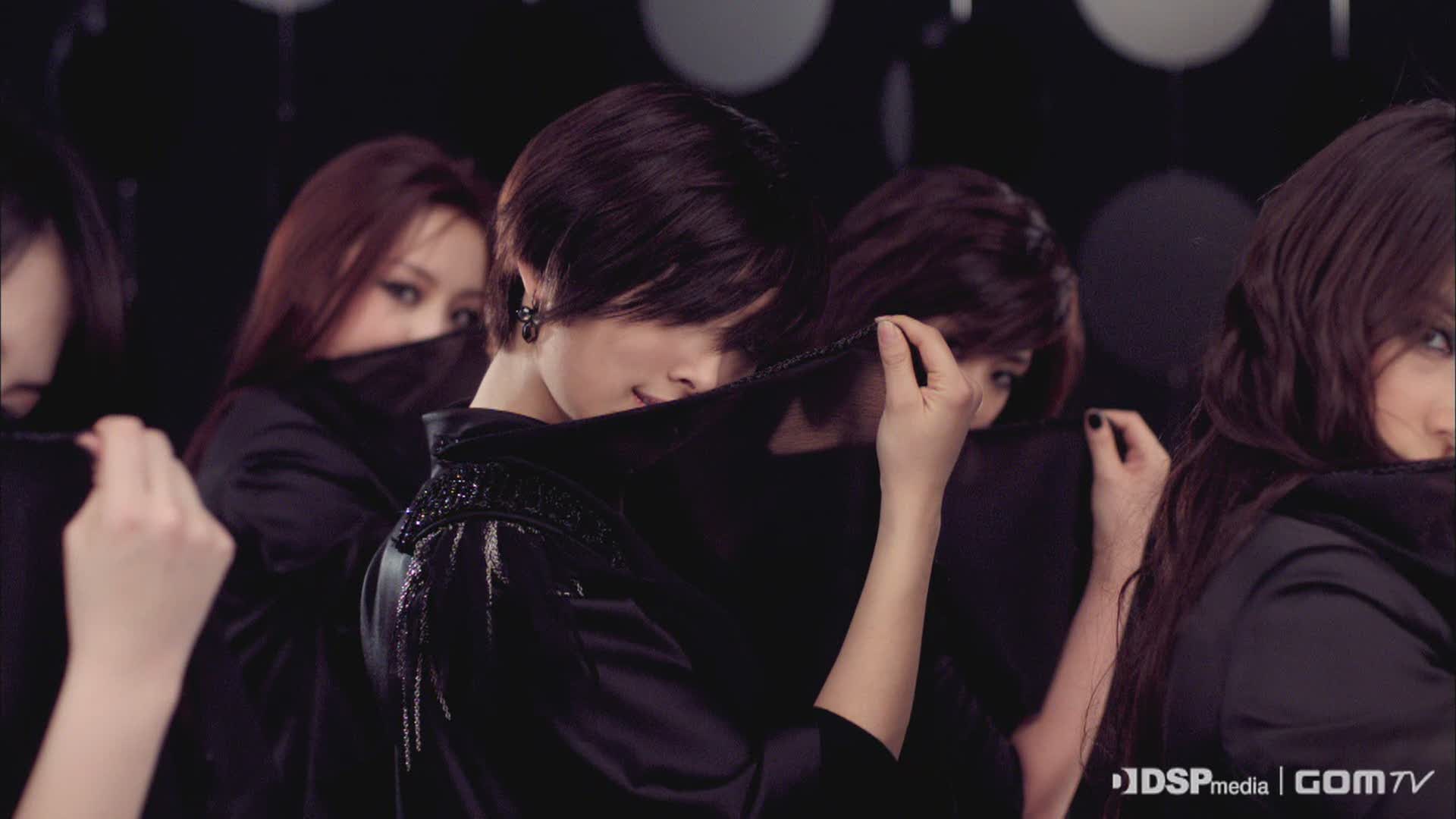
Lupin (루팡) by KARA (카라): Lyrics, Translation, and Explanation

(Source)

Well, this is embarrassing.

Now as you’re probably aware, I simply love this song, and must have listened to it well over a hundred times. And the music video is amazing too.

But now that I’ve actually studied the lyrics? Hell, but for the word “2010” at the beginning, I actually had no idea that so much of the song was in English.

On the positive side though, that’s given me a renewed appreciation for the difficulties many Koreans have in realizing that a (frustrated) foreigner is actually speaking Korean to them, albeit in a strange accent. And I don’t mind how nonsensical all the English in the song is either, as that’s quite normal for K-pop.

But unfortunately the Korean too seems literally thrown together in many places, which made it difficult for even my Korean wife to understand. And as you’ll soon see, the small amount of it below belies how much time and effort went into translating it.

And knowing all that about the song now? To be frank, it’s made it lose just a bit of its magic for me.

Lest the same happen to you, read on at your peril!

The first part obviously doesn’t need an explanation, although I’d be interested in learning what “la couture” means exactly:

Sing it with me now

2010, We bringing new love to the floor

Rocking what’s real la couture

We opening new doors new show new world new control

Can you keep up oh!

Hallo! Hallo! Hallo! Hallo! Hallo!

Hallo! Hallo! Hallo! Hallo! Hallo!

Hallo! Hallo! Hallo! Hallo! Hallo! Catch!

Hallo! Hallo! Catch! Catch! Hallo! Hallo!

(Source)

겁먹지마 니 심장소리가 들켜 (쉿!)

뒤에 서서 침착하게 지켜봐봐

탐난다고 서두르단 결국 Game set

유연하게 행동해봐 As usual it’s mine

Hide your fear, your heartbeat will be detected (shh!)

Stand behind [me], calmly try to keep watch

Even if it is desirable, if you hurry in the end Game set

Try to be flexible As usual it’s mine

(Source)

Most of that was pretty basic, provided you know that adding “보다” to the end of a verb, and conjugated in banmal (반말; informal speech) as “봐”, simply means try to do the verb. At the end of line 2, it’s added to “지켜보다” (to keep watch), hence the “지켜봐봐”.

But I don’t understand line 3 at all: “탐난다” means “be desirable” (not “burn” as given everywhere else: that’s “타다”), which is simple enough, but then it’s given as indirect speech, as indicated by the “~ㄴ다고” ending. But who said what is desirable? And what’s the connection to “서두르다” (hurry) after that for that matter, and while we’re at it what’s the “ㄴ” doing at the end of that too?

To make sense of it then, I suggested to my wife that possibly something like “탐나더라도” was intended, the “더라더” being a grammar pattern meaning “no matter how much, even though, I don’t care if”, and so on, and she concurred.

Finally, line 4 is literally “flexibly act/behave-try-to”.

(Source)

Next, there’s the main chorus. As you can see though, there’s just one Korean line in it, and its simply “Go/climb high, try to grab/take all the world”:

(Eo eo eo) It’s  mine

(Eo eo eo) This is mine

(Eo eo eo) This is mine

(Eo eo eo)

높이 올라 가 (Ye Ye Ye) 세상을 다 가져봐 (Ye Ye Ye)

Never back it up Back it it up (it it up)

Never turn it up Turn it it up (it it up)

(Source)

Hallo! Hallo! Hallo! Hallo! Hallo! Catch!

Hallo! Hallo! Catch! Catch! Hallo! Hallo!

한눈팔면 기회조차 뺏겨버려 (쉿!)

누구보다 한발 먼저 다가가 봐

남들처럼 티내다간 결국 Game set

유연하게 행동해봐 As usual it’s mine

If you so much as glance away, you’ll throw away your chance (shh!)

You should take the first step and try to approach

If you have the air of everyone else in the end Game set

Try to be flexible As usual it’s mine

(Source)

In Line 1 (of the Korean), “한눈” is literally “one eye”, and “팔다” sell, but hopefully it’s not too much of a jump to see that “selling one eye” means “look (or glance) away”, especially as the listener was already told to keep watch in the last verse.

Then, next to “기회” (chance, opportunity) there is the grammar pattern “조차”, which basically means “even, to boot, in addition”, as in “목이 아파서 밥은커녕 물한 잔조차 마실 수 없다” for example, or “My throat is so sore that I can’t even drink a glass of water, let alone eat rice”.

But with the next, “뱃기다” (be dispossessed of) plus the grammar pattern “버리다” added to it, which adds a sense of completely ruining or throwing away something, then in English the “even” seemed a bit awkward. So I came up with “If you so much as glance away, you’ll throw away your chance” instead.

Then line 2 is literally “who than- one step – first – approach try to”, so I think “You should take the first step and try to approach” gets the gist of that. And the “who” (or rather “they”) referred to is the “남들” in line 3, which I originally thought was an abbreviation for men (“남자” plus the plural marker “들”),  but it turns out to mean “other people” instead. But note though, that that’s not in the sense that the male is used the default for both genders like in Spanish(?), as they’re different words: the “남” in “남들” has no hanja (Chinese character) root, whereas that for “남자” does, and indeed you’ll often see it – 男 – on doors to toilets and men’s changing rooms and so on (and while we’re on the topic, here’s the one for women {여} too: 女).

Finally, in line 3 “티내다” wasn’t in my electronic dictionary, but “티” can mean “an air”, and pulling a thick print dictionary from my bookcase with more examples  of that usage confirmed it.

(Source)

Next, the chorus is repeated, then you have:

이제 차근차근 걸어나가봐

세상 하나하나 전부 가득 담아봐

특별하길 원하니 네 것이길 바라니

시작해 Uh! Yeah, yeah!!

Now try to step out slowly and carefully

Try to fill in each and every part of the whole world

Do you want to be special? Do you hope it will be yours?

Start Uh! Yeah, yeah!!

(Source)

First up, in line 1, “차근차근” can mean “scrupulously”, “methodically”, “systematically”, and so on, but the final, more literal meaning of “step by step” seems most appropriate here. But then “Step out step by step” sounds awkward in English though, so I changed it to “slowly and carefully” instead. That does seem to contradict the carpe diem spirit of the song a little unfortunately, but I think that’s the fault of the original Korean!

Then you have “걸어나가다”, which was annoying for me as a beginner (Yet another word for “walk”?? And Koreans complain about learning English!), but is quite easy to understand really. You see, “걷다”, which is irregular and so conjugates as “걸어~”, is your basic “walk”.  But then you can have things like “가다” and “오다” added to them, giving “걸어오다” and “걸어가다”, and which simply mean “walk” plus “come” and “go” respectively, or “walk towards [the speaker]” and “walk away from [the speaker]” in English. And with “걸어나가다” in the song, “나가다” simply means “go/step out”, giving “walk out”. Granted, it can also mean “walk towards, approach” according to the dictionary, (and don’t forget that “다가가다” from the last verse means “approach” too!), but “walk out” seems much more appropriate given the context of the previous verses.

Line 2 was very annoying though. Literally, it is “world – one by one – all parts/whole – full – fill/put in try to”, which can probably be translated many different ways (but not one by one as in separate worlds though), and “Try to fill in each and every part of the whole world” was the best I could do.

But that was a doddle compared to line 3. First up, “특별하다” means “to be special”, but then adding “기” at the end changes it to a noun, and then the “ㄹ” makes it the object. So, “specialness”, with the “원하다” being “want” plus the “니” at the end being an informal question form, and usually implying that the speaker places themself slightly higher than the listener – usually determined by age, as explained by Seamus Walsh in his comments to a translation of another song (a belated thanks for those by the way!). Which gives “Do you want specialness”, or “Do you want to be special?”.

Then you have “것이길 바라니”. “바라다” means “desire”, “hope for”, and “look forward to” (you’ll often see the formal form “바랍니다” at the end of signs on the subway and so on), and it includes the “니” form at the end as just explained. But “것이길”? I guess it’s “것” (thing) plus “이다” (to be) plus “기” to make it a noun, then “ㄹ” to make all that an object. So literally “your thing – the act of beingness – hope for”!

And that’s it, but for the 2nd half of the chorus again:

높이 올라 가 (Ye Ye Ye) 세상을 다 가져 봐 (Uh yeah)

Never back it up Back it it up (it it up)

Never turn it up Turn it it up (uh yeah, yeah!!)

As a reward for slogging your way through all that, let me present you with the DJ Amaya vs Groovebot Hard Club Edit, which reminds me a lot  of what I used to dance to in clubs 10-15 years ago (wistful sigh):

Originally, this particular KARA fan didn’t like it much. But it rapidly grew on her, and you can see how she felt when it finally finished:

Next week: I Don’t Care by 2NE1.

Reading the Lolita Effect in South Korea, Part 1: The role of K-pop and the Korean media in sexual socialization and the formation of body image

A simply surreal video making the rounds at the moment. As explained by Lisa at Sociological Images, it:

…beautifully illustrates the socialization of children into particular kinds of worship. With hand motions, body movements, and facial expressions, this child is doing a wonderful job learning the culturally-specific rules guiding the performance of devotion.

Which led to a great deal of discussion at that site. But I’ll confine myself here to echoing Jason’s comment that it simply reminds him of his son picking up his own behaviors such as sweeping, and that the young girl:

…certainly isn’t worshiping here, but is just mimicking her parents and the other people around her. I can guarantee she has no concept of a deity.

But what has all that got to do with K-pop, let alone Meenakshi Durham’s The Lolita Effect? Well, because after reading all that, it was very interesting comparing my daughters’ own reactions to KARA’s Lupin just half an hour later. First, those of four and a half year-old Alice:

Then with her two and a half year-old sister Elizabeth:

Granted, perhaps you had to be there…and in which case I probably would have removed my dirty laundry from the floor first (sorry). But I didn’t notice it myself, because at the time I was simply transfixed.

You see, along with dozens of other K-pop music videos, Alice and Elizabeth must have watched and “danced” to Lupin at least 20 times before that night. But that was the first time that Alice at least seemed to demonstrate that she not only remembered it, but actually knew it very well, and was performing repetitive actions that were recognizably part of the same dance…which she’d demand to do seven more times before going to bed.

Unfortunately for my paternal pride though, in hindsight she was neither simply copying the music video nor giving her own original interpretation of it: as confirmed by her teacher later, she’s preparing for a Christmas performance at her kindergarten soon, and—yes—she’ll be dancing to Lupin.

So what’s the big deal? After all, while I’m still translating the lyrics myself (or at least I was until my “study” got invaded), they seem harmless enough:

But what if the kindergarten teachers had chosen Mister instead?

Or something by the Wondergirls perhaps? Two weeks from now, might I have looked on in abject horror as my 4 year-old kept thrusting her bottom out at me while singing I’m So Hot?

(See here for the video; the owner has disabled embedding)

No, because first, no matter how much WonderBaby’s appearances on national television could be construed as widespread public acceptance of that sort of thing, my wife confirms that many other Korean parents would also have complained well before then.

But second, and most importantly, actually Alice has already been thrusting her bottom out at me like the Wondergirls, for about three months now.

Seriously: several times a day, she’d suddenly run up to me giggling when I was at my desk, quickly thrust her bottom out at me a few times, then she’d run away in hysterics. Fortunately, she seems to have largely grown out of it now, but not through any discouragement on my part, which just seemed to make doing it all the more amusing for her.

Why did she start in the first place? I’ve no idea, as although she could have seen that dance move virtually anywhere, she wouldn’t have had any idea what it represented, or what adults would think of it. Perhaps one of her teachers overreacted to her or one of her classmates doing it or something, after which it became fun.

But whatever the reason, does that mean that it’s hypocritical to have any misgivings about Wonderbaby then?

Hell no. But to counter the argument that it’s just clean harmless fun, let’s be very specific about what the problems with her dancing to So Hot on national television are exactly. I can identify two main ones.

First, there’s the fact that Wonderbaby quite literally invites the viewer to view her as a sexual person. Of course, she probably has virtually no idea of the meanings of what she’s singing, let alone the consequences. In which case, one might already reasonably ask what she’s doing there in the first place, and in cases like this it is usually this naive, unknowing projection of sexuality that adults tend to be most concerned with. As explained by Durham in The Lolita Effect:

…the signals that girls send out about their sexuality, often naively, in response to the prevailing media and marketing trends, [are] signals that adults fear will attract harmful sexual attention. As the columnist Rosa Brooks lamented in the Los Angeles Times, “old fashioned American capitalism…is busy serving our children up to pedophiles on a corporate platter”….

….These charges open up quite a can of worms. Can marketers in fact “serve” children up to pedophiles? Is there any real danger in young girls wearing low-cut, skimpy, or “trashy” clothes, or is this just a harmless fashion trend designed to raise parental hackles, like so many others in the past? Could it even be seen as a feminist moves towards embracing a femininity or “girliness” scorned by previous generations and linking it to power rather than passivity? (p. 69)

I’ll return to the last point later. But before I do, from the outset I want to put paid to the notion that even children that young are completely neuter and/or are unaffected by sex in the media:

For children to take an interest in sex is not out-of-the-ordinary or scandalous. Even toddlers “play doctor” to explore each others’ bodies and mimic intercourse, though scholars are still debating what constitutes “normal” sexual behavior in young children. Sex is a part of life, so it is bound to surface in different ways at different developmental stages; it is not cause for alarm unless there is harm or abuse involved. Of course, sexuality needs to be dealt with in ways that are appropriate for the age and maturity of the child, the cultural and social context, and above all, the ethical implications of the situation, but sex per se cannot reasonably be viewed as harmful to minors. (p. 68)

And in particular:

The conventional wisdom is that interest in sex escalates as children approach adolescence; this is a biological viewpoint that connects the hormonal shifts and physical maturation of puberty with an increased interest in sex. But now sexuality marks preadolescence and childhood, too, and for many adults, this is justifiable cause for alarm. In today’s world, children as young as eight report worrying about being popular with the opposite sex; first graders describe being sexually-harassed by classmates; and by middle school, kids are steeped in sexual jargon, images, and exploration. Sex educator Deborah Roffman argues that little girls start wanting to look good for others at age four….(p. 65)

Very few—if any—cultures have found ways of adequately and appropriately dealing with the inconvenient fact of child sexuality (let alone the media) but surely Wonderbaby’s example doesn’t help. Nor do the music videos discussed below with slightly older girls either, but which I only realized thanks to Barry Raymond, a friend of mine that used to live in Korea (and now with 3 daughters himself):

No, that’s not them: rather, it’s a screenshot from the music video for Bang! (뱅!) by After School (애프터스쿨), which I translated back in June. One of my favorite Korean songs, I was originally a little miffed when Barry criticized it because the inclusion of the young girls, to which I replied on Facebook:

I’m usually quite wary of that too Barry, especially in Korea, where people are generally very reluctant to admit that things like that can be problematic. But in this particular case I think their presence is fine personally, because they’re gone within the first 20 seconds or so, and don’t perform any dance moves that can be considered remotely sexual. So they’re clearly supposed to be decorations at the beginning, considered quite separate to the grown-up (sexual) women of the group.

His response:

The lyrics and dancing that make up the song and video are all about sex. To place a child at the beginning of that exploits them in a sexual way. How would you feel about a child appearing at the beginning of Bad Romance or some other Lady Gaga song. It’s a girl group exploiting itself on the basis of sexuality, at least in this song. That is their choice, don’t force it upon the clearly underaged girls that appear in the video or try to make it appealing to an underage audience.

Me:

Hmmm, you may well have a point there, which I admit I wouldn’t have considered if you hadn’t brought up imagining the same in Bad Romance; I wonder if that shows just how used to that sort of thing I am here?

(15 year-old f(x) band member Sulli in Oh! Boy Magazine; source)

And finally, albeit admittedly after my asking if I could post it here at some point(!):

According to Wikipedia… See More’s typology of child pornography, the type described as posing involves (allow me to paraphrase) ‘deliberately posed pictures (video) of children fully clothed, partially clothed etc. where the context and/or organization suggests sexual interest’.

The”Bang” video places two clothed girls wearing the exact same attire as the older models at the beginning of the video. The girls dance alongside the older models where the older models are dancing in a sexually provocative manner (the younger girls are not in my opinion dancing in a sexually provocative manner). It should also be noted that while the girls wear the same outfits as the older models the fitting of their outfits is not alarmingly provocative although the same outfit on the older models is certainly sexually provocative. So we have a situation where several sexually provocative models are juxtaposed with what appears to be virtually identical under-aged girls. This to me would constitute a context of sexual interest where the line between the older models and the younger models is intentionally blurred.

Further to this context would be the lyrics….and the title of the song, “After School” along with the school oriented marching parade uniforms. To me this video is unambiguous contextualized sexual exploitation of children.

Is judging the Korean media and Korean music videos with an assessment system developed by the Paedophile Unit of the London Metropolitan Police merely imposing a Western value system on Korea? You decide, although I’d wager that in fact the Korean police have a very similar system.

Either way, not much later one of After School’s subgroups – Orange Caramel –  did the same again with their music video for A~ing (아잉):

For the sake of providing sufficient warning of the slightly NSFW image coming up in a moment, let me take the opportunity here to point out that it’s not so much the lyrics and dance moves that are the issue this time (see here for a video with them), but more having a child in a music video “sugar-coated with sexual undertones,” with an “obviously pedobaittastic tone,” and with “kinky cosplay lolita outfits”, all as noted by Johnelle at SeoulBeats. And so much so, that this next screenshot…

…instantly reminded of this next image, which I’ve had on my hard drive for years, from God knows where. Not looking very closely at the small print before then, I’d always assumed that it was the cover of an erotic fiction book, but it actually turns out to be a poster for a pornographic cartoon:

(Source: unknown)

Continuing with A~ing though, just in case you think Johnelle and I are exaggerating:

And in particular, these costumes, which—correct me if I’m wrong—seem to serve no other purpose than to have one’s breasts spill out of them:

All good wholesome stuff. So, like Johnelle notes, what’s with having a little girl dressed up in the same kind of vinyl red riding hood get-up as the women at the end?

So, does all the above mean I’m advocating that girls should never be allowed to appear in sexually-themed music videos (and so on) then? Yes, I guess so.

But how to set a minimum age for that? After all, the upshot of everything I’ve written so far that any age limit would be somewhat arbitrary and artificial.

If I did have to to set an age though (and it would be very unrealistic not to have one), then I’d say that the age of consent would be the most logical choice. Unfortunately however, in Korea that happens to be as low as 13 (see here and here), even though the age at which one can view and perform in sexually-related material and/or have reliable access to contraception is 18.

Yeah, I don’t see the reason for the huge discrepancy in age limits either…which is not quite the same as arguing that any of them should be 13.

But that’s a subject for another post. In the meantime, one argument against any age limit on appearances is that the average age at which girls begin to menstruate has been dropping steadily since 1850, so much so that – in developed countries at least – they now enter puberty between the ages of 8 and 13. It would be a pity to deny girls the right to express their ensuing sexuality in popular culture, especially with female sexuality in general being repressed and/or literally viewed as evil for so much of human history.

(16 year-old Bae Su-ji of Miss A; source)

Yet the notion that the feminist sexual empowerment of girls and women is what primarily motivated the appearances of Wonderbaby, the girls in the After School videos, the tight pants of 15 year-old Sulli, and 16 year old Bae Su-ji’s pose above is simply absurd, and indeed there is solid evidence that most young female entertainers are in fact pressured to wear their supposedly empowering skimpy clothing (and dance provocatively) rather than doing so out of choice. But although such arguments have still been made in Korea nevertheless, the overwhelming public attitude is to stick one’s head in the sand and deny the existence of teenage sexuality at all (let alone child sexuality), as this Korean commentator complains himself.

And in a sense, this is the official Korean government position too, if the article “Swept up by Girl Groups” by Jeong Deok-hyun is anything to go by. You can find it on pages 44-48 of the March 2010 edition of Korea Magazine, the official magazine of the Korean Culture and Information Service (downloadable here), and about this specific part on page 48…

“The shadow of recession and nostalgia:  Some are so surprised by the elder generations’ enthusiasm for girl groups that they cannot help but mention the Lolita complex. Nevertheless, that would be an example of an exaggerated principle that remains from the past authoritarian era. In the course of shifting from a masculine-dominated era to one of feminine equality, the imposing frames of age and gender are being slowly torn down. The time has come in pop culture where a man in his 40s can cheer for teenage girl groups without being looked at suspiciously.”

…my friend Dr. Stephen Epstein, Director of the Asian Studies Institute at Victoria University wrote to me:

The logic here is almost comical: the empowerment present is not that it brings young women to a heightened sense of their own possibilities in the world (which is mentioned nowhere in the piece), but rather that pop culture commodification of sexuality has reached the point that middle-aged men now have the privilege of ogling teenage girls in bands without fear of embarrassment. Now that’s what I call empowerment….

(Source)

But again—and this bears repeating—its not girls’ sexuality itself that is the problem. Rather it is that:

…the expression of girls’ sexuality seems to be possible only within an extremely restrictive framework. Girls’ sexuality, it seems, has to comply with the markers of sexuality that we recognize, and it cannot be manifested, recognized, or mobilized in other, potentially more empowering and supportive, ways.

This is a form of mythmaking. When a concept as complicated, multilayered, and diverse as sex is reduced to expression through a single channel – the one involving lacy lingerie, skintight clothing, and the rest of what Ariel Levy calls “the caricature of female hotness” – it has to be seen as construction or a fabrication, in which the complexities of the subject are flattened into a single, authoritative dimension, and in which all other possibilities are erased.

So it is important to think about the ways in which girls are being coached to aspire to “hotness” by popular culture, and how the commercialized definitions of “hot” offer beguiling but problematic representations of sex that limit its vast and vital potential. (pp. 70-71, emphasis in original).

And that is the second major problem with WonderBaby’s appearance: how it already sets her on that path, and/or provides an example for others to follow. And while that is by no means a problem confined to Korea – Durham’s book alone is testament to that – it is taken to extremes here. As like I explain in Part 1, it is near impossible for a young aspiring female singer or actress to advance her career without doing “sexy dances” on numerous talk shows and entertainment programs:

And yet strangely, when 30-somethings (and above) do the same it is usually only as part of a big joke, as if they were suddenly neuter. Moreover, whenever a girl group’s music video features sexy dancing and lyrics that aren’t exclusively designed for a male gaze, then they have a very good chance of being banned from television, as anyone with even just a passing familiarity with K-pop can attest to.

But on a final note, one frequent complaint I have about most articles and blog posts on this subject is that they rarely explain why this is the case, nor why younger and younger women and girls are becoming more involved over time. And indeed, for all its popularity, even Durham isn’t as clear about this as I would like either, and I had to read her book several times to figure out what she actually means by “The Lolita Effect” exactly.

In short, it is the natural consequence of various industries’ (fashion, cosmetics, cosmetic surgery, diet-related, food, and so on) need to build, expand, and maintain markets for their products, which obviously they would do best by – with their symbiotic relationship with the media through advertising – creating the impression that one’s appearance and/or ability to perform for the male gaze is the most important criteria that one should be judged on. And the younger that girls learn that lesson and consume their products, the better.

Simplistic? You bet, and I’d be the last person to deny the role of a whole host of other factors, including – for one – the fact that basic biology makes women’s physical attractiveness a much more important factor in choosing a mate for men than vice-versa.

But do consider that: there is not a single country that did not also experience “housewifization” as a consequence of development; that in economic terms at least Korea is now officially the most consumerist country in the world, and much more so than the US (no, really); that comsumerism was explicitly conflated with national-security and anti-communism by the Park Chung-hee (박정희) regime of 1961-1979 (and very much still is); and finally that Korean women played a crucial role in that last, as that last link makes clear.

Given all that, then is anyone surprised that Korean women the thinnest in the developed world, yet actually consider themselves the fattest, and act and spend accordingly?

Correlation not always implying causation be dammed. And if nothing else, I hope I have at least persuaded you of that link with this long post!

(Source)

The “Reading the Lolita Effect in South Korea” series:

Breathe (비리드) by Miss A (미쓰에이): Lyrics, Translation, & Explanation

( Source )

Like Bad Girl, Good Girl (배드걸 굿걸) translated last week, Miss A’s (미쓰에이) Breathe (브리드) is also a song which very quickly grows on you. But seeming to lack a real climax though, then ultimately it proves somewhat less satisfying…a double entendre you’d do well keep in mind if you’re likely to be shocked by all the panting and heavy-breathing in it, let alone Meng Jia’s (멍지아, 孟佳) helpful demonstration of what might cause her to do that at 2:47.

Hell, Korean may well lack the “th” sound, but even the Hangulization of the title actually sounds more like “breed” too.

You’d probably never suspect then, that its central narrative is actually one of complete passivity towards the desired guy, with the music video full of aegyo and childish impressions to boot. Indeed, in that sense it’s much more in the vein of, say, Girls’ Generation’s Oh, T-ara’s Like the First Time, and KARA’s Mister then anything you’d ever expect from the same group that just did Bad Girl, Good Girl.

Not that that’s necessarily bad of course, and may we all meet someone that makes us that weak at the knees. But it was certainly a slight disappointment after just becoming a fan of theirs for being so different.

Still, I do like it, and especially the music video. And not just because of the eye-candy either. Rather, because with the backgrounds and the women’s sometimes deliberately stilted dance movements, in fact it reminds me a little of the 1989 Fine Young Cannibals’ number 1 hit She Drives Me Crazy, which was nominated for best video at the MTV Music Video Awards that year:

Minor quibbles are the small size of the room with the stripes that you can see in the screenshot below, which makes the fantasy element to the video a little harder to sustain, and Wang Fei Fei’s (왕페이페이, 王霏霏) simply bizarre hairstyle in the segments in which she’s wearing a red top (you’ll soon see what I mean). But I can easily forgive those considering how easy the excessive repetition made translating the lyrics!

너 땜에 자꾸만 내 가슴이 (hot hot hot hot)

너 땜에 자꾸만 내 몸이 (hot hot hot hot)

니가 날 볼 때마다, 니 생각 할 때마다

너 땜에 자꾸만 내 가슴이

no oh no oh no oh oh, I can’t breathe

no oh no oh no oh oh, I can’t breathe

no oh no oh no oh oh, I can’t breathe

no oh no oh no oh no oh no oh

Because of you my chest [is] often (hot hot hot hot)

Because of you my body [is] often (hot hot hot hot)

Whenever you look at me

Whenever I think of you

Because of you my chest [is] often…

( Source: unknown )

In Line 1, “땜” is short for “때문에”, or “because”, and there’s a lot of contractions like that in this song.

Next “만” after “자꾸” in several lines could have been a little confusing, as it usually means “only,” which would give the stange “frequently only” in the text. But in songs especially, it’s also used just for emphasis, and it’s usually very easy to tell by context which meaning is intended. You’ll see it again later.

Finally, yes, “가슴” does indeed mean “breasts”, but outside of Naver image searches then it’s probably more commonly used as the gender-neutral “chest”.

( Source )

Boy you look so fine

어쩜 너무 멋져 안보는 척 해보지만 자꾸만 눈을 맞춰

난 이런 적이 없는데 너에게 빠졌어

니 생각 만하고 있어 날 구해줘 어서

Boy you look so fine

Wow, you’re so cool, but while you pretend not to look we frequently make eye contact

I’ve never been like this before, I’ve sooo fallen for you

All I can think about is you, please hurry and save me

( Source )

In line 2, “어쩜” is short for “어쩌면”, which I was surprised wasn’t simply the verb “어쩌다” plus “면” (if) but was an entirely different word of its own, my dictionary giving:

  1. (감탄사로; admiration, wonder, exclamation) what, how
  2. (아마) possibly, maybe, perhaps

And I’m inordinately proud to say that while my Korean wife thought number 2 was correct, I argued that only number 1 made any sense, giving  “Wow, you’re so cool.” And if so,then it must be him that pretends not to look at her.

In line 4, “구하다” means:

  1. seek, look for, want, hunt
  2. ask for, call for, solicit for
  3. get, have, obtain, find (out), buy, purchase

But this time I did defer to my wife, who said that “save me” was much more accurate than my original “have me,” no matter how tempted I was to go with that instead because of all the heavy breathing.

( Source )

Boy you look so fine

(짝사랑은 난 하기 싫은데) 말을 해볼까

(너도 날 좋아할 것 같은데) 용기를 내서

고백해볼까 (yeah)

싫다면 어쩌나 (yeah)

이렇게 기다리다 미치겠어

Boy you look so fine

(I hate one-sided love) Shall I make the first move

(I think you like me too) Shall I be brave

and confess my love? (yeah)

But what if you don’t feel the same way?

I’m going crazy waiting like this

( Source )

Easy enough, but I’ve taken a few liberties to make it sound better in English. In line 2 for instance, “말을 해볼까” is literally “shall I try to talk,” and in line 5 “싫다면 어쩌나” would literally be “hate [me] – hypothetically speaking – if [you] – what would [I] do”.

Fellow Korean learners, give me a buzz if you’d like me to explain any of the grammar above, but otherwise, that in line 6 was most interesting for me. In particular, I wondered why “이렇게 기다리는것이 미치겠어” couldn’t be used instead, much easier for me because of how I learned Korean, and literally “this way – the act of waiting – crazy – will be.” But my wife says that that would mean more “it is crazy to wait like this”, not the song’s intended “waiting like this is driving me crazy”. Granted it may sound like a trivial difference, but there you have it.

For the sake of keeping track later, let’s call all that the chorus. For now though, next there’s the Korean half of the opening segment again, then after that:

( Source )

오늘은 난 꼭(꼭) 고백을 하고야 말 거라고

I’m gonna let you know

Baby I will let you know

생각하다가도 너만 나타나면

몸이 다시 굳어버리고 할말은 잊어버리고 oh

No matter how much I think that I will definitely confess my love to you today…

I’m gonna let you know

Baby I will let you know

…if you show up

Again I will tense up and forget what I was going to say

( Source )

This part was much harder to translate than I thought it would be!

First, for the grammar form “~고야 말다” in line 1, my trusty Korean Grammar for International Learners came to the rescue, saying that, first on page 181, the “~(이)야” grammar pattern it is part of means “only if it be, if it is just (no more than); when it comes to; taking ··· for granted; even, indeed.” Then it gets to “~고야 말다” specifically on the next page, saying:

The auxiliary particle can be used in conjunction with the pattern in ~고 in two different ways. The combination ~고야 means “only after ··· ing” or “only under the circumstance that / under the unique circumstance that.” ··· Added to the patter ~고 말다 meaning “finish up doing it, get it done, finally do it,” the ~이(야) in the resulting pattern in ~고야 말다 lends added emphasis to the finality inherent in the pattern.

Next, it’s important to realize that line 4 follows straight on from line 1, with the English in lines 2 and 3 being an aside really (otherwise the future tense form of indirect speech – “ㄹ 거라고” – at the end of line 1 makes no sense). Then the “다가” added to “생각하다” line 4 means “think, and then.” Immediately after that, the “도” should really be “더라도”, or “no matter how much,” then the “만” after that is just for emphasis again.

Finally all that makes “오늘은 난 꼭(꼭) 고백을 하고야 말 거라고 생각하다가도 너만 나타나면” become literally “today – I – definitely (definitely) – confess [finally] – think [will] [after] [no matter how much I] – you – show up [if],” with the grammar points in square brackets. I hope that all makes sense!

After the “if” section, then the “굳다” in line 5 means “become hard, stiffen” or “hard, solid” according to my dictionary, which I’ll confess certainly got my mind wandering, but “tense up” would be a better translation. Finally, the “버리다” after both that and the “forget” at the end would be in the sense of to one’s disappointment or regret (another grammar form), not literally throwing something away.

Then there’s the chorus again…then the entire opening segment again…then:

( Source )

눈이 마주칠 때 마다 심장이 잠시 멈춰 (hot hot)

니가 돌아설 때 마다 슬픔이 나를 덮쳐 (흑흑)

내 마음속에 갇혀 있는 이 사랑을 주고 싶어 미쳐 받아줘 catcher

Here (here) my (my)

love boy I just can’t breathe

Every time our eyes meet my heart stops for a moment (hot hot)

Whenever you turn your back on me I am struck with sadness (sob sob)

I’m going crazy wanting to give you my love that has been left trapped for so long, please receive it catcher

Here (here) my (my)

love boy I just can’t breathe

( Source )

In line 1, I couldn’t really see any difference between “눈을 맞춰” from earlier and “눈이 마주치다” here, so note it could just be “whenever we make eye contact” again. Next, in line 2 “덮치다” is “to hold something down” or to “attack, assault, raid, strike,” so “I am struck with sadness” felt appropriate.

What probably wouldn’t have been appropriate though, would be “pant pant” just after that, even that that’s much closer to what Meng Jia was actually doing. But as that sounds awkward even for lyrics for English songs, then I erred on the side of the dictionary definition of “흑흑,” or “sob sob” instead.

In line 3, the grammar form “[verb] + 아/어/여 있다” usually just means the thing that has been acted on (by the verb) remains in that state, and only “[verb] + 아/어/여 두다” means that it’s been left in that state for a long time, but I’d argue that in English at least the latter is more natural for this situation, and so stuck with “my love that has been left trapped for so long.”

Finally, I confess to having no idea what that (to me) nonsensical “이” is doing in the middle of it though, but unfortunately it’s not a typo. Sigh.

After that, the opening segment, and then, well already that’s it!

As always, I’d be very interested in hearing what you thought of the song and/or aspects of the translation, and if you’d like to sing and read along at the same time then I suggest this video above. To be frank though, I haven’t looked at it myself for comparison’s sake yet, nor this admittedly much easier to read translation at Yeeun2Grace either, although I will.

It’s just that after an unplanned 2-3 hours of dancing to K-pop songs with my 2 and 4 year-old daughters tonight, simultaneously worrying about the effects of watching music videos like this on them…then, well, I’d just rather have it up rather than delay another day!

Share

Bad Girl, Good Girl (배드걸 굿걸) by Miss A (미쓰에이): Lyrics, Translation, and Explanation

(Source)

Having just written that I find new girl groups virtually indistinguishable from each other these days, then I’m very glad reader “abcfsk” persuaded me to take a closer look at Bad Girl, Good Girl (배드걸 굿걸) by Miss A (미쓰에이), as I grew to like it very quickly. And not just because of the eye-candy in the music video below either, which I actually deliberately avoided watching so as to better compare my own translation of the lyrics to the one there later.

But hell: taken from a zip-file available here, in hindsight the screenshots below didn’t really do justice to the eroticism of some of the dance moves. And which to be frank, made finally seeing the video itself almost feel like a reward for all my hard work.

No great surprise to learn that Park Jin-young (박진영) is their manager then, as he is notorious for that sort of thing. Granted, that is the way the whole Korean music industry is going these days, primarily as a means for new groups to stand out, but those groups under the JYP Entertainment label do seem to push the boundaries more than most.

Focusing on the lyrics for now though, here’s my own original translation of them, with explanations of those parts I found difficult:

Update – In case anyone’s confused, the original video with lyrics included has been deleted.

You don’t know me, you don’t know me

You don’t know me, you don’t know me

So shut up boy, so shut up boy

So shut up boy, so shut up, shut up

앞에선 한 마디도 못 하더니

뒤에선 내 얘길 안 좋게 해 어이가 없어

Hello, hello, hello

나같은 여잔 처음 으로 으로 으로

본 것 같은데 왜 나를 판단하니

내가 혹시 두려운거니

You don’t know me, you don’t know me

You don’t know me, you don’t know me

So shut up boy, so shut up boy

So shut up boy, so shut up, shut up

In front of me you can’t say a word

And I can’t believe the bad things you say about me behind my back

Hello, hello, hello

I think this is the first time you’ve ever met a woman like me…why do you judge me?

Am I a thing to be feared?

(Source, all screenshots: Red and Rosy)

Starting with Line 1 of the Korean after “shut up” etc., the “더니” in “하더니” has many usages according to page 277 of my reference guide, Korean Grammar for International Learners (KGIL), but I think the most appropriate is number 1, that which “allows the speaker to affirm that some fact which (s)he directly experienced or witnessed in the past about a third-person subject is the reason or source for the state of affairs in the follow clause…the subject is usually second or third person”.

That allows the fact that the unnamed man (her boyfriend?) is reticent in front of her to be linked to line 2, that he badmouths her behind her back. But which was actually much more difficult to translate than it looked, as “뒤에선 내 얘길 안 좋게 해 어이가 없어” is literally “[me] behind as for – my story – not well do – word – not have”, which sort of looks like what I ultimately wrote, but was ripe for misinterpretation. Once my long-suffering wife told me that “어이가 없어” actually means “I can’t believe” though, then I was able to muddle along.

In line 6, the “거니” in “두려운거니” isn’t in KGIL, but I think it’s shorthand for “두려운것이에요”, or “scary thing is”. Hence I used the noun form “am I a thing to be feared?” in my translation, but of course something like “are you scared of me?” would be fine too.

Now for the chorus:

겉으론 bad girl 속으론 good girl

나를 잘 알지도 못 하면서

내 겉모습만 보면서

한심한 여자로 보는 너의 시선이 난 너무나 웃겨

춤 출 땐 bad girl 사랑은 good girl

춤추는 내 모습을 볼 때는 넋을 놓고 보고서는

끝나니 손가락질 하는 그 위선이 난 너무나 웃겨

On the outside I’m a bad girl, on the inside I’m a good girl

While you don’t know me well

While only looking at my outward appearance

Thinking of me as a pathetic woman is so laughable

When I dance I’m a bad girl, but when it comes to love I’m a good girl

When you see me dance you lose your mind

Only then to scorn me when the dance is ended

I laugh at your hypocrisy

In line 1, I was surprised that “으로” was used instead of “에”, as I’d always thought the former was used mostly for directions and processes rather than physical locations, but my wife assures me that the latter can’t be used at all in this case (oh well). She also told me that in line 4, “pathetic” would be a much better translation of “한심하다” than the “pitiful; pitiable; wretched” and so on that my dictionary gave; that in the case of line 6 at least, “모습” really means just “me” rather than “outward appearance” or “figure”; and finally that “넋을 놓고 보다” means “to lose one’s mind”, which I would never have got figured out otherwise. I did realize that “보고서” at the end looked a bit weird though – “a written report” – and ultimately the “고서” in it turns out to be one more grammar pattern. Which according to p. 251 of KGIL, has the effect of:

…tightening the relationship between the preceding and following clause, and implying that the contents of the second clause are a natural and closely linked follow-on to those of the first. In other words, whereas “고” alone is appropriate when a long interval intervenes between the two clauses, “고서” is appropriate when the connection is more immediate”.

Finally in line 7, of course “끝나니” is short for “끝나니까”, or “because it finished”. Add “scorn” and “hypocrisy” in there as well, then whatever the particulars of the last 2 lines, I got the impression that the man is captivated by her dancing, but then scorns and thinks little of her as soon as she stops and the spell is broken. Hence laughing at his hypocrisy, although now I’m little confused about the narrative of the song as I type this, as by this stage at least I thought the whole point was that she shouldn’t be judged by her outward appearance and actions…whereas now it appears that they’re actually also her strong points.

이런 옷 이런 머리모양으로 이런 춤을 추는 여자는

뻔해 ha 네가 더 뻔해, 오~

Hello, hello, hello

자신 없으면 저 뒤로 뒤로 뒤로

물러서면 되지 왜 자꾸 떠드니

속이 훤히 보이는 건 아니

A woman with those clothes, that hairstyle, and doing that dance

is shameless? Ha! You’re even more shameless, oh~

Hello, hello, hello

If you have no confidence, you can step back back back there

Why do you frequently make so much noise complaining about me?

I can see right through you

In line 4, I was a little confused for a moment by “저”, which is short for “저기” or “there” rather than being the respectful form of “me”. And then by “자신 없으면 저 뒤로 뒤로 뒤로 물러서면 되지” in lines 4-5, which literally means “confidence – if not have – there – towards the back towards the back towards the back – if step back” and looks like an unnecessary and confusing repetition to me.

Finally, line 6 was a big stumbling block: first, I originally thought “아니” meant “no”, but it’s actually “know”, as in “알다”. Then, “훤하다” means “gray, dimly-lit”; “extensive, broad and wide, spacious”; “good-looking”; and finally “be familiar with” and I was plumping for the first meaning until my wife said the last would be better.

Speaking of whom, to anybody envious at my Korean ability evident in translations in numerous earlier posts, and surprised at (and tired of) how much I’ve needed my wife’s help this time(!), then, well, I’d be lying if I said she didn’t have a huge role in correcting my numerous mistakes and explaining things after I do the original translations (I probably wouldn’t be able to properly provide any at all without her). I just haven’t mentioned that before because I usually don’t talk about the translation process itself, and how much time and effort it takes us.

Which gives me a newfound respect for those studying Korean entirely by themselves! But getting back to the lyrics though, after the above there’s the chorus again, and then the final verse:

날 감당 할 수 있는 남잘 찾아요

진짜 남자를 찾아요

말로만 남자다운 척 할 남자 말고

날 불안 해 하지 않을 남잔 없나요

자신감이 넘쳐서 내가 나일 수 있게

자유롭게 두고 멀리서 바라보는

I’m looking for a man who can bear me

I’m looking for a real man

Not a man who only talks like a real man

Is there no man that I don’t make uneasy?

Who can’t give me the freedom to watch me become a woman overflowing with confidence?

Finally, an easy verse! Any fellow Korean learners, please feel free to ask me about any of it, but otherwise that’s the whole song already, but for the chorus and finally the English opening sequence again.

Reluctantly tearing my eyes away from the singers (especially Fei {페이}) to the translated lyrics in the video then, I’m happy to say that they appear to be very similar, although there do appear to be some differences between the subjects in the some cases (in other words, I’ve got some “he”s where TheKpopSubber has “she”s and so on).

I’d like to look at those in more detail, but unfortunately I’m about to go out on a big shopping trip with my wife and kids, so for now I’ll just have to leave the post for you to enjoy as it is I’m afraid (those of you also unnerved by mistaken recent reports that North Korea was shelling again, may be happy for the distraction!). But of course, do please feel free to discuss those differences and/or anything about the song, group, and/or MV yourselves, although still knowing so little about the group then I’m going to reserve my own analysis until I’ve at least translated their second hit Breathe (브리드) next week:

Enjoy!^^

Update: Wait…one of them’s only just turned 16? Another middle-school student in a girl band?

Update 2: Given Miss A’s Chinese angle mentioned in the comments (2 of singers are Chinese, and they’ve been promoting themselves extensively there), then I’d like to point interested readers to Rowan Pease’s chapter “Korean Pop Music in China: Nationalism, Authenticity, and Gender” in Cultural Studies and Cultural Industries in Northeast Asia: What a Difference a Region Makes, edited by Chris Berry, Nicola Liscutin, and Jonathan D. Mackintosh, (2009, pp. 151-167), in which (among many other interesting things) she explains that:

(Source: The Japan Foundation)

In 2003, the Korean National Tourism Office [a major investor in the Korean wave] conducted a Hanliu tourism survey in China, Taiwan, and Hong Kong exploring attitudes to Korean culture, publishing the results online…

….It compared the impact of Korean culture with that of four “competitor” countries (the U.S., Japan, Taiwan, and Hong Kong), and in the process revealed much about Korea’s own political and nationalist concerns, particularly in relation to Japan and America. Six of the eleven options for respondents to the category “reasons I like Korean culture” reflect this preoccupation: “less sexual than Japanese culture,” “less sexual than American culture,” “less violent than Japanese popular culture,” “less violent than American popular culture,” “decreased interest in American culture,” and “decreased interest in Japanese culture.” One other echoes Straubhaar’s notion of cultural proximity: “similar in culture.” Certainly, Korea’s own music media censorship laws (which even in 1997 prohibited the displaying of body piercings, navels, tattoos, “outfits which might harm the sound emotional development of youth,” and banned violent or political lyrics), meant that Chinese TV stations could buy in Korean music videos and music TV shows knowing that they were unlikely to upset local censors. However, these questions also reflected a perception that Korea acts as a defender against excessive Westernization and as a guardian of Confucian values within East Asia. (pp. 155-156)

I wonder if those perceptions still hold true for China today, and in particular just how safe and “less sexual” than American and Japanese culture music videos like this one are viewed by Chinese TV stations?

Girl Groups, VNT, and THAT Maxim Korea Cover

( Source )

Ever heard of VNT (브이엔티) before?

No, me neither, and frankly I find most new girl groups virtually indistinguishable from each other these days. But it turns out that VNT may actually be quite different, its 3 members explicitly wanting to “focus more on their music rather than their visuals.” Like rapper of the group Lil’J (릴제이) said in a recent interview:

“One thing that I’m confident about is, like our CEO stated, our music. We’ll become a team that wins because of our talents, not our looks. Tina and I dropped out of high school for this, and we will be sure to show everyone our passion for music.”

And later:

“We may be a girl group, but we dream of changing the Korean music industry with our music. Our first and foremost goal is to have our fans listen to high quality music. We want to become the top in every aspect, and later become seniors that lure others to dream of becoming like us. Of course, we also dream of an award at the year-end awards this year.”

Of course, that may well just be hype. And I’m not sure how a photoshoot in December’s Maxim Korea fits in with that sentiment exactly, with subsequent “news” reports on it overwhelmingly focusing on their hitherto hidden S-lines. But they do still need some publicity of course, so I’ll give them the benefit of the doubt for now.

As for their music, judge for yourself with their first single Sound (소리):

Personally it’s a little slow for my tastes, and despite their similar look to 2NE1 (투애니원), there’s definitely nothing about grrrl power in the lyrics. Indeed, quite the opposite really, as they’re all about passively waiting for a man…and which is precisely what Yumi (유미) appears to be doing on the magazine cover come to think of it.

Or is she?

If so, then I hope *cough* he comes soon, as she looks pretty uncomfortable really. But is that really just a sex position she’s in?

Granted, Maxim Korea isn’t exactly averse to placing women in ostensibly sexually attractive poses, but which just a few seconds’ thought demonstrates would be quite impractical and awkward in reality (especially for the woman). Take 18 year-old model Om Sang-mi (엄상미) in the same edition for instance, spreadeagled in a shopping trolley.

But with the top half of Yumi’s body sticking out unnaturally like that, and with those red pants, that hairstyle, and puffed-up frilly shirt to boot? In line with the Christmas theme, then I think the main point is actually to make her look like a turkey.

Prove me wrong!^^

(For a similar example of women’s bodies being compared to meat in the Korean media, see here)

Share

Korean Retro!

(Source)

Despite everything I’ve said about Girls’ Generation (소녀시대) over the years, I’m really liking this retro look for their new mini-album Hoot (훗), to be released later this week. Heck, along with Eccentric Yoruba, I’m even liking the title track too, whereas I needed to hear DJ Areia’s trance remix before I could even begin to listen to Oh! (오!).

But I’ve actually liked Korean retro itself for a long time now, and the posters reminded me of a brief article on that from the November 2008 edition of Design Journal (디자인저널), which I thought readers may also be interested in. And in the magazine itself of course, which — although its English could be much improved as you’ll soon see — is very rare in that it has both English and Korean versions of each article, helping to open up an entire creative side of Korean life that would normally be relatively inaccessible to expats.

Alas, unfortunately I’ve just learned that there were no more issues published after July 2009. But I do hope you still enjoy the article though, and if so then you may also like the So Much Pileup blog that I subscribe to, which has examples of retro graphic design from around the world. Personally, I was hooked on it as soon as I read the following about the logotype on the right:

The way that A and the S form together as one. It’s like they’re having an incredibly intimate moment that I happened to stumble upon. Where as the r-a ligature seems a little forced. That lowercase a will undoubtedly wake up feeling used and perhaps will regret the whole experience.

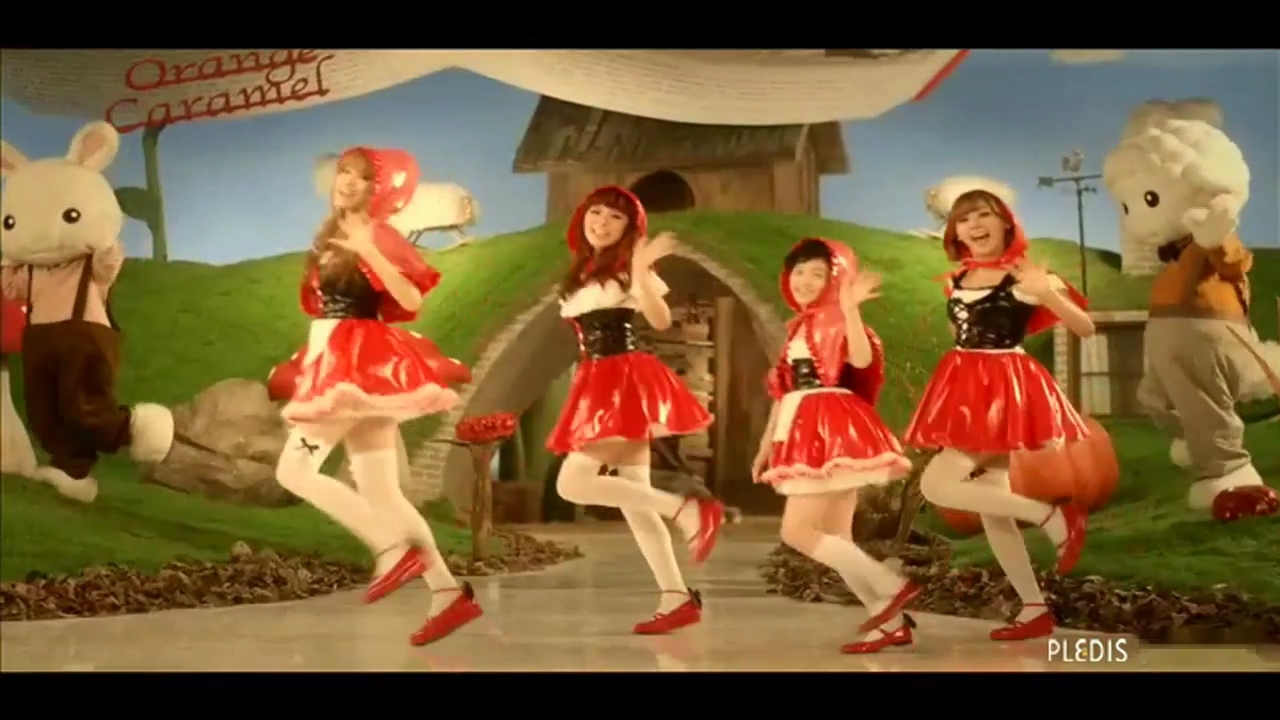
And in that same spirit of turning what was once considered dull and ordinary into something fun and sexy, let me leave you with all the great examples of Korean retro mentioned below:

Any other aficionados out there?^^

Update: More retro-themed pictures of Girls’ Generation are available here:

Update 2, July 2012: Here’s a post on the “fashion police” of the 1970s who would check women’s skirt lengths, which emerged in the discussion in the comments.

Korean Sociological Image #51: Male Objectification and Double Standards

What would be your reaction if this flashed on your TV screen?

Mine was that hard abs aren’t the best analogy for airbags. But my mistake: they’re not supposed to be. Rather, Hyundai needed something to signify the number of airbags as the voiceover went through various specs of the car.
Which, to be fair, is much clearer in the full commercial.

How about if a proper airbag analogy had been used instead, like Mercedes Benz did back in 2006?

(Source)

If you found that objectification distasteful however, then consider the following from Renault/Samsung in 2008 below also:

Which uses the same analogy, but is clearly quite a contrast to BMW’s puerile effort. Nevertheless, some commenters on an earlier post (update: since deleted sorry!) did still have some issues with it, whereas nobody on this blog at least has had any with all of the men’s 6-packs that suddenly started appearing in Korean commercials from last year.

But I’m sure you’re already well-aware of that double-standard, so the purpose of this post is not just to draw your attention to it. Nor to simply pass on that juxtaposition of advertisements, however interesting. In combination with a recent development in the Korean media though, what that juxtaposition did serve to do was make me realize both the rapid mainstreaming and dogmatic nature of that double-standard here, and which is a combination that I think is pretty unique to Korea too.

Let me explain.

Actually, the first I already have: consider how popular the new buzzword “chocolate abs” (초콜릿복근) is in the Korean media now as a result of all the recent ads featuring them for instance (see here, here, here, #8 here, and this new one below for examples and/or discussion), whereas it didn’t even make a list of buzzwords at the end of last year.

Against that sudden popularity however, you could argue that they’ve actually already been around for a long time in music videos. As Hoon-Soon Kim explains of some from 2000 in “Korean Music Videos, Postmodernism, and Gender Politics” in Jung-Hwa Oh (ed.), Feminist Cultural Politics in Korea (2005) for instance, albeit with more of a focus on the emergence of the “Flower Men” or kkotminam (꽃미남) phenomenon than male objectification per se:

…we see that there is a new type of male image emerging albeit in a small number of music videos. It is a de-gendered image of men which is a contrast to the macho image. Male groups such as Y2K, H.O.T., ITYM, and Sinwha, whose fans are mostly teenage girls, portray this image. They wear make-up and a lot of jewelry and ornaments – which are all considered feminine – and take off their shirts to show off their bodies. This indicates that the male body is also sexually objectified as the female body….The style of the video is similar to that used to show female images with extreme close-ups to fill the screen with a face, and medium-range or full body shots for dances. Although there is a risk of overstating the phenomenon, this image could be interpreted as a signal indicating the possibility of breaking the binary boundaries of men and women that have been formed in a patriarchal culture. (p. 207)

And yet just like in ads, the amount of male objectification in music videos—or to be specific, ab exposure—does also seem to have picked up markedly in the past year or so. Like Multi explained back in March:

…in the past month the internet has been flooded with pictures of Korean celebrities and their abs (as well as some other shots that are not entirely SFW – you’re over 18 you can check them out here, and here). Our favorite controversial band 2PM just did an extensive photoshoot and were topless for most of it (parts 1, 2, 3, 4). Lee Joon of the new boy group MBLAQ flashes his abs a whole lot, because the king of ab-flashing, and Korean superstar extraordinaire, Rain, who happens to be his boss, tells him to because the fans like it, (yup, we sure do ;) and everyone wants to get pictures of them (exhibit A, B, C, among countless others). Then there’s these guys, this guy and this guy, and like 50 others. And then countless polls as to whose abs are better.

To be precise, Rain told Lee Joon that taking off his shirt has far more effect on his audiences than his dancing. And as “the king of ab-flashing”, then of course he could have been talking about himself instead (actually, I thought he was originally), so I can hardly fault him for showing off his own abs so frequently in his own music videos and performances. But rarely in harmony with his song’s lyrics and/or even his choreography however, and so for me personally he more epitomizes just how cynical and commercially-driven the trend has become, with obvious parallels to more familiar ones for female performers. Check out from 2:55 here for instance:

And my critique of the trend as “commercially-driven” is no mere cliche, because whereas it’s mostly young girl-groups that have sprung up in the past year or so (see here for a handy chart), likewise Korean male singers have to adapt to the Korean music industry’s overwhelming reliance on musicians’ product endorsements, appearances on variety shows, and casting in dramas to make profits (as opposed to actually selling music). This encourages their agencies to make them stand out and differentiate themselves from each other by coming up ever more sexual lyrics and/or performances and music videos: namely, more abs from the guys, let alone feigned fellatio, feigned sex on beds, or even virtual rapes of audience members on stage during performances.

Allkpop argues that it’s consumers that are driving this trend however, and that this explains the imbalance between new girl and boy groups:

It looks like girl groups don’t seem to have as high of a failure rate as boy groups or solo singers. These new girl groups have already been gaining so much attention. The reason why you can rely on girl groups to bring in the income is because there’s always teenage boys and ahjusshi (old men) fans to trust. They can also go perform at various events which always require a pay day. Supposedly, Secret gets paid around $8000 per event performance while a group like 4minute gets paid around $12,000 per event.

And yet while that is not incorrect per se, Multi goes on to explain in her post that it is largely female fan club members in their 30s and 40s that are driving this trend, not unlike how I’ve demonstrated that the same demographic (and often exactly the same women) were the driving force behind the full emergence of the kkotminam phenomenon back around the time of the 2002 World Cup. Hence I’d argue that the imbalance is more the result of top-down imperatives then, with many similarities to the American media ideal of female sexuality getting progressively younger over the last 3 decades…and for the same profit-driven motives.

But I digress: for more on that, see a forthcoming Part 2 of my “Reading the Lolita Effect in South Korea” series, which I’ll link to here once it’s up (update: and here it is!). In the meantime, hopefully by this stage you can see why celebrities so dominate advertising here, and which is already an industry not exactly averse to perpetuating celebrities’ agencies’ inherent needs to use sex to sell. Moreover, whereas it’s true that the content of ads worldwide does tend to lag behind social trends, as even just the title of Kwangok Kim and Dennis Lowry’s journal article “Television Commercials as a Lagging Social Indicator: Gender Role Stereotypes in Korean Television Advertising” in Sex Roles, Vol. 53, Nos. 11/12 December 2005 suggests, once they do start appearing in ads then that wider exposure (no pun intended) can have a profound effect in mainstreaming them:

According to cultivation theory, the media play an important role in creating distorted views. This theory suggests that exposure to media content creates a worldview, or a consistent image of social behavior, norms, values, and structures, based on the stable view of society provided by the media. In other words, cultivation theory posits that consistent images and portrayals construct a specific portrait of reality, and as viewers see more and more images, they gradually come to cultivate or adopt attitudes and expectations about the world that coincide with the images they see. Although this model has typically been employed to explain the impact of of television violence, it also has been applied successfully to the cultivation of attitudes towards gender roles. (p. 902, references removed)

(“Bob’s Television Dream” by Robert Couse-Baker)

And in particular:

Although television viewers often claim that commercials do not affect them in negative ways, repeated images in television advertising may already have created a “mainstreaming effect,” as suggested by cultivation theory. Television has the power to cultivate people to have the same views of the world, for example, stereotypical views of gender roles in our society. In other words, the mainstreaming effect reduces cultural and political differences among television viewers. Studies have shown that heavy television viewing may influence children’s perceptions of behaviors and psychological characteristics associated with gender…and [one other] found that heavy viewers of television commercials among the elderly were more likely than light viewers to perceive characters (e.g., the elderly) in commercials as realistic (i.e., mainstreaming effect). It may not be advertisers’ full responsibility to reflect statistically accurate images of society. However, the burden of responsibility is on the advertisers when they fail to reflect the rapid changes in such stereotypes in our society. (p. 908, references removed)

But still, how exactly does simple exposure to those ads necessarily result in us adopting the attitudes and worldviews contained therein, as if by osmosis or something?

Well first, consider their sheer number: “In the United States alone, the average person may be exposed to 500 and 1000 commercial messages a day”, according to p.34 of Essentials of Contemporary Advertising by William Arens and David Schaefer (2007). And like Stuart and Elizabeth Ewen explain in their prologue to Channels of Desire: Mass Images and the Shaping of American Consciousness (1992), it’s amazing how subtly, profoundly, and almost entirely unconsciously this daily barrage affects us. Quite a charming narrative, which no-one can fail to be more interested in advertising after reading, I’ve scanned it for you below:

But regardless of whatever is ultimately responsible for the timing and/or mainstreaming of men exposing their abs in the Korean media, I’m sure we can all agree that they are now here to stay (and there was much rejoicing). And in a sense, this was indirectly confirmed by SBS recently when it decided to ban female performers from exposing their navels and/or abs on its popular Inkigayo (인기가요) show, whereas male performers remain free to rip off their own shirts: the “recent development in the Korean media” that I referred to in the introduction.

Why is that ban more significant than the plethora of others however? And why is it not exceptional, but in fact genuinely reflects deeply ambivalent and dogmatic societal attitudes to—for want of a better term—women’s top halves? Alas, it was my original intention to jump straight into that second part here, but with this post already at 2000 words (and well overdue), then I’ll wisely defer those 1500 extra ones to a separate post later in the week.

(Source)

Until then, a request, lest anyone feel I’ve been too critical of Rain here: does anybody know the name of a recent music video that features 2 young male singers vying for the affections of a woman, taking off their tops repeatedly (perhaps 10 times) and walking around half-naked for most of the video as they sing…before finally noticing that the woman has taken advantage of their distracted state by stealing their jeep?

Please do pass it on if you do, as I feel it actually much better epitomizes just “how cynical and commercially-driven the [ab-exposure] trend has become” than Rain does, and which even heterosexual women and gay men that see it will probably agree is a little excessive, let alone extremely lame. Moreover, while I don’t claim to have suddenly seen the light as a result, and can now completely empathize with women’s feelings about their own pervasive objectification in the media…I do think the eye-rolling, sense-of-exasperation, and literal gagging I experienced is at least a start towards doing so!^^

Update: With thanks to Katarina, the video is I was Able to Eat Well by 2AM’s Changmin & 8eight’s Lee Hyun:

Clearly, I exaggerated it in my memory. But understandably, as with them so so eager to shed their clothes together in the garage parking lot from roughly 0:59 for instance (for the sake of showing off their abs), that segment at least seriously resembles a gay porn video.

Probably actually objectifying the woman even more than the men though, then I take it all back: Rain’s performances do best epitomize the ab craze!

(For more posts in the Korean Sociological Images series, see here)

Korea Doesn’t Get Much Cuter Than This…

A girl-group aimed at my demographic, set in the style of the video games I used to play as a teenager? Seriously, what more could one ask for in a music video?^^

Thanks to Ashley at SeoulBeats for the laugh!

Because Of You (너 때문에) by After School (애프터스쿨): Lyrics, Translation, & Explanation

With apologies for not writing about the positives of Korean popular culture more often, let me present Because of You (너 때문에) by After School (애프터스쿨). It’s one of my 10 favorite Korean songs, and easily their best.

Or at least, DJ Areia’s version of it above is, but I include the original below if you prefer.

The music video however, is a little confusing. Not because it depicts a relationship between 2 women though: admittedly that was a surprise, but in hindsight the lyrics are completely gender neutral. Rather, it’s because there is a man – model Song Jae-lim (송재림) – featured prominently throughout, and it’s not entirely clear who or what he’s supposed to represent exactly. Indeed, with his collage of photos of different members of the group, closed-circuit TV monitoring of them, and finally holes in walls through which to directly spy on them, then “voyeur” or “stalker” is what comes to mind personally, but I’d be surprised if that’s what the creative director intended.

If anyone can explain what he’s doing there then, then please let me know! In the meantime, I hope the translation adds to your enjoyment of the song, and for Korean learners I’ve included detailed explanations in those cases where I came across words or grammar that were new to me personally, or where my (Korean) wife and I had some difficulties. But I’m still quite happy to explain anything else though, and of course may have made some mistakes, so please give me a buzz in either case.

Here goes:

아직도 나 그대를 잊지못해

I never forget boy

I never forget boy

헤어진지 벌써 몇년이 지났는지 몰라

그대 생각만 하면 자꾸 눈물만 흘러

오늘따라 왜 그렇게 네가 보고플까

창밖의 빗소리가 내 맘을 흔들어놔

I still can’t forget you

I never forget boy

I never forget boy

Since we split up, already so many years have passed I’ve lost track

I only have to think of you, and I frequently [end up] crying

Why especially today do I want to see you so much?

The sounds of the rain outside the window pane has gotten my heart beating

Line 5 was the first problem, which my wife and I actually argued about a little (albeit when we were both very tired), because although “만” usually means “only”, according to her it can also mean “whenever” too. And however annoying it is for learners like myself, I do concede that even the simplest of Korean words can have multiple meanings sometime, so although I haven’t encountered that use of the term myself yet, for a while I wisely deferred to her translation of it as “Whenever I think about you”.

But still, it bugged me, as surely “그대 (애대해서) 생각할때 마다”, say, would be a much less ambiguous way of saying that? Hence the result you see above, after resolving which we wisely decided to start translating the next verse in the morning. Unfortunately however, that still left Line 7, which uses the construction of [verb] + [아/어/여 ending] + [놓다].

I wasn’t familiar with that, but I did know [verb]+ [아/어/여 ending] + [있다], which means that “the state resulting from the action of the verb continues to exist” for a short time, and also [verb]+ [아/어/여 ending] + [두다], which basically means to something in that state for a much much longer time (compared to 있다), so it wasn’t difficult to understand this new 놓다 one, which “indicates that the action of the main verb is complete, and is restricted to action verbs”. See page 353 of Korean Grammar for International Learners for more information, an essential reference book which I’d be surprised if anyone still reading by this stage didn’t already have!

사랑하지 말걸 그랬어 정 주지 말걸 그랬어

붙잡지 말걸 그랬어 왜 이렇게 나 혼자 아파

사랑하지 말걸 그랬어 정주지 말걸 그랬어

붙잡지 말걸 그랬어 왜 이렇게 나 혼자 아파

난 항상 너만의 장미가 되려던 내 맘을 아니

이제 조각난 사랑의 마침표가 됐다는걸

눈물이 밀려와 메마른 입술이 젖어

이제 어떡해 그댈 잊을 수 없어

I shouldn’t have loved you, I shouldn’t have given you affection

I shouldn’t have asked you to stay, why am only I hurt so much?

I shouldn’t have loved you, I shouldn’t have given you affection

I shouldn’t have asked you to stay, why am only I hurt so much?

I was always going to be your rose, Do you know my heart?

I know our shattered love’s final end has come

My gushing tears wet my dry lips

Why can’t I forget you now?

In lines 1-3, the construction [verb] + [지말걸] basically means “shouldn’t have [verb], and the “그랬어” just adds emphasis. In Line 1, it seemed simplest just to translate “정” as “affection”, but note that it often means a great deal more than that in group contexts (see here and here). Meanwhile, in Line 7 I changed “밀려오다” from “advancing” to “gushing”, because although the former is technically more correct, in English “advancing tears” really means tears that haven’t arrived yet, whereas in this case the Korean means tears that have arrived, and keep coming like waves on the sea keep advancing towards the shore.

Line 6 though – 이제 조각난 사랑의 마침표가 됐다는걸 – was probably the hardest of the entire song to translate. My logic with “I know our shattered love’s final end has come” was, first, that the sentence is quite literally “Now-shattered-love’s-full stop/period-has come/formed/arrived I know”, with me writing “full stop/period” to avoid anyone confusing “period” with a period of time, when actually “마침표” just means the punctuation at the end of a sentence. But then I decided that “final end” is what it is meant by that surely, and changed it accordingly.

Still, I admit that the sentence as a whole remains pretty strange, as in my experience “shattered love” has already has had “a final end” by virtue of shattering in the first place. Perhaps not so in Korean though?

Next, the chorus:

너 때문에 많이도 울었어 (매일밤 난)

너 때문에 많이도 웃었어 (그대 때문에)

너 때문에 사랑을 믿었어 (woo boy)

너 때문에 너 때문에 모두 다 잃었어

정말 답답답해 갑갑갑해 막막막해 너없는 세상이

내 말을 씹어놓고 자존심 짖밟아놓고

내 맘을 찢어놓고 왜 나를 떠나가

Because of you I cried a lot (every night I)

Because of you I laughed a lot (because of you)

Because of you I believed in love (woo boy)

Because of you, because of you, I lost everything

I am so frustrated, stifled, and lost in a world without you

You ignored what I said and walked all over me

You tore my heart to shreds, why did you leave me?

Most of that was quite simple in contrast. Of course there are many alternatives in English for “닫답하다”, “갑갑하다”, and “막막하다” in Line 5, and the difference between the first 2 in particular is quite subtle. Indeed, although this was the first time I’d ever heard “갑갑하다” myself, my wife tells me that it is so similar to “닫답하다” that it is often used in conjunction with it for emphasis.

Also, in line 6 and 7 there is the [verb] + [아/어/여 ending] + [놓다] used earlier. In Line 6, I decided that “you ignored what I said” was a better translation of “내 말을 씹어” than the literal “you chewed my words”, which sounds quite ambiguous in English. In the case of  “자존심 짖밟아” though, I decided that “walked all over me” sounded the most natural, but the more literal “you trampled over my self-respect” was probably fine really.

Note though, that the last line should really have a “you” or “당신이” inserted, making it  “내 맘을 찢어놓고 왜 당신이 나를 떠나가” or “You tore my heart to shreds, why did you leave me?”. And as I’ll explain, the question of who left whom exactly becomes important a little later.

그날도 비가 왔었지

한참을 그댄 말없이 나를 바라보기만 했어 어어어

흔들리는 눈빛과

애써 짓는 어색한 미소가 이별을 얘기해줘 줘줘줘

It rained that day too

For a long time, you just stared at me wordlessly

Through the light of your eyes and your labored, awkward smile, I realized you were going to split up with me

That’s quite straightforward, so I’ll just continue:

사랑하지 말걸 그랬어 정주지 말걸 그랬어

붙잡지 말걸 그랬어 왜 이렇게 나 혼자 아파

사랑하지 말걸 그랬어 정주지 말걸 그랬어

붙잡지 말걸 그랬어 왜 이렇게 나 혼자 아파

나보고 떠나가라고 할땐 언제고

떠난다니까 어쩌고 미친사람 취급만 해 정말 힘들어 (Boy slooow down)

아무런 말도 못한 채 울어

Cause I want to stay next to you

My love is true Wanna go back to when I was with you

I shouldn’t have loved you, I shouldn’t have given you affection

I shouldn’t have asked you to stay, why am only I hurt so much?

I shouldn’t have loved you, I shouldn’t have given you affection

I shouldn’t have asked you to stay, why am only I hurt so much?

You are the one who told me to leave

After saying that, why did you only treat me like I was crazy? It was so painful and difficult for me

I cried so hard I couldn’t speak

Cause I want to stay next to you

My love is true Wanna go back to when I was with you

The question of who left whom is important because of Line 5, “나보고 떠나가라고 할땐 언제고”. The “보고” in that is just another way of saying “한테”, leaving us with literally “To me-ordered [me] to leave-when you [ordered me]-some day”; not as confusing as it looks though, as it’s just “When you told me to leave someday”. Or so I thought, but in that case the placing of the “언제고” would be different: “”나보고 언제고 떠나가라고 할땐”. And it couldn’t be “Someday, when you told me to leave” either, as the subject marker attached to “when” – “할 땐” – makes that impossible.

I despaired then, and it didn’t help that I thought it was the other person that left the singer(s) either. My wife came to the rescue though, by saying that although the dictionary says “”언제고” is “someday”, it’s also used for emphasizing that someone said something to you, and not the other way round. She also told me that that meant I could omit the “when” too, and hence you the final result “You are the one who told me to leave”.

That still leaves the question of who left whom though, especially as the next line was “After saying that, why did you only treat me like I was crazy?”. My best guess then, is that the ex-girlfriend told the singer(s) to leave, and when she didn’t, the ex-girlfriend left instead, especially given the last line of the song which you’ll see in a moment.

Next is the chorus again though, so I’ll skip ahead to the next verse. And if you haven’t been listening to the remix version, then I highly recommend you at least listen to this section from 2:42 (3:03 in the original), as it’s not for nothing that I said back in May that “the background melodies at that point raise my spirits from virtually any depths, and make me feel like I can conquer the world, even after probably 200+ times of listening to the song”!

I miss you I need you 꿈 속에선 아직도 I’m with you

I miss you (miss you) I need you (need you)

시간을 되돌려 Wanna kiss you again ma boy

맘이 너무 아픈데 견디기 괴로운데

너는 어디서 뭘하니 (나 울었어 참 많이)

너 없인 난 못살아 내게로 돌아와줘 날 떠나가지마

I miss you, I need you, You’re still in my dreams, I’m with you

I miss you (miss you) I need you (need you)

I wish I could go back to then, Wanna kiss you again ma boy

My heart aches, enduring it is so painful

What are you doing now, where are you (I cried so much)

I can’t live without you, Please come back to me, Please don’t leave me

And finally there is the chorus again. Again then, I hope you can all enjoy the song much better now, and if you’re a fan of After School then you may also like to check out my translations of the lyrics to Ah! (아!) and Bang! (뱅!) too. And the Song Lyrics & Translations category in general of course; alas, there’s only 1 song by another artist in there as I type this, but I promise to add many more soon!

<!–[if gte mso 9]> Normal 0 MicrosoftInternetExplorer4 <![endif]–> <!–[endif]–>

아직도 그대를 잊지못해

I never forget boy

I never forget boy

헤어진지 벌써 몇년이 지났는지 몰라

그대 생각만 하면 자꾸 눈물만 흘러

오늘따라 그렇게 네가 보고플까

창밖의 빗소리가 맘을 흔들어놔

사랑하지 말걸 그랬어

정주지 말걸 그랬어

붙잡지 말걸 그랬어

이렇게 혼자 아파

사랑하지 말걸 그랬어

정주지 말걸 그랬어

붙잡지 말걸 그랬어

이렇게 혼자 아파

항상 너만의 장미가

되려던 맘을 아니

이제 조각난 사랑의 마침표가

됐다는걸

눈물이 밀려와

메마른 입술이 젖어

이제 어떡해

그댈 잊을 없어

너때문에 많이도 울었어 (매일밤 )

너때문에 많이도 웃었어(그대 때문에)

너때문에 사랑을 믿었어(woo boy)

너때문에 너때문에 모두 잃었어

정말 답답답해

갑갑갑해

막막막해

너없는 세상이

말을 씹어놓고

자존심 짖밟아놓고

맘을 찢어놓고

나를 떠나가

그날도 비가 왔었지

한참을 그댄 말없이 나를

바라보기만 했어

흔들리는 눈빛과

애써 짓는 어색한 미소가

이별을 얘기해줘

사랑하지 말걸 그랬어

정주지 말걸 그랬어

붙잡지 말걸 그랬어

이렇게 혼자 아파

사랑하지 말걸 그랬어

정주지 말걸 그랬어

붙잡지 말걸 그랬어

이렇게 혼자 아파

나보고 떠나가라고 할땐 언제고

떠난다니까 어쩌고

미친사람 취급만

정말 힘들어 (보이 슬로우 다운)

아무런 말도 못한 울어

cause i want to stay

next to you my love is true

wanna go back to when i was with you

너때문에 많이도 울었어 (매일 )

너때문에 많이도 웃었어 (그대 때문에)

너때문에 사랑을 믿었어 (woo boy)

너때문에 너때문에 모두다 잃었어

정말 답답답해

갑갑갑해

막막막해

없는 세상이

내말을 씹어놓고

자존심 짓밟아놓고

맘을 찢어 놓고

나를 떠나가

I miss you i need you

속에선 아직도

i’m with you

I miss you (miss you)

I need you (need you)

시간을 되돌려

wanna kiss you again ma boy

맘이 너무 아픈데

견디기 괴로운데

너는 어디서 뭘하니

(나울었어 참많이)

없인 못살아

내게로 돌아와줘

떠나가지마

너때문에 많이도 울었어

너때문에 많이도 웃었어

(많이도 웃었어)

너때문에 사랑을 믿었어

너때문에 너때문에 모두 잃었어

(너때문에 )

정말 답답해

갑갑해

막막해

없는 세상이

말을 씹어놓고

자존심 짓밟아놓고

맘을 찢어 놓고

나를 떠나가

Share

Share

Conformity and Celebrity in Korean Advertising: Some Quick Thoughts

( Source )

What? Belgian surrealist art on a blog about Korean sociology? Yes indeed; but never fear, for I’ll be criticizing something Korea-related soon enough!^^

The painting in question is Golconda (1953) by René Magritte, and I’m sure many of you have seen it before. But what did you think it was about?

Personally, I’d always assumed it was a critique of conformism. But Charly Herscovici, who was bequeathed copyright on Magritte’s works, commented that (via Wikipedia):

Magritte was fascinated by the seductiveness of images. Ordinarily, you see a picture of something and you believe in it, you are seduced by it; you take its honesty for granted. But Magritte knew that representations of things can lie. These images of men aren’t men, just pictures of them, so they don’t have to follow any rules. This painting is fun, but it also makes us aware of the falsity of representation.

So although our interpretations aren’t mutually exclusive, the painting may not be quite as drab and negative as I thought. Still, does that make the concept suitable for a phone commercial?

Not really:

Vodpod videos no longer available.

No, I can’t really think of any relationship between the artistic concept and the voiceover droning on through the “U” section of the dictionary either. And ironically, the result probably emphasizes conformism and/or uniformity more than Golconda does too; particularly by starting with the word “unique”, only then to visually demonstrate how owning a Galaxy S phone will make you anything but.

Explicitly stating the opposite however, Rain’s (비) recent commercial for the SK-W Phone provides an interesting contrast:

And at least the copywriting does match the video this time (translation from the uploader):

– Do you want to be in the spotlight as just one of all dressed in the same form?

– You can be a real star only when there is an aura about you.

– (Rain’s voice): Your desire to want someone’s attention is one good enough reason to want ‘W’.

– ‘W’ which is really quite something with its own shining aura (repeated two times)

Or in other words, if you’re just the same as everyone else, then owning a special SK-W phone will compensate for your lacking any special qualities, thereby helping you get the girl.

Or will you? It takes no great leap of the imagination to see that if I can get a shining aura of sexual magnetism to rub off on me by purchasing the phone, then so can you too. Indeed, you can argue that the explicitness of the above message actually only serves to highlight that mundane, self-defeating reality of consumerism.

So why then, were over 100,000 sold in the month after its release?

Alas, I know nothing about the merits of the phone itself. But some advertorials have directly linked its success to Rain’s dancing in the commercial, and I can disagree with that at least, finding the first part of his dance more reminiscent of an imitation of Robocop than anything else (source, right). Instead, I would attribute it more to the fact that it simply features one of Korea’s biggest celebrities, an unfortunate mainstay of Korean advertising. As Londoner Bruce Haines puts it, currently head of Korea’s largest ad agency Cheil Worldwide (제일기획):

Q) What’s one big difference between advertising in Korea and the UK?

A) Celebrity endorsement – a huge proportion of Korean ads depend on famous people. Of course, it’s not uncommon in the West for stars to endorse a product, but generally the ad has a core idea and makes use of the celebrity endorsement to enhance the original concept. Not so in Korea. In its crudest form, Korean advertising degenerates to beautiful people holding a bottle. This is one of the things holding back the reputation of Korean advertising worldwide.  (10 Magazine)

And on top of that, perhaps I’m really quite misguided in assuming that the messages of conformity wouldn’t find a receptive audience among Korean consumers too. After all, however much of a gross generalization it sounds at first, in fact emphasizing both have been strong political and economic prerogatives of the South Korean state for much of its short history, and with profoundly gendered consequences.

What do you think? Either way, if this collection of my thoughts on the 2 commercials must(?) have a conclusion, then it would be that I’d like to see more alternatives to the dominate narrative of simply throwing expensive celebrities and/or their bodies at consumers. And I don’t mean simply throwing art at them instead!^^

In the case of smart phones specifically, perhaps we could have ones that emphasized how they can be genuinely helpful and empowering for ordinary people?

At first, I thought this one qualified:

Vodpod videos no longer available.

But in hindsight, a demonstration of how phones can help you be like everyone else isn’t quite what I had in mind. If you know of any then, please pass on any better ones, for phones or anything else!

Share

Korean Sociological Image #49: Lee Hyori has an Asian Bottom?

Well, bottom half of her body to be precise. But then she is Korean after all, so what on Earth does that make her top half?

“Western,” according to her. And while she’s quite happy with that at least, in contrast she’s dissatisfied with her “Asian” legs, claiming that she has to always wear high heels to compensate for them (source, right).

However, despite my original shock at hearing her describe herself in such terms, ironically I find myself defending her statements.

No, really.

But first, the context. From the Hankyung:

가수 이효리가 “상체는 서구적인 반면 하체는 동양적이다”라고 말해 눈길을 끌고 있다.

Singer Lee Hyori is drawing lots of attention for saying “While I have a Western top half, on the other hand the bottom half of my body is Asian.”

지난 20일 방송된 MBC ‘섹션TV 연예통신’에 출연한 이효리는 서구적인 상체를 가지고 있는데 반면 “동양적인 하체를 가지고 있다”며 “하이힐은 생명과도 같다”고 말해 주위를 웃음바다로 만들었다.

Appearing on the MBC show “Section TV Entertainment Report” on the 20th of August, she then said that “High heels are as important as life itself!”, which turned the audience into a sea of laughter.

이날 이효리는 “샵에서 효리씨가 입어주면 옷이 잘 팔린다며 옷을 공짜로 준다”며 “옷을 잘 입는 방법은 얼마나 자신의 체형을 잘 커버하느냐인 것 같다”고 설명했다.

She also explained that “When I go into a shop, the owners give me clothes for free because they will sell well if I wear them”, and that “How well you wear clothes depends on how much of your body shape you cover up.”

이효리에게 ‘숨기고 싶은 신체적 단점’에 대해 질문하자 “상체는 서구적인 반면 하체는 동양적이다”라고 말했다.

When asked what were bad points about her body she wanted to hide, she replied that “I have a Western top half, but an Asian bottom half”.

이어 동양적인 하체를 커버하기 위한 해결책으로 “절대로 하이힐을 벗지 않는 것”이라고 강조하며 “10cm 이하 하이힐은 쳐다보지도 않고 잠을 잘 때도 하이힐은 신고 잔다”고 말해 주위를 폭소케 했다.

Accordingly, she emphasized that the solution for covering(?) her Asian bottom half was “never taking high heels off”, and that “not only will I not look at high heels with a heel less than 10cm high, but I even sleep in high heels”, producing hysterics in the audience.

Lee Hyori High Heels(Source. Source below: unknown)

Apologies for the terrible quality of that “news report”, but as I type this unfortunately I’m only able to find minor variations of it on the Korean internet. But lots of them, albeit only because Korea’s top female sex-symbol is admitting to having (self-perceived) flaws, and definitely not because of her views on different races’ body shapes.

And why should they be news? Are they really as strange as they first sound?

In short, no, for three main reasons.

Firstly, as some commenters at K-pop blogs allkpop and Omona! They Didn’t have pointed out, she probably merely meant that she had larger than average breasts and short legs instead, and was not necessarily denigrating women cursed with the latter, nor Asians in general. And that’s probably true.

Still, why not just say that instead?

But would you? In English, we describe people by their races all the time; much less so, the specific features that make us characterize them as such. Moreover, I’ve certainly met many people with a blend of racial features too, let alone the two I’ve fathered myself!

So although it sounds extreme and even amusing in English, I’d be very surprised if Lee Hyori wasn’t indeed just referring to certain body features when she said she had a seogujeogin (서구적인) top half and dongyangjeogin (동양적인) bottom half. Indeed, and finally, it behooves non-native speakers like myself not to take the Korean language too literally.

I learned this lesson myself back in February, through trying to understand the 2009 buzzword cheongsoon-glaemor (청순글래머). Meaning “innocent” or “pure”, then cheongsoon at least was easy enough, but glaemor (글래머)? Naturally I assumed it meant the same as the English, but as several readers pointed out, it’s a false cognate, actually meaning “large breasts” instead. So cheongsoon-glaemor means “innocent and busty” in English.

Yes, that does indeed sound inane in any language, but the point is that it’s rather different to “innocent and pure-looking but while still having a rich and glamorous celebrity lifestyle”, which is what I originally thought. And just in light of a mistake like that alone, then surely Lee Hyori should be given the benefit of the doubt in this case, rather than instantly being accused of racism and/or – ironically – feelings of racial inferiority.

Still, after almost spitting out my coffee while reading about the story this morning, I admit I’m a little reluctant to let her entirely off the hook.

And indeed, just like the term glaemor originally came from a mistranslation by the Japanese, stemming from the well-endowed busts of glamorous Hollywood starlets in the 1950s, the notion that all Korean women should envy the large breasts and long legs of their Western counterparts seems simply absurd considering what their bodies are like 60 years later. So it is high time more Koreans challenged this stereotype, and pondered what sustains it nevertheless.

Perhaps a good place to start would be ubiquitous cosmetic-surgery advertisements, which seem to have an inordinate number of Caucasians in them? What do you think?

(Source)

(For all posts in the Korean Sociological Images series, see here)

Korean Photoshop Disaster #6: I like it hot, strong, and black! (Updated)

( Source )

Do men pay more attention to men’s chests than women?

As a gym addict 10-15 years ago, I read somewhere in a newspaper that they do. And with my self-confidence back then wholly tied to how much I buffed up, it certainly matched my own experience.

Unfortunately for the sake of objectivity though, it’s been difficult not to remember that every time I’ve seen a topless man ever since. One look at Changmim of 2AM half-naked and holding his crotch in a coffee ad then, and all I could think about was the large, firm package that used to be the weekend edition of the New Zealand Herald.

Naturally enough, most commenters at allkpop and Omona! They Didn’t focused on the one that Changmin was allegedly holding in his left hand instead, and I’m going to take a wild guess that most of those were heterosexual women. Perhaps that explains why so few noticed the appalling photoshop job on his chest?^^

Yet despite men’s greater interest in those in a competitive sense, in reality not only is bilateral symmetry a good indicator of genetic health for both sexes, and hence a heavily favored trait in mates, but even women’s own breasts become more symmetrical during the most fertile period of their menstrual cycle too. So it’s a strange oversight.

And of course for the photoshopper too, who presumably originally aimed to create some sort of languid, fluid-like effect, and I expect the mistake will be corrected before the full ad campaign for Maeil’s “Cafe Latte Americano Dutch” is launched on the 13th (source, above). But regardless, and on a more serious note now, it still has to be the first of the recent spate of Korean advertisements to objectify men that I’ve positively disliked, rather than be merely nonplussed or amused by.

For it is just as lame as it is provocative.

Putting aside how problematic the slogan “Find Your Black” is to English speakers, as described at allkpop the campaign’s basic concept is that various members of 2AM represent “Chic Black”, “Luxury Black”, “Tough Black”, and Changmin as “Sexy Black,” and the first major problem with the ad is also the most obvious: what does a topless idol grabbing his genitalia has to with coffee exactly?

Or indeed, with being “sexy”, and it that sense it also reduces to and perpetuates the notion that sexiness is only a matter of skin exposure, whether for men or for women. A problem which is hardly unique to the Korea media of course, but it is exaggerated here, and so unfortunately I’m wasn’t all that surprised that that was the best that the creative team could come up with.

And yet, would the same ad have actually been possible with a woman? Specifically, one with her hand placed on her crotch, a pretty blatant gesture of intent in anyone’s language?

( Source: unknown )

But why so specific? Well, if there’s one consistent theme to emerge out of writing about Korean advertisements for 3 years, that would be being witness to a long line of firsts: the first erect nipples; the first portrayal of Korean female – foreign male relationships; the first kiss; the first spoof of objectification within ads(!); the first soju ad to portray a woman as, well, really rather slutty, as opposed to decades of portraying them as virgins; and so on. And no matter how difficult it may be to believe for recent visitors to the country, in fact some of those emerged just within the last 3 weeks, let alone the last 3 years.

So, it’s natural to write as if I have almost a perverted fixation on things like crotches sometimes! And indeed, if there’s one thing to take away from Changmin’s ad, it’s the realization that however permissible grabbing one’s crotch is in passing in brief dances on talk shows and in music videos and so on in Korea, I don’t think I’ve ever seen it in a print advertisement. On women or on men, and hence netizens’ intense interest in Changmin’s ad.

But of course I may be wrong, and so as always, please pass on any earlier ads that you are aware of. But for various reasons, I really do think that an equivalent ad with a woman would have aroused far more controversy.

How about you? Let me finish by providing two related examples to help get you thinking.

First, the the above one with Kim Ah-joong (김아중) from 2006, which at first glance is sexually-assertive enough. But as commenter “huncamunca” pointed out to me 2 years ago (in a post I ironically deleted yesterday!), it is definitely not an example of the sexually aggressive “cowboy stance” that I first interpreted it as:

…I agree that the “cowboy” thumbs in the belt loops make the picture sexual, but other elements of the stance make it sexual AND DEMURE, not aggressive. Usually, in the cowboy stance, the shoulders are relaxed and legs are slightly apart, with weight more on one foot than the other (see for example the picture of the woman on page 240 of the Pease book) [on body language]. However, Kim Ah-jung’s shoulders are raised, as if she is shrugging slightly in a demure way. Her elbows are straight and held close to her body to take up as little space as possible, which is not typical of the relaxed cowboy stance. Her legs are also tightly closed to take up as little space as possible, and they don’t look like they are about to take her toward what she wants. Her head is tilted down so she can look up demurely at the viewer. The combination of raised shoulders and lowered head is similar to the “Head Duck” in the Pease book (p. 235), which shows submissiveness. Also the wind effect makes it look as though whatever she is looking at (presumably a male viewer) is powerful enough to nearly blow her away while she marvels at him and waits for his approach. She doesn’t look like she intends to act, but rather like she hopes to be acted upon–sexual but still submissive.

Not that Changmin looks all that sexually aggressive either of course: indeed, he appears to be protecting himself more than anything else, but either way the ambiguity again points to a lack of thought behind the campaign.

Finally, a female equivalent of gratuitous objectification and/or nudity in a coffee ad provided by Italian coffee company Lavazza, also in 2006:

( Source )

Notorious for ads involving sex and/or the excessive objectification of women since at least 2005, this one was ultimately judged as discriminating against women by the Swedish Trade Ethical Council against Sexism in Advertising (ERK), and presumably forced to be withdrawn:

Sweden’s Ethical Council has a lower tolerance for the use of scantily clad women to advertise products than comparable regulatory bodies in other countries…

…ERK judged “that the woman is used as an eye catcher without any connection to the advertised products, and that it is insulting towards women”.In its defence Lavazza wrote that the 2006 calendar from which the images were taken used humour and irony to recreate a 1950s feel. The company claimed that the images depicted glamour, style and a lust for life and were in no way discriminatory.

[ERK Secretary] Jan Fager disagrees. In his opinion it is not acceptable for an advertisement for coffee to be sexy in the same way as, for example, an underwear ad. He noted that while H&M has come in for much criticism from the general public the company’s Christmas campaigns have never been found in breach of ethical standards…

…In its written judgment the ERK maintained that Lavazza had not lived up to the principle “that advertising should be formed with due regard for social responsibility”

Good for ERK, and yes, I rather like that acronym too!^^ But one wonders what they would make of Changmin?

Update – Unfortunately my English copy is in New Zealand, but see below for more on the cowboy stance, and how intimately sexual and physical aggression can be linked. From pages 236 and 237 of the Korean edition of The Definitive Book of Body Language by Alan and Barbara Pease (2006), it’s easily one of the most helpful book purchases you’ll ever make, although I did much prefer the realistic line drawings in the 1989(?) edition to the cartoon-like ones and photos of famous people in the new one:

And for comparison’s sake, here’s a less disastrously photoshopped image of Changmin:

( Source )

(For more posts in the Korean Photoshop Disasters series, see here)

Share

Korean Sociological Image #48: The Male Gaze

( Source: L-C-R. Reproduced with permission )

Like photographer L-C-R says, this 2008 Gundam advertisement is a prime example of a woman being portrayed as a child and/or sex object, of which she saw entirely too much of while she was in Korea.

You may be very surprised then, when you learn whom it was actually aimed at.

But first, please consider what is it exactly that so demeans drama actress Min Seo-hyeon (민서현) in it? I identify 4 or 5 things myself, which I outline in descending order of importance below:

  1. her childlike expression, combined with putting her fingers in her mouth
  2. the canting of her head
  3. her surprisingly awkward stance
  4. her passivity as she awaits the masculine-looking robot to make the next move

And after discussing those, albeit briefly because I’ve already done so in great depth in this similar post about soju advertisements, I’ll finally look at the ad in the context of the campaign as a whole. But feel free to disagree with any of those and/or suggest others, and in that vein I highly recommend asking your Korean partners, colleagues or friends their own opinions also. As if the experience of asking my wife and her friends earlier is anything to go by, then they are very likely to disagree with the first. Or indeed, that she’s being portrayed childishly at all, and – jumping ahead – not even in the following commercials either:

I’d argue that the main reason for that is the Korean cultural practice of aegyo (애교), difficult to define in English but probably somewhere between “affected sweetness” and “affected childishness“, and at least partially rooted in the prolonged transition to adulthood of experienced 20-something Koreans that are the biggest practitioners of it. For not only does the Korean education system essentially defer the joys of adolescence (but not the negatives!) until graduating from high school, but economic circumstances force them to live at home until marriage and/or deliberately put off their university graduation, and men also have their 24-28 months of compulsory military service to boot.

But I realize that since I was a student myself in the mid-1990s, more and more 20-somethings in Western countries are also postponing leaving home, and indeed to note all the above is not to argue that all Korean 20-somethings in such circumstances are childish; actually, I have intelligent, mature, and thoroughly Westernized Korean friends that have resigned themselves to them, or alternatively feel so trapped that they are literally fleeing the country to escape. Yet one thing they certainly do not do however, is aegyo, and I put it to you that in fact that is neither required for women to successfully navigate a patriarchal society, nor particularly savvy and ultimately empowering of them to do so.

( Source )
( Source: L-C-R )

Yes, “women”. As while Korean men do also do aegyo, and so as you’d expect content analysis demonstrates that men are much more likely to be portrayed childishly in advertisements in Korean magazines than US ones, and Korean men more than Western ones in the former, it is still overwhelmingly Korean women that are done so, and to a much greater extent than women of any ethnicity are in US magazines.

( Source )

As for anyone still not seeing the childishness in Seo-hyeon’s expression however, or why it is problematic in any sense, consider what the images above tell us about just how “natural” such expressions really are on adults, and why women are more commonly portrayed with them nevertheless. And which are often accentuated of course, by putting their fingers in their mouths, and which could possibly be considered “self-touching” as defined by sociologist Erving Goffman in Gender Advertisements (1979) below:

As discussed in that earlier post on soju advertisements, both are often combined with the canting of the head, which is problematic for the reasons outlined there. I also discuss awkward stances there too, and to anyone believing that I’m about to read too much into Seo-hyeon’s, I suggest stopping here and trying it for yourself,  making sure to bend and spread your legs outward at the knees like she does in particular. For not only will you realize just how unnatural it really is, and that people only ever stand like that in advertisements (and overwhelmingly women at that), but you’ll also probably end up falling forward a little on your first attempt like I did, and will suddenly gain a very palpable sense of why exactly the advertisement does indeed present her as a sex object:

( Source: L-C-R )

In Goffman’s framework in Gender Advertisements, that “bashful knee bend” is something that women frequently, men very infrequently, are posed in a display of. And whatever else, it can be read as

…a foregoing of full effort to be prepared and on he ready in the current social situation, for the position adds a moment to any effort to fight or flee. Once again one finds a posture that seems to presuppose the goodwill of anyone in the surround who could offer harm. (p.45)

Hence passivity, as blind to whatever occurs behind her, nevertheless Seo-hyeon seems to be eagerly awaiting whatever the robot plans to do with her. And which judging by the fact that it also is standing slightly thrust forward, and has a big long gun resting behind Seo-hyeon’s buttocks, couldn’t really be any clearer. Hell, even the protrusion on its crotch is already bright red for good measure too.

( Source )

An advertising campaign clearly aimed at young men and adolescent boys then, whom I’ll safely assume are the vast majority of Gundam fans? If so, then the effort actually appears to have backfired, as the few commentators on it I’ve been able to find here, here, here, here, and here generally express both surprise and disdain at seeing Min Seo-hyun at all, the last of whom wrote the following about the advertisement above:

이 광고는 광고로서의 설득력이 전혀 없다. 그것이 염가 제작되었기 때문이 아니다. 반대로 제작비는 많이 들었을 것이다. 이름있는 사람들의 얼굴을 비추기 때문이다.(그림의 건프라 광고에 출연하는 사람이 유명한지는 잘 모르겠다.) 그러나 문제 역시 그러한 사고방식에 있다. 즉, 유명한 사람의 얼굴을 비추면 광고가 될 것이라는 사고방식에.

This advertisement has no persuasive power at all. But not because it was cheaply and poorly produced; actually, because of the famous faces in it, it looks like a lot of money was spent on it (well, actually I don’t know if they are famous or not). Rather, the problem is with using that advertising logic in the first place.

이것은 어느 정도 맞는 말이다. 유명한 사람이 어떤 상품을 소비하고 있으면 그것만으로도 상품의 질을 소비자들에게 안심시켜 줄 수 있다. 그러나 그것도 광고의 효용성 안에서 이루어져야 한다.

However you look at it, this is correct. While of course simply having famous faces in an advertisement is sufficient for most consumers, they should still be used in the ad as effectively as possible however.

이 광고의 전략은, 유명하거나 예쁜 사람과 건프라의 이미지를 교차시켜 건프라가 갖는 오타쿠 이미지의 쇄신일 것이다. 좋은 생각이다. 그러나 이러한 두 이미지가 교차점을 찾지 못하고 있다. 저 사람은 건프라를 만지작거리고 있지만 전혀 즐거워 보이지 않는다. 아마 저 사람은 자신이 들고 있는 건프라의 이름도 모를 것이다.

The advertisement’s strategy is to reform the image of a Gunpla Otaku [an obsessive fan of something – James] by combining with a famous or attractive person. This is a good idea. However, ultimately they don’t really mix. This person doesn’t look like she’s enjoying holding the model [really?] and probably doesn’t even know the name of it.

( Source )

방 또한 지나치게 깨끗하지 않은가? 건프라에 열중하면 당연히 방은 데칼 찌꺼기나 플라스틱 조각으로 너저분해져 있어야 하고, 책장에는 잡다한 건프라가 어지럽게 진열되어 있어야 한다. 채색하는 손은 알록달록 에나멜이 묻어 있어야 하고, 옷은 더러워져도 상관없는 펑퍼짐한 츄리닝이어야 하며, 얼굴은 지극히 진중한 표정을 짓고 있을 것이다. 오히려 이러한 당연한 이미지를 예쁘고, 성공적이고, 멋있는 사람들과 교차시켰으면 이 광고는 성공을 거두었을 것이다. 장동건이 한없이 고결한 태도로 NDS를 플레이했다면 NDS는 그만큼 팔리지 않았을 것이다. 오히려 소파에 퍼져 앉아 우리들이 하듯이 게임을 했기 때문에, 우리가 하는 것을 장동건도 한다는 안심을 소비자에게 줄 수 있었다.

Also, isn’t the room excessively clean? When you are absorbed in assembling a Gunpla model, of course the room should be messy with the remains of decals and leftover plastic, and various other models displayed on the bookcase. And while your hands would be stained with enamel paint and your casual clothes dirty and speckled, your face shows that you don’t care about that as you focus all your attention on assembling the model. Rather, prettier and more successful people were needed. And recall that very famous actor Jang Dong-gun didn’t similarly loftily play Nintendo DS Lite while he was advertising it in 2007; instead, he just played it normally on the sofa like the rest of us, and so it sold well.

게다가, 타겟을 통일했으면 더 설득력이 있었을 것이다. 지금 이 광고가 노리는 소비층은 누구인가? 아이? 청소년? 남자? 여자?

Hence I think the ad would have been more persuasive if it had been aimed at a wider variety of people. But to whom was it actually aimed at anyway? Children? Teenagers? Men? Women?

( Source: L-C-R. Reproduced with permission )

Sounds like a rather picky otaku to me, but he does at least finish with some good questions, which I’ll now attempt to answer by passing on what I’ve been able to find of the remainder of the campaign.

First up, the one above that was alongside the one with Min Seo-hyun. Featuring popular singer (now actor) Kim Kibum (김기범) of the boy band Super Junior (슈퍼주니어), at first glance it’s very similar. And yet:

  • the robot isn’t even facing towards him, let alone thrusting a phallic object towards his buttocks
  • Kibum’s stance is much more natural
  • rather than passively waiting for robot to initiate something, here he seems to be silently asking the observer what fun things he can do with the robot himself
  • accordingly, his expression is more mischievous than childish
( Source: L-C-R )

Crucially however, this dichotomy is not repeated in the rest of the campaign. See the following commercial which features both actors for instance (as an aside, it starts with the lines “Shall we do it? Okay”, a common innuendo in Korean advertising):

And in particular, the long version of the bedroom one, which reveals that the reason she become interested in Gundam in the first place was because boyfriend Kim Kibum bequeathed his collection to her while doing his military service, to which she now enthusiastically adds to with her own robot:

And the theme of both sexes enjoying assembling and enjoying Gundam models is corroborated by the following posters and website images:

( Source )
( Sources: left, right )

Taken as a whole, I’d argue that the only consistent theme of the campaign is that of Min Seo-hyeon becoming more and more involved in the hobby for various reasons, including by: being (sexually) tempted by the models themselves; encouraged to take it up by Kim Kibum giving her his own models; assembling models together at his suggestion; and finally becoming equally passionate and knowledgeable about it as he is. Nay, it’s not so much a theme as the exact narrative Gundam hoped would play out repeatedly in real life, and besides which the cute portrait poster of Kibum above to download from the Gundam website is sufficient evidence in itself that the campaign was aimed at teenage girls and women.

Why then, did the bedroom commercial and the opening advertisement simply suck so badly? Why on Earth did the advertising agency responsible think that having a 22 year-old woman acting like a 12 year-old would make either age group more interested in the product, let alone by suggesting that – not to put too fine a point on it – she also wanted to get fucked by it?

Of course, there could be any number of reasons. For instance, there is the cultural practice of aegyo as mentioned, which I may have underestimated, and perhaps I’m wrong in thinking that the majority of Korean women would be at least unimpressed, if not offended, by depictions of women as children. It could also be yet another demonstration of an advertising agency so used to selling products to men that it comes to regard their perceived desires and tastes as the norm, and so unwittingly applies them to women too:

( Tempted to drink soju with 16.8% alcohol now girls? )

But recall that photographer L-C-R mentioned that she saw advertisements like these everywhere in Korea, as probably you do too, which raises a third possibility: either the Korean advertising industry as a whole is dominated by men (which may in fact be true), or else it has so internalized those male norms that even women in the industry (let alone consumers) regard them as normal and appropriate for selling products to either sex.

A phenomenon by no means confined to Korea or the just the advertising industry, this is the essence of the “male gaze“, and which hopefully having provided some evidence for and/or at least piqued your interest in, I’ll wisely finish by pointing you in the direction of excellent introductions to the topic rather than going on further here. One is the examination of the ways women are portrayed in graphic novels provided by fantasy magazine, and another is the related Bechdel Test for movies:

And here’s a brief application of that to specifically Fantasy movies at Feminist SF also. But I most highly recommend the illuminating, even strangely moving 1972 documentary Ways of Seeing by then art historian John Berger, which I’ve just discovered via Sociological Images here and here. Obviously the second episode on the female nude is most pertinent here, but episode 1 is more likely to captivate you to the extent that you forget to leave your seat for the next half hour:

Here’s episode 2:

And I would include episodes 3 and 4, the latter of which is on advertising, but I haven’t watched them myself yet!^^

(For all posts in the Korean Sociological Images series, see here)

Share

Ah! (아!) by After School (애프터스쿨): Lyrics & Translation

After School’s (애프터스쿨) debut track from last year, of which I again include both DJ Areia’s remix above and the original below for you to enjoy while I explain the lyrics. But note that the remix is not actually trance this time, but rather the disco-like “vibrating analog synthesizer sounds and the helicopter-like basslines” of the late-1980s and early-1990s, so please do give it a try if you’re normally put off by dance music.

As for the music video itself, its theme is a little strange: schoolgirls in skimpy clothing coming on to their increasingly flustered young teacher, whom they are very happy to have ‘accidentally’ burst into their locker room later? It sounds…nay, looks like Japanese manga, and reminds me that student-teacher relationships (including dating and marriage) are a common trope of mainstream Korean popular culture (see here, here, and here for example), which only serves to both glamorize and normalize them.

Still, overly hormonal school students do sometimes have crushes on their teachers, and there’s nothing wrong in itself with portraying those in a music video. But while this one does obviously cater more to men’s sexual fantasies than to women’s (would having the group members vying for the affections of a handsome male student instead appeal more to women?), the lyrics demonstrate that there is much more to the song than meets the eye…

Again, for reasons outlined last time, I’ll provide very literal translations:

이렇게 둘이, 너와 단 둘이
언제나 둘이, 달콤한 이야길 하고파 둘이
둘이, 오늘밤 둘이, 사랑해 우리 둘이 둘이 baby

This way the two of us, with you only the two of us

All the time the two of us, I want us to tell a sweet story

The two of us, tonight the two of us, I love you we the two of us the two of us baby

“단” in the first line confused me for a while: it has a dozen meanings, including “bunch” or “bundle” which would (sort of) go with “the two of us”, but ultimately the meaning “only” is the most appropriate here. After that, the “~ㄹ 고파 하다” verb ending in the second line was the first time I’ve ever come across it personally, nor is it in any of my grammar books, but my wife says it simply means “~하고 싶다”, or “want to”.

잘빠진 다리와 외모 너는 내게 반하지
그대를 향한 윙크 한번 내게 빠지지
니 높은 콧대, 내 몸맨 어때
내 앞에선 니 모든게 무너지고 말껄

You have fallen in love with my slender legs and outward appearance

If I wink towards you one time you will fall (further)

The bridge of your nose is high (you have high standards)

How is my body?

Everything about you is going to crumble in front of me anyway

It feels a little hypocritical of me to critique other translations of songs here, as I very much rely on them to try and understand anything I might be having difficulty with myself, and especially because the translators may lack my increasingly annoyed Korean wife to constantly ask questions of in the next room. Nevertheless, those of whomever DJ Areia uses in his remixes (Yeeun2Grace perhaps?) really do seem a little sloppy sometimes (recall the big mistake in the 5th line of Bang!), and certainly disguise the subtlety of the original.

Take the first line for instance: “빠지다” has 13 meanings according to my dictionary, but “sexy” isn’t one of them; rather “잘빠진 다리” are “legs that have lost a lot of weight”, or “slender”. Sure, you could argue that this is just being picky, but it’s just as plausible to think that there is something culturally significant in the fact that “legs that have lost a lot of weight” was said rather than “섹시한다리” for instance, or more literally “sexy legs”. Also, “외모” is not “face”, but is actually the “outward appearance” of your entire body.

Next, putting line 4 as “I know you’ll crumble in my presence” completely ignores the “모든게” (or “모든것” + “이”) in it, or “everything”, and although “I know you’ll fall for me” is fine I guess, the verb ending “~고 말껄” (annoyingly not in any of my grammar books) means more “[the verb] is going to happen anyway”. Hence “everything about you is revealed in front of me” seems much better, as per the translation available on the AfterSchoolPlay fansite (registration required)

Finally, not a translation mistake, but in line 2 annoyingly the meaning of “빠지다” is different to that in line 1; and learners of English complain about the multiple meanings of words!

사랑한다 말만 말고 보여 주겠니
나도 니가 맘에 들어 춤을 추겠니
너와 난 왠지, 자꾸만 왠지
통할 것만 같아, 너를 사랑 할것 같아

Don’t just say you love me, aren’t you going to show me?

I like you too, aren’t you going to dance for me?

You and me for some reason, only again and again for some reason

I think we will only be connected, I think I will love you

My wife tells me that the verb ending “~겠니” in line 1 and 2, again not in any of my grammar books(!), means “aren’t you going to [verb] for me?”, So where on Earth “If I didn’t like you would I dance up on you like this?” below comes from I have no idea, no matter how appealing the thought!

(chorus)

짧은 시간 가까워진 우리 둘 사이
그대와 난 이제 하늘이 맺어준 사이
두말 할 필요 없어, 다가와 내게 어서
조명이 나를 번쩍 비추면
그댈 유혹하는 내 눈빛이 뜨거워지지
다른 남자들은 니가 너무 부러워지지
말은 안해도 난 알잖아 표현 안해도 다 알아
빨개진 니 얼굴이 다 말을 해주잖아

In just a short time we have become close

We are a match made in heaven

We don’t need to say it twice, come to me

If a light suddenly shines on me

It heats up the light of my eyes that is seductive to you

And other men become very jealous of you

You don’t have to say it or show it in your expression, I know everything

You red face shows it all

Not much to say here actually, other than both the translators at Yeeun2Grace and AfterSchoolPlay separated the above into two verses between lines 4 and 5. But I think that was mistaken, as line 4 ends in “비추면” or “if the light shines (on me)”, which is why the singer’s seductive eyes light up in the line 5. Lacking that connector, then I think that their own versions of line 4 and line 5 – “I’ve been illuminated by the light… You see my burning seductive eyes” and “When the lightning strikes me…My eyes which are putting him into temptation are becoming hotter”  respectively – don’t really make any sense.

(chorus)

나나나~

After school in the house, 모두 같이 make it bounce
들어봐 지금 내 말, 오늘밤 tonight
다가와 말못했던 얘기, 우리 둘만의 작고 작은 속삭임
그래 넌 지금 날 너무 원하지, 가벼운건 싫어 내 모습이
다른 장소 after party, 걱정마 이런 내 스타일에
오늘밤은 후회안해, 내 맘을 뺏어봐 baby boy

(chorus)

Na na na~

After School in the house, everybody together make it bounce

Hear my words now, this night tonight

Come to me, and all the things you (we?) couldn’t say, all the little whispers we said only to each other

Yes, you really want me now, I (you?) don’t want just light stuff

Different place after party, don’t worry this is my style

Don’t regret tonight, try to take my heart baby boy

Again, the Korean seems pretty straightforward here. On a final note then, given how targeted it is towards male audiences I was very surprised not to find any screenshots of the music video either via Korean or English search engines, leaving me with the onerous task of producing my own. Despite the visuals however, the lyrics in this debut song are clearly just as much about girl-power and being confident and assertive as they were in Bang! a year later, so the possibility remains open that After School may actually have a sizable female fan base (and I rather hope that they do).

In light of that then, you imagine what I thought of three members’ most recent song in which they pour on the aegyo (애교), basically looking and behaving like 12 year-old girls. Like I said in the comments to a post about it at SeoulBeats:

I’d have to give it a thumbs down. Not so much for the music in itself, but because I’ve always liked After School for the assertive, confident, girl-power theme of their songs, and so this “candy coated aegyo overload” as you well put it really seems to dilute their brand.

And most other commenters there agreed with me. But what do you think of it? Feel free to disagree with me of course, and diversity is the spice of life and all, even for music groups. But still…

(Source)

As always, thanks in advance for pointing out any mistakes I may have made or providing alternative translations!

Korean Photoshop Disaster #5: Girls’ Generation’s legs too fat for China?

( Source )

Given the clear artistic license applied to the other main image in this series, would you say that here too, the graphic designer deliberately intended for members of Girls’ Generation (소녀시대) to look like virtual caricatures of themselves?

Update: See Korean Lovers Photoblog for the full series.

(For more posts in the Korean Photoshop Disasters series, see here)

Share

Music Monday: On Black music, KARA, & Why K-pop bands are so large…

Three things of interest I came across all in the space of this morning…

First up, a recent edition of the BBC4 podcast Thinking Allowed, which – paraphrasing slightly – discusses the contention of cultural critic Paul Gilroy that:

From Curtis Mayfield to 50 Cent, from Nina Simone to JayZ, black music has declined in its quality and lost its moral stance. Outlined in his essay “Troubadours, Warriors, and Diplomats” in his book Darker Than Blue: On the Moral Economies of Black Atlantic Culture (2010) , he joins host Laurie Taylor and music journalist Caspar Melville to discuss the counter-cultural stance that black popular music once had, and explore whether it really has been destroyed.

On the surface only tangentially-related to Korea, in that modern K-pop has strong hip-hop roots (in contrast to J-pop, which are more in rock), this 28 minute, very accessible synopsis it is still surely required listening for all those interested in music and cultural studies. And indeed, the second half of the discussion in which they talk more about the impact of technological developments on music, and especially the reality that precious few young people are prepared to pay for it anymore, is perhaps more pertinent to the Korean music industry than most.

Next, an Icelandic reader passed on a link (thanks!) to the journal article “Crazy About You: Reflections on the Meanings of Contemporary Teen Pop Music” in the Electronic Journal of Sociology (2002), by Phillip Vannini and Scott M. Myers, in which the highlighted part below immediately leaped out at me. With apologies for the long quote for the sake of context (actually, only 2/3rds of the paragraph!):

…Centralized corporate production insures continued consumption through pervasive distribution, vast output volume, and structured product obsolescence (Gitlin, 1981) while strategies of careful manufacturing of the image and sound of pop icons ascertain that audiences are treated as ‘targets’ and ‘market-segments’. Take for example the case of Britney Spears. Her image and sound had been first controlled by Disney as a pre-teen Britney worked as a host of the Mickey Mouse Club. Subsequently her schoolgirl image was spiced up to appeal to the 12-16 age group and her videos were made to occupy a steady spot in the rotation of Zoog ABC and the Disney Network. Now, with her continued biological growth her image has been recreated as sensual and provocative and formatted to meet the demands of MTV. As this takes place new ‘Britney’s’ mushroom on the market to appeal to different targets: Jessica Simpson to Christian teenagers, Mandy Moore to preteens, Jennifer Lopez to Latinas and older fans. Producers’ control extends from songwriting to image-packaging and personality development (Frith, 1978). Any boy-band act is put together to appeal to various personalities and life outlooks of fans as each band includes a member portrayed as cute and sweet, one funny, one good-looking and mysterious, one creative and goofy, one talented and motivated, one dark and tough, and such. Bands are created with the consumers’ demand in mind4, for example LFO target through MTV an older adolescent urban audience with their hip-hopish sound and sexual innuendos, while S Club 7 and Aaron Carter target preteens through Fox Family and ABC Family. This is an example of the diversification of products that allow producers the broadest appeal possible and the highest profit margin.

In passing, footnote 4 from that is also interesting:

4. The structure of consumer demand is an important concept to keep in mind. As Frith (1978) suggested producers’ ability to shape needs is limited. Why or when a style becomes popular or unpopular remains a conundrum for the music industry. It is much easier for any producer to stay with one genre or act after it has become popular and produce endless imitations than experiment with new formats or shape consumer demand. Record industries still find very few acts highly profitable, while the majority of albums produced and distributed hardly bring any profit at all (Burnett, 1996).

But the highlighted part caught my eye because of what I’d read in the post Thoughts on K-Pop Vol. 1: So Addictive at the blog Multi, which is definitely required reading for those interested in Korean music specifically:

Another important thing to note is that the Korean music industry is populated mainly by groups of at least five members. With a main audience of between 10 and 19, this is a brilliant idea because all the kids will have at least one person they like in every band, are enthralled by their personalities as seen on numerous TV shows, and will not hesitate to buy their albums and merchandise. This works for other industries as well, as phone, food and clothing companies almost solely hire celebrities to star in their commercials. They also record songs and shoot music videos (and short films) for these products and then endorse them on their numerous TV appearances. Basically, the celebrities become the only people you see on screen and in print. They become ridiculously popular really quickly, and then are sent around Asia to maximize their worth because all the other countries have succumbed to the “hallyu wave”.

Naively, I hadn’t been aware that the same logic also existed outside of East Asia. But having said that, it is still much more marked in K-pop. For not only it is exaggerated by the overwhelmingly celebrity-focused nature of advertising here, but that in turn is further exaggerated by the need to sell singers rather than their music per se,  for reasons mentioned earlier. And there’s less space for independent artists that don’t subscribe to that logic to emerge too.

Finally, all the photos of KARA (카라) in this post are from their performance at (unfortunately spelt) Wonkwang University (원광대학교)* last month, in which it started to rain halfway through their song but – seemingly without so much as batting an eye – they kept performing nonetheless (see video below).  Found via Omona They Didn’t!, admittedly I probably wouldn’t have given the photos a second glance if they had been of a boy-band instead, but once I had then I really responded to them, well-aware of how refreshing and especially liberating it can feel to continue exercising – or indeed, dancing – in a downpour.

More to the point though, not only are the photos themselves stunning, which this blog theme doesn’t really do justice to (click on the images themselves for more detail, or see Diabolique here and here for more), but in particular KARA happened to be performing Lupin (루팡), in which as Multi – who else? – puts it:

…From what I gleaned from Youtube translations of the songs, they sing about being confident (in love?) and not being afraid…as opposed to simply trying to get a guy’s attention in “Mister” (미스터); check here and here for respective lyrics, and it shows in their performances. They shine in “Lupin”, but bore with “Mister”. It might just be that “Lupin” is fresher, and they’re bored of performing Mister (side effect of weekly live performances, a.k.a overkill, of songs in k-pop) but I doubt it’s just that…

She tends to prefer performances to the music itself, and presumably to the music videos too, but for what it’s worth here they are to compare:

And finally a fan cam of the performance, although unfortunately it’s of very poor quality. The rain starts falling about at about 1:20:

Thoughts?

p.s. I’d been under the impression for many years that the term “Black Music” wasn’t particularly PC, and consequently have sometimes discouraged my Korean students from using it, but the Thinking Allowed podcast made me realize I may have been mistaken. Was I, or is there perhaps a difference between American and British English?

* (Say “Won-Kwang”, not “Wonk Wang”!)

Share

Bang! (뱅!) by After School (애프터스쿨): Lyrics & Translation

Remember my plan last month “to find out how actual fans respond to various girl groups’ song lyrics, music videos, and on and off-stage behavior and so on, rather than simply speculating like I’ve done previously”? Alas, I haven’t been able to do any as much work on that as I would have liked to by now, but I have completed a necessary first step: translating After School’s (애프터스쿨) songs into English, so as to get a better grip on what is actually being discussed. Starting with Bang! (뱅!) here, I’ll be passing on the results over the next few weeks, before moving on to 2NE1’s songs.

Actually, there are already numerous translations of the song available, so you may wonder what the point of adding one more is. But then song lyrics in any language can be very ambiguous even to native speakers, and so some of those translations can ultimately differ quite widely. And as you’ll soon see, a mistranslation of just a single line can have a huge impact on the perceived character of a song too, so I’m glad I decided to engage with the original Korean instead.

A quick note on the music itself first. While my predilection for trance music is already well known to regular readers (not that this really qualifies as such), I do genuinely believe that, objectively speaking, DJ Areia’s remix above is far superior to the original below. For not only does it have a faster tempo (134 bpm vs. 120) that is much more appropriate for its youthful, energetic theme, but more importantly because it has a clear climax at 1:29-1:43 which flows well into the melodic, dreamlike sequence from 1:43-2:15. In contrast, the original seems to be almost, well, passing the time at the equivalent period of 1:39-1:54, in a sense waiting for the climax that never comes; instead, you merely get the melodic sequence at 1:54-2:27. This ends up leaving me feeling very unfulfilled, and many fans have also commented that it seems somewhat out of place (but not that I dislike that segment in itself).

Hence the original literally feels somewhat lacking to me, and the first time I heard it I was reminded of playing my father’s singles at 33½rpm rather than 45rpm for fun when I was a kid. Here it is if you prefer it though, and I’ll be briefly referring to the some of the translations in this particular video of it in the text:

T.R.Y. Do it now! Can you follow me? Yes!! Uh-ha~!!

T.R.Y. Pick it up! You’ll never catch me!! Oh~ No!!

눈부시게 빛나는 나를 따라 Oh! Oh! Oh!

가식적인 말들은 비웃어버려 Ha! Ha! Ha!

예쁘기만 한 너는 더 이상은 No! No! No!

짜릿한 음악 속에 던져버려 Bang! Bang! Bang!

Follow my dazzlingly shining self Oh! Oh! Oh!

Laugh out your pretentious, affected words

You only being pretty, no longer

Throw yourself/it into the thrilling music

As you can see, I’ve decided to stick to very literal translations this time: partially because I’m sure readers can already think of phrases that would be more appropriate for English audiences, and partially because with all the ambiguity and different translations as mentioned, then knowing the gist of the song is more important.

Indeed, this helped me to overcome the difficulties which I had as soon as line 3, very literally  “prettiness-only-(having)-you-more-more-(than) No! No! No!”. Not unreasonably I first translated that as “you have no more than your prettiness”, but I found that a little cynical and odd in light of the girl-power vibe of the song as a whole, so I checked out the translations that DJ Areia used, but which also came up with “the only thing you have is being pretty, you’re no more”.  Still dissatisfied, I eventually found the video above at NME.com then (which has many more translated K-pop videos), and it had “All you do is being pretty, no more No! No! No!”, which seems much more logical. And later, my wife also confirmed that “더 이상은” is almost always used in a negative sentence, and means “no longer” in a time sense.

Hence, detailed translations of songs often belie how open to interpretation they really are, and so never take them for granted (including mine!): it would be a pity if anybody got entirely the wrong impression of After School because of something like that. Meanwhile, is one supposed to throw that attitude or oneself into the thrilling music in line 4? The original Korean doesn’t say, but like much of the song, I suspect that it doesn’t really matter.

우리는!! Oh~ After!! School Up!! 너흰 모두 비켜라!! Check it out!! 다 가져봐!! A-ha! A-ha! A-ha!

Right now!! Oh~ After!! School Up!! 모두 미쳐라!! 외쳐라!! 또 이렇게!! A-ha! A-ha! A-ha!

Us!! Oh~ After!! School Up!! All of you get out of the way!! Check it out!! Take it all!! A-ha! A-ha! A-ha!

Right now!! Oh~ After!! School Up!! Everybody be crazy!! Shout!! Do it like this again!! A-ha! A-ha! A-ha!

Those seem quite straightforward, but a quick cultural point: while it is perfectly normal to say “비켜” to children, literally “Get out of the way”, my wife has advised me that adding a respectful “주세요” at the end like with most verbs doesn’t make it an acceptable request to strangers, just like “Could you please get out of the way” isn’t that bad(!) but still wouldn’t always be the most appropriate thing to say in English either. Instead, simply “실례합니다” is best.

T.R.Y. Do it now! Can you follow me? Yes!! Uh-ha~!!

T.R.Y. Pick it up! You’ll never catch me!! Oh~ No!!

가슴 뛰는 이 밤을 내 맘은 Oh! Oh! Oh!

불타는 네 눈길은 내 몸을 타고 Ha! Ha! Ha!

거칠어진 숨소리 멈추진 마 No! No! No!

심장이 이 리듬을 따라가게 쿵! 쿵! 쿵!

This chest-throbbing night is mine Oh! Oh! Oh!

Your burning gaze climbs/burns my body Ha! Ha! Ha!

Don’t stop your breath (that has turned wild and rough) No! No! No!

Let your heart follow the rhythm Bang! Bang! Bang!

Again, I’m sure you get the gist above, but let me just highlight 2 points. First, line 3 is translated as the slightly perverse-sounding “the sound of your breath gets rougher, don’t stop” or “don’t stop the sound your heavy breathing” respectively in the videos above, but that’s not at all obvious from “거칠다”, which is “coarse/rough (skin); rude (behavior)/wild (nature)/harsh (tone)/violent (language); rough/slovenly/slipshod/loose; or rough/wild/raging/furious/turbulent” according my electronic dictionary, and indeed “heavy (breathing)” seems far removed from the “rough (skin)” meant in one of my daughters’ books in the first picture (in case you’re wondering, the girl is pondering what could be hiding under the blankets).

Similarly, like you can see in the bottom 2 pictures, “쿵” in line 4 is an onomatopoeia for the sound of something hitting something else, so probably “bump” in the bottom video is better than the “bang” of the first. Still, the English “bang bang bang” does seem quite apt considering band member Kim Jung-ah (김정아) dances to that part of the song by repeatedly thrusting her chest out at the viewer(!), and on a side note I’ve often wondered if advertisers for the Korean clothes company Bang Bang (뱅뱅) are aware of the double-entendre:

But carrying on:

우리는!! Oh~ After!! School Up!! 너흰 모두 비켜라!! Check it out!! 다 가져봐!! A-ha! A-ha! A-ha!

Right now!! Oh~ After!! School Up!! 모두 미쳐라!! 외쳐라!! 또 이렇게!! A-ha! A-ha! A-ha!

(rap) Bringin’ it to you daily It’s only from the best

After School Playgirlz know how to get fresh

So cool, So right, just so tasty

We bring it fast forward the fellows go crazy

좀더 과감하게 보여 주는 거야 너~ (To be raised for my life)

좀더 특별하게 춤을 추는 거야 너~ (To be raised for my life)

Show yourself dancing a little more boldly (To be raised for my life)

Dance a little more specially (To be raised for my life)

And “과감하다” means “resolute/determined/bold/daring”, so I’d say the first video’s “you should show it more dangerously” is a little off.

One! Two!! Three!!!

음악에 널 맡겨 주문을 걸어봐 Yeah~ (To be raised for my life)

(rap) Crisp clean original new quality is what we give to you.

(Check it out) a new generation and a whole new start (check it out) collaboration with a brand new heart

조금 더 다가와 이순간을 Catch Up!! Oh~

(rap) On your mark set ready to go, can you feel it in your body this A.S. flow…

Hey hey what you want ! Let’s go…!!

Entrust yourself (your body) to the music, and try casting a spell Yeah~ (To be raised for my life)

And:

Approach this moment a little more

That first line is one of those cases which would just be impossible without a native speaker: “주문을 걸다” means “cast a spell”, but naturally that compound verb isn’t mentioned in any of my dictionaries. Instead, I was struggling with “주문” as “order”, “spell”,  or “request/demand/desire” and “걸다” which has 10 meanings, but usually “hook”, “put into position”, or “install”, before giving up and consulting the videos.

And that’s about it, but here is the remainder for the sake of completeness:

우리는!! Oh~ After!! School Up!! 너흰 모두 비켜라!! Check it out!! 다 가져봐!! A-ha! A-ha! A-ha!

Right now!! Oh~ After!! School Up!! 모두 미쳐라!! 외쳐라!! 또 이렇게!! A-ha! A-ha! A-ha!

T.R.Y. Do it now! Can you follow me? Yes!! Uh-ha~!!

T.R.Y. Pick it up! You’ll never catch me!! Oh~ No!!

A-ha! A-ha! A-ha! T.R.Y. Do it now!!.

A-ha! A-ha! A-ha! Can you follow me? Yes!! Uh-ha~!!

A-ha! A-ha! A-ha!

A-ha! A-ha! A-ha!

And on that note, I hope you enjoyed the song, and/or learned a little about After School and/or some Korean in the process. As always, please feel free to correct any mistakes I may have made, and thanks in advance to those that do!

( Source, all screenshots )

Share

Isn’t It Beautiful? (얼마나 좋을까?) by Lee Soo-young (이수영): Lyrics & Translation

( Source )

Last week, I mentioned that until I found DJ Areia’s trance remixes, then in almost 10 years here I’d never been particularly moved by any popular Korean music. But with a few noticeable exceptions, starting with Isn’t it Beautiful? (얼마나 좋을까?) by Lee Soo-young (이수영), a Korean adaptation of the Japanese song sung by Japanese folk singer Ritsuki Nakano (professionally known as “RIKKI“), and which was the theme song for Final Fantasy X, a role-playing game for the PlayStation 2 released in 2001. Difficult to avoid hearing in Korea at the time, there is no better way to describe it than as a simply beautiful piece of music, and one which deserves to be much better known among a, well, younger generation of listeners.

With apologies for the poor quality of the video, please take a listen for yourself:

I actually first translated the lyrics in July 2007 just after starting this blog, but like most of what I wrote back then that original post has since been mercifully deleted. As I began translating some of these songs for this research project of mine however, to be posted over the next several weeks (and hopefully to become a regular thing), I realized it would be a shame to waste it, both for the sake of the music and especially for understanding the original Korean. Which as you’ll soon see, is much more difficult than it may at first appear, and I realize now that I made many mistakes in the original!

Let’s start with the first verse. I won’t mention many specific words, because you can simply look those up in a dictionary yourself, but I will highlight some of the things I had difficulty with, as you may well be confused by them too. But this is by no means the final, definitive word on the lyrics in English, and I very much welcome and will appreciate any corrections:

바람이 들려준 이야기엔, 내 마음 설레였고

구름에 실려온 내일로, 그 목소리 향해

거울에 흔들리는 달에 비친, 내 마음 함께 떨리고

별들은 흐르는 눈물속에, 고이 다 흘러버렸어

The confusion starts almost immediately, for “엔” in line 1 is not simply a shortened form of “에” plus “는”, with the latter indicating that the “이야기” is the subject here. Rather, my wife says that the “는” is just added for emphasis, although she can’t say why.

( Source )

Next, although in hindsight the “내일” in line 2 is obviously “tomorrow”, that wasn’t so clear when I first started translating and didn’t know what the song was about; hence I wondered if it could be “내” plus “일”, or “my” plus “work/task”, but then there would need to be a space between the “내” and the “일”!

Also, the “오다” in “실려온” is not always simply “실리다” plus “coming” like I thought 3 years ago; rather, although it’s difficult to summarize the grammar point here, “오다” or “가다 ” added to a verb are not always simply “coming” and “going” in space respectively, but can also be in time too. Korean Grammar for International Learners, p. 340, describes them as meaning “continuous performance of an action over time as one comes towards the ‘present and continuous’ performance of an action over time into the future (away from the present) respectively”.

Finally, although I personally find it quite easy now, I should also mention the “버리다” attached to “흐르다” in the last line: if you look in your dictionary, it means “throw away” or “ruin”, but when added to a verb it can mean 1) the action of the verb has been completed with little or no room to spare, 2) the verb produced a state contrary to what was hoped for or expected, or 3) that the speaker feels relief that something has ended.  So:

My heart was throbbing to a story told to me by the wind, and

which was carried by a cloud towards the voice of tomorrow.

My heart trembled to the moon shining in a mirror,

and it all softly melted with the stars’ flowing tears

( Source )

Unfortunately, that is very different to what I wrote 3 years ago, and it may also be very different to what you yourself came up with too: there’s so much metaphor here, that my wife and I despaired with pinning words down to anything specific in English, particularly with line 2. And on that note, if you’d like a more poetic and/or readable alternative for all the lyrics (sniff), then consider these ones and in the details to this video for instance, but note that both are based on the Japanese rather than the Korean version. Moving on:

얼마나 좋을까, 둘이서 손을 잡고 갈 수 있다면

가보고 싶어, 당신이 있는 곳 당신의 품 속

거기 안겨, 몸을 맡기고, 어둠에 감싸여

꿈을 꾸네

This verse, or the chorus rather, was much easier. If we just focus on the problematic words first, of course the “둘” in line 1 means “two”, but the “이서” added to it basically renders it “[us] two, together”, or “you and I”. Then in line 2, “곳” or “spot, place” should not be confused with “것”, or “thing”, and just after that the “품” means chest, or bosom. Not that that last can’t also simply be looked up in a dictionary of course, but then I’ve never personally heard of that meaning of “품” outside of this song.

The grammar is also very easy, although I’ll quickly mention it for learners: first, the “ㄹ/을까” in line 1 is added when asking for someone opinion, or just reaffirming yours (making it analogous to the “eh” of Australian, NZ, and Canadian English”). Then, the “다” added to the “면”, or “if”, is only for definite hypothetical situations, as opposed to “If you grab the beer, I’ll grab the chips” for instance. Finally there’s the “네” in line 4, which denotes mild surprise, but then you’ve probably already had many Koreans replyingg “와…한국말 잘 하시네요” when you’ve spoken to them in Korean!

Imagine how wonderful it would be, if we could grab each other’s hands and leave

I’d try to go, into the place that you are in your heart

Hugged by you, I’d entrust my body (soul?) to you and

Wrapped in the darkness…I’m dreaming!

( Sources: left, right )


The next verse was also quite easy. Admittedly I’m confused by which tenses apply to what, but otherwise probably the only things of note are the “지” in line 1, which usually means “right?” as in a tag question, but like in English can just be part of a simple statement (like “좋을까” earlier); and the “지다” in “흩다” in line 2, which basically means “make into the state of the preceding verb or adjective”. In this case “흩다” means “spread” or “scatter”, so “be scattered”:

바람은 멈추고 목소리는, 아득하게 속삭이겠지

구름이 흩어져 내일은, 아득한 환상일 뿐

달빛이 스미는 거울 속, 내 마음은 흐르고 별들이 떨리다, 멈춰

흐를 때 눈물은 감출 수 없어

Which gives in English:

The wind has stopped, and my voice with become just a whisper

The clouds will scatter and tomorrow will become only a vague, distant fantasy

Moonlight will soak the mirror in which my heart flows and the stars tremble and stop

I can’t hide my tears when they flow

Finally the chorus again, with only a little changed:

얼마나 좋을까, 둘이서 손을 잡고 갈 수 있다면

가보고 싶어, 당신이 있는 곳 당신의 품 속

그대 얼굴, 살며시 스치고,

내일로 사라지는, 꿈을 꿨어

In line 3, don’t confuse “그대”, which means “you” or the other party involved, with “그때”, or “then”. Giving in English:

Imagine how wonderful it would be, if we could grab each other’s hands and leave

I’d try to go, into the place that you are in your heart


I gently touch and brush past your face, and

I dreamt a dream that is disappearing towards tomorrow

( Source )

And there you go! I hope you enjoyed the song and/or I helped you to understand it a little, and there’s certainly many more gems out there in Korean music if you’re prepared to look. Probably I’ll provide much less of an explanation for more recent songs though, as I’d rather focus on the content of the songs rather than on the Korean per se, but we’ll see!

Share