It’s Official: UNDP Says Korea Now Feminist Paradise (NOT April 1 Joke!)

(Source: unknown)

If there was only one statistic that best sums up contemporary Korean society, then that would be its “Gender Empowerment Measure” (GEM). Calculated by the UNDP, it is:

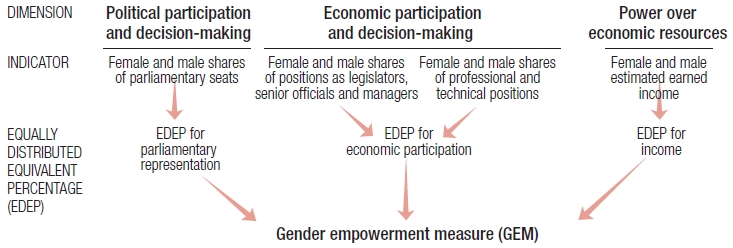
…an indicator of women’s degree of participation in political and economic activity and the policy-making process, using for its evaluation factors such as the number of female legislators, the percentage of women in senior official and managerial positions, the percentage of women in professional and technical positions, and the income differential between men and women (source).

Or, to put it graphically (see here for more details):

And why Korea’s GEM is so revealing is not just because of its abysmal ranking, which, at 68th out of 179 countries surveyed, is bested even by developing countries such as Kyrgyzstan, the Dominican Republic, the Philippines, Vietnam, Moldova, Botswana, and Nicaragua. Rather, it’s because that rank is so out of sync with its other rank of 25 in the Human Development Index (HDI), which measures a country’s  standard of living. Surely, as I explained two years ago, there is no greater testament to the palpable gender apartheid here, than the fact that Korea does such a good job of educating and taking care of the health its citizens, only then to effectively exclude fully half of them from political and economic power?

(Source: unknown)

Mentioning this in a conference paper I’m writing on Korean girl groups however, as one does, earlier today my coauthor quite reasonably asked me if a more up to date ranking wasn’t available?

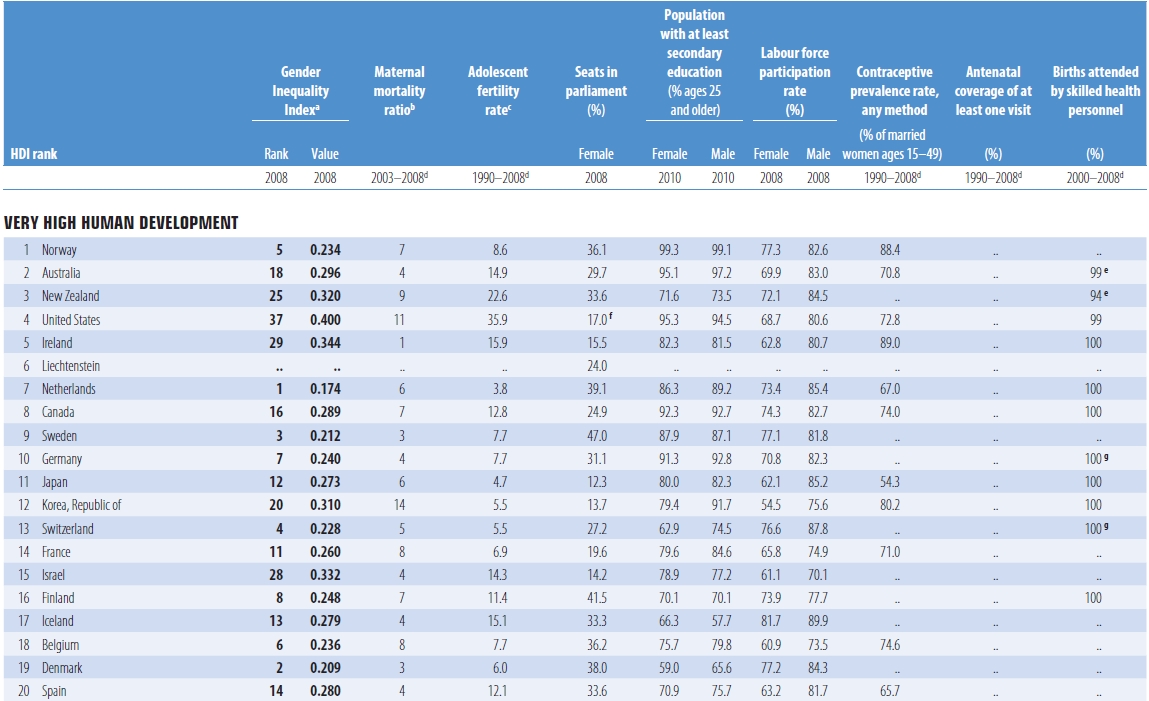
Alas, no. But there did appear to have been some recalculating of the 2008 figures done, with the first thing I saw from my search giving Korea a new ranking of, well, 20th best in the world:

Needless to say, I did a double-take. And indeed, as most of you have probably already guessed, actually the GEM has been abolished. Instead, Korea now has a ranking of 20 in what’s called the “Gender Inequality Index” (GII), calculated according to the following criteria:

What to take away from this? Well first, if I do say so myself, that it’s a pretty interesting thing to end up with, having originated from a paragraph that just one line earlier discusses Girls’ Generation’s signature hot pants.

But more seriously, I do want to stress the incredible achievements that Korea has made in terms of affordable, quality healthcare, well-illustrated by a recent anecdote from Ask a Korean! on a Korean stroke victim in New York, who quite rationally choose to fly 13 hours back to Korea rather than be treated in a hospital there. And it’s also indicative of how dangerous it can still be for women to give birth in many parts of the world, with 1 in 16 new mothers dying in Sub-Saharan Africa for instance, that the UNDP has good reason to think that the Maternal Mortality Ratio needs to be considered in any worldwide measure of gender inequality.

Nevertheless, while budding Canadian politicians, for example, are already taking advantage of their country’s new ranking behind Japan (yet another new paragon of feminist virtue) to say it’s all the government’s fault, it’s probably Korea jumping from 68th to 20th that should be getting the most attention. After all, albeit with apologies to long-term readers for the frequent mention, it does have: among the lowest female workforce participation rates in the OECD; the lowest rate of employment for educated women in the OECD (in fact, Korea is the only country in the OECD where the more educated the woman, the less likely she is to be employed); the largest gender wage gap in the OECD; only 13.7% of its legislators women; and a President that encouraged the mass firing of women to get over the latest financial crisis.

(Source)

At the very least then, Korea’s example seriously questions the applicability of the GII to developed countries. But can readers can think of any other issues raised?

Share

Sex and the University, Part 4: A Scared 19 Year-Old’s Ob-Gyn Experience

(Source: Dramabeans)

With thanks to Marilyn for translating it, allow me to present the fourth and final article in the Sex and the University series:

겁많은 스무살 기자의 산부인과 검진 체험기 / A scared 20 year-old reporter’s ob-gyn exam experience (19 in Western age)

대한산부인과학회는 지난 5월 ‘퍼플리본 캠페인’을 시작했다. 올해부터 매년 5월 셋째 주에 진행될 예정인 이 캠페인은 여성암 중 사망률 2위를 차지하고 있지만 비교적 잘 알려지지 않은 자궁경부암에 대해 알리고 검진율이 낮은 20~30대 여성들의 관심을 유도하기 위한 것이다. 김상운 사무총장은 “많은 여성질환들이 젊을 때부터 정기검진을 하면 예방효과가 크다”며 대학생들도 산부인과 검진을 받을 것을 권했다. 그러나 이러한 필요성에도 불구하고 많은 여대생들이 병원을 찾기를 꺼린다. 산부인과는 임신한 여성들만 찾는 다는 인식이 미혼 여성들로 하여금 산부인과 문턱을 넘는 일을 어렵게 만들기 때문이다.

Last May, the Korean Society of Obstetrics and Gynecology started the “purple ribbon” campaign.   This purposes of this campaign, planned to take place during the third week of May from this year [2010] on, are to raise awareness of cervical cancer, which, though the second deadliest of cancers that only affect women, is not well known, and to increase interest among women in their 20s and 30s, who rarely get screenings.  Secretary-general  Kim Sang-woon said, “If many female patients get regular screenings from a young age, there will be great preventative effects,” and recommended that university students get ob-gyn exams as well.  However, despite such necessity, many female college students are reluctant to visit a clinic.  This is because the belief that only pregnant women go there makes entering the ob-gyn’s office difficult for unmarried women.

(Source)

이런 상황에 놓인 여대생들을 대표해 10학번 새내기 기자가 직접 산부인과를 방문해 검진을 받아보기로 했다. 미혼여성을 대상으로 한 가장 기본적인 검진은 초음파 검사와 혈액검사라고 한다. 기자는 인터넷을 통해 신촌의 산부인과를 수소문한 끝에 신촌역 근처 S산부인과로 결정했다. 방문 전 인터넷사이트의 예약 게시판에 평소 생리통이 심했던 기자의 고충을 적고 예약을 완료했다.

Representing college women put in this kind of situation, this freshman reporter, who entered university in 2010, agreed to personally visit an ob-gyn and get an exam.  It is said that the most basic exam for unmarried women is an ultrasound and a blood test.  After asking around about Sinchon-area obstetrician-gynecologists on the Internet, I chose ‘S’ Obstetrics-Gynecology, near Sinchon Station.  Before going, I wrote on the appointment board on the clinic’s website that my problem was severe menstrual pain and booked my appointment.

예약한 날짜가 다가와 초조한 마음으로 병원을 찾았다. 산부인과와의 인연은 20년 전 태어나며 맺었던 것이 마지막이라 그곳에서 무슨 일이 생길지 도무지 감이 잡히지 않았다. 잠시 기다리자 접수대에서 이름이 호명됐고 전문의와 오늘 받을 검진의 기본적인 사항에 대한 이야기를 나눴다. 혈액검사는 난소암 유무를 가리기 위한 것이고, 초음파 검사는 자궁에 근종이나 난소에 혹이 있는지를 알아보기 위한 것인데 항문 또는 질을 통해 검사한다고 했다. 검진 받는 여성의 성관계 여부에 따라 추가적인 암 검사가 더해진다. 그렇게 접수를 마치고 이유 모를 공포에 휩싸여 호명되기를 기다렸다. 내 나이 꽃다운 스무살, 산부인과에 있다는 사실만으로도 이미 부인과 질병에 걸려버린 느낌이라 불안감은 점점 더 증폭됐다 (source, below).

The appointment date approached and I went to the clinic with an anxious heart.  My last connection to the ob-gyn had been made when I was being born twenty years ago, so I had no clue what was about to happen there.   After waiting a moment, my name was called by the front desk and I talked with the specialist [prob. the doctor] about the basics of the exam I would receive that day.  The specialist said the blood test would detect ovarian cancer, and the ultrasound would check for uterine fibroids and ovarian cysts; the exam would be done through the anal passage or vagina.  Contingent upon the sexual activity of the woman receiving the exam, additional cancer screenings are added.   In that manner, I completed my registration and then, filled with fear without knowing why, I waited for my name to be called.  I am a 20-year-old in the bloom of youth, but just the fact that I was at the ob-gyn gave me the feeling that I already had a gynecological disease, and my discomfort continued to increase.

먼저 초음파 검사를 받기 위해 탈의실로 가 아래를 모두 벗고 발목까지 오는 긴 치마를 입었다. 두려운 마음으로 검진실 문을 열자 특이한 모양의 의자가 보였다. 치과 의자처럼 생겼는데 다리를 벌려 고정하는 받침대가 추가된 형태였다. 좋지 않은 예감이 든다. 예감적중, 간호사가 의자에 누워 다리를 벌리라고 한다. 겁에 질려 검사가 아프냐고 묻자 간호사는 태연하게 “불편할 수 있어요”라고 대답한다.

First, in order to get the ultrasound exam, I went to a changing room, took off all of my lower-body clothing and put on a long skirt that reached to my ankles.  Fearfully, I opened the exam room door and saw a specially-shaped chair.  It looked like a dentist’s chair but with the addition of a rack to which spread legs could be fastened.  I had a bad feeling about that.  My feeling was right – the nurse told me to lay down on the chair and spread my legs.  Scared, I asked if the exam would hurt; the nurse calmly answered, “It may be uncomfortable.”

이윽고 냉철한 표정의 여의사가 들어와 초음파 검사 도구를 항문에 집어넣는다. 간호사 말대로다. 아프지는 않지만 확실히 ‘불편’했다. 마치 배변을 보고 있는 듯한 느낌이 몰려왔다가 사라졌다. 윤활제를 바른 탓에 시원한 느낌이 들었다. 기분이 묘하다. 이 와중에 그나마 여의사라 다행이라는 생각을 한다.

(Sources: left, right)

Before long, the female doctor entered with a dispassionate expression and put the ultrasound exam instrument in my anal passage.  It was as the nurse had said.  It didn’t hurt, but it was certainly uncomfortable.  A strong feeling that I was about to have a bowel movement came and disappeared.   Because of the lubricant spread [on the instrument], there was a cool sensation.  I felt strange.  At that time, I thought it was at least fortunate that it was a woman doctor.

누워서 눈앞의 스크린을 보자 나의 자궁과 난소가 보인다. 혹이나 다른 이상은 발견되지 않았다. 스크린을 보던 의사가 “생리하실 때 아플 것처럼 생긴 자궁이네요”라고 말했다. 산부인과에 온 목적이 해결되는 감동적인 순간, 내 몸에는 전혀 이상이 없으며 단지 ‘자궁 모양’ 문제였음을 깨닫는다. 산부인과에 진작 왔으면 불안에 떨지 않아도 되었을 것을. 며칠 뒤에는 “난소암 혈액검사 결과, 정상입니다”라는 간략한 문자가 도착했다. 모든 검사 종료, 이제야 안도했다.

(Source)

As I lay and looked at the screen in front of me, my cervix and ovaries were visible.  No cysts or other irregularities were detected.  The doctor, looking at the screen, said, “Your cervix looks like it would hurt during menstruation.”  At this emotional moment in which my purpose for coming to the ob-gyn was resolved, I realized that there was nothing wrong with my body, only a problem with “cervix shape.”  Also, that had I come to the ob-gyn earlier, I wouldn’t have needed to be anxious [about the pain].  A few days later, the brief text message, “Your ovarian cancer blood test results were normal” arrived.   At the end of all the exams, I finally felt relieved.

스무살 기자에게 산부인과 검사는 약간의 수치와 6만원이라는 비용을 수반한다는 점에서 그리 유쾌한 경험은 아니었다. 하지만 자신의 몸을 위해 한 번은 가볼 필요가 있는 것 같다. 기자의 경우 마침 결과가 좋아 적어도 5년 동안은 다시 이 경험을 하지 않아도 되겠다 싶어 안심했다. 그러나 부인과 질병에 가족력이 있거나 성관계 경험이 있을 경우 1년에 한 번씩은 산부인과에 가는 것이 좋다고 하니, 참고하면 되겠다.

Considering the slight shame and the 60,000 Won fee, the ob-gyn exam was not a very pleasant experience for this 20 year-old reporter.  However, it does seem that going once is necessary, for the sake of one’s body.  I felt relieved that I wouldn’t have to have this experience again for at least five years because the results happened to be good in my case.  Just know that if you have a family history of gynecological diseases or have sexual experience, though, they said that going to the ob-gyn once a year is good (end).

(Source)

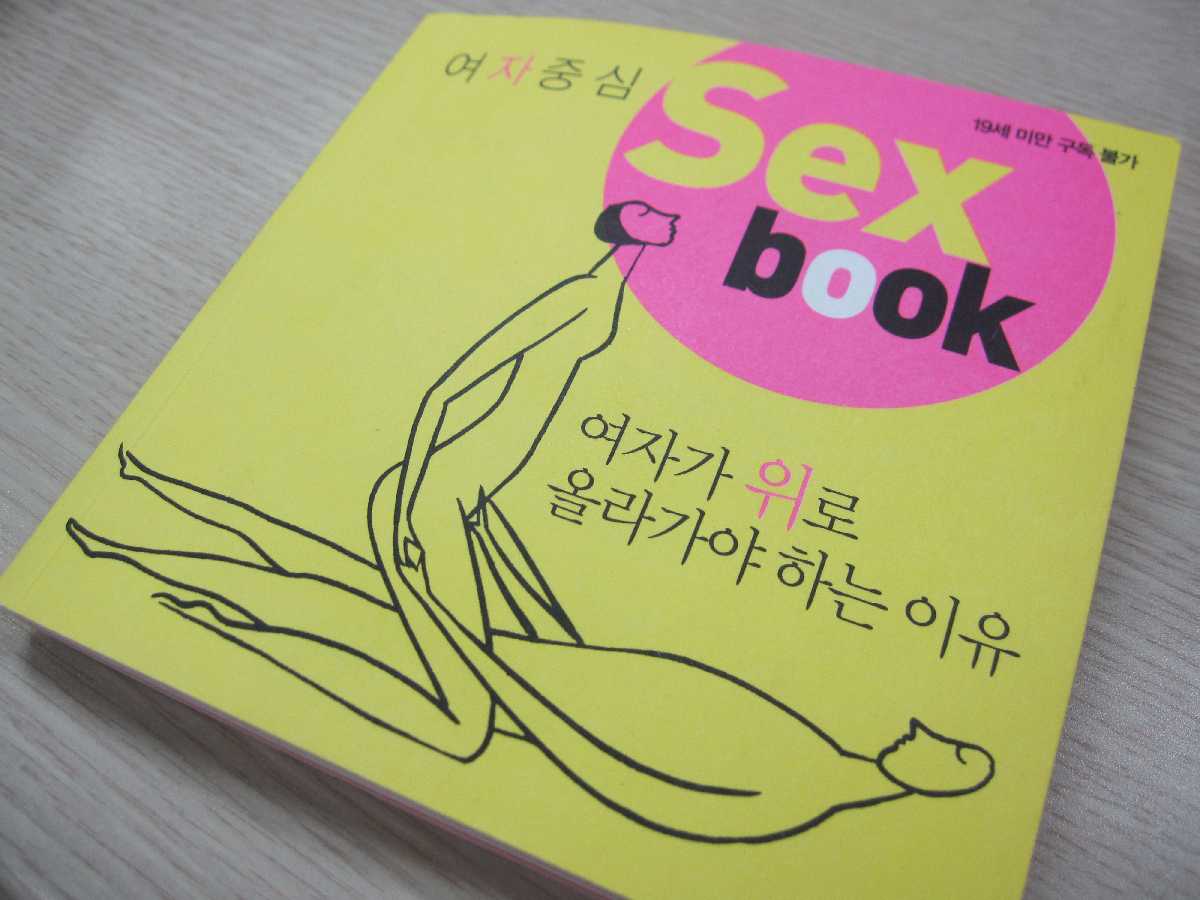
A little disappointed with the reporter’s plan not to lose her virginity in the next 5 year however, a genuine waste of one’s youth(!), then let me end on a rather more lecherous note via the above image, found in passing while preparing this post. Indeed, with a cover that says “Reasons Women Have To Get On Top“, the book sounds intriguing, and now I feel like doing some translating of my own next week!^^

(For more in the Sex and the University series, please see Parts 1-3 on students’ levels of sexual experience and activity, on an interview with a sex columnist, and on students’ cohabitation culture respectively)

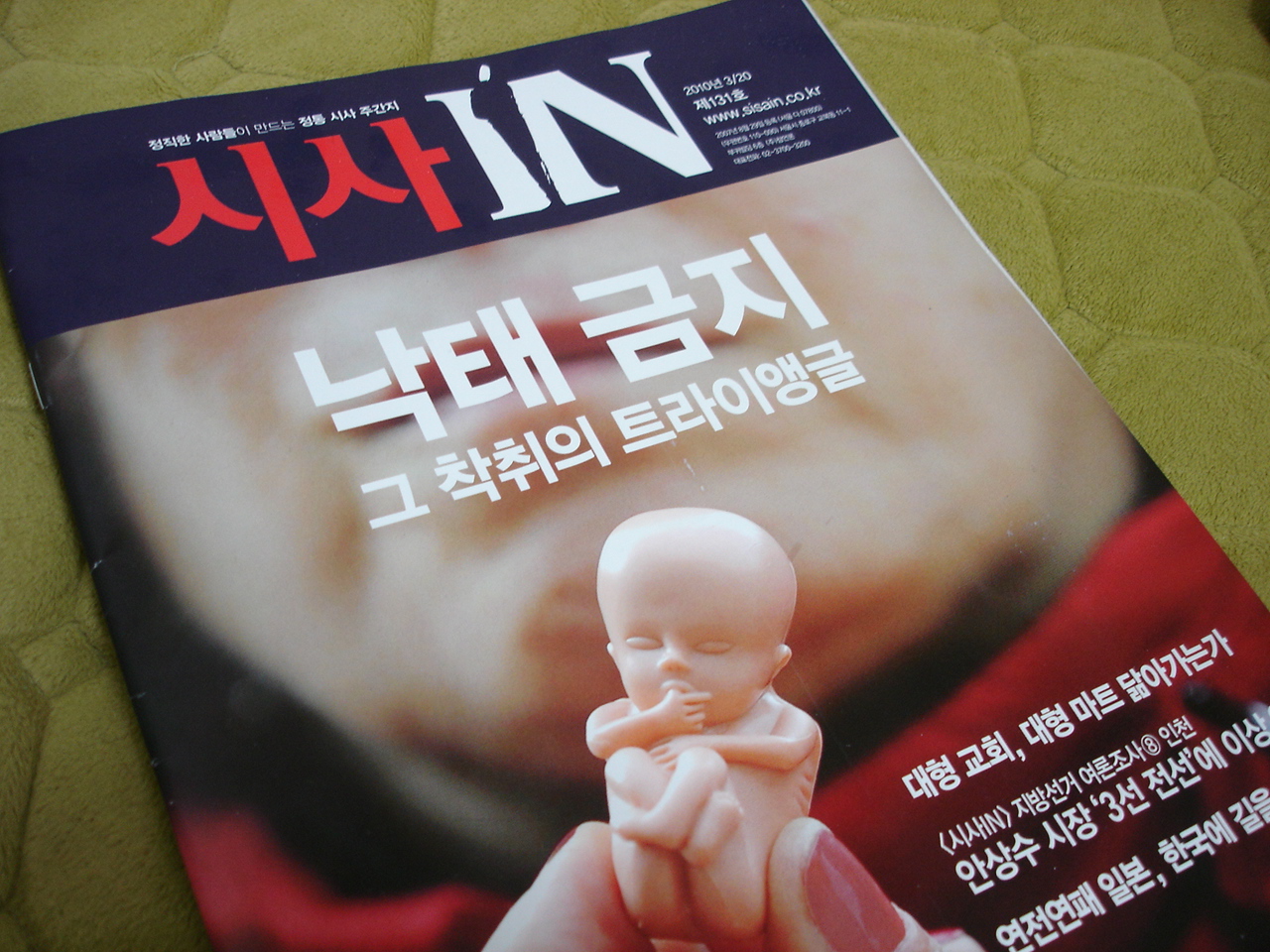
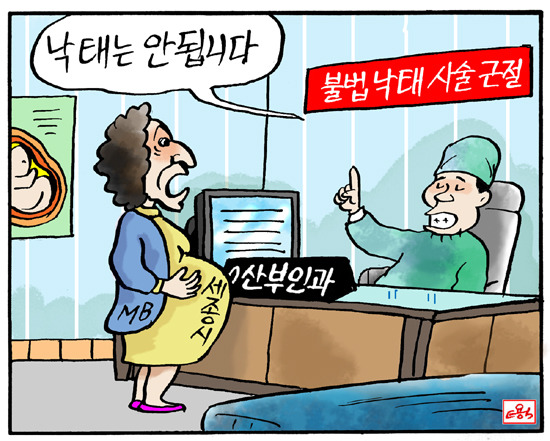
Resisting the Criminalization of Abortion in South Korea

(Source: ImpAwards)

Lee Myung-bak may be able to avoid the issue of abortion in the remaining years of his presidency, but this successor certainly won’t. Like Lindsay Lohan says, some stories do indeed keep on growing.

Not so much because Koreans feel strongly about abortion itself though. Rather, because this is the same president that immediately tried to abolish the (then) Ministry of Gender Equality for instance, despite campaign promises not to. And also, because a year later, he encouraged targeting women for mass layoffs as a solution to the financial crisis. Criminalizing abortion simply in order to increase the birthrate rate then, is really part and parcel of a wider mentality that is fundamentally failing to get to grips with women’s entrenched inequality here. And perhaps could come be the symbol and/or catalyst for later volatile protests about any number of related issues, much like those in 2008 were never really simply about imported beef.

Until then, following on from this earlier post about a video that alerted me to the fact that doctors were getting (suspended) sentences for performing abortions, I’ve translated the following article to give you more information about those. And in the process, I’ve confirmed commenter Matt of Gusts of Popular Feeling’s point about it that no doctor mentioned actually had to spend any time in jail.

However, as you’ll see, the article does not appear to say that the manager of the gynecology clinic in Suwon also got a suspended sentence, which would presumably mean that in fact he or she at least did go to jail. Which seems just a little unfair and confusing, so if anyone with better Korean skills can please clarify, then that would be much appreciated!^^ (source, right)

잇따른낙태죄실형선고 부당해” “Continued Sentences for ‘Abortion Crimes’ are Unjust”

<임신․출산 결정권을 위한 네트워크>규탄성명 발표 / A Public Denouncement by The Network for Pregnancy & Birth Decision Rights (NPBDR)

최근 들어 인공임신중절을 시술한 의사에게 실형이 선고되는 사례가 잇따르자 이에 대한 비판의 목소리가 커지고 있다. 이례적인 처벌 강화가 인공임신중절 시술의 위축을 가져와 여성들의 안전과 건강을 위협할 것이라는 우려에서다.

Recently, criticism has been growing of the numbers of doctors receiving sentences for performing abortions. There is a great deal of worry and anxiety that singling out abortion laws for enforcement will reduce the number of abortions and be dangerous for women’s safety and health.

‘임신중절’ 시술 의사에게 실형판결 잇따라 / Doctors are continually being sentenced for performing abortions

지난 9월 3일 울산지방법원은 인공임신중절을 시술한 의사에게 1심에서 징역 6월에 집행유예 1년, 자격정지 1년을 선고했다. 이에 앞서 지난 8월 수원지방법원은 역시 인공임신중절 시술 혐의로 고발된 산부인과 의사와 사무장에게 각각 징역 1년에 집행유예 2년, 징역 2년 6월의 실형을 선고했다.

On the 3rd of September, in the first session of a case at Ulsan District Court, a doctor who performed an abortion was given a 6-month jail sentence suspended for 1 year (i.e. no jail), and was stripped of their doctor’s license for 1 year. And in August at Suwon District Court, a gynecologist who was suspected of performing an abortion and the gynecology clinic manager were given a 1 year sentence suspended for 2 years and a 2 year, 6 month jail sentence respectively.
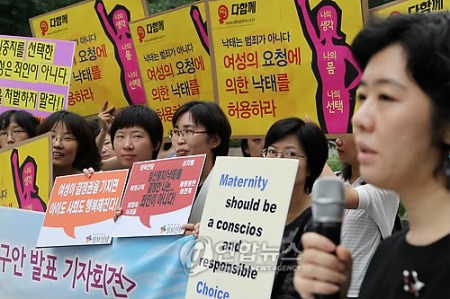
이는 그동안 인공임신중절에 대한 기소 건수 자체가 적었고, 기소되더라도 선고유예에 그치는 경우가 대부분이었던 것과 비교해 이례적이라는 평가다. (source, right)

Even though the number of cases of doctors that have received sentences for performing abortions is small, and most have received suspended sentences, compared with those the above cases are quite exceptional.

올해 2월 프로라이프의사회가 인공임신중절 시술을 한 의료기관 3곳을 고발했을 때에도 사무장이 구속 기소된 한 곳을 제외하고 각각 벌금 200만원에 약식기소, 무혐의 처리를 받았을 뿐이다.

In February, a pro-life doctor’s association filed suits against 3 clinics where abortions were being performed, but in all but one the managers simply to had to pay fines of 2 million won each in out of court settlements.

또 한 지난 5월에는 부산지방법원에서 임신 7주의 여성에게 인공임신중절을 시술한 혐의로 기소된 의사에 대해서도 선고유예판결을 내렸다. 당시 재판관은 “낙태에 대한 처벌과 관련해 공권력의 처벌의지가 상대적으로 미약했던”사실에 비춰 “의사에 대한 처벌은 형평성에 어긋난다”고 선고유예의 이유를 밝혔다.

In May, at Busan District Court, a doctor who was suspected of performing an abortion on a woman who was 7 weeks pregnant received a suspended sentence. In that case, the judge said in his or her judgment that “the government’s will for punishing abortion-related crimes is relatively weak”, and that the reason for the suspended sentence in that case was that “the [prescribed] punishment ran counter to notions of social equity”.

의사에게 징역형을 선고한 울산지방법원의 김정민 재판관이 “태아의 생명은 사람의 생명과 마찬가지로 형법이 보호하고자 하는 매우 중요한 법익”이라며 “형법의 비추에 피고인의 범행은 그 죄질이 가볍다고 볼 수 없”다고 선고 이유를 밝힌 것과 대조적이다.

In complete contrast, Kim Jeong-min, the judge who gave the jail sentence to the manager in Ulsan, said the reason was that “a fetus’s life is exactly the same a person’s life, and deserves the full benefit and protection of the law”, and hence “the defendant’s crime could not be punished lightly”.

(Source: 착선의 독서실)

“징역형 선고, 중절수술 위축시킬 것” “With Sentences, the Number of Abortions Will Go Down”

특히 9월 울산지방법원의 판결은 임신 10주의 ‘초기낙태’와 ‘10대여성의 낙태’에 대해 징역형을 선고한 것이어서 판결이 던진 파장이 심상치 않다. ‘의학적으로 시술이 안전한’ 12주 미만의 인공임신중절은 이미 많은 국가에서 합법화되어 있으며, 10대 임신의 경우에도 현실적으로 양육의 어려움이 있어 사실상 임신중절 허용사유로 용인되어 왔기 때문이다.

In particular, the September case in Ulsan has generated a lot of controversy because the doctor’s sentence was for an abortion performed on a teenage girl who was 10 weeks pregnant. After all, not only is abortion in the first trimester completely safe and legal in many countries, but the general consensus is that such young girls have special difficulties in raising a child.

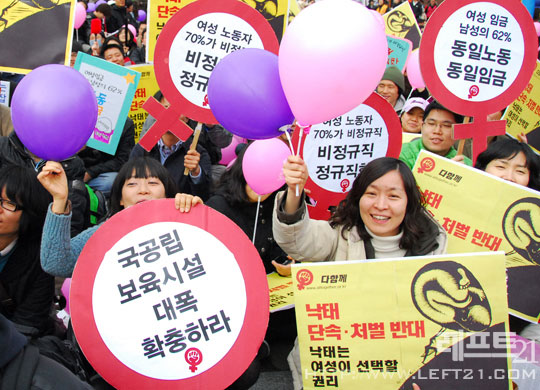
이 판결에 대해 <임신․출산 결정권을 위한 네트워크>는 29일 “여성의 결정권을 원천적으로 부정하는” 판결이라며 규탄성명을 내고, 항소심에 적극 대응할 것을 천명하고 나섰다. 임신․출산 결정권을 위한 네트워크는 인공임신중절을 범죄화하는 움직임에 대응하기 위해 결성된 단체로서, 여성·노동·진보 단체들과 진보신당, 민주노동당이 함께 참여하고 있다.

< 임신․출산 결정권을 위한 네트워크>는 잇따른 “징역형 선고가 선례가 돼 올해 2~3월처럼 낙태 수술이 위축돼 낙태 수술비가 치솟고, 낙태를 필요로 하는 여성들이 심각한 어려움에 처하게 될 것”이라고 심각한 우려를 표했다.

On the 29th of September, the NPBDR denounced that judgment as “fundamentally denying women’s rights” and that the group would actively appeal it. The NPBDR is an organization that was established to fight against the criminalization of abortion in conjunction with women’s groups, worker’s groups, progressive groups and the New Progressive and Democratic Labor Party. In addition, the NPBDR expressed serious worry about the “continuing cases of sentencing for abortions, which like those cases in February and March set precedents, and were accompanied by decreases in the numbers of abortions and a sudden rise in their expenses, which became a serious concern for women seeking abortions.”

(Source)

실제로 올해 2월 프로라이프 의사회의 산부인과 고발 후, 산부인과의 임신중절 시술 기피로 인해 고통을 호소하는 상담전화가 여성단체에 빗발쳤다. 시술비용이 치솟았고, 비싼 수술비와 처벌에 대한 두려움 때문에 ‘원정낙태’를 알아보는 여성들까지 나타났었다.

After a pro-life doctor’s group filed suit against gynecologists in February, the reality was that they started avoiding providing abortion services, leading to a torrent of pleads for help from women to women’s groups’ hotlines. Because of the sudden increase in their expenses, and the fear of being punished, many women are now considering getting abortions overseas.

‘임신중절 허용’ 법 개정 움직임에 역행 Such Judgments Work Against Abortion Law Reform

< 임신․출산 결정권을 위한 네트워크>는 특히 “여성운동이 여성의 요청에 의한 낙태를 허용하라는 목소리를 높이고 있고, 한나라당 홍일표 의원, 산부인과의사회, 법무부 형사법개정특별심의위원회 등도 제한적이나마 낙태를 허용하는 방향의 법 개정을 주장”하고 있는 상황에서 이런 판결이 나온 것에 대해 깊은 유감을 나타냈다.

The NPBDR, deeply saddened by the above cases, says “women’s movements and women in general are raising their voices high in their demands for legalizing abortion, and have the support of National Assemblyman Hong Il-pyeo of the ruling Grand National Party, gynecologists’ groups, and the Special Committee for the Reform of Criminal Law under the Ministry of Justice, and so on, that, although they only have limited political power, are also insisting on the legalization of abortion.”

“낙태가 불법화된 나라들이 합법화된 나라들보다 낙태율이 오히려 더 높”은 것에서도 드러나듯, “처벌이 결코 낙태를 줄일 수 없다”는 사실에 대해 이미 국제사회뿐만 아니라 우리나라에서도 공감대가 확산되고 있는 시점에서 시대착오적인 판결이라는 것이다. 현재 국제사회에서는 유엔 여성차별철폐협약(CEDAW)에 근거해 인공임신중절한 여성을 처벌하는 ‘낙태죄’ 폐지를 각국에 권고하고 있다.
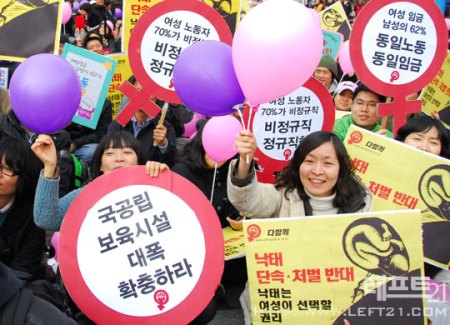
Also, “compared to countries where abortion is legal, in fact abortion rates are higher in countries that have criminalized it,” and this means that “criminalizing abortions can never bring abortion rates down,” a fact that at this point in time not just international society, but Koreans also agree on, and so find the above judgments an anachronism. Presently, on the basis of the Convention on the U.N. Elimination of All Forms of Discrimination Against Women (CEDAW), international society is recommending each country to abolish laws defining abortion as a crime and not punishing women who have abortions. (source, right)

< 임신․출산 결정권을 위한 네트워크>는 “출산은 여성의 삶 전체에 지대한 영향”을 미치고 “출산에 뒤따르는 책임을 감당할 당사자도 여성”이라는 점을 환기시키며 “자신의 삶에 대해 신중하게 고민하고 낙태를 결정한 여성을 범죄자 취급해서는 안 된다”고 못 박았다. 또한 앞으로 있을 항소심에 대한 구체적 대응을 준비 중에 있다고 덧붙였다.

Finally, the NPBDR wants to remind everyone that “giving birth is the single most influential thing in a woman’s whole life,” and is accompanied by a great deal of anxiety about how and if she will be able to cope with her new role as a mother. The group firmly insisted that “accordingly women who have agonized over this and come to the final decision to have an abortion should not be treated like criminals,” and added that they were making strenuous efforts to prepare to fight for their appeal against the Suwon judgment (end).

And on that note, apologies for not finding any information about the woman fined for simply planning an abortion, as mentioned in the earlier post, and I’ll keep looking. But in the meantime, I was very happy to read about the palpable resistance to Lee Myung-bak’s anti-abortion drive that is already emerging!

How about you?

Newsflash: Korean Doctor Sent to Jail for Performing Abortion, Korean Woman Fined for Planning to Have One

( Source: Dramabeans )

Yes, those really did happen in the last couple of months.

Perhaps it was naive of me to be so shocked and surprised however? After all, according to the Korea Herald, “about 30 [doctors] have been brought to the court over the past 5 years, mostly resulting in probation or fines”, so presumably this latest case technically isn’t the first time a Korean doctor has been incarcerated for performing an abortion (for 1 year, with probation for 2 years). And then the Lee Myung-bak Administration did signal it would begin enforcing Korea’s long-ignored abortion laws over a year ago too, in a vain and wholly misguided effort to increase the record-low birthrate, so prosecutions had to emerge sooner or later.

Still, I’d be surprised if this wasn’t the first time a pregnant woman has been fined for just planning an abortion, and according to the law she could even face having her baby in jail herself if she tries again. And the fact that she was charged as a result of her husband informing the police? It sounds positively Dickensian.

Seriously, is he physically confining her to their home as I type this? Is she still allowed to divorce him, or has she been stripped of that right too?

My second surprise was that, yet again, I didn’t actually learn of this important news via any English-language media, but rather via the following humble-looking video passed on to me by a Facebook friend, who in turn found it via her friend Heejung Paik of Gwangju Womenlink (광주여성민우회). Simply a very brief overview of Korean’s draconian abortion laws in the global context rather than a discussion of the cases themselves though, I’ve just translated those parts relevant to Korea below:

From 0:21-0:39:

2010년 3월, 멕시코 165명의 여성 낙태로 수감중

멕시코 구아나후아토주 여성, 최대 35년형 낙태로 선고

2010년 9월, 한국의사 낙태시술로 징역 1년 선고

In March of 2010, in Mexico 165 women were incarcerated for having abortions.

One of those women, in the state of Guanajuato, got the maximum sentence of 35 years.

In September of 2010, a Korean doctor was sentenced to 1 year in jail for performing an abortion.

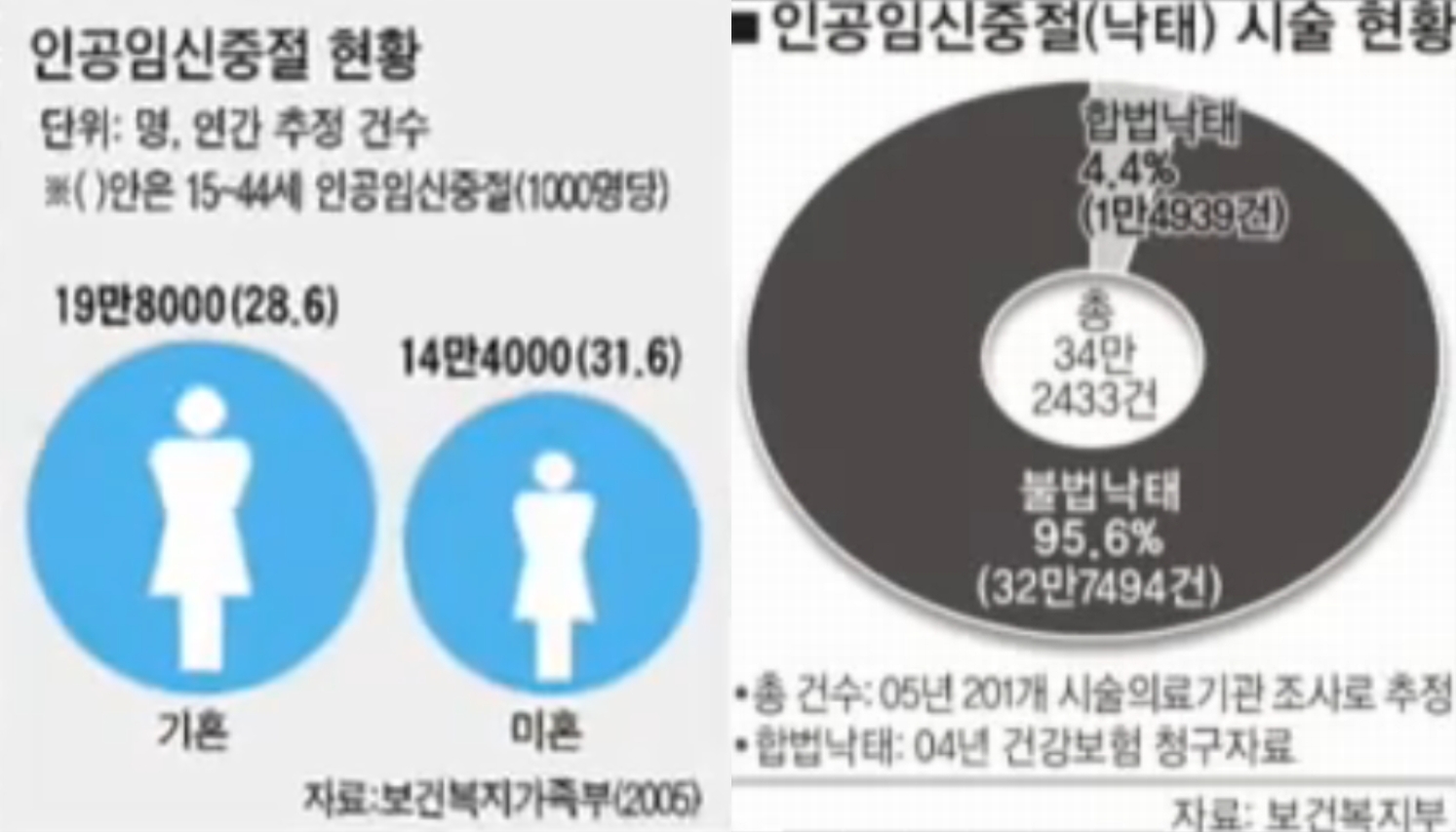
Next, two visuals from 1:04-1:20 (apologies for the poor quality):

On the left:

Estimated number of abortions performed annually (in brackets, the number of 15-44 year-old women out of 1000 that had abortions)

Married: 198,000 (28.6/1000)

Unmarried: 144,000 (31.6/1000)

Source: Ministry of Welfare and Family Affairs (2005; now defunct)

On the right:

Out of 342,433 abortions,  4.4% (or 14,939) were legal, and 95.6% (or 327,494) were illegal.

Estimation based on 2005 survey of 201 abortion clinics, and 2004 health insurance records of legal abortions.

Source: Ministry of Social Welfare

From 1:50-1:58:

유교적인 조선시대에서조차 낙태한 여성이 처벌받은 기록이 없다

Even in the Confucian Joseon Dynasty there is no record of any punishment for abortion

( Source )

From 2:17-2:35:

강간, 근친 상간 또는 임부의 건강 보호를 이유로만 낙태가 가능한 나라 (멕시코, 브라질, 수단, 대한민국 등 17개국)

한국보다 낮은 등급의 국가는 전체의 약 27%에 불과하며,

이란, 아프가니스탄, 리비아 등의 국가가 속해있다.

현재 OECD 국가 20개 중 한국보다 낙태시술이 어려운 나라는 단  2개국뿐이다.

There are 17 countries that allow abortion only in the case of rape, incest and if the health of mother is threatened (Mexico, Brazil, Sudan, South Korea, and so on)

Altogether, only 27% of countries provide less abortion rights than Korea, including Iran, Afghanistan, and Libya.

At present, out of the 20 countries in the OECD, there are only 2 in which it is more difficult to obtain an abortion than Korea.

Finally, from 3:09-3:16:

2010년 10월, 한국에서는 낙태를 한 여성이 남편의 고발로 검찰에 기소되어 벌금형을 선고 받았다.

In October 2010, a Korean woman was fined after her husband informed the police of her intention to have an abortion.

( Source )

And on that note, apologies for not providing details about the cases myself in this post, but as I finishing typing this at 1:30am (albeit with a final edit over a coffee 9 hours later) then my translations of Korean articles on those will have to wait until later this weekend sometime next week I’m afraid. Hence the “newsflash” in the title!

Until then though, is anyone aware of any English-language articles on them that I may have missed? And how do you personally feel about the news?

Share

Korean Women Angry at Being Promoted Less Than Men

Gender Gap Angry Woman(Source: TheDailyEnglishShow.com,via studio tdes)

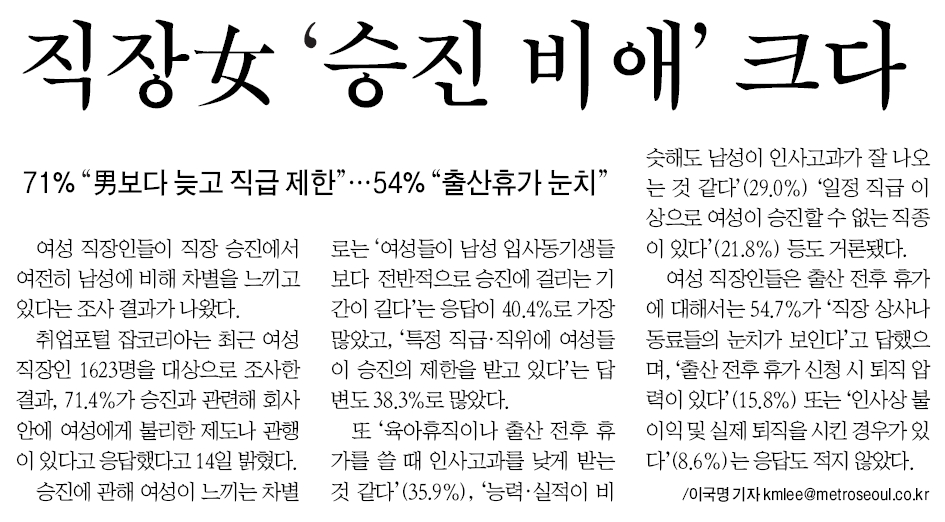
A snapshot of some of the different forms of sexual discrimination experienced at Korean workplaces, from the January 15 edition of Metro Busan:

Women Workers’ “Promotion Grief” is Big

71% Say “Compared to Men, Promotions Come Late and with Limits”…54% Say “We Feel Inhibited From Asking for Maternity Leave”

A survey of women workers has revealed that when it comes to promotion, they still feel that they suffer from sexual discrimination.

The results of a survey of 1623 women workers by job portal site JobKorea, released on the 14th, showed that 71.4% believed that the promotion systems at their companies placed women at a disadvantage.

Asked for more information about this discrimination, 40.4% [of the 1623 women] said that “compared to men that enter the company at the same time, women have to wait longer to get promoted,” and 38.3% added that “women are excluded from some higher positions.”

In addition, 35.9% mentioned that “if we take maternity leave or time off before and after giving birth, we get lower scores on our evaluations by the personnel department,” 29% that “even if we have the same ability and practical know-how as men, we get lower scores,” and 21.8% that women simply are excluded from certain kinds of jobs.

Also, 54.7% replied that they found it very difficult to ask their superiors or coworkers for time off for childbirth, 15.8% said that they felt pressure to quit their jobs after having a baby, and finally 8.6% were aware of cases where recent mothers were indeed forced to quit. (end)

With no information given about the methodology used, then all those results should be taken with a grain of salt unfortunately.

In particular, considering that it is still common practice to fire women upon marriage, then that last figure sounds rather low to me. Also, consider that before the current economic crisis, not only did Korea already have one of the lowest women’s workforce participation rates (and the highest wage gap) in the OECD, but that those few that did work formed a disproportionate number of irregular workers. This ensured that they would be laid-off en masse last year (see #15 here also), and they are unlikely to return to work soon given Korea’s jobless recovery.

(In stark contrast, the decline in the construction industry in the US, for instance, means that for the first time in history actually more women work than men there now.)

Meanwhile, the effects of all the above on Korea’s low birthrate have also been somewhat predictable, now the world’s lowest for the third year running. But never fear, for the Korean Broadcasting Advertising Corporation (KOBACO) is on the case:

(See here {Korean} for more on the making of the campaign)

In KOBACO’s defense, the first women featured does actually have a job. Is it churlish of me to point out that she still goes home early to cook while her husband burns the midnight oil…?

Update 1: Lest the commercial not succeed though, then the Ministry for Health, Welfare and Family Affairs (보건복지가족부), in charge of raising the country’s birthrate, is insisting that its employees go home at 7:30 pm on the third Wednesday of each month, all the better to have sex with their partners and have more babies.

No, unfortunately I’m not making that up.

Update 2: This satire of that is so good, it’s difficult not to believe that it’s the real thing!

Why Do Young Koreans Live With Their Parents?

Young Korean Man (Source: Andrew Butts; CC BY 2.0)

(Update, 2 March 2016: Thanks for the link in today’s Guardian, but this Korea Times article of mine is a little out of date. I recommend this 2013 Busan Haps article instead.)

In Saturday’s Korea Times. As always, here’s the original version:

…Everyone knows the strong Korean custom of adult children living with their parents until marriage. Yet a report released earlier this year revealed that one-person households now account for a fifth of all households in Seoul.

This is lower than national figures for most other developed countries, the Seoul Development Institute report notes, and the number for Korea as a whole is likely to be lower still. But the rise puts Seoul on par with Australia, and the rate is predicted to grow to a quarter of all households by 2030.

How to interpret this? Does it signal that the Korean custom of staying in the family home until marriage is under threat?

That is unlikely. The figure includes single professionals, jobless youth, those separated from their spouses, divorcees, and senior citizens, with growth in every category. It does not imply a sudden glut of young Koreans leaving home.

While Korea has experienced many periods of great labor mobility in its recent history, particularly of young, single, working-class women moving to work in factories in cities in the 1960s and 1970s, there is definitely no tradition of young middle-class Korean university students leaving home to share private accommodation with fellow students, and there are still strong taboos against openly cohabiting with partners.

At the same time, young Westerners are adjusting their expectations for living arrangements, as the combination of rising university fees, stingier government allowances, and prospect of paying back student loans leads them to defer leaving home until graduating and/or getting their first job. This delay is often both parents’ and children’s least preferred option, but it is a trend likely to continue given the bleak job market for graduates worldwide.

This points to important economic reasons for the differences, and indeed there are big financial hurdles to overcome to live independently in Korea. For instance, at the moment Korean students cannot get student loans without their parents acting as guarantors (although the Ministry of Education, Science and Technology is working to change this). Nor do the vast majority of universities accept credit cards for payment of fees. In practice though, the combination of extremely high “key money” deposits required by landlords and the low wages afforded by part-time jobs favored by students are keeping even the most rebellious of youths at home until graduating and getting their first job. And then, he or she faces a dearth of rentals of appropriate size.

But familiarity breeds acceptance, and while cultural factors are still important, in practice they are often overstated, as for all the purported differences in how Koreans and Westerners view and value family life, many would behave in a similar fashion in similar circumstances.

For instance, with a child’s school being such an important consideration for entrance into a preferred university, and seniority-based promotion systems locking an employee into a specific company, then if a man is transferred to a different city it is very logical for his wife and children to remain in the family home rather than the children leaving the good school and/or him starting at a much lower wage and position in another company.

Also, as legions of unhappy mothers driving home every Sunday night can attest, Koreans generally don’t like to give their children to relatives to look after during the week, but with childcare facilities being so inadequate,  working parents usually have little choice.

Certainly there are some arrangements that Westerners would almost unanimously reject, such as sending one’s family overseas for years for the sake of the children’s education, but Koreans’ living arrangements do not mean that they are as cold, calculating, or dogmatic as they may at first appear. For instance, while they are not openly discussed, ubiquitous love hotels point to unmarried Koreans having romantic relationships much like Westerners, and as the spate of recent celebrity pregnancies can attest, engaged couples are usually given a great deal of freedom.

Moreover, Korean’s living arrangements may well become more liberal in the future.

A long-running debate within sociology rages over whether capitalism forces very different societies to “converge” and become more similar to each other over time or not, and as one of the only non-Western developed societies, Korea is an important element in that debate.

And as reported by the Economist in March, a decade ago Andrew Oswald of the University of Warwick observed that countries with high rates of home ownership have higher rates of unemployment: with few rental options, he argued, young people living with their parents find it harder to move out and get work, or are stuck in local jobs for which they are ill-suited, and earning less than they could.

korean-grown-children-living-with-parentsPerhaps given the dire state of today’s economy, such imperatives will force such a change in Korea? (End)
With apologies to long-term readers, for naturally my articles for the KT will tend to be about subjects that I’ve already covered and know well (source right: Korea Times).

As they’re for a newspaper rather than a blog though, then I’m being forced to make the subjects much more newsworthy, contemporary, and concise than in their original rambling manifestations here, which (presumably) can’t help but have positive effects on my writing style in the blog as a whole. At the very least then, my planned next blog post will be much shorter than it would have been had I posted it just a few months ago(!), but never fear, for I am still a geek, and so it will still be an in-depth one on an original subject (update: sorry, it’ll be next week, but I’m not sure what day now).

For anyone new to the blog and wanting to learn more about any of the issues raised in the article though, then please try the following links:

Enjoy!

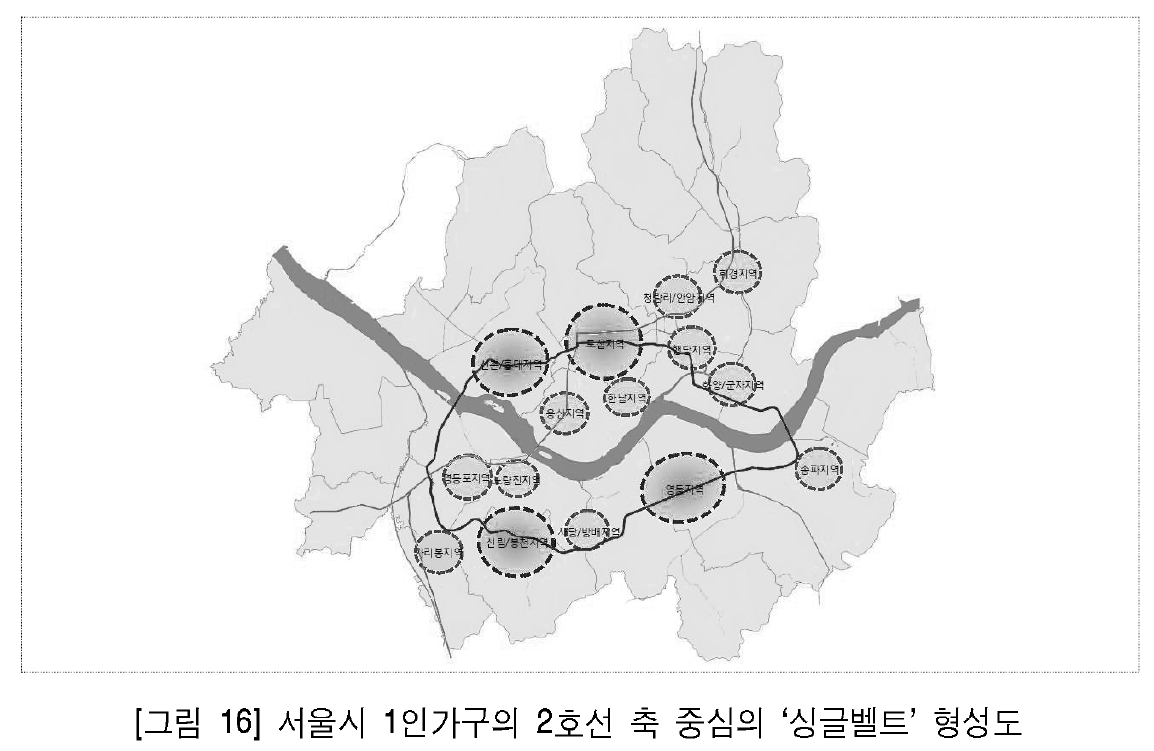
Update) The SDI’s report also mentioned that 51% of those people living alone in Seoul lived in the districts along subway line No. 2, a very small area relative to the vast conurbation that is the second most populous city in the world! It’s definitely no coincidence then, that those districts are dense with cafes, restaurants and retail shops, in total offering 21% of all the part-time jobs in Seoul.

Most of those pay 4000 won an hour, that article reports; the minimum wage is 3500.

Update 2) Here’s a graphic representation of the “single belt” around subway line No. 2, from p.15 of the SDI report.

the-single-belt-of-one-person-households-around-subway-line-no-2-in-seoul

For Every Birth, a Korean Career Dies

pregnant warrior with one knee up(Source: Bonbon; CC BY 2.0)

Not technically Korean sorry, but it seemed an apt response to the following graph:

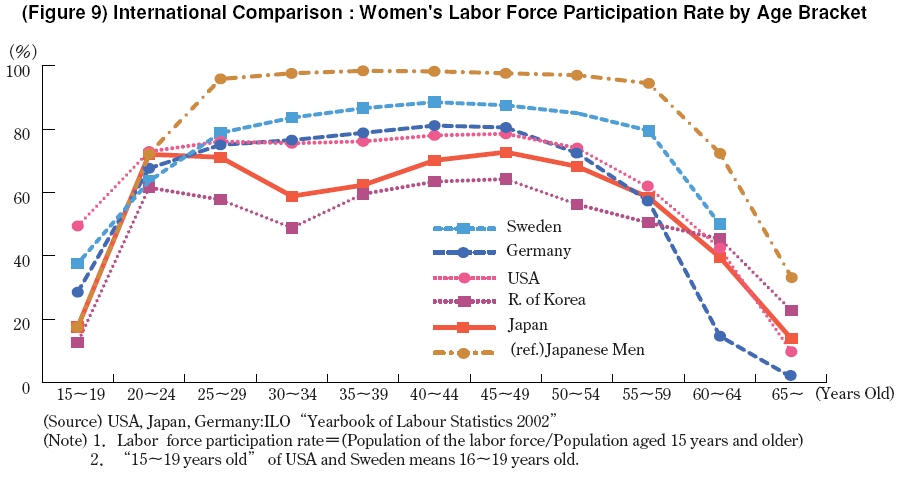
international-comparison-of-female-labour-force-participation-rates-in-oecd-2007

(Source: OECD)

Actually I’m surprised that that figure for Korea is so high, regularly hearing that Korea has the lowest rate in the OECD, and which given the high numbers of Koreans in tertiary education and the low wages in the types of jobs open to young women (and men), both of which will only be exacerbated by the current financial crisis, it may still well be if the age range is extended from 25-54 to 15-64. Regardless, it’s very low, and while I’ve written a great deal on the blog over the last two years as to the reasons why (see here and here for starters), a picture really does say a thousand words.

Or more graphs to be precise, the next one below clearly showing Korea’s sharp “M-shaped curve” of women’s labor force participation, the result of women entering the labor force after finishing their schooling, then leaving in droves as they find it impossible to juggle children and work, then returning gradually once the children reach school age, finally to leave again as they retire. This is in contrast to the “upside-down U-curve”  of – let’s face it – more enlightened countries (at least when it comes to the position of women), and the “n-curve” for men, which is usefully included as a comparison:

womens-labor-force-participation-rate-by-age-bracket-2002-south-korea-etc(Source: Gender Equality Bureau Cabinet Office)

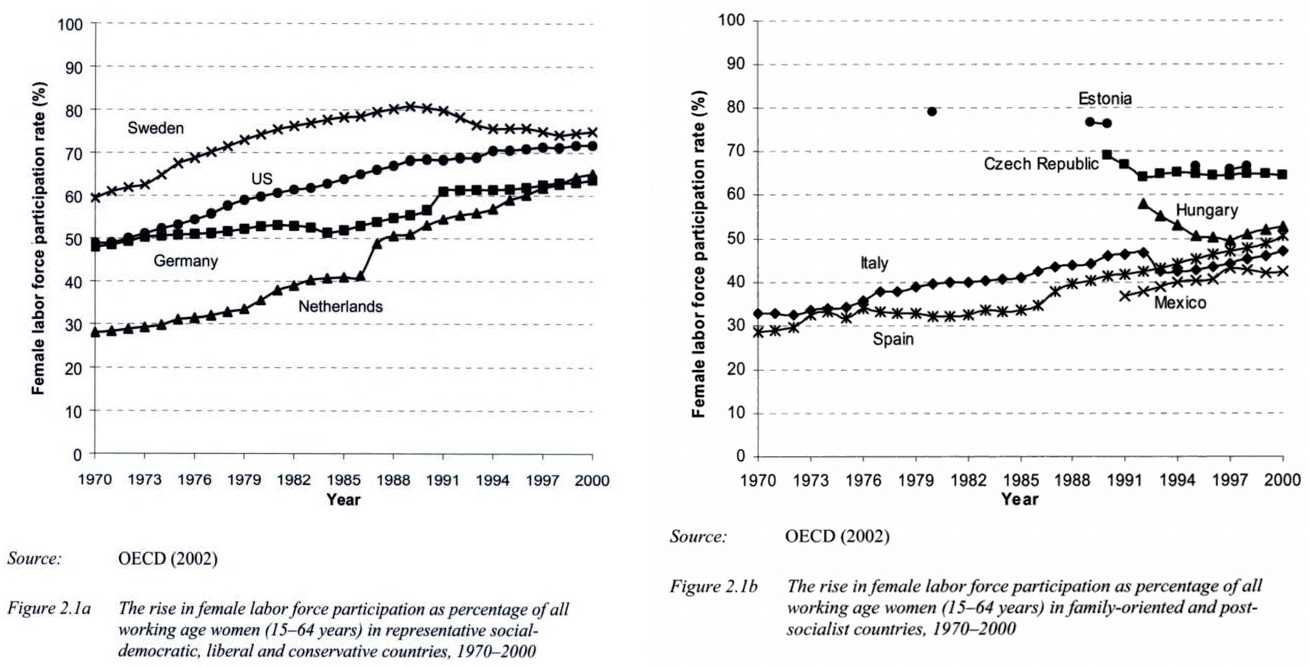
Unfortunately I couldn’t find an online graph showing how Korea’s women’s labor force participation rate has changed over time, but I do have the figures below from page 24 of Working Korea 2007 published by the Korea Labor & Society Institute, which you can compare to the rates of some other countries through these graphs that I could find, luckily for the same age range of 15-64:

  • 1980: 38.2%
  • 1980-84: 38.6%
  • 1985-89: 40.0%
  • 1990-94: 40.%
  • 1995-99: 41.5%
the-rise-in-female-labor-force-participation-as-a-percentage-of-all-working-women-graphs(Source: Pages 36 & 37, Globalization, Uncertainty and Women’s Careers: An International Comparison
edited by Hans-Peter Blossfeld, Heather Anne Hofmeister, 2006)

In this case, Korea’s figures most resemble Mexico’s I guess. For the sake of future reference, here are some more recent, albeit depressingly similar figures:

  • 2005: 41.7%
  • 2006: 41.9%

Being so…er…ripe for it, then ideally this or a similar ad will also appear in Korea sometime soon; either way, I’m sorry if in the past I’ve sounded a little like a stuck record, so regularly lamenting the low position of women in Korea and all, but hopefully all of the above has provided a stark demonstration as to why I have the focus on the blog that I do!

Korean Medical Association: Don’t Take the Pill!

All the contraceptive pills are gone...(Source: Surija / “Sray”; CC BY 2.0)

Why not? Well, because Korean women are stupid apparently, unable to do so much as read the instructions and numerous warnings about possible side-effects that come with the product, let alone do their own research and make their own choice about what contraception is best for them personally.

Or at least, that is the more benign reading of this warning from the KMA, and to be fair, given such factors as Koreans’ general reluctance to self-diagnose and be proactive about treating any medical condition that they might have themselves, and many Korean women’s complete reliance on men to use contraception, then at first glance there is nothing to distinguish the top-down, patronizing but also paternalistic tone of the KMA in the warning as any different from any other Korean institution’s relationship with the Korean public. In reality however, in its bias and scare-mongering it demonstrates an explicit and almost sinister vested interest in maintaining the huge abortion industry here.

No, really. That may sound like hyperbole, but then the Korean state already has a long history as an extremely invasive and coercive force in Koreans’ reproductive lives, its population policy in the 1960s and 1970s only slightly less draconian than that of China’s today, at many points having soldiers withdrawn from the DMZ at the height of the Cold War to deliver IUDs and perform abortions in the Korean countryside for instance (see this book for more on that). And such industry-related claims are also widely acknowledged of Japanese health authorities (albeit not so much in Japan itself), which banned the pill for three decades and which Japanese women are still scared of using, so why not of Korea ones too?

But regardless of that background, how else are we to interpret the evidence from just the KMA’s warning alone? Consider that:

  • It provides no information about possible side-effects that I didn’t already know about 10 years ago (and I’m a guy remember), which begs the question of why the Korea Times considered it “news” exactly.
  • It literally doesn’t provide a single positive medical benefit of using them, and naturally the Korea Times fails its most basic of journalistic duties by not providing them either.
  • It implies that somehow there is somehow something unique to contraceptive pills and not, say…amphetamines that makes women’s access to them in much more urgent need of being restricted.
  • And finally, that in a country where double-standards, moralistic pharmacists and medical staff, virtually non-existent sex education, and a lack of access already combine to severely limit women’s sexual confidence and choices of contraception in practice (see here)…surely it is telling that the most senior medical institution in the country is literally scaring women away from using the single safest and most effective contraceptive in human history?

Actually, I do agree that there are some benefits to women of, say, requiring a prescription from a doctor to get the pill, one poster in this forum (which I give a hat tip to for some of the above) pointing out that it means many women will usually get gynecological examinations at the same time, wheres they wouldn’t have bothered otherwise. But, one should always be very careful to acknowledge the different contexts in which they occur, and I dare say that most young British women buying contraceptives, for instance, are not asked by pharmacists if they’re married, or alternatively the same by doctors and nurses rather than a more neutral, non-judgmental inquiry as to if they are sexually active. To require a prescription in those circumstances would surely mean that many women simply wouldn’t go to get them all, which renders quick and easy access to the pill, albeit online if you don’t look 25 or older, one of the very few positives about Korean sexual culture (source, right: NEWSis).

Ending on another positive note, all trends in Korea point to continued increased use of the pill over time, and I’m not merely seeking brownie points among my readers when I say that I do have confidence in Korean women even just considering the pill not to be swayed by “warnings” like this. Given how, as I explained in my last post on the subject, half the battle is getting many Korean women to take an active role in using contraception at all, then merely thinking about all the pros and cons of the options available is an important first step. And of those that have done so, then I dare say that from that point on they will apply a more discerning eye to the ravings of groups like the KMA!

Update: In case anyone wants it, here is the original warning in Korean too.

Why Korean Girls Don’t Say No: Contraception Commercials, Condom Use, and Double Standards in South Korea

(Updated, January 2014)

Western journalists don’t often write about sex in South Korea. But when they do, they just love to mention how “conservative” it is. As if sexuality wasn’t really the immense concept it is. And, as if Korea, just like the journalists’ own societies, couldn’t actually be progressive in some aspects of it despite being conservative in others.

It frankly annoys then, that the advertising of contraception here does fit the stereotypes. As does what it reveals about attitudes towards its users, especially if they’re women.

The first frustration is that contraceptive commercials were banned from television until as late as January 2006. What’s more, it wouldn’t be until July 2013 that condoms actually graced Korean screens. This was especially ironic considering exceptions had already been made for the sake of HIV/AIDS prevention campaigns that played in October 2004.

The delay is interesting, and deserves further investigation; possibly, some de-facto restrictions against condom commercials remained. Either way, contraceptive pill manufacturers at least soon took advantage of the lifting of the ban, starting with this commercial by Mercilon four months later, and now nobody bats an eye seeing the pill on television or at the cinema. (Opening image source: The Hankyoreh.)

Originally, the first half of this post was devoted to that commercial, as public statements by the actress, 22 year-old SNU student Kim So-mi (김소미), appeared to indicate a false ignorance of the pill, as well as making sure to distance herself from the sexually-active women the commercial was aimed at:

하지만 정작 김씨는 광고를 찍으면서 피임약에 대해 처음으로 알게 됐다고 털어놨다

However, Kim said that she only learned about the pill for the first time while shooting the commercial.

피임약 광고로 자신의 얼굴이 알려지더라도 이중적 시각으로 자신을 보지 말기를 당부하는 것도 잊지 않았다. 어디까지나 광고모델일 뿐이라는 것이다.

Even if her face was known from the pill ad, she did not forget to ask her not to see herself in a double perspective. It’s just an advertising model.

Being slut-shamed by from someone actually endorsing contraceptives will always feel bizarre. Yet it spoke to my own anecdotal experience that all too many Korean women feigned ignorance of contraception for the sake of their reputations, the corollary of which was not insisting on condom use and relying wholly on their male partners to “take care of things.” Which, to many readers of the original post, sounded even more bizarre and outrageous than Kim So-mi did, not least because they were hearing it from a non-Korean man rather than from a Korean woman. But later I would confirm those uncomfortable truths through numerous Korean sources.

korean-unmarried-couple-thinking-about-sexSource, all screenshots: 여자도 모르는 여자이야기

In hindsight however, her statements may be open to interpretation, and only came from one source. Add that the commercial itself is unfortunately no longer available (alas, I didn’t know how to save videos in 2008) then I didn’t need to think twice about removing that commentary, and consequently the comments (sorry). But the second half of the post was my summary of this survey on “condom-related behaviors and attitudes among Korean youths”, at the time one of the most rigorous and recent available (albeit based on data collected in 2003), and as the PDF is again no longer publicly available then I’m happy to keep that summary below for the benefit of readers.

Here goes (with only a little editing of the original post):

  • 27% of men 7.8% of women had sex before the age of 18
  • “Contrary to the reported Korean situation, there are no significant gender differences in the rate of premarital sex and age at first intercourse compared to that in many other liberal, developed societies.”
  • “Compared to other [developed] societies, although there are fewer sexually experienced youths under 18 in Korea, there has nevertheless been an increase in premarital sex and a substantial lowering of the age at first sexual intercourse….the rate for females has risen more rapidly than that for males.”

For an excellent discussion of public attitudes to teenage sexuality in the 1990s that provide a backdrop to those results, I highly recommend reading this post at Gusts of Popular Feeling, and it’s clear that little has changed over a decade later. Moreover, it’s just a thought, but in the almost complete absence of any information or adults talking to them about sex (although I admit there have been some improvements since this post was first written), then I invite readers to speculate about just whom exactly might be providing young Koreans with most of their sexual role models instead:

Source: Textcube
  • In December 2005, there had been 3,829 cumulative reported cases of HIV/AIDS, of which males accounted for 90.7%. Of the new HIV infections among Korean women in 2004, all were attributed to heterosexual contact.

By August this year, the total had risen to 5717, with almost exactly the same proportions of men to women. The survey notes that with such relatively low numbers, if women “were able to ensure that their partners use condoms consistently and properly, [then] HIV/AIDS would be prevented effectively.” They’re not, as we shall see, but on the positive side it should be noted that the majority of Koreans no longer see HIV/AIDS as a mere foreign, gay disease that doesn’t affect them.

  • According to previous research, mostly conducted in the five years before this survey, “the percentage of consistent condom use among young people as well as in the general population was relatively lower than in other countries. It was found that only 18.6% of never married, sexually active young people aged 18-29 used condoms consistently…[and]…the reported condom use at first sexual intercourse was 18.7% for men and 13.4% for women. The reported condom use of high school students was much lower at 10%.”

Personally, I’m surprised that that last figure was even as high as 10%, given that vending machines in public toilets and from older friends would be about the only place high school students would obtain them. But of greater note already, albeit not a hugely significant statistical difference in this particular case, is the I think counter-intuitive finding (to Westerners) that more men than women reported using condoms the first time they had sex. Indeed, this disparity continued afterwards:

  • “More men (17.3%) than women (13.6%) reported having consistent condom use with a steady partner…for other partner types, consistent condom use was less reported by women than by men. For experience with condoms, more men than women reported having used condoms.”

Why? Partially it is because Korean men are much more sexually active:

  • 50.4% of the single 19-30 year-old subjects reported having had sexual intercourse, but this disguises huge differences between men and women (67.3% and 30% respectively).
  • “Men reported a higher proportion of sexual experiences with two or more multiple partners during the previous 12 months than women did (57.2% vs 41.0%).”
  • “Single men were four times more likely to be [sexually] experienced than women.”
  • “According to a recent study, the median age at first sexual intercourse for Korean men (21.0 years) was three years lower than that for Korean women, even though men marry, on average, later than women do….This difference may be interpreted as an indication that young men have sex with prostitutes or older experienced women. About 13% of young men age 20-29 reported that their sexual partners were prostitutes.”

And this in turn led to them being much more confident and knowledgeable about using them than Korean women:

korean-unmarried-couple-having-sex
  • “Men were more likely to agree somewhat or completely that condoms protected against HIV and other STDs.”
  • “Compared with women…men reported a higher level of self-efficacy in condom use when they were drunken.”

But this is of course only half the story, and somewhat of a chicken (sperm?) before the egg one at that. For if you haven’t guessed already, the survey concludes that:

…these gender differences in sexual initiation and experience can be explained by strong, gender-based, double standards and values in the traditional culture. Single women in Korea are still expected to be passive and virgins at marriage. Although Korean women’s level of education and participation in the labor force has rapidly risen (albeit the latter still at the lowest levels in the OECD – James), the imposed attitudes on their expected social roles have not dramatically changed yet. Korean society still places emphasis on women’s virginity at marriage and women are supposed to be initiated into sex by their husbands.

And thus:

Premarital sex may be a more serious concern to women because of their vulnerability….young sexually experienced females reported that they had been pressured by their boyfriends or other men to have sex as a proof of their love and been forced not to use a condom at first intercourse.

durex-condoms-er-penetrate-the-korean-marketWhich makes Durex’s depiction on the right of its…er…penetration of the Korean market in August this year (source, right: The Korea Times) not a particularly accurate reflection of current Korean sexual mores, and unfortunately the women in it are less likely to be supposed role models as chosen simply because every public event in Korea requires scantily-clad females known as “narrator models.” More seriously though, the survey clears up a great deal of almost instinctive confusion I and I think many readers would have had recently over newspaper headlines such as “Women Inactive in Preventing Unwanted Pregnancy,” and “Korean Women Say Birth Control is Men’s Responsibility“, although I must confess that I never expected to be so, well…true, especially as my female Korean friends have all stated that they have to contend with Korean men often refusing to wear condoms, which unfortunately probably says much more about my choice of Korean female friends than it does of Korean men and women as a whole.

But I’m not merely covering all my bases when I say that it’s not all doom and gloom for Korean men and (especially) women, for I have seen teenage sex education centers, for instance, pop up around Busan since I first moved here, and, just like so many other Korean issues on which Koreans only appear to be unanimous and monolithic in their opinions to non-Korean speakers, the notion that contraception is solely a man’s responsibility is hardly a universally accepted and uncontested notion among young Koreans especially, as this blog post (for one) demonstrates (again, let me know if you’d like a translation). Moreover, and to put this post and myself to bed, while I may occasionally sound like a broken record when I point out this next (but someone has to), I think I’ve more than adequately demonstrated that increasingly sexual images of women in commercials  and advertisements in recent years can and are having an effect on these double-standards also. Combined with knowledge that the English-language media and books on Korea especially tend to have a considerable lag behind trends in Korea then, it’s going to be very interesting to see the results of any similar survey in the future. Watch this space.

korean-unmarried-couple-having-sexor-notKorean women taking responsibility for contraception…only in the movies?

Back to 2014 now, if you’re after more recent surveys, there are many more translated and discussed in the “contraception“, “sexual relationships“, and “teenage sexuality” categories here (all of which come under the voluminous “Korean sexuality” one), but probably the most recent is this one conducted in 2012. Unfortunately though, no mention is made of its methodology, so the results must be taken with a grain of salt. But if any readers would like to help me rectify that by going through the original 260- page Korean report with me, I’d be very grateful!

If you reside in South Korea, you can donate via wire transfer: Turnbull James Edward (Kookmin Bank/국민은행, 563401-01-214324)