Korean Gender Reader

Chae-Yeon in her underwear cropped1. Chae-yeon’s Music Video Banned by Korean Broadcasters

Personally, I think that the K-pop blogs (see here and here) have been too harsh in their criticisms of Chae-yeon’s (채연) new music video Shake (흔들려) as being more skanky than sexy, and while it’s certainly true that at the ripe old age of 31 she’s much older than most Korean pop stars, any c0mments to the effect that the video is a sign of desperation on her part are rendered false by her being no stranger to sexy outfits and provocative dances and music videos since…well, pretty much since she first rose to fame in late 2003.

Now, I’m not so naive as to think that her management company, now humbled into editing the video to make it suitable for television, didn’t deliberately seek this ban for promotional purposes, nor do I so dogmatically associate sexual liberation and it’s expression in the media with democratization that I see Chae-yeon as a feminist pioneer merely for showing us some cleavage either. But if you actually see the video, then like I imagine what most Koreans are doing you will probably ask yourself what all the fuss is about. And coming on top of the Ministry for Health, Welfare and Family Affairs recent banning of music group TVXQ’s I’ve Got You Under My Skin from TV and radio on the one hand (see #2 here), but also the Supreme Court’s recent ruling in favor of the import and distribution of the very sexually explicit U.S. film Shortbus on the other (see #1 here), then it doesn’t seem unreasonable to suppose that this latest banning just adds to Koreans’ increasing frustrations with a completely arbitrary, often contradictory, and almost always completely ineffective system for determining what is and isn’t “suitable” for them to watch.

2. The Changing Role of Women in Korea’s Past

Andrei Lankov writes an amusing column here about stereotypes of widows and the prohibitions against their remarriage in Korean history, and how these proved unsustainable in the 1950s in the face of their huge numbers and inability to make a living. After all, considering that they were well-known to have voracious sexual desires, all the better for them to remarry and have a man to provide for them rather than satisfy themselves with married men (but remain destitute).

Meanwhile, here Don Southerton discusses how paintings of the late-18th and early-19th Century reflected changes in women’s roles in the late Joseon dynasty (대조선국).

3. Female Climber Conquers Top 11 Himalayan Peaks

South Korean Oh Eun-sun, 43, became Korea’s first and the world’s third female mountaineer to conquer the 11 highest Himalayan peaks, her agency said Friday.

On top of that…*cough*…she aims to be the first women in the world to climb the 14 highest, and will on her way to Pakistan to do just that as soon as July!

4. “Making Pregnancy Unglamorous”

jung hye-young uncomfortable pregnancy D-line(Source: Cloudnain)

Skinny Bitch Bun in the OvenAs a father of two, then I don’t know how anyone could ever describe pregnancy as “glamorous,” although if one doesn’t have any direct experience of it then I suppose that Byun Jung-soo (변정수) and Son Tae-young (손태영) did manage to pull that image off, or at least within the confines of a photo studio and then with later retouching by Photoshop that is (see here and #11 here respectively).

Unfortunately, the same can’t really be said of Jung Hye-young (정혜영) in photos of her pregnant figure in Elle magazine here, here, and here, and which with her squashed belly in some and high heels in all of them, beg the question of what Elle’s purpose in taking them was exactly. To highlight how uncomfortable pregnancy actually is in reality? :D

Update, right: A book that all these recent celebrity pregnancies reminded of (see here for the details).

5. Koreans’ Bodies Are Changing

Obviously Koreans are getting much taller as a result of their better diets, and these days it’s not at all unusual to see children literally a foot (30.48cm) or more taller than their parents because those have improved so rapidly. Personally, whenever I see such a stark contrast I’m always reminded of sociologist So-Hee Lee’s point that ” Generation is an important attribute of identity in Korea, like race in the United States” (p. 146 of this book), and something always good to bear in mind when thinking about Korean society, although it was intended as more of a comment on how that was changing so quickly rather than on Koreans’ actual bodies themselves!

But the shape of their faces changing also? Apparently so, according to this article, but it seems counter-intuitive, and without further access to the original data and descriptions of the methodology of the Korean Agency for Technology and Standards behind the research, then the first thing that comes to mind is the possibility – but I stress, only possibility – that researchers may be projecting today’s desired face shapes and/or changes onto the data.

Just something to bear in mind: it would be good to have more information. In the meantime, for more discussion of that and other related issues, see here and here, and let me highlight Sonagi’s point that “Nutrition can explain changes in bone and facial structure” especially.

6. The Five Prettiest Male Entertainers

A description to be taken literally!  See the results of a netizen poll here.

7. Traditional Feminism

“Traditional” in the sense that some people are actually doing something about women’s inequality here rather than *cough* merely writing about on the internet. First, see here for more information about a group of Korean women that “envision a global network of local feminist activists that they are calling the Glocal Activist Network (글로컬액티비즘), and are traveling the world to recruit organizations and individuals to join up,” then here for a little about members of the Korean Women’s Trade Union who are campaigning for a 1000 won increase in the minimum wage (I believe it’s at about 3500 won at the moment, or US$2.80), and finally here on the rising inequality in Korea behind the latter, which has disproportionately affected women (see #2 here).

8. Love, Marriage, Babies…and Taxes

As I discuss here, with Korean women still being “encouraged to resign” once their bosses discover that they’re pregnant, then I’ve often made the point that minimal tax incentives and/or one-off cash payments for recent parents are unlikely to encourage many women to have more children, and indeed – lo and behold – Korea has had the lowest birthrate in the world for the second-year running.

Moreover, it turns out that while “conventional wisdom holds that married couples with children pay less income tax than singles, with multiple-member households enjoying greater tax deductions,” in fact “the nation’s tax system still favors single-member households over married couples,” according to this report.

On top of that, Korea already has the third most dangerous roads for children in the OECD (and is the sixth most dangerous to drive in overall), and Korean children and teenagers are the unhappiest in the OECD also.  Which begs the question of why I chose to raise two here myself…

9. Seoul Going Woman Friendly

I’ve already mentioned the increases in the numbers of women’s toilets, and a more comprehensive list of the changes being made is available here. Many are logical and positive steps, but most attention has (naturally) been given to the “women-only parking spaces, ” conceived under the explicit assumption that “women are worse drivers” (see here and here). That is sexist and just plain wrong, like I noted in #3 here, but the following extra information in that first link above draw my attention to yet another, overlooked sexist element:

…Seongdong and Dongdaemun in Seoul offer women-only parking spaces designed to help female drivers. The parking spaces are a bit larger than ordinary, giving consideration to children and baby carriages, and are also arranged in bright and open places.

On the one hand, it’s good that they’re in bright and open places, and women may well enjoy the greater room for children and baby carriages also. But then, as this image from Thailand reminded me, it also reinforces the notion that childcare is only women’s work.

10. Kim Yu-na: Most Overexposed Performer in Korean Commercials

I’ve nothing against ice-skater Kim Yu-na, and in fact quite like the new sultry and sweaty side of her presented in the image on the left (source, and see here also), quite a contrast to the childish image of her that is usually presented in the media (and of Korean female celebrities in general). But the idea of drinking milk while exercising is so incongruous that I soon wake up from any fantasies Maeil presumably wanted me to have, although it has to be said that that probably wouldn’t put most Koreans off, whom will in my experience drink it at some distinctly odd times and occasions (such as with spicy kimchee-stew (김치찌개), and after a hard day’s hiking!).

More to the point, Yu-na appeared in more commercials than any other Korean celebrity in the May 2008-May 2009 period, and yet is merely the latest – and certainly won’t be the last – in a string of Korean personalities to suddenly become famous overseas and thereby immediately overexposed in the Korean media. For more on that, and on Koreans’ collective passionate embrace of a sport once a Korean person – any Korean person – becomes internationally successful in it, and their just as abrupt abandonment of all interest in it after their fame dies down, see here, here, here and here.

(By the way, “Kim Yu-na” is a very bad Anglicization of  “김연아”: the official one of “Kim Yeon-ah”, with the “eo” sounding like the “o” in hot, would be much better)

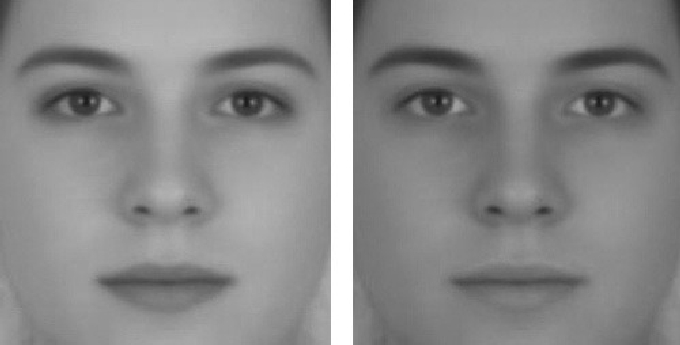
The Illusion of Sex

The Illusion of Sex.

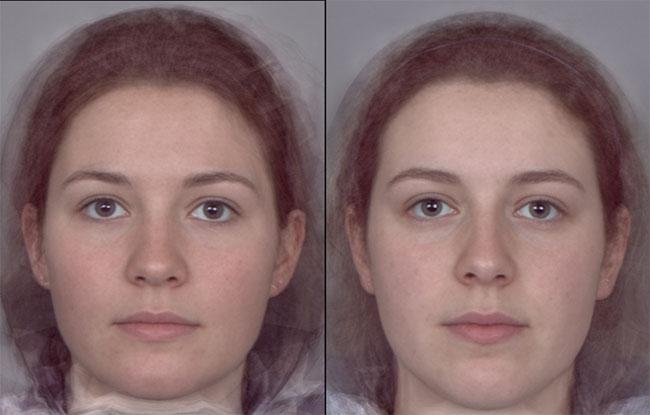
A description of the images above made by Harvard psychologist Richard Russell, who won third prize in the 5th Annual Illusion of the Year Contest for them:

In the Illusion of Sex, two faces are perceived as male and female. However, both faces are actually versions of the same androgynous face. One face was created by increasing the contrast of the androgynous face, while the other face was created by decreasing the contrast. The face with more contrast is perceived as female, while the face with less contrast is perceived as male. The Illusion of Sex demonstrates that contrast is an important cue for perceiving the sex of a face, with greater contrast appearing feminine, and lesser contrast appearing masculine.

I found the following explanation much more useful and interesting though:

What you’re looking at isn’t an optical illusion, but is a play on the basic expected traits of men and women’s faces. The flusher lips of the left pic coincide with our expectations for women’s faces, as does the fairer skin. And it’s not just the illusion of lipstick; even without lipstick, we expect women’s lips to be more red than men’s. The difference in skin tone also brings to mind a recent a study suggesting that, on the whole, men’s faces are more red complected, while women’s are more green. Thus, even in the B&W photo, we infer that the darker complected face has the deeper reddish tone of masculinity; the lighter, the paler, greenish tone of femininity.

Obviously there’s much that’s debatable in that, especially whether those “expected traits” are universal or culturally-determined, but in the meantime I can’t deny that contrast is an important cue for determining the sex of a face, and that this provides more evidence for Korean women’s mania for lightening their skins being influenced by much more than merely wanting to emulate the wealth and sophistication represented by Caucasians.

Update) There is an 11-page PDF about these images available here, and you can find out more about Richard Russel and his research interests here.

(Thanks very much to reader Nicolas for passing this on)

Women Bullying Women at Work

In today’s Korea Times, with links and and a little extra information that couldn’t be squeezed into the 800 word limit:

No Room for Sisterhood in Today’s Workplaces?

In U.S. workplaces, women are primarily bullied by other women rather than by men, the New York Times reported last week, and the news quickly went viral as it busted some long and deeply-held stereotypes about the women’s movement.

In total, 60 percent of bullies in U.S. workplaces are men, according to the Workplace Bullying Institute (WBI), a national advocacy group. But whereas they tend to target both sexes equally, their female counterparts choose other women as their targets over 70% of the time (source, right: A Muchness of Me).

These figures were surprising because they arrived in an environment where the glass ceiling remains quite strong: a 2008 census by the nonprofit research group Catalyst, for instance, found that only 15.7 percent of Fortune 500 officers and 15.2 percent of directors were women. On that basis, it had been natural to assume that many women workers identify themselves as members of a repressed group, and consequently are more supportive and nurturing of each other in their working lives than men are.

Yet in reality, as numerous examples provided by the WBI attest to, there is little sense of feminist solidarity in the workplace. Why?

One reason is the record number of working women in the U.S., who are now more numerous than working men for the first time in history, primarily because the recession has hit male-dominated industries. Yet reaching this point has long been predicted, and as women also make up more than 50 percent of management, professional, and related occupations, then the surge in their numbers isn’t the result of them taking low paid and/or irregular work to make ends meet during the recession either.

But ironically this may actually increase pressures on women, as with so many now going after top jobs, yet a variety of discriminatory practices still preventing most from acquiring them, then it is logical for women to perceive female coworkers as competitors rather than as possible allies. Add the stereotype shared by both sexes that women are less tough and less likely to complain about bullying than men also, and it’s a wonder that this gender dimension to bullying in the workplace wasn’t noticed much earlier.

Women bullying women(Source: fav.or.it)

If anything, this competition is likely to be more cut-throat in Korea, where it is primarily women that are losing their jobs. As this newspaper reported in March for instance, of the 166,000 of Korean 30-somethings had lost their jobs the previous month, only 9000 were men.

That was not necessarily due to discrimination in itself: in a recession, all companies fire their irregular and temporary workers first. But in Korea, a disproportionate number of these are 30-something women, largely due to this group being singled out for firing during the Asian Financial Crisis of 1997-98.

That was explicitly for discriminatory reasons, the logic being that fathers and husbands would provide for their families or wives respectively. Unfortunately, government and business sentiments have little changed since.

Lee Myung-bak cartoonIn January, President Lee Myung-bak was quoted as saying that “the most urgent issue on our hands is to create jobs for the heads of households” (see #2 here), and as reported in Wednesday’s Hankyoreh newspaper, many Korean companies are encouraging pregnant women to resign, or are making their working lives intolerable if they don’t.
Consequently, compared to other OECD member countries Korea comes dead last on many indicators of women’s position in economic life, and it was without exaggeration that a 2007 OECD report described the country as the worst to work in for women. For example, in addition to extremely long working hours, the wage gap between men and women, which showed slow but steady improvement in the two decades before the Asian Financial Crisis, has stagnated at women earning roughly 64% of what men do ever since (source, right: unknown).

In these circumstances, it is to be expected that Korea also has one of the lowest women’s workforce participation rates also: according to the Korea Labor and Society Institute, 41.9 percent of all women aged 25-54 were working in 2006, little changed from an average rate of 41.5 percent for 1995-99, or, indeed, of 38.2 percent in 1980. The corollary of this is one of the lowest birth rates in the world, for Korean women are naturally choosing to have one child or none at all in order to work. But at least two are required to maintain a population.

There is perhaps no greater indictment of a society than the unwillingness of its members to raise children in it. But with wages being cut, hours being raised, and stress levels rising for everybody during this recession, Korean women are even less likely to want to do so with having to compete so vigorously with other women just to keep their jobs, let alone break the glass ceiling.

Update) A brief but interesting discussion of the origins of the term “glass ceiling” and the reasons for its persistence is available at the Economist here.

Korean Sociological Image #4: Where do Korean Politicians Come From?

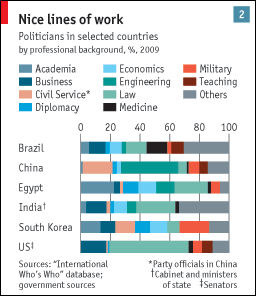
Original Lines of Work, Politicians in Selected=Apologies for the small size, but if you can see the pink and orange blobs for Korean politicians that were originally civil servants or in the military respectively, then you get the idea.
The graph is from this article in the Economist magazine, which asks the question of why professional paths to the top vary so much, but unfortunately only mentions South Korea when it says…

Countries often have marked peculiarities. Egypt likes academics; South Korea, civil servants; Brazil, doctors (see chart 2). Some emerging-market countries are bedeviled by large numbers of criminals, even if this doesn’t usually show up in their ‘Who’s Who’ records.

…yet is no less fascinating for all that. If I reluctantly confine my brief discussion to South Korea here though, then that predominance of civil servants among Korean politicians should be no surprise to anyone familiar with its Twentieth Century history (see here and here), and I’d expect to find much the same in other postwar “developmental states” also, particularly Japan that is their model and the former colonial power of most.

But of course their importance goes back much further than that (see here), as indeed it does in China, which has historically provided Korea with many governmental and political models to emulate. Hence the Economist is quite correct in painting Chinese Communist Party officials with (literally) the same brush also, for despite their modern ideological labels they are in many senses merely performing what are really quite timeless roles.

Other than that, I confess to being surprised at the number of politicians with military backgrounds, even though I’ve written a great deal about the pervasiveness of military culture in Korean daily life. One shouldn’t make too many generalizations from so little information though, and so I’d hesitate to make any links between the low numbers of politicians that were formerly lawyers and Korean legal culture also, although I’m certainly tempted!

(For more posts in the “Korean Sociological Image” series, see here)

Korean Gender Reader

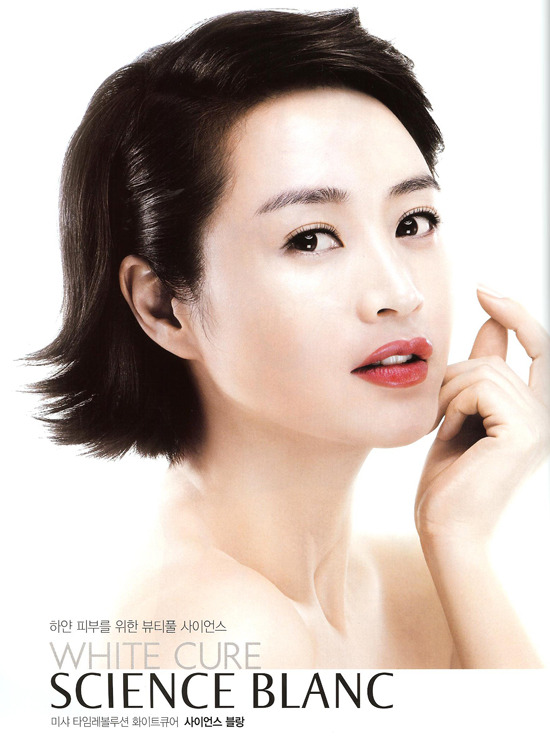
White Kim Hye-su Missha1. Number of Women Suffering Osteoporotic Fracture Increasing

So short that I may as well give the entire article:

Around 200 out of 100,000 Korean women are suffering from osteoporotic fracture, more than a four-fold increase over the past decade. The estimated annual socio-economic losses from such fractures are around W1.05 trillion (US$1=W1,275).

According to a 2007 survey by the U.S. National Institute of Health, the number of female osteoporotic fracture patients was seven times more than that of breast cancer patients, 2.5 times more than stroke patients, and 1.4 times more than heart attack patients.

Moon Sung-hwan, an orthopedist at Severance Hospital, said, “According to the World Health Organization, one in four women suffers a fracture in her lifetime. The rate increases to over 33 percent among those in their 60s or 70s, and 50 percent among those aged 80 or over.” Hip-joint fractures are particularly dangerous, since approximately 30 percent of patients die within two years.

I accept that a host of factors may be responsible for the dramatic increase, but as I make clear here, here, and here, Korean women go to great lengths to avoid the sun for the sake of light skins (to the extent that they now have among the lowest Vitamin D levels in the world). Moreover, as Korean women’s disposable incomes have gone up over the last few decades then so too has the range of whitening creams, lotions, and pills and so forth available to them, one of the most recent of which is that in this recent advertisement with Kim Hye-su (김혜수) for Korean cosmetics company Missha (미샤) above (source). It is not illogical to suppose that with greater spending on such items comes even greater care and attention to avoiding the sun, hence a drop in Vitamin D levels, and in turn a greater risk of osteoporotic fracture.

Naturally, that would be more young women than the middle-aged and older women most at risk, so there is an unresolved issue of timing with the recent increase. Alternative explanations?

2. South Korea Ranks Low In Terms Of Its Mothers’ Quality Of Life

For the details, see here. Again, just like with the UNDP’s 2008  “Human Development Index” and “Gender Empowerment Index” that I discussed here, whereas most countries’ economic indicators are also pretty good guides to the quality of life there, when it comes to Korea anything to do with women’s quality of life trails those economic indicators quite significantly. In this case for instance, its GDP was 15th largest in the world in 2008, but somehow it was only the 50th best place to be a mother (out of 158 countries surveyed).

I haven’t looked at the breakdown of the figures, but I would be very surprised if Korean maternal and infant death rates weren’t indeed the 15th lowest in the world or even lower, but that Korea lost a great deal of marks on its inability and/or unwillingness to reintegrate mothers into the workplace. For stark illustrations of just how bad Korea is in that regard, see here.

3. Jeong Ryeo-won’s Anorexia Problems?

Skinny Jeong Ryeo-won in April 2009(Source: zziixx)

In this interview, Jeong Ryeo-won (정려원) claims that she only lost the weight for a recent movie role, and never went below 40kg, but personally I think that the jury is still out on both. Regardless, in a sense it’s surprising that she’s been getting the attention that she has for it, considering that Biotherm presumably thinks that that caricature of an actual women above would not repel Korean women but be instead what they aspire to look like themselves. And if you think that that’s bad, wait till you see how she looked last July, when clothing retailer Giordano thought that pictures of her that scared my two year-old daughter would somehow have women rushing to their stores…

4. “If I Can Grope You, You Pass”

There’s been a great deal more discussion of the case of the student teachers sexually harassed by four teachers at their assigned public school earlier in the month (see #4 here), but probably the best is that at Brian in Jeollanam-do here, who also talks about the pervasiveness of this sort of thing at mandatory drinking parties at Korean workplaces. Here and here are two follow-ups also.

Meanwhile, the medical confinement of sexual predators has begun. According to Korea Beat, it’s a rare positive step, with rehabilitation as the goal.

Cruel Temptations Korean Drama5. Swearing Increases on Korean Television

A strange inclusion perhaps, but while there are naturally awkward aspects to all societies that its members are aware of but refuse to acknowledge and/or discuss (particularly sexual ones), in this part of world cultural norms of deference to authority, saving face, and not wanting to stand out in the crowd and so on probably mean that pressing social issues tend to get avoided for longer than in most.

So far, so cliched. Sure. But in a general sense, it’s a step in the right direction when popular culture reflects how people actually think, speak, and behave rather than cultural producers’ notions of how they should do so, and can create a feedback loop leading to more of the same

More concretely though, a spate of Korean women swearing on television, which appears to be occurring in the currently playing popular drama Cruel Temptations on the right in particular (source), may well challenge the sexist dubbing of foreign films and dramas, reported on by Robert Koehler in 2006:

A women’s group has issued a report on the “sexist” dubbing of foreign films and dramas, reports women’s newspaper Ilda The group took a look at some 27 English-language dramas shown on terrestrial broadcasting in September and October.  It found that most of them employed sexist sexist practices when dubbed into Korean.  Namely, male characters spoke in banmal, or “low language,” while female characters used jondaenmal, or “high/respectful” language, even though the original English dialogue made no such distinctions.

I don’t watch enough Korean television to know how prevalent this practice still is (can any readers fill me in?), but if it does still occur then it can only look more ridiculous in light of these new developments.

And I say “ridiculous” because a) it is, and b) I’m not so sure that any Korean couples even speak like that anymore, but then if any of my own limited circle of Korean friends used such a sexist division of language with their spouses and partners then we probably wouldn’t be friends in the first place! Can anyone without kids who gets to leave the house more than do I confirm that that is indeed out of date now (or not)?

6. Love and Marriage

Worried Moment for Korean Couple(Source: Unknown)

First up, the Korea Times reports that there’s a recent trend for employers to set up events for their single employees to meet:

Here’s what they do ― First, companies offer their single staff to register for a large dating event offsite at a hotel or theme mark. Matchmaking companies then kick in with games and events to help the crowd get to know each other better. At the end of the session, participants pick ― through a secret ballot ― who they want to be with.

Duo says about 50 people are accepted for one session and 30 percent of them go home as a couple. Some companies host the event as much as four times a year.

Considering Koreans are physically at work for some of the longest hours in the world, albeit not actually working for much of them (see here), then these events certainly make sense, although I doubt that they’re so efficient and no-nonsense that 30 percent of participants “go home as a couple”(!). Which makes me wonder whether: the long hours and culture of the salaryman system is primarily responsible for the idea (or rather, the vestiges of it), and if so if it is mirrored in Japan especially; or the fact that most Koreans were raised in single-sex middle and high-schools until recently, and thus much prefer arranged, usually group meetings rather than being so bold as to ask the opposite sex for a date directly; or, most likely, a combination of the two?

Regardless, Korean companies clearly seem unlikely to go down the Western path of banning the practice anytime soon, but on a more grass-roots level Koreans I have spoken to about this personally have invariably been surprised to hear about what occurs – or rather, what doesn’t occur – in Western workplaces, and have taken a surprising amount of time to get their heads around notions such as “Don’t screw the crew.” But naturally my friends and students don’t speak for all Koreans, so I’d be interested in hearing what others have (had) to say.

Before I forget, Michael Hurt has written an excellent guide for (primarily) men on the positives and pitfalls of dating Korean women because of having such different backgrounds, including the effects of that single-sex schooling as mentioned. But don’t get the wrong impression: this is not a “How to screw Korean women”  kind of Korean guide, but rather something I could very much relate to after being in a relationship with a Korean woman for the last 9 years, and that I wish had been available much earlier!

Also, Koreans are continuing to get married at later and later ages, compounded by the recent financial crisis:

The latest statistics compound the frustrations felt by baby boomer parents. Last year, the average marrying age was 31.4 for men and 28.3 for women. More and more Koreans are choosing to marry later in life. In 1981, Korean men got married at an average age of 26.4 and women when they were 23.2. This means in 27 years, the average marrying age has been pushed back five years. Three out of 10 Koreans between the ages of 25 and 34, which are considered prime marrying years, are single.

In addition, the crisis is also having an effect on the kind of ceremonies couples that actually do get married actually have, practicalities and strained finances forcing a rethink in the previous norm of the groom’s family paying for the couple’s apartment, and the bride’s for the contents.

A more equitable, more Feminist arrangement because it’s the cheapest? God moves in mysterious ways!

And finally, here is a story about a matchmaker that is setting up North Korean defectors with eligible South Korean men.

7. Quick Links

A follow-up on the Joo Ji-hoon drug scandal, which I discussed last week.

KoreaBeat briefly discusses a TV program about a 23 year-old that leads a double life as a university student and a prostitute, and also about the military opening up to girlfriends, sisters and mothers by encouraging conscripts to blog about their experiences. Considering the huge socialization effect of military conscription on Korean men, then this may ultimately prove much more significant than it probably first appears.

– And last but not least, more information on the cost of studying in Korea at Extra! Korea here, and part and parcel of the primarily financial and not cultural reasons that Koreans adults live with their parents until marriage.

How to Get Ahead in Korea…

Samsung Mini-notebook advertisementWhile I wouldn’t go so far as to include it in my “Creative Korean Advertising” series, this advertisement certainly did get my attention when it was in the form of the entire back page of today’s Korea Times, and not just because I have a shaved head myself! Click on it for a full-size image, and you’ll soon see what I mean.

Meanwhile, apologies for the lack of posts recently, but my father-in-law literally fell off a cliff last weekend, and had to be taken by helicopter to the closest hospital. He’s okay (ish), but he’ll be in hospital for a long time, and with my wife going back and forth to her hometown to see him, my looking after the children while she does, and all my other work and paid writing commitments, then my blogging plans for this week have lost out to my getting a whole 5 hours of sleep a night I’m afraid(!). But blogging-wise at least, things should be back to normal within a couple of days.

Korean Women Are Not Alphabets!

kim-tae-hee-v-line-face-drink-advertisement

Update, February 2013: Please see here, here, and many other posts in my “Revealing the Korean Body Politic” series for my considerably updated, hopefully much more nuanced thoughts on Korea’s alphabetization trend, especially in light of what I’ve learned about historical Western precedents!

The original version of my article for today’s Korea Times:

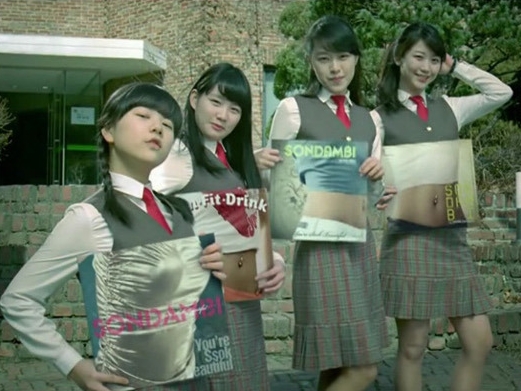
Well known for donning corsets on stage since her comeback in May last year, few can deny that there is much to find cute in singer Son Dam-bi (손담비) tightening a miniature one around a bottle of ‘Today’s Tea’ in her latest commercial.

But while modern corsets lack the uncomfortable body-shaping functions of their Victorian counterparts, they remain an enduring symbol of the pressures women can be under to conform to often impossible ideals of appearance. And despite its lightheartedness, this commercial provides an excellent illustration of a distinctly Korean spin on this (source, right: kjutaeng3)

Beverage producer Lotte Chilsung invented the term ‘bellyline’ for use in this commercial, and it is this that the corset and supposedly the drink help with slimming. In itself, doing so is not at all worthy of any criticism, nor is the term dissimilar to, say, the English equivalent of ‘waistline,’ which would actually have been a much more appropriate choice here. But with that perfectly good term existing already, then why invent a new one?

The reason is that the term is merely the latest in a spate of naming particularly female body parts after English letters in recent years, a very curious fashion that seems unique to Korea so far. Consider the following best known examples of this:

  • M-line (abdominals, for men)
  • S-line (breasts and buttocks, viewed from the side)
  • U-line (exposed lower back)
  • V-line (one for face, and another for the line in-between breasts)
  • W-line (breasts)
  • X-line (long legs and arms, with a narrow waist)
A Woman and her lines(Source: Dark Roasted Blend)

And so integral to Korean pop culture are S-lines and V-lines in particular, that within five minutes of turning on a television you are likely to see either female celebrities strutting them on talk-shows, or prominent ‘S’s and ‘V’s displayed in commercials. Indeed, such is the current mania surrounding them that you can even come across examples completely unrelated to the original body parts involved, including in commercials for cell-phones, school uniforms, and even gas boilers!

Although this practice seems frivolous on the surface, says blogger Javabeans “it actually belies much more pernicious trends in society at large,” and something is surely seriously amiss when, rather than the media, you have a majority of female celebrities “vocally espousing their alphabet-lines and therefore actually objectifying themselves as a conglomeration of “perfect” body parts rather than as whole, genuine people.” But, why their alacrity in doing so? (source, left: 여자가 좋다. 남자는 필요없다.)

A clue is that this quote was made in the context of a breast cancer fund-raising party in October last year, the producers of which saw absolutely no irony in naming ‘Love Your W.’ And if nothing is viewed as untoward in doing so for an event supposedly about empowering women by encouraging them to respect more and take better care of their bodies, then you can imagine that there are few inhibitions for promoting the use of ‘lines’ to teenagers and young girls either.

Accordingly, there are even educational videos that promote healthy food such as fermented bean paste (dwenjang/된장) to elementary-school children that mention that eating it will be good for their S-lines and V-lines also. And one probably direct effect of this is the fact that many Korean middle-school girls have ‘face rollers,’ the repeated application of which is supposed to flatten one’s face towards a desired, angular, ‘V’ shape.

To be sure, the Korean media is not unique in placing undue emphasis on women’s appearances rather than their intelligence — the American media obsession with Michelle Obama’s fashion choices being a notorious recent example — nor is it in providing often unobtainable and unnatural role models and body ideals for women and girls. But the contexts in which those are received are important, and whereas videos like the above would rapidly be banned in schools in many other developed countries, and/or educators that criticized children because of their appearance rapidly fired, unfortunately both are par for the course in Korea.

(Han Ye-seul demonstrates yet another “V-line.” Source: Naver Photo Gallery)

To an extent, this lack of awareness and/or concern is understandable when a child’s entire life prospects are almost entirely determined by a single exam: parents have other priorities. But on the other hand, when a majority of netizens did not take pride in astronaut Yi Soyeon for being the first Korean to go into space last year, but instead criticized her for her appearance during the flight, then teenage girls will hardly be encouraged to study harder.

And on a wider scale, as Korea again faces an economic crisis, in order to recover it is worth pondering what lies behind Korea long having one of the lowest rates of working women in the OECD. Surely a good start to using this underutilized human resource, one of the best-educated in the world, would be to encourage both sexes to stop judging women, and women expecting to be judged, entirely on their appearance?

Quick Statistics on Child Sexual Abuse in Korea

Korean Children Stream(Source: Bridget CollaCC BY-SA 2.0)

The Ministry for Health, Welfare, and Family Affairs can certainly be misguided in the “protection” it provides to youngsters sometimes (see #2 here). But given Korean television’s propensity for highlighting dull, vacuous company-endorsed public “campaigns” in commercial breaks, then it deserves kudos for its simple but effective message in this one:

For those of you that are interested, here is the full text seen in the book (repeated by the voice over):

허루평균 2.7 명 아동성폭력 피해

On average, everyday 2.7 children suffer from sexual abuse.

성폭력 피해 아동 편균 연령 9.4세

The average age of victims is 9.4

2007년 아동 성폭력 1,081건 발생

In 2007, there were 1,081 cases of sexual abuse against children

아동 성폭력 ,  당신의 관심만이 사전에 막을 수 있습니다

Only your concern can prevent this

모든아이가 내아이입니다

All children are my children(?)

보건복지가족부

Ministry for Health, Welfare, and Family Affairs

And for further reading I highly recommend this semi-introduction to the topic by Gord Sellar, prompted by his witnessing a mother pouring water over her son’s head to punish him for not liking his food. Alternatively, for more statistics and analysis, then I recommend most of the posts in the “youth” section of Gusts of Popular Feeling here, and Brian in Jeollanam-do has also written a lot about specific cases.

And last but not least, there is also the English section of the Ministry’s website itself, which is actually not all that bad.

Korean Gender Reader

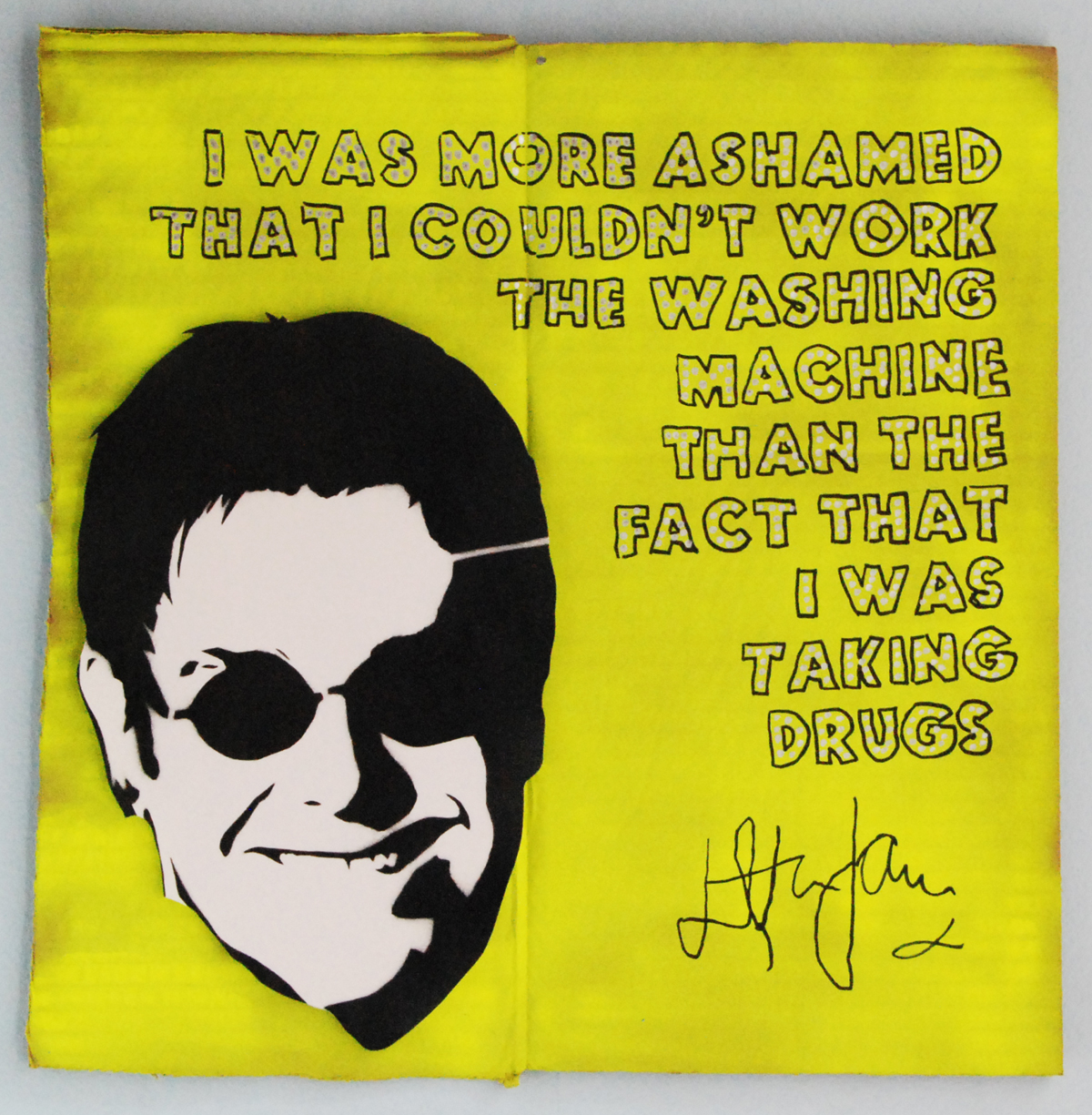
elton-john-drugs-quoteSource: id-iom.

Sorry for the delay: although I’d like to provide a much more professional-sounding excuse, the reality is that my toddler’s constant temper tantrums over the last two days have completely ruined my blogging plans for this week!

1. Joo Ji-hoon Drug Scandal

My personal choice for the most interesting story last week. In brief:

In the latest drug bust of entertainers, police booked popular film star Ju Ji-hun, 27, on suspicion of drug use and arrest warrants were sought for actress Yun Seol-hee, 28, and model Ye Hak-young, 26, for alleged smuggling ecstasy tablets and ketamine into the country from Japan. Two other residents were booked on similar suspicions.

“Besides the suspects on the list we have secured, there are likely more, given the amount of drugs smuggled. Further investigations are unavoidable,” an officer of the Seoul Metropolitan Policy Agency said (Korea Times).

Why I found it so interesting, and why it’s notable in a feminist sense, is because of how the huge disparities between Western and Korean celebrity culture may play out here. Very broadly speaking, Westerners usually tolerate – nay, encourage –  debauchery on the part of their idols, but Koreans are the polar opposite, usually demanding of celebrities standards of behavior and conduct much stricter than they do of themselves. Throw sexual double-standards and many especially young actresses frequently playing “sweet and innocent” roles into the mix too, then many female celebrities in particular have faced heavy public opprobrium once they have been revealed to be, say, merely human.

Yoon eun hye the temptressHence my first thought that the female celebrities involved in this scandal might get the most flak for it, but as Joo Ji-hoon (주지훈) is so much better known than them then so far most attention has been on him instead. Naturally, this story is all over the K-pop blogs, but DramaBeans provides the best coverage: see here, here and then here for all the details in chronological order, to which I’d add the surprising news that so far he hasn’t given the tearful apology that is de rigueur for these situations, and instead is – shock! horror! – unrepentant.

(Right: Does the blame ultimately lie with Yoon Eun-hye? Source)

2. I’ve Got You Under My Skin

Previous restrictions on nudity, sex, and swearing in the media are rapidly being lifted in Korea (see #1 here), but that doesn’t mean that all the individuals and institutions involved are liberalizing things at the same speed, nor, indeed, that they’re even on the same page. As I explain in the bottom of this post:

…aside from the government’s push for a  “real name” internet system of course, one other notable censorship issue is the Youth Protection Committee’s (of the Ministry for Health, Welfare and Family Affairs; see #4 here) recent banning of music group TVXQ’s latest songs from being played on TV and the radio because of “lewd content” (see here also). But one might ask what exactly the point was considering the album has already been out for six months though!

And blogger Gord Sellar has written an excellent post on the supreme irony of this:

…The idea that a censor who cannot speak English well enough to understand the nuances of what’s being said is interesting.

But then again, there’s also the nuances of what’s being heard. After all, I can say, “Ha, that censor doesn’t know enough English to know that it means, “I’ve got you on my mind,” or, “You’ve affected me emotionally in such a way that I cannot shake this effect you have on me.” But the censor’s grasp of English is…

Well, there’s the question. The Ministry for Health, Welfare and Family Affairs certainly doesn’t seem to know what the phrase means in English — though it’s well-documented, is present in popular culture, and absolutely innocuous in an English speaking context. (Even the stuff about “… deep down in the heart of me, so deep inside, that you’re really a part of me…” is tame enough to have been on mainstream TV back when sexual content was not broadcast in the States.)

See here for the rest.

3. More Female Toilets to be Built in Seoul

By coincidence, I heard on the Guardian Daily podcast last year about recent changes to laws in the UK requiring all new buildings to have female toilets double the size of those provided for men, and as a guy I had no idea of just how impractical and inconvenient and still steeped in a Victorian architectural mentality many are there, ultimately with big impacts on women with children in particular (and in turn, families), although as a father now I have much the same problems myself, and can certainly empathize. See here, here, here for more information on that UK case, but most of the problems mentioned would be universal,  and so provide some good context for the following news about the Seoul City Government, which will:

…increase the number of women’s toilets to close to that of their male counterparts. Currently, there are 42,348 male toilets compared to only 34,649 toilets for females. It will build 3,100 more this year and 3,800 next year (Korea Times).

A curious disparity. Regardless, and even if you’re a guy and/or not interested in such matters, at the very least more and bigger female toilets will mean less waiting for your partner, as someone on the podcast I heard mentioned.

Another, somewhat misguided initiative also mentioned in that report is to provide many slightly larger female-only car-parking spaces, the logic presumably being that women are worse drivers and so need more space to maneuver. Admittedly I don’t drive myself, but I’m pretty confident that any car-insurance salesperson can confirm that that is complete bullshit (women actually have less accidents than men), and so this idea reflects the prejudices of the city councilors more than anything else.

Update: See KoreaBeat here for more details.

4. Gwangju Female High School Students Stripped as Punishment

For the details, see Brian in Jeollanam-do here. One minor thing that he forgot to mention in that post is that it occurred at an all-girl high school, but which is not to say that that condones the punishment in any way

Also occurring at a high school, it was reported by the Korea Times that four male teachers are to receive punishment for sexually harassing female interns. Unfortunately, given a history of teachers getting off lightly for far worse offenses, such as one being given only a six-month sentence for sex with an 11 year-old (see #9 here), then…let’s just say I have my doubts as to how effective their ultimate “punishment” will be.

5. Han Chae-young Models Men’s Clothes

han-chae-young-rogatis-한채영-로가디스As allkpop reports, Rogatis (로가디스), a Korean menswear company, has chosen actress Han Chae-young (한채영), as their next model for their latest line of mens clothing (right, source). Not that significant perhaps, but it immediately brought to mind Danish clothing company JBS’s notorious underwear advertisements from last year, which featured virtually naked (naturally) women in men’s underwear, and which ultimately got…er…pulled (see here and here for more on those, but which are probably NSFW).

Now, I’m not going to feign outrage at those, nor at the notion of using women to model men’s clothes in itself, although personally I found the ones with nurses and so forth actually sniffing the underwear (and savoring the smell) to be very unrealistic more of a turn-off than anything else. But I’m curious as to readers’ opinions on the Rogatis advertisements specifically, as although they’re certainly still quite risqué (see more examples here), most of the complaints against those by JSB focused less on the women’s nudity as their explicit subservience in them, which clearly doesn’t apply here.

So, does it work? It it still objectionable in any way? Why, why not?

6. Korea’s Lost Generation

First becoming involved in Korean sociology via the huge differences in living arrangements for 20-somethings between Korea and Western countries, then I’ve long been interested in the various financial barriers that prevented Korean twenty-somethings from leaving home, and without which it’s no exaggeration to say a veritable revolution in Korean sexuality would occur. Indeed, the situation of today, rife with double-standards and open secrets and all, is not at all dissimilar to that of Western countries before huge expansions in university enrollments in the 1960s and 1970s, but until a similar Korean generation of cohabitants that no longer feels a need to hide things emerges from that, then it will continue to be women especially that suffer the most from sexual matters not being out in the open, either physically or by placing feminine virginity and “modesty” on a pedestal.

In my most recent posts on the subject then (here, here, and here), excessive student loan interest rates and rising univeristy fees have emerged as the biggest of those financial burdens, and in many ways what is occurring in Korea today parallels what occurred when I was a student myself in New Zealand in the mid-1990s. I didn’t, however, have this to contend with also:

As a candidate, President Lee Myung-bak promised to slash school fees by 50 percent and create 600,000 jobs annually. He did neither….

….It’s true President Lee had made these pledges before he knew the world would fall to what he has dubbed the “unprecedented” economic crisis. But there are not many governments trying to get out of this crisis by cutting initial salaries of college graduates, and telling them to remain content with internships, as the Lee administration does now.

President Lee called for the new entrants into labor markets, who probably constitute the best-educated generation of all, to “lower their sights and start humbly.” This could pass as advice among individuals but hardly a sermon coming from a responsible official ― much less the head of state ― to the fresh workforce that will shoulder the nation’s future.

By all means much recent criticism about the Korea Times is deserved (see here and here), but the editorial that that is from may prove remarkably prescient: at the very least, telling a whole swath of young people to STFU and be content with working in Family Mart for what should be the most productive and exciting part of their lives will accentuate their disengagement with the political process.

7. Birth, Death and Divorce in Korea

A swathe of statistics on each have been published recently:  for links and analysis on the former two especially, see Matt at Gusts of Popular Feeling here, and for the latter see Brian in Jelloanamdo here.

Meanwhile, if you’re futher interested in Korean demographics, particularly similarities and differences in family structures between Korea, the US, and Japan,  then you’ll probably like this series of mine on the subject also.

8. Korea’s Lack of Rape Kits: A Comparison to the U.S.

As someone who gets plagiarized himself on a regular basis, then normally I’d be very reluctant to cut and paste a post by KoreaBeat in its entirety, but in this case I think I can make a rare exception:

Nicholas Kristof wrote in [the] New York Times about the problem of severely backlogged rape kits in the United States, putting me in mind of how they are often never even collected in Korea.

And the latter, a translation of a lengthy article on the subject, should be required reading for everyone reading this blog!

If you reside in South Korea, you can donate via wire transfer: Turnbull James Edward (Kookmin Bank/국민은행, 563401-01-214324)

Korean Sociological Image #2: Son Dambi, The Perfect Woman

(Source: Paranzui)

Updated, October 2013

My previous commentary on this “Today’s Tea” commercial was woefully out of date, so it’s since been mercifully deleted(!). But many of the themes expressed remain just as potent in the Korean media today, including the encouraging of teenage girls and children to be dissatisfied with their bodies; the constant invention of new, often impossible, body shapes and “lines” for females of all ages to strive for; the over-reliance on celebrity endorsements, to the extent that the one chosen here, Son Dam-bi, is portrayed as somehow having a superior body and face to an equally-attractive, almost identical woman; and finally, albeit admittedly minor here, the reinforcement of gendered dieting roles by portraying the (single) male humorously—confirming that dieting is something only women need should be serious about.

Think I’m exaggerating? Just see for yourself:

Those problems aside, note that the “34-쏙/ssok-34” is a clever wordplay on women’s “vital statistics” (bust/waist/hip measurements), with one use of the word “ssok” being to stress how concave something is. In fairness, it’s quite apt for a slimming product.

(For more posts in the “Korean Sociological Image” series, see here)

Teenage Sexuality in Korean Pop Culture

원더걸스-wondergirls-in-short-skirts-doing-cute-faces

In Monday’s Korea Times, and it’s close enough to the original that I’ll forgo presenting my own version here this time. New readers, please see here for a video, screenshots,  and much wider discussion of the O’yu commercial mentioned and the issues it raises, and see here for more on the Sahmyook University study on condom use and premarital sex by Koreans referred to also. Old readers, apologies for the repetition this time, but fulfilling Brian’s request just proved too tempting in the end!

Share

An Introduction to Domestic Violence in Japan

For more detailed information, see Ken’s three part series on the 2006 survey on domestic violence by the Cabinet Office of Japan (Gender Equality Bureau) at What Japan Thinks here.

Alternatively, for those of you more interested in domestic violence in Korea, then see here for the first installment in my series on that. Further afield, see here for information on the dramatic decrease in spouse-to-spouse murders in the US over the last 30 years (extreme, but still related), which deserves to be much more widely known.

(Via: Feministing)

Korean Gender Reader

supposedly-fat-kim-yu-bin-김유빈(Source: 원더풀홀릭)

1. God Moves in Mysterious Ways

My opinions on the marketing of teenage girl groups like the Wondergirls (원더걸스) have become much more nuanced since I wrote controversial posts like this and this a year ago, although regardless of my criticisms I never had anything against any of the groups or the singers themselves. And good on Kim Yu-bin (김유빈) above for standing up to the netizens who can’t tell the difference between turning “fat” and turning into a woman.

2. Korea Drops from 64th to 68th in its Gender Empowerment Measure

Probably the most stunning indictment of Korea’s gender relations, it’s worth quoting this Hankyoreh report in full for those of you who haven’t heard of the GEM before:

South Korea fell further out of the mid-low range last year compared to other world nations in women’s rights, a report shows.

According to [2008 data] released Monday, calculated by the United Nations Development Programme for over 100 world nations, South Korea earned a score of 0.54, falling four spaces to 68th from its 2007 ranking of 64th.

The GEM is an indicator of women’s degree of participation in political and economic activity and the policy-making process, using for its evaluation factors such as the number of female legislators, the percentage of women in senior official and managerial positions, the percentage of women in professional and technical positions, and the income differential between men and women. A value closer to 1 indicates a higher level of empowerment.

In the first set of GEM calculations released in 1995, South Korea ranked 90th out of 116 countries, but its ranking gradually rose after that, reaching 68th in 2004, 59th in 2005 and 53rd in 2006. But its ranking fell once again in 2007, as it fell considerably compared to the overall average for nations assessed in areas such as percentage of female legislators and female professionals.

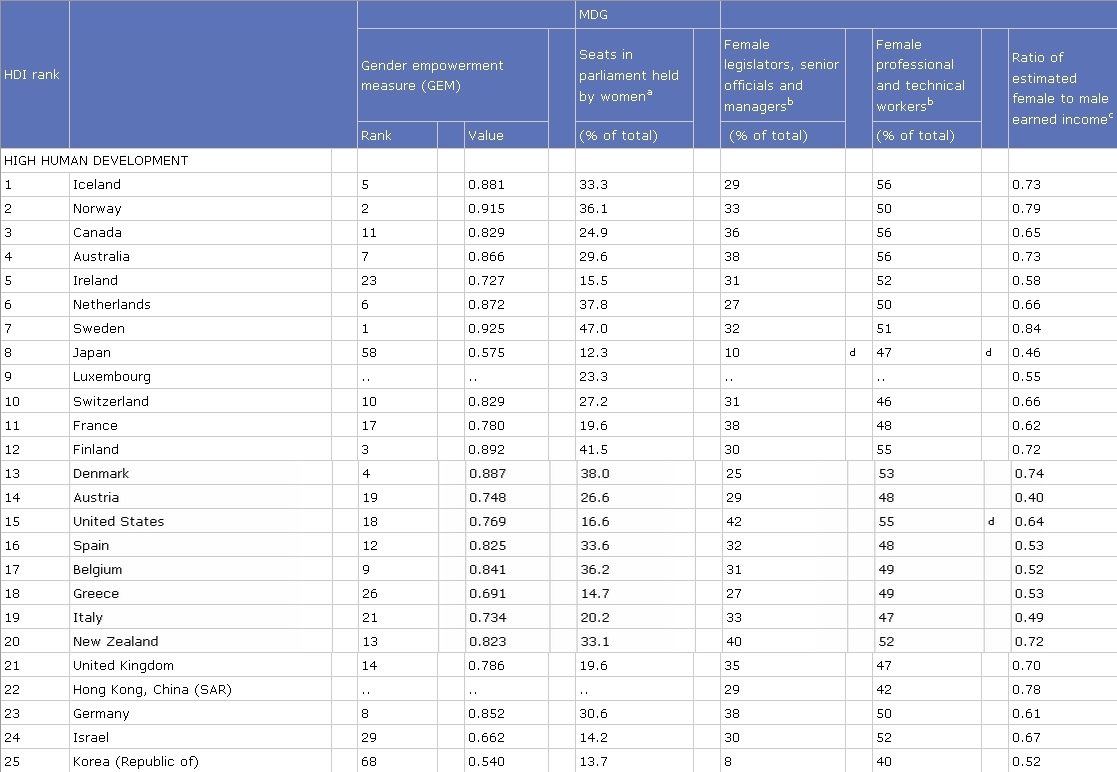
Like Michael Hurt pointed out back in 2006, these figures need to be placed in the context of Korea’s ranking in the Human Development Index (HDI), which combines things like life expectancy and education levels. Roughly speaking, the more developed and better a country is to live in the higher its HDI ranking will be, and usually its GEM will be pretty similar too. But then look at these (click for a much larger version):

south-korea-2008-gender-empowerment-measure-gem-ranking-by-human-development-index-hdi(Source: UNData)

In brief, of the best 25 countries in the world to live in, only 4 are not also among the best 25 countries in terms of women’s rights and levels of economic and political power: Greece on 26, Israel on 29, Japan on 58, and finally Korea on 68. Put another way, women will certainly have a good quality of life in Korea, but they have less chance of becoming a politician or even a middle-manager or computer programmer than in:

  • 59 Kyrgyzstan,
  • 60 the Dominican Republic,
  • 61 the Philippines,
  • 62 Vietnam,
  • 63 Moldova,
  • 64 Botswana,
  • 65 the Russian Federation,
  • 66 Uruguay,

and

  • 67 Nicaragua, the HDI of which was 120th(!) out of 179 countries surveyed.

In fairness though, Korea has actually improved in absolute if not relative terms:

In South Korea last year, women accounted for 13.7 percent of legislators, 8.0 percent of administrative and managerial positions and 40 percent of professional and technical positions, while the ratio of female to male income was 0.52.

The overall percentage improved from 2007, but South Korea was pushed down in the rankings through an overall improvement in gender empowerment among other nations examined. The overall average values for the nations studied were 19 percent for the percentage of female legislators, 29 percent for women in administrative and managerial positions, and 48 percent for women in professional and technical positions.

True, the gap between Japan’s HDI and GEM is also so high, and I can’t blame Korea’s low GEM ranking almost entirely on military conscription in this series but also regularly claim deep economic and social similarities between the two countries in other posts. While I do eventually plan to start covering gender issues in at least Japan and Taiwan though, until then I’d strongly caution against looking for easy explanations such as shared Neo-Confucianism, as Singapore’s HDI is 28 but it’s GEM 15(!), and China’s 94 and 72 respectively for instance (unfortunately there are no separate figures for Hong Kong, or for non-member state Taiwan). Moreover, China’s comparatively good GEM score is not due to the number of women in state-owned enterprises, as they almost always held lower, non-advancing positions within them and were the first to go when they were privatized, wound down, or restructured (but it may account for Vietnam’s relatively good one though).

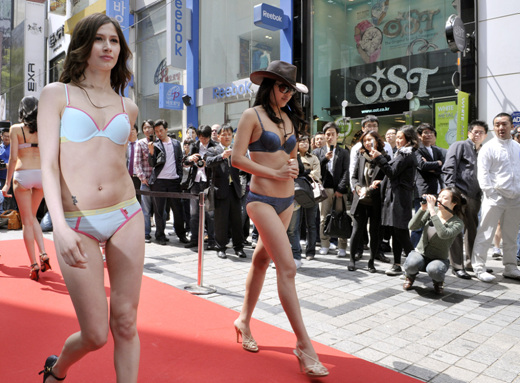
caucasian-and-korean-lingerie-models3. Korean Lingerie Models too Embarrassed to Show Their Faces?

As long-term readers of this blog will know, the main reason that there are so few Korean women in lingerie advertisements is because many Korean porn stars have done so in the past, giving the industry a dirty reputation, although stereotypes of Caucasians’ more liberal sexuality and their role as signifiers of “developed country status” certainly also play a part.

FeetmanSeoul argues that this accounts for Korean models’ virtual disguises(!) at Levi’s “Best Body” fashion show in Myeongdong last week (source, right), although it may well have been the choice of organizers rather than the models themselves.

4. Korea’s Double-Standards Still Devastating for Female Celebrities

As I explain here, it’s still open to debate whether singer Baek Ji-young (백지영) has successfully salvaged her reputation after a sex video scandal in 2000, but another case that deserves to be far better known is that of Ivy (아이비), for whom simply the threat of the release of a similar video was enough to derail her career in 2007. On top of that, despite the trivial fact that the video didn’t actually exist, and that her ex-boyfriend was ultimately sent to jail for making the threat, she was sued by various companies she modeled for and endorsed because of the “damage to their reputations.”

Unfortunately, she is still considered beyond the pale. As PopSeoul! explains, songs originally written for her are now being used by other singers instead.

5. Sexual Violence

  • It’s good that the drunken executives that harassed a 19 year-old student were arrested, but not that she accepted monetary compensation from them rather than pressing charges. As for why this is a feature of the Korean justice system, see here.
  • One of the five teenagers that drugged and raped a 16 year-old in Suncheon is a student at one of Brian in Jeollanamdo’s schools. Make sure to ask him for follow-up details.
  • The Supreme Court upheld a 10 year sentence on Jesus Morning Star cult leader Jung Myung-suk for the sexual abuse of five Korean followers between 2003 and 2006.
  • On Wednesday serial killer Kang Ho-soon was sentenced to death for the murder of a total of 10 women, including his wife and mother-in-law. See here and #5 here for more details.

6. That Movie Poster

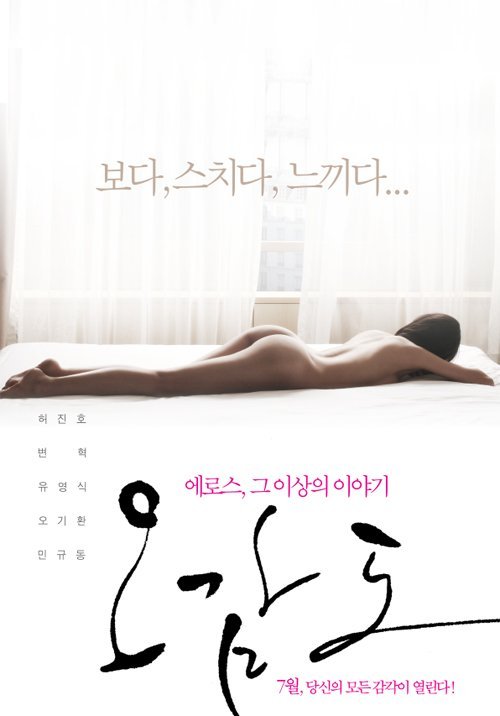
Yes, for the movie Ogamdo (오감도, source), apparently causing quite some controversy with it’s depiction of a women’s naked buttocks (a first?), but really quite predictable given things like this (see #1) and this. ogamdo-오감도For more on the movie itself see here (including details on the owner of said buttocks), and there’s a nice…er…meaty discussion at KoreaBeat too.

7. Anti-Miss Korea Festival

Held at Seoul University on Saturday, and now in its tenth year, bizarrely there appears to be a great deal of information on it available in English, particularly in Australian newspapers (maybe this has something to do with that?) but virtually none in Korean, at least for this year’s event! As Australian newspapers are unlikely to report on how it went though, then I’ll keep looking for “안티미스코리아대회” on Naver, but in the meantime you might find this journal article about the 2000-2001 Drama Viva Women (여자만세) that it inspired interesting.

8. The Differences Between How Koreans and Westerners Perceive and Discuss Appearance

What is said to you and about you by Koreans often shouldn’t be taken at face value, but on the other hand is invariably very blunt, and this habit can take a great deal of getting used to. For a big discussion on how to navigate this cultural minefield, see The Hub of Sparkle here.

9. Monsters-in-Law

A Korean take on domineering mothers-in-law. For the religious/ethical and demographic reasons for why it’s no generalization to say that they’re much worse than their Western counterparts, see here and here respectively.

10. Welcome, Brides, But…

A good recent summary of the problems faced by migrant brides, although I concur with J. Scott Burgeson’s criticism of the author as being unable to ‘transcend the “pure-blood” ideology she claims to critique.”

Koreans’ Indoor Childhoods are Clouding Their Vision

girl-with-huge-glasses-in-libraryIn yesterday’s Korea Times. Long-term readers may recognize the topic from this brief report I gave on it back in January, but, as I’ll explain, I’m very glad I decided to take a second look at the science involved:

Why do so many East Asian children wear glasses? Because they don’t get enough exposure to sunlight, according to a study released by the Australian Research Council’s Centre of Excellence in Vision Science earlier this year. Which may well prove to be a damming indictment of education cultures that confine huge numbers of children to institutes when they’re not at school (source, left: unknown).

Rates of myopia (short-sightedness) have dramatically increased in East Asia over recent decades. To pick the best-known example, data on male conscripts in the Singaporean army shows that 40 years ago, roughly 25% of Singaporean children finishing high school had myopia, but now that figure is closer to 90%, despite students being healthier and taller overall. Similar rates are found in Hong Kong, Taiwan, and Guangzhou Province in China.

These general figures belie what is actually a very real threat to public health. Beyond simply consigning 9 in 10 students to eyewear, according to Dr. Ian Morgan of the Vision Centre, up to 20% of students in those regions are in the “high myopia” category, which translates into a roughly 50/50 chance of going completely blind by the time they are middle-aged. Governments across the region are expressing serious concern.

Previous popular explanations for the worsening vision included East Asian children spending more time at their desks and computers (“near work activity”, when the focus of vision is within a short range over an extended period) these days, or alternatively that there is a special East Asian genetic susceptibility. Both theories have been demolished by researchers at the Vision Centre, who compared myopia rates of 6 year-old children of Chinese origin in Singapore and Sydney.

In brief, only 3% of those in Sydney suffered from myopia, compared to 30% in Singapore. That there was any difference undermines a genetic explanation, but whereas most people might have expected it to be accounted for by the latter’s greater amount of near work activity, to researchers’ surprise in fact Sydney children did more, which suggested that the myopia must be triggered by some other environmental factor. Eliminating all other variables, the critical factor appeared to be that Sydney children were spending far more time outdoors. To be precise, 13-14 hours a week compared to 3 or 4.

While the exact mechanism between sunlight exposure and preventing myopia is still to be determined, the researchers believe that the neurotransmitter dopamine is responsible: known to inhibit eyeball growth, sunlight causes the retina to release more of it.

Evolved to literally keep an eye on the horizon, humans are naturally long-sighted (with short eyeballs), but our eyeballs lengthen as we grow and become more accustomed to near work activity. Myopia occurs when the eyeball has grown too long, meaning that the focus of light entering it falls short of the back of the eyeball, requiring corrective lenses to correct it.

That Singaporean children don’t get enough exposure to sunlight may sound counterintuitive, but in fact the hot and sticky climate makes children more inclined to spend time in air-conditioned environments indoors, and just like in many East Asian countries with more agreeable climates there is also a relative lack of parks and open spaces. Regardless, culture is undoubtedly the biggest factor. Australia is well known as a sporty outdoor country and after-school institutes are almost unheard of. In contrast, many East Asian children’s 6-day school and institute schedules deprive them of sleep to levels that would be considered borderline child abuse in Australia, sapping them of the time, energy or inclination to play outdoors in the sun.

There are additional medical problems associated with a lack of sunlight. Light skins are very popular among many East Asian women, evidenced by the plethora of “skin-whitening” pills, lotions and creams available in cosmetics stores, and in Korea it is already a common sight this spring to see women making sure to cover their faces with books and handbags as they cross a sunlit street, even if just for a few seconds.

While there is nothing at all wrong or unhealthy with this in itself – quite the opposite – the sun is avoided to excess by South Korean women. A 2004 endocrinology study by Severance Hospital in Seoul showed that the nation’s women are seriously deficient in Vitamin D, making them more likely to suffer osteoporosis later in life. In fact they posted the lowest Vitamin D levels of all 18 nations surveyed, with 88.2% of the women surveyed failing to reach a healthy threshold (source, right: the Korea Times).

sunlight-prevents-myopiaWhile it is possible to absorb Vitamin D through food, the surest way is through exposure to a few rays of sunlight every day, and Korean women would be well advised to ask themselves if ultra-pallid skin is really worth the price of full health. Just as Korean parents might wonder if higher TOEIC scores are really worth the price of their children’s long-term health (end).
I confess, I struggled with the science in this article. No, not because it was out of my field of expertise: as it so happens, not only do I have very bad eyesight myself (-7.5 for those of you who know what that means), and so am intimately familiar with diagrams of long and short eyeballs and so on from countless visits to opticians, but in fact my original major at university was astronomy too (no, really), and I learned so much about optics instead of actually looking at stars that I ended up dropping that major altogether!

More then, because the authors of the articles I linked to in my original post proved to be much less concerned with how sunlight prevents myopia as explaining that it had been discovered that it did, and so what proved to be the key information about the effect of dopamine on inhibiting the growth of the eyeball was missing from them. Fortunately though, I eventually found it in this press release by the Vision Center itself, and suddenly everything clicked. But without it, those articles and the dozen more I pored over while researching this post simply don’t make sense, and although it’s tempting to forgive those authors that lacked a science background especially, some advice from my (last) high school physics teacher seems apt here: if you can’t explain something to someone else, then odds are you don’t understand it yourself.

Words I’ve lived by for the past 16 years. Meanwhile, my frustrations with science reporting aside, see here for more information on the Severance Hospital study demonstrating Korean women’s severe Vitamin D deficiencies. And I’m too harsh really: this radio interview of Dr. Ian Morgan is still useful and interesting despite everything.

Update) Unfortunately, as parents’ angry complaints against this proposal for a 10pm curfew on hagwon teaching indicate, the norm of keeping children indoors studying until as late as 12:30am(!) five to six nights of the week isn’t going to change anytime soon.

Where do Ajosshis Come From? Part 3: Manchukuo and The Militarization of Daily Life in South Korea

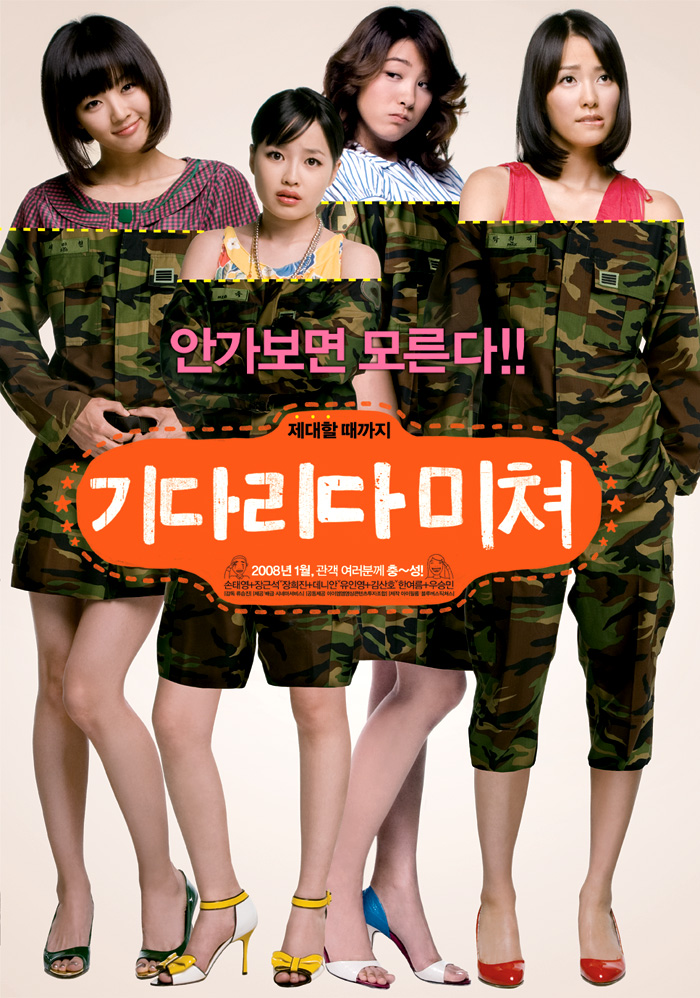
(Movie poster for “The Longest 24 Hours,” (기다리다미쳐, 2007), a lighthearted look at military service from the perspective of conscripts’ girlfriends; also known as “Crazy4wait.” Source: 여자도 모른는 여자이야기)

It’s been quite a while, so to remind readers, in Part One of this series I argued that a virtual gender apartheid existed in modern Korea, with women excluded from economic and political life here to an extent much more reminiscent of Middle Eastern countries than what one would expect in a modern liberal democracy. If that sounds like mere hyperbole to new readers, then sure, it probably would to me too(!), but by all means examine the evidence given there, to which I would now add that Korea has the lowest number of working women of all developed countries also, and that spousal rape isn’t even a crime here (see #2 here).

(Update, February 2014: Part One has since been deleted sorry)

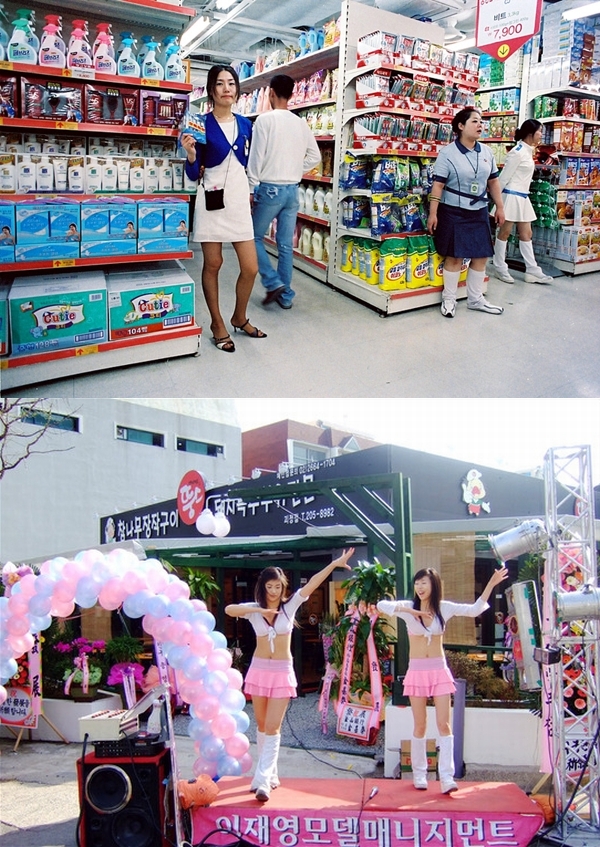
How to explain this? Well, naturally many specific elements of Korean women’s disadvantaged position in Korean society are no great mysteries: decades of salaryman male-breadwinner forms of employment for instance, explain a great deal about the lack of women in senior positions in companies (a parallel is how the Cultural Revolution four decades ago resulted in an “intellectual skills gap” that still affects the Chinese economy), and deeply hierarchical and sexist Neo-Confucianism has had a profound influence on Koreans’ worldviews, even extending to how men’s and women’s bodies are perceived and valued differently, and from which it is no great leap of the imagination to see echoes of in – amongst other things –  the widespread use of doumi (도우미) or female “assistants” and scantily-clad “narrator models” (나레이터 머델) here to sell mundane household items or open even the humblest of new stores and restaurants respectively.

korean-doumi-shop-assistants-and-narrator-models-도우미0-나레이터-모델(With apologies to Michael Hurt for the use of the top image, but like he says, despite their ubiquity most doumi are embarrassed by their jobs and very reluctant to have their photos taken; after half an hour of looking (in Korean!), this is the only similar one I could find. Bottom image taken from shytiny)

But both those and many other factors commonly cited are by no means confined to Korea, and while going into greater detail would undoubtedly tease out plausible reasons why Korean women are worse off than, say, their counterparts in Japan or even China (hardly well-known for gender equality in themselves), here I am more concerned with the systematic nature of women’s exclusion in Korea. Ergo, however cliched it sounds, this series is all about seeing the forest rather than the trees.

With that in mind, based on my readings of especially Kwon (2001) and Moon (2005) and on my own nine years’ experience of the militarism that is still inherent to many Korean institutions (especially schools) in particular, then I laid the blame for that exclusion squarely on the continuation of and widespread public acceptance of the universal male conscription system, and all that that entails: nothing else seems adequate to explain so widespread and pervasive a phenomenon.

Again, that may well sound somewhat exaggerated at first: after all, South Korea is by no means the only country in the world to have conscription, and while I’d venture that a cross-country comparison would undoubtedly demonstrate at least a tendency towards lower levels of women’s empowerment in those countries that had it, that the “feminist paradises” of Sweden and Norway also have it, for instance, shows that any link would by no means be clear-cut. But then for most of the brief history of South Korea the military has had a uniquely pervasive role in society, one not revealed by any casual comparisons with other military regimes, and this really needs to be fully appreciated and understood before some of my more outlandish sounding claims about the effects of conscription on gender roles here can be assessed objectively. Hence, while it will take us far in time and space from what would normally come under the rubric of “Korean gender issues” – and which explains the 9 month hiatus, for unfortunately my beginning to write the series coincided with my wanting to examine more “traditional” aspects of that subject – I realized that the Korean military itself needed to be studied first, and so Part Two was about its origins in the Japanese colonial state, again much greater in size, scope and ambitions than a simple conflation with its European and US counterparts would suggest.

This post continues where that left off, focusing on the short-lived Japanese colonial state of Manchukuo (Manchuria region, 1932-1945), which eventual nreturnees to Korea among the  720,000 Korean immigrants there (from 1932-1940) and a sizable proportion of the South Korean bureaucracy, armed forces, and police of the 1950s and 1960s had some first-hand experience of living in and working for. In particular, Manchukuo was where president Park Chung-hee (1963-1979) above (source) spent most of his formative years as an officer in the army (even going so far as to sign an oath of loyalty to it in his own blood), and, as we shall see, is what he would effectively recreate in South Korea in the 1960s and 70s.

Korea’s Wild Wild West?

(Source: 이것저것 연습장)

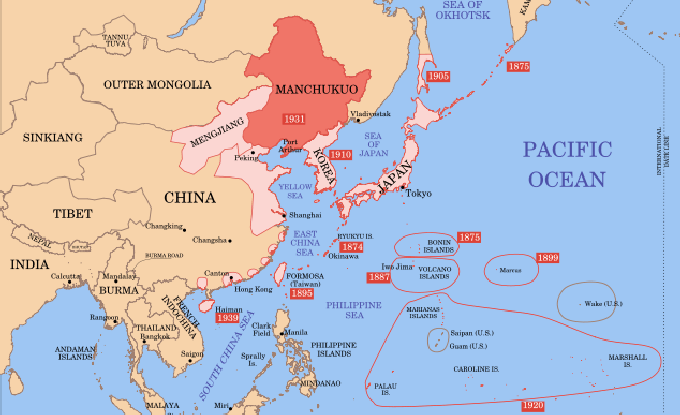
Okay, first the big picture:  what were Japanese motives in occupying what was to become Manchukuo? Well, primarily because it greatly expanded the Japanese imperial empire, still much smaller, weaker, and younger than its European and American counterparts as explained in Part Two. But more practically speaking, it also provided:

  • A bridgehead for the invasion of China, well connected by rail and road links to Korea even before the 1930s
  • A buffer-zone between the USSR and both the more developed and crucial colony of Korea, and indeed there would be several clashes between the two on the Machukuo border in the late 1930s
  • An important source of particularly mineral resources in its own right, without which the later invasion of Southeast Asia wouldn’t have been possible
  • And finally, an escape valve to ease Japanese (and Korean) domestic agrarian population pressures and poverty, exacerbated by the depression.
(The Prewar Expansion of the Japanese Empire. Source: Wikipedia)

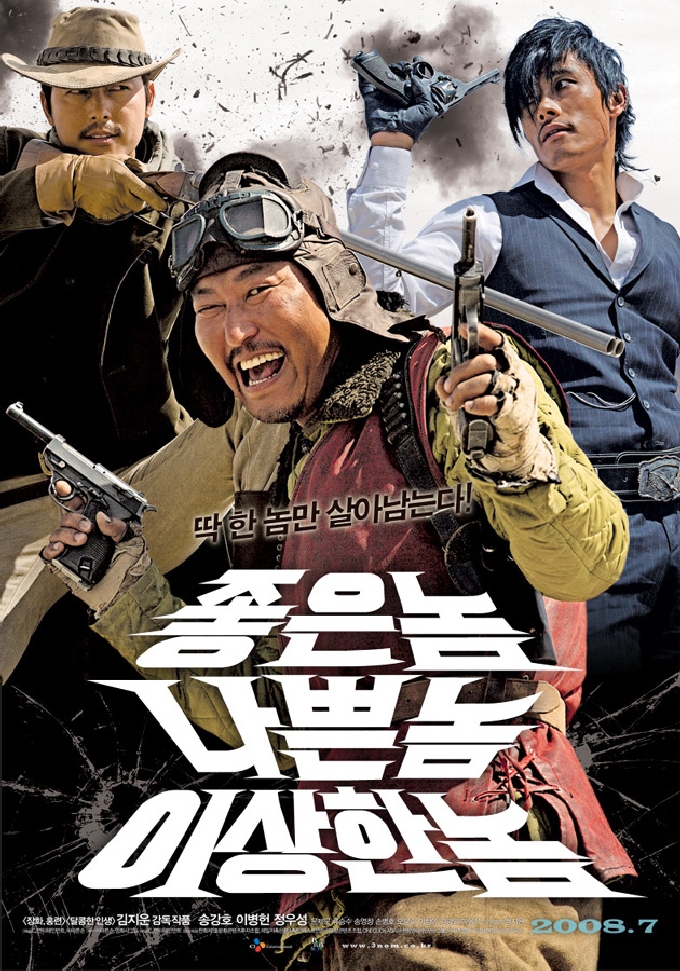
The 2008 movie The Good, The Bad, The Weird (좋은 놈, 나쁜 놈, 이상한 놈) in the poster above happens to be set there, and by all accounts it is fun to watch, but unfortunately its depiction of life there in the 1930s as Korea’s version of the Wild West is probably exaggerated at best. While it’s true that the Chinese Warlord Era as a whole is not exactly well known for the stability or internal coherence of its various regimes, and that things would have been quite chaotic around the period when warlord Zhang Xueliang withdrew his forces from the region and ceded it to the elite Kwangtung Japanese Imperial Army after the Mukden Incident of September 18 1931, that strategic retreat was largely dictated by forces beyond his control, such as Chiang Kai-Shek being unable to provide assistance. In fact, his regime was far more coherent than most of that era, being able to effectively wipe out opium-trafficking and internal corruption in the previous decade for instance. Moreover, much of the state bureaucracy was bequeathed to the new Japanese colonial state, and as soon as April of 1932, it was one of the most controlled, regimented regimes in Northeast Asian history.

Don’t worry if that was all above your head: suffice to say that Manchukuo state organs were in many senses grafted onto the preexisting ones of Zhang Xueliang’s regime, but with the crucial difference that recent events meant that there were no longer any substantial non-state actors like a business or landed class to impede them in instilling notions of loyalty and nationalism in their new pool of workers and soldiers.

And whom were by no means unwilling victims of the process either. For example, writing about the Korean “Truth Commission on Forced Mobilization under the Japanese Imperialism (sic)” in 2006, Michael Breen said:

The Truth Commission on Forced Mobilization under the Japanese Imperialism (sic) announced on Monday that 83 of the 148 Koreans convicted of war crimes were victims of Japan and should not be blamed….

[But they] were not tried as soldiers or POW camp guards who had done their jobs. They were tried for over-zealousness, for decisions and actions over and above the call of duty. They were the thugs, the brutes, the monsters, the most horrible of the ”horrible people”….By what authority does the Truth Commission have to remove their individual responsibility with its class act defense of nationality? Such skewed morality led to the crimes against the lowest class– ”prisoners” — in the first place. People who committed crimes against humanity are not innocent by virtue of being Korean any more than Japanese who brutalized Koreans are innocent by virtue of being Japanese.

….[the Truth Commission] should recognize that the idea that Koreans were all unhappy citizens of imperialism bar a few collaborators is a myth. Koreans were Japanese citizens, and it did not occur to many to support the allies against their own country. Ask anyone who lived in that period, and they will tell you that the political correctness of the post-colonial generation is distorted.

They will also tell you that from 1937-42, Koreans in the Japanese army were volunteers — who included King Kojong’s son, an army general — and that large-scale forced conscription only started in 1944. The Commission should know that those rounding up comfort women were Koreans and those torturing people in police stations were mostly Koreans. Koreans, in other words, were more ”horrible” to Koreans in many cases than the Japanese were. The solution to this dilemma is to accept the notion of individual responsibility.

And according to Suk-Jung Han in his July 2005 Japan Focus article “Imitating the Colonizers: The Legacy of the Disciplining State from Manchukuo to South Korea,”  similar senses of citizenship were instilled in new Manchukuo citizens by means of:

  • State-Sponsored Confucianism
  • Mourning Rituals and Ancestor Worship
  • State-foundation Gymnastics
  • Anti-Communist Rallies

A combination which will probably sound very familiar to those of you even with just the most basic of knowledge of South Korea’s history. Indeed, as Han’s article is only 14 pages long and very readable in its own right, rather than provide a detailed discussion of what you many of you will go on to read there regardless, it’s probably wiser if I just provide some excerpts here, starting with:

The legacy of Manchukuo can be seen in numerous “naturalized” events in South and North Korea. So-called “national ceremonies,” such as paying a one minute silent tribute to the war dead in front of monuments, marching, lectures on the “current emergency situation”, movie-showing, poster making, student speech contests, rallies, big athletic meetings, and so on- largely related to anti-communism, and all too familiar to South Koreans for several decades from the 1950s- were originally national events of Manchukuo in the 1930s.

For state-sponsored Confucianism, some crucial clues as for how South Korea has come to be known as “More Confucian than China”:

South Koreans grew accustomed to the Confucian ideology of loyalty and filiality (choong-hyo) stressed by Syngman Rhee’s regime (1948-1960) as well as Park Chung Hee’s (1961-1979). The post-liberation ideology was different from the Confucianism of the Chosun dynasty, which had been not only the official ideology but also the basis of ethics and cosmic philosophy. The former was less intense than the latter. But Confucianism was still influential in the post-liberation era. Important Confucian concepts, like loyalty to the nation, were instilled in students. It was Manchukuo that energetically patronized Confucianism. Manchukuo differed from mainland China where Confucianism was severely attacked by the May 4th intellectuals and their heirs. Also, Manchukuo differed from Japan in the 1930s when Shinto was deployed as the state religion.

About the importance of mourning rituals and ancestor worship, which might sound outlandish to many outside of Korea, but intimately familiar to anyone who’s ever experienced either of the two biggest occasions of the year Seollal or Chuseok in an actual Korean home, and learned first-hand just how morbid they can be, at least symbolically:

Although monuments for the war dead began to supplement Confucian shrines as the site of important ceremonies, the mourning ceremony, either for ancestors or soldiers, was long essential to Confucian practice inside and outside the home. In April, 1935, officials and army officers attended a great mourning ceremony (zhaohunji, shokonsai), held at the newly built monument in the capital. The assembly, opening ceremony, invocation of the spirits, enshrining of the dead, offering of food, and tributary speech solemnly proceeded. This was simply one example of numerous mourning ceremonies of subsequent years, particularly after the outbreak of the Sino-Japanese war.

The mourning ceremony for dead officials, policemen and soldiers was an important an event, next only to one worshipping Confucius. Although prewar Japanese society also had ceremonies for the war dead at Yasukuni shrine, they were not equal to those in Manchukuo. In Japan, all the war dead (except those who died in hospitals, rather than at the front) were enshrined at Yasukuni. Ceremonies for all were held there at fixed dates. In Manchukuo, by contrast, ceremonies were held at numerous places and at various times. Each ministry of the central government, central police board, army district, province, and county office organized a committee for constructing monuments. Monuments and plazas for the war dead were built across the nation.

seollal-shrine(Offerings of food and drink at a temporary mini-shrine devoted to the spirits of dead ancestors, to whom male members of the family must bow to in ceremonies on Seollal and Chuseok. Source: DiscoverKorea)

For state-foundation gymnastics:

Most middle-aged and older South Koreans remember Jaegun gymnastics from the 1960s. “Jaegun chejo shiijak (let’s start Jaegun gymnastics), one, two, three, four!” The song was broadcast in the early morning across the country in the 1960s following Park’s military coup. [9] Most family members woke up to this song-like command and practiced Jaegun gymnastics, still practically asleep. Jaegun, meaning reconstruction (of the state or nation), was the catch phrase of Park’s regime. Several other songs about Jaegun were written and propagated for citizens and students to memorize. The model for Jaegun gymnastics was the Jianguo (state foundation or construction of the nation) gymnastics of Manchukuo. Jianguo and Jaegun had the common Chinese character of foundation or construction (“jian” in Chinese, “gun” in Korean). Jianguo was the essential word in Manchukuo, from “Jianguo spirit”, “Jianguo celebration day” to “Jianguo University” and “Jianguo exercise.” Hence, construction and reconstruction were the key words for Manchukuo and South Korea.

And still as big a part of the collective Korean psyche that there are still many references to it in popular culture, even that explicitly catering to young people that would barely remember it, if at all. One recent example of which was in a commercial for an eyeliner, as I discuss here:

Also of note:

In Manchukuo, exercise and sanitation were important fields in which the regime invested. There were special weeks of exercise and street cleaning. During this time, the human body came under the jurisdiction of the state. One month after its foundation, the regime prepared an athletic meeting….Imitating the German fascists, the rulers of Manchukuo were interested in the physical training of citizens….Through sports, Manchukuo sought international approval, for which the regime was so thirsty.

This importance of this will become apparent in later posts when I discuss Korea’s population control policies of the 1960s and 1970s, only marginally less rigorously pursued and personally invasive than their Chinese counterparts, and a good illustration of which is the withdrawal troops from the DMZ at the height of tensions with North Korea in order to implant IUDs and perform (voluntary, but rather highly encouraged) sterilizations on citizens in remote rural areas and islands. No, really.

crimson-dawn-by-spargett(“Crimson Dawn” by Spargett. Source: A Muchness of Me)

And finally, for anti-Communist rallies:

South Koreans became sick and tired of anti-communist rallies (bangongdaehue) or “Great gathering for destroying communists” (myulgongdaehue) under Syngman Rhee’s and Park Chung Hee’s regimes. Old folks and housewives were led by officials of city districts and neighborhood districts, and students led by teachers gathered in great stadiums and shouted anti-communist phrases. Again, the model was Manchukuo. In prewar Japan, of course, there was mass mobilization (through such organizations as the Military reservist association and National youth association). After the Manchurian Incident, in particular, jingoism spread among news media, magazines, movies, and literature. According to Louise Young, however, neither government repression nor market pressures can entirely explain the enthusiasm in the 1930s. It was voluntary. Journalists of Asahi or Mainichi supported the army, because they had conviction (Young 1998: 79). Also, the main enemy in Japanese society was not necessarily communist Russia (although it may have been for the Japanese army). Hence, there were no anti-communist rallies in Japan. By contrast, there were myriad anti-communist rallies in Manchukuo. Also, Manchukuo had many more occasions for rallies. Manchukuo was a pioneering place of maximum mobilization, summoning people day and night. The fascist gatherings of Germany and Italy flowed to both North Korea and South Korea through Manchukuo.

Hell, for all its anti-Japanese rhetoric, even at least one of South Korea’s national holidays (until 2005) ultimately comes from Manchukuo too:

In 1936, “tree-planting day” was added. There were other celebrations such as, those for Japan’s withdrawal from the League of Nations, the entry of Japanese soldiers to Manchuria, the visit of Japanese royal family members, and the abolition of Japanese privilege, even one for the founding of the post office.

For a little more on the national-security mania of South Korean military regimes, see here, but that will be the main topic of *cough* a much bigger Part Four.

But let me stop this post here, for Han’s section on “Inheritors in the 1970s,” in which South Korea sounds like a carbon copy of all the above, really needs to be read in its entirety, and my amount of copying and pasting has already become a little excessive. Apologies for that, and I don’t like looking lazy either, but I confess that the question of how to summarize an article that most readers would go on to read regardless proved such a stumbling block for me that it’s taken me nine months to return to it. And that was despite the fact that the next post in the series will be about something I read in 1997 which – in no uncertain terms – was such a revelation to me that without having done so I literally wouldn’t be in Korea or even East Asia today too, let alone have started this blog (but hence its title). Better then, to be a little lazy in this one post then to procrastinate any longer!

democracy-park-monument-busan(Source: Brian Yap (葉); CC BY-NC 2.0)

Love Stinks: Why More Korean Women Wear Deodorant Than Men

성유리-sultry-sung-yuriIn today’s Korea Times. I’ll chime in here with links and extra information that I couldn’t provide in the 800 words allowed there (source, left: fotoya):

“Men can sweat up to 50% more than women,” or so says deodorant maker Rexona. Yet not only do very few Koreans ever wear deodorant, advertisements for it that have started appearing in recent years have almost exclusively been aimed at women.

Far from being counterintuitive however, a study published last Monday in the journal Flavor and Fragrance demonstrates that women have very good reasons to pay more attention to how they smell.

Researchers at the Monell Chemical Senses Center in Philadelphia asked male and female volunteers to rate the strength of 32 underarm sweat samples collected from both genders, and then 32 more that had been disguised by different fragrances typically used to control or mask underarm odor. While both men and women rated the unadulterated samples as equally strong, 19 fragrances successfully disguised the smell for men, while women were deceived by just two.

Investigating further using only female volunteers’, again the unadulterated samples were rated equally strong, but whereas six fragrances succeeded in disguising the men’s smells, as many as 16 worked on the women’s.

Yes, I also thought that it was strange to test only female volunteers in the second series of tests, and I’m confused about the composition of the sweat samples in the first series too: were they just random samples from men or women, were they mixed together into some form of asexual smell, or what? Unfortunately, the above is the best I could make out from 4 even more confusing and widely divergent reports on the study here, here, here, and here, and with what I’m being paid then my sense of journalistic integrity doesn’t quite extend to paying for access to the study itself I’m afraid!

In other words, while women’s noses are more sensitive than men’s, their own odors are more easily disguised, leading women to wear more deodorant or perfume than men.

Naturally there’s much more to it than men’s worse sense of smell, as I’d wager that — at the moment at least — in most cultures it is much more culturally acceptable for women than men to spend a great deal of time and money investing in how they smell, and express an interest in “smelly things” in general, although this study does at least point to a possible biological basis for that. One commentator on one of those other reports argues that the proportion of male to female chefs suggests otherwise, but others argue that that is more due to discrimination than anything else.

As an aside, in the mating game, this may not always be good strategy: other research has shown that the scent of a woman’s sweat is particularly attractive to men at the most fertile time of her monthly cycle.

composite faces of the 10 women with highest and lowest levels of oestrogen(Composite images of women taken with the most (L) and least (R) amounts of estrogen when ovulating. Source: New Scientist)

I’ve lost the link behind that sorry, but with the proviso that what counts as “common sense” and “natural” in gender studies and behavioral science is very much dependent on its era (scroll down a little here for a classic demonstration of that), with so much else about women being the most attractive at the most fertile parts of their cycles then I don’t think that readers will be needing much convincing.

But there is much more than this behind the gender bias in the marketing of deodorant in Korea.

In their low deodorant uptake, Koreans are the exception rather than the rule. While it is true that the first aerosol deodorant was launched as recently as 1965, the first roll-on applicator tested in 1952, and Mum, the first ever commercial product for preventing body odor, only invented in 1888, every major civilization as far back as the ancient Egyptians has left a record of its efforts at disguising underarm body odor. So what makes Koreans so different?

Diet, weight, fitness and climate certainly all play a role in how much one sweats, how smelly it is, and one’s ability to smell others. While explanations involving ethnicity are fraught with danger, it is true that Northeast Asians have fewer of the apocrine sweat glands most associated with odor than average. Famous human behavioralist Desmond Morris (The Naked Woman, 2007) has argued that this makes them less susceptible to body odor. But while Northeast Asians on the whole may smell less than other groups, that does not mean that many individuals – particularly men – can relax about their personal hygiene.

That many do is probably at least partially due to a host of cultural and economic factors: for instance, during much of Korea’s recent history deodorant would have been considered a luxury that few needed and even fewer could afford; a notion that still lingers in the gifting of such basic items as spam and cooking oil for national holidays. Another is Korean men’s mandatory military service, a defining experience forcing youngsters to get used to going without many everyday basics.

nivea-deodorant-korea-데오드란트With a nod to all the commentators on my earlier big post on deodorant use and its marketing in Korea (source, right)…

On the other hand, given women’s physiological advantages and their dominance of the “smelly industries” worldwide, the very word “perfume” has feminine overtones to many Western male ears. It is reasonable to assume that “deodorant” has similar connotations for most Korean men. Yet looking at the popularity of kkotminam or “flower men” in Korea, challenging traditional notions of masculinity and spending more time and money on their appearance, deodorant manufacturers should be keen to tap into a whole new market.

Unfortunately the timing is bad: while “look at this strange side of the recession!”-type stories are in vogue at the moment, with everything from skirt lengths, alcohol and tobacco consumption, number of breast enlargement surgeries, lipstick sales, and even vasectomies variously being described as going up or down with the economy, experience from the financial crisis of 1997-98 suggests that sales of men’s cosmetics are about to drop. After four years of 10-20% growth from 1992, sales dropped 28.6% the next year, and ad spending by 37%.

Those last figures come from p. 125 of “The Trend of Creating Atypical Male Images in Heterosexist Korean Society” by Lim In-Sook, Korea Journal, Vol. 4 No. 4 Winter 2008,  pp. 115-146, available online here. They put paid to any side-notions I had that flower men ideals for men partially came from the need to stand out in the suddenly very competitive job market after the Asian Financial Crisis (which just goes to show that women’s changing tastes probably had more to do with it!), but given their relative popularity now then that may not be what happens to sales of men’s cosmetics during this latest recession though.

When (if) things pick up though, forget about those Korean deodorant advertisements for women that emphasize mother figures and friendships. Expect those for men to associate the right deodorant with sexual success.

Another recent study from the International Journal of Cosmetic Science has demonstrated that how a deodorant makes a man feel is much more important than any changes to his scent. Lest that sound like exaggeration, researchers found that women looking at men through one-way mirrors rated those wearing certain deodorants more attractive than others, due simply to the confident swagger the act of wearing the deodorant had given them!

An annoying, tantalizing way to end an article? That must mean I’m learning the tools of the trade then! For that above study see here, and I discuss it in more detail in that earlier post of mine.

“Breathless”: A New Korean Movie on Domestic Violence

breathlessMy own series of posts on domestic violence in Korea is on temporary hiatus as I realize I should finish others first, but in the meantime the new movie “Breathless” (똥파리, or “shit fly” in typically earthy Korean) on that theme looks like something I should definitely take some time to watch. In the words of Korea Times reporter Lee Hyo-won, whose film reviews are of such high quality that I confess I cut out and keep most of them (source, left: KoreaFilm):

…”Breathless” explores the murky gray zone between compassion and cruelty, redemption and revenge, and the blessings and curses of family bonds. In a nutshell, it’s a family drama that’s inappropriate for children. While harrowingly violent, however, the multiple-award winning film by director-lead actor-producer Yang Ik-june seethes with warmth and humor.

The film is making headlines for entering almost 20 international film events and picking up top prizes, including, most recently, the SIGNIS Prize and the Audience Award, Wednesday, at the Buenos Aires International Independent Film Festival. And the movie does not disappoint, and establishes Yang as a name to watch out for.

Read here for the remainder, and here for an interview and short biography of producer, director and lead actor(!) Yang Ik-june (양익준), who sounds like a bit of maverick:

”I want to say ‘ – you’ to the world through my films,” he said. He also wants to show the male private parts onscreen someday. ”Koreans think it’s artistic when they see it in a foreign film, but here they censor it. We feel unstable in this world because we want things to be safe all the time, but we need to be courageous,” said the director, who respects cineastes like John Cameron Mitchell (”Shortbus”). ”Sex is part of life,” he said.

For more on the recent decision to allow Shortbus to be screened, see here. I definitely share his sentiments, and, as someone notorious among my friends for never shying away from sexual topics myself, I very much look forward to more films from him!

Angry Asian Men

frustrated-chinese-man( Source left: unknown; Source right: GR × HERMARK, CC BY-NC-SA 2.0)

Well, angry Chinese men to be precise, for in 2005 there were 32 million more Chinese boys under the age of 20 than girls, some of the oldest of which will already have been having problems finding sexual partners. And the the gap is set to get worse over the next twenty years as the demographic “wave” of China’s skewed sex ratio arrives.

That figure comes from this study released last week, according to the New York Times actually the first ever to provide hard data on the scale of the problems coming as a result of China’s “One Child Policy“, so it’s well worth a quick read (it’s only seven pages long).

Certainly the notion of hordes of sexually frustrated young men haunting Shanghai bars may sound facetious at first (aren’t they there already?), but the reality is that throughout history they’ve invariably proved very bad for social stability and security: much better to send them off fighting wars, so they don’t cause trouble back at home. Which, needless to say, is ultimately very ominous-sounding considering the ugly nationalist streak China has been displaying in recent years, particularly by its young people. For more on that, see this excellent article by Michael Ledeen (with thanks to Tom Coyner’s “Korean Economic Reader” mailing list), who argues partially on that basis that it is quite misleading and outdated to think of China as a communist regime, and that it is actually more a fascist one now. He’s very convincing.

garfield-minus-garfield-what-if-we-could-see-into-the-futureMeanwhile, see here for my take on Korea’s own sex-ratio problems, which – despite what you may read elsewhere – were actually acknowledged and largely taken care of back in the mid-1990s. Unfortunately however, that minor detail tends to get overlooked by the overseas media somehow (source, right: Garfield Minus Garfield).

Finally, not that it really has anything to do with this post, but I confess that it inspired the title: if you haven’t heard of the Angry Asian Man blog then be sure to check it out, as it offers an unorthodox (and much needed) perspective on American culture and politics.

Going All The Way…to Hong Kong?!

jung-il-woo-cha-su-yeon-vita500-commerical-정일우-차수연-비타500-광고-captureEstimated reading time: 2 minutes. Actors: Cha Su-yeon and Jung Il-woo. Source: Paranzui

How could I miss this? Probably the first Korean commercial ever to feature a woman literally moving up and down on top of her boyfriend?

Much more interesting though, is what is written and said. For not only does the background text read “You need Vitamin C for love too!” (사랑에도 비타민C가 필요하다!) for instance, but, like Chris explains at Dead Girl:

Boyfriend is trying to airplane girlfriend but he’s having trouble maintaining, if you know what I mean, and so he downs a bottle of 비타500. Immediately invigorated, dude now has no problem keeping her up, and at the end he asks her, “Where shall we go?” She replies, “Hong Kong!”, which I now know is a pretty popular euphemism here in Korea for an orgasm, its origins being the affluent image of Hong Kong that was held in the collective consciousness of Korea until not too long ago. So ladies, next time your man asks where you wanna go, demand he take you to Hong Kong, and don’t let him stop till you get there.

Noble sentiments indeed.

Although the slang was new to me, I did quickly learn when I arrived in Korea that the English equivalent of “coming” was “going” in Korean, so going somewhere does make some sense. Nine years later though, the Korean (and Japanese) for that seems to have been completely Anglicized. Which is a pity, as this phrase is possibly unique to the Korean language, and a genuine surprise to hear in a primetime television commercial.

What other surprises like this ad might be out there? If just a little bit of Korean ability completely transforms our understanding of otherwise innocuous-appearing cultural products, perhaps we should keep an open mind about how sexually conservative Korean society in general really is. Why do gatekeepers present it as such to overseas audiences, when it clearly is a lot more nuanced than that?

If you reside in South Korea, you can donate via wire transfer: Turnbull James Edward (Kookmin Bank/국민은행, 563401-01-214324)

Korean Gender Reader

baek-ji-young-soju-advertisements(Source: Bohae)

Apologies for the Korea Gender Reader’s one-month hiatus. Naturally even I can’t cover everything I missed(!), so today’s post will be a mish-mash of news from March and from last week.

1. Baek Ji-young Chosen as Soju Model

The innocent victim of a sex-scandal in 2000, singer Baek Ji-young (백지영) has had to fight hard against Korea’s double-standards to rehabilitate her career, and it’s both a reflection of that and how much Korea has changed since that she was recently chosen in an online-poll as the next model for “Ip-Saeju” (잎새주) soju, produced by Bohae (보해양조).

Of course, by now it’s quite rare to find Korean soju and beer advertisements that feature virginal-looking women, although they were the norm two years ago when both were almost exclusively marketed towards men. I wonder if Baek Ji-young would have been considered too risqué had a similar poll have been conducted then?

2. Statistics on the Effects of the Recession on Women

On many occasions I’ve pointed out that, like during the Asian Financial Crisis of 1997-98, women workers are again the biggest victims of the current recession. But finally, here are some actual figures:

According to the National Statistical Office (NSO), Sunday, the number of people employed in their 30s fell by 167,000 to 5.81 million in February from a year earlier, the lowest since the office began compiling data in June 1999.

In particular, the number of female workers in that age bracket dropped sharply by 157,000, while male workers declined by 9,000, indicating women are more severely affected than men by the unfolding corporate downsizing and the collapse of self-run businesses.

And why…

”A significant portion of 30-something female workers are employed on a non-permanent and temporary basis, without job security and other fringe benefits. Companies target them first when things go bad because it is easier to lay them off than regular workers,” the official said.

3. Another Knocked-up Korean Star Gets Married

An inelegant way to put it perhaps, but how else to convey just how routine this is becoming? Of course, in practice just like everyone else Koreans have long been more tolerant of premarital sex and pregnancy provided that the couple ultimately “did the right thing,” but it’s certainly been only recently that Korean celebrities, usually held to much higher moral standards than the public, could start being so blatant about it.

Or can they? In this particular case, minor celebrity Jung Sia (정시아) still felt compelled to deny pregnancy rumors until an wedding date was set, but despite that I’m quite confident that sooner or later not only will some female celebrity be unrepentant after being “exposed,” but will also be supported by most Koreans (albeit by indifference more than active censure).

4. The Continuing Korean Low Birth-Rate Saga

While it’s been one of my areas of interest for a long time (see here and here), even I tire of repeated articles that mention that Korea’s birth rate is one of the lowest in the world and…little much else really, so I’ll try to keep this section to a minimum:

— 4 in 10 Korean women report that they are delaying pregnancy due to the recession, but certainly not helping are management and colleagues’ changed perceptions of new mothers’ abilities and career ambitions once they return to work.

— Last year, the average marrying age was 31.4 for men and 28.3 for women, but the number of marriages is beginning to dwindle.

korean-health-minister-jeon-jae-hee-and-comedian-kim-ji-sun— Health, Welfare and Family Affairs Minister Jeon Jae-hee and comedian Kim Ji-sun (right, source) are currently holding radio campaigns to “boost the country’s birthrate,”  which totaled about 630,000 infants in 2000 but declined to 430,000 in 2005 (although there was a temporary increase in 2008 because Koreans rushed to get married before — and then have children during — the auspicious Year of the Pig).
Although that’s better than nothing, one gets the sense that it’s like rearranging deckchairs on the Titanic considering the wider problems with inadequate and expensive childcare facilities and workplace discrimination that are the real reasons Korean women are discouraged from having children: it’s not just a matter of feeling more maternal. But to be fair, John Jae-hee does acknowledge that the benefits of incremental improvements to policy are likely to be moot given the current recession (Note: rather confusingly, not least for the Ministries themselves, there is a seperate Gender Equality Minister by the name of Byun Do-yoon).

— Lawmaker Park Sun-young of the minor Liberty Forward Party (LFP) recommended that in order to increase birth rates Korea should adopt the French policy anonymous birth, under which pregnant women can visit a hospital, register anonymously, give birth and leave.

While commendable in itself, I doubt there’d be much effect on the birth rate  in a country with a strong stigma against raising children out of wedlock (see #3 above). More interesting in that report are statistics on the extremely high number of abortions in Korea, and the fact that only 1% of fathers take advantage of the *cough* generous 3-day paternity leave to which they are entitled, introduced last year. To be fair to Korean fathers though, as an undergraduate I read that even with the extremely generous provisions offered in  Scandinavian countries that few fathers took up the offers there either, and I’ve read on at least one blog here (although I’ve lost the address unfortunately) that many Korean employers are completely ignoring or effectively prohibiting male employees from taking paternity leave.

In today’s economic climate,  the maxim “Choose your battles” comes to mind, and 3 days hardly seems worth it.

— A strange report on a bill to reduce the term limit for abortions from 28 weeks to 24. Strange because first it notes that Korea has one of the highest abortion rates in the world, and then it states that:

Healthy women who undergo elective abortions can be imprisoned for up to one year or fined two million won. Doctors performing the abortion can be imprisoned for up to two years.

And yet doesn’t comment on the obvious contradiction .

If you’re interested in the debate about term limits, then you’ll probably be interested in last year’s decision in the UK to keep the abortion limit to 24 weeks (see here and here). In sum, that limit was set in 1990, and there was a move to reduce the limit to 20 weeks because of advances in medical technology since, but in fact despite those the rates of 24 week-old and younger premature babies surviving is virtually unchanged. Hence although it was made a conscience vote (not along party lines), it was overwhelmingly rejected.

— Finally, by 2020 probably up to 50% of teenagers in many rural areas will be biracial (see here also). But see here for a brief report on the verbal, physical, and sexual abuse faced by many of their immigrant mothers.

5. PETA Demonstration in Seoul

peta-protest-in-seoul-ed8e98ed8380-ec9ab8ec849cFor the story behind the jarring image on the right (source), see here.
I’m definitely anti-fur, always bought free-range eggs and chicken before moving to Korea (which lacks them), and was even vegetarian for the odd couple of months or so as a student, but despite all that I’m vehemently anti-PETA, and for so many reasons that I could write several posts just on that subject alone. Keeping on topic though, while I often disagree with much of what I read on the blog Feministing, its critique of PETA’s use of (attractive) naked women to advertise its cause is spot on:

…the thing I hate most about this particular PETA propaganda is that it takes what should be a message of empowerment, Love-Your-Body-style, and turns it into yet another affirmation of the female ideal. As [co-author] Renee puts it, “It seems that they respect the rights of animals far more than they respect women. Consider that they don’t use images of male nudes, nor do they use images of women with varying body sizes.”

As you’ll recall, PETA has defended this advertising strategy with the weak response that “sex sells.” It’s an excuse I expect from Axe and Maxim, but not from a movement that is supposedly about justice.

Granted, the Korean woman on the right isn’t your average model, but then she would have been included to add a token sense of local legitimacy: the modus operandi and the arguments against it remain the same.

As a guy I find the notion that naked women are the only way to get me interested in a cause very patronizing, and besides which I seriously doubt that men’s greater awareness of PETA via admiring notorious advertisements like this (second from the top) really translates into effective support.

If I happened to be Korean too then I also would annoyed at the audacity of foreigners thinking that: flying in from the US; walking around naked for 5 minutes; then flying out to do exactly the same thing in another country the next day would somehow be enough to influence my opinions, although I’m not for a moment saying that foreigners shouldn’t protest in Korea and/or that they can’t be effective, especially in situations where Koreans lack local expertise, aren’t interested (but should be), and/or are understandably too concerned about their own reputations to protest themselves.

6. Adidas Korea Finally Uses an Actual Athlete For Advertisements

adidas-korea-me-myself-campaign-spokesperson-modelToo distracted by them to notice myself, commentator Sonagi was right to point out that the skinny, decidedly nonathletic models used to launch Adidas Korea’s “Me Myself Campaign” in February, supposedly all about rejecting the fashion industry’s impossible standards and promoting healthy and fit body images for women, achieved anything but in reality.

Suitably chagrined, I suggested that some kick-ass female boxers could be used instead, but Adidas ultimately plumped for a yoga instructor who goes by the name of Jessica (left, source). Meanwhile, rival Nike Korea is now has a side-contract with actress Park Shin-Hye (박신혜), but currently world-famous ice skater Kim Yu-na (김윤아) is their frontwoman, replacing BoA who was the year before.

I don’t mean to imply by the above that non-athletes are bad choices in themselves, and indeed BoA in particular is clearly very physically active, but as Korean women overwhelmingly prefer passive methods of losing weight (see here and here), then absolutely any link between losing weight and active exercise is to be strongly encouraged.

To illustrate the transformative effects attributed to merely drinking something, for instance, the music group Girls’ Generation (소녀시대) is currently promoting a skin-cleansing drink despite its members’ typical teenage acne, actress Song Hye-gyo (성혜교) is doing the same for one that makes you look White lightens your skin, and Kim Tae-hee (김태희) is still selling drinks that make your face more of a “V” shape.

Bear in mind that such obsessions exist despite Korean women still being the least obese in the OECD. On the plus-side though, limits are emerging as to how skinny a woman’s legs can be before even Korean netizens think twice about praising them.

7. More Bizarre Standards For Female Celebrities

sandra-park-박산다라-magazine-coverLike this post explains, most Korean female celebrities start with a cute and innocent image and try a sexier and more mature one later, but actress and singer Sandara Park (박산다라), who had a modest career in the Philippines before becoming popular in Korea, is making news for her photoshoot for the “lads’ mag” on the right while she was there (source).

But while it’s true that Korean fans are often upset with real-life behavior out of character with actresses’ roles in dramas and TV (no, really), considering the number of Korean women that have appeared in Korean equivalents – a standard method for advancing one’s career – then I’m at a loss as to what all the fuss by netizens is about. Especially as it’s quite clear that it was a one-off and that it was done because her image in the Philippines then was simply too cute and innocent!

8. Family Who Raped Mentally-handicapped Relative Given Jail Time

Undoubtedly due to public pressure, the four men who repeatedly raped their mentally-handicapped relative over seven years, but whom were given suspended sentences because there was no-one else to look after her (see #8 here, then here), have been re-sentenced to prison time.

9. Sex Offenders Free to Teach In Korean Schools

One does have to wonder where the motives for stereotyping foreign male teachers as pedophiles comes from when you discover things like this:

Currently, criminal records of those sentenced to less than three years in prison are removed after five years. As such, schools can’t always ascertain the criminal record of would-be teachers.

Which meant that a Korean teacher with seven counts of “sexual assault and other crimes” against teens was able to get a job teaching them: for the details read Matt at Gusts of Popular Feeling here, KoreaBeat here, and Brian in Jeollanamdo here. Matt also rounds off with an excellently researched and comprehensive “State of Korean Youth”  post here, and don’t forget to also read this one describing how a teacher was only given a six-month sentence for sex with an 11 year-old, and how the maximum sentence is still only three years.