For those of you that are interested in the title topic, then let me mention that I’ve finally finished the rather lengthy post on it that I started back in May, which you can read here. Apologies for taking 2 months rather than the promised 2 days to do so, and by why of compensation you can expect a flurry of related posts from me over the next 3 weeks, which by complete coincidence I’ve just realized is all the time I have left to prepare a presentation on the subject for a conference in Daejeon…
Seriously though, while it is a much more academic post than usual, even if you just give it a quick scan then you may be simply amazed at how much Korean television and movies have changed in the last 10-15 years, and how important dramas in particular have been at subverting traditional ideologies of female sexuality. This provides a precedent for the impact of things like Friends and Sex and the City on Korean gender relations and consumerism a little later, and hence also myself a newfound respect for them: see here for some recommendations for more recent ones in the same radical vein as the ones mentioned in the post.
Remember this video? While flawed, it made a decent effort at highlighting the hypocrisy of the Korean media, which by dint of a lack of criticism can be said to generally condone relationships between Korean men and foreign women (like that of Lee Min-ho and Jessica Gomes above, from this commercial for “2X” beer), but which on the other hand often explicitly portrays Western men as sexual predators and the Korean women that enter into relationships with them as either naive and in need of protection, or alternatively as cold and calculating, providing sexual services in return for English lessons and/or, eventually, foreign citizenship.
Well, the creator “Steroidmaximus” has created a new video, and with it he has clearly taken into account some of the (justifiable) criticisms of the first, while still retaining its positives:
Most importantly, he has also created a Korean version:
What do you think? As I type this I’ve yet to have my first cup of coffee, and in all seriousness have my daughter on my lap drawing trains and asking me to help, so my own analysis will have to wait until later this afternoon I’m afraid. But I would like to look at it much more closely than I did the first video, so I’ll come back and update this post later accordingly.
Update: Charles, K-man and Seamus have already done most of my work for me! If I might add things to the discussion that people haven’t already then:
– Like Charles said, I would remove most the American back-story, particularly the part about Neo-Nazis from 0:20-0:45. While I naturally don’t consider myself a racist, I and 99% of other foreigners in Korea have probably never even seen a Neo-Nazi, let alone confronted one, so this comes across as very contrived, and strains the video’s credibility, particularly given that it’s in the introduction. There were other, shorter and more believable ways to get the message across that the vast majority of foreigners in Korea do not support racism.
– Somewhere at about the 1:00 to 1:10 mark, I would have written something along the lines of “Just like Koreans would [work and have an adventure abroad rather than work in a cubicle] if they could.” Its absence is not critical of course, and in fact you could well argue that that specifically would be superfluous, but still, it’s the first of numerous cases of careless wording and sloppy editing (eg: putting “but” before “After their marriage…” at 3:00), the cumulative effect of which is to seriously detract from the overall message.
– Still laughing at the scene from Daespo Naughty Girls (다세포소녀) at 2:00…soooo true!
– It would have been better to have placed the 5:50 Gangnam club picture with an almost-naked Korean hostess entertaining a Korean man before beginning the shots with Westerners and their similar debauchery at 3:13 instead, which would better highlighted their similarities and the implied fact that, unlike the latter, all Korean men are not portrayed as sexual predators etc. because of the actions of a few. This message is lost a little by jumping straight from an ad and a photoshoot for a men’s magazine featuring Korean men and Caucasian women instead.
– And finally, from 3:27 I found the narrative really gets lost and the message somewhat repetitive personally. In particular, the “certain incongruities:” that Jerry and Ji-eun noticed from 5:09 are, well, a bit incongruous, because I don’t think the fact that the Korean media demonizes Western male English teachers as sexual deviants and molesters has been adequately demonstrated previously. So even if the titles of the (overused) untranslated Korean articles – which untranslated are of little use in the English version anyway – then things like “sexual abuse of disabled woman” at 5:37 seem a bit out of place.
But still, a much better second attempt, and I too look forward to further videos from Steroidmaximus, and not just on this issue either.
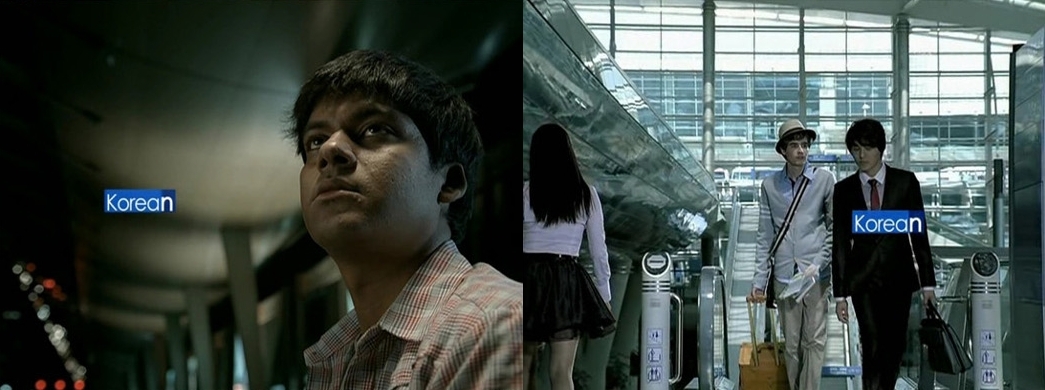
Look familiar? If not, then on the left you have Mahbub Alam, co-star of the recent movie Bandhobi(반두비), which challenges many Koreans’ stereotypes of and prejudices towards workers and immigrants from developing countries. Here he is in a public service commercial from the Korean Broadcast Advertising Corporation (KOBACO) below, and while it won’t change the world, in terms of the time and money invested at least it will probably prove much more effective at promoting Korea overseas than all the millions lavished on the “Korea Sparkling” slogan.
Vodpod videos no longer available.
In Korean, the commercial says:
우리는 달라졌지만…더 달라져야 합니다.
우리는 가까워졌지만…더 가까워져야 합니다.
우리의 가슴은 뜨겁지만…더 뜨거워져야 합니다.
Korea보다 더 자랑스러운Korean
코리아 브랜드 당신이 만듭니다.
And in English:
We are very different…but we need to be more different.
We are closer…but we need to be closer still.
We have warm hearts….but they need to be warmer.
Instead of being proud of Korea, we should be prouder of being Korean.
We, ourselves, have to create Korea’s brand.
Make sure to see the movie at the cinema while you still can!
Update: In case you missed it, see here for further information about the 4th Migrant Worker Film Festival (MWFF) that Mahbub Alam is the director of, and which will shortly be touring several Korean cities, starting with my wife’s hometown of Jinju (진주) on the 26th.
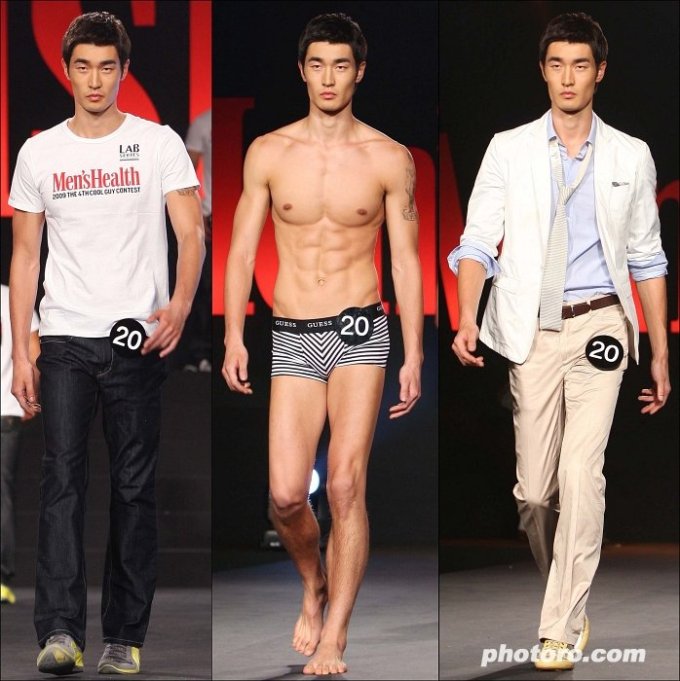
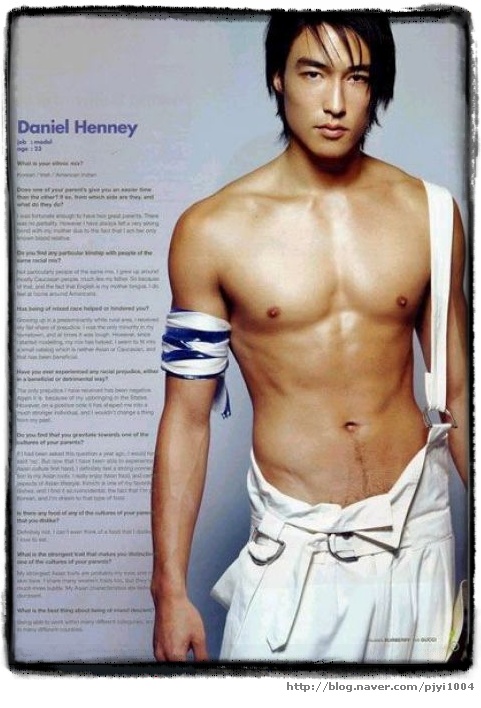
I didn’t catch his name sorry, but if you’d like to know more about the winner of the “4th Men’s Health Cool Guy Contest” above, then click on the picture or the Men’s Health Korea site itself for many more like it. In the meantime, with so many stories to report on this week I’ve decided to put them into loose categories to make it easier to find what you’re interested in:
Sexuality
1) Of course, the two biggest stories of the last week were: first, the foreign women on the Korean show “Global Beauties Chat” (미녀들의 수다), who chose to complain about both the foreign (Caucasian) men who supposedly come to Korea because they can’t get a job or girl back home and the Korean women that naively fall for them; and second, intern reporter Choi Hee-seon’s series of articles in The Chosun Ilbo saying much the same thing, as well as accusing said men of sexual crimes against students and Korean women. Needless to say, both provoked an instantaneous and vehement response in the Korean blogosphere (for starters see here, here, here on the former, and here and here on the latter), and with 165 comments at that first link alone I’m not going to enter into the fray at this late stage.
In passing though, let me mention that in response Chris in South Korea offers 8 reasons, and then 8 more reasons, why Korean women might prefer Western guys over Korean men. But while I haven’t read either post nor the comments in any great detail, and I’d be surprised if I didn’t think that there was something to all of them, let me offer a word of caution: when actual Korean women themselves aren’t providing most if not all of the input into such lists, they can very quickly and easily devolve into simple narcissism.
Not that Chris is guilty of this by any means, and in fact I write because I speak from experience, having waxed lyrical on similar points with a Korean female friend years ago only rightly to be told to STFU, and that most Korean women that liked Western guys did so simply because they tended to be taller. Just something to keep in mind.
(Above: Park Si-yeon {박시연} models for High Cut. For more information about the photoshoot, see here)
3) Consensual sex with 13 year-olds is legal. Yes, apparently so, given a recent acquittal of a Busan man for doing so with a runaway in his (unofficial) care and, as Matt at Gusts of Popular Feeling notes in the most comprehensive look at the case, mirrors a similar decision 8 years earlier. For further discussion, see this article in the Korea Times by Michael Stevens, and this post at The Marmot’s Hole.
4) Infidelik at FeetManSeoulreports on the perils of not wearing a bra on the streets of Korea. If you’re interested in that, then you may also want to check out this post at Sociological Images about how, in contrast, visible nipples have became more accepted in Western countries since the 1990s.
5)Rules on abortion toughened. Somewhat surreal, given that there are already very few circumstances under which Korean women can legally have an abortion, and yet Korean has one of the largest abortion industries in the world. To put it mildly, the article is somewhat lacking by not providing that context (see here for that).
6) The Marmot’s Hole reports that the police would like to close down a Swinger’s Club in Seoul, but unfortunately there is currently no law allowing them to do so. Again, somewhat surreal, given that adultery is actually illegal in Korea, albeit usually with entirely arbitrary prosecutions.
Meanwhile, Brian in Jeollanam-doreports that Education Ministry officials formed the largest group of civil servants caught paying for sex.
7) Not that these are recent news items by any means, but while we’re on the topic you may be interested in the fact that Korea used to be a much more sexually freer place; indeed, as Frog in a Well points out, “just because a society has a reputation for sexual restraint doesn’t mean that it is and always was asexual.” Also, here and here are two excellent Andrei Lankov articles from TheKorea Times about how military governments allowed much racier films in the late-1970s and early-1980s (in an opium for the masses sense) and the development of the prostitution industry in Korea before the Japanese colonial period respectively.
Censorship and Media
8)Dramabeansreports that the star-studded Ogamado (오감도) continues with its provocative promotional material (see #7 here also). For a review of the movie, (which is really 5 movies in 1) see here, and given some of their subject matter then as a commenter over at Dramabeans (#17) noted, it is strange that the posters are as per usual fetishizing the female form and not the men, which leads her(?) to worry that all the sex is only from the perspective of the men.
9) The Korea Communications Standards Council announced on Monday they will commence deliberations on the fate of “Naked News Korea,” which started its racy services late last month both online and mobile. As Brian notes, there far more explicit and sexually suggestive programs are readily available 24/7 on Korean cable television, so this scrutiny is rather strange. Is it because its whole raison d’être and discussions of sexuality are just too blatant for censors’ tastes? To wit:
According to the communications watchdog, the contents of the site have been closely monitored since it began and an episode in which its presenters discussed female orgasms was deemed vulgar and inappropriately suggestive.
In all seriousness, I’d be interested in seeing that. I have the strong suspicion that the notion of women sitting around talking in a no-BS Sex and the City style was a bit too much for Korean censors, and hence any discussion of female orgasms by them would have been deemed vulgar and suggestive regardless.
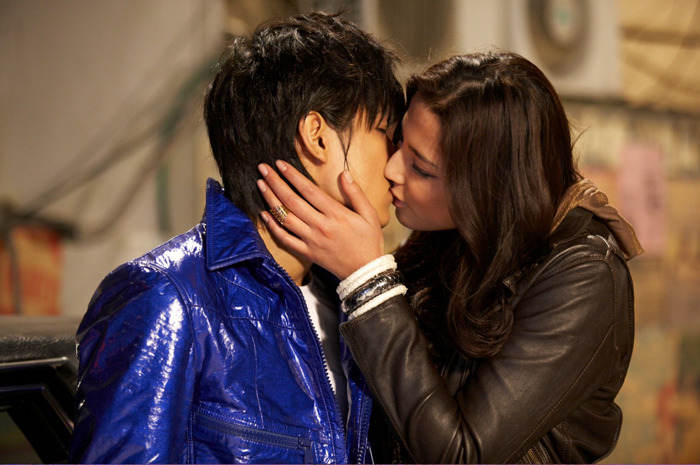
10) Another commercial featuring kissing…well, actually there’s so many these days that I’m losing track (see here for another recent one). Here is the latest one (via PopSeoul!), featuring AJ and Min Hyo-rin (민효린) and with the tagline “Cool (refreshing) for 20 year-olds” (“스무살을 상큼하게”, at 0:17):
11) As predicted (see #1 here), rapper E.via’s (이비아) latest song, featuring a lot of innuendo and heavy breathing, was indeed deemed inappropriate for Korean TV. For further details, see Extra! Koreahere.
12) More on Choi Jin-sil (최진실), who was notoriously sued by a company she had a modeling contract with for ruining their reputation by making her husband’s beating of her public (see here and here, the latter of which has puts the case into the context of domestic violence in Korea). For two opinion pieces in The Korea Times, see here and here.
14) Apparently, Abusive Words Over The Phone Are Punishable. Meanwhile, and more understandably, a cartoonist was summoned by the police after drawing a cartoon insulting the president. As a commenter here notes, regardless of the freedom of speech issues involved, the police in any country are obliged to investigate cases as blatant as this one.
Politics and Economics
15) Korea has the biggest wage gap between men and women in the OECD. See the Korea Times and the JoongAng Daily for more, and see Brian in Jeollanam-do for more information about conditions in Jeollanam-do specifically, which has the biggest gap (image source: J. David Allen).
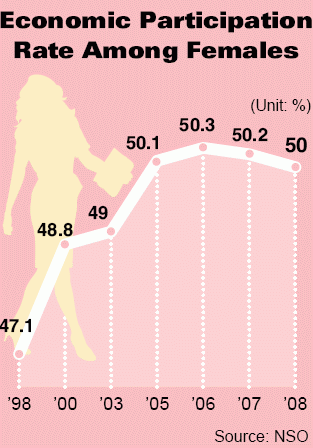
In addition, Lee Hyo-sik of the Korea Times reported that male temporary workers are more likely to lose their jobs than women because of the industries they tend to be in, but on the other hand reported a few days later that women are still more likely to lose their jobs overall because they form a disproportionate number of temporary workers. The graph on the right comes from the latter report, and while useful, would have been more so had it been placed into context, which is that Korea has one of the lowest rates of female participation in the labor force in the OECD. For much more on that, see here(source, right).
Not unrelated, the Chosun Ilbo reported that “Korean Women’s Status is Still Low Among OECD Nations”.
16) Korea is to become most aged society in OECD by 2050. Also:The Hankyorehhas an editorial on how its record-breaking low birth rate – “unparalleled to anywhere else in the world” – requires employment policy revisions; there is a list of related recent articles at the Hub of Sparkle!here; and Japanianwrites on the implications of the aging and shrinking Japanese population, with obvious parallels in Korea (via Global Voices).
18)Brand Confucianreports that KT recently promoted 3 women to top-tier executive positions.
19) However miserly it sounds, something that may have a lasting impact on the rate of young Koreans living independently before marriage is the raising of the minimum wage to 4,110 won per hour. See Judy Han at Otherwise for the details.
20)ROK Dropdiscusseswhether the Korean Army should also conscript women, or do away with conscription altogether. Given conscription’s role in a pervasive militarization of Korean society, as I discuss in this series of posts beginning here, then I’m much more in favor of the latter.
Events, Movies, and Fashion
21)FeetManSeoul’s cover model Lee Seul-gi (이슬기) becomes Miss Korea 2009. I’m a little confused though, because the Korea Times reported that a different woman won.
22) Chris in South Korea (naturally) visited and took many pictures of the Wild Women’s Performing Arts Festival that I mentioned last month (see #17 here).
24) Rebecca Voight at The New York Timesloses her head and claims that Korean menswear is innovative. Meanwhile, Five by Fifty says that pink is both Japanese women’s most and second least-preferred color on Japanese men.
25) (Male) actor Yoo Ji-tae (유지태) is to receive Seoul Women’s Prize.
26) Apparently, Kim Yu-na (김연아) is a champion skater primarily because of her small face. For the details, see here, and see here and here for where such a crazed logic stems from.
27) Keeping Korea Beautiful: read here for an interview with Klaus Fassbender, president and executive director of L’Oreal Korea.
29)Breathless(똥파리 or “shit fly” in typically earthy Korean), a Korean movie about domestic violence that I wrote a little about here, has won its 13th award, this time at the New York Asian Film Festival.
30) Finally, in news outside of Korea, Matt at On My Way to Korea has a post on the way women are presented in North Korean propaganda posters; EqualWrites explains why being catcalled in Vietnam is not flattering; Shanghaiistwrites about “homowives”, or heterosexual women married to gay Chinese men (hat tip to Left Flank); and finally, the Economist has an article about Gay rights in China and last month’s Shanghai Pride Week.
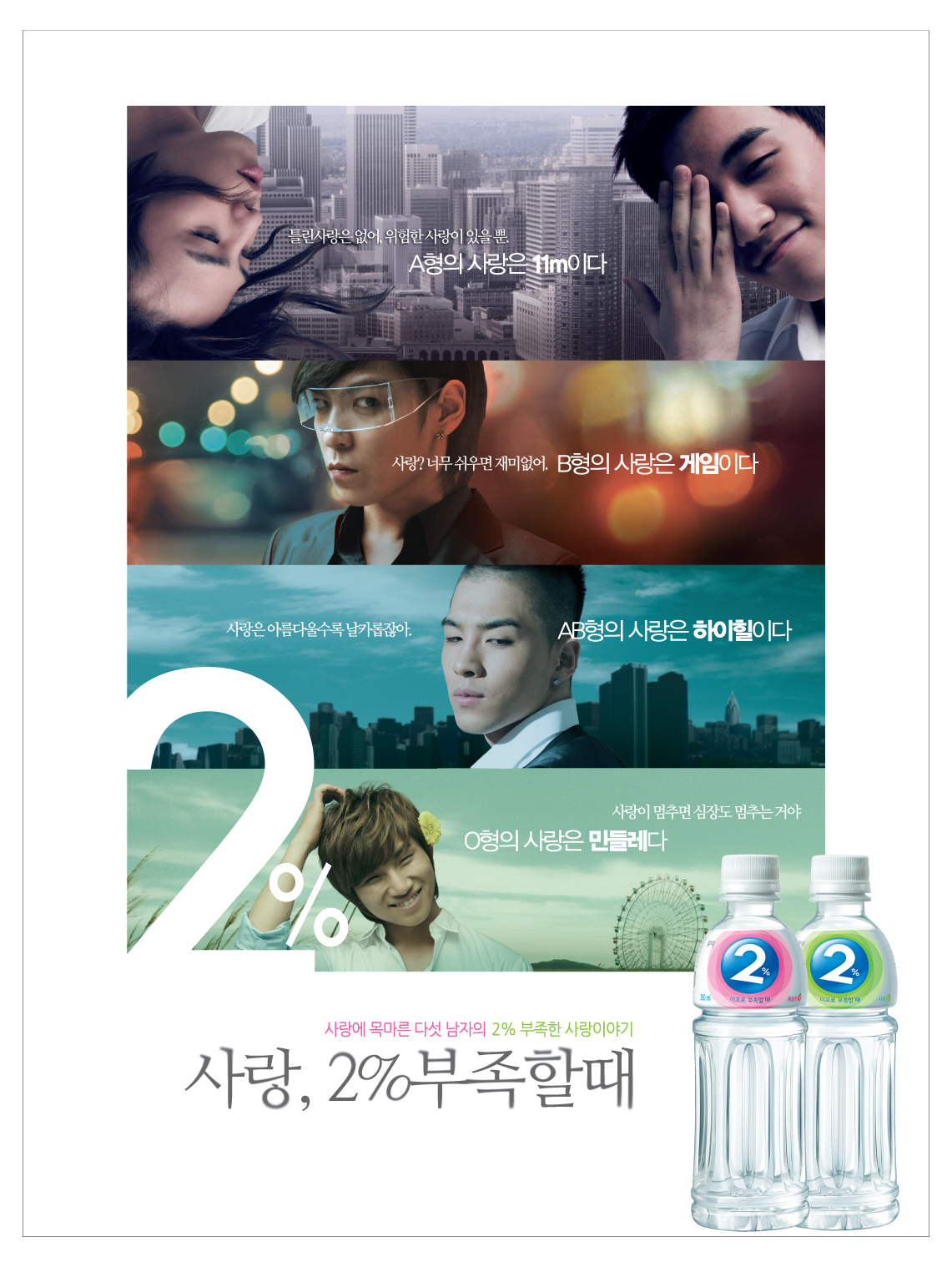
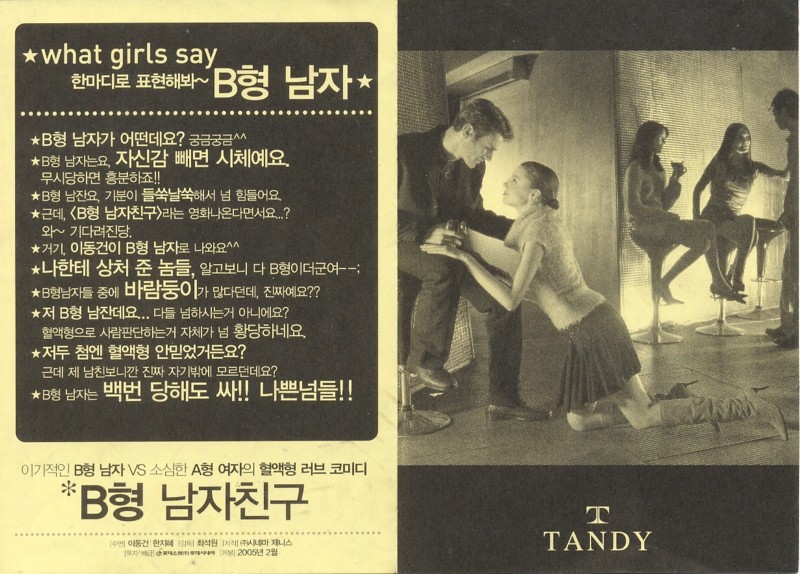
With those top two panels reminding me of the futuristic Blade Runner, it’s ironic that the ad is actually based on the decidedly archaic belief that one’s bloodtype determines one’s personality. What’s more, it’s a surprisingly deeply-held one too, with some Korean women even rejecting all B-type men as potential marriage partners because of it, as I discussed when I wrote about a similar marketing campaign for kiwifruit back in May. In short, it’s not quite the same as having a good laugh at your daily horoscope, and can’t be so easily dismissed.
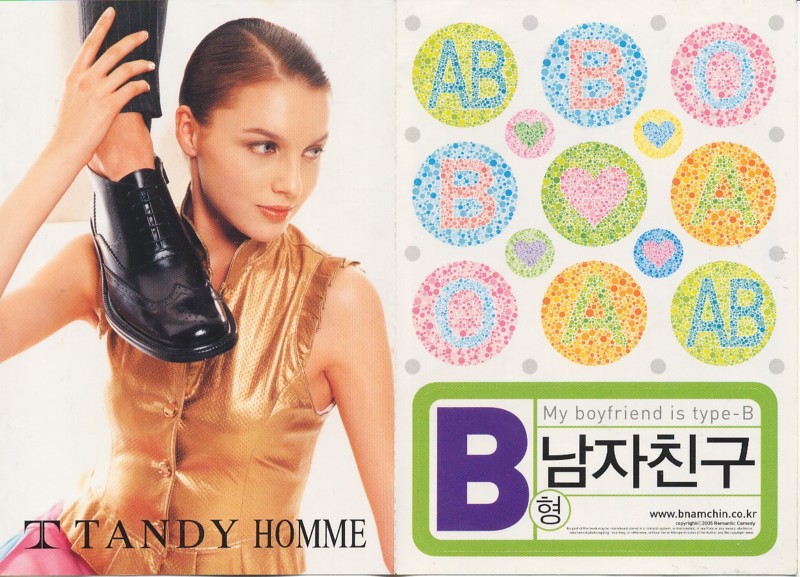
A strange {and slightly disturbing} advertisement for Tandy found on this site about the 2005 movie My Boyfriend is Type B {B형 남자친구}. See later in the post for one more, and here for a review of the movie.
Lest one is tempted to jump to conclusions about Koreans’ critical-thinking skills though, then consider this blog post on the subject that was featured on the front page of Yahoo! Korea about a month later, which I’ve translated below. It is from the 12th most popular Korean blog according to its own blog ranking system—by way of comparison, this one is currently ranked 87,378 out of 4,644,184—so it would have been read by a lot of people:
우리나라에서만 볼 수 있는 ‘혈액형’ 광고의 불편함…
It’s discomforting how Korea is the only country in the world with advertisements about bloodtypes…
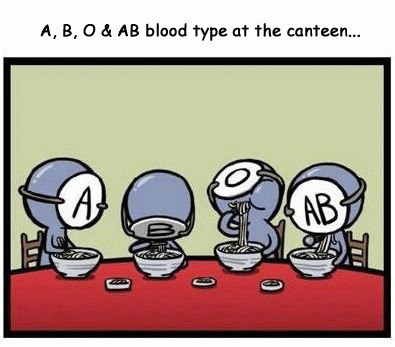
A형, B형, AB형, O형이 한자리에 앉아서 식사를 하고 있었다. 갑자기 AB형이 밥을 먹다 말고 벌떡 일어나 뛰쳐나가자 O형이 AB형을 뒤쫓아간다.
남겨진 A형이 B형에게 조심스레 묻는다: “쟤 혹시 나한테 화난거야?”
온라인과 오프라인을 막론하고 이젠 귀에 딱지가 앉을 정도로 듣게되는 혈액형별 성격에 관한 유머다.
일본에서 들어와 국내에 뿌리내린 혈액형별 성격 분석은 독일의 우성학에서 출발해 일본에서도 1970년대에 확고히 자리잡았다고 하는데 이런 성격 분석이 국내에 유입되어 뿌리내리며 우리나라를 전세계에서 몇 안되는 혈액형 신봉 국가를 만들어 버렸다. 사람 둘 셋만 모이면 혈액형에 대한 이야기가 쏟아져 나오는 그런 나라…;;
그렇게 보면 다음 CF들은 어쩌면 우리나라에서만 만날 수 있는 광고의 유형은 아닐까?
Four people, one with bloodtype A, one with B, one with AB, and one with O were sitting down having a meal together. Suddenly, “AB” stopped eating and got up and ran outside, and “O” decided to follow (him).
“A” and “B” remained, and A nervously asked B: “Is (he) angry with me?”
(James: No, I don’t get it either. But, for the remainder of the cartoon version on the right, see here, and here for many more like it.)
Needless to say, online and offline, there is so much humor about blood types that people are very tired of it.
Blood type and personality analysis originally derives from German eugenics, but it became firmly rooted in Japan in the 1970s, and from there in Korean culture, making Korea one of just a handful of countries that haven’t thrown such beliefs away. Indeed, get two or three Koreans together, and invariably they’ll end up chattering about blood types…
In this sense, you can only really see commercials like the following in Korea, right?
혈액형으로먹는다… 제스프리골드키위/Eat according to your blood type…Zespri Golden Kiwi
키위를 먹는 방식을 혈액형 성격 분석에 맞춰 유머러스하게 풀어놓은 제스프리의 CF다.
Here’s a humorous commercial by Zespri saying different blood types eat Kiwis in different styles (James: see my earlier post for the other 3 in the series):
Vodpod videos no longer available.
혈액형으로마신다… 2% 부족할때/Drink according to your blood type…2% “Near Water”
제스프리가 코믹이란 콘셉트를 내세웠다면 이쪽은 혈액형과 치환되는 단어와 사랑을 엮고 빅뱅을 얹어 광고를 내놨는데 실제 빅뱅 멤버의 혈액형에 맞춘 광고란다.
Whereas the Zespri commercials had a comic concept, the following ones with the band Big Bang (빅뱅) has each member falling in love and romancing women according to their bloodtypes (James: this video combines all 4 commercials in the series):
재학습되는혈액형성격분석…/These commercials help perpetuate public belief in the bloodtype and personality theory
평소 귀가 얇은 편이라 혈액형별 성격 분석에 종종 혹하는 편이지만 ABO식 혈액형의 고작 4가지 패턴으로 60억 세계인의 성격을 모두 분류할 수 있다고는 생각치 않는다. 또 이론적 뿌리도 부실하고 지나친 일반화와 선입견 듬뿍 담긴 규정으로 혈액형 별로 사람을 가늠해 버리는 것 자체가 혈액형에 기준한 성격 분석이 갖는 문제점이라고 생각하는 편이다.
Normally I’m a little gullible, so I’m often convinced of the validity of the bloodtype and personality theory, but still, I can’t believe that all 6 billion people in the world can be compartmentalized and categorized into just four types. And it is a problem that people are influenced by and follow the rules of their prescribed personality when the theory is based on insufficient evidence, is too generalistic, and rife with prejudices and preconceptions.
그런 이유로 이번에 소개한 혈액형에 관한 CF들은 왠지 불편했는데…감각적인 영상과 유머 코드로 적당히 버무려 광고를 바라보는 이들에게 쉽게 퍼지고 기억되는 이런 영상들이 결국 사람들 사이에 회자되는 혈액형별 성격 분석을 재학습시키고 있는게 아닐까란 생각에 이르렀기 때문이다.
For this reason, seeing these commercials made me feel a little uncomfortable…when sensible (if misguided) notions of bloodtype and personality are mixed with humorous ones in a sort-of cultural code and then utilized in commercials like these, they help to keep the theory on everyone’s minds and thereby perpetuate artificial divisions.
물론 사회에서 익숙한 코드를 반영해 상품을 홍보하는 건 일반적인 광고의 특성이니 어쩔 수 없는 부분이 있었겠지만 그래도 “이 혈액형은 이렇고 저 혈액형은 저래. 그러니 너는 이렇지?”라는 식으로 세상 모두를 4가지 성격군으로 분류할 수 있다고 생각하는 것 자체가 문제 아닐까?
훗~ 평범한 O형의 한마디였다. 응?
Of course commercials will always reflect a society’s cultural codes, but nevertheless isn’t it a problem when we say “this bloodtype behaves like this, that one like that, so that’s why you do what you do, yes?”, and that we want to compartmentalize the whole world into just four types?
I’m O by the way. Is that a typical thing for an O type to say? (Finish)
Not exactly the piercing critique I anticipated when I began translating, but that wasn’t my point really, which was more to provide a healthy reminder that just like back home there is a healthy diversity of opinions in Korea on just about every subject, but which it’s very easy to overlook if you only rely on English-language sources. Indeed, I’ve just found yet another, longer news report on the same two advertising campaigns, which I’m happy to also translate if anyone’s further interested (it’ll be good revision).
In the meantime, while finding some images for this post I couldn’t help but notice that, once again, apparently the powers that be felt that only young women in tight t-shirts and/or miniskirts could persuade persuade Koreans to perform their civic duty on “World Blood Donor Day” this year (left) and last (right). Come to think it though, that particular advertising convention doesn’t exactly detract from the aim of getting people’s blood flowing…
Sorry, I couldn’t resist it. And in fairness, this year’s ads did feature boy-band Super Junior (슈퍼주니어) also. For some big pictures of them promoting donating blood, albeit together with Girls’ Generation (소녀시대), see here.
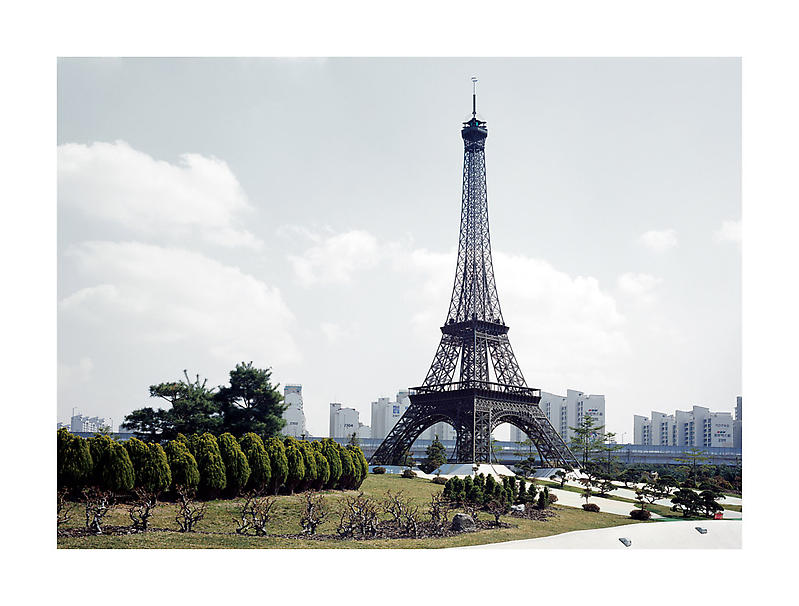
Unfortunately, my two young daughters have never really granted me the spare weekends, money, or energy required to pursue my fledgling interest in creative Korean art, but I still subscribe to the odd art and/or photography blog, and am particularly interested in the theme of juxtapositions. Still, I’ve never really seen anything quite like this “Real World” series by Back Seung Woo though, in which the juxtapositions are so subtle and so well blended together that they can take a few seconds to register, however glaring they may be in hindsight. Someone unfamiliar with Korean-style apartments for instance, and/or the area around the base of the Eiffel Tower, could well take some convincing that that’s not the real thing above…let alone that it’s actually a 50cm high model.
For more images and information about his work, see the Asian Photography Blog here (image source: Gana Art).
In Korea, it is accepted practice for men to relentlessly pursue the objects of their heart’s desire, sometimes for many years, and despite if said objects clearly, repeatedly, and vehemently express their disinterest.
Far from being viewed as stalking however, it is generally viewed as both a sweet and noble sign of one’s love and dedication. There’s even a proverb specifically for this: “열번찍어 안넘이 가는 나무 없다,” which roughly translates as “There is no tree that can withstand being chopped 10 times.” (Image source, right.)
It’s not that I can’t see those sweet and noble elements, nor how many Korean women would surely exploit the practice, in a playing hard to get fashion (some more Korean that comes to mind is “희망고문하다,” literally to “hope-torture [someone],” or to repeatedly string someone along and then break their heart). But I think that the consensus of most Westerners is that if the woman says she’s not interested…then she’s not interested, and hence that the man’s behavior after being told is stalking, regardless of how sweet or noble his intentions. Unfortunately, in a society that already accepts women being physically dragged into nightclubs, then foreign or Korean, women can probably expect little sympathy when dealing a stalker.
This probably won’t be the first or last time you’ll read about this subject: navigating different expectations when it comes to dating are an integral part of the expat experience, and with my limited dating experience then I can’t add much that hasn’t already had gallons of virtual ink spilt on it. Two useful things I can do though: first, mentioning that of all the guides to navigating those dating minefields out there, that this one by Michael Hurt at Scribblings of the Metropolitician is by far the best, and with many things that informs even my marriage of 6 years; and second, and which was frankly the real inspiration for this post, that over at Sociological Images there is a post that discusses the fact that:
Various journalists and scholars have pointed out over the years that movies and TV shows often portray as romantic behavior that is fairly indistinguishable from stalking.
And then a video created by Jonathan McIntosh of Rebellious Pixels, who:
…edited together scenes from Buffy the Vampire Slayer with scenes of Edward Cullen from the movie Twilight to show how behavior that is depicted as protective and romantic in the film (and book) could also be seen as disturbing
For more, see the original post here. Not that I think that the humorous stalking in, say, There’s Something About Mary had much of an effect on my own opinions of it, nor that seeing it in pop-culture somehow renders real-life examples in any country okay, but still: the next time we feel a sense of righteousness and indignation about hearing Korean examples, it is certainly worth pondering the mixed messages that Western pop-culture provides.
A recent report on Korea’s delivery cum odd-job men by Jane Han of the Korea Times, who unfortunately reinforces many gender stereotypes as she explains the interesting new service:
Is ‘Substitute Man’ Modern White Knight?
For 27-year-old Lim Ji-ae, battling cockroaches in her studio apartment has been a constant nightmare. At least one or two encounters with the insect per week put her on edge. That is, until she recently hired someone to be her personal pest control agent for 5,000 won per occasion.
He arrives at her house within 10 minutes of her call, and sometimes even picks up toilet paper, toothpaste and other urgent grocery items on his way. In fact, whatever Lim needs, he does―most of the time.
“He’s my new best friend,” says Lim, who was actually referring to a plural group of service providers, the so-called substitute men, an emerging beck-and-call squad that evolved from the common “quick delivery service,” which simply shuttled goods from point A to point B. (Image source, right: Silver Age Comics.)
But the upgraded version exceeds far beyond expectations, as substitute men do everything from delivering food, moving heavy furniture, picking up laundry and walking dogs to escorting children to and from school.
For those of you that don’t live here and may be unaware, one of the good…nay, great things about Korea is that in addition to providing cheap and healthy food, many restaurants provide delivery for no extra charge too; suffice to say, I probably did more cooking in my last year in New Zealand than in the entire 9 years I’ve lived here. So while I am unaware of how long companies offering “quick delivery services” of other goods have been around, they’re obviously a natural extension of this service culture. If you live in an urban area and check your junk mail, then you’ll probably find that there’s at least 2 or 3 available in your area.
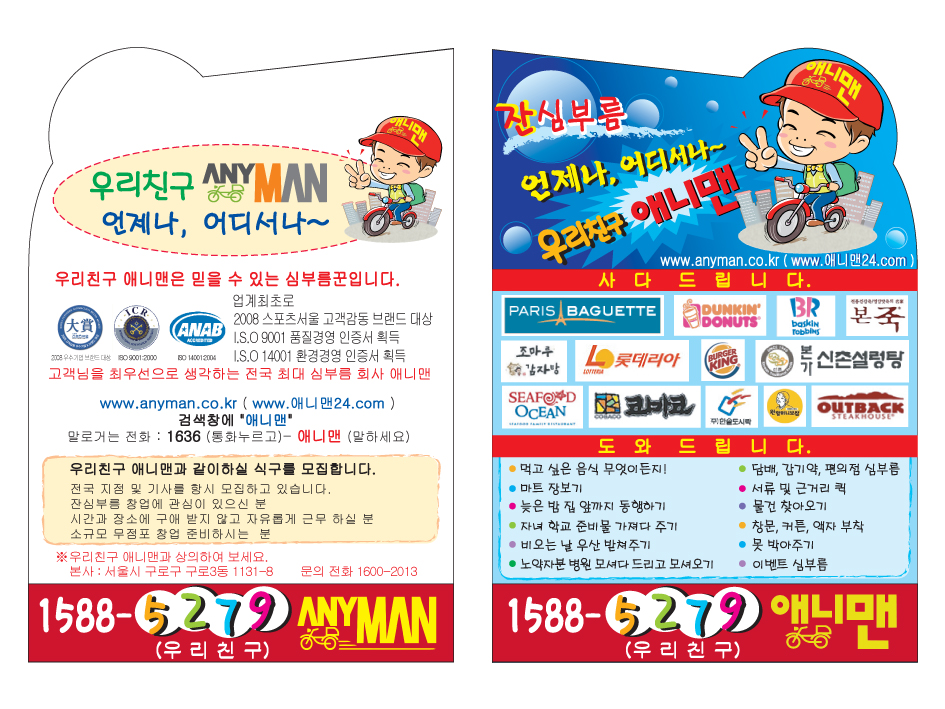
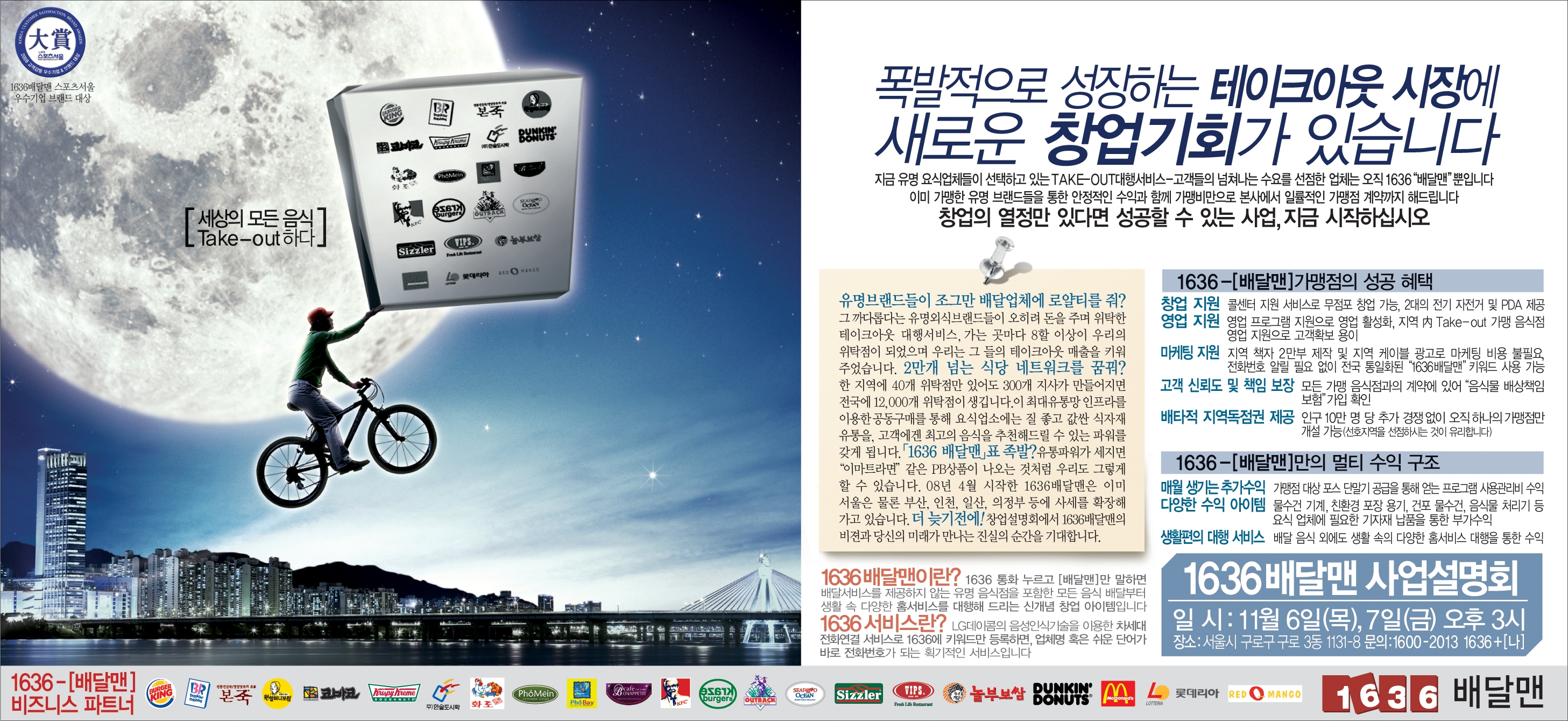
In fairness then, it is good that the article mentioned this context. And, as the image available on AnyMan’s website above indicates, neither company mentioned disguises the fact that they are still mainly simple delivery companies. Continuing:
As long as nothing illegal and morally wrong is involved, almost everything is possible, says Yoon Joo-yeol, who runs Any Man, a service based in southern Seoul.
“We had someone calling for toilet paper while on the toilet,” he said, “while one man called from the U.S. to have porridge and medicine delivered to his girlfriend ill in bed.”
One picky customer, who couldn’t trust local seafood restaurants, even requested a substitute man to videotape himself catch a fish in the ocean before having the fresh catch prepared as sashimi, Yoon recounted.
“There is never a dull day,” he said, adding that services typically cost anywhere from 5,000 won to 300,000 won, considering the labor intensity of the task.
Hell, nothing wrong with any of that, nor in the list of people (e.g., single households, old people, workaholics, and so on) that Anyman’s website suggests would benefit from using their services. (Life Manager’s lists are basically the same.) It would be reading far too much into things to see fault in, say, the fact that Anyman suggests it can deliver food to sick girlfriends but not boyfriends. However, like the slave man who apparently arrives at a woman’s beck and call kills bugs however, it is very tempting to do so once you read the last part of the article:
Lee Jae-hong, the owner of Life Manager, another service provider, explains that the do-it-all service is picking up quick traction nationwide from men and women of all ages, but the best business is in the Gangnam, southern Seoul, district.
He said the large single female population in the area leads to high demand for frequent services such as food delivery, grocery shopping and simple repair work.
“The competition is becoming fierce as more and more customers are learning about the service,” said Lee said, who competes with almost 15 rivals in the area.
Experienced customers like Lim says the cost is “friendly,” but advised users to be cautious and not to expose too much personal information to the substitutes.
Sigh. Where to start?
First, the article instantly reminded me of a Sociological Images post about a New Orleans business called The Occasional Wife. Because as author Lisa explains there:
…the business relies on and reproduces the very idea of “wife.” As the website makes clear, wives are people who (a) make your life more pleasurable by taking care of details and daily life-maintenance (such as running errands), (b) organize special events in your life (such as holidays), and (c) deal with work-intensive home-related burdens (such as moving), all in while perfectly coiffed and in high heels!
Like commenters on that post mentioned, services that rely on and reinforce a stereotypical notion of appropriate gender roles texist throughout the Western world. Indeed, the first thing I thought of when I saw that post was the New Zealand Hire a Hubby service which started a few years before I left in 2000, and which I was curious to see if it was still in business. Apparently so:
But, secondly, I think a crucial difference is that the services of these two companies at least are premised on sharply delineated notions of “wifes” and “hubbies,” whereas with the Korean “Deliveryman 2.0,” they’re so new that social conventions on typical clients and services offered seem very much in flux. Or are they? Take the videos of typical clients and services from the Life Manager and Anyman websites for instance (apologies for the poor quality):
Tellingly, neither video promotes the company as the purveyor of the services of big burley men to hapless single females, and the former especially portrays quite a range of clients, including—shock, horror—some men. Which raises questions as to why the author chose to portray them as such.
On the other hand, there is indeed a large population of singles in the Gangnam area (see this post on Seoul demographics as for why), and I grant that there is a possibility—but only a possibility—that there is something special about single women that live in Gangnam that means that they disproportionately use such services. After all, it is the most expensive and sought-after area to live in whole country, so presumably there would be a large number of rich single women there quite used to paying others for the basic services us mere mortals have to do our ourselves.
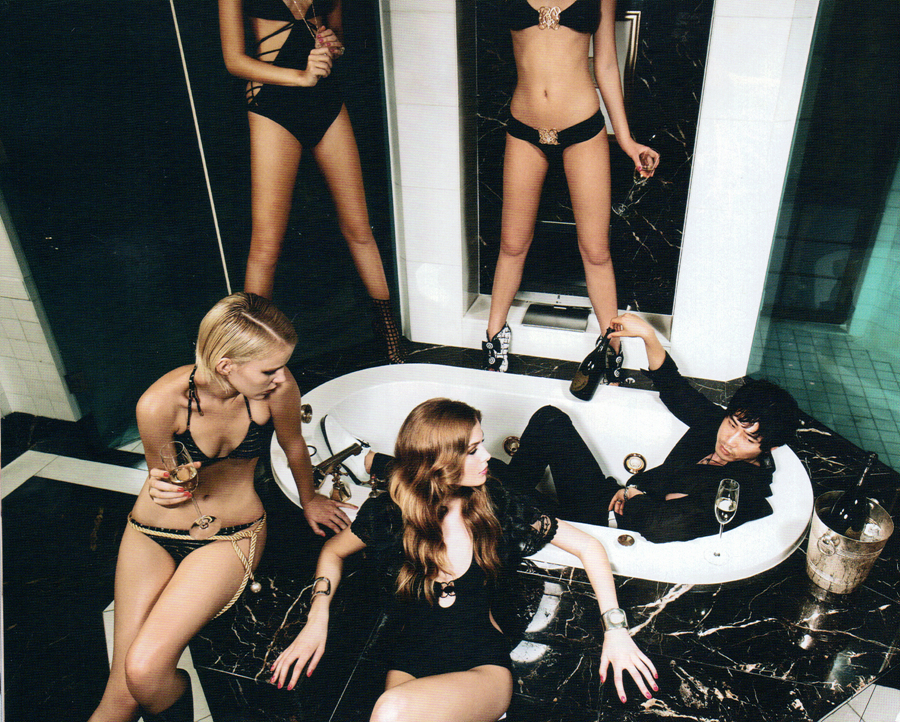
However, the same logic would also apply to the rich single men that live in the area.
That said, it has been suggested that all the single women are not rich but rather work in the numerous bars and brothels there, which may well have a grain of truth in it; if so, among singles at least, there may well be a disproportionate number of women in that area. (The report discussed in that earlier post of mine doesn’t provide that level of detail.) Not living in Seoul myself though, I’d be grateful if Seoul-based readers can confirm if there is something to that possibility or not.
For a moment then, I thought that discomfort with the article was unjustified. Perhaps the owner of Life Manager is an angel, who just so happens to have a great deal of business catering to single females in the Gangnam area— nothing wrong with that. But still, I’m unwilling to let him or perhaps author Jane Han entirely off the hook. In particular, although I shouldn’t jump to any conclusions without seeing the original Korean transcript of the interview, the former does say:
…the large single female population in the area leads to high demand for frequent services such as food delivery, grocery shopping and simple repair work.
Ergo, needs for help with those tasks—and, apparently, killing cockroaches—are inherent to the single female, regardless of where they live. Which reminds me of last year’s report on “Alpha Girls” by The Chosun Ilbo, which depicted single women living with their parents as both incapable of and unwilling to do housework, as well as being basically selfish and useless overall; whereas a discussion with virtually any 20-something Korean can confirm that the reality is that they are expected to, can, and generally do do a disproportionate amount of housework, unlike their brothers. Of course, we have all met single women like the article describes, but just as many single men too, and similarly there was no objective reason for Jane Han to give this article the passive, useless female/knight in shining armour tone to it that she did.
Why did she then? I’ll leave that up to the reader. But as blogger Gord Sellar points out in this excellent post on Korean consumerism here, there does seem to be quite a backlash among certain groups of Korean men against single, independent women, and it would be no surprise if this was increasingly reflected in the Korean media. It’ll certainly be something to keep an eye on in the future.
(Hat tip: Roboseyo. For more posts in the “Korean Sociological Image” series, see here.)
Apologies for the light posting and not responding to comments and emails, but my 50-hour weeks are having their toll. Fortunately, this is the last one, and as I type this I’ve just finished a long post that will be up by tomorrow.
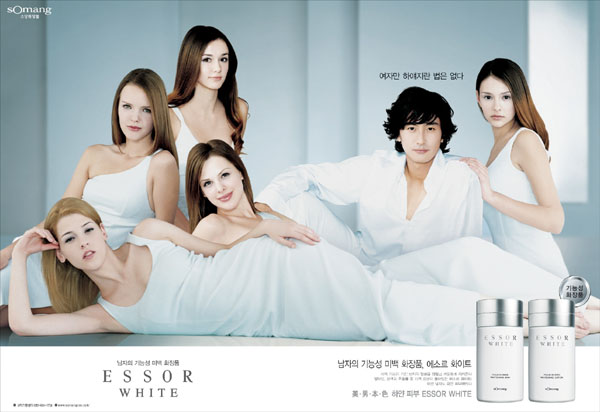
Until then, let me quickly mention this post over at The Marmot’s Hole about a short video cum picture-documentary on the hypocrisy of the Korean media’s stereotypes of Western men as sexual predators and – to the extent that they’re portrayed at all – very negative and sexist images of the Korean women who enter into relationships with them, but at the same time readily (and increasingly) presenting images of Korean men with Western (read: Caucasian) women, albeit with the latter also usually portrayed in an similarly sexist and degrading fashion. To which I present as Exhibit A actor Kang Ji-Hwan’s (강지환) latest photoshoot for Esquire Korea above, which you can see more of here, and as Exhibit B this Somang Cosmetics advertisement below (source) with Ahn Jung-hwan (안정환) from 2003 that it instantly reminded me of, which I discuss a little here. Naturally, I’d be the last person to be offended by women in bikinis in particular, but still, there are alternatives to depicting Korean male-Caucasian female relationships with the latter as something other than mere trophy girlfriends. Yet I can only think of a handful of examples.
But being an understandably large and ongoing concern of the (overwhelmingly male-dominated) Korean blogosphere (see the links at the end of this post), then normally I choose to blog about other aspects of gender-relationships in Korea, but a) I confess that with this post I was *cough* glad to finally find an excuse to post the Esquire pictures sans lengthy analysis, and b) as the creator of the video took a dozen or so images from this blog to make it, then other readers may well find it interesting just for that reason. All the same, I link to the video rather than providing it here myself, as I’m more interested in the issues it raises rather than the video per se. But if you are, then you can certainly depend on a lively discussion of it at The Marmot’s Hole.
With all due respect to the creator of the video though, I would agree with critics there that: to a large extent it is preaching to the choir; it has a confusing message; the reference to the Virginia Tech massacre was completely unnecessary; and, above all, it needs to have Korean subtitles if it has to have any effect at all on most Koreans. But still, a picture does say a thousand words, and despite those handicaps it will probably get much more attention from them then this English-language blog has. Hmmm…
Update: A second, much better video has been made. See here for my post and many comments on it.
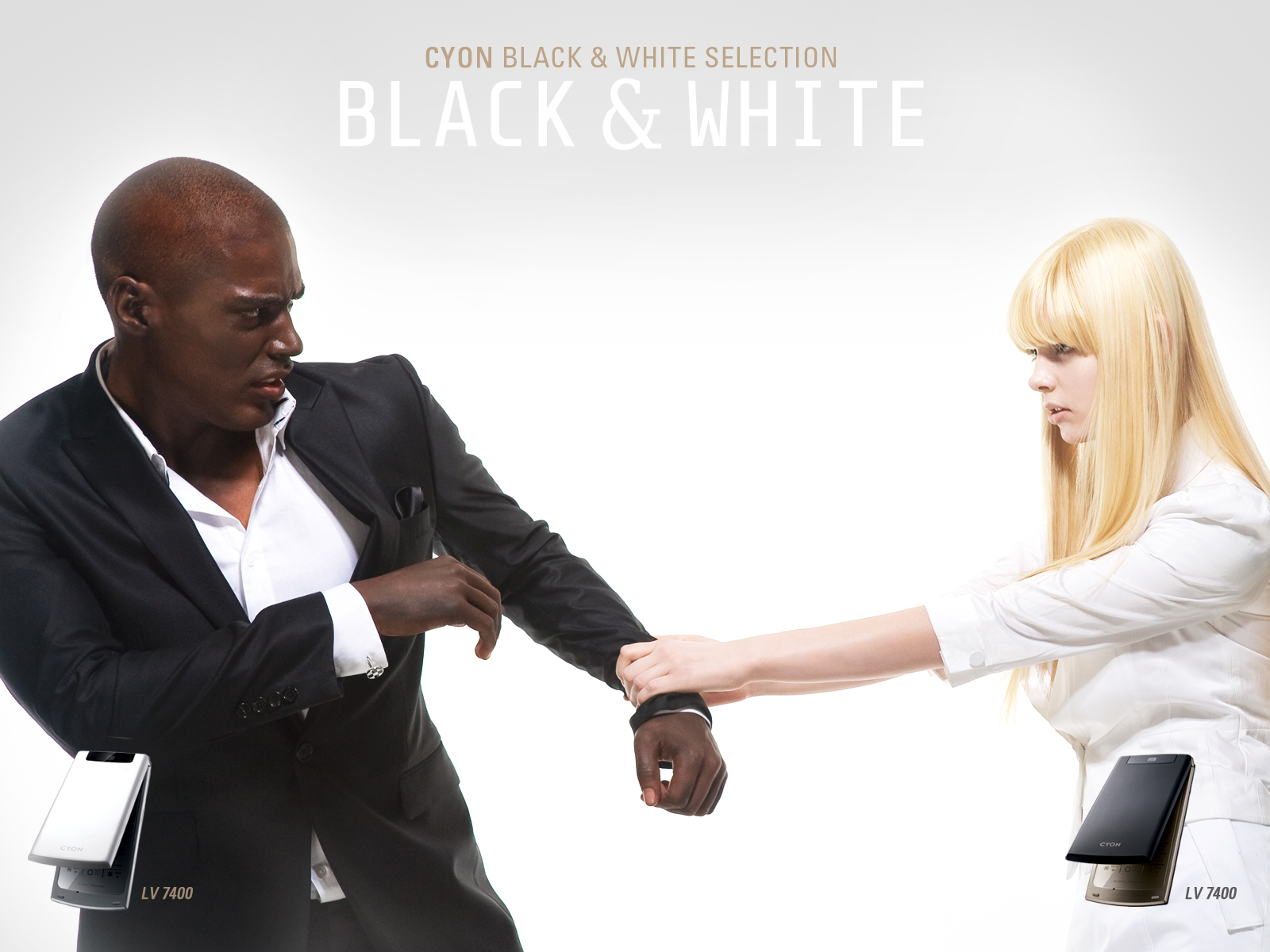
Spare a thought for the hapless LG Cyon marketing department. Because after 12 years in the business, it must be really difficult to think of interesting names for new phones.
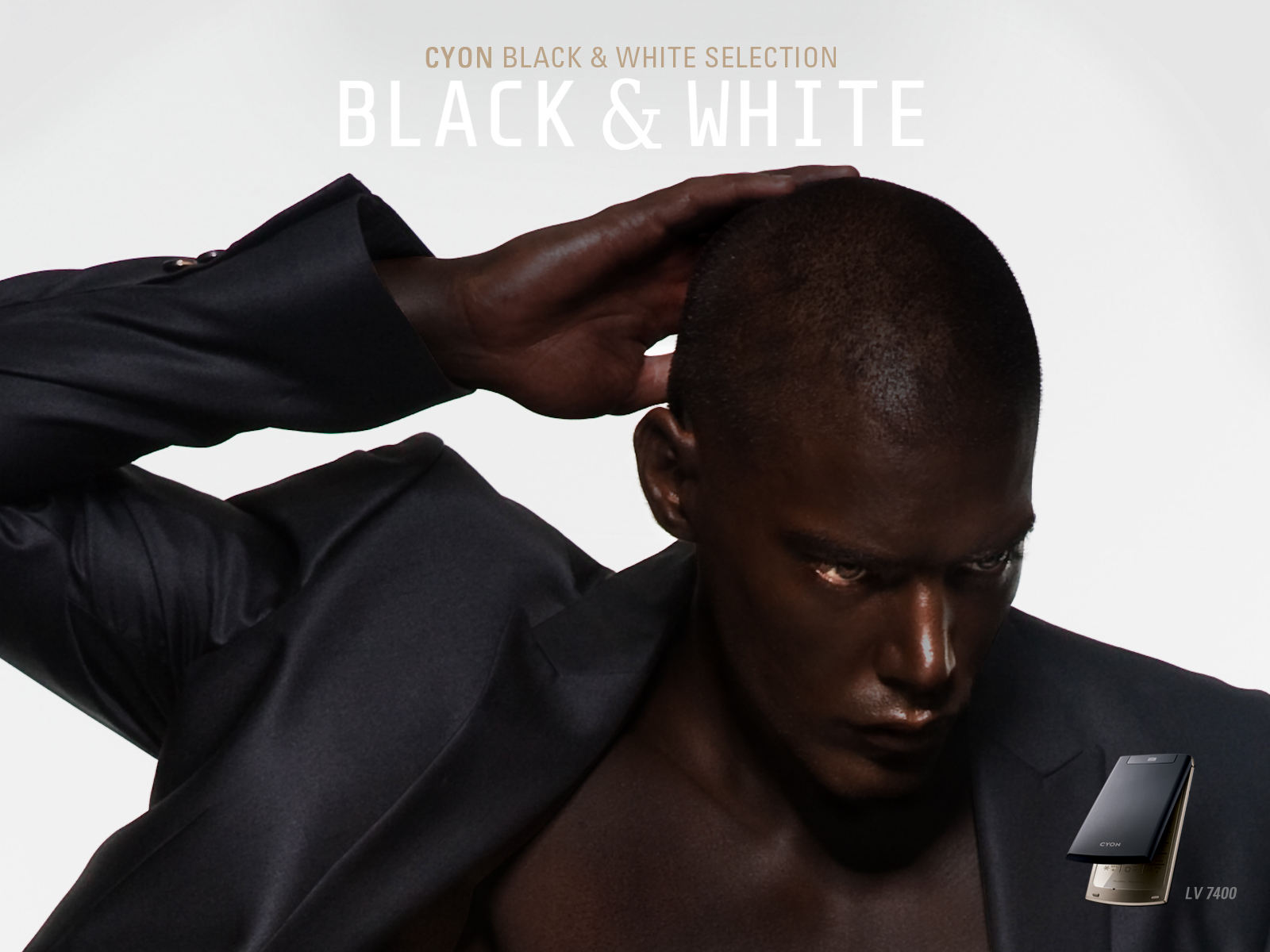
No, really: how else to explain the singularly uninspired choice of “Black and White” for the latest, well, black and white LV-7400 phones to come out? Sure, the likes of “Lollipop” and “Ice Cream” may hardly have been all that creative either, but at least they spawned quirky and memorable advertising campaigns, whereas this series of advertisements for the LV-7400 seems dull, uninspired, and above all too literal. In fairness though, they do provide an instant and dramatic representation of the product, and the commercial itself has a mild eroticism and sensuality to it that compels you to look more closely.
But of course, it’s not those that made me sit up and take notice:
Yes, that is indeed not a Black man, but a Caucasian man somehow painted black.
It’s so bizarre, and so difficult to rationalize. Because was it really so difficult to find a genuine Black guy? No of course not, and given the extra time and effort involved in painting a Caucasian one then it must have been a deliberate choice. But if so, wouldn’t it have been far more logical and consistent to have also included a Black woman painted white? If not, then what is the “coloring” supposed to signify? And why, oh why, weren’t these blatantly obvious questions asked by LG Cyon?
Very flawed concept and execution aside though, could the advertisement be construed as racist in any sense?
To answer, my first thought was to turn to Michael Hurt post’s about other Korean examples of the “Blackface” phenomenon at the Scribblings of the Metropolitician, and I broadly agree that the examples he gives are indeed offensive. Moreover, a huge multinational company like LG (of which Cyon is just the name of its mobile phone arm) would almost certainly be aware of the reception they would receive in Western markets, and as such cannot claim ignorance of their racist connotations and history, a parallel of which is Coreana’s use of Nazi imagery in a cosmetics commercial (see Brian in Jeollanam-dohere and here for more on that). Nor do I accept the argument that images that Westerners would find problematic are automatically rendered acceptable simply by virtue or being made by and for Koreans, a culturally-relativist argument that at the very least is highly patronizing to the latter.
But despite all that, my gut reaction to first offenses is to give the various Korean institutions, companies, and/or individuals behind them the benefit of the doubt, and to use them as an opportunity for education. In particular, because Korean society almost completely lacks any sense of political correctness (which can be as refreshing as it is annoying), and as, for instance, the recent controversy over the use of icons of its former Japanese colonizers for Girls’ Generation’s new album cover (see here and here) demonstrate, or the choice of a comfort woman theme for a series of erotic photos, many Korean companies can display a shocking ignorance of what might offend just fellow Koreans, let alone foreigners. Moreover, considering that: until as late as 2006 Korean social-science textbooks stated that Korea was a homogeneous society and that this was a source of national strength (see #1 here); that a great deal of manifestations of supposedly Western culture in the music industry especially are mere imitations of domestic acts that have come before them, sans non-Koreans’ cultural baggage and angst; and finally that, in Japan at least there are:
…teenagers who used to dress up, and maybe still do, in a fashion known as Ganguro (ガングロ), which literally means “black-face.”
According to a Western video report on this phenomenon, this look does not come from people of African descent; instead, its origins are traceable to a Japanese comic’s donning of blackface in order to clown around in a loincloth in the guise of an aboriginal Australian.
With influences on Korea also (again, see Michael’s post), then it’s almost surprising that offensive advertisements and so on don’t crop up more often, and perhaps demonstrate that Korean society is improving in this regard, albeit more slowly than surely (see below).
Also, while intent is not the only consideration in judging such an advertisement, it is still probably the most important, and accordingly I’m at a loss as to how the Cyon advertisements could be construed as a deliberate attempt to demean Black people somehow, regardless of how much offense it may or may not generate: indeed, if that was the intention, then it could certainly have been done much more directly.
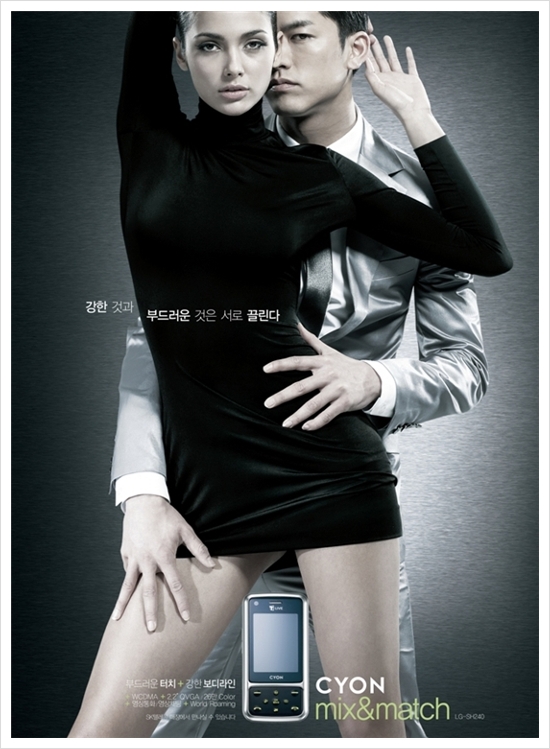
That said, I’m reluctant to let Cyon completely off the hook. For take its advertisement from last year for the “mix&match SH-240” series of phones on the right for instance (source). In isolation, then they’re not bad at all (sex sells after all), but again, consistent and logical would have been alternative advertisements with a Caucasian man and a Korean women getting it on also, let alone Koreans with partners of other ethnicities, and I see such a lack as both very deliberate and emblematic of the Korean media’s issues with such relationships even in 2009 (see here, here, here, and here). But that’s another blog post, albeit one which I have to write very soon as part of my preparation for this conference in August!
Update, October 17) See here for another controversial example of “contemporary blackface,” this time from the French version of Vogue magazine.
(For more posts in the “Korean Sociological Image” series, see here)
Yes, Korean “gender” reader from now on, as despite the name my “feminist reader” posts were really always more on gender and sexuality issues rather than on feminist ones per se, although of course they’re still intimately related and will still get mentioned. I’ve updated the names of all the old posts accordingly.
1) In an advertising tactic that looks set to become a new standard given how popular the recent banning of similar songs and videos made them afterward (see #1 here and #2 here, and apparently the same logic applies to “leftist” books), rookie rapper E.via (이비아) probably deliberately sought controversy with the opening of her song “Oppa, Can I do it?” (오빠! 나 해도 돼?), which – surprise, surprise – begins with heavy breathing and the lines “Oppa…you know…I really want to do it…Can’t I do it once? Oppa…Can I do it?” See allkpophere for more, and here for the song itself (photo source: Diet Life).
3) The ballad singer “U” created a stir with a lesbian kissing scene in an MV teaser for her new song, “Suddenly” (울컥).
4) School violence appears to be on the rise, although Korea Beat notes it may just be institutions are better at ferreting out cases that would previously have gone undiscovered. See Brian in Jeollanam-do also for a legal case where a student hitting a teacher in retaliation for corporeal punishment was ruled as not being legitimate self-defense.
6) A good look at the nightmare that is trying to find quality, affordable childcare in Tokyo, with obvious parallels to Korea. See here also for how Korean kindergarten teachers are underpaid and overworked. In fairness though, my own 3 year-old daughter goes to a very nice and affordable kindergarten (and our family makes much less money than your average Korean middle-class ones!), so they are out there.
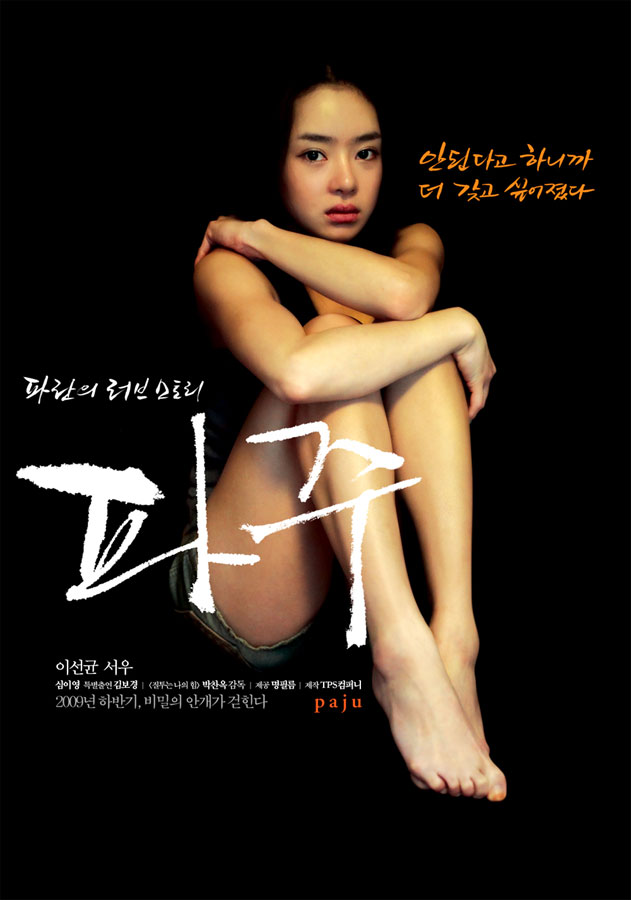
7) Although the movie itself isn’t set to come out until Autumn, with its Lolita-themed storyline and especially the poster with actress Seo-woo (서우) above (source), then Paju (파주) is already getting a lot of attention: the orange text, for instance, says “If (you) say (I) can’t, then (I) want to do (it) all the more.” See DramaBeanshere for a synopsis (actually, it sounds quite interesting).
Update: Come to think of it, Seo-woo’s passive look in the poster and the assertive, risqué text give completely opposite impressions of her character in the movie. I wonder why? From what I’ve read at DramaBeans though, the latter is the more accurate.
8) Chris in South Korea visited Haesindang Park (해신당 공원) in Gangwon-do, which is apparently full of penises.
9)An Acorn in the Dog’s Food provides a harrowing tale of a mother suffering from depression who killed her son and tried to make it look like suicide, and only by chance was unable to kill her daughter also.
11) PopSeoul! and allkpopdiscuss the case of newbie actor Lee Si-young, who was dropped from an upcoming drama for falling in love and making public her relationship with fellow actor Junjin. This will have a big negative impact on her fledgling career (she is already said to have lost some advertising deals as a result), but, lest this be taken as indicative of Korean management companies slave-like contracts with their stars (see #6 here) and Korean companies’ strange stipulations about the reputations of stars modeling for them (ie, if you get beaten up by your husband then be sure to hide it from the public), the decision was made solely by screenwriter Im Sung-han (임성한), apparently notorious for that sort of thing.
13) As allkpop discusses here, recent advertisements featuring Lee Hyori are creating jams in Korean subway stations (apparently not here though!).
14) Good on actress Kim Bu-seon (김부선) for standing up for the legalization of marijuana in Korea and drawing attention to the Korean public’s often bizarre attitudes towards it (considering that 46% of Korean men and 9% of women are considered binge drinkers, then you may be surprised at Koreans’ rather dogmatic attitudes to other drugs). See Michael Hurt at Scribblings of the Metropolitician for a wider discussion of those.
15) Finally, as Omana They Didn’t! tests your knowledge of Korea’s best abshere (helpful example above), it behooves me to present my candidate for the best female version below. And in related news, some form of contest for former Men’s Health Korea magazine cover models will take place at the ‘4th Men’s Health Cool Guy Contest’ on July 2, 2009 at the Grand Hilton Convention Center. See here and here for the details.
( The title reads: “A message of hope to all women!” )
If someone had told me years ago that I’d be writing about a Korean infomercial at some point, then I would have wagered good money that it would have been about one for bidets actually, for nothing quite gives you that “We’re not in Kansas anymore” feeling as switching the television on and seeing attractive women holding perspex buttocks over jets of water, waxing lyrical about how well they cleared a strategically placed brown-yellow paste. I could mention the looks of ecstasy and relief on various actors’ faces as they supposedly use the bidets later too…but you get the idea.
Lest I give the wrong impression though, there are certainly many advantages to Koreans’ no-nonsense attitudes to bodily functions, and actually I much prefer them to many Americans’ delicate sensibilities. But what to make of these – for want of a better term – electric breast enlargers?
If you can forgive the pun, then two things really stick out about this infomercial and its accompanying website for me (beware a loud video if you click on the latter):
First, needless to say, since writing this post on the subject a year ago I’ve still seen absolutely no evidence to suggest that doing fuck all is an effective way to lose weight and gain muscle tone and so on, let alone enlarge any specific body part. But while Korea by no means has a monopoly on misleading advertising, it is also true that various loopholes in advertising legislation here mean that there is little to stop producers of “diet-related” products from, well, basically completely lying about the efficacy of their products. For more on this, see the second half of this post where I discuss Minjeong Kim’s and Sharron Lennon’s “Content Analysis of Diet Advertisements: A Cross-National Comparison of Korean and U.S. Women’s Magazines” (Clothing and Textiles Research Journal, October 2006)¹ from which I first learned of it, and if it sounds like I’m exaggerating, then consider the fact that despite supposedly far stricter standards for “normal” food that over 88% of food labeled as organic isn’t, for instance, or that the KFDA is not empowered to tell you, say, which Vitamin C drinks contain carcinogens, but only (and uselessly) how many (see #14 here).
And second, in the strange event that you didn’t look closely enough to notice, then let me point out that it is only the Caucasian model above that you can see in lingerie, whereas her Korean counterparts are all fully clothed. True, that may sound like a strange way to describe a woman in a crop-top, but the difference is more than mere semantics, as many Korean porn stars worked as lingerie models before bans on foreign models working in Korea were lifted in the mid-1990s. This means that even today lingerie modeling still has a certain stigma that even bikini-modeling lacks, and despite the bikinis themselves obviously being just as (if not more) revealing. For more information, see #1 here for the most recent of many posts on that.
Still, Koreans are notoriously savvy consumers, so while I confess that I haven’t bothered to look at this late hour, I imagine that there will be many scathing reviews of this product available online. And, with obvious parallels in many other (more important) aspects of life in a democracy as young as Korea’s, to a certain extent this vibrancy of online Korean life is the result of and compensates for deficient legislation, although on the other hand in this particular case it is also stymieing the development of a healthy Korean consumer culture.
Tempting as it is to continue this post in that vein, let me wisely close here by pointing out that in the product’s defense, it can simply be returned with your money back before 2 weeks. And I seem to recall from my 2 viewings of Dragon: The Bruce Lee Story that actor Jason Scott Lee playing Bruce Lee had two similar things strapped to his pecs in a scene where he was working on a script at home (i.e. not exercising, just like the women in this infomercial). Can anybody enlighten me? Am I dismissing…er…electric shock treatment(?) unfairly? As far as I know though, and to many teenage girls’ chagrin, the size of a woman’s pectoral muscles still has little effect on the ultimate size and look of her breasts, which are mostly connective tissue, “lobules,” and fat.
(For all posts in my “Korean Sociological Image” series, see here)
1. On a technical note, since I wrote that post the PDF of the article is no longer free to download I’m afraid, so I would be grateful if anyone that knows of a free link an/or a copy themselves could pass it on for me to provide to others here. Alternatively, serendipitously my printer broke last week and I’m buying a printer/scanner to replace it, so I’ll be able to scan the copy I printed if anybody asks!
An advertisement from today’s Korea Times, which immediately grabbed my attention for 3 reasons:
It’s for a women’s university, but not only does it feature men, it has more men than women.
It has a Caucasian man in it, whereas the target audience would overwhelmingly be Korean.
The Caucasian man is easily the most prominent feature in it, and is looking at the viewer rather than into the distance like the Korean students.
After just a few minutes thought though, obvious reasons emerge for all of those: men are and should be featured because the program is available to both men and women (well technically, the website doesn’t mention anything about the sex of applicants) for instance, and for all their ethnic diversity Caucasians are still an instant and logical signifier of Western countries. And dealing face to face with an American colleague at an American hospital – ie, having a job at one – is precisely the goal of students that will enter this program too, which in turn is well represented by the Koreans in the advertisement looking towards their futures as it were. As the male Korean is wearing a tie, then I’m a bit unsure as to whether the Koreans are supposed to be students in the program or graduates with jobs looking for better opportunities, but other than that slight confusion then the advertisement appears logical as a whole.
Still, despite myself it gives me misgivings.
One minor reason is because the doctor is male. Nothing wrong with that of course, but it seems strange to have a male role-model in an advertisement for a women’s university. Yes, I know I just said that the doctor is supposed to be a future colleague, yet in addition to representing both that and a life in America he does still have a job that students entering into the program would aspire to. If the primary target of the advertisement is women then, not choosing a female doctor seems like a wasted opportunity to kill three birds with one stone.
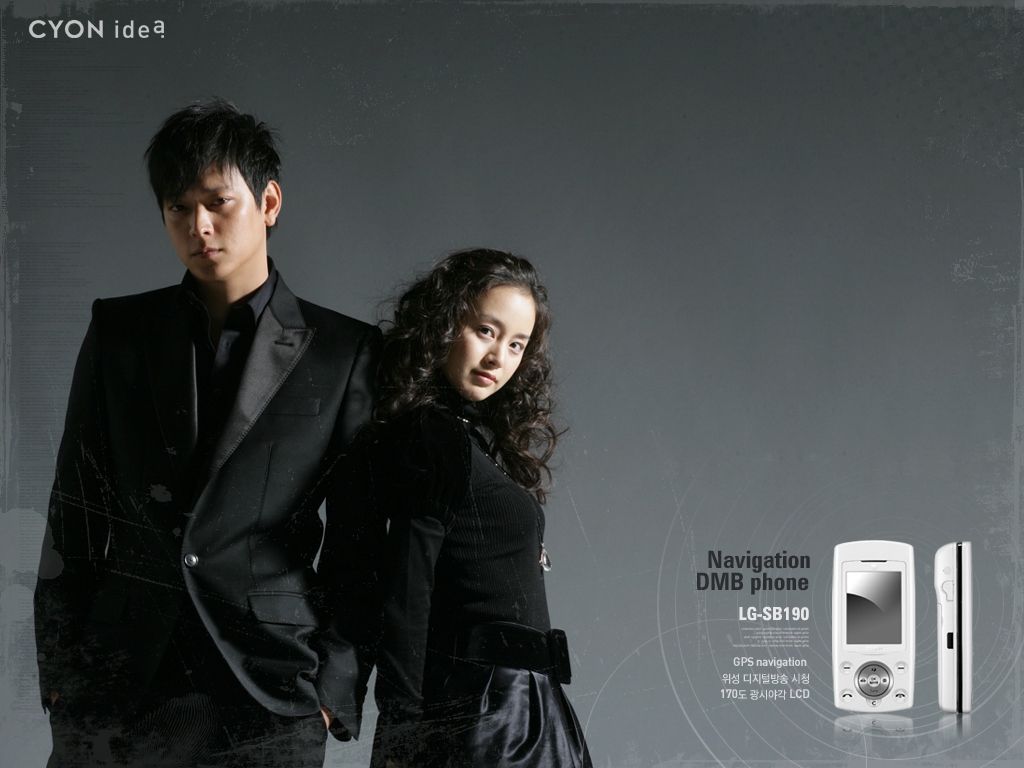
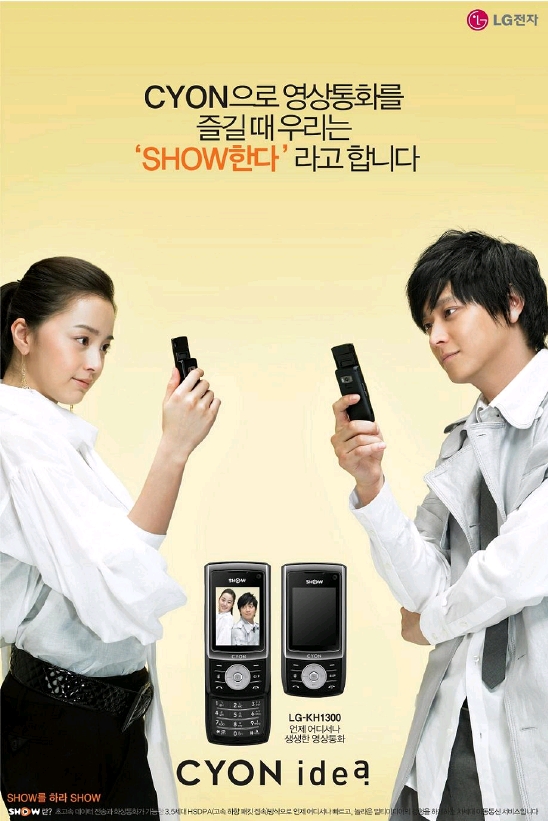
But dammit, why’d he have to be so big? As I discuss at great length here, relative size is one of the most powerful tools in advertising, not only making certain features more prominent than others but also – especially when it’s used to contrast two or more people of different sexes, ethnicities, jobs, ages, and so on – both determining and conforming to social norms of ranking, status, and appropriate social roles. For instance, if you take a random man and woman then in 1 in 6 cases the woman will be of equal height or taller, but in advertisements the figure is closer to 1 in 20 or even less. Not that that is evidence of sexism per se though, as women overwhelmingly prefer men that are taller than themselves, and it’s natural that many advertisements would reflect this. Moreover, if you’ve chosen specific celebrities with a significant height difference, say Kang Dong-won (강동원) and Kim Tae-hee (김태희) above, then it would be difficult to engineer a realistic-looking advertisement in which he somehow appears shorter than her.
But then consider this advertisement on the right with the exact same couple (source), in which the height difference has been significantly reduced. Sure, it’s not the only reason why the advertisement has a completely different, more egalitarian vibe than the first, but I’d argue that it’s the most important one. And to hammer that point home, consider how simply bizarre everyone would find the above, gangsterish one if Kim Tae-hee were just a little bigger, let alone if a woman taller than Kang Dong-won had been used.
Ergo, size matters, and so while my concern with Sunghin Women’s University’s advertisement may well only stem from the inherent angst of being a socially-aware Caucasian male, guilty at living in a country where being such undeniably confers certain advantages, it still leaves me feeling a little uncomfortable. I would have much preferred one that focused more on the Korean students themselves, and how the program empowered them, but while retaining the signifiers of America, the job, and so on. Not something that basically says:
Oooh, do this course, and you can talk to and work with White people! In America!!!What more could you ever want?
Okay, that specific vocalization may just be me. Or is it? That’s a rather indelicate way to put it above, but it is certainly true that living and working (and being educated) in America conveys a lot of status in Korean society, so far from me implying that any Korean is a passive dupe for responding positively to advertisements like this it is logical and intelligent for them to do so. Moreover, my wife, who is Korean, pointed out that most Koreans wouldn’t think twice about the Caucasian in this ad. Perhaps my concerns are misplaced then.
What do you think? Mere overanalysis and liberal-arts major angst on my part? Or a legitimate concern? Regardless, admit that the doctor is the first person you noticed too though!
(For all posts in the “Korean Sociological Image” series, see here)
On the face of it, Park Ji-sung (박지성) is a very logical choice to endorse any given Korean company’s products or services. After all, he is easily Korea’s most popular male sports star at the moment, he (naturally) has a good body, and he is so successful that he has even published an autobiography already. Accordingly he has dozens of advertising deals to his name, and – to place his popularity into context – via his numerous Korean fans’ choices of credit cards he has more than financially compensated Manchester United for the loss of David Beckham for instance. Presumably then, Gillette Koreathought it was on to a good thing when it belatedly decided to join his bandwagon.
Nevertheless, while it’s not like I can claim to being all that photogenic myself, Park Ji-sung is actually a *cough* less than inspired choice, and at the very least advertisements like the above probably stretch consumers’ senses of disbelief just a little too far, if they don’t put off Korean men from using Gillette products altogether! If you haven’t already figured out why, then photos like this, this, this and this may help, and as Roboseyopoints out, it’s not just because of her own sudden popularity that Korean companies started signing deals en masse with ice-skater Kim Yu-na (김연아) last year.
Update: Which brings up the side issue that Korean celebrities are notorious for being unconcerned about diluting their own personal brands, but so far this doesn’t appear to have been the case with either Park Ji-sung or Kim Yu-na.
Of course, photoshopping is by no means a recent phenomenon or unique to Korean advertisers, although it’s also true that extreme examples like Amore Pacific’srecent attempt to get women to aspire to a – by definition impossible – photoshopped “X-line” body ideal may well be very hard to find in other countries. With that in mind, I’m always interested in the extent to which Koreans are aware* of the level of photoshopping that occurs in advertisements and their opinions of it, but as I and many commenters have already talked about photoshopping on numerous occasions on the blog already (here’s a very small sample!), then rather than merely rehashing old points here, instead let me ask you how well you think Gillette’s ads will do, what your Korean friends, lovers and/or colleagues think of it, and what they think of photoshopping in general? Commenter Seamus Walsh’s female friends for instance, told him a little while ago that:
…they all were aware of the altering of photos that goes on…but that it is generally ignored because they know the models are attractive anyway, and that they look good after photoshopping, so that’s all that matters. Basically, despite knowing an image isn’t a true representation, they would rather have the altered image. I just wonder if this means that their ideals of beauty are based on the reality or the unnatural and unattainable?
Me too. But how representative are those opinions of average Koreans’ in turn? Please let me know!
* Not to imply that your average Korean consumer is any less intelligent than your average Western one with that statement, but having said that, on the other hand I’m not going to lie and pretend that somehow the Korean education system encourages the same level of critical thinking either.
(For all posts in the “Korean Sociological Image” series, see here)
Well, it certainly sounds like it will be, although I admit I have some reservations about Bandhobi‘s (반두비) “crude political satire,” and especially of its portrayal of an American English teacher as an “occasional rotten apple.” Given that it otherwise aims to transcend and/or educate viewers about such issues as racism, illegal immigration, and possibly even teenage sexuality, then it would be both ironic and quite a pity if it resorted to gross stereotypes of foreign male English teachers in the process.
(In passing, as I probably won’t get to mention them otherwise then reviews of the book “The East, The West, and Sex” by Richard Bernstein here, here, here, and here may help to put those stereotypes in comparative perspective, and are interesting in their own rights)
Still, Korea Times’s movie criticLee Hyo-won, whose excellent movie reviews I’ve sung the praises of before, has easily persuaded me to go and watch it this weekend. Here is her(?) full review below:
In “Bandhobi,” director Shin Dong-il translates to screen “uncomfortable” issues of illegal immigration, racism and social toadyism through the universal languages of ticklish humor, teenage angst and priceless friendship.
It’s a story about growing pains and the meeting point of different cultures _ the title “Bandohbi” roughly means “female friend” in Bengali. It’s an indie flick that, while comfortably feigning mainstream superficiality, is inlaid with some gem-like scenes that show why Shim was dubbed “the Korean Woody Allen” (Berlin International Film Festival, “Host & Guest,” 2005).
Teenage actress Bae Jin-hui portrays the cheeky 17-year-old Min-seo with sure-fire articulation. One of the thousands of girls who took part in political candlelit vigils, Min-seo relentlessly speaks her mind at home – “you’re just my mom’s sex partner,” she shouts at her single mother’s incompetent boyfriend (Here, the film could have made the man despicable and turned it into something more noir, but he truly wants to get a job and become part of the family).
But she isn’t entirely the hardball rebel she pretends be. Not wanting to be a burden, she even takes up an illicit part-time job to raise money for English lessons.
One day, she decides to treat herself to the spoils of a misplaced wallet, but is caught by the owner, a migrant worker from Bangladesh. Mahbub Alam, a migrant worker-turned-documentary filmmaker who played a minor part in Shin’s “My Friend & His Wife,” shows off his fluent Korean to play the 29-year-old intellectual struggling to support his family back home.
Update: It turns out that Matt at Gusts of Popular Feeling actually knows Mahbub Alam. See here for a little more on his work with the Migrant Workers’ Union and with Migrant Workers’ Television.
Min-seo tries to dissuade Karim from reporting her to the police by offering to grant him a favor, and reluctantly agrees to help track down his former boss that owes one year’s pay. As the unlikely pair pose as loan sharks, they find themselves transforming each other’s worlds in unexpected ways but Karim’s visa will not last forever.
The sometimes-shaky handheld camera keeps a rather ironic distance from the characters; for Min-seo, the world is a piece of cake while for Karim it is a cruel battlefield. They slowly form a mutual understanding, with the girl asking indiscreet questions and the gentleman preaching about problems in Korean society. Yet the most affecting scenes do not involve words, but rather the simple act of crying, listening and eating.
The blatant mockery of traditionally right-wing institutions including the President Lee Myung-bak administration and the daily Chosun Ilbo are actually funny, but at times are not limited to character portrayal as they ought to, and are rather vulgarly laid into the mise en scene. Another questionable aspect of the film, which aims to highlight the foreign community in Korea, is that the American teacher was not convincing as the occasional rotten apple he was supposed to represent, let alone his “atypical” American English accent.
The crude political satire will throw some into fits of laughter while offending others, and contrived narrative elements are bound to irritate picky viewers. But just as the film’s hero Karim says, “open your mind,” and discover the film’s redeeming – and inspiring – qualities.
It is unfortunate that the film, which could nevertheless reach out to teenagers, was rated 19 and over for some candid depictions of a girl’s sexual awakening. In theaters June 25. Distributed by Indiestory.
Moviegoers can also look forward to the Migrant Worker Film Festival, of which Allum is festival director. It will be held in July in Seoul and through September in other parts of the country. Visit www.mwff.or.kr.
I’m assuming that that “sexual awakening” involves Min-seo becoming attracted to Karim, and if so it would be quite radical for a Korean movie, as I’m at a loss to think of any portrayals of romantic relationships between Korean women and Western men in Korean cinema, let alone with men from an ‘undesirable’ country like Bangladesh (can anyone fill me in please?). Given everything that I’ve written about teenage sexuality in Korea though – in short, that Korean teenagers are having sex, but the Korean public’s unwillingness to acknowledge this is severely restricting teenagers’ access to contraception and reliable information – then that rating is indeed a pity. But on the plus side, presumably Korean teenagers will be able to find a way to watch it nevertheless, and the restrictions will make them even more inclined to do so!
Sorry, but once I remembered the catchphrase of the gay groups at my university in the mid-1990s, then I couldn’t resist that particular addition to it!
In my defense though, there’s been a relative flood of LGBT-related news in the Korean blogosphere since the 10th Korea Queer Culture Festivalfinished two weeks ago. To wit:
1) Expect an outing of a Korean celebrity by an angry ex-girlfriend sometime soon.
2)3xFTM, Korea’s first ever movie about a female to male transgender experience, is currently playing in cinemas. See here for a review.
4) The Wonder Girls are so popular in Thailand that a “Wonder Gays” group has been created.
5) Don’t miss Chris in South Korea’sphotos of the parade and festival themselves.
6) And finally, Dramabeansreports that “Director Kim Jo Gwang-soo added an entry to the small-but-growing category of Korean queer cinema with his short film Boy Meets Boy, starring rising pretty-boy actor Kim Hye-sung. He is following that with his second film,Friends? [친구사이?], which isn’t quite feature-length but clocks in as a mid-length film at 50 minutes.”
Friends is currently in post-production, and with teenage boys kissing in it and reportedly a bed-scene too, it’ll be very interesting to see how widely it is screened and if any objections to it are raised. Unfortunately, I missed any news of Boy Meets Boy when it was released last year, so if anyone has any information about its reception then please let me know.
Update: “fuchsiathegreat” has just written a list that he(?) claims covers most if not all queer films that have ever been produced in Korea. I think that that’s an exaggeration(!), but it’s certainly a good guide to what has been produced in the last decade. Check it out at Omana They Didn’t!here.
Update 2: Although most of the films themselves are difficult to find unfortunately, check out the links provided by Pierre here for a history of queer cinema in Korea up until the late-1990s.
(By the way, if you were under the {perfectly understandable} impression that Koreans thought that there were no homosexuals in Korea, then you might find this post interesting)
Other news, in no particular order:
7) Actress Moon Geun-young participated at the 2009 Pink Ribbon Love Marathon fan meeting, with the aim of raising the awareness and need for prevention of breast cancer.
8) The Chosun Ilboreported that Swedish husbands do 6 time more housework than their Korean counterparts.
9) The original is a little difficult to read, but Watashi to Tokyodiscusses an article about why highly-educated Japanese women aspire to be housewives.
10) The Dong-a Ilboreported on the recent launching of government task force for making a “better place for procreation” to promote childbirth. Forgive my arrogance, but I suspect that I could have translated that better.
13)Allkpop reports that teenage girl group Girls’ Generation is involved in a new show where they learn look after a baby for a day (see here and here). I’m sure that it’s entirely with ratings in mind, but on the plus side they are also getting involved in a campaign to help adopted children. Cue highly relevant pictures accompanying the Korean news reports.
14)Brand Confucianreports that “according to Yonhap news, Consumers Korea, a consumer advocacy group, released a report showing that several international and local Korean baby skin care product manufacturers are marketing products containing potentially harmful chemical preservatives and fragrances as ‘natural’ or even ‘organic’.”
To place that into context, 88% of products marketed as organic food in Korea are anything but, and even though 27 out of 30 Vitamin C drinks in Korea contain dangerously high levels of carcinogenic benzene, not only are the KFDA’s powers so limited that none of the companies producing them can face penalties, but it’s not allowed to publicly reveal their names. So, when I wrote about this topic in passing a year ago, guess what country’s websites I had to visit in order to learn which 3 drinks are safe? It certainly put Korean democracy into a new perspective…
In related news, I’ve just read that the government said that “7 out of 79 brands of bottled water were found to contain bromate, a suspected carcinogen, exceeding international guidelines for drinking water quality.” See here for the details, and again, which 7 are not named. And in another ominous sign, last year the KFDA’s lack of legal authority and resources inspired it to get the public to do its own job of checking health and safety standards at Korean restaurants.
15) The Korea Times reports that a professor was given a jail term for sexually harassing female students, and Korea Beat reports that: the acquittal of a professor accused of sexually assaulting a female student was affirmed; the Dong-a Ilbo was accused of sexism by portraying women memorial services for the late ex-president Roh Muh-hyun as acting only out of emotion; and, as a follow-up to the Seoul City government’s plans to increase the number of public toilets for women (see #9 here), provides some more details of what exactly will be provided and how they will be funded (and parks are to become more “women-friendly” also).
16)PopSeoul! reports that the two rumor-spreaders that contributed to Choi Jin-sil’s suicide last year are to receive…suspended sentences of 2 years and 120 hours community service. But while that may sound lenient, particularly in light of her tragic life and the ignominy of being sued after death for not hiding her husband’s beatings from the media, there are still rights to free speech involved.
17) The Wild Women’s Performing Arts Festival is set to be held in Hongdae in Seoul on June 27, and will raise funds for the Korean Women’s Association United, which tackles such issues as gender equality. See here and here for the details.
18) Despite thousands of articles about and even more photos of Lady Gaga’s recent visit to Seoul(source), only Sarah Kim at Ningin made the obvious points that “…Asian sensibilities seem to have a double standard. It’s not ok for Asian artist to dress risqué or to come off as sexy, but when Westerners do it, it’s completely ok. And why is it when Westerns idols go to Asia it’s a big deal but not the other way around.”
There are exceptions to the first point of course (Kim So-yeon’s revealing dress at the Pusan International Film Festival in 2007 instantly springs to mind), but Sarah is quite right, and I’ve made the same point frequently myself (see #1 here). Recall that Chae-yeon’s far less revealing music video was banned from Korean television recently for instance (see #1 here), which she discusses briefly in an interview here.
19) Not strictly Korean, but considering that Korea has the lowest number of working women (read: mothers) in the OECD then this post at Contexts “about the ‘motherhood penalty’: the pattern demonstrating that working mothers make less than women without children.” should be interesting. The study examined, authored by Shelley J. Correll of Stanford University, Stephen J. Benard, and In Paik also suggests that, “the mommy gap is actually bigger than the gender gap for women under 35.”
21)Mr World 2009 is to be held in Seoul this September.
22) In the Korea Times, Choi Yearn-hong writes about the bizarre mentality of the Korean Constitutional Court, which seems stuck in the 19th Century when it rules women’s rights. Among other things, in some cases it has adjudged that women’s inheritance rights are only half those of men.
23) Apparently, hairy legs for men are no longer in fashion in Korea, although despite living here 9 years I’ll be damned it I can recall when they ever were? Despite Korean men not exactly being well-known for their body hair though, the Korea Times reports that sales of body-hair removal products and devices to them are increasing every summer. They are also putting on cosmetics for the sake of getting an edge in the job market too.
24) And to make sure to end on a fun note, the Korea Heraldreports that Korean actor Lee Byung-hun below (source) is the most desired boyfriend by Japanese women, and finally Allkpop gives a list of the hottest Korean male stars under 25 and also informs us that apparently Kim Hyun-joong is the most kissable Korean male celebrity.
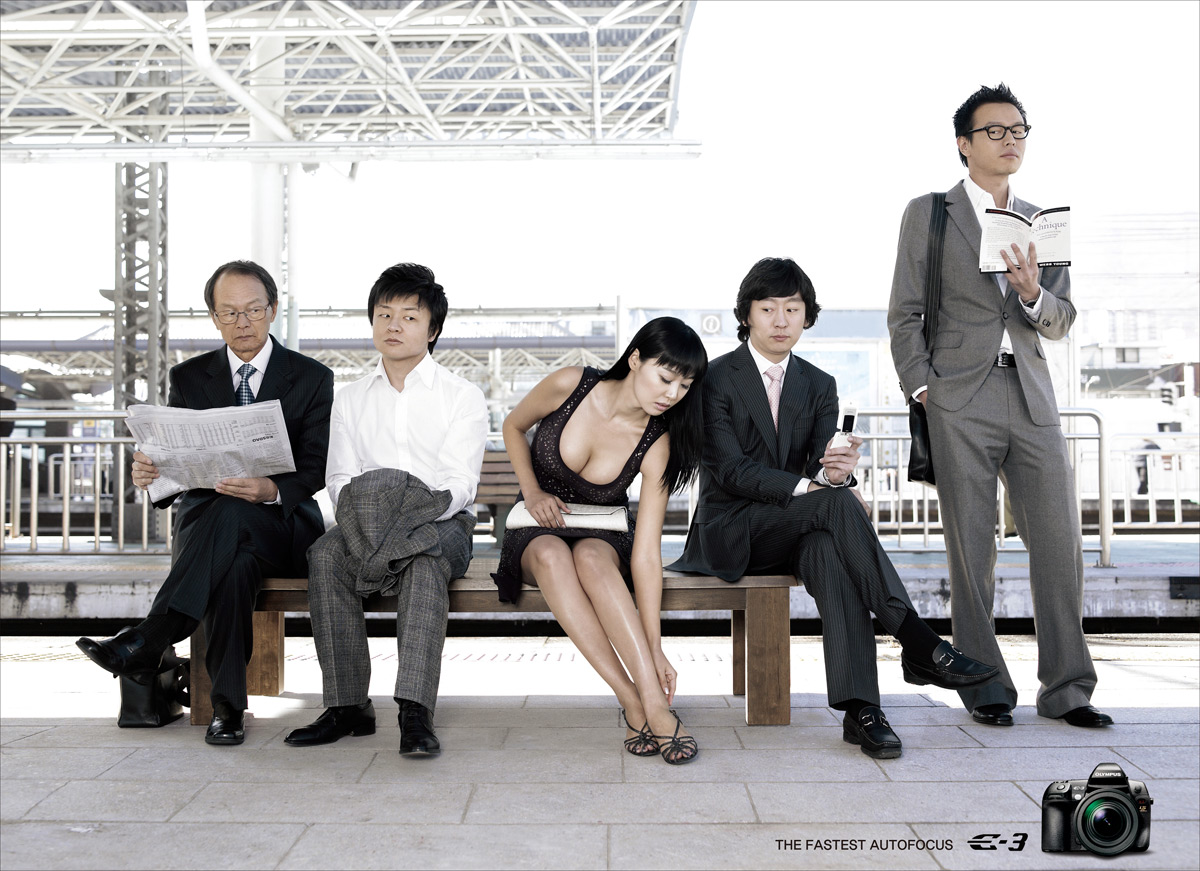
Given my Feminist pretensions, then usually I’d instinctively feel defensive about my decision to post an ad like this, and in the past this has often prompted me to write lengthy arguments about how, say, exposure of breasts per se shouldn’t be regarded as sexist. But with some notable exceptions (and from which I’ve learned a great deal from), whether through preaching to the converted, most of my readers being men(?), or some other reason, judging by the lack of detracting comments on those occasions then such justifications have probably proved unnecessary.
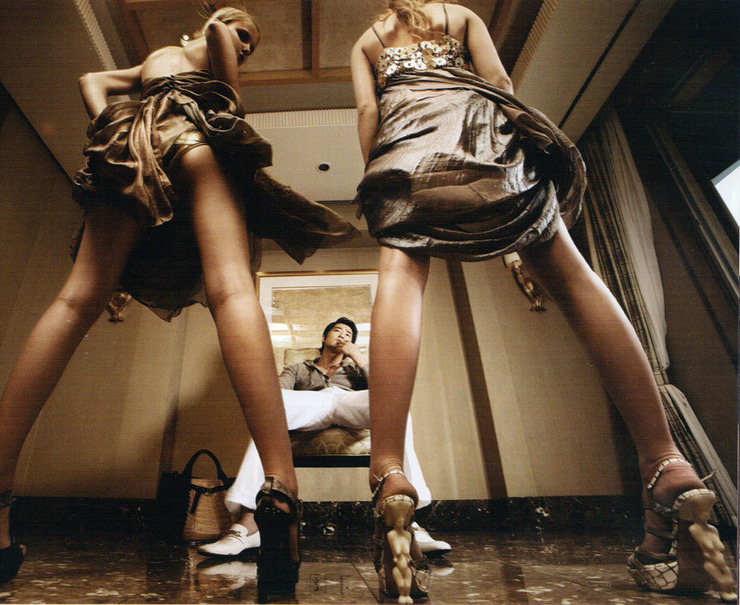
So, I’ll let it go: readers certainly don’t need me to spell out that on the one hand this ad is definitely objectifying, but on the other that men would behave exactly the same way even if women had achieved complete equality, and can decide for themselves if it’s sexist or not (I’m still happy to discuss that in the comments section though). In the meantime, I’m learning to feel less ashamed about the unabashed grins ads like this put on my face, especially the first ad in this post.
Actually, a much more interesting issue it raises is its directness. Of course objectifying women is hardly new or unique to Korean ads, but I can’t think of any other example that so blatantly incorporates the corresponding (sexual) male gaze into its message, and this makes it more sexual than, say, the sudden spate of couples kissing in Korean advertisements that is making news recently (see here, here, and here). On top of that, it actually went up way back in November 2007 too (see the details here), which raises some interesting questions:
How common was it?
Where was it posted?
Were there any complaints?
If so, was it removed from circulation?
If not, why have there been no similar ads since?
Or perhaps there have been, it’s just that I didn’t notice them?
If any readers can help me with any of those, I’d appreciate it. In the morning, and with apologies for not doing this first, I’ll scour Naver and so on and see if there’s anything in Korean on it.
Update: Unfortunately I couldn’t find anything at all about this ad in Korea, either at Naver or Yahoo! Korea, and which makes me wonder if it was actually released or not? But as for ads featuring the male gaze, I forgot about this one with Han Ye-seul (한예슬) for lingerie company Venus (비너스). From February 2008:
Vodpod videos no longer available.
(For all posts in my “Creative Korean Advertising” series, see here)
An otherwise innocuous, quick slice of Korean life…but which inadvertently prompted some soul-searching and a minor epiphany about Korean society on my part. Please bear with me!
If you’re reading this blog in Korea, then by virtue of its inane “We Live in OZ” catchphrase you’ve probably more aware of LG Telecom’s “OZ Generation” advertising campaign than most. But you may not have heard of its online virtual first person “date” with model and actress Lee Yeon-hee (이연희) that was launched about two weeks ago, and which deserves kudos for being the first of its kind in Korea (indeed, this post was originally intended to be #16 in my “Creative Korean Advertising” series). As Coolsmurf explains at allkpophere:
Users get to have a complete, enjoyable date with Lee Yeon Hee by completing 6 stages with varying difficulties, but all of which can be solved by using the LG mobile phone and your trusty keyboard. You get to hold the hands of Yeon Hee as you dash away from the crowd, ride a bus with her, have a meal, celebrate her birthday, etc.
And as of Saturday, 200,000 people had participated since it was released 10 days earlier, with 20,000 visitors daily. Unfortunately, and all too typically for Korea, the main site requires your national ID number to participate (I didn’t check if my “foreign” one worked or not sorry), but strangely this alternate entry site (in the screenshot below) doesn’t, which will hopefully give K-pop fans outside of Korea a chance to participate.
I confess, I did it myself for a little while: it’s like a surreal bubblegum version of Doom 3, with eye-candy as the target rather than demons. And my 3 year-old daughter sitting on my lap found it hilarious when I crashed into people and potholes while running to meet Yeon-hee in “Mission 1” (hint, use the cursors), but neither of us were sufficiently motivated to figure out how to rouse her after she fell asleep on the bus in Mission 2 though I’m afraid (but get on the bus using the mouse this time). Not for a fifth time at least…
But what epiphany about Korean society did this prompt on my part? Other than being reminded, say, of the penetration and pervasiveness of mobile phones into all elements of Korean life that is?
Well, consider the rather childish and platonic way the couple interacts on the “date” itself, replete with numerous uses of the word Oppa (오빠): to Western eyes it makes it appear more reminiscent of the sorts of dates we had – or perhaps, our parents liked to think we had? – back in our early teens, and certainly nothing like what most Western adults would consider worth showing up for. Lest you feel like that’s an exaggeration though, then by all means examine it for yourselves, but I’m sure that most people at all familiar with unmarried Koreans need no such assurances.
In the original version of this post, this prompted a lot of speculation on my part as to whether the date game was in fact primarily targeted towards teenagers, but that was misguided: as Charles points out in his comment that made me realize that, I myself went on “dates” like that with a 25 year-old Korean woman before I met my future wife, and although I haven’t dated in the 9 years since – and so by no means claim to be an expert on Korean dating culture – I’m confident that a sizable proportion of 20-something Koreans do have indeed have platonic dates like this. After all, the various cultural, social, and economic factors that lay behind the plethora of blind-dating systems in Korea certainly do still exist, although as Michael Hurt in this excellent practical guide to the cultural pitfalls of dating Korean women points out, the move from single-sex to mixed schooling is beginning to change those (see the KoreanClass101 Bloghere also).
Lest I give the wrong impression though, I’m not against such dates per se. And while it’s true that I don’t personally consider dating without the ultimate aim of a sexual relationship as dating at all, that’s isn’t quite the same as thinking that, say, any woman that doesn’t sometimes put out on the first date (or guy that doesn’t want that) is a prude! And that so many Koreans go on such dates is – however patronizing it may sound – a very nice and endearing aspect of Korean society.
However, it is but one version of Korean dating culture. And yet while Koreans as a whole are certainly more sexually reserved than your generic Westerners, I doubt that any readers need convincing of the fact that over 50% of Koreans have sexual experiences before marriage. Yet- and herein lies the (belated) beginning of my epiphany – why is it only the platonic version of dating that is still overwhelmingly presented in the Korean media? And particularly when depictions of so many other aspects of sexuality in the Korean media are becoming increasingly bolder and more liberal over time?
True, if you take issue with my description of the way dating is depicted in the Korean media, then I have no data to back that up: indeed, I don’t watch Korean dramas precisely because on the rare occasions I’ve naively wanted to spend more than 5 minutes with my wife on the sofa while she’s watching one, then I’ve soon been forced to leave the room at sheer disgust and incredulity with the surreal, Disneyland version of Korean life presented on the TV screen. Still, as commentators on this lengthy post on that subject pointed out, there are more realistic and palatable dramas out there if you’re prepared to look for them.
Also, granted: the ways dating and premarital sex are depicted in the Korean media are in many respects quite separate to, say, the censorship issues that I’ve been following closely in my weekly(ish) “Korean Gender Reader” posts. But still, rather than censorship being akin to some inexorable fact of nature (i.e. Korea is a conservative country…what else does one expect?), the numerous forward and backward steps in Korea just this year has provided me with a healthy reminder that what is considered suitable for Korean viewers is in reality a very mutable concept (and don’t get me started on Japanese censorship issues). Which begs the question of who is doing the defining, and why.
This brought to mind the following lesson I learned from An Introduction to Japanese Society by Yoshio Sugimoto (and easily the first book you should ever read on the subject):
Japanese culture, like the cultures of other complex societies, comprises a multitude of subcultures. Some are dominant, powerful, and controlling, and form core subcultures in given dimensions. Examples are the management subculture in the occupational dimension, the large corporation subculture in the firm size dimension, the male subculture in the gender dimension, and the Tokyo subculture in the regional dimension. Other subcultures are more subordinate, subservient, or marginal, and may be called the peripheral subcultures. Some examples are the part-time worker subculture, the small business subculture, the female subculture, and the rural subculture.
Core subcultures have ideological capital to define the normative framework of society. Even though the lifetime employment and the company-first dogma associated with the large corporation subculture apply to less than a quarter of the workforce, that part of the population has provided a role model which all workers are expected to follow, putting their companies ahead of their individual interests…. (p. 12).
Yes, Japan, supposedly the land of the faceless salaryman…is anything but. And yes, the subject of salarymen may seem a little out of place at first glance, but I’m sure you’re seeing the connections already. Continuing in the same vein (although as a quick aside, it’s interesting to consider why Japan is so well-known for the salaryman system, when if fact it’s only Korea that ever had them as a majority of workers):
Dominating in the upper echelons of society, core subcultural groups are able to control the educational curriculum, influence the mass media, and prevail in the areas of publishing and publicity. They outshine their peripheral counterparts in establishing their modes of life and expectations in the national domain and presenting their subcultures as the national culture. The samurai spirit, the kamikaze vigor, and the soul of the Yamato race, which some male groups may have as part of the dominant subculture of men, are promoted as presenting Japan’s national culture….
More generally, the slanted views of Japan’s totality tend to reproduce because writers, readers, and editors of publications on the general characteristics of Japanese society belong to the core subcultural sphere. Sharing their subcultural base, they conceptualize and hypothesize in a similar way, confirm their portrayal of Japan between themselves, and rarely seek outside confirmation….(pp. 12-13).
As another aside, this last point highlights how Koreans are in many senses shooting themselves in the foot by alienating and demonizing a whole generation of English teachers in Korea (see here, here, and here):
Core subcultural groups overshadow those on the periphery in inter-cultural transactions too. Foreign visitors to Japan, who shape the images of Japan in their own countries, interact more intensely with core subcultural groups than with peripheral ones. In cultural exchange programs, Japanese who have houses, good salaries, and university educations predominate among the host families, language trainers, and introducers of Japanese culture…(p. 13)
(Update: See here for some quick recent examples of how different the Japanese are to the way they’re normally represented in the foreign media)
No, I’m not suggesting that there is a big conspiracy to keep premarital sex off Korean screens. Nor am I suggesting that the above is all that original or profound, and certainly my ultimate epiphany – merely to extend the above lesson to depictions of Korean dating and premarital sex in the Korean media also – is much less so.
But the point that I want you to take away from all this is that at the very least it provides an interesting and useful alternate framework with which to analyze the topic in future. For instance, the completely ineffectual Youth Protection Committee’s (of the Ministry for Health, Welfare and Family Affairs) recent banning of music group TVXQ’s latest songs from being played on TV and the radio because of “lewd content” and the need to “protect teenagers” (see #2 here), may be most explicable in terms of corporatist motivations, or in other words be the result of the Ministry’s struggle for relevance and definition under the hostile Lee Myung-bak Administration, which originally planned to disband the former Ministry of Gender Equality and Family altogether (now a separate Ministry of Gender Equality exists: see #4 here), and despite the compromise being opposed by all ministries involved. No, I’m not saying that that is the case necessarily, just that it’s a possibility that needs to be considered.
And on that note, I’d better end this post, which has admittedly somewhat evolved from its ostensible original topic. Which reminds me, presumably other male and female members of the “OZ Generation” in the advertisements will have similar dates set up for them, and it’ll be interesting seeing the different conventions for the former’s behavior and writing about that a later date. And probably this topic will be in IMAD (아이엠 애드) also (Korea’s only magazine devoted to online advertising), and I’ll make sure to buy it and translate the corresponding article also. In the meantime, I’m curious as to if this virtual date has already been done overseas, so if any readers know of foreign examples then please pass them on.
When hearing last week about something as appalling as an actress being sued for daring to show her bruises and black eyes to the media, it’s only human nature to assume the worst of Korean society.
But while Korea certainly does have a great deal of work to do in combating domestic violence—and criminalizing spousal rape would be an essential first step (see #2 here)—it’s also true that police and legal attitudes towards it have considerably hardened in recent years, both cause and effect of a law change in 2007 that requires police to forward all cases of domestic violence to a prosecutor (the previous 1998 law just left it up to their own discretion). In addition, Korean women are now more likely than ever to divorce on the basis of verbal or physical abuse, rather than suffering silently as in past decades.
Indeed, what stands out more than anything else about the court decision is how much it goes against the grain of trends within Korean society, and certainly does not reflect the will of all Koreans. Some quick excerpts from today’s Korea Times for instance:
Women’s groups are angry over the top court’s ruling that ordered the late actress Choi Jin-sil (최진실) to compensate a builder for failing to maintain “dignity” as a model representing its products.
They censured the Supreme Court for not realizing the suffering of domestic violence victims, which included Choi.
Korean Womenlink, the Korea Women’s Hot Line, and the Korea Women’s Association United issued a joint statement Wednesday lambasting the ruling.
On June 4, the court reversed a high court ruling that decided in favor of Choi in a compensation suit filed by Shinhan Engineering and Construction in 2004 against the actress, who was the model for its apartments.
The advertiser claims she did not keep her contractual obligation to “maintain dignity,” because she disclosed to the public her bruised and swollen face which was caused by the violence of her then husband, former baseball player Cho Sung-min. They divorced soon afterward.
For the rest, see here. Also, see here for my original post on this issue and information about similar cases in the past, and here for a quick primer on the numerical rates of domestic violence in Korea (albeit in 2004), with many graphs and tables.
(By the way, although it was already common knowledge, it’s good that the Korean media is now naming the company. But I wonder if it was originally kept anonymous by a court order, or just by convention?)