The Kafkaesque Korean Beauty Trends of 2009

(Source: Unknown)

Confused about all the new buzzwords used to describe Koreans’ bodies these days? Here’s my translation of an article that gives a quick guide.

The author implies that most of them arose organically from the public’s interest in certain actors in Korean dramas. Whereas in reality, it’s companies and the media that are overwhelmingly responsible, as they’re in a constant quest to create new consumer trends (read: new reasons for people to feel dissatisfied with themselves). Yet while most of these have no basis in reality, are essentially useless, and/or are so contrived as to be quickly forgotten or ignored, some do stick.

Of those that do though, if they have some English in them then it often makes them more interesting from a sociological standpoint. For whether by accident, mistranslation or design, they both reflect the way the term is already usually misused in Korean and further influence they way in which related English-language popular culture gets filtered into its Korean counterpart.

A good example from this article would be chongsoon-glaemor (청순글래머), or “innocent glamor,” which at first glance doesn’t seem all that strange: in her television commercials for instance, the ice-skater Kim Yuna (김연아) below manages to project an innocent image while having a seemingly glamorous lifestyle (I wonder if she’ll find the former stifling as she grows older however, like actress Moon Geun-young?). But it emerges that “sexy” would be a much better translation of the English word “glamor(ous),” and although I’m sure readers are well aware of the number of ways  in which women are presented as pure and innocent but somehow also lustful in Western popular culture, and effectively are in Korean, there are still problems with assuming that that is what the term means, as the word “sexy” isn’t construed quite the same way here. Instead, we seem to be left with an obscure term for Korean women that look more virginal than normal(?), but yet still do the mechanical “sexy dances” virtually required of them on Korean talk shows.

Anybody with more familiarity with the term and/or the actress Shin Se-kyung that supposedly spawned it, please feel free to correct me on my interpretation: after all, this is the first time I’ve looked at its origins, and just based on one article at that (Update — with thanks to Seamus Walsh for pointing it out, I did indeed make a mistake: “glamor” actually means “busty” in Korean). But with the proviso that the next means I may be cherry-picking the facts to suit my own views, it does still seem very consistent with the Korean media’s overall trend towards discouraging or outright banning of assertive displays of women’s sexuality, i.e. genuinely sexy behavior.

꿀벅지·미중년·꽃남…2009년 연예계 뷰티 트렌드는? 2009-12-31 by 두정아

올해 연예계 트렌드를 이끈 핫 키워드는 무엇일까. 꽃남과 미중년, 꿀벅지, 베이비페이스, 청순글래머 등 어느 해보다 개성있고 다양한 트렌드가 공존했던 한 해였다.

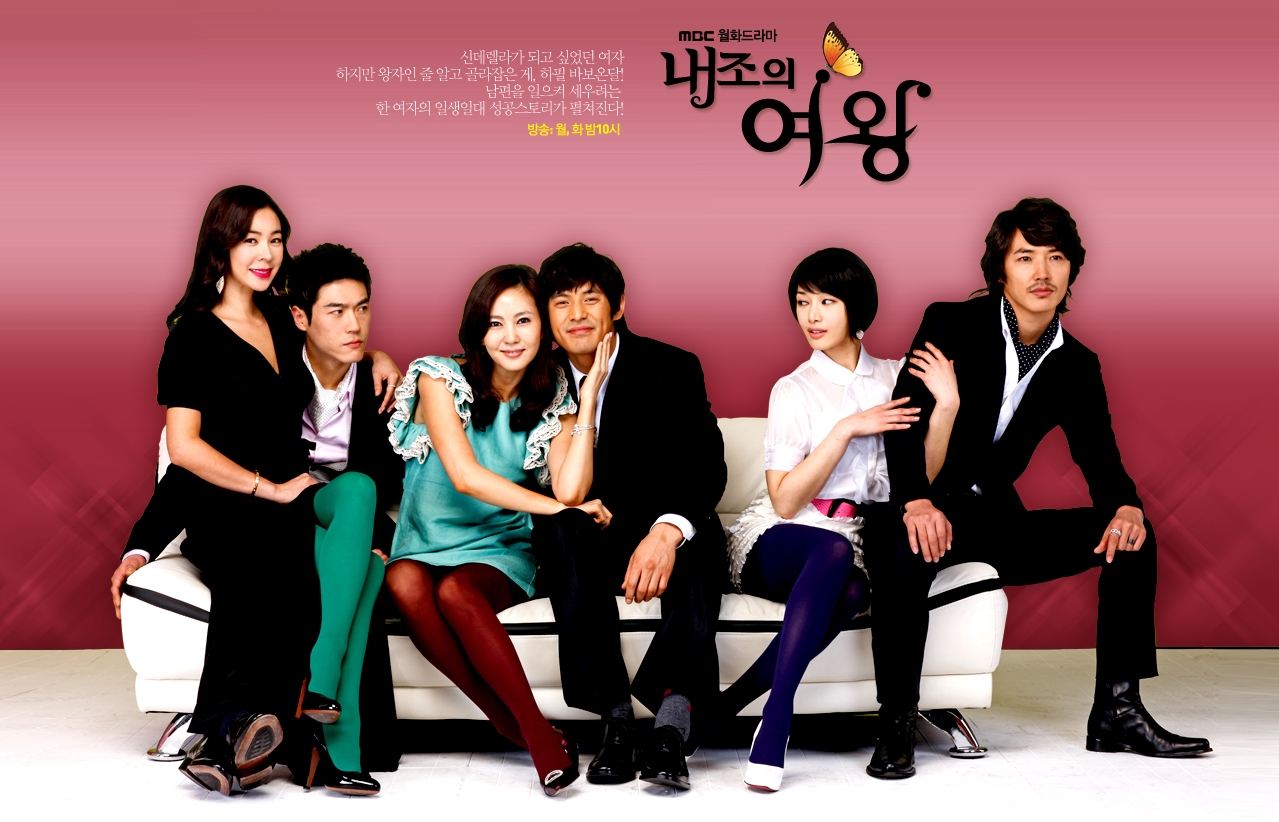
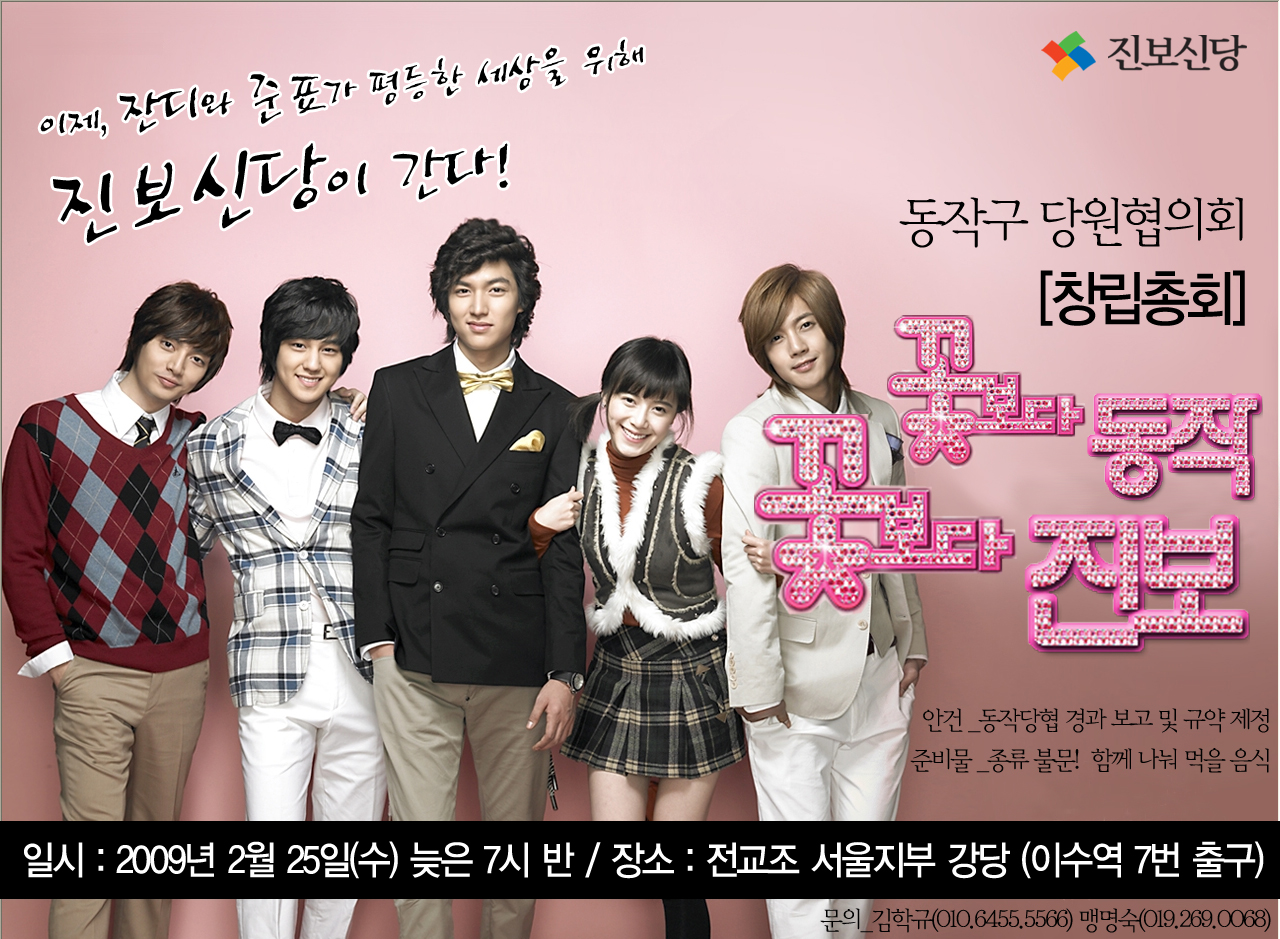
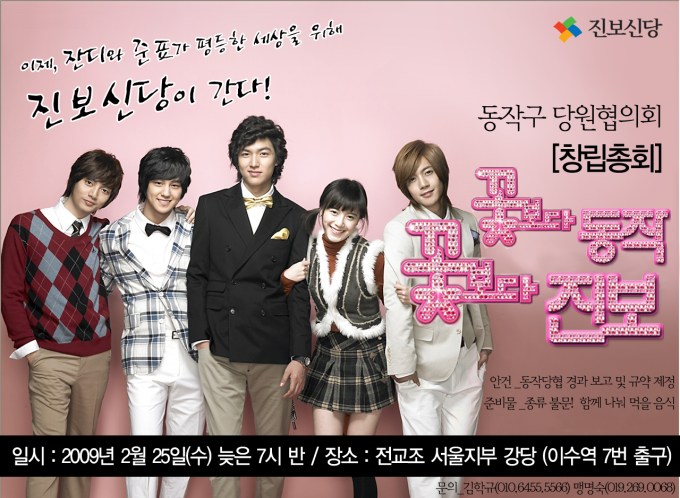
드라마 ‘꽃보다 남자’로 ‘꽃남’이라는 단어가 사람들 입에 오르내렸고, ‘내조의 여왕’의 윤상현은 ‘미중년’이라는 찬사를 받으며 남성들의 뷰티 열풍을 이끌었으며 그룹 에프터스쿨 멤버 유이의 매끈한 허벅지를 일컫는 ‘꿀벅지’와 배우 신세경의 ‘청순글래머’ 등은 여심을 자극하며 바디 열풍을 일으켰다. 여전한 ‘V라인’ 강세 속에 동안(童顔) 열풍 또한 이어져 ‘베이비페이스’라는 단어가 자주 회자됐다.

What were the hot keywords that led trends in the world of entertainment in 2009?

With kkotnam (flower man) and mijoongnam (beautiful middle-aged man), ggoolbokji (honey thighs), babyface and chongsoon-glaemor (innocent glamor) emerging, there were many very distinct trends compared to most years.

From the drama Boys Over Flowers the term “flower man” was on everyone’s lips; from Queen of Housewives the actor Yoon Sang-hyu received a lot of praise for his looks, spawning the word “beautiful middle-aged man” and a strong following among men wanting to emulate him; and women were similarly interested in the After School member UEE’s smooth and velvety thighs known as “honey thighs” and actress Shin Se-kyung’s “innocent glamor.” Finally, in addition to the eternal “V-line,” a strong interest in youthful faces has been shown by the new word “babyface” that is often talked about.
(Source: Unknown)

‘꽃남’·’미중년’, 남성 뷰티(美) 열풍

KBS 드라마 ‘꽃보다 남자’ 신드롬에 힘입어, MBC 드라마 ‘내조의 여왕’ 태봉이 (윤상현 분)가 일으킨 ‘미중년’ 열풍까지 남성들의 뷰티 열풍이 어느 해보다 뜨거웠다. 이를 계기로 남자도 외모 관리를 해야 한다는 인식이 공유되기도 했다.

거친 남성다움보다는 부드럽고 세련된 귀족적인 이미지를 선호하는 분위기로 바뀌며 성형외과나 피부과를 적극적으로 찾는 남성들도 크게 증가했다.

경제 성장을 이루던 90년대에 사회생활을 시작한 현재 30대 후반부터 40대 초반의 중년들은 전통적인 부모 세대와 달리 중년이 돼서도 문화와 여가를 즐기고 자신을 가꾸는 노력에 적극적이기 때문이라는 해석이다.

Combined, the flower man syndrome caused by the KBS Drama Boys Over Flowers and the beautiful middle-aged man craze caused by the character Tae Bong-ee in Queen of Housewives have led to men taking a great interest in their bodies. This is how the notion that men, like women, also have to take care of their bodies and appearance has become accepted wisdom.

In turn, as the preferred image of Korean masculinity has become softer and more polished, refined and noble, cosmetic surgery and skincare clinics are reporting a great upsurge in interest from men.

One additional reason for this is that even though men that grew up and entered the workforce in the 1990s are now in their late-30s and early-40s, they are very different to their parents’ generation, and choose to enjoy culture and their free time more, which includes taking a greater interest in themselves.

‘꿀벅지’ ‘소시지룩’ ‘청순글래머’ 바디 열풍 선도

올 한해 주목할 트렌드는 바디 열풍이다. 소녀시대의 지(GEE) 열풍과 함께 유행한 일명 ‘소·시·지(Gee)룩’. 몸매가 고스란히 드러나는 초절정 스키니진에 타이트한 티셔츠를 입은 여성들이 패션을 주도하면서 여성들의 S라인 욕구는 상승했다.

뒤이어 그룹 애프터스쿨 유이의 건강미 넘치는 탄탄한 허벅지가 주목을 받으면서 꿀이 발린 듯한 매력적인 허벅지라는 뜻의 ‘꿀벅지’라는 신조어까지 탄생했다.

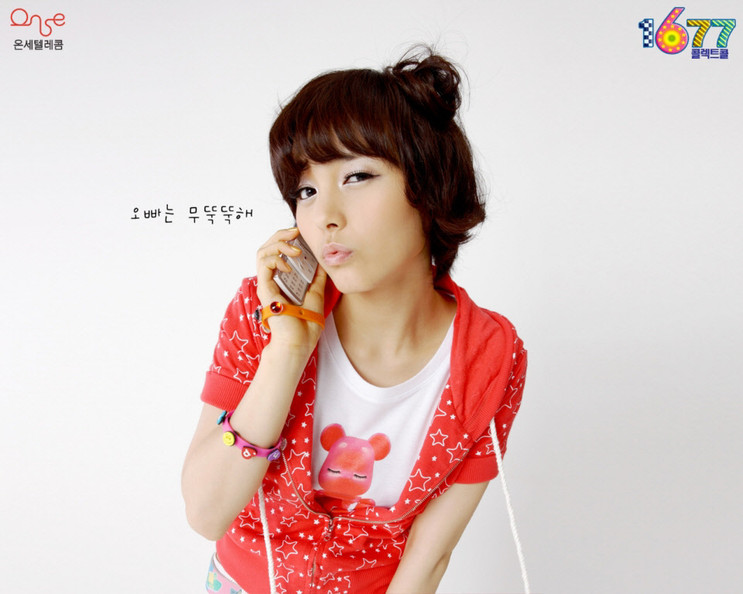
또한 요즘 주가를 올리고 있는 단어는 ‘청순글래머’. MBC 시트콤 ‘지붕 뚫고 하이킥’ 출연하고 있는 신세경은 청순한 매력과 섹시한 관능미를 동시에 지니고 있어 ‘청순 글래머’의 대명사로 불린다. ‘포스트 김혜수’로 주목받으며 휴대전화, 화장품 광고 모델 자리를 꿰차는 등 그 인기를 입증하고 있다.

이에 대해 그랜드성형외과 유상욱 원장은 “과거 여자 톱스타들의 상징이 ‘화장품 모델’이었다면 2009년은 이효리, 신민아, 송혜교, 손담비 등 청바지 모델로 그 중심이 바뀌었다”며 “이 같은 변화는 요즘 대중들의 관심이 바디로 옮겨지고 있다는 증거”라고 설명했다.

2009 was a real year of body trends. First, there was the very popular so called “sausage look” of Girls’ Generation. Hiding nothing, the ensuing fashion of wearing extremely skinny jeans and tight t-shirts among women has sparked an intense interest by women in their S-lines.

(Update — “Sausage look” may be a mistake, as the “소시”, or “soshi”, in “소시지(Gee)룩” is also the Korean shorthand for Girls’ Generation, and the “지”, or “gee”, the name of one of their most iconic songs. So the term may mean “sausage look”, or it may mean, literally, “how Girls’ Generation looked in the Gee music video”, in which they happened to wear skinny jeans. Either way, it’s a good pun!)

Next, as a lot of interest in After School member UEE’s firm, smooth and very healthy-looking thighs emerged, the new word “honey thighs” was coined to describe thighs like them.

Another word that’s stock is rising is “Innocent Glamor.” This comes from the actress Shin Se-kyung that appeared in the MBC sitcom High Kick Through The Roof, described as the icon for women who combine a pure and innocent image with sex appeal. Considered a second Kim Hye-su also, because of her popularity she regularly appears in cellphone and cosmetics commercials.

According to “Grand Cosmetic Surgery Clinic” owner Yu Sang-ok, “in the past the symbol of top female stars was the cosmetic model, but in 2009 women like Lee Hyori, Shin Min-ah, Song Hye-gyo and Son Dam-bi have been mostly modeling jeans instead,” and “this is proof that the focus of people’s attention has moved to star’s bodies now.”

(Source: Naver)

‘V라인’ 강세, ‘베이비페이스’가 위협

올해도 ‘V라인’ 강세는 여전했다. 뭐니뭐니해도 ‘동안’, ‘V라인’, ‘작은 얼굴’은 사람들이 가장 선호하는 이미지이기 때문이다. 갸름하고 부드러운 V라인은 첫인상부터 편안하고 친근한 장점도 있다.

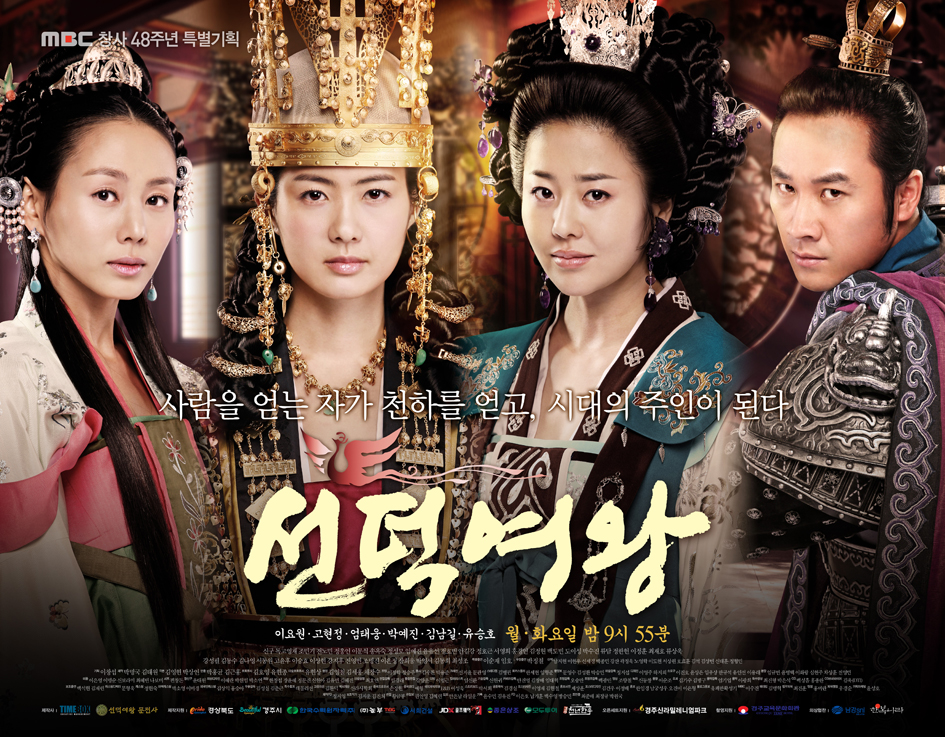
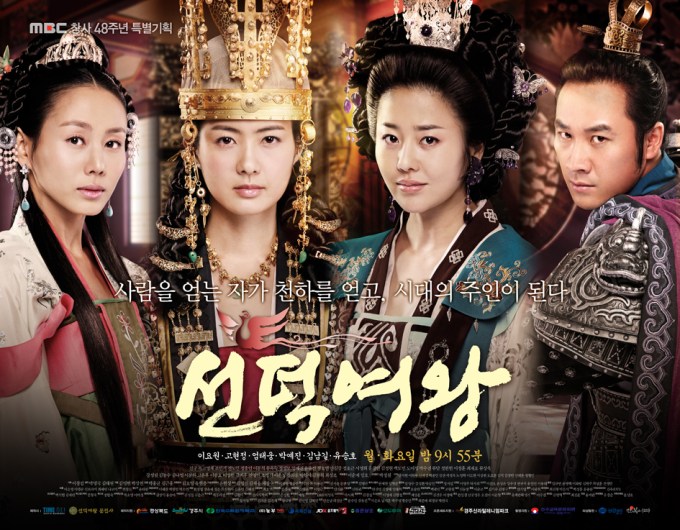
MBC 드라마 ‘선덕여왕’ 미실 역의 고현정은 소름끼치는 연기와 더불어 나이를 가늠할 수 없는 ‘베이비페이스’로 주목을 받았다. 투명한 피부는 물론, 볼륨감이 그대로 살아있는 생기있는 얼굴은 아기 피부 같다는 찬사를 받았다.

‘베이비페이스’는 ‘어려보이면서 입체적인 얼굴’을 말한다. 그 특징은 얼굴 옆이 아닌 앞쪽으로 볼륨감이 살아있는 얼굴로 콧등의 높이와 균형을 이루는 부드러운 곡선 모양의 탐스러운 이마 그리고 갸름하고 조금은 짧은 듯한 턱 선이 생명이다. 이러한 ‘베이비 페이스’의 열풍은 2010년에도 지속될 것으로 전망된다.

Last year, the emphasis on the V-line remained unchanged. After all, the preferred image is to have a dongan “youthful face [for one’s age],” V-line, or jakkun-olgool “small face.” And if you have a long, slender face with a V-line, people’s first impression of you will be softer and friendlier.

Hence the interest in the “Babyface” of actress Ko Hyeon-jeong, who played the character Lady Mishil in the MBC drama Queen Seon Duk, and whose acting was so good that she gave viewers goose pimples. With clear skin and glowing, firm cheeks, she has received a lot of praise for having a face as good as a baby’s.

But a babyface has been described as a “solid, 3D face.” In particular, it’s not just the volume of the cheeks on the side but also the balance with the bridge of the nose, the softness of the curves and the desirability of the forehead that make it look youthful. They look set to remain popular in 2010. (end)
(Source: Naver)

Like I said in an earlier post, I was embarrassed at not realizing how sexist the term honey thighs was when I first heard the term, but I doubt I would have if they’d been described like that instead. And continuing with the theme of  sexual discrimination, I was surprised not to see “chocolate abs” for men also; unlike the commercial that spawned it, perhaps the term itself is more 2010 vintage?

Regardless, please let me know if you can think of any others, and especially if you have alternative explanations for where any of the above ones came from!

Oh? Oh…!

( Source )

Call me old-fashioned, but although music videos can have a huge effect on my enjoyment of songs, I still try to judge them on their own merits.

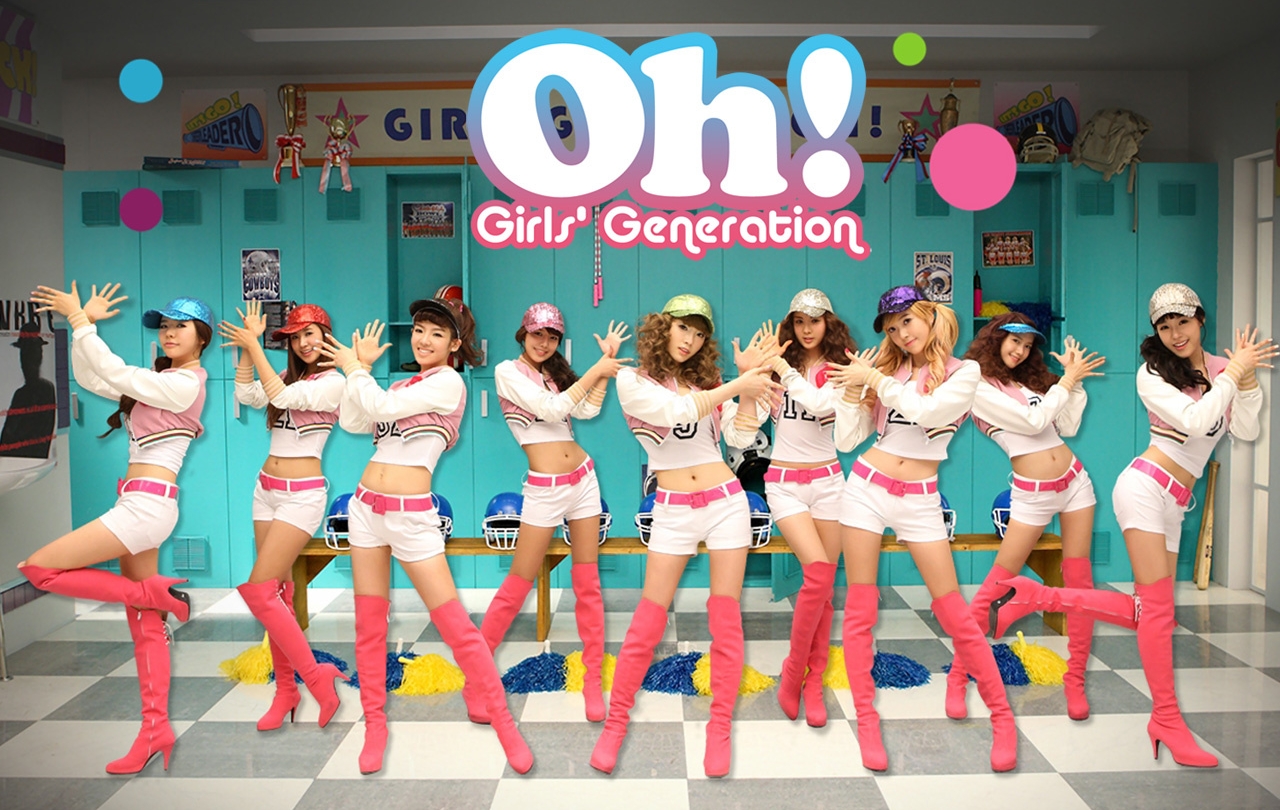
By that criteria, all of Girls’ Generation’s hits have fallen flat for me, no matter how photogenic the girls are. But then I found a remix of their latest hit Oh! by the Greek trance DJ “Areia”, and I immediately fell in love with it.

Like he says on his blog, he put a lot of work into it. And it shows.

True, it’s actually the only one of his K-pop remixes that I like, that of Abracadabra (아브라카다브라) by the Brown Eyed Girls being particularly disappointing. But I’ve only listened to a handful so far, and his abilities are definitely improving over time. To any other Korea-based trance fans out there, frequently lamenting at how something so popular in Japan could be so completely absent from the cultural radar here, I’m sure you’ll be just as happy as I was to have found him!

For the lyrics (and a translation) to the song, see Yeeun2Grace here, and if you’re interested and haven’t seen it already, then this video (via Extra! Korea) makes a pretty compelling case that the song has been plagiarized from U.S./Barbadian singer Rihanna’s Shut Up and Drive. If you’re disappointed in my not providing my usual critical analysis on this occasion though, then I apologize(!), and by all means read precisely that at Appears.
But if you’d still like to watch the original video, albeit now with the trance remix, then I do understand:

Click on the video itself to be taken to Ariea’s YouTube page, which has a playlist of his other K-pop remixes.

Update: There’s been a lot of speculation in the comments as to why the video’s concept is of cheerleaders hoping to get the attention of American footballers, simply bizarre considering that the sport has virtually no following here. So I posed the question to my two classes earlier today, and the combination of their explanations proves to be quite compelling.

First, my morning class mentioned the success of the movie Bring it On in 2000, particularly the song Hey Mickey from the soundtrack, and this struck a chord with me because men who would have been in their late-teens and early-twenties back then were precisely the demographic that SM Entertainment created Girls’ Generation for (indeed, Girls’ Generation has performed the song many times). While that may just be coincidence though, they also said that high school footballers dating cheerleaders have been a staple of American movies and dramas they’ve watched ever since, and they were at a loss for an equivalent in Korean pop culture.

My afternoon class disagreed that Bring It On was popular however, and this is borne out by the box office figures for that year. Instead, they pointed out that all Korean cheerleaders are adults, and so although the youngest members of the group are in fact turning 20 this year, to have presented them as Korean cheerleaders pining after Korean baseball or basketball players would have clashed with their image of being precocious teenagers. Recall that the song itself is about unrequited love for an older male too, which the exaggerated youth of the women singing it would help to emphasize.

In short, cheerleaders for high school American footballers were the only possibility because there are no teenage cheerleaders in Korea.

But my two classes’ explanations are not mutually exclusive of course, nor with some of the alternative explanations posted in the comments section here either. While I would like to corroborate them though, unfortunately analysis like that is severely lacking on the Korean internet, so that might have to wait until I investigate next month’s music magazines.

Meanwhile, I’m quite convinced personally, but what do you think? Please let me know, and perhaps I can get a dialogue going with my students!

Update 2: Despite 1 billion won (US$860,000) being spent on Girls’ Generations stage costumes last year, apparently there was little money available for making some props for this music video, so some store-bought ones with the Iowa Hawkeyes logo were used instead. You can just imagine the reaction of Hawkeyes fans

Share

The Dire Need for Sex Education in South Korea

(Source)

As you probably suspected, only a very small percentage of Korean teenagers are having sex. The average age that they started though, was as young as 14, and that doesn’t just affect them academically.

Or at least, that’s the take-away message of the news article below, which I was pleasantly surprised to see on the front page of Yahoo! Korea last week. Unfortunately it is rather sloppily written, raises more questions than answers, seems to ignore teenage prostitution and – in a typical irony – required age verification to search for it again the next day, but I’m cautiously optimistic that the information will lead to more calls for improved sex education at Korean schools. After all, it can hardly get any worse.

이른 성관계가 아이들에게 미치는 영향 – The Effects of Having Sex at an Early Age

“어린나이에 갖는 성관계는 아이들에게 어떤 영향을 끼칠까?”

얼마 전 청소년들이 성관계를 시작하는 평균 연령이 14.2세며 피임율은 38%에 불과하다는 조사결과가 발표되면서 우리나라 청소년들의 성 노출 연령이 점차 낮아지고 있음이 드러나면서 청소년의 성 문제가 다시 한 번 대두되고 있다.

대한산부인과학회지에 실린 ‘한국 청소년들을 대상으로 한 성행태 조사’에 따르면 2006년 9월 13~18세 중·고등학생 7만1404명 (남 3만7420명, 여 3만4200명) 을 조사한 결과 청소년의 성관계 시작 연령은 중학교 2학년인 14.2세(남 14.0세, 여 14.5세)였다고 밝혔다.

이들의 성관계 경험률은 5.1% (남 6.7%, 여 3.4%) 였으며 성경험자의 피임률은 38%에 불과했다. 또한 성관계 경험 여학생의 14%는 임신 경험이 있었으며 이 중 85%가 임신중절수술 경험을 했다.

청소년의 생식기는 생물학적으로 완전히 성숙된 단계가 아니기 때문에 바이러스가 침투하면 대항할 힘이 부족해 이른 성경험은 자칫 자궁과 생식기의 건강을 위협할 수 있고 여자의 경우 자궁경부암의 발병확률이 급증 할 수 있음을 전문가들은 충고했다.

“What are the effects of having sex at an early age?”

The results of a survey on adolescent sexuality released some time ago shows that the average age that adolescents are exposed to sex is gradually lowering over time. Of adolescents that have already had sex, the average age that they lost their virginity was 14.2, and only 38% of them used contraception. This is making teenage sexuality become a pressing social issue again.

According to the “Survey of Korean Adolescents’ Sexual Activity” published in The Korean Gynecological Journal, of the 71,404 13~18 year-old middle and high school students surveyed in September 2006 (37, 420 boys and 34,200 girls), the average age that they lost their virginity was 14.2, which is the second year of middle school (boys at 14.0, and girls at 14.5).

Of those students surveyed, 5.1% had sexual experience (boys: 6.7%, girls 3.4%), but only 38% of them had used contraception. Also, 14.1% of those girls had gotten pregnant, 85% of whom had an abortion.

Having sex before the genitals are fully developed means that the body’s ability to fight off viruses and repair damage to them is insufficient, and in particular girls have a much greater chance of developing cervical cancer.

이른 나이에 성관계 갖은 아이들, 대학 못간다 – Adolescents That Have Sex Don’t Want to go to University

완벽하게 몸이 성장하지 못한 상태에서 갖는 성관계는 신체적인 악영향을 끼치기도 하지만 더 심각한 것은 심리적인 부작용이다.

영국 글래스고대학이 지난 6년 동안 5000명의 학생들을 대상으로 성관계와 학업성취도의 상관관계를 조사한 결과 남녀 청소년 모두 이른 성경험이 자신을 어른처럼 느끼게 만들어 학업 등에 소홀해지는 경향을 보였다는 연구결과를 사춘기저널(Journal of Adolescence)에 발표했다.

연구는 14~18세 사이의 청소년들에게 성관계를 가진 그룹과 그렇지 않은 그룹을 나누어 계속 학교를 다닐 의향과 장래희망의 변화여부 등에 대해 묻는 방식으로 진행됐다.

연구결과 16세 이전에 이미 섹스를 경험한 청소년 중 39%가 대학 진학 등 학업을 더 연장하고 싶은 생각이 없다고 대답했으며 성경험이 없는 학생들은 24%만이 학업연장에 대한 뜻이 없는 것으로 나타났다.

앨리슨 파크스는 “청소년기에 성경험을 가지게 되면 더욱 이성과 함께 있는 시간을 원하는 것으로 나타났다”며 “일찍 성을 경험한 남녀 모두 마치 자신이 선구자인 것처럼 행동하는 경향을 보였다”고 말했다.

(Source)

While having sex before one’s body is fully developed is bad physically, the mental side effects are far greater.

A study of the sexual experiences and academic accomplishments of 5000 adolescent boys and girls conducted for the last 6 years by the University of Glasgow, published in the Journal of Adolescence, shows a negative relationship between the two. In short, adolescents with sexual experience tended to feel that they were already adults, and so paid less attention to their studies.

The study’s method involved dividing 14~18 year-olds into two groups: those with sexual experiences and those without, and asking each about their plans for the future. Of the 16 year-olds that had already had sex, 39% said that they had had enough of schooling and did not plan to go on to university, but only 24% of virgins felt the same way. According to Alison Parkson, this was partially because “those adolescents that first had sex at an early age wanted to spend more and more time with members of the opposite sex,” and that they “felt that they were pioneers.”

성관계 그 후, 밀려오는 불안감 – Anxiety and Depression After Having Sex

충동 에 이끌려 성관계를 맺은 후 정신적으로 미성숙한 아이들에게는 그제 서야 불안감이 물밀 듯이 밀려온다.

우리나라에서 청소년 시절에 성관계는 물론 이성교제 역시 불건전하고 몰래해야한다는 인식이 사회전반에 깔려 있다.

즉 아이들에게 이성과의 관계는 일종의 ‘죄’라는 이미지가 강하기 때문에 이성교제나 성관계가 이뤄지는 것은 단연 어른들의 눈을 피한 탈선의 상황에서가 주를 이루게 된다.

게다가 신체적으로는 임신이 충분히 가능한 나이고 또 그것을 본인들도 인지하고 있기 때문에 심한 불안감을 겪게 되는 것이다.

상담21성건강연구소 유외숙 박사는 “아이들은 무방비하게 인터넷에 노출되다보니 실제적인 것이 어떤 느낌을 줄까 하는 호기심과 욕구에 사로잡히게 된다”며 “그러나 섹스를 하고 돌아서자 마자 ‘임신했을까, 만족을 못시켰을까, 부모님에게 알려질까’ 등의 불안감이 찾아오기 때문에 자기평가가 상당히 낮아지게 된다”고 설명했다.

유 박사는 이어 “게다가 이런 고민들을 해결 할 곳이 필요한데 실제 청소년들이 문제를 들고 찾아갈 만한 곳이 없어 혼자 앓게 되는 경우가 많다”며 “이런 불안감이 심해지면 대인기피증이 생기거나 정말 성관계가 필요한 시기가 됐을 때 제대로 된 성생활을 못하게 되는 경우도 있다”고 덧붙였다.

(Source)

Adolescents that act on their urges to have sex before they are mentally ready for it tend to have feelings of anxiety, uneasiness and depression afterward.

In Korean society, there is almost a universal taboo against adolescents dating, meaning that they have to do it secretly. Indeed, having sexual relationships or even dating the opposite sex is virtually considered a crime by adolescents here, and hence that that which does occur is in places far from the eyes of adults.

In addition, as the girls are aware that there is a chance that they might get pregnant, then they in particular suffer a great deal of anxiety and depression.

According to Dr. Yu Wae-sook at Consult 21 Sexual Health Research Institute, “adolescents are defenseless against what they see on the internet, and naturally get caught up in and want to physically experience those things for themselves,” but also that once they do, “they worry about such things as if they are pregnant, if they were good enough and if their parents will somehow find out. This causes them a great deal of anxiety, and lowers their self-worth and confidence.”

Moreover, “adolescents don’t really have anywhere or anyone to go to for answers, and so have to continue worrying about them alone” and “that these worries can become so serious that they become reclusive. This can have grave consequences for their future sex lives once they reach an age when they would normally be physically and emotionally mature enough to start one.” (end)

(Source: Unknown)

As always, please feel free to correct any mistakes above, which is by no means a literal translation.

For more information about the issues raised, see here for a related survey conducted in 2003 and my analysis, and Matt at Gusts of Popular Feeling here for his on similar surveys conducted in late 2008; you may also find this recent post of mine on the Korean age of consent interesting. Meanwhile, I will try to find out more information about the survey itself in the next few days, particularly the methodology used!

Open Thread #5: So What?

Photo(edited) by Marco Xu on Unsplash

To get you started, a provocative comment I just received on an old post, which would be wasted in obscurity there. With apologies to the author if this sounds impolite, but I ultimately find much of his argument superficial, although it’s always good to have one’s views tested:

…Hi, just stumbled on to your blog last night in between reviewing flashcards for my Chinese class, and I have to say I’m thrilled to find someone as interested (at least in this and recent posts) in the topic of standards of beauty, particularly in Korea. I do however have to argue a point. And this isn’t necessarily aimed at you personally or the views you hold, but you seem to be a willing enough participant in the discussions that occur because of your blog posts that I though I’d give it a shot.

Looking back over said “beauty” posts, I continually find myself asking, “so what”? So what if Koreans openly put an exceptionally high standard on external appearance? So what if women in Korea try to become most easily divisible by which letter they most look like? So what if even kids are targeted by the media in what amounts to little more than marketers seeking the widest possible audience?

Is all this something that doesn’t happen in western countries? You yourself have said that it is not.

Granted, I come from something of a biased perspective in a number of ways. First of all, I don’t think of women in ad campaigns, subconsciously or otherwise, as sex objects because I’m gay. Secondly, from my “objective” perspective on feminine beauty, I tend to lean more towards the thinner, petite side of women that are shown so ubiquitously in magazines from Vogue downwards. Thirdly, as someone who has been very tall (6′5″, so ~195cm)and called thin all his life almost in place of standard introductions, I can see where all of the body-consciousness in our society comes from; it’s only natural to judge someone first and foremost on appearance.

Source: unknown

Anyway, back to the gist, I have to say, is it a bad thing that Korean ad firms target womens’ physical appearance so blatantly? After all, at least it seems as though a Korean woman knows what’s expected of her in terms of appearance. In the West, on the contrary, we constantly say that size doesn’t matter, which we know perfectly well to be false. Heterosexual males may not be as turned on by a 100lb, 170cm woman as they are by one maybe 20lbs heavier, but the upper limit to what most males find attractive, by my subjective observations, is significantly lower than what the average woman in the U.S. (my country of residence) now weighs. Because we’ve told women (and men) that size doesn’t matter, things have, to be polite, gotten out of hand. According to the U.S. gov’t, which calculates these things based on body-mass index (admittedly a very poor way of doing so, basically just weight divided by height), more than two-thirds of women in America are overweight.

Although of course there are exceptions, in most East Asian countries overweight and obese people, particularly women, are fairly rare. I think in part it’s because the culture in that part of the world (yay generalizations!) says outright that size does matter, whereas we say it doesn’t, but really it still does.

In short, long-winded post aside, I’d rather be in a country where people say to my face that I’m fat instead of whispering it to each other as I walk by. At least that way, the social pressure to be thin is so much greater and clearer that it can’t be overlooked or downplayed to save face for those applying that pressure. And in terms of health, I think more would rather be underweight than overweight. After all, eating disorders affect, what, about 10% of women in the U.S., while obesity-related diseases kill millions each year. Just from the perspective of someone living in the U.S., I think maybe being a bit more upfront about the natural inclination towards “thinner” (when compared to the national average) women may not be such a bad thing after all.

Then again, having never been to Korea, you’re more able to say whether this is quite so helpful there as it would be here. Of course, culture aside, that brings us to the question of whether certain ethnic groups are naturally thinner or not, which is another issue entirely of questionable validity and fairness…(end).

Source: Cocofun

Actually I don’t disagree with all of that, and by coincidence its “so what?” tone struck a chord with me because of some similar advice about writing I’ve been putting into practice in recent months. Unfortunately, I feel too guilty about my daughters being glued to the television for hours to provide a proper critique this weekend sorry, and will have to rely on my choice of accompanying images to speak for themselves. Besides which, I’m much more interested in what you think!

If you reside in South Korea, you can donate via wire transfer: Turnbull James Edward (Kookmin Bank/국민은행, 563401-01-214324)

Sex and the Red-Blooded Woman

Remember these?

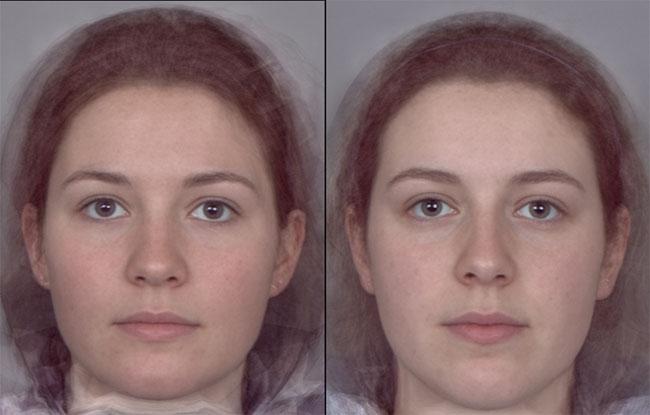
I first came across them back in 2008, the first time I really tried to understand Korean women’s penchant for skin-whitening. While it turns out that I originally misinterpreted what the images above were, from a 2005 study of the relationship between female attractiveness and hormones, one of its conclusions remains the same: the redder a women’s cheeks, the sexier.

In brief, the images are 2 composites made from 2 separate groups of 10 women each from the study (out of 59), all taken on the days they were ovulating, i.e. when they were most likely to get pregnant. On the left is that of the 10 women with the highest estrogen levels on that day in their menstrual cycles, and on the right of the 10 women with the lowest.

It sounds mean to the latter, but I’m sure there’d be little argument as to which women are the more attractive.

While I’ve touched in passing on the role of hormones in human sexual attractiveness many times before however, most notably the fact that women with (arguably) universally-attractive hourglass figures have much more estrogen than those with other body shapes, making them up to 3 times more likely to get pregnant, I don’t mean to imply that one’s preferences in the opposite sex are nothing but a reflection of their hormone levels.

Source: Pixabay @Pexels.

For example, all things being equal, then men with high testosterone are better mates for women, as that is a good indicator of physical health. But while a great many women might find men with “masculine” jaws like Harrison Ford irresistible however, that is not the same as saying that they would automatically choose to have children with them over more “feminine” men, as those same high hormone levels tend (and I stress, only tend) to make them poorer fathers relative to their more average rivals.

But ideally, women would get pregnant by the hunks, and trick other men who were better fathers into raising them, thinking they were their own. And one way in which men try to prevent this is by spending much more time with their female partners when they are ovulating, thereby ensuring that they don’t get a chance to have flings with those dashing Harrison Ford types just when they’re most tempted to. (Women in heterosexual relationships, take note of the extra attention right about the same time you feel like a night out with the girls!)

On the women’s side, one way to ensure that he doesn’t have flings when you’re having your period, thereby potentially having children with other women who will take some of his time and resources away from your own, is to trick him into thinking that you’re actually ovulating instead. And how best to do that?

Well, remember those red cheeks in the opening image?

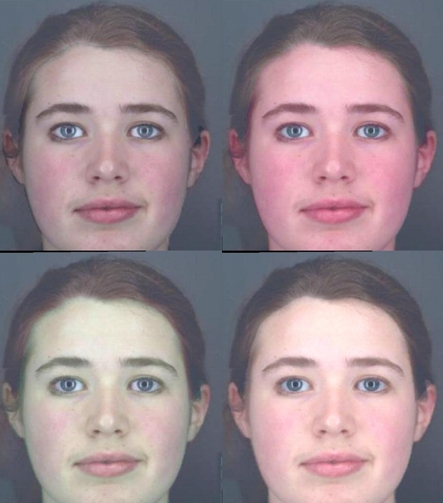
I confess, I haven’t actually had many conversations with women about why they wear blusher, and invariably they’ve just said they do so out of habit, and/or that it makes them look prettier. And indeed it might, in the sense that if one associates red and pink with femininity (for whatever cultural and/or biological reasons), then wearing it would certainly make one appear more feminine. But in a new study by Ian Stephen and colleagues at the University of St. Andrews in Scotland, one more very good reason to wear it has been revealed. In short, as Jina Pincott at Love, Sex, Attraction…and Science explains, they:

…recruited volunteers of various races and asked them to digitally adjust the color tone on more than 50 faces [of both sexes] to make them look as healthy and attractive as possible. Volunteers consistently added more red coloring to the cheeks — whether the face was Caucasian, Asian, or Black. The redder the face, the more suggestive it is of oxygen-rich blood reaching the skin. The more oxygen-rich blood, the more suggestive it is of the person’s general health and youth. An old person, a sick person, a person with hypertension or bad circulation…will not get rosy-cheeked.

And crucially, the researchers also found that volunteers preferred women over men with rosy cheeks. Why?

One reason may be the sex hormones, which show up more obviously in flushed female faces. But it may also be due to the fact that men already have ruddier faces than women do — they have higher levels of hemoglobin and arterial oxygen content in their blood. As a result, the male blush is not as obvious a cue of good health and high sex hormones.

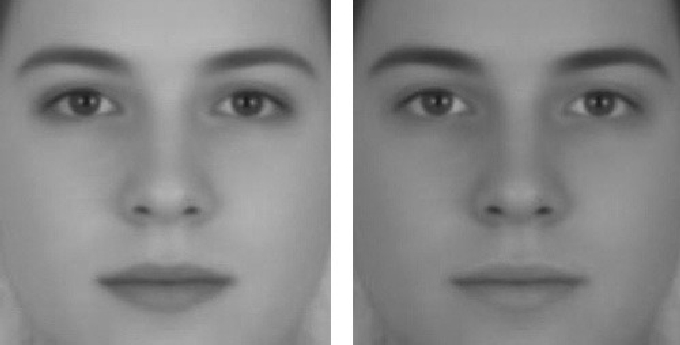
Corroborated by this study that I discussed back in May, which showed that people tend to judge the same androgynous face on left as female because it is much lighter than that on the right:

In my view then, and regardless of my opinions on its origins, skin-whitening is an enduring but fundamentally anti-instinctive cultural practice. Or is it?

Despite all the above, please bear in mind that interpretations and explanations of otherwise objective studies of human attractiveness can in practice be very culturally determined…not least my own. For example, as an impressionable 19 year-old I became a huge fan of evolutionary psychology after reading this article in Time magazine in 1995, and in turn the sociobiological explanations of human attractiveness that are its bread and butter. But just 4 years later, I was suitably chagrined by a second article in the same magazine that exposed the fact that, for one, evolutionary psychologists’ depictions of the work division in hunter-gatherer societies was remarkably like that of 1950s suburban nuclear families. More recently, Bad Science provides a scathing critique in much the same vein, including of some of the specific points I’ve mentioned in this post, and while I share many commenters’ concerns that author Ben Goldacre doesn’t seem to appreciate the differences between media reports on evolutionary psychology and the discipline itself, he does make some valid points.

So please feel free to question anything here yourself also! And I have a request: while writing this post, I realized that I’ve never actually asked any Korean men themselves if they prefer women with light skin, let alone why. With apologies for my lack of field research then, can anyone that has please let me know? I have a sneaking suspicion that it might pressure to do so might primarily come from other women rather than men, just like I recently read somewhere is the case with losing weight, so I’d be very interested in finding out.

If you reside in South Korea, you can donate via wire transfer: Turnbull James Edward (Kookmin Bank/국민은행, 563401-01-214324)

Open Thread #4 (Updated)

Have a nice weekend everyone! I’m off to a wedding in a couple of hours myself, then buying a couple of books on the Korean media to try and begin to place the censorship of recent years – invariably quite arbitrary, hypocritical, and inconsistent – into some sort of context, most likely that of the corporate interests of the various ministries and companies involved themselves.

Note that I’m talking largely about censorship of sexually-related material though, obviously influenced by but not directly related to the general curtailing of media freedoms under the Lee Myung-bak Administration. And why yes, after thinking deeply about and rejecting several other possibilities over the last two weeks, something along those lines is indeed what I’m going to settle on for a 50,000 word MA thesis topic, finally getting the application process started by perhaps the end of next month. How did you guess?

Seriously though, I’d be very happy and very grateful to bounce ideas off readers this weekend before I present something to my supervisor, but of course I’d also be happy to chat about anything else Korea and/or sociology-related readers are interested in. And perhaps that discussion about censorship should wait until Monday really, when I’ll have finished my post about what has effectively been censorship of a recent sexually-themed webtoon of Girls’ Generation. Yes, that one, and I forbid discussion of it until then!^^

Update: That post will be slightly delayed sorry, caused by my eldest daughter having a high fever all day Sunday, with the most violent shivering from her I’ve ever seen. Fortunately it doesn’t appear to be meningitis, but to make sure my wife and I will have to keep a vigil overnight in case her temperature goes up too much.

Share

Sex, Marriage, and Sex Work in South Korea

Korean Wedding Sidelong Glance(Source: Matt Scott; CC BY 2.0)

With my considerable gratitude to its author for passing it on, I’ll let the following email speak for itself:

…As a foreign woman married to a Korean man, myself and my husband face a unique set of cultural obstacles in our marriage. It can be trying at times, but we are usually able to work out our differences through a serious commitment to communication. However, there is one aspect of being married to a Korean man that I continually struggle with. From what I have observed throughout my time in Korea (and please correct me if I’m wrong), it seems that frequenting prostitutes is an accepted part of life for Korean married men. In fact, it is often required of businessmen if they want to be successful and accepted among their coworkers. For example, I have a friend who was offered a highly coveted position with a certain large corporation. While working there, he was required to regularly go out drinking and visiting prostitutes with his team. Given the strong hierarchical nature of Korean society, he felt unable to say no to his superiors, yet his religious beliefs compelled him to reject this lifestyle. As a result, he had no other choice but to quit and try to find another line of work.

I am told by Korean friends that going out drinking and womanizing with coworkers is an integral part of business in Korea (and, I imagine, another way that female employees are excluded and held back in business). Although this was shocking to me at first, it wasn’t hard to believe once I became more familiar with the language and more observant of my surroundings. It’s impossible to go anywhere in this country without being faced with a constant barrage of prostitution venues. Of course, they often masquerade as something else- massage parlors, karaoke rooms, barber shops, tea shops, PC rooms, bars, rest houses, etc., but they all offer at least the possibility of sex. It’s not exactly comforting to walk around in the middle of the day and see middle-aged men in business suits going into cheap motels on their lunch breaks or after work before returning home to their families. Although I know my husband is a good man and he has assured me that he’ll never engage in that type of behavior, I find it hard to trust him completely when every man in his life, including his father, his friends, and his mentors, sets this kind of example.

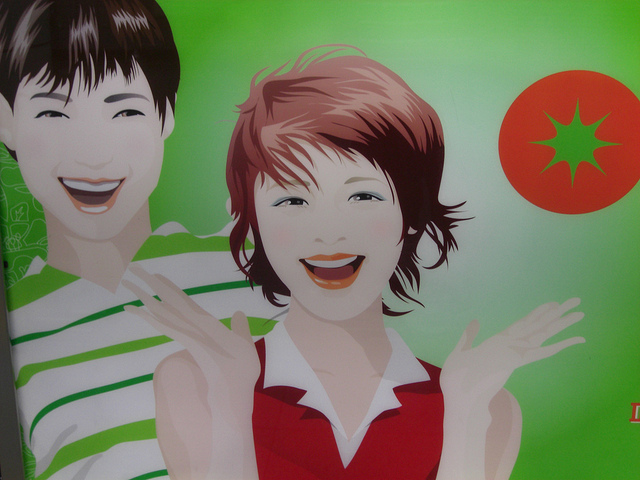
When I ask my female friends how Korean women put up with this from their husbands, they tell me that it’s what the men must do if they are to be successful. One said that even though the husbands stay out all night with prostitutes, drink with them, touch their bodies, etc., it is their choice whether or not they go all Korean Tomato Couplethe way. I simply can’t wrap my head around this rationalization. Where I come from, if a spouse cheats, it is expected that the couple will either get divorced or go into some serious marriage counseling. It is not simply tolerated, or at least not by those who have any self-respect. As I love my husband deeply, my greatest fear is that he will give in to his peers and join them some time, resulting in the end of our marriage. I can’t conceive of how Korean men can not only hurt and disrespect their wives like this, but also spend all their time fraternizing with coworkers and women rather than spending it with their children. This aspect of Korean culture is toxic to families, and is one of the reasons I don’t believe I could raise a family in Korea. I am truly interested to hear how other married women – both Korean and foreigners – deal with this problem. Have they experienced the same fears that I have, or have their experiences been different? Do they tolerate their husbands going out with coworkers and meeting women, and if so, why? Finally, for those like me who are greatly disturbed by this aspect of the culture, how do they overcome these anxieties and learn to trust their husbands? (end)

Korean Businessman Playing Guitar(Source: Simon Helle Nielsen; source above: Shawn Perez. Both CC BY 2.0)

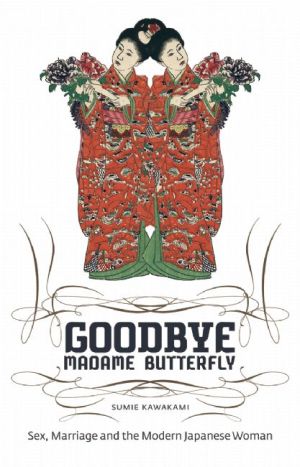
As I too would soon quit any job that required regularly drinking with colleagues, let alone visiting prostitutes, then I don’t have anything to add to the email I’m afraid. But I can point you towards my discussion of the effects on married couples’ sex lives, based around my review of Goodbye Madame Butterfly: Sex, Marriage and the Modern Japanese Woman by Sumie Kawakami (2007); as I explain there, the experiences and attitudes described there are very relevant to Korean couples, largely because both countries share the same salaryman working culture, with husbands (and indeed wives) working late most evenings.

Also, by coincidence Michael Hurt at the Scribblings of the Metropolitician has just written a post on Korean society’s denial of the pervasiveness, ubiquity, and above all systematic nature of prostitution that is highly relevant to the discussion here. A snippet:

…I posit that the resistance to what every outsider observes as KOREAN SOCIAL REALITY in terms of the commodification and subjugation of women in this society, especially as embodied in the rampant institutionalized prostitution that is as observable in terms of the sheer numbers and types of such places of business (room salons, business clubs, barber shops, massage parlors, handjob rooms, juicy bars, miin-chon, 단란주점, 도우미 노래방, which goes without even mentioning the vast numbers of red-light districts in every part of Seoul and every city in Korea) NARY REQUIRES statistics, either.

What I see as the frequent resistance of people to believe something that is OBVIOUS in observed reality if one simply COUNTS the number of houses of prostitution on a single city block in any part of this city — Kangnam Station to Shinchon to City Hall to Apkujeong to Chungdam to nearly any neighborhood after midnight, when the plastic balloons, mini-trucks, and neon signs come on that aren’t on during the day — is partially a denial of obvious reality, coupled with the urge to throw out the many statistics that bolster easy observation because they make one very uncomfortable.

But I’m a human being. I understand emotions. But what makes it so easy for me to recognize that the US brutally kidnapped, displaced, and murdered MILLIONS of human beings for the sake of material gain, which has resulted in creating some negative aspects to my culture, i.e. discrimination and institutionalized racism? But when I mention institutionalized prostitution as a legacy of compressed and authoritarian development in the Korean context, people instantly start equivocating and dismissing my argument, while holding it to such an abnormally high bar of scrutiny, one would be hard-pressed to assert ANYTHING particular about Korean society….(end)

Read the rest there.

Related Posts:

Korean Women Angry at Being Promoted Less Than Men

Gender Gap Angry Woman(Source: TheDailyEnglishShow.com,via studio tdes)

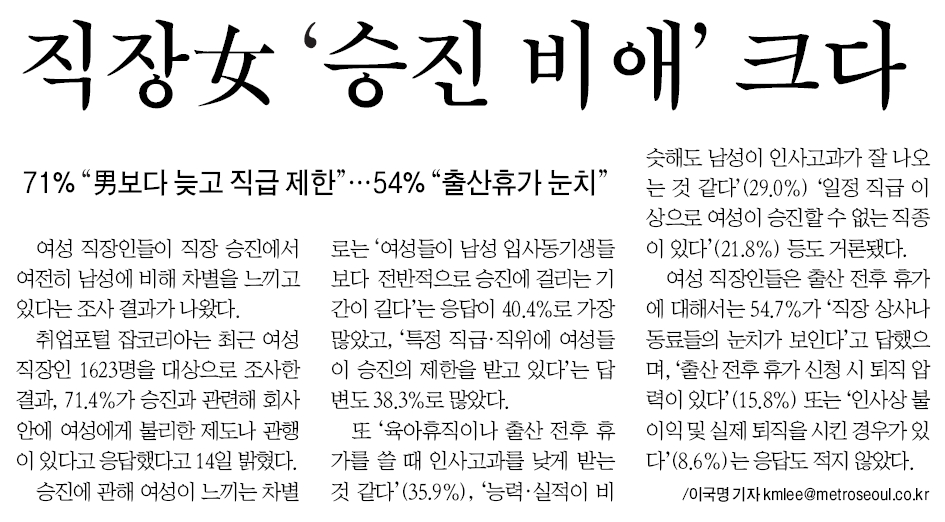
A snapshot of some of the different forms of sexual discrimination experienced at Korean workplaces, from the January 15 edition of Metro Busan:

Women Workers’ “Promotion Grief” is Big

71% Say “Compared to Men, Promotions Come Late and with Limits”…54% Say “We Feel Inhibited From Asking for Maternity Leave”

A survey of women workers has revealed that when it comes to promotion, they still feel that they suffer from sexual discrimination.

The results of a survey of 1623 women workers by job portal site JobKorea, released on the 14th, showed that 71.4% believed that the promotion systems at their companies placed women at a disadvantage.

Asked for more information about this discrimination, 40.4% [of the 1623 women] said that “compared to men that enter the company at the same time, women have to wait longer to get promoted,” and 38.3% added that “women are excluded from some higher positions.”

In addition, 35.9% mentioned that “if we take maternity leave or time off before and after giving birth, we get lower scores on our evaluations by the personnel department,” 29% that “even if we have the same ability and practical know-how as men, we get lower scores,” and 21.8% that women simply are excluded from certain kinds of jobs.

Also, 54.7% replied that they found it very difficult to ask their superiors or coworkers for time off for childbirth, 15.8% said that they felt pressure to quit their jobs after having a baby, and finally 8.6% were aware of cases where recent mothers were indeed forced to quit. (end)

With no information given about the methodology used, then all those results should be taken with a grain of salt unfortunately.

In particular, considering that it is still common practice to fire women upon marriage, then that last figure sounds rather low to me. Also, consider that before the current economic crisis, not only did Korea already have one of the lowest women’s workforce participation rates (and the highest wage gap) in the OECD, but that those few that did work formed a disproportionate number of irregular workers. This ensured that they would be laid-off en masse last year (see #15 here also), and they are unlikely to return to work soon given Korea’s jobless recovery.

(In stark contrast, the decline in the construction industry in the US, for instance, means that for the first time in history actually more women work than men there now.)

Meanwhile, the effects of all the above on Korea’s low birthrate have also been somewhat predictable, now the world’s lowest for the third year running. But never fear, for the Korean Broadcasting Advertising Corporation (KOBACO) is on the case:

(See here {Korean} for more on the making of the campaign)

In KOBACO’s defense, the first women featured does actually have a job. Is it churlish of me to point out that she still goes home early to cook while her husband burns the midnight oil…?

Update 1: Lest the commercial not succeed though, then the Ministry for Health, Welfare and Family Affairs (보건복지가족부), in charge of raising the country’s birthrate, is insisting that its employees go home at 7:30 pm on the third Wednesday of each month, all the better to have sex with their partners and have more babies.

No, unfortunately I’m not making that up.

Update 2: This satire of that is so good, it’s difficult not to believe that it’s the real thing!

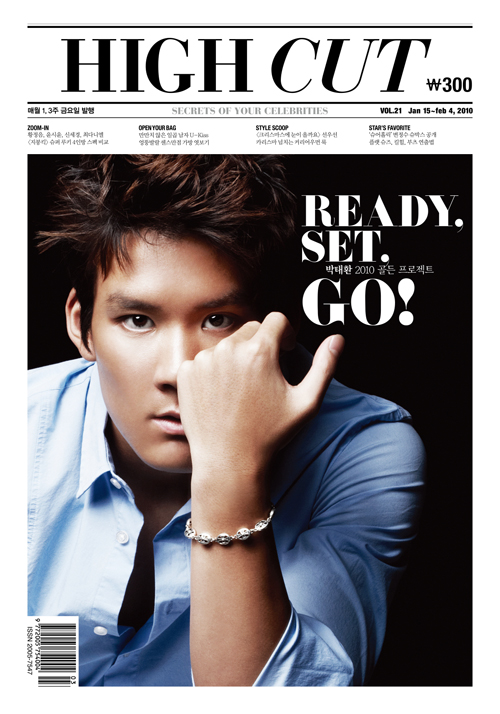
Korean Photoshop Disaster #3: Park Tae-hwan’s Babyface

( Source: High Cut )

Granted, it’s not the most egregious case of a Korean athlete’s face being photoshopped. That dubious honor still remains firmly in the hands of Gillette Korea, whose choice of pockmarked Manchester United footballer Park Ji-sung (박지성) to endorse them last year is probably also the most glaring example of the over-reliance on celebrities in Korean advertising too.

Unlike him though, youthful Olympic medalist Park Tae-hwan (박태환) already has unblemished and unusually smooth skin, which raises the question of what the photoshopping was for exactly?

Personally, it reminds me of the airbrushing of Milla Jovovich’s face in Resident Evil: Extinction (2007), which many viewers found unnecessary, confusing and/or distracting. Indeed, while I’ll be the first to admit that Tae-hwan has a great body (more of which you can see in the last post), and with the proviso that I’m a (jealous) heterosexual male, I’d say that in the second picture in the series his now somewhat seal-like face simply draws too much attention away from his abs…

Can anyone think of similar examples, particularly Korean ones? Please pass them on!

(For all posts in the Korean Photoshop Disasters series, see here)

Share

Korean Sociological Image #30: Exploiting Koreans’ Body Insecurities

Like everywhere else, Korea has a long tradition of celebrities endorsing government campaigns.

Unlike everywhere else, a “huge proportion of Korean ads depend on famous people,” says Bruce Haines, head of Korea’s largest ad agency Cheil Worldwide, a tendency which in its crudest form degenerates Korean advertising into merely “beautiful people holding a bottle.” In turn, that leads to a scramble for and subsequent overexposure of whichever Korean stars are most popular at that moment, regardless of their inappropriateness for the product(s).

Government campaigns are no different, to my mind the most notorious case still being the National Election Commission’s (중앙선거관리위원회) choice of The Wondergirls (원더걸스) to encourage people to vote in local elections in April 2008. Needless to say, I can’t think of anyone more inappropriate than teenagers (two of whom were only 15), and their choice of outfits simply beggars belief:

Vodpod videos no longer available.

But again, no different to what they wore in commercials at the time. Which is precisely my point: regardless of their merits, major trends in advertising are bound to be reflected in government campaigns sooner or later.

And as long term readers of this blog will be well aware, one trend is encouraging consumers to associate certain foods and drinks with certain desired body shapes. While it is hardly unique to Korea, it is done to excess here.

Is it any wonder then, that with the decline of the domestic rice industy, and concerns food security as a whole, that the government would do the same when promoting the consumption of domestic foods and drinks?

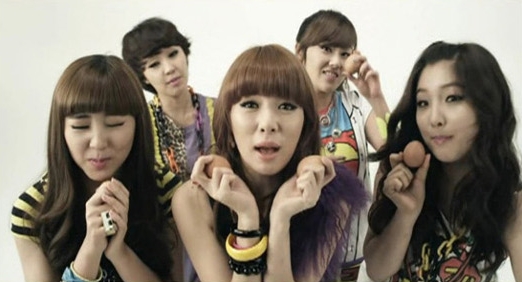
Last year for instance, I gave the example of how the Korean rice wine Makgeolli (막걸리) was being marketed to women on the basis that it is supposedly good for one’s skin. Now, I’ve found two more examples by the Ministry for Food, Agriculture, Forestry and Fisheries (농림수산식품부; MIFAFF), using the new group 4Minute (포미닛) and the Olympic medalist Park Tae-hwan (박태환) respectively:

Vodpod videos no longer available.

Vodpod videos no longer available.

To be clear, I am not saying that either are inappropriate choices. Actually I think they’re rather good: both are very popular, and it turns out that 4minutes’ egg song is a variation of their recent hit “Hot issue” too. I also fully concede that the connections between consumption of the product and obtaining an attractive body are fleeting (4minute) or merely implied (Park Tae-hwan) at best.

But still, they’re there. And given the long-term problems with Korean agriculture as identified above, then I hereby predict that we’re going to be seeing many more public campaigns like these in 2010. In particular, the links made between the products being advertised and obtaining an “S-line” and so on are going to be made more explicit.

Sound like an exaggeration? Well, recall how quickly commercial incentives have transformed decades-old standards for soju advertisements: just three years ago, they overwhelmingly offered virginal images of women, whereas now it’s rather difficult to find ones that don’t present them as eminently sexually available. Moreover, in an effort to appeal more to women, soju companies too are encouraging them to associate new lower-strength brands with maintaining a good body, however implausibly.

But perhaps an even more appropriate example is soy milk. If you’ll bear with me, being allergic to milk means that I follow developments in the soy milk industry here pretty closely, and Starbucks Korea’s belated decision to add soy to its menu in 2005 had a huge impact on my quality of life here! Not unlike the drinks themselves though (anybody know where I can find these flavored ones?) – or, indeed, government campaigns – soy milk commercials tend to be rather bland, so I certainly sat up and took notice when I first saw this one a few days ago:

Vodpod videos no longer available.

Soy milk companies too then, seem to be adopting the tactics of their more popular counterparts now. Lest I appear overly critical though, consider the scene 0:03 from 0:06 where 17 year-old Kim Hyun-ah’s says “[S]라인을 유지하려면 어쩔 수 없어,” or “If you want to maintain your S-line, you have no choice but to [drink] this.” Despite my constant criticisms of that sort of thing, and my earnest desire that my daughters don’t grow up to repeat it, I have to admit that I can’t help but find her expression and tone of voice, well, extremely cute…

Yes, I know: very hypocritical of me, and I await your counsel. But on a final, more serious note, consider Garaetteok Day (가래떡데이), MIFAFF’s scheme since 2006 to get people to eat stick-shaped rice cakes instead of Pepero chocolate sticks on November 11 each year. Promoted mostly as a romantic event for couples, as are most imported and/or artificially created holidays (Christmas Day, for instance, is the date the most condoms are sold in Korea), is it really too much of a jump to imagine that concerns about one’s appearances will be added to that too? Watch this space!

Update: An alternative way of exploiting Koreans’ associations with November 11 (source):

(For all posts in the Korean Sociological Images series, see here)

Share

What IS the Age of Consent in South Korea?

Considering the abysmal state of sex education in Korea, part and parcel of a society reluctant to admit that teenagers have sex or even sexuality, then the notion that it’s only thirteen sounds simply absurd.

Despite myself though, that’s precisely what I’m going to argue.

Not because that’s the consensus of English-language materials on the subject however. The vast majority never provide a source for their information on South Korea specifically (see here, here, here and here for some examples), and following the trail of those of that do almost invariably leads to a chart of the age of consent in various countries on Wikipedia, itself unsourced (but which has recently been edited as I’ll explain). Indeed, highlighting how problematic that makes them was my original intention in writing this post.

But first, the catalyst was this post at Omona They Didn’t!, a popular K-pop site. There, commenters discussed singer G-Dragon’s (지드래곤) concert performance below that featured simulated sex scenes, and which he is now being investigated for (but not yet prosecuted) because it had been rated suitable only for ages twelve and above (see here, here, here, here and here for the latest developments). Arguably somewhat arbitrary and hypocritical considering similar performances by other singers that haven’t been, the outrage is even stranger if the age of consent is thirteen, as pointed out there by a commenter with the handle “hallerness.”

(Update: See here for a detailed explanation of what exactly happened at the concert and the legal response, including an interview with the performer on the bed)

Queried on that low age by other commenters though, this blog got mentioned, and she emailed me asking for clarification. With apologies for the delay, this post is my response.

The first step in preparing it was simply to ask my students. But although their confusion was not entirely unexpected (whereas I’ve been writing about Korean sexuality for a long time now!), it still took a great deal of time and effort to explain what the concept was.

Not to imply that they’re stupid and/or ignorant of course, but that Korean adults needed an explanation at all is surely indicative of how alien the notion of teenage sexuality is here (or at least public discussion of it).

Once that was out of the way, then all said it was 18, like I also thought: after all, almost everything else sex-related is, including buying contraception, having access to or appearing in pornographic materials, and working in de facto sex-related industries. But they had no idea of what the Korean term was, hesitant suggestions including 법정나이 (literally “correct age”) and 법적나이제한 (correct age limit).

Turning to an online dictionary next then, I found 성관계 승낙 연령 (sexual relationship consent age) instead, with the explanation 합법적으로 성관계를 승낙할 수 있는 연령 (legally sexual relationship can consent to age). Paste it into Korean search engines, and you do get some results, although most appear to be about Canada (see a little later for why). Rather than wading through those though, I had no hesitation in turning to Matt at Gusts of Popular Feeling instead, who has written a great deal about teenage prostitution. And fortunately he does have a post in which he discusses this issue.

To be specific, it is about controversial rulings in two teenage prostitution cases in July 2001 and July 2009 (known in Korean as wonjo gyoje; 원조 교제). And while technically The Korea Times articles he quotes also do not mention any specific law, the age of consent being thirteen proved crucial in both cases, and I recommend reading his post in full to understand why.

From the 2001 article (link broken):

Under related laws, those who have sex with minors younger than 13 should be punished, regardless of whether the minors agreed or whether there was a financial deal. However, having sex with minors aged 13 or older, which does not involve financial deals, is not punishable if the minor consents.

And from the 2009 one:

In Korea, a person is not guilty of any crime for having sex with a minor aged 13 and over unless it is paid for or forced. Sex with those under the age of 13 is punishable even if it is carried out under mutual consent.

And Matt’s reaction was exactly the same as mine would have been. In particular:

….I found the age of consent shocking because I’d heard for so long that it was 19. Keep in mind that in the 1990s I think Canada’s age of consent went from 16 to 14 (or 12, if the other person was 14) which I also thought was quite low. It recently was put back up to 16 due to people considered predators on MySpace, etc. finding young girls to sleep with [James: which is what most Korean articles on 성관계 승낙 연령 were about]. Considering Korea’s internet culture and the fact so much wonjo gyoje is organized online, you’d think more would have been done by now….

…I’m surprised that the age of consent hasn’t been raised here, considering, as I mentioned, how much online activity is to be found with men looking to have sex with underaged girls, and how it’s routinely stated (even by the police on their website) that the age of consent is actually 19. Also, considering how in the late 1990s how youth sexuality and changing youth behavior (and rising crime, including sex crimes) was discussed as if teens were a virus infecting society, the low age of consent is perplexing – not looked at through a moral lens, but through the discourse in the media surrounding teens at the time (and to a lesser extent now).

(Source)

Six months earlier, he wrote the following on this post of mine about a 14 year-old Korean model that posed nude, and I’d be interested if the second case in 2009 changed his mind:

…“However, having sex with minors aged 13 or older, which does not involve financial deals, is not punishable if the minor consents.” That contradicts the 19 year old age of consent the police say they adhere to, but if I have to choose between the police and a 7 year-old KT article, I’ll go with the police.

And when I wrote that post, the Wikipedia entry on the age of consent in South Korea gave it as 13n, citing this chart as a source but which in turn implies that the entry for South Korea comes only from “verified information from our correspondents,” given that the other sources cited there have no information about South Korea. Very recently though, the Wikipedia entry has been edited to “The age of consent in South Korea is not currently known,” and if you go on to examine the discussion about that this is what you find:

I’d hoped that that link to the Seoul Metropolitan Police Agency would save me the trouble of following up Matt’s mentions of it myself, but unfortunately it doesn’t appear to be working, and besides which might be unreliable like “Truthfulchat” pointed out.

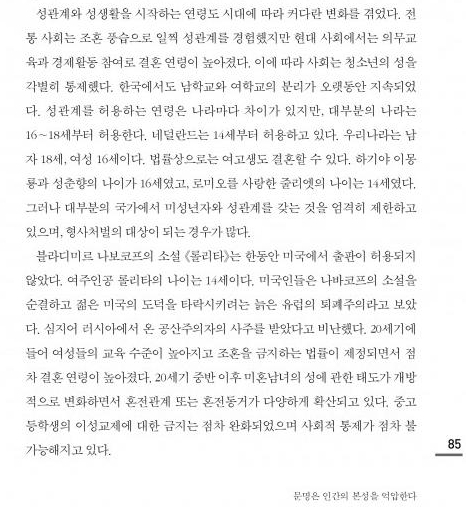
So, if Matt doesn’t read this post for himself first, then I’ll contact him for help with that source from the Korean police (I’ve given up trying to navigate their various sites), and besides which would be very grateful for his input. As I type this however, I’ve had my long-suffering wife looking on her computer for more Korean sources (her Korean is rather better than mine!), and yet after twenty minutes she has only been able to find this page from a 2007 book entitled Gyoyanginul Ouihan Saegyaesa (교양인을 위한 세계사), or World History for Civilized People by Kim Yun-tae:

With apologies for the small size, that states that in Korea the age of consent is 18 for men, and 16 for women!

In conclusion then, to put it mildly the jury is still out on what the age of consent in Korea is, and so this seems an opportune moment to throw open the floor to suggestions on how to continue from readers, which would be very much appreciated (not least by my wife!).

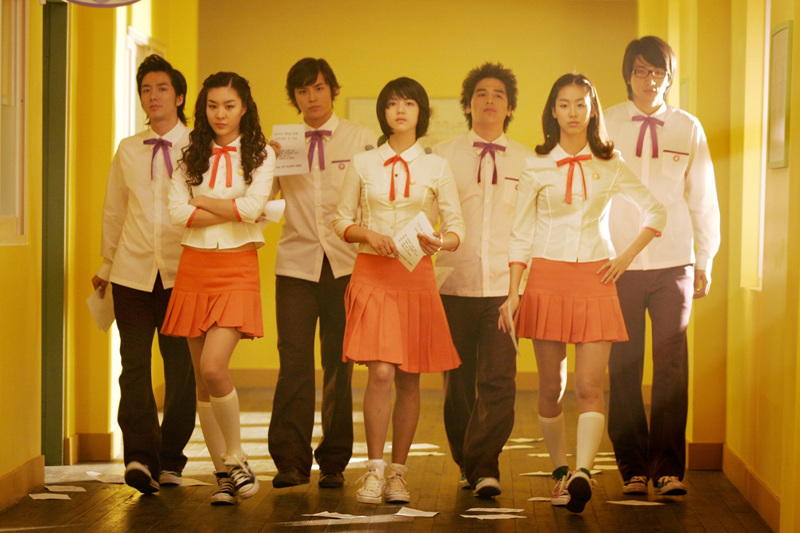
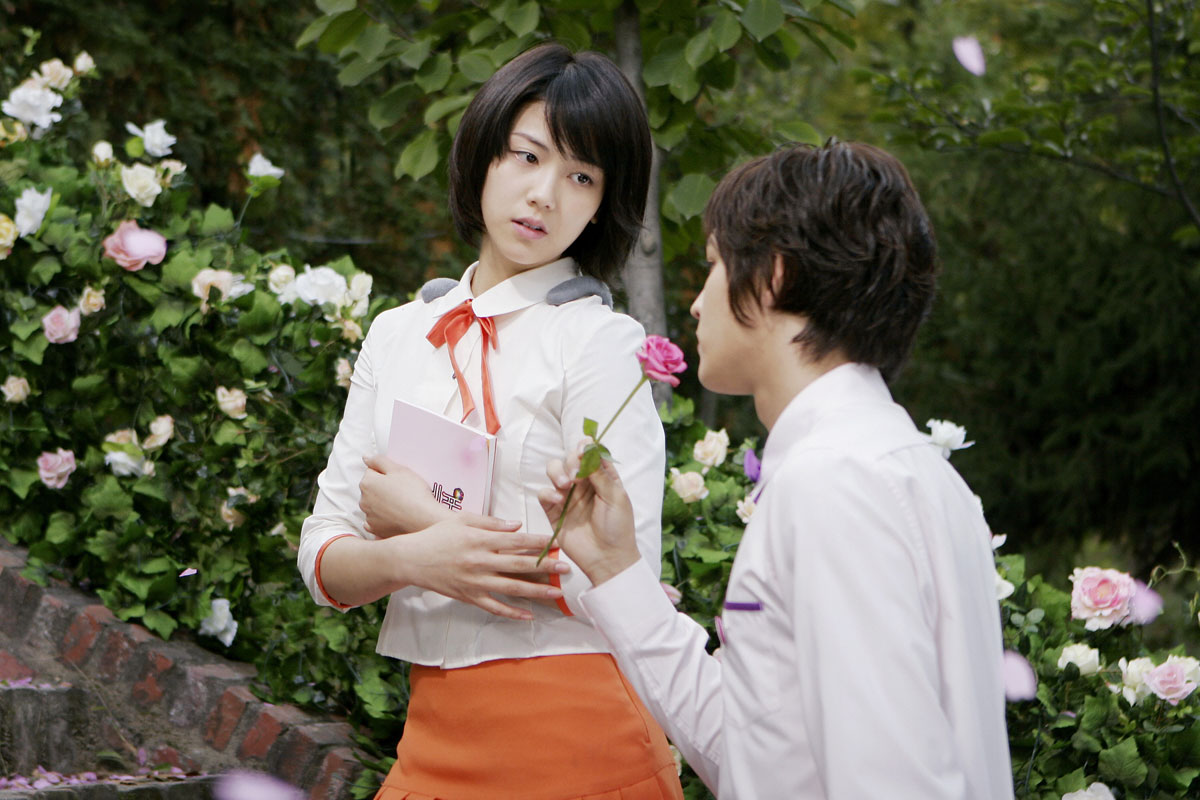
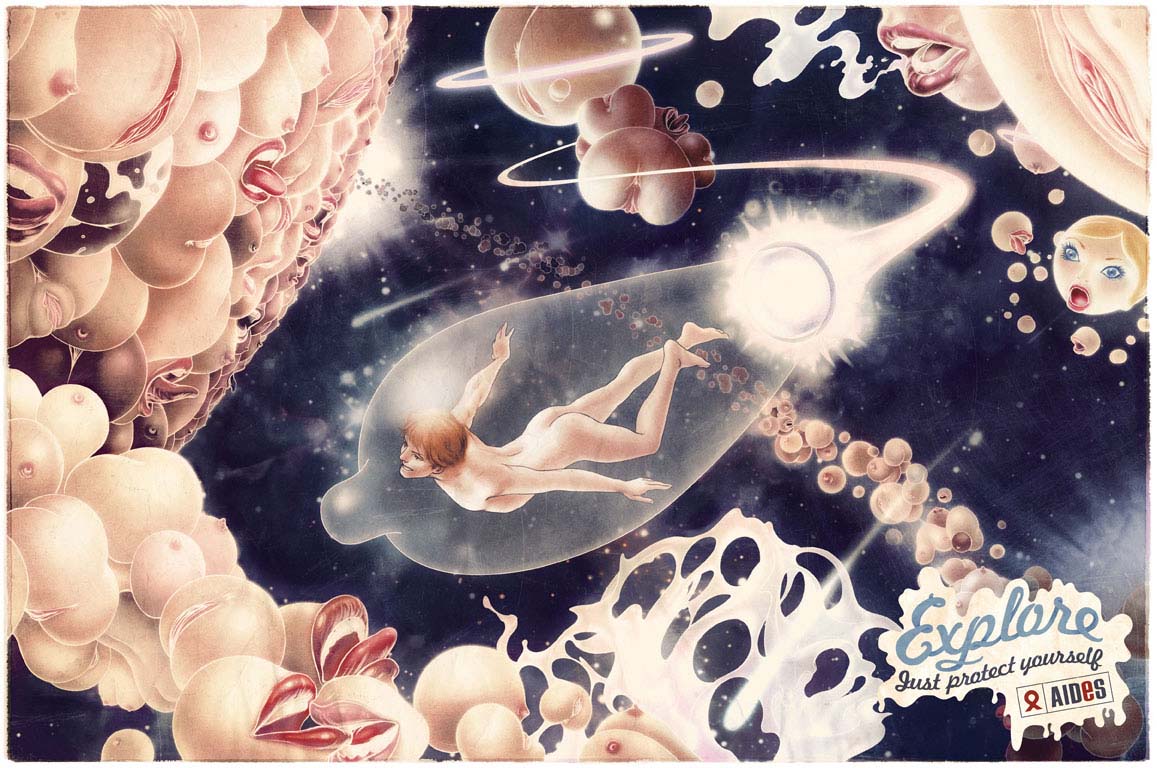
Before I do though, if you’re curious then the first two images above (source), then they are from the 2006 movie Dasepo Naughty Girls (다세포 소녀), which appears to be an excellent satire on Korean sexual mores; see here for an extensive review by – who else? – Matt. And finally, although they’re not related at all sorry, the more I wrote this post the more the following safe sex posters (NSFW) by James Jean kept coming to mind:

(Source: I Believe in ADV)

See BoingBoing for an extensive comments thread about them.

Open Thread #3

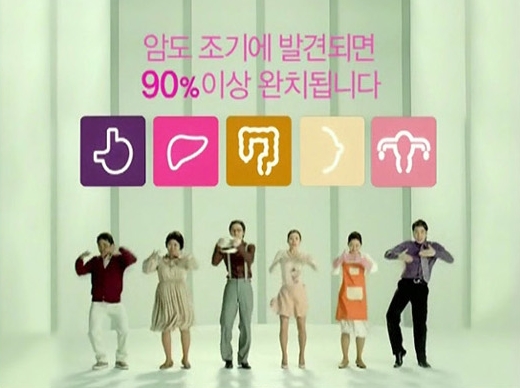
I may be wrong in assuming that public service announcements in Western countries still don’t feature stylized breasts and vaginas(?),  but regardless I love Korea’s no-nonsense attitudes to the body and bodily functions, in this case at least easily trumping any qualms that the Ministry for Health, Welfare and Family Affairs (보건복지가족부) may have had about featuring them in its campaign for people to get regularly checked for cancer.

What I really love though, is that it has been turned into the song and dance below:

Vodpod videos no longer available.

Easily to laugh at perhaps, but are more serious but otherwise rather dull campaigns in Western countries really more effective?

Meanwhile, apologies to all those readers who were looking forward to my promised restarting of the Korean Gender Reader series in the new year,  but after much soul-searching this week – prompted by my catching a cold after writing the last two posts until the small hours – I’ve been forced to admit that I still don’t have the time. I may have next month if some anticipated changes are made to my job, but until then, please feel free to pass on and discuss any Korean gender, media and sexuality-related stories yourselves here!

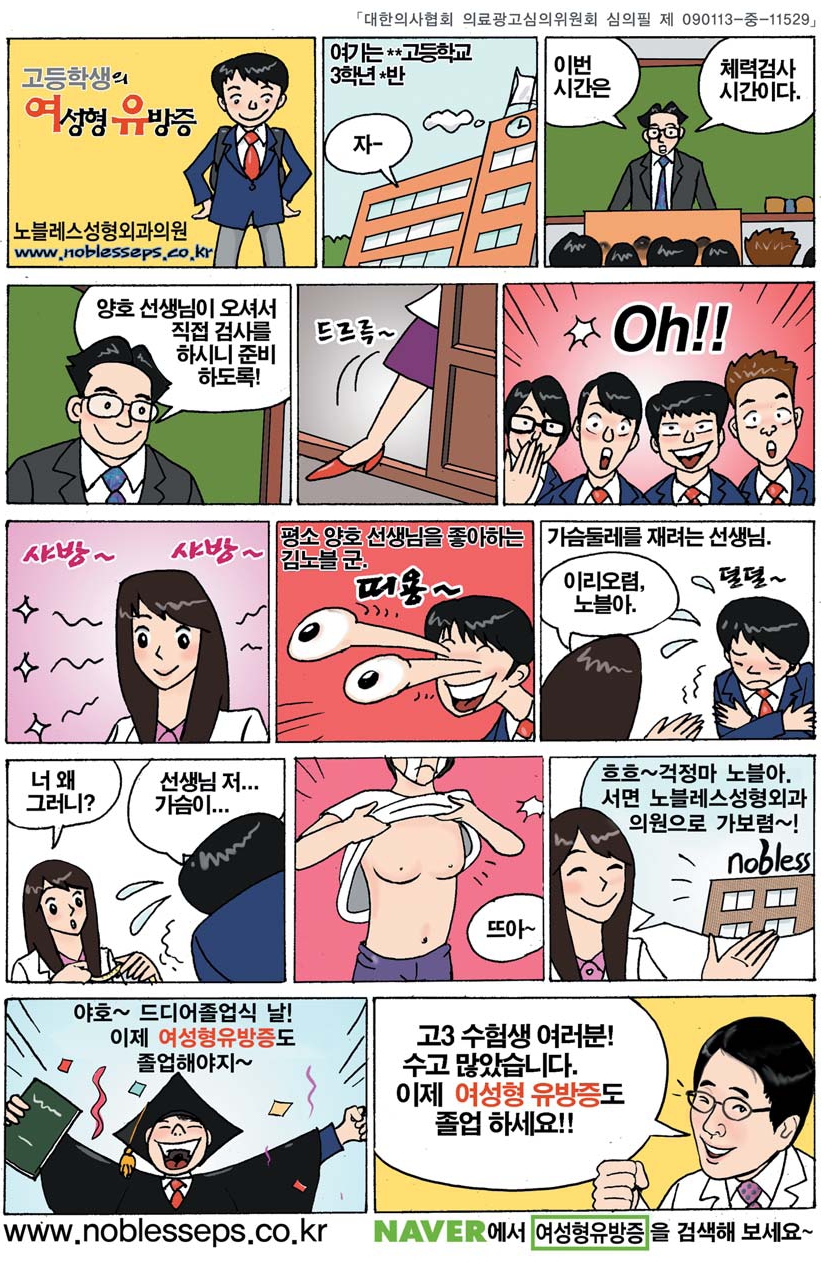
Update – Seeing as we’re talking about Korean oddities, consider the following advertisement for a cosmetic surgery clinic here in Busan:

From page 18 of the 4th of January Busan edition of Focus newspaper – the entertainment section no less. And don’t get me wrong: with the proviso that Noblesse has a vested interest in fostering insecurities about one’s body image, I’d image that female-like breasts are no laughing matter for the high-school boys with the misfortune of having them.

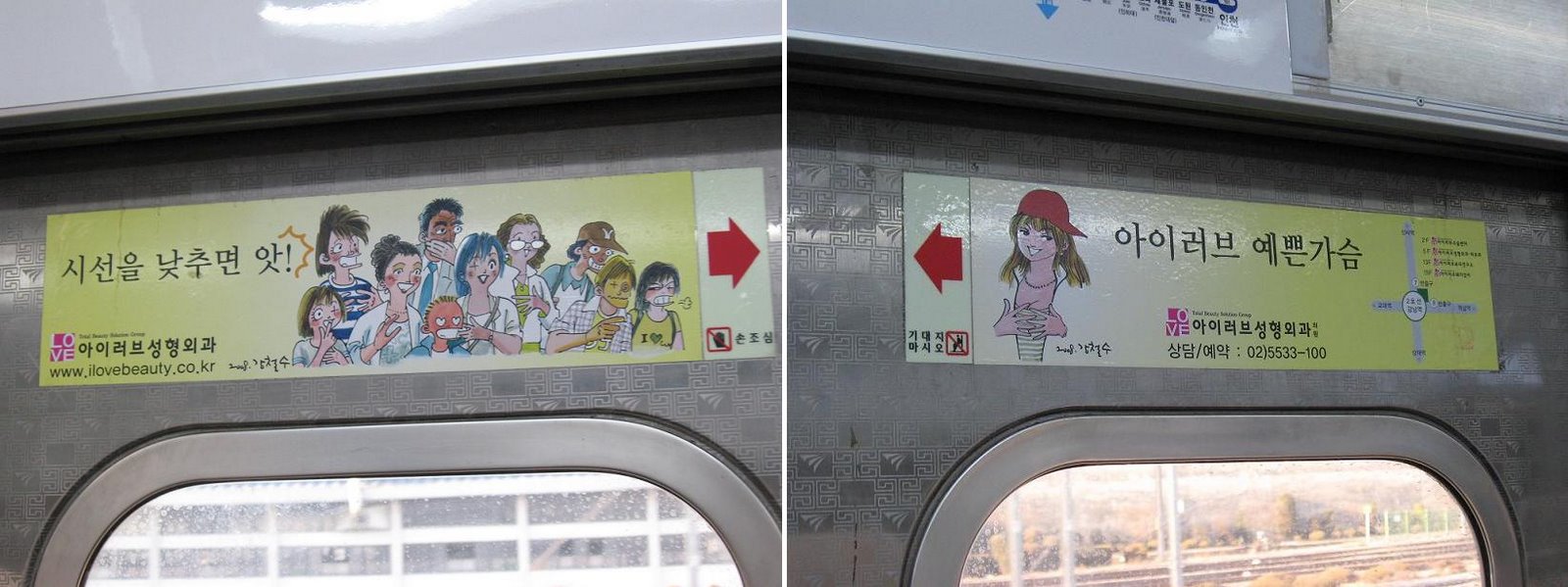
It is also common for Korean cosmetic surgery clinics to use comics in their advertisements, one that readily comes to mind consisting of a group of people gaping in either awe, lust, or jealousy at a woman who has just received breast implants. You may have seen it on the Seoul subway:

Thanks to reader Marilyn for passing on the photo. And again it is unsophisticated perhaps, but regardless of one’s opinion of cosmetic surgery in general, it was probably effective: it got both Marilyn’s and my own attentions at least!

Granted that the Noblesse advertisement remains just plain bizarre though, albeit a little less so when you realize that the woman featured was either the school nurse or a visiting government health inspector, not simply a new teacher.

Finally, while we’re on the subject of cartoons, here’s one I couldn’t help smiling at a couple of days later (from Focus newspaper again):

In case you don’t get it, the young man is living with his older sister but has to find his own place. At first, he thinks the place the real estate agent shows him is too old for the rent being asked, but he changes his mind when he sees the view from his window. In the final panel, the real estate agent crumbles about how difficult his job is these days…

More problematic in Japan than in Korea perhaps, where I hear that voyeurism is so taken for granted that women can expect their underwear to be stolen if it is hung from the first or even the second floor, or is that just an exaggeration? Alternatively, is it a problem in Korea too?

Share

Korean Sociological Image #29: JYP’s Objectification of Women

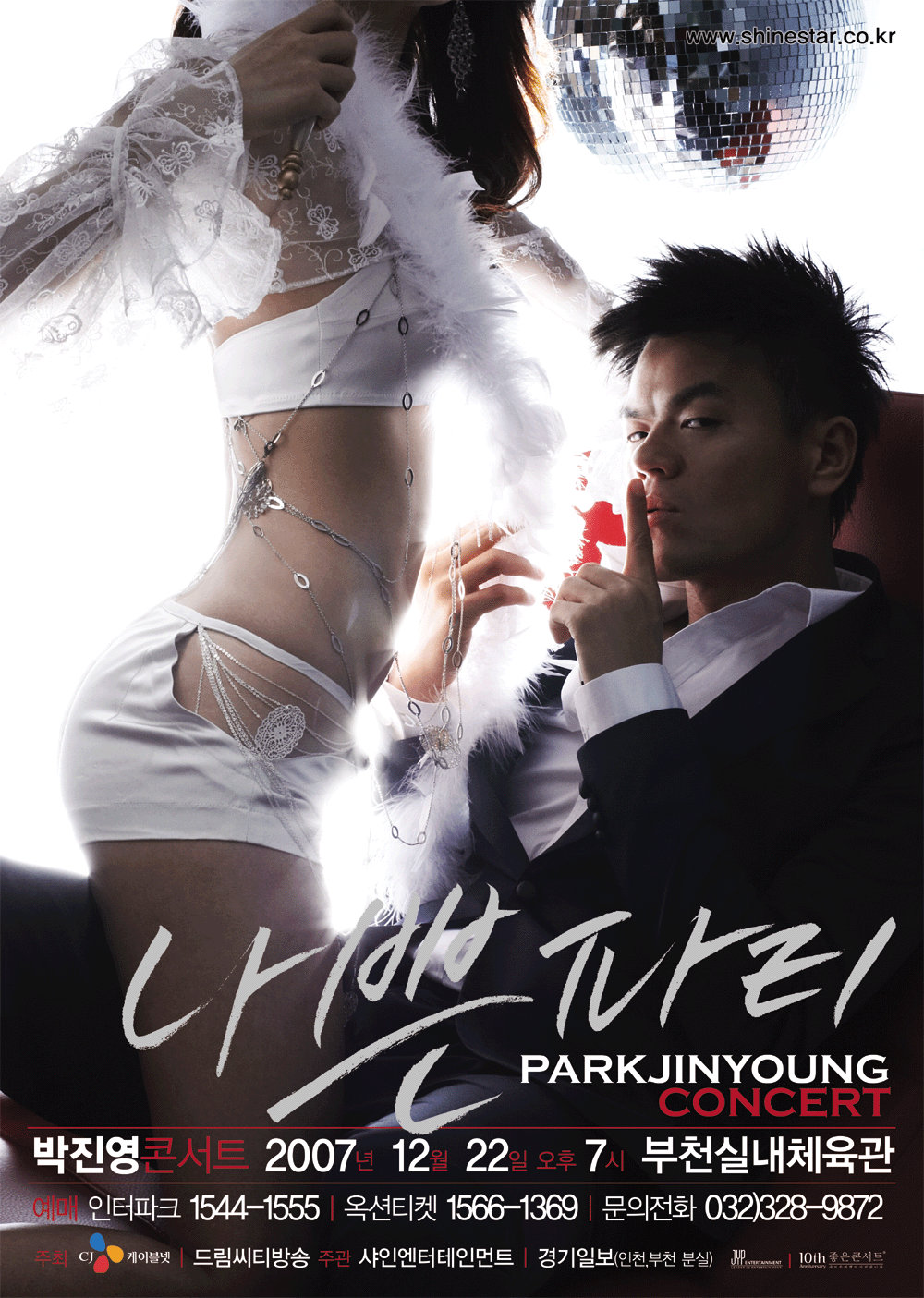
(Source)

What’s wrong with this advertisement?

When I first saw it, I couldn’t really put my finger on it, other than noting the similarity to some iconic but controversial music videos by Robert Palmer. Which was kind of ironic, considering what Park Jin-young (박진영) is putting his fingers on.

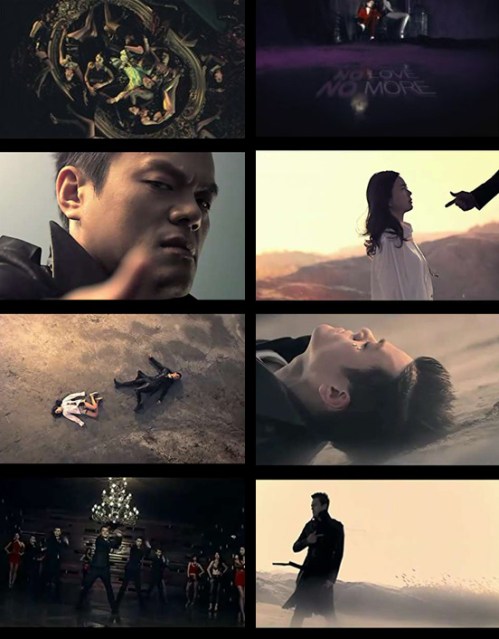
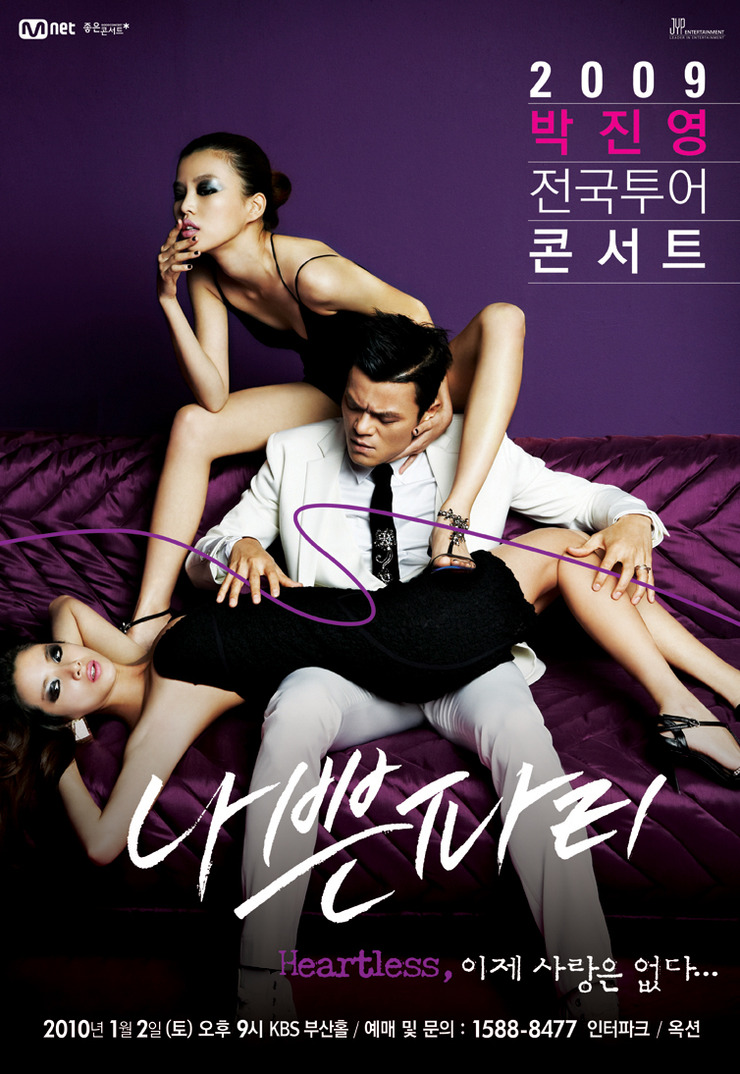
With thanks to an anonymous reader for passing it on, both these problematic elements and more are present in his new music video No Love, No More (노러브노모어), the main subject of this post. But first, a quick explanation of what was so controversial about those Robert Palmer videos exactly, for many of my younger readers may not even have heard of him.

As Alyx Vesey explains in Feminist Music Geek, the crucial one was “Addicted to Love” from 1986, and as a feminist she had trouble with it:

…for one big, obvious, highlighter-yellow reason. It’s so blatantly sexist. The models who comprise Palmer’s backing band are normatively beautiful, musically inept, interchangeable, ornamental, passive, and blankly spectacular. They’re kinda like a Busby Berkeley chorus line, only on sedatives and with visible nipples.

And while it’s a little off-topic for a post ostensibly about JYP, I think it’s worth quoting her a little more:

And yet. I can’t let this one go so easily. It’s an indelible image that is simple and yet iconic in design (it’s so effective that ”Simply Irresistible” and “I Didn’t Mean to Turn You On” only mildly revise the concept). Thus, it’s also easily replicable. When you put “Addicted to Love” alongside another lexicon 1980s video like, say, Michael Jackson’s “Thriller,” it’s much easier to match (many people, including Jackson, tried and failed to reach or exceed that video’s epic proportions).

It’s also an easy concept to subvert, which is my primary interest. I’d like to highlight a few instances where women take on “Addicted to Love” and, in the process of recasting and reconfiguration, potentially disrupt the original music video’s sexist aims.

Which I highly encourage you to check out. Meanwhile, let me also present the Simply Irresistible music video here, for I think that with the women dancing in the background, it is the most similar of the three to No Love No More:

Finally, No Love No More itself. Regardless of the criticisms in this post, it probably has the best picture quality of any music video I’ve ever watched on Youtube, so make sure to click on “HD”:

Clearly not a carbon copy of Robert Palmer’s videos then, and JYP, or whomever was responsible for them, might reasonably claim not to have been at all influenced by those. But whatever the origins, the women in the barn (and in the poster) are indeed extremely similar, and almost all are objectified.

And yet there are still more problematic elements in it, pointed out to me by the reader who passed the video on. Unfortunately, I didn’t have time to ask permission to quote her email before writing (apologies for my over-enthusiasm), so she’ll have to remain anonymous:

…the video infuriates me. Maybe it’s because I come from a country where explicit violence against women is not only extremely taboo but also illegal to portray in music videos. Still, given that domestic violence is such a formidable problem in this country, I find it mind-blowingly irresponsible that the most powerful man in Korean music at the moment puts out a video like this (source, right: unknown).

Shooting his girlfriend execution-style (apparently it’s okay to show her blood spraying out as her body crumples to the ground but it’s not okay to show an actual gun doing the shooting)… he then turns the “gun” on himself, and we’re expected to sympathize with him as a tear runs down his cheek as he takes his last breath. He executed his girlfriend, but the poor guy must have felt immense pain to have been driven to do such a thing. Break to the rest of the video, which simply consists of JYP dancing while dozens of women stand around or grope him as sexual props. JYP’s entire image seems to rely on the objectification of women, as demonstrated by [that poster], for one example…

…in which he is fingering a woman’s breasts, “playing her” as if she was a musical instrument. Now I’m definitely no fan of K-pop, and normally have nothing to do with it, but this video of his has been playing over and over on TV, and I can’t help but fear the message it sends young Koreans. JYP is, after all, immensely popular and influential in the K-music world, as he owns one of the most successful music labels in Korea and appears on countless TV shows and commercials. I find it surprising that no one seems to take offense to this video, which romanticizes violent “crimes of passion” (end).

(Source)

I agree, and as that reader is almost entirely responsible for this post, I encourage her to give me permission to print her name so that she can receive the credit for it!

But I would of course appreciate it if any other readers had more to add, on either the music video, the poster, and/or JYP’s marketing in general. And I confess, I know little about JYP’s music. So, to any fans of his in particular, would you say that that characterization of him is fair?

(For more posts in the Korean Sociological Image series, see here)

Korean Sociological Image #28: Cosmetic Surgery Advertisements Featuring Caucasians

(Source)

I’ve never done any systematic study of advertisements for Korean cosmetic surgery clinics. But still, I’d wager that the overwhelming majority do not feature Caucasians.

And why should they? Like frequent commenter Whatsonthemenu pointed out in an email to me, she has never seen a tanning product advertisement in North America, for instance, that used a model of African descent, and most models look European or possibly Hispanic. Similarly, advertisements for hair straightening products, generally aimed at Black women, always use Black models (usually light-skinned ones), never Caucasian or Asian.

One reason for this is that correlation does not imply causation, and that tanned Caucasians happen to look darker does not necessarily mean that they want to look like Africans. Rather, the consensus view of tanning’s origins is that it developed as a status symbol, implying the wealth to take vacations to warmer climes.

In the case of hair-straighteners however, let me pass on Whatsonthemenu’s comment that “the desire for straight hair almost certainly originates in the desire to look closer to Caucasians,” and that this stems from back when house slaves, who were more likely to have Caucasian fathers or grandfathers, had higher status than field slaves. Which leads one to ask what Caucasians’ absence in advertisements implies?

Perhaps that when it comes to something as personal as dramatically altering one’s body and/or appearance in particular, there is a universal tendency to deny one might be imitating some aspect of another culture, race and/or ethnicity? After all, not to implies acknowledging a (perceived) flaw with your own, unlikely to go down well with other members of it.

Which is what makes Koreas’ exception to the rules so interesting.

(Source: unknown)

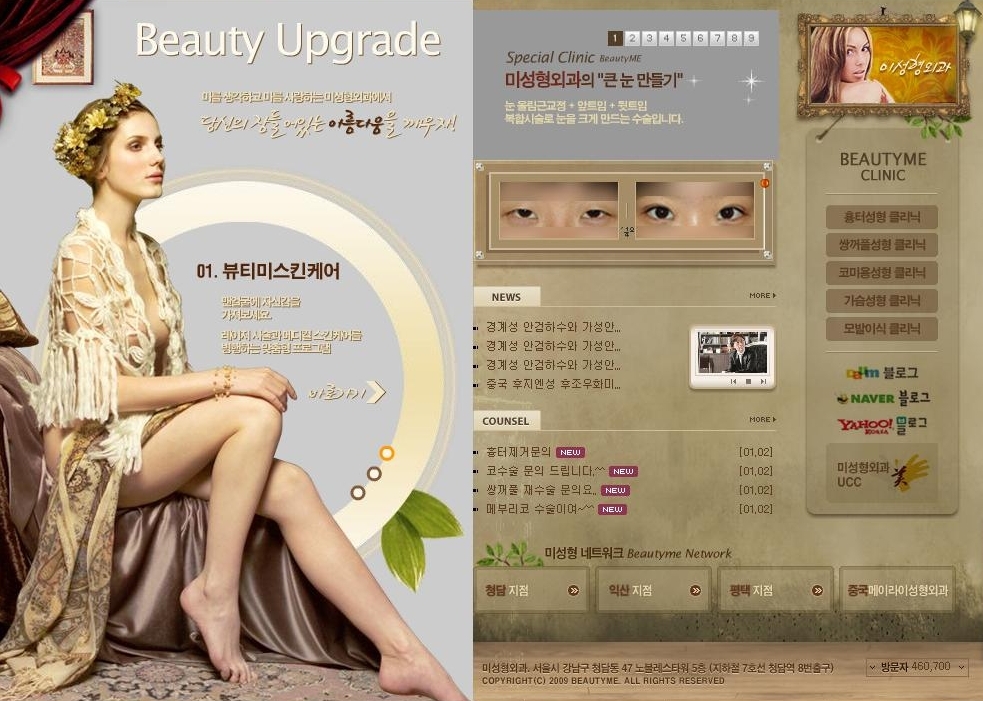
Whatsonthemenu noticed this advertisement for the BeautyMe Clinic on The Chosun Ilbo’s website last weekend, clicking on which took you to their homepage above. The Caucasian woman you see there is featured quite prominently throughout the site, and, judging by the the single page discussing double-eyelid surgery for men also featuring a Caucasian man, the choice of her race is not due to mere laziness or accident on the web designer’s part.

So why?

One obvious answer is that some Korean cosmetic surgery patients genuinely do want to look more Caucasian. But I think that they’d be a very small minority, even among those getting only those procedures that ultimately have that effect. Meanwhile, probably the vast majority don’t have that goal, either explicitly or subconsciously, and would justifiably take great offense at the suggestion.

However, clearly the intended customers would have no problems with associating cosmetic surgery in general and/or specific operations with Caucasians, nor find the choice of the model’s ethnicity strange. If they did, then presumably the proprietor of BeautyMe Clinic and others with similar advertisements (see here and here) would have chosen a Korean woman instead, as most do.

Yet they didn’t, and that those (positive or neutral) associations presumably existed prior to exposure to the advertisement puts paid to any notion that “Caucasianness” has had absolutely no role in Koreans’ modern ideals of beauty. And, in turn, to the notion that Koreans finding light skins and double-eyelids and so on attractive today are merely continuations of unaltered historical Korean tastes that existed prior to contact with Caucasians. Indeed, like blogger Michael Hurt wrote in 2005, it’s high time to acknowledge:

…the big, fat, white elephant in the room that is America and the West. You have to consider how having white skin here in Korea is not simply a matter of lightness anymore, of being a sign that one doesn’t have to work outside in a field. The relative pallor of one’s skin is now inevitably linked to notions of civility and class that are also reflected against the very real presence of white people, who are not surprisingly, positively associated with notions of civility and class.

But, and I stress, to do so is not to deny a role – and probably a much greater role – for historical Korean beauty ideals (and definitely not to claim that Koreans just “want to look White”). For a sense of the weight of the respective roles of each, and their possible mechanisms, please see the debate in previous posts.

(For more posts in the Korean Sociological Images series, see here)