Korean Gender Reader

(Source)

Some good news and bad news: after announcing earlier this year that monthly birth-control and morning-after pills were to be reclassified as prescription-only and over-the-counter respectively (i.e., the opposite of the current situation), the KDFA has just postponed its decision for 3 years.

Officially, the reason is because “there has to be careful consideration when overturning a classification system that has been retained for decades,” and because the extra time will allow the KDFA to “carefully monitor” the (supposed) side effects of the morning-after pills and also (unnecessarily) better educate the public on the side-effects and correct usage of monthly birth-control ones. But the more likely explanation is that the government was unnerved by the opposition to the reclassification of the month birth-control pill in particular, especially just before the election. In contrast, the opposition to the morning-after pill is mainly by religious conservatives, who would be very unlikely to vote for a different party.

One interpretation of such a long postponement is, of course, that the proposal will be quietly shelved in 3 years, although a negative of that would be a continued lack of access to the morning-after pill. But the realist in me thinks otherwise: as I explain in this Busan Haps article, the curious proposed simultaneous restriction and liberation of access to contraception has nothing to do with any dangers or women’s own needs or concerns, and everything to do with financial pressures within and between the Korean medical and pharmaceutical industries as Korea’s demographic crunch begins to bite. Those are not going to go away any time soon, particularly if the present conservative administration is reelected under Park Geun-hye — recall that her predecessor’s biggest solution to the declining birth rate and women’s inability to combine careers and children was simply to (re)criminalize abortion.

The conservative media’s framing of the contraception debate supports this pessimistic view: this article in the Korean Joongang Daily, for instance, explains that if reelected the government will continue to stress the opposition of “government officials, doctors, experts, women’s rights activists, religious groups and other civic organizations” to making the morning-after pill OTC, while simultaneously downplaying the far greater support for the status quo with the monthly birth-control pill. (And, possibly, support for making the morning-after pill over-the-counter too; I am unsure how much that has sorry.)

In sum, the combination of the (re)criminalization of abortion and now the proposed restriction of the monthly contraceptive-pill points to a “War on Women” every bit as real as the GOP’s one in the US, and which deserves to be far more widely known outside of Korea. Although, admittedly, I don’t know Park Geun-hye’s own personal beliefs on women’s reproductive rights, I do have genuine concerns that the Korean election of 2012 will be a eerie parallel of that of my native UK in 1979, when, to paraphrase my mother, “Millions of women voted for her simply because she was a woman, who then proceeded to crap all over them.” Certainly, her mere nomination as presidential candidate is already being widely described in feminist, empowering, and riding the crest of a wave of “women rising to the top” type terms, whereas I say that remains to be seen.

(Source)

Meanwhile apologies for the lack of posts, but my first week of the new semester proved to be much busier than expected. Usually, I try to have at least 2 posts in between each Korean Gender Reader, but I decided I’d rather post (hopefully) much better quality ones next week than rush them this time!

Update: By coincidence, the birth control pill ad I used to open this post with is for the Mercilon brand, which is several readers’ favorite, and which they were stocking up on because it is unavailable in the US. But of course every woman is different, so if Mercilon is not for you then please see The Wanderlust Diary and/or Kimchiowner’s Blog for a list of available brands, and the process of buying them.

Announcements

Care to visit some of Korea’s grandest museums? Help me to get there, get it written, then get it to you! (Kickstarter Project)

The Meet Market: White Party, Saturday September 1 (The Kimchi Queen)

Gay Friends in Seoul Meetup, Sunday September 2: Movie Night & Potluck (The Kimchi Queen)

Body Image/Health:

“Fat for an Asian:” The Pressure to be Naturally Perfect (XoJane)

Fukuoka Girls: Don’t You Wish You Were Cute Like Me? (Japan Realtime)

Doojoon’s Reaction to an Overweight Fan and the Blame Game (Seoulbeats)

Doojoon’s Faux Pas: The result of trainees’ social isolation? (Seoulbeats)

The politics of veils, ‘polleras’ and mini-skirts (Aljazeera)

Female Boxers: From disgust to admiration (The F-word)

Is Korea’s drug policy working? (The Korea Herald)

Censorship:

Production Firm Charged Over R-Rated Eminem Gig (The Chosunilbo)

Ratings board says it was lied to about Eminem show (The Korea Herald)

The Constitutional Court rules on the “real name” law and a controversial abortion law (Korea Law Today)

Crime:

More sex offenders could be castrated; Critics say castration doesn’t address psychological origins of sexual violence (The Hankyoreh)

Push for chemical castration in wake of sexual offenses (Korea Joongang Daily)

Chemical castration to see wider use (The Korea Times)

Is chemical castration effective in preventing sex offenses? (The Korea Times)

Picture of the Day: Korean Self Defense Gadgets (ROK Drop)

Gov’t to toughen measures against potential sex criminals (The Korea Times)

Anklet-wearing murderer of housewife lived alone, having no friend (The Korea Times)

Stupid talk about rape: Not just an American thing (The Marmot’s Hole)

Breaking News: A second ‘Na-young Case’ in the making? (The Marmot’s Hole)

Dating/Relationships/Marriage:

A North Korean love story: Defectors to marry in group ceremony (The Star; Isn’t Moonies style!)

Stressed men drawn to heavy women (BBC)

Shall We Dance? Yes…But Not in Public (Speaking of China)

New Zealand experience suggests “marriage equality” will win where “gay marriage” or “same-sex marriage” will not (Kiwipolitico)

LGBT/Sexuality:

An Expat`s Guide to Going to the Gyno in Korea (Busan Haps)

The Flip-flop over Foreskin (Nursing Clio)

Gayspeak: 끼탑 and 땍마 (The Kimchi Queen)

Campaign aims to kick Korean prostitutes out of Australia (The Korea Times)

China AIDS patients topple gate of gov’t office (The Huffington Post)

Eight things you didn’t know you could do with human sperm (io9)

Film Review: Stateless Things/줄탁동시 (The Kimchi Queen)

Reply 1997 Shin Wonho PD: “The real reason for putting in homosexuality…” (Omona They Didn’t)

Read: Behind the Red Door — Sex in China, by Richard Burger (Shanghaiist)

Miscellaneous:

Can men be feminists? (New Statesmen)

Men Explain Things to Me: The origins of the term “mansplaining” (Guernica)

Politics/Economics/Workplaces:

Young South Koreans face jobless woes with ‘graduate glut’ (My Sinchew)

Joblessness ruining young people’s health (The Hankyoreh)

Japan’s Graduates Face Tough Job Market (Japan Realtime)

Japanese Police Women To Go Up To 10% Of Force….by 2023 (Japanesesubculture)

Pop Culture:

GD’s “One of A Kind”: Musings on Looking For Meaning Kpop (Idle Revelry)

Korean Culture Through K-pop 102: Pass the Soju (Seoulbeats)

Pronunciation Tips: Practicing the aegyo intonation (Hangukdrama and Korean)

Idols Striving for Perfection: It’s a Hard-Knock Life (Seoulbeats)

Pregnancy/Abortion/Childbirth/Demographics/Parenting/Education/Multiculturalism:

Girl Commits Suicide After Being Bullied in KakaoTalk Chatroom (Korea Bang)

One Chinese child too many – 27-year old woman forced to abort 7-month fetus (The East Asia Gazette)

Constitutional Court deems abortion a criminal offense (The Hankyoreh)

Deaths of only children present social challenge in China (Want China Times)

Out-of-wedlock babies on the rise (The Korea Herald)

Breastfeeding flash mob in the heart of Singapore (Channel News Asia)

Chinese Government defends college policy favoring boys (Global Times)

South Koreans Balk at Saturdays Without School (Bloomberg Businessweek)

Teachers’ rights to be better protected (The Korea Times)

(Links are not necessarily endorsements)

Korean Gender Reader

(Source)

Not really related to Korea sorry, but the book sounds interesting, and I was impressed by the writing style of the reviewer at io9:

There’s also some heavy intellectual lifting going on in the background. The book doesn’t shy away from things like the politicization of the pregnant body, though it’s done so non-didactically, I wonder if a teen reader would even notice that what seems to be a standoff in a doctor’s office is really about the way different individuals view pregnant bodies and place value on them.

Click on the links for more. Meanwhile, I’ll be adding an “announcements” section to each KGR from now on, so if you ever have any fundraisers, meet-ups, public lectures and screenings, surveys, requests for information about lost loves etc., please let me know and I’ll add them here!

Announcements:

— Busan, Saturday 25th: Public screening of Nefarious: Merchant of Souls, an award winning documentary about sex-trafficking. See Busan Haps for details.

The Noble Cause: Busan Salim Women`s Shelter (Busan Haps)

Bras for a Cause (Seoul), August 24-September 30 (Facebook Group)

UK Chinese Studies Student Seeks Chinese/Non-Chinese Couples for Dissertation Survey (Speaking of China)

Lost love at first sight (Noona Blog: Seoul)

Itaewon, Seoul: Auditions for The Rocky Horror Picture Show, September 1-2 (The Kimichi Queen)

Gay Friends in Seoul Meetup: Sunday 26th, Jongkak (The Kimchi Queen)

Volunteer Positions to Teach English to North Korean Defectors at Canadian Embassy (Gusts of Popular Feeling)

Body Image/Health:

About G.NA’s Malnutrition and Fans’ Hypocrisy (Seoulbeats)

How Alysia Montano reminds the boys that they are getting beat by a girl (Yahoo!, via 10Confessions)

Doctors Misuse and Abuse Sleep Inducers on Patients (Human Rights Monitor: South Korea)

“Girls Get Curves” – combining math and body positivism (Work That Matters)

Censorship:

Controversial Launch of Online Music Video Rating (Global Voices)

Korea Policing the Net. Twist? It’s South Korea (The New York Times)

Music video ratings strike an off note (Korea Joongang Daily)

KARA may need to adjust “Pandora” dance for KBS’s ‘Music Bank’ (Allkpop)

Ding dong, the online real name system is dead (The Marmot’s Hole)

Crime:

Admission officer system fails to sort out sexual offender (The Korea Times)

North Korea: Human Traffickers and the Chinese Market for Brides (The Daily Beast)

Victim of sexual violence tells her heartbreaking story (The Hankyoreh)

Ex-multiple rapist wearing electronic anklet nabbed for rape and murder (The Korea Times)

Dating/Relationships/Marriage:

Double Happiness: Chinese Wedding Stories from Four Western Women (Speaking of China)

One Introvert, Finding Refuge (And Love) in China (Speaking of China)

LGBT/Sexuality:

Trans-Roadmap: a space for the transgender people (Ilda)

Struggling for acceptance, gay Christians find their own place of worship (Yonhap)

Getting It On: The Covert History of the American Condom (Collectors Weekly)

Thinking “Out of Bounds”: Masculinity, Male-to-Male Affection, and Athletics (The Feminist Wire)

Are Women More Bisexual Than Men? (Femiblogged)

XX파일 : X?파일 1회) XY로 태어나 XX의 삶을 선택한 그녀들의 고백 (Insite TV; video)

Taiwan women in same-sex Buddhist wedding (Diva Asia)

Taiwan same-sex union points to Asia shift on gay rights (France 24)

How one sociologist sizes up China’s sex trade (Shanghaiist)

Gayspeak: 철수 and 영희 (The Kimchi Queen)

Shin Dong Yeop, Hong Seok Cheon Become MCs for Korea’s First Transgender Talk Show (E News World)

Some reading on Korean attitudes towards AIDS (Gusts of Popular Feeling)

Introducing Queer Corner 퀴어 코너 소개 with Guest Blogger Enzo Cho’Gath (Korean Gender Cafe)

공창제를 허하라, Should Korean government allow Licensed Prostitution? (Korean Gender Cafe)

Queer Corner: Five Questions / 게이생활: 동성애자의 첫인상 칠문 (Korean Gender Cafe)

Miscellaneous:

Preachers and Drunkards: Seoul Subway Users’ Worst Enemy (Korea Bang)

Women allowed on bicycles as N. Korea turns wheels of change (itv News)

Photos from a Day in Taipei: A Monument, a Climb, and a Japanese AV Actress (Shanghai Shiok)

NYC Comedian Gets Attacked For Harassing Asians in Audience (I’m No Picasso II)

Should South Korea do more to assist North Korean women? (Korean Gender Cafe)

Smart Girls at the Party: “a fun reminder that you don’t have to be famous to be interesting, to matter, or to make a difference” (Thick Dumpling Skin)

Politics/Economics/Workplaces:

More housewives become breadwinners (The Korea Times)

In Seoul, more women have become victims of the financial crisis than men (The Korea Times)

Call center workers suffer from sexual harassment, small pay (The Korea Times)

Pop Culture:

What exactly IS the message of PSY’s “Gangnam Style” and what does it say about gender or dating? (Korean Gender Cafe; a follow-up to a previous post)

“There’s another entire discussion to be had about why Psy’s ‘Have enough self-confidence, and your dorkiness will become awesome’ message doesn’t seem to apply to females, who still need to be smoking hawt.” (SNSD Free for all)

Being White in K-Pop: Chad Future’s “Hello” MV (Seoulbeats)

Ma Boy serves up gender-bender school romance… with a twist (Dramabeans)

Why Psy’s “Gangnam Style” style went “American-style” and is the “Apt Pupil” of K-Pop (Scribblings of the Metropolitican)

Gangnam Style, Dissected: The Subversive Message Within South Korea’s Music Video Sensation (The Atlantic)

Smokin’ Hot or Smokin’ Not: Idols on Their Not-so-Best Behavior (Seoulbeats)

KBS casts body-swapper drama Oohlala Spouses (Dramabeans)

Pregnancy/Abortion/Childbirth/Demographics/Parenting/Education/Multiculturalism:

Korea charged with racial discrimination regarding HIV testing (Gusts of Popular Feeling)

To Boldly Go … Where Foreign Faces Speak Mandarin (Asia Society)

Hollywood and the Helpless Husband: “…if you’re watching a film about men taking care of babies, you’re watching a comedy. That hasn’t changed since the dawn of American cinema.” (Women’s Voices for Change)

Just Wait Until Your Mother Gets Home: Dads are taking over as full-time parents (New York Times)

The Myth of Looming Female Dominance (Sociological Images; a critique of the NYT article)

What am I teaching my son (mostly about driving)? (Surprises Aplenty)

South Korea upholds abortion ban (The Guardian)

Why is Samsung poking fun at foreigners speaking Korean? (Travel Wire Asia)

Foreign instructor at a university in Daejeon to be fired for internet postings (Gusts of Popular Feeling)

— Study: The older the dad, the more mutations he’s likely to pass on (io9; The Economist; The Washington Post)

(Links are not necessarily endorsements)

The Economist on K-Pop’s Role in Celebrity Endorsements

(Source)

Well, I covered it in passing in an opinion piece in The Korea Herald over a year ago, and many times on the blog (and on Busan Haps) since, but hey: I admit that The Economist is probably a more authoritative-sounding source. See here then, for a discussion of how the dynamics of the Korean digital music industry are forcing labels to financially rely on celebrity endorsements, and which is a big factor behind why 2 out of 3 Korean advertisements feature them, one of the highest rates in the world.

While frustratingly brief, it does have some money quotes:

…SM Entertainment’s boss complains that even 1m downloads cannot cover the cost of making a music video….

….SM Entertainment and other purveyors of K-pop cover this shortfall at home by having their stars hawk the latest phone, or appear on television variety shows. The biggest labels have become adept at squeezing cash out of their pop stars’ names, rather than their music. But only a handful of musicians are famous enough to benefit.

South Korea’s old business model, perfected by its carmakers, was to use a captive home market as a launch-pad from which to invade foreign shores. The country’s pop musicians have turned this model upside down: they have to export their tunes to make up for meagre pickings at home.

(Source)

See bloop69’s comment also, who contends that things are not as dire as they seem (for a similar discussion between abcfsk and myself, see here):

A huge chunk of the money is made in “collectable” CDs and DVDs, which can run north of $150 per shot and are constantly churned out. It’s not a case of INVADING other shores you clueless dolt. It’s a case of using Youtube and videos as LOSS LEADERS to capture a small number (tens to hundreds of thousands) of hardcore fans who spend $100s US EACH to support their “fandom”

You don’t even begin to perceive it but in fact the Koreans are using a very progressive model… similar to League of Legends or FarmVille to give customers a free “taste” of the music. Like Kpop free to play MMOs also rely heavily on “whales” and heavily invested customers to carry the rest of the customer base. It has nothing to do with “invading” other shores. This is the strategy they have been using in Korea and are using around the world.

Finally, a quick request: please ask your Korean partners, friends, colleagues and so on if they know what “celebrity endorsement” is in Korean. If they struggle to answer, as my wife did, then I think that will be testament to just how pervasive they are here! (Eventually, she came up with “유명인 보증”).

The Pee Doesn’t Lie: 1 in 4 young Korean women smoke (The Gender Politics of Smoking in South Korea, Part 5)

(Source)

When crusty old Confucians will slap them in the face for smoking, then surely women will tend to smoke in private, and keep mum about it if anyone asks. That’s just common sense.

But, as discussed in previous posts in this series (Part 1, Part 2, Part 3, Newsflash, Part 4, Korea’s Hidden Smokers, How Many Teenage Girls Are Smoking?), that still seems to escape many journalists and researchers, who work under the assumption that very few Korean women smoke (officially, just 2.8% in 2010 for instance, against 42.6% of men). Whereas in reality, previous best estimates put the figure at 17% for young women, pointing to a looming health crisis.

So, how to convince the Korean government to take action? Especially when successive administrations have been accused of exaggerating their successes in reducing the male smoking rate, while ignoring the indirect evidence for rising female one?

(Source)

What’s needed is irrefutable proof. To get that, one reader suggested installing highly sensitive smoke detectors in the toilets of schools and universities, where many young women hide to smoke, while another, thinking of a rough minimum rate for teenage girls, to simply look at the number that were caught by their teachers (14% at his school). A third, probably most reliable option is to test for nicotine in their urine, via the medical tests given to every middle and high-school student, and, as explained in the recently-released article “Relationship Between BMI, Body Image, and Smoking in Korean Women as Determined by Urine Cotinine: Results of a Nationwide Survey” in the Asian Pacific Journal of Cancer Prevention (Volume 13, 2012; 1003-1010), a group of researchers from various universities have indeed focused on pee, albeit that of women aged 19 and over in the 2008-2009 Korea National Health and Nutrition Examination Survey instead.

Very readable at just 8 pages, half of which are tables or references, I highly recommend downloading the PDF (just email me for a copy if the link stops working). For readers without the time though, let me pass on the abstract here instead (click on it to make it bigger), then some highlights:

— Unfortunately, the sampling method, explained on page 1004, is very poorly explained, and I think has some crucial typos. But in sum, out of 4,600 households in the survey, 5,485 women above the age of 19 “were selected for further analysis because complete data concerning their socioeconomic and health factors and body-related variables were available.” How many 19+ women were in the original household survey though, and how and why extra information about these 5,485 of them was available (e.g., were they randomly selected for further tests?), is not provided.

— Urinary cotinine “is widely used as a biomarker for smoking because of its high sensitivity and specificity,” the level of 50 ng/mL used here being a widely accepted cut-off level for indicating active, rather than passive smokers.

— Here are the figures by age bracket, with their standard errors. Unfortunately, I lack the statistical background to understand the discrepancies between reported and “analyzed” rates sorry (for example, 158 out of 704 is actually 22.4%):

  • 19-29: 158 smokers out of 704 (23.1%, 2.0%)
  • 30-39: 178 smokers out of 1075 (17.3%, 1.3%)
  • 40-49: 134 smokers out of 1046 (13.5%, 1.2%)
  • 50-59: 97 smokers out of 1001 (9.3%, 1.0%)
  • 60-69: 70 smokers out of 919 (7.5%, 1.1%)
  • 70+: 87 smokers out of 740 (12.1%, 1.5%)

— Overall, 14.5% of the participants smoked, just under 1 in 7. Note that the article mentions that the reported rate in 2011 was 7.0%, which arguably more indicates how useless official figures are than a sudden dramatic jump from the 2.8% of 2010 (both figures are from the OECD).

— The article does an excellent job of breaking the figures down by age, income, occupation, and marital status, demonstrating that the notion of an “overall” or “average” female (or male) smoking rate is misguided and unhelpful anyway. Please see previous posts in the series for more discussion of that.

(Source)

— Finally, the focus of the article is on the relationship between smoking rates and the difference between subjects’ Body Mass Index (BMI) and Subjective Body Perception (SBP), and found that that was indeed:

…the most important factor determining female smoking behavior. Women with low BMI who perceived themselves as normal or fat were most likely to smoke; these results suggested that subjective body recognition plays as important a role as objective physical measures such as BMI in smoking behavior. Moreover, in women who were never married, divorced or widowed, underweight BMI was highly correlated with smoking. Thus, it is necessary to educate the public to have a correct self-body perception and a good understanding or the relationship between smoking and weight issues in order to reduce female smoking. In particular, women who were never married and had low BMI were especially susceptible to smoking and require special attention and preventative care (p. 1009).

Unfortunately, those educators will have their work cut out for them: Korea is the only developed country in the world where women in their 20s and 30s are getting thinner rather than more obese (and, accordingly, are the slimmest), yet a 2010 study would find that 2/3rds of female university students still overestimated their own weight (and, tellingly, all of those 2/3rds were actually either normal or underweight).

Update: Interestingly, the notion that cigarettes put off hunger was once used to sell cigarettes to men as well as women. I wonder when and why that stopped?

Essential Reading: “Multiple Exposures: Korean Bodies and the Transnational Imagination”

(Sources — left: unknown; right)

See The Asia-Pacific Journal for the article. Covering many of the themes discussed on the blog, and much more besides, expect to see me linking to it for many years to come!

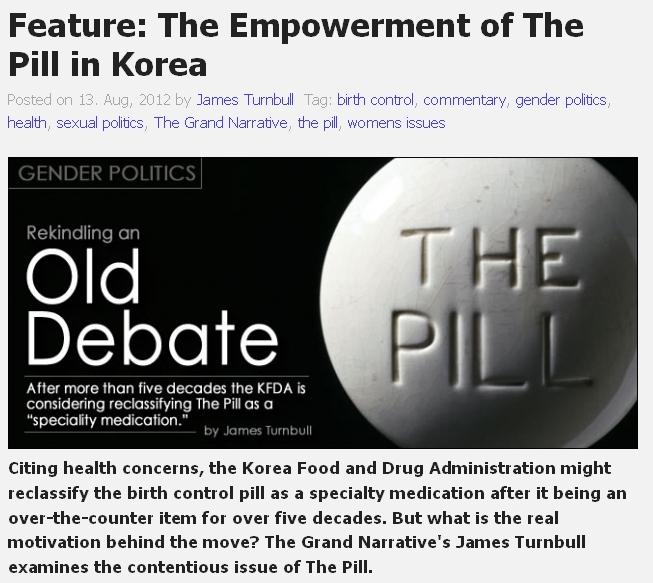
Quick Hit: “The Empowerment of the Pill in Korea”

Thanks very much for the comments on my earlier post on Korean OBGYN clinics, which I incorporated into a brief edit of my latest BusanHaps article. Just click on the picture to read.

Here’s hoping the KDFA makes the correct decision at the end of August!

Quick Break/Open Thread

Between my insomnia because of the heat, all my other writing projects, and running out of time to enjoy my summer break with my family (I haven’t even taken my daughters swimming yet!), I’ve decided I need a short break from blogging sorry. But just for about 2 weeks, and everyone’s more than welcome to raise and discuss anything Korean, feminist, sexuality, pop-culture etc. related here in the meantime — I’ll still be around to chat, and will be tweeting and posting links on the blog’s Facebook page as per normal.

So, have a good summer everyone, and please say hi if any of you are in Busan!^^

Update — Christal Phillips, a visiting professor at Yonsei University, has asked me to pass on the following:

I am writing a paper on biracial people in Korea and have created a brief survey for parents of biracial children in Korea as well as biracial Koreans. If this applies to you, please fill out the survey and pass it along to your friends and co-workers: https://www.surveymonkey.com/s/LZJNRJB Thank you for your assistance.”

I can confirm that it just takes 5-10 minutes, and participants will be entered into a draw for a $25 Starbucks gift card.

Korean Gender Reader

(Source)

Body Image/Health:

Sneaking in on Sarah in the shower (Matador)

Miss plastic fantastic? (The Korea Times)

Are tattoos still taboo in South Korea? (Angry K-pop Fan)

More Lookism: Koreans’ Nose Obsession (The Unlikely Expat)

Humanizing the Olympic Body (Nursing Clio)

Low-income women and high-income men show high obesity rate (The Korea Times)

The “underground rules” of China’s beauty pageant (Want China Times)

Street Harassment in Spain: What’s better? A culture where the objectification of women is in your face daily – but people acknowledge it exists? Or one where you know it’s there, but it hides malevolently? (Develled Dish)

After Bikini-Girl Ban, Cosplay in Spotlight (China Real Time Report)

Can women be in ads without someone yelling foul? (Adland.tv)

The Benefits(?) of Wearing a Short Skirt in China (You Offend Me You Offend My Family)

Crime:

New sex scandal at Korea University (Asian Correspondent)

Korean Supreme Court overturns molestation conviction of pants-dropper (Asian Correspondent)

Child pornography VERY poorly monitored (The Korea Times)

Man Scolds 16-year-old for Spitting, Gets Beaten-up and Dies (Korea Bang)

Is the Punishment for Rape & Sexual Assault Too Light In Korea? (ROK Drop)

Dating/Relationships/Marriage:

“Did you always want to marry an Asian guy?” (Speaking of China)

Korea to tighten rules on international marriage brokers (The Korea Herald)

Race as reflected in gender ratios within fictional bi-racial marriages (Hafu)

“The Reality and Twisted Values of Some White Men” Series at Gusts of Popular Feeling:

Part 9: The ‘Hidden camera sex video’ could spread… anxious police, idle university

LGBT/Sexuality:

Dinner, Movie, and a Dirty Sanchez (GQ)

PiFan 2012: Super Virgin (숫호구, Suthogoo) 2012 (Modern Korean Cinema)

Popular Korean Comic Book Depicts Exploitation, Abuse, & Murder of Prostitutes (With Conviction)

History:

The Torture Chambers of Seoul (And With Your Help, I’ll Get That Chicken)

Misc:

Blog Shoutout: Korean Gender Café 한국 젠더 카페

Newspaper Reports on Online Misogyny ‘Ladygate’ Trend in Korea (Korea Bang)

The truly inspiring story of the Chinese rubbish collector who saved and raised THIRTY babies abandoned at the roadside (The Daily Mail)

Actress Lee Shi Young wins amateur boxing championship, is actual baddest female in K-entertainment (Asian Junkie)

Getting a modeling job in Korea (Noona Blog: Seoul)

Politics/Economics/Workplaces:

Female work force boosted as child care burden eases (Korea Joongang Daily)

North Korean grassroots capitalism has a female face (The Korea Times)

One-third of Korean workers bullied at office (Asian Correspondent; also see Women Bullying Women)

Shadow of the Japanese housewife (The Japan Times)

Samsung’s Female Executives Shatter South Korea’s Glass Ceiling (The Daily Beast)

Pop Culture:

Trying to make sense of the T-Ara controversy (Angry K-pop Fan)

Guilty until proven innocent: The lynch mob against T-ara and who’s really to blame (The Prophet Blog)

Why Homoerotic Fanservice is Just Not Okay (Seoulbeats)

Verbal Jint reveals “You Deserve Better” was inspired by story of domestic violence (Allkpop)

Idols, Twitter and Online Harassment (Seoulbeats)

A Debut Novel Considers the Angry Asian (Scene Asia)

Pregnancy/Abortion/Childbirth/Demographics/Parenting/Education/Multiculturalism:

Sex Differences in Attitudes Toward Paternity Testing (Psychology Today)

Caesarean sections result in infections for one in ten patients, study finds (The Guardian; also see Pregnancy, Caesareans and Body Image in Korea)

Disney Princesses Circa 2012: I’m Too Sexy For My Gown? (Peggy Orenstein)

Introducing: Cinderella 2012 (Peggy Orenstein)

Deadbeat Dads and No Show Moms: 1 million orphans in Korea (Occidentalism)

Will the foreigners PLEASE stop molesting women at the beach, Part II (The Marmot’s Hole)

More support on way for interracial families (The Korea Times)

Generational warfare: Young and old have different ideas on how to rebuild tsunami-stricken communities (The Economist)

(Links are not necessarily endorsements)
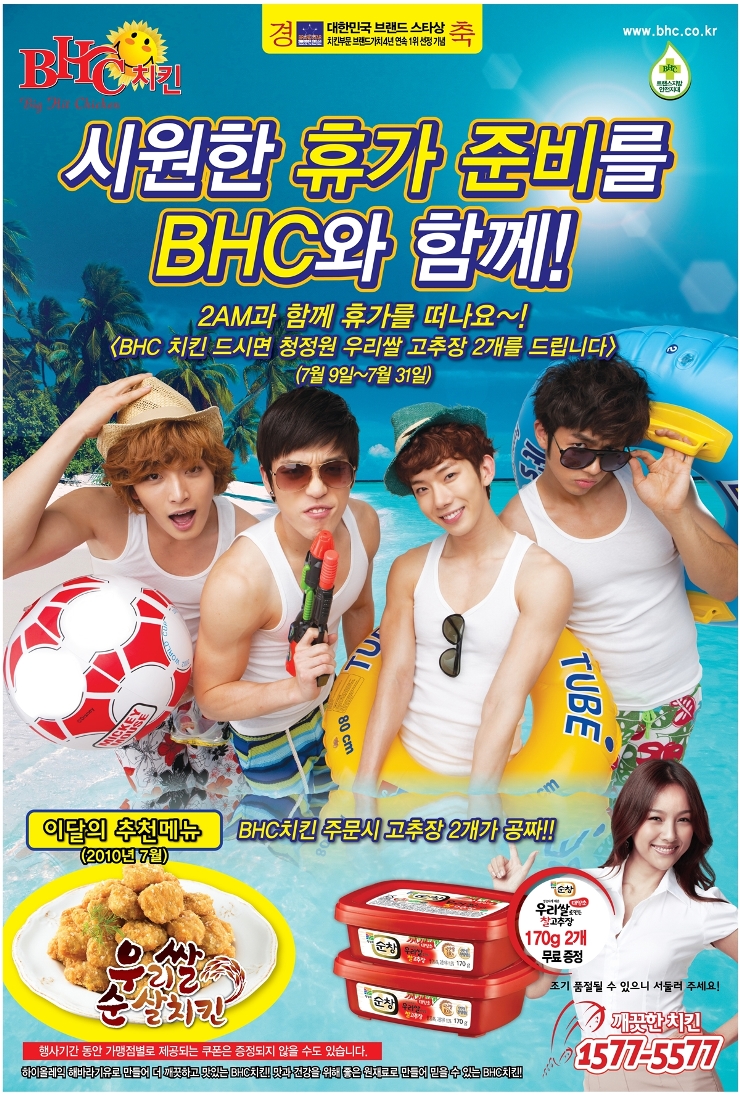
Korean Sociological Image #72: Girl-group performances for the military

In the commercial above, a conscripted soldier is happy that his girlfriend is coming to visit him. What really gets him and his buddies running though, in a play on the faster downloading speeds of KT’s 4G LTE network, is the arrival of a girl-group on his army base.

With 300-350,000 new conscripts annually, one of the longest conscription periods in the world, and a grisly — but improving — record of bullying and abysmal living conditions, keeping the troops entertained can safely be assumed to have long been a big concern of the South Korean military. Accordingly, televised visits by girl-groups and entertainers have become a recognizable part of Korean popular culture (although they originally performed for US soldiers). Here’s an example with actress Shin Se-Kyung (신세경), performing on an army base as part of the very popular Infinity Challenge (무한도전) show last year (episode 269, aired October 1):

For those many more conscripts not lucky enough to have pretty female celebrities come to their own base though, the blog Sorry, I was drunk provides an interesting, *very frank* insider account of what they thought of girl-groups, as well as prostitution, cheating on partners, Caucasian girlfriends, and marriage. Here’s what the author wrote about the former:

…I knew Korean guys, especially sexually deprived conscripts, liked female celebrities (duh, right?), but I didn’t know how bad that affection was. I learned that Korean conscripts in general are obsessed with K-Pop girl groups, in particular Girls’ Generation. By obsessed, I mean really obsessed. A good example of this is rapper Psy’s description of his military service.

In this show, Psy says he was made to stand guard while watching the TV so he could alert senior conscripts that Girls’ Generation was on it. While it wasn’t that extreme in my unit, it was quite normal to see guys flock to the TV whenever GG or other good looking female celebrities were on air. Every Friday and Saturday, when the major networks have those “music” shows parading group after group, entire units would stay glued to the TV. Guys would watch the same music video or performance repeatedly so they could oggle at the girls. Their bare legs exposed, sexy dancing, and terrible music (not a secret among conscripts either), it was pretty obvious there was only one reason for these “musicians” to exist. These girls are glorified strippers, covered in the thin veil of “music” so it doesn’t seem as creepy and sad as going to a strip club. For conscripts, it’s usually the only form of sexual gratification they’re allowed while on base.

See also:

(For more posts in the Korean Sociological Image series, see here)

If you reside in South Korea, you can donate via wire transfer: Turnbull James Edward (Kookmin Bank/국민은행, 563401-01-214324)