Korean Sociological Image #10: “Blackface”

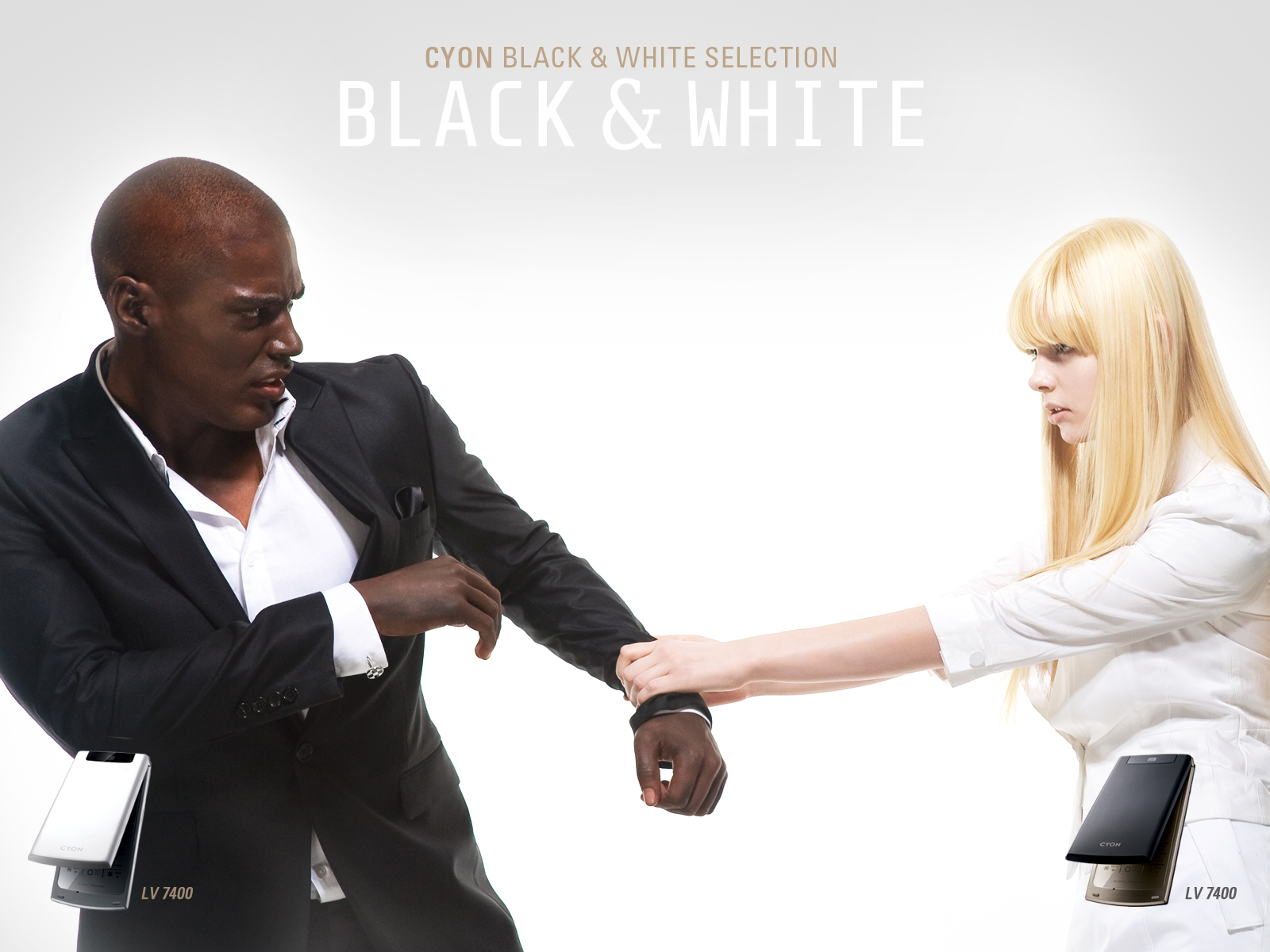
Cyon Black and White AdverisementSpare a thought for the hapless LG Cyon marketing department. Because after 12 years in the business, it must be really difficult to think of interesting names for new phones.

No, really: how else to explain the singularly uninspired choice of “Black and White” for the latest, well, black and white LV-7400 phones to come out? Sure, the likes of “Lollipop” and “Ice Cream” may hardly have been all that creative either, but at least they spawned quirky and memorable advertising campaigns, whereas this series of advertisements for the LV-7400 seems dull, uninspired, and above all too literal. In fairness though, they do provide an instant and dramatic representation of the product, and the commercial itself has a mild eroticism and sensuality to it that compels you to look more closely.

But of course, it’s not those that made me sit up and take notice:

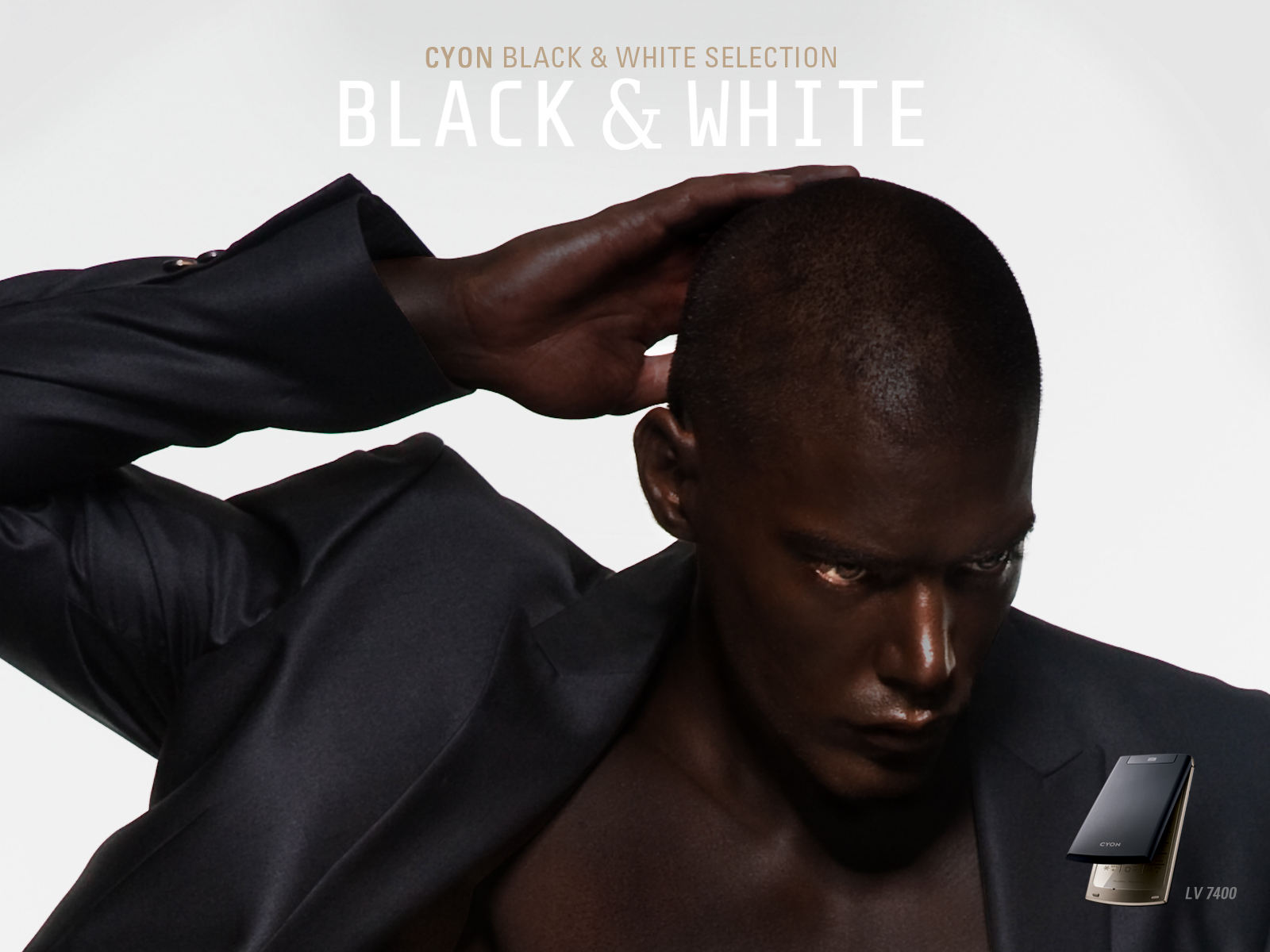
Cyon Black and White Phone AdverisementCyon Black and White Adverisement Black Guy

Yes, that is indeed not a Black man, but a Caucasian man somehow painted black.

It’s so bizarre, and so difficult to rationalize. Because was it really so difficult to find a genuine Black guy? No of course not, and given the extra time and effort involved in painting a Caucasian one then it must have been a deliberate choice. But if so, wouldn’t it have been far more logical and consistent to have also included a Black woman painted white? If not, then what is the “coloring” supposed to signify? And why, oh why, weren’t these blatantly obvious questions  asked by LG Cyon?

Very flawed concept and execution aside though, could the advertisement be construed as racist in any sense?

To answer, my first thought was to turn to Michael Hurt post’s about other Korean examples of the “Blackface” phenomenon at the Scribblings of the Metropolitician, and I broadly agree that the examples he gives are indeed offensive. Moreover, a huge multinational company like LG (of which Cyon is just the name of its mobile phone arm) would almost certainly be aware of the reception they would receive in Western markets, and as such cannot claim ignorance of their racist connotations and history, a parallel of which is Coreana’s use of Nazi imagery in a cosmetics commercial (see Brian in Jeollanam-do here and here for more on that). Nor do I accept the argument that images that Westerners would find problematic are automatically rendered acceptable simply by virtue or being made by and for Koreans, a culturally-relativist Girls' Generation Original Album Coverargument that at the very least is highly patronizing to the latter.

But despite all that, my gut reaction to first offenses is to give the various Korean institutions, companies, and/or individuals behind them the benefit of the doubt, and to use them as an opportunity for education. In particular, because Korean society almost completely lacks any sense of political correctness (which can be as refreshing as it is annoying), and as, for instance, the recent controversy over the use of icons of its former Japanese colonizers for Girls’ Generation’s new album cover (see here and here) demonstrate, or the choice of a comfort woman theme for a series of erotic photos, many Korean companies can display a shocking ignorance of what might offend just fellow Koreans, let alone foreigners. Moreover, considering that: until as late as 2006 Korean social-science textbooks stated that Korea was a homogeneous society and that this was a source of national strength (see #1 here); that a great deal of manifestations of supposedly Western culture in the music industry especially are mere imitations of domestic acts that have come before them, sans non-Koreans’ cultural baggage and angst; and finally that, in Japan at least there are:

…teenagers who used to dress up, and maybe still do, in a fashion known as Ganguro (ガングロ), which literally means “black-face.”

According to a Western video report on this phenomenon, this look does not come from people of African descent; instead, its origins are traceable to a Japanese comic’s donning of blackface in order to clown around in a loincloth in the guise of an aboriginal Australian.

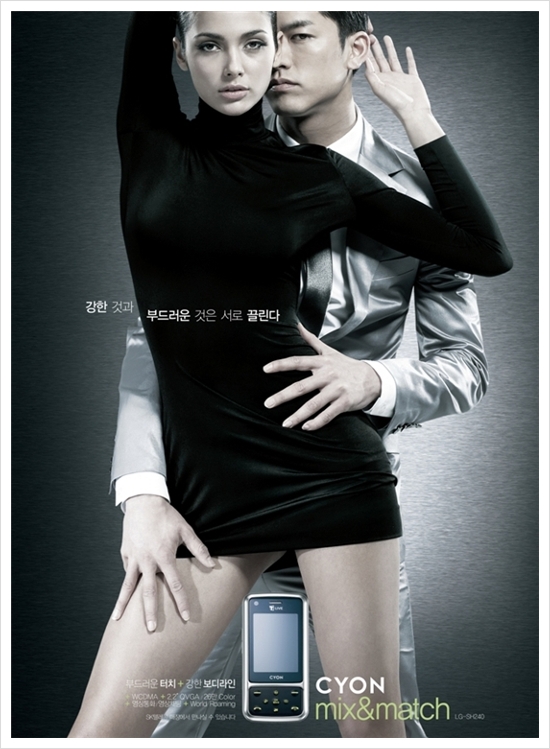
Mix&Match Cyon Korean Phone AdvertisementWith influences on Korea also (again, see Michael’s post), then it’s almost surprising that offensive advertisements and so on don’t crop up more often, and perhaps demonstrate that Korean society is improving in this regard, albeit more slowly than surely (see below).

Also, while intent is not the only consideration in judging such an advertisement, it is still probably the most important, and accordingly I’m at a loss as to how the Cyon advertisements could be construed as a deliberate attempt to demean Black people somehow, regardless of how much offense it may or may not generate: indeed, if that was the intention, then it could certainly have been done much more directly.

That said, I’m reluctant to let Cyon completely off the hook. For take its advertisement from last year for the “mix&match SH-240” series of phones on the right for instance (source). In isolation, then they’re not bad at all (sex sells after all), but again, consistent and logical would have been alternative advertisements with a Caucasian man and a Korean women getting it on also, let alone Koreans with partners of other ethnicities, and I see such a lack as both very deliberate and emblematic of the Korean media’s issues with such relationships even in 2009 (see here, here, here, and here). But that’s another blog post, albeit one which I have to write very soon as part of my preparation for this conference in August!

Update, October 17) See here for another controversial example of “contemporary blackface,” this time from the French version of Vogue magazine.

(For more posts in the “Korean Sociological Image” series, see here)

Korean Sociological Image #9: The Secret to Bigger Breasts?

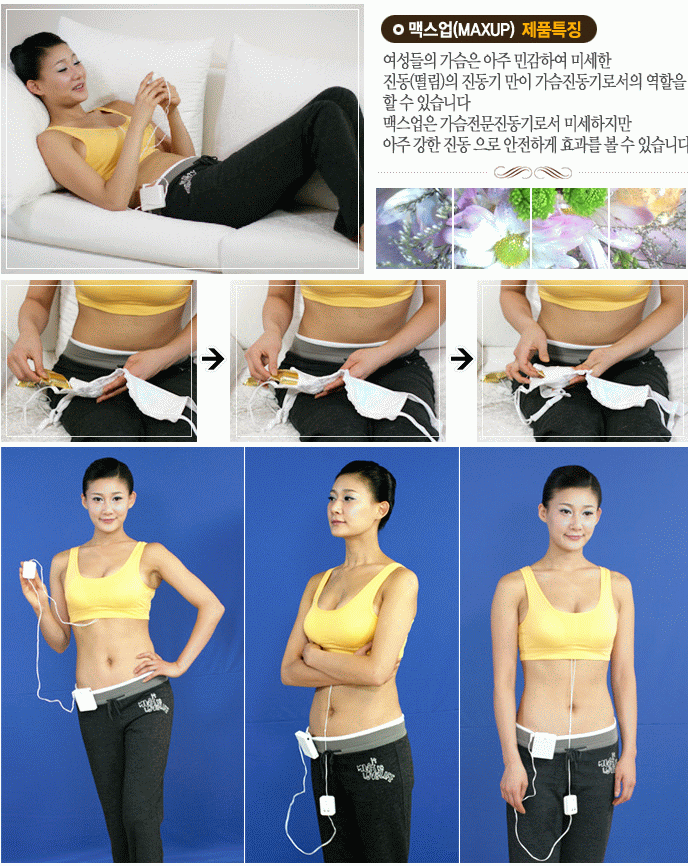
Korean Breast Massager Advertisement Caucasian

( The title reads: “A message of hope to all women!” )

If someone had told me years ago that I’d be writing about a Korean infomercial at some point, then I would have wagered good money that it would have been about one for bidets actually, for nothing quite gives you that “We’re not in Kansas anymore” feeling as switching the television on and seeing attractive women holding perspex buttocks over jets of water, waxing lyrical about how well they cleared a strategically placed brown-yellow paste. I could mention the looks of ecstasy and relief on various actors’ faces as they supposedly use the bidets later too…but you get the idea.

Lest I give the wrong impression though, there are certainly many advantages to Koreans’ no-nonsense attitudes to bodily functions, and actually I much prefer them to many Americans’ delicate sensibilities. But what to make of these – for want of a better term – electric breast enlargers?

If you can forgive the pun, then two things really stick out about this infomercial and its accompanying website for me (beware a loud video if you click on the latter):

First, needless to say, since writing this post on the subject a year ago I’ve still seen absolutely no evidence to suggest that doing fuck all is an effective way to lose weight and gain muscle tone and so on, let alone enlarge any specific body part. But while Korea by no means has a monopoly on misleading advertising, it is also true that various loopholes in advertising legislation here mean that there is little to stop producers of “diet-related” products from, well, basically completely lying about the efficacy of their products. For more on this, see the second half of this post where I discuss Minjeong Kim’s and Sharron Lennon’s “Content Analysis of Diet Advertisements: A Cross-National Comparison of Korean and U.S. Women’s Magazines” (Clothing and Textiles Research Journal, October 2006)¹ from which I first learned of it, and if it sounds like I’m exaggerating, then consider the fact that despite supposedly far stricter standards for “normal” food that over 88% of food labeled as organic isn’t, for instance, or that the KFDA is not empowered to tell you, say, which Vitamin C drinks contain carcinogens, but only (and uselessly) how many (see #14 here).

And second, in the strange event that you didn’t look closely enough to notice, then let me point out that it is only the Caucasian model above that you can see in lingerie, whereas her Korean counterparts are all fully clothed. True, that may sound like a strange way to describe a woman in a crop-top, but the difference is more than mere semantics, as many Korean porn stars worked as lingerie models before bans on foreign models working in Korea were lifted in the mid-1990s. This means that even today lingerie modeling still has a certain stigma that even bikini-modeling lacks, and despite the bikinis themselves obviously being just as (if not more) revealing. For more information, see #1 here for the most recent of many posts on that.

Korean Breast Massager Advertisement Korean

Still, Koreans are notoriously savvy consumers, so while I confess that I haven’t bothered to look at this late hour, I imagine that there will be many scathing reviews of this product available online. And, with obvious parallels in many other (more important) aspects of life in a democracy as young as Korea’s, to a certain extent this vibrancy of online Korean life is the result of and compensates for deficient legislation, although on the other hand in this particular case it is also stymieing the development of a healthy Korean consumer culture.

Tempting as it is to continue this post in that vein, let me wisely close here by pointing out that in the product’s defense, it can simply be returned with your money back before 2 weeks. And I seem to recall from my 2 viewings of Dragon: The Bruce Lee Story that actor Jason Scott Lee playing Bruce Lee had two similar things strapped to his pecs in a scene where he was working on a script at home (i.e. not exercising, just like the women in this infomercial). Can anybody enlighten me? Am I dismissing…er…electric shock treatment(?) unfairly? As far as I know though, and to many teenage girls’ chagrin, the size of a woman’s pectoral muscles still has little effect on the ultimate size and look of her breasts, which are mostly connective tissue, “lobules,” and fat.

(For all posts in my “Korean Sociological Image” series, see here)

1. On a technical note, since I wrote that post the PDF of the article is no longer free to download I’m afraid, so I would be grateful if anyone that knows of a free link an/or a copy themselves could pass it on for me to provide to others here. Alternatively, serendipitously my printer broke last week and I’m buying a printer/scanner to replace it, so I’ll be able to scan the copy I printed if anybody asks!

Share

Korean Sociological Image #8: America…Fuck Yeah!

Korean Advertisement Sungshin Women's University Relative Size Racism Caucasian

An advertisement from today’s Korea Times, which immediately grabbed my attention for 3 reasons:

  • It’s for a women’s university, but not only does it feature men, it has more men than women.
  • It has a Caucasian man in it, whereas the target audience would overwhelmingly be Korean.
  • The Caucasian man is easily the most prominent feature in it, and is looking at the viewer rather than into the distance like the Korean students.

After just a few minutes thought though, obvious reasons emerge for all of those: men are and should be featured because the program is available to both men and women (well technically, the website doesn’t mention anything about the sex of applicants) for instance, and for all their ethnic diversity Caucasians are still an instant and logical signifier of Western countries. And dealing face to face with an American colleague at an American hospital – ie, having a job at one – is precisely the goal of students that will enter this program too, which in turn is well represented by the Koreans in the advertisement looking towards their futures as it were. As the male Korean is wearing a tie, then I’m a bit unsure as to whether the Koreans are supposed to be students in the program or graduates with jobs looking for better opportunities, but other than that slight confusion then the advertisement appears logical as a whole.

Still, despite myself it gives me misgivings.

One minor reason is because the doctor is male. Nothing wrong with that of course, but it seems strange to have a male role-model in an advertisement for a women’s university. Yes, I know I just said that the doctor is supposed to be a future colleague, yet in addition to representing both that and a life in America he does still have a job that students entering into the program would aspire to. If the primary target of the advertisement is women then, not choosing a female doctor seems like a wasted opportunity to kill three birds with one stone.

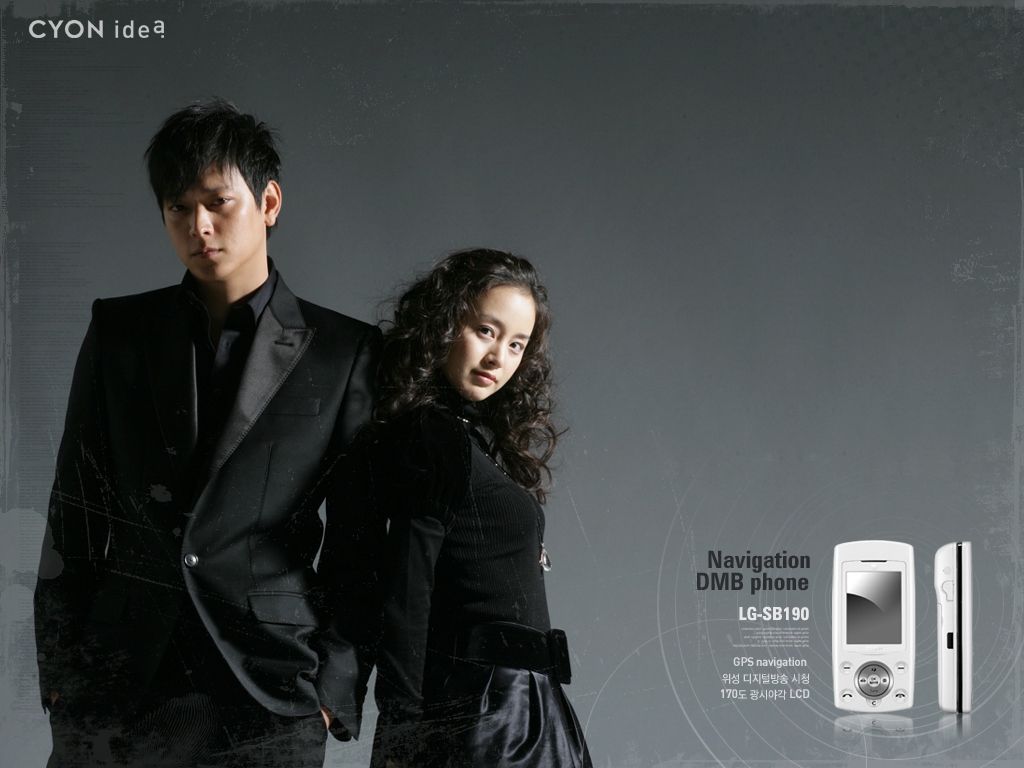
kim-tae-hee-kang-dong-won-cyon-phone-advertisement-relative-size-eab980ed839ced9dac-eab095eb8f99ec9b90( Source )

But dammit, why’d he have to be so big? As I discuss at great length here, relative size is one of the most powerful tools in advertising, not only making certain features more prominent than others but also – especially when it’s used to contrast two or more people of different sexes, ethnicities, jobs, ages, and so on – both determining and conforming to social norms of ranking, status, and appropriate social roles. For instance, if you take a random man and woman then in 1 in 6 cases the woman will be of equal height or taller, but in advertisements the figure is closer to 1 in 20 or even less. Not that that is evidence of sexism per se though, as women overwhelmingly prefer men that are taller than themselves, and it’s natural that many advertisements would reflect this. Moreover, if you’ve chosen specific celebrities with a significant height difference, say Kang Dong-won (강동원) and Kim Tae-hee (김태희) above, then it would be difficult to engineer a realistic-looking advertisement in which he somehow appears shorter than her.

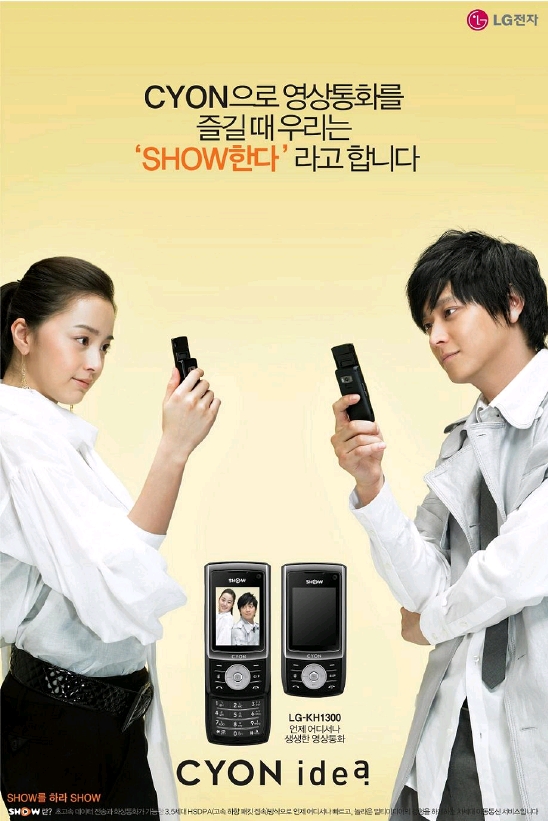
kim-tae-hee-kang-dong-won-cyon-phone-advertisement-eab491eab3a0-relative-size-eab980ed839ced9dac-eab095eb8f99ec9b90But then consider this advertisement on the right with the exact same couple (source), in which the height difference has been significantly reduced. Sure, it’s not the only reason why the advertisement has a completely different, more egalitarian vibe than the first, but I’d argue that it’s the most important one. And to hammer that point home, consider how simply bizarre everyone would find the above, gangsterish one if Kim Tae-hee were just a little bigger, let alone if a woman taller than Kang Dong-won had been used.

Ergo, size matters, and so while my concern with Sunghin Women’s University’s advertisement may well only stem from the inherent angst of being a socially-aware Caucasian male, guilty at living in a country where being such undeniably confers certain advantages, it still leaves me feeling a little uncomfortable. I would have much preferred one that focused more on the Korean students themselves, and how the program empowered them, but while retaining the signifiers of America, the job, and so on. Not something that basically says:

Oooh, do this course, and you can talk to and work with White people! In America!!! What more could you ever want?

Okay, that specific vocalization may just be me. Or is it? That’s a rather indelicate way to put it above, but it is certainly true that living and working (and being educated) in America conveys a lot of status in Korean society, so far from me implying that any Korean is a passive dupe for responding positively to advertisements like this it is logical and intelligent for them to do so. Moreover, my wife, who is Korean, pointed out that most Koreans wouldn’t think twice about the Caucasian in this ad. Perhaps my concerns are misplaced then.

What do you think? Mere overanalysis and liberal-arts major angst on my part? Or a legitimate concern? Regardless, admit that the doctor is the first person you noticed too though!

(For all posts in the “Korean Sociological Image” series, see here)

Share

Korean Sociological Image #7: The Best Gillette Could Get?

Park Ji-sung Gillette Advertisement Photoshop( Source )

On the face of it, Park Ji-sung (박지성) is a very logical choice to endorse any given Korean company’s products or services. After all, he is easily Korea’s most popular male sports star at the moment, he (naturally) has a good body, and he is so successful that he has even published an autobiography already. Accordingly he has dozens of advertising deals to his name, and – to place his popularity into context – via his numerous Korean fans’ choices of credit cards he has more than financially compensated Manchester United for the loss of David Beckham for instance. Presumably then, Gillette Korea thought it was on to a good thing when it belatedly decided to join his bandwagon.

Nevertheless, while it’s not like I can claim to being all that photogenic myself, Park Ji-sung is actually a *cough* less than inspired choice, and at the very least advertisements like the above probably stretch consumers’ senses of disbelief just a little too far, if they don’t put off Korean men from using Gillette products altogether! If you haven’t already figured out why, then photos like this, this, this and this may help, and as Roboseyo points out, it’s not just because of her own sudden popularity that Korean companies started signing deals en masse with ice-skater Kim Yu-na (김연아) last year.

Update: Which brings up the side issue that Korean celebrities are notorious for being unconcerned about diluting their own personal brands, but so far this doesn’t appear to have been the case with either Park Ji-sung or Kim Yu-na.

Korean Zespri Kiwifruit AdvertisementOf course, photoshopping is by no means a recent phenomenon or unique to Korean advertisers, although it’s also true that extreme examples like Amore Pacific’s recent attempt to get women to aspire to a – by definition impossible – photoshopped “X-line” body ideal may well be very hard to find in other countries. With that in mind, I’m always interested in the extent to which Koreans are aware* of the level of photoshopping that occurs in advertisements and their opinions of it, but as I and many commenters have already talked about photoshopping on numerous occasions on the blog already (here’s a very small sample!), then rather than merely rehashing old points here, instead let me ask you how well you think Gillette’s ads will do, what your Korean friends, lovers and/or colleagues think of it, and what they think of photoshopping in general? Commenter Seamus Walsh’s female friends for instance, told him a little while ago that:

…they all were aware of the altering of photos that goes on…but that it is generally ignored because they know the models are attractive anyway, and that they look good after photoshopping, so that’s all that matters. Basically, despite knowing an image isn’t a true representation, they would rather have the altered image. I just wonder if this means that their ideals of beauty are based on the reality or the unnatural and unattainable?

Me too. But how representative are those opinions of average Koreans’ in turn? Please let me know!

* Not to imply that your average Korean consumer is any less intelligent than your average Western one with that statement, but having said that, on the other hand I’m not going to lie and pretend that somehow the Korean education system encourages the same level of critical thinking either.

(For all posts in the “Korean Sociological Image” series, see here)

Share

Creative Korean Advertising #16: The Male Gaze

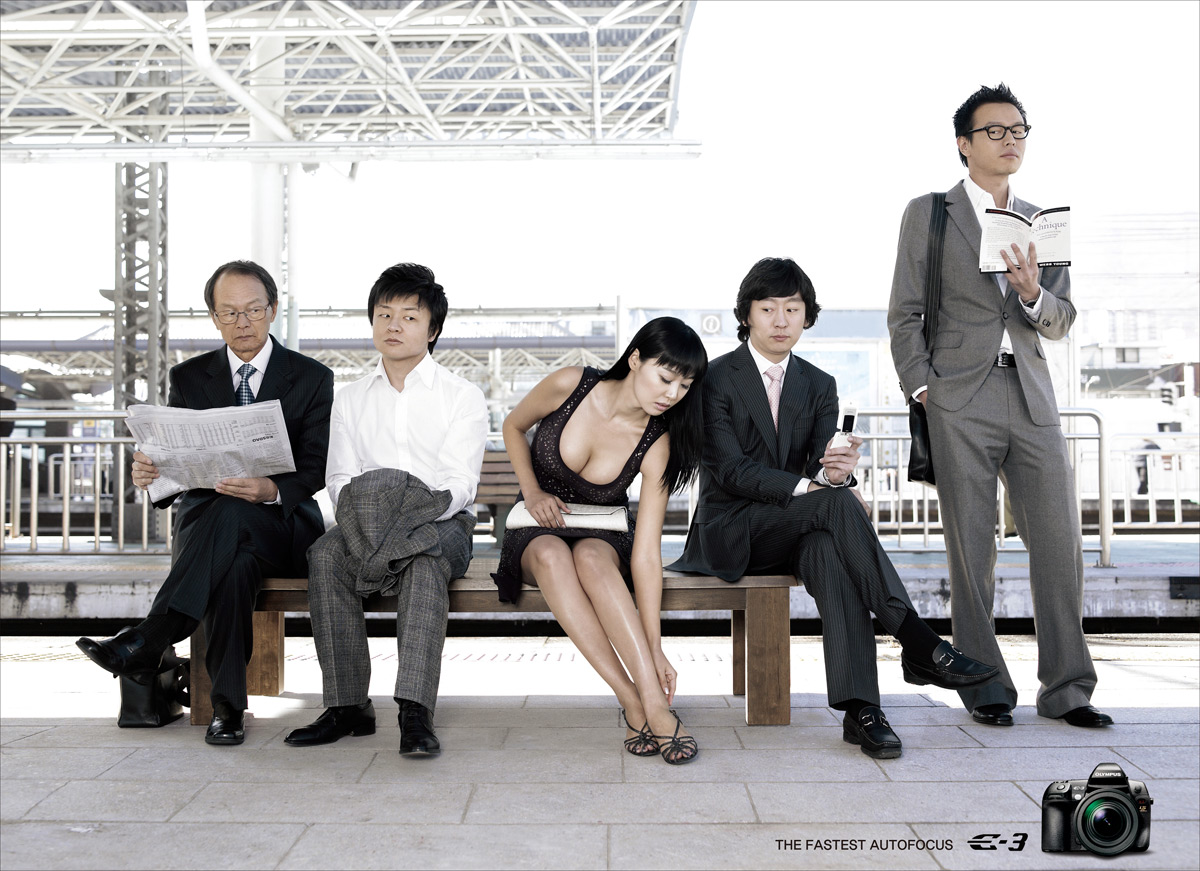
Diamond Ogilvy Korea Olympus E3 Autofocus( Source: Add Shots )

Given my Feminist pretensions, then usually I’d instinctively feel defensive about my decision to post an ad like this, and in the past this has often prompted me to write lengthy arguments about how, say, exposure of breasts per se shouldn’t be regarded as sexist. But with some notable exceptions (and from which I’ve learned a great deal from), whether through preaching to the converted, most of my readers being men(?), or some other reason, judging by the lack of detracting comments on those occasions then such justifications have probably proved unnecessary.

So, I’ll let it go: readers certainly don’t need me to spell out that on the one hand this ad is definitely objectifying, but on the other that men would behave exactly the same way even if women had achieved complete equality, and can decide for themselves if it’s sexist or not (I’m still happy to discuss that in the comments section though). In the meantime, I’m learning to feel less ashamed about the unabashed grins ads like this put on my face, especially the first ad in this post.

Actually, a much more interesting issue it raises is its directness. Of course objectifying women is hardly new or unique to Korean ads, but I can’t think of any other example that so blatantly incorporates the corresponding (sexual) male gaze into its message, and this makes it more sexual than, say, the sudden spate of couples kissing in Korean advertisements that is making news recently (see here, here, and here). On top of that, it actually went up way back in November 2007 too (see the details here), which raises some interesting questions:

  • How common was it?
  • Where was it posted?
  • Were there any complaints?
  • If so, was it removed from circulation?
  • If not, why have there been no similar ads since?
  • Or perhaps there have been, it’s just that I didn’t notice them?

If any readers can help me with any of those, I’d appreciate it. In the morning, and with apologies for not doing this first, I’ll scour Naver and so on and see if there’s anything in Korean on it.

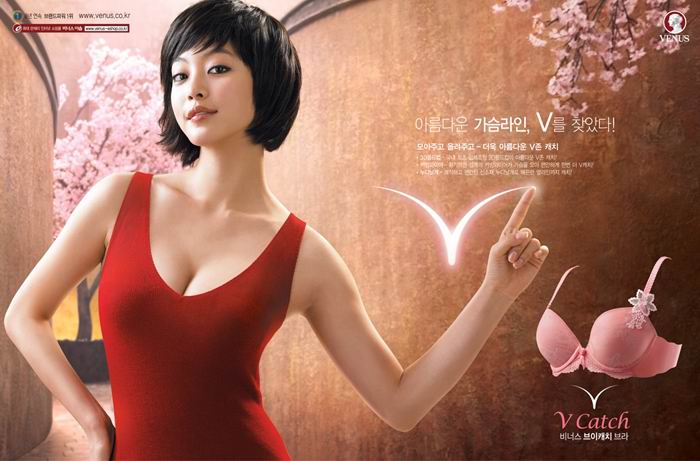
Update: Unfortunately I couldn’t find anything at all about this ad in Korea, either at Naver or Yahoo! Korea, and which makes me wonder if it was actually released or not? But as for ads featuring the male gaze, I forgot about this one with Han Ye-seul (한예슬) for lingerie company Venus (비너스). From February 2008:

Vodpod videos no longer available.

(For all posts in my “Creative Korean Advertising” series, see here)

Share

Korean Sociological Image #6: How about a date with Lee Yeon-hee?

Lee Yeon-hee Oz Date

An otherwise innocuous, quick slice of Korean life…but which inadvertently prompted some soul-searching and a minor epiphany about Korean society on my part. Please bear with me!

If you’re reading this blog in Korea, then by virtue of its inane “We Live in OZ” catchphrase you’ve probably more aware of LG Telecom’s “OZ Generation” advertising campaign than most. But you may not have heard of its online virtual first person “date” with model and actress Lee Yeon-hee (이연희) that was launched about two weeks ago, and which deserves kudos for being the first of its kind in Korea (indeed, this post was originally intended to be #16 in my Creative Korean Advertisingseries). As Coolsmurf explains at allkpop here:

Users get to have a complete, enjoyable date with Lee Yeon Hee by completing 6 stages with varying difficulties, but all of which can be solved by using the LG mobile phone and your trusty keyboard. You get to hold the hands of Yeon Hee as you dash away from the crowd, ride a bus with her, have a meal, celebrate her birthday, etc.

And as of Saturday, 200,000 people had participated since it was released 10 days earlier, with 20,000 visitors daily. Unfortunately, and all too typically for Korea, the main site requires your national ID number to participate (I didn’t check if my “foreign” one worked or not sorry), but strangely this alternate entry site (in the screenshot below) doesn’t, which will hopefully give K-pop fans outside of Korea a chance to participate.

Lee Yeon-hee Oz Star Date Game

I confess, I did it myself for a little while: it’s like a surreal bubblegum version of Doom 3, with eye-candy as the target rather than demons. And my 3 year-old daughter sitting on my lap found it hilarious when I crashed into people and potholes while running to meet Yeon-hee in “Mission 1” (hint, use the cursors), but neither of us were sufficiently motivated to figure out how to rouse her after she fell asleep on the bus in Mission 2 though I’m afraid (but get on the bus using the mouse this time). Not for a fifth time at least…

But what epiphany about Korean society did this prompt on my part? Other than being reminded, say, of the penetration and pervasiveness of mobile phones into all elements of Korean life that is?

Well, consider the rather childish and platonic way the couple interacts on the “date” itself, replete with numerous uses of the word Oppa (오빠): to Western eyes it makes it appear more reminiscent of the sorts of dates we had – or perhaps, our parents liked to think we had? – back in our early teens, and certainly nothing like what most Western adults would consider worth showing up for. Lest you feel like that’s an exaggeration though, then by all means examine it for yourselves, but I’m sure that most people at all familiar with unmarried Koreans need no such assurances.
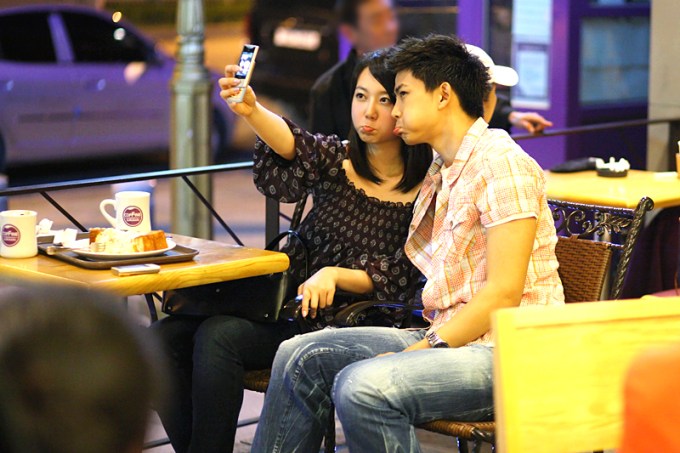
A Typical Korean Date

In the original version of this post, this prompted a lot of speculation on my part as to whether the date game was in fact primarily targeted towards teenagers, but that was misguided: as Charles points out in his comment that made me realize that, I myself went on “dates” like that with a 25 year-old Korean woman before I met my future wife, and although I haven’t dated in the 9 years since – and so by no means claim to be an expert on Korean dating culture – I’m confident that a sizable proportion of 20-something Koreans do have indeed have platonic dates like this. After all, the various cultural, social, and economic factors that lay behind the plethora of blind-dating systems in Korea certainly do still exist, although as Michael Hurt in this excellent practical guide to the cultural pitfalls of dating Korean women points out, the move from single-sex to mixed schooling is beginning to change those (see the KoreanClass101 Blog here also).

Lest I give the wrong impression though, I’m not against such dates per se. And while it’s true that I don’t personally consider dating without the ultimate aim of a sexual relationship as dating at all, that’s isn’t quite the same as thinking that, say, any woman that doesn’t sometimes put out on the first date (or guy that doesn’t want that) is a prude! And that so many Koreans go on such dates is – however patronizing it may sound – a very nice and endearing aspect of Korean society.

However, it is but one version of Korean dating culture. And yet while Koreans as a whole are certainly more sexually reserved than your generic Westerners, I doubt that any readers need convincing of the fact that over 50% of Koreans have sexual experiences before marriage. Yet- and herein lies the (belated) beginning of my epiphany – why is it only the platonic version of dating that is still overwhelmingly presented in the Korean media? And particularly when depictions of so many other aspects of sexuality in the Korean media are becoming increasingly bolder and more liberal over time?

Girls' Generation... Korean Teens are Sweet and Innocent

True, if you take issue with my description of the way dating is depicted in the Korean media, then I have no data to back that up: indeed, I don’t watch Korean dramas precisely because on the rare occasions I’ve naively wanted to spend more than 5 minutes with my wife on the sofa while she’s watching one, then I’ve soon been forced to leave the room at sheer disgust and incredulity with the surreal, Disneyland version of Korean life presented on the TV screen. Still, as commentators on this lengthy post on that subject pointed out, there are more realistic and palatable dramas out there if you’re prepared to look for them.

Also, granted: the ways dating and premarital sex are depicted in the Korean media are in many respects quite separate to, say, the censorship issues that I’ve been following closely in my weekly(ish) Korean Gender Readerposts. But still, rather than censorship being akin to some inexorable fact of nature (i.e. Korea is a conservative country…what else does one expect?), the numerous forward and backward steps in Korea just this year has provided me with a healthy reminder that what is considered suitable for Korean viewers is in reality a very mutable concept (and don’t get me started on Japanese censorship issues). Which begs the question of who is doing the defining, and why.

This brought to mind the following lesson I learned from An Introduction to Japanese Society by Yoshio Sugimoto (and easily the first book you should ever read on the subject):

Japanese culture, like the cultures of other complex societies, comprises a multitude of subcultures. Some are dominant, powerful, and controlling, and form core subcultures in given dimensions. Examples are the management subculture in the occupational dimension, the large corporation subculture in the firm size dimension, the male subculture in the gender dimension, and the Tokyo subculture in the regional dimension. Other subcultures are more subordinate, subservient, or marginal, and may be called the peripheral subcultures. Some examples are the part-time worker subculture, the small business subculture, the female subculture, and the rural subculture.

Core subcultures have ideological capital to define the normative framework of society. Even though the lifetime employment and the company-first dogma associated with the large corporation subculture apply to less than a quarter of the workforce, that part of the population has provided a role model which all workers are expected to follow, putting their companies ahead of their individual interests…. (p. 12).

yellow-salaryman

Yes, Japan, supposedly the land of the faceless salaryman…is anything but. And yes, the subject of salarymen may seem a little out of place at first glance, but I’m sure you’re seeing the connections already. Continuing in the same vein (although as a quick aside, it’s interesting to consider why Japan is so well-known for the salaryman system, when if fact it’s only Korea that ever had them as a majority of workers):

Dominating in the upper echelons of society, core subcultural groups are able to control the educational curriculum, influence the mass media, and prevail in the areas of publishing and publicity. They outshine their peripheral counterparts in establishing their modes of life and expectations in the national domain and presenting their subcultures as the national culture. The samurai spirit, the kamikaze vigor, and the soul of the Yamato race, which some male groups may have as part of the dominant subculture of men, are promoted as presenting Japan’s national culture….

More generally, the slanted views of Japan’s totality tend to reproduce because writers, readers, and editors of publications on the general characteristics of Japanese society belong to the core subcultural sphere. Sharing their subcultural base, they conceptualize and hypothesize in a similar way, confirm their portrayal of Japan between themselves, and rarely seek outside confirmation….(pp. 12-13).

As another aside, this last point highlights how Koreans are in many senses shooting themselves in the foot by alienating and demonizing a whole generation of English teachers in Korea (see here, here, and here):

Core subcultural groups overshadow those on the periphery in inter-cultural transactions too. Foreign visitors to Japan, who shape the images of Japan in their own countries, interact more intensely with core subcultural groups than with peripheral ones. In cultural exchange programs, Japanese who have houses, good salaries, and university educations predominate among the host families, language trainers, and introducers of Japanese culture…(p. 13)

(Update: See here for some quick recent examples of how different the Japanese are to the way they’re normally represented in the foreign media)

No, I’m not suggesting that there is a big conspiracy to keep premarital sex off Korean screens. Nor am I suggesting that the above is all that original or profound, and certainly my ultimate epiphany – merely to extend the above lesson to depictions of Korean dating and premarital sex in the Korean media also – is much less so.

But the point that I want you to take away from all this is that at the very least it provides an interesting and useful alternate framework with which to analyze the topic in future. For instance, the completely ineffectual Youth Protection Committee’s (of the Ministry for Health, Welfare and Family Affairs) recent banning of music group TVXQ’s latest songs from being played on TV and the radio because of “lewd content” and the need to “protect teenagers” (see #2 here), may be most explicable in terms of corporatist motivations, or in other words be the result of the Ministry’s struggle for relevance and definition under the hostile Lee Myung-bak Administration, which originally planned to disband the former Ministry of Gender Equality and Family altogether (now a separate Ministry of Gender Equality exists: see #4 here), and despite the compromise being opposed by all ministries involved. No, I’m not saying that that is the case necessarily, just that it’s a possibility that needs to be considered.

And on that note, I’d better end this post, which has admittedly somewhat evolved from its ostensible original topic. Which reminds me, presumably other male and female members of the “OZ Generation” in the advertisements will have similar dates set up for them, and it’ll be interesting seeing the different conventions for the former’s behavior and writing about that a later date. And probably this topic will be in IM AD (아이엠 애드) also (Korea’s only magazine devoted to online advertising), and I’ll make sure to buy it and translate the corresponding article also. In the meantime, I’m curious as to if this virtual date has already been done overseas, so if any readers know of foreign examples then please pass them on.

Image sources: first & second, third, fourth, last.

(For all posts in the “Korean Sociological Image” series, see here)

Share

Choi Jin-sil Sued For Being Beaten by Her Husband: Update

Choi Jin-sil holding back tearsWhen hearing last week about something as appalling as an actress being sued for daring to show her bruises and black eyes to the media, it’s only human nature to assume the worst of Korean society.

But while Korea certainly does have a great deal of work to do in combating domestic violence—and criminalizing spousal rape would be an essential first step (see #2 here)—it’s also true that police and legal attitudes towards it have considerably hardened in recent years, both cause and effect of a law change in 2007 that requires police to forward all cases of domestic violence to a prosecutor (the previous 1998 law just left it up to their own discretion). In addition, Korean women are now more likely than ever to divorce on the basis of verbal or physical abuse, rather than suffering silently as in past decades.

Indeed, what stands out more than anything else about the court decision is how much it goes against the grain of trends within Korean society, and certainly does not reflect the will of all Koreans. Some quick excerpts from today’s Korea Times for instance:

Women’s groups are angry over the top court’s ruling that ordered the late actress Choi Jin-sil (최진실) to compensate a builder for failing to maintain “dignity” as a model representing its products.

They censured the Supreme Court for not realizing the suffering of domestic violence victims, which included Choi.

Korean Womenlink, the Korea Women’s Hot Line, and the Korea Women’s Association United issued a joint statement Wednesday lambasting the ruling.

On June 4, the court reversed a high court ruling that decided in favor of Choi in a compensation suit filed by Shinhan Engineering and Construction in 2004 against the actress, who was the model for its apartments.

The advertiser claims she did not keep her contractual obligation to “maintain dignity,” because she disclosed to the public her bruised and swollen face which was caused by the violence of her then husband, former baseball player Cho Sung-min. They divorced soon afterward.

For the rest, see here. Also, see here for my original post on this issue and information about similar cases in the past, and here for a quick primer on the numerical rates of domestic violence in Korea (albeit in 2004), with many graphs and tables.

(By the way, although it was already common knowledge, it’s good that the Korean media is now naming the company. But I wonder if it was originally kept anonymous by a court order, or just by convention?)

Gender and The Unwritten Rules of Korean Alcohol Advertisements

Phallic Bokbunja advertisement( Source )

Prompted by my recent post on an advertisement selling soju to women, which I misinterpreted the details if not the spirit of (no pun intended) because I was too lazy to translate the voiceover first, I’ll be using Korean sources as much as possible in my analyses of Korean advertisements  from now on. Unfortunately, judging by its absence in bookstores and its website not being updated, then the only specialist magazine on offline Korean advertising I used to use for that – Korea Ad Times (코리아애드타임즈) – folded back in March, and Korean-language internet sources (on any subject) are notorious for their vacuousness and poor quality writing.

This Maeil Economy (MK) report that I’ve translated below is no exception, and as I pay much more attention to what readers might actually find interesting these days than I did a year ago, when admittedly I used to post just about any tabloid trash I’d translated, then normally I’d reject posting this. But – lest that honesty put you off reading further – I did still learn a couple of things from this one, especially from the last paragraph:

소주광고의 법칙…모델은 만 18세이상의 여자: 포스터 우측 하단에 소주병

The Rules of Soju Advertisements: models have to be over 18, and there has to be a soju bottle in the lower right corner of the poster.

Son Dam-bi Charmsoju Advertisement

( Source )

모델 나이 제한을 비롯해 이래저래 제약이 많은 소주 광고엔 공식이 있다.

Beginning with restrictions on the minimum age of models used, there are many de facto rules to the standard formula used in soju advertisements.

소주 광고의 가장 기본적인 공식은 최고의 인기를 누리고 있는 여자 연예인을 모델로 기용하는 것. 현재 진로 참이슬은 하지원, 진로 제이는 신민아, 롯데주류 처음처럼은 이효리, 보해 잎새주는 백지영과 모델 계약을 맺었다.

The first is that female models that enjoy the highest popularity are hired. Currently, Ha Ji-won models for Chamisul (James: taking over from Son Dam-bi above), Shin Min-a for Jinro, Lee Hyori for Lotte’s “Like the first time,” and Baek Ji-young for Bohae’s yipsejoo.

이는 소주라는 제품 특성상 남성 소비자 비중이 70%를 넘고, 소주를 자주 찾는 남성층이 여성 모델을 선호하기 때문이다. 소주 판매에서 가장 주축이 되는 소비자는 20~30대 남성층. 인기 있는 여성 모델이 소주 광고모델을 하면 이들의 호응을 얻을 수 있다. 이와 함께 깨끗하고 순한 이미지를 강조하고자 하는 업체들의 요구도 강하다. 과거 독한 술로 여겨지던 소주가 최근 알코올 도수를 낮춰서다. 이 같은 이유로 웬만하면 소주 광고는 여성 모델을 기용하고 있다.

As 70 per cent of soju drinkers are men, primarily in their twenties and thirties, then female models are preferred, and popular female entertainers always get the best response from this group. Also, soju companies demand a clean a pure image be emphasized in advertisements. Finally, the alcohol content of  soju is going down. For all these reasons, women are used in soju advertisements.

하지만 최근 저도주 경쟁에 따라 남성을 모델로 기용하는 사례도 찾아볼 수 있다.

Gang Dong-won Soju AdvertisementHowever, as there is increasingly a market for weaker soju drinks, then you can increasingly find male models being used.

20대 여성을 타깃으로 삼은 대선주조의 `봄봄`은 강동원을 모델로 썼다. 봄봄은 알코올 도수가 16.7도로 국내에서 시판 중인 소주 중 가장 낮다. 젊은 여성들을 주된 소비자로 삼다보니 여성들 사이에서 인기가 많은 모델 강동원을 택한 것이다. 대선주조는 대학생 1000여 명을 봄봄 개발에 참여시켰고, 그중에서도 여성들의 입맛에 초점을 맞췄다.

For Daesun’s “Spring Spring” brand of soju, at 16.7 per cent the weakest soju on the domestic market, Gang Dong-won was used to target female consumers in their twenties (source). He was the first choice of 1000 female university students that were used to help develop the brand by participating in a survey on how they found its taste.

소주업계 관계자는 “최근 알코올 도수를 낮춘 소주가 출시되는 것은 여성들을 소주시장에 끌어들이기 위한 것”이라며 “이에 따라 여성만 광고모델로 쓰던 관행도 변하는 추세”라고 설명했다.

An industry insider explained that “recently soju drinks with lower alcohol contents have been released in order to attract female consumers, and accordingly we are changing the convention that only women should be used in soju advertisements.”

소주잔은 반드시 오른손으로 들어야 한다는 것이 두 번째 공식이다. 우리나라에서는 술잔을 왼손에 들고 받는 것은 술을 따라주는 사람에게 실례로 여기기 때문에 모델이 왼손잡이라고 하더라도 반드시 오른손으로 들어야 한다. 또 소주병은 포스터 오른쪽 하단에 똑바로 서 있어야 한다. 이는 주류회사들의 오래된 관행인데, 소주병 자체가 바로 제조회사를 상징하므로 소주병이 기울어져 있으면 사세가 기운다고 여기기 때문이다. 모델이 들고 있지 않은 상태에서 가장 잘 보이면서 광고 전체의 분위기를 깨지 않는 곳이 오른쪽 하단이다.

That soju glasses have to be held in the right hand without fail is another unwritten rule of soju advertisements, as in Korea it is impolite to a person offering the alcohol to receive it in left hand, even if one is left-handed. Also, on soju advertisements the soju bottle itself must be standing, as it is a symbol of the company, and if it is leaning then similarly the fortunes of the company will decline. Finally, if the model is not holding the bottle but it is standing in the bottom-right corner, then it does not detract from the advertisement’s sense of atmosphere.

There are many exceptions to the above rules of course, but now that I’m aware of them, then a quick survey shows that the vast majority of soju advertisements do indeed follow those conventions. Needless to say though, while most advertisements are not as explicit as the opening one for in this “bokboonja” (복분자) here, the use of a bottle as a phallic symbol is by far the most important consideration in virtually any drink advertisement, and it’s difficult to take seriously any analysis of one that doesn’t mention that. Nor one that wouldn’t mention what the shape below is supposed to represent either, which I was interested to learn is called a “yonic” symbol:

Yonic Bokbunja advertisement( Source )

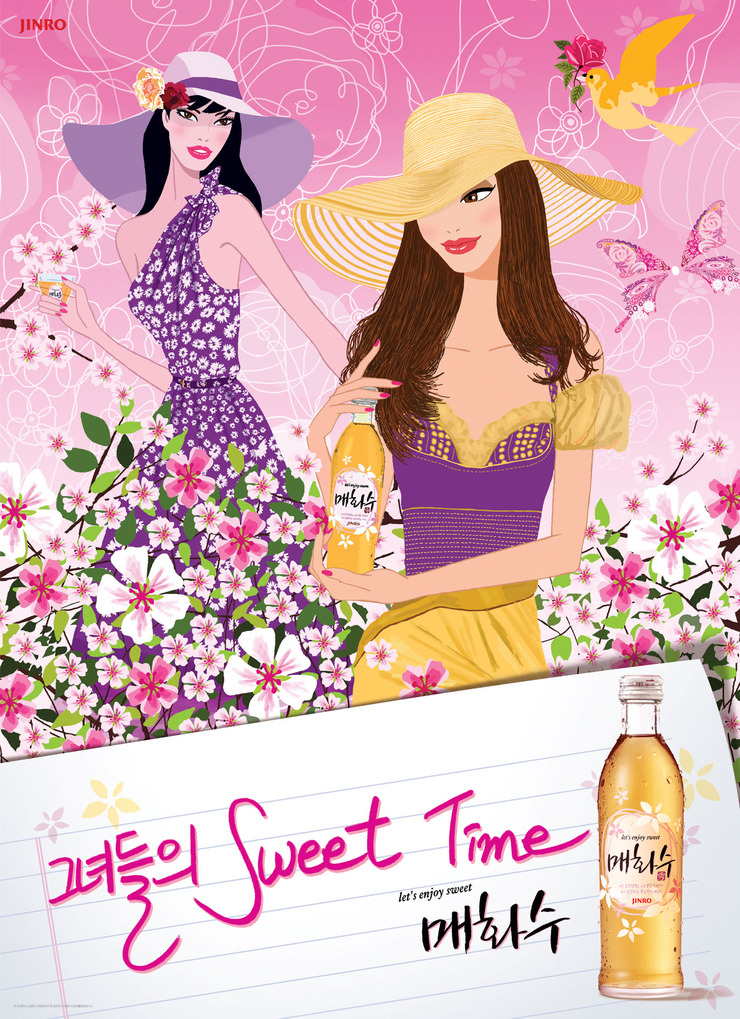
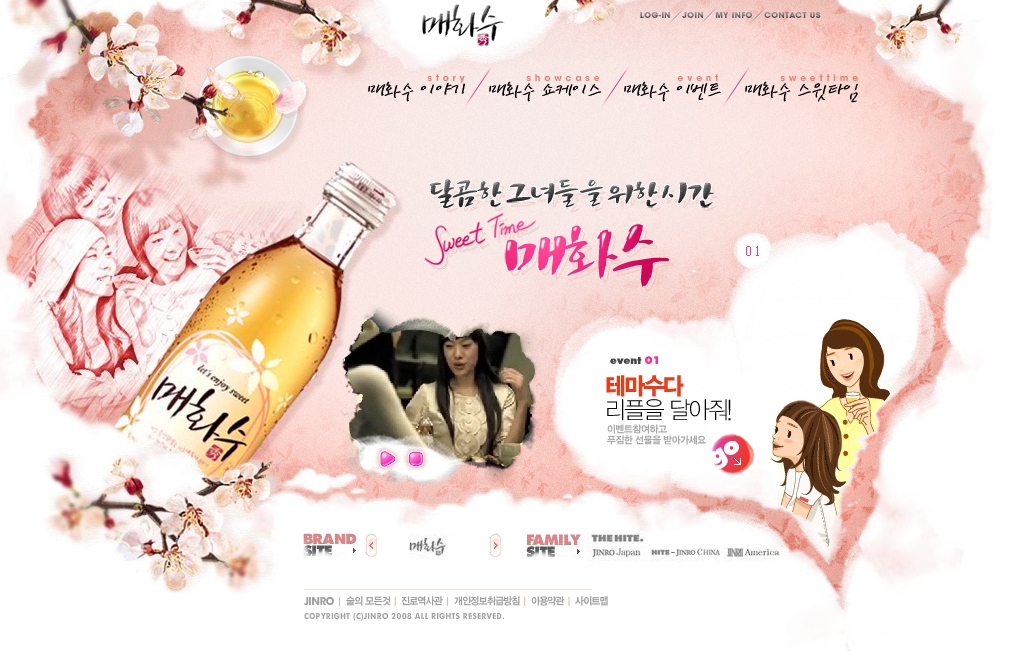
And speaking of women, while I won’t give this subject the attention it deserves here (perhaps next week), also interesting is that I’ve noticed that it is alcohol advertisements targeted towards women that are more likely to break those conventions, which by no means apply only to soju. A good example is this one below (more here) for Jinro’s “maehwasu” (매화수) drink with 14 per cent alcohol, clearly targeted exclusively at women, and one wonders at the logic behind both the flowers and pastel colors and Jinro’s belief that such a vastly different marketing approach was warranted. More often than not these are more indicative of advertisers’ stereotypes and prejudices than any empirical evidence that gendered advertising actually works, at least in the case of broadly similar products marketed to both sexes (cosmetics are possibly one exception though).

maehwasu gendered advertisement( Source )

On a final note, I can’t resist mention of the maehwasu website, for what do you find literally popping up and extending in the bottom left corner of the screen when you visit, to the obvious delight of the three women next to it? It would be interesting to listen to a company representative or advertiser try to explain a non-sexual reason for that particular exception to the rules…

Phallic Maehwasu Screenshot

Share

Firm Sues Dead Actress For Being Beaten by Her Husband – And Wins

Choi Jin-sil holding back tearsA simply outrageous story, that couldn’t really wait for my “Korean Gender Reader” on Monday.

But, given the similar case of the singer Ivy (아이비), whose reputation was ruined by her ex-boyfriend threatening to release a sex-video of her to the media in late 2007, and who was later sued by advertisers for this despite the video never actually existing, then this latest case with Choi Jin-sil (최진실) is exceptional only in degree really.

However, in suing an actress that committed suicide, the unnamed construction company (Update: It’s Shinhan/신한건설) below may well have pushed the limits of public acceptability, and this will hopefully incur a backlash that will far outweigh the relatively small gains now to be provided by her estate.

To play Devil’s Advocate for the moment though, the appeal was probably submitted to the Supreme Court well before Choi Jin-sil’s death in October last year (Update: Indeed, it was submitted 5 years ago). But even so, of course it is deplorable that the company submitted the original suit in the first place, and I’m sure that it would have still been possible to withdraw it afterwards.

Models who failed to maintain appropriate dignity as representatives of the products they represent should compensate for the damages caused to their advertiser, the top court ruled.

The Supreme Court reversed the original ruling and ruled in favor of a construction company that filed a suit against the deceased actress Choi Jin-sil, who committed suicide last October.

The company, upon hiring the top actress as their representing model in March 2004, concluded a contract stating Choi’s duties to pay back 500 million won ($399,361), should she depreciate the company’s social reputation.

However, in August, Choi appeared on television and newspapers with her face full of bruises, allegedly caused by the violence of her then husband and retired baseball player Cho Sung-min.

Choi and Cho, who had been living apart since 2002, divorced soon after the incident.

The advertiser company thus filed a suit against the actress, requesting for 3 billion won as compensation. The amount included the 500 million won in damages as stated in the contract, additional compensation of 400 million won and 210 million won in advertising costs spent by the company.

“The purpose of the brand model contract is to use the model’s social reputation and images to draw the customers’ interest,” said the Supreme Court in the ruling. “The model’s failure to maintain an adequate image constitutes a breach of the hiring contract.”

The concept of the apartment Choi was supposed to advertise was dignity and happiness, and Choi, as its model, was under the obligation to act accordingly, said the court.

A lower court said in an earlier ruling that Choi could not be held responsible for depreciating the image of the apartment or the company as she had not been proven guilty of causing her former husband’s violence.

Choi’s mother presented herself at court, as legal representative of her two children who succeeded their mother’s duties and became defendants of the case.

The estimated value of Choi’s estate is about 5 billion won, including real estate and bank savings, according to her family.

(Source: Korea Herald)

See here for more information about domestic violence in Korea, and #2 here for more on a custody battle which Choi Jin-sil’s family also had to face in October 2008, but which her ex-husband was persuaded to give up (see here and here), and which in turn ushered in positive changes in the Korean legal system. Here’s hoping this latest case will similarly have a silver lining, and force Korean companies to rethink the ethics and long-term financial value of insisting on compensation for events beyond celebrities’ control.

Ladies: Stay Slim with Soju?

Shin Min-a Soju Advertisement Mirror

Faced with the unenviable task of somehow making soju cool, Jinro (진로) did a pretty good job with the launching of its new “J” (제이) brand back in October, but its latest efforts to associate the brand with losing weight may well require too big a suspension of disbelief from most consumers!

Or at least, that was my first gut reaction. But then if faced with a choice of two equally priced and similar brands of any strong alcohol, probably I would indeed choose the slightly weaker one: I am slightly overweight, and it’s not like 5 per cent less alcohol wouldn’t still have the desired effect on me. How about you?

As you’ll soon see though, it’s not that which made me first notice the ad:

Vodpod videos no longer available.

Look familiar? To put it mildly, commercials featuring female celebrities lounging around in their underwear aren’t exactly common on Korean television, and so I don’t think the similarities with this advertisement with Han Ji-hye (한지혜) from March – actually, the only other example – are any coincidence. Here, the actress and model featured is Shin Min-a (신민아), as it happens in the entertainment news a great deal as I write this for her first screen kiss with Won bin (원빈), and as you can probably tell, the idea is that a 1 per cent reduction in alcohol content (from 19.5 to 18.5) somehow results in the following:

Shin Min-a Soju Advertisement minus 1inch

Shin Min-a Soju Advertisement minus 1kg

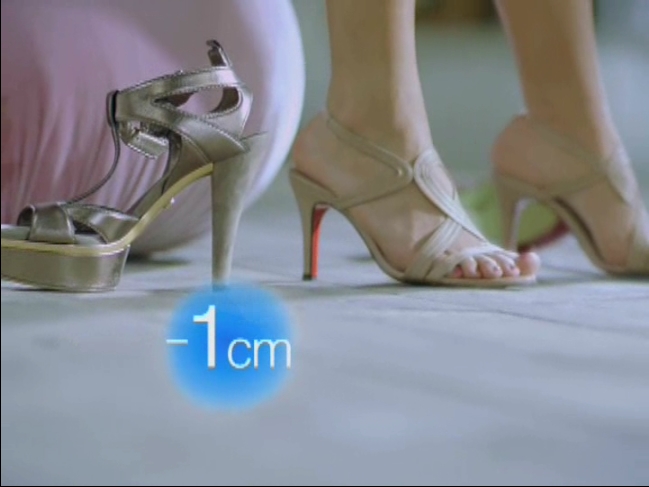
Shin Min-a Soju Advertisement minus 1cm

Admittedly I don’t like high heels in the first place, but that last is probably overdoing it, as I can’t see how drinking less alcohol than normal somehow makes you taller as well as thinner? Regardless, below is a accompanying poster for the new, weaker soju that you may have seen around, and for the sake of adding to my conversation with commentator Seamus about Koreans’ (relative) lack of awareness of the amount of photoshopping in everyday advertisements and magazine images, would be grateful if you could show it to your Korean friends, students, colleagues, and/or lovers and so on: among other things, do they think Min-a’s legs have been lengthened and made thinner in it or not?

Update: Sorry, but in hindsight it was sloppy and quite strange of me to write about this ad without translating the voiceover first, and if I had then what I wrote above would have been quite different:

1kg 빠져도, 다른데?

If you lose 1kg, are you different?

1인치만 줄어도, 좋은데

[Even] if you shorten your skirt by only one inch, it looks better.

1cm만 낮아도, 편한데

[Even] if you reduce the length of your high heels by only 1 cm, they’re more comfortable.

그리고 1도만 더 부드러워져도

처음보다 1도 더 부드럽다

And also if you soften [soju] by only one degree, it’s one degree softer from the first sip.

18.5도 진로제이

진로제이처럼 더 부드러워지세요

18.5% Alcohol Jinro J

Like Jinro, please make your life a little softer.

Shin Min-a Jinro Soju Advertisement

Placing the ad in a wider perspective, as much as 90 per cent of all alcohol consumed in Korea is soju, and Jinro sells 50 per cent of that, so this latest marketing drive may well reflect the saturation of the market more than anything else (no pun intended). In such circumstances, a company can either start selling in new markets or repackage its product in different varieties if it wants to increase profits (or to ensure that they don’t decrease: examples like this are how I learned about the Marxian “inevitable tendency of the rate of profit to fall” at university), a good example of which is the number of different Coca-cola drinks available and their (very very) rough correlation with an economy’s level of capitalistic development and competition, as evidenced by, say, the precisely two available in New Zealand when I entered university in the mid-1990s against the plethora available in the US decades earlier.

And so with equivalents in other Northeast-Asian countries, and little appeal outside of the region, diversification is probably the most logical path for soju producers. True, the above ads in particular reflect a desire to create a new market before reaching that stage – only 30 per cent of soju drinkers are women – but given that…

The word soju to most Korean women produces something approaching a mild panic – an explosive squeal of disgust, a deeply pained expression, head shaking, hand waving. That’s not to say they don’t drink it. It’s just they don’t seem particularly like it, even as they pour it down their throats (source).

…then I have my doubts as to whether that figure will ever go up to 50 per cent. Here’s hoping that the Korean alcohol industry is indeed on the verge of offering more choices and variety then!

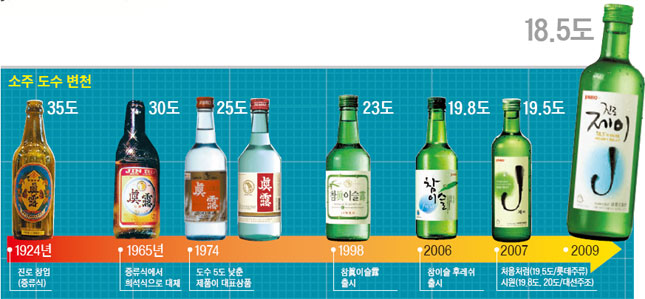
Update: Here is a related graphic showing decreases in soju’s alcohol strength over time. For more information (in Korean), see here.

Soju's Strength Decreasing Over Time

(Image Sources: first, second-fourth, fifth, last)

Share

The Illusion of Sex

The Illusion of Sex.

A description of the images above made by Harvard psychologist Richard Russell, who won third prize in the 5th Annual Illusion of the Year Contest for them:

In the Illusion of Sex, two faces are perceived as male and female. However, both faces are actually versions of the same androgynous face. One face was created by increasing the contrast of the androgynous face, while the other face was created by decreasing the contrast. The face with more contrast is perceived as female, while the face with less contrast is perceived as male. The Illusion of Sex demonstrates that contrast is an important cue for perceiving the sex of a face, with greater contrast appearing feminine, and lesser contrast appearing masculine.

I found the following explanation much more useful and interesting though:

What you’re looking at isn’t an optical illusion, but is a play on the basic expected traits of men and women’s faces. The flusher lips of the left pic coincide with our expectations for women’s faces, as does the fairer skin. And it’s not just the illusion of lipstick; even without lipstick, we expect women’s lips to be more red than men’s. The difference in skin tone also brings to mind a recent a study suggesting that, on the whole, men’s faces are more red complected, while women’s are more green. Thus, even in the B&W photo, we infer that the darker complected face has the deeper reddish tone of masculinity; the lighter, the paler, greenish tone of femininity.

Obviously there’s much that’s debatable in that, especially whether those “expected traits” are universal or culturally-determined, but in the meantime I can’t deny that contrast is an important cue for determining the sex of a face, and that this provides more evidence for Korean women’s mania for lightening their skins being influenced by much more than merely wanting to emulate the wealth and sophistication represented by Caucasians.

Update) There is an 11-page PDF about these images available here, and you can find out more about Richard Russel and his research interests here.

(Thanks very much to reader Nicolas for passing this on)

How to Get Ahead in Korea…

Samsung Mini-notebook advertisementWhile I wouldn’t go so far as to include it in my “Creative Korean Advertising” series, this advertisement certainly did get my attention when it was in the form of the entire back page of today’s Korea Times, and not just because I have a shaved head myself! Click on it for a full-size image, and you’ll soon see what I mean.

Meanwhile, apologies for the lack of posts recently, but my father-in-law literally fell off a cliff last weekend, and had to be taken by helicopter to the closest hospital. He’s okay (ish), but he’ll be in hospital for a long time, and with my wife going back and forth to her hometown to see him, my looking after the children while she does, and all my other work and paid writing commitments, then my blogging plans for this week have lost out to my getting a whole 5 hours of sleep a night I’m afraid(!). But blogging-wise at least, things should be back to normal within a couple of days.

Korean Women Are Not Alphabets!

kim-tae-hee-v-line-face-drink-advertisement

Update, February 2013: Please see here, here, and many other posts in my “Revealing the Korean Body Politic” series for my considerably updated, hopefully much more nuanced thoughts on Korea’s alphabetization trend, especially in light of what I’ve learned about historical Western precedents!

The original version of my article for today’s Korea Times:

Well known for donning corsets on stage since her comeback in May last year, few can deny that there is much to find cute in singer Son Dam-bi (손담비) tightening a miniature one around a bottle of ‘Today’s Tea’ in her latest commercial.

But while modern corsets lack the uncomfortable body-shaping functions of their Victorian counterparts, they remain an enduring symbol of the pressures women can be under to conform to often impossible ideals of appearance. And despite its lightheartedness, this commercial provides an excellent illustration of a distinctly Korean spin on this (source, right: kjutaeng3)

Beverage producer Lotte Chilsung invented the term ‘bellyline’ for use in this commercial, and it is this that the corset and supposedly the drink help with slimming. In itself, doing so is not at all worthy of any criticism, nor is the term dissimilar to, say, the English equivalent of ‘waistline,’ which would actually have been a much more appropriate choice here. But with that perfectly good term existing already, then why invent a new one?

The reason is that the term is merely the latest in a spate of naming particularly female body parts after English letters in recent years, a very curious fashion that seems unique to Korea so far. Consider the following best known examples of this:

  • M-line (abdominals, for men)
  • S-line (breasts and buttocks, viewed from the side)
  • U-line (exposed lower back)
  • V-line (one for face, and another for the line in-between breasts)
  • W-line (breasts)
  • X-line (long legs and arms, with a narrow waist)
A Woman and her lines(Source: Dark Roasted Blend)

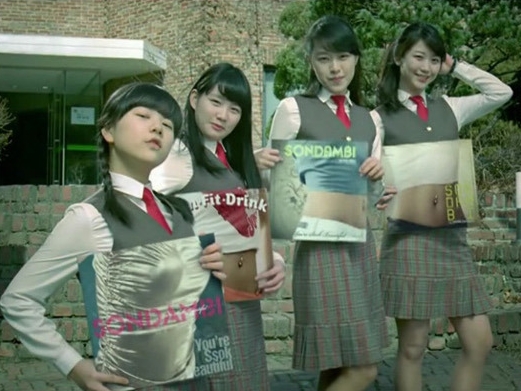
And so integral to Korean pop culture are S-lines and V-lines in particular, that within five minutes of turning on a television you are likely to see either female celebrities strutting them on talk-shows, or prominent ‘S’s and ‘V’s displayed in commercials. Indeed, such is the current mania surrounding them that you can even come across examples completely unrelated to the original body parts involved, including in commercials for cell-phones, school uniforms, and even gas boilers!

Although this practice seems frivolous on the surface, says blogger Javabeans “it actually belies much more pernicious trends in society at large,” and something is surely seriously amiss when, rather than the media, you have a majority of female celebrities “vocally espousing their alphabet-lines and therefore actually objectifying themselves as a conglomeration of “perfect” body parts rather than as whole, genuine people.” But, why their alacrity in doing so? (source, left: 여자가 좋다. 남자는 필요없다.)

A clue is that this quote was made in the context of a breast cancer fund-raising party in October last year, the producers of which saw absolutely no irony in naming ‘Love Your W.’ And if nothing is viewed as untoward in doing so for an event supposedly about empowering women by encouraging them to respect more and take better care of their bodies, then you can imagine that there are few inhibitions for promoting the use of ‘lines’ to teenagers and young girls either.

Accordingly, there are even educational videos that promote healthy food such as fermented bean paste (dwenjang/된장) to elementary-school children that mention that eating it will be good for their S-lines and V-lines also. And one probably direct effect of this is the fact that many Korean middle-school girls have ‘face rollers,’ the repeated application of which is supposed to flatten one’s face towards a desired, angular, ‘V’ shape.

To be sure, the Korean media is not unique in placing undue emphasis on women’s appearances rather than their intelligence — the American media obsession with Michelle Obama’s fashion choices being a notorious recent example — nor is it in providing often unobtainable and unnatural role models and body ideals for women and girls. But the contexts in which those are received are important, and whereas videos like the above would rapidly be banned in schools in many other developed countries, and/or educators that criticized children because of their appearance rapidly fired, unfortunately both are par for the course in Korea.

(Han Ye-seul demonstrates yet another “V-line.” Source: Naver Photo Gallery)

To an extent, this lack of awareness and/or concern is understandable when a child’s entire life prospects are almost entirely determined by a single exam: parents have other priorities. But on the other hand, when a majority of netizens did not take pride in astronaut Yi Soyeon for being the first Korean to go into space last year, but instead criticized her for her appearance during the flight, then teenage girls will hardly be encouraged to study harder.

And on a wider scale, as Korea again faces an economic crisis, in order to recover it is worth pondering what lies behind Korea long having one of the lowest rates of working women in the OECD. Surely a good start to using this underutilized human resource, one of the best-educated in the world, would be to encourage both sexes to stop judging women, and women expecting to be judged, entirely on their appearance?

Korean Sociological Image #2: Son Dambi, The Perfect Woman

(Source: Paranzui)

Updated, October 2013

My previous commentary on this “Today’s Tea” commercial was woefully out of date, so it’s since been mercifully deleted(!). But many of the themes expressed remain just as potent in the Korean media today, including the encouraging of teenage girls and children to be dissatisfied with their bodies; the constant invention of new, often impossible, body shapes and “lines” for females of all ages to strive for; the over-reliance on celebrity endorsements, to the extent that the one chosen here, Son Dam-bi, is portrayed as somehow having a superior body and face to an equally-attractive, almost identical woman; and finally, albeit admittedly minor here, the reinforcement of gendered dieting roles by portraying the (single) male humorously—confirming that dieting is something only women need should be serious about.

Think I’m exaggerating? Just see for yourself:

Those problems aside, note that the “34-쏙/ssok-34” is a clever wordplay on women’s “vital statistics” (bust/waist/hip measurements), with one use of the word “ssok” being to stress how concave something is. In fairness, it’s quite apt for a slimming product.

(For more posts in the “Korean Sociological Image” series, see here)

Love Stinks: Why More Korean Women Wear Deodorant Than Men

성유리-sultry-sung-yuriIn today’s Korea Times. I’ll chime in here with links and extra information that I couldn’t provide in the 800 words allowed there (source, left: fotoya):

“Men can sweat up to 50% more than women,” or so says deodorant maker Rexona. Yet not only do very few Koreans ever wear deodorant, advertisements for it that have started appearing in recent years have almost exclusively been aimed at women.

Far from being counterintuitive however, a study published last Monday in the journal Flavor and Fragrance demonstrates that women have very good reasons to pay more attention to how they smell.

Researchers at the Monell Chemical Senses Center in Philadelphia asked male and female volunteers to rate the strength of 32 underarm sweat samples collected from both genders, and then 32 more that had been disguised by different fragrances typically used to control or mask underarm odor. While both men and women rated the unadulterated samples as equally strong, 19 fragrances successfully disguised the smell for men, while women were deceived by just two.

Investigating further using only female volunteers’, again the unadulterated samples were rated equally strong, but whereas six fragrances succeeded in disguising the men’s smells, as many as 16 worked on the women’s.

Yes, I also thought that it was strange to test only female volunteers in the second series of tests, and I’m confused about the composition of the sweat samples in the first series too: were they just random samples from men or women, were they mixed together into some form of asexual smell, or what? Unfortunately, the above is the best I could make out from 4 even more confusing and widely divergent reports on the study here, here, here, and here, and with what I’m being paid then my sense of journalistic integrity doesn’t quite extend to paying for access to the study itself I’m afraid!

In other words, while women’s noses are more sensitive than men’s, their own odors are more easily disguised, leading women to wear more deodorant or perfume than men.

Naturally there’s much more to it than men’s worse sense of smell, as I’d wager that — at the moment at least — in most cultures it is much more culturally acceptable for women than men to spend a great deal of time and money investing in how they smell, and express an interest in “smelly things” in general, although this study does at least point to a possible biological basis for that. One commentator on one of those other reports argues that the proportion of male to female chefs suggests otherwise, but others argue that that is more due to discrimination than anything else.

As an aside, in the mating game, this may not always be good strategy: other research has shown that the scent of a woman’s sweat is particularly attractive to men at the most fertile time of her monthly cycle.

composite faces of the 10 women with highest and lowest levels of oestrogen(Composite images of women taken with the most (L) and least (R) amounts of estrogen when ovulating. Source: New Scientist)

I’ve lost the link behind that sorry, but with the proviso that what counts as “common sense” and “natural” in gender studies and behavioral science is very much dependent on its era (scroll down a little here for a classic demonstration of that), with so much else about women being the most attractive at the most fertile parts of their cycles then I don’t think that readers will be needing much convincing.

But there is much more than this behind the gender bias in the marketing of deodorant in Korea.

In their low deodorant uptake, Koreans are the exception rather than the rule. While it is true that the first aerosol deodorant was launched as recently as 1965, the first roll-on applicator tested in 1952, and Mum, the first ever commercial product for preventing body odor, only invented in 1888, every major civilization as far back as the ancient Egyptians has left a record of its efforts at disguising underarm body odor. So what makes Koreans so different?

Diet, weight, fitness and climate certainly all play a role in how much one sweats, how smelly it is, and one’s ability to smell others. While explanations involving ethnicity are fraught with danger, it is true that Northeast Asians have fewer of the apocrine sweat glands most associated with odor than average. Famous human behavioralist Desmond Morris (The Naked Woman, 2007) has argued that this makes them less susceptible to body odor. But while Northeast Asians on the whole may smell less than other groups, that does not mean that many individuals – particularly men – can relax about their personal hygiene.

That many do is probably at least partially due to a host of cultural and economic factors: for instance, during much of Korea’s recent history deodorant would have been considered a luxury that few needed and even fewer could afford; a notion that still lingers in the gifting of such basic items as spam and cooking oil for national holidays. Another is Korean men’s mandatory military service, a defining experience forcing youngsters to get used to going without many everyday basics.

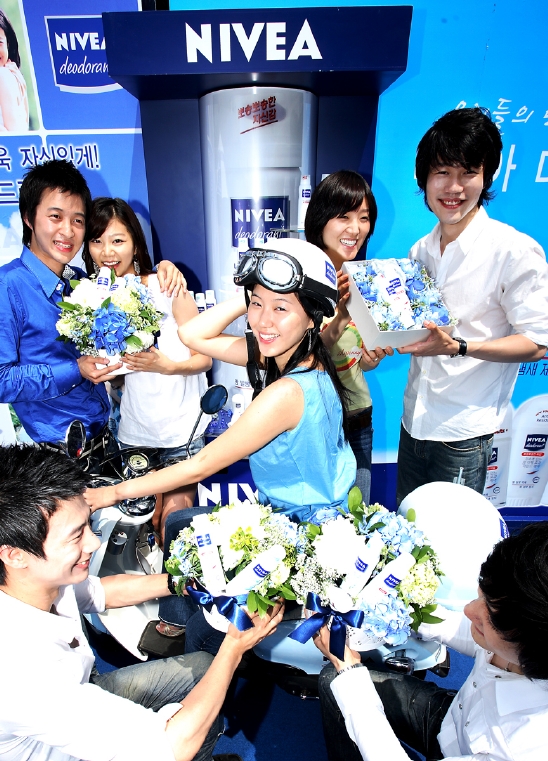
nivea-deodorant-korea-데오드란트With a nod to all the commentators on my earlier big post on deodorant use and its marketing in Korea (source, right)…

On the other hand, given women’s physiological advantages and their dominance of the “smelly industries” worldwide, the very word “perfume” has feminine overtones to many Western male ears. It is reasonable to assume that “deodorant” has similar connotations for most Korean men. Yet looking at the popularity of kkotminam or “flower men” in Korea, challenging traditional notions of masculinity and spending more time and money on their appearance, deodorant manufacturers should be keen to tap into a whole new market.

Unfortunately the timing is bad: while “look at this strange side of the recession!”-type stories are in vogue at the moment, with everything from skirt lengths, alcohol and tobacco consumption, number of breast enlargement surgeries, lipstick sales, and even vasectomies variously being described as going up or down with the economy, experience from the financial crisis of 1997-98 suggests that sales of men’s cosmetics are about to drop. After four years of 10-20% growth from 1992, sales dropped 28.6% the next year, and ad spending by 37%.

Those last figures come from p. 125 of “The Trend of Creating Atypical Male Images in Heterosexist Korean Society” by Lim In-Sook, Korea Journal, Vol. 4 No. 4 Winter 2008,  pp. 115-146, available online here. They put paid to any side-notions I had that flower men ideals for men partially came from the need to stand out in the suddenly very competitive job market after the Asian Financial Crisis (which just goes to show that women’s changing tastes probably had more to do with it!), but given their relative popularity now then that may not be what happens to sales of men’s cosmetics during this latest recession though.

When (if) things pick up though, forget about those Korean deodorant advertisements for women that emphasize mother figures and friendships. Expect those for men to associate the right deodorant with sexual success.

Another recent study from the International Journal of Cosmetic Science has demonstrated that how a deodorant makes a man feel is much more important than any changes to his scent. Lest that sound like exaggeration, researchers found that women looking at men through one-way mirrors rated those wearing certain deodorants more attractive than others, due simply to the confident swagger the act of wearing the deodorant had given them!

An annoying, tantalizing way to end an article? That must mean I’m learning the tools of the trade then! For that above study see here, and I discuss it in more detail in that earlier post of mine.

Going All The Way…to Hong Kong?!

jung-il-woo-cha-su-yeon-vita500-commerical-정일우-차수연-비타500-광고-captureEstimated reading time: 2 minutes. Actors: Cha Su-yeon and Jung Il-woo. Source: Paranzui

How could I miss this? Probably the first Korean commercial ever to feature a woman literally moving up and down on top of her boyfriend?

Much more interesting though, is what is written and said. For not only does the background text read “You need Vitamin C for love too!” (사랑에도 비타민C가 필요하다!) for instance, but, like Chris explains at Dead Girl:

Boyfriend is trying to airplane girlfriend but he’s having trouble maintaining, if you know what I mean, and so he downs a bottle of 비타500. Immediately invigorated, dude now has no problem keeping her up, and at the end he asks her, “Where shall we go?” She replies, “Hong Kong!”, which I now know is a pretty popular euphemism here in Korea for an orgasm, its origins being the affluent image of Hong Kong that was held in the collective consciousness of Korea until not too long ago. So ladies, next time your man asks where you wanna go, demand he take you to Hong Kong, and don’t let him stop till you get there.

Noble sentiments indeed.

Although the slang was new to me, I did quickly learn when I arrived in Korea that the English equivalent of “coming” was “going” in Korean, so going somewhere does make some sense. Nine years later though, the Korean (and Japanese) for that seems to have been completely Anglicized. Which is a pity, as this phrase is possibly unique to the Korean language, and a genuine surprise to hear in a primetime television commercial.

What other surprises like this ad might be out there? If just a little bit of Korean ability completely transforms our understanding of otherwise innocuous-appearing cultural products, perhaps we should keep an open mind about how sexually conservative Korean society in general really is. Why do gatekeepers present it as such to overseas audiences, when it clearly is a lot more nuanced than that?

If you reside in South Korea, you can donate via wire transfer: Turnbull James Edward (Kookmin Bank/국민은행, 563401-01-214324)

Flower Men: The Hot Topic of 2009?

daniel-henny-cosmetics-advertisment(Source: SpaceHo)

Written at the request of the Korea Times editor yesterday, with the final edited version available online here.

Naturally I think the original is much the more pleasant to read, and so that is what I include below, but I have to concede that the editor both adapted it well to a news format and made it take much less time to get to the point; in hindsight, my thesis topic wasn’t exactly the best of choices for an 800 word article. Any new readers looking for the promised wider discussion of the issues raised in it though, please see here, here, here, and here (for starters!).

Still, one genuine quibble with the Korea Time’s article is the misleading title, as it was actually the last downturn — the Asian Financial Crisis — that was responsible for the “Flower Men Wind” as they put it. But that’s no big deal, and its obvious to anyone who goes on to read it.

On a final note, I suddenly have a newfound appreciation for Michael Breen’s sarcastic article about commentators to Korea Times articles. To wit: “this author is out to lunch and offers nothing to KT readers. men need to work and they should be first in line for jobs.”

Sigh.

Downturn Spawns ‘Flower Men’ Wind

Jo In-sung(Source: Dramabeans)

“Dynamic Korea” still graces many a Korean government website, and while that slogan has demonstrably failed to stimulate tourism in recent years, it remains a fitting one for such a rapidly changing society. Yet in the midst of such change, how to anchor oneself as a member of it?

In practice, the need for rootedness renders one’s generation in Korea as strong a marker of identity as, say, race is in the US, and one vivid demonstration of this is the sight of grown children alongside their parents: not only are the former often well over a foot taller because of better diets, but in particular the pastel colors of many sons’ clothes, their elaborate hairstyles, their attention to skincare, their “couple-clothes” and so on can be in sharp contrast to the staid appearance of their fathers, many of whom may well be quite perplexed and embarrassed at what they see as their sons’ effeminate looks.

Yet most would probably be surprised and offended to hear themselves being described as such, and, to be fair, such concepts do vary greatly between times and cultures. What their fathers regard as effeminate now were actually the norm in many earlier periods of Korean history for instance, as illustrated by the costumes in the 2005 movie “The King and the Clown,” and — however bizarre this may sound to Western readers — couple-clothes can in fact be worn by both sexes for the sake of rebellion, such visible affection being a stark rejection of their parents’ often arranged marriages, and all that those entailed.

As such, it is important to analyze the origins of current Korean fashions and lifestyle choices in Koreans’ own terms. Unfortunately, this has generally not been the case in English for Korean men’s current “kkotminam” ideals of appearance.

Possibly, this is because its literal translation — “flower men” — sounds awkward, and so the seemingly close equivalent of “metrosexual” is quickly used in its place. This conflation leads writers to attribute the rising popularity of flower men in Korea over the last decade to a mere importing of metrosexuality. This is a mistake.

jang-dong-gun-cosmetics-advertisementAmong other things, Korea completely lacked — nay, explicitly banned — the mainstreaming and then commodification of gay culture in the 1990s that led to the rise of metrosexuality. Even today there are implicit restrictions against positive portrayals of foreign male-Korean female relationships in the Korea media that have prevented metrosexual symbols like David Beckham from ever acquiring the popularity here that they did in, say, Japan during the 2002 World Cup. Moreover, when focusing on men, it can be easy to lose sight of the fact that it is actually women’s changing tastes in them that drive changes in their fashions and grooming habits, and accordingly it ultimately proves to be married Korean women in the late-1990s that are responsible for flower men’s origins (source, right: ruppy2009).
Why married women? Because it was they who bore the brunt of layoffs during the “IMF crisis,” the logic being that they could be provided for by their husbands instead. But coming after decades of the subservience of feminist goals to wider ones of democratization, and only so recently being given the opportunity to achieve those – not least of which was the right not to be fired upon marriage – they were greatly angered at the sudden loss of a long-awaited opportunity. Moreover, to add insult to injury, they were then encouraged by both government and business to support “Korea’s hardworking men” in order to overcome the crisis.

This shows that Korea remains a deeply patriarchal society, and even today women are heavily circumscribed in the extent to which they can publicly criticize Korean men. Indirect criticism, therefore, took the form of an outright rejection of traditional ideals of men as strong, provider types. A sudden glut of movies appeared featuring romances between older women and younger men, and that this was when the first, identifiable, flower men began appearing in advertising too. And then there was the World Cup of 2002: Korean women themselves were surprised at how as a mass they appropriated such a previously masculine event as their own, in just a few short weeks forever changing standards of dress, discourses of sexuality, and cementing these new ideals of the Korean man.

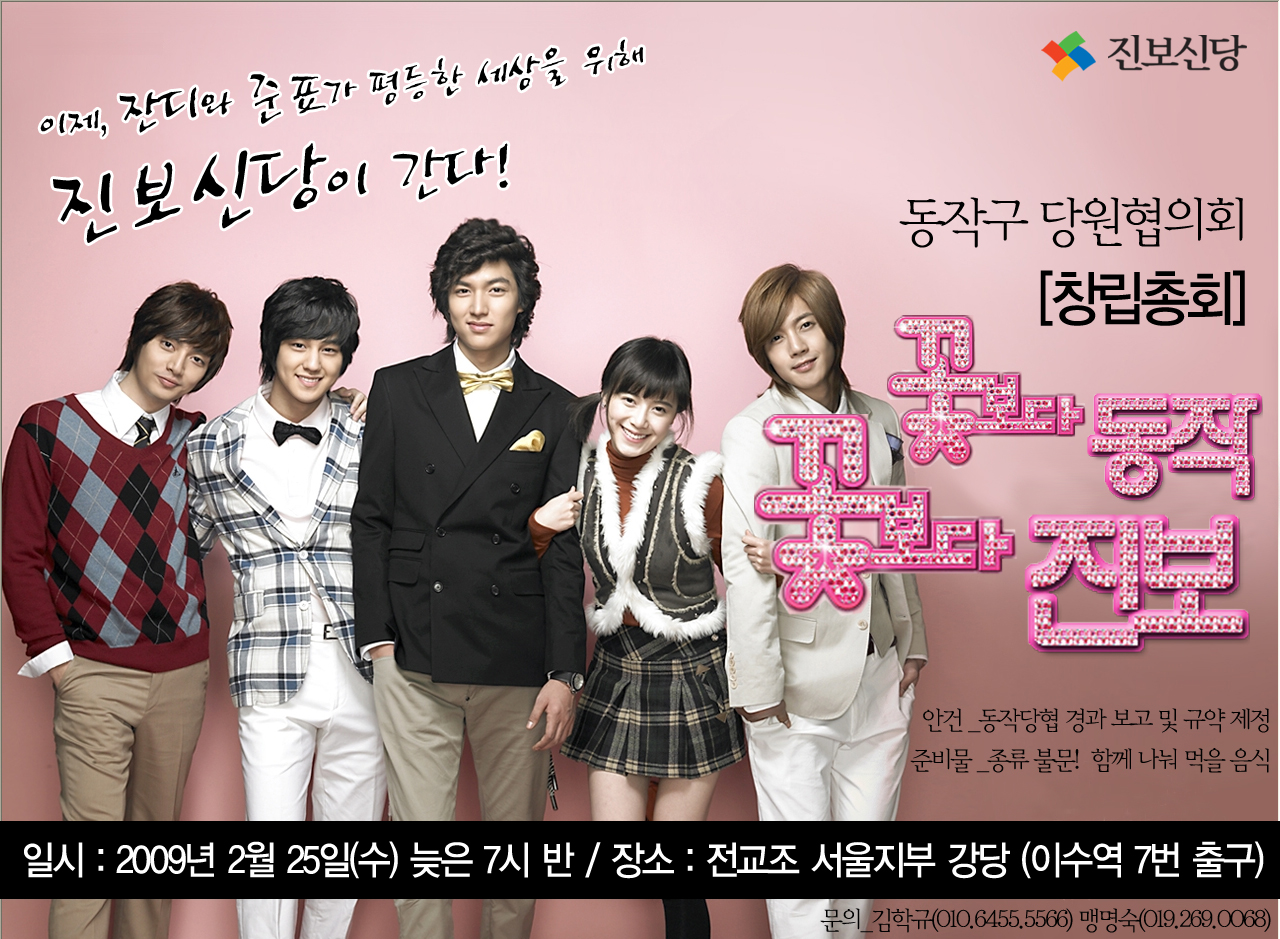
boys-over-flowers-korean-drama(Source: 동작신진보)

Certainly, there are many more elements to the story: the term “flower men” actually first appeared in 1999 in the context of imported Japanese manga for instance, and as the teenagers that read those grew up, manga-derived films and dramas have gone mainstream. But it is the supposedly asexual married women known as “ajumma” that deserve major credit as instigators of that process, showing that Korea was not a mere passive vessel for Western trends. It is surely telling that the first mention of the term “metrosexual” in Korean newspapers was not until 2003.

Update) “Mirror, Mirror…”, from TIME in October 2005, is a good example of an article that conflates kkotminam with metrosexuals, and in turn sees no essential differences between them and similar groups in East Asia such as, say, “aimei nanren” (love beauty men) in China. But although I (justifiably) criticize that journalistic tendency, there definitely is what my (likely) thesis supervisor has described as Japanese-inspired, “pan-Asian soft masculinity” out there: I just think that its national differences need more acknowledgement, and that at the very least it was very much through the lens of the IMF Crisis that that was imported it to Korea.

Other than that though, the article is not without its good points. For example:

But is the rise of the Asian Pretty Boy all that revolutionary? Not really, says Romit Dasgupta, who teaches Japanese studies at the University of Western Australia. “It’s not a result of David Beckham that suddenly Asian men are starting to look after themselves,” he says. “The tradition was already there.” During Japan’s peaceful Heian period between 794 and 1185, for example, both men and women powdered their faces white. Chinese University of Hong Kong professor Anthony Fung notes that in the West, maleness typically means “muscles, dark skin and strong bodies.” In Asia, by contrast, definitions of masculinity have traditionally been more flexible. During China’s Ming and Qing dynasties (1368-1911), men were depicted in paintings as ethereal, feminine creatures. That refined ideal is best found in the Chinese classic novel, The Dream of the Red Chamber, in which one of the main characters, Jia Baoyu, applies makeup and writes prose in his study instead of battling enemies. And he gets the girl! “Extreme androgyny is nothing particularly new,” says Fabienne Darling-Wolf, a professor of Japanese studies at Temple University in Pennsylvania. “The 50 or so post-war years during which Japanese men were not androgynous-due to Western influence and the desire to ‘catch up’ economically-is the glitch in history, not the other way around.”

Korea is a Conservative Country: Redux

(Source: 1023sheep)

Sorry for the delay, but my article for the Korea Times — my big news — is finally in today’s paper. The subject is loosely how Korea’s reputation as a conservative country is very outdated, that advertisements are a good reflection of its rapidly changing sexual mores, and that…well, there wasn’t too much else to say in the 800 word limit really. Nothing new in there for regular readers then, but the editor has hinted that the better the response it gets, the more likely I will get my own regular column, so *cough* please do go on to read it regardless.

One minor complaint with the KT’s editing is having all my italics replaced by quotation marks in it — they’re not quite the same — and I don’t find the choice of title particularly eye-catching either. But on the other hand, not a word was changed from the original, which is probably quite rare.

Seriously though, I won’t put my foot in my mouth again by giving a specific date for future articles, but naturally I’ll let you all know as soon as they’re up.

The poster, by the way, is for the 2004 Movie S-Diary (에스다이어리), which was considered pretty raunchy when it came it out, but would be very tame by today’s standards. Just like I mention in the article, things change very quickly in Korea, and at the risk of sounding like I’m merely ingratiating myself with new Korean readers, that is one of the fascinating things about the place. It’s good to remind oneself every now and then.

Update 1) Before I forget, I should give full credit to Sonagi for my point in the second last paragraph of the article, about revealing images of women being sexist by virtue of the sheer weight of them, and the same tired women-sexually submissive/men-dominant roles portrayed in most of them. I didn’t fully appreciate it at the time, but realize now that she had a point.

Update 2) Actually, I’ve just noticed that in the very first line(!) of my article the word “that” was removed from “…that such an impression can easily be forgiven”, ruining that sentence and hardly giving a great first impression of the remainder of the article either. Sigh. I don’t think I’ll read it again, lest I find any more editing mistakes…

What a Lovely Big Shiny Purple One My Man Has!

whisen-air-conditioner-advertisement-han-ye-seul-song-seung-hun(Source: Korea Times, 25/02/2009, p. 20; see full advertisement here)

A classic case of sociologist Erving Goffman’s notion of “The Ritualization of Subordination” in depictions of the sexes together, although you don’t need to have heard of either to tell who’s the boss in this particular advertisement!

One slightly less obvious point of interest though, is Han Ye-seul’s (한예슬) use of the “bashful knee bend,” a common motif for women in advertisements, and which according to Goffman:

…can be read as a foregoing of full effort to be prepared and on the ready in the current social situation, for the position adds a moment to any effort to fight or flee. Once again one finds a posture that seems to presuppose the goodwill of anyone in the surround who could offer harm. Observe…that a sex-typed subject is not so much involved as a format for constructing a picture (Gender Advertisements, 1976, p. 45).

Which I read as it being used in advertisements to show women feeling safe and secure in the presence of their male protectors, in this case Song Seung-heon (송승헌). And why not? To claim that the depiction of that natural feeling is sexist in itself is absurd, but Goffman’s point was simply that the knee bend, and a host of other means of active/passive dichotomies in depictions of the sexes like that—such as men almost always being portrayed as taller than women, far more than in real life—were still overdone in advertising, and not exactly compensated by images of women as assertive, aggressive and/or as instructors, superiors and leaders either.

Or at least in 1976; as that last link explains and the advertisement on the right (source: popseoul) with Lee lee min ho levisMin-ho (이민호) makes clear, things have certainly changed a great deal since, having one person on a bed and/or lower than the other also being a common way of showing ranking. Which is not to say that—now that you have it in mind—you won’t still find many many examples of women with the knee bend in advertisements (or, indeed, in a bed).

But even more interesting though, is the fact that it is Song Seung-heon at all that is advertising the Whisen (휘센) air-conditioner, for actually I only noticed the ad because is the first Korean one for an air-conditioner that I’ve seen in which a man is the center of attention. Sure, that they’re dominated by women is no surprise, as it’s also true of their Western counterparts, albeit to a much lesser extent (but a difference one would expect given Korea’s deeply patriarchal society). But then bear in mind that the process of  modernization that electronics and electric appliances still epitomize—especially in a society as development-obsessed as Korea—has always involved “housewifization” and the nuclearization of the family, and so while it’s certainly true to say that owning one’s first washing machine in the 1960s in the UK, say, was also a definite signifier of status and upward mobility, Korean advertisements for the same should be placed in the context of a society where consumerism has been equated with national security, and in which the lowest numbers of women in the world work (for a developed society).  Hence not only are Korean examples almost hyperreal advertisements for modernity itself, but so far they’ve overwhelmingly featured female-centered narratives, Korean housewives’ need for the self-fulfillment that Betty Friedan saw that their purchase provided being all that more the greater here, and other manifestations of which would be an obsessive focus on real-estate speculation and on children’s educational achievements.

Which might sound a little to take in all at once, but I assure you, once you’ve seen a few examples like the one below then you’ll get a sense of how surreal they consistently are, and why this deserves explanation (and have also reminded me personally of how advertisements really are a reflection of the zeitgeist of an era). So, why the change in that particular advertisement?

My first thought was because it was for the “Luxury” (럭셔리) model, as the instant I learned that in fact a scene from science-fiction novel I read as a teenager came to mind, which opened with a conversation between a couple in which the woman explained to her fiance that, while women did the bulk of shopping, men still bought the important expensive things like houses and cars. As it happens, the couple were in a decidely backward parallel universe where, among other things, American women had never gained the vote(!), but obviously it still has echoes in real life, and indeed this logic does especially apply to Korea: for instance, while I’m not sure to what extent this tradition is followed, I’ve repeatedly heard that it is expected that before a wedding a new wife’s family must provide for the furniture for their new apartment, whereas the husband’s family must provide the apartment itself. Does the expense of this model then, draw it from the female realm to the male, thereby appealing more to the latter? Or is the advertisement still primarily aimed at women, this supposedly luxurious model possessing a male and/or sophisticated aura that other, cheaper ones lack? Or is there still some other factor that I’m missing?

Unfortunately, the K-pop blogs (see here, here and here) do little more than provide more pictures and links to related commercials, so I’d be happy to hear your own thoughts. And I’ll make sure to keep an eye out for mention of it in next month’s Korean advertising magazines.

Expect More Nudity During This Recession

Apparently, I wasn’t the only one to notice Duoback’s advertisement for its new “Alpha” chair a few days ago. Yes, that one:

korean-duoback-alpha-chair-advertisement-듀오백알파-광고(Source: Metro)

It’s always nice to be proved right. Even if it is true that my earlier observations about the advertisement were common-sense really, and that it just so happens to be a tabloid-style article from Yahoo Korea that provides the first confirmation of them:

Recessions Lead to Nude Advertisements…and Flustered Commuters

인 박인숙 (35세, 가명)씨는 출근 후 회사에 비치된 신문들을 훑어보며 깜짝 놀랐다.

After arriving at work one day, a 35 year-old woman that we’ll call Park In-sook (not her real name) was surprised at what she saw while browsing a newspaper provided by her company.

맨살을 훤히 드러낸 한 여성의 뒷모습이 담긴 광고가 눈에 띄었기 때문. 녹색의 투명한 타올이 엉덩이에 살짝 걸쳐 있을 뿐 전라에 가깝다. 신문에 실린 이 광고의 품목은 여성전용 제품이 아니었다. 기능성 의자 광고였다.

Her eyes were drawn to an advertisement which featured the back side *cough* of a woman, completely naked but for a green transparent towel lightly covering her buttocks. The advertisement wasn’t actually for any product specifically for women, but was for an expensive ergonomic chair instead.

‘인간의 몸을 기억하다’는 메시지를 담고 있는 이 광고는 여성 누드 사진을 이용해 독자들의 눈길을 끌고 있다.

The accompanying message in the advertisement was that “This chair remembers the human form,” and the nude woman was clearly placed in it simply to draw the attention of readers.

duoback-loves-your-body-듀오백또 다른 신문엔 여성의 상체 누드(뒷모습) 사진이 전면광고로 실렸다. 이 광고는 한 아울렛을 소개하는 것으로 역시 여성의 알몸이 등장할 만한 제품과 거리가 멀었다.

A different full-page advertisement for a outlet store featuring only a woman’s nude back has already been in another newspaper, and in that earlier advertisement too the product(s) advertised had little to do with nor required nude women (James: not the one on the right for another Duoback chair, although it seems a strange coincidence that it’s the only other Duoback chair featuring nudity, and that the “outlet store” is unnamed; I think the report made a mistake).

최근 이처럼 일간지에 여성의 누드 사진이 활용된 광고가 눈에 띄게 늘자 독자들은 낯 뜨겁다는 반응이다. 아침부터 신문에 누드 사진과 다름없는 광고를 보게 돼 불쾌하다는 설명이다.

Recently, there has been a spate of advertisements featuring nudity in daily newspapers, and these have been making many readers embarrassed and uncomfortable when they encounter them. But these days, it is almost impossible to escape them.

박인숙씨는 “신문광고에 누드사진이 실리면 시선을 집중시킬 순 있겠지만 너무 선정적인 광고로 인해 불쾌해지는 사람들도 많을 것”이라며 “상쾌한 기분으로 아침을 시작해야하는데 이런 광고는 달갑지 않다”고 토로했다.

According to Park In-sook, “Certainly advertisements featuring nudity will get many reader’s attentions, but sensational and shocking advertisements can also make many people uncomfortable. It is important to start every day with a fresh mind, and advertisements like these aren’t helping.”

한 편으론 독자의 시선을 한 번에 끌어당길 수 있다는 측면에서 광고효과가 극대화된다는 평가다. 특히 요즘같이 불황에는 사람들의 감각을 자극하는 광고기법이 먹힌다는 속설대로 제품을 하나라도 더 팔려고 하는 회사들이 이런 광고를 자주 하고 있다는 분석이 나온다.

On the other hand, advertisements like this are more effective because they attract consumers’ attentions with just one glance. And as both modern analysis and a traditional saying advise, during a recession companies should use dependable advertisement techniques which are well proven to do so.

한 광고회사 PD는 “통상적으로 경제가 어려울 땐 자신의 소득을 기준으로 이성적인 구매를 하기 마련인데 회사 입장에선 조금이라도 자극적인 광고를 통해 소비자를 유혹하려고 한다”며 “섹스어필처럼 감각에 호소하는 광고는 단기적으로 큰 효과가 있다”고 말했다.

According to a spokesperson for the advertisement company PD behind the Duoback advertisement, “People naturally spend rationally and frugally during a recession, so from a company’s perspective it is best to use stimulating and direct advertisements that appeal to basic human senses, and those with sex-appeal especially will certainly get a quick result.”

이어 “많은 돈을 들여 톱스타를 쓰지 못하는 중소기업에서 이런 광고를 선호한다”며 “경기 불황일수록 이런 광고를 더욱 많이 하게 될 것”이라고 덧붙였다.

Moreover, “Small and medium-sized that can’t afford top stars tend to prefer these kinds of advertisements, and as the economy gets worse we can expect to see more like these.”