Korean Gender Reader, Feb. 23 – Mar. 1

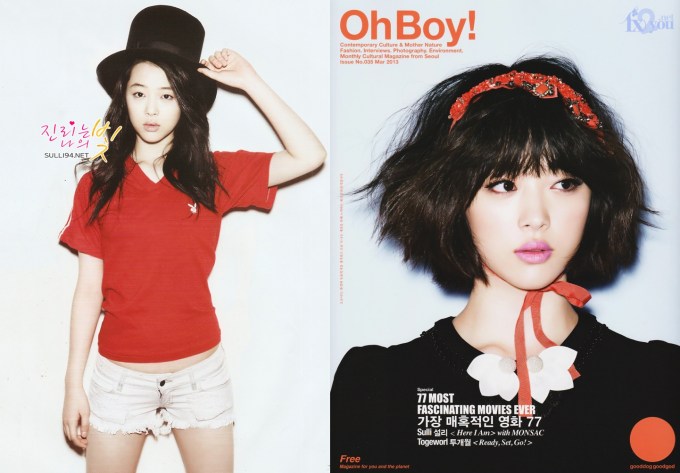
Sulli Oh Boy, 15 and 18(Sources; left, right)

Not quite enough for another post in my “Reading the Lolita Effect in Korea” series, but a good example of what I discuss there: 18 year-old Sulli, one of the maknaes of the girl-group f(x), shows far less skin in her latest photoshoot for Oh Boy! magazine than she did 3 years ago! (Hat tip to @mellowyel).

Meanwhile, next week I’m giving a presentation in Seoul; have a magazine article to write; one daughter starting school, the other changing kindergartens; the start of the next semester at my university; and so on (seriously, I really could go on!), so I’ll be much too busy to post again until the week after next sorry. Until then, I hope the stories below keep you occupied, and please remember that Friday, March 8 is my birthday International Women’s Day, with various events happening in Gwangju and Seoul. If readers know of any more, please let me know!

Saturday

Stephen Epstein: Korea’s indie rock scholar (Korea.net)

Glass ceiling outlasts Madam President (The Korea Herald)

Citizen Brock: South Korea considers a Canadian (Asian Correspondent)

13 Photos From Taiwan’s First Same-Sex Buddhist Marriage (Peppermint Kiss)

Ask the Yangxifu: Does He Like Me? Signs a Chinese Man Might Be Into You (Speaking of China)

Sunday

American teacher in Japan under fire for lessons on Japan’s history of discrimination (The Washington Post; The Marmot’s Hole)

Park Si-hoo and Sexual Assault in K-entertainment (Seoulbeats)

Did Sunny Days’ company use Jung Soo Jung’s sexual harassment to promote the group? (Asian Junkie)

Police under controversy for asking intrusive questions to gang rape victim (Netizen Buzz; more cases here)

What’s going on with Rainbow’s “concept”? (Frank Kogan)

Monday

Hongdae club day lewd party incident (Gusts of Popular Feeling)

Eight Years of Living Together as an Unmarried Heterosexual Couple (Ilda)

“Korea is a paradise” for foreign instructors (Gusts of Popular Feeling)

“Little Mom” Program in Gwangju: Stigma or Support? (Korean Gender Cafe)

Leftovers: unmarried Chinese women over 25 (The Guardian)

Tuesday

How Demography Is Changing Japan (The Diplomat)

K-pop trainees have a 0.1% chance of debuting (Netizen Buzz)

Korean plastic surgery ads from the 1970s (Möüth)

Resources on censorship in the Korean music industry (Angry K-Pop Fan)

Truth, Lies and Propaganda: The North Korean hoax that backfired (NK News)

Wednesday

Beijing Lesbian Couple Seeking Marriage Registration Refused (chinaSMACK)

More Than Half of Korean Nurses Report Being Sexually Harassed or Assaulted by Doctors and Patients (Idle Worship; The Marmot’s Hole)

Female population predicted to surpass males by 2016 (Netizen Buzz)

Migrant Women Still Suffer Discrimination (The Chosun Ilbo)

SKorea’s 1st female leader yet to hire many women (AP)

Thursday

Japan’s ‘Women Only’ Train Cars: Is it a Crime for Men to Ride? (Rocketnews24)

On Death, Dying, and Funerals in Korea (Seoul Searching)

1 in 5 Korean men to die single (The Korea Herald)

K-pop’s Guns: Sexy, Cool and Harmless? (Seoulbeats)

Investigation into “foreign instructors’ methods for luring Korean women” (Gusts of Popular Feeling)

Friday

Why are there so many trainees involved in celebrity scandals? (Netizen Buzz)

Broadcast announcement: ‘For foreign instructors, is Korea a paradise for women?’ (Gusts of Popular Feeling)

The (Daycare) Wonder Years (Lee’s Korea Blog)

Korean cosmetics enjoy popularity in China thanks to Korean pop culture (Yonhap)

Plastic surgery, ‘Gangnam-style’ (Global Post)

(Links are not necessarily endorsements)

Korean Sociological Image #75: Gender Discrimination in Everyday Korean Language

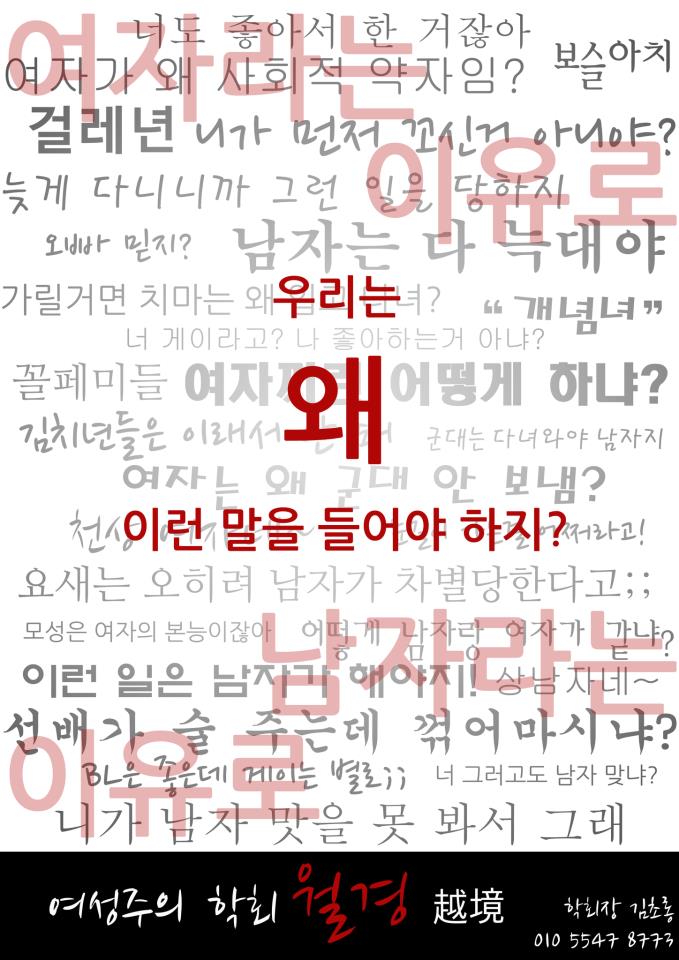
Korean Gender Discrimination LanguageAs Noface-nameless explains:

Students at Sungkyunkwan University has created this poster, among many others to point out all the gender discrimination happening with common phrases said between friends and colleagues. The centered text in red reads “WHY do we have to listen to these things” / “WHY do we have to deal with these phrases” (translation open to interpretation)

some of the background text deals with homophobia, rape culture, negative gender stereotypes and heteropatriarchy.

Every time I the conversation of feminism or conversation of gender and sexuality in Korean, it makes me feel good. Because my Korean is very limited, I love adding new words to my dictionary, especially about these things.

Just recently I learned that the Korean translation of Women’s studies is 여성학.. I havent found the equivalent translation for Women’s and Gender studies but Im leaning towards something like 성(sexuality)과 여성학 .?

still learning….

Via: Tales of Wonderlost

(For more posts in the Korean Sociological Image series, see here)

Revealing the Korean Body Politic, Part 4: Girls are different from boys

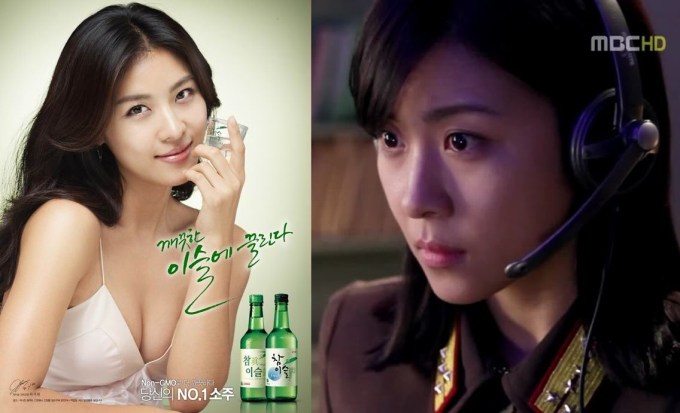
Ha Ji-won Breast Size Korean AttitudesEstimated reading time: 16 minutes. Image sources: left, right.

“The JoongAng Ilbo reports that having a full rack is seen as a disadvantage for women in North Korea.

This is in marked contrast to the South, where a thin figure and big breasts have become symbols of beauty.

According to defectors, if a woman appears well-endowed in the North, people think she is intentionally and lewdly stressing her femininity, and she can easily come to be regarded as a slut. You have an atmosphere that doesn’t allow women to wear revealing clothing, and the North is still a male-dominated society.

One defector from Hoeryong said she had a work friend with large breasts who often ate chives because she’d heard they make your boobs smaller. She added that she was surprised upon learning that women in the South actually have operations to make their breasts bigger.”

The Marmot’s Hole

Alas, The Joongang Ilbo provides nothing to verify those claims. But, I see no reason why the defectors would lie, and negative stereotypes of large-breasted women are by no means confined to North Korea. Also, who would ever question that “a thin figure and big breasts have become symbols of beauty” in the South?
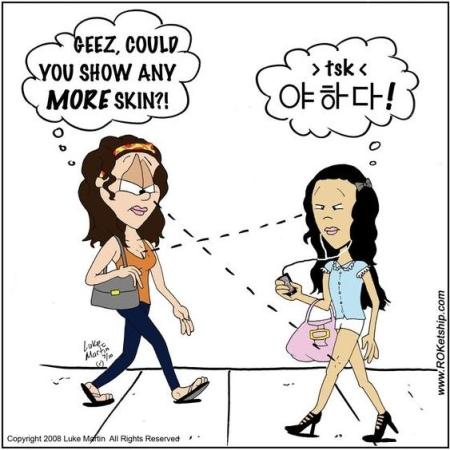
Korean Women Revealing Clothing AttitudesFortunately though, Liminality did, who in a must-read response shows that however much the Korean beauty industries and media promote such an ideal, and however much East Asian-women may have a genetic predisposition towards small breasts, cosmetic surgery patients at least hardly consider themselves lacking in that department. In fact, quite the opposite:

  • Per capita, far more breast surgery operations are performed in European and North and South American countries than in Korea (or Asia)
  • Despite having the highest per capita number of cosmetic surgery operations overall, Korea only came 22nd in the number of breast surgery operations performed per capita
  • Of those operations, Koreans had slightly less augmentation and lift operations than their counterparts in the US and Brazil, and slightly more reduction surgeries (source, above; reproduced with permission)

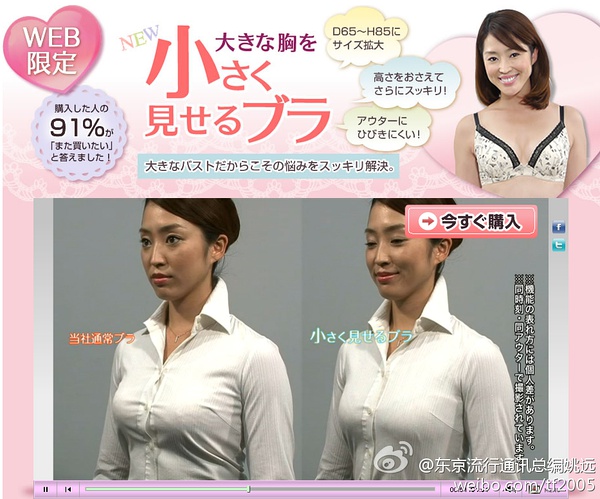
Similar attitudes may exist in Japan too, where even lingerie maker Wacoal was surprised by the number of women who told told them they wanted a bra that made their breasts look smaller, and then by the huge popularity of the—yes, really—’Bra That Makes Big Breasts Look Small’ design they developed in response. Also, Japanese mail order fashion magazine Bellemaison has developed a ‘Chest Line Cover’ (see second image below) that “promises to be a cool alternative to wearing a real camisole as Japan prepares for another hot summer made even hotter with another year of power rationing,” which I’m sure readers of both sexes can confirm would probably be just as big a hit in Korea.

Bra That Makes Big Breasts Look SmallSource: duoban

But readers don’t need me to tell them that showing cleavage is still a big taboo in Korea, or that there’s a big disconnect between ordinary Koreans’—and even models’—attitudes to fashion, body image, and sexuality and what you may see on Korean TV. And I can’t claim any special expertise on ordinary North Koreans’ attitudes either.
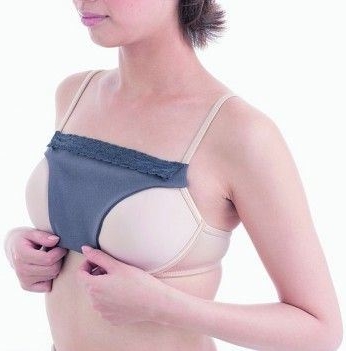
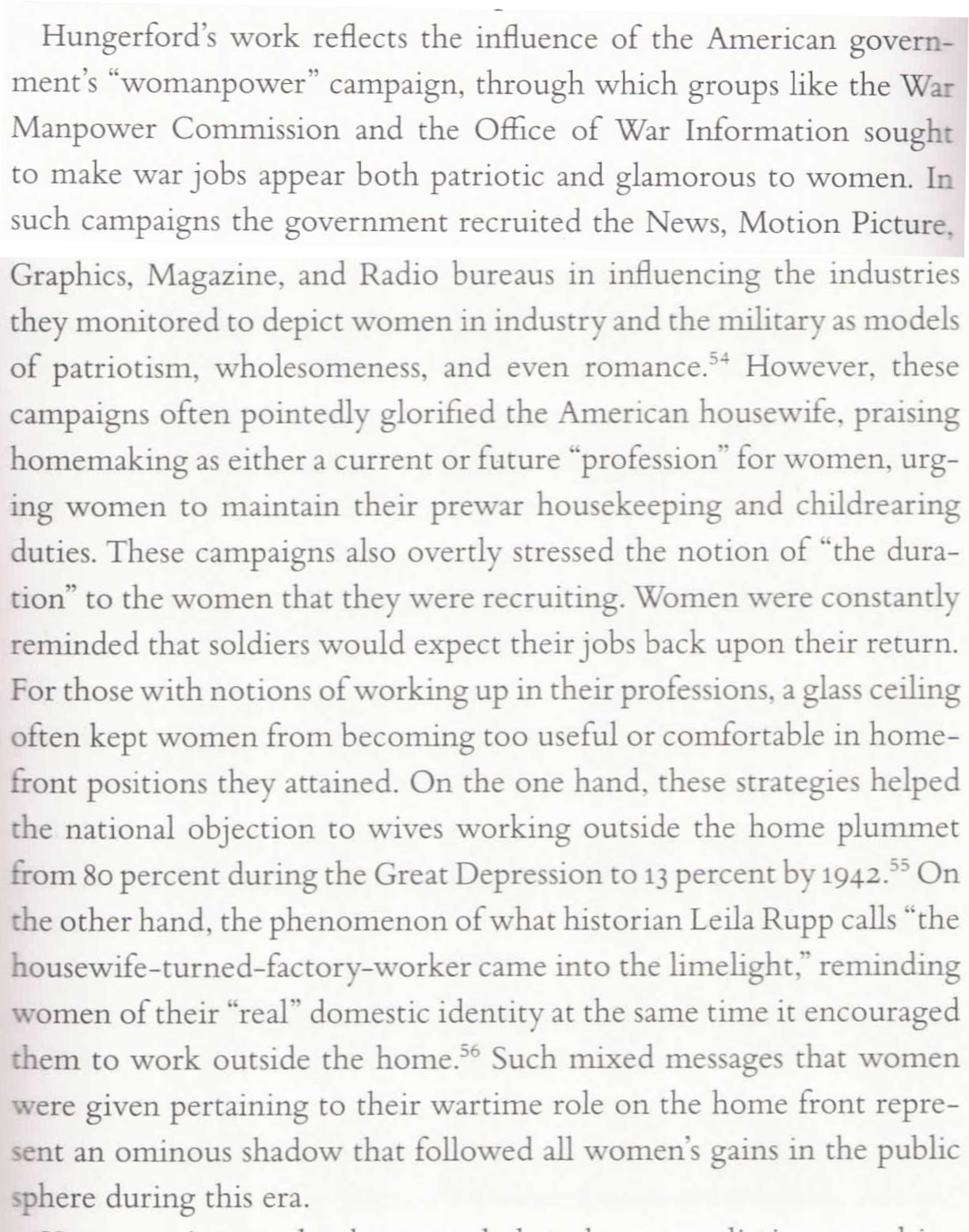
Chest Line CoverHowever, when I read that original post at The Marmot’s Hole, by coincidence I’d also just finished The Home Front and Beyond: American Women in the 1940s by Susan M. Hartmann (1983), in which she explains that the massive social dislocations of that decade—in particular, women suddenly entering the workforce in large numbers—were responsible for big changes in women’s fashion there, as well as preferred breast sizes. And, as it happens, North Korea is also going through a very turbulent period at the moment, with power relations between the sexes undergoing especially dramatic change:

Imagine going to work every day and not getting paid. Then, one day, you’re told there’s no work to do — so you must pay the company for the privilege of not working.

This is the daily reality facing Mrs. Kim, a petite 52-year-old North Korean. Her husband’s job in a state-run steel factory requires him to build roads. She can’t remember the last time he received a monthly salary. When there are no roads to build, he has to pay his company around 20 times his paltry monthly salary, she says.

“He had to pay not to work for about six months of last year,” Mrs. Kim told NPR, sighing. “You have to pay, even if you can’t afford to eat. It’s mandatory.”

So she is the one who must keep the family alive, as her husband wrestles with this state-sanctioned extortion.

Welcome to the Orwellian world of work in North Korea. In this reclusive country, profound social change is happening beyond the view of the outside world. The demands of politics have dramatically redrawn gender roles, forcing women to become the breadwinners.

National Public Radio, December 28; hat tip to Matt at Gusts of Popular Feeling.
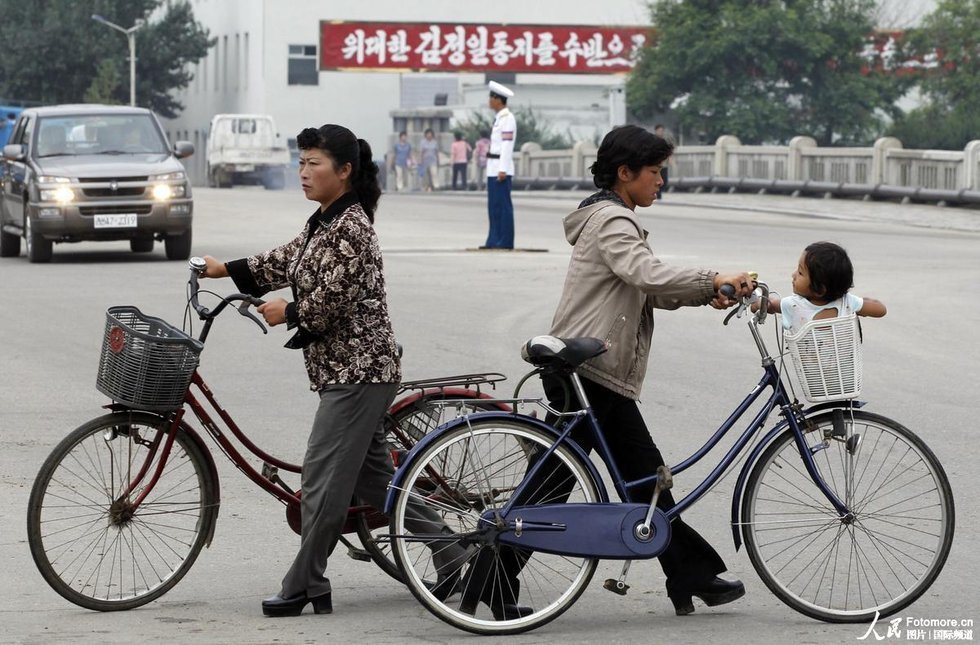
North Korean Women BikesSource: diandian

The NPR goes on to mention that one major consequence of that emasculation is skyrocketing domestic violence, against which speculating about ensuing changes in fashions can admittedly sound frivolous. But those have changed regardless—indeed, by government decree. First, in July last year:

Supreme leader Kim Jong-un appears to be loosening the government’s grip on how women dress by allowing them to wear pants, platform shoes and earrings, ABC News reported.

Previously, pants were only permitted as uniforms for females in the factories or the fields — and not for making a fashion statement.

“If caught, sometimes they would cut your pants right there in public to make it into a skirt,” Park Ye-Kyong, who defected to South Korea in 2004, told ABC News.

That doesn’t mean North Korean women don’t enjoy preening, Park added.

“Yes, we were hungry but desire to look beautiful lies in any woman,” she said.

North Korean Female IdealIn addition, the next month a 20 year-ban on women riding bicycles was lifted. Ostensibly imposed for women’s safety, numerous sources also mention its supposed incompatibility with juche, related educational television promoting “the idea of a woman wearing a skirt while riding a bicycle [being] contrary to socialist custom.” (See NK News {source, right} for more on North Korean ideals of women). Moreover, in 2009 Human Rights Watch also noted that:

…the ban on pants and bicycles for women is symptomatic of a range of other, often-overlooked, problems.

Across North Korea’s conservative, male-dominated society, there is discrimination against women, a knowing disregard for the consequences of such policies, and an opportunistic manipulation of power by police officers trying to make easy money by preying on an undervalued and underprivileged population.

In light of that, most likely the lifting of the bans was mainly simple populism on the part of a new leader, as well as — despite those state gender ideologies described above — a reluctant concession to the new realities of female breadwinners. Sure enough, in typical North Korean fashion (pun intended), just 5 months later the ban on women riding bicycles would actually be reinstated. Also, while technically they can still keep their pants on, in practice opportunities for women to beautify themselves remain limited, with both sexes punished for straying from officially-sanctioned hairstyles; sharp divisions in what is permissible for married and unmarried women; and a general lack of (beauty-related) resources overall, including such simple things as hairdryers.

Perhaps, things are not changing in North Korea as much as they first appear?

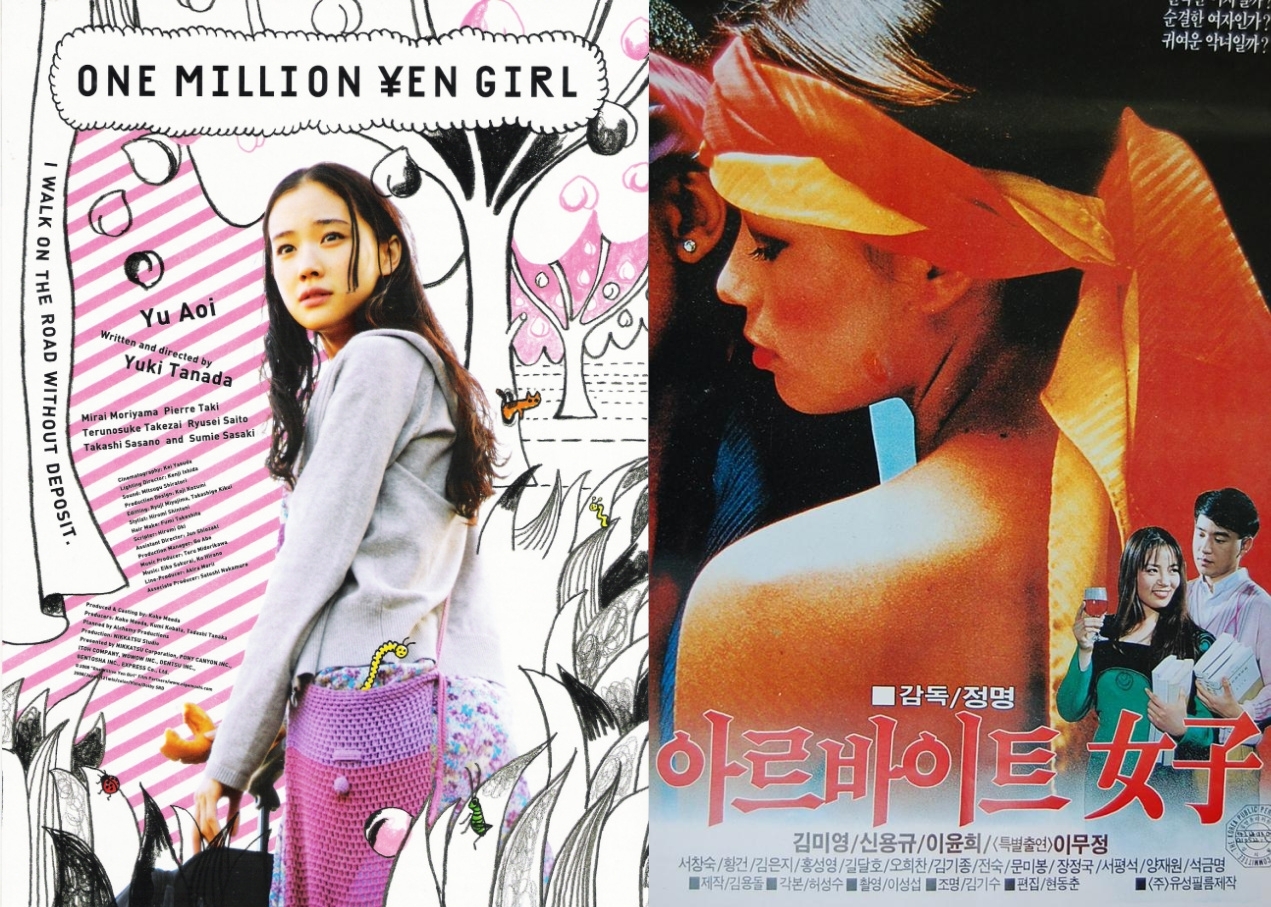
One Million Yen Girl Part Time WomanSources: left, right.

Yet in South Korea at least, it’s true that the last 15 years have seen a vast increase in the numbers of women competing with—and increasingly displacing—men for irregular and part-time work, despite the (extremely low) overall female workforce participation rate remaining unchanged. This has spawned quite a backlash, and—à la The Beauty Myth (1991)—a rapid increase in (overwhelmingly female) objectification in popular culture. So, while again I stress my ignorance and lack of knowledge with anything North-Korea related, it’s not unreasonable to suppose that, surely, the sudden large influx of women into the workforce may also be having some sort of impact there.
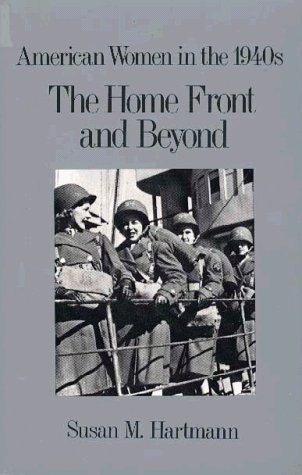
The Home Front and BeyondEither way, reading about similar experiences elsewhere can inform an understanding of what’s happening in both countries. So, with the obvious—but still necessary—caveat that of course both countries are very different to the US in the 1940s, for the remainder of this post let me try to pass on some of what I’ve learned about what happened there.

First, it’s important to get a sense of the numbers (pp. 77-8):

  • The female labor force grew by 6.5 million during the war
  • In 1944, 37% of all adult women were reported in the labor force, but nearly 50% of all women were actually employed at some time during that year
  • The greatest changes took place among married women
  • 1 in 10 married women entered the work force during the war, representing over 3 million of those 6.5 million new female workers (3.7 million, according to Marilyn Yalom in A History of the Wife {2002; p. 320})
  • 2.89 million were single, the rest widowed or divorced
  • So, for the first time in US history there were more married women than single women in the workforce.
  • Note however, that the war resulted in many more marriages than there would have been normally — approximately 1 million more, according to Yalom. Moreover, wives of absentee husbands were twice as likely to seek jobs, with half of all servicemen’s wives being in the labor force
  • The percentage of wives that worked grew from 13.9 in 1940 to 22.5 in 1944 (Yalom says 15 in 1940 to over 24 in 1945)
  • The percentage of women with children that worked grew from 7.8 in 1940 to 12.1 in 1944
  • By 1945, half of all working women were over 35; slightly more than 1 in 4 were 45 or older
  • The typical female worker had shifted from younger and single to older and married, a pattern which was maintained in the postwar years
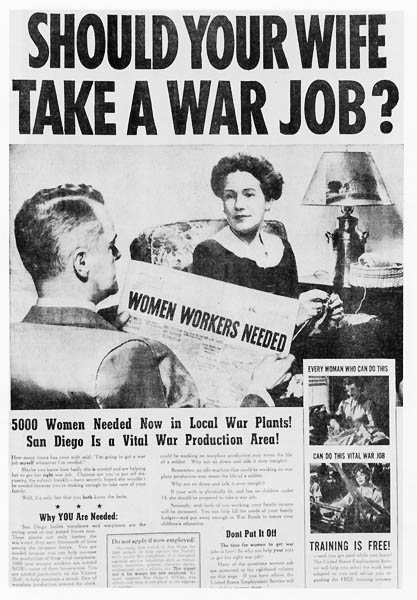
Should Your Wife Take a War JobAs Hartmann elaborates throughout her book, these figures represent an ensuing era of relative opportunity and freedom for many women (including sexual freedom; see Pin-Up Grrrls {2006} by Maria Busnek, pp. 213-224; see below also), even if it was usually simple economic necessity that compelled them to work in the first place (and usually at tedious, menial, and unfulfilling work at that). Accordingly, it definitely set the stage for second-wave feminism in the 1950s and ’60s, and deserves the place it’s gained in the Western historical imagination.

However, it’s also true that despite the huge public and private need for women to enter the workforce, that need was still considerably tempered by both sexes’ preexisting gender and racial ideologies, with both official propaganda and popular culture glamorizing women’s work and stressing its patriotic importance on the one hand, yet emphasizing its strictly temporary nature on the other. Not least, to nervous male workers and servicemen, who: lacked our knowledge that the war would lift the US out of the Depression (source, right); were very much judged by their ability to provide for their families, in an era where many simply couldn’t (note that one big difference between the Depression and the current financial crisis is that many people were literally starving during the former); and who sometimes had genuine difficulties with employment after demobilization, particularly in the shrinking war industries in which the women had been recruited (Hartmann, p. 63).

Buszek summarizes the contradictions of this era well (pp. 214-5):
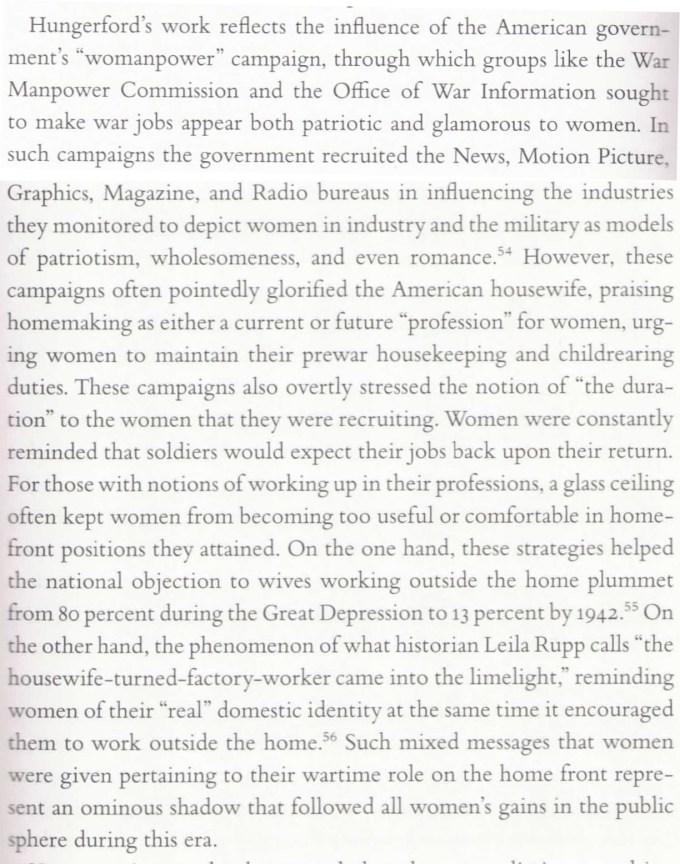
Pin-up Grrrls pp. 214-5And in particular:

  • Despite the huge demand for workers, and the ultimate, relative flexibility both employers and male employees would demonstrate in incorporating Caucasian women into their midst, African-American women remained largely unwelcome (e.g., 10 months after Pearl Harbor, there were fewer than 100 out of 3000 women in Detroit war industries). So, while the numbers of them working did increase from 1.5 million in 1940 to 2.1 million in 1944, their share of the female labor force actually dipped from 13.8 to 12.5. By 1950, their employment patterns were very similar to those of 10 years earlier, albeit partially because by then their husbands were making more money. (Hartmann, pp. 60, 78-9)
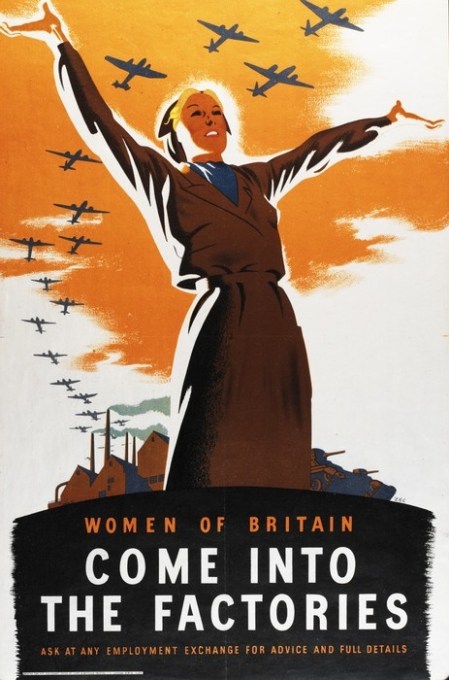
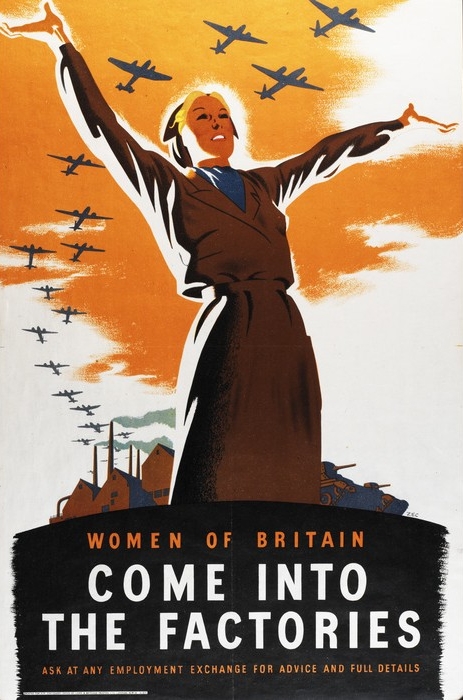
  • Women of Britain Come into the factoriesPartially, the huge numbers of wives that entered the workforce is because there were previously bans against them by many companies, let alone being against social convention; even schools discriminated against them. It’s amazing how quickly bans were dropped once the need for labor arose though, with some previously hostile managers coming to express a “preference for married women as more stable and conscientious than their single sisters” (pp. 59-60). And this provides encouraging news for Korea, which unfortunately still largely retains those conventions, and where as recently as 2009 I was working for a company that — yes, really — fired women upon marriage (source, right).
  • Nevertheless, there remained extreme public and private ambivalence about working mothers. Officially seen as more of a social problem than something to be encouraged, officials did recognize “that financial need compelled some mothers to work and that in localities with severe labor shortages production goals would requite the employment of mothers,” and urged employers not to discriminate against them (p.58). But on the other hand, the government would also constantly remind them that homestay mothers were essential for children’s development; popular culture was full of stories of child neglect; and daycare provision, while expanded, was ultimately completely inadequate, paling behind that which was provided in the UK, and prompting frustrated managers of some defense plants to set up their own (Yalom, pp. 324-6).
Ellen DeGeneres, Portia de Rossi Check Out Katy PerrySource: Celebuzz

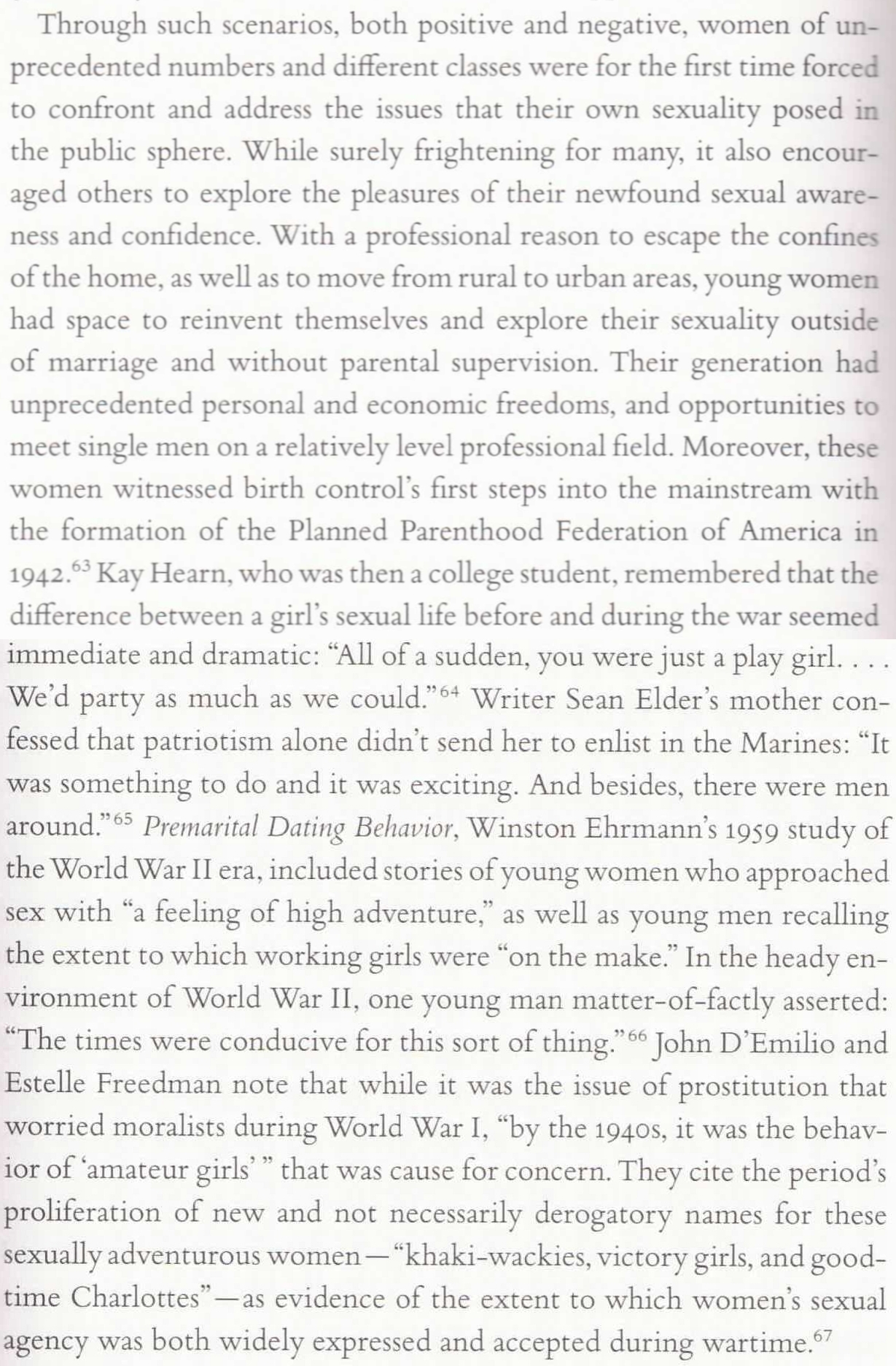
But, lest we forget, this post is about breasts. And changes in women’s fashions which came with the contradictions involved with entering the workforce, with women having to confront rampant sexual harassment on the one hand, and often being blamed for the “distraction” they posed, but on the other relishing their newfound freedoms (Buszek, pp. 216-7):
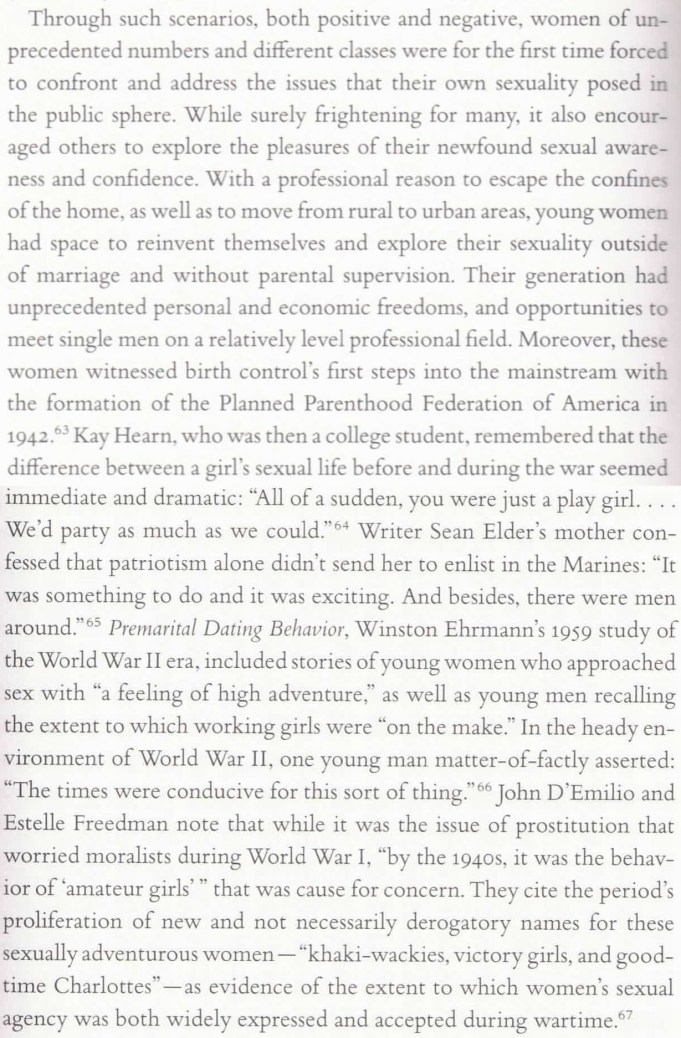
Pin-up Grrrls p216-7However, the combination of war-time shortages and women’s entrance into the workforce meant that people suddenly became used to women in functional, masculine clothing and with more practical hairstyles, and that women’s fashions became more simplified, comfortable, less overtly sexual, and changed less frequently than before. So, when you learn that popular culture stressed the exact opposite, for example…
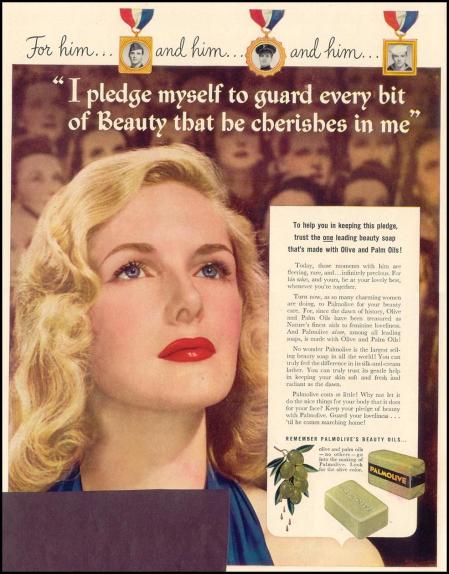
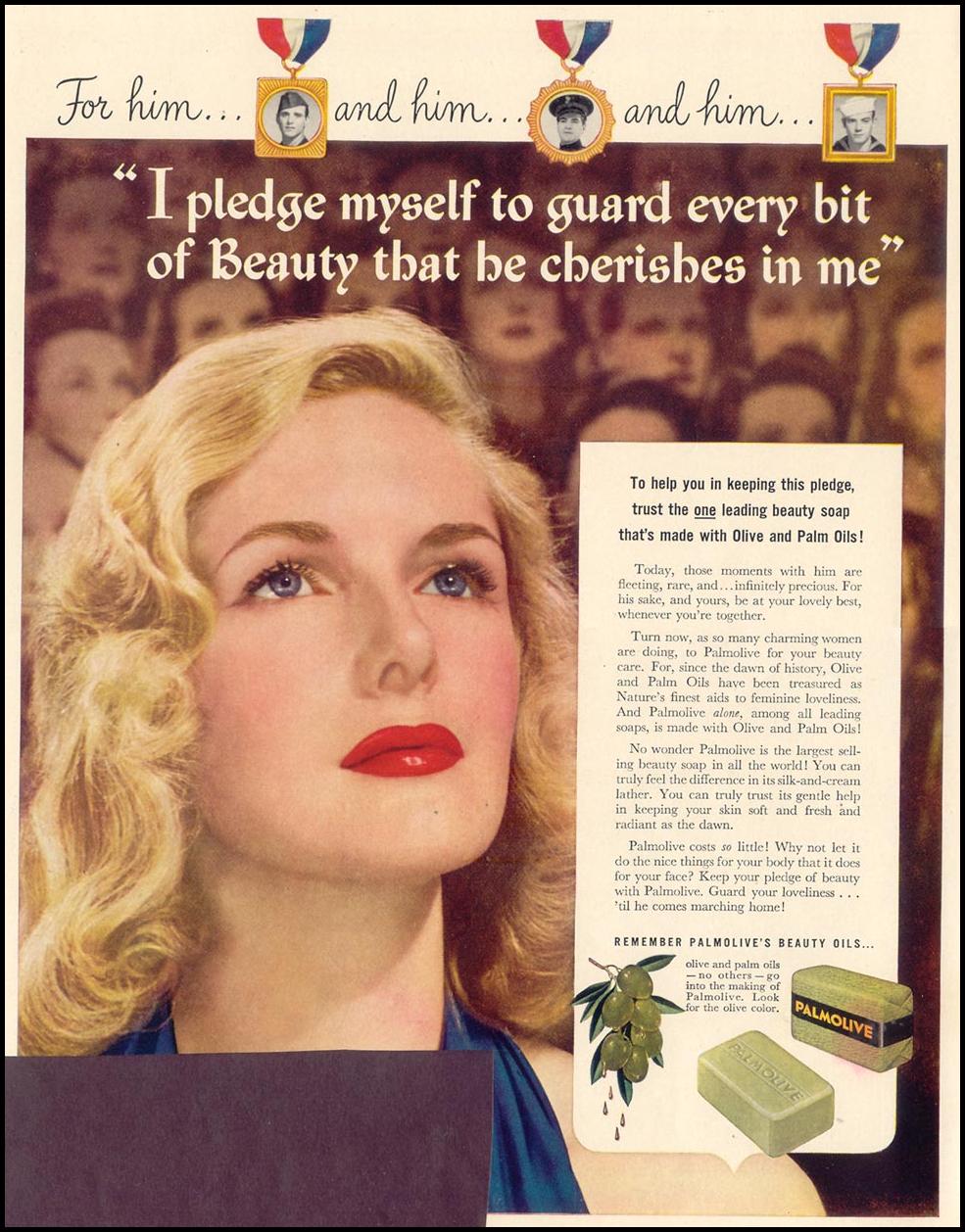
  • I pledge myself to guard every bit of beauty that he cherishes in meThat female workers were still “glamorous” and feminine despite their new roles (Hartmann, p. 199)
  • As were female sport stars, women’s sports enjoying a lot of popularity while their male counterparts were occupied (p. 194)
  • Lingerie manufacturers coped with wartime shortages and new demand by producing much practical bras, yet these coincided with pinup photographs that emphasized their subjects’ breasts (Jill Fields, An Intimate Affair: Women, Lingerie and Sexuality, 2007, p. 106). As explained in Part 3 of this series, this ultimately led to the fashion for large and uplifted breasts that remains to this day.

…then it is very easy and natural — indeed, this is my very strong impression from the books discussed here, although exact page references are suddenly proving maddeningly elusive(!) — to argue that this alternate ideal was imposed by, for want of a better word, the patriarchy, to encourage women to enter the workforce yet at the same time remind them that their place there was unnatural and temporary. And, to be clear, not for a moment am I arguing that this wasn’t very much the case (source, right).

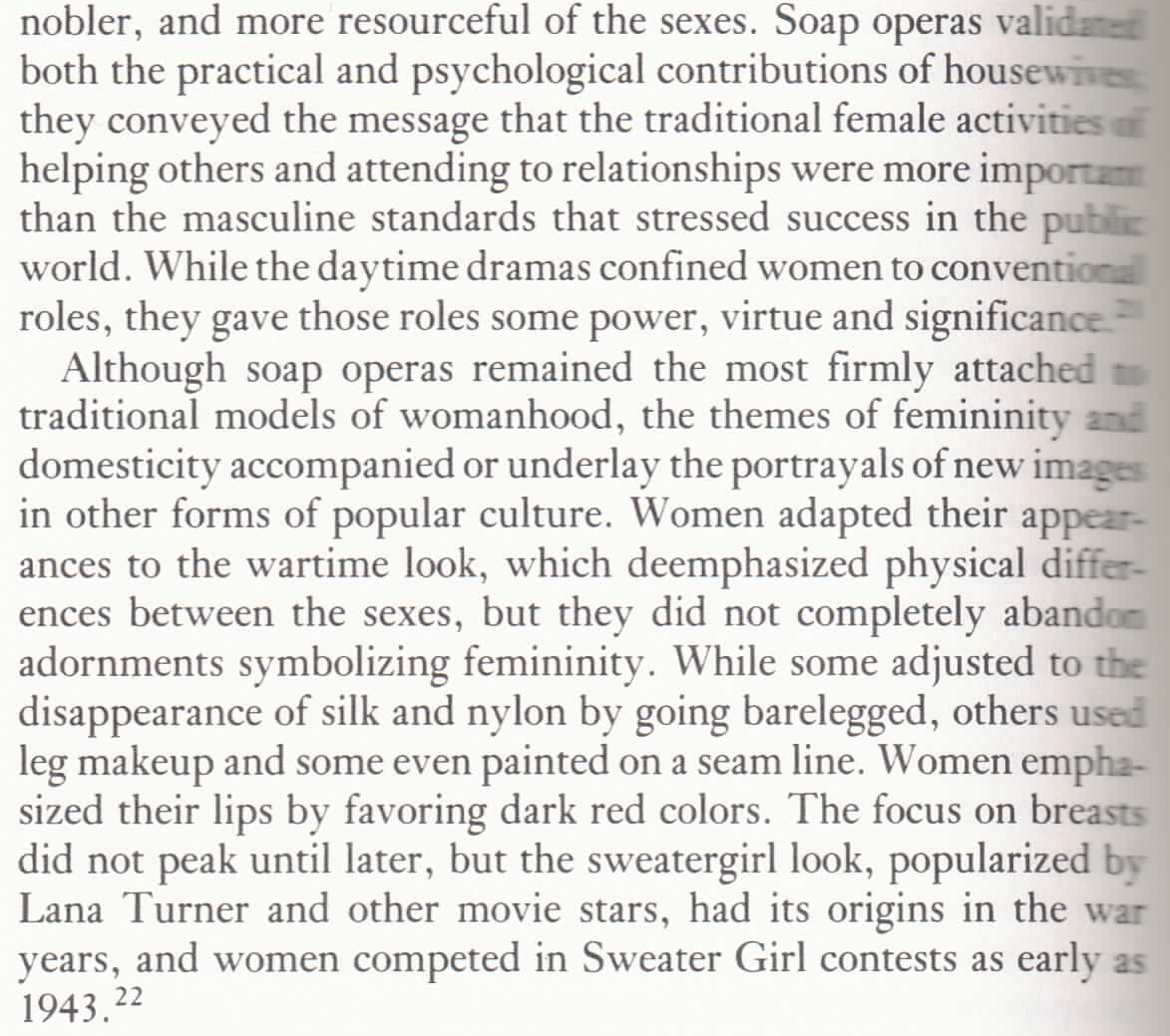
However, as Hartmann explains on p. 198 below (echoed by the other sources), it’s also true that women themselves were just as passionate about preserving their femininity (indeed, they would understandably revel in impractical but much more feminine fashions once war rationing ended):
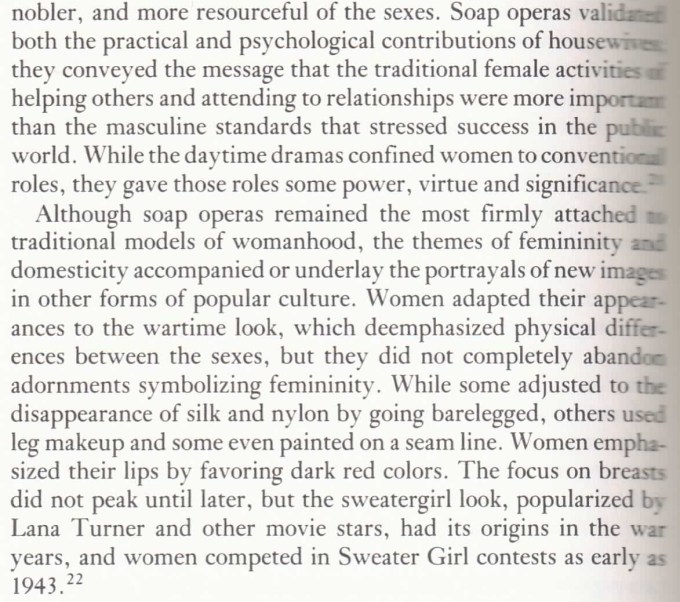
Hartmann, The Home Front, p.198In particular, and especially in light of the new opportunities open to them as mentioned, I think it’s both overly dogmatic and patronizing to dismiss choosing to use those feminine adornments as mere false consciousness and women’s own mindless incorporation of patriarchal values. Also, although it’s true that the period was rife with pop psychology theories (it was conveniently claimed that women like boring, monotonous work much more than men for instance) it’s very unlikely that men and women rationalized and articulated their choices and concerns in such patriarchal terms. Even if those did operate on a subconscious level, and patriarchy is still the only thread which can bring otherwise disparate developments in the period together, surely men did not think, for example, that if they saw more big-breasted women in popular culture, emphasizing the differences between the sexes as increased use of lipstick did in the workplace, that this would make them feel more secure in their jobs.

In addition, while changes in attitudes were certainly quick, they didn’t happen overnight, Jill Fields (p. 106) noting that “uplift” and “separation” trends in bras for instance, which accentuated the projection of the breast silhouette, had actually already started back in the 1930s. Finally, if you’re confused like I am, because I just noted above that bras actually became more practical during wartime, and am now stating that women could simultaneously be censured and praised for wearing distracting clothes, that’s because contradictory and competing trends coexisted simultaneously, the 1940s being just as messy, complicated, and contradictory as modern life.
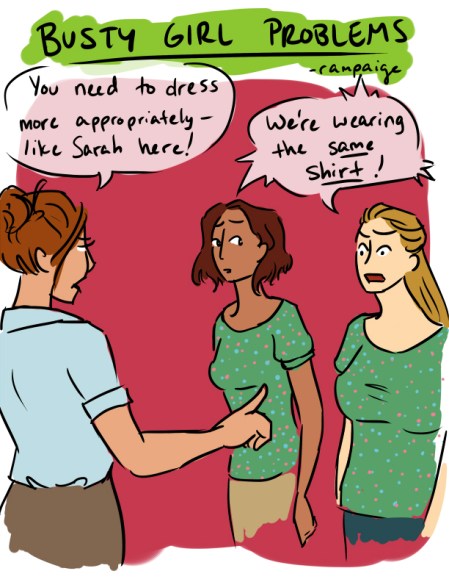
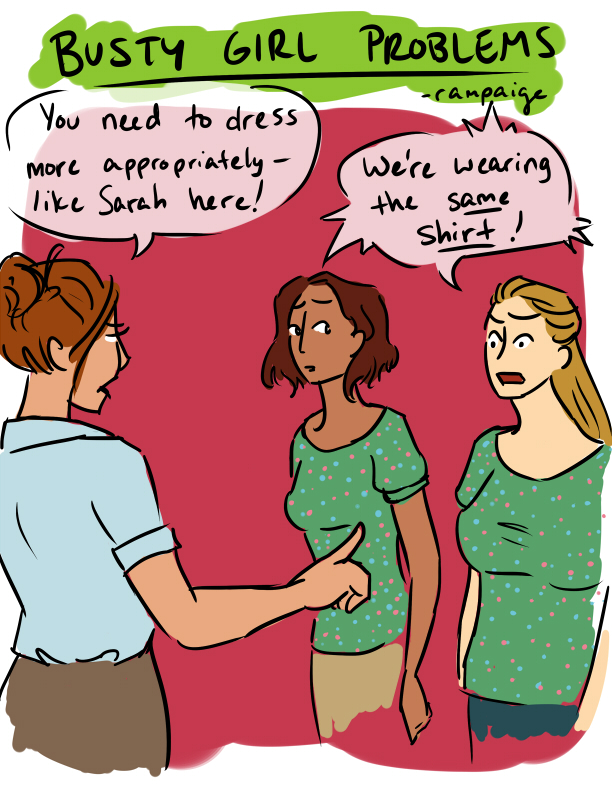
Busty Girl Comics Double StandardAnd on that note, thank you very much for bearing with me in this admittedly equally messy, complicated, and contradictory post, the result of me personally trying to understand what patriarchy means in practice as well as theory. And, with the proviso that my relief — and frankly joy — at discovering historic parallels (and especially English-language historiography!) to modern North and South Korean developments should make me wary of projecting too much, and not blind me to the significant differences, I’m very happy to have pointers towards further study, and very much welcome readers’ own suggestions! (source, right)

The Revealing the Korean Body Politic Series:

Update: See Fit, Feminist, and (almost) Fifty for “the medical condemnations of women’s cycling [which are] fascinating for what they tell us about what people thought (and maybe still think?) about women’s athletic capabilities and potential.”

Update 2: “Saudi daily al-Yawm cited an unnamed official as saying women can now ride bikes in parks and recreational areas. According to the official, the ruling stipulated that women must wear a full-body abaya, be accompanied by a male relative, and stay within certain areas. They are allowed to bike for recreational purposes only, not as a primary mode of transportation.” (Aljazeera)

Korean Gender Reader, Feb. 16-22

Scared Shocked Man(Source: unknown)

Sorry for the lack of posts — the one I’m working on is proving much more involved (and several thousand more words!) than I expected. But I will have it up early sometime next week, and will try to make it worth the wait :)

Announcements

Legal NGO Filing Complaint with UN Regarding E2 HIV Testing: Your input needed! (Expat Hell; Gusts of Popular Feeling)

Casting call for an independent short film, Seoul, Sunday February 24 (Seoul Players)

Saturday

3 Sisters Left Abandoned in the Basement (Human Rights Monitor)

Ask the Yangxifu: Why Your Chinese Wedding Ceremony Will Always Be Big, Fat and Loud (Speaking of China)

CathyCat tries to sell their product by making miss A’s Fei look like CGI (Asian Junkie)

Queer Links from the Week (The Kimchi Queen)

HIV/AIDS Increasing in Osaka (Visual Anthropology of Japan)

Sunday

Why do Asian women have smaller breasts? (The New York Times; Netizen Buzz)

As Families Change, Korea’s Elderly Are Turning to Suicide (The New York Times; Korea Economic Reader)

Do some Korean fans of K-pop purposefully keep information from overseas ones? (Angry K-Pop Fan)

How can Korea provide better child care? (The Korea Herald)

Koreans finding noisy neighbours harder to handle (The Korea Times; Global Voices)

Monday

(Video) Korea Today: The Economist Sues Korean Hagwon (Arirang TV)

Singapore’s Population Debate Grows Heated (The Diplomat)

Japanese dual surname law has more opponents (The Daily Yomiuri)
Wuhan student’s same-sex love story a hit on Youku (Want China Times)

Korean lawmaker who exposed Samsung corruption forced from office (The Verge; The Marmot’s Hole)

Tuesday

Are foreign English teachers in Korea foreigners, expats, guest workers, or immigrants? (I’m No Picasso; update)

Korean Work Ethic and the Quality of Life (My Musings)

Seven-year-old Park Min Ha has an anti-cafe, which means we’ve reached a new low (Asian Junkie)

On Bainian — Chinese New Year’s Calls — And Those Annoying Questions From Relatives (Speaking of China)

Sunny (2008): Representations of Militarism, Masculinity, and the Korean Experience of the Vietnam War (Peace and Conflict Monitor)

Wednesday

Park Si Hoo accused of sexual assault, netizens reveal ugly double standard (Asian Junkie; Update 1, 2, 3, 4, 5)

Say Goodbye to the Wonder Years: Leaving K-Pop Behind (The One Shots)

Film documents the troubled lives of Japan’s male porn stars (The Tokyo Reporter)

Suggestions For The Future: Sports Illustrated’s Swimsuit Edition (Racialicous)

Korean retirees make pittance delivering things via free subway trips (Arari)

Thursday

China’s ‘leftover women’, unmarried at 27 (BBC)

Roundtable: Can’t Resist the Aegyo (Seoulbeats)

Female lawmakers emerging in South Korea (The Asahi Shimbun)

In Defense of (Korean) Hazing (Sorry, I was drunk)

2012 drug crime statistics (Gusts of Popular Feeling)

Friday

[ASK AKF] K-pop fanart and fanfiction (Angry K-Pop Fan)

Prostitution in Korea: Disturbing public order vs. earning A living (Human Rights Monitor)

Incorrect statistics portray Americans and Canadians as more prone to criminality (Gusts of Popular Feeling)

There IS life after girl-group failure (Netizen Buzz)

Something to appreciate: Korean rap is not more sexist, more profanity-ridden, homophobic, or full of hate than other Korean music (Footnotes)

(Links are not necessarily endorsements)

Korean Gender Reader, Feb. 9-15

Screenshot f.luxRather than me decorate this post with some random Korean and/or gender-related image this week, let me pass on one of something far more useful: a screenshot of the webpage for f.lux, a small and easily-installable computer program which softens your computer screen’s brightness after sunset. Found via the comments thread to this article at io9, about how using computer screens — designed to be as bright as the sun — at night is screwing up our sleep, I’ve been using it for about 10 days now, and it’s already done wonders for my tired eyes at least.

Click here to download it, and fellow geeks and amateur astronomers may also be interested in this post at ScienceBlogs, which explains some of the science behind it.

p.s. Unfortunately, it’s unavailable for Android (although it is available for the iPhone and iPad); if anybody knows an equivalent that is, please please please let me know!

p.p.s. If you have problems with the program dimming at the wrong time, like I did, go to your Control Panel and check you’re set to the right time zone, despite what you’ve set your computer’s clock to. Once I changed it, this also cleared up 5 years of frustrating, weirdly-timed emails for me!

Announcements:

Free Movie Tickets to White Night and short films Suddenly Last Summer and Going South (The Kimchi Queen)

Seoul Players run V-Day contests and events (Seoul Players; The Korea Herald)

International Women’s Day in Gwangju (Facebook Group)

Saturday

“How My Mother Sees My Friends” and “How Others See ‘My Couple’” (Gord Sellar)

From the Archives: Embarrassing Moments with Chinese Characteristics (Speaking of China)

[WTF] Journalist mistakes viral video of sexual assault as ‘public display of skinship between a couple’ (Netizen Buzz)

Deaf people look at me as weird for being gay. Gay people look at me weird for being deaf. (The Kimchi Queen)

Starbucks baristas writing “외국인” on your cup? (I’m No Picasso)

Sunday

Police Say More Japanese Women Becoming Human Trafficking Victims (Japan Subculture Research Center)

Netizens dig up proof of ‘Laws of the Jungle’ being staged (Netizen Buzz; update)

7 year old actress Park Min Ha found to have an anti cafe.. industry senses urgency for child protection laws (Netizen Buzz)

A Letter from a South Korean Sex Worker (Research Project Korea)

Bush & Baths (Alana in Wanderlust)

Monday

Surviving Senior Year in a Korean High School (and getting into SKY) (3WM)

General Conscript Life (Sorry, I Was Drunk)

K-pop Fanfiction: The Disturbing Truth (Beyond Hallyu)

Is It Okay for Parents to Lie to Their Kids? China’s Parents Say Yes (The Atlantic)

On Our Radar: Mixed Weight Relationships (Thick Dumpling Skin)

Tuesday

Minah asks her label CEO to lift Girl’s Day’s ban on dating (Allkpop)

Chinese women largest group of marriage immigrants (The Korea Herald)

Dating Korean men according to Waygook (I’m No Picasso)

Minami 2 (Frank Kogan)

Foreigners love, threaten, and owe apology to Korea (Gusts of Popular Feeling)

Wednesday

In the 2013 Sports Illustrated Swimsuit Edition, Chinese people are exotic props (Shanghaiist)

Conservative Netizens Mock Death of Singer, Cause Controversy (KoreaBANG; Asian Junkie; funeral)

The Hidden Meaning Behind Peeling an Apple (Geek in Heels)

Idols revealed to be paid $2 USD/hr for ‘IAC’ attendance… is it worth the injuries? (Netizen Buzz; update)

Women should lead more start-ups (Korea Joongang Daily)

Thursday

Gendered Degradation Ceremony in J-pop Group AKB48 (Sociology in Focus)

Growing Pains for North Korean Defector Teens: Some integration issues are cultural, others are just a fact of life (NK News.org)

Govt: Hey, About Those Headlines on Youth Unemployment (Korea Realtime)

Pants vs. skirts: Flight attendants fight for choice (Korea Joongang Daily)

Hallyu’s Appeal to Asia… No, The Other Asia (Seoulbeats)

Friday

Celebrating Valentine’s Day in Japan (Sociological Images)

Entertainer on talk show talks about using rhythm method with wife (Allkpop)

Review: Sistar19 – Gone Not Around Any Longer (Selective Hearing)

You know what conscripts in general do, but do you know what it feels like? (Sorry, I was drunk)

Several pics show G-Dragon wearing what appears to be a Nazi medal... (Angry K-Pop Fan)

(Links are not necessarily endorsements)

“Cute Lines for Cute Girls”: Street Harassment Framed as Fun (Continued)

I’ve been asked by Jerry Liu, the maker of the “Cute Lines for Cute Girls” video featured 2 weeks ago, to ask what readers’ reactions are to the above video.

As explained by the makers of this one (Simple Pickup), “all the faces, we interacted with, which aren’t blurred were given consent forms because their reactions were too funny.”

What do you think?

Related Posts:

JangHeung Area Children’s Center Needs New Classrooms

123I’ve been asked to pass on the following:

What are these?

These are pictures of classroom areas at the JangHeung Area Children’s Center, located in JangHeung Eup of JangHeung County, Jeollanamdo. Our Center serves 61 children from one of the 5 poorest counties in Korea. Currently we have 3 classrooms at our center. 2 are one-room classroom buildings. That is what you see above. One of the classroom buildings is 100% unusable, the 2nd classroom building is not good either.

Our Center operates on an educational budget of less than 1,200,000w per month, less than 20,000w per child. Our total budget is less than 80,000w per month for each child. This is less than 50% of the tuition for any one hagwon that I am familiar with.

All of the children in our program come to us through the local welfare office. As you might imagine finances are tight and we don’t have money for extra things. That includes replacing our 2 classroom buildings. To continue our mission of providing a quality education for the children in our program it is imperative that we acquire the necessary funds to meet this essential need and provide safe, usable classroom space for our children. We need your help to do that.

For More Information about us please visit our facebook group at JangHeung Area Children’s Center. Please join us today.

To make a donation of 20,000w, 30,000w, or 50,000w please send bank transfer to:

NongHyup Bank 657-01-074288      Fundraising Goal: 12,000,000w

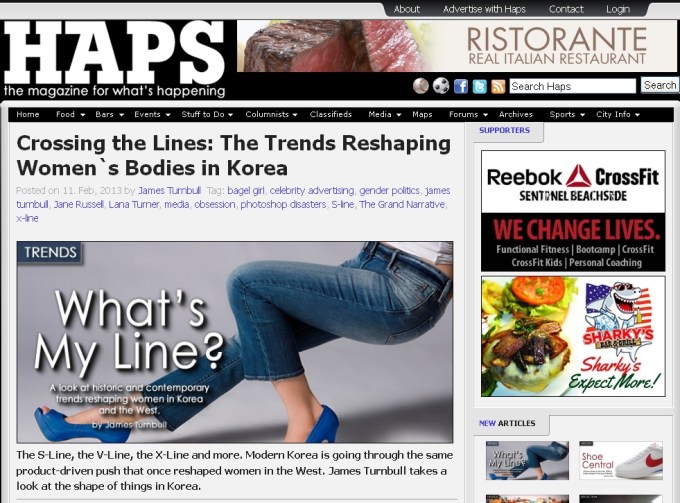
Crossing the Lines: The Trends Reshaping Women’s Bodies in Korea

James Turnbull Busan Haps What's My LineSee here for my latest article of that title at Busan Haps, and here for more details and context :)

Korean Gender Reader, 2-8 Feb.

The Man Who Loved Books(Source)

Sorry I haven’t posted anything this week folks; I’ve gotten just a little too lost in my offline writing work and research this vacation. But with only 3 weeks left of the semester break though, I’m slowly returning to a more normal schedule, and will try to start posting more regularly from next week.

Until then, have a good 설날 everyone, and make sure not to miss Bittersweet Joke, a documentary about unwed mothers in Korea, playing on BBC World at 6:30pm, Saturday Feb 9. See Tales of Wonderlost for the details.

Saturday

What do Jack Nicholson and Co-Ed School have in common? (Angry K-Pop Fan)

Sexual harassment education in cartoon form (ILDA)

Everything you ever wanted to know about aegyo (My First Love Story)

The reality of the Korean acting industry as told by an anonymous actor of 10 years (Netizen Buzz)

South Korea slips lower in press freedom index (Asian Correspondent; Global Voices; The Marmot’s Hole; koreaBANG)

Sunday

Nudes in Korean art (The Korea Herald)

The (Korean) Military Doesn’t Get Respect (Sorry, I Was Drunk)

Peaceshannon’s Conference Speech on Korea’s Special Adoption Law (Tales of Wonderlost)

Why Are We Still Talking About Sunye’s Non-pregnancy? (Seoulbeats)

Rapist of 8-year-old in Naju sentenced to life in jail (Korea Joongang Daily)

Monday

Alternative living in Korea: 3 women philosophers farming in the woods (ILDA)

“It is no surprise that Asian women are the most popular women of color in porn…” (Phenomenology/Intervention)

AKB48 member’s ‘penance’ shows flaws in idol culture (The Japan Times; The Guardian; Asian Junkie, 1, 2, 3, 4; io9; Frank Kogan; The Atlantic)

Government Report: Korea Ranked #1 for Sex with Minors in Southeast Asia (Idle Worship)

Park Geun-Hye & Fashion: Still HATE this Double Standard (Korean Gender Cafe)

Tuesday

Korea still has too few women execs (The Korea Herald)

The “Room Thing” And Other Indirect Chinese References to Sex (Speaking of China)

Actress Kim Nam Joo praised for admitting that she starves to maintain her perfect figure (Netizen Buzz; Korean women in their late 20s miss avg. 4.5 meals a month)

Villages paying parents to have more children (The Hankyoreh)

Korean plastic surgeon shares his views on industry regulations (South China Morning Post)

Wednesday

U.S. Increases Crackdown on Chinese and Korean Birth Tourism “Maternity Hotels” (Idle Worship)

Getting an HIV/AIDS check in Seoul (The Kimchi Queen)

Korean government to push passage of anti-discrimination bill (The Marmot’s Hole)

Hwang Woo-seok extracted ovaries without patients’ knowledge or consent (ILDA)

Gay Korean Actor Reveals Coming Out Struggles (The Kimchi Queen; E News World; Global Voices)

Thursday

K-pop’s Not All Gold and Diamonds, Boy (Seoulbeats)

South Korean Flight Attendants Fight for the Right to Wear Pants (Jezebel; The Seattle Times; The Huffington Post)

An estimated 16 million Chinese women are married to gay men & don’t know it (Bloomberg)

Why Girls Love “Boys’ Love”: The World of K-Pop Fanfiction (The One Shots)

The 2005 English Spectrum Incident Part 31: Anti-English Spectrum founder’s statement (Gusts of Popular Feeling)

Friday

“I Got A Boy” & SNSD In-Flux (The Mind Reels)

The emergence of K-pop: a history from Lee to Gee (Koreanology)

Screenings of White Night, Suddenly Last Summer and Going South with English Subtitles (The Kimchi Queen)

Suzy crowned the CF queen of 2012 (Omona They Didn’t)

QROK Radio: the only radio station in English by, for and about the GLBTQ community (The Kimchi Queen)

(Links are not necessarily endorsements)

Korean Gender Reader, 26 Jan. – 1 Feb.

Life A User's Manual(Source)

Saturday

Low South Korean birth rate shows signs of increasing (The Hankyoreh; ROK Drop)

Kang Min-kyung’s Gillette CF: Possibly The Worst Thing Ever (Seoulbeats)

Syringes, surgery and slaps: Thais suffer for K-pop beauty (The Marmot’s Hole)

Why did men stop wearing high heels? (BBC)

Yellow Face and Orientalism in the Media: Controlling What it Means to be Asian (Phenomenology/Intervention)

Sunday

Reading List: The Lesbian Rights Movement and Feminism in South Korea (The Kimchi Queen)

I can’t stop thinking about other people who can’t stop looking at Korean women (Feministing)

Transgender students suffer discrimination in silence (The Hankyoreh)

“I Didn’t Think Living as a Gay Man in Korea Would be This Hard” (Arari)

How a Japanese Diplomat Saved 6,000 Jews from the Holocaust (Allegiance Musical)

Monday

Korea’s Youth Divided Over Memories of Military Rule (koreaBANG)

Dating Chinese Men: Sure, why not? (Life Behind the Wall)

North Koreans don’t like women with big boobs: report (The Marmot’s Hole)

There are “entire organizations of brokers and doctors dedicated to throwing perfectly fine, functioning people into mental hospitals against their will” (Netizen Buzz)

“School 2013”: Fiction or Reality? (My Musings)

Tuesday

Korean Hanbok vs Japanese Kimono – Epic Dress Battles of History (Kimchibytes)

Top 10 stars with the most CFs in 2012 (Netizen Buzz)

Meet the (Chinese) Parents (Speaking of China)

Is it possible to be a die hard fan of k-pop idol culture without fetishization of Korean ethnicity? (Angry K-Pop Fan)

“The Construction of the Feminine in Korean Popular Music: A Performance Analysis of “I AM: SMTown Live” and Multi-Artist Musical Variety Shows.” (Footnotes; update1; update2)

Wednesday

Koreans ‘Biggest Clients of Prostitutes in Southeast Asia’ (The Chosun Ilbo)

I Feel Pretty Unpretty: Why Anthea Shouldn’t Get Plastic Surgery (The Oneshots)

Korea Times Perpetuates Beanpaste Girl Stereotype (The Korea Times)

Statistics About Sexual Assault Within the Korean Military (ROK Drop; see my post “Sex as Power in the Korean Military” for some context)

A Pink’s Eunji’s oranges controversy is the most I’ve ever seen Koreans care about traffic laws (Asian Junkie)

Thursday

All the K-pop fans, where do they all come from? (Frank Kogan)

Seoul’s 12 Best Gay Bars in Jongno (Discovering Korea)

Foreign Women and Korean Men: Who’s objectifying and who’s objectified? (I’m No Picasso)

Korean women shatter glass ceiling at foreign drugmakers (The Korea Times)

Meditations on Junk, #1: Ugly Koreans/Ugly Americans (Gord Sellar)

Friday

Having sex with a suspect: is it bribery? (Human Rights Monitor)

KCSC censures comedians for satirizing Park Geun-hye (The Marmot’s Hole)

Busan’s Hyeongjae Welfare Center-Another Example of 有錢無罪 無錢有罪 (Arari)

On dating Chinese men… Are Chinese men the best kept secret? (YinYangJinFeng)

Japan’s Demographic Disaster (The Diplomat)

(Links are not necessarily endorsements)

“Cute Lines for Cute Girls”: Street Harassment Framed as Fun

With her permission, here is a reader’s email I recently received. While I don’t usually post things that aren’t specifically Korea-related, I thought I’d make an exception this time!

Dear Mr. Turnbull,

I thought you might be interested in this video since your blog is about gender studies (Apologies for the long e-mail, but I want to explain myself thoroughly).

I was just curious about your and others’ thoughts on it. I remember watching the Korean street harassment video with the bikkis (nightclub workers?) and thought this was an interesting contrast. It’s not often that you can see a compilation quite like this.

One of my subscriptions posted a video called “Cute lines for Cute Girls” with the description “Everyone dreams of using corny but sweet pickup lines on random unsuspecting women. My friend and I show you the reactions we got :)” (My emphasis added)

I watched it and instead of making me smile, it just made me cringe. The video consists of him and his friend approaching random women in the street and in buildings with corny pickup lines. What made me uneasy is that I couldn’t help but see that some of the women did not seem to enjoy it. Sure, the background music makes it seem light-hearted and fun, but mute it and look at their body language. Some did have fun with it and laughed, but to me most 1) couldn’t walk away fast enough, 2) gave an uncomfortable laugh and smile (that “what the hell just happened” smile).

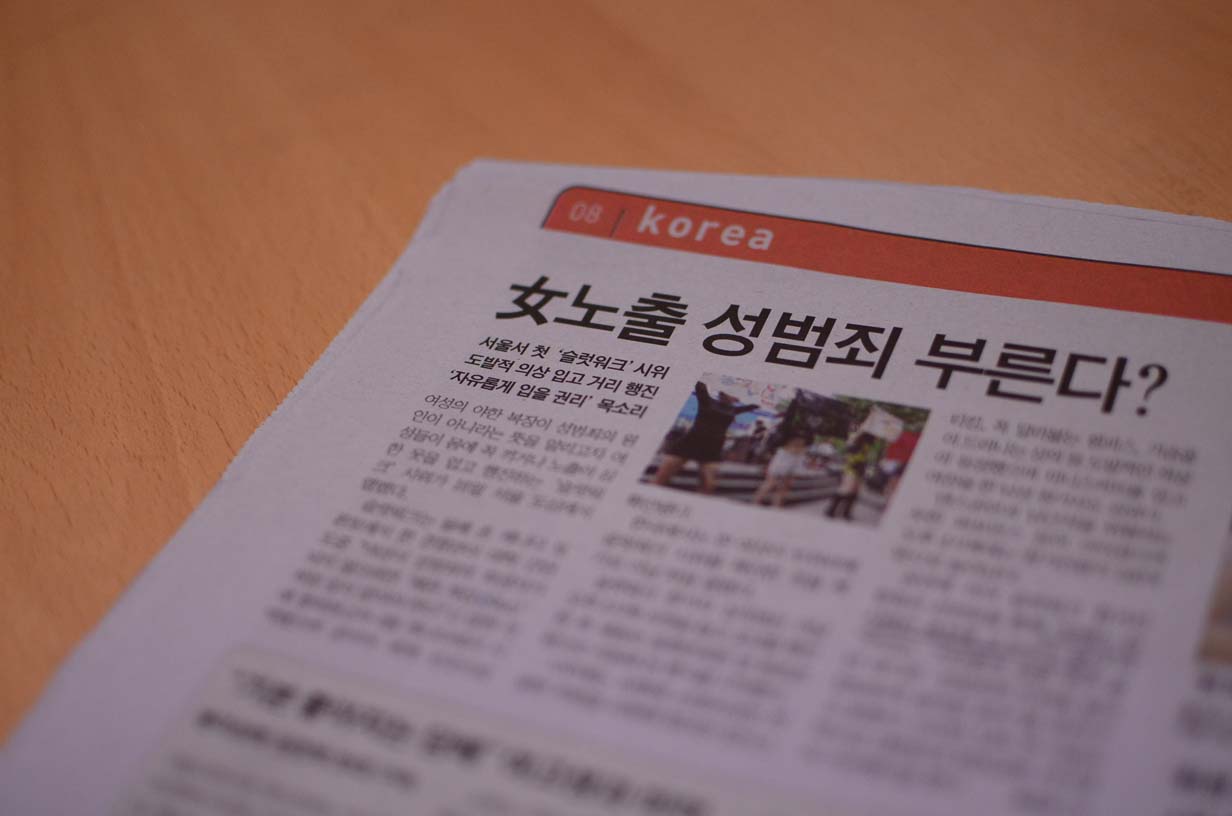
Korea Slutwalk(Source)

I think most people can see that whistling and making lewd comments are wrong. What complicates things and divides opinions is that these are “nice guys.” They are not your typical catcallers lurking in a doorway, but “regular, non-threatening” guys on the street. But does this make it ok? I would say not.

Perhaps I was wrong about the video, but his replies really disturbed me. Even if you do not agree with me about the video, the conversation we had was really telling about attitudes about street harassment today.

I don’t know if he’ll remove my comments or not, so I’ll paste the conversation here (my emphases throughout):

NSAM08 17x11_txt rep_v2.inddMe: I don’t know about this. I mean, you’re going after women you have no interest in other than to make a video so people can laugh at them. Most of them just laugh uncomfortably and walk away. This is like one step above cat-calling.

Him: Hey waterlily6782001, this is an exercise in overcoming false constraints that many individuals place on themselves. Also, many of these girls played along when they heard these lines because they were cool and fun girls who knew how to banter back. If anything, this is a great profile on the decent quality of women at University of Pennsylvania.

(Almost feels like he’s saying I’m not cool or fun or of decent quality because I do not like his “exercise”)

Me: Yes, I understand and I do like your other videos, but this one… From your videos, I don’t think you’re a mean person and I don’t think you ever intend to hurt anyone, so I wasn’t too upset. Yes, some of them bantered back, but can’t you see that some were also clearly uncomfortable? It’s just that when you have to deal with totally insincere guys chatting you up all the time as a dare or just to get a reaction, it goes from flattering to tiring.

Him: They could’ve been having a bad day; school could’ve been stressing them out. Even if our lines caused the discomfort, my friend and I were simply giving them compliments. If they can’t take a compliment, then their frame of mind needs work. For example, I love your constructive criticism. But I could easily have said, “This person is a hater. I should delete the comment.” But if I did that, we wouldn’t be having a great discussion. Frame life positively. You’ll be much happier =)

Me: Please read this, it explains it better than I ever could ^_^

I think what we have here is just that you, as a man, will never experience life as a woman. So it’s difficult to grasp that what you see as “compliments” can mean different things to different women. There’s just no way for me to make you fully understand, but I appreciate your replies and wish you the best. ^_^ (end)

Street Harassment Korea(Source: leftycartoons)

He implies that I’m 1) a hater 2) pessimistic and 3) unhappy because I do not like his video. I’ve read hater comments before and I thought my commentary was pretty tame. I’m also pretty sure haters don’t promote your videos on their blogs as I’ve done with his in the past (He did a student documentary on Asian male and white female relationships).

It was clear that I couldn’t make him understand, and he implies that he made no one uncomfortable (“Even if our lines caused the discomfort”). But you can’t tell me that the girl at 0:53 is not uncomfortable while she’s speeding past, head down, eyes averted, walking around him, and not even stopping. The girl at 2:10 is also clearly not amused even though you can’t see her face. Listen to her voice! I also wonder if the girl at 2:30 was really having fun having a guy 1) corner her at work and 2) continue to talk to her even after she emphasizes TWICE that she has a boyfriend.

This in particular really disturbed me: Even if our lines caused the discomfort, my friend and I were simply giving them compliments. If they can’t take a compliment, then their frame of mind needs work.

…which is probably the #1 argument guys have for when girls don’t like their advances. It’s a COMPLIMENT and if you’re uncomfortable YOU need to change. So if I don’t like a guy following me along the sidewalk giving me an insincere “compliment” I need to change my attitude.

Korea Slutwalk Newspaper(Source)

Do I hate compliments? No. I appreciate heart-felt compliments.

Do I hate jokes? No. I make them all the time.

Do I hate corny pick-up lines? No. In fact, they can be cute and are good ice-breakers.

What I do hate is a stranger who has absolutely no genuine or honest interest in me, and:

  • 1) cutting in front of me
  • 2) following me
  • 3) giving me a completely fake compliment just to see my reaction,
  • 4) walking away,
  • 5) laughing
  • 6) recording the whole thing, and
  • 7) posting it on the internet.

So what do you think? Do these guys get a free pass because they aren’t dirty old men hanging on the street corner?

Thanks for reading this long e-mail and have a good day!

James: What do readers think? I’m in complete agreement myself!

Update 1, Feb. 3: Just for everyone’s interest, here’s something I stumbled across in a review of a book on the history of online dating:

Of course, single people have always had means to boost their odds. You can move to a city, where the population of as-yet-unclaimed hearts will be larger. You can lower your standards to broaden the radius of your dating pool. You can also just toss out game 24-7 with utter indiscretion. One acquaintance likes to tell random women on the street that he thinks they’re beautiful. “Like 1 in 5 will slow their roll a little and give me a smile,” he says. “And like 1 in 5 of those stop and talk to me and let me hand them my business card. And like 1 in 5 of those actually call me.” I would assume that at least 2 in 5 women he approaches think him a frightening skeezball. And I think, for better or worse, he’s OK with that ratio.

Update 2, Feb. 5: See some related reading in “Korean Girls Be Scared of Me (And Every Other Dude)” at Gyopo Keith.

Update 3, Feb. 7: And some more in “How to Talk to a Woman Without Being a Creep” at Jezebel.

Update 4, Feb 14: Jerry Liu, the maker of the video, has asked me to ask what readers’ reactions to this one by “Simple Pickup” are.

Related Posts:

Korean Movie Review #7: My Wife Got Married (아내가 결혼했다; 2008)

My Wife Got Married 2(Source)

Starring: Son Yae-jin (Joo In-Ah), Kim Ju-Hyeok (Noh Deok-Hoon), and Joo Sang-Wook (Han Jae-Kyeong). Written by Song Hye-Jin (original novel by Park Hyun-Wook) and directed by Jeong Yoon-soo.119 minutes.

Before the mid-1990s, very few Korean movies featured a wife leaving an unhappy marriage. Of those that did, either she would ultimately return to her husband, tail between her legs, or she would face an untimely death, so great was the inevitable spiral into destitution and despair.

So, when Kim Tae-kyun (김태균) directed The Adventures of Mrs. Park (박봉곤 가출사건; 1996), who not just successfully pursued her lifelong dreams of becoming a singer, but found new romance with a second husband too, he softened the subversive social message by making the movie into a romantic comedy. But even then, he would later confess to Cine 21 magazine, he was extremely concerned at how audiences might react to such “an unexpected ending”.

Fast forward to 2008, and My Wife Got Married, about a woman who demands 2 husbands, was one of the most popular movies of the year, and even won Son Ye-jin the Blue Dragon Film Award for best actress. Not quite a comedy, and sparking minimal complaint or controversy (although women were careful not to publicly identify too closely with her character), it’s difficult not to see it as a sign of how quickly and irrevocably Korean attitudes had changed in the preceding decade. I’ve projected feminist empowerment onto it ever since.

It’s somewhat ironic then, that it turns out that the movie is *ahem* actually told exclusively from the perspective of the main male character, Noh Deok-Hoon…

*Minor spoliers follow*

Opening in Spring 2002 with Deok-Hoon bumping into Joo In-Ah on the subway, next they’re at a coffee shop, where he reminisces about missing his chance to ask her out back when they worked together, and speculating with his male coworkers about whether she wore a bra or not (as one does). Discovering a shared love of football, specifically the rivals Real Madrid (him) and FC Barcelona (her; expect many ensuing football/relationship metaphors in the movie), soon they’re having drinks, then sex at her place.

My Wife Got Married 3In a surprisingly erotic scene, Deok-Hoon has the best sex of his life, and instantly makes such an emotional, almost spiritual connection to In-Ah that it’s easy to see how wounded he would be by what audiences already know will come. But, by no means does she merely humor him in response. So, even without that benefit of hindsight, it’s no surprise that they do genuinely fall in love.

Nymphomania a historyThis is more important than it may sound. Because, before falling in love, first they are lovers (what an oxymoron!), with one scene in which she encourages him to very explicitly talk about his sexual fantasies — he struggles; she’s well aware of hers — hinting at her much greater sexual subjectivity, and willingness to act on it. Considering that just 13 minutes in, audiences were — à la Basic Instinct — reflexively craning their necks to get a better glimpse of her exposed(?) nipples, it would have been very natural and easy for writer Song Hye-Jin to have continued on that salacious, titillating basis, portraying In-Ah as a emotionally manipulative nymphomaniac that can’t be satisfied with just one man, with all the double standards that that implies.

Instead, as soon as we’re shown that they’re in love, In-Ah also says that despite that, she can’t guarantee that Deok-Hoon will be the only person she loves for her entire life. Her surprise at his umbrage with that seems both authentic and naive (a constant theme), as is her not realizing how he might feel at her continuing to drink and socialize until all hours as if she were still single.

Not that she can’t or shouldn’t mind you. Rather, it’s how secretive she is about it that is the problem, never answering her phone; it’s only when he eventually, desperately confronts her at her apartment after one such session that it seems to click. Only slightly drunk and still impeccably dressed, you sense maybe she is only testing him when she retorts that she was sleeping with someone. Either way, he leaves her.

After a month of moping around, he’s encouraged by a friend to forgive her, but also to ensure it doesn’t happen again by marrying her and then knocking her up. Surprised at his call, let alone his marriage proposal, she takes a lot of persuading, only finally acquiescing during a World Cup game.

Those that were here that magical summer, will surely understand.

My Wife Got Married 1(Source)

Domestic bliss ensues, only briefly interrupted by her moving to a different city for 4 days a week for the sake of her job; after all, such arrangements are completely normal for millions of Koreans. This movie being what is though, soon his world comes crashing down when she reveals that she’s not just fallen in love with a second man — Han Jae-Kyeong — there, but she would like him to also be her husband — not just boyfriend — just as Deok-Hoon is in Seoul. Angry, emotional, and this time also physical confrontations follow, with Deok-Hoon resolving not to let her to “win” by divorcing her.

Let’s pause for a moment here, as many viewers may well have needed to take a deep breath at this point in the movie. Because, victim or perpetrator, likely most would also been affected by cheating spouses, partners, or parents at least once in their lives. Equally likely, they resolved to never let it happen again, or to them. So, if Deok-Hoon returning to In-Ah the first time didn’t already, his acquiescing to this new arrangement surely brought many of those same feelings of rage, hurt, impotence, and frustration back to the surface.

Or perhaps I’m just projecting? Either way, frankly, if I wasn’t already committed to a review, I would have stopped watching at that point, for the same reasons I turn off most Korean dramas within 10 minutes: it’s difficult to be sympathetic to — or interested in — a character you constantly want to grab by the shoulders and just shake some damn sense into.

My Wife Got Married 6(Source)

Yet, for a time, the trio — well, technically two duos — does seem to work, providing one takeaway message that polygamy (technically, polyandry) is neither as absurd nor as evil as it’s usually assumed to be. Moreover, in the process the movie pointedly questions many of Korean society’s double standards regarding marriage, especially how prostitutes and mistresses are tolerated for men while many wives languish at home, resigned to continuing their — by their own admission — loveless, sexless marriages out of financial dependence and fears they will lose custody of their children. Many reviewers erroneously claim these are shared by Deok-Hoon; however, but for sneaking glimpses of In-ah’s breasts at work, then complaining of her not wearing a bra in public (after sleeping together just one time!), he’s only guilty of firmly believing in monogamy. Indeed, he’s the one that repeatedly lashes out at his male friend’s hypocrisy, although it’s true that he could have done so with much greater gusto at his brother’s.

However, no matter how positively it portrays polyandry, the movie also demonstrates how unfeasible it is in a society where it’s both illegal and there’s strong social prejudices against it. And, coming from a movie which can be described as a romance only by default (to those reviewers that call it a comedy, I’m perplexed at what they laughed at), you’re left wondering what the point of the 2 hours was exactly.

*Major spoilers follow*

My Wife Got Married 7 (Source)

Specifically, it’s the birth of a daughter that starkly demonstrates how the trio’s arrangement simply can’t be sustained in the face of family and official obligations. Questions of paternity aside (In-Ah wants him to love the child regardless of the who is the father, so never reveals that. Later, it’s Jae-Kyeong that reveals that they always used contraception when they were together), it soon becomes apparent that Deok-Hoon and Jae-Kyeong’s families are none the wiser.

This facade comes tumbling down when Deok-Hoon’s colleagues in Seoul see In-Ah, Jae-Kyeong, and daughter in a magazine article written by (unknowingly to them) the latter’s cousin, and assume that he’s secretly gotten a divorce. Fearing he’s slowly but surely losing both wife and daughter, and partially out of spite (really, he hasn’t felt in control of his life since the start of the movie), he responds by crashing the first birthday party Jae-Kyeong’s family has for “their” daughter.

My Wife Got Married 5(Source)

In response, In-ah disappears with her daughter, and her two husbands — this is much more believable than it may sound — come to live together and even become friends; as they say, they have nowhere else to go. When a postcard from Spain arrives 5 months later, the movie ends with both of them joining her there to watch football games and live happily ever after, as if somehow questions of employment, visas, schooling, custody rights, and social prejudice didn’t also apply there.

*Spoilers End*

Was it too much to ask that the movie delved a little more into some of those questions? Do any movies know any Korean movies that do cover alternative living arrangements a little more realistically, but are still entertaining? Thanks!

Update, Feb. 3: By coincidence, today The Atlantic had an interesting article titled “When Taking Multiple Husbands Makes Sense,” with the byline “Historically, polyandry was much more common than we thought.”

Update, January 3 2014: And today, Salon one titled “My Two Husbands.”

Korean Gender Reader, 19-25 January

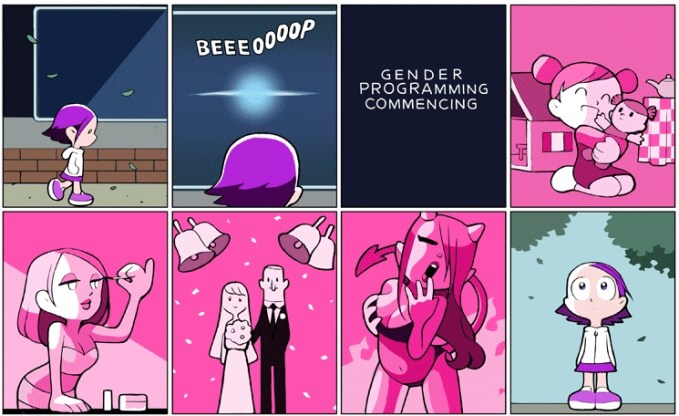
Gender Programming by Sinfest(“Gender Programming” by Sinfest. Click on the image for the full strip)

The new, lite version. Sorry if anyone relied on the categories in the previous version, but 1) they were always pretty loose and arbitrary anyway (many stories could go into several), and 2) they didn’t really seem appropriate with me deliberately going for a good mix of subjects now, rather than simply collecting every story I came across. Grouping them into five at a time does make for easy mental navigation though (i.e., see what’s available for one day, move on to the next), and if you’re impatient it only takes about a minute (yes — I’ve timed!) to read the titles of all the thirty-five links available.

Enjoy!

Saturday

On Dragon’s Dol (On Becoming a Good Korean Feminist Wife; Part 2, Part 3, Part 4)

Lawmakers moving to set a quota for women directors at public institutions (The Korea Herald)

What are thigh gaps and why you probably aren’t going to get one from weight loss (Angry K-pop Fan)

Korean Culture Through K-pop 102: Korean Nationalism Uncovered (Seoulbeats)

— Gay in Korea: an interview with an American expat living in Seoul (Mapping Words)

Sunday

Realizing Park’s vision on gender equality (The Korea Herald)

Why Westerners Screw Up Meeting Older Koreans (Meet me at the wall)

The problematic social norms of “I Got a Boy” (My Musings)

Netizens admit to being overly harsh with female stars (Netizen Buzz)

Lee Hi Shocks Fans With Training Details (Omona They Didn’t!)

Monday

Another Friend, Another Divorce in China (Speaking of China)

The 2005 English Spectrum Incident, Part 10: ‘Recruit a Yankee strike force!’ (Gusts of Popular Feeling; Part 11; Part 19)

Korean government’s glass ceiling is intact (Korea Joongang Daily)

Kodansha is figuring out that using the kid in the nude photoshoot with Kasai Tomomi was a bad idea (Asian Junkie; NSFW?)

South Korea’s college-educated women complain about income, employment disparities (Press TV Video {automatic}; The Korea Times)

Tuesday

Korea last in OECD in female graduate employment (The Korea Herald; The Korea Economic Daily)

Do men really have higher sex drives than women? (io9)

“The Sexy Lie” by Dr. Caroline Heldman (TEDx): Great lecture about female sexual objectification and its damaging effects (Angry K-Pop Fan)

Saesang fan drugs himchan’s drink (Omona They Didn’t!)

Life in Plastic: Fantastic? (Outside Seoul)

Wednesday

Korea builds first ever school for victims of bullying AND bullies (Netizen Buzz)

High-end call girl service busted (The Marmot’s Hole)

South Korean animation: is the underdog finally having its day? (The Guardian)

Will Hosting the Special Olympics Change Koreans’ Views on the Disabled? (Korea Realtime)

Human Rights Committee Criticizes Seocho-gu Office for Banning Ad Promoting Gay Awareness (Tales of Wonderlost)

Thursday

Japanese finance minster wants old people to “hurry up and die” (io9; Visual Anthropology of Japan)

What is “Men’s Korea” (formerly Boslachi)? (Korean Gender Cafe)

Sean Hayes in the Christian Science Monitor on Korean Adoptions (The Korean Law Blog; The Hankyoreh)

So-called “Reverse Sexism” in Korea (Korean Gender Cafe)

The Promise and Perils of Feminist Criticism in Chinese Studies (Dissertation Reviews)

Friday

— “Memoirs of a Geisha” source gets fed up and writes her own memoir to set the record straight (Tales of Wonderlost)

For surgery, some patients prefer a woman’s touch (Korea Joongang Daily)

Queer Culture in Japan (Rainbow Arts Project)

Go Young Wook to Be Indicted for Sexually Harassing Minors (Omona They Didn’t!)

“Here are the best [Asian-American] responses to ‘Paper Tigers,’ in my opinion” (Phenomenology/Intervention)

(Links are not necessarily endorsements)

Quick Hit: Living as a female smoker in Korea

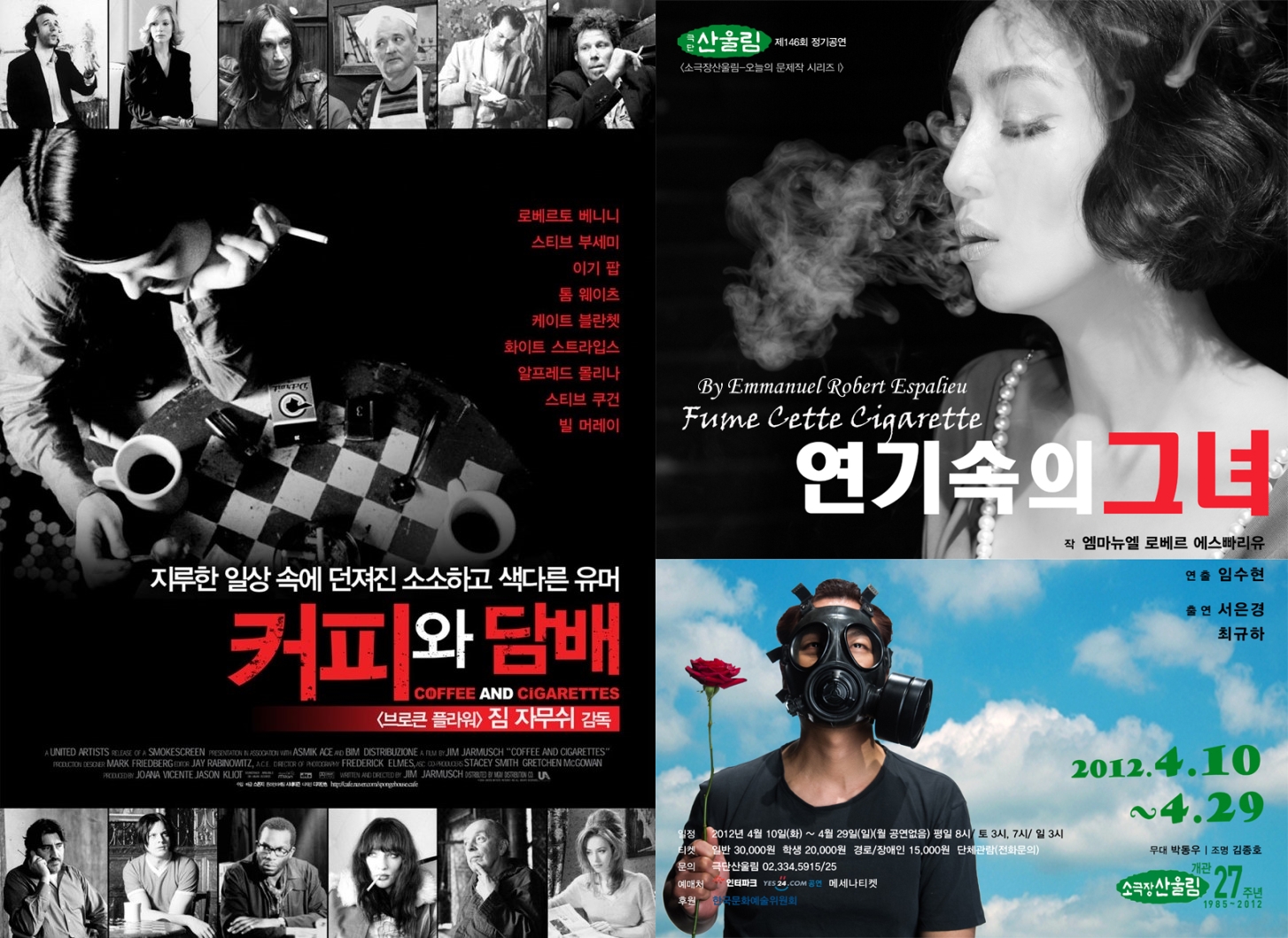
Coffee and Cigarettes 2003 Fume Cette Cigarette Korea(Sources: left, flygookee; right, Emmanuel Robert-Espalieu, auteur)

The other day Kim Young-hee (26) smoked in public instead of a cafe. She took out a cigarette impulsively while waiting for the bus home after a few drinks with her friends.

“I was a bit tipsy and felt like a puff. After I lit the cigarette, a random middle-aged man came up to me and started shouting as if I had done something very bad. He said, ‘I will slap your face if you don’t throw your cigarette away right now.’ He called me ‘dirty little woman.’”

She still thinks it was ridiculously unfair for him to reproach her because the man was also holding a cigarette…

See The Korea Times for more stories of similar incidents, and my The Gender Politics of Smoking in South Korea series (Part 1, Part 2, Part 3, Newsflash, Part 4, Korea’s Hidden Smokers) for more context. As explained in the latter (see the article in the last link for a summary of the series), the stigma against women smoking leads to massive under-reporting by them, resulting in official figures of roughly 2-5% of Korean women smoking, against best estimates of roughly 20% (see here for a handy international comparison). What’s more, the previous government was accused of deliberately downplaying the figures to stress its success in lowering the (admittedly more pressing) high male smoking rate, and while technically I haven’t seen the same accusations leveled at the outgoing Lee Myung-bak Administration, I haven’t found any official acknowledgement of how problematic its figures are either.

Korean Woman Smoking SmallMeanwhile, since my last post in the series was published nearly a year ago, probably the biggest developments have been the Seoul City Council’s continuing efforts to implement its 2011 plans to increase the number of public areas being designated smoke-free to 1/5th of the city by 2014 (smoking on sidewalks was already banned in 2010); and also efforts by some companies, both public and private, that have gone so far as to make being a non-smoker a prerequisite for promotion. For more details on both of those, see “Getting Tough: Korean Smokers Passed Over for Job Promotions” by Bobby McGill at Busan Haps, who also notes that (source, right: sungjinism):

The central government is doing what it can while avoiding Korea’s third-rail of politics, the “sin tax”. Few things more quickly turn the public against you here than raising taxes on Korean’s beloved cigarettes and alcohol. And the evidence shows that aside of potentially costing elected officials their jobs, it does little to curb smoking anyway.

The last time the government raised taxes on cigarettes was in 2004 by 354 won (30 cents) when 52 percent of the male population was smoking. The rate dropped a paltry seven points to 45 percent by 2007, but then increased the three subsequent years hitting 48.3 percent in 2010 before leveling off back at the current 45 percent.

I’d agree that the government is avoiding the sin tax, but disagree that that 2004 tax hike constitutes evidence against its effectiveness: a raise of 354 won being moot when just last year, packs were still at “the very smoker-friendly price of 2,700 won each” (US$2.53 as I type this). Moreover, in November “The International Tobacco Control Policy Evaluation Project’s team of some 100 health experts from around 20 countries” said that “it is imperative for South Korea to raise taxes on tobacco products,” and also 50% of respondents in a December 2010 survey by The Ministry of Health and Welfare “said that they would seriously consider quitting if the price was at least 8,000 won per pack.”

What do you think, about any of the above? Especially those among you that smoke yourselves? Personally, when I hear of women getting threatened, even slapped in the face for smoking in 2013, I’m very skeptical about news of improvements. But I realize that that is likely much more a manifestation of general misogyny than being anti-smoking per se, with Nathan McMurray of Korea Law Today, for instance, being much more optimistic about changing attitudes:

Reducing smoking is a process that will require the collective willpower of the entire country, because it is a habit so deeply ingrained in the culture. However, positive strides have been made to reduce the number of male smokers. In fact, since I have been in this country, I have noticed that the perception/acceptance of smoking has morphed into something different than it used to be.

Either way, let me conclude by passing on some further reading I’ve come across in the past year. First, Smoking Roomspecifically gender and smoking-related, which show that — of course — it’s by no means just Korea where the number of female smokers is soaring (source, right: Jude Lee; CC BY 2.0):

Empowered women smoke more (New Scientist)

Torches of Freedom: Women and Smoking Propaganda (Sociological Images)

Female smoking death risk ‘has soared’ (BBC)

Women who quit smoking before 30 cut risk of tobacco-related death by 97% (The Guardian)

Lung cancer in women ‘to soar’ by 2040 (BBC)

And finally, on some methods for curbing smoking in general:

In an unsurprising development, smoke-free laws have lead to fewer hospitalizations (io9)

Look what they’ve done to my brands: Cigarette-makers will weather the spread of plain-packaging laws (The Economist)

Why cigarette packs matter (Bad Science)

Producing Bodies in Anti-Smoking Campaigns (Sociological Images)

Smoked out: Can a film of a smoker trigger the act? (The Economist)

Quick Hit: Radio Interview Tomorrow

Vector-BG-Yellow-Light(Source)

Tomorrow at about 8:30am, there’ll be a brief interview of me in the “Morning Coffee” section of the 7-9am Morning Wave program on Busan e-FM. More about me than than anything Korean feminism, sexuality, or pop-culture related sorry(!), if you’re still interested you can listen in at 90.5 FM or online here, or catch it later in the archives.

Also, before I forget, back in November I made a small contribution to James Pearson’s (of koreaBANG fame) article “‘Ladygate’ incidents point to misogyny on the Korean Internet” for Yonhap. Sorry for the long delay in passing that on, and please see my “Korean Sociological Image #73: The True Numbers of Korean Working Women” if you’d like more context.

Korean Gender Reader Version 2.0? (Jan. 12-18)

Korean Man Woman Looking at Viewer(Source)

As promised last time, here (yes, click the link) is this week’s new, improved Korean Gender Reader. But, frankly I’m disappointed with it. While using paper.li did save a lot of time, and the result does look much better than my regular posts, several stories I tweeted are missing; most stories you have to click the “more” links to see; their categories are completely meaningless; and the inability to choose my own descriptions to links means the headlines often give absolutely no indication of the contents (yes, I can hardly criticize given the headline to my own last post, but still!).

Without much more editorial control then, in hindsight paper.li only seems appropriate for daily collections of links really.

So, apologies for the failed experiment, and next week I’ll revert back to the old system. Suggestions for how to save time with it are still very welcome, but probably simplest and best is if I limit the number of links to the 5 most interesting stories I come across each day, coming to a total of 35 a week. Compared to the 70-100+ I normally post, that doesn’t sound too onerous, and of course all the extra stories not linked to in the KGR posts will be still available via the Facebook Page or my Twitter Feed.

You know my hips don’t lie. And I’m starting to feel it’s right. BUT…let’s check your IIEF-5 score and our PVI frequency baby. Oh yeah~

Woman's Waist Tape Measure(Source: by Janine, Flickr)

Kramare and Treichler (1996): “Feminism is the radical notion that women are people.”

Geher (2009): “Evolutionary psychology is the radical notion that human behavior is part of the natural world.”

There is no reason on earth to believe that these two “radical” notions are irreconcilable.

(Feminist Evolutionary Psychology Society)

Yet evolutionary psychology still has such a bad reputation among feminists.

Partially, that’s because many feminist criticisms of the discipline and its researchers — and vice-versa — are really just based on strawmen and stereotypes.

That said, it’s also true that evolutionary psychologists can indeed sometimes make outlandish, sexist claims based on little to no evidence.

Or at least, they can seem to. More often than not, it’s actually journalists that are doing that for them, who rarely have time for their caveats and qualifications. Also, journalists can sometimes simply make mistakes and/or misunderstand too, or evolutionary psychologists fail to clearly explain the purpose, methodology, and conclusions of their research.

evolutionary psychology bingo(Source)

These maxims are worth repeating, especially when you read a headline that brings an instant, smug satisfaction of being proven right. In this case, with “Why Dating Women With Slim Waists Lowers Men’s Risk for Erectile Dysfunction” by Christine Hsu in Medical Daily, which not only makes sense given everything else I’ve read about women with hourglass figures — that they’re significantly more fertile than those with other body types, which likely plays a strong role in why that one is so popular amongst heterosexual men (to the extent that even congenitally blind men prefer them) — but, sharing that preference, also reminds me that I’ve got great taste in women too.

Just taking Hsu’s word for it though, would be nothing more than confirmation bias. So, starting with her introduction (my emphasis):

Body Shapes Types Sketch(Source)

Possessing a ‘figure 8’ body has long been a trademark of feminine beauty, and now new research has revealed the reason why men tend to prefer women with a waspish waist.

The study also linked the middle proportion of a woman’s body to the likelihood of satisfaction and erectile dysfunction in her partner.

Researchers found that the slimmer a woman’s waist, the more satisfied her partner and the less likely he is to suffer impotence in the bedroom, according to the study published in the [December 2012 issue of the] journal Archives of Sexual Behavior.

That study is “Slimmer Women’s Waist is Associated with Better Erectile Function in Men Independent of Age” by Stuart Brody and Petr Weiss, and I’ve highlighted that last section because — admittedly in hindsight — it should already raise alarm bells: sexual satisfaction isn’t actually mentioned in the title of the article, nor the original study. That doesn’t necessarily mean that it’s not there, but the combination of the titles and the highlighted part does strongly imply that, somewhere within, the study will mention that female participants’ waists were measured and the sexual satisfaction and levels of impotence of their male partners.

At first glance, it appears to be done so in the abstract, (my emphasis; source, right):

Hourglass figure means more babies….To assess the association of women’s waist size with a more tangible measure of perceived sexual attractiveness (as well as reward value for both sexes), we examined the association of women’s age and waist circumference with an index of men’s erectile function (IIEF-5 scores), frequency of penile-vaginal intercourse (PVI), and sexual satisfaction in a representative sample of Czechs (699 men and 715 women) aged 35–65 years. Multivariate analyses indicated that better erectile function scores were independently associated with younger age of self and partner and women’s slimmer waist. PVI frequency was independently associated with women’s younger age and women’s slimmer waist. Sexual satisfaction was independently associated with men’s younger age and slimmer waist for both sexes. Better erectile function, greater PVI frequency, and greater sexual satisfaction were associated with women’s slimmer waist, independently of both sexes’ ages….

But then I moved on to the methodology (the first 2 pages are available at the above link), which ends the section on how the participants were chosen with (my emphasis):

The rationale for using participants who were not both members of the same couple includes prioritizing a representative sample and decreasing risk of a couple comparing responses (Weiss & Brody, 2011). The 649 women who provided complete data had a mean (SD) age of 48.1 (8.6) years, and the 685men who provided complete data had a mean (SD) age of 49.6 (8.7) years.

Christina Hendricks Marilyn MonroeWhich begged the question of how on Earth, if data on the waist sizes and sexual satisfaction of both partners in a couple was not gathered (and erectile function of the male partner), it was determined that “the slimmer a woman’s waist, the more [sexually] satisfied her partner and the less likely he is to suffer impotence in the bedroom.” This in turn spawned an interesting all-day conversation on The Grand Narrative Facebook page, and ultimately led — thank you! — to my getting my hands on the full study itself.

As it’s only 8 pages long, I highly recommend that you read it for yourselves (please email me or let me know in the comments if you would like a copy) so let me just sum it up here. As it turns out, Hsu did indeed make some mistakes (source, right).

First, the methodology:

  • Page 3, paragraph 1, mentions that “The same wording for the IIEF-5” — the test of erectile function — “was used for both sexes with the added instruction that the woman should complete it on behalf of her partner.” Earlier, it also mentions that the test is very reliable, with men’s and their female partners’ assessment of the men’s erectile function being very similar (obviously, their female partners would know!).
  • Page 3, paragraph 2, mentions that only participants completed the survey on sexual satisfaction;  and page 3, paragraph 3, that participants measured only their own waists. In short, it’s these points that already prove the error of Hsu’s link between male sexual satisfaction and female waist size that I highlighted in the introduction.

male waist sizesNext, the results (source, right):

  • The younger the men and women, the less problems with erectile dysfunction the men (or the women’s male partners) had.
  • The slimmer the women’s waists, the less problems their male partners had with erectile dysfunction.
  • The slimmer the women’s waists, or the younger the women, the more often they had sexual intercourse.
  • The slimmer both sexes were, the more likely they were to have satisfying sex lives. The younger the men were (not the women) the more likely they were to have satisfying sex lives.
  • The more often men and women had sex, the less problems with erectile dysfunction they (or the women’s male partners) had; and the younger the men (not the women), the more likely they were to have satisfying sex lives.
  • Women with slimmer waists tended to have sex more often; their male partners had less problems with erectile dysfunction; and they (the women) were more likely to have satisfying sex lives.
  • And finally, crucially, “It was noteworthy that the association of women’s slimmer waist with all measures of sexual function was independent of both partners’ age” (from the end of page 6).
No cute clothes for fatties(Source: ~PinkieNekoGirl)

That’s a lot to take in, many points seem obvious and to follow naturally from each other, and there’s certainly the possibility that I’ve misunderstood and/or misrepresented some of them myself — if you think so, by all means please correct me. Also, I don’t mean to harshly criticize a reporter who undoubtedly had less time to spend on the study than the 3 days of my semester break(!) that I ultimately did. But, although it’s very very easy to take away the message that “the slimmer a woman’s waist, the more satisfied her partner” from it, with the conclusion stating —

The findings were generally in accord with evolutionary perspectives. Men’s erectile function scores were independently associated with younger age of self and partner, and women’s slimmer waist (all factors generally associated with greater reproductive fitness). Similarly, PVI frequency was independently associated with women’s younger age and women’s slimmer waist. Sexual satisfaction was independently associated with men’s younger age, and slimmer waist for both sexes. Better erectile function, greater PVI frequency, and greater sexual satisfaction were associated with women’s slimmer waist, independently of both sexes’ ages. Thus, capacity for potentially reproductive sexual behavior, frequency thereof, and a psychological response that might support pair-bonding were all linked to women’s slimmer waist.

— for instance, Hsu does appear to have misunderstood it, also mentioning that “researchers also recorded how often the 699 study participants — Czech men between the ages of 35 and 65 years old — had sexual intercourse,” whereas actually (page 2, paragraph 5) 699 men and 715 women were surveyed, and of those 685 men and 649 women provided complete data.

Either way, I can just imagine what many journalists and advertisers would — and probably will? — make of a study which seems to say that men with slimmer wives and partners have more satisfying sex lives!

Curry Sex Life(Source)

Update — For those who *cough* don’t understand the title of the post:

Let’s Talk About 섹스, 베이비~

Kim Soo-yong's 19 Show Banner(Source)

I showed my (Korean) wife this thread. Her response:

“They think Koreans can’t talk about gay rights? How insulting. We’re more advanced than you think. Gay issues are talked about all the time on talk shows and in the media. [Those commenters] clearly do not understand Korean culture.”

(Comment at Gusts of Popular Feeling)

I would have said more “ignorant” of Korean culture, but you get the idea. And, as if to prove her point, somehow the very next thing in my browser was the new Kim Soo-yong’s 19 [R18] Show, hosted by (obviously) comedian Kim Soo-Yong and announcer Kim Min-jin, and also starring psychologist Dr. Choi Chang-ho and comedian Yun Sok-ju.

Although this particular show may not have talked about LGBT issues (yet), it hit home because it provided a second healthy reminder that Koreans are frankly talking about sex at least, despite foreign stereotypes of their extreme sexual conservatism. Indeed, there’s actually been shows like this for many years now.

Here’s the introduction to it on the Kukitv station website:

Kim Soo-yong's 19 Show(Source)

My (very quick) translation:

Men and women,

Out of feelings they share when they love each other, there’s some things they don’t understand, or they do understand but feel strange about, or they thought they understood but can be easily mistaken about.

From the first date, skinship, and sex to proposing and marriage, we need to something to clear the wish-washy, hidden, unspoken things between men and women.

For the hidden sex stories in your heart, to the secret urges of your partners whom you thought you knew well…

And fortunately for something that plays at 1:10am on weeknights, all of the 5 shows so far — and shorter segments of shows — are available on Youtube here. Here’s the full first episode to get you going:

Alas, language-wise, it’s not for the faint-hearted: the Korean subtitles are minimal, and there’s unlikely to ever be English ones available. Can anyone please recommend any similar shows that are more accessible for non-Korean speakers, and/or — seeing as they inspired this post — pass on any of those that have dealt specifically with LGBT issues? Thanks!

(Update: I should also mention the Talk on Sex podcast that I’ve been following on and off for years, but again that’s entirely in Korean).

Adieu, Korean Gender Reader Version 1.0

Speech Balloons Background(Source)

Some minor changes to announce, blogging-wise.

The main change is that I’ll be completely redoing the format of the Korean Gender Reader posts. Because really, they’ve long been superseded by the blog’s Facebook page and Twitter feed where I first post the stories, and where they seem to generate much more discussion too. Also, although the posts may not look like much work, they actually involve 4-5 hours each week of tedious searching through RSS feeds, then copying and pasting them here. Frankly, I’ve long been tempted to simply stop writing them, but have kept at it for readers’ sakes.

I could also mention that I’d probably lose half of my readers if I stopped writing them too, but let’s not go there.

So, I’ve been looking at ways to automate the process somehow. Unfortunately, my options are very limited because this blog isn’t self-hosted, but one possibility is using paper.li instead, which produces “papers,” or digests of stories on a single webpage (which I could link to). Previously, I’d rejected it because those few examples I read always seemed to be very randomly-generated and unfocused, but I’ve since learned that it’s possible to be very selective with the stories you add, especially if — obvious, in hindsight — you choose your own Twitter feed as the only source.

After doing some experimenting, I’m quite happy with the results. It does have some minor issues, particularly with not being able to choose category names, or which stories go in which, but they’re still all easy to access. And, with excerpts and images thrown in to the mix too, it may well be an improvement.

I’ll roll it out next Friday Saturday, and will use the time saved to be a little more consistent in my production of longer, analytical pieces like this recent one, with translations thrown in here and there. And I have a lot more offline things I’m working on this year too, but I’ll let you know about those when they come up.

In short, my blogging plans for 2013 sound *ahem* suspiciously similar to those for 2012. But I’ll try really hard this time round!

Announcements

Gay Shorts on Smartphones Screening 1/9 through 1/26 (The Kimchi Queen)

Body Image, Health

My lucky thunder thighs (Salon)

Erin Li’s L.A. Coffin School Puts the Spotlight on Mental Illness Among Asian Americans (Mochi Magazine)

— The top 10 most handsome actors as chosen by a plastic surgeon (Netizen Buzz)

New Online Game Attracts Women Gamers with Free Beauty Treatment Offers (Korea IT Times)

My Body, My Self-Image, My Self-Destruction (Geek in Heels)

A new line of confidence-wear for girls (The Ethical Adman)

Ministry of Employment and Labor denied proposals of NHRCK on Industrial Accident Compensation Insurance Act (South Korean Human Rights Monitor)

Koreans Are Heaviest Drinkers Among Asian Americans, Study Shows (KoreAm)

400 Years of Women Removing Their Body Hair (Jezebel)

Israel’s New Ban on Super Skinny Models Won’t Fix the Problem (XX Factor; Thick Dumpling Skin)

Claims ginseng is ‘new Viagra’ just don’t stand up (NHS)

Woman’s Work: The Ugly Truth Behind the Beauty Premium (Bitch)

Vogue Italia Breaks Another Barrier With First Asian Cover Model (TIME)

Top celebrities suing Gangnam cosmetic clinic for using their images and names without permission (Omona They Didn’t)

Dr. Michi, I’d love to hear your thoughts about whether a heavy consumption of K-Pop can influence a young person toward disordered eating (Thick Dumpling Skin)

Perpetuating Stereotypes: How Korean high school girls (supposedly) see themselves (I’m No Picasso)

Censorship, Media

Power of the Korean Film Producer: Park Chung Hee’s Forgotten Film Cartel of the 1960s Golden Decade and its Legacy (The Asia-Pacific Journal)

BBC World Service considering opening station aimed at North Koreans (The Independent)

“I no longer use Naver as my primary search engine…because I am fed up with their tactics in manipulating media.” (Arari)

Crime

Authorities Entering Private Property on Domestic Violence Calls: A Problem? (South Korean Human Rights Monitor)

Go Young Wook in custody on four counts of sexual misconduct and assault against minors (Asian Junkie; The Chosun Ilbo; Omona They Didn’t)

Revenge Crimes on the Rise (South Korean Human Rights Monitor)

Retroactive application of tracking sex offenders ruled constitutional (The Hankyoreh)

Dating, Relationships, Marriage

[Q&A] Korean wedding customs: do brides give a lot of money for grooms? (Loving Korean)

Photos: Couples rush to wed on lucky day (Shanghaiist)

Perfect 10? Never Mind That. Ask Her for Her Credit Score. (The New York Times; see here for the Korean angle, especially the comments {update: also see “Korean Women Marry for Money”})

Celebrity dating rumors are serious business (Seoulbeats)

Ask the Yangxifu: On Wealth/Income for Chinese Men + Western Women Couples (Speaking of China)

Newly registered marriages in Korea fell to an all-time low last year, study finds (Asia Sentinel)

Education, Parenting, Demographics

Korean police have plan to reduce bullying (Asian Correspondent)

Family planning official in Fujian busted for infant trafficking (Shanghaiist)

Michelle Rhee Featured On PBS’s Frontline Program (ROK Drop)

Without Babies, Can Japan Survive? (The New York Times)

Preference for male babies has created a gender imbalance among young people aged 9-24 (The Hankyoreh)

Reliable Student Exchange Programs in Korea (Angry K-Pop Fan)

— Unwed mothers call for Park’s attention (Tales of Wonderlost)

Blind Stubbornness of Ministry of Health and Welfare is Destroying the lives of Children (The Korean Law Blog)

Growing pains for foreign academics in South Korea (Gusts of Popular Feeling)

— Harvard students marvel at lonely, hard-studying Korean students (The Hankyoreh)

Economics, Politics, Workplaces, Ladygate

“There are lots of reasons why Korea is a nice place to live, but endless Tea Party-style nationalism is not one of them” (Asian Security Blog)

Gender equality key to Japan’s future prosperity (The Japan Times)

Finnish Critique of Korean Hierarchy (Via Korea)

Korean military digs itself into a deeper hole with celebrity soldiers (Netizen Buzz; Asian Junkie; Omona They Didn’t)

Japan needs women power to galvanize economy: party (Reuters)

Korea: The Tyranny of Titles (Via Korea)

Defense ministry urges caution about cutting military service period (Yonhap)

Ministry of Gender Equality Receives More than Initial Budget: Netizens Angry (KoreaBANG)

Lee Hyori’s lack of plans for marriage garners backlash (Netizen Buzz)

LGBT, Sexuality

Queer Links from the Week (The Kimchi Queen)

Teacher Guidebook for Queer Korean Students (The Kimchi Queen)

Lana Wachowski Opens Up About Her Transition in Korea’s Talk Show (Kstar10)

Court questions anti-prostitution law (The Marmot’s Hole; Korea Law Today; The Korean Law Blog)

Foreign Media Perpetuating Stereotypes: “South Korea’s youth are among the most sexually conservative in the world” (VICE)

Miscellaneous

Think before you say “Korean” before a noun of any kind (I’m No Picasso)

Pop Culture

Is what’s happening to Block B now similar to what happened to TVXQ? (Angry K-Pop Fan)

Block B is Going to Court (Seoulbeats)

Roundtable: Block Bust? (Seoulbeats)

E.via splits with agency, forced to use new name, chooses Tymee (Frank Kogan)

New Korean Films: Raising Social Issues With A Musical (Modern Korean Cinema)

Aegyo Hip Hop: Cultural Appropriation at Its Messiest (Seoulbeats)

New music video teaches Korea’s young about Gwangju Massacre (The Hankyoreh)

Any feminist bloggers watching Chinese martial arts period dramas? (The F-Word)

“Gangnam Style”: Crossing Over in the New World (World Literature Today)

Teaching Sociology with Music Videos (The Sociological Cinema)

Video: Who Will Be China’s Psy? (The Asia Society)

“I am a Failed ABC”: Finding Identity as a Chinese-American K-pop Star (Seoulbeats)

Interview with Poet Kim Hyesoon (Korean Modern Literature in Korean)

Best of Korean Music 2012 (Mark Russell’s Website)

Cross-Cultural Cussing (Seoulbeats)

Social Problems

At the Front Line of Suicide Prevention in South Korea (Korea Real Time)

Korea Needs to Stem the Tide of Suicides (The Chosun Ilbo)

Suicide of Another Celebrity Grabs Koreans’ Attention (Korea Real Time)

Horses Cure Internet Porn Addiction In South Korea (Business Insider)

How can Korea improve road safety? (The Korea Herald; Via Korea)

(Links are not necessarily endorsements)

Korean Gender Reader, Dec. 29 – Jan. 4

American Born Chinese(Source)

The front and back covers of American Born Chinese (2006) by Gene Luen Yang, my first completed book of 2013!

Body Image, Health

Korea’s Pop Music Explosion Is Fueling a Plastic Surgery Boom (Alternet; KoreAm)

The Evolution of Asian Eyebrows: A (Dia)critical Contemplation (Pasadena Art Beat)

Park Geun-Hye & Skirts: HATE this Double Standard (Korean Gender Cafe)

Wait A Minute, Did North Korea Just Get Sexy? (NK News.Org)

In Japan, Tattoos Are Not Just For Yakuza Anymore (Japan Subculture Research Center)

Foreign Cosplayers Are Welcome In Japan (Kotaku)

Is Natural Beauty More Oppressive Than Make-up? (XX Factor)

Femen’s Neocolonial Feminism: When Nudity Becomes a Uniform (Alahkbar English)

“I suspect it’s difficult for men to imagine a world in which their bodies have long been inextricably linked to their value as an individual…” (Persona)

Censorship, Media

KCSC Keeps Trivial NK Speech Blocked (Infidelworld)

Over 1,000 Films Rated in 2012 (Kobiz)

Put simply, JYJ fans are like an organized gang on Nate (Netizen Buzz)

Netizen Explains Roots of Korean Conservative Online Community (KoreaBANG)

Kim Sori’s MV teaser featuring her cameltoe rated 12+ (Netizen Buzz)

Crime

First-ever chemical castration sentence handed down (The Hankyoreh; The Marmot’s Hole)

Sexual Assault and Harassment, Child Self-defense, Domestic Violence Shelter Volunteer (Korean Gender Cafe)

Child molesters getting probation thanks to settlements with parents (The Marmot’s Hole)

가정폭력 Domestic Violence Awareness : Music & Media (Korean Gender Cafe)

Go Young Wook again accused of sexual assault against a minor (Asian Junkie; Netizen Buzz; Omona They Didn’t 1, 2)

Dating, Relationships, Marriage

Chinese Love Notes: Broken Dreams (Selly’s Little World)

Forgive me a little sentimentality on a Sunday morning (I’m No Picasso)

Education, Parenting, Demographics

안녕히 계세요 (Shotgun Adventures)

South Korea Prepares The Young For A Rapidly Aging Population (NPR)

Low South Korean birth rate raises fears (The Financial Times; free registration required)

Unwed mothers call for Park’s attention (The Korea Times)

Surge in Twins as Older Couples Seek Fertility Treatment (The Chosun Ilbo)

N. Korea moving into aging society (The Korea Times)

Test Me: The Relationship Between TOEIC & Communicative Competence (Scribblings of the Metropolitician)

Economics, Politics, Workplaces, Ladygate

One Small Step for a Woman, One Giant Leap Backward for the Nation (Asiapundits)

Beate Gordon, Long-Unsung Heroine of Japanese Women’s Rights, Dies at 89 (The New York Times)

LGBT, Sexuality

HIV/AIDS Awareness Campaign in Seoul (The Kimchi Queen)

Reading List: Becoming a Female-to-Male Transgender (FTM) in South Korea (The Kimchi Queen)

The Gay Teen-Boy Romance Comic Beloved by Women in Japan (The Atlantic)

Gay star Hong Suk Chun’s guesting on ‘Radio Star’ receives a favorable response (Netizen Buzz)

Miscellaneous

AIDA MAKOTO: Monument To Nothing (Art Exhibition Reviews) (Japan Subculture Research Center)

Pop Culture

When culture meets decorum (radio-palava) (Angry K-pop Fan)

New Year, New Look, New SNSD? (Seoulbeats)

Girls’ Generation has a boy and some serious gender troubles (Beyond Hallyu)

The Year in Korean Movies (Spoiler Alert: ‘Wow’) (Mark Russell’s Website)

Block B files suit against Stardom Entertainment for lack of payment, wants contract nullified (Asian Junkie; Angry K-Pop Fan; Omona)

Raining on Rain’s Parade: Celebrity Soldiers and Special Treatment (Seoulbeats)

The concept of T-ara’s new Sexy Love MV is quite dehumanizing and it reeks objectification (Angry K-pop Fan)

Has K-pop Lowered Our Music Standards? (Omona They Didn’t)

Jung So-min: “Watching my bed scene with my parents was awkward” (Dramabeans)

PSY: What would have happened if a foreign singer had sung anti-Korean songs? (The Marmot’s Hole)

Congratulations Psy on your tremendous success! Time to become a vegetarian and ride a bicycle to work (Korea: Circles and Squares)

Social Problems

Y’all are funny. Just stare back? This is Incheon. (I’m No Picasso)

Normal Sadism, Weak Boundaries, and Social Unhappiness (Gord Sellar)

(Links are not necessarily endorsements)