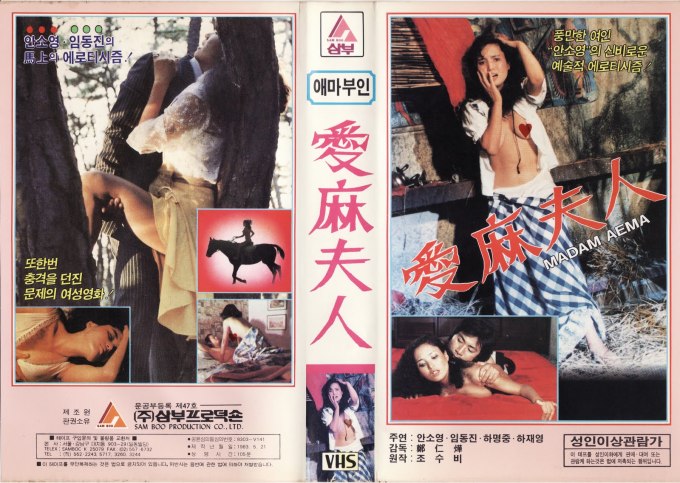
The More Risqué, The More Boring (OR, Something You Didn’t Know About the Horse Dance!)

(Source: The Cinehound Forum)

Sorry, but I just can’t help it: I get very excited when I see the words “성 상품화” (sexual objectification) and “걸그룹” (girl-group) together.

That’s because I struggled for years to find critical Korean commentary on either. Whereas now, I’m just inundated with articles to translate, with or without relying on my “성 상품화” Google News Alert. And, if nothing else, this recent column of Jo Woo-yeong’s I’ve translated below is testament to that greatly increased public interest and discussion.

Unfortunately though, frankly it says little that is new either, and provides no evidence for its numerous assertions. But on the plus side, I did learn of popular-music critic Kang Tae-gyu’s twitter and blog through it. What’s more, in the process of figuring out what on Earth Jo Woo-yeong meant when she talks about Gangnam Style in the 6th paragraph, I also learnt what apparently every Korean over 30 already knew: the word “horse” (말/mal) has sexual connotations.

No, I never thought to ask Korean friends their feelings about horses either. And yes, it’s more what the word reminds them of really: the movie Madame Aema (에무 부인; aema buin) to be precise, and/or its numerous sequels. As Andrei Lankov explains in The Korean Times:

In early 1982 Madam Ema, the most explicit of Korean movies ever made, hit the theaters. Not much can be said about its plot which is, for all practical purposes, absent. It was an erotic movie, often bordering on the pornographic….

….To everybody’s surprise, the censors did not ask too many questions. Actually, the only change they demanded was a change in the movie title. The title….was deliberately conceived in a way which hinted at Emmanuelle, the [French] erotic classic which was also a great hit in Korea of the late 1970s….

….Ema was a huge success. In March 1982 the movie was put on at an experimental late night show which attracted a huge crowd. The late night shows were another invention of the military regime which was preparing to lift a decades-old curfew….

….The pioneering Ema had 12 sequels, which were shot until the early 1990s. This makes it the longest series in the history of Korean cinema. It was very successful commercially as well ― the “first” Ema was seen by 310,000 people during the first year, and it became the box office champion of 1982. Some of the copycats were doing almost as well as the original.

(Update: After seven years in Korea, this Emma is a little tired of older Koreans explaining the connotations of her name to her!)

I’m a little confused by the censors’ ultimate title-change though (see the article and/or here for details), and would appreciate it if anybody could clarify. In return, for anyone further interested in sexuality and gender roles in Korean cinema in the period, Yu Gina of Duksung Women’s University mentions that (source, right):

The early 20th century, in the movie, <The Vow Make below the Moon, (1923)> the woman has the role of a good wife that rescues her husband from a gambling addiction. The woman dedicates to her husband, and this women’s character became the origin image of a ‘good wife.’ However, the heroin of <Sweet Dream-Lullaby of Death (1936)> is the opposite of that good wife. She resists her oppressive husband and her desire hits her daughter with a car and poisons herself because of the guilt. The ending contains the message that a woman who refuses to be a ‘good wife’ is going to be punished. This flow is maintained in other movies such as <The Ae-ma Woman and Madame Freedom>. These movies imply that women who pursue their desires are punished and vilified.

I’ve highlighted that last part because of its familiarity: as I explain in depth here, that dominant narrative wouldn’t be challenged until the mid to late-1990s, which proved to be a watershed in Korean cinema history. As might all the radical changes occurring today too, at least in terms of censorship, sexuality, and free speech.

And on that note, here’s the translation. Resolving to be more discerning with my choices in future though (even if this one did result in an interesting tangent), this will be the next one, which sounds very interesting according to Lost in Traffic Lights’ description!

점점 야해지는 걸(girl), 점점 식상해질 걸 / The More Risqué, The More Boring

Jo Woo-yeong, E Daily Star IN, 5 November 2012 (duplicated at Domin.com, 6 November; all images from these 2 sources)

‘란제리룩 의상을 입은 여성이 허벅지에 가터벨트를 착용한 채 봉춤을 춘다.’ 성인용 비디오물에 흔히 등장하는 장면이 아니다. 요즘 섹시 콘셉트를 내세운 일부 걸그룹의 단면을 모아놓으면 이런 모습이라는 얘기다.

Wearing a lingerie-style outfit and a garter belt on the thigh, then pole-dancing, is not a common scene in adult videos. But it has become routine for some girl-groups to do so as part of their “sexy concepts.”

점점 야해지고, 점점 섹시해지고 있다. 속살로 착각을 일으키는 살구색 천이 덧대인 시스루 스타일 의상은 ‘귀여운 꼼수’다. 핫팬츠를 입은 채 다리를 과도하게 벌리는 일명 ‘쩍벌춤’이나 야릇한 상상을 부추기는 교태 섞인 몸짓은 웬만한 걸그룹이 거쳐야 할 필수 코스가 된 지 오래다.

Things are getting sexier and more risqué. Wearing apricot-colored clothing that gives the illusion of skin normally hidden by clothing, faux see-through clothing as it were, is known as a new “cute tactic.” Also, adopting flirty sexual poses that stir up people’s lecherous imaginations, such as dancing with your legs wide open while wearing hot pants (known as the “spread-leg dance”), has long been a requirement of girl-groups.

심지어 남녀간 성 관계 체위를 연상케 하는 커플 댄스도 빼놓을 수 없는 퍼포먼스 아이템이다. 실제 본 무대는 그렇지 않더라도 활동에 앞서 공개하는 뮤직비디오 티저 영상이나 이미지에는 ‘19금’, ‘침대 셀카’, ‘키스’, ‘목욕신’, ‘파격 노출’ 등의 수식어 정도는 붙어줘야 한다.

Worst of all, couple dances with moves that look like sex positions are also performance items. And even if they’re not ultimately done on stage, teaser videos and images beforehand have to have descriptions like “R18,” “photographed in bed,” “kiss,” “bath scene,” “excessive exposure,” and so on attached to them.

애프터스쿨, 카라, 시크릿, 안다미로, 현아, 지나, 걸스데이, NS윤지 등 수많은 여가수가 올 하반기 한 번쯤 선정성 논란에 휘말렸거나 혹은 이를 자처했다. 걸그룹들의 과도한 노출•선정적인 춤에 대한 비판과 이에 맞서 표현의 자유를 부르짖는 목소리는 서로 메아리가 돼 잊을 만하면 돌아온다.

After School, Kara, Secret, Andamiro, Hyuna, G.Na, Girls’ Day, and NS Yoon-G are just some of the female singers and girl-groups that have been embroiled in controversy about their excessive exposure and/or sexual provocation at least once in the second half of this year, or have sought it. But if you criticize either, invariably the rejoinder is that it is merely freedom of expression.

대중은 각박한 현실에서 판타지(Fantasy)적인 이야기와 동경의 대상을 찾기 마련이다. 대중은 일탈하고 싶고, 내가 하지 못하거나 할 수 없는 것들을 해내는 연예인을 보면서 대리만족, 카타르시스를 느끼기 때문이다. 앞서 소녀시대, 씨스타, 나인뮤지스 등은 특정 직업 ‘제복’ 같은 무대 의상으로 일종의 ‘타부(Taboo)’와 로망을 절묘히 배합해 대중의 욕망을 건드리기도 했다.

Wanting to escape from their harsh reality, it is natural that the public yearns for fantasies. So, while watching entertainers doing what they can’t do or won’t do, they gain a vicarious satisfaction and feeling of catharsis. Previously, groups like Girls’ Generation, Sistar, and Nine Muses did this by specializing in a uniform look, provoking the public’s desire with an exquisite combination of taboo [breaking?] and romance.

강태규 대중음악평론가는 “치열한 경쟁 속 대중의 이목을 끌기 위한 방송사나 연예기획사가 결국 대중의 판타지를 쫓고 있다”고 말했다. 스무 살도 안 된 미성년자 연예인을 ‘청순 글래머’, ‘베이글녀’ 등으로 성 상품화 하는 세태가 현실이다. 방송 카메라는 무대 아래서부터 위 방향으로 걸그룹 멤버의 몸을 훑고, 신체 특정 부위를 클로즈업해 촬영한다. 그는 “보다 자극적인 것을 요구하는 사회에서 시청률을 추구하는 방송과 ‘생존의 몸부림’ 치는 연예기획사가 성적 판타지를 쫓는 것은 당연한 수순일지 모른다”고 씁쓸해했다.

Kang Tae-gyu, a popular-music critic said, “In an intense war for the public’s attention, the media and entertainment agencies ultimately provide fantasies.” Yet it’s not just 20-somethings that are sexually-objectified with terms like “Innocent Glamor” and “Bagel Girl,” but even teens. Cameras will go over their bodies from bottom to top while girl-groups are on stage, lingering with close-ups on certain body parts. Kang continued, despairingly, Providing sexual fantasies may be natural with the media and entertainment agencies’ relentless pursuit of higher viewer rates.”

일부 매체 역시 어느덧 가수의 음악을 분석, 무대 전체를 평하기보다 그들의 선정적인 의상•퍼포먼스에 주목한다. 그게 쉽고 편해서다. 수요자(대중)와 공급자(방송•기획사)가 서로에게 원하는 것만을 주고 있는 ‘필요악’인 존재가 되어가고 있다.

But almost before we know it, we have some elements of the media not paying ever paying attention to singers’ music or what’s on stage, but only taking notice of sexually suggestive costumes or performances. This is because it is easy and convenient to do so. Both the public consumers and producers (both in broadcasting and in entertainment agencies) are only giving each other what they want, so in effect this is a necessary evil of the music industry.

역설적으로 코믹한 춤으로 세계적인 인기를 끌고 있는 싸이는 보는 음악뿐 아닌 듣는 즐거움까지 안겼다. 국내 가요계의 큰 수확이다. 하지만 싸이의 ‘말춤’ 역시 그 특유의 유쾌함으로 상쇄됐을 뿐 그 안에 ‘말’이라는 동물이 갖는 묘한 성적 상징성이 담겼다. 사실 ‘섹시한’ 매력은 남녀 누구나 갖고 싶은 본능이라 할 만하다.

Paradoxically though, Psy gained worldwide popularity [not by providing something sexual, but] by providing both a funny dance and listening pleasure, and the Korean music industry in general has benefited greatly from this popularity. Yet while Psy’s comedic “horse dance” is unique, ironically even the word “horse” has sexual connotations. Moreover, man or woman, who doesn’t want to be more sexually attractive?

대중음악 가수에게 순수예술을 바라서도 안 되고 그럴 필요도 없다. 퍼포먼스도 실력이고 잘 생기고 예쁜 외모도 개인이 가진 하나의 능력이다. 문제는 그들이 내세우는 ‘섹시’가 얼마만큼의 당위성과 명분을 갖느냐다. 단순히 눈길을 끌기 위해 속살을 드러내고 몸을 흔드는 것이라면 ‘예술’이 아닌 ‘외설’에 가깝다는 비판을 피하기 어렵다.

We cannot expect singers of popular music to only produce pure art, and not be influenced by commercial imperatives. Also, there is nothing wrong with performing well, and/or being physically attractive. The problem is when sexiness is presented where it is uncalled for, with no justification. Simply showing singers dancing in tight and/or faux nude clothes isn’t art but rather obscenity, and isn’t difficult to criticize.

성시권 대중음악평론가는 “국내 대중의 인식이 많이 변해가고 있으나 마돈나, 레이디 가가 등 유명 팝스타들과 지금 국내 걸그룹들을 비교 대상으로 삼기에는 무리가 있다”고 말했다. 음악과 퍼포먼스, 주객이 바뀐 경우가 많다는 게 그의 주장이다. 그는 “퍼포먼스는 음악에 담긴 메시지를 조금 더 잘 표현하기 위한 수단이어야 하는데 일부 걸그룹이나 여가수의 무대가 과연 그러한지 의문”이라며 “몇몇 그룹이 비슷하게 돌고 도는 섹시 콘셉트는 계속 양산되고 시장서 꾸준히 소모되겠지만, 갈수록 식상함이 더해져 그들 스스로를 가둘 것”이라고 평했다. 그는 “그들은 물론 더 나아가 K팝 발전을 위해 방송•언론•평단과 각 연예 기획사의 각자 역할에 대한 고민이 필요한 시점”이라고 말했다.

Song Shi-kwon, a popular-music critic, said “In Korea, perceptions are changing, but you still can’t really compare them to famous stars like Madonna or Lady Gaga.” But in many cases, girl-groups’ performances are now more important than their music. He continued, “Performance should be a tool to convey the message in the music a little better, but I have to wonder if some girl-groups and female-singers’ stages really do that,” and judged that “by all copying each other in providing a sexy concept, their music and performances will certainly be consumed in the market, but in the process people will becoming bored with it, and so the groups will come to limit each other’s’ development.” Ultimately, “For the further development of K-pop, broadcasters, the media, critics, and entertainment agencies need to seriously think about their own roles in it.”

Korean (Movie) Censors in Retreat?

(Sources, edited: left, right)

With so much attention on restrictive censorship in K-pop these days, it’s easy to overlook how much standards in movies have actually been relaxed in recent years. See my latest column in Busan Haps for more information, especially if you’ve never heard of Shortbus before…

But please let me reiterate here though, that the freedom to show more sex and nudity in popular culture is just one aspect of becoming a more sexually liberal society. For sure, it’s a step in the right direction, and can have positive knock-on effects, just like the first kiss in a Korean ad in 2009 lifted the taboo on PDA for a lot of young couples for instance. (Yes, only anecdotal; but prove me wrong). But on the other hand, with the (re)criminalization of abortion by the Lee Myung-bak administration, recent attempts to limit access to the contraceptive pill, and the continued stigmatization of single mothers, you could reasonably argue that Korea is really just as sexually conservative as ever. No matter how much T&A you can see on the silver screen now, and which is often (usually?) just for financial reasons anyway.

In short, it’s complicated. Anyone that’s been here more than a couple of years, what impressions do you get? And how do you think things will change after the elections?

Korean(?!!) Movie Review #6: Air Doll (2009)

(Source)

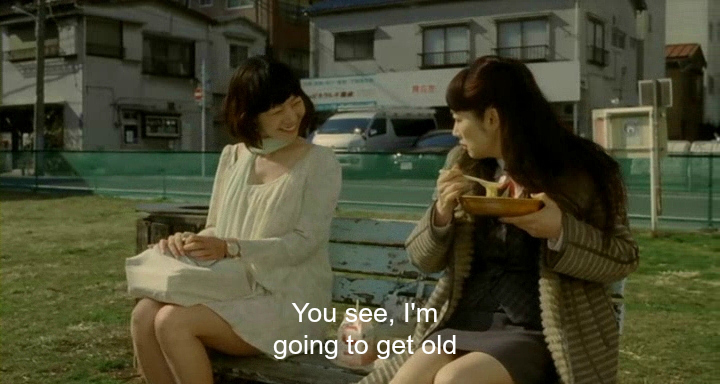
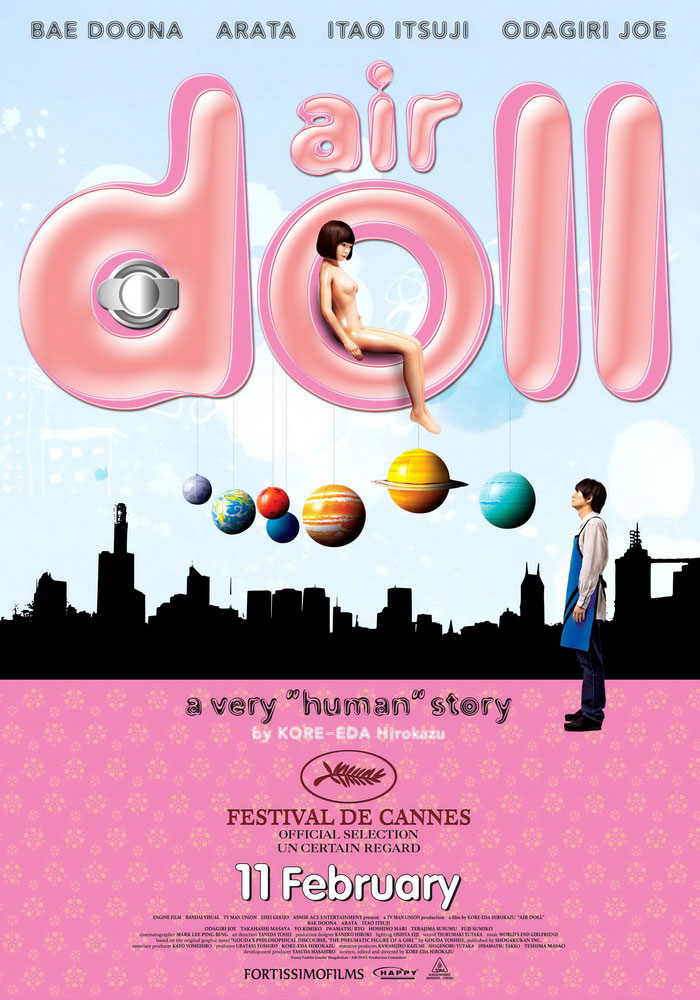
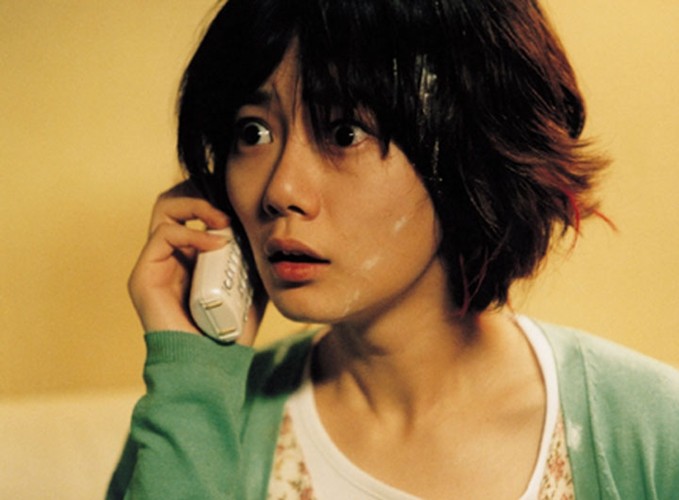
Starring: Bae Doo-na (Nozomi),  Itsuji Itao (Hideo), and Arata Iura (Junichi). Written and directed by Hirokazu Koreeda (original manga by Yoshiie Gōda). In Japanese with English subtitles. 126 minutes.

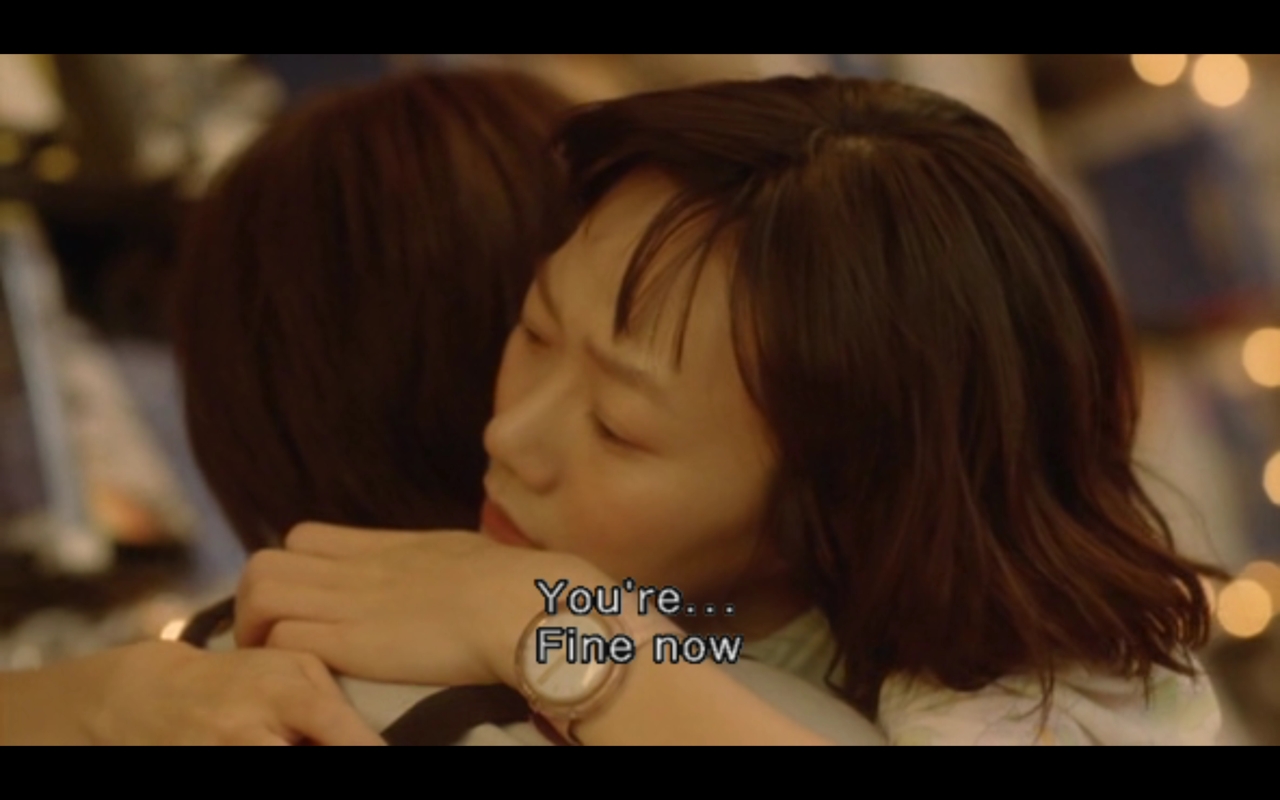
Less than four minutes into Air Doll, middle-aged owner Hideo has sex with the inflatable doll he’s named Nozomi, with all the crunching of flesh against plastic and washing of detachable vaginas that that implies. It’s as if director Hirokazu Koreeda was deliberately encouraging the squeamish to walk out of the theater.

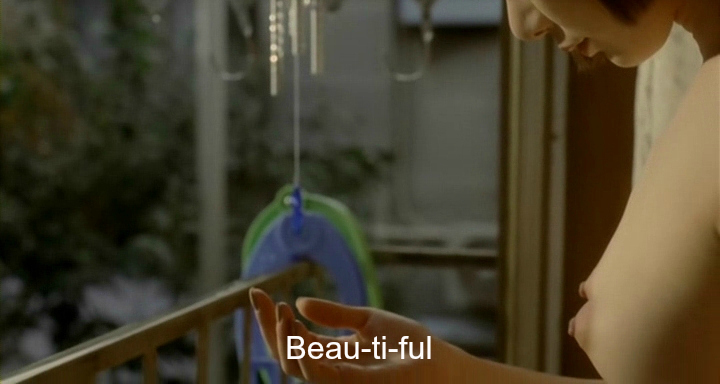
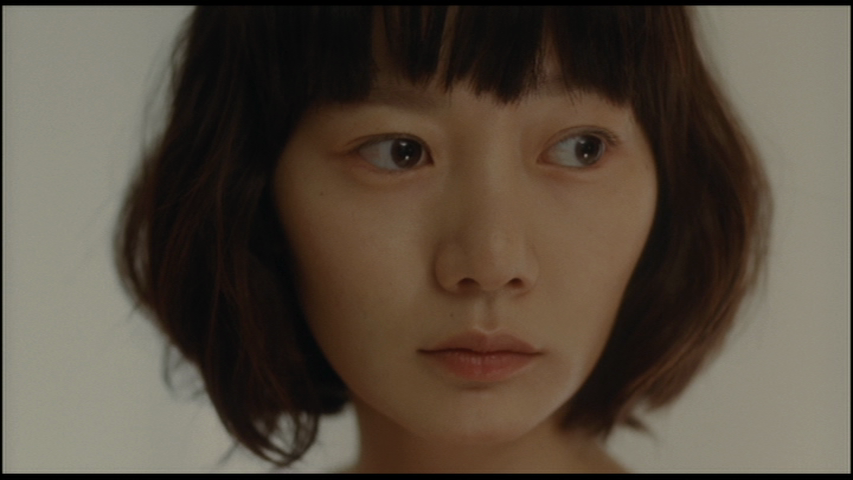
It’s also ironic, as the very next scene reveals it to be a very erotic, albeit knowingly voyeuristic movie too, the camera luxuriating on Nozomi’s nude form as she magically comes to life (see the telling juxtaposition in the NSFW screenshot below; the subtitle actually refers to some dew she’s touching). She’ll proceed to spend a disproportionate amount of the next two hours topless, even for a movie about a sex-doll.

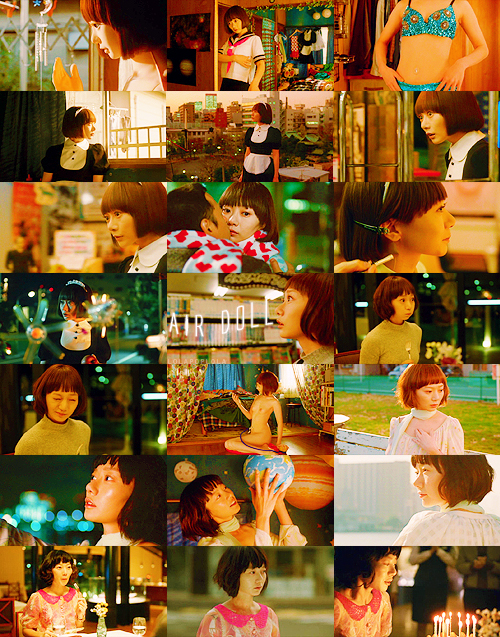
Yes, still an inflatable sex-doll, not a woman. For as she proceeds to leave Hideo’s apartment in a maid costume, and encounter a succession of sad, desperately lonely characters, her literal hollowness proves to be a poignant metaphor for all their lost, empty souls.

But she deliberately appears palpably, sensually human too, and you just can’t have it both ways. Especially in a movie that already so heavily relies on viewers’ suspensions of disbelief.

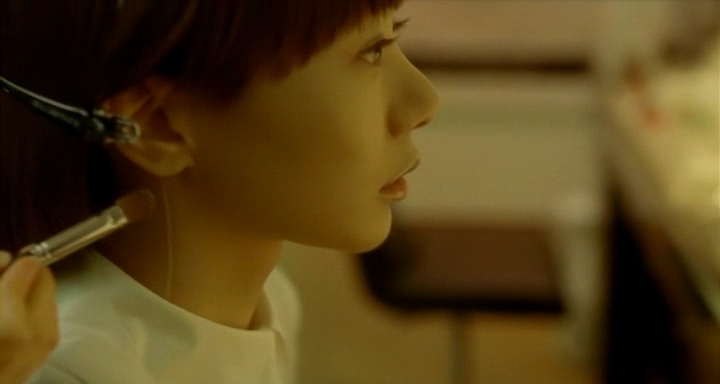
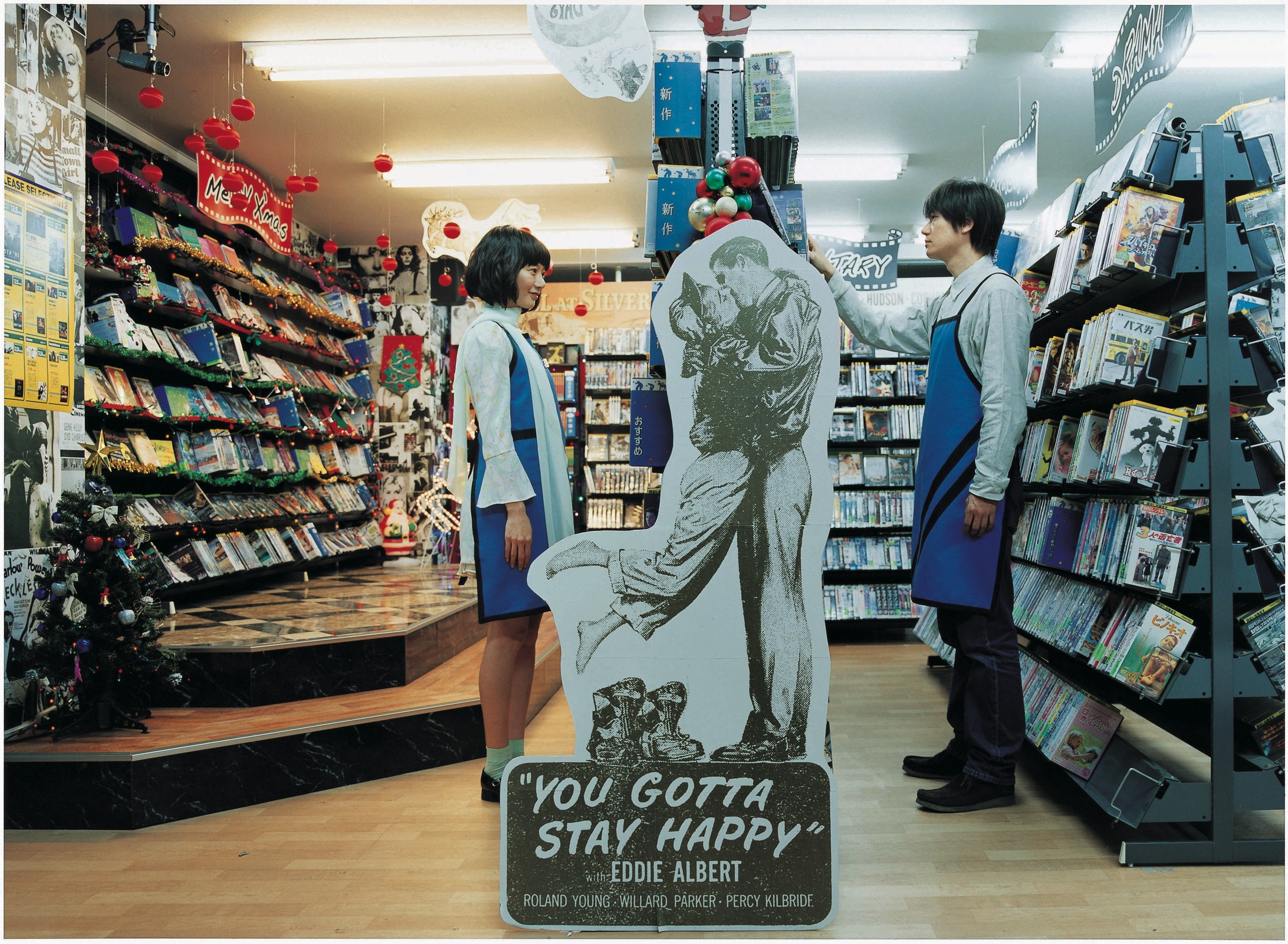
So, even if is nitpicking to wonder how she goes from learning speech and what clothes are in the morning, to getting a job at a DVD store in the evening, a scene in which a beautician covers her suddenly visible* seams with make-up is nothing but confusing and distracting. As is another when she pumps herself full of air one morning (naked, of course), yet somehow had a meal at a restaurant with co-worker Junichi the night before. And so on. Suffice to say, her new form is ambiguous, but much more human than not.

When she accidentally punctures her hand and rapidly deflates fifty minutes in then, it’s jarring, and it’s asking far too much of the viewer to pretend that she’s been nothing but a walking, talking balloon all that time.

*With the benefit of 4 viewings, the seams are visible earlier, but only in some scenes. Appearance-wise, the movie is rife with continuity errors.

Granted, Air Doll is fundamentally an allegory. But, rather than aiding it, here the confusing content simply gets in the way of the message. Koreeda, who borrowed only the initial concept from the original manga, really should have considered alternative methods of conveying it.

One possibility would be having Nozomi become fully human at the beginning of the movie and during the day, but often uncontrollably and reluctantly reverting a little, then changing back completely at night. Indeed, this is actually very similar to what happens in the first half of the movie, and then making her transformation progressively more unstable would suit the second half — and narrative as a whole — very well too.

Crucially, the nagging questions also distract the viewer from fully appreciating one of the movie’s great strengths, which is how Nozomi never really stops the innocent, childlike exploration of her new world, nor finding beauty in it. And her exquisite mimicry of its inhabitants is simply priceless.

Yet despite those, she also shows, as Tirdad Derakhshani of The Inquirer puts it, a sublime progression “from a childlike naif who plays with toddlers in a sandbox to a sophisticated woman who devours books, draws portraits, and philosophizes about life,” (my emphasis) and I’m not alone in thinking that Bae Doo-na is one of the few actresses that has the skill and versatility to pull the combination off (Tom Miles of Midnight Eye suggests Rinko Kikuchi or Hanae Kan, while Yuna at The Marmot’s Hole calls Aoi Yuu “a Bae Doo-na equivalent in Japan”).

(Source)

The practicalities of that process are that, despite everything, she soon establishes a routine of leaving for work at a DVD store once Hideo leaves, learning about the world through the strangers she meets on her breaks and/or days off, and especially by constantly asking questions of her unfazed, endlessly patient coworker Junichi, who soon starts taking her out to see the things she asks about. Finally, she has to rush home to lie passively for her “master” before he returns home, finding him increasingly repulsive, but using the time to ponder her discovery that she is/was a cheap “substitute for handling sexual desire;” to learn about love, mortality, and desire; and to determine why she found herself “with a heart [she] was not supposed to have.”

(Source)

(Minor Spoilers Begin)

But then, with the combination of a rare form of cunnilingus and strategically-placed tape, Junichi saves her from her puncture. An obvious turning point in their relationship, albeit more because Nozomi thinks she’s found a kindred spirit rather than because of their new intimacy per se (indeed, Junichi is so enigmatic that she initially thinks he is a sex doll too), unfortunately the movie, already convoluted, becomes very difficult to follow. And, crucially, not because of the depth of the message, but rather because Koreeda seems to be deliberately encouraging mistaken readings of the plot. In particular:

  • The morning after the puncture scene, the next 20 minutes show Nozomi symbolically throwing away Hideo’s pump for her, then leaving rejoicing in her freedom and liberation around the city. It very much seems as if she’s left Hideo forever…so again it’s jarring when you see her miserably by his side that evening, as per usual.
  • That last scene above is very brief, and it’s easy for it not to really register (although in fairness, it is technically there). So when you see Nozomi sneaking a look at Hideo bringing a new doll home, it appears that perhaps he’s doing so because she’s actually left him. Not, as, we’re supposed to think, that he’s put the (still fully inflated) Nozomi away in a cupboard.

And there’s many more confounding examples. Perhaps, certainly, the misreadings are just due to my own dull-wittedness, but I don’t think I’d be alone in needing two — actually three! — viewings of this movie just to figure out what the hell is going on. In contrast, Inception (2010), say, has many deep messages, but somehow I still understood the plot in that on the very first try (source, right).

In combination with obvious questions about her human or doll form then, and the problems of continuity with Nozomi’s image, this is a third red flag that points to laziness and/or arrogance on Kareeda’s part. Or alternatively, with a hat tip to Gomushin Girl’s comment in my review of Kim Ki-duk’s Samaria (2004), perhaps he simply got too caught up in his own message to think about how it might look to a less-informed audience member.

But he redeems himself with a powerful message just before the end of the movie, and one that I’m amazed that other reviewers (at least the 25+ I’ve read) didn’t pick up on

.(Major Spoilers Begin).

While, again, it’s delightful to watch Nozomi learning to be human, in the process noticing the hidden joys and beautifies of life that most of us have chosen to ignore, that’s increasingly tempered by her realization that her own purpose is nothing but to sate the sexual desires of the men around her, who do nothing to disabuse her of that notion. It’s vividly shown in the dead expression on her face when the DVD store-owner blackmails her into sex, threatening to tell Junichi about Hideo, and also partially explains why later, having finally left Hideo, she tells Junichi she’ll do absolutely anything for him.

(Source)

When he replies that he’d like to deflate and then breathe life into her again, she’s visibly shocked and — I’d say — disappointed that he’s ultimately no different from all the other men she’s met. But of course agrees, and appears to enjoy the ensuing “sex.”

Yet then, when he’s sleeping, she cuts an equivalent nozzle into his own navel, ultimately killing him from, presumably, loss of blood. But not before blowing into it herself, climbing on top of him, and unequivocally orgasming to the ensuing “conventional” sex (which, despite his tremendous pain, he’ll also do his best to actively participate in).

While it may sound minor in isolation, and I don’t want to be so glib as to take loudness, frequency, and duration of moans as a barometer for women’s sexual pleasure, it is the only moment in the entire movie she imposes her own will and/or sexuality on others, rather than being a mere, literal, receptacle for theirs. As such, It stands as a rare and very welcome final moment of defiance in the somewhat inevitable and predictable path to her coming suicide. (Update: on that last, see io9 for a curious case of life imitating art.)

(All Spoilers End)

(Source)

To the extent that it exists at all then, it is precisely here that a feminist reading of the movie could be further explored. In contrast, John Esther’s point at Jesther Entertainment that “Air Doll stands for, among other things, as a metaphor for women who are to look pretty, say nothing, stay home and wait for the patriarch to return home and breathe his breath into her lifeless a(i)rea” is true, but a bit of a dead end. As is Nick Davis’s comment at Nick’s Flicks Picks, which I thought was a misguided — and very forced — interpretation:

If you know anything about the Pacific fronts in World War II and a history of chauvinist disavowals by Japanese governments, the casting of a Korean actress as a Japanese man’s inert, unresisting erotic receptacle can’t help trigger distasteful connotations.

That aside, and in conclusion, while it’s a little harsh for Kelly Vance of East Bay Express to describe the movie as a “dreary, middlebrow allegory,” it is true that the movie is at least thirty minutes too long, many of those spent in vignettes showcasing the emptiness of the characters’ lives, while Nozomi drones on about — wait for it — how empty life is, all to the accompaniment of languid, sickly-sweet music in the background. Also, in a review at Antagony and Ecstasy that I highly recommend, Tim Brayton rightfully points out that the movie only provides observations and not actual insights, whereas plenty of Pinnochio-like movies have given both before, and with much more skill too.

(Source)

So, with the important qualification that you may need a lot of help with the plot before watching, Air Doll can a pleasant enough movie, albeit one lacking much of a vision, and inexpertly conveyed at that. Instead, think of it more as an invitation to form your own.

And, in the process, do take time to notice the superb cinematography too. For as Tom Miles at Midnight Eye Review explains, it’s set:

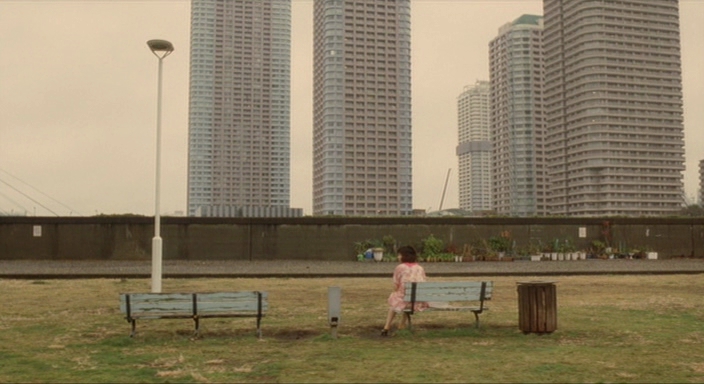
in one of Tokyo’s remaining shitamachi, an old neighbourhood of little independent houses, while ominous high-rises wait on the other side of the river for the aging abodes to crumble, impatient to take over the turf.

On that note, see above for my favorite location in the movie, which even someone as literal-minded as myself could appreciate!

“Kang So-ra! When Are You Going To Stop Being So Fat?!”

(Source: Metro, Busan edition, May 31 2012, p. 11)

One of the great advantages of Erving Goffman’s Gender Advertisements, I tell students in my lectures on gender roles in Korean ads, is that it’s not language-based. Whether the ads are from Korea, Kenya, or Khazakstan, I rhapsodize, it’s all about the pictures, making cross-country and historical comparisons possible.

In reality though, culture and language are still important. The tendency towards positioning men higher than women in ads for instance, implying their superiority (just think of the purpose of thrones), can pale against a seated matriarch’s greater social status. Also, ads may allude to popular books, movies, or songs that a foreign observer is unaware of, and/or the text make a pun about the images that a non-native speaker would struggle to understand.

In short, Korean ads can be far more subtle than they may at first appear to someone like me, let alone less gender-stereotyping.

(Source: unknown)

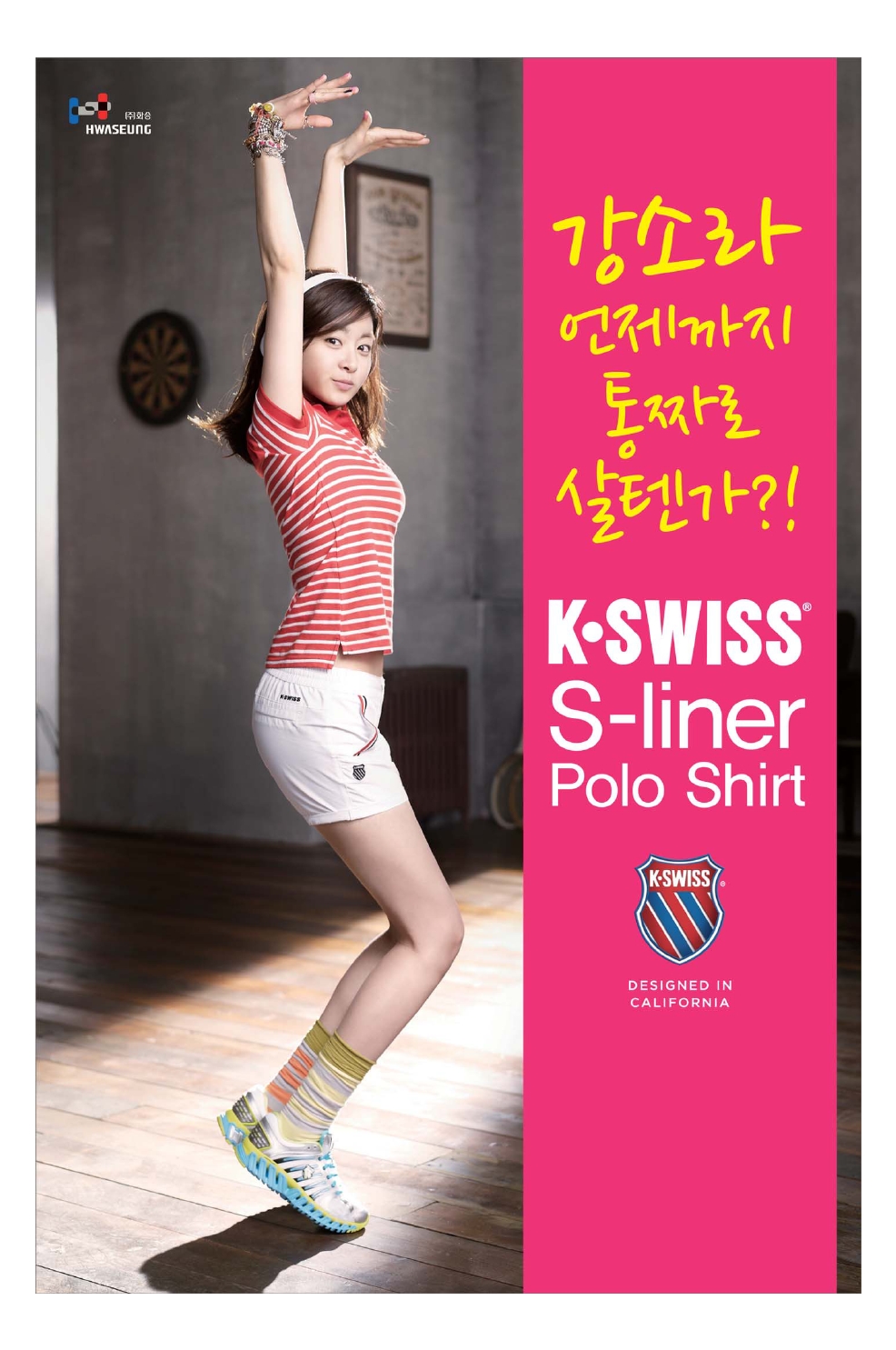
With that in mind, I decided to quickly re-examine K-Swiss’s “S-liner Polo Shirt” ad with Kang So-ra (강소라), that I’d previously dismissed as just yet another example of the ridiculous poses Korean advertisers put women in to show their S-lines off. After all, however unlikely, maybe she’s done a humorous Walk like an Egyptian dance at some point in her brief career (say, in the popular movie Sunny last year), and was parodying that? Or maybe there was something in the text to explain her pose?

Alas, no. Judging by the TV commercial above, the ridiculous pose and dance were definitely just for K-Swiss. And as for the text, that doesn’t redeem the ad either…although I’d have never guessed it would have taken me, my wife, and two of her friends nearly half an hour to figure that out!

It looked easy enough: “강소라” is Kang So-ra’s name, “언제까지” is “until when”, and “살텐가” is “will live”, as in the more formal form “살거예요”. But “통짜로”? Literally, it’s the adverb “wholly”, but that made no sense. So, with the logic that perhaps 22 year-old Kang So-ra formerly lacked feminine curves then, but now, as per the dictates of Korean consumerism and gender roles,  she’s compelled to show them off at every available opportunity, we decided it meant “통” as in the Hanja character that means a (usually cylindrical) container (i.e. a body), “짜” which can often mean “thing” or “person” (see pages 263 and 374 of the Handbook of Korean Vocabulary respectively!), and “로”, which in this case would mean “as”, or “in the manner of”.

Putting aside what role such exhortations may or many not have in Koreans’ intense body dysphoria for a moment (uniquely in the developed world, Korean women aged between 20-39 are becoming more underweight than obese), we were pretty proud of ourselves for figuring that out. But then my wife’s second friend arrived, who pointed out that “통짜” is actually a sort-of adjective means “fat”, as in “통짜몸메가 있어”. Specifically, after a lot of time arguing about whether it actually more meant “curved” than fat per se (recall what “통” can mean above), it means a fat waist, regardless of how curved the rest of the body is (or not — it can be used to describe me men too).

So there you have it: literally, the appalling “Kang So-ra! Until when —  fat person as — going to live?!”. But suddenly, as I type this, I have renewed doubts: was Kang So-ra considered fat previously? Even if so, surely she is indeed no longer living as a fat person, in the ad? And so on.

So by all means, I admit I may be completely mistaken, and would welcome any alternative translations and explanations of the text. But either way, I doubt it provides a very body-positive message.

Meanwhile, if it’s true that 통짜 bodies lack the shapely breasts and buttocks of an S-line, then perhaps there’s something to the photo of Uee (유이) above that show’s that there’s actually two concepts of the term? In the diagram, it says that men think it refers to the blue whereas women think it refers to the red, but the results seem pretty mixed at the original post on Facebook.

Which do you think it means?

Korean(?!!) Movie Review #5: Linda Linda Linda (2005)

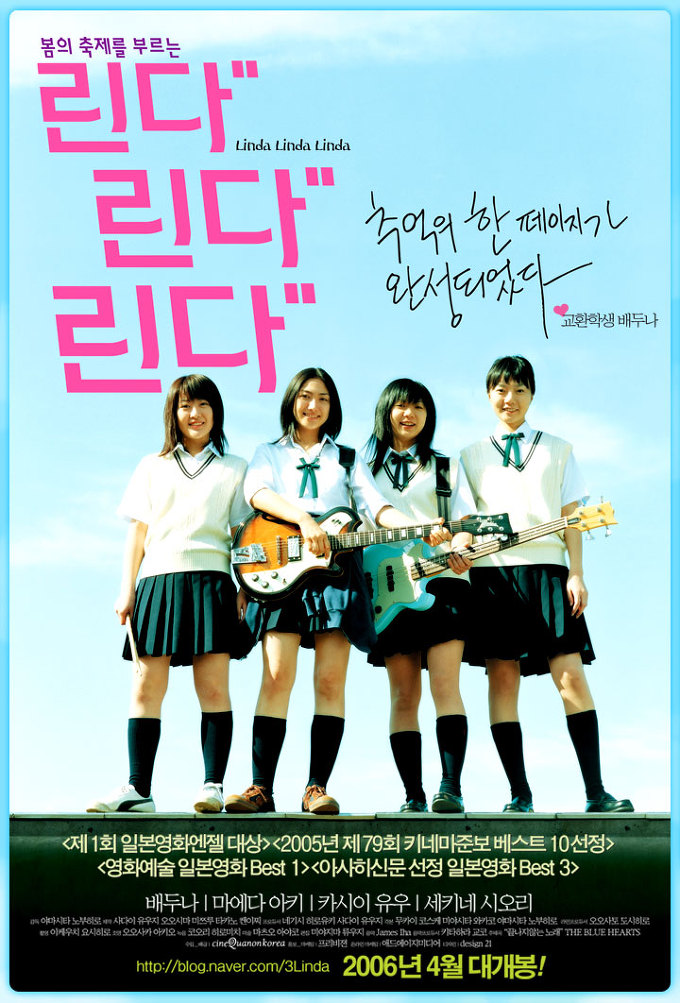
(Source)

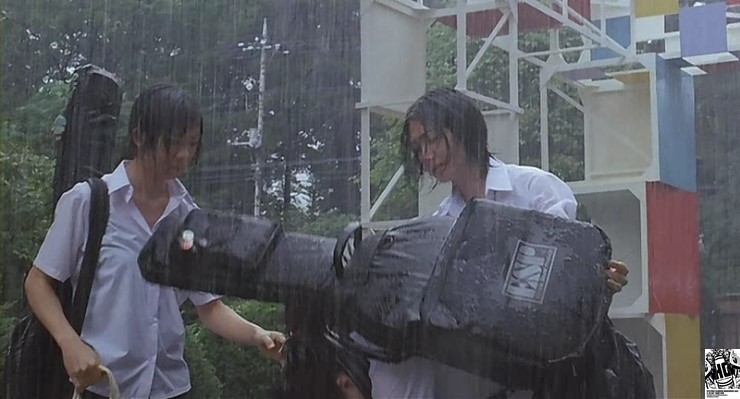
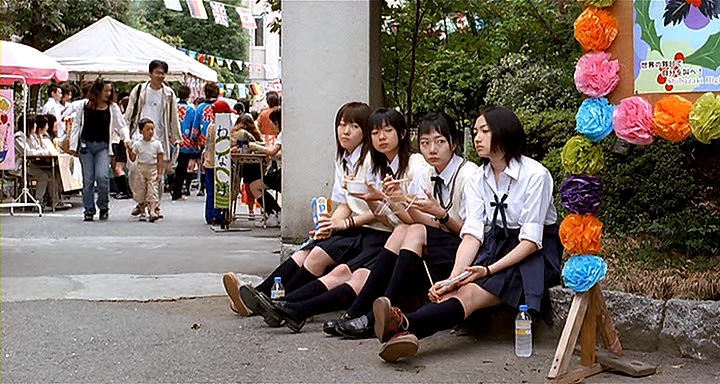
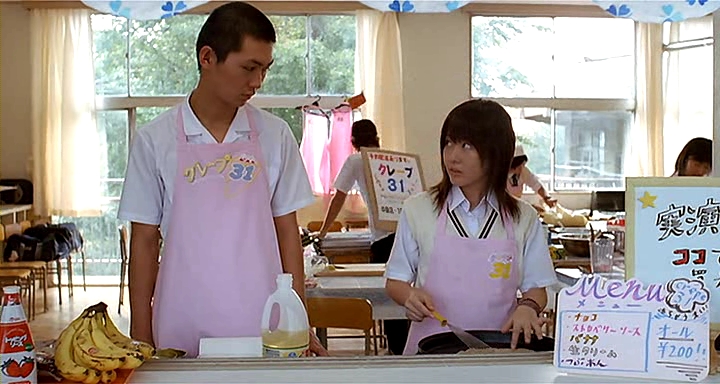
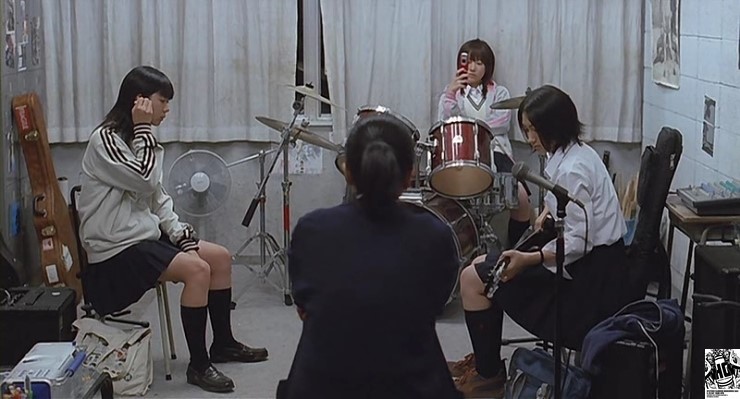
Starring (L-R): Aki Maeda (Kyoko), Yu Kashii (Kei), Shiori Sekine (Nozomi), and Bae Doo-na (Son). Written and directed by Nobuhiro Yamashita. In Japanese (and some Korean) with English subtitles. 115 minutes

As a (very) fledgling film reviewer, I’d be lying if I didn’t admit to relying on other, more experienced reviewers for guidance sometimes. So, I’m really struggling with why they made so many glaring mistakes about Linda Linda Linda.

Add to that a number of pithy one-liners that there’s actually no evidence for, and especially the willful ignorance displayed in shoehorning coming-of-age narratives into the movie, then I’ll seriously be taking all “expert” movie reviews with a big grain of salt in the future.

Despite what you may read elsewhere then, the movie is about a high school girl band that has just lost its guitarist (Moe) and lead singer (Rinko) to a hand injury and argument respectively, and opens with remaining members Nozomi, Kyoko, and Kei having to decide if they will still perform at the end of the high school festival week in just three days. As you’ve already guessed, they do, choosing to sing the iconic 1987 punk-rock hit Linda Linda (and 2 other songs) by The Blue Hearts.

But keeping Nozomi on bass, Kyoko on drums, and moving Kei from keyboard to guitar, still leaves them short of a vocalist. On a whim, they invite Korean exchange student Son to fill Rinko’s place, despite her occasional difficulties with Japanese.

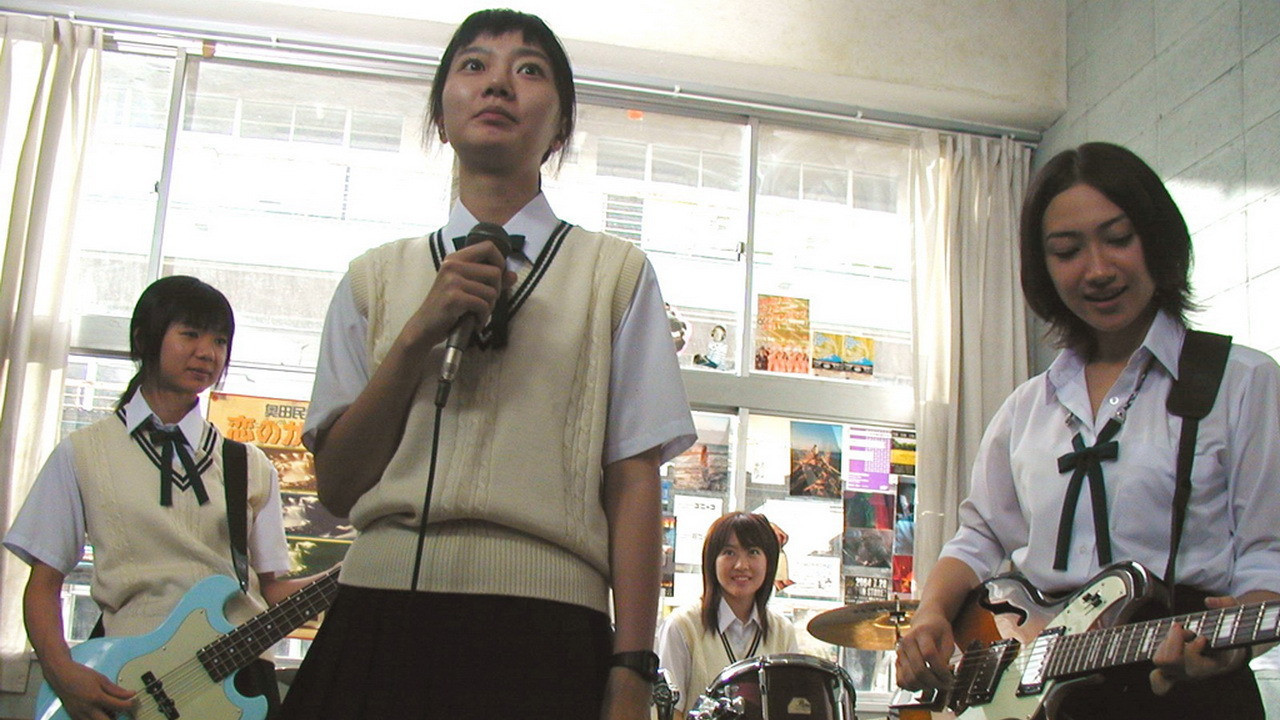
(Source)

Son gets asked 21 minutes into the movie, and the remaining 94 are about the band practicing (spoilers begin) over the next two days and nights, culminating in them performing on the day as planned, albeit much later and wetter than expected. Yes, that’s it. It’s not an underdog story, there’s no hint of fame and success once the performance is over, no big romances, nor are there any jealous rivals. There aren’t even any major dramas or even mild arguments between the four major characters either (spoilers end). Indeed, it’s probably the most minimalist plot you’ll ever encounter, no matter how much of a movie buff you are.

(Source)

While fans of director Nobuhiro Yamashita may appreciate this, his previous works likewise featuring “aimless youth with nothing better to do than walk or sit around”, it’s easy to appreciate why others might find it slow and ponderous. One reviewer understandably wrote it off as “incident-free pic [that] will induce sleep” for instance, while another quite plausibly claimed that there were points when he was watching the movie where he “would leave, prepare part of lunch, and return, to find that literally nothing had happened.”

What’s more, the English marketing for it was very misleading, Rob Humanick at Slant mentioning that the press notes for movie suggested “a foreign regurgitation of stale conventions from the American teenage flick,” and that it was “difficult to not expect something of a J-pop remake of Bring It On that substitute[d] an all-girl cover band for sexed-up cheerleaders.” Also, the US trailer suggested something much quicker and more comical than what audiences ultimately got:

In light of all that, I must concede that I’d probably be far less forgiving of the movie’s glacial pace if it was about high school boys rather than girls. But it takes much more than 18 year-old Japanese schoolgirls to get me to like a movie so much, and I’m sure other heterosexual male and lesbian reviewers likewise aren’t so shallow, let alone everyone else. Why, then, does the movie get almost universal praise?

One reason is Bae Doo-na. A long-time fan, I can’t be objective about her myself, so consider Tom Mes’s description of her performance at Midnight Eye instead, which is quite representative of the accolades she has received:

…[a] major factor to the film’s success is the casting of Korean actress Bae Du-Na in the role of Son. Several years older than her teenage co-stars [26 in 2005] and more accustomed to mature roles in the likes of Park Chan-Wook’s Sympathy for Mr. Vengeance and Hyeon Nam-Seob’s Saving My Hubby, Bae easily outshines the rest of the cast.

Or, as G. Allen Johnson of the San Fransisco Chronicle put it:

Not conventionally beautiful, with gamin-like features and a seemingly permanent mope, Bae is the Christina Ricci of South Korea, with a similar ability to inform a simple character with many layers, most notably in the Korean gem Take Care of my Cat. That makes her a perfect fit for the minimalist milieu of director Nobuhiro Yamashita…

(Source)

I beg to differ on her not being “conventionally beautiful”: mirroring her acting abilities, a quick Google image search reveals she can be as feminine or as androgynous as her role requires, but let’s not go there. Rather, that “seemingly permanent mope” is a good way to describe Son’s social awkwardness as both an exchange student and — I suspect — a natural geek, and through conveying this so well she ironically makes a far more convincing teenager than her real-life teenage co-stars (although to be fair, their characters didn’t call for it).

With such a focus on her though, it’s surprising that Johnson would write that “Son can barely speak a word of Japanese, let alone sing it”. This is simply not true: while she does sometimes struggle with her words, or needs people to repeat themselves, she never has any real difficulties communicating. Nevertheless, Johnson’s assertion is echoed by virtually every other reviewer, which leaves me wondering if there were some mistakes in translations, and/or if there are other versions out there? Humanick at Slant, for example, mentions that the funniest scene in the movie is when Son attempts “to overcome her language difficulties in a restaurant where only paying customers are allowed to use the restrooms”, something which is strangely lacking in the file I downloaded (which, as always, I’ve watched twice).

(Source)

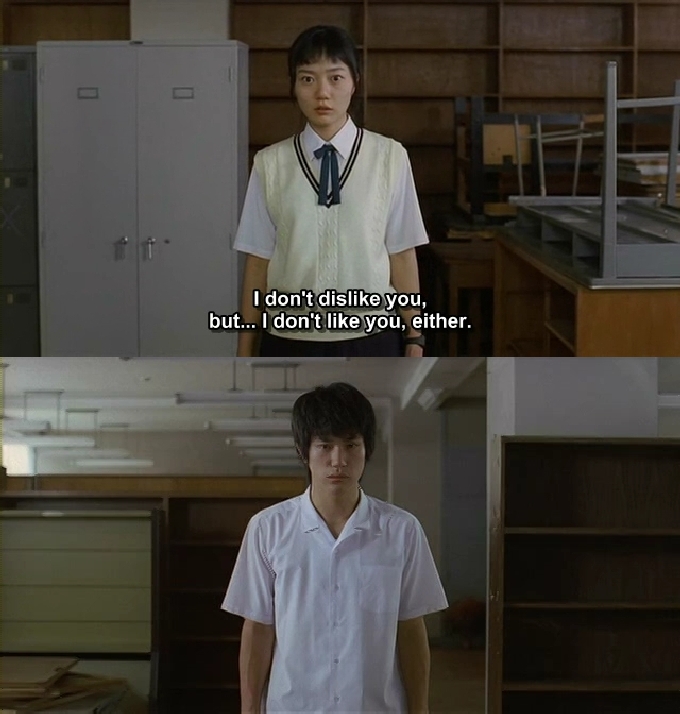
Another potential misunderstanding is that, unless you’re familiar with either Korean or Japanese, it’s not always clear which language Son is speaking (Korean was only indicated by brackets in the version I watched). This becomes relevant (spoilers begin, including image below) when she sings by herself in a karaoke room, revealing her to be much more confident in her native Korean, and especially in a later scene (see here for a video) when Son is approached by long-time secret admirer Yusaka (nickname Makki) to confess his love for her. When you realize that he does so in halting Korean (which even astute reviewers like Didion at Feminéma missed, and Johnson of the San Fransisco Chronicle mistook as poetry), then you can’t help but feel much sorrier for the guy when Son quickly rejects him, especially if you’ve ever had your weeks of unrequited love and wooing preparations dismissed in an instant yourself.

Because of that, I was much less sympathetic to the spin Alyx Veseyputs on Son’s reaction over at Feminist Music Geek:

The rest of the girls look through the window of an abandoned classroom, watching their lead singer choose the band, and her friends, over some guy who happens to like her but that she doesn’t know.

I don’t mean to single out Alyx, who otherwise writes an excellent review. It’s just that it points to the tendency of many other reviewers and commenters to overstress the female homosocial elements of this movie. In the New York Times for instance, Jeannette Catsoulis is so gushing about how “the film’s sweet, slow rhythms bind them together” that you can be forgiven for thinking that they don’t think about boys at all. Admittedly, Catsoulis is clearly pressed for space, but still: the reality is that not only is Son very inquisitive about Kei’s history with Yomoki, her ex, but Kyoko’s attention is just as much on her own crush Kazuya as on her band-mates. And indeed it’s precisely that which the four of them talk about — and bond over — during their last communal meal (spoilers end).

(Source)

But don’t get me wrong: I am definitely not saying that the boys in the movie should be given more attention, that it’s in any way about them, or that the movie’s main focus isn’t indeed about high-school girls bonding. After all, that last is the second reason the movie has received such high praise, especially from, naturally enough, women.

This presents an interesting question however, which I’d like to pose to female readers: just how genuine are the situations and the dialogue? I ask because following Jane Austen’s example, who never has two male characters talking alone to each other in any of her novels, I’d be very hesitant to ever do the same with female ones (something to consider with — but not apologize for — male-written and/or directed movies that fail the Bechdel Test). If they ring true though, then male director Yamashita, and crucially also writer, somehow has really hit the spot.

(Source)

A related question is raised by Burl Burlingame’s review at Honolulu Star Bulletin, which opens with:

I have a friend who used to play in an all-girls punk band. She said rehearsals took forever because they’d play one song, talk about their feelings for an hour, play one song, talk about their feelings for an hour … which pretty much describes Linda, Linda, Linda, Nobuhiro Yamashita’s slacker success story about girls who form a band for a high-school talent show.

Taken out of context, I would have condemned Burlingame for perpetuating gender stereotypes, but now I’m not so sure. What do any female musicians amongst you make of it?

(Source)

Either way, I can understand all the one-liners on grrrl-power bonding then, but can’t overlook the blinders some of the reviewers seemed to have on. Humanick at Slant, for instance, describes the movie as “an emotionally attuned look at adolescent life amid the invisible social structures of high school with an underlying emphasis on gender and cultural barriers to boot, all surprisingly free of manipulation”, but I’m at a complete loss as to what those barriers are myself. Likewise, Catsoulis asserts in the New York Times (yes — she’s an easy target) that “the irritations and tedium of high school life are staged with refreshing simplicity”, whereas in reality these are glaring for their absence, the unregimented nature of their school life greatly puzzling me until I realized that the movie began already well into the school’s festival week.

(Update — I forgot to mention that one minor flaw in the movie is that it would have been unlikely for Son to have bonded so well the other band members in just over two days; starting the movie a couple of weeks earlier, giving a more realistic time-frame for this, would surely have required only minimal plot and technical changes)

It also puzzled Alyx at Feminist Music Geek, who wrote:

I’m also not entirely clear about the nature of Japanese schools. I came through an underfunded, less-than-superlative Texas public school system. Thus, Paran Maum’s school seems like a tony liberal arts magnate where teenagers are given considerable support and resources for their artistic inclinations, thus implying that the students come from respectable middle- to upper-middle-class families. But I’m not sure if this high school is exceptional in Japan….while I initially feel the need to mention the classed dimensions of privilege that allow the girls the fine arts education and leisure time to form a band (instead of, say, take jobs or quit school to support their families), I don’t want to suggest that what I see as an American viewer is in accord with Japan’s classed realities.

Whether this surprising freedom the girls have is the norm or just for the duration of festival week however, that they behave more like they’re in university than high school is crucial for the movie’s last major source of appeal: the ability to project coming-of-age narratives onto it (spoilers begin).

(Source)

As I stated in the introduction, I actually think this is quite misguided: the girls (re)form a band, they practice, they perform, the end. Where’s the coming of age drama in that? But I can empathize (spoilers end). Given how free the girls are to do things under their own initiative, to set their own hours, and to come and go between activities as they please, things utterly denied to most Japanese (and Korean) teenagers, it’s difficult not to see them as near-adults. In particular, although Nozomi’s background is woefully underexplored (you know no more about her by the end of the movie than at the beginning), Kei above seems to to have had quite a history with — and lingering feelings for — much older ex Yomoki below, yet stoically accepts that he’ll be moving on to Tokyo (personally, it wasn’t until I was much older that I realized life was like that).

Combine that with being the de facto leader of the group, and things like getting the band, sans permission from parents or teachers, halfway across town to get some extra practice at Yokomi’s studio, then in short she seems much more capable and assured than your average 18 year-old.

(Source)

Mention must also be made of ThrownMuse’s comment here (difficult to find on the site; look for the 6 June 2007 entry) that “the movie has a very subtle feminist and punk-rock aesthetic that I don’t think every viewer picks up on”. Which would include me, and, again, it’s annoying that it’s not elaborated on. But perhaps Alyx of Feminist Music Geek fills the gap:

I do find the girls’ fandom of The Blue Hearts, whose songs they cover, to be quite interesting. For one, girls identifying with a fast, hard-rocking all-male rock band, while at no time talking about how cute certain members are, seems to suggest a wider range of possibilities for who can influence a girl. The band even goes so far as to call themselves Paran Maum, which is “blue hearts” in Korean (an indication of Son’s importance to the band). There’s a lot of talk on this blog about the importance of women and girls influencing one another in popular music. However, we shouldn’t short shrift what it means for girls finding their sound and voice through boys and men or ignore the progressive and possibly queer potential in girls identifying with boys. Like Patti Smith, PJ Harvey, and Sleater-Kinney before them, these girls don’t plug in and rock out to be with the band — they are the band and want to thrash just as hard as the boys.

I find any queer potential here a little forced though, both because of the characters’ random choice of the band in the movie and the mundane reason Yamashita chose to use it, as he explained below in a Cinema Strikes Back interview. But I’d be happy to be persuaded otherwise:

CSB: Was Linda Linda Linda always the main song or were there other possibilities you considered?

Nobuhiro Yamashita: Linda Linda Linda is such an iconic song done by the Blue Hearts. Everybody knows it. When you hear the Blue Hearts, it’s the song that first comes to peoples’ minds. It was always the first choice for the main song we were going to use. (With respect to) other songs (in the film), we did have many choices we had to go through.

Finally, no matter how cliched, I’d be lying if didn’t admit that the music didn’t immediately remind of me of some scenes from Kill Bill Volume 1, most notably the 5.6.7.8’s in “The House of Blue Leaves” nightclub:

Even if — ahem — it turns that they don’t actually sing any Japanese songs in the movie, I’m definitely more curious about Japanese rock now (it helps that I’m also heavily into retro-themed Japanese artwork like this too {source}, but which I could obviously never put up on a Korea-related blog). And perhaps you too, for nobody watching can’t help but sing along to Linda Linda by the end of the movie.

And on that note, this music video isn’t from the movie, so don’t worry about spoilers. Sing away!^^

The original Blue Hearts song for comparison:

Korean Movie Review #4: Saving my Hubby (2002)

(Source)

Has there ever been an actor you’ve really liked, but couldn’t put your finger on why?

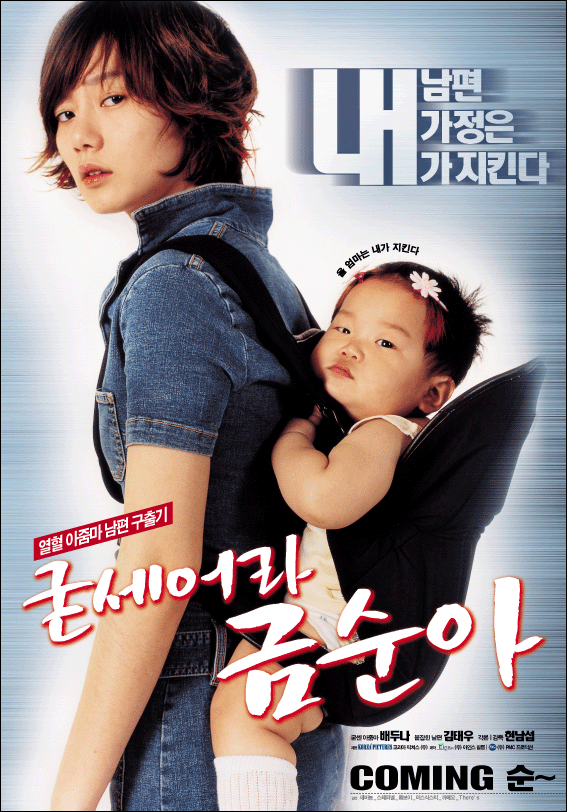
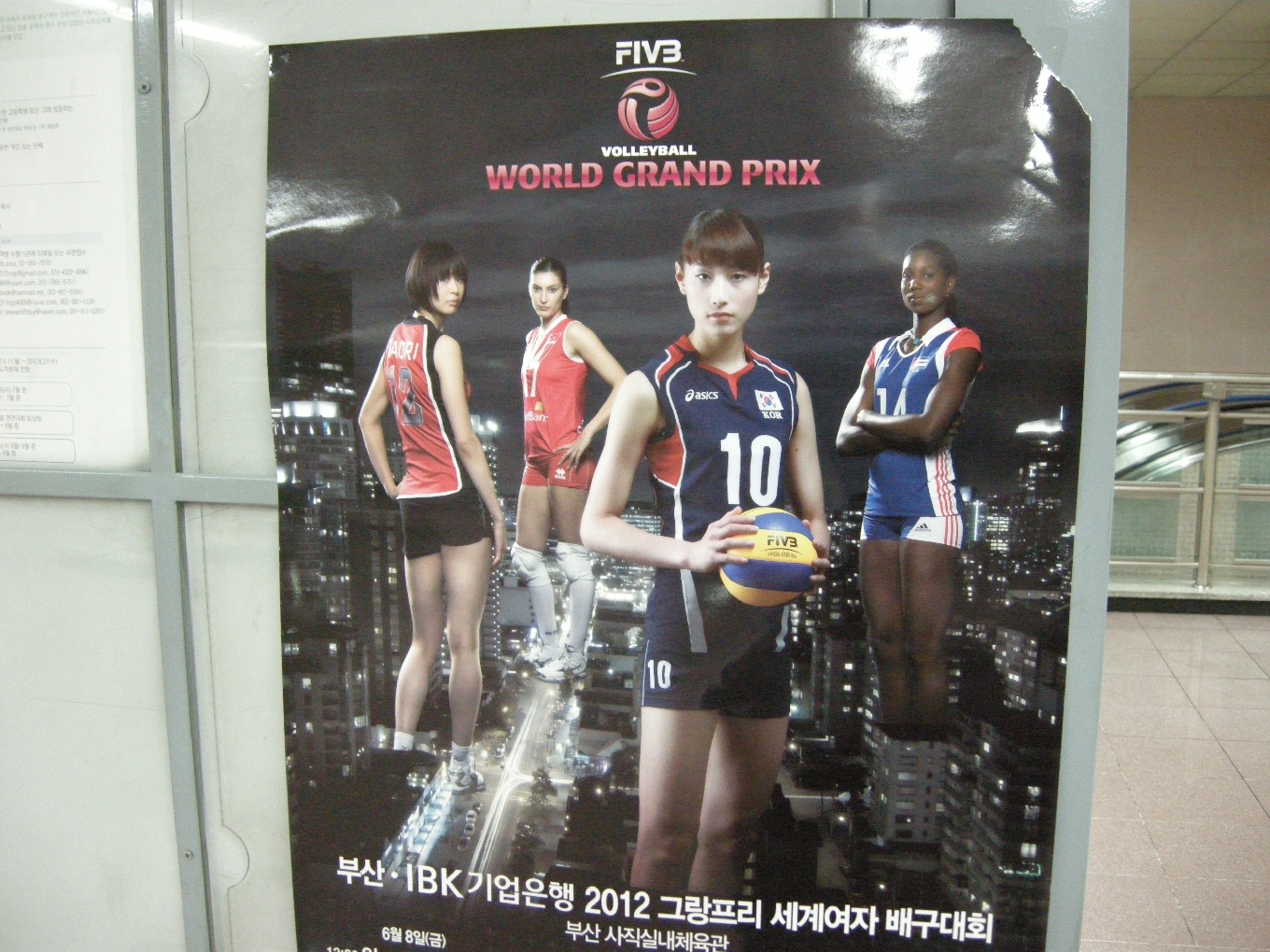
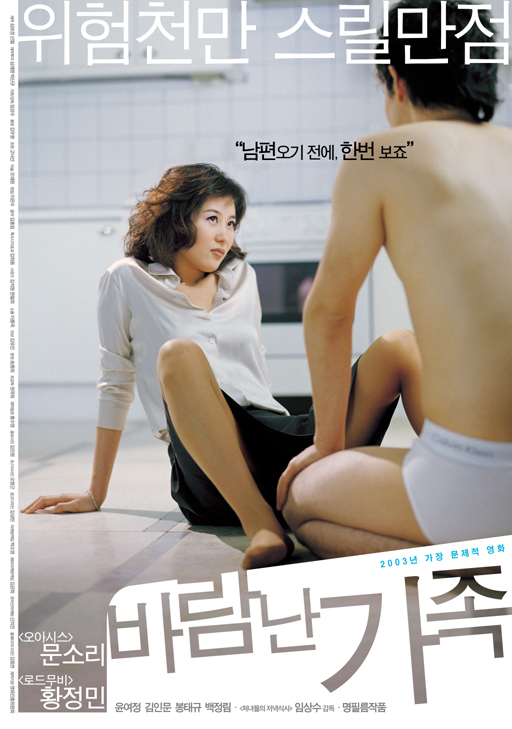
For me, that was Bae Doo-na (배두나), much on my mind since I heard she would be starring in Cloud Atlas. Later, I’d also stumble upon a…let’s say “eye-catching” movie poster of hers from 2003, which I remember constantly distracting me as I looked for jobs around my new home of Busan. And finally this week, when my family and I decided we’d go the 2012 FIVB Volleyball World Grand Prix on Saturday, I suddenly remembered that she’d played a former volleyball star in Saving my Hubby (굳세어라 금순아) too.

It was time to investigate. Just what was it about her that I found so compelling?

To my surprise, I soon realized I hadn’t actually watched many of her movies, including The Host (2006) and Sympathy for Mr. Vengeance (2002) for which she is best known. I had watched Take Care of my Cat (2001) of course, twice, but in hindsight I probably missed a great deal without subtitles, no matter how good my Korean used to be.

That just left the coming of age movie Plum Blossom (2000) then, probably best known for its numerous sex scenes — not quite the answer I expected or wanted. Still, it is a very affecting movie, with Bae Doo-na’s performance more much memorable for her character’s spunkiness than her frequent nudity. That’d be the image of her I’d bring with me to Saving my Hubby.

And who can blame me with a poster like the opening one above, or trailers like this?

As Wikipedia describes the plot (slightly edited by me):

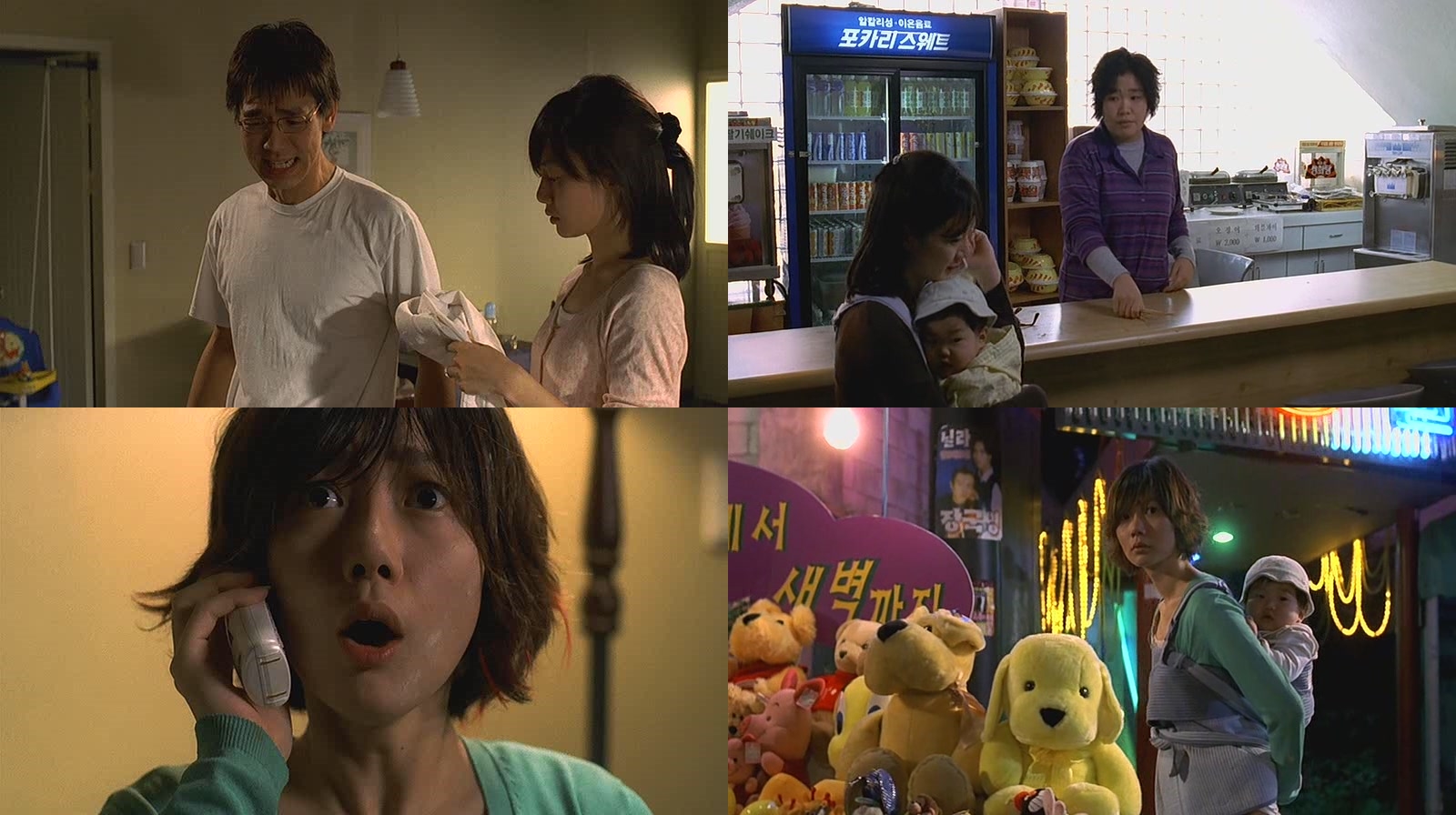
Former volleyball star Gum-soon (Bae Doo-na) is now a married housewife with a baby daughter. Her husband, Joon-tae (준태, played by Kim Tae-woo {김태우}),* is starting the first day of his new job, when Gum-soon receives word that her in-laws are going to visit the following morning. While she struggles to get their house ready, Joon-tae is taken out for a drink with his new colleagues. Later that evening, while preparing her home for a visit by her in-laws early the next morning, Gum-soon gets a phone call from a nightclub owner who is holding her husband hostage, claiming that he has run up a huge bill and doesn’t have the money to pay for it. Strapping her baby to her back, Gum-soon sets out to rescue her husband.

*Not the former g.o.d. member of the same name, despite what what Wikipedia says!

So you can imagine my surprise and disappointment when, just a couple of minutes into the movie, both Gum-soon and Joon-tae are having tantrums more befitting of preteens than young parents. But then they are young — Gum-soon the character and Bae Doo-na the actor are both clearly in their early-20s, only marrying because of her pregnancy, and this youth and unpreparedness for domestic life is a central theme of the movie (Joon-tae’s age is less clear, while Kim Tae-woo the actor is a youthful-looking 31). A parent at 30 myself, it took some effort not to project that more typical age onto the couple, and to judge them less harshly for their childishness. Especially as adult women constantly behaving like children is a pervasive, grating part of Korean popular culture.

(Source)

Ironically though, it’s also precisely some of those childish domestic scenes, which dominate the first 20 minutes, that are among the most endearing parts of the movie. Viewers with Korean partners are likely to find much about the couple’s interactions that warmly resonate with their own relationships (mine is at 18:10 when — squeee!— Gum-soon says “정말?!”).

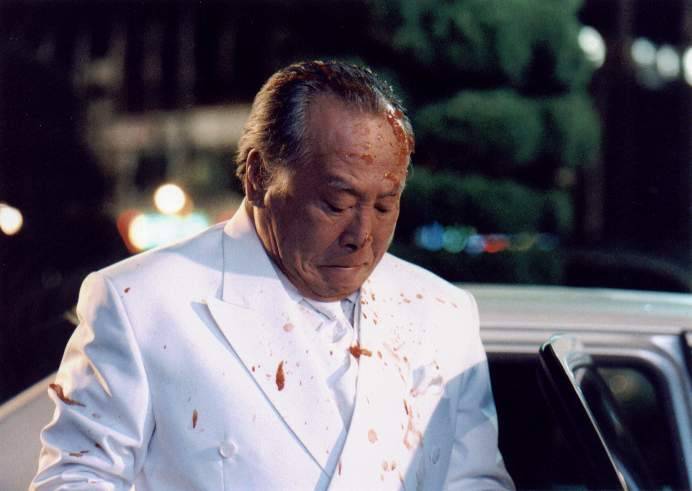
But don’t get me wrong: this is no romantic comedy. Nor, despite Gum-soon’s heroine role, can it remotely be described as a grrrl-power flick. Rather, once Gum-soon receives that phone-call, it’s all slapstick from there, complete with the mandatory inept gangsters, chasing her for accidentally getting their boss’s suit dirty. All of which you can see for yourself via this alternative trailer, which gives a much more accurate impression of the movie:

For the next half hour or so, the ensuing antics are amusing enough. The movie also really captures Korean nightlife well. In particular, when she can’t find the nightclub her husband is in, her lost wanderings readily evoked my first few months in Korea: when smartphones didn’t exist, and all the bars, clubs, norae-bangs, and 24-hour haejang-gook restaurants of downtown Jinju seemed to blend into one vast neon blur…even though they were just a few blocks in reality.

(Source)

Indeed, ultimately it becomes too realistic, for about halfway through the movie the gags suddenly seem to dry up, and we’re left with Gum-soon literally running around in circles as she avoids the gangsters and looks for the nightclub — minus the gangsters, it’s like watching me trying to find my hotel in Insa-dong one drunken early morning last summer. When things do finally pick up again, unfortunately it’s so late in the movie that there’s no time to build up the momentum of laughs that would compensate for the long lull.

That said, it’s still worth seeing (you can watch it online here, with English subtitles) — it has its amusing moments, and others that will likely remind many readers of why they’re with their Korean partners, or at least of their Korean newbie days out on the town. But don’t be fooled by the promotional material into thinking that it’s anything more than that, and I’m certain that there’s much better movies with Bae Doo-na out there.

(Source)

Any recommendations? :)

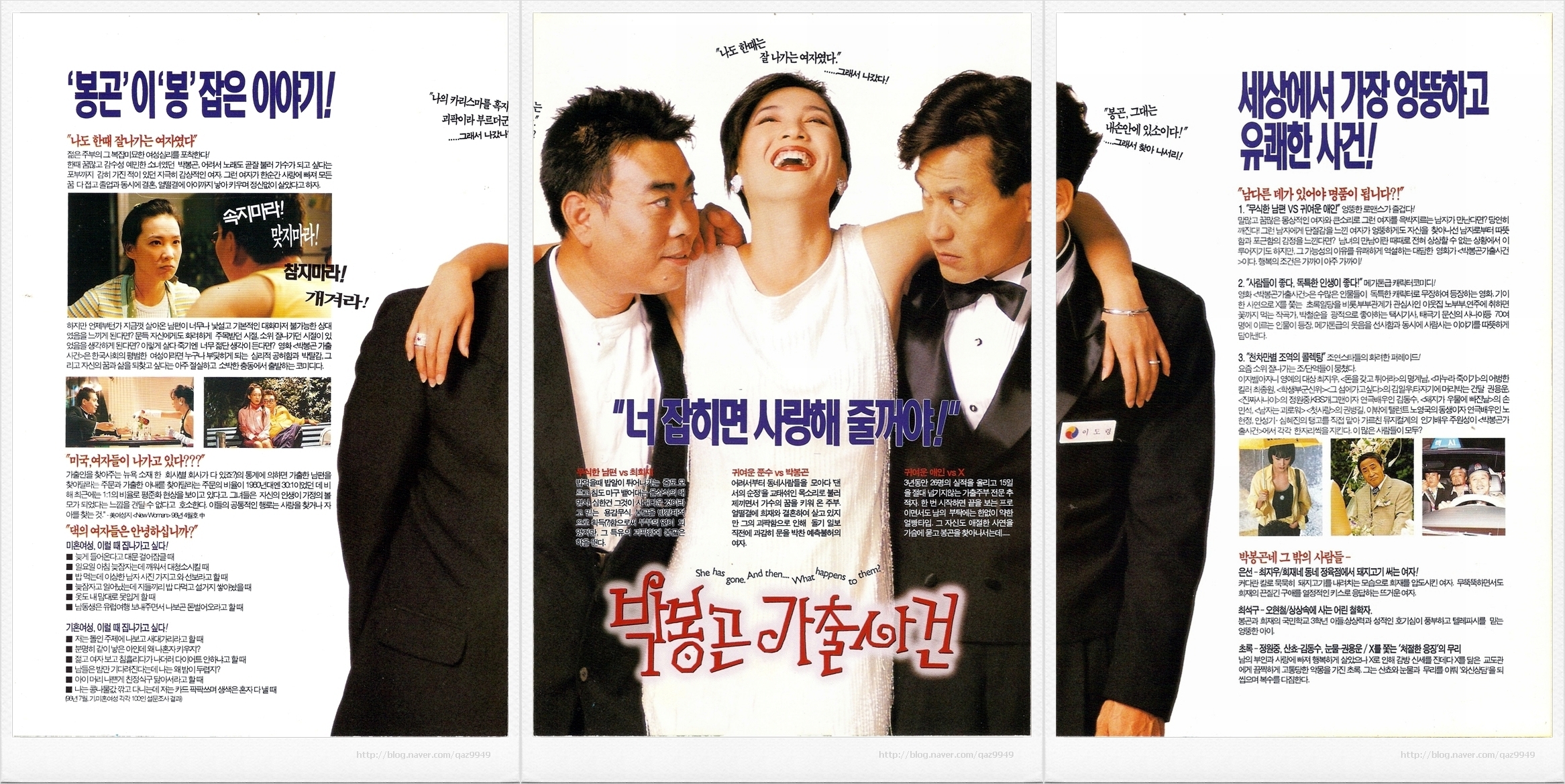
The Korean Media’s War on Women (and Men)

Via 10 Confessions, here is a short but quite rare “expo on the focus of the mass media and internet news sites on superficial looks of the entertainers in the industry, and how this trend needs to change.” Sorry that it’s all in Korean, but 10 Confessions provides a good (English) description of it, and it’s the least I can do to pass on the videos themselves (especially after spending half an hour looking for them!).

To see the segment, jump ahead to 2:30 in the first video. It lasts until 4:10 in the second.

The Korean Ad Industry’s Celebrity Obsession

(Sources: left, right)

See Busan Haps for the full article. It was prompted by Yoo In-na (유인나) and then Kim Sa-rang (김사랑; left) endorsing Gillette razors last year, when suddenly a lot of celebrities seemed to be endorsing products not normally associated with their sex.

Granted, women have been used to sell things to men for as long as advertisements have existed. And as for using Hyun Bin (현빈; right) to advertise a tea-drink that supposedly gives you a “V-line”, that’s just common sense: not only will he appeal to women, but so too might some men be encouraged to think about their own, hitherto exclusively feminine V-lines, thereby creating a whole new market.

But still: I’d wager that there has indeed been a great deal of gender-bending in the Korean advertising industry in the last couple of years. For instance, I’ve definitely never heard of a guy advertising bras before, no matter how dishy I’m assured this one (So Ji-sub; 소지섭) happens to be:

(Source)

Was he chosen just because he’s a pretty face? Or was the reasoning much more subtle than that? I can’t say in this case. But I do know that celebrities have a much greater effect on our consumption choices than we all like to think. Please read the article for more on how and why…

For some hints, here is the interview with Fame Junkies author Jake Halpern that I refer to in it. If for some reason that the video below doesn’t immediately take you to it though (it’s at 34:30), then please click here instead:

Finally, if you’ve read this far, then I heartily recommend watching Starsuckers in its entirety. For me, it was especially what the narrator says at 45:45 that sold me on it, and which I encourage you all to refer to the next time someone accuses you of reading too much into anything you see in the media:

p.s. Sorry for sounding so mercenary, but please let me remind everyone that any donations for my writing, however small, are very much appreciated. Unfortunately though, I haven’t actually received any since January 21(!), and I don’t get paid for my Busan Haps articles!^^

Korean Sociological Image #68: Laughing at the 1970s Fashion-Police

(Sources: left, right)

Remember when the Korean Defense Ministry said it was considering playing girl-groups’ music videos on giant TV screens along the DMZ?

The rationale, according to the official that thought of it, was that “the revealing outfits worn by the performers and their provocative dances could have a considerable impact on North Korean soldiers.”

Alas, nothing came of the idea. But the irony was palpable: in the 1970s, such revealing outfits were deemed subversive by the military government, with ruler-bearing policemen stopping women on the street to measure the length of their skirts (they would also cut men’s hair if it was too long).

This difference is humorously illustrated in Samsung’s 2007 commercial for the Anycall Miniskirt (애니콜 미니스커트), with Jun Ji-hyun (전지현):

It’s disappointing that it was set in the UK though, which never had such ‘fashion-police.’ Why not pick from the wealth of Korean video and imagery from that period? (Just look under “미니스커트 다속” for instance, literally “miniskirt control/supervision/clampdown.”)

My first thought was because the ad is already doing some subtle fashion-policing, through informing the Korean public of the new de facto rules. That would be much less subtle with authentic Korean examples though, and the ensuing social message, however refreshing, would be at odds with the cheerful tone of this one.

On the other hand, we can make allowances for creative license; perhaps the advertisers just wanted a swinging ’60s vibe. Also, it’s not like Koreans themselves aren’t afraid to poke fun at their old, ridiculous laws on miniskirt length (not least because they weren’t removed from the books until as recently as 2006), nor critique modern fashion and body-image ideals.

Still, it is yet another example of a phone literally embodying a woman. As is LG’s recent LTE wireless ad, which isn’t subtle at all:

(Source)

On the left, the black text reads “If it’s only the shape/appearance of LTE, then it isn’t available everywhere,” while on the right the pink reads “If it’s really LTE, then it’s available in every city.” The headline in the middle reads “But it’s different,” and finally the text at the bottom reads “The one and only LTE, in touch in every city nationwide. Automatic roaming in 220 countries worldwide.”

Personally, I think the execution is flawed—if the woman on the left is supposed to only have the shape and/or appearance of the real LTE (confusedly, “모양” means both), then shouldn’t both women actually look and be clothed exactly the same, with some indication that they’re different for some other reason (say, by having the women on the left scowling)?

Either way, the advertisement’s other message is that the woman on the right, with high-heels, a V-line face, impossibly-long (and uneven!) photoshopped legs, and a dress that only just covers her underwear, is quite literally the modern standard that all agasshis (young women) should adhere to. Jun Ji-hyun’s bobbies would be proud.

(For more posts in the “Korean Sociological Image” series, see here)

Oh In-hye: “I don’t regret wearing that revealing dress”

Source: Freeutil

My translation of her interview in Busan Focus, December 6 2011, p. 23, by Jang Byeong-ho:

“I Don’t Regret Wearing That Revealing Dress”

Issue-maker Oh In-hye, main star of Red Vacance, Black Wedding, Dreams of becoming a “humanist actress”

“There have been big changes since the Busan International Film Festival (BIFF). At the time things were just crazy, but now I’m quite relaxed. Things have returned to what they were like before BIFF”.

On the 5th, I met Oh In-hye at a coffee-shop in Seoul, the actress who has been in the spotlight for wearing such a striking dress at BIFF earlier in the year. I couldn’t help but be curious at how she felt about being at the center of such controversy.

“Before I went to the film festival, I thought my visiting it would just be reported as “An actress called Oh In-hye attended”, she said, but to her it was her first time, and an amazing experience. Also, while she was very hurt by malicious news reports and what netizens wrote about her, she confidently said to herself to “have no regrets”, and that “If I am to go again to the opening ceremony of a film festival, I’ll wear a revealing dress again. But perhaps revealing just a little less though!” (laughs).

Also, Oh In-hye is thinking about using the interest in her as an opportunity, “It’s all water under the bridge. Instead, now I have a goal of changing my revealing image. And if I have a goal, I should work on it, right?” she openly and honestly revealed, a complete contrast to the sexy demeanor she possessed when she was wearing the revealing dress. But she also said that she was worried that her revealing image would distort the message of her coming movie Red Vacance, Black Wedding, coming out on the 8th of December.

Oh In-hye has yearned to be an entertainer since she was very young, but didn’t set on an acting path until the relatively late age of 22 [She is 27 now]. From 2 to 3 years ago, she has worked without an agency, and firmly said that she “has no plans to join one. I want to be a humanist actress, not just an entertainer who makes issues.”

Finally, she admitted that the director Lars von Trier and the actress Penelope Cruz, Oh In-hye revealed that “increasing my acting ability by studying a lot of acting is my biggest homework!”, leaving this reporter curious about her honest and forthcoming persona (End).

Source: Adman

“A Korean Nip and Tuck to Look Like a Film Star”

A recent short BBC video about Korean medical tourism, focusing on East Asians coming to Korea to look like their favorite Hallyu stars.

Fellow old-timers may be reminded of this similar story from 2004, about Korean women asking cosmetic surgeons to give them Lee Hyori’s butt, and so on.

(K)Pop Art는?

(Sources: left, right)

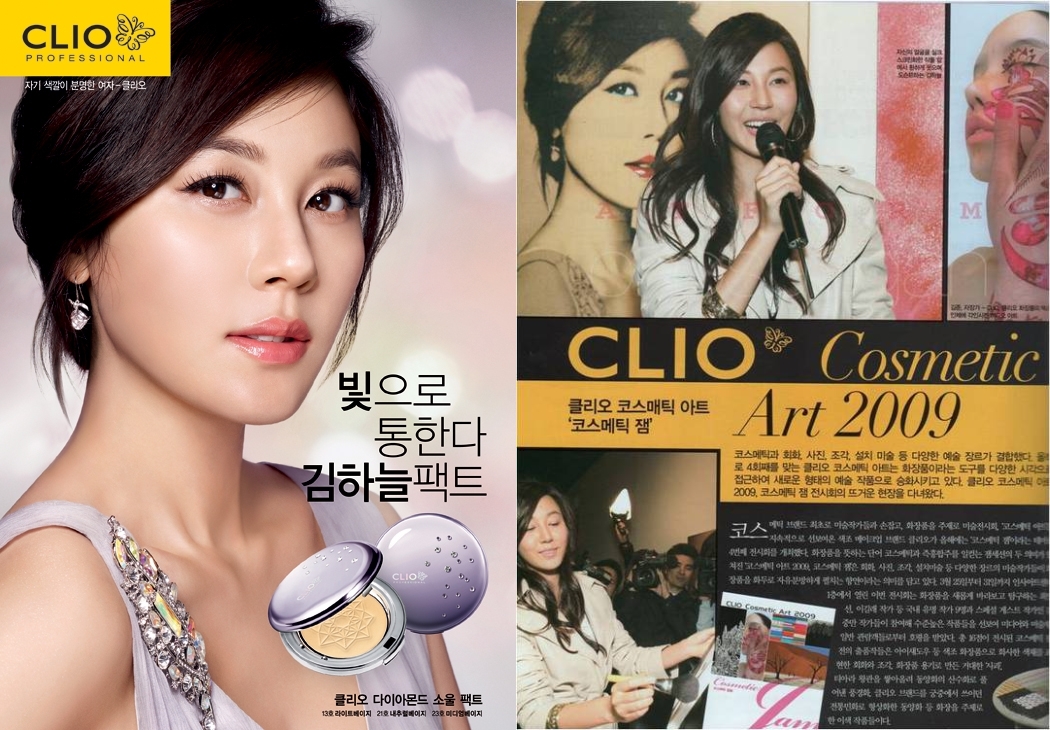
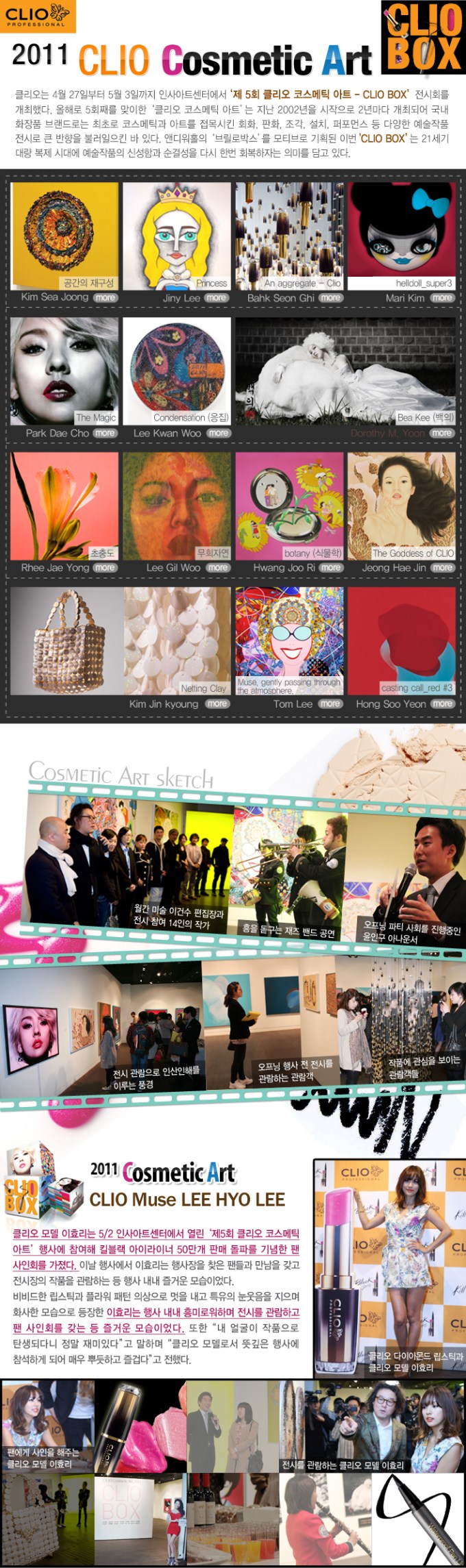
What comes to mind when you hear that Korean(?) cosmetic brand Clio (클리오) hosts a biennial Clio Cosmetic Art exhibition? That it sounds more like a brand tie-in than a genuine attempt to encourage original and thought-provoking art? The purist in me couldn’t agree more, especially when you consider that some works in the 4th (2009) and 5th (2011) exhibitions were not just inspired by, but use the very same photos as Clio’s own advertisements, prominently featuring brand endorsers Kim Ha Neul (김하늘) and Lee Hyori (이효리) respectively.

When its at the behest of the advertiser itself, arguably the ensuing pop-art loses its edginess.

But art doesn’t have to be radical to look good. What’s more, when you combine the images with the women themselves, then the juxtapositions are like an intellectual wet dream, the afterglow of which has had me buzzing for the last week.

For which are the more real? The flesh-and-blood women in the Insa Art Center (인사아트센터) in Seoul’s Insa-dong district? Or Ha Neul and Hyori the mass-produced visual commodities, with which we are much more familiar?

Groovy

(Sources: left, right)

But although the pictures did indeed persuade me to take down my handful of books on hyperreality and postmodernism, yet again I rejected them as unnecessarily abstruse, even for a geek like me. Also, Lee Hyori in particular (I’m less familiar with Ha Neul) is actually so down-to-earth and accessible that arguments that she’s merely a media creation can’t be sustained, one positive of Korean celebrity culture that I’ll be discussing in a lengthy post next week soon.

Until then, let me just pass on the art itself here, hoping to inspire more aficionados amongst you.

First, see here for a brief English introduction to the 5th exhibition, then the following graphic about it for a quick snapshot. If there’s anything on it you particularly like, click on the graphic itself to go to the Clio website, then on the specific artwork on the graphic there to get a quick (Korean) bio of the artist.

To any K-pop fans, see if you guess where you’ve seen Mari Kim’s work before:

(Source)

For many more large and/or high-definition pictures of the art and exhibition hall itself, see here, here, here, or here (beware the automatic music in the last one). My favorite work is easily The Magic (also known as Masic) by Park Dae Cho (박대조) below (the one using the same photo as a Clio advertisement), which you can see a zoomable version of here:

(Source)

Note though, that it’s actually a color-changing transparency in a light box rather than a static image, like most of Park Dae Cho’s works (which you can see more of on his blog):

That video doesn’t really do justice to it though, as it must really have been quite mesmerizing when viewed close-up. For the best equivalent, click on the following image:

(Source)

As for those of you that share my love of juxtapositions, alas, there seems to be a conspiracy of exhibition-goers to avoid taking decent pictures of Lee Hyori standing next to this particular artwork in particular, this one always cutting it in half for example, or this one being so much more interested in the contents of Lee Hyori’s dress that he ruined the contrast. But decent, albeit smaller and/or watermarked versions can be seen here, here, or on Park Dae Cho’s blog itself.

Meanwhile, if you haven’t guessed already, Mari Kim (blog; Facebook; Twitter), not to confused with (the also – quite literally – cool) Miru Kim, is the artist behind 2NE1’s (투애니원) I am the Best (내가 제일 잘 나가) album cover, and the Hate You music video:

(Source)

Finally, unfortunately there was much less interest in the 4th exhibition with Kim Ha Nuel, but Dramabeans does have a good English introduction to it,  and again Clio has a snapshot image, although without links to the artists this time:

(Source)

See here, and here for more pictures of the exhibition, and here and here for more shots of juxtapositions.

What do you think? Please let me know, and I’d very much appreciate it if readers could pass on any more examples of interesting juxtapositions and/or celebrity-related Korean pop-art. I’d be especially interested in anything featuring men, as I’m curious if I’m only interested in the Clio exhibitions because they’re centered around two attractive women. I’m sure that’s not the only reason I like them (what do female readers think of them?), but probably it’s much more important than I’d like to admit!

Update – Sorry for forgetting to mention it in case you wanted to go, but unfortunately the 5th exhibition ended back in May. But see you at the 6th one in 2013! :D

Korean Movie Review #3: Paju (2009)

(Sources: left, right)

I’m not allowed to love this person?

Because you say I can’t, I want it all the more.

With posters like these, then you could be forgiven for thinking that Paju (파주) is about some forbidden, Lolita-like relationship between the 2 main characters. Indeed, add promotional photoshoots of Seo Woo (서우) and Lee Sun-gyun (이선균) necking, or Seo-woo perched expectantly on the side of a bed, then why wouldn’t anyone believe initial media reports that this is basically a tale of an “outrageous high-school student” who, with “a mix of innocent and provocative appeal”, falls in love with her older sister’s husband?

A deep and complex movie that actually features nothing of the sort, Paju (파주) is very much undermined by such prurient marketing, and leads the cynic in me to believe that was designed to counter its otherwise ponderous and depressing tone by titillating audiences. Add that Paju requires: numerous suspensions of disbelief; is often frustratingly vague; and ultimately doesn’t seem to go anywhere, then, despite its accolades, it’s not a movie I can easily recommend to anyone but the most dedicated Korean film buffs.

And yet despite myself, I still agree with reviewer Darcy Paquet that it is “without question, one of the best Korean films of 2009,″ for reasons I didn’t fully appreciate when I first saw it six months ago.

One of those reasons is that, with events unfolding in a sequence not unlike Pulp-Fiction (1994), Paju has a confusing patchwork of flashbacks and flash-forwards that defies recounting here. But while this was very frustrating at first however, the timeline of events does resolve itself in the end, and in the meantime it forces audiences to think for themselves for a change.

Also, although ostensibly about Joong-shik (Lee Sung-gyun), Paju is really about his relationships with three women: first, with Ja-young (played by Kim Bo-kyoung/김보경) eight years earlier, that ends with a harrowing incident involving her baby that sets the tone for the rest of the movie; next in his marriage to Eun-su (played by Shim Yi-young/심이영), whom we soon learn dies in a gas explosion in their shared home; and finally with his much younger sister-in-law Eun-mo (Seo-woo), the relationship which anchors the story. And in particular, these women’s roles (and the skill with which they are acted) are very much one of the strengths of the movie, and something that can be difficult to appreciate for those that aren’t very familiar with Korean cinema (like myself). For, as Elizabeth Kerr of The Hollywood Reporter explains, director Park Chan-ok (박찬옥):

…is able to do something many filmmakers can’t or won’t, and that’s draw a realistic picture of modern femininity that’s blessedly free of the stereotypes that make up movie women. There’s no shrieking or weeping from Eun-mo when she recalls the events that lead to her sister’s death; Eun-su’s reactions within her fragile marriage are empathetic; and Joong-shik’s first live-in lover Ja-young, doesn’t have any ulterior motives when she re-enters his life.

(Source)

Nevertheless, it is also these relationships – or, rather, Joong-shik’s role in them – that are ultimately the movie’s undoing too. Because, constantly running away from her problems aside, if Eun-mo did indeed both have the hidden strengths and be as mature beyond her years as the movie suggests, then, despite Joong-shik’s fears, (spoilers begin) she would likely have been able to recover from learning that she accidentally caused her sister’s death. But this is moot: in one of Paju’s biggest plot holes, Eun-mo wouldn’t have needed to be told any details beyond the fact that Eun-su died in a gas explosion in their home (only Joong-shik knew how it was caused), and indeed she soon learns that through her own clandestine investigations anyway. Yet by telling her that Eun-su died in a hit-and-run instead, then, rather than protecting her, all it serves to do is lead her to believe that he’s hiding something.

When he professes towards the end that he’s loved her all along then, in fact only marrying Eun-su to be close to her, his apparent deception is the main reason she doesn’t reciprocate (the other, presumably, being how he used Eun-su). And the audience can hardly blame her: not only does his confession seem somewhat forced and awkward, he never expressing anything but platonic love for her previously, but it suddenly diminishes his character, rendering what at one point seemed to be a genuine closeness developing developing between him and Eun-mo into something much more calculated on his part.

But it does at least present us with an interesting enigma: why does he permanently sabotage any chances of them becoming lovers by refusing to tell the truth?

(Source)

Granted, he doesn’t realize she already knows about the gas explosion. But still, he doesn’t actually ask why she rejects him, which is inexplicable considering how he feels about her. Why not?

One solution, I think, I discovered indirectly, by realizing what so bugged me about an unrelated observation by Darcy Paquet:

In part, it is the film’s willful obscurity that gives it its strength….Personally I liked that the story’s misunderstandings persist through to the end: this is not a film where all characters come around to accept the same interpretation of the events we have witnessed. Because each character carries a different understanding – and no character possesses complete knowledge of what happened – there is a layered complexity to the film’s emotions.

In short, I think this is a fundamental misreading of the obscurity’s purpose. Rather, it’s only really two characters that have different understandings of events, and, like I said, Joong-shik very much possesses enough knowledge to change Eun-mo’s. But he doesn’t because, soon in a jail cell falsely accused of Eun-su’s murder and/or insurance fraud, he readily acquiesces in his incarceration, seeing it as a sort of penance for either the accident with Ja-young’s baby and/or his (oft-stated) insincere social activism. And, in hindsight, this is something he’s been seeking ever since he arrived in the city of Paju, and this gives us a fresh perspective on other alternative motivations for his entering into a loveless marriage with Eun-su too.

Not only is he buoyed by the knowledge that he is protecting Eun-mo from anguish then (a noble sacrifice that reminded me of the ending to The Crying Game {1992}) (spoliers end), but, if you watch the following beautiful scene from Strange Days (1995), which I was very surprised and lucky to find on YouTube, then suddenly what he’s doing really does begin to make sense. Please indulge me for 96 seconds, taking special note of  what Lenny Nero (Ralph Fiennes) says at 1:24:

Unlike Strange Days however, which showed Lenny Nero the ultimate futility of atonement, Paju suggests that therein lies Joong-shik’s salvation. And in that sense, Paju is so much closer to Crime and Punishment (1866) than it is Lolita (1955), and cinema goers in 2009 would have appreciated the movie all the more if its marketing had reflected that.

(For more Korean Movie Reviews, see here)

Share

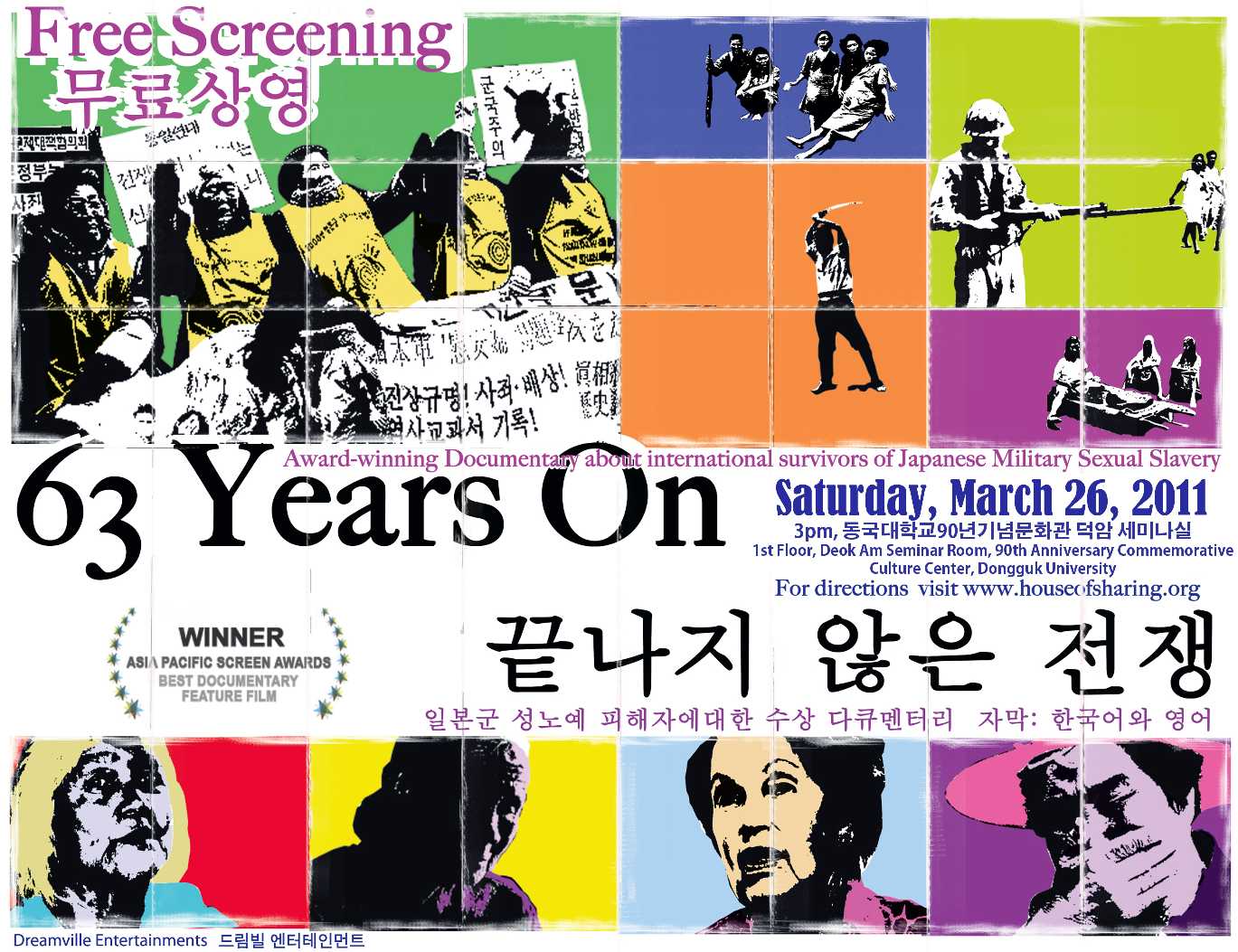
“63 Years On: The Story of the Comfort Women” Screening This Saturday

With thanks to Shannon Heit for passing it on, this Saturday at Dongguk University in Seoul there will be a free screening of “63 Years On”, a documentary about the Comfort Women. Starting at 3pm, see the Facebook event page or this press release for further details, and here for a campus map. Also, please note that it does have English subtitles.

Update 1: Ask a Korean! reports that, sadly, a former Comfort Woman just passed away today. That leaves only 73 registered ones still alive.

Update 2: For anyone further interested in the topic of Comfort Women, consider also grabbing a copy of Behind Forgotten Eyes, an award-winning 2007 documentary (via @ornamentity).

Share

Ah! (아!) by After School (애프터스쿨): Lyrics & Translation

After School’s (애프터스쿨) debut track from last year, of which I again include both DJ Areia’s remix above and the original below for you to enjoy while I explain the lyrics. But note that the remix is not actually trance this time, but rather the disco-like “vibrating analog synthesizer sounds and the helicopter-like basslines” of the late-1980s and early-1990s, so please do give it a try if you’re normally put off by dance music.

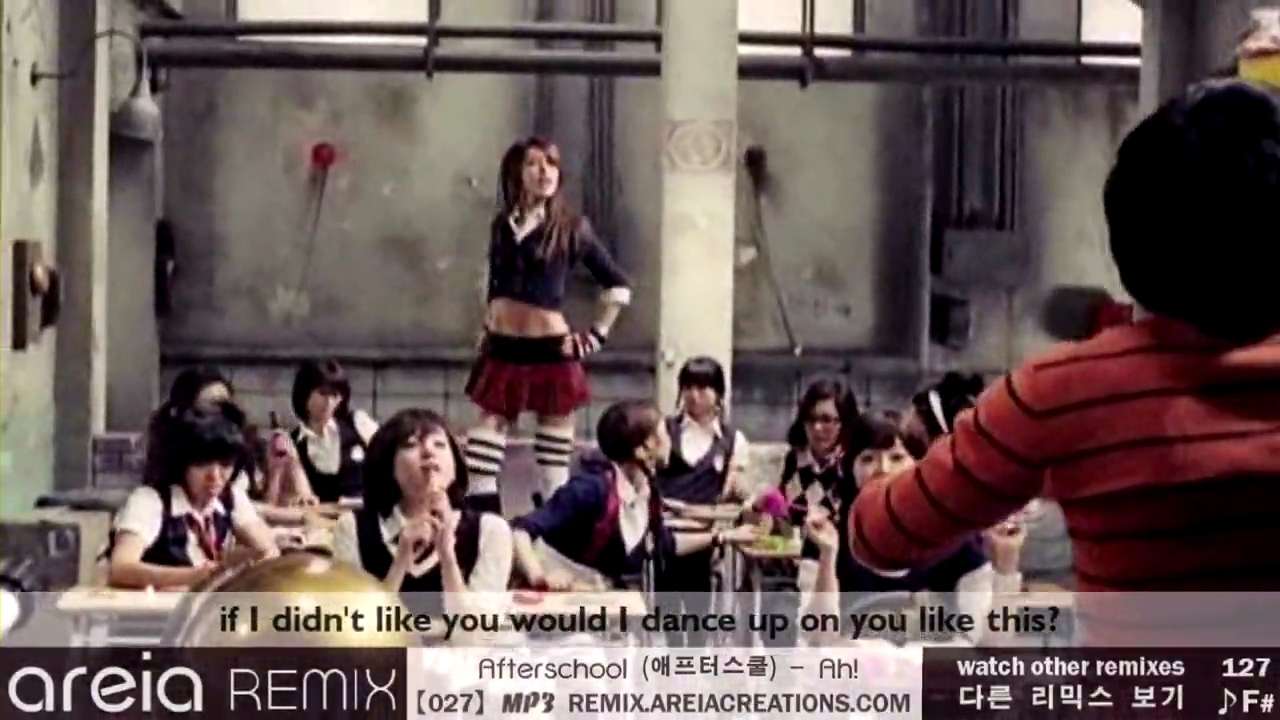
As for the music video itself, its theme is a little strange: schoolgirls in skimpy clothing coming on to their increasingly flustered young teacher, whom they are very happy to have ‘accidentally’ burst into their locker room later? It sounds…nay, looks like Japanese manga, and reminds me that student-teacher relationships (including dating and marriage) are a common trope of mainstream Korean popular culture (see here, here, and here for example), which only serves to both glamorize and normalize them.

Still, overly hormonal school students do sometimes have crushes on their teachers, and there’s nothing wrong in itself with portraying those in a music video. But while this one does obviously cater more to men’s sexual fantasies than to women’s (would having the group members vying for the affections of a handsome male student instead appeal more to women?), the lyrics demonstrate that there is much more to the song than meets the eye…

Again, for reasons outlined last time, I’ll provide very literal translations:

이렇게 둘이, 너와 단 둘이
언제나 둘이, 달콤한 이야길 하고파 둘이
둘이, 오늘밤 둘이, 사랑해 우리 둘이 둘이 baby

This way the two of us, with you only the two of us

All the time the two of us, I want us to tell a sweet story

The two of us, tonight the two of us, I love you we the two of us the two of us baby

“단” in the first line confused me for a while: it has a dozen meanings, including “bunch” or “bundle” which would (sort of) go with “the two of us”, but ultimately the meaning “only” is the most appropriate here. After that, the “~ㄹ 고파 하다” verb ending in the second line was the first time I’ve ever come across it personally, nor is it in any of my grammar books, but my wife says it simply means “~하고 싶다”, or “want to”.

잘빠진 다리와 외모 너는 내게 반하지
그대를 향한 윙크 한번 내게 빠지지
니 높은 콧대, 내 몸맨 어때
내 앞에선 니 모든게 무너지고 말껄

You have fallen in love with my slender legs and outward appearance

If I wink towards you one time you will fall (further)

The bridge of your nose is high (you have high standards)

How is my body?

Everything about you is going to crumble in front of me anyway

It feels a little hypocritical of me to critique other translations of songs here, as I very much rely on them to try and understand anything I might be having difficulty with myself, and especially because the translators may lack my increasingly annoyed Korean wife to constantly ask questions of in the next room. Nevertheless, those of whomever DJ Areia uses in his remixes (Yeeun2Grace perhaps?) really do seem a little sloppy sometimes (recall the big mistake in the 5th line of Bang!), and certainly disguise the subtlety of the original.

Take the first line for instance: “빠지다” has 13 meanings according to my dictionary, but “sexy” isn’t one of them; rather “잘빠진 다리” are “legs that have lost a lot of weight”, or “slender”. Sure, you could argue that this is just being picky, but it’s just as plausible to think that there is something culturally significant in the fact that “legs that have lost a lot of weight” was said rather than “섹시한다리” for instance, or more literally “sexy legs”. Also, “외모” is not “face”, but is actually the “outward appearance” of your entire body.

Next, putting line 4 as “I know you’ll crumble in my presence” completely ignores the “모든게” (or “모든것” + “이”) in it, or “everything”, and although “I know you’ll fall for me” is fine I guess, the verb ending “~고 말껄” (annoyingly not in any of my grammar books) means more “[the verb] is going to happen anyway”. Hence “everything about you is revealed in front of me” seems much better, as per the translation available on the AfterSchoolPlay fansite (registration required)

Finally, not a translation mistake, but in line 2 annoyingly the meaning of “빠지다” is different to that in line 1; and learners of English complain about the multiple meanings of words!

사랑한다 말만 말고 보여 주겠니
나도 니가 맘에 들어 춤을 추겠니
너와 난 왠지, 자꾸만 왠지
통할 것만 같아, 너를 사랑 할것 같아

Don’t just say you love me, aren’t you going to show me?

I like you too, aren’t you going to dance for me?

You and me for some reason, only again and again for some reason

I think we will only be connected, I think I will love you

My wife tells me that the verb ending “~겠니” in line 1 and 2, again not in any of my grammar books(!), means “aren’t you going to [verb] for me?”, So where on Earth “If I didn’t like you would I dance up on you like this?” below comes from I have no idea, no matter how appealing the thought!

(chorus)

짧은 시간 가까워진 우리 둘 사이
그대와 난 이제 하늘이 맺어준 사이
두말 할 필요 없어, 다가와 내게 어서
조명이 나를 번쩍 비추면
그댈 유혹하는 내 눈빛이 뜨거워지지
다른 남자들은 니가 너무 부러워지지
말은 안해도 난 알잖아 표현 안해도 다 알아
빨개진 니 얼굴이 다 말을 해주잖아

In just a short time we have become close

We are a match made in heaven

We don’t need to say it twice, come to me

If a light suddenly shines on me

It heats up the light of my eyes that is seductive to you

And other men become very jealous of you

You don’t have to say it or show it in your expression, I know everything

You red face shows it all

Not much to say here actually, other than both the translators at Yeeun2Grace and AfterSchoolPlay separated the above into two verses between lines 4 and 5. But I think that was mistaken, as line 4 ends in “비추면” or “if the light shines (on me)”, which is why the singer’s seductive eyes light up in the line 5. Lacking that connector, then I think that their own versions of line 4 and line 5 – “I’ve been illuminated by the light… You see my burning seductive eyes” and “When the lightning strikes me…My eyes which are putting him into temptation are becoming hotter”  respectively – don’t really make any sense.

(chorus)

나나나~

After school in the house, 모두 같이 make it bounce
들어봐 지금 내 말, 오늘밤 tonight
다가와 말못했던 얘기, 우리 둘만의 작고 작은 속삭임
그래 넌 지금 날 너무 원하지, 가벼운건 싫어 내 모습이
다른 장소 after party, 걱정마 이런 내 스타일에
오늘밤은 후회안해, 내 맘을 뺏어봐 baby boy

(chorus)

Na na na~

After School in the house, everybody together make it bounce

Hear my words now, this night tonight

Come to me, and all the things you (we?) couldn’t say, all the little whispers we said only to each other

Yes, you really want me now, I (you?) don’t want just light stuff

Different place after party, don’t worry this is my style

Don’t regret tonight, try to take my heart baby boy

Again, the Korean seems pretty straightforward here. On a final note then, given how targeted it is towards male audiences I was very surprised not to find any screenshots of the music video either via Korean or English search engines, leaving me with the onerous task of producing my own. Despite the visuals however, the lyrics in this debut song are clearly just as much about girl-power and being confident and assertive as they were in Bang! a year later, so the possibility remains open that After School may actually have a sizable female fan base (and I rather hope that they do).

In light of that then, you imagine what I thought of three members’ most recent song in which they pour on the aegyo (애교), basically looking and behaving like 12 year-old girls. Like I said in the comments to a post about it at SeoulBeats:

I’d have to give it a thumbs down. Not so much for the music in itself, but because I’ve always liked After School for the assertive, confident, girl-power theme of their songs, and so this “candy coated aegyo overload” as you well put it really seems to dilute their brand.

And most other commenters there agreed with me. But what do you think of it? Feel free to disagree with me of course, and diversity is the spice of life and all, even for music groups. But still…

(Source)

As always, thanks in advance for pointing out any mistakes I may have made or providing alternative translations!

What a Difference a Region Makes

( Source: The Japan Foundation )

With thanks to Philip Gowman of London Korean Links for bringing it to everyone’s attention, I’m literally ordering this book as I type this just for the Korea-related chapters alone!

UK-based readers, note the book-launch in London next Wednesday: see the The Japan Foundation for more details, and make sure to email jd.mackintosh@bbk.ac.uk by Monday if you’d like to attend.

Share

Korean Movie Review #1: A Good Lawyer’s Wife (2003)

A Good Lawyer's Wife Cast( Source )

A Good Lawyer’s Wife defies easy description.

Heavily marketed on the basis of its explicit sexual content, and with probably no longer than 10 minutes between one sex scene and the next, on the surface it is simply pornography masquerading as art-house cinema. Or so I thought when I first saw it at the cinema in August 2003, my – let’s be honest – appreciation of Moon So-ri’s (문소리) nude body tempered by the knowledge that the object of her affections was Bong Tae-gyu (봉태규), then regularly appearing in numerous childish and annoying television commercials. Hardly lacking for access to pornography, I saw no reason to watch it again in the next 6 years.

But the movie was my first introduction to Hwang Jung-min (황정민), whom after seeing his transformation into a bumbling, possibly slightly mentally-handicapped idiot in You Are My Sunshine (너는 내 운명; 2005) a little later, instantly became one of my favorite actors. And then seeing So-ri’s brief but stellar performance in Peppermint Candy (박하사탕; 2000) last week too, I thought I’d give it another chance. After all, my tastes are a little more mature and more discerning now, and far from being put off by depictions of relationships between 30-something women and (often) childish younger men, if all goes to plan I’ll be formally writing a dissertation on precisely that by next March.

Watching it (again) myself over several nights originally then, I was very surprised at how much I liked it this time, and how much of the plot I’d either overlooked or simply gotten completely wrong 6 years ago. Struggling to determine why my opinion had changed so dramatically on a second viewing, I decided to watch it with my wife to see if she liked it also, and more importantly why. Unfortunately, she too thought it was largely pornography masquerading as art-house cinema(!), but she did at least confirm what I’d relearned about the plot. And watching her reactions out of the corner of my eye while ironing shirts (as one does when seeing a highly pornographic movie for the third time), finally it came to me.

A Good Lawyer's Wife Movie Poster

The first thing of note is that its English title is an extremely poor choice. Although it’s true that So-ri’s sexual frustrations with lawyer-husband Jung-min are the catalyst for her having an affair with her teenage neighbor (not actually consummated until close to the end, but – rather than maintaining the suspense – the DVD introduction helpfully shows that scene!), she is by no means a “society wife” smiling inanely at his shoulder at numerous dinner parties and so forth; in fact, she literally has no involvement in his working life and relationships whatsoever. There’s no evidence to suggest that she “gave up her dancing career in order to be a good lawyer’s wife” either, despite what the appalling Wikipedia article on the movie suggests, and one suspects that – like many English-speaking viewers – the writer was misled by the title.

Instead, a much better translation of “바람난 가족” would have been “A Family Having Affairs,” and accordingly it is quickly revealed in the first few minutes that with the exception of Jung-min’s dying father (competently played by Kim In-moon {김인문}) all main adult characters are or will have illicit sexual relationships: Jung-min a long-standing one with Baek Jeong-rim (백정림), a very complex character difficult to get to grips with in just one sitting; his mother Yoon Yeo-jeong (윤여정) with a minor character; and of course So-ri with Tae-gyu. And therein lies the source(s) of the continual sex scenes, which apparently attracted Korean viewers in droves (it was #1 at the box office).

But what, amongst all the sex, were the other points of this movie? What, indeed, was its “moral,” which – as I stressed in my last review – I believe a movie has to have in order to be worthwhile?

Well, without wanting to give any of the plot away, by virtue of all the affairs this is clearly a family with problems (even an adopted son is aware that Jung-min is lying when he says he’s working late). Jung-min’s reasons for his are unfortunately never elaborated, but his mother’s are: like Moon So-ri, she was sexually frustrated.

And how, in a marriage, might one become so?

A Good Lawyer's Wife 2003

Well, while I’m not naive or intellectually shallow enough to attribute all married couples’ sexual problems to a lack of communication, nor arguing that communicating with one’s spouse (or partner for that matter) automatically solves them, I would wager that – if you’ll forgive the pun – a lack of communication is at the root of the vast majority of them. But whereas So-ri may not have been able to resolve her own sexual frustration with Jung-min given that he was already secretly having an affair, tellingly she doesn’t even try. Instead, as one would expect from a fucked-up family, she seems to have her heart set on fucking Tae-gyu literally the morning after Jung-min fails to satisfy her (the poster on the right is rather misleading).

Granted, to a large extent I’d simply be projecting in seeing meaning in that. After all, after 9 years together as a couple (5 married), my wife and I have naturally had our own sexual issues, especially after the birth of 2 children, but – with the knowledge that not doing so would have grave consequences for our marriage – all happily resolved by simply discussing things. Hence, despite all the attention on them, I do personally see all the affairs and the sex in the movie as natural consequences of and/or metaphors  for something deeper. As I think was the deliberate intention of director Im Sang-soo (임상수).

For instance, as Darcy Paquet in his excellent review at Koreanfilm.org points out, this is not the first time he has presented frank sexuality and nonconformist heroes in his movies. And in particular, bear in mind that with: the longest working hours in the world (albeit many of which are not actually spent working); the lowest women’s workforce participation rate in the OECD; and prostitution accounting for 4.1% of GDP also, then as this Japanese author (and personal experience) suggests, there are a lot of virtually sexless marriages in this part of the world.

Ergo, there may be more to the popularity of this movie than mere voyeurism, particularly as it was the enthusiastic response to finally having such frustrations articulated in popular culture in the mid-1990s that is what made movies like this possible in the first place.

True, I’ve yet to look for confirmation from Korean-language sources of that (watch this space). But as a response to potential accusations of overanalysis and projection then, let me offer this challenge: at the behest of their relatives and descendants, Jung-min’s main legal case in the movie – presented in the very first scene in fact – involves the unearthing of victims of an atrocity, which presumably took place during the Korean War or just before. There are also references to Jung-min’s own extended family being separated by the Korean War. While I have yet to come across any reviewer that interprets the former as any more than merely establishing his character as a lawyer though, and hence easily interchangeable with any other legal case, what purpose could both serve other than as metaphors for the broken family at the heart of this movie?

Likewise, gratuitous sex  is not what this movie is all about. And so compelling are all main characters’ stories, that despite yourself you may be wishing that one or two sex scenes had been removed in favor of further character development by the end of the movie. Indeed, the only criticism of the movie I have personally is that even after 3 viewings, Jung-min’s motivations for his affairs remain a frustrating enigma.

Baek Jeong-rim Hwang Jung-min

Next week, if I can find it: My Wife is a Gangster (조폭 마느라; 2001) Samaritan Girl (사마리아; 2004).

Share

Women Getting on Top: Korean Sexuality and Popular Culture in the 1990s

The Adventures of Mrs. Park 박봉곤 가출 사건

For those of you that are interested in the title topic, then let me mention that I’ve finally finished the rather lengthy post on it that I started back in May, which you can read here. Apologies for taking 2 months rather than the promised 2 days to do so, and by why of compensation you can expect a flurry of related posts from me over the next 3 weeks, which by complete coincidence I’ve just realized is all the time I have left to prepare a presentation on the subject for a conference in Daejeon

Seriously though, while it is a much more academic post than usual, even if you just give it a quick scan then you may be simply amazed at how much Korean television and movies have changed in the last 10-15 years, and how important dramas in particular have been at subverting traditional ideologies of female sexuality. This provides a precedent for the impact of things like Friends and Sex and the City on Korean gender relations and consumerism a little later, and hence also myself a newfound respect for them: see here for some recommendations for more recent ones in the same radical vein as the ones mentioned in the post.

Branding Korea: A Promising Fresh Start?

Bandhobi Movie Mahbub Alam

Look familiar? If not, then on the left you have Mahbub Alam, co-star of the recent movie Bandhobi (반두비), which challenges many Koreans’ stereotypes of and prejudices towards workers and immigrants from developing countries. Here he is in a public service commercial from the Korean Broadcast Advertising Corporation (KOBACO) below, and while it won’t change the world, in terms of the time and money invested at least it will probably prove much more effective at promoting Korea overseas than all the millions lavished on the “Korea Sparkling” slogan.

Vodpod videos no longer available.

In Korean, the commercial says:

우리는 달라졌지만…더 달라져야 합니다.

우리는 가까워졌지만…더 가까워져야 합니다.

우리의 가슴은 뜨겁지만…더 뜨거워져야 합니다.

Korea보다 더 자랑스러운Korean

코리아 브랜드 당신이 만듭니다.

And in English:

We are very different…but we need to be more different.

We are closer…but we need to be closer still.

We have warm hearts….but they need to be warmer.

Instead of being proud of Korea, we should be prouder of being Korean.

We, ourselves, have to create Korea’s brand.

Bandhobi

Make sure to see the movie at the cinema while you still can!

Update: In case you missed it, see here for further information about the 4th Migrant Worker Film Festival (MWFF) that Mahbub Alam is the director of,  and which will shortly be touring several Korean cities, starting with my wife’s hometown of Jinju (진주) on the 26th.

Share

What do Koreans REALLY Think of Bloodtypes?

big bang 2%보족할때 광고 blood type advertisement

With those top two panels reminding me of the futuristic Blade Runner, it’s ironic that the ad is actually based on the decidedly archaic belief that one’s bloodtype determines one’s personality. What’s more, it’s a surprisingly deeply-held one too, with some Korean women even rejecting all B-type men as potential marriage partners because of it, as I discussed when I wrote about a similar marketing campaign for kiwifruit back in May. In short, it’s not quite the same as having a good laugh at your daily horoscope, and can’t be so easily dismissed.

My Boyfriend is Type-b Tandy Advertisement

A strange {and slightly disturbing} advertisement for Tandy found on this site about the 2005 movie My Boyfriend is Type B {B형 남자친구}. See later in the post for one more, and here for a review of the movie.

Lest one is tempted to jump to conclusions about Koreans’ critical-thinking skills though, then consider this blog post on the subject that was featured on the front page of Yahoo! Korea about a month later, which I’ve translated below. It is from the 12th most popular Korean blog according to its own blog ranking system—by way of comparison, this one is currently ranked 87,378 out of 4,644,184—so it would have been read by a lot of people:

우리나라에서만 볼 수 있는 ‘혈액형’ 광고의 불편함…

It’s discomforting  how Korea is the only country in the world with advertisements about bloodtypes…

A형, B형, AB형, O형이 한자리에 앉아서 식사를 하고 있었다. 갑자기 AB형이 밥을 먹다 말고 벌떡 일어나 뛰쳐나가자 O형이 AB형을 뒤쫓아간다.

남겨진 A형이 B형에게 조심스레 묻는다: “쟤 혹시 나한테 화난거야?”

온라인과 오프라인을 막론하고 이젠 귀에 딱지가 앉을 정도로 듣게되는 혈액형별 성격에 관한 유머다.

일본에서 들어와 국내에 뿌리내린 혈액형별 성격 분석은 독일의 우성학에서 출발해 일본에서도 1970년대에 확고히 자리잡았다고 하는데 이런 성격 분석이 국내에 유입되어 뿌리내리며 우리나라를 전세계에서 몇 안되는 혈액형 신봉 국가를 만들어 버렸다. 사람 둘 셋만 모이면 혈액형에 대한 이야기가 쏟아져 나오는 그런 나라…;;

그렇게 보면 다음 CF들은 어쩌면 우리나라에서만 만날 수 있는 광고의 유형은 아닐까?

A, B, O & AB Bloodtypes Eating TogetherFour people, one with bloodtype A, one with B, one with AB, and one with O were sitting down having a meal together. Suddenly, “AB” stopped eating and got up and ran outside, and “O” decided to follow (him).
“A” and “B” remained, and A nervously asked B: “Is (he) angry with me?”

(James: No, I don’t get it either. But, for the remainder of the cartoon version on the right, see here, and here for many more like it.)

Needless to say, online and offline, there is so much humor about blood types that people are very tired of it.

Blood type and personality analysis originally derives from German eugenics, but it became firmly rooted in Japan in the 1970s, and from there in Korean culture, making Korea one of just a handful of countries that haven’t thrown such beliefs away. Indeed, get two or three Koreans together, and invariably they’ll end up chattering about blood types…

In this sense, you can only really see commercials like the following in Korea, right?

혈액형으로 먹는다제스프리 골드키위/Eat according to your blood type…Zespri Golden Kiwi

키위를 먹는 방식을 혈액형 성격 분석에 맞춰 유머러스하게 풀어놓은 제스프리의 CF다.

Here’s a humorous commercial by Zespri saying different blood types eat Kiwis in different styles (James: see my earlier post for the other 3 in the series):

Vodpod videos no longer available.

혈액형으로 마신다… 2% 부족할 때/Drink according to your blood type…2% “Near Water

제스프리가 코믹이란 콘셉트를 내세웠다면 이쪽은 혈액형과 치환되는 단어와 사랑을 엮고 빅뱅을 얹어 광고를 내놨는데 실제 빅뱅 멤버의 혈액형에 맞춘 광고란다.

Whereas the Zespri commercials had a comic concept, the following ones with the band Big Bang (빅뱅) has each member falling in love and romancing women according to their bloodtypes (James: this video combines all 4 commercials in the series):

재학습되는 혈액형 성격 분석…/These commercials help perpetuate public belief in the bloodtype and personality theory

평소 귀가 얇은 편이라 혈액형별 성격 분석에 종종 혹하는 편이지만 ABO식 혈액형의 고작 4가지 패턴으로 60억 세계인의 성격을 모두 분류할 수 있다고는 생각치 않는다. 또 이론적 뿌리도 부실하고 지나친 일반화와 선입견 듬뿍 담긴 규정으로 혈액형 별로 사람을 가늠해 버리는 것 자체가 혈액형에 기준한 성격 분석이 갖는 문제점이라고 생각하는 편이다.

Normally I’m a little gullible, so I’m often convinced of the validity of the bloodtype and personality theory, but still, I can’t believe that all 6 billion people in the world can be compartmentalized and categorized into just four types. And it is a problem that people are influenced by and follow the rules of their prescribed personality when the theory is based on insufficient evidence,  is too generalistic, and rife with prejudices and preconceptions.

My Boyfriend is Type-b Korean Tandy Advertisement

그런 이유로 이번에 소개한 혈액형에 관한 CF들은 왠지 불편했는데…감각적인 영상과 유머 코드로 적당히 버무려 광고를 바라보는 이들에게 쉽게 퍼지고 기억되는 이런 영상들이 결국 사람들 사이에 회자되는 혈액형별 성격 분석을 재학습시키고 있는게 아닐까란 생각에 이르렀기 때문이다.

For this reason, seeing these commercials made me feel a little uncomfortable…when sensible (if misguided) notions of bloodtype and personality are mixed with humorous ones in a sort-of cultural code and then utilized in commercials like these, they help to keep the theory on everyone’s minds and thereby perpetuate artificial divisions.

물론 사회에서 익숙한 코드를 반영해 상품을 홍보하는 건 일반적인 광고의 특성이니 어쩔 수 없는 부분이 있었겠지만 그래도 “이 혈액형은 이렇고 저 혈액형은 저래. 그러니 너는 이렇지?”라는 식으로 세상 모두를 4가지 성격군으로 분류할 수 있다고 생각하는 것 자체가 문제 아닐까?

훗~ 평범한 O형의 한마디였다. 응?

Of course commercials will always reflect a society’s cultural codes, but nevertheless isn’t it a problem when we say “this bloodtype behaves like this, that one like that, so that’s why you do what you do, yes?”, and that we want to compartmentalize the whole world into just four types?

I’m O by the way. Is that a typical thing for an O type to say? (Finish)

Get's the blood flowing...

Not exactly the piercing critique I anticipated when I began translating, but that wasn’t my point really, which was more to provide a healthy reminder that just like back home there is a healthy diversity of opinions in Korea on just about every subject, but which it’s very easy to overlook if you only rely on English-language sources. Indeed, I’ve just found yet another, longer news report on the same two advertising campaigns, which I’m happy to also translate if anyone’s further interested (it’ll be good revision).

In the meantime, while finding some images for this post I couldn’t help but notice that, once again, apparently the powers that be felt that only young women in tight t-shirts and/or miniskirts could persuade persuade Koreans to perform their civic duty on “World Blood Donor Day” this year (left) and last (right). Come to think it though, that particular advertising convention doesn’t exactly detract from the aim of getting people’s blood flowing…

Sorry, I couldn’t resist it. And in fairness, this year’s ads did feature boy-band Super Junior (슈퍼주니어) also. For some big pictures of them promoting donating blood, albeit together with Girls’ Generation (소녀시대), see here.

Share