Korean Sociological Image #54: Sex & Drugs

(Source: Focus {Busan ed.}, 08.12.2010, p. 17)

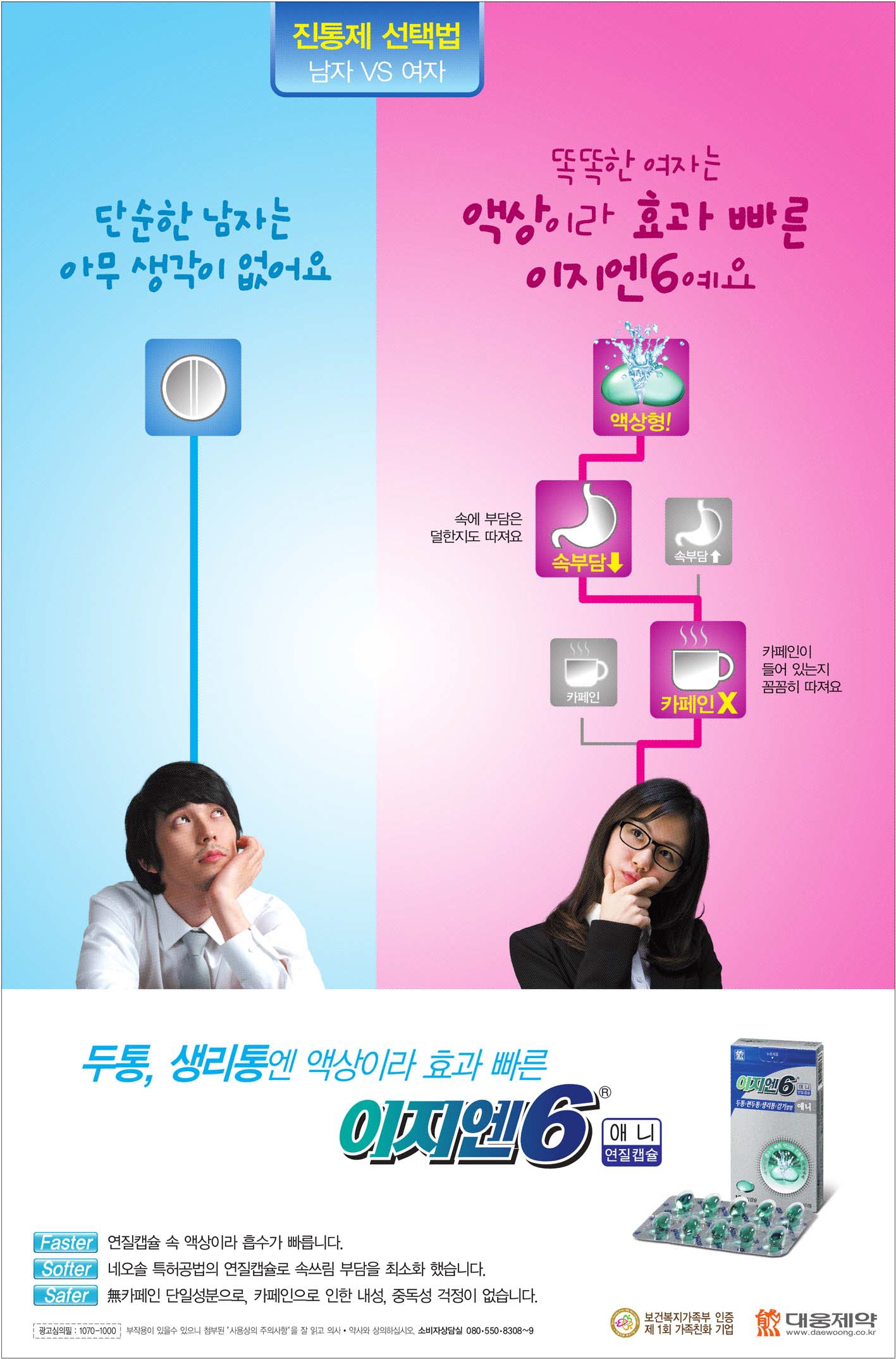
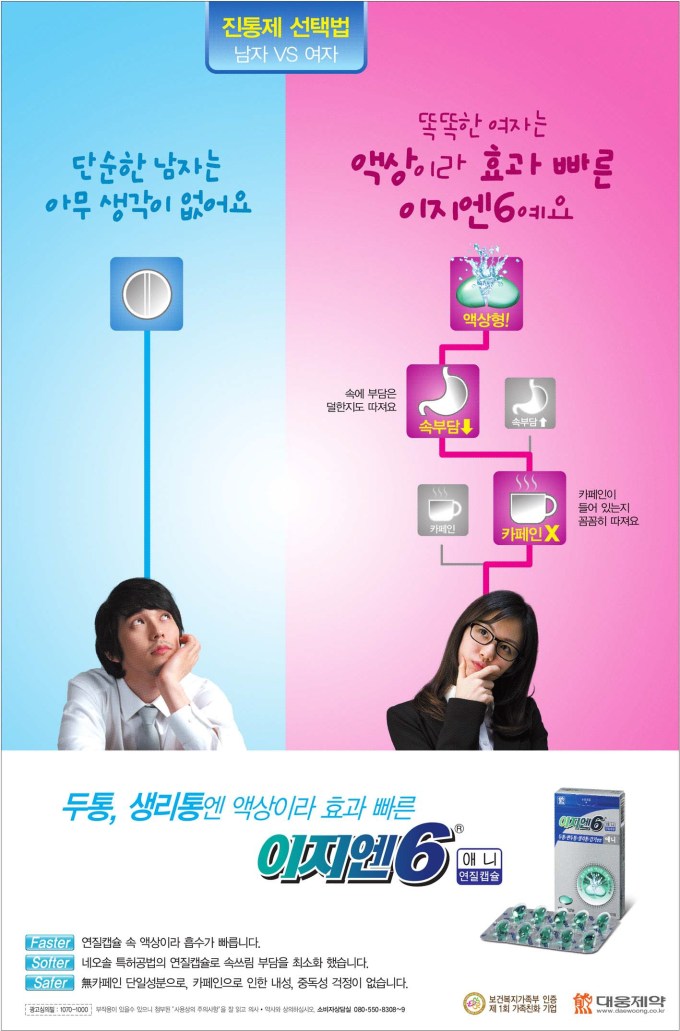
As we all know, if you’re a real man, then you couldn’t care less about what painkiller to use.

But to be precise, the ad actually says dansoonhan men (단순한남자). Which usually translates as “simple” in English, but probably best would be “straightforward” in this case.

Forgive me though, for still considering myself just as smart (dokdokhae;똑똑해) as the woman in the ad. After all, I too wear glasses sometimes.

How am I supposed to choose a painkiller then? Or – heaven forbid – straightforward women for that matter?

Alas, the ad gives no clue:

Methods of choosing a painkiller – Men vs. Women

Straightforward men [choose] without thinking.

As for smart women…because it’s a liquid, its effects are fast. This is EZN6.

Liquid Form…[They need to] think about if it will decrease the burden on the stomach or not

[They need to] carefully think about if it contains caffeine or not

And at the very least, it certainly doesn’t discourage the notion that looking after one’s body is really something only women should do. Unlike most products that are marketed very differently to each sex though (see here, here, here, here, and here for more Korean examples), the irony here is that there’s now a wealth of evidence to suggest that painkillers that work on one sex can be ineffective or even increase pain on the other. In the near-future, there may well be completely different painkillers developed for men and women.

And when they are, then yes: I’d wager that they’re going to be pink and blue too.

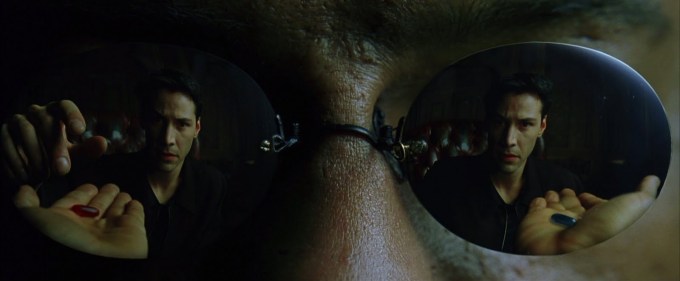
You’re in for a world of hurt Neo! (Source)

When that day arrives though, do you think Daewoong Pharmaceutical (대웅제약) will simply come up with 2 versions of the ad, each only featuring one sex? Or will ads for men continue to emphasize simplicity, but those for women stressing how they’d have even more things to consider?

My money’s on the latter…!

(For all posts in the Korean Sociological Images series, see here)

Share

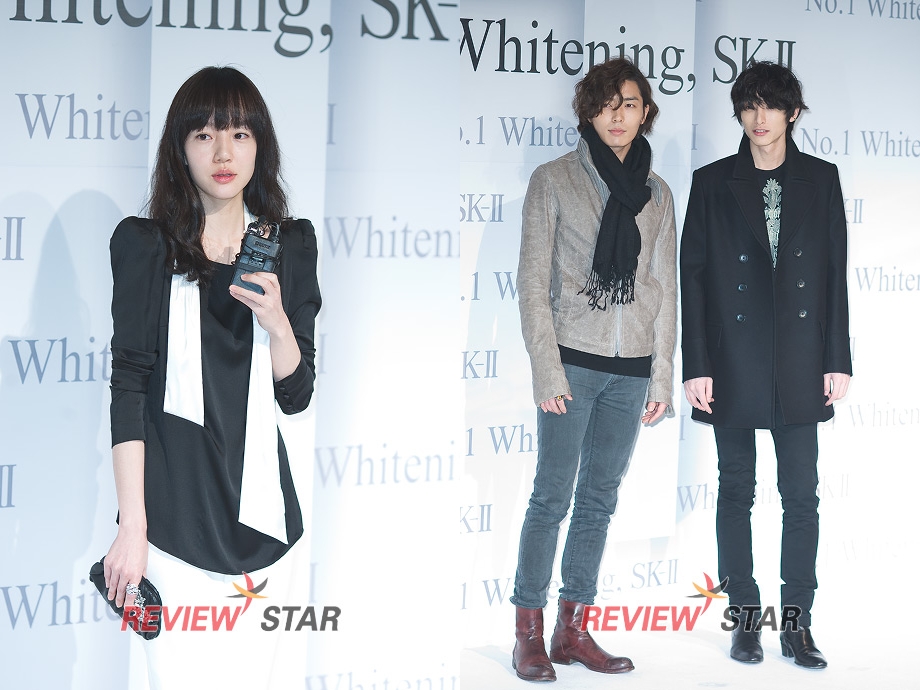
Korean Sociological Image #53: “SK-II No. 1 Whitening Celebration Party”

(Source)

See here or here for more photos. Is such a deathly pallor really something to be aspired to?

(For more posts in the Korean Sociological Images series, please see here)

Korean Sociological Image #52: Are Celebrities Removing the Stigma of Lingerie Modelling?

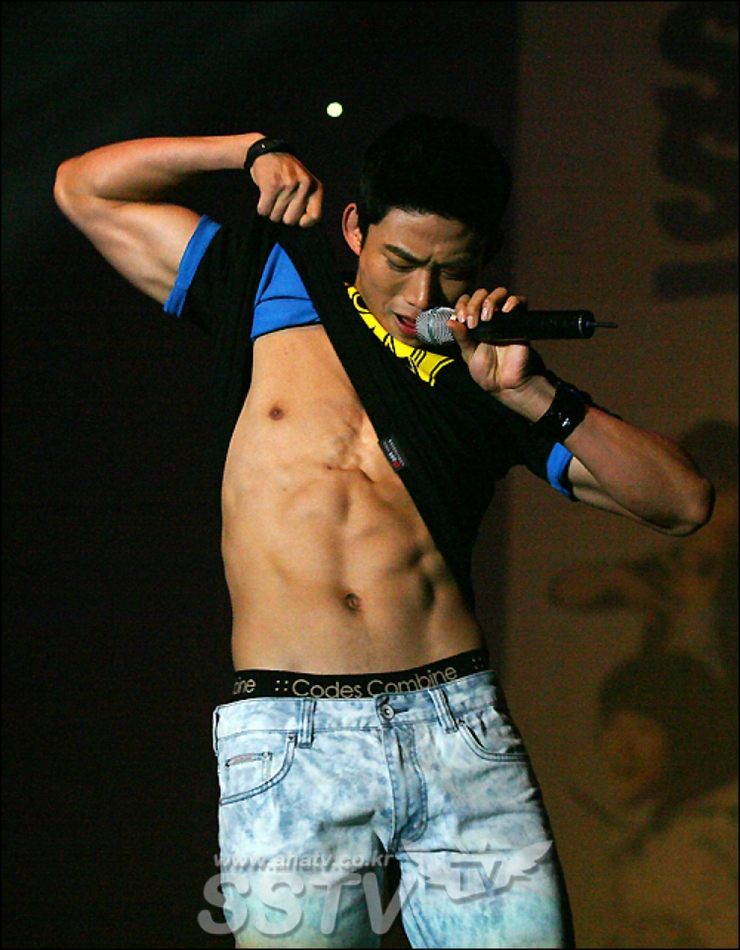
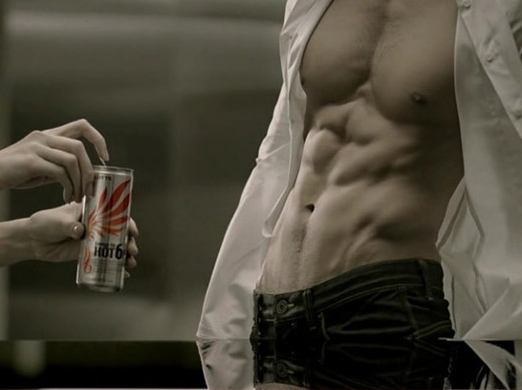
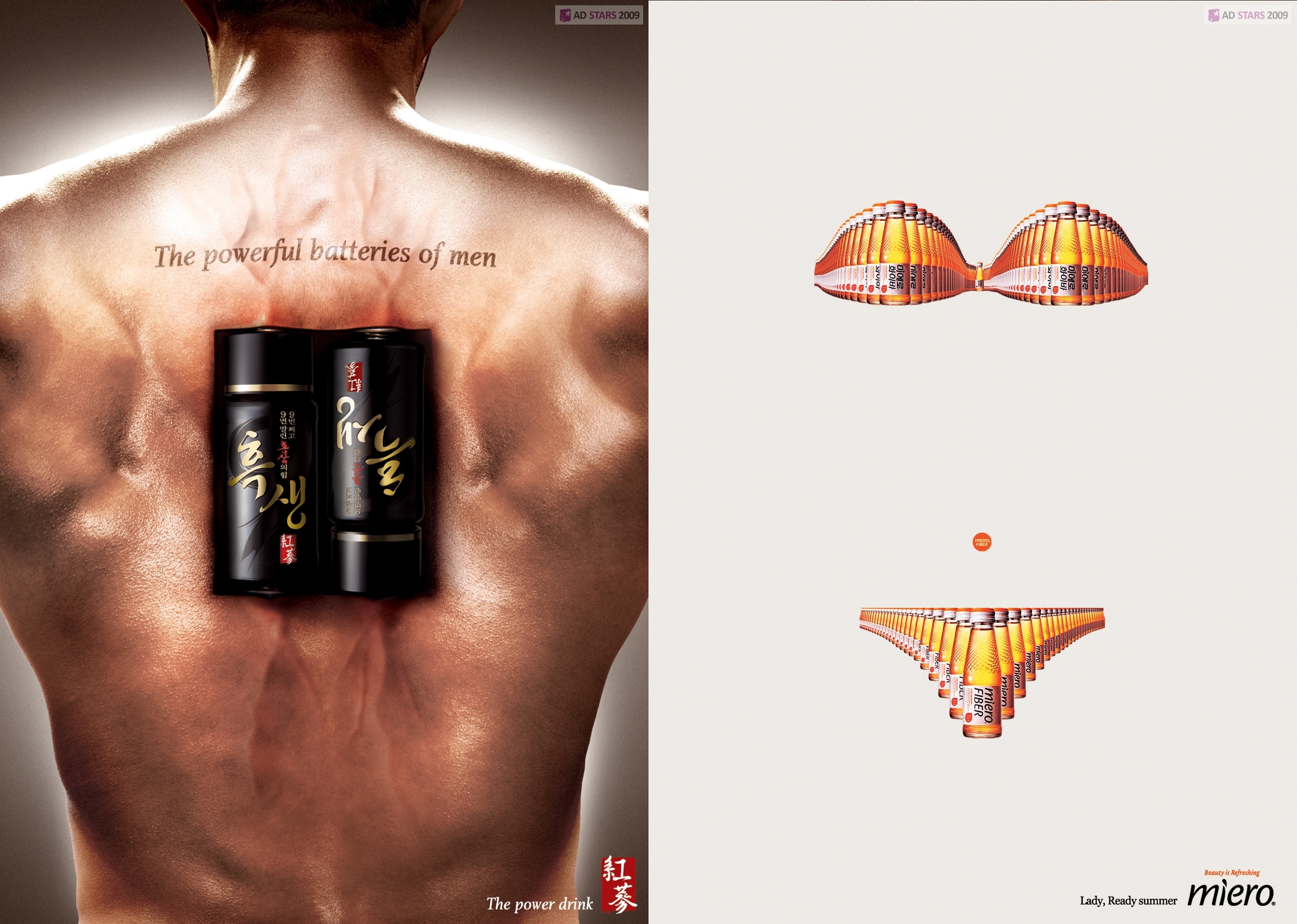
After writing about double-standards in the objectification of men’s and women’s bodies in the Korean media last month, this month I was looking forward to wrapping that up. Finally, I thought, I’d be able to remove the prominent “Abs vs. Breasts” folder on my Firefox toolbar.

Alas, I’ve decided some more context is needed first. Which by coincidence, also allows me to get rid of the even more embarrassing “Lingerie” folder in the process.

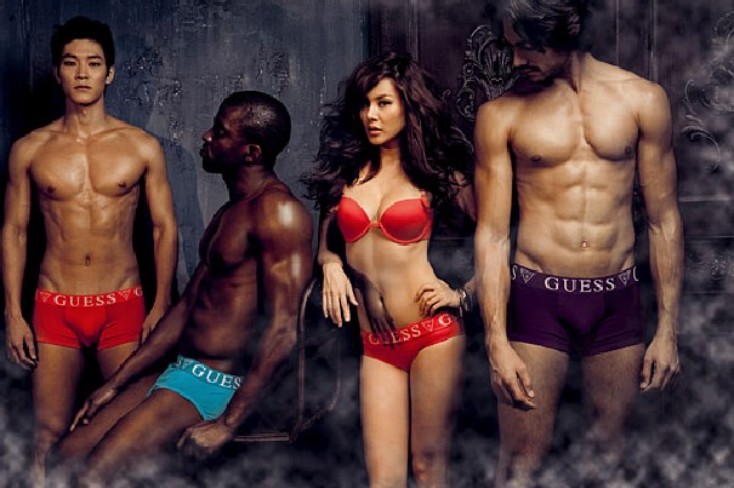
But while the topic sounds facetious perhaps, having overwhelmingly Caucasian models in lingerie advertisements has definite effects on how Koreans perceive both Caucasians’ and their own bodies and sexuality. If you consider what Michael Hurt wrote in his blog Scribblings of the Metropolitician back in 2005 for instance:

…One thing that I also notice is that in underwear and other commercials that require people to be scantily-clad, only white people seem to be plastered up on walls in the near-buff. Now, it may be the sense that Korean folks – especially women – would be considered too reserved and above that sort of thing (what I call the “cult of Confucian domesticity”). Maybe that’s linked to the stereotyped expectation that white people always be running around all nasty and hanging out already, as is their “way.” Another possibility has to do with the reaction I hear from Korean people when I mention this, which is that white people just “look better” with less clothes, since Koreans have “short leg” syndrome and gams that look like “radishes.” The men are more “manly” and just look more “natural” with their shirts off…

Then I’m sure you’ll appreciate that while that artificial dichotomy between “naturally” nude, more sexual Caucasians (and by extension, all Westerners) and more modest, virginal, pure Koreans is neither new, solely confined to Korea, nor wholly a construct of the Korean media, at the very least this odd feature of Korean lingerie advertisements certainly helps sustain it. And that dichotomy has largely negative effects on all Westerners here, especially women.
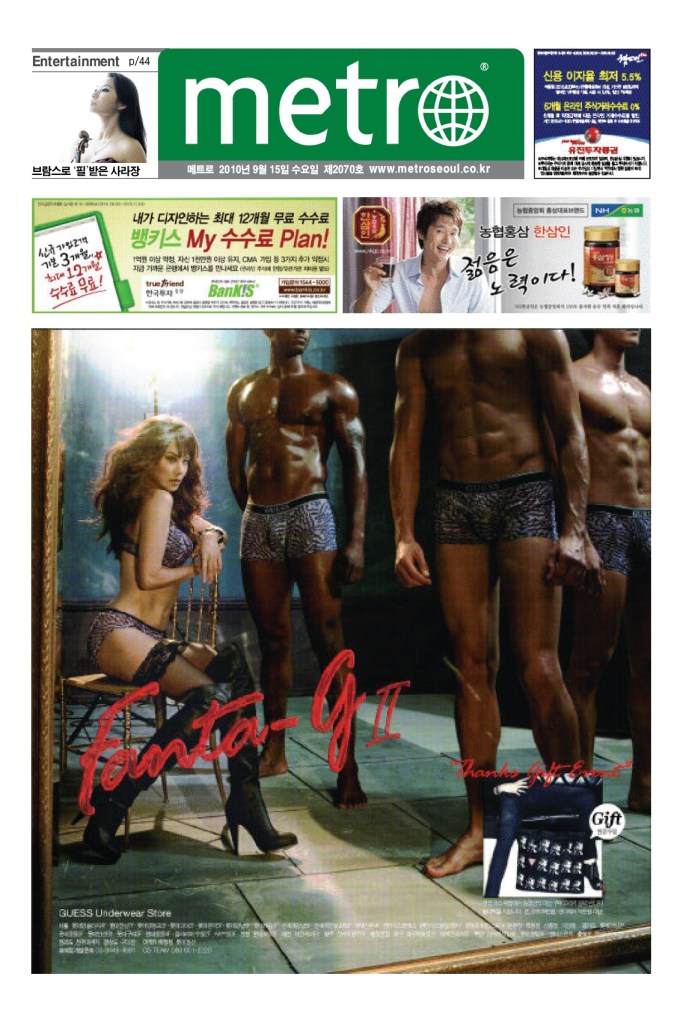
( Caucasian models used for the first erect nipple ever featured in a Korean ad {see here also}. Source: Metro, July 8 2010, p. 7. )

Already having discussed the evidence for and consequences of the sexualization of Caucasian women in great depth last September however, then let me just quickly summarize relevant points from it here:

Empirical studies have shown that Korean women’s magazines have a disproportionate numbers of Caucasian female models in them, with some even have more Caucasian models than Korean ones overall. Unfortunately though, none of those studies made any distinction between lingerie and non-lingerie advertisements.

Before laws banning foreign models were lifted in 1994, many Korean female porn stars were also lingerie models, which discouraged female models from lingerie modeling. This fact only really became public in June 2008 however, which explains why those earlier studies didn’t take it into account (or Michael Hurt back in 2005).

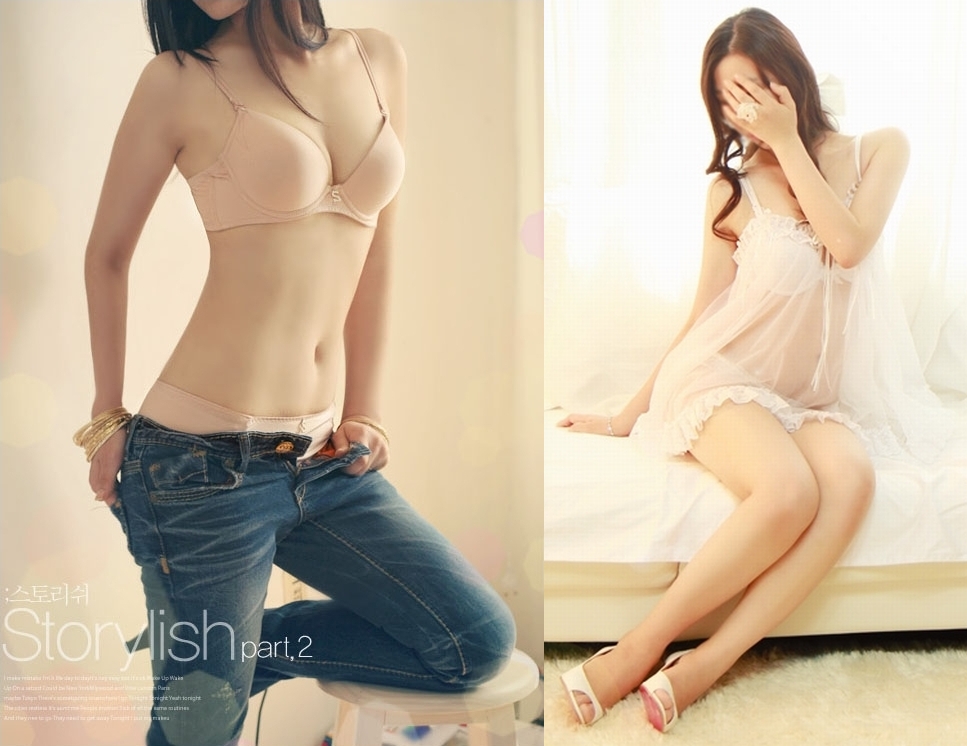
Of course, there have always been exceptions, with the Yes’ company especially having no qualms about using Korean models. But for other companies, they are usually anonymous, with either their heads not being visible or them literally covering themselves up by whatever means available. See the examples below from Korean lingerie company StoryIS’s website for instance, or #3 here, where the Korean female models look simply absurd hiding under large hats and sunglasses.

Update: I forgot to mention lingerie infomercials, on which it’s common to see Caucasian models wearing the lingerie alongside fully-clothed Korean models carrying the lingerie on coathangers.

Moreover, when female celebrities are used, they are invariably fully-clothed. And so much so in fact, that it’s no exaggeration to say that they may not have been actually wearing the advertised lingerie at all considering that you couldn’t actually see it.

( Sources: left, right )

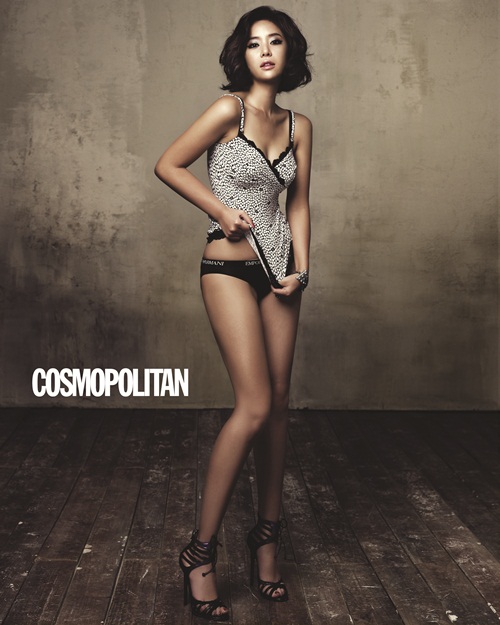
But that was over a year ago. At the end of that post though, I did note a (then) recent advertisement by Shin Min-a that you could see it in, and simply had no idea that it was just the beginning of a veritable flood of celebrity lingerie photoshoots thereafter. Finally noticing by the following summer though, by its end I had: Ivy (in the opening image); Shin Min-a (again); Park Han-byul; Seo-woo; Girls’ Day; Gong Hyo-jin; Song Ji-hyo; LPG; Min Hyo-rin; Lee Si-yeong; Shin Se-Kyeong; and Yoon Eun-hye in that infamous “Lingerie” folder.

Then I discovered a Korean blog on lingerie while researching this post, and from just one post there I learned that I had to add at least Baek Ji-young, Lee Hyori, Seo In-young, Hyuna, Hyo-min, and Yu-jin to that list also…by which point I frankly gave up keeping track. And belatedly realized that, of course, Korean celebrities have actually been modeling lingerie for far longer than just the past year (I’d completely forgotten about this example for instance).

But still, I think it’s no coincidence that I would notice so many photoshoots in such a short space of time. And for that reason, would argue that the most recent ones at least should definitely be seen in the wider context of Korean entertainment companies’ ever-increasing need for the greater exposure (no pun intended) and differentiation of their celebrities in order to maximize profits. Recall what I wrote of the ensuing objectification of male singers for instance:

…whereas it’s mostly young girl-groups that have sprung up in the past year or so (see here for a handy chart), likewise Korean male singers have to adapt to the Korean music industry’s overwhelming reliance on musicians’ product endorsements, appearances on variety shows, and casting in dramas to make profits (as opposed to actually selling music). This encourages their agencies to make them stand out and differentiate themselves from each other by coming up ever more sexual lyrics and/or performances and music videos: namely, more abs from the guys, let alone feigned fellatio, feigned sex on beds, or even virtual rapes of audience members on stage during performances.

Regardless of the motives however, on the positive side surely these photoshoots can not but help to remove the stigma associated with the industry in Korea? And, once that’s been achieved, then that will in turn begin to (at least slightly) challenge that hypersexual Caucasians vs. chaste Koreans dichotomy as mentioned earlier.

( Source )

But in reality, perhaps things will not be quite as quick or as simple as that. For while I merely bookmarked those photoshoots as they came up in K-pop blogs, in hindsight I should also have been making the following distinctions between them:

  1. Advertisements for lingerie companies in which just the lingerie is worn
  2. Advertisements for lingerie companies in which the lingerie is hidden partially or completely under clothing
  3. Photoshoots for men’s or women’s magazines like Maxim and Cosmopoltian
  4. Korean Gravia photoshoots

And from what I can tell now, most of the them seem to be #3, with Ivy’s opening newspaper cover probably being the most prominent exception (and what prompted this post). Hoping to find an authoritative Korean perspective on all that as I begin working on this post then, probably by no coincidence – I guess wasn’t the only person to notice this trend – Yahoo! Korea linked to what appeared to be precisely that the next day, and so I happily translated it that same night.

In the light of the next day though, I was simply stunned at its terrible quality, and after trying to edit it to some level of coherence but abjectly failing, gave up on the post in disgust; regularly complaining about Korean portal sites, then I should have known better really. But 3 weeks later, I realize that it would be a pity to waste all that time spent translating, and that at the very least fans of Hwang Jung-eum (황정음) and High Kick Through the Roof (지붕킥) may still like it. And who knows? You may be able to gain some insights from it that I missed.

But if not, then let me end this post here by apologizing in advance if I have possibly conflated Caucasians with Westerners too often and too readily in this post, but which is frankly difficult to avoid in a post focused on the former, but raising issues that still have large effects on the latter. And to better understand that, at the suggestion of a reader I now have Imperial Citizens: Koreans and Race from Seoul to LA by Nadia Kim (2008) sitting on my desk, which will be my reading for my flight to Boston next week!^^
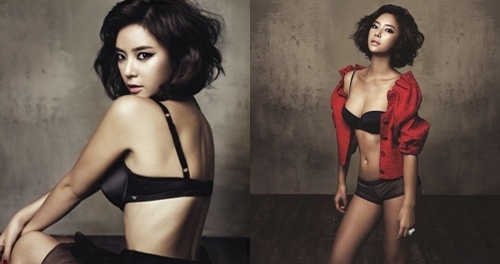
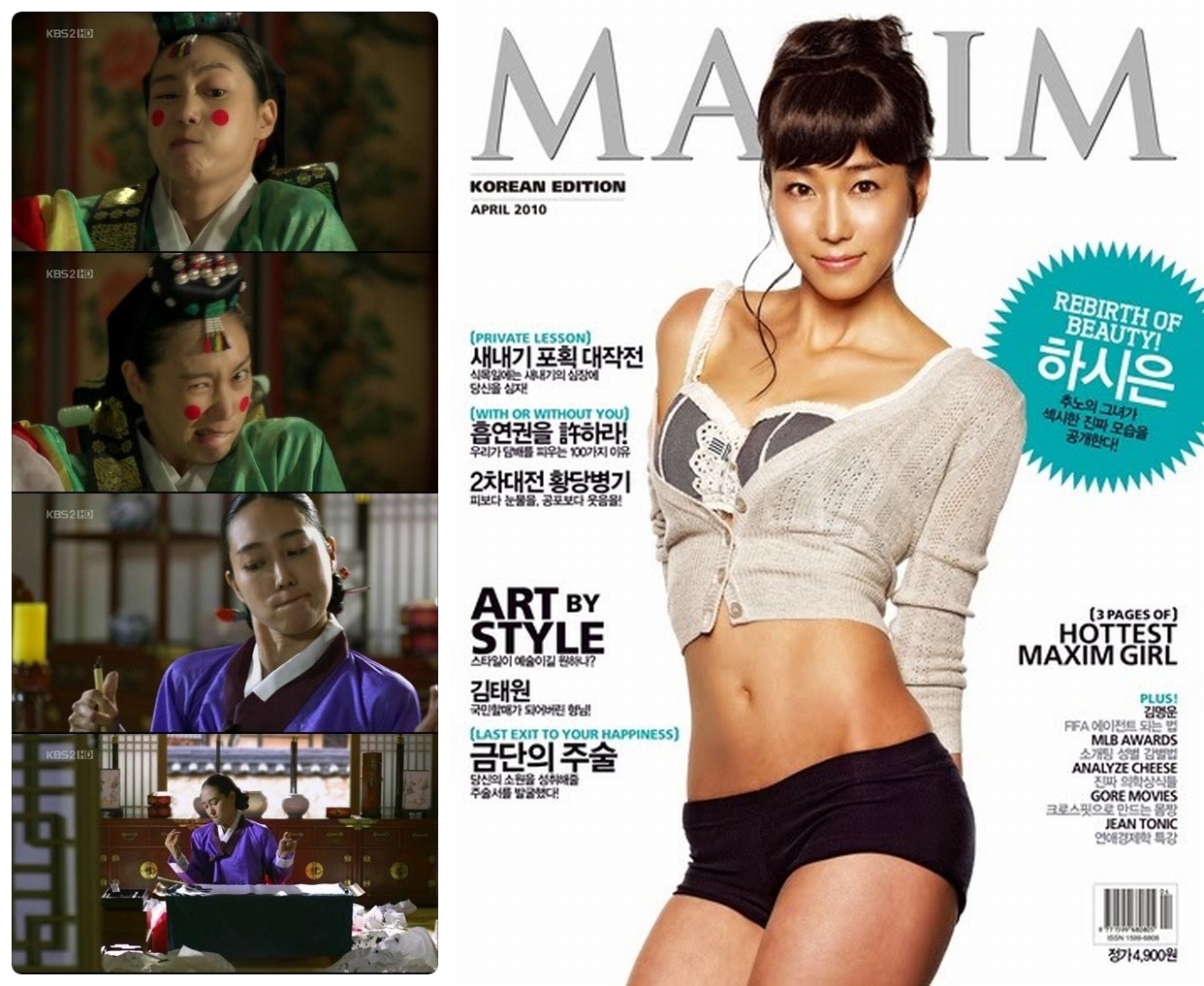
황정음 속옷화보, 득보다 실이 많은 노출

Hwang Jung-eum Loses More than She Gains by Showing Her Body

황정음이 속옷 화보를 찍었네요. 그동안 깜찍하고 귀여운 얼굴만 보다가 섹시하고 볼륨감 있는 그녀의 노출 사진을 보고 조금 놀랐어요. 노출 정도가 생각보다 파격적이고 아찔하기 때문이에요. 황정음은 이번 노출이 처음이라고 하는데요. 처음치고는 너무 도발적이고 과감한 노출이에요. 그만큼 몸매에 자신 있었기 때문이겠죠. 요즘 속옷 화보는 신세경, 한예슬도 찍었고 TV광고에도 나오고 있는데, 노출이 심한 편이 아니죠. 몸매 노출보다 속옷에 더 비중을 뒀기 때문이에요.

Wow, Hwang Jung-eum has done a lingerie photoshoot. So far, we’ve only ever really seen her small, cute face, so I was a little surprised by her sexy, curvaceous body in these photos. Because she showed so much more than I thought, I’m really a little light-headed too. This is the first time she’s showed so much of her body like this, and it’s much more provocative than I would have expected for her first time; I guess she was confident about her body. These days, Shin Se-kyeong and Han Ye-seul have appeared in lingerie photoshoots and television advertisements, and [yet] in those the amount of exposure tends not to be so serious. In those, the focus is more on the lingerie than their bodies.

속옷 광고 화보는 잘 나가는 여자 톱스타들만 찍는다고 하죠? 고소영, 송혜교, 김남주, 김태희 등 당대 톱스타들도 유명 속옷 광고를 찍었어요. 그런데 이들의 속옷 광고는 S라인만 자랑할 뿐 노출이 거의 없습니다. 말 그대로 속옷을 광고한 화보였고 몸매 자랑을 한 것이 아니었어요. 보통 무명 연예인들이 속옷 광고를 찍을 때는 노출 수위가 높아집니다. 그런데 나중에 유명 배우가 된 뒤 이런 노출 화보로 굴욕을 당하기도 합니다. 모델 시절 속옷만 입고 해맑게 웃고 있는 홍수아의 속옷 화보도 한 때 인터넷에서 화제가 되기도 했어요. 그리고 수애, 오윤아도 데뷔 전 속옷 화보에 출연한 경험이 있고요.

Only women who are already well on the route to becoming top-stars do lingerie advertisement photoshoots, yes? Go So-young, Song Hye-gyo, Kim Nam-joo, Kim Tae-hee, and others [at] that age have all appeared in lingerie advertisements for famous brands. However, in those showing off and exposing their S-lines is almost completely absent. Indeed, there are virtually none that show off the model’s body. Take more common ones featuring unknown models however, and the level of exposure goes up markedly. And if that woman becomes famous later, then this might come back to haunt her. For instance, Hong Soo-ah appeared in one wearing just lingerie and a bright smile, and this become a hot internet topic later. And Soo-ae and Oh Yoon-ah also have the experience of modeling lingerie before becoming famous.

그런데 일부 스타의 경우 지나친 노출 속옷을 찍어 구설수에 오르기도 했죠. 가수 아이비도 얼마 전 속옷 화보를 찍었는데, 노출이 너무 파격적이라 네티즌들의 입방아에 오르내리기도 했어요. 속옷 모델이라 어느 정도의 노출은 당연하지만 플레이보이 잡지를 연상케 하는 놰쇄적인 느낌이 너무 강했기 때문이죠. 속옷보다 아이비의 몸매가 더 시선을 끌었으니 주객이 전도된 경우라 할 수 있어요.

( Source )

In some stars’ cases, showing far too much in lingerie photoshoots gave rise to them being the subjects of malicious gossip and rumors. For instance, a little while ago Ivy [above] was in one. Because she showed so much of her body, a lot of netizens were gossiping about her. And while of course lingerie models have to show at least little of their bodies, in her case it was so much that it reminded you of Playboy magazine. Even though the photoshoot was supposedly for  showing off the underwear, it seemed to be showing off Ivy’s body far far more.

그렇다면 황정음의 경우는 어떨까요? 황정음의 속옷화보도 아이비에 버금갈 정도에요. 한번도 노출을 하지 않다가 왜 이렇게 파격적인 노출을 했는지 모르겠네요. 가슴이 훤히 드러난 사진을 보면 깜찍함은 온데 간데 없고 섹시함이 풍기는데 그리 귀티나는 이미지는 아니에요. 섹시미가 보이긴 보이는데, 인위적인 느낌이 든다고 할까요? 그리고 가슴이 드러난 사진은 뽀샵 흔적이 너무 강하네요.

If so, what to make of the case of Hwang Jung-eum? It’s very similar to Ivy’s. She’s never done anything like this before, so I don’t know why she suddenly appeared in such a revealing photoshoot. Her breasts are very exposed, she’s lost her cuteness, and while she gives off some sexiness she’s not very elegant-looking. Moreover, don’t you feel her sexiness is a little artificial? And there are signs that her breasts have been heavily photoshopped too.

요즘 ‘자이언트’ 촬영하면서 체중이 6kg 늘었다고 하는데, 다리를 보니 ‘말라깽이’ 그 자체네요. 보정작업 흔적이 역력한데 소속사는 촬영 후 보정을 하지 않았다고 합니다. 눈에 빤히 보이는 거짓말이죠. 황정음만 하는 것이 아니라 모든 모델이 뽀샵을 하는데, 왜 굳이 하지 않았다고 하는지 모르겠네요.

These days, while shooting for the drama Giant she gained 6kg, but her legs remain extremely thin. There are obvious signs that this was compensated for in the photos then, but her agency says this didn’t happen. But you can tell this is a lie. And it’s not like Hwang Jung-eum is the only model that gets photoshopped, so I have no idea why her agency would so adamantly deny it.

황정음 속옷 화보는 신세경과 비교해 보면 알 수 있어요. 신세경의 속옷 화보는 드레스에 속옷이 보일듯 말듯한 신비주의 컨셉으로 찍었어요. 이는 신세경의 청순미와 신비주의 컨셉이 딱 맞아 떨어진 절묘한 사진에요. 사실 이런 화보가 여배우에게 좋은 이미지를 남길 수 있어요. 물론 노출이 무조건 나쁘다는 것은 아니지만 황정음의 노출 화보는 그동안 쌓아놓은 깜찍 이미지를 한꺼번에 날릴 수 있는 위험한 화보에요. 지금 황정음은 나름 톱스타기 때문에 굳이 노출 화보를 찍을 이유가 없어요.

If we compare Hwang Jung-eum’s photoshoot with Shin Se-kyeong’s then I think we can learn the reason. The concept of Shin Se-kyeung’s photoshoot is a mysterious and subtle one that has the lingerie under the dress, leaving us always guessing as to whether we can see it or not. This mysterious and innocent-beauty concept is well suited to her image, and in fact it does no harm to any female actor. In contrast, while of course showing off one’s body is not bad per se, Hwang Jung-eum has long cultivated a very cute image and there is a danger that she’s ruined it all at once with this photoshoot. And seeing as she’s sort of a top star already now, then I don’t know the reason why she did it.

황정음은 ‘지붕킥’ 이후 돈과 인기를 한번에 거머쥔 스타인데, 화보촬영으로 돈을 더 벌려한 것은 아니라고 봅니다. 그렇다면 배우로서 깜찍, 엉뚱 이미지를 벗기위한 노출이라고 볼 수 있는데요. 한 번에 너무 파격적인 노출을 하다보니 그녀의 속옷 화보를 보고 당황스러운 사람이 많을 겁니다. 같은 속옷 화보를 찍어도 배우에 따라 그 느낌이 다른데, 황정음은 신세경, 한예슬과는 달리 ‘싼티’가 좀 풍기네요. 소속사는 다양한 모습의 황정음이 있다고 봐달라며 절대 이미지 변신을 위한 파격적인 시도는 아니라고 강조했는데요. 사진은 아찔한데 어떻게 그냥 일반적인 화보로 봐달라는 건지 모르겠네요.

( Source )

Hwang Jung-eum suddenly gained a lot of money and popularity through appearing in High Kick Through the Roof, so she didn’t do this photoshoot for the sake of money. Perhaps then, it was in order to lose her cute image gained through acting, even though many people will be confused by it because it is so revealing? But different actresses can do the same kind of lingerie photoshoots [James: this contradicts all the above, as they are quite different] and give off quite different impressions, and unlike Shin Se-kyeung or Han Yae-sul, Hwang Jung-eum comes across as very cheap. However, her agency stress that this photoshoot was absolutely not done to change her image, just to show a different side of her. Yet how can anyone claim it is just your average, run-of-the-mill lingerie photoshoot?

‘ 자이언트’에서 황정음은 가수 이미주로 출연하고 있는데, 주상욱과의 키스신으로 얼마전 남친 김용준이 키스장면을 보며 담배를 물고 있는 사진이 화제가 되기도 했지요. 이번 속옷 화보 촬영에 김용준은 쿨하게 응원을 해주었다고 하는데, 황정음의 노출사진이 수많은 남자들에게 공개되는데 쿨한 반응을 보였다니 의외네요. 주상욱과의 키스신보다 속옷 화보가 낫다고 본 건가요?

In Giant, Hwang Jung-eum plays the singer Lee Mee-ju, and in reaction to one scene in which she kisses her partner (actor Ju Sang-wook) her real-life boyfriend (singer Kim Young-jun) posted a spoof picture of himself biting a cigarette in anger at seeing it on the internet. And in reaction to her photoshoot, he was very cool about it, which was surprising: who would be so cool about having his girlfriend exposed to so many other men? Did he really think that that was better than the kiss scene?
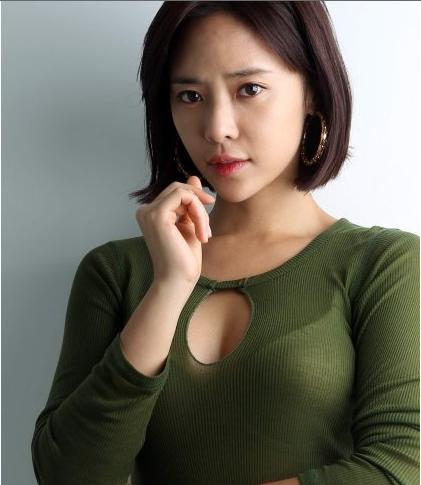
여자 연예인들에게 화보촬영은 자신의 가치를 드러낼 수 있는 아주 좋은 기회죠. 해마다 여름만 되면 너도 나도 비키니 몸매를 자랑하는 것도 자신의 상품성을 과시(?)하는 것이라고 볼 수 있어요. 황정음도 자신의 상품적 가치를 더 높이기 위해 이번 속옷 화보를 찍었을 겁니다. 그러나 이번 속옷화보 촬영은 황정음에겐 득보다 실이 많을 것 같네요. ‘지붕킥’으로 대박스타가 된 그녀는 정극 ‘자이언트’에서 연기력 논란을 빚기도 했는데, 배우로서 연기로 승부하는 것보다 노출로 승부한다는 느낌을 줄 수 있기 때문이에요. 그런데 그 노출이 인위적인 뽀샵으로 귀티보다 ‘싼티’가 나는게 더 문제가 아닐까요?

Photoshoots are a good opportunity for female entertainers to demonstrate their worth. Just like every summer we can see women showing off their bodies in bikinis, which also is like demonstrating their product value [James: that’s literally what it says]. But Hwang Jung-eum did the photoshoot to increase her worth. However, through doing so she actually lost more than she gained, because while she became a big star through High Kick Through the Roof, now she is appearing in the much more conventional drama Giant, in which her acting abilities have been questioned. In light of this, then at the very least the photoshoot seems very badly-timed, and surely not appearing elegant but instead literally overexposed and heavily photoshopped is in fact much more of a problem for her than a benefit?

‘지붕킥’에서 깜찍한 춤과 애교 연기로 하루 아침에 벼락스타가 된 것에 대해 황정음을 곱지 않은 시선으로 보는 사람들도 많습니다. ‘잘 나갈 때 조신하게 행동해라’는 말과 달리 황정음은 노출화보를 찍는 등 오히려 더 오버하고 있는 듯 합니다. 벤츠를 타면서도 노출 화보를 찍은 황정음을 곱게 보는 사람은 많지 않아요. ‘자이언트’를 통해 정극 연기 도전을 하는 황정음은 오직 연기력으로 배우 수명을 오래가게 할 수 있는 길을 찾아야 합니다. 노출 화보는 황정음에게 독이 될 수 있으니까요.

Through her cute dancing and aegyo in High Kick Through the Roof, Hwang Jung-eum became famous almost literally overnight, which many people seem to resent. Rather than following the old adage to behave well while one is in the spotlight however, rather this photoshoot of hers is just too much, and there are not many people who would have done while already rich enough to drive a Mercedes Benz. With Giant, Hwang Jung-eum was presented with a challenge that she could have used to increase her acting ability and sustain a long acting career. Unfortunately, she seems to have squandered it with this photoshoot. (end)

( Source )

p. s. Not related to Korea, but you may also enjoy the post Lingerie as liberating? from Sociological Images on a woman (in an advertisement) feeling “hot” as a result of wearing lingerie, only then to cover it up with a burqa

(For all posts in the Korean Sociological Images series, see here)

Share

Korean Sociological Image #51: Male Objectification and Double Standards

What would be your reaction if this flashed on your TV screen?

Mine was that hard abs aren’t the best analogy for airbags. But my mistake: they’re not supposed to be. Rather, Hyundai needed something to signify the number of airbags as the voiceover went through various specs of the car.

Which, to be fair, is much clearer in the full commercial.

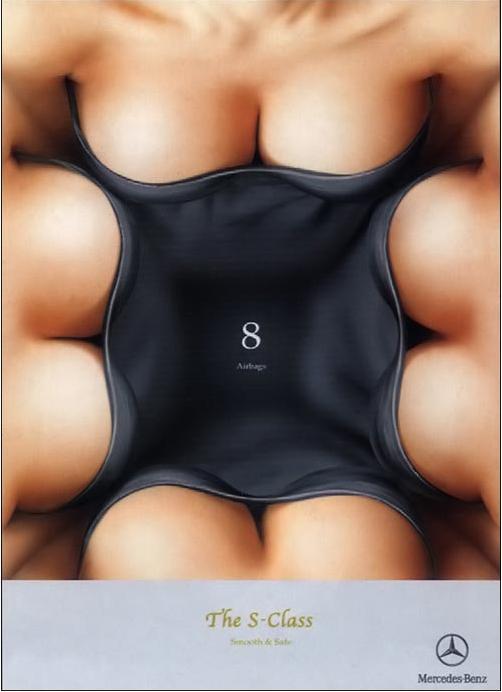
How about if a proper airbag analogy had been used instead, like Mercedes Benz did back in 2006?

(Source)

If you found that objectification distasteful however, then consider the following from Renault/Samsung in 2008 below also:

Which uses the same analogy, but is clearly quite a contrast to BMW’s puerile effort. Nevertheless, some commenters on an earlier post (update: since deleted sorry!) did still have some issues with it, whereas nobody on this blog at least has had any with all of the men’s 6-packs that suddenly started appearing in Korean commercials from last year.

But I’m sure you’re already well-aware of that double-standard, so the purpose of this post is not just to draw your attention to it. Nor to simply pass on that juxtaposition of advertisements, however interesting. In combination with a recent development in the Korean media though, what that juxtaposition did serve to do was make me realize both the rapid mainstreaming and dogmatic nature of that double-standard here, and which is a combination that I think is pretty unique to Korea too.

Let me explain.

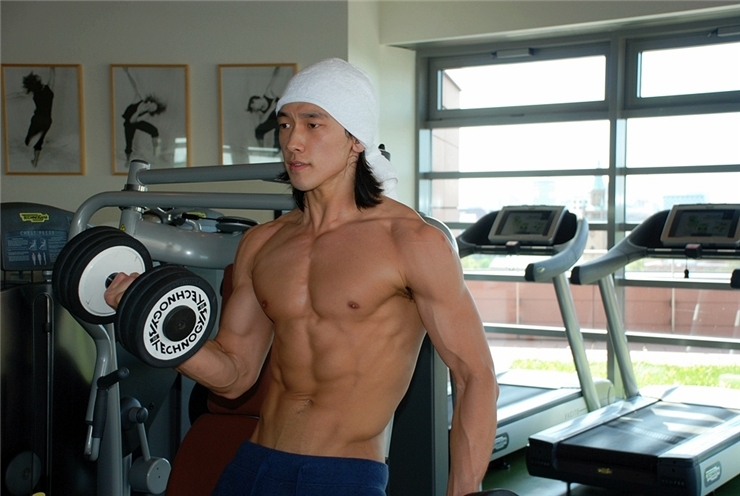
Actually, the first I already have: consider how popular the new buzzword “chocolate abs” (초콜릿복근) is in the Korean media now as a result of all the recent ads featuring them for instance (see here, here, here, #8 here, and this new one below for examples and/or discussion), whereas it didn’t even make a list of buzzwords at the end of last year.

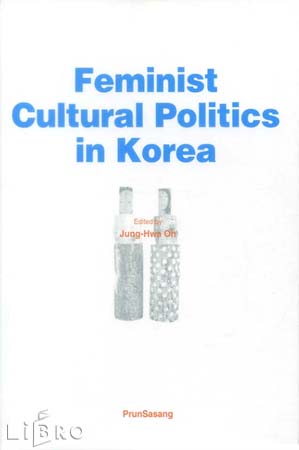
Against that sudden popularity however, you could argue that they’ve actually already been around for a long time in music videos. As Hoon-Soon Kim explains of some from 2000 in “Korean Music Videos, Postmodernism, and Gender Politics” in Jung-Hwa Oh (ed.), Feminist Cultural Politics in Korea (2005) for instance, albeit with more of a focus on the emergence of the “Flower Men” or kkotminam (꽃미남) phenomenon than male objectification per se:

…we see that there is a new type of male image emerging albeit in a small number of music videos. It is a de-gendered image of men which is a contrast to the macho image. Male groups such as Y2K, H.O.T., ITYM, and Sinwha, whose fans are mostly teenage girls, portray this image. They wear make-up and a lot of jewelry and ornaments – which are all considered feminine – and take off their shirts to show off their bodies. This indicates that the male body is also sexually objectified as the female body….The style of the video is similar to that used to show female images with extreme close-ups to fill the screen with a face, and medium-range or full body shots for dances. Although there is a risk of overstating the phenomenon, this image could be interpreted as a signal indicating the possibility of breaking the binary boundaries of men and women that have been formed in a patriarchal culture. (p. 207)

And yet just like in ads, the amount of male objectification in music videos—or to be specific, ab exposure—does also seem to have picked up markedly in the past year or so. Like Multi explained back in March:

…in the past month the internet has been flooded with pictures of Korean celebrities and their abs (as well as some other shots that are not entirely SFW – you’re over 18 you can check them out here, and here). Our favorite controversial band 2PM just did an extensive photoshoot and were topless for most of it (parts 1, 2, 3, 4). Lee Joon of the new boy group MBLAQ flashes his abs a whole lot, because the king of ab-flashing, and Korean superstar extraordinaire, Rain, who happens to be his boss, tells him to because the fans like it, (yup, we sure do ;) and everyone wants to get pictures of them (exhibit A, B, C, among countless others). Then there’s these guys, this guy and this guy, and like 50 others. And then countless polls as to whose abs are better.

To be precise, Rain told Lee Joon that taking off his shirt has far more effect on his audiences than his dancing. And as “the king of ab-flashing”, then of course he could have been talking about himself instead (actually, I thought he was originally), so I can hardly fault him for showing off his own abs so frequently in his own music videos and performances. But rarely in harmony with his song’s lyrics and/or even his choreography however, and so for me personally he more epitomizes just how cynical and commercially-driven the trend has become, with obvious parallels to more familiar ones for female performers. Check out from 2:55 here for instance:

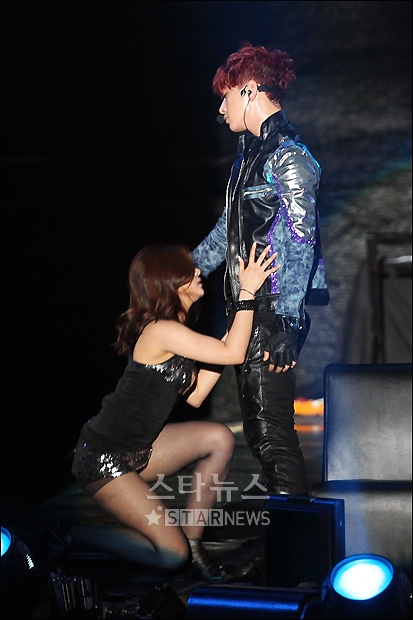
And my critique of the trend as “commercially-driven” is no mere cliche, because whereas it’s mostly young girl-groups that have sprung up in the past year or so (see here for a handy chart), likewise Korean male singers have to adapt to the Korean music industry’s overwhelming reliance on musicians’ product endorsements, appearances on variety shows, and casting in dramas to make profits (as opposed to actually selling music). This encourages their agencies to make them stand out and differentiate themselves from each other by coming up ever more sexual lyrics and/or performances and music videos: namely, more abs from the guys, let alone feigned fellatio, feigned sex on beds, or even virtual rapes of audience members on stage during performances.

Allkpop argues that it’s consumers that are driving this trend however, and that this explains the imbalance between new girl and boy groups:

It looks like girl groups don’t seem to have as high of a failure rate as boy groups or solo singers. These new girl groups have already been gaining so much attention. The reason why you can rely on girl groups to bring in the income is because there’s always teenage boys and ahjusshi (old men) fans to trust. They can also go perform at various events which always require a pay day. Supposedly, Secret gets paid around $8000 per event performance while a group like 4minute gets paid around $12,000 per event.

And yet while that is not incorrect per se, Multi goes on to explain in her post that it is largely female fan club members in their 30s and 40s that are driving this trend, not unlike how I’ve demonstrated that the same demographic (and often exactly the same women) were the driving force behind the full emergence of the kkotminam phenomenon back around the time of the 2002 World Cup. Hence I’d argue that the imbalance is more the result of top-down imperatives then, with many similarities to the American media ideal of female sexuality getting progressively younger over the last 3 decades…and for the same profit-driven motives.

But I digress: for more on that, see a forthcoming Part 2 of my “Reading the Lolita Effect in South Korea” series, which I’ll link to here once it’s up (update: and here it is!). In the meantime, hopefully by this stage you can see why celebrities so dominate advertising here, and which is already an industry not exactly averse to perpetuating celebrities’ agencies’ inherent needs to use sex to sell. Moreover, whereas it’s true that the content of ads worldwide does tend to lag behind social trends, as even just the title of Kwangok Kim and Dennis Lowry’s journal article “Television Commercials as a Lagging Social Indicator: Gender Role Stereotypes in Korean Television Advertising” in Sex Roles, Vol. 53, Nos. 11/12 December 2005 suggests, once they do start appearing in ads then that wider exposure (no pun intended) can have a profound effect in mainstreaming them:

According to cultivation theory, the media play an important role in creating distorted views. This theory suggests that exposure to media content creates a worldview, or a consistent image of social behavior, norms, values, and structures, based on the stable view of society provided by the media. In other words, cultivation theory posits that consistent images and portrayals construct a specific portrait of reality, and as viewers see more and more images, they gradually come to cultivate or adopt attitudes and expectations about the world that coincide with the images they see. Although this model has typically been employed to explain the impact of of television violence, it also has been applied successfully to the cultivation of attitudes towards gender roles. (p. 902, references removed)

(“Bob’s Television Dream” by Robert Couse-Baker)

And in particular:

Although television viewers often claim that commercials do not affect them in negative ways, repeated images in television advertising may already have created a “mainstreaming effect,” as suggested by cultivation theory. Television has the power to cultivate people to have the same views of the world, for example, stereotypical views of gender roles in our society. In other words, the mainstreaming effect reduces cultural and political differences among television viewers. Studies have shown that heavy television viewing may influence children’s perceptions of behaviors and psychological characteristics associated with gender…and [one other] found that heavy viewers of television commercials among the elderly were more likely than light viewers to perceive characters (e.g., the elderly) in commercials as realistic (i.e., mainstreaming effect). It may not be advertisers’ full responsibility to reflect statistically accurate images of society. However, the burden of responsibility is on the advertisers when they fail to reflect the rapid changes in such stereotypes in our society. (p. 908, references removed)

But still, how exactly does simple exposure to those ads necessarily result in us adopting the attitudes and worldviews contained therein, as if by osmosis or something?

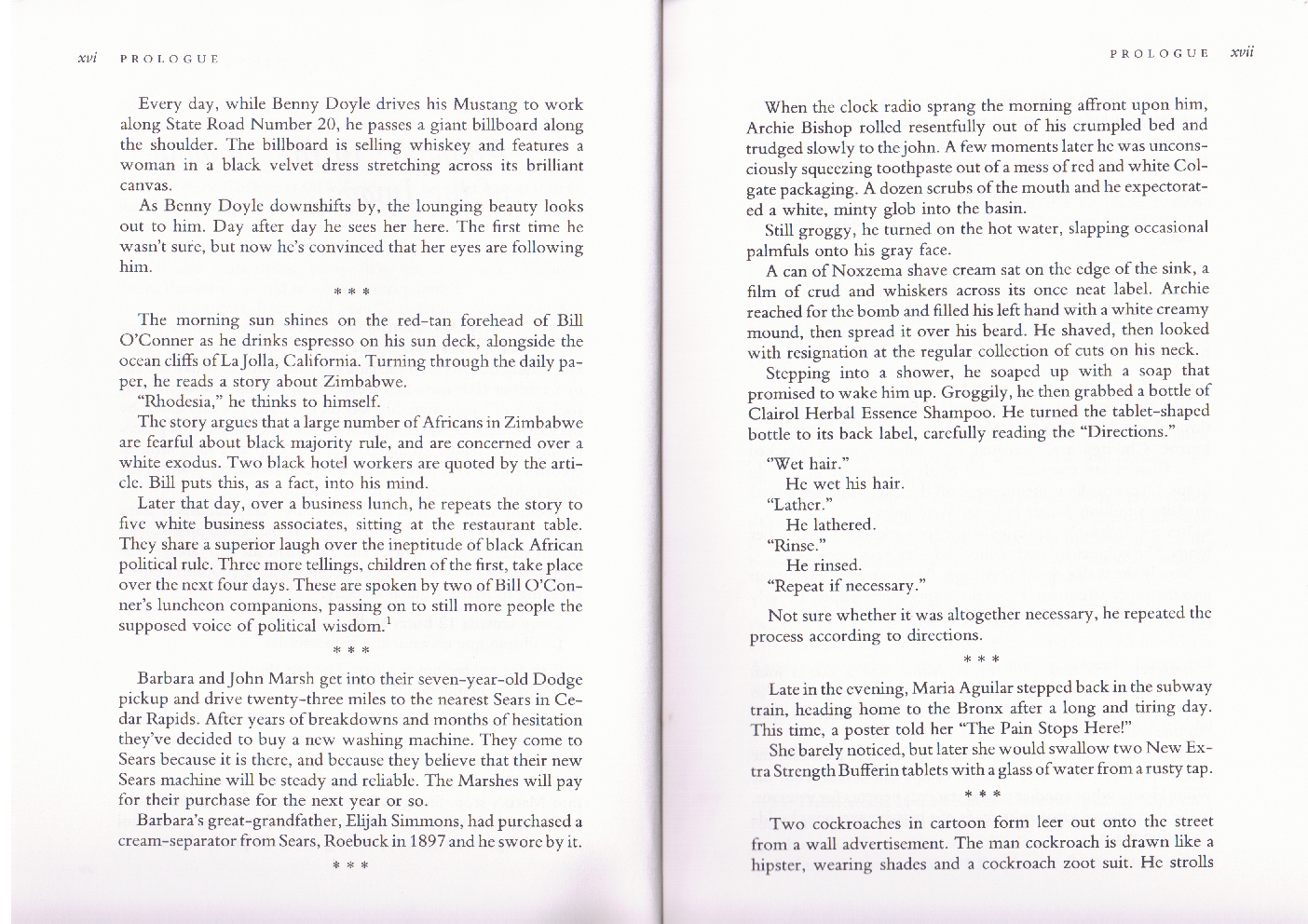
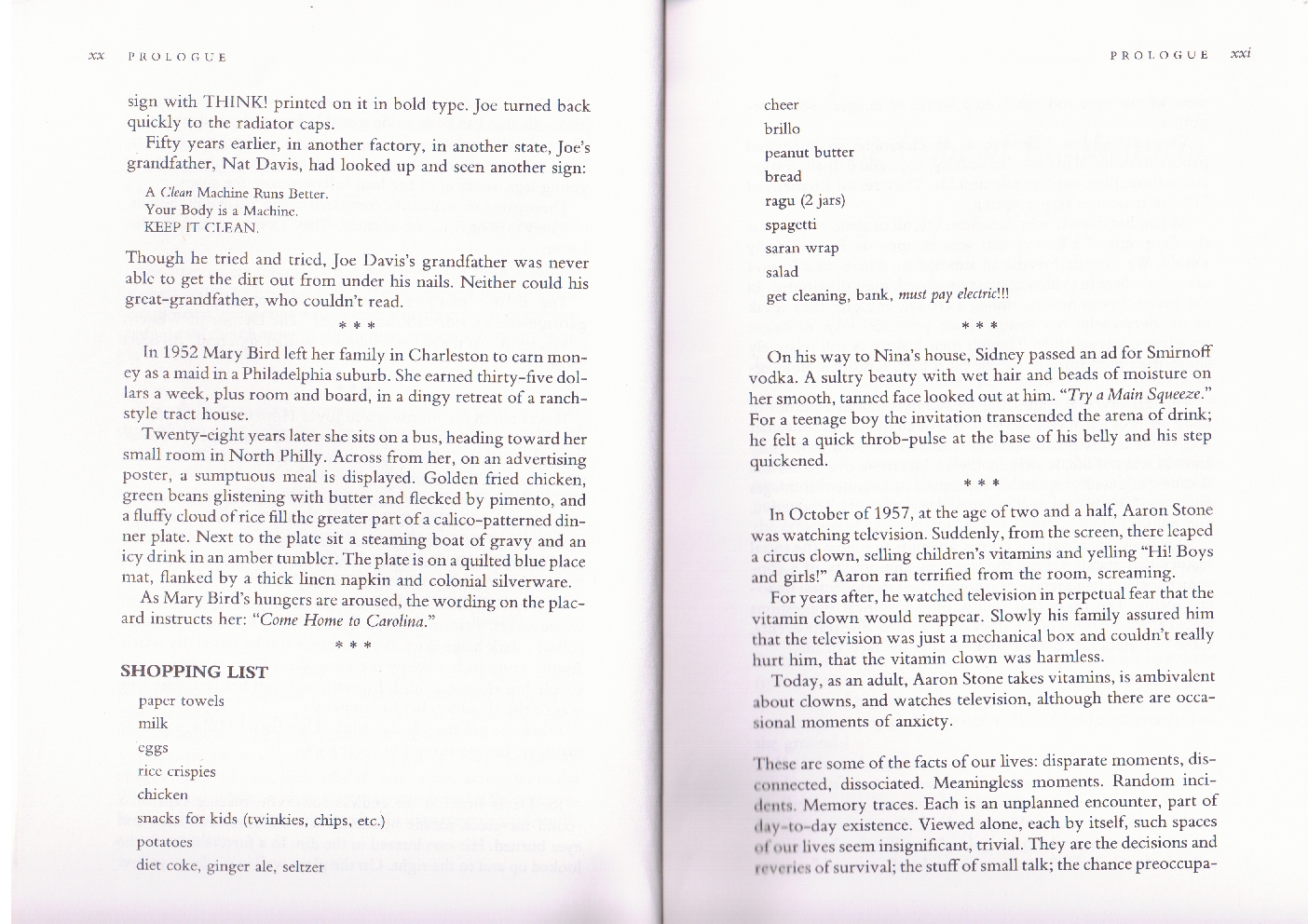
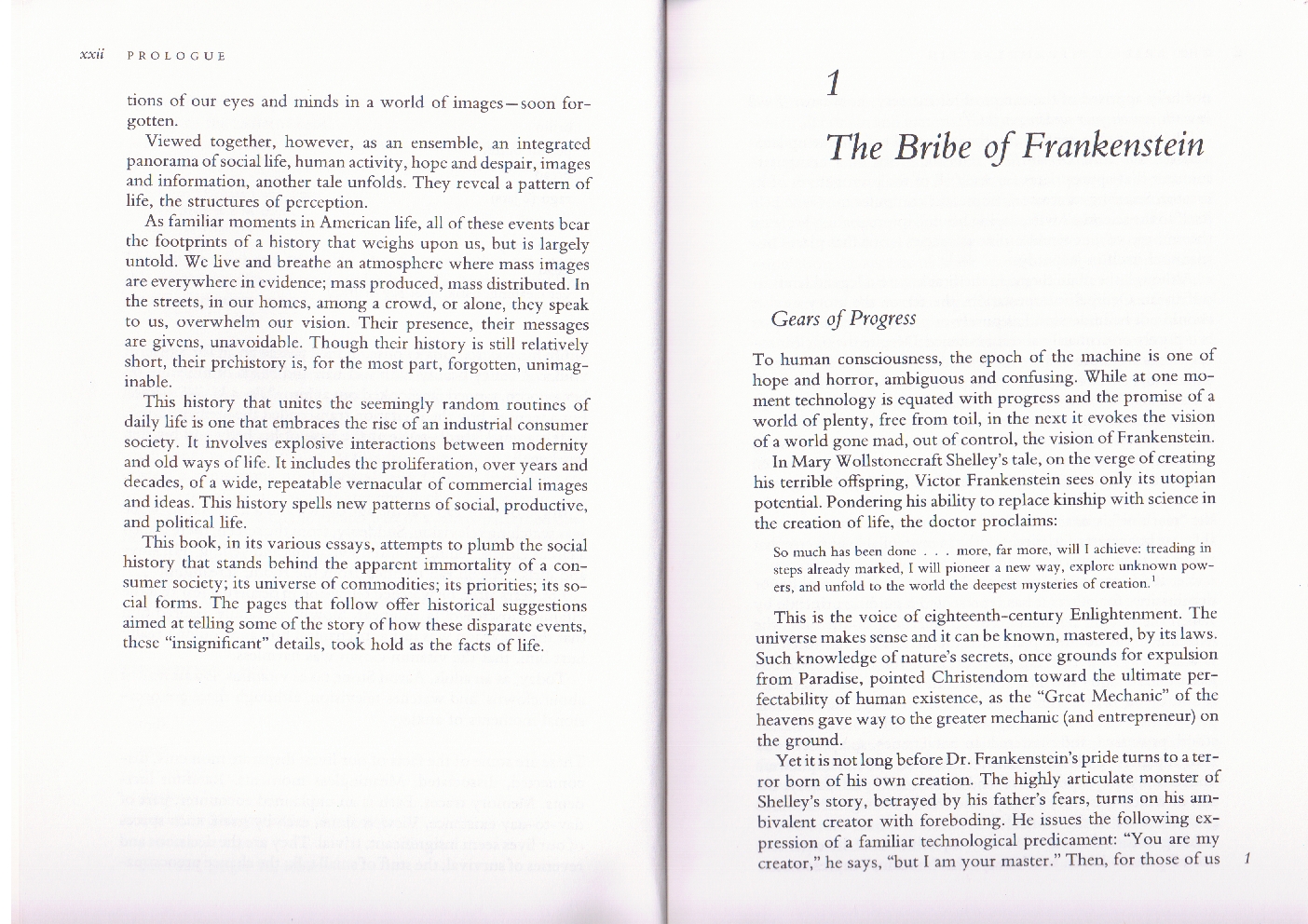
Well first, consider their sheer number: “In the United States alone, the average person may be exposed to 500 and 1000 commercial messages a day”, according to p.34 of Essentials of Contemporary Advertising by William Arens and David Schaefer (2007). And like Stuart and Elizabeth Ewen explain in their prologue to Channels of Desire: Mass Images and the Shaping of American Consciousness (1992), it’s amazing how subtly, profoundly, and almost entirely unconsciously this daily barrage affects us. Quite a charming narrative, which no-one can fail to be more interested in advertising after reading, I’ve scanned it for you below:

But regardless of whatever is ultimately responsible for the timing and/or mainstreaming of men exposing their abs in the Korean media, I’m sure we can all agree that they are now here to stay (and there was much rejoicing). And in a sense, this was indirectly confirmed by SBS recently when it decided to ban female performers from exposing their navels and/or abs on its popular Inkigayo (인기가요) show, whereas male performers remain free to rip off their own shirts: the “recent development in the Korean media” that I referred to in the introduction.

Why is that ban more significant than the plethora of others however? And why is it not exceptional, but in fact genuinely reflects deeply ambivalent and dogmatic societal attitudes to—for want of a better term—women’s top halves? Alas, it was my original intention to jump straight into that second part here, but with this post already at 2000 words (and well overdue), then I’ll wisely defer those 1500 extra ones to a separate post later in the week.

(Source)

Until then, a request, lest anyone feel I’ve been too critical of Rain here: does anybody know the name of a recent music video that features 2 young male singers vying for the affections of a woman, taking off their tops repeatedly (perhaps 10 times) and walking around half-naked for most of the video as they sing…before finally noticing that the woman has taken advantage of their distracted state by stealing their jeep?

Please do pass it on if you do, as I feel it actually much better epitomizes just “how cynical and commercially-driven the [ab-exposure] trend has become” than Rain does, and which even heterosexual women and gay men that see it will probably agree is a little excessive, let alone extremely lame. Moreover, while I don’t claim to have suddenly seen the light as a result, and can now completely empathize with women’s feelings about their own pervasive objectification in the media…I do think the eye-rolling, sense-of-exasperation, and literal gagging I experienced is at least a start towards doing so!^^

Update: With thanks to Katarina, the video is I was Able to Eat Well by 2AM’s Changmin & 8eight’s Lee Hyun:

Clearly, I exaggerated it in my memory. But understandably, as with them so so eager to shed their clothes together in the garage parking lot from roughly 0:59 for instance (for the sake of showing off their abs), that segment at least seriously resembles a gay porn video.

Probably actually objectifying the woman even more than the men though, then I take it all back: Rain’s performances do best epitomize the ab craze!

(For more posts in the Korean Sociological Images series, see here)

Korean Sociological Image #50: The Depths of the Red Ginseng Craze

Vodpod videos no longer available.

Are commercials for this product really the same the world over? Put that to the test by quickly trying to guess what is being advertised above, before all is revealed at o:10.

For non-Korean speakers, the powder shown is a combination of ganghwa-yagssoog (강화약쑥), or “medicinally strengthening” mugwort, and hongsam-paoodeo (홍삼파우더), or red ginseng powder. And surely there is no greater testament to believing in its health benefits than by being prepared to use it in the most intimate of places?

Lest my bashful euphemism for VAGINAS detract from that point however, do recall that during the 2008 protests against US beef imports for instance, many Koreans genuinely believed baseless rumors that Mad Cow Disease could be caught via the gelatin used in sanitary napkins. So it makes perfect sense for aptly-named manufacturer Body Fit (바디피트) to capitalize on the belief that what’s inside sanitary napkins can have direct effects on the wearer’s health.

Indeed, red ginseng in particular is even rumored to be an aphrodisiac too.

Still, you could also argue that it actually smacks of desperation by ginseng producers. For – with apologies for the inadvertent pun – one of the first things the commercial reminded me of was the fact that:

…once a market is saturated, I learned at university in New Zealand, there is a inherent tendency for a company’s rate of profit to fall. But this can be offset by re-marketing and/or making new varieties of the original product, and accordingly my lecturer posited the plethora of varieties of Coca-Cola available in the U.S. as a reflection of the greater capitalistic development of its economy (read: saturation of its domestic market) compared to New Zealand’s, which then only had two. Indeed, advertising culture in New Zealand in the late-1990s, he suggested, was only akin to that of the US in the 1950s in its scale and intensity, no matter how brash and “American” New Zealanders regarded it.

( Source: unknown )

And the second was either a Metro or Focus newspaper cartoon I remember from 2005, a satire of the “well being” (웰빙) craze that showed that simply adding a sprinkle of green tea powder to a product seemed to give it health benefits in consumers’ minds, and for which they were prepared to pay a premium for. In particular, the last panel had me laughing out loud on a crowded subway car, for its ads for extremely expensive “Well Being Apartments” built with green tea concrete really hit the spot.

And which just goes to show that not all Korean consumers are gullible as the mad cow disease connection above suggests. And – seeing as we’re talking about vaginas after all – then the latest Western craze for “labiaplasties” for instance, sounds far far worse (see a NSFW video here too).

But hey, if a misguided belief in the health benefits of a product exists, then you can guarantee that companies will exploit it and/or encourage it. And so it seems very strange then, that actually neither sexual potency or health benefits are the stated logic of the commercial, which is rather that the combination of mugwort and red ginseng would eliminate odor. And which my wife assures me is a genuine concern for women, and not an invented concern as I first thought.

But still, would they really be the most appropriate substances for doing so? How about green tea powder, which – you guessed it – is also found in feminine hygiene products in Korea?

Let’s just say I have my doubts. Meanwhile, can anyone also think of any red ginseng (or green tea) products specifically aimed at men? Or, aphrodisiac-wise, is red ginseng actually only supposed to work on men anyway?

Update: Here’s a collection of amusing and/or bizarre “care down there” ads from around the world. Enjoy!

(For all posts in the Korean Sociological Images series, see here)
Share

Korean Sociological Image #49: Lee Hyori has an Asian Bottom?

Well, bottom half of her body to be precise. But then she is Korean after all, so what on Earth does that make her top half?

“Western,” according to her. And while she’s quite happy with that at least, in contrast she’s dissatisfied with her “Asian” legs, claiming that she has to always wear high heels to compensate for them (source, right).

However, despite my original shock at hearing her describe herself in such terms, ironically I find myself defending her statements.

No, really.

But first, the context. From the Hankyung:

가수 이효리가 “상체는 서구적인 반면 하체는 동양적이다”라고 말해 눈길을 끌고 있다.

Singer Lee Hyori is drawing lots of attention for saying “While I have a Western top half, on the other hand the bottom half of my body is Asian.”

지난 20일 방송된 MBC ‘섹션TV 연예통신’에 출연한 이효리는 서구적인 상체를 가지고 있는데 반면 “동양적인 하체를 가지고 있다”며 “하이힐은 생명과도 같다”고 말해 주위를 웃음바다로 만들었다.

Appearing on the MBC show “Section TV Entertainment Report” on the 20th of August, she then said that “High heels are as important as life itself!”, which turned the audience into a sea of laughter.

이날 이효리는 “샵에서 효리씨가 입어주면 옷이 잘 팔린다며 옷을 공짜로 준다”며 “옷을 잘 입는 방법은 얼마나 자신의 체형을 잘 커버하느냐인 것 같다”고 설명했다.

She also explained that “When I go into a shop, the owners give me clothes for free because they will sell well if I wear them”, and that “How well you wear clothes depends on how much of your body shape you cover up.”

이효리에게 ‘숨기고 싶은 신체적 단점’에 대해 질문하자 “상체는 서구적인 반면 하체는 동양적이다”라고 말했다.

When asked what were bad points about her body she wanted to hide, she replied that “I have a Western top half, but an Asian bottom half”.

이어 동양적인 하체를 커버하기 위한 해결책으로 “절대로 하이힐을 벗지 않는 것”이라고 강조하며 “10cm 이하 하이힐은 쳐다보지도 않고 잠을 잘 때도 하이힐은 신고 잔다”고 말해 주위를 폭소케 했다.

Accordingly, she emphasized that the solution for covering(?) her Asian bottom half was “never taking high heels off”, and that “not only will I not look at high heels with a heel less than 10cm high, but I even sleep in high heels”, producing hysterics in the audience.

Lee Hyori High Heels(Source. Source below: unknown)

Apologies for the terrible quality of that “news report”, but as I type this unfortunately I’m only able to find minor variations of it on the Korean internet. But lots of them, albeit only because Korea’s top female sex-symbol is admitting to having (self-perceived) flaws, and definitely not because of her views on different races’ body shapes.

And why should they be news? Are they really as strange as they first sound?

In short, no, for three main reasons.

Firstly, as some commenters at K-pop blogs allkpop and Omona! They Didn’t have pointed out, she probably merely meant that she had larger than average breasts and short legs instead, and was not necessarily denigrating women cursed with the latter, nor Asians in general. And that’s probably true.

Still, why not just say that instead?

But would you? In English, we describe people by their races all the time; much less so, the specific features that make us characterize them as such. Moreover, I’ve certainly met many people with a blend of racial features too, let alone the two I’ve fathered myself!

So although it sounds extreme and even amusing in English, I’d be very surprised if Lee Hyori wasn’t indeed just referring to certain body features when she said she had a seogujeogin (서구적인) top half and dongyangjeogin (동양적인) bottom half. Indeed, and finally, it behooves non-native speakers like myself not to take the Korean language too literally.

I learned this lesson myself back in February, through trying to understand the 2009 buzzword cheongsoon-glaemor (청순글래머). Meaning “innocent” or “pure”, then cheongsoon at least was easy enough, but glaemor (글래머)? Naturally I assumed it meant the same as the English, but as several readers pointed out, it’s a false cognate, actually meaning “large breasts” instead. So cheongsoon-glaemor means “innocent and busty” in English.

Yes, that does indeed sound inane in any language, but the point is that it’s rather different to “innocent and pure-looking but while still having a rich and glamorous celebrity lifestyle”, which is what I originally thought. And just in light of a mistake like that alone, then surely Lee Hyori should be given the benefit of the doubt in this case, rather than instantly being accused of racism and/or – ironically – feelings of racial inferiority.

Still, after almost spitting out my coffee while reading about the story this morning, I admit I’m a little reluctant to let her entirely off the hook.

And indeed, just like the term glaemor originally came from a mistranslation by the Japanese, stemming from the well-endowed busts of glamorous Hollywood starlets in the 1950s, the notion that all Korean women should envy the large breasts and long legs of their Western counterparts seems simply absurd considering what their bodies are like 60 years later. So it is high time more Koreans challenged this stereotype, and pondered what sustains it nevertheless.

Perhaps a good place to start would be ubiquitous cosmetic-surgery advertisements, which seem to have an inordinate number of Caucasians in them? What do you think?

(Source)

(For all posts in the Korean Sociological Images series, see here)

Korean Sociological Image #48: The Male Gaze

( Source: L-C-R. Reproduced with permission )

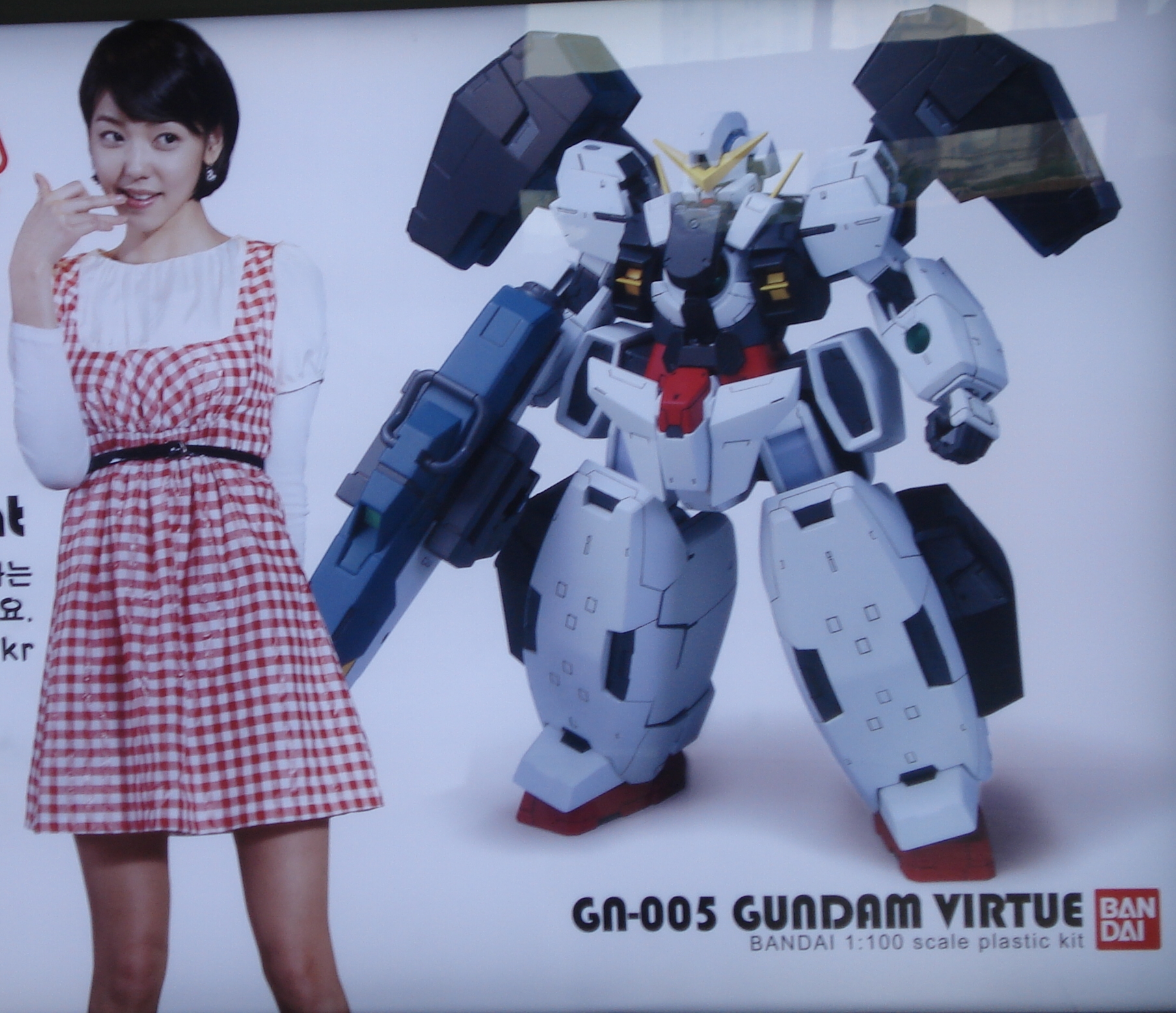
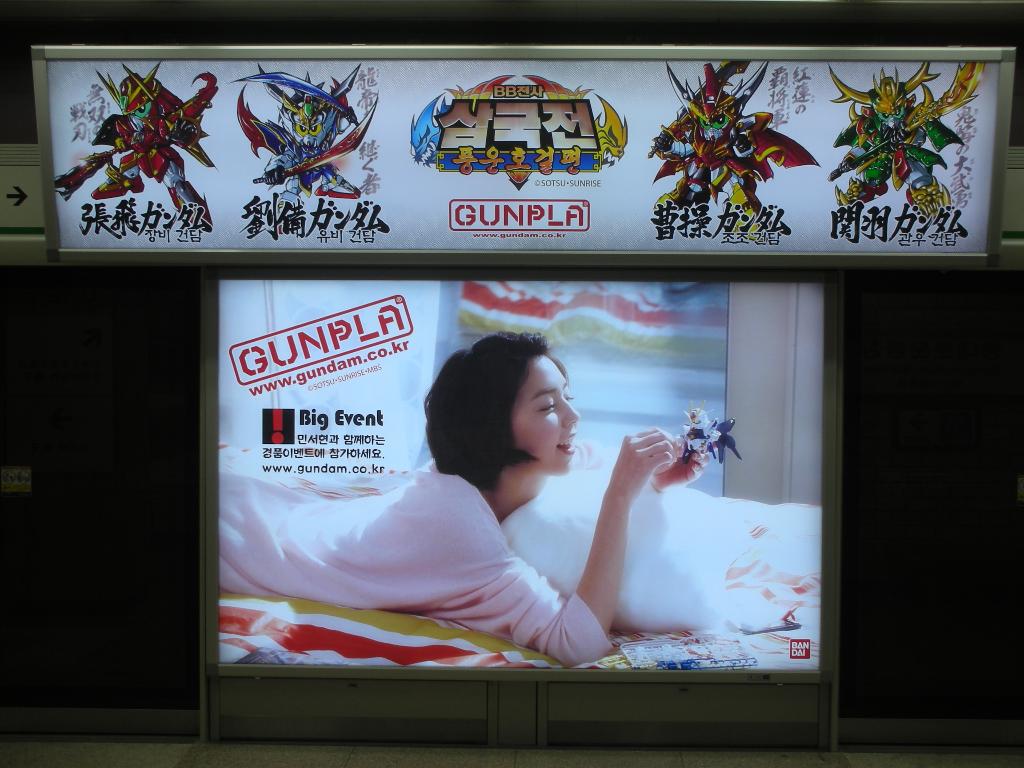
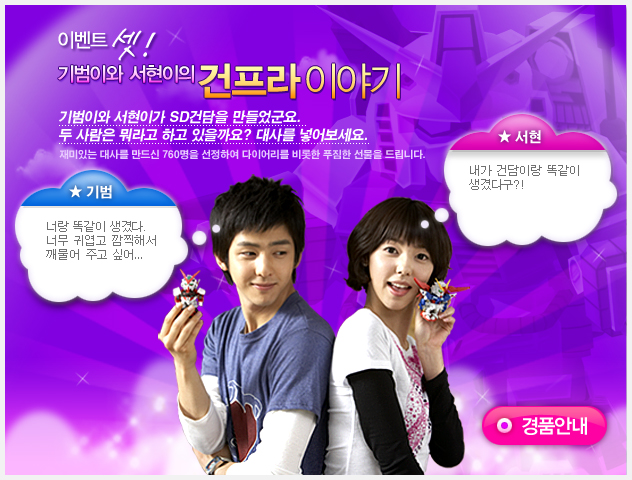
Like photographer L-C-R says, this 2008 Gundam advertisement is a prime example of a woman being portrayed as a child and/or sex object, of which she saw entirely too much of while she was in Korea.

You may be very surprised then, when you learn whom it was actually aimed at.

But first, please consider what is it exactly that so demeans drama actress Min Seo-hyeon (민서현) in it? I identify 4 or 5 things myself, which I outline in descending order of importance below:

  1. her childlike expression, combined with putting her fingers in her mouth
  2. the canting of her head
  3. her surprisingly awkward stance
  4. her passivity as she awaits the masculine-looking robot to make the next move

And after discussing those, albeit briefly because I’ve already done so in great depth in this similar post about soju advertisements, I’ll finally look at the ad in the context of the campaign as a whole. But feel free to disagree with any of those and/or suggest others, and in that vein I highly recommend asking your Korean partners, colleagues or friends their own opinions also. As if the experience of asking my wife and her friends earlier is anything to go by, then they are very likely to disagree with the first. Or indeed, that she’s being portrayed childishly at all, and – jumping ahead – not even in the following commercials either:

I’d argue that the main reason for that is the Korean cultural practice of aegyo (애교), difficult to define in English but probably somewhere between “affected sweetness” and “affected childishness“, and at least partially rooted in the prolonged transition to adulthood of experienced 20-something Koreans that are the biggest practitioners of it. For not only does the Korean education system essentially defer the joys of adolescence (but not the negatives!) until graduating from high school, but economic circumstances force them to live at home until marriage and/or deliberately put off their university graduation, and men also have their 24-28 months of compulsory military service to boot.

But I realize that since I was a student myself in the mid-1990s, more and more 20-somethings in Western countries are also postponing leaving home, and indeed to note all the above is not to argue that all Korean 20-somethings in such circumstances are childish; actually, I have intelligent, mature, and thoroughly Westernized Korean friends that have resigned themselves to them, or alternatively feel so trapped that they are literally fleeing the country to escape. Yet one thing they certainly do not do however, is aegyo, and I put it to you that in fact that is neither required for women to successfully navigate a patriarchal society, nor particularly savvy and ultimately empowering of them to do so.

( Source )
( Source: L-C-R )

Yes, “women”. As while Korean men do also do aegyo, and so as you’d expect content analysis demonstrates that men are much more likely to be portrayed childishly in advertisements in Korean magazines than US ones, and Korean men more than Western ones in the former, it is still overwhelmingly Korean women that are done so, and to a much greater extent than women of any ethnicity are in US magazines.

( Source )

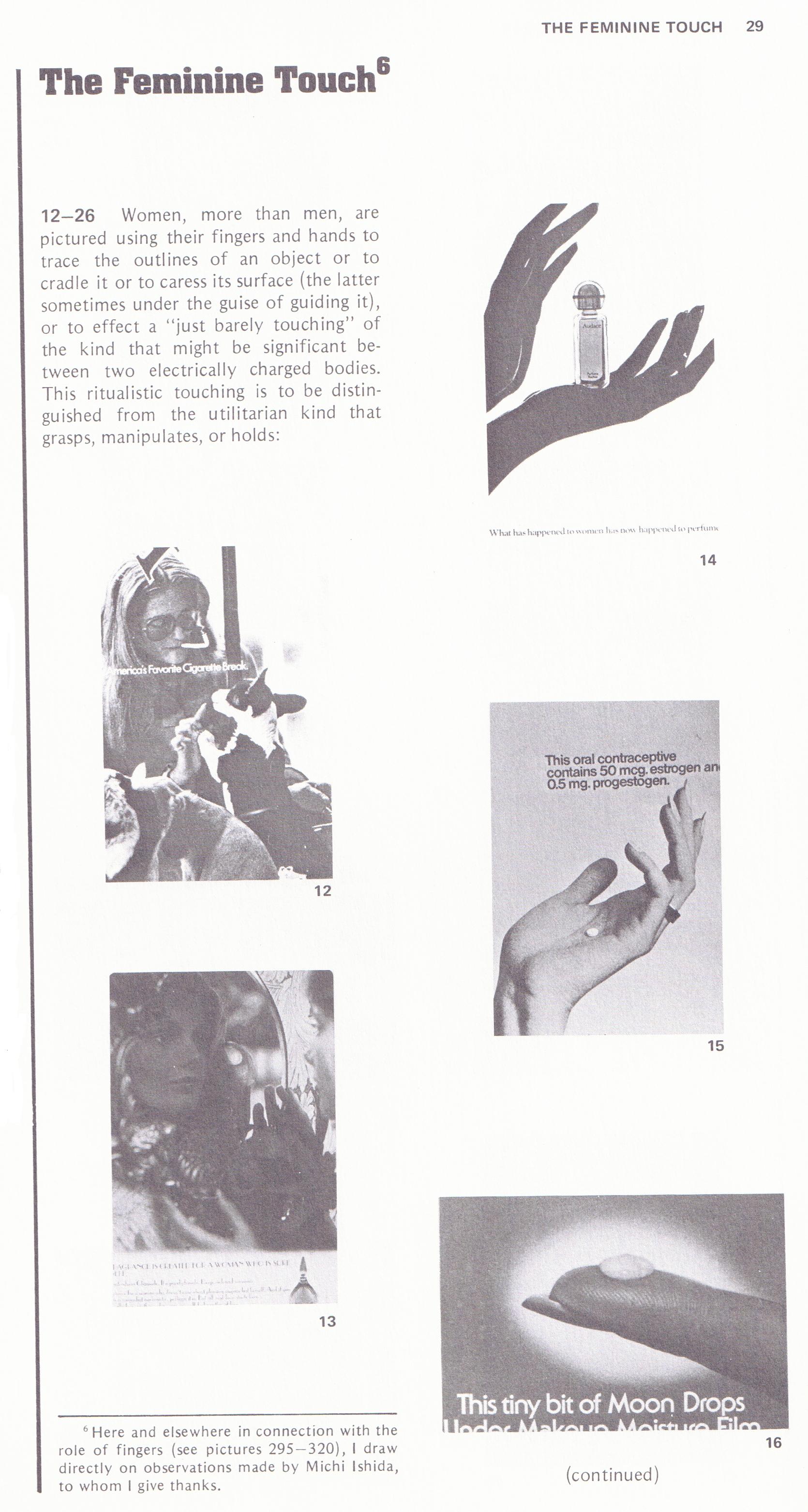
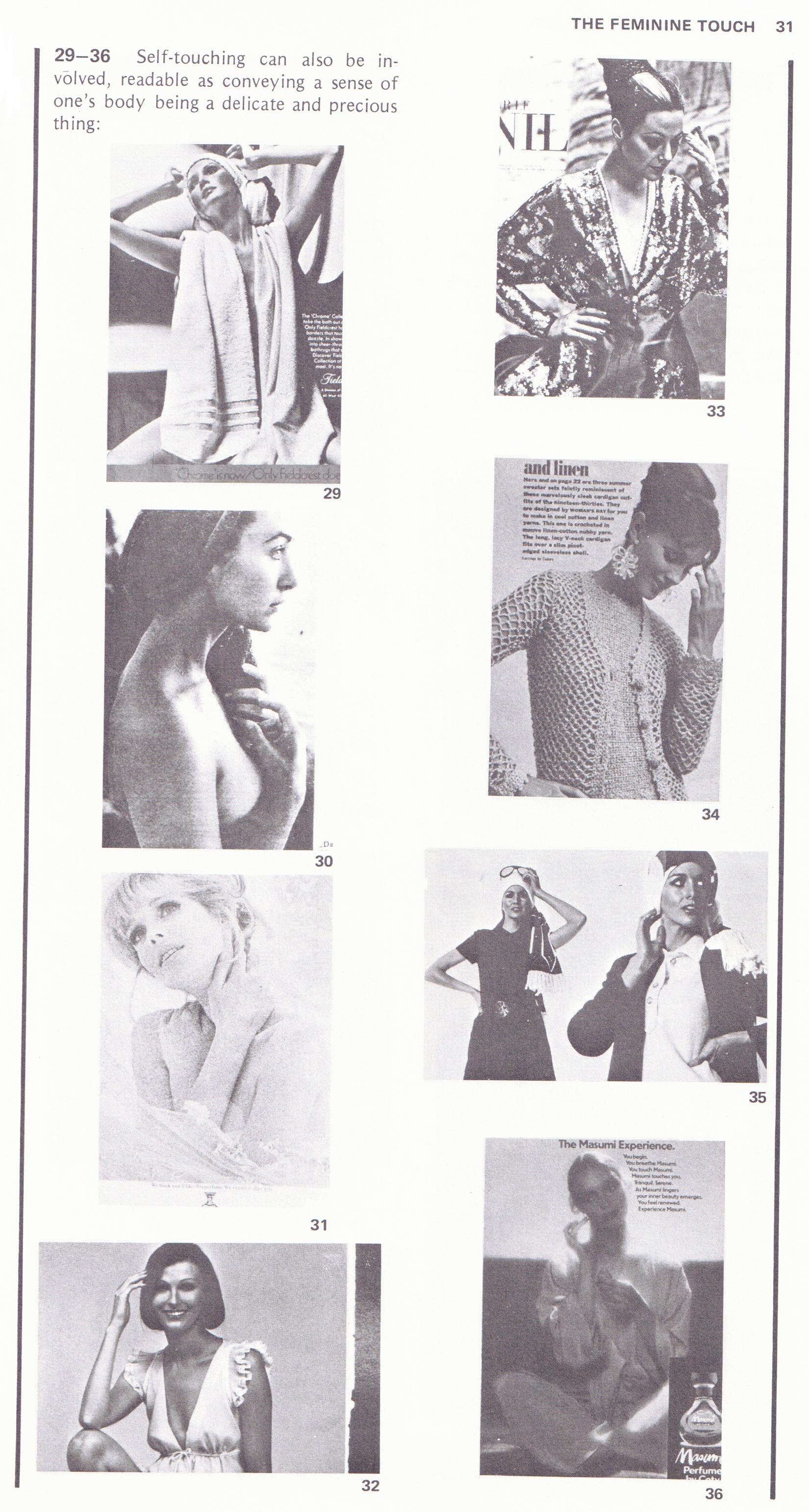
As for anyone still not seeing the childishness in Seo-hyeon’s expression however, or why it is problematic in any sense, consider what the images above tell us about just how “natural” such expressions really are on adults, and why women are more commonly portrayed with them nevertheless. And which are often accentuated of course, by putting their fingers in their mouths, and which could possibly be considered “self-touching” as defined by sociologist Erving Goffman in Gender Advertisements (1979) below:

As discussed in that earlier post on soju advertisements, both are often combined with the canting of the head, which is problematic for the reasons outlined there. I also discuss awkward stances there too, and to anyone believing that I’m about to read too much into Seo-hyeon’s, I suggest stopping here and trying it for yourself,  making sure to bend and spread your legs outward at the knees like she does in particular. For not only will you realize just how unnatural it really is, and that people only ever stand like that in advertisements (and overwhelmingly women at that), but you’ll also probably end up falling forward a little on your first attempt like I did, and will suddenly gain a very palpable sense of why exactly the advertisement does indeed present her as a sex object:

( Source: L-C-R )
In Goffman’s framework in Gender Advertisements, that “bashful knee bend” is something that women frequently, men very infrequently, are posed in a display of. And whatever else, it can be read as

…a foregoing of full effort to be prepared and on he ready in the current social situation, for the position adds a moment to any effort to fight or flee. Once again one finds a posture that seems to presuppose the goodwill of anyone in the surround who could offer harm. (p.45)

Hence passivity, as blind to whatever occurs behind her, nevertheless Seo-hyeon seems to be eagerly awaiting whatever the robot plans to do with her. And which judging by the fact that it also is standing slightly thrust forward, and has a big long gun resting behind Seo-hyeon’s buttocks, couldn’t really be any clearer. Hell, even the protrusion on its crotch is already bright red for good measure too.

( Source )

An advertising campaign clearly aimed at young men and adolescent boys then, whom I’ll safely assume are the vast majority of Gundam fans? If so, then the effort actually appears to have backfired, as the few commentators on it I’ve been able to find here, here, here, here, and here generally express both surprise and disdain at seeing Min Seo-hyun at all, the last of whom wrote the following about the advertisement above:

이 광고는 광고로서의 설득력이 전혀 없다. 그것이 염가 제작되었기 때문이 아니다. 반대로 제작비는 많이 들었을 것이다. 이름있는 사람들의 얼굴을 비추기 때문이다.(그림의 건프라 광고에 출연하는 사람이 유명한지는 잘 모르겠다.) 그러나 문제 역시 그러한 사고방식에 있다. 즉, 유명한 사람의 얼굴을 비추면 광고가 될 것이라는 사고방식에.

This advertisement has no persuasive power at all. But not because it was cheaply and poorly produced; actually, because of the famous faces in it, it looks like a lot of money was spent on it (well, actually I don’t know if they are famous or not). Rather, the problem is with using that advertising logic in the first place.

이것은 어느 정도 맞는 말이다. 유명한 사람이 어떤 상품을 소비하고 있으면 그것만으로도 상품의 질을 소비자들에게 안심시켜 줄 수 있다. 그러나 그것도 광고의 효용성 안에서 이루어져야 한다.

However you look at it, this is correct. While of course simply having famous faces in an advertisement is sufficient for most consumers, they should still be used in the ad as effectively as possible however.

이 광고의 전략은, 유명하거나 예쁜 사람과 건프라의 이미지를 교차시켜 건프라가 갖는 오타쿠 이미지의 쇄신일 것이다. 좋은 생각이다. 그러나 이러한 두 이미지가 교차점을 찾지 못하고 있다. 저 사람은 건프라를 만지작거리고 있지만 전혀 즐거워 보이지 않는다. 아마 저 사람은 자신이 들고 있는 건프라의 이름도 모를 것이다.

The advertisement’s strategy is to reform the image of a Gunpla Otaku [an obsessive fan of something – James] by combining with a famous or attractive person. This is a good idea. However, ultimately they don’t really mix. This person doesn’t look like she’s enjoying holding the model [really?] and probably doesn’t even know the name of it.

( Source )

방 또한 지나치게 깨끗하지 않은가? 건프라에 열중하면 당연히 방은 데칼 찌꺼기나 플라스틱 조각으로 너저분해져 있어야 하고, 책장에는 잡다한 건프라가 어지럽게 진열되어 있어야 한다. 채색하는 손은 알록달록 에나멜이 묻어 있어야 하고, 옷은 더러워져도 상관없는 펑퍼짐한 츄리닝이어야 하며, 얼굴은 지극히 진중한 표정을 짓고 있을 것이다. 오히려 이러한 당연한 이미지를 예쁘고, 성공적이고, 멋있는 사람들과 교차시켰으면 이 광고는 성공을 거두었을 것이다. 장동건이 한없이 고결한 태도로 NDS를 플레이했다면 NDS는 그만큼 팔리지 않았을 것이다. 오히려 소파에 퍼져 앉아 우리들이 하듯이 게임을 했기 때문에, 우리가 하는 것을 장동건도 한다는 안심을 소비자에게 줄 수 있었다.

Also, isn’t the room excessively clean? When you are absorbed in assembling a Gunpla model, of course the room should be messy with the remains of decals and leftover plastic, and various other models displayed on the bookcase. And while your hands would be stained with enamel paint and your casual clothes dirty and speckled, your face shows that you don’t care about that as you focus all your attention on assembling the model. Rather, prettier and more successful people were needed. And recall that very famous actor Jang Dong-gun didn’t similarly loftily play Nintendo DS Lite while he was advertising it in 2007; instead, he just played it normally on the sofa like the rest of us, and so it sold well.

게다가, 타겟을 통일했으면 더 설득력이 있었을 것이다. 지금 이 광고가 노리는 소비층은 누구인가? 아이? 청소년? 남자? 여자?

Hence I think the ad would have been more persuasive if it had been aimed at a wider variety of people. But to whom was it actually aimed at anyway? Children? Teenagers? Men? Women?

( Source: L-C-R. Reproduced with permission )

Sounds like a rather picky otaku to me, but he does at least finish with some good questions, which I’ll now attempt to answer by passing on what I’ve been able to find of the remainder of the campaign.

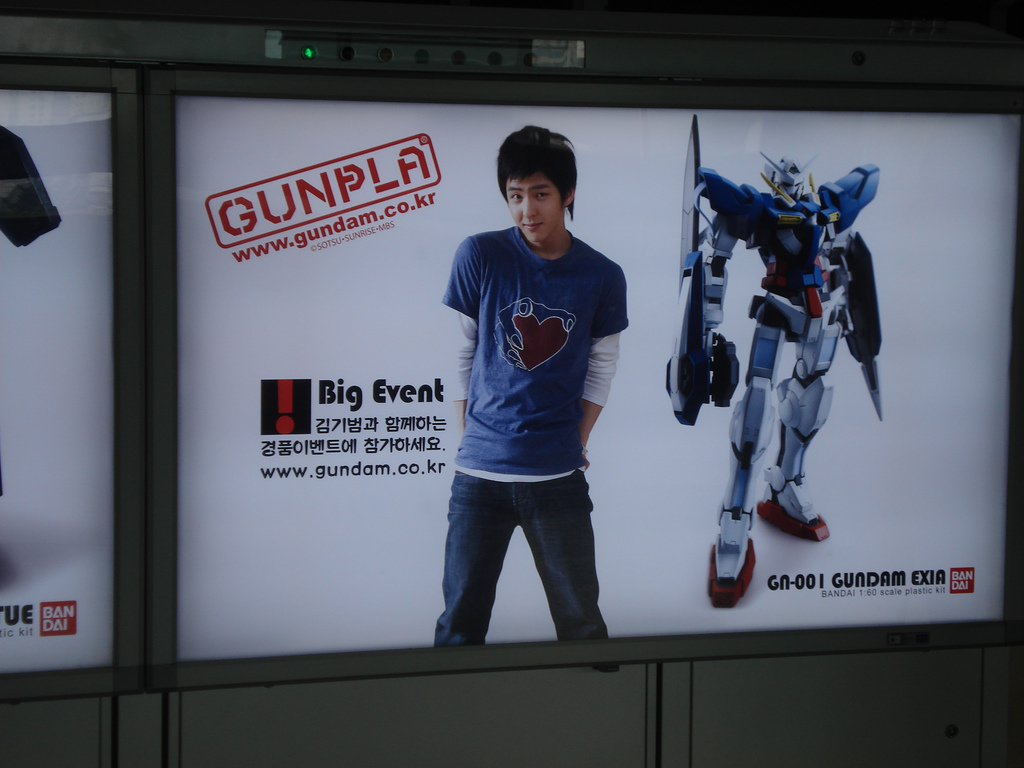
First up, the one above that was alongside the one with Min Seo-hyun. Featuring popular singer (now actor) Kim Kibum (김기범) of the boy band Super Junior (슈퍼주니어), at first glance it’s very similar. And yet:

  • the robot isn’t even facing towards him, let alone thrusting a phallic object towards his buttocks
  • Kibum’s stance is much more natural
  • rather than passively waiting for robot to initiate something, here he seems to be silently asking the observer what fun things he can do with the robot himself
  • accordingly, his expression is more mischievous than childish
( Source: L-C-R )

Crucially however, this dichotomy is not repeated in the rest of the campaign. See the following commercial which features both actors for instance (as an aside, it starts with the lines “Shall we do it? Okay”, a common innuendo in Korean advertising):

And in particular, the long version of the bedroom one, which reveals that the reason she become interested in Gundam in the first place was because boyfriend Kim Kibum bequeathed his collection to her while doing his military service, to which she now enthusiastically adds to with her own robot:

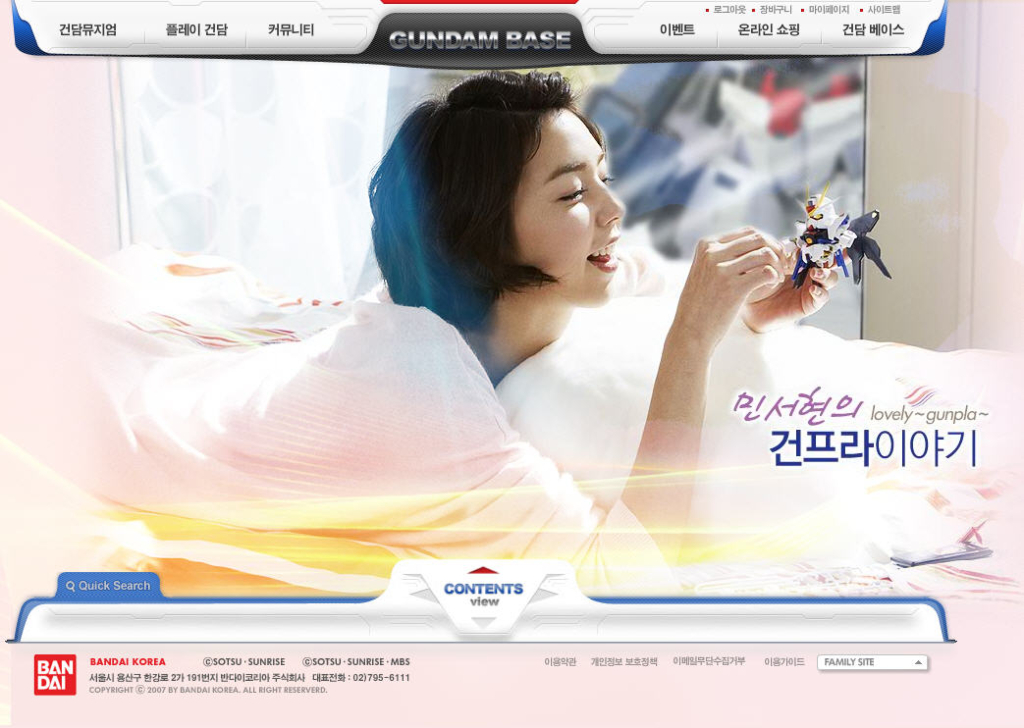
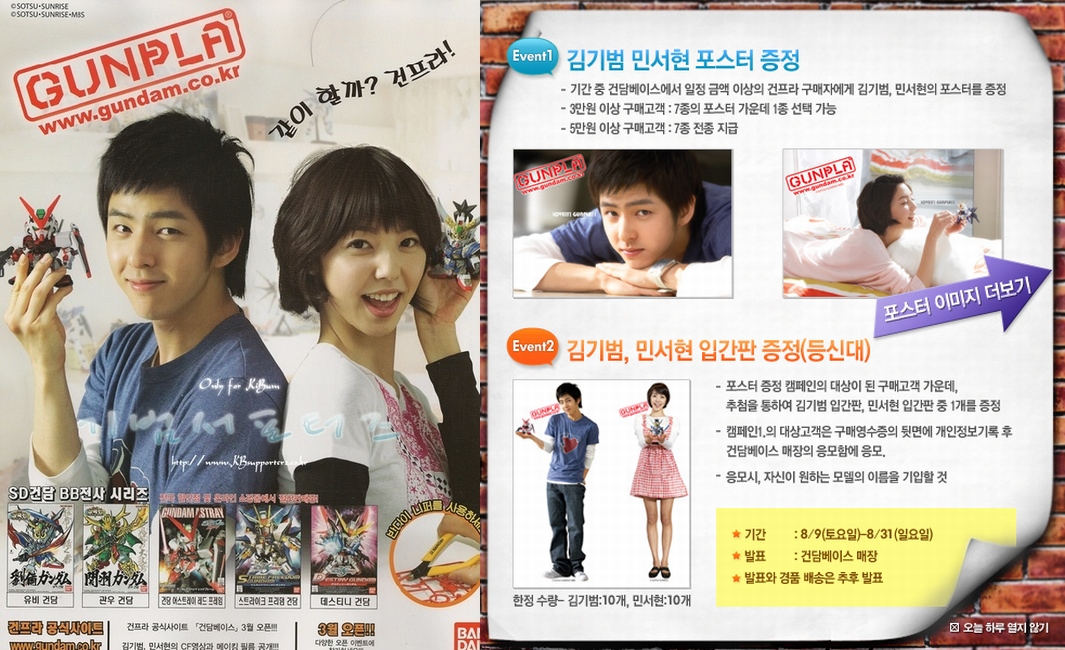
And the theme of both sexes enjoying assembling and enjoying Gundam models is corroborated by the following posters and website images:

( Source )
( Sources: left, right )

Taken as a whole, I’d argue that the only consistent theme of the campaign is that of Min Seo-hyeon becoming more and more involved in the hobby for various reasons, including by: being (sexually) tempted by the models themselves; encouraged to take it up by Kim Kibum giving her his own models; assembling models together at his suggestion; and finally becoming equally passionate and knowledgeable about it as he is. Nay, it’s not so much a theme as the exact narrative Gundam hoped would play out repeatedly in real life, and besides which the cute portrait poster of Kibum above to download from the Gundam website is sufficient evidence in itself that the campaign was aimed at teenage girls and women.

Why then, did the bedroom commercial and the opening advertisement simply suck so badly? Why on Earth did the advertising agency responsible think that having a 22 year-old woman acting like a 12 year-old would make either age group more interested in the product, let alone by suggesting that – not to put too fine a point on it – she also wanted to get fucked by it?

Of course, there could be any number of reasons. For instance, there is the cultural practice of aegyo as mentioned, which I may have underestimated, and perhaps I’m wrong in thinking that the majority of Korean women would be at least unimpressed, if not offended, by depictions of women as children. It could also be yet another demonstration of an advertising agency so used to selling products to men that it comes to regard their perceived desires and tastes as the norm, and so unwittingly applies them to women too:

( Tempted to drink soju with 16.8% alcohol now girls? )

But recall that photographer L-C-R mentioned that she saw advertisements like these everywhere in Korea, as probably you do too, which raises a third possibility: either the Korean advertising industry as a whole is dominated by men (which may in fact be true), or else it has so internalized those male norms that even women in the industry (let alone consumers) regard them as normal and appropriate for selling products to either sex.

A phenomenon by no means confined to Korea or the just the advertising industry, this is the essence of the “male gaze“, and which hopefully having provided some evidence for and/or at least piqued your interest in, I’ll wisely finish by pointing you in the direction of excellent introductions to the topic rather than going on further here. One is the examination of the ways women are portrayed in graphic novels provided by fantasy magazine, and another is the related Bechdel Test for movies:

And here’s a brief application of that to specifically Fantasy movies at Feminist SF also. But I most highly recommend the illuminating, even strangely moving 1972 documentary Ways of Seeing by then art historian John Berger, which I’ve just discovered via Sociological Images here and here. Obviously the second episode on the female nude is most pertinent here, but episode 1 is more likely to captivate you to the extent that you forget to leave your seat for the next half hour:

Here’s episode 2:

And I would include episodes 3 and 4, the latter of which is on advertising, but I haven’t watched them myself yet!^^

(For all posts in the Korean Sociological Images series, see here)

Share

Korean Sociological Image #47: East End Girls, meet West End Boys

Yes, it had to happen eventually! A big round of applause to Nextour, for quite possibly the very first positive representation of a Korean female – Western male relationship in a Korean commercial.

New readers shaking your heads in disbelief however, please consider reading other posts in the “interracial relationships” category, especially here, here, here, here, here, and here. And please also ponder the following quote from Hyun-Mee Kim in her chapter “Feminization of the 2002 World Cup and Women’s Fandom” in Feminist Cultural Politics in Korea, ed. by Jung-Hwa Oh, 2005, pp. 228-243 below on the then unprecedented public attention by Korean women on the bodies of the Korean players, and which gives a big clue as to why such an essentially innocuous commercial didn’t emerge back then:

…if Korean women’s enthusiasm had mostly been directed at handsome Western soccer players, such as England’s Beckham or Owen, Portugal’s Figu, Italy’s Toti or Spain’s Morientes, the situation would have been drastically different. That they zealously applauded Hiddinck, a Dutch male and the director of the Korean team, seemingly too much of a “father” for them to desire sexual union with, and the familiar handsome guys of Ahn Jeong-hwan, Kim Nam-il, and Song Jong-Guk, must have been the chief reason for positive response the Korean women fans got from the rest of the society.

In particular:

The attitude of the Korean media that looks down on Japanese women for expressing their love for Beckham and treats them as “ppansun-i”s [빤순이, or condescending slang for crazed girl fans – James], clearly shows what line the Korean women should dare not cross. This World Cup, which ended up as a worshiping of the 23 [Korean players], delineates the limitations as Korean women rose up as the subjects of their own sexual desires. This is a society in which there is still a strong belief in the sexual union of the full bloods: for the women to collectively root for Ronaldo or Morientes, there is too much at stake. It is so much easier to shout out that they want the “yellow bodies” of our own race rather than “white and black bodies”. Hence, the happy union of women’s sexual desires and new patriotism in the 2002 World Cup. (p. 239)

Naturally one commercial doesn’t mean a sexual and racial revolution of course (note that only Caucasian men were featured), but it is a start, and certainly provides a welcome contrast to the general persecution of foreign males in the Korea media in recent years, as most recently demonstrated by the fact that Anti English Spectrum’s Lee Eun-ung was uncritically allowed to present his repulsive, unsubstantiated views on foreign males on a national radio show for instance. Indeed, the lack of netizen reaction to the commercial so far hopefully demonstrates that things may have actually improved a little since 2002, and provides a healthy reminder that, just like in other countries, the Korean media is probably not a very accurate guide to public opinion in the first place.

Meanwhile, see here for the male version, albeit a slightly seedy one (caressing a ‘sandwoman’ anyone?), and young readers see here also if you didn’t understand the “East End Girls” reference!^^

Update, November 2011) Alas, it wasn’t actually the first! See here for an example from 2006 (and one more from later in 2010).

(For all posts in the Korean Sociological Images series, see here)

Korean Sociological Image #46: The Language of Exclusion (Updated)

(Source: Mental Poo; reproduced with permission)

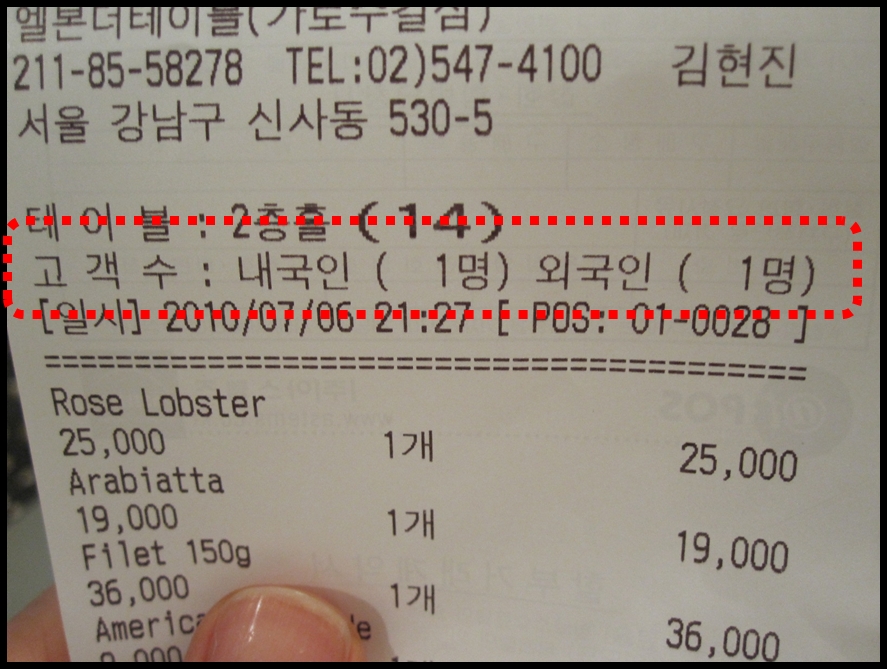
A receipt from a recent visit by blogger My Jihae to an upscale restaurant in Seoul, about which she wrote:

I’m not sure how many restaurants do this, and why this restaurant bothers to do this in the first place, but on the top of the receipt they blatantly keep track of whether the guests are locals or foreigners. They pegged me right away, I guess it’s that obvious.

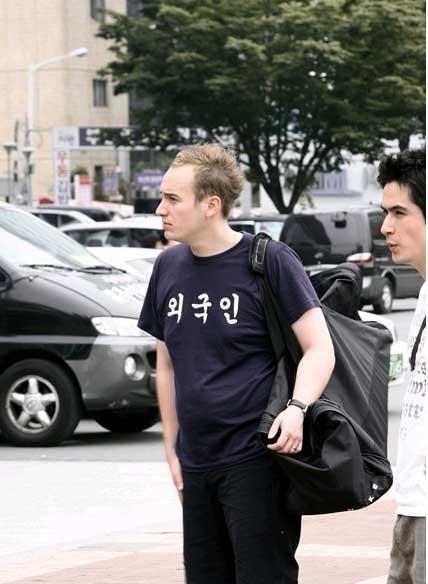
For those of you that can’t read Korean, for now let’s say that waegookin (외국인) on the right generally means a foreigner, and naegookin (내국인) on the left a Korean person. And that does indeed describe My Jihae and her dining partner respectively, although she is actually Korean-American. But why bother to note the distinction between two ethnically-identical customers at the same table?

Some commenters to her post speculate that it may have been done for taxation purposes, which I wrote would be something good to know if true, as otherwise:

…many expats (myself included) may simply chalk things like this up to Koreans typically and completely unnecessarily pointing out our foreignness, when in fact they may be nothing of the sort.

And see Occidentalism here and here for a similar case in Japan. Unfortunately however, not all perceived Korean tendencies towards exclusion are simply misunderstandings on the part of non-Koreans.

Take the “Waegookin Shock Meltdown” for instance, which describes the situation:

…where when speaking in Korean, Koreans freeze up because they have some silly preconceptions that foreigners simply ‘can’t’ speak Korean or that they just ‘shouldn’t’ speak to us in Korean – the latter which comes without the help of the government and medias insistence in the last 10 years or so that ‘globalization’ means that Koreans should all have to speak English whenever they encounter big-nosed white people.

Foreigners Gangnam Style(Source: Republic of Korea; CC BY-SA 2.0)

And which personally used to get me extremely frustrated and angry while learning Korean a few years ago, although now I believe that that reaction from Koreans more often stems from simple inexperience and/or nervousness in dealing with non-Koreans. Still, whatever combination of factors are responsible in any given case, all have clear solutions, something which can not be so easily said of the ways in which Korean notions of nationalism, citizenship, and even the Korean language itself arguably inherently exclude others. Focusing on the latter in this post, I identify 2 main ways in which it does so:

First, because Koreans might take a vacation to New Zealand, say, and describe New Zealanders as waegookin while they’re there, so clearly “foreigner” doesn’t quite cut it as a translation. Perhaps “non-ethnic Korean” would be more suitable? But then what about about My Jihae back in the restaurant?

Given such confusion, then as you might expect the question of the most appropriate English term has already attracted a great deal of attention from many generations of expats, and so if you can forgive my heemanggomoon (희망고문; literally “hope-torture” or “stringing someone along”, and one of my favorite Korean words), I’ve decided that it would be unhelpful to repeat any of that here. Instead, let me refer you to this excellent post by regular commenter Seamus Walsh for the most recent and comprehensive discussion of this aspect of the language issue (but this and this post by others are also helpful), only passing on myself what I wrote in my own post on it 2 years ago:

It may not sound like much, but like I said in this forum, Korea’s (and Japan’s) bloodline-based notions of nationalism and citizenship emphasize and exaggerate the differences between natives and non-natives to an extent rarely found elsewhere in the world, and the constant reminders of these quickly become wearisome to anyone who’s spent even just a few months living here, let alone 8 years. And ironically, constantly hearing the term waegookin in our daily lives probably means that we come to adopt some of the same notions of division and distance ourselves too, and the effect snowballs.

Naturally, Seamus also covers the the second reason in that post, the fact that Koreans never say “my home”, “my wife”, “my language”, or “my country” for instance, but say “our” (우리) instead. And that I can add something useful to here, as by coincidence there was recently a lively discussion on that very topic on the email-based Korean Studies Internet Discussion List, prompted by the following question by William Pore of Pusan National University (source, right: Asadal Thought):

Dear List:

For any comparative Asian linguists, Ural Altaic linguists (?), or, maybe even Korean linguists on the list, I would like to inquire if a pronoun similar to the Korean we (i.e. ‘uri’) occurs with the same frequency/prominence in any related languages to the same degree that it does in Korean. Should we accept the assertion that I nearly always have had that the prominence of that pronoun in Korean is due to a particular Korean mindset alone?

And rather than have you scroll through the full June archive yourself, my contribution is in presenting a truncated and much(!) more readable version of the most pertinent comments instead. Starting with JMF’s reply then:

Perhaps this is not directly related, but I witnessed some very interesting aspects of “uri” while raising my daughter in Korea. Not only my daugher but all of her “pure Korean” friends as well naturally used the words “I/my” almost exclusively. I saw and heard all of them say in Korean “my house,” my school,” “my Mommy/Daddy,” etc. Of course, they were quickly corrected/reprimanded by parents and teachers until they capitulated and began to use “we/our” almost exclusively where they had once felt that “I/my” was more natural. In a word, “uri” is not somehow “organic” to Korean-ness or Korean language but rather externally injected and enforced.

Frank Rudiger, University of Vienna:

And here comes something even less directly related, yet not completely unrelated: In Russian, there is a similar way of saying “we” when actually meaning “I”, for example “me and my mother” would literally be “us with mom” (my s mamoj). In other words, this is not necessarily a purely Korean phenomenon. I guess Russian is not the only example. What about “we won” (wir haben gewonnen) meaning “our team has won” in German (at least)?

(Source: Stinkie Pinkie; CC BY 2.0)

Dr. Balazs Szalontai, Mongolia International University:

In Mongolian language, which has some interesting grammatical similarities with Korean, this practice is carried even further. One would often hear a lady utter the term “manaa nuhur” (our husband), rather than “minii nuhur” (my husband), though she supposedly does not intend to share the said individual with any additional ladies.:)

Alison Tokita, Tokyo Institute of Technology:

I know Japanese much better than I know Korean, but clearly the Korean uri has its equivalent in Japanese language and usage. The Japanese equivalent of uri has indeed been very frequent in recent decades as an aspect of Nihonjinron (theories or discourse of Japanese uniqueness), but is probably declining in the younger generation. The Japanese equivalent actually uses archaic forms of the pronoun. Some examples:

Japan is expressed as not only Nihon, but as waga kuni (our country; cf the softer watashitachi no kuni). The Japanese are not only Nihonjin, but wareware Nihonjin (we Japanese). My or our house can be wagaya (cf watashitachi no uchi).

Then there is the use of koku (country, nation): Japanese literature is koku bungaku (recently the use of Nihon bungaku is starting to replace this); Japanese history is kokushi (now changing to Nihonshi); Japanese (national) language is kokugo: what is taught to Japanese in schools is kokugo and what is taught to non-Japanese is Nihongo.

The use of our and national instead of the country name conveys a somewhat closed country, nationalistic mentality, and as Japan is becoming more internationalized this seems to be going out of favour. These are only my impressions, but others may know of research on this linguistic phenomenon.

Dr. Edward D. Rockstein:

Of course, the usage of koku [a Sino-Japanese loan word] you describe has antecedents in Chinese usages such as  guoyu national language, guoshi national history, guowen national writing system or national literature, ddeung ddeung, nado nado, deng deng.

(Source: Unknown)

And by Owen Miller, with a similar example from England that I was very surprised and happy to see as a former Geordie myself(!), and with most of my extended family still in the region:

I wouldn’t like to step to far into the territory of the linguists on this list but I really wonder whether the case can be made empirically that the pronoun we is more frequent in Korean than in other languages. While I’m sure that John Frankl is right about its enforced use (as a result of ideological norms of national and familial collectivity that probably have relatively recent *historical roots), this doesn’t mean that it isn’t used **frequently** in similar ways in other languages. *

The use of the ‘national we’ is not uncommon in the UK, although perhaps uncommon enough that it makes me wince when I hear it. For example, teaching the First Opium War last year I found myself feeling strangely uncomfortable when the students spontaneously started discussing how terrible it was that ‘we’ had done this bad thing to China.

In certain British English dialects ‘we’ is also very commonly used in the way that Ross King describes above (exclusive first-person plural pronoun) in non-national contexts. For example, the Geordie English pronoun ‘wor’, as in ‘wor lass <http://en.wiktionary.org/wiki/wor_lass>’.

It strikes me that the Korean discourse on the use of ‘uri’ is probably something of a self-reinforcing feedback loop: Encourage the use of a word in official discourse so as to strengthen national collectivity –> discover that word is used frequently –> find that this is evidence of strong national collectivity –> further encourage use of word etc etc.

Finally Jonathan:

Is there evidence of widespread vernacular use of uri prior to the twentieth century? I ask because I wonder if its use was prompted by the Japanese use of ware as in wareware Nihonjin?

And after all that, a clear message that this lingusitic feature of Korean is by no means as unique to Korean as many of us probably thought!

Thoughts?

Update 1: As several people have suggested in the comments, and Sara confirmed, the reason that upscale restaurants keep track of non-Koreans is so that they can determine which dishes are the most popular among them, and adjust their menus accordingly. Which is certainly nothing to get upset about, but then wouldn’t actually be all that helpful either, and it would make much more sense to note customers’ nationalities instead (provided staff had the ability to politely ask them).

Regardless however, certainly Koreans in the service industry do frequently unnecessarily keep track of customers which are non-Koreans. As I originally thought Brian in Jeollanam-do‘s receipt on the right was a prime example of for instance, but after reading his explanation:

In my case, I was at a Lotteria (shut up, it’s pretty good) in a Kim’s Club next to my apartment, and the “foreigner” was to help identify who the take-out order went to. Just to preempt any commenters from James’ post, no, I’m not terribly offended and it’s not the worst thing to ever happen to me. It’s just an odd default term considering the people working the counter usually just announce the order to the crowed in order to connect people with food. There’s no reason not to just announce “Bulgogi Burger set,” or whatever, unless the person assumed I wouldn’t understand the announcement. A good posibility, in spite of me having ordered in Korean.

…then I realize that it would indeed make sense to identify a foreign customer if the person taking his or her order felt that they’d be unlikely to understand their announcement. But I disagree with Brian’s first last line though (why assume that someone who can order in Korean couldn’t also understand that it’s arrived?), and which is just the sort of thing which so aggravates me about speaking Korean in this country like I explained. Hence the “외국인” was actually unnecessary then, but rather more because of the Lotteria worker’s preconceptions of non-Asian foreigners’ Korean ability (they would never do the same to a Japanese person) than anything inherent to the Korean language.

Either way, it’s good to remember that whenever one is highlighted like this, then it could be for any number of reasons, and 99% of the time the people responsible do not mean to and are probably completely unaware that they may be causing offense. Moreover, as Brian’s discussions here and here of decades-old journal articles on this subject attest to (see this one at Gypsy Scholar also), this is something one just has to get used to.

Update 2: See The View From Taiwan for a similar issue with terms there.

(For all posts in the Korean Sociological Images series, see here)

Korean Sociological Image #44: Westerners, Nipples, and the Presentation of Sexuality in the Korean Media

( Source: Metro, July 8 2010, p. 7. Cropped slightly)

It’s amazing what pops up in Korean newspapers these days.

Yes, however difficult it may be for overseas readers to believe, that is the actually the first nipple my Korean wife, friends, and I have ever seen in a Korean advertisement. Moreover, it’s probably no coincidence that it belongs to a Caucasian model too, and one that looks like she’s about to get involved in a ménage à trois at that.

Focusing on the nipple first though (as one does), let me provide some context: with the important exception of ubiquitous single-sex bathhouses, Koreans are generally more conservative than Anglophones when it comes to public nudity; topless males are extremely rare away from beaches, swimming pools, and concert stages for instance, and topless females unheard of, let alone full nudists of either sex (recall also that just 5-10 years ago, women even covered their swimsuits with t-shirts too). In addition, while female celebrities have been showing a lot of cleavage in recent years, this trend has yet to be adopted by ordinary women, whom can expect just as much unwanted attention if they accidentally leave home bra-less.

However, breast-feeding is generally fine if done discreetly, and indeed one of the first things I noticed in my first time in a Korean supermarket 10 years ago was a brand of milk (or soy milk) that prominently featured a large breast and a suckling baby on its packaging. Unfortunately I can’t remember the name to find an image, but I do also recall that it was by no means hidden away in any sense.

I doubt that that would have been considered acceptable in New Zealand from which I’d just left, and in that vein note that the current trend for visible nipples in the Western media at least remains precisely that: a trend, and certainly not an liberal, progressive ideal that Korean social mores will somehow inexorably shift towards in the future. For all its eroticism, it pales compared to the standards of the 1970s for instance (see this NSFW example from a 1976 Cosmopolitan), while in Korea no less an authority than Tom Coyner points out (also NSFW) that 60 years ago Korean mothers in the countryside dressed with readily visible breasts “with pride if they had just given birth to a son.”

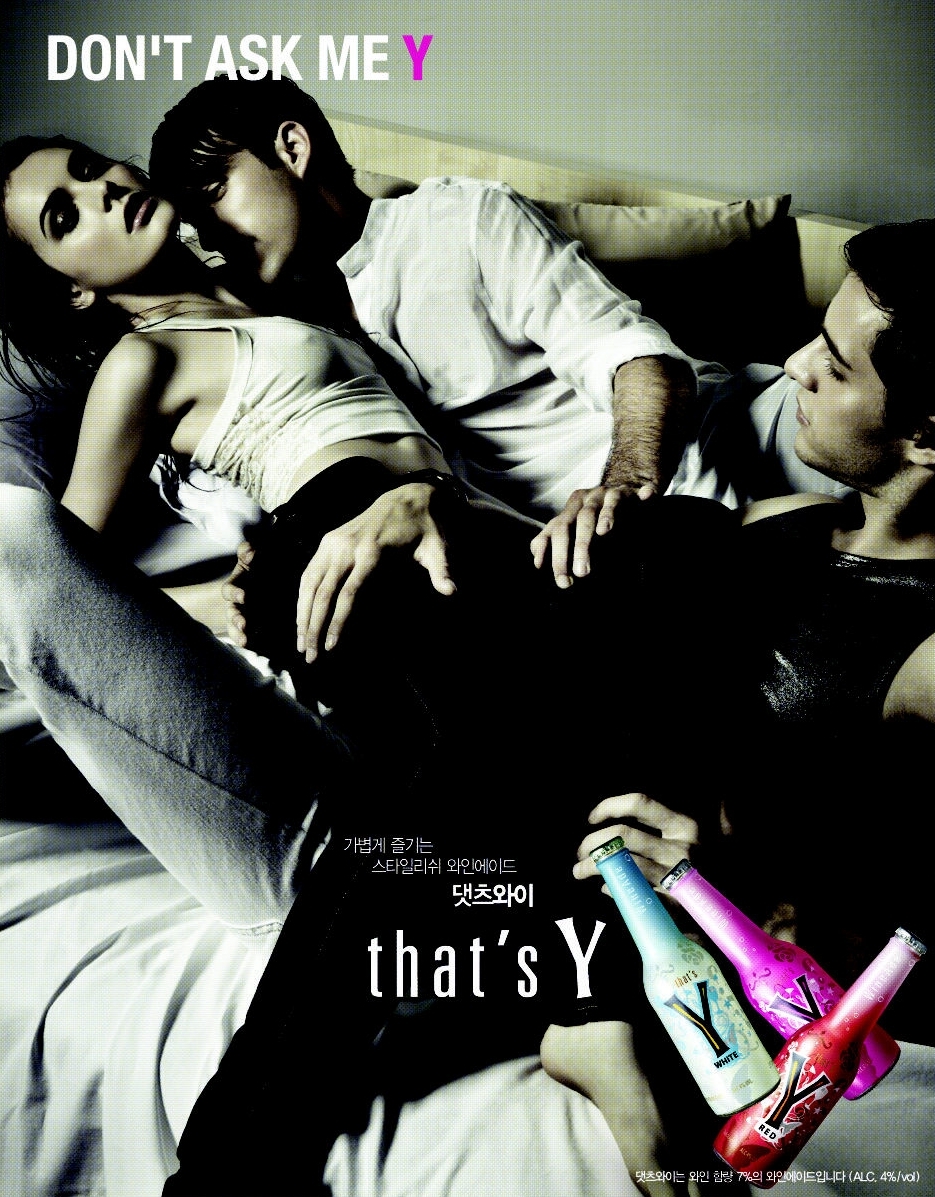
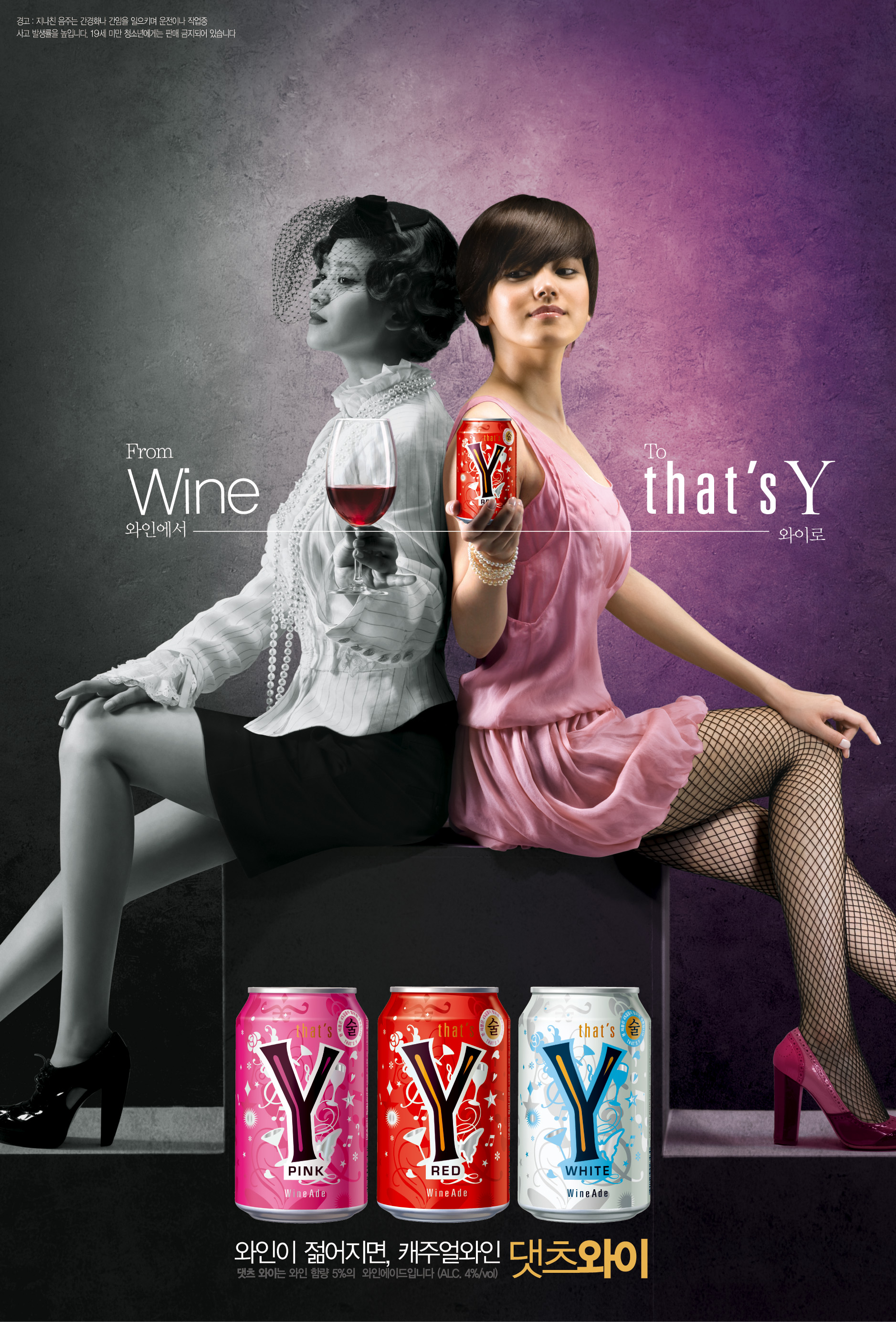
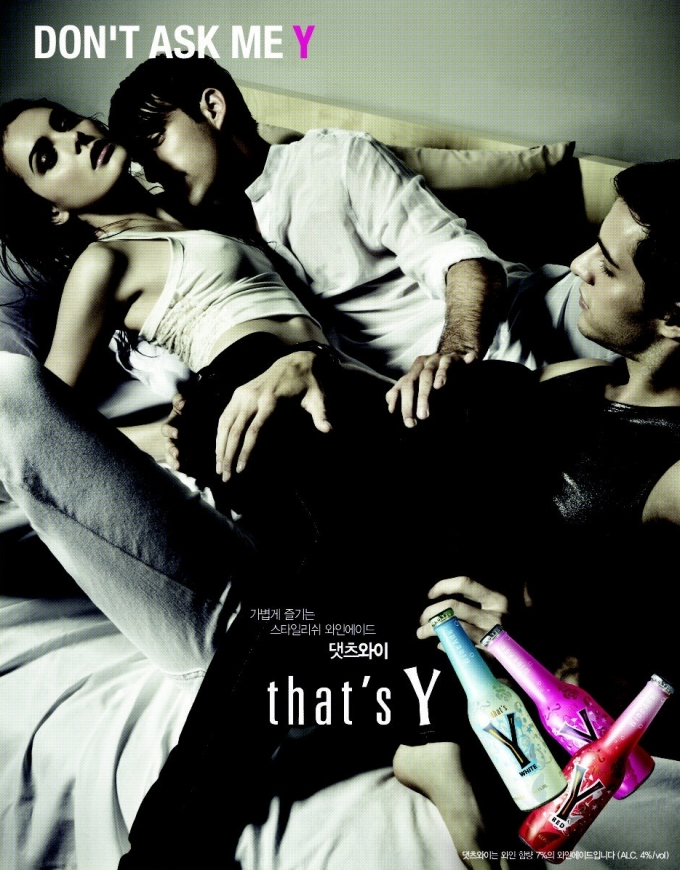
( Source )

So why the nipple now? Unfortunately, little about the advertisement or the drink provides a clue: “That’s Y” (댓츠와이) is merely a wine cooler (or alcopop?) produced by Lotte Chilsung (롯데칠성음료) since 2008, like wine coolers everywhere primarily marketed to 20-somethings. Judging by its moribund website though, then it hasn’t been selling very successfully (probably why there was a shift to selling it in more stylish bottles rather than cans last month), so one can speculate that Lotte Chilsung was desperate to draw people’s attention to it. Judging by the complete absence of reaction from netizens and the media so far however, strangely that “sex sells” strategy doesn’t appear to have worked.

Ultimately more significant then, is the race of the models in the advertisement in which it appears. Why are they Caucasian? And are Koreans ever portrayed in such brazenly sexual situations as that?

Again, Lotte Chilsung provides no clue: in fact only one more print advertisement for the drink is available online in addition to what you see here. That did also only feature Caucasian women, but then the above one has Korean women in it, and the only television commercial below also only has Koreans too (of both sexes). But looking at the wider context however, then of course there is overwhelming evidence that Caucasians are indeed portrayed more sexually than Koreans in the media here, and particularly women.

Why? Well, assuming that you’ve read that last link, then for one consider how well an artificial dichotomy between virginal, sexually passive Korean women and hypersexual, promiscuous Caucasian ones buttresses extensive human-trafficking in East European and Russian women here. And as for the guys, the notion that foreign male English teachers are oversexed, and thus more likely to be pedophiles than their Korean counterparts, certainly does serve to deflect attention away from the latter. Although one wonders why the Korean media bothers sometimes; after all, just this week apparently even politicians feel perfectly justified in presenting a completely imaginarywave” of sexual crimes by them to justify ever more stringent visa regulations.

Vodpod videos no longer available.

And I could go on, but I’d be much more interested in hearing readers’ own ideas. In the case of this particular advertisement though, I acknowledge that it may not in fact be the first nipple out there(!), but regardless let me pose the question of if you think Korean models instead would have aroused more or less controversy to get you started.

Against the argument that there are plenty of risqué ads with Koreans these days though, and so I’m making a mountain out of a molehill, then for sure, and you don’t have to look very far on this blog to find numerous discussions of how much things have changed just in the last 2 years. But look again: a threesome? And virtually in flagrante delicto on the sofa at that? By all means *ahem* pass on any Korean examples you’ve come across, but in the meantime I’d argue that while the goalposts for what is considered a “shocking advertisement” in Korea do indeed change over time, somehow Caucasians still seem to be in the majority of them!

Update – With thanks to Dave for passing it on, who apparently had much sharper eyes than I did back then, in fact there was a commercial with erect nipples as early as 2006. And yes, you guessed it: that had Caucasians too!

(For all posts in the Korean Sociological Images series, see here)

Share

Korean Sociological Image #43: ESL Students on Top?

( Source: Gusts of Popular Feeling. Reproduced with permission )

A recent advertisement for the Pagoda chain of language institutes noticed by Matt of Gusts of Popular Feeling, who notes that the attraction “is clearly for women to get close to, to have one on one communication with, and to have almost direct contact with the male foreign teacher.”

In any other context this would be unremarkable, but unfortunately the Korean media is notorious for presenting foreign male – Korean female relationships either negatively or not at all (although this is slowly improving). So this advertisement really stands out for the rare, quite literal closeness of the models in it, albeit not necessarily in a romantic sense.

In contrast, Japanese language institutes have already been advertising this way for a long time, as noted by Keiron Bailey in his 2006 journal article Marketing the eikaiwa wonderland: ideology, akogare, and gender alterity in English conversation school advertising in Japan. Two examples from that, both from 2002:

I’ve already discussed Bailey’s article in depth in an earlier post however, so let me just quickly highlight three points from it here:

Younger women are pursuing English-language learning for three major reasons. The first reason is to enhance their career prospects….The second purpose is to engage in travel, either for vacation purposes or for ryugaku. The third motivation is to actualize what Kelsky calls ”eroticized discourses of new selfhood” by realizing romantic and/or sexual desires with Western males. (pp.105-6)

Next:

…the visual pairing of Japanese women with white males invokes a set of social and professional properties that are radically differentiated from a hegemonic array of gender-stratifying ideologies. This metonymy relies on the properties of the white male signifier being defined in relation to a historical gendered Occidentalist imaginary as an ”agent of women’s professional, romantic and sexual liberation”. (p. 106)

And finally:

This [advertising] trend valorizes and celebrates female erotic subjectivity and positions the white male as an object of consumption for sophisticated, cosmopolitan female consumers. (p. 106)

And see that post or the article itself for more. Note that the latter was actually written in 2003 though, so I would appreciate it if any Japan-based readers could confirm if that is still in fact a trend there, and especially if you could pass on some examples. Also, I should stress that this is but one Korean example, and indeed possibly the first of its kind too, so it’s a little premature to argue that Korean language school advertisements are now going to be following the same logic that Bailey identifies. In particular, it definitely shouldn’t be taken as confirmation that Korean women are especially attracted to Western males either, a fallacy which unfortunately many expats (both male and female) seem to subscribe to.

Personally, I’d be much more interested in finding any advertisements featuring foreign female teachers instead, as the corollary of demonizing their male, mostly Caucasian, counterparts in the media in general seems to be hypersexualizing Caucasian women.  Alas, I haven’t taught in an adults language institute since 2004, so please help me: is this trend mirrored by Korean language school advertisers? Why or why not?

Meanwhile, Matt did also see an advertisement aimed at Korean male students, to whom the message appears to be “to take the intensive program and, moving beyond healthy competition, to be better than the (male) native speaker, to beat him, to be stronger than him”:

( Source: Gusts of Popular Feeling. Reproduced with permission )
Which is certainly quite a contrast! See the comments thread on Matt’s post for more commentary on both.

Update 1 – By coincidence, a commercial with a hint of an interracial relationship I saw as soon as I finished this post. Perfectly innocuous in itself, unfortunately the Korean media is almost completely devoid of anything with a reversal of the sexes:

Vodpod videos no longer available.

Update 2 – Brian in Jeollanam-do remembered this Wall Street Institute advertisement from March last year:

See Brian’s blog for more commentary, and Page F30 for the original images, including the clumsily added correction to the atrocious English a few weeks later.

(For all posts in the Korean Sociological Images series, see here)

Share

Korean Sociological Image #42: Sunset for the Red She-Devils?

( Source: ROKetship. Reproduced with permission. )

Like Joe McPherson of ZenKimchi fame says of the above cartoon, either way, it’s a win for my gender, so I was surprised that this was the first time I’d ever really noticed this curious Korean social more.

For those of you still at a loss however, yahada (야하다) generally means “too revealing” if it’s about clothes, and “too sexual” if it’s about anything else, like a conversation topic; alternatively, nomu pa-ee-da (너무 파이다) could have been used instead, which literally means “dug too much”. So, it’s a commentary on the difference in what is considered revealing clothing by Koreans and Western expats, and something which of course expat women have long been well aware of, congratulating ROKetship artist Luke Martin for his astuteness in droves on his Facebook page. One of them, Kelly in Korea, wrote on her blog:

So true. Showing your shoulders or chest will definitely get you stares from the older crowd and young men, while lotsa leg is okay. That being said, I feel like I see more Korean girls showing shoulder this summer than last—is that just me? Regardless, now that the full heat of summer is upon us, I have stopped worrying so much about societal dress codes and just wear whatever keeps me from passing out in the midday sun.

And for all my lapses, I think that there’s definitely something to that change. How long-lasting it is however, literally remains to be seen.

Why? Because as I’ve written here, here, here, and here (for starters), squads of daring female soccer fans known as oppa budae (오빠 부대) did have a dramatic and permanent effect on what were considered acceptable standards of dress for Korean women during the 2002 World Cup. But then it’s also true that many people that had tolerated their croptops, say, were much less willing to do so the next summer once they were no longer in the service of a national cause, which again just goes to show that revealing clothing (or suggestive dancing) should never be taken as a proxy for female sexual liberation.

In that vein, I’ve often wanted to do an empirical study of advertisements in various men’s and women’s Korean magazines for the summers before, during, and after the 2002, 2006, and 2010 World Cups, hypothesizing that there would be definite peaks in World Cup years. But note that those would not just be because of young women hoping to emulate Shin Mina and “Elf Girl’s” examples, who become famous overnight for, well, little more than having good bodies and wearing skimpy “Red Devil” (붉은악마) costumes like those above (source): that isn’t why oppa budae women were wearing them in 2002, and surely only accounted for very few in 2006 and 2010 too.*

Moreover, for anyone lucky enough to have been in Korea during any of the summers of 2002, 2006, and now 2010, you don’t need me to tell you that Koreans tend to let their inhibitions go during the World Cup, and that at the very least the normal standards for clothing didn’t apply; indeed, it would be very strange if – à la Rosie the Riveter – Korean women returned to their formally conservative ways afterwards. Accordingly, I’d also expect that study to show an increase in revealing advertisements for the period overall (although of course many factors would be responsible), and so while I don’t expect to see many croptops on Korean streets in the summer of 2011 unfortunately, I wouldn’t be surprised if they were the fashion in, say, 2015, or 2016. After all, recall that women didn’t even use to wear bikinis at the beach just 8 years ago!

What do you think? Either way, I’m perfectly serious about that study, in which I would using Erving Goffman’s 1979 Gender Advertisements framework (see here, here, and here), and would publish the results in a journal article; unfortunately I can’t do it alone though, so any Korea Studies geeks, please contact me if you’re interested (but be warned it would be rather more tedious than it sounds!). Meanwhile, see here, here, here, here, here, and here for more insights from ROKetship about Korean attitudes to fashion and body-image, (the last may be a little confusing though: see Scribblings of the Metropolitican for an explanation), and of course there’s many more about other aspects of Korean life that all expats will identify with!

* That’s unlikely to be repeated in light of entertainment companies using it to market their female stars in 2010, prompting a backlash)

(For all posts in the Korean Sociological Images series, see here)


Korean Sociological Image #41: Mothers of Warriors

(Source)

A quick question: who would you choose to sell hormone-treatment and anti-depression medication to middle-aged women?

Barring Bae Young-joon (배용준) above, notoriously popular among them, then I’d wager that middle-aged women themselves were your most likely answer. And your least likely? Probably men in their early-20s, which begs the question of why they’re the only ones actually speaking in the following commercial from Dongkook Pharmaceutical (see below for a translation):

Of course, the reason the young men are featured at all is because Korea has universal male conscription, which makes parting scenes like those featured above a normal part of the Korean life-cycle. So while the leaving ceremony itself may be unfamiliar to most Western observers, a company encouraging consumers to associate its product with it is really no different from a bank using imagery of, say, children’s university graduation ceremonies to sell retirement savings plans.

Still, that’s not to say that it’s just any old commercial. For in relying on an emotional event for Korean mothers and sons to sell its products, but quite literally denying only the mothers a voice in that, Dongkook Pharmaceutical has ironically provided an apt illustration of Korean women’s expected role in any public debates about military conscription. Which is in short, to be seen and not heard, their opinions taken for granted by others.

For instance, in 1997 the Korean media revealed that the sons of Lee Hoi-chang (이회창), the then presidential candidate of the then ruling Shinhangukdang (New Korean Party; 신한국당), had been exempted from their military service due to medical grounds; popularly believed to have used his wealth and influence to secure this, the backlash against Lee for failing to fulfill his paternal and nationalist responsibilities was so intense that his political career was soon over. And yet according to Insook Kown in A Feminist Exploration of Military Conscription: The Gendering of the Connections Between Nationalism, Militarism and Citizenship in South Korea (2001), even in the midst of all that:

…women were voiceless. Those who accused Lee, answered the accusations, reported the matter, and contributed articles were all men. In public, the conscription scandal seemed a matter for men only. Sometimes, mothers were used by men as a reference symbolizing a certain group of women only concerned about the welfare of their sons. Many male editorial writers represented the angry emotions of mothers to show South Korean popular opinion. One editorial writer in the JoongAng Daily (22/08/97) described the anger of many mothers of sons. According to him, these mothers wrote a slogan on the calender for Election Day: “Let’s never forget the exemptions of Lee’s sons”.  (p. 43)

(Source: anja_johnson)

And later another editorial writer in the same paper (27/08/97) illustrated the emotional background of the issue by using a motherly perspective:

People did not deal with the exemption by making accusations of immorality or illegal intervention in the exemption, but with emotional anger like, why did your sons not have to go into the army, while my son is suffering in a life-or-death crisis. What made women angrier than anyone else, was caused by this kind emotion. (p. 43)

Kwon argues that the Korean state has always very much had a stake in accepting feminized forms of self-sacrifice in its name, whether as factory workers, prostitutes to the US military or Japanese tourists (a crucial source of foreign exchange in the 1960s and 1970s), or mothers of conscripts. Focusing on the latter here, consequently they have so far lacked:

…room to represent their own sacrifices in public. Mother’s concern and pain over their son’s conscription has remained hidden under the taken-for-granted necessity of military conscription for national security. Their voices have been deprived of a space for expression; and because their emotional attachment to their sons has been translated into a private matter, they have not mobilized as a group. (p. 37; tenses have been changed)

Not that this lack of representation means that mothers are necessarily opposed to conscription. For example, Cynthia Enloe, who has written extensively on the subject of “patriotic motherhood” narratives constructed by militarized states, argues that in fact they can have attractions for women whose mothering role has been evaluated as personal and private. Indeed, it can be a chance for them to completely revalue their maternal duty:

Some women feel deeply validated when some politician goes on the call for mothering to be defined as a vital contribution to the nation’s war effort, because warfare has been imagined by many to be the quintessentially public and national activity. (Maneuvers: The International Politics of Militarizing Women’s Lives, 2000, p. 11, quoted in Kwon p. 46)

Moreover, what are these “sacrifices” referred to exactly? Kwon’s analysis is a little weak on this point, as although she provides a comprehensive and convincing demonstration of how in fact all women suffer from the conscription system (a subject taken up in this series), there is little evidence that mothers specifically suffer beyond that aforementioned “concern and pain over their son’s conscription”. As the commercial demonstrates however, that may be rather more than a Western observer might expect.

At which point it is prudent to provide the translation of it(!). Below, the text featured on the screen is written as normal text below, while everything spoken by the conscripts or in the voiceover I’ve put in quotation marks. I’ve also provided the commercial again to make it easier to follow along:

엄마…..그동안 받기만 해왔습니다

Mother…..(I’ve) only ever received things (from you)

엄마…이제 처음으로 엄마품을 떠나네요

Mother….this is the first time I’ve left my mother’s (your?) bosom”

엄마…고맙습니다

Mother…thank you

듬직한 대한민국 군인이 돼서 엄마가 믿고 의지할 수 있는 아들이 되겠습니다

I will become a reliable, trustworthy Korean soldier whom you can trust and depend on

이제는 우리가 엄마를 도와드릴 차례입니다

Now it’s our (my?) turn to help our mothers

어머니 잘 다녀오겠습니다. 사랑합니다. 사랑해

Mother, I will do well before I return. I love you (formal). I love you (informal)

엄마, 사랑합니다. 충성!

Mother, I love you (formal). Loyalty! (Fealty?) (Devotion?) [James: whatever the exact meaning, it is said when saluting]

대한민국 갱년기 어머니들의 10명 중 8명은 다양한 갱년기 증상으로 힘들어하고 있습니다

Out of every 10 mothers of the Korean public who experience menopause, 8 suffer from various symptoms

(Above, left and right): 여성 갱년기 극복 갬폐인 & 동국제약

Female Menopause Conquest Campaign & Dongkook Pharmaceutical

엄마에게, 사랑의 마음을 전하세요. 훼라민큐가 함께 합니다

Tell your mother the love you feel in your heart. With HeraminQ.

이제, 엄마의 갱년기를 도와주세요. 훼라민Q.

Now, please help with mothers’ menopause. HeraminQ.

(In very fine print): 의사, 약사와 상의하십시오. 부작용이 있을 수 있습니다

Please consult with a doctor or pharmacist. Side effects are possible.

Update: Seamus Walsh has provided a slightly more accurate translation (with explanations) in the comments.

(For another post: the impact on sisters and girlfriends of conscription? Movie poster for The Longest 24 Hours, (기다리다미쳐, 2007), a lighthearted look at military service from the perspective of conscripts’ girlfriends; also known as Crazy4wait. Source)

While this may sound a little hypocritical at first, let me begin my discussion on the subject of the mothers’ feelings by highlighting those of the men; actually, that is the original reason I wanted to write this post, for let me stress that you were seeing men in their early-20s crying at the thought of leaving their mothers. What did that make you think of them?

Well, at risk of sounding insensitive, personally I found them to be pathetic. Not that I was all that mature at the same age of course, and in many senses my reaction may simply be because of cultural differences. Like Brian in Jeollanam-do once put it:

…everything in Korea tries to be cute, in the same way everything in the States is “Xtreme” and too cool for school. Korea uses a cartoon to advertise where the US would have a gravelly stoner voiceover, and Korean videos often feature cuteness exaggerated to a sickening degree where American videos would lots of brooding and feigned indifference.

And not unrelated is how different average Koreans’ and average Westerners’ life-cycles are at that age, although 30-somethings like myself should be wary of projecting their own experiences onto today’s 20-somethings. Nor do I want to make light of the hardships conscripts have to endure either.

(Source: anja_johnson)
But then I’m not:  in that commercial at least, thinking about those hardships is not why they’re crying. Moreover, to describe the crying as a simple cultural difference underplays the extent to which this practice is unique even within Korean culture itself, as beyond obvious cases such as funerals, my (Korean) wife for one could think of no other situations in which it is so socially acceptable for a man of that age to cry publicly. That they can and do then, is partially because a) the vast majority of Koreans don’t actually think of any male as a “man” until he has fulfilled his military service, and b) this uniquely strong bond between mothers and conscript-sons. Indeed, there is:

…a widely held popular belief that a father should encourage his son to go into the army, and to fulfill his national defense duty to achieve real citizenship. In this gendered construction, mothers represent emotional attachment such as compassion and pity toward their conscripted sons. In other words…the emotional part of the work of conscription….

…At the most emotional step of the conscription process, the father disappears. For instance, in two recent guidebooks published for pre-conscripts, the authors, both male, make almost no mention of fathers. The only ‘object’ for whom male soldiers are expected to feel concern about in the family is the mother. (p. 44)

And as you might expect, this is well-represented in popular culture, and in addition to commercials like the above I have frequently seen conscripts brought on to the stage after a girl-group has performed on an army base to wax lyrical about their performance and their attractiveness…only then to break down in tears and leave a very emotional message to their mothers watching back home (indeed, often they’re literally choking on their words so much that Om-ma “mother” is the only word you’re able to discern).

Unfortunately for readers however, this is yet another case of something interesting to outside observers that is unremarkable to Koreans themselves, and so I’ve spent over an hour unsuccessfully looking for examples to post here (videos of girl-group performances typically finish just before the soldiers are brought on stage). If any readers find any I would appreciate it if you could pass them on, but in the meantime let me finish by passing on what Kwon says about the program Ujeongdui Mudae (우정의 무대), or Stage for Friendship, the only program about conscripted soldiers in the 1990s, and which had:

…one famous section, ‘Yearning for Mother’. An unidentified  mother talked about her son from back stage. Following her talk, a lot of soldiers ran on the stage shouting “Mother” and insisted she was their mother. Finally, the mother appeared on stage and hugged her son. Finally, the mother appeared on stage and hugged her son. Accompanied with deeply moving music, both mother and son cried, as did other soldiers and everybody watching the TV show. (p. 44).

For your interest though, I did find this 2008 commercial with Moon Geun-young (문근영) for GS Caltex (칼텍스), which features a mother visiting her son during his military service (and impressed with how much of a man he has become):

And for the record, Dongkook Pharmaceutical did produce more “normal” commercials for HeraminQ with middle-age women, here, here, and here, as well as another one in the “life-cycle” series featuring mothers’ high-school children taking their life-determining university-entrance exams:

Thoughts?

(For all posts in the Korean Sociological Images series, see here; for more on the effect of conscription on Korean society, see here and here)

Korean Sociological Image #40: As Pretty as a Picture?

(Source)

As any visitor to the country can tell you, Korea is a society obsessed with appearance.

After all, cosmetic-surgery clinics are everywhere. And where else can you hear of people bothering to photoshop passport photos, or even that it’s completely legal to do so?

But if we accept that obsession as a given, then, whatever its pernicious effects on women (and, of course, it does primarily affect women), it doesn’t mean that Korean consumers are simply dupes. A woman who decides to get breast-enlargement surgery, for instance, isn’t necessarily suffering from something like gong-ju byeong (공주병), or “princess disease.” More likely, she’s making a very rational, informed choice that has a dramatic positive effect on her career opportunities and confidence, more than paying back the initial investment.

And indeed, short of becoming some form of activist, and a poor and frustrated one at that, what exactly can people do when prospective employers require photos with resumes?

Still, as regular commenter Gomushin Girl pointed out in an earlier post:

You can say that an individual’s decision to participate in a socially normative activity may be rational, but that doesn’t make it either healthy for the individual or a rational norm for society to perpetuate. Female genital mutilation makes rational sense to the parents who inflict it on their daughters, who thereby ensure their daughter’s ability to participate as a normative member of society. However, few people would argue that submitting a child or young woman to a painful, permanently physically debilitating, possibly lethal, and medically unnecessary surgery is a healthy decision for either the individual and the society, no matter how established.

Add to this that the decision to get plastic surgery is not an uncoerced one and focused almost entirely on policing the looks of a single gender, and you have a deeply problematic social custom. It’s also a social custom under considerable debate among Koreans themselves, so it’s not like the big bad Westerners are coming by just to tsk tsk at the silly Asian custom. (My emphasis.)

With those negatives in mind, I’m glad to pass on the news that at least one politician is trying to do something about resume photographs:

(Source: Focus Busan, June 9 2010, p. 6.)
Will Photos Be Removed From Resumes?

On the 8th, Grand National Party (한나라당) National Assembly member Jeong Ok-im (photo) pushed for a revision to existing anti-sexual discrimination legislation for it to also prohibit the attachment of photographs to resumes and/or application forms.

According to existing legislation, if employers ask female applicants for details of their looks, height, weight, and other bodily-related facts, and also such things as their marital status, then they can face of a fine of 5 million won.

Jeong aims to add two extra clauses to this. First, that it should not be confined only to “female workers” but should be instead be made applicable to all “workers”; and also, that employers can not demand photos with applications. The reason is that such questions are not just a problem for women, but in fact affect both sexes.

(Source)

Moreover, Jeong explained that this requirement for photos, reflecting a long-seated overemphasis  on appearance, is not to be found in developed countries like the U.K., U.S., Australia, and Canada. In fact, in the O.E.C.D., only Korea and Japan follow this practice.

Indeed, from the outset employers in those other countries do not request information about such things as your sex, age, body size, weight, and so on, as these are irrelvent to your ability.

Jeong says that “this ‘Perfect Face Culture’ has deep roots in tradition and our patriarchal culture, and it continually distorts the employment market. Hence I have proposed these changes to the legislation to put a stop to it.”

What do you think? Have any readers, and perhaps particularly Gyopo readers, had any negative experiences of being asked questions like the above in interviews, which they would be much less likely to by Western employers?

Of course, I’m not so naive or biased to assume that Western employers don’t sometimes ask inappropriate and/or illegal questions either, but then I doubt they would ever ask details of applicants’ family histories and parents’ jobs for instance, and I imagine that I would be very uncomfortable working for an employer for whom the answers to such questions were important. Indeed, it behooves me to remember how my own work-life as foreign English teacher is really quite isolated from the rest of Korean society in that regard.

But regardless, even if the legislation is revised, it remains to be seen if it is actually enforced: women are still regularly fired for getting pregnant or requesting their legally mandated maternity leave for instance, despite already comprehensive anti-sexual discrimination legislation. But hey: at least it’s a start!

(Source: SOCIALisBETTER)

Note: This post is not intended as:

  • An indirect commentary on the attractiveness of the random Korean woman and man above
  • An invitation to question their intelligence and/or mock their decision to have their photos photoshopped
  • Nor an invitation to criticize the random photo studio for providing such a service (with my apologies for using its pictures).

Please: no comments along those lines.

Update: With apologies for overlooking it, Brian in Jeollanam-do also discussed this topic a little last June.

(For all posts in the Korean Sociological Images series, see here)

Korean Sociological Image #39: Why are Koreans so into their Looks?

Arirang TV (아리랑 TV) has a deserved reputation for presenting an overly positive image of Korea to the world, so I was pleasantly surprised by this segment from Monday’s Arirang Today that acknowledges the huge pressures Korean women face to have unnecessary cosmetic surgery for job interviews and marriage prospects, and without presenting them as mere mindless followers of fashions in the process. Only 7 minutes long, it’s a good short introduction to the topic (via: pompeiigranate).

(For all posts in the Korean Sociological Images series, see here)


Share

Korean Sociological Image #37: Like a Virgin?

As they say, first impressions are everything. And so, with apologies to those of you unwise enough to read this blog at work, let me share mine of girl group T-ara (티아라) from their music video of Like the First Time (처음처럼) before proceeding: namely, that they were confident, sexy women, not at all embarrassed to perform risqué dance moves like the above in front of large audiences.

However, it was difficult to square that impression with their shyness in the following brief interview for Entertainment Tonight (연예가 중계) last month, conducted while making (rather bizarre) commercials for a mobile phone, and I would interested in hearing your thoughts on possible reasons for the differences, and how representative the interview is as whole of the way 20-something women especially are portrayed in Korean entertainment programs.

The most important point first: from roughly 1:00 t0 1:30, the interview focuses on group leader Ham Eun-jeong (함은정) feeling embarrassed about repeatedly hugging actor Yoon Si-yoon (윤시윤) for their commercial, despite having just met in the studio. In particular, at 1:10 below she says “어떡해”, or “How” as in “How can I do this?” while making an exaggerated expression of embarrassment, about which the reporter comments “굉장히 부끄러워하죠?”, or “She’s very shy, yes?”. Note also the addition of “근심” and “걱정” on the screen too for added context and atmosphere, (a habit of entertainment programs picked up from Japan), although rather confusedly they both mean anxiety, or worry.

Then at 1:25, she’s asked how she feels from hugging Si-yoon for so long, to which she replies “솔직히말해도…떨려요!”, or “To be honest…I’m shaking/trembling!”.

Natural feelings? Of course. But then recall her music video, in which she – not to put too fine a point on it – repeatedly bends over and thrusts out her bottom, jiggles her breasts, and runs her hands over her breasts and crotch while singing about how her body was on fire. Indeed, even the interviewer herself later (3:08) highlights the complete contrast:

Moreover, while I’ve never personally strutted my stuff on stage like Eun-jeong, I am actually quite comfortable – nay, somewhat notorious for – acting in front of large groups of adult students (I’m tempted to mention faking an orgasm in class once in my first year of teaching, but I’d better not), and doubt that I’d be embarrassed repeatedly hugging an attractive woman in front of others. Yes, I would be if I ended up having a large visible erection as a result, but that’s besides the point: if Eun-jeong was embarrassed, it wasn’t because she was visibly turned on.

And I stress “if”: my wife, for instance, also watched the interview, and at first told me her embarrassment was perfectly natural, but then readily conceded it was rather strange in light of her performances in music videos and on stage. Which leads me to my first question: do you think Eun-jeong was genuinely embarrassed?

One commentator at Omona! They Didn’t did at least:

…Eunjung lost her composure while filming a hugging scene with Yoon Si Yoon….It’s funny how Eunjung was so flustered and shy around a guy because she exudes such a powerful and charismatic presence on stage. I guess we are all prone to weakness in front of the opposite sex.

And I do remain open to the possibility. However, I’d argue that either subconsciously or deliberately, she’s much more likely to be playing to expectations and norms of the Korean media that she present herself as cute and innocent, regardless of her true personality; well illustrated, I think, by this 2007 commercial with Kim Tae-hee (김태희):

As PopSeoul! explains:

She acts all sugar and spice in wide-eyed innocence as she sips her drink carefully, but as soon as her date turns away, she lets loose her inner diva to strike a pose for the camera. Her date discovers the saved pictures on his Olympus and accuses her of being “nae-soong”.

Nae-soong (내숭) being the:

…inconsistency between a girl’s true personality (i.e. extroverted), and external (i.e. introverted, shy and innocent) personality. In other words, trying to hide your true intentions self by acting sweet and innocent.

And indeed the interview is full of demonstrations of how sweet and innocent they are. For instance, at 1:47 Park Ji-yeon (박지연) is embarrassed to learn that she is Si-yoon’s favorite of all the T-ara members (although you may be surprised to learn that she’s only 16, and hence her embarrassment arguably the most likely to be genuine):

And at 3:17, Eun-jeong feigns (I don’t think anyone would dispute this!) being upset at the other group members selecting her as looking the most different (read: uglier) before putting on make-up:

One music video and and one interview are by no means sufficient to get an idea of their true personalities however (to the extent that one sees any celebrities’ true personalities in front of a camera at all that is), and so I also briefly looked at some episodes of T-ara Dot Com (티아라닷컴), a quasi-reality show about them setting up an internet clothes shopping mall of that name. Here’s a brief segment of one episode, with English subtitles:

And in which their behavior is no different to that in the interview. Hence, while I do still feel that Eun-jeong’s embarrassment at hugging Si-yoon at least was completely feigned, I concede that T-ara’s cutesy behavior overall probably wasn’t an act, and not unrepresentative of Koreans their age either (for reasons explained here).

If that behavior is still a definite expectation or norm of Korean entertainment programs however, depends on such factors as how other women are portrayed in them; if there’s a large difference between men and women; and to what extent such programs offer opportunities for entertainers to present alternate, more serious sides of themselves if they wish to do so.

Unfortunately, I can’t personally say: even when I first arrived in Korea at the tender age of 24, I soon chose never to watch these sorts of programs because I had better things to do than seeing grown men and women acting like children on them. Now, at 34, I’m more concerned about the influence they will have on my own daughters, and to be frank would consider myself a failure as a father if they grew up to behave like members of T-ara do when they reach the same age.

However, in contrast to when I was 24, in fact there’s also some things I like about the Korean media which are on display in the interview, and which I’ll devote the remainder of the post to.

First, in a meta-sense, the practice of providing subtitles and/or commentary on them is simply great for studying Korean, especially considering the huge gap in real-life learning material for Korean learners, let alone intermediate level material. And if dramas aren’t your thing, then studying a 10 minute segment of an episode of T-ara Dot Com everyday is probably quite a tolerable alternative:

More to the point of this post however, there is the very human side of stars presented, a stark contrast to the pedestals Western medias tend to place their own celebrities on. For instance, not only does the interviewer ask at 3:39, which member of T-ara farts the most:

But at 3:49, we even get to watch the evidence:

And, lest he feel left out, Si-yoon is asked if he also farts, to which he replies at 3:57 that yes, he enjoys it:

Compared to that, watching him pick his nose and examine the contents at 2:30 was nothing. And hey, a guy’s got to do what a guy’s got to do, but in any other country I’d be surprised his agent didn’t want that cut out:

But not that showing that celebrities fart and pick their noses like the rest of us mere mortals are the only positives of course. I also love how the interview highlights Ji-yeon stuffing her face with strawberries at 2:57 for instance, and particularly from a basket that looks like it was bought from the back of a food truck, to be found in literally every Korean neighborhood at almost any time of day (for instance, selling salt at 5:30 in the morning). You see, something that looks like it could have been bought in my wife’s home village in 1970 is somewhat incongruous on the set of a commercial for probably one of the most technologically sophisticated products on the planet, and reminds me that constantly seeing such juxtapositions is one reason I love living here:

Finally, there’s the standard happy, bubbly ending of such shows, usually accompanied by cries of Hwaiting! (화이팅); if you’re not smiling yourself at least a little when you see one on TV, that’s probably because you’re being carried out of the room on a stretcher with blanket over your head:

To recap, I would love to hear: your own opinions on how genuine Eun-jeong’s embarrassment was; how representative of young women’s behavior on entertainment shows T-ara’s was; and whether they were simply being themselves or if they were fulfilling expectations and norms of how 20-something women should act on them (I realize that the last is a bit of a false dichotomy though, and should be considered more as a feedback loop). Are there any Korean entertainment shows where women don’t have to be cute? And how about 20-something men, or older women?

Alternatively, do you have any more pet peeves about Korean shows not covered here, or reasons that you really like them?

(For all posts in the Korean Sociological Images series, see here)

Share

Korean Sociological Image #36: Beauty and the Beast

( Sources – left; right: K-popped! )

A pair of brief but revealing juxtapositions to ponder this weekend.

First, earlier in the week it was reported that Ha Si-eun’s (하시은) performance as a character with cerebral palsy in the popular historical drama Chuno (추노) was so convincing, it persuaded her representatives to arrange a photoshoot with Maxim, lest “it affect her career.”

My first reaction to this news? Naturally, that I’m never averse to seeing an attractive woman posing in her underwear…but heaven forbid that she become better known for her acting skills. To play devil’s advocate however, in my experience Korean actors do tend to be typecast by the public rather easily, and indeed a representative did express concerns that fans would be unable to dissociate Ha Si-eun’s image in the drama from real life:

하시은 측 한 관계자는 3월 29일 오전 뉴스엔과의 전화통화에서 “‘추노’의 뇌성마비 이미지가 너무 강했던 터라 하시은의 평소 모습과 작품 속 모습을 연결시키지 못하는 이들이 많았다”며 “부족한 점이 많지만 새로운 모습을 선보이고자 이번 화보를 촬영하게 됐다”고 밝혔다.

Given the frame of mind that put me in though, I couldn’t help but laugh at the irony of the advertisements accompanying this article in the Korea Times that I read 5 minutes later:

Part and parcel of the tabloidish tone of that newspaper in recent months, those advertisements are not confined to just that article of course. But still, it’s almost worthy of FAIL Blog, yes?

(For all posts in the Korean Sociological Image series, see here)

Share

Korean Sociological Image #35: Ready for some Hot 6iX?

(Source)

For all the misreadings of the title that undoubtedly brought many of you to this post(!), “Hot 6iX” (핫식스) is just a simple energy drink really, albeit a deliberate attempt by Lotte Chilsung (롯데칠성음료) to produce a Korean equivalent of Red Bull for the domestic market. And ultimately to belatedly tap into the global market too, currently worth 1.4 billion dollars and growing 20% every year despite the recession.

An avid drinker of “V” back when I lived in New Zealand, I think it’s about time. Much more interesting than the drink itself though, are what the 4 advertisements produced so far tell us about how quickly the Korean media is changing, and especially how men and women are presented therein. With apologies for giving the game away somewhat with the opening image, here they are:

Although my wife and I laughed at the joke in the first one too, I confess that I was already well into writing this post after only seeing the two featuring women. For they confirmed a strong and enduring division in the marketing of health, energy, and/or sports drinks whereby those aimed at men tend to promote the idea that the drink will give them extra energy for work, exercise, or even sex, but those at women that it will simply help them to lose weight. A phenomenon by no means confined only to Korea, you can imagine my surprise then, when I learned of the 6iX ad aimed at female drinkers also.

(Sources: left, right)

And although it sounds rather awkward, my delight too. For with the proviso that the objectification of men can be just as problematic as that of women, and its occurrence in the media in numbers comparable to that of women a bizarre and somewhat unlikely “solution” for the latter, I’d like to throw open for discussion the notion that any objections any of you may have – or imagine that others may have – to those first 2 advertisements are somewhat mollified by having an advertisement featuring a man also.  Or alternatively is that just me, and/or are the advertisements with women not all that objectionable in the first place?

Meanwhile, expect to see many more advertisements like them in coming months: the 4 above all have random numbers assigned to them, much like what were ultimately 30 or so in this “Confessions of 20-somethings” (스무살의 고백) advertising series of Maxwell House (맥스웰하우스) that started last year (see #2 here). And on a final note, it’s difficult to believe that advertisements objectifying men like this only really started in earnest last year, yes?

Update, July 2012: Alas, my prediction was completely wrong. There were no new commercials for over 2 years, and the new ones released this month don’t objectify either sex at all (although they do still target both men and women). See here for all the 2012 and 2010 ones.

(For more posts in the Korean Sociological Images series, see here)

Korean Sociological Image #34: Child Sex Offender Kim Kil-tae Caught

Whether in response to intense criticism of the government’s policies towards sex offenders or of their own accord, I was still very impressed with the police for sending this wanted notice for Kim Kil-tae (김길태) to all Busan households yesterday, the main suspect in the rape and murder of 13 year-old Lee Yu-ri (이유리) last month. The first time I’d ever received a wanted notice in the mail in 10 years in Korea, let alone for a crime that occurred last Saturday at the other side of a city of 3.6 million, I thought it was significant enough to warrant a post in its own right, but I’m happy to report that literally as I began typing that the news came through that he has been caught.

I’ll update this post as more information becomes available. The reward, by the way, was for 20,000,000 won, or roughly 17,700 US dollars.

Update 1 – I’ll let this news speak for itself:

Rival parties agreed Wednesday to convene a one-day parliamentary session this month to act on a series of bills calling for tougher punishment for sex crimes, an unusual bipartisan move reflecting nationwide outrage over the recent rape and murder of a teenage girl.

Read the rest here. On a more reflective note, see Extra! Korea for a brief discussion on the possible role of absentee parents in this and similar crimes.

Update 2 – The Korea Times has a report about his apprehension here.

Update 3 – The Hankyoreh’s take on it is here. Earlier, it used the original crime itself to criticize unrelated policies of the Lee Myung-bak administration in a cartoon, and while I’m generally sympathetic to the newspaper (it’s the only Korean newspaper which doesn’t caricature and/or deliberately misrepresent foreign English teachers for instance), it does seem to have a habit of that sort of thing.

Update 4 – Via ROK Drop, here are the latest developments in the case:

The police investigation of a recent rape and murder case of a teenage girl in Busan is facing difficulties due to lack of evidence.

The 33-year-old, Kim Gil-tae, caught Wednesday, has denied the charges and remained silent during interrogation, said officials.

He only admitted stealing money and keys in a nearby hair shop while he was hiding from police.

Investigators requested an arrest warrant on Thursday, based on genetic evidence such as Kim’s DNA found in the body of the 13-year-old victim, Lee Yu-ri.

The police, however, have so far failed to collect definitive evidence linking him to the murder.

Read the rest at the Korea Herald here. Personally, I’m a bit confused and surprised though, as how on Earth can the fact that his DNA was found inside the body not be the “definitive evidence” required?

Update 5: Initially denying it, the news has just come in that Kim Kil-tae has now confessed to the crime.

(For all posts in the Korean Sociological Images series, see here)

Share

Korean Sociological Image #33: Take the Wondergirls, Lolita Sexy Style!

Source: Wgby

Well, that is literally what it says:

원더걸스를 가져라! 그녀들의 스타일! 그녀를의 매렬에 끌린다면…소녀의 감성과 성숙함이 공존하는 앙비귀때(Ambiguite) 섹시함을 입어라

Take the Wondergirls [with you]! Their style! If you are attracted to their charm…wear Ambiguity’s sexiness, which has both girls’ sense and maturity.

But lest I give the wrong impression, it’s just the name of one line of JYP Entertainment’s new Wondergirls-themed cosmetics brand. And given the essential randomness of the names of the others too, and the fact that English terms routinely get incororated into Korean almost completely devoid of their original meaning, then I doubt that much thought went into it. Certainly it’s difficult to argue for nefarious intent in this case at least.

Still, it’s inappropriate.

Debuting in early-2007 when 3 of the 5 members were only 14 years old, the Wondergirls have been routinely described as Lolitas by the Korean media ever since; as were Girls’ Generation, and presumably as all the teen members of the new girl groups following them will be too. Using that term while simultaneously denying the sexual connotations to it however, is an oxymoron, and part and parcel of the Korean public’s wider refusal to acknowledge the sexual ways in which they’re marketed.

Hence the name is problematic. But granted: this is a tired theme, so for a change, it was very encouraging to see music columnist Kim Bong-hyeon (김병현) challenging that myopia earlier this month. And now I’ve also learned of a famous essayist and surgeon named Park Kyung-chul (박경철) too, who asked probing questions to Girls’ Generation members themselves in an interview nearly 2 years ago. Thanks very much to “A Korean Student” for passing on a partial translation, which I’ve posted with their commentary below:

Source: AsianPopcorn

…[In an interview] ironically subtitled: THEY ALWAYS ASK IF WE REHEARSED OUR ANSWERS. WHY CAN’T YOU BELIEVE OUR WORDS?, Park deliberately asks “difficult” questions and gets guarded and somewhat obtuse/hostile answers in return. Park is an ajusshi but definitely not a fan of entertainment industry, and there was also a chaperon/manager present. Here’s a translated excerpt:

QUESTION: Let me ask you some questions that might be uncomfortable. Do you think the word ‘Girls’ Generation’ is really innocent as it sounds? Don’t you think there’s a disguised sexy code [sic] behind the mask of innocence?

ANSWER: Anyhow we are not the ones who created that code. We know there are people who see it that way. It hurts to read ogling comments about us on the internet sometimes. But presenting the innocent girls’ image as it is—that is what has made us [successful.] We’ve shown you an image of girls who are growing up, and we will continue to do so in the future. Of course when we get older, it will be different. But that time hasn’t come yet. If they choose to see us like that, that is not really our problem. Why do you/they want to do it anyway? We are still kids. Don’t you think the real problem lies not in the way we show ourselves as we are, but in the fact that you/they compulsively see what us kids don’t actually possess?

Source: Unknown

And here Park thinks to himself:

But the girls’ rather uniform make-up style, obvious traces (to my trained surgeon’s eyes, that is) of cosmetic surgeries, their miniskirts, and the way they sit and dress—-all this “processed” feel leads me to think of the unknowingly worn facade of ‘ladies,’ not ‘girls.’

Whew. Talking about double entendres. Frankly, the girls react like hard-bitten soldiers who live in barracks. (Like most teenage idol groups, they’ve actually lived together in a dorm-apartment for many years.) Park even likens them to slippery politicians. So I guess you can throw away the notion of naivete, at least in GG’s case. I’d say they are fully aware, perhaps more so than the others, of the contexts surrounding them. Not sure about the interviewer though. The guy’s kind of ambivalent, though not as unreflective as the music columnist.

Imagine that, next we’ll be hearing that they eat and fart too!

You are not too far off the mark, but probably not in the way you mean. LoL (end)

James: Thanks again for the translation, and very much a healthy reminder to myself of how much I may have missed before I started regularly using Korean-language sources on this blog!^^

(For all posts in the Korean Sociological Images series, see here)

If you reside in South Korea, you can donate via wire transfer: Turnbull James Edward (Kookmin Bank/국민은행, 563401-01-214324)