Probably both a driving force and reflection of the increasing amount of maleobjectification in the Korean media since last year, then you may have noticed that female authors and commenters on K-pop blogs have become increasingly vocal in their admirationofmale celebrities’ bodies these days. And with the provisos that such objectification can be problematic, and more of one sex by no means nullifying the negative effects of that of another, then all power to them, but it does increasingly tempt me to indulge myself a little too!
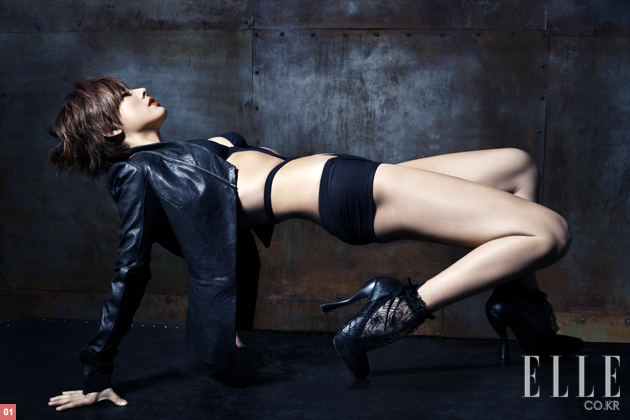
Hence I was considering presenting some pictures for Lee Hyori’s (이효리) recentphotoshoot for Elle Korea here earlier today, but paused when I thought about how to describe her in them: after all, heaven forbid that a male blogger shift from simply using banalities like “she is sexy” when expressing admiration for a woman’s body, to discussing her body parts in the same manner that female bloggers now can and do of a man’s. Or is that just me?
Either way, the sky didn’t fall in the last time I posted a picture of a woman simply because I liked it, and so ultimately I probably would have done so this time too. Well before getting to that stage however, I happened to quickly click between the picture from Elle Korea itself above and that from MSN Korea below, and something much more interesting literally jumped out at me:
In case you’ve missed it, this GIF I’ve created shows how that switch looked:
Yes, not only did MSN Korea feel the need to enlarge her breasts, apparently they also thought that she was too fat too. Anybody else find the change simply more patronizing than sexy however?
Either way, it certainly makes yesterday’s video on Korean women’s perceived need for cosmetic surgery and weight reduction all the more poignant!
(For all posts in the Korean Photoshop Disasters series, see here)
Arirang TV (아리랑 TV) has a deserved reputation for presenting an overly positive image of Korea to the world, so I was pleasantly surprised by this segment from Monday’s Arirang Today thatacknowledges the huge pressures Korean women face to have unnecessary cosmetic surgery for job interviews and marriage prospects, and without presenting them as mere mindless followers of fashions in the process. Only 7 minutes long, it’s a good short introduction to the topic (via: pompeiigranate).
(For all posts in the Korean Sociological Images series, see here)
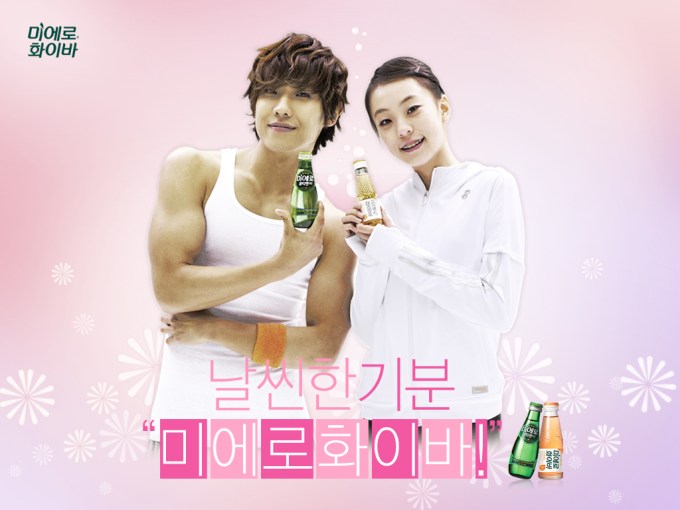
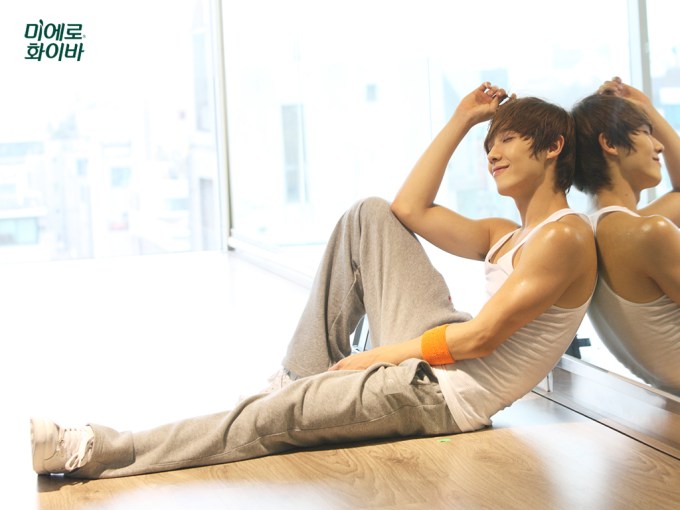
Regularly criticizing food and drink companies for marketing their products so differently to either sex, or even exclusively just to one, then I’m surprised to find I have mixed feelings about the news that one company has actually chosen to stop doing so for a change: Hyundai Pharm (현대약픔), whose Miero Fiber (미에로화이바) “diet drink” for women was ironically the first of its kind in Korea, but for which a new campaign has been launched featuring Lee Joon (이준), a member of boy band MBLAQ (엠블랙), and Kwak Min-jung (곽민정), a figure skater:
제 2의 비라 불리며 초콜릿 복근으로 팬들의 마음을 사로잡고 있는 엠블랙 이준과 밴쿠버 동계올림픽에서 괄목할만한 성장으로 모두를 놀라게 한, 제2의 피겨여왕을 꿈꾸는 피겨스케이팅 선수 곽민정, 이 두 사람이 만난다면 어떤 모습일까?
엠블랙 이준과 곽민정 선수가 기능성 식이섬유 음료의 대표 주자인 현대약품 미에로화이바의 새모델로 발탁됐다.
Called the second Rain (비), and gaining a lot of fans through his chocolate abs, Lee Joon of MBLAQ is with Kwak Min-jung, a figure skater who startled everyone with her remarkable growth as a skater at the Winter Olympics in Vancouver, and who dreams of becoming the second figure skating queen [after Kim Yuna (김연아)]. What are they doing meeting together?
Lee Joon of MBLAQ and Kwak Min-jung the skilled athlete have been chosen as the representatives of the diet fiber drink Miero Fiber by producers Hyundai Pharm.
미에로화이바는 1989년에 출시되어 20년 넘게 많은 사람들의 사랑을 받아온 국내 최초의 식이섬유 기능성 음료로, 그 동안 이소라, 김혜수, 박민영, 고아라, 신민아 등 미에로화이바를 거쳐 간 여자 연예인들은 최고의 인기를 구사한다는 소문을 낳을 만큼, S라인 여자 연예인들의 매력이 돋보이는 CF를 선보여왔다.
이에 이준과 곽민정 선수의 모델 발탁이 더욱 신선할 것이라는 것이 현대약품 측의 설명. 서로 다른 분야에서 떠오르는 신예로 맹활약 중인 이 두 사람은 이번 CF를 통해 2010년, 모두가 부러워하는 워너비 몸짱으로 등극할 예정이라고.
Miero Fiber has received a lot of love since being launched as the first diet drink in Korea in 1989, and indeed [previously unknown] female entertainers that have showed off their S-lines and attractiveness in commercials for it have included the likes of Lee So-ra, Kim Hye-su, Park Min-young, Go-ara, and Shin Min-a, to the extent that there is a rumor that appearing in one is very helpful for a female entertainer’s career!
James – That is probably just the typical hyperbole of Korean news stories, but then I did personally first learn of Shin Min-a in 2000 and Go-ara in 2006 through their Meiro Fiber commercials:
Lee Joon and Kwak Min-jung were chosen by Hyundai Pharm because the company wanted a strong, fresh image, and because both are rising stars in their respective fields. It is hoped that through this commercial, in 2010 many people will become jealous of them and also try to get good bodies.
현대약품 관계자는 “이준과 곽민정 의 건강미와 무한한 가능성에 주목했다”며 “이준의 강하고 섹시한 이미지와 곽민정 선수의 건강하고 귀여운 매력을 통해 미에로화이바가 상징하는 건강한 아름다움의 컨셉이 효과적으로 전달될 것”이라며 새로운 모델에 대한 기대감을 선보였다.
한편, 지난 달 세계선수권대회를 마치고 귀국한 곽민정 은 국내에서 한 달간 머물며 휴식을 취한 뒤 다시 캐나다 토론토로 돌아가 오서코치와 함께 훈련에 전념할 계획이며, 이준은 최근 짧은 헤어스타일로 변신해 스승인 비와 붕어빵 외모로 화제를 일으키며 본격적인 컴백에 대한 팬들의 기대감이 한껏 고조되고 있다.
According to a Hyundai Pharm spokesperson, “It has often been remarked that Lee Joon and Kwak Min-jung both have a kind of healthy beauty and unlimited potential,” and that “with Lee Joon’s strong and sexy image and Kwak Min-jung’s healthy and cute one, they will be effective as symbols of Miero Fiber’s healthy and beautiful concept,” which is why they were chosen as new models and why Hyundai Pharm has high expectations of them.
In the meantime, after the 2010 World Figure Skating Championships concluded last month, Kwak Min-jung returned to Korea for a month of rest, but has since returned to Toronto in Canada to concentrate on training with coach Brian Orser, while Lee-Joon has recently changed his hairstyle to look almost like a twin of his mentor Rain, raising a lot of interest and expectations among fans as to what the theme of MBLAQ’s comeback will be. (source)
Granted, not an explicit admission that Hyundai Pharm now hopes to sell to men what it previously wanted consumers to believe was only for women. But that message is pretty clear in the commercial itself:
언니만큼 잘하고싶어요. 라인도 신경써야죠.
Like my older sister [Kim Yuna], I want to do well. I also have to pay attention to my S-line, yes?
마시는것도 관리해야죠. 형! 딱 기다려!
I too have to think about what I drink. Older brother [Rain]! Just you wait for me!
내일이 기다려집니다. 미에로 화이버.
We can’t wait for tomorrow. Miero Fiber.
And on that note, it’s a pity that, yet again, athletes that have gained great bodies through exercise are endorsing a product that encourages people to think that merely slugging a diet drink is all that is required. But I do think that selling it to both sexes is still a positive step: after all, as I discuss here, unfortunately it is by no means an exaggeration to say that there is a widespread belief among Korean women that “obtaining the perfect body is possible provided one merely buys and passively uses, applies or digests various products,” and one which strangely coexists alongside a belief by men that they must do active exercise instead. Introduce the notion that men and women can obtain their desired bodies through the same means however, and you begin to challenge that false dichotomy.
On the other hand, it is a diet drink being sold, and so there is also the possibility that ads like these will simply encourage men to forgo exercise in favor of dieting (and so on) also. Which do you think is the more likely scenario?
Either way, Korean energy drinks are off to a good start!
Always just an experiment really, after last week’s open thread received no comments whatsoever then I deleted it and thought I’d call it a day, but I’ve relented and decided to give the open threads one more shot: after all, all the others received many. So, if you’d like a forum to talk about virtually anything Korea-related each weekend (albeit with a preference for sociology and pop-culture), and perhaps most importantly one that is moderated also, then please do make sure to contribute this time!
But please don’t get the wrong impression: of course I’ll be a little disappointed if the open threads don’t take off, but I don’t mind really, as keeping you entertained and informed is my prime concern (call me selfish, but I would like to get paid to write eventually, and this is how I learn how!). And with that in mind, in lieu of an extra post this weekend I’m starting this open thread a little early to give me more time to work on several in-depth ones I’ve been promising for a while.
Before I go though, an admin note for RSS feed subscribers: I recently bought the domain “http://thegrandnarrative.com”, which the old “http://thegrandnarrative.com.wordpress.com” now automatically redirects to, but I’ve noticed that although the feed for the latter still works just fine in Google Reader, the feed for the former is completely haywire, throwing up any post I simply edit even if it is several years old. That wouldn’t normally be a problem, but then I’m doing some major spring cleaning as it were, editing a month’s worth of old posts at a time, and this has meant that sometimes 20 very old posts have been arriving in your feed each day, which must be a little annoying. Sorry about that, and unfortunately I don’t know what I can do about it until I finish in a couple of weeks, but if you’d like to receive notification only when new posts arrive in the meantime, then please consider changing the feed to the old wordpress one, or alternatively you can subscribe by email via the button on the right.
Update, Monday 26th – Apologies, but those posts will have to be postponed a little, and this week’s Korea Gender Reader to next week: our landlord has just informed my wife and I that she wants to raise the rent, and so much of today has been spent looking at apartments online. We might be moving in less than 2 weeks!
Very surprised to hear that this will be not only be playing in Busan, but just 10 minutes away in my local drinking district of Kyungsung and Pukyong university, I’m glad to finally get a chance to see this. With all proceeds going to shelters that help victims of sex trafficking in Korea, check out the Facebook page for the details, including about the after party: am looking forward to meeting some readers there!
Update 1: Lest the poster above give you the wrong impression however, which is actually for a Korean performance in Bucheon, please note that the performance is in English, and you can hear an interview of the cast on Koreabridgehere if you like.
Update 2: You need to be logged on to see the Facebook page, so alternatively you can see here for the details instead, and I’ve also added a map below.
Never being interested in gisaeng (기생) previously, I am now intrigued after reading this unorthodox perspective on them at Curiosity Killed the Eccentric Yoruba, with a special emphasis on the 2006 drama Hwang Jin-i (황진이) above. A quick excerpt:
While I do not believe that courtesans largely lived happy lives, I do believe that they were the freest and most independent women in those patriarchal societies. I remember my friend reading me an essay she had written which she called ‘Why I want to be a whore’. She had written that essay for a Latin class she took and the context was ancient Rome. According to my friend the only profession that ensured a woman’s freedom and independence was to be prostitution and I am pretty sure she meant the art of the courtesan.
Anybody know how I can watch Hwang Jin-i with English and/or Korean subtitles?
2. 60% of teens have unprotected sex
Naturally, that headline from The Korea Times actually only refers to sexually-active teens, and whom were only 5.1% of all the 75,238 teens surveyed (so in fact, only “3.06% of teens have unprotected sex”). But regardless, as always I would be very wary of drawing any conclusions from the data with no information provided about the methodology used, although I’d echo the report’s criticism of the woefully inadequate sex education provided at Korean schools.
If you’re interested in finding out more, please consult the categories on the right for many more posts on Korean teenage sexuality and related issues, or see this one on the age of consent and this one on sex education if you’d rather just have quick introductions.
3. Why is celebrity endorsement so important in Korean commercials?
When even the head of Korea’s largest advertising agency says that much of Korean advertising can be reduced to simply “beautiful people holding a bottle,” then it’s not just your imagination when you see so many idols doing so many commercials these days; now, see Omona! They Didn’t for why.
An interesting read that alternates between literary theory and social history, it details how, in the late 90s and early 2000’s, Chick Lit came from overseas, took Korea by something resembling force, and was then recreated as a domestic product, but one that had internalized many of the messages of the original imports.
5. Cheerleaders helping to reinvigorate pro-baseball
So claims thisChosun Ilbo article, which also says that baseball stadiums are no longer the sole domain of middle-aged men but are now full of both men and women in their 20s.
Not a baseball fan myself, does anyone know if this is just wishful thinking or not?
7. Girls’ Generation members ordered to always wear make-up
Lest the sky fall in if even more pictures of them without it appear on the internet. But on a more serious note, I do have a Korean friend who works in a bank who has told me that she’d be fired if she repeatedly came to work with her face au naturel, although I don’t know how typical that is of Korean companies in general?
8. Korean student commits suicide after being raped during MT
Moreover, if not rape per se, then sexual harassment at least may well be endemic to MT culture:
Not too long ago, Brian (formerly) in Jeollanam-do reported on the university student who committed suicide after being raped on an MT. MT is short for “membership training” and they have nothing to do with any sort of training. Groups of students who are associated in some way (e.g. are members of the same club or have the same major) go somewhere, stay the night, and then return the next day. Participation is supposedly optional, but declining could get you ostracized, which is a big deal in Korea, particularly among university students. What do they do there? Drinking alcohol. Lots of it. Again, you’re pressured to conform and participate. If you don’t drink, or only a little, you will be angrily accused of “spoiling the mood” by your superiors (“seon-bae”). In Korea, subordinates (“hoo-bae”) basically have to do everything that their seonbaes demand, or risk the aforementioned excommunication. It’s common for male seon-baes to try to get female hoo-baes drunk so as to make sexually harassing them easier.
First, the good news: child rape victims are no longer required to testify in court when their alleged rapists are tried, although in light of the continuing confusion surrounding the age of consent in Korea I would have preferred it if the Yonhap Newsreport had specified until what age victims are considered children (not academic if 13 year-olds are considered consenting adults).
More ominously however, the government has now decided to release the names and faces of alleged sex-offenders when there is “strong evidence of guilt and a public demand to know,” and one immediate problem that comes to mind is how open that is to interpretation. But as Seamus at Asadal Thought puts however, more crucial is the fact that it is just:
…anothercase of the government trying to just keep the people happy while completely missing the point.
The point is not that people want to see the faces of these people – they’re not a threat once they’re caught. What the people of Korea really want is, one, for better regulations to be put in place to stop these crimes being committed in the first place, and two, for the offenders to be given sufficiently harsh sentences when they’re charged.
Also in crime-related news, Korea Beat reports that an investigation has been opened into a Gwangyang high school teacher who allegedly slapped and beat students.
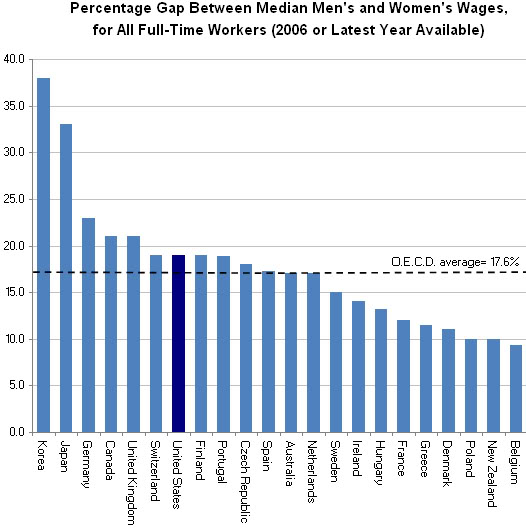
10. Korea’s gender wage gap in comparative perspective
Mentioning the fact that Korea has the largest gender wage gap in the OECD so many times, I have been remiss in not providing a graph like this earlier (via: Sociological Images):
11. Music videos banned for depicting…jaywalking
About to start writing an MA thesis in which I place:
…the censorship of recent years – invariably quite arbitrary, hypocritical, and inconsistent – into some sort of context, most likely that of the corporate interests of the various ministries and companies involved themselves.
Then I feel quite vindicated in light of hearing the supposed reasons both a recent Rain and LeeHyori (이효리) music video have been banned from public television for.
Meanwhile, despite earlier reports (see #5 here) that singer G-dragon would not be prosecuted for the following sexually-charged performance at a concert attended by minors, this no longer appears to be the case:
With thanks for passing all the links on, see Tenshii’s comment for more information on those and many similar cases.
12. Avoiding Stalkers
I’m no Picasso and Jasmine Taiwo recently had problems with stalkers, and have a lot of good advice for other women in case the same happens to them. Also, see Roboseyo’s post for links to earlier incidents.
Best of luck to this couple in Seoul, although unfortunately they’re going to need it considering a Korean newspaper recently placed gay personals on a par with advertising prostitution. Also, see Doing It Korean Style for the recent storm in a teacup over a recent public kiss between 2 male singers.
14. “New university department modeled on the MIT Media Lab to nurture a pool of creative individuals to lead the country’s technology sector”…women need not apply?
Via fellow Twitterer José María Areta, how else is one to interpret the news that male students in master’s and Ph.D. programs there will be exempted from military service?
On the plus side however, one also wonders at its legality: just last month, affirmative action for men who had completed their military service was (again) ruled unconstitutional (see #13 here), and unless female graduates are offered similar benefits for receiving degrees then I’d be surprised if it wasn’t challenged as discriminatory.
15.Dating in Korea
Unable to write last week’s Korea Gender Reader because of computer problems, unfortunately there’s necessarily been a great many stories I’ve not covered this time for the sake of keeping this post to a readable length.
But of course I still have to mention all the recent excellent posts on this topic however, starting with this and then this by I’m no Picasso (a follow-up on those I mentioned at #3 here), the latter of which a Korean reader also weighs in on; next, there is Gord Sellar’s excellent series on “Expat Social Fallacies,” from which I’ve learned a great deal (and, indeed, been a little humbled by realizing how many apply to myself), of which Part 2 is primarily about dating; and finally, for those of you that missed it the first time, I recommend reading the post entitled “Western men in Korea who hate on K-guys: get some new material” at Doing It Korean Style first, in which a lot of regular commenters on thisblog contributed to the long comments thread. Enjoy!
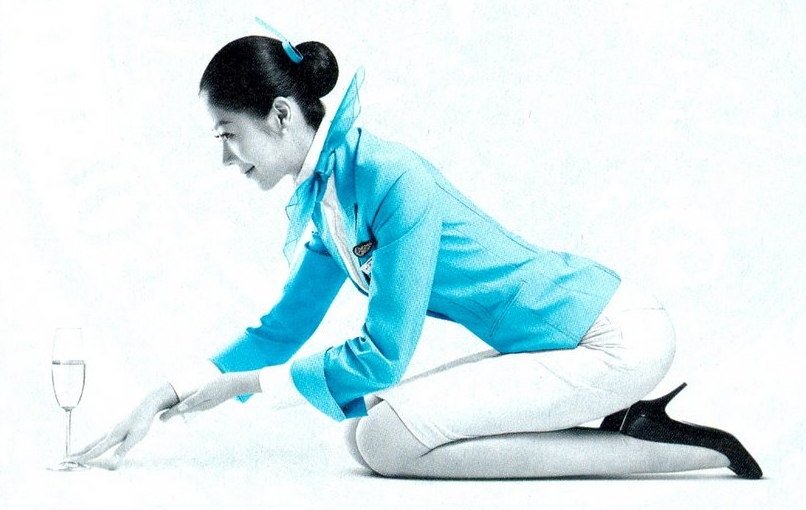
Quick question: for want of a better word, what vibe do you get from the above image? How does it make you feel?
Part of this Korean Air advertisement, how about with the caption:
From departure to arrival, only dignified services for our dignified guests.
Or with the fine print:
When you land, you should be in the same delicate condition as you were during take-off. That’s why our delicate service with a smile remains constant throughout the flight until you reach your destination.
In particular, do you find it demeaning to the steward in any way, or women in general?
Does the fact that only 11% of Korean Air stewards are men influence you in any way, Korean Air only hiring men from within its own ground staff since 1997, but women also from the general public?
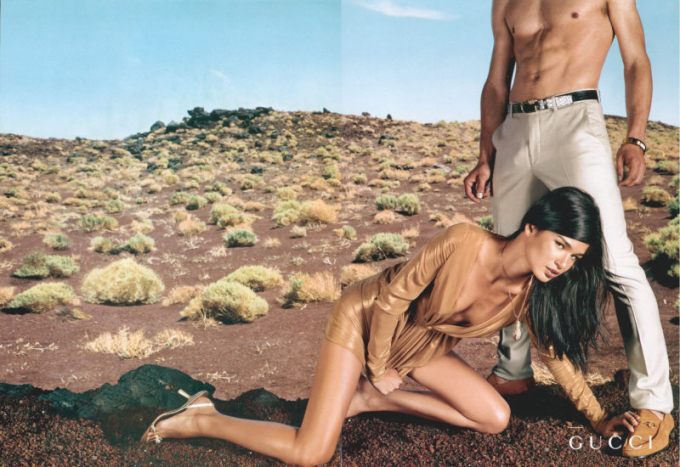
And finally, do you get the same vibe from this Gucci advertisement? Why or why not?
Alas, I have no information about the Gucci advertisement unfortunately (I would be grateful if any readers could enlighten me), but the Korean Air advertisement at least ran in magazines and newspapers worldwide in March 2008, and I recall finding it vaguely disturbing when I saw it in the Asian edition of The Economist at the time, but not quite being able to put my finger on why exactly.
And as it turns out, I wasn’t the only one, commentators from Singapore to London either baffled by it, finding it “hilarious that Korean Air published it in a Western magazine,” thinking it demeaning to women, and/or hoping that in Korea itself “it’s some kind of image of empowerment.” But I didn’t personally see anything sexual in it however, and so – forgive my naivety – originally didn’t quite get this unspecified newspaper author who commented that they were “glad that she is wearing a scarf, which is part of her uniform, and not something else.” Moreover, I certainly didn’t think it looked like she was about to perform fellatio either, unlike the author of Copyranter:
KOREAN AIR: How May We Service You?
Korean Air: You think our turbines have suction power…
The ad copy (click image) reads, in part: “That’s why our delicate service (no teeth!) with a smile remains constant throughout the flight…” Now, the ad was scanned from the March 31st Asian edition of Newsweek. And as tipster Juditha wrote, there certainly is a cultural difference with how female flight attendants (and really, all females) are perceived in Asian culture. But. Still. If the airline keeps running ads in this vein (sorry!), their male passengers are not going to stop at unbuckling just their seat belts.
But hey, we all make mistakes, and it’s not like there weren’t some distinctly sexual overtones to the advertising campaign as a whole; with thanks to fellow blogger Logan Row for pointing it out, note the symbolism at 0:19 in the commercial below for instance (and quite a common theme in wine advertisements!):
What is the logic of the Korean Air advertisement then? Well, as commentators in those above links pointed out, what Korean Air is trying to say in it is:
…that their attendants will go the extra mile for their guests. The pose that the flight attendant is striking is how traditional Korean hostesses would serve guests in their own homes. It is a traditional Korean (and to an extent Japanese) form of humility and hospitality
…Korean (and Asian) custom of bowing in front of your elders, parents, to people you respect, or in general to show deference to someone and submission. (ie students serve their teachers drinks/food on their knees) Its a position of servitude not necessarily the same ‘on your knees’ sexual connotation we have in the US. Obviously all of this still is problematic as far as the the female subjugation at the will of the Korean Air clients and basically almost just as offensive. But I thought that cultural reference was probably really important as well, as Korean, and other Asian cultures would read it with that in mind.
it conjures up being treated like royalty – in the old days the servants of royalty had to kneel and bow at all times when presenting the king with food/drinks/documents and then scoot out the door, never showing their backs. it is a sign of respect. with that said, this should not run anywhere outside East Asia as it can be misconstrued by everyone else.
However, unfortunately it was. And unlike in Korea where cultural factors mean that the advertisement is not necessarily demeaning to women, a person’s social status usually trumping factors like how (literally) highly they are placed in an advertisement (see here, here, and here), having any group regularly placed lower than another in advertisements tends to be problematic in Western culture, for reasons the late sociologist Erving Goffman outlined in Gender Advertisements (1979):
Although less so than in some, elevation seems to be employed indicatively in our society, high physical place symbolizing high social place. (Courtrooms provide an example) In contrived scenes in advertisements, men tend to be located higher than women, this allowing elevation to be exploited as a delineative resources. A certain amount of contortion may be required. Note, this arrangement is supported by the understanding in our society that courtesy obliges men to favor women with first claim on whatever is available by way of a seat. (p. 43)
And also:
Beds and floors provide places in social situations where incumbent persons will be lower than anyone sitting on a chair or standing. Floors are also associated with the less clean, less pure, less exalted parts of the room – for example, the place to keep dogs, baskets of soiled clothes, street footwear, and the like. And a recumbent position is one from which physical defense of oneself can least well be initiated and therefore one which renders very dependent on the benignness of the surround. (Of course, lying on the floor or on a sofa or bed seems also to be a conventionalized expression of sexual availability) The point here is that it appears that children and women are pictured on floors and beds more than men. (p. 41)
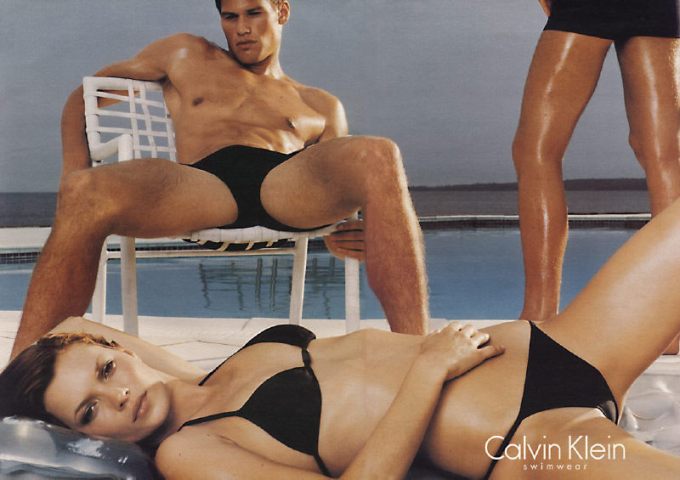
Granted, the Gucci and Calvin Klein examples of this above are particularly provocative, but you can see more normal ones in this “Ritualization of Subordination” category of Goffman’s framework at The Gender Ads Project if you’re interested. Moreover, in light of those, I’m no longer entirely convinced that the Korean Air advertisement isn’t still problematic despite its cultural context: after all, with the proviso that men usually look rather awkward in poses that are sexually appealing on women (as hilariously demonstrated here), I personally find it very difficult to imagine a man in place of a woman in the Korean Air advertisement, although I fully concede that that may be due to my own socialization process leading me to believe that it is more “natural” with a woman, or even simply my familiarity with the advertisement, that happened to feature a woman rather than a man. Or is it not just me?
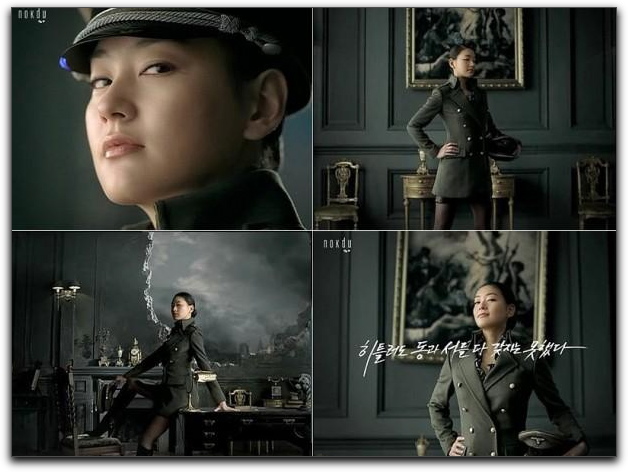
Regardless, this is by no means the first time that Korean advertisers or advertising agencies have produced advertisements that are appropriate for and/or logical to Koreans, but completely confusing and even offensive overseas. Not that only Korean companies are guilty of doing so of course, but they are the focus here, so let me leave you with 2 examples, the most notorious of which is probably Korean cosmetic maker Coreana’s (코리아나) use of Nazi imagery in 2008, about which you can read more at Brian in Jeollanam-dohere, here, and then here (and the video is still available at Adland.TV).
Next, slightly more benign, there is that for the Samsung Sens notebook computer from September last year:
The logic of those with other, non-Sens notebooks having pig noses is that Korean 2-plug electrical sockets do indeed look a little similar, and I’ve heard that that’s traditionally what they were called too (but perhaps only by children?). Regardless however, one wonders why they act like bafoons, and particularly why they’re all Caucasian when the commercial was filmed in a city as racially diverse as Sydney?
But a crucial difference between those and the Korean Air advertisement was that only the latter was intended for a global audience, and so the advertiser or advertising agency responsible should really should have known better. And now I’m curious: can anyone think of other cases where Korean advertisers or advertising agencies have made similar mistakes overseas? Alas, given the insular nature of the Korean advertising industry, probably not!
Update: Compare this advertisement for ANA airlines’ flights to Japan, from the February 2010 Hemisphere magazine (the in-flight United Airlines mag).
(For more posts in the “Gender Advertisements in the Korean Context” series, see here, here, here, here, and here)
UK-based readers, note the book-launch in London next Wednesday: see the The Japan Foundation for more details, and make sure to email jd.mackintosh@bbk.ac.uk by Monday if you’d like to attend.
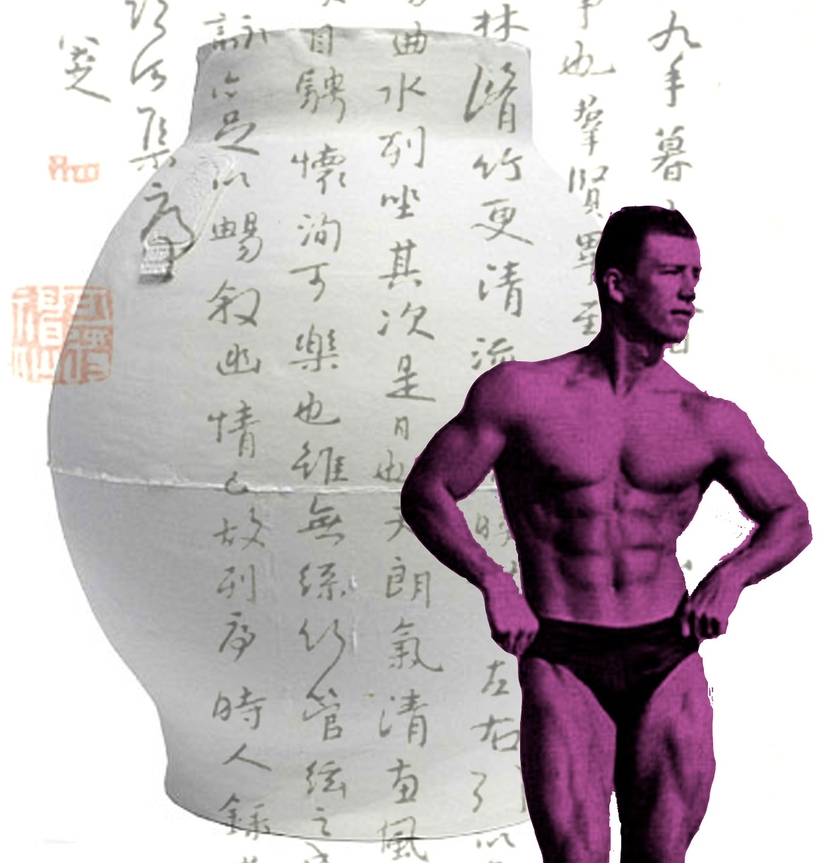
Alas, it’s no longer my planned thesis topic, but I’m still very interested in theorigins of the kkotminam (꽃미남) phenomenon, and so naturally I”m intrigued by the notion that the physically healthier a society, the more women in it tend to prefer “feminine” men as mates. From The Economist:
A disease-free society helps effeminate men attract women
IT IS not just a sense of fairness that seems to be calibrated to social circumstances (see article). Mating preferences, too, vary with a society’s level of economic development. That, at least, is the conclusion of a study by Ben Jones and Lisa DeBruine [themselves a married couple] of Aberdeen University, in Scotland, published this week in the Proceedings of the Royal Society.
….In a man, the craggy physical characteristics associated with masculinity [James: because of testosterone] often indicate a strong immune system and thus a likelihood of his producing healthier offspring than his softer-featured confrères will. But such men are also more promiscuous and do not care as much about long-term relationships, leaving women to raise their kids alone.
Nowadays, sound parenting is often more important to the viability of a man’s offspring than Herculean strength. That, some researchers suspect, may be changing the physical traits that women look for in a mate, at least in some societies. A study carried out in 2004, for example, discovered that women in rural Jamaica found manly types more desirable than did women in Britain, which led to questions about whether those preferences were arbitrary or whether women in different parts of the world might be adapting to circumstances that place different emphasis on manliness in the competitive calculus.
Dr Jones and Dr DeBruine therefore looked to see if there is an inverse relationship between women’s preference for masculine features and national health. Sure enough, they found one…
With a nod towards copyright, see the article itself for the rest, and particularly for the methodology used, which did account for cultural and racial differences (image right: Hot Girl Remix by geishaboy500). Still, my first reaction was that this earlier study seemed to completely contradict those findings, as it demonstrated that for much of human history women had good reason to prefer skinny guys over muscled ones, the latter being less likely to survive in (frequent) times of scarcity, but that this no longer applied in the overabundance of modern times.
However, just like the kkotminam phenomenon itself forces many Westerners to reconsider their previously held notions of masculinity and femininity (not least myself), one should be very specific about what one means by those terms, and so note that this study was purely based on face shapes, which are heavily influenced by hormones. Accordingly, it makes a great deal of sense that with good access to modern medicine, women would be more interested in other factors than simply passing on a good immune system to her children, as evidenced by a masculine jaw.
Hence, with the proviso that what makes “a great deal of sense” is very culturally and period specific however (evolutionary psychologists, for example, guilty of once thinking that all women in prehistoric tribes stayed in the camp to look after children and/or do some gathering while the men went off to hunt each day!), and that the specific timing of the popularity of the kkotminam and metrosexual phenomenons (and various permutations thereof) were/are/will be heavily dependent on a whole range of factors, not least the interests of the cosmetic industry, do you think that there’s a certain inevitability in them? Or are they merely passing fads? After all, given the above logic, then they’re here to stay.
Regardless, if it were possible, it would be fascinating to see if women’s tastes in men in a various society varied over time according to the health of its members. Alas, isolating everything but preference in face shape is probably impossible, and while it’s fair to say that in all historical societies men’s (and women’s) clothing probably tended to become more flamboyant and colorful in times of prosperity, I can’t stress often enough that neither characteristic is “feminine” per se!
Update: Alas, my wifi connection has been playing up since the weekend, so I certainly won’t be!
Please bear with me for the next couple of days while I get it fixed.
Update 2: All solved, albeit too late for this week’s Korean Gender Reader sorry. Turns out that my wife and I had been using our neighbor’s wifi signal for the past year!
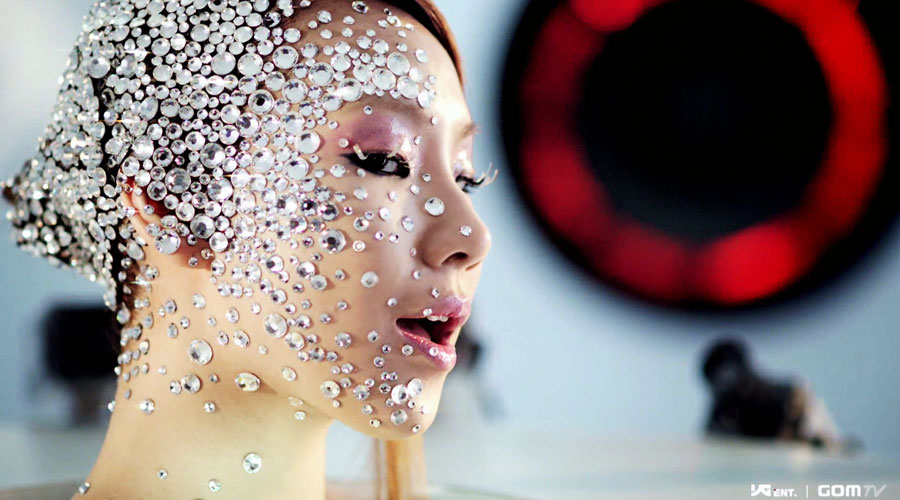
As they say, first impressions are everything. And so, with apologies to those of you unwise enough to read this blog at work, let me share mine of girl group T-ara (티아라) from their music video of Like the First Time (처음처럼) before proceeding: namely, that they were confident, sexy women, not at all embarrassed to perform risqué dance moves like the above in front of large audiences.
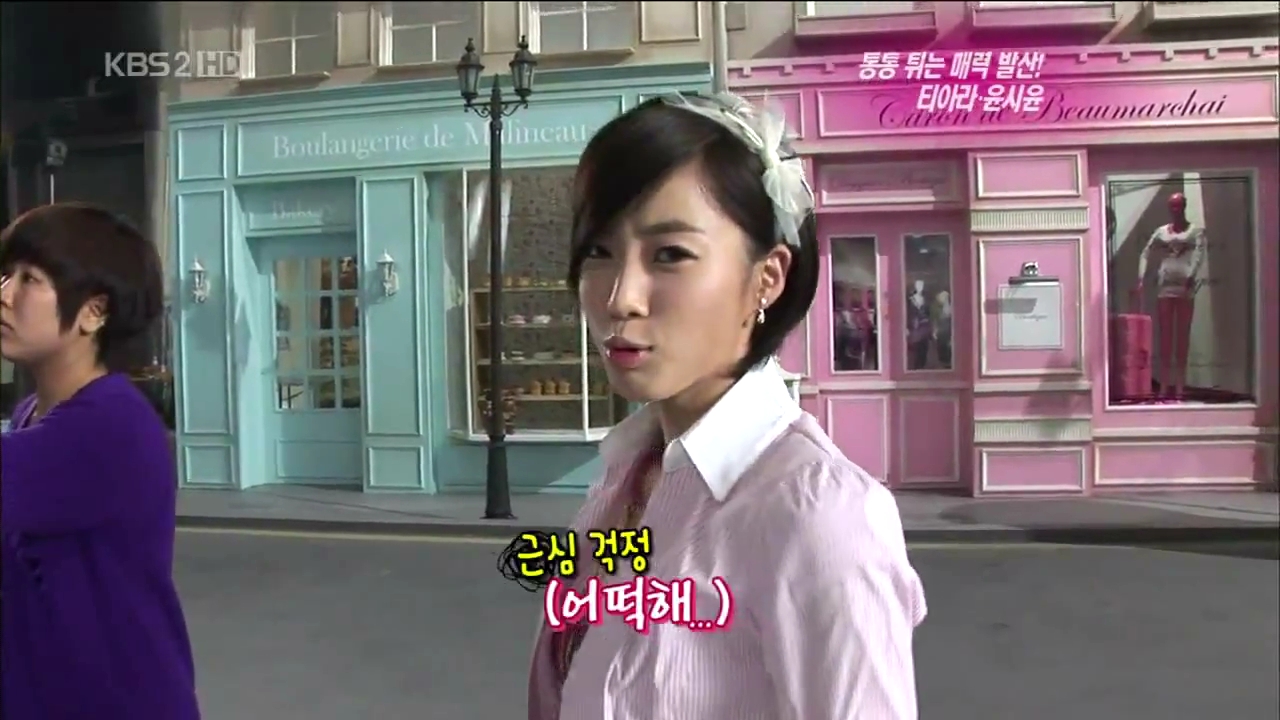
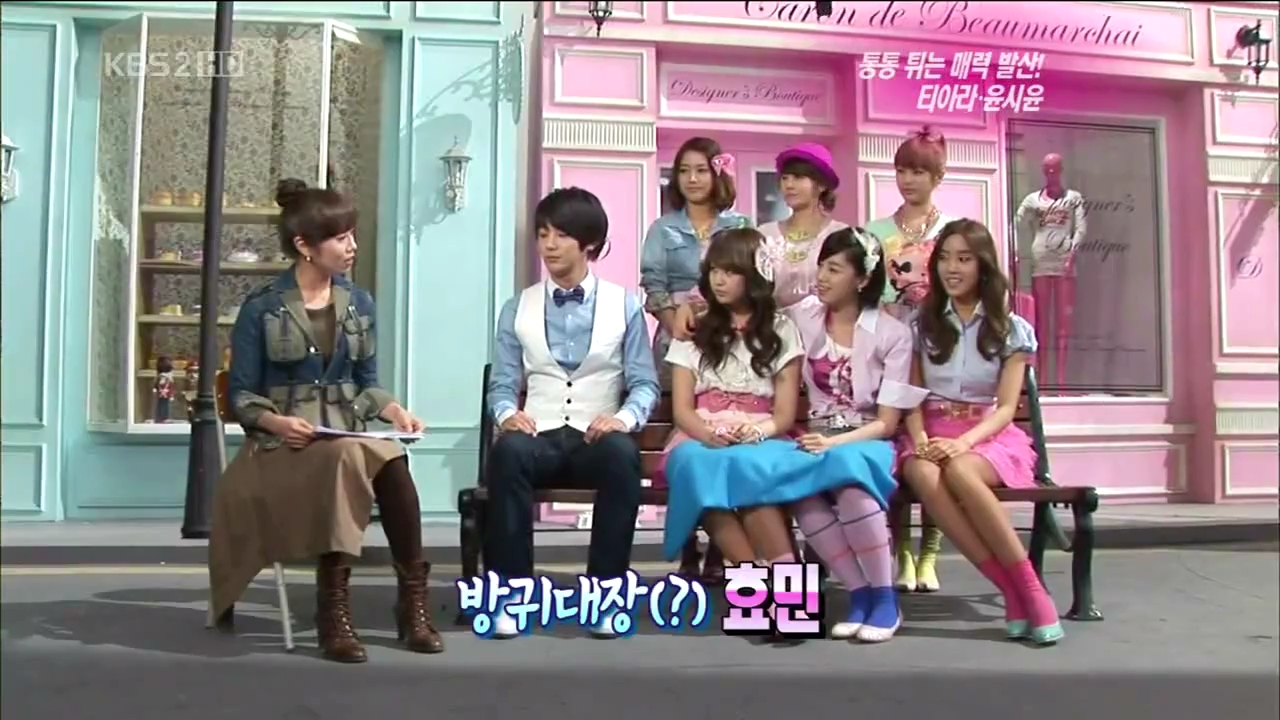
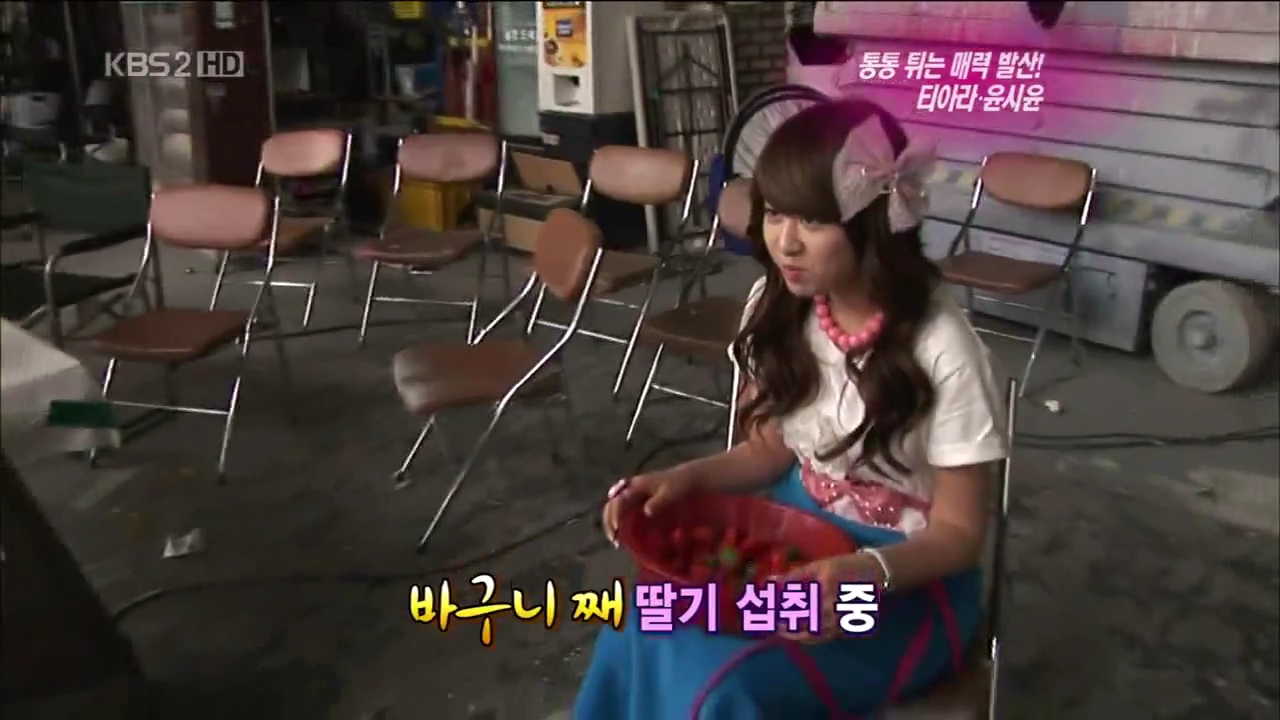
However, it was difficult to square that impression with their shyness in the following brief interview for Entertainment Tonight (연예가 중계) last month, conducted while making (rather bizarre) commercials for a mobile phone, and I would interested in hearing your thoughts on possible reasons for the differences, and how representative the interview is as whole of the way 20-something women especially are portrayed in Korean entertainment programs.
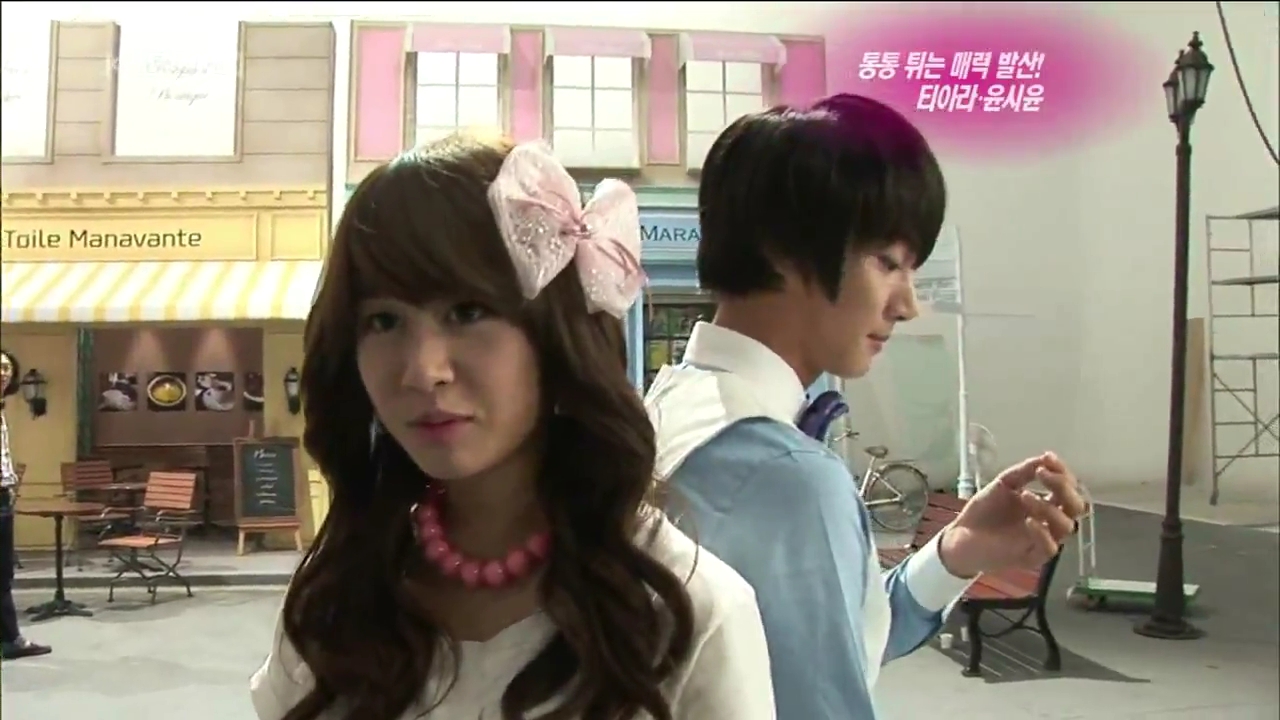
The most important point first: from roughly 1:00 t0 1:30, the interview focuses on group leader Ham Eun-jeong (함은정) feeling embarrassed about repeatedly hugging actor Yoon Si-yoon (윤시윤) for their commercial, despite having just met in the studio. In particular, at 1:10 below she says “어떡해”, or “How” as in “How can I do this?” while making an exaggerated expression of embarrassment, about which the reporter comments “굉장히 부끄러워하죠?”, or “She’s very shy, yes?”. Note also the addition of “근심” and “걱정” on the screen too for added context and atmosphere, (a habit of entertainment programs picked up from Japan), although rather confusedly they both mean anxiety, or worry.
Then at 1:25, she’s asked how she feels from hugging Si-yoon for so long, to which she replies “솔직히말해도…떨려요!”, or “To be honest…I’m shaking/trembling!”.
Natural feelings? Of course. But then recall her music video, in which she – not to put too fine a point on it – repeatedly bends over and thrusts out her bottom, jiggles her breasts, and runs her hands over her breasts and crotch while singing about how her body was on fire. Indeed, even the interviewer herself later (3:08) highlights the complete contrast:
Moreover, while I’ve never personally strutted my stuff on stage like Eun-jeong, I am actually quite comfortable – nay, somewhat notorious for – acting in front of large groups of adult students (I’m tempted to mention faking an orgasm in class once in my first year of teaching, but I’d better not), and doubt that I’d be embarrassed repeatedly hugging an attractive woman in front of others. Yes, I would be if I ended up having a large visible erection as a result, but that’s besides the point: if Eun-jeong was embarrassed, it wasn’t because she was visibly turned on.
And I stress “if”: my wife, for instance, also watched the interview, and at first told me her embarrassment was perfectly natural, but then readily conceded it was rather strange in light of her performances in music videos and on stage. Which leads me to my first question: do you think Eun-jeong was genuinely embarrassed?
…Eunjung lost her composure while filming a hugging scene with Yoon Si Yoon….It’s funny how Eunjung was so flustered and shy around a guy because she exudes such a powerful and charismatic presence on stage. I guess we are all prone to weakness in front of the opposite sex.
And I do remain open to the possibility. However, I’d argue that either subconsciously or deliberately, she’s much more likely to be playing to expectations and norms of the Korean media that she present herself as cute and innocent, regardless of her true personality; well illustrated, I think, by this 2007 commercial with Kim Tae-hee (김태희):
She acts all sugar and spice in wide-eyed innocence as she sips her drink carefully, but as soon as her date turns away, she lets loose her inner diva to strike a pose for the camera. Her date discovers the saved pictures on his Olympus and accuses her of being “nae-soong”.
…inconsistency between a girl’s true personality (i.e. extroverted), and external (i.e. introverted, shy and innocent) personality. In other words, trying to hide your true intentions self by acting sweet and innocent.
And indeed the interview is full of demonstrations of how sweet and innocent they are. For instance, at 1:47 Park Ji-yeon (박지연) is embarrassed to learn that she is Si-yoon’s favorite of all the T-ara members (although you may be surprised to learn that she’s only 16, and hence her embarrassment arguably the most likely to be genuine):
And at 3:17, Eun-jeong feigns (I don’t think anyone would dispute this!) being upset at the other group members selecting her as looking the most different (read: uglier) before putting on make-up:
One music video and and one interview are by no means sufficient to get an idea of their true personalities however (to the extent that one sees any celebrities’ true personalities in front of a camera at all that is), and so I also briefly looked at some episodes of T-ara Dot Com (티아라닷컴), a quasi-reality show about them setting up an internet clothes shopping mall of that name. Here’s a brief segment of one episode, with English subtitles:
And in which their behavior is no different to that in the interview. Hence, while I do still feel that Eun-jeong’s embarrassment at hugging Si-yoon at least was completely feigned, I concede that T-ara’s cutesy behavior overall probably wasn’t an act, and not unrepresentative of Koreans their age either (for reasons explained here).
If that behavior is still a definite expectation or norm of Korean entertainment programs however, depends on such factors as how other women are portrayed in them; if there’s a large difference between men and women; and to what extent such programs offer opportunities for entertainers to present alternate, more serious sides of themselves if they wish to do so.
Unfortunately, I can’t personally say: even when I first arrived in Korea at the tender age of 24, I soon chose never to watch these sorts of programs because I had better things to do than seeing grown men and women acting like children on them. Now, at 34, I’m more concerned about the influence they will have on my own daughters, and to be frank would consider myself a failure as a father if they grew up to behave like members of T-ara do when they reach the same age.
However, in contrast to when I was 24, in fact there’s also some things I like about the Korean media which are on display in the interview, and which I’ll devote the remainder of the post to.
First, in a meta-sense, the practice of providing subtitles and/or commentary on them is simply great for studying Korean, especially considering the huge gap in real-life learning material for Korean learners, let alone intermediate level material. And if dramas aren’t your thing, then studying a 10 minute segment of an episode of T-ara Dot Com everyday is probably quite a tolerable alternative:
More to the point of this post however, there is the very human side of stars presented, a stark contrast to the pedestals Western medias tend to place their own celebrities on. For instance, not only does the interviewer ask at 3:39, which member of T-ara farts the most:
But at 3:49, we even get to watch the evidence:
And, lest he feel left out, Si-yoon is asked if he also farts, to which he replies at 3:57 that yes, he enjoys it:
Compared to that, watching him pick his nose and examine the contents at 2:30 was nothing. And hey, a guy’s got to do what a guy’s got to do, but in any other country I’d be surprised his agent didn’t want that cut out:
But not that showing that celebrities fart and pick their noses like the rest of us mere mortals are the only positives of course. I also love how the interview highlights Ji-yeon stuffing her face with strawberries at 2:57 for instance, and particularly from a basket that looks like it was bought from the back of a food truck, to be found in literally every Korean neighborhood at almost any time of day (for instance, selling salt at 5:30 in the morning). You see, something that looks like it could have been bought in my wife’s home village in 1970 is somewhat incongruous on the set of a commercial for probably one of the most technologically sophisticated products on the planet, and reminds me that constantly seeing such juxtapositions is one reason I love living here:
Finally, there’s the standard happy, bubbly ending of such shows, usually accompanied by cries of Hwaiting! (화이팅); if you’re not smiling yourself at least a little when you see one on TV, that’s probably because you’re being carried out of the room on a stretcher with blanket over your head:
To recap, I would love to hear: your own opinions on how genuine Eun-jeong’s embarrassment was; how representative of young women’s behavior on entertainment shows T-ara’s was; and whether they were simply being themselves or if they were fulfilling expectations and norms of how 20-something women should act on them (I realize that the last is a bit of a false dichotomy though, and should be considered more as a feedback loop). Are there any Korean entertainment shows where women don’t have to be cute? And how about 20-something men, or older women?
Alternatively, do you have any more pet peeves about Korean shows not covered here, or reasons that you really like them?
(For all posts in the Korean Sociological Images series, see here)
Is it just middle-aged Korean men that expect their female subordinates to do menial tasks for them at work, or are younger men different? Does being a foreigner always get you out of this gendered hierarchy? Weigh in on this at Going Places by Diana, who also has many interesting posts about life with her new Korean husband.
Unfortunately, the newlyweds are leaving Korea in August, but she has just started a new blog called Feminist Marriage to compensate. For more on Korean corporate life itself though, this time from the perspective of an atypical gyopo woman, then check out Mental Poo.
2) Korean gender wage gap largest in OECD (again)
Not unrelated to the above, for basic statistics see TheKorea Herald, and as a longer analysis in The Korea Times puts it, the basic problem is:
…the extreme imbalance in the “quality of employment.” In other words, men usually take regular, high-income and professional jobs, while women toil in temporary, low-income and non-professional positions. Women account for less than 2 percent of the executives in the nation’s four largest family-controlled conglomerates of Samsung, Hyundai Automotive, LG and SK groups. One can find few ― if any ― female managers in large commercial banks.
…The low birthrate problem cannot be resolved simply by giving some supportive incentives to women who have children. Women must be allowed to work without worrying about discrimination, and be given equal chances for promotion. With the workforce shrinking as the number of senior citizens rises, one way to deal with the problem is to encourage more women to take jobs.
Korea’s work environment must be changed to allow more women to attain influential positions. The number of female public servants increases each year, but only 7.6 percent of high-ranking positions are held by women. Korea is the only G20 member country where women are virtually nonexistent in top management. As a host country of the G20 Summit, this is something Korea should be ashamed of.
New readers, see this earlier post for more on some of the practical, day-to-day ways in which Korean women are discriminated in the workplace.
3) Likes and dislikes of dating in Korea
Reflections at the I’m no Picasso blog here and here respectively (via Diana).
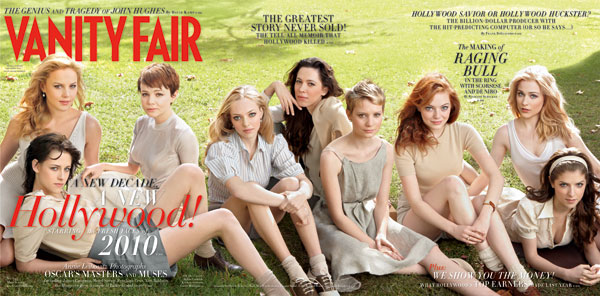
Daine Farr, an American actress with a Korean husband, laments the lack of diversity on the cover of the March edition of Vanity Fair:
…Here is the real cause for my distress with this Vanity Fair “issue”: I have two daughters, neither of whom is as white as I am. My girls are only 1 year old and a generation away from choosing a profession, yet I already fear the day they consider doing what mommy does. (Nepotism is one of the few perks an actress has to offer her offspring.)
I shudder at the impossibility for my half-Korean women in film — talented, thin, young, beautiful or not — based on Vanity Fair’s cover statement. All the education and experience I could provide my daughters will never make them as lily white as Mary Magdalene. And if auburn hair is the only variation allowed at the next supper of Hollywood’s up-and-coming apostles, then my girls, and a majority of those in America, are still out of luck.
Rather confusing news from TheKorea Herald in light of last week’s reports that Koreans were overdosing on diet pills (see #5 here), and as a whole were one of the world’s skinniest populations. Moreover, it also reports that 1 in 7 Seoul school students is overweight, and the Chosun Ilbo adds that Gangwon is the nation’s most obese province, probably because of its high drinking rate and disproportionate number of senior citizens.
Meanwhile, let me pass on the following slightly surreal advertisement for some form of slimming drink I also came across last week; let me know if you’d like a translation and/or want to know more about what on Earth it is selling exactly (viaParanzui):
Vodpod videos no longer available.
6) Multicultural divorce rates soaring across nation
Predictable? Read the Joongang Daily for the details, and also Helen Clark at CNN Go hears from Vietnamese women themselves about what they think about marrying Chinese (and Korean) men. Some excerpts:
…It is true that women from poor areas of Vietnam have been known to marry Chinese, Korean or Taiwanese men, but to say Vietnamese women long to marry them would be news in Vietnam as well. Usually foreign “wife buyers” are poorer, older men from rural areas who cannot land a mate at home. And what respectable woman would long for a man that can’t find a woman except by purchasing one?
“We hate Chinese men,” says bank worker P. Ha, 28, on behalf of herself and her friend. But she concedes that marrying into a better life is an opportunity that some find hard to pass up. Seated opposite central Hoan Kiem Lake where many young Vietnamese couples come to walk in circles hand in hand, she explains: “Many Vietnamese girls need money. They have to escape hardship so they get married for money. I feel so sorry for them.”
She relates the same sordid tales of abuse and exploitation that have been circulating in local and foreign media for years, the ones that may force the government to begin regulating the foreign marriage market racket. That will be especially important if, by 2020, China has 24 million excess bachelors, as has been reported, who will be looking overseas to find partners.
And:
…”I think they (Vietnamese women) prefer Korean men to Chinese men, as they’re richer,” says Nguyen Thi Phuong, a 27-year-old English teacher.
Ha and Ngan don’t agree. Neither are much impressed by Korean or Taiwanese men. “They’re the same. We like Japan, Australia or England. They have a lot of knowledge,” says Ha.
And finally, and only a little dated, Diana at Going Places also discusses:
…a fascinating piece of research presented at the International Conference on Border Control and Empowerment of Immigrant Brides held in September 2007 in Taipei. Marriage Migrant Women in Korea and Attempts to Organize Them was presented by Lee, Inkyoung. She uses case studies and statistical data to highlight the problems faced by women, mostly from rural China and Vietnam, who come to Korea to marry with the promise of the wealth of a more powerful country. Unfortunately, the reality of such arranged marriages rarely live up to the promise of “The Korean Dream.”
7) What is a housewife’s labor worth?
10,172 won per hour, according to the Chosun Ilbo.
8) Violence, Rape and Hazing in Elementary Schools
As usual, Matt at Gusts of Popular Feeling provides a comprehensive report; and very worrying to me personally, with 2 daughters that will be starting school in a few years.
9) Male idol sexually harassed by men
Garam, a member of a new teenage boy band called D-NA (대국남아), has complained of being sexually harassed by older men.
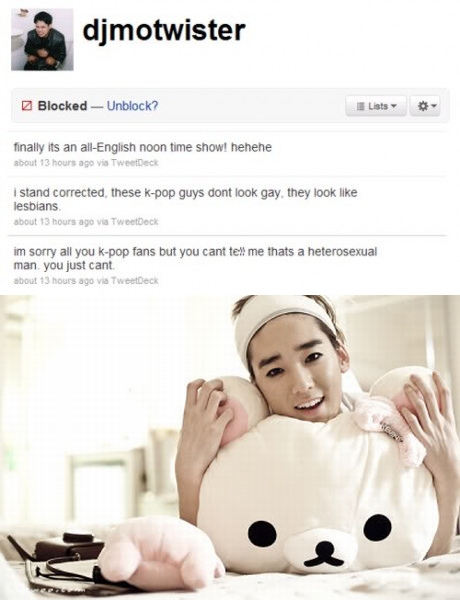
I’ll let the Filipino DJ at the center of the latest storm in K-pop speak for himself:
…Since I posted these comments [on the right], I have received thousands of demands for a public apology and equally large amounts of death threats.
Yeah, right. Like what the fuck are you 12 year olds going to do?
Listen kids, what I wrote was my opinion meant to critique their fashion sense. I felt it’s in the same line as how critics dissect the Best and Worst Dressed at awards night. Look at their photo and be realistic, I am not off on my assessment–those dudes dress and look like chicks.
For the rest, and thousands of comments, see here and here.
11) Japanese rape fantasy videos under fire
From the Huffington Post, which includes a video report from CNN:
…In one such game the object is to find and rape the woman who fired the player from his imaginary job. In another, called “Rapelay,” the player stalks a young woman, her mother and her sister on a train, all while being able to grope them with a click of your mouse. They also include much more graphic, interactive scenes that cannot be shown.
Recall that manga that depicts sex with minors is also being banned by the Tokyo Municipal Government; see #13 here.
12) Sexism in Mandarin
With 70% of Korean being derived from Chinese, Chinayouren has also made me interested in unearthing all the sexist expressions in Korean with this post:
In this week’s language post I want to examine the gender implications in the Chinese written and spoken language, and the reactions of the Chinese women to the many discriminatory expressions in use today…
…The old Confucian tradition in China is hardly an example of gender equality, and given the intimate relation between Confucian scholars and the Chinese script over the millennia, it is only natural that the characters should carry some important bias. As we will see, the spoken language is not any better, reflecting a society where the woman had a very limited role even among the masses.
…Among the incentives that are being considered to reward those who complete their mandatory military service is awarding bonus points when they apply for jobs. This system of reward was struck down as unconstitutional in 1999 and has been a point of contention ever since. The Military Manpower Administration claims that draft dodgers have been resorting to increasingly sophisticated methods to avoid the military service ever since the bonus points system was scrapped. It argues that reinstating the bonus system would be an incentive to serve. However, women`s rights advocacy groups counter that there is no basis for reviving the system since it has already been ruled unconstitutional. Furthermore, such a system discriminates against women, they argue. Indeed, better ways must be found to reward those who serve the nation than through reintroducing a system that discriminates against women…
Not that I don’t consider mandatory military service an impediment to men’s education and career, but as Ask a Korean!points out, and I further elaborate on in this series:
…military experience becomes fuel for sexism. Remember that Korean men believe that they made an incredible sacrifice by serving in the military. (And to some extent, that is true.) So whenever women demand more equal rights, a standard, pithy answer from men is: “Have you been to the military?” For example, a few years ago Korean government abolished the bonus points given to those who served in the military in hiring government workers, based on the reason that it is unfair to women. The decision nearly caused a riot, and is still a very popular fodder for anti-feminists in Korea…
Consequently, I’d rather have the necessity of the whole system of conscription itself re-examined, or – rather unlikely – women also required to serve, well before men are again legally rewarded for serving.
Happy to report that I’ve just secured a teaching position at a university, and enjoying the sunny weather, then this photograph seemed apt…
But please feel free to talk about absolutely anything in these open threads; last week, people only talked about my choice of accompanying image instead…not uninteresting of course, but not really my intention!
If you reside in South Korea, you can donate via wire transfer: Turnbull James Edward (Kookmin Bank/국민은행, 563401-01-214324)
A pair of brief but revealing juxtapositions to ponder this weekend.
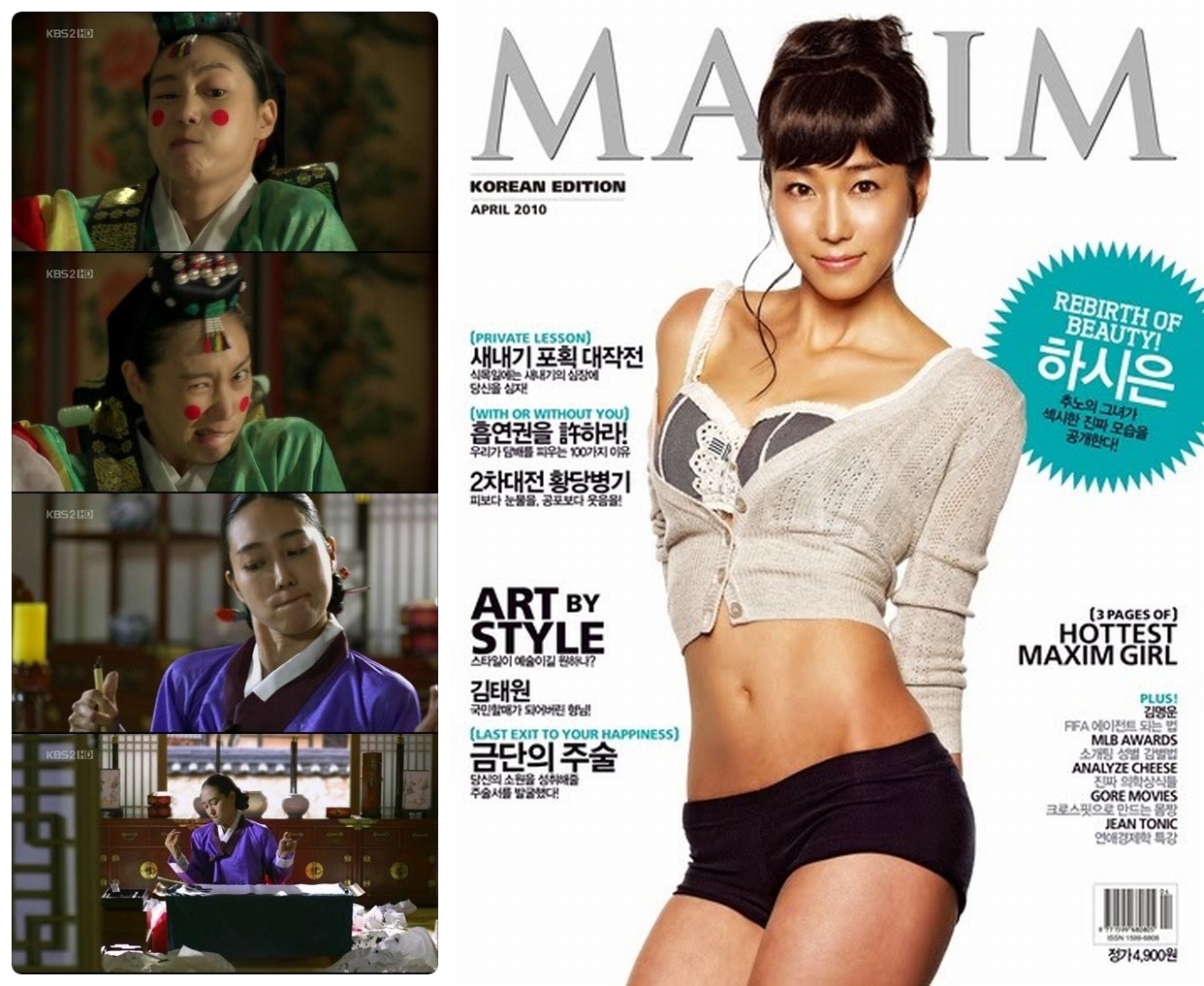
First, earlier in the week it was reported that Ha Si-eun’s (하시은) performance as a character with cerebral palsy in the popular historical drama Chuno (추노) was so convincing, it persuaded her representatives to arrange a photoshoot with Maxim, lest “it affect her career.”
My first reaction to this news? Naturally, that I’m never averse to seeing an attractive woman posing in her underwear…but heaven forbid that she become better known for her acting skills. To play devil’s advocate however, in my experience Korean actors do tend to be typecast by the public rather easily, and indeed a representative did express concerns that fans would be unable to dissociate Ha Si-eun’s image in the drama from real life:
하시은 측 한 관계자는 3월 29일 오전 뉴스엔과의 전화통화에서 “‘추노’의 뇌성마비 이미지가 너무 강했던 터라 하시은의 평소 모습과 작품 속 모습을 연결시키지 못하는 이들이 많았다”며 “부족한 점이 많지만 새로운 모습을 선보이고자 이번 화보를 촬영하게 됐다”고 밝혔다.
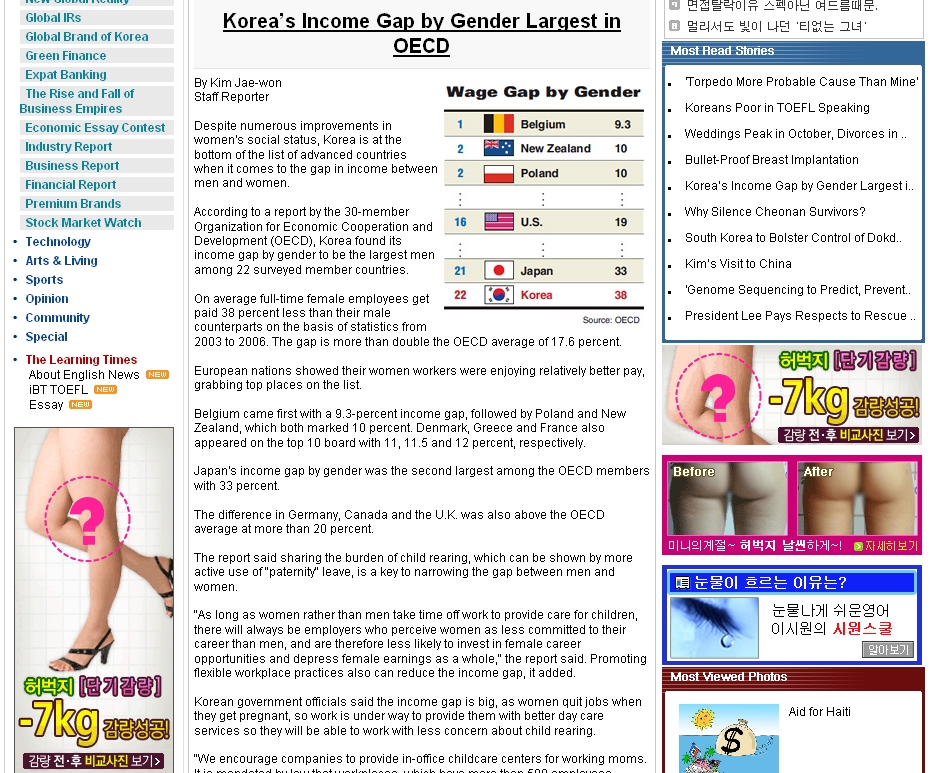
Given the frame of mind that put me in though, I couldn’t help but laugh at the irony of the advertisements accompanying this article in the Korea Times that I read 5 minutes later:
Part and parcel of the tabloidishtone of that newspaper in recent months, those advertisements are not confined to just that article of course. But still, it’s almost worthy of FAIL Blog, yes?
(For all posts in the Korean Sociological Image series, see here)






















 The Grand Narrative
