Korean Sociological Image #71: “Specs” for the perfect Korean wife or husband

(Source: Slutwalk Korea)

When I lived abroad in Korea, I spent a lot of time doing work in cafes. Probably a 100 or more during my 2 years there. As such, I eavesdropped on thousands of conversations. And nearly every one of those conversations was about two topics: complaints re studying English and complaints re losing weight.

(Patricia Park, Korean Bodega, June 15)

Maybe I’m just nostalgic for my bachelor days, but it’s conversations about “specs” (스펙) that I’ve really noticed myself. A Korean term for the criteria used to evaluate a potential spouse on, it’s also my experience that it’s almost exclusively used by women, although that may just be because there’s usually more women than men at my local Starbucks.

Either way, in February Kim Da-ye at the Korea Times argued that looking at marriage this way is a relatively new phenomenon, and that it’s “matchmaking companies that rate spouse seekers by specs [that] have fueled [such] materialism.” And, as if to bolster that point, Donga-Reuters would report on exactly the same phenomenon emerging in China after I’d already begun writing this post.

But as discussed below, matchmakers have been encouraging such pragmatism for decades, so they can hardly be described as driving that change in outlook. Rather, it’s economic factors that are responsible, as Kim later acknowledges in her article:

…today’s buzzword “Sampo” generation (삼포세대) …indicates a 30-something who has given up dating, marrying and giving birth because of the lack of financial means…

Contrast the “880,000 won generation”, which generally refers to 20-somethings. Continuing:

….What’s interesting about such preferences for the partner’s economic qualification is that they don’t come from conservative parents or rigid social structure but independent, young individuals….

….The near obsession with fine lifestyle is a contrast to the attitude of the baby boomer generation, many of whom used to say that they can start from a small rented room….

When asked why the younger generation isn’t willing make such a humble start, Lee, a single woman in her mid-30s working at a media firm, said, “Back then, amid fast economic growth, people had hoped that they would be able to climb up the social ladder and afford a bigger place in the future. Nowadays, people feel that if they start in a small room, they will be stuck there for the rest of their lives.”

The high cost of getting married naturally leads to some couples to be heavily indebted after the honeymoon ends. In addition to the Sampo generation, another phrase linked to both the economy and marriage has emerged — “honeymoon poor.”

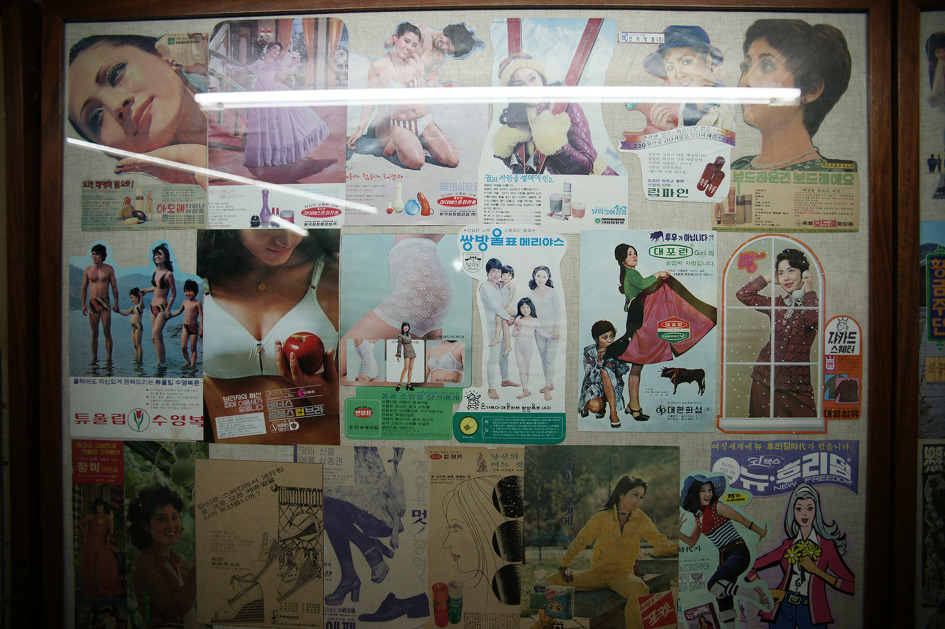
And Kim — whose article is still very informative overall — gives several examples of engaged couples’ fights over money, some of whom ultimately break up. Yet those would not be out of place in popular discourses of marriage in, for example, the 1980s, when women’s magazines were similarly promoting the virtues of arranged ones. Presumably, at the behest of their advertisers:
(Source: Google Books)

Passage Rites Made Easy [A 1982 Korean book by Ko Chonggi] describes marriage through an arranged meeting as more “rational” behavior than simply falling in love because the candidates for romance and matrimony have already been carefully scrutinized by parents and matchmakers. Korean women’s magazines also emphasize the value of prior screening in choosing a mate, suggesting by the frequency with which they address this topic that their youthful readership is by no means convinced of the merits of matchmade matrimony:

Today, with the trend towards frankness in sexual matters, talk of “arranged meetings” or “matchmade marriage” might sound excessively stale. Even so, in marriage the conditions of both sides enter into things. Matchmade marriage, where you can dispassionately investigate these considerations beforehand, has some advantages that cannot be ignored (“The Secrets of a Successful Arranged Meeting,” Yong Reidi, 3 March 1985: 347).

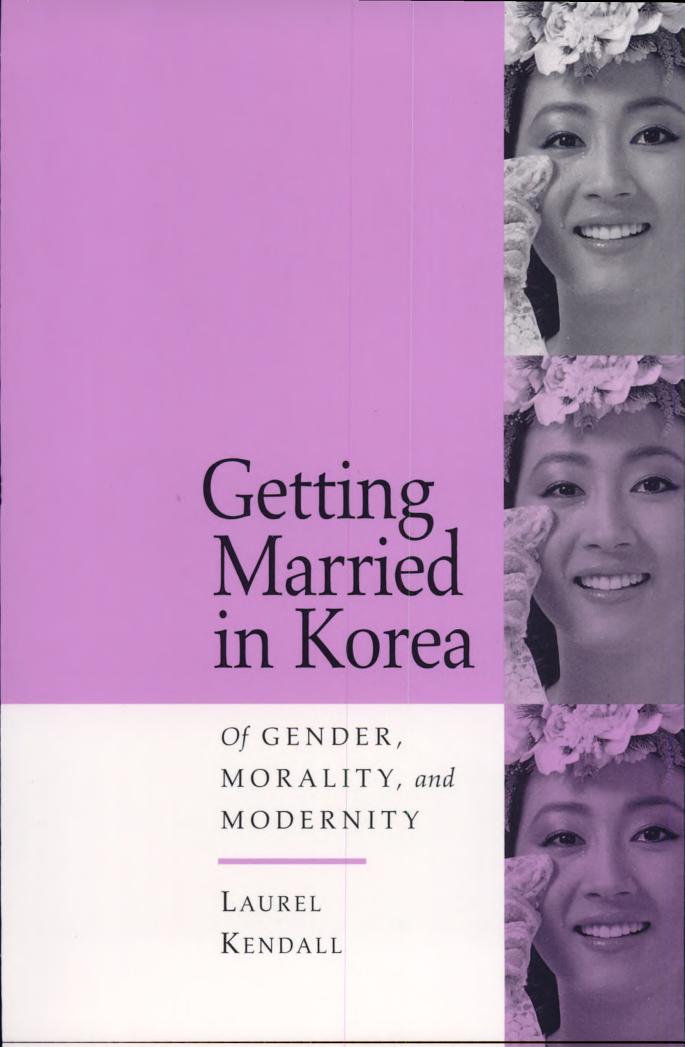
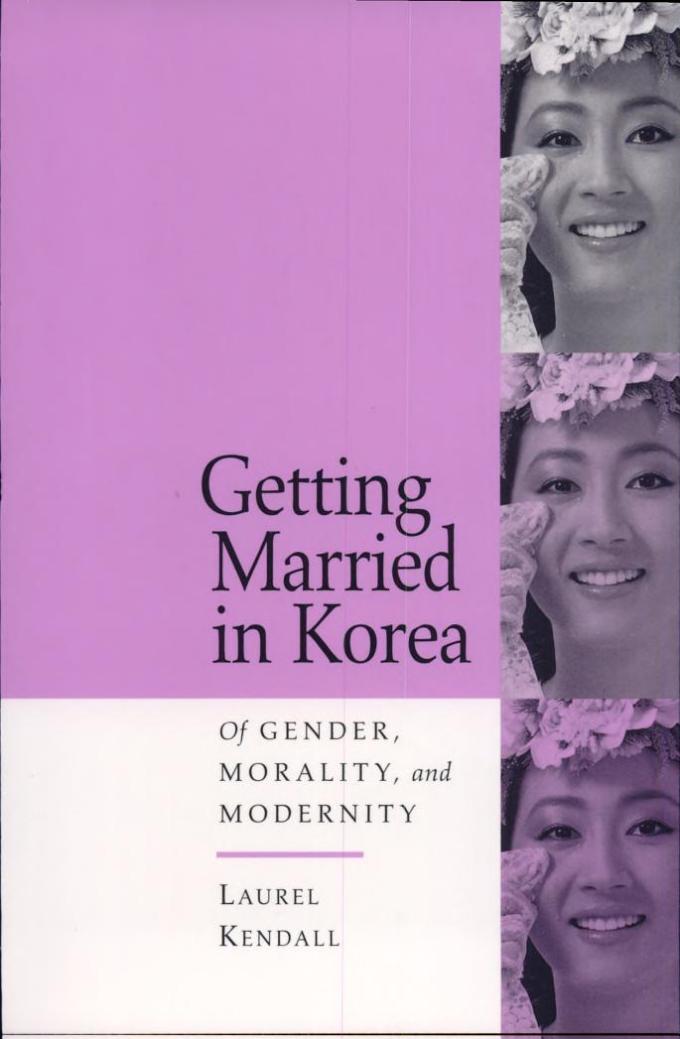
From pages 89-90 of Getting Married in Korea: Of Gender, Morality, and Modernity (1996), by Laurel Kendall, the next page sounds a little ironic 18 years later:

The evolution of Korean courtship practices provides one excellent example of how notions of progress, of an enlightened “now” versus a repressive “then”, mask the particular disadvantages for women in new forms of matrimonial negotiations, be they “matchmade” or “for love” — a mask which sometimes slips in angry conversation or social satire. Through courtship and through all of the talk about getting married, notions of ideal “man” and “woman”, “husband” and “wife”, “son-in-law” and “daughter-in-law” are constructed, reinforced, and resisted….

….In Korean popular discourse, the evils of old-fashioned matrimony, in which near-children were forced by the will of their elders to marry total strangers, have been replaced by more enlightened practices. The “old days” are still on the horizon of living memory, but are recalled as from an utterly vanished time. In confessing that he never saw his wife’s face until his wedding night, the writer Cho P’ungyon states [in 1983] with a touch of hyperbole that “Today’s young people would consider this laughable and the faint-hearted might swoon away, but in my day these procedures were considered natural.”
(Source: Korea Portal)

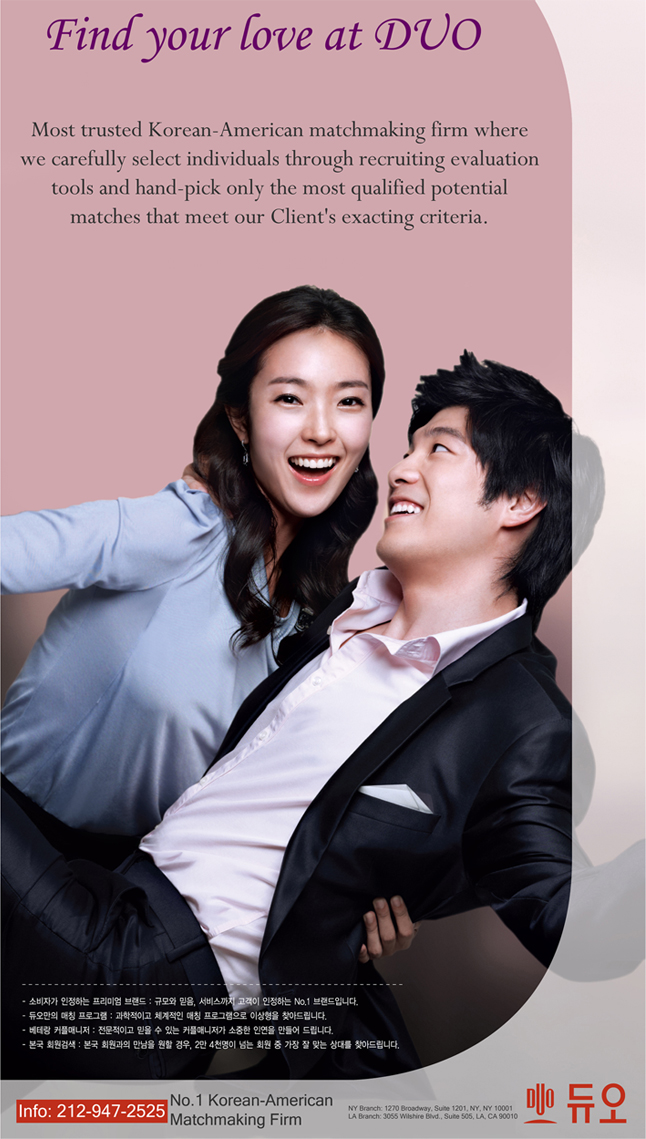
The difference being that in 2012, financially-strapped singles can no longer afford to be so dismissive (nor Japanese ones either). Moreover, while they’re not marrying complete strangers perhaps, many Koreans do marry people they’ve only known a few weeks, as discussed in an earlier post. Also, some mild social coercion can indeed be involved, as Gomushin Girl explained:

It’s important to differentiate between different kinds of matchmaking arrangements…lots of Koreans use services that are similar to eHarmony, It’s Just Dinner, and other similar paid and unpaid services. Just like in the US, there’s free and paid computer matching sites, and more expensive and comprehensive personalized dating services. These offer a great deal of flexibility, and allow you to reject partners at many stages of the process – the worst consequence being that the agent in charge of finding you matches will decide you’re too picky, and start sending you “lower quality” matches. You’re free to meet multiple people at once, and they’re basically meant to facilitate dating.

However, 선 (Seon) matches are pretty different. Most of the time the people proposing the arrangement are close family or friends (of your parents), and parties are expected to make up their minds pretty quickly. Delaying too long or changing your mind after the first few dates is strongly frowned upon, and may even cause major social riftts. This means that women especially are pressured to marry people before they’re comfortable with them, and even if they’re not really what they’re looking for. Seon is serious, and you’re expected to commit yourself pretty quickly.

It’s also expected to override existing social relationships. My Korean host mother once called me up to ask if I’d go down to Busan to meet a friend’s son, who was interested in a seon meeting with me. I told her I’d just started dating someone, and her response was essentially, “That’s wonderful! When can you come to Busan?”
(Source: Sinbustory)

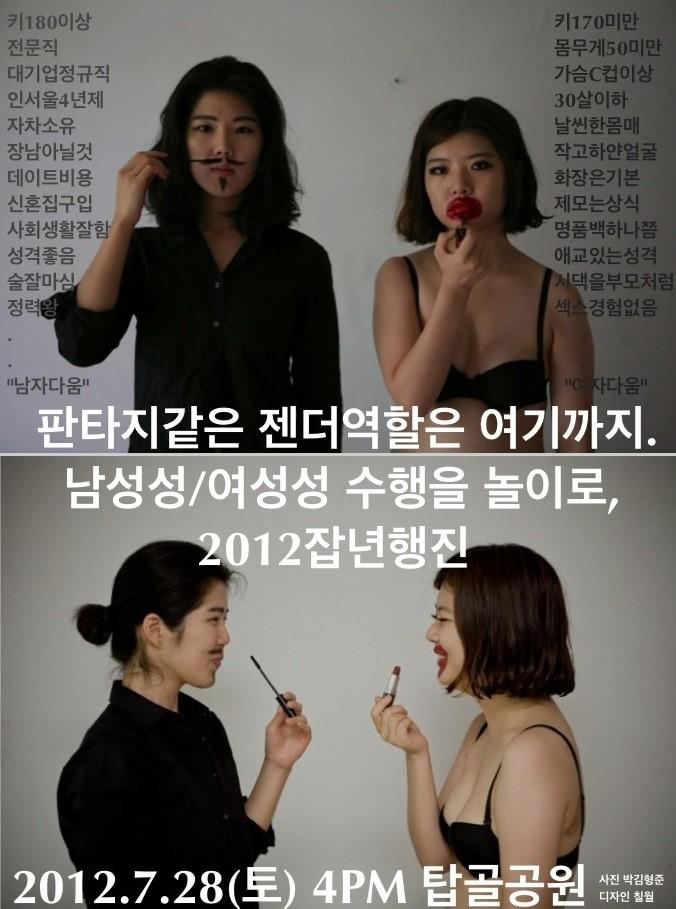
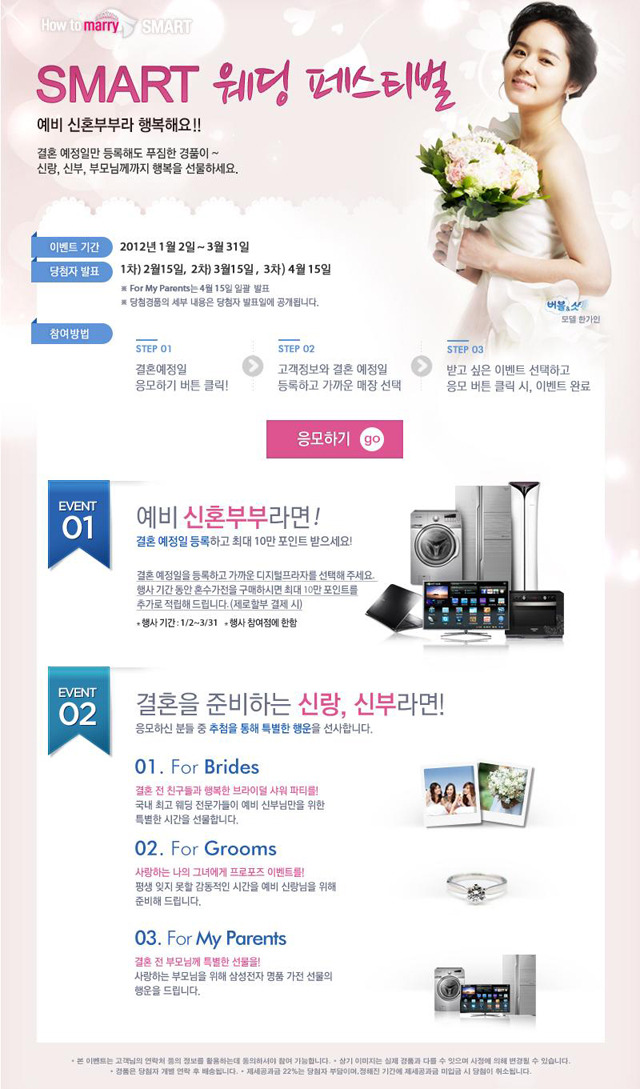
And on that note, let me leave you with a translation of the image that prompted this post, a poster for last week’s Slutwalk in Seoul. The slogan reads, roughly, “Let’s stop these fantasy gender roles now. Let’s play at being ‘masculine’ and ‘feminine’, 2012 Slutwalk Korea.” Many of the specs it mentions would be shared by people the world over, but there are also some quintessentially Korean ones:

For the “man” (literally, it says “manliness”):

  • 키180이상 Over 180cm in height
  • 전문직 A professional
  • 대기업정규직 Regular worker at a big company
  • 인서울4년제 Went to a 4-year university in Seoul
  • 자차소유 Owns a car
  • 장남아닐것 Not a first-born son
  • 데이트비용 Pays for everything on a date
  • 신혼집구입 Buys a home after marriage
  • 사회생활잘함 Good social skills
  • 성격좋음 Good personality
  • 술잘마심 A good drinker
  • 정력왕 Good sexual stamina

For the woman (“womanliness”):

  • 키170미만 Under 170cm tall
  • 몸무게50미만 Under 50 kg
  • 가슴C컵이상 A C-cup or over
  • 30살이하 30 or under
  • 날신한몸매 Thin body
  • 작고하얀얼굴 Small and white face
  • 화장은기본 Always wears make-up
  • 제모는상식 Shaves legs and underarms
  • 명품백하나쯤 Have at least one brand-name handbag
  • 애교있는성격 Have aegyo
  • 시댁을부모처럼 Treats parents-in-law like her own parents
  • 섹스경험없음 Be a virgin

Are there any others readers would add? Especially Korean ones?

(For more posts in the Korean Sociological Image series, see here)

Korean Gender Reader: Slutwalk Tomorrow!

(Source)

Starting 4pm, from Tapgol Park in Seoul. Again, see here, here, and here for the organizers’ Facebook event page, Facebook group, and blog respectively, here for an English translation of  the “Slut Walk Korea Declaration 2012″, and finally here for R0boseyo’s excellent write-up of last year’s event.

Sorry that I can’t join you Seoulites this year, and please let us all know how it goes!^^

Body Image/Health:

Both men and women may be hardwired to objectify women’s bodies (io9)

Are Men Attracted to What They Think Other Men Approve Of? (Jezebel)

Miss Korea 2012 Dubbed ‘Miss Plastic’ by Netizens (Korea Bang)

A(nother) Problematic Experience in a Korean OBGYN Clinic (Agent 071)

S-line is default dynamic pose for female comic book characters (Escher Girls)

I’m Loving It? The Fast Food Health Epidemic in Singapore (Thick Dumpling Skin)

Why is plastic surgery considered bad? (Angry K-pop Fan)

The Skinny Fat Girl (Or: It’s not just the Korean media that fatshames skinny women) (Nursing Clio)

Singapore blogger undergoes major facial surgery in Korea (Yahoo! Entertainment Singapore)

Great legs but ridiculous poses on Min Hyo-rin (Omona)

An Ugly Reflection: Plastic Surgery In Korea (Follow Your Hart)

Cosmetic Surgery Patients Getting Younger (The Chosun Ilbo)

Objectification: Nothing As Easy As It Looks (Seoulbeats)

Crime:

Repeat offenders commit half of sex crimes (The Korea Times)

Korea’s kiddie porn enforcement lax (The Marmot’s Hole)

Sex offenders poorly monitored (The Korea Times)

Children and women remain unprotected against sex crimes (The Korea Times)

Sometimes you have to wonder about the world… (The Marmot’s Hole)

Missing girl found dead in Tongyeong (The Korea Herald)

Sex-Offender Website Swamped After Child Killing (The Chosun Ilbo)

South Korean Police Tire of Abuse by Drinkers (The New York Times)

Children from poor families more likely to be targets of sexual crimes (The Hankyoreh)

Dating/Relationships/Marriage:

Celebrating 10 Years Together With My Husband (Speaking of China)

PDA in South Korea (From Korea with Love)

“The Reality and Twisted Values of Some White Men” Series at Gusts of Popular Feeling:

Part 8: After the ‘hidden camera sex’ report… victim hurt again through ‘comment terror’

LGBT/Sexuality:

Women’s Gait and Dancing Attractiveness Across the Menstrual Cycle (Psychology Today)

Teen prostitution – the numbers have grown, the conditions are worse (Ilda)

Shoutout: Gay Friends in Seoul

What should schools teach about sex? (The Korea Herald)

Misc:

The male feminist: a contemporary player in the fight for women’s liberation (The F-Word)

A Glimpse into the Lives of the Women of the Coalition for North Korean Women’s Rights (Ministry of Unification)

Beware of sexy waitresses in North Korean restaurants – they may be spies? (Examiner.com)

Feminist Culture Clash (Us in Busan)

Now Confucian Culture Causes Nuclear Meltdowns Too? (The Unlikely Expat)

Politics/Economics/Workplaces:

How Eve Grew up in Korea (Seoulbeats)

Womenomics for growth (The Korea Times)

Concern for Young Temporary Workers’ Rights (Human Rights Monitor)

Retirees in South Korea find it’s no country for old men (Reuters)

Pop Culture:

Nice to see a Korean MV simply featuring black people as – well, people (Mixtapes and Liner Notes)

Can you recommend the Korean route to becoming an idol? (Angry K-pop Fan)

On (Bad) Driving in Korean Popular Culture (Seoulbeats)

The Weaknesses of SM, JYP, and YG Entertainment (Allkpop)

When fans forcibly pair up two males who are actually straight (Angry K-pop Fan)

Pregnancy/Abortion/Childbirth/Demographics/Parenting/Education/Multiculturalism:

Anti-English Spectrum vs. the Asiatic Exclusion League (Gord Sellar)

One brain, two minds: The surprising impact of speaking another language (Kim Yuri)

South Korea teenagers bullied to death (CNN)

Children with Smart Phones: Are We Being Smart About It? (Human Rights Monitor)

Japanese women fall behind Hong Kong in longevity (BBC)

Weekly Chosun on multiculturalism, xenophobia (The Marmot’s Hole)

Korean Sociological Image #70: “The Healthy Man-Meat Ham”

(Source)

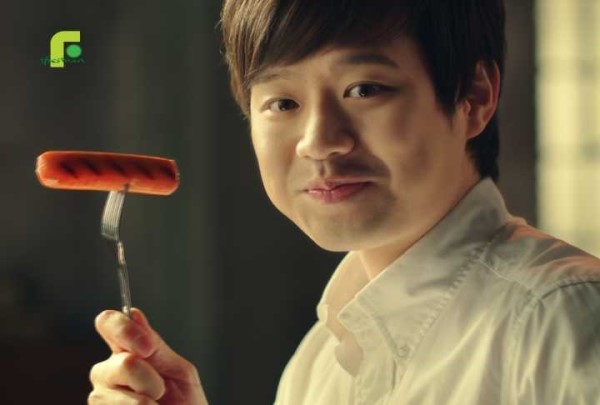
Alas, the irony here is probably unintentional: Koreans actually say “the water is good” (물이 좋다) when there’s lots of hot bodies around, not that it’s a meat market. So, if you want a real satire on that theme, go see Kara’s wonderful effort for Cob Chicken instead, back when male objectification in Korean ads was really taking off.

Still this commercial does make me laugh. Especially when the meat in question is miniature hot-dog sausages:

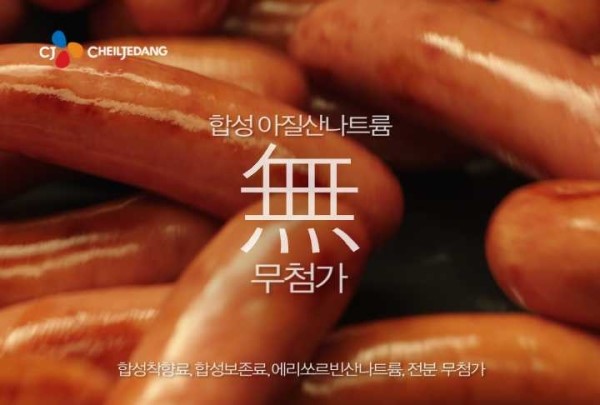
The actor is Cheon Jeong-myeong, and the company is CJ Freshian. The text reads:

사람들은 더할수록 완성된다고 믿는다 People believe that the more you add to something, the more complete it will be

하지만 더 건강한 햄은 But as for the healthy ham

빼고, 빼고, 빼고 Remove, Remove, Remove

(無) 합성아질산나트륨, 무첨가 No added sodium nitrate

(Source)

“無”, or “moo/무”,  literally means “no, not, nothing”, but here it’s also a clever pun because the Chinese/Hanja character looks like a six-pack. The usual choice though, would be “王”, or “wang/왕” , or the Korean one ““chocolate abs” (choco-lat-bok-gun/초콜릿복근) that was made popular in early-2010.

Continuing, the voiceover says:

합성착향료, 합성보존료, 에리쏘르빈산나트륨, 전분 무첨가 No added flavorings, preservatives, sodium erythorbate (an antioxidant), or flour

필요없는 것을 빼고 Remove things that are not needed

맜있게, 더 건강하게, 프리시안 더건강한 햄 Deliciously, more healthily, Freshian the healthy ham

(Source)

For comparison, see the discussion at Korean Sociological Image #35, about Lotte Chilsung’s (롯데칠성음료) 2010 commercials for “Hot 6iX” (핫식스), which featured both men’s and women’s shirts bursting open:

(For more posts in the Korean Sociological Image series, see here)

Korean Sociological Image #69: Attitudes Towards Sexual Objectification, 2004 vs. 2012

Back in 2004, I would study Korean by translating articles about Lee Hyori’s breasts. Because that was much more interesting than reading about the joys of kimchi-making in Korean textbooks.

So, I hardly romanticize that era as more innocent and chaste than today’s. Nor, by highlighting just one complaint by one women’s group from then, do I mean to imply that the Korean public was necessarily more prudish back in 2004, or that it’s necessarily more permissive today. After all, my Google News Alert for “성상품화” (sexual objectification) still provides me with fresh critiques of the recent Miss Korea Pageant every day. And who can forget the role “Bikini Girl” played in April’s congressional elections?

Having said that, things definitely have changed in 8 years:

  • Starting about 2006, ubiquitous soju ads started featuring women in revealing clothing after decades of almost exclusively using demure, virginal-looking models.
  • A little later, dominant media narratives about girl-groups, depicting middle-aged male fandom as platonic rather than sexual, provided a window for their objectification to flourish.
  • Men have also been increasingly objectified, particularly after the “chocolate abs” label was coined in 2009.
  • The number of smutty online-ads has surged, especially in the last year.
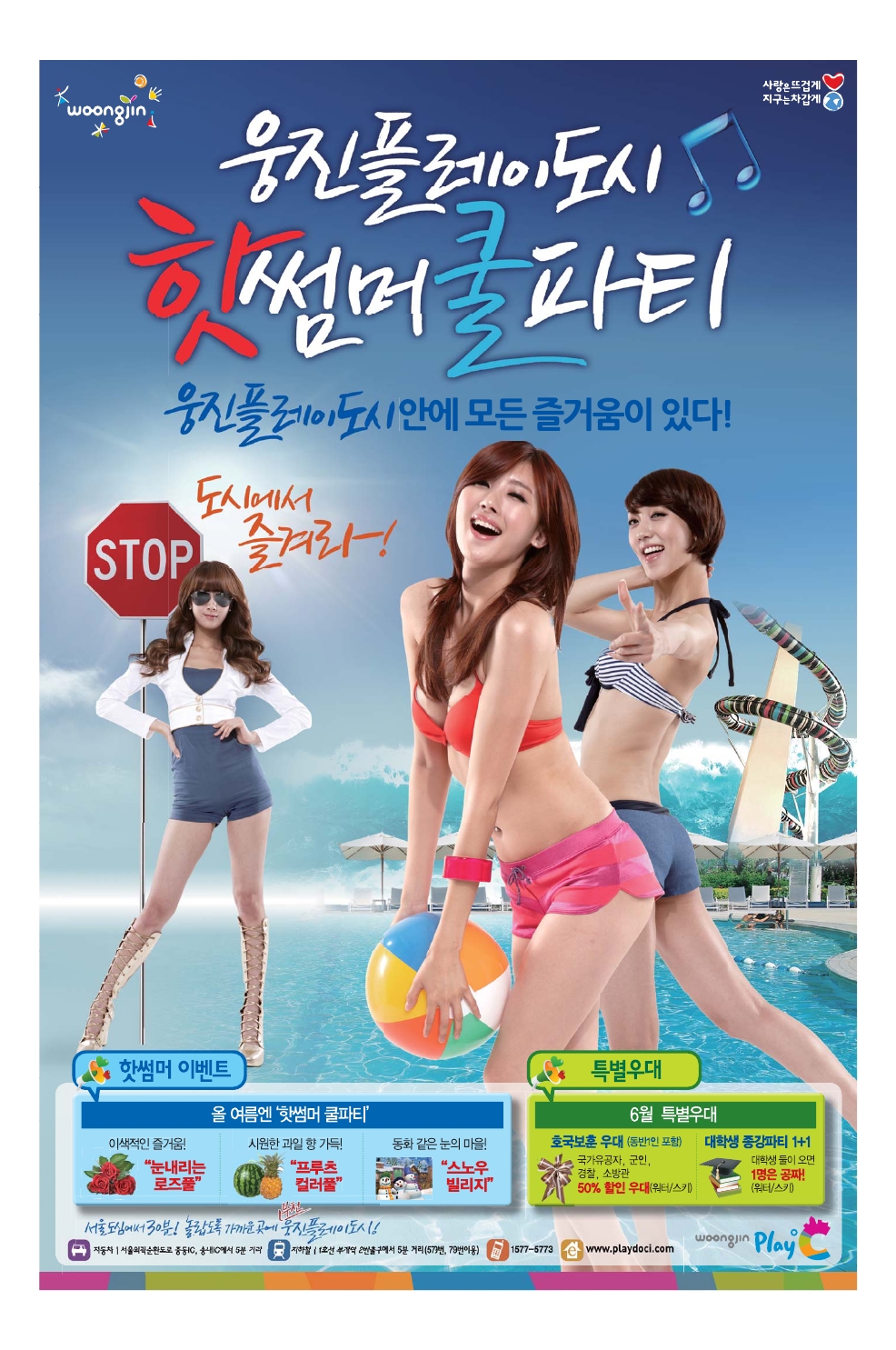
  • And last but not least, it’s difficult to find an advertisement for water-parks (also ubiquitous) that doesn’t feature a scantily-clad girl-group, with one—Ocean World—even inventing a group specifically for that purpose. (Boy bands and male models are used also, most notably by Caribbean Bay below, but my strong impression is that there’s much less of them than women)

In short, it is via the increasing objectification of (especially) girl-groups that you can see a clear McDonalidization of Korean cultural industries in recent years (see here, here, herehere, and here for more on the hows and whys). And, because of that shift, it’s difficult to imagine a complaint like this being given much attention in 2012:

전남관광 책자 두고 ‘여성상품화’ 논란 일어 / Controversy over Sexual Objectification of Women in Jeollanam-do Tourist Brochure

Oh My News, June 15 2004. By Gang Seong-gwan.

지난 6월초 전남도가 여름 관광객을 겨냥해 제작배포한 관광 홍보책자 ‘남도스케치’에 사용된 비키니 차림의 여성사진이 논란이다. 광주여성민우회는 14일 성명을 통해 “남도스케치 배포를 즉각 중단하라”고 요구하고 나섰다.

Controversy has arisen over the use of women in bikinis in the June edition of tourist brochure Namdo Sketch, a widely-distributed brochure aimed at summer tourists . In an announcement on the 14th, the Gwangju branch of Womenlink demanded that it stopped being distributed immediately.

(Source: James Turnbull)

전 남도는 ‘남도스케치’를 제작하면서 책 표지, ‘전남이 추천하는 여름 여행지 BEST’ 중 완도 명사십리 해수욕장 등 7곳을 소개하면서 비키니를 입은 여성의 사진 10여장을 게재했다. 이 책자는 겉표지까지 총 85페이지로 구성됐으며 비키니 사진은 책자 앞 부분에 게재했다. 전남도는 제작된 책자 2만여부를 터미널 등 공공장소와 전남도내 기초단체 등지에 배포를 마친 상태이며 조만간 2쇄에 들어간다는 계획이다.

이에 대해 광주여성민우회는 “여성을 성 상품화했다”면서 전남도의 공개사과는 물론 책자 배포 중단을 요구하고 나섰다.

With a cover title of “Best Recommended Tourist Sightseeing Areas in Jeollanam-do” [James – I can’t see that title myself, but unfortunately that opening photo was very small], Namdo Sketch introduces 7 tourist sights, including Wando and Myeongsashibri Beach, and uses a total of 10 pictures of women in bikinis on the front cover and in the first part of the brochure, out of 85 pages. By the end of its first printing, the Jeollanam-do Provincial Government had distributed roughly 20,000 copies to transport terminals, public places, and civic groups, and planned to make a second printing.

Gwangju Womenlink said that the brochure sexually objectified women, and demanded a public apology as a matter of course, as well as a halt on further distribution.

“여성 성 상품화 한 것, 배포 중단”…”문제제기 이해하지만, 시원한 여름을…” / “This is the sexual objectification of women, distribution must stop”…”We understand, but hey: this is summer…”

광주여성민우회는 “전남 관광홍보는 여성의 비키니만이 유일한 대안인가”라며 “공공기관에서 나온 책자인가 할 정도로 낯뜨거운 장면이 많이 실려 있어 당혹스러움과 황당함을 느낀다”고 밝혔다.

Gwangju Womenlink argued that “Are women in bikinis the only option for a tourist brochure?”, and said “We are embarrassed and perplexed that a public institution would go so far as to use such crude [James – I think this is a better translation of “낯뜨겁다” than “obscene” or “rude”] images in a tourist brochure.” (source, right)

이어 “지역에 관광객을 유치하기 위해 명소를 소개하는 것은 좋지만 관광지역의 구체적인 정보와 특색 있는 프로그램의 홍보 대신 여성의 비키니 복장을 내세워 시선을 끌어보고자 하는 공무원의 얄팍한 속셈은 용납될 수 없는 행위”라고 비판했다.

Continuing: “It is good that tourists are being attracted to this area by having places of interest introduced to them. But instead of providing concrete information and unique tourist programs, the PR simply consists of pictures of women in bikinis, designed to attract one’s attention. This is both shallow and misguided of Jeollanam-do officials, and can’t be forgiven.”

또 여성민우회는 “지역의 명소를 알려내기 위한 기본 조건은 다른 지역과 차별되는 테마를 만들어 남도만의 색다른 맛을 느끼게 하는 것이다”면서 “노력해야 할 것은 따로 있는데 엉뚱한 것으로 메꾸려는 것은 직무유기”라고 주장했다.

여성민우회는 “여성의 성 상품화를 부추기는 공공기관의 홍보책자는 결코 용납될 수 없다”면서 ‘남도스케치’의 배포중지를 요구했다.

Also, Womenlink emphasized that “What should have been done to inform tourists about places of interest was showing them how different they were to other ares and what unusual tastes, experiences, and feelings Jeollanam-do has to offer. Instead of making an effort and doing their duty though, officials offered this rubbish.”

It added that “Promoting the sexual objectification of women is never acceptable”, and so demanded an immediate halt to the distribution of the brochure.

(Sources: left, right)

이에 대해 전남도청 한 공무원은 “문제제기는 이해한다”면서도 “여성의 사진을 표지에 넣는다고 해서 이 책자가 눈길을 끌고 있는 것은 아닌 것 같다”고 말했다.

그 러나 또 다른 공무원은 “여성의 비키니 사진을 두고 상품화까지 이야기하는 것은 지나친 것 아니냐”며 “오히려 여성단체들이 그렇게 주장하면서 폄하시킨 것은 아닌지 모르겠다. 물론 어느 정도는 이해할 수 있지만 이런 사진을 많이 사용한 것도 아니지 않느냐”고 주장했다.

In response, a Jeollanam-do official said ” We understand the concerns, but it’s not because of the women in bikinis on the cover that people are drawn to the brochure.” Another emphasized that “It’s a complete exaggeration to claim that just pictures of women in bikinis is objectification. Rather, it’s women’s groups that are degrading women by doing so. And it’s not like we used many in the brochure.”

관광책자 제작 담당부서인 전남도청 관광진흥과 이명흠 과장도 “여성단체의 지적사항에 대해서 전혀 모르는 바는 아니다”면서도 “행정관청에서 발행한 책자여서 그럴텐데 여름에 맞춰서 시원한 해수욕장과 수영복을 입은 모습의 여성을 모델로 했을 뿐이다”고 말했다.

이어 이 과장은 “행정기관이 발행했다는 느낌이 들면 잘 보지 않는다. (관광객들의) 눈길을 끌 수도 있다는 생각에서 진행한 공격적인 마케팅의 일환이다”며 “너무 한쪽으로만 생각하지 말고 발상을 바꿨으면 좋겠다”고 주장했다.

(Source: Metro Seoul, 31 May 2012, p.49)

Lee Myung-hum, the head of the Tourism Promotion Office of Jeollanam-do Provincial Government that produced the brochure, said “It’s not like I don’t understand women’s groups concerns. But only swimsuits are appropriate for female models promoting cool swimming areas in the summer.” He added that “No-one ever pays attention to anything produced by a council tourism promotion office. The images were simply part of an aggressive marketing technique designed to get the attention of tourists, and shouldn’t be overanalyzed.”

한편 ‘남도스케치’ 표지모델은 전남도청 여성 공무원 중 희망자들이 참여하기도 했으며, 지난해에도 전남도는 여름 관광홍보 책자를 제작하면서 표지 등에 비키니을 입은 여성 사진을 게재한 바 있다.

The models used in the brochure included Jeollnam-do female officials [James — it says only the cover, but there were only 2 women on that], and a similar brochure was produced the previous year (end).

James — While the Jeollanam-do officials didn’t sound too sympathetic in that June 2004 article, another from the next month points out that in the second printing the bikini models were removed from the cover and 2 more pages, although some did still remain. It’s from that article that the before and after covers came from.

(For more posts in the Korean Sociological Image series, see here)
Korean Gender Reader: Slutwalk Next Saturday!

(Source)

See here, here, and here for the organizers’ Facebook event page, Facebook group, and blog respectively. Alas, there isn’t any information available in English, but R0boseyo’s excellent write-up of last year’s event gives you a good idea of what to expect.

Update: The “Slut Walk Korea Declaration 2012” has an English translation.

Body Image/Health:

Do I look fat in this country? A look at beauty ideals in Korean culture (Chatelaine)

“Rougan”: How My Husband Helped Me Love My Curves (Speaking of China)

Big Boobs in Korea (Eat Your Kimchi)

Continued Criticism of Miss Korea Pageant (Korea Human Rights News; scroll down for translation)

London 2012 Olympics: let’s celebrate sportswomen’s bodies (The Guardian)

Comic Book Industry Rejects Human-looking Female Characters (Escher Girls)

Blog Shoutout: Women’s Comic Book Poses in Real Life (Maxi and April)

Snoop Dogg vs. SONEs: The Tweet Heard ‘Round the K-popiverse (Seoulbeats)

North Korea Experts Can See a Lot in a Hemline (The New York Times; Asia Times)

Censorship:

Rolling Changes in K-pop (Seoulbeats)

China arrests 31 in U.S.-hosted porn website crackdown (People’s Daily Online)

Bill to ban alcohol ads by young celebrities (The Korea Times, EUCAM; see The Wall Street Journal also)

Crime:

Girl Posts Picture of Alleged ‘Molesting’ Man on Bus (Korea Bang)

Teen rape exposes dark side of the Korean Web (Korea Joongang Daily)

Anti-Trafficking NGO to Set Up Shop in Korea (The Chosun Ilbo)

“Looking for Pretty Women: Minimum 1 Million Won per Day” (Human Rights Monitor)

Foreign Ministry engulfed in sexual harassment case (The Korea Times)

Dating/Relationships/Marriage:

Getting Your Marriage Certificate in China (My Beijing Survival Diary)

Dating in Korea (Rok On!)

Ask the Yangxifu: My Boyfriend Doesn’t Understand My Past Child Abuse (Speaking of China)

“The Reality and Twisted Values of Some White Men” Series at Gusts of Popular Feeling:

Part 8: After the ‘hidden camera sex’ report… victim hurt again through ‘comment terror’

Who’s Hunting Who? (The Korea Times, The Marmot’s Hole)

Newspaper Reveals the ‘Truth’ About Foreigners in Korea (Korea Bang)

LGBT/Sexuality:

LGBT Groups Oppose Reappointment of NHRCK Byung-chul Hyun (Human Rights Monitor)

Xiyadie depicts homosexual love in Chinese paper-cuts (Los Angeles Times)

Dance, Mingle, Be Gay (Matt Lemon Photography)

Misc:

Tokyo’s new Robot Girls Restaurant will bring out your inner cyber-fetishist (io9)

London 2012: Japan, Australia and organisers face sexism claims (The Guardian)

China 2050: Caucasians to Become China’s Migrant Workers in the Future? (Chinasmack; Ministry of Tofu)

Koreans are Individualistic (in Stressful Environments) (Via Korea)

Is it okay to bar the visually impaired from bath houses? (Ilda)

Politics/Economics/Workplaces:

How to avoid false accusations of sexual harassment (I’m No Picasso)

Dreaming of a future where people finish work at 5pm (The Wall Street Journal)

Solbi shares that she was in a sexual harassment prevention video (Allkpop)

Problems with Korea’s labor law (this time from an employee perspective) (Korea Law Today)

Best Places to Work in Korea (Human Rights Monitor)

Park Geun-hye pledges after-school childcare for working couples (The Korea Times)

Are Koreans ready for woman president? (The Korea Times)

Lighting the way to female leadership (The Korea Times)

Pop Culture:

How To Be The Asian Female TV/Movie Sidekick (8asians)

Gender and Race: The Relationship Between Same-Sex Couples and Interracial Depictions in US Television (Overthinking)

Being branded as a K-pop fan (Angry K-pop Fan)

New drama series “Answer to 1997” to tackle obsessive fans (My First Love Story)

Why all the English phrases in K-pop? (Angry K-pop Fan)

Variety Screen Time: An Idol’s Ongoing Battle (Seoulbeats)

‘You only like Korean idols because they’re good looking’: the role of visuals in K-pop (Angry K-pop Fan; Part 2)

Pregnancy/Abortion/Childbirth/Demographics/Parenting/Education/Multiculturalism:

National economy threatened by shrinking population (The Hankyoreh)

After corporal punishment debate, Korean students still being hit (Asian Correspondent)

Refugee Rights Movement Finally Takes Root in Korea (Human Rights Monitor)

Mandatory HIV Testing Policy Challenged at the International Level – Korea charged with violating racial discrimination treaty (Gusts of Popular Feeling, Voice of America)

Op-Ed: A Need to Better Understand Youth Suicide Issues in Korea (Human Rights Monitor)

Life about to get enough tougher for migrant workers (The Hankyoreh)

(Links are not necessarily endorsements)

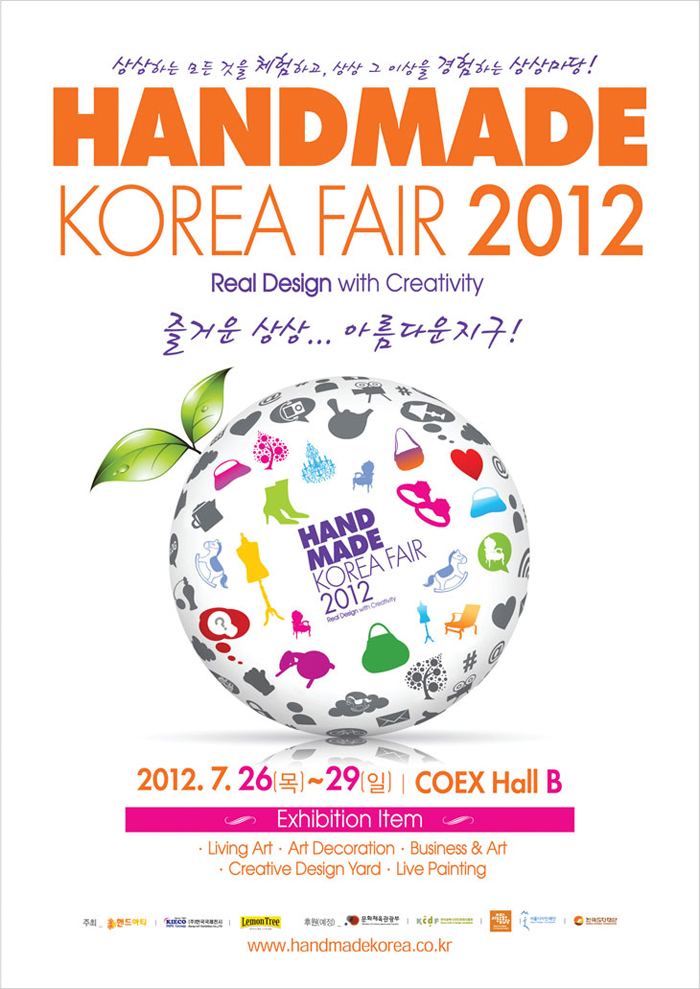
Handmade Korea Fair 2012

(Source)

Apologies for the off-topic post, but I thought my more artistic readers would appreciate a heads-up about this. Unfortunately, there’s no English information available on either its homepage, blog, or Facebook page, but I’m sure everyone can find COEX for themselves, and I can at least tell you that tickets are 10,000 won each. Also, see The Constant Crafter and Alien’s Day Out for write-ups about last year’s fair, here for an extensive Flickr gallery of it, and finally below for a quick video:

If anyone does go, please let me know what you thought!^^

Update: Note that the 2nd Seoul Slutwalk is also next week, on Saturday the 28th. I’ll put up a separate post about that tomorrow.

Update 2: See here for Foreigner Joy’s report on the fair.

Update 3: And here for Cute in Korea’s.

Quick Hit: Cheongju Sex-Education Camp for Teens

(Source)

Sex-education is still so severely neglected in the Korean education system, and still so stuck in the 1980s, that it’s easy to think that things will never change. Especially with an administration so opposed to women’s reproductive rights.

But it’s not all doom and gloom though, and a quick internet search reveals what seems to many camps like this across Korea each summer:

청주시, 속리산 유스타운에서 청소년 성교육 캠프 실시 / Teenage Sex-Education Camp Held at Sokrisan Youthtown, Cheongju

Newswire, 18 July 2012

청주시(한범덕 시장)는 7월 18일부터 19일까지 청주시 소재 중학교 남녀학생 62명과 함께 속리산 유스타운에서 1박 2일간 청소년기에 알아야 할 올바른 성가치관의 정립과 성행동에 대한 책임의식 고취, 청소년들의 건강한 성문화 정착을 위해 청소년 성교육 캠프를 마련했다.

From 18th to the 19th of July, 62 boys and girls from a middle school in Cheongju will attend a two day, one night sex-education camp at Sokrisan Youthtown. Its purpose is to promote healthy sex-culture among teens by instilling correct sexual values and a sense of responsibility about sexual acts.

이번 사업은 청주시여성발전기금 6백만원을 지원하여 인구보건복지협회 충북지회부설 청주성폭력상담소(소장 엄정옥) 주관 하에 청주시내에 소재한 중학교 남녀 학생 62명을 대상으로 청소년들이 직접 참여하여 눈으로 보고 체험할 수 있는 프로그램으로 운영하게 된다.

This event is organized by the Cheongju Women’s Helpline Consultation Center (Manager: Ohm Jeong-ok), part of the Cheongju branch of the Planned Population Federation of Korea, and was provided with 6 million won by the Cheongju Women’s Development Center. It will give 62 Cheongju male and female middle-school students a chance to experience things directly and see them with their own eyes.

전체 62명을 6개조 모둠으로 구성하여 지도교사(성교육전문가)의 진행 하에 모둠별 집단 프로그램, 신체관련 모형 만들기, 눈으로 보는 성교육(임신·출산·낙태·피임방법·성병)과 청소년 성폭력 예방 동영상을 시청하고 서바이벌게임과 황톳길체험, 별빛 성축제를 통하여 또래 간 친화와 화합의 시간을 갖는다.

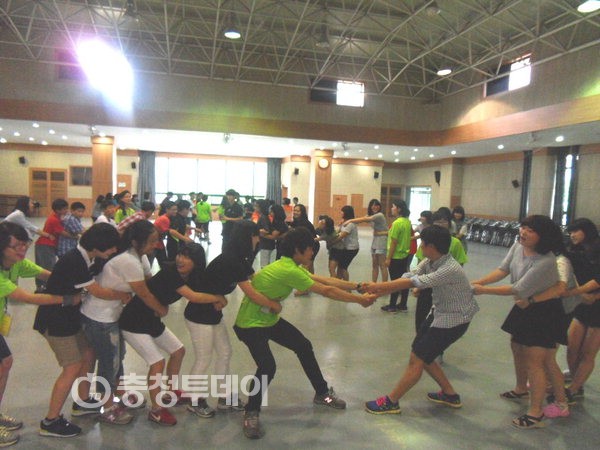
The 62 students will be in split into 6 groups, each under the control of a teacher specializing in sex-education. They will progress through various programs, including: making body shapes [James – possibly that’s what they’re doing in the picture below, taken later]; receiving visual education [James – ?] related to pregnancy, childbirth, abortion, contraception, and STDs; watching teenage sexual violence prevention videos; doing survival games; going hiking; and making friendships through a “Starlight Sex Festival”.

(Source)

또 성개방화·성상품화로 인해 다양한 청소년 성문제가 사회문제로 확산되고 있고 급속한 산업화로 인한 잘못된 정보의 홍수 속에서 자칫 일탈의 길로 접어 들기 쉬운 청소년기에 이들의 눈높이에 맞는 성교육 캠프활동을 통하여 올바른 성가치관을 심어주고 성행동에 대한 책임의식을 함양하여 문제를 스스로 예방하고 대처할 수 있는 성적 의사결정 능력을 키우기 위한 일환으로 마련됐다.

Because of greater sexual liberalization [James — meant in a negative sense, i.e. greater exposure to sex in the media and earlier and more frequent sexual experience], teenagers have various sexual problems, which are becoming society’s problems. But because of industrialization [James – the rise of the internet?] there is a lot of incorrect information about sex out there, and it is very easy for teens to take the wrong path. Through an age-appropriate program, this event is designed to instill correct sexual values, to promote sexual responsibility, and to help students themselves prevent sexual problems and make decisions.

청주시 관계자는 “청소년 성문제는 개인의 문제가 아니라 우리사회 전체의 책임이므로 이번 행사가 청소년들에게 올바른 성 가치관을 정립할 수 있는 좋은 기회가 되길 바란다”고 밝혔다.

A Cheongju city official said: “Teenage sexual problems are not just person problems, but all society’s responsibility. I hope this event gives teenagers a good opportunity to gain correct sexual values.”

Increasing Numbers of Single Households in Korea: Lessons from Eric Klinenberg’s “Going Solo”

(Source)

From Office Hours, a sociology podcast I regularly listen to:

This week we talk with Eric Klinenberg about his new book, Going Solo: The Extraordinary Rise and Surprising Appeal of Living Alone. Also be sure to check out Klinenberg’s New York Times article, One’s a Crowd.

Although Korea isn’t covered specifically, there’s a lot discussed that is very relevant to it, so I think readers will still find it very interesting. Personally, I really started paying attention after I heard the following 5 minutes in:

…but affluence, and prosperity, that’s not enough. We know that because there’s parts of the world where there’s lots of wealth, but very little living alone. So for instance, in Saudi Arabia, where almost no-one lives alone…and the reason for that is another big driver of living alone is women’s independence: women’s economic independence, and also their capacity to control their own lives, and control their own bodies. When women enter into the paid labor market, and gain sexual independence…personal independence…they are able to delay marriage (and now, people delay marriage longer than ever), they’re also able to get out of marriages that aren’t working. Through divorce, without worrying about sentencing themselves to a lifetime of poverty or having to move back in with their families. So, this is a BIG part of the story I tell…

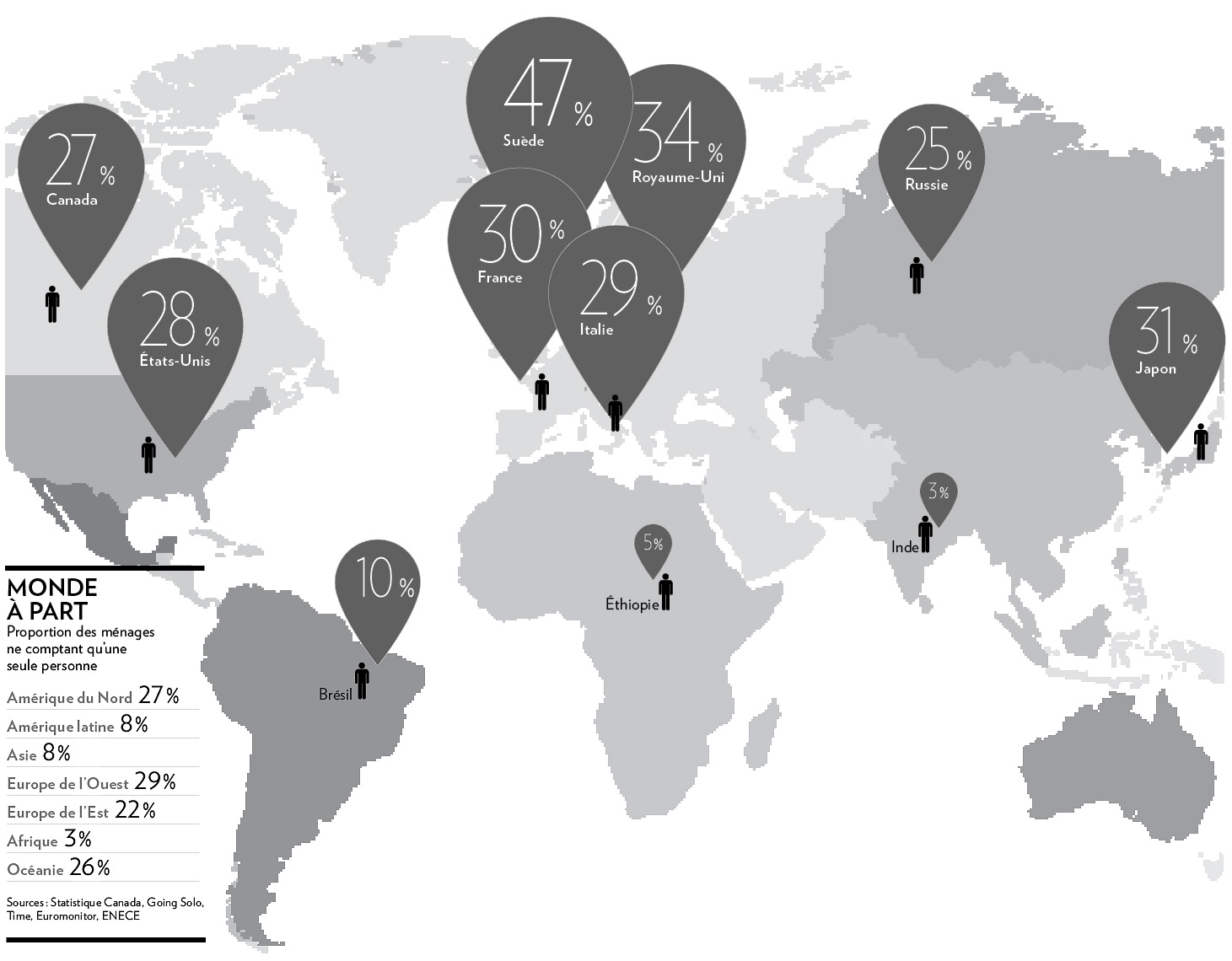
See here and here for some reviews of the book, and here’s a quick comparative map of national rates from La Presse:

Unfortunately, I’ve been unable to find a base national rate for South Korea, but in January 2009 the Seoul Development Institute did find that 20.4% of Seoul households involved people living alone, and which was expected to rise to 25% by 2030. For more information and discussion, see the Korea Herald here, or in passing in the following posts (the last is at the blog Asadal Thought):

Sex and the University, Part 3: University Students’ Cohabitation Culture

Why are Korean and Japanese Families so Similar? Part 2: Couples Living With Their Parents After Marriage

Why Do Young Koreans Live With Their Parents?

How Many Unmarried Koreans Live Away From Their Parents?

The Race of Single People

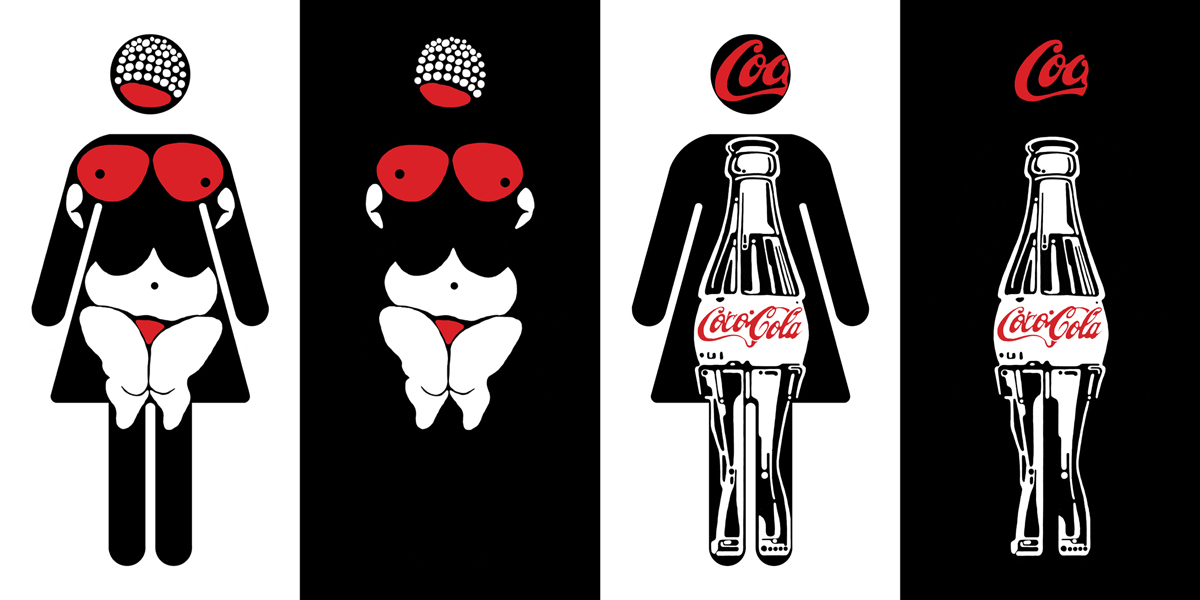
“Humanist (Hongikingan/홍익인간)” by Lee Boo-rok (이부록), 2007

(Source)

Just something that really got me thinking about fertility, body-labelling, and hourglass figures (or indeed, cola bottle ones). Normally I’d simply post it to the blog’s Facebook page, but unfortunately artist Lee Boo-rok doesn’t appear to have been very active in the past few years, and I could only find a handful of small, poor-quality pictures of this and his other works. Here’s another good copy of this one then, just in case the original link at the Gyeonggi Museum of Modern Art is ever taken down! :)

(p.s. For anyone that doesn’t know, that’s the Venus of Willendorf on the left)

Update: By coincidence, just after writing this post I discovered the pop-artist Mel Ramos, who’s done a lot of paintings of voluptuous female nudes alongside commercial products. Two — Lola Cola (1972) and Lola Cola #2 (2004) — feature cola bottles, and I also like Photoshop CS (2008).

All, of course, are NSFW.

Korean Gender Reader

(“Less Births, Better Births” by IISG; edited)

Body Image/Health:

On Korean ‘dieting’ and why I need to have a chat with my gym (I’m No Picasso)

Teacher Small Face: On Beauty in South Korea (The Culture Muncher)

Myths about corrective jaw surgery debunked (The Korea Times)

Opinion: On Photoshopping (Niche)

Fashion: A thin line between sexy and trashy (The Korea Times)

Asian beauty, redefined (Thick Dumpling Skin)

Colon cancer rates among Korean men highest in Asia (Arirang; see here for a cached version)

What happened to f(x) Luna’s muscular legs? (Korea.com)

Problems will arise at the conversion of oral contraceptives to prescription-only (Ilda)

Taking morning-after pills in time is the key (Ilda)

Even the peer-reviewed science of penis size is burdened by a lack of consistent data (i09)

Crime:

Police investigating foreign instructor for hidden camera sex videos (Gusts of Popular Feeling)

Sex, an English Teacher and (Secretly Recorded) Videotape (The Marmot’s Hole)

NoCut News celebrates another victory in battle against foreign instructor (Gusts of Popular Feeling)

Student Finds Secret Sex Tapes on Foreign Teacher’s Computer (Korea Bang)

Open World Entertainment CEO Jang Seok Woo threatens victims (Asian Junkie)

Open World Entertainment CEO threatens victims, is reprimanded by judge (K-Pop Express)

Six celebrities’ online malls fined for fake customer reviews (Korea Law Today)

Spy cameras help Peeping Toms go on the prowl (The Korea Herald)

South Korean violent crime rate “at least twice as high as US” (Asian Correspondent)

Korean Tourism Official Says American Men with Korean Women Are To Blame For Wild Nightlife In Shinchon & Itaewon (ROK Drop)

Dating/Relationships/Marriage:

How the Logic of “Friendzoning” Would Work If Applied in Other Instances (Kim Yuri)

[Korean App] TTTing – Fun with Social Dating (Hangukdrama and Korean)

My Korean Family (Asiapundits)

Avoiding Generalizations about Korean Men (I’m No Picasso II)

The English Spectrum Series at Gusts of Popular Feeling:

Part 37: Warrant for the arrest of a man in his 30s for breaking into home of foreign instructors

LGBT/Sexuality:

Smut and Fanservice in Anime (The Dragorol; NSFW)

Why You Can’t Bulletpoint Gay Travel (Waegook Tom)

Harisu, More Beautiful Than A Woman: LGBT In The Entertainment Industry (Seoulbeats)

Lesbians now allowed to donate blood; gay men still barred (Shanghaiist)

400 prostitutes working in a single brothel in Seoul? (Occidentalism)

Family in forced abortion case compensated RMB70,000 (Shanghaiist)

Misc:

‘K-Town’ Gets Its Own Reality Show With A Hard-Partying, Foul-Mouthed, Purse-Throwing Cast (LAist)

Gendercide and the Role of Media: Chinese Missing Girls (Democracy x Peace)

Korea and Vietnam: Learn from History (The Korea Times)

“You’re overthinking things”: A response (The F-Word)

Asian-American Exceptionalism: An Inconvenient Truth (Via Korea)

Still think Westerners are better critical thinkers than Asians?? (The Diplomat)

Culturalism in the context of the Fukushima Disaster the instinctive response to blame (Asian) culture to explain any and all behavior (Ask a Korean)

Stop blaming Fukushima on Japan’s culture (East Asia Forum)

Politics/Economics/Workplaces:

Asian Values and Women in the Boardroom (The Unlikely Expat)

“It remains realistically difficult to take maternity leave [in Korea]” (The Chosun Ilbo)

Most new workers are past retirement age while young people struggle to start careers (The Hankyoreh)

Stereotypes of women in the workplace (Korea Joongang Daily)

Pop Culture:

Obvious sexism and outdated gender roles on A Gentleman’s Dignity (Loverholic, Lobotronic)

The Dark Side: Skin Colour and K-pop (Seoulbeats)

Tired of all of the new groups appearing? So are the groups themselves! (Asian Junkie)

2NE1′s Minzy & CEO Yang Hyun Suk make a compromise regarding sexy dances (Allkpop)

T-ARA’s Eunjung Wasn’t Feeling Bo Peep Bo Peep (MTV-K)

Pregnancy/Abortion/Childbirth/Demographics/Parenting/Education/Multiculturalism:

Dressing the Part: Should Moms Dress More Conservatively? (Geek in Heels)

“Wild Goose Families” on NPR’s All Things Considered (The Unlikely Expat)

Adventures in Parenting Abroad Part 1: Knocked Up (The Three Wise Monkeys)

Multiculturalism: a choice, not an inevitability (The Marmot’s Hole)

Diplomats discuss migrants’ welfare (The Korea Herald)

South Korea’s Shutdown Curfew For Minors Challenged In Court (Gaming Blend)

(Links are not necessarily endorsements)

Horror Stories(?) About Korean OBGYN Clinics

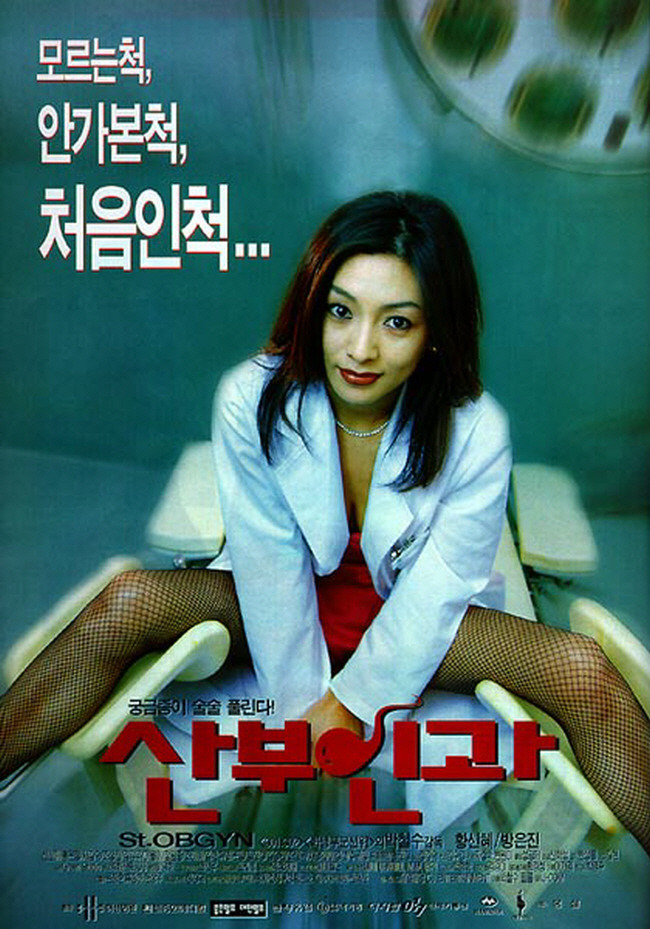
(“Pretend not to know”, “Pretend not to go”, “Pretend it’s the first time”. Push! Push! {1997}. Source)

This was the most read society news story on Naver last week, undoubtedly because of the recent announcement that the pill is to be made prescription only (a similar article was #5), which will naturally require more visits to OBGYNs. I have my own article about that coming out in Busan Haps next month (update: here it is!), but in the meantime see here, here and here for further details, as well as Korean Gender Reader posts from June.

Without discounting the genuine negative experiences outlined below, for the sake of balance let add that my wife has had no problems with those OBGYNs she’s dealt with since her first pregnancy, nor this 19 year-old student who wrote about her first visit to a clinic for her university newspaper (although it’s true she was given some strange and/or unnecessary tests). Also, it seems somewhat naive of patients to be surprised at questions about their sexual experience, and a little churlish of them to complain about them.

Update — in addition to many helpful, practical reader comments on this post below, and on the previous one about the student’s visit, let me recommend this one by a friend on Facebook:

…to be honest, I think most women expect a trip to the gyno to be awkward, that’s par for the course. However, many of the questions mentioned in the article were definitely way out of line. I’ve come across some less than sensitive (aka prejudiced and or judgmental) docs here.. I just assumed their overly-direct statements/questions were just a translation issue. Obviously not!

One disheartening aspect of women’s clinics is that you have to speak to a nurse (or sometimes just the receptionist) first, often in crowded reception area, to explain why you’re there. They often ask for all your symptoms, check your weight and blood pressure and when you had your last period in front of countless strangers. One clinic I went to had an LCD screen with the waiting patients listed in order of their turn.. including the reason why there were there… So much for privacy! It just adds another layer of humiliation to an already uncomfortable situation.

That being said- there are some amazing gynos here. I hope these problems can be properly addressed- no one should have to feel ashamed in front of their doctor. The danger here is that women will stop seeing doctors about their gynecological/sexual health out of fear of embarrassment and risk greater health problems.

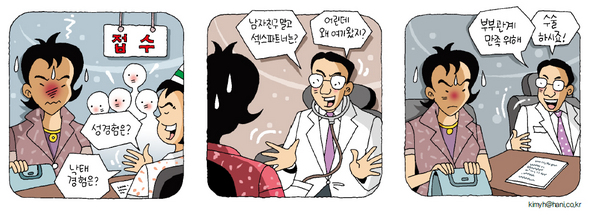
“성경험 유무는 왜…? 굳이 그것까지” 굴욕의 진료, 산부인과

“Why do they ask about sexual experience? Is that really necessary?” Humiliating Treatment at OBGYN Clinics

엄지원 / Uhm Ji-won, The Hankyoreh, 2 July 2012

여성이 불편한 산부인과 / Women find gynecology clinics uncomfortable
접수대부터 진료·시술까지 / From reception to treatment and surgery
의료진 노골적 발언에 민망 / OBGYNs make suggestive, embarrassing comments
사전피임약 처방전 필요한데… / The pill requires a prescription…
여성들 심리적 부담 커 고민 / Psychological pressure on women increases
환자 배려 의료지침 등 필요 / OBGYNs need guidance on bedside manners

지난 6월 정부는 사전피임약을 전문약으로 분류하는 약사법 개정안을 발표했다. 이 법안이 국회에서 통과되면 여성들이 산부인과를 찾을 일이 더 많아질 수 있다. 이를 두고 여성들은 산부인과에 가는 것 자체가 눈치 보이는 사회 분위기를 지적한 바 있다.

This June, the government announced that it was considering amending the Drugs, Cosmetics, and Medical Instruments Law to reclassify the pill as a prescription medicine. If passed by Congress, it will mean women will have to visit OBGYN clinics much more often. In light of this, women have been pointing out the [bad] atmosphere at them.

한국여성민 우회가 산부인과 진료 경험이 있는 여성 210명을 상대로 설문조사한 결과는 ‘외부의 시선’ 못지않게 산부인과 진료 자체에 대한 여성들의 두려움이 실제로 광범위하게 퍼져 있다는 사실을 확인해준다. 설문 특성상 응답자의 신상과 구체적인 피해 일시·장소 등을 밝히진 않았지만, 여성들은 산부인과에서 겪은 수치와 불편을 설문지에 빼곡히 적었다.

Korean Womenlink conducted a survey of 210 women who had received treatment at OBGYN clinics, and the results confirmed not just the endurance of public stereotypes that all women visiting OBGYN clinics had STDs, but also that women’s fears in visiting them were well-founded. The survey was anonymous, and respondents were asked to provide no details of the times or places in which they’d been made to feel embarrassed or humiliated, but many still felt compelled to write a great deal about their negative experiences.

(Source)

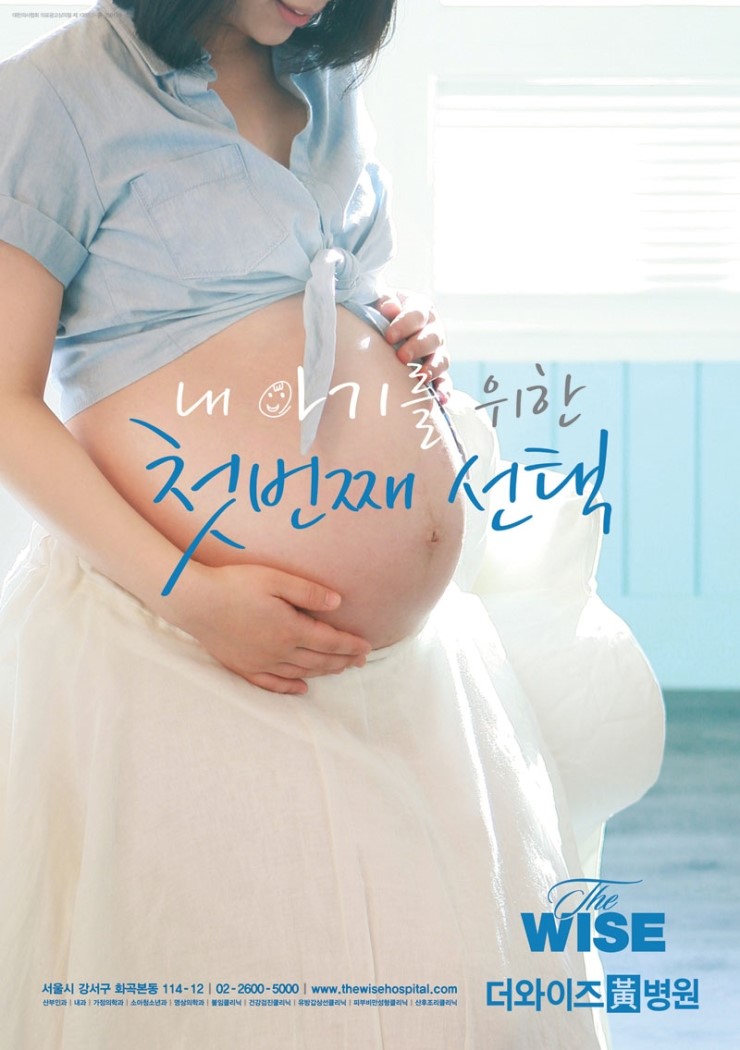
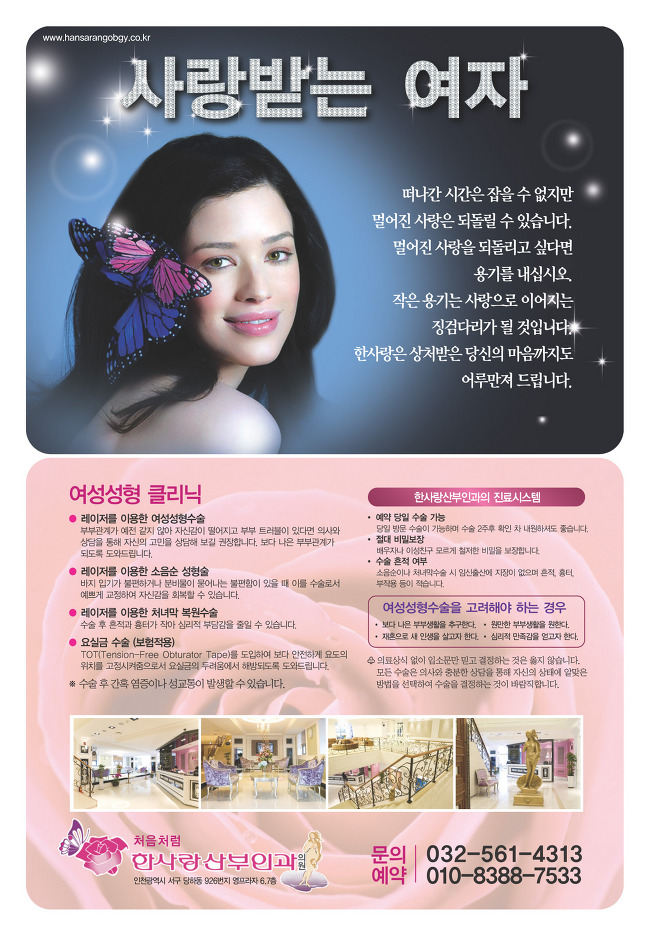
신지은(가명·36)씨는 얼마 전 산부인과에서 느낀 굴욕감이 생생하다. 아이를 낳고 정기검진차 방문한 신씨에게 의사는 은근히 ‘수술’을 권했다.

Shin Ji-eun (not her real name), 36, vividly remembers visiting a clinic for a regular check-up after her child was born, where the doctor implied she should have surgery:

“출산을 한 뒤니 부부관계를 오래 유지하고 싶으면 이참에 수술을 하라”고 말했다. 그가 권한 것은 여성 성기를 성형하는 수술이었다. “배려인지 희롱인지 알 수 없는 제안”이었다고 신씨는 말했다.

“After having a baby, and seeing as you’re already here, you should have surgery on your genitals for the sake of your married life”, the doctor said [James – what kind of surgery isn’t specified]. “I didn’t know whether to take it as a joke or a serious suggestion” Ji-eun said.

실제로 설문조사에 응한 여성들은 진료가 시작되는 접수대에서부터 낙태경험 또는 성경험을 묻는 수치스런 질문을 받았다고 증언했다. 어느 여성은 “진료 접수 때 ‘냉이 많아져서 병원에 왔다’고 했더니, 접수대 간호사가 큰 소리로 ‘성병이네요’라고 말해 매우 불쾌했다”고 적었다.

Respondents to the survey reported being asked embarrassing questions about their sexual experience and having abortions even as soon as arriving at the reception desk. One woman said “I went to the OBGYN clinic because I was having a heavy vaginal discharge, and the nurse at the desk loudly said ‘Oh, you must have an STD!’, which mortified me.”

진료 시작 뒤에도 수치심을 주는 의료진의 발언이 이어졌다고 응답자들은 적었다. 특히 “성경험이 있느냐”고 묻는 의료진의 태도가 당혹스러웠다고 여성들은 밝혔다. 어느 여성은 “성경험이 없다”고 답했다가 “검사할 때 번거롭다. 솔직히 말하라”는 의사의 말을 들었다. “그 뒤로 가급적 산부인과에 가지 않는다”고 이 여성은 밝혔다.

The shaming experiences continue after treatment starts too, because of doctors’ comments. In particular, after being asked if she had sexual experience, and replying that she didn’t, one woman found her doctor’s reply – “Be honest. Otherwise the examination will be more complicated” – perplexing, and said she’d rather not visit an OBGYN again.

(Source)

의료진이 성경험 여부를 묻는 것은 관련 진료에 필수적인 정보이기 때문이다. 그러나 성경험이 있든 없든 “왜 그런 정보가 필요한지 사전 설명 없이 다짜고짜 물어 불쾌했다”는 게 처음 산부인과를 방문한 여성들의 이구동성이다. 여성민우회 조사를 보면, 산부인과 방문 당시 성경험이 있었던 경우는 69.5%, 없었던 경우는 29.5%였다.

Before being treated, patients need an explanation of why being asked about their sexual experience was necessary. Without that, many women reported, they felt very embarrassed on their first visits to clinics.

Of the respondents, 69.5% had prior sexual experience, and 29.5% didn’t.

Top Left — Of 210 Respondents: 35.2% had no negative experiences, 64.3% did, and 0.5% didn’t reply.

Top Right — Of the 64.3% of women who reported negative experiences: 56.3% were related to fears and anxieties about their treatment; 30.4% to public perceptions [of OBGYN patients]; 3.7%  to questions about STDs; 3.0% to costs of treatment; and 6.7% to other things.

Bottom — Age at first visit to an OBGYN

자궁경부암 검사를 받으러 갔던 어느 여성은 “결혼 안 했으면 처녀막이 상할 수 있으니 검사하지 말라”는 의사의 말을 들었다. 자신을 배려하는 듯하면서도 ‘처녀성’ 운운하는 발언에 수치심을 느꼈다고 응답자는 적었다. “몇번 경험해봤나”, “최근엔 언제였나”, “첫 경험이 언제인가”, “남자친구 말고 섹스 파트너가 있나” 등을 아무렇지 않게 묻는 일은 점잖은 축에 속했다. 이들이 기록한 의료진의 어떤 발언은 그대로 옮기기에 민망할 정도다.

One woman who visited in order to be examined for cervical cancer was asked if she was married, “because if you haven’t, then you shouldn’t receive an examination that will break your hymen”; while possibly the doctor was just being considerate about her virginity, the woman still felt ashamed and embarrassed. Other embarrassing questions, like “How many times have you had sex?”; “When was the last time you had sex?”; “When did you lose your virginity?”; and “Do you have another partner in addition to your boyfriend”, don’t even begin to compare to what some doctors asked patients, which they reported were too shameful to write down in their surveys (source, right).

“성기 모양이 참 예쁘다. 남편이 함부로 하지 않는가 보다.” “가슴이 작아서 사진이 찍히려나 모르겠네.” “어린데 왜 산부인과에 왔을까?” 심지어 체모가 많은 것을 보고 “남편이 좋아했겠다”는 이야기를 들은 경우도 있었다.

“Your vagina is very pretty. Your husband wasn’t as rough as most men”; “Your breasts are so small I’m not sure they will even show in the mammogram”; ” You’re so young, why are you visiting an OBGYN?” and even, after seeing that a patient had lots of pubic hair, commenting that “Your husband must like it” are among some of the stories about doctors that respondents did provide.

환자보다 의사 중심으로 꾸며진 진료 환경에 대한 여성들의 성토도 이어졌다.

In general, respondents felt that the treatment environment was designed with doctors rather than patients in mind.

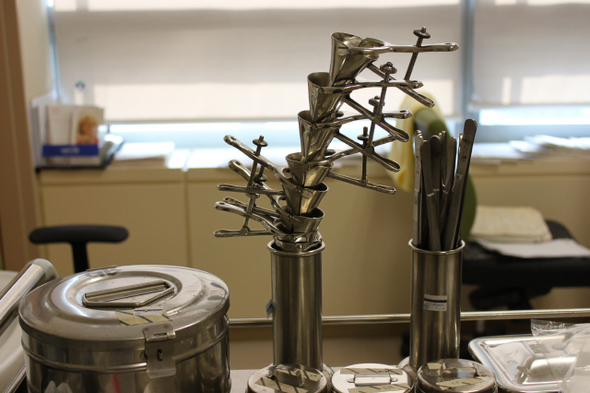
다리를 위로 향한 채 눕게 돼 있는 산부인과의 ‘진료의자’를 응답자들은 ‘굴욕의자’, ‘쩍벌의자’로 부르며 불쾌감을 표시했다. 한 여성은 “진찰대에 다리를 벌리고 올라가는 것 자체가 매우 불쾌해 다시 가고 싶지 않다”고 적었다.

(Source)

Women showed how upset they were by describing the treatment chair, in which patients lie with their legs in stirrups, as the “Chair of Shame”, or the “Spreadeagle Chair”. One woman wrote “I never want to go in that chair again. Having to spread my legs like that is very upsetting.”

자궁암 검사를 위해 병원을 찾았던 여성은 “의사가 들어오기 전 속옷을 벗고 다리를 벌린 채 준비했고 뒤이어 들어온 의사는 아무 설명도 없이 진료도구를 질 내부에 집어넣어 검사했다”고 불쾌감을 드러냈다.

Another woman who went to a hospital to be checked for cervical cancer wrote “Before the doctor came, I took off my underwear and got up and spread my legs, and when he arrived he just quickly put an instrument inside me, without any warning or explanation.”

‘진정으로 산부인과를 걱정하는 의사들 모임’의 최안나 대변인은 “산부인과 진료는 특히 예민한 분야이므로 성경험 여부 등 구체 정보가 왜 필요한지, 진료 과정은 어떻게 진행될 것인지 상세히 설명하고 의견을 구하는 건 당연한 절차”라며 “산부인과의 진료 서비스가 많이 나아지고 있다고 해도 여전히 일부 환자 눈높이에 부족한 점이 있다”고 말했다.

Choi Ahn-na, a spokesperson for the Korean Gynecological Physicians’ Association (GYNOB) [James — a notoriously anti-abortion group of OBGYNs. See here for more information about them] explained that “Gynecology and Obstetrics are very sensitive branches of medicine, for which it is both normal and essential for OBGYNs to have detailed information about patients, as this determines both the treatment type and how it’s administered. However, while OBGYNs have improved their services a great deal, it is also true that remaining weak spots need to be dealt with, as well as how things looks from patients’ perspectives.”

(Source)

여성민우회는 이달 중 1000여명에 대한 실태조사 최종 결과 분석이 끝나면 전문의·보건전문가 등과 간담회를 열어 환자를 배려하는 산부인과 의료 지침을 만들어 배포하는 등 ‘산부인과 바꾸기 프로젝트’를 이어갈 계획이다.

Continuing its “Transform OBGYN Clinics Project” [James — Yes, this is the first time it’s been mentioned in the article], this month Womenlink is following-up by surveying 1000 women. After analyzing the results with health specialists, it will produce and distribute a guide for OBGYNs for dealing with patients.

김인숙 한국여성민우회 공동대표는 “왜 여성들이 산부인과에 가는 데 부담감을 느끼는지 구체적으로 확인해 앞으로 더 나은 산부인과 진료 문화를 만들어 갈 것”이라고 밝혔다.

Kim In-sook, a co-spokesperson of Womenlink, said “We will determine exactly why women feel so stressed about going to clinics, with the aim of making a better and more welcoming environment for them there.”

<한겨레>는 ‘여성이 불편한 산부인과’를 ‘여성이 행복한 산부인과’로 바꾸기 위한 제보와 의견을 받아 관련 보도를 이어갈 예정이다.

(Editor): In order to make women feel comfortable with visiting OBGYN clinics, The Hankyoreh will continue to receive and report on women’s opinions and experiences of them.

Korean Gender Reader

(Source)

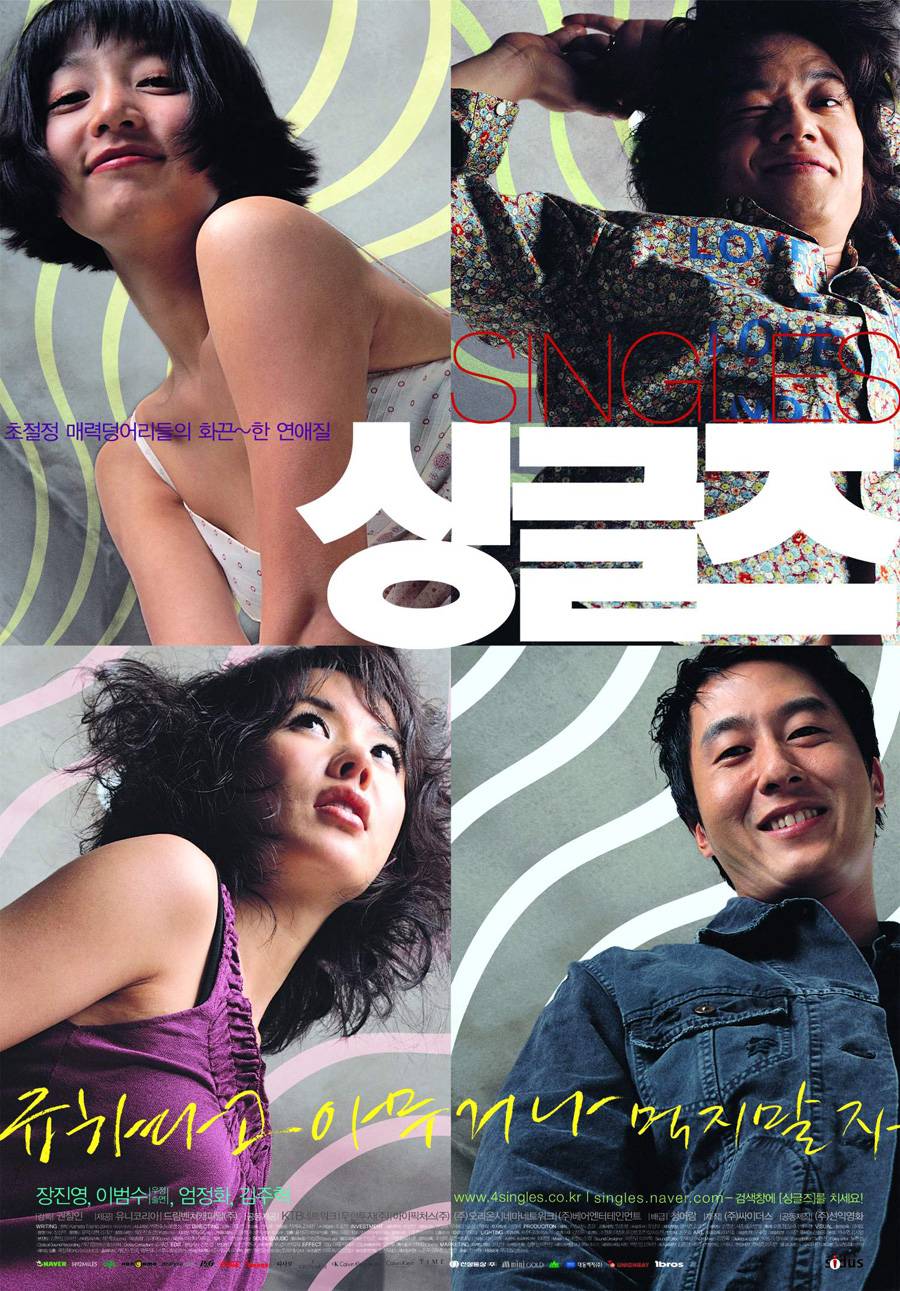
A poster for the upcoming movie Plump Revolution, in which Lee So-jeong puts on weight for a man (Lee Hyeon-jin) whose ideal type is a plump woman. Hopefully, it will have more helpful social messages than 200 Pounds Beauty (2006) did!

Body Image/Health:

Lookism or Insecurity: Cosmetic Surgery in South Korea (Kim Yuri; video by Jean Chung)

— Unrealistic Representations of Women in G-Market Ads: Part 1, Part 2 (Kim Yuri)

In China, a Radical Solution for the Sunburn (The Atlantic)

Where is the ‘S-Line’? Male-Female Split in Netizen Opinion (Korea Bang)

Rainbow’s leader wins suit against plastic surgeon (Korea Joongang Daily)

When Idolizing Idols Goes Too Far (Seoulbeats)

North Korean women can wear trousers and high heels at last (Daily News)

Confessions of a Retoucher (gemmaruthwilson{dot}com)

Censorship:

MV Censorship to Hit Online Content Next Month (MTV-K)

New Regulation That Might Shake Up K-Pop World: Music Videos Require Review Before Online Releases (Soompi)

Korean Groups Declare War on Internet Pornography (Korea Bang)

Crime:

School Employee Sentenced to 12 Years for Raping Deaf Student (Omona They Didnt)

Supreme Court puts to rest Korea University molestation case (Asian Correspondent)

Women’s rights group protests violence against women (The Korea Herald)

Odd Sexual Harassment Ruling Gets Mocked Online (Global Voices)

Korean police seek reforms to ‘prevent another Oh Won-chun’ (Asian Correspondent)

Man ‘Molests’ Girl at Driving Range, is Fined. Netizens Divided (Korea Bang)

Dating/Relationships/Marriage:

Growing up with Banana Fever (The F-Word)

Touching the Opposite Sex in Korea (Seoulistic Videos)

The menace of ‘foreign peril’ media (Groove Korea)

Response(s) to the MBC report (Gusts of Popular Feeling)

History:

The dangers of the call of nature (The Marmot’s Hole)

LGBT/Sexuality:

In Pictures: Korean Sex Workers’ Day (Research Project Korea)

Decriminalizing prostitution in Korea (The Korea Herald)

Seoul court rules to prevent posters advocating for gay rights (Korea Joongang Daily)

Korean prostitutes caught on tape in Tokyo (The Tokyo Reporter)

Can Korea ever accept homosexuals? (The Korea Herald)

When We Acknowledge Difference, Life Becomes a Festival: Participating in the 13th Korea Queer Culture Festival’s Parade (Ilda)

Misc:

North Korea has Girl Groups Similar to Girls’ Generation? (Soompi)

Poor Treatment of Female Inmates in North Korean Gulags (Korea Bang)

Spotting Suicidal Tendencies on Social Networks (Technology Review)

The gentleman’s syndrome: A look into the real-life 40-something man-about-town (The Korea Herald)

Politics/Economics/Workplaces:

To people who ask, “What is it that women’s organizations have done?”: The hate underlying the “__ Girl series” and criticism of women’s organizations (Ilda)

‘Strikingly’ few women in Asia’s top jobs (Rappler)

Seoul City initiatives to improve lives of women (Korea: Circles and Squares)

Park Chu-young’s Military Service Mess (The Diplomat)

Women can help save the Korean economy (The Dong-a Ilbo)

Lookism, Snarkiness, and Judgment at Work in Korea (The Unlikely Expat)

Income Gap between Men and Women Widens in Korea (Arirang)

The place of young women: Girl power up (The Economist; China)

New-fangled feminism: Self-dignified indeed (The Economist; China)

Pop Culture:

What’s it like to be women in Korea’s indie scene? (MTV-K; video automatically opens)

The Baddest Female Seoul City Ever Had: CL, artist of the year 2011 (Frank Kogan)

Photos of Tanned K-pop Band Spark Controversy over Skin Colour (Korea Bang)

A Gentleman’s Dignity: Dumped for Wearing a Sexy Dress (Lobotronic)

Only Caucasian Actress/Models Sought for B2ST MV (Omona They Didn’t; Asian Junkie)

4-Minute sings Hindi: Re-visiting cultural insensitivity and why society sucks (Angry K-Pop Fan)

Four Minutes to Build a Case for Cultural Sensitivity (Seoulbeats)

More on cross-cultural encounters: a response to Seoulbeats (Radio Palava)

Pregnancy/Abortion/Childbirth/Demographics/Parenting/Education/Multiculturalism:

Electronic Wristlet Rental Service for Children at Haeundae Beach (Busan Haps)

Turning One (Lee’s Korea Blog)

More Older Singles Are a Challenge for the Government (The Chosun Ilbo)

Many Prefer to Stay Single Forever (The Chosun Ilbo)

…Or maybe it should be titled Many have no choice but to stay single forever (Alleyways)

Should Mommy Blogs Be Censored? (Geek in Heels)

Dads of Reddit: How has having daughters changed your perception of women? (Reddit)

Asians Are Immigrations New Face (The New York Times; The Unlikely Expat; ROK Drop)

(Links are not necessarily endorsements)

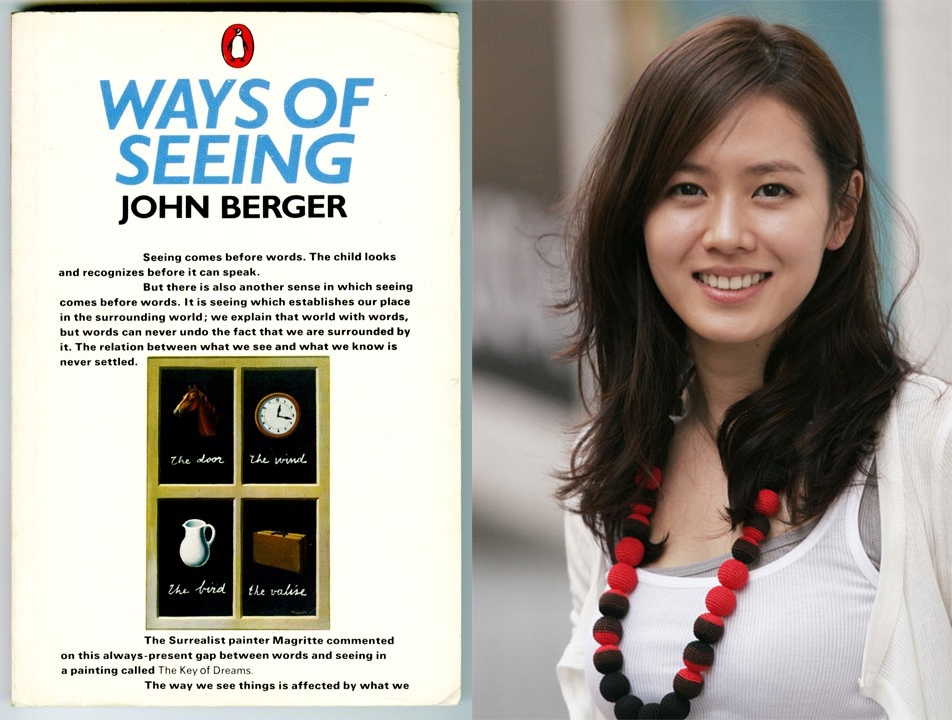
The Male Gaze and the Korean Mass Media (Or: Ways of Seeing Son Ye-jin as Fat…)

(Sources: left, right)

Another week, another group of perfectly healthy women fat-shamed on Korean television. Yes, even Son Ye-jin too, no matter how disarmingly attractive she looks above.

It was such a pleasant surprise then, to see the following denouncement from Entermedia reproduced in the entertainment and celebrity sections of Daum and Yahoo! Korea too. The first time I’ve ever comes across a lengthy critique about the male gaze and impossible body ideals alongside, well, numerous examples of exactly those, the optimist in me hopes that this represents some kind of turning-point. Or, at the very least, a consensus that the offending programs clearly overstepped a line, even by the Korean media’s standards!

손예진 몸매 논란, 무엇이 문제일까 / Controversy About Son Ye-jin’s body; What is the Problem?

by Bae Guk-nam, Entermedia, July 2 2012

– 손예진이 통통하면 이득보는 사람들 / There are people that profit from Son Ye-jin being fat
– 미디어, 이 땅의 여성들 말라깽이 강박증 환자로 내몰아 / The media encourages Korean women to be obsessed with thinness

처음 제 귀를 의심했습니다. 다음에는 설마 그럴까라는 생각을 했습니다. 그리고 파급 효과가 엄청나다는 인식에 이르렀습니다. 바로 여성 몸매를 제시한 세 개의 방송 프로그램을 보면서 느낀 제 반응과 생각입니다. 그리고 세 개의 프로그램을 보면서 여성 몸매에 대한 매스미디어와 일부 남성의 편견에 찬 시선의 현주소를 알 수 있었지요. 그러한 시선은 이 땅의 수많은 여성들로 하여금 몸에 대해 과도한 집착을 하게 할 뿐만 아니라 육체에 대한 불만과 취약성, 결핍을 끊임없이 느끼게 만들어 지극히 정상적인 자신의 몸에 대해 비정상으로 바라보게 만드는 병폐를 심화시키는 문제를 야기 시키고 있다는 것도 절감하게 됐습니다.

At first, I doubted what I was I really seeing. Then I thought “Really? OMG”, and realized how much of a controversy would be raised. That was my reaction when I saw three recent programs about women’s bodies.

While watching, I got to know the reality of the deep prejudice with which the mass media and some men viewed women’s bodies. I realized that through this, Korean women don’t just get excessively attached to their body image, but are also disempowered through continuously feeling frustrated with their bodies, and coming to feel that theirs are abnormal .

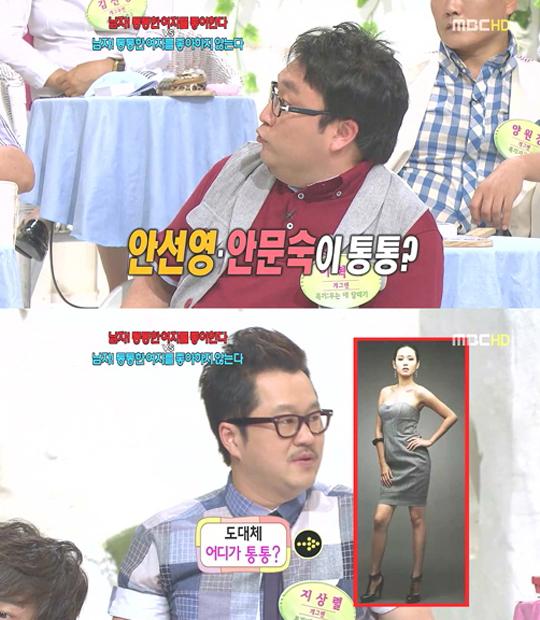
여성의 몸에 대한 미디어와 남성의 시선, 그리고 그 병폐를 적나라하게 노출시킨 방송이 바로 지난 6월23일 방송된 MBC < 세바퀴 > 입니다. 이날 방송에서’남자들이 통통한 여자를 좋아한다는 말이 사실인가?’라는 설문에 대한 이야기를 나누던 중 이혁재는”출연진 중에서는 안선영과 안문숙 정도가 통통한 것 같다. 이경애는 통통한 게 아니고 고도비만이다”라고 말해 충격을 주더니 지상렬은 통통의 기준이 되는 연예인이 “손예진이다”라고 답해 출연자 뿐만 아니라 시청자들을 경악하게 만들었습니다. 헬스 트레이너 숀리는 여기에서 더 나아가 “조여정, 송혜교를 통통하다고 하는데, 저는 예전부터 그런 몸을 좋아했다”라며 안방 시청자의 몸매에 대한 인식에 대한 생각을 다시 한번 하게 만들었지요.

The problems of this media and male gaze were very evident in the June 23rd episode of World-Changing Quiz Show, broadcast on MBC [James — see here and here for Part 1 and 2]. On that show, the discussion topic for the panel was “Is it true that men like fat women?”, and comedian Lee Hyeok-jae (male) not only remarked that two female members of the panel — comedians Ahn Sun-young and Ahn Moon-sook — were fat (literally, he said “Fat like them you mean?)” , but that a third—  Lee Kyong-ae — was extremely so, shocking other panel members and the audience. Then comedian Ji Sang-ryul (male) opined that among women in the entertainment industry, Son Ye-jin was the standard [James – upper limit?], further adding to everyone’s astonishment. Finally, health trainer Sean Lee mentioned that people say that Jo Yeo-jung and Song Hye-gyo are fat, but that he has liked such body types for a long time, again making viewers at home dwell on the subject of fatness.

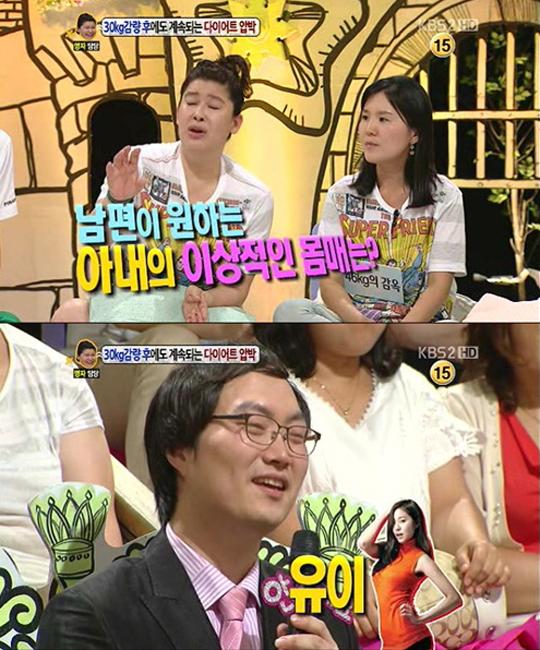
6월25일 방송된 KBS < 안녕하세요 > 에선 46Kg의 몸무게를 유지하라는 남편 때문에 고민이라는 한 여성이 출연했습니다. 남편이 연애시절부터 마른 여자를 좋아해 75Kg체중을 46Kg으로 만들어 결혼했다는 황은미씨는 “결혼한 지금도 46kg의 체중을 유지하라는 남편의 감시를 받고 있다. 매일 배가 어느 정도 나왔는지 남편에게 검사를 받는다”며 몸무게 대한 남편의 기준을 완화해 달라고 부탁을 했고 이에 황씨 남편은 “(애프터스쿨) 유이씨 정도면 좋겠다. 나이가 좀 있으니까 양보해서 48kg 유지해라”라고 답했습니다.

Then on the 25th, a woman called Hwang Un-mi appeared on Hello! on KBS, describing the suffering she’s endured because of her husband demanding she stay at a weight of 46kg. He’s liked thin women ever since they started dating, so she went from 75kg to 46kg before she they got married, and she said that “Since then, he still insists I stay at 46kg, and checks my belly thickness every day to make sure.” When she asked her husband on the show for some relaxing of his standards, he replied “I like a body like that of Uee’s from After School. But seeing as you’re older, I’ll let you go up to 48kg.”

6월19일 방송된 tvN’화성인 바이러스’에는 압박붕대로 얼굴에서 발끝까지 온몸을 감으면서 생활하는 일명 ‘미라녀’김유정씨가 출연했지요. 압박붕대로 체중 10kg 감량에 성공했다는 김유정씨는 “3~4년간 계속 압박붕대를 감다 보니까 요령을 터득하게 됐다. 살 많은 곳을 세게 감을수록 (다이어트)효과가 좋다”며 다이어트를 위해 몸에 사용하는 압박붕대는 복부 4개를 비롯해 23개에 달한다는 충격적인 설명을 태연스럽게 했습니다.

이 세 개의 프로그램은 여성의 몸에 대한 남성의 시각과 그리고 미디어의 행태, 그 결과의 양태를 단적으로 보여준 것입니다.

And earlier, on the 19th, “Human Mummy” Kim Yu-jeong appeared on Martian Virus on TvN [James — this show highlights strange and unusual people], who wraps herself in pressure bandages from head to toe in order to lose weight. She matter-of-factly explained “I’ve successfully lost 10kg this way, and have figured it out while I’ve been doing it over the last 3-4 years. It’s very effective if you have a lot of weight to lose,” and that she applied 4 pressure bandages to her abdomen each time, and 23 on her body overall.

These three programs clearly showed the male gaze on women’s bodies, and the media’s views on them too.

대상을 바라보는 방식은 우리가 알고 있는 그리고 우리가 인식하고 있는 것과 깊은 관련이 있습니다. 여성의 몸매에 대한 것도 마찬가지입니다. 안선영 안문숙 손예진 조여정 송혜교등이 통통하다고 바라보는 이혁재 지상렬 그리고 숀리의 언급은 상당수 남성들의 여성의 몸에 대해 바라보는 방식을 드러냈다고 봅니다. 이상적인 여성의 몸매마저 통통하다고 인식하는 이러한 남성들의 여성의 몸에 대한 문제 있는 시선은 방송, 신문, 인터넷 등 매스미디어를 통해 확대재생산되고 수많은 사람들에게 여성의 몸매를 바라보는 인식의 토대를 마련해줍니다.

The way we see things is deeply related to what we already know and what we recognize. And it’s same with women’s bodies.Through the mass media, the problematic viewpoints of these male entertainers, who believe even those women with ideal bodies are fat, has spread extensively. This has laid the groundwork for how many people view women’s bodies (source, above).

매스미디어와 상당수 남성들은 끊임없이 여자 연예인으로 대변되는 몸매의 이상형을 제시하며 수많은 여성들에게 몸매에 대한 채워지지 않는 욕망을 자극시키고 있습니다. 이혁재 지상렬로 대변되는 일부 남성들과 매스미디어는 현실에서 좀처럼 존재할 수 없는 완벽한 이상형의 여성 몸매 제시를 통해 여성의 정상적인 몸매 더 나아가 손예진 송혜교 등으로 대변되는 이상화된 몸매마저도 비정상으로 치부하고 있습니다. 이 때문에 수많은 여성들은 정도의 차이는 있지만 자신의 몸매에 대해 부족과 결핍을 느끼게 만듭니다.

Through female entertainers, the mass media and many men present women’s ideal body types, and this creates a lot of anxiety and anguish for women about their own bodies. Men like Lee Hyeok-jae and Ji Sang-ryul consider ideal women’s bodies like those of Son Ye-jin’s and Song Hye-gyo’s as abnormal, while at the same time presenting as ideals body types and shapes that are impossible in real life. And while some women will be closer to those ideals than others, all will still inadequate and lacking.

(Source)

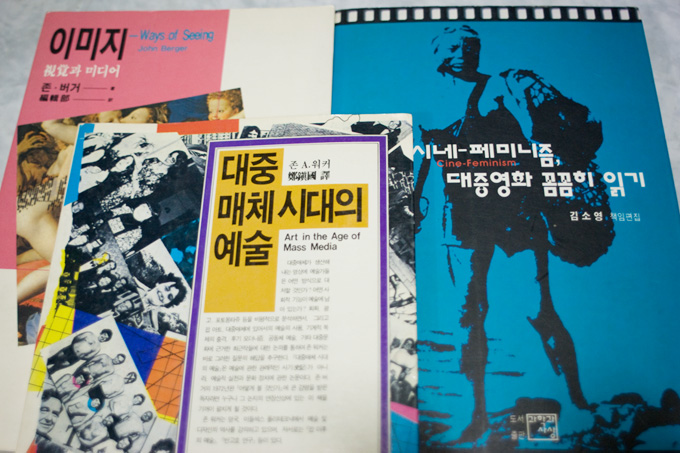
여성의 몸에 대한 상당수 남성들의 시선과 매스미디어의 응시 방식은 수많은 이땅의 여성들의 몸에 대한 인식에 크나 큰 영향을 줍니다.’여성은 그녀 자신의 모든 것을 관찰해야만하고 또 그녀가 무엇을 할 수 있는가를 생각해야만 한다. 왜냐하면 스스로가 다른 사람에게 궁극적으로는 남성에게 어떻게 비춰질 것인가 하는 문제가 여성의 삶의 성공 여부를 결정짓는 가장 중요한 관건이기 때문이다. 여성 자신의 스스로 존재에 대한 느낌은 다른 사람에 의해 내려지는 그녀에 대한 평가에 의해 보완되어져야만 하는 것이다’라고 존 버거가 ‘Ways of Seeing’ 에서 설파한 것처럼 여성의 몸에 대한 남성의 시선은 몸매에 대한 여성의 인식과 태도에 지대한 영향을 미칩니다.

The way most men look at women’s bodies, and the way the mass media presents them, has a big influences on the way women themselves view them. Like John Berger said in Ways of Seeing [James — on the second page of Chapter 3 {p. 46} in my 1972 Penguin edition]:

She has to survey everything she is and everything she does because how she appears to others, and ultimately how she appears to men, is of crucial importance for what is normally thought of as the success of her life. Her own sense of being in herself is supplanted by a sense of being appreciated as herself by another.

(James — Ways of Seeing was originally a documentary, which is now available online; see here and especially here for more information. It’s the second episode that is most relevant here)
매스미디어의 여성의 이상적 몸매의 강요에 가까운 현실는 남성의 여성에 대한 왜곡된 몸매의 시선을 강화시키고 그 결과 수많은 이 땅의 여성들을 자신의 육체와의 비정상적인 전쟁으로 내몰리고 있습니다. 물론 이 전쟁의 진정한(?) 승자는 여성도 남성도 아닌 여성의 몸에 대한 끊임없는 결핍의 이데올로기를 설파해 막대한 이윤을 창출하는 뷰티산업, 성형외과, 광고, 매스미디어 등이지요.

This reality of the mass media promoting [impossible] ideals of women’s body shapes distorts how men view women’s bodies, and in turn this encourages women to fight against their own bodies. The real winners in this war are not men, nor women, but rather the beauty, cosmetic surgery, advertising and mass media industries that make vast profits from propagating an ideology of an unceasing dissatisfaction with oneself.

여성 몸매의 이상형이라고 할수 있는 손예진 송혜교 마저 통통하다고 말하는 지상렬 등으로 대변되는 여성의 몸매에 대한 남성의 시선과 매스미디어의 응시 방식은 아내의 46Kg의 몸매 유지를 요구하고 애프터스쿨의 유이의 몸매를 이상적 몸매로 꼽아 아내마저 제2의 유이로 만들려는 남성들을 더욱 더 확대재생산합니다. 그리고 이 때문에 정상 체중인데도 아침엔 다이어트용 시리얼에 저지방우유, 점심엔 채소와 밥 반공기, 저녁엔 아무것도 먹지 않고 운동 2시간을 하는 주부들과 압박붕대 20여개로 감싼 기괴한 모습으로 다이어트를 하는 20대 여성들이 양산되고 있습니다.

(Source)

[It is the callous environment in which entertainers can describe female celebrities like Son Ye-jin and Song Hye-gyo as fat that is at least partially responsible for the husband that demanded his wife have a body like Uee’s]. And it’s also because of that that both housewives and women in their 20s, all of healthy weights, will only diet cereal with low fat milk for breakfast, for lunch just vegetables and half a bowl of rice,  and nothing for dinner, yet exercise for 2 hours. Some will even also go the extremes of wrapping themselves with 20 pressure bandages.

여성 몸매에 대한 남성의 문제 있는 시선과 여성들의 완벽한 몸매를 지속적으로 강요하는 방송 등 매스미디어의 행태는 이 땅의 수많은 여성들을 이상화된 몸에 대한 과도한 집착을 초래하고 자신의 몸에 대한 끊임없는 불만과 결핍을 불러옵니다. 그리고 급기야 정체성과 자기실현을 왜곡된 방향으로 유도하며 정신없는(mindless) 몸매(body)만을 만드는 육체와의 전쟁터로 내 몰고 있습니다. 이제 여성의 몸매에 대한 문제 있는 미디어의 행태와 남성의 시선은 교정돼야합니다.

손예진씨, 당신은 결코 통통하지 않습니다!

Men’s problematic gaze of women’s bodies, and the mass media’s encouragement of women to desire impossible perfect body types, only leads to unhealthy obsessions and unceasing dissatisfaction. Furthermore, they induce a distortion of women’s identity and self-realization,  and creates a war in which women only fight to have a good body, not a good mind or spirit. This problematic men’s gaze and mass media’s attitude needs to be corrected.

Son Ye-jin, you will never be fat!

(Thanks to Daheefanel for passing on the story!)

Shocking Report: Foreigners Dating Koreans Conspiracy! — 충격보기: 외국인과 교제음모!

This video is a parody of the ridiculous, offensive video “The Shocking Reality About Relationships With Foreigners” which aired on South Korea’s MBC TV network in May 2012. Click here to see the original video with English subtitles.

Quick Hit: Korean Retro in Paju!

(Source)

“…[I]n the worldwide retro trend, where is the Korean culture located? Most of the cases, instead of original Korean culture, foreign vintage culture and goods are imported. It is because of the ’70s and ’80s fever for the Westernization then it is hard to find original Korean retro. So you find that only unidentified mixture of retro cultures have mushroomed in Korea without its own color.”

So lamented the Design Journal (디자인저널) back in November 2008. But as it turns out, a veritable treasure-trove of Korean retro has long been available in the Museum of Modern History of Korea (한국 근현대사 박물관) in Paju, just 30km north of Seoul. See here, here, here, and here for some high-definition photos of the exhibits, and here (a PDF) and here for information about the museum in English.

Combined with the Heyri Artist’s Village, and/or the Paju Book City, then you have the makings of a perfect day trip from Seoul, and a very educational and cultured one at that. Any takers?^^