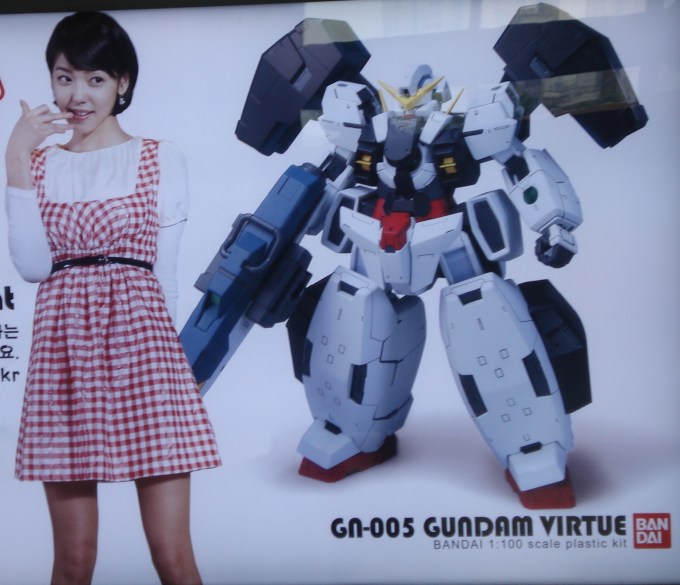
Korean Sociological Image #48: The Male Gaze

( Source: L-C-R. Reproduced with permission )

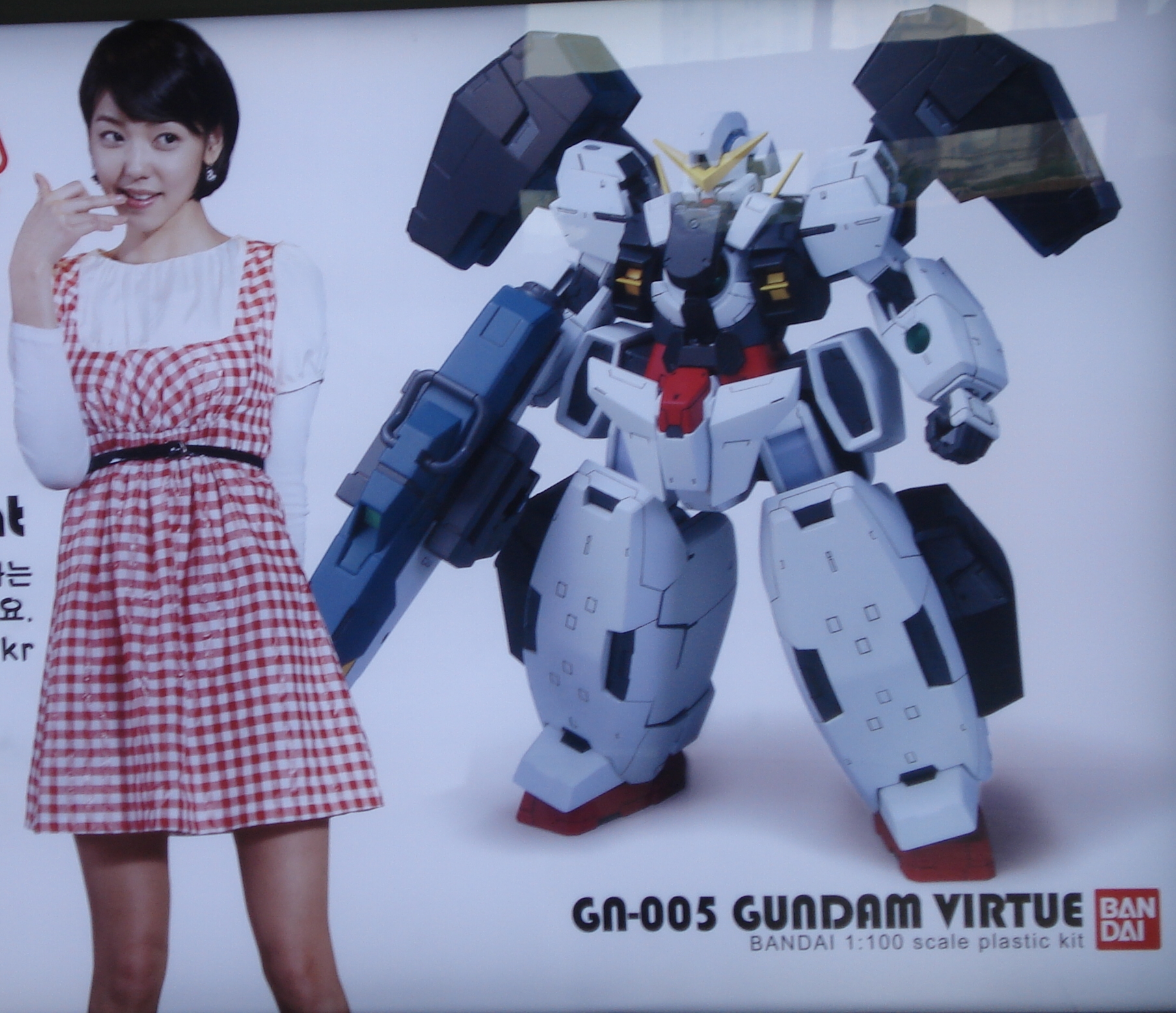
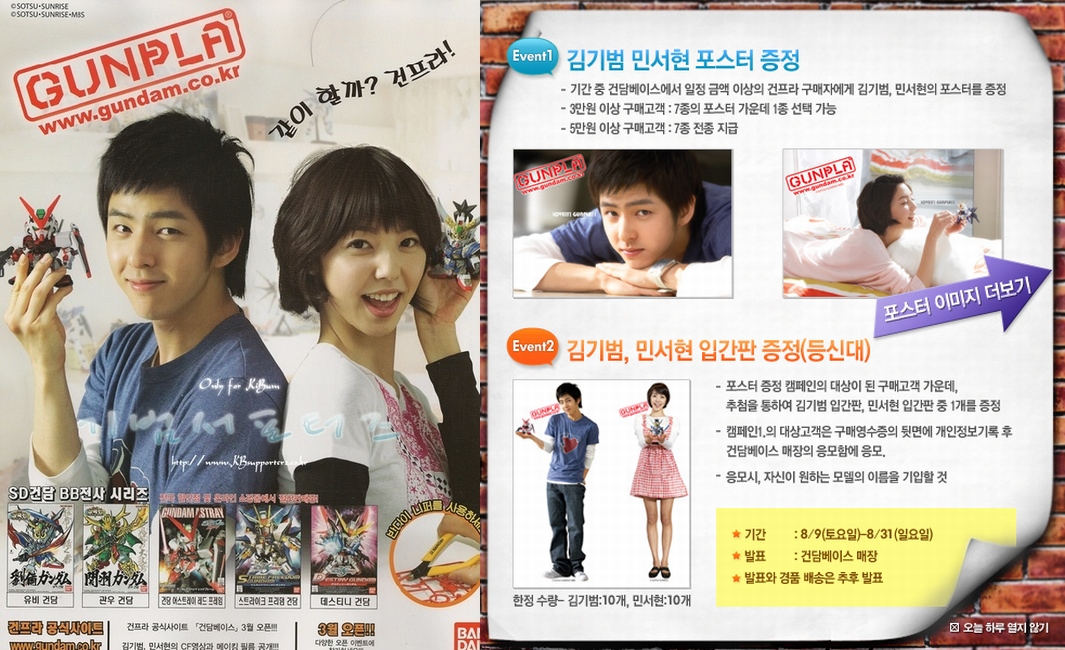
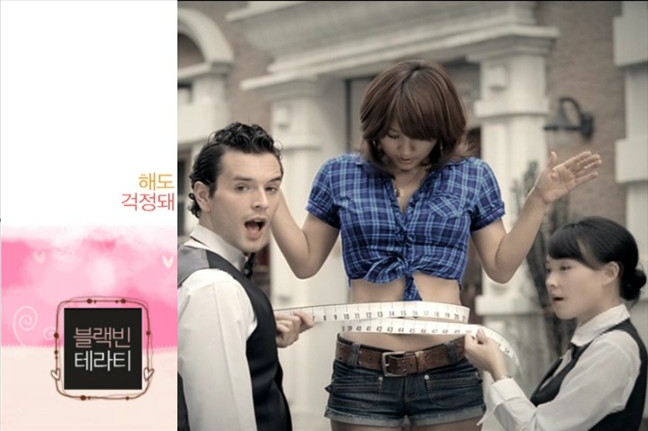
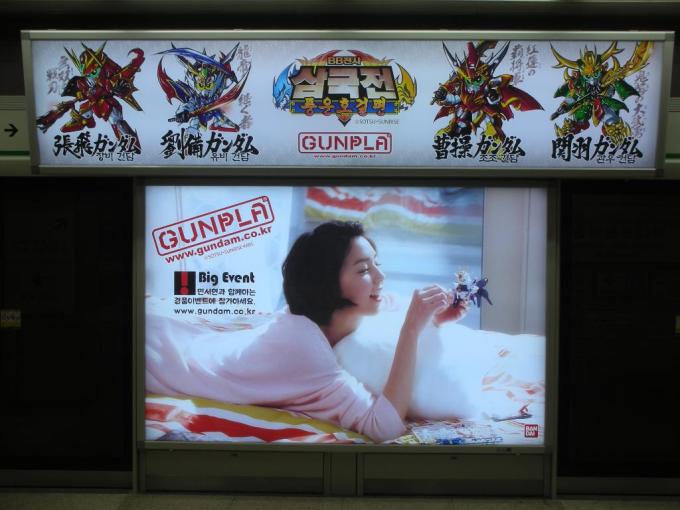
Like photographer L-C-R says, this 2008 Gundam advertisement is a prime example of a woman being portrayed as a child and/or sex object, of which she saw entirely too much of while she was in Korea.

You may be very surprised then, when you learn whom it was actually aimed at.

But first, please consider what is it exactly that so demeans drama actress Min Seo-hyeon (민서현) in it? I identify 4 or 5 things myself, which I outline in descending order of importance below:

  1. her childlike expression, combined with putting her fingers in her mouth
  2. the canting of her head
  3. her surprisingly awkward stance
  4. her passivity as she awaits the masculine-looking robot to make the next move

And after discussing those, albeit briefly because I’ve already done so in great depth in this similar post about soju advertisements, I’ll finally look at the ad in the context of the campaign as a whole. But feel free to disagree with any of those and/or suggest others, and in that vein I highly recommend asking your Korean partners, colleagues or friends their own opinions also. As if the experience of asking my wife and her friends earlier is anything to go by, then they are very likely to disagree with the first. Or indeed, that she’s being portrayed childishly at all, and – jumping ahead – not even in the following commercials either:

I’d argue that the main reason for that is the Korean cultural practice of aegyo (애교), difficult to define in English but probably somewhere between “affected sweetness” and “affected childishness“, and at least partially rooted in the prolonged transition to adulthood of experienced 20-something Koreans that are the biggest practitioners of it. For not only does the Korean education system essentially defer the joys of adolescence (but not the negatives!) until graduating from high school, but economic circumstances force them to live at home until marriage and/or deliberately put off their university graduation, and men also have their 24-28 months of compulsory military service to boot.

But I realize that since I was a student myself in the mid-1990s, more and more 20-somethings in Western countries are also postponing leaving home, and indeed to note all the above is not to argue that all Korean 20-somethings in such circumstances are childish; actually, I have intelligent, mature, and thoroughly Westernized Korean friends that have resigned themselves to them, or alternatively feel so trapped that they are literally fleeing the country to escape. Yet one thing they certainly do not do however, is aegyo, and I put it to you that in fact that is neither required for women to successfully navigate a patriarchal society, nor particularly savvy and ultimately empowering of them to do so.

( Source )
( Source: L-C-R )

Yes, “women”. As while Korean men do also do aegyo, and so as you’d expect content analysis demonstrates that men are much more likely to be portrayed childishly in advertisements in Korean magazines than US ones, and Korean men more than Western ones in the former, it is still overwhelmingly Korean women that are done so, and to a much greater extent than women of any ethnicity are in US magazines.

( Source )

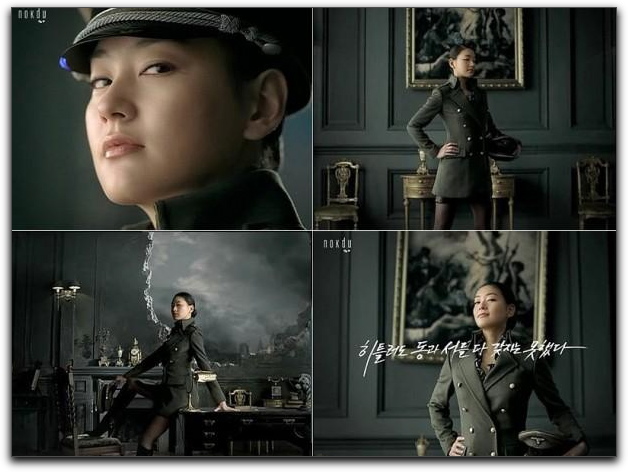
As for anyone still not seeing the childishness in Seo-hyeon’s expression however, or why it is problematic in any sense, consider what the images above tell us about just how “natural” such expressions really are on adults, and why women are more commonly portrayed with them nevertheless. And which are often accentuated of course, by putting their fingers in their mouths, and which could possibly be considered “self-touching” as defined by sociologist Erving Goffman in Gender Advertisements (1979) below:
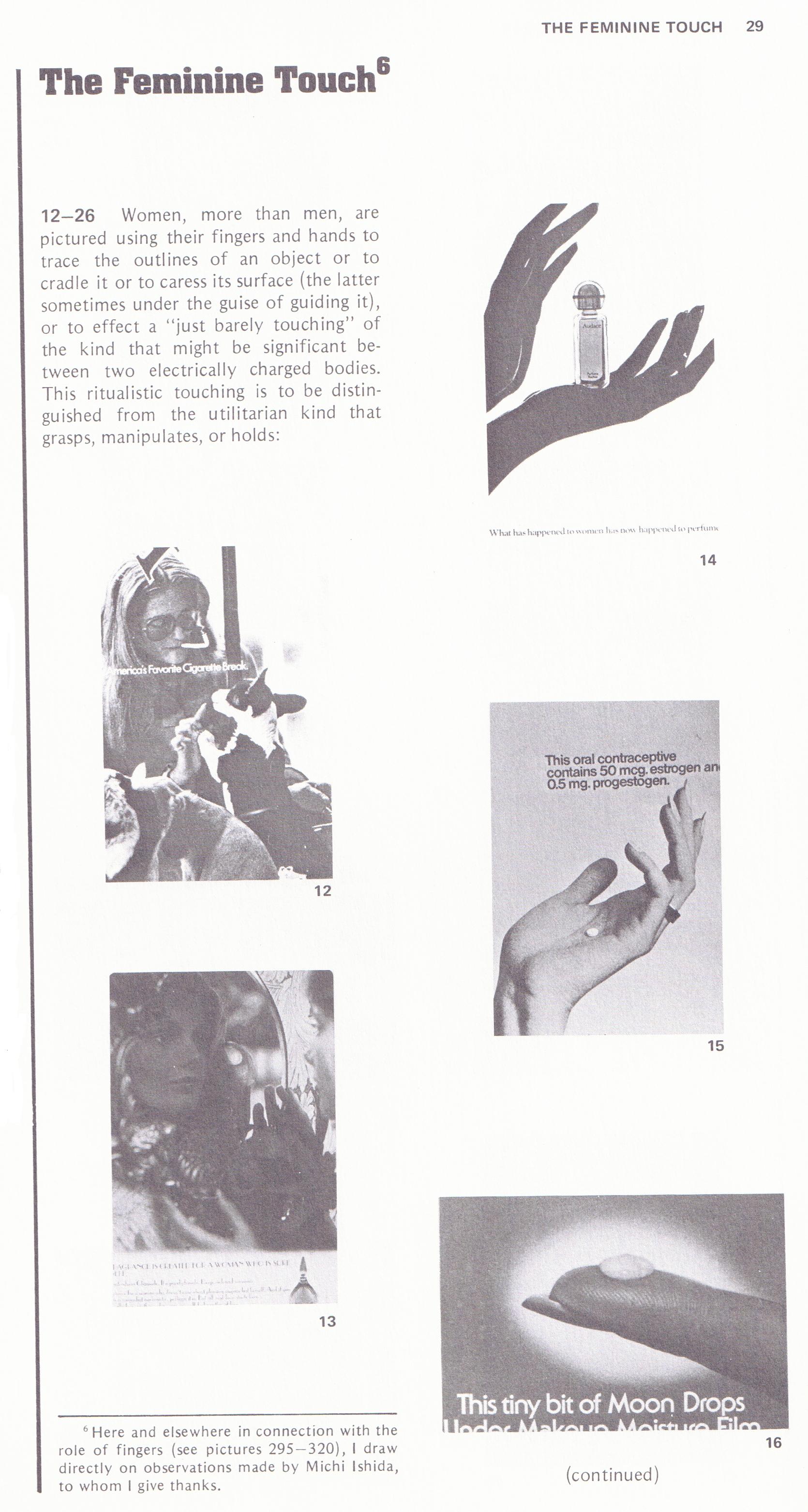
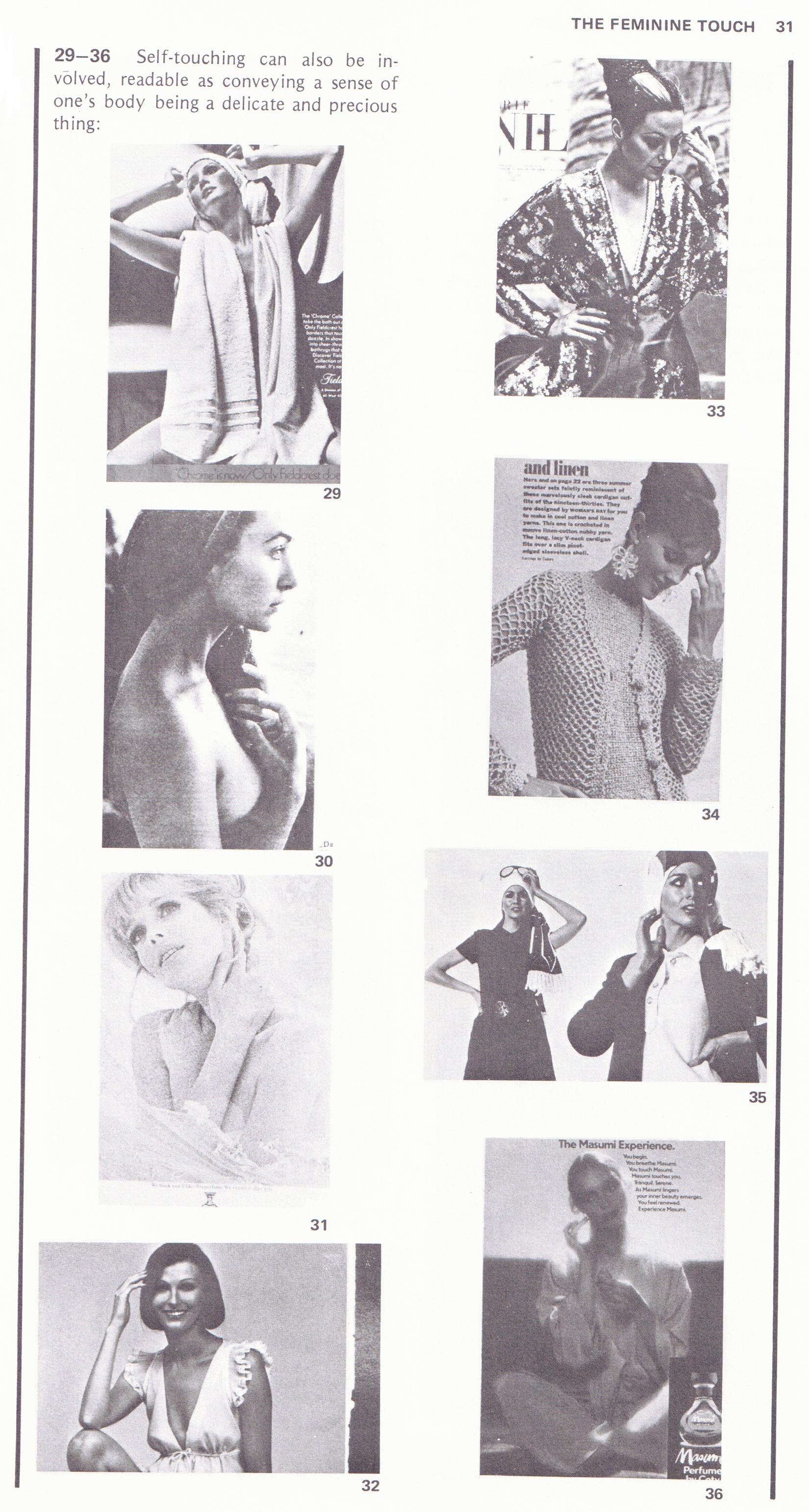
As discussed in that earlier post on soju advertisements, both are often combined with the canting of the head, which is problematic for the reasons outlined there. I also discuss awkward stances there too, and to anyone believing that I’m about to read too much into Seo-hyeon’s, I suggest stopping here and trying it for yourself,  making sure to bend and spread your legs outward at the knees like she does in particular. For not only will you realize just how unnatural it really is, and that people only ever stand like that in advertisements (and overwhelmingly women at that), but you’ll also probably end up falling forward a little on your first attempt like I did, and will suddenly gain a very palpable sense of why exactly the advertisement does indeed present her as a sex object:
( Source: L-C-R )

In Goffman’s framework in Gender Advertisements, that “bashful knee bend” is something that women frequently, men very infrequently, are posed in a display of. And whatever else, it can be read as

…a foregoing of full effort to be prepared and on he ready in the current social situation, for the position adds a moment to any effort to fight or flee. Once again one finds a posture that seems to presuppose the goodwill of anyone in the surround who could offer harm. (p.45)

Hence passivity, as blind to whatever occurs behind her, nevertheless Seo-hyeon seems to be eagerly awaiting whatever the robot plans to do with her. And which judging by the fact that it also is standing slightly thrust forward, and has a big long gun resting behind Seo-hyeon’s buttocks, couldn’t really be any clearer. Hell, even the protrusion on its crotch is already bright red for good measure too.
( Source )

An advertising campaign clearly aimed at young men and adolescent boys then, whom I’ll safely assume are the vast majority of Gundam fans? If so, then the effort actually appears to have backfired, as the few commentators on it I’ve been able to find here, here, here, here, and here generally express both surprise and disdain at seeing Min Seo-hyun at all, the last of whom wrote the following about the advertisement above:

이 광고는 광고로서의 설득력이 전혀 없다. 그것이 염가 제작되었기 때문이 아니다. 반대로 제작비는 많이 들었을 것이다. 이름있는 사람들의 얼굴을 비추기 때문이다.(그림의 건프라 광고에 출연하는 사람이 유명한지는 잘 모르겠다.) 그러나 문제 역시 그러한 사고방식에 있다. 즉, 유명한 사람의 얼굴을 비추면 광고가 될 것이라는 사고방식에.

This advertisement has no persuasive power at all. But not because it was cheaply and poorly produced; actually, because of the famous faces in it, it looks like a lot of money was spent on it (well, actually I don’t know if they are famous or not). Rather, the problem is with using that advertising logic in the first place.

이것은 어느 정도 맞는 말이다. 유명한 사람이 어떤 상품을 소비하고 있으면 그것만으로도 상품의 질을 소비자들에게 안심시켜 줄 수 있다. 그러나 그것도 광고의 효용성 안에서 이루어져야 한다.

However you look at it, this is correct. While of course simply having famous faces in an advertisement is sufficient for most consumers, they should still be used in the ad as effectively as possible however.

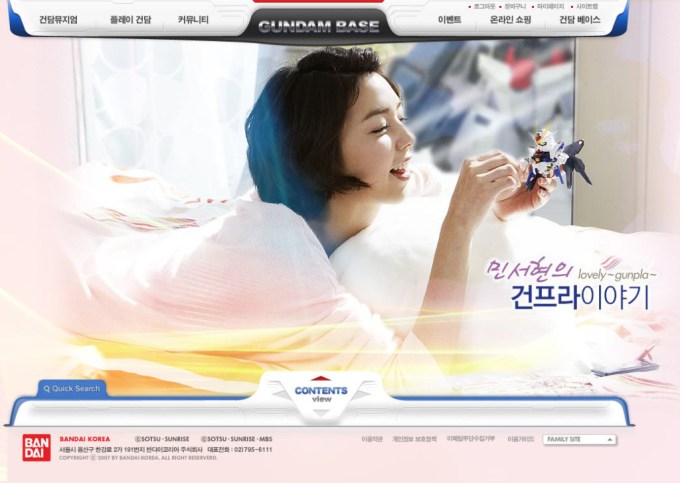
이 광고의 전략은, 유명하거나 예쁜 사람과 건프라의 이미지를 교차시켜 건프라가 갖는 오타쿠 이미지의 쇄신일 것이다. 좋은 생각이다. 그러나 이러한 두 이미지가 교차점을 찾지 못하고 있다. 저 사람은 건프라를 만지작거리고 있지만 전혀 즐거워 보이지 않는다. 아마 저 사람은 자신이 들고 있는 건프라의 이름도 모를 것이다.

The advertisement’s strategy is to reform the image of a Gunpla Otaku [an obsessive fan of something – James] by combining with a famous or attractive person. This is a good idea. However, ultimately they don’t really mix. This person doesn’t look like she’s enjoying holding the model [really?] and probably doesn’t even know the name of it.
( Source )

방 또한 지나치게 깨끗하지 않은가? 건프라에 열중하면 당연히 방은 데칼 찌꺼기나 플라스틱 조각으로 너저분해져 있어야 하고, 책장에는 잡다한 건프라가 어지럽게 진열되어 있어야 한다. 채색하는 손은 알록달록 에나멜이 묻어 있어야 하고, 옷은 더러워져도 상관없는 펑퍼짐한 츄리닝이어야 하며, 얼굴은 지극히 진중한 표정을 짓고 있을 것이다. 오히려 이러한 당연한 이미지를 예쁘고, 성공적이고, 멋있는 사람들과 교차시켰으면 이 광고는 성공을 거두었을 것이다. 장동건이 한없이 고결한 태도로 NDS를 플레이했다면 NDS는 그만큼 팔리지 않았을 것이다. 오히려 소파에 퍼져 앉아 우리들이 하듯이 게임을 했기 때문에, 우리가 하는 것을 장동건도 한다는 안심을 소비자에게 줄 수 있었다.

Also, isn’t the room excessively clean? When you are absorbed in assembling a Gunpla model, of course the room should be messy with the remains of decals and leftover plastic, and various other models displayed on the bookcase. And while your hands would be stained with enamel paint and your casual clothes dirty and speckled, your face shows that you don’t care about that as you focus all your attention on assembling the model. Rather, prettier and more successful people were needed. And recall that very famous actor Jang Dong-gun didn’t similarly loftily play Nintendo DS Lite while he was advertising it in 2007; instead, he just played it normally on the sofa like the rest of us, and so it sold well.

게다가, 타겟을 통일했으면 더 설득력이 있었을 것이다. 지금 이 광고가 노리는 소비층은 누구인가? 아이? 청소년? 남자? 여자?

Hence I think the ad would have been more persuasive if it had been aimed at a wider variety of people. But to whom was it actually aimed at anyway? Children? Teenagers? Men? Women?

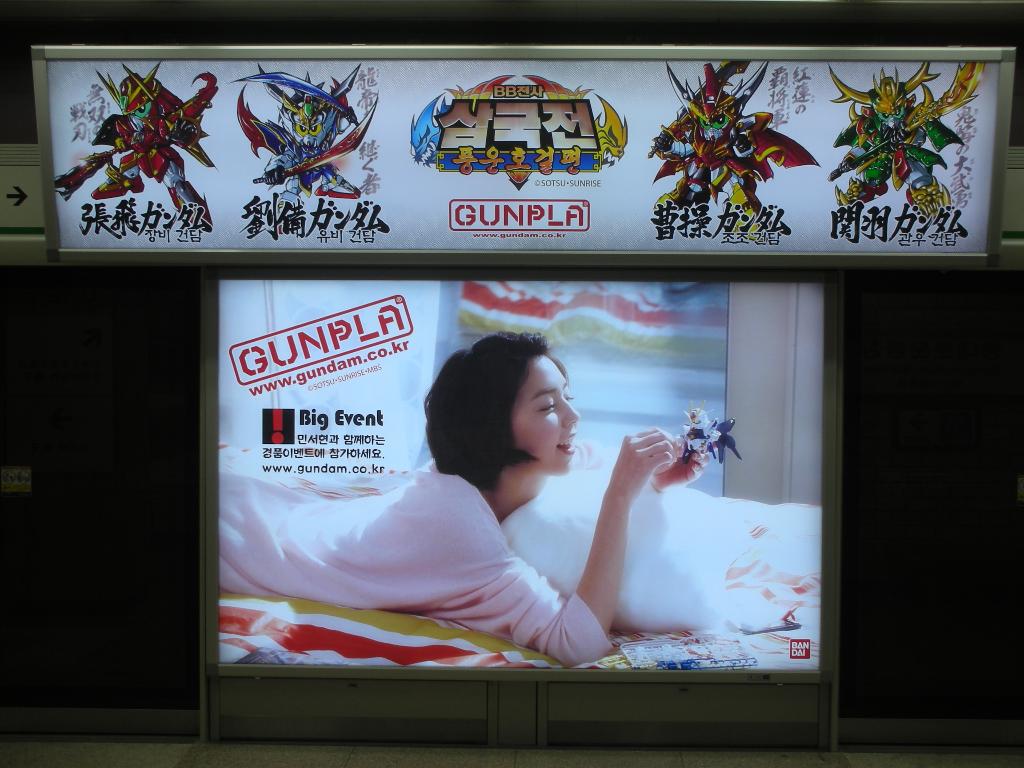
( Source: L-C-R. Reproduced with permission )

Sounds like a rather picky otaku to me, but he does at least finish with some good questions, which I’ll now attempt to answer by passing on what I’ve been able to find of the remainder of the campaign.

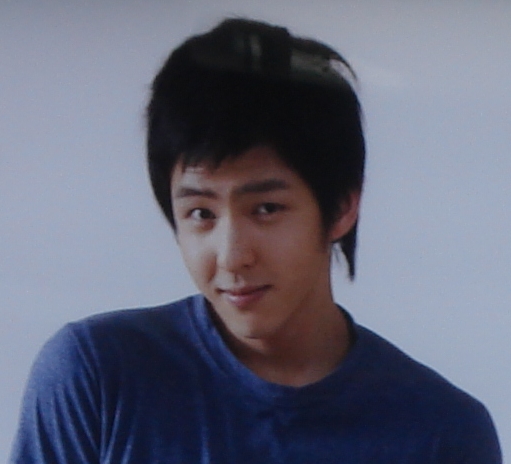
First up, the one above that was alongside the one with Min Seo-hyun. Featuring popular singer (now actor) Kim Kibum (김기범) of the boy band Super Junior (슈퍼주니어), at first glance it’s very similar. And yet:

  • the robot isn’t even facing towards him, let alone thrusting a phallic object towards his buttocks
  • Kibum’s stance is much more natural
  • rather than passively waiting for robot to initiate something, here he seems to be silently asking the observer what fun things he can do with the robot himself
  • accordingly, his expression is more mischievous than childish
( Source: L-C-R )

Crucially however, this dichotomy is not repeated in the rest of the campaign. See the following commercial which features both actors for instance (as an aside, it starts with the lines “Shall we do it? Okay”, a common innuendo in Korean advertising):

And in particular, the long version of the bedroom one, which reveals that the reason she become interested in Gundam in the first place was because boyfriend Kim Kibum bequeathed his collection to her while doing his military service, to which she now enthusiastically adds to with her own robot:

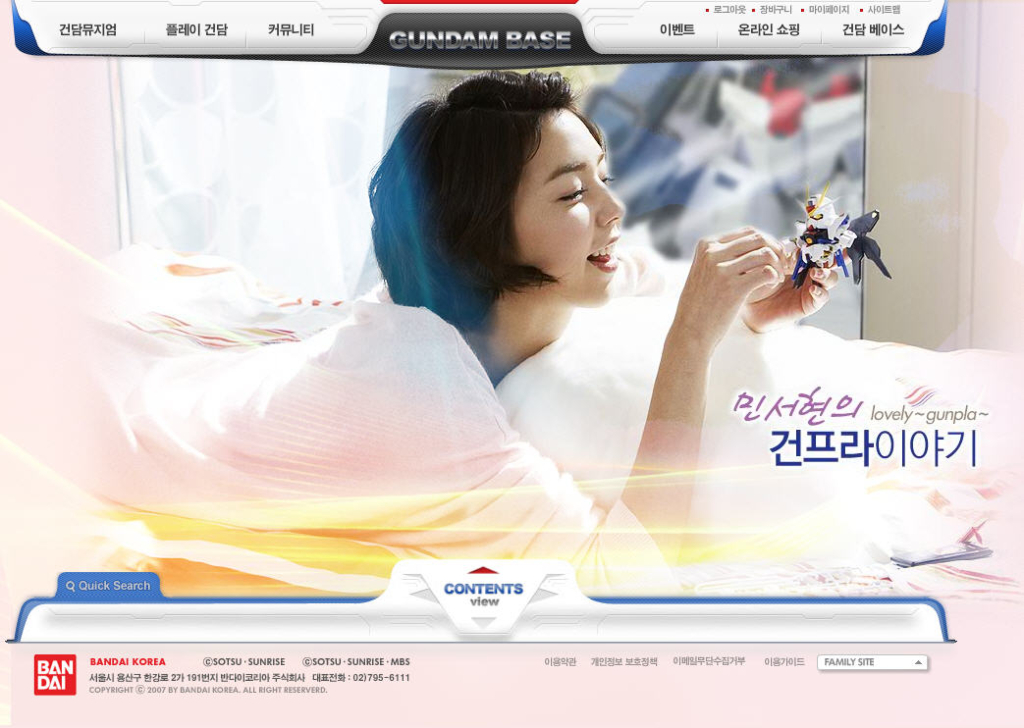
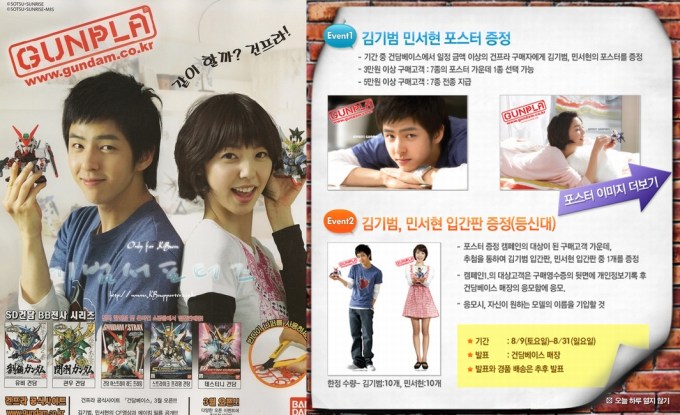
And the theme of both sexes enjoying assembling and enjoying Gundam models is corroborated by the following posters and website images:

( Source )
( Sources: left, right )

Taken as a whole, I’d argue that the only consistent theme of the campaign is that of Min Seo-hyeon becoming more and more involved in the hobby for various reasons, including by: being (sexually) tempted by the models themselves; encouraged to take it up by Kim Kibum giving her his own models; assembling models together at his suggestion; and finally becoming equally passionate and knowledgeable about it as he is. Nay, it’s not so much a theme as the exact narrative Gundam hoped would play out repeatedly in real life, and besides which the cute portrait poster of Kibum above to download from the Gundam website is sufficient evidence in itself that the campaign was aimed at teenage girls and women.

Why then, did the bedroom commercial and the opening advertisement simply suck so badly? Why on Earth did the advertising agency responsible think that having a 22 year-old woman acting like a 12 year-old would make either age group more interested in the product, let alone by suggesting that – not to put too fine a point on it – she also wanted to get fucked by it?

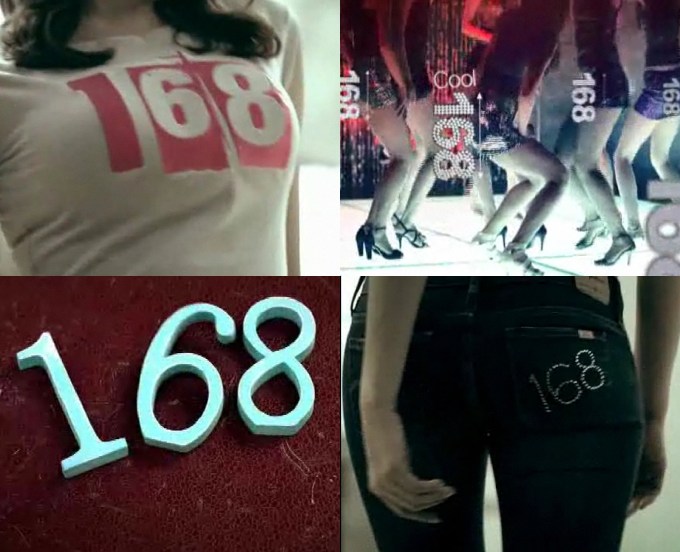
Of course, there could be any number of reasons. For instance, there is the cultural practice of aegyo as mentioned, which I may have underestimated, and perhaps I’m wrong in thinking that the majority of Korean women would be at least unimpressed, if not offended, by depictions of women as children. It could also be yet another demonstration of an advertising agency so used to selling products to men that it comes to regard their perceived desires and tastes as the norm, and so unwittingly applies them to women too:
( Tempted to drink soju with 16.8% alcohol now girls? )

But recall that photographer L-C-R mentioned that she saw advertisements like these everywhere in Korea, as probably you do too, which raises a third possibility: either the Korean advertising industry as a whole is dominated by men (which may in fact be true), or else it has so internalized those male norms that even women in the industry (let alone consumers) regard them as normal and appropriate for selling products to either sex.

A phenomenon by no means confined to Korea or the just the advertising industry, this is the essence of the “male gaze“, and which hopefully having provided some evidence for and/or at least piqued your interest in, I’ll wisely finish by pointing you in the direction of excellent introductions to the topic rather than going on further here. One is the examination of the ways women are portrayed in graphic novels provided by fantasy magazine, and another is the related Bechdel Test for movies:

And here’s a brief application of that to specifically Fantasy movies at Feminist SF also. But I most highly recommend the illuminating, even strangely moving 1972 documentary Ways of Seeing by then art historian John Berger, which I’ve just discovered via Sociological Images here and here. Obviously the second episode on the female nude is most pertinent here, but episode 1 is more likely to captivate you to the extent that you forget to leave your seat for the next half hour:

Here’s episode 2:

And I would include episodes 3 and 4, the latter of which is on advertising, but I haven’t watched them myself yet!^^

(For all posts in the Korean Sociological Images series, see here)

Share

Creative Korean Advertising #24: Will They? Won’t They?

Apologies for the slow posting folks: last week, I developed a “swellbow” from writing at my computer for too long, and it’s made sleeping a little difficult, let alone blogging. And I could mention the heatwave and my daughter’s kindergarten closing for 2 weeks too, but you get the idea!

Hence my original intention here just to pass on the deceptively innocent advertisement above, which had me burst out laughing at its crude sexual symbolism. But in hindsight it is also noteworthy both for having a woman initiating a relationship (possibly the first of its kind?), and for being part of a creative multimedia campaign featuring tantalizing hints of various episodes in various couples’ dating lives, which you’re then encouraged to find out more about by using the electronic tags on the bottles to download the “full stories” directly to your smart phone. Take a look for yourself:

Yes, my curiosity was especially piqued by the one involving kissing too, and it’s difficult to believe now that you only began seeing that in Korean advertisements just last year.  Regardless, fortunately the full stories are also available at the company website and now Youtube, and ironically that particular one ends up being more charming than anything else:

I hope you enjoyed them, and for anyone that missed the humor in the very first advertisement, then take a closer look at o:19 specifically. Lest you feel I’m reading too much into that however, then let me draw your attention to similar examples here, here, here, and here also!^^

(For more posts in the Creative Korean Advertising series, see here)

Share

Korean Sociological Image #47: East End Girls, meet West End Boys

Yes, it had to happen eventually! A big round of applause to Nextour, for quite possibly the very first positive representation of a Korean female – Western male relationship in a Korean commercial.

New readers shaking your heads in disbelief however, please consider reading other posts in the “interracial relationships” category, especially here, here, here, here, here, and here. And please also ponder the following quote from Hyun-Mee Kim in her chapter “Feminization of the 2002 World Cup and Women’s Fandom” in Feminist Cultural Politics in Korea, ed. by Jung-Hwa Oh, 2005, pp. 228-243 below on the then unprecedented public attention by Korean women on the bodies of the Korean players, and which gives a big clue as to why such an essentially innocuous commercial didn’t emerge back then:

…if Korean women’s enthusiasm had mostly been directed at handsome Western soccer players, such as England’s Beckham or Owen, Portugal’s Figu, Italy’s Toti or Spain’s Morientes, the situation would have been drastically different. That they zealously applauded Hiddinck, a Dutch male and the director of the Korean team, seemingly too much of a “father” for them to desire sexual union with, and the familiar handsome guys of Ahn Jeong-hwan, Kim Nam-il, and Song Jong-Guk, must have been the chief reason for positive response the Korean women fans got from the rest of the society.

In particular:

The attitude of the Korean media that looks down on Japanese women for expressing their love for Beckham and treats them as “ppansun-i”s [빤순이, or condescending slang for crazed girl fans – James], clearly shows what line the Korean women should dare not cross. This World Cup, which ended up as a worshiping of the 23 [Korean players], delineates the limitations as Korean women rose up as the subjects of their own sexual desires. This is a society in which there is still a strong belief in the sexual union of the full bloods: for the women to collectively root for Ronaldo or Morientes, there is too much at stake. It is so much easier to shout out that they want the “yellow bodies” of our own race rather than “white and black bodies”. Hence, the happy union of women’s sexual desires and new patriotism in the 2002 World Cup. (p. 239)

Naturally one commercial doesn’t mean a sexual and racial revolution of course (note that only Caucasian men were featured), but it is a start, and certainly provides a welcome contrast to the general persecution of foreign males in the Korea media in recent years, as most recently demonstrated by the fact that Anti English Spectrum’s Lee Eun-ung was uncritically allowed to present his repulsive, unsubstantiated views on foreign males on a national radio show for instance. Indeed, the lack of netizen reaction to the commercial so far hopefully demonstrates that things may have actually improved a little since 2002, and provides a healthy reminder that, just like in other countries, the Korean media is probably not a very accurate guide to public opinion in the first place.

Meanwhile, see here for the male version, albeit a slightly seedy one (caressing a ‘sandwoman’ anyone?), and young readers see here also if you didn’t understand the “East End Girls” reference!^^

Update, November 2011) Alas, it wasn’t actually the first! See here for an example from 2006 (and one more from later in 2010).

(For all posts in the Korean Sociological Images series, see here)
Korean Sociological Image #45: Modernizing Traditional Korean Clothes

(Source)

For all my love of Korean culture, I’ve never really understood the appeal of modern hanbok (한복).

Primarily, because of their impracticality: after performing the ancestor worship rites known as cha-ryae (차례) in mine at my parents-in-laws’ house on various Korean holidays for instance, I find it very difficult to eat the traditional breakfasts that follow with such baggy sleeves getting in the way, especially at the low tables that most Koreans use. It also has no pockets, no zipper, and can get uncomfortably hot very easily, especially during Chuseok (추석) when the weather can still be quite warm. And my wife has similar problems with hers too, adding that women also seem to find their slightly more elaborate version more uncomfortable than men do theirs.

For those reasons, I fully expected the Wikipedia article on hanbok to mention that despite popular perceptions, only the small elite known as the yangban (양반) ever really wore them historically, who were notorious for being resolutely opposed to performing anything that smacked of physical labor. Was Koreans’ pride in their “national dress” a little misplaced then, and just another invented tradition like the kilt in Scotland?

Alas, it doesn’t say, although it does seem reasonable to suppose that practical considerations were undoubtedly more important for the bulk of the population. But what the article does demonstrate though, is that the hanbok has as rich and varied a history as, say, the Western suit (it was naive of me to be surprised at that), and the frequent changes in the various forms and usages of the garment over time indicate that its role as a signifier of class, status, and occupation was much more complicated than I first thought.

Still, I can’t think of a more unflattering garment for women.

No, I’m not so uncouth as to think that women can only be attractive in clothes that are form-fitting and/or show some skin. But then from the neck down, the hanbok is almost like a burqa in that it’s impossible to tell if there’s a man or woman under it, so I certainly can’t imagine anyone ever describing as a woman as sexy in it. Beautiful, yes. Pretty, cute, charming, handsome—sure, you name it. But sexy? Judge for yourselves at Flickr, or from the hanbok sections of recent Miss Korea pageants:

Of course, possibly I’m being too harsh, and by all means feel free to disagree with me: these two bloggers here and here certainly do for instance. (Update: in turn, I disagree with this blogger’s response that being “traditional” means that the clothes shouldn’t be sexy, and that only “a non-Korean male writer” would think they could be both. I’d also point out that they were once considered everyday clothes, with many different purposes. So why should how they now “honor [one’s] tradition and culture” be the only criteria we evaluate them on?). But regardless, hopefully now at least you can understand why I did a double-take when I saw the following new designs last week:

(Source)

Unfortunately, the only information about them are in clumsily-written advertorials from the company that makes them (see here, here, here, and here), but at least they do explain a little about the logic to the new designs. Here’s my rough translation of the first of them, which incidentally also has the best quality version of the image on the left(!):

아찔한 초미니 한복 / Giddy Ultra-miniskirt Hanbok 2010-07-07 12:09

한국의 아름다움을 오롯이 담고 있는 우리의 옷, 한복. 복을 부르고 화를 쫒는다는 뜻을 담고 있는 한복은, 인생의 중요한 순간마다 반드시 갖춰 입어야 하는 우리 생활의 일부이자 소중한 문화유산이다.

The hanbok is the item of clothing that completely and harmoniously shows Korea’s beauty. It has the meaning of bringing good luck and dispelling anger, and at every important event in your life you should wear this vital part of our cultural inheritance.

한복을 아름답게 입기 위해서는 속적삼과 속치마는 물론이고 긴 치마와 저고리까지 제대로 갖춰야 하지만, 시대가 변하고 젊은 층의 안목도 새로워지면서 한복은 어느새 고리타분하고 촌스러운 옷으로 전락하는 듯 했다. 그러나 명품 한복 브랜드들을 위시해 전통한복을 계승하고 퓨전한복과 한복 드레스를 내놓으며 젊은 층은 물론이고 나아가 세계인의 시선까지 사로잡는 상품을 개발함으로서, 한복은 다시금 아름다운 우리의 옷으로 발돋움하고 있다.

In order to beautifully wear the hanbok, of course you need to the undershirt, petticoat, long skirt, and top and to properly wear them, but as times change the hanbok is become old-fashioned and rustic in young people’s eyes.  However, the hanbok is currently taking a big step in becoming all Koreans’ beautiful clothing again by the entrance on the market of a new brand which has developed a fusion style of traditional hanbok and long skirts that will appeal to everyone from the young generation to globalized people.

(Source)

한복 알리기와 보급에 주력해 온 명품 브랜드 <안근배 한복 대여> 역시 초미니 한복 드레스와 퓨전 한복 등, 차별화된 디자인과 소재 개발로 고객들의 다양한 요구를 충족시키고 있다. 최근 2010/2011 신상품 70여개를 출시한 <안근배 한복 대여>는 높은 퀄리티의 전통 한복뿐만 아니라 파격적인 초미니 한복 드레스와 퓨전 한복등을 선보이며 화제를 모으는 한편, 우리 고유의 멋을 계승하며 신세대 고객들의 입맛까지 사로잡았다는 평가를 받고 있다. 특히 <안근배 한복 대여>는 전통 한복의 아름다움은 그대로 살리면서도, 더운 여름철에 쾌적하게 한복을 입고 싶어 하는 고객의 구미에 맞는 상품을 전략적으로 출시해 눈길을 끌었다.

Angunbae Hanbok Rentals (AHR) is a company that has concentrated on supplying and letting people know about this new style of hanbok, and in addition to having one fusion type with and ultra-short miniskirt, is differentiating its designs and materials in order to satisfy the varied demands and requirements of customers. Recently, AHR has launched 70 new designs for the 2010/2011 season, and these have been attracting lots of attention not just for their high quality traditional forms but also their fusion with unconventional ultra-short miniskirts, and have been gaining a lot of praise for their coolness that satisfies customers’ modern tastes. In particular, AHR has been noticed for strategically providing customers with hanbok that, while showing off the garments’ traditional beauty, are also a comfortable choice for their summer tastes.

<안근배 한복 대여>는 초미니 한복뿐만 아니라 전통 한복과 한복 드레스 등 다양한 상품으로 인기몰이중이며, 업계 1위의 브랜드답게 전문화된 콜센터 운영과 홈페이지 운영으로 고객들을 만족시키고 있다. 특히 공식홈페이지 http://www.hanbokrent.kr에서는 7월 한 달 간 진행되는 신랑 신부 커플 한복 20% 할인 행사 안내와 다양한 신상품들을 확인할 수 있다.

AHR doesn’t just provide hanbok with ultra-short mini-skirts, but is also popular for its traditional hanbok and hanbok dresses and so on, and provides a wide variety of products to rent; as the top brand in the business, it operates a call center staffed by experts and a homepage to make sure to fully satisfy customers’ needs. And please note: any couples about to get married, visit www.hanbokrent.kr to get a 20% discount on couple hanbok and/or a variety of new products.

(Sources: left, right)

Is 300,000 won reasonable to rent the first ones? Regardless, see many more examples at the “Fusion” section of AHR’s website, and I’m all for changes to any popular item of clothing that make it more comfortable, cooler to wear in the summer, and a little sexier and more elegant too.

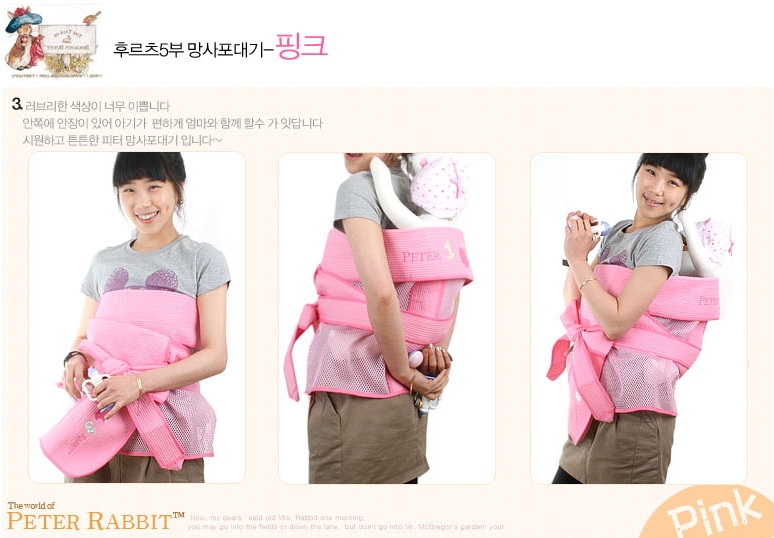
But this post wasn’t intended to be only about hanbok. In fact, the humble podaegi (포대기), or traditional Korean baby sling, may ultimately be much more interesting:

(Source)

Quite simple to put on once you get the knack, it’s very easy to see why Korean mothers would use these while working in fields, or even just the kitchen (scroll down here a little for a picture). Hell, if I had to carry a baby for hours while doing manual labor, then I’d probably choose something that comfortable and tight too, and so I wasn’t surprised to hear from my father’s Nigerian colleagues that my wife’s was just like Nigerian ones, where, naturally enough, they’re called “wrappers,” and the act of wearing one “backing.” (Thanks to reader eccentricyoruba for the terms.)

Still, note that the shoulder straps are a recent adaptation carried over from Western baby harnesses, and there weren’t many versions with them available in 2006 when my first daughter was born; wearing a version like this without them then, my wife’s back got tired quickly, and she speculates that perhaps that would have been less of a problem had she been bending over in a field in it like her mother and grandmother did (she eventually got a Western-style baby harness). Also, as you can imagine they can get extremely hot in the summer, which is why these modern mesh types are now available (and I’m sure ones with shoulder-straps are available too):

(Source)
(Source)

Clearly then, podaegi manufacturers are also quite capable of adapting their products to modern tastes. But still, one big, possibly insurmountable problem with them remains.

Men usually refuse to wear them.

(Source: unknown)

At this point, I should probably mention that I don’t wear anything to carry either of my 2 daughters myself: when Alice was born in June 2006, I was working long hours and my wife became a housewife, so it was only natural that she carry her while I carried groceries and so on; when Elizabeth was born in August 2008, my wife carried her whereas I had Alice to either walk with me, chase after, and/or only briefly carry when crossing roads. Sometimes I wish I had used a Western style baby carrier though: both daughters refuse to sleep or be carried in my left arm, often crying until I put them in my right one, and I’m sure that I now have a slightly crooked spine as a result.

Still, of course I did wear my wife’s poedagi at home sometimes, especially when she was out and I had to put them to sleep in the way that they were used to. But in public? Never, for I think I’m safe in assuming that the vast majority of Koreans consider the podaegi as inappropriate on a men as a bra, and which is why you’ll only ever see pictures of them in podaegi if they’re posed in comical situations like the above.

Western-style harnesses however, you’ll see plenty of Korean men wearing them, which leads me to a question I’d like to throw open to readers: are podaegi then, in a sense an impediment to changing people’s beliefs that childcare is only a women’s job?

Yes, of course popular perceptions of clothes and senses of appropriate fashions are constantly changing, and of course there are also a myriad of reasons completely unrelated to clothing that explain why Korea has the highest number of housewives in the OECD. But recall that throughout our daily lives,  we are in fact constantly bombarded with subtle messages that reinforce the notion that parenting is women’s job, so it doesn’t seem unreasonable to suppose that this may also have an impact.

Alternatively, look at it this way: if you were a woman expecting a baby soon, which style would you buy if you wanted your male partner to take equal responsibility for carrying the baby after it arrived?^^

Update: See FeetManSeoul (or The Marmot’s Hole) for a post about upcoming fashion shows featuring Jung Jun Hong and Lee Young Hee, the latter of whom:

…is considered the greatest living hanbok designer. And her stuff is smoking, every season. It’s one of the classiest shows of the season, consistently. She really does hanboks like they should be done — who knew hanbok style was still evolving, and evolving quite stylishly? The former, designer Jung, has a more modern take on the hanboks and always has some of the most colorful shows out there.

ung Jun Hong and Lee Young Hee, the latter of whom is considered the greatest living hanbok designer. And her stuff is smoking, every season. It’s one of the classiest shows of the season, consistently. She really does hanboks like they should be done — who knew hanbok style was still evolving, and evolving quite stylishly? The former, designer Jung, has a more modern take on the hanboks and always has some of the most colorful shows out there.

Sex as Power in the South Korean Military: A Follow-up

( Source )

As I discussed back in March, the first ever survey on the issue of sexual violence in the Korean military discovered endemic levels of abuse, with roughly 15% of 250,000 conscripts each year experiencing it as either victims or perpetrators. A hugely important socialization experience for Korean men, this had grave implications for Korean society.

On a slight positive note however, I was happy to also read that much of the researchers’ data was obtained by interviews with soldiers in their barracks with the official cooperation of the Ministry of Defense. A sign of changing attitudes towards acknowledging and dealing with the problem?

Alas, I’ve just discovered that that was far too optimistic, as the military still remains one of the least transparent institutions in Korea:

When the Cheonan sank [in March], the initial reaction was shock and sadness, which quickly gave way to rage: with a government accused of dragging its feet, but also with a military that seemed unprepared for a North Korean attack.

But anger with the military runs deeper than over a single event. Mistrust of the institution is widespread because it has failed to open itself up, using the excuse of national security, while the rest of the country has embraced democracy.

South Korea’s military dictatorship may be a thing of the past, but the North’s constant saber rattling in the form of nuclear tests, missile launches, spy incidents and the occasional skirmish continue to give Korea’s men at arms an immediate relevance – and an excuse to conceal things from the public. That right to secrecy is enshrined in the National Security Law, which places restrictions even on regular citizens’ freedom of speech for the sake of preventing enemy subversion, but is even more of a cloak for the armed forces. It’s the legal manifestation of the bubble in which the military operates, isolating it from the massive changes the rest of Korean society has undergone. To date, for example, no civilian has ever been named defense minister.

Every year, a report is quietly released titled, “Military deaths caused by accidents.” In 2008, there were 134 names on that list, including 75 suicides. The suicides are usually explained by a “failure to adjust to military life.”

That explanation is unacceptable for Joo Jong-woo, whose son, Pvt. Joo Jung-wook, committed suicide in 2001 at age 22…

Read the rest at The JoongAng Ilbo, including about “its emphasis on tight ideological control of its conscripts” resulting in its banning of left-wing books like the works of Noam Chomsky, and the expulsion of military legal officers for “arguing that the military’s regulations are unconstitutional”. Meanwhile, the Korean military still refuses to recognize conscientious objectors and so imprisons them (see here also for a podcast on the development of the concept of conscientious objection in the West), the National Human Rights Commission is ineffective, and the maintenance of the conscription system as a whole is one reason why the Korean Military remains  “a 1970-vintage force structure, designed around a 1970-vintage threat, equipped with 1970-vintage weapons.”

( Source: anja_johnson )

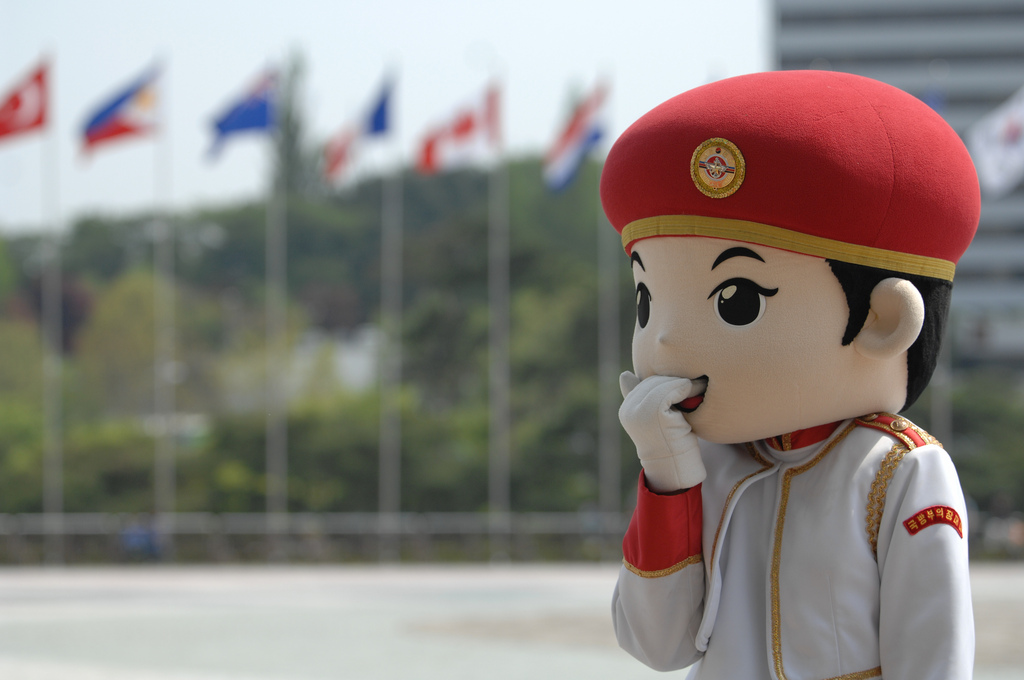
As for the images of mascots, please note that I post them not to be facetious though(!), but rather to show how facile such attempts to soften the image of institutions like the police and military are in light of reports like this. But nothing against the mascots themselves of course, and see here, here, and here for more information about Podori (포도리) in the riot gear!^^

Update, October 2010: Unfortunately, this recent incident demonstrates that little progress has been made since this post was written.

Share

The Gender Politics of Smoking in South Korea: Newsflash

Estimated reading time: 3 minutes. Article source: Metro, Busan edition, 8 July 2010, p. 3.

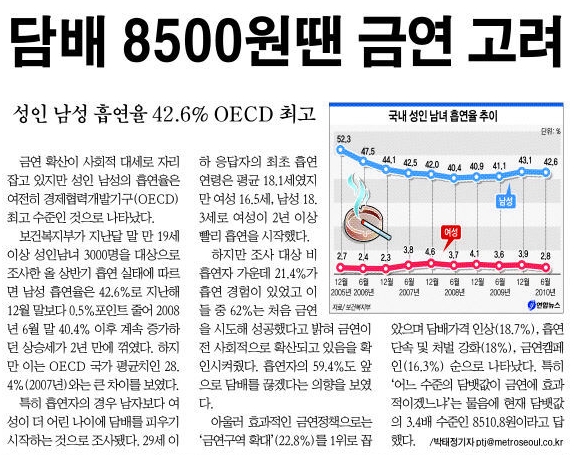
A quick newspaper report on Korean smoking rates that caught my eye.

Of course, I was a little disappointed that it discussed “average” rates for men and women, as these are essentially useless pieces of information given the huge diversity within each gender in Korea, and doubly so for women because of chronic underreporting. But that is to be expected for a free daily, and at least it takes a step in the right direction by mentioning that female teenagers tend to start smoking much earlier than males, which will hopefully result in some much-needed attention being given to this burgeoning group:

People Would Consider Quitting if Cigarettes Cost 8500 won a Packet

At 42.6%, Korea has the highest adult male smoking rate in the OECD

Although the general social trend is for people to stop smoking, Korea retains its position as the country with the highest adult male smoking rate in the Organisation for Economic Co-operation and Development (OECD).

According to a survey of 3000 men and women over the age of 19 conducted by the Ministry of Health and Welfare last month, 42.6% of Korean men smoked in the first half of this year, a decrease of 0.5% from the second half of last year, and a break in continuous increases for the past 2 years from August 2008, when it was 40.4%. However, a large gap between this and the average OECD rate of 28.4% (2007) is apparent.

Of particular interest, the survey also revealed that compared to men, women are starting to smoke at earlier ages. Of those smokers under 29 surveyed, the average age both sexes started was 18.1, but the average age of women was 16.5 and that for men was 18.3, showing women started roughly 2 years earlier.

However, of non-smokers surveyed, 21.4% replied that they did once smoke, but 62% of those were successful in quitting on their first time, showing that it is becoming easier and the social norm to do so. Indeed, 59.4% of smokers replied that they intended to quit.

Accordingly, when asked what the most effective method of quitting would be, the most popular choice [James – among current smokers?] was “increasing the numbers of no-smoking zones” at 22.8%, followed by raising the price of cigarettes (18.7%), increasing penalties for smokers (18%), and launching public campaigns (16.3%). In particular, when asked “How much would the price of cigarettes have to be raised to be effective in making you quit?”, the average answer was 8510.8 won a packet, or 3-4 times higher than current prices.

Next week, after Part 4 is completed, I’ll translate this much longer Korean article that looks at female smoking more specifically.

(Links to other posts in the series as they appear: Part 1, Part 2, Part 3, Part 4; Korea’s Hidden Smokers; Living as a female smoker in Korea)

If you reside in South Korea, you can donate via wire transfer: Turnbull James Edward (Kookmin Bank/국민은행, 563401-01-214324)

Korean Sociological Image #44: Westerners, Nipples, and the Presentation of Sexuality in the Korean Media

( Source: Metro, July 8 2010, p. 7. Cropped slightly)

It’s amazing what pops up in Korean newspapers these days.

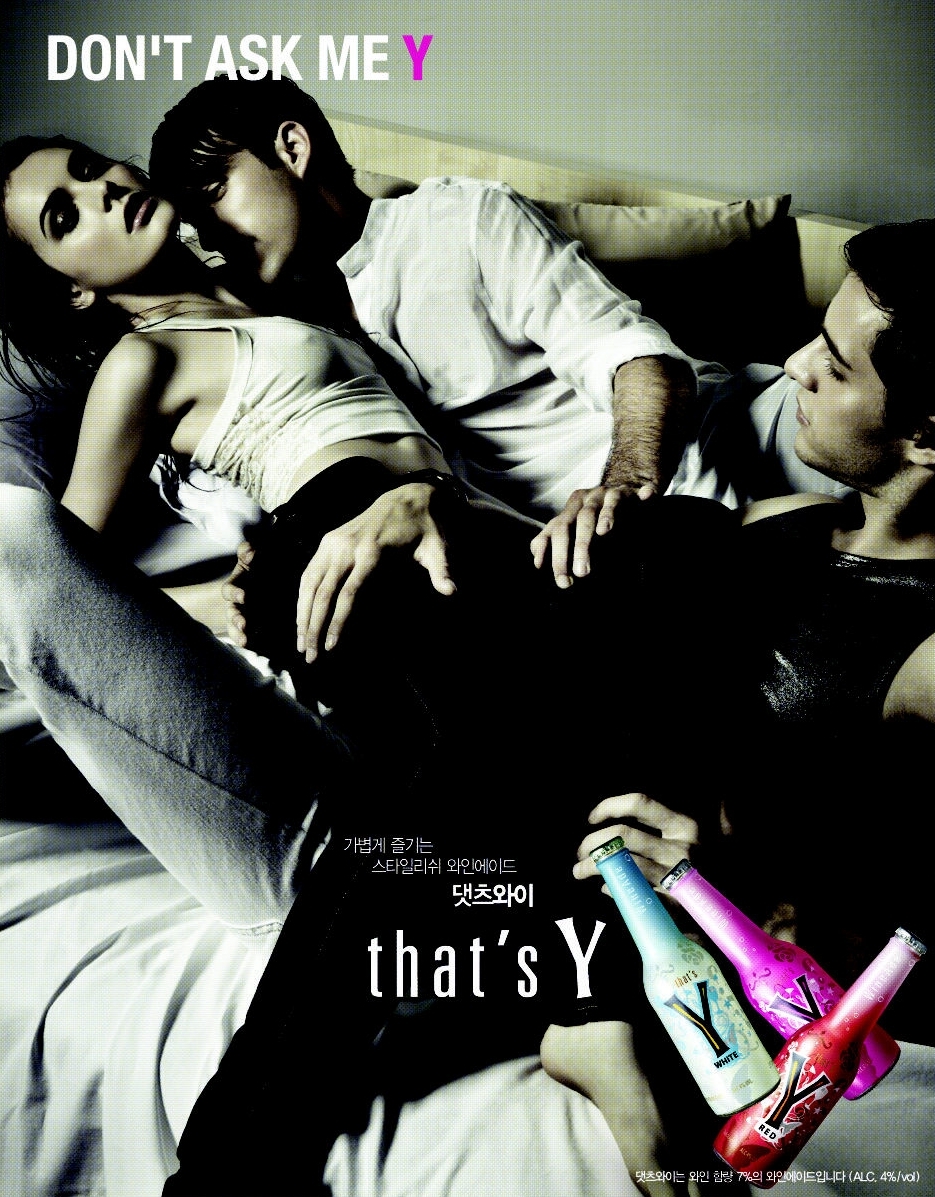
Yes, however difficult it may be for overseas readers to believe, that is the actually the first nipple my Korean wife, friends, and I have ever seen in a Korean advertisement. Moreover, it’s probably no coincidence that it belongs to a Caucasian model too, and one that looks like she’s about to get involved in a ménage à trois at that.

Focusing on the nipple first though (as one does), let me provide some context: with the important exception of ubiquitous single-sex bathhouses, Koreans are generally more conservative than Anglophones when it comes to public nudity; topless males are extremely rare away from beaches, swimming pools, and concert stages for instance, and topless females unheard of, let alone full nudists of either sex (recall also that just 5-10 years ago, women even covered their swimsuits with t-shirts too). In addition, while female celebrities have been showing a lot of cleavage in recent years, this trend has yet to be adopted by ordinary women, whom can expect just as much unwanted attention if they accidentally leave home bra-less.

However, breast-feeding is generally fine if done discreetly, and indeed one of the first things I noticed in my first time in a Korean supermarket 10 years ago was a brand of milk (or soy milk) that prominently featured a large breast and a suckling baby on its packaging. Unfortunately I can’t remember the name to find an image, but I do also recall that it was by no means hidden away in any sense.

I doubt that that would have been considered acceptable in New Zealand from which I’d just left, and in that vein note that the current trend for visible nipples in the Western media at least remains precisely that: a trend, and certainly not an liberal, progressive ideal that Korean social mores will somehow inexorably shift towards in the future. For all its eroticism, it pales compared to the standards of the 1970s for instance (see this NSFW example from a 1976 Cosmopolitan), while in Korea no less an authority than Tom Coyner points out (also NSFW) that 60 years ago Korean mothers in the countryside dressed with readily visible breasts “with pride if they had just given birth to a son.”

( Source )

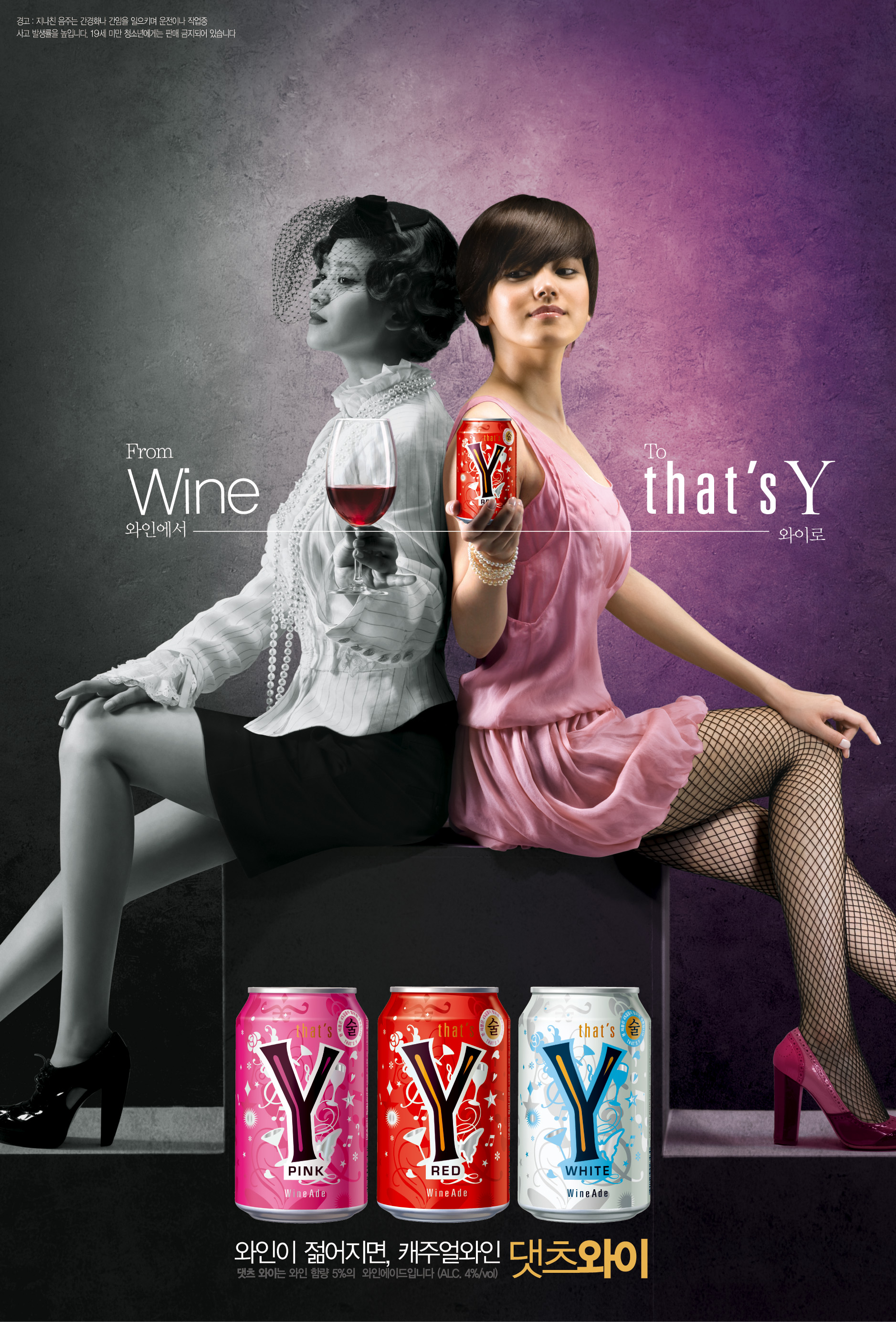
So why the nipple now? Unfortunately, little about the advertisement or the drink provides a clue: “That’s Y” (댓츠와이) is merely a wine cooler (or alcopop?) produced by Lotte Chilsung (롯데칠성음료) since 2008, like wine coolers everywhere primarily marketed to 20-somethings. Judging by its moribund website though, then it hasn’t been selling very successfully (probably why there was a shift to selling it in more stylish bottles rather than cans last month), so one can speculate that Lotte Chilsung was desperate to draw people’s attention to it. Judging by the complete absence of reaction from netizens and the media so far however, strangely that “sex sells” strategy doesn’t appear to have worked.

Ultimately more significant then, is the race of the models in the advertisement in which it appears. Why are they Caucasian? And are Koreans ever portrayed in such brazenly sexual situations as that?

Again, Lotte Chilsung provides no clue: in fact only one more print advertisement for the drink is available online in addition to what you see here. That did also only feature Caucasian women, but then the above one has Korean women in it, and the only television commercial below also only has Koreans too (of both sexes). But looking at the wider context however, then of course there is overwhelming evidence that Caucasians are indeed portrayed more sexually than Koreans in the media here, and particularly women.

Why? Well, assuming that you’ve read that last link, then for one consider how well an artificial dichotomy between virginal, sexually passive Korean women and hypersexual, promiscuous Caucasian ones buttresses extensive human-trafficking in East European and Russian women here. And as for the guys, the notion that foreign male English teachers are oversexed, and thus more likely to be pedophiles than their Korean counterparts, certainly does serve to deflect attention away from the latter. Although one wonders why the Korean media bothers sometimes; after all, just this week apparently even politicians feel perfectly justified in presenting a completely imaginarywave” of sexual crimes by them to justify ever more stringent visa regulations.

Vodpod videos no longer available.

And I could go on, but I’d be much more interested in hearing readers’ own ideas. In the case of this particular advertisement though, I acknowledge that it may not in fact be the first nipple out there(!), but regardless let me pose the question of if you think Korean models instead would have aroused more or less controversy to get you started.

Against the argument that there are plenty of risqué ads with Koreans these days though, and so I’m making a mountain out of a molehill, then for sure, and you don’t have to look very far on this blog to find numerous discussions of how much things have changed just in the last 2 years. But look again: a threesome? And virtually in flagrante delicto on the sofa at that? By all means *ahem* pass on any Korean examples you’ve come across, but in the meantime I’d argue that while the goalposts for what is considered a “shocking advertisement” in Korea do indeed change over time, somehow Caucasians still seem to be in the majority of them!

Update – With thanks to Dave for passing it on, who apparently had much sharper eyes than I did back then, in fact there was a commercial with erect nipples as early as 2006. And yes, you guessed it: that had Caucasians too!

(For all posts in the Korean Sociological Images series, see here)

Share

Korean Sociological Image #43: ESL Students on Top?

( Source: Gusts of Popular Feeling. Reproduced with permission )

A recent advertisement for the Pagoda chain of language institutes noticed by Matt of Gusts of Popular Feeling, who notes that the attraction “is clearly for women to get close to, to have one on one communication with, and to have almost direct contact with the male foreign teacher.”

In any other context this would be unremarkable, but unfortunately the Korean media is notorious for presenting foreign male – Korean female relationships either negatively or not at all (although this is slowly improving). So this advertisement really stands out for the rare, quite literal closeness of the models in it, albeit not necessarily in a romantic sense.

In contrast, Japanese language institutes have already been advertising this way for a long time, as noted by Keiron Bailey in his 2006 journal article Marketing the eikaiwa wonderland: ideology, akogare, and gender alterity in English conversation school advertising in Japan. Two examples from that, both from 2002:

I’ve already discussed Bailey’s article in depth in an earlier post however, so let me just quickly highlight three points from it here:

Younger women are pursuing English-language learning for three major reasons. The first reason is to enhance their career prospects….The second purpose is to engage in travel, either for vacation purposes or for ryugaku. The third motivation is to actualize what Kelsky calls ”eroticized discourses of new selfhood” by realizing romantic and/or sexual desires with Western males. (pp.105-6)

Next:

…the visual pairing of Japanese women with white males invokes a set of social and professional properties that are radically differentiated from a hegemonic array of gender-stratifying ideologies. This metonymy relies on the properties of the white male signifier being defined in relation to a historical gendered Occidentalist imaginary as an ”agent of women’s professional, romantic and sexual liberation”. (p. 106)

And finally:

This [advertising] trend valorizes and celebrates female erotic subjectivity and positions the white male as an object of consumption for sophisticated, cosmopolitan female consumers. (p. 106)

And see that post or the article itself for more. Note that the latter was actually written in 2003 though, so I would appreciate it if any Japan-based readers could confirm if that is still in fact a trend there, and especially if you could pass on some examples. Also, I should stress that this is but one Korean example, and indeed possibly the first of its kind too, so it’s a little premature to argue that Korean language school advertisements are now going to be following the same logic that Bailey identifies. In particular, it definitely shouldn’t be taken as confirmation that Korean women are especially attracted to Western males either, a fallacy which unfortunately many expats (both male and female) seem to subscribe to.

Personally, I’d be much more interested in finding any advertisements featuring foreign female teachers instead, as the corollary of demonizing their male, mostly Caucasian, counterparts in the media in general seems to be hypersexualizing Caucasian women.  Alas, I haven’t taught in an adults language institute since 2004, so please help me: is this trend mirrored by Korean language school advertisers? Why or why not?

Meanwhile, Matt did also see an advertisement aimed at Korean male students, to whom the message appears to be “to take the intensive program and, moving beyond healthy competition, to be better than the (male) native speaker, to beat him, to be stronger than him”:

( Source: Gusts of Popular Feeling. Reproduced with permission )

Which is certainly quite a contrast! See the comments thread on Matt’s post for more commentary on both.

Update 1 – By coincidence, a commercial with a hint of an interracial relationship I saw as soon as I finished this post. Perfectly innocuous in itself, unfortunately the Korean media is almost completely devoid of anything with a reversal of the sexes:

Vodpod videos no longer available.

Update 2 – Brian in Jeollanam-do remembered this Wall Street Institute advertisement from March last year:

See Brian’s blog for more commentary, and Page F30 for the original images, including the clumsily added correction to the atrocious English a few weeks later.

(For all posts in the Korean Sociological Images series, see here)

Share

Korean Sociological Image #42: Sunset for the Red She-Devils?

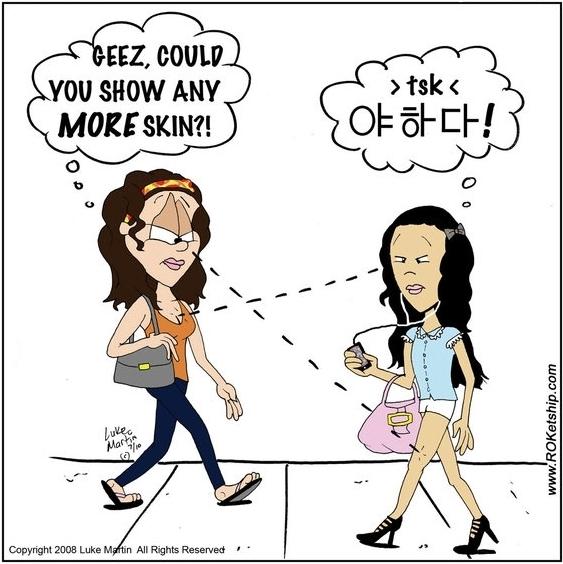
( Source: ROKetship. Reproduced with permission. )

Like Joe McPherson of ZenKimchi fame says of the above cartoon, either way, it’s a win for my gender, so I was surprised that this was the first time I’d ever really noticed this curious Korean social more.

For those of you still at a loss however, yahada (야하다) generally means “too revealing” if it’s about clothes, and “too sexual” if it’s about anything else, like a conversation topic; alternatively, nomu pa-ee-da (너무 파이다) could have been used instead, which literally means “dug too much”. So, it’s a commentary on the difference in what is considered revealing clothing by Koreans and Western expats, and something which of course expat women have long been well aware of, congratulating ROKetship artist Luke Martin for his astuteness in droves on his Facebook page. One of them, Kelly in Korea, wrote on her blog:

So true. Showing your shoulders or chest will definitely get you stares from the older crowd and young men, while lotsa leg is okay. That being said, I feel like I see more Korean girls showing shoulder this summer than last—is that just me? Regardless, now that the full heat of summer is upon us, I have stopped worrying so much about societal dress codes and just wear whatever keeps me from passing out in the midday sun.

And for all my lapses, I think that there’s definitely something to that change. How long-lasting it is however, literally remains to be seen.

Why? Because as I’ve written here, here, here, and here (for starters), squads of daring female soccer fans known as oppa budae (오빠 부대) did have a dramatic and permanent effect on what were considered acceptable standards of dress for Korean women during the 2002 World Cup. But then it’s also true that many people that had tolerated their croptops, say, were much less willing to do so the next summer once they were no longer in the service of a national cause, which again just goes to show that revealing clothing (or suggestive dancing) should never be taken as a proxy for female sexual liberation.

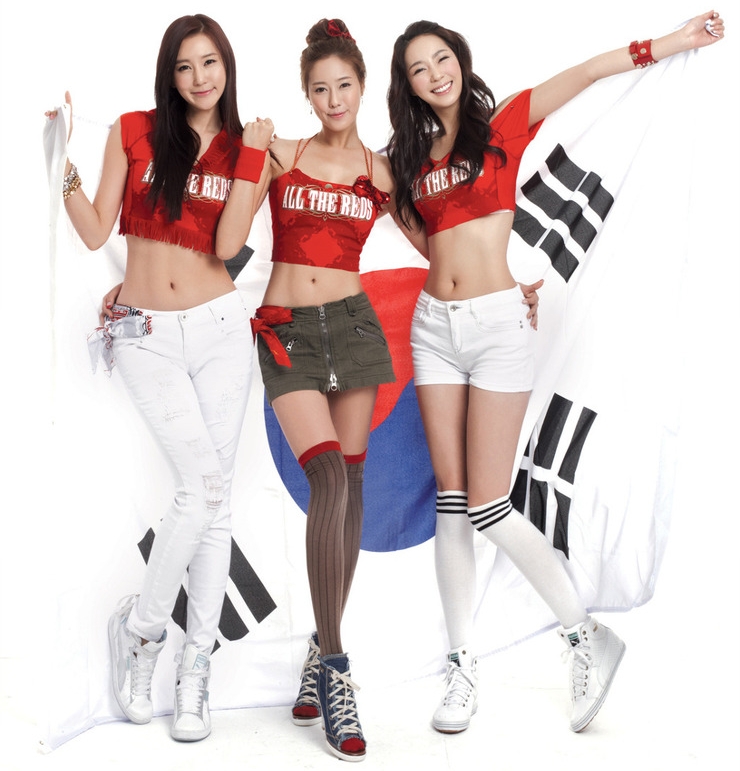
In that vein, I’ve often wanted to do an empirical study of advertisements in various men’s and women’s Korean magazines for the summers before, during, and after the 2002, 2006, and 2010 World Cups, hypothesizing that there would be definite peaks in World Cup years. But note that those would not just be because of young women hoping to emulate Shin Mina and “Elf Girl’s” examples, who become famous overnight for, well, little more than having good bodies and wearing skimpy “Red Devil” (붉은악마) costumes like those above (source): that isn’t why oppa budae women were wearing them in 2002, and surely only accounted for very few in 2006 and 2010 too.*

Moreover, for anyone lucky enough to have been in Korea during any of the summers of 2002, 2006, and now 2010, you don’t need me to tell you that Koreans tend to let their inhibitions go during the World Cup, and that at the very least the normal standards for clothing didn’t apply; indeed, it would be very strange if – à la Rosie the Riveter – Korean women returned to their formally conservative ways afterwards. Accordingly, I’d also expect that study to show an increase in revealing advertisements for the period overall (although of course many factors would be responsible), and so while I don’t expect to see many croptops on Korean streets in the summer of 2011 unfortunately, I wouldn’t be surprised if they were the fashion in, say, 2015, or 2016. After all, recall that women didn’t even use to wear bikinis at the beach just 8 years ago!

What do you think? Either way, I’m perfectly serious about that study, in which I would using Erving Goffman’s 1979 Gender Advertisements framework (see here, here, and here), and would publish the results in a journal article; unfortunately I can’t do it alone though, so any Korea Studies geeks, please contact me if you’re interested (but be warned it would be rather more tedious than it sounds!). Meanwhile, see here, here, here, here, here, and here for more insights from ROKetship about Korean attitudes to fashion and body-image, (the last may be a little confusing though: see Scribblings of the Metropolitican for an explanation), and of course there’s many more about other aspects of Korean life that all expats will identify with!

* That’s unlikely to be repeated in light of entertainment companies using it to market their female stars in 2010, prompting a backlash)

(For all posts in the Korean Sociological Images series, see here)


The Gender Politics of Smoking in South Korea: Part 3

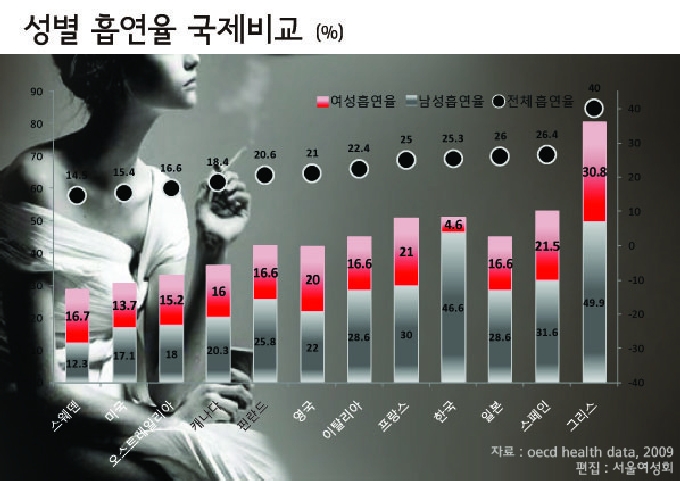
( Korea is 4th from right; source )

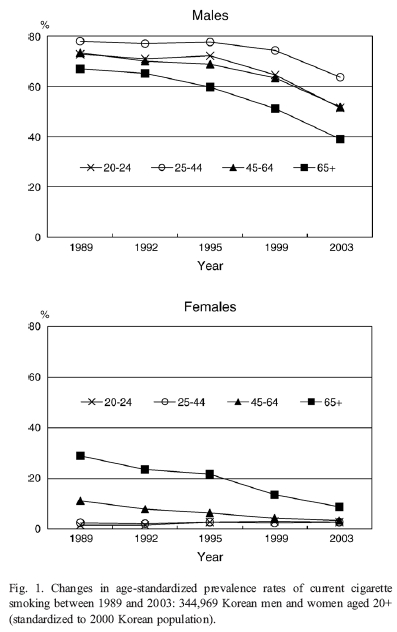
Apparently, Korea is pretty unique in its huge difference in smoking rates between the sexes: up to 10 times more Korean men smoke than women. Or do they?

In short, probably not: considering that a 2007 Gallup Korea study found that 83.4% of Koreans thought that women should not smoke, then the accuracy of almost all figures are undermined by chronic underreporting by women. Moreover, it is misguided to speak of male or female smoking rates in the first place when those within each gender differ so widely by age, socioeconomic position, and/or marital status. Even unhelpful too, as low perceived rates for women overall have encouraged Korean medical authorities to almost exclusively focus on reducing smoking rates among men instead, overlooking rapidly rising rates among young women especially.

But for all their flaws, it is only natural to want to have some numbers to work with. And so, when I wrote Part 1, my original intention here was to pass on all those provided by 3 recent journal articles on the subject, hopefully providing readers with enough information to get at least a rough idea of the true numbers in the process. Numerous failed drafts later however, I now realize that that approach was a mistake, and should have paid much more attention to the following points by Lee et .al. (2009):

…the limited data available on female smoking prevalence and behaviour in South Korea must be urgently addressed. Data from the Korean National Health and Nutrition Survey (Table 2) suggests female smoking rates have fluctuated significantly between 1980 and 2003, with variations within age groups by year that are difficult to explain. There are also inconsistencies across different data sources which prevent clear understanding of smoking behaviour within specific cohorts by age, location, socio-economic group and other variables.

Instead then, let me do my best to point out broad themes within the various data sources instead, starting with those revealed by the following graph provided by Young-Ho Khang and Hong-Jun Cho, “Socioeconomic inequality in cigarette smoking: Trends by gender, age, and socioeconomic position in South Korea, 1989-2003“, Preventive Medicine Volume 42, Issue 6, June 2006, Pages 415-422:

Based on a huge sample population from 5 Social Statistical Surveys from the Korea National Statistical Office, it does at least provide a good illustration of overall smoking trends for both sexes over the period covered. A quick summary:

Results show that for men, smoking rates decreased in all age groups…For women aged 45+, smoking rates decreased…while those for younger age groups either remained stable (25-44) or increased (20-24). In addition, the decreasing pattern of smoking among women aged 45+ was not the same as that of men. For women aged 45+… reductions began earlier than for men. (p. 418, paraphrased)

And they believe that the decreases were primarily due to legislation; in particular, the 1995 Health Promotion Act, which restricted smoking in public buildings and places. Unfortunately however, it was not very effective on young women, nor on the inverse relationship between educational level and rates of smoking, which was generally true in all age groups and both genders. They speculate that that was partially because:

…most policy efforts have been aimed at the dissemination of information about the hazardous health impacts of smoking while policy efforts on work site smoking cessation programs or economic measures (i.e., taxation) to discourage smoking were minimal. (p. 421)

( Source )

Khang and Cho do provide further details of how women’s smoking rates differ by their socioeconomic position, but to be frank I found that jargon-filled part of the article rather poorly written, and don’t understand it despite several rereadings. Whether that’s my fault or theirs, I’ll have to skip covering that topic here regardless, and instead will focus on the following point that you may already have noticed yourself:

Unlike many developed Western countries, this study showed greater smoking rates in older women compared to younger women. This is consistent with studies conducted in Asian countries such as China, Vietnam, and India….Age differences in power relations by gender and social pressure toward young women may explain the difference in female smoking prevalence between Western countries and less developed Asian countries. However, further studies are needed to elucidate the causes of the difference. (p. 420, my emphasis)

And probably not by coincidence, in Hong-Jun Cho, Young-Ho Khang, Hee-Jin Jun, and Ichiro Kawachi, “Marital status and smoking in Korea: The influence of gender and age“, Social Science & Medicine, Volume 66, Issue 3, February 2008, Pages 609-619, they provided exactly that, from which an intriguing finding was:

…that the difference in the effect of marital status on smoking rate varied according to gender….smoking rates for unmarried women compared with married women were generally much greater than comparable [rates] for men across all age groups, and were particularly high in younger women. This finding differs from many previous Western studies that reported either no gender difference in the influence of marriage on smoking, or greater difference between married versus unmarried rates in married men compared to married women. (pp. 613-14, my emphasis)

Some details:

The smoking rate for unmarried women was approximately 2-8 times higher than for married women depending upon the age group. In contrast, the smoking rate for unmarried men was not higher than the married men for the 25-34 and 65-74 year-old age groups…

…In the 35-54 year-old age range, the smoking rate in divorced women was more than twice that of the widowed women. This difference was smaller for men…

…the present study found that the smoking rate was higher in unmarried compared to married people. This finding is consistent with those of many Western studies of both men and women…(p. 613)

( Businesswoman by the_toe_stubber )

And crucially:

Women’s smoking can be underreported in societies where there is a strong social norm against young women adopting such behavior. Such a reporting bias may have affected the findings of this study. Nonetheless, it is not clear whether reporting bias would have produced the differential patterns of smoking rate according to marital status

…a definite casual relationship between marital status and smoking could not be established [in this study]. Selection is also possible. The divorce rate for smokers is twice that for non-smokers, and men who continue smoking have a lower probability of getting married. But, because the effect of marital status on smoking is stronger in men than women, this cannot explain the gender-related difference in the present study. (p. 616 & 617, my emphases)

And they identify many reasons why unmarried Korean women may smoke more than married ones, and particularly divorced or widowed ones. Some are positive:

…smoking by women, and especially married women, can be restricted by social pressure applied from both inside and outside the family. In such cases, becoming divorced or widowed may release women from the force of sanctions and expectations. (p. 611).

And see here and here for more on those social pressures married women face. Unfortunately however, newly-single women are much more likely to smoke from stress rather than a feeling of liberation:

Higher smoking rates in the unmarried may be a reflection of coping in response to stress brought on my marital disruption. Marital disruption can create two types of stress – that which is directly associated with the disruption, and that which is indirectly associated, such as role change, financial difficulties, and child caring responsibilities. Women suffer greater financial hardship following marital disruption compared to men, especially in societies where the gender age gap is high [James – and Korea’s is among the highest the world; see #10 here]….[in 2002], the income of a woman-headed single-parent family was 83% of a man-headed single-parent family.

Above: “A Woman Smoking” (여자가 담배피는게) by Im Su-bin (임수빈), which according to allkpop “tells of a sad story of how a woman resorts to smoking and drinking after being heartbroken and why there’s nothing wrong with that”.

On a final note however, it is also true that widowed or divorced women also tend to older than average, and in Korea particularly the effects of that are difficult to separate from their marital status because:

…older women may find it easier to smoke due to less social pressure on this age group stemming from the general respect shown for the elderly in Confucian traditions. (p. 611)

With a nod to copyright, if any readers interested in reading the articles for themselves, please email me if you like me to send copies (and thanks again to the reader who sent them to me in the first place!). Meanwhile, as those turned out to be much more closely linked than I first realized (indeed, they even use the same data), then I’ve decided to discuss the third article – Kelley Lee, Carrie Carpenter, Chaitanya Challa, Sungkyu Lee, Gregory N Connolly, and Howard K Koh, “The strategic targeting of females by transnational tobacco companies in South Korea following trade liberalisation”, Globalization and Health 2009, Volume 5, Issue 2) – in a separate post (Part 4) rather than carry on here. The final Part 5 though, will still be a “discussion on the ways in which tobacco companies have (largely successfully) targeted Korean girls and women over the last two decades” from that however!^^

Update 1 – For anyone interested, a recent survey found that Seoul residents endure 50 minutes of passive smoking a day.

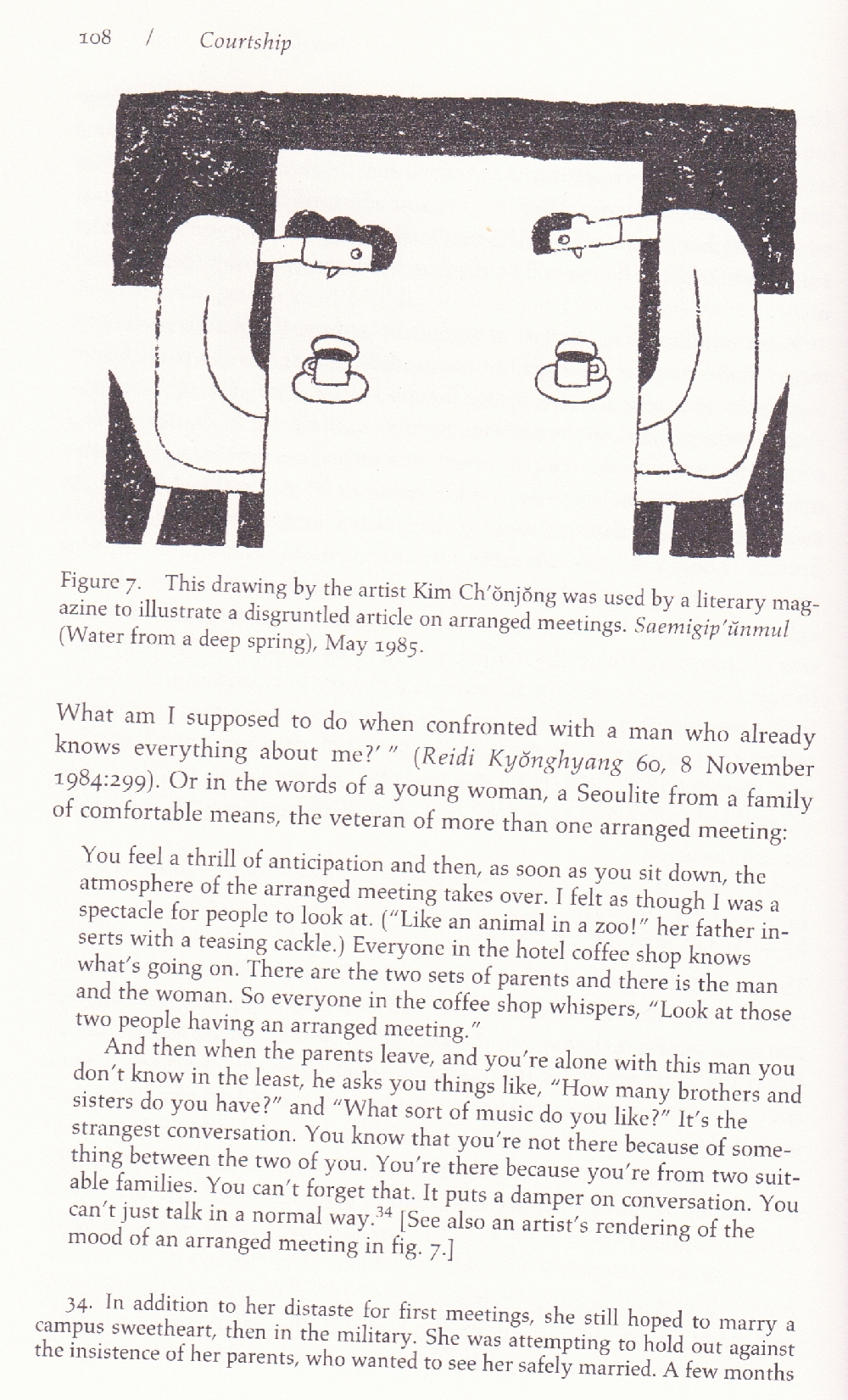
Update 2 – A picture that I was reminded of by I’m no picasso’s comment on the connections between coffee-shop culture and female smoking. From Getting Married in Korea: Of Gender, Morality, and Modernity by Laurel Kendall (1996):

(Other posts in the series as they appear: Part 1, Part 2, Newsflash, Part 4, Korea’s Hidden Smokers; Living as a female smoker in Korea)

The Hips Don’t Lie…

( But is she smart too? Source )

As long-term readers will be well aware, I’m a big fan of evolutionary psychology. And why not? It usually provides both simple and extremely compelling explanations for many universal cultural features and human behaviors, such as that of the evil stepmother or the fact that 95% of killers are males respectively for instance. So when research in 2004 found that women with hourglass body shapes are 30% more likely to become pregnant than others, it was no great surprise that men worldwide have always tended to find this body type the most attractive.

But even congenitally blind men too?

Yes, it’s true, and while critics have frequently pointed out the sexist and/or (ironically) culturally-based assumptions to many of evolutionary psychologists’ conclusions, this latest news definitely buttresses the “nature” rather than the “nurture” side of the debate:

…Notwithstanding the significant scientific evidence in support for the ubiquitous male preference for the hourglass figure [a waist-to-hip ratio of 0.68 to 0.72], social constructivists doggedly hang on to the position that our preferences are due to arbitrary socialization (e.g., advertising teaches men to prefer a particular body type). Well, in today’s post, I discuss a new study that yet again kills the apparently immortal socialization dragon!

In a recent paper published in Evolution and Human Behavior, Johan C. Karremans, Willem, E. Frankenhuis, and Sander Arons explored men’s WHR preferences with one twist: the men in question were congenitally blind! Needless to say, this largely removes the possibility that these men were taught via media images to prefer a particular female body type. You might wonder how one would go about eliciting such preferences from blind men…via touch of course! The researchers had two mannequins dressed in exactly the same way but who varied in terms of their WHR (0.70 or 0.84)…

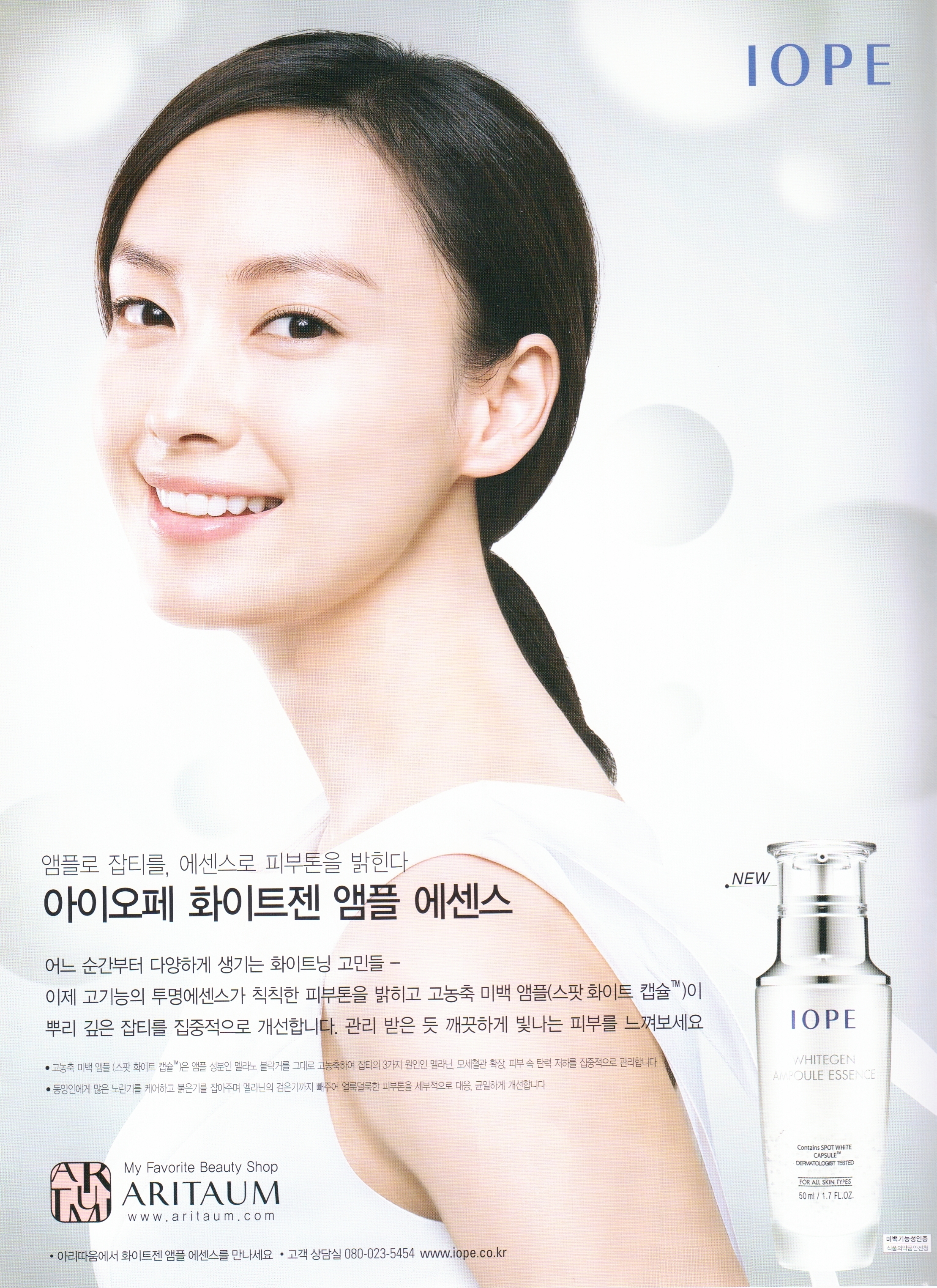
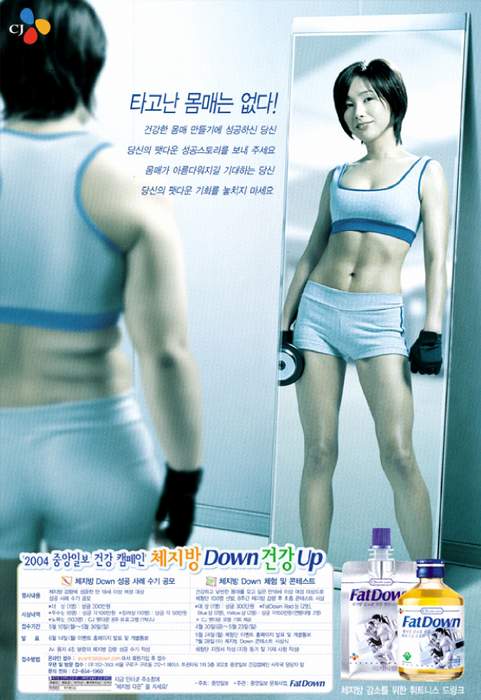
Read the details at Homo Consumericus, and the typically acerbic comments section there is also interesting. Meanwhile, on the same day I read that I happened to pick up the June 2010 edition (no.21) of cosmetic store Aritaum’s (아리따움; “Charm”) free advertorial magazine (as one does), and the contrast with the wholly photoshopped, physically impossible “X-line” body type being promoted in it couldn’t have been any greater:

( “Find your X-line”? Good luck! )

I’ve already discussed the X-line concept in an earlier post, almost literally tearing to shreds a Korea Times report – nay, also an advertorial – that uncritically reported on the “new body trend” in the process. But you may also be curious to read the advertising copy for the X-line slimming drink above however: what does persuade Korean women to buy such things?

아리따움 슬리머

울여름, 꿈에 그리는 비키니를 위한 당신의 다이어트 플랜은? 운동하기엔 많은 시간과 노력이 필요하고, 어디서 왔는지 모를 다이어트 방법은 믿을 수 가 없다. 그렇다면 올해도 무조건 굶는 것이 최고? 굶어서 빼는 다이어트는 단기간의 체중 감소는 느끼겠지만 얼굴 혈색을 나쁘게 하고 피부 탄력을 떨어뜨리며, 얼마 지나지 않아 요요 현상을 불러온다.

슬리머 DX는 간편하고 즐겹게 이용할 수 있는 슬리밍 제품으로 식약청으로부터 체지방 감소 기능을 인정 받아 믿고 섭취할 수 있다. 또한 휴대가 편한 앰플 형태라 언제, 어디서든 자신의 라이프스타일에 따라 쉽고 간편하게 다이어트가 가능하다. 아리따움 슬리머 DX라면 올 균형 있는 X라인으로 비키니를 입는 데 주저함은 없을 듯!

Edited slightly, to make it sound better in English:

Aritaum Slimmer

This summer, what is your diet plan for getting into your dream bikini? Exercising takes a lot of time and effort, and you can’t believe in diets if you don’t who came up with them. This year, is simply being hungry the best solution? If you diet this way, it is true that you will soon feel that you’ve lost some weight, but at the same time your complexion will become bad and your skin will lose its elasticity and bounce, almost inevitably resulting in a yo-yo effect as you crave foods again.

Slimmer DX is a simple, convenient, and enjoyable to use slimming product that you can take with the confidence that the Korean FDA has recognized and approved it as a slimming product. Also, it is portable and in a bottle that has more than enough for any occasion, ensuring you can easily use it to diet whenever and wherever you choose according to your lifestyle. This summer, you shouldn’t have any hesitation to use Aritaum Slimmer DX to wear a bikini that shows off your balanced X-line!

Sound familiar?

Diet advertisements in Korean magazinesappear to promote more passive dieting methods (e.g., diet pills,aroma therapy, diet crème, or diet drinks) than activedieting methods (e.g., exercise). Results further indicatedthat women may be misled to believe that dieting is simple,easy, quick, and effective without pain, if they consume theadvertised product. This study suggests that there is an urgentneed to establish government regulations or policies about dietproducts and their claims in Korea. Magazine publishers alsoneed to recognize their role in societal well-being and acceptsome responsibility for advertisements in their magazines.

Finally, a question for readers: I picked up the Aritaum magazine partially because I couldn’t tell if Lee Na-young’s (이나영) neck above in a bus-shelter advertisement near my apartment had been lengthened or not? She’s a tall woman; I honestly can’t tell. Meanwhile, the woman in the first picture is Shin Se-kyeong (신세경) for those that you that are curious (whom I’m well aware will also have been extensively photoshopped; in the original image, her legs appear to have been lengthened), but, alas, the identity of the ant-like figure with the X-line escapes me I’m afraid!^^

Korean Sociological Image #41: Mothers of Warriors

(Source)

A quick question: who would you choose to sell hormone-treatment and anti-depression medication to middle-aged women?

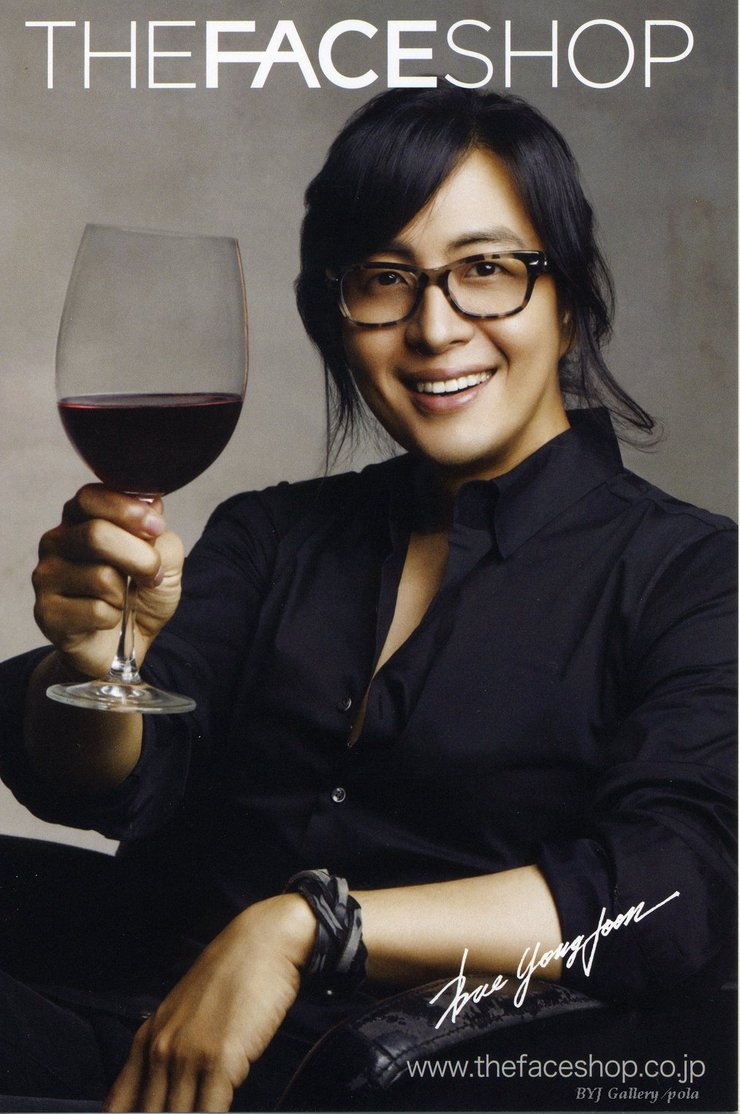
Barring Bae Young-joon (배용준) above, notoriously popular among them, then I’d wager that middle-aged women themselves were your most likely answer. And your least likely? Probably men in their early-20s, which begs the question of why they’re the only ones actually speaking in the following commercial from Dongkook Pharmaceutical (see below for a translation):

Of course, the reason the young men are featured at all is because Korea has universal male conscription, which makes parting scenes like those featured above a normal part of the Korean life-cycle. So while the leaving ceremony itself may be unfamiliar to most Western observers, a company encouraging consumers to associate its product with it is really no different from a bank using imagery of, say, children’s university graduation ceremonies to sell retirement savings plans.

Still, that’s not to say that it’s just any old commercial. For in relying on an emotional event for Korean mothers and sons to sell its products, but quite literally denying only the mothers a voice in that, Dongkook Pharmaceutical has ironically provided an apt illustration of Korean women’s expected role in any public debates about military conscription. Which is in short, to be seen and not heard, their opinions taken for granted by others.

For instance, in 1997 the Korean media revealed that the sons of Lee Hoi-chang (이회창), the then presidential candidate of the then ruling Shinhangukdang (New Korean Party; 신한국당), had been exempted from their military service due to medical grounds; popularly believed to have used his wealth and influence to secure this, the backlash against Lee for failing to fulfill his paternal and nationalist responsibilities was so intense that his political career was soon over. And yet according to Insook Kown in A Feminist Exploration of Military Conscription: The Gendering of the Connections Between Nationalism, Militarism and Citizenship in South Korea (2001), even in the midst of all that:

…women were voiceless. Those who accused Lee, answered the accusations, reported the matter, and contributed articles were all men. In public, the conscription scandal seemed a matter for men only. Sometimes, mothers were used by men as a reference symbolizing a certain group of women only concerned about the welfare of their sons. Many male editorial writers represented the angry emotions of mothers to show South Korean popular opinion. One editorial writer in the JoongAng Daily (22/08/97) described the anger of many mothers of sons. According to him, these mothers wrote a slogan on the calender for Election Day: “Let’s never forget the exemptions of Lee’s sons”.  (p. 43)

(Source: anja_johnson)

And later another editorial writer in the same paper (27/08/97) illustrated the emotional background of the issue by using a motherly perspective:

People did not deal with the exemption by making accusations of immorality or illegal intervention in the exemption, but with emotional anger like, why did your sons not have to go into the army, while my son is suffering in a life-or-death crisis. What made women angrier than anyone else, was caused by this kind emotion. (p. 43)

Kwon argues that the Korean state has always very much had a stake in accepting feminized forms of self-sacrifice in its name, whether as factory workers, prostitutes to the US military or Japanese tourists (a crucial source of foreign exchange in the 1960s and 1970s), or mothers of conscripts. Focusing on the latter here, consequently they have so far lacked:

…room to represent their own sacrifices in public. Mother’s concern and pain over their son’s conscription has remained hidden under the taken-for-granted necessity of military conscription for national security. Their voices have been deprived of a space for expression; and because their emotional attachment to their sons has been translated into a private matter, they have not mobilized as a group. (p. 37; tenses have been changed)

Not that this lack of representation means that mothers are necessarily opposed to conscription. For example, Cynthia Enloe, who has written extensively on the subject of “patriotic motherhood” narratives constructed by militarized states, argues that in fact they can have attractions for women whose mothering role has been evaluated as personal and private. Indeed, it can be a chance for them to completely revalue their maternal duty:

Some women feel deeply validated when some politician goes on the call for mothering to be defined as a vital contribution to the nation’s war effort, because warfare has been imagined by many to be the quintessentially public and national activity. (Maneuvers: The International Politics of Militarizing Women’s Lives, 2000, p. 11, quoted in Kwon p. 46)

Moreover, what are these “sacrifices” referred to exactly? Kwon’s analysis is a little weak on this point, as although she provides a comprehensive and convincing demonstration of how in fact all women suffer from the conscription system (a subject taken up in this series), there is little evidence that mothers specifically suffer beyond that aforementioned “concern and pain over their son’s conscription”. As the commercial demonstrates however, that may be rather more than a Western observer might expect.

At which point it is prudent to provide the translation of it(!). Below, the text featured on the screen is written as normal text below, while everything spoken by the conscripts or in the voiceover I’ve put in quotation marks. I’ve also provided the commercial again to make it easier to follow along:

엄마…..그동안 받기만 해왔습니다

Mother…..(I’ve) only ever received things (from you)

엄마…이제 처음으로 엄마품을 떠나네요

Mother….this is the first time I’ve left my mother’s (your?) bosom”

엄마…고맙습니다

Mother…thank you

듬직한 대한민국 군인이 돼서 엄마가 믿고 의지할 수 있는 아들이 되겠습니다

I will become a reliable, trustworthy Korean soldier whom you can trust and depend on

이제는 우리가 엄마를 도와드릴 차례입니다

Now it’s our (my?) turn to help our mothers

어머니 잘 다녀오겠습니다. 사랑합니다. 사랑해

Mother, I will do well before I return. I love you (formal). I love you (informal)

엄마, 사랑합니다. 충성!

Mother, I love you (formal). Loyalty! (Fealty?) (Devotion?) [James: whatever the exact meaning, it is said when saluting]

대한민국 갱년기 어머니들의 10명 중 8명은 다양한 갱년기 증상으로 힘들어하고 있습니다

Out of every 10 mothers of the Korean public who experience menopause, 8 suffer from various symptoms

(Above, left and right): 여성 갱년기 극복 갬폐인 & 동국제약

Female Menopause Conquest Campaign & Dongkook Pharmaceutical

엄마에게, 사랑의 마음을 전하세요. 훼라민큐가 함께 합니다

Tell your mother the love you feel in your heart. With HeraminQ.

이제, 엄마의 갱년기를 도와주세요. 훼라민Q.

Now, please help with mothers’ menopause. HeraminQ.

(In very fine print): 의사, 약사와 상의하십시오. 부작용이 있을 수 있습니다

Please consult with a doctor or pharmacist. Side effects are possible.

Update: Seamus Walsh has provided a slightly more accurate translation (with explanations) in the comments.

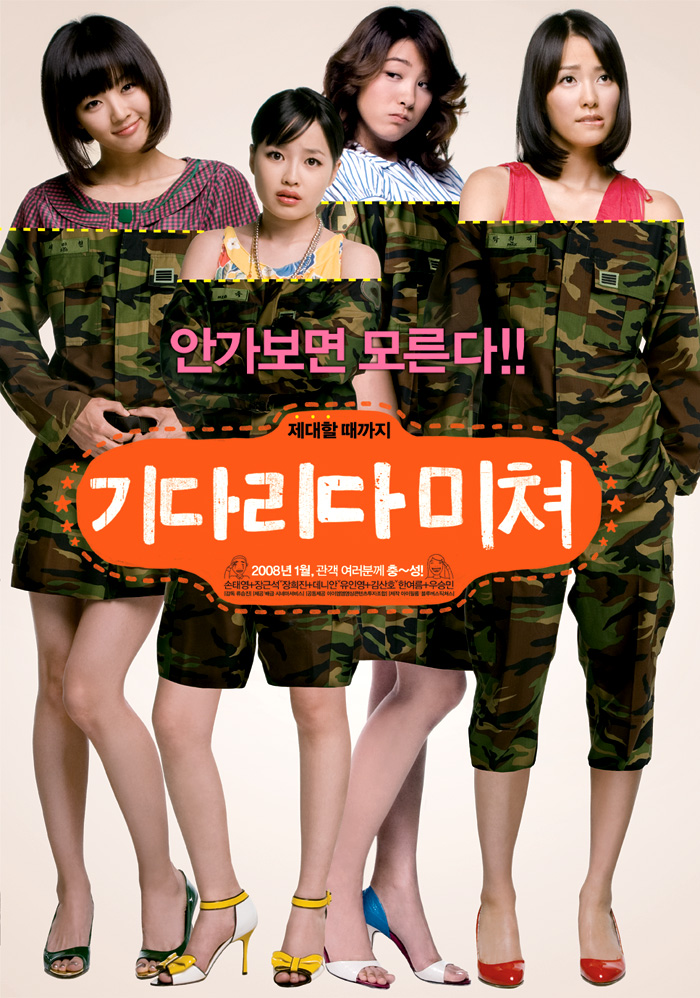
(For another post: the impact on sisters and girlfriends of conscription? Movie poster for The Longest 24 Hours, (기다리다미쳐, 2007), a lighthearted look at military service from the perspective of conscripts’ girlfriends; also known as Crazy4wait. Source)

While this may sound a little hypocritical at first, let me begin my discussion on the subject of the mothers’ feelings by highlighting those of the men; actually, that is the original reason I wanted to write this post, for let me stress that you were seeing men in their early-20s crying at the thought of leaving their mothers. What did that make you think of them?

Well, at risk of sounding insensitive, personally I found them to be pathetic. Not that I was all that mature at the same age of course, and in many senses my reaction may simply be because of cultural differences. Like Brian in Jeollanam-do once put it:

…everything in Korea tries to be cute, in the same way everything in the States is “Xtreme” and too cool for school. Korea uses a cartoon to advertise where the US would have a gravelly stoner voiceover, and Korean videos often feature cuteness exaggerated to a sickening degree where American videos would lots of brooding and feigned indifference.

And not unrelated is how different average Koreans’ and average Westerners’ life-cycles are at that age, although 30-somethings like myself should be wary of projecting their own experiences onto today’s 20-somethings. Nor do I want to make light of the hardships conscripts have to endure either.

(Source: anja_johnson)

But then I’m not:  in that commercial at least, thinking about those hardships is not why they’re crying. Moreover, to describe the crying as a simple cultural difference underplays the extent to which this practice is unique even within Korean culture itself, as beyond obvious cases such as funerals, my (Korean) wife for one could think of no other situations in which it is so socially acceptable for a man of that age to cry publicly. That they can and do then, is partially because a) the vast majority of Koreans don’t actually think of any male as a “man” until he has fulfilled his military service, and b) this uniquely strong bond between mothers and conscript-sons. Indeed, there is:

…a widely held popular belief that a father should encourage his son to go into the army, and to fulfill his national defense duty to achieve real citizenship. In this gendered construction, mothers represent emotional attachment such as compassion and pity toward their conscripted sons. In other words…the emotional part of the work of conscription….

…At the most emotional step of the conscription process, the father disappears. For instance, in two recent guidebooks published for pre-conscripts, the authors, both male, make almost no mention of fathers. The only ‘object’ for whom male soldiers are expected to feel concern about in the family is the mother. (p. 44)

And as you might expect, this is well-represented in popular culture, and in addition to commercials like the above I have frequently seen conscripts brought on to the stage after a girl-group has performed on an army base to wax lyrical about their performance and their attractiveness…only then to break down in tears and leave a very emotional message to their mothers watching back home (indeed, often they’re literally choking on their words so much that Om-ma “mother” is the only word you’re able to discern).

Unfortunately for readers however, this is yet another case of something interesting to outside observers that is unremarkable to Koreans themselves, and so I’ve spent over an hour unsuccessfully looking for examples to post here (videos of girl-group performances typically finish just before the soldiers are brought on stage). If any readers find any I would appreciate it if you could pass them on, but in the meantime let me finish by passing on what Kwon says about the program Ujeongdui Mudae (우정의 무대), or Stage for Friendship, the only program about conscripted soldiers in the 1990s, and which had:

…one famous section, ‘Yearning for Mother’. An unidentified  mother talked about her son from back stage. Following her talk, a lot of soldiers ran on the stage shouting “Mother” and insisted she was their mother. Finally, the mother appeared on stage and hugged her son. Finally, the mother appeared on stage and hugged her son. Accompanied with deeply moving music, both mother and son cried, as did other soldiers and everybody watching the TV show. (p. 44).

For your interest though, I did find this 2008 commercial with Moon Geun-young (문근영) for GS Caltex (칼텍스), which features a mother visiting her son during his military service (and impressed with how much of a man he has become):

And for the record, Dongkook Pharmaceutical did produce more “normal” commercials for HeraminQ with middle-age women, here, here, and here, as well as another one in the “life-cycle” series featuring mothers’ high-school children taking their life-determining university-entrance exams:

Thoughts?

(For all posts in the Korean Sociological Images series, see here; for more on the effect of conscription on Korean society, see here and here)

Music Monday: On Black music, KARA, & Why K-pop bands are so large…

Three things of interest I came across all in the space of this morning…

First up, a recent edition of the BBC4 podcast Thinking Allowed, which – paraphrasing slightly – discusses the contention of cultural critic Paul Gilroy that:

From Curtis Mayfield to 50 Cent, from Nina Simone to JayZ, black music has declined in its quality and lost its moral stance. Outlined in his essay “Troubadours, Warriors, and Diplomats” in his book Darker Than Blue: On the Moral Economies of Black Atlantic Culture (2010) , he joins host Laurie Taylor and music journalist Caspar Melville to discuss the counter-cultural stance that black popular music once had, and explore whether it really has been destroyed.

On the surface only tangentially-related to Korea, in that modern K-pop has strong hip-hop roots (in contrast to J-pop, which are more in rock), this 28 minute, very accessible synopsis it is still surely required listening for all those interested in music and cultural studies. And indeed, the second half of the discussion in which they talk more about the impact of technological developments on music, and especially the reality that precious few young people are prepared to pay for it anymore, is perhaps more pertinent to the Korean music industry than most.

Next, an Icelandic reader passed on a link (thanks!) to the journal article “Crazy About You: Reflections on the Meanings of Contemporary Teen Pop Music” in the Electronic Journal of Sociology (2002), by Phillip Vannini and Scott M. Myers, in which the highlighted part below immediately leaped out at me. With apologies for the long quote for the sake of context (actually, only 2/3rds of the paragraph!):

…Centralized corporate production insures continued consumption through pervasive distribution, vast output volume, and structured product obsolescence (Gitlin, 1981) while strategies of careful manufacturing of the image and sound of pop icons ascertain that audiences are treated as ‘targets’ and ‘market-segments’. Take for example the case of Britney Spears. Her image and sound had been first controlled by Disney as a pre-teen Britney worked as a host of the Mickey Mouse Club. Subsequently her schoolgirl image was spiced up to appeal to the 12-16 age group and her videos were made to occupy a steady spot in the rotation of Zoog ABC and the Disney Network. Now, with her continued biological growth her image has been recreated as sensual and provocative and formatted to meet the demands of MTV. As this takes place new ‘Britney’s’ mushroom on the market to appeal to different targets: Jessica Simpson to Christian teenagers, Mandy Moore to preteens, Jennifer Lopez to Latinas and older fans. Producers’ control extends from songwriting to image-packaging and personality development (Frith, 1978). Any boy-band act is put together to appeal to various personalities and life outlooks of fans as each band includes a member portrayed as cute and sweet, one funny, one good-looking and mysterious, one creative and goofy, one talented and motivated, one dark and tough, and such. Bands are created with the consumers’ demand in mind4, for example LFO target through MTV an older adolescent urban audience with their hip-hopish sound and sexual innuendos, while S Club 7 and Aaron Carter target preteens through Fox Family and ABC Family. This is an example of the diversification of products that allow producers the broadest appeal possible and the highest profit margin.

In passing, footnote 4 from that is also interesting:

4. The structure of consumer demand is an important concept to keep in mind. As Frith (1978) suggested producers’ ability to shape needs is limited. Why or when a style becomes popular or unpopular remains a conundrum for the music industry. It is much easier for any producer to stay with one genre or act after it has become popular and produce endless imitations than experiment with new formats or shape consumer demand. Record industries still find very few acts highly profitable, while the majority of albums produced and distributed hardly bring any profit at all (Burnett, 1996).

But the highlighted part caught my eye because of what I’d read in the post Thoughts on K-Pop Vol. 1: So Addictive at the blog Multi, which is definitely required reading for those interested in Korean music specifically:

Another important thing to note is that the Korean music industry is populated mainly by groups of at least five members. With a main audience of between 10 and 19, this is a brilliant idea because all the kids will have at least one person they like in every band, are enthralled by their personalities as seen on numerous TV shows, and will not hesitate to buy their albums and merchandise. This works for other industries as well, as phone, food and clothing companies almost solely hire celebrities to star in their commercials. They also record songs and shoot music videos (and short films) for these products and then endorse them on their numerous TV appearances. Basically, the celebrities become the only people you see on screen and in print. They become ridiculously popular really quickly, and then are sent around Asia to maximize their worth because all the other countries have succumbed to the “hallyu wave”.

Naively, I hadn’t been aware that the same logic also existed outside of East Asia. But having said that, it is still much more marked in K-pop. For not only it is exaggerated by the overwhelmingly celebrity-focused nature of advertising here, but that in turn is further exaggerated by the need to sell singers rather than their music per se,  for reasons mentioned earlier. And there’s less space for independent artists that don’t subscribe to that logic to emerge too.

Finally, all the photos of KARA (카라) in this post are from their performance at (unfortunately spelt) Wonkwang University (원광대학교)* last month, in which it started to rain halfway through their song but – seemingly without so much as batting an eye – they kept performing nonetheless (see video below).  Found via Omona They Didn’t!, admittedly I probably wouldn’t have given the photos a second glance if they had been of a boy-band instead, but once I had then I really responded to them, well-aware of how refreshing and especially liberating it can feel to continue exercising – or indeed, dancing – in a downpour.

More to the point though, not only are the photos themselves stunning, which this blog theme doesn’t really do justice to (click on the images themselves for more detail, or see Diabolique here and here for more), but in particular KARA happened to be performing Lupin (루팡), in which as Multi – who else? – puts it:

…From what I gleaned from Youtube translations of the songs, they sing about being confident (in love?) and not being afraid…as opposed to simply trying to get a guy’s attention in “Mister” (미스터); check here and here for respective lyrics, and it shows in their performances. They shine in “Lupin”, but bore with “Mister”. It might just be that “Lupin” is fresher, and they’re bored of performing Mister (side effect of weekly live performances, a.k.a overkill, of songs in k-pop) but I doubt it’s just that…

She tends to prefer performances to the music itself, and presumably to the music videos too, but for what it’s worth here they are to compare:

And finally a fan cam of the performance, although unfortunately it’s of very poor quality. The rain starts falling about at about 1:20:

Thoughts?

p.s. I’d been under the impression for many years that the term “Black Music” wasn’t particularly PC, and consequently have sometimes discouraged my Korean students from using it, but the Thinking Allowed podcast made me realize I may have been mistaken. Was I, or is there perhaps a difference between American and British English?

* (Say “Won-Kwang”, not “Wonk Wang”!)

Share

Hot Sweaty Korean Women

What makes this commercial so special?

No, it’s not because of Park Ga-hee’s great body, which isn’t unheard of in K-pop. It’s not because she’s leader of the girl-group After School, which I’ve been writing a lot about recently. And it’s not because she’s no manufactured K-pop idol either, once literally penniless on the streets of Seoul after running away from home.

Those do make her more attractive and interesting, but they don’t speak to the commercial.

Rather, it’s special because she’s sweating.

Yes, sweating. Because as I first highlighted over 2 years ago, Korean women generally prefer passive means of losing weight to active ones like exercise. (Update, 2013: post since deleted sorry.) Indeed, even the ones that do attend gyms rarely seem to exert any actual effort while they’re there, and I’ve seen less than a handful dripping with sweat while on a treadmill.

A gross over-generalization? Actually, I very much hope so, and, admittedly not having gone to a Korean gym myself since 2004, then I’d nothing better to learn that things have changed since. But my 2008 post did seem to strike a chord with readers’ own experiences back then, and in turn the underlying attitudes to exercise that they demonstrated were corroborated by one of the few English language studies of the subject: “Content Analysis of Diet Advertisements: A Cross-National Comparison of Korean and U.S. Women’s Magazines” (Clothing and Textiles Research Journal, October 2006), by Minjeong Kim and Sharron Lennon. With apologies to long-term readers for my frequent references to it, but it’s worth (re)highlighting some parts here to remind ourselves just how unique the Fat Down (팻다운) commercial really is:

In his study with Korean female college students, Kim (1998) found that a predominant portion of respondents engaged in dieting for appearance rather than health, and a majority of respondents had previously engaged in dieting. The most common method of dieting was to restrict caloric intake, whereas a similar study with American female college students found that exercise was the most common dieting method among American women (Grunwald, 1985). (p. 350)

(Source: 영원같은 찰나)

Granted, those are old studies. But ponder the fact that one question I posed to my university students for their final vocal tests this week was “What are your plans for the summer?”, and fully 20 out of 55 of the women said they would be dieting to wear a bikini on the beach.* Which not only surely reflects an obsession in itself, but notably none said merely “losing weight” either, and definitely not “exercising” or “working out” (by way of comparison, 1 out of 65 guys said he would be working out). Hence the tests took rather longer than expected, as I felt compelled to step out of my remit as an English teacher and point out that none of them needed to lose weight whatsoever, that Korean women were already the slimmest in the OECD, and that could they at least consider maybe exercising rather than dieting?

(*As readers explained in the comments, I took the word “diet” much too literally. My mistake.)

And there are were plenty more anecdotes like that available in that post from 2008. But I like to be above passing on mere anecdotes these days, so consider some of the empirical evidence provided by Kim and Lennon instead:

The percentage of diet ads in relation to total ads was far greater in Korean women’s magazines than in U.S. magazines. (p.357)

Also (source. right):

A current article in one Korean newspaper (“Half of High School Females Are Not Qualified,” 2002) reported that more than half of Korean high school women suffer from an anemic constitution caused by malnutrition because of dieting. Also half the prospective blood donors from several high schools were not qualified because of deficiencies in nutrition. (p. 357)

Finally:

Content analysis of the types of diet products/programs indicated that there are a variety of diet products easily available in Korean magazines….Diet pills, body attachments such as a diet belt, and oriental diet herbs were three of the more frequently advertised diet products in the Korean magazines sampled. However, none of them was reported as being clinically approved….Korean magazines promote more passive diet methods than active diet methods. Ads for passive diet methods such as diet pills, massage, aroma therapy, diet crème, or diet drinks that one must take, put on the body, or smell to lose weight were more prevalent than diet ads requiring one’s active participation such as exercise equipment or aerobic videotapes. Passive dieting ads reinforce the idea that buying a product will solve weight problems with no effort on the part of the user. (p. 358)

See here, here, and here for examples and further discussion of such advertisements, and you may also find these electric breast massagers and apple-hip seats interesting. Meanwhile, shame again on the Brown Eyed Girls…but please don’t take this post as an endorsement of Fat Down myself: I know nothing about it, and certainly do not know its ingredients or effectiveness. As you can see above though, I do at least recall that Jung Da-yeon also endorsed it, a woman in her early-40s who became famous a few years ago for being a momjjang ajumma (몸짱아주마), literally a “good body married woman”.

(Update) Related, I like the no-bullshit attitude of this advertisement for a cosmetic surgery in yesterday’s Busan edition of Focus newspaper (p. 6), which reads: “How much will you have to drink before you’ll get a V-line?”, a reference to this drink’s supposed ability to give you that face shape.

(Source: Focus)

The Gender Politics of Smoking in South Korea: Part 2

A teaser for the next posts in the series (click to enlarge):

With apologies for the poor quality of the scans, those are from an activity in the ESL activity book Decisionmaker: 14 Business Situations for Analysis and Discussion (1997) by David Evans, which I happened to be doing with my advanced students when a reader sent me the journal articles that inspired this series. It seemed a pity not to mention the interesting coincidence!

Yet another coincidence is that before I moved from Jinju (진주) to Busan in late-2003, I also happened to have a 23-year old female Korean friend who was similarly attracted by the possibility of working for British American Tobacco, which was then setting up a manufacturing plant in Sacheon (사천) just a few kilometers away (it’s still there). We didn’t quite have a conversation like Kim Jin-hiu did with her family, although I did try to discourage her from applying; as I would today too, although I’d have a much better appreciation of her motivations. In the end though, she ignored me and managed to get an interview, but surprisingly wasn’t offered a job.

Meanwhile, as David Evans explains, the marketing plan in the “secret memo” does sound outrageous, but in fact:

…some cigarette companies have undoubtedly targeted children in their marketing strategies. A leaked memo from a Canadian tobacco company listed teenagers as a target group,  and cigarette adverts are regularly shown on children’s TV in Japan (James: is this still true?). In 1991, a study showed that American children as young as six could identify Joe Camel (a cartoon character advertising Camel cigarettes) as easily as Mickey Mouse!

And in Part 4, which I’ll link to below once it’s up next week, I’ll outline how internal industry documents reveal that cigarette companies in Korea (including British American Tobacco) have indeed been using many of the same strategies mentioned above, albeit technically not explicitly to girls (or boys for that matter). Watch this space.

(Links to other posts in the series as they appear: Part 1, Part 3, Newsflash, Part 4, Korea’s Hidden Smokers; Living as a female smoker in Korea)

The Gender Politics of Smoking in South Korea: Part 1

( Park Soo-ae {박수에} in A Family {가족; 2004}; source )

As numerous expats can attest to, coming to live in Korea can be quite a jarring experience sometimes. But probably not as much as you’d expect, for Korea too is a modern, developed country, with institutions and services that match – nay, are often better – than equivalents in your home country. Comparatively speaking, the transition is really rather smooth.

Scratch below the surface however, and decidedly archaic twists to many aspects of daily life do soon emerge, many of which are profoundly gendered too. For example, after a few months here I began teaching a group of highly intelligent women already fluent in English, who attended my class merely as a hobby. All housewives, later I learned that they likely did so because while Korea has been providing an equal education to both sexes for decades now, and indeed as many as 82% of high-school graduates go on to university, just a few years after graduating women are routinely fired and/or are pressured to resign upon getting married or becoming pregnant. Which makes one wonder what the point of women’s higher education was exactly, and accordingly a study conducted just a few years earlier (Women’s education, work, and marriage in Korea: women’s lives under institutional conflicts by Mijeong Lee, 1998, pp. 161-163) found that, à la Jane Austen, it was largely to secure higher-earning husbands.

It is true though, that modernization the world over has invariably entailed such “housewifization” and nuclearization of the family, so in that sense at least Korea is arguably simply repeating the experience of societies that developed earlier.  One way in which Korea does stand out then, is the case of smoking, and you’re probably well aware that it once had the highest male smoking rate in the world, whereas that for women has historically been extremely low. But unless you are already living in the country, then you may not have realized that this is not necessarily by choice, but rather because women can still get slapped for simply smoking in the street, even in 2010. And as testament to the strength of this taboo, it has influenced the smoking habits of at least one female blogger here too for instance, even though most Koreans excuse expats from the vast majority of Korean social norms (source, right).

This brief four-part series is about that gender politics of smoking in Korea, starting in this post with how such an artificial gender binary emerged in the first place; a later one will provide detailed statistics on the number of smokers in Korea, followed by a discussion on the ways in which tobacco companies have (largely successfully) targeted Korean girls and women over the last two decades. As you’ll soon see, it is really a little naive to speak of a “Korean smoking rate” or even “Korean male” or “Korean female” smoking rate when the results differ so widely by age, gender, class, and/or marital status, and the widely perceived notion that Korean women don’t and/or shouldn’t smoke is obscuring the fact that in reality more and more are over time (very roughly 1 in 5), and that success in reducing the number of male smokers comes in the midst of a looming health crisis among female ones.

But first, perhaps “taboo” is not strong enough a word. Consider why the Seoul Metropolitan Council recently proposed banning smoking in public spaces for instance:

“I suggested the bill to protect pregnant women and children from second-hand smoke on streets and at other public spaces” Park Hee-sung, a city councilor, said. “It also secures the right to smoke by designating smoking areas.”

No mere slip of the tongue, this is really a bizarre rationale for banning public smoking: don’t men and non-pregnant women also suffer from passive smoking? But place it in the context of decades-old legislation that posits both children and all women alike as in need of protection however, as mentioned in Kelley Lee et. al. in “The strategic targeting of females by transnational tobacco companies in South Korea following trade liberalisation”, Globalization and Health 2009; 5: 2 (download here), then it does begin to make some sense:

The National Health Promotion Law Enforcement Ordinance, adopted in 1989, bans all tobacco advertising, marketing and sponsorship aimed at women and children including both print and broadcast media.

Although as I’ll explain in Part 4, cigarette companies have largely managed to circumvent this restriction. In the meantime, how did the gender ideology behind the law come about?

( Source: iMorpheus )

Well, consider the thoughts of C. Paul Dredge in “Smoking in Korea” published in the Korea Journal back in April 1980, (downloadable here), which are worth quoting at some length. From page 28:

With a clear logic rooted in Neo-confucianism, this explanation intuitively makes sense, and I feel confident that I speak for almost everyone when I say that if that excerpt was all of Dredge’s article that was still available, then we’d be more than satisfied with it.

You can imagine how I felt then, when I read on and learned that that was actually bullshit. From pages 28-29:

A good lesson to remember when trying to understand any society better, and indeed I’ve previously made a similar point in the context of how authority and/or hierarchical relationships are portrayed differently in Korean and Western advertisements, so I should have given it a little more thought myself.

With a newfound respect for Dredge then (does anyone know more about him?), I highly recommend reading his article for yourself to learn more (it’s only 11 pages long), in which he goes on to discuss how the above affected Korean women’s smoking habits (at least in 1980). Also analyzing how they differed in the context of the aforementioned divisions of age, class, and marital status however, then I’ll leave that discussion for Part 3 next week.

For now, I’d be more interested in hearing about your own experiences and opinions of smoking in Korea. Alas, although I’ve never lectured anyone about smoking, I confess that I’m an anti-smoking Nazi myself, and possibly for that reason I only have 2 very occasional smokers among my friends to ask. So I would really appreciate it!^^

Update 1: For those interested in smoking culture in North Korea also, see here.

Update 2: An interesting response to this post by a Korean blogger (in English) is available here.

(Other posts in the series: Part 2, Part 3, Newsflash, Part 4, Korea’s Hidden Smokers, Quick Hit: Living as a female smoker in Korea)

Gender Studies 101: How the media perpetuates negative body images

(Source)

Alas, I’m still taking a break from blogging for another week or so(!), so let me just quickly pass on a Korea Times article on “X-lines” and women’s body images that I’m quoted in today. New readers who want to learn more about them, please see:

  • Here for a quick summary of all the various “lines” used to describe women’s bodies at the moment
  • Here for a much longer analysis and a discussion of how and why they’ve developed from being mere fads to become enduring parts of Korean media culture
  • Here for the ways in which even prepubescent girls are socialized to develop a concern for achieving such lines in the future
  • Here for the deep roots this Alphabetization craze has in various Korean philosophical and linguistic traditions, rendering it qualitatively different to similar sounding name-assigning in English.
  • And finally here, here, and here for more on the fact that Korean women are the slimmest in the OECD, but still consume the most diet drugs.

Meanwhile, I’m very grateful to author Cathy Rose A. Garcia for asking for my input, and for then including so much of what I wrote in our email exchange. It seems almost churlish of me to critique it so severely after that, but I’m afraid I must, for it seems rather naive, almost disingenuous to write an article about how popular X-lines are when the only evidence for that comes from a company that has a vested interest in making people think so:

Three out of four female college students consider X-line, a term referring to a slim waist with ample breasts and hips, to be the ideal body shape, according to a survey by Amore Pacific’s V=B Program. The survey covered 1,000 female college students from Ewha Woman’s University and Dongduk Women’s University from May 13 and 17.

Granted, Cathy does mention later:

Amore Pacific’s V=B Program, which sponsored the survey of college students, offers a line of herbal Oriental beauty supplements. It recently introduced the “S-line slim DX,” which claims to reduce body fat and abdominal fat.

But the conflict of interest should have been made more explicit, and indeed is rather ironic in light of one of my quotes:

“Companies do have a vested interest in creating new, artificial body ideals that purchasing their products can supposedly help you achieve. And given the media’s overwhelmingly uncritical reporting and active dissemination of these ideals, then it is difficult not to conclude that the media is at least passively colluding with its advertisers in this regard,” Turnbull said.

Moreover, as I explain here, the X-line is by no means a “new” obsession of Korean women, but is at least 2 years old, originally created by – you guessed it Amore Pacific, who created the monstrosity on a computer when Yoon Eun-hye’s (윤은혜) actual body failed to deliver:

(Sources: left, right)

In fairness, Amore Pacific did use more human-like realistic images of her body in some of its advertisements for the V=B Program that year, but those in no way compensate for encouraging women to obtain a literally impossible body shape in the first place. And call me picky, but any news article on X-lines is severely remiss in not mentioning that.

What do you think? Are my critiques of the article fair?

Korean Photoshop Disaster #4: NOBODY’S Perfect!

Probably both a driving force and reflection of the increasing amount of male objectification in the Korean media since last year, then you may have noticed that female authors and commenters on K-pop blogs have become increasingly vocal in their admiration of male celebrities’ bodies these days. And with the provisos that such objectification can be problematic, and more of one sex by no means nullifying the negative effects of that of another, then all power to them, but it does increasingly tempt me to indulge myself a little too!

Hence I was considering presenting some pictures for Lee Hyori’s (이효리) recent photoshoot for Elle Korea here earlier today, but paused when I thought about how to describe her in them: after all, heaven forbid that a male blogger shift from simply using banalities like “she is sexy” when expressing admiration for a woman’s body, to discussing her body parts in the same manner that female bloggers now can and do of a man’s. Or is that just me?

Either way, the sky didn’t fall in the last time I posted a picture of a woman simply because I liked it, and so ultimately I probably would have done so this time too. Well before getting to that stage however, I happened to quickly click between the picture from Elle Korea itself above and that from MSN Korea below, and something much more interesting literally jumped out at me:

In case you’ve missed it, this GIF I’ve created shows how that switch looked:

Yes, not only did MSN Korea feel the need to enlarge her breasts, apparently they also thought that she was too fat too. Anybody else find the change simply more patronizing than sexy however?

Either way, it certainly makes yesterday’s video on Korean women’s perceived need for cosmetic surgery and weight reduction all the more poignant!

(For all posts in the Korean Photoshop Disasters series, see here)

Share

Gender Advertisements: What, boys can drink girly drinks now?

Regularly criticizing food and drink companies for marketing their products so differently to either sex, or even exclusively just to one, then I’m surprised to find I have mixed feelings about the news that one company has actually chosen to stop doing so for a change: Hyundai Pharm (현대약픔), whose Miero Fiber (미에로화이바) “diet drink” for women was ironically the first of its kind in Korea, but for which a new campaign has been launched featuring Lee Joon (이준), a member of boy band MBLAQ (엠블랙), and Kwak Min-jung (곽민정), a figure skater:

제 2의 비라 불리며 초콜릿 복근으로 팬들의 마음을 사로잡고 있는 엠블랙 이준과 밴쿠버 동계올림픽에서 괄목할만한 성장으로 모두를 놀라게 한, 제2의 피겨여왕을 꿈꾸는 피겨스케이팅 선수 곽민정, 이 두 사람이 만난다면 어떤 모습일까?

엠블랙 이준과 곽민정 선수가 기능성 식이섬유 음료의 대표 주자인 현대약품 미에로화이바의 새모델로 발탁됐다.

Called the second Rain (비), and gaining a lot of fans through his chocolate abs, Lee Joon of MBLAQ is with Kwak Min-jung, a figure skater who startled everyone with her remarkable growth as a skater at the Winter Olympics in Vancouver, and who dreams of becoming the second figure skating queen [after Kim Yuna (김연아)]. What are they doing meeting together?

Lee Joon of MBLAQ and Kwak Min-jung the skilled athlete have been chosen as the representatives of the diet fiber drink Miero Fiber by producers Hyundai Pharm.

미에로화이바는 1989년에 출시되어 20년 넘게 많은 사람들의 사랑을 받아온 국내 최초의 식이섬유 기능성 음료로, 그 동안 이소라, 김혜수, 박민영, 고아라, 신민아 등 미에로화이바를 거쳐 간 여자 연예인들은 최고의 인기를 구사한다는 소문을 낳을 만큼, S라인 여자 연예인들의 매력이 돋보이는 CF를 선보여왔다.

이에 이준과 곽민정 선수의 모델 발탁이 더욱 신선할 것이라는 것이 현대약품 측의 설명. 서로 다른 분야에서 떠오르는 신예로 맹활약 중인 이 두 사람은 이번 CF를 통해 2010년, 모두가 부러워하는 워너비 몸짱으로 등극할 예정이라고.

Miero Fiber has received a lot of love since being launched as the first diet drink in Korea in 1989, and indeed [previously unknown] female entertainers that have showed off their S-lines and attractiveness in commercials for it have included the likes of Lee So-ra, Kim Hye-su, Park Min-young, Go-ara, and Shin Min-a, to the extent that there is a rumor that appearing in one is very helpful for a female entertainer’s career!

James – That is probably just the typical hyperbole of Korean news stories, but then I did personally first learn of Shin Min-a in 2000 and Go-ara in 2006 through their Meiro Fiber commercials:

Lee Joon and Kwak Min-jung were chosen by Hyundai Pharm because the company wanted a strong, fresh image, and because both are rising stars in their respective fields. It is hoped that through this commercial, in 2010 many people will become jealous of them and also try to get good bodies.

현대약품 관계자는 “이준과 곽민정 의 건강미와 무한한 가능성에 주목했다”며 “이준의 강하고 섹시한 이미지와 곽민정 선수의 건강하고 귀여운 매력을 통해 미에로화이바가 상징하는 건강한 아름다움의 컨셉이 효과적으로 전달될 것”이라며 새로운 모델에 대한 기대감을 선보였다.

한편, 지난 달 세계선수권대회를 마치고 귀국한 곽민정 은 국내에서 한 달간 머물며 휴식을 취한 뒤 다시 캐나다 토론토로 돌아가 오서코치와 함께 훈련에 전념할 계획이며, 이준은 최근 짧은 헤어스타일로 변신해 스승인 비와 붕어빵 외모로 화제를 일으키며 본격적인 컴백에 대한 팬들의 기대감이 한껏 고조되고 있다.

According to a Hyundai Pharm spokesperson, “It has often been remarked that Lee Joon and Kwak Min-jung both have a kind of healthy beauty and unlimited potential,” and that “with Lee Joon’s strong and sexy image and Kwak Min-jung’s healthy and cute one, they will be effective as symbols of Miero Fiber’s healthy and beautiful concept,” which is why they were chosen as new models and why Hyundai Pharm has high expectations of them.

In the meantime, after the 2010 World Figure Skating Championships concluded last month, Kwak Min-jung returned to Korea for a month of rest, but has since returned to Toronto in Canada to concentrate on training with coach Brian Orser, while Lee-Joon has recently changed his hairstyle to look almost like a twin of his mentor Rain, raising a lot of interest and expectations among fans as to what the theme of MBLAQ’s comeback will be. (source)

Granted, not an explicit admission that Hyundai Pharm now hopes to sell to men what it previously wanted consumers to believe was only for women. But that message is pretty clear in the commercial itself:

언니만큼 잘하고싶어요. 라인도 신경써야죠.

Like my older sister [Kim Yuna], I want to do well. I also have to pay attention to my S-line, yes?

마시는것도 관리해야죠. 형! 딱 기다려!

I too have to think about what I drink. Older brother [Rain]! Just you wait for me!

내일이 기다려집니다. 미에로 화이버.

We can’t wait for tomorrow. Miero Fiber.

And on that note, it’s a pity that, yet again, athletes that have gained great bodies through exercise are endorsing a product that encourages people to think that merely slugging a diet drink is all that is required. But I do think that selling it to both sexes is still a positive step: after all, as I discuss here, unfortunately it is by no means an exaggeration to say that there is a widespread belief among Korean women that “obtaining the perfect body is possible provided one merely buys and passively uses, applies or digests various products,” and one which strangely coexists alongside a belief by men that they must do active exercise instead. Introduce the notion that men and women can obtain their desired bodies through the same means however, and you begin to challenge that false dichotomy.

On the other hand, it is a diet drink being sold, and so there is also the possibility that ads like these will simply encourage men to forgo exercise in favor of dieting (and so on) also. Which do you think is the more likely scenario?

Either way, Korean energy drinks are off to a good start!

Share

Gender Advertisements in the Korean Context: The Mile High Club

( Source )

Quick question: for want of a better word, what vibe do you get from the above image? How does it make you feel?

Part of this Korean Air advertisement, how about with the caption:

From departure to arrival, only dignified services for our dignified guests.

Or with the fine print:

When you land, you should be in the same delicate condition as you were during take-off. That’s why our delicate service with a smile remains constant throughout the flight until you reach your destination.

In particular, do you find it demeaning to the steward in any way, or women in general?

Does the fact that only 11% of Korean Air stewards are men influence you in any way, Korean Air only hiring men from within its own ground staff since 1997, but women also from the general public?

And finally, do you get the same vibe from this Gucci advertisement? Why or why not?

( Source: the Fashion Spot {NSFW})

Alas, I have no information about the Gucci advertisement unfortunately (I would be grateful if any readers could enlighten me), but the Korean Air advertisement at least ran in magazines and newspapers worldwide in March 2008, and I recall finding it vaguely disturbing when I saw it in the Asian edition of The Economist at the time, but not quite being able to put my finger on why exactly.

And as it turns out, I wasn’t the only one, commentators from Singapore to London either baffled by it, finding it “hilarious that Korean Air published it in a Western magazine,” thinking it demeaning to women, and/or hoping that in Korea itself “it’s some kind of image of empowerment.” But I didn’t personally see anything sexual in it however, and so – forgive my naivety – originally didn’t quite get this unspecified newspaper author who commented that they were “glad that she is wearing a scarf, which is part of her uniform, and not something else.” Moreover, I certainly didn’t think it looked like she was about to perform fellatio either, unlike the author of Copyranter:

KOREAN AIR: How May We Service You?

Korean Air: You think our turbines have suction power…

The ad copy (click image) reads, in part: “That’s why our delicate service (no teeth!) with a smile remains constant throughout the flight…” Now, the ad was scanned from the March 31st Asian edition of Newsweek. And as tipster Juditha wrote, there certainly is a cultural difference with how female flight attendants (and really, all females) are perceived in Asian culture. But. Still. If the airline keeps running ads in this vein (sorry!), their male passengers are not going to stop at unbuckling just their seat belts.

But hey, we all make mistakes, and it’s not like there weren’t some distinctly sexual overtones to the advertising campaign as a whole; with thanks to fellow blogger Logan Row for pointing it out, note the symbolism at 0:19 in the commercial below for instance (and quite a common theme in wine advertisements!):

What is the logic of the Korean Air advertisement then? Well, as commentators in those above links pointed out, what Korean Air is trying to say in it is:

…that their attendants will go the extra mile for their guests. The pose that the flight attendant is striking is how traditional Korean hostesses would serve guests in their own homes. It is a traditional Korean (and to an extent Japanese) form of humility and hospitality

And that it’s a reference to the:

…Korean (and Asian) custom of bowing in front of your elders, parents, to people you respect, or in general to show deference to someone and submission. (ie students serve their teachers drinks/food on their knees) Its a position of servitude not necessarily the same ‘on your knees’ sexual connotation we have in the US. Obviously all of this still is problematic as far as the the female subjugation at the will of the Korean Air clients and basically almost just as offensive. But I thought that cultural reference was probably really important as well, as Korean, and other Asian cultures would read it with that in mind.

And finally that:

it conjures up being treated like royalty – in the old days the servants of royalty had to kneel and bow at all times when presenting the king with food/drinks/documents and then scoot out the door, never showing their backs. it is a sign of respect. with that said, this should not run anywhere outside East Asia as it can be misconstrued by everyone else.

( Source: the Fashion Spot {NSFW})

However, unfortunately it was. And unlike in Korea where cultural factors mean that the advertisement is not necessarily demeaning to women, a person’s social status usually trumping factors like how (literally) highly they are placed in an advertisement (see here, here, and here), having any group regularly placed lower than another in advertisements tends to be problematic in Western culture, for reasons the late sociologist Erving Goffman outlined in Gender Advertisements (1979):

Although less so than in some, elevation seems to be employed indicatively in our society, high physical place symbolizing high social place. (Courtrooms provide an example) In contrived scenes in advertisements, men tend to be located higher than women, this allowing elevation to be exploited as a delineative resources. A certain amount of contortion may be required. Note, this arrangement is supported by the understanding in our society that courtesy obliges men to favor women with first claim on whatever is available by way of a seat. (p. 43)

And also:

Beds and floors provide places in social situations where incumbent persons will be lower than anyone sitting on a chair or standing. Floors are also associated with the less clean, less pure, less exalted parts of the room – for example, the place to keep dogs, baskets of soiled clothes, street footwear, and the like. And a recumbent position is one from which physical defense of oneself can least well be initiated and therefore one which renders very dependent on the benignness of the surround. (Of course, lying on the floor or on a sofa or bed seems also to be a conventionalized expression of sexual availability) The point here is that it appears that children and women are pictured on floors and beds more than men. (p. 41)

Granted, the Gucci and Calvin Klein examples of this above are particularly provocative, but you can see more normal ones in this “Ritualization of Subordination” category of Goffman’s framework at The Gender Ads Project if you’re interested. Moreover, in light of those, I’m no longer entirely convinced that the Korean Air advertisement isn’t still problematic despite its cultural context: after all, with the proviso that men usually look rather awkward in poses that are sexually appealing on women (as hilariously demonstrated here), I personally find it very difficult to imagine a man in place of a woman in the Korean Air advertisement, although I fully concede that that may be due to my own socialization process leading me to believe that it is more “natural” with a woman, or even simply my familiarity with the advertisement, that happened to feature a woman rather than a man. Or is it not just me?

( Source: WallyWorld )

Regardless, this is by no means the first time that Korean advertisers or advertising agencies have produced advertisements that are appropriate for and/or logical to Koreans, but completely confusing and even offensive overseas. Not that only Korean companies are guilty of doing so of course, but they are the focus here, so let me leave you with 2 examples, the most notorious of which is probably Korean cosmetic maker Coreana’s (코리아나) use of Nazi imagery in 2008, about which you can read more at Brian in Jeollanam-do here, here, and then here (and the video is still available at Adland.TV).

Next, slightly more benign, there is that for the Samsung Sens notebook computer from September last year:

The logic of those with other, non-Sens notebooks having pig noses is that Korean 2-plug electrical sockets do indeed look a little similar, and I’ve heard that that’s traditionally what they were called too (but perhaps only by children?).  Regardless however, one wonders why they act like bafoons, and particularly why they’re all Caucasian when the commercial was filmed in a city as racially diverse as Sydney?

But a crucial difference between those and the Korean Air advertisement was that only the latter was intended for a global audience, and so the advertiser or advertising agency responsible should really should have known better. And now I’m curious: can anyone think of other cases where Korean advertisers or advertising agencies have made similar mistakes overseas? Alas, given the insular nature of the Korean advertising industry, probably not!

Update: Compare this advertisement for ANA airlines’ flights to Japan, from the February 2010 Hemisphere magazine (the in-flight United Airlines mag).

(For more posts in the “Gender Advertisements in the Korean Context” series, see here, here, here, here, and here)

Share